JNU offers admission once a year from March to August. It offers more than 110 courses in total across UG, PG and doctoral levels. The university conducts its own entrance test for PhD known as JNUEE. Admissions are based on entrance exams such as CUET, CUET-PG, GAT-B, CAT. Counseling is conducted through JoSAA, CSAB, DASA, and CCMT.
Popular programs at JNU include MA Political Science, MA International Relations, BA (Hons) Foreign Languages, M.Tech, and PhD. Admissions for PG programs are scheduled for May 2026, while UG admissions are scheduled for July 2026.
JNU Important Dates 2026
Below is a detailed timeline of key events for various JNU entrance exams and admission processes in 2026.
JNU CUET PG 2026
JNU CUET UG 2026
JNU GAT-B 2026
| Event |
Tentative Dates |
| Notification Release |
February 2026 |
| Application Form Start |
February 2026 |
| Application Deadline |
March 2026 |
| Application Correction Window |
April 2026 |
| Admit Card Release |
April 2026 |
| Exam Date |
April 2026 |
| Answer Key Release |
April 2026 |
| Result Declaration |
May - June 2026 |
JNU JNUEE 2026
| Event |
Tentative Date |
| Online Application for JNUEE 2026 |
February 2026 |
| JNUEE 2026 |
May 2026 |
| Announcement of JNUEE 2026 Result |
July 2026 |
JNU JEE Main 2026
| Event |
Date |
| JEE Main 2026 Session 1 Exam |
Jan 22, 2026 - Jan 30, 2026 |
| JEE Main 2026 Result |
Feb 19, 2026 |
| JEE Main 2026 Session 2 Registration Opens |
Feb 2026 |
| JEE Main 2026 Session 2 Exam Date |
Apr 1-10, 2026 |
| JEE Main 2026 Session 2 Result |
Apr 20, 2026 |
JNU Admission Dates 2026
| Event |
Expected Timeline |
| PG Registration / Merit List |
May - June 2026 |
| PG Counselling / Admission |
June - July 2026 |
| UG Registration / Merit List |
July - August 2026 |
| UG Counselling / Admission |
August - September 2026 |
Students praise JNU for its strong academics, research opportunities, and affordable, friendly campus with good dorms. Classes are tough and admissions competitive, but it’s ideal for civil services and serious study. For industry jobs, other institutes may be better. Overall, challenging, supportive, and exciting. - Reviews on Quora about JNU Master’s Admissions
JNU PG Admission Process 2026
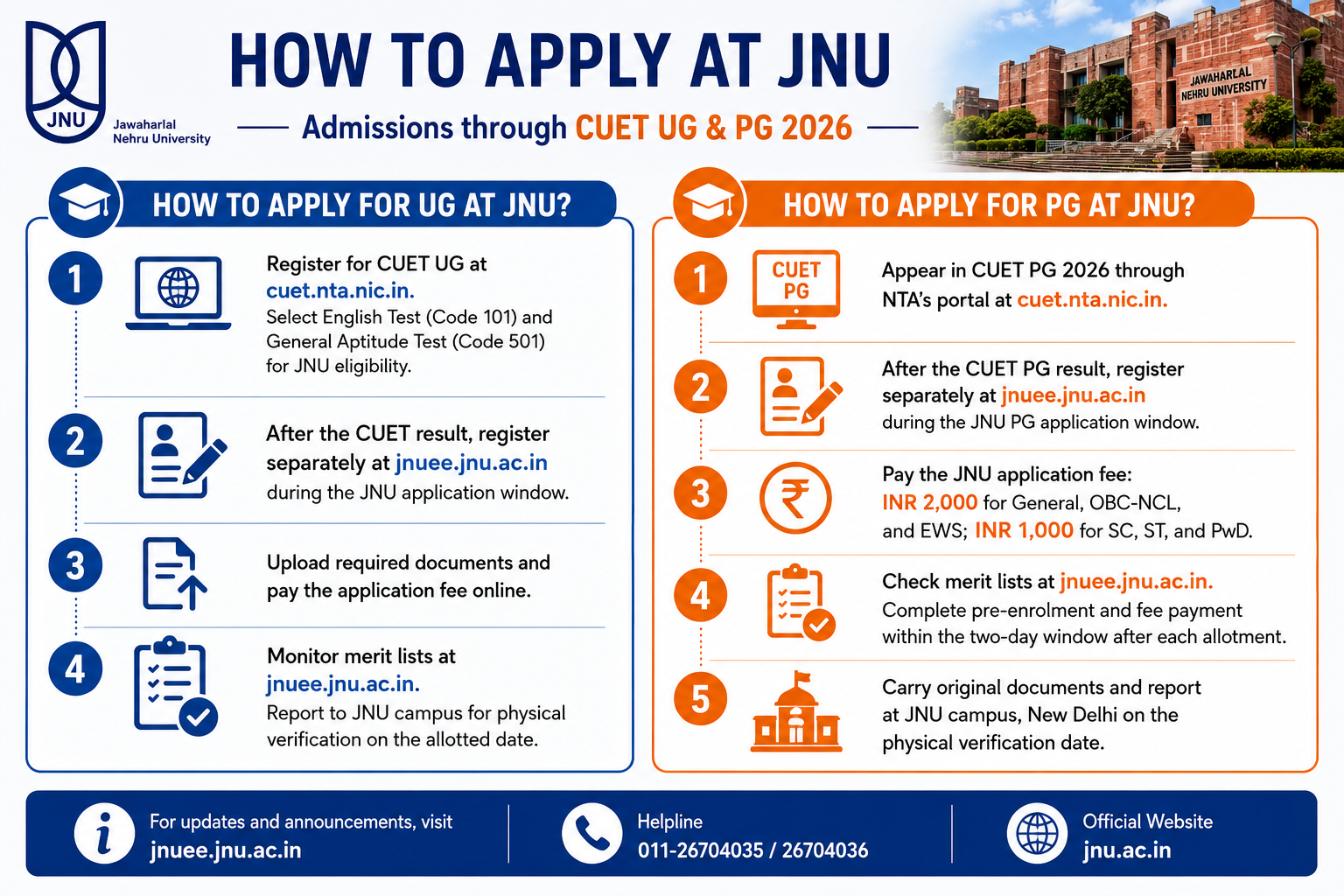
JNU PG admissions are via CUET‑PG, with some programmes via GAT‑B and CCMT/GATE.
Step 1: Check Eligibility & Exam Route
- Verify UG degree, subject requirements, and minimum percentage in the JNU PG e-prospectus.
- Identify exam channel:
- CUET-PG: Most MA/MSc/MCA/MPH/MTech (except some branches) & PG Diplomas
- GAT-B: MSc Biotechnology & Computational Biology
- GATE/CCMT: Select MTech specialisations
Step 2: Apply for Entrance Exam
- Register on CUET-PG / GAT-B / GATE portal.
- Select JNU + programme codes, upload documents, pay fees.
- Appear for exam and save scorecard & application details.
Step 3: Register on JNU PG Portal
- After results, apply on the JNU PG admission portal.
- Enter details, exam scores, and programme preferences.
- Use correction window if needed; admissions run in multiple rounds.
Step 4: Merit List & Pre-Enrolment
- JNU releases multiple merit lists based on scores and reservation norms.
- If allotted, complete pre-enrolment: confirm seat, upload documents, pay initial fee.
Step 5: Verification & Final Registration
- Report to JNU for physical document verification.
- Pay remaining fees to complete registration.
- Final spot rounds may be held for vacant seats.
JNU PhD Admission Process 2026
From 2025‑26, JNU PhD admissions have largely shifted to a NET/JRF/GATE‑based model in line with revised UGC regulations. Internal entrance tests are retained only for limited programmes if notified.
Step 1: Check Eligibility & Exam Score
- Master’s degree in relevant discipline with ~55% marks (5% relaxation for Reserved category).
- Valid UGC/CSIR-NET or JRF from UGC/CSIR/ICMR/DBT/NBHM, or GATE score (as applicable).
Step 2: Apply on JNU PhD Portal
- Register on the JNU PhD admission portal.
- Fill personal, academic, and research details; choose permitted Centres/Schools.
- Upload documents and pay application fee online.
Step 3: Shortlisting for Viva-Voce
- Shortlisting based on NET/JRF/GATE percentile and departmental criteria.
- Interview details (date, mode, proposal/SoP if required) shared via portal/email.
Step 4: Viva-Voce & Merit List
- Selection typically uses 70% exam score + 30% viva-voce (as per UGC/JNU norms).
- Final merit list published; supervisors/research areas allotted.
Step 5: Admission & Enrolment
- Accept offer, pay fees, and complete document verification.
- Final enrolment is done in the concerned School/Centre.
JNU UG Admission Process 2026
For 2025‑26, all JNU UG and Certificate/COE/COP programmes are through CUET‑UG conducted by NTA. Basic steps:
Step 1: Check Eligibility & CUET Papers
- Pass 10+2 from a recognised board with ~45-50% marks (5% relaxation for reserved categories).
- Confirm required CUET-UG subject papers for your chosen JNU course.
Step 2: Apply for CUET-UG
- Register on the NTA CUET-UG portal.
- Select JNU + relevant test papers, upload documents, pay fee.
- Download the admit card and appear for the exam.
Step 3: Register for JNU Counselling
- After CUET results, register on JNU’s UG Admission through CUET portal.
- Enter CUET details, academic info, and set programme preferences.
Step 4: Merit List & Seat Allocation
- JNU releases merit lists based mainly on CUET scores (with other criteria if applicable).
- Accept/upgrade allotted seat and upload documents online.
Step 5: Verification & Final Admission
- Report to JNU for physical verification and pay admission fee.
- Further rounds/spot admissions held if seats remain vacant.
According to Arundhati Das, a BA (Hons.) Arabic student, the course is engaging, particularly for those interested in learning languages like Arabic. Students benefit from small class sizes and supportive faculty at JNU. Internships and placements are primarily available in embassies or international companies. Campus life emphasizes academics, sports, and library use, while hostels are well-equipped and offer good food. Overall, the program is affordable and provides strong preparation for future careers abroad. - Click Here to Read the Detailed Review
Important Documents Required for JNU Admission 2026
Candidates must keep original documents and scanned copies ready for online upload, pre-enrolment, and physical verification.
Common Documents (UG / PG / PhD)
- Recent passport-size photographs
- Scanned signature
- Valid photo ID proof
- Date of Birth proof
- Category certificate in Government of India format, if applicable
- PwD certificate, if applicable
- Income certificate
- Migration / Transfer Certificate
- Anti-ragging affidavit
- Character/Conduct Certificate
Entrance Examination Documents
- CUET-UG / CUET-PG scorecard
- GAT-B scorecard
- GATE scorecard
- UGC/CSIR-NET / JRF certificate
- Entrance exam application form & admit card
Academic Qualification Documents
For UG Admission
- Class 10 marksheet & certificate
- Class 12 marksheet & certificate
For PG Admission
- UG marksheets (all semesters/years)
- UG degree / provisional certificate
For PhD Admission
- PG marksheets (all semesters/years)
- PG degree / provisional certificate
- Research proposal / Statement of Purpose (SoP) (if required by Centre)
- Experience certificates (if applicable)
Reservation & Special Category Documents
- OBC-NCL certificate (issued on or after 1 April of the admission year)
- EWS certificate (valid for the current financial year)
- Kashmiri Migrant certificate
- Defence / JNU employee ward certificate
- Foreign/NRI candidate documents (passport, visa, equivalence certificate)
During Pre-Enrolment & Final Registration
- Seat acceptance / pre-enrolment receipt
- Fee payment receipts
- Undertakings or declarations as notified by JNU
- Medical fitness certificate (if required)
JNU Cutoff 2026
To get admission in any courses at JNU, candidates must appear for the entrance exams such as CUET UG & PG, JEE Main, GATE, along with the CSAB Counselling. Below are the JNU cutoff of different national level test:
JNU CUET PG Cutoff 2025
The overall cutoff marks for CUET PG is 27 - 99. JNU CUET PG Cutoff 2025 for General Category is listed below.
| Courses |
First Round |
Last Round |
| MA Hindi |
99 |
- |
| MA Functional Hindi and Translation |
94 |
- |
| MA Sanskrit |
92 |
- |
| MA English |
89 |
- |
| MA Urdu |
86 |
- |
| MA Arabic |
85 |
- |
| MA International Studies |
84 |
- |
| MA Philosophy |
84 |
- |
| MA Political Science |
83 |
- |
| MA International Relations |
82 |
- |
| MA Sociology |
79 |
78 |
| MA Chinese |
76 |
- |
| MA French |
76 |
- |
| MCA |
76 |
73 |
| MPH |
76 |
- |
| MA Labour and Development |
73 |
- |
| MA Ancient History |
71 |
- |
| MA Linguistics |
71 |
- |
| M.Sc Life Science |
71 |
- |
| MA Geography |
69 |
- |
| M.Sc Molecular Medicine |
68 |
65 |
| M.Sc Mathematics |
67 |
- |
| MA Medieval History |
67 |
- |
| MA World Economy |
66 |
61 |
| M.Sc Environmental Science |
65 |
- |
| M.Sc Physics |
65 |
- |
| MA Economics |
64 |
61 |
| MA Disaster Management |
62 |
- |
| MA Korean |
59 |
- |
| MA Spanish |
59 |
- |
| M.Sc Chemistry |
58 |
- |
| M.Tech Computer Science & Technology |
51 |
- |
| MA Russian Studies |
50 |
45 |
| M.Tech Data Science |
49 |
- |
| PG Diploma in Big Data Analytics |
48 |
- |
| MA Arts and Aesthetics |
46 |
- |
| MA Persian |
32 |
- |
| M.Tech. Nano Electronics |
32 |
- |
| M.Tech Nano Science and Technology |
27 |
- |
| M.Sc Computational and Integrative Sciences |
- |
50 |
JNU JEE Main Cutoff 2025
The overall cutoff rank for JEE Main is 25706 - 33831. JNU JEE Main Cutoff 2025 for General Category is listed below.
| Courses |
First Round |
Last Round |
| B.Tech Computer Science Engineering |
25706 |
31402 |
| B.Tech Electronics & Communication Engineering |
33831 |
41588 |
JNU CUET Cutoff 2025
The overall cutoff marks for CUET is 59 - 74. JNU CUET Cutoff 2025 for General Category is listed below.
| Courses |
First Round |
Last Round |
| BA (Hons.) Japanese |
74 |
64 |
| BA (Hons.) French |
74 |
65 |
| BA (Hons.) German |
73 |
65 |
| BA (Hons.) Spanish |
70 |
64 |
| BA (Hons.) Korean |
69 |
62 |
| BA (Hons.) Chinese |
68 |
63 |
| BA Hons. (Russian) |
67 |
61 |
| BA (Hons.) Persian |
64 |
57 |
| BA (Hons.) Arabic |
62 |
55 |
| BA Hons. Pashto |
59 |
55 |
JNU GATE Cutoff 2025
The overall cutoff marks for GATE is 400 - 592. JNU GATE Cutoff 2025 for General Category is listed below.
| Courses |
First Round |
Last Round |
| M.Tech Computer Science and Engineering |
592 |
509 |
| M.Tech Electronics and Communication Engineering |
400 |
350 |
JNU CSAB Counselling Cutoff 2025
JNU admits students to B.Tech courses through CSAB Counselling. By checking the CSAB Counselling 2025 cutoff, students can get an idea of the scores required for admission to JNU. Below is the category-wise JNU CSAB Counselling Cutoff 2025 (All India).
| Category |
First Round |
Last Round |
| General |
49000 |
55021 |
| SC |
176215 |
- |
| ST |
270446 |
300293 |
| EWS |
57267 |
62547 |
| OBCNCL |
60671 |
71004 |
JNU Admission FAQs
Ques. Can I get admission in JNU if my CUET score is 348/450 (English+GT)?
Ans. Yes, you may have a chance, but it depends on the course, your category, and the specific cutoff for that program at JNU. A 348/450 CUET score is generally competitive, especially for some language, social science, or less high-demand programs, but for very popular courses, cutoffs can be higher. Final admission also depends on merit lists, seat availability, and counseling rounds.
Ques. How is MA Sociology at JNU in terms of academics, classes, attendance, UPSC relevance?
Ans. MA Sociology at JNU is academically rigorous, theory- and research-focused, with heavy reading, seminars, and assignments. Attendance isn’t strictly enforced, but regular participation helps with grades and faculty support. It aligns well with UPSC sociology optional, though balancing prep with coursework can be challenging due to the workload.
Ques. What subjects are taught in JNU's MA in International Relations and Area Studies?
Ans. JNU MA in International Relations and Area Studies (IRAS) teaches core subjects like International Relations theories, International Law, Foreign Policy, Area Studies, and Research Methods. Students can also choose optional courses about different regions like South Asia, East Asia, West Asia, Africa, and topics like nation-building, security, and development. The course gives a good mix of theory, research skills, and knowledge about different parts of the world.
Ques. What is the JNU M.Tech in Geotechnical Engineering program like?
Ans. JNU M.Tech in Geotechnical Engineering is a 2-year program that focuses on soil and rock behavior, foundations, retaining structures, and ground improvement. It includes theory, lab work, projects, and sometimes computer modelling to solve real-world construction and infrastructure problems. Graduates can work in construction, consulting, research, or government projects.
Ques. Can I get into JNU master’s courses without CUET‑PG?
Ans. No, for most master’s programs at JNU, including MA and M.Tech courses, CUET (or the specific JNU entrance test) is now required for admission. JNU has mostly stopped direct admissions or merit-based entry without CUET, except in very rare cases like certain PhD programs, sponsored candidates, or international students. So if you are applying for regular MA/M.Tech courses as a general student, you cannot get in without CUET.
Ques. What is the last date to register for JNU 2026?
Ans. For JNU 2026 admissions, the last date to apply depends on the program. For CUET‑PG, the application deadline was January 14, 2026. For most JNU programs that use CUET scores, the admission registration usually opens around July–August 2026, with the final deadline likely in August. It’s important to check JNU’s official website for the exact dates and updates.
Comments