The National Testing Agency (NTA) conducted the CUET PG 2026 Public Health (COQP19) examination on March 19, 2026, during Shift 1 from 09:00 AM to 10:30 AM.

Students who appeared for the exam reported that the overall difficulty level of the paper was moderate. CUET PG 2026 Public Health Question Paper with Solutions PDF is available here for download. The marking scheme is +4 for correct answers and -1 for wrong answers, totaling 300 marks.

CUET PG 2026 Public Health Question Paper with Solutions PDF

CUET PG 2026 Public Health Question Paper with Answer Key Download PDF Check Solutions

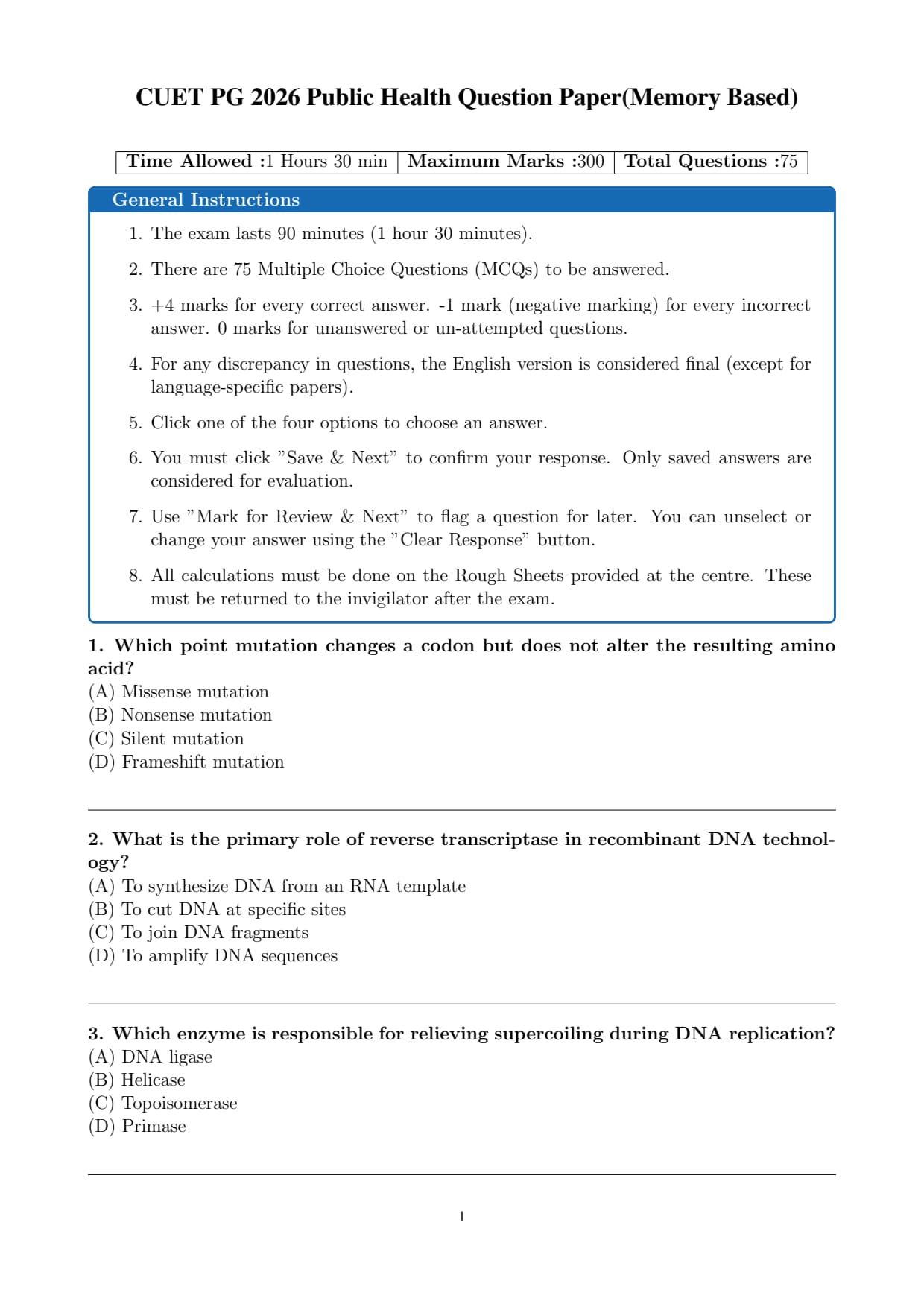
Question 1:

Which point mutation changes a codon but does not alter the resulting amino acid?

  • (A) Missense mutation
  • (B) Nonsense mutation
  • (C) Silent mutation
  • (D) Frameshift mutation

Question 2:

What is the primary role of reverse transcriptase in recombinant DNA technology?

  • (A) To synthesize DNA from an RNA template
  • (B) To cut DNA at specific sites
  • (C) To join DNA fragments
  • (D) To amplify DNA sequences

Question 3:

Which enzyme is responsible for relieving supercoiling during DNA replication?

  • (A) DNA ligase
  • (B) Helicase
  • (C) Topoisomerase
  • (D) Primase

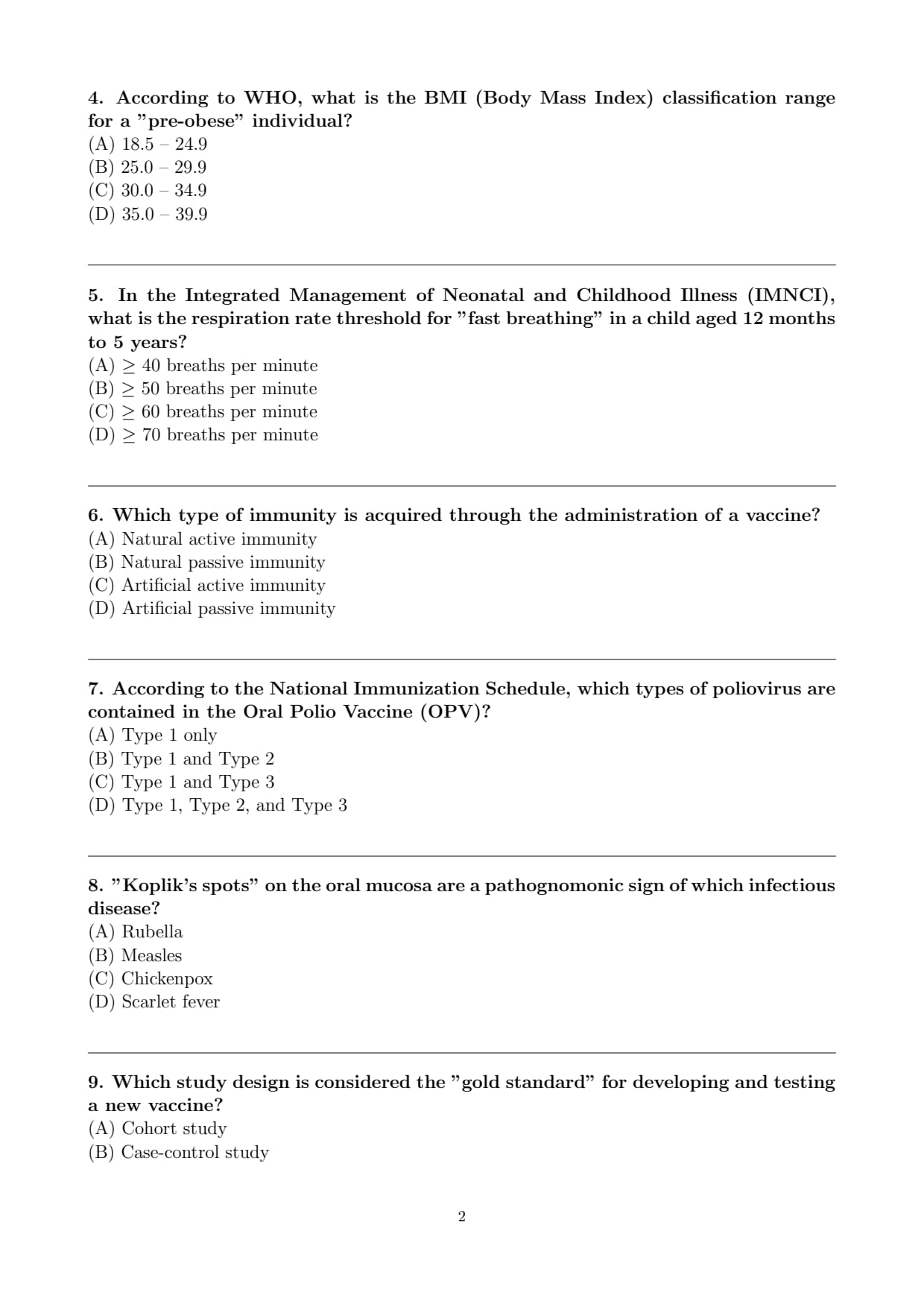
Question 4:

According to WHO, what is the BMI (Body Mass Index) classification range for a "pre-obese" individual?

  • (A) 18.5 -- 24.9
  • (B) 25.0 -- 29.9
  • (C) 30.0 -- 34.9
  • (D) 35.0 -- 39.9

Question 5:

In the Integrated Management of Neonatal and Childhood Illness (IMNCI), what is the respiration rate threshold for "fast breathing" in a child aged 12 months to 5 years?

  • (A) \(\geq\) 40 breaths per minute
  • (B) \(\geq\) 50 breaths per minute
  • (C) \(\geq\) 60 breaths per minute
  • (D) \(\geq\) 70 breaths per minute

Question 6:

Which type of immunity is acquired through the administration of a vaccine?

  • (A) Natural active immunity
  • (B) Natural passive immunity
  • (C) Artificial active immunity
  • (D) Artificial passive immunity

Question 7:

According to the National Immunization Schedule, which types of poliovirus are contained in the Oral Polio Vaccine (OPV)?

  • (A) Type 1 only
  • (B) Type 1 and Type 2
  • (C) Type 1 and Type 3
  • (D) Type 1, Type 2, and Type 3

Question 8:

"Koplik's spots" on the oral mucosa are a pathognomonic sign of which infectious disease?

  • (A) Rubella
  • (B) Measles
  • (C) Chickenpox
  • (D) Scarlet fever

Question 9:

Which study design is considered the "gold standard" for developing and testing a new vaccine?

  • (A) Cohort study
  • (B) Case-control study
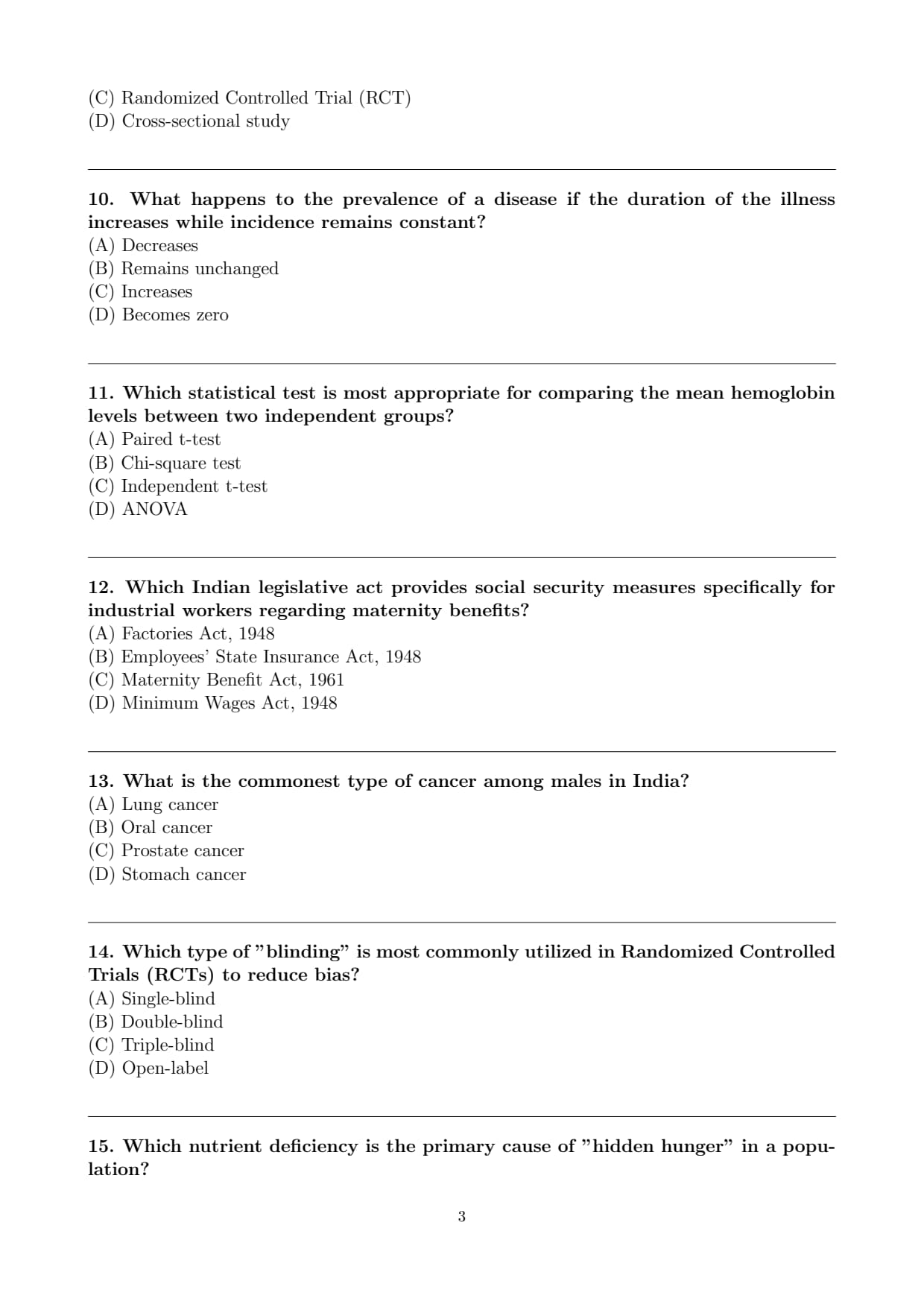
  • (C) Randomized Controlled Trial (RCT)
  • (D) Cross-sectional study

Question 10:

What happens to the prevalence of a disease if the duration of the illness increases while incidence remains constant?

  • (A) Decreases
  • (B) Remains unchanged
  • (C) Increases
  • (D) Becomes zero

Question 11:

Which statistical test is most appropriate for comparing the mean hemoglobin levels between two independent groups?

  • (A) Paired t-test
  • (B) Chi-square test
  • (C) Independent t-test
  • (D) ANOVA

Question 12:

Which Indian legislative act provides social security measures specifically for industrial workers regarding maternity benefits?

  • (A) Factories Act, 1948
  • (B) Employees' State Insurance Act, 1948
  • (C) Maternity Benefit Act, 1961
  • (D) Minimum Wages Act, 1948

Question 13:

What is the commonest type of cancer among males in India?

  • (A) Lung cancer
  • (B) Oral cancer
  • (C) Prostate cancer
  • (D) Stomach cancer

Question 14:

Which type of "blinding" is most commonly utilized in Randomized Controlled Trials (RCTs) to reduce bias?

  • (A) Single-blind
  • (B) Double-blind
  • (C) Triple-blind
  • (D) Open-label

Question 15:

Which nutrient deficiency is the primary cause of "hidden hunger" in a population?
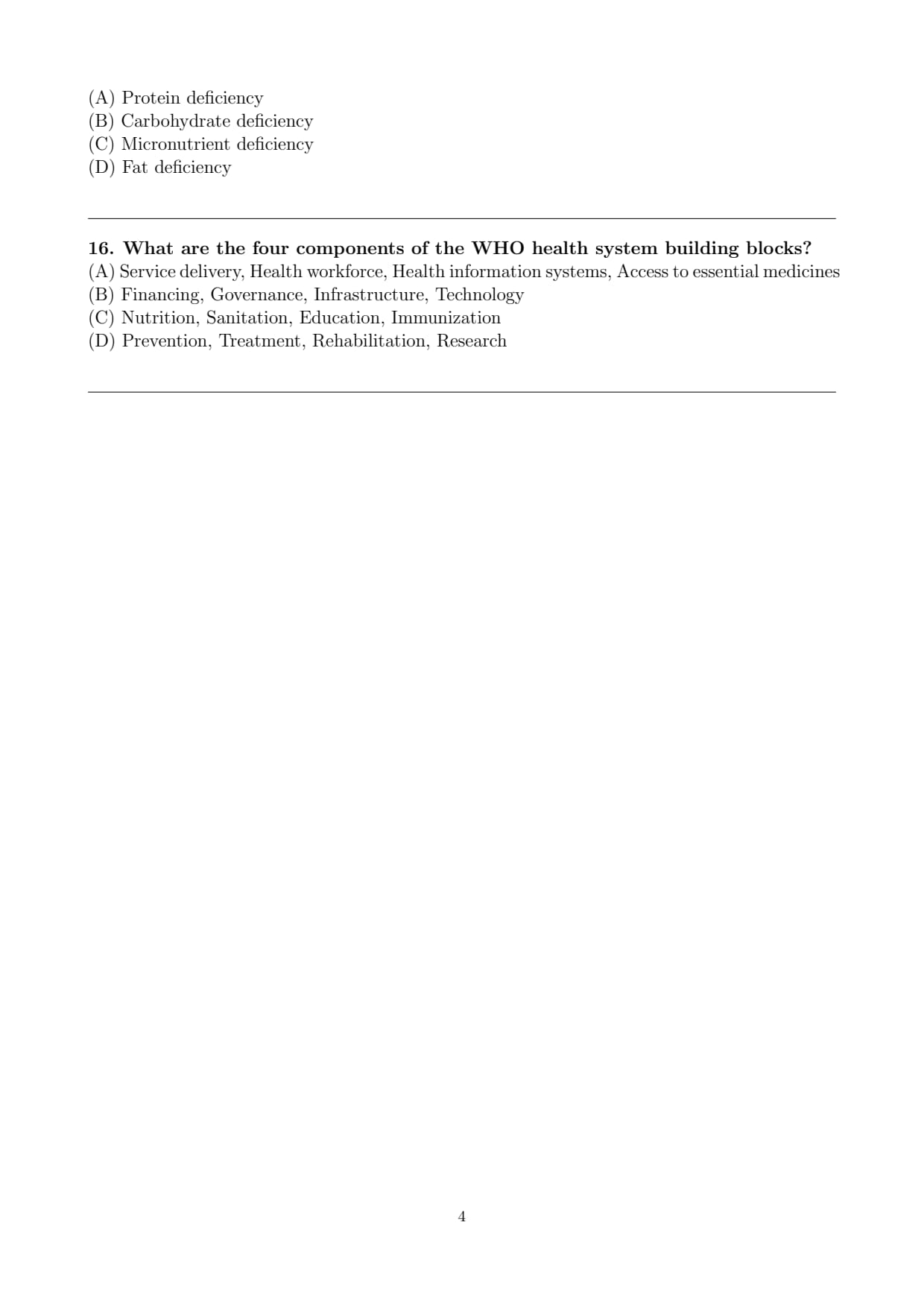
  • (A) Protein deficiency
  • (B) Carbohydrate deficiency
  • (C) Micronutrient deficiency
  • (D) Fat deficiency

Question 16:

What are the four components of the WHO health system building blocks?

  • (A) Service delivery, Health workforce, Health information systems, Access to essential medicines
  • (B) Financing, Governance, Infrastructure, Technology
  • (C) Nutrition, Sanitation, Education, Immunization
  • (D) Prevention, Treatment, Rehabilitation, Research

CUET PG 2026 Public Health Preparation