




The National Testing Agency (NTA) conducted the CUET PG 2026 Mathematics (SCQP19) examination on March 18, 2026, during Shift 2 from 12:30 PM to 02:00 PM.
Students who appeared for the exam reported that the overall difficulty level of the paper was moderate to difficult. CUET PG 2026 Mathematics Question Paper with Solutions PDF is available here for download. The marking scheme is +4 for correct answers and -1 for wrong answers, totaling 300 marks.
CUET PG 2026 Mathematics Question Paper with Solutions PDF
| CUET PG 2026 Mathematics Question Paper with Answer Key | Download PDF | Check Solutions |

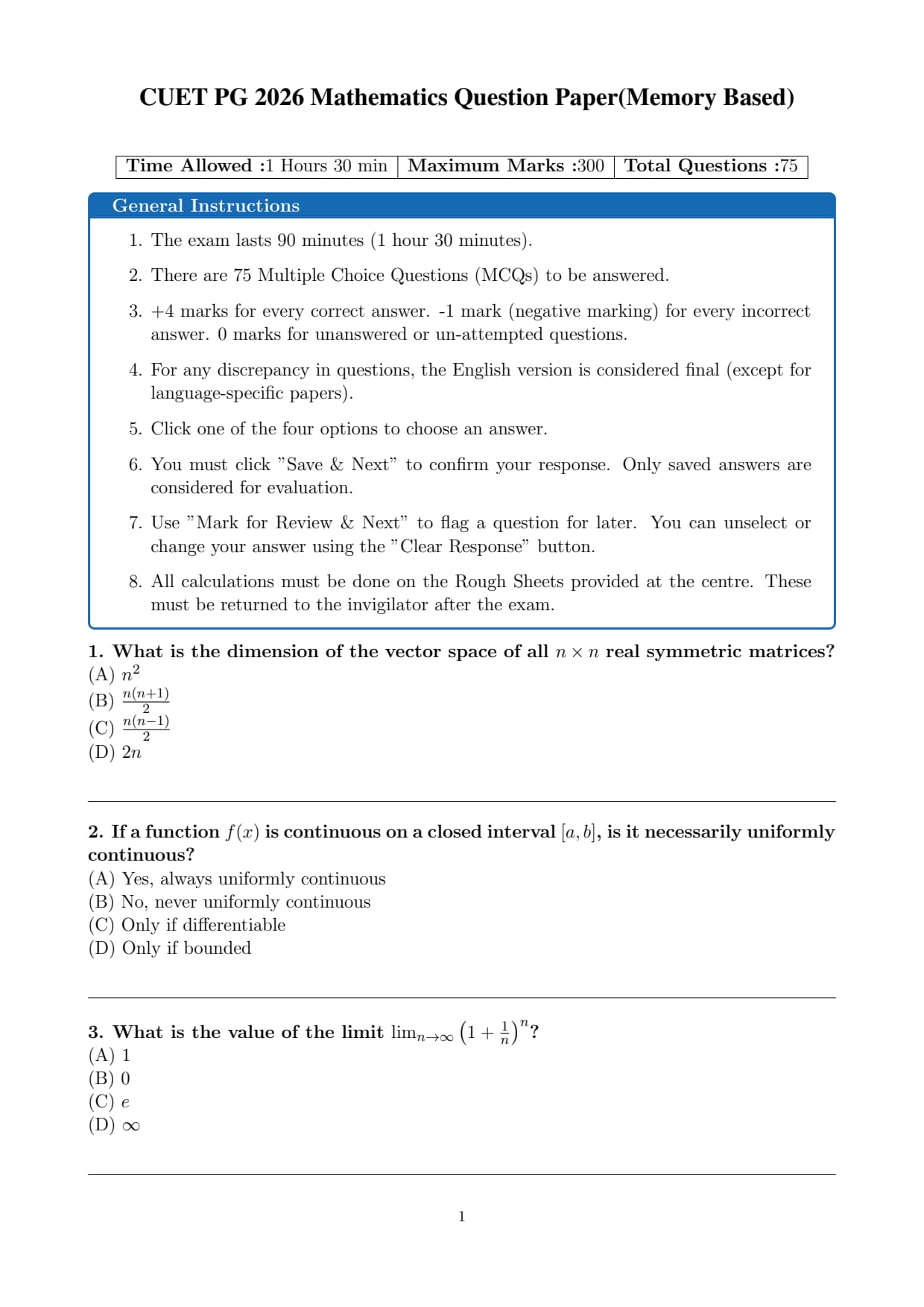
What is the dimension of the vector space of all \( n \times n \) real symmetric matrices?
View Solution
Concept:
A real symmetric matrix satisfies: \[ A^T = A \]
This means the entries are symmetric about the main diagonal.
Step 1: Count diagonal elements
There are \( n \) diagonal elements: \[ a_{11}, a_{22}, \dots, a_{nn} \]
Step 2: Count off-diagonal elements
For \( i \neq j \), we have: \[ a_{ij} = a_{ji} \]
So each pair contributes only one independent element.
Number of such pairs: \[ \frac{n(n-1)}{2} \]
Step 3: Total independent elements
\[ n + \frac{n(n-1)}{2} = \frac{n(n+1)}{2} \]
Hence, the dimension is: \[ \frac{n(n+1)}{2} \] Quick Tip: Symmetric matrix dimension = diagonal + upper triangle
= \( n + \frac{n(n-1)}{2} = \frac{n(n+1)}{2} \)
If a function \( f(x) \) is continuous on a closed interval \( [a,b] \), is it necessarily uniformly continuous?
View Solution
Concept: Heine–Cantor Theorem
A very important result in real analysis states:
If a function is continuous on a closed and bounded interval \( [a,b] \),
Then it is uniformly continuous on that interval.
Step 1: Understand continuity vs uniform continuity
Continuity: For every point \(x\), we can find a \(\delta\) depending on \(x\).
Uniform continuity: A single \(\delta\) works for all \(x \in [a,b]\).
Step 2: Apply the theorem
Since the function is continuous on a closed interval \( [a,b] \), it satisfies: \[ Uniform continuity on [a,b] \]
Step 3: Why closed interval matters
Closed intervals are:
Bounded
Contain all limit points
This ensures no “escape” of function behavior at endpoints.
Conclusion: \[ The function is always uniformly continuous. \] Quick Tip: Continuous on closed interval \( \Rightarrow \) Uniformly continuous (Always true!)
What is the value of the limit \( \lim_{n \to \infty} \left(1 + \frac{1}{n}\right)^n \)?
View Solution
Concept: Definition of \(e\)
The number \(e\) is defined as: \[ e = \lim_{n \to \infty} \left(1 + \frac{1}{n}\right)^n \]
Step 1: Recognize the standard limit
The given expression is a direct standard limit used to define \(e\).
Step 2: Intuition behind the limit
This expression arises in:
Compound interest problems
Continuous growth models
As \(n\) increases, the quantity: \[ \left(1 + \frac{1}{n}\right)^n \]
approaches a fixed number.
Step 3: Numerical idea
\[ n=1 \Rightarrow 2,\quad n=2 \Rightarrow 2.25,\quad n=10 \Rightarrow 2.593,\quad n \to \infty \Rightarrow 2.718... \]
Step 4: Final value
\[ \lim_{n \to \infty} \left(1 + \frac{1}{n}\right)^n = e \approx 2.718 \]
Conclusion: \[ Limit value is e \] Quick Tip: Always remember: \[ \left(1 + \frac{1}{n}\right)^n \rightarrow e \] A standard and very important limit in calculus.
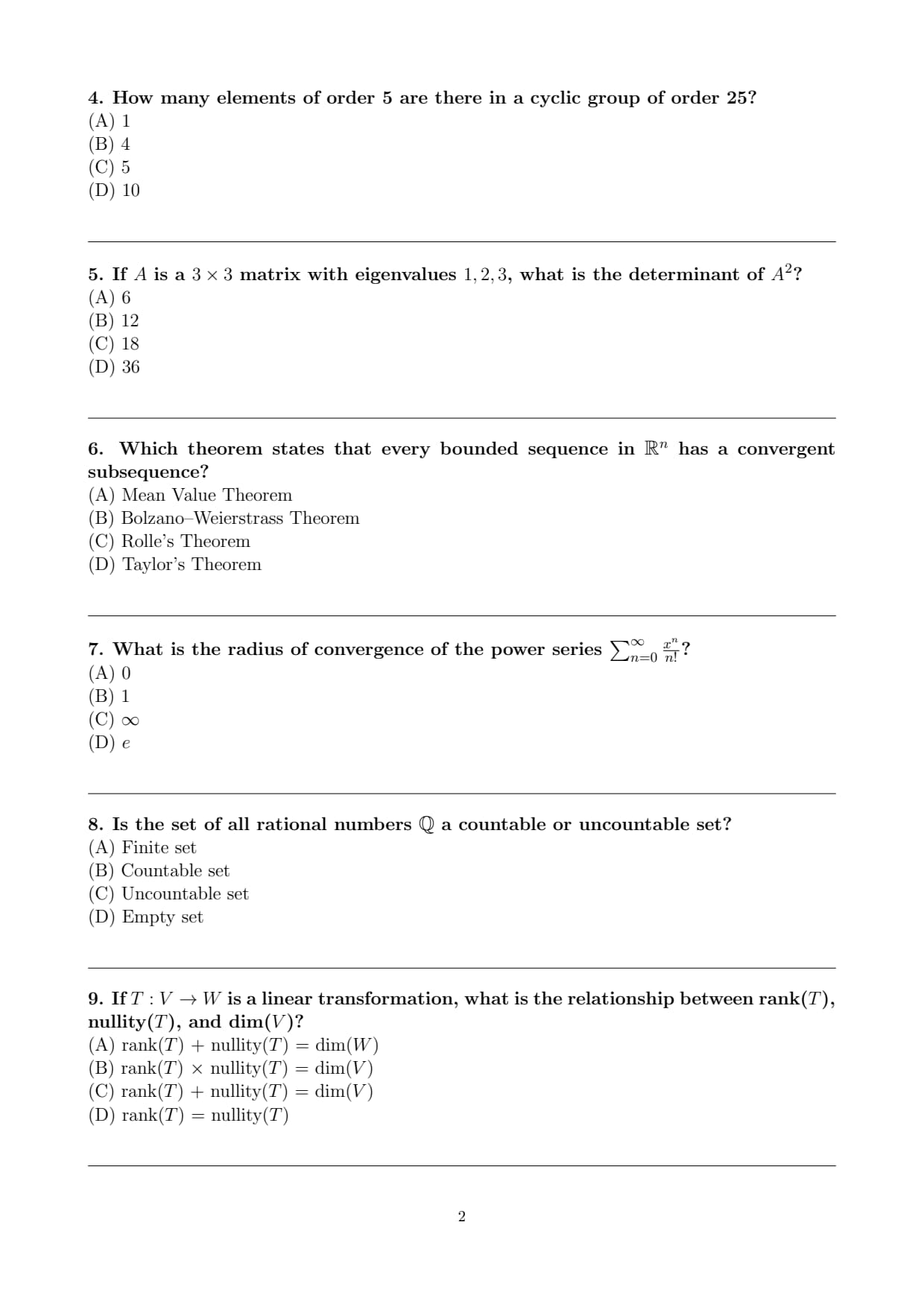
How many elements of order 5 are there in a cyclic group of order 25?
View Solution
Concept: Order of elements in a cyclic group
In a cyclic group of order \( n \), the number of elements of order \( d \) (where \( d \mid n \)) is given by Euler’s totient function: \[ \phi(d) \]
Step 1: Identify the group order
\[ n = 25 = 5^2 \]
Step 2: Find valid divisors
Possible orders divide 25: \[ 1, 5, 25 \]
We need elements of order \(5\).
Step 3: Apply Euler's totient function
\[ \phi(5) = 5 - 1 = 4 \]
Step 4: Interpretation
There are exactly 4 generators of the subgroup of order 5.
Conclusion: \[ Number of elements of order 5 = 4 \] Quick Tip: In cyclic groups: Number of elements of order \(d\) = \( \phi(d) \)
If \( A \) is a \(3 \times 3\) matrix with eigenvalues \(1, 2, 3\), what is the determinant of \(A^2\)?
View Solution
Concept 1: Determinant and eigenvalues
The determinant of a matrix is equal to the product of its eigenvalues: \[ \det(A) = \lambda_1 \cdot \lambda_2 \cdot \lambda_3 \]
Step 1: Compute determinant of \(A\)
Given eigenvalues: \[ 1, 2, 3 \] \[ \det(A) = 1 \times 2 \times 3 = 6 \]
Concept 2: Determinant of powers
For any square matrix: \[ \det(A^k) = (\det A)^k \]
Step 2: Apply the formula for \(A^2\)
\[ \det(A^2) = (\det A)^2 = 6^2 = 36 \]
Step 3: Alternative understanding
Eigenvalues of \(A^2\) are: \[ 1^2, 2^2, 3^2 = 1, 4, 9 \] \[ \det(A^2) = 1 \times 4 \times 9 = 36 \]
Conclusion: \[ \det(A^2) = 36 \] Quick Tip: Two useful results: Product of eigenvalues = determinant \( \det(A^k) = (\det A)^k \)
Which theorem states that every bounded sequence in \( \mathbb{R}^n \) has a convergent subsequence?
View Solution
Concept: Bolzano–Weierstrass Theorem
This is a fundamental theorem in real analysis which states:
Every bounded sequence in \( \mathbb{R}^n \) has at least one convergent subsequence.
Step 1: Understand bounded sequence
A sequence \( \{x_n\} \) is bounded if: \[ \exists M > 0 such that \|x_n\| \leq M for all n \]
Step 2: Apply the theorem
If the sequence is bounded, then it cannot “escape to infinity,” so there exists a subsequence that converges.
Step 3: Conclusion
\[ Bolzano–Weierstrass Theorem guarantees convergence of a subsequence \] Quick Tip: Bounded sequence \( \Rightarrow \) Convergent subsequence (always!)
What is the radius of convergence of the power series \( \sum_{n=0}^{\infty} \frac{x^n}{n!} \)?
View Solution
Concept: Radius of convergence using Ratio Test
For a power series: \[ \sum a_n x^n \]
the radius of convergence \(R\) is found using: \[ \lim_{n \to \infty} \left| \frac{a_{n+1}}{a_n} \right| \]
Step 1: Identify coefficients
\[ a_n = \frac{1}{n!} \]
Step 2: Apply Ratio Test
\[ \left| \frac{a_{n+1}}{a_n} \right} = \frac{1}{(n+1)!} \cdot n! = \frac{1}{n+1} \]
Step 3: Take the limit
\[ \lim_{n \to \infty} \frac{1}{n+1} = 0 \]
Step 4: Interpretation
Since the limit is 0 for all \(x\), the series converges for all real \(x\).
Conclusion: \[ R = \infty \] Quick Tip: \(\sum \frac{x^n}{n!} = e^x\)
Exponential series converges for all real numbers \(x\)
Is the set of all rational numbers \( \mathbb{Q} \) a countable or uncountable set?
View Solution
Concept: Countability of sets
A set is called:
Countable if its elements can be put in one-to-one correspondence with \( \mathbb{N} \)
Uncountable if this is not possible
Step 1: Form of rational numbers
Every rational number can be written as: \[ \frac{p}{q}, \quad p \in \mathbb{Z},\; q \in \mathbb{N} \]
Step 2: Arrangement idea
We can arrange all such fractions in a grid and traverse them diagonally (Cantor’s method), ensuring every rational number is listed.
Step 3: Conclusion
Since all rational numbers can be listed in a sequence: \[ \mathbb{Q} is countable \] Quick Tip: Even though rationals are infinite, they are still countable!
If \( T: V \to W \) is a linear transformation, what is the relationship between rank(\(T\)), nullity(\(T\)), and dim(\(V\))?
View Solution
Concept: Rank–Nullity Theorem
This is a fundamental theorem in linear algebra which states: \[ rank(T) + nullity(T) = \dim(V) \]
Step 1: Understand terms
Rank: Dimension of the image (range) of \(T\)
Nullity: Dimension of the kernel (null space) of \(T\)
dim(\(V\)): Dimension of domain space
Step 2: Interpretation
The theorem splits the domain space into:
Part mapped to zero (kernel)
Part mapped to image
Step 3: Conclusion
\[ rank(T) + nullity(T) = \dim(V) \] Quick Tip: Always remember: \[ Rank + Nullity = Dimension of domain \]
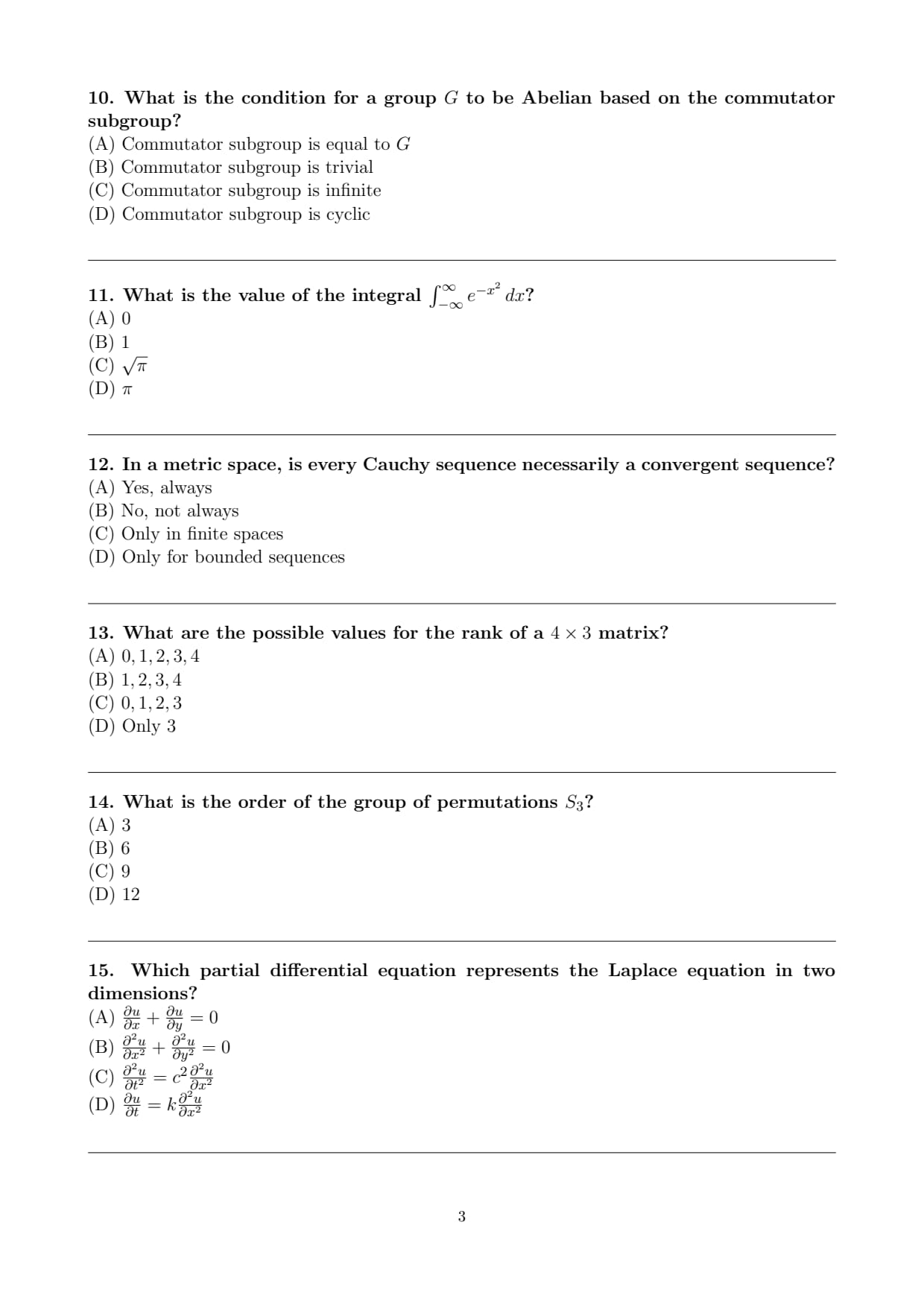
What is the condition for a group \( G \) to be Abelian based on the commutator subgroup?
View Solution
Concept: Commutator Subgroup
The commutator of two elements \(a, b \in G\) is: \[ [a,b] = aba^{-1}b^{-1} \]
The commutator subgroup \(G'\) (or \([G,G]\)) is generated by all such commutators.
Step 1: Abelian group definition
A group is Abelian if: \[ ab = ba \quad \forall a,b \in G \]
Step 2: Effect on commutators
If \(ab = ba\), then: \[ [a,b] = e \]
(identity element)
Step 3: Conclusion
All commutators are identity \( \Rightarrow \) commutator subgroup is trivial: \[ G' = \{e\} \] Quick Tip: Group is Abelian \( \Leftrightarrow \) Commutator subgroup is trivial
What is the value of the integral \( \int_{-\infty}^{\infty} e^{-x^2} \, dx \)?
View Solution
Concept: Gaussian Integral
The integral: \[ \int_{-\infty}^{\infty} e^{-x^2} dx \]
is a standard result known as the Gaussian integral.
Step 1: Define the integral
Let: \[ I = \int_{-\infty}^{\infty} e^{-x^2} dx \]
Step 2: Square the integral
\[ I^2 = \left(\int_{-\infty}^{\infty} e^{-x^2} dx \right)\left(\int_{-\infty}^{\infty} e^{-y^2} dy \right) \]
\[ = \int_{-\infty}^{\infty} \int_{-\infty}^{\infty} e^{-(x^2+y^2)} dx\,dy \]
Step 3: Convert to polar coordinates
\[ x^2 + y^2 = r^2, \quad dx\,dy = r\,dr\,d\theta \]
\[ I^2 = \int_{0}^{2\pi} \int_{0}^{\infty} e^{-r^2} r\,dr\,d\theta \]
Step 4: Evaluate the integral
\[ \int_{0}^{\infty} e^{-r^2} r\,dr = \frac{1}{2} \]
\[ I^2 = 2\pi \cdot \frac{1}{2} = \pi \]
Step 5: Final result
\[ I = \sqrt{\pi} \] Quick Tip: \[ \int_{-\infty}^{\infty} e^{-x^2} dx = \sqrt{\pi} \] A very important standard result in probability and analysis.
In a metric space, is every Cauchy sequence necessarily a convergent sequence?
View Solution
Concept: Cauchy sequence and completeness
A sequence is Cauchy if its terms get arbitrarily close to each other.
A sequence converges if it approaches a limit in the space.
Step 1: Key idea
In general metric spaces: \[ Cauchy sequence \not\Rightarrow convergent \]
Step 2: Special case
If the space is complete, then: \[ Every Cauchy sequence converges \]
Step 3: Example
In \( \mathbb{Q} \), a Cauchy sequence may converge to an irrational number, which is not in \( \mathbb{Q} \), so it does not converge in that space.
Conclusion: \[ Not every Cauchy sequence is convergent (unless space is complete) \] Quick Tip: Cauchy \( \Rightarrow \) Convergent only in complete spaces
What are the possible values for the rank of a \(4 \times 3\) matrix?
View Solution
Concept: Rank of a matrix
The rank of a matrix is the maximum number of linearly independent rows or columns.
Step 1: General rule
For an \(m \times n\) matrix: \[ rank \leq \min(m,n) \]
Step 2: Apply to given matrix
Matrix size: \[ 4 \times 3 \] \[ \min(4,3) = 3 \]
Step 3: Possible values
Rank can be any integer from \(0\) up to \(3\): \[ 0,1,2,3 \]
Step 4: Interpretation
Rank \(0\): zero matrix
Rank \(3\): full column rank
Conclusion: \[ Possible ranks = 0,1,2,3 \] Quick Tip: Rank of \(m \times n\) matrix \( \leq \min(m,n)\)
What is the order of the group of permutations \( S_3 \)?
View Solution
Concept: Symmetric Group
The symmetric group \( S_n \) consists of all permutations of \( n \) elements.
Step 1: Formula for order
\[ |S_n| = n! \]
Step 2: Apply for \(S_3\)
\[ |S_3| = 3! = 3 \times 2 \times 1 = 6 \]
Step 3: Interpretation
There are 6 possible ways to arrange 3 distinct elements.
Conclusion: \[ |S_3| = 6 \] Quick Tip: Order of symmetric group \(S_n = n!\)
Which partial differential equation represents the Laplace equation in two dimensions?
View Solution
Concept: Laplace Equation
The Laplace equation is a second-order partial differential equation widely used in physics and engineering.
Step 1: Standard form in two dimensions
\[ \frac{\partial^2 u}{\partial x^2} + \frac{\partial^2 u}{\partial y^2} = 0 \]
Step 2: Interpretation
It describes:
Steady-state heat distribution
Electrostatic potential
Fluid flow
Step 3: Identify correct option
Option (B) matches the standard Laplace equation.
Conclusion: \[ Laplace equation in 2D is \frac{\partial^2 u}{\partial x^2} + \frac{\partial^2 u}{\partial y^2} = 0 \] Quick Tip: Laplace equation = sum of second partial derivatives equals zero



Comments