The National Testing Agency (NTA) conducted the CUET PG 2026 Mass Communication (COQP17) examination on March 19, 2026, during Shift 3 from 04:00 PM to 05:30 PM.

Students who appeared for the exam reported that the overall difficulty level of the paper was moderate. CUET PG 2026 Mass Communication Question Paper with Solutions PDF is available here for download. The marking scheme is +4 for correct answers and -1 for wrong answers, totaling 300 marks.

CUET PG 2026 Mass Communication Question Paper with Solutions PDF

CUET PG 2026 Mass Communication Question Paper with Answer Key Download PDF Check Solutions

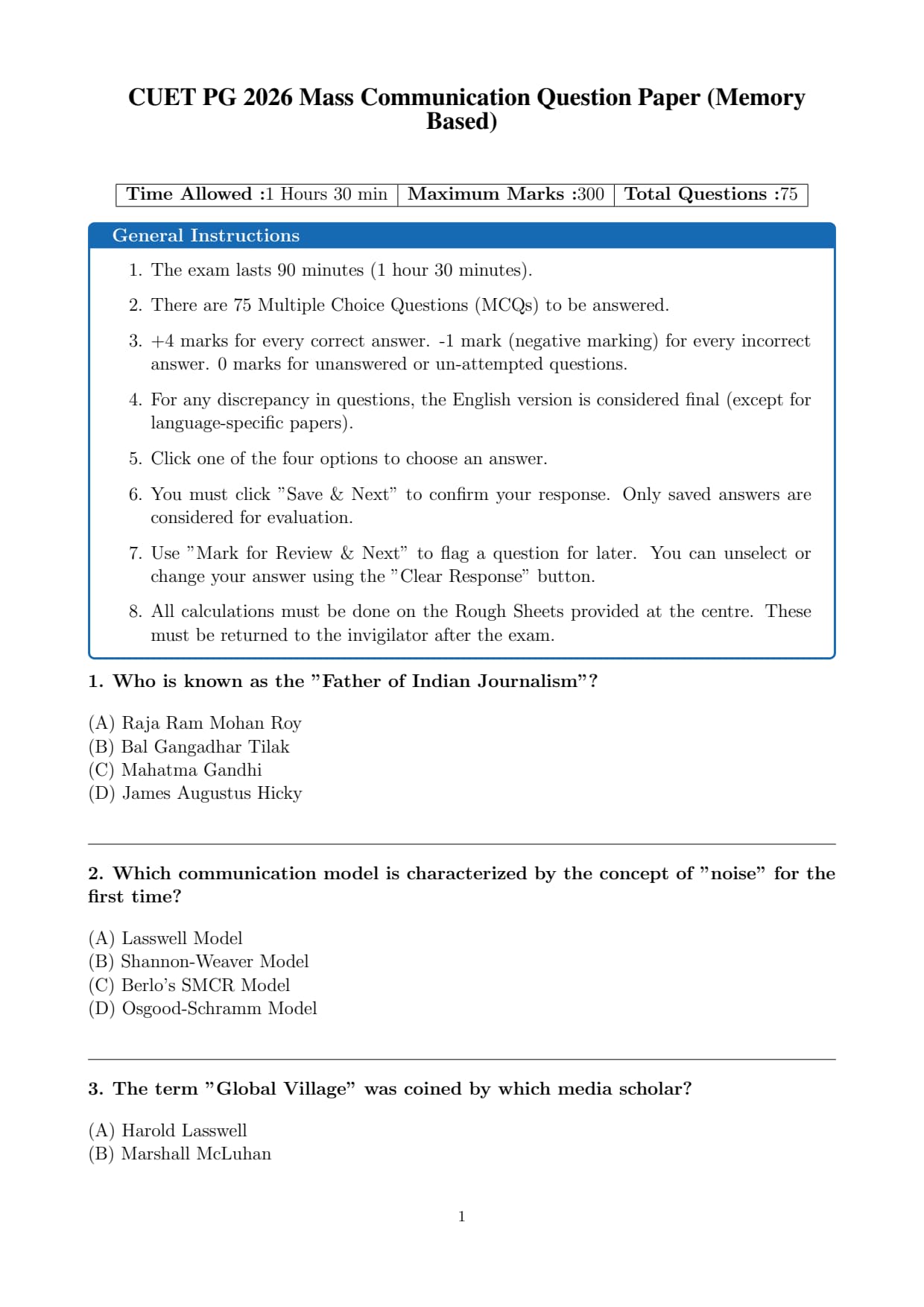
Question 1:

Who is known as the "Father of Indian Journalism"?

  • (A) Raja Ram Mohan Roy
  • (B) Bal Gangadhar Tilak
  • (C) Mahatma Gandhi
  • (D) James Augustus Hicky

Question 2:

Which communication model is characterized by the concept of "noise" for the first time?

  • (A) Lasswell Model
  • (B) Shannon-Weaver Model
  • (C) Berlo's SMCR Model
  • (D) Osgood-Schramm Model

Question 3:

The term "Global Village" was coined by which media scholar?

  • (A) Harold Lasswell
  • (B) Marshall McLuhan
  • (C) Noam Chomsky
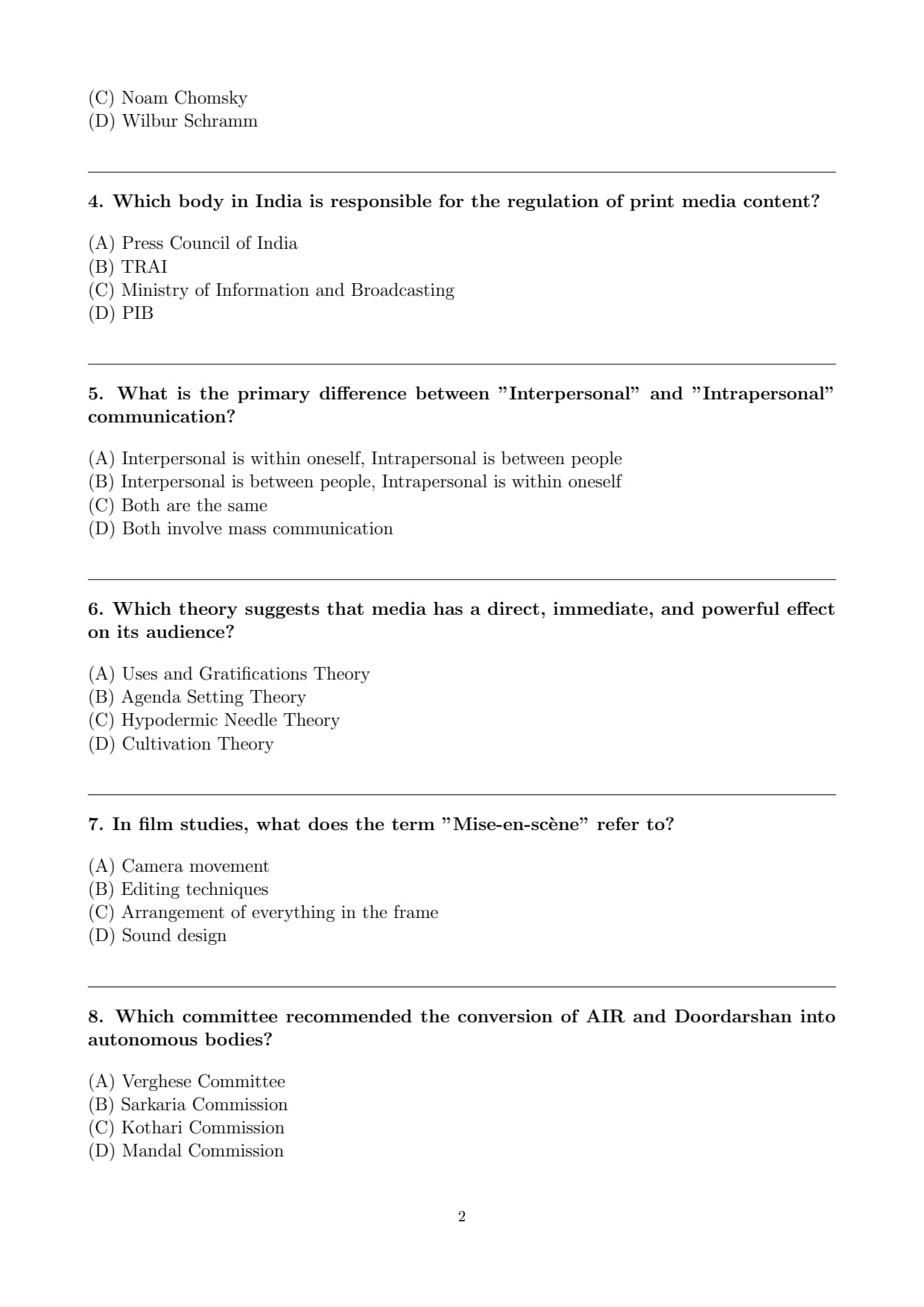
  • (D) Wilbur Schramm

Question 4:

Which body in India is responsible for the regulation of print media content?

  • (A) Press Council of India
  • (B) TRAI
  • (C) Ministry of Information and Broadcasting
  • (D) PIB

Question 5:

What is the primary difference between "Interpersonal" and "Intrapersonal" communication?

  • (A) Interpersonal is within oneself, Intrapersonal is between people
  • (B) Interpersonal is between people, Intrapersonal is within oneself
  • (C) Both are the same
  • (D) Both involve mass communication

Question 6:

Which theory suggests that media has a direct, immediate, and powerful effect on its audience?

  • (A) Uses and Gratifications Theory
  • (B) Agenda Setting Theory
  • (C) Hypodermic Needle Theory
  • (D) Cultivation Theory

Question 7:

In film studies, what does the term "Mise-en-scène" refer to?

  • (A) Camera movement
  • (B) Editing techniques
  • (C) Arrangement of everything in the frame
  • (D) Sound design

Question 8:

Which committee recommended the conversion of AIR and Doordarshan into autonomous bodies?

  • (A) Verghese Committee
  • (B) Sarkaria Commission
  • (C) Kothari Commission
  • (D) Mandal Commission

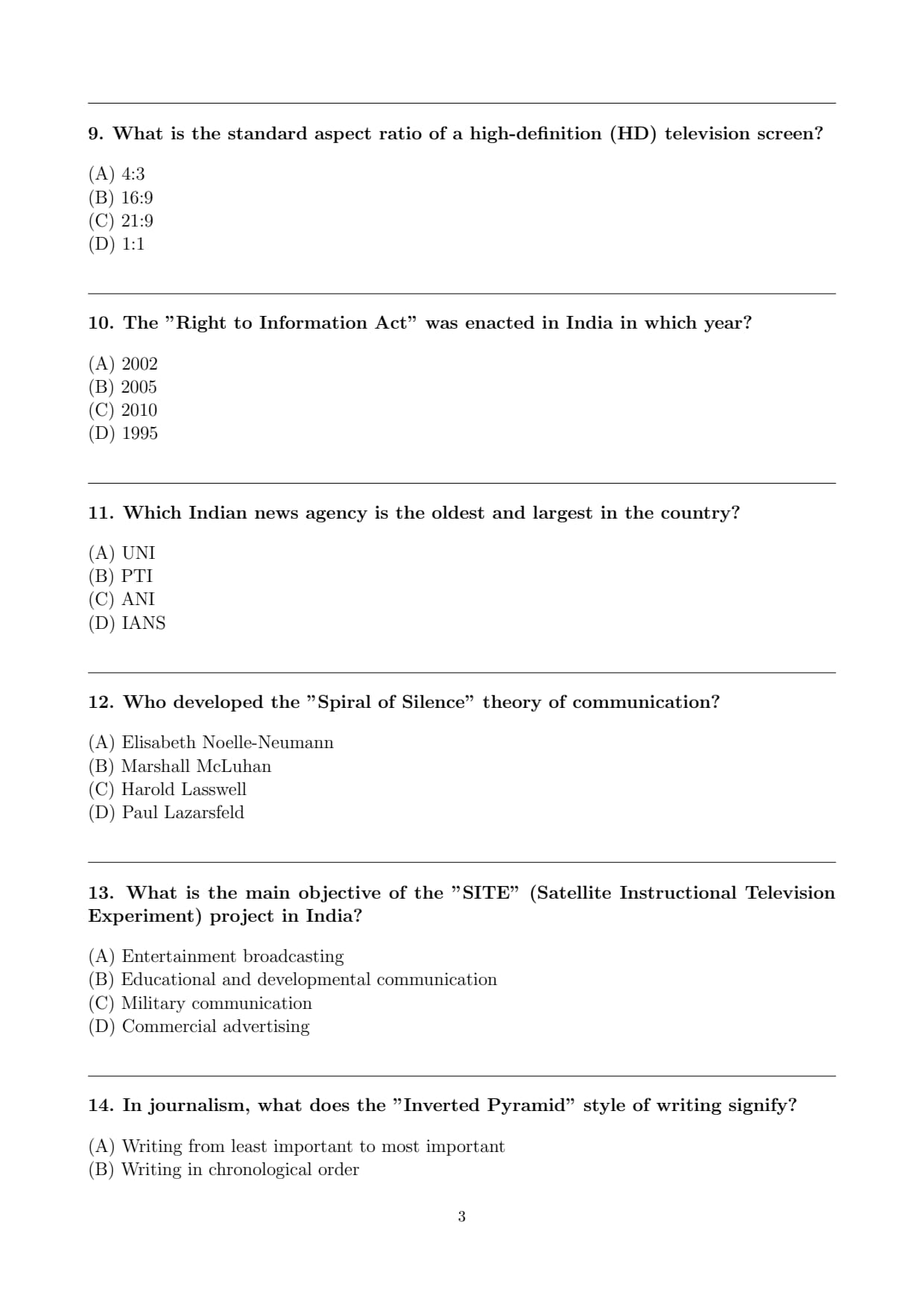
Question 9:

What is the standard aspect ratio of a high-definition (HD) television screen?

  • (A) 4:3
  • (B) 16:9
  • (C) 21:9
  • (D) 1:1

Question 10:

The "Right to Information Act" was enacted in India in which year?

  • (A) 2002
  • (B) 2005
  • (C) 2010
  • (D) 1995

Question 11:

Which Indian news agency is the oldest and largest in the country?

  • (A) UNI
  • (B) PTI
  • (C) ANI
  • (D) IANS

Question 12:

Who developed the "Spiral of Silence" theory of communication?

  • (A) Elisabeth Noelle-Neumann
  • (B) Marshall McLuhan
  • (C) Harold Lasswell
  • (D) Paul Lazarsfeld

Question 13:

What is the main objective of the "SITE" (Satellite Instructional Television Experiment) project in India?

  • (A) Entertainment broadcasting
  • (B) Educational and developmental communication
  • (C) Military communication
  • (D) Commercial advertising

Question 14:

In journalism, what does the "Inverted Pyramid" style of writing signify?

  • (A) Writing from least important to most important
  • (B) Writing in chronological order
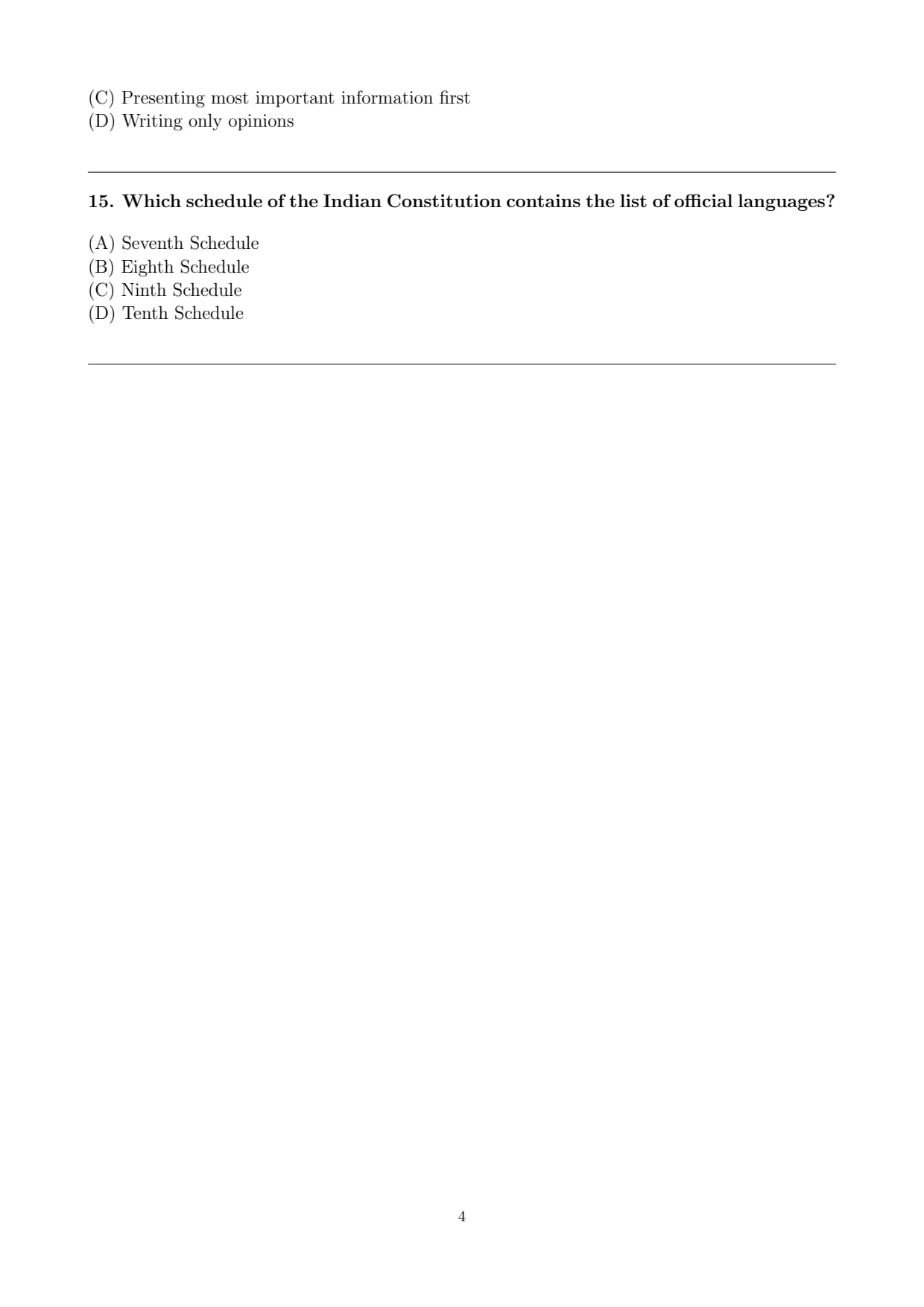
  • (C) Presenting most important information first
  • (D) Writing only opinions

Question 15:

Which schedule of the Indian Constitution contains the list of official languages?
  • (A) Seventh Schedule
  • (B) Eighth Schedule
  • (C) Ninth Schedule
  • (D) Tenth Schedule

CUET PG 2026 Mass Communication Preparation