



Content Curator
Electrical energy and power are used to run electrical equipment. Electric Power is the amount of energy transferred in an electric circuit for a given amount of time. Electricity is generated from various energy transformations like solar energy is transformed into Electrical Energy through solar panels, the conversion of nuclear energy to Electrical Energy in nuclear power plants.
Also Read: Renewable Energy
| Table of Content |
Key Terms: Electrical Energy, Electric Power, Potential Energy, Kinetic Energy, Ohm’s Law, SI Unit
What is Electrical Energy?
[Click Here for Sample Questions]
Electrical Energy is caused by the moving of electric charge. The movement of charges from one place to another is a form of Kinetic Energy. As the speed of the electric charge movement increases the capacity to carry more Electrical Energy also increases. As we know the law of conversion, “energy cannot be converted nor destroyed, but can be transformed from one form to another.” In the same way, Electrical Energy is transformed from one form to another.
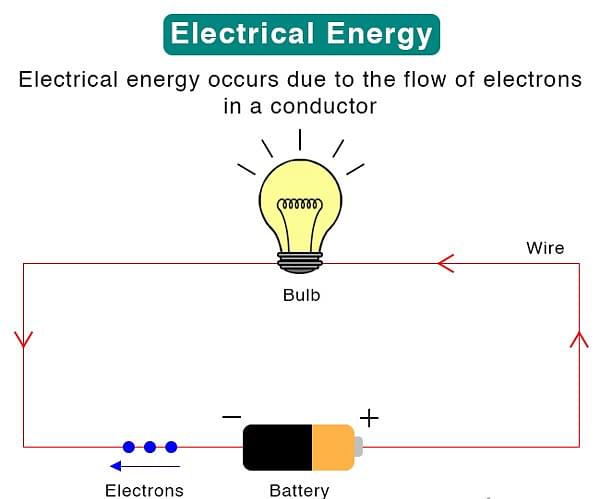
Electrical Energy
There can be various forms of generating Electrical Energy. Consider an example of a Nuclear Power Plant. Nuclear power plants convert nuclear energy into Electrical Energy by running steam turbines. Other examples can be car batteries, which convert chemical energy into Electrical Energy.
Electrical Energy can also be converted into some different forms of energy. For example, a lightbulb. When the bulb is turned on Electrical Energy is converted into light and heat energy. Electrical Energy can be used to power up and run electrical equipment.
What is electrical energy?Electrical energy forms either due to kinetic energy or potential energy. However, it is mostly because of potential energy, that is, energy stored due to the relative positions of either charged particles or electric fields. It is caused by the moving of electric charges. [Checkout Important Question: What are the five types of energy?] What are the units of electrical energy?Electrical energy has the following units: Joules, Kilowatt-hour, and Electron-volt. What are the uses of electrical energy?Some of the many uses of electrical energy are:
Show speed of electricity.Electricity can travel at the speed of light which is over 186,000 miles per second. |
Also read: Non-renewable Energy
Electrical Energy Formula
[Click Here for Sample Questions]
Consider a cell with its positive and negative terminal. The presence of electrons is more on the negative terminal than that of the positive terminal.
Let's consider Positive terminal as A and Negative terminal as B.
So the electric potential at both the terminals will be V(A) and V(B) respectively.
Current is flowing from A to B, thus V(A) > V(B).
The potential difference between A and B is,
V= V(A) – V(B)>0 ………(1)
Consider the time interval of t,
So, the amount of charge Q=It
Where, I= Electric current
Therefore I = Qt ……….(2)
Charge in Potential Energy
Charge(Q) at terminal A is Q V(A) and charge at terminal B is Q V(B)
Therefore, change in potential energy Wpot:
| Wpot = Final Potential Energy – Initial potential energy |
Thus,
⇒Wpot = Q[(V(B)-V(A)]
⇒ Wpot = - Q V … from (1)
⇒ Wpot = -IVt … from (2)
Change in Kinetic Energy
If charges in the conductor are moving without collision, then kinetic energy would also change.
So, conversion of total energy K = IVt >0
Therefore, the amount of heat energy dissipated at time interval t is,
WK = Q V
WK = VIt … from(2)
Units of Electrical Energy
Electrical Energy is measured in joule or watt-second. When one-ampere current is passed through a circuit for one second, the potential difference of one volt is applied across it then the Electrical Energy of one joule is measured. The industry standard to measure Electrical Energy is kilowatt-hour (kWh).
| 1kWh = 1000\(\times\)60\(\times\)60 watt-sec 1kWh = 36\(\times\)105 Ws or Joules |
What is Electric Power?
[Click Here for Sample Questions]
Electric Power is defined as the rate at which work is done, or energy is transferred in an electrical circuit. It is how much energy is used to complete the work in a given particular time.
| “The rate at which electrically charged particles are transferred from one point to another in a given interval of time is known as Electric Power.” Electric Power is denoted by ‘P’. |

Electric Power
The SI unit of Power is Watt (W).
Power is calculated by P= VI … (3)
We know energy displaced at time interval t is given by,
W = VI t
W = P t … from (3)
The energy displaced per unit time is the power displaced,
P = Wt
According to Ohm's law,
⇒ V = IR
Therefore, Power “P” is
P = I2R or P = V2R … from (3)
Parameters of Electric power:
| Type | Value |
|---|---|
| Symbol | P |
| SI Unit | Watt, Joule Per Second |
| Quantity | Scalar Quantity |
| Formula | P = VI (Where, V = Potential Difference (volts), I = Electric Current) |
Also Read: Difference Between Work and Energy
Difference Between Electrical Energy and Electric Power
[Click Here for Sample Questions]
Key differences between Electrical Energy and Electric Power are:
| Type | Electrical Energy | Electric Power |
|---|---|---|
| Definition | Capacity to do electric work, in an electrical and electronic circuit is called as electrical energy | Rate of work done per unit charge or rate of energy transferred per unit time is called Electric Power. |
| Representation | Electrical Energy is represented by ‘W’ | Electric Power is represented by ‘P’ |
| Formula | W = Work x Time or W = Energy x Time | P= Work/Time or P= Energy/ Time |
| S.I Unit | S.I unit for Electrical Energy is Watt.Sec (Ws) or Joule (J) Commercially Electrical Energy is measured in Kilowatt-hour (kWh). And 1kWh is known as 1 unit | S.I unit for Electric Power is Watt (W) or Joule/Sec (J/s) |
| Transformation | Energy can be transformed from one form to another | Power cannot be transformed from one form to another |
| Generation | Energy can be generated | Power cannot be generated |
| Storage | Electrical Energy can be stored and can be used later. Eg. Battery | Power cannot be stored in storable devices |
Also Read: Batteries
Things to Remember
- The capacity to do electric work, in an electrical and electronic circuit, is called electrical energy.
- The rate of work done per unit charge or rate of energy transferred per unit time is called Electric Power.
- Electrical Energy for potential energy, Wpot= – IVt
- Electrical Energy for kinetic energy, WK= VIt
- S.I Unit for Electric Power is watt.sec or joule
- Electric Power formula is, P = VI
Read More:
Sample Questions
Ques. Define Electrical Energy and state its SI unit? (2 Marks)
Ans. The capacity to do electric work, in an electrical and electronic circuit is called electrical energy. Electrical Energy can be due to kinetic energy or potential energy.
S.I Unit for Electric Power is watt.sec or joule. Commercial units used for Electrical Energy is kilowatt.hour (kWh). And one kWh is known as one unit.
Ques. Write the uses of Electrical Energy. (2 Marks)
Ans. Electrical Energy can be used in many ways. The use of Electrical Energy has become a part of life. From household electrical items like televisions, fans, ACs, heaters. Also personal items like mobiles, laptops and computers, watches all are applications of Electrical Energy. The commercial use can be public transport systems, security systems are few examples.
Ques. Define Electric Power and state its SI unit? (2 Marks)
Ans. Rate of work done per unit charge or rate of energy transferred per unit time is called Electric Power. Also, the rate at which electric charged particles are transferred from one point to another in a given interval of time is known as Electric Power. Electric Power is denoted by ‘P’. The SI unit of Power is watt (W) or joule/sec (J/sec).
Ques. Express Electric Power in terms of ohms law? (3 Marks)
Ans. Rate of work done per unit charge or rate of energy transferred per unit time is called Electric Power.
Power is calculated by P= VI ………(1)
According to Ohm's law,
V= IR.
Therefore, Power P is
P= I2R OR P= V2R …….from (1)
Where,
- V = potential difference
- I = electric current
- R = resistance
- P = Electric Power
Ques. A battery of 9V is connected to the resistance of 25?. What is the current and power across the resistance? (3 Marks)
Ans. Given: Voltage (V)= 9V
Resistance (R)= 25Ω
Find: Current (I), Power (P)
Solution: Current (I) = Voltage (V)Resistance (R)
I=9V25Ω
I=0.36 A …..(1)
Power (P) =VI
= 9X0.36 …..from (1)
= 3.24 J/Sec
P =3.24 W
The current across the resistance is 0.36 Ampere. Power across resistance is 3.24 W
Ques. 12V battery is used for mobile phone. It requires 0.8A current to play a video. Calculate how much power is required to play a video. (3 Marks)
Ans.
Given: Voltage (V)= 12V
Current (I) = 0.8A
Find: Power(P)
Solution:
Power (P)= VI
P =12 x 0.8 (V x A)
P =12 x 0.8 (JC x Cs)
P =9.6 J/s
P =9.6 W
Power required to play the video is 9.6W
Ques. An electric lamp of 5A is used for 45 mins at 220V. Calculate the Electrical Energy and Electric Power required. (5 Marks)
Ans.
Given: Voltage(V) = 220V
Current (I) = 5A
Time (t) = 45 min
= 45 x 60sec = 2700sec
Find: Electrical Energy (W), Electric Power (P)
Solution:
Electrical Energy (W) = VIt
W = 220 x 5 x 2700 (V x A x sec)
W = 2970000 (Jsec x sec)
W = 2970000 J
W = 2970 kJ
Electric Power (P) = VI
P = 220 x 5 (V x A)
P = 1100 W
P = 1100 J/sec
Electrical Energy and Electric Power required are 2970kJ and 1100J/sec respectively.
Ques. 50kJ energy is used by an Iron for 5 mins at 240V. Calculate current (I) used by the Iron? (5 Marks)
Ans. Given: Energy (W) = 50 kJ = 50000 J
Voltage (V) = 240 V
Time (t) = 5 mins = 5 x 60 = 300 sec
To determine: Current (I)
Thus,
Power (P) = Energy (W)Time (t)
P = 50000300 (J/Sec)
P = 166.67 J/Sec
P = 166.67 W
Now, P = VI
Hence,
Current (I) = PV
I = 166.67240 (W/V)
I = 0.69 A
I = 0.7 A
Current used by Iron is 0.7 Ampere.
Ques. John watches TV on an average of 4 hrs per day. The current flowing through the TV is 0.5A at 220V. Electric board charges Rs. 7 per kWh. Find the cost of Electrical Energy for one month (31 days)? (5 Marks)
Ans.
Given: Current (I) = 0.5A
Voltage (V)= 220V
Time (t) = 4hrs
Time for 31 days (T) = 4 x 31 = 124 hrs
Cost per kWh = Rs.7
Find: Cost for Electrical Energy for 31 days
Solution:
Power (P) = VI
P = 220 x 0.5 (V x A)
P = 110 W …..(1)
Electrical Energy for 31 days (W) = power (P) x Time (T) ….. Total time for 31 days
W = PT
W = 110 x 124 (W x hrs) …..from (1)
W = 13640 W hrs
W = 13.64 kWh
Cost of Electrical Energy for 31 days
Total cost = Total energy (W) x Cost per unit energy
Total cost = 13.64 x 7 (kWh x Rs/kWh )
Total cost = Rs. 95.48
Cost of Electrical Energy for one month is Rs.95.48
Also Read:



Comments