The National Testing Agency (NTA) conducted the CUET PG 2026 B.Ed. Science (COQP06) examination on March 24, 2026, during Shift 2 from 12:30 PM to 02:00 PM.

Students who appeared for the exam reported that the overall difficulty level of the paper was moderate. CUET PG 2026 B.Ed. Science Question Paper with Solutions PDF is available here for download. The marking scheme is +4 for correct answers and -1 for wrong answers, totaling 300 marks.

CUET PG 2026 B.Ed. Science Question Paper with Solutions PDF

CUET PG 2026 B.Ed. Science Question Paper with Answer Key Download PDF Check Solutions
CUET PG 2026 B.Ed. Science Question Paper

Question 1:

Which of the following organelles is known as the "powerhouse of the cell"?

  • (A) Nucleus
  • (B) Mitochondria
  • (C) Ribosome
  • (D) Golgi apparatus
Correct Answer: (2) Mitochondria
View Solution


Concept:

Cells contain specialized structures called organelles, each performing a specific function. The mitochondria are responsible for producing energy required for cellular activities.

Mitochondria generate energy in the form of ATP (Adenosine Triphosphate) through the process of cellular respiration. Because they supply energy to the cell, they are commonly referred to as the "powerhouse of the cell".


Step 1: Understanding the role of mitochondria.

Mitochondria break down glucose and other nutrients in the presence of oxygen to produce ATP, which powers metabolic activities such as movement, synthesis of molecules, and active transport.


Step 2: Eliminating other options.


Nucleus controls genetic information and cell activities.
Ribosomes are responsible for protein synthesis.
Golgi apparatus modifies and packages proteins for transport.


Thus, the organelle known as the powerhouse of the cell is mitochondria. Quick Tip: \textbf{Mitochondria produce ATP through cellular respiration}, which is why they are called the \textbf{powerhouse of the cell}.


Question 2:

What is the unit of measure for electrical resistance?

  • (A) Volt
  • (B) Ampere
  • (C) Ohm
  • (D) Watt
Correct Answer: (3) Ohm
View Solution


Concept:

Electrical resistance is the property of a material that opposes the flow of electric current through it. The SI unit of electrical resistance is the Ohm, represented by the symbol \( \Omega \).

Resistance is related to voltage and current through Ohm’s Law:
\[ V = IR \]

where:


\(V\) = Voltage (Volts)
\(I\) = Current (Amperes)
\(R\) = Resistance (Ohms)


Step 1: Identify the SI unit for resistance.

The standard SI unit used to measure resistance is the Ohm (\(\Omega\)).


Step 2: Eliminate other options.


Volt measures electrical potential difference.
Ampere measures electric current.
Watt measures electrical power.


Therefore, the correct unit for electrical resistance is the Ohm. Quick Tip: \textbf{Ohm (\(\Omega\)) is the SI unit of electrical resistance}, defined using Ohm’s Law \(V = IR\).


Question 3:

Which gas is primarily responsible for the greenhouse effect on Earth?

  • (A) Oxygen
  • (B) Nitrogen
  • (C) Carbon dioxide
  • (D) Hydrogen
Correct Answer: (3) Carbon dioxide
View Solution


Concept:

The greenhouse effect is a natural process in which certain gases in the Earth's atmosphere trap heat and keep the planet warm enough to sustain life. These gases are known as greenhouse gases.

Major greenhouse gases include:


Carbon dioxide (\(CO_2\))
Methane (\(CH_4\))
Nitrous oxide (\(N_2O\))
Water vapor


Among these, carbon dioxide is the most significant contributor to the greenhouse effect due to its large quantity in the atmosphere and its release from human activities such as burning fossil fuels and deforestation.


Step 1: Identify the main greenhouse gas.

Carbon dioxide absorbs infrared radiation emitted by the Earth and traps heat within the atmosphere.


Step 2: Eliminate other options.


Oxygen and Nitrogen make up most of the atmosphere but do not significantly trap heat.
Hydrogen is not a greenhouse gas in Earth's atmosphere.


Thus, the gas primarily responsible for the greenhouse effect is Carbon dioxide. Quick Tip: \textbf{Carbon dioxide (\(CO_2\)) is the major greenhouse gas} responsible for global warming due to fossil fuel burning and deforestation.


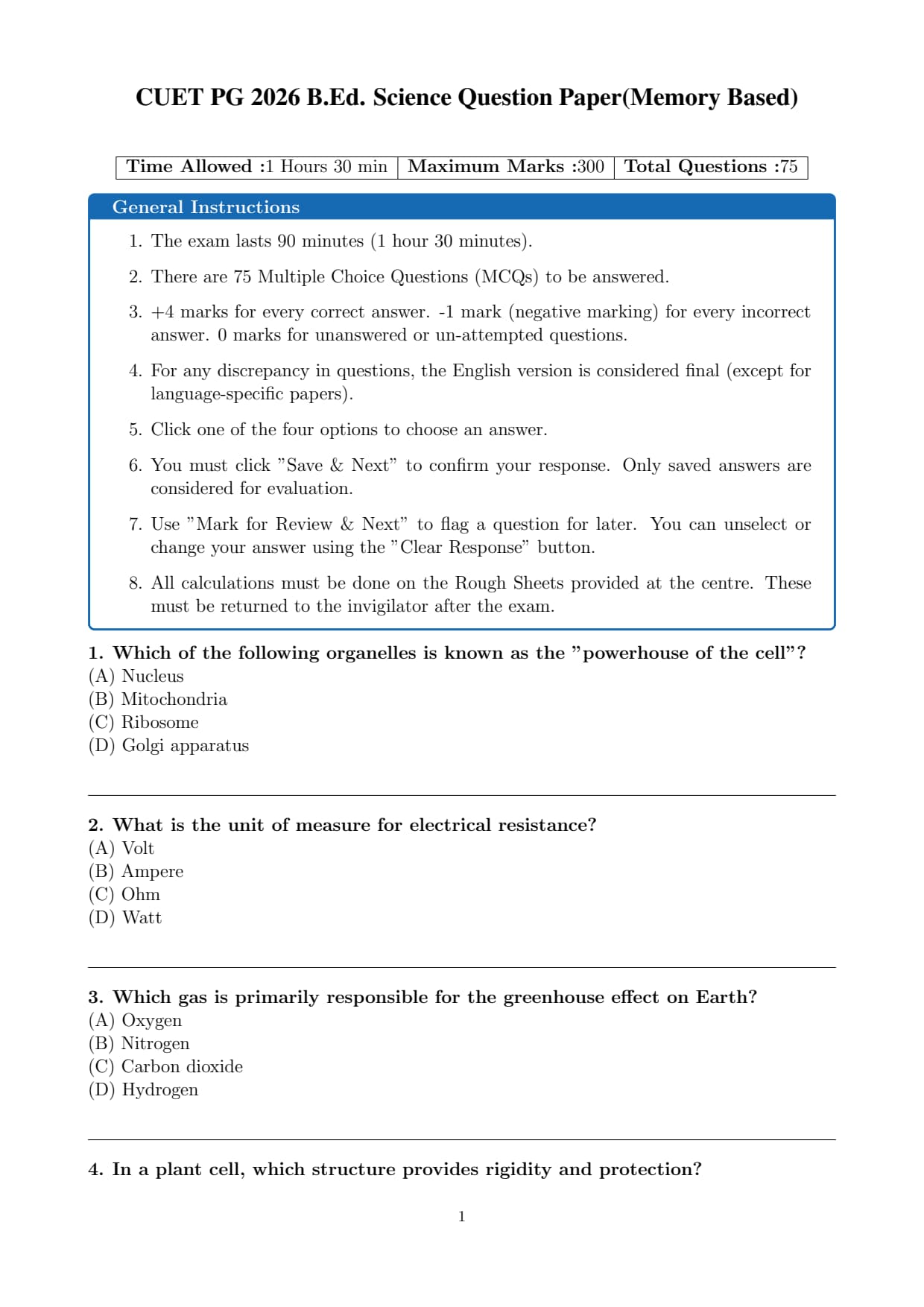
Question 4:

In a plant cell, which structure provides rigidity and protection?

  • (A) Cell membrane
  • (B) Cell wall
  • (C) Vacuole
  • (D) Nucleus
Correct Answer: (2) Cell wall
View Solution


Concept:

Plant cells contain a rigid outer layer called the cell wall. It surrounds the cell membrane and provides structural support, protection, and shape to the cell.

The cell wall is primarily composed of cellulose, a complex carbohydrate that gives the cell strength and rigidity.


Step 1: Understanding the function of the cell wall.

The cell wall helps the plant cell maintain its shape and protects it from mechanical damage and excessive water intake.


Step 2: Eliminating other options.


Cell membrane controls the movement of substances in and out of the cell.
Vacuole stores water and nutrients.
Nucleus controls genetic activities of the cell.


Thus, the structure responsible for rigidity and protection in plant cells is the cell wall. Quick Tip: \textbf{Plant cells have a cell wall made of cellulose} which provides rigidity, support, and protection.


Question 5:

What is the chemical formula for common table salt?

  • (A) KCl
  • (B) NaCl
  • (C) CaCl\(_2\)
  • (D) Na\(_2\)SO\(_4\)
Correct Answer: (2) NaCl
View Solution


Concept:

Table salt, commonly used in food, is chemically known as sodium chloride. It is an ionic compound formed by the combination of sodium (\(Na\)) and chlorine (\(Cl\)).

In sodium chloride, sodium loses one electron to form a positive ion (\(Na^+\)), and chlorine gains one electron to form a negative ion (\(Cl^-\)). These oppositely charged ions attract each other to form an ionic bond.


Step 1: Identify the chemical composition.

Table salt consists of sodium and chlorine, forming the compound NaCl.


Step 2: Eliminate other options.


KCl is potassium chloride.
CaCl\(_2\) is calcium chloride.
Na\(_2\)SO\(_4\) is sodium sulfate.


Thus, the chemical formula for common table salt is NaCl. Quick Tip: \textbf{NaCl = Sodium chloride = Table salt}. It is formed by ionic bonding between sodium and chlorine.


Question 6:

Which law of motion states that for every action, there is an equal and opposite reaction?

  • (A) Newton’s First Law
  • (B) Newton’s Second Law
  • (C) Newton’s Third Law
  • (D) Law of Gravitation
Correct Answer: (3) Newton’s Third Law
View Solution


Concept:

Newton’s Third Law of Motion states that:
\[ For every action, there is an equal and opposite reaction. \]

This means that whenever one object exerts a force on another object, the second object exerts an equal force in the opposite direction on the first object.


Step 1: Understanding the action–reaction principle.

If object A applies a force on object B, then object B simultaneously applies an equal force on object A in the opposite direction.


Step 2: Examples of Newton’s Third Law.


A rocket moves upward because gases push downward.
When walking, the foot pushes the ground backward and the ground pushes the body forward.


Step 3: Eliminating other options.


Newton’s First Law explains inertia.
Newton’s Second Law relates force, mass, and acceleration.
Law of Gravitation explains gravitational attraction between masses.


Thus, the law stating that every action has an equal and opposite reaction is Newton’s Third Law of Motion. Quick Tip: \textbf{Newton’s Third Law: Action = Reaction}. Forces always occur in pairs acting in opposite directions.


Question 7:

Which part of the human brain is responsible for maintaining balance and posture?

  • (A) Cerebrum
  • (B) Cerebellum
  • (C) Medulla oblongata
  • (D) Hypothalamus
Correct Answer: (2) Cerebellum
View Solution


Concept:

The human brain is divided into several major parts, each responsible for specific functions. The cerebellum is located at the back of the brain, below the cerebrum, and plays a crucial role in coordinating voluntary movements.

The cerebellum helps in maintaining:


Body balance
Posture
Coordination of muscles


Step 1: Identify the brain part controlling balance.

The cerebellum integrates sensory information from the inner ear, eyes, and muscles to maintain equilibrium and posture.


Step 2: Eliminate other options.


Cerebrum controls thinking, memory, and voluntary actions.
Medulla oblongata regulates involuntary actions such as breathing and heartbeat.
Hypothalamus regulates body temperature, hunger, and hormones.


Thus, the brain part responsible for balance and posture is the cerebellum. Quick Tip: \textbf{Cerebellum = balance + posture + coordination of movement}.


Question 8:

What process do plants use to convert light energy into chemical energy?

  • (A) Respiration
  • (B) Transpiration
  • (C) Photosynthesis
  • (D) Fermentation
Correct Answer: (3) Photosynthesis
View Solution


Concept:

Photosynthesis is the process by which green plants convert light energy from the sun into chemical energy stored in glucose.

This process takes place in the chloroplasts of plant cells using the pigment chlorophyll.

The simplified photosynthesis equation is:
\[ 6CO_2 + 6H_2O \rightarrow C_6H_{12}O_6 + 6O_2 \]


Step 1: Understand the energy conversion.

During photosynthesis, plants use sunlight to convert carbon dioxide and water into glucose and oxygen.


Step 2: Eliminate other options.


Respiration releases energy from food.
Transpiration is the loss of water vapor from plant leaves.
Fermentation occurs in microorganisms under anaerobic conditions.


Thus, the process converting light energy into chemical energy is photosynthesis. Quick Tip: \textbf{Photosynthesis = Sunlight + CO\(_2\) + Water → Glucose + Oxygen}.


Question 9:

In a chemical reaction, what is the name of the substance that speeds up the reaction without being consumed?

  • (A) Reactant
  • (B) Product
  • (C) Catalyst
  • (D) Solvent
Correct Answer: (3) Catalyst
View Solution


Concept:

A catalyst is a substance that increases the rate of a chemical reaction without being permanently consumed or undergoing any permanent chemical change.

Catalysts work by lowering the activation energy required for a reaction to occur.


Step 1: Understand the function of a catalyst.

By reducing the activation energy barrier, a catalyst allows more molecules to react successfully, thereby speeding up the reaction.


Step 2: Eliminate other options.


Reactants are substances that take part in a reaction.
Products are substances formed after the reaction.
Solvent dissolves substances but does not necessarily speed up reactions.


Thus, the substance that speeds up a reaction without being consumed is a catalyst. Quick Tip: \textbf{Catalyst = speeds up reaction + not consumed}.


Question 10:

Which planet in our solar system is known as the "Red Planet"?

  • (A) Venus
  • (B) Mars
  • (C) Jupiter
  • (D) Saturn
Correct Answer: (2) Mars
View Solution


Concept:

Mars is commonly known as the "Red Planet" because of its reddish appearance when observed from Earth. The red color is caused by the presence of iron oxide (rust) on the planet’s surface.

Iron minerals in Martian soil react with oxygen and form iron oxide, giving the planet its distinctive red color.


Step 1: Identify the planet with reddish appearance.

Mars appears red due to iron oxide dust covering much of its surface.


Step 2: Eliminate other options.


Venus is known for its thick atmosphere and extreme temperature.
Jupiter is the largest planet with prominent gas bands.
Saturn is known for its extensive ring system.


Thus, the planet known as the Red Planet is Mars. Quick Tip: \textbf{Mars = Red Planet} because its surface contains iron oxide (rust).


Question 11:

What is the pH value of pure water at room temperature?

  • (A) 5
  • (B) 7
  • (C) 9
  • (D) 14
Correct Answer: (2) 7
View Solution


Concept:

The pH scale measures the acidity or basicity of a solution and ranges from 0 to 14.


pH < 7 → Acidic
pH = 7 → Neutral
pH > 7 → Basic (alkaline)


Pure water at room temperature (\(\approx 25^\circ C\)) has equal concentrations of hydrogen ions (\(H^+\)) and hydroxide ions (\(OH^-\)), making it neutral.


Step 1: Understand neutrality of pure water.

In pure water:
\[ [H^+] = [OH^-] \]

This balance results in a neutral pH.


Step 2: Determine the neutral value on the pH scale.

The neutral point on the pH scale is 7. Therefore, pure water has a pH of 7. Quick Tip: \textbf{pH 7 = Neutral}. Pure water at room temperature has a pH of \textbf{7}.


Question 12:

Which blood cells are responsible for carrying oxygen throughout the body?

  • (A) White blood cells
  • (B) Platelets
  • (C) Red blood cells
  • (D) Plasma cells
Correct Answer: (3) Red blood cells
View Solution


Concept:

Red blood cells (RBCs), also called erythrocytes, are responsible for transporting oxygen from the lungs to the tissues throughout the body.

RBCs contain a protein called hemoglobin, which binds with oxygen molecules and carries them through the bloodstream.


Step 1: Understand the oxygen transport mechanism.

Hemoglobin in red blood cells combines with oxygen in the lungs and delivers it to body tissues where it is required for cellular respiration.


Step 2: Eliminate other options.


White blood cells help fight infections.
Platelets are involved in blood clotting.
Plasma is the liquid component of blood.


Thus, the blood cells responsible for transporting oxygen are red blood cells. Quick Tip: \textbf{Red Blood Cells (RBCs) contain hemoglobin}, which carries oxygen throughout the body.


Question 13:

What type of lens is used to correct myopia (nearsightedness)?

  • (A) Convex lens
  • (B) Concave lens
  • (C) Cylindrical lens
  • (D) Bifocal lens
Correct Answer: (2) Concave lens
View Solution


Concept:

Myopia (nearsightedness) is a vision defect in which a person can see nearby objects clearly but distant objects appear blurred. This occurs when the image of distant objects forms in front of the retina instead of on the retina.

A concave lens (diverging lens) is used to correct this defect.


Step 1: Understanding how the concave lens corrects vision.

A concave lens diverges incoming light rays so that they appear to come from a point farther away. This adjustment allows the image to form correctly on the retina.


Step 2: Eliminating other options.


Convex lens is used to correct hypermetropia (farsightedness).
Cylindrical lens is used for astigmatism.
Bifocal lenses correct both near and distant vision problems.


Thus, myopia is corrected using a concave lens. Quick Tip: \textbf{Myopia → Concave lens} \textbf{Hypermetropia → Convex lens}.


Question 14:

Which element has the highest thermal conductivity of all metals?
  • (A) Copper
  • (B) Aluminum
  • (C) Silver
  • (D) Gold
Correct Answer: (3) Silver
View Solution


Concept:

Thermal conductivity is the ability of a material to conduct heat. Among all metals, silver (Ag) has the highest thermal conductivity.

Silver allows heat to flow through it very efficiently due to the movement of free electrons within its structure.


Step 1: Identify the metal with the highest thermal conductivity.

Silver is the best conductor of heat among metals.


Step 2: Compare with other metals.


Copper also has very high thermal conductivity but slightly lower than silver.
Aluminum conducts heat well but less efficiently than copper.
Gold has good conductivity but is less than silver and copper.


Thus, the element with the highest thermal conductivity is Silver. Quick Tip: \textbf{Order of thermal conductivity (high to low):} \textbf{Silver > Copper > Gold > Aluminum}.


Question 15:

What is the process of a solid turning directly into a gas called?

  • (A) Condensation
  • (B) Sublimation
  • (C) Evaporation
  • (D) Deposition
Correct Answer: (2) Sublimation
View Solution


Concept:

Sublimation is the process in which a substance changes directly from a solid state to a gaseous state without passing through the liquid phase.

This occurs when molecules of a solid gain enough energy to escape directly into the gas phase.

Common examples include:


Dry ice (solid \(CO_2\))
Camphor
Naphthalene
Iodine crystals


Step 1: Identify the phase change.

Solid → Gas without becoming liquid is called sublimation.


Step 2: Eliminate other options.


Condensation is gas → liquid.
Evaporation is liquid → gas.
Deposition is gas → solid.


Thus, the direct change of a solid into gas is called sublimation. Quick Tip: \textbf{Sublimation = Solid → Gas directly} (no liquid stage).

CUET PG 2026 B.Ed. Science Preparation