The National Testing Agency (NTA) conducted the CUET PG 2026 Art & Aesthetics (HUQP04) examination on March 24, 2026, during Shift 2 from 12:30 PM to 02:00 PM.

Students who appeared for the exam reported that the overall difficulty level of the paper was moderate. CUET PG 2026 Art & Aesthetics Question Paper with Solutions PDF is available here for download. The marking scheme is +4 for correct answers and -1 for wrong answers, totaling 300 marks.

CUET PG 2026 Art & Aesthetics Question Paper with Solutions PDF

CUET PG 2026 Art & Aesthetics Question Paper with Answer Key Download PDF Check Solutions
CUET PG 2026 Art and Aesthetics Question Paper


Question 1:

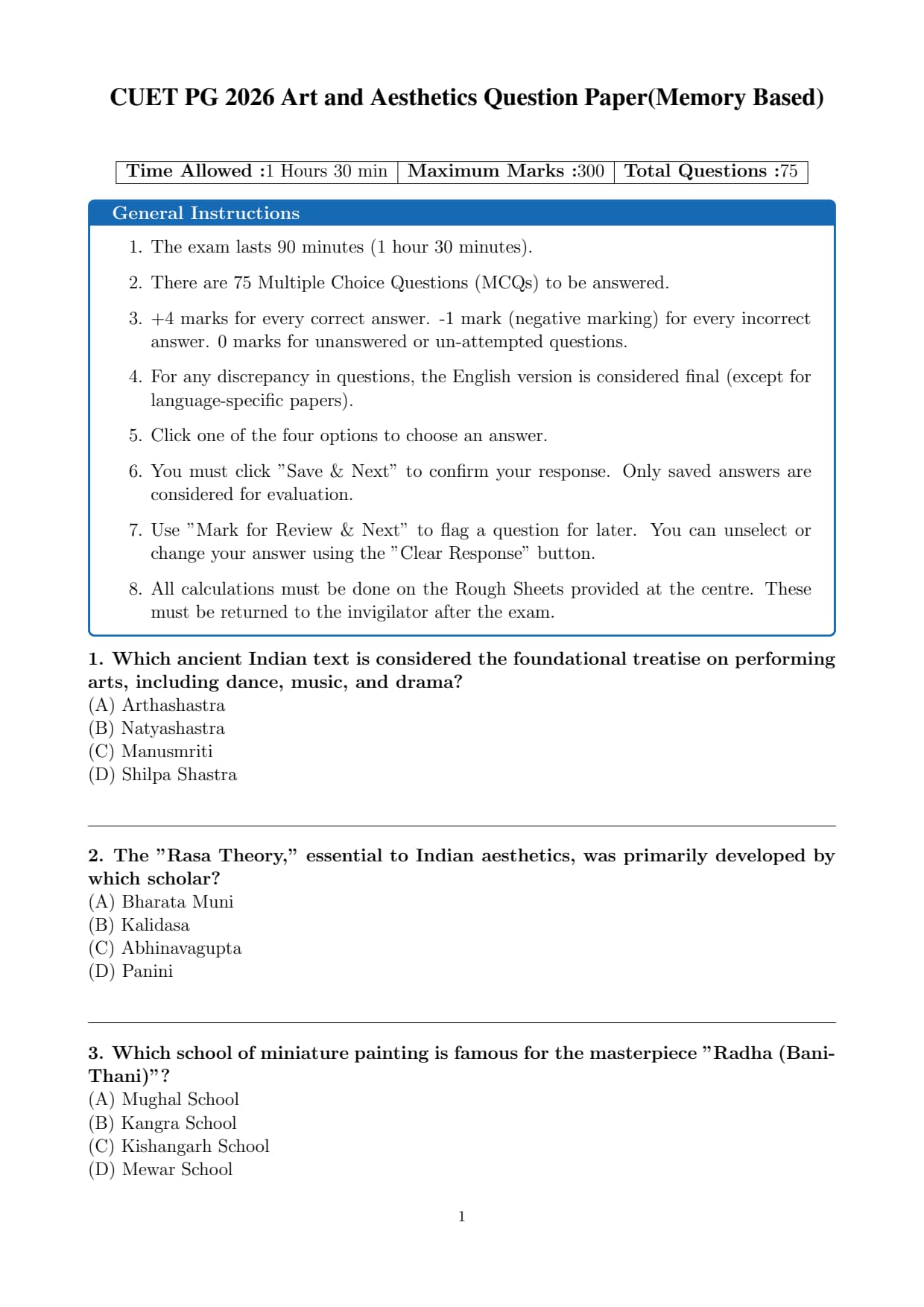
Which ancient Indian text is considered the foundational treatise on performing arts, including dance, music, and drama?

  • (A) Arthashastra
  • (B) Natyashastra
  • (C) Manusmriti
  • (D) Shilpa Shastra
Correct Answer: (2) Natyashastra
View Solution


Concept:

The Natyashastra is an ancient Sanskrit treatise on performing arts, traditionally attributed to the sage Bharata Muni. It is considered the foundational text for Indian classical theatre, dance, and music.

The work discusses various aspects of stage performance such as:


Acting techniques
Dance movements and gestures
Musical elements
Stage design and production


It also introduces the concept of Rasa (aesthetic emotion), which is central to Indian artistic traditions.


Step 1: Identify the foundational text for performing arts.

The Natyashastra provides systematic guidelines for theatrical performance and classical dance traditions in India.


Step 2: Eliminate other options.


Arthashastra deals with statecraft and economics.
Manusmriti focuses on social and legal codes.
Shilpa Shastra relates to architecture and sculpture.


Thus, the foundational treatise on performing arts is the Natyashastra. Quick Tip: \textbf{Natyashastra by Bharata Muni} is the classical Indian text on \textbf{dance, music, theatre, and aesthetics}.


Question 2:

The "Rasa Theory," essential to Indian aesthetics, was primarily developed by which scholar?

  • (A) Bharata Muni
  • (B) Kalidasa
  • (C) Abhinavagupta
  • (D) Panini
Correct Answer: (3) Abhinavagupta
View Solution


Concept:

The concept of Rasa (aesthetic emotion) originates from the Natyashastra of Bharata Muni. However, the theory was further elaborated and philosophically developed by the Kashmiri scholar Abhinavagupta in his commentary called Abhinavabharati.

Abhinavagupta expanded the interpretation of rasa and explained how artistic performances evoke aesthetic experience in the audience.

The traditional rasas include:


Shringara (love)
Hasya (laughter)
Karuna (compassion)
Raudra (anger)
Veera (heroism)
Bhayanaka (fear)
Bibhatsa (disgust)
Adbhuta (wonder)
Shanta (peace)


Step 1: Identify the scholar who developed the theory further.

Although Bharata Muni introduced the concept, Abhinavagupta provided the most influential interpretation and development of Rasa Theory.


Step 2: Eliminate other options.


Bharata Muni introduced rasa but did not elaborate it philosophically as Abhinavagupta did.
Kalidasa was a classical Sanskrit poet and playwright.
Panini was a grammarian known for Sanskrit grammar.


Thus, the scholar who primarily developed the Rasa Theory is Abhinavagupta. Quick Tip: \textbf{Rasa Theory: Introduced in the \textbf{Natyashastra by Bharata Muni}, elaborated by \textbf{Abhinavagupta}.


Question 3:

Which school of miniature painting is famous for the masterpiece "Radha (Bani-Thani)"?

  • (A) Mughal School
  • (B) Kangra School
  • (C) Kishangarh School
  • (D) Mewar School
Correct Answer: (3) Kishangarh School
View Solution


Concept:

The Kishangarh School of miniature painting developed in the princely state of Kishangarh in Rajasthan during the 18th century. It is renowned for its refined style, delicate lines, and lyrical representation of romantic themes.

One of the most famous paintings from this school is "Bani-Thani", often identified as an artistic representation of Radha.

The painting is characterized by:


Elongated face
Arched eyebrows
Lotus-like eyes
Graceful and elegant expression


Step 1: Identify the painting tradition associated with Bani-Thani.

The masterpiece Radha (Bani-Thani) was painted by the artist Nihal Chand under the patronage of Raja Sawant Singh of Kishangarh.


Step 2: Eliminate other options.


Mughal School focused on courtly and historical themes.
Kangra School is known for lyrical depictions of Krishna legends.
Mewar School is an earlier Rajasthani painting tradition.


Thus, the miniature painting school famous for "Radha (Bani-Thani)" is the Kishangarh School. Quick Tip: \textbf{Bani-Thani} is a famous painting of the \textbf{Kishangarh School} and is often called the \textbf{"Mona Lisa of India"}.


Question 4:

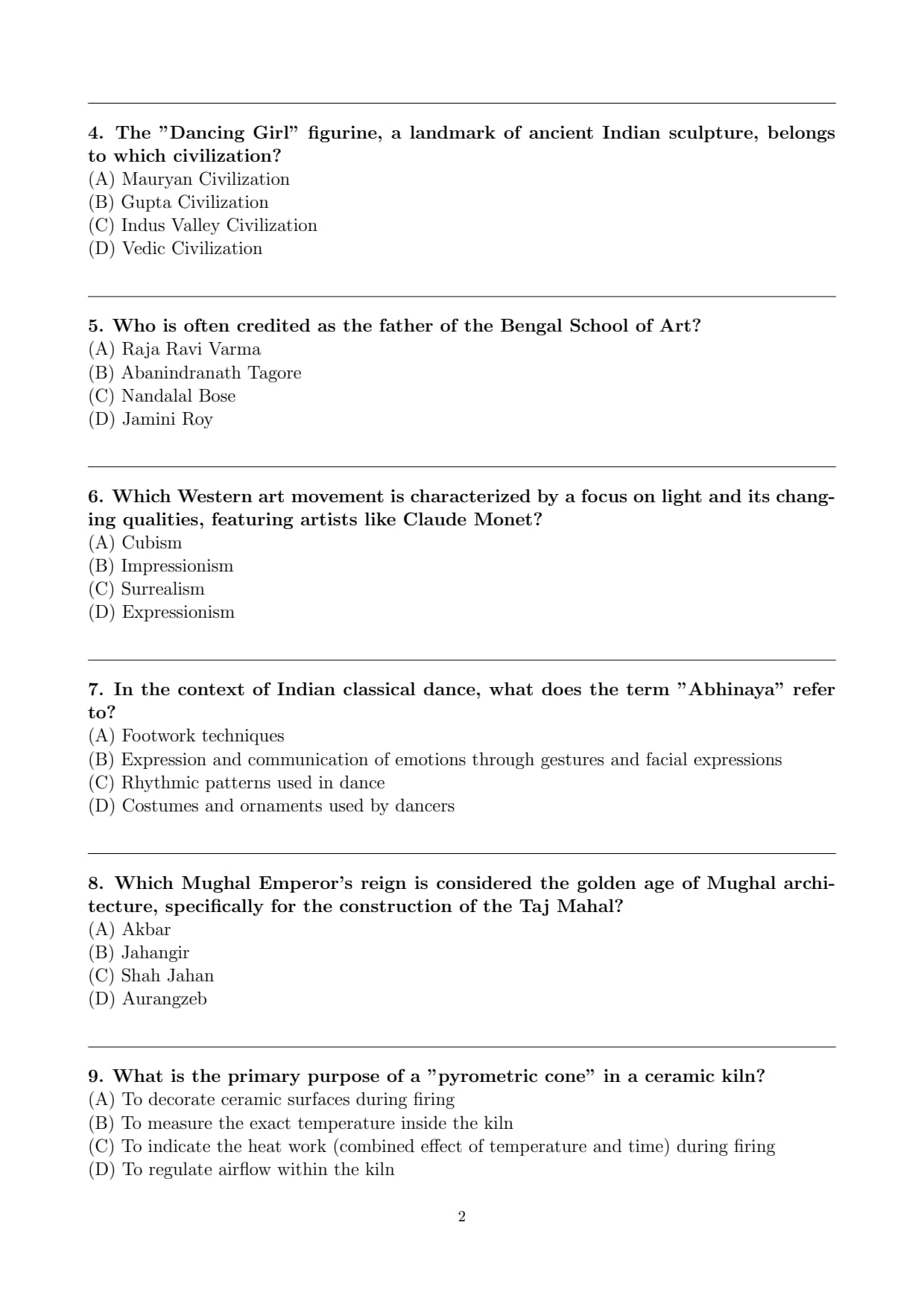
The "Dancing Girl" figurine, a landmark of ancient Indian sculpture, belongs to which civilization?

  • (A) Mauryan Civilization
  • (B) Gupta Civilization
  • (C) Indus Valley Civilization
  • (D) Vedic Civilization
Correct Answer: (3) Indus Valley Civilization
View Solution


Concept:

The famous bronze figurine known as the "Dancing Girl" is one of the most iconic artifacts discovered from the Indus Valley Civilization (also known as the Harappan Civilization), which flourished around \(2500\)–\(1900\) BCE.

This sculpture was discovered at the archaeological site of Mohenjo-daro in present-day Pakistan.


Step 1: Identify the civilization associated with the sculpture.

The figurine was made using the lost-wax casting technique and represents a young girl standing in a confident pose with one hand on her hip.


Step 2: Eliminate other options.


Mauryan Civilization is known for the Ashokan pillars and polished stone sculptures.
Gupta Civilization is famous for classical Hindu and Buddhist sculptures.
Vedic Civilization did not produce such bronze figurines.


Thus, the "Dancing Girl" figurine belongs to the Indus Valley Civilization. Quick Tip: The \textbf{Dancing Girl of Mohenjo-daro} is a famous bronze sculpture from the \textbf{Indus Valley Civilization}.


Question 5:

Who is often credited as the father of the Bengal School of Art?

  • (A) Raja Ravi Varma
  • (B) Abanindranath Tagore
  • (C) Nandalal Bose
  • (D) Jamini Roy
Correct Answer: (2) Abanindranath Tagore
View Solution


Concept:

The Bengal School of Art emerged in the early 20th century as a nationalist art movement in India. It sought to revive traditional Indian artistic styles and reject Western academic realism promoted during the colonial period.

Abanindranath Tagore, the nephew of Rabindranath Tagore, is widely regarded as the founder and father of the Bengal School of Art.


Step 1: Understand the objectives of the Bengal School.

The movement emphasized:


Indian cultural themes
Spiritual and mythological subjects
Inspiration from Mughal and Rajput miniature painting


Step 2: Eliminate other options.


Raja Ravi Varma blended Indian themes with European realism.
Nandalal Bose was a prominent student and later leader of the movement.
Jamini Roy developed a distinctive folk-inspired modern style.


Thus, the father of the Bengal School of Art is Abanindranath Tagore. Quick Tip: \textbf{Abanindranath Tagore} founded the \textbf{Bengal School of Art}, which promoted revival of traditional Indian painting styles.


Question 6:

Which Western art movement is characterized by a focus on light and its changing qualities, featuring artists like Claude Monet?

  • (A) Cubism
  • (B) Impressionism
  • (C) Surrealism
  • (D) Expressionism
Correct Answer: (2) Impressionism
View Solution


Concept:

Impressionism was a 19th-century Western art movement that originated in France. It emphasized capturing the effects of light and atmosphere rather than detailed realistic representation.

Artists of this movement often painted outdoors to capture the changing qualities of natural light.


Step 1: Identify the artistic style associated with Claude Monet.

Claude Monet is one of the most prominent Impressionist painters. His works often depict landscapes and scenes with visible brushstrokes and vibrant colors to capture momentary impressions.


Step 2: Eliminate other options.


Cubism uses geometric shapes to represent subjects.
Surrealism explores dream-like imagery and subconscious themes.
Expressionism focuses on emotional intensity and distortion.


Thus, the art movement known for focusing on light and visual impressions is Impressionism. Quick Tip: \textbf{Impressionism} focuses on capturing \textbf{light, color, and momentary visual impressions}. Famous artists include \textbf{Claude Monet, Renoir, and Degas}.


Question 7:

In the context of Indian classical dance, what does the term "Abhinaya" refer to?

  • (A) Footwork techniques
  • (B) Expression and communication of emotions through gestures and facial expressions
  • (C) Rhythmic patterns used in dance
  • (D) Costumes and ornaments used by dancers
Correct Answer: (2) Expression and communication of emotions through gestures and facial expressions
View Solution


Concept:

In Indian classical dance, the term Abhinaya refers to the art of expressing emotions, ideas, and stories through facial expressions, gestures, and body movements. The word originates from Sanskrit, where abhi means "towards" and \textit{naya means "to lead," implying leading the audience toward emotional understanding.

Abhinaya is a crucial aspect of dance forms such as Bharatanatyam, Kathak, and Odissi.


Step 1: Understand the role of Abhinaya in dance.

Through Abhinaya, dancers convey the emotional content of a performance and communicate narratives drawn from mythology, poetry, and devotional themes.


Step 2: Types of Abhinaya described in classical texts.

According to traditional theory, Abhinaya includes:


Angika – Expression through body movements
Vachika – Expression through speech or song
Aharya – Expression through costumes and makeup
Satvika – Expression through inner emotional states


Thus, Abhinaya primarily refers to expressive storytelling through gestures and facial expressions. Quick Tip: \textbf{Abhinaya = Expression in classical dance, used to communicate emotions and narratives through gestures and facial expressions.


Question 8:

Which Mughal Emperor's reign is considered the golden age of Mughal architecture, specifically for the construction of the Taj Mahal?

  • (A) Akbar
  • (B) Jahangir
  • (C) Shah Jahan
  • (D) Aurangzeb
Correct Answer: (3) Shah Jahan
View Solution


Concept:

The reign of Shah Jahan (1628–1658) is widely regarded as the golden age of Mughal architecture. During his rule, several magnificent architectural structures were constructed, characterized by refined symmetry, marble work, and intricate decoration.

The most famous monument from his reign is the Taj Mahal, built in memory of his wife Mumtaz Mahal.


Step 1: Identify the emperor associated with the Taj Mahal.

The Taj Mahal was constructed between 1632 and 1653 during the reign of Shah Jahan.


Step 2: Other architectural achievements during his reign.

Notable monuments built under Shah Jahan include:


Red Fort in Delhi
Jama Masjid in Delhi
Shalimar Gardens in Lahore


Thus, the Mughal emperor associated with the golden age of Mughal architecture is Shah Jahan. Quick Tip: \textbf{Shah Jahan = Golden age of Mughal architecture}, famous for the \textbf{Taj Mahal}.


Question 9:

What is the primary purpose of a "pyrometric cone" in a ceramic kiln?

  • (A) To decorate ceramic surfaces during firing
  • (B) To measure the exact temperature inside the kiln
  • (C) To indicate the heat work (combined effect of temperature and time) during firing
  • (D) To regulate airflow within the kiln
Correct Answer: (3) To indicate the heat work (combined effect of temperature and time) during firing
View Solution


Concept:

A pyrometric cone is a small pyramid-shaped device used in ceramic kilns to monitor the firing process. It is made of specially formulated ceramic materials that bend or deform at specific heat conditions.

Unlike a thermometer, which measures only temperature, a pyrometric cone measures heat work, which is the combined effect of:


Temperature
Duration of heating


Step 1: Understand the function of the cone.

When the kiln reaches the intended firing conditions, the cone bends or melts at a predetermined point, indicating that the correct heat work has been achieved.


Step 2: Why heat work matters.

In ceramics, proper firing depends not only on the peak temperature but also on how long the material is exposed to that heat.


Step 3: Eliminate other options.


Pyrometric cones are not decorative elements.
They do not measure exact temperature like thermometers.
They do not regulate airflow in the kiln.


Thus, the primary purpose of a pyrometric cone is to indicate the heat work during kiln firing. Quick Tip: \textbf{Pyrometric cone = indicator of heat work} (temperature + time) in ceramic kiln firing.


Question 10:

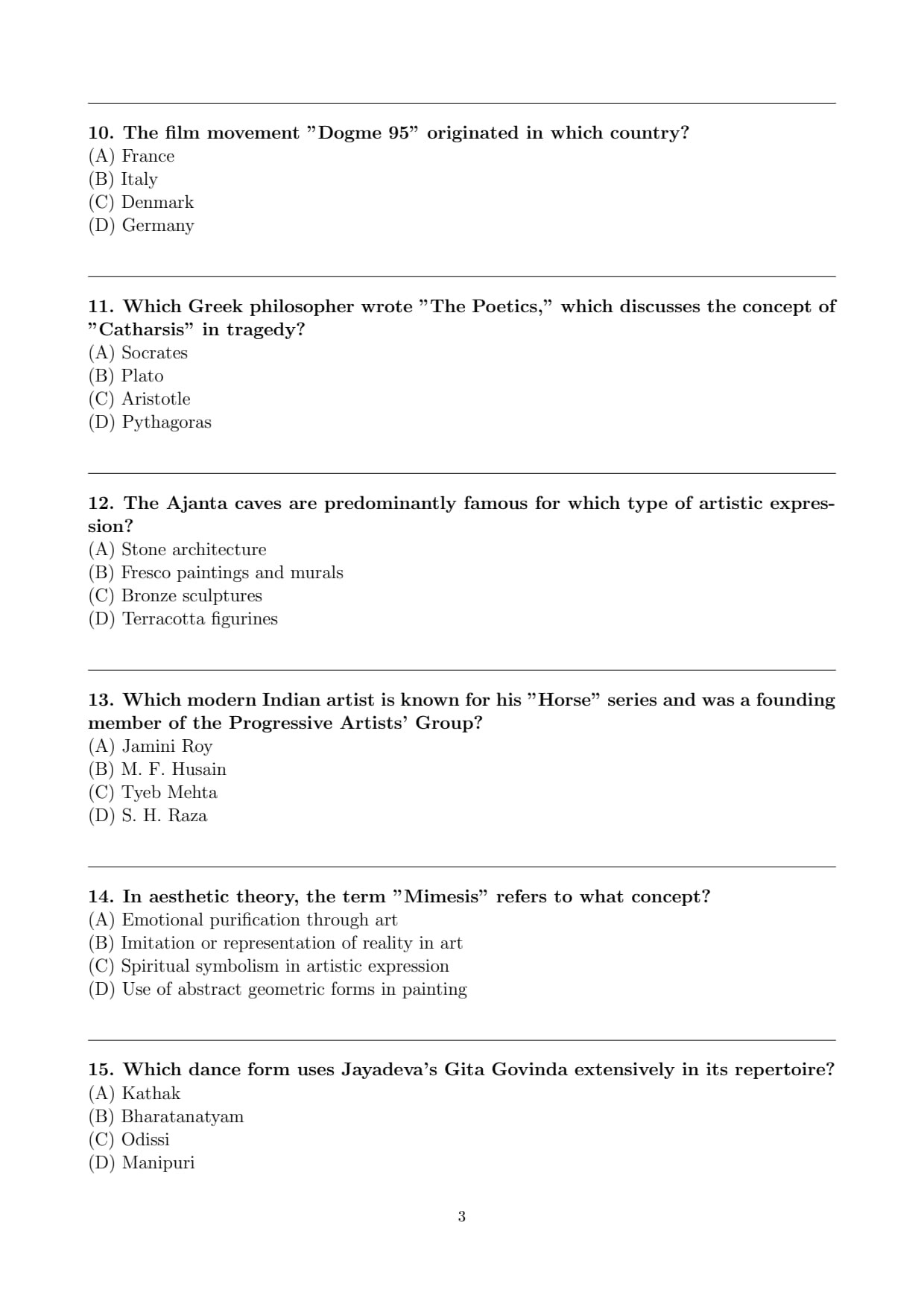
The film movement "Dogme 95" originated in which country?

  • (A) France
  • (B) Italy
  • (C) Denmark
  • (D) Germany
Correct Answer: (3) Denmark
View Solution


Concept:

Dogme 95 was a film movement created in 1995 by Danish filmmakers Lars von Trier and Thomas Vinterberg. The movement aimed to simplify filmmaking by focusing on storytelling, acting, and theme rather than elaborate special effects or production techniques.

It introduced a strict set of rules known as the "Vow of Chastity".


Step 1: Understand the origin of the movement.

The Dogme 95 manifesto was first announced in Copenhagen, Denmark.


Step 2: Key principles of Dogme 95.

The rules included:


Shooting on location only
No artificial lighting
Handheld cameras
No special effects or superficial action


Thus, the Dogme 95 movement originated in Denmark. Quick Tip: \textbf{Dogme 95} is a Danish film movement emphasizing realism and simplicity in filmmaking.


Question 11:

Which Greek philosopher wrote "The Poetics," which discusses the concept of "Catharsis" in tragedy?

  • (A) Socrates
  • (B) Plato
  • (C) Aristotle
  • (D) Pythagoras
Correct Answer: (3) Aristotle
View Solution


Concept:

"The Poetics" is a famous work by the Greek philosopher Aristotle. In this treatise, Aristotle analyzes the principles of literature, especially tragedy.

One of the key concepts introduced in the work is Catharsis.


Step 1: Understand the concept of Catharsis.

Catharsis refers to the emotional purification or release experienced by the audience after witnessing the intense emotions portrayed in a tragedy.


Step 2: Aristotle’s analysis of tragedy.

According to Aristotle, an effective tragedy should evoke feelings of:


Pity
Fear


These emotions ultimately lead to catharsis in the audience.


Step 3: Eliminate other options.


Socrates focused mainly on ethical philosophy.
Plato wrote philosophical dialogues and criticized poetry in his work.
Pythagoras was known for contributions to mathematics and philosophy.


Thus, the philosopher who wrote "The Poetics" is Aristotle. Quick Tip: \textbf{Aristotle's "Poetics"} explains tragedy and introduces the concept of \textbf{Catharsis}.


Question 12:

The Ajanta caves are predominantly famous for which type of artistic expression?

  • (A) Stone architecture
  • (B) Fresco paintings and murals
  • (C) Bronze sculptures
  • (D) Terracotta figurines
Correct Answer: (2) Fresco paintings and murals
View Solution


Concept:

The Ajanta Caves, located in Maharashtra, India, are a group of rock-cut Buddhist cave monuments dating from approximately the 2nd century BCE to the 6th century CE.

They are world-famous for their wall paintings and murals, which depict scenes from the life of Buddha and stories from the Jataka tales.


Step 1: Identify the major artistic feature of Ajanta.

The caves contain beautifully preserved fresco-style paintings that illustrate religious narratives and courtly life.


Step 2: Characteristics of Ajanta paintings.

These paintings are known for:


Expressive human figures
Naturalistic shading
Rich colors and intricate details


Step 3: Eliminate other options.


While Ajanta includes rock-cut architecture and sculptures, its paintings and murals are the most celebrated feature.
Bronze sculptures and terracotta figurines are not the primary artistic elements here.


Thus, the Ajanta caves are predominantly famous for their fresco paintings and murals. Quick Tip: \textbf{Ajanta Caves = Buddhist murals and fresco paintings} depicting Jataka tales and scenes from Buddha’s life.


Question 13:

Which modern Indian artist is known for his "Horse" series and was a founding member of the Progressive Artists' Group?

  • (A) Jamini Roy
  • (B) M. F. Husain
  • (C) Tyeb Mehta
  • (D) S. H. Raza
Correct Answer: (2) M. F. Husain
View Solution


Concept:

Maqbool Fida Husain (M. F. Husain) was one of the most prominent modern Indian painters and a founding member of the Progressive Artists' Group formed in Bombay in 1947.

He became widely recognized for his distinctive style, which blended elements of Indian tradition with modernist artistic techniques.


Step 1: Identify the artist associated with the Horse series.

Husain's famous "Horse" series features dynamic and energetic depictions of horses, often symbolizing strength, movement, and vitality.


Step 2: Contribution to modern Indian art.

As a member of the Progressive Artists' Group, Husain helped shape modern Indian art by promoting artistic freedom and experimentation.


Step 3: Eliminate other options.


Jamini Roy is known for his folk-inspired painting style.
Tyeb Mehta is famous for his modernist figurative works.
S. H. Raza is known for the Bindu series.


Thus, the artist known for the Horse series is M. F. Husain. Quick Tip: \textbf{M. F. Husain was a founding member of the \textbf{Progressive Artists' Group} and famous for his \textbf{Horse paintings}.


Question 14:

In aesthetic theory, the term "Mimesis" refers to what concept?

  • (A) Emotional purification through art
  • (B) Imitation or representation of reality in art
  • (C) Spiritual symbolism in artistic expression
  • (D) Use of abstract geometric forms in painting
Correct Answer: (2) Imitation or representation of reality in art
View Solution


Concept:

The concept of Mimesis originates from ancient Greek philosophy and is closely associated with Plato and Aristotle. It refers to the idea that art imitates or represents aspects of reality.

According to classical aesthetic theory, artists recreate or imitate the world through various forms of artistic expression such as painting, literature, and drama.


Step 1: Understanding the meaning of Mimesis.

The word mimesis literally means "imitation" in Greek. It suggests that art reflects or reproduces real-life experiences and natural forms.


Step 2: Role in classical aesthetics.

Aristotle considered mimesis a fundamental principle of artistic creation, where art represents human actions and emotions.


Step 3: Eliminate other options.


Emotional purification is related to Catharsis.
Spiritual symbolism is associated with certain religious art traditions.
Abstract geometric forms relate more to modern abstract art movements.


Thus, Mimesis refers to the imitation or representation of reality in art. Quick Tip: \textbf{Mimesis = Imitation of reality in art, a key concept in classical aesthetic theory.


Question 15:

Which dance form uses Jayadeva’s Gita Govinda extensively in its repertoire?
  • (A) Kathak
  • (B) Bharatanatyam
  • (C) Odissi
  • (D) Manipuri
Correct Answer: (3) Odissi
View Solution


Concept:

Gita Govinda, composed by the 12th-century poet Jayadeva, is a lyrical Sanskrit work that describes the divine love between Krishna and Radha.

The text is widely used in the repertoire of the classical dance form Odissi, which originated in the state of Odisha.


Step 1: Understand the relationship between Odissi and Gita Govinda.

Many Odissi dance performances interpret verses from Gita Govinda through expressive movements and abhinaya (facial expressions and gestures).


Step 2: Historical significance.

The compositions of Gita Govinda have long been associated with temple traditions in Odisha, especially the Jagannath Temple in Puri.


Step 3: Eliminate other options.


Kathak developed mainly in North India and Mughal courts.
Bharatanatyam originated in Tamil Nadu and emphasizes Tamil devotional compositions.
Manipuri focuses on Raslila traditions but does not primarily rely on Gita Govinda.


Thus, the dance form that extensively uses Gita Govinda is Odissi. Quick Tip: \textbf{Odissi dance frequently interprets verses from Jayadeva’s Gita Govinda}, depicting the love of Radha and Krishna.

CUET PG 2026 Art & Aesthetics Preparation