




The National Testing Agency (NTA) conducted the CUET PG 2026 Mechanical Engineering (MTQP07) examination on March 19, 2026, during Shift 2 from 12:30 PM to 02:00 PM.
Students who appeared for the exam reported that the overall difficulty level of the paper was moderate. CUET PG 2026 Mechanical Engineering Question Paper with Solutions PDF is available here for download. The marking scheme is +4 for correct answers and -1 for wrong answers, totaling 300 marks.
CUET PG 2026 Mechanical Engineering Question Paper with Solutions PDF
| CUET PG 2026 Mechanical Engineering Question Paper with Answer Key | Download PDF | Check Solutions |

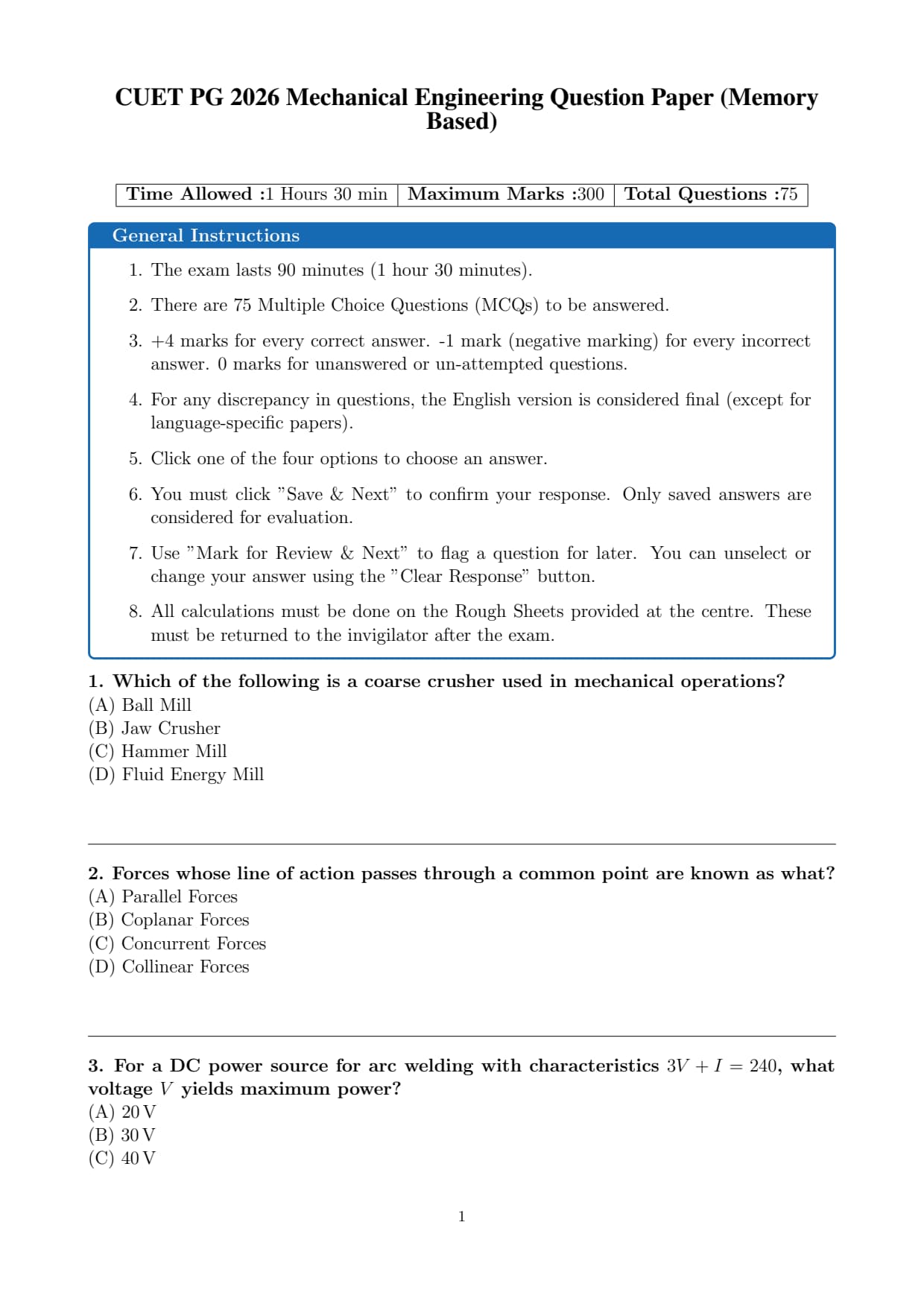
Which of the following is a coarse crusher used in mechanical operations?
View Solution
Concept:
Size reduction in mechanical operations is classified into coarse, intermediate, and fine crushing. Different equipment is used depending on the desired size reduction.
Step 1: Understanding coarse crushing.
Coarse crushers are used for the initial size reduction of large solid materials into smaller lumps.
Step 2: Identifying the correct equipment.
The Jaw Crusher is a primary crusher widely used for coarse crushing. It works by compressing material between a fixed and a moving jaw.
Step 3: Eliminating incorrect options.
Ball Mill is used for fine grinding.
Hammer Mill is used for intermediate to fine crushing.
Fluid Energy Mill is used for ultra-fine grinding.
Conclusion:
Thus, the correct answer is Jaw Crusher. Quick Tip: \textbf{Jaw Crusher = Coarse crushing (primary stage).}
Remember: Big rocks \(\rightarrow\) Jaw Crusher.
Forces whose line of action passes through a common point are known as what?
View Solution
Concept:
In engineering mechanics, forces are classified based on the relationship between their lines of action. Understanding these classifications helps in analyzing equilibrium and resultant forces.
Step 1: Understanding the given condition.
The question states that the lines of action of forces pass through a common point.
Step 2: Identifying the correct term.
Such forces are called Concurrent Forces, where all forces intersect at a single point.
Step 3: Eliminating incorrect options.
Parallel Forces have lines of action that never meet.
Coplanar Forces lie in the same plane but may not intersect at one point.
Collinear Forces act along the same straight line.
Conclusion:
Thus, the correct answer is Concurrent Forces. Quick Tip: \textbf{Concurrent Forces = All forces meet at one point.}
Think: Arrows pointing to the same point.
For a DC power source for arc welding with characteristics \(3V + I = 240\), what voltage \(V\) yields maximum power?
View Solution
Concept:
Electrical power is given by: \[ P = VI \]
To find maximum power, we express power in terms of a single variable and then maximize the function.
Step 1: Express current \(I\) in terms of voltage \(V\).
Given: \[ 3V + I = 240 \Rightarrow I = 240 - 3V \]
Step 2: Substitute into power equation.
\[ P = V \cdot I = V(240 - 3V) \] \[ P = 240V - 3V^2 \]
Step 3: Maximize the power function.
This is a quadratic equation: \[ P = -3V^2 + 240V \]
Maximum occurs at: \[ V = \frac{-b}{2a} = \frac{240}{2 \times 3} = 40 \]
Conclusion:
Thus, the voltage that yields maximum power is \(\boxed{40 \, V}\). Quick Tip: For maximum power in quadratic form \(P = aV^2 + bV\), use:
\[ V = \frac{-b}{2a} \]
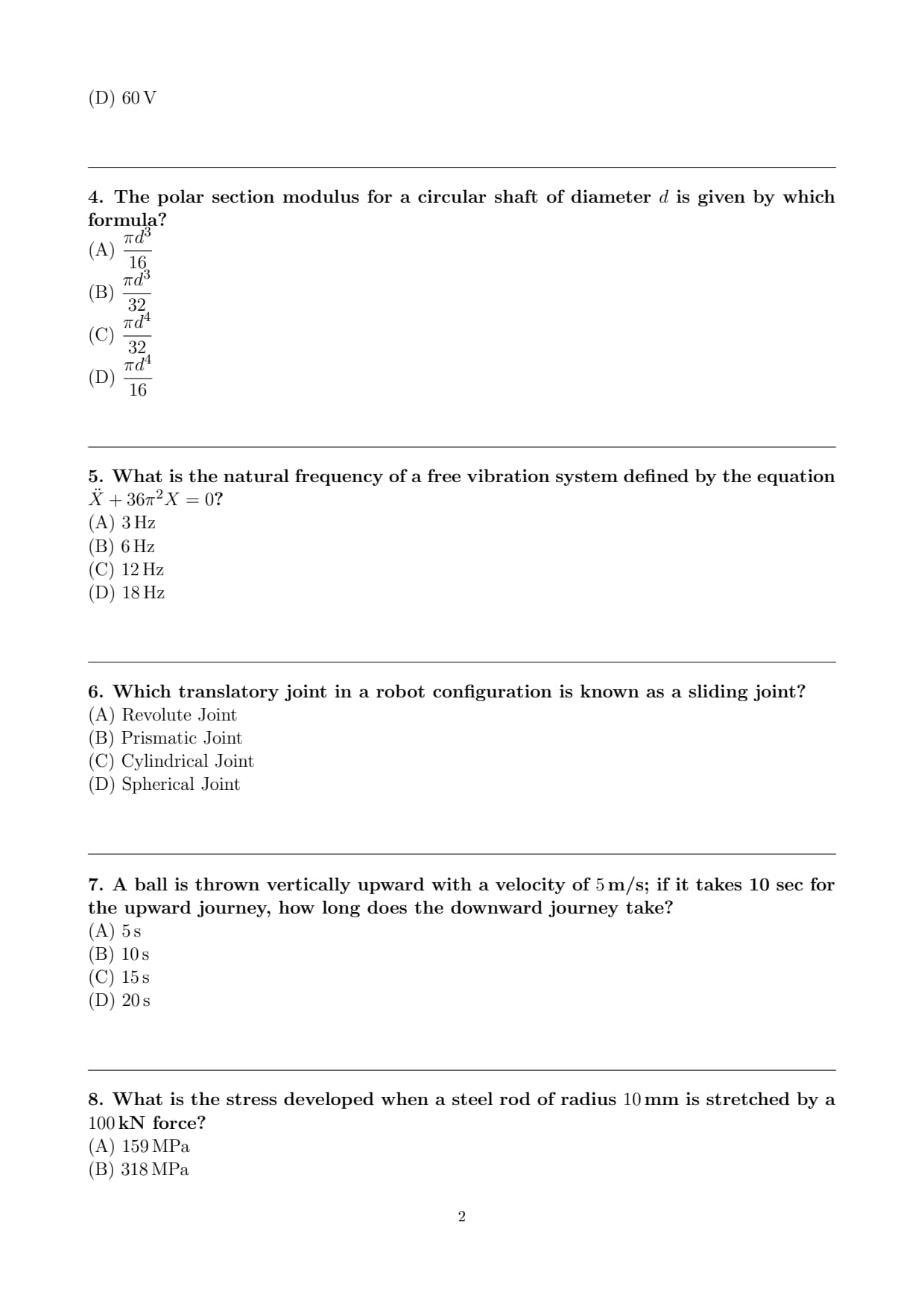
The polar section modulus for a circular shaft of diameter \(d\) is given by which formula?
View Solution
Concept:
Polar section modulus is used in torsion problems to determine the strength of a shaft. It is defined as: \[ Z_p = \frac{J}{R} \]
where \(J\) is the polar moment of inertia and \(R\) is the outer radius.
Step 1: Write the polar moment of inertia.
For a solid circular shaft: \[ J = \frac{\pi d^4}{32} \]
Step 2: Substitute radius \(R = \frac{d}{2}\).
\[ Z_p = \frac{J}{R} = \frac{\frac{\pi d^4}{32}}{\frac{d}{2}} \]
Step 3: Simplify the expression.
\[ Z_p = \frac{\pi d^4}{32} \times \frac{2}{d} = \frac{\pi d^3}{16} \]
Conclusion:
Thus, the correct formula is \( \boxed{\dfrac{\pi d^3}{16}} \). Quick Tip: For solid circular shaft:
\(J = \frac{\pi d^4}{32}\), \quad \(Z_p = \frac{\pi d^3}{16}\)
What is the natural frequency of a free vibration system defined by the equation \( \ddot{X} + 36\pi^2 X = 0 \)?
View Solution
Concept:
The standard equation of free vibration is: \[ \ddot{X} + \omega^2 X = 0 \]
where \( \omega \) is the प्राकृतिक angular frequency (rad/s), and: \[ f = \frac{\omega}{2\pi} \]
Step 1: Compare with standard equation.
Given: \[ \ddot{X} + 36\pi^2 X = 0 \]
So, \[ \omega^2 = 36\pi^2 \Rightarrow \omega = 6\pi \]
Step 2: Calculate natural frequency.
\[ f = \frac{\omega}{2\pi} = \frac{6\pi}{2\pi} = 3 \, Hz \]
Step 3: Correcting interpretation.
The angular frequency \( \omega = 6\pi \) rad/s corresponds to: \[ f = 3 \, Hz \]
Conclusion:
Thus, the natural frequency is \( \boxed{3 \, Hz} \). Quick Tip: Compare with \( \ddot{X} + \omega^2 X = 0 \), then:
\( f = \dfrac{\omega}{2\pi} \)
Which translatory joint in a robot configuration is known as a sliding joint?
View Solution
Concept:
In robotics, joints are classified based on the type of motion they allow. Translatory joints permit linear motion, unlike rotational joints.
Step 1: Understanding translatory motion.
A translatory (linear) joint allows movement along a straight line without rotation.
Step 2: Identifying the sliding joint.
The Prismatic Joint allows linear sliding motion between two links, similar to a piston moving inside a cylinder. Hence, it is also called a sliding joint.
Step 3: Eliminating incorrect options.
Revolute Joint allows rotational motion.
Cylindrical Joint allows both rotation and translation.
Spherical Joint allows multi-axis rotation.
Conclusion:
Thus, the correct answer is Prismatic Joint. Quick Tip: \textbf{Prismatic Joint = Linear (sliding) motion}.
Think: Piston movement.
A ball is thrown vertically upward with a velocity of \(5 \, m/s\); if it takes 10 sec for the upward journey, how long does the downward journey take?
View Solution
Concept:
In vertical motion under gravity (neglecting air resistance), the time taken to go up is equal to the time taken to come down to the same level.
Step 1: Understanding the motion.
The ball is projected upward and returns back under the influence of gravity. The motion is symmetric.
Step 2: Using symmetry of motion.
Time of ascent = Time of descent (for same height).
Step 3: Apply given data.
Upward journey time = \(10 \, s\)
\[ \Rightarrow Downward journey time = 10 \, s \]
Conclusion:
Thus, the downward journey also takes \( \boxed{10 \, s} \). Quick Tip: For vertical motion:
\textbf{Time up = Time down} (if same starting and ending level).
What is the stress developed when a steel rod of radius \(10 \, mm\) is stretched by a \(100 \, kN\) force?
View Solution
Concept:
Stress is defined as force per unit area: \[ \sigma = \frac{F}{A} \]
Step 1: Convert given values into SI units.
Force: \[ F = 100 \, kN = 100 \times 10^3 \, N \]
Radius: \[ r = 10 \, mm = 10 \times 10^{-3} \, m \]
Step 2: Calculate cross-sectional area.
\[ A = \pi r^2 = \pi (10 \times 10^{-3})^2 = \pi \times 10^{-4} \, m^2 \]
Step 3: Compute stress.
\[ \sigma = \frac{100 \times 10^3}{\pi \times 10^{-4}} = \frac{10^5}{\pi \times 10^{-4}} = \frac{10^9}{\pi} \approx 318 \times 10^6 \, Pa \]
\[ \sigma \approx 318 \, MPa \]
Conclusion:
Thus, the stress developed is \( \boxed{318 \, MPa} \). Quick Tip: \(\sigma = \frac{F}{A}\), and for circular section: \(A = \pi r^2\).
Always convert mm to m before calculation.
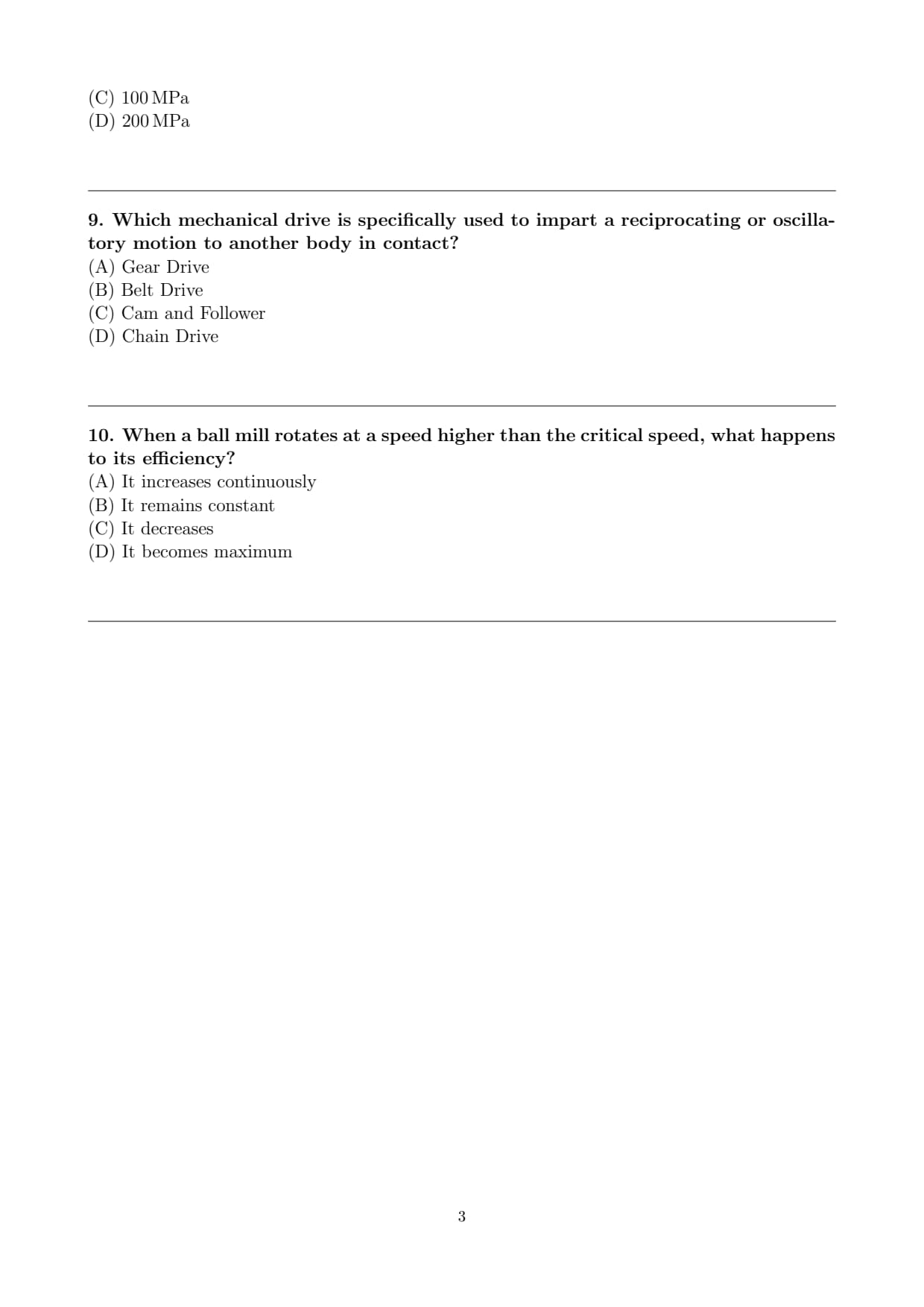
Which mechanical drive is specifically used to impart a reciprocating or oscillatory motion to another body in contact?
View Solution
Concept:
Different mechanical drives are used to transmit motion and power. Some are specifically designed to convert rotary motion into reciprocating or oscillatory motion.
Step 1: Understanding the requirement.
The question asks for a mechanism that imparts reciprocating or oscillatory motion to another body in contact.
Step 2: Identifying the correct mechanism.
A Cam and Follower mechanism converts rotary motion of the cam into reciprocating or oscillatory motion of the follower. The follower remains in contact with the cam surface.
Step 3: Eliminating incorrect options.
Gear Drive transmits rotary motion between shafts.
Belt Drive transmits motion using belts and pulleys.
Chain Drive transmits rotary motion using chains and sprockets.
Conclusion:
Thus, the correct answer is Cam and Follower. Quick Tip: \textbf{Cam + Follower = Rotary input \(\rightarrow\) Reciprocating/oscillating output}.
Used in engines and automated machinery.
When a ball mill rotates at a speed higher than the critical speed, what happens to its efficiency?
View Solution
Concept:
In a ball mill, grinding occurs due to the impact and attrition of balls falling on the material. The efficiency depends on the rotational speed relative to the critical speed.
Step 1: Understanding critical speed.
Critical speed is the speed at which the centrifugal force equals gravitational force, causing the balls to cling to the mill wall.
Step 2: Behavior above critical speed.
When the mill rotates above critical speed, the balls are carried along the wall and do not fall onto the material. Hence, no effective grinding occurs.
Step 3: Effect on efficiency.
Since impact action is lost, the grinding efficiency decreases significantly.
Conclusion:
Thus, the efficiency decreases when operating above critical speed. Quick Tip: \textbf{Above critical speed = Balls stick to wall = No grinding = Low efficiency}.



Comments