




The National Testing Agency (NTA) conducted the CUET PG 2026 Botany (SCQP07) examination on March 18, 2026, during Shift 3 from 04:00 PM to 05:30 PM.
Students who appeared for the exam reported that the overall difficulty level of the paper was moderate. CUET PG 2026 Botany Question Paper with Solutions PDF is available here for download. The marking scheme is +4 for correct answers and -1 for wrong answers, totaling 300 marks.
CUET PG 2026 Botany Question Paper with Solutions PDF
| CUET PG 2026 Botany Question Paper with Answer Key | Download PDF | Check Solutions |
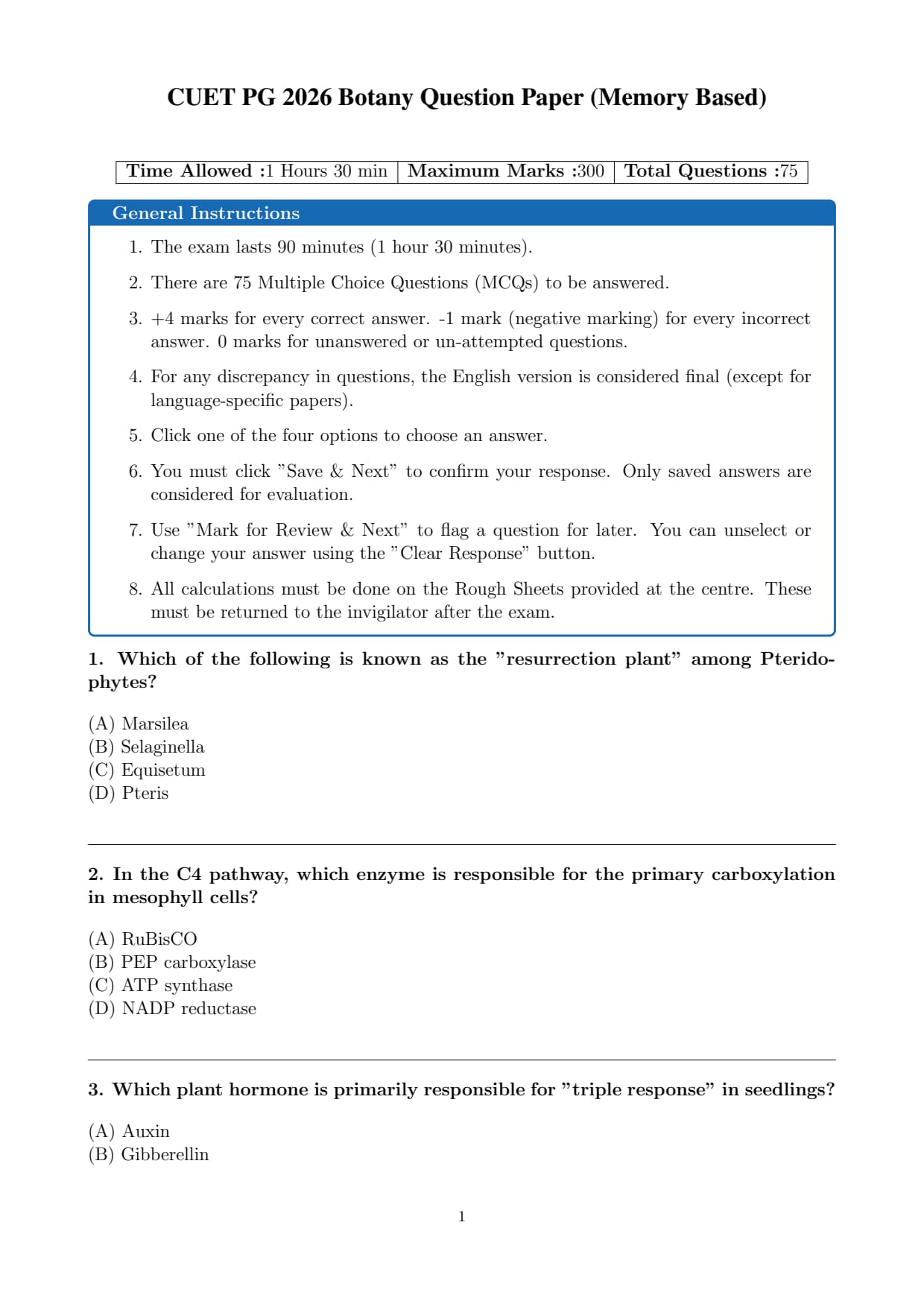
Which of the following is known as the "resurrection plant" among Pteridophytes?
View Solution
Concept:
Some plants have the ability to survive extreme dehydration and revive upon rehydration. Such plants are called resurrection plants. In Pteridophytes, certain species show this remarkable adaptation.
Step 1: Understanding the term "resurrection plant".
A resurrection plant can withstand prolonged dry conditions and resume normal metabolic activity when water becomes available again.
Step 2: Identifying the correct genus.
Among Pteridophytes, Selaginella (especially Selaginella bryopteris) is well known for its ability to survive desiccation and revive after rehydration. Hence, it is called the resurrection plant.
Step 3: Eliminating other options.
Marsilea – An aquatic fern, does not show resurrection ability.
Equisetum – Known as horsetail, lacks this property.
Pteris – A typical fern, no resurrection feature. Quick Tip: Selaginella bryopteris is popularly known as the \textbf{"Sanjeevani booti"} and is famous for its resurrection ability.
In the C4 pathway, which enzyme is responsible for the primary carboxylation in mesophyll cells?
View Solution
Concept:
In C4 plants, photosynthesis is spatially separated between mesophyll cells and bundle sheath cells. The initial fixation of carbon dioxide (primary carboxylation) occurs in mesophyll cells using a specialized enzyme.
Step 1: Understanding primary carboxylation.
Primary carboxylation refers to the first step of CO\(_2\) fixation, where CO\(_2\) is incorporated into an organic compound.
Step 2: Identifying the enzyme in mesophyll cells.
In C4 plants, phosphoenolpyruvate (PEP) combines with CO\(_2\) in mesophyll cells. This reaction is catalyzed by the enzyme PEP carboxylase, forming oxaloacetic acid (OAA).
Step 3: Eliminating other options.
RuBisCO – Functions in bundle sheath cells during the Calvin cycle.
ATP synthase – Involved in ATP formation, not carboxylation.
NADP reductase – Involved in reduction of NADP\(^+\), not CO\(_2\) fixation. Quick Tip: PEP carboxylase has a high affinity for CO\(_2\) and does not show oxygenase activity, which helps C4 plants minimize photorespiration.
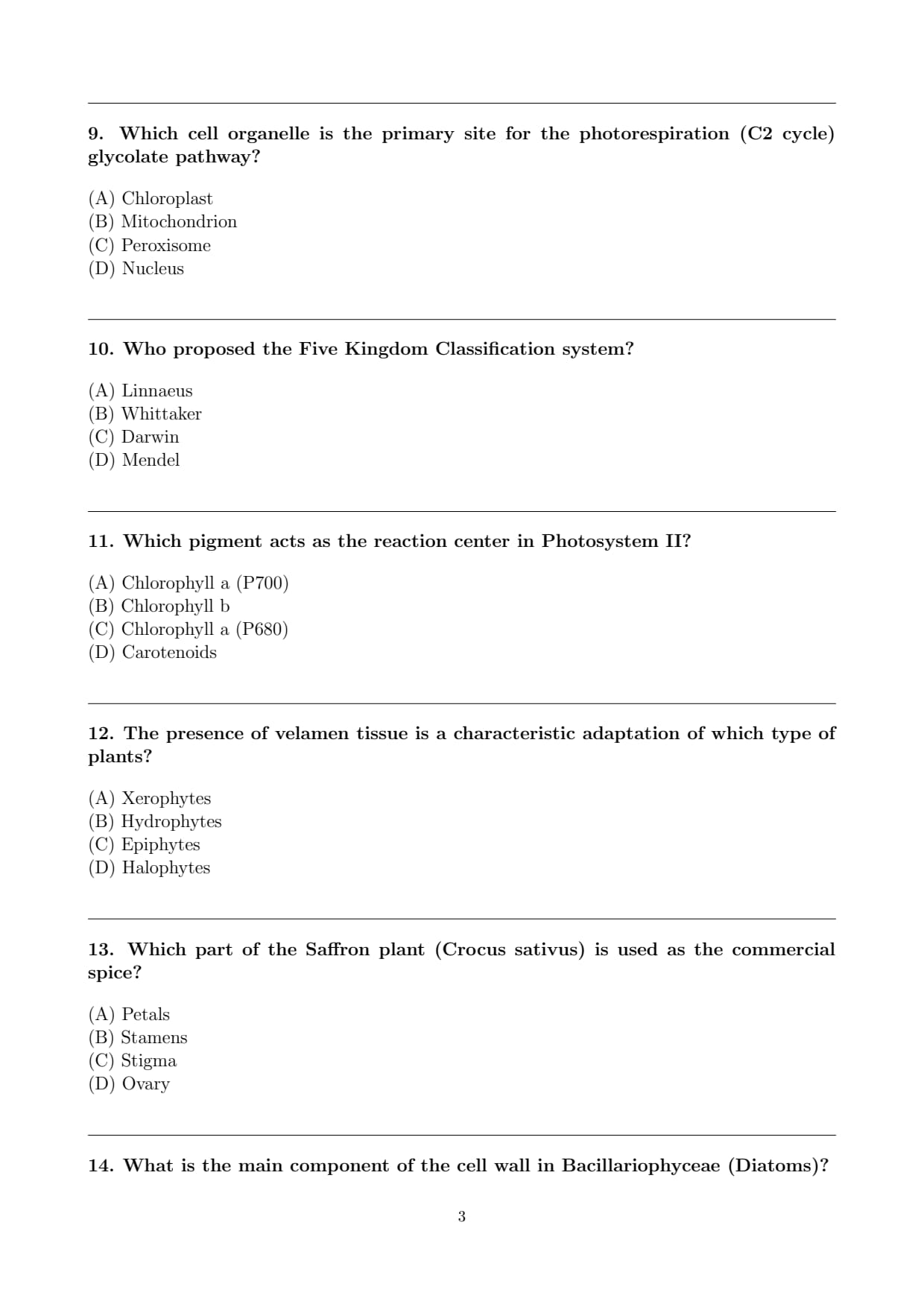
Which plant hormone is primarily responsible for "triple response" in seedlings?
View Solution
Concept:
The triple response in seedlings is a characteristic growth pattern observed in response to a specific plant hormone, especially under stress or mechanical impedance.
Step 1: Understanding triple response.
The triple response includes:
Inhibition of stem elongation
Radial swelling of the stem
Horizontal growth (apical hook formation)
Step 2: Identifying the hormone.
Ethylene is the plant hormone responsible for inducing the triple response in seedlings.
Step 3: Eliminating other options.
Auxin – Promotes elongation, not triple response.
Gibberellin – Stimulates stem elongation.
Cytokinin – Promotes cell division. Quick Tip: Ethylene is the only gaseous plant hormone and plays a key role in fruit ripening and stress responses.
What is the characteristic genetic ratio of a dihybrid cross involving dominant epistasis?
View Solution
Concept:
Epistasis is the interaction between genes where one gene masks or modifies the expression of another. In dominant epistasis, a dominant allele of one gene masks the effect of another gene.
Step 1: Understanding dominant epistasis.
In dominant epistasis, the presence of at least one dominant allele (A-) suppresses the expression of another gene (B/b), regardless of its alleles.
Step 2: Determining phenotypic ratio.
A typical dihybrid cross (AaBb \(\times\) AaBb) under dominant epistasis produces a modified phenotypic ratio: \[ 12 : 3 : 1 \]
Step 3: Explanation of ratio.
12 – Individuals with dominant epistatic allele (A-)
3 – Individuals with aaB-
1 – Individuals with aabb Quick Tip: Dominant epistasis modifies the classic 9:3:3:1 ratio to 12:3:1 by masking one gene's effect with a dominant allele of another gene.
The "Kranz anatomy" is a distinctive feature of the leaves of which group of plants?
View Solution
Concept:
Kranz anatomy refers to a special structural arrangement of cells in leaves that is associated with C\(_4\) photosynthesis.
Step 1: Understanding Kranz anatomy.
In Kranz anatomy, vascular bundles are surrounded by bundle sheath cells, which in turn are surrounded by mesophyll cells forming a wreath-like structure.
Step 2: Identifying the plant group.
This anatomical adaptation is characteristic of C\(_4\) plants, where photosynthesis is divided between mesophyll and bundle sheath cells to minimize photorespiration.
Step 3: Eliminating other options.
C\(_3\) plants – Lack Kranz anatomy.
CAM plants – Show temporal separation, not Kranz structure.
Bryophytes – Do not have such advanced leaf anatomy. Quick Tip: Kranz anatomy helps C\(_4\) plants efficiently fix CO\(_2\) and reduces photorespiration, especially in hot and dry conditions.
Which fungus is commonly used in the commercial production of citric acid?
View Solution
Concept:
Certain fungi are widely used in industrial fermentation processes for the production of organic acids.
Step 1: Understanding citric acid production.
Citric acid is produced commercially through fermentation using microorganisms under controlled conditions.
Step 2: Identifying the organism.
Aspergillus niger is the most commonly used fungus for large-scale production of citric acid due to its high yield and efficiency.
Step 3: Eliminating other options.
Penicillium – Known for antibiotic production.
Saccharomyces cerevisiae – Used in alcohol fermentation.
Rhizopus – Used in some organic acid production but not primarily for citric acid. Quick Tip: Aspergillus niger is widely used in industry not only for citric acid but also for enzyme production.
In the life cycle of Puccinia graminis, which spores are produced on the Barberry leaf?
View Solution
Concept:
Puccinia graminis is a heteroecious rust fungus that requires two hosts (wheat and barberry) to complete its life cycle and produces different types of spores on each host.
Step 1: Understanding host alternation.
Barberry acts as the alternate host, while wheat is the primary host.
Step 2: Identifying spores on Barberry.
On barberry leaves, the fungus produces pycniospores followed by aeciospores. The aeciospores are responsible for infecting wheat plants.
Step 3: Eliminating other options.
Uredospores – Produced on wheat.
Teliospores – Produced on wheat.
Basidiospores – Produced after germination of teliospores. Quick Tip: Puccinia graminis completes five spore stages, making it a macrocyclic fungus with host alternation.
What is the ploidy level of the endosperm in a typical gymnosperm like Pinus?
View Solution
Concept:
In gymnosperms, the nutritive tissue supporting embryo development is not a true endosperm but is derived from the female gametophyte.
Step 1: Understanding gymnosperm endosperm.
Unlike angiosperms, gymnosperms do not undergo triple fusion.
Step 2: Determining ploidy.
The nutritive tissue (called endosperm in a general sense) develops from the haploid female gametophyte; therefore, it is haploid (n).
Step 3: Comparison with angiosperms.
In angiosperms, endosperm is typically triploid (3n) due to double fertilization, which is absent in gymnosperms. Quick Tip: Gymnosperms lack double fertilization; hence their nutritive tissue remains haploid.
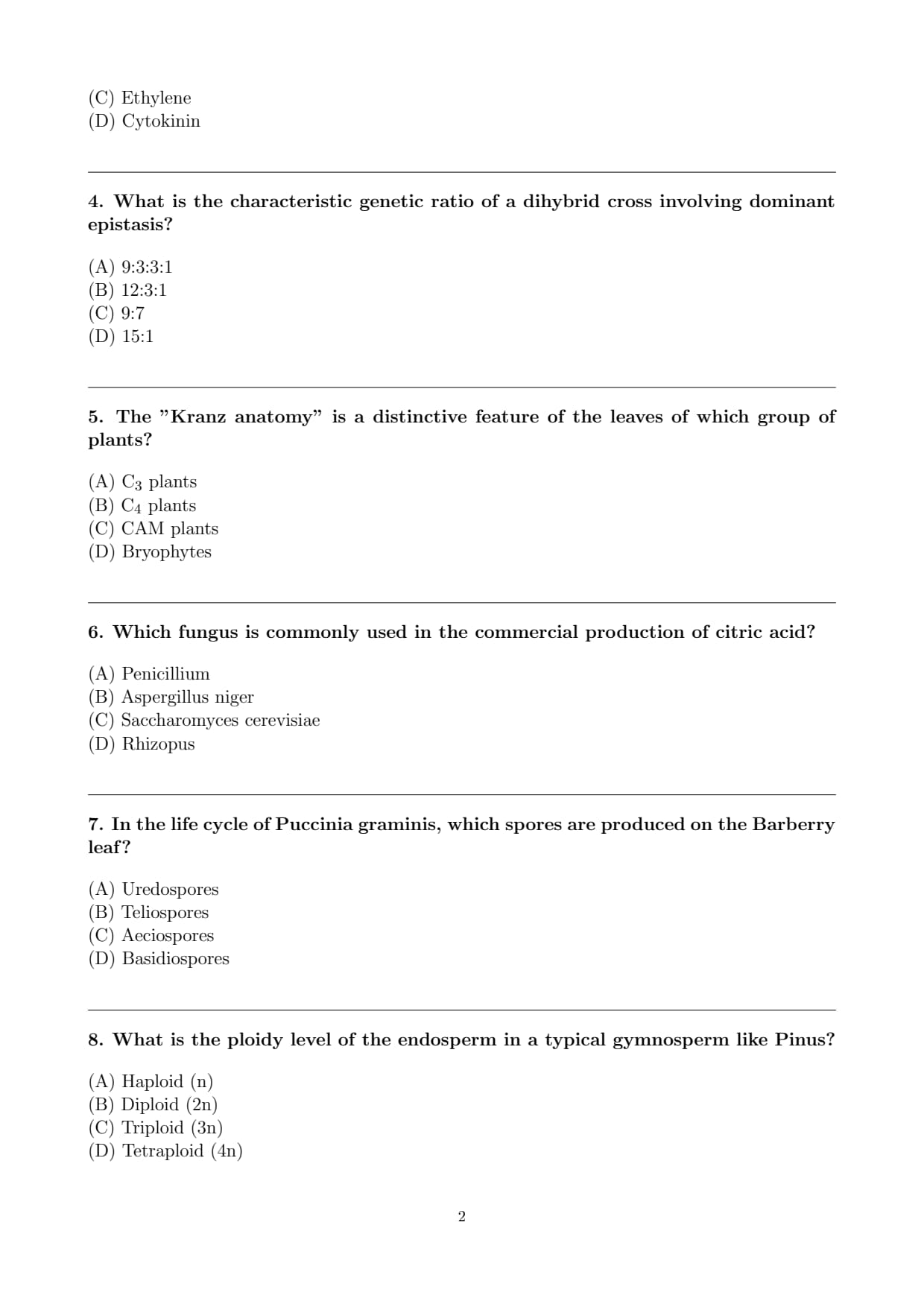
Which cell organelle is the primary site for the photorespiration (C2 cycle) glycolate pathway?
View Solution
Concept:
Photorespiration (C\(_2\) cycle) is a process involving multiple organelles, where glycolate metabolism plays a key role.
Step 1: Understanding photorespiration.
Photorespiration occurs when RuBisCO oxygenates RuBP, leading to the formation of glycolate.
Step 2: Identifying the primary site.
Glycolate is processed mainly in the peroxisome, where it is converted into glycine and other intermediates.
Step 3: Role of other organelles.
Chloroplast – Initial reaction occurs here.
Mitochondrion – Further metabolism of glycine.
Peroxisome – Main site of glycolate pathway. Quick Tip: Photorespiration involves coordination between chloroplast, peroxisome, and mitochondrion, but the glycolate pathway is centered in the peroxisome.
Who proposed the Five Kingdom Classification system?
View Solution
Concept:
The Five Kingdom Classification system is a widely accepted system that classifies organisms based on cell structure, body organization, mode of nutrition, and reproduction.
Step 1: Identifying the scientist.
R.H. Whittaker proposed the Five Kingdom Classification in 1969.
Step 2: Understanding the kingdoms.
The five kingdoms are Monera, Protista, Fungi, Plantae, and Animalia.
Step 3: Eliminating other options.
Linnaeus – Proposed the two-kingdom system.
Darwin – Known for the theory of evolution.
Mendel – Father of genetics. Quick Tip: Whittaker's classification is based on multiple criteria including cell type, complexity, and nutrition.
Which pigment acts as the reaction center in Photosystem II?
View Solution
Concept:
Photosystems contain a reaction center where light energy is converted into chemical energy. Each photosystem has a specific chlorophyll a molecule acting as the reaction center.
Step 1: Understanding Photosystem II.
Photosystem II (PS II) absorbs light maximally at 680 nm.
Step 2: Identifying the reaction center.
The reaction center of PS II is a special form of chlorophyll a called P680.
Step 3: Eliminating other options.
P700 – Reaction center of Photosystem I.
Chlorophyll b – Accessory pigment.
Carotenoids – Accessory pigments. Quick Tip: Remember: PS II = P680 and PS I = P700.
The presence of velamen tissue is a characteristic adaptation of which type of plants?
View Solution
Concept:
Velamen is a specialized multilayered tissue found in certain plant roots that helps in absorption and retention of moisture.
Step 1: Understanding velamen.
Velamen is a spongy tissue present in aerial roots that absorbs water from the atmosphere.
Step 2: Identifying plant type.
This adaptation is characteristic of epiphytic plants such as orchids, which grow on other plants and rely on atmospheric moisture.
Step 3: Eliminating other options.
Xerophytes – Adapted to dry conditions but lack velamen.
Hydrophytes – Aquatic plants.
Halophytes – Salt-tolerant plants. Quick Tip: Velamen helps epiphytes absorb water quickly and reduces water loss.
Which part of the Saffron plant (Crocus sativus) is used as the commercial spice?
View Solution
Concept:
Saffron is one of the most expensive spices and is obtained from a specific reproductive part of the flower.
Step 1: Identifying the plant part.
In Crocus sativus, the dried red-colored stigmas of the flower are used as the commercial spice saffron.
Step 2: Reason for use.
The stigma contains aromatic compounds and pigments (like crocin) responsible for flavor, color, and fragrance.
Step 3: Eliminating other options.
Petals – Not used as spice.
Stamens – Do not provide saffron.
Ovary – Not used commercially. Quick Tip: Saffron is obtained by hand-picking and drying the stigmas, making it one of the costliest spices in the world.
What is the main component of the cell wall in Bacillariophyceae (Diatoms)?
View Solution
Concept:
Diatoms are unicellular algae belonging to Bacillariophyceae, known for their unique cell wall structure.
Step 1: Understanding diatom cell wall.
The cell wall of diatoms is called a frustule, which is made up of two overlapping halves.
Step 2: Identifying composition.
The frustule is primarily composed of silica (hydrated silicon dioxide), giving it a glass-like appearance.
Step 3: Eliminating other options.
Cellulose – Found in plant cell walls.
Chitin – Found in fungi.
Pectin – Present in plant cell walls. Quick Tip: Diatomaceous earth, formed from accumulated diatom shells, is rich in silica.
Which vector is most commonly used for the genetic transformation of dicotyledonous plants?
View Solution
Concept:
Genetic transformation in plants involves introducing foreign DNA into plant cells using suitable vectors.
Step 1: Understanding the vector system.
Agrobacterium tumefaciens naturally transfers DNA into plant cells through its Ti (tumor-inducing) plasmid.
Step 2: Application in dicots.
This bacterium is widely used as a vector for genetic transformation, especially in dicotyledonous plants.
Step 3: Eliminating other options.
pBR322 – Bacterial cloning vector.
Bacteriophage lambda – Infects bacteria.
Cosmids – Used in cloning, not plant transformation. Quick Tip: Agrobacterium tumefaciens is called a natural genetic engineer due to its ability to transfer DNA into plants.




Comments