



Arts and Board Exam Specialist
Environmental studies typically focus on topics such as pollution, conservation, and sustainable development. The environment refers to the natural world around us, including air, water, land, plants, and animals. It plays a crucial role in supporting life on Earth and maintaining its delicate balance.
It addresses various types of pollution, their causes, and effects on the environment and human health. Overall, the goal of environmental studies is to create awareness and understanding of the importance of protecting our environment for future generations.
Related Links:
- Appearing for NEET, Download NEET PYQ for all subjects
- Appearing for CUET, Download CUET PYQ for all subjects
- Chapter-wise Important Section in Environmental Studies
- Most Repeated MCQs (2020–2024)
- Most Expected MCQs for 2026 Board Exams (chapter-wise)
- Very Short Answer Type Questions (1 Mark)
- Short Answer Type Questions (2 Marks)
- Long Answer Questions (3 Marks Questions)
- Very Long Answer Questions (5 Marks Questions)
Chapter-wise Important Section in Environmental Studies
The paper focuses heavily on application-based and real-world environmental problem-solving. Questions from chapters like Pollution, Natural Resources, Ecosystems, and Sustainable Development are usually repeated every year. The CBSE Class 10 Environmental Studies (EVS) syllabus is designed to evaluate students’ understanding of environmental issues, sustainable development, and factors that influence ecological conservation.
For the CBSE 2026 Class 10 Environmental Studies exam, the expected pattern is :
- Section A – MCQs (1 mark each)
- Section B – Very Short Answer Questions (1 mark each)
- Section C – Short Answer Questions (3 marks each)
- Section D – Long Answer Questions (5 marks each)
| Chapter | Important Areas |
|---|---|
| Natural Resources | Water, soil, forests, and resource conservation |
| Ecosystems | Food chains, food webs, biotic- abiotic components |
| Biodiversity | Flora-fauna, conservation, endangered species |
| Environmental Pollution | Air, water, soil pollution; noise pollution; global warming |
| Sustainable Development | Reduce–Reuse–Recycle, waste management |
| Human Impact on the Environment | Deforestation, overpopulation, and industrialization |
| Climate Change | Greenhouse effect, carbon footprint |
| Disaster Management | Natural disasters & preparedness |
Environmental Studies Class 10 Important Questions Video
Most Repeated MCQs (2020–2024)
1. The process of converting waste materials into reusable objects is called:
- Reuse b) Recycle c) Reduce d) Recover
Answer: b
2. Ozone layer depletion is mainly caused by:
- CO 2 b) CFCs c) Methane d) O 2
Answer: b
The highest trophic level in a food chain is:
- Producers b) Primary consumers c) Secondary consumers d) Top carnivores
Answer: d
3. Which gas is responsible for global warming?
- Nitrogen b) Oxygen c) Carbon dioxide d) Helium
Answer: c
4. Afforestation means:
- Cutting trees b) Planting trees c) Burning forests d) Soil erosion
Answer: b
5. The International Day for Disaster Reduction is observed on:
- 13 October b) 5 June c) 22 April 11 December
Answer: a
6. The main cause of water pollution is:
- Photosynthesis b) Industrial waste c) Wind energy d) Evaporation
Answer: b
7. Which is NOT a renewable resource?
- Solar power b) Wind energy c) Petroleum d) Water
Answer: c
8. Food webs are formed by:
- Single food chain b)Multiple interconnected food chains c) Only producers d) Only consumers
Answer: b
9. Which of the following reduces carbon footprint?
- Increase car use, b) Burning waste c) Using public transport, d) Wasting electricity
Answer: c
Most Expected MCQs for 2026 Board Exams (chapter-wise)
Chapter 1: Natural Resources
1. Water harvesting helps in:
- Increasing soil acidity
- Recharging groundwater
- Producing electricity
- Increasing salinity
Answer: b
2. Which of the following is an exhaustible resource?
- Air
- b) Coal
- c) Sunlight
- d) Water
Answer: b
Chapter 2: Ecosystems
3. Producers in an ecosystem are usually:
- Animals
- b) Fungi
- c) Plants
- d) Decomposers
Answer: c
4. Energy flow in an ecosystem is always:
- Circular
- One-directional
- Reversible
- Random
Answer: b
Chapter 3: Biodiversity
5. The term ‘biodiversity’ refers to:
- A variety of living organisms
- Weather patterns
- Soil composition
- Industrial development
Answer: a
6. Which is an example of ex-situ conservation?
- National parks
- Sanctuaries
- Zoos
- Biosphere reserves
Answer: c
Chapter 4: Pollution
7. The AQI measures:
- Water pH level
- Air quality
- Soil fertility
- Temperature
Answer: b
8. The major cause of acid rain is:
- CO2 and O2
- SO2 and NOx
- H2O and CO
- CH4
Answer: b
Chapter 5: Sustainable Development
9. The 3R principle stands for:
- Reduce–Reuse–Recycle
- Restore–Repair– Reuse
- Reduce–Relate–Recycle
- None
Answer: a
10. Sustainable development ensures:
- Use of resources only for the present
- Use of resources for future generations
- Increase in industrial waste
- More use of fossil fuels
Answer: b
Chapter 6: Human Impact on the Environment
11. Eutrophication of water bodies is caused by:
- Oil spills
- Excess nutrients
- Strong waves
- Temperature rise
Answer: b
12. Which activity increases carbon footprint?
- Cycling
- Tree planting
- Using ACs extensively
- Using solar heaters
Answer: c
Chapter 7: Climate Change
13. The greenhouse effect is essential for:
- Heavy rainfall
- Life on Earth
- Forest fires
- Ozone formation
Answer: b
14. Kyoto Protocol is related to:
- Biodiversity
- Climate change
- Disaster management
- Pollution control
Answer: b
Chapter 8: Disaster Management
15. Earthquake intensity is measured using:
- Richter scale
- Lactometer
- Seismograph
- Thermometer
Answer: a
16. Which is a mitigation measure for floods?
- Building dams
- Lighting fireworks
- Increasing deforestation
- Plastic dumping
Answer: a
General EVS
17. The main source of renewable energy in India is:
- Coal
- Solar energy
- Petroleum
- Uranium
Answer: b
18. Which is biodegradable?
- Plastic bag
- Glass
- Paper
- Metal
Answer: c
19. Noise pollution level is measured in:
- dB
- ppm
- mm
- mg
Answer: a
20. Waste segregation means separating waste into:
- Wet and dry
- Metal only
- Plastics only
- Stones
Answer: a
Very Short Answer Type Questions (1 Mark)
Ques. Define ecosystem.
Ans. A community of living organisms interacting with each other and with their physical environment is called an ecosystem
Ques. Name two greenhouse gases.
Ans. Carbon dioxide, methane
Ques. What is the full form of CFC?
Ans. Chlorofluorocarbons
Ques. Give one example of a renewable resource.
Ans. Solar energy
Ques. Name one method of water conservation.
Ans. Rainwater harvesting
Ques. What is the environment?
Ans. The environment refers to the natural world around us, which includes the atmosphere, hydrosphere, geosphere, flora, and fauna.
Ques. What is pollution?
Ans. Harmful or dangerous substances or items introduced into an ecosystem are considered pollution.
Ques. In your own words, please define "conservation."
Ans. Conservation refers to the practice of safeguarding, preserving, managing, or restoring natural resources like forests, wildlife, and ecosystems.
Ques. What is sustainable development?
Ans. Development that satisfies the demands of the present without jeopardising the potential of future generations to do the same is called sustainable development.
Ques. What is biodiversity?
Ans. The term "biodiversity" refers to the wide array of organisms that may be found on Earth, encompassing a diverse range of species and habitats, as well as variations in individual genes.
Short Answer Type Questions (2 Marks)
Ques. Explain the 3R principle with examples.
Ans. The 3Rs in environmental studies are given as:
- Reduce: Cut down on natural resource use (e.g., reducing electricity).
- Reuse: Use items again (e.g., reusable bottles).
- Recycle: Convert waste into new products (e.g., recycling paper).
Ques. What are the causes of air pollution?
Ans. Burning fossil fuels, industrial pollutants, vehicle exhaust, and agricultural practices all contribute to unhealthy levels of air pollution. Carbon monoxide, nitrogen oxides, and sulphur dioxide are only some of the gases released into the environment when fossil fuels like coal, oil, and natural gas are burned. Particulate matter and chemical contaminants are also released into the air from industrial activity.
Ques. Justify why it's so crucial that biodiversity be preserved.
Ans. Having a wide range of plant and animal species on Earth is known as "biodiversity," and it's crucial for many reasons. Firstly, it safeguards the continuation of biologically diverse ecosystems by ensuring the survival of a wide variety of species.
- Second, biodiversity is useful because it helps with ecosystem services, including pollination, pest management, and nutrient cycling.
- Finally, biodiversity is significant in terms of aesthetics and culture. Finally, maintaining biodiversity is crucial to human well-being.
Long Answer Questions (3 Marks Questions)
Ques. Lay out how people's health is negatively impacted by pollution.
Ans. There are numerous ways in which pollution can harm people's health. Asthma, bronchitis, and lung cancer are just a few of the respiratory illnesses that can be triggered by breathing polluted air.
- Cholera and typhoid, both of which may be spread by contaminated water, are two examples of the problems that can arise when water supplies are contaminated.
- Food poisoning can result from soil and crop contamination brought on by land degradation.
- Hearing loss and stress disorders are two of the many negative health outcomes associated with exposure to excessive noise.
- Pollution is a known contributor to a wide range of health problems, including but not limited to: skin irritation and allergies, fetal abnormalities.
Ques. In your own words, please elucidate the value and significance of recycling.
Ans. Reusing old materials to make something new is called recycling. Natural resources like timber, minerals, and water are conserved, the amount of trash delivered to landfills is cut down, and pollution from trash disposal is mitigated.
- It takes a lot less energy to recycle than it would to extract fresh raw materials; therefore, recycling is great for energy conservation.
- Employment opportunities in the recycling sector are a further benefit, as is the promotion of a greener economic growth.
Ques. Explain how shifting temperatures have altered the local ecosystem and the variety of animal and plant life.
Ans. The impacts of climate change on animals and biodiversity are complex. Some species may become less common while others become more common as a result of changes in temperature and precipitation patterns that affect their ranges and populations.
- Marshes, mangroves, and coral reefs are just a few examples of coastal habitats that could be lost due to rising sea levels.
- A mismatch between the timing of breeding and the timing of food availability is another potential consequence of climate change.
- Temperature shifts can also upset ecosystems' delicate equilibrium, which can reduce biodiversity.
Very Long Answer Questions (5 Marks Questions)
Ques. Explain the role of government and individuals in protecting the environment.
Ans. The government's responsibility in environmental protection is to enact and uphold policies that safeguard natural resources and limit pollution. The government's involvement extends to safeguarding endangered species and their habitats, sponsoring environmental research and education, and promoting awareness of these issues.
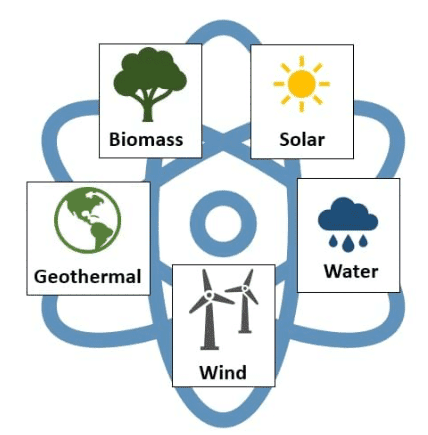
- Governments may do their part to promote sustainable development by doing things like offering tax breaks for eco-friendly goods and services and supporting the use of renewable energy sources.
Renewable energy
- An individual's daily actions have a significant impact on environmental protection.
- Use of public transit, carpooling, and cycling are all viable alternatives to driving that can help individuals lessen their environmental impact.
- Taking shorter showers, shutting off lights and appliances when not in use, and switching to more energy-efficient models are all easy ways for individuals to save water and electricity.
- In addition, individuals can do their part to lessen environmental damage by recycling, composting, and safely discarding hazardous materials from the home.
- Furthermore, individuals can help safeguard the environment by showing their support for and purchasing goods from businesses that engage in environmentally friendly practices and policies.
- All things considered, the government and individuals alike bear substantial responsibility for preserving ecological balance.
Read More: Species diversity
Ques. Explain the causes and effects of deforestation.
Ans. Deforestation actually refers to the intentional destruction of forest habitat for a variety of reasons. Main reasons for forest loss are:
- The extension of agriculture involves the elimination of vegetation in order to make room for more fields and pastures for domesticated animals.
- Logging is the practice of cutting down trees for industrial purposes like making paper and furniture.
- In order to make way for new buildings and infrastructure, land must be cleared during the urbanization process.
- In order to obtain minerals and other natural resources, land must be cleared.
The environmental implications of deforestation are varied. Many plant and animal species rely on forests for their survival, thus if forests disappear, so do those species.
Ques. Define "Green Energy" and elaborate on its significance.
Ans. Green energy refers to power that comes from non-conventional, sustainable resources such the sun, wind, water, earth, and plants. Because it does not release any greenhouse gasses or pollutants, it is regarded to be safe for the environment.

Green energy
- Green energy is important because it can eventually replace nonrenewable fossil fuels, which are the main cause of environmental damage and global warming.
- It aids in decreasing the need for fossil fuels and the harmful effects of producing energy.
- In addition, the price of renewable energy is dropping and will continue to do so in the future, making it more affordable than conventional energy.
- Green energy investment not only serves to spur job growth and expansion of the economy, but also helps to protect the environment.



Comments