



Education Content Expert
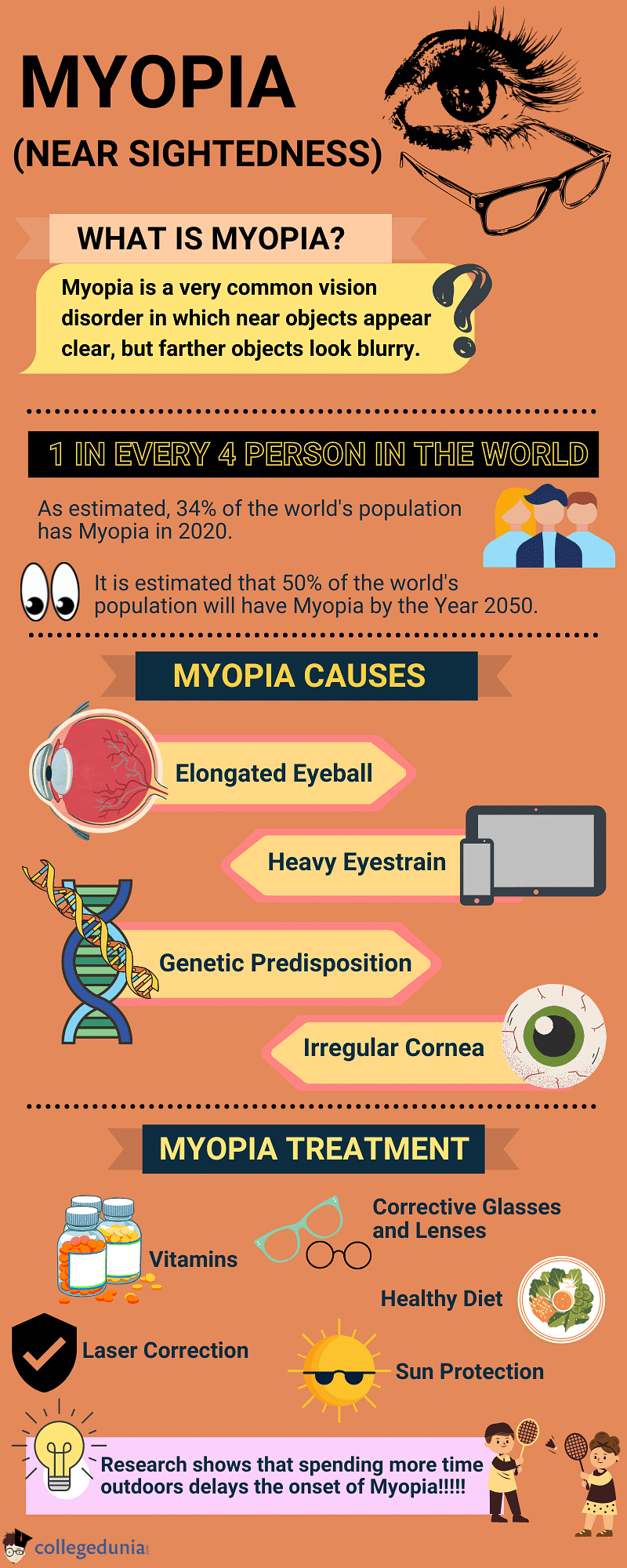
Myopia is a very common vision disorder in which near objects appear clear, but farther objects look blurry. It makes focusing on objects at a farther distance difficult and leads to blurry vision.
- It usually develops during childhood and adolescence and becomes more stable at the later stage of life.
- It affects a significant percentage of the human population and tends to run in families.
- Myopia is also known as nearsightedness or short-sightedness.
- It can easily be corrected with eyeglasses, contact lenses, or surgery.
Read More: NCERT Solutions For Class 10 Science The Human Eye and the Colourful World
Key Terms: Myopia, Nearsightedness, Short-sightedness, Vision Disorder, Eye Defect, Symptoms of Myopia, Pathological Myopia, Eye, Retina
Myopia Meaning
[Click Here for Sample Questions]
Myopia is an eye disease or abnormality of the eye in which near vision is clear while distant vision is blurred.
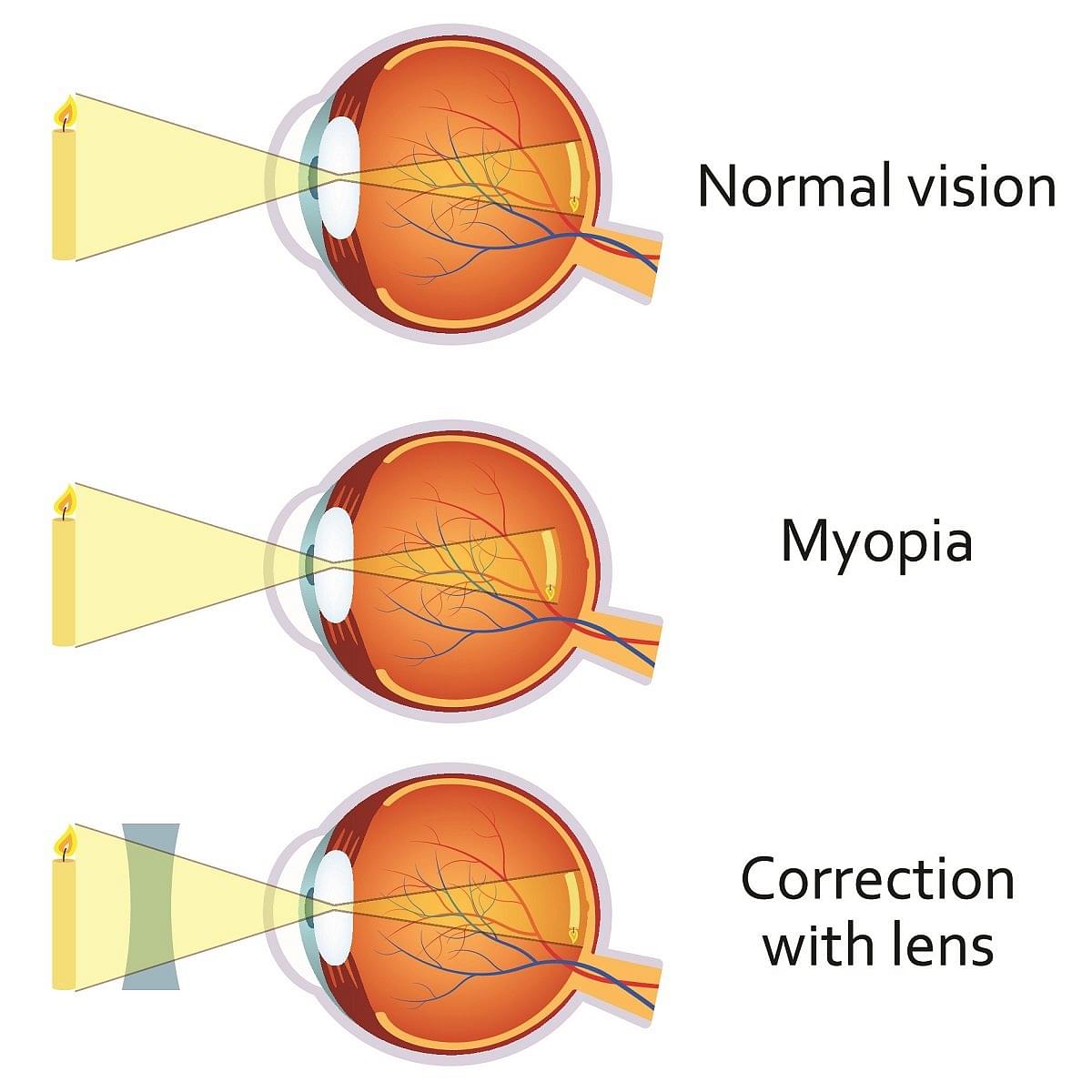
- Myopia occurs when the eye shape or any other part of the eye causes light rays to bend (refract) inaccurately.
- In this case, light rays do not focus on the surface of the retina but in front of it.
- The light rays converge too fast in the eyes and are focused before they reach the retina.
- It leads to images being blurry and unclear when perceived.
- The distant images appear out of focus however the objects nearby are seen clearly.
- This is the reason why myopia is referred to as nearsightedness or short-sightedness.
- It is a very common eye defect and can easily be corrected with glasses, contact lenses, or refractive surgery.

Myopia
The video below explains this:
Human Eye One Shot Detailed Video Explanation:
Read More:
Causes of Myopia
[Click Here for Sample Questions]
Myopia is caused due to several reasons be it hereditary or lifestyle-related causes. The main causes of Myopia are listed as follows:
- Hereditary: Myopia is hereditary more than half of the time which means it passes down to generations.
- Elongation of Eyeballs or Building of Corneas: The light rays are refracted when the usual curvature of the cornea bulges. In myopia, the image is formed before the cornea. The image of the distant objects does not appear at the appropriate point and seems blurred.
- Uncontrolled Diabetes: An increase in the blood sugar level may lead to Myopia.
- Unattended Cataract: Myopic shifts are the visible signs of Cataracts. When the cataract is not cured on time, it may lead to the development of Myopia.
- Shape of Lens becomes Too Convex: If the shape of the lens becomes too convex, the defect of Myopia or nearsightedness may arise.
- Increase in Depth of Eyeball: When the length of the eyeball is too long in comparison to the focusing power of the lens of the eye and cornea, the light rays focus at a point in front of the retina and not on the retina itself.

Normal Vision vs Myopia
Read More: The Human Eye and The Colourful World Important Questions
Types of Myopia
[Click Here for Sample Questions]
Myopia can be categorized into three main types which are as follows:
Simple Myopia
- In simple myopia, the human eye is usually healthy.
- The fault and the problem of the vision of the eye may be corrected easily without any surgical process.
- It can easily be treated with a proper powerful lens or glasses.
High Myopia
- High Myopia is the extreme form of myopia.
- If a person is diagnosed with myopia at a young age, this impairment gets worse with growing age.
- High myopia raises the risk of additional eye disorders including cataracts, glaucoma, and so on.
Pathological Myopia
- Pathological Myopia is also known as degenerative myopia.
- People with this kind of myopia will also have additional eye conditions.
- It can cause lattice degeneration, which is a type of retinal thinning.
- It may also lead to retinal atrophy wherein the parts of the retina are wasted and do not work.
- Pathological Myopia can cause Forster-Fuchs’ spot, a type of scarring on the retina that can lead to blind spots.
- It can also cause vision loss.
- It cannot be corrected with glasses or contact lenses.
Myopia
Symptoms of Myopia
[Click Here for Sample Questions]
The common signs and symptoms of Myopia include:
- A myopic person will not be able to see distant signs clearly (like road signs). However, they will be able to see nearby objects.
- While driving or playing sports, feeling fatigued is also a sign of myopia.
- When a person needs to squint or close the eyelids partially to be able to see distant objects is also a sign of myopia.
- Eyestrain is also caused due to Myopia.
- Headache is one of the common symptoms of Myopia.
If a person starts to experience these symptoms, they must consult an optometrist, who can determine whether they have myopia or not.

Symptoms of Myopia
Read More: The Human Eye and The Colourful World Revision Notes
Treatment of Myopia
[Click Here for Sample Questions]
Myopia can easily be corrected at an earlier stage. Some of the common treatments for Myopia are as follows:
Glasses and Contact Lenses
- The use of spectacles and contact lenses with adequate power is the most frequent treatment option for myopia.
- For a myopic individual, the power of the eye is negative.
- The customized lenses fit into frames and are worn as spectacles while the contact lenses are disk lenses that are put on the eye surface.
Correction of Myopia
Orthokeratology
- This approach for treating myopia is nonsurgical.
- A moderate kind of myopia can be treated by Orthokeratology.
- This therapy requires the use of a succession of hard corneal lenses.
Surgery
- There are two options for surgery in case of Myopia.
- One is the placement of a corrective lens for myopia inside the eye, either in front of the person’s lens or in place of it.
- The other is laser surgery wherein an eye doctor will use a powerful beam of light to change the shape of the cornea.
Myopia Formula
[Click Here for Sample Questions]
Myopia Formula is used to calculate the power of the lens required to correct myopia. For this, the approximate formula of the focal length of the combined lens is used:
| \({1 \over f} = {1 \over f_1} +{1 \over f_2}\) |
Where
- f: Effective Focal Length.
- f1: Focal Length of the Lens Required.
- f2: Focal Length of the Human Eye.
Nearsightedness and Its Correction
[Click Here for Sample Questions]
Myopia or Nearsightedness is not an illness but a disorder that can easily be corrected.
- The image of the object becomes blurry as the light rays are not diverging at the right point and creating a focused image.
- The rays get focused in front of the retina in the case of Myopia.
- The use of a concave lens easily fixes myopia in most cases.
- Before concave lenses converge and concentrate on the retina, parallel lights cause them to diverge.
- When viewing objects that are near, the light rays are coming from far-off points, which make them almost parallel to each other by the time they reach the cornea.

Corrective Lenses for Myopia
Check More:
Things to Remember
- Myopia is an eye focus disorder that leads to difficulty seeing distant objects but one can see near objects clearly.
- Myopia is generally hereditary but can also be caused due to lifestyle problems.
- It is caused due to elongation of the eyeball or bulging of the cornea.
- In myopia, the image is formed in front of the retina instead of being formed on the retina.
- Myopia Formula is used to find the power of the corrective lens and is given as \({1 \over f} = {1 \over f_1} +{1 \over f_2}\).
- It can be cured with the help of contact lenses, glasses, or surgery in extreme cases.
Sample Questions
Ques. Myopia is also known as _______
(a) Far-sightedness
(b) Zero-sightedness
(c) Near-sightedness
(d) None of the above (2 Marks)
Ans. (c) Near-sightedness
Explanation: Myopia is also referred to as Near-sightedness. It is a common vision defect, wherein objects closer to the person can be seen carefully, while ones that are placed far are blurred or may not be visible clearly to the person. This is the reason why myopia is also called near or short-sightedness. Myopia occurs when light rays bend or refract in the wrong direction and focus the image on your retina.
Ques. Myopia is caused by
(a) Watching TV
(b) Hereditary
(c) Dust Infection
(d) Allergy (2 Marks)
Ans. (b) Hereditary
Explanation: Myopia is a vision disorder that has a hereditary pattern. The chance of getting this disorder is higher for first-degree relatives of the affected person (siblings or children). Genetics can increase the likelihood of developing myopia. For instance, children who have a parent with myopia are more likely to develop it themselves.
Ques. The formula used to calculate the power of the correcting lens for myopia is
(a) 1/f = 1/f1 – 1/f2
(b) 1/f = 1/f1 x 1/f2
(c) 1/f = f1 + f2
(d) 1/f = 1/f1 + 1/f2 (2 Marks)
Ans. (d) 1/f=1/f1+1/f2
Explanation: It is known that,
P=1/f
Where
- P is power.
- f is the focal length in meters.
For example, if the power is -3.00. So using the myopia formula,
-3.00 = 1/f
f =0.67 meters
Ques. How can nearsightedness be fixed?
(a) Using Diverging Lenses
(b) Using Thick Lenses
(c) Using Converging Lens
(d) Using Reading Lens (2 Marks)
Ans. (a) Using Diverging Lenses
Explanation: The problem of nearsightedness or myopia can be fixed using a diverging lens. The diverging lens helps in curving the light entering the eye so that the light hits the retina and creates an image rather than making it in front of the retina.
Ques. Symptom of myopia is
(a) Squinting
(b) Frowning
(c) Difficulty in breathing
(d) Both a and b (2 Marks)
Ans. (d) Both a and b
Explanation: When a myopic person is squinting or frowning it shows that they are facing difficulty in reading certain things. Squinting and frowning can help with less amount of light entering the eye, which might help in sharper images.
Ques. A person is advised to wear spectacles with concave lenses. What type of defect of vision is he suffering from? (1 Mark)
Ans. The defect of vision that a person is suffering from is Myopia or short-sightedness.
Ques. (a) What is meant by the power of accommodation of an eye?
(b) A person with a myopic eye cannot see objects beyond 1.2 m directly. What should be the type of corrective lens used? What would be its power? (2 Marks)
Ans. (a) The maximum variation in the power of the lens due to which the far-off and nearby objects are viewed clearly is called the power of accommodation.
(b) To correct this an object at infinity has to be brought to a distance of 120 cm. Using the myopia formula,
\({1 \over f} = {1 \over f_1} +{1 \over f_2}\)
\({1 \over f} = {1 \over -120} +{1 \over - \infty} = {1 \over -120}\)
f = -120 cm
P = 100/-120 = -5/6D
P = -0.83 D
Thus, a concave lens of focal length 120 cm and power –0.83 D is needed to be used.
Ques. (a) Explain the following terms used in relation to defects in vision and the correction provided for them:
(i) Myopia
(ii) Astigmatism
(iii) Bifocal lenses
(iv) Far-sightedness
(b) Why is the normal eye unable to focus on an object placed within 10 cm of the eye? (5 Marks)
Ans. (a) (i) Myopia: Myopia or short-sightedness is caused due to excessive curvature in the cornea or elongation of the eyeball. In this, the image of the object is formed before the retina. So, to correct this a concave lens is used.
(ii) Astigmatism: The inability to focus the light in both vertical and horizontal lines is called astigmatism. It is caused due to curvature in the lens both horizontally and vertically. Astigmatism can be corrected by using a cylindrical lens.
(iii) Bifocal Lenses: These lenses are used to correct the presbyopic eye. These contain lenses with upper concave and lower convex surfaces. Presbyopia occurs with growing age.
(iv) Far-sightedness: Far-sightedness or hypermetropia is caused due to greater focal length of the eye lens. In this, the eyeball becomes smaller. This defect can be corrected by using a convex lens.
(b) The focal length of the lens cannot be changed to an extent that objects nearer than 25 cm can be viewed. So it is not able to focus for 10 cm.
Ques. What is Myopia? (2 Marks)
Ans. Myopia is an eye defect in which a person is not able to view objects that are placed at a distance. In this case, the image is formed before the retina. For every myopic eye, there is a fixed far point beyond which a clear image cannot be seen. The short-sightedness can be corrected by using a concave lens which can diverge and shifts the image to the retina.
Ques. (a) A student cannot see clearly a chart hanging on a wall placed at a distance of 3 m from his eye. Name the defect of vision he is suffering from. Draw a ray diagram to illustrate this defect. List its two possible causes.
(b) An eye donation camp is being organized by social workers in your locality. How and why would you help in this cause? (5 Marks)
Ans. (a) Myopia or Short-sightedness is the inability of an eye to view long distant objects. The image in this case falls before the retina. For every myopic eye, there exists a far point beyond which a clear image cannot be seen. Short-sightedness is caused due to
- Excessive curvature in the cornea.
- Elongation of the eyeball.
(b) The reasons for donating eyes are:
- A person’s corneal blindness can only be elevated by a human donor’s cornea.
- It is an opportunity to restore someone’s sight.
The methods for supporting this cause include:
- Make it a tradition of donating the eyes.
- Motivate and educate people about eye donation.
- Help to remove all the myths related to eye donation.
For Latest Updates on Upcoming Board Exams, Click Here: https://t.me/class_10_12_board_updates
Check More:



Comments