



MA (Master of Arts) is a 2-year postgraduate programme that focuses on advanced studies in humanities, social sciences, languages, literature and related disciplines.
- MA Colleges in India – MA courses are offered by more than 300 colleges, including both private and government universities across India.
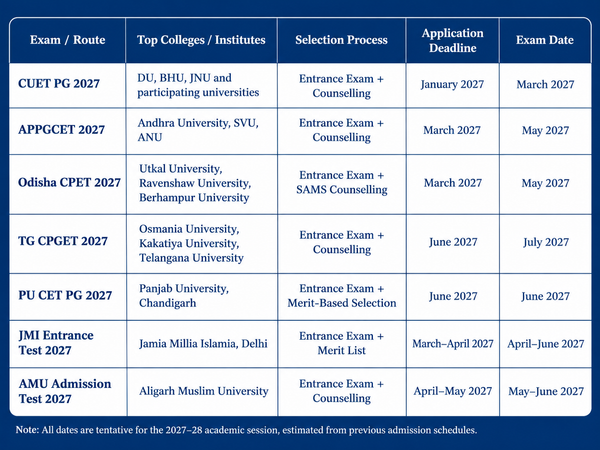
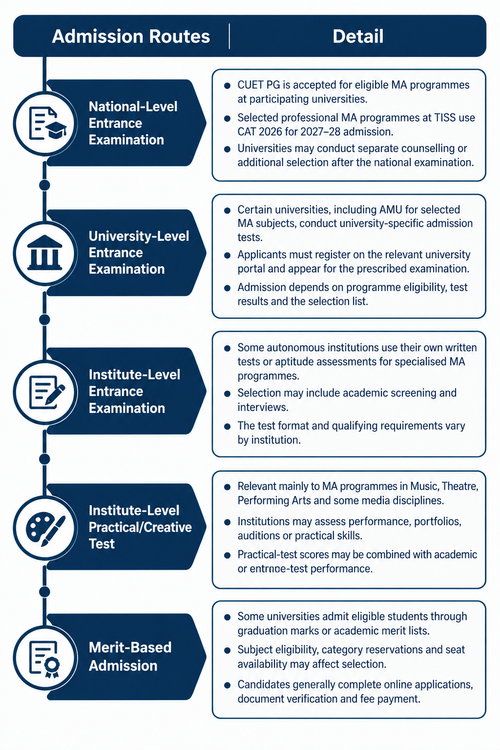
- Admission – Admission through CUET PG, university-level entrance exams, merit lists based on graduation marks, counselling or institution-specific selection.
- Eligibility Criteria – Students with a recognised bachelor’s degree in any or a relevant discipline can apply, depending on the specialisation. Minimum marks generally range from 45% to 55%, depending on the university.
- Course Scope – Graduates can work in teaching, research, journalism, content writing, public administration, social services and corporate communication, or pursue higher studies such as a PhD.
Course Highlight
| Top Colleges | Total Course Fees | Specialisation Areas | Average Starting Salary |
|---|---|---|---|
| Government Brennen College Dharmadam, Thalasery, Aligarh Muslim University, & PGDAV College, New Delhi | INR 1.5 K to INR 4.63 Lakh | English, History, Political Science, Economics, Psychology, Sociology, Geography, Hindi, Public Administration | Approximately INR 2.5–6 LPA |
Quick Facts
- Duration: 2 years, divided into 4 semesters, and approved one-year PG routes may be available to eligible candidates
- Eligibility: Bachelor's degree from a recognised university, BA, BSc, BCom and other graduates may qualify depending on the MA subject
- Entrance Exam: CUET PG, CAT (selected TISS MA programmes), AMU admission tests and university-specific PG entrance examinations
- Selection: Entrance score, graduation merit, counselling, document verification and, where required, interview or practical assessment
- Government Institution Fee Range: INR 1.5 K (Government Maharishi Valmiki College, Kanker) to INR 1.6 Lakh (Majuli College, Jorhat)
- Private Institution Fee Range: INR 2.4 K (Shree G.K. & C.K. Bosamia Arts & Commerce College, Jetpur) to INR 4.63 Lakh (Anjaneya University, Raipur)
- Admission Season: Applications- December–May, Exams & Results- February–July, Counselling & Admissions- May–September.
Top Entrance Exams
Ques. Which MA specialisation is suitable for government jobs?
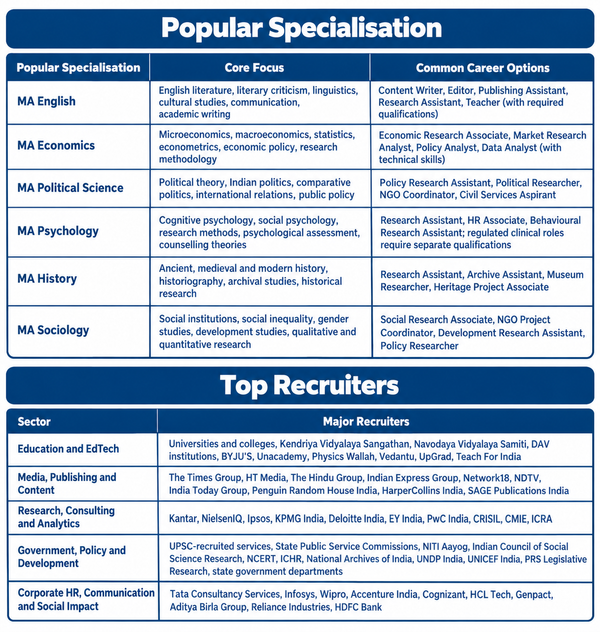
Ans. MA Political Science, History, Economics, Public Administration and Sociology are relevant to subjects covered in various competitive examinations. However, an MA specialisation does not ensure selection in government services. Candidates must satisfy the requirements of UPSC, State PSC, SSC or other recruiting agencies.
Ques. Which MA specialisation is useful for corporate careers?
Ans. MA Economics, Psychology, English, Communication and specialised HR-related programmes may support corporate career pathways. Economics graduates can pursue research and analytics roles, Psychology graduates can explore HR and behavioural research, while English graduates may work in communication, content and publishing.
Ques. What is the starting salary after an MA degree in India?
Ans. Early-career earnings in many MA-related roles may fall around INR 2.5–6 LPA, although salaries can be lower or higher. Research associates, content writers, HR executives and policy research assistants have different salary structures.
Ques. Do MA colleges provide campus placements?
Ans. Some institutions offer campus recruitment opportunities for selected postgraduate programmes. However, placement access is not uniform across all MA subjects or colleges. Graduates in humanities and social sciences may also obtain jobs through internships, independent applications, research projects and competitive recruitment.
Three Myths Busted
- Myth: Only BA graduates can pursue an MA.
- Fact: Graduates from Arts, Commerce, Science and other disciplines can apply for many MA programmes. However, subjects such as Economics, Psychology and certain languages may require relevant undergraduate coursework or specified credits.
- Myth: CUET PG is compulsory for admission to every MA college.
- Fact: CUET PG is used by participating institutions. Some universities use graduation merit, institutional entrance examinations or additional assessments.
- Myth: An MA degree is useful only for teaching jobs.
- Fact: MA graduates can pursue research, media, publishing, public administration, policy, human resources, social development and other careers. Some regulated professional roles require additional qualifications.
Types of Admission Routes in India
MA Admission Process
- Qualifying Examination: Candidates must complete a bachelor's degree from a recognised university. Final-year undergraduate students may apply where provisional admission is permitted.
- Eligible Streams: BA, BSc, BCom and graduates from other recognised streams may apply. Some MA specialisations require particular undergraduate subjects, credits or qualifications.
- Minimum Marks: Requirements vary by institution. Some programmes prescribe 45%–55% or an equivalent CGPA, while others use subject-specific eligibility or simply require a recognised bachelor's degree.
- Entrance Registration: Register for CUET PG 2027 or the university-specific admission examination, where required. Candidates targeting selected TISS management-oriented MA programmes must follow the CAT 2026 route for 2027–28.
- Entrance Result: Download the scorecard and check the participating university's eligibility conditions, qualifying scores and separate admission-registration requirements.
- Practical/Creative Test: Required only for selected programmes, such as Music, Theatre and Performing Arts. Candidates may need an audition, portfolio or performance assessment.
- Interview: Certain interdisciplinary and professional MA programmes conduct interviews or additional assessments. Most conventional MA programmes do not require an interview unless specified.
- Counselling/Application: Complete the university admission form and submit programme preferences. For example, Delhi University uses CSAS (PG) for its applicable two-year postgraduate programmes.
- Document Verification: Keep Class 10 and 12 certificates, graduation mark sheets, degree or provisional certificate, entrance scorecard, identity proof, photographs, category certificate where applicable, and migration or transfer documents if required.
- Seat Confirmation: Accept the allotted seat, complete academic verification and pay the admission fee within the university's deadline.
Top MA Colleges in India
Ques. Does TISS accept CUET PG or CAT for MA admission in 2027–28?
Ans. TISS has officially announced that admission to MA Human Resource Management & Labour Relations and MA Organisation Development, Change and Leadership for 2027–28 will use CAT 2026 scores. This does not mean CAT is required for all TISS MA programmes. Applicants should verify the admission route for their chosen programme on the TISS admissions website.
Ques. Can I become an Assistant Professor after completing an MA?
Ans. An MA in a relevant subject can be an academic qualification for pursuing teaching and research eligibility pathways. Students usually need to clear UGC-NET, SET/SLET or PhD-related eligibility requirements, including prescribed postgraduate marks and discipline conditions. Recruitment also depends on institutional rules and vacancies as an MA alone does not automatically qualify a candidate for every Assistant Professor position.
Ques. Which documents are required for MA admission 2027–28?
Ans. MA admission documents include Class 10 and 12 mark sheets, graduation mark sheets, degree or provisional certificate, entrance scorecard where required, identity proof, passport-size photograph and category certificate if applicable. Universities may additionally request migration, transfer, income, disability or domicile certificates. Students should follow the final document checklist issued by the admitting institution.
Scholarships
- Merit-Based Scholarships: Some universities provide scholarships or fee concessions based on undergraduate academic performance, merit position or continued academic progress. Eligibility and amounts are institution-specific.
- Government PG Scholarships: The UGC National Scholarship for Post Graduate Studies is listed on the National Scholarship Portal. The 2026–27 application window opened on September 16, 2026, with a published student deadline of October 31, 2026.
- Need-Based Scholarships/Freeships: Eligible students from lower-income households may apply for university-level financial assistance, income-based fee concessions and student-aid funds where available.
- Category-Based Scholarships: Eligible SC, ST, OBC, EBC and other notified-category students can explore applicable central and state post-matric or higher-education scholarship schemes.
- Disability-Related Scholarships: Eligible students with disabilities may apply for relevant higher-education support programmes listed on the National Scholarship Portal, subject to scheme criteria.
- Sports and Cultural Scholarships: Some institutions provide fee concessions or financial awards to students with qualifying achievements in sports or cultural activities. Availability must be checked with the college.
- Institution-Specific Scholarships: Universities and colleges may provide endowment scholarships, departmental awards, alumni-funded grants and fee assistance. Selection can depend on academic merit, income, attendance and fund availability.
Ques. Can I get MA admission without an entrance examination?
Ans. Yes. Some institutions provide MA admission through graduation merit or non-entrance application routes. For example, IGNOU offers several MA distance programmes based on prescribed academic eligibility. Also, the applicable admission method must be checked separately for each institution.
Ques. What is the difference between MA and MSc?
Ans. MA generally focuses on humanities, languages, social sciences and interdisciplinary subjects, whereas MSc usually focuses on science, mathematics, technology-related and quantitative disciplines. Some subjects, including Economics, Psychology and Geography, may be available under either degree title. The actual syllabus, research training and eligibility are more important than the degree abbreviation alone.
Ques. What is the CUET PG cutoff for MA admission?
Ans. There is no single CUET PG cutoff for all MA colleges. Admission scores differ by university, MA subject, seat category, available seats, applicant performance and counselling round. For example, Delhi University publishes programme-specific minimum allocation scores through its PG admission process.
Career Opportunities After MA
| Career Option | Average Salary (Approx. Starting Years) |
|---|---|
| Content Writer / Editor | INR 2.5–5 LPA |
| Research Assistant | INR 2.5–5 LPA |
| Policy Research Assistant | INR 3–6 LPA |
| Journalist / News Researcher | INR 2.5–5 LPA |
| Human Resources Executive | INR 3–6 LPA |
| Social Research Associate | INR 3–5.5 LPA |
| NGO Programme Coordinator | INR 2.5–5 LPA |
| Public Relations Executive | INR 3–6 LPA |
| Market Research Analyst | INR 3–6 LPA |
| Data / Economic Research Associate | INR 3.5–7 LPA |
| School Teacher (with required teaching qualifications) | INR 2.5–5.5 LPA |
| Translator / Language Specialist | INR 2.5–5 LPA |
MA Specialisations & Top Recruiters
Higher Education Options
| Course | Duration |
|---|---|
| PhD in Arts, Humanities or Social Sciences | 3–6 years, depending on university regulations and research progress |
| BEd (Bachelor of Education) | 2 years under the conventional route; eligibility and approved programme structure vary |
| MBA (Master of Business Administration) | 2 years |
| PG Diploma in Journalism, Digital Media or Public Relations | 1 year; varies by institute |
| PG Diploma / Professional Certification in Data Analytics, Research Methods or Public Policy | 6 months–2 years, depending on the course |
FAQs
Ques. Can Science and Commerce students pursue an MA?
Ans. Yes. Science and Commerce graduates may apply for MA programmes that accept candidates from different academic backgrounds. Subjects such as Economics, Psychology and certain languages may have additional requirements. Eligibility depends on the university and specialisation.
Ques. Is CUET PG compulsory for MA admission in 2027?
Ans. No. CUET PG is required only for MA programmes that use it for admission. Other universities may offer graduation-merit admission, university-specific tests or institute-level selection.
Ques. What is the minimum percentage required for MA admission?
Ans. There is no universal minimum graduation percentage for MA admission across India. Some institutions prescribe approximately 45%–55%, while others use different marks, CGPA or subject-eligibility criteria. Reserved-category relaxation may be available under institutional rules.
Ques. Is Mathematics compulsory in Class 12 for MA admission?
Ans. No. Mathematics is not compulsory for most MA programmes, including English, History and Political Science. However, MA Economics and certain quantitative or interdisciplinary programmes may require previous Mathematics or Statistics coursework.
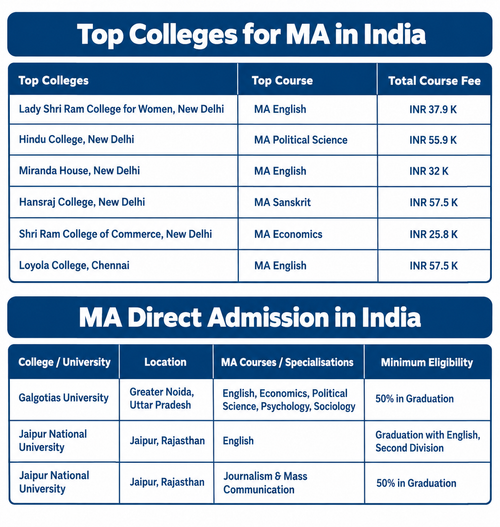
Ques. Which MA colleges offer comparatively affordable courses?
Ans. Delhi University colleges, public state universities and government-funded institutions offer comparatively affordable courses, though students should compare tuition, examination fees, accommodation, travel and course format rather than tuition alone.



Comments