



The BSc Nursing course is a 4-year-long undergraduate degree program in the field of healthcare that prepares students to become skilled Nurses. BSc Nursing focuses on building both theoretical knowledge and practical skills essential for patient care, healthcare management, and clinical practice.
The BSc Nursing syllabus is prescribed by the Indian Nursing Council (INC). The BSc Nursing syllabus provides foundational knowledge about Human Anatomy, Physiology, Biochemistry, Nutrition, Psychology, Microbiology, and Nursing Fundamentals, via theoretical and practical training. The syllabus is divided into 8 semesters following a 4-year curriculum. It includes a mix of theoretical learning, lab sessions, clinical training, summer internships, projects, and more
Also Read
BSc Nursing Admission 2025- BSc Nursing Syllabus
1.1 BSc Nursing 1st year subjects
1.2 BSc Nursing 2nd year subjects
1.3 BSc Nursing subjects in the 3rd year
1.4 BSc Nursing subjects in the 4th year
1.5 What is the syllabus for the AIIMS BSc Nursing?
1.6 Is BSc Nursing very difficult?
- Are there any Electives in BSc Nursing?
- Top Books recommended for BSc Nursing
- BSc Nursing Entrance Exam Syllabus
4.1 AIIMS BSc Nursing Entrance Exam Syllabus
4.2 JIPMER BSc Nursing Entrance Exam Syllabus
4.3 BHU BSc Nursing Entrance Exam syllabus
4.4 Syllabus for PGIMER BSc Nursing Entrance Exam
- How can I prepare for BSc Nursing?
- BSc Nursing Syllabus 2025: FAQs
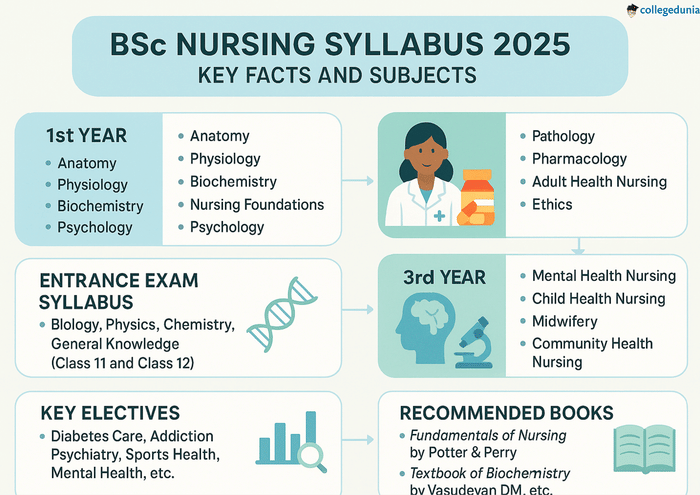
BSc Nursing Syllabus
The BSc Nursing syllabus is a 4-year, 8-semester program structured to equip students with the essential knowledge and practical skills required for a successful nursing career. The BSc Nursing syllabus 2025 covers many subjects. The syllabus progresses from foundational subjects in the early years to more specialized topics in the later stages, preparing students to handle diverse healthcare situations.
A portion of the course is dedicated to intensive practical training, ensuring students gain experience in various healthcare settings.
BSc Nursing 1st year subjects
The 1st year of BSc Nursing syllabus is designed to equip students with a strong foundation in nursing and basic medical science. The first year BSc nursing syllabus introduces students to both theoretical knowledge and practical skills that will help them understand advanced nursing concepts in later years.
The 1st year syllabus covers subjects like anatomy, physiology, nutrition, psychology, and nursing foundations. Along with classroom learning, students also experience basic clinical practices and healthcare concepts.
| 1st Semester Syllabus | 2nd Semester Syllabus |
|---|---|
| Anatomy and Physiology | Nutrition and Dietetics |
| Nursing Foundation I | Nursing Foundation II |
| Communicative English | Environmental Science |
| Sociology and Psychology | Biochemistry |
| General Science | Community Health Nursing, including Healthcare Policy and Regulation |
BSc Nursing 2nd year subjects
The 2nd year of BSc Nursing syllabus focuses on applied medical science and clinical training. The second year focuses on understanding disease, its causes, treatment and the role of nurses in patient care. It introduces the fundamentals of adult health nursing, pharmacology and professional ethics.
The syllabus is divided into two semesters, 3rd and 4th, covering both theoretical and practical aspects of healthcare.
The BSc Nursing second year syllabus is mentioned in the following table.
| 3rd Semester Syllabus | 4th Semester Syllabus |
|---|---|
| Pathology I | Pathology II |
| Microbiology and Infection Control | Adult Health Nursing II |
| Professionalism, Professional Values and Ethics, including bioethics. | Pharmacology II and Genetics |
| Pharmacology I | Educational Technology/Nursing Education |
| Adult Health Nursing I | - |
BSc Nursing subjects in the 3rd year
The 3rd year of BSc Nursing syllabus focuses mainly on specialized areas of nursing. Third year subjects focus on mental health, child care, leadership, research and nursing laws. Students start learning midwifery and community health nursing, preparing them for both hospital as well as community-based healthcare roles.
The BSc Nursing third-year syllabus is mentioned in the following table.
| 5th Semester Syllabus | 6th Semester Syllabus |
|---|---|
| Mental Health Nursing I | Mental Health Nursing II |
| Nursing Research and Statistics | Community Health Nursing, including epidemiology |
| Nursing Management and Leadership | Child Health Nursing II |
| Child Health Nursing I | Midwifery/Obstetrics and Gynaecology (OBG) I |
| Nursing Informatics and Technology | - |
| Introduction to Forensic Nursing and Indian Laws | - |
BSc Nursing subjects in the 4th year
The 4th year of BSc Nursing is the final year of the program. This year emphasises community health, advanced midwifery/obstetrics, and internship, allowing students to apply knowledge and skills in real-world healthcare settings.
You can check the fourth-year syllabus in the following table.
| 7th Semester Syllabus | 8th Semester Syllabus |
|---|---|
| Community Health Nursing, including Standard Treatment Protocols | Internship (Practicum/ Residency Posting) |
| Midwifery/Obstetrics and Gynaecology (OBG) II | - |
See More:
What is the syllabus for the AIIMS BSc Nursing?
AIIMS is considered to be one of the premier institutes to pursue BSc Nursing in India. The AIIMS BSc Nursing program is designed to prepare students with both theoretical knowledge and practical training in nursing and healthcare. The curriculum is spread across four years, and it gradually advances from basic sciences to specialised nursing fields, along with clinical practice.
You can check the year-wise AIIMS BSc Nursing syllabus in the following table.
| 1st Year Syllabus | |
|---|---|
| Anatomy | Physiology |
| Nutrition | Biochemistry |
| Nursing Foundations | Psychology |
| Microbiology | Introduction to Computers |
| English | Hindi |
| 2nd Year Syllabus | |
| Pharmacology | Pathology and Genetics |
| Medical Surgical Nursing I | Community Health Nursing I |
| Communication and Education Technology | – |
| 3rd Year Syllabus | |
| Sociology | Medical Surgical Nursing II |
| Child Health Nursing | Mental Health Nursing |
| 4th Year Syllabus | |
| Midwifery and Obstetrical Nursing | Community Health Nursing II |
| Nursing Research and Statistics | Management of Nursing Services and Education |
| Integrated Practice | – |
Is BSc Nursing very difficult?
You may find BSc Nursing to be challenging because of the wide syllabus. The practical work and internship also make the course demanding. Many students find it difficult to manage the theoretical and practical components. You are required to have a strong understanding of nursing principles and subjects like anatomy, physiology, microbiology and more. With dedication, consistent effort and proper time management, you can easily manage the BSc Nursing syllabus.
Are there any Electives in BSc Nursing?
The BSc Nursing syllabus has electives that you can choose to develop knowledge and skills in a specific field. You can select electives as per your interests and career goals. Some of the common elective subjects are listed below
.
- Human Values - Understanding ethics, empathy, and compassion in healthcare.
- Diabetes Care - Basics of managing diabetes, patient care, and lifestyle interventions.
- CBT - Introduction to mental health therapy techniques.
- Addiction Psychiatry - Study of substance abuse, rehabilitation, and psychiatric care.
- Adolescent Health - Focus on health issues specific to teenagers, including growth, nutrition, and mental health.
- Sports Health - Basics of sports medicine, injury prevention, and rehabilitation.
- Scientific Writing Skills - Training in research writing, article drafting, and academic publishing.
- Health Economics - Understanding the economics of healthcare systems and hospital management.
- Sexuality and Health - Study of sexual health, awareness, and reproductive health.
- Accreditation and Practice Standards - Learning about hospital accreditation, quality standards, and safety protocols.
Read More: Types of BSc Nursing
Top Books recommended for BSc Nursing
Books are an important part of the BSc Nursing curriculum as they will help you to cope with the syllabus and understand the theoretical concepts, but also develop practical insights into patient care, healthcare management, and nursing ethics. There are many books that you can consider. Some of the top books are as follows.
| Book | Author |
|---|---|
| Anatomy and Physiology for Nurses | Singh I |
| Introduction to Sociology | Bhushan V |
| Introduction to Psychology | Morgon CT |
| Fundamentals of Nursing | Potter, Perry |
| English for Professional Nursing | David MT |
| Basics of Clinical Nutrition | Joshi YK |
| Textbook of Biochemistry | Vasudevan DM |
| Textbook of Preventive and Social Medicine | Park JE |
| Environmental Sciences | Agarwal KC |
| Clinical Pharmacology | Bennet PN |
| Textbook of Pathology | Mohan H |
| Textbook of Microbiology | Ananthanarayanan H |
| Medical Surgical Nursing | Brunner V |
| Textbook of Psychiatric Nursing | Kapoor |
| Nursing Care of Infants and Children | Whaley, Wongs |
| Essentials of Nursing Research | Polit |
| Nursing Administration | Basavanthappa BT |
| Introduction to Community Health Nursing | Rao KS |
BSc Nursing Entrance Exam Syllabus
The BSc Nursing entrance exam syllabus is generally based on the class 11 and class 12 curriculum. Most of the questions come from Biology, Physics, and Chemistry, since these subjects form the foundation of nursing. Some colleges also include sections on General Knowledge, Logical Aptitude, and Nursing Fundamentals to test your overall awareness and analytical skills.
You can check the BSc Nursing entrance exam syllabus for some of the top colleges in the following sections.
AIIMS BSc Nursing Entrance Exam Syllabus
AIIMS BSc Nursing entrance exam syllabus consists of topics from Biology, Physics, Chemistry and General Knowledge, mostly based on class 11 and class 12 NCERT syllabus. The exam will be 2 hours long, with the total marks being 100. There is also a negative marking of -1/3.
You can check the subject-wise topics below.
| Biology | |
|---|---|
| Cell Theory | Structural Organisation of the Cell |
| Mendel’s Law of Inheritance | The difference between Prokaryotes and Eukaryotes |
| Classification Binomial and Nominal Nomenclature | Five Kingdom Classifications |
| Mineral Nutrition: Essential Elements and Their Function | The Role of Plants in Human Welfare |
| Physics | |
| Electronic Devices | Alternating Current |
| Electromagnetic Waves | Dual Nature of Matter |
| Electrostatics | Optics |
| Magnetic Effect of Current & Magnetism | Atoms and Nuclei |
| Communication Systems | Current Electricity |
| Electromagnetic Induction | – |
| Chemistry | |
| Chemistry in Everyday Life | Biomolecules |
| General Principles and Processes of Isolation of Elements | Solid State |
| Electrochemistry | Polymers |
| Chemical Kinetics | Solutions |
| P Block Elements | D and F Block Elements |
| Organic Compounds containing Nitrogen | Surface Chemistry |
| Alcohols | Phenol and Ester |
| Coordination Compounds | Keystones and Carboxylic Acids |
| General Knowledge | |
| Current Affairs | General policy & scientific research |
| History | Geography |
| Culture | – |
JIPMER BSc Nursing Entrance Exam Syllabus
The JIPMER BSc Nursing entrance test consists of questions from Biology, Physics and Chemistry from Class 11 and 12 NCERTs. Admission to JIPMER BSc Nursing is based on the NEET UG exam.
You can check the syllabus below.
| Biology | |
|---|---|
| Diversity in the Living World | Plant Physiology |
| Structural Organisation in Animals and Plants | Human Physiology |
| Cell Structure and Function | Reproduction |
| Biotechnology and Its Applications | Ecology and Environment |
| Biology and Human Welfare | Genetics and Evolution |
| Physics | |
| Physics and Measurement | Laws of Motion |
| Kinematics | Electrostatics |
| Oscillations and Waves | Current Electricity |
| Work, Energy and Power | Properties of Solids and Liquids |
| Rotational Motion | Thermodynamics |
| Gravitation | Kinetic Theory of Gases |
| Magnetic Effects of Current and Magnetism | Dual Nature of Matter and Radiation |
| Electromagnetic Inductions and Alternating Currents | Atoms and Nuclei |
| Electromagnetic Waves | Electronic Devices |
| Optics | Experimental Skills |
| Chemistry | |
| Basic Concepts of Chemistry | Chemical Thermodynamics |
| Structure of an Atom | Solutions |
| Chemical Bonding and Molecular Structure | Equilibrium |
| Chemical Kinetics | Redox Reactions and Electrochemistry |
| Classification of Elements and Periodicity in Properties | P Block Elements |
| Purification and Characterisation of Organic Compounds | D and F Block Elements |
| Basic Principles of Organic Chemistry | Coordination Compounds |
| Hydrocarbons | Organic Compounds Containing Oxygen |
| Organic Compounds Containing Halogens | Organic Compounds Containing Nitrogen |
| Biomolecules | Principles Related to Practical Chemistry |
BHU BSc Nursing Entrance Exam syllabus
BHU admits students through the NEET UG exam for the selection of students for its BSc Nursing course. Candidates interested in BHU BSc Nursing admission need to prepare from the NEET syllabus, which covers subjects from class 11 and class 12 NCERT textbooks. The syllabus mainly includes Biology, Physics and Chemistry.
You can check the syllabus in the following table.
| Biology | |
|---|---|
| Diversity in the Living World | Plant Physiology |
| Structural Organisation in Animals and Plants | Human Physiology |
| Cell Structure and Function | Reproduction |
| Biotechnology and Its Applications | Ecology and Environment |
| Biology and Human Welfare | Genetics and Evolution |
| Physics | |
| Physics and Measurement | Laws of Motion |
| Kinematics | Electrostatics |
| Oscillations and Waves | Current Electricity |
| Work, Energy and Power | Properties of Solids and Liquids |
| Rotational Motion | Thermodynamics |
| Gravitation | Kinetic Theory of Gases |
| Magnetic Effects of Current and Magnetism | Dual Nature of Matter and Radiation |
| Electromagnetic Inductions and Alternating Currents | Atoms and Nuclei |
| Electromagnetic Waves | Electronic Devices |
| Optics | Experimental Skills |
| Chemistry | |
| Basic Concepts of Chemistry | Chemical Thermodynamics |
| Structure of an Atom | Solutions |
| Chemical Bonding and Molecular Structure | Equilibrium |
| Chemical Kinetics | Redox Reactions and Electrochemistry |
| Classification of Elements and Periodicity in Properties | P Block Elements |
| Purification and Characterisation of Organic Compounds | D and F Block Elements |
| Basic Principles of Organic Chemistry | Coordination Compounds |
| Hydrocarbons | Organic Compounds Containing Oxygen |
| Organic Compounds Containing Halogens | Organic Compounds Containing Nitrogen |
| Biomolecules | Principles Related to Practical Chemistry |
Syllabus for PGIMER BSc Nursing Entrance Exam
The PGIMER (Postgraduate Institute of Medical Education and Research), Chandigarh, conducts its own entrance examination for admission to the BSc Nursing program. PGIMER BSc Nursing entrance exam syllabus consists of topics from Biology, Physics, Chemistry and General English. The syllabus is mainly based on the NCERT curriculum of Class 11 and Class 12.
The exam is generally computer-based and includes multiple-choice questions with a negative marking system.
You can check the detailed syllabus below.
| Biology | |
|---|---|
| Cell Theory | Structural Organisation of Cell |
| Mendel’s Law of Inheritance | The difference between Prokaryotes and Eukaryotes |
| Classification Binomial and Nominal Nomenclature | Five Kingdom Classifications |
| Mineral Nutrition: Essential Elements and Their Function | The Role of Plants in Human Welfare |
| Physics | |
| Electronic Devices | Alternating Current |
| Electromagnetic Waves | Dual Nature of Matter |
| Electrostatics | Optics |
| Magnetic Effect of Current & Magnetism | Atoms and Nuclei |
| Communication Systems | Current Electricity |
| Electromagnetic Induction | – |
| Chemistry | |
| Chemistry in Everyday Life | Biomolecules |
| General Principles and Processes of Isolation of Elements | Solid State |
| Electrochemistry | Polymers |
| Chemical Kinetics | Solutions |
| P Block Elements | D and F Block Elements |
| Organic Compounds containing Nitrogen | Surface Chemistry |
| Alcohols | Phenol and Ester |
| Coordination Compounds | Keystones and Carboxylic Acids |
| General English | |
| Synonym/Antonym | One Word Substitution |
| Spot the Error | Comprehension Passage |
| Fill in the Blanks | Shuffling of Sentence Parts |
| Shuffling of Sentences in a Passage | Close Passage |
| Mis-spelt Words | Idioms and Phrases |
How can I prepare for BSc Nursing?
Clearing the BSc Nursing program requires a strong performance on the entrance exam. A consistent study is required to excel in the exam. You can consider the following points for your preparation.
- Know the Syllabus: Understand the exam's syllabus and pattern. This will help you identify all the topics you need to cover and how the exam is structured.
- Make a Study Plan: Create a study schedule and stick to it. Make sure to dedicate equal time to each subject to ensure balanced preparation.
- Strengthen Your Foundation: You must focus on strengthening your base by focusing on the core subjects. A solid understanding of the basics will make it easier to prepare for more complex topics later on.
- Utilise Resources: You must make use of resources like online tutorials, reference books and previous years’ papers to help you in your preparation. These tools can provide valuable insights and practice opportunities.
- Revise and Practice: You must revise regularly to retain knowledge. Take mock tests to check your preparation level, identify weak areas and correct them.
BSc Nursing Syllabus 2025: FAQs
Ques. What is the BSc Nursing 1st Year Syllabus?
Ans. The BSc Nursing 1st year syllabus introduces students to both theoretical knowledge and practical skills that will help them understand advanced nursing concepts in later years.
The BSc Nursing 1st year syllabus covers subjects like anatomy, physiology, nutrition, psychology, and nursing foundations. Along with classroom learning, students also experience basic clinical practices and healthcare concepts.
| 1st Semester Syllabus | |
|---|---|
| Anatomy and Physiology | Sociology and Psychology |
| Nursing Foundation I | General Science |
| Communicative English | – |
| 2nd Semester Syllabus | |
| Nutrition and Dietetics | Biochemistry |
| Nursing Foundation II | Community Health Nursing, including Healthcare Policy and Regulation |
| Environmental Science | – |
Ques. How can I learn about technology in healthcare in the BSc Nursing syllabus?
Ans. The BSc Nursing syllabus has topics like nursing informatics, education technology and more to address the integration of technology in healthcare services. This ensures that you will be well-equipped with tools related to patient care and record management.
Ques. How can I develop nursing research skills through the BSc Nursing syllabus?
Ans. The BSc Nursing syllabus has a subject called nursing research and statistics. This will provide you with knowledge of different research aspects like nursing research methods, the use of statistics in patient management and more. You can expect to develop strong nursing research skills through this subject.
Ques. What can I expect to learn in the mental health subject of the BSc Nursing?
Ans. Mental health nursing is one of the major subjects of the BSc Nursing syllabus. The subject deals with the diagnosis of mental health issues, treatment and management of mental health, use of medicines and psychiatric principles.



Comments
Found 1 Comment
There are various common entrance tests (state and national level) as well as entrance tests conducted by the respective institutes for admission to B.Sc Nursing courses. Generally, the syllabus is based on the curriculum of the intermediate level. You can read about the entrance syllabus, pattern, as well as other information from B.Sc Nursing Entrance Test.