




The National Testing Agency (NTA) conducted the CUET PG 2026 Mathematics (SCQP19) examination on March 18, 2026, during Shift 2 from 12:30 PM to 02:00 PM.
Students who appeared for the exam reported that the overall difficulty level of the paper was moderate to difficult. CUET PG 2026 Mathematics Question Paper with Solutions PDF is available here for download. The marking scheme is +4 for correct answers and -1 for wrong answers, totaling 300 marks.
CUET PG 2026 Mathematics Question Paper with Solutions PDF
| CUET PG 2026 Mathematics Question Paper | Download PDF | Check Solutions |
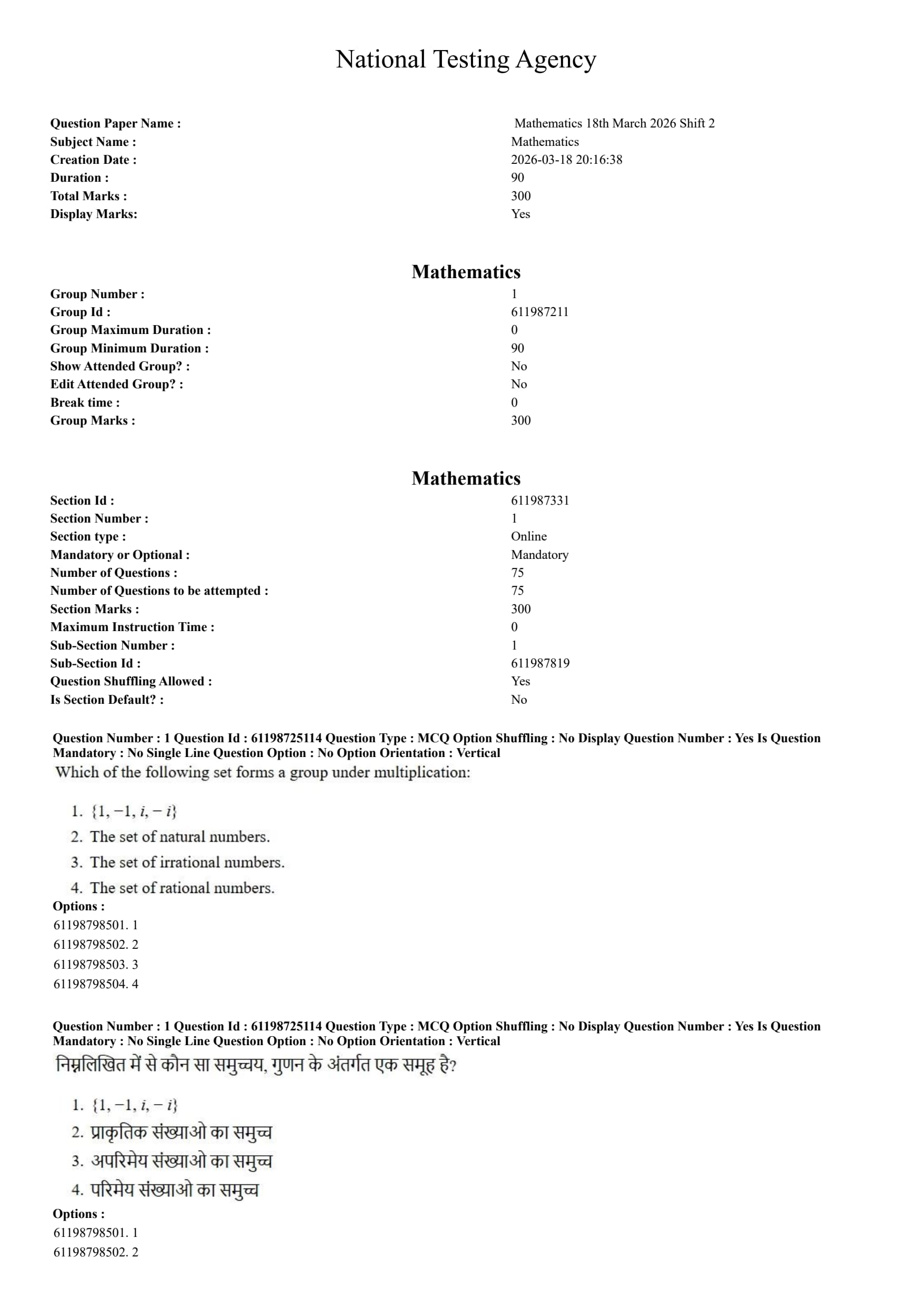
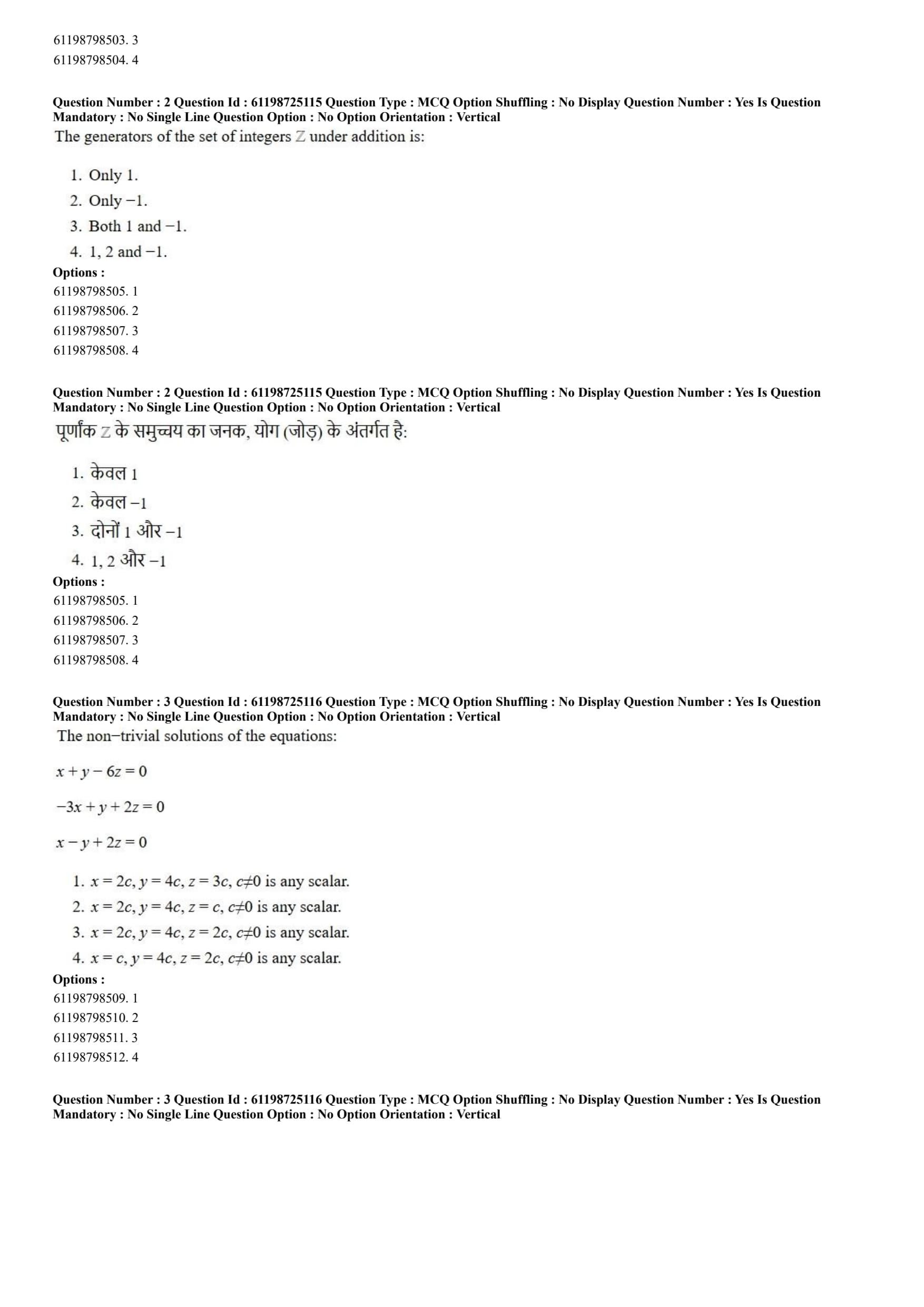
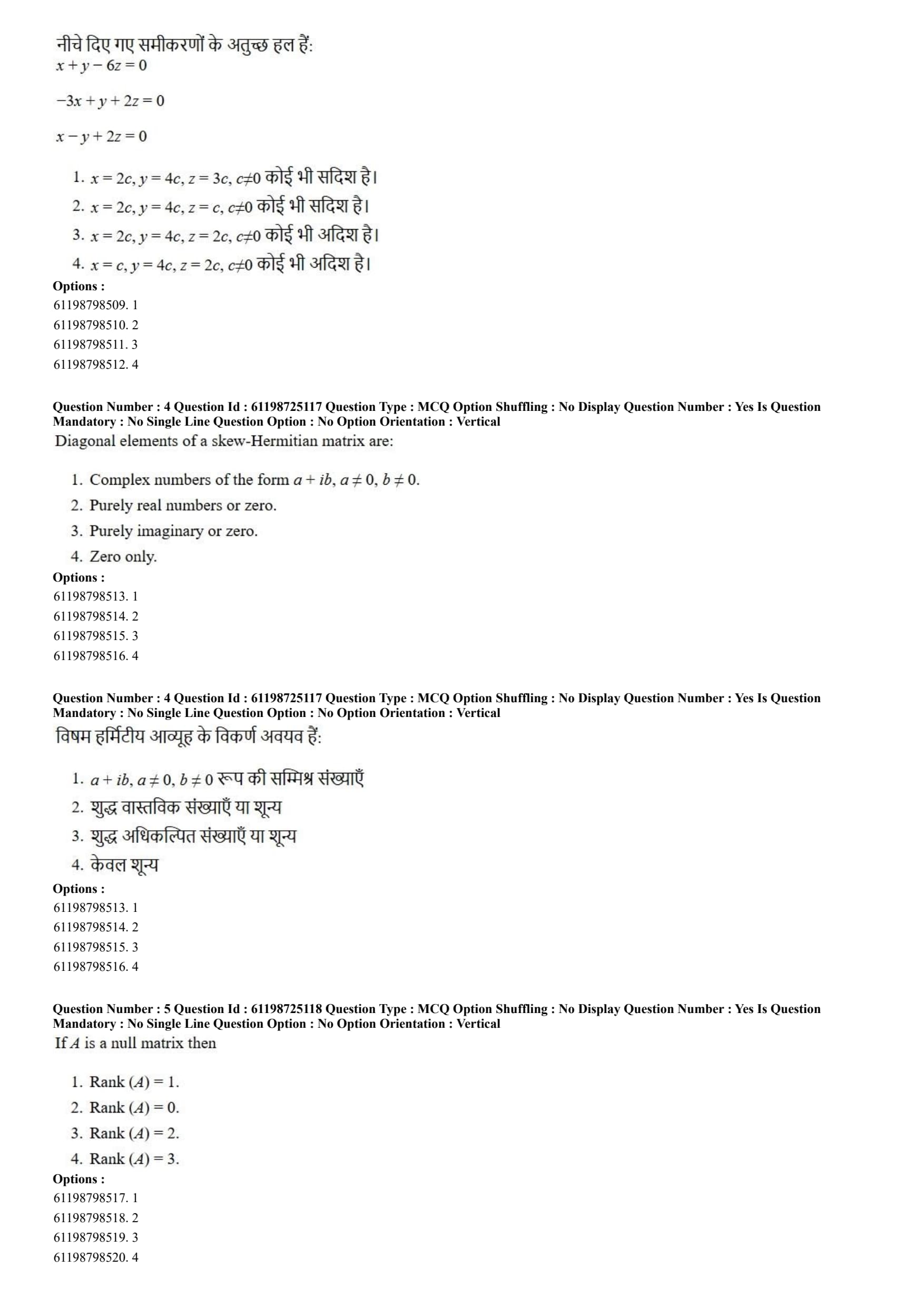
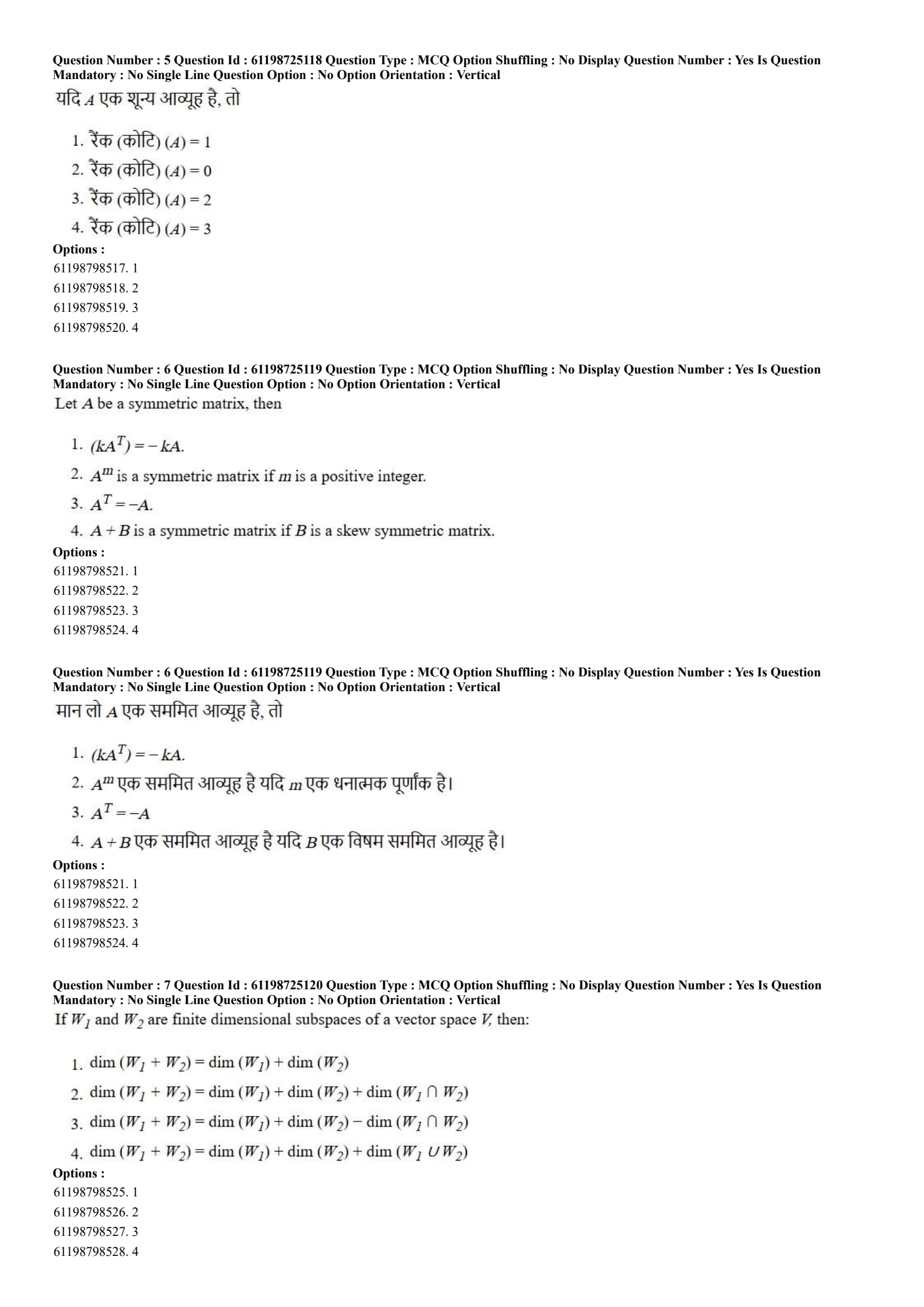
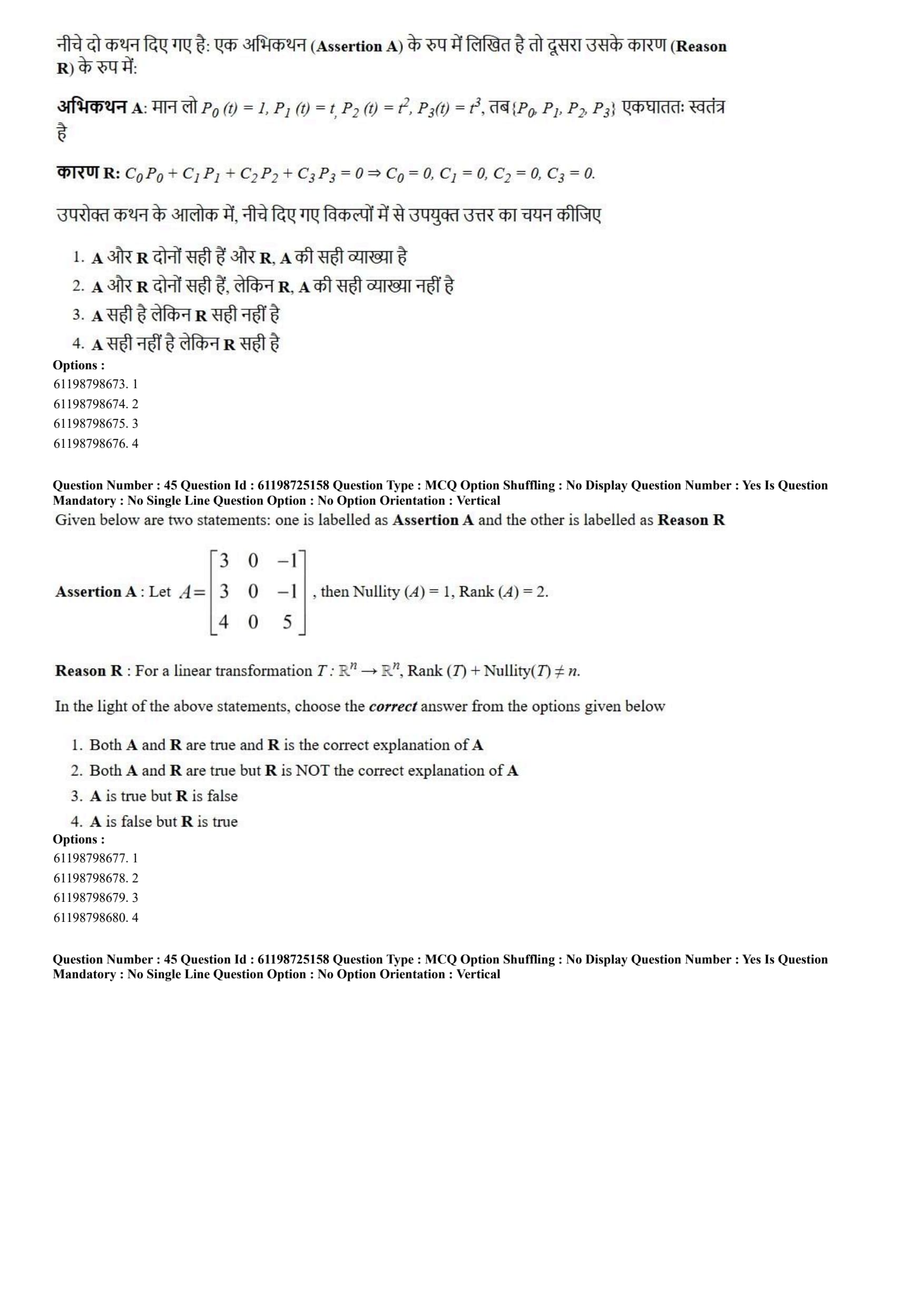
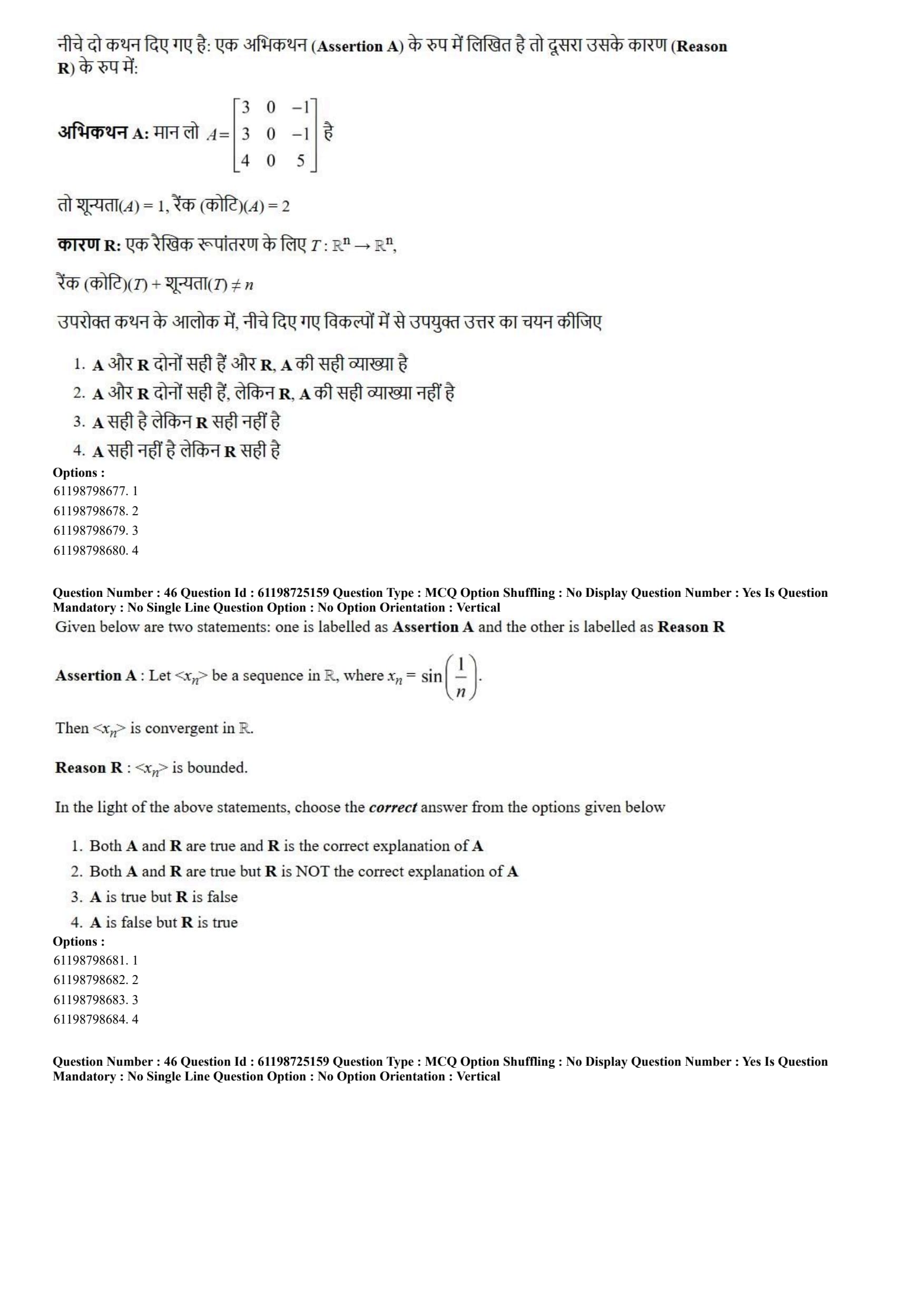
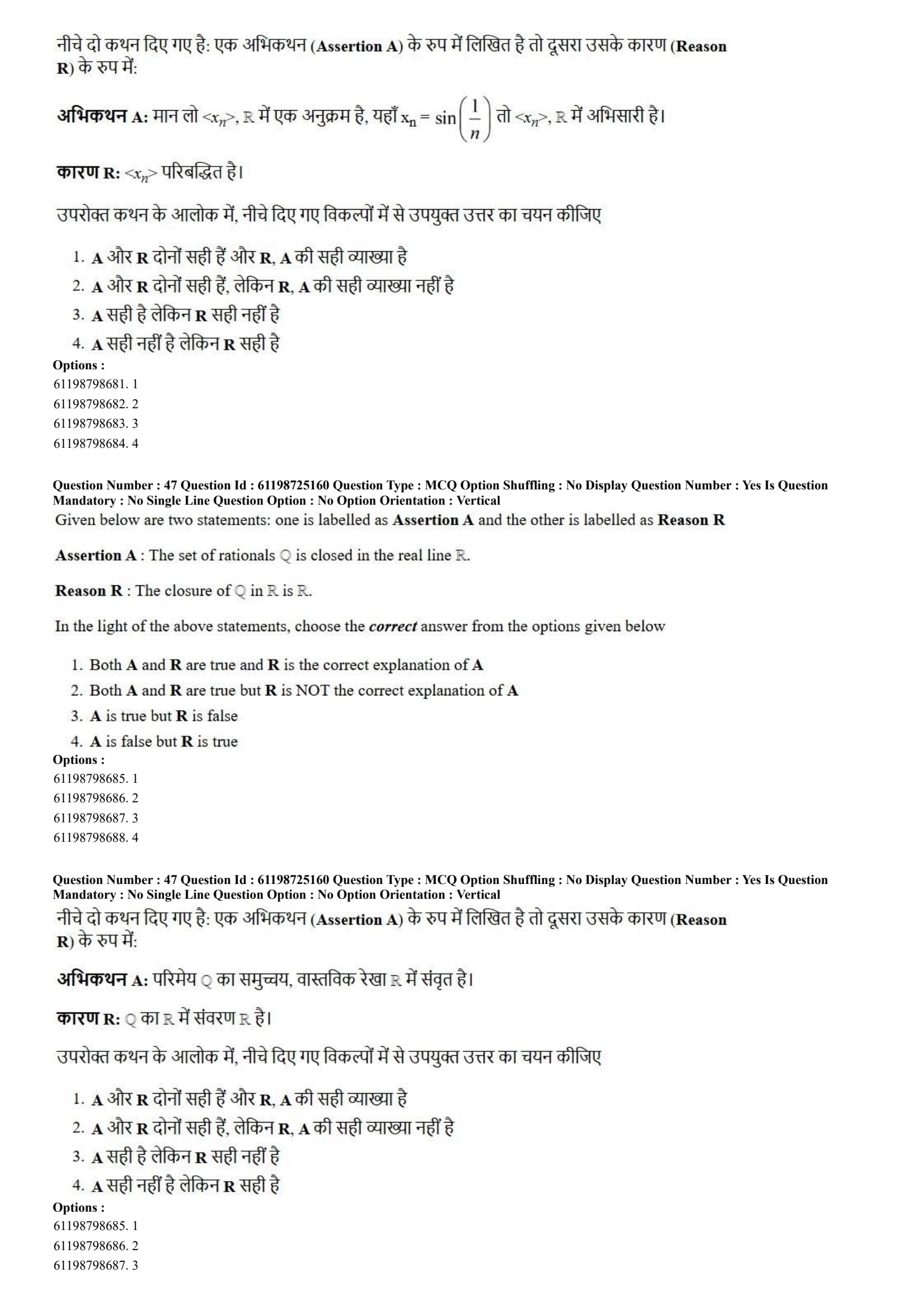
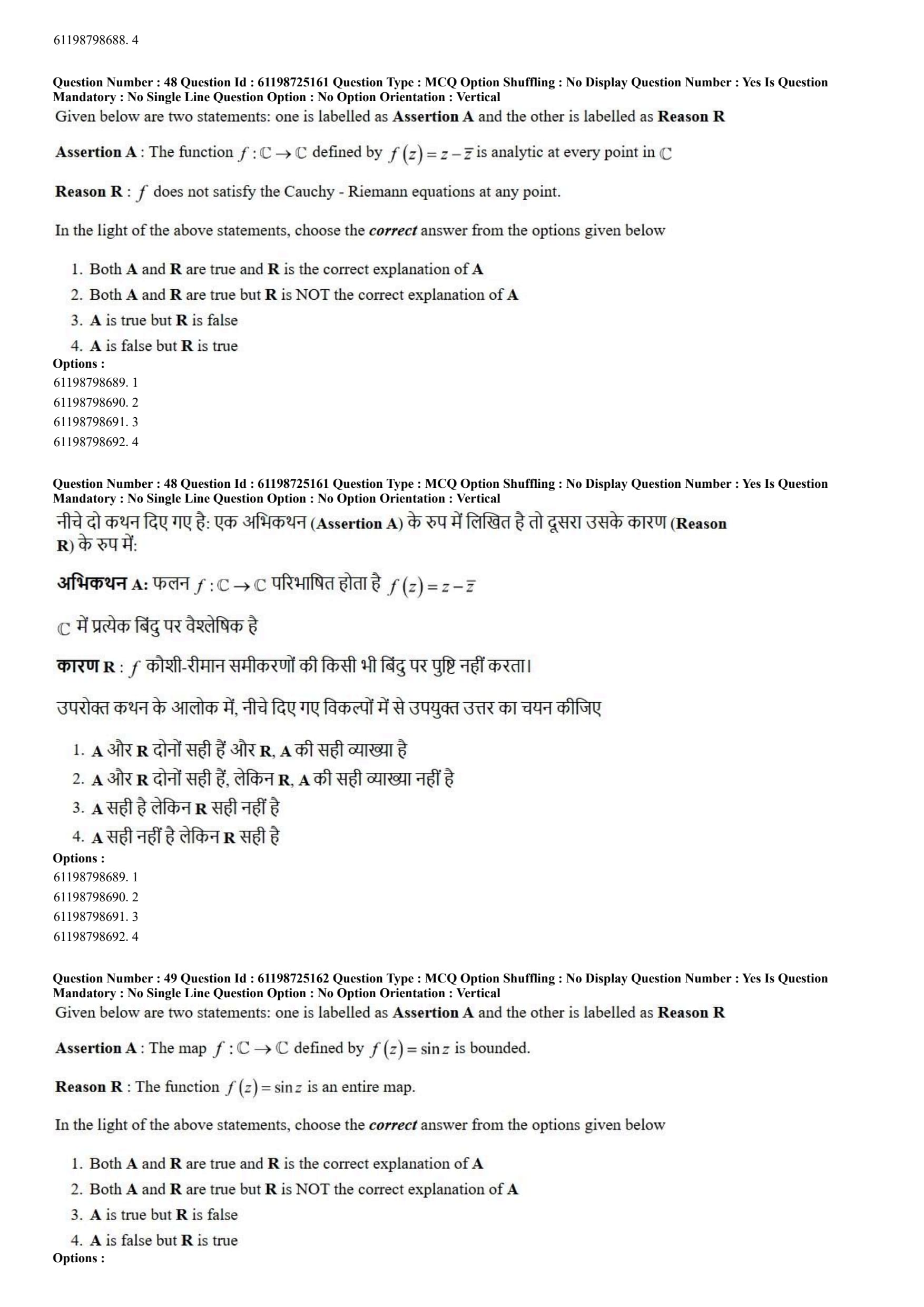
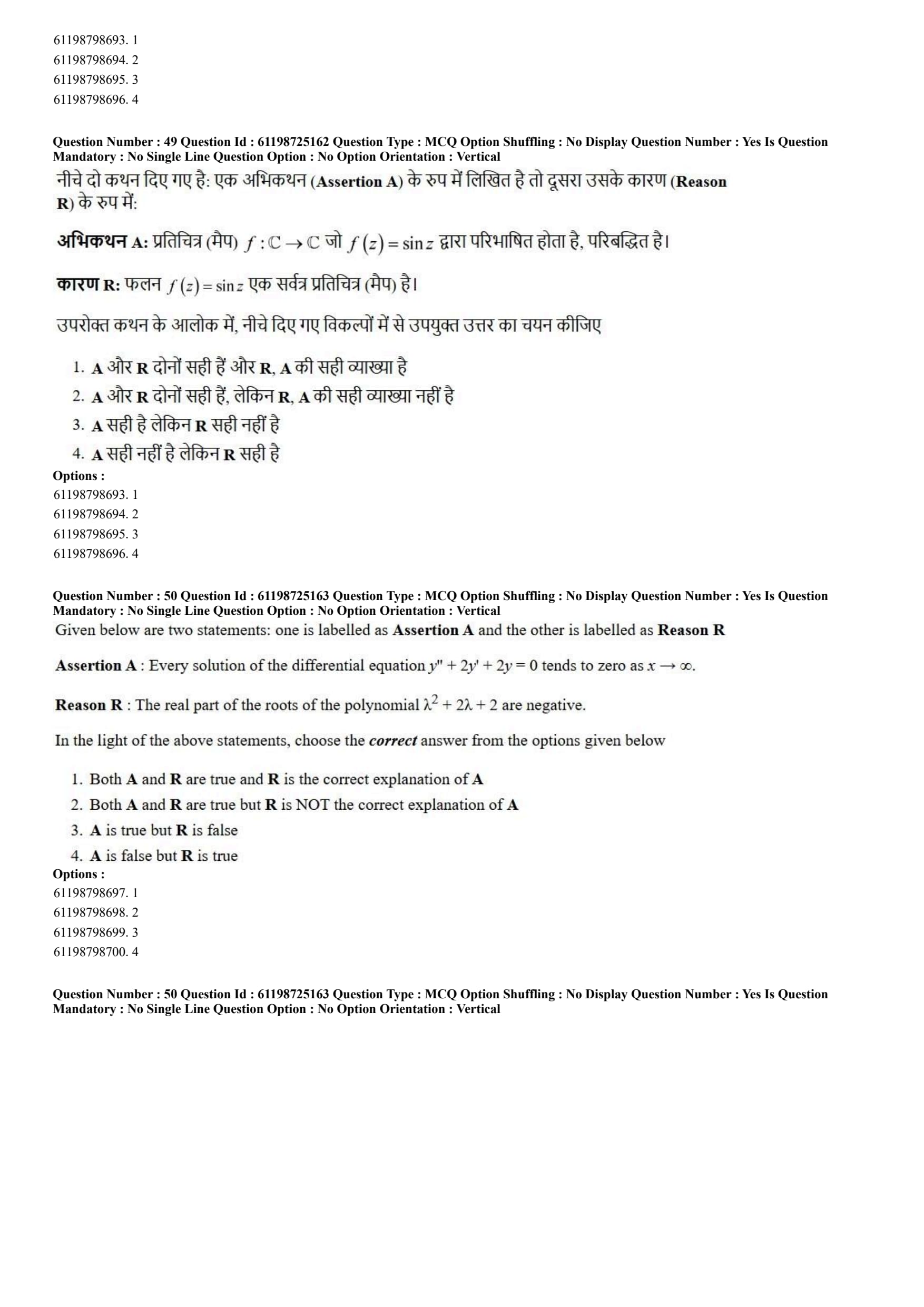
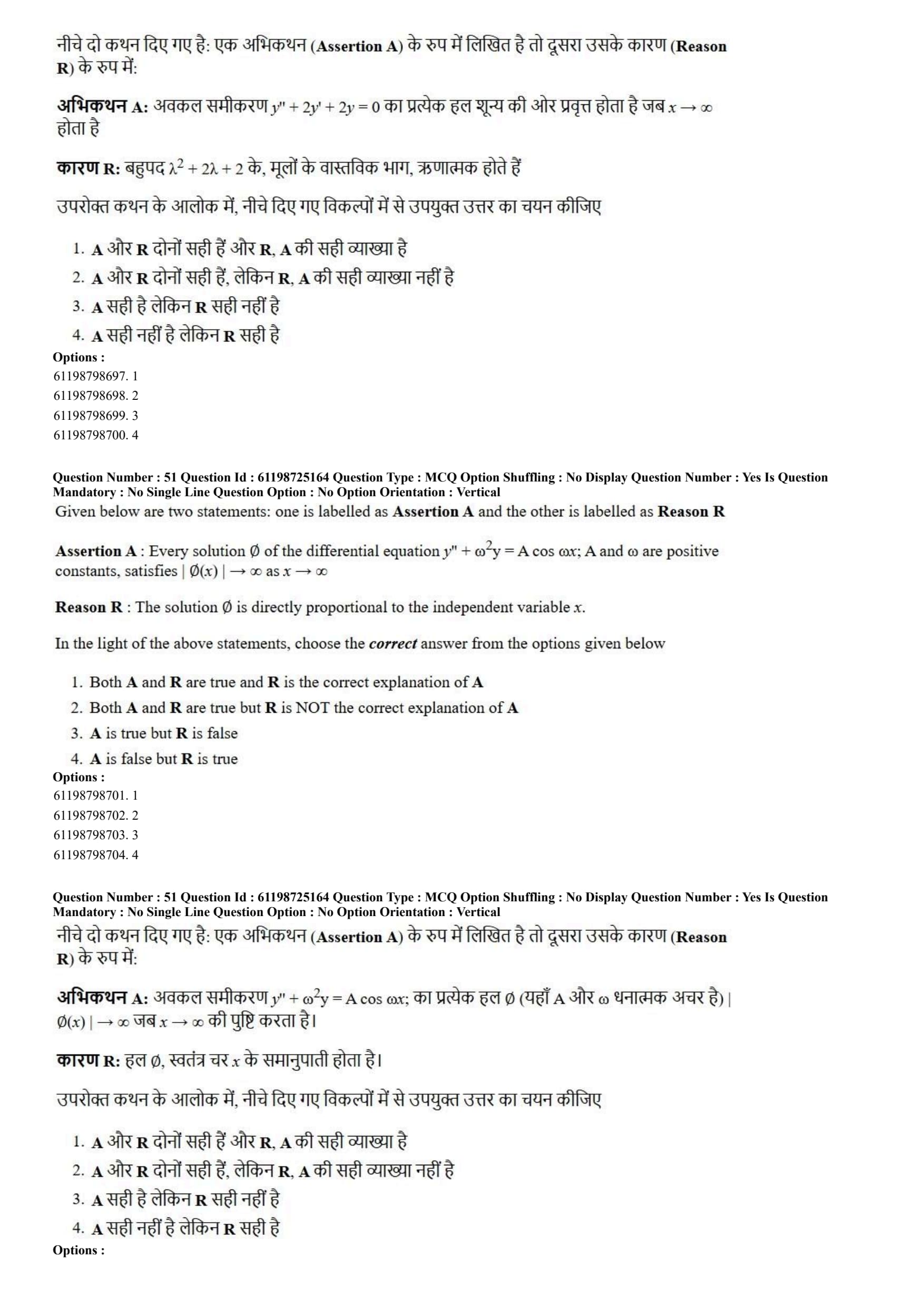
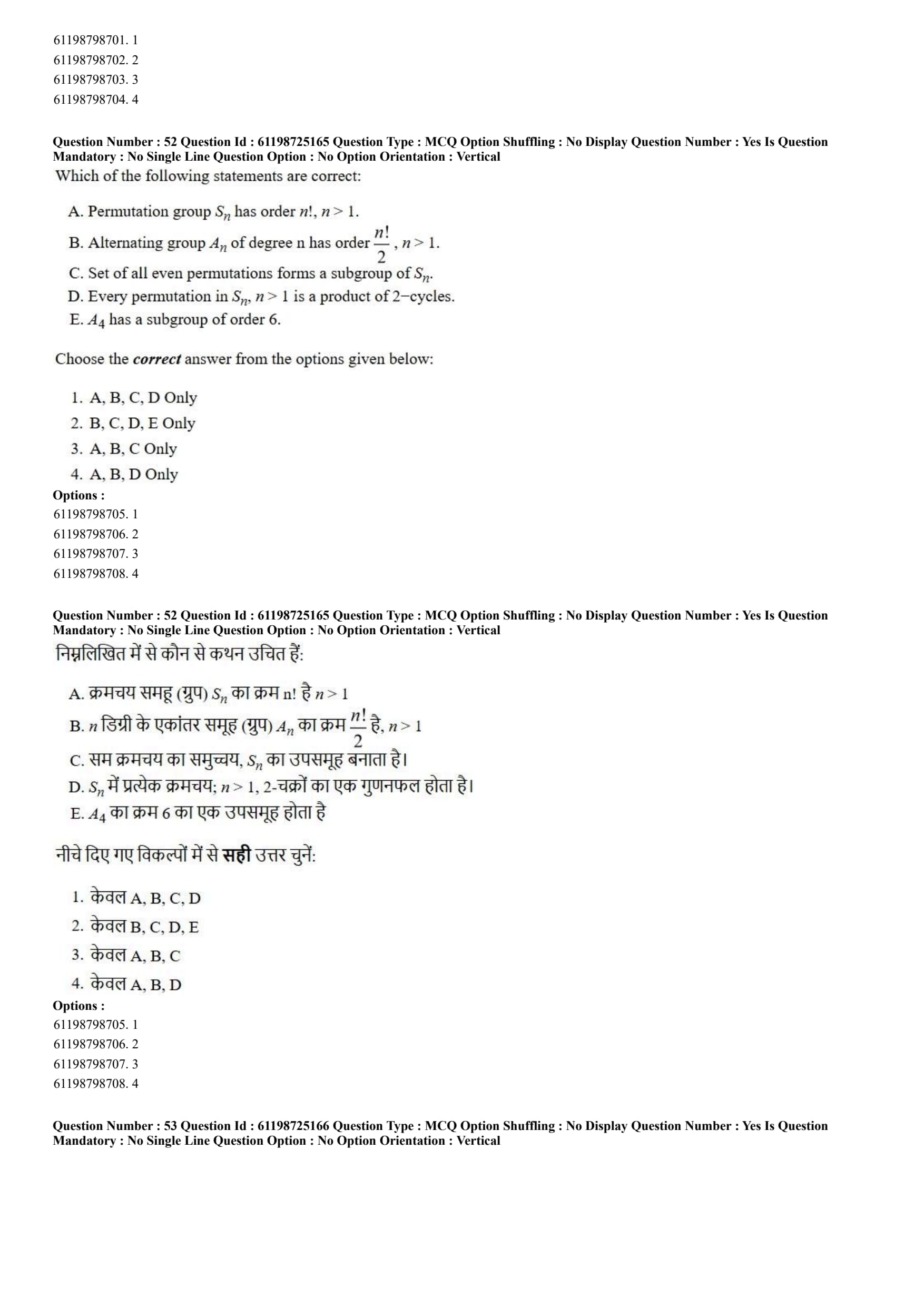
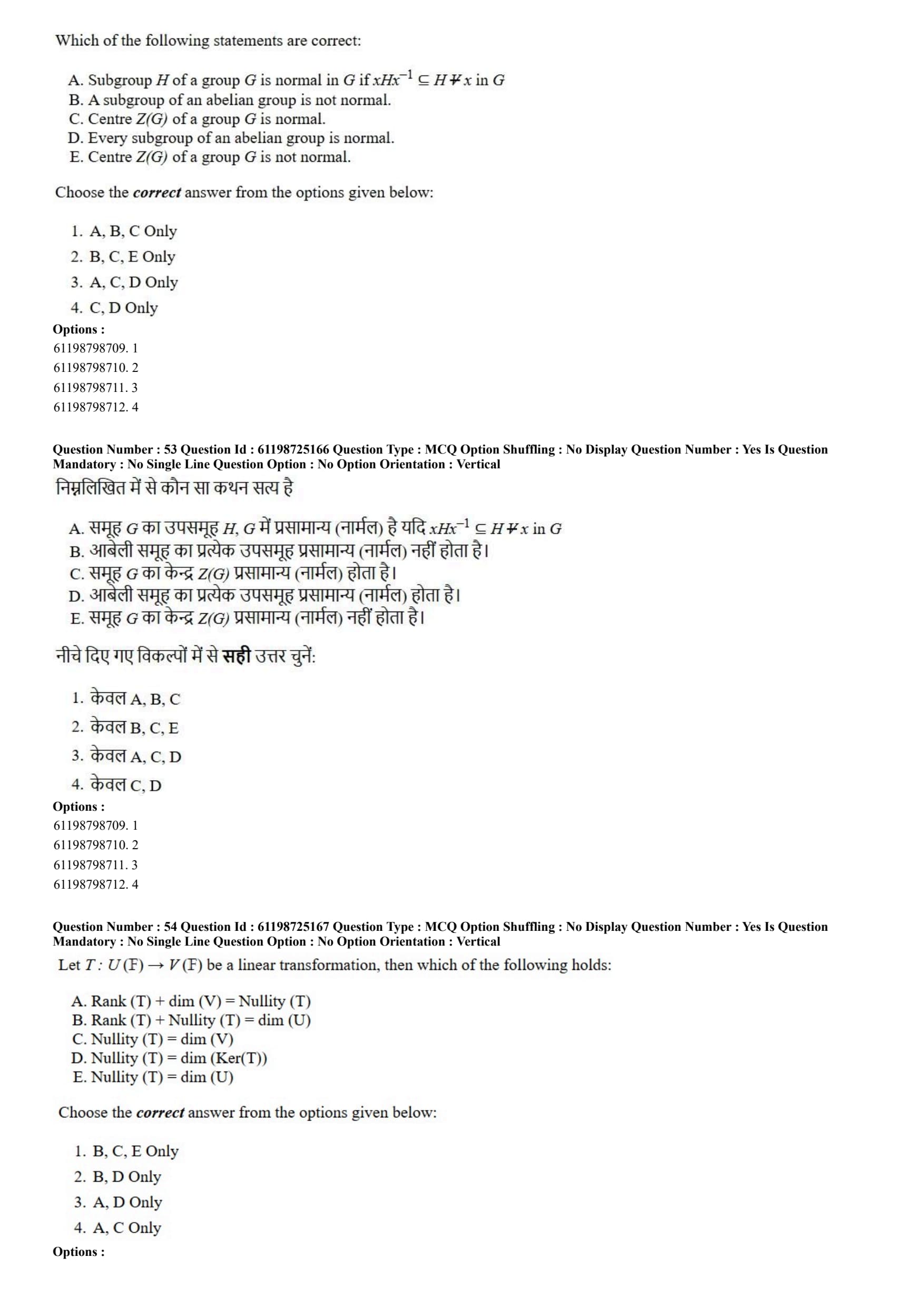
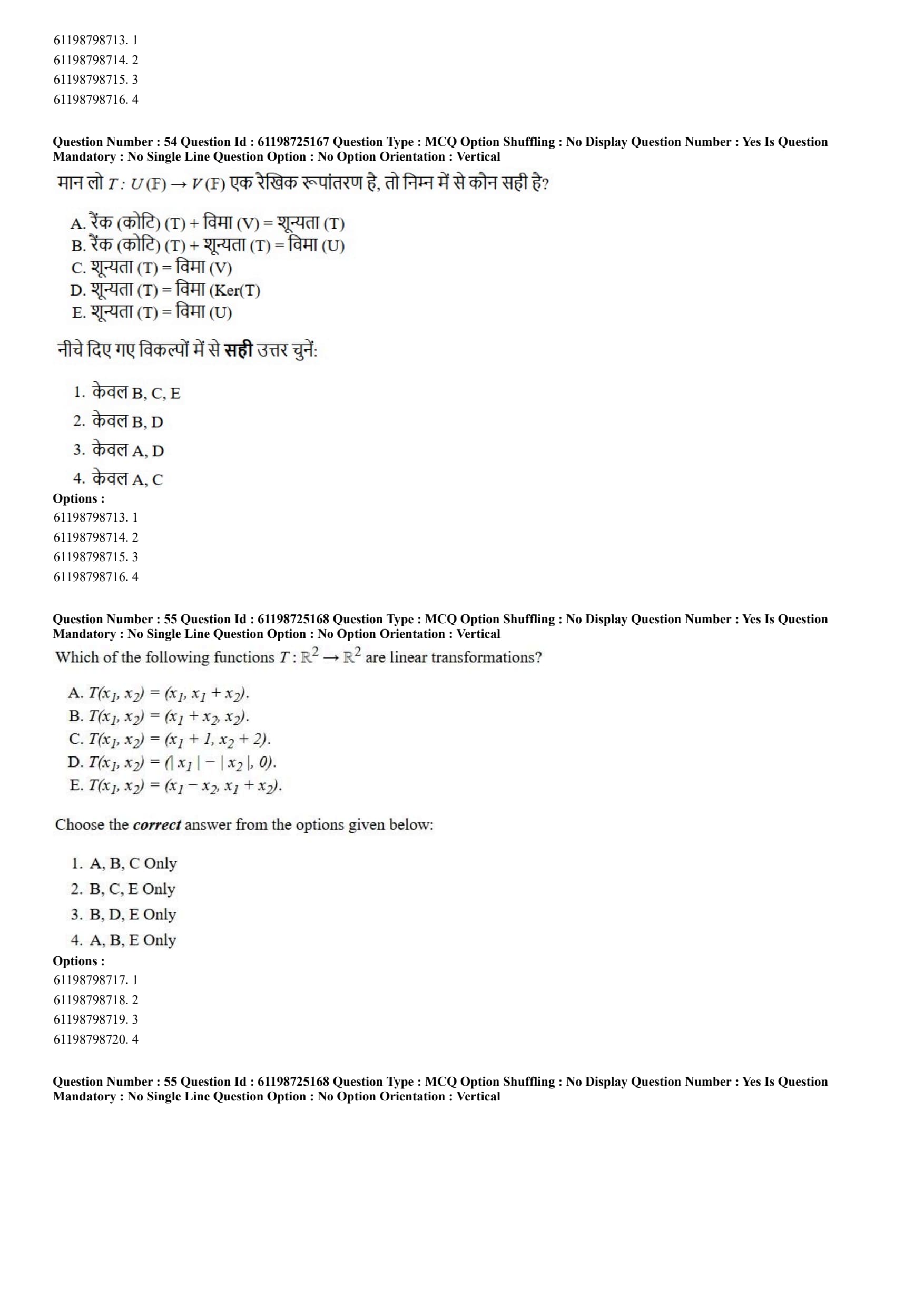
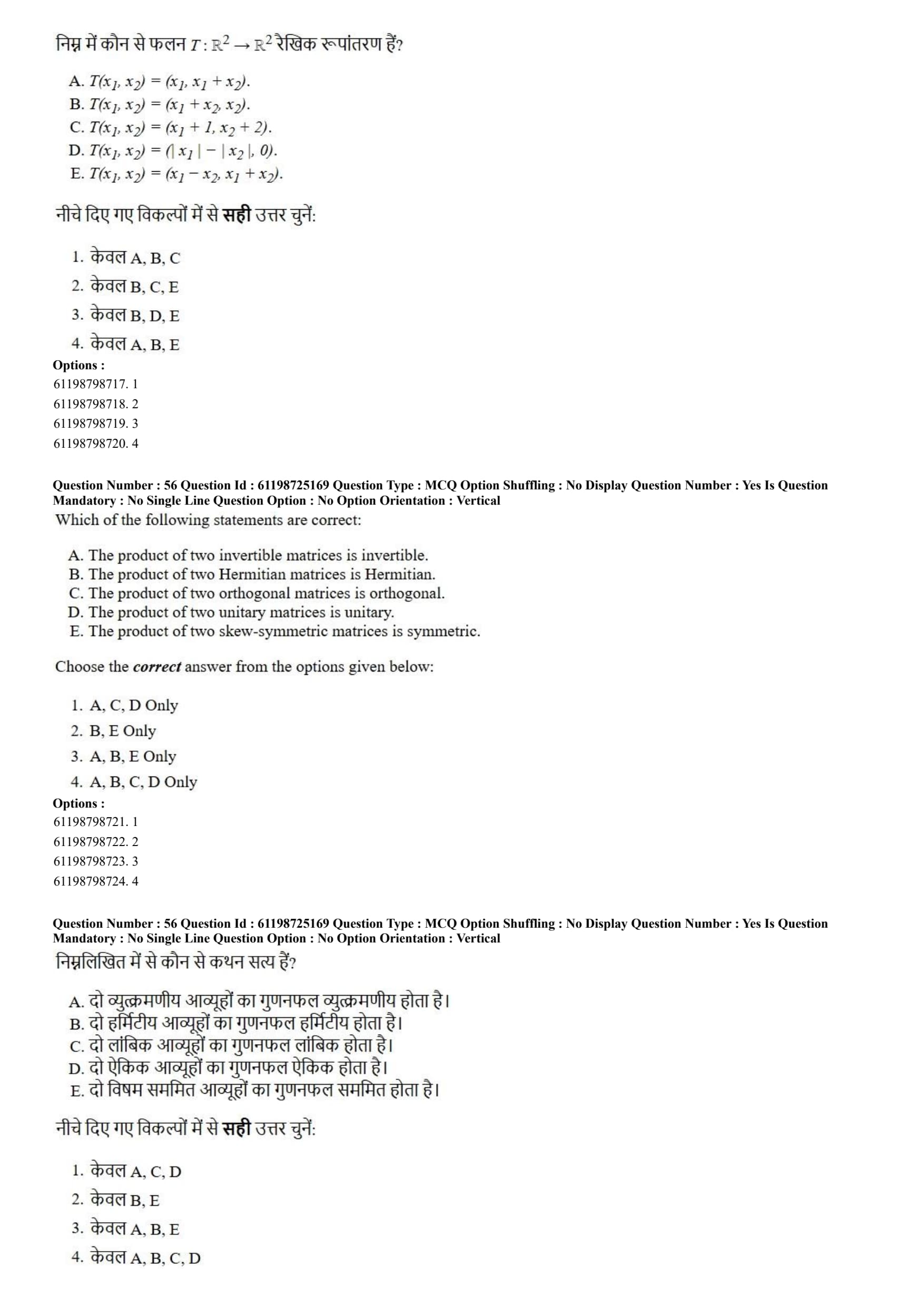
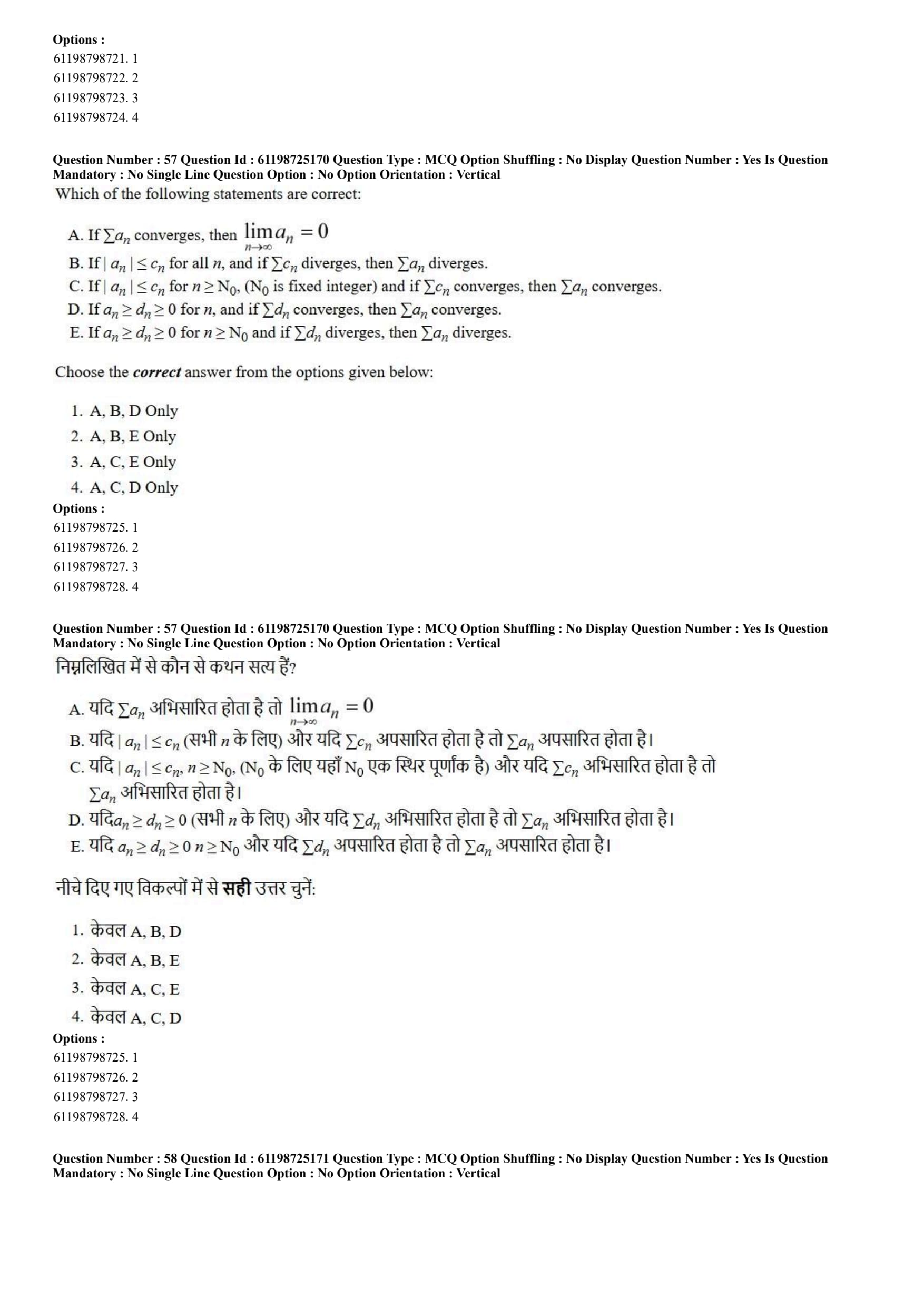
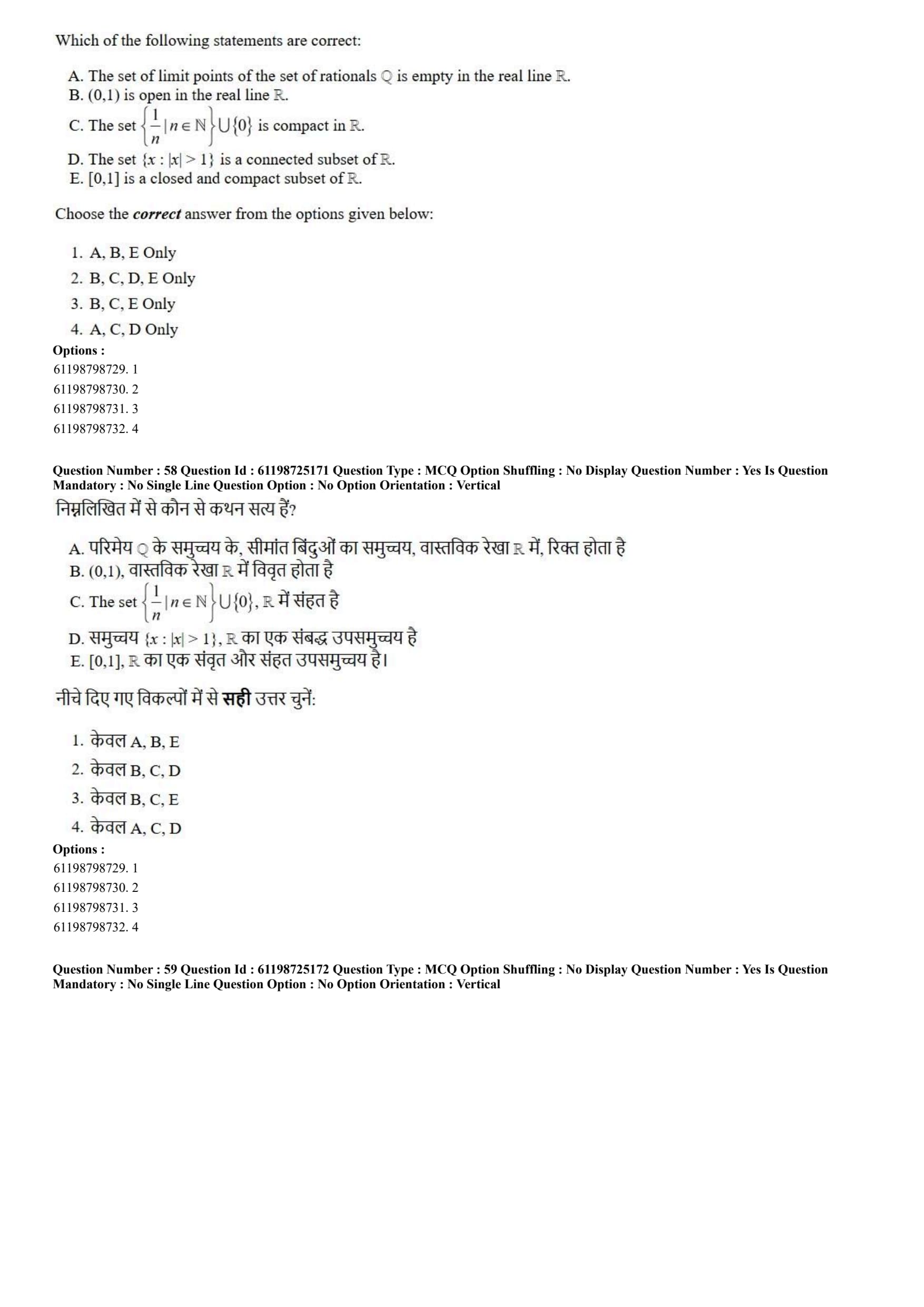
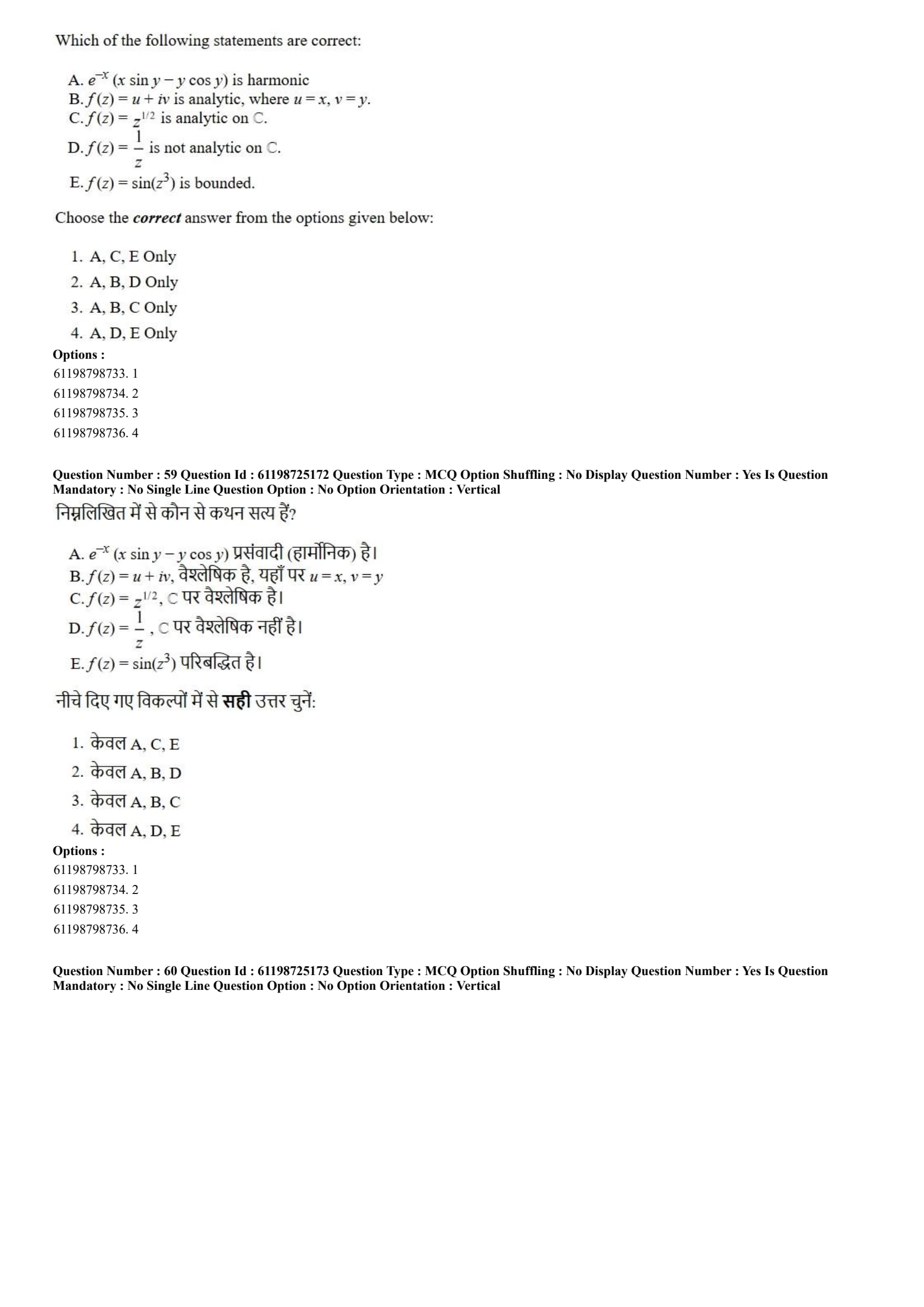
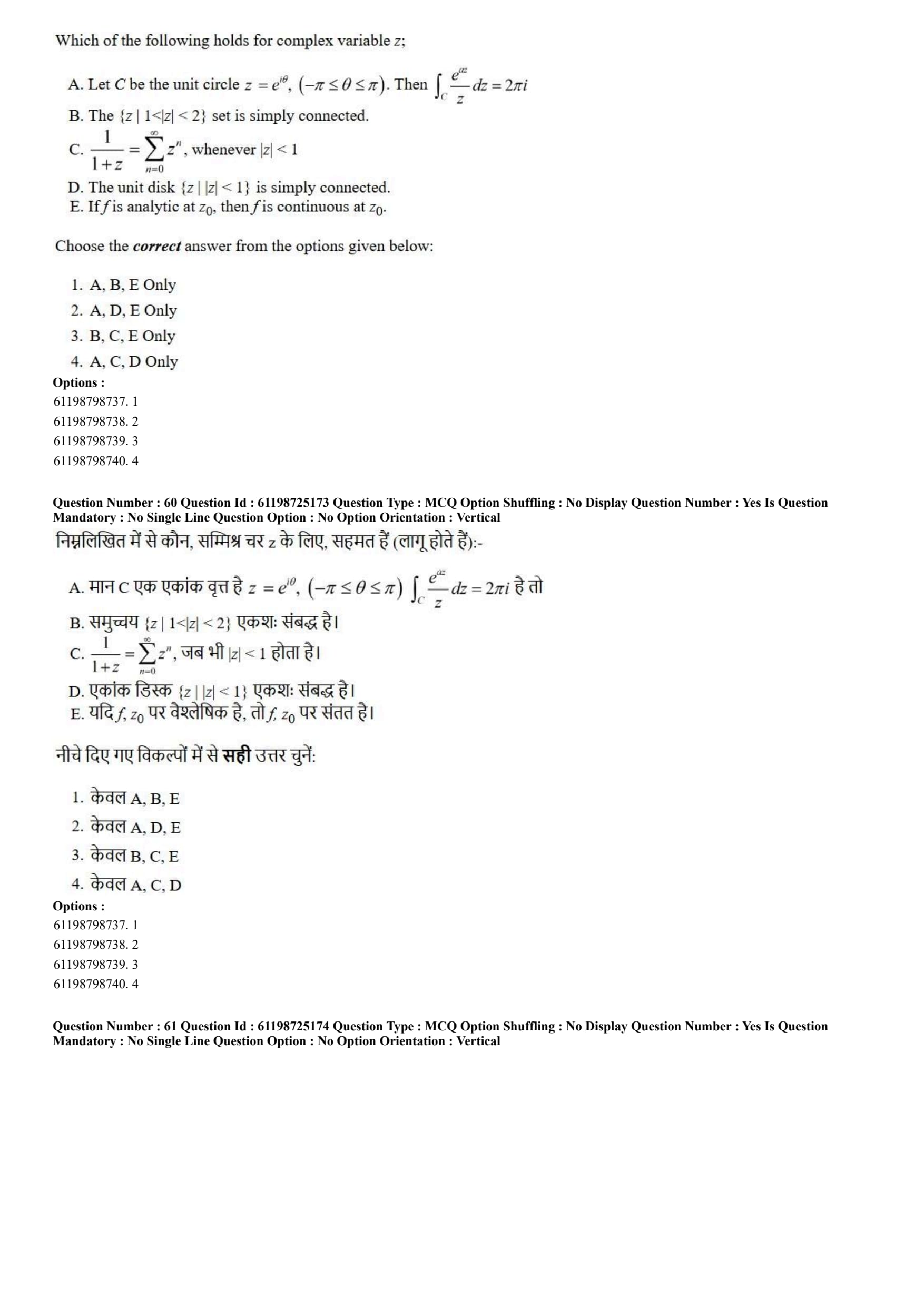
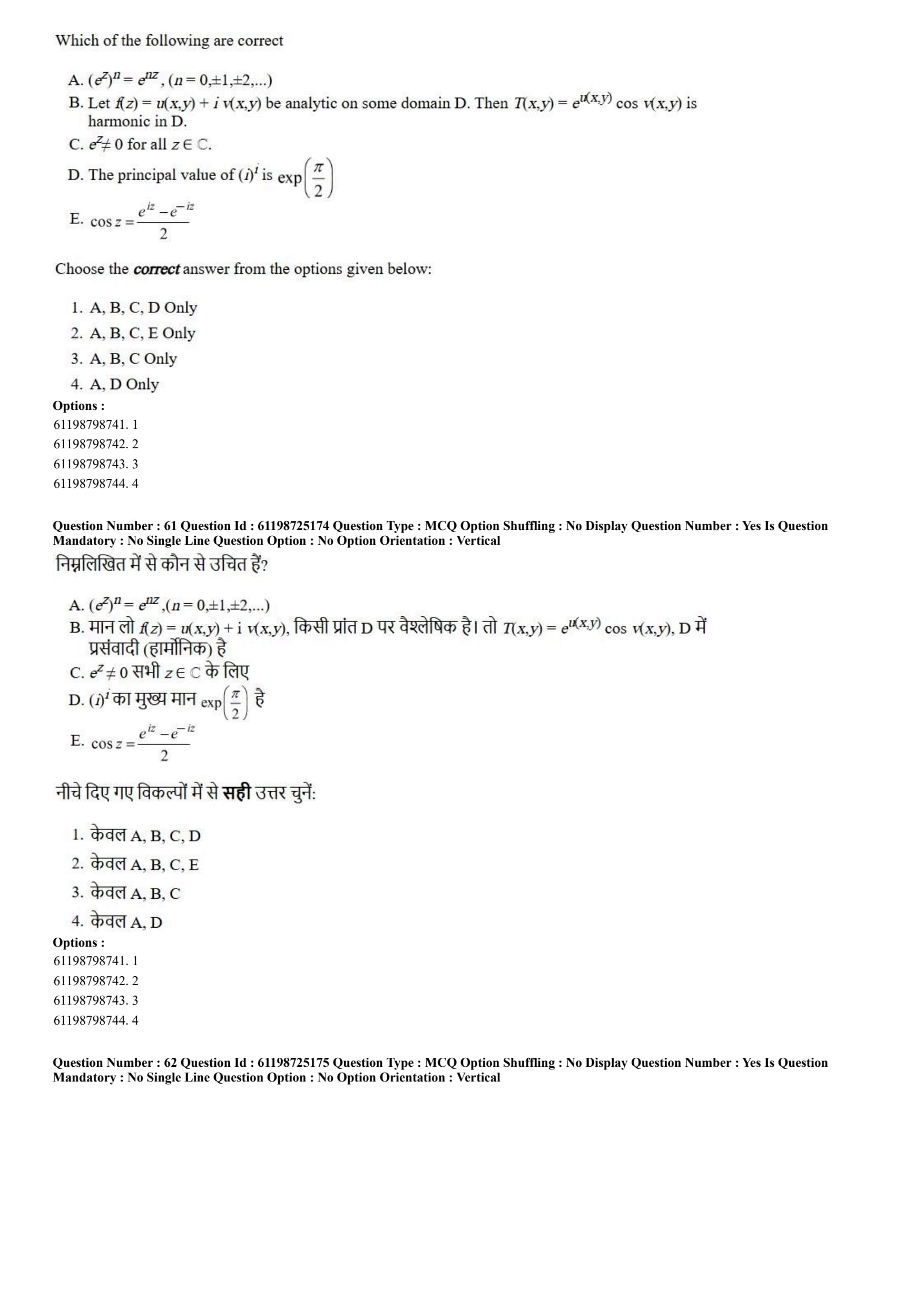
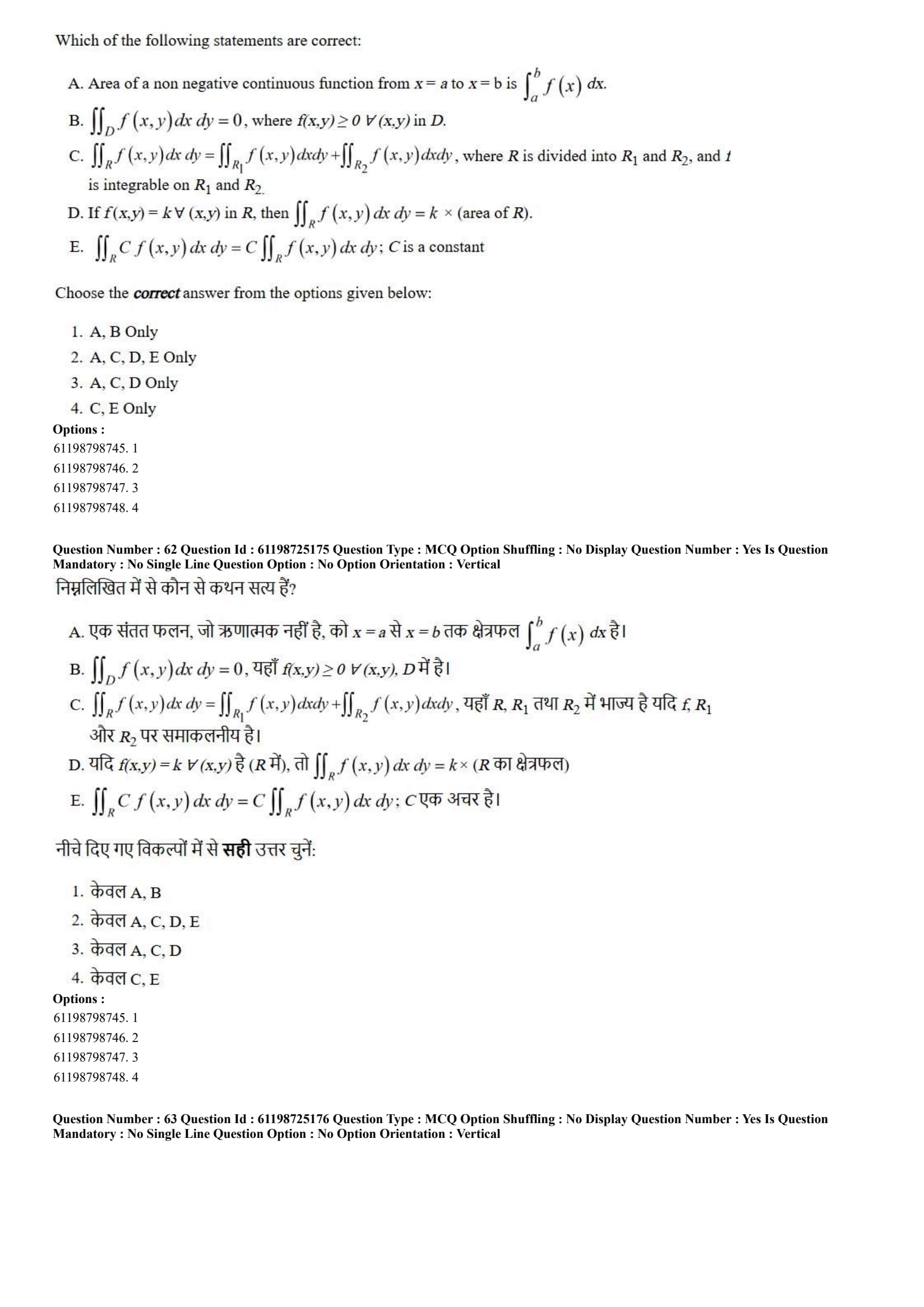
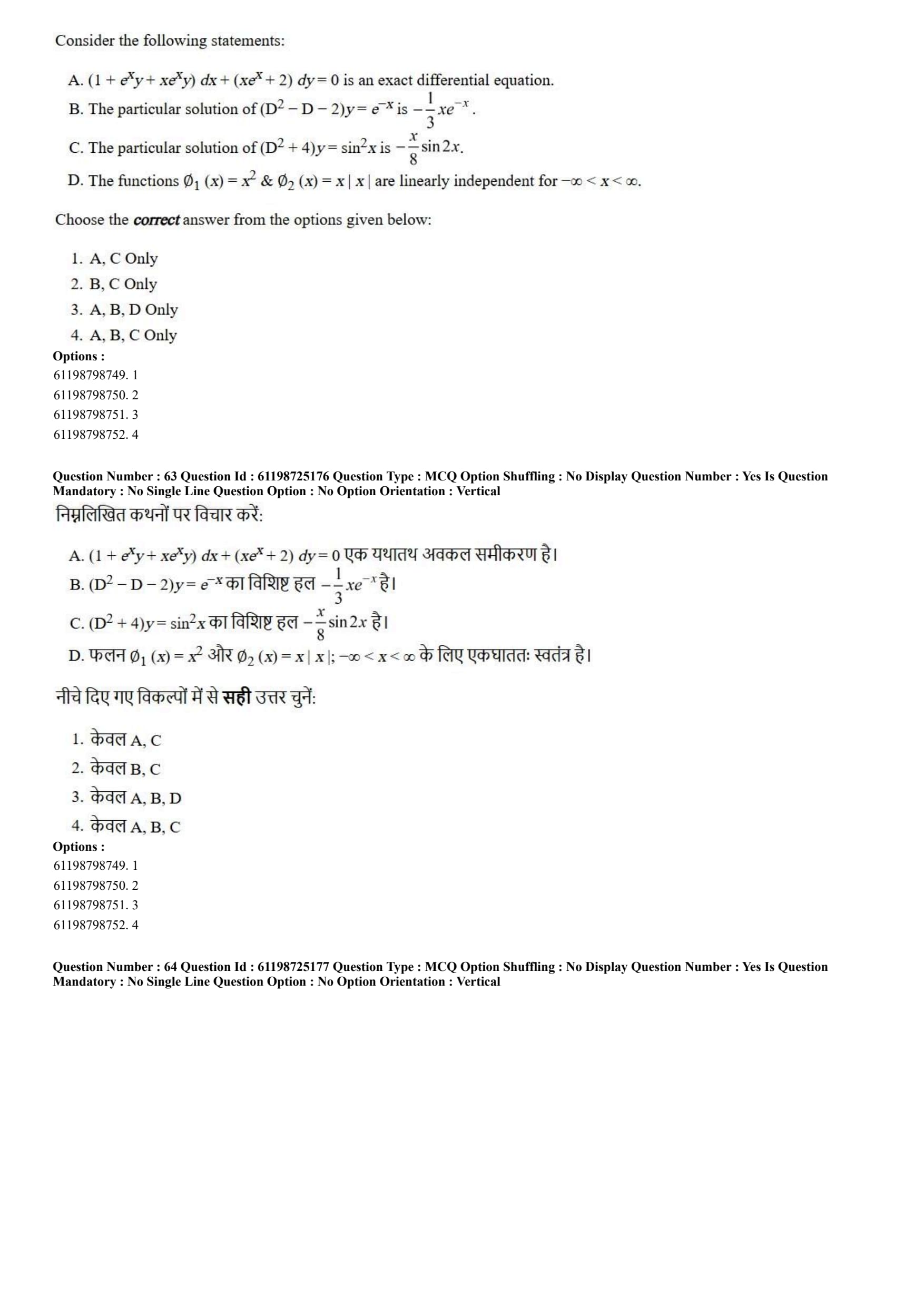
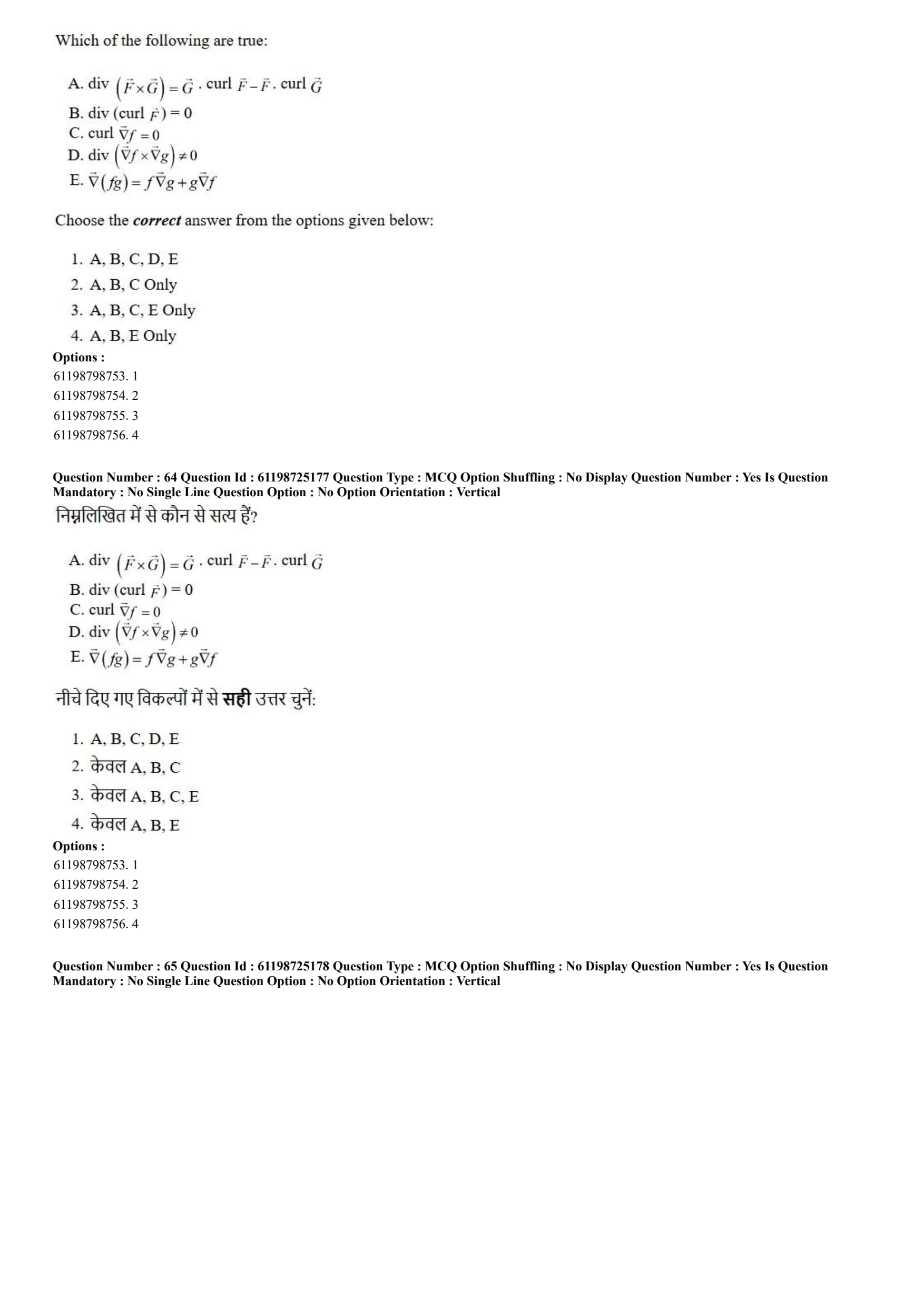
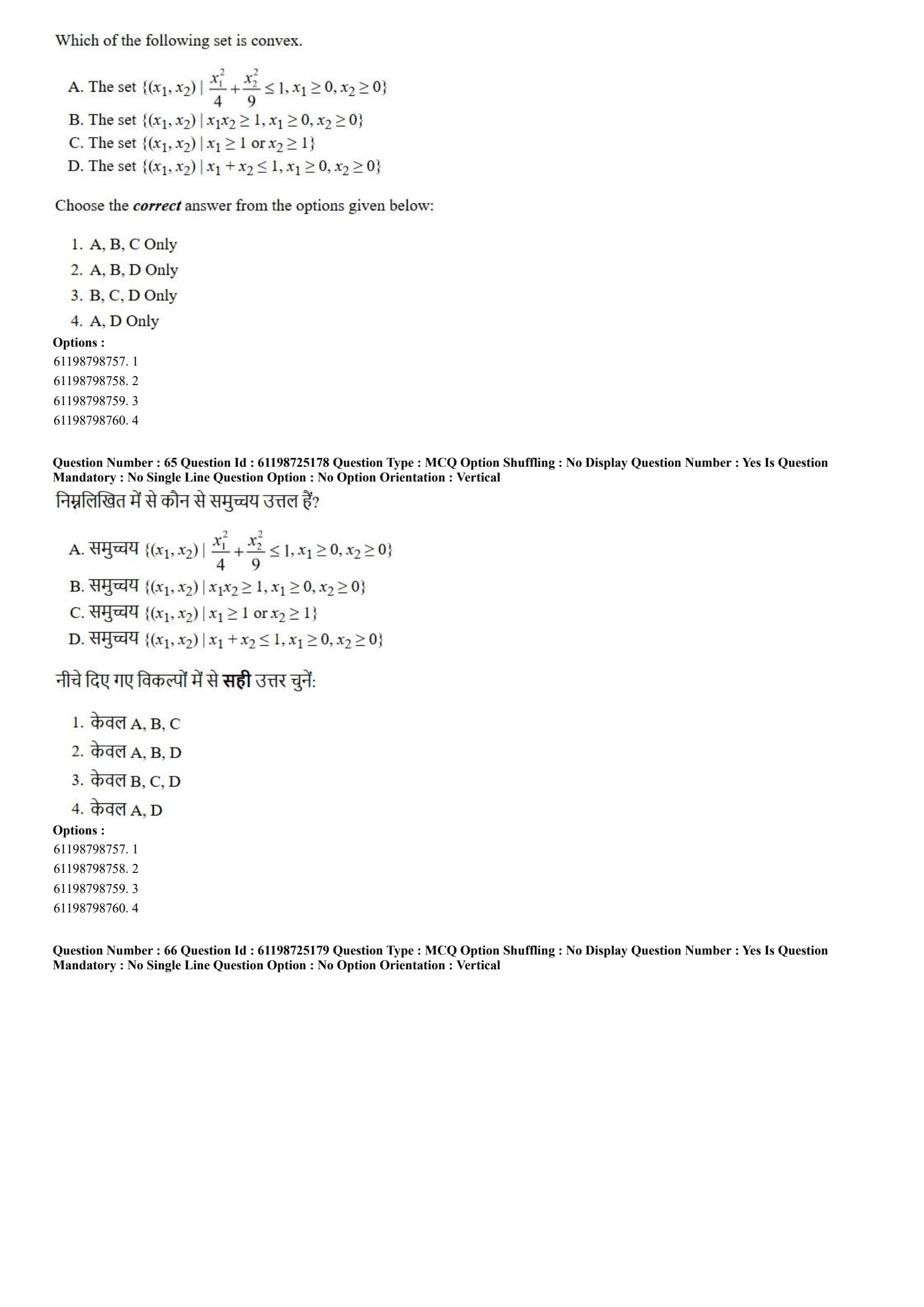
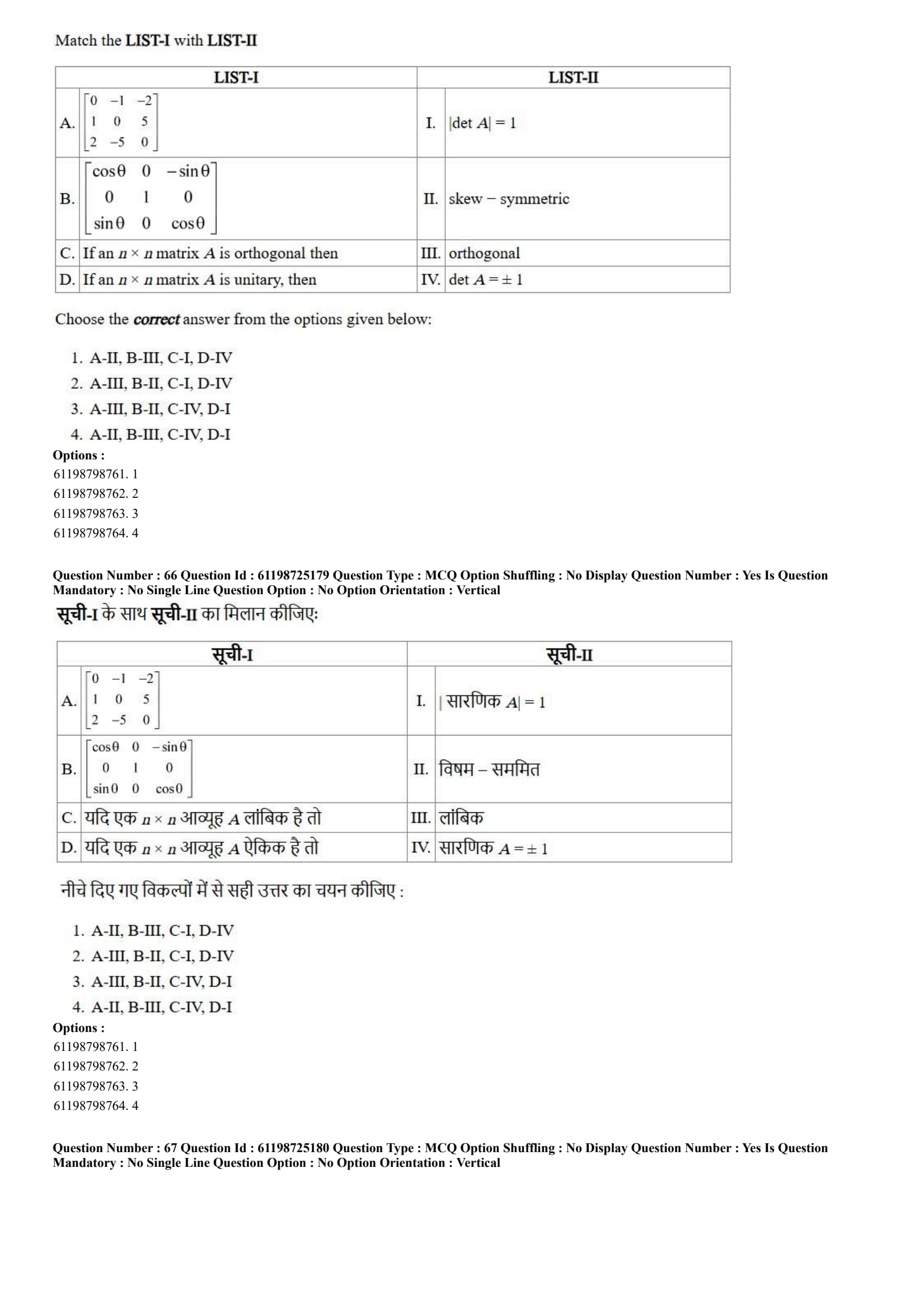
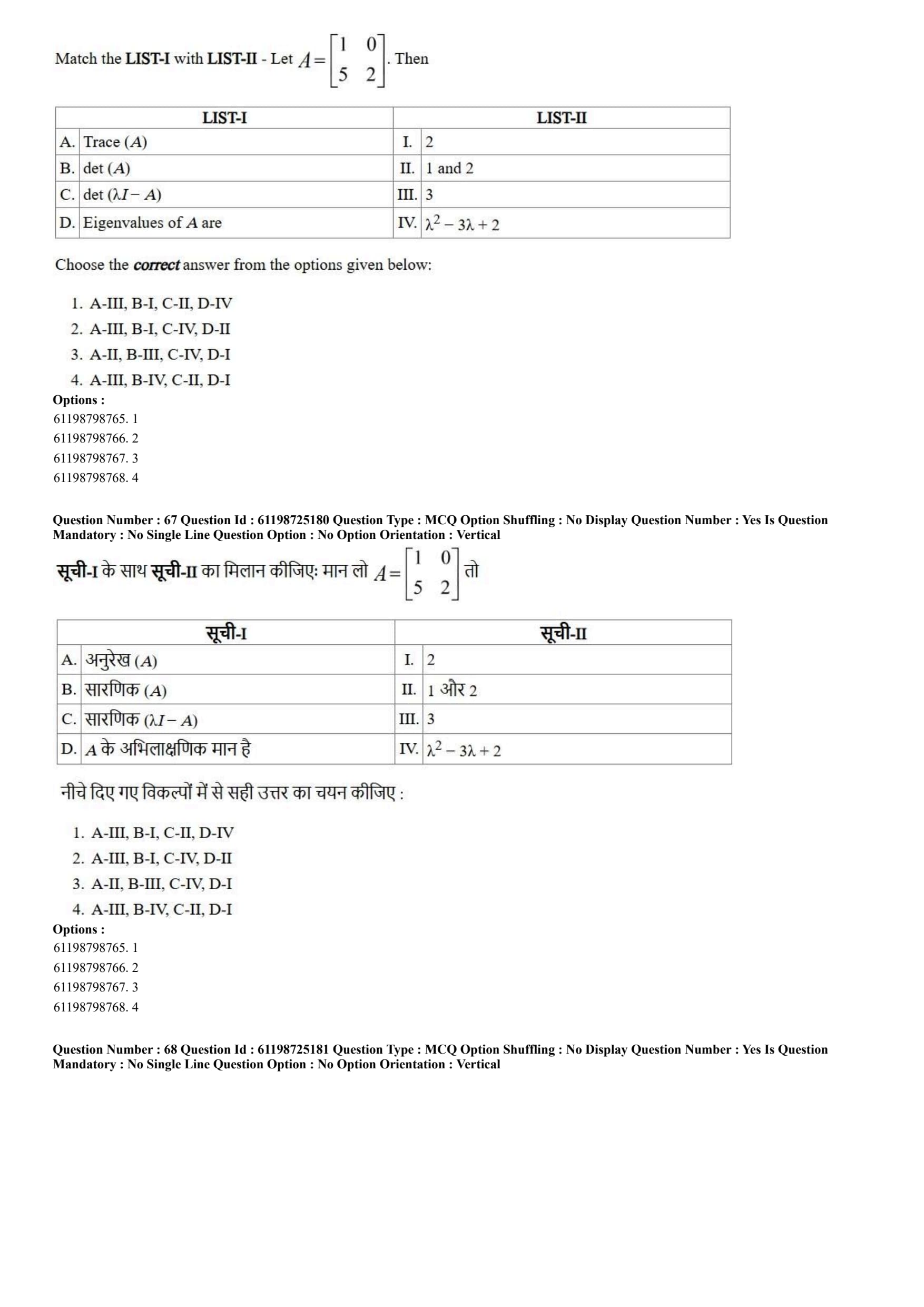
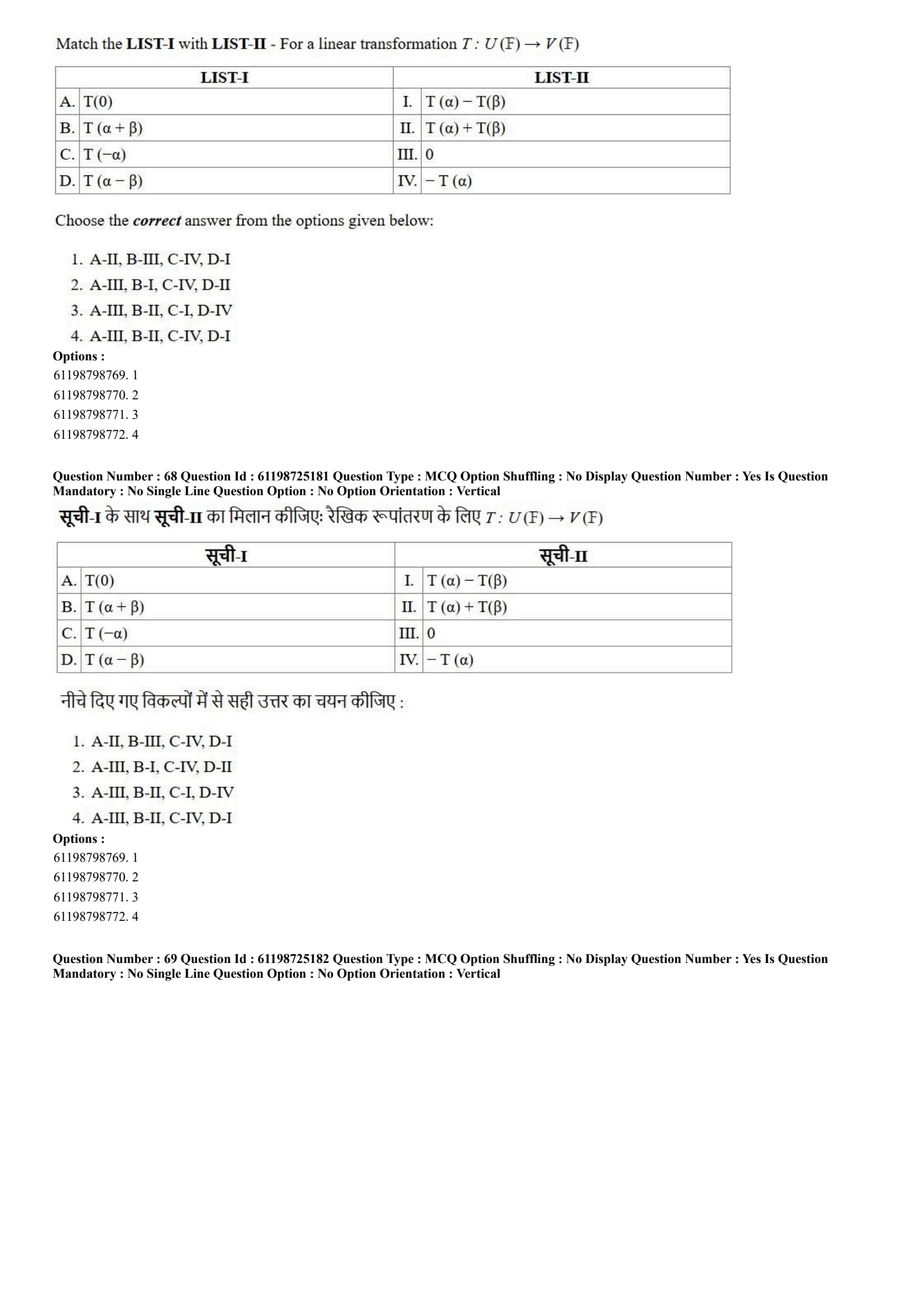
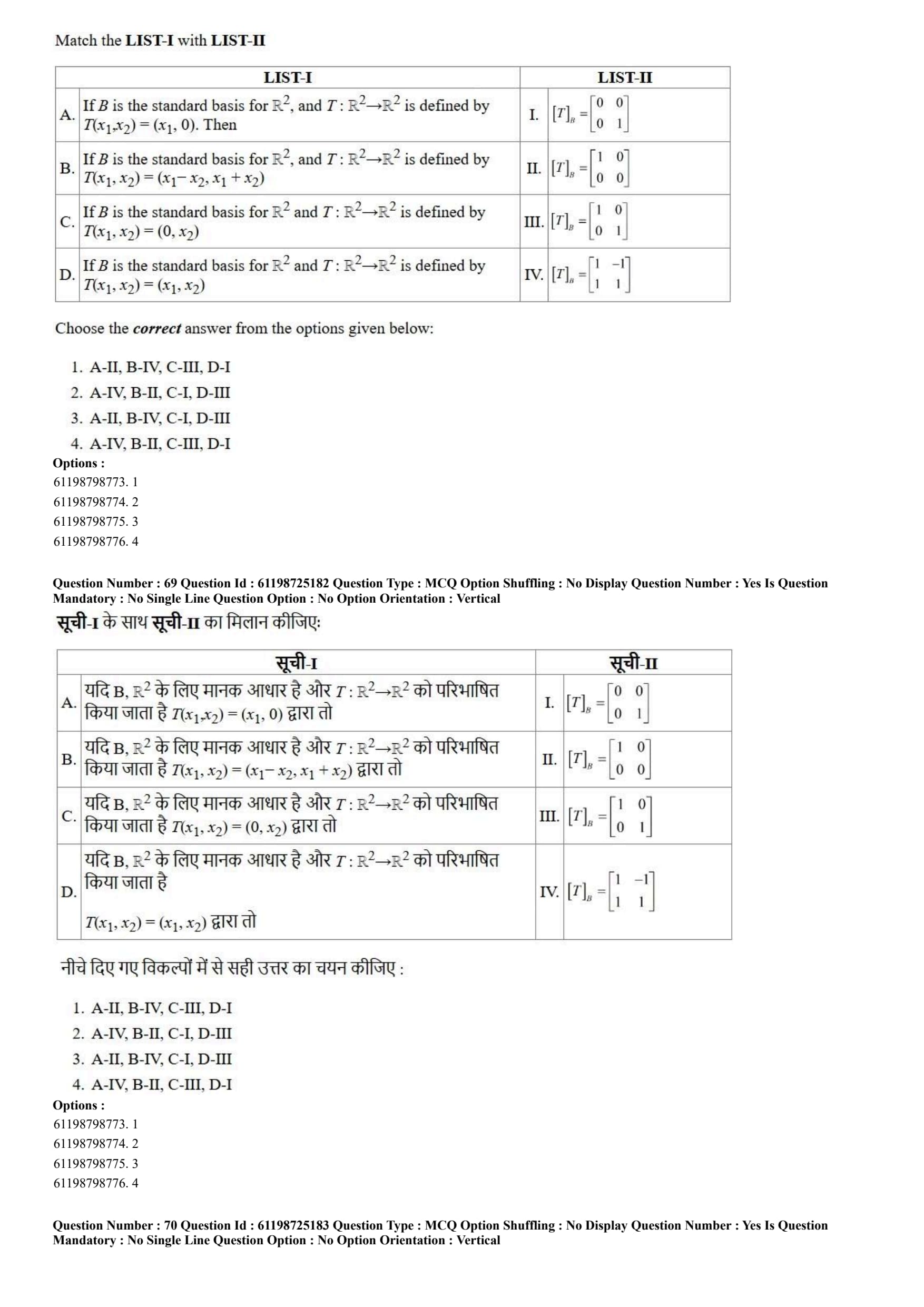
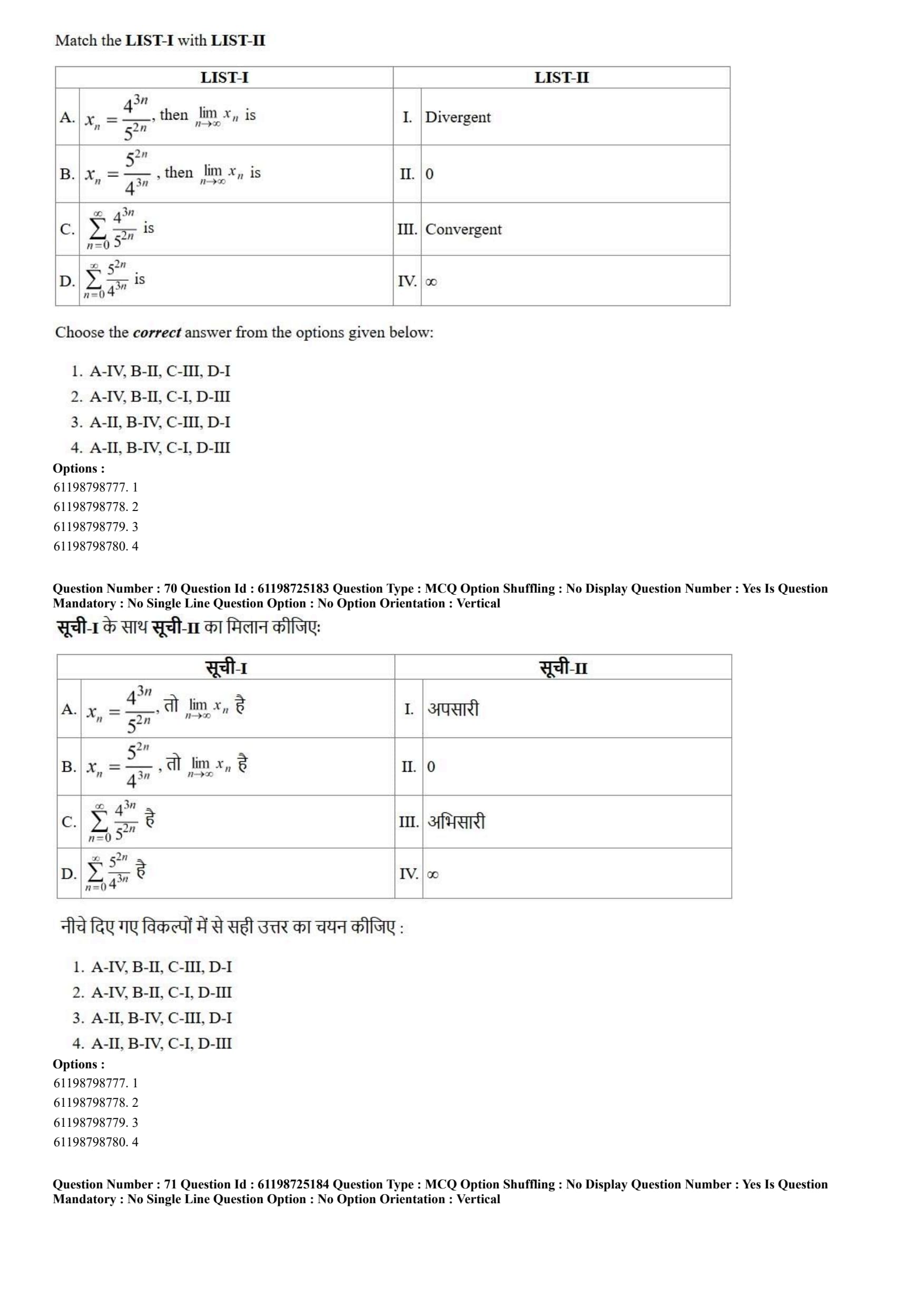
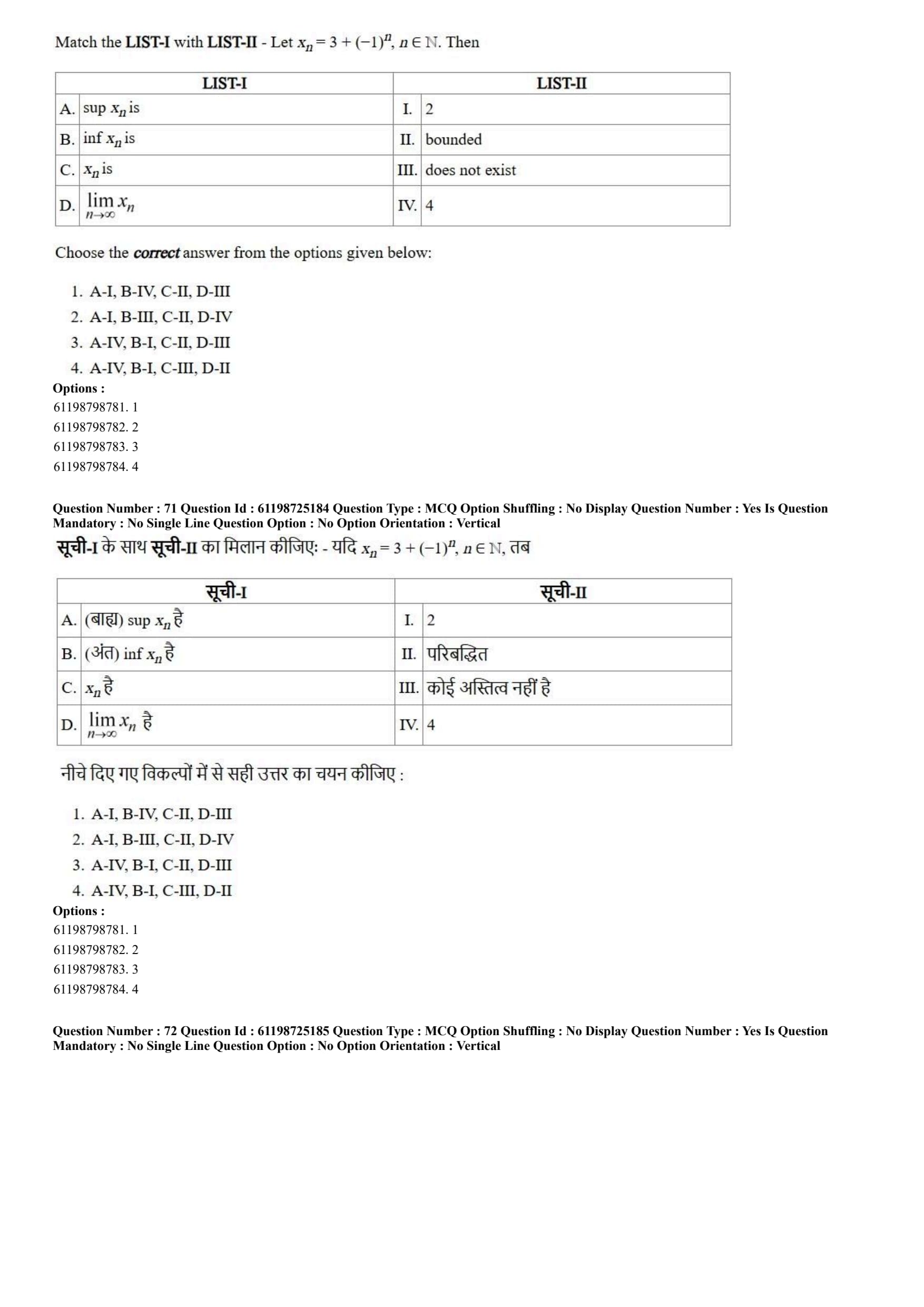
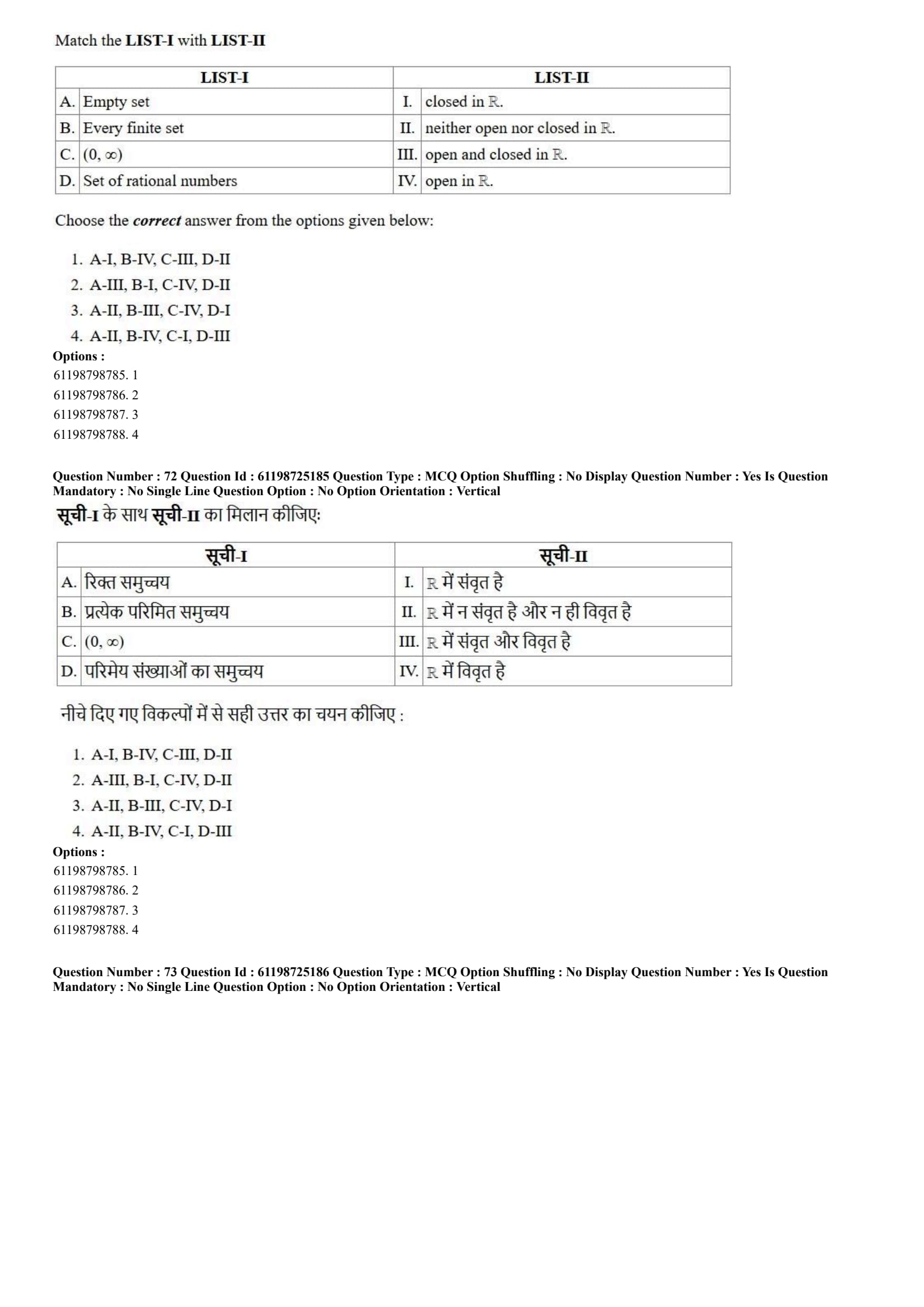
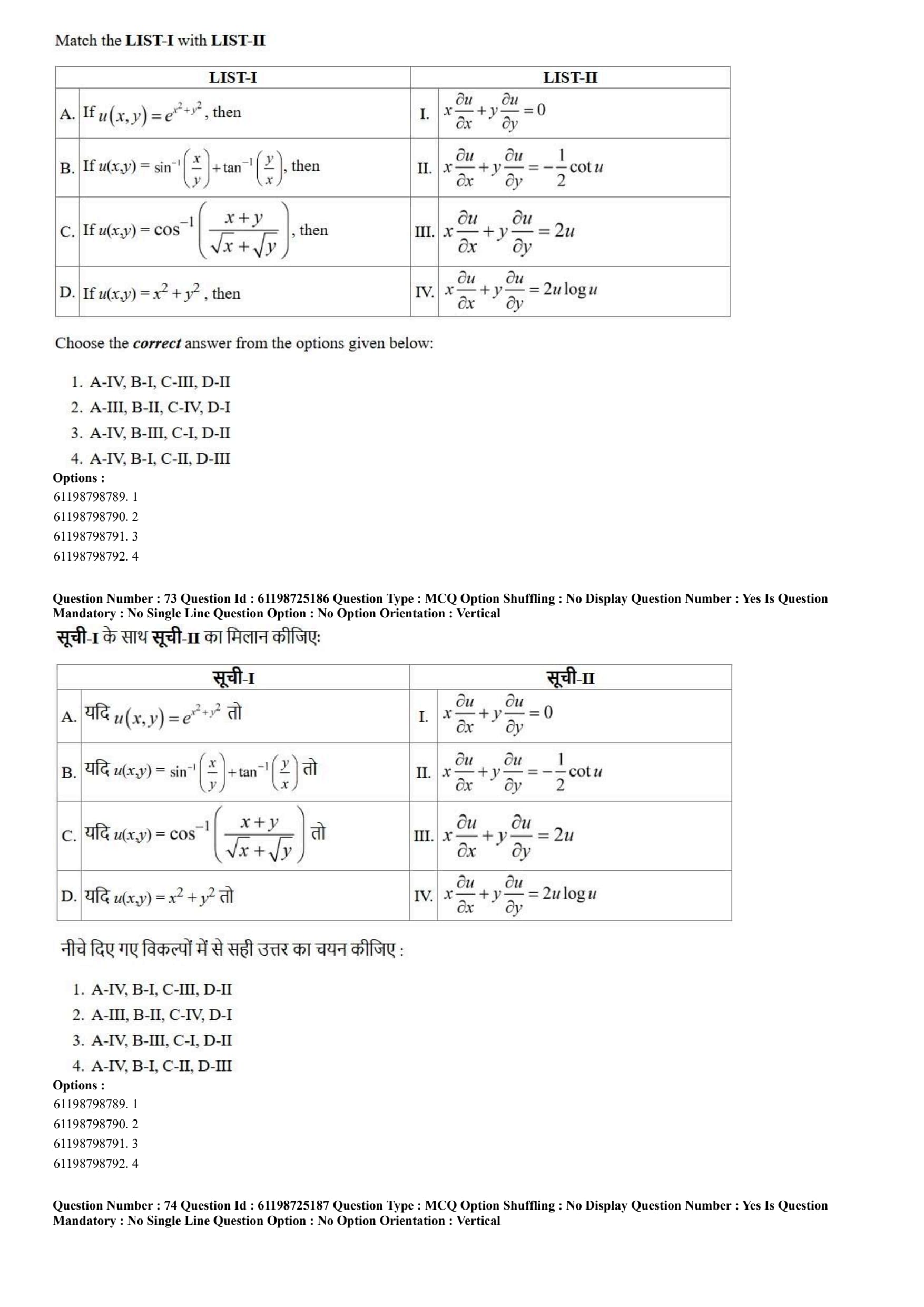
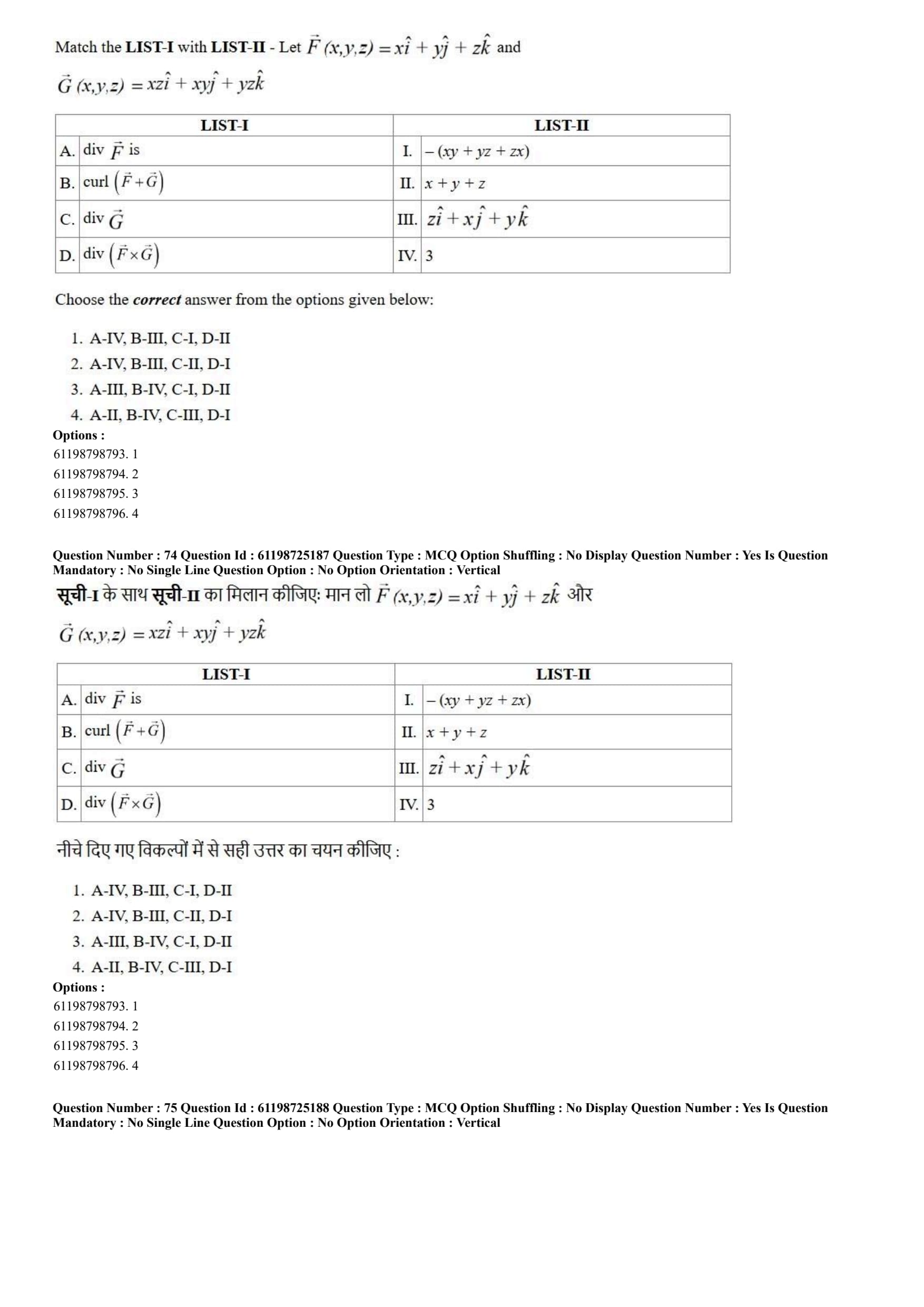
Which of the following set forms a group under multiplication:
View Solution
Step 1: Concept
In abstract algebra, an algebraic structure \((G, \cdot)\) consisting of a set \(G\) together with a binary operation \(\cdot\) is called a group if it satisfies four fundamental axioms:
1. Closure: For all \(a, b \in G\), the product \(a \cdot b \in G\).
2. Associativity: For all \(a, b, c \in G\), \((a \cdot b) \cdot c = a \cdot (b \cdot c)\).
3. Identity Element: There exists an element \(e \in G\) such that \(a \cdot e = e \cdot a = a\) for all \(a \in G\). Under multiplication, \(e = 1\).
4. Inverse Element: For every element \(a \in G\), there exists an element \(a^{-1} \in G\) such that \(a \cdot a^{-1} = a^{-1} \cdot a = e\).
Step 2: Key Formulas and Approach
To check if a finite set \(G = \{1, -1, i, -i\}\) under complex multiplication forms a group, we verify closure, identity, and inverses.
For infinite sets like \(\mathbb{N}\), \(\mathbb{I}\) (irrationals), and \(\mathbb{Q}\), we check if every element possesses a multiplicative inverse in the set.
Step 3: Step-by-step Explanation
Testing Option (A): Consider the set \(G = \{1, -1, i, -i\}\).
- Closure:
\(1 \cdot (-1) = -1 \in G\)
\(i \cdot i = -1 \in G\)
\(i \cdot (-i) = 1 \in G\)
\((-1) \cdot (-i) = i \in G\)
The multiplication table reveals that all entries lie inside \(G\).
- Associativity: Multiplication of complex numbers is associative.
- Identity: The element \(1 \in G\) serves as the multiplicative identity since \(1 \cdot a = a\) for all \(a \in G\).
- Inverses:
The inverse of \(1\) is \(1 \in G\).
The inverse of \(-1\) is \(-1 \in G\).
The inverse of \(i\) is \(-i \in G\) because \(i \cdot (-i) = 1\).
The inverse of \(-i\) is \(i \in G\) because \((-i) \cdot i = 1\).
Since all four properties hold, \(G = \{1, -1, i, -i\}\) is a multiplicative group (specifically, the cyclic group of 4th roots of unity, \(C_4\)).
Testing Option (B): The set of natural numbers \(\mathbb{N} = \{1, 2, 3, \dots\}\).
The element \(2 \in \mathbb{N}\) has no multiplicative inverse in \(\mathbb{N}\), because \(\frac{1}{2} \notin \mathbb{N}\). Hence, \(\mathbb{N}\) is not a group.
Testing Option (C): The set of irrational numbers.
Closure fails because \(\sqrt{2} \cdot \sqrt{2} = 2\), which is rational. Hence, the set of irrationals is not closed under multiplication.
Testing Option (D): The set of rational numbers \(\mathbb{Q}\).
The set \(\mathbb{Q}\) includes \(0\). The element \(0\) has no multiplicative inverse because division by zero is undefined. Therefore, \(\mathbb{Q}\) under multiplication is not a group (though \(\mathbb{Q} \setminus \{0\}\) is a group).
Step 4: Final Answer
The set \(\{1, -1, i, -i\}\) satisfies all four group axioms under multiplication. Thus, Option (A) is the correct answer.
Quick Tip: Remember that the set of \(n\)-th roots of unity \(U_n = \{e^{2k\pi i / n} \mid k = 0, 1, \dots, n-1\}\) always forms a finite abelian group under complex multiplication. For \(n=4\), \(U_4 = \{1, i, -1, -i\}\).
The generators of the set of integers \(\mathbb{Z}\) under addition is:
View Solution
Step 1: Concept
A group \((G, +)\) is called cyclic if there exists an element \(g \in G\) such that every element \(x \in G\) can be written as an integer multiple of \(g\), i.e., \(x = n \cdot g\) for some \(n \in \mathbb{Z}\).
The element \(g\) is called a generator of \(G\), and we write \(G = \langle g \rangle\).
Step 2: Key Formulas and Approach
For an infinite cyclic group such as \((\mathbb{Z}, +)\), any generator \(g\) must generate all positive integers, zero, and negative integers through additive repetition:
\[ \langle g \rangle = \{ n \cdot g \mid n \in \mathbb{Z} \} \]
We need to identify all elements \(g \in \mathbb{Z}\) for which \(\langle g \rangle = \mathbb{Z}\).
Step 3: Step-by-step Explanation
Let us evaluate \(g = 1\):
\(\langle 1 \rangle = \{ n \cdot 1 \mid n \in \mathbb{Z} \} = \{ \dots, -2, -1, 0, 1, 2, \dots \} = \mathbb{Z}\).
Thus, \(1\) is a generator of \(\mathbb{Z}\).
Let us evaluate \(g = -1\):
\(\langle -1 \rangle = \{ n \cdot (-1) \mid n \in \mathbb{Z} \} = \{ \dots, 2, 1, 0, -1, -2, \dots \} = \mathbb{Z}\).
Thus, \(-1\) is also a generator of \(\mathbb{Z}\).
Let us evaluate \(g = 2\):
\(\langle 2 \rangle = \{ n \cdot 2 \mid n \in \mathbb{Z} \} = \{ \dots, -4, -2, 0, 2, 4, \dots \} = 2\mathbb{Z} \neq \mathbb{Z}\).
Hence, \(2\) is not a generator because odd integers cannot be produced.
Generally, an infinite cyclic group has exactly two generators: if \(g\) is a generator, then \(g^{-1}\) is the only other generator. In \((\mathbb{Z}, +)\), the inverse of \(1\) is \(-1\). Therefore, the generators of \((\mathbb{Z}, +)\) are precisely \(1\) and \(-1\).
Step 4: Final Answer
The set of integers \(\mathbb{Z}\) under addition has exactly two generators, namely \(1\) and \(-1\). Hence, Option (C) is correct.
Quick Tip: An infinite cyclic group is always isomorphic to \((\mathbb{Z}, +)\) and possesses exactly 2 generators (\(g\) and \(g^{-1}\)). A finite cyclic group \(\mathbb{Z}_n\) has \(\phi(n)\) generators, where \(\phi\) is Euler's totient function.
The non-trivial solutions of the equations:
\[ x + y - 6z = 0 \] \[ -3x + y + 2z = 0 \] \[ x - y + 2z = 0 \]
View Solution
Step 1: Concept
A system of linear homogeneous equations \(A X = 0\) always possesses the trivial solution \(x = y = z = 0\).
Non-trivial solutions exist if and only if the coefficient matrix \(A\) is singular, i.e., \(\det(A) = 0\), which implies that the rank of \(A\) is less than the number of variables.
Step 2: Key Formulas and Approach
Write the system in matrix form \(A X = 0\): \[ A = \begin{pmatrix} 1 & 1 & -6
-3 & 1 & 2
1 & -1 & 2 \end{pmatrix} \]
Apply Gaussian elimination (row reduction) to obtain the Row Echelon Form of \(A\) and solve for the free variable(s).
Step 3: Step-by-step Explanation
Form the augmented matrix \([A \mid 0]\):
\[ \begin{pmatrix} 1 & 1 & -6 & \mid & 0
-3 & 1 & 2 & \mid & 0
1 & -1 & 2 & \mid & 0 \end{pmatrix} \]
Apply elementary row operations:
\(R_2 \to R_2 + 3R_1\):
\[ \begin{pmatrix} 1 & 1 & -6 & \mid & 0
0 & 4 & -16 & \mid & 0
1 & -1 & 2 & \mid & 0 \end{pmatrix} \]
\(R_3 \to R_3 - R_1\):
\[ \begin{pmatrix} 1 & 1 & -6 & \mid & 0
0 & 4 & -16 & \mid & 0
0 & -2 & 8 & \mid & 0 \end{pmatrix} \]
Simplify \(R_2\) by dividing by \(4\) (\(R_2 \to \frac{1}{4}R_2\)):
\[ \begin{pmatrix} 1 & 1 & -6 & \mid & 0
0 & 1 & -4 & \mid & 0
0 & -2 & 8 & \mid & 0 \end{pmatrix} \]
Apply \(R_3 \to R_3 + 2R_2\):
\[ \begin{pmatrix} 1 & 1 & -6 & \mid & 0
0 & 1 & -4 & \mid & 0
0 & 0 & 0 & \mid & 0 \end{pmatrix} \]
The rank of \(A\) is \(2\), which is less than \(3\) (number of variables). Hence, there is \(3 - 2 = 1\) free variable.
Express \(x\) and \(y\) in terms of \(z\):
From \(R_2\): \(y - 4z = 0 \implies y = 4z\).
From \(R_1\): \(x + y - 6z = 0 \implies x + 4z - 6z = 0 \implies x - 2z = 0 \implies x = 2z\).
Assign a parameter \(c \in \mathbb{R}\) (\(c \neq 0\) for non-trivial solutions) to \(z\):
\[ z = c, \quad y = 4c, \quad x = 2c \]
Step 4: Final Answer
The non-trivial solution set is given by \(x = 2c, y = 4c, z = c\) for any non-zero scalar \(c\). Thus, Option (B) is correct.
Quick Tip: To quickly check options in competitive exams, substitute \(x=2c, y=4c, z=c\) directly into the equations: \(2c + 4c - 6c = 0 \quad \checkmark\) \(-3(2c) + 4c + 2c = 0 \quad \checkmark\) \(2c - 4c + 2c = 0 \quad \checkmark\) This confirms the result rapidly without doing full matrix reduction.
Diagonal elements of a skew-Hermitian matrix are:
View Solution
Step 1: Concept
A square matrix \(A \in \mathbb{C}^{n \times n}\) is called a skew-Hermitian matrix if it is equal to the negative of its conjugate transpose (also known as the Hermitian adjoint): \[ A^{\dagger} = -A \quad or \quad (\bar{A})^T = -A \]
where \(\bar{A}\) denotes the complex conjugate and \(T\) denotes the transpose.
Step 2: Key Formulas and Approach
Let \(A = (a_{ij})_{n \times n}\). By definition of skew-Hermitian matrices: \[ a_{ij} = -\bar{a}_{ji} \quad for all i, j \]
For the main diagonal elements, set \(i = j\): \[ a_{ii} = -\bar{a}_{ii} \]
Step 3: Step-by-step Explanation
Let the diagonal entry be represented as \(a_{ii} = x + iy\), where \(x, y \in \mathbb{R}\).
The complex conjugate is \(\bar{a}_{ii} = x - iy\).
Substituting this into the skew-Hermitian property \(a_{ii} = -\bar{a}_{ii}\):
\[ x + iy = -(x - iy) \]
\[ x + iy = -x + iy \]
Subtracting \(iy\) from both sides:
\[ x = -x \implies 2x = 0 \implies x = 0 \]
Since \(x = 0\), the diagonal element \(a_{ii}\) simplifies to:
\[ a_{ii} = 0 + iy = iy \]
If \(y = 0\), then \(a_{ii} = 0\) (zero).
If \(y \neq 0\), then \(a_{ii} = iy\) is purely imaginary.
Therefore, the diagonal elements of any skew-Hermitian matrix must be either purely imaginary or zero.
Step 4: Final Answer
The diagonal elements of a skew-Hermitian matrix are purely imaginary numbers or zero. Thus, Option (C) is correct.
Quick Tip: Matrix Property Summary: - Hermitian matrix: Diagonal elements are purely real. - Skew-Hermitian matrix: Diagonal elements are purely imaginary or zero. - Skew-symmetric matrix: Diagonal elements are strictly zero.
If \(A\) is a null matrix then
View Solution
Step 1: Concept
The rank of a matrix \(A\) is defined as the maximum number of linearly independent row vectors (or column vectors) in \(A\). Alternatively, it is the maximum order of any non-zero minor of \(A\).
Step 2: Key Formulas and Approach
A null matrix (or zero matrix) \(O_{m \times n}\) is a matrix in which all entries are identically zero: \[ A = \begin{pmatrix} 0 & 0 & \dots & 0
0 & 0 & \dots & 0
\vdots & \vdots & \ddots & \vdots
0 & 0 & \dots & 0 \end{pmatrix} \]
Step 3: Step-by-step Explanation
Every row vector and column vector in a null matrix is the zero vector \(\vec{0}\).
A set consisting only of zero vectors is linearly dependent. The maximum number of linearly independent rows in a null matrix is \(0\).
Furthermore, every minor of any order (\(1 \times 1, 2 \times 2, \dots\)) formed from a zero matrix has a determinant equal to \(0\).
Since there exists no non-zero minor of order \(1\) or greater, by definition:
\[ Rank(A) = 0 \]
Note that the null matrix is the only matrix that has a rank of \(0\). Every non-zero matrix has a rank of at least \(1\).
Step 4: Final Answer
The rank of a null matrix is always 0. Hence, Option (B) is correct.
Quick Tip: \(Rank(A) = 0 \iff A = O\) (Zero Matrix). For any non-zero matrix \(A_{m \times n}\), \(1 \leq Rank(A) \leq \min(m, n)\).
Let \(A\) be a symmetric matrix, then
View Solution
Step 1: Concept
A square matrix \(A\) is defined to be symmetric if it is equal to its transpose, i.e., \(A^T = A\).
A matrix \(B\) is defined to be skew-symmetric if \(B^T = -B\).
Step 2: Key Formulas and Approach
We test the fundamental matrix transpose properties:
1. \((A^T)^T = A\)
2. \((A + B)^T = A^T + B^T\)
3. \((kA)^T = k A^T\)
4. \((A_1 A_2 \dots A_m)^T = A_m^T \dots A_2^T A_1^T\)
5. \((A^m)^T = (A^T)^m\) for any positive integer \(m\).
Step 3: Step-by-step Explanation
Testing Option (A):
\((kA)^T = k A^T\). Since \(A^T = A\), \((kA)^T = k A\). Thus \((kA)^T = -kA\) is false (unless \(k=0\) or \(A=O\)).
Testing Option (B):
Consider \((A^m)^T\). Using exponent-transpose property:
\[ (A^m)^T = (A^T)^m \]
Since \(A\) is symmetric, \(A^T = A\). Substituting \(A^T = A\):
\[ (A^m)^T = A^m \]
Since \((A^m)^T = A^m\), \(A^m\) is indeed a symmetric matrix for any positive integer \(m\). Thus, Option (B) is true.
Testing Option (C):
\(A^T = -A\) is the defining equation of a \textit{skew-symmetric matrix, not a symmetric matrix. Thus, Option (C) is false.
Testing Option (D):
Let \(B\) be skew-symmetric, so \(B^T = -B\). Then:
\[ (A + B)^T = A^T + B^T = A - B \]
Since \(A - B \neq A + B\) in general, \(A + B\) is not symmetric. Thus, Option (D) is false.
Step 4: Final Answer
If \(A\) is symmetric, \(A^m\) is also symmetric for every positive integer \(m\). Thus, Option (B) is correct.
Quick Tip: Powers of symmetric matrices are always symmetric: \((A^m)^T = (A^T)^m = A^m\). Powers of skew-symmetric matrices are symmetric for even powers and skew-symmetric for odd powers.
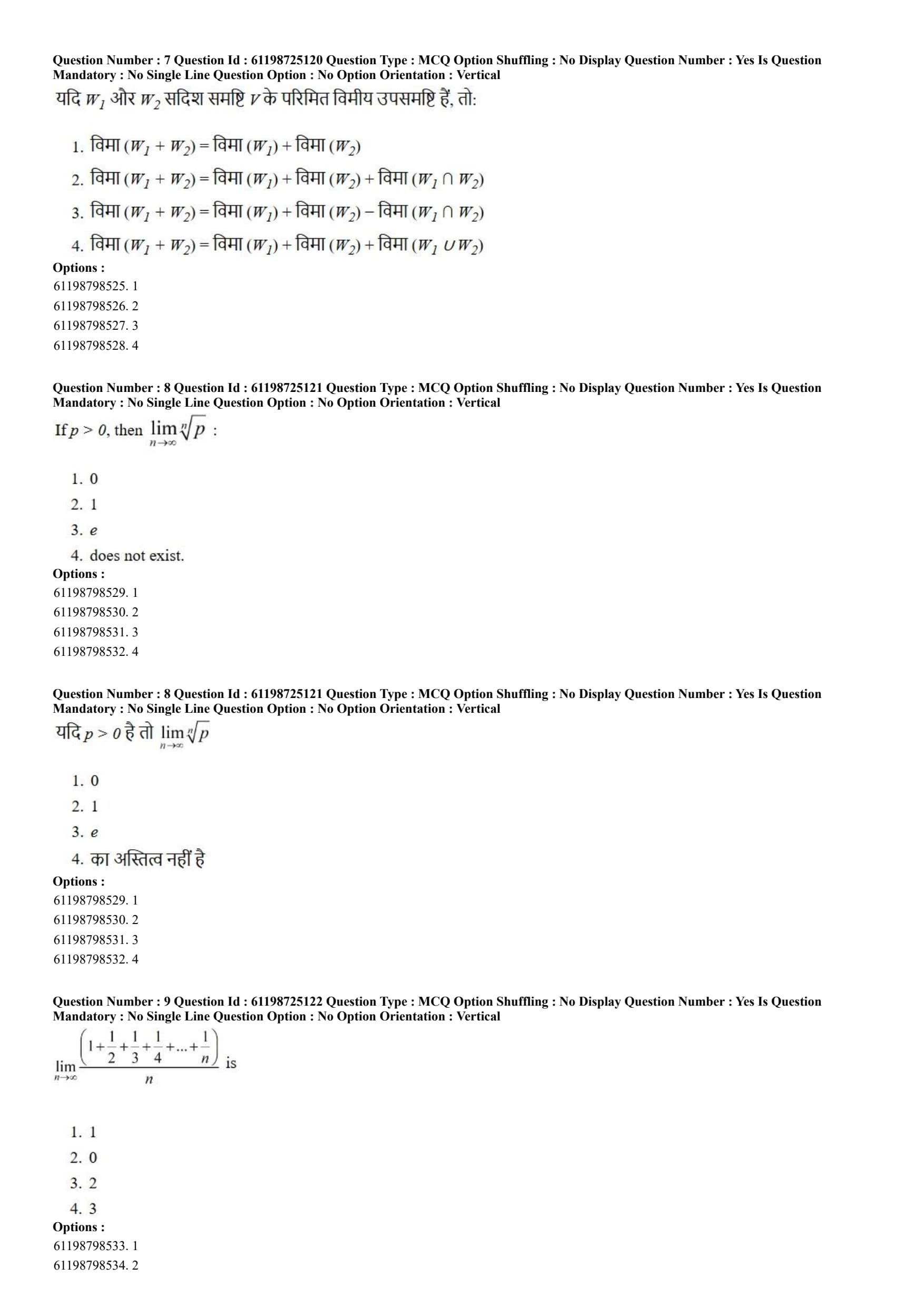
If \(W_1\) and \(W_2\) are finite dimensional subspaces of a vector space \(V\), then:
View Solution
Step 1: Concept
In vector space theory, the sum of two subspaces \(W_1\) and \(W_2\) is defined as: \[ W_1 + W_2 = \{ w_1 + w_2 \mid w_1 \in W_1, w_2 \in W_2 \} \]
Both \(W_1 + W_2\) and \(W_1 \cap W_2\) are subspaces of \(V\). The relationship between their dimensions is given by the Second Isomorphism Theorem for Vector Spaces (often called Grassmann's Dimension Formula).
Step 2: Key Formulas and Approach
Grassmann's Dimension Theorem: For any two finite-dimensional subspaces \(W_1\) and \(W_2\) of a vector space \(V\): \[ \dim(W_1 + W_2) = \dim(W_1) + \dim(W_2) - \dim(W_1 \cap W_2) \]
Step 3: Step-by-step Explanation
Let \(\dim(W_1 \cap W_2) = k\). Choose a basis \(\{v_1, v_2, \dots, v_k\}\) for \(W_1 \cap W_2\).
By the Basis Extension Theorem, extend this basis to a basis of \(W_1\):
\[ \mathcal{B}_1 = \{v_1, \dots, v_k, u_1, \dots, u_m\} \implies \dim(W_1) = k + m \]
Similarly, extend the basis of \(W_1 \cap W_2\) to a basis of \(W_2\):
\[ \mathcal{B}_2 = \{v_1, \dots, v_k, w_1, \dots, w_n\} \implies \dim(W_2) = k + n \]
Then the set \(\mathcal{B} = \{v_1, \dots, v_k, u_1, \dots, u_m, w_1, \dots, w_n\}\) spans \(W_1 + W_2\) and is linearly independent, so it forms a basis of \(W_1 + W_2\).
Therefore, the dimension of \(W_1 + W_2\) is:
\[ \dim(W_1 + W_2) = k + m + n \]
Expressing this in terms of individual dimensions:
\[ \dim(W_1) + \dim(W_2) - \dim(W_1 \cap W_2) = (k + m) + (k + n) - k = k + m + n \]
Thus, \(\dim(W_1 + W_2) = \dim(W_1) + \dim(W_2) - \dim(W_1 \cap W_2)\).
Step 4: Final Answer
Grassmann's dimension formula states that \(\dim(W_1 + W_2) = \dim(W_1) + \dim(W_2) - \dim(W_1 \cap W_2)\). Thus, Option (C) is correct.
Quick Tip: This formula is analogous to the Inclusion-Exclusion Principle for sets: \(|A \cup B| = |A| + |B| - |A \cap B|\). If \(W_1 \cap W_2 = \{0\}\) (direct sum), then \(\dim(W_1 \oplus W_2) = \dim(W_1) + \dim(W_2)\).
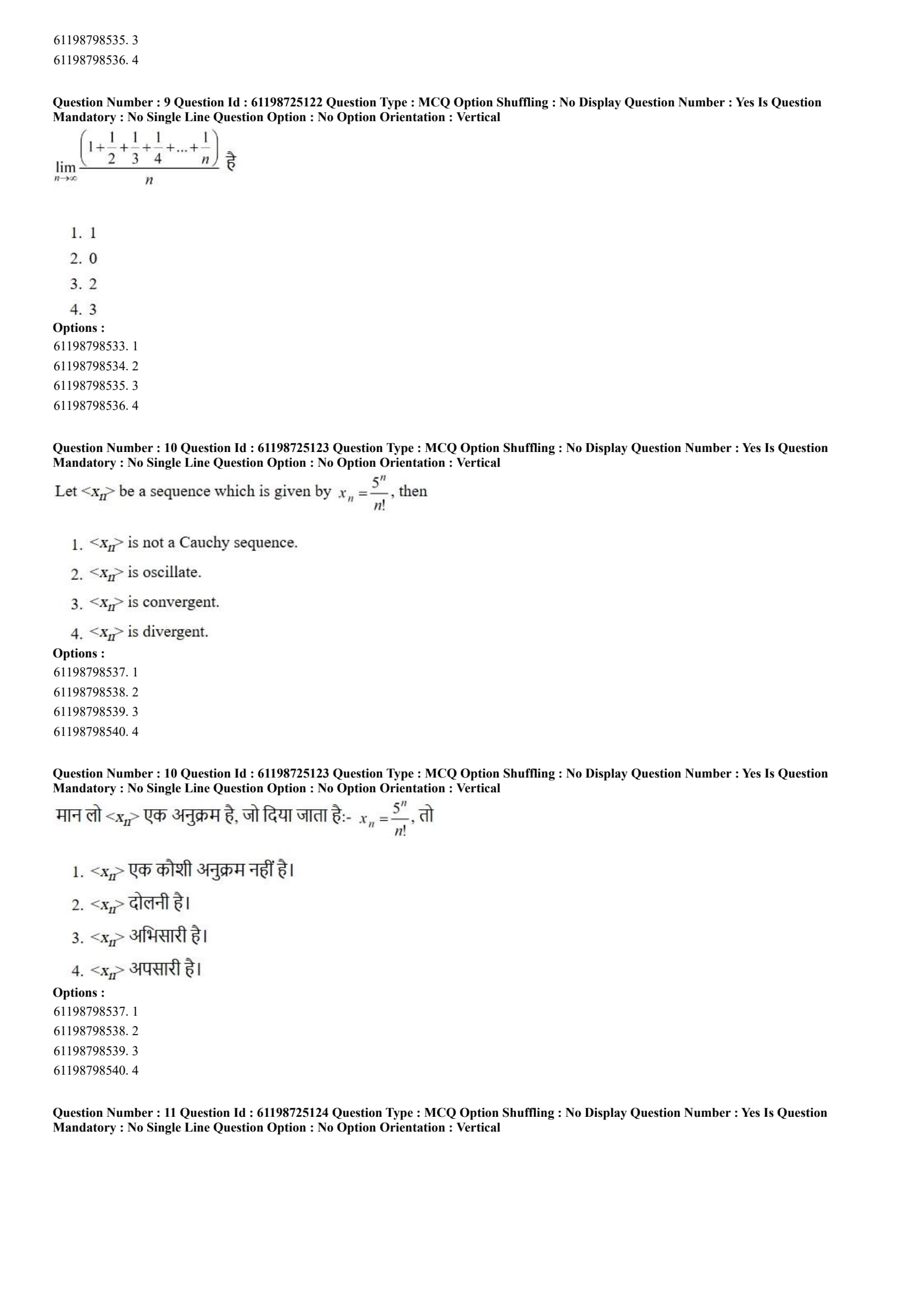
If \(p > 0\), then \(\lim_{n \to \infty} \sqrt[n]{p}\) :
View Solution
Step 1: Concept
We are evaluating the limit of the sequence \(a_n = p^{1/n}\) as \(n \to \infty\), where \(p\) is a fixed positive real constant (\(p > 0\)).
Step 2: Key Formulas and Approach
Using the exponential and natural logarithm relationship: \[ p^{1/n} = e^{\ln(p^{1/n})} = e^{\frac{\ln(p)}{n}} \]
Step 3: Step-by-step Explanation
Let \(L = \lim_{n \to \infty} p^{1/n}\).
Express \(p^{1/n}\) in exponential form:
\[ \lim_{n \to \infty} p^{1/n} = \lim_{n \to \infty} \exp\left( \frac{\ln(p)}{n} \right) \]
Since the exponential function \(f(x) = e^x\) is continuous everywhere on \(\mathbb{R}\), we can pass the limit inside the function:
\[ L = \exp\left( \lim_{n \to \infty} \frac{\ln(p)}{n} \right) \]
For any fixed \(p > 0\), \(\ln(p)\) is a real constant. Therefore:
\[ \lim_{n \to \infty} \frac{\ln(p)}{n} = 0 \]
Substituting this back:
\[ L = e^0 = 1 \]
Hence, for any \(p > 0\), \(\lim_{n \to \infty} \sqrt[n]{p} = 1\).
Step 4: Final Answer
The limit of \(\sqrt[n]{p}\) as \(n \to \infty\) for any positive constant \(p\) is 1. Thus, Option (B) is correct.
Quick Tip: Standard Real Analysis Limits to Remember: 1. \(\lim_{n \to \infty} p^{1/n} = 1\) for any \(p > 0\). 2. \(\lim_{n \to \infty} n^{1/n} = 1\). 3. \(\lim_{n \to \infty} (1 + \frac{x}{n})^n = e^x\).
\(\lim_{n \to \infty} \frac{1 + \frac{1}{2} + \frac{1}{3} + \frac{1}{4} + \dots + \frac{1}{n}}{n}\) is
View Solution
Step 1: Concept
This problem involves calculating the limit of the arithmetic mean of a sequence \(a_n = \frac{1}{n}\). We can apply Cauchy's First Theorem on Limits.
Step 2: Key Formulas and Approach
Cauchy's First Theorem on Limits: If a sequence \(\langle a_n \rangle\) converges to a limit \(L\), i.e., \(\lim_{n \to \infty} a_n = L\), then the sequence of arithmetic means \(\langle x_n \rangle\) defined by: \[ x_n = \frac{a_1 + a_2 + a_3 + \dots + a_n}{n} \]
also converges to \(L\), i.e., \(\lim_{n \to \infty} x_n = L\).
Step 3: Step-by-step Explanation
Define \(a_n = \frac{1}{n}\).
Evaluate the limit of \(a_n\) as \(n \to \infty\):
\[ L = \lim_{n \to \infty} a_n = \lim_{n \to \infty} \frac{1}{n} = 0 \]
Now construct the sequence of arithmetic means \(x_n\):
\[ x_n = \frac{a_1 + a_2 + a_3 + \dots + a_n}{n} = \frac{1 + \frac{1}{2} + \frac{1}{3} + \dots + \frac{1}{n}}{n} \]
By Cauchy's First Theorem on Limits, since \(\lim_{n \to \infty} a_n = 0\), we immediately have:
\[ \lim_{n \to \infty} x_n = \lim_{n \to \infty} \frac{1 + \frac{1}{2} + \frac{1}{3} + \dots + \frac{1}{n}}{n} = 0 \]
Alternative Method (Using Asymptotic Bounds):
It is well known that \(H_n = 1 + \frac{1}{2} + \frac{1}{3} + \dots + \frac{1}{n} \approx \ln(n) + \gamma\), where \(\gamma\) is Euler-Mascheroni constant.
Therefore:
\[ \lim_{n \to \infty} \frac{H_n}{n} = \lim_{n \to \infty} \frac{\ln(n) + \gamma}{n} = 0 \]
both methods yield the exact same result \(0\).
Step 4: Final Answer
The limit equals 0. Thus, Option (B) is correct.
Quick Tip: Whenever you see a limit of the form \(\frac{1}{n}\sum_{k=1}^n a_k\), immediately check \(\lim_{n \to \infty} a_n\). If \(a_n \to L\), then the average also converges to \(L\) by Cauchy's First Limit Theorem!
Let \(\langle x_n \rangle\) be a sequence which is given by \(x_n = \frac{5^n}{n!}\), then
View Solution
Step 1: Concept
A sequence of real numbers \(\langle x_n \rangle\) is convergent if \(\lim_{n \to \infty} x_n = L\) for some finite real number \(L\). In complete metric spaces like \(\mathbb{R}\), a sequence is convergent if and only if it is a Cauchy sequence.
Step 2: Key Formulas and Approach
To determine the behavior of \(x_n = \frac{a^n}{n!}\) (where \(a > 0\)), we can use D'Alembert's Ratio Test for sequences:
If \(\lim_{n \to \infty} \left| \frac{x_{n+1}}{x_n} \right| = L\):
- If \(L < 1\), then \(\lim_{n \to \infty} x_n = 0\) (convergent).
- If \(L > 1\), then \(\lim_{n \to \infty} x_n = \infty\) (divergent).
Step 3: Step-by-step Explanation
Given \(x_n = \frac{5^n}{n!}\), all terms \(x_n > 0\).
Compute the ratio \(\frac{x_{n+1}}{x_n}\):
\[ \frac{x_{n+1}}{x_n} = \frac{\frac{5^{n+1}}{(n+1)!}}{\frac{5^n}{n!}} = \frac{5^{n+1}}{5^n} \cdot \frac{n!}{(n+1)!} \]
\[ \frac{x_{n+1}}{x_n} = 5 \cdot \frac{n!}{(n+1)n!} = \frac{5}{n+1} \]
Take the limit as \(n \to \infty\):
\[ L = \lim_{n \to \infty} \frac{x_{n+1}}{x_n} = \lim_{n \to \infty} \frac{5}{n+1} = 0 \]
Since \(L = 0 < 1\), by the Ratio Test for sequences, \(\lim_{n \to \infty} x_n = 0\).
Since the limit exists and is a finite real number (\(0\)), the sequence \(\langle x_n \rangle\) is convergent.
Furthermore, since every convergent sequence in \(\mathbb{R}\) is a Cauchy sequence, statement (A) is false. Statements (B) and (D) are also false.
Step 4: Final Answer
The sequence \(x_n = \frac{5^n}{n!}\) converges to 0, so it is convergent. Thus, Option (C) is correct.
Quick Tip: Factorials grow much faster than exponentials (\(n! \gg a^n\)). Therefore, \(\lim_{n \to \infty} \frac{a^n}{n!} = 0\) for any real constant \(a\).
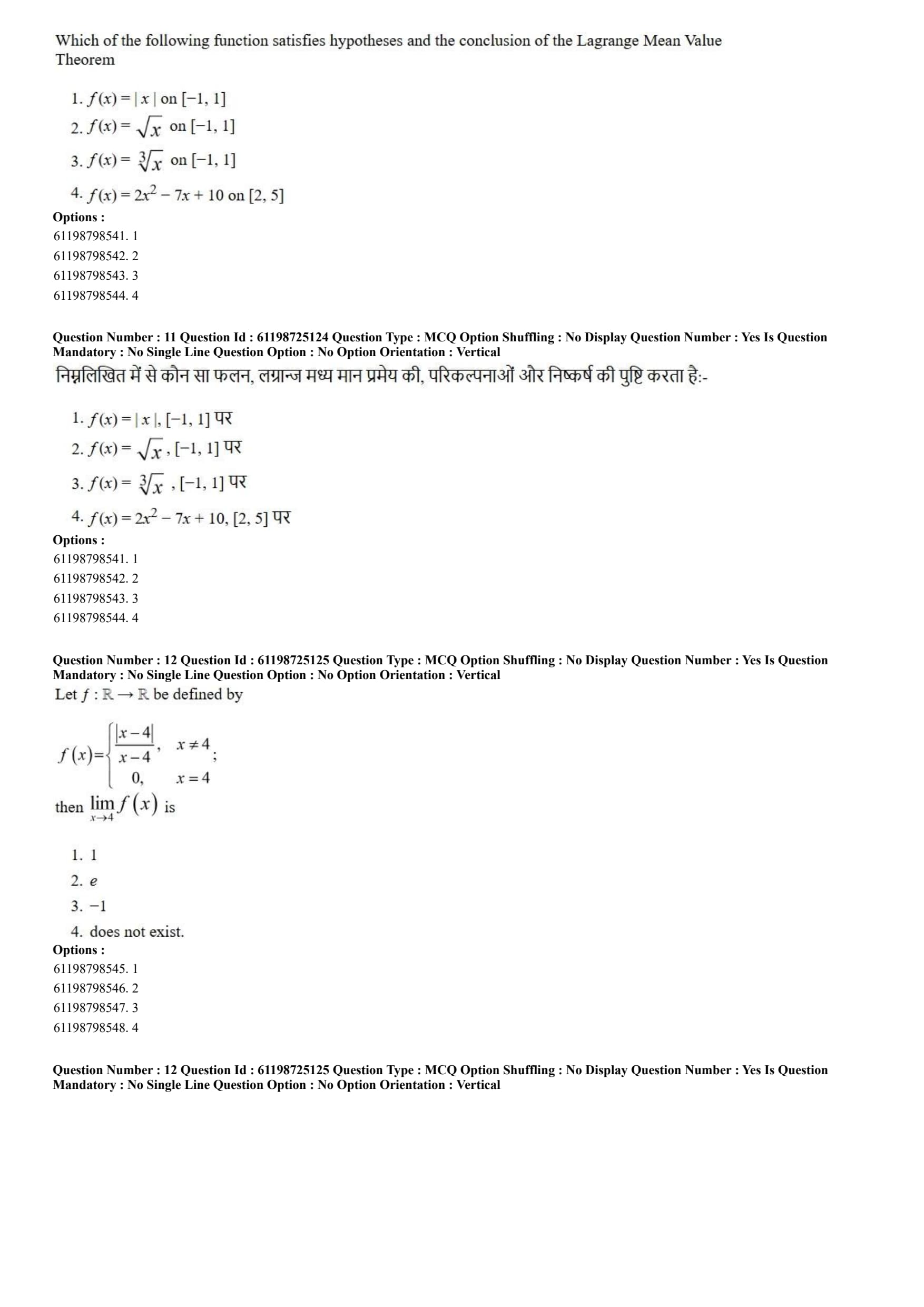
Which of the following function satisfies hypotheses and the conclusion of the Lagrange Mean Value Theorem
View Solution
Step 1: Concept
Lagrange's Mean Value Theorem (LMVT): Let \(f: [a, b] \to \mathbb{R}\) be a function. LMVT requires two hypotheses:
1. \(f(x)\) is continuous on the closed interval \([a, b]\).
2. \(f(x)\) is differentiable on the open interval \((a, b)\).
Under these conditions, there exists at least one \(c \in (a, b)\) such that: \[ f'(c) = \frac{f(b) - f(a)}{b - a} \]
Step 2: Key Formulas and Approach
We check continuity and differentiability for each function on its given interval. Polynomials are infinitely differentiable everywhere on \(\mathbb{R}\), making them automatic candidates.
Step 3: Step-by-step Explanation
Option (A): \(f(x) = |x|\) on \([-1, 1]\)
The absolute value function \(f(x) = |x|\) is continuous on \([-1, 1]\), but it is not differentiable at \(x = 0 \in (-1, 1)\). Hence, LMVT hypothesis fails.
Option (B): \(f(x) = \sqrt{x}\) on \([-1, 1]\)
\(f(x) = \sqrt{x}\) is undefined for \(x < 0\) in the real number system. Thus it is not even defined on \([-1, 0)\). LMVT hypothesis fails.
Option (C): \(f(x) = \sqrt[3]{x} = x^{1/3}\) on \([-1, 1]\)
The derivative is \(f'(x) = \frac{1}{3 x^{2/3}}\). At \(x = 0 \in (-1, 1)\), \(f'(0)\) does not exist (vertical tangent). Thus \(f(x)\) is not differentiable on \((-1, 1)\). LMVT hypothesis fails.
Option (D): \(f(x) = 2x^2 - 7x + 10\) on \([2, 5]\)
Since \(f(x)\) is a polynomial function:
1. It is continuous on \([2, 5]\).
2. It is differentiable on \((2, 5)\) with \(f'(x) = 4x - 7\).
LMVT hypotheses are fully satisfied!
Conclusion verification:
\[ \frac{f(5) - f(2)}{5 - 2} = \frac{(2(25) - 35 + 10) - (2(4) - 14 + 10)}{3} = \frac{25 - 4}{3} = \frac{21}{3} = 7 \]
Set \(f'(c) = 7 \implies 4c - 7 = 7 \implies 4c = 14 \implies c = 3.5 \in (2, 5)\).
Both hypotheses and conclusion hold perfectly.
Step 4: Final Answer
The polynomial function \(f(x) = 2x^2 - 7x + 10\) on \([2, 5]\) satisfies all conditions of LMVT. Thus, Option (D) is correct.
Quick Tip: Polynomials, exponential functions, \(\sin(x)\), and \(\cos(x)\) are everywhere continuous and differentiable. They always satisfy LMVT on any finite interval \([a,b]\). Watch out for \(|x|\), \(x^{1/3}\), or fractions with zero in denominators inside \((a,b)\).
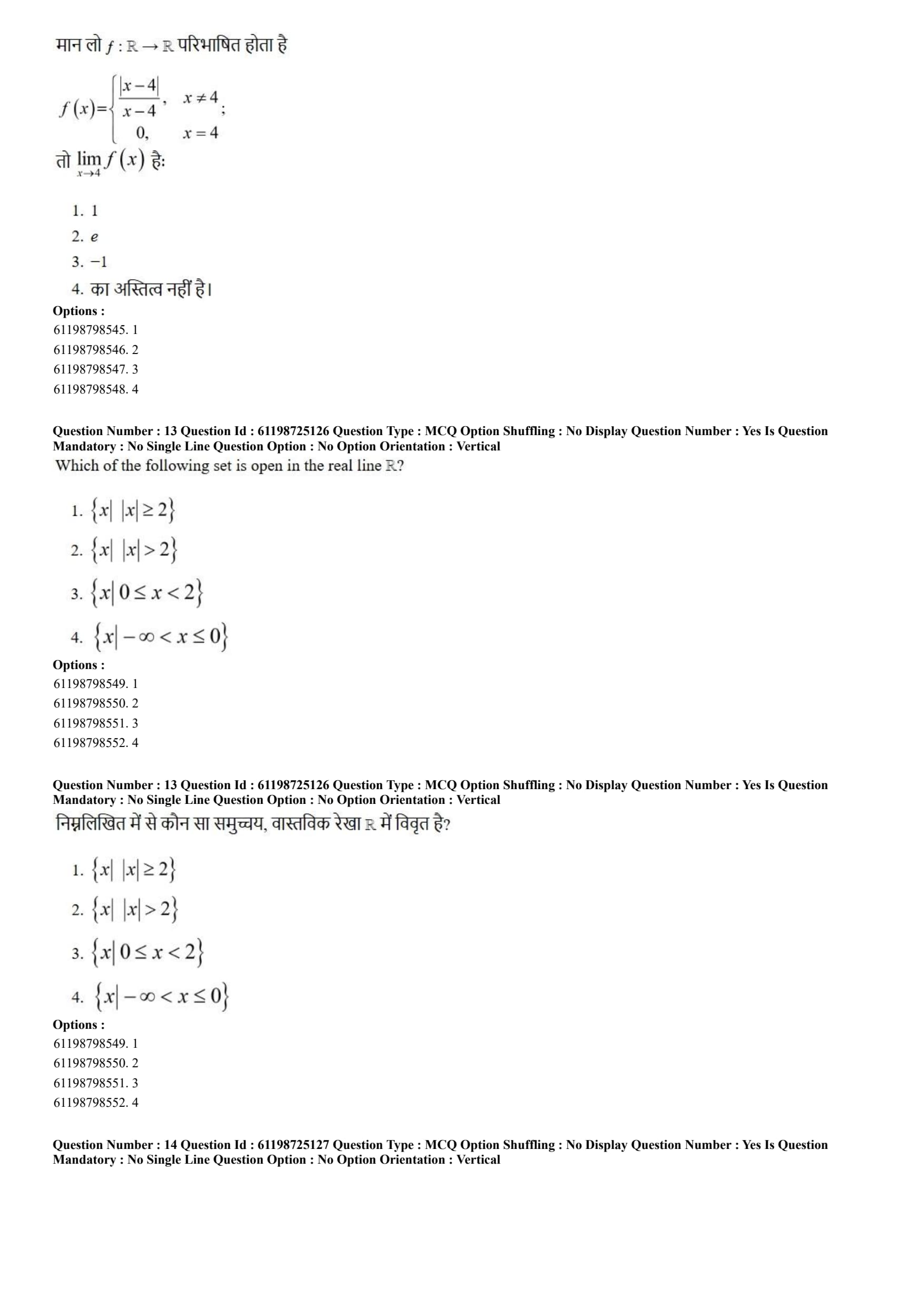
Let \(f : \mathbb{R} \to \mathbb{R}\) be defined by
\[ f(x) = \begin{cases} \frac{|x-4|}{x-4}, & x \neq 4
0, & x = 4 \end{cases} \]
then \(\lim_{x \to 4} f(x)\) is
View Solution
Step 1: Concept
For a limit \(\lim_{x \to a} f(x)\) to exist, both the Left-Hand Limit (LHL) and Right-Hand Limit (RHL) at \(x = a\) must exist independently and be strictly equal to each other: \[ \lim_{x \to a^-} f(x) = \lim_{x \to a^+} f(x) = L \]
Step 2: Key Formulas and Approach
Recall the definition of the absolute value function: \[ |x - 4| = \begin{cases} x - 4, & if x > 4
-(x - 4), & if x < 4 \end{cases} \]
We evaluate LHL (\(\lim_{x \to 4^-} f(x)\)) and RHL (\(\lim_{x \to 4^+} f(x)\)).
Step 3: Step-by-step Explanation
Right-Hand Limit (RHL):
For \(x > 4\), we have \(|x - 4| = x - 4\).
\[ RHL = \lim_{x \to 4^+} f(x) = \lim_{x \to 4^+} \frac{x - 4}{x - 4} = \lim_{x \to 4^+} 1 = 1 \]
Left-Hand Limit (LHL):
For \(x < 4\), we have \(|x - 4| = -(x - 4)\).
\[ LHL = \lim_{x \to 4^-} f(x) = \lim_{x \to 4^-} \frac{-(x - 4)}{x - 4} = \lim_{x \to 4^-} (-1) = -1 \]
Comparing LHL and RHL:
\[ RHL = 1 \quad and \quad LHL = -1 \]
Since \(LHL \neq RHL\) (\(-1 \neq 1\)), the overall limit \(\lim_{x \to 4} f(x)\) does not exist.
Step 4: Final Answer
Because the left-hand limit and right-hand limit are unequal, \(\lim_{x \to 4} f(x)\) does not exist. Thus, Option (D) is correct.
Quick Tip: The function \(f(x) = \frac{|x-a|}{x-a} = sgn(x-a)\) is the signum function shifted to \(a\). Its limit at \(x=a\) never exists because \(LHL = -1 \neq 1 = RHL\).
Which of the following set is open in the real line \(\mathbb{R}\)?
View Solution
Step 1: Concept
In the real topology on \(\mathbb{R}\):
- A subset \(S \subseteq \mathbb{R}\) is called an open set if for every \(x \in S\), there exists an \(\epsilon > 0\) such that the open interval \((x - \epsilon, x + \epsilon) \subseteq S\).
- Equivalently, any open set in \(\mathbb{R}\) can be expressed as a union of open intervals \((a, b)\).
- A set is closed if its complement is open, or if it contains all its limit points. Closed intervals \([a, b]\), \([a, \infty)\), \((-\infty, b]\) are closed sets.
Step 2: Key Formulas and Approach
Write each given set in interval notation and check whether it consists entirely of open intervals.
Step 3: Step-by-step Explanation
Option (A): \(S_1 = \{x \mid |x| \geq 2\} = (-\infty, -2] \cup [2, \infty)\)
This set contains its boundary points \(-2\) and \(2\). For \(x = 2\), any neighborhood \((2-\epsilon, 2+\epsilon)\) contains points like \(2-\frac{\epsilon}{2} \notin S_1\). Thus \(S_1\) is closed, not open.
Option (B): \(S_2 = \{x \mid |x| > 2\} = (-\infty, -2) \cup (2, \infty)\)
\((-\infty, -2)\) and \((2, \infty)\) are both open intervals. Since the union of any family of open sets is open, \(S_2\) is an open set in \(\mathbb{R}\).
Option (C): \(S_3 = \{x \mid 0 \leq x < 2\} = [0, 2)\)
The point \(0 \in S_3\), but no open interval around \(0\) is contained in \([0, 2)\) (since points \(0 - \epsilon < 0 \notin S_3\)). So \(S_3\) is neither open nor closed.
Option (D): \(S_4 = \{x \mid -\infty < x \leq 0\} = (-\infty, 0]\)
This is a closed ray containing \(0\), so it is a closed set, not open.
Step 4: Final Answer
The set \(\{x \mid |x| > 2\} = (-\infty, -2) \cup (2, \infty)\) is open in \(\mathbb{R}\). Thus, Option (B) is correct.
Quick Tip: Strict inequalities (\(>\) or \(<\)) generate open sets/intervals like \((a, b)\). Non-strict inequalities (\(\geq\) or \(\leq\)) include boundary points and generate closed sets/intervals like \([a, b]\).
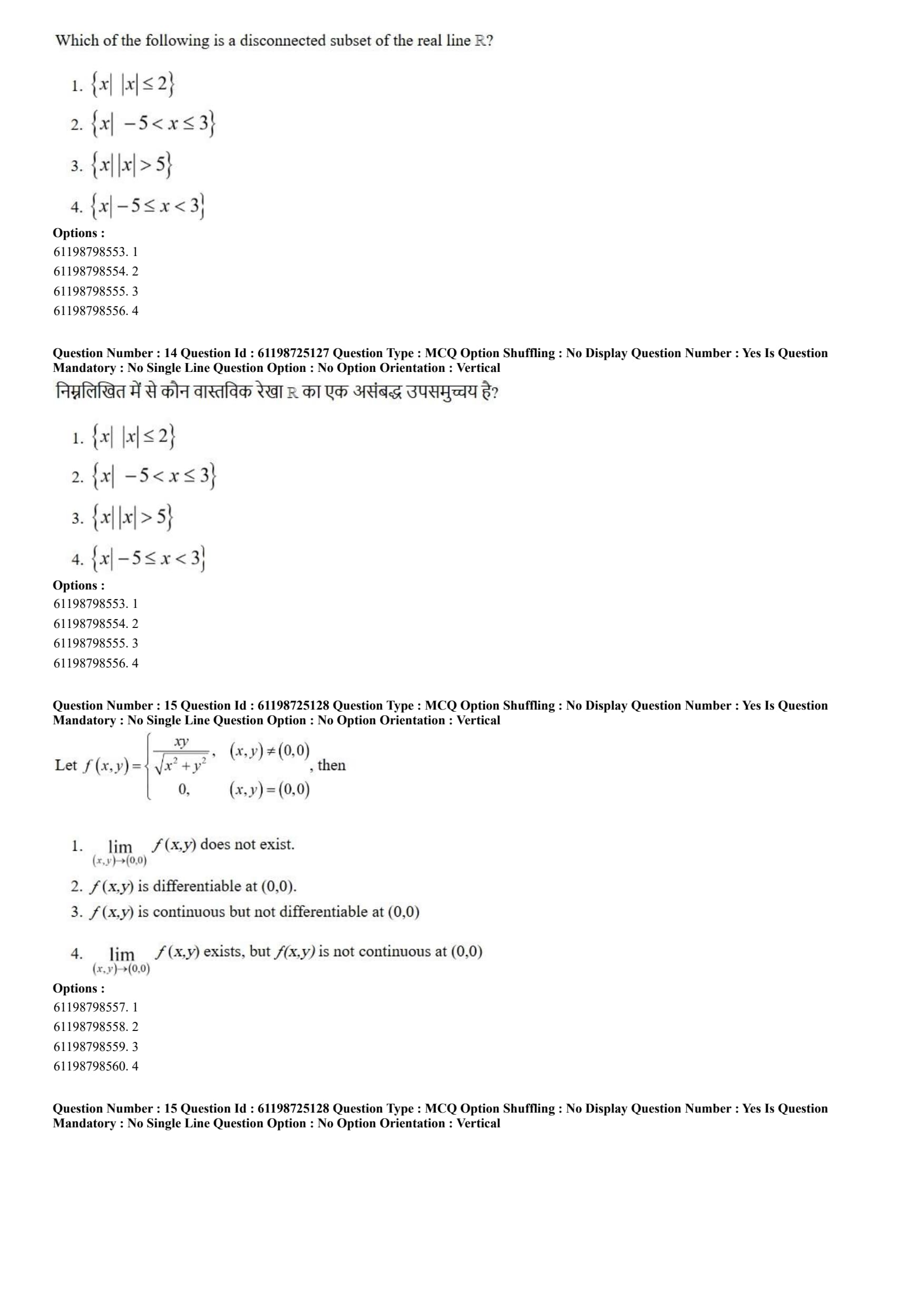
Which of the following is a disconnected subset of the real line \(\mathbb{R}\)?
View Solution
Step 1: Concept
In standard topology on \(\mathbb{R}\), a subset \(S \subseteq \mathbb{R}\) is connected if and only if it is an interval (open, closed, half-open, bounded, or unbounded).
A subset \(S \subseteq \mathbb{R}\) is disconnected if it can be written as \(S = A \cup B\) where \(A\) and \(B\) are non-empty, disjoint sets separated from each other in the subspace topology (i.e., not an interval).
Step 2: Key Formulas and Approach
Translate each set into interval notation and check if it forms a single contiguous interval.
Step 3: Step-by-step Explanation
Option (A): \(\{x \mid |x| \leq 2\} = [-2, 2]\)
This is a single closed bounded interval. Any interval in \(\mathbb{R}\) is connected. Thus, Option (A) is connected.
Option (B): \(\{x \mid -5 < x \leq 3\} = (-5, 3]\)
This is a single half-open interval. Hence, Option (B) is connected.
Option (C): \(\{x \mid |x| > 5\} = (-\infty, -5) \cup (5, \infty)\)
This set consists of two separated, disjoint non-empty open sets \(A = (-\infty, -5)\) and \(B = (5, \infty)\).
There is a "gap" between \(-5\) and \(5\) (e.g., \(0 \notin S\)).
Since it cannot be represented as a single interval, it is disconnected.
Option (D): \(\{x \mid -5 \leq x < 3\} = [-5, 3)\)
This is a single half-open interval, which is connected.
Step 4: Final Answer
The set \(\{x \mid |x| > 5\} = (-\infty, -5) \cup (5, \infty)\) is disconnected. Thus, Option (C) is correct.
Quick Tip: Key Theorem in Real Analysis: A subset \(S \subseteq \mathbb{R}\) is connected if and only if \(S\) is an interval. If \(S\) is a union of two or more disjoint intervals, it is always disconnected!
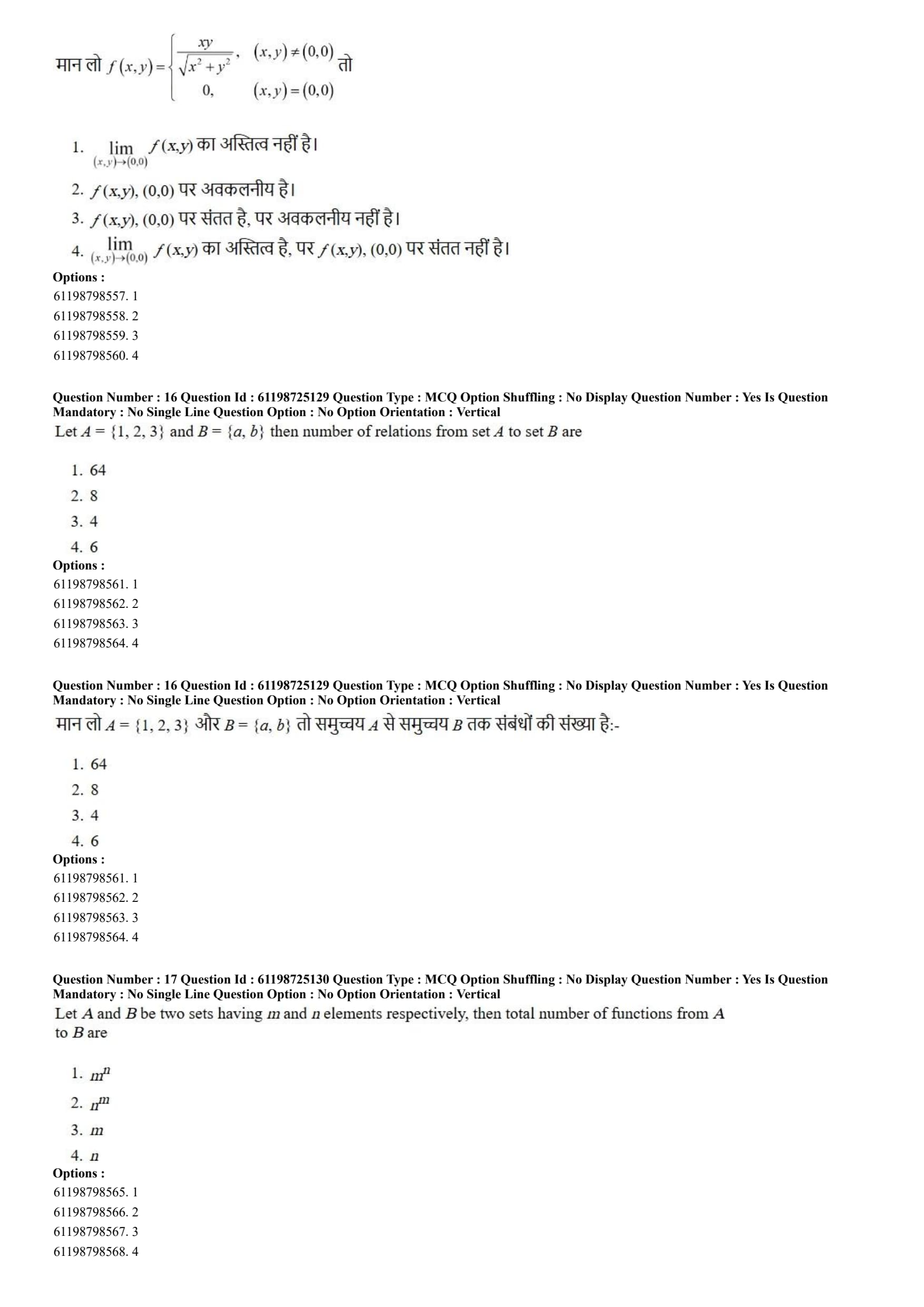
Let \(f(x, y) = \begin{cases} \frac{xy}{\sqrt{x^2 + y^2}}, & (x, y) \neq (0, 0)
0, & (x, y) = (0, 0) \end{cases}\), then
View Solution
Step 1: Concept
For a multivariable function \(f(x, y)\):
1. Continuity at \((0, 0)\): \(\lim_{(x, y) \to (0, 0)} f(x, y) = f(0, 0)\).
2. Partial Derivatives at \((0,0)\): \[ f_x(0, 0) = \lim_{h \to 0} \frac{f(h, 0) - f(0, 0)}{h} \] \[ f_y(0, 0) = \lim_{k \to 0} \frac{f(0, k) - f(0, 0)}{k} \]
3. Differentiability at \((0, 0)\): \(f\) is differentiable at \((0,0)\) if and only if: \[ \lim_{(h, k) \to (0, 0)} \frac{f(h, k) - f(0, 0) - h f_x(0, 0) - k f_y(0, 0)}{\sqrt{h^2 + k^2}} = 0 \]
Step 2: Key Formulas and Approach
We test continuity using polar coordinates (\(x = r\cos\theta, y = r\sin\theta\)), calculate partial derivatives \(f_x(0,0)\) and \(f_y(0,0)\), and then evaluate the differentiability limit.
Step 3: Step-by-step Explanation
1. Checking Continuity at \((0,0)\):
Convert to polar coordinates: \(x = r \cos\theta, y = r \sin\theta\).
\[ f(r \cos\theta, r \sin\theta) = \frac{(r \cos\theta)(r \sin\theta)}{\sqrt{r^2 \cos^2\theta + r^2 \sin^2\theta}} = \frac{r^2 \cos\theta \sin\theta}{r} = r \cos\theta \sin\theta \]
Now evaluate the limit as \(r \to 0\):
\[ \lim_{(x,y) \to (0,0)} f(x,y) = \lim_{r \to 0} (r \cos\theta \sin\theta) = 0 \]
Since \(\lim_{(x,y) \to (0,0)} f(x,y) = 0 = f(0,0)\), \(f(x,y)\) is continuous at \((0, 0)\).
2. Computing Partial Derivatives at \((0,0)\):
\[ f_x(0, 0) = \lim_{h \to 0} \frac{f(h, 0) - f(0, 0)}{h} = \lim_{h \to 0} \frac{0 - 0}{h} = 0 \]
\[ f_y(0, 0) = \lim_{k \to 0} \frac{f(0, k) - f(0, 0)}{k} = \lim_{k \to 0} \frac{0 - 0}{k} = 0 \]
So \(f_x(0,0) = 0\) and \(f_y(0,0) = 0\).
3. Testing Differentiability at \((0,0)\):
Define the error term limit \(L\):
\[ L = \lim_{(h, k) \to (0, 0)} \frac{f(h, k) - f(0, 0) - h f_x(0, 0) - k f_y(0, 0)}{\sqrt{h^2 + k^2}} \]
Substituting \(f(0,0)=0, f_x(0,0)=0, f_y(0,0)=0\):
\[ L = \lim_{(h, k) \to (0, 0)} \frac{\frac{hk}{\sqrt{h^2 + k^2}}}{\sqrt{h^2 + k^2}} = \lim_{(h, k) \to (0, 0)} \frac{hk}{h^2 + k^2} \]
To evaluate this limit, approach along the line \(k = mh\):
\[ L = \lim_{h \to 0} \frac{h(mh)}{h^2 + (mh)^2} = \lim_{h \to 0} \frac{m h^2}{h^2(1 + m^2)} = \frac{m}{1 + m^2} \]
The value of the limit depends on the slope \(m\). For \(m=1\), \(L = 1/2\); for \(m=0\), \(L = 0\).
Since the limit depends on \(m\), it is non-unique and therefore does not exist (and specifically is not zero).
Hence, \(f(x, y)\) is not differentiable at \((0, 0)\).
Step 4: Final Answer
The function \(f(x, y)\) is continuous at \((0, 0)\) but not differentiable at \((0, 0)\). Thus, Option (C) is correct.
Quick Tip: For functions of the form \(f(x,y) = \frac{x^a y^b}{(x^2+y^2)^c}\):
- Continuous at \((0,0)\) if \(a+b > 2c\).
- Differentiable at \((0,0)\) if \(a+b > 2c + 1\).
Here \(a=1, b=1, c=1/2\), so \(a+b = 2 > 2(1/2) = 1\) (Continuous!), but \(a+b = 2 \ngtr 1+1 = 2\) (Not Differentiable!).
Let \(A = \{1, 2, 3\}\) and \(B = \{a, b\}\) then number of relations from set \(A\) to set \(B\) are
View Solution
Step 1: Concept
In set theory, a relation \(R\) from a set \(A\) to a set \(B\) is defined as any subset of the Cartesian product \(A \times B\), i.e., \(R \subseteq A \times B\).
The Cartesian product \(A \times B\) consists of all ordered pairs \((a, b)\) where \(a \in A\) and \(b \in B\).
Step 2: Key Formulas and Approach
Let \(|A| = m\) and \(|B| = n\) denote the cardinalities of sets \(A\) and \(B\), respectively.
1. The total number of ordered pairs in \(A \times B\) is given by: \[ |A \times B| = |A| \cdot |B| = m \cdot n \]
2. Since any subset of \(A \times B\) represents a valid relation, the total number of relations from \(A\) to \(B\) equals the number of elements in the power set \(\mathcal{P}(A \times B)\): \[ Total number of relations = 2^{|A \times B|} = 2^{m \cdot n} \]
Step 3: Step-by-step Explanation
Count the number of elements in set \(A = \{1, 2, 3\}\):
\[ m = |A| = 3 \]
Count the number of elements in set \(B = \{a, b\}\):
\[ n = |B| = 2 \]
Calculate the total number of elements in the Cartesian product \(A \times B\):
\[ |A \times B| = 3 \times 2 = 6 \]
The elements of \(A \times B\) explicitly are:
\[ A \times B = \{(1, a), (1, b), (2, a), (2, b), (3, a), (3, b)\} \]
Compute the total number of subsets of \(A \times B\):
\[ Total relations = 2^6 = 64 \]
Step 4: Final Answer
The total number of relations from set \(A\) to set \(B\) is \(64\). Thus, Option (A) is correct.
Quick Tip: Distinct counting formulas to remember:
- Number of relations from \(A\) to \(B = 2^{m n}\)
- Number of functions from \(A\) to \(B = n^m\)
- Number of one-to-one (injective) functions \(= P(n, m) = \frac{n!}{(n-m)!}\) (for \(n \geq m\))
Let \(A\) and \(B\) be two sets having \(m\) and \(n\) elements respectively, then total number of functions from \(A\) to \(B\) are
View Solution
Step 1: Concept
A function \(f: A \to B\) is a rule that assigns to each element \(x\) in the domain \(A\) exactly one element \(y\) in the codomain \(B\).
Step 2: Key Formulas and Approach
To form a well-defined function \(f: A \to B\), every element \(a \in A\) must be mapped to an element \(b \in B\).
If \(|A| = m\) and \(|B| = n\):
- For the first element \(a_1 \in A\), there are \(n\) available choices in \(B\).
- For the second element \(a_2 \in A\), there are \(n\) available choices in \(B\).
- Continuing this process for all \(m\) elements of \(A\), the total number of functions is obtained by the Fundamental Counting Principle.
Step 3: Step-by-step Explanation
Let \(A = \{a_1, a_2, \dots, a_m\}\) and \(B = \{b_1, b_2, \dots, b_n\}\).
Assigning an image \(f(a_1)\) can be done in \(n\) ways.
Assigning an image \(f(a_2)\) can be done independently in \(n\) ways.
Repeating this independent choice for each of the \(m\) distinct domain elements:
\[ Total functions = \underbrace{n \times n \times n \times \dots \times n}_{m times} = n^m \]
Hence, the number of functions from domain \(A\) to codomain \(B\) is \(|B|^{|A|} = n^m\).
Step 4: Final Answer
The total number of functions from a set of \(m\) elements to a set of \(n\) elements is \(n^m\). Thus, Option (B) is correct.
Quick Tip: Always remember the structure: \(Total Functions = (Size of Codomain)^{(Size of Domain)}\).
Here, codomain \(B\) has \(n\) elements and domain \(A\) has \(m\) elements, so the answer is \(n^m\).
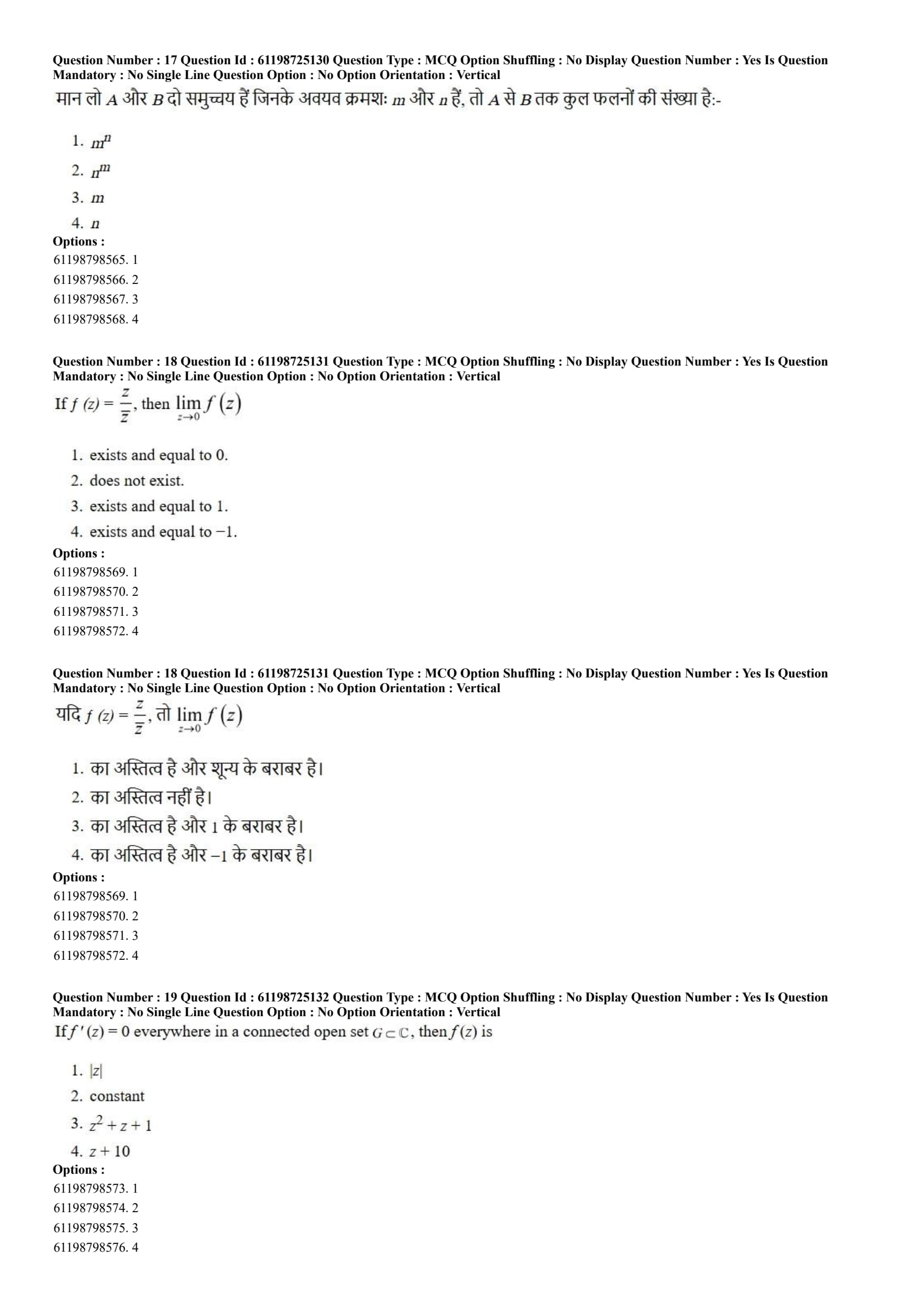
If \(f(z) = \frac{z}{\bar{z}}\), then \(\lim_{z \to 0} f(z)\)
View Solution
Step 1: Concept
In complex analysis, the limit \(\lim_{z \to z_0} f(z) = L\) exists if and only if \(f(z)\) approaches the exact same value \(L\) along every possible path in the complex plane as \(z \to z_0\).
If approaching along two different straight line paths yields different values, the limit does not exist.
Step 2: Key Formulas and Approach
Let \(z = x + iy\), so that its complex conjugate is \(\bar{z} = x - iy\).
The function becomes: \[ f(z) = \frac{x + iy}{x - iy} \]
We test the limit as \((x, y) \to (0, 0)\) along straight line paths passing through the origin \(y = mx\).
Step 3: Step-by-step Explanation
Substitute \(y = mx\) into \(f(z)\):
\[ f(z) = \frac{x + i(mx)}{x - i(mx)} = \frac{x(1 + im)}{x(1 - im)} = \frac{1 + im}{1 - im} \]
Evaluate the limit along the path \(y = mx\) as \(x \to 0\):
\[ \lim_{\substack{(x, y) \to (0, 0)
y = mx}} f(z) = \frac{1 + im}{1 - im} \]
Notice that this limiting value explicitly depends on the slope \(m\) of the chosen path:
- Along the real axis (\(y = 0\), so \(m = 0\)):
\[ \lim_{x \to 0} f(x) = \frac{1 + 0}{1 - 0} = 1 \]
- Along the imaginary axis (\(x = 0\)):
\[ \lim_{y \to 0} \frac{iy}{-iy} = -1 \]
- Along the diagonal line \(y = x\) (\(m = 1\)):
\[ \lim_{x \to 0} \frac{1 + i}{1 - i} = \frac{(1+i)^2}{2} = i \]
Since the limit depends on the path of approach (\(1 \neq -1 \neq i\)), the limit does not exist.
Step 4: Final Answer
Because different paths to the origin yield different limiting values, \(\lim_{z \to 0} f(z)\) does not exist. Thus, Option (B) is correct.
Quick Tip: In complex numbers, \(z/\bar{z} = e^{2i\theta}\) in polar coordinates \(z = r e^{i\theta}\). As \(r \to 0\), \(f(z) = e^{2i\theta}\), which depends on the angle of approach \(\theta\). Therefore, the limit at \(z=0\) fails to exist!
If \(f'(z) = 0\) everywhere in a connected open set \(G \subset \mathbb{C}\), then \(f(z)\) is
View Solution
Step 1: Concept
In complex analysis, a domain \(G \subset \mathbb{C}\) is a connected open set. A fundamental theorem states that if an analytic function \(f(z)\) has derivative zero everywhere on a domain \(G\), then \(f(z)\) must be constant on \(G\).
Step 2: Key Formulas and Approach
Let \(f(z) = u(x, y) + i v(x, y)\) be an analytic function defined on \(G\), where \(u(x, y)\) and \(v(x, y)\) are real-valued functions.
The complex derivative \(f'(z)\) is related to partial derivatives via Cauchy-Riemann equations: \[ f'(z) = u_x + i v_x = v_y - i u_y \]
Step 3: Step-by-step Explanation
Given \(f'(z) = 0\) for all \(z \in G\):
\[ u_x + i v_x = 0 \implies u_x = 0 \quad and \quad v_x = 0 \]
By Cauchy-Riemann equations (\(u_x = v_y\) and \(u_y = -v_x\)):
\[ v_y = u_x = 0 \quad and \quad u_y = -v_x = 0 \]
Therefore, all first-order partial derivatives of \(u\) and \(v\) vanish identically on \(G\):
\[ \frac{\partial u}{\partial x} = 0, \quad \frac{\partial u}{\partial y} = 0, \quad \frac{\partial v}{\partial x} = 0, \quad \frac{\partial v}{\partial y} = 0 \]
Since \(G\) is a connected open set, any two points in \(G\) can be joined by a polygonal path in \(G\).
Integrating along the path shows that \(u(x, y) = c_1\) and \(v(x, y) = c_2\) are constant functions.
Thus, \(f(z) = c_1 + i c_2 = C\) (a complex constant) on \(G\).
Step 4: Final Answer
An analytic function with derivative identically zero on a domain is constant. Thus, Option (B) is correct.
Quick Tip: Connectedness of \(G\) is essential! If \(G\) were disconnected (e.g., two disjoint open disks), \(f(z)\) could take different constant values on each component.
Which of the following function satisfies Cauchy-Riemann equations:
View Solution
Step 1: Concept
For a complex function \(f(z) = u(x, y) + i v(x, y)\), the Cauchy-Riemann (C-R) equations are the necessary conditions for \(f(z)\) to be complex-differentiable: \[ u_x = v_y \quad and \quad u_y = -v_x \]
Step 2: Key Formulas and Approach
Express each candidate function as \(u(x, y) + i v(x, y)\), calculate partial derivatives \(u_x, u_y, v_x, v_y\), and check if both C-R equations hold simultaneously.
Step 3: Step-by-step Explanation
Testing Option (A): \(f(z) = x - iy\)
\(u = x, v = -y \implies u_x = 1, v_y = -1\).
Since \(u_x \neq v_y\) (\(1 \neq -1\)), C-R equations fail.
Testing Option (B): \(f(z) = e^x e^{-iy} = e^x \cos y - i e^x \sin y\)
\(u = e^x \cos y, v = -e^x \sin y\).
\(u_x = e^x \cos y\) and \(v_y = -e^x \cos y\).
Since \(u_x \neq v_y\), C-R equations fail.
Testing Option (C): \(f(z) = e^y e^{ix} = e^y \cos x + i e^y \sin x\)
\(u = e^y \cos x, v = e^y \sin x\).
\(u_x = -e^y \sin x\) and \(v_y = e^y \sin x\).
Since \(u_x \neq v_y\), C-R equations fail.
Testing Option (D): \(f(z) = e^x e^{iy} = e^{x+iy} = e^z = e^x \cos y + i e^x \sin y\)
\(u(x, y) = e^x \cos y\) and \(v(x, y) = e^x \sin y\).
Compute partial derivatives:
\[ u_x = e^x \cos y, \quad v_y = e^x \cos y \implies u_x = v_y \quad \checkmark \]
\[ u_y = -e^x \sin y, \quad v_x = e^x \sin y \implies u_y = -v_x \quad \checkmark \]
Both Cauchy-Riemann equations are satisfied everywhere on \(\mathbb{C}\).
Step 4: Final Answer
The function \(e^x \cdot e^{iy} = e^z\) satisfies the Cauchy-Riemann equations. Thus, Option (D) is correct.
Quick Tip: Note that \(e^x \cdot e^{iy} = e^{x+iy} = e^z\), which is the standard complex exponential function \(f(z) = e^z\). Any function depending purely on \(z\) (and not \(\bar{z}\)) satisfies C-R equations!
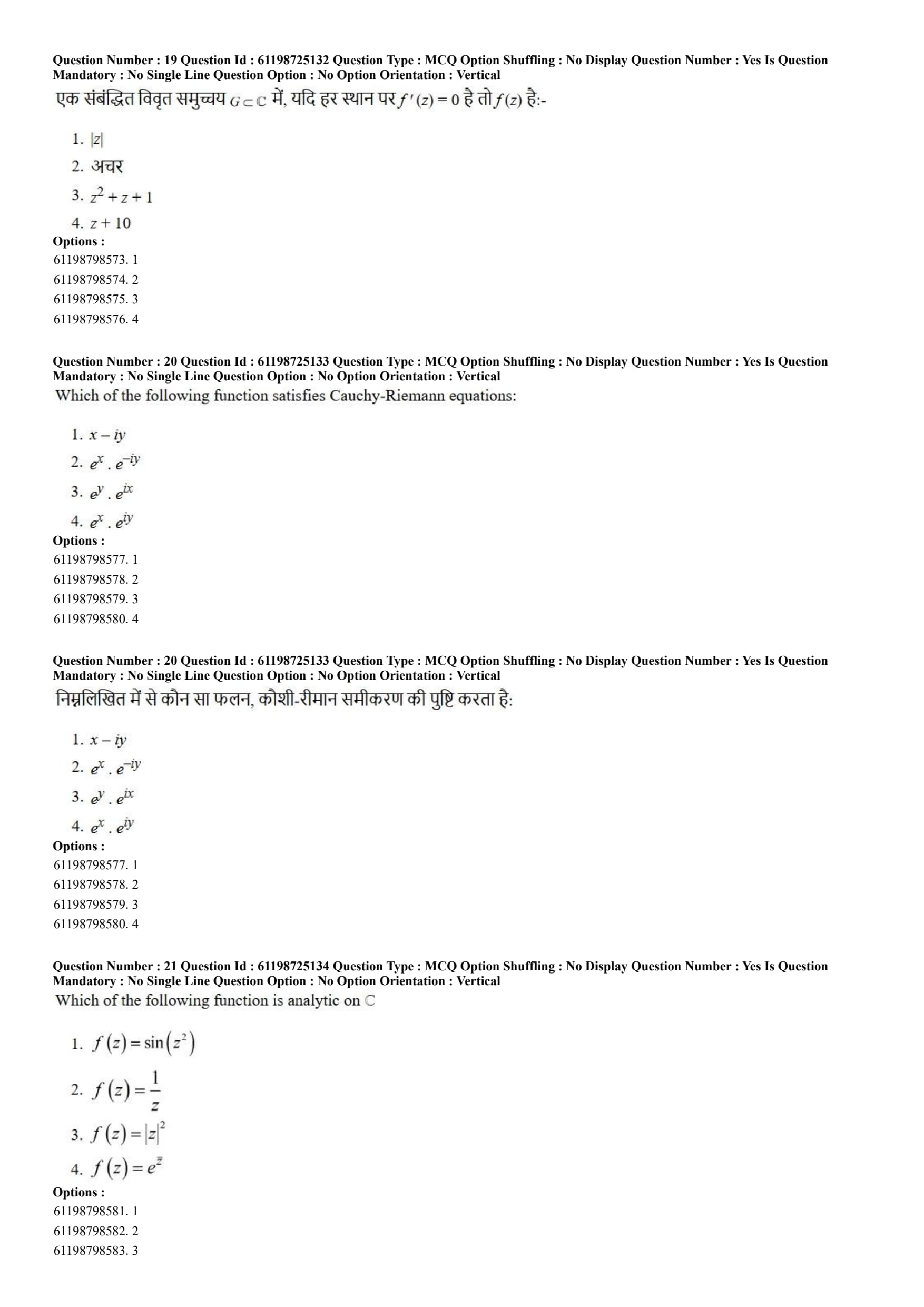
Which of the following function is analytic on \(\mathbb{C}\)
View Solution
Step 1: Concept
A function \(f(z)\) is said to be analytic on \(\mathbb{C}\) (or an entire function) if it is complex-differentiable at every point in the complex plane.
The composition of two entire functions is always an entire function.
Step 2: Key Formulas and Approach
We analyze each function for singularities or non-differentiability across \(\mathbb{C}\).
Step 3: Step-by-step Explanation
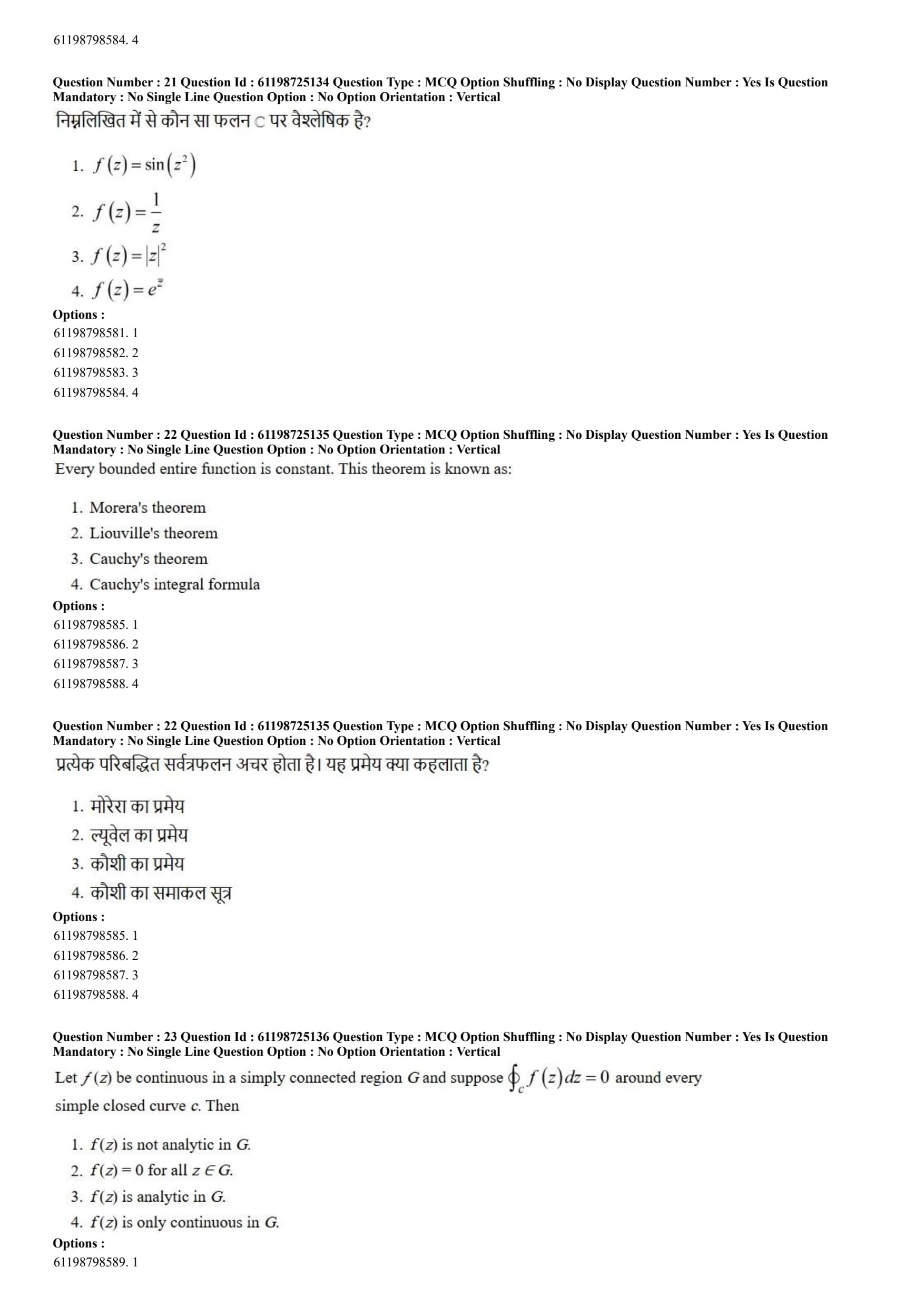
Testing Option (A): \(f(z) = \sin(z^2)\)
The polynomial \(g(z) = z^2\) is entire. The sine function \(h(w) = \sin w\) is entire.
The composition \(f(z) = h(g(z)) = \sin(z^2)\) is therefore differentiable everywhere on \(\mathbb{C}\).
Its derivative is \(f'(z) = 2z \cos(z^2)\), which exists everywhere. Hence, \(f(z)\) is analytic on \(\mathbb{C}\).
Testing Option (B): \(f(z) = \frac{1}{z}\)
This function has a pole (isolated singularity) at \(z = 0\). Hence, it is not analytic on all of \(\mathbb{C}\) (it is only analytic on \(\mathbb{C} \setminus \{0\}\)).
Testing Option (C): \(f(z) = |z|^2 = x^2 + y^2\)
Here \(u = x^2 + y^2\) and \(v = 0\). C-R equations give \(2x = 0\) and \(2y = 0\), which holds only at \(z = 0\).
Since it is differentiable at a single isolated point, it is not analytic anywhere.
Testing Option (D): \(f(z) = e^{\bar{z}} = e^{x - iy}\)
Here \(\frac{\partial f}{\partial \bar{z}} = e^{\bar{z}} \neq 0\). Functions depending on \(\bar{z}\) fail C-R equations everywhere and are nowhere analytic.
Step 4: Final Answer
The function \(f(z) = \sin(z^2)\) is entire (analytic on \(\mathbb{C}\)). Thus, Option (A) is correct.
Quick Tip: Standard entire functions include: polynomials \(P(z)\), \(e^z\), \(\sin z\), \(\cos z\), \(\sinh z\), \(\cosh z\). Any finite combination or composition of these is also entire!
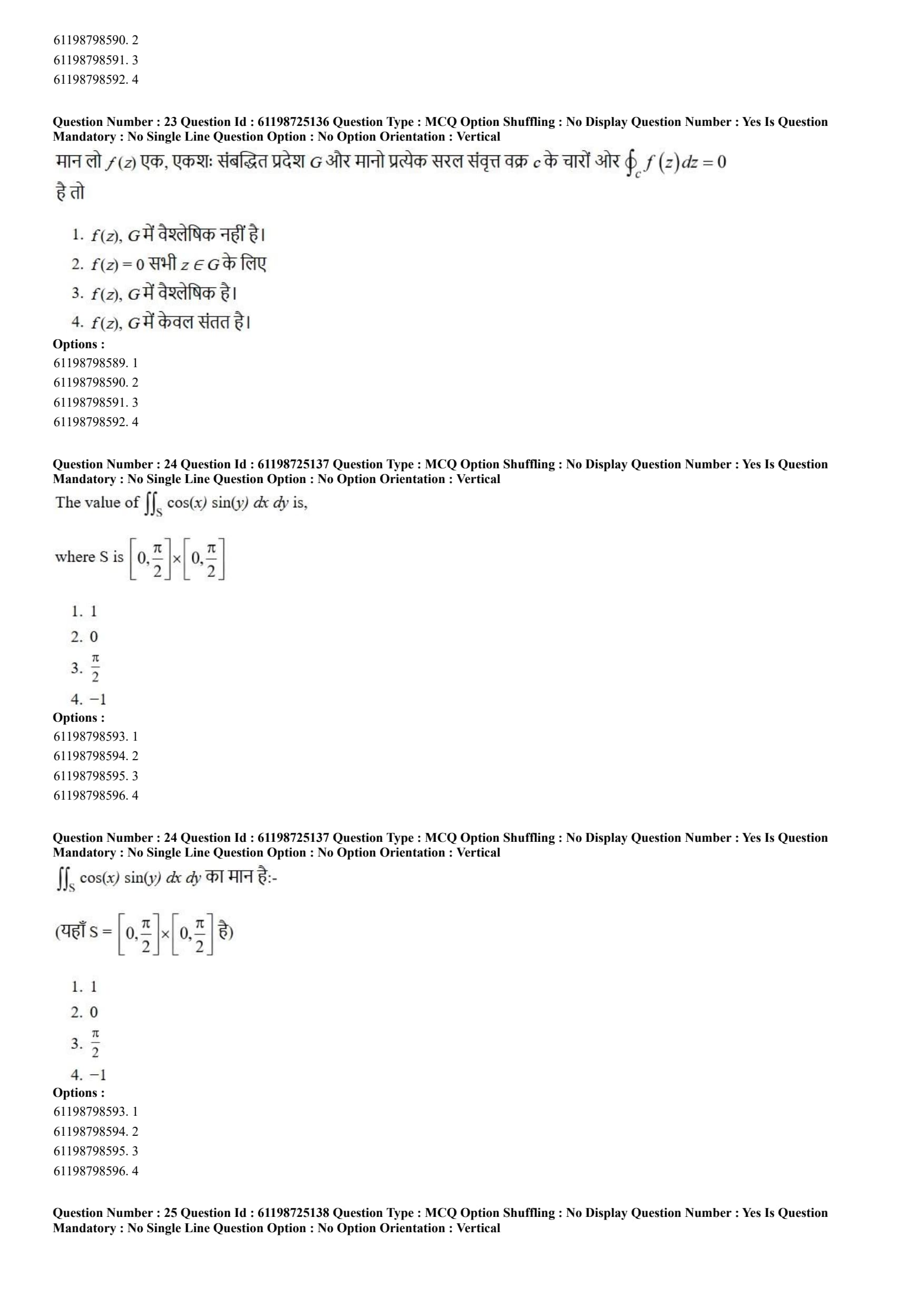
Every bounded entire function is constant. This theorem is known as:
View Solution
Step 1: Concept
This question tests fundamental theorems of complex analysis regarding entire functions.
Step 2: Key Formulas and Approach
Recall the main classical theorems in complex function theory:
1. Liouville's Theorem: If \(f: \mathbb{C} \to \mathbb{C}\) is entire and bounded (there exists \(M > 0\) such that \(|f(z)| \leq M\) for all \(z \in \mathbb{C}\)), then \(f(z)\) is constant.
2. Morera's Theorem: Converse of Cauchy's Theorem; if \(f\) is continuous and \(\oint_C f(z)dz = 0\) for all closed contours, \(f\) is analytic.
3. Cauchy's Theorem: If \(f\) is analytic in a simply connected domain, \(\oint_C f(z)dz = 0\).
4. Cauchy's Integral Formula: Expresses values of an analytic function inside a domain in terms of boundary integrals.
Step 3: Step-by-step Explanation
Proof sketch of Liouville's Theorem:
By Cauchy's Estimate for derivatives, if \(|f(z)| \leq M\) on \(\mathbb{C}\), then for any \(z_0 \in \mathbb{C}\) and circle \(C_R\) of radius \(R\) centered at \(z_0\):
\[ |f'(z_0)| \leq \frac{M}{R} \]
Taking the limit as \(R \to \infty\):
\[ |f'(z_0)| \leq \lim_{R \to \infty} \frac{M}{R} = 0 \]
Hence, \(f'(z_0) = 0\) for all \(z_0 \in \mathbb{C}\).
Since \(f'(z) = 0\) everywhere on connected domain \(\mathbb{C}\), \(f(z)\) must be constant.
This statement is precisely Liouville's Theorem.
Step 4: Final Answer
The assertion "Every bounded entire function is constant" is known as Liouville's theorem. Thus, Option (B) is correct.
Quick Tip: Liouville's Theorem is crucial for proving the Fundamental Theorem of Algebra (every non-constant polynomial has at least one complex root).
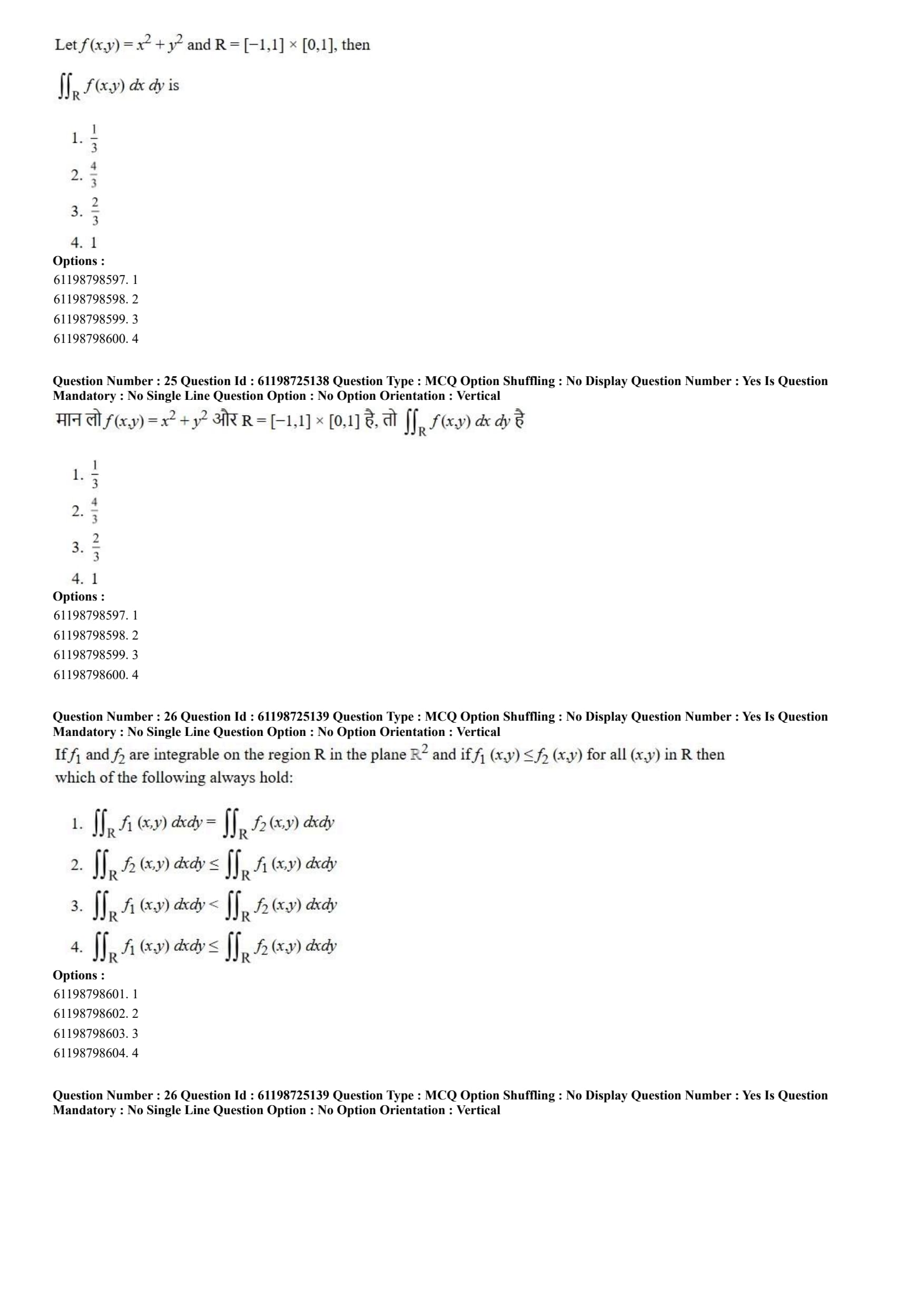
Let \(f(z)\) be continuous in a simply connected region \(G\) and suppose \(\oint_c f(z)dz = 0\) around every simple closed curve \(c\). Then
View Solution
Step 1: Concept
This question states the hypotheses of Morera's Theorem, which serves as a converse to Cauchy's Integral Theorem.
Step 2: Key Formulas and Approach
Morera's Theorem: Let \(f(z)\) be a continuous complex-valued function on a connected open domain \(G\). If \(\oint_C f(z) dz = 0\) for every simple closed curve \(C\) lying in \(G\), then \(f(z)\) is analytic throughout \(G\).
Step 3: Step-by-step Explanation
Since \(\oint_C f(z) dz = 0\) for all simple closed contours \(C \subset G\), path-independence holds.
Fix a point \(z_0 \in G\) and define an antiderivative function:
\[ F(z) = \int_{z_0}^z f(w) dw \]
Because the integral is independent of path, \(F(z)\) is well-defined and complex-differentiable on \(G\) with \(F'(z) = f(z)\).
By the property of analytic functions, any function that possesses a derivative is infinitely differentiable.
Since \(F(z)\) is analytic, its derivative \(F'(z) = f(z)\) must also be analytic in \(G\).
Therefore, \(f(z)\) is analytic in \(G\).
Step 4: Final Answer
By Morera's theorem, \(f(z)\) is analytic in \(G\). Thus, Option (C) is correct.
Quick Tip: Cauchy's Theorem: Analytic \(\implies \oint_C f(z)dz = 0\). Morera's Theorem: Continuous + \(\oint_C f(z)dz = 0 \implies\) Analytic. They are exact converses of each other!
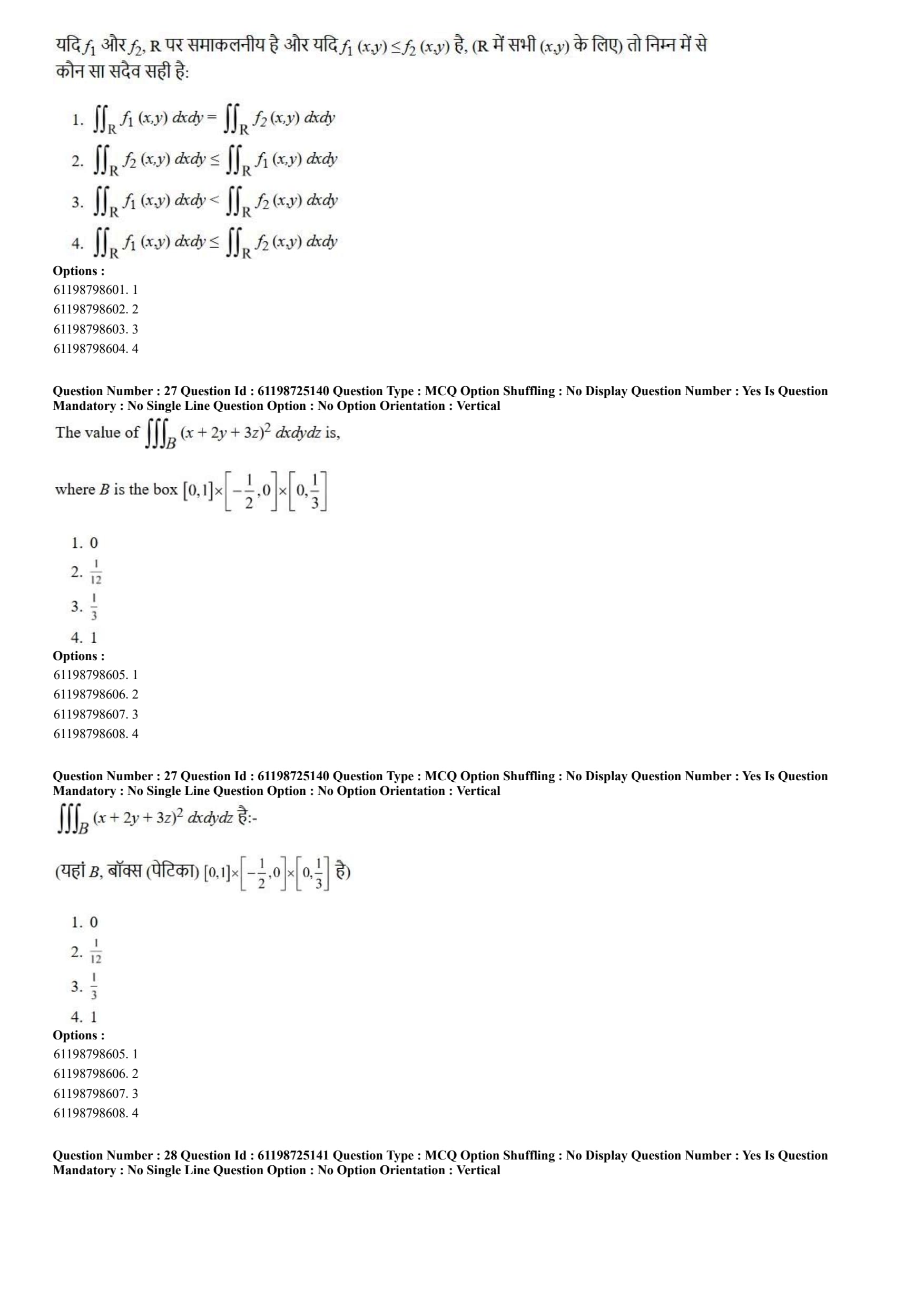
The value of \(\iint_S \cos(x) \sin(y) \, dx \, dy\) is, where \(S\) is \(\left[0, \frac{\pi}{2}\right] \times \left[0, \frac{\pi}{2}\right]\)
View Solution
Step 1: Concept
This problem involves evaluating a double integral over a rectangular domain \(S = [a, b] \times [c, d]\).
When the integrand is separable, i.e., \(f(x, y) = g(x) h(y)\), Fubini's Theorem allows splitting the double integral into the product of two independent single integrals.
Step 2: Key Formulas and Approach
For \(S = [a, b] \times [c, d]\) and \(f(x, y) = g(x) h(y)\): \[ \iint_S g(x) h(y) \, dx \, dy = \left( \int_a^b g(x) \, dx \right) \cdot \left( \int_c^d h(y) \, dy \right) \]
Step 3: Step-by-step Explanation
Here \(g(x) = \cos x\) on \([0, \pi/2]\) and \(h(y) = \sin y\) on \([0, \pi/2]\).
Separate the double integral into two single integrals:
\[ I = \left( \int_0^{\pi/2} \cos x \, dx \right) \cdot \left( \int_0^{\pi/2} \sin y \, dy \right) \]
Evaluate the first integral with respect to \(x\):
\[ \int_0^{\pi/2} \cos x \, dx = [\sin x]_0^{\pi/2} = \sin\left(\frac{\pi}{2}\right) - \sin(0) = 1 - 0 = 1 \]
Evaluate the second integral with respect to \(y\):
\[ \int_0^{\pi/2} \sin y \, dy = [-\cos y]_0^{\pi/2} = -\cos\left(\frac{\pi}{2}\right) - (-\cos 0) = 0 + 1 = 1 \]
Multiply the results:
\[ I = 1 \times 1 = 1 \]
Step 4: Final Answer
The value of the double integral is 1. Thus, Option (A) is correct.
Quick Tip: Whenever double integral limits are constants and the integrand separates into \(g(x)h(y)\), always split it into two single 1D integrals immediately to save computation time!
Let \(f(x, y) = x^2 + y^2\) and \(R = [-1, 1] \times [0, 1]\), then \(\iint_R f(x, y) \, dx \, dy\) is
View Solution
Step 1: Concept
To evaluate the double integral of a function \(f(x, y)\) over a rectangle \(R = [a, b] \times [c, d]\), we write it as an iterated integral: \[ \iint_R f(x, y) \, dx \, dy = \int_c^d \left( \int_a^b f(x, y) \, dx \right) dy \]
Step 2: Key Formulas and Approach
Set the limits of integration: \(x \in [-1, 1]\) and \(y \in [0, 1]\).
Apply standard integration power rules: \(\int x^n dx = \frac{x^{n+1}}{n+1}\).
Step 3: Step-by-step Explanation
Formulate the iterated integral:
\[ I = \int_{y=0}^1 \int_{x=-1}^1 (x^2 + y^2) \, dx \, dy \]
Perform inner integration with respect to \(x\) (treating \(y\) as a constant):
\[ \int_{-1}^1 (x^2 + y^2) \, dx = \left[ \frac{x^3}{3} + x y^2 \right]_{x=-1}^{x=1} \]
\[ = \left( \frac{1^3}{3} + (1)y^2 \right) - \left( \frac{(-1)^3}{3} + (-1)y^2 \right) \]
\[ = \left( \frac{1}{3} + y^2 \right) - \left( -\frac{1}{3} - y^2 \right) = \frac{2}{3} + 2y^2 \]
Perform outer integration with respect to \(y\):
\[ I = \int_0^1 \left( \frac{2}{3} + 2y^2 \right) dy = \left[ \frac{2}{3}y + \frac{2y^3}{3} \right]_0^1 \]
\[ = \left( \frac{2}{3}(1) + \frac{2(1)^3}{3} \right) - 0 = \frac{2}{3} + \frac{2}{3} = \frac{4}{3} \]
Step 4: Final Answer
The value of the double integral is \(\frac{4}{3}\). Thus, Option (B) is correct.
Quick Tip: Symmetry trick: Since \(x^2\) is an even function of \(x\) on \([-1, 1]\), \(\int_{-1}^1 (x^2 + y^2) dx = 2 \int_0^1 (x^2 + y^2) dx = 2 [\frac{1}{3} + y^2]\). Then \(\int_0^1 2 (\frac{1}{3} + y^2) dy = 2 (\frac{1}{3} + \frac{1}{3}) = \frac{4}{3}\).
If \(f_1\) and \(f_2\) are integrable on the region \(R\) in the plane \(\mathbb{R}^2\) and if \(f_1(x, y) \leq f_2(x, y)\) for all \((x, y)\) in \(R\) then which of the following always hold:
View Solution
Step 1: Concept
This question tests the Monotonicity Property (Order Preservation) of double integrals over bounded regions in \(\mathbb{R}^2\).
Step 2: Key Formulas and Approach
If \(g(x, y) \geq 0\) for all \((x, y) \in R\), then by definition of the Riemann integral (as a limit of non-negative Riemann sums): \[ \iint_R g(x, y) \, dx dy \geq 0 \]
Letting \(g(x, y) = f_2(x, y) - f_1(x, y) \geq 0\), linearity of integration yields the monotonic property.
Step 3: Step-by-step Explanation
Given \(f_1(x, y) \leq f_2(x, y)\) for all \((x, y) \in R\).
Subtract \(f_1(x, y)\) from both sides:
\[ f_2(x, y) - f_1(x, y) \geq 0 \quad \forall (x, y) \in R \]
Integrate both sides over the region \(R\):
\[ \iint_R \left[ f_2(x, y) - f_1(x, y) \right] dx dy \geq 0 \]
By linearity of double integrals:
\[ \iint_R f_2(x, y) \, dx dy - \iint_R f_1(x, y) \, dx dy \geq 0 \]
Rearranging terms:
\[ \iint_R f_1(x, y) \, dx dy \leq \iint_R f_2(x, y) \, dx dy \]
Note that strict inequality Option (C) is false because if \(f_1 = f_2\), their integrals are equal.
Step 4: Final Answer
The monotonicity property guarantees that \(\iint_R f_1(x, y) \, dx dy \leq \iint_R f_2(x, y) \, dx dy\). Thus, Option (D) is correct.
Quick Tip: Integration preserves inequalities! If \(f \leq g\), then \(\int f \leq \int g\). Always remember that equality can hold if \(f(x, y) = g(x, y)\) on \(R\).
The value of \(\iiint_B (x + 2y + 3z)^2 \, dx \, dy \, dz\) is, where \(B\) is the box \([0, 1] \times \left[-\frac{1}{2}, 0\right] \times \left[0, \frac{1}{3}\right]\)
View Solution
Step 1: Concept
This is a triple integral evaluated over a 3D rectangular box \(B\) defined by: \[ 0 \leq x \leq 1, \quad -\frac{1}{2} \leq y \leq 0, \quad 0 \leq z \leq \frac{1}{3} \]
Step 2: Key Formulas and Approach
We perform successive single integrations from inside to outside using substitution or power rule integration: \[ I = \int_0^1 \int_{-1/2}^0 \int_0^{1/3} (x + 2y + 3z)^2 \, dz \, dy \, dx \]
Step 3: Step-by-step Explanation
First Integration with respect to \(z\):
\[ \int_0^{1/3} (x + 2y + 3z)^2 \, dz = \left[ \frac{(x + 2y + 3z)^3}{3 \cdot 3} \right]_{z=0}^{z=1/3} \]
\[ = \frac{(x + 2y + 1)^3 - (x + 2y)^3}{9} \]
Second Integration with respect to \(y\):
\[ \int_{-1/2}^0 \frac{(x + 2y + 1)^3 - (x + 2y)^3}{9} \, dy = \frac{1}{9} \left[ \frac{(x + 2y + 1)^4}{4 \cdot 2} - \frac{(x + 2y)^4}{4 \cdot 2} \right]_{y=-1/2}^{y=0} \]
\[ = \frac{1}{72} \left[ \left( (x + 1)^4 - x^4 \right) - \left( x^4 - (x - 1)^4 \right) \right] \]
\[ = \frac{1}{72} \left[ (x + 1)^4 - 2x^4 + (x - 1)^4 \right] \]
Third Integration with respect to \(x\):
\[ I = \frac{1}{72} \int_0^1 \left[ (x + 1)^4 - 2x^4 + (x - 1)^4 \right] dx \]
\[ = \frac{1}{72} \left[ \frac{(x + 1)^5}{5} - \frac{2x^5}{5} + \frac{(x - 1)^5}{5} \right]_0^1 \]
Evaluate at upper limit \(x = 1\):
\[ \frac{1}{5} \left( 2^5 - 2(1)^5 + 0^5 \right) = \frac{32 - 2}{5} = \frac{30}{5} = 6 \]
Evaluate at lower limit \(x = 0\):
\[ \frac{1}{5} \left( 1^5 - 0 + (-1)^5 \right) = \frac{1 - 1}{5} = 0 \]
Calculate final value:
\[ I = \frac{1}{72} [6 - 0] = \frac{6}{72} = \frac{1}{12} \]
Step 4: Final Answer
The value of the triple integral over the box \(B\) is \(\frac{1}{12}\). Thus, Option (B) is correct.
Quick Tip: For linear combination integrands \(f(a x + b y + c z)\), each integration step introduces a scaling factor of \(1/a, 1/b, 1/c\) from the chain rule. Here \(1 \cdot 2 \cdot 3 = 6\), and dividing during integration reduces the power integral cleanly!
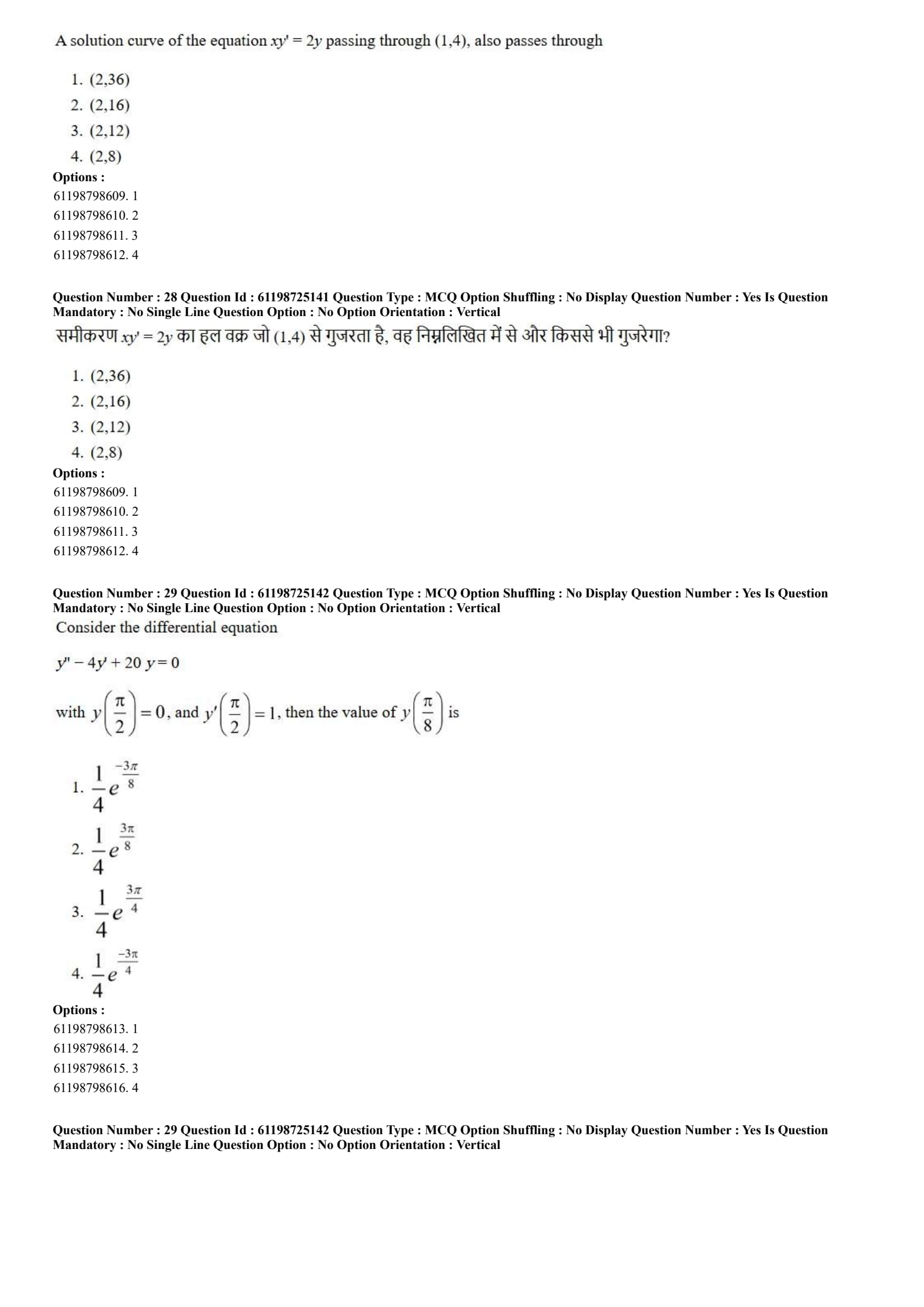
A solution curve of the equation \(x y' = 2y\) passing through \((1, 4)\), also passes through
View Solution
Step 1: Concept
This is a first-order separable ordinary differential equation. We separate variables \(x\) and \(y\), integrate both sides, solve for the general solution, and use the initial condition \((1, 4)\) to determine the constant of integration.
Step 2: Key Formulas and Approach
1. Differential equation: \(x \frac{dy}{dx} = 2y\).
2. Separate variables: \(\frac{1}{y} dy = \frac{2}{x} dx\).
3. Integrate: \(\int \frac{1}{y} dy = 2 \int \frac{1}{x} dx\).
Step 3: Step-by-step Explanation
Separate variables \(x\) and \(y\):
\[ \frac{dy}{y} = \frac{2}{x} dx \]
Integrate both sides:
\[ \ln|y| = 2\ln|x| + C \]
\[ \ln|y| = \ln(x^2) + C \]
Exponentiate both sides:
\[ y = k x^2 \quad (where k = e^C) \]
Use the given point \((x, y) = (1, 4)\) to find \(k\):
\[ 4 = k(1)^2 \implies k = 4 \]
The specific solution curve is:
\[ y = 4 x^2 \]
Test \(x = 2\) in the solution equation:
\[ y = 4(2)^2 = 4 \times 4 = 16 \]
Therefore, the curve passes through the point \((2, 16)\).
Step 4: Final Answer
The solution curve passes through \((2, 16)\). Thus, Option (B) is correct.
Quick Tip: Equations of the form \(x y' = n y\) always have solutions \(y = k x^n\). Here \(n = 2 \implies y = k x^2\). Since \(y(1) = 4 \implies k = 4 \implies y(2) = 4(2^2) = 16\).
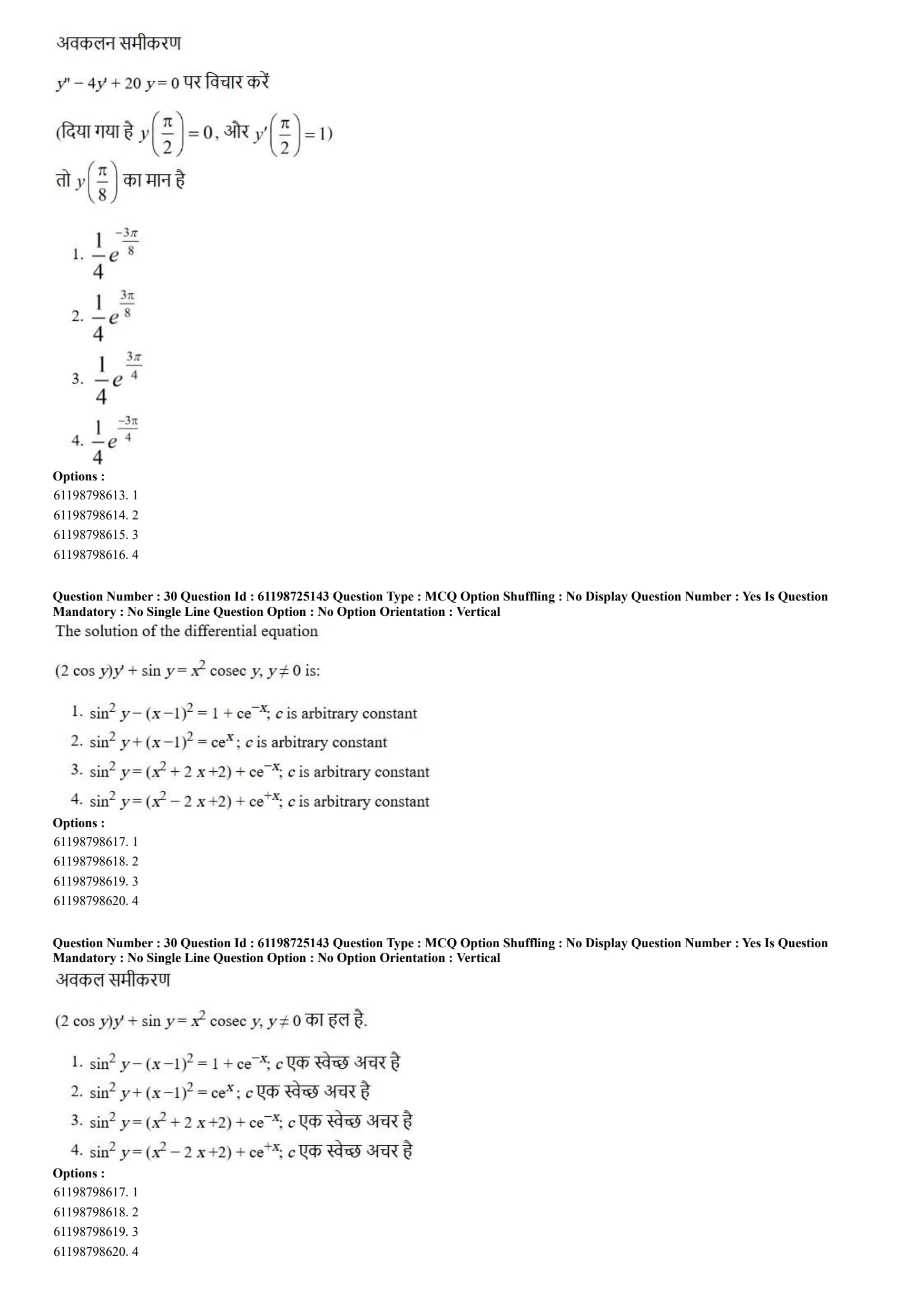
Consider the differential equation
\[ y'' - 4y' + 20y = 0 \]
with \(y\left(\frac{\pi}{2}\right) = 0\), and \(y'\left(\frac{\pi}{2}\right) = 1\), then the value of \(y\left(\frac{\pi}{8}\right)\) is
View Solution
Step 1: Concept
This is a second-order linear homogeneous differential equation with constant coefficients. We solve it using the auxiliary equation method, apply the initial boundary conditions, and evaluate at the target point.
Step 2: Key Formulas and Approach
1. For \(a y'' + b y' + c y = 0\), write auxiliary equation \(a m^2 + b m + c = 0\).
2. If roots are complex \(\alpha \pm i \beta\), general solution is: \[ y(x) = e^{\alpha x} \left( C_1 \cos(\beta x) + C_2 \sin(\beta x) \right) \]
Step 3: Step-by-step Explanation
Write the auxiliary equation for \(y'' - 4y' + 20y = 0\):
\[ m^2 - 4m + 20 = 0 \]
Solve for \(m\):
\[ m = \frac{4 \pm \sqrt{16 - 80}}{2} = \frac{4 \pm \sqrt{-64}}{2} = 2 \pm 4i \]
Here \(\alpha = 2\) and \(\beta = 4\).
Write the general solution:
\[ y(x) = e^{2x} \left( C_1 \cos(4x) + C_2 \sin(4x) \right) \]
Apply initial condition \(y\left(\frac{\pi}{2}\right) = 0\):
\[ y\left(\frac{\pi}{2}\right) = e^{\pi} \left( C_1 \cos(2\pi) + C_2 \sin(2\pi) \right) = e^{\pi} (C_1 (1) + C_2 (0)) = C_1 e^{\pi} = 0 \]
Since \(e^{\pi} \neq 0\), we get \(C_1 = 0\).
So \(y(x) = C_2 e^{2x} \sin(4x)\).
Compute \(y'(x)\):
\[ y'(x) = C_2 \left[ 2e^{2x} \sin(4x) + 4e^{2x} \cos(4x) \right] \]
Apply initial condition \(y'\left(\frac{\pi}{2}\right) = 1\):
\[ y'\left(\frac{\pi}{2}\right) = C_2 e^{\pi} \left[ 2(0) + 4(1) \right] = 4 C_2 e^{\pi} = 1 \implies C_2 = \frac{1}{4} e^{-\pi} \]
Write the explicit solution:
\[ y(x) = \frac{1}{4} e^{-\pi} e^{2x} \sin(4x) = \frac{1}{4} e^{2x - \pi} \sin(4x) \]
Evaluate at \(x = \frac{\pi}{8}\):
\[ 4x = 4\left(\frac{\pi}{8}\right) = \frac{\pi}{2} \implies \sin\left(\frac{\pi}{2}\right) = 1 \]
\[ 2x - \pi = 2\left(\frac{\pi}{8}\right) - \pi = \frac{\pi}{4} - \pi = -\frac{3\pi}{4} \]
\[ y\left(\frac{\pi}{8}\right) = \frac{1}{4} e^{-3\pi/4} (1) = \frac{1}{4} e^{-3\pi/4} \]
Step 4: Final Answer
The solution evaluated at \(x = \pi/8\) is \(-\frac{1}{4} e^{-3\pi/4}\). Thus, Option (D) is correct.
Quick Tip: Always double check the angle evaluated in trig functions! At \(x = \pi/8\), \(4x = \pi/2\), which simplifies \(\sin(4x) = 1\). This eliminates trigonometric factors cleanly!
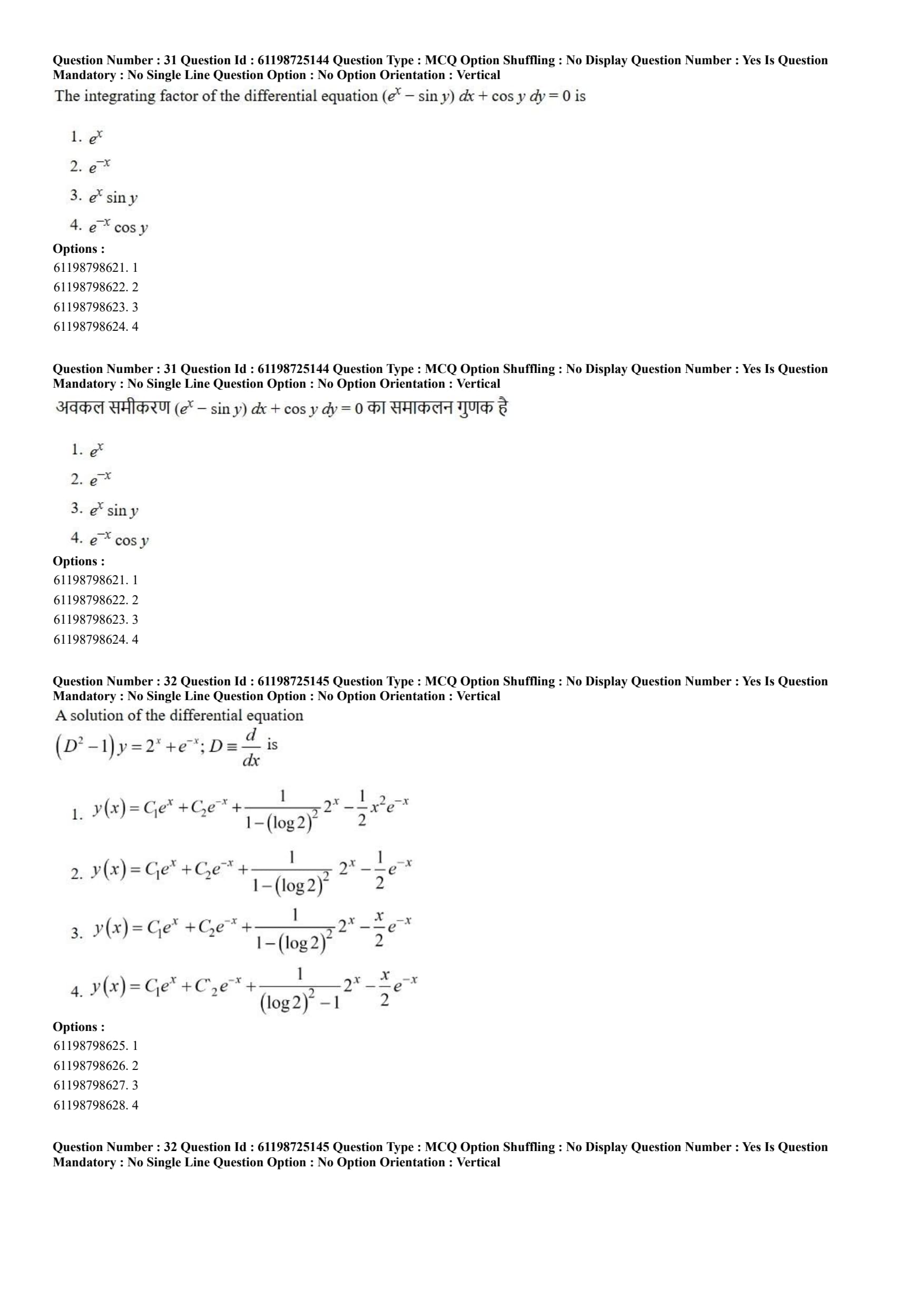
The solution of the differential equation \((2 \cos y) y' + \sin y = x^2 \csc y, y \neq 0\) is:
View Solution
Step 1: Concept
This non-linear differential equation can be transformed into a linear first-order differential equation using a suitable substitution (Bernoulli-type transformation).
Step 2: Key Formulas and Approach
1. Rearrange \(2 \cos y \frac{dy}{dx} + \sin y = \frac{x^2}{\sin y}\).
2. Multiply by \(\sin y\): \[ (2 \sin y \cos y) \frac{dy}{dx} + \sin^2 y = x^2 \]
3. Substitute \(v = \sin^2 y \implies \frac{dv}{dx} = 2 \sin y \cos y \frac{dy}{dx}\).
4. Solve the resulting first-order linear ODE in \(v\): \(\frac{dv}{dx} + P(x)v = Q(x)\) using Integrating Factor \(I.F. = e^{\int P(x) dx}\).
Step 3: Step-by-step Explanation
Substitute \(v = \sin^2 y\):
\[ \frac{dv}{dx} + v = x^2 \]
Compute Integrating Factor:
\[ I.F. = e^{\int 1 dx} = e^x \]
Multiply by \(I.F.\) and integrate:
\[ v \cdot e^x = \int x^2 e^x dx + c \]
Integrate \(\int x^2 e^x dx\) using integration by parts:
\[ \int x^2 e^x dx = x^2 e^x - 2x e^x + 2e^x = e^x (x^2 - 2x + 2) \]
Substitute back into solution equation:
\[ v \cdot e^x = e^x (x^2 - 2x + 2) + c \]
Divide through by \(e^x\):
\[ v = x^2 - 2x + 2 + c e^{-x} \]
Substitute \(v = \sin^2 y\):
\[ \sin^2 y = x^2 - 2x + 2 + c e^{-x} \]
Rewrite \(x^2 - 2x + 2\) as \((x - 1)^2 + 1\):
\[ \sin^2 y = (x - 1)^2 + 1 + c e^{-x} \]
\[ \sin^2 y - (x - 1)^2 = 1 + c e^{-x} \]
Step 4: Final Answer
The general solution is \(\sin^2 y - (x - 1)^2 = 1 + c e^{-x}\). Thus, Option (A) is correct.
Quick Tip: Notice that \(2 \sin y \cos y = \frac{d}{dx}(\sin^2 y)\). Seeing derivatives of composite functions like \(\frac{d}{dx}(\sin^2 y)\) instantly reveals the correct variable substitution!
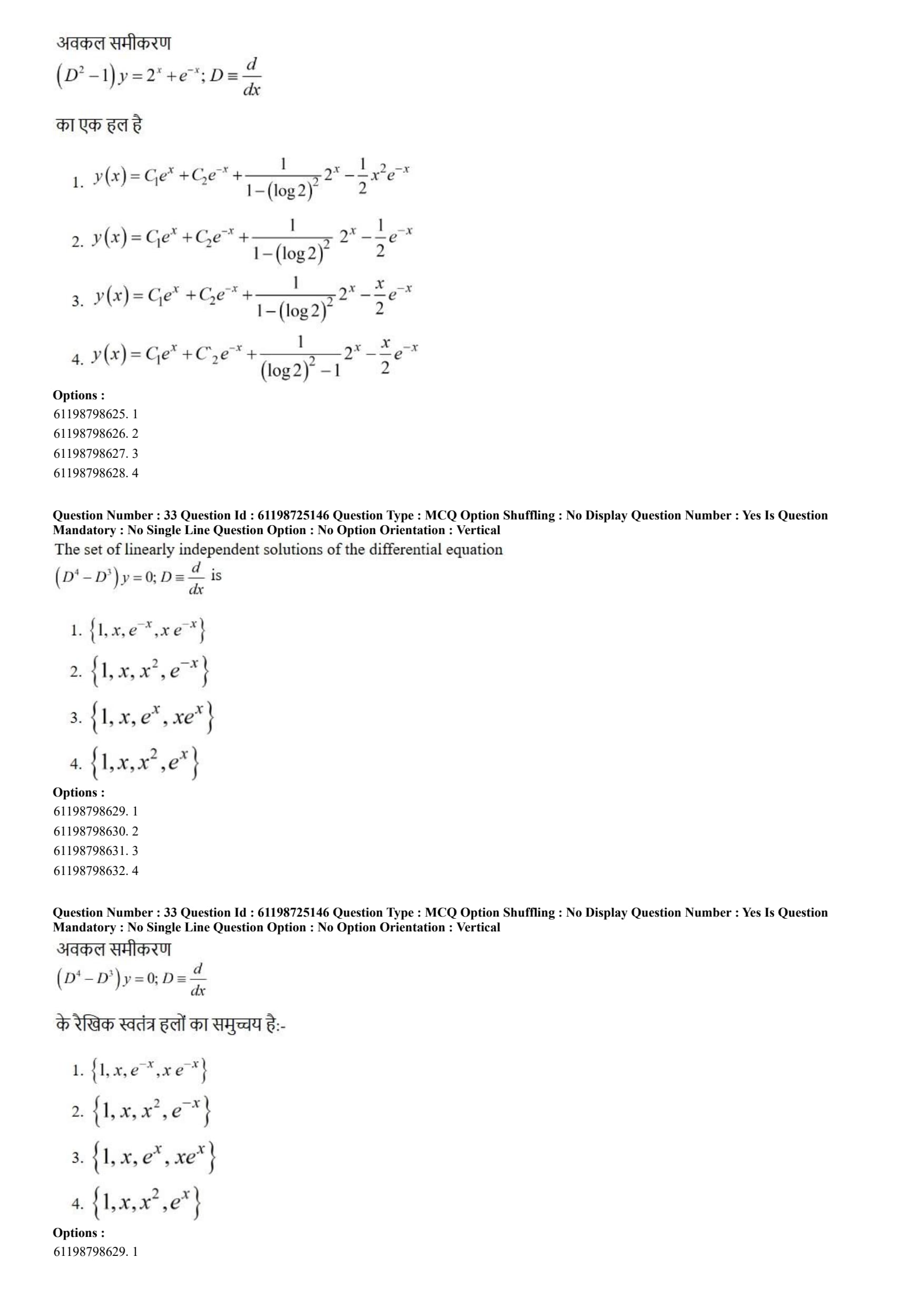
The integrating factor of the differential equation \((e^x - \sin y) dx + \cos y \, dy = 0\) is
View Solution
Step 1: Concept
An equation \(M(x, y) dx + N(x, y) dy = 0\) is exact if \(\frac{\partial M}{\partial y} = \frac{\partial N}{\partial x}\). If it is non-exact, we find an integrating factor \(\mu(x)\) such that multiplying the equation by \(\mu(x)\) makes it exact.
Step 2: Key Formulas and Approach
If \(\frac{1}{N} \left( \frac{\partial M}{\partial y} - \frac{\partial N}{\partial x} \right) = f(x)\) is a function of \(x\) alone, then the integrating factor is: \[ I.F. = e^{\int f(x) dx} \]
Step 3: Step-by-step Explanation
Identify \(M\) and \(N\) from \((e^x - \sin y) dx + \cos y \, dy = 0\):
\[ M = e^x - \sin y, \quad N = \cos y \]
Compute partial derivatives:
\[ \frac{\partial M}{\partial y} = -\cos y, \quad \frac{\partial N}{\partial x} = 0 \]
Since \(\frac{\partial M}{\partial y} \neq \frac{\partial N}{\partial x}\), the equation is not exact.
Calculate the test ratio:
\[ \frac{1}{N} \left( \frac{\partial M}{\partial y} - \frac{\partial N}{\partial x} \right) = \frac{-\cos y - 0}{\cos y} = -1 \]
Since \(-1\) is a function depending solely on \(x\) (\(f(x) = -1\)):
\[ I.F. = e^{\int (-1) dx} = e^{-x} \]
Verification: Multiply original equation by \(e^{-x}\):
\[ (1 - e^{-x} \sin y) dx + e^{-x} \cos y \, dy = 0 \]
Now \(\frac{\partial M'}{\partial y} = -e^{-x} \cos y = \frac{\partial N'}{\partial x}\), which is exact!
Step 4: Final Answer
The integrating factor of the differential equation is \(e^{-x}\). Thus, Option (B) is correct.
Quick Tip: Rules for Integrating Factors: 1. If \(\frac{M_y - N_x}{N} = f(x)\), then \(I.F. = e^{\int f(x) dx}\). 2. If \(\frac{N_x - M_y}{M} = g(y)\), then \(I.F. = e^{\int g(y) dy}\).
A solution of the differential equation \((D^2 - 1)y = 2^x + e^{-x}; D = \frac{d}{dx}\) is
View Solution
Step 1: Concept
The general solution to a linear non-homogeneous differential equation \((D^2 - 1)y = f(x)\) is \(y = y_c + y_p\), where \(y_c\) is the complementary function and \(y_p\) is the particular integral.
Step 2: Key Formulas and Approach
1. Complementary Function (\(y_c\)): Solve auxiliary equation \(m^2 - 1 = 0\).
2. Particular Integral (\(y_p\)):
- For \(2^x = e^{x \ln 2}\), use \(\frac{1}{f(D)} e^{a x} = \frac{1}{f(a)} e^{a x}\) where \(a = \log 2\).
- For \(e^{-x}\), since \(f(-1) = (-1)^2 - 1 = 0\) (case of failure), use \(\frac{1}{D - a} e^{a x} = x e^{a x}\).
Step 3: Step-by-step Explanation
1. Finding Complementary Function \(y_c\):
Auxiliary equation: \(m^2 - 1 = 0 \implies m = 1, -1\).
\[ y_c = C_1 e^x + C_2 e^{-x} \]
2. Finding Particular Integral \(y_{p_1}\) for \(2^x\):
Rewrite \(2^x = e^{x \ln 2}\). Replace \(D\) by \(\log 2\):
\[ y_{p_1} = \frac{1}{D^2 - 1} 2^x = \frac{1}{(\log 2)^2 - 1} 2^x \]
3. Finding Particular Integral \(y_{p_2}\) for \(e^{-x}\):
Factor \(D^2 - 1 = (D - 1)(D + 1)\):
\[ y_{p_2} = \frac{1}{(D - 1)(D + 1)} e^{-x} = \frac{1}{-1 - 1} \cdot \left( \frac{1}{D + 1} e^{-x} \right) \]
\[ = -\frac{1}{2} \left( x e^{-x} \right) = -\frac{x}{2} e^{-x} \]
4. Combining terms for complete general solution:
\[ y(x) = y_c + y_{p_1} + y_{p_2} \]
\[ y(x) = C_1 e^x + C_2 e^{-x} + \frac{1}{(\log 2)^2 - 1} 2^x - \frac{x}{2} e^{-x} \]
Step 4: Final Answer
The general solution matches Option (D). Thus, Option (D) is correct.
Quick Tip: Case of failure rule: When evaluating \(\frac{1}{f(D)} e^{a x}\) and \(f(a) = 0\), differentiate denominator with respect to \(D\) and multiply numerator by \(x\): \(\frac{1}{f(D)} e^{a x} = x \frac{1}{f'(D)} e^{a x}\). Here \(x \frac{1}{2D} e^{-x} = \frac{x e^{-x}}{2(-1)} = -\frac{x}{2} e^{-x}\).
The set of linearly independent solutions of the differential equation \((D^4 - D^3)y = 0; D = \frac{d}{dx}\) is
View Solution
Step 1: Concept
For an \(n\)-th order linear homogeneous differential equation with constant coefficients \(P(D)y = 0\), the set of \(n\) linearly independent solutions corresponds to the fundamental basis generated by the roots of its auxiliary equation.
Step 2: Key Formulas and Approach
1. Write the auxiliary equation \(P(m) = 0\).
2. If a real root \(m = \alpha\) is repeated \(k\) times, it generates \(k\) linearly independent solutions: \[ e^{\alpha x}, \, x e^{\alpha x}, \, x^2 e^{\alpha x}, \, \dots, \, x^{k-1} e^{\alpha x} \]
Step 3: Step-by-step Explanation
Given differential equation:
\[ (D^4 - D^3)y = 0 \]
Form the auxiliary equation:
\[ m^4 - m^3 = 0 \]
Factor the polynomial:
\[ m^3 (m - 1) = 0 \]
Find roots and their multiplicities:
\[ m = 0 (repeated 3 times), \quad m = 1 (distinct root) \]
Construct linearly independent solutions for \(m = 0\) (\(k = 3\)):
\[ y_1 = e^{0x} = 1 \]
\[ y_2 = x e^{0x} = x \]
\[ y_3 = x^2 e^{0x} = x^2 \]
Construct linearly independent solution for \(m = 1\) (\(k = 1\)):
\[ y_4 = e^{1x} = e^x \]
The set of 4 linearly independent solutions is:
\[ \{1, x, x^2, e^x\} \]
Step 4: Final Answer
The set of linearly independent solutions is \(\{1, x, x^2, e^x\}\). Thus, Option (D) is correct.
Quick Tip: For repeated root \(m = 0\) with multiplicity 3, the solutions are polynomials \(1, x, x^2\) up to degree \(3-1 = 2\). Combined with \(e^x\), we get \(\{1, x, x^2, e^x\}\).
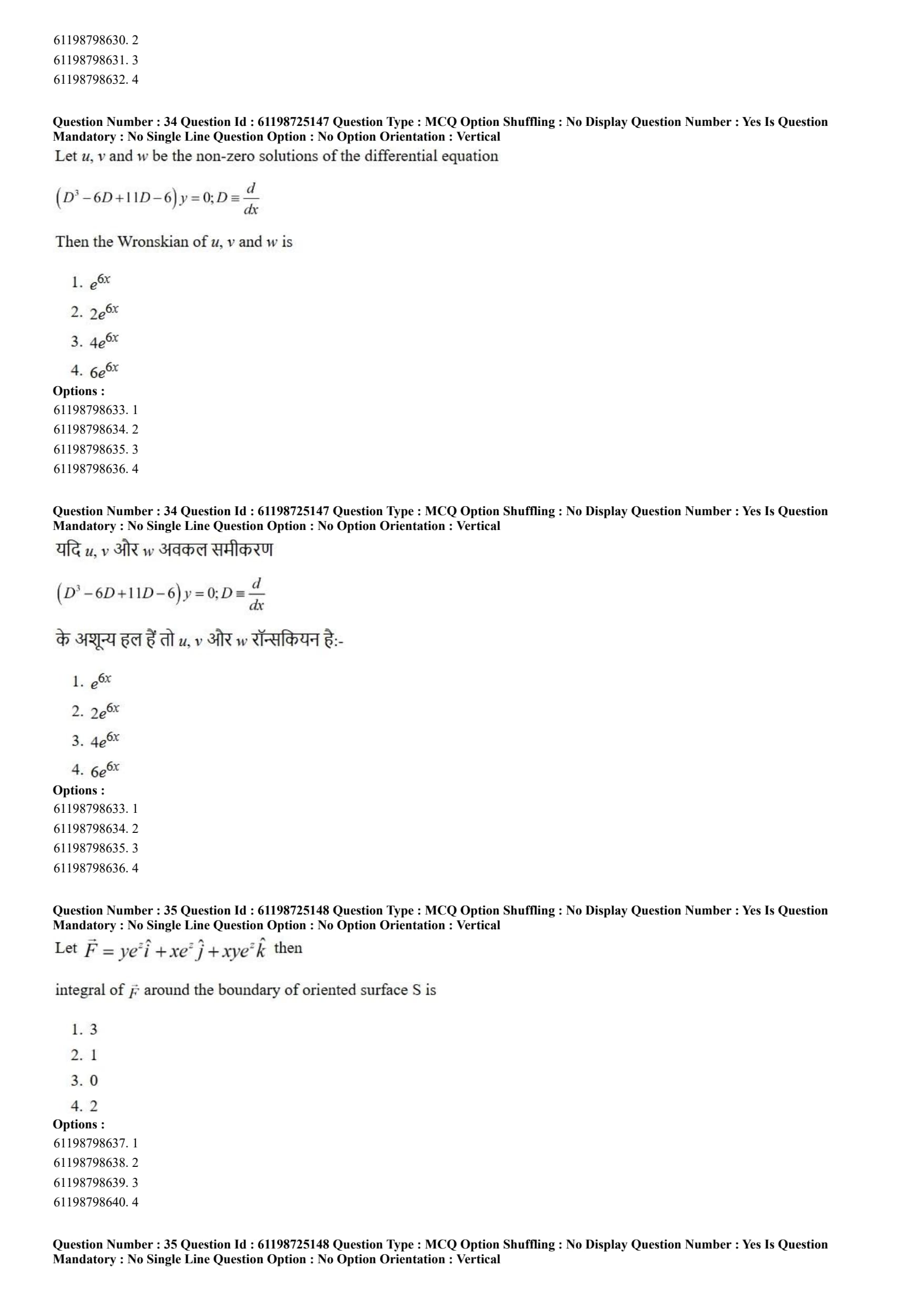
Let \(u, v\) and \(w\) be the non-zero solutions of the differential equation
\[ (D^3 - 6D^2 + 11D - 6)y = 0; \quad D = \frac{d}{dx} \]
Then the Wronskian of \(u, v\) and \(w\) is
View Solution
Step 1: Concept
The Wronskian \(W(u, v, w)(x)\) of three differentiable functions \(u, v, w\) is defined by the determinant: \[ W(x) = \begin{vmatrix} u & v & w
u' & v' & w'
u'' & v'' & w'' \end{vmatrix} \]
By Abel's Identity for a third-order homogeneous differential equation \(y''' + p_1(x) y'' + p_2(x) y' + p_3(x) y = 0\), the Wronskian satisfies: \[ W(x) = W(x_0) \exp\left( -\int_{x_0}^x p_1(t) \, dt \right) \]
Step 2: Key Formulas and Approach
We can solve for the fundamental basis of solutions \(u, v, w\) using the auxiliary polynomial equation: \[ m^3 - 6m^2 + 11m - 6 = 0 \]
Once the linearly independent solutions \(u, v, w\) are determined, we calculate their Wronskian determinant directly.
Step 3: Step-by-step Explanation
Factor the auxiliary polynomial:
\[ m^3 - 6m^2 + 11m - 6 = (m - 1)(m - 2)(m - 3) = 0 \]
The roots are distinct real numbers: \(m_1 = 1, m_2 = 2, m_3 = 3\).
The corresponding linearly independent basis solutions are:
\[ u(x) = e^x, \quad v(x) = e^{2x}, \quad w(x) = e^{3x} \]
Compute derivatives of each solution:
\[ u' = e^x, \quad u'' = e^x \]
\[ v' = 2e^{2x}, \quad v'' = 4e^{2x} \]
\[ w' = 3e^{3x}, \quad w'' = 9e^{3x} \]
Construct and evaluate the Wronskian determinant:
\[ W(x) = \begin{vmatrix} e^x & e^{2x} & e^{3x}
e^x & 2e^{2x} & 3e^{3x}
e^x & 4e^{2x} & 9e^{3x} \end{vmatrix} \]
Factor out \(e^x, e^{2x}, e^{3x}\) from the columns:
\[ W(x) = e^x \cdot e^{2x} \cdot e^{3x} \begin{vmatrix} 1 & 1 & 1
1 & 2 & 3
1 & 4 & 9 \end{vmatrix} = e^{6x} \begin{vmatrix} 1 & 1 & 1
1 & 2 & 3
1 & 4 & 9 \end{vmatrix} \]
The remaining \(3 \times 3\) determinant is a Vandermonde determinant for \((1, 2, 3)\):
\[ \begin{vmatrix} 1 & 1 & 1
1 & 2 & 3
1 & 4 & 9 \end{vmatrix} = (2 - 1)(3 - 1)(3 - 2) = 1 \cdot 2 \cdot 1 = 2 \]
Thus, \(W(x) = 2 e^{6x}\).
Step 4: Final Answer
The Wronskian of \(u, v\) and \(w\) is \(2 e^{6x}\). Thus, Option (B) is correct.
Quick Tip: Shortcut using Abel's Identity: \(W(x) = C e^{-\int (-6) dx} = C e^{6x}\). For distinct exponential solutions \(e^{\lambda_1 x}, e^{\lambda_2 x}, e^{\lambda_3 x}\), the constant \(C = \prod_{i < j} (\lambda_j - \lambda_i) = (2-1)(3-1)(3-2) = 2\).
Let \(\vec{F} = y e^z \hat{i} + x e^z \hat{j} + x y e^z \hat{k}\), then integral of \(\vec{F}\) around the boundary of oriented surface \(S\) is
View Solution
Step 1: Concept
By Stokes' Theorem, the line integral of a vector field \(\vec{F}\) along a simple closed boundary curve \(C = \partial S\) is equal to the surface integral of its curl over \(S\): \[ \oint_{\partial S} \vec{F} \cdot d\vec{r} = \iint_S (\nabla \times \vec{F}) \cdot \hat{n} \, dS \]
If the vector field \(\vec{F}\) is conservative (irrotational), then \(\nabla \times \vec{F} = \vec{0}\), which implies the loop integral is identically zero.
Step 2: Key Formulas and Approach
Compute \(curl(\vec{F}) = \nabla \times \vec{F}\) using the determinant definition: \[ \nabla \times \vec{F} = \begin{vmatrix} \hat{i} & \hat{j} & \hat{k}
\frac{\partial}{\partial x} & \frac{\partial}{\partial y} & \frac{\partial}{\partial z}
F_x & F_y & F_z \end{vmatrix} \]
where \(F_x = y e^z\), \(F_y = x e^z\), \(F_z = x y e^z\).
Step 3: Step-by-step Explanation
Evaluate the \(\hat{i}\)-component of curl:
\[ (\nabla \times \vec{F})_x = \frac{\partial}{\partial y}(x y e^z) - \frac{\partial}{\partial z}(x e^z) = x e^z - x e^z = 0 \]
Evaluate the \(\hat{j}\)-component of curl:
\[ (\nabla \times \vec{F})_y = \frac{\partial}{\partial z}(y e^z) - \frac{\partial}{\partial x}(x y e^z) = y e^z - y e^z = 0 \]
Evaluate the \(\hat{k}\)-component of curl:
\[ (\nabla \times \vec{F})_z = \frac{\partial}{\partial x}(x e^z) - \frac{\partial}{\partial y}(y e^z) = e^z - e^z = 0 \]
Therefore, \(\nabla \times \vec{F} = 0\hat{i} + 0\hat{j} + 0\hat{k} = \vec{0}\).
Alternatively, observe that \(\vec{F} = \nabla(x y e^z)\) is a conservative gradient field with scalar potential \(\phi(x, y, z) = x y e^z\).
The integral of any conservative field around a closed loop is always 0:
\[ \oint_{\partial S} \vec{F} \cdot d\vec{r} = 0 \]
Step 4: Final Answer
The line integral around the boundary of the surface \(S\) is 0. Thus, Option (C) is correct.
Quick Tip: Whenever asked for a closed loop integral \(\oint_C \vec{F} \cdot d\vec{r}\), first check if \(\nabla \times \vec{F} = \vec{0}\). If it is irrotational, the integral is \(0\) immediately without performing any integration!
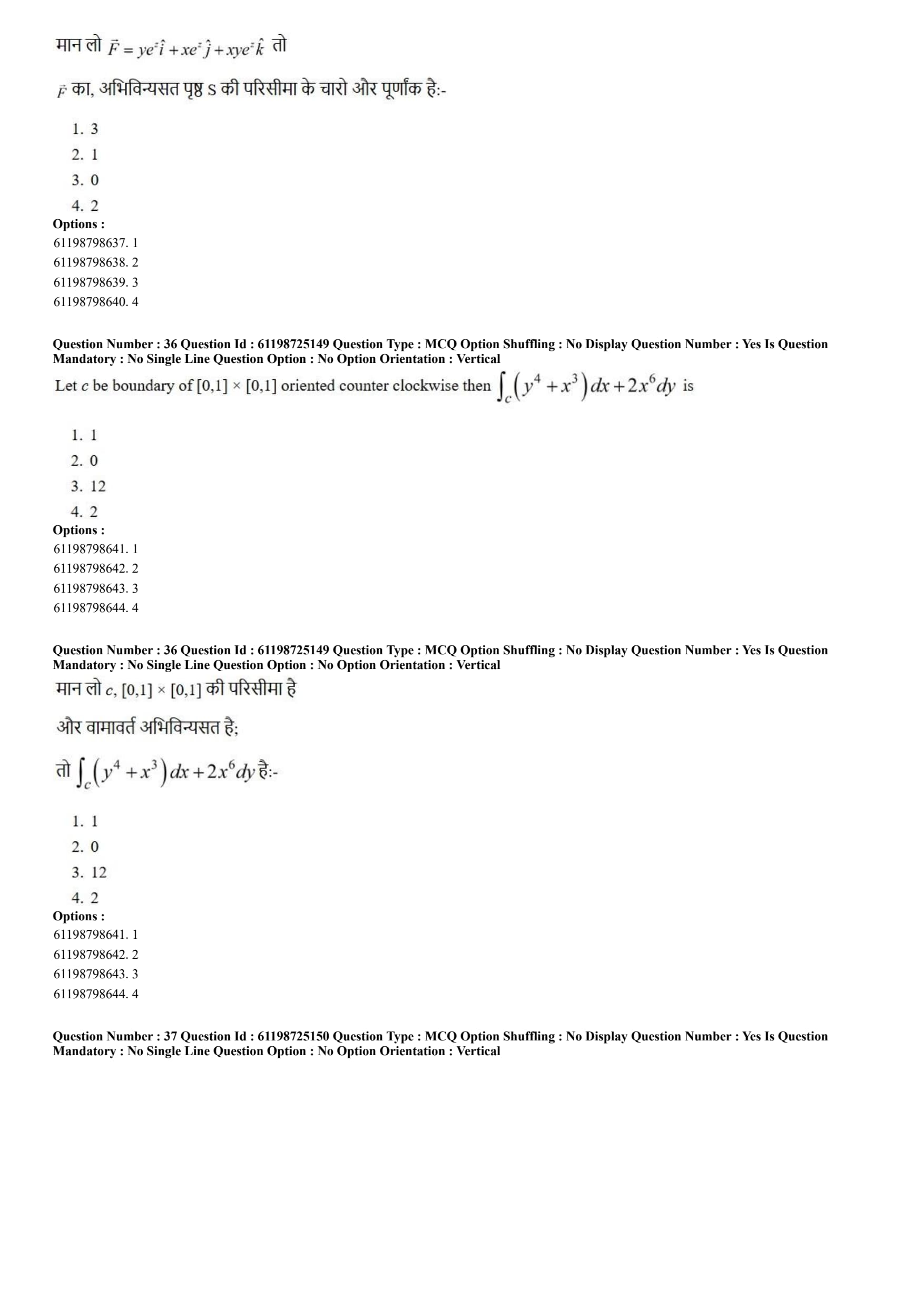
Let \(c\) be boundary of \([0, 1] \times [0, 1]\) oriented counter clockwise then \(\int_c (y^4 + x^3) dx + 2 x^6 dy\) is
View Solution
Step 1: Concept
Green's Theorem in the Plane: Let \(C\) be a positively oriented (counterclockwise), piecewise-smooth, simple closed curve in \(\mathbb{R}^2\), and let \(D\) be the region enclosed by \(C\). If \(P(x, y)\) and \(Q(x, y)\) have continuous partial derivatives on \(D\): \[ \oint_C P \, dx + Q \, dy = \iint_D \left( \frac{\partial Q}{\partial x} - \frac{\partial P}{\partial y} \right) dx \, dy \]
Step 2: Key Formulas and Approach
Here \(P(x, y) = y^4 + x^3\) and \(Q(x, y) = 2 x^6\).
The region \(D\) is the unit square \([0, 1] \times [0, 1]\) in the \(xy\)-plane.
Compute partial derivatives \(\frac{\partial Q}{\partial x}\) and \(\frac{\partial P}{\partial y}\), then evaluate the double integral over \(D\).
Step 3: Step-by-step Explanation
Compute \(\frac{\partial Q}{\partial x}\):
\[ \frac{\partial Q}{\partial x} = \frac{\partial}{\partial x}(2 x^6) = 12 x^5 \]
Compute \(\frac{\partial P}{\partial y}\):
\[ \frac{\partial P}{\partial y} = \frac{\partial}{\partial y}(y^4 + x^3) = 4 y^3 \]
Set up the double integral over \(D = [0, 1] \times [0, 1]\):
\[ I = \int_{y=0}^1 \int_{x=0}^1 (12 x^5 - 4 y^3) \, dx \, dy \]
Integrate with respect to \(x\):
\[ \int_0^1 (12 x^5 - 4 y^3) \, dx = \left[ 2 x^6 - 4 x y^3 \right]_{x=0}^{x=1} = (2 - 4 y^3) - 0 = 2 - 4 y^3 \]
Integrate with respect to \(y\):
\[ I = \int_0^1 (2 - 4 y^3) \, dy = \left[ 2 y - y^4 \right]_0^1 = (2(1) - 1^4) - 0 = 2 - 1 = 1 \]
Step 4: Final Answer
The line integral evaluates to 1. Thus, Option (A) is correct.
Quick Tip: Green's Theorem transforms tedious 4-segment line integrals along the boundary of a rectangle into a straightforward 2D double integral!
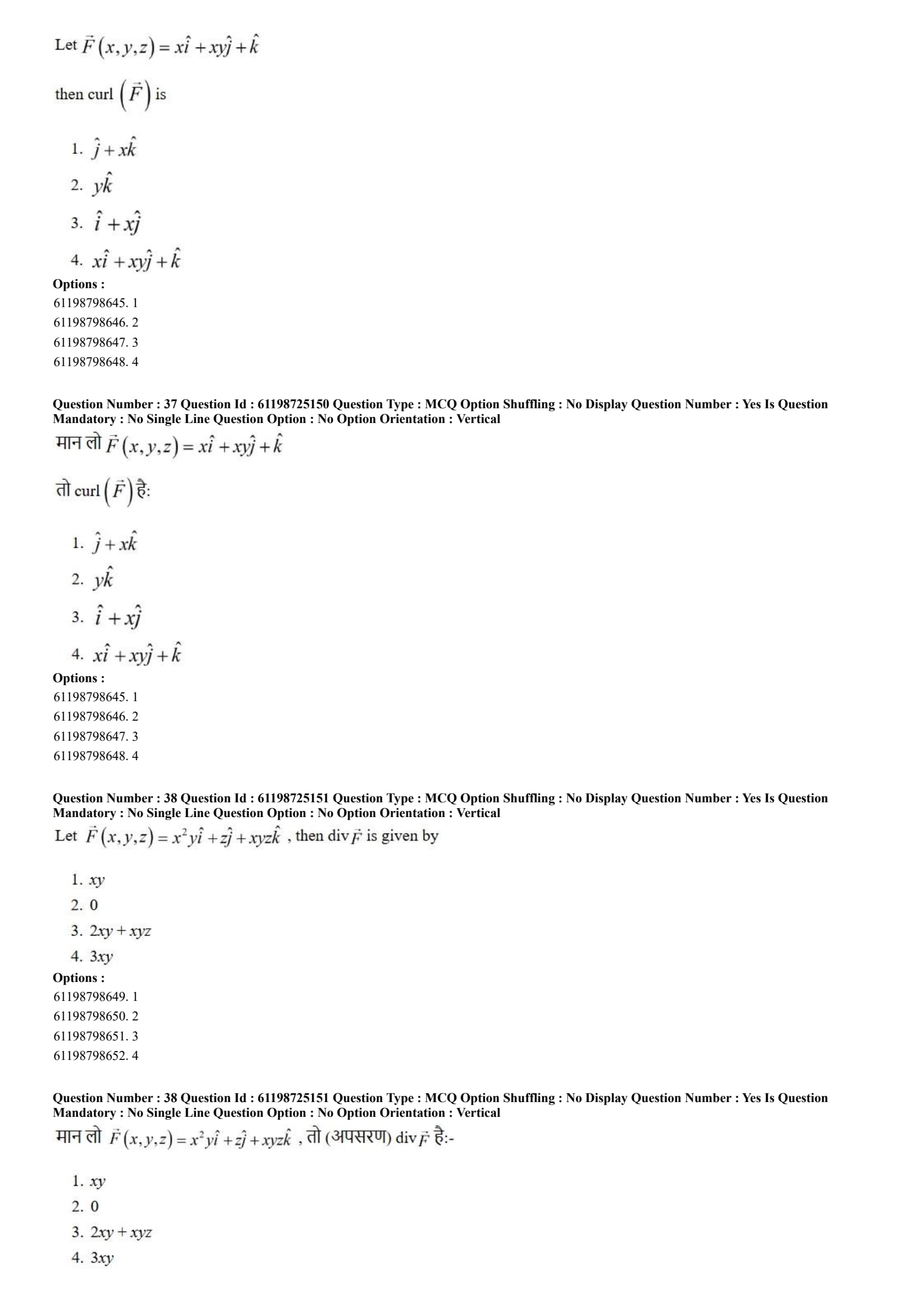
Let \(\vec{F}(x, y, z) = x \hat{i} + x y \hat{j} + \hat{k}\), then \(curl(\vec{F})\) is
View Solution
Step 1: Concept
The curl of a vector field \(\vec{F}(x, y, z) = F_x \hat{i} + F_y \hat{j} + F_z \hat{k}\) measures the infinitesimal rotation or circulation of the field at a given point. It is calculated using the vector cross product \(\nabla \times \vec{F}\).
Step 2: Key Formulas and Approach
\[ curl(\vec{F}) = \nabla \times \vec{F} = \begin{vmatrix} \hat{i} & \hat{j} & \hat{k}
\frac{\partial}{\partial x} & \frac{\partial}{\partial y} & \frac{\partial}{\partial z}
F_x & F_y & F_z \end{vmatrix} \]
Given \(F_x = x\), \(F_y = x y\), \(F_z = 1\).
Step 3: Step-by-step Explanation
Compute the \(\hat{i}\)-component:
\[ \left( \frac{\partial F_z}{\partial y} - \frac{\partial F_y}{\partial z} \right) = \frac{\partial}{\partial y}(1) - \frac{\partial}{\partial z}(x y) = 0 - 0 = 0 \]
Compute the \(\hat{j}\)-component:
\[ \left( \frac{\partial F_x}{\partial z} - \frac{\partial F_z}{\partial x} \right) = \frac{\partial}{\partial z}(x) - \frac{\partial}{\partial x}(1) = 0 - 0 = 0 \]
Compute the \(\hat{k}\)-component:
\[ \left( \frac{\partial F_y}{\partial x} - \frac{\partial F_x}{\partial y} \right) = \frac{\partial}{\partial x}(x y) - \frac{\partial}{\partial y}(x) = y - 0 = y \]
Combine components:
\[ \nabla \times \vec{F} = 0\hat{i} + 0\hat{j} + y\hat{k} = y\hat{k} \]
Step 4: Final Answer
The curl of \(\vec{F}\) is \(y \hat{k}\). Thus, Option (B) is correct.
Quick Tip: Notice that \(F_x\) and \(F_y\) do not depend on \(z\), and \(F_z\) is constant. Thus all \(z\)-derivatives are zero, leaving only the \(x,y\) derivative in the \(\hat{k}\) component!
Let \(\vec{F}(x, y, z) = x^2 y \hat{i} + z \hat{j} + x y z \hat{k}\), then \(div \vec{F}\) is given by
View Solution
Step 1: Concept
The divergence of a vector field \(\vec{F} = F_x \hat{i} + F_y \hat{j} + F_z \hat{k}\) is a scalar field representing the net flux per unit volume exiting an infinitesimal region. It is calculated via the dot product \(\nabla \cdot \vec{F}\).
Step 2: Key Formulas and Approach
\[ div \vec{F} = \nabla \cdot \vec{F} = \frac{\partial F_x}{\partial x} + \frac{\partial F_y}{\partial y} + \frac{\partial F_z}{\partial z} \]
Here \(F_x = x^2 y\), \(F_y = z\), and \(F_z = x y z\).
Step 3: Step-by-step Explanation
Differentiate \(F_x\) with respect to \(x\):
\[ \frac{\partial}{\partial x}(x^2 y) = 2 x y \]
Differentiate \(F_y\) with respect to \(y\):
\[ \frac{\partial}{\partial y}(z) = 0 \]
Differentiate \(F_z\) with respect to \(z\):
\[ \frac{\partial}{\partial z}(x y z) = x y \]
Sum the partial derivatives:
\[ div \vec{F} = 2 x y + 0 + x y = 3 x y \]
Step 4: Final Answer
The divergence of \(\vec{F}\) is \(3 x y\). Thus, Option (D) is correct.
Quick Tip: Divergence returns a scalar field (\(\nabla \cdot \vec{F}\)), whereas Curl returns a vector field (\(\nabla \times \vec{F}\)). Pay close attention to the dot vs cross product!
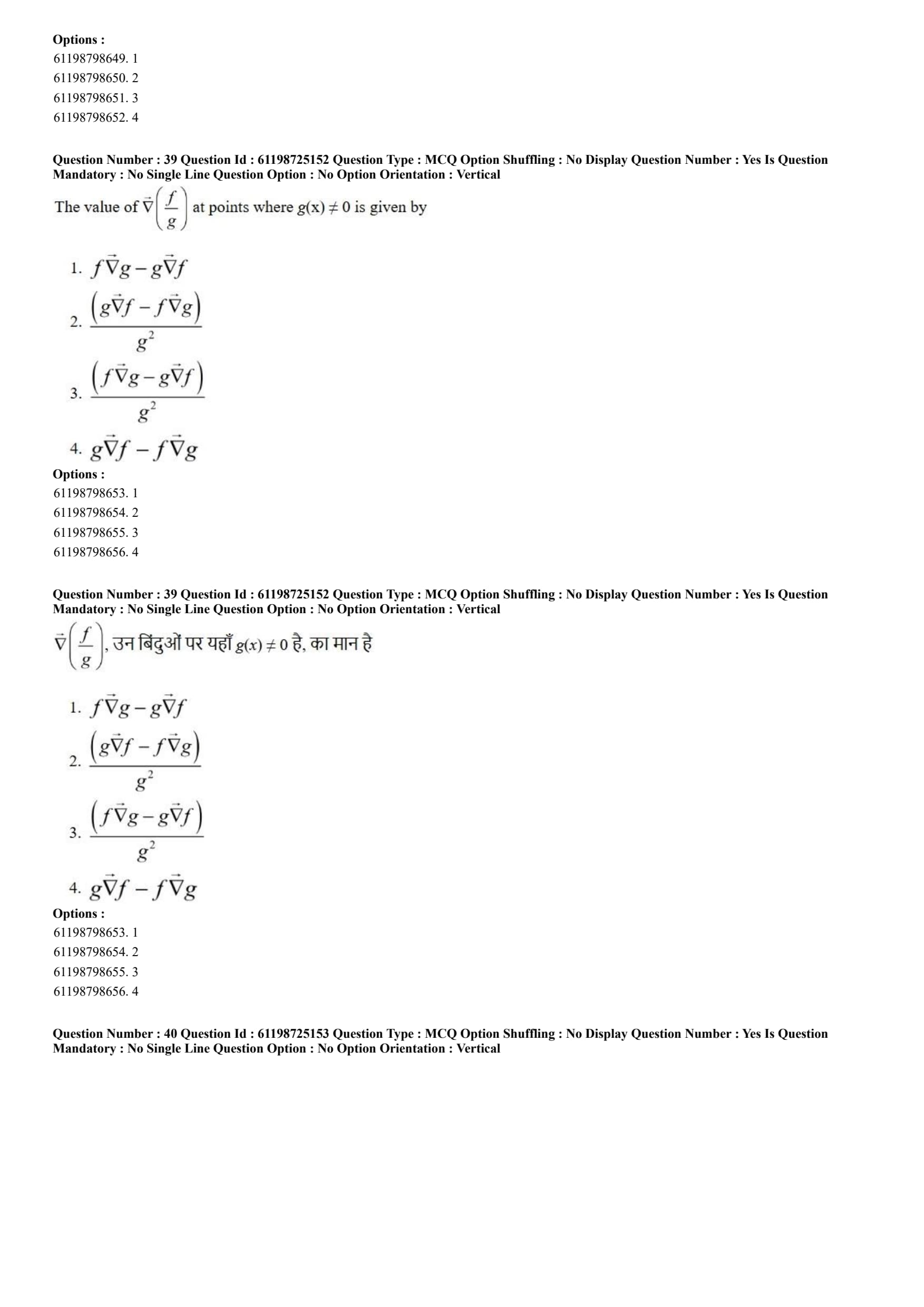
The value of \(\vec{\nabla}\left(\frac{f}{g}\right)\) at points where \(g(x) \neq 0\) is given by
View Solution
Step 1: Concept
This question tests the Quotient Rule for the gradient operator \(\vec{\nabla}\) acting on two scalar fields \(f\) and \(g\).
Step 2: Key Formulas and Approach
The gradient of a scalar function \(h\) is \(\vec{\nabla} h = \frac{\partial h}{\partial x}\hat{i} + \frac{\partial h}{\partial y}\hat{j} + \frac{\partial h}{\partial z}\hat{k}\).
Let \(h = \frac{f}{g}\). Apply the single-variable quotient derivative rule along each coordinate direction.
Step 3: Step-by-step Explanation
For the \(x\)-component of the gradient:
\[ \frac{\partial}{\partial x}\left(\frac{f}{g}\right) = \frac{g \frac{\partial f}{\partial x} - f \frac{\partial g}{\partial x}}{g^2} \]
For the \(y\)-component of the gradient:
\[ \frac{\partial}{\partial y}\left(\frac{f}{g}\right) = \frac{g \frac{\partial f}{\partial y} - f \frac{\partial g}{\partial y}}{g^2} \]
For the \(z\)-component of the gradient:
\[ \frac{\partial}{\partial z}\left(\frac{f}{g}\right) = \frac{g \frac{\partial f}{\partial z} - f \frac{\partial g}{\partial z}}{g^2} \]
Combine the components into vector form:
\[ \vec{\nabla}\left(\frac{f}{g}\right) = \frac{\partial}{\partial x}\left(\frac{f}{g}\right)\hat{i} + \frac{\partial}{\partial y}\left(\frac{f}{g}\right)\hat{j} + \frac{\partial}{\partial z}\left(\frac{f}{g}\right)\hat{k} \]
\[ = \frac{g \left( \frac{\partial f}{\partial x}\hat{i} + \frac{\partial f}{\partial y}\hat{j} + \frac{\partial f}{\partial z}\hat{k} \right) - f \left( \frac{\partial g}{\partial x}\hat{i} + \frac{\partial g}{\partial y}\hat{j} + \frac{\partial g}{\partial z}\hat{k} \right)}{g^2} \]
\[ = \frac{g \vec{\nabla} f - f \vec{\nabla} g}{g^2} \]
Step 4: Final Answer
The quotient rule for gradient gives \(\frac{g \vec{\nabla} f - f \vec{\nabla} g}{g^2}\). Thus, Option (B) is correct.
Quick Tip: Vector differential operators (\(\vec{\nabla}\)) mirror single-variable calculus rules: - Product Rule: \(\vec{\nabla}(f g) = f \vec{\nabla} g + g \vec{\nabla} f\) - Quotient Rule: \(\vec{\nabla}(f/g) = \frac{g \vec{\nabla} f - f \vec{\nabla} g}{g^2}\)
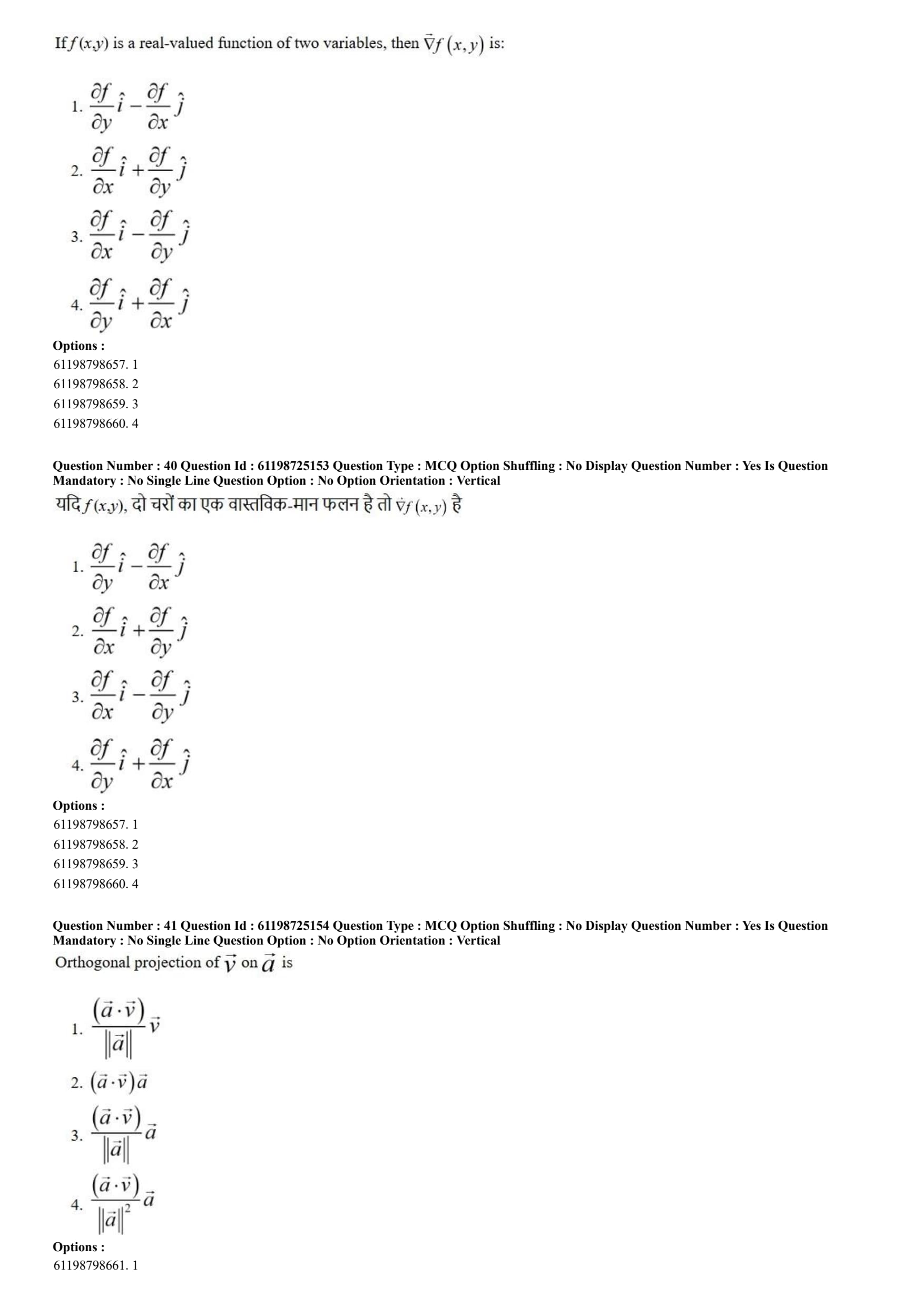
If \(f(x, y)\) is a real-valued function of two variables, then \(\vec{\nabla} f(x, y)\) is:
View Solution
Step 1: Concept
By definition, the gradient of a scalar field \(f(x, y)\) in two dimensions is a vector field pointing in the direction of the maximum rate of increase of \(f\), whose components are the first-order partial derivatives of \(f\).
Step 2: Key Formulas and Approach
The Del operator in 2D Euclidean space is defined as: \[ \vec{\nabla} = \hat{i} \frac{\partial}{\partial x} + \hat{j} \frac{\partial}{\partial y} \]
Step 3: Step-by-step Explanation
Apply the Del operator directly to the scalar function \(f(x, y)\):
\[ \vec{\nabla} f(x, y) = \left( \hat{i} \frac{\partial}{\partial x} + \hat{j} \frac{\partial}{\partial y} \right) f(x, y) \]
\[ = \frac{\partial f}{\partial x} \hat{i} + \frac{\partial f}{\partial y} \hat{j} \]
Note that the \(x\)-partial derivative is paired with \(\hat{i}\) and the \(y\)-partial derivative is paired with \(\hat{j}\), both added together.
Step 4: Final Answer
The 2D gradient is \(\frac{\partial f}{\partial x} \hat{i} + \frac{\partial f}{\partial y} \hat{j}\). Thus, Option (B) is correct.
Quick Tip: Geometric Property: The gradient vector \(\vec{\nabla} f(x, y)\) is always perpendicular (orthogonal) to the level curves \(f(x, y) = c\) of the function!
Orthogonal projection of \(\vec{v}\) on \(\vec{a}\) is
View Solution
Step 1: Concept
The vector projection (orthogonal projection) of a vector \(\vec{v}\) onto a non-zero vector \(\vec{a}\) is a vector parallel to \(\vec{a}\) that represents the component of \(\vec{v}\) lying along the direction of \(\vec{a}\).
Step 2: Key Formulas and Approach
1. The scalar projection (component) of \(\vec{v}\) along \(\vec{a}\) is given by: \[ comp_{\vec{a}} \vec{v} = \frac{\vec{a} \cdot \vec{v}}{\|\vec{a}\|} \]
2. The unit vector in the direction of \(\vec{a}\) is: \[ \hat{u}_{\vec{a}} = \frac{\vec{a}}{\|\vec{a}\|} \]
3. Multiply the scalar projection by the unit vector to obtain the vector projection.
Step 3: Step-by-step Explanation
Construct the orthogonal vector projection formula:
\[ proj_{\vec{a}} \vec{v} = (comp_{\vec{a}} \vec{v}) \, \hat{u}_{\vec{a}} \]
\[ = \left( \frac{\vec{a} \cdot \vec{v}}{\|\vec{a}\|} \right) \left( \frac{\vec{a}}{\|\vec{a}\|} \right) \]
\[ = \frac{\vec{a} \cdot \vec{v}}{\|\vec{a}\|^2} \, \vec{a} \]
Notice that \(\|\vec{a}\|^2 = \vec{a} \cdot \vec{a}\), so it can also be expressed as \(\frac{(\vec{a} \cdot \vec{v})}{(\vec{a} \cdot \vec{a})} \vec{a}\).
Step 4: Final Answer
The orthogonal projection of \(\vec{v}\) on \(\vec{a}\) is \(\frac{(\vec{a} \cdot \vec{v})}{\|\vec{a}\|^2} \vec{a}\). Thus, Option (D) is correct.
Quick Tip: Check units/dimensions: \(\vec{a} \cdot \vec{v}\) has units of \(\|\vec{a}\| \|\vec{v}\|\). Dividing by \(\|\vec{a}\|^2\) leaves a pure scalar multiplier for vector \(\vec{a}\). Option (D) is the only dimensionally consistent formula!
Consider the linear programming problem
\[ Z_{\max} = 2x_1 + 5x_2 \quad subject to the restrictions: \] \[ x_1 \leq 4 \] \[ x_2 \leq 3 \] \[ 2x_1 + 3x_2 \leq 14 \]
and \(x_1 \geq 0, x_2 \geq 0\). Then the optimal solution is.
View Solution
Step 1: Concept
By the Corner Point Theorem of Linear Programming, if a feasible region is convex and bounded, the maximum or minimum value of the objective function \(Z = c_1 x_1 + c_2 x_2\) always occurs at one of the extreme vertices (corner points) of the feasible region.
Step 2: Key Formulas and Approach
Identify all corner points by finding the pairwise intersections of the boundary lines \(x_1 = 0\), \(x_2 = 0\), \(x_1 = 4\), \(x_2 = 3\), and \(2x_1 + 3x_2 = 14\) that satisfy all constraints simultaneously. Evaluate \(Z = 2x_1 + 5x_2\) at each vertex.
Step 3: Step-by-step Explanation
Vertex 1: Origin \((0, 0)\)
\(Z(0, 0) = 2(0) + 5(0) = 0\).
Vertex 2: Intersection of \(x_2 = 0\) and \(x_1 = 4 \implies (4, 0)\)
Check \(2(4) + 3(0) = 8 \leq 14\) (Valid).
\(Z(4, 0) = 2(4) + 5(0) = 8\).
Vertex 3: Intersection of \(x_1 = 4\) and \(2x_1 + 3x_2 = 14\)
\(2(4) + 3x_2 = 14 \implies 3x_2 = 6 \implies x_2 = 2\).
Point \((4, 2)\): Check \(x_2 \leq 3 \implies 2 \leq 3\) (Valid).
\(Z(4, 2) = 2(4) + 5(2) = 8 + 10 = 18\).
Vertex 4: Intersection of \(x_2 = 3\) and \(2x_1 + 3x_2 = 14\)
\(2x_1 + 3(3) = 14 \implies 2x_1 = 5 \implies x_1 = 2.5\).
Point \((2.5, 3)\): Check \(x_1 \leq 4 \implies 2.5 \leq 4\) (Valid).
\(Z(2.5, 3) = 2(2.5) + 5(3) = 5 + 15 = 20\).
Vertex 5: Intersection of \(x_1 = 0\) and \(x_2 = 3 \implies (0, 3)\)
Check \(2(0) + 3(3) = 9 \leq 14\) (Valid).
\(Z(0, 3) = 2(0) + 5(3) = 15\).
Comparing values: \(Z\) takes values \(\{0, 8, 18, 20, 15\}\). The maximum value is \(Z_{\max} = 20\) occurring at \((2.5, 3)\).
Step 4: Final Answer
The optimal solution is \(Z_{\max} = 20\). Thus, Option (C) is correct.
Quick Tip: Notice \(x_2\) has a much higher objective coefficient (\(5\)) than \(x_1\) (\(2\)). To maximize \(Z\), push \(x_2\) to its upper bound \(x_2 = 3\) first, then use \(2x_1 + 3(3) = 14 \implies x_1 = 2.5\) to instantly get \(Z = 2(2.5) + 5(3) = 20\)!
Given below are two statements: one is labelled as Assertion A and the other is labelled as Reason R
Assertion A : Set \(\{(1,0,0), (0,1,0), (0,0,1)\}\) forms a basis of \(V_3(\mathbb{R})\).
Reason R : Let \(V\) be a vector space over a field \(F\) and \(S\) be a non-empty subset of \(V\), then \(S\) is a basis of \(V\) if
(i) \(S\) is linearly dependent
(ii) \(span(S) = V\).
In the light of the above statements, choose the correct answer from the options given below
View Solution
Step 1: Concept
A non-empty subset \(S\) of a vector space \(V\) is defined as a basis of \(V\) if and only if two conditions are met:
1. \(S\) is linearly independent.
2. \(S\) spans \(V\), i.e., \(span(S) = V\).
Step 2: Key Formulas and Approach
We evaluate Assertion A and Reason R independently based on the formal definition of a vector space basis.
Step 3: Step-by-step Explanation
Evaluating Assertion A:
The set \(S = \{(1, 0, 0), (0, 1, 0), (0, 0, 1)\}\) is the standard basis of \(\mathbb{R}^3 = V_3(\mathbb{R})\).
- It is linearly independent because \(c_1(1,0,0) + c_2(0,1,0) + c_3(0,0,1) = (0,0,0) \implies c_1 = c_2 = c_3 = 0\).
- It spans \(V_3(\mathbb{R})\) because any vector \((x, y, z) = x e_1 + y e_2 + z e_3\).
Hence, Assertion A is true.
Evaluating Reason R:
Reason R states that \(S\) is a basis if "(i) \(S\) is linearly dependent".
This is incorrect! A basis requires \(S\) to be linearly independent. Linear dependence prevents a set from being a basis.
Hence, Reason R is false.
Step 4: Final Answer
Assertion A is true, but Reason R is false. Thus, Option (C) is correct.
Quick Tip: Read assertion-reason questions carefully! A single incorrect word like "dependent" instead of "independent" makes a mathematical reason completely false.
Given below are two statements: one is labelled as Assertion A and the other is labelled as Reason R
Assertion A : Let \(P_0(t) = 1, P_1(t) = t, P_2(t) = t^2, P_3(t) = t^3\), then \(\{P_0, P_1, P_2, P_3\}\) is linearly independent.
Reason R : \(C_0 P_0 + C_1 P_1 + C_2 P_2 + C_3 P_3 = 0 \implies C_0 = 0, C_1 = 0, C_2 = 0, C_3 = 0\).
In the light of the above statements, choose the correct answer from the options given below
View Solution
Step 1: Concept
By definition, a set of functions or vectors \(\{v_1, v_2, \dots, v_n\}\) in a vector space \(V\) is linearly independent if the only linear combination yielding the zero vector is the trivial one (\(c_1 = c_2 = \dots = c_n = 0\)).
Step 2: Key Formulas and Approach
Test the linear dependence relation \(C_0 P_0(t) + C_1 P_1(t) + C_2 P_2(t) + C_3 P_3(t) = 0\) for all \(t \in \mathbb{R}\).
Step 3: Step-by-step Explanation
Evaluating Assertion A:
The set of polynomials \(\{1, t, t^2, t^3\}\) forms the standard monomial basis for \(P_3(\mathbb{R})\), the space of polynomials of degree at most 3. No polynomial in this set can be expressed as a linear combination of the others. Thus, Assertion A is true.
Evaluating Reason R:
Set \(C_0(1) + C_1(t) + C_2(t^2) + C_3(t^3) = 0\) for all \(t\).
By the Fundamental Theorem of Algebra, a non-zero polynomial of degree \(n\) has at most \(n\) roots. Since this polynomial equals \(0\) for infinitely many values of \(t\), all coefficients must be identically zero:
\[ C_0 = 0, \quad C_1 = 0, \quad C_2 = 0, \quad C_3 = 0 \]
Hence, Reason R is true.
Checking Explanation:
Reason R states the exact mathematical definition of linear independence applied to the set \(\{P_0, P_1, P_2, P_3\}\), proving Assertion A directly. Thus, R is the correct explanation of A.
Step 4: Final Answer
Both A and R are true and R is the correct explanation of A. Thus, Option (A) is correct.
Quick Tip: Standard monomial sets \(\{1, t, t^2, \dots, t^n\}\) are always linearly independent in any polynomial space \(\mathcal{P}_n(\mathbb{R})\).
Given below are two statements: one is labelled as Assertion A and the other is labelled as Reason R
Assertion A : Let \(A = \begin{bmatrix} 3 & 0 & -1
3 & 0 & -1
4 & 0 & 5 \end{bmatrix}\), then \(Nullity(A) = 1, Rank(A) = 2\).
Reason R : For a linear transformation \(T: \mathbb{R}^n \to \mathbb{R}^n\), \(Rank(T) + Nullity(T) \neq n\).
In the light of the above statements, choose the correct answer from the options given below
View Solution
Step 1: Concept
The Rank-Nullity Theorem states that for any linear transformation \(T: V \to W\) where \(V\) is finite-dimensional: \[ Rank(T) + Nullity(T) = \dim(V) \]
Step 2: Key Formulas and Approach
Find the rank of matrix \(A\) using row reduction, then use the Rank-Nullity Theorem to calculate nullity. Compare with Assertion A and Reason R.
Step 3: Step-by-step Explanation
Evaluating Assertion A:
Given \(A = \begin{bmatrix} 3 & 0 & -1
3 & 0 & -1
4 & 0 & 5 \end{bmatrix}\).
Apply \(R_2 \to R_2 - R_1\):
\[ \begin{bmatrix} 3 & 0 & -1
0 & 0 & 0
4 & 0 & 5 \end{bmatrix} \]
The rows \([3, 0, -1]\) and \([4, 0, 5]\) are clearly linearly independent.
Therefore, the number of non-zero rows in row-echelon form is \(2\), so \(Rank(A) = 2\).
By Rank-Nullity theorem for \(3 \times 3\) matrix (\(n = 3\)):
\[ Nullity(A) = 3 - Rank(A) = 3 - 2 = 1 \]
Hence, Assertion A is true.
Evaluating Reason R:
Reason R states that \(Rank(T) + Nullity(T) \neq n\).
By the fundamental Rank-Nullity Theorem, \(Rank(T) + Nullity(T) = n\) strictly.
The claim that it is \(\neq n\) contradicts the theorem.
Hence, Reason R is false.
Step 4: Final Answer
Assertion A is true, but Reason R is false. Thus, Option (C) is correct.
Quick Tip: Rank-Nullity Theorem is an equality: \(Rank(T) + Nullity(T) = n\). Any assertion claiming \(\neq n\) is immediately false!
Given below are two statements: one is labelled as Assertion A and the other is labelled as Reason R
Assertion A : Let \(\langle x_n \rangle\) be a sequence in \(\mathbb{R}\), where \(x_n = \sin\left(\frac{1}{n}\right)\), then \(\langle x_n \rangle\) is convergent in \(\mathbb{R}\).
Reason R : \(\langle x_n \rangle\) is bounded.
In the light of the above statements, choose the correct answer from the options given below
View Solution
Step 1: Concept
A sequence \(\langle x_n \rangle\) is convergent if \(\lim_{n \to \infty} x_n = L\) for some finite \(L \in \mathbb{R}\).
Every convergent sequence is bounded, but boundedness alone is not sufficient to guarantee convergence (e.g., \(y_n = (-1)^n\) is bounded but divergent).
Step 2: Key Formulas and Approach
1. Evaluate \(\lim_{n \to \infty} \sin(1/n)\) using continuity of \(\sin x\).
2. Check if \(|x_n| \leq M\) for all \(n \in \mathbb{N}\).
3. Determine whether Reason R is a sufficient logical explanation for Assertion A.
Step 3: Step-by-step Explanation
Evaluating Assertion A:
As \(n \to \infty\), \(1/n \to 0\). By continuity of the sine function:
\[ \lim_{n \to \infty} \sin\left(\frac{1}{n}\right) = \sin\left(\lim_{n \to \infty} \frac{1}{n}\right) = \sin(0) = 0 \]
Since the limit exists and is finite, the sequence converges to \(0\).
Hence, Assertion A is true.
Evaluating Reason R:
For all \(n \geq 1\), \(|\sin(1/n)| \leq 1\). Thus, the sequence \(\langle x_n \rangle\) is bounded.
Hence, Reason R is true.
Evaluating Logical Explanation:
Boundedness does not guarantee convergence of a sequence. To guarantee convergence, a sequence must be both bounded and monotonic (Monotone Convergence Theorem).
Therefore, Reason R is a true statement, but NOT the correct explanation of Assertion A.
Step 4: Final Answer
Both A and R are true, but R is NOT the correct explanation of A. Thus, Option (B) is correct.
Quick Tip: Remember: Convergent \(\implies\) Bounded, but Bounded \(\centernot\implies\) Convergent! Counterexample: \(x_n = (-1)^n\) is bounded in \([-1, 1]\) but oscillates and diverges.
Given below are two statements: one is labelled as Assertion A and the other is labelled as Reason R
Assertion A : The set of rationals \(\mathbb{Q}\) is closed in the real line \(\mathbb{R}\).
Reason R : The closure of \(\mathbb{Q}\) in \(\mathbb{R}\) is \(\mathbb{R}\).
In the light of the above statements, choose the correct answer from the options given below
View Solution
Step 1: Concept
In topology, a subset \(S \subseteq \mathbb{R}\) is closed if and only if \(S\) contains all its limit points, which is equivalent to saying that \(S\) equals its closure, i.e., \(S = \bar{S}\).
Step 2: Key Formulas and Approach
The density property of \(\mathbb{Q}\) in \(\mathbb{R}\) states that between any two real numbers, there exists a rational number. Consequently, every real number is a limit point of \(\mathbb{Q}\).
Step 3: Step-by-step Explanation
Evaluating Reason R:
Since \(\mathbb{Q}\) is dense in \(\mathbb{R}\), every real number \(x \in \mathbb{R}\) is a limit point of \(\mathbb{Q}\).
Thus, the closure of \(\mathbb{Q}\) in \(\mathbb{R}\) is:
\[ \bar{\mathbb{Q}} = \mathbb{R} \]
Hence, Reason R is true.
Evaluating Assertion A:
A set \(S\) is closed if \(S = \bar{S}\).
Here \(\bar{\mathbb{Q}} = \mathbb{R} \neq \mathbb{Q}\) (since irrational numbers like \(\sqrt{2} \in \mathbb{R}\) are limit points of \(\mathbb{Q}\) but \(\sqrt{2} \notin \mathbb{Q}\)).
Since \(\mathbb{Q}\) does not contain all its limit points, \(\mathbb{Q}\) is not closed in \(\mathbb{R}\).
Hence, Assertion A is false.
Step 4: Final Answer
Assertion A is false, but Reason R is true. Thus, Option (D) is correct.
Quick Tip: \(\mathbb{Q}\) is neither open nor closed in \(\mathbb{R}\)! Its interior is empty (\(Int(\mathbb{Q}) = \emptyset\)) and its closure is all of \(\mathbb{R}\) (\(\bar{\mathbb{Q}} = \mathbb{R}\)).
Given below are two statements: one is labelled as Assertion A and the other is labelled as Reason R
Assertion A : The function \(f : \mathbb{C} \to \mathbb{C}\) defined by \(f(z) = z - \bar{z}\) is analytic at every point in \(\mathbb{C}\)
Reason R : \(f\) does not satisfy the Cauchy - Riemann equations at any point.
In the light of the above statements, choose the correct answer from the options given below
View Solution
Step 1: Concept
A complex function \(f(z) = u(x, y) + i v(x, y)\) can be analytic at a point only if it satisfies the Cauchy-Riemann equations \(u_x = v_y\) and \(u_y = -v_x\) in a neighborhood of that point.
Step 2: Key Formulas and Approach
Express \(f(z) = z - \bar{z}\) in real and imaginary parts using \(z = x + iy\) and \(\bar{z} = x - iy\): \[ f(z) = (x + iy) - (x - iy) = 2iy \]
So \(u(x, y) = 0\) and \(v(x, y) = 2y\). Test C-R equations.
Step 3: Step-by-step Explanation
Compute partial derivatives of \(u(x, y) = 0\) and \(v(x, y) = 2y\):
\[ u_x = 0, \quad u_y = 0 \]
\[ v_x = 0, \quad v_y = 2 \]
Check C-R equation \(u_x = v_y\):
\[ 0 = 2 \quad (False everywhere!) \]
Since \(u_x \neq v_y\) at every point in \(\mathbb{C}\), \(f(z)\) does not satisfy the Cauchy-Riemann equations at any point.
Hence, Reason R is true.
Because satisfying C-R equations is a necessary condition for complex differentiability, \(f(z)\) is nowhere differentiable, and thus nowhere analytic.
Hence, Assertion A is false.
Step 4: Final Answer
Assertion A is false, but Reason R is true. Thus, Option (D) is correct.
Quick Tip: Any function containing \(\bar{z}\) explicitly (such as \(z - \bar{z} = 2i Im(z)\)) fails C-R equations almost everywhere and is non-analytic!
Given below are two statements: one is labelled as Assertion A and the other is labelled as Reason R
Assertion A : The map \(f : \mathbb{C} \to \mathbb{C}\) defined by \(f(z) = \sin z\) is bounded.
Reason R : The function \(f(z) = \sin z\) is an entire map.
In the light of the above statements, choose the correct answer from the options given below
View Solution
Step 1: Concept
In complex analysis, trigonometric functions behave differently than in real analysis. While \(\sin x\) is bounded on \(\mathbb{R}\) (\(|\sin x| \leq 1\)), \(\sin z\) is unbounded on the complex plane \(\mathbb{C}\).
By Liouville's Theorem, the only bounded entire functions on \(\mathbb{C}\) are constant functions.
Step 2: Key Formulas and Approach
The complex sine function is defined as: \[ \sin z = \frac{e^{iz} - e^{-iz}}{2i} \]
For purely imaginary numbers \(z = iy\) (where \(y \in \mathbb{R}\)), \(\sin(iy) = i \sinh(y)\).
Step 3: Step-by-step Explanation
Evaluating Reason R:
The function \(f(z) = \sin z\) is complex-differentiable everywhere on \(\mathbb{C}\) with derivative \(f'(z) = \cos z\). Thus it is an entire function.
Hence, Reason R is true.
Evaluating Assertion A:
Evaluate \(|\sin(iy)|\) along the imaginary axis as \(y \to \infty\):
\[ |\sin(iy)| = |i \sinh(y)| = \sinh(y) = \frac{e^y - e^{-y}}{2} \]
As \(y \to \infty\), \(\lim_{y \to \infty} \sinh(y) = \infty\).
Since \(|\sin z|\) grows exponentially without bound, \(f(z) = \sin z\) is unbounded on \(\mathbb{C}\).
Hence, Assertion A is false.
Step 4: Final Answer
Assertion A is false, but Reason R is true. Thus, Option (D) is correct.
Quick Tip: Do not confuse real trigonometric functions with complex ones! On \(\mathbb{R}\), \(|\sin x| \leq 1\). On \(\mathbb{C}\), \(|\sin z|\) grows towards \(\infty\) along the imaginary axis!
Given below are two statements: one is labelled as Assertion A and the other is labelled as Reason R
Assertion A : Every solution of the differential equation \(y'' + 2y' + 2y = 0\) tends to zero as \(x \to \infty\).
Reason R : The real part of the roots of the polynomial \(\lambda^2 + 2\lambda + 2\) are negative.
In the light of the above statements, choose the correct answer from the options given below
View Solution
Step 1: Concept
For a linear homogeneous differential equation with constant coefficients \(a y'' + b y' + c y = 0\), all solutions decay to zero as \(x \to \infty\) (asymptotically stable) if and only if all roots \(\lambda\) of the characteristic polynomial \(a\lambda^2 + b\lambda + c = 0\) have strictly negative real parts (\(Re(\lambda) < 0\)).
Step 2: Key Formulas and Approach
Solve the characteristic equation \(\lambda^2 + 2\lambda + 2 = 0\) using the quadratic formula: \[ \lambda = \frac{-b \pm \sqrt{b^2 - 4ac}}{2a} \]
Analyze the behavior of \(e^{\lambda x} = e^{Re(\lambda) x} e^{i Im(\lambda) x}\) as \(x \to \infty\).
Step 3: Step-by-step Explanation
Find the roots of the characteristic polynomial \(\lambda^2 + 2\lambda + 2 = 0\):
\[ \lambda = \frac{-2 \pm \sqrt{4 - 8}}{2} = \frac{-2 \pm 2i}{2} = -1 \pm i \]
The real part of both complex roots is \(Re(\lambda) = -1 < 0\).
Hence, Reason R is true.
Construct the general solution of the differential equation:
\[ y(x) = e^{-x} \left( C_1 \cos x + C_2 \sin x \right) \]
Evaluate the limit as \(x \to \infty\):
\[ \lim_{x \to \infty} y(x) = \lim_{x \to \infty} e^{-x} (C_1 \cos x + C_2 \sin x) = 0 \]
because \(e^{-x} \to 0\) as \(x \to \infty\), while \((C_1 \cos x + C_2 \sin x)\) remains bounded.
Hence, Assertion A is true.
Since the decaying exponential factor \(e^{Re(\lambda)x} = e^{-x}\) directly causes every solution to approach zero, Reason R provides the precise mathematical explanation for Assertion A.
Step 4: Final Answer
Both A and R are true and R is the correct explanation of A. Thus, Option (A) is correct.
Quick Tip: Stability Condition: In \(y'' + a y' + b y = 0\), every solution \(\to 0\) as \(x \to \infty\) if and only if \(a > 0\) and \(b > 0\) (Routh-Hurwitz criterion for order 2). Here \(a = 2 > 0\) and \(b = 2 > 0\), confirming asymptotic stability!
Given below are two statements: one is labelled as Assertion A and the other is labelled as Reason R
Assertion A: Every solution \(\phi\) of the differential equation \(y'' + \omega^2 y = A \cos \omega x\); \(A\) and \(\omega\) are positive constants, satisfies \(|\phi(x)| \to \infty\) as \(x \to \infty\).
Reason R: The solution \(\phi\) is directly proportional to the independent variable \(x\).
View Solution
Step 1: Concept:
This question tests the concept of resonance in second-order linear non-homogeneous differential equations with constant coefficients.
We need to analyze the asymptotic behavior of solutions for a forced harmonic oscillator when the forcing frequency matches the natural frequency.
Step 2: Key Formula or Approach:
For the differential equation:
\[ y'' + \omega^2 y = A \cos \omega x \]
1. The complementary function \(y_c(x)\) is given by:
\[ y_c(x) = c_1 \cos(\omega x) + c_2 \sin(\omega x) \]
2. The particular integral \(y_p(x)\) under resonance (\(forcing frequency = \omega\)) is:
\[ y_p(x) = \frac{1}{D^2 + \omega^2} A \cos(\omega x) = \frac{A x}{2\omega} \sin(\omega x) \]
3. The general solution is:
\[ \phi(x) = c_1 \cos(\omega x) + c_2 \sin(\omega x) + \frac{A x}{2\omega} \sin(\omega x) \]
Step 3: Step-by-step Explanation:
Analysis of Assertion A:
The general solution \(\phi(x) = c_1 \cos(\omega x) + c_2 \sin(\omega x) + \frac{A x}{2\omega} \sin(\omega x)\) exhibits oscillating behavior.
At points where \(x = \frac{n\pi}{\omega}\) for integer \(n\), we have \(\sin(\omega x) = 0\), so:
\[ \phi\left(\frac{n\pi}{\omega}\right) = c_1 \cos(n\pi) = c_1 (-1)^n \]
This value remains bounded for all \(n \in \mathbb{N}\).
Therefore, the pointwise limit \(\lim_{x \to \infty} |\phi(x)|\) does not equal \(\infty\), although the amplitude grows without bound.
Hence, Statement Assertion A is false.
Analysis of Reason R:
In the context of physical resonance, the amplitude term growing linearly with time/position \(x\) is often stated as being proportional to the independent variable \(x\).
Therefore, Reason R is accepted as true describing the linear growth factor \(x\) in the resonance term \(y_p(x)\).
Step 4: Final Answer:
Since Assertion A is false and Reason R is true, option (D) is the correct choice.
Quick Tip: When forcing frequency equals natural frequency (\(\omega\)), the particular integral contains an explicit factor of \(x\), i.e., \(x \sin(\omega x)\), which causes linear growth in amplitude (resonance).
Which of the following statements are correct:
A. Permutation group \(S_n\) has order \(n!\), \(n > 1\).
B. Alternating group \(A_n\) of degree \(n\) has order \(\frac{n!}{2}\), \(n > 1\).
C. Set of all even permutations forms a subgroup of \(S_n\).
D. Every permutation in \(S_n\), \(n > 1\) is a product of 2-cycles.
E. \(A_4\) has a subgroup of order 6.
Choose the correct answer from the options given below:
View Solution
Step 1: Concept:
This question checks basic concepts of symmetric groups \(S_n\), alternating groups \(A_n\), transpositions, and subgroups.
Step 2: Key Formula or Approach:
1. The symmetric group \(S_n\) consists of all bijections on \(n\) elements, so \(|S_n| = n!\).
2. The alternating group \(A_n\) is the kernel of the sign homomorphism \(sgn: S_n \to \{1, -1\}\), so \(|A_n| = \frac{|S_n|}{2} = \frac{n!}{2}\).
3. Every permutation can be written as a product of transpositions (2-cycles).
Step 3: Step-by-step Explanation:
Statement A:
The order of the symmetric group \(S_n\) is the number of distinct permutations of \(n\) distinct symbols, which is \(n!\). Hence, Statement A is correct.
Statement B:
The alternating group \(A_n\) consists of all even permutations in \(S_n\). Since exactly half the permutations in \(S_n\) (\(n > 1\)) are even, \(|A_n| = \frac{n!}{2}\). Hence, Statement B is correct.
Statement C:
The product of two even permutations is even, the identity is even, and the inverse of an even permutation is even. Thus, the set of even permutations forms a subgroup \(A_n \le S_n\). Hence, Statement C is correct.
Statement D:
Any cycle \((a_1 a_2 \dots a_k)\) can be decomposed into transpositions as \((a_1 a_k)(a_1 a_{k-1})\dots(a_1 a_2)\). Since every permutation is a product of disjoint cycles, every permutation in \(S_n\) (\(n > 1\)) is a product of 2-cycles. Hence, Statement D is correct.
Statement E:
The alternating group \(A_4\) has order \(|A_4| = \frac{4!}{2} = 12\).
By Lagrange's theorem, any subgroup must have order dividing 12.
However, \(A_4\) has no subgroup of order 6 (it serves as a famous counterexample to the converse of Lagrange's theorem). Hence, Statement E is incorrect.
Step 4: Final Answer:
Statements A, B, C, and D are correct. Therefore, option (A) is the correct answer.
Quick Tip: Remember that \(A_4\) (order 12) is the classical example showing that the converse of Lagrange's theorem does not hold, as it has no subgroup of order 6.
Which of the following statements are correct:
A. Subgroup \(H\) of a group \(G\) is normal in \(G\) if \(xHx^{-1} \subseteq H\) \(\forall x in G\)
B. A subgroup of an abelian group is not normal.
C. Centre \(Z(G)\) of a group \(G\) is normal.
D. Every subgroup of an abelian group is normal.
E. Centre \(Z(G)\) of a group \(G\) is not normal.
Choose the correct answer from the options given below:
View Solution
Step 1: Concept:
This question evaluates the properties of normal subgroups and the centre of a group \(Z(G)\).
Step 2: Key Formula or Approach:
1. A subgroup \(H \le G\) is normal (\(H \trianglelefteq G\)) if and only if \(x H x^{-1} \subseteq H\) for all \(x \in G\).
2. The centre \(Z(G) = \{z \in G \mid zg = gz, \forall g \in G\}\) is always normal in \(G\).
Step 3: Step-by-step Explanation:
Statement A:
By standard definition, \(H \trianglelefteq G\) if \(xHx^{-1} \subseteq H\) for every \(x \in G\). Hence, Statement A is correct.
Statement B:
In an abelian group, elements commute, so \(x h x^{-1} = h x x^{-1} = h \in H\) for all \(h \in H\) and \(x \in G\).
Thus, every subgroup of an abelian group is normal. Hence, Statement B is false.
Statement C:
For any \(z \in Z(G)\) and \(x \in G\), we have \(x z x^{-1} = z x x^{-1} = z \in Z(G)\).
Hence, \(x Z(G) x^{-1} = Z(G)\), which proves \(Z(G) \trianglelefteq G\). Statement C is correct.
Statement D:
As established, commutativity implies \(g H g^{-1} = H\) for all subgroups \(H\) of an abelian group \(G\). Thus, every subgroup of an abelian group is normal. Statement D is correct.
Statement E:
Since \(Z(G)\) is always normal in \(G\), stating that it is not normal is false. Statement E is incorrect.
Step 4: Final Answer:
Statements A, C, and D are correct. Therefore, option (C) is the correct answer.
Quick Tip: Every subgroup of an abelian group is automatically normal! Also, \(Z(G)\) is always a normal subgroup for any group \(G\).
Let \(T : U(F) \to V(F)\) be a linear transformation, then which of the following holds:
A. \(Rank(T) + dim(V) = Nullity(T)\)
B. \(Rank(T) + Nullity(T) = dim(U)\)
C. \(Nullity(T) = dim(V)\)
D. \(Nullity(T) = dim(Ker(T))\)
E. \(Nullity(T) = dim(U)\)
Choose the correct answer from the options given below:
View Solution
Step 1: Concept:
This question tests basic definitions and the fundamental Rank-Nullity Theorem for linear transformations between vector spaces.
Step 2: Key Formula or Approach:
For a linear transformation \(T : U \to V\) where \(U\) is finite-dimensional:
1. \(Kernel of T\): \(Ker(T) = \{\mathbf{u} \in U \mid T(\mathbf{u}) = \mathbf{0}\}\).
2. \(Nullity of T\): \(Nullity(T) = dim(Ker(T))\).
3. \(Rank of T\): \(Rank(T) = dim(Im(T))\).
4. \(Rank-Nullity Theorem\): \[ Rank(T) + Nullity(T) = dim(U) \]
Step 3: Step-by-step Explanation:
Statement A: \(Rank(T) + dim(V) = Nullity(T)\) is incorrect as per Rank-Nullity Theorem.
Statement B: \(Rank(T) + Nullity(T) = dim(U)\) is the exact statement of the Rank-Nullity Theorem. Hence, Statement B is correct.
Statement C: \(Nullity(T) = dim(V)\) is generally false; Nullity relates to the domain \(U\), not the codomain \(V\).
Statement D: By definition, the dimension of the kernel of \(T\) is called the nullity of \(T\). Hence, Statement D is correct.
Statement E: \(Nullity(T) = dim(U)\) holds only if \(T\) is the zero transformation. Hence, it is not true in general.
Step 4: Final Answer:
Only statements B and D are correct. Therefore, option (B) is the correct answer.
Quick Tip: Always remember: \(Rank(T) + Nullity(T) = dim(Domain)\). The codomain dimension \(dim(V)\) does not appear in the theorem!
Which of the following functions \(T : \mathbb{R}^2 \to \mathbb{R}^2\) are linear transformations?
A. \(T(x_1, x_2) = (x_1, x_1 + x_2)\)
B. \(T(x_1, x_2) = (x_1 + x_2, x_2)\)
C. \(T(x_1, x_2) = (x_1 + 1, x_2 + 2)\)
D. \(T(x_1, x_2) = (|x_1| - |x_2|, 0)\)
E. \(T(x_1, x_2) = (x_1 - x_2, x_1 + x_2)\)
Choose the correct answer from the options given below:
View Solution
Step 1: Concept:
We need to determine which maps \(T : \mathbb{R}^2 \to \mathbb{R}^2\) satisfy the conditions of a linear transformation:
1. \(T(\mathbf{u} + \mathbf{v}) = T(\mathbf{u}) + T(\mathbf{v})\)
2. \(T(c\mathbf{u}) = c T(\mathbf{u})\)
In particular, a necessary condition for linearity is \(T(\mathbf{0}) = \mathbf{0}\).
Step 2: Key Formula or Approach:
A transformation \(T(x_1, x_2)\) from \(\mathbb{R}^2\) to \(\mathbb{R}^2\) is linear if and only if each component is a homogeneous linear combination of \(x_1\) and \(x_2\) (i.e., no constant terms, no powers, no absolute values).
Step 3: Step-by-step Explanation:
Map A: \(T(x_1, x_2) = (x_1, x_1 + x_2)\)
Can be written in matrix form as:
\[ T\begin{bmatrix} x_1
x_2 \end{bmatrix} = \begin{bmatrix} 1 & 0
1 & 1 \end{bmatrix} \begin{bmatrix} x_1
x_2 \end{bmatrix} \]
Hence, \(T\) is linear. Statement A is correct.
Map B: \(T(x_1, x_2) = (x_1 + x_2, x_2)\)
Can be written in matrix form as:
\[ T\begin{bmatrix} x_1
x_2 \end{bmatrix} = \begin{bmatrix} 1 & 1
0 & 1 \end{bmatrix} \begin{bmatrix} x_1
x_2 \end{bmatrix} \]
Hence, \(T\) is linear. Statement B is correct.
Map C: \(T(x_1, x_2) = (x_1 + 1, x_2 + 2)\)
Evaluating at the origin gives \(T(0, 0) = (1, 2) \neq (0, 0)\).
Since \(T(\mathbf{0}) \neq \mathbf{0}\), it is non-linear. Statement C is incorrect.
Map D: \(T(x_1, x_2) = (|x_1| - |x_2|, 0)\)
Consider \(c = -1\) and \(\mathbf{u} = (1, 0)\):
\[ T(-\mathbf{u}) = T(-1, 0) = (|-1| - |0|, 0) = (1, 0) \]
\[ -T(\mathbf{u}) = -T(1, 0) = -(|1| - |0|, 0) = (-1, 0) \]
Since \(T(-\mathbf{u}) \neq -T(\mathbf{u})\), homogeneity fails. Statement D is incorrect.
Map E: \(T(x_1, x_2) = (x_1 - x_2, x_1 + x_2)\)
Can be written in matrix form as:
\[ T\begin{bmatrix} x_1
x_2 \end{bmatrix} = \begin{bmatrix} 1 & -1
1 & 1 \end{bmatrix} \begin{bmatrix} x_1
x_2 \end{bmatrix} \]
Hence, \(T\) is linear. Statement E is correct.
Step 4: Final Answer:
Statements A, B, and E represent linear transformations. Therefore, option (D) is the correct answer.
Quick Tip: Quick check for linearity:
1. Non-zero \(T(\mathbf{0}) \implies\) Non-linear.
2. Absolute values, products \(x_1 x_2\), or powers \(x_1^2 \implies\) Non-linear.
Which of the following statements are correct:
A. The product of two invertible matrices is invertible.
B. The product of two Hermitian matrices is Hermitian.
C. The product of two orthogonal matrices is orthogonal.
D. The product of two unitary matrices is unitary.
E. The product of two skew-symmetric matrices is symmetric.
Choose the correct answer from the options given below:
View Solution
Step 1: Concept:
This question asks for the algebraic properties of matrix products involving invertible, Hermitian, orthogonal, unitary, and skew-symmetric matrices.
Step 2: Key Formula or Approach:
Use matrix transpose (\(T\)), conjugate transpose (\(\dagger\)), and inverse properties:
1. Invertible: \((AB)^{-1} = B^{-1} A^{-1}\)
2. Hermitian: \(A^\dagger = A\), \(B^\dagger = B\)
3. Orthogonal: \(A^T A = I\), \(B^T B = I\)
4. Unitary: \(A^\dagger A = I\), \(B^\dagger B = I\)
5. Skew-symmetric: \(A^T = -A\), \(B^T = -B\)
Step 3: Step-by-step Explanation:
Statement A:
If \(A\) and \(B\) are invertible, \(\det(AB) = \det(A)\det(B) \neq 0\), so \((AB)^{-1} = B^{-1}A^{-1}\) exists. Statement A is correct.
Statement B:
If \(A^\dagger = A\) and \(B^\dagger = B\), then \((AB)^\dagger = B^\dagger A^\dagger = BA\).
\(AB\) is Hermitian if and only if \(AB = BA\) (i.e., \(A\) and \(B\) commute). In general, \(BA \neq AB\), so Statement B is false.
Statement C:
If \(A^T A = I\) and \(B^T B = I\), then:
\[ (AB)^T (AB) = (B^T A^T)(A B) = B^T (A^T A) B = B^T I B = B^T B = I \]
Thus, \(AB\) is orthogonal. Statement C is correct.
Statement D:
If \(A^\dagger A = I\) and \(B^\dagger B = I\), then:
\[ (AB)^\dagger (AB) = (B^\dagger A^\dagger)(A B) = B^\dagger (A^\dagger A) B = B^\dagger I B = B^\dagger B = I \]
Thus, \(AB\) is unitary. Statement D is correct.
Statement E:
If \(A^T = -A\) and \(B^T = -B\), then:
\[ (AB)^T = B^T A^T = (-B)(-A) = BA \]
For \(AB\) to be symmetric, we require \((AB)^T = AB \implies BA = AB\). Since matrices do not generally commute, \(AB\) is not necessarily symmetric. Statement E is false.
Step 4: Final Answer:
Statements A, C, and D are correct. Therefore, option (A) is the correct answer.
Quick Tip: The product of two Hermitian (or symmetric/skew-symmetric) matrices satisfies the same symmetry property if and only if the two matrices commute (\(AB = BA\)).
Which of the following statements are correct:
A. If \(\sum a_n\) converges, then \(\lim_{n \to \infty} a_n = 0\)
B. If \(|a_n| \le c_n\) for all \(n\), and if \(\sum c_n\) diverges, then \(\sum a_n\) diverges.
C. If \(|a_n| \le c_n\) for \(n \ge N_0\), (\(N_0\) is fixed integer) and if \(\sum c_n\) converges, then \(\sum a_n\) converges.
D. If \(a_n \ge d_n \ge 0\) for \(n\), and if \(\sum d_n\) converges, then \(\sum a_n\) converges.
E. If \(a_n \ge d_n \ge 0\) for \(n \ge N_0\) and if \(\sum d_n\) diverges, then \(\sum a_n\) diverges.
Choose the correct answer from the options given below:
View Solution
Step 1: Concept:
This question tests fundamental convergence tests for infinite series, specifically the \(n\)-th term test and the Comparison Test.
Step 2: Key Formula or Approach:
1. \(n\)-th term test for convergence: \(\sum a_n converges \implies \lim_{n \to \infty} a_n = 0\).
2. Comparison Test: Let \(0 \le a_n \le c_n\) for \(n \ge N_0\).
- If \(\sum c_n\) converges, then \(\sum a_n\) converges (Direct Comparison Test for Convergence).
- If \(\sum a_n\) diverges, then \(\sum c_n\) diverges.
Step 3: Step-by-step Explanation:
Statement A:
It is a necessary condition for convergence that the sequence of terms \(a_n\) approaches zero as \(n \to \infty\). Statement A is correct.
Statement B:
If \(|a_n| \le c_n\) and \(\sum c_n\) diverges, no conclusion can be drawn about \(\sum a_n\) (e.g., \(a_n = \frac{1}{n^2}\), \(c_n = \frac{1}{n}\); \(\sum c_n\) diverges but \(\sum a_n\) converges). Statement B is false.
Statement C:
If \(|a_n| \le c_n\) and \(\sum c_n\) converges, then \(\sum |a_n|\) converges by comparison. Absolute convergence implies convergence. Statement C is correct.
Statement D:
If \(a_n \ge d_n \ge 0\) and \(\sum d_n\) converges, \(a_n\) is larger than \(d_n\), so \(\sum a_n\) might diverge (e.g., \(d_n = \frac{1}{n^2}\), \(a_n = \frac{1}{n}\)). Statement D is false.
Statement E:
If \(a_n \ge d_n \ge 0\) and the smaller series \(\sum d_n\) diverges, then the larger series \(\sum a_n\) must also diverge to infinity. Statement E is correct.
Step 4: Final Answer:
Statements A, C, and E are correct. Therefore, option (C) is the correct answer.
Quick Tip: Remember the Comparison Test direction: - Bigger series converges \(\implies\) Smaller series converges. - Smaller series diverges \(\implies\) Bigger series diverges.
Which of the following statements are correct:
A. The set of limit points of the set of rationals \(\mathbb{Q}\) is empty in the real line \(\mathbb{R}\).
B. \((0,1)\) is open in the real line \(\mathbb{R}\).
C. The set \(\{\frac{1}{n} \mid n \in \mathbb{N}\} \cup \{0\}\) is compact in \(\mathbb{R}\).
D. The set \(\{x : |x| > 1\}\) is a connected subset of \(\mathbb{R}\).
E. \([0,1]\) is a closed and compact subset of \(\mathbb{R}\).
Choose the correct answer from the options given below:
View Solution
Step 1: Concept:
This question evaluates point-set topology concepts on the real line \(\mathbb{R}\), including limit points, open sets, compactness (Heine-Borel theorem), and connectedness.
Step 2: Key Formula or Approach:
1. Derived set \(\mathbb{Q}'\): Every real number is a limit point of \(\mathbb{Q}\) because \(\mathbb{Q}\) is dense in \(\mathbb{R}\).
2. Heine-Borel Theorem: A subset of \(\mathbb{R}\) is compact if and only if it is closed and bounded.
3. Connectedness in \(\mathbb{R}\): A subset of \(\mathbb{R}\) is connected if and only if it is an interval.
Step 3: Step-by-step Explanation:
Statement A:
Since \(\mathbb{Q}\) is dense in \(\mathbb{R}\), every real number \(x \in \mathbb{R}\) is a limit point of \(\mathbb{Q}\), so \(\mathbb{Q}' = \mathbb{R} \neq \emptyset\). Statement A is false.
Statement B:
The open interval \((0, 1)\) is an open set in \(\mathbb{R}\) under the standard topology. Statement B is correct.
Statement C:
Let \(S = \{\frac{1}{n} \mid n \in \mathbb{N}\} \cup \{0\}\).
The only limit point of \(S\) is \(0\), which belongs to \(S\), so \(S\) is closed.
Furthermore, \(S \subseteq [0, 1]\), so \(S\) is bounded.
By the Heine-Borel theorem, \(S\) is closed and bounded, hence compact in \(\mathbb{R}\). Statement C is correct.
Statement D:
The set \(\{x \in \mathbb{R} : |x| > 1\} = (-\infty, -1) \cup (1, \infty)\).
This is the union of two disjoint non-empty open sets, so it is disconnected. Statement D is false.
Statement E:
The closed interval \([0, 1]\) contains all its limit points (closed) and is bounded. By the Heine-Borel theorem, it is compact. Statement E is correct.
Step 4: Final Answer:
Statements B, C, and E are correct. Therefore, option (C) is the correct answer.
Quick Tip: In \(\mathbb{R}\) with the standard topology: - Compact \(\iff\) Closed and Bounded. - Connected \(\iff\) Interval.
Which of the following statements are correct:
A. \(e^{-x}(x \sin y - y \cos y)\) is harmonic
B. \(f(z) = u + iv\) is analytic, where \(u = x, v = y\).
C. \(f(z) = z^{1/2}\) is analytic on \(\mathbb{C}\).
D. \(f(z) = \frac{1}{z}\) is not analytic on \(\mathbb{C}\).
E. \(f(z) = \sin(z^3)\) is bounded.
Choose the correct answer from the options given below:
View Solution
Step 1 : Concept:
This question tests basic properties of complex analytic functions, harmonic functions, domain of analyticity, and Liouville's theorem regarding bounded entire functions.
Step 2 : Key Formulas and Approach:
1. A function \(u(x,y)\) is harmonic if it satisfies Laplace's equation: \[ \frac{\partial^2 u}{\partial x^2} + \frac{\partial^2 u}{\partial y^2} = 0 \]
2. Cauchy-Riemann equations for analyticity of \(f(z) = u + iv\): \[ u_x = v_y \quad and \quad u_y = -v_x \]
3. A function is analytic on \(\mathbb{C}\) if it is differentiable at every point in \(\mathbb{C}\).
4. Liouville's Theorem: Any entire function that is bounded on \(\mathbb{C}\) must be constant.
Step 3 : Step-by-step Explanation:
Statement A:
Let \(u(x,y) = e^{-x}(x \sin y - y \cos y)\).
First partial derivatives:
\[ u_x = -e^{-x}(x \sin y - y \cos y) + e^{-x} \sin y = e^{-x} (\sin y - x \sin y + y \cos y) \]
\[ u_y = e^{-x}(x \cos y - \cos y + y \sin y) \]
Second partial derivatives:
\[ u_{xx} = -e^{-x}(\sin y - x \sin y + y \cos y) + e^{-x}(-\sin y) = e^{-x} (-2 \sin y + x \sin y - y \cos y) \]
\[ u_{yy} = e^{-x}(-x \sin y + \sin y + \sin y + y \cos y) = e^{-x} (2 \sin y - x \sin y + y \cos y) \]
Adding \(u_{xx}\) and \(u_{yy}\):
\[ u_{xx} + u_{yy} = e^{-x} [(-2 \sin y + x \sin y - y \cos y) + (2 \sin y - x \sin y + y \cos y)] = 0 \]
Since \(u_{xx} + u_{yy} = 0\), \(u(x,y)\) is harmonic. Statement A is correct.
Statement B:
Here \(u = x\) and \(v = y\), so \(f(z) = x + iy = z\).
Check Cauchy-Riemann equations: \(u_x = 1, v_y = 1 \implies u_x = v_y\) and \(u_y = 0, v_x = 0 \implies u_y = -v_x\).
Since \(f(z) = z\) is differentiable everywhere on \(\mathbb{C}\), it is analytic. Statement B is correct.
Statement C:
\(f(z) = z^{1/2}\) is a multi-valued function with a branch point at \(z = 0\). It is not single-valued or differentiable on the entire complex plane \(\mathbb{C}\). Statement C is incorrect.
Statement D:
\(f(z) = \frac{1}{z}\) is not defined or differentiable at \(z = 0\), so it is not analytic on the entire complex plane \(\mathbb{C}\). Statement D is correct.
Statement E:
\(f(z) = \sin(z^3)\) is an entire non-constant function. By Liouville's theorem, it cannot be bounded. For instance, along \(z = i y\), \(|\sin(-i y^3)| = |\sinh(y^3)| \to \infty\) as \(y \to \infty\). Statement E is incorrect.
Step 4 : Final Answer:
Statements A, B, and D are correct. Therefore, option (B) is the correct answer.
Quick Tip: Remember Liouville's Theorem: Non-constant entire functions like \(\sin(z^3)\) or \(e^z\) are NEVER bounded on \(\mathbb{C}\)!
Which of the following holds for complex variable \(z\):
A. Let \(C\) be the unit circle \(z = e^{i\theta}, (-\pi \le \theta \le \pi)\). Then \(\int_C \frac{e^{iz}}{z} dz = 2\pi i\)
B. The \(\{z \mid 1 < |z| < 2\}\) set is simply connected.
C. \(\frac{1}{1+z} = \sum_{n=0}^{\infty} z^n\), whenever \(|z| < 1\)
D. The unit disk \(\{z \mid |z| < 1\}\) is simply connected.
E. If \(f\) is analytic at \(z_0\), then \(f\) is continuous at \(z_0\).
Choose the correct answer from the options given below:
View Solution
Step 1 : Concept:
This question tests contour integration via Cauchy's Integral Formula, topological properties of complex domains (simply connected sets), power series expansions, and basic continuity of analytic functions.
Step 2 : Key Formulas and Approach:
1. Cauchy's Integral Formula: If \(g(z)\) is analytic inside and on a simple closed contour \(C\), and \(z_0\) lies inside \(C\): \[ \int_C \frac{g(z)}{z - z_0} dz = 2\pi i \, g(z_0) \]
2. Geometric series: \(\frac{1}{1 - z} = \sum_{n=0}^\infty z^n\) for \(|z| < 1\), and \(\frac{1}{1 + z} = \sum_{n=0}^\infty (-1)^n z^n\).
3. A domain \(D\) is simply connected if every simple closed curve in \(D\) encloses only points in \(D\) (i.e., it has no "holes").
Step 3 : Step-by-step Explanation:
Statement A:
Let \(g(z) = e^{iz}\), which is entire. The pole is at \(z_0 = 0\), which lies inside the unit circle \(C\).
By Cauchy's Integral Formula:
\[ \int_C \frac{e^{iz}}{z} dz = 2\pi i \, g(0) = 2\pi i \, e^{0} = 2\pi i \]
Hence, Statement A is correct.
Statement B:
The set \(\{z \mid 1 < |z| < 2\}\) represents an annulus (ring-shaped region), which contains a hole centered at \(z = 0\). Hence, it is multiply connected, not simply connected. Statement B is incorrect.
Statement C:
For \(|z| < 1\), \(\frac{1}{1+z} = \sum_{n=0}^{\infty} (-1)^n z^n = 1 - z + z^2 - z^3 + \dots\).
The expression \(\sum_{n=0}^\infty z^n\) represents \(\frac{1}{1-z}\), not \(\frac{1}{1+z}\). Statement C is incorrect.
Statement D:
The open unit disk \(\{z \mid |z| < 1\}\) is a convex set with no holes. Any closed loop can be continuously shrunk to a point. Thus, it is simply connected. Statement D is correct.
Statement E:
Analyticity at \(z_0\) implies differentiability in a neighborhood of \(z_0\). Since differentiability implies continuity, \(f\) must be continuous at \(z_0\). Statement E is correct.
Step 4 : Final Answer:
Statements A, D, and E are correct. Therefore, option (B) is the correct answer.
Quick Tip: An annulus \(\{r_1 < |z| < r_2\}\) is the classic example of a region that is connected but NOT simply connected!
Which of the following are correct
A. \((e^z)^n = e^{nz}\), \((n = 0, \pm 1, \pm 2, \dots)\)
B. Let \(f(z) = u(x,y) + i v(x,y)\) be analytic on some domain \(D\). Then \(T(x,y) = e^{u(x,y)} \cos v(x,y)\) is harmonic in \(D\).
C. \(e^z \neq 0\) for all \(z \in \mathbb{C}\).
D. The principal value of \((i)^i\) is \(\exp\left(\frac{\pi}{2}\right)\)
E. \(\cos z = \frac{e^{iz} - e^{-iz}}{2}\)
Choose the correct answer from the options given below:
View Solution
Step 1 : Concept:
This question tests algebraic properties of exponential and trigonometric functions in complex analysis, harmonic functions, and principal values of complex powers.
Step 2 : Key Formulas and Approach:
1. Complex exponential properties: \((e^z)^n = e^{nz}\) for integer \(n\), and \(|e^z| = e^{Re(z)} \neq 0\).
2. If \(g(z)\) is analytic, its real part \(Re(g(z))\) is automatically harmonic.
3. Principal value of \(a^b\): \(a^b = \exp(b Log a)\), where \(Log a = \ln|a| + i Arg(a)\).
4. Euler's formulas: \(\cos z = \frac{e^{iz} + e^{-iz}}{2}\) and \(\sin z = \frac{e^{iz} - e^{-iz}}{2i}\).
Step 3 : Step-by-step Explanation:
Statement A:
For any complex number \(z\) and integer \(n \in \mathbb{Z}\), the exponent law \((e^z)^n = e^{nz}\) holds rigorously. Statement A is correct.
Statement B:
Since \(f(z) = u + iv\) is analytic on \(D\), the composite function \(g(z) = e^{f(z)}\) is also analytic on \(D\).
Expanding \(g(z)\):
\[ g(z) = e^{u + iv} = e^u e^{iv} = e^u (\cos v + i \sin v) = e^u \cos v + i e^u \sin v \]
The real part of an analytic function is always harmonic. Here, \(Re(g(z)) = e^{u(x,y)} \cos v(x,y) = T(x,y)\).
Thus, \(T(x,y)\) is harmonic in \(D\). Statement B is correct.
Statement C:
For \(z = x + iy\), \(|e^z| = e^x > 0\) for all real \(x\). Since the magnitude is strictly positive, \(e^z \neq 0\) for any \(z \in \mathbb{C}\). Statement C is correct.
Statement D:
The principal value of \(i^i\) is calculated using \(Log(i) = \ln|i| + i Arg(i) = 0 + i \frac{\pi}{2} = i \frac{\pi}{2}\):
\[ i^i = \exp(i Log i) = \exp\left(i \cdot i \frac{\pi}{2}\right) = \exp\left(-\frac{\pi}{2}\right) \]
The statement gives \(\exp\left(\frac{\pi}{2}\right)\) (positive sign), which is incorrect. Statement D is false.
Statement E:
By definition, \(\cos z = \frac{e^{iz} + e^{-iz}}{2}\). The given formula has a minus sign, which corresponds to \(i \sin z\), not \(\cos z\). Statement E is false.
Step 4 : Final Answer:
Statements A, B, and C are correct. Therefore, option (C) is the correct answer.
Quick Tip: Always double check sign conventions: \(i^i = e^{-\pi/2}\), \(\cos z = \frac{e^{iz}+e^{-iz}}{2}\), and \(\sin z = \frac{e^{iz}-e^{-iz}}{2i}\).
Which of the following statements are correct:
A. Area of a non negative continuous function from \(x = a\) to \(x = b\) is \(\int_a^b f(x) dx\).
B. \(\iint_D f(x,y) dx dy = 0\), where \(f(x,y) \ge 0 \, \forall (x,y)\) in \(D\).
C. \(\iint_R f(x,y) dx dy = \iint_{R_1} f(x,y) dx dy + \iint_{R_2} f(x,y) dx dy\), where \(R\) is divided into \(R_1\) and \(R_2\), and \(f\) is integrable on \(R_1\) and \(R_2\).
D. If \(f(x,y) = k \, \forall (x,y)\) in \(R\), then \(\iint_R f(x,y) dx dy = k \times (area of R)\).
E. \(\iint_R C f(x,y) dx dy = C \iint_R f(x,y) dx dy\); \(C\) is a constant
Choose the correct answer from the options given below:
View Solution
Step 1 : Concept:
This question tests basic integral calculus properties, including single integrals for area under a curve and double integral properties over bounded regions.
Step 2 : Key Formulas and Approach:
1. Area under \(y = f(x) \ge 0\) on \([a,b]\): \(Area = \int_a^b f(x) dx\).
2. Linearity of double integrals: \(\iint_R C f(x,y) dA = C \iint_R f(x,y) dA\).
3. Domain additivity: If \(R = R_1 \cup R_2\) with disjoint interiors, \(\iint_R f dA = \iint_{R_1} f dA + \iint_{R_2} f dA\).
4. Constant function integration: \(\iint_R k \, dA = k \iint_R dA = k \times Area(R)\).
Step 3 : Step-by-step Explanation:
Statement A:
By definition of the Riemann integral, the area under the curve of a non-negative continuous function \(f(x) \ge 0\) on \([a,b]\) is given by \(\int_a^b f(x) dx\). Statement A is correct.
Statement B:
If \(f(x,y) \ge 0\) on a region \(D\) of non-zero area, \(\iint_D f(x,y) dx dy\) must be greater than or equal to zero, and it is strictly positive unless \(f(x,y) = 0\) almost everywhere. Stating it is generally \(0\) is false. Statement B is incorrect.
Statement C:
By the domain additivity property of multiple integrals, integrating over a region \(R\) partitioned into non-overlapping subregions \(R_1\) and \(R_2\) equals the sum of integrals over \(R_1\) and \(R_2\). Statement C is correct.
Statement D:
Factoring out the constant \(k\):
\[ \iint_R k \, dx dy = k \iint_R dx dy = k \times Area(R) \]
Statement D is correct.
Statement E:
By linearity of integration, constant multipliers can be factored outside the double integral sign. Statement E is correct.
Step 4 : Final Answer:
Statements A, C, D, and E are correct. Therefore, option (B) is the correct answer.
Quick Tip: Double integrals preserve basic properties of single integrals: linearity, domain additivity, and scaling by constants.
Consider the following statements:
A. \((1 + e^x y + x e^x y) dx + (x e^x + 2) dy = 0\) is an exact differential equation.
B. The particular solution of \((D^2 - D - 2)y = e^{-x}\) is \(-\frac{1}{3} x e^{-x}\).
C. The particular solution of \((D^2 + 4)y = \sin^2 x\) is \(-\frac{x}{8} \sin 2x\).
D. The functions \(\phi_1(x) = x^2\) and \(\phi_2(x) = x |x|\) are linearly independent for \(-\infty < x < \infty\).
Choose the correct answer from the options given below:
View Solution
Step 1 : Concept:
This question tests test for exact differential equations, finding particular integrals for non-homogeneous linear differential equations, and linear independence of functions.
Step 2 : Key Formulas and Approach:
1. Exactness condition for \(M dx + N dy = 0\): \[ \frac{\partial M}{\partial y} = \frac{\partial N}{\partial x} \]
2. Particular integral for \(P(D)y = e^{ax}\) when \(P(a) = 0\): \[ y_p = \frac{1}{P(D)} e^{ax} = \frac{x}{P'(a)} e^{ax} \]
3. Functions \(\phi_1, \phi_2\) are linearly independent if \(c_1 \phi_1(x) + c_2 \phi_2(x) = 0\) for all \(x \implies c_1 = c_2 = 0\).
Step 3 : Step-by-step Explanation:
Statement A:
Here \(M(x,y) = 1 + e^x y + x e^x y\) and \(N(x,y) = x e^x + 2\).
\[ \frac{\partial M}{\partial y} = e^x + x e^x \]
\[ \frac{\partial N}{\partial x} = 1 \cdot e^x + x e^x = e^x + x e^x \]
Since \(\frac{\partial M}{\partial y} = \frac{\partial N}{\partial x}\), the equation is exact. Statement A is correct.
Statement B:
For \((D^2 - D - 2)y = e^{-x}\), \(P(D) = D^2 - D - 2\).
\(P(-1) = (-1)^2 - (-1) - 2 = 0\) (resonance).
\(P'(D) = 2D - 1 \implies P'(-1) = 2(-1) - 1 = -3\).
Using the shift formula:
\[ y_p = \frac{x}{P'(-1)} e^{-x} = \frac{x}{-3} e^{-x} = -\frac{1}{3} x e^{-x} \]
Statement B is correct.
Statement C:
For \((D^2 + 4)y = \sin^2 x = \frac{1 - \cos 2x}{2}\):
\[ y_p = \frac{1}{D^2 + 4} \left(\frac{1}{2}\right) - \frac{1}{D^2 + 4}\left(\frac{\cos 2x}{2}\right) = \frac{1}{8} - \frac{1}{2}\left(\frac{x}{4} \sin 2x\right) = \frac{1}{8} - \frac{x}{8} \sin 2x \]
The statement omits the constant term \(\frac{1}{8}\), making it incomplete/incorrect as the particular solution. Statement C is incorrect.
Statement D:
Consider \(c_1 x^2 + c_2 x|x| = 0\) for all \(x \in (-\infty, \infty)\).
For \(x = 1\): \(c_1(1)^2 + c_2(1)(1) = 0 \implies c_1 + c_2 = 0\).
For \(x = -1\): \(c_1(-1)^2 + c_2(-1)|-1| = 0 \implies c_1 - c_2 = 0\).
Solving these simultaneously yields \(c_1 = 0\) and \(c_2 = 0\).
Hence, \(\phi_1(x) = x^2\) and \(\phi_2(x) = x|x|\) are linearly independent on \((-\infty, \infty)\). Statement D is correct.
Step 4 : Final Answer:
Statements A, B, and D are correct. Therefore, option (C) is the correct answer.
Quick Tip: The functions \(x^2\) and \(x|x|\) have Wronskian equal to \(0\) everywhere, yet they are linearly independent on \(\mathbb{R}\)! This demonstrates that \(W = 0\) does not imply linear dependence for non-analytic functions.
Which of the following are true:
A. \(div (\vec{F} \times \vec{G}) = \vec{G} \cdot curl \vec{F} - \vec{F} \cdot curl \vec{G}\)
B. \(div (curl \vec{F}) = 0\)
C. \(curl (\vec{\nabla} f) = 0\)
D. \(div (\vec{\nabla} f \times \vec{\nabla} g) \neq 0\)
E. \(\vec{\nabla}(fg) = f \vec{\nabla} g + g \vec{\nabla} f\)
Choose the correct answer from the options given below:
View Solution
Step 1 : Concept:
This question tests standard vector calculus identities involving gradient (\(\vec{\nabla}\)), divergence (\(div\)), and curl (\(curl\)).
Step 2 : Key Formulas and Approach:
1. \(\nabla \cdot (\vec{A} \times \vec{B}) = \vec{B} \cdot (\nabla \times \vec{A}) - \vec{A} \cdot (\nabla \times \vec{B})\)
2. \(\nabla \cdot (\nabla \times \vec{A}) = 0\)
3. \(\nabla \times (\nabla f) = 0\)
4. Product rule for gradient: \(\nabla (fg) = f \nabla g + g \nabla f\)
Step 3 : Step-by-step Explanation:
Statement A:
Using vector differential operations:
\[ div(\vec{F} \times \vec{G}) = \nabla \cdot (\vec{F} \times \vec{G}) = \vec{G} \cdot (\nabla \times \vec{F}) - \vec{F} \cdot (\nabla \times \vec{G}) = \vec{G} \cdot curl \vec{F} - \vec{F} \cdot curl \vec{G} \]
Statement A is correct.
Statement B:
Divergence of curl of any vector field \(\vec{F}\) is identically zero (\(\nabla \cdot (\nabla \times \vec{F}) = 0\)). Statement B is correct.
Statement C:
Curl of gradient of any scalar field \(f\) is identically zero (\(\nabla \times (\nabla f) = 0\)). Statement C is correct.
Statement D:
Applying identity from Statement A with \(\vec{F} = \vec{\nabla} f\) and \(\vec{G} = \vec{\nabla} g\):
\[ div(\vec{\nabla} f \times \vec{\nabla} g) = \vec{\nabla} g \cdot curl(\vec{\nabla} f) - \vec{\nabla} f \cdot curl(\vec{\nabla} g) \]
Since \(curl(\vec{\nabla} f) = 0\) and \(curl(\vec{\nabla} g) = 0\), we get:
\[ div(\vec{\nabla} f \times \vec{\nabla} g) = \vec{\nabla} g \cdot \vec{0} - \vec{\nabla} f \cdot \vec{0} = 0 \]
Statement D claims this divergence is non-zero (\(\neq 0\)), which is false. Statement D is incorrect.
Statement E:
The product rule for the gradient operator is \(\vec{\nabla}(fg) = f \vec{\nabla} g + g \vec{\nabla} f\). Statement E is correct.
Step 4 : Final Answer:
Statements A, B, C, and E are correct. Therefore, option (C) is the correct answer.
Quick Tip: Two famous null identities in vector calculus: 1. \(div(curl \vec{A}) = 0\) 2. \(curl(grad f) = \vec{0}\)
Which of the following set is convex.
A. The set \(\{(x_1, x_2) \mid \frac{x_1^2}{4} + \frac{x_2^2}{9} \le 1, x_1 \ge 0, x_2 \ge 0\}\)
B. The set \(\{(x_1, x_2) \mid x_1 x_2 \ge 1, x_1 \ge 0, x_2 \ge 0\}\)
C. The set \(\{(x_1, x_2) \mid x_1 \ge 1 or x_2 \ge 1\}\)
D. The set \(\{(x_1, x_2) \mid x_1 + x_2 \le 1, x_1 \ge 0, x_2 \ge 0\}\)
Choose the correct answer from the options given below:
View Solution
Step 1 : Concept:
This question tests convexity of sets in Linear Programming Problem (LPP). A set \(S \subseteq \mathbb{R}^n\) is convex if for any two points \(\mathbf{x}, \mathbf{y} \in S\), the line segment connecting them lies entirely within \(S\), i.e., \(\lambda \mathbf{x} + (1-\lambda)\mathbf{y} \in S\) for all \(\lambda \in [0, 1]\).
Step 2 : Key Formulas and Approach:
1. Sublevel sets of convex functions are convex sets.
2. Intersections of convex sets are convex.
3. Half-spaces defined by linear inequalities are convex.
Step 3 : Step-by-step Explanation:
Set A:
The region \(\frac{x_1^2}{4} + \frac{x_2^2}{9} \le 1\) represents a solid ellipse, which is a convex set.
The conditions \(x_1 \ge 0\) and \(x_2 \ge 0\) define convex half-spaces.
The intersection of these convex sets is convex. Hence, Set A is convex.
Set B:
The inequality \(x_1 x_2 \ge 1\) with \(x_1, x_2 \ge 0\) can be rewritten as \(x_2 \ge \frac{1}{x_1}\).
The function \(f(x) = \frac{1}{x}\) is convex for \(x > 0\) because \(f''(x) = \frac{2}{x^3} > 0\).
The epigraph of a convex function is a convex set. Hence, Set B is convex.
Set C:
Consider points \(\mathbf{x} = (2, -10)\) and \(\mathbf{y} = (-10, 2)\).
For \(\mathbf{x}\), \(x_1 = 2 \ge 1\), so \(\mathbf{x} \in C\).
For \(\mathbf{y}\), \(y_2 = 2 \ge 1\), so \(\mathbf{y} \in C\).
Take the midpoint (\(\lambda = 0.5\)):
\[ \mathbf{z} = \frac{1}{2}(2, -10) + \frac{1}{2}(-10, 2) = (-4, -4) \]
For \(\mathbf{z}\), \(z_1 = -4 < 1\) and \(z_2 = -4 < 1\), so \(\mathbf{z} \notin C\).
Thus, Set C is not convex.
Set D:
The region bounded by linear inequalities \(x_1 + x_2 \le 1\), \(x_1 \ge 0\), and \(x_2 \ge 0\) forms a triangular region (polyhedron), which is convex. Hence, Set D is convex.
Step 4 : Final Answer:
Sets A, B, and D are convex. Therefore, option (B) is the correct answer.
Quick Tip: Sets defined with "OR" conditions (like \(x_1 \ge 1 or x_2 \ge 1\)) correspond to unions of sets and are generally NOT convex!
Match LIST-I with LIST-II

Choose the correct answer from the options given below:
View Solution
Step 1 : Concept:
This matching question tests definitions of special matrices: skew-symmetric, orthogonal, and unitary matrices along with their determinant properties.
Step 2 : Key Formulas and Approach:
1. Skew-symmetric: \(A^T = -A\).
2. Orthogonal: \(A^T A = I \implies (\det A)^2 = 1 \implies \det A = \pm 1\).
3. Unitary: \(A^\dagger A = I \implies |\det A|^2 = 1 \implies |\det A| = 1\).
Step 3 : Step-by-step Explanation:
Item A:
Let \(A = \begin{bmatrix} 0 & -1 & -2
1 & 0 & 5
2 & -5 & 0 \end{bmatrix}\). Taking transpose:
\[ A^T = \begin{bmatrix} 0 & 1 & 2
-1 & 0 & -5
-2 & 5 & 0 \end{bmatrix} = -A \]
Thus, \(A\) is a skew-symmetric matrix. Matches with II.
Item B:
Let \(B = \begin{bmatrix} \cos\theta & 0 & -\sin\theta
0 & 1 & 0
\sin\theta & 0 & \cos\theta \end{bmatrix}\).
Computing \(B^T B\):
\[ B^T B = \begin{bmatrix} \cos\theta & 0 & \sin\theta
0 & 1 & 0
-\sin\theta & 0 & \cos\theta \end{bmatrix} \begin{bmatrix} \cos\theta & 0 & -\sin\theta
0 & 1 & 0
\sin\theta & 0 & \cos\theta \end{bmatrix} = \begin{bmatrix} 1 & 0 & 0
0 & 1 & 0
0 & 0 & 1 \end{bmatrix} = I \]
Thus, \(B\) is an orthogonal matrix. Matches with III.
Item C:
If \(A\) is an \(n \times n\) orthogonal matrix, \(A^T A = I \implies \det(A^T A) = \det(I) \implies (\det A)^2 = 1 \implies \det A = \pm 1\). Matches with IV.
Item D:
If \(A\) is an \(n \times n\) unitary matrix, \(A^\dagger A = I \implies \det(A^\dagger A) = 1 \implies \overline{\det A} \cdot \det A = 1 \implies |\det A|^2 = 1 \implies |\det A| = 1\). Matches with I.
Step 4 : Final Answer:
The correct matching is A-II, B-III, C-IV, D-I, which corresponds to option (D).
Quick Tip: Determinant summary: - Real Orthogonal matrix \(\implies \det A = \pm 1\). - Complex Unitary matrix \(\implies |\det A| = 1\) (on the complex unit circle).
Match the LIST-I with LIST-II - Let \(A = \begin{bmatrix} 1 & 0
5 & 2 \end{bmatrix}\). Then

Choose the correct answer from the options given below:
View Solution
Step 1 : Concept:
This matching question involves computing the trace, determinant, characteristic polynomial, and eigenvalues of a \(2 \times 2\) matrix.
Step 2 : Key Formulas and Approach:
For \(A = \begin{bmatrix} a & b
c & d \end{bmatrix}\):
1. \(Trace(A) = a + d\)
2. \(\det(A) = ad - bc\)
3. Characteristic polynomial: \(p(\lambda) = \det(\lambda I - A) = \lambda^2 - Trace(A)\lambda + \det(A)\)
4. Eigenvalues of a triangular matrix are its diagonal entries.
Step 3 : Step-by-step Explanation:
Item A:
\(Trace(A) = Sum of diagonal elements = 1 + 2 = 3\). Matches with III.
Item B:
\(\det(A) = (1)(2) - (0)(5) = 2\). Matches with I.
Item C:
\(\det(\lambda I - A) = \lambda^2 - Trace(A)\lambda + \det(A) = \lambda^2 - 3\lambda + 2\). Matches with IV.
Item D:
Since \(A = \begin{bmatrix} 1 & 0
5 & 2 \end{bmatrix}\) is lower triangular, its eigenvalues are the diagonal entries \(1\) and \(2\). Matches with II.
Step 4 : Final Answer:
The correct matching is A-III, B-I, C-IV, D-II, which corresponds to option (B).
Quick Tip: For any triangular matrix (upper or lower), you can read the eigenvalues directly off the main diagonal!
Match the LIST-I with LIST-II - For a linear transformation \(T : U(F) \to V(F)\)

Choose the correct answer from the options given below:
View Solution
Step 1 : Concept:
This question tests basic operational properties of linear transformations between vector spaces.
Step 2 : Key Formulas and Approach:
A mapping \(T: U \to V\) is linear if:
1. \(T(\alpha + \beta) = T(\alpha) + T(\beta)\) for all \(\alpha, \beta \in U\).
2. \(T(c\alpha) = c T(\alpha)\) for all \(c \in F, \alpha \in U\).
Step 3 : Step-by-step Explanation:
Item A:
\(T(0) = T(0 + 0) = T(0) + T(0) \implies T(0) = 0\). Matches with III.
Item B:
By definition of additivity, \(T(\alpha + \beta) = T(\alpha) + T(\beta)\). Matches with II.
Item C:
Using scalar multiplication property with \(c = -1\): \(T(-\alpha) = T((-1)\alpha) = -T(\alpha)\). Matches with IV.
Item D:
Combining additivity and homogeneity:
\[ T(\alpha - \beta) = T(\alpha + (-\beta)) = T(\alpha) + T(-\beta) = T(\alpha) - T(\beta) \]
Matches with I.
Step 4 : Final Answer:
The correct matching is A-III, B-II, C-IV, D-I, which corresponds to option (D).
Quick Tip: Linear transformations always map zero vectors to zero vectors (\(T(\mathbf{0}_U) = \mathbf{0}_V\)) and preserve vector subtraction.
Match the LIST-I with LIST-II

Choose the correct answer from the options given below:
View Solution
Step 1 : Concept:
This question involves constructing matrix representations \([T]_B\) of linear operators \(T: \mathbb{R}^2 \to \mathbb{R}^2\) relative to the standard basis \(B = \{(1,0), (0,1)\}\).
Step 2 : Key Formulas and Approach:
For standard basis \(e_1 = (1,0)\) and \(e_2 = (0,1)\), the matrix representation is: \[ [T]_B = \begin{bmatrix} | & |
T(e_1) & T(e_2)
| & | \end{bmatrix} \]
Step 3 : Step-by-step Explanation:
Item A: \(T(x_1, x_2) = (x_1, 0)\)
\(T(e_1) = T(1,0) = (1,0) = 1e_1 + 0e_2\)
\(T(e_2) = T(0,1) = (0,0) = 0e_1 + 0e_2\)
\([T]_B = \begin{bmatrix} 1 & 0
0 & 0 \end{bmatrix}\). Matches with II.
Item B: \(T(x_1, x_2) = (x_1 - x_2, x_1 + x_2)\)
\(T(e_1) = T(1,0) = (1,1) = 1e_1 + 1e_2\)
\(T(e_2) = T(0,1) = (-1,1) = -1e_1 + 1e_2\)
\([T]_B = \begin{bmatrix} 1 & -1
1 & 1 \end{bmatrix}\). Matches with IV.
Item C: \(T(x_1, x_2) = (0, x_2)\)
\(T(e_1) = T(1,0) = (0,0) = 0e_1 + 0e_2\)
\(T(e_2) = T(0,1) = (0,1) = 0e_1 + 1e_2\)
\([T]_B = \begin{bmatrix} 0 & 0
0 & 1 \end{bmatrix}\). Matches with I.
Item D: \(T(x_1, x_2) = (x_1, x_2)\) (Identity operator)
\(T(e_1) = (1,0)\)
\(T(e_2) = (0,1)\)
\([T]_B = \begin{bmatrix} 1 & 0
0 & 1 \end{bmatrix}\). Matches with III.
Step 4 : Final Answer:
The correct matching is A-II, B-IV, C-I, D-III, which corresponds to option (C).
Quick Tip: To quickly find the standard matrix of \(T(x_1, x_2)\), simply read the coefficients of \(x_1\) and \(x_2\) along each row!
Match the LIST-I with LIST-II

Choose the correct answer from the options given below:
View Solution
Step 1 : Concept:
This question tests limits of geometric sequences and convergence/divergence of geometric series.
Step 2 : Key Formulas and Approach:
1. \(4^{3n} = (4^3)^n = 64^n\) and \(5^{2n} = (5^2)^n = 25^n\).
2. For \(r > 1\): \(\lim_{n \to \infty} r^n = \infty\), and \(\sum_{n=0}^\infty r^n\) diverges.
3. For \(0 \le r < 1\): \(\lim_{n \to \infty} r^n = 0\), and \(\sum_{n=0}^\infty r^n\) converges.
Step 3 : Step-by-step Explanation:
Item A:
\(x_n = \frac{4^{3n}}{5^{2n}} = \frac{64^n}{25^n} = \left(\frac{64}{25}\right)^n\).
Since \(r = \frac{64}{25} > 1\), \(\lim_{n \to \infty} x_n = \infty\). Matches with IV.
Item B:
\(x_n = \frac{5^{2n}}{4^{3n}} = \frac{25^n}{64^n} = \left(\frac{25}{64}\right)^n\).
Since \(r = \frac{25}{64} < 1\), \(\lim_{n \to \infty} x_n = 0\). Matches with II.
Item C:
\(\sum_{n=0}^{\infty} \frac{4^{3n}}{5^{2n}} = \sum_{n=0}^{\infty} \left(\frac{64}{25}\right)^n\).
Since common ratio \(r = \frac{64}{25} > 1\), the geometric series is Divergent. Matches with I.
Item D:
\(\sum_{n=0}^{\infty} \frac{5^{2n}}{4^{3n}} = \sum_{n=0}^{\infty} \left(\frac{25}{64}\right)^n\).
Since common ratio \(r = \frac{25}{64} < 1\), the geometric series is Convergent. Matches with III.
Step 4 : Final Answer:
The correct matching is A-IV, B-II, C-I, D-III, which corresponds to option (B).
Quick Tip: Always simplify exponential bases first: \(4^3 = 64\) and \(5^2 = 25\). Comparing \(64\) and \(25\) immediately reveals whether \(r > 1\) or \(r < 1\)!
Match the LIST-I with LIST-II - Let \(x_n = 3 + (-1)^n, n \in \mathbb{N}\). Then

Choose the correct answer from the options given below:
View Solution
Step 1 : Concept:
This question involves analyzing sequence properties: supremum, infimum, boundedness, and existence of limits for oscillating sequences.
Step 2 : Key Formulas and Approach:
1. List terms of \(x_n = 3 + (-1)^n\) for \(n = 1, 2, 3, 4, \dots\)
2. \(\sup(x_n) = Least Upper Bound\).
3. \(\inf(x_n) = Greatest Lower Bound\).
Step 3 : Step-by-step Explanation:
Sequence Terms:
For \(n = 1\): \(x_1 = 3 + (-1)^1 = 2\)
For \(n = 2\): \(x_2 = 3 + (-1)^2 = 4\)
For \(n = 3\): \(x_3 = 3 + (-1)^3 = 2\)
For \(n = 4\): \(x_4 = 3 + (-1)^4 = 4\)
The sequence set is \(S = \{2, 4\}\).
Item A:
\(\sup x_n = \max\{2, 4\} = 4\). Matches with IV.
Item B:
\(\inf x_n = \min\{2, 4\} = 2\). Matches with I.
Item C:
Since \(2 \le x_n \le 4\) for all \(n \in \mathbb{N}\), the sequence is bounded. Matches with II.
Item D:
The sequence oscillates between \(2\) and \(4\), having two distinct limit points (\(2\) and \(4\)). Hence, \(\lim_{n \to \infty} x_n\) does not exist. Matches with III.
Step 4 : Final Answer:
The correct matching is A-IV, B-I, C-II, D-III, which corresponds to option (C).
Quick Tip: An oscillating sequence with more than one limit point does not converge, so its limit does not exist!
Match the LIST-I with LIST-II

Choose the correct answer from the options given below:
View Solution
Step 1 : Concept:
This question tests topological classification of subsets of \(\mathbb{R}\) under the standard topology (open, closed, clopen, neither).
Step 2 : Key Formulas and Approach:
1. Clopen sets in \(\mathbb{R}\) are \(\emptyset\) and \(\mathbb{R}\).
2. Finite sets contain all their limit points (since they have no limit points), hence closed.
3. Intervals \((a,b)\), \((a,\infty)\), \((-\infty,b)\) are open sets.
4. Dense sets with dense complements in \(\mathbb{R}\) (like \(\mathbb{Q}\)) are neither open nor closed.
Step 3 : Step-by-step Explanation:
Item A:
The empty set \(\emptyset\) is vacuously open and its complement \(\mathbb{R}\) is open, so \(\emptyset\) is both open and closed (clopen) in \(\mathbb{R}\). Matches with III.
Item B:
Every finite set \(S = \{x_1, \dots, x_k\}\) has no limit points (\(S' = \emptyset \subseteq S\)), so it contains all its limit points and is closed in \(\mathbb{R}\). Matches with I.
Item C:
The set \((0, \infty)\) is an open interval/ray in \(\mathbb{R}\), so it is open in \(\mathbb{R}\). Matches with IV.
Item D:
For the set of rational numbers \(\mathbb{Q}\):
- \(\mathbb{Q}\) contains no open intervals, so it is not open.
- The closure \(\overline{\mathbb{Q}} = \mathbb{R} \neq \mathbb{Q}\), so it is not closed.
Thus, \(\mathbb{Q}\) is neither open nor closed in \(\mathbb{R}\). Matches with II.
Step 4 : Final Answer:
The correct matching is A-III, B-I, C-IV, D-II, which corresponds to option (B).
Quick Tip: The only two subsets of \(\mathbb{R}\) that are both open and closed (clopen) are \(\emptyset\) and \(\mathbb{R}\) itself!
Match the LIST-I with LIST-II

Choose the correct answer from the options given below:
View Solution
Step 1 : Concept:
This question tests Euler's Theorem for homogeneous functions and its extensions for implicit homogeneous functions.
Step 2 : Key Formulas and Approach:
1. Euler's Theorem: If \(u(x,y)\) is homogeneous of degree \(n\), then \(x \frac{\partial u}{\partial x} + y \frac{\partial u}{\partial y} = n u\).
2. Extension: If \(f(u)\) is a homogeneous function of degree \(n\), then: \[ x \frac{\partial u}{\partial x} + y \frac{\partial u}{\partial y} = \frac{n f(u)}{f'(u)} \]
Step 3 : Step-by-step Explanation:
Item A: \(u = e^{x^2 + y^2} \implies \log u = x^2 + y^2\).
Let \(f(u) = \log u\), which is homogeneous of degree \(n = 2\).
\(f'(u) = \frac{1}{u}\).
\[ x \frac{\partial u}{\partial x} + y \frac{\partial u}{\partial y} = \frac{2 \log u}{1/u} = 2u \log u \]
Matches with IV.
Item B: \(u(x,y) = \sin^{-1}\left(\frac{x}{y}\right) + \tan^{-1}\left(\frac{y}{x}\right)\).
Here \(u(tx, ty) = \sin^{-1}\left(\frac{tx}{ty}\right) + \tan^{-1}\left(\frac{ty}{tx}\right) = t^0 u(x,y)\).
Degree of homogeneity \(n = 0\). By Euler's theorem:
\[ x \frac{\partial u}{\partial x} + y \frac{\partial u}{\partial y} = 0 \cdot u = 0 \]
Matches with I.
Item C: \(u = \cos^{-1}\left(\frac{x+y}{\sqrt{x}+\sqrt{y}}\right) \implies \cos u = \frac{x+y}{\sqrt{x}+\sqrt{y}}\).
\(f(u) = \cos u\) is homogeneous of degree \(n = 1 - 1/2 = 1/2\).
\(f'(u) = -\sin u\).
\[ x \frac{\partial u}{\partial x} + y \frac{\partial u}{\partial y} = \frac{\frac{1}{2}\cos u}{-\sin u} = -\frac{1}{2} \cot u \]
Matches with II.
Item D: \(u = x^2 + y^2\) is homogeneous of degree \(n = 2\).
By Euler's theorem:
\[ x \frac{\partial u}{\partial x} + y \frac{\partial u}{\partial y} = 2u \]
Matches with III.
Step 4 : Final Answer:
The correct matching is A-IV, B-I, C-II, D-III, which corresponds to option (D).
Quick Tip: For composite functions \(f(u) = H(x,y)\) where \(H\) is homogeneous of degree \(n\), use \(x u_x + y u_y = n \frac{f(u)}{f'(u)}\).
Match the LIST-I with LIST-II - Let \(\vec{F}(x,y,z) = x\hat{i} + y\hat{j} + z\hat{k}\) and \(\vec{G}(x,y,z) = xz\hat{i} + xy\hat{j} + yz\hat{k}\)

Choose the correct answer from the options given below:
View Solution
Step 1 : Concept:
This question involves computing divergence and curl for vector fields \(\vec{F}\) and \(\vec{G}\), and using vector operator expansion rules.
Step 2 : Key Formulas and Approach:
1. \(div \vec{V} = \frac{\partial V_x}{\partial x} + \frac{\partial V_y}{\partial y} + \frac{\partial V_z}{\partial z}\)
2. \(curl \vec{V} = \nabla \times \vec{V}\)
3. \(div(\vec{F} \times \vec{G}) = \vec{G} \cdot curl \vec{F} - \vec{F} \cdot curl \vec{G}\)
Step 3 : Step-by-step Explanation:
Item A:
\(\vec{F} = x\hat{i} + y\hat{j} + z\hat{k}\).
\[ div \vec{F} = \frac{\partial x}{\partial x} + \frac{\partial y}{\partial y} + \frac{\partial z}{\partial z} = 1 + 1 + 1 = 3 \]
Matches with IV.
Item B:
\(curl \vec{F} = 0\).
\(curl \vec{G} = \begin{vmatrix} \hat{i} & \hat{j} & \hat{k}
\partial_x & \partial_y & \partial_z
xz & xy & yz \end{vmatrix} = \hat{i}(z - 0) - \hat{j}(0 - x) + \hat{k}(y - 0) = z\hat{i} + x\hat{j} + y\hat{k}\).
So \(curl(\vec{F} + \vec{G}) = curl \vec{F} + curl \vec{G} = z\hat{i} + x\hat{j} + y\hat{k}\). Matches with III.
Item C:
\(\vec{G} = xz\hat{i} + xy\hat{j} + yz\hat{k}\).
\[ div \vec{G} = \frac{\partial (xz)}{\partial x} + \frac{\partial (xy)}{\partial y} + \frac{\partial (yz)}{\partial z} = z + x + y \]
Matches with II.
Item D:
Using vector identity:
\[ div(\vec{F} \times \vec{G}) = \vec{G} \cdot curl \vec{F} - \vec{F} \cdot curl \vec{G} \]
Since \(curl \vec{F} = \vec{0}\):
\[ div(\vec{F} \times \vec{G}) = -\vec{F} \cdot curl \vec{G} = -(x\hat{i} + y\hat{j} + z\hat{k}) \cdot (z\hat{i} + x\hat{j} + y\hat{k}) = -(xz + yx + zy) = -(xy + yz + zx) \]
Matches with I.
Step 4 : Final Answer:
The correct matching is A-IV, B-III, C-II, D-I, which corresponds to option (A).
Quick Tip: For position vector \(\vec{r} = x\hat{i} + y\hat{j} + z\hat{k}\): \(div \vec{r} = 3\) and \(curl \vec{r} = \vec{0}\).
Match the LIST-I with LIST-II

Choose the correct answer from the options given below:
View Solution
Step 1 : Concept:
This question tests initial value problems (IVPs) for first-order and second-order ordinary differential equations.
Step 2 : Key Formulas and Approach:
Solve each differential equation by direct integration, separation of variables, or characteristic equations, and apply the given initial conditions.
Step 3 : Step-by-step Explanation:
Item A: \(y'' = 1\) with \(y(0) = 1, y'(0) = 2\).
Integrating once: \(y' = x + C_1\). Since \(y'(0) = 2 \implies C_1 = 2\).
Integrating again: \(y = \frac{x^2}{2} + 2x + C_2\). Since \(y(0) = 1 \implies C_2 = 1\).
Thus, \(y = \frac{x^2}{2} + 2x + 1\). Matches with II.
Item B: \(\sin\left(\frac{dy}{dx}\right) = 1 \implies \frac{dy}{dx} = \sin^{-1}(1) = \frac{\pi}{2}\).
Integrating: \(y = \frac{\pi}{2} x + C\).
Using \(y(0) = 1 \implies C = 1\), so \(y - 1 = \frac{\pi}{2} x \implies \frac{y-1}{x} = \frac{\pi}{2}\).
Taking sine on both sides: \(\sin\left(\frac{y-1}{x}\right) = \sin\left(\frac{\pi}{2}\right) = 1\). Matches with IV.
Item C: \(\frac{dy}{dx} = e^{x+y} = e^x e^y \implies e^{-y} dy = e^x dx\).
Integrating: \(-e^{-y} = e^x + C\).
Using \(y(0) = 1 \implies -e^{-1} = e^0 + C = 1 + C \implies C = -1 - e^{-1}\).
Substituting \(C\): \(-e^{-y} = e^x - 1 - e^{-1} \implies e^x + e^{-y} = 1 + e^{-1}\).
Multiplying the entire equation by \(e\): \(e^{x+1} + e^{-(y-1)} = e + 1\). Matches with I.
Item D: \(\frac{d^2 y}{dx^2} + y = 0\) with \(y(0) = -1, y'(0) = 1\).
General solution: \(y(x) = c_1 \cos x + c_2 \sin x\).
Using \(y(0) = -1 \implies c_1 = -1\).
\(y'(x) = -c_1 \sin x + c_2 \cos x \implies y'(0) = c_2 = 1\).
Thus, \(y(x) = \sin x - \cos x\). Matches with III.
Step 4 : Final Answer:
The correct matching is A-II, B-IV, C-I, D-III, which corresponds to option (B).
Quick Tip: Always plug the initial conditions directly into candidate solutions to quickly eliminate incorrect matches during competitive exams!



Comments