




The National Testing Agency (NTA) held the CUET PG 2026 General (COQP11) exam on March 8, 2026 exam on March 8, 2026, during Shift 3 (04:00 PM – 05:30 PM). This update offers a brief analysis of the CUET PG General 2026 question paper analysis, includes memory-based questions reported by students, and provides a direct link to download the CUET PG 2026 General question paper PDF with solutions.
Based on students’ reactions, the paper was Moderate, with questions mainly from general awareness, logical reasoning, quantitative aptitude, and basic analytical ability.
CUET PG General 2026 Question Paper with Solutions PDF
| CUET PG General 2026 Question Paper with Answer key | Download PDF | Check Solutions |
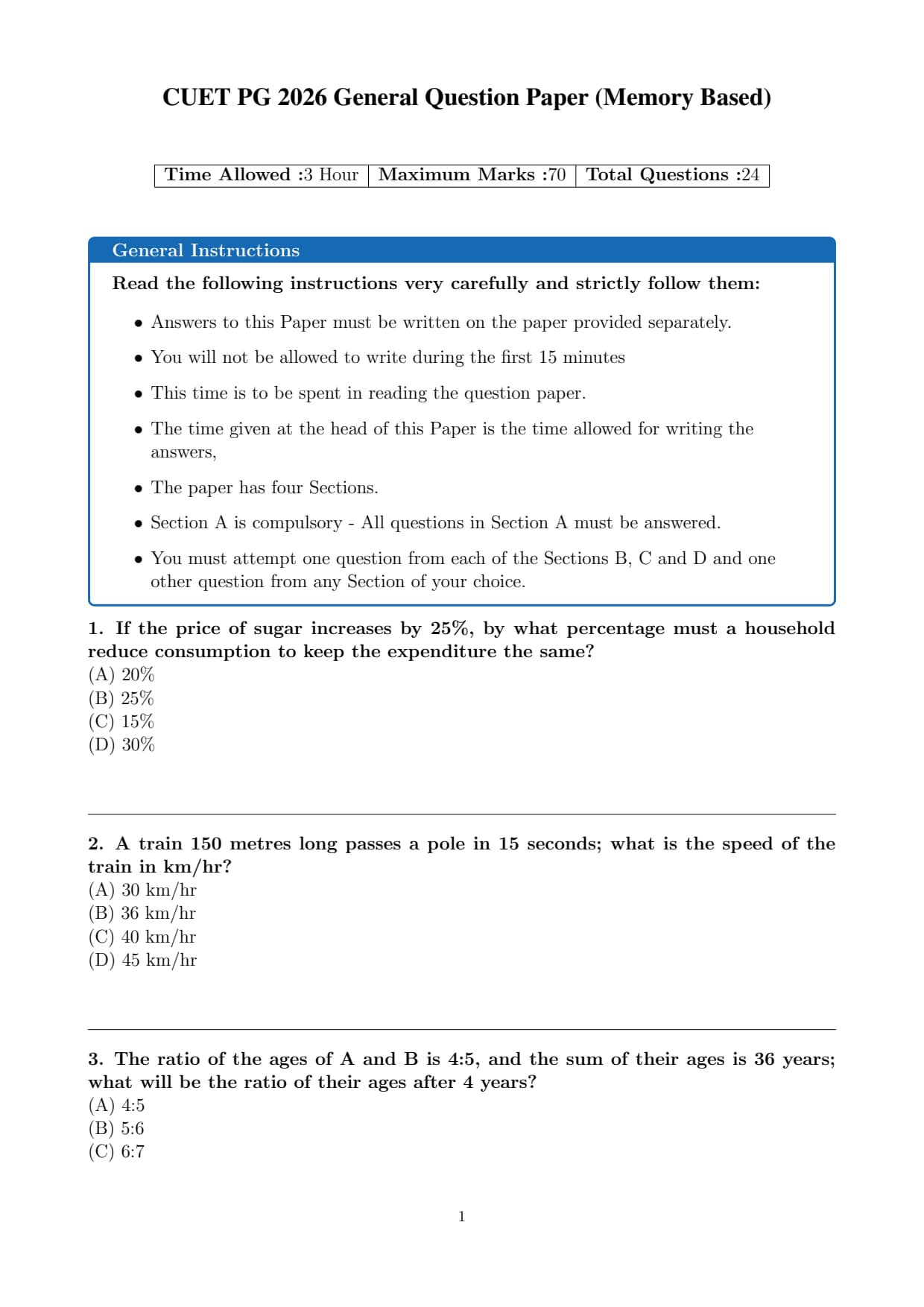
If the price of sugar increases by 25%, by what percentage must a household reduce consumption to keep the expenditure the same?
View Solution
Concept:
When the price of a commodity increases but the total expenditure must remain constant, the quantity consumed must decrease proportionally. This relationship can be calculated using the formula:
\[ Required Reduction in Consumption (%) = \frac{Increase in Price}{100 + Increase in Price} \times 100 \]
This formula helps determine how much consumption must be reduced so that the total spending does not change despite the price increase.
Step 1: Identify the given information.
\[ Increase in price = 25% \]
Step 2: Apply the formula.
\[ Reduction in consumption = \frac{25}{100 + 25} \times 100 \]
\[ = \frac{25}{125} \times 100 \]
\[ = 20% \]
Step 3: Alternative explanation using numbers.
Assume initially:
\[ Price of sugar = ₹100 per unit \]
\[ Quantity purchased = 1 unit \]
\[ Total expenditure = ₹100 \]
After a 25% increase:
\[ New price = 100 + 25 = ₹125 \]
To keep the expenditure ₹100:
\[ Quantity that can be purchased = \frac{100}{125} = 0.8 \]
Reduction in consumption:
\[ 1 - 0.8 = 0.2 = 20% \]
Step 4: Selecting the correct answer.
\[ \boxed{20%} \] Quick Tip: Shortcut formula for such questions: \[ Reduction % = \frac{Price Increase %}{100 + Price Increase %} \times 100 \] Example: \[ If price increases by 25% \] \[ Required reduction = \frac{25}{125} \times 100 = 20% \] Memory trick: \[ \textbf{Price ↑ → Consumption ↓} \] To keep expenditure constant, consumption must decrease proportionally.
A train 150 metres long passes a pole in 15 seconds; what is the speed of the train in km/hr?
View Solution
Concept:
When a train passes a pole or a standing object, the distance covered by the train is equal to the length of the train. The speed of the train can be calculated using the basic formula:
\[ Speed = \frac{Distance}{Time} \]
Here:
Distance = Length of the train
Time = Time taken to completely pass the pole
After calculating speed in metres per second (m/s), we convert it into kilometres per hour (km/hr) using:
\[ 1 m/s = 3.6 km/hr \]
Step 1: Identify the given values.
\[ Length of train = 150 metres \]
\[ Time taken = 15 seconds \]
Step 2: Calculate speed in m/s.
\[ Speed = \frac{150}{15} \]
\[ = 10 m/s \]
Step 3: Convert m/s to km/hr.
\[ 10 \times 3.6 = 36 km/hr \]
Step 4: Final result.
\[ \boxed{36 km/hr} \] Quick Tip: Important formulas for train problems: \[ Speed = \frac{Distance}{Time} \] If a train passes a pole: \[ Distance = Length of train \] Conversion rule: \[ 1 m/s = 3.6 km/hr \] Memory trick: \[ \textbf{Pole → Only Train Length} \]
The ratio of the ages of A and B is 4:5, and the sum of their ages is 36 years; what will be the ratio of their ages after 4 years?
View Solution
Concept:
In ratio problems involving ages, the given ratio represents the proportional relationship between the ages of two individuals. If the ratio of their ages is known, we can assume the ages to be multiples of the ratio values and then use the given sum to determine their actual ages.
If the ratio of two quantities is:
\[ a:b \]
then their actual values can be represented as:
\[ ax and bx \]
where \(x\) is a common multiplier.
Step 1: Represent the ages using the ratio.
The ratio of the ages of A and B is:
\[ 4:5 \]
Let their ages be:
\[ 4x and 5x \]
Step 2: Use the given sum of ages.
\[ 4x + 5x = 36 \]
\[ 9x = 36 \]
\[ x = 4 \]
Step 3: Find their present ages.
\[ A = 4x = 4 \times 4 = 16 \]
\[ B = 5x = 5 \times 4 = 20 \]
Step 4: Find their ages after 4 years.
\[ A = 16 + 4 = 20 \]
\[ B = 20 + 4 = 24 \]
Step 5: Find the new ratio.
\[ 20:24 \]
Divide both numbers by 4:
\[ 5:6 \]
Step 6: Final answer.
\[ \boxed{5:6} \] Quick Tip: Steps to solve age ratio problems: Represent ages using the given ratio (e.g., \(4x\) and \(5x\)). Use the given total or difference to find \(x\). Calculate present ages. Adjust the ages according to the time mentioned. Simplify the ratio. Memory trick: \[ \textbf{Age problems → Use ratio multiples first} \]
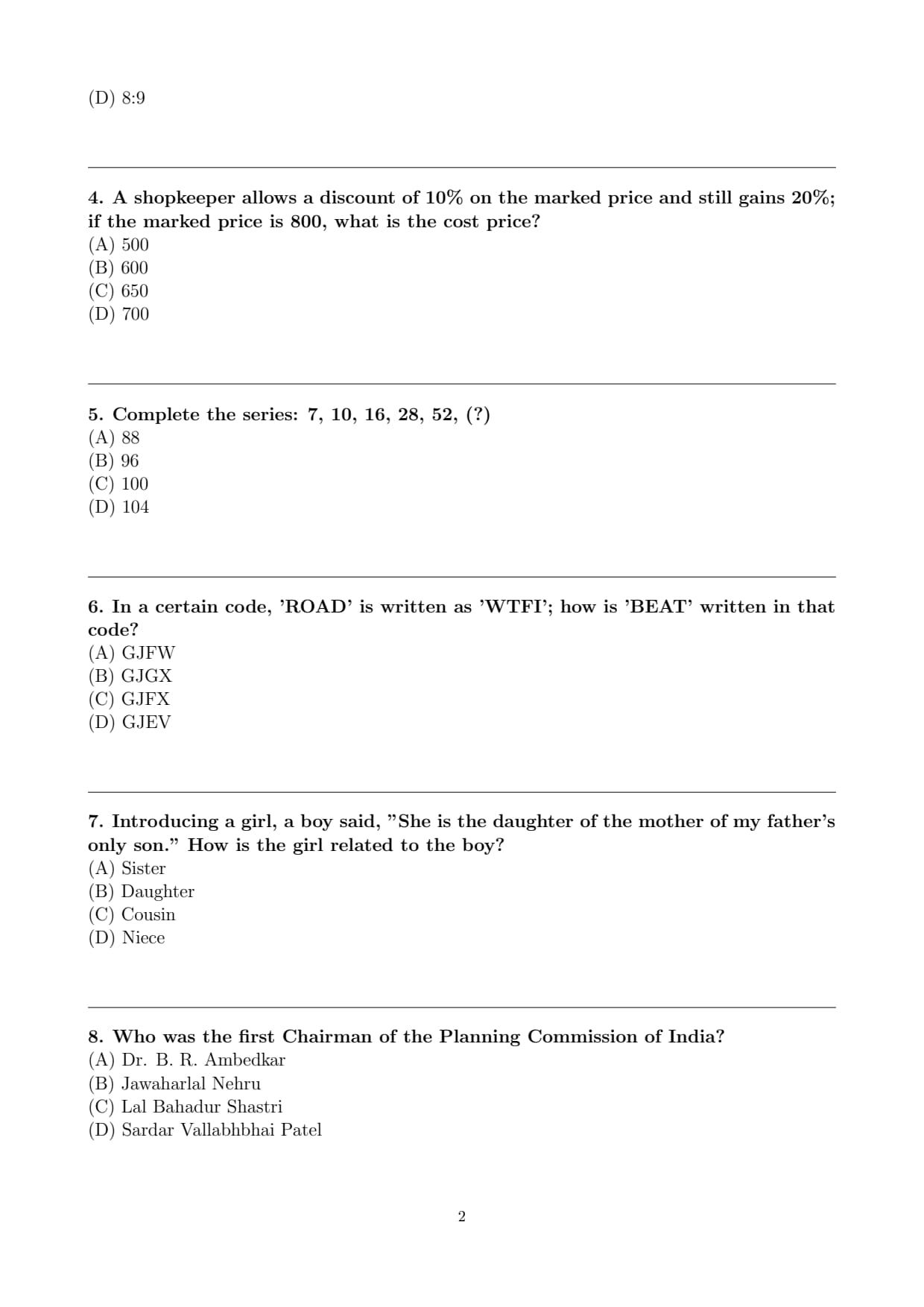
A shopkeeper allows a discount of 10% on the marked price and still gains 20%; if the marked price is ₹800, what is the cost price?
View Solution
Concept:
In profit and discount problems, three important prices are involved:
Cost Price (CP) – The price at which the shopkeeper purchases the item.
Marked Price (MP) – The price printed or listed on the product.
Selling Price (SP) – The price at which the product is actually sold after giving discount.
The relationships used in such problems are:
\[ SP = MP - Discount \]
\[ SP = CP \left(1 + \frac{Profit %}{100}\right) \]
Step 1: Find the Selling Price after discount.
Marked Price:
\[ MP = ₹800 \]
Discount given:
\[ 10% of 800 = 80 \]
Selling Price:
\[ SP = 800 - 80 = ₹720 \]
Step 2: Use the profit formula.
The shopkeeper gains:
\[ 20% \]
Thus,
\[ SP = CP \left(1 + \frac{20}{100}\right) \]
\[ SP = 1.2 \times CP \]
Step 3: Substitute the selling price.
\[ 720 = 1.2 \times CP \]
\[ CP = \frac{720}{1.2} \]
\[ CP = 600 \]
Step 4: Final answer.
\[ \boxed{₹600} \] Quick Tip: Steps for solving discount and profit problems: First calculate \textbf{Selling Price} after discount. Then apply the \textbf{profit formula}. Shortcut formula: \[ SP = MP \times \left(1 - \frac{Discount}{100}\right) \] \[ SP = CP \times \left(1 + \frac{Profit}{100}\right) \] Memory trick: \[ \textbf{Discount ↓ → SP decreases} \] \[ \textbf{Profit ↑ → SP increases} \]
Complete the series: 7, 10, 16, 28, 52, (?)
View Solution
Concept:
In number series questions, we often identify patterns in the differences between consecutive numbers. Many series follow patterns such as increasing differences, multiplication patterns, or combinations of arithmetic operations.
A useful strategy is to calculate the difference between consecutive terms to detect a pattern.
Step 1: Write the given series.
\[ 7,\; 10,\; 16,\; 28,\; 52,\; ? \]
Step 2: Find the differences between consecutive numbers.
\[ 10 - 7 = 3 \]
\[ 16 - 10 = 6 \]
\[ 28 - 16 = 12 \]
\[ 52 - 28 = 24 \]
Thus, the differences are:
\[ 3,\; 6,\; 12,\; 24 \]
Step 3: Identify the pattern in the differences.
Each difference is double the previous one:
\[ 3 \times 2 = 6 \]
\[ 6 \times 2 = 12 \]
\[ 12 \times 2 = 24 \]
Therefore, the next difference should be:
\[ 24 \times 2 = 48 \]
Step 4: Find the next term in the series.
\[ 52 + 48 = 100 \]
Thus, the next number in the series is:
\[ 100 \]
Step 5: Selecting the correct option.
\[ \boxed{100} \]
Hence, the correct answer is:
\[ Option (C) 100 \] Quick Tip: When solving number series: First check the \textbf{differences between consecutive terms}. Look for patterns such as doubling, squares, cubes, or alternating operations. In this series: \[ 7,\;10,\;16,\;28,\;52 \] Differences follow: \[ 3,\;6,\;12,\;24,\;48 \] So the next term is: \[ 52 + 48 = 100 \]
In a certain code, 'ROAD' is written as 'WTFI'; how is 'BEAT' written in that code?
View Solution
Concept:
Coding–decoding problems often involve shifting letters in the alphabet by a certain number of positions. To identify the pattern, we compare each letter of the original word with its corresponding coded letter and observe the alphabetical shifts.
Step 1: Write the given coding.
\[ ROAD \rightarrow WTFI \]
Now compare the alphabetical positions.
\[ R \rightarrow W \]
\[ O \rightarrow T \]
\[ A \rightarrow F \]
\[ D \rightarrow I \]
Step 2: Determine the letter shifts.
\[ R(18) \rightarrow W(23) = +5 \]
\[ O(15) \rightarrow T(20) = +5 \]
\[ A(1) \rightarrow F(6) = +5 \]
\[ D(4) \rightarrow I(9) = +5 \]
Thus, each letter is shifted forward by 5 positions in the alphabet.
Step 3: Apply the same rule to the word BEAT.
\[ B \rightarrow G \]
\[ E \rightarrow J \]
\[ A \rightarrow F \]
\[ T \rightarrow X \]
Step 4: Form the coded word.
\[ BEAT \rightarrow GJFX \]
Step 5: Select the correct option.
\[ \boxed{GJFX} \] Quick Tip: Common coding–decoding techniques include: Alphabet shifting (e.g., +2, +3, +5 positions) Reversing letters Alternating shifts In this problem: \[ \textbf{Each letter shifts forward by 5 positions} \] Example: \[ A \rightarrow F,\quad B \rightarrow G,\quad C \rightarrow H \] So: \[ BEAT \rightarrow GJFX \]
Introducing a girl, a boy said, "She is the daughter of the mother of my father's only son." How is the girl related to the boy?
View Solution
Concept:
Blood relation questions require careful interpretation of family relationships described in a statement. The best approach is to simplify the statement step-by-step and identify each relationship logically.
Step 1: Start with the innermost part of the sentence.
The statement says:
\[ "my father's only son" \]
Since the boy himself is speaking, the phrase "my father's only son" refers to the boy himself.
Step 2: Identify the next relation.
The sentence now becomes:
\[ "the mother of my father's only son" \]
Since the father's only son is the boy, the mother of the boy is simply his mother.
Step 3: Interpret the complete statement.
The girl is described as:
\[ "the daughter of my mother" \]
The daughter of the boy's mother would be:
Either the boy himself (if he were a girl) or
His sister
Since the statement refers to a girl, the relationship must be:
\[ \textbf{Sister} \]
Step 4: Final answer.
\[ \boxed{Sister} \] Quick Tip: Strategy for solving blood relation problems: Break the sentence into smaller parts. Start from the \textbf{innermost relationship}. Replace phrases step-by-step until the relationship becomes clear. Shortcut for this question: \[ Father's only son = The boy himself \] \[ Mother of the boy = His mother \] \[ Daughter of his mother = His sister \]
Who was the first Chairman of the Planning Commission of India?
View Solution
Concept:
The Planning Commission of India was a government institution responsible for formulating India's Five-Year Plans and guiding the country's economic development. It was established on 15 March 1950 by a resolution of the Government of India.
The main objective of the Planning Commission was to:
Assess the country's resources
Formulate development plans
Determine priorities for economic growth
Allocate resources effectively among different sectors
According to the structure of the Planning Commission, the Prime Minister of India served as its Chairman. At the time of its establishment in 1950, the Prime Minister was Jawaharlal Nehru. Therefore, he became the first Chairman of the Planning Commission.
The Planning Commission functioned for several decades before being replaced by NITI Aayog in 2015.
Step 1: Identify when the Planning Commission was established.
\[ Planning Commission established in 1950 \]
Step 2: Determine who was the Prime Minister at that time.
\[ Prime Minister in 1950 = Jawaharlal Nehru \]
Step 3: Apply the rule of the commission.
Since the Prime Minister serves as the Chairman of the Planning Commission, Jawaharlal Nehru automatically became the first Chairman.
Step 4: Analyze the options.
Option (A): Dr. B. R. Ambedkar — Chairman of the Drafting Committee of the Constitution.
Option (B): Jawaharlal Nehru — Correct; first Chairman of the Planning Commission.
Option (C): Lal Bahadur Shastri — Later Prime Minister of India.
Option (D): Sardar Vallabhbhai Patel — First Deputy Prime Minister and Home Minister.
Step 5: Final answer.
\[ \boxed{Jawaharlal Nehru} \] Quick Tip: Important facts about the Planning Commission: Established: \textbf{15 March 1950} Chairman: \textbf{Prime Minister of India} First Chairman: \textbf{Jawaharlal Nehru} Replaced by: \textbf{NITI Aayog in 2015} Memory trick: \[ \textbf{Planning Commission → Nehru Era} \]
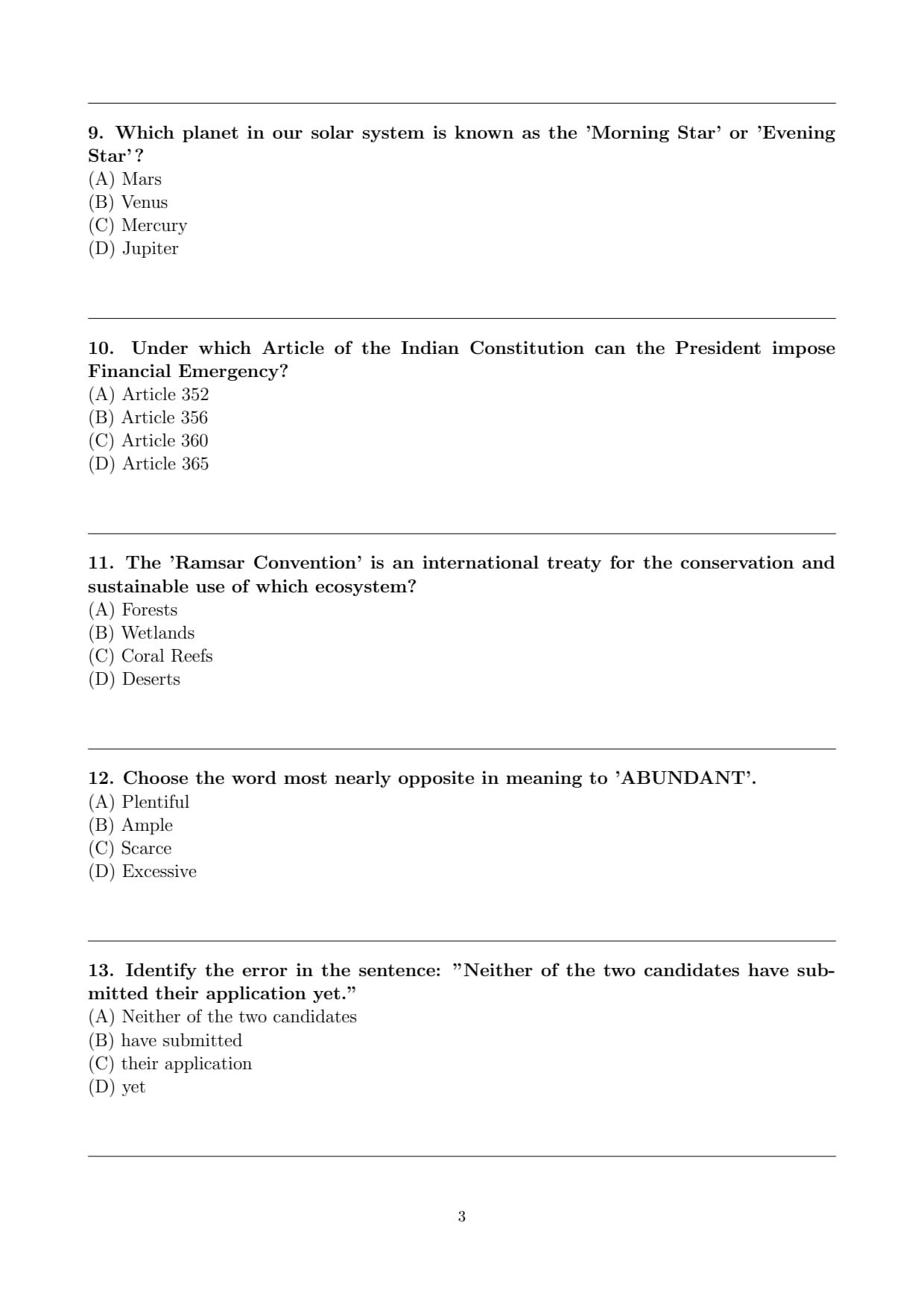
Which planet in our solar system is known as the 'Morning Star' or 'Evening Star'?
View Solution
Concept:
Venus is often called the "Morning Star" or the "Evening Star" because it is one of the brightest objects visible in the sky after the Sun and the Moon. Although it is a planet, it appears very bright and star-like when seen from Earth.
Venus is the second planet from the Sun and reflects a large amount of sunlight due to its thick cloud cover. Because of this high reflectivity, it shines brightly in the sky.
Venus can be observed in two ways:
Morning Star – When Venus appears in the eastern sky before sunrise.
Evening Star – When Venus appears in the western sky after sunset.
Since Venus orbits closer to the Sun than Earth, it is always seen near the Sun in the sky, either shortly before sunrise or just after sunset.
Step 1: Understand the meaning of Morning Star and Evening Star.
These terms refer to a bright celestial object visible either before sunrise or after sunset.
Step 2: Identify the planet that appears brightest in the sky.
Venus reflects sunlight strongly and is therefore the brightest planet visible from Earth.
Step 3: Analyze the options.
Option (A): Mars — Known as the Red Planet.
Option (B): Venus — Correct; commonly called the Morning Star or Evening Star.
Option (C): Mercury — Closest planet to the Sun but not as bright as Venus.
Option (D): Jupiter — Known as the Largest planet.
Step 4: Final answer.
\[ \boxed{Venus} \] Quick Tip: Important planet nicknames: \textbf{Venus} → Morning Star / Evening Star \textbf{Mars} → Red Planet \textbf{Earth} → Blue Planet \textbf{Jupiter} → Largest Planet Memory trick: \[ \textbf{Venus = Brightest Planet in the Night Sky} \] Hence it is called the \textbf{Morning Star} or \textbf{Evening Star}.
Under which Article of the Indian Constitution can the President impose Financial Emergency?
View Solution
Concept:
The Indian Constitution provides provisions for different types of emergencies to protect the country's stability and governance during extraordinary situations. These emergencies are classified into three categories:
National Emergency – Article 352
State Emergency (President's Rule) – Article 356
Financial Emergency – Article 360
A Financial Emergency can be declared when the financial stability or credit of India or any part of its territory is threatened.
Under Article 360, the President of India has the authority to proclaim a financial emergency if he or she is satisfied that the financial stability of the country is at risk.
If Financial Emergency is declared, the central government gains extensive powers such as:
Directing states to observe financial discipline
Reducing salaries and allowances of government employees
Reducing salaries of judges of the Supreme Court and High Courts
Requiring states to reserve money bills for presidential consideration
It is important to note that Financial Emergency has never been declared in India so far.
Step 1: Understand the type of emergency mentioned.
The question asks about the constitutional provision related to Financial Emergency.
Step 2: Recall the relevant article.
Financial Emergency is specifically provided under:
\[ Article 360 \]
Step 3: Analyze the options.
Option (A): Article 352 — National Emergency.
Option (B): Article 356 — President's Rule in states.
Option (C): Article 360 — Financial Emergency.
Option (D): Article 365 — Related to failure of states to comply with Union directions.
Step 4: Final answer.
\[ \boxed{Article 360} \] Quick Tip: Types of emergencies in the Indian Constitution: \textbf{Article 352} → National Emergency \textbf{Article 356} → President's Rule (State Emergency) \textbf{Article 360} → Financial Emergency Memory trick: \[ \textbf{352 → Nation} \] \[ \textbf{356 → State} \] \[ \textbf{360 → Finance} \]
The 'Ramsar Convention' is an international treaty for the conservation and sustainable use of which ecosystem?
View Solution
Concept:
The Ramsar Convention is an international treaty focused on the conservation and sustainable use of wetlands. It was adopted in the city of Ramsar, Iran on 2 February 1971. Because of this origin, it is officially known as the Convention on Wetlands of International Importance.
The primary objective of the Ramsar Convention is to protect wetlands because they play a crucial role in maintaining ecological balance. Wetlands are areas where water covers the soil either permanently or seasonally, such as marshes, lakes, rivers, and mangroves.
The convention encourages countries to:
Conserve and manage wetlands sustainably
Identify and designate wetlands of international importance (Ramsar Sites)
Promote wise use of wetland resources
Protect biodiversity and wildlife habitats
Wetlands are important because they:
Support rich biodiversity
Help in flood control
Recharge groundwater
Provide habitats for migratory birds
Step 1: Identify the purpose of the Ramsar Convention.
The Ramsar Convention was created to promote the conservation and sustainable use of wetlands worldwide.
Step 2: Understand the ecosystem involved.
Wetlands include ecosystems such as lakes, marshes, swamps, mangroves, and floodplains.
Step 3: Analyze the options.
Option (A): Forests — Protected under other environmental agreements.
Option (B): Wetlands — Correct; Ramsar Convention focuses specifically on wetlands.
Option (C): Coral Reefs — Protected under marine conservation programs.
Option (D): Deserts — Not related to the Ramsar Convention.
Step 4: Final answer.
\[ \boxed{Wetlands} \] Quick Tip: Key facts about the Ramsar Convention: Signed in \textbf{Ramsar, Iran (1971)} Focuses on \textbf{wetland conservation} \textbf{2 February} is celebrated as \textbf{World Wetlands Day} Memory trick: \[ \textbf{Ramsar → Water Areas → Wetlands} \]
Choose the word most nearly opposite in meaning to 'ABUNDANT'.
View Solution
Concept:
An antonym is a word that has the opposite meaning of another word. To solve such questions, it is important to understand the meaning of the given word and then choose the option that expresses the opposite meaning.
The word “Abundant” means something that exists in large quantities or is more than enough.
Examples of its meaning include:
plentiful
ample
plentiful supply
excessive quantity
The opposite of abundant would therefore indicate a lack or shortage of something.
Step 1: Understand the meaning of the word 'Abundant'.
\[ Abundant = Existing in large quantities; plentiful \]
Step 2: Analyze the options.
Option (A): Plentiful — Similar meaning to abundant.
Option (B): Ample — Also similar meaning (more than enough).
Option (C): Scarce — Means limited or in short supply; opposite of abundant.
Option (D): Excessive — Means too much; similar meaning to abundant.
Step 3: Identify the correct antonym.
The word that expresses the opposite meaning of abundant is:
\[ \boxed{Scarce} \] Quick Tip: Remember common antonym pairs: Abundant → Scarce Increase → Decrease Expand → Contract Prosperity → Poverty Memory trick: \[ \textbf{Abundant = Plenty} \] \[ \textbf{Scarce = Shortage} \]
Identify the error in the sentence: "Neither of the two candidates have submitted their application yet."
View Solution
Concept:
In English grammar, the word “Neither” is treated as a singular pronoun. Therefore, it requires a singular verb. Even though the phrase “of the two candidates” refers to more than one person, the subject of the sentence is still the singular pronoun Neither.
Hence, the verb must also be singular.
Step 1: Identify the subject of the sentence.
\[ Neither of the two candidates \]
The subject here is Neither, which is singular.
Step 2: Check the verb used in the sentence.
The sentence uses:
\[ have submitted \]
The verb have is a plural verb.
Step 3: Determine the correct verb form.
Since the subject is singular, the correct verb should be:
\[ has submitted \]
Thus, the correct sentence would be:
\[ "Neither of the two candidates has submitted their application yet." \]
Step 4: Identify the incorrect part.
The grammatical error occurs in the phrase:
\[ \boxed{have submitted} \] Quick Tip: Words such as the following are always treated as \textbf{singular} and take singular verbs: Neither Either Each Everyone Someone Example: \[ Neither of the players \textbf{is ready.} \] Memory trick: \[ \textbf{Neither/Either/Each → Singular Verb} \]
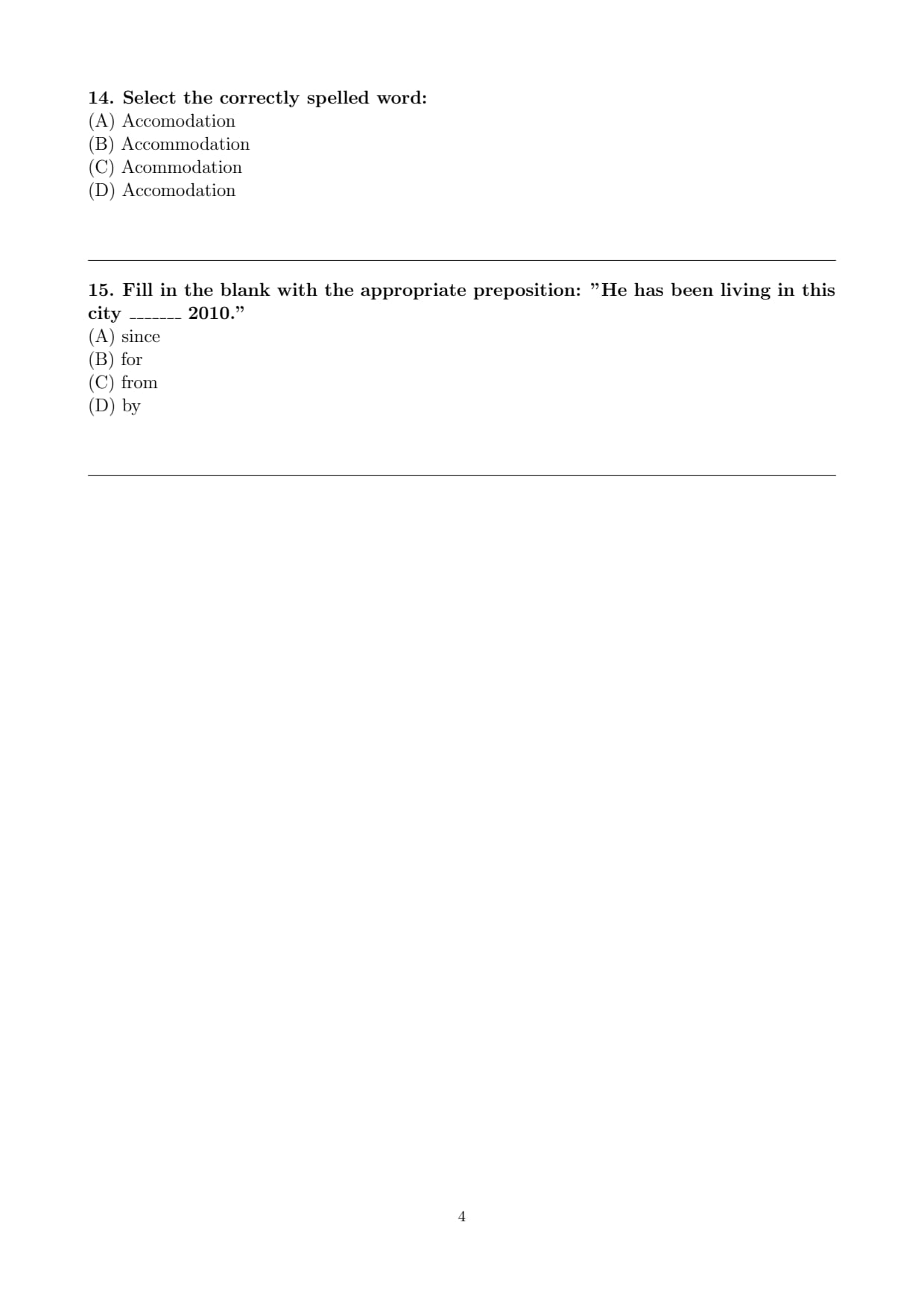
Select the correctly spelled word:
View Solution
Concept:
Spelling questions test knowledge of the correct arrangement of letters in English words. Many English words contain double letters, and errors often occur when these are misspelled.
The correct spelling of the word meaning lodging or a place to stay is:
\[ \textbf{Accommodation} \]
The correct structure of the word includes:
Two c's
Two m's
\[ A C C O M M O D A T I O N \]
Step 1: Examine each option.
Option (A): Accomodation — Incorrect; missing one c.
Option (B): Accommodation — Correct; contains two c's and two m's.
Option (C): Acommodation — Incorrect; missing one c and one m.
Option (D): Accomodation — Incorrect; same mistake as option (A).
Step 2: Identify the correct spelling.
\[ \boxed{Accommodation} \] Quick Tip: Memory trick for the word \textbf{Accommodation}: \[ \textbf{Accommodation → 2 C's and 2 M's} \] Think of it as: \[ \textbf{AC + COM + MODATION} \] Many students mistakenly write only one \textbf{c} or one \textbf{m}, but the correct spelling has \textbf{double c and double m}.
Fill in the blank with the appropriate preposition: "He has been living in this city _______ 2010."
View Solution
Concept:
In English grammar, the prepositions “since” and “for” are commonly used with the present perfect tense or present perfect continuous tense to describe actions that started in the past and continue in the present.
The difference between them is:
Since is used with a specific point in time.
For is used with a period or duration of time.
Examples:
Since 2010
Since Monday
Since morning
For five years
For two months
Step 1: Analyze the sentence.
\[ "He has been living in this city \_\_\_\_\_\_\_ 2010." \]
The year 2010 represents a specific point in time.
Step 2: Choose the correct preposition.
Since we are referring to a specific starting point in the past, the correct preposition is:
\[ \textbf{since} \]
Step 3: Check the other options.
Option (A): since — Correct; used with a specific time point.
Option (B): for — Used with durations (e.g., for ten years).
Option (C): from — Usually used with "to" or "till".
Option (D): by — Indicates deadline or limit, not duration.
Step 4: Correct sentence.
\[ "He has been living in this city \textbf{since 2010."} \]
Final answer:
\[ \boxed{since} \] Quick Tip: Use: \textbf{Since} → specific starting point in time (since 2010, since Monday) \textbf{For} → duration of time (for 10 years, for two days) Memory trick: \[ \textbf{Since = Starting Point} \] \[ \textbf{For = Time Period} \]
CUET PG General Question Paper 2026: Unit-Wise Weightage
| Unit Name | Approx. Questions | Difficulty |
| General Knowledge & Current Affairs (National & International Events) | 15–18 | Moderate |
| Logical Reasoning (Analogy, Coding-Decoding, Series, Puzzles) | 12–15 | Moderate |
| Quantitative Aptitude (Arithmetic, Percentage, Ratio, Data Interpretation) | 10–12 | Moderate |
| Language Comprehension (Reading Comprehension, Vocabulary, Grammar) | 8–10 | Easy–Moderate |
| Analytical Ability & Critical Thinking | 8–10 | Moderate |



Comments