




The National Testing Agency (NTA) conducted the CUET PG 2026 General Management (COQP12) exam on March 8, 2026, during Shift 2 (12:30 PM – 02:00 PM). This live update covers the CUET PG General Management 2026 question paper analysis, memory-based questions shared by candidates, and the direct link to download the CUET PG 2026 General Management question paper PDF with solutions.
Based on student feedback, the overall paper was Moderate, with most questions asked from management principles, business environment, quantitative aptitude, logical reasoning, and basic economics.
CUET PG General Management 2026 Question Paper with Solutions PDF
| CUET PG General Management 2026 Question Paper with Answer key | Download PDF | Check Solutions |

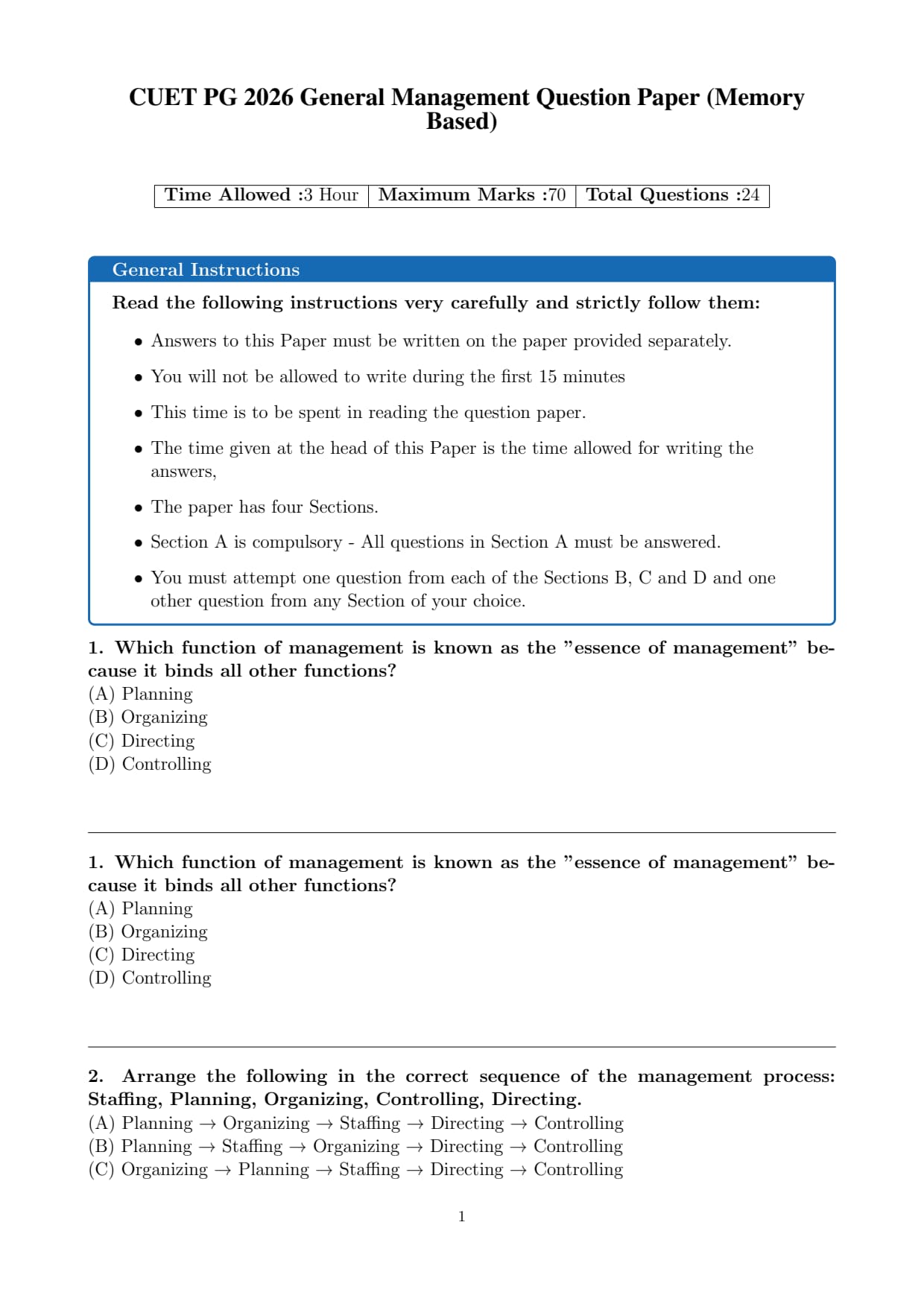
Which function of management is known as the "essence of management" because it binds all other functions?
View Solution
Concept:
Management is a systematic process that involves coordinating and directing the activities of individuals in an organization to achieve specific goals. The major functions of management include:
Planning
Organizing
Staffing
Directing
Controlling
Among these functions, Directing is often referred to as the "essence of management" because it integrates and activates all other managerial functions. Directing involves guiding, supervising, motivating, and leading employees so that organizational objectives can be achieved effectively.
While planning sets goals and organizing arranges resources, these functions cannot be implemented unless employees are properly guided and motivated. This is where directing becomes crucial.
Key elements of directing include:
Supervision – Monitoring the work of employees
Leadership – Influencing and guiding people
Motivation – Encouraging employees to perform better
Communication – Ensuring smooth flow of information
Because directing activates the workforce and links all managerial activities together, it is known as the essence of management.
Step 1: Understanding the question.
The question asks which management function binds together all other functions and ensures their effective implementation.
Step 2: Analyzing the role of each function.
Planning: Deciding goals and determining the course of action.
Organizing: Arranging resources and assigning tasks.
Directing: Guiding, motivating, and supervising employees to perform tasks effectively.
Controlling: Monitoring performance and correcting deviations.
Step 3: Identifying the function that integrates all activities.
Directing plays a key role in activating organizational efforts by guiding employees and ensuring that planned activities are carried out effectively.
Step 4: Selecting the correct answer.
\[ \boxed{Directing} \] Quick Tip: Key functions of management: \textbf{Planning} → Setting objectives \textbf{Organizing} → Arranging resources \textbf{Staffing} → Recruiting employees \textbf{Directing} → Guiding and motivating employees \textbf{Controlling} → Evaluating performance Remember: \[ \textbf{Directing = Essence of Management} \] because it activates and coordinates all other managerial functions.
Which function of management is known as the "essence of management" because it binds all other functions?
View Solution
Concept:
Management is a systematic process that involves coordinating and directing the activities of individuals in an organization to achieve specific goals. The major functions of management include:
Planning
Organizing
Staffing
Directing
Controlling
Among these functions, Directing is often referred to as the "essence of management" because it integrates and activates all other managerial functions. Directing involves guiding, supervising, motivating, and leading employees so that organizational objectives can be achieved effectively.
While planning sets goals and organizing arranges resources, these functions cannot be implemented unless employees are properly guided and motivated. This is where directing becomes crucial.
Key elements of directing include:
Supervision – Monitoring the work of employees
Leadership – Influencing and guiding people
Motivation – Encouraging employees to perform better
Communication – Ensuring smooth flow of information
Because directing activates the workforce and links all managerial activities together, it is known as the essence of management.
Step 1: Understanding the question.
The question asks which management function binds together all other functions and ensures their effective implementation.
Step 2: Analyzing the role of each function.
Planning: Deciding goals and determining the course of action.
Organizing: Arranging resources and assigning tasks.
Directing: Guiding, motivating, and supervising employees to perform tasks effectively.
Controlling: Monitoring performance and correcting deviations.
Step 3: Identifying the function that integrates all activities.
Directing plays a key role in activating organizational efforts by guiding employees and ensuring that planned activities are carried out effectively.
Step 4: Selecting the correct answer.
\[ \boxed{Directing} \] Quick Tip: Key functions of management: \textbf{Planning} → Setting objectives \textbf{Organizing} → Arranging resources \textbf{Staffing} → Recruiting employees \textbf{Directing} → Guiding and motivating employees \textbf{Controlling} → Evaluating performance Remember: \[ \textbf{Directing = Essence of Management} \] because it activates and coordinates all other managerial functions.
Arrange the following in the correct sequence of the management process: Staffing, Planning, Organizing, Controlling, Directing.
View Solution
Concept:
Management is a continuous process that involves several interrelated functions. These functions are performed by managers to achieve organizational objectives effectively and efficiently. The classical sequence of the management process generally follows a logical order where each function builds upon the previous one.
The five major functions of management are:
Planning
Organizing
Staffing
Directing
Controlling
Each function has a specific role in ensuring the smooth functioning of an organization.
Step 1: Planning.
Planning is the first step in the management process. It involves determining the objectives of the organization and deciding the best course of action to achieve them. Managers set goals, formulate strategies, and prepare plans during this stage.
Step 2: Organizing.
After planning, the next step is organizing. This function involves arranging resources, dividing tasks, assigning responsibilities, and establishing relationships among different departments to implement the plans effectively.
Step 3: Staffing.
Staffing involves recruiting, selecting, training, and placing the right people in the right positions within the organization. It ensures that human resources are properly utilized to accomplish organizational goals.
Step 4: Directing.
Directing is the process of guiding, supervising, motivating, and leading employees so that they work efficiently toward achieving organizational objectives.
Step 5: Controlling.
Controlling is the final step in the management process. It involves measuring actual performance, comparing it with planned objectives, and taking corrective action if necessary.
Step 6: Correct sequence.
\[ Planning \rightarrow Organizing \rightarrow Staffing \rightarrow Directing \rightarrow Controlling \]
Step 7: Analyzing the options.
Option (A): Planning → Organizing → Staffing → Directing → Controlling — Correct sequence.
Option (B): Staffing is placed before organizing, which is incorrect.
Option (C): Organizing is incorrectly placed before planning.
Option (D): Directing is incorrectly placed before staffing.
Step 8: Selecting the correct answer.
\[ \boxed{Planning → Organizing → Staffing → Directing → Controlling} \] Quick Tip: The standard order of management functions is: \[ \textbf{P → O → S → D → C} \] \textbf{P} – Planning \textbf{O} – Organizing \textbf{S} – Staffing \textbf{D} – Directing \textbf{C} – Controlling Memory trick: \[ \textbf{Plan → Organize → Staff → Direct → Control} \] This sequence reflects the logical flow of managerial activities in any organization.
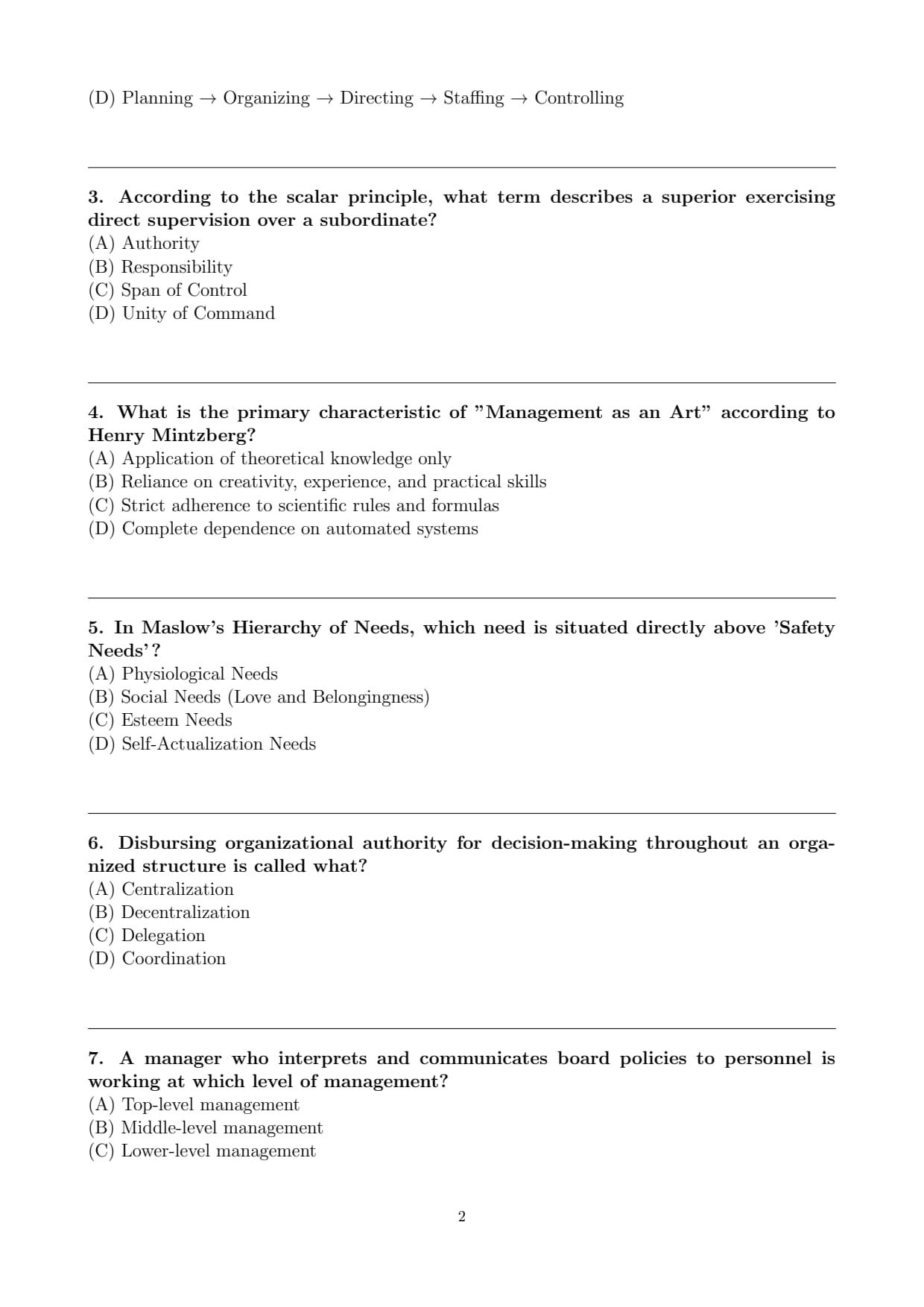
According to the scalar principle, what term describes a superior exercising direct supervision over a subordinate?
View Solution
Concept:
The Scalar Principle in management refers to the chain of authority that extends from the highest level of management to the lowest level in an organization. It emphasizes a clear line of authority and communication within the organizational hierarchy.
Within this framework, an important concept is the Span of Control. Span of control refers to the number of subordinates that a manager or superior can effectively supervise and manage directly. It determines how many employees report directly to a particular manager.
A proper span of control helps ensure effective supervision, clear communication, and efficient coordination of activities. If the span of control is too wide, a manager may struggle to supervise all employees effectively. If it is too narrow, it may lead to unnecessary levels of management and increased administrative costs.
Step 1: Understanding the scalar principle.
The scalar principle describes the hierarchical chain of authority in an organization, where each level has authority over the level below it.
Step 2: Identifying the concept related to supervision.
The question asks for the term that describes a superior directly supervising subordinates. This concept refers to how many subordinates a manager can manage directly.
Step 3: Analyzing the options.
Option (A): Authority — Refers to the power to make decisions and issue orders.
Option (B): Responsibility — Refers to the obligation to perform assigned duties.
Option (C): Span of Control — Refers to the number of subordinates directly supervised by a superior. This matches the description in the question.
Option (D): Unity of Command — Means that each employee should receive orders from only one superior.
Step 4: Selecting the correct answer.
\[ \boxed{Span of Control} \] Quick Tip: Important management principles to remember: \textbf{Scalar Chain} → Chain of authority from top to bottom \textbf{Span of Control} → Number of subordinates supervised by a manager \textbf{Unity of Command} → One employee receives orders from only one boss Memory trick: \[ \textbf{Span of Control = How many people a manager directly controls} \]
What is the primary characteristic of "Management as an Art" according to Henry Mintzberg?
View Solution
Concept:
Management is often described as both a science and an art. When management is viewed as an art, it emphasizes the practical application of knowledge, creativity, intuition, and personal skills in handling organizational situations.
According to management thinkers such as Henry Mintzberg, managerial work is not purely theoretical or mechanical. Instead, it involves the ability to make judgments, adapt to changing circumstances, and apply experience in solving real-world problems.
The concept of management as an art highlights the following characteristics:
Practical Application of Knowledge – Managers apply principles and concepts to real organizational situations.
Creativity and Innovation – Managers often need creative solutions for complex problems.
Experience-Based Decision Making – Managerial effectiveness improves through experience and practice.
Skill Development – Managerial abilities such as leadership, communication, and problem-solving develop through continuous practice.
Henry Mintzberg emphasized that managers perform dynamic roles that require judgment, interpersonal skills, and practical experience rather than relying only on theoretical frameworks.
Step 1: Understanding the concept of management as an art.
When management is described as an art, it focuses on the practical use of knowledge and skills to achieve organizational goals.
Step 2: Identify the core characteristic.
The main feature of management as an art is the use of creativity, experience, intuition, and practical skills in solving managerial problems.
Step 3: Analyzing the options.
Option (A): Application of theoretical knowledge only — This relates more to management as a science.
Option (B): Reliance on creativity, experience, and practical skills — Correct; this reflects the artistic and practical nature of management.
Option (C): Strict adherence to scientific rules and formulas — This again relates to management as a science.
Option (D): Complete dependence on automated systems — Not related to the concept of management as an art.
Step 4: Selecting the correct answer.
\[ \boxed{Reliance on creativity, experience, and practical skills} \] Quick Tip: \textbf{Management as Art vs Science} \textbf{Management as Art} → Creativity, experience, intuition, practical skills \textbf{Management as Science} → Systematic knowledge, principles, and theories Memory trick: \[ \textbf{Art = Application + Creativity} \] Managers become more effective artists through \textbf{practice and experience}.
In Maslow's Hierarchy of Needs, which need is situated directly above 'Safety Needs'?
View Solution
Concept:
Maslow's Hierarchy of Needs is a motivational theory proposed by the psychologist Abraham Maslow. It explains human motivation in terms of a hierarchy of needs arranged from the most basic needs to higher-level psychological needs.
Maslow suggested that individuals must satisfy lower-level needs before progressing to higher-level needs. These needs are usually represented in the form of a pyramid with five levels.
The five levels of Maslow's hierarchy are:
Physiological Needs – Basic survival needs such as food, water, shelter, and sleep.
Safety Needs – Security, protection, stability, and freedom from fear.
Social Needs (Love and Belongingness) – Friendship, affection, family relationships, and a sense of belonging.
Esteem Needs – Self-respect, recognition, status, and achievement.
Self-Actualization Needs – Realizing one's full potential, creativity, and personal growth.
Thus, in the hierarchy, Social Needs come immediately after Safety Needs.
Step 1: Identify the position of Safety Needs.
In Maslow's hierarchy, Safety Needs are the second level of the pyramid.
Step 2: Determine the need directly above Safety Needs.
The level immediately above Safety Needs is the third level, which is Social Needs (also called Love and Belongingness Needs).
Step 3: Analyze the options.
Option (A): Physiological Needs — These are the lowest level of needs.
Option (B): Social Needs — Correct; these come directly above Safety Needs.
Option (C): Esteem Needs — These come after Social Needs.
Option (D): Self-Actualization Needs — These are the highest level in the hierarchy.
Step 4: Selecting the correct answer.
\[ \boxed{Social Needs (Love and Belongingness)} \] Quick Tip: Maslow's hierarchy from lowest to highest: \[ \textbf{Physiological → Safety → Social → Esteem → Self-Actualization} \] Memory trick: \[ \textbf{P S S E S} \] P – Physiological S – Safety S – Social E – Esteem S – Self-Actualization Remember: \textbf{Social Needs come immediately after Safety Needs}.
Disbursing organizational authority for decision-making throughout an organized structure is called what?
View Solution
Concept:
In management, the distribution of authority within an organization determines how decisions are made and who has the power to make them. Two important concepts related to this are centralization and decentralization.
Decentralization refers to the systematic delegation and distribution of decision-making authority to lower levels of management within an organization. Instead of concentrating all authority at the top level, decentralization allows managers at different levels to participate in decision-making.
This approach improves efficiency, encourages initiative among employees, and enhances organizational flexibility.
Key features of decentralization include:
Distribution of authority across different levels of management
Faster decision-making due to reduced dependence on top management
Increased managerial development and motivation
Greater organizational responsiveness to changes
Step 1: Understanding the question.
The question refers to the distribution of authority for decision-making throughout an organization.
Step 2: Identify the management concept involved.
When authority is spread across different levels of the organizational hierarchy, it is known as decentralization.
Step 3: Analyzing the options.
Option (A): Centralization — Concentration of authority at the top level of management.
Option (B): Decentralization — Distribution of decision-making authority throughout the organizational structure. This matches the description in the question.
Option (C): Delegation — Assigning specific tasks and authority from a superior to a subordinate.
Option (D): Coordination — Integrating and harmonizing different organizational activities.
Step 4: Selecting the correct answer.
\[ \boxed{Decentralization} \] Quick Tip: Difference between key authority concepts: \textbf{Centralization} → Authority concentrated at top level \textbf{Decentralization} → Authority distributed throughout organization \textbf{Delegation} → Transfer of authority from superior to subordinate Memory trick: \[ \textbf{Decentralization = Decision power distributed across the organization} \]
A manager who interprets and communicates board policies to personnel is working at which level of management?
View Solution
Concept:
Management in an organization is generally divided into three levels based on the roles and responsibilities performed by managers. These levels help maintain a clear hierarchy and efficient coordination between policy formulation and implementation.
The three levels of management are:
Top-Level Management
Middle-Level Management
Lower-Level (Supervisory) Management
Top-Level Management consists of executives such as the board of directors, chief executive officer (CEO), and managing director. They are responsible for formulating organizational policies, setting long-term goals, and making strategic decisions.
Middle-Level Management acts as a link between top-level management and lower-level management. Managers at this level interpret policies created by top management and communicate them to lower-level managers and employees. They also coordinate activities between different departments and ensure that organizational plans are properly implemented.
Lower-Level Management or supervisory management directly oversees workers and is responsible for day-to-day operations.
Step 1: Understanding the role described in the question.
The question describes a manager who interprets and communicates policies formulated by the board to the personnel.
Step 2: Identify the management level performing this role.
The responsibility of interpreting and transmitting policies from top management to operational staff belongs to middle-level management.
Step 3: Analyzing the options.
Option (A): Top-level management — Responsible for creating policies rather than interpreting them.
Option (B): Middle-level management — Correct; they interpret and communicate policies to lower-level managers and staff.
Option (C): Lower-level management — Responsible mainly for supervising daily tasks.
Option (D): Supervisory level — Similar to lower-level management and focuses on direct supervision of workers.
Step 4: Selecting the correct answer.
\[ \boxed{Middle-level management} \] Quick Tip: Levels of management and their main roles: \textbf{Top-Level Management} → Formulates policies and strategic goals \textbf{Middle-Level Management} → Interprets and implements policies \textbf{Lower-Level Management} → Supervises daily work of employees Memory trick: \[ \textbf{Top = Policy Making} \] \[ \textbf{Middle = Policy Interpretation} \] \[ \textbf{Lower = Policy Implementation} \]
What is "Planned Obsolescence" in the context of marketing and product management?
View Solution
Concept:
Planned Obsolescence is a marketing and product management strategy in which products are intentionally designed to have a limited useful life. After a certain period, the product becomes outdated, less efficient, or incompatible with newer technologies, encouraging consumers to purchase a replacement.
This strategy is commonly used by companies to stimulate continuous demand for their products and maintain consistent sales. By introducing newer versions or models with improved features, companies encourage customers to upgrade their existing products.
Planned obsolescence can occur in several forms:
Technical Obsolescence – New technology makes older products outdated.
Style Obsolescence – Changes in design or fashion make older models less desirable.
Functional Obsolescence – Products are designed to wear out or become less efficient after a certain time.
Examples include frequent updates in smartphones, electronics, and automobiles where newer models replace older versions.
Step 1: Understanding the concept.
The question asks for the meaning of planned obsolescence in marketing and product management.
Step 2: Identify the key feature.
Planned obsolescence refers to the deliberate design of products so that they become outdated or unusable after a certain time, encouraging consumers to purchase new products.
Step 3: Analyzing the options.
Option (A): Designing products to last indefinitely — This is the opposite of planned obsolescence.
Option (B): Intentionally designing products with a limited useful life — Correct; this accurately describes planned obsolescence.
Option (C): Producing goods only after receiving customer orders — This refers to demand-based production.
Option (D): Eliminating outdated products immediately — This does not describe the strategy itself.
Step 4: Selecting the correct answer.
\[ \boxed{Intentionally designing products with a limited useful life so they need replacement} \] Quick Tip: \textbf{Planned Obsolescence} means designing products so they become outdated or unusable after a certain period. Common examples include: Frequent smartphone upgrades Software updates that stop supporting older devices Fashion trends changing rapidly Memory trick: \[ \textbf{Planned Obsolescence = Planned Replacement} \]
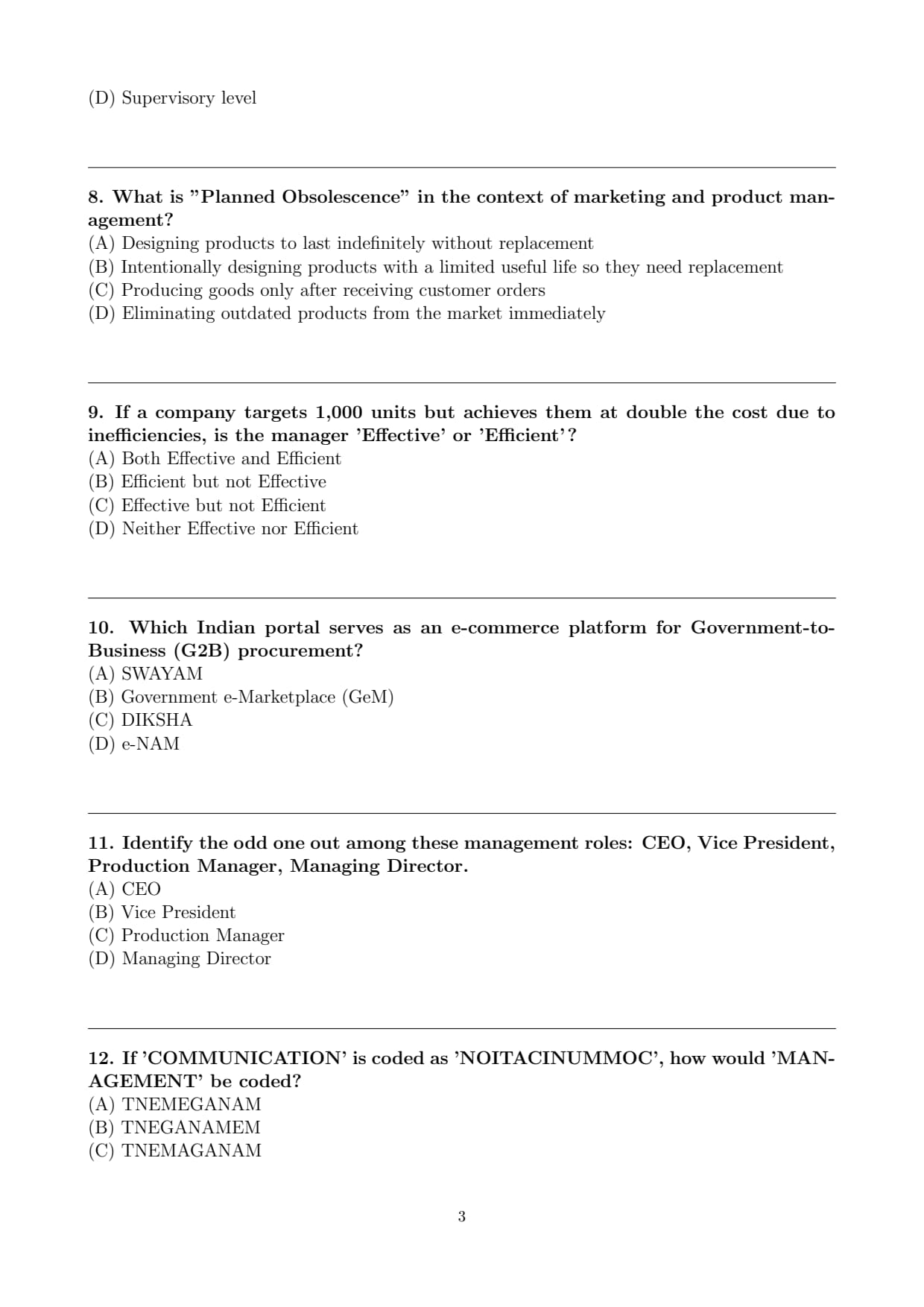
If a company targets 1,000 units but achieves them at double the cost due to inefficiencies, is the manager 'Effective' or 'Efficient'?
View Solution
Concept:
In management, two important performance concepts are Effectiveness and Efficiency. Although they are related, they have different meanings.
Effectiveness refers to achieving the desired goals or objectives. It focuses on doing the right tasks.
Efficiency refers to achieving goals with minimum resources, time, or cost. It focuses on doing tasks in the best possible way.
In simple terms:
\[ \textbf{Effectiveness = Doing the right things} \]
\[ \textbf{Efficiency = Doing things right} \]
An ideal manager should aim to be both effective and efficient. However, in some situations a manager may achieve the target but waste resources, or use resources efficiently but fail to achieve the target.
Step 1: Analyze the situation described in the question.
Target set by the company: 1,000 units
Actual production achieved: 1,000 units
Since the manager achieved the target, the goal has been accomplished.
Step 2: Evaluate efficiency.
The problem states that the target was achieved at double the cost due to inefficiencies. This means excessive resources were used.
Therefore, the manager is not efficient.
Step 3: Determine effectiveness.
Since the objective (producing 1,000 units) was achieved, the manager is effective.
Step 4: Final evaluation.
\[ Goal achieved \Rightarrow Effective \]
\[ Resources wasted \Rightarrow Not Efficient \]
Thus, the manager is:
\[ \boxed{Effective but not Efficient} \] Quick Tip: Difference between effectiveness and efficiency: \textbf{Effectiveness} → Achieving the desired objective \textbf{Efficiency} → Achieving the objective with minimum cost or resources Memory trick: \[ \textbf{Effectiveness = Right Goal} \] \[ \textbf{Efficiency = Right Method} \] A good manager should aim for \textbf{both effectiveness and efficiency}.
Which Indian portal serves as an e-commerce platform for Government-to-Business (G2B) procurement?
View Solution
Concept:
The Government e-Marketplace (GeM) is an online procurement portal launched by the Government of India to facilitate transparent and efficient purchasing of goods and services by government departments, public sector undertakings (PSUs), and other government organizations.
It functions as a Government-to-Business (G2B) e-commerce platform where government buyers can purchase products and services directly from registered vendors.
The platform was launched in 2016 by the Ministry of Commerce and Industry. It aims to improve transparency, efficiency, and speed in government procurement processes.
Key features of GeM include:
Online marketplace for government procurement
Direct interaction between government buyers and registered sellers
Transparent pricing and bidding system
Reduced paperwork and faster procurement process
Support for small and medium enterprises (SMEs)
GeM helps streamline public procurement and ensures better value for money for government purchases.
Step 1: Understanding the question.
The question asks which Indian portal functions as an e-commerce platform for Government-to-Business (G2B) procurement.
Step 2: Identify the relevant portal.
The portal designed specifically for government departments to procure goods and services from businesses online is the Government e-Marketplace (GeM).
Step 3: Analyzing the options.
Option (A): SWAYAM — Online education platform for courses.
Option (B): Government e-Marketplace (GeM) — Correct; it is the official portal for government procurement from businesses.
Option (C): DIKSHA — Digital platform for teacher training and educational resources.
Option (D): e-NAM — Electronic National Agriculture Market for agricultural trade.
Step 4: Selecting the correct answer.
\[ \boxed{Government e-Marketplace (GeM)} \] Quick Tip: Important Indian digital platforms: \textbf{GeM} → Government e-Marketplace for government procurement \textbf{SWAYAM} → Online education platform \textbf{DIKSHA} → Digital platform for teachers and learning resources \textbf{e-NAM} → Online agricultural trading platform Memory trick: \[ \textbf{GeM = Government e-Marketplace} \] Used for \textbf{Government-to-Business (G2B) procurement}.
Identify the odd one out among these management roles: CEO, Vice President, Production Manager, Managing Director.
View Solution
Concept:
In organizational management, managerial positions are generally categorized into different levels based on their authority, responsibilities, and decision-making power. These levels include:
Top-Level Management
Middle-Level Management
Lower-Level Management
Top-Level Management consists of senior executives responsible for strategic planning, policy formulation, and overall organizational direction. These managers make long-term decisions that affect the entire organization.
Examples of top-level managers include:
Chief Executive Officer (CEO)
Managing Director (MD)
Vice President (in many organizations)
Middle-Level Management is responsible for implementing policies formulated by top management and supervising departmental activities.
Production Manager is typically a middle-level manager responsible for managing the production department, supervising workers, ensuring efficient production processes, and implementing the strategies decided by top management.
Step 1: Examine the roles given in the question.
CEO
Vice President
Production Manager
Managing Director
Step 2: Identify the management level of each role.
CEO → Top-level management
Vice President → Top-level or senior executive management
Managing Director → Top-level management
Production Manager → Middle-level management
Step 3: Determine the odd one out.
Three roles belong to top-level management, while one role belongs to middle-level management. Therefore, the odd one out is:
\[ \boxed{Production Manager} \] Quick Tip: Levels of management: \textbf{Top-Level} → CEO, Managing Director, President, Vice President \textbf{Middle-Level} → Department Managers (Production Manager, Marketing Manager) \textbf{Lower-Level} → Supervisors, Foremen Memory trick: \[ \textbf{CEO / MD / VP = Strategic Leadership} \] \[ \textbf{Production Manager = Department Management} \]
If 'COMMUNICATION' is coded as 'NOITACINUMMOC', how would 'MANAGEMENT' be coded?
View Solution
Concept:
Coding–decoding questions test logical reasoning by identifying the pattern used to transform one word into another. A common coding technique is reversing the order of letters in the word.
In the given example:
\[ COMMUNICATION \rightarrow NOITACINUMMOC \]
The letters of the original word are written in the reverse order to form the coded word.
Step 1: Identify the pattern.
Write the original word:
\[ COMMUNICATION \]
Reverse the letters from end to beginning:
\[ NOITACINUMMOC \]
Thus, the rule is:
\[ \textbf{Coding rule: Reverse the word} \]
Step 2: Apply the same rule to the word MANAGEMENT.
Original word:
\[ MANAGEMENT \]
Reverse the order of letters:
\[ TNEMEGANAM \]
Step 3: Verify with the given options.
Option (A): TNEMEGANAM — Correct; exact reverse of MANAGEMENT.
Option (B): TNEGANAMEM — Incorrect order.
Option (C): TNEMAGANAM — Incorrect letter sequence.
Option (D): TNEMEGANMA — Incorrect arrangement.
Step 4: Selecting the correct answer.
\[ \boxed{TNEMEGANAM} \] Quick Tip: In coding–decoding questions, always check common patterns such as: Reversing the word Alphabet shifting (A → B, B → C) Alternating letter patterns Position-based changes In this question: \[ \textbf{COMMUNICATION} \rightarrow \textbf{Reverse} \rightarrow \textbf{NOITACINUMMOC} \] So, \[ \textbf{MANAGEMENT} \rightarrow \textbf{Reverse} \rightarrow \textbf{TNEMEGANAM} \]
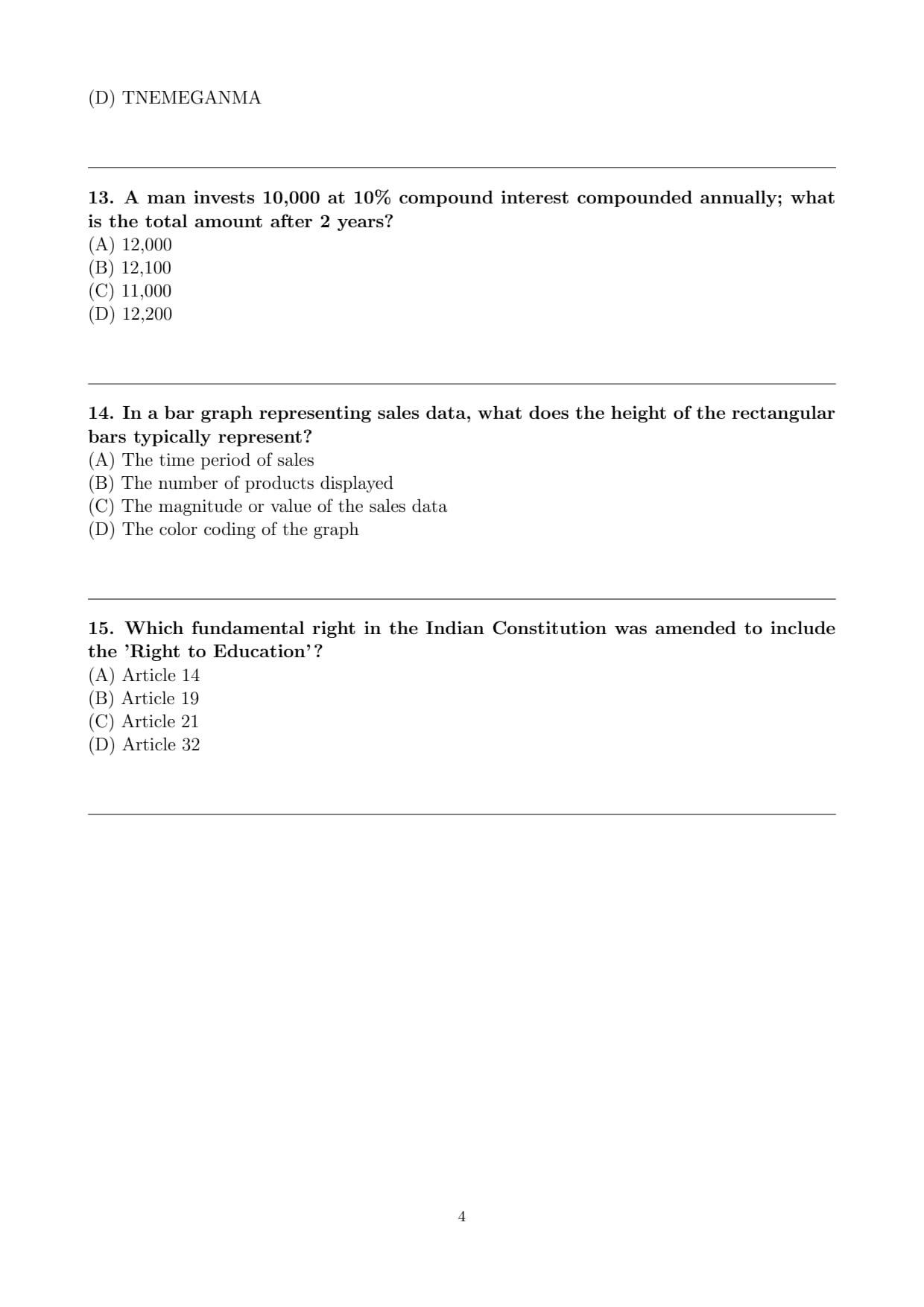
A man invests ₹10,000 at 10% compound interest compounded annually; what is the total amount after 2 years?
View Solution
Concept:
Compound Interest is the interest calculated on both the initial principal and the accumulated interest from previous periods. Unlike simple interest, where interest is calculated only on the principal, compound interest allows interest to grow faster because interest is added to the principal each period.
The formula for compound amount when interest is compounded annually is:
\[ A = P \left(1 + \frac{r}{100}\right)^n \]
Where:
\(A\) = Final amount
\(P\) = Principal (initial investment)
\(r\) = Rate of interest per year
\(n\) = Number of years
Step 1: Identify the given values.
\[ P = 10,000 \]
\[ r = 10% \]
\[ n = 2 years \]
Step 2: Substitute the values into the compound interest formula.
\[ A = 10000 \left(1 + \frac{10}{100}\right)^2 \]
\[ A = 10000 (1.1)^2 \]
Step 3: Calculate the value.
\[ (1.1)^2 = 1.21 \]
\[ A = 10000 \times 1.21 \]
\[ A = 12100 \]
Step 4: Final result.
\[ \boxed{₹12,100} \]
Thus, the total amount after 2 years is ₹12,100. Quick Tip: For compound interest questions: \[ A = P \left(1 + \frac{r}{100}\right)^n \] Example shortcut for 2 years: After 1 year: \(10000 \times 1.10 = 11000\) After 2 years: \(11000 \times 1.10 = 12100\) Memory trick: \[ \textbf{Compound Interest = Interest on Interest} \]
In a bar graph representing sales data, what does the height of the rectangular bars typically represent?
View Solution
Concept:
A bar graph is a graphical representation of data using rectangular bars. It is commonly used in statistics, business analysis, and data visualization to compare different categories of data.
In a bar graph, each bar represents a category, and the height (or length) of the bar corresponds to the value or magnitude of the data associated with that category.
Bar graphs typically consist of:
X-axis (horizontal axis): Represents different categories or groups.
Y-axis (vertical axis): Represents numerical values or quantities.
Bars: Rectangular shapes whose height or length represents the magnitude of the data.
When used to represent sales data, the height of each bar shows the amount or value of sales for a specific product, region, or time period.
Step 1: Understand the structure of a bar graph.
In a bar graph, numerical values are usually represented along the vertical axis, and the bars extend upward to indicate those values.
Step 2: Interpret the meaning of the bar height.
The height of a bar visually represents how large or small the data value is for a particular category.
For example, if one bar is taller than another, it means the corresponding category has a higher value.
Step 3: Analyze the options.
Option (A): The time period of sales — This is usually shown on the horizontal axis.
Option (B): The number of products displayed — This does not represent the bar height.
Option (C): The magnitude or value of the sales data — Correct; the height of the bar represents the numerical value of the data.
Option (D): The color coding of the graph — Colors may distinguish categories but do not represent numerical values.
Step 4: Selecting the correct answer.
\[ \boxed{The magnitude or value of the sales data} \] Quick Tip: Key components of a bar graph: \textbf{X-axis} → Categories (products, months, regions) \textbf{Y-axis} → Numerical values \textbf{Bar height} → Magnitude of the data Memory trick: \[ \textbf{Taller Bar = Higher Value} \] So in sales graphs, the taller the bar, the greater the sales.
Which fundamental right in the Indian Constitution was amended to include the 'Right to Education'?
View Solution
Concept:
The Right to Education (RTE) was incorporated into the Indian Constitution through the 86th Constitutional Amendment Act, 2002. This amendment inserted Article 21A, which guarantees free and compulsory education to children between the ages of 6 and 14 years.
Article 21A was introduced as a part of the broader interpretation of Article 21, which guarantees the Right to Life and Personal Liberty. The Supreme Court of India had earlier interpreted the right to life as including the right to live with dignity, which naturally includes access to education.
Therefore, the Right to Education emerged from and was added to the framework of Article 21.
The amendment also introduced two additional constitutional provisions:
Article 21A – Makes education a fundamental right for children aged 6–14 years.
Article 45 (modified) – Directs the state to provide early childhood care and education for children below six years.
Article 51A(k) – Makes it a fundamental duty of parents or guardians to provide opportunities for education to children between 6 and 14 years.
Step 1: Understand the constitutional change.
The Right to Education was formally added through the 86th Constitutional Amendment Act, 2002.
Step 2: Identify the parent article.
The new Article 21A was inserted under the broader framework of Article 21, which deals with the Right to Life and Personal Liberty.
Step 3: Analyze the options.
Option (A): Article 14 — Related to Right to Equality.
Option (B): Article 19 — Related to various freedoms such as speech and expression.
Option (C): Article 21 — Correct; the Right to Education was introduced as Article 21A under the framework of Article 21.
Option (D): Article 32 — Right to Constitutional Remedies.
Step 4: Selecting the correct answer.
\[ \boxed{Article 21} \] Quick Tip: Important facts about the Right to Education: Introduced by \textbf{86th Constitutional Amendment Act, 2002} Added as \textbf{Article 21A} Guarantees free and compulsory education for children aged \textbf{6–14 years} Implemented through the \textbf{RTE Act, 2009} Memory trick: \[ \textbf{21 → Life} \] \[ \textbf{21A → Life + Education} \]
CUET PG General Management Question Paper 2026: Unit-Wise Weightage
| Unit Name | Approx. Questions | Difficulty |
| Principles of Management & Management Thinkers | 12–14 | Moderate |
| Organizational Behaviour (Motivation, Leadership, Communication) | 10–12 | Easy–Moderate |
| Marketing Management (Concepts, 4Ps, Consumer Behaviour) | 8–10 | Moderate |
| Financial & Accounting Basics | 8–10 | Moderate |
| Human Resource Management | 6–8 | Easy |
| Business Environment, Entrepreneurship & Business Ethics | 6–8 | Moderate |



Comments