CUET PG 2026 Forensic Science Question Paper will be available for download here. The National Testing Agency (NTA) is conducting the CUET PG 2026 Forensic Science ( SCQP13) examination on March 10, 2026, during Shift 2 from 12:30 PM to 2:00 PM.

CUET PG 2026 Forensic Science Question Paper with Solutions PDF

CUET PG 2026 Forensic Science Question Paper with Answer key Download PDF Check Solutions

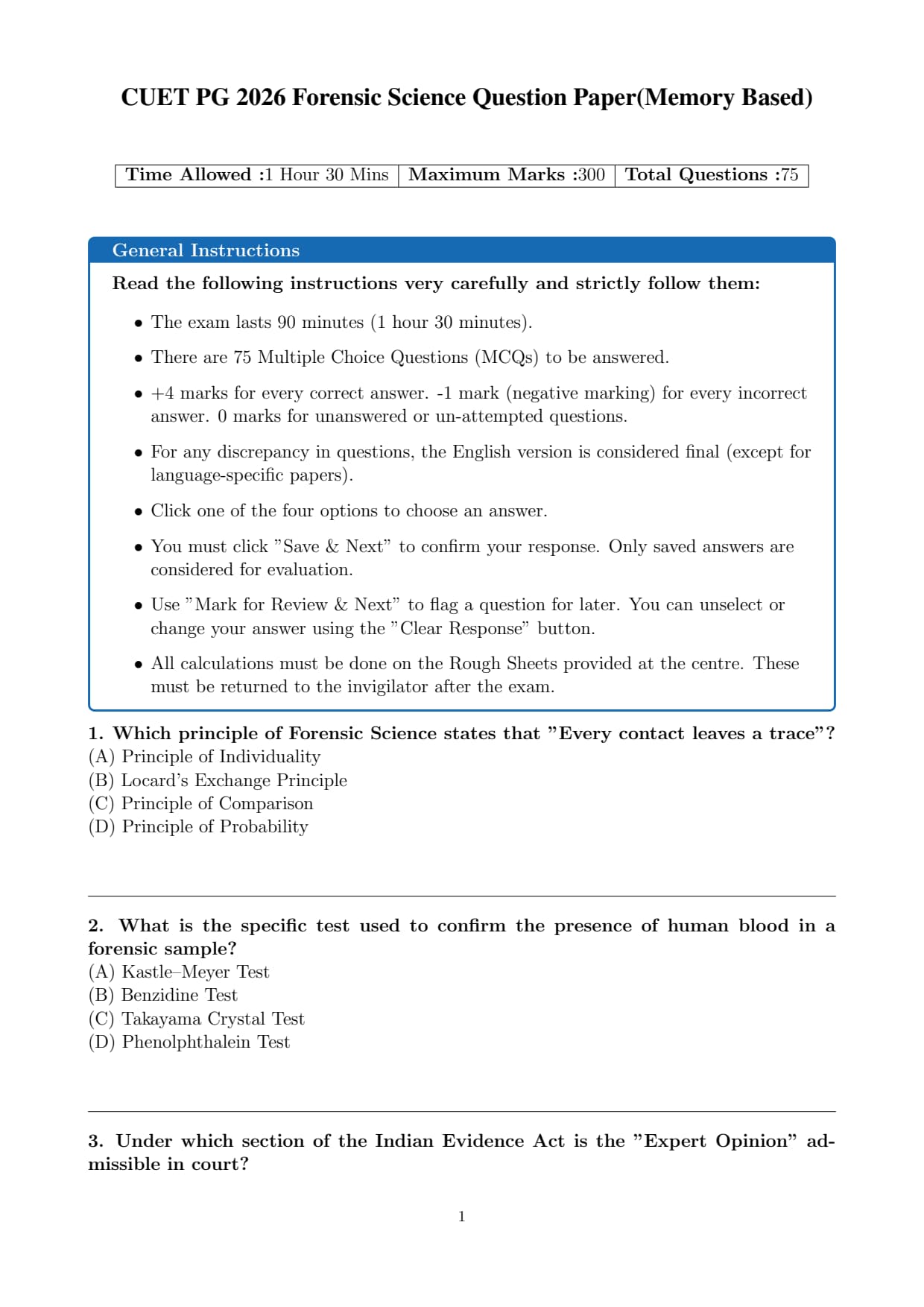
Question 1:

Which principle of Forensic Science states that "Every contact leaves a trace"?

  • (A) Principle of Individuality
  • (B) Locard's Exchange Principle
  • (C) Principle of Comparison
  • (D) Principle of Probability

Question 2:

What is the specific test used to confirm the presence of human blood in a forensic sample?

  • (A) Kastle–Meyer Test
  • (B) Benzidine Test
  • (C) Takayama Crystal Test
  • (D) Phenolphthalein Test

Question 3:

Under which section of the Indian Evidence Act is the "Expert Opinion" admissible in court?

  • (A) Section 24
  • (B) Section 32
  • (C) Section 45
  • (D) Section 73

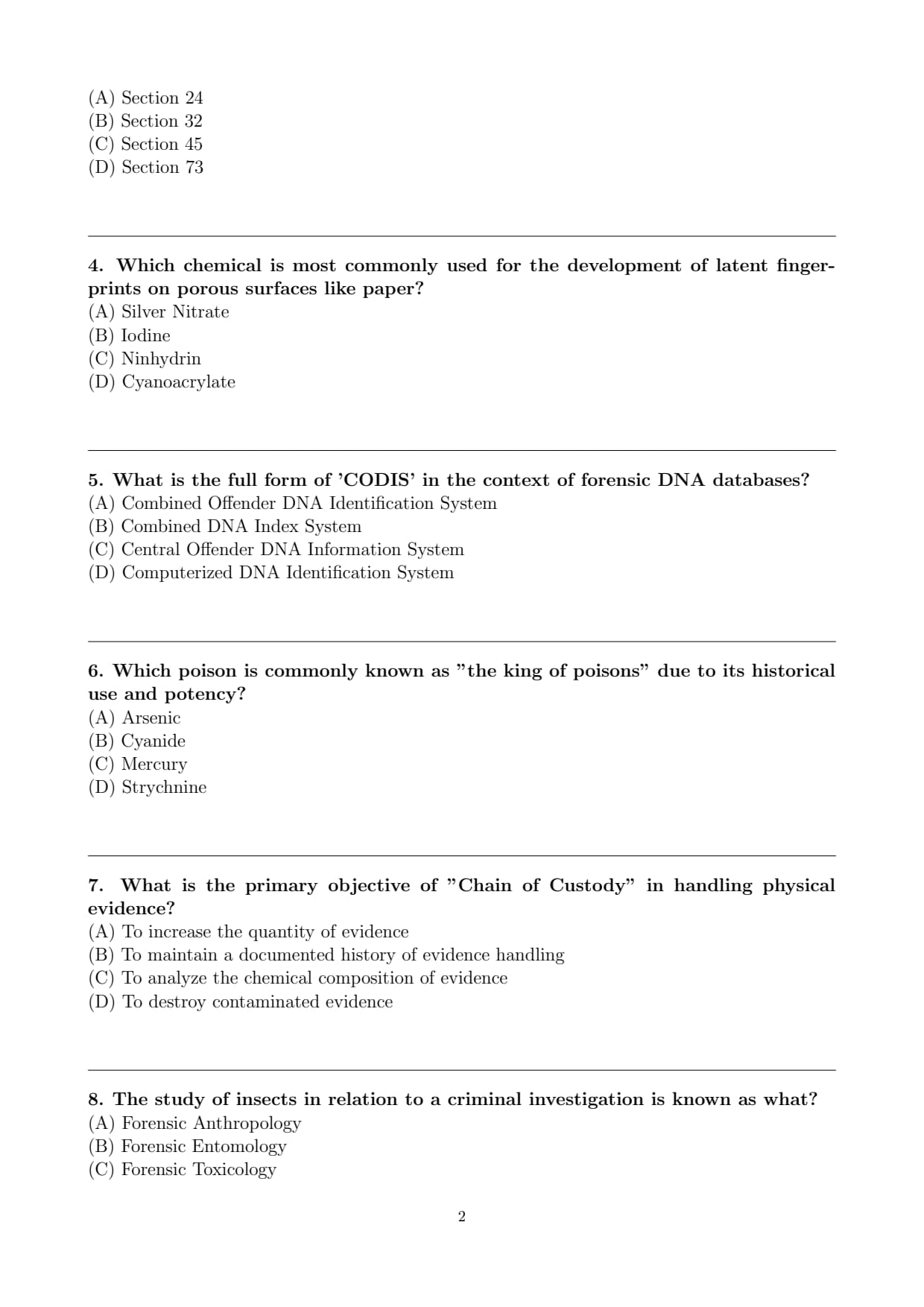
Question 4:

Which chemical is most commonly used for the development of latent fingerprints on porous surfaces like paper?

  • (A) Silver Nitrate
  • (B) Iodine
  • (C) Ninhydrin
  • (D) Cyanoacrylate

Question 5:

What is the full form of 'CODIS' in the context of forensic DNA databases?

  • (A) Combined Offender DNA Identification System
  • (B) Combined DNA Index System
  • (C) Central Offender DNA Information System
  • (D) Computerized DNA Identification System

Question 6:

Which poison is commonly known as "the king of poisons" due to its historical use and potency?

  • (A) Arsenic
  • (B) Cyanide
  • (C) Mercury
  • (D) Strychnine

Question 7:

What is the primary objective of "Chain of Custody" in handling physical evidence?

  • (A) To increase the quantity of evidence
  • (B) To maintain a documented history of evidence handling
  • (C) To analyze the chemical composition of evidence
  • (D) To destroy contaminated evidence

Question 8:

The study of insects in relation to a criminal investigation is known as what?

  • (A) Forensic Anthropology
  • (B) Forensic Entomology
  • (C) Forensic Toxicology
  • (D) Forensic Odontology

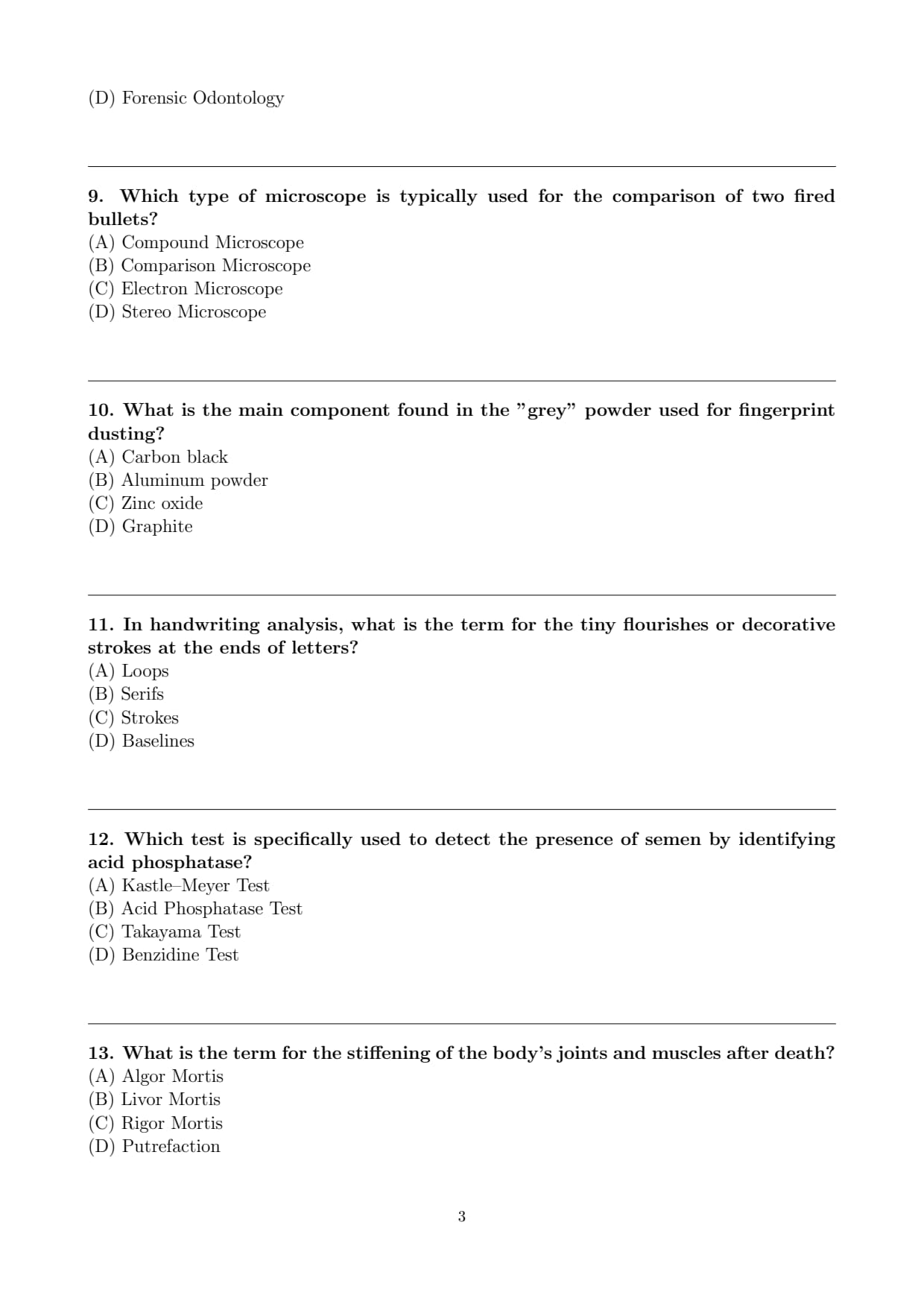
Question 9:

Which type of microscope is typically used for the comparison of two fired bullets?

  • (A) Compound Microscope
  • (B) Comparison Microscope
  • (C) Electron Microscope
  • (D) Stereo Microscope

Question 10:

What is the main component found in the "grey" powder used for fingerprint dusting?

  • (A) Carbon black
  • (B) Aluminum powder
  • (C) Zinc oxide
  • (D) Graphite

Question 11:

In handwriting analysis, what is the term for the tiny flourishes or decorative strokes at the ends of letters?

  • (A) Loops
  • (B) Serifs
  • (C) Strokes
  • (D) Baselines

Question 12:

Which test is specifically used to detect the presence of semen by identifying acid phosphatase?

  • (A) Kastle–Meyer Test
  • (B) Acid Phosphatase Test
  • (C) Takayama Test
  • (D) Benzidine Test

Question 13:

What is the term for the stiffening of the body's joints and muscles after death?

  • (A) Algor Mortis
  • (B) Livor Mortis
  • (C) Rigor Mortis
  • (D) Putrefaction

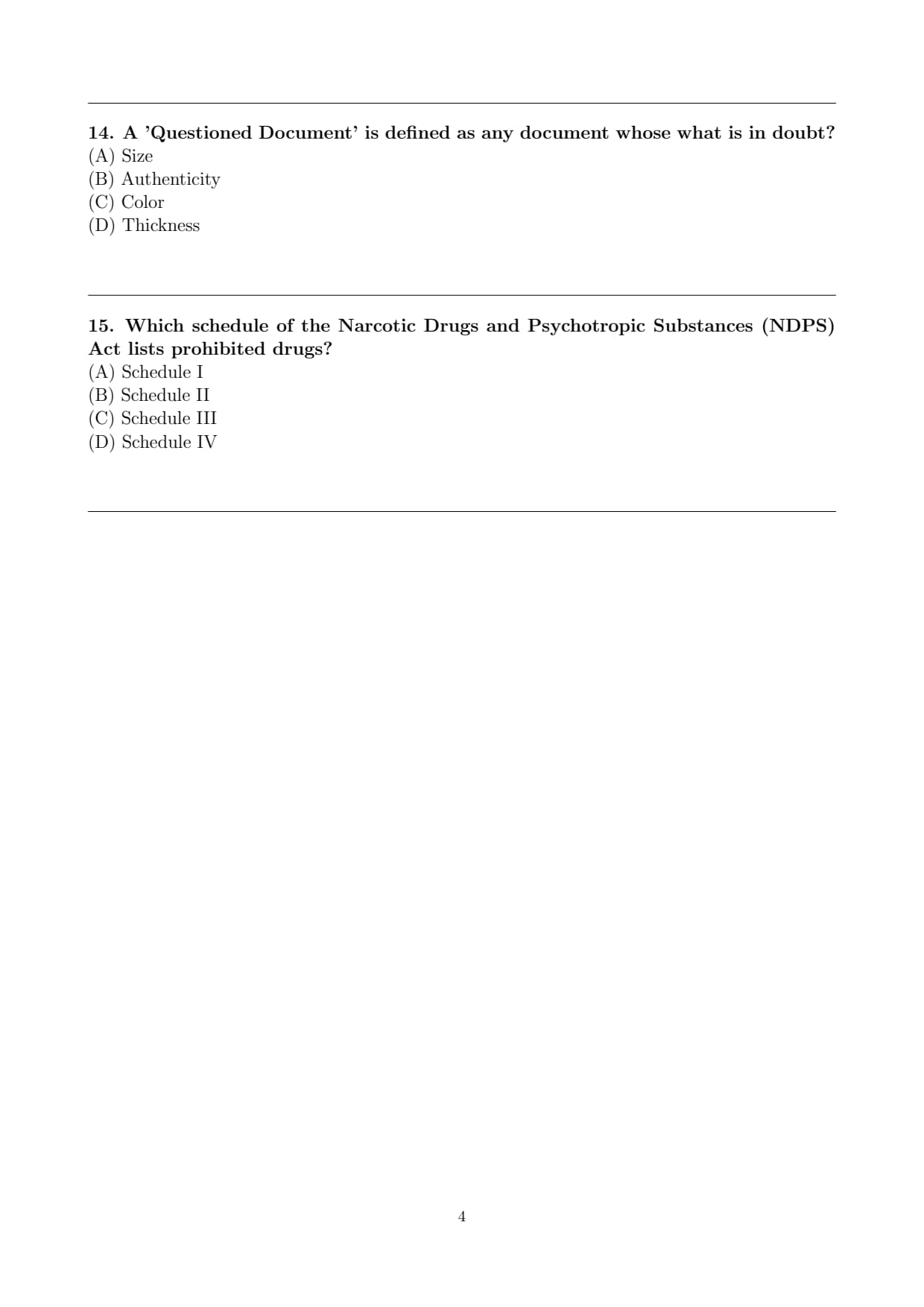
Question 14:

A 'Questioned Document' is defined as any document whose what is in doubt?

  • (A) Size
  • (B) Authenticity
  • (C) Color
  • (D) Thickness

Question 15:

Which schedule of the Narcotic Drugs and Psychotropic Substances (NDPS) Act lists prohibited drugs?
  • (A) Schedule I
  • (B) Schedule II
  • (C) Schedule III
  • (D) Schedule IV

CUET PG 2026 Forensic Science Preparation