




The National Testing Agency (NTA) conducted the CUET PG B.Ed. (COQP03) exam on March 8, 2026, during Shift 1 (9:00 AM – 10:30 AM). This live update covers the CUET PG B.Ed. 2026 question paper analysis, memory-based questions shared by candidates, and the direct link to download the B.Ed. 2026 question paper PDF with solutions.
According to students who appeared for the exam, the overall paper was Moderate in difficulty. Most questions were focused on educational psychology, teaching aptitude, research basics, and concepts of lifelong learning and extension education, while a few questions also tested knowledge of education policies and classroom pedagogy.
CUET PG B.Ed. 2026 Question Paper with Solutions PDF
| CUET PG B.Ed. 2026 Question Paper with Solutions PDF | Download PDF | Check Solutions |
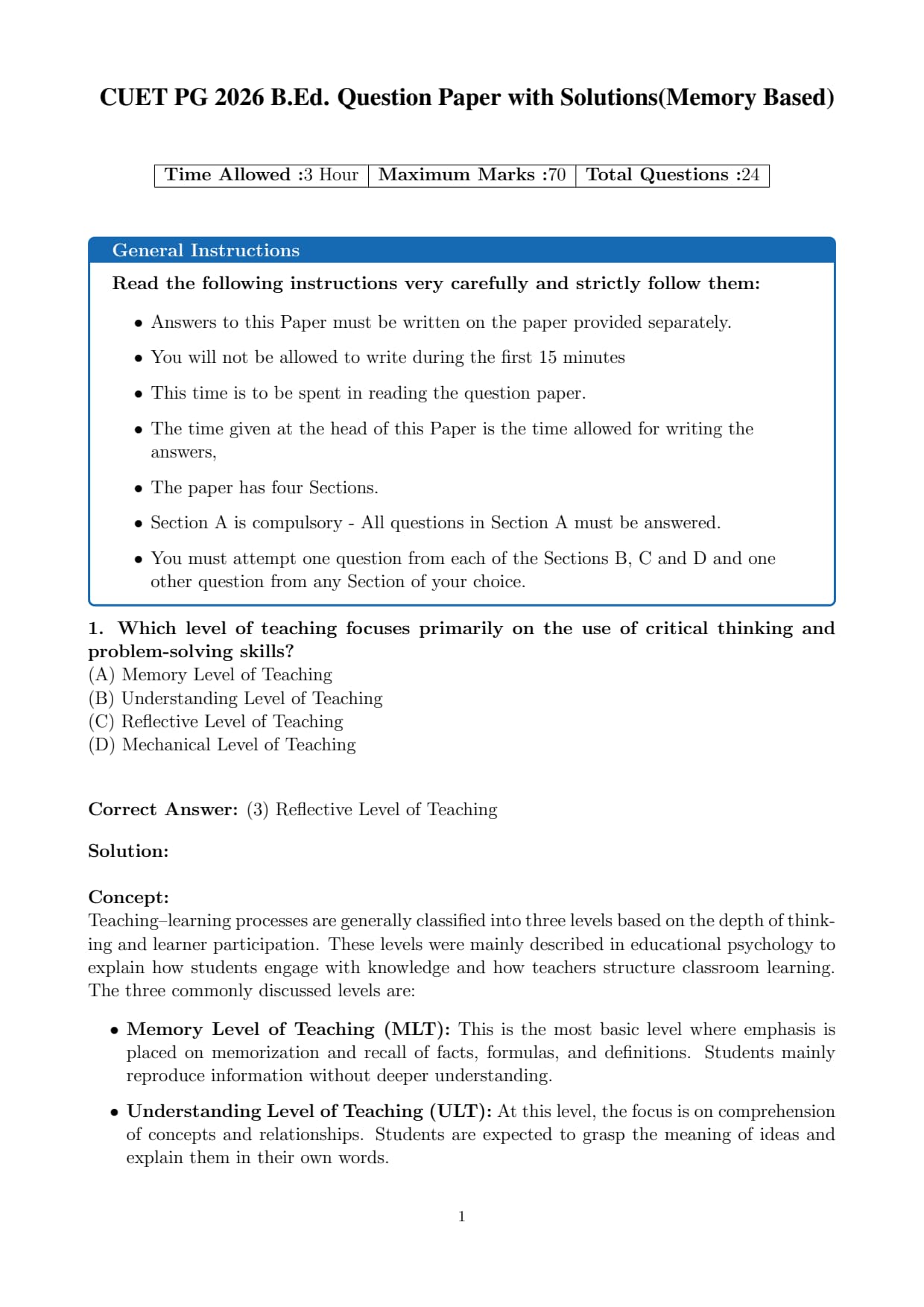
Which level of teaching focuses primarily on the use of critical thinking and problem-solving skills?
View Solution
Concept:
Teaching–learning processes are generally classified into three levels based on the depth of thinking and learner participation. These levels were mainly described in educational psychology to explain how students engage with knowledge and how teachers structure classroom learning. The three commonly discussed levels are:
Memory Level of Teaching (MLT): This is the most basic level where emphasis is placed on memorization and recall of facts, formulas, and definitions. Students mainly reproduce information without deeper understanding.
Understanding Level of Teaching (ULT): At this level, the focus is on comprehension of concepts and relationships. Students are expected to grasp the meaning of ideas and explain them in their own words.
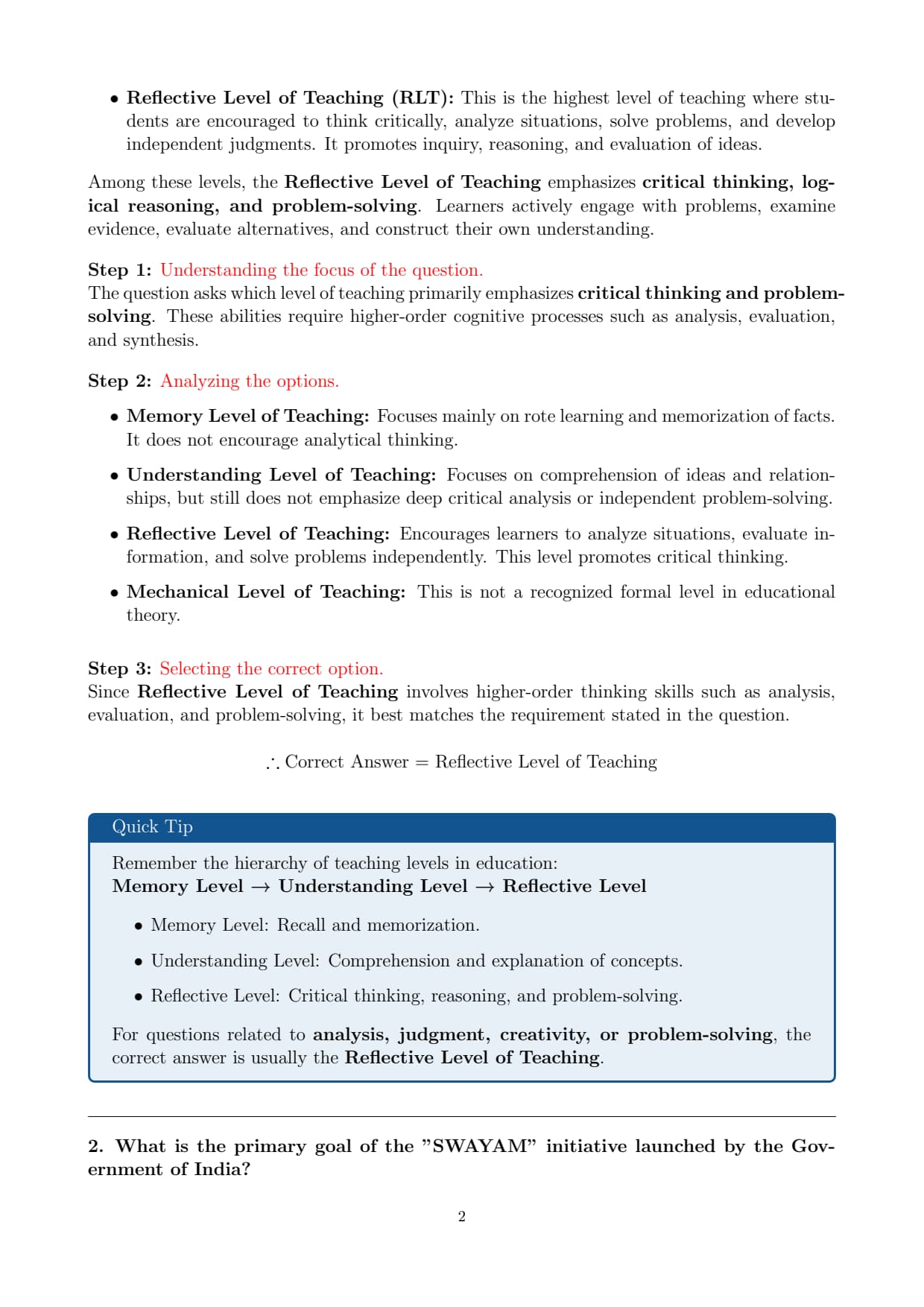
Reflective Level of Teaching (RLT): This is the highest level of teaching where students are encouraged to think critically, analyze situations, solve problems, and develop independent judgments. It promotes inquiry, reasoning, and evaluation of ideas.
Among these levels, the Reflective Level of Teaching emphasizes critical thinking, logical reasoning, and problem-solving. Learners actively engage with problems, examine evidence, evaluate alternatives, and construct their own understanding.
Step 1: Understanding the focus of the question.
The question asks which level of teaching primarily emphasizes critical thinking and problem-solving. These abilities require higher-order cognitive processes such as analysis, evaluation, and synthesis.
Step 2: Analyzing the options.
Memory Level of Teaching: Focuses mainly on rote learning and memorization of facts. It does not encourage analytical thinking.
Understanding Level of Teaching: Focuses on comprehension of ideas and relationships, but still does not emphasize deep critical analysis or independent problem-solving.
Reflective Level of Teaching: Encourages learners to analyze situations, evaluate information, and solve problems independently. This level promotes critical thinking.
Mechanical Level of Teaching: This is not a recognized formal level in educational theory.
Step 3: Selecting the correct option.
Since Reflective Level of Teaching involves higher-order thinking skills such as analysis, evaluation, and problem-solving, it best matches the requirement stated in the question.
\[ \therefore Correct Answer = Reflective Level of Teaching \] Quick Tip: Remember the hierarchy of teaching levels in education:
\textbf{Memory Level → Understanding Level → Reflective Level} Memory Level: Recall and memorization. Understanding Level: Comprehension and explanation of concepts. Reflective Level: Critical thinking, reasoning, and problem-solving. For questions related to \textbf{analysis, judgment, creativity, or problem-solving}, the correct answer is usually the \textbf{Reflective Level of Teaching}.
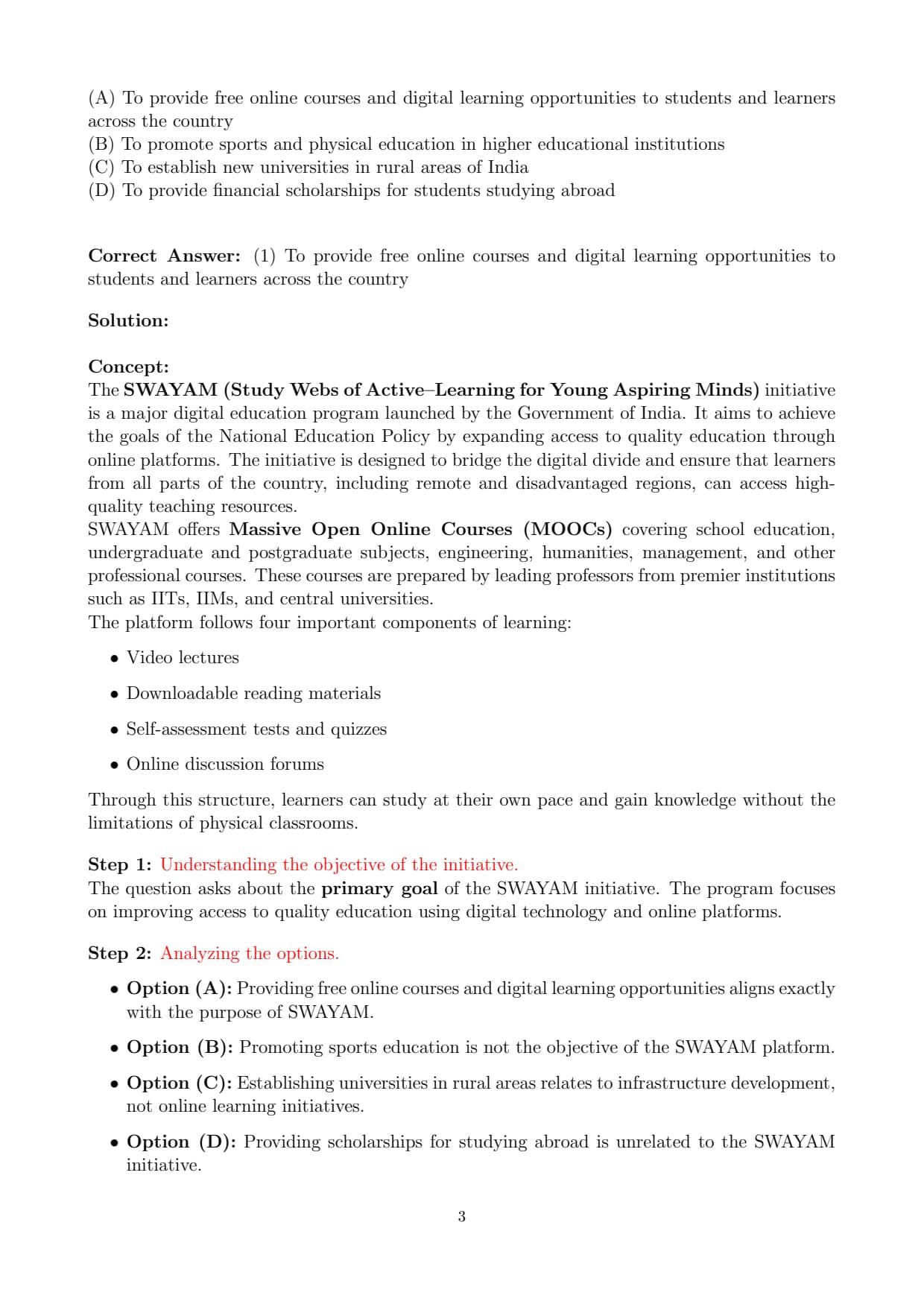
What is the primary goal of the "SWAYAM" initiative launched by the Government of India?
View Solution
Concept:
The SWAYAM (Study Webs of Active–Learning for Young Aspiring Minds) initiative is a major digital education program launched by the Government of India. It aims to achieve the goals of the National Education Policy by expanding access to quality education through online platforms. The initiative is designed to bridge the digital divide and ensure that learners from all parts of the country, including remote and disadvantaged regions, can access high-quality teaching resources.
SWAYAM offers Massive Open Online Courses (MOOCs) covering school education, undergraduate and postgraduate subjects, engineering, humanities, management, and other professional courses. These courses are prepared by leading professors from premier institutions such as IITs, IIMs, and central universities.
The platform follows four important components of learning:
Video lectures
Downloadable reading materials
Self-assessment tests and quizzes
Online discussion forums
Through this structure, learners can study at their own pace and gain knowledge without the limitations of physical classrooms.
Step 1: Understanding the objective of the initiative.
The question asks about the primary goal of the SWAYAM initiative. The program focuses on improving access to quality education using digital technology and online platforms.
Step 2: Analyzing the options.
Option (A): Providing free online courses and digital learning opportunities aligns exactly with the purpose of SWAYAM.
Option (B): Promoting sports education is not the objective of the SWAYAM platform.
Option (C): Establishing universities in rural areas relates to infrastructure development, not online learning initiatives.
Option (D): Providing scholarships for studying abroad is unrelated to the SWAYAM initiative.
Step 3: Selecting the correct answer.
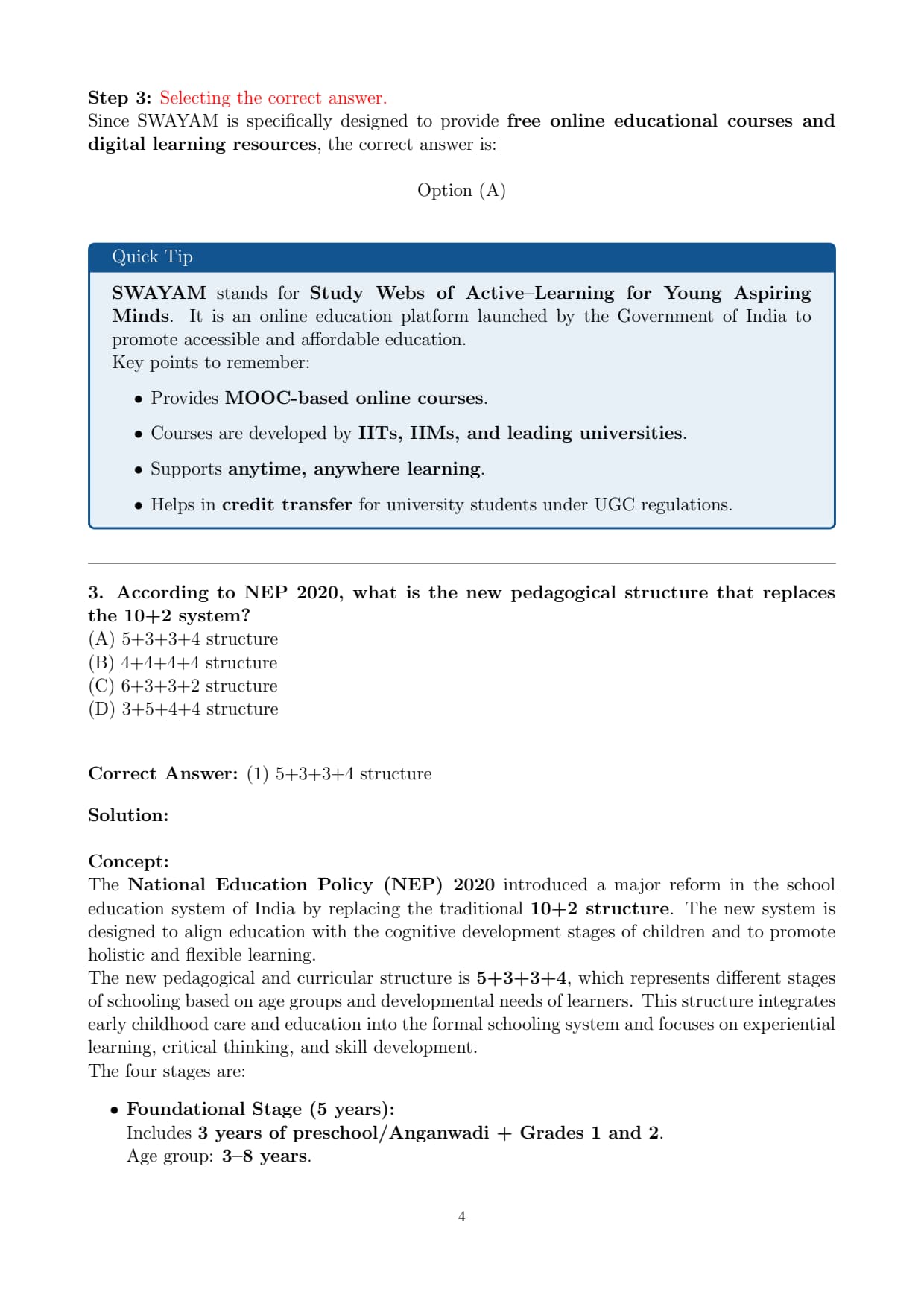
Since SWAYAM is specifically designed to provide free online educational courses and digital learning resources, the correct answer is:
\[ Option (A) \] Quick Tip: \textbf{SWAYAM} stands for \textbf{Study Webs of Active–Learning for Young Aspiring Minds}. It is an online education platform launched by the Government of India to promote accessible and affordable education. Key points to remember: Provides \textbf{MOOC-based online courses}. Courses are developed by \textbf{IITs, IIMs, and leading universities}. Supports \textbf{anytime, anywhere learning}. Helps in \textbf{credit transfer} for university students under UGC regulations.
According to NEP 2020, what is the new pedagogical structure that replaces the 10+2 system?
View Solution
Concept:
The National Education Policy (NEP) 2020 introduced a major reform in the school education system of India by replacing the traditional 10+2 structure. The new system is designed to align education with the cognitive development stages of children and to promote holistic and flexible learning.
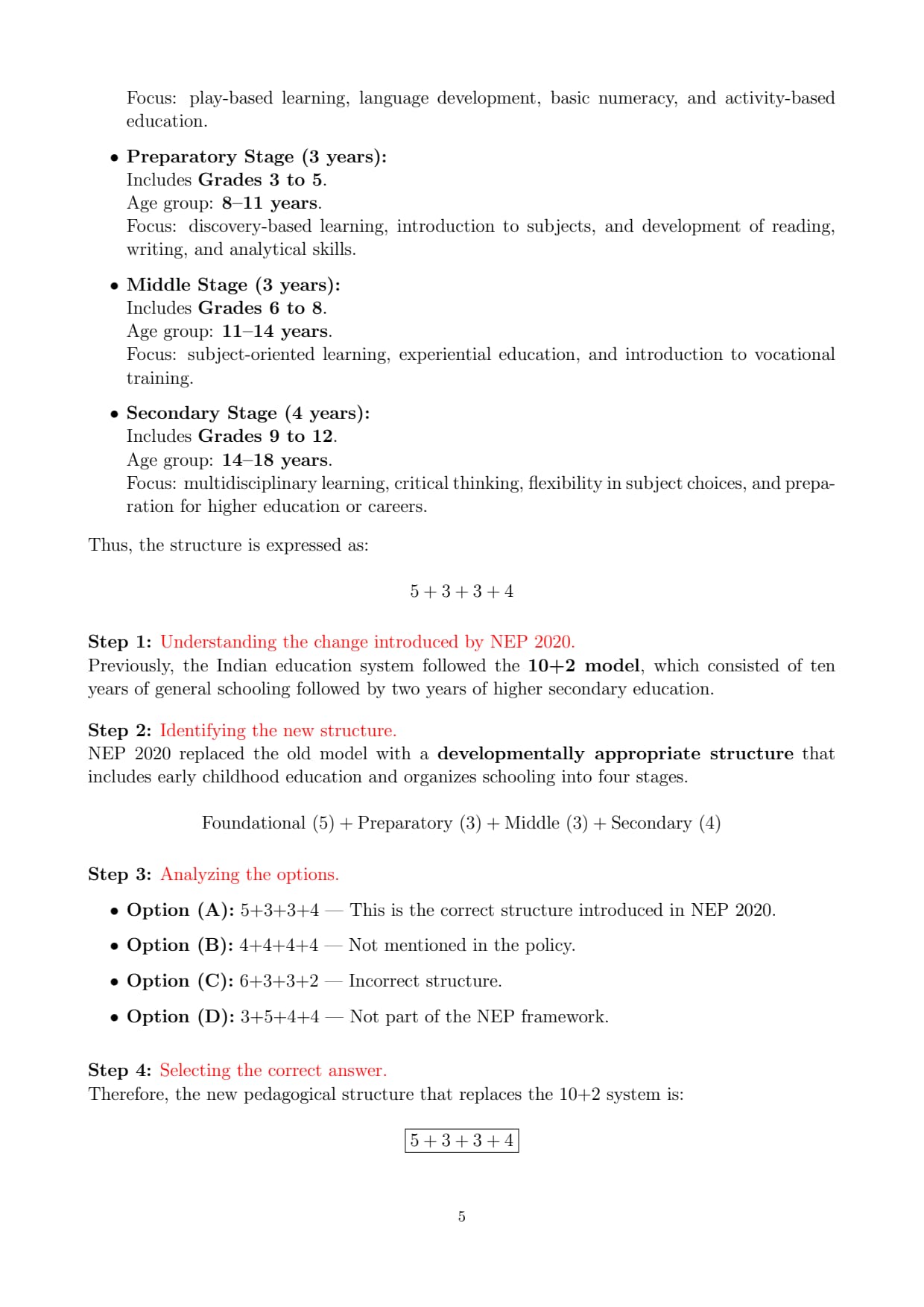
The new pedagogical and curricular structure is 5+3+3+4, which represents different stages of schooling based on age groups and developmental needs of learners. This structure integrates early childhood care and education into the formal schooling system and focuses on experiential learning, critical thinking, and skill development.
The four stages are:
Foundational Stage (5 years):
Includes 3 years of preschool/Anganwadi + Grades 1 and 2.
Age group: 3–8 years.
Focus: play-based learning, language development, basic numeracy, and activity-based education.
Preparatory Stage (3 years):
Includes Grades 3 to 5.
Age group: 8–11 years.
Focus: discovery-based learning, introduction to subjects, and development of reading, writing, and analytical skills.
Middle Stage (3 years):
Includes Grades 6 to 8.
Age group: 11–14 years.
Focus: subject-oriented learning, experiential education, and introduction to vocational training.
Secondary Stage (4 years):
Includes Grades 9 to 12.
Age group: 14–18 years.
Focus: multidisciplinary learning, critical thinking, flexibility in subject choices, and preparation for higher education or careers.
Thus, the structure is expressed as:
\[ 5 + 3 + 3 + 4 \]
Step 1: Understanding the change introduced by NEP 2020.
Previously, the Indian education system followed the 10+2 model, which consisted of ten years of general schooling followed by two years of higher secondary education.
Step 2: Identifying the new structure.
NEP 2020 replaced the old model with a developmentally appropriate structure that includes early childhood education and organizes schooling into four stages.
\[ Foundational (5) + Preparatory (3) + Middle (3) + Secondary (4) \]
Step 3: Analyzing the options.
Option (A): 5+3+3+4 — This is the correct structure introduced in NEP 2020.
Option (B): 4+4+4+4 — Not mentioned in the policy.
Option (C): 6+3+3+2 — Incorrect structure.
Option (D): 3+5+4+4 — Not part of the NEP framework.
Step 4: Selecting the correct answer.
Therefore, the new pedagogical structure that replaces the 10+2 system is:
\[ \boxed{5+3+3+4} \] Quick Tip: \textbf{NEP 2020 School Structure:} \textbf{5 years} → Foundational Stage (3 years preschool + Grades 1–2) \textbf{3 years} → Preparatory Stage (Grades 3–5) \textbf{3 years} → Middle Stage (Grades 6–8) \textbf{4 years} → Secondary Stage (Grades 9–12) A quick way to remember it for exams: \[ \textbf{Foundational + Preparatory + Middle + Secondary} \] \[ \textbf{5 + 3 + 3 + 4} \] This reform integrates \textbf{early childhood education into the formal schooling system}.
If a student is consistently disruptive in class, what is the most pedagogically sound first step for a teacher?
View Solution
Concept:
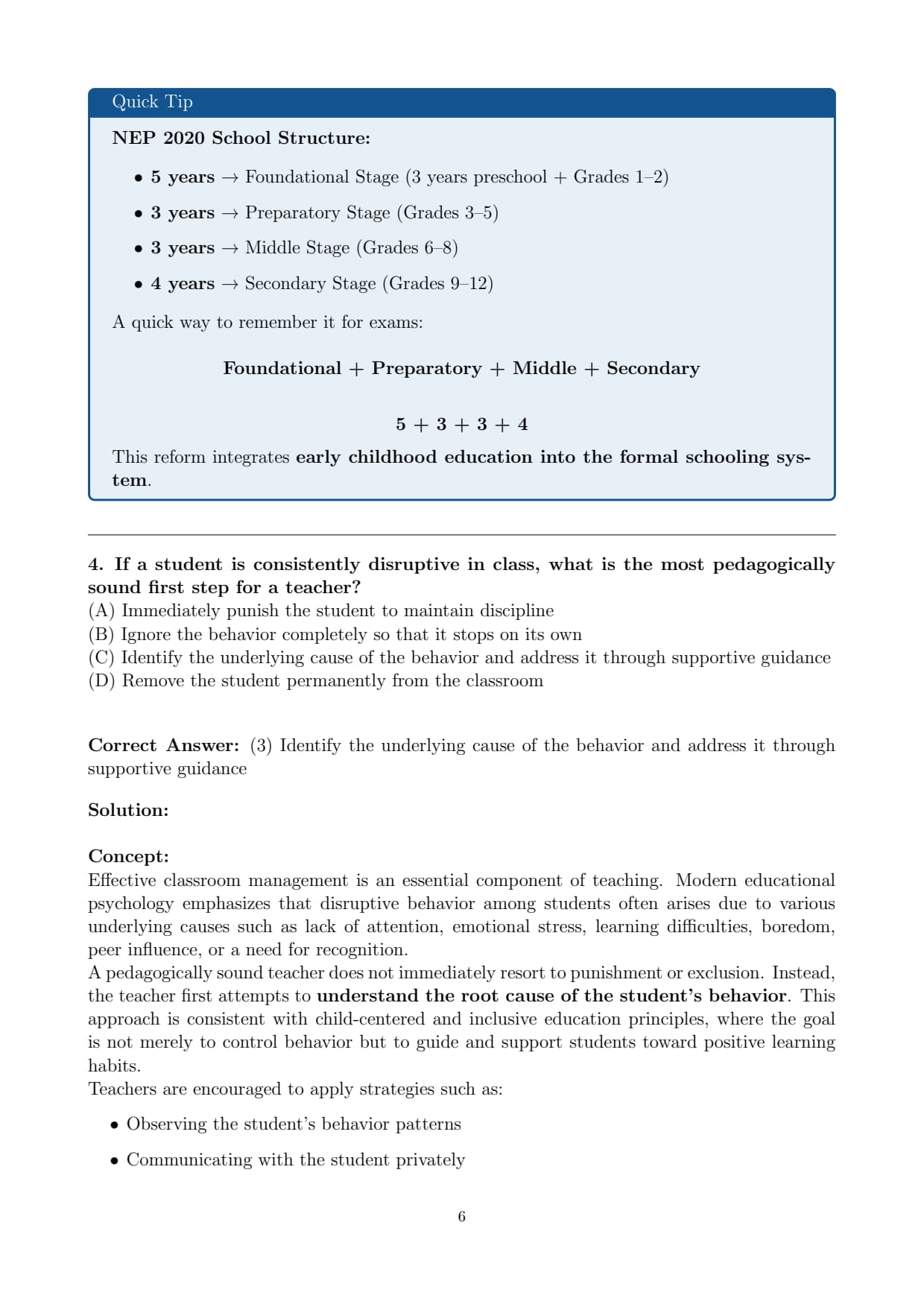
Effective classroom management is an essential component of teaching. Modern educational psychology emphasizes that disruptive behavior among students often arises due to various underlying causes such as lack of attention, emotional stress, learning difficulties, boredom, peer influence, or a need for recognition.
A pedagogically sound teacher does not immediately resort to punishment or exclusion. Instead, the teacher first attempts to understand the root cause of the student's behavior. This approach is consistent with child-centered and inclusive education principles, where the goal is not merely to control behavior but to guide and support students toward positive learning habits.
Teachers are encouraged to apply strategies such as:
Observing the student's behavior patterns
Communicating with the student privately
Understanding emotional or academic difficulties
Providing guidance, counseling, or motivation
Adjusting teaching strategies if needed
By identifying the underlying cause, the teacher can take appropriate steps that promote both discipline and student well-being.
Step 1: Understanding the focus of the question.
The question asks for the most pedagogically sound first step. This means the action that aligns best with educational principles and student-centered teaching.
Step 2: Analyzing the options.
Option (A): Immediate punishment may control behavior temporarily but does not address the root cause of the problem.
Option (B): Ignoring disruptive behavior can allow the problem to worsen and negatively affect the learning environment.
Option (C): Identifying the underlying cause and guiding the student constructively is the most effective and educationally appropriate approach.
Option (D): Permanently removing a student from the classroom is an extreme step and not appropriate as a first response.
Step 3: Selecting the correct answer.
Since good teaching practices emphasize understanding students and addressing the causes of behavioral issues, the correct choice is:
\[ Option (C) \] Quick Tip: In classroom management questions, remember this principle: \textbf{Understand → Guide → Support → Correct} Teachers should first try to understand the reason behind a student's behavior before taking disciplinary action. Positive guidance and supportive interventions are considered more effective than punishment in promoting long-term behavioral improvement.
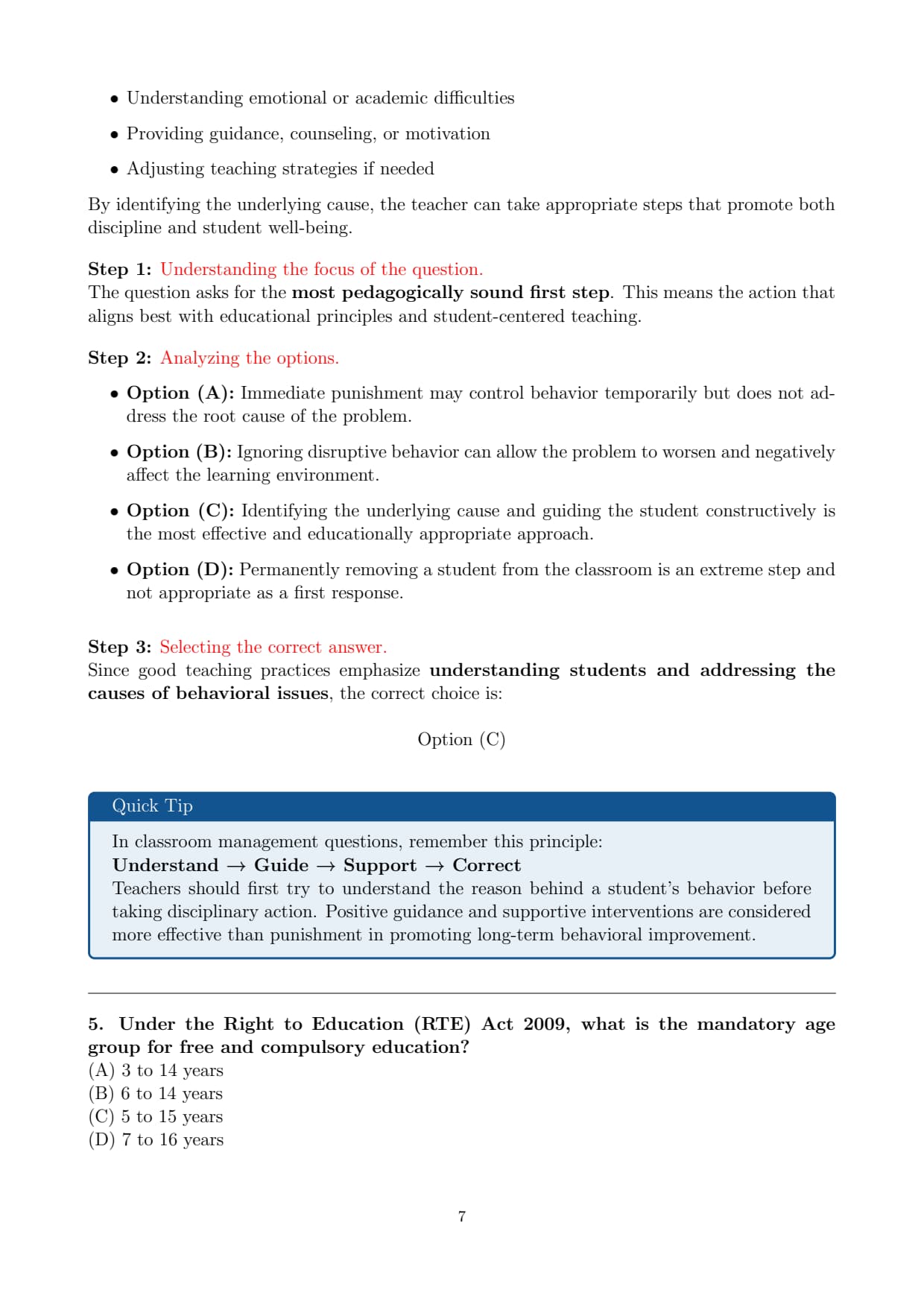
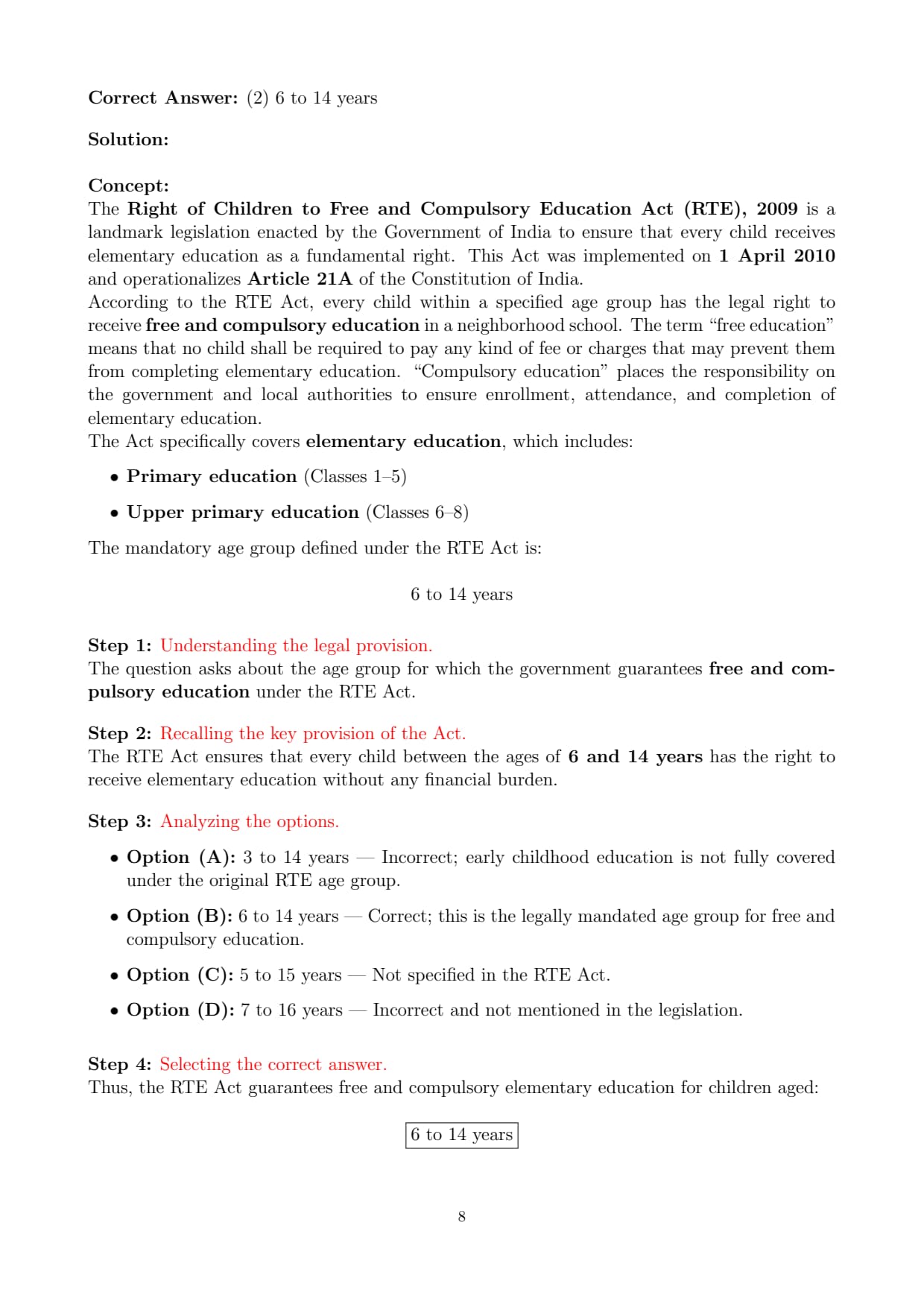
Under the Right to Education (RTE) Act 2009, what is the mandatory age group for free and compulsory education?
View Solution
Concept:
The Right of Children to Free and Compulsory Education Act (RTE), 2009 is a landmark legislation enacted by the Government of India to ensure that every child receives elementary education as a fundamental right. This Act was implemented on 1 April 2010 and operationalizes Article 21A of the Constitution of India.
According to the RTE Act, every child within a specified age group has the legal right to receive free and compulsory education in a neighborhood school. The term “free education” means that no child shall be required to pay any kind of fee or charges that may prevent them from completing elementary education. “Compulsory education” places the responsibility on the government and local authorities to ensure enrollment, attendance, and completion of elementary education.
The Act specifically covers elementary education, which includes:
Primary education (Classes 1–5)
Upper primary education (Classes 6–8)
The mandatory age group defined under the RTE Act is:
\[ 6 to 14 years \]
Step 1: Understanding the legal provision.
The question asks about the age group for which the government guarantees free and compulsory education under the RTE Act.
Step 2: Recalling the key provision of the Act.
The RTE Act ensures that every child between the ages of 6 and 14 years has the right to receive elementary education without any financial burden.
Step 3: Analyzing the options.
Option (A): 3 to 14 years — Incorrect; early childhood education is not fully covered under the original RTE age group.
Option (B): 6 to 14 years — Correct; this is the legally mandated age group for free and compulsory education.
Option (C): 5 to 15 years — Not specified in the RTE Act.
Option (D): 7 to 16 years — Incorrect and not mentioned in the legislation.
Step 4: Selecting the correct answer.
Thus, the RTE Act guarantees free and compulsory elementary education for children aged:
\[ \boxed{6 to 14 years} \] Quick Tip: Key points about the \textbf{RTE Act 2009} for exams: Guarantees \textbf{free and compulsory education}. Covers children aged \textbf{6–14 years}. Implements \textbf{Article 21A} of the Constitution. Ensures \textbf{no detention policy} (initially introduced). Mandates \textbf{25% reservation for economically weaker sections} in private schools. A quick memory trick: \[ \textbf{RTE = Classes 1–8 = Age 6–14} \]
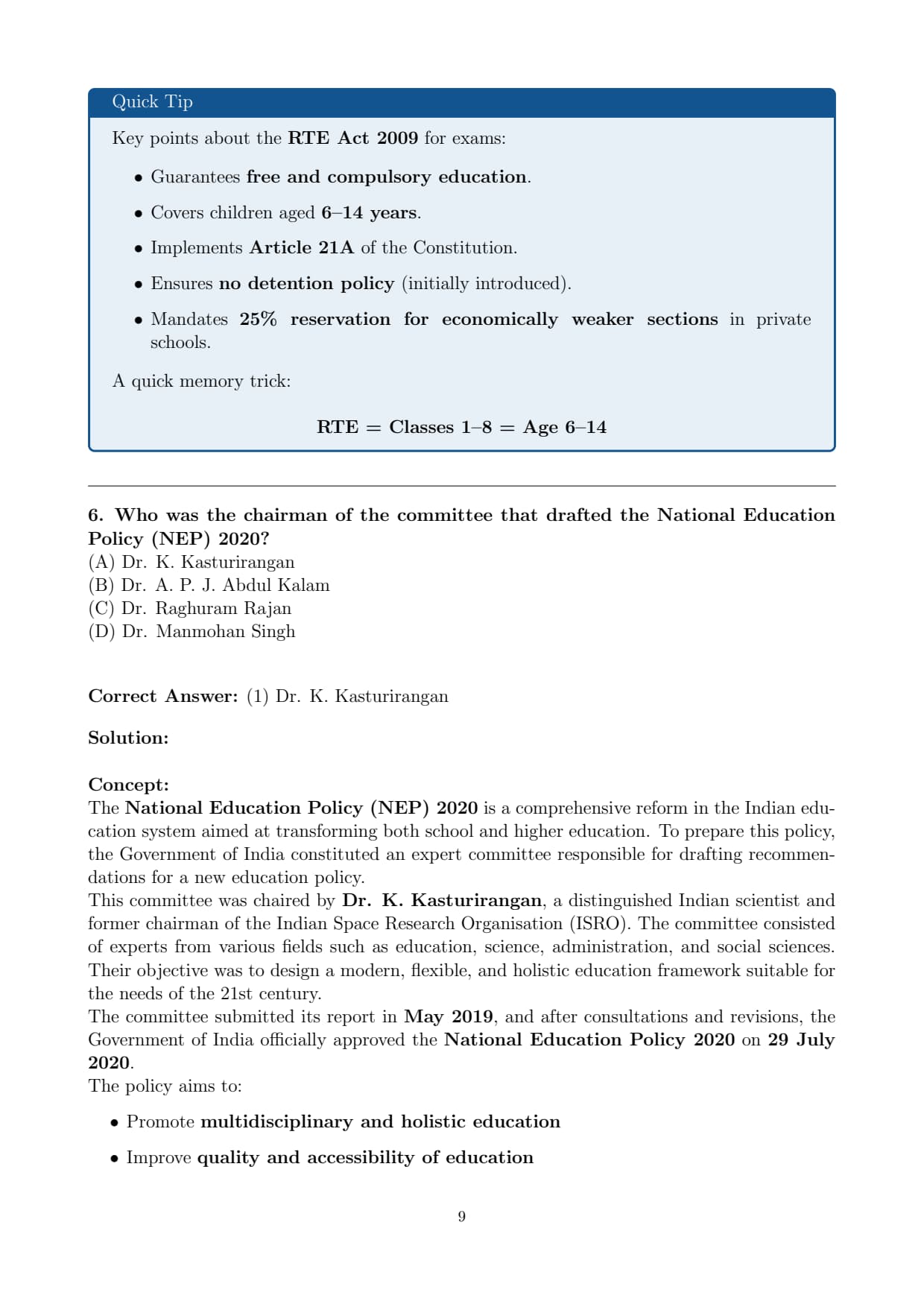
Who was the chairman of the committee that drafted the National Education Policy (NEP) 2020?
View Solution
Concept:
The National Education Policy (NEP) 2020 is a comprehensive reform in the Indian education system aimed at transforming both school and higher education. To prepare this policy, the Government of India constituted an expert committee responsible for drafting recommendations for a new education policy.
This committee was chaired by Dr. K. Kasturirangan, a distinguished Indian scientist and former chairman of the Indian Space Research Organisation (ISRO). The committee consisted of experts from various fields such as education, science, administration, and social sciences. Their objective was to design a modern, flexible, and holistic education framework suitable for the needs of the 21st century.
The committee submitted its report in May 2019, and after consultations and revisions, the Government of India officially approved the National Education Policy 2020 on 29 July 2020.
The policy aims to:
Promote multidisciplinary and holistic education
Improve quality and accessibility of education
Encourage critical thinking and creativity
Integrate technology in education
Reform the school structure to 5+3+3+4
Step 1: Understanding the question.
The question asks for the chairman of the committee that prepared the draft of the National Education Policy 2020.
Step 2: Recalling the committee leadership.
The committee responsible for drafting the NEP 2020 was chaired by Dr. K. Kasturirangan, who played a key role in shaping the recommendations of the policy.
Step 3: Analyzing the options.
Option (A): Dr. K. Kasturirangan — Correct; he chaired the committee that drafted NEP 2020.
Option (B): Dr. A. P. J. Abdul Kalam — Former President of India and scientist, but not related to drafting NEP 2020.
Option (C): Dr. Raghuram Rajan — Former Governor of the Reserve Bank of India.
Option (D): Dr. Manmohan Singh — Former Prime Minister of India.
Step 4: Selecting the correct answer.
Since the drafting committee of NEP 2020 was led by Dr. K. Kasturirangan, the correct answer is:
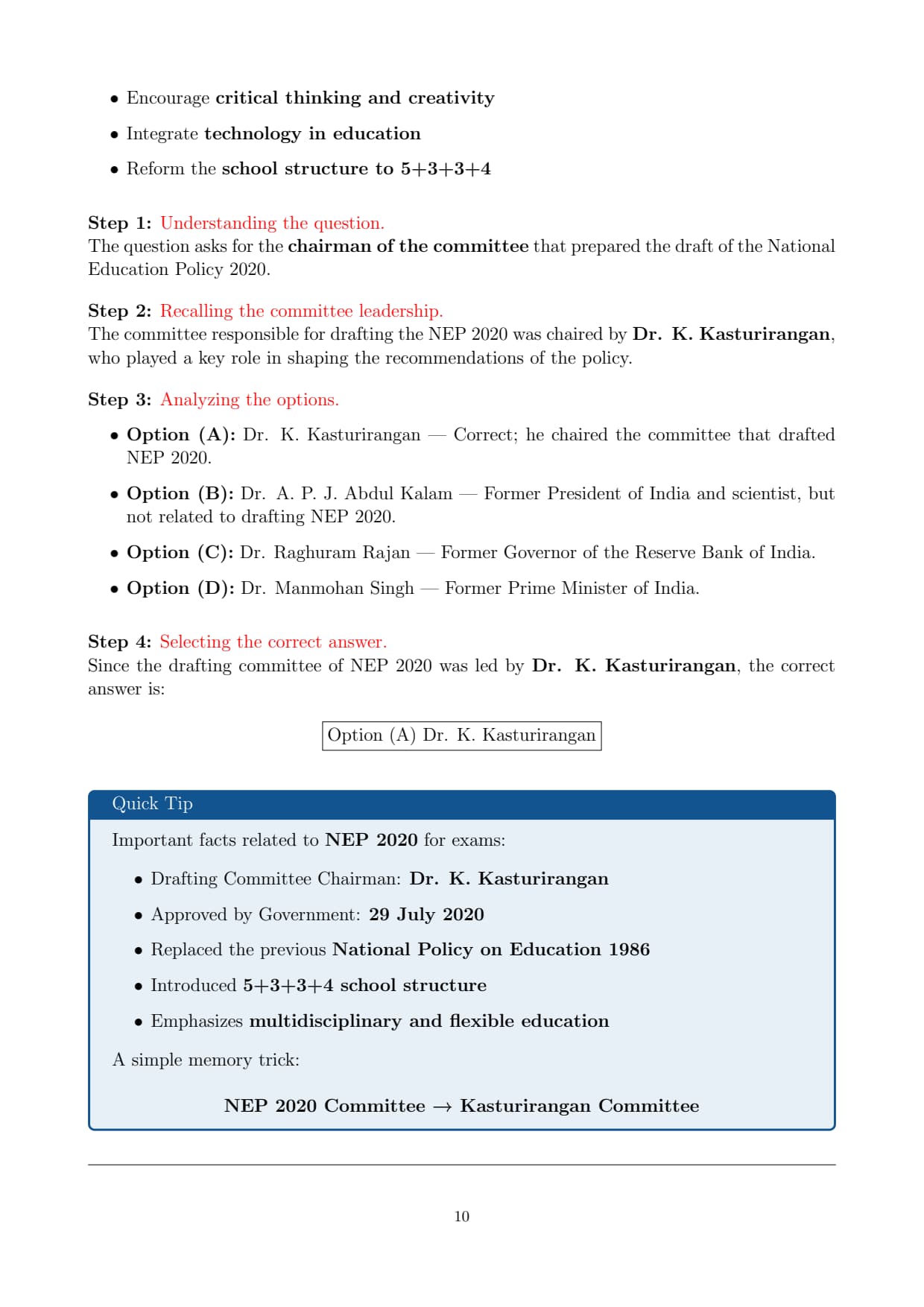
\[ \boxed{Option (A) Dr. K. Kasturirangan} \] Quick Tip: Important facts related to \textbf{NEP 2020} for exams: Drafting Committee Chairman: \textbf{Dr. K. Kasturirangan} Approved by Government: \textbf{29 July 2020} Replaced the previous \textbf{National Policy on Education 1986} Introduced \textbf{5+3+3+4 school structure} Emphasizes \textbf{multidisciplinary and flexible education} A simple memory trick: \[ \textbf{NEP 2020 Committee → Kasturirangan Committee} \]
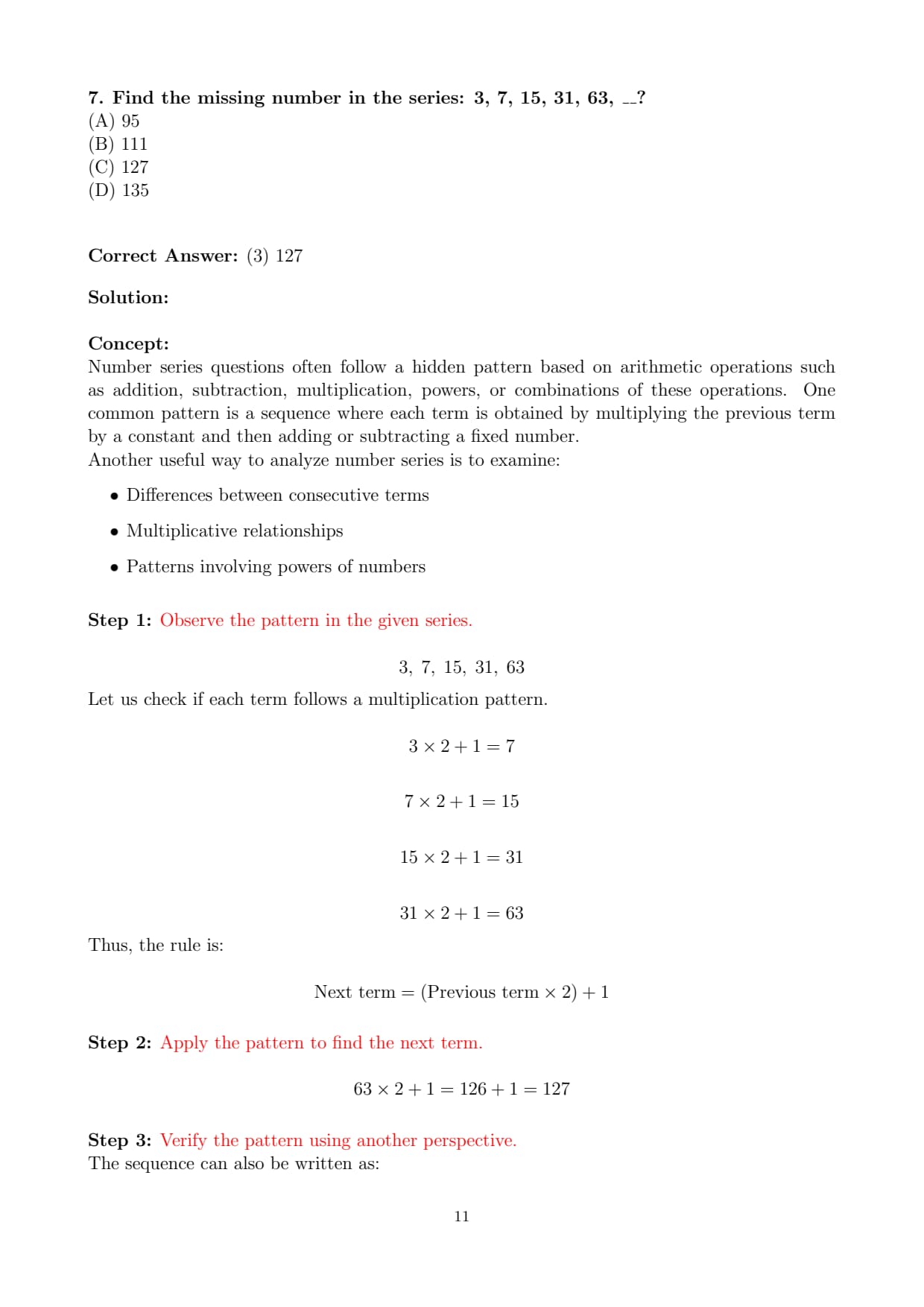
Find the missing number in the series: 3, 7, 15, 31, 63, __?
View Solution
Concept:
Number series questions often follow a hidden pattern based on arithmetic operations such as addition, subtraction, multiplication, powers, or combinations of these operations. One common pattern is a sequence where each term is obtained by multiplying the previous term by a constant and then adding or subtracting a fixed number.
Another useful way to analyze number series is to examine:
Differences between consecutive terms
Multiplicative relationships
Patterns involving powers of numbers
Step 1: Observe the pattern in the given series.
\[ 3,\; 7,\; 15,\; 31,\; 63 \]
Let us check if each term follows a multiplication pattern.
\[ 3 \times 2 + 1 = 7 \]
\[ 7 \times 2 + 1 = 15 \]
\[ 15 \times 2 + 1 = 31 \]
\[ 31 \times 2 + 1 = 63 \]
Thus, the rule is:
\[ Next term = (Previous term \times 2) + 1 \]
Step 2: Apply the pattern to find the next term.
\[ 63 \times 2 + 1 = 126 + 1 = 127 \]
Step 3: Verify the pattern using another perspective.
The sequence can also be written as:
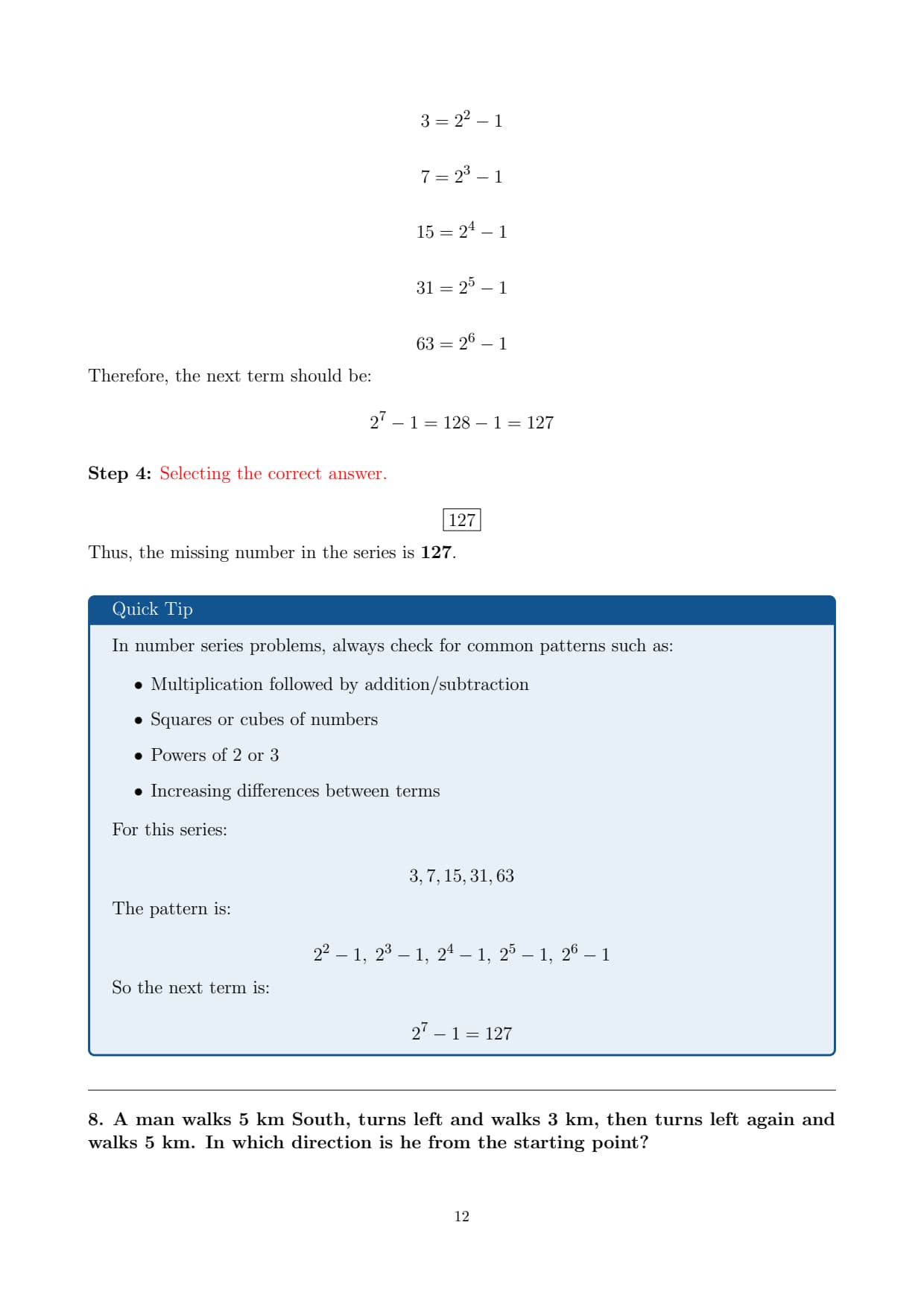
\[ 3 = 2^2 - 1 \]
\[ 7 = 2^3 - 1 \]
\[ 15 = 2^4 - 1 \]
\[ 31 = 2^5 - 1 \]
\[ 63 = 2^6 - 1 \]
Therefore, the next term should be:
\[ 2^7 - 1 = 128 - 1 = 127 \]
Step 4: Selecting the correct answer.
\[ \boxed{127} \]
Thus, the missing number in the series is 127. Quick Tip: In number series problems, always check for common patterns such as: Multiplication followed by addition/subtraction Squares or cubes of numbers Powers of 2 or 3 Increasing differences between terms For this series: \[ 3, 7, 15, 31, 63 \] The pattern is: \[ 2^2-1,\; 2^3-1,\; 2^4-1,\; 2^5-1,\; 2^6-1 \] So the next term is: \[ 2^7 - 1 = 127 \]
A man walks 5 km South, turns left and walks 3 km, then turns left again and walks 5 km. In which direction is he from the starting point?
View Solution
Concept:
Direction sense questions test the ability to track movements and determine the final position relative to the starting point. While solving such problems, it is helpful to imagine the directions on a compass or draw a simple diagram.
The four primary directions are:
North (N)
South (S)
East (E)
West (W)
Important rules:
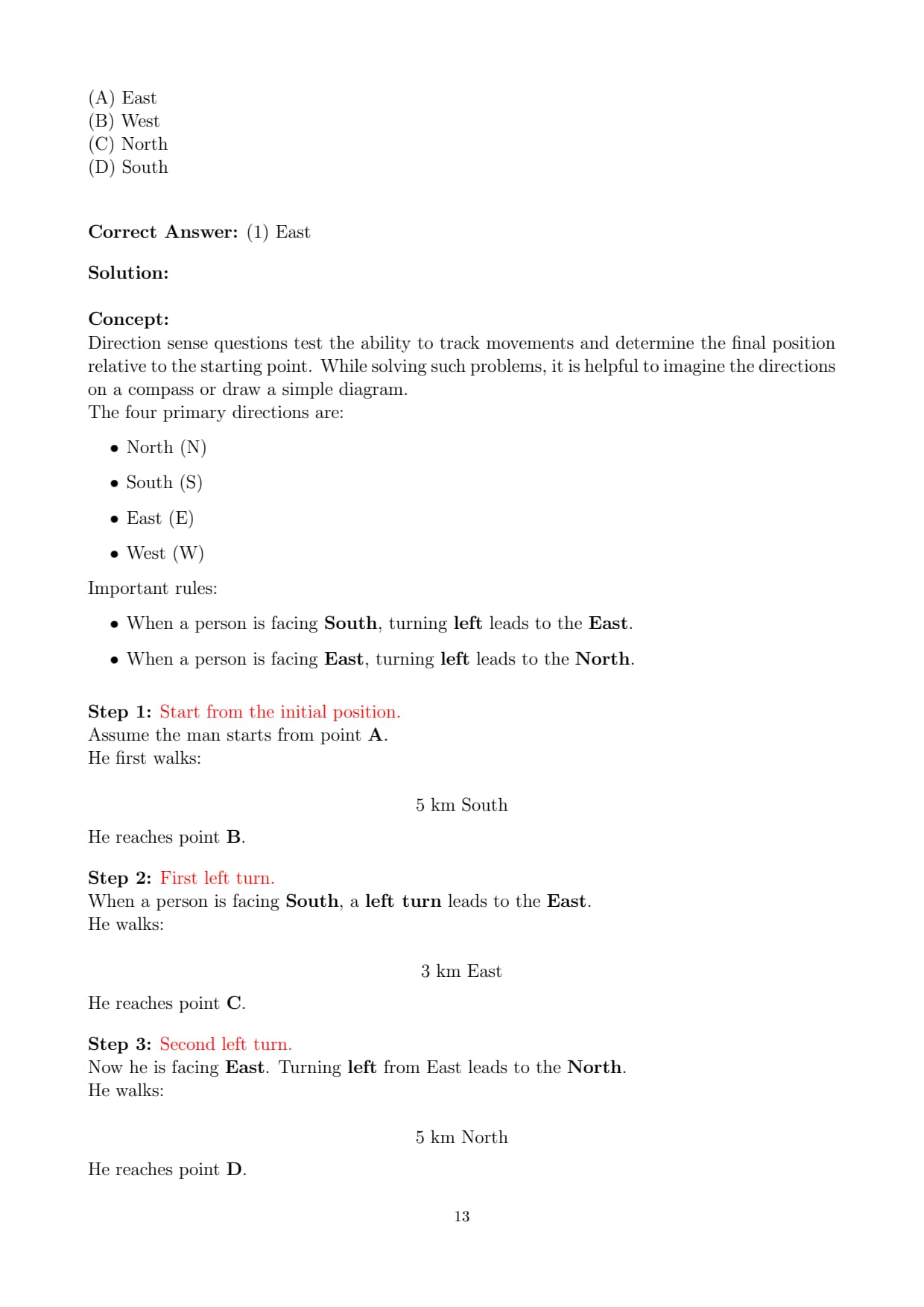
When a person is facing South, turning left leads to the East.
When a person is facing East, turning left leads to the North.
Step 1: Start from the initial position.
Assume the man starts from point A.
He first walks:
\[ 5 km South \]
He reaches point B.
Step 2: First left turn.
When a person is facing South, a left turn leads to the East.
He walks:
\[ 3 km East \]
He reaches point C.
Step 3: Second left turn.
Now he is facing East. Turning left from East leads to the North.
He walks:
\[ 5 km North \]
He reaches point D.
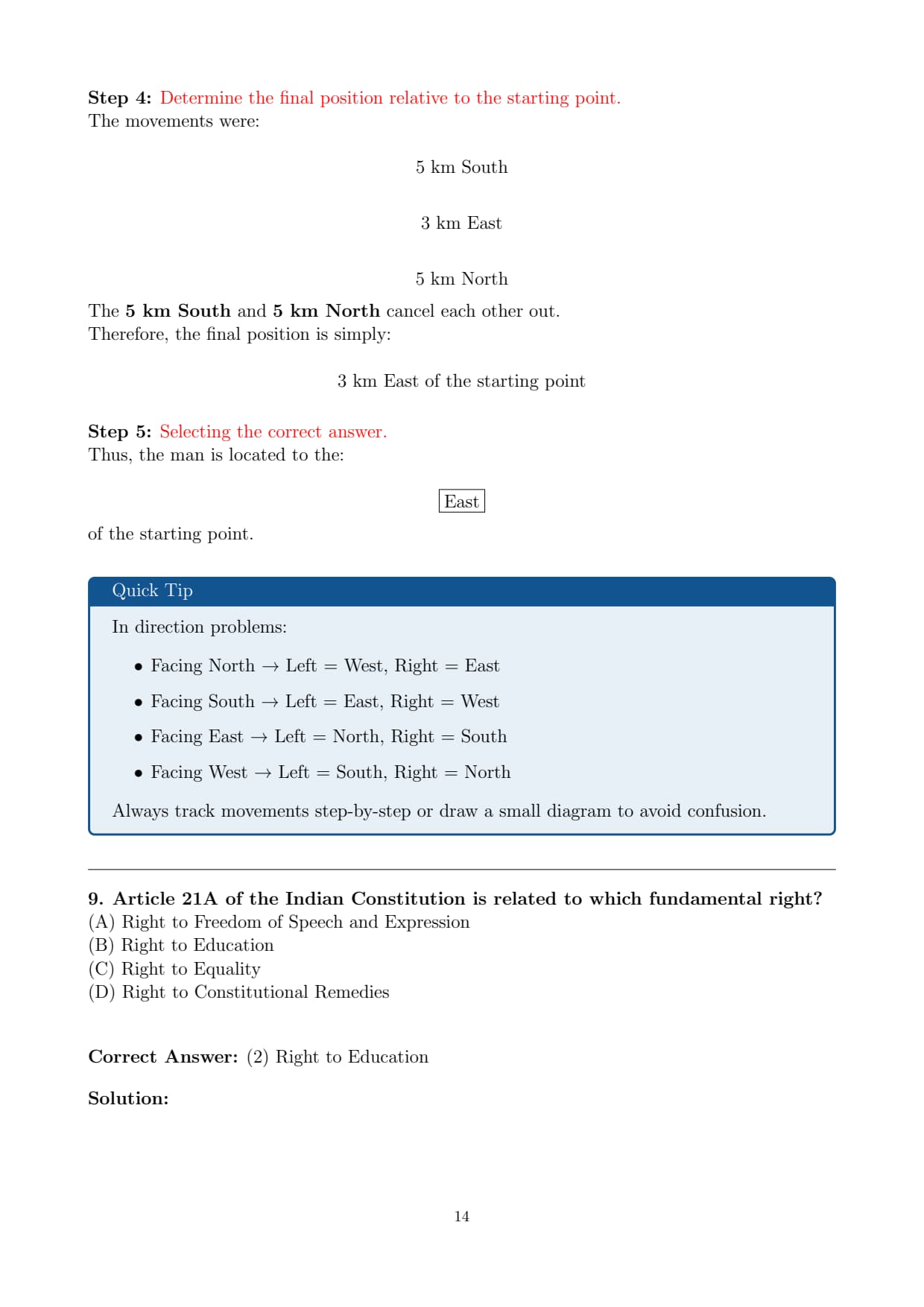
Step 4: Determine the final position relative to the starting point.
The movements were:
\[ 5 km South \]
\[ 3 km East \]
\[ 5 km North \]
The 5 km South and 5 km North cancel each other out.
Therefore, the final position is simply:
\[ 3 km East of the starting point \]
Step 5: Selecting the correct answer.
Thus, the man is located to the:
\[ \boxed{East} \]
of the starting point. Quick Tip: In direction problems: Facing North → Left = West, Right = East Facing South → Left = East, Right = West Facing East → Left = North, Right = South Facing West → Left = South, Right = North Always track movements step-by-step or draw a small diagram to avoid confusion.
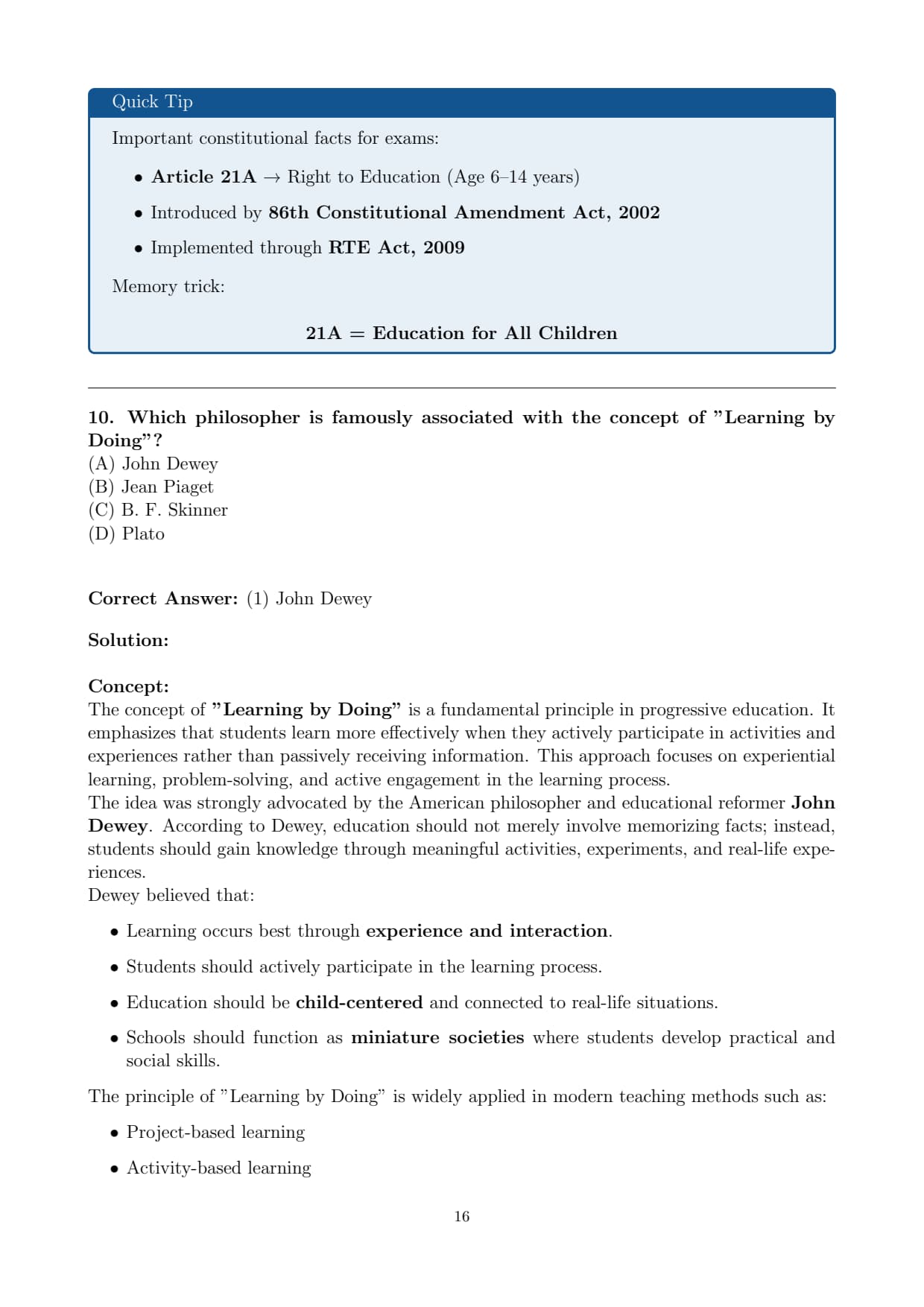
Article 21A of the Indian Constitution is related to which fundamental right?
View Solution
Concept:
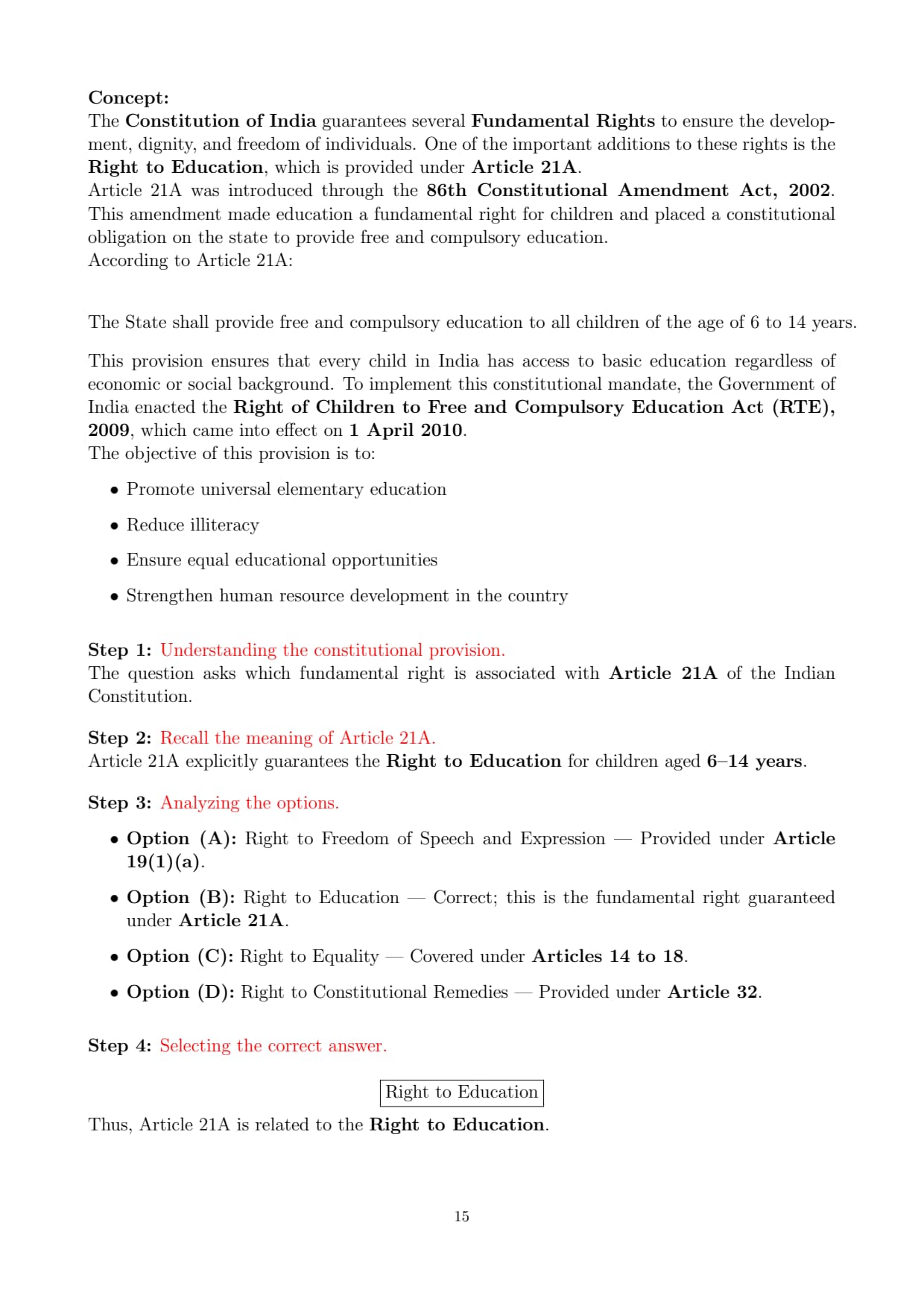
The Constitution of India guarantees several Fundamental Rights to ensure the development, dignity, and freedom of individuals. One of the important additions to these rights is the Right to Education, which is provided under Article 21A.
Article 21A was introduced through the 86th Constitutional Amendment Act, 2002. This amendment made education a fundamental right for children and placed a constitutional obligation on the state to provide free and compulsory education.
According to Article 21A:
\[ The State shall provide free and compulsory education to all children of the age of 6 to 14 years. \]
This provision ensures that every child in India has access to basic education regardless of economic or social background. To implement this constitutional mandate, the Government of India enacted the Right of Children to Free and Compulsory Education Act (RTE), 2009, which came into effect on 1 April 2010.
The objective of this provision is to:
Promote universal elementary education
Reduce illiteracy
Ensure equal educational opportunities
Strengthen human resource development in the country
Step 1: Understanding the constitutional provision.
The question asks which fundamental right is associated with Article 21A of the Indian Constitution.
Step 2: Recall the meaning of Article 21A.
Article 21A explicitly guarantees the Right to Education for children aged 6–14 years.
Step 3: Analyzing the options.
Option (A): Right to Freedom of Speech and Expression — Provided under Article 19(1)(a).
Option (B): Right to Education — Correct; this is the fundamental right guaranteed under Article 21A.
Option (C): Right to Equality — Covered under Articles 14 to 18.
Option (D): Right to Constitutional Remedies — Provided under Article 32.
Step 4: Selecting the correct answer.
\[ \boxed{Right to Education} \]
Thus, Article 21A is related to the Right to Education. Quick Tip: Important constitutional facts for exams: \textbf{Article 21A} → Right to Education (Age 6–14 years) Introduced by \textbf{86th Constitutional Amendment Act, 2002} Implemented through \textbf{RTE Act, 2009} Memory trick: \[ \textbf{21A = Education for All Children} \]
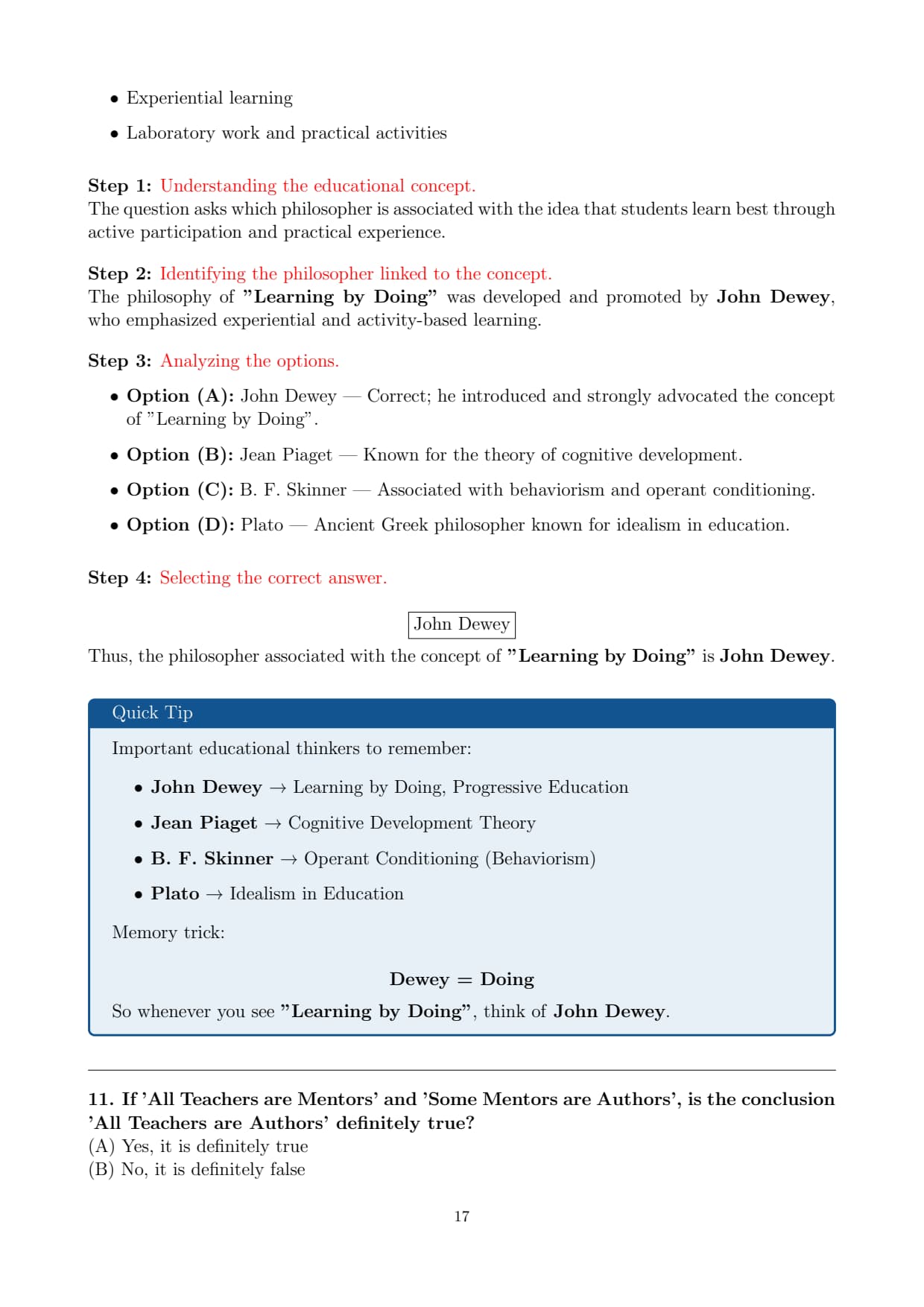
Which philosopher is famously associated with the concept of "Learning by Doing"?
View Solution
Concept:
The concept of "Learning by Doing" is a fundamental principle in progressive education. It emphasizes that students learn more effectively when they actively participate in activities and experiences rather than passively receiving information. This approach focuses on experiential learning, problem-solving, and active engagement in the learning process.
The idea was strongly advocated by the American philosopher and educational reformer John Dewey. According to Dewey, education should not merely involve memorizing facts; instead, students should gain knowledge through meaningful activities, experiments, and real-life experiences.
Dewey believed that:
Learning occurs best through experience and interaction.
Students should actively participate in the learning process.
Education should be child-centered and connected to real-life situations.
Schools should function as miniature societies where students develop practical and social skills.
The principle of "Learning by Doing" is widely applied in modern teaching methods such as:
Project-based learning
Activity-based learning
Experiential learning
Laboratory work and practical activities
Step 1: Understanding the educational concept.
The question asks which philosopher is associated with the idea that students learn best through active participation and practical experience.
Step 2: Identifying the philosopher linked to the concept.
The philosophy of "Learning by Doing" was developed and promoted by John Dewey, who emphasized experiential and activity-based learning.
Step 3: Analyzing the options.
Option (A): John Dewey — Correct; he introduced and strongly advocated the concept of "Learning by Doing".
Option (B): Jean Piaget — Known for the theory of cognitive development.
Option (C): B. F. Skinner — Associated with behaviorism and operant conditioning.
Option (D): Plato — Ancient Greek philosopher known for idealism in education.
Step 4: Selecting the correct answer.
\[ \boxed{John Dewey} \]
Thus, the philosopher associated with the concept of "Learning by Doing" is John Dewey. Quick Tip: Important educational thinkers to remember: \textbf{John Dewey} → Learning by Doing, Progressive Education \textbf{Jean Piaget} → Cognitive Development Theory \textbf{B. F. Skinner} → Operant Conditioning (Behaviorism) \textbf{Plato} → Idealism in Education Memory trick: \[ \textbf{Dewey = Doing} \] So whenever you see \textbf{"Learning by Doing"}, think of \textbf{John Dewey}.
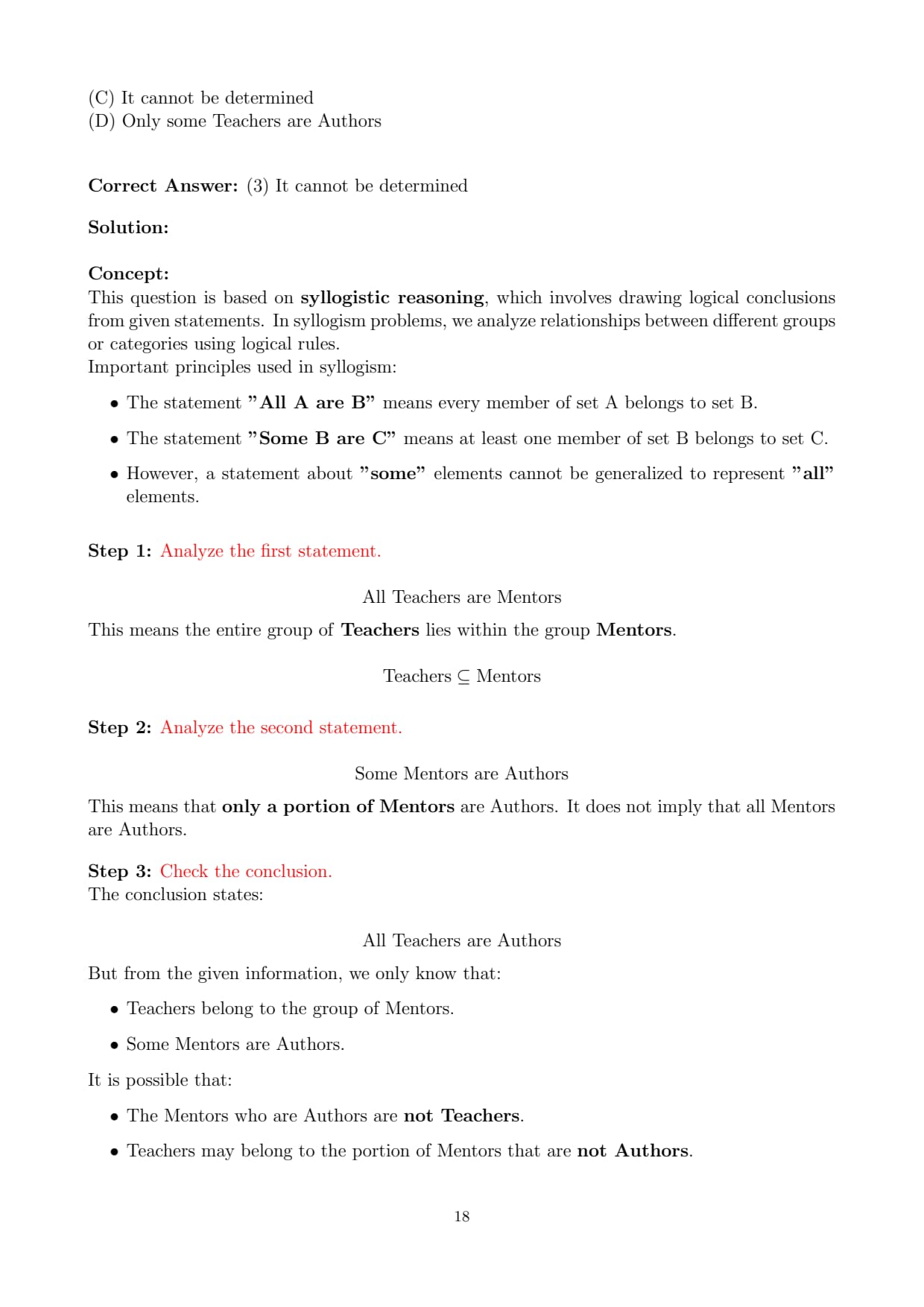
If 'All Teachers are Mentors' and 'Some Mentors are Authors', is the conclusion 'All Teachers are Authors' definitely true?
View Solution
Concept:
This question is based on syllogistic reasoning, which involves drawing logical conclusions from given statements. In syllogism problems, we analyze relationships between different groups or categories using logical rules.
Important principles used in syllogism:
The statement "All A are B" means every member of set A belongs to set B.
The statement "Some B are C" means at least one member of set B belongs to set C.
However, a statement about "some" elements cannot be generalized to represent "all" elements.
Step 1: Analyze the first statement.
\[ All Teachers are Mentors \]
This means the entire group of Teachers lies within the group Mentors.
\[ Teachers \subseteq Mentors \]
Step 2: Analyze the second statement.
\[ Some Mentors are Authors \]
This means that only a portion of Mentors are Authors. It does not imply that all Mentors are Authors.
Step 3: Check the conclusion.
The conclusion states:
\[ All Teachers are Authors \]
But from the given information, we only know that:
Teachers belong to the group of Mentors.
Some Mentors are Authors.
It is possible that:
The Mentors who are Authors are not Teachers.
Teachers may belong to the portion of Mentors that are not Authors.
Therefore, the conclusion cannot be guaranteed.
Step 4: Logical interpretation using set relationships.
\[ Teachers \subseteq Mentors \]
\[ Some Mentors \subseteq Authors \]
But there is no definite relation that confirms:
\[ Teachers \subseteq Authors \]
Hence, the conclusion is not logically certain.
Step 5: Selecting the correct answer.
\[ \boxed{It cannot be determined} \] Quick Tip: Key rule in syllogism questions: From \textbf{"All A are B"} and \textbf{"Some B are C"}, you \textbf{cannot conclude} that \textbf{"All A are C"}. Statements involving \textbf{"some"} do not guarantee universal conclusions. Memory shortcut: \[ \textbf{All + Some } \Rightarrow \textbf{ No definite universal conclusion} \]
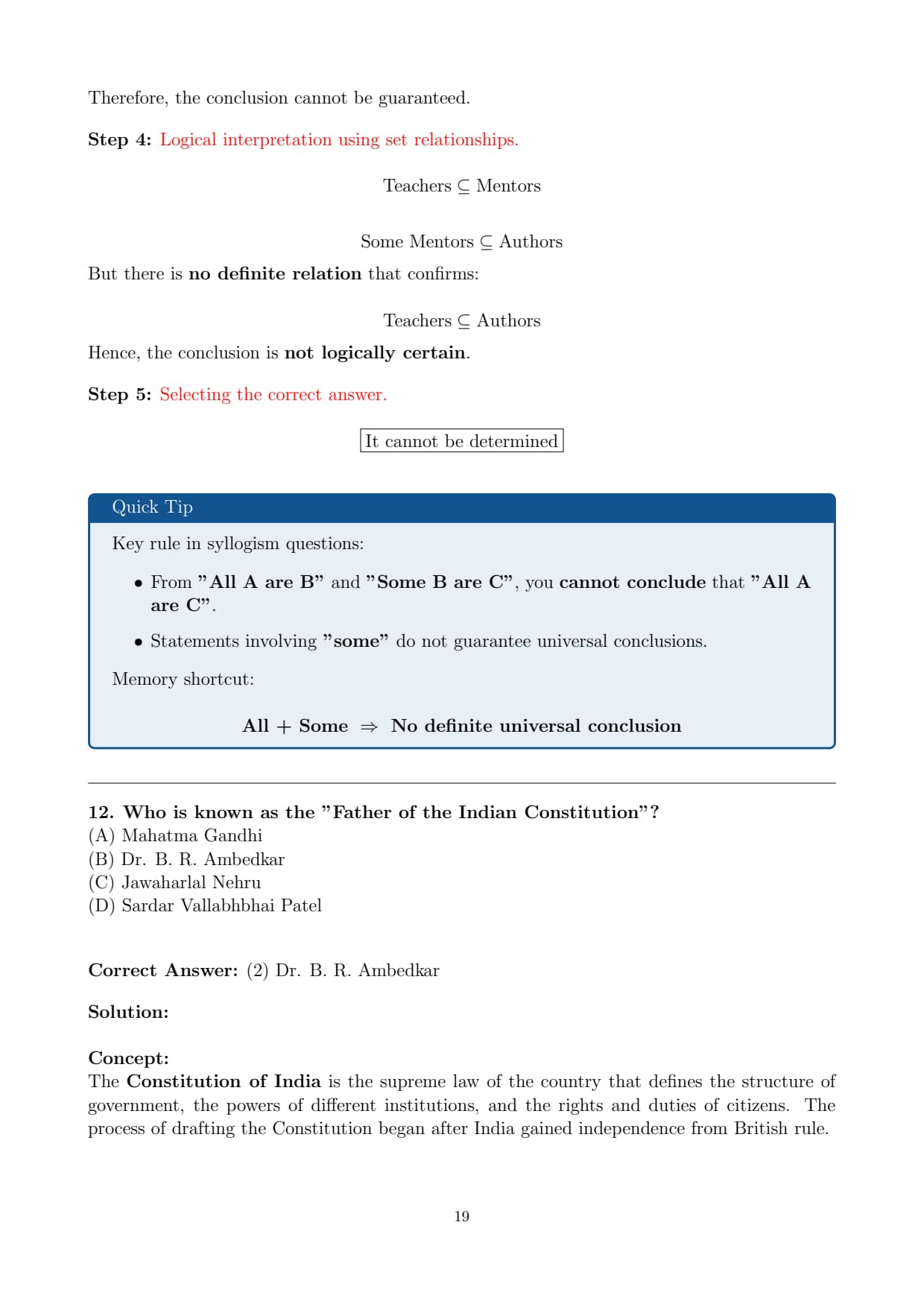
Who is known as the "Father of the Indian Constitution"?
View Solution
Concept:
The Constitution of India is the supreme law of the country that defines the structure of government, the powers of different institutions, and the rights and duties of citizens. The process of drafting the Constitution began after India gained independence from British rule.
To prepare the Constitution, a Constituent Assembly was formed in 1946. This assembly created a Drafting Committee responsible for preparing the final draft of the Constitution. The chairman of this drafting committee was Dr. Bhimrao Ramji Ambedkar.
Dr. B. R. Ambedkar played a crucial role in shaping the Constitution by incorporating important principles such as:
Fundamental Rights
Equality before law
Social justice
Protection of minority rights
Federal structure of government
Due to his outstanding contribution and leadership in drafting the Constitution, Dr. B. R. Ambedkar is widely recognized as the "Father of the Indian Constitution".
Step 1: Understanding the historical context.
After independence, India required a comprehensive legal framework to govern the country. The Constituent Assembly undertook the responsibility of drafting this framework.
Step 2: Role of the Drafting Committee.
The Drafting Committee was responsible for preparing the final draft of the Constitution. It consisted of several members, but the committee was chaired by Dr. B. R. Ambedkar.
Step 3: Reason for the title.
Because of his leadership, legal expertise, and major contribution in shaping the Constitution, Dr. Ambedkar earned the title:
\[ "Father of the Indian Constitution" \]
Step 4: Analyzing the options.
Option (A): Mahatma Gandhi — Known as the Father of the Nation.
Option (B): Dr. B. R. Ambedkar — Correct; chairman of the Drafting Committee of the Constitution.
Option (C): Jawaharlal Nehru — First Prime Minister of India.
Option (D): Sardar Vallabhbhai Patel — Known as the Iron Man of India and played a major role in the integration of princely states.
Step 5: Selecting the correct answer.
\[ \boxed{Dr. B. R. Ambedkar} \] Quick Tip: Important leaders and their famous titles: \textbf{Dr. B. R. Ambedkar} → Father of the Indian Constitution \textbf{Mahatma Gandhi} → Father of the Nation \textbf{Sardar Vallabhbhai Patel} → Iron Man of India \textbf{Jawaharlal Nehru} → Architect of Modern India Memory trick: \[ \textbf{Ambedkar = Architect of the Constitution} \]
What is the full form of 'DIKSHA', the national digital infrastructure for teachers?
View Solution
Concept:
DIKSHA stands for Digital Infrastructure for Knowledge Sharing. It is a national digital platform developed by the Government of India to support teachers, students, and educational administrators by providing access to high-quality digital learning resources.
The platform was launched by the Ministry of Education (formerly MHRD) as part of the government's initiative to strengthen digital education and improve the quality of teaching across the country. DIKSHA serves as a repository of educational content aligned with school curricula and provides tools for teacher training, professional development, and classroom support.
Key features of DIKSHA include:
Digital textbooks and learning materials
Teacher training modules
Interactive learning resources such as videos and quizzes
QR code–enabled textbooks for easy access to digital content
Support for multiple Indian languages
The platform is widely used by teachers to enhance their teaching practices and by students to access supplementary learning materials.
Step 1: Understanding the term DIKSHA.
The question asks for the full form of the acronym DIKSHA, which is a digital education platform for teachers and learners in India.
Step 2: Recalling the official expansion of the acronym.
The correct full form of DIKSHA is:
\[ Digital Infrastructure for Knowledge Sharing \]
Step 3: Analyzing the options.
Option (A): Digital Infrastructure for Knowledge Sharing — Correct; this is the official full form of DIKSHA.
Option (B): Digital Initiative for Knowledge Sharing in Higher Academics — Incorrect; not the official expansion.
Option (C): Development Initiative for Knowledge Sharing and Human Advancement — Incorrect.
Option (D): Digital Integrated Knowledge System for Higher Academics — Incorrect.
Step 4: Selecting the correct answer.
\[ \boxed{Digital Infrastructure for Knowledge Sharing} \] Quick Tip: Important digital education platforms in India: \textbf{DIKSHA} → Digital Infrastructure for Knowledge Sharing \textbf{SWAYAM} → Study Webs of Active–Learning for Young Aspiring Minds \textbf{SWAYAM PRABHA} → DTH channels for educational broadcasting Memory trick: \[ \textbf{DIKSHA = Digital Infrastructure for Knowledge Sharing} \]
A classroom where students from diverse backgrounds and abilities learn together is known as what?
View Solution
Concept:
An Inclusive Classroom is a learning environment where students of different backgrounds, abilities, learning styles, socio-economic conditions, and disabilities learn together in the same classroom. The concept of inclusive education is based on the principle that all children have the right to quality education and equal opportunities for learning.
Inclusive education promotes:
Equal participation of all learners
Respect for diversity
Adaptation of teaching methods to meet different learning needs
Collaboration among students
In an inclusive classroom, teachers use various strategies such as differentiated instruction, cooperative learning, and flexible teaching methods to ensure that every student can participate and succeed.
This approach is strongly supported by modern educational policies such as the Right to Education (RTE) Act 2009 and the National Education Policy (NEP) 2020, which emphasize equitable and inclusive education for all learners.
Step 1: Understanding the key idea in the question.
The question mentions a classroom where students from diverse backgrounds and abilities learn together.
Step 2: Identify the educational term describing this situation.
When students with different abilities, disabilities, cultures, and learning needs study together in the same environment, the classroom is called an Inclusive Classroom.
Step 3: Analyzing the options.
Option (A): Inclusive Classroom — Correct; it refers to a classroom where all students learn together regardless of their differences.
Option (B): Traditional Classroom — Refers to a conventional teaching setup but does not necessarily imply diversity or inclusion.
Option (C): Segregated Classroom — Opposite of inclusive; students with special needs are separated.
Option (D): Exclusive Classroom — Implies restricted access rather than inclusion.
Step 4: Selecting the correct answer.
\[ \boxed{Inclusive Classroom} \] Quick Tip: \textbf{Inclusive Education} means educating all students together regardless of differences such as: Physical abilities Learning styles Cultural background Socio-economic status Key principle: \[ \textbf{Education for All in the Same Classroom} \] Inclusive classrooms promote equality, cooperation, and respect among students.
CUET PG B.Ed. Question Paper 2026: Unit-Wise Weightage
| Unit Name | Approx. Questions | Difficulty |
| Foundations of Education (Philosophical, Sociological & Historical Perspectives) | 12–14 | Moderate |
| Educational Psychology (Learning Theories, Intelligence, Motivation) | 10–12 | Moderate |
| Teaching-Learning Process & Pedagogy | 10–12 | Moderate |
| Educational Technology & ICT | 8–10 | Easy–Moderate |
| Assessment, Evaluation & Research in Education | 8–10 | Moderate |
| Inclusive Education, Guidance & Counselling | 6–8 | Easy |



Comments