The CUET PG Public Health Exam 2025 will be conducted from 13th May to 3rd June. Candidates appearing for the CUET 2025 Public Health entrance can download the question paper, answer key, and solution PDF after the exam. This test evaluates knowledge in epidemiology, biostatistics, health systems, disease prevention, healthcare policies, and public health management.
Students must attempt 75 questions in 60 minutes, for a total of 300 marks. Each correct answer is awarded 4 marks, and 1 mark is deducted for every wrong response.
CUET PG Public Health 2025 Question Paper with Solutions PDF
Question 1:
What is the role of reverse transcriptase in recombinant DNA technology?
- (A) It leaves RNA at specific sequences
- (B) It synthesizes DNA from an RNA template
- (C) It repairs damaged DNA
- (D) It unwinds DNA during replication
Question 2:
A point mutation that changes a codon but does not alter the resulting amino acid is classified as -
- (A) Missense mutation
- (B) Nonsense mutation
- (C) Silent mutation
- (D) Frameshift mutation
Question 3:
Which enzyme is primarily responsible for relieving supercoiling during DNA replication?
- (A) DNA helicase
- (B) DNA ligase
- (C) DNA polymerase
- (D) Topoisomerase
Question 4:
What is the primary purpose of using T4 DNA ligase in recombinant DNA technology?
- (A) To cut DNA at specific sequences
- (B) To join DNA fragments with complementary sticky ends
- (C) To synthesize DNA from RNA
- (D) To unwind DNA for replication
Question 5:
What is the role of ATP in bioluminescence reactions?
- (A) To phosphorylate luciferase.
- (B) To act as an energy source for luciferin oxidation.
- (C) To stabilize the light emission.
- (D) To generate NADH for the reaction.
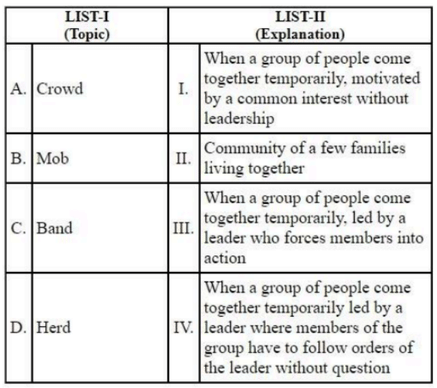
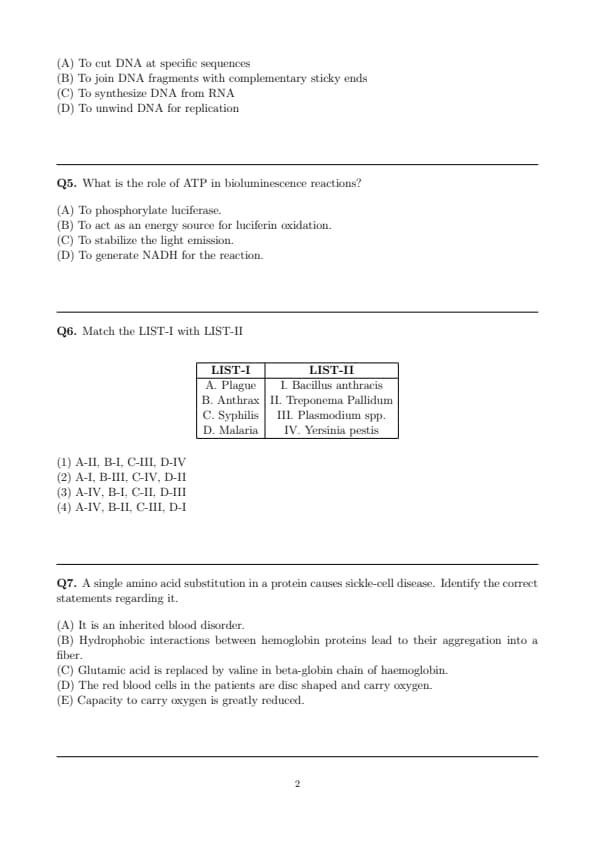
Question 6:
Match the LIST-I with LIST-II
![]()
- (1) A-II, B-I, C-III, D-IV
- (2) A-I, B-III, C-IV, D-II
- (3) A-IV, B-I, C-II, D-III
- (4) A-IV, B-II, C-III, D-I
Question 7:
A single amino acid substitution in a protein causes sickle-cell disease.
Identify the correct statements regarding it.
- (A) It is an inherited blood disorder.
- (B) Hydrophobic interactions between hemoglobin proteins lead to their aggregation into a fiber.
- (C) Glutamic acid is replaced by valine in beta-globin chain of haemoglobin.
- (D) The red blood cells in the patients are disc shaped and carry oxygen.
- (E) Capacity to carry oxygen is greatly reduced.
Question 8:
Arrange the following scientific events in chronological sequence (oldest to latest)
A. Florence Nightingale organized hospitals with minimized cross infections.
B. Joseph Lister developed aseptic techniques.
C. Fanny Hesse advocated use of agar as a solidifying material for microbiological media.
D. Elie Metchikoff discovered phagocytosis.
- (A) A, B, C, D
- (B) A, C, B, D
- (C) B, A, D, C
- (D) C, B, D, A
Question 9:
Arrange the causative agent as per the ascending order of their incubation period for the disease development, as mentioned in bracket:
A. Clostridium perfringens (food poisoning)
B. Salmonella typhi (Typhoid)
C. Bubonic (Plague)
D. HIV (AIDS)
- (A) A, B, C, D
- (B) A, C, B, D
- (C) B, C, A, D
- (D) C, B, D, A
Question 10:
The typical sequence for bacterial growth curve is:
- (A) Exponential/Log phase
- (B) Lag Phase
- (C) Stationary Phase
- (D) Death/Decline Phase
Question 11:
Contact between two people with different types of culture leading to diffusion of culture both ways is known as:
- (1) Socialization
- (2) Social stress
- (3) Acculturation
- (4) Social defence
Question 12:
Hidden hunger is a form of undernutrition due to deficiency of:
- (1) Vitamins and Minerals
- (2) Carbohydrates
- (3) Proteins
- (4) Fats
Question 13:
Anti-larval measures to control vector-borne diseases include which of the following?
A. Environmental Control
B. Biological Control
C. Residual Sprays
D. Genetic Control
- (A) A and B only
- (B) C and D only
- (C) A, B, C and D
- (D) B, C and D only
Question 14:
Classify the following foods in ascending order (lowest to highest) according to their Glycaemic Index:
A. Whole grains
B. Baked potato
C. Brown rice
D. Blackberry
- (A) C, B, A, D
- (B) A, C, B, D
- (C) D, A, C, B
- (D) C, B, D, A
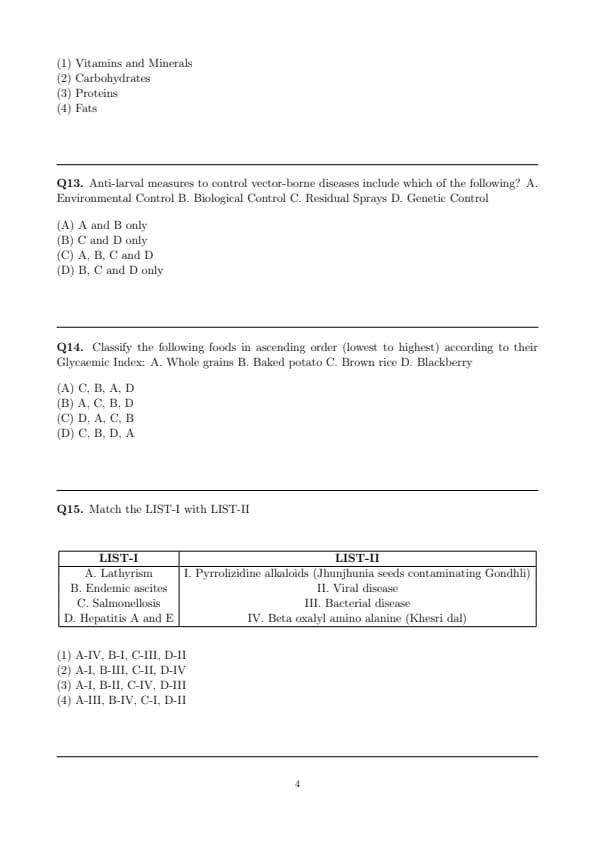
Question 15:
Match the LIST-I with LIST-II
![]()
- (1) A-IV, B-I, C-III, D-II
- (2) A-I, B-III, C-II, D-IV
- (3) A-I, B-II, C-IV, D-III
- (4) A-III, B-IV, C-I, D-II
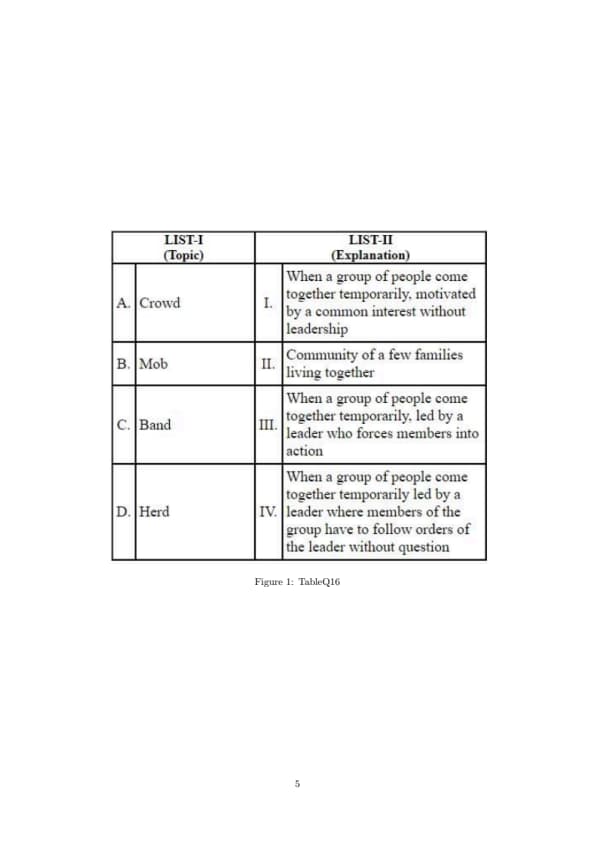
Question 16:
Match the LIST-I with LIST-II
![]()
- (1) A-I, B-II, C-III, D-IV
- (2) A-I, B-III, C-II, D-IV
- (3) A-III, B-II, C-IV, D-I
- (4) A-III, B-IV, C-II, D-I
Question 17:
Which of the following are examples of food fortification?
A. Iodization of salt
B. Vitamin D in milk
C. Vanilla essence in Ice cream
D. Saccharin in toothpaste
- (A) A, B and D only
- (B) A, B and C only
- (C) A, C and D only
- (D) A and B only
Question 18:
Arrange the following food items in descending order (highest to lowest) according to presence of amount of Vitamin C in them:
A. Lime
B. Potato
C. Amla or gooseberry
D. Guava
- (A) A, C, B, D
- (B) A, D, B, C
- (C) B, A, D, C
- (D) C, D, A, B
Question 19:
The legislations for social security measures for industrial workers in India includes all except:
- (1) Workmen's Compensation Act, 1923
- (2) Central Maternity Benefit Act, 1961
- (3) Employees State Insurance Act, 1948
- (4) Water Prevention and Control of Pollution Act, 1974
Question 20:
Scale for measuring socio-economic status in urban areas ONLY widely used in India is:
- (1) Pareek and Kulshrestha Scale
- (2) Kuppuswamy Scale
- (3) B G Prasad Scale
- (4) Hollingshed Scale
Question 21:
Koplik's spots in oral mucosa along with rashes are seen in which disease?
- (1) Mumps
- (2) Chickenpox
- (3) Rubella
- (4) Measles
Question 22:
Which of the following statement is true about First-aid in case of snake bite?
A. Immobilize in the same way as a fractured limb
B. Incise or manipulate the bitten site
C. Give beverages or stimulants
D. Do not apply any compression in the form of tight ligatures
- (1) A and D only
- (2) A and C only
- (3) A, C and D
- (4) B, C and D only
Question 23:
Isolation is important in the control of which disease?
- (1) Diphtheria
- (2) Hepatitis A
- (3) Tuberculosis
- (4) HIV-AIDS
Question 24:
Commonest type of cancer among males in India is:
- (1) Lung cancer
- (2) Oral Cavity cancer
- (3) Prostate cancer
- (4) Bladder cancer
Question 25:
According to IMNCI (Integrated Management of Neonatal and Childhood Illness) classification, fast breathing is present in a child aged 12 months up to 5 years if respiration rate is more than or equal to:
- (1) 60
- (2) 50
- (3) 40
- (4) 30
Question 26:
According to WHO BMI (Body-mass index) classification, Pre-obese value is:
- (1) 25.00-29.99
- (2) 30.00-34.99
- (3) 20.00-24.99
- (4) 18.5-24.99
Question 27:
Risk factors for non-communicable diseases are all of the following except:
- (1) Tobacco and alcohol
- (2) Raised cholesterol
- (3) Contaminated water
- (4) Sedentary lifestyle
Question 28:
According to the National Immunisation Schedule, OPV (oral polio vaccine) contains how many types of Poliovirus?
A. Type 1
B. Type 2
C. Type 3
D. Type 4
- (1) A, B and C only
- (2) A and C only
- (3) A and B only
- (4) B, C and D only
Question 29:
According to National Immunisation Schedule, OPV (oral polio vaccine) contains how many types of Poliovirus?
A. Type 1
B. Type 2
C. Type 3
D. Type 4
- (1) A, B and C only
- (2) A and C only
- (3) A and B only
- (4) B, C and D only
Question 30:
Match the LIST-I with LIST-II
![]()
- (1) A-I, B-III, C-II, D-IV
- (2) A-II, B-IV, C-I, D-III
- (3) A-IV, B-II, C-I, D-III
- (4) A-III, B-II, C-I, D-IV
Question 31:
The goal of the population approach to shift the community distribution of blood pressure towards lower levels involves reduction of salt intake to an average of not more than:
- (1) 3 grams per day
- (2) 4 grams per day
- (3) 5 grams per day
- (4) 6 grams per day
Question 32:
Laboratory diagnosis of HIV infection is done through which of the following tests?
A. Absolute CD4 lymphocyte count
B. WESTERN Blot
C. HIV viral load test
D. ELISA test
- (1) D and B
- (2) A and C
- (3) A, C and D
- (4) C and D
Question 33:
Neonatal Tetanus is well controlled by all, except:
- (1) Antibiotics
- (2) Clean delivery surface
- (3) Clean blade for cutting the cord and clean tie for the cord
- (4) Tetanus immunization
Question 34:
Which of the following is the true statement in the case of Leprosy:
- (1) The indeterminate type of Leprosy is bacteriologically positive.
- (2) Tuberculoid type of Leprosy is bacteriologically negative.
- (3) Lepromatous type of Leprosy is bacteriologically negative.
- (4) Pure neuritic type of Leprosy is bacteriologically positive.
Question 35:
Appropriate clinical management of Acute Diarrheal diseases in children is:
- (1) Give tea or coffee
- (2) Oral Rehydration therapy with reduced osmolarity Oral Rehydration Salt and Zinc supplementation
- (3) Antibiotics only
- (4) Stop breastfeeding
Question 36:
Screening programmes for detection of Diabetes Mellitus is:
- (1) Primordial Level of Prevention
- (2) Primary Level of Prevention
- (3) Secondary Level of Prevention
- (4) Tertiary Level of Prevention
Question 37:
Match List-I with List-II
![]()
- (1) A-III, B-I, C-II, D-IV
- (2) A-II, B-I, C-III, D-IV
- (3) A-I, B-III, C-II, D-IV
- (4) A-IV, B-II, C-III, D-I
Question 38:
"Blinding" is most commonly done in:
- (1) Case Control study
- (2) Randomized Controlled Trials
- (3) Cohort study
- (4) Cross-sectional study
Question 40:
The study design for developing the new vaccine is:
- (1) Cross-sectional study
- (2) Cohort Study
- (3) Longitudinal study
- (4) Randomized Controlled trial
Question 41:
Attributes of a mentally healthy person in the Mental Dimensions of Health include:
A. Faces problems and tries to solve them intelligently
B. Coping with stress and anxiety
C. Commitment to integrity, principles, ethics, belief, and commitment to some higher beings
D. Has good self-control and balances rationally and emotionally
- (1) A, B and D only
- (2) A, B and C only
- (3) B, C and D only
- (4) A, C and D only
Question 42:
Increase in Prevalence of a disease depends on:
A. Incidence of disease
B. Communicable period of disease
C. Increased Duration of disease/illness
D. Increased mortality due to the disease
- (1) A and D only
- (2) A and C only
- (3) A and B only
- (4) C and D only
Question 43:
Arrange the given step-by-step approach in the investigation of an Epidemic in ascending order.
A. Formulation of hypothesis
B. Verification of diagnosis
C. Data analysis
D. Confirmation of the existence of an epidemic
- (1) A, D, C, B
- (2) B, C, A, D
- (3) B, D, C, A
- (4) C, B, D, A
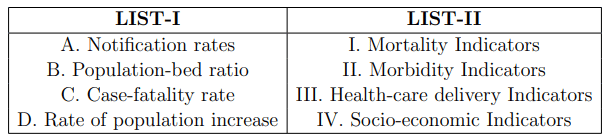
Question 44:
Match indicators of health (List-I) with their Classification (List-II)
![]()
- (1) A-III, B-II, C-I, D-IV
- (2) A-I, B-III, C-II, D-IV
- (3) A-II, B-III, C-I, D-IV
- (4) A-III, B-IV, C-I, D-II
Question 45:
According to vaccine vial monitors, a vaccine is to be discarded and not to be used if:
A. Inner square color is lighter than outer circle
B. Inner circle color is lighter than outer square
C. Inner square color is same as the outer circle
D. Inner square color is darker than outer circle
Choose the correct answer from the options given below:
- (1) C and D only
- (2) A and B only
- (3) A, C and D only
- (4) A and C only
Question 46:
Match the LIST-I with LIST-II
![]()
- (1) A-IV, B-II, C-I, D-III
- (2) A-II, B-IV, C-I, D-III
- (3) A-IV, B-II, C-III, D-I
- (4) A-II, B-IV, C-III, D-I
Question 47:
All are true about Screening tests for a disease except:
- (1) Done on apparently healthy people
- (2) Not a basis for treatment
- (3) Based on one criteria or cut off point
- (4) Based on evaluation of number of symptoms, signs and laboratory findings
Question 48:
How many vaccine vials are carried in Vaccine Carriers?
- (1) 6-8
- (2) 12-14
- (3) 16-20
- (4) 2-4
Question 49:
Active immunity is acquired by:
- (1) Administration of Immunoglobulin
- (2) Transferring of antibodies across placenta
- (3) Following subclinical infection like Polio and Diphtheria
- (4) Administration of antisera or anti-toxins
Question 50:
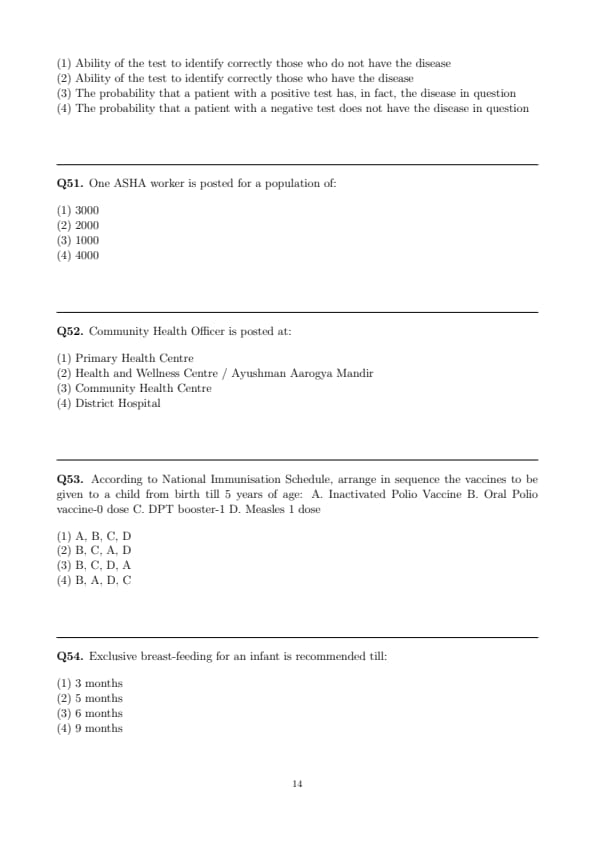
Specificity of a Screening Test is:
- (1) Ability of the test to identify correctly those who do not have the disease
- (2) Ability of the test to identify correctly those who have the disease
- (3) The probability that a patient with a positive test has, in fact, the disease in question
- (4) The probability that a patient with a negative test does not have the disease in question
Question 51:
One ASHA worker is posted for a population of:
- (1) 3000
- (2) 2000
- (3) 1000
- (4) 4000
Question 52:
Community Health Officer is posted at:
- (1) Primary Health Centre
- (2) Health and Wellness Centre / Ayushman Aarogya Mandir
- (3) Community Health Centre
- (4) District Hospital
Question 53:
According to National Immunisation Schedule, arrange in sequence the vaccines to be given to a child from birth till 5 years of age:
A. Inactivated Polio Vaccine
B. Oral Polio vaccine-0 dose
C. DPT booster-1
D. Measles 1 dose
- (1) A, B, C, D
- (2) B, C, A, D
- (3) B, C, D, A
- (4) B, A, D, C
Question 54:
Exclusive breast-feeding for an infant is recommended till:
- (1) 3 months
- (2) 5 months
- (3) 6 months
- (4) 9 months
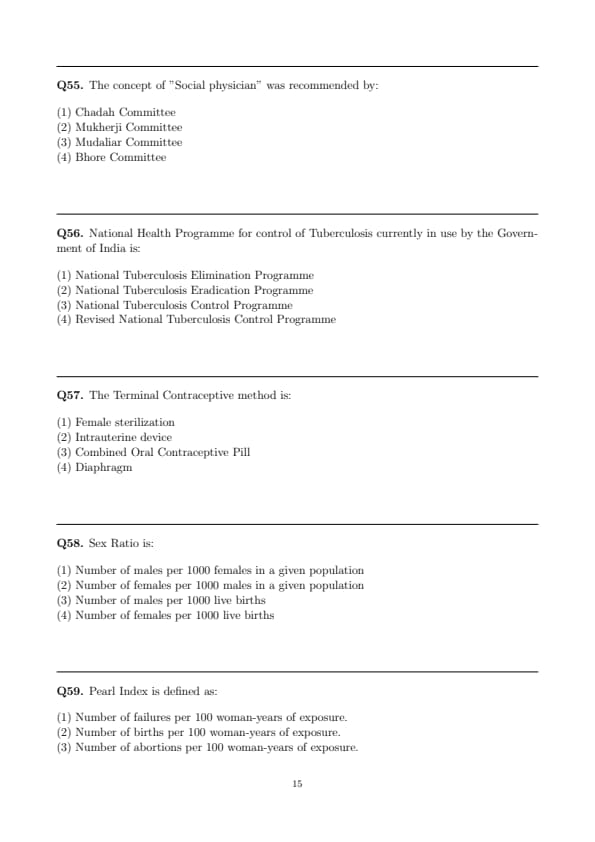
Question 55:
The concept of "Social physician" was recommended by:
- (1) Chadah Committee
- (2) Mukherji Committee
- (3) Mudaliar Committee
- (4) Bhore Committee
Question 56:
National Health Programme for control of Tuberculosis currently in use by the Government of India is:
- (1) National Tuberculosis Elimination Programme
- (2) National Tuberculosis Eradication Programme
- (3) National Tuberculosis Control Programme
- (4) Revised National Tuberculosis Control Programme
Question 57:
The Terminal Contraceptive method is:
- (1) Female sterilization
- (2) Intrauterine device
- (3) Combined Oral Contraceptive Pill
- (4) Diaphragm
Question 58:
Sex Ratio is:
- (1) Number of males per 1000 females in a given population
- (2) Number of females per 1000 males in a given population
- (3) Number of males per 1000 live births
- (4) Number of females per 1000 live births
Question 59:
Pearl Index is defined as:
- (1) Number of failures per 100 woman-years of exposure.
- (2) Number of births per 100 woman-years of exposure.
- (3) Number of abortions per 100 woman-years of exposure.
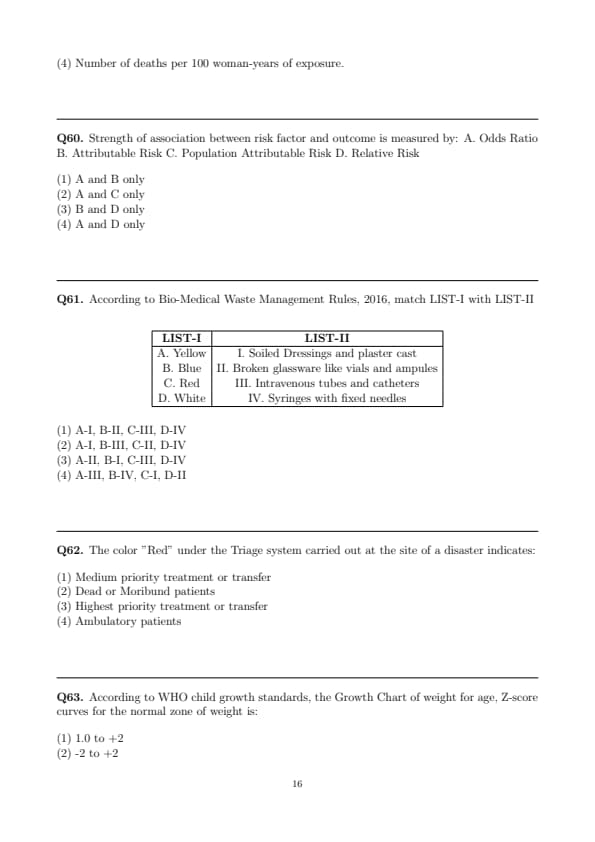
- (4) Number of deaths per 100 woman-years of exposure.
Question 60:
Strength of association between risk factor and outcome is measured by:
A. Odds Ratio
B. Attributable Risk
C. Population Attributable Risk
D. Relative Risk
- (1) A and B only
- (2) A and C only
- (3) B and D only
- (4) A and D only
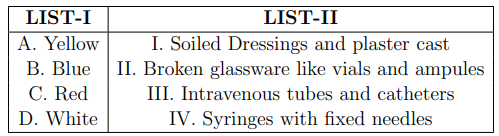
Question 61:
According to Bio-Medical Waste Management Rules, 2016, match LIST-I with LIST-II
![]()
- (1) A-I, B-II, C-III, D-IV
- (2) A-I, B-III, C-II, D-IV
- (3) A-II, B-I, C-III, D-IV
- (4) A-III, B-IV, C-I, D-II
Question 62:
The color "Red" under the Triage system carried out at the site of a disaster indicates:
- (1) Medium priority treatment or transfer
- (2) Dead or Moribund patients
- (3) Highest priority treatment or transfer
- (4) Ambulatory patients
Question 63:
According to WHO child growth standards, the Growth Chart of weight for age, Z-score curves for the normal zone of weight is:
- (1) 1.0 to +2
- (2) -2 to +2
- (3) 0 to +1
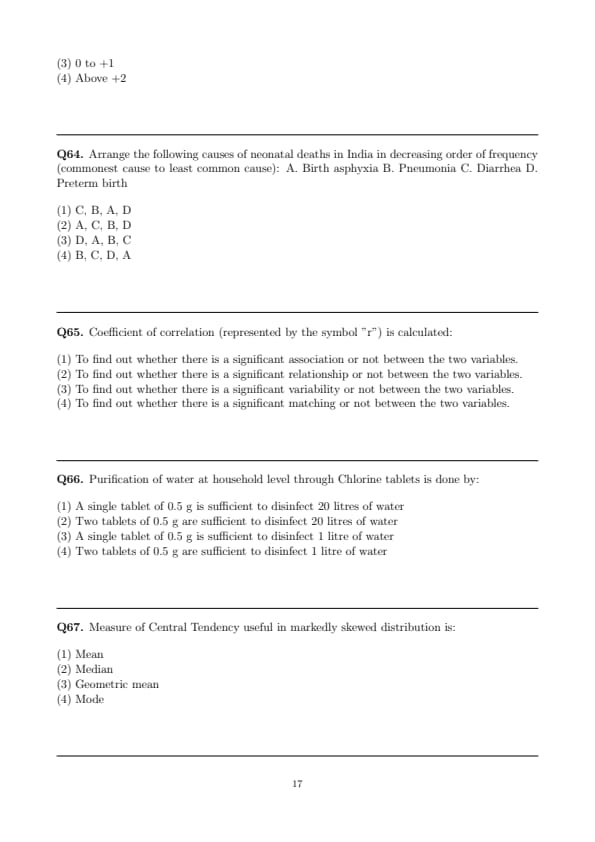
- (4) Above +2
Question 64:
Arrange the following causes of neonatal deaths in India in decreasing order of frequency (commonest cause to least common cause):
A. Birth asphyxia
B. Pneumonia
C. Diarrhea
D. Preterm birth
- (1) C, B, A, D
- (2) A, C, B, D
- (3) D, A, B, C
- (4) B, C, D, A
Question 65:
Coefficient of correlation (represented by the symbol "r") is calculated:
- (1) To find out whether there is a significant association or not between the two variables.
- (2) To find out whether there is a significant relationship or not between the two variables.
- (3) To find out whether there is a significant variability or not between the two variables.
- (4) To find out whether there is a significant matching or not between the two variables.
Question 66:
Purification of water at household level through Chlorine tablets is done by:
- (1) A single tablet of 0.5 g is sufficient to disinfect 20 litres of water
- (2) Two tablets of 0.5 g are sufficient to disinfect 20 litres of water
- (3) A single tablet of 0.5 g is sufficient to disinfect 1 litre of water
- (4) Two tablets of 0.5 g are sufficient to disinfect 1 litre of water
Question 67:
Measure of Central Tendency useful in markedly skewed distribution is:
- (1) Mean
- (2) Median
- (3) Geometric mean
- (4) Mode
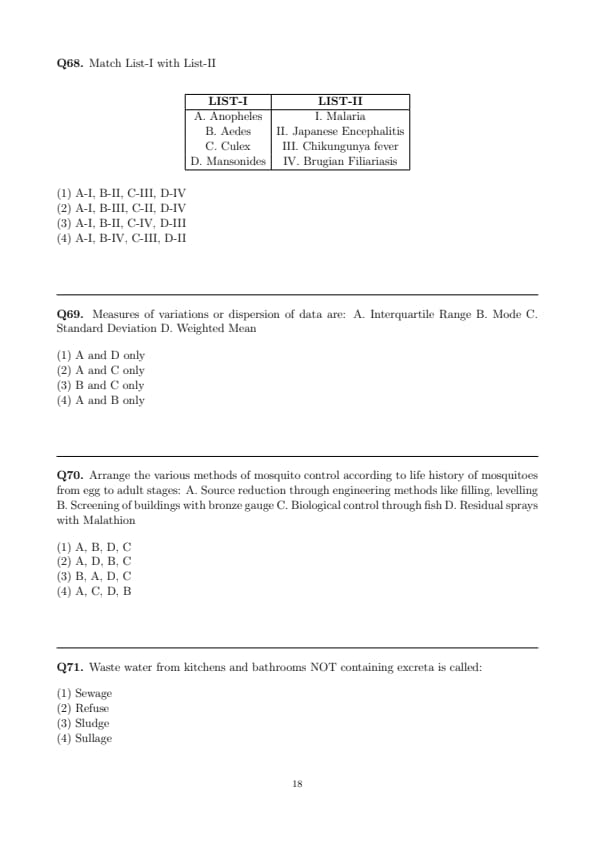
Question 68:
Match List-I with List-II
![]()
- (1) A-I, B-II, C-III, D-IV
- (2) A-I, B-III, C-II, D-IV
- (3) A-I, B-II, C-IV, D-III
- (4) A-I, B-IV, C-III, D-II
Question 69:
Measures of variations or dispersion of data are:
A. Interquartile Range
B. Mode
C. Standard Deviation
D. Weighted Mean
- (1) A and D only
- (2) A and C only
- (3) B and C only
- (4) A and B only
Question 70:
Arrange the various methods of mosquito control according to life history of mosquitoes from egg to adult stages:
A. Source reduction through engineering methods like filling, levelling
B. Screening of buildings with bronze gauge
C. Biological control through fish
D. Residual sprays with Malathion
- (1) A, B, D, C
- (2) A, D, B, C
- (3) B, A, D, C
- (4) A, C, D, B
Question 71:
Waste water from kitchens and bathrooms NOT containing excreta is called:
- (1) Sewage
- (2) Refuse
- (3) Sludge
- (4) Sullage
Question 72:
Best sampling method where every unit in the population has an equal chance of being included in the sample is:
- (1) Convenience Sampling
- (2) Quota Sampling
- (3) Simple Random Sampling
- (4) Judgemental Sampling
Question 73:
Which of the mosquitoes is easily distinguished by white stripes on the black body?
- (1) Culex
- (2) Anopheles
- (3) Mansonoides
- (4) Aedes
Question 74:
The proportion of frequencies lying on either side of the mean in a normal distribution curve within a range of +1 to -1 standard deviation is approximately:
- (1) 95%
- (2) 68%
- (3) 50%
- (4) 75%
Question 75:
In India, birth weight of less than 2.5 kg is considered low birth weight:
- (1) 2.5
- (2) 2.0
- (3) 1.5
- (4) 3.0













Comments