




The CUET PG English exam for 2025 was conducted from March 13 to April 1, 2025, as per the official CUET PG schedule. Once the exam is over, candidates will be able to download the official question paper, answer key, and solution PDFs for review and preparation purposes.
This exam evaluates a candidate’s literary comprehension, critical thinking, and understanding of British literature, American literature, literary theory, cultural studies, Indian writing in English, and grammar. It also includes topics like literary criticism, modernism, postcolonialism, and contemporary literary trends.
Candidates must solve 75 objective-type questions in 60 minutes, with the paper carrying a total of 300 marks. Each correct response earns 4 marks, while 1 mark is deducted for every incorrect answer.
CUET PG English 2025 Question Paper with Answer Key PDF
| CUET PG English Question Paper with Solutions PDF | Download PDF | Check Solutions |
CUET PG English 2025 Question Paper with Solutions
Who among the following were known as the University Wits?
(A) . John Lyly
(B) . Ben Jonson
(C) . Thomas Nashe
(D) . Thomas Middleton
Choose the correct answer from the options given below:
Match List-I with List-II
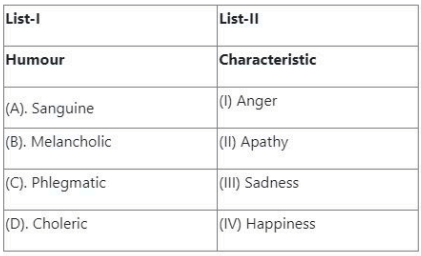
Choose the correct answer from the options given below:
'Hamartia' refers to a trait in the protagonist in plays, that are:
Match List-I with List-II
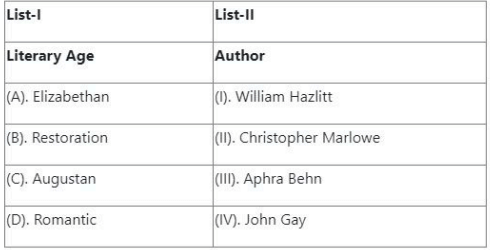
Choose the correct answer from the options given below:
Match List-I with List-II
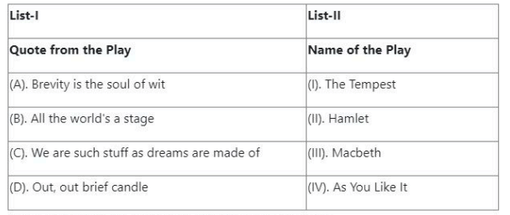
Choose the correct answer from the options given below:
Match List-I with List-II
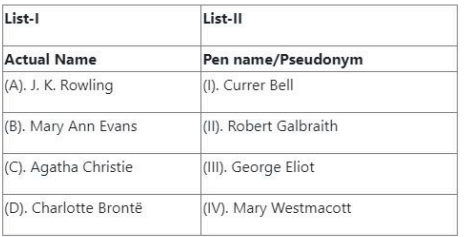
Choose the correct answer from the options given below:
Who first used the term 'Negative Capability'?
'Poetry is a spontaneous overflow of powerful feelings and emotions recollected in tranquility', as a poetic philosophy is ascribed to:
Match List-I with List-II
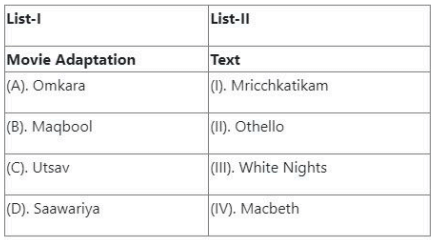
Choose the correct answer from the options given below:
The first Indian writer to write a novel in English was:
The first woman to receive the Nobel Prize in Literature was:
Blank verse is:
Naturalism is:
What is Intentional Fallacy?
Which of the following books relate to the Partition of India?
(A) The Broken Mirror
(B) Coolie
(C) Midnight's Furies
(D) Ice Candy Man
Choose the correct answer from the options given below:
Who among the following is a science fiction writer?
Which ONE of the following female characters does not figure in the works by Kalidasa?
At whose request during the Nagyagnya was The Mahabharata narrated ?
Arrange the following Nobel Prize winners in chronological order of they being awarded, beginning with the earliest.
(A) Doris Lessing
(B) William Golding
(C) J. M. Coetzee
(D) Wole Soyinka
Choose the correct answer from the options given below:
Arrange the following movements/prominent literary genres in chronological order, beginning with the earliest:
(A) Gothic Novel
(B) The Newgate Fiction
(C) Expressionism
(D) Metaphysical Poetry
Choose the correct answer from the options given below:
The 'Wars of the Roses' is used to describe which of the following:
The central doctrines of the Enlightenment were inimical to which of the following:
Arrange the following in the chronological order (beginning with the earliest):
(A) Pre-Raphaelites
(B) Edwardian
(C) The Graveyard School of poetry
(D) Sturm and Drang
Choose the correct answer from the options given below:
Arrange the following Indian writers in the chronological order (beginning with the earliest) of their date of birth:
(A) Jaishankar Prasad
(B) Dushyant Kumar
(C) Premchand
(D) Amrita Pritam
Choose the correct answer from the options given below:
Which among the following autobiographies by Indian women is the earliest?
Match List-I with List-II
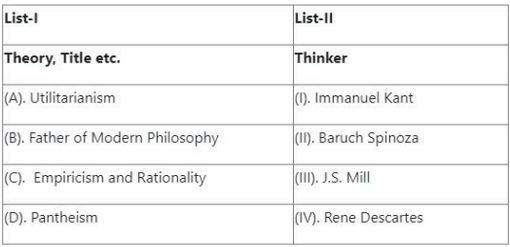
Choose the correct answer from the options given below:
Which of the following books is not a part of the Tamil text Cilapattikaram?
Which of the following are Nissim Ezekiel's poems?
(A) . Enterprise
(B) . My Grandmother's House
(C) . Goodbye Party for Miss Pushpa T S
(D) . On Killing a Tree
Choose the correct answer from the options given below:
Which figure of speech is used in the opening line of Spenser's sonnet LVII (57) - 'Sweet Warrior! When Shall I Have Peace with Thee?'
Which of the following statements are correct in the context of Coleridge's understanding of the terms 'Fancy' and 'Imagination'?
(A) . Fancy is a mechanical faculty of the human mind.
(B) . Imagination is an organic faculty of the human mind that dissolves dialectical oppositions.
(C) . Fancy is Mimetic, and Imagination is creative.
(D) . Fancy is the real poetic creativity.
Choose the correct answer from the options given below:
Match List-I with List-II
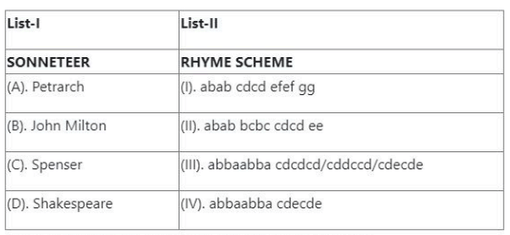
Choose the correct answer from the options given below:
Which of the following statements are true with respect to Aristotle's classic analysis of Tragedy in his Poetics?
(A) . Tragedy is mimesis.
(B) . Tragedy intends to accomplish the catharsis of emotions like pity and fear.
(C) . The tragic hero is an everyday person with ordinary moral worth.
(D) . It is hamartia, which often leads the tragic hero into a state of suffering.
Choose the correct answer from the options given below:
Match List-I with List-II
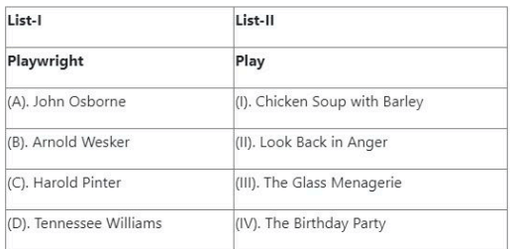
Choose the correct answer from the options given below:
Arrange the following literary periods/movements in chronological order, beginning with the earliest:
(A) . Restoration age
(B) . Art for Art's Sake
(C) . Age of Sensibility
(D) . Harlem Renaissance
Choose the correct answer from the options given below:
Which of the following statements is incorrect?
Which of the following are American transcendentalist writers?
(A) . Ezra Pound
(B) . T.S. Eliot
(C) . Ralph Waldo Emerson
(D) . Henry David Thoreau
Choose the correct answer from the options given below:
Which of the following is NOT a work by R. K. Narayan?
Match List-I with List-II
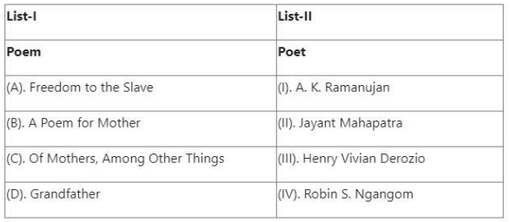
Choose the correct answer from the options given below:
Which of the following is NOT an autobiography?
"Shimmering snow on the southern slope of the Simla hills," is an example of:
Who is considered the 'compiler' of the Vedas?
Arrange these Indian writers in chronological order with reference to their year of birth, starting with the earliest:
(A) . Ismat Chugtai
(B) . Gurdial Singh Rahi
(C) . Harivansh Rai Bachchan
(D) . Sarat Chandra Chattopadhyay
Choose the correct answer from the options given below:
Which ONE of the following authors is not from the Caribbean region?
Match List-I with List-II
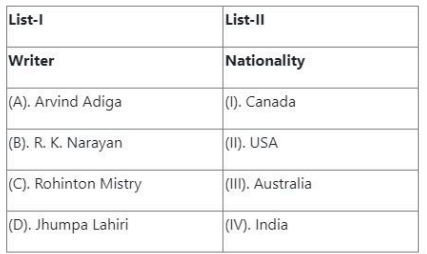
Choose the correct answer from the options given below:
Sequence these Nobel Prize winners in chronological order of they having received the award:
(A) . T.S. Eliot
(B) . Samuel Beckett
(C) . Bob Dylan
(D) . W.B. Yeats
Choose the correct answer from the options given below:
Which of the following is an ancient book of grammar?
Which of the following is NOT true about the Enlightenment Age?
Which of the following elements of drama was termed as mythos by Aristotle ?
Who among the following is associated with the Gothic?
Arrange the following in the correct chronological order of the year of their birth, beginning with the earliest.
(A) . Toru Dutt
(B) . Jhumpa Lahiri
(C) . R.K. Narayan
(D) . Anita Desai
Choose the correct answer from the options given below:
Match List-I with List-II
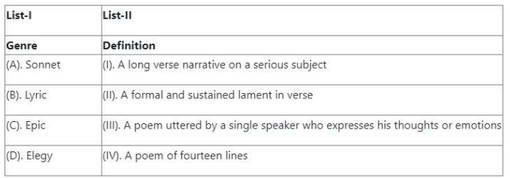
Choose the correct answer from the options given below:
Which of the following is the most appropriate statement about a 'heroic couplet'?
"Sethe", he says, "me and you, we got more yesterday than anybody. We need some more kind of tomorrow."
Which figure of speech is used here? Choose the most appropriate answer.
"Into the darkness they go, the wise and the lovely. Crowned
With lilies and with laurel they go; but I am not resigned."
Which form of poetry would the afore-mentioned lines be classified as? Choose the most appropriate answer.
Which of the following options are correct with regard to Postmodernism?
(A) . Focus on classical themes of heroism
(B) . Promotes the idea of multiple perspectives
(C) . Challenges grand narratives
(D) . Focus on metafiction and intertextuality
Choose the correct answer from the options given below:
Arrange the following Jnanpith Awardees in the order in which they received the award (beginning with the earliest):
(A) . Amitav Ghosh
(B) . Mahadevi Verma
(C) . Nilamani Pookan
(D) . Girish Karnad
Choose the correct answer from the options given below:
Which of the following is not a characteristic of Ecocriticism?
Identify correctly the themes and ideas that are explored in Modernist literature:
(A) Fragmentation and Disillusionment
(B) Rejection of traditional narrative forms
(C) . A focus on the representation of the alienated self
(D) . The linearity of time
Choose the correct answer from the options given below:
Match the literary term in List-I with its correct definition in List-II
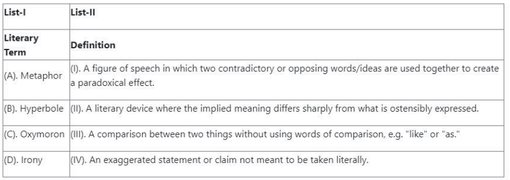
Choose the correct answer from the options given below:
Arrange the following elements of a story in chronological order as they typically occur in the plot structure, from the earliest to the latest:
(A) . Exposition
(B) . Climax
(C) . Rising Action
(D) . Resolution
Choose the correct answer from the options given below:
Which of the following literary terms refer to a play on words where a word has two or more meanings, or words that sound similar but have different meanings?
Which options are TRUE of 'Existentialism'?
(A) . Focus on radical individual freedom.
(B) . Albert Camus and Jean-Paul Sartre are thinkers/writers associated with this movement.
(C) . The absurdity of human existence is one of the major themes.
(D) . Its immediate inspiration was the French Revolution.
Choose the correct answer from the options given below:
Match List-I with List-II
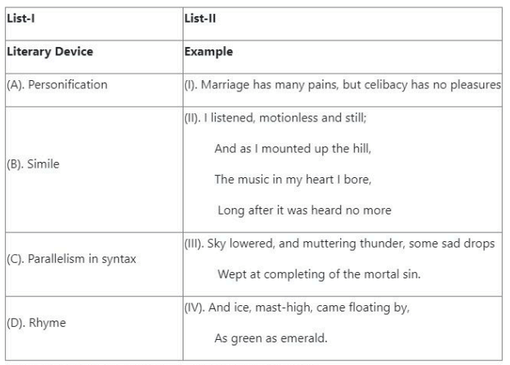
Choose the correct answer from the options given below:
Choose the correct option about Dayanand Saraswati.
(A) . Dayanand Saraswati wrote the book Satyartha Prakash.
(B) . "Back to Vedas" was the call given by Dayanand Saraswati.
(C) . Arya Samaj was started by Dayanand Saraswati in Andhra Pradesh.
(D) . Dayananda Anglo Vedic (D.A.V.) schools were established based on his philosophy and teachings.
Choose the correct answer from the options given below:
Arrange the following texts in the order they were written, from the earliest to the latest.
(A) . The Inheritance of Loss
(B) . The Guide
(C) . Swami and Friends
(D) . The Shadow Lines
Choose the correct answer from the options given below:
Match List-I with List-II
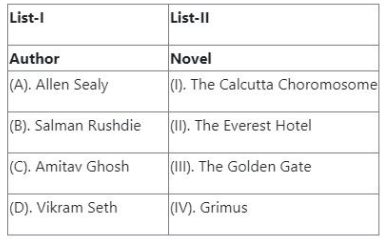
Choose the correct answer from the options given below:
Match List-I with List-II
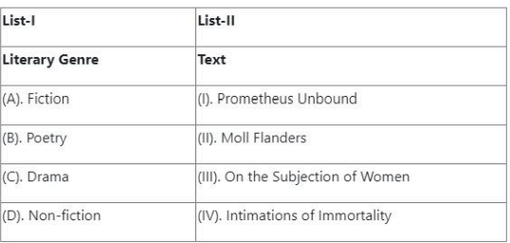
Choose the correct answer from the options given below:
Read the following passage carefully and answer the questions that follow:
When we approach prose for purposes of working out a literary appreciation, our main concern is with the kind of language used to match the thought content which it intends to convey through the medium. It is so difficult to draw a line between prose and poetry in the exact sense of the term that some critics have even pleaded for the abolition of this distinction. However, prose, for purposes of literary criticism, is just another way of expressing our thoughts in the form of language. When we view it as a question of literary appreciation, our main attention is first to the thought-content, which may differ in its nature. The nature of the thought-content will determine first the register of the language. A technical idea would require a technical register in the language, whereas a literary piece would require an altogether different language. The prose of a journalist would be guided by the requirements of the public it is addressed to; it would mostly be simple language which even an ordinary reader can make sense of. A literary writer, who has a special audience in mind, would try to convey the depth of his mind, or would use the nuances of the language to convey the subtlety of emotional complex that he sets out to convey. A critic would set out constructing well-composed, economical sentences, without any sense of wasted effort. Ease of expression is another criterion in this matter. If the writer tends to labour hard and overwork his expression with bombastic words, it is obviously not going to make any impression on the readers’ minds in any case. But the main thing that a student of literary criticism cares about is the nature of the thought-content of the passage, for language must convey, with a sense of economy, ease of expression and exactness of approach, the thought-content of the writer. The failure to meet these demands means that the writer has not achieved the required command over the language that is expected of a good writer.
Question 68:
Complete the following sentence by choosing the correct option out of the given ones as per the reading of the passage:
Prose as a medium of literary appreciation ...
Match List-I with List-II
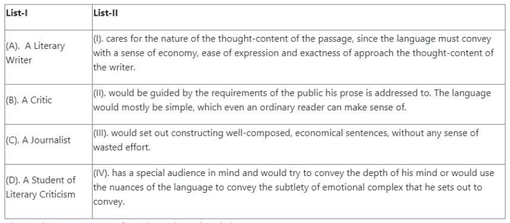
Choose the correct answer from the options given below:
What are the characteristics of good prose? Choose the most appropriate answer
(A) . Use of bombastic words.
(B) . Matching the requirements of the targeted readership.
(C) . Ease of expression.
(D) . Economy of words.
Choose the correct answer from the options given below:
The given passage may be characterised as -
According to the speaker, what stops one from going crazy?
What was the 'only' thing that prevented the writer from losing her sanity?
What was worse than the illness?
Which term applies the best to the given passage?



Comments