




The CUET PG Disaster Studies exam in 2025 is scheduled for 26th March during Shift 2. After the exam, candidates can access the question paper, answer key, and detailed solution PDF. The test evaluates knowledge in art Disaster Studies, techniques of Disaster Studies, aesthetics, Indian and Western art forms, and creative expression.
Candidates must attempt 75 questions within 60 minutes, totaling 300 marks. Each correct answer awards 4 marks, while 1 mark is deducted for every incorrect response.
CUET PG 2025 Disaster Studies Question Paper with Solutions PDF
| CUET PG 2025 Disaster Studies Question Paper with Solutions PDF | Download PDF | Check Solutions |
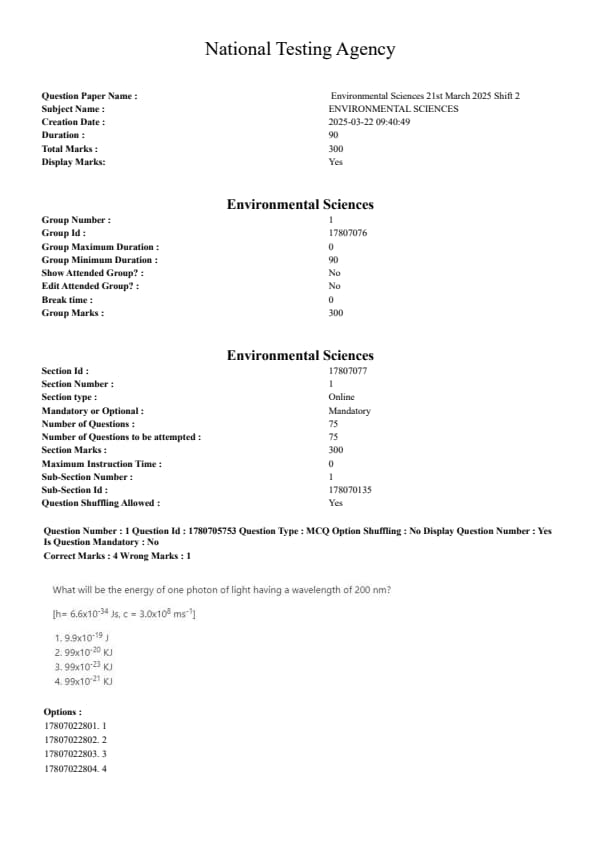
What will be the energy of one photon of light having a wavelength of 200 nm? \([h = 6.6 \times 10^{-34}\,J s,\; c = 3.0 \times 10^{8}\,m s^{-1}]\)
View Solution
Step 1: Use the formula for energy of a photon: \[ E = \frac{hc}{\lambda} \]
Step 2: Convert wavelength into meters: \[ \lambda = 200\,nm = 200 \times 10^{-9}\,m \]
Step 3: Substitute the given values: \[ E = \frac{(6.6 \times 10^{-34})(3.0 \times 10^{8})}{200 \times 10^{-9}} \]
Step 4: Simplify: \[ E = \frac{19.8 \times 10^{-26}}{2.0 \times 10^{-7}} = 9.9 \times 10^{-19}\,J \] Quick Tip: Always convert wavelength into meters before substituting in \[ E = \frac{hc}{\lambda}. \] Photon energy is inversely proportional to wavelength.
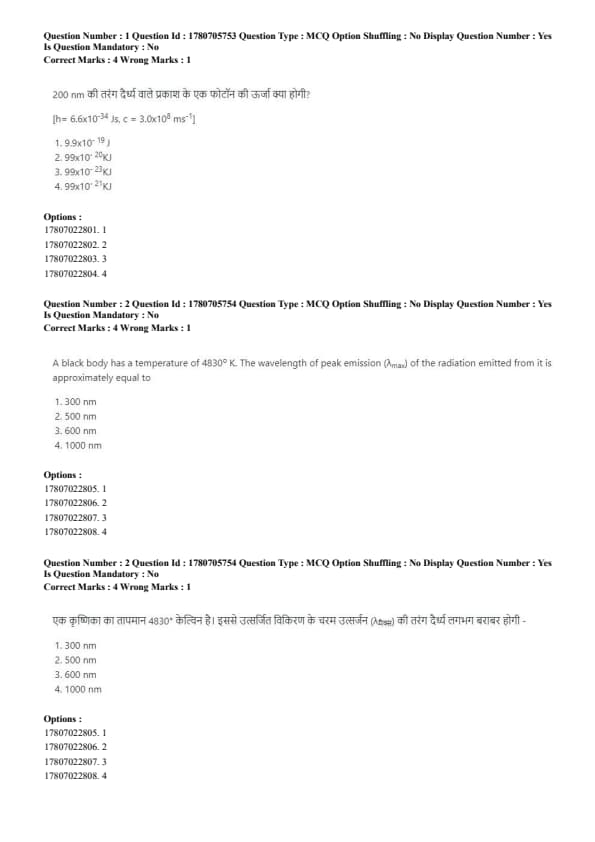
A black body has a temperature of \(4830\,K\). The wavelength of peak emission \((\lambda_{\max})\) of the radiation emitted from it is approximately equal to:
View Solution
Step 1: Use Wien’s displacement law: \[ \lambda_{\max} T = b \]
where \( b = 2.9 \times 10^{-3}\,m K \).
Step 2: Substitute the given temperature: \[ \lambda_{\max} = \frac{2.9 \times 10^{-3}}{4830} \]
Step 3: Calculate: \[ \lambda_{\max} \approx 6.0 \times 10^{-7}\,m \]
Step 4: Convert meters to nanometers: \[ 6.0 \times 10^{-7}\,m = 600\,nm \] Quick Tip: For black body radiation problems, directly apply Wien’s law \[ \lambda_{\max} = \frac{2.9 \times 10^{-3}}{T}. \] Higher temperature implies shorter peak wavelength.
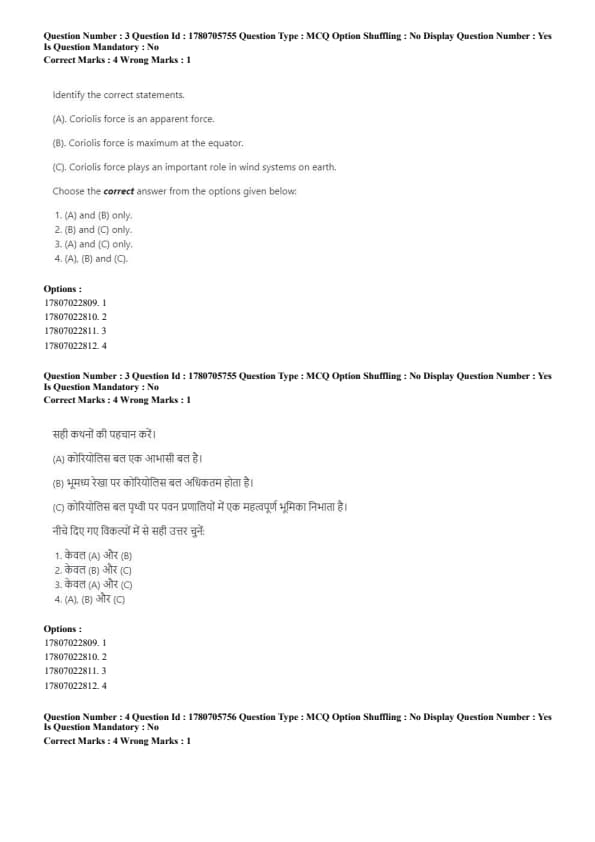
Identify the correct statements.
(A). Coriolis force is an apparent force.
(B). Coriolis force is maximum at the equator.
(C). Coriolis force plays an important role in wind systems on earth.
Choose the correct answer from the options given below:
View Solution
Step 1: Coriolis force is a pseudo (apparent) force observed in a rotating frame of reference.
Hence, statement (A) is correct.
Step 2: The magnitude of Coriolis force is zero at the equator and maximum at the poles.
Hence, statement (B) is incorrect.
Step 3: Coriolis force significantly affects large-scale motions such as wind and ocean currents on Earth.
Hence, statement (C) is correct.
Step 4: Therefore, the correct statements are (A) and (C) only. Quick Tip: Coriolis force depends on latitude: - Zero at the equator - Maximum at the poles It strongly influences atmospheric and oceanic circulation.
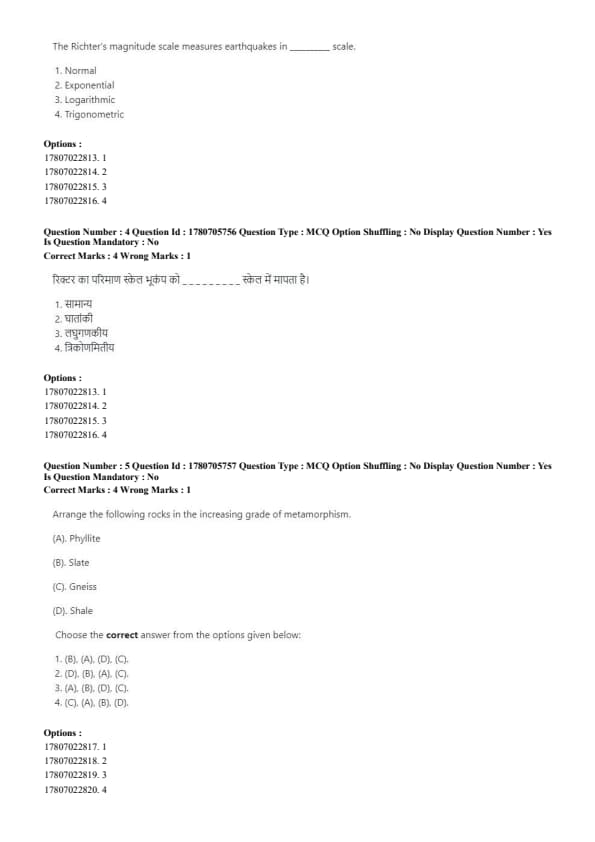
The Richter’s magnitude scale measures earthquakes in ________ scale.
View Solution
Step 1: The Richter scale is defined based on the logarithm of the amplitude of seismic waves recorded by seismographs.
Step 2: An increase of 1 unit on the Richter scale corresponds to a tenfold increase in wave amplitude.
Step 3: Hence, the Richter scale follows a logarithmic scale. Quick Tip: On the Richter scale, each whole number increase represents 10 times greater wave amplitude and about 32 times more energy release.
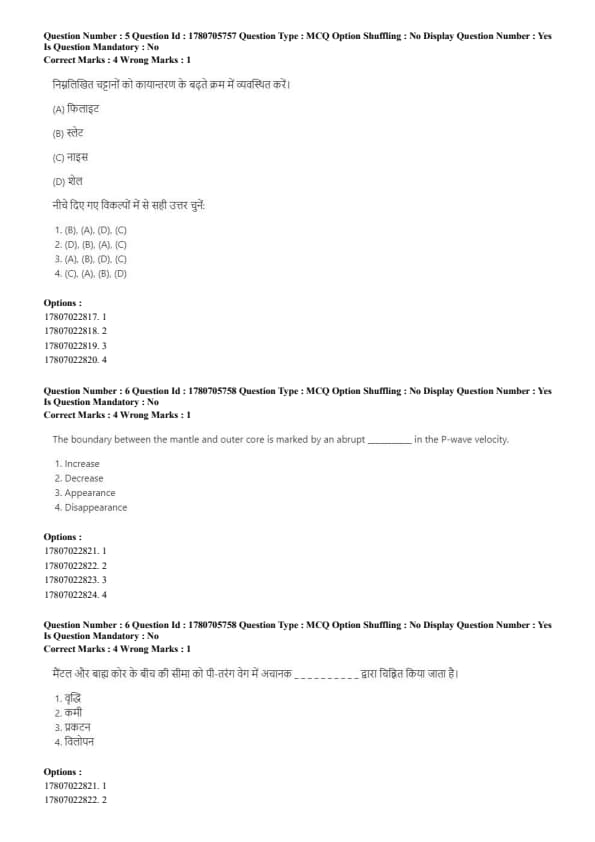
Arrange the following rocks in the increasing grade of metamorphism.
(A) Phyllite
(B) Slate
(C) Gneiss
(D) Shale
Choose the correct sequence from the options given below:
View Solution
Step 1: Shale is a sedimentary rock and represents the lowest grade before metamorphism begins.
Step 2: With increasing temperature and pressure, shale transforms into slate.
Step 3: Further metamorphism converts slate into phyllite.
Step 4: At the highest grade of metamorphism, phyllite changes into gneiss.
Step 5: Hence, the correct increasing order of metamorphism is: \[ Shale \rightarrow Slate \rightarrow Phyllite \rightarrow Gneiss \] Quick Tip: Increasing grade of metamorphism generally follows: Shale \(\rightarrow\) Slate \(\rightarrow\) Phyllite \(\rightarrow\) Schist \(\rightarrow\) Gneiss.
The boundary between the mantle and outer core is marked by an abrupt ________ in the P-wave velocity.
View Solution
Step 1: The boundary between the mantle and the outer core is known as the Gutenberg discontinuity.
Step 2: When P-waves enter the outer core from the mantle, they move from a solid to a liquid medium.
Step 3: Due to this change in state, the velocity of P-waves suddenly decreases.
Step 4: Hence, the mantle–outer core boundary is marked by an abrupt decrease in P-wave velocity. Quick Tip: P-waves can travel through both solids and liquids, but their velocity decreases sharply when entering the liquid outer core.
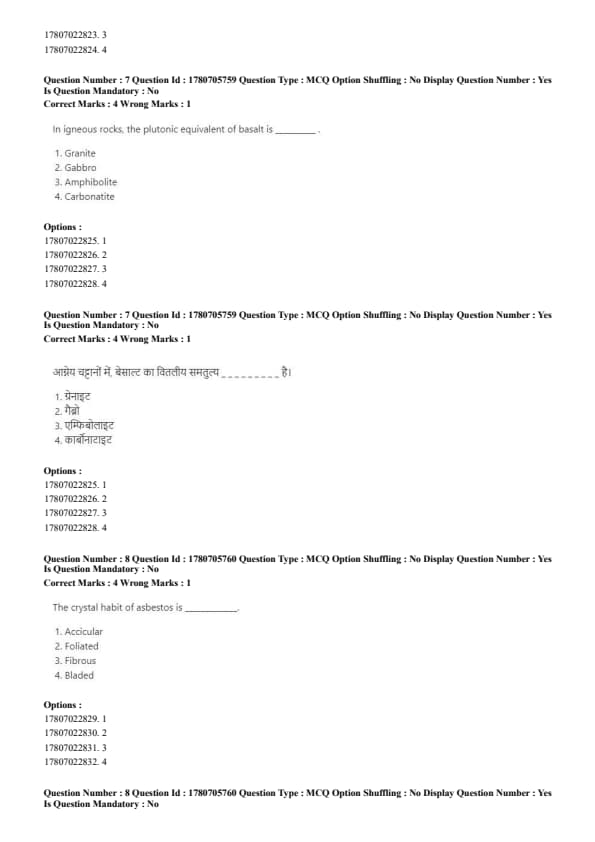
In igneous rocks, the plutonic equivalent of basalt is:
View Solution
Step 1: Basalt is a mafic igneous rock formed by rapid cooling of lava at the Earth’s surface (extrusive).
Step 2: The plutonic (intrusive) equivalent of an extrusive igneous rock has the same chemical composition but forms deep inside the Earth with slow cooling.
Step 3: Gabbro is a coarse-grained, mafic intrusive igneous rock with the same composition as basalt.
Step 4: Hence, the plutonic equivalent of basalt is gabbro. Quick Tip: Extrusive–Intrusive equivalents: Basalt \(\leftrightarrow\) Gabbro, Rhyolite \(\leftrightarrow\) Granite.
The crystal habit of asbestos is:
View Solution
Step 1: Crystal habit refers to the characteristic external shape in which a mineral commonly occurs.
Step 2: Asbestos minerals are known for forming long, thin, thread-like crystals.
Step 3: Such a crystal form is described as fibrous.
Step 4: Hence, the crystal habit of asbestos is fibrous. Quick Tip: Fibrous crystal habit is characterized by elongated, thread-like structures, commonly seen in asbestos minerals.
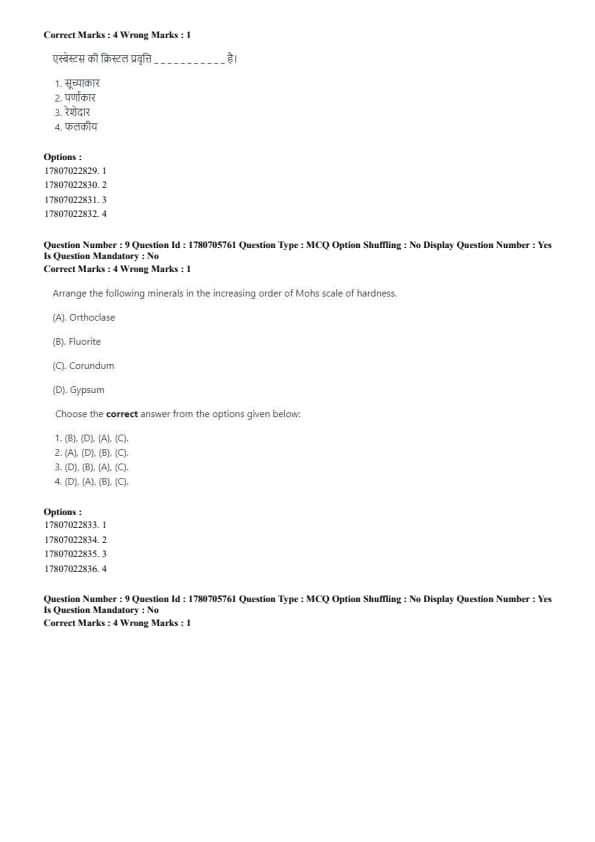
Arrange the following minerals in the increasing order of Mohs scale of hardness.
(A) Orthoclase
(B) Fluorite
(C) Corundum
(D) Gypsum
Choose the correct answer from the options given below:
View Solution
Step 1: Mohs hardness values of the given minerals are:
Gypsum = 2, Fluorite = 4, Orthoclase = 6, Corundum = 9.
Step 2: Arrange the minerals from lowest to highest hardness.
Step 3: The increasing order is: \[ Gypsum \rightarrow Fluorite \rightarrow Orthoclase \rightarrow Corundum \]
Step 4: Hence, the correct sequence is (D), (B), (A), (C). Quick Tip: Remember key Mohs values: Gypsum (2), Fluorite (4), Orthoclase (6), Corundum (9). Lower number means softer mineral.
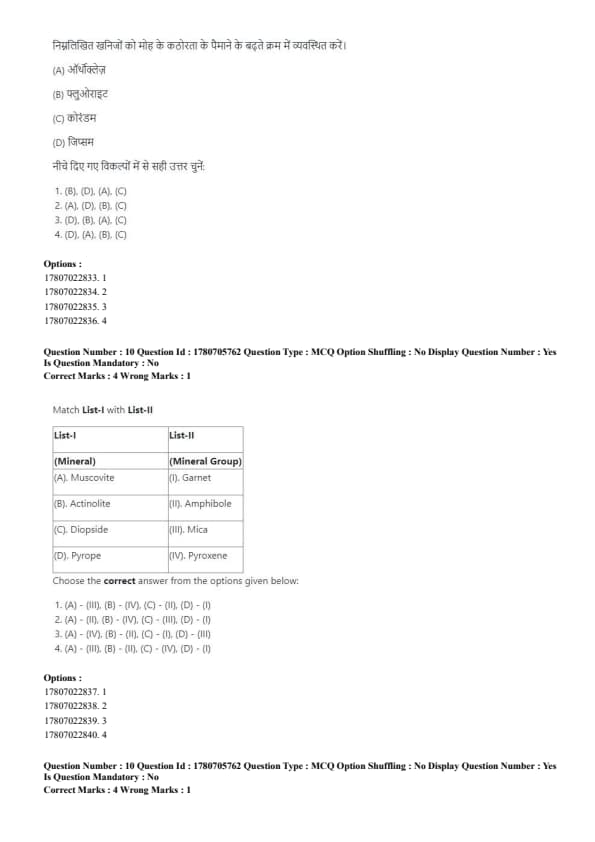
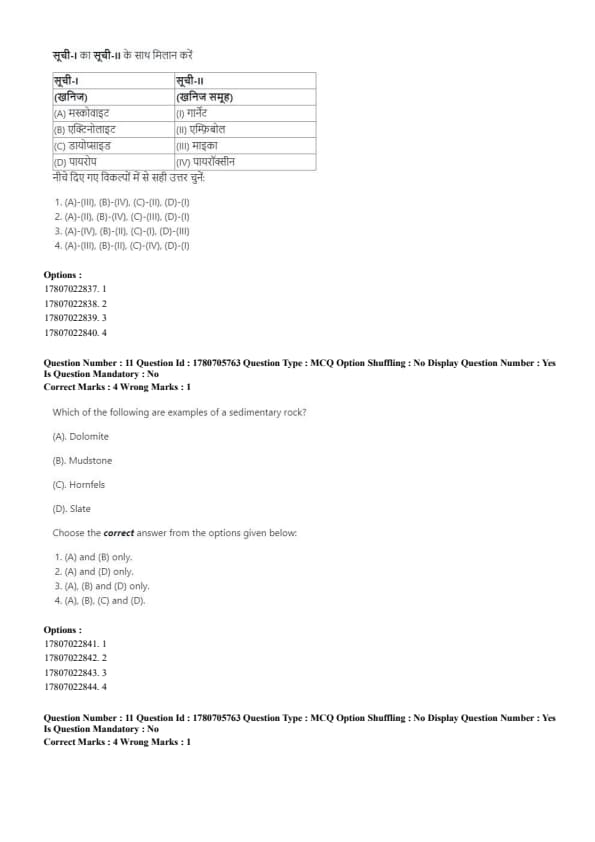
Match List–I with List–II.
List–I (Mineral) \hfill List–II (Mineral Group)
(A) Muscovite \hfill (I) Garnet
(B) Actinolite \hfill (II) Amphibole
(C) Diopside \hfill (III) Mica
(D) Pyrope \hfill (IV) Pyroxene
Choose the correct answer from the options given below:
View Solution
Step 1: Muscovite belongs to the mica group.
So, (A) \(\rightarrow\) (III).
Step 2: Actinolite is a member of the amphibole group.
So, (B) \(\rightarrow\) (II).
Step 3: Diopside is a pyroxene mineral.
So, (C) \(\rightarrow\) (IV).
Step 4: Pyrope is a variety of garnet.
So, (D) \(\rightarrow\) (I).
Step 5: Hence, the correct matching is
(A)–(III), (B)–(II), (C)–(IV), (D)–(I). Quick Tip: Common mineral groups: Muscovite \(\rightarrow\) Mica, Actinolite \(\rightarrow\) Amphibole, Diopside \(\rightarrow\) Pyroxene, Pyrope \(\rightarrow\) Garnet.
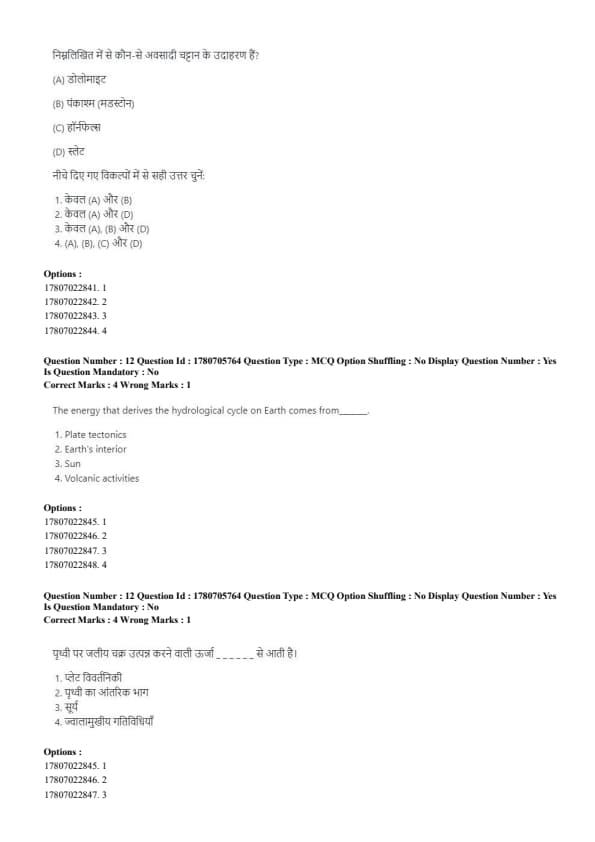
Which of the following are examples of sedimentary rocks?
(A) Dolomite
(B) Mudstone
(C) Hornfels
(D) Slate
Choose the correct answer from the options given below:
View Solution
Step 1: Dolomite is a sedimentary rock formed by chemical precipitation or alteration of limestone.
Step 2: Mudstone is a clastic sedimentary rock formed from compacted mud-sized particles.
Step 3: Hornfels is a metamorphic rock formed by contact metamorphism.
Hence, it is not sedimentary.
Step 4: Slate is also a metamorphic rock derived from shale.
Step 5: Therefore, only dolomite and mudstone are sedimentary rocks. Quick Tip: Sedimentary rocks form by deposition, compaction, or precipitation. Hornfels and slate are metamorphic, not sedimentary.
The energy that drives the hydrological cycle on Earth comes from:
View Solution
Step 1: The hydrological (water) cycle involves processes such as evaporation, condensation, precipitation, and runoff.
Step 2: Evaporation of water from oceans, rivers, and lakes requires a continuous supply of energy.
Step 3: This energy is provided by solar radiation from the Sun.
Step 4: Hence, the hydrological cycle on Earth is driven by energy from the Sun. Quick Tip: Solar energy is the main driving force behind evaporation and the entire hydrological cycle on Earth.
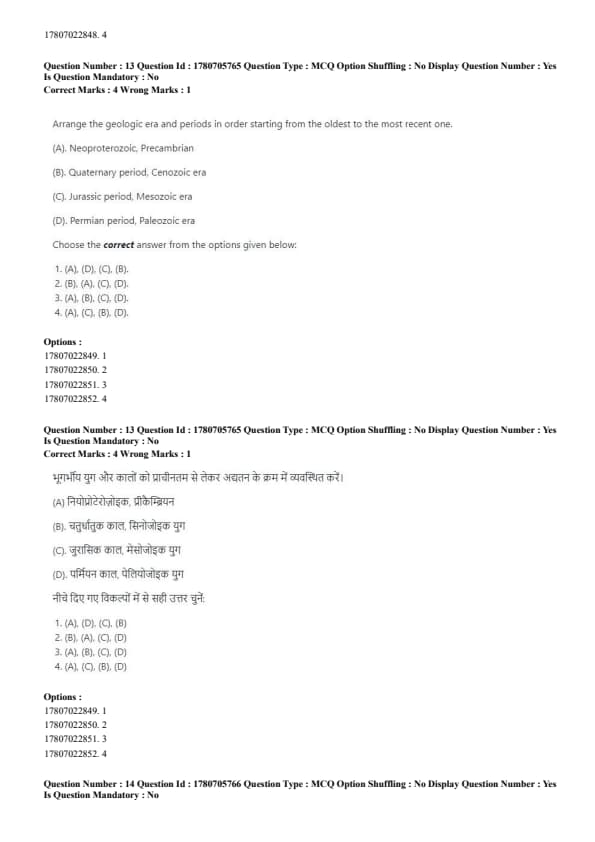
Arrange the geologic eras and periods in order starting from the oldest to the most recent one.
(A) Neoproterozoic, Precambrian
(B) Quaternary period, Cenozoic era
(C) Jurassic period, Mesozoic era
(D) Permian period, Paleozoic era
Choose the correct answer from the options given below:
View Solution
Step 1: The Precambrian (including the Neoproterozoic) is the oldest division of geologic time.
Step 2: The Paleozoic era follows the Precambrian, with the Permian as its last period.
Step 3: The Mesozoic era succeeds the Paleozoic, and the Jurassic is a middle period of the Mesozoic.
Step 4: The Cenozoic era is the most recent era, and the Quaternary is its latest period.
Step 5: Hence, the correct chronological order from oldest to most recent is: \[ (A) \rightarrow (D) \rightarrow (C) \rightarrow (B) \] Quick Tip: Geologic time order (oldest to youngest): Precambrian \(\rightarrow\) Paleozoic \(\rightarrow\) Mesozoic \(\rightarrow\) Cenozoic.
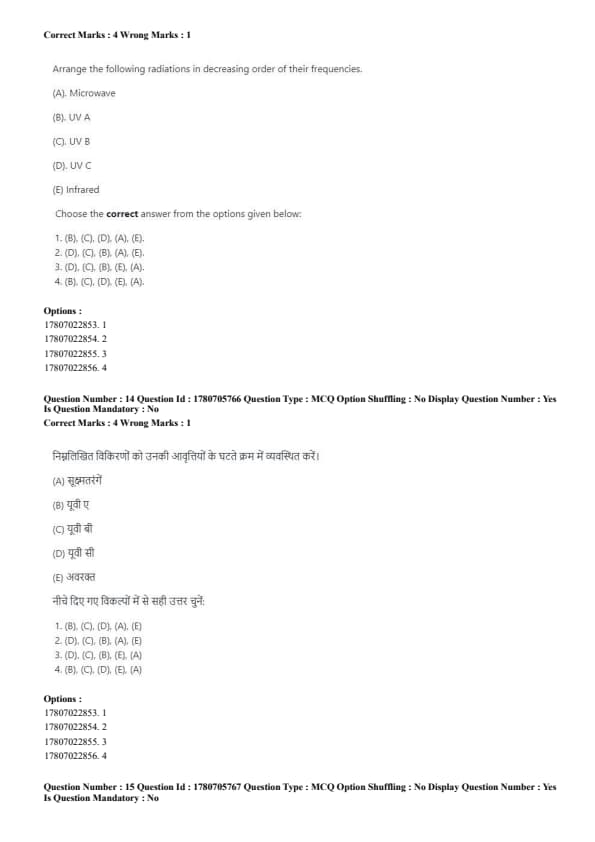
Arrange the following radiations in decreasing order of their frequencies.
(A) Microwave
(B) UVA
(C) UVB
(D) UVC
(E) Infrared
Choose the correct answer from the options given below:
View Solution
Step 1: Frequency of electromagnetic radiation increases as wavelength decreases.
Step 2: Among ultraviolet radiations, UVC has the highest frequency, followed by UVB and then UVA.
Step 3: Infrared radiation has a lower frequency than ultraviolet radiation but higher than microwaves.
Step 4: Microwaves have the lowest frequency among the given radiations.
Step 5: Therefore, the decreasing order of frequency is: \[ UVC \rightarrow UVB \rightarrow UVA \rightarrow Infrared \rightarrow Microwave \] Quick Tip: In the electromagnetic spectrum, frequency decreases from gamma rays to radio waves. Shorter wavelength means higher frequency.
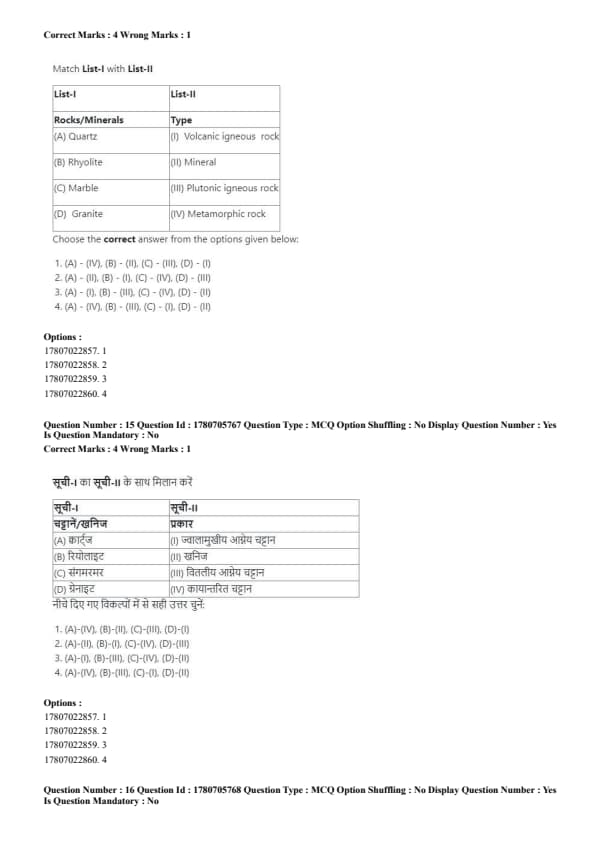
Match List–I with List–II.
List–I (Rocks/Minerals) \hfill List–II (Type)
(A) Quartz \hfill (I) Volcanic igneous rock
(B) Rhyolite \hfill (II) Mineral
(C) Marble \hfill (III) Plutonic igneous rock
(D) Granite \hfill (IV) Metamorphic rock
Choose the correct answer from the options given below:
View Solution
Step 1: Quartz is a naturally occurring crystalline substance and hence a mineral.
So, (A) \(\rightarrow\) (II).
Step 2: Rhyolite is an extrusive (volcanic) igneous rock.
So, (B) \(\rightarrow\) (I).
Step 3: Marble is formed by metamorphism of limestone and is a metamorphic rock.
So, (C) \(\rightarrow\) (IV).
Step 4: Granite forms deep within the Earth by slow cooling of magma and is a plutonic igneous rock.
So, (D) \(\rightarrow\) (III).
Step 5: Hence, the correct matching is
(A)–(II), (B)–(I), (C)–(IV), (D)–(III). Quick Tip: Quartz is a mineral, Rhyolite is volcanic (extrusive), Granite is plutonic (intrusive), Marble is metamorphic.
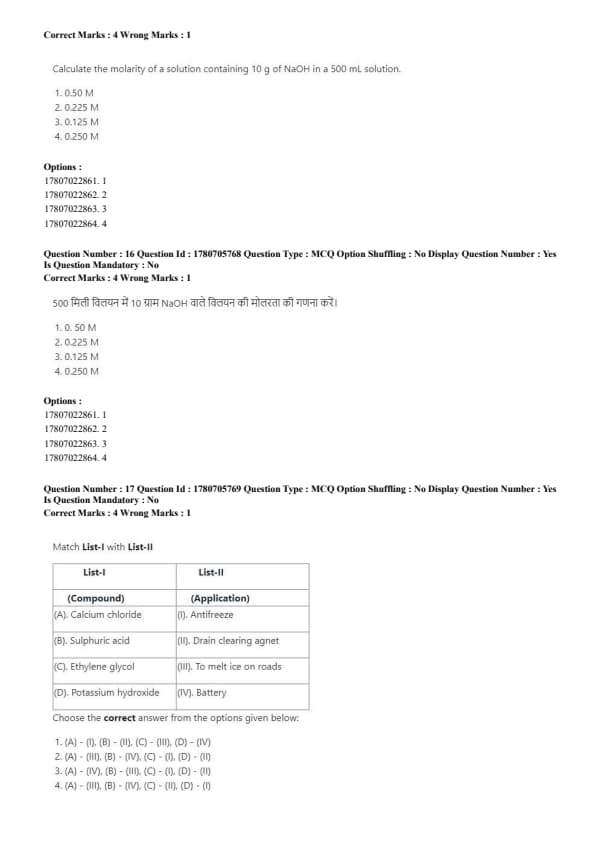
Calculate the molarity of a solution containing \(10\,g\) of NaOH in a \(500\,mL\) solution.
View Solution
Step 1: Calculate the molar mass of NaOH: \[ NaOH = 23 + 16 + 1 = 40\,g mol^{-1} \]
Step 2: Calculate the number of moles of NaOH: \[ Moles = \frac{10}{40} = 0.25\,mol \]
Step 3: Convert volume into liters: \[ 500\,mL = 0.5\,L \]
Step 4: Calculate molarity: \[ M = \frac{0.25}{0.5} = 0.50\,M \] Quick Tip: Molarity \(=\dfrac{moles of solute}{volume of solution in liters}\). Always convert volume into liters before calculating molarity.
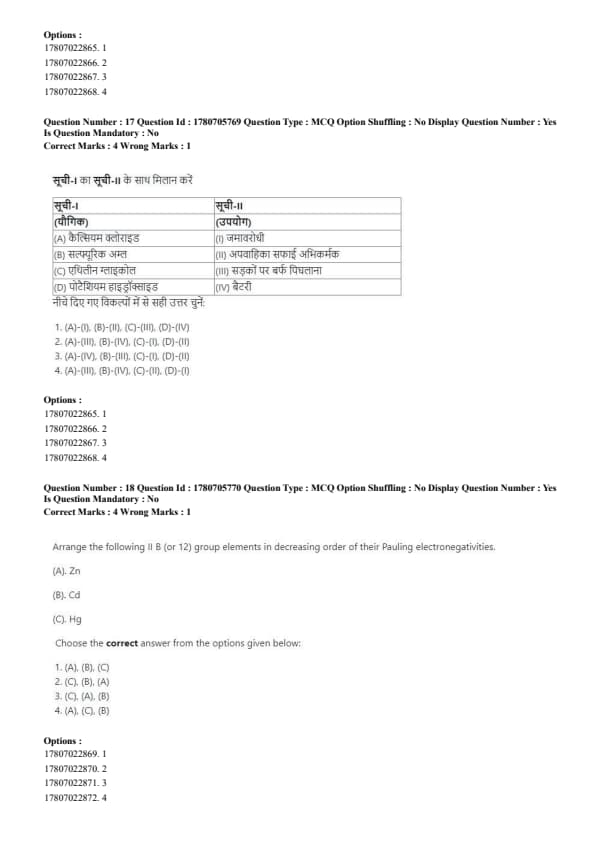
Match List–I with List–II.
List–I (Compound) \hfill List–II (Application)
(A) Calcium chloride \hfill (I) Antifreeze
(B) Sulphuric acid \hfill (II) Drain clearing agent
(C) Ethylene glycol \hfill (III) To melt ice on roads
(D) Potassium hydroxide \hfill (IV) Battery
Choose the correct answer from the options given below:
View Solution
Step 1: Calcium chloride is commonly used to melt ice on roads.
So, (A) \(\rightarrow\) (III).
Step 2: Sulphuric acid is used as an electrolyte in lead–acid batteries.
So, (B) \(\rightarrow\) (IV).
Step 3: Ethylene glycol is widely used as an antifreeze.
So, (C) \(\rightarrow\) (I).
Step 4: Potassium hydroxide is used as a drain clearing agent.
So, (D) \(\rightarrow\) (II).
Step 5: Hence, the correct matching is
(A)–(III), (B)–(IV), (C)–(I), (D)–(II). Quick Tip: Common applications: Calcium chloride \(\rightarrow\) de-icing, Ethylene glycol \(\rightarrow\) antifreeze, Sulphuric acid \(\rightarrow\) batteries, KOH \(\rightarrow\) drain cleaner.
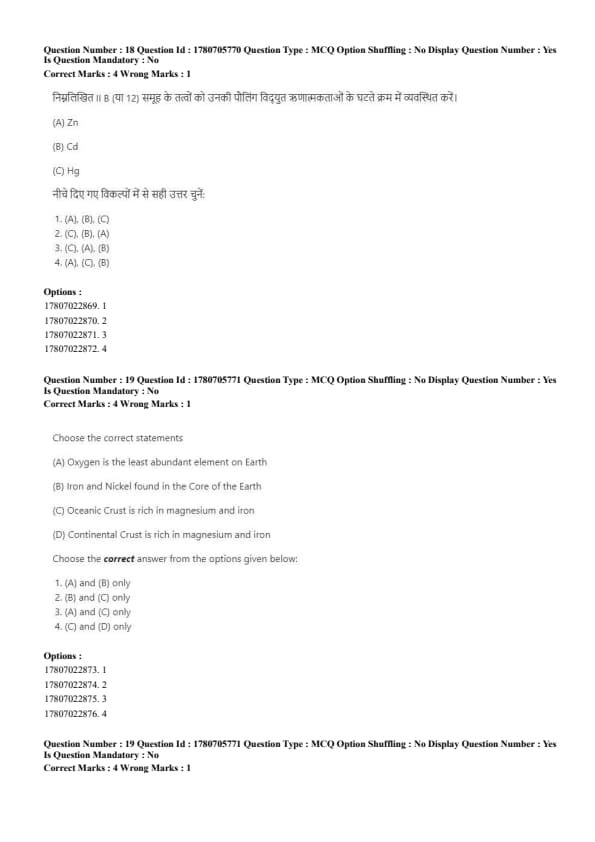
Arrange the following II B (or 12) group elements in decreasing order of their Pauling electronegativities.
(A) Zn
(B) Cd
(C) Hg
Choose the correct answer from the options given below:
View Solution
Step 1: Pauling electronegativity values of the given elements are approximately:
Zn = 1.65, Cd = 1.69, Hg = 2.00.
Step 2: Higher electronegativity means greater tendency to attract electrons.
Step 3: Among the given elements, mercury has the highest electronegativity, followed by cadmium and then zinc.
Step 4: Therefore, the decreasing order of electronegativity is: \[ Hg \rightarrow Cd \rightarrow Zn \] Quick Tip: In group 12 elements, electronegativity generally increases down the group due to relativistic effects, with mercury showing the highest value.
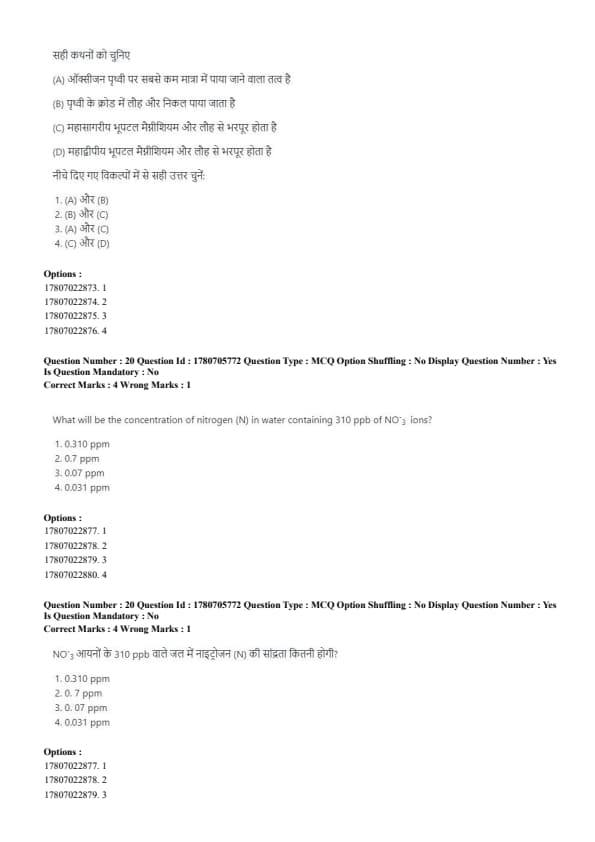
Choose the correct statements.
(A) Oxygen is the least abundant element on Earth.
(B) Iron and nickel are found in the core of the Earth.
(C) Oceanic crust is rich in magnesium and iron.
(D) Continental crust is rich in magnesium and iron.
Choose the correct answer from the options given below:
View Solution
Step 1: Oxygen is the most abundant element in the Earth’s crust, not the least.
Hence, statement (A) is incorrect.
Step 2: The Earth’s core is mainly composed of iron and nickel.
Hence, statement (B) is correct.
Step 3: Oceanic crust is basaltic in nature and is rich in magnesium and iron (SIMA).
Hence, statement (C) is correct.
Step 4: Continental crust is rich in silica and aluminium (SIAL), not magnesium and iron.
Hence, statement (D) is incorrect.
Step 5: Therefore, the correct statements are (B) and (C) only. Quick Tip: Remember Earth composition terms: SIAL \(\rightarrow\) Continental crust (Si + Al), SIMA \(\rightarrow\) Oceanic crust (Si + Mg).
What will be the concentration of nitrogen (N) in water containing \(310\,ppb\) of \(NO_3^-\) ions?
View Solution
Step 1: Convert ppb to ppm: \[ 310\,ppb = 0.310\,ppm of NO_3^- \]
Step 2: Determine the molar masses: \[ Molar mass of NO_3^- = 14 + (16 \times 3) = 62 \] \[ Molar mass of N = 14 \]
Step 3: Find the fraction of nitrogen in nitrate: \[ \frac{14}{62} \]
Step 4: Calculate concentration of nitrogen: \[ N concentration = 0.310 \times \frac{14}{62} \approx 0.07\,ppm \] Quick Tip: To find elemental concentration from an ion, multiply by the ratio of molar mass of the element to the molar mass of the ion.
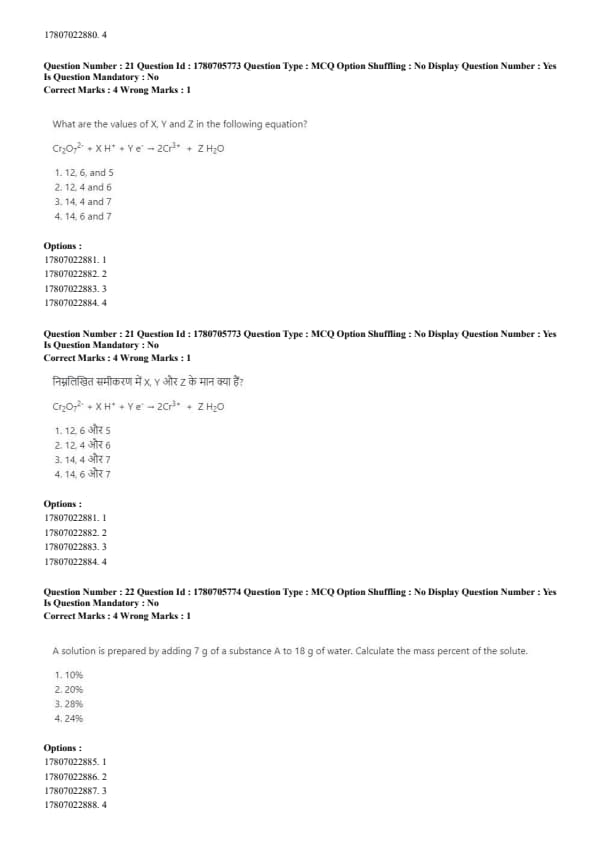
What are the values of \(X\), \(Y\) and \(Z\) in the following equation? \[ Cr_2O_7^{2-} + X\,H^+ + Y\,e^- \rightarrow 2Cr^{3+} + Z\,H_2O \]
View Solution
Step 1: Write the reduction half-reaction of dichromate ion in acidic medium: \[ Cr_2O_7^{2-} \rightarrow 2Cr^{3+} \]
Step 2: Balance chromium atoms: \[ Cr_2O_7^{2-} \rightarrow 2Cr^{3+} \]
Step 3: Balance oxygen atoms by adding water: \[ Cr_2O_7^{2-} \rightarrow 2Cr^{3+} + 7H_2O \]
Step 4: Balance hydrogen atoms by adding \(H^+\): \[ Cr_2O_7^{2-} + 14H^+ \rightarrow 2Cr^{3+} + 7H_2O \]
Step 5: Balance charges by adding electrons: \[ Cr_2O_7^{2-} + 14H^+ + 6e^- \rightarrow 2Cr^{3+} + 7H_2O \]
Step 6: Hence, \[ X = 14,\quad Y = 6,\quad Z = 7 \] Quick Tip: In acidic medium, dichromate ion is reduced as: \[ Cr_2O_7^{2-} + 14H^+ + 6e^- \rightarrow 2Cr^{3+} + 7H_2O \] This reaction is commonly used in redox balancing.
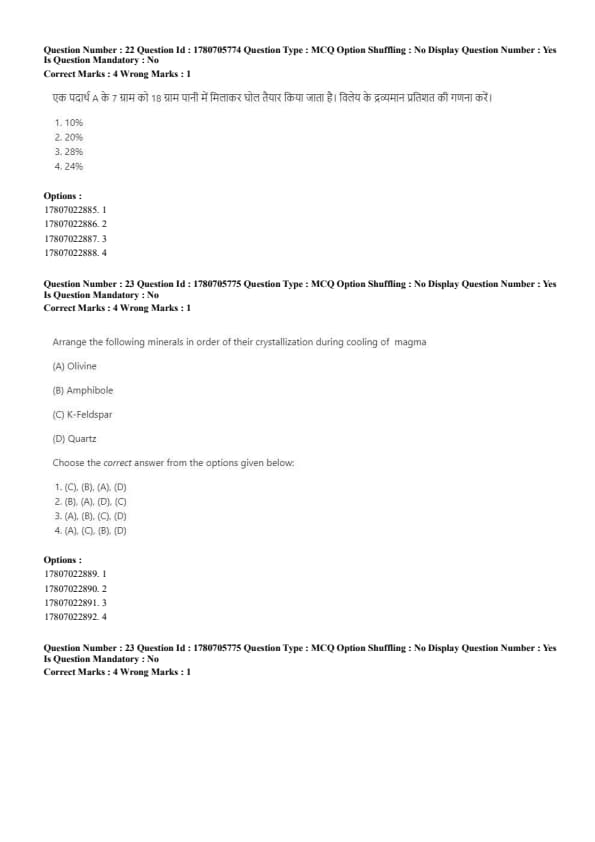
A solution is prepared by adding \(7\,g\) of a substance A to \(18\,g\) of water. Calculate the mass percent of the solute.
View Solution
Step 1: Calculate the total mass of the solution: \[ Total mass = 7 + 18 = 25\,g \]
Step 2: Use the formula for mass percent: \[ Mass percent = \frac{Mass of solute}{Mass of solution} \times 100 \]
Step 3: Substitute the values: \[ Mass percent = \frac{7}{25} \times 100 = 28% \] Quick Tip: Mass percent depends only on masses, not on volume: \[ % by mass = \frac{mass of solute}{mass of solution} \times 100. \]
Arrange the following minerals in order of their crystallization during cooling of magma.
(A) Olivine
(B) Amphibole
(C) K-Feldspar
(D) Quartz
Choose the correct answer from the options given below:
View Solution
Step 1: The crystallization sequence of minerals from magma is explained by Bowen’s Reaction Series.
Step 2: Olivine crystallizes at the highest temperature and hence forms first.
Step 3: Amphibole crystallizes at a lower temperature than olivine.
Step 4: K-feldspar crystallizes after amphibole at still lower temperatures.
Step 5: Quartz crystallizes at the lowest temperature and hence forms last.
Step 6: Therefore, the correct order of crystallization during cooling is: \[ Olivine \rightarrow Amphibole \rightarrow K-Feldspar \rightarrow Quartz \] Quick Tip: According to Bowen’s Reaction Series, high-temperature mafic minerals crystallize first, while low-temperature felsic minerals crystallize last.
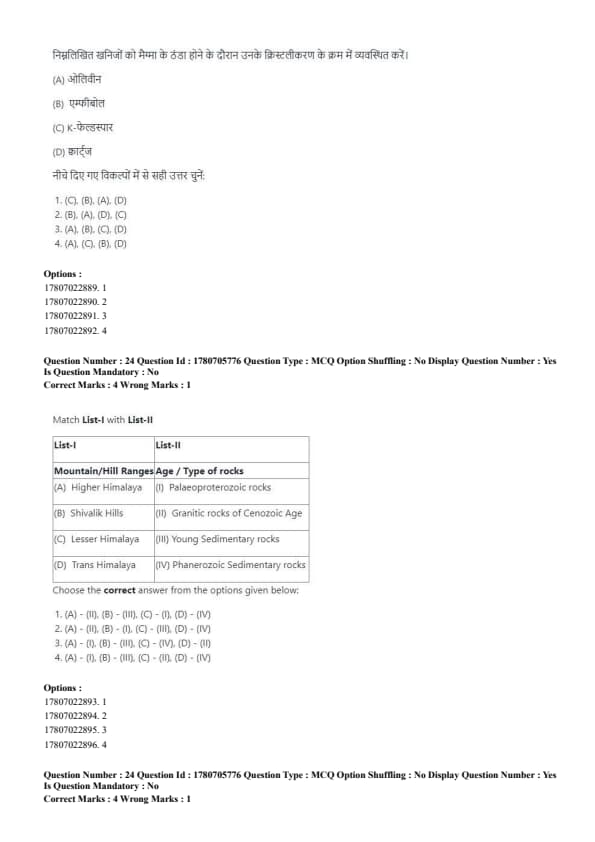
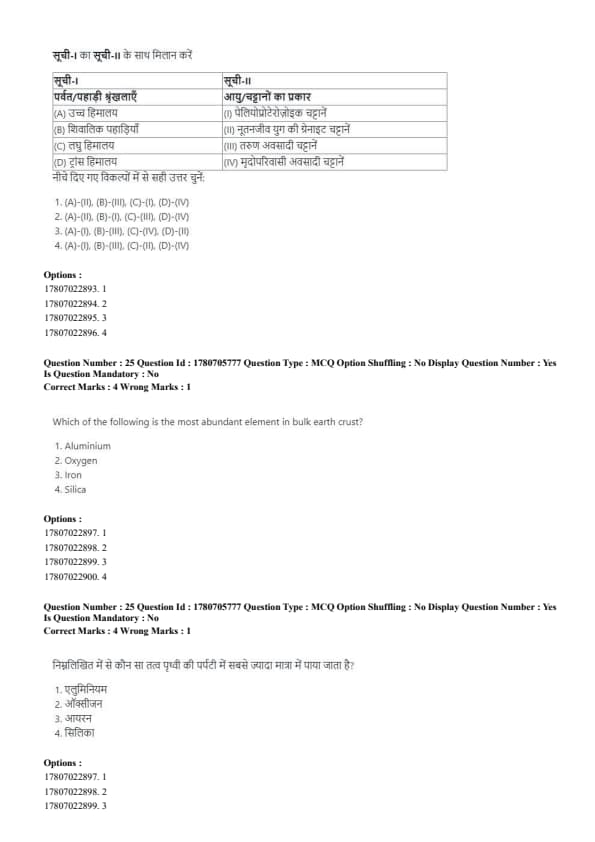
Match List–I with List–II.
List–I (Mountain/Hill Ranges) \hfill List–II (Age / Type of rocks)
(A) Higher Himalaya \hfill (I) Palaeoproterozoic rocks
(B) Shivalik Hills \hfill (II) Granitic rocks of Cenozoic age
(C) Lesser Himalaya \hfill (III) Young sedimentary rocks
(D) Trans Himalaya \hfill (IV) Phanerozoic sedimentary rocks
Choose the correct answer from the options given below:
View Solution
Step 1: The Higher Himalaya is dominated by granitic rocks formed during the Cenozoic era.
So, (A) \(\rightarrow\) (II).
Step 2: The Shivalik Hills consist mainly of young, unconsolidated sedimentary deposits.
So, (B) \(\rightarrow\) (III).
Step 3: The Lesser Himalaya is composed largely of very old Palaeoproterozoic rocks.
So, (C) \(\rightarrow\) (I).
Step 4: The Trans Himalaya includes Phanerozoic sedimentary sequences.
So, (D) \(\rightarrow\) (IV).
Step 5: Hence, the correct matching is
(A)–(II), (B)–(III), (C)–(I), (D)–(IV). Quick Tip: Himalayan divisions: Higher Himalaya \(\rightarrow\) Cenozoic granites, Shivalik \(\rightarrow\) youngest sediments, Lesser Himalaya \(\rightarrow\) very old rocks.
Which of the following is the most abundant element in the bulk Earth’s crust?
View Solution
Step 1: The Earth’s crust is composed mainly of oxides and silicate minerals.
Step 2: Oxygen combines with elements such as silicon, aluminium, iron, calcium, and magnesium to form these minerals.
Step 3: By weight percentage, oxygen constitutes about 46% of the Earth’s crust, making it the most abundant element.
Step 4: Hence, the most abundant element in the bulk Earth’s crust is oxygen. Quick Tip: Abundance in Earth’s crust (by weight): Oxygen \(>\) Silicon \(>\) Aluminium \(>\) Iron.
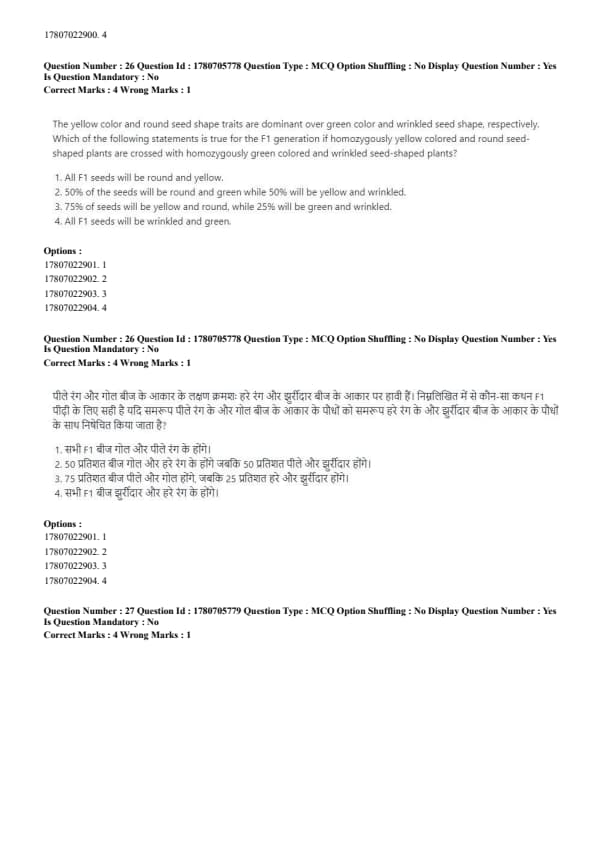
The yellow colour and round seed shape traits are dominant over green colour and wrinkled seed shape, respectively. Which of the following statements is true for the \(F_1\) generation if homozygous yellow coloured and round seed-shaped plants are crossed with homozygous green coloured and wrinkled seed-shaped plants?
View Solution
Step 1: Let yellow colour (Y) be dominant over green colour (y), and round seed shape (R) be dominant over wrinkled seed shape (r).
Step 2: The parental cross is: \[ YYRR \times yyrr \]
Step 3: Gametes formed are: \[ YR \quad and \quad yr \]
Step 4: All offspring in the \(F_1\) generation will have the genotype: \[ YyRr \]
Step 5: Since Y and R are dominant alleles, all \(F_1\) plants will show yellow colour and round seed shape. Quick Tip: In a cross between two homozygous parents with contrasting traits, all \(F_1\) offspring are heterozygous and express only the dominant traits.
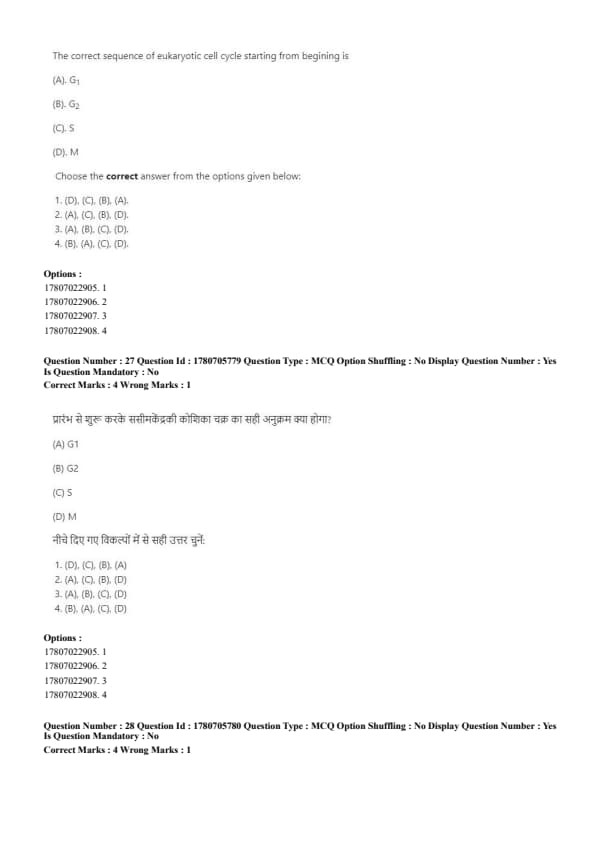
The correct sequence of the eukaryotic cell cycle starting from the beginning is:
(A) \(G_1\)
(B) \(G_2\)
(C) \(S\)
(D) \(M\)
Choose the correct answer from the options given below:
View Solution
Step 1: The cell cycle begins with the \(G_1\) phase, during which the cell grows and prepares for DNA synthesis.
Step 2: This is followed by the \(S\) phase, where DNA replication occurs.
Step 3: After DNA synthesis, the cell enters the \(G_2\) phase, involving further growth and preparation for division.
Step 4: Finally, the cell undergoes the \(M\) phase, which includes mitosis and cytokinesis.
Step 5: Hence, the correct sequence is: \[ G_1 \rightarrow S \rightarrow G_2 \rightarrow M \] Quick Tip: Remember the cell cycle order as: \[ G_1 \rightarrow S \rightarrow G_2 \rightarrow M \] Interphase includes \(G_1\), \(S\), and \(G_2\) phases.
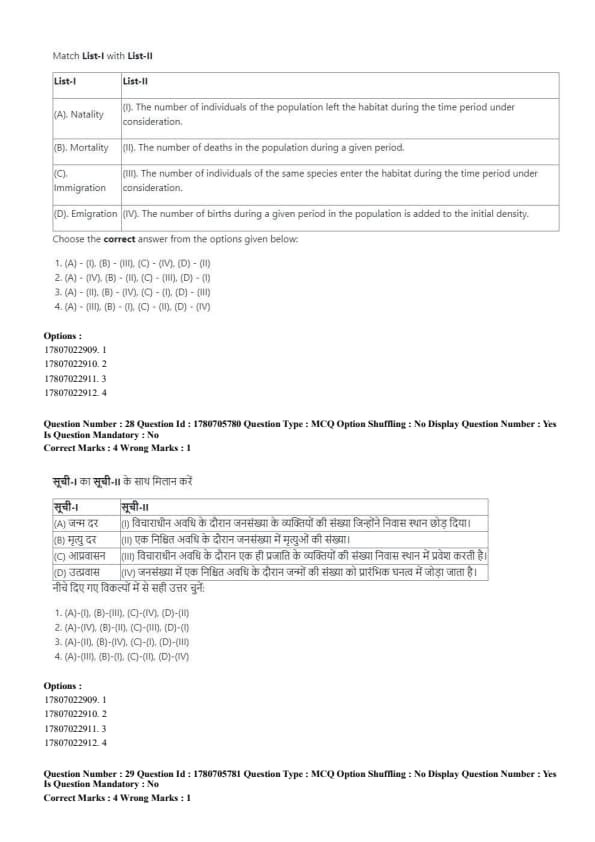
Match List–I with List–II.
List–I \hfill List–II
(A) Natality \hfill (I) The number of individuals of the population that leave the habitat during the time period under consideration.
(B) Mortality \hfill (II) The number of deaths in the population during a given period.
(C) Immigration \hfill (III) The number of individuals of the same species that enter the habitat during the time period under consideration.
(D) Emigration \hfill (IV) The number of births during a given period in the population is added to the initial density.
Choose the correct answer from the options given below:
View Solution
Step 1: Natality refers to the number of births occurring in a population during a given period.
So, (A) \(\rightarrow\) (IV).
Step 2: Mortality refers to the number of deaths in a population during a given period.
So, (B) \(\rightarrow\) (II).
Step 3: Immigration is the movement of individuals of the same species into a habitat.
So, (C) \(\rightarrow\) (III).
Step 4: Emigration is the movement of individuals out of a habitat.
So, (D) \(\rightarrow\) (I).
Step 5: Hence, the correct matching is
(A)–(IV), (B)–(II), (C)–(III), (D)–(I). Quick Tip: Population size changes due to: Natality (births) and Immigration (entry) increase population, Mortality (deaths) and Emigration (exit) decrease population.
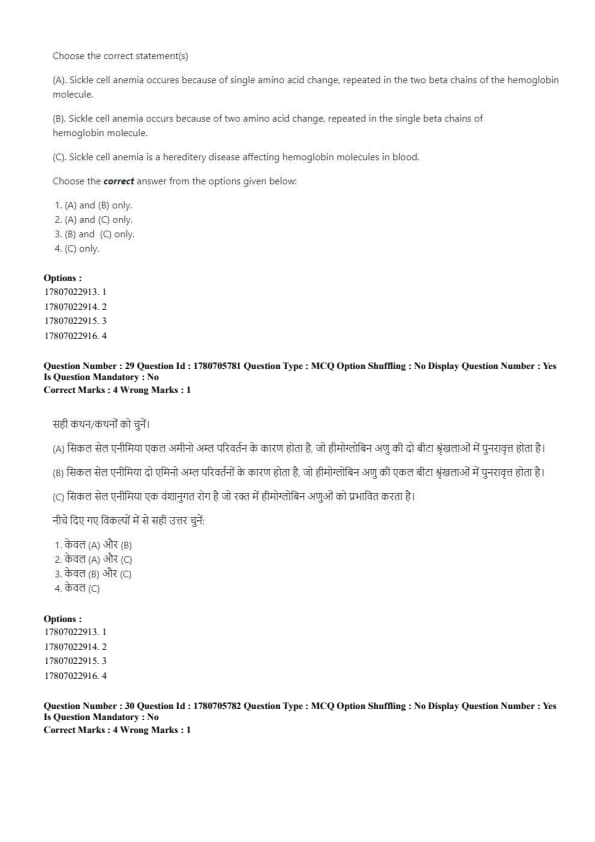
Choose the correct statement(s).
(A) Sickle cell anemia occurs because of a single amino acid change, repeated in the two beta chains of the hemoglobin molecule.
(B) Sickle cell anemia occurs because of two amino acid changes, repeated in the single beta chain of hemoglobin molecule.
(C) Sickle cell anemia is a hereditary disease affecting hemoglobin molecules in blood.
Choose the correct answer from the options given below:
View Solution
Step 1: Sickle cell anemia is caused by a single amino acid substitution (glutamic acid replaced by valine) in the beta globin chain.
Step 2: Hemoglobin has two beta chains, so this single amino acid change is present in both beta chains.
Hence, statement (A) is correct.
Step 3: There is only one amino acid change, not two, and it does not occur in a single beta chain alone.
Hence, statement (B) is incorrect.
Step 4: Sickle cell anemia is an inherited genetic disorder affecting hemoglobin in red blood cells.
Hence, statement (C) is correct.
Step 5: Therefore, the correct statements are (A) and (C) only. Quick Tip: Sickle cell anemia is caused by a point mutation in the beta globin gene, leading to abnormal hemoglobin (HbS) and sickle-shaped red blood cells.
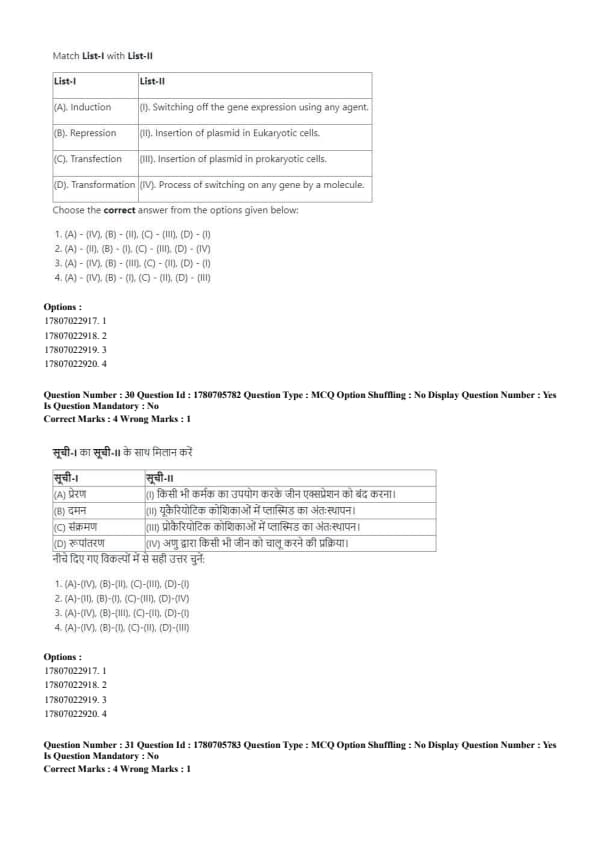
Match List–I with List–II.
List–I \hfill List–II
(A) Induction \hfill (I) Switching off the gene expression using any agent
(B) Repression \hfill (II) Insertion of plasmid in eukaryotic cells
(C) Transfection \hfill (III) Insertion of plasmid in prokaryotic cells
(D) Transformation \hfill (IV) Process of switching on any gene by a molecule
Choose the correct answer from the options given below:
View Solution
Step 1: Induction refers to the process of switching on a gene by an inducing molecule.
So, (A) \(\rightarrow\) (IV).
Step 2: Repression involves switching off gene expression using a repressor or other agents.
So, (B) \(\rightarrow\) (I).
Step 3: Transfection is the introduction of foreign DNA (plasmid) into eukaryotic cells.
So, (C) \(\rightarrow\) (II).
Step 4: Transformation is the uptake of plasmid DNA by prokaryotic cells such as bacteria.
So, (D) \(\rightarrow\) (III).
Step 5: Hence, the correct matching is
(A)–(IV), (B)–(I), (C)–(II), (D)–(III). Quick Tip: Remember: Induction \(\rightarrow\) gene ON, Repression \(\rightarrow\) gene OFF, Transformation \(\rightarrow\) prokaryotes, Transfection \(\rightarrow\) eukaryotes.
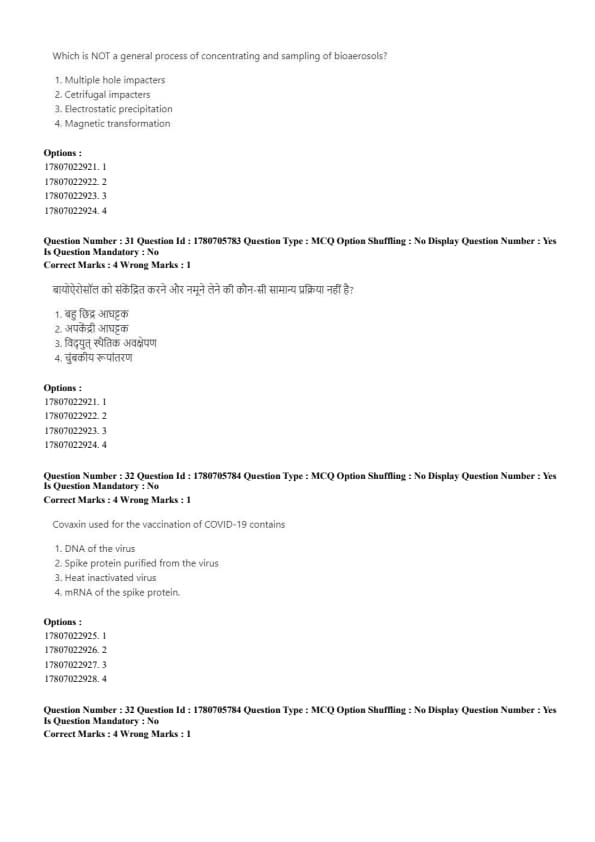
Which of the following is \textbf{NOT} a general process of concentrating and sampling of bioaerosols?
View Solution
Step 1: Bioaerosol sampling involves techniques that collect airborne biological particles based on size, inertia, or electrical charge.
Step 2: Multiple hole impacters collect particles by inertial impaction and are commonly used in bioaerosol sampling.
Step 3: Centrifugal impacters use centrifugal force to concentrate and collect airborne particles.
Step 4: Electrostatic precipitation collects bioaerosols by charging particles and attracting them to oppositely charged surfaces.
Step 5: Magnetic transformation is not used as a standard method for concentrating or sampling bioaerosols. Quick Tip: Bioaerosol sampling methods rely on inertial, centrifugal, or electrostatic principles. Magnetic techniques are not used for this purpose.
Covaxin used for the vaccination of COVID-19 contains:
View Solution
Step 1: Covaxin is developed using the whole SARS-CoV-2 virus.
Step 2: The virus is rendered non-infectious by chemical/heat inactivation so that it cannot cause disease.
Step 3: Although inactivated, the virus retains its antigenic properties and can stimulate an immune response.
Step 4: Hence, Covaxin contains a heat-inactivated (killed) form of the SARS-CoV-2 virus. Quick Tip: Vaccines can be based on: live attenuated virus, inactivated virus, subunit proteins, or nucleic acids (DNA/mRNA). Covaxin is an \textbf{inactivated whole-virus vaccine}.
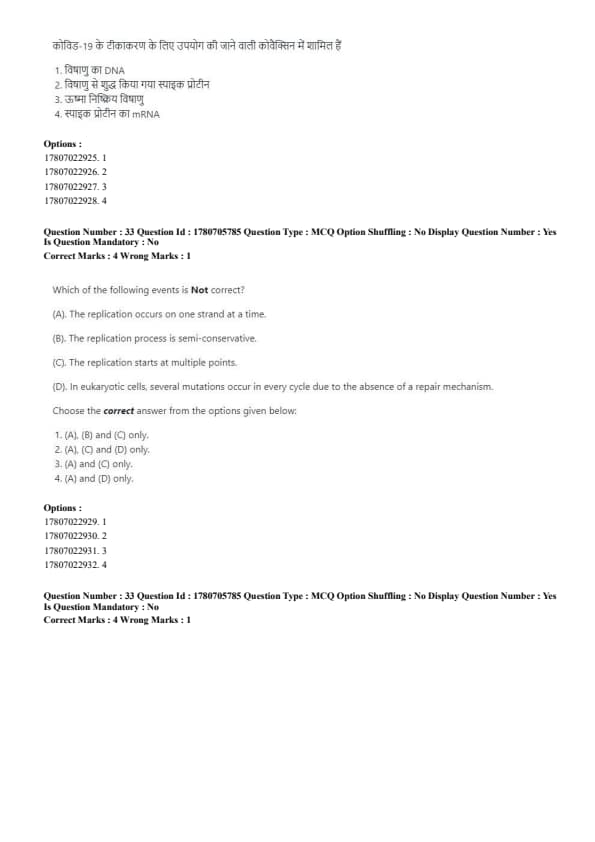
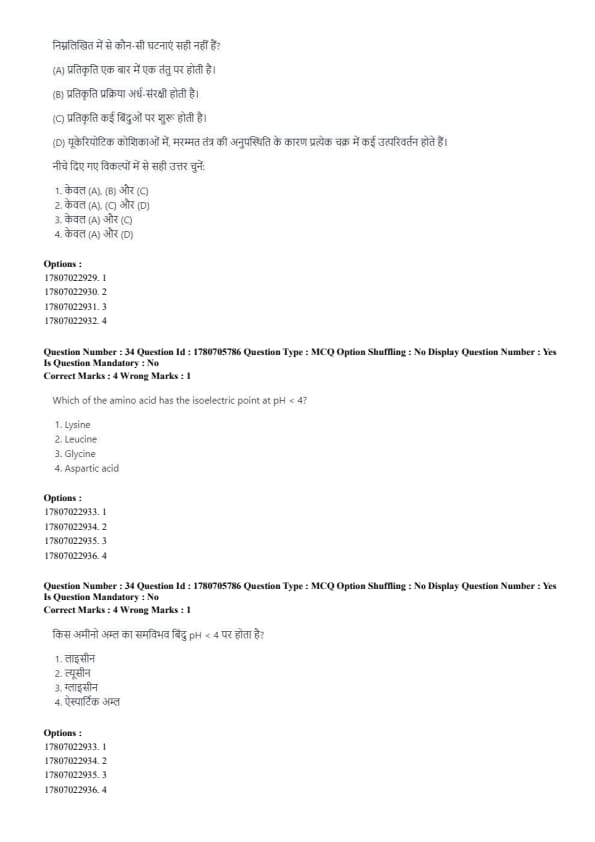
Which of the following events is \textbf{NOT} correct?
(A) The replication occurs on one strand at a time.
(B) The replication process is semi-conservative.
(C) The replication starts at multiple points.
(D) In eukaryotic cells, several mutations occur in every cycle due to the absence of a repair mechanism.
Choose the correct answer from the options given below:
View Solution
Step 1: DNA replication occurs simultaneously on both strands (leading and lagging strands), not on one strand at a time.
Hence, statement (A) is incorrect.
Step 2: DNA replication is semi-conservative, meaning each daughter DNA molecule contains one parental and one newly synthesized strand.
Hence, statement (B) is correct.
Step 3: In eukaryotic cells, DNA replication begins at multiple origins along the chromosome.
Hence, statement (C) is correct.
Step 4: Eukaryotic cells possess efficient DNA repair mechanisms; mutations do not occur in every cycle due to absence of repair.
Hence, statement (D) is incorrect.
Step 5: Therefore, the incorrect statements are (A) and (D) only. Quick Tip: DNA replication facts: - It is semi-conservative - Occurs on both strands simultaneously - Starts at multiple origins in eukaryotes - DNA repair mechanisms maintain fidelity
Which of the following amino acid has the isoelectric point at \(pH < 4\)?
View Solution
Step 1: The isoelectric point (\(pI\)) is the pH at which an amino acid has no net charge.
Step 2: Amino acids with acidic side chains (–COOH) have low isoelectric points.
Step 3: Aspartic acid contains an extra carboxyl group in its side chain, making it acidic.
Step 4: Due to this extra acidic group, the \(pI\) of aspartic acid lies below 4.
Step 5: Hence, the amino acid with isoelectric point at \(pH < 4\) is aspartic acid. Quick Tip: Isoelectric point trends: Acidic amino acids \(\rightarrow\) low \(pI\), Basic amino acids \(\rightarrow\) high \(pI\), Neutral amino acids \(\rightarrow\) intermediate \(pI\).
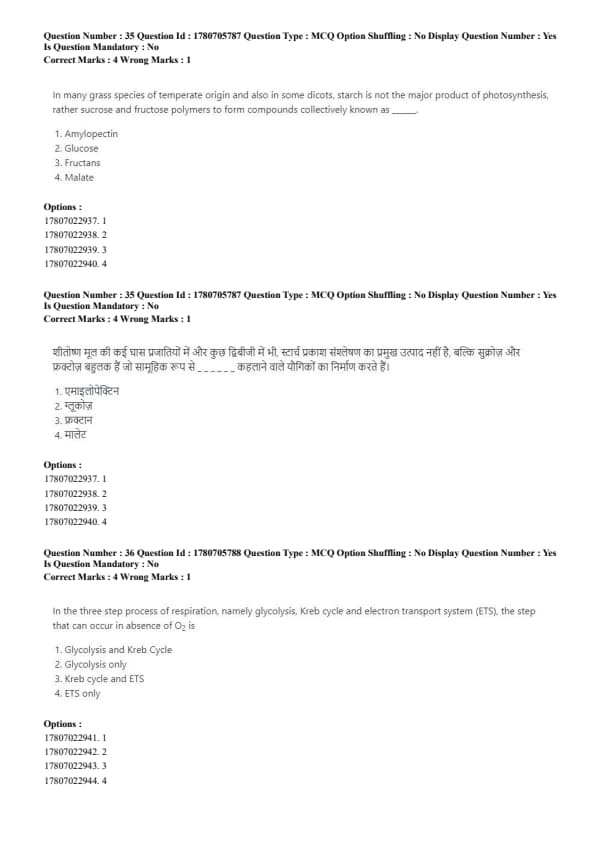
In many grass species of temperate origin and also in some dicots, starch is not the major product of photosynthesis; rather sucrose and fructose polymers form compounds collectively known as:
View Solution
Step 1: In most plants, starch is the primary storage product of photosynthesis.
Step 2: However, many temperate grasses and some dicot plants store carbohydrates differently.
Step 3: In these plants, sucrose is converted into polymers of fructose.
Step 4: These fructose polymers are collectively known as fructans.
Step 5: Hence, the correct answer is fructans. Quick Tip: Temperate grasses often store food as fructans instead of starch, which helps them tolerate cold and drought conditions.
In the three-step process of respiration, namely glycolysis, Krebs cycle and electron transport system (ETS), the step that can occur in the absence of \(O_2\) is:
View Solution
Step 1: Glycolysis occurs in the cytoplasm and does not require oxygen.
Step 2: The Krebs cycle depends indirectly on oxygen because it requires NAD\(^+\) and FAD, which are regenerated only when the ETS operates.
Step 3: The electron transport system (ETS) requires oxygen as the final electron acceptor.
Step 4: Hence, among the three steps of respiration, only glycolysis can occur in the absence of oxygen. Quick Tip: Glycolysis is an anaerobic process, whereas Krebs cycle and ETS are aerobic processes.
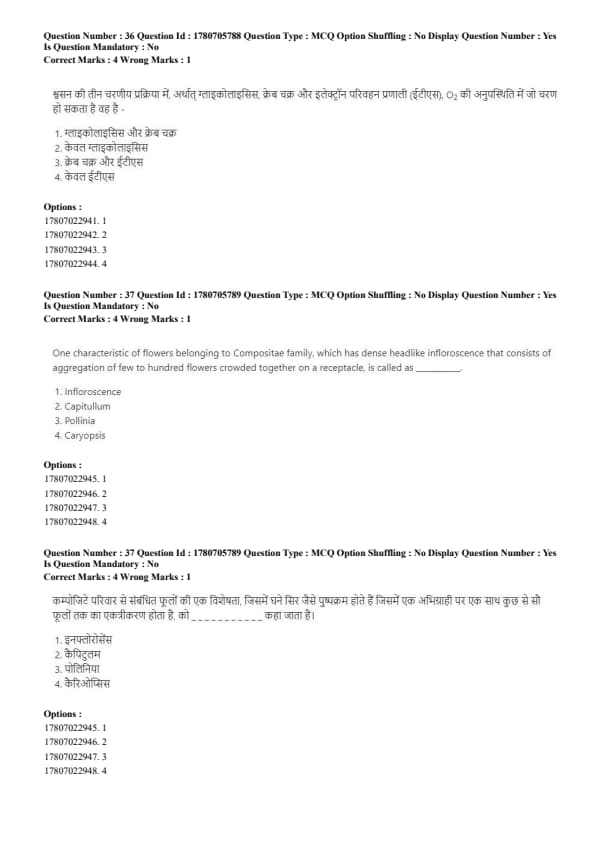
One characteristic of flowers belonging to the Compositae family, which has a dense head-like inflorescence consisting of an aggregation of a few to hundreds of flowers crowded together on a receptacle, is called as ________.
View Solution
Step 1: Plants of the Compositae (Asteraceae) family show a special type of inflorescence.
Step 2: In this inflorescence, numerous small flowers (florets) are densely packed on a common flat receptacle.
Step 3: This head-like arrangement gives the appearance of a single flower.
Step 4: Such an inflorescence is specifically called a capitulum. Quick Tip: Capitulum is characteristic of the Compositae (Asteraceae) family, e.g., sunflower, marigold.
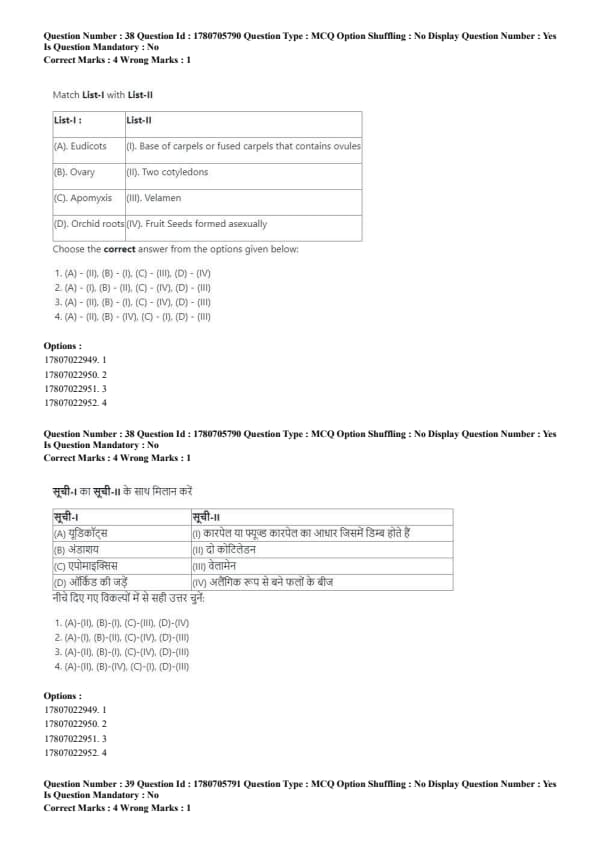
Match List–I with List–II.
List–I \hfill List–II
(A) Eudicots \hfill (I) Base of carpels or fused carpels that contains ovules
(B) Ovary \hfill (II) Two cotyledons
(C) Apomixis \hfill (III) Velamen
(D) Orchid roots \hfill (IV) Fruit/Seeds formed asexually
Choose the correct answer from the options given below:
View Solution
Step 1: Eudicots are characterized by the presence of two cotyledons.
So, (A) \(\rightarrow\) (II).
Step 2: Ovary is the basal part of the carpel or fused carpels that contains ovules.
So, (B) \(\rightarrow\) (I).
Step 3: Apomixis is the formation of seeds and fruits without fertilization.
So, (C) \(\rightarrow\) (IV).
Step 4: Orchid roots possess a special spongy tissue called velamen.
So, (D) \(\rightarrow\) (III).
Step 5: Hence, the correct matching is
(A)–(II), (B)–(I), (C)–(IV), (D)–(III). Quick Tip: Key associations: Eudicots \(\rightarrow\) two cotyledons, Apomixis \(\rightarrow\) asexual seed formation, Orchid roots \(\rightarrow\) velamen tissue.
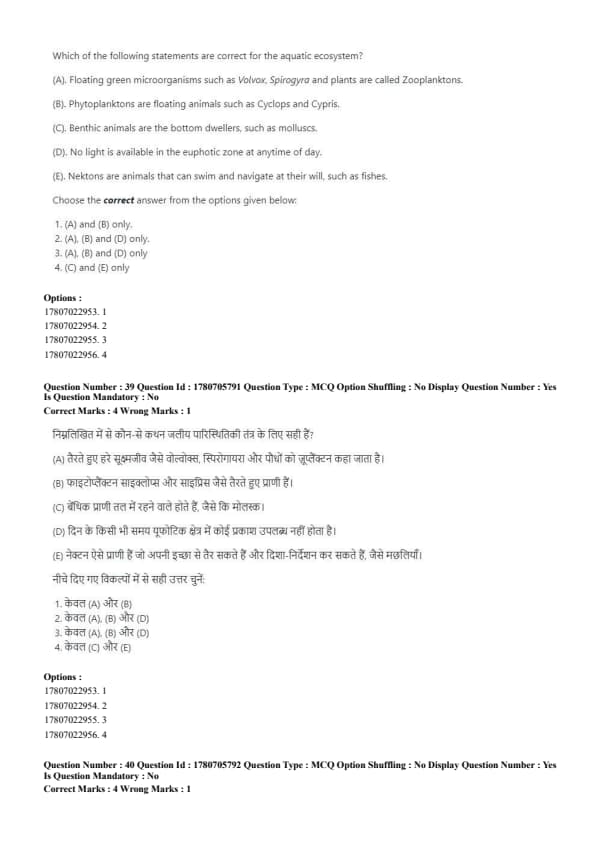
Which of the following statements are correct for the aquatic ecosystem?
(A) Floating green microorganisms such as \textit{Volvox, \textit{Spirogyra and plants are called zooplanktons.
(B) Phytoplanktons are floating animals such as \textit{Cyclops and \textit{Cypris.
(C) Benthic animals are the bottom dwellers, such as molluscs.
(D) No light is available in the euphotic zone at any time of day.
(E) Nektons are animals that can swim and navigate at their will, such as fishes.
Choose the correct answer from the options given below:
View Solution
Step 1: Floating green microorganisms like \textit{Volvox and \textit{Spirogyra are phytoplanktons, not zooplanktons.
Hence, statement (A) is incorrect.
Step 2: \textit{Cyclops and \textit{Cypris are animals and belong to zooplanktons, not phytoplanktons.
Hence, statement (B) is incorrect.
Step 3: Benthic animals live at the bottom of water bodies; molluscs are common examples.
Hence, statement (C) is correct.
Step 4: The euphotic zone is the upper layer of water that receives sufficient sunlight for photosynthesis.
Hence, statement (D) is incorrect.
Step 5: Nektons are actively swimming aquatic animals such as fishes.
Hence, statement (E) is correct.
Step 6: Therefore, the correct statements are (C) and (E) only. Quick Tip: Aquatic groups: Phytoplankton \(\rightarrow\) photosynthetic drifters, Zooplankton \(\rightarrow\) drifting animals, Benthos \(\rightarrow\) bottom dwellers, Nekton \(\rightarrow\) active swimmers.
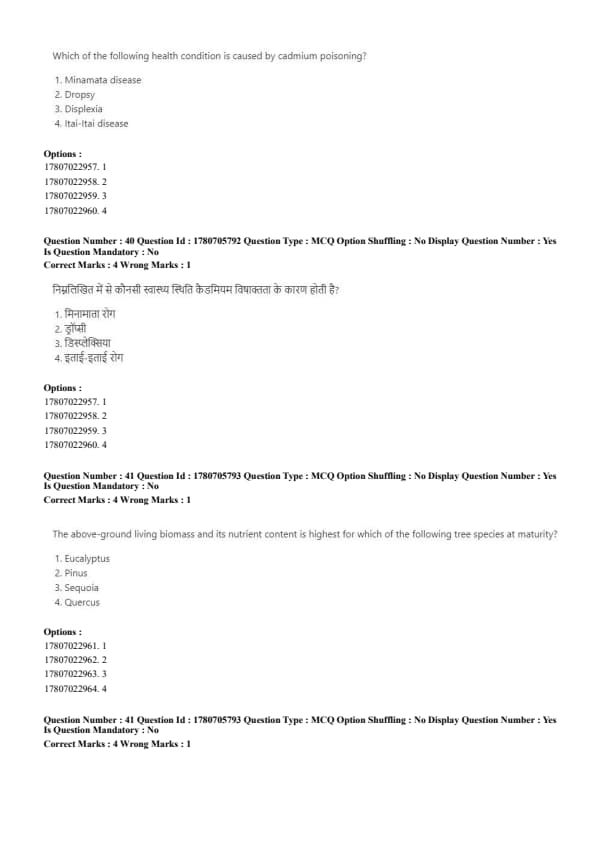
Which of the following health condition is caused by cadmium poisoning?
View Solution
Step 1: Cadmium is a toxic heavy metal that can accumulate in the human body, particularly affecting bones and kidneys.
Step 2: Chronic exposure to cadmium leads to severe bone pain, bone softening, and kidney damage.
Step 3: The disease caused by cadmium poisoning was first reported in Japan and is known as Itai-Itai disease.
Step 4: Hence, cadmium poisoning causes Itai-Itai disease. Quick Tip: Heavy metal poisoning examples: Mercury \(\rightarrow\) Minamata disease, Cadmium \(\rightarrow\) Itai-Itai disease.
The above-ground living biomass and its nutrient content is highest for which of the following tree species at maturity?
View Solution
Step 1: Above-ground living biomass refers to the total mass of living plant material present above the soil surface.
Step 2: Sequoia (giant sequoia/redwood) trees attain enormous height, girth, and longevity compared to other tree species.
Step 3: Due to their massive size and long life span, Sequoia trees accumulate the highest above-ground biomass and nutrient content at maturity.
Step 4: Hence, among the given options, Sequoia has the highest above-ground living biomass. Quick Tip: Giant Sequoia trees are among the largest living organisms on Earth, known for their exceptional biomass and carbon storage capacity.
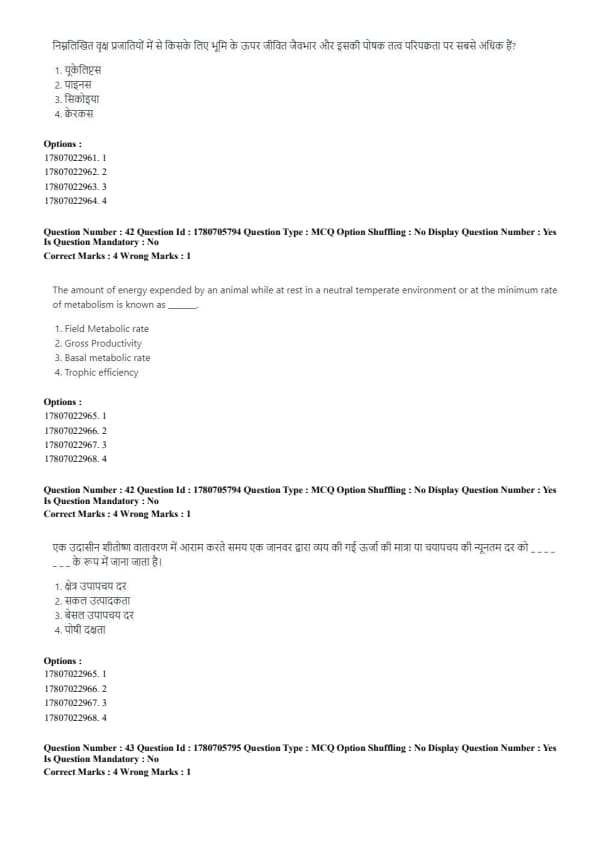
The amount of energy expended by an animal while at rest in a neutral temperate environment or at the minimum rate of metabolism is known as:
View Solution
Step 1: Basal metabolic rate (BMR) refers to the minimum amount of energy required to maintain vital physiological functions.
Step 2: It is measured when the organism is at rest, in a post-absorptive state, and under neutral temperature conditions.
Step 3: BMR represents the lowest rate of metabolism necessary for survival.
Step 4: Hence, the energy expended under these conditions is called basal metabolic rate. Quick Tip: Basal metabolic rate is measured under strict resting conditions and reflects the minimum energy needed for basic life processes.
Choose the incorrect statement.
(A) Catalytic destruction of \(O_3\) is prominent over Antarctica.
(B) Thickness of \(O_3\) layer is measured in \AA\ units.
(C) Thinning of \(O_3\) layer also occurs over Arctic.
(D) Polar stratospheric clouds play a role in ozone destruction.
View Solution
Step 1: Catalytic destruction of ozone is most prominent over Antarctica due to extreme cold and the presence of polar stratospheric clouds.
Hence, statement (A) is correct.
Step 2: The thickness of the ozone layer is measured in Dobson Units (DU), not in angstrom (\AA) units.
Hence, statement (B) is incorrect.
Step 3: Ozone thinning also occurs over the Arctic, though it is less severe than over Antarctica.
Hence, statement (C) is correct.
Step 4: Polar stratospheric clouds provide surfaces for reactions that release active chlorine, which destroys ozone.
Hence, statement (D) is correct. Quick Tip: Ozone layer thickness is always expressed in \textbf{Dobson Units (DU)}, not in length units like angstrom or nanometer.
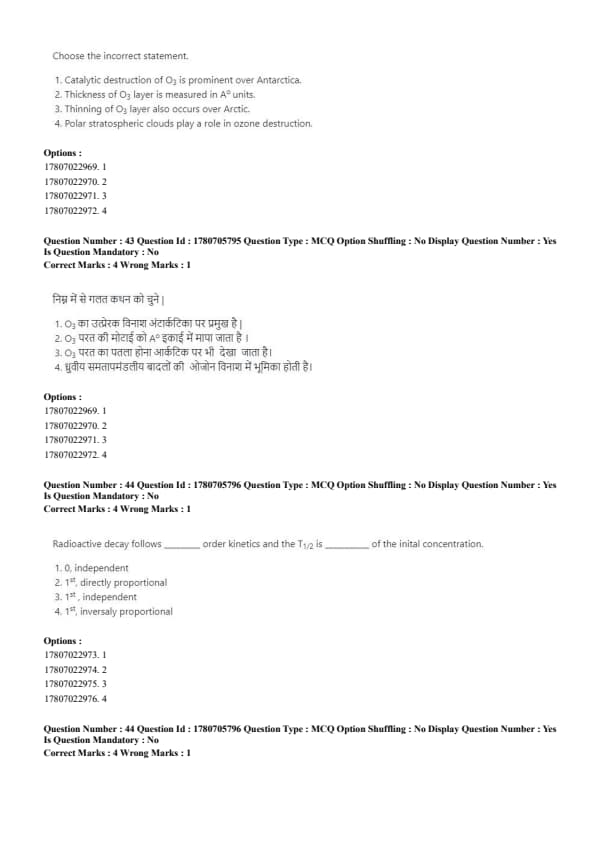
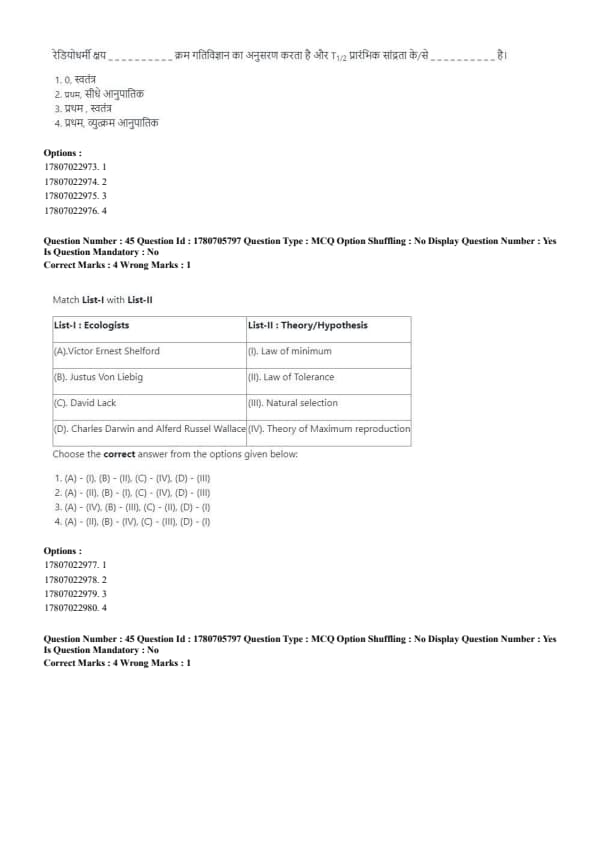
Radioactive decay follows ______ order kinetics and the \(T_{1/2}\) is ______ of the initial concentration.
View Solution
Step 1: Radioactive decay follows first-order kinetics because the rate of decay is proportional to the number of undecayed nuclei present.
Step 2: For a first-order reaction, the half-life is given by: \[ T_{1/2} = \frac{0.693}{k} \]
Step 3: The half-life expression does not contain the initial concentration term.
Step 4: Hence, radioactive decay is a first-order process and its half-life is independent of the initial concentration. Quick Tip: All radioactive decay processes follow first-order kinetics, and their half-life remains constant regardless of the amount of substance present.
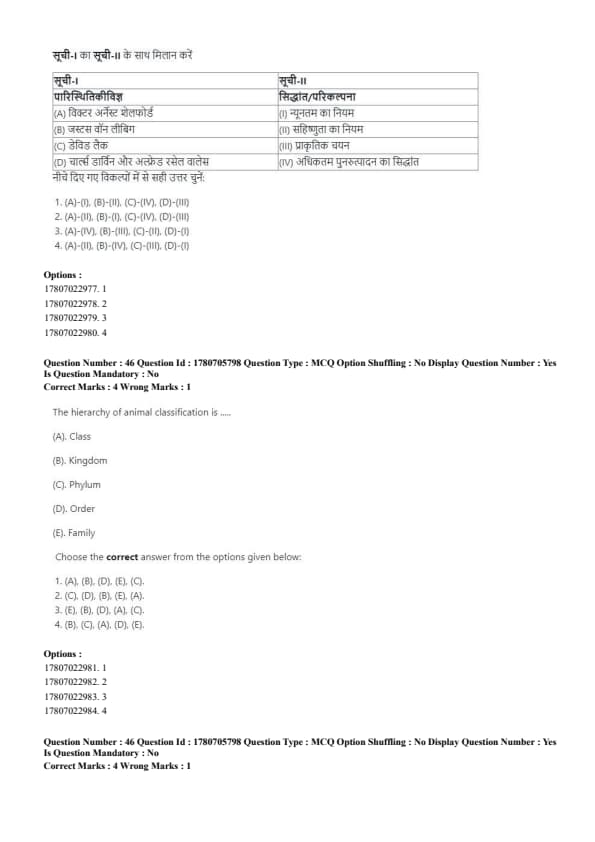
Match List–I with List–II.
List–I (Ecologists) \hfill List–II (Theory/Hypothesis)
(A) Victor Ernest Shelford \hfill (I) Law of minimum
(B) Justus von Liebig \hfill (II) Law of tolerance
(C) David Lack \hfill (III) Natural selection
(D) Charles Darwin and Alfred Russel Wallace \hfill (IV) Theory of maximum reproduction
Choose the correct answer from the options given below:
View Solution
Step 1: Victor Ernest Shelford proposed the Law of Tolerance, which explains limits of survival for organisms.
So, (A) \(\rightarrow\) (II).
Step 2: Justus von Liebig gave the Law of Minimum, stating that growth is controlled by the scarcest resource.
So, (B) \(\rightarrow\) (I).
Step 3: David Lack proposed the Theory of Maximum Reproduction, explaining population regulation in birds.
So, (C) \(\rightarrow\) (IV).
Step 4: Charles Darwin and Alfred Russel Wallace jointly proposed the theory of Natural Selection.
So, (D) \(\rightarrow\) (III).
Step 5: Hence, the correct matching is
(A)–(II), (B)–(I), (C)–(IV), (D)–(III). Quick Tip: Key ecological laws: Liebig \(\rightarrow\) Law of Minimum, Shelford \(\rightarrow\) Law of Tolerance, Darwin & Wallace \(\rightarrow\) Natural Selection.
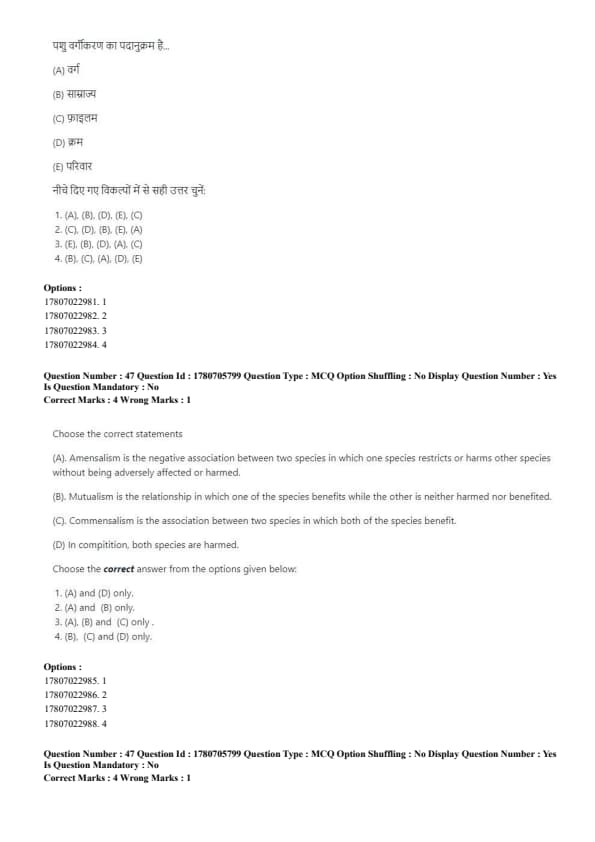
The hierarchy of animal classification is:
(A) Class
(B) Kingdom
(C) Phylum
(D) Order
(E) Family
Choose the correct answer from the options given below:
View Solution
Step 1: Biological classification follows a hierarchical system from broader to more specific categories.
Step 2: The correct sequence is: \[ Kingdom \rightarrow Phylum \rightarrow Class \rightarrow Order \rightarrow Family \]
Step 3: Substituting the given symbols: \[ (B) \rightarrow (C) \rightarrow (A) \rightarrow (D) \rightarrow (E) \]
Step 4: Hence, the correct hierarchy is (B), (C), (A), (D), (E). Quick Tip: Remember the taxonomic hierarchy as: \textbf{Kingdom → Phylum → Class → Order → Family → Genus → Species}.
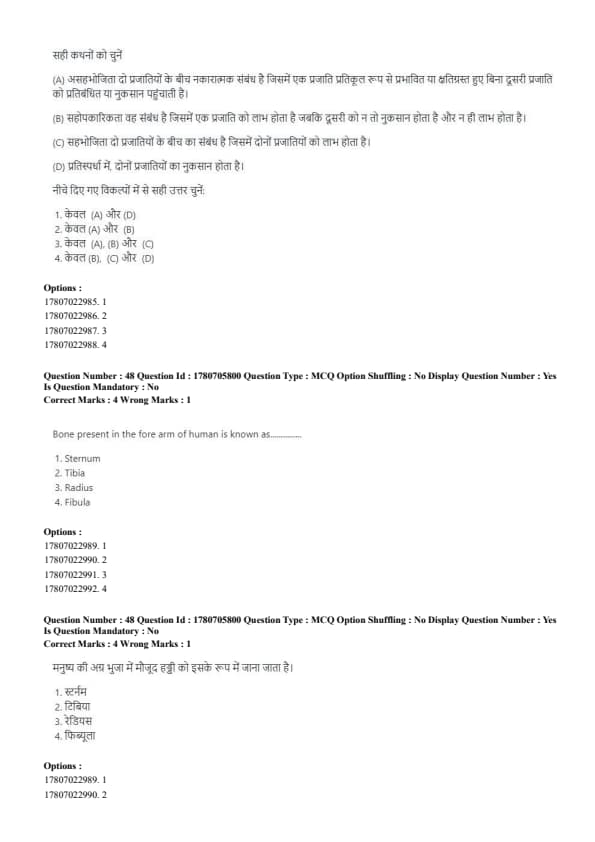
Choose the correct statements.
(A) Amensalism is the negative association between two species in which one species restricts or harms the other species without being adversely affected or harmed.
(B) Mutualism is the relationship in which one of the species benefits while the other is neither harmed nor benefited.
(C) Commensalism is the association between two species in which both of the species benefit.
(D) In competition, both species are harmed.
Choose the correct answer from the options given below:
View Solution
Step 1: In amensalism, one species is harmed while the other remains unaffected.
Hence, statement (A) is correct.
Step 2: Mutualism is an interaction in which both species benefit, not just one.
Hence, statement (B) is incorrect.
Step 3: Commensalism is an interaction where one species benefits and the other is neither harmed nor benefited.
Hence, statement (C) is incorrect.
Step 4: In competition, both interacting species suffer due to limited resources.
Hence, statement (D) is correct.
Step 5: Therefore, the correct statements are (A) and (D) only. Quick Tip: Key ecological interactions: Mutualism \((+,+)\), Commensalism \((+,0)\), Amensalism \((-,0)\), Competition \((-,-)\).
Bone present in the forearm of human is known as:
View Solution
Step 1: The human forearm consists of two long bones: radius and ulna.
Step 2: The radius is located on the lateral (thumb) side of the forearm.
Step 3: Sternum is a flat bone in the chest, tibia and fibula are bones of the lower leg.
Step 4: Hence, the bone present in the forearm is the radius. Quick Tip: Forearm bones: Radius (thumb side) and Ulna (little finger side).
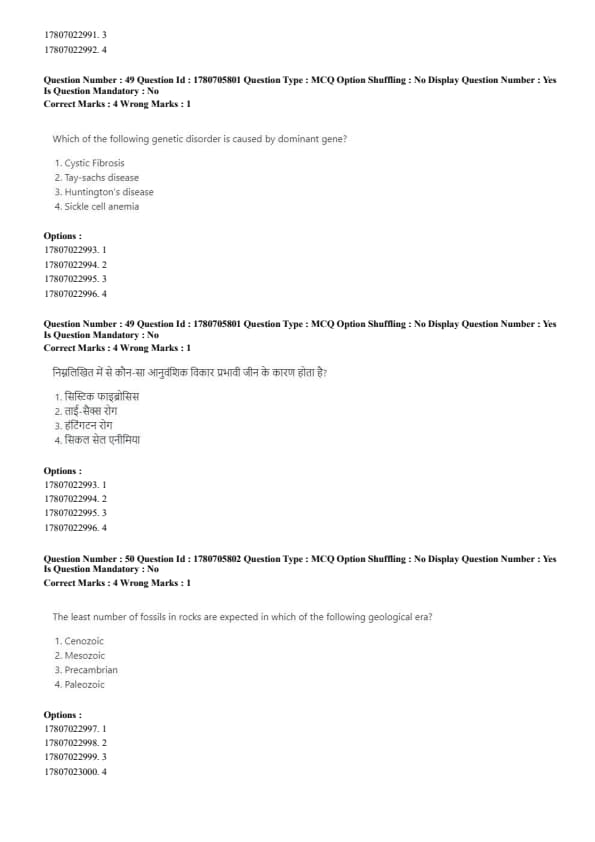
Which of the following genetic disorder is caused by a dominant gene?
View Solution
Step 1: Genetic disorders can be inherited as autosomal dominant or autosomal recessive traits.
Step 2: Huntington's disease is caused by an autosomal dominant mutation, meaning a single copy of the mutant gene is sufficient to cause the disorder.
Step 3: Cystic fibrosis, Tay–Sachs disease, and sickle cell anemia are autosomal recessive disorders.
Step 4: Hence, the genetic disorder caused by a dominant gene is Huntington's disease. Quick Tip: Autosomal dominant disorder example: Huntington's disease. Autosomal recessive disorders: Cystic fibrosis, Tay–Sachs disease, Sickle cell anemia.
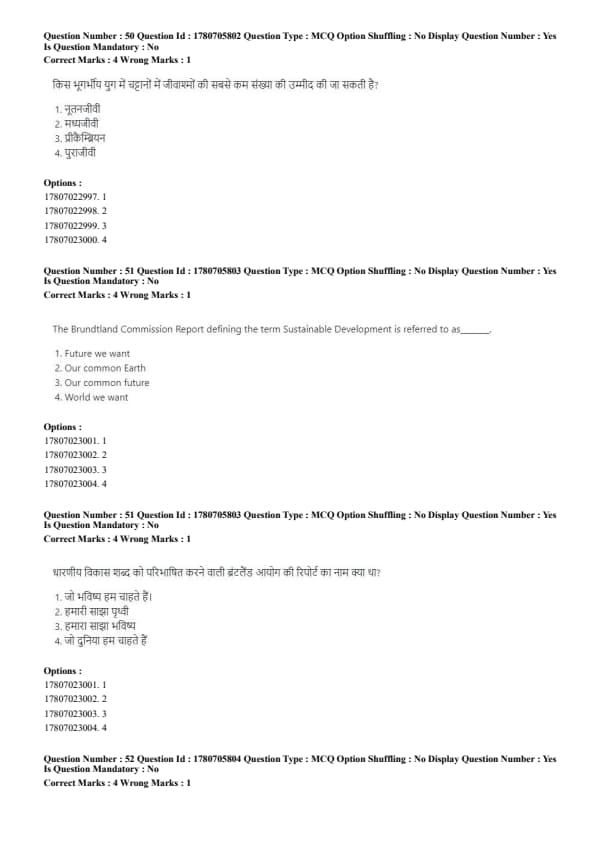
The least number of fossils in rocks are expected in which of the following geological era?
View Solution
Step 1: Fossils are remains or impressions of organisms preserved in rocks.
Step 2: During the Precambrian era, life forms were mostly simple, soft-bodied, and microscopic.
Step 3: Soft-bodied organisms have very low chances of fossilization.
Step 4: Hence, rocks of the Precambrian era contain the least number of fossils. Quick Tip: Precambrian era represents the earliest history of Earth, with primitive life forms and very scarce fossil records.
The Brundtland Commission Report defining the term Sustainable Development is referred to as:
View Solution
Step 1: The Brundtland Commission was formally known as the World Commission on Environment and Development (WCED).
Step 2: In 1987, the commission published a report defining the concept of sustainable development.
Step 3: The report was titled Our Common Future.
Step 4: Hence, the Brundtland Commission Report is referred to as \textit{Our Common Future. Quick Tip: Sustainable development was formally defined in the 1987 Brundtland Report titled \textit{Our Common Future.
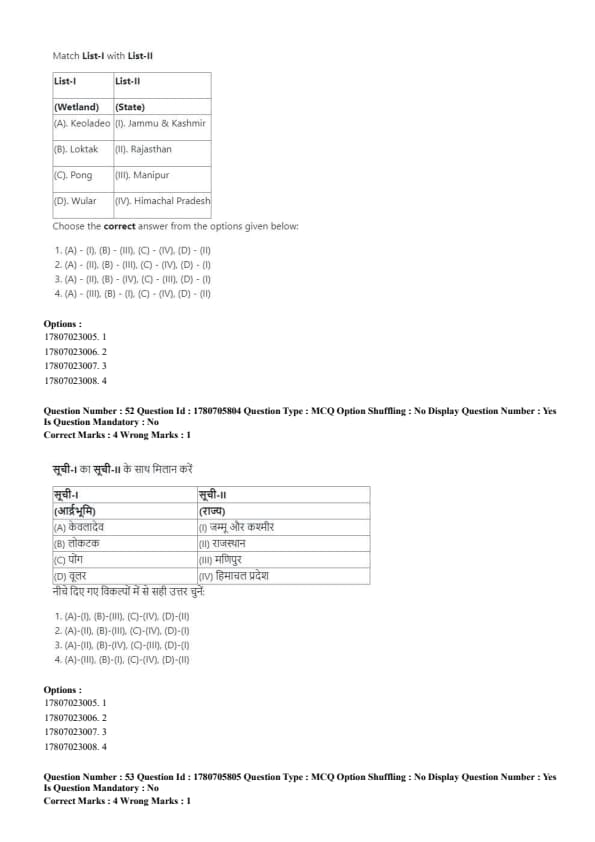
Match List–I with List–II.
List–I (Wetland) \hfill List–II (State)
(A) Keoladeo \hfill (I) Jammu \& Kashmir
(B) Loktak \hfill (II) Rajasthan
(C) Pong \hfill (III) Manipur
(D) Wular \hfill (IV) Himachal Pradesh
Choose the correct answer from the options given below:
View Solution
Step 1: Keoladeo National Park is located in Rajasthan.
So, (A) \(\rightarrow\) (II).
Step 2: Loktak Lake is situated in Manipur.
So, (B) \(\rightarrow\) (III).
Step 3: Pong Dam Lake is located in Himachal Pradesh.
So, (C) \(\rightarrow\) (IV).
Step 4: Wular Lake is located in Jammu \& Kashmir.
So, (D) \(\rightarrow\) (I).
Step 5: Hence, the correct matching is
(A)–(II), (B)–(III), (C)–(IV), (D)–(I). Quick Tip: Important Indian wetlands: Keoladeo \(\rightarrow\) Rajasthan, Loktak \(\rightarrow\) Manipur, Pong \(\rightarrow\) Himachal Pradesh, Wular \(\rightarrow\) Jammu \& Kashmir.
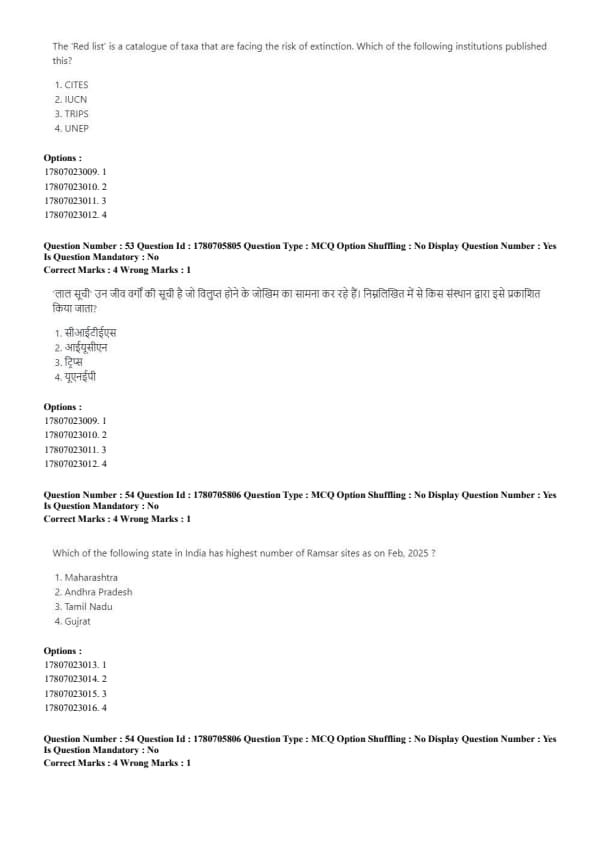
The `Red List’ is a catalogue of taxa that are facing the risk of extinction. Which of the following institutions published this?
View Solution
Step 1: The Red List of Threatened Species is an authoritative inventory of the conservation status of biological species.
Step 2: It is published and maintained by the International Union for Conservation of Nature (IUCN).
Step 3: The Red List assesses the extinction risk of species worldwide using standardized criteria.
Step 4: Hence, the institution that publishes the Red List is IUCN. Quick Tip: The IUCN Red List categorizes species as Extinct, Endangered, Vulnerable, Near Threatened, etc., based on their risk of extinction.
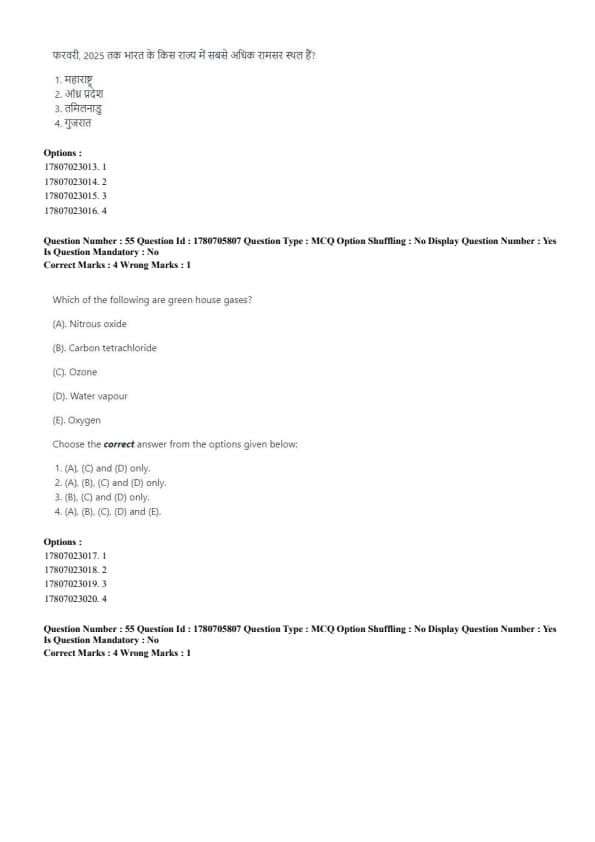
Which of the following states in India has the highest number of Ramsar sites as of February 2025?
View Solution
Step 1: Ramsar sites are wetlands of international importance designated under the Ramsar Convention.
Step 2: According to updated state-wise data, Tamil Nadu has the highest number of Ramsar sites in India, with more than any other state. :contentReference[oaicite:0]{index=0
Step 3: The other states listed (Maharashtra, Andhra Pradesh, Gujarat) have fewer Ramsar sites in comparison. :contentReference[oaicite:1]{index=1
Step 4: Therefore, the state with the highest number of Ramsar sites as of February 2025 is Tamil Nadu. Quick Tip: Ramsar sites are distributed unevenly across Indian states, with Tamil Nadu leading in count due to numerous important wetlands designated under the Ramsar Convention. :contentReference[oaicite:2]{index=2}
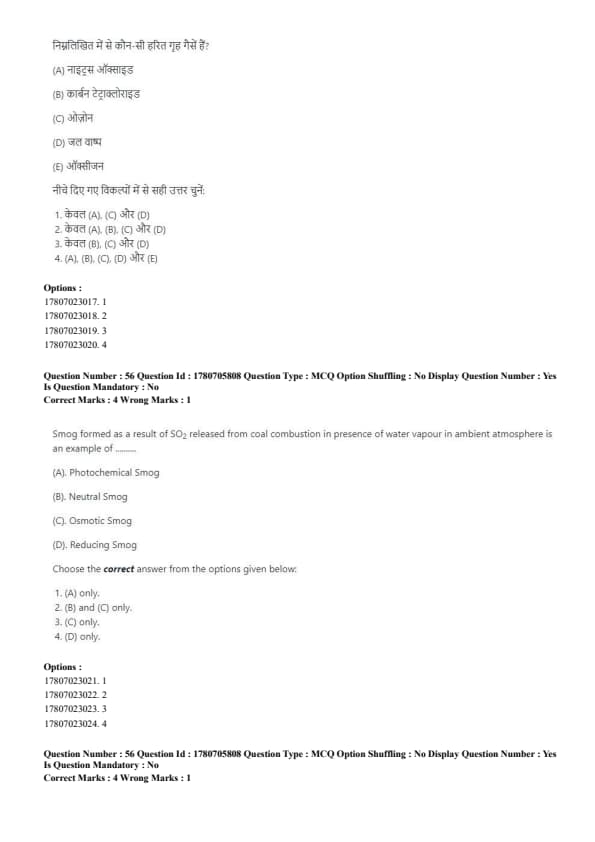
Which of the following are greenhouse gases?
(A) Nitrous oxide
(B) Carbon tetrachloride
(C) Ozone
(D) Water vapour
(E) Oxygen
Choose the correct answer from the options given below:
View Solution
Step 1: Nitrous oxide (\(N_2O\)) is a potent greenhouse gas.
Hence, (A) is correct.
Step 2: Carbon tetrachloride (\(CCl_4\)) is a halogenated compound that absorbs infrared radiation and acts as a greenhouse gas.
Hence, (B) is correct.
Step 3: Ozone (\(O_3\)) present in the troposphere acts as a greenhouse gas.
Hence, (C) is correct.
Step 4: Water vapour is the most abundant natural greenhouse gas in the atmosphere.
Hence, (D) is correct.
Step 5: Oxygen (\(O_2\)) does not absorb infrared radiation and is not a greenhouse gas.
Hence, (E) is incorrect.
Step 6: Therefore, the correct greenhouse gases are (A), (B), (C) and (D). Quick Tip: Greenhouse gases absorb infrared radiation and trap heat. Major examples include \(CO_2\), \(CH_4\), \(N_2O\), water vapour, and ozone.
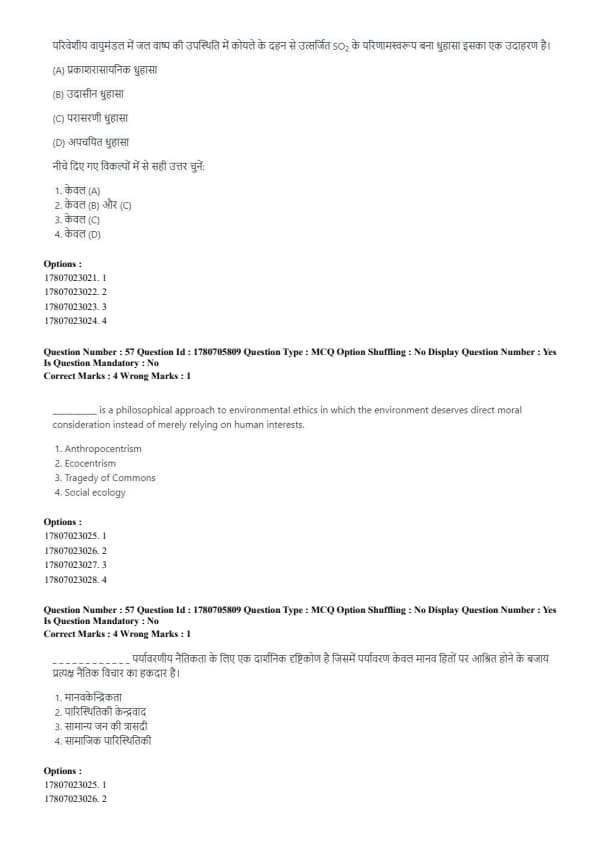
Smog formed as a result of \(SO_2\) released from coal combustion in the presence of water vapour in the ambient atmosphere is an example of:
(A) Photochemical smog
(B) Neutral smog
(C) Osmotic smog
(D) Reducing smog
Choose the correct answer from the options given below:
View Solution
Step 1: Smog produced from coal combustion releases sulphur dioxide (\(SO_2\)) into the atmosphere.
Step 2: In the presence of water vapour, \(SO_2\) forms sulphuric acid aerosols and particulate matter.
Step 3: This type of smog is rich in reducing agents and is commonly called reducing smog or London smog.
Step 4: Photochemical smog, on the other hand, is formed from nitrogen oxides and hydrocarbons under sunlight.
Step 5: Hence, the smog described is reducing smog. Quick Tip: Reducing (London) smog is associated with coal burning, high \(SO_2\) levels, fog, and cool humid conditions, whereas photochemical smog occurs in sunny, warm climates.
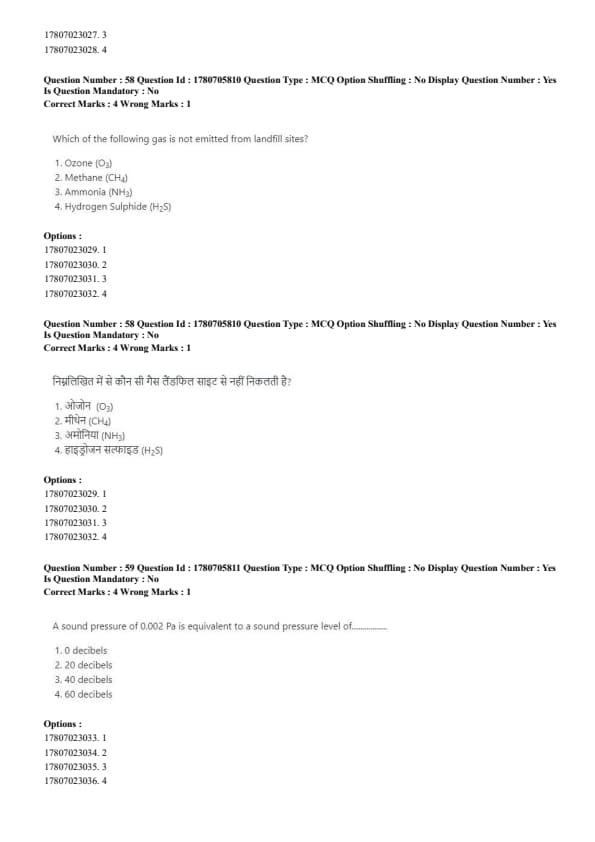
________ is a philosophical approach to environmental ethics in which the environment deserves direct moral consideration instead of merely relying on human interests.
View Solution
Step 1: Environmental ethics deals with moral relationships between humans and the natural environment.
Step 2: Ecocentrism places intrinsic value on all components of ecosystems, including living and non-living entities.
Step 3: Unlike anthropocentrism, ecocentrism does not prioritize human interests over nature.
Step 4: Hence, the philosophy that grants direct moral consideration to the environment is ecocentrism. Quick Tip: Anthropocentrism is human-centered, while ecocentrism is nature-centered and values ecosystems intrinsically.
Which of the following gas is \textbf{not} emitted from landfill sites?
View Solution
Step 1: Landfill sites contain large amounts of organic waste that undergo anaerobic decomposition.
Step 2: Anaerobic decomposition produces methane as a major gas.
Hence, methane is emitted from landfills.
Step 3: Decomposition of nitrogen- and sulphur-containing organic matter releases ammonia and hydrogen sulphide.
Hence, \(NH_3\) and \(H_2S\) are emitted.
Step 4: Ozone is not directly emitted from landfill sites; it is a secondary pollutant formed in the atmosphere by photochemical reactions.
Step 5: Therefore, ozone is not emitted from landfill sites. Quick Tip: Landfill gases mainly include methane, carbon dioxide, ammonia, and hydrogen sulphide. Ozone is formed photochemically in the atmosphere, not emitted directly.
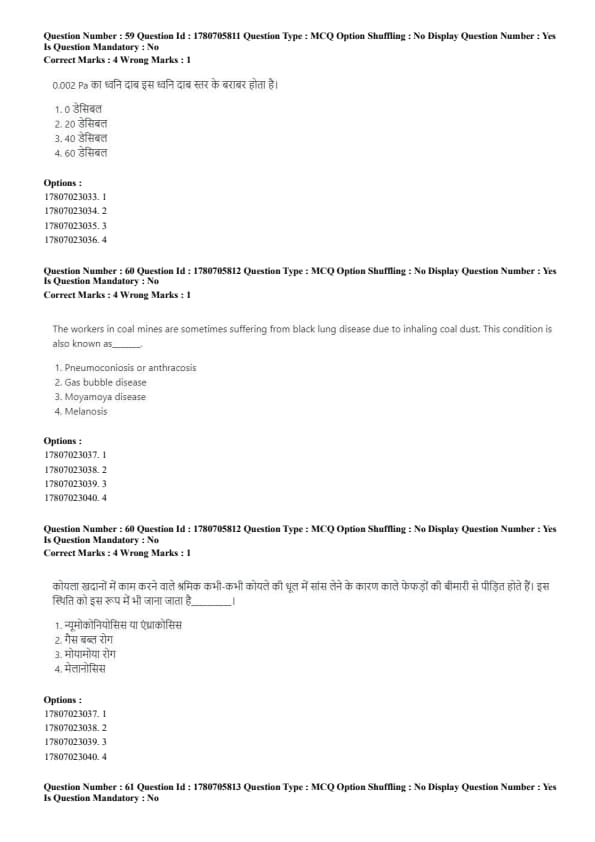
A sound pressure of \(0.002\,Pa\) is equivalent to a sound pressure level of:
View Solution
Step 1: The reference sound pressure in air is: \[ p_0 = 20\,\muPa = 2 \times 10^{-5}\,Pa \]
Step 2: Use the sound pressure level (SPL) formula: \[ SPL = 20 \log_{10}\!\left(\frac{p}{p_0}\right) \]
Step 3: Substitute the given values: \[ SPL = 20 \log_{10}\!\left(\frac{0.002}{2 \times 10^{-5}}\right) = 20 \log_{10}(100) \]
Step 4: Evaluate: \[ \log_{10}(100) = 2 \] \[ SPL = 20 \times 2 = 40\,dB \] Quick Tip: Sound pressure level in air is calculated using \[ SPL = 20 \log_{10}\!\left(\frac{p}{20\,\muPa}\right). \] An increase by a factor of 10 in pressure corresponds to a \(20\,dB\) increase.
The workers in coal mines sometimes suffer from black lung disease due to inhaling coal dust. This condition is also known as:
View Solution
Step 1: Continuous inhalation of coal dust in coal mines leads to deposition of dust particles in the lungs.
Step 2: This causes chronic lung disease characterized by inflammation and fibrosis.
Step 3: The disease is medically termed coal workers’ pneumoconiosis, also known as anthracosis.
Step 4: Hence, black lung disease is pneumoconiosis or anthracosis. Quick Tip: Occupational lung diseases: Coal dust \(\rightarrow\) Pneumoconiosis (Anthracosis), Silica dust \(\rightarrow\) Silicosis, Asbestos \(\rightarrow\) Asbestosis.
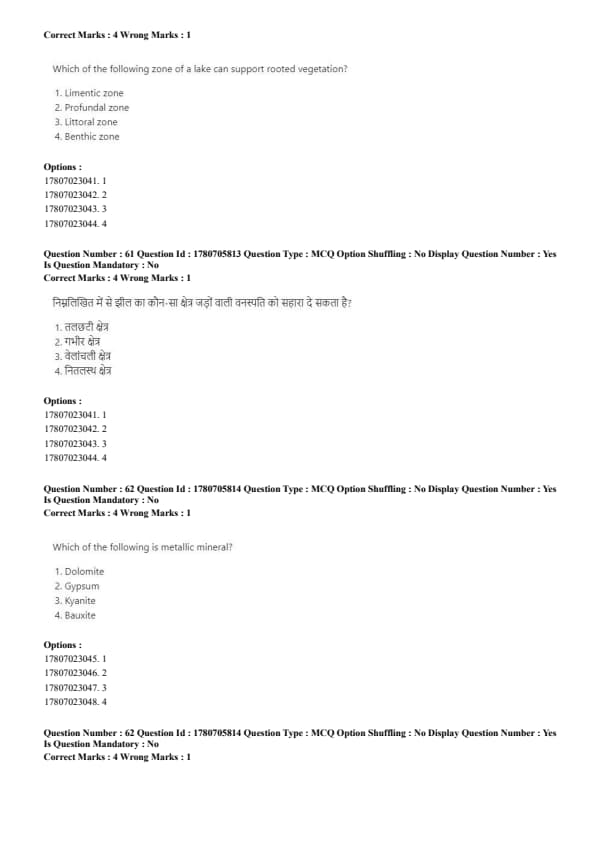
Which of the following zone of a lake can support rooted vegetation?
View Solution
Step 1: The littoral zone is the shallow region of a lake near the shore.
Step 2: This zone receives sufficient sunlight that reaches the bottom.
Step 3: Because light reaches the lake bottom, rooted aquatic plants can grow here.
Step 4: Limnetic and profundal zones are deeper and do not support rooted vegetation.
Step 5: Hence, rooted vegetation is supported in the littoral zone. Quick Tip: Lake zones: Littoral \(\rightarrow\) shallow, light reaches bottom, rooted plants present; Limnetic \(\rightarrow\) open surface water; Profundal \(\rightarrow\) deep, no light.
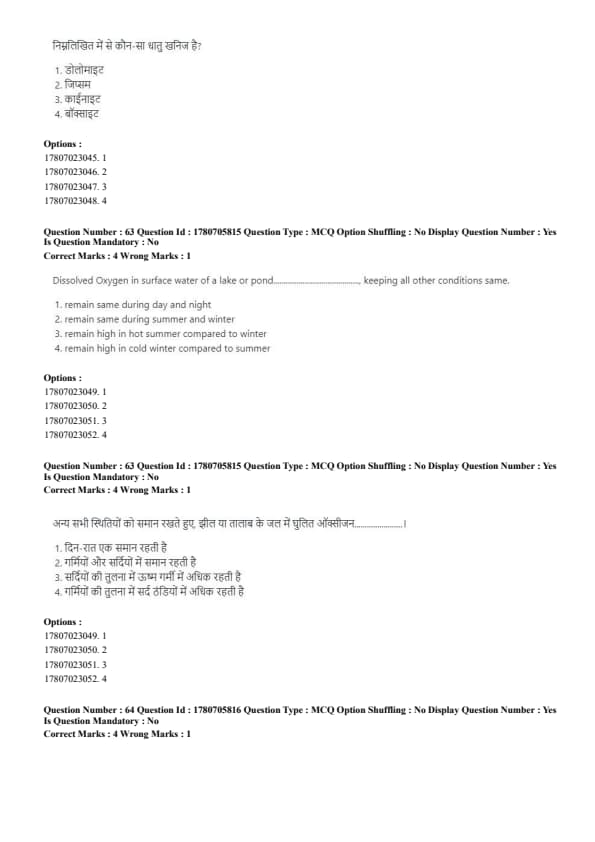
Which of the following is a metallic mineral?
View Solution
Step 1: Metallic minerals are those from which metals can be extracted economically.
Step 2: Bauxite is the principal ore of aluminium, a metallic element.
Step 3: Dolomite, gypsum, and kyanite are non-metallic minerals.
Step 4: Hence, the metallic mineral among the given options is bauxite. Quick Tip: Metallic minerals yield metals on processing (e.g., bauxite \(\rightarrow\) aluminium), whereas non-metallic minerals do not.
Dissolved oxygen in surface water of a lake or pond ________________, keeping all other conditions same.
View Solution
Step 1: Dissolved oxygen (DO) in water depends strongly on temperature.
Step 2: Solubility of oxygen in water increases as temperature decreases.
Step 3: In winter, colder water can hold more dissolved oxygen than warmer summer water.
Step 4: Therefore, dissolved oxygen remains higher in cold winter compared to summer. Quick Tip: Cold water holds more dissolved gases than warm water. Hence, dissolved oxygen levels are higher in winter than in summer.
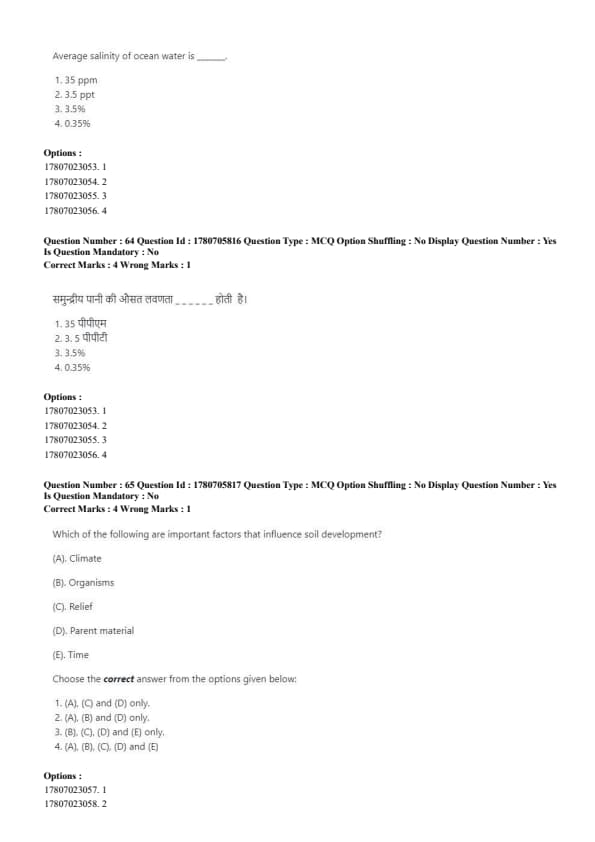
Average salinity of ocean water is _____.
View Solution
Step 1: Average salinity of ocean water is commonly expressed as \(35\,ppt\) (parts per thousand).
Step 2: Converting parts per thousand to percentage: \[ 35\,ppt = \frac{35}{1000} \times 100 = 3.5% \]
Step 3: Hence, the average salinity of ocean water is \(3.5%\). Quick Tip: Ocean water salinity is typically expressed as \(35\,ppt\), which is numerically equal to \(3.5%\).
Which of the following are important factors that influence soil development?
(A) Climate
(B) Organisms
(C) Relief
(D) Parent material
(E) Time
Choose the correct answer from the options given below:
View Solution
Step 1: Soil development is governed by five classic soil-forming factors, commonly remembered as CLORPT.
Step 2: Climate controls temperature and rainfall, influencing weathering and leaching.
Step 3: Organisms (plants, animals, microbes) contribute organic matter and affect soil structure.
Step 4: Relief (topography) influences drainage, erosion, and soil depth.
Step 5: Parent material determines the mineral composition of the soil.
Step 6: Time allows soil-forming processes to act and horizons to develop.
Step 7: Hence, all the given factors influence soil development. Quick Tip: Soil-forming factors = \textbf{CLORPT}: Climate, Organisms, Relief, Parent material, Time.
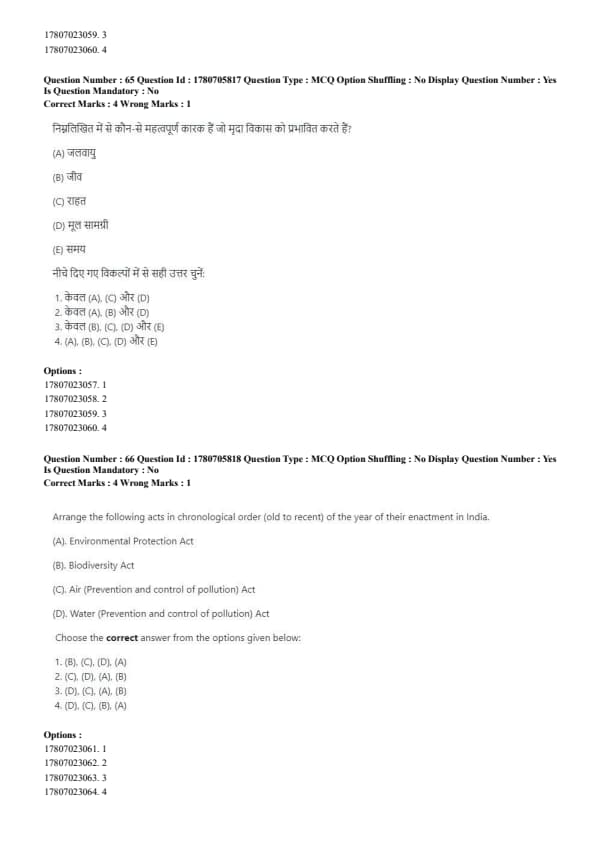
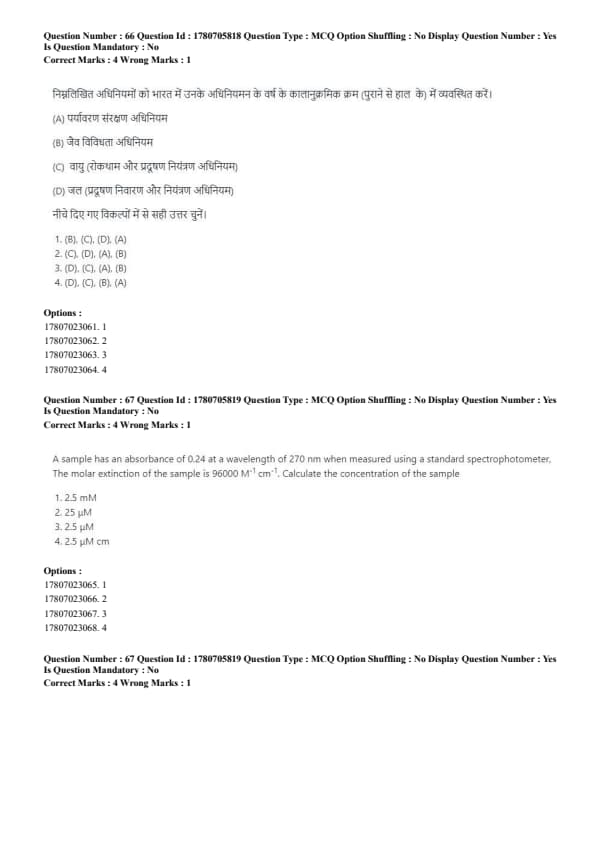
Arrange the following Acts in chronological order (oldest to most recent) of the year of their enactment in India.
(A) Environment (Protection) Act
(B) Biodiversity Act
(C) Air (Prevention and Control of Pollution) Act
(D) Water (Prevention and Control of Pollution) Act
Choose the correct answer from the options given below:
View Solution
Step 1: The Water (Prevention and Control of Pollution) Act was enacted in 1974.
So, it is the oldest among the given Acts.
Step 2: The Air (Prevention and Control of Pollution) Act was enacted in 1981.
Step 3: The Environment (Protection) Act was enacted in 1986, after the Bhopal gas tragedy.
Step 4: The Biodiversity Act was enacted in 2002, making it the most recent among the given Acts.
Step 5: Hence, the correct chronological order (old to recent) is: \[ (D) \rightarrow (C) \rightarrow (A) \rightarrow (B) \] Quick Tip: Important environmental Acts in India (chronological): Water Act (1974) \(\rightarrow\) Air Act (1981) \(\rightarrow\) Environment Protection Act (1986) \(\rightarrow\) Biodiversity Act (2002).
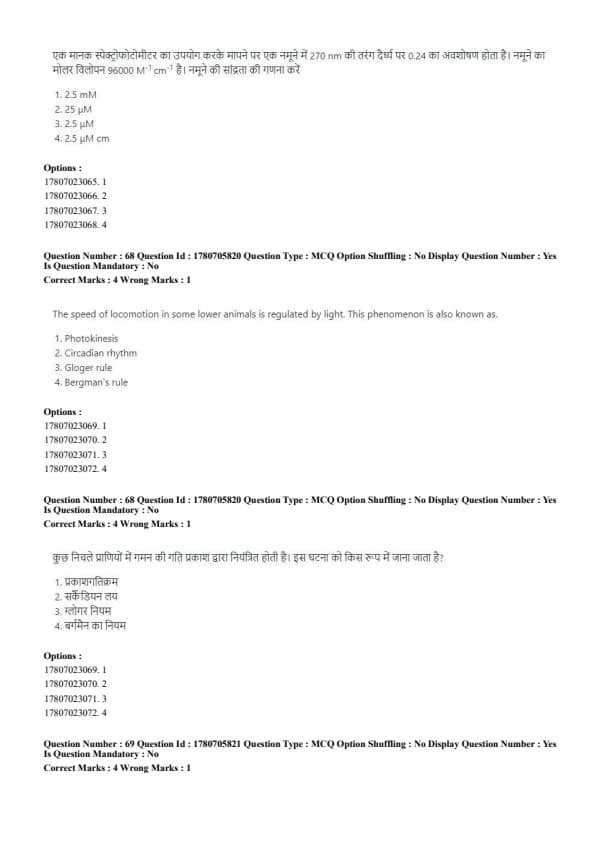
A sample has an absorbance of \(0.24\) at a wavelength of \(270\,nm\) when measured using a standard spectrophotometer. The molar extinction coefficient of the sample is \(96000\,M^{-1}\,cm^{-1}\). Calculate the concentration of the sample.
View Solution
Step 1: Use Beer–Lambert law: \[ A = \varepsilon \, l \, c \]
where \(A\) = absorbance, \(\varepsilon\) = molar extinction coefficient, \(l\) = path length (standard cuvette \(= 1\,cm\)), \(c\) = concentration.
Step 2: Substitute the given values: \[ 0.24 = 96000 \times 1 \times c \]
Step 3: Solve for concentration: \[ c = \frac{0.24}{96000} = 2.5 \times 10^{-6}\,M \]
Step 4: Convert molarity to micromolar: \[ 2.5 \times 10^{-6}\,M = 2.5\,\muM \] Quick Tip: For spectrophotometry problems, remember: \[ A = \varepsilon l c \] For a standard cuvette, \(l = 1\,cm\), which simplifies calculations.
The speed of locomotion in some lower animals is regulated by light. This phenomenon is also known as:
View Solution
Step 1: In some lower animals, light does not determine the direction of movement but affects the speed of movement.
Step 2: Such non-directional response to light, where locomotory speed changes with light intensity, is called kinesis.
Step 3: When this response is specifically due to light, it is termed photokinesis.
Step 4: Hence, regulation of speed of locomotion by light is known as photokinesis. Quick Tip: Phototaxis \(\rightarrow\) directional movement toward/away from light. Photokinesis \(\rightarrow\) change in speed due to light intensity.
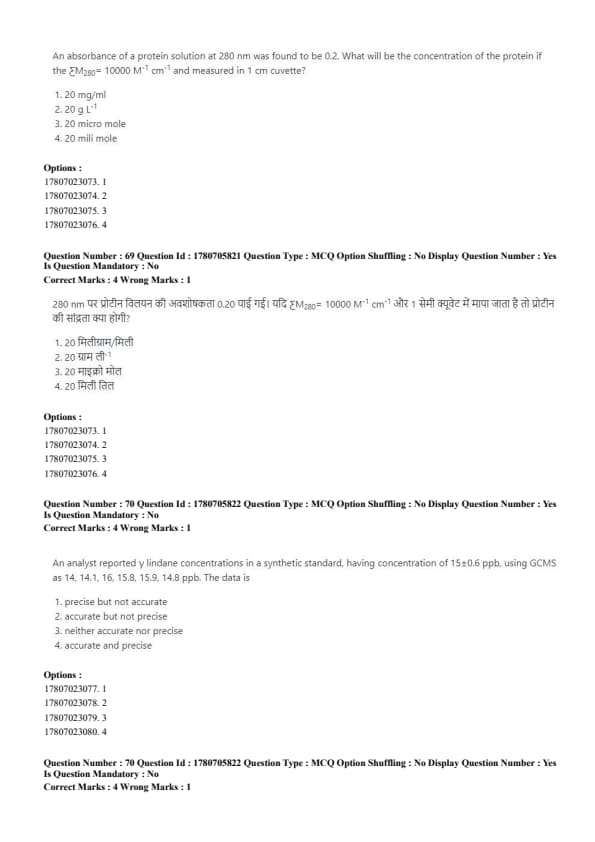
An absorbance of a protein solution at \(280\,nm\) was found to be \(0.2\). What will be the concentration of the protein if the \(\varepsilon_{280} = 10000\,M^{-1}\,cm^{-1}\) and it is measured in a \(1\,cm\) cuvette?
View Solution
Step 1: Apply Beer–Lambert law: \[ A = \varepsilon \, l \, c \]
Step 2: Substitute the given values: \[ 0.2 = 10000 \times 1 \times c \]
Step 3: Calculate concentration: \[ c = \frac{0.2}{10000} = 2 \times 10^{-5}\,M \]
Step 4: Convert molarity to micromolar: \[ 2 \times 10^{-5}\,M = 20\,\muM \] Quick Tip: At \(280\,nm\), protein absorbance mainly arises from aromatic amino acids (tryptophan and tyrosine). For a \(1\,cm\) cuvette, concentration is simply \(c = A/\varepsilon\).
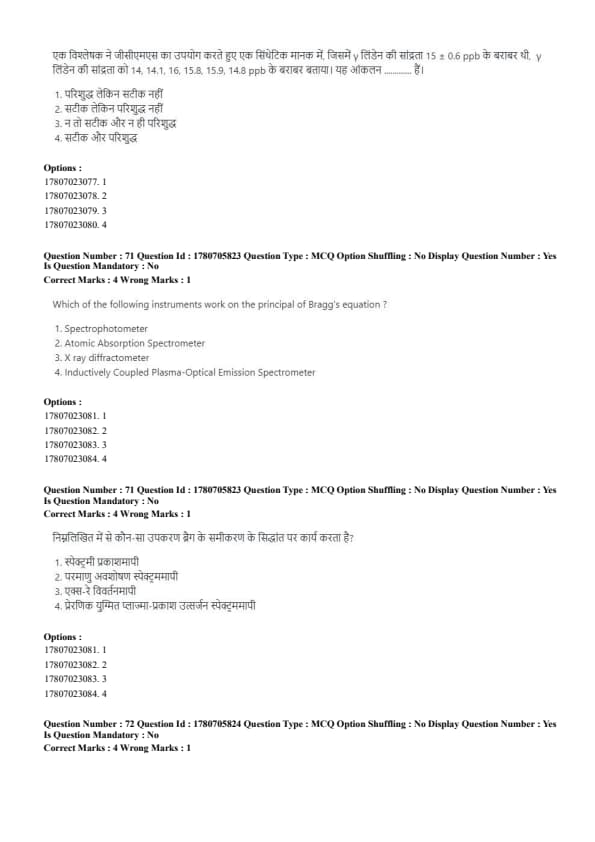
An analyst reported \(\gamma\)-lindane concentrations in a synthetic standard, having concentration of \(15 \pm 0.6\,ppb\), using GC–MS as \(14,\;14.1,\;16,\;15.8,\;15.9,\;14.8\,ppb\). The data is:
View Solution
Step 1: The true value of the standard lies in the range: \[ 15 \pm 0.6 \Rightarrow 14.4 to 15.6\,ppb \]
Step 2: Most of the reported values lie close to \(15\,ppb\) and within or very near the acceptable range, indicating good accuracy.
Step 3: The measurements are closely clustered with small variation among themselves, indicating good precision.
Step 4: Since the values are both close to the true value and close to each other, the data is both accurate and precise. Quick Tip: Accuracy refers to closeness to the true value, while precision refers to closeness among repeated measurements. Good analytical data should ideally be both accurate and precise.
Which of the following instruments works on the principle of Bragg's equation?
View Solution
Step 1: Bragg’s equation is given by: \[ n\lambda = 2d \sin \theta \]
where \(d\) is the interplanar spacing of crystal planes and \(\theta\) is the angle of incidence.
Step 2: This equation explains the diffraction of X-rays by crystal lattices.
Step 3: X-ray diffractometers utilize Bragg’s law to determine crystal structure and interplanar spacing.
Step 4: The other instruments listed operate on absorption or emission principles, not diffraction. Quick Tip: Bragg’s law is exclusively associated with \textbf{X-ray diffraction (XRD)} and is used to study crystal structures.
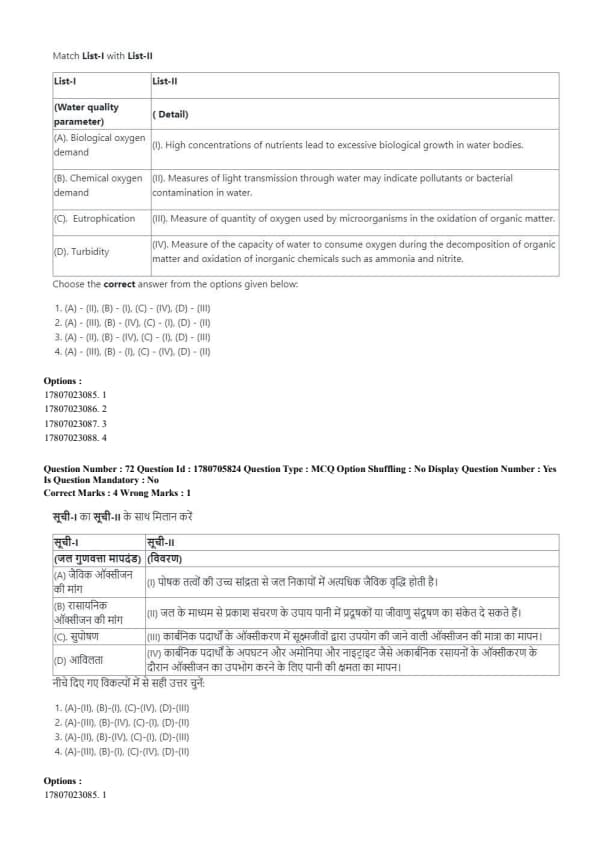
Match List–I with List–II.
List–I (Water quality parameter) \hfill List–II (Detail)
(A) Biological oxygen demand \hfill (I) High concentrations of nutrients lead to excessive biological growth in water bodies.
(B) Chemical oxygen demand \hfill (II) Measures of light transmission through water may indicate pollutants or bacterial contamination in water.
(C) Eutrophication \hfill (III) Measure of quantity of oxygen used by microorganisms in the oxidation of organic matter.
(D) Turbidity \hfill (IV) Measure of the capacity of water to consume oxygen during the decomposition of organic matter and oxidation of inorganic chemicals such as ammonia and nitrite.
Choose the correct answer from the options given below:
View Solution
Step 1: Biological Oxygen Demand (BOD) measures the amount of oxygen used by microorganisms to oxidize organic matter.
So, (A) \(\rightarrow\) (III).
Step 2: Chemical Oxygen Demand (COD) measures the total oxygen required to oxidize organic and inorganic substances in water.
So, (B) \(\rightarrow\) (IV).
Step 3: Eutrophication refers to nutrient enrichment leading to excessive biological growth.
So, (C) \(\rightarrow\) (I).
Step 4: Turbidity indicates the clarity of water and is measured by light transmission.
So, (D) \(\rightarrow\) (II). Quick Tip: BOD \(\rightarrow\) biological oxidation of organic matter, COD \(\rightarrow\) chemical oxidation (organic + inorganic), Eutrophication \(\rightarrow\) nutrient enrichment, Turbidity \(\rightarrow\) water clarity.
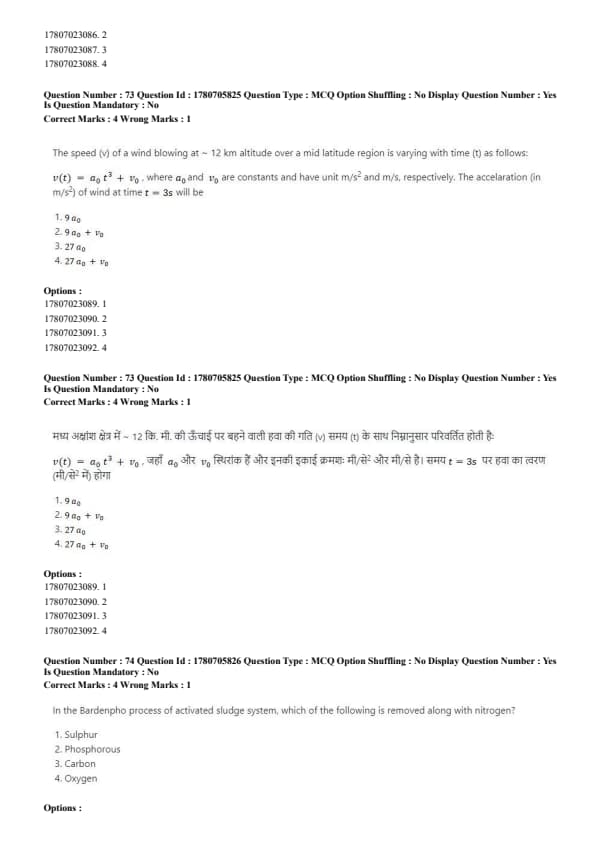
The speed (\(v\)) of a wind blowing at \(\sim 12\,km\) altitude over a mid-latitude region is varying with time (\(t\)) as follows: \[ v(t) = a_0 t^3 + v_0, \]
where \(a_0\) and \(v_0\) are constants and have units \(m s^{-4}\) and \(m s^{-1}\), respectively. The acceleration (in \(m s^{-2}\)) of wind at time \(t = 3\,s\) will be:
View Solution
Step 1: Acceleration is the time derivative of velocity: \[ a(t) = \frac{dv}{dt} \]
Step 2: Differentiate the given velocity function: \[ v(t) = a_0 t^3 + v_0 \] \[ a(t) = \frac{d}{dt}(a_0 t^3 + v_0) = 3a_0 t^2 \]
Step 3: Substitute \(t = 3\,s\): \[ a(3) = 3a_0 (3)^2 = 3a_0 \times 9 = 27a_0 \] Quick Tip: Acceleration is obtained by differentiating velocity with respect to time. Constants like \(v_0\) vanish on differentiation.
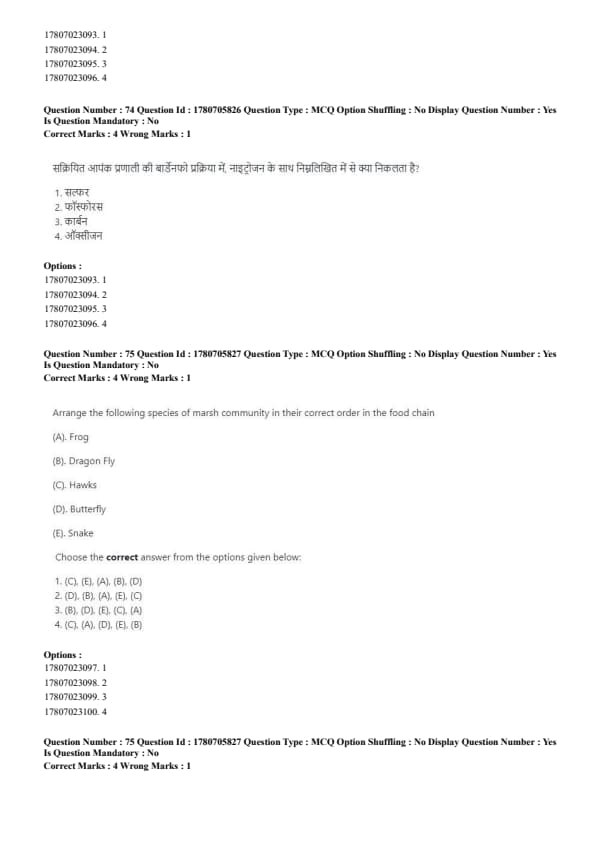
In the Bardenpho process of activated sludge system, which of the following is removed along with nitrogen?
View Solution
Step 1: The Bardenpho process is an advanced biological wastewater treatment process.
Step 2: It consists of alternating anaerobic, anoxic, and aerobic zones.
Step 3: These conditions allow effective biological removal of nitrogen (via nitrification and denitrification).
Step 4: The process also promotes enhanced biological phosphorus removal (EBPR).
Step 5: Hence, along with nitrogen, phosphorus is also removed in the Bardenpho process. Quick Tip: The Bardenpho process is designed for \textbf{simultaneous removal of nitrogen and phosphorus} from wastewater using biological treatment stages.
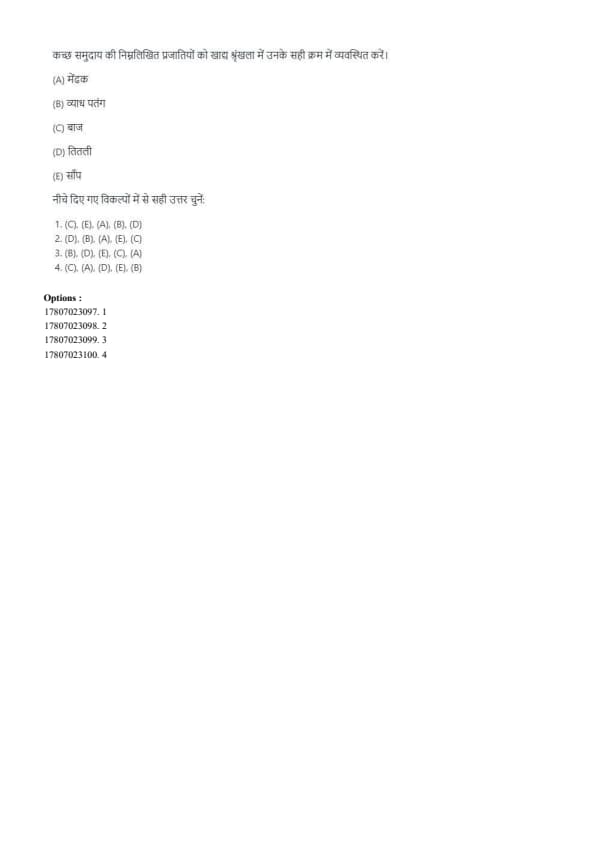
Arrange the following species of a marsh community in their correct order in the food chain.
(A) Frog
(B) Dragon fly
(C) Hawks
(D) Butterfly
(E) Snake
Choose the correct answer from the options given below:
View Solution
Step 1: Butterfly feeds on plant material and acts as a primary consumer.
Step 2: Dragon fly is an insect predator that feeds on smaller insects like butterflies.
Step 3: Frog feeds on insects such as dragon flies.
Step 4: Snake feeds on frogs.
Step 5: Hawks are top predators and feed on snakes.
Step 6: Therefore, the correct food chain sequence is: \[ Butterfly \rightarrow Dragon fly \rightarrow Frog \rightarrow Snake \rightarrow Hawks \] Quick Tip: In food chains, energy flows from lower trophic levels (herbivores) to higher trophic levels (top carnivores).



Comments