CUET PG Criminology Question Paper 2025 (Available): Download Question Paper with Solutions PDF

Shivam Yadav's profile photo

Shivam Yadav

Updated on - Dec 30, 2025

The CUET PG Criminology exam in 2025 was scheduled on March 23, 2025. After the exam, candidates will be able to download the CUETPGCriminologyquestionpaper2025, answer key, and solution PDF. The test assesses a student’s grasp of criminological theories, criminal justice systems, victimology, law enforcement, penology, and current crime-related affairs.

Students must attempt 75 questions in 60 minutes, with a total of 300 marks. Each correct answer earns 4 marks, while 1 mark is deducted for every wrong response.

CUET PG Criminology 2025 Question Paper with Answer Key PDF

CUET PG Criminology Question Paper with Solutions PDF Download PDF Check Solutions

CUET PG Criminology 2025 Question Paper with Solutions


Question 1:

Which of the following statements is NOT directly related to the Universal Declaration of Human Rights?

  • (A) Civil and political rights
  • (B) Economic, social, cultural rights
  • (C) Collective Rights such as right to development
  • (D) Rights exclusively related to Victims of Crime and Abuse of Power

Question 2:

The Directive Principles of State Policy talks about:

A. Equal justice and free legal aid
B. Maternity relief
C. Composition of the Council of States
D. Promotion of cooperative societies

Choose the correct answer from the options given below:

  • (A) A, B and D only
  • (B) A, B and C only
  • (C) A, B, C and D
  • (D) B, C and D only

Question 3:

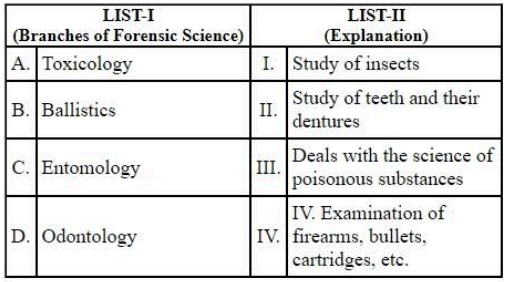
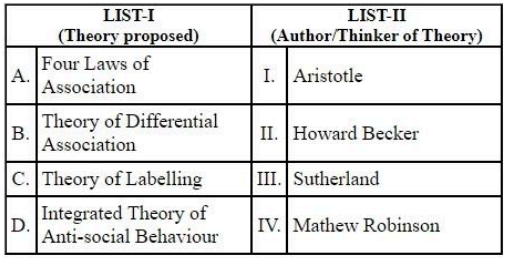
Match the LIST-I with LIST-II

Choose the correct answer from the options given below:

  • (A) A-I, B-II, C - III, D - IV
  • (B) A-I, B-III, C-II, D - IV
  • (C) A-I, B-II, C - IV, D - III
  • (D) A-III, B - IV, C - I, D - II

Question 4:

Which of the following ancient texts was the source of crime, crime control and punishment in the Indian traditional system of governance?

  • (A) Garud Puran
  • (B) Dharmasastra
  • (C) Atharva Veda
  • (D) Yajur Veda

Question 5:

In criminological literature, 'Recidivism' implies:

  • (A) The radical approach by criminologists who believe that human nature by itself is not criminal
  • (B) The tendency of under-trials to show an innocent face so that they are released
  • (C) The habit of relapsing into crime by the offenders
  • (D) The tendency of under-trials who are falsely charged to actually commit the crime for which they are imprisoned.

Question 6:

Open jails are set up under philosophical tenets of ___________.

  • (A) Incarceration of prisoners
  • (B) Revenge Philosophy
  • (C) Retribution
  • (D) Reformation of prisoners

Question 7:

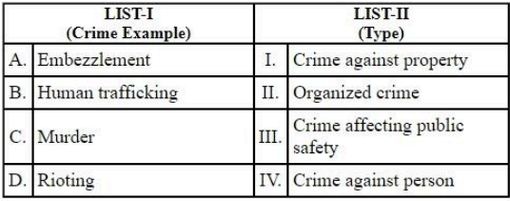
Match the LIST-I with LIST-II

Choose the correct answer from the options given below:

  • (A) A-I, B-II, C - III, D - IV
  • (B) A-I, B-III, C-II, D-IV
  • (C) A-I, B-II, C - IV, D-III
  • (D) A-III, B-IV, C-I, D-II

Question 8:

Under the Juvenile Justice (Care & Protection of Children) Act, 2015, which of the following is a unique provision for 'children in conflict with law'?

  • (A) Mandatory life imprisonment
  • (B) Automatic transfer to adult prison
  • (C) Permanent records of criminal offenses
  • (D) Rehabilitation through individualized care plans

Question 9:

The most significant advantage of e-courts in the Indian context is:

  • (A) Complete eradication of human element
  • (B) Enhanced accessibility and transparent case tracking
  • (C) Mandatory replacement of human judgement
  • (D) Mandatory online hearings

Question 10:

Arrange the following United Nations Congresses on the Prevention of Crime and the Treatment of Offenders from earliest to latest:

A. The Congress in Kyoto
B. The Congress in Stockholm
C. The Congress in London
D. The Congress in Milan

Choose the correct answer from the options given below:

  • (A) A, B, C, D
  • (B) A, C, B, D
  • (C) B, A, D, C
  • (D) C, B, A, D

Question 11:

Fundamental Duties in the Constitution of India primarily aim at:

  • (A) Impose legal restrictions
  • (B) Limit the Government's power
  • (C) Create a moral-ethical framework for citizens of India
  • (D) Fundamental Duties act as a prerequisite for citizenship

Question 12:

One of the unique features of Indian federalism is:

  • (A) Cooperative federalism with flexibility
  • (B) Absolute State autonomy
  • (C) Dissolution of transparency
  • (D) Absolute union autonomy

Question 13:

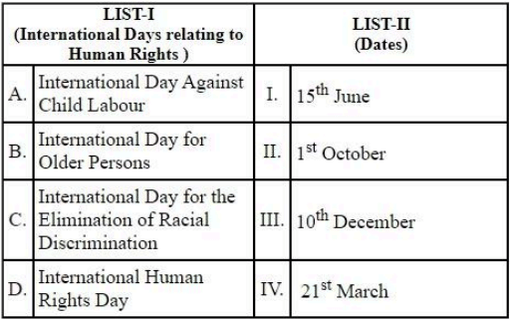
Match the LIST-I with LIST-II

Choose the correct answer from the options given below:

  • (A) A - I, B - II, C - III, D - IV
  • (B) A - I, B - III, C - II, D - IV
  • (C) A - I, B - II, C - IV, D - III
  • (D) A - III, B - IV, C - I, D - II

Question 14:

The Protection of Civil Rights Act primarily addresses:

  • (A) Economic discrimination
  • (B) Political representation
  • (C) Social discrimination and untouchability
  • (D) Educational reservations

Question 15:

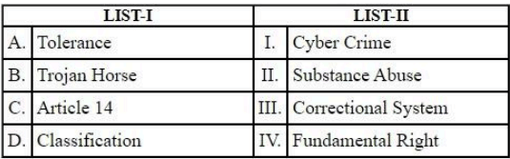
Match the LIST-I with LIST-II

Choose the correct answer from the options given below:

  • (A) A - II, B - III, C - I, D - IV
  • (B) A - I, B - II, C - III, D - IV
  • (C) A - III, B - II, C - I, D - IV
  • (D) A - IV, B - III, C - II, D - I

Question 16:

Arrange the major commissions/committees on police reform in India from the earliest to latest years of their establishment:

A. Padnabhaiah Committee
B. Ribeiro Commission
C. National Police Commission
D. Malimath Committee

Choose the correct answer from the options given below:

  • (A) A, B, C, D
  • (B) A, C, B, D
  • (C) B, A, D, C
  • (D) C, B, A, D

Question 17:

Which article of the Constitution under Directive Principles of State Policy, aims to prevent the concentration of wealth (material resources)?

  • (A) Article 39B
  • (B) Article 40
  • (C) Article 42C
  • (D) Article 44

Question 18:

What is the primary purpose of Lok-Adalat in India?

  • (A) To enforce strict penalties
  • (B) To oversee constitutional matters
  • (C) To facilitate quick resolution of cases
  • (D) To handle crimes done by politicians

Question 19:

According to the NHRC guidelines, which of the following is not applicable for Police-Public Relations?

  • (A) Giving absolute authority to local people for crime investigation.
  • (B) Providing a toll-free telephone number for the public for reporting crime
  • (C) Developing systems to promote transparency in registration of offense and recording progress
  • (D) Monthly meeting of the SHO with the public

Question 20:

Arrange the position/rank in the police administration from lowest to highest:

A. Deputy Superintendent of Police
B. Constable
C. Assistant Sub-Inspector
D. Additional Superintendent of Police

Choose the correct answer from the options given below:

  • (A) A, B, C, D
  • (B) B, C, A, D
  • (C) B, A, D, C
  • (D) C, B, D, A

Question 21:

One of the most distinctive aspects regarding child protection under the Juvenile Justice (Care & Protection of Children) Act, 2015, is:

  • (A) Punitive measures against families who fail to protect their children
  • (B) Complete State guardianship
  • (C) Prioritizing Institutional care only
  • (D) Prioritizing family-based rehabilitation

Question 22:

Under the Maintenance and Welfare of Parents and Senior Citizens Act, 2007, which authority handles maintenance disputes?

  • (A) Senior Citizen Panchayat Courts
  • (B) High Courts
  • (C) Family Courts
  • (D) Senior Citizen Tribunals

Question 23:

Which of the following actions comes under the act of 'Dowry' as per the Dowry Prohibition Act, 1961?

A. The groom's parents demand specific gifts for their relatives.
B. Parents give cash to their newly wedded daughter out of their own will.
C. Advertising that parental property will be given to the groom for marrying their daughter.
D. The groom's extended family forces the bride's family for destination wedding.

Choose the correct answer from the options given below:

  • (A) A, B and D only
  • (B) A, B and C only
  • (C) A, B, C and D
  • (D) A, C and D only

Question 24:

Arrange the following scams from the earliest to latest, as they were brought to the knowledge of public.

A. Harshad Mehta Scam
B. Satyam Scam
C. PNB Nirav Modi Scam
D. Ketan Parekh Scam

Choose the correct answer from the options given below:

  • (A) A, B, C, D
  • (B) A, C, B, D
  • (C) A, D, B, C
  • (D) C, B, D, A

Question 25:

Sometimes, a child pornography image is hidden inside another graphic image file, audio file or other file format. Such malpractices come under the gamut of:

  • (A) Secondary cyber crime
  • (B) Cyber strangulation
  • (C) Steganography
  • (D) Stenography

Question 26:

The duties of an employer are dealt under ___________ of the Sexual Harassment of Women at Workplace Act.

  • (A) Chapter 4
  • (B) Chapter 5
  • (C) Chapter 6
  • (D) Chapter 7

Question 27:

Who among the following was actively associated with the concept of Public Interest Litigation and made it widely practicable in India?

  • (A) Justice P.N. Bhagwati
  • (B) Justice J.S. Verma
  • (C) Justice M. Hidayatullah
  • (D) Justice B.N. Kirpal

Question 28:

Which report specifically addresses the conditions of women prisoners in India?

  • (A) National Human Rights Commission Report, 2002
  • (B) Justice Krishna Iyer Report, 1987
  • (C) Mulla Committee Report, 1983
  • (D) Committee on Women in Detention, 2005

Question 29:

One of the most innovative features of the Protection of Women from Domestic Violence Act, 2005, is:

  • (A) Criminal prosecution of primary accused only
  • (B) Financial penalties for victims
  • (C) Right to residence and comprehensive relief to the aggrieved
  • (D) Public shaming of perpetrators

Question 30:

Which subject is included in the concurrent list under the Indian Constitution?

  • (A) Education
  • (B) Police
  • (C) Army
  • (D) Nuclear energy

Question 31:

A hidden computer programme that is set to disturb a computer system or network, which is triggered at a preset time or some other logically defined state of the system analogous to a time bomb, is called:

  • (A) Email Bomb
  • (B) Logic Bomb
  • (C) Adipocere Bomb
  • (D) Antivirus related cyber malfunctioning

Question 32:

Which of the following conditions are considered as bonded labour under the Bonded Labour System (Abolition) Act, 1976?

  • (A) Pledging labour for loan with no repayment terms
  • (B) Working as an apprentice for a fixed term
  • (C) Voluntary work taken up but expecting remuneration and not getting
  • (D) Remuneration of labour but without getting salary slips

Question 33:

The Mulla Committee focused on reforms in the area of __________

  • (A) Police training
  • (B) Juvenile justice
  • (C) Prisoner welfare and Prison administration
  • (D) Women and child welfare

Question 34:

Who among the following eminent criminologists are considered as the exponents of Positive School?

A. Raffaele Garofalo
B. Cesare Lombroso
C. Enrico Ferri
D. Richard Quinney

Choose the correct answer from the options given below:

  • (A) A, B and D only
  • (B) A, B and C only
  • (C) A, B, C and D
  • (D) B, C and D only

Question 35:

The Government of India initiated a Helpline number for the elderly, which is:

  • (A) 1098
  • (B) 13468
  • (C) 14567
  • (D) 45678

Question 36:

The process where inmates adopt the norms, values, and behaviours of the prison sub-culture to survive the stresses of life behind bars is termed as:

  • (A) Socialization
  • (B) Prison-enculturation
  • (C) Prisonization
  • (D) Jailization

Question 37:

Which of the following cases led to the establishment of the "Basic Structure Doctrine"?

  • (A) Minerva Mills vs. Union of India
  • (B) Golaknath vs. State of Punjab
  • (C) Maneka Gandhi vs. Union of India
  • (D) Keshavananda Bharati vs. State of Kerala

Question 38:

Match the LIST-I with LIST-II

Choose the correct answer from the options given below:

  • (A) A-I, B-II, C - III, D - IV
  • (B) A-I, B - III, C - II, D - IV
  • (C) A-I, B - II, C - IV, D - III
  • (D) A-III, B - IV, C - I, D - II

Question 39:

Arrange the following significant words as they appear in the preamble of the Constitution of India:

A. FRATERNITY
B. EQUALITY
C. LIBERTY
D. JUSTICE

Choose the correct answer from the options given below:

  • (A) A, B, C, D
  • (B) A, C, B, D
  • (C) B, A, D, C
  • (D) D, C, B, A

Question 40:

Sequence the following legislations as they were enacted - from earliest to latest:

A. National Food Security Act
B. Mahatma Gandhi National Rural Employment Guarantee Act
C. Family Courts Act
D. Medical Termination of Pregnancy Act

Choose the correct answer from the options given below:

  • (A) A, B, C, D
  • (B) A, C, B, D
  • (C) D, C, B, A
  • (D) C, B, D, A

Question 41:

___________ is an internet scam done by cyber criminals where the user is convinced digitally to provide confidential information.

  • (A) Phishing attack
  • (B) Docx attack
  • (C) Website attack
  • (D) Internet terrorism

Question 42:

In which of the following cyber crimes does the victim believe in the offender and part with information/money?

  • (A) Worm hole
  • (B) Pig Slaughter scam
  • (C) Web site attack
  • (D) Virus attack

Question 43:

How much does a complainant have to pay the police to get a copy of the FIR or complaint?

  • (A) Rs. 100/-
  • (B) Varies from state to state
  • (C) Rs. 50/-
  • (D) No payment is to be made

Question 44:

What is included in the rights of prisoners in the contemporary legal framework in India?

  • (A) Absolute right to freedom
  • (B) Complete suspension of rights
  • (C) Restricted legal access
  • (D) Preservation of Comprehensive human dignity

Question 45:

One of the most distinct aspects of the 'Sexual Harassment of Women at Workplace Act', is:

  • (A) Punishment of the accused within a month
  • (B) Mandatory Internal Complaints Committee
  • (C) Public disclosure of complaints
  • (D) Exclusive digital reporting platforms

Question 46:

According to which principle or law of Forensic science, it is asserted that, "when a criminal or his/her instrument of crime comes in contact with the victim or the objects surrounding him/her, they leave traces, and the criminal or his/her instrument picks up traces from the same contact?"

  • (A) Law of Circumstantial Facts
  • (B) Locard's Principle of Exchange
  • (C) Law of Comparison
  • (D) Principle of Probability

Question 47:

BPRD stands for:

  • (A) Bihar Police Research Division
  • (B) Board of Police Research & Development
  • (C) Bureau of Police Research & Development
  • (D) Bhartiya Police Resource Division

Question 48:

Which key aspect is emphasized in the recommendations of the Second Administrative Reforms Committee (ARC) on police reforms?

  • (A) Absolute authority of the police personnel in dealing with offenders
  • (B) Political control over police
  • (C) Strengthening community policing
  • (D) Increased funding for prisons

Question 49:

Which scheme focuses on vocational training for prisoners in India?

  • (A) Skill development of prisoners
  • (B) Swavalamban yojana
  • (C) Sudhar Jao Yojana
  • (D) Nirbhaya Scheme

Question 50:

A comprehensive coverage of Integrated Child Protection Services by the Ministry of Women & Child Development is known as:

  • (A) Mission Vatsalya
  • (B) Mission Suraksha
  • (C) Mission Bal Suraksha evam Unnati
  • (D) Mission Bacche Bachao

Question 51:

The POCSO Act denotes:

  • (A) The Protection of Children from Sexual Offences Act
  • (B) The Prevention of Children from Sexual Offences Act
  • (C) The Promotion of Children against Sexual Offences Act
  • (D) The Projection of Children about Sexual Obligation Act

Question 52:

Which of the following statements are true with regard to 'Foster Care'?

A. It is a means of alternative care under the Juvenile Justice Act, other than the child's biological family.
B. It always precedes and leads to legal adoption.
C. It is keeping a child in need of care and protection in a family temporarily as identified by the District Child Protection Unit.
D. It may result in legal adoption.

Choose the correct answer from the options given below:

  • (A) A, C and D only
  • (B) A, B and C only
  • (C) A, B, C and D
  • (D) B, C and D only

Question 53:

Which of the following are the characteristics of radical criminology?

A. It rejects the individualistic approach to crime causation.
B. Instead of explaining the fact of deviance with reference to the society within which it occurs, it gives importance to social power.
C. It questions the rightfulness of law.
D. It postulates the 'free-will' of deviants.

Choose the correct answer from the options given below:

  • (A) A, B and D only
  • (B) A, B and C only
  • (C) A, B, C and D
  • (D) B, C and D only

Question 54:

Alcoholism is a:

A. Social problem
B. Victimless crime
C. Violent, organized crime
D. Problem with long term physical and mental health implications

Choose the correct answer from the options given below:

  • (A) A, B and D only
  • (B) A, B and C only
  • (C) A, B, C and D
  • (D) B, C and D only

Question 55:

The four domains of child rights as propagated by the UNCRC are:

  • (A) Right to Survival; Right to Protection; Right to Development; and Right to Participation
  • (B) Right to Health; Right to Education; Right to Protection; and Right to Development
  • (C) Right to Survival; Right to Education; Right against Abuse and Exploitation; and Right to Development
  • (D) Right to Survival; Right to have a Family; Right to Development; and Right to Education

Question 56:

Under the POCSO Act, which of the following enhances child protection?

  • (A) Global database of offenders
  • (B) Compulsory digital tracking
  • (C) In-camera trial with child-friendly infrastructure
  • (D) Mandatory DNA testing

Question 57:

Which of the following Act originated from the Vishakha guidelines?

  • (A) POCSO Act
  • (B) Sexual Harassment of Women Act 2013
  • (C) J.J. Act 2015
  • (D) Protection of Women from Domestic Violence Act 2005

Question 58:

What is included under Innovative prison reform strategies?

  • (A) Reduced legal representation
  • (B) Increased imprisonment duration
  • (C) Implementing Revenge Philosophy
  • (D) Skill development and psychological counselling

Question 59:

What is the distinct approach adopted under Child Labour (Prohibition & Regulation) Act?

  • (A) Complete prohibition
  • (B) Rehabilitation and education support
  • (C) Gradual phase out from child labor
  • (D) Economic compensation

Question 60:

Which among the following is a part of the State Police?

  • (A) CBI
  • (B) CRPF
  • (C) Prohibition Enforcement Wing (PEW)
  • (D) CISF

Question 61:

What is the primary focus of the Indecent Representation of Women Act?

  • (A) Criminal prosecution of the aggrieved party
  • (B) Preventing visual media misrepresentation
  • (C) Social media regulations
  • (D) Workplace dress codes

Question 62:

What is one of the most distinctive features of the Directive Principles of State Policy of the Indian Constitution?

  • (A) Legally enforceable mandates
  • (B) Aspirational guidelines for governance
  • (C) Absolute constitutional guarantees
  • (D) Permanent governmental obligations

Question 63:

Match the LIST-I with LIST-II

Choose the correct answer from the options given below:

  • (A) A - IV, B - III, C - II, D - I
  • (B) A - II, B - I, C - IV, D - III
  • (C) A - I, B - II, C - IV, D - III
  • (D) A - I, B - II, C - III, D - IV

Question 64:

What is the most progressive provision regarding investigation of cases of child sexual abuse under the POCSO Act?

  • (A) Child friendly court procedures
  • (B) Mandatory minimum punishment of six months imprisonment
  • (C) Automatic bail denial system
  • (D) Permanent criminal record of accused

Question 65:

What is the primary influence of the Universal Declaration of Human Rights principles?

  • (A) Domestic legal systems of the countries
  • (B) Military strategies
  • (C) International Human Rights Framework
  • (D) Economic policies

Question 66:

Which unique preventive measures is mandated under the POCSO Act?

  • (A) Mandatory reporting by all citizens
  • (B) Digital surveillance
  • (C) Background checks for all professionals involved with child care, directly or indirectly
  • (D) Psychological profiling of children

Question 67:

Which remedy is uniquely provided under the Protection of Women from Domestic Violence Act, 2005, that goes beyond traditional legal recourse?

  • (A) Immediate arrest of the accused
  • (B) Protection order with comprehensive support to the victim
  • (C) Free and mandatory counseling for both parties
  • (D) Permanent restraining order

Question 68:

What are the three main sources of typically finding physical evidence according to Forensic Sciences?

  • (A) The crime scene; the witness; and the investigating agency
  • (B) Finger prints; body fluids; and weapons and tools
  • (C) The body materials; chemical substances; and botanical materials
  • (D) The crime scene; the culprit; and the victim

Question 69:

Under the Protection of Women from Domestic Violence Act, 2005, the definition of "domestic relationship" includes:

  • (A) Only married couples
  • (B) Couples with marriage certificate
  • (C) Only nuclear family relationships
  • (D) Married and extended family relationships

Question 70:

In the Juvenile Justice (Care & Protection of Children) Act, 2015, "children in need of care and protection" specifically excludes:

  • (A) Children engaged in unlawful activities
  • (B) Orphaned children
  • (C) Children subjected to sexual abuse
  • (D) Children working in hazardous conditions

Question 71:

What is one of the salient features of the Scheduled Castes and Scheduled Tribes (Prevention of Atrocities) Act?

  • (A) Arbitrary approach
  • (B) Presumption of innocence for accused
  • (C) Stringent anti-discriminatory provisions
  • (D) Optional implementation

Question 72:

Match the LIST-I with LIST-II

Choose the correct answer from the options given below:

  • (A) A - I, B - II, C - III, D - IV
  • (B) A - I, B - III, C - II, D - IV
  • (C) A - I, B - II, C - IV, D - III
  • (D) A - III, B - IV, C - I, D - II

Question 73:

Which of the following offences may be considered a 'victimless crime'?

  • (A) Drug Abuse
  • (B) Robbery
  • (C) Cyber crime
  • (D) Communal rioting

Question 74:

What are the five ordeals, treated as divine means of proof of the guilt or innocence of the accused in the traditional Indian governance system?

  • (A) Balance, Fire, Water, Poison, and Kosa
  • (B) Fire, Water, Earth, Air, and Space
  • (C) Mudra, House, Forest, Fire, and Kosa
  • (D) Death penalty, house arrest, public humiliation, imprisonment and ostracism

Question 75:

Noted socio-legal researchers Shaw and Mckay propounded, "traditions of delinquency are transmitted through successive generations of the same region in the same way as language, customs and attitudes are transmitted". How it is known as?


  • (A) Social Disengagement Theory
  • (B) Cultural Transmission Theory
  • (C) Neighbourhood influence of crime theory
  • (D) Crime Syndicate Theory

Fees Structure

Structure based on different categories

CategoriesState
General800
sc550

In case of any inaccuracy, Notify Us! 

Comments


No Comments To Show