CUET PG Computer Science Question Paper 2025 (Available): Download Question Paper with Solutions PDF

Shivam Yadav's profile photo

Shivam Yadav

Updated on - Dec 30, 2025

The CUET PG Computer Science exam 2025 was conducted on 18th March 2025. After the test, students can download the question paper, official answer key, and detailed solution PDFs for all sets. The test focuses on topics such as data structures, algorithms, computer networks, operating systems, database management systems, software engineering, theory of computation, and programming languages like C/C++/Java/Python.

The exam has 75 questions to be attempted in 60 minutes, totaling 300 marks. Each correct answer gets 4 marks, and 1 mark is deducted for every incorrect one.

CUET PG Computer Science 2025 Question Paper with Answer Key PDF

CUET PG Computer Science Question Paper with Solutions PDF Download PDF Check Solutions

CUET PG Computer Science 2025 Question Paper with Solutions


Question 1:

One term in the given number series is wrong. Find out the wrong term.

  • (A) 3
  • (B) 10
  • (C) 4
  • (D) 27

Question 2:

Find the next two terms of the series:
The given series is: \( A, C, F, J, ? \).

(A) O
(B) U
(C) R
(D) V

Choose the correct answer from the options given below:

  • (1) (A) and (B) respectively
  • (2) (B) and (A) respectively
  • (3) (C) and (D) respectively
  • (4) (D) and (C) respectively

Question 3:

Door is related to bang in the same way as chain is related to

  • (1) Thunder
  • (2) Clinch
  • (3) Tinkle
  • (4) Clank

Question 4:

In a certain code, VISHWANATHAN is written as NAAWTHHSANIV. How is KARUNAKARANA written in that code?

  • (1) KAANRAURNAAK
  • (2) AKNUARRANKA
  • (3) NKKRAKRAUK
  • (4) RUNKAAUNAK

Question 5:

Find the number of triangles in the given figure.

  • (1) 36
  • (2) 44
  • (3) 48
  • (4) 46

Question 6:

Identify the missing number (?) from the following figure.

  • (1) 12
  • (2) 16
  • (3) 18
  • (4) 20

Question 7:

Introducing a man to her husband, a woman said, "His brother's father is the only son of my grandfather." How is the woman related to this man?

  • (1) Mother
  • (2) Aunt
  • (3) Sister
  • (4) Daughter

Question 8:

Find the missing word (?) which is similar to the given words.
  • (1) Trumpet
  • (2) Violin
  • (3) Harmonium
  • (4) Mridanga

Question 9:

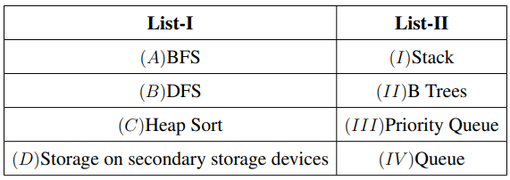
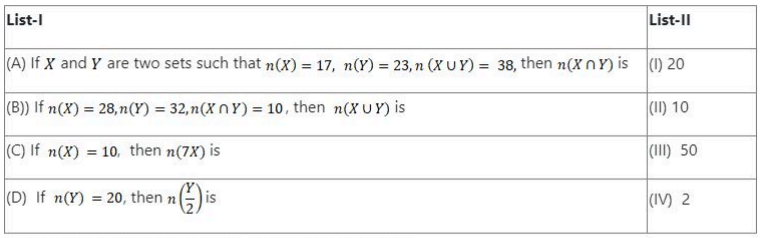
Match List-I with List-II.

  • (1) (A) - (III), (B) - (IV), (C) - (I), (D) - (II)
  • (2) (A) - (II), (B) - (I), (C) - (III), (D) - (IV)
  • (3) (A) - (IV), (B) - (III), (C) - (I), (D) - (II)
  • (4) (A) - (IV), (B) - (II), (C) - (III), (D) - (I)

Question 10:

Choose the missing term (?) of the following series.
\( 2, 27, 107, 427, ? \).

  • (1) 1262
  • (2) 1707
  • (3) 4027
  • (4) 4407

Question 11:

In an examination, a student scores 4 marks for every correct answer and loses 1 mark for every wrong answer. If she/he attempts all 60 questions and secures 130 marks, the number of questions she/he attempts wrongly are?

  • (1) 38
  • (2) 22
  • (3) 21
  • (4) 37

Question 12:

In the following question, there is a certain relationship between two given words on one side of "::" and one word is given on another side of "::" while another word is to be found from the given options, having the same relation with this word as the words of the given pair bear. Choose the correct option to replace the '?'.

Milk : Emulsion :: Butter : ?

  • (1) Aerosol
  • (2) Suspension
  • (3) Sol
  • (4) Gel

Question 13:

Consider the following four words, out of which three are alike in some manner and one is different.

(A) Arrow
(B) Missile
(C) Sword
(D) Bullet

Choose the combination that has alike words.

  • (1) (A), (B) and (D) only
  • (2) (B), (C) and (D) only
  • (3) (A), (B) and (C) only
  • (4) (A), (C) and (D) only

Question 14:

Consider the following alphabet series:

A B C D E F G H I J K L M N O P Q R S T U V W X Y Z

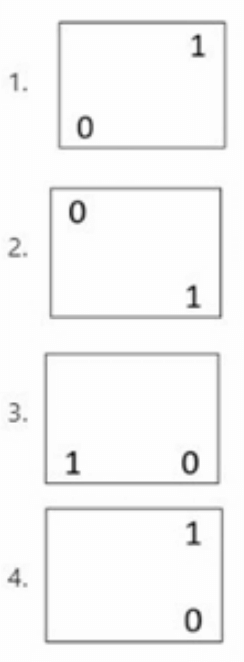
If the second half of the given alphabet series is written in reverse order, which letter will be seventh to the right of the twelfth letter from the left end?
  • (1) R
  • (2) S
  • (3) U
  • (4) T

Question 15:

Which figure comes next in the given series below?


Question 16:

If \( \frac{1}{9!} + \frac{1}{10!} = \frac{x}{11!} \), then the value of \( x \) is:
  • (1) 121
  • (2) 120
  • (3) 12
  • (4) 24

Question 17:

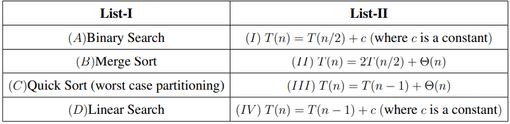
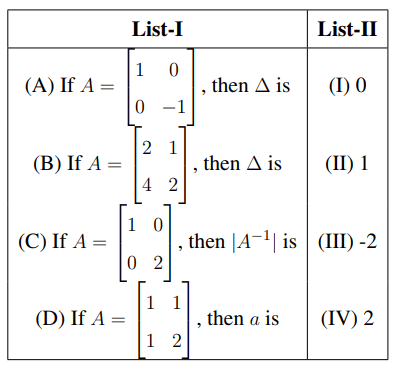
Match List-I with List-II.

  • (1) (A) - (III), (B) - (IV), (C) - (I), (D) - (II)
  • (2) (A) - (II), (B) - (I), (C) - (III), (D) - (IV)
  • (3) (A) - (IV), (B) - (III), (C) - (I), (D) - (II)
  • (4) (A) - (IV), (B) - (II), (C) - (III), (D) - (I)

Question 18:

Out of 5 consonants and 4 vowels, how many words of 3 consonants and 3 vowels can be made?

  • (1) 40
  • (2) 80
  • (3) 20
  • (4) 240

Question 19:

From the given sets, which is an infinite set:

  • (1) \( \{ x: x \in \mathbb{N} and (x - 1)(x - 2) = 0 \} \)
  • (2) \( \{ x: x \in \mathbb{N} and x is a prime number and less than 199 \} \)
  • (3) \( \{ x: x \in \mathbb{N} and x^5 - 1 = 0 \} \)
  • (4) \( \{ x: x \in \mathbb{N} and x is odd \} \)

Question 20:

A fair coin is tossed three times. Let A be the event of getting exactly two heads and B be the event of getting at most two tails, then \( P(A \cup B) \) is:
  • (1) \( \frac{1}{2} \)
  • (2) \( \frac{3}{8} \)
  • (3) \( \frac{1}{8} \)
  • (4) \( \frac{7}{8} \)

Question 21:

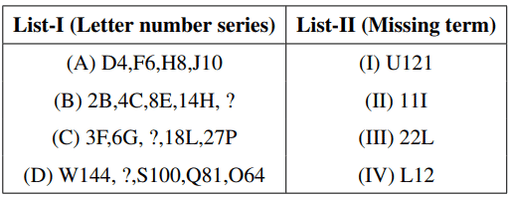
Match List-I with List-II.

  • (1) (A) - (I), (B) - (II), (C) - (I), (D) - (III)
  • (2) (A) - (II), (B) - (I), (C) - (III), (D) - (IV)
  • (3) (A) - (IV), (B) - (III), (C) - (I), (D) - (II)
  • (4) (A) - (IV), (B) - (II), (C) - (III), (D) - (I)

Question 22:

If \( a, b, c \) are in Geometric Progression and \( a^x = b^y = c^z \), then \( x, y, z \) are in:

  • (1) Arithmetic Progression
  • (2) Geometric Progression

Question 23:

If \( (x - 1) \) is a factor of \( 2x^2 - 5x + k = 0 \), then the value of \( k \) is:

  • (1) 2
  • (2) 5
  • (3) 3
  • (4) 4

Question 24:

If \( x = \left( 2 + \sqrt{3} \right)^3 + \left( 2 - \sqrt{3} \right)^{-3} \) and \( x^3 - 3x + k = 0 \), then the value of \( k \) is:

  • (1) -4
  • (2) 4
  • (3) \( \sqrt{3} \)
  • (4) \( 2\sqrt{3} \)

Question 25:

If \[ \frac{1}{a(b + c)} + \frac{1}{b(c + a)} + \frac{1}{c(a + b)} = k, then the value of k is: \]

  • (1) \( ab + bc + ca \)
  • (2) \( (ab + bc + ca)^2 \)
  • (3) \( 2(ab + bc + ca) \)
  • (4) 0

Question 26:

The length of major axis and coordinate of vertices for the ellipse \( 3x^2 + 2y^2 = 6 \) respectively are:

  • (1) \( 2\sqrt{2}, (0, \pm\sqrt{3}) \)
  • (2) \( 2\sqrt{3}, (0, \pm\sqrt{3}) \)
  • (3) \( 2\sqrt{2}, (\pm\sqrt{3}, 0) \)
  • (4) \( 2\sqrt{3}, (\pm\sqrt{3}, 0) \)

Question 27:

The center and radius for the circle \( x^2 + y^2 + 6x - 4y + 4 = 0 \) respectively are:

  • (1) (2, 3) and 3
  • (2) (3, 2) and 8
  • (3) (2, -3) and 3
  • (4) (-3, 2) and 3

Question 28:

If the line through \( (3, y) \) and \( (2, 7) \) is parallel to the line through \( (-1, 4) \) and \( (0, 6) \), then the value of \( y \) is:

  • (1) -7
  • (2) 9
  • (3) 7
  • (4) 2

Question 29:

The points \( (K, 2 - 2K), (-K + 1, 2K) \) and \( (-4 - K, 6 - 2K) \) are collinear if:

(A) \( K = \frac{1}{2} \)
(B) \( K = -\frac{1}{2} \)
(C) \( K = \frac{3}{2} \)
(D) \( K = -1 \)
(E) \( K = 1 \)

  • (1) (A) and (D) only
  • (2) (A) and (E) only
  • (3) (B) and (D) only
  • (4) (D) only

Question 30:

If \( x^2 = -16y \) is an equation of a parabola, then:

(A) Directrix is \( y = 4 \)
(B) Directrix is \( x = 4 \)
(C) Co-ordinates of focus are \( (0, -4) \)
(D) Co-ordinates of focus are \( (-4, 0) \)
(E) Length of latus ***** is 16

  • (1) (A) and (E) only
  • (2) (B), (C) and (E) only
  • (3) (A), (C) and (E) only
  • (4) (B), (D) and (E) only

Question 31:

The value of \(\displaystyle \lim_{x \to \infty}\left(1+\frac{2}{3x}\right)^{x}\) is:

  • (A) \(e\)
  • (B) \(e^{2}\)
  • (C) \(e^{\tfrac{2}{3}}\)
  • (D) \(\dfrac{1}{e^{3}}\)

Question 32:

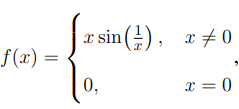
If then \(f(x)\) is

  • (A) continuous for all \(x\in\mathbb{R}\)
  • (B) continuous at \(0\) only
  • (C) not continuous at \(1\)
  • (D) not continuous at \(0\)

Question 33:

\[ \int \frac{2x+1}{x^{2}+x+2}\, dx \ is \]

  • (A) \(\log(2x+1)+c\), where \(c\) is an arbitrary constant
  • (B) \(\log\!\left(\dfrac{2x+1}{x^{2}+x+2}\right)+c\), where \(c\) is an arbitrary constant
  • (C) \(\log(x^{2}+x+2)+c\), where \(c\) is an arbitrary constant
  • (D) \(\log\!\left(\tfrac{1}{2}\right)+c\), where \(c\) is an arbitrary constant

Question 34:

Bag \(A\) contains 3 Red and 4 Black balls while Bag \(B\) contains 5 Red and 6 Black balls. One ball is drawn at random from one of the bags and is found to be Red. Then, the probability that it was drawn from Bag \(B\) is:

  • (A) \(\tfrac{35}{68}\)
  • (B) \(\tfrac{7}{38}\)
  • (C) \(\tfrac{14}{37}\)
  • (D) \(\tfrac{34}{43}\)

Question 35:

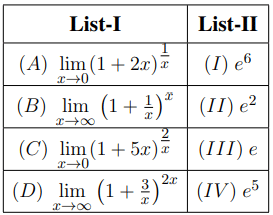
Match List-I with List-II:

Choose the correct answer from the options given below:

  • (A) (A)-(IV), (B)-(I), (C)-(II), (D)-(III)
  • (B) (A)-(II), (B)-(I), (C)-(III), (D)-(IV)
  • (C) (A)-(II), (B)-(III), (C)-(IV), (D)-(I)
  • (D) (A)-(III), (B)-(II), (C)-(I), (D)-(IV)

Question 36:

Which of the following scheduler/schedulers is/are also called CPU scheduler?

(A) Short Term Scheduler
(B) Long Term Scheduler
(C) Medium Term Scheduler
(D) Asymmetric Scheduler

Choose the correct answer from the options given below:

  • (1) (A), (B) and (C) only
  • (2) (A), (B) and (C) only
  • (3) (A), (B), (C) and (D)
  • (4) (A) only

Question 37:

A situation where two or more processes are blocked, waiting for resources held by each other is called:

  • (1) Pooling
  • (2) Deadlock
  • (3) Thrashing
  • (4) Paging

Question 38:

External fragmentation occurs .................. .

  • (1) When enough total memory space exists to satisfy a request, but it is not contiguous, storage is fragmented into a large number of small holes.
  • (2) When enough total memory space exists to satisfy a request, which is contiguous, storage is fragmented into a large number of small holes.
  • (3) When memory is empty.
  • (4) Always.

Question 39:

Which disk scheduling algorithm looks for the track closest to the current head position?

  • (1) LOOK
  • (2) SSTF
  • (3) FCFS
  • (4) SCAN

Question 40:

Which CPU scheduling algorithm prefers the process with the shortest burst time?

  • (1) FCFS
  • (2) SJF
  • (3) Round Robin
  • (4) Priority Scheduling

Question 41:

The Dining Philosopher problem can be solved by:

  • (1) Use of semaphores
  • (2) Use of overlays
  • (3) Mutual exclusion
  • (4) Bounded waiting

Question 42:

Complete the following statement by choosing the correct option.
For a deadlock to occur, the four conditions namely Mutual Exclusion, Hold and Wait, No preemption, Circular wait __________.

  • (1) May or may not hold
  • (2) The circular wait does not imply hold and wait condition
  • (3) Are completely independent
  • (4) Must hold simultaneously

Question 43:

Which of the following is a way to recover from the deadlock which has already occurred?

  • (1) Process termination
  • (2) Non preemption of resources
  • (3) Banker's algorithm
  • (4) Circular wait

Question 44:

Details of a paging system for memory management are as follows:
Logical address space: 32 KB
Page Size: 4 KB
Physical Memory size: 64 KB

The number of pages in the logical address space and number of page frames in physical memory, respectively, are:

  • (1) 4, 16
  • (2) 4, 12
  • (3) 8, 16
  • (4) 3, 16

Question 45:

Consider a page reference string as:
7, 0, 1, 2, 0, 3, 0, 4, 2, 3, 0, 3, 2.
Assume that there are 3-page frames available.

Calculate the total number of page faults for the above reference string if LRU policy is used for page replacement.

  • (1) 10
  • (2) 8
  • (3) 9
  • (4) 11

Question 46:

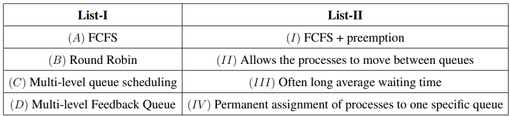
Match List-I with List-II:

Choose the correct answer from the options given below:

  • (1) (A) - (I), (B) - (II), (C) - (III), (D) - (IV)
  • (2) (A) - (III), (B) - (I), (C) - (IV), (D) - (II)
  • (3) (A) - (I), (B) - (III), (C) - (IV), (D) - (II)
  • (4) (A) - (III), (B) - (II), (C) - (IV), (D) - (I)

Question 47:

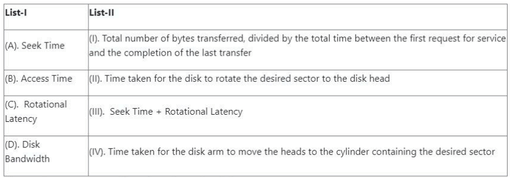
Match List-I with List-II:

Choose the correct answer from the options given below:

  • (1) (A) - (I), (B) - (II), (C) - (III), (D) - (IV)
  • (2) (A) - (III), (B) - (II), (C) - (IV), (D) - (I)
  • (3) (A) - (I), (B) - (III), (C) - (IV), (D) - (II)
  • (4) (A) - (IV), (B) - (III), (C) - (II), (D) - (I)

Question 48:

Consider a typical process P in the critical section. Arrange the following statements of code to make a valid general structure.

(A). Critical section
(B) . Remainder section
(C) . Entry section
(D) . Exit section


  • (1) (C), (B), (A), (D)
  • (2) (C), (A), (B), (D)
  • (3) (C), (A), (D), (B)
  • (4) (C), (B), (D), (A)

Question 49:

Arrange the following layers of MS DOS operating system starting from inner most to outer most.

(A). ROM BIOS Device drivers
(B) . Resident System Program
(C) . MS DOS Device Drivers
(D) . Application Program

  • (1) (A), (C), (B), (D)
  • (2) (B), (D), (C), (A)
  • (3) (B), (A), (C), (D)
  • (4) (C), (B), (A), (D)

Question 50:

Which of the following is not an application of DFS?

  • (1) Topological Sort
  • (2) Determining Strongly Connected Components in a graph
  • (3) Finding minimum distance to a node in an unweighted graph optimally
  • (4) Solving Maze Problem

Question 51:

Match List-I with List-II:

Choose the correct answer from the options given below:

  • (1) (A) - (IV), (B) - (II), (C) - (III), (D) - (I)
  • (2) (A) - (III), (B) - (I), (C) - (IV), (D) - (II)
  • (3) (A) - (I), (B) - (III), (C) - (IV), (D) - (II)
  • (4) (A) - (III), (B) - (IV), (C) - (II), (D) - (I)

Question 52:

In a binary search tree, the worst case time complexity of inserting and deleting a key is:

  • (1) \(O(\log n)\) for insertion and \(O(n)\) for deletion
  • (2) \(O(n)\) for insertion and \(O(\log n)\) for deletion
  • (3) \(O(n)\) for insertion and \(O(n)\) for deletion
  • (4) \(O(\log n)\) for insertion and \(O(n)\) for deletion

Question 53:

Match List-I with List-II:

Choose the correct answer from the options given below:

  • (1) (A) - (I), (B) - (II), (C) - (III), (D) - (IV)
  • (2) (A) - (III), (B) - (I), (C) - (IV), (D) - (II)
  • (3) (A) - (I), (B) - (III), (C) - (IV), (D) - (II)
  • (4) (A) - (III), (B) - (IV), (C) - (II), (D) - (I)

Question 54:

Arrange the following time complexities in increasing order.
(A). Bubble sort (worst case)
(B) . Deleting head node in singly linked list
(C) . Binary search
(D) . Worst case of merge sort

  • (1) (A), (B), (C), (D)
  • (2) (B), (C), (D), (A)
  • (3) (B), (C), (A), (D)
  • (4) (C), (B), (D), (A)

Question 55:

Which of the following statements are TRUE, where \(|E|\) represents the number of edges?

(A). In case of a directed graph, the sum of lengths of all the adjacency list is |E|
(B) . For an undirected graph, the sum of the lengths of all the adjacency list is 2|E|
(C) . For a dense graph, adjacency matrix representation is preferable
(D) . The memory requirement of the adjacency matrix of a graph is dependent on the number of edges

  • (1) (A), (B) and (D) only
  • (2) (A), (B) and (C) only
  • (3) (A), (B), (C) and (D)
  • (4) (A), (B) and (C) only

Question 56:

In ................. the search time is independent of the number of elements \(n\).

  • (1) Binary Search
  • (2) Hashing
  • (3) Linear Search
  • (4) Jump Search

Question 57:

Consider the task of finding the shortest path in an unweighted graph by using BFS and DFS.
Which of the following statements are true?

(A). BFS always finds the shortest path.
(B) . DFS always finds the shortest path.
(C) . DFS does not guarantee finding the shortest path.
(D) . BFS does not guarantee finding the shortest path.

  • (1) (B) and (D) only
  • (2) (A) and (C) only
  • (3) (A) and (B) only
  • (4) (C) and (D) only

Question 58:

In case of Binary Search Tree, which of the following procedure’s running time is distinct among all?

  • (1) TREE-SUCCESSOR (finds successor of the given node)
  • (2) TREE-MAXIMUM (finds the node with maximum value)
  • (3) INORDER-WALK (prints all elements of a tree in inorder manner)
  • (4) TREE-MINIMUM (finds the node with minimum value)

Question 59:

All the elements that hash to the same slot are placed into the same linked list in:

  • (1) Universal hashing
  • (2) Linear Probing
  • (3) Quadratic probing
  • (4) Chaining

Question 60:

The Quicksort and randomized Quicksort procedures differ in:

  • (1) Selection of Pivot element
  • (2) Worst case time complexity
  • (3) Best case time complexity
  • (4) Final Output

Question 61:


The statements of pseudocode for searching the first element with key k in the linked list L are given below. Arrange them in the correct order.

(A) while (x != NIL and x.key != k)
(B) x = L.head
(C) x = x.next
(D) return x

Choose the correct answer from the options given below:

  • (1) (B), (A), (C), (D)
  • (2) (A), (B), (C), (D)
  • (3) (C), (B), (A), (D)
  • (4) (C), (B), (D), (A)

Question 62:

Given the index i of a node in a heap, we can not compute:

  • (1) Parent(i)
  • (2) Heap size
  • (3) Left(i)
  • (4) Right(i)

Question 63:

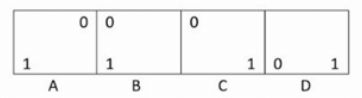
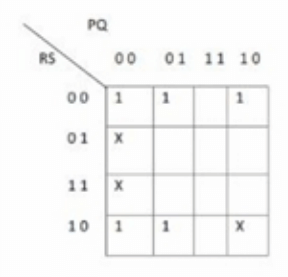
Consider the following Karnaugh Map (K-map). Minimal Function generated by this Karnaugh map is:
  • (1) \( Q.S + P.Q \)
  • (2) \( Q.S' + P.Q \)
  • (3) \( P.Q' + Q.S' + P.S \)
  • (4) \( P.Q + Q.S' + P.S' \)

Question 64:

Consider the following types of memories.

(A) Hard Disk Drive (HDD)
(B) Cache Memory
(C) Random Access Memory (RAM)
(D) Registers

Arrange the above memories according to their access speed (from fastest to slowest):

  • (1) (D), (C), (B), (A)
  • (2) (A), (C), (B), (D)
  • (3) (B), (C), (A), (D)
  • (4) (D), (B), (C), (A)

Question 65:

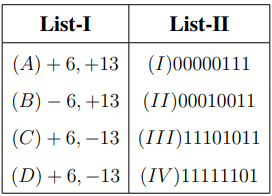
Perform the arithmetic addition of the two decimal numbers given in List-I using the signed-complement system.
Match the corresponding output of List-I with binary number representation given in List-II.
  • (1) (A) - (III), (B) - (I), (C) - (III), (D) - (IV)
  • (2) (A) - (II), (B) - (I), (C) - (II), (D) - (III)
  • (3) (A) - (I), (B) - (II), (C) - (III), (D) - (IV)
  • (4) (A) - (II), (B) - (IV), (C) - (I), (D) - (III)

Question 66:

Arrange the following steps in the correct order to understand the functioning of a 3 to 8 line decoder.

(A) The encoder enable input is set to 1.
(B) The decoder activates one of its 8 output lines based on the input code.
(C) The input binary code is applied to the decoder.
(D) The decoder converts the 3-bit binary input into 8 possible outputs.

  • (1) (A), (B), (C), (D)
  • (2) (A), (B), (C), (D)
  • (3) (C), (B), (A), (D)
  • (4) (A), (B), (C), (D)

Question 67:

What should be the minimum Hamming distance \( d_{min} \) to guarantee correction of up to p errors in a given block code?

  • (1) \( 2p \)
  • (2) \( 2p + 1 \)
  • (3) \( 2p - 1 \)
  • (4) \( 2^{p} \)

Question 68:

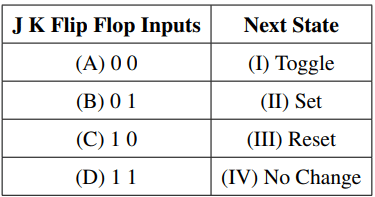
Consider the following statements.

(A) Combinational logic circuits do not have memory, while sequential logic circuits have memory elements.
(B) Sequential logic circuits depend only on the current inputs, while combinational logic circuits depend on both current and past inputs.
(C) Flip-flops and latches are examples of combinational logic circuits.
(D) Multiplexer is an example of combinational logic circuit.
  • (1) (A) and (D) only
  • (2) (A), (B), and (C) only
  • (3) (A), (B), (C) and (D)
  • (4) (A), (C) and (D) only

Question 69:

Match List-I with List-II.

  • (1) (A) - (I), (B) - (II), (C) - (III), (D) - (IV)
  • (2) (A) - (IV), (B) - (III), (C) - (II), (D) - (I)
  • (3) (A) - (I), (B) - (III), (C) - (IV), (D) - (II)
  • (4) (A) - (III), (B) - (IV), (C) - (I), (D) - (II)

Question 70:

What is the result of the following operation defined by IEEE754?
\[ (NaN == NaN) \]

  • (1) false
  • (2) true
  • (3) error
  • (4) 1

Question 71:

Which of the following statement is true about IEEE754 representation of +0 and -0?

  • (1) have the same sign bit, but different mantissa bits.
  • (2) differ only in the sign bit; their exponent and mantissa bits are identical.
  • (3) have the same representation because they are mathematically equivalent.
  • (4) differ in both their exponent and mantissa bits.

Question 72:

Minimum number of 2:1 Multiplexers required to design a 16:1 Multiplexer is?

  • (1) 12
  • (2) 14
  • (3) 15
  • (4) 16

Question 73:

What should be the output of the following boolean expression after simplifying it to a minimum number of variables? \[ a'b' + ab + a'b \]

  • (1) \( a + b' \)
  • (2) \( a' + b \)
  • (3) \( a'b' + b \)
  • (4) \( a + b \)

Question 74:

To provide a memory capacity of 32K X 16 how many address lines and data lines are required?

  • (1) address lines=14 , data lines=16
  • (2) address lines=15, data lines=16
  • (3) address lines=14, data lines=4
  • (4) address lines=15, data lines=4

Question 75:

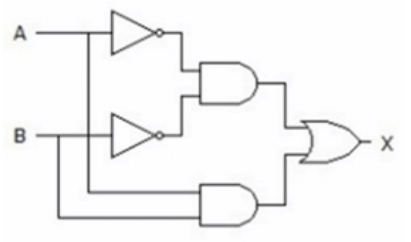
The following circuit generates the same output as?
  • (1) XOR GATE
  • (2) XNOR GATE
  • (3) NAND GATE
  • (4) NOR GATE

Fees Structure

Structure based on different categories

CategoriesState
General800
sc550

In case of any inaccuracy, Notify Us! 

Comments


No Comments To Show