The CUET PG Commerce Exam 2025 will be conducted from 13th May to 3rd June. After the exam, candidates can download the CUET 2025 Commerce question paper, answer key, and solution PDF. This test assesses core concepts such as accounting, business law, economics, financial management, auditing, taxation, and organizational behavior.
Students are required to attempt 75 MCQs in 60 minutes, with 4 marks for every correct response and a penalty of 1 mark for each incorrect answer.
CUET PG Commerce 2025 Question Paper with Solutions PDF
Question 1:
Compute the fiscal deficit from the given data: Total receipts are 13,500 crores and total expenditures are 15,000 crores. Revenue receipts are 3500 crores. Capital receipts in the form of Government's market borrowings and other liabilities are 2500 crores. Loan recoveries are 7500 crores.
- (1) 9000 crores
- (2) 4000 crores
- (3) 1500 crores
- (4) 5000 crores
Question 2:
Which of the following are revenue receipts of the Central Government?
- (A) GST
- (B) Provident Fund
- (C) Interest receipts
- (D) Recoveries of loans and advances from State Governments
Question 3:
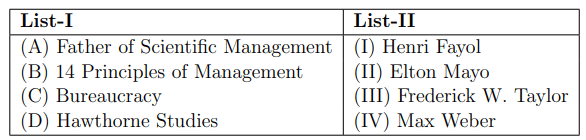
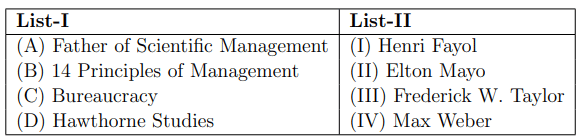
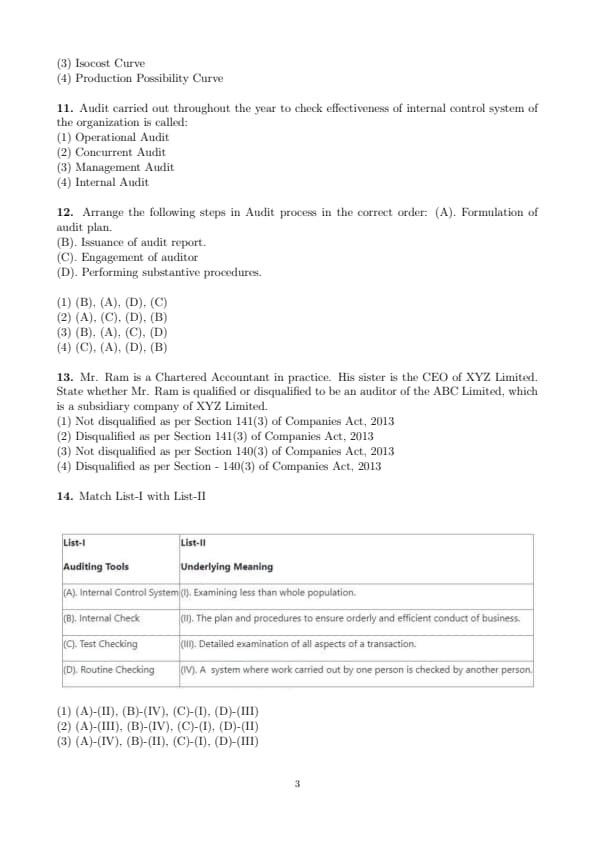
Match List-I (Management Theories/Principles) with List-II (Management Thinkers):
![]()
Choose the Correct one from the options given below:
- (1) (A)-(I), (B)-(III), (C)-(II), (D)-(IV)
- (2) (A)-(III), (B)-(I), (C)-(IV), (D)-(II)
- (3) (A)-(I), (B)-(II), (C)-(IV), (D)-(III)
- (4) (A)-(III), (B)-(IV), (C)-(I), (D)-(II)
Question 4:
Who is the most well-known advocate of the Classical View of Social Responsibility stating that "Management's only social responsibility is to maximize profits"?
- (1) John Elkinton
- (2) Edward Freeman
- (3) Milton Friedman
- (4) Henry Mintzberg
Question 5:
Goal-setting is an integral part of planning function of management. Arrange the following steps involved in the goal-setting process in the correct order.
- (A) Evaluate available resources
- (B) Review the organization's mission
- (C) Review results
- (D) Determine specific & measurable goals and communicate them
Question 6:
Arrange the following in an organization's human resource management process in the correct order:
- (A) Recruitment
- (B) Performance Management
- (C) Orientation
- (D) Selection
Question 7:
The demand curve for a product is given by: \( Q = 900 - 40P \). Where \( Q \) is the quantity and \( P \) is the price of the product. The price of the product is Rs. 15. What is the price elasticity of demand if the price increases to Rs. 20?
Question 8:
Which of the following statements is incorrect?
- (1) Indifference curves are downward sloping
- (2) Indifference curves intersect each other
- (3) Indifference curves are usually convex
- (4) Consumer preferences are assumed to be transitive
Question 9:
Which of the following are the features of perfect competition?
- (A) Product Heterogeneity
- (B) Free entry and exit of firms
- (C) The firm is a price maker
- (D) Large number of buyers and sellers
Question 10:
At a given cost level, a graph which shows combinations of labor and capital that can be used to produce is called:
- (1) Indifference Curve
- (2) Budget Line
- (3) Isocost Curve
- (4) Production Possibility Curve
Question 11:
Audit carried out throughout the year to check effectiveness of internal control system of the organization is called:
- (1) Operational Audit
- (2) Concurrent Audit
- (3) Management Audit
- (4) Internal Audit
Question 12:
Arrange the following steps in Audit process in the correct order:
- (A) . Formulation of audit plan.
- (B) . Issuance of audit report.
- (C) . Engagement of auditor
- (D) . Performing substantive procedures.
- Choose the Correct one from the options given below:
- (1) (B), (A), (D), (C)
- (2) (A), (C), (D), (B)
- (3) (B), (A), (C), (D)
- (4) (C), (A), (D), (B)
Question 13:
Mr. Ram is a Chartered Accountant in practice. His sister is the CEO of XYZ Limited. State whether Mr. Ram is qualified or disqualified to be an auditor of the ABC Limited, which is a subsidiary company of XYZ Limited.
- (1) Not disqualified as per Section 141(3) of Companies Act, 2013
- (2) Disqualified as per Section 141(3) of Companies Act, 2013
- (3) Not disqualified as per Section 140(3) of Companies Act, 2013
- (4) Disqualified as per Section - 140(3) of Companies Act, 2013
Question 14:
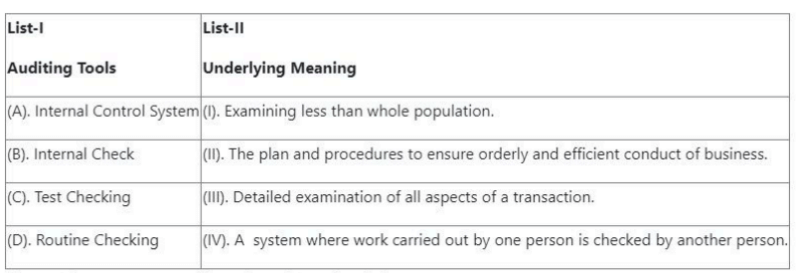
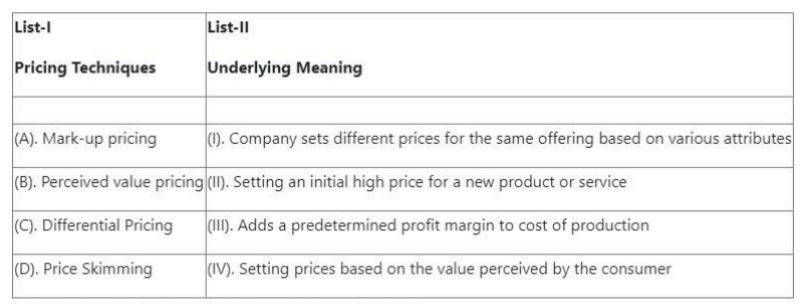
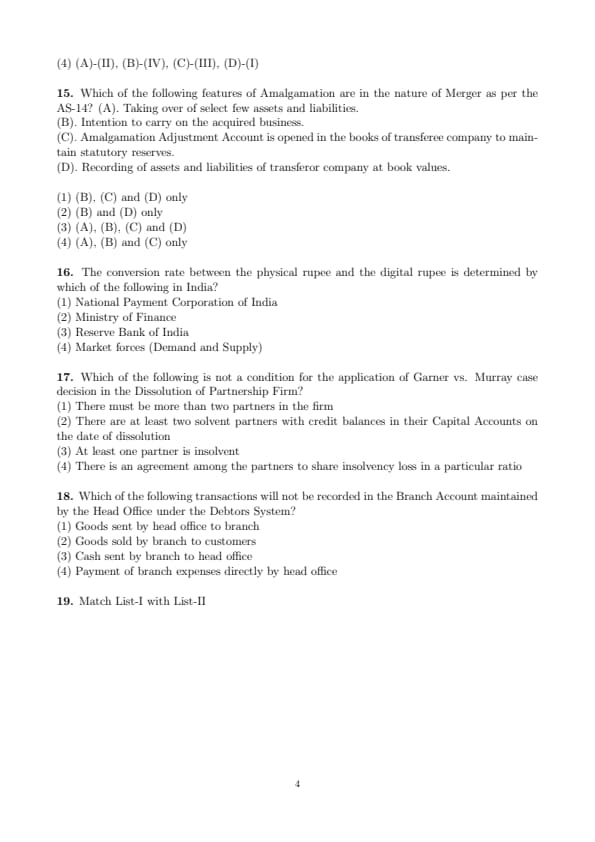
Match List-I with List-II
![]()
Choose the Correct one from the options given below:
- (1) (A)-(II), (B)-(IV), (C)-(I), (D)-(III)
- (2) (A)-(III), (B)-(IV), (C)-(I), (D)-(II)
- (3) (A)-(IV), (B)-(II), (C)-(I), (D)-(III)
- (4) (A)-(II), (B)-(IV), (C)-(III), (D)-(I)
Question 15:
Which of the following features of Amalgamation are in the nature of Merger as per the AS-14?
- (A) . Taking over of select few assets and liabilities.
- (B) . Intention to carry on the acquired business.
- (C) . Amalgamation Adjustment Account is opened in the books of transferee company to maintain statutory reserves.
- (D) . Recording of assets and liabilities of transferor company at book values.
Choose the Correct one from the options given below:
- (1) (B), (C) and (D) only
- (2) (B) and (D) only
- (3) (A), (B), (C) and (D)
- (4) (A), (B) and (C) only
Question 16:
The conversion rate between the physical rupee and the digital rupee is determined by which of the following in India?
- (1) National Payment Corporation of India
- (2) Ministry of Finance
- (3) Reserve Bank of India
- (4) Market forces (Demand and Supply)
Question 17:
Which of the following is not a condition for the application of Garner vs. Murray case decision in the Dissolution of Partnership Firm?
- (1) There must be more than two partners in the firm
- (2) There are at least two solvent partners with credit balances in their Capital Accounts on the date of dissolution
- (3) At least one partner is insolvent
- (4) There is an agreement among the partners to share insolvency loss in a particular ratio
Question 18:
Which of the following transactions will not be recorded in the Branch Account maintained by the Head Office under the Debtors System?
- (1) Goods sent by head office to branch
- (2) Goods sold by branch to customers
- (3) Cash sent by branch to head office
- (4) Payment of branch expenses directly by head office
Question 19:
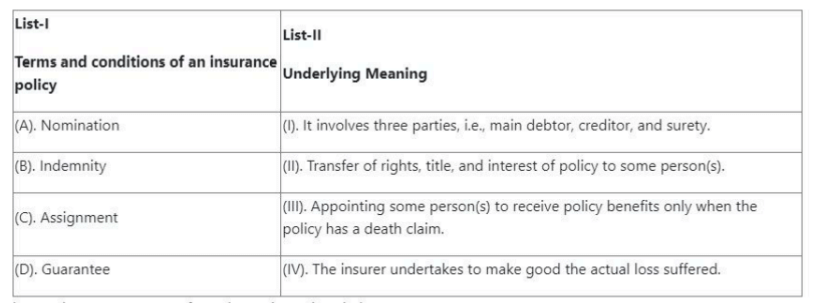
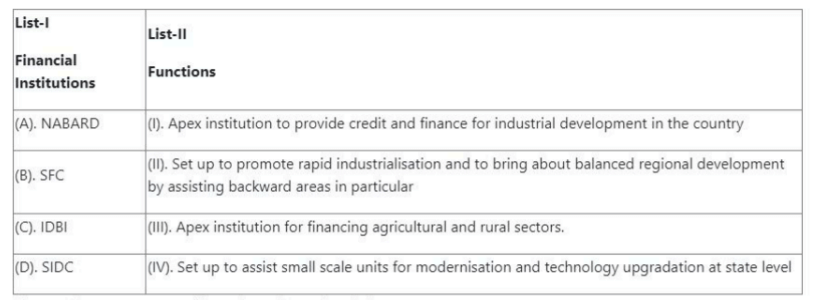
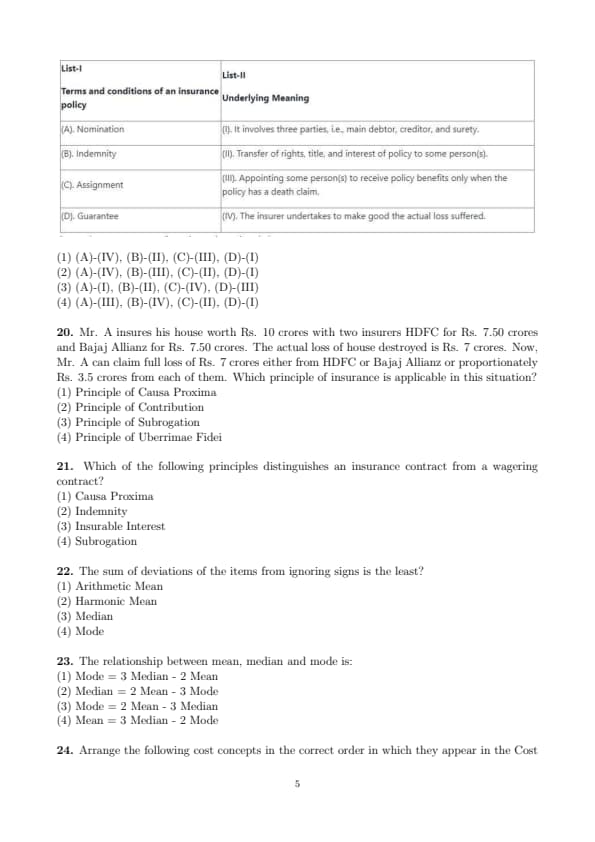
Match List-I with List-II
![]()
Choose the Correct one from the options given below:
- (1) (A)-(IV), (B)-(II), (C)-(III), (D)-(I)
- (2) (A)-(IV), (B)-(III), (C)-(II), (D)-(I)
- (3) (A)-(I), (B)-(II), (C)-(IV), (D)-(III)
- (4) (A)-(III), (B)-(IV), (C)-(II), (D)-(I)
Question 20:
Mr. A insures his house worth Rs. 10 crores with two insurers HDFC for Rs. 7.50 crores and Bajaj Allianz for Rs. 7.50 crores. The actual loss of house destroyed is Rs. 7 crores. Now, Mr. A can claim full loss of Rs. 7 crores either from HDFC or Bajaj Allianz or proportionately Rs. 3.5 crores from each of them.
Which principle of insurance is applicable in this situation?
- (1) Principle of Causa Proxima
- (2) Principle of Contribution
- (3) Principle of Subrogation
- (4) Principle of Uberrimae Fidei
Question 21:
Which of the following principles distinguishes an insurance contract from a wagering contract?
- (1) Causa Proxima
- (2) Indemnity
- (3) Insurable Interest
- (4) Subrogation
Question 22:
The sum of deviations of the items from ignoring signs is the least?
- (1) Arithmetic Mean
- (2) Harmonic Mean
- (3) Median
- (4) Mode
Question 23:
The relationship between mean, median and mode is:
- (1) Mode = 3 Median - 2 Mean
- (2) Median = 2 Mean - 3 Mode
- (3) Mode = 2 Mean - 3 Median
- (4) Mean = 3 Median - 2 Mode
Question 24:
Arrange the following cost concepts in the correct order in which they appear in the Cost Sheet.
- (A) Works Cost
- (B) Cost of Sales
- (C) Prime Cost
- (D) Cost of Production
Choose the Correct one from the options given below:
- (1) (A), (C), (B), (D)
- (2) (C), (A), (B), (D)
- (3) (A), (C), (D), (B)
- (4) (C), (A), (D), (B)
Question 25:
In a factory 1,000 workers were idle because of a power failure. As a result, a loss of production of 2,000 units of Product X and 4,000 units of Product Y occurred. Each employee was paid a normal wage at the rate of Rs. 100 per hour. One standard hour is required to manufacture five units of Product X and four units of Product Y. How much is the Idle Time Variance due to power failure?
- (1) Rs. 1,40,000 (Adverse)
- (2) Rs. 1,00,000 (Adverse)
- (3) Rs. 6,00,000 (Adverse)
- (4) Rs. 2,40,000 (Adverse)
Question 26:
Arrange the following needs in the order in which they appear in the Maslow's Hierarchy of Needs, starting from bottom to top.
- (A) Social
- (B) Physiological
- (C) Esteem
- (D) Safety
Choose the Correct one from the options given below:
- (1) (B), (D), (A), (C)
- (2) (B), (D), (C), (A)
- (3) (D), (B), (A), (C)
- (4) (D), (B), (C), (A)
Question 27:
Disbursing organisational authority for making decisions in an organised structure is called:
- (1) Decentralization of authority
- (2) Centralisation of authority
- (3) Delegation of power
- (4) Differentiation of authority
Question 28:
As per the scalar principle, which term is used for the relationship in which a superior exercises direct supervision over a subordinate?
- (1) Staff Relationship
- (2) Line authority
- (3) Discipline
- (4) Unity of Command
Question 29:
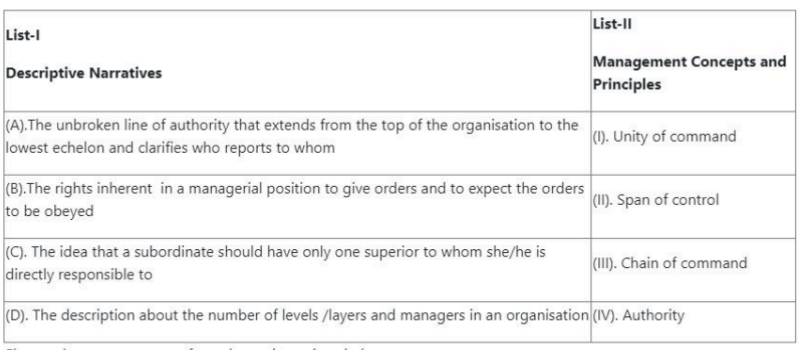
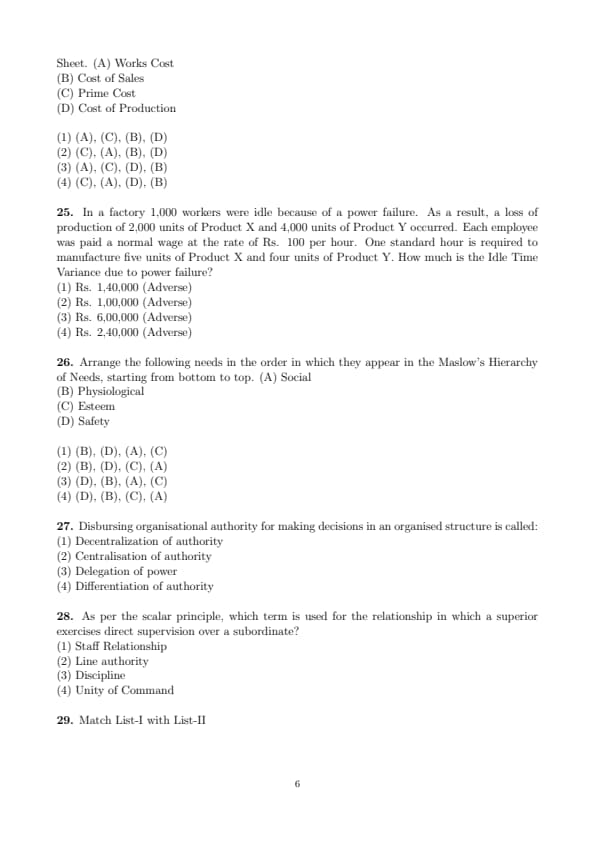
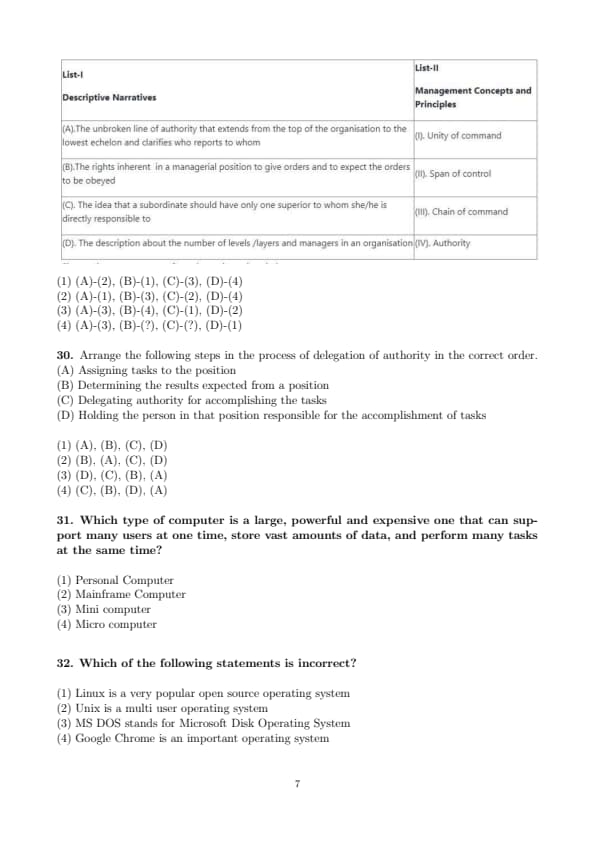
Match List-I with List-II
![]()
Choose the Correct one from the options given below:
- (1) (A)-(2), (B)-(1), (C)-(3), (D)-(4)
- (2) (A)-(1), (B)-(3), (C)-(2), (D)-(4)
- (3) (A)-(3), (B)-(4), (C)-(1), (D)-(2)
- (4) (A)-(3), (B)-(?), (C)-(?), (D)-(1)
Question 30:
Arrange the following steps in the process of delegation of authority in the correct order.
- (A) Assigning tasks to the position
- (B) Determining the results expected from a position
- (C) Delegating authority for accomplishing the tasks
- (D) Holding the person in that position responsible for the accomplishment of tasks
Choose the Correct one from the options given below:
- (1) (A), (B), (C), (D)
- (2) (B), (A), (C), (D)
- (3) (D), (C), (B), (A)
- (4) (C), (B), (D), (A)
Question 31:
Which type of computer is a large, powerful and expensive one that can support many users at one time, store vast amounts of data, and perform many tasks at the same time?
- (1) Personal Computer
- (2) Mainframe Computer
- (3) Mini computer
- (4) Micro computer
Question 32:
Which of the following statements is incorrect?
- (1) Linux is a very popular open source operating system
- (2) Unix is a multi user operating system
- (3) MS DOS stands for Microsoft Disk Operating System
- (4) Google Chrome is an important operating system
Question 33:
Which of the following statements are correct?
- (A) When a cyclical pattern in data has a period of less than 1 year, the pattern in data is called seasonal variation
- (B) When a cyclical pattern has a period more than 1 year, we refer to it as cyclical variation
- (C) Seasonality is considered equivalent to forecasting
- (D) Cyclical behaviour in business is also termed as business cycle
Choose the Correct one from the options given below:
- (1) (A), (B) and (D) only
- (2) (A) and (C) only
- (3) (A), (B), (C) and (D)
- (4) (B), (C) and (D) only
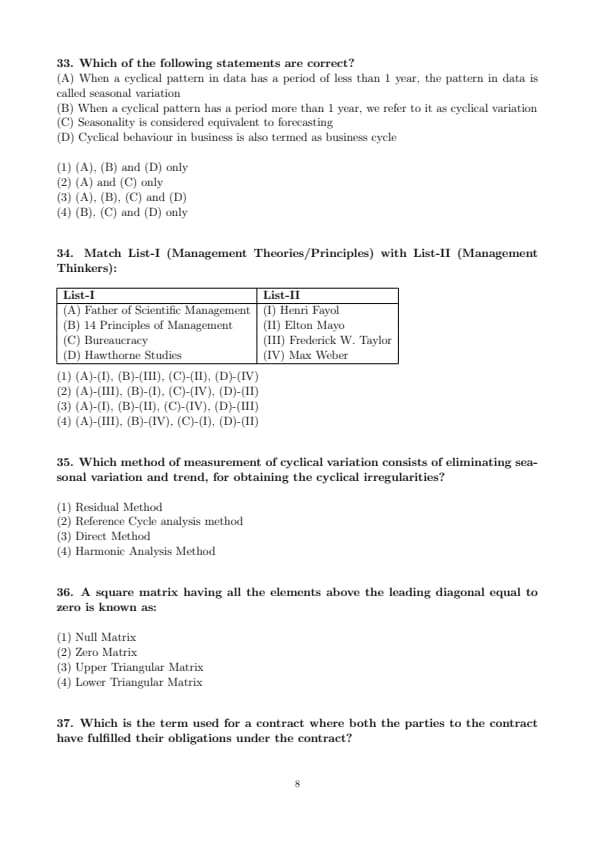
Question 34:
Match List-I (Management Theories/Principles) with List-II (Management Thinkers):
![]()
Choose the Correct one from the options given below:
- (1) (A)-(I), (B)-(III), (C)-(II), (D)-(IV)
- (2) (A)-(III), (B)-(I), (C)-(IV), (D)-(II)
- (3) (A)-(I), (B)-(II), (C)-(IV), (D)-(III)
- (4) (A)-(III), (B)-(IV), (C)-(I), (D)-(II)
Question 35:
Which method of measurement of cyclical variation consists of eliminating seasonal variation and trend, for obtaining the cyclical irregularities?
- (1) Residual Method
- (2) Reference Cycle analysis method
- (3) Direct Method
- (4) Harmonic Analysis Method
Question 36:
A square matrix having all the elements above the leading diagonal equal to zero is known as:
- (1) Null Matrix
- (2) Zero Matrix
- (3) Upper Triangular Matrix
- (4) Lower Triangular Matrix
Question 37:
Which is the term used for a contract where both the parties to the contract have fulfilled their obligations under the contract?
- (1) Executed Contract
- (2) Unilateral Contract
- (3) Reciprocal contract
- (4) Quasi Contract
Question 38:
In a contract of sale, there is no implied condition as to quality or fitness for any particular purpose of goods supplied. According to which rule, it is the duty of buyer to see and satisfy whether the goods purchased will be suitable for his purpose or not?
- (1) Express Condition
- (2) Let the seller beware
- (3) Caveat Emptor
- (4) Contingent Warranty
Question 39:
Which of the following are true statements relating to delivery of goods?
- (A) Delivery and payment are concurrent conditions
- (B) Delivery may be actual, symbolic or constructive
- (C) Delivery may be at any time of the day only
- (D) Delivery of wrong quality
Choose the Correct one from the options given below:
- (1) (A), (B) and (D) only
- (2) (A) and (B) only
- (3) (A), (B), (C) and (D)
- (4) (B), (C), and (D) only
Question 40:
Which of the following tests are often employed to measure advertising effectiveness?
- (A) Recognition test
- (B) Inquiry test
- (C) Reason-why test
- (D) Sales test
Choose the Correct one from the options given below:
- (1) (A), (B) and (C) only
- (2) (A), (B) and (D) only
- (3) (A), (B), (C) and (D)
- (4) (B), (C) and (D) only
Question 41:
"Every person dealing with the company is presumed to have read the memorandum and articles of associations and understood them in their true perspective, irrespective of the fact whether one has actually read them or not." The underlying doctrine in this regard is known as
- (1) Doctrine of Indoor Management
- (2) Doctrine of Constructive Notice
- (3) Doctrine of Lapse
- (4) Doctrine of Outdoor Management
Question 42:
Which of the following lays down that the affairs of the company are conducted perfectly consistent with the articles of association of the company, consequently the persons dealing with them are not to be affected by any irregularity which might have taken place in the management of the company?
- (1) Doctrine of Indoor Management
- (2) Doctrine of Lapse
- (3) Doctrine of Constructive Notice
- (4) Doctrine of Top Management
Question 43:
Which of the following generative AI applications is considered as the most disruptive?
- (1) Chat GPT
- (2) Gemini
- (3) Copilot
- (4) Deepseek
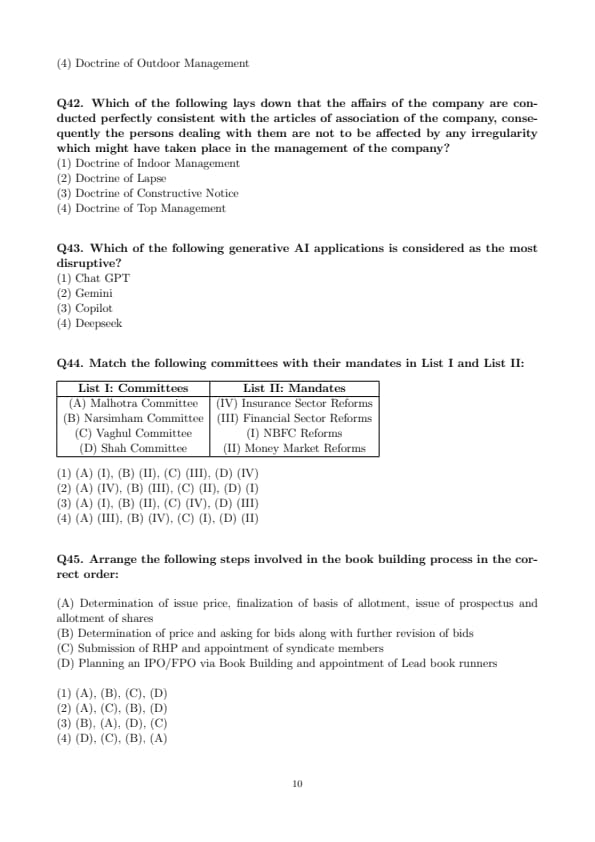
Question 44:
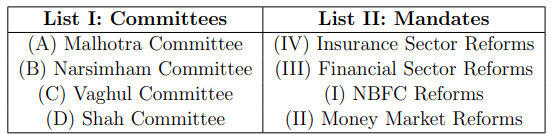
Match the following committees with their mandates in List I and List II:
![]()
Choose the Correct one from the options given below:
- (1) (A) (I), (B) (II), (C) (III), (D) (IV)
- (2) (A) (IV), (B) (III), (C) (II), (D) (I)
- (3) (A) (I), (B) (II), (C) (IV), (D) (III)
- (4) (A) (III), (B) (IV), (C) (I), (D) (II)
Question 45:
Arrange the following steps involved in the book building process in the correct order:
- (A) Determination of issue price, finalization of basis of allotment, issue of prospectus and allotment of shares
- (B) Determination of price and asking for bids along with further revision of bids
- (C) Submission of RHP and appointment of syndicate members
- (D) Planning an IPO/FPO via Book Building and appointment of Lead book runners
Choose the Correct one from the options given below:
- (1) (A), (B), (C), (D)
- (2) (A), (C), (B), (D)
- (3) (B), (A), (D), (C)
- (4) (D), (C), (B), (A)
Question 46:
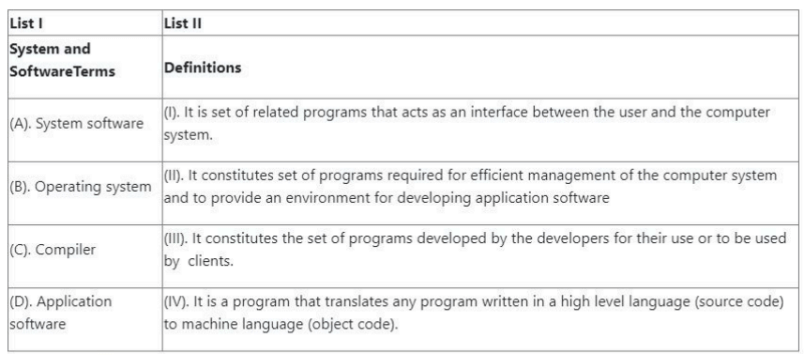
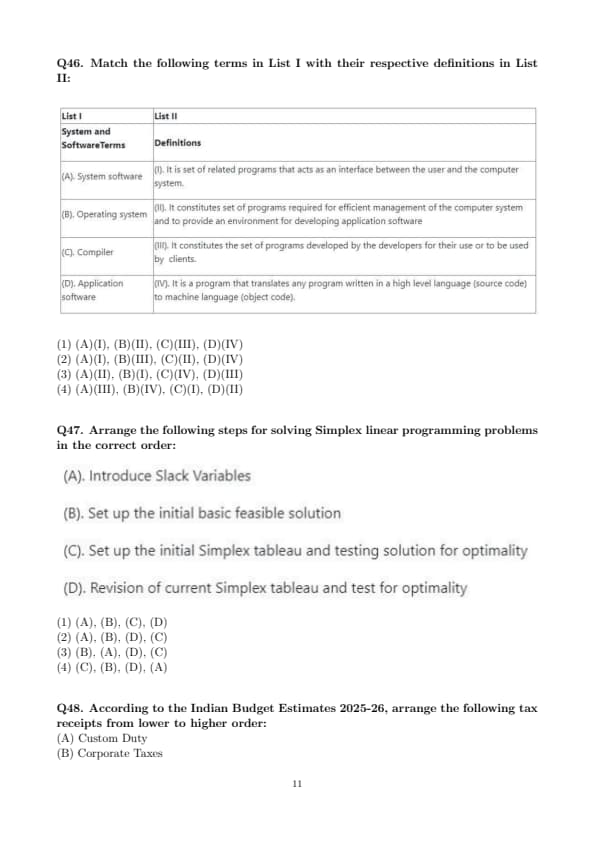
Match the following terms in List I with their respective definitions in List II:
![]()
Choose the Correct one from the options given below:
- (1) (A)(I), (B)(II), (C)(III), (D)(IV)
- (2) (A)(I), (B)(III), (C)(II), (D)(IV)
- (3) (A)(II), (B)(I), (C)(IV), (D)(III)
- (4) (A)(III), (B)(IV), (C)(I), (D)(II)
Question 47:
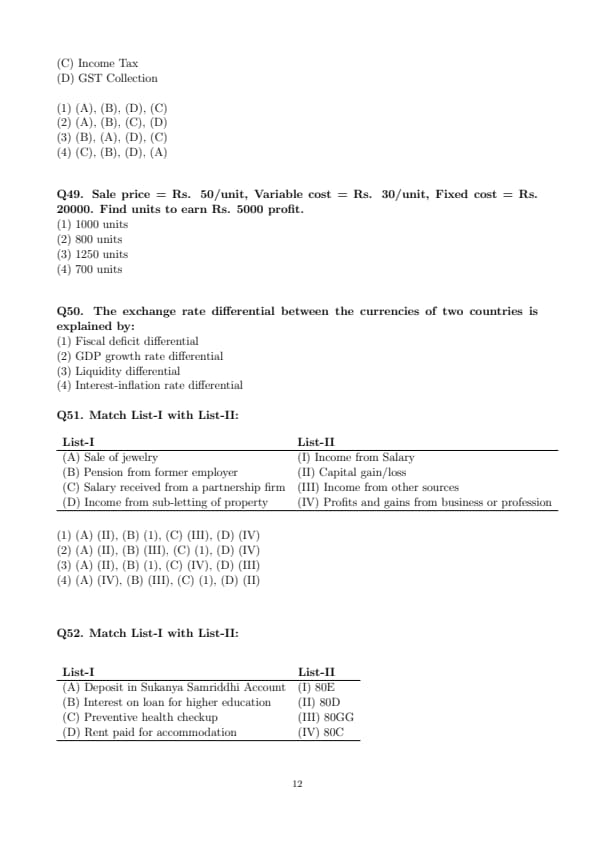
Arrange the following steps for solving Simplex linear programming problems in the correct order:
![]()
- (1) (A), (B), (C), (D)
- (2) (A), (B), (D), (C)
- (3) (B), (A), (D), (C)
- (4) (C), (B), (D), (A)
Question 48:
According to the Indian Budget Estimates 2025-26, arrange the following tax receipts from lower to higher order:
(A) Custom Duty
(B) Corporate Taxes
(C) Income Tax
(D) GST Collection
Choose the Correct one from the options given below:
- (1) (A), (B), (D), (C)
- (2) (A), (B), (C), (D)
- (3) (B), (A), (D), (C)
- (4) (C), (B), (D), (A)
Question 49:
Sale price = Rs. 50/unit, Variable cost = Rs. 30/unit, Fixed cost = Rs. 20000. Find units to earn Rs. 5000 profit.
- (1) 1000 units
- (2) 800 units
- (3) 1250 units
- (4) 700 units
Question 50:
The exchange rate differential between the currencies of two countries is explained by:
- (1) Fiscal deficit differential
- (2) GDP growth rate differential
- (3) Liquidity differential
- (4) Interest-inflation rate differential
Question 51:
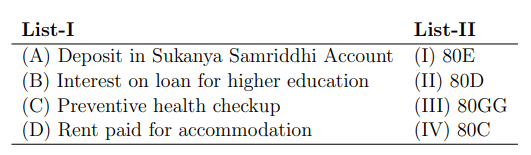
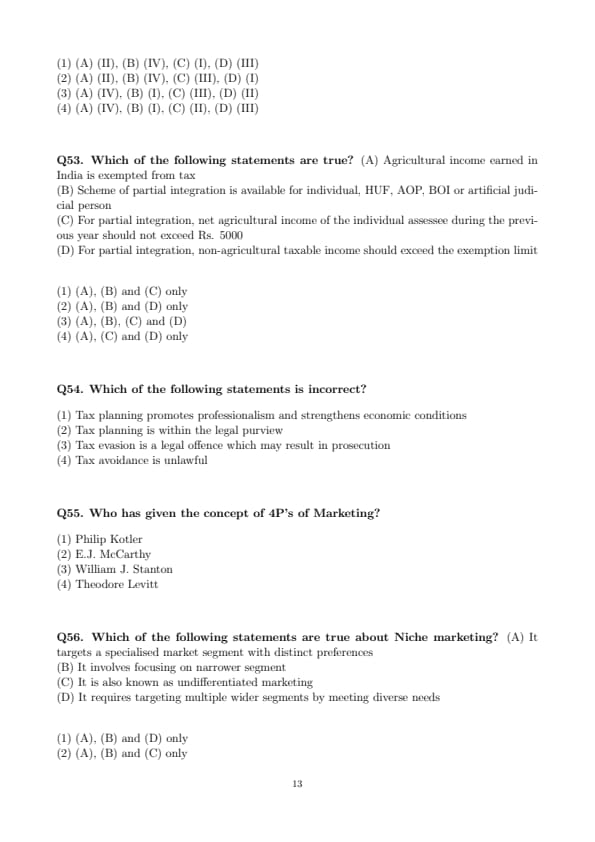
Match List-I with List-II:
![]()
Choose the Correct one from the options given below:
- (1) (A) (II), (B) (1), (C) (III), (D) (IV)
- (2) (A) (II), (B) (III), (C) (1), (D) (IV)
- (3) (A) (II), (B) (1), (C) (IV), (D) (III)
- (4) (A) (IV), (B) (III), (C) (1), (D) (II)
Question 52:
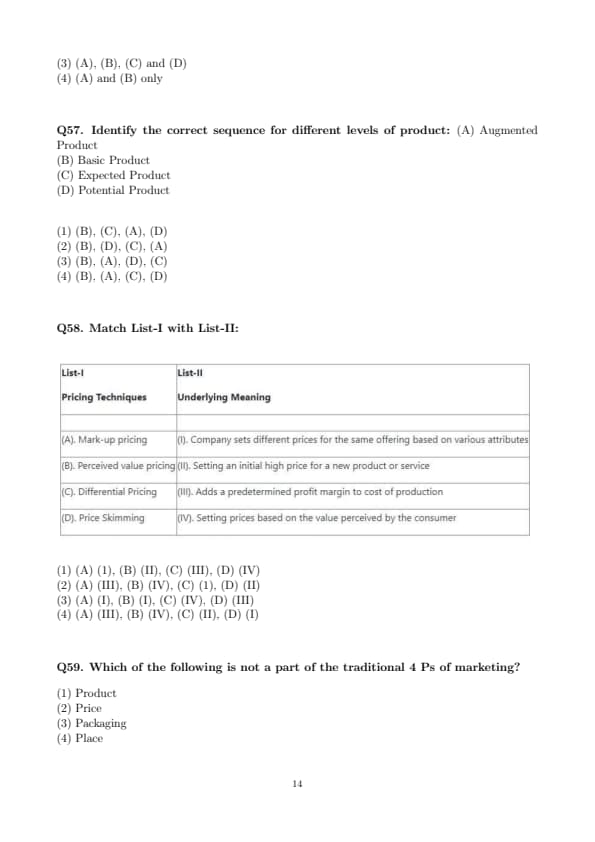
Match List-I with List-II:
![]()
Choose the Correct one from the options given below:
- (1) (A) (II), (B) (IV), (C) (I), (D) (III)
- (2) (A) (II), (B) (IV), (C) (III), (D) (I)
- (3) (A) (IV), (B) (I), (C) (III), (D) (II)
- (4) (A) (IV), (B) (I), (C) (II), (D) (III)
Question 53:
Which of the following statements are true?
- (A) Agricultural income earned in India is exempted from tax
- (B) Scheme of partial integration is available for individual, HUF, AOP, BOI or artificial judicial person
- (C) For partial integration, net agricultural income of the individual assessee during the previous year should not exceed Rs. 5000
- (D) For partial integration, non-agricultural taxable income should exceed the exemption limit
Choose the Correct one from the options given below:
- (1) (A), (B) and (C) only
- (2) (A), (B) and (D) only
- (3) (A), (B), (C) and (D)
- (4) (A), (C) and (D) only
Question 54:
Which of the following statements is incorrect?
- (1) Tax planning promotes professionalism and strengthens economic conditions
- (2) Tax planning is within the legal purview
- (3) Tax evasion is a legal offence which may result in prosecution
- (4) Tax avoidance is unlawful
Question 55:
Who has given the concept of 4P's of Marketing?
- (1) Philip Kotler
- (2) E.J. McCarthy
- (3) William J. Stanton
- (4) Theodore Levitt
Question 56:
Which of the following statements are true about Niche marketing?
- (A) It targets a specialised market segment with distinct preferences
- (B) It involves focusing on narrower segment
- (C) It is also known as undifferentiated marketing
- (D) It requires targeting multiple wider segments by meeting diverse needs
Choose the Correct one from the options given below:
- (1) (A), (B) and (D) only
- (2) (A), (B) and (C) only
- (3) (A), (B), (C) and (D)
- (4) (A) and (B) only
Question 57:
Identify the correct sequence for different levels of product:
- (A) Augmented Product
- (B) Basic Product
- (C) Expected Product
- (D) Potential Product
Choose the Correct one from the options given below:
- (1) (B), (C), (A), (D)
- (2) (B), (D), (C), (A)
- (3) (B), (A), (D), (C)
- (4) (B), (A), (C), (D)
Question 58:
Match List-I with List-II:
![]()
Choose the Correct one from the options given below:
- (1) (A) (1), (B) (II), (C) (III), (D) (IV)
- (2) (A) (III), (B) (IV), (C) (1), (D) (II)
- (3) (A) (I), (B) (I), (C) (IV), (D) (III)
- (4) (A) (III), (B) (IV), (C) (II), (D) (I)
Question 59:
Which of the following is not a part of the traditional 4 Ps of marketing?
- (1) Product
- (2) Price
- (3) Packaging
- (4) Place
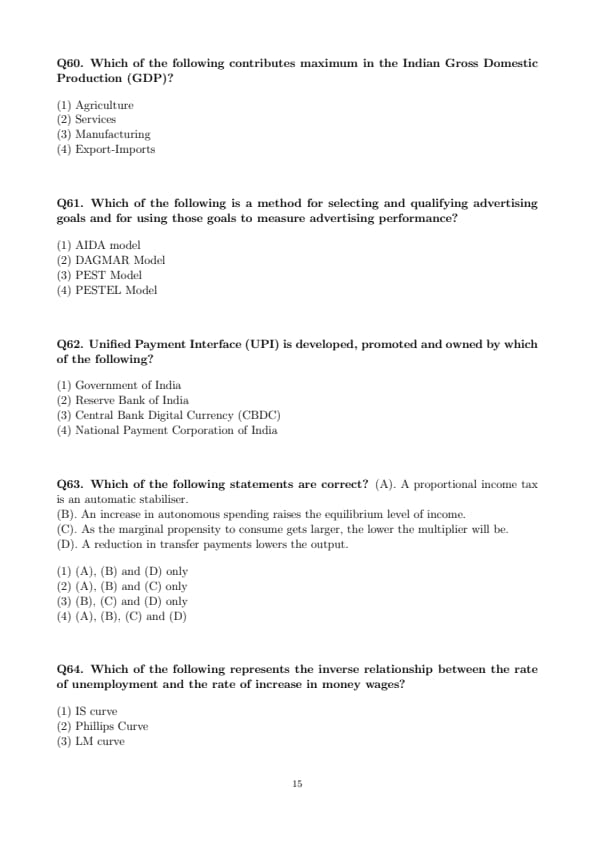
Question 60:
Which of the following contributes maximum in the Indian Gross Domestic Production (GDP)?
- (1) Agriculture
- (2) Services
- (3) Manufacturing
- (4) Export-Imports
Question 61:
Which of the following is a method for selecting and qualifying advertising goals and for using those goals to measure advertising performance?
- (1) AIDA model
- (2) DAGMAR Model
- (3) PEST Model
- (4) PESTEL Model
Question 62:
Unified Payment Interface (UPI) is developed, promoted and owned by which of the following?
- (1) Government of India
- (2) Reserve Bank of India
- (3) Central Bank Digital Currency (CBDC)
- (4) National Payment Corporation of India
Question 63:
Which of the following statements are correct?
- (A) . A proportional income tax is an automatic stabiliser.
- (B) . An increase in autonomous spending raises the equilibrium level of income.
- (C) . As the marginal propensity to consume gets larger, the lower the multiplier will be.
- (D) . A reduction in transfer payments lowers the output.
Choose the Correct one from the options given below:
- (1) (A), (B) and (D) only
- (2) (A), (B) and (C) only
- (3) (B), (C) and (D) only
- (4) (A), (B), (C) and (D)
Question 64:
Which of the following represents the inverse relationship between the rate of unemployment and the rate of increase in money wages?
- (1) IS curve
- (2) Phillips Curve
- (3) LM curve
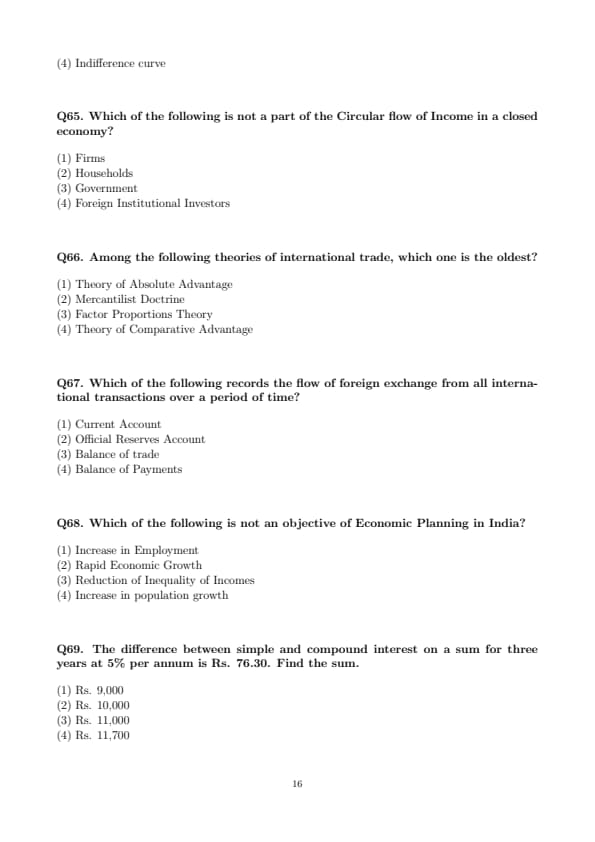
- (4) Indifference curve
Question 65:
Which of the following is not a part of the Circular flow of Income in a closed economy?
- (1) Firms
- (2) Households
- (3) Government
- (4) Foreign Institutional Investors
Question 66:
Among the following theories of international trade, which one is the oldest?
- (1) Theory of Absolute Advantage
- (2) Mercantilist Doctrine
- (3) Factor Proportions Theory
- (4) Theory of Comparative Advantage
Question 67:
Which of the following records the flow of foreign exchange from all international transactions over a period of time?
- (1) Current Account
- (2) Official Reserves Account
- (3) Balance of trade
- (4) Balance of Payments
Question 68:
Which of the following is not an objective of Economic Planning in India?
- (1) Increase in Employment
- (2) Rapid Economic Growth
- (3) Reduction of Inequality of Incomes
- (4) Increase in population growth
Question 69:
The difference between simple and compound interest on a sum for three years at 5% per annum is Rs. 76.30. Find the sum.
- (1) Rs. 9,000
- (2) Rs. 10,000
- (3) Rs. 11,000
- (4) Rs. 11,700
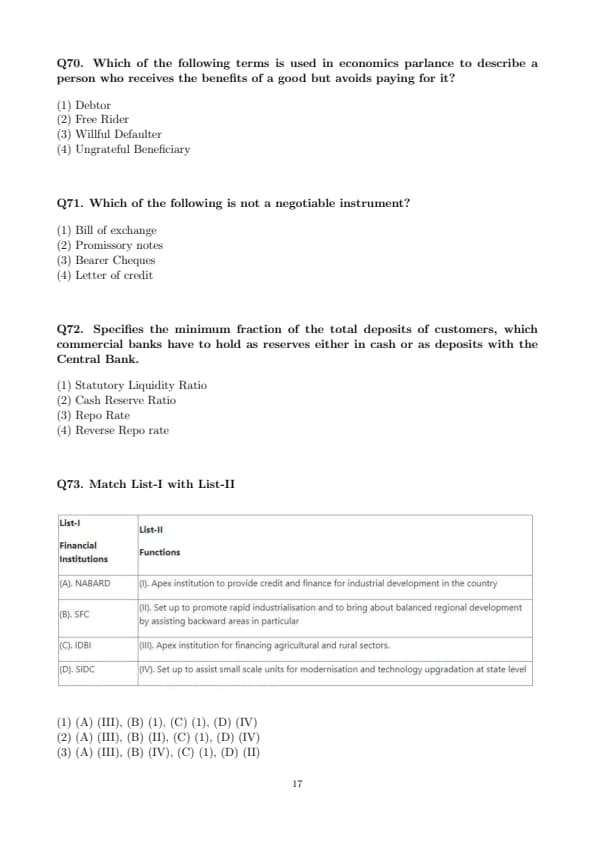
Question 70:
Which of the following terms is used in economics parlance to describe a person who receives the benefits of a good but avoids paying for it?
- (1) Debtor
- (2) Free Rider
- (3) Willful Defaulter
- (4) Ungrateful Beneficiary
Question 71:
Which of the following is not a negotiable instrument?
- (1) Bill of exchange
- (2) Promissory notes
- (3) Bearer Cheques
- (4) Letter of credit
Question 72:
Specifies the minimum fraction of the total deposits of customers, which commercial banks have to hold as reserves either in cash or as deposits with the Central Bank.
- (1) Statutory Liquidity Ratio
- (2) Cash Reserve Ratio
- (3) Repo Rate
- (4) Reverse Repo rate
Question 73:
Match List-I with List-II
![]()
Choose the Correct one from the options given below:
- (1) (A) (III), (B) (1), (C) (1), (D) (IV)
- (2) (A) (III), (B) (II), (C) (1), (D) (IV)
- (3) (A) (III), (B) (IV), (C) (1), (D) (II)
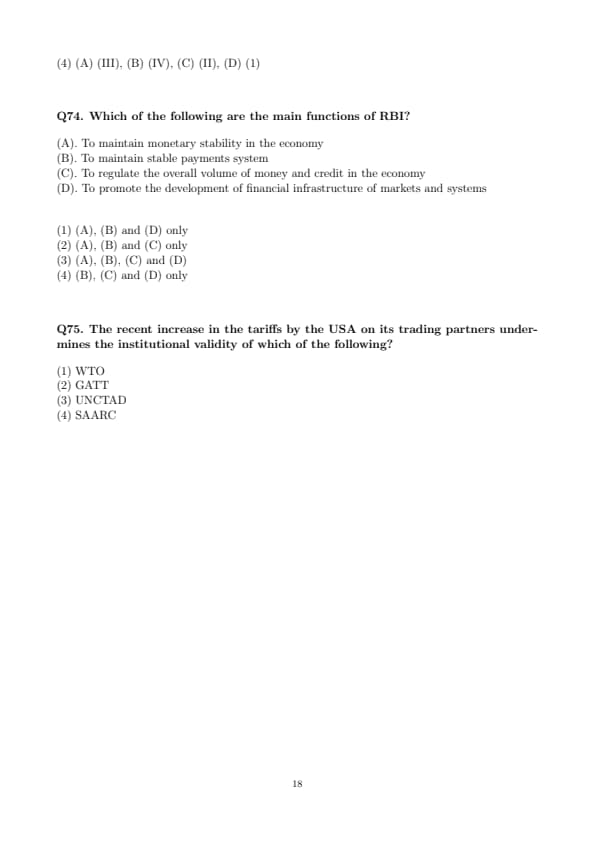
- (4) (A) (III), (B) (IV), (C) (II), (D) (1)
Question 74:
Which of the following are the main functions of RBI?
- (A) . To maintain monetary stability in the economy
- (B) . To maintain stable payments system
- (C) . To regulate the overall volume of money and credit in the economy
- (D) . To promote the development of financial infrastructure of markets and systems
Choose the Correct one from the options given below:
- (1) (A), (B) and (D) only
- (2) (A), (B) and (C) only
- (3) (A), (B), (C) and (D)
- (4) (B), (C) and (D) only
Question 75:
The recent increase in the tariffs by the USA on its trading partners undermines the institutional validity of which of the following?
- (1) WTO
- (2) GATT
- (3) UNCTAD
- (4) SAARC










Comments