




The CUET PG Bioinformatics exam in 2025 was scheduled to be conducted between 13th May and 3rd June. After the exam, candidates can download the official question paper, answer key, and detailed solution PDF for reference. The exam evaluates a candidate’s knowledge of molecular biology, genomics, proteomics, programming in bioinformatics, biological databases, algorithms, and biostatistics relevant to the field of bioinformatics.
Candidates must attempt 75 questions in 60 minutes, with a total of 300 marks. Each correct answer carries 4 marks, while 1 mark is deducted for every incorrect response.
CUET PG Bioinformatics 2025 Question Paper with Answer Key PDF
| CUET PG Bioinformatics Question Paper with Solutions PDF | Download PDF | Check Solutions |
CUET PG Bioinformatics 2025 Question Paper with Solutions
Which of the following relationships is/are not true?
(A). Most probable velocity = \( \sqrt{\frac{2RT}{M}} \)
(B). \( PV = \frac{2}{3}kT \)
(C). Compressibility factor \( Z = \frac{PV}{nRT} \)
(D). Average kinetic energy of gas = \( \frac{1}{2}kT \)
Choose the correct answer from the options given below
Match List-I with List-II
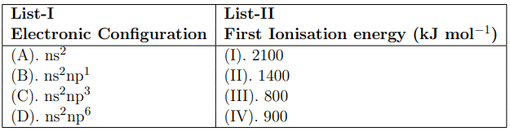
Choose the correct answer from the options given below:
The shielding constant of a 2p electron (calculated using Slater's rules) is
Match List-I with List-II
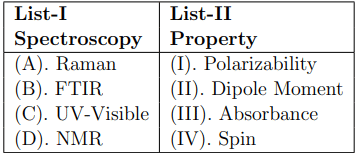
Choose the correct answer from the options given below:
The structure of protein comprises of:
(A). Primary structure of protein is associated with amino acids
(B). Secondary structure of protein is associated to peptides
(C). Tertiary structure of protein is associated with polypeptide chains
(D). Quaternary structure of protein is associated with polypeptide chains
Choose the correct answer from the options given below:
In a chromatographic analysis of lemon oil a peak for limonene has a retention time of 8.36 min with a baseline width of 0.96 min. y-Terpinene elutes at 9.54 min with a baseline width of 0.64 min. What is the resolution between the two peaks?
Which of the following statements are correct about photosynthesis
(A). Photosystem I has a greater number of a particular type of chlorophyll molecule called chlorophyll a
(B). Photosystem II is maximally activated at wavelengths shorter than 680 nm
(C). In photosystem I, NADPH is produced.
(D). Photosystem II is maximally activated at wavelengths larger than 680 nm
Choose the correct answer from the options given below:
Even at relatively high resolution, most of the peaks in a HNMR spectrum of a protein are broad, which makes it difficult to extract information about biological samples using NMR. This is because:
Match List-I with List-II

Choose the correct answer from the options given below:
Which of the following are the properties of a good cloning vector
(A). Ideally should be less than 10 kb
(B). Isolation and purification should be easy
(C). Should contain a unique target site
(D). Able to replicate autonomously
Choose the correct answer from the options given below:
Match List-I with List-II
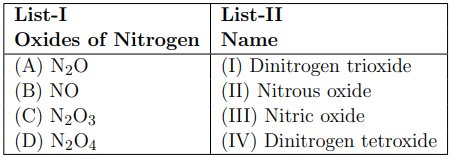
Choose the correct answer from the options given below:
Siderophores are small polydentate ligands and have a high affinity for:
A group of transposable elements described as retroelements encompass
Monoclonal antibodies can be employed for
(A). Early detection of cancers
(B). Clear detection of pathogens
(C). Classification of blood group
Choose the correct answer from the options given below:
Ripening delayed tomatoes are produced by
Which of the following statement regarding Innate immunity is wrong.
(A) The response time is minute to hours.
(B) The specificity of innate immunity is highly diverse.
(C) The major components of innate immunity are B cells and T cells.
(D) The major components of innate immunity are phagocytes.
Choose the correct answer from the options given below:
Which of the following are chiral molecules?
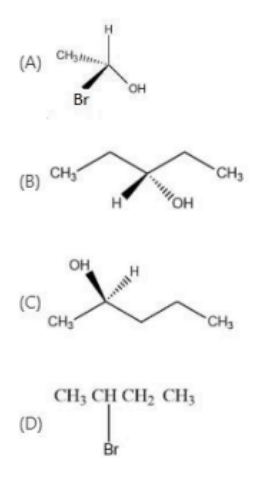
Choose the correct answer from the options given below:
Which of the following microorganism plays an important role in the early stages of cheese production?
(A). Brevibacterium linens
(B). Penicillium candidum
(C). Lactococcus cremoris
(D). Lactococcus lactis
Choose the correct answer from the options given below:
Which of the following in vitro technique is used to find Protein-Protein Interaction
The presence and distribution of specific mRNAs within a cell can be detected by
Agrobacterium tumefaciens is frequently used as a vector to create transgenic plants. Under laboratory conditions Agrobacterium - mediated plant transformation does not require
Two-dimensional gel electrophoresis carries out protein based on
Cosmids contain
(A). Replication origin
(B). Unique restriction sites
(C). A selectable marker from a plasmid
(D). Cos site from phage \(\lambda\) genome
Choose the correct answer from the options given below:
In the enzyme-linked antibody used in ELISA, the interaction between the enzyme and antibody is stabilized by
Eicosanoids are a type of polyenoic fatty acids that consist of
(A). Leukotrienes
(B). Prostaglandins
(C). Lipoxins
(D). Cholesterol
Choose the correct answer from the options given below:
RNA polymerase responsible for the synthesis of tRNA
Arrange the following bacteriophages in the increasing order of size in terms of nucleotide base pairs
(A). T4 phage
(B). \(\lambda\) phage
(C). T7 phage
(D). \(\phi\)X174 phage
Choose the correct answer from the options given below:
What is the role of the p53 gene in cancer development.
The sequence of reactions catalyzed by pyruvate dehydrogenase complex are:
(A). Decarboxylation of pyruvate
(B). Formation of Acetyl-CoA
(C). Formation of acetyl lipoamide
(D). Oxidation of dihydrolipoamide
Choose the correct answer from the options given below
The urea cycle takes place in which of the following compartments of the cell
(A). Cytosol
(B). Endoplasmic reticulum
(C). Mitochondrial matrix
(D). Peroxisomes
Choose the correct answer from the options given below:
Consider the following reactions in which all the reactants and products are in gaseous state.
2PQ \(\rightleftharpoons\) P\(_2\) + Q\(_2\) K\(_1\) = 4 \(\times\) 10\(^4\)
PQ + \(\frac{1}{2}\)R\(_2\) \(\rightleftharpoons\) PQR K\(_2\) = 5 \(\times\) 10\(^{-3}\)
The value of K\(_3\) for the equilibrium \(\frac{1}{2}\)P\(_2\) + \(\frac{1}{2}\)Q\(_2\) + \(\frac{1}{2}\)R\(_2\) \(\rightleftharpoons\) PQR is
Match List-I with List-II
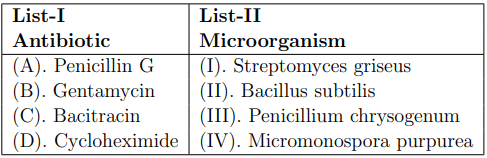
Choose the correct answer from the options given below:
The Michaelis constant (Km) in enzyme kinetics represents
[Co(NH\(_3\))\(_{4}\)(NO\(_2\))\(_{2}\)]Cl exhibits.
(A) Ionisation isomerism
(B) Linkage isomerism
(C) Geometrical isomerism
(D) Coordination isomerism
(E) Solvate isomerism
Choose the correct answer from the options given below:
The alpha particles are
Which of the following are components of lipid raft in plasma membrane
The amino acid Tryptophan exhibits maximum UV absorption at what approximate wavelength
Which one of the following regions of the target gene is NOT used for making an RNAi construct to knock down its expression
Which of the following statements regarding restriction enzymes used in recombinant DNA technology is correct
Every continuous real valued function on [a, b] is
(A). Constant.
(B). Bounded above.
(C). Bounded below.
(D). Unbounded.
Choose the correct answer from the options given below:
View Solution
Step 1: Understanding the Concept:
This question refers to the Boundedness Theorem (a consequence of the Extreme Value Theorem) from real analysis, which describes a fundamental property of continuous functions defined on closed and bounded intervals.
Step 2: Detailed Explanation:
The Boundedness Theorem states that if a function \(f\) is continuous on a closed and bounded interval \([a, b]\), then \(f\) is bounded on that interval.
A function is "bounded" if it is both bounded above and bounded below.
Bounded above means there exists a real number M such that \(f(x) \le M\) for all \(x\) in \([a, b]\).
Bounded below means there exists a real number m such that \(f(x) \ge m\) for all \(x\) in \([a, b]\).
Let's analyze the given statements:
(A) Constant: This is not necessarily true. For example, \(f(x) = x\) is continuous on \([0, 1]\) but is not constant.
(B) Bounded above: This is true, according to the Boundedness Theorem.
(C) Bounded below: This is also true, according to the Boundedness Theorem.
(D) Unbounded: This is false and directly contradicts the theorem.
Step 3: Final Answer:
The theorem guarantees that the function will be both bounded above and bounded below. Therefore, statements (B) and (C) are correct.
Quick Tip: The keywords are "continuous" and "closed interval [a, b]". When you see these together, think of a piece of string held between two points. You can't draw it without lifting your pen (continuous), and it has defined endpoints. Such a string will always have a highest point and a lowest point; it can't go to infinity.
Let \( < G,*> \) be a group. Then for all a, b, c \(\in\) G
(A). (a*b)*c \(\in\) G
(B). a*b = b*a
(C). a*(b*c) = (a*b)*c
(D). a*b = a*c implies b = c.
Choose the correct answer from the options given below:
View Solution
Step 1: Understanding the Concept:
A group is a fundamental algebraic structure consisting of a set G and a binary operation * that satisfies four axioms: Closure, Associativity, Identity Element, and Inverse Element. This question tests which of the given statements are necessary properties of any group.
Step 2: Detailed Explanation:
Let's analyze each statement based on the definition of a group:
(A) (a*b)*c \(\in\) G: This property is a direct consequence of the Closure axiom. The closure axiom states that for any a, b \(\in\) G, the result a*b is also in G. If we let d = a*b, then d \(\in\) G. Applying closure again, d*c = (a*b)*c must also be in G. So, statement (A) is correct.
(B) a*b = b*a: This is the commutative property. While some groups have this property (they are called Abelian groups), it is not a requirement for a structure to be a group. For example, the group of invertible matrices under matrix multiplication is not commutative. So, statement (B) is not always true for a general group.
(C) a*(b*c) = (a*b)*c: This is the associative property, which is one of the fundamental axioms of a group. So, statement (C) is correct.
(D) a*b = a*c implies b = c: This is the left cancellation law. It is a property that can be derived from the group axioms and is true for all groups. (Proof: Since G is a group, an inverse element a\(^{-1}\) exists. Multiply both sides of a*b = a*c on the left by a\(^{-1}\): a\(^{-1}\)*(a*b) = a\(^{-1}\)*(a*c). By associativity, (a\(^{-1}\)*a)*b = (a\(^{-1}\)*a)*c. This simplifies to e*b = e*c, where e is the identity element, so b = c). So, statement (D) is correct.
Step 3: Final Answer:
The properties that hold true for any group are (A), (C), and (D). Statement (B) only holds for Abelian groups. Therefore, the correct option is (1).
Quick Tip: Remember the four group axioms: Closure, Associativity, Identity, and Inverse. Commutativity (a*b = b*a) is an extra property that defines an Abelian group, but it's not required for a general group. The cancellation law is a provable consequence of the main axioms.
Match List-I with List-II
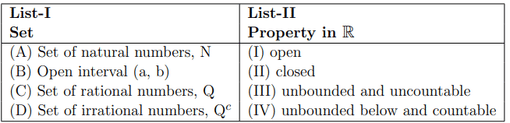
Choose the correct answer from the options given below:
View Solution
Step 1: Understanding the Concept:
This question tests knowledge of basic topological and set-theoretic properties of common subsets of the real numbers (\(\mathbb{R}\)). We need to determine if each set is open or closed, bounded or unbounded, and countable or uncountable.
Step 2: Detailed Explanation:
Let's analyze each set in List-I and match it with its properties in List-II.
(A) Set of natural numbers, \(\mathbb{N} = \{1, 2, 3, \dots\}\):
It is not open because for any natural number n, no open interval around n is contained entirely within \(\mathbb{N}\).
It is a closed set in \(\mathbb{R}\). Its complement, \(\mathbb{R} \setminus \mathbb{N}\), is a union of open intervals like \((-\infty, 1) \cup (1, 2) \cup \dots\), which is an open set.
This matches with (II) closed.
(B) Open interval (a, b):
By its definition in topology, an open interval is an open set. For every point x in (a, b), there exists a smaller open interval around x that is still contained within (a, b).
This matches with (I) open.
(C) Set of rational numbers, \(\mathbb{Q}\):
It is unbounded both above and below.
It is countable, meaning its elements can be put into a one-to-one correspondence with the natural numbers.
It is neither open nor closed.
The property that fits best is (IV) unbounded below and countable.
(D) Set of irrational numbers, \(\mathbb{Q}^c\):
It is unbounded both above and below.
It is uncountable.
It is neither open nor closed.
The property that fits best is (III) unbounded and uncountable.
Step 3: Final Answer:
The correct matching is:
(A) \(\rightarrow\) (II)
(B) \(\rightarrow\) (I)
(C) \(\rightarrow\) (IV)
(D) \(\rightarrow\) (III)
This corresponds to option (3).
Quick Tip: Key properties to memorize: \(\mathbb{N}\) and \(\mathbb{Z}\) are closed and countable. \(\mathbb{Q}\) is countable, but neither open nor closed. \(\mathbb{Q}^c\) and \(\mathbb{R}\) are uncountable. An open interval (a,b) is open. A closed interval [a,b] is closed.
The solution of \(y = xp + \frac{m}{p}\) where \(p = \frac{dy}{dx}\) is
View Solution
Step 1: Understanding the Concept:
The given differential equation \(y = xp + \frac{m}{p}\) is a classic example of Clairaut's equation, which has the general form \(y = xp + f(p)\), where \(p = \frac{dy}{dx}\). Clairaut's equations have a general solution and a singular solution. The general solution is found by simply replacing \(p\) with an arbitrary constant \(c\).
Step 2: Key Formula or Approach:
To solve a Clairaut's equation \(y = xp + f(p)\):
1. Differentiate the entire equation with respect to \(x\).
2. Use the fact that \(\frac{dy}{dx} = p\).
3. The resulting equation can be factored. One factor will lead to the general solution, and the other to the singular solution.
Step 3: Detailed Explanation:
Given the equation: \[ y = xp + \frac{m}{p} \quad (*).\]
Differentiate with respect to \(x\): \[ \frac{dy}{dx} = \left(1 \cdot p + x \cdot \frac{dp}{dx}\right) - \frac{m}{p^2} \frac{dp}{dx} \]
Since \(\frac{dy}{dx} = p\), we have: \[ p = p + x \frac{dp}{dx} - \frac{m}{p^2} \frac{dp}{dx} \]
Subtract \(p\) from both sides: \[ 0 = x \frac{dp}{dx} - \frac{m}{p^2} \frac{dp}{dx} \]
Factor out \(\frac{dp}{dx}\): \[ \left(x - \frac{m}{p^2}\right) \frac{dp}{dx} = 0 \]
This equation gives two possibilities:
Case 1: \(\frac{dp}{dx} = 0\)
If \(\frac{dp}{dx} = 0\), integrating with respect to \(x\) gives \(p = c\), where \(c\) is an arbitrary constant.
Substituting \(p=c\) back into the original equation (*), we get the general solution: \[ y = xc + \frac{m}{c} \]
This matches option (4).
Case 2: \(x - \frac{m}{p^2} = 0\)
This leads to \(p^2 = \frac{m}{x}\) or \(p = \pm\sqrt{\frac{m}{x}}\). Substituting this back into the original equation gives the singular solution, which is not among the options.
Step 4: Final Answer:
The general solution of the Clairaut's equation is obtained by replacing \(p\) with a constant \(c\), which gives \(y = xc + \frac{m}{c}\).
Quick Tip: For any equation in the form of \(y = xp + f(p)\) (Clairaut's equation), the general solution is always found by simply replacing the parameter \(p\) with a constant \(c\). This is a valuable shortcut in exams.
Let \(f\) be a continuous real valued function, defined by, \(f(x) = \sin x\), for all \(x \in [-\frac{\pi}{2}, \frac{\pi}{2}]\). Then which of the following does not hold.
View Solution
Step 1: Understanding the Concept:
We are given the function \(f(x) = \sin x\) on the closed interval \([-\frac{\pi}{2}, \frac{\pi}{2}]\). We need to analyze its derivative, \(f'(x)\), on the open interval \((-\frac{\pi}{2}, \frac{\pi}{2})\) and determine which of the given statements is false.
Step 2: Detailed Explanation:
First, we find the derivative of the function \(f(x)\):
\(f(x) = \sin x\)
\(f'(x) = \cos x\)
Now, we evaluate each statement for \(f'(x) = \cos x\) on the open interval \(x \in (-\frac{\pi}{2}, \frac{\pi}{2})\).
(A) \(f'\) is continuous on \((-\frac{\pi}{2}, \frac{\pi}{2})\): The function \(f'(x) = \cos x\) is continuous for all real numbers. Thus, it is continuous on this interval. This statement is TRUE.
(B) \(f'\) is bounded on \((-\frac{\pi}{2}, \frac{\pi}{2})\): On the interval \((-\frac{\pi}{2}, \frac{\pi}{2})\), the value of \(\cos x\) is strictly greater than 0 and less than or equal to 1. The range is \((0, 1]\). Since all values are between 0 and 1, the function is bounded. This statement is TRUE.
(C) \(f'(x) = 0\) for some \(x \in (-\frac{\pi}{2}, \frac{\pi}{2})\): We need to check if the equation \(\cos x = 0\) has a solution within the open interval. The solutions to \(\cos x = 0\) are \(x = \pm \frac{\pi}{2}, \pm \frac{3\pi}{2}, \dots\). None of these values lie *inside* the open interval \((-\frac{\pi}{2}, \frac{\pi}{2})\). This statement is FALSE.
(D) \(f'(x) = 1\) for some \(x \in (-\frac{\pi}{2}, \frac{\pi}{2})\): We need to check if the equation \(\cos x = 1\) has a solution within the open interval. The solution is \(x = 0\), and \(0\) is clearly within the interval \((-\frac{\pi}{2}, \frac{\pi}{2})\). This statement is TRUE.
Step 3: Final Answer:
The question asks which statement does not hold (i.e., is false). Based on our analysis, statement (C) is the one that is false.
Quick Tip: When analyzing properties of a function on an interval, pay close attention to whether the interval is open `()` or closed `[]`. Endpoints are included in closed intervals but excluded from open intervals, which can be critical for questions about attaining maximums, minimums, or specific values like zero.
Let an unbiased die be thrown and the random variable X be the number appears on its top. Then the expectation of X is
View Solution
Step 1: Understanding the Concept:
The expectation (or expected value) of a discrete random variable is the probability-weighted average of all its possible values. For an unbiased die, each of the six faces has an equal probability of appearing.
Step 2: Key Formula or Approach:
The formula for the expected value \(E[X]\) of a discrete random variable X is: \[ E[X] = \sum_{i} x_i P(X = x_i) \]
where \(x_i\) are the possible values of X and \(P(X = x_i)\) is the probability of each value occurring.
Step 3: Detailed Explanation:
For a single throw of an unbiased die:
The set of possible outcomes (values of X) is \(\{1, 2, 3, 4, 5, 6\}\).
Since the die is unbiased, the probability of each outcome is the same: \[ P(X=1) = P(X=2) = P(X=3) = P(X=4) = P(X=5) = P(X=6) = \frac{1}{6} \]
Now, we apply the expectation formula: \[ E[X] = \left(1 \times \frac{1}{6}\right) + \left(2 \times \frac{1}{6}\right) + \left(3 \times \frac{1}{6}\right) + \left(4 \times \frac{1}{6}\right) + \left(5 \times \frac{1}{6}\right) + \left(6 \times \frac{1}{6}\right) \]
Factor out the common probability \(\frac{1}{6}\): \[ E[X] = \frac{1}{6} (1 + 2 + 3 + 4 + 5 + 6) \]
The sum of the numbers is \(1+2+3+4+5+6 = 21\). \[ E[X] = \frac{1}{6} (21) = \frac{21}{6} \]
Simplify the fraction by dividing the numerator and denominator by 3: \[ E[X] = \frac{7}{2} \]
Step 4: Final Answer:
The expectation of X is \(\frac{7}{2}\) or 3.5. This matches option (3).
Quick Tip: For any process with equally likely integer outcomes from 1 to n (like a fair die or a spinner), the expected value is simply the average of the first and last outcome: \(\frac{1 + n}{2}\). For a die, this is \(\frac{1 + 6}{2} = \frac{7}{2} = 3.5\).
The integral \( \int_{0}^{\pi/2} \sin^5 x \cos^7 x \,dx = \)
View Solution
Step 1: Understanding the Concept:
This integral is a specific case of Wallis' integrals, which have a standard reduction formula, especially for definite integrals from 0 to \(\pi/2\). This is related to the Beta function.
Step 2: Key Formula or Approach:
The reduction formula for integrals of the form \( \int_{0}^{\pi/2} \sin^m x \cos^n x \,dx \) is given by: \[ \int_{0}^{\pi/2} \sin^m x \cos^n x \,dx = \frac{[(m-1)(m-3)\dots][(n-1)(n-3)\dots]}{(m+n)(m+n-2)\dots} \times K \]
where the terms in the numerator continue until they reach 1 or 2.
The value of \(K\) is:
- \(K = \frac{\pi}{2}\) if both \(m\) and \(n\) are even.
- \(K = 1\) otherwise (if at least one of \(m\) or \(n\) is odd).
Step 3: Detailed Explanation:
Using the reduction formula for \(m=5\) and \(n=7\).
Since at least one power is odd (in this case, both are), the factor \(K\) will be 1.
Numerator:
\((m-1)(m-3)\dots = (5-1)(5-3) = 4 \times 2\)
\((n-1)(n-3)\dots = (7-1)(7-3)(7-5) = 6 \times 4 \times 2\)
Denominator:
\((m+n)(m+n-2)\dots = (5+7)(5+7-2)(5+7-4)(5+7-6)(5+7-8)(5+7-10) = 12 \times 10 \times 8 \times 6 \times 4 \times 2\)
Now, assemble the fraction: \[ \int_{0}^{\pi/2} \sin^5 x \cos^7 x \,dx = \frac{(4 \times 2) \times (6 \times 4 \times 2)}{12 \times 10 \times 8 \times 6 \times 4 \times 2} \]
We can cancel the term \((6 \times 4 \times 2)\) from the numerator and the denominator: \[ = \frac{4 \times 2}{12 \times 10 \times 8} = \frac{8}{960} \]
Simplify the fraction: \[ = \frac{1}{120} \]
Step 4: Final Answer:
The value of the integral is \(\frac{1}{120}\). This matches option (3).
Quick Tip: The reduction formula is a powerful shortcut for integrals of \(\sin^m x \cos^n x\) from 0 to \(\pi/2\). Just remember to start decrementing by 2 from \(m-1\), \(n-1\) in the numerator and from \(m+n\) in the denominator. And don't forget the \(\pi/2\) factor if both powers are even!
The equation of a straight line passes through the point (4,-5) and is perpendicular to the straight line 3x + 4y + 5 = 0.
View Solution
Step 1: Understanding the Concept:
We need to find the equation of a line given a point it passes through and a line it is perpendicular to. The key relationship is between the slopes of two perpendicular lines.
Step 2: Key Formula or Approach:
1. Find the slope (\(m_1\)) of the given line. For a line \(Ax + By + C = 0\), the slope is \(m = -A/B\).
2. Find the slope (\(m_2\)) of the perpendicular line. The relationship is \(m_2 = -1/m_1\).
3. Use the point-slope form of a line equation, \(y - y_1 = m_2(x - x_1)\), to find the equation of the required line.
4. Convert the equation to the general form \(Ax + By + C = 0\).
Step 3: Detailed Explanation:
1. Find the slope of the given line.
The given line is \(3x + 4y + 5 = 0\).
Its slope, \(m_1\), is \(-\frac{A}{B} = -\frac{3}{4}\).
2. Find the slope of the perpendicular line.
The slope of our required line, \(m_2\), must be the negative reciprocal of \(m_1\). \[ m_2 = -\frac{1}{m_1} = -\frac{1}{(-3/4)} = \frac{4}{3} \]
3. Use the point-slope form.
The required line passes through the point \((x_1, y_1) = (4, -5)\) and has a slope \(m_2 = 4/3\). \[ y - y_1 = m_2(x - x_1) \] \[ y - (-5) = \frac{4}{3}(x - 4) \] \[ y + 5 = \frac{4}{3}(x - 4) \]
4. Convert to general form.
Multiply both sides by 3 to eliminate the fraction: \[ 3(y + 5) = 4(x - 4) \] \[ 3y + 15 = 4x - 16 \]
Rearrange the terms to match the form \(Ax + By + C = 0\): \[ 0 = 4x - 3y - 16 - 15 \] \[ 4x - 3y - 31 = 0 \]
Step 4: Final Answer:
The equation of the line is \(4x - 3y - 31 = 0\). This matches option (1).
Quick Tip: A quick shortcut: a line perpendicular to \(Ax + By + C = 0\) will have the form \(Bx - Ay + K = 0\). For the line \(3x + 4y + 5 = 0\), a perpendicular line is \(4x - 3y + K = 0\). Substitute the point (4, -5) to find K: \(4(4) - 3(-5) + K = 0 \Rightarrow 16 + 15 + K = 0 \Rightarrow 31 + K = 0 \Rightarrow K = -31\). So the equation is \(4x - 3y - 31 = 0\).
Which of the following subsets form subgroups of the group < \(\mathbb{Z}\), +>?
(A). H\(_1\) = {0}
(B). H\(_2\) = {n+1: n \(\in\) \(\mathbb{Z}\)
(C). H\(_3\) = {2n: n \(\in\) \(\mathbb{Z}\)
(D). H\(_4\) = {2n+1: n \(\in\) \(\mathbb{Z}\)
Choose the correct answer from the options given below:
View Solution
Step 1: Understanding the Concept:
For a non-empty subset H to be a subgroup of the group \(<\mathbb{Z}, +>\), it must be closed under addition and contain inverses for each of its elements. The identity element in \(<\mathbb{Z}, +>\) is 0, and the inverse of an element \(a\) is \(-a\). A key theorem states that all subgroups of \(<\mathbb{Z}, +>\) are of the form \(k\mathbb{Z} = \{kn : n \in \mathbb{Z}\}\) for some non-negative integer \(k\).
Step 2: Detailed Explanation:
We will test each subset against the subgroup criteria:
(A) \(H_1 = \{0\}\): This is the trivial subgroup. It corresponds to the form \(k\mathbb{Z}\) with \(k=0\). It contains the identity (0), is closed under addition (\(0+0=0\)), and contains the inverse of 0 (which is 0). Thus, (A) is a subgroup.
(B) \(H_2 = \{n+1 \mid n \in \mathbb{Z}\}\): This is another way of writing the set of all integers, \(\mathbb{Z}\). For any integer \(k\), we can choose \(n = k-1\) (which is an integer), so that \(n+1 = (k-1)+1 = k\). Thus, \(H_2 = \mathbb{Z}\). A group is always a subgroup of itself (the improper subgroup). This corresponds to \(k\mathbb{Z}\) with \(k=1\). Mathematically, this is a subgroup. However, exam questions often distinguish between proper subgroups and the group itself.
(C) \(H_3 = \{2n \mid n \in \mathbb{Z}\}\): This is the set of all even integers. This corresponds to the form \(k\mathbb{Z}\) with \(k=2\). It contains the identity (0, for \(n=0\)), is closed (even + even = even), and contains inverses (the inverse of an even number is its negative, which is also even). Thus, (C) is a subgroup.
(D) \(H_4 = \{2n+1 \mid n \in \mathbb{Z}\}\): This is the set of all odd integers. This set does not contain the identity element 0, because \(2n+1=0\) implies \(n=-1/2\), which is not an integer. A subset that does not contain the identity cannot be a subgroup. Thus, (D) is not a subgroup.
Step 3: Final Answer:
The subsets that are subgroups are H\(_1\), H\(_2\), and H\(_3\). The subset H\(_4\) is not a subgroup. The option "(A), (B), and (C) only" is not the selected correct answer. The correct answer provided is (1), which is "(A) and (C) only." This implies that the question implicitly asks for the subsets that form proper subgroups, in addition to the trivial subgroup {0}, and excludes the group \(\mathbb{Z}\) itself (H\(_2\)). This is a common convention in multiple-choice questions to test the identification of different types of subgroups. Following this interpretation, the correct choices are the trivial subgroup (A) and the proper subgroup of even integers (C).
Quick Tip: The fastest way to check if a subset of \((\mathbb{Z}, +)\) is a subgroup is to see if it can be written in the form \(k\mathbb{Z}\) for some integer \(k\). The set of odd numbers cannot be written in this form and is the classic example of a subset that is not a subgroup because it lacks the identity element (0).
The series \( \sum_{n=1}^{\infty} \frac{1}{n} \)
View Solution
Step 1: Understanding the Concept:
The given series, \( \sum_{n=1}^{\infty} \frac{1}{n} = 1 + \frac{1}{2} + \frac{1}{3} + \frac{1}{4} + \dots \), is known as the harmonic series. We need to determine if this infinite series converges to a finite value or diverges.
Step 2: Key Formula or Approach:
There are several tests for convergence/divergence. The p-series test is the most direct for this type of series.
The p-series test: A series of the form \( \sum_{n=1}^{\infty} \frac{1}{n^p} \)
- converges if \(p > 1\).
- diverges if \(p \le 1\).
Step 3: Detailed Explanation:
Using the p-series test:
The harmonic series is a p-series with the exponent \(p=1\).
According to the p-series test, since \(p = 1\) (which satisfies \(p \le 1\)), the series diverges.
This means the sum of the terms increases without bound and does not approach any finite number.
Step 4: Final Answer:
The harmonic series does not converge to a finite value. Therefore, the series does not converge.
Quick Tip: The harmonic series \( \sum \frac{1}{n} \) is the most famous example of a divergent series whose terms approach zero. Do not be fooled by the fact that the terms get smaller and smaller. The sum still grows without bound, just very slowly.
If a subset B is a basis of a vector space V, then
(A). B generates V.
(B). B contains zero vector.
(C). B is linearly independent.
(D). B is the only basis of V.
Choose the correct answer from the options given below:
View Solution
Step 1: Understanding the Concept:
A basis of a vector space V is a set of vectors that satisfies two fundamental properties. These properties ensure that any vector in V can be uniquely represented as a linear combination of the basis vectors.
Step 2: Detailed Explanation:
By definition, a subset B of a vector space V is a basis if and only if it satisfies the following two conditions:
B is linearly independent. This means that no vector in B can be written as a linear combination of the other vectors in B. This corresponds to statement (C).
B spans (or generates) V. This means that every vector in V can be written as a linear combination of the vectors in B. This corresponds to statement (A).
Let's analyze the other statements:
(B) B contains zero vector: This is false. Any set containing the zero vector is automatically linearly dependent, which violates the first condition of a basis.
(D) B is the only basis of V: This is false. Any non-trivial vector space has infinitely many bases. For example, in \(\mathbb{R}^2\), both \(\{(1,0), (0,1)\}\) and \(\{(1,1), (1,-1)\}\) are valid bases.
Step 3: Final Answer:
The two defining properties of a basis are that it is a linearly independent set and it generates (spans) the vector space. Therefore, statements (A) and (C) are correct.
Quick Tip: Remember the two main properties of a basis: it must be a \(\textbf{linearly independent}\) set, and it must \(\textbf{span}\) the entire vector space. A good basis has just enough vectors to reach everywhere (span) but no redundant vectors (linearly independent).
Bacteria have specialized Two component system for the signaling, which among these is the part or sensory domain
Match List-I with List-II
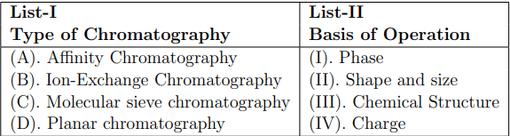
Choose the correct answer from the options given below:
In Transcription, which among these Transcription factors have Helicase activity
Match List-I with List-II
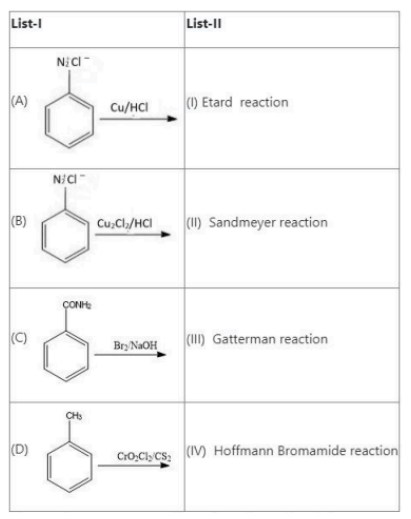
Choose the correct answer from the options given below:
Amino acid that can form Di-sulfide linkage in protein
Which bacteria is called the DNA repair champion
What is the most significant advantage of using Subroutines or Functions in computer programming?
Which of the following is typically considered part of the MSU?
(A) Monitor
(B) Keyboard
(C) Motherboard
(D) CPU
Choose the correct answer from the options given below:
What is the difference between clock speed and instruction cycle time?
Match List-I with List-II

Choose the correct answer from the options given below:
Which of the following is not the benefit of using an inline function in C++?
(A).It can improve code readability and reduce function call overhead.
(B).It can make the code more modular and easier to maintain.
(C).It allows for dynamic function calls at runtime.
(D).It can be used to define recursive functions.
Choose the correct answer from the options given below:
What is the difference between one-dimensional and two-dimensional arrays in C++?
What are the risks of using pointers without proper care?
What is the main difference between LCD and LED displays?
What is the fundamental assumption behind a Markov model?
View Solution
Step 1: Understanding the Concept:
A Markov model (or Markov chain/process) is a type of stochastic model used to describe sequences of events. The question asks for its most fundamental, defining assumption.
Step 2: Detailed Explanation:
Let's analyze the options:
1. The probability of transitioning...depends only on the current state, not the past state: This is the precise definition of the Markov property. It is the core assumption that makes a process "Markovian." It implies that the system is "memoryless"—to predict the future, you only need to know the present state; the history of how it got there is irrelevant. This is the fundamental assumption.
2. The model is used to optimize decision-making processes...: This describes an application of Markov models, specifically Markov Decision Processes (MDPs), which are used in reinforcement learning and operations research. It is a use case, not the core assumption of the model itself.
3. The model represents a system as a series of interconnected states...: This is a true description of the structure of a Markov model, but it is not the underlying assumption. The assumption is about *how* the system moves between those states.
4. The model uses statistical methods to predict future events...: This is a very general statement that applies to almost any predictive statistical model (e.g., regression, time series analysis, etc.), not just Markov models. It is not specific enough to be the fundamental assumption.
Step 3: Final Answer:
The defining characteristic and fundamental assumption of a Markov model is the Markov property: the future is conditionally independent of the past, given the present.
Quick Tip: Remember the Markov property with the phrase: "The future depends only on the present, not the past." Think of a simple weather model: if today is sunny (the current state), the probability of it being rainy tomorrow might be 10%, regardless of whether yesterday was sunny or rainy.
What is the key principle behind Monte Carlo simulation?
View Solution
Step 1: Understanding the Concept:
Monte Carlo methods are a broad class of computational algorithms that rely on repeated random sampling to obtain numerical results. They are often used when it is difficult or impossible to solve a problem analytically. The question asks for the key principle.
Step 2: Detailed Explanation:
Let's analyze the options:
1. Utilizing statistical analysis to identify patterns...: This describes the field of data analysis or data mining, not Monte Carlo simulation.
2. Performing repeated random trials to approximate solutions...: This is the core principle of the Monte Carlo method. By simulating a process with random inputs many times, one can observe the distribution of outcomes and approximate quantities like averages, probabilities, or integrals. For example, to find the area of a complex shape, you could enclose it in a square, randomly throw "darts" at the square, and the ratio of darts inside the shape to the total darts thrown gives an approximation of the area.
3. Building and training artificial neural networks...: This describes the field of machine learning, specifically deep learning.
4. Formulating and solving mathematical equations...: This describes traditional deterministic modeling. Monte Carlo methods are used precisely when such direct solving is not feasible.
Step 3: Final Answer:
The key principle of Monte Carlo simulation is the use of repeated random sampling or trials to numerically approximate the solution to problems that are difficult to solve analytically.
Quick Tip: The name "Monte Carlo" refers to the famous casino. Think of the method as running an experiment over and over again on a computer. Instead of solving a complex equation for the probability of a coin landing heads 10 times in a row, you could just have the computer simulate flipping a coin 10 times, millions of times, and see how often it happens. That's the Monte Carlo approach.
The first ever biological sequence database which was developed by Dayhoff and Eck's 1965 is
Match List-I with List-II
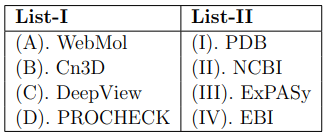
Choose the correct answer from the options given below:
Electronic Polymerase Chain Reaction (e-PCR) is a computational procedure that is used..
Readseq one of the most popular computer programs written by Don Gilbert at Indiana University used for
Which are the correct statements regarding INSDC....
(A). Promotion of Human Genome Project
(B). It is collaboration of GenBank, EMBL and DDBJ databases.
(C). Facilitating exchange of sequence data on daily basis
(D). Validation of 3D model of protein with respect to structure solved by either X-ray crystallography or NMR spectroscopy
Choose the correct answer from the options given below:
Match List-I with List-II
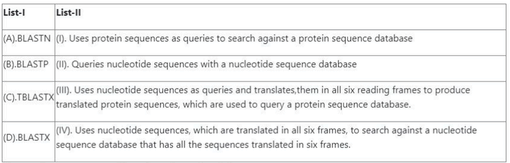
Choose the correct answer from the options given below:
SAKURA is a
An example of primary database is:
(A). GenBank
(B). EMBL
(C). DDBJ
(D). PDB
Choose the correct answer from the options given below:
Match List-I with List-II

Choose the correct answer from the options given below:



Comments