

![Chitkara University - [CU]](https://image-static.collegedunia.com/public/college_data/images/logos/1771840116Screenshot20260223at13.53.40.png?h=71.7&w=71.7&mode=stretch)

For a long time, universities have been judged by practical outcomes: placements secured, salaries offered, and degrees awarded. These are important measures, but they do not fully capture what a university is meant to be. At their best, universities have also been places where students encounter ideas that unsettle assumptions, where disciplines intersect, and where intellectual and cultural life unfolds alongside formal instruction.

That dimension is beginning to reappear across Indian campuses. As artificial intelligence and automation reshape the nature of work, professional knowledge alone no longer guarantees long-term relevance. Employers increasingly value people who can interpret complexity, communicate clearly, and think beyond narrow specialisations. These capacities are not developed through technical training alone. They are shaped through exposure to literature, public thought, and cultural exchange.
One visible sign of this shift has been the emergence of literary festivals within universities. Public festivals such as the Jaipur Literature Festival, the Dehradun Literature Festival, and the Kalinga Literary Festival have, over the past two decades, demonstrated the appetite for conversations that bring writers, artists, and audiences together. Increasingly, universities are creating similar spaces on their own campuses, making such exchanges part of everyday academic life rather than occasional public events.
At Chitkara University in Punjab, the Chitkara Lit Fest recently concluded its fourth edition. Established in 2023, it began as an experiment—an attempt to see whether a campus festival could sustain student interest beyond novelty. The response suggested that it could. Auditoriums filled quickly when figures such as Javed Akhtar, Irshad Kamil, and Usha Uthup appeared in its early editions, but what stood out was what happened afterwards. Students lingered. Some waited to ask questions they had not planned to ask. Others returned the next day with friends who had not attended before.
Over time, the range of voices widened. Authors were joined by filmmakers, journalists, actors, and storytellers whose work existed across mediums. By its third year, participants included Shobhaa De, Kalki Koechlin, Lisa Ray, and Neelesh Misra. Their sessions rarely focused on achievement alone. They spoke about uncertainty, creative risk, and the slow, often unglamorous process of finding one’s voice. For students accustomed to structured academic pathways, these conversations offered a different perspective on what a life in the arts—or any field—might look like.
What makes campus festivals distinct from public ones is proximity. Students encounter speakers not as distant figures on a stage, but as individuals who remain present within the rhythms of the university day. A session attended out of curiosity can influence academic choices, creative interests, or simply the confidence to participate more actively in discussion. These effects are difficult to measure, but they are often visible in quieter ways—in student publications, informal discussion circles, or the willingness to speak up in classrooms.
Such initiatives also reflect a broader shift toward multidisciplinary education. Students pursuing business, engineering, or technology increasingly recognise the value of engaging with ideas beyond their immediate fields. Many universities now offer academic pathways that allow management students to study liberal arts, or engineering students to explore design and communication. Cultural platforms reinforce this approach by creating shared spaces where these interests intersect naturally.
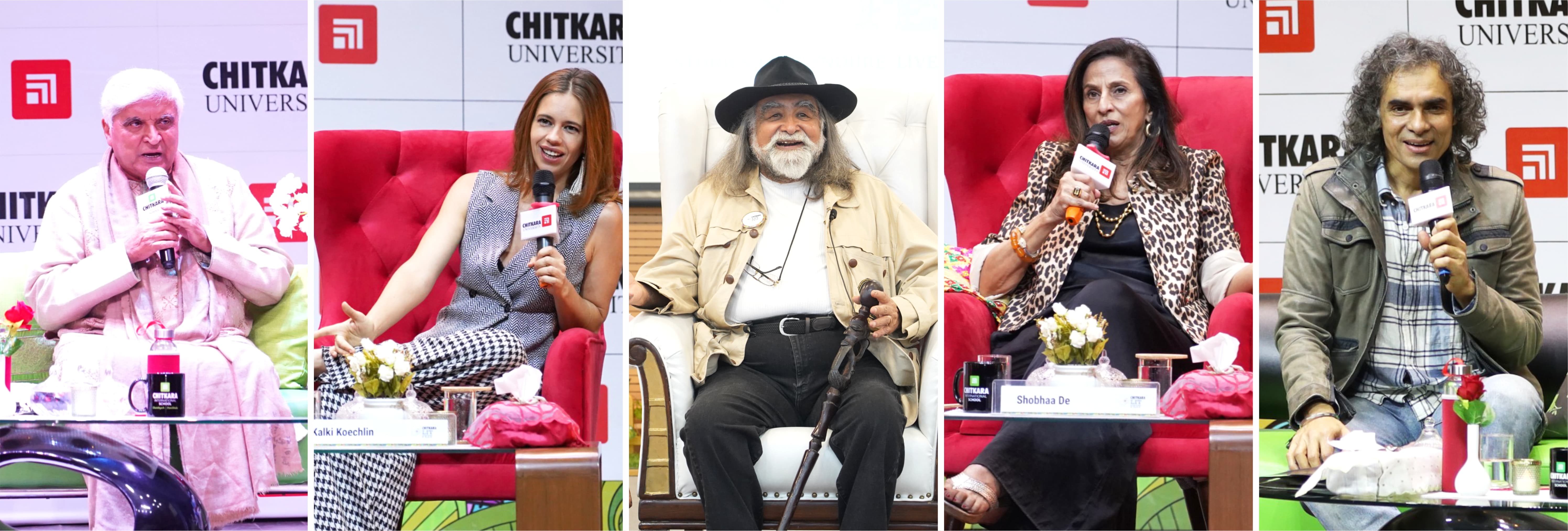
The implications extend beyond individual campuses. When universities host writers and public thinkers, they strengthen connections between academic communities and the wider cultural landscape. They signal that campuses remain relevant not only to industry, but also to public intellectual life. This exchange benefits both sides: students gain exposure to contemporary ideas, and speakers encounter audiences willing to engage without pre-existing professional expectations.
India’s higher-education system is expanding rapidly, with new institutions and programs emerging each year. Amid this growth, there is a risk that universities become defined primarily by professional output. The rise of campus literary festivals suggests a different trajectory—one in which cultural and intellectual engagement remains central to the educational experience.
This shift does not replace professional preparation; it deepens it. Students still pursue degrees with clear career goals. But alongside that, they are encountering ideas that cannot be reduced to examination outcomes or placement statistics. They are learning that education is not only about acquiring expertise, but also about understanding the broader human contexts in which that expertise will be applied.
In the long run, that broader perspective may prove to be one of the most enduring outcomes a university can offer.
About Chitkara University
Chitkara University is a UGC-recognised and NAAC-accredited private university in North India, with campuses in Punjab and Himachal Pradesh, offering career-oriented undergraduate and postgraduate programs in Engineering, Business, Healthcare, Pharmacy, Design, Architecture, Hospitality, and emerging technology fields. For students planning higher education, the University provides industry-aligned programs designed to combine academic excellence with practical exposure.
The curriculum emphasises experiential learning through internships, industry projects, research opportunities, and global collaborations, supported by modern infrastructure, advanced laboratories, industry mentorship, and skill-based training that strengthens student employability. Backed by 2,000+ campus recruiters and 300+ international academic and industry collaborations, students gain strong placement support, international exposure, academic exchange, and collaborative research opportunities.
Consistently ranked among leading institutions by national and global frameworks such as NIRF, QS World University Rankings, and Times Higher Education, the University maintains high academic rigour and industry relevance. With strong corporate partnerships and a focus on innovation, entrepreneurship, and interdisciplinary learning, it prepares students for emerging career opportunities in India and abroad.















![MBA/PGDM | admission | 2024 | Narsee Monjee Institute of Management Studies - [NMIMS Deemed to be University]](https://image-static.collegedunia.com/public/college_data/images/logos/1506323004Logo.jpg?h=72&w=72&mode=stretch)


![MBA/PGDM | admission | 2024 | Indian Institute of Management - [IIMC]](https://image-static.collegedunia.com/public/college_data/images/logos/1488950580d2.png?h=72&w=72&mode=stretch)








.jpeg?h=72&w=72&mode=stretch)
.jpeg?h=72&w=72&mode=stretch)





Comments