



Education Journalist | Study Abroad Lead
Scattering of Light refers to the physical process in which the moving particles are forced to deviate from their straight path due to some localized non-uniformities. Scattering basically refers to the particle-particle collision between atoms, molecules, electrons, protons, and other particles. Scattering happens both for light and sound. This phenomenon is very common in day-to-day life and is seen by everyone. A part of the light is absorbed by the particles of the medium when it passes from one medium to another. The intensity of scattered light depends on the wavelength of the light and the size of the particles.
The most common phenomenon of scattering of light which we see every day are:
- The red color of the sun during sunrise and sunset.
- The white color of the clouds.
- The blue color of the sky.
Scattering is totally different from both reflection and refraction of light. In reflection, the light after striking a polished surface bounces back. But in the scattering of light, the light rays get deviated or scattered in different directions by the medium through which it passes.
Key Terms: Light, Refraction of Light, Atoms, Photons, Scattering of Light, Reflection, Wavelength, Rayleigh Scattering
What is Scattering of Light?
[Click Here for Sample Questions]
Whenever a light ray passes from one medium to another, it strikes the particles of that medium.
- Due to this strike, some of the light rays get absorbed by the particles while other gets scattered in all directions.
- The wavelength of the light and the size of the particle which scattered the light ray helps in determining the strength of the scattering.
- Because of the waviness of the line and its interaction with a particle, shorter wavelengths and high frequencies scatter more.
- The more a line waivers, the more likely it is to intersect with a particle.
- Longer wavelengths, on the other hand, have a lower frequency and are straighter, therefore the chances of colliding with a particle are lower.
For example, when light from the sun enters the earth's atmosphere, the rays strike the particles of the air present on the earth. Some of these rays are absorbed by those particles and some are scattered in all directions.
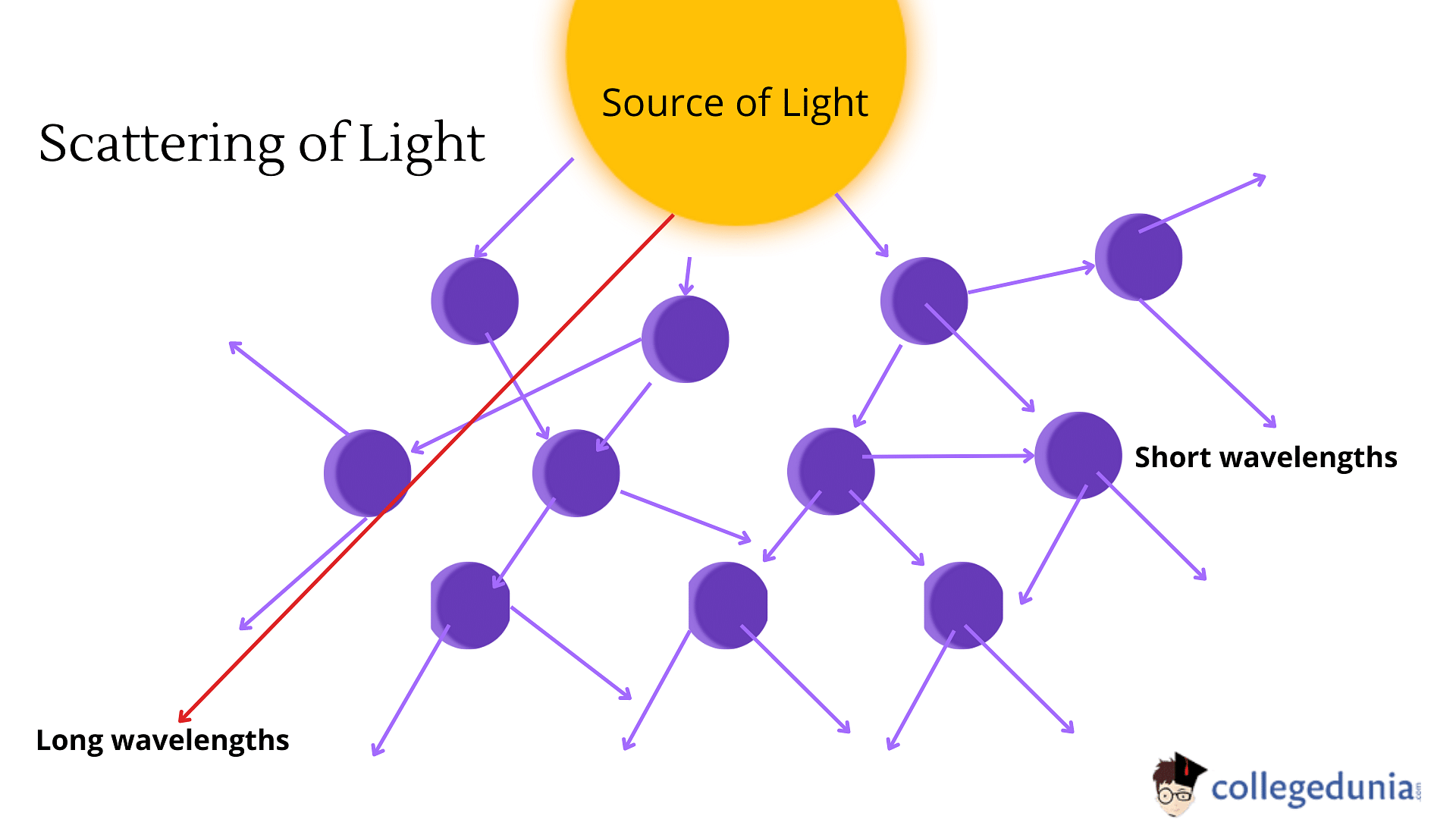
The bending of multicolored light in the afternoon is observed due to the phenomenon of refraction and total internal reflection of light. The wavelength of sunlight forms different colors in various directions. Rayleigh's scattering theory explains the red color of the sun in the morning and the blue color of the sky. The probability of scattering is inversely proportional to the fourth power of the wavelength of the radiation.
If p is the probability of scattering and λ is the wavelength of radiation, then it is given as \(P ⋉ \frac{1}{\lambda^4}\)
The video below explains this:
Human Eye One Shot Detailed Video Explanation:
Read More:
Various forms of light scattering
[Click Here for Sample Questions]
The various forms of scattering of light are:
- Elastic Scattering - When the incident beam of light and the dispersed beam of light have the same energy.
- Inelastic Scattering - When the incident beam of light and the dispersed beam of light do not have the same energy. Inelastic scattering is further divided into four different types:
Rayleigh Scattering
When radiation of light interacts with molecules and particles in the atmosphere that have a smaller diameter than the wavelength of the incoming radiation, Rayleigh scattering occurs.
- Longer wavelengths scatter more readily than shorter wavelengths.
- Small particles, such as NO2 and O2, scatter light with shorter wavelengths (like blue and violet visible light).
- Blue light is more scattered in the atmosphere than longer wavelength red light.
- Incoming sunlight travels a longer distance through the atmosphere at sunrise and sunset.
- The longer journey causes so much scattering of the short (blue) wavelengths that we only see the longer (red and orange) wavelengths of light.
- The sky would appear black in the absence of particles and scattering.
Mie Scattering
When the wavelength of electromagnetic radiation is similar to the size of air particles, Mie scattering occurs.
- Mie scattering affects photons from the near-ultraviolet to the mid-infrared regions of the spectrum.
- Mie scattering occurs largely in the lower atmosphere, where bigger particles are more prevalent, and it predominates when the sky is overcast.
- The main causes of Mie scatter are pollen, dust, and pollution.
- For Example, the clouds look white due to Mie Scattering.
Read More:
| The Human Eye and The Colourful World Revision Notes | The Human Eye and the Colourful World Important Questions | The Human Eye and the Colourful World NCERT Solutions |
Tyndall Effect
The atmosphere of the earth is a diverse combination of microscopic particles. Smoke, tiny water droplets, suspended dust particles, and air molecules are among these particles. The path of a light beam becomes visible when it encounters such small particles. After being diffusely reflected by these particles, the light reaches us.
- The Tyndall effect is caused by the scattering of light by colloidal particles.
- The phenomenon occurs when a fine beam of sunlight enters a room, filled with smoke, through a small aperture.
- As a result, light scattering makes the particles visible.
- When sunlight penetrates through a dense forest canopy, the Tyndall effect is seen.
- Light is scattered by small water droplets in the mist.
- The size of the scattering particles determines the color of the scattered light.
- Light of shorter wavelengths is scattered by very minute particles, while the light of longer wavelengths is scattered by bigger particles.
- The dispersed light may even seem white if the scattering particles are large enough in size.
Raman Effect
The scattering of photons by excited molecules at higher energy levels is referred to as Raman scattering. The photons are inelastically scattered, which implies that the kinetic energy of an incident particle is either lost or gained, with stokes and anti-stokes components.
Read More: Why do we have two eyes?
Factors on which the Scattering of Light depends
[Click Here for Sample Questions]
The factors on which the scattering of light depends are –
- The wavelength of the incident light
- Size of the molecules by which this light is scattered.
p ∝ 1/(wavelength)4
Where p is the probability of scattering of light. So we can say that the light ray with a shorter wavelength has more scattering.
Why the color of the clear sky is blue?
Molecules having a larger size than the wavelength of light experience the light scattering effect differently - the Mie effect. Due to large particles, the light appears white. Therefore the clouds made of water droplets are white.
- The blue color is present majorly in lower wavelengths.
- With the wavelength of light, the scattering efficiency of small molecules present in the atmosphere decreases.
For red light, the wavelength is more, and the scattering is less in the atmosphere. Therefore, the sun appears red at sunrise and sunset.

Blue Color of the sky
Things to Remember
- Scattering of Light refers to physical processes in which the moving particles or radiation are forced to deviate from a straight path due to localized non-uniformities.
- Shorter wavelengths and high frequencies of light scatter more.
- The scattering of light is inversely proportional to the fourth power of its wavelength.
- Scattering is responsible for various phenomena such as the blue color of the sky, the reddish appearance of the sun during sunrise, etc.
- On the basis of scattered light, the dispersion can be classified as elastic and inelastic scattering.
- Red light scatters the least while blue light scatters the most.
Sample Questions
Ques 1: Why does the Sun seem to be red at sunrise and sunset? (1 mark)
Ans 1. During sunset and sunrise, the sun is at its farthest point. As it travels towards the earth, the sun's white light is scattered. The blue color scatters the most. The maximum amount of red light, which is less diffused, reaches us. As a result, the sun seems to be red.
Ques 2: Why the sky looks blue in color? (1 mark)
Ans 2. We know that the wavelength of the red and blue light is 7000 Angstrom and 4000 Angstrom respectively. Due to the presence of dust particles in the air, the air molecules scatter the blue light more than the red light. So more blue light is scattered in all directions. So we see the sky as blue.
Ques 3: Why space beyond the atmosphere looks dark in color? (1 mark)
Ans 3. There is no atmosphere in space. There are no air particles against which the sun's light can be reflected, scattered, or reflected. As a result, light does not scatter in space at all. As a result, we see everything as black.
Ques 4. What are the examples of scattering of light? (5 marks)
Ans. The examples of scattering of light include –
- The light scattered by the particles in the atmosphere leads to the blue color of the sky.
- Due to the scattering of light, the sky appears crimson during sunrise and sunset.
- It helps to analyze air pollution.
- It explains the dissemination phenomenon.
- It helps to determine molecular weight.
Ques 5. Explain the scattering of light by a prism. (3 marks)
Ans. The bending of light when it flows from one transparent substance into other is called refraction. This phenomenon is observed when light passes through a prism. A prism scatters light by refraction and also separates lights of different wavelengths.
Examples of refraction include prisms, magnifying glasses, and rainbows.
Ques 6. What is the difference between scattering and dispersion of light? (3 marks)
Ans. Scattering occurs when a ray of light deviates from its initial path and then travels in a new direction.
When a ray of light collides with a particle or a surface, it scatters. The splitting of white light into its constituent colors is known as dispersion.
Ques 7. Do suspensions scatter light? (2 marks)
Ans. Unlike colloidal particles, particles in a suspension can be separated using the filtering method. Light can be scattered through colloids, however, it can’t be transmitted through suspensions. Particles in a suspension can be seen with the naked eye, whereas colloidal particles require the use of a microscope.
Ques 8. What are the conditions of the Tyndall effect? (2 marks)
Ans. The conditions for the Tyndall effect are as follows –
- The diameter of the dispersed particle should be smaller than the wavelength of light.
- The longer wavelength of light is transmitted more whereas the shorter wavelength of light is scattered.
Ques 9. Why danger signals are red? (3 marks)
Ans. Out of all the visible colors, red has the highest wavelength. When light passes through the Earth’s atmosphere, it is scattered. As the size of the atoms is much less than the wavelength of incident light. As per Rayleigh scattering, the intensity of scattered light varies inversely with the fourth power of wavelength of light, therefore, the red color is the least scattered.
Hence, it can be seen from a maximum distance even with the fog and an unclear atmosphere. This is why the danger signals are red.
Ques 10. Why the sun appears whitish at noon? (2 marks)
Ans. At noon time, the sun is nearly overhead. Therefore, light from the sun has to travel a much smaller distance, and therefore the scattering of light is less. Hence, all the colors of the visible light enter the eye of the observer, therefore appearing whitish at noon.
Read More:



Comments