


Define the principal focus of a concave mirror.

Collegedunia Team logo

Collegedunia Team

Content Curator

The point on the principal axis of a concave mirror where the rays of light coming from infinity or parallel to the principal axis meet after reflection from the mirror is called the principal focus of a concave mirror.

  • It is denoted by the symbol F.
  • The principal focus is also referred to as simply focus or focal point.
  • The principal focus of a concave mirror lies in front of the mirror.
  • The distance between the pole and the principal focus of the concave mirror is called the focal length.
  • A line passing through the principal focus and perpendicular to the principal axis on which the rays of light coming from a distant object making different angles with the principal axis converge or diverge is known as a focal plane.
  • A concave mirror is also known as a convergent mirror.
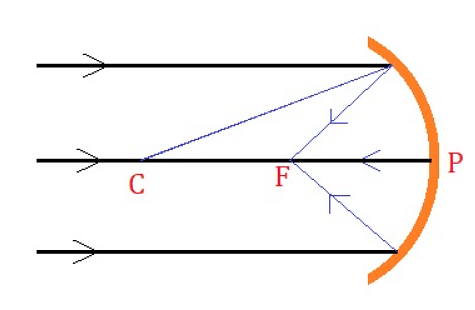
Location of principal focus of the concave mirror

Location of principal focus of the concave mirror


Read More: 

CBSE X Related Questions

  • 1.
    From the given situations, identify 'Chemotropic' and 'Geotropic' movements in parts of plants, respectively:
    (i) Growth of pollen tube towards ovule.
    (ii) Movement of sunflower towards sunlight.
    (iii) Movement of root towards Earth/Gravity.
    (iv) Movement of leaves due to breeze.

      • (i) and (iii) respectively
      • (iii) and (i) respectively
      • (i), (ii) and (iii), (iv) respectively
      • (i), (iii) and (ii), (iv) respectively

    • 2.
      Given below is a pyramid showing various trophic levels in an ecosystem:
      (a) From the organisms listed below, identify which one is to be placed at which trophic level:
      Deer, Grass, Lion, Snake, Rabbit
      (b) Discuss the reason why primary consumers will have more energy as compared to secondary consumers?
      (c) Why is the base of the pyramid broad?


        • 3.
          Which structure in a leaf is mainly responsible for gaseous exchange?

            • Xylem
            • Stomata
            • Phloem
            • Cuticle

          • 4.
            State two differences between the act of chewing food and salivation on sight of food.


              • 5.
                Draw a neat diagram to show germination of pollen on the female reproductive part of the flower. Name and label only the following parts:
                (a) The part that receives the pollen grain.
                (b) The structure that carries the male germ cell to reach the female germ cell.


                  • 6.
                    When a human egg is fertilized by a sperm having ‘Y’ chromosome, the zygote has the following combination of chromosomes:

                      • 44 + XX
                      • 22 + XX
                      • 44 + XY
                      • 22 + XY

                    Comments


                    No Comments To Show
