




Students can calculate their JEE Advanced marks from the official answer key which is expected to be released on May 25th 2026.
- Students have to download their response sheets and answer key from the official JEE Advanced website.
- Make sure the correct option ID and your chosen option ID match; If its matching, give +3 or + 4, depending on the question type.
- If the question ID and the correct option ID do not match, calculate -1 marks.
- If you find any discrepancies in the provisional answer key, you can challenge it within the given time.
Also Read:
- Check JEE Advanced 2026 answer key release date and updates
- Check JEE Advanced 2026 Results, Direct Link, and Scorecard
- JEE Advanced 2026 Expected Category-wise Marks vs Rank
Step-by-Step Guide: How to Calculate JEE Advanced Marks from the Answer Key
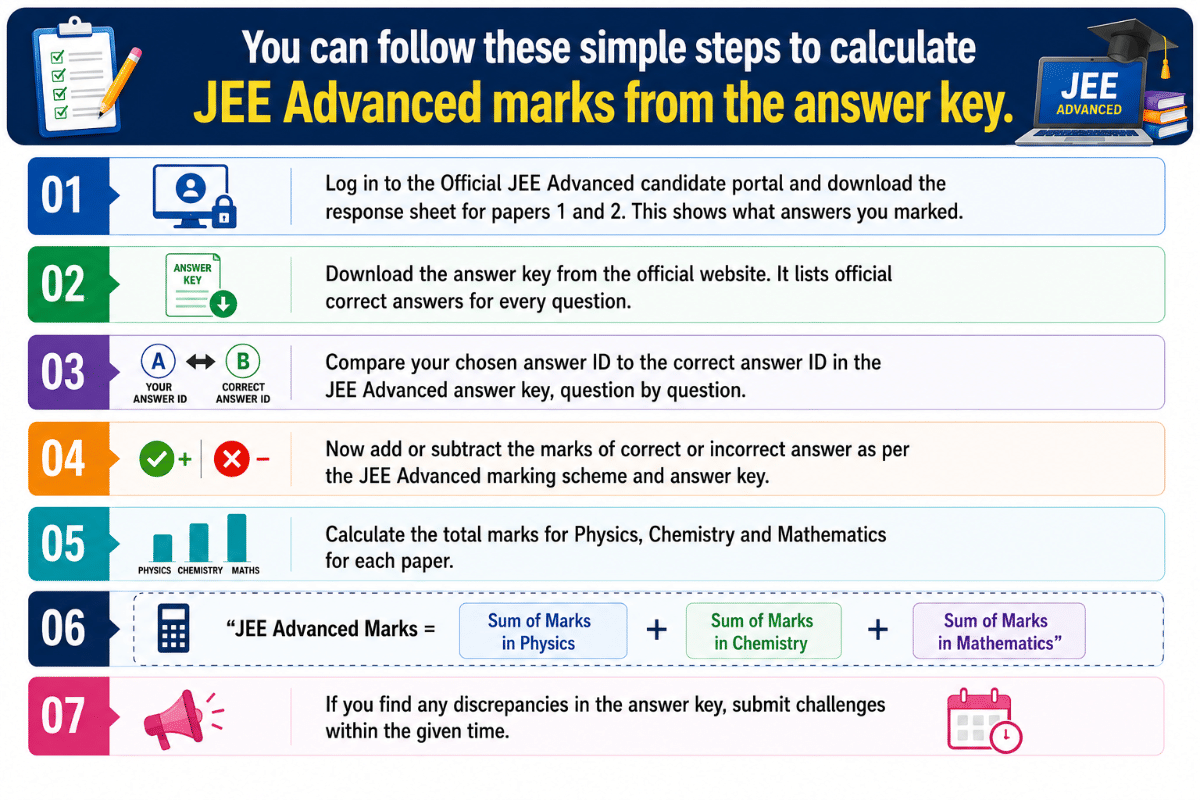
You can follow these simple steps to calculate JEE Advanced marks from the answer key.
- Log in to the Official JEE Advanced candidate portal and download the response sheet for papers 1 and 2. This shows what answers you marked.
- Download the answer key from the official website. It lists official correct answers for every question.
- Compare your chosen answer ID to the correct answer ID in the JEE Advanced answer key, question by question.
- Now add or subtract the marks of correct or incorrect answer as per the JEE Advanced marking scheme and answer key.
- Calculate the total marks for Physics, Chemistry and Mathematics for each paper.
“JEE Advanced Marks = Sum of Marks in Physics + Sum of Marks in Chemistry + Sum of Marks in Mathematics”
- If you find any discrepancies in the answer key, submit challenges within the given time.
Also Read:
Ques. Do we get partial marks for multiple correct answers in JEE Advanced?
Ans. Yes. Partial marks are awarded for multiple correct answers. Marks mainly depend on the number of correct answers and the number of correct answers you have chosen.
Ques. What if I wrote 7.726 instead of 7.72? Will I get marks?
Ans. It usually depends on the decimal point range allowed and the precision mentioned on the paper. Some years they will allow range, and in other years it's too strict.
JEE Advanced 2026 Marking Scheme to Help You Calculate JEE Advanced Marks
- Single correct MCQ has the marking scheme of + 3 for a correct answer and -1 for a wrong answer.
- For multiple correct answers, + 4 will be given for choosing all correct answers and +3 to + 1 for partial answers.
- Numeric questions don’t have any negative marking. +4 for given for correct answer.
- Use this marking scheme to calculate your JEE Advanced score.
For multiple correct questions: +3 marks if you select only 3 correct options when the correct answers were all four. +2 if you select only 2 correct answers when 3 or more options were correct officially. +1 if you are chosen only 1 option when 2 or more options were correct officially
| Question Type | Correct Answer | Incorrect Answer | Unattempted | Example Score Calculation |
|---|---|---|---|---|
| Single Correct MCQ | +3 | -1 | 0 | 5 correct 2 wrong = (5 x 3) - (2 x 1) = 13 |
| Multiple Correct | +4 (All) | -2 if wrong answers get picked. | 0 | All correct = + 4Partial Correct = +1 to +3 |
| Numerical Value | +4 | 0 | 0 | 8 correct: 8 x 4 = 32 |
Also Read:
Common Mistakes to Avoid When Calculating JEE Advanced Marks from the Answer Key
Students make common mistakes while counting their JEE Advanced marks from their answer key.
- Don’t ignore partial marking while calculating your score. You may get +1, 2, or +3 marks for picking partially correct answers.
- Numerical questions typically have no negative marking. Students sometimes assume negative marking for numerical answers.
- Don’t forget to count negative marking for some matching or single correct questions.
Also Read: Minimum Marks in JEE Advanced to get IIT for OBC Students
How to Calculate JEE Advanced Marks From Answer Key? : Quora Discussions
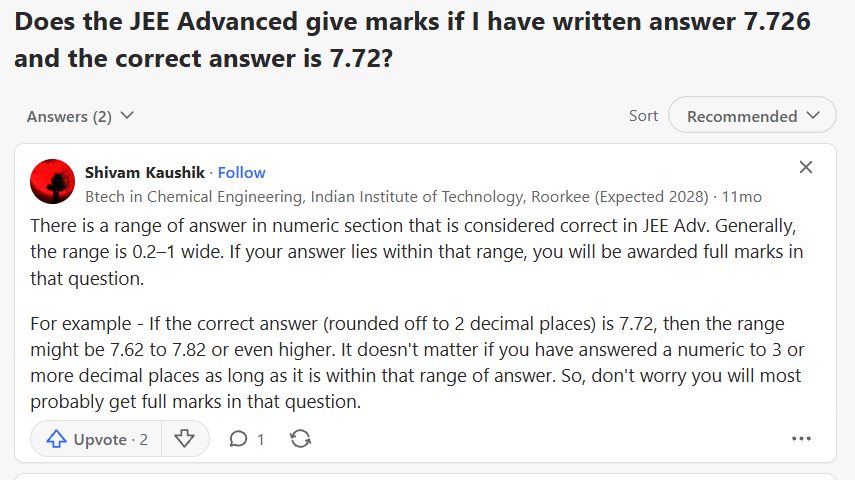
As per the user on Quora, in the JEE Advanced numerical value question, if you have written 7.726 instead of 7.72, you will be awarded marks. As per the user, there will be a decimal point range, usually between 0.2 and 1, which will be considered the correct answer.
Related News:



Comments