




The National Testing Agency (NTA) conducted the CUET PG 2026 Nanoscience (SCQP22) examination on March 19, 2026, during Shift 3 from 04:00 PM to 05:30 PM.
Students who appeared for the exam reported that the overall difficulty level of the paper was moderate. CUET PG 2026 Nanoscience Question Paper with Solutions PDF is available here for download. The marking scheme is +4 for correct answers and -1 for wrong answers, totaling 300 marks.
CUET PG 2026 Nanoscience Question Paper with Solutions PDF
| CUET PG 2026 Nanoscience Question Paper | Download PDF | Check Solutions |
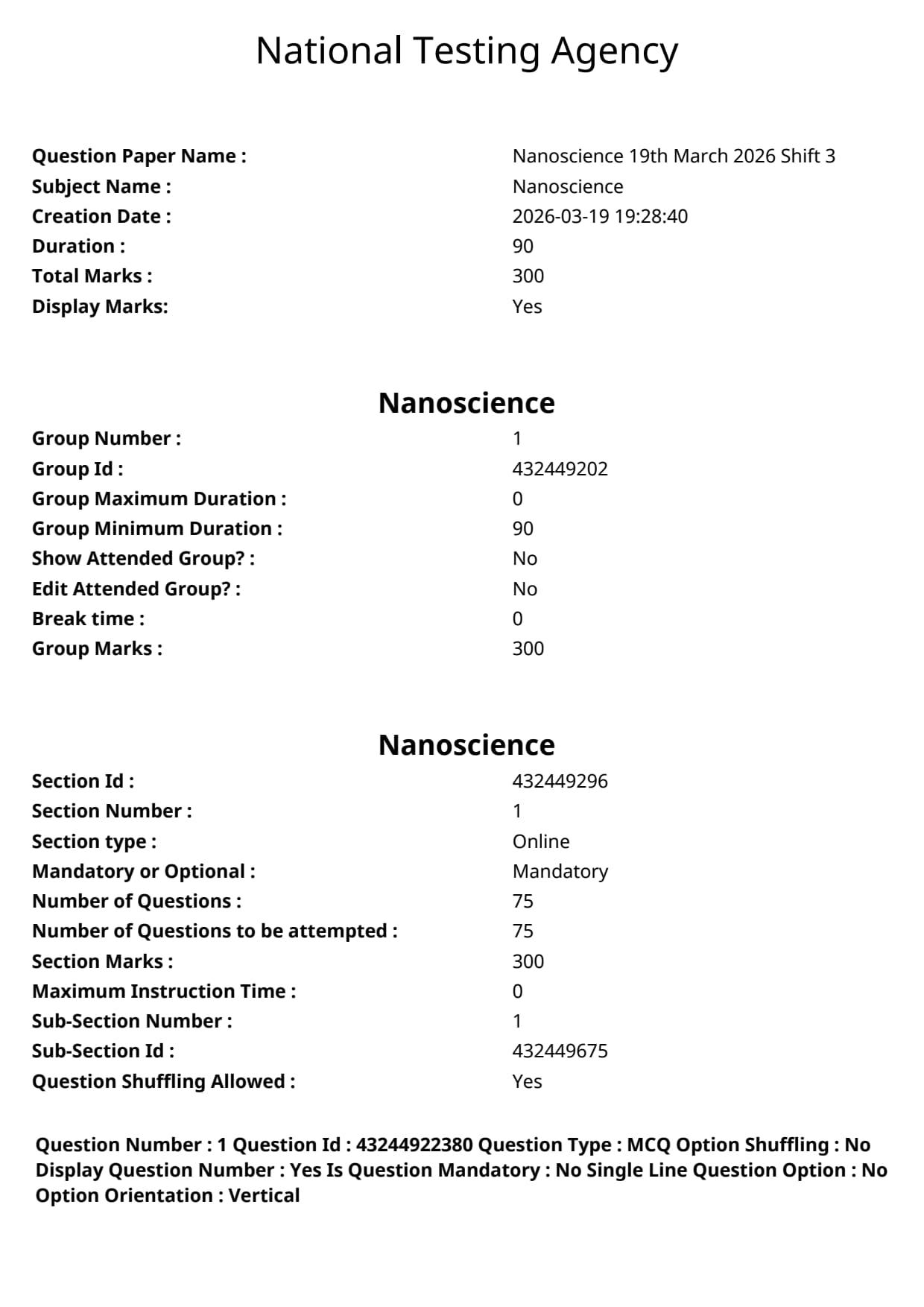
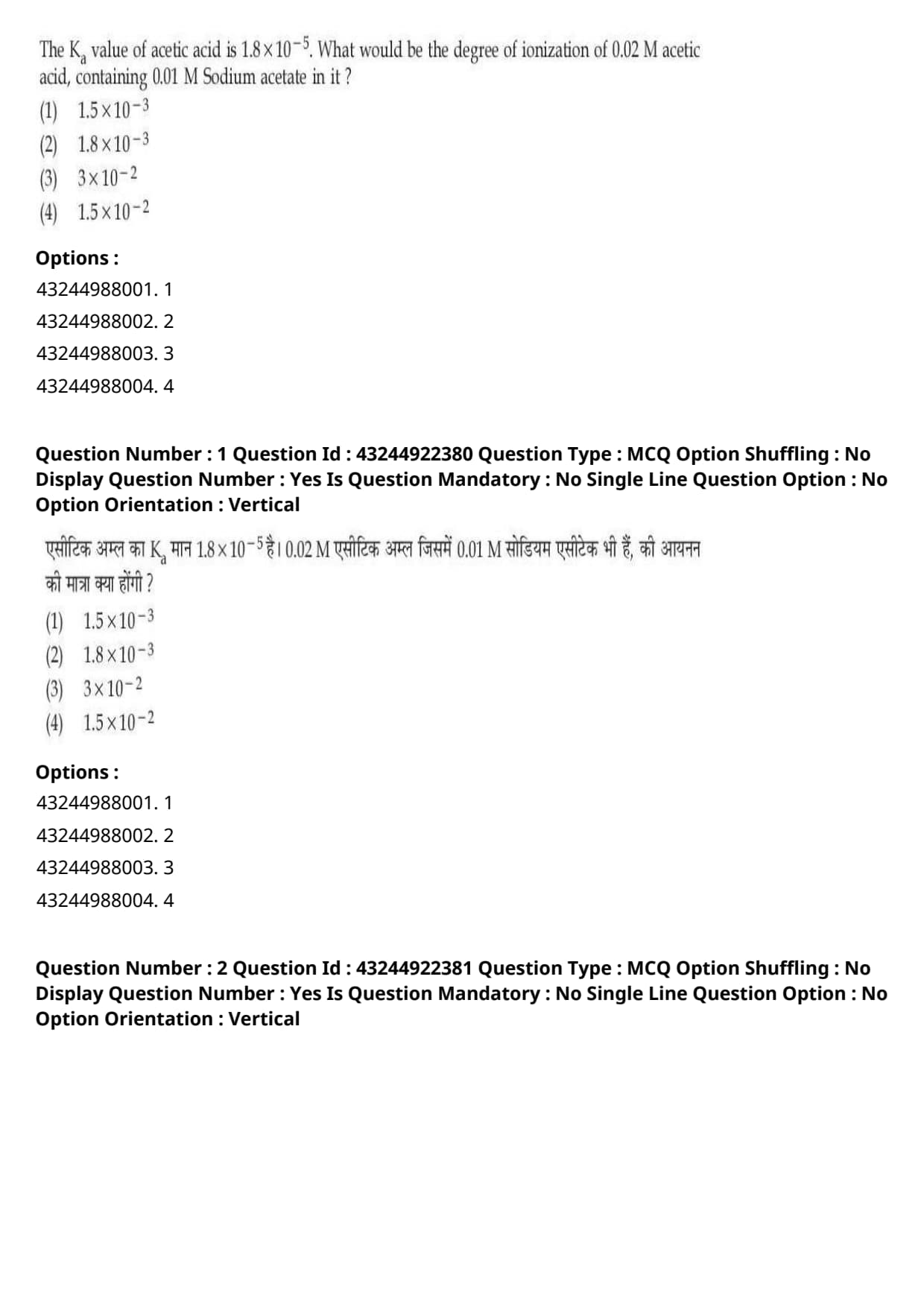
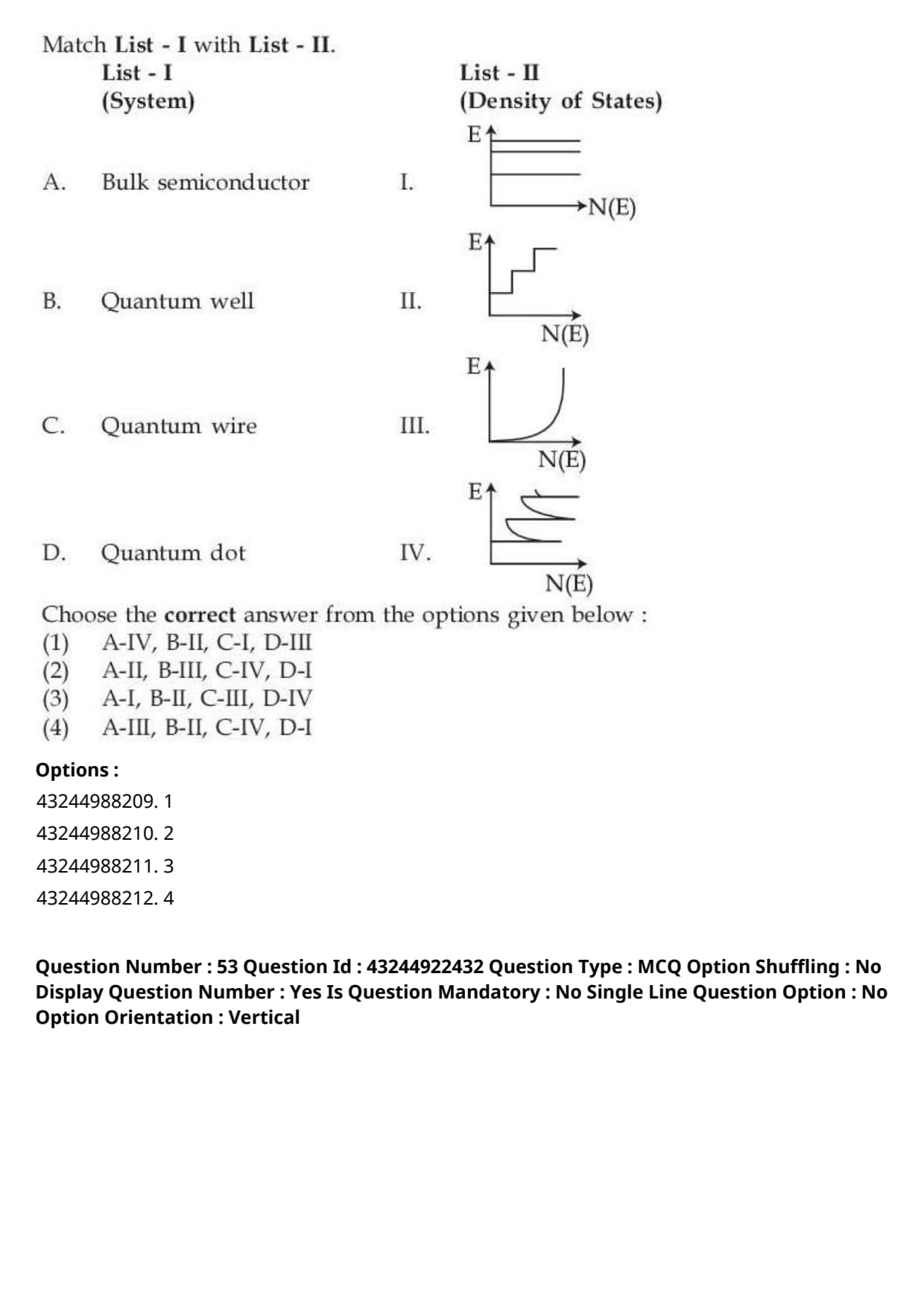
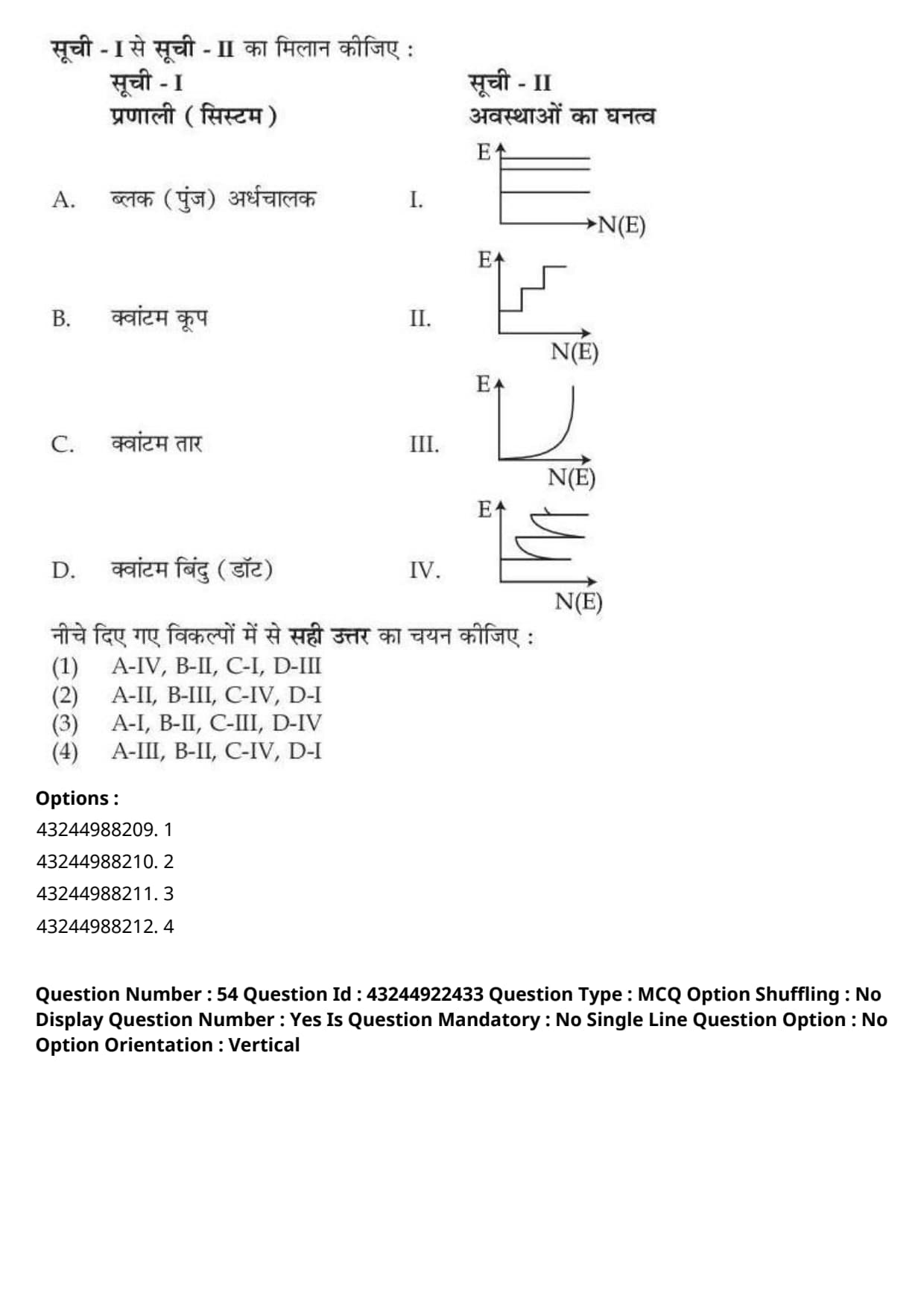
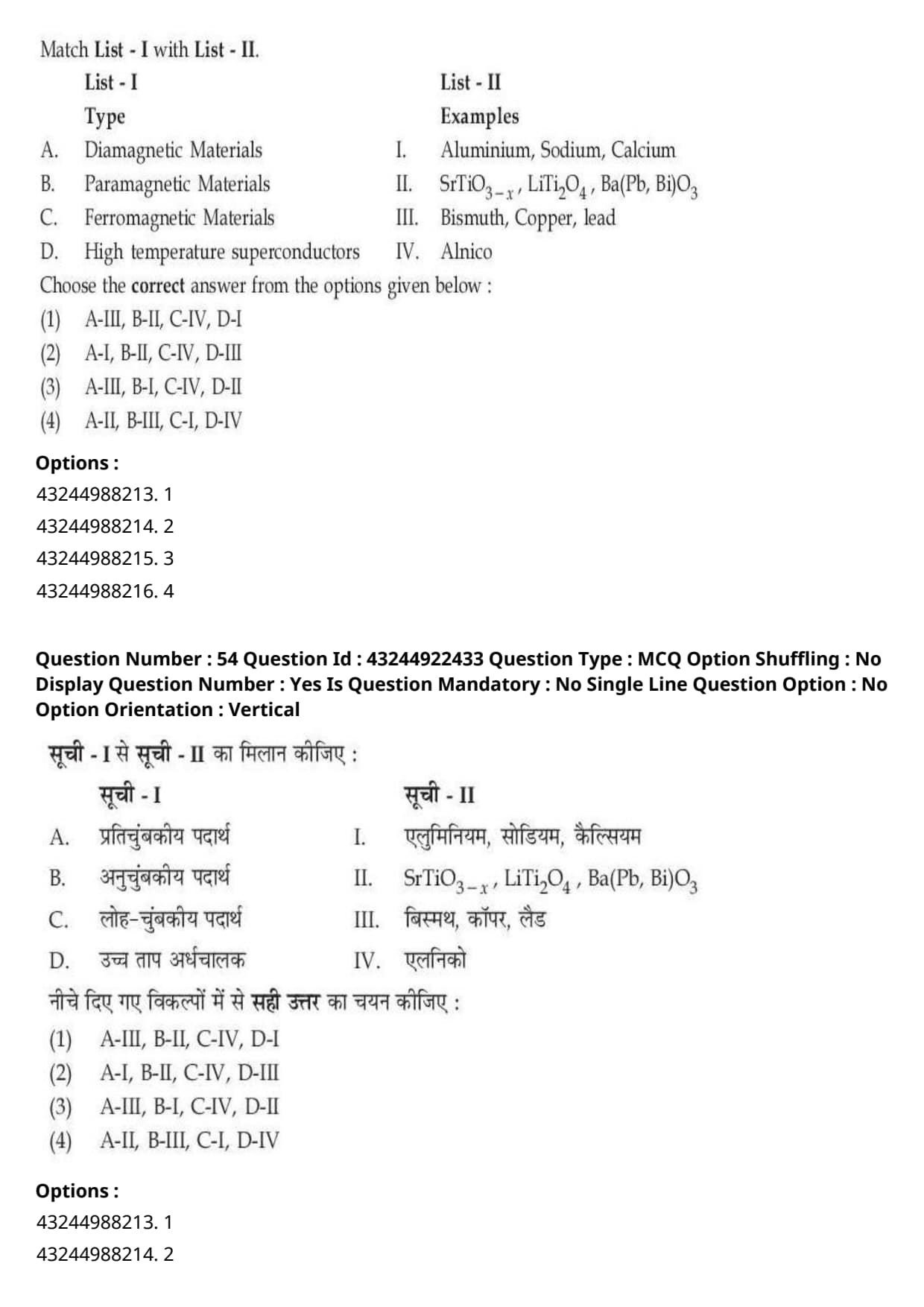
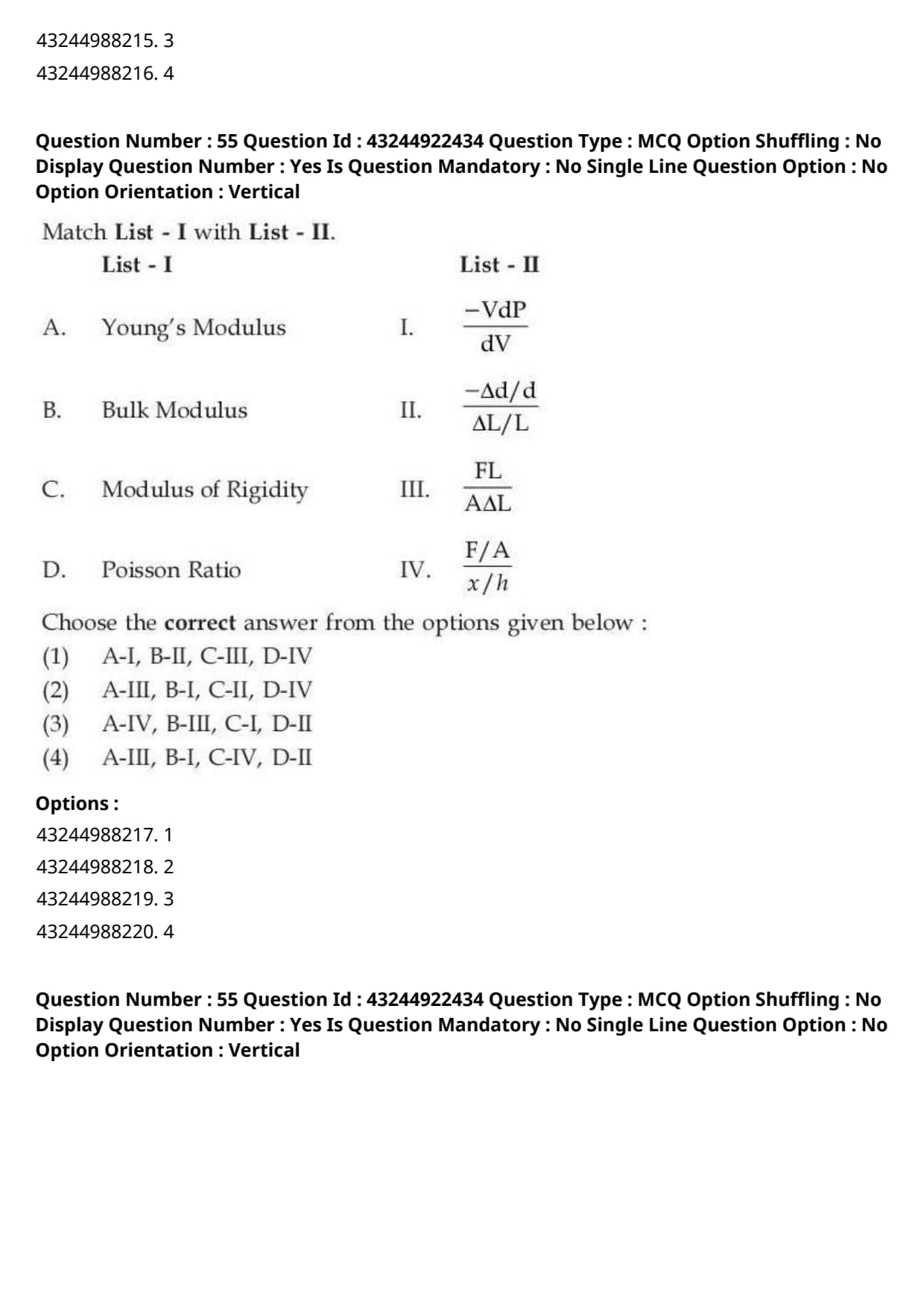
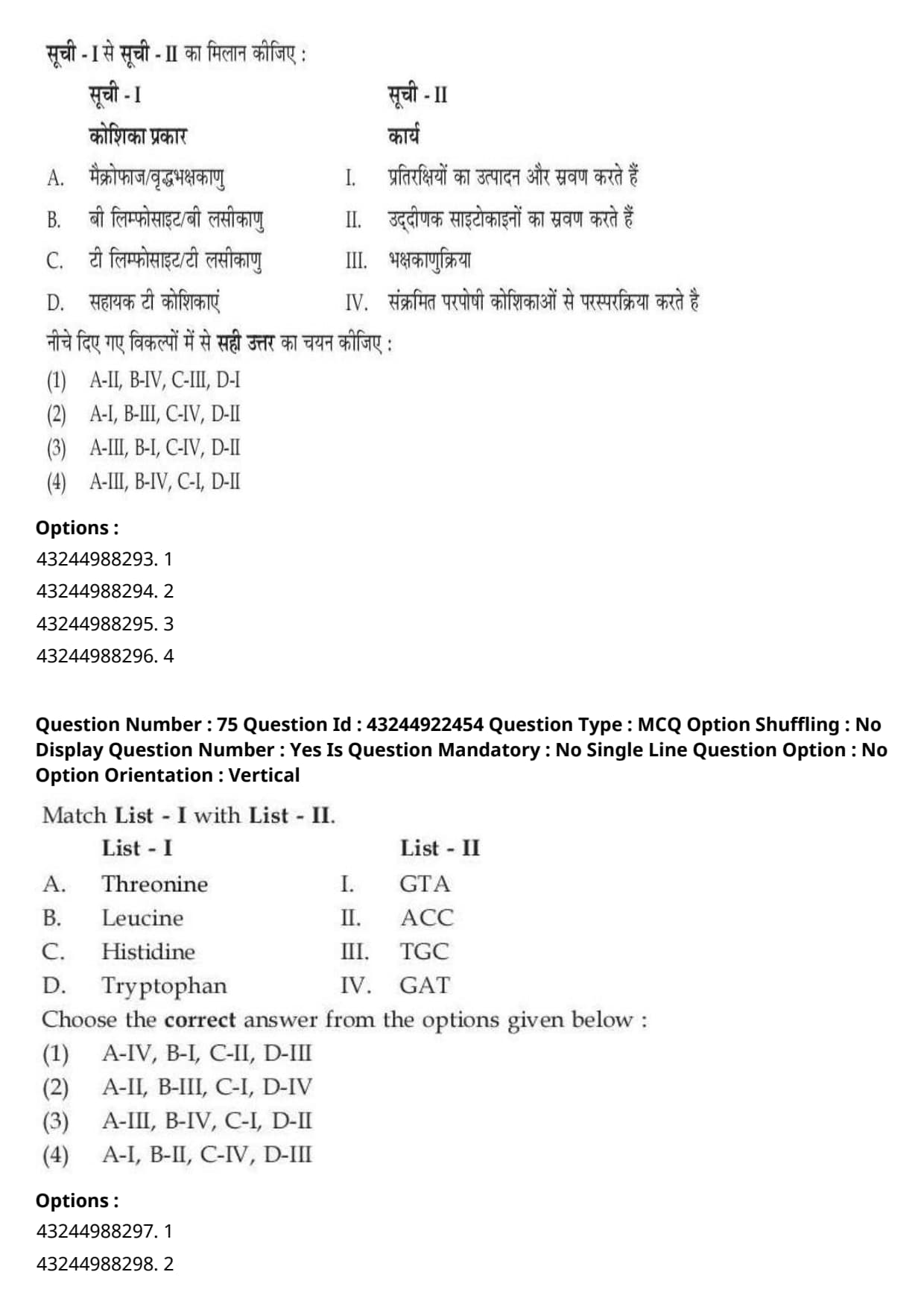
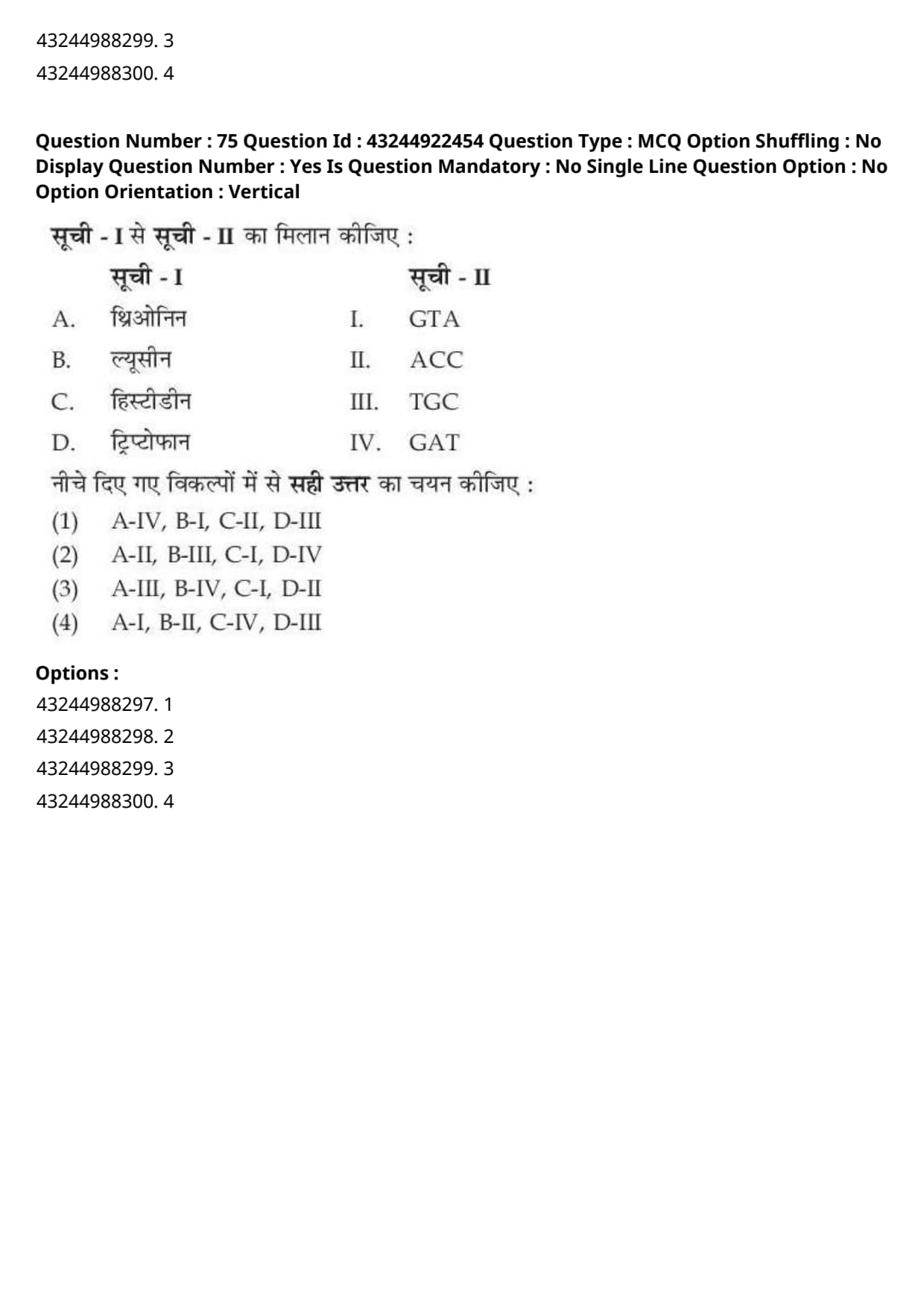
The \(K_a\) value of acetic acid is \(1.8 \times 10^{-5}\). What would be the degree of ionization of 0.02 M acetic acid, containing 0.01 M Sodium acetate in it?
View Solution
Step 1: Concept:
The question asks for the degree of ionization (\(\alpha\)) of a weak acid (acetic acid) in a solution that also contains a strong electrolyte (sodium acetate) providing a common ion.
This is a classic application of the Common Ion Effect, which states that the addition of a common ion to a weak electrolyte solution suppresses the ionization of the weak electrolyte.
Step 2: Key Formula or Approach:
The dissociation of acetic acid is given by:
\[ CH_3COOH \rightleftharpoons CH_3COO^- + H^+ \]
The acid dissociation constant (\(K_a\)) is expressed as:
\[ K_a = \frac{[CH_3COO^-][H^+]}{[CH_3COOH]} \]
Let \(C_a\) be the initial concentration of the acid and \(C_s\) be the concentration of the added salt (which dissociates completely).
Step 3: Step-by-step Explanation:
Let the initial concentration of acetic acid be \(C_a = 0.02\) M.
The initial concentration of the common ion from sodium acetate is \(C_s = 0.01\) M.
Let \(\alpha\) be the degree of ionization of acetic acid. The change in concentration for \(CH_3COOH\) is \(-C_a\alpha\), and for \(H^+\) and \(CH_3COO^-\) it is \(+C_a\alpha\).
At equilibrium, the concentrations are:
\([CH_3COOH] = C_a(1 - \alpha) = 0.02(1 - \alpha)\)
\([H^+] = C_a\alpha = 0.02\alpha\)
\([CH_3COO^-] = C_s + C_a\alpha = 0.01 + 0.02\alpha\)
Since acetic acid is a weak acid and its dissociation is further suppressed by the common ion, \(\alpha\) is extremely small (\(\alpha \ll 1\)).
We can approximate: \((1 - \alpha) \approx 1\) and \((0.01 + 0.02\alpha) \approx 0.01\).
Substituting these into the \(K_a\) expression:
\[ 1.8 \times 10^{-5} = \frac{(0.01)(0.02\alpha)}{0.02} \]
Simplifying the equation:
\[ 1.8 \times 10^{-5} = 0.01 \times \alpha \]
Solving for \(\alpha\):
\[ \alpha = \frac{1.8 \times 10^{-5}}{0.01} = 1.8 \times 10^{-3} \]
Step 4: Final Answer:
The degree of ionization is mathematically calculated to be \(1.8 \times 10^{-3}\), which matches option (B).
Quick Tip: % Quick Tip In common ion effect problems for weak acids or bases, the concentration of the common ion supplied by the weak electrolyte is almost always negligible compared to the strong electrolyte. Directly using \([Salt]\) for the conjugate ion concentration saves valuable time during exams.
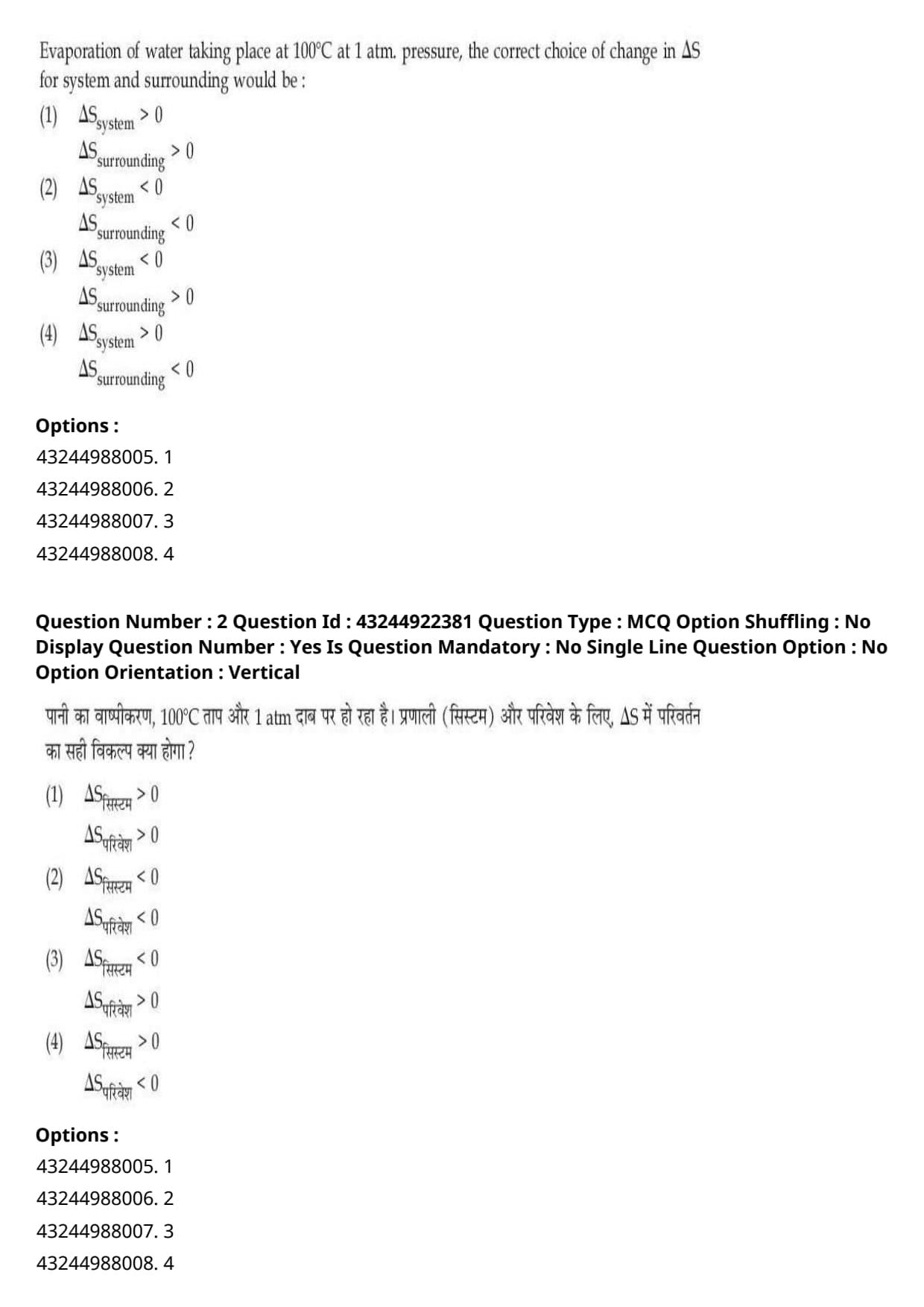
Evaporation of water taking place at \(100 °C\) at 1 atm. pressure, the correct choice of change in \(\Delta S\) for system and surrounding would be :
View Solution
Step 1: Concept:
The question explores the thermodynamic entropy changes (\(\Delta S\)) during a phase transition, specifically the evaporation of water at its standard boiling point (\(100^\circC\), 1 atm).
We must evaluate the sign of entropy change for both the system (the water undergoing evaporation) and its surroundings.
Step 2: Key Formula or Approach:
Entropy (\(S\)) is a measure of randomness or disorder.
For the system undergoing a phase change from liquid to gas:
\[ \Delta S_{system} = S_{gas} - S_{liquid} \]
For the surroundings, the entropy change is related to the heat exchanged:
\[ \Delta S_{surrounding} = \frac{q_{surrounding}}{T} = \frac{-q_{system}}{T} \]
Step 3: Step-by-step Explanation:
System: The process is the evaporation of water (\(H_2O_{(l)} \rightarrow H_2O_{(g)}\)).
Gases have significantly higher entropy than liquids because the molecules have far greater freedom of motion and occupy a much larger volume.
Therefore, the entropy of the system increases, making \(\Delta S_{system} > 0\) (positive).
Surroundings: Evaporation is an endothermic process. The system must absorb heat from its surroundings to overcome the intermolecular forces in the liquid phase.
Since the system absorbs heat (\(q_{system} > 0\)), the surroundings lose an equal amount of heat (\(q_{surrounding} < 0\)).
Because the surroundings lose thermal energy, their thermal disorder decreases. Therefore, \(\Delta S_{surrounding} = -q_{system} / T\), which means \(\Delta S_{surrounding} < 0\) (negative).
Additionally, at the normal boiling point, the phase change is a reversible equilibrium process where the total entropy change of the universe is zero (\(\Delta S_{univ} = \Delta S_{sys} + \Delta S_{surr} = 0\)). Thus, \(\Delta S_{sys} = -\Delta S_{surr}\).
Step 4: Final Answer:
The entropy of the system increases while the entropy of the surroundings decreases. This matches option (D).
Quick Tip: % Quick Tip Whenever an endothermic phase change occurs (like melting or boiling), the system's entropy always increases (\(>0\)) and the surroundings' entropy always decreases (\(<0\)). For exothermic phase changes (freezing, condensation), the exact opposite is true.
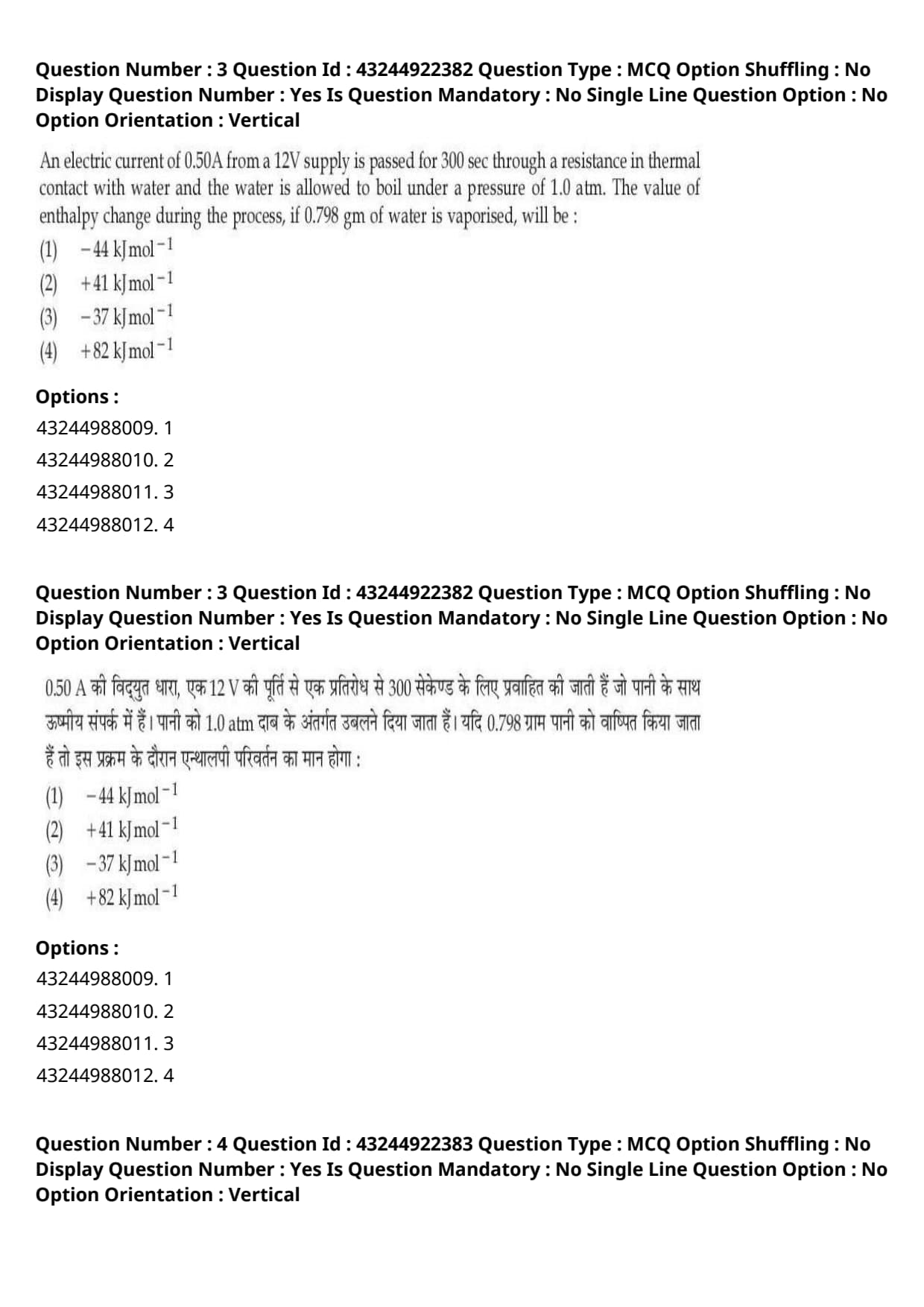
An electric current of 0.50A from a 12V supply is passed for 300 sec through a resistance in thermal contact with water and the water is allowed to boil under a pressure of 1.0 atm. The value of enthalpy change during the process, if 0.798 gm of water is vaporised, will be :
View Solution
Step 1: Concept:
The problem asks for the molar enthalpy of vaporization of water. We are given the electrical energy used to boil a specific mass of water.
We must first calculate the total heat energy supplied by the electrical circuit and then determine the enthalpy change per mole of water vaporized.
Step 2: Key Formula or Approach:
The total electrical energy (\(W\) or \(Q\)) supplied by a circuit is given by Joule's law of heating:
\[ Q = V \times I \times t \]
Where \(V\) is voltage, \(I\) is current, and \(t\) is time in seconds.
The molar enthalpy change (\(\Delta H\)) is the total heat supplied divided by the number of moles (\(n\)) vaporized:
\[ \Delta H = \frac{Q}{n} \]
Step 3: Step-by-step Explanation:
First, calculate the total electrical energy (heat) supplied to the water:
\[ Q = 12 V \times 0.50 A \times 300 s \]
\[ Q = 1800 Joules = 1.8 kJ \]
Next, determine the number of moles of water vaporized. The molar mass of water (\(H_2O\)) is \(18 g mol^{-1}\).
\[ n = \frac{mass}{molar mass} = \frac{0.798 g}{18 g mol^{-1}} \approx 0.04433 mol \]
Now, calculate the enthalpy of vaporization per mole:
\[ \Delta H = \frac{1.8 kJ}{0.04433 mol} \approx 40.604 kJ mol^{-1} \]
Rounding to the nearest whole number given in the options, we get \(41 kJ mol^{-1}\).
Since vaporization requires the absorption of heat (it is an endothermic process), the sign of the enthalpy change must be positive.
\[ \Delta H = +41 kJ mol^{-1} \]
Step 4: Final Answer:
The calculated molar enthalpy change is \(+41 kJ mol^{-1}\), matching option (B).
Quick Tip: % Quick Tip Pay close attention to thermodynamic signs! Vaporization, melting, and sublimation are always endothermic (positive \(\Delta H\)). Condensation and freezing are always exothermic (negative \(\Delta H\)). This immediately eliminates options with negative signs for boiling processes.
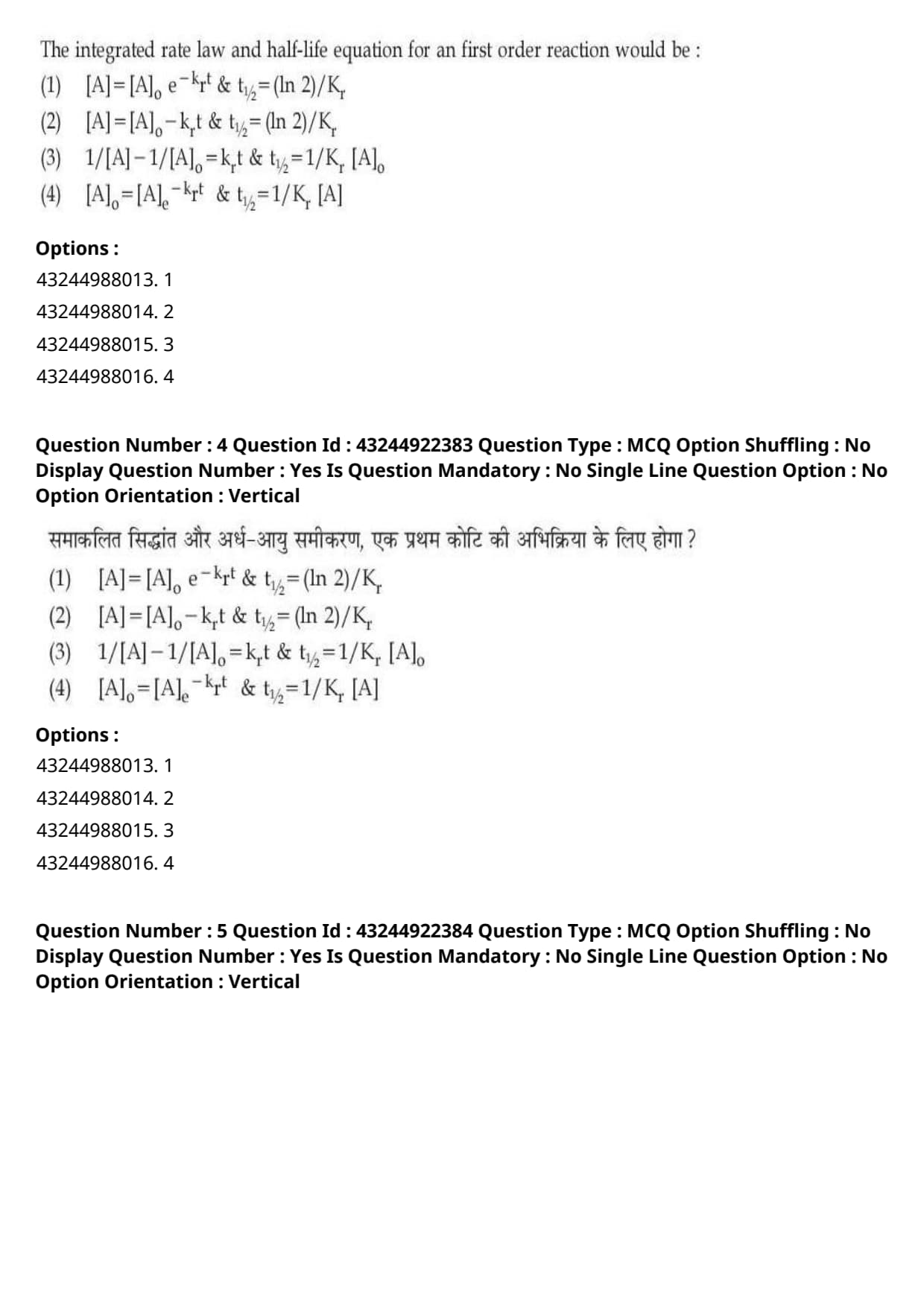
The integrated rate law and half-life equation for an first order reaction would be :
View Solution
Step 1: Concept:
The question asks for the mathematical formulas that describe the concentration-time relationship (integrated rate law) and the half-life for a first-order chemical reaction.
Step 2: Key Formula or Approach:
For a first-order reaction \(A \rightarrow Products\), the rate law is given by:
\[ Rate = -\frac{d[A]}{dt} = k_r[A] \]
Integrating this differential equation yields the concentration profile over time.
The half-life (\(t_{1/2}\)) is defined as the time required for the concentration of the reactant to drop to exactly half of its initial value (\([A] = [A]_0 / 2\)).
Step 3: Step-by-step Explanation:
Integrated Rate Law: Rearranging the differential rate law gives:
\[ \frac{d[A]}{[A]} = -k_r dt \]
Integrating from \(t = 0\) (where \([A] = [A]_0\)) to time \(t\):
\[ \int_{[A]_0}^{[A]} \frac{1}{[A]} d[A] = -k_r \int_0^t dt \]
\[ \ln[A] - \ln[A]_0 = -k_rt \]
\[ \ln\left(\frac{[A]}{[A]_0}\right) = -k_rt \]
Taking the exponential of both sides gives the standard integrated rate law for a first-order reaction:
\[ [A] = [A]_0 e^{-k_rt} \]
Half-Life Equation: Substitute \([A] = \frac{[A]_0}{2}\) and \(t = t_{1/2}\) into the logarithmic form:
\[ \ln\left(\frac{[A]_0/2}{[A]_0}\right) = -k_r t_{1/2} \]
\[ \ln\left(\frac{1}{2}\right) = -k_r t_{1/2} \]
\[ -\ln(2) = -k_r t_{1/2} \]
\[ t_{1/2} = \frac{\ln 2}{k_r} \]
Reviewing the options, Option (A) presents both of these correctly derived expressions.
For completeness: Option (B) mixes zero-order rate law with first-order half-life. Option (C) represents second-order kinetics. Option (D) incorrectly positions the exponential term.
Step 4: Final Answer:
The correct integrated rate law and half-life for a first-order reaction are given in option (A).
Quick Tip: % Quick Tip A key characteristic of first-order reactions is that their half-life is completely independent of the initial concentration \([A]_0\). This is unique to first-order kinetics and is highly useful for identifying reaction orders experimentally.
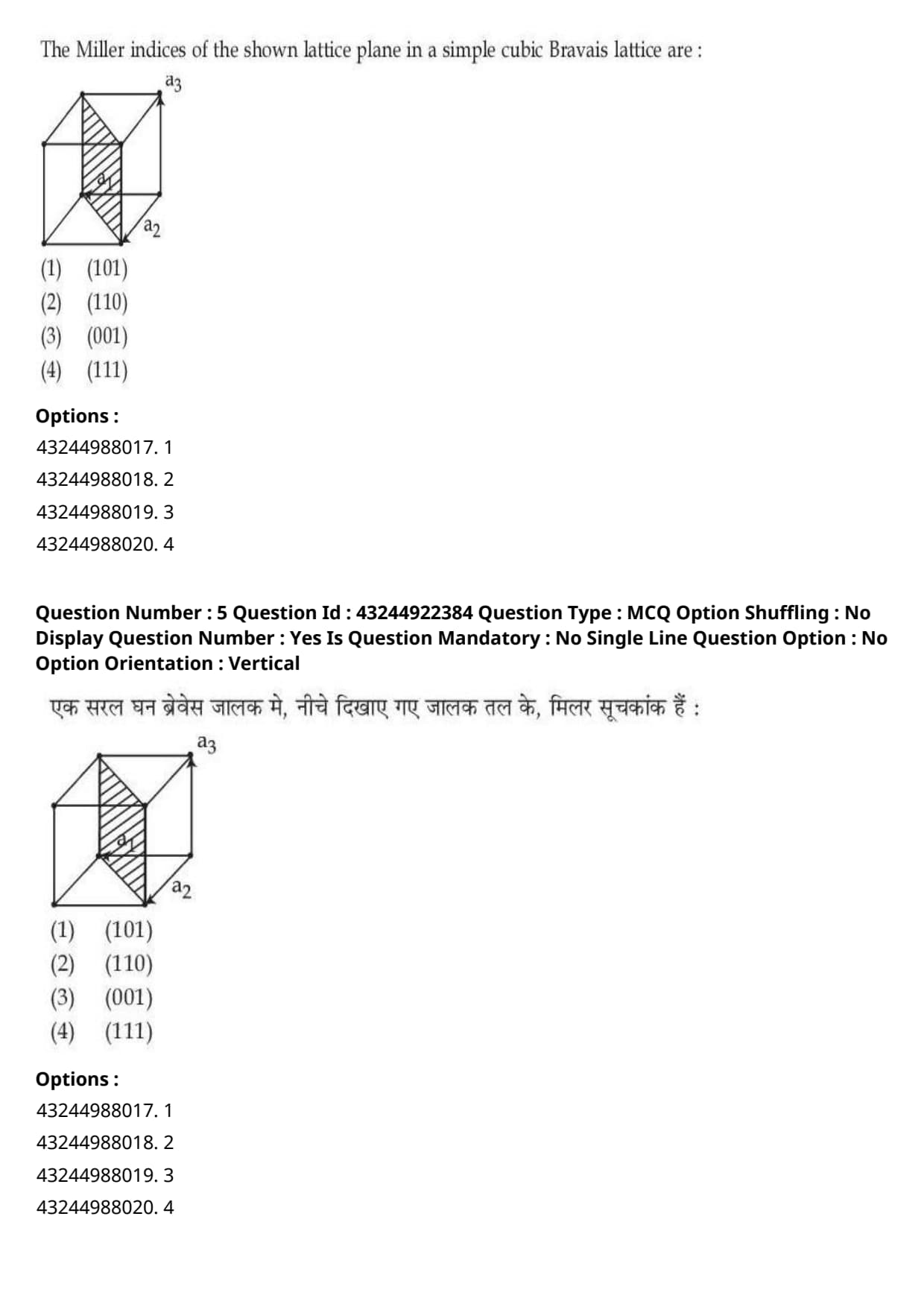
The Miller indices of the shown lattice plane in a simple cubic Bravais lattice are :

View Solution
Step 1: Concept:
The question requires us to determine the Miller indices of a specific crystallographic plane illustrated inside a simple cubic unit cell. The image defines three crystallographic axes: \(a_1\), \(a_2\), and \(a_3\).
Step 2: Key Formula or Approach:
Miller indices \((hkl)\) are determined through a standardized three-step process:
1. Identify the fractional intercepts that the plane makes with the crystallographic axes (\(a_1, a_2, a_3\)).
2. Take the reciprocal of each intercept.
3. Clear any fractions to express the reciprocals as the smallest possible set of integers.
Step 3: Step-by-step Explanation:
Based on standard representations of cubic lattices, let's identify the intercepts from the provided diagram. The axes are given as \(a_1\) (typically the x-axis pointing towards the viewer/left), \(a_2\) (the y-axis pointing right), and \(a_3\) (the z-axis pointing up).
Observing the shaded plane in the cubic unit cell:
- The plane cuts the \(a_1\) axis exactly at the unit cell boundary, so the intercept is \(1\).
- The plane cuts the \(a_3\) axis exactly at the top of the unit cell, so the intercept is \(1\).
- The plane extends completely parallel to the \(a_2\) axis without ever intersecting it. Therefore, its intercept on the \(a_2\) axis is considered to be infinity (\(\infty\)).
The fractional intercepts are thus: \((1, \infty, 1)\).
Now, we take the reciprocals of these intercepts:
\[ h = \frac{1}{1} = 1 \]
\[ k = \frac{1}{\infty} = 0 \]
\[ l = \frac{1}{1} = 1 \]
The resulting indices are already integers, so no clearing of fractions is needed.
The Miller indices are enclosed in parentheses without commas: \((101)\).
Step 4: Final Answer:
The Miller indices for the plane are \((101)\), which corresponds to option (A).
Quick Tip: % Quick Tip If a crystallographic plane is parallel to an axis, its intercept is infinity, and the corresponding Miller index is exactly \(0\). Always remember: Intercept \(\rightarrow\) Reciprocal \(\rightarrow\) Clear Fractions.
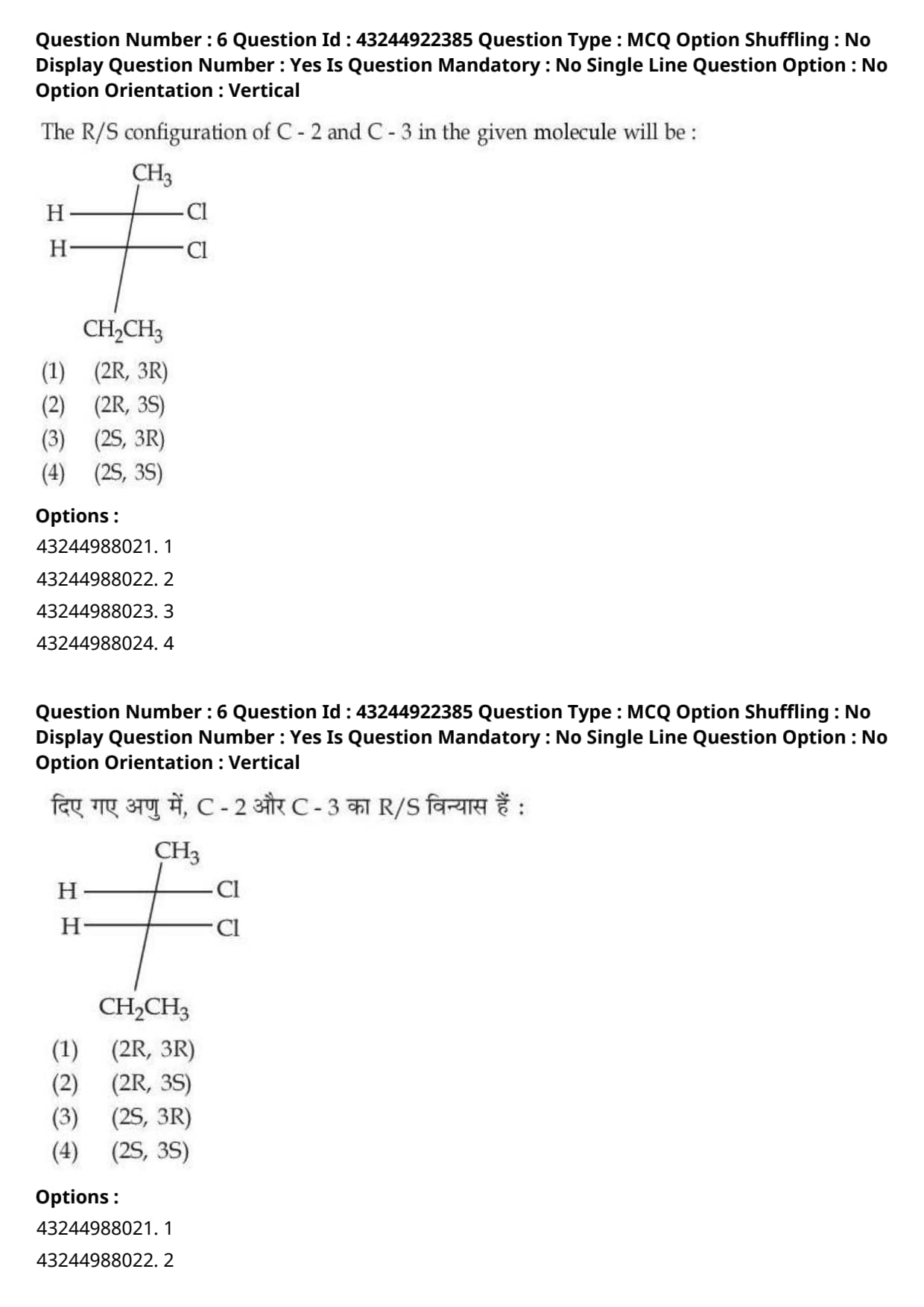
The R/S configuration of C-2 and C-3 in the given molecule will be :

View Solution
Step 1: Concept:
We are tasked with determining the absolute stereochemical configuration (R or S) for two chiral centers (C-2 and C-3) in a molecule drawn in a Fischer projection. The molecule is 2,3-dichloropentane.
Step 2: Key Formula or Approach:
Use the Cahn-Ingold-Prelog (CIP) priority rules:
1. Assign priorities (1 to 4) to the four groups attached to each chiral center based on atomic number.
2. Determine the direction of the curve tracing priority 1 \(\rightarrow\) 2 \(\rightarrow\) 3.
3. In a Fischer projection, if the lowest priority group (usually H) is on a horizontal bond, the apparent configuration is reversed (Clockwise becomes S, Counter-clockwise becomes R).
Step 3: Step-by-step Explanation:
Configuration at C-2:
The groups attached to C-2 are: \(-Cl\), \(-CH(Cl)CH_2CH_3\) (C-3 group), \(-CH_3\), and \(-H\).
- Priority 1: \(-Cl\) (highest atomic number, 17).
- Priority 2: \(-CH(Cl)CH_2CH_3\) (C-3 has a Cl attached, making it higher priority than C-1).
- Priority 3: \(-CH_3\).
- Priority 4: \(-H\) (lowest atomic number).
In the drawn projection, \(-Cl\) is on the right, \(-CH_3\) is up, and C-3 is down. The path from 1(\(-Cl\)) \(\rightarrow\) 2(C-3 down) \(\rightarrow\) 3(\(-CH_3\) up) traces a clockwise direction.
However, the lowest priority group (\(-H\)) is situated on a horizontal line.
Therefore, we reverse the apparent clockwise (R) configuration to S. So, C-2 is 2S.
Configuration at C-3:
The groups attached to C-3 are: \(-Cl\), \(-CH(Cl)CH_3\) (C-2 group), \(-CH_2CH_3\), and \(-H\).
- Priority 1: \(-Cl\) (atomic number 17).
- Priority 2: \(-CH(Cl)CH_3\) (C-2 is attached to Cl, whereas the ethyl group is only attached to C).
- Priority 3: \(-CH_2CH_3\) (ethyl group).
- Priority 4: \(-H\).
In the Fischer projection, \(-Cl\) is on the right, C-2 is up, and \(-CH_2CH_3\) is down. The path from 1(\(-Cl\) right) \(\rightarrow\) 2(C-2 up) \(\rightarrow\) 3(\(-CH_2CH_3\) down) traces a counter-clockwise direction.
Since the lowest priority group (\(-H\)) is on a horizontal line, we reverse the apparent counter-clockwise (S) configuration to R. So, C-3 is 3R.
Step 4: Final Answer:
The absolute configuration is (2S, 3R), which corresponds to option (C).
Quick Tip: % Quick Tip For Fischer projections: Vertical bond for lowest priority group \(\rightarrow\) keep the result. Horizontal bond for lowest priority group \(\rightarrow\) reverse the result. (Clockwise is usually R, Counter-Clockwise is usually S).
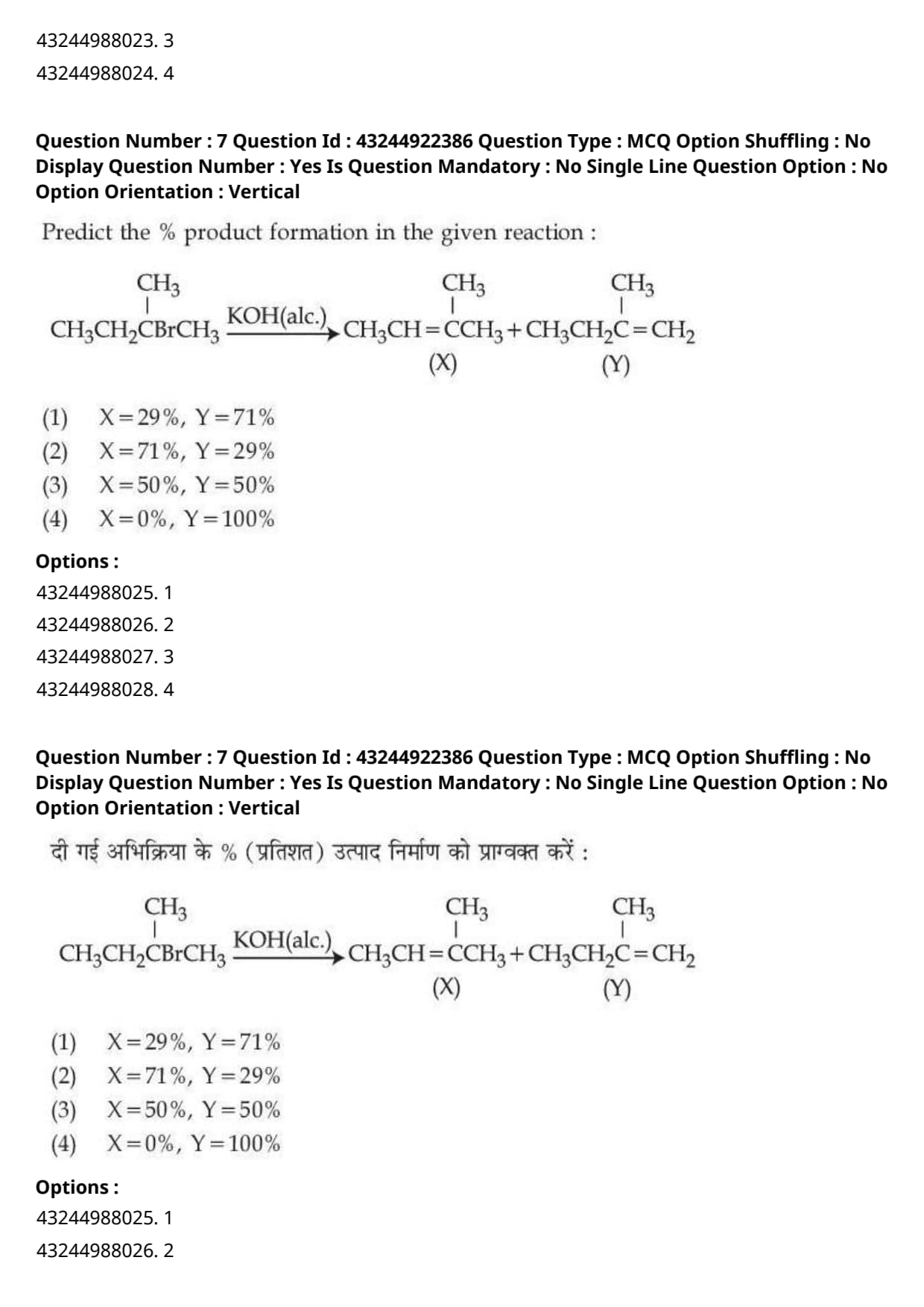
Predict the % product formation in the given reaction :
\(CH_3CH_2CBr(CH_3)_2 \xrightarrow{KOH(alc.)} CH_3CH=C(CH_3)_2 \ (X) + CH_3CH_2C(CH_3)=CH_2 \ (Y)\)
View Solution
Step 1: Concept:
The given reaction is a dehydrohalogenation of a tertiary alkyl halide (2-bromo-2-methylbutane) using an alcoholic base (\(KOH\)), which proceeds primarily via an E2 elimination mechanism. We need to identify the major and minor alkene products and their relative percentages.
Step 2: Key Formula or Approach:
The regioselectivity of E2 eliminations using small, unhindered bases (like \(OH^-\) from \(KOH(alc)\) or ethoxide) is governed by Zaitsev's Rule.
Zaitsev's Rule states that the major product will be the most highly substituted, and therefore most thermodynamically stable, alkene.
Step 3: Step-by-step Explanation:
The substrate, 2-bromo-2-methylbutane, has \(\beta\)-hydrogens on two different types of adjacent carbon atoms.
Elimination involving the \(\beta\)-hydrogen from the \(CH_2\) group (C-3) yields 2-methyl-2-butene. This is product (X). It has three alkyl groups attached to the double bond, making it a trisubstituted alkene.
Elimination involving a \(\beta\)-hydrogen from one of the \(CH_3\) groups (C-1 or the methyl branch) yields 2-methyl-1-butene. This is product (Y). It has only two alkyl groups attached to the double bond, making it a disubstituted alkene.
Because \(KOH(alc.)\) is a relatively small base, it can easily access the more sterically hindered internal protons to form the more stable alkene.
Therefore, product (X), the Zaitsev product, will be the major product.
Historically and experimentally, the dehydrohalogenation of 2-bromo-2-methylbutane with small bases yields approximately 71% of the trisubstituted alkene (X) and 29% of the disubstituted alkene (Y).
This specific 71:29 ratio is a classic textbook example used to illustrate regiochemistry in E2 eliminations.
Step 4: Final Answer:
The major product X forms around 71%, and the minor product Y forms around 29%. This matches option (B).
Quick Tip: % Quick Tip Small bases (e.g., \(NaOH\), \(KOH\), \(NaOEt\), \(NaOMe\)) favor the Zaitsev product (more substituted alkene). Bulky bases (e.g., potassium tert-butoxide, LDA) suffer from steric hindrance and thus favor the Hofmann product (less substituted alkene, formed by removing the most accessible proton).
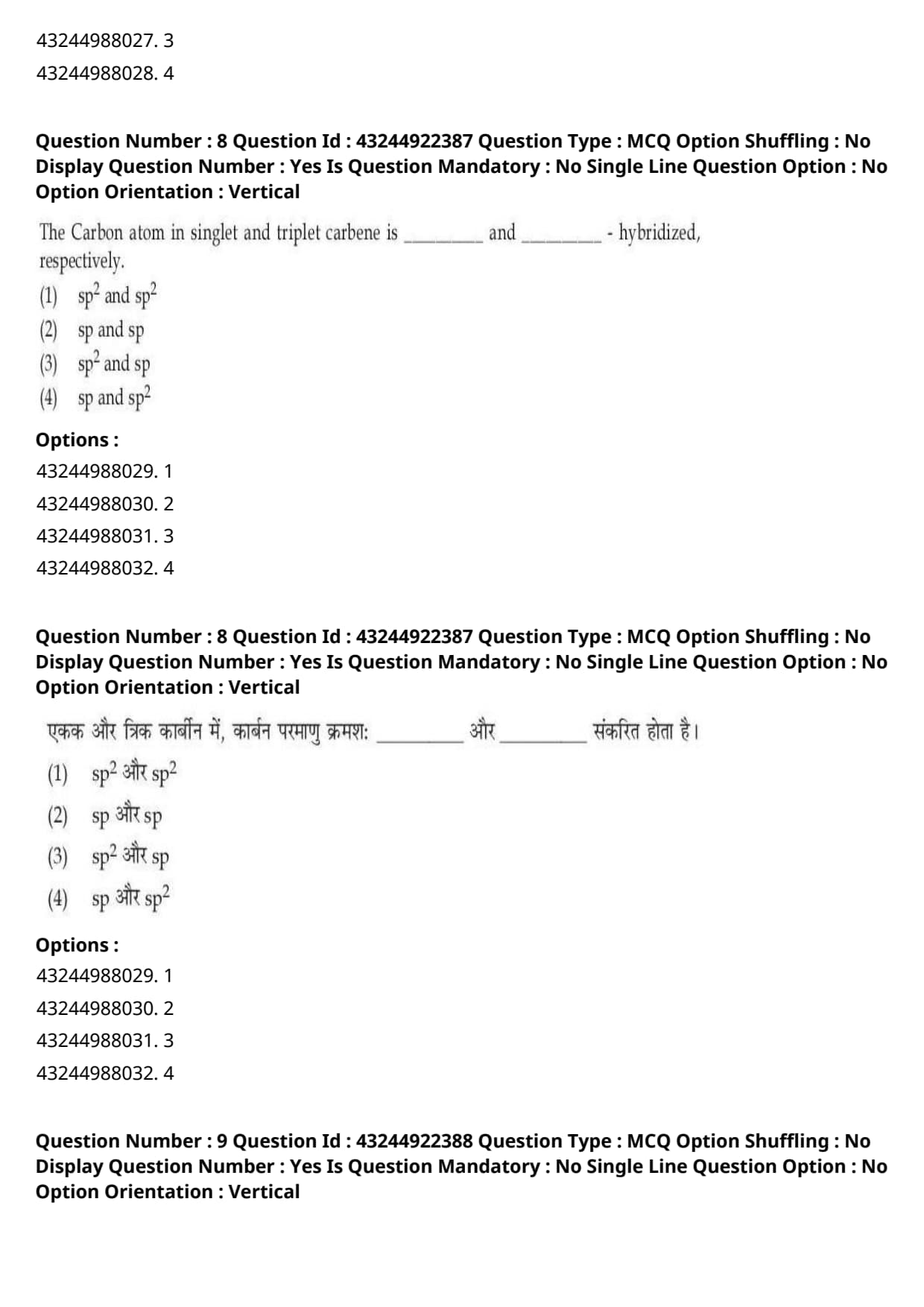
The Carbon atom in singlet and triplet carbene is ____________ and ____________ - hybridized, respectively.
View Solution
Step 1: Concept:
The question asks for the hybridization states of the central carbon atom in two different electronic states of carbenes: singlet and triplet.
Step 2: Key Formula or Approach:
Carbenes (\(:CR_2\)) are neutral reactive intermediates containing a divalent carbon atom with six valence electrons. Their geometry and hybridization depend on how the two non-bonding electrons are distributed.
- Singlet Carbene: The two non-bonding electrons are paired in a single orbital with opposite spins.
- Triplet Carbene: The two non-bonding electrons occupy two separate orthogonal orbitals with parallel spins.
Step 3: Step-by-step Explanation:
Singlet Carbene: To accommodate a lone pair and two bonding pairs, the carbon atom utilizes three \(sp^2\) hybridized orbitals. The paired non-bonding electrons occupy one \(sp^2\) orbital, while the remaining unhybridized \(p\)-orbital is empty. This results in a bent geometry with a bond angle usually between \(100^\circ\) and \(110^\circ\). Therefore, the hybridization is \(sp^2\).
Triplet Carbene: To keep the two unpaired electrons as far apart as possible (Hund's Rule) to minimize electron-electron repulsion, the molecule prefers a linear geometry. In the simplest idealized model, the central carbon is \(sp\) hybridized, forming two linear bonds, and leaving two orthogonal, unhybridized \(p\)-orbitals to house the two unpaired electrons.
Note: While high-level computational chemistry shows that some ground-state triplet carbenes (like \(:CH_2\)) are actually bent with a wider angle (roughly \(130^\circ - 150^\circ\), exhibiting sp\(^2\)-like character), standard undergraduate organic chemistry curricula traditionally teach that singlet carbenes are \(sp^2\) hybridized (bent) and triplet carbenes are \(sp\) hybridized (linear) as a simplifying model.
Looking at the options provided, the standard textbook answer aligns with option (C).
Step 4: Final Answer:
The central carbon in a singlet carbene is \(sp^2\) hybridized, and in a triplet carbene, it is traditionally considered \(sp\) hybridized. This matches option (C).
Quick Tip: % Quick Tip Remember the pairing: Singlet = Paired electrons in one orbital = \(sp^2\) hybridization (bent shape). Triplet = Unpaired electrons in two separate orbitals = \(sp\) hybridization (linear shape for minimum repulsion).
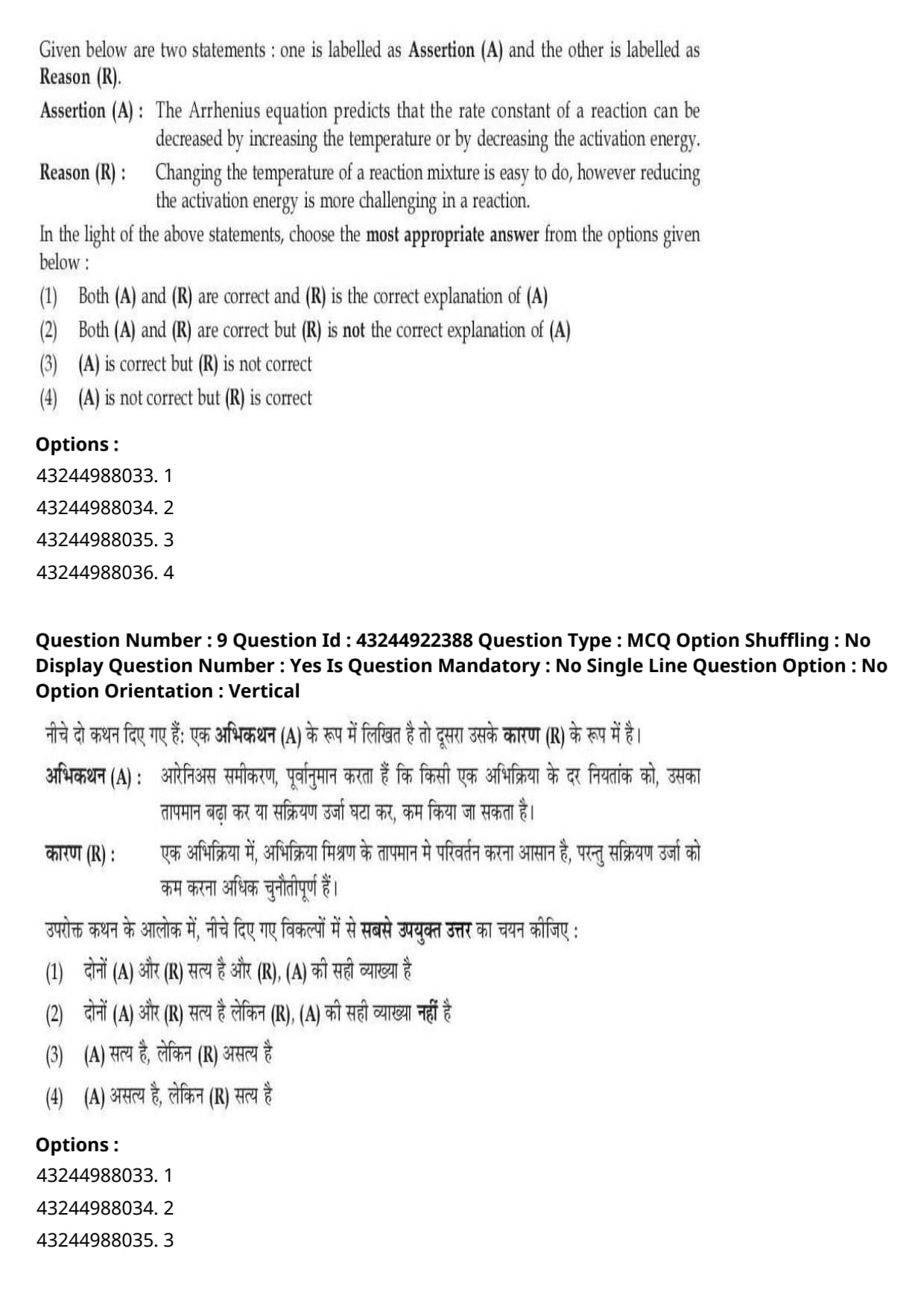
Given below are two statements : one is labelled as Assertion (A) and the other is labelled as Reason (R).
Assertion (A) : The Arrhenius equation predicts that the rate constant of a reaction can be decreased by increasing the temperature or by decreasing the activation energy.
Reason (R) : Changing the temperature of a reaction mixture is easy to do, however reducing the activation energy is more challenging in a reaction.
In the light of the above statements, choose the most appropriate answer from the options given below :
View Solution
Step 1: Concept:
This is an Assertion-Reason type question focusing on chemical kinetics, specifically the Arrhenius equation and the practical manipulation of reaction rates.
Step 2: Key Formula or Approach:
The Arrhenius equation is given by:
\[ k = A e^{-\frac{E_a}{RT}} \]
Where:
- \(k\) is the rate constant
- \(A\) is the pre-exponential factor
- \(E_a\) is the activation energy
- \(R\) is the universal gas constant
- \(T\) is the absolute temperature
Step 3: Step-by-step Explanation:
Evaluating Assertion (A): The statement claims that the rate constant (\(k\)) can be decreased by \textit{increasing temperature (\(T\)) or by \textit{decreasing activation energy (\(E_a\)).
Let's analyze the math: If \(T\) increases, the term \(\frac{E_a{RT}\) becomes smaller. Because of the negative sign, \(-\frac{E_a}{RT}\) becomes less negative (i.e., it increases). Therefore, the exponential \(e^{-E_a/RT}\) increases, causing \(k\) to increase.
Similarly, if \(E_a\) is decreased, the magnitude of the negative exponent becomes smaller, again causing \(k\) to increase.
Therefore, increasing \(T\) or decreasing \(E_a\) both result in a higher reaction rate, contradicting Assertion (A). Assertion (A) is explicitly false.
Evaluating Reason (R): Modifying the temperature of a reaction requires only simple physical apparatus (like a heat bath). Conversely, decreasing the activation energy fundamentally changes the reaction pathway, which typically requires discovering and utilizing an appropriate catalyst. Finding a stable, efficient, and cost-effective catalyst is inherently much more challenging than merely turning up a thermostat. Therefore, Reason (R) is a fundamentally correct statement of fact.
Step 4: Final Answer:
Since (A) is false and (R) is true, the correct choice is option (D).
Quick Tip: % Quick Tip When evaluating mathematical relationships like \(y = e^{-x}\), remember that as \(x\) (which acts as a stand-in for \(E_a/T\)) decreases, the overall value of \(y\) increases. Thus, higher \(T\) or lower \(E_a\) strictly increases reaction rates.
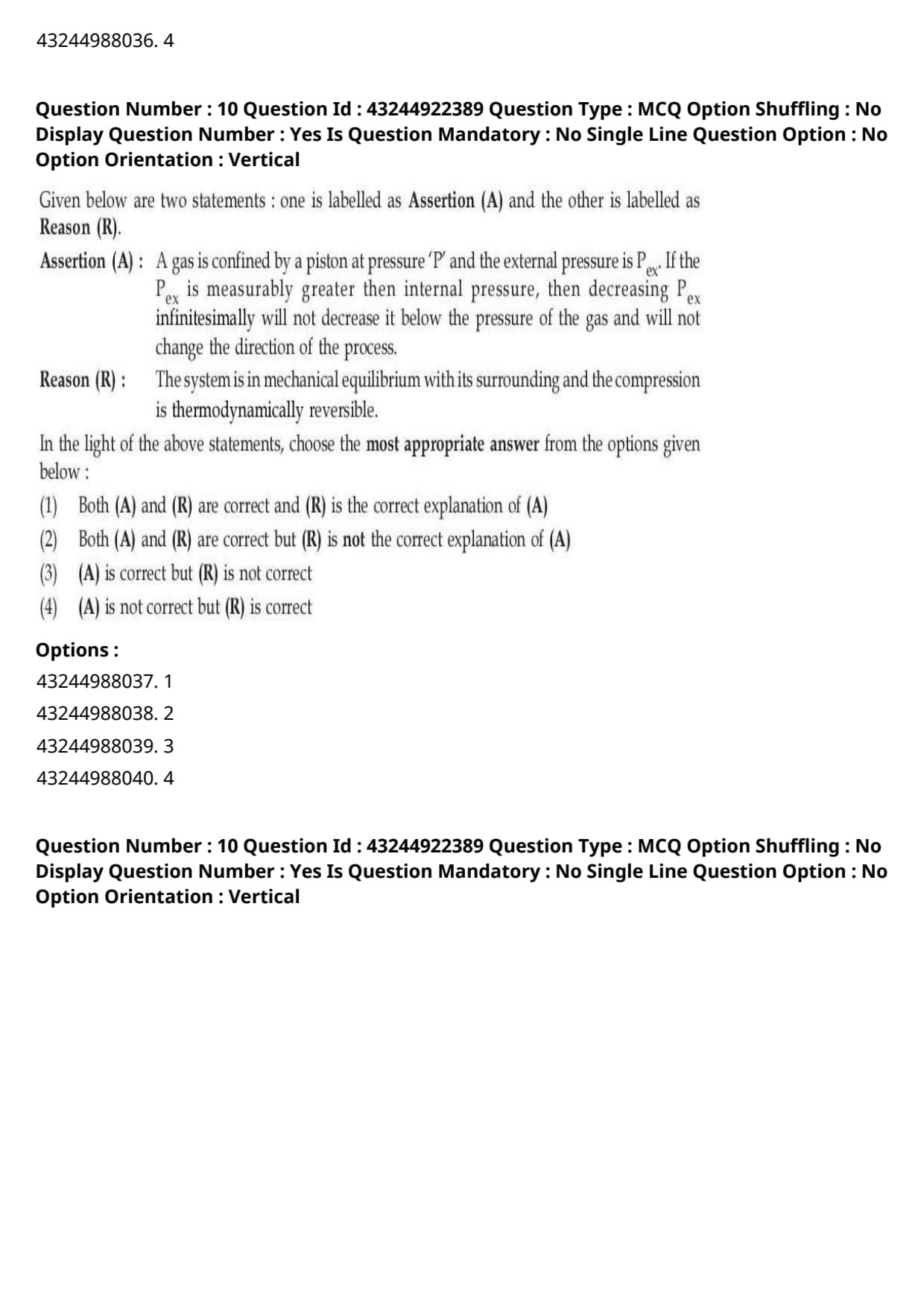
Given below are two statements : one is labelled as Assertion (A) and the other is labelled as Reason (R).
Assertion (A) : A gas is confined by a piston at pressure '\(P\)' and the external pressure is \(P_{ex}\). If the \(P_{ex}\) is measurably greater than internal pressure, then decreasing \(P_{ex}\) infinitesimally will not decrease it below the pressure of the gas and will not change the direction of the process.
Reason (R) : The system is in mechanical equilibrium with its surrounding and the compression is thermodynamically reversible.
In the light of the above statements, choose the most appropriate answer from the options given below :
View Solution
Step 1: Concept:
This problem addresses the thermodynamic concepts of reversible versus irreversible processes, mechanical equilibrium, and the driving forces behind gas compression.
Step 2: Key Formula or Approach:
- A process is reversible if the system is in mechanical equilibrium with its surroundings at every step, meaning the driving force (pressure difference) is infinitesimally small: \(P_{ex} \approx P_{int} \pm dP\).
- A process is irreversible if there is a finite, measurable driving force: e.g., \(P_{ex} \gg P_{int}\).
Step 3: Step-by-step Explanation:
Evaluating Assertion (A): The assertion specifies that \(P_{ex}\) is measurably greater than the internal pressure \(P\). This large pressure gradient drives an irreversible compression. Because the difference \(P_{ex - P\) is finite (not infinitesimal), a tiny infinitesimal decrease in \(P_{ex}\) will still leave the external pressure substantially greater than the internal pressure (\(P_{ex} - dP_{ex} > P\)). Consequently, the gas will continue to be compressed; the direction of the process will not change. Therefore, Assertion (A) is physically sound and correct.
Evaluating Reason (R): The reason claims the system is in mechanical equilibrium and the process is thermodynamically reversible. By definition, mechanical equilibrium requires that the pressures are balanced (\(P_{ex} = P\)). Since Assertion (A) explicitly established that \(P_{ex}\) is measurably greater than \(P\), the system is fundamentally not in equilibrium. A process driven by a large, finite pressure difference is inherently irreversible, not reversible. Therefore, Reason (R) is false.
Step 4: Final Answer:
Assertion (A) is true, but Reason (R) is false. This corresponds to option (C).
Quick Tip: % Quick Tip Reversibility in thermodynamics implies that a process can be perfectly reversed by an infinitesimally small change in external conditions. If there's a macroscopic, measurable difference in forces or pressures, the process is spontaneous and irreversible.
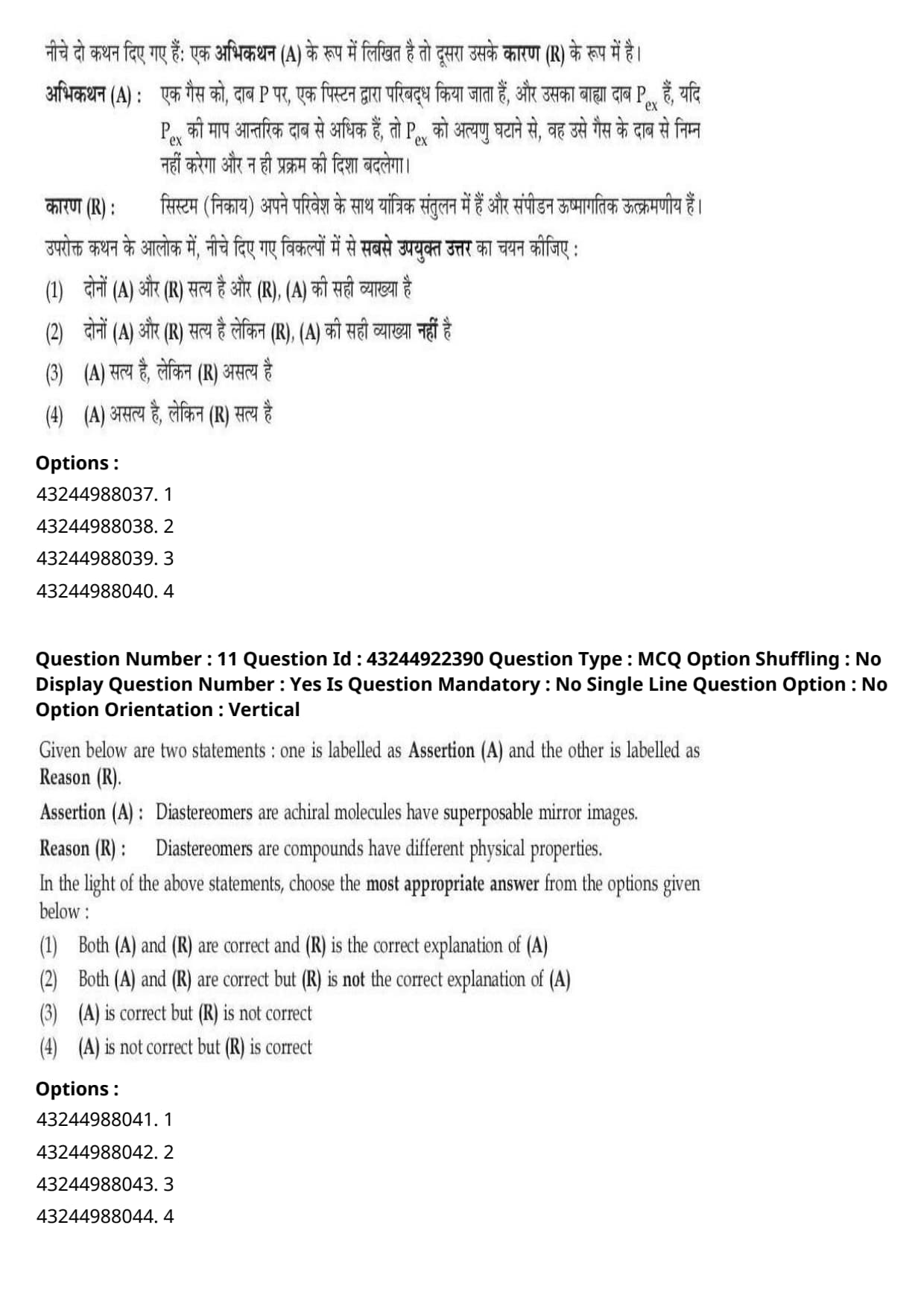
Given below are two statements : one is labelled as Assertion (A) and the other is labelled as Reason (R).
Assertion (A) : Diastereomers are achiral molecules have superposable mirror images.
Reason (R) : Diastereomers are compounds have different physical properties.
In the light of the above statements, choose the most appropriate answer from the options given below :
View Solution
Step 1: Concept:
The question asks to evaluate two statements about stereoisomers, specifically diastereomers, focusing on their chirality and physical properties.
Step 2: Key Definitions:
- Enantiomers: Stereoisomers that are non-superposable mirror images of each other. They must be chiral.
- Diastereomers: Stereoisomers that are NOT mirror images of each other.
- Chirality: A molecule is chiral if it cannot be superposed on its mirror image. Achiral molecules have superposable mirror images.
Step 3: Step-by-step Explanation:
Evaluating Assertion (A): The statement boldly claims that "Diastereomers are achiral molecules...". This is factually incorrect. While some specific diastereomers (namely, meso compounds) are achiral, the vast majority of diastereomers are chiral. For example, D-glucose and D-galactose are diastereomers, and both are highly chiral molecules. Thus, diastereomers are not defined by being achiral. Assertion (A) is false.
Evaluating Reason (R): Because diastereomers are not mirror images, they possess different internal distances between atoms and functional groups, resulting in differing overall spatial geometries. As a result, they experience different intermolecular forces. Consequently, diastereomers always have different physical properties, such as boiling points, melting points, densities, and solubilities. Therefore, Reason (R) is a universally true statement.
Step 4: Final Answer:
Since (A) is false and (R) is true, the correct answer is option (D).
Quick Tip: % Quick Tip Enantiomers have identical physical properties (except the direction they rotate plane-polarized light) and must be separated by chiral methods. Diastereomers have different physical properties and can be separated by standard techniques like fractional distillation or crystallization.
Given below are two statements : one is labelled as Assertion (A) and the other is labelled as Reason (R).
Assertion (A) : Boiling point of cis isomers is higher than trans isomers.
Reason (R) : The Dipole moment of cis isomers is higher than trans isomers.
In the light of the above statements, choose the most appropriate answer from the options given below :
View Solution
Step 1: Concept:
This question tests knowledge of the physical properties (specifically boiling point) of geometric isomers (cis and trans) and how these properties relate to molecular polarity (dipole moment).
Step 2: Key Concept:
Boiling points are directly related to the strength of intermolecular forces in a liquid. Stronger forces require more thermal energy to overcome, leading to higher boiling points. Dipole-dipole interactions are a significant contributor to intermolecular forces.
Step 3: Step-by-step Explanation:
Evaluating Reason (R): In a cis-isomer, similar functional groups are on the same side of the double bond. Their individual bond dipoles generally point in the same general direction, meaning they add up to give the molecule a significant net dipole moment. In a trans-isomer, similar groups are on opposite sides, causing their bond dipoles to point in opposing directions, mostly or completely canceling each other out. Thus, it is generally true that cis isomers have higher net dipole moments than trans isomers.
Evaluating Assertion (A): Because cis isomers possess a higher dipole moment, the dipole-dipole attractions between cis molecules in the liquid phase are stronger than those between trans molecules (which rely mostly on weaker London dispersion forces). Because these intermolecular forces are stronger, more energy is required to boil a cis isomer, giving it a higher boiling point than its trans counterpart. Therefore, Assertion (A) is correct.
Relationship: The increased dipole moment described in (R) directly causes the stronger intermolecular forces that lead to the higher boiling point described in (A). Therefore, (R) correctly explains (A).
Step 4: Final Answer:
Both statements are true, and the Reason provides the physical basis for the Assertion. Option (A) is correct.
Quick Tip: % Quick Tip Rule of thumb for geometric isomers: \textbf{Cis} generally has a higher \textbf{Boiling Point} (due to higher polarity and stronger dipole-dipole forces). \textbf{Trans} generally has a higher \textbf{Melting Point} (because its highly symmetric structure packs much more efficiently into a solid crystal lattice).
Given below are two statements : one is labelled as Assertion (A) and the other is labelled as Reason (R).
Assertion (A) : \(\dot{C}H_3\) behave as nucleophiles.
Reason (R) : Odd electron species where unpaired electron is accommodated in a low energy SOMO also behave as nucleophiles.
In the light of the above statements, choose the most appropriate answer from the options given below :
View Solution
Step 1: Concept:
The question relies on Frontier Molecular Orbital (FMO) theory to explain the reactivity of free radicals, specifically focusing on whether the methyl radical (\(\dot{C}H_3\)) acts as a nucleophile or an electrophile, and how the energy level of the Singly Occupied Molecular Orbital (SOMO) dictates this behavior.
Step 2: Key Formula or Approach:
In radical chemistry, FMO theory states that radical reactivity is governed by interactions between the SOMO of the radical and either the HOMO or LUMO of the reacting partner:
- A radical with a High-Energy SOMO acts as an electron donor (nucleophile), preferring to interact with the LUMO of an electrophilic molecule. Alkyl radicals typically fall into this category due to electron-donating hyperconjugative effects.
- A radical with a Low-Energy SOMO acts as an electron acceptor (electrophile), preferring to interact with the HOMO of a nucleophilic molecule. Radicals with electron-withdrawing groups (like halogens or carbonyls) fall into this category.
Step 3: Step-by-step Explanation:
Evaluating Assertion (A): The methyl radical (\(\dot{C}H_3\)) is an alkyl radical. While it lacks the electron-donating hyperconjugation of larger alkyl radicals (like tert-butyl), simple alkyl radicals generally behave as weak to moderate nucleophiles in their addition reactions to alkenes (they prefer to attack electron-deficient, electrophilic double bonds). Therefore, the assertion that they behave as nucleophiles is generally considered correct in organic chemistry.
Evaluating Reason (R): Reason (R) states that an odd electron species with a low energy SOMO behaves as a nucleophile. This fundamentally contradicts FMO theory. A low-energy SOMO means the orbital is highly electronegative and wants to accept an electron, rendering the radical an electrophile. It is a high energy SOMO that makes a radical a nucleophile (ready to donate its electron). Thus, the statement in Reason (R) is scientifically incorrect.
Step 4: Final Answer:
Because (A) is correct and (R) is conceptually incorrect, the answer is option (C).
Quick Tip: % Quick Tip To quickly determine radical character: Radicals adjacent to electron-donating groups (e.g., alkyl, ether oxygens) have raised SOMO levels and are \textbf{nucleophilic}. Radicals adjacent to electron-withdrawing groups (e.g., carbonyls, halogens, nitriles) have lowered SOMO levels and are \textbf{electrophilic}.
Choose the correct sequence by arranging the given ions in the order of increasing size :
A. \(Cl^-\)
B. \(Mg^{2+}\)
C. \(Br^-\)
D. \(S^{2-}\)
E. \(Na^+\)
Choose the correct answer from the options given below :
View Solution
Step 1: Concept:
The objective is to arrange five different monoatomic ions in order of increasing ionic radius. This requires comparing isoelectronic series and analyzing the effect of principal quantum numbers (electron shells) and effective nuclear charge.
Step 2: Key Formula or Approach:
1. Ions with a higher principal quantum number (\(n\)) generally have a larger size because their valence electrons occupy shells further from the nucleus.
2. For isoelectronic species (ions with the exact same number of electrons), the size decreases as the nuclear charge (number of protons, \(Z\)) increases. More protons pull the same number of electrons more tightly inward.
Step 3: Step-by-step Explanation:
Let's break the given ions into groups based on their electron configurations:
- Group 1 (\(Ne\) core, 10 electrons): \(Na^+\) (\(Z=11\)) and \(Mg^{2+}\) (\(Z=12\)). Since they are isoelectronic, the one with more protons is smaller. Thus, \(Mg^{2+} < Na^+\).
- Group 2 (\(Ar\) core, 18 electrons): \(Cl^-\) (\(Z=17\)) and \(S^{2-}\) (\(Z=16\)). Isoelectronic again, more protons means smaller size. Thus, \(Cl^- < S^{2-}\).
- Group 3 (\(Kr\) core, 36 electrons): \(Br^-\) (\(Z=35\)).
Now, we compare the groups. The size increases significantly as we add entirely new electron shells.
- \(Ne\) core ions (\(n=2\) valence shell) are strictly smaller than \(Ar\) core ions (\(n=3\) valence shell).
- \(Ar\) core ions are strictly smaller than \(Kr\) core ions (\(n=4\) valence shell).
Therefore, combining our observations, the complete size order from smallest to largest is:
\(Mg^{2+}\) (10 e-, \(Z=12\)) \(<\) \(Na^+\) (10 e-, \(Z=11\)) \(<\) \(Cl^-\) (18 e-, \(Z=17\)) \(<\) \(S^{2-}\) (18 e-, \(Z=16\)) \(<\) \(Br^-\) (36 e-, \(Z=35\)).
Translating this to the given letters: B (\(Mg^{2+}\)) < E (\(Na^+\)) < A (\(Cl^-\)) < D (\(S^{2-}\)) < C (\(Br^-\)).
Step 4: Final Answer:
The correct sequence is B < E < A < D < C, which matches option (C).
Quick Tip: % Quick Tip When comparing atomic or ionic sizes, rule \#1 is the number of shells (period number on the periodic table). Rule \#2 is for isoelectronic series: the more highly positive the charge (or the less negative), the smaller the ion, due to a stronger pull by the protons.
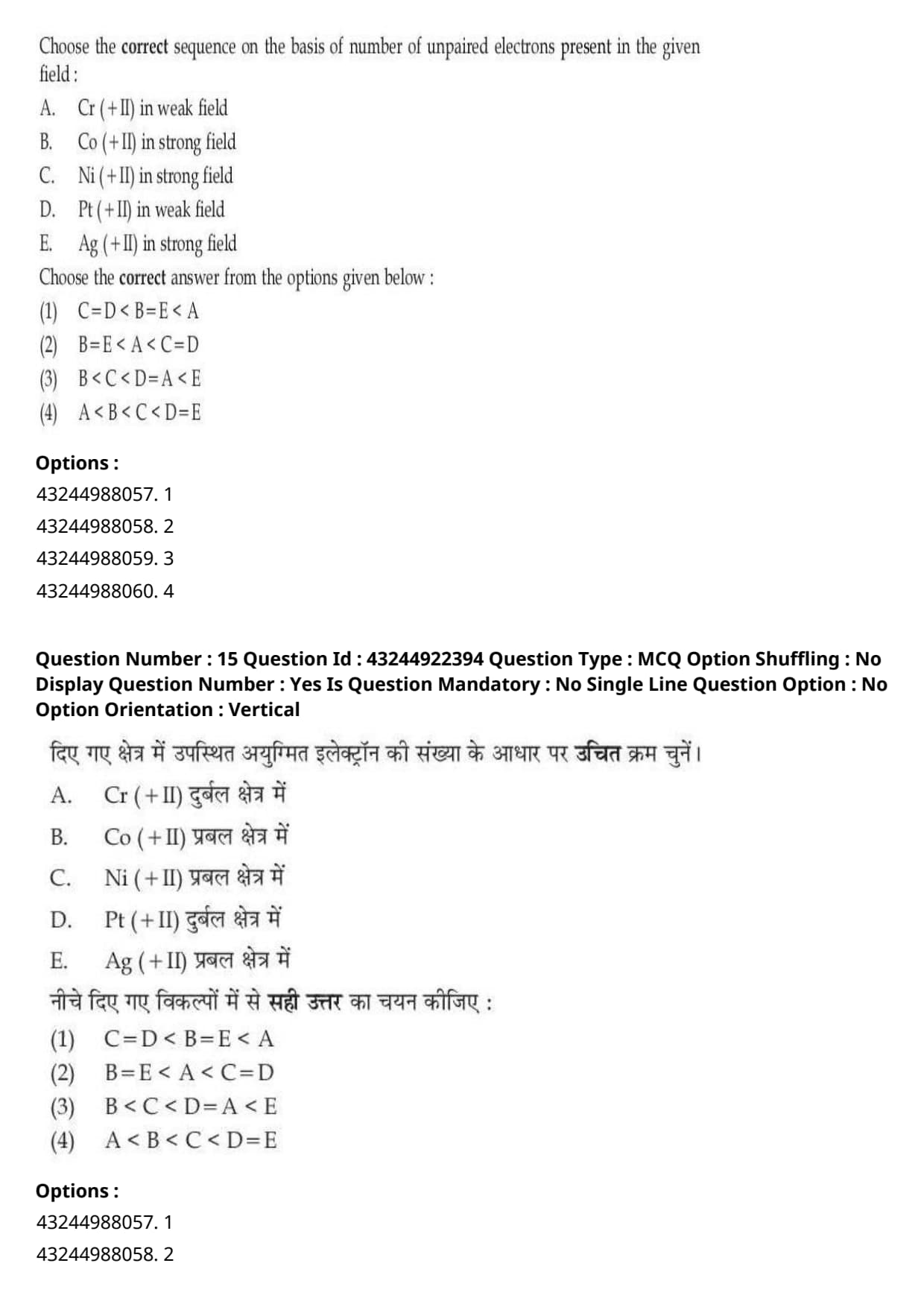
Choose the correct sequence on the basis of number of unpaired electrons present in the given field:
A. \(Cr(+II)\) in weak field
B. \(Co(+II)\) in strong field
C. \(Ni(+II)\) in strong field
D. \(Pt(+II)\) in weak field
E. \(Ag(+II)\) in strong field
Choose the correct answer from the options given below :
View Solution
Step 1: Concept:
The question requires determining the number of unpaired d-electrons in various transition metal complex ions, taking into account their oxidation state and the strength of the ligand field (Crystal Field Theory), and then ordering them.
Step 2: Key Formula or Approach:
1. Determine the oxidation state and \(d^n\) configuration for the metal ion.
2. Apply Crystal Field Theory based on geometry and field strength:
- Strong field ligands cause large splitting (\(\Delta_o\)), forcing electrons to pair up in lower energy orbitals (low-spin).
- Weak field ligands cause small splitting, allowing electrons to occupy higher energy orbitals before pairing (high-spin).
- Remember that 4d and 5d metals essentially always form low-spin complexes, regardless of ligand strength, because of their larger spatial orbital extent. Furthermore, \(d^8\) configurations for strong fields or heavy metals frequently form square planar, diamagnetic (\(n_{unpaired} = 0\)) complexes.
Step 3: Step-by-step Explanation:
A. \(Cr(+II)\) in weak field: Cr is \([Ar] 4s^1 3d^5\). Cr(II) is \(d^4\). In a weak octahedral field, it forms a high-spin complex: \(t_{2g}^3 e_g^1\). This gives 4 unpaired electrons.
B. \(Co(+II)\) in strong field: Co is \([Ar] 4s^2 3d^7\). Co(II) is \(d^7\). In a strong octahedral field, it forms a low-spin complex: \(t_{2g}^6 e_g^1\). This gives 1 unpaired electron.
C. \(Ni(+II)\) in strong field: Ni is \([Ar] 4s^2 3d^8\). Ni(II) is \(d^8\). In a strong field, Ni(II) typically forms a square planar complex, where the \(d_{x^2-y^2\) orbital is very high in energy and empty, leading to a paired configuration. Thus, it is diamagnetic with 0 unpaired electrons.
D. \(Pt(+II)\) in weak field: Pt is a 5d transition metal. Its compounds always experience a very large crystal field splitting, effectively acting as "strong field" cases regardless of the ligand. \(Pt(+II)\) is \(d^8\) and almost exclusively forms square planar complexes that are diamagnetic. Thus, it has 0 unpaired electrons.
E. \(Ag(+II)\) in strong field: Ag is \([Kr] 5s^1 4d^{10\). Ag(II) is \(d^9\). In any ligand field (octahedral or square planar), a \(d^9\) configuration must have exactly 1 unpaired electron.
Summary of Unpaired Electrons:
C (\(0\)) = D (\(0\)) \(<\) B (\(1\)) = E (\(1\)) \(<\) A (\(4\)).
Step 4: Final Answer:
This specific ordering directly matches option (A).
Quick Tip: % Quick Tip Key exceptions to memorize: 4d (Pd, Ru, Ag) and 5d (Pt, Ir, Au) transition metals essentially never form high-spin complexes. Furthermore, \(d^8\) metals in a strong field (like \(Ni^{2+}\) with \(CN^-\)) or heavy \(d^8\) metals (like \(Pt^{2+}, Pd^{2+}\)) predominantly form square planar complexes, which are completely diamagnetic (0 unpaired electrons).
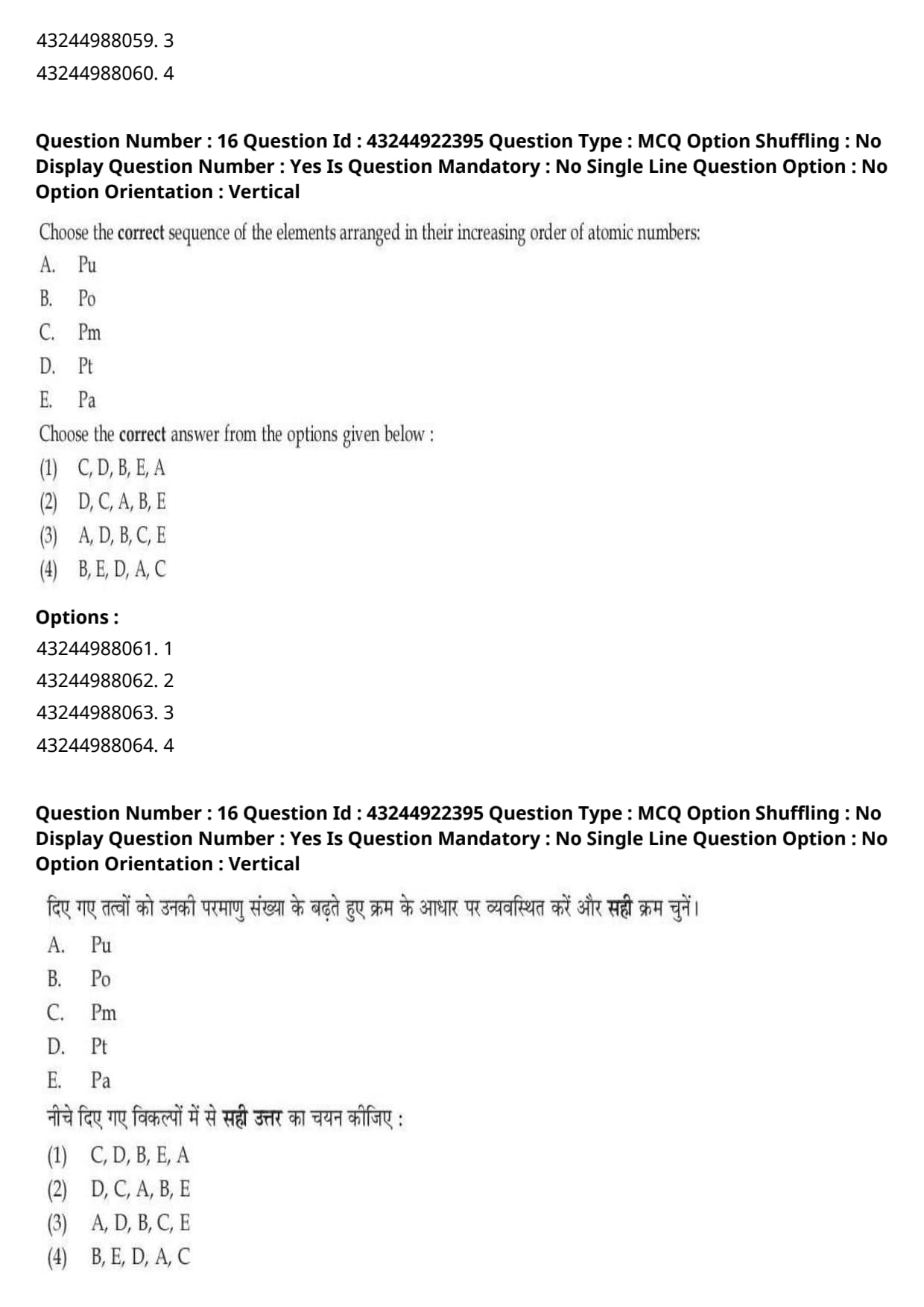
Choose the correct sequence of the elements arranged in their increasing order of atomic numbers:
A. Pu
B. Po
C. Pm
D. Pt
E. Pa
Choose the correct answer from the options given below :
View Solution
Step 1: Concept:
The task is straightforward: identify the atomic number (\(Z\)) for five given chemical elements and arrange them in ascending order.
Step 2: Identifying the Elements and Atomic Numbers:
Let's define each element from its chemical symbol:
- A. Pu: Plutonium. An actinide element, famous for use in nuclear reactors and weapons. Atomic number \(Z = 94\).
- B. Po: Polonium. A p-block chalcogen, radioactive, discovered by Marie Curie. Atomic number \(Z = 84\).
- C. Pm: Promethium. A lanthanide element, rare and radioactive. Atomic number \(Z = 61\).
- D. Pt: Platinum. A heavy transition metal in the 5d series. Atomic number \(Z = 78\).
- E. Pa: Protactinium. An actinide element occurring before Uranium. Atomic number \(Z = 91\).
Step 3: Step-by-step Explanation:
Now we arrange the numbers in increasing (ascending) order:
\(61 < 78 < 84 < 91 < 94\)
Correlating these values back to the given symbols:
- 61 corresponds to C (Promethium)
- 78 corresponds to D (Platinum)
- 84 corresponds to B (Polonium)
- 91 corresponds to E (Protactinium)
- 94 corresponds to A (Plutonium)
The final ordered sequence is C, D, B, E, A.
Step 4: Final Answer:
The correct arrangement based on atomic numbers is found in option (A).
Quick Tip: % Quick Tip While memorizing the entire periodic table isn't always necessary, you should be broadly familiar with the "blocks". Lanthanides span Z=57 to 71. Actinides span Z=89 to 103. The 5d transition metals span Z=72 to 80. This general knowledge allows you to quickly sort elements even if you forget the exact atomic number.
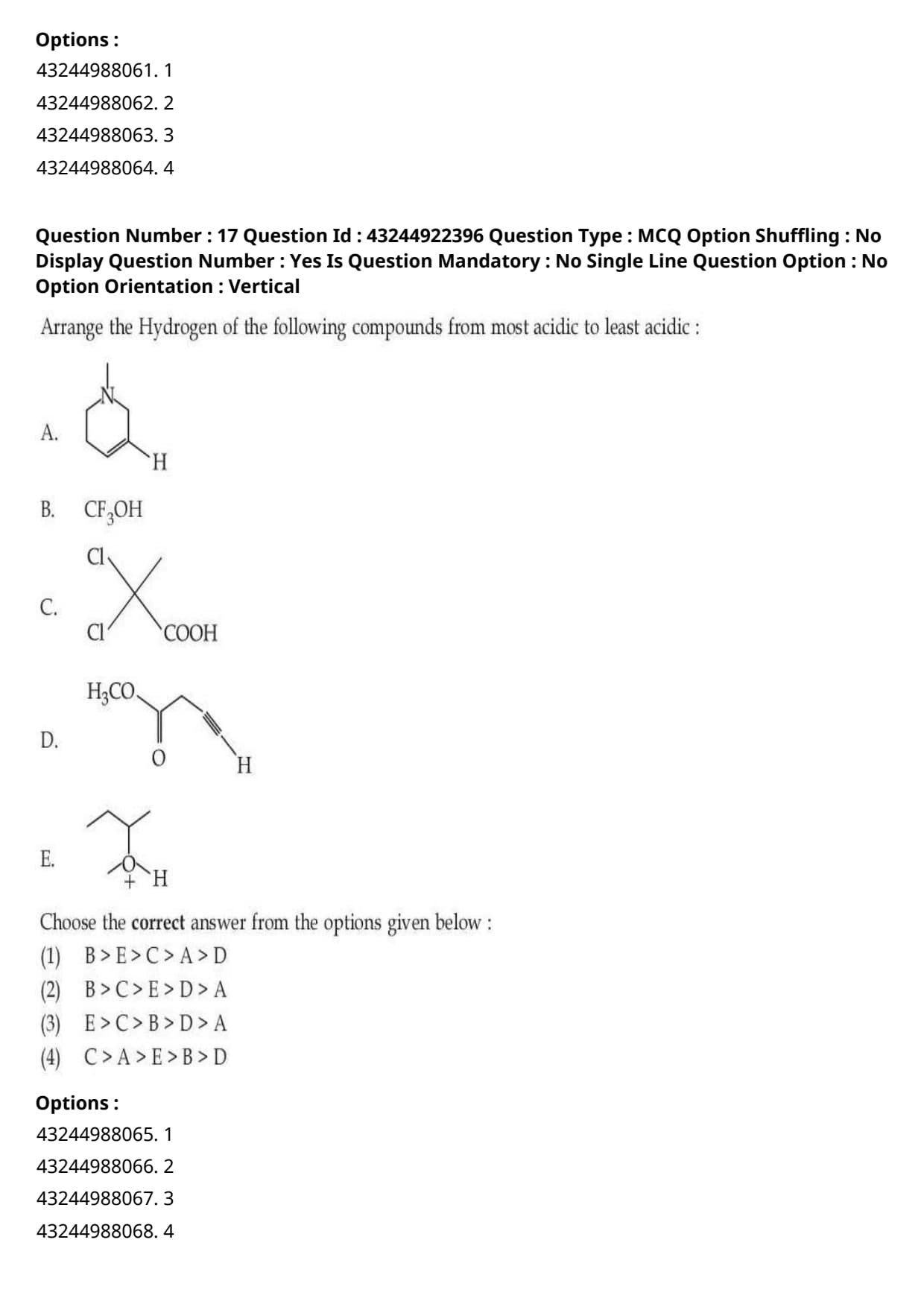
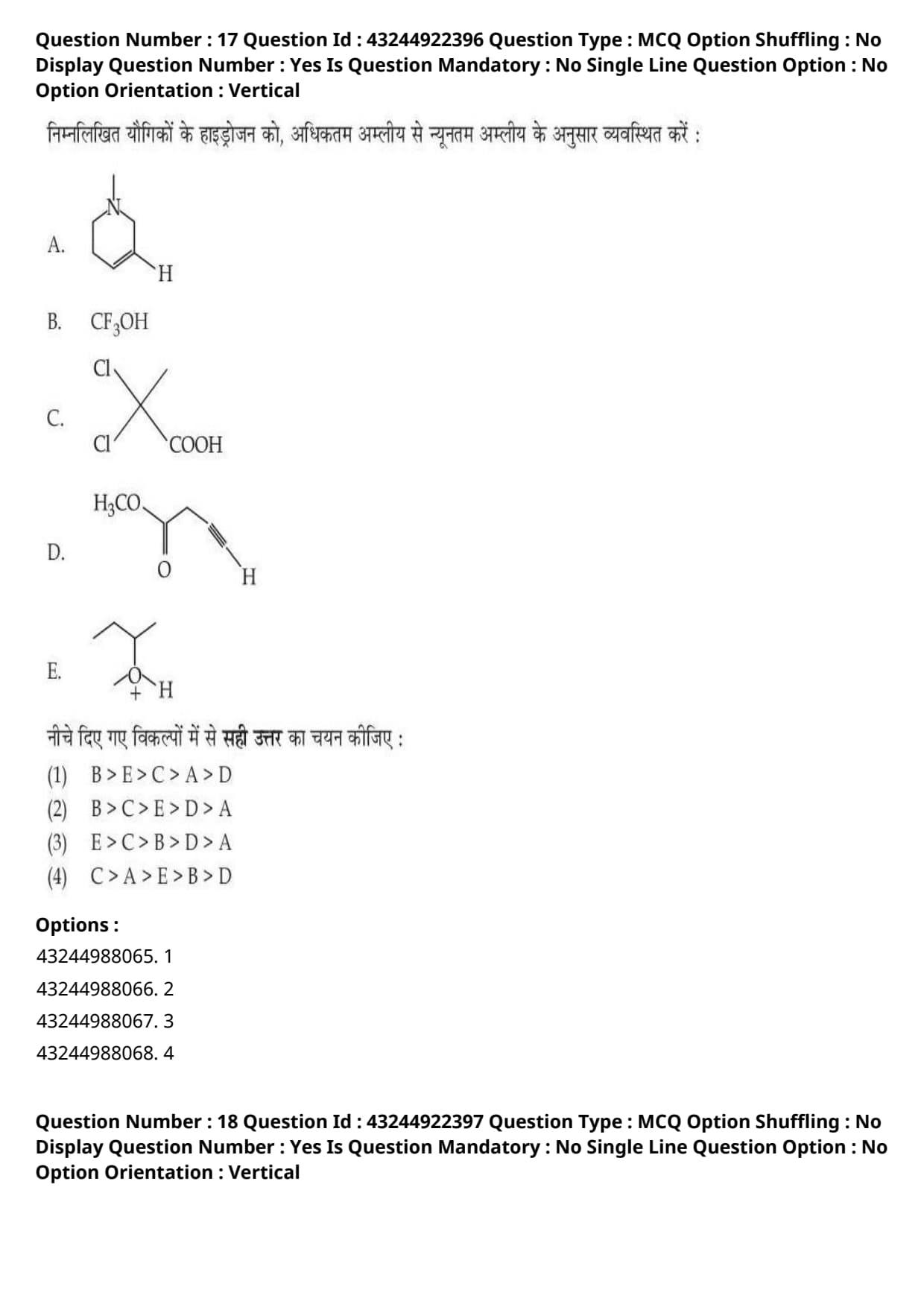
Arrange the Hydrogen of the following compounds from most acidic to least acidic :

Choose the correct answer from the options given below :
View Solution
Step 1: Concept:
We are asked to rank the acidity of five specific protons in five different chemical environments. Acidity is measured by how easily a compound donates a proton, which corresponds to the stability of the resulting conjugate base or the formal charge of the acidic species.
Step 2: Key Formula or Approach:
Evaluate the approximate \(pK_a\) values or structural stability factors for each molecule. A lower \(pK_a\) means a stronger acid.
- Positively charged species with a proton on a highly electronegative atom (like \(O^+\) or \(N^+\)) are generally very strong acids.
- Electron-withdrawing groups (EWG) via inductive or resonance effects increase acidity.
- \(sp\) hybridized carbons are more electronegative than \(sp^3\), making terminal alkynes moderately acidic.
- Neutral amines are very weak acids.
Step 3: Step-by-step Explanation:
Let's analyze the structures shown in the image (based on standard chemical notation inferences):
E. Protonated ether/ketone (\(R_2C=O^+-H\) or \(R-O^+(H)-R\)): The image shows a positively charged oxonium ion. Positively charged oxygen species are extremely acidic because Oxygen is highly electronegative and wants to pull electrons back to neutralize the charge. Expected \(pK_a\) is less than 0 (e.g., protonated acetone is \(\sim -7.3\)). Most acidic.
C. Dichloroacetic acid (\(CHCl_2COOH\)): This is a carboxylic acid. The acidity is heavily increased by the significant inductive electron-withdrawing effect (\(-I\) effect) of the two adjacent chlorine atoms, which stabilize the carboxylate anion. Expected \(pK_a \approx 1.3\). Second most acidic.
B. Trifluoromethanol (\(CF_3OH\)): It is an alcohol, but the presence of the powerful electron-withdrawing \(CF_3\) group drastically lowers its \(pK_a\) compared to normal alcohols (like ethanol at \(\sim 16\)). Though highly unstable in reality, its theoretical \(pK_a\) is around \(10\), making it substantially more acidic than normal alcohols or alkynes. Third most acidic.
D. Terminal alkyne proton (\(R-C\equiv C-H\)): The hydrogen is attached to an \(sp\) hybridized carbon, which is more electronegative than \(sp^2\) or \(sp^3\) carbons due to 50% s-character. The conjugate base (acetylide anion) is relatively stable. Expected \(pK_a \approx 25\). Fourth most acidic.
A. Piperidine (neutral secondary amine): The image shows a saturated nitrogen heterocycle with an N-H bond. Neutral amines are extremely poor acids (and act primarily as bases). Deprotonating a neutral amine produces a highly unstable amide anion (\(N^-\)). Expected \(pK_a \approx 35\). Least acidic.
Combining these evaluations, the order from most to least acidic is E > C > B > D > A.
Step 4: Final Answer:
This sequence perfectly matches option (C).
Quick Tip: % Quick Tip A fast way to order acidity is to first look at the formal charges: positively charged species (\(O-H^+, N-H^+\)) are almost always more acidic than neutral molecules. Then look at the functional group: Carboxylic Acids \(>\) Phenols/Activated alcohols \(>\) Normal Alcohols \(>\) Alkynes \(>\) Amines \(>\) Alkanes.
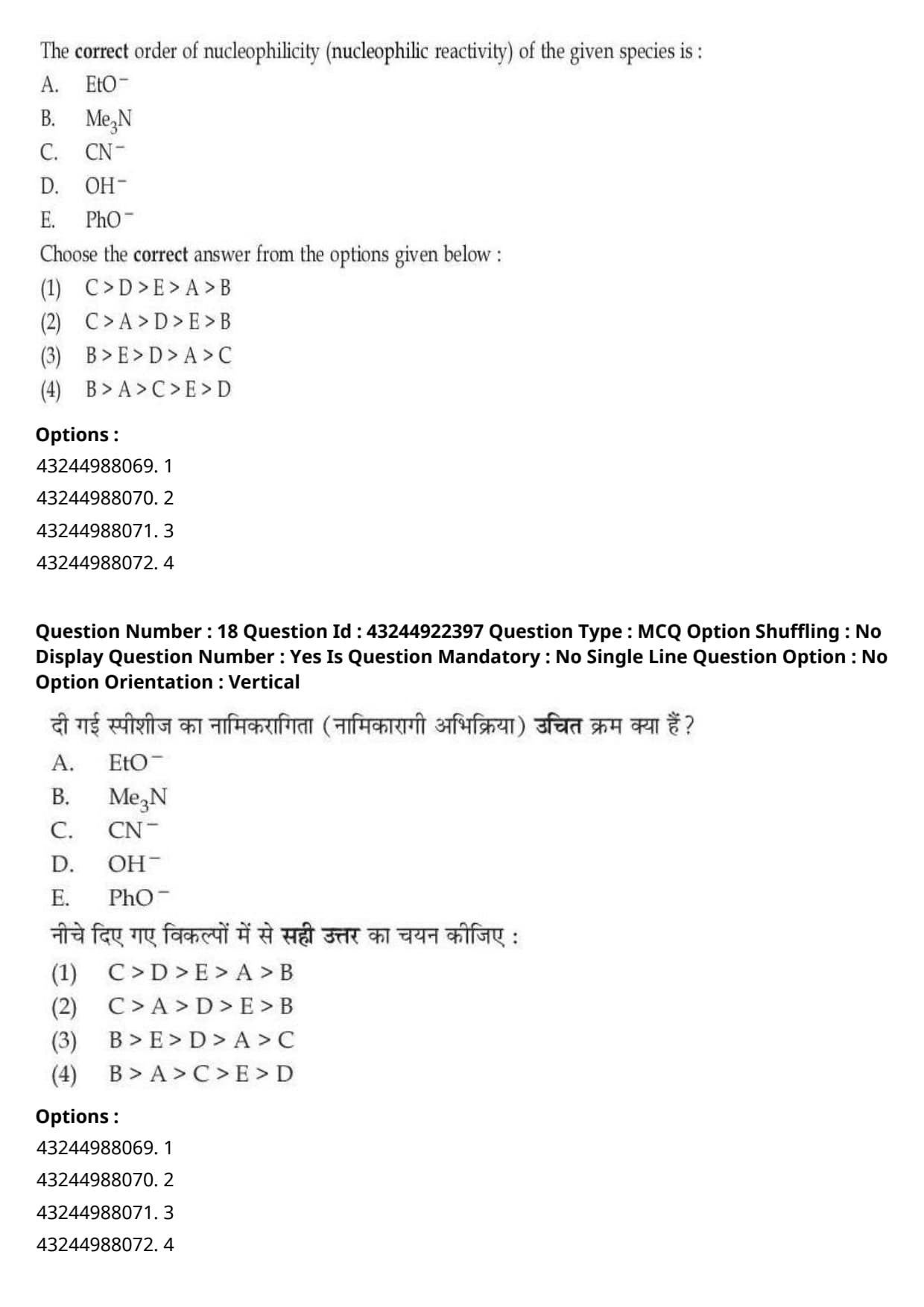
The correct order of nucleophilicity (nucleophilic reactivity) of the given species is :
A. \(EtO^-\)
B. \(Me_3N\)
C. \(CN^-\)
D. \(OH^-\)
E. \(PhO^-\)
Choose the correct answer from the options given below :
View Solution
Step 1: Concept:
The problem requires ranking five different chemical species according to their nucleophilic strength (nucleophilicity), which is a measure of how quickly a species can attack an electrophilic carbon atom.
Step 2: Key Formula or Approach:
Nucleophilicity depends on several factors:
1. Charge: Anions are generally much better nucleophiles than neutral molecules.
2. Electronegativity: Less electronegative atoms are more willing to share their electrons, making them better nucleophiles (e.g., C > N > O > F).
3. Polarizability: Larger, more polarizable atoms are better nucleophiles.
4. Resonance / Delocalization: If a lone pair or negative charge is delocalized via resonance, its availability to attack an electrophile drops significantly, lowering nucleophilicity.
5. Inductive Effects: Electron-donating groups (like alkyls) increase electron density and thus nucleophilicity.
Step 3: Step-by-step Explanation:
C. \(CN^-\) (Cyanide ion): This anion has the negative charge located primarily on the Carbon atom (though delocalized somewhat to Nitrogen). Carbon is less electronegative than Oxygen or Nitrogen, making its lone pair highly available and highly reactive. Cyanide is an exceptionally strong nucleophile. (Highest)
Next, we compare the localized oxygen anions: \(EtO^-\) (A) and \(OH^-\) (D). The ethyl group in ethoxide (\(EtO^-\)) provides an electron-donating inductive effect (\(+I\)), pushing extra electron density onto the oxygen atom, making it a stronger nucleophile than the hydroxide ion. So, \(EtO^- > OH^-\).
E. \(PhO^-\) (Phenoxide ion): The negative charge on the oxygen atom is highly delocalized into the aromatic benzene ring via resonance. Because the electron density is spread out and less available for attack, phenoxide is a significantly weaker nucleophile than localized alkoxides or hydroxide.
B. \(Me_3N\) (Trimethylamine): This is a neutral molecule. While nitrogen is less electronegative than oxygen, neutral amines are generally less nucleophilic than negatively charged oxygen anions (especially considering the steric hindrance of the three methyl groups in \(S_N2\) reactions). Thus, it ranks at the bottom in this specific grouping. (Lowest)
Combining these observations, the full sequence from most to least nucleophilic is: \(CN^- > EtO^- > OH^- > PhO^- > Me_3N\).
Translating to the letters provided: C > A > D > E > B.
Step 4: Final Answer:
The correctly derived sequence matches option (B).
Quick Tip: % Quick Tip A simple ranking strategy: Anions with less electronegative donor atoms (like \(C^-\)) \(>\) Localized Anions with highly electronegative atoms (\(O^-\)) \(>\) Resonance-stabilized Anions (\(ArO^-\)) \(>\) Neutral molecules. Alkyl groups increase nucleophilicity slightly due to \(+I\) effects.
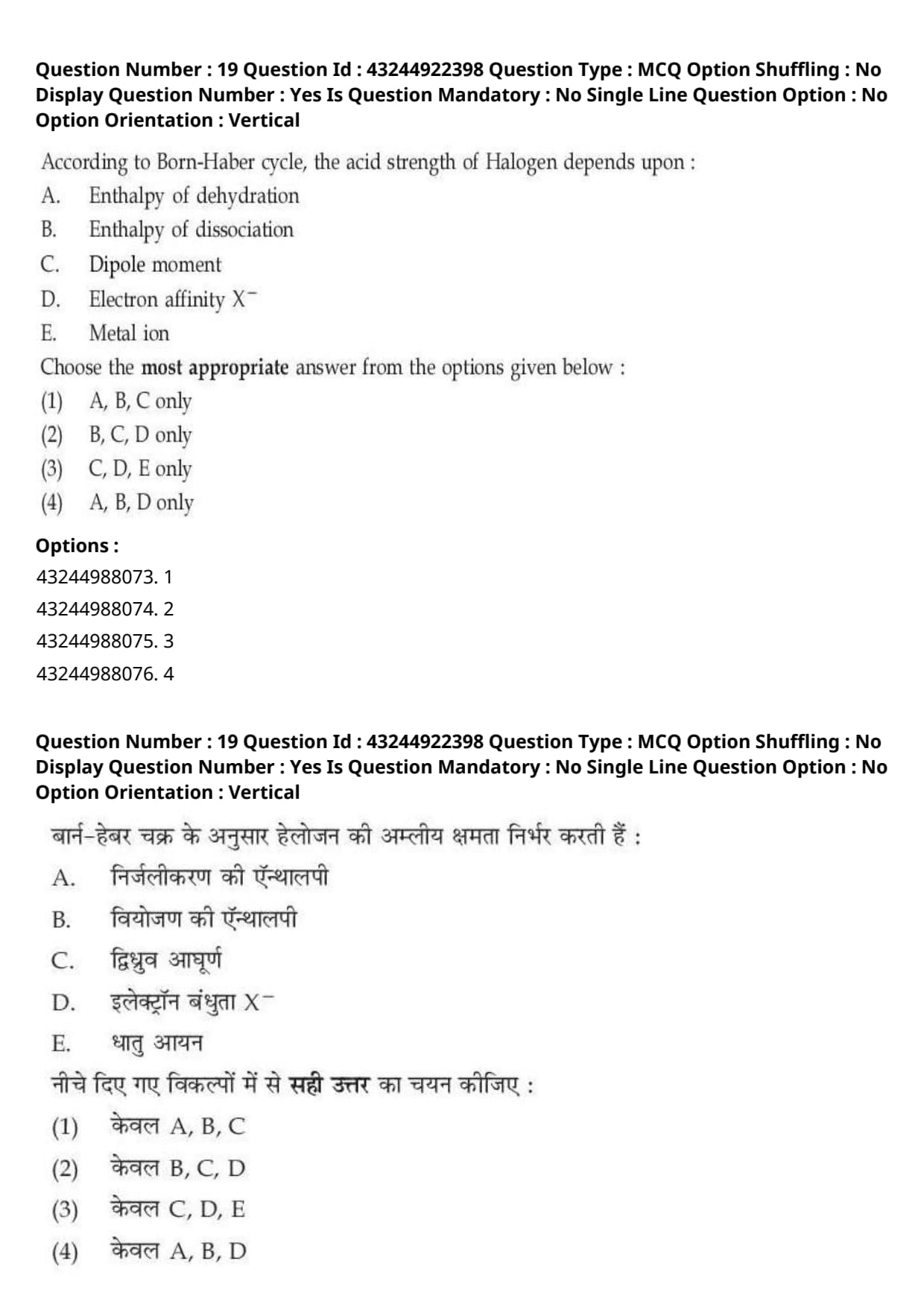
According to Born-Haber cycle, the acid strength of Halogen depends upon :
A. Enthalpy of dehydration
B. Enthalpy of dissociation
C. Dipole moment
D. Electron affinity \(X^-\)
E. Metal ion
Choose the most appropriate answer from the options given below :
View Solution
Step 1: Concept:
The question asks to identify the thermodynamic factors that govern the acid strength of halogen acids (HX) when applying a Born-Haber cycle (or a similar thermodynamic cycle in aqueous solution).
Step 2: Key Formula or Approach:
The dissociation of a hydrogen halide \(HX_{(aq)} \rightarrow H^+_{(aq)} + X^-_{(aq)}\) can be broken down into a theoretical thermodynamic cycle involving several conceptual steps:
1. Dehydration/Desolvation: Removing the aqueous HX species from solution into the gas phase (often ignored or combined, but if considering the full cycle from aqueous, it's a step. More commonly, we look at the hydration of the resulting ions).
2. Bond Dissociation: Breaking the gaseous HX molecule into atoms: \(HX_{(g)} \rightarrow H_{(g)} + X_{(g)}\) (Enthalpy of dissociation).
3. Ionization of Hydrogen: \(H_{(g)} \rightarrow H^+_{(g)} + e^-\) (Ionization energy).
4. Electron Affinity: The halogen atom gaining an electron: \(X_{(g)} + e^- \rightarrow X^-_{(g)}\) (Electron affinity).
5. Hydration: The gaseous ions entering the aqueous phase: \(H^+_{(g)} + X^-_{(g)} \rightarrow H^+_{(aq)} + X^-_{(aq)}\) (Enthalpy of hydration, whose reverse process is dehydration).
Step 3: Step-by-step Explanation:
Based on the cycle above, the overall Gibbs free energy change (which dictates acid strength, \(K_a\)) is the sum of these energy terms.
A. Enthalpy of dehydration: In many textbook problems, "enthalpy of hydration" is the term used. Dehydration is simply the energetic opposite. The cycle definitively depends on these solvation energies.
B. Enthalpy of dissociation: Breaking the H-X bond is a major energy barrier. The weaker the bond, the stronger the acid (e.g., HI > HBr > HCl > HF). This is a critical factor.
C. Dipole moment: While it influences physical properties, it is not an energetic step defined within a Born-Haber thermodynamic cycle.
D. Electron affinity: The energy released when the halogen atom accepts an electron to become an anion (\(X^-\)) strongly drives the thermodynamics of dissociation.
E. Metal ion: Completely irrelevant to the acid strength of an HX molecule, as no metal ions are involved in the dissociation of HX in water.
Therefore, the parameters forming the thermodynamic cycle are A, B, and D.
Step 4: Final Answer:
The factors involved in the cycle are A, B, and D, which points to option (D).
Quick Tip: % Quick Tip For halogen acids, the dominant factor determining their relative acidity order in water (HI > HBr > HCl \(\gg\) HF) is the \textbf{Bond Dissociation Enthalpy}, as the H-X bond becomes much weaker down the group, outweighing changes in electron affinity and hydration enthalpy.
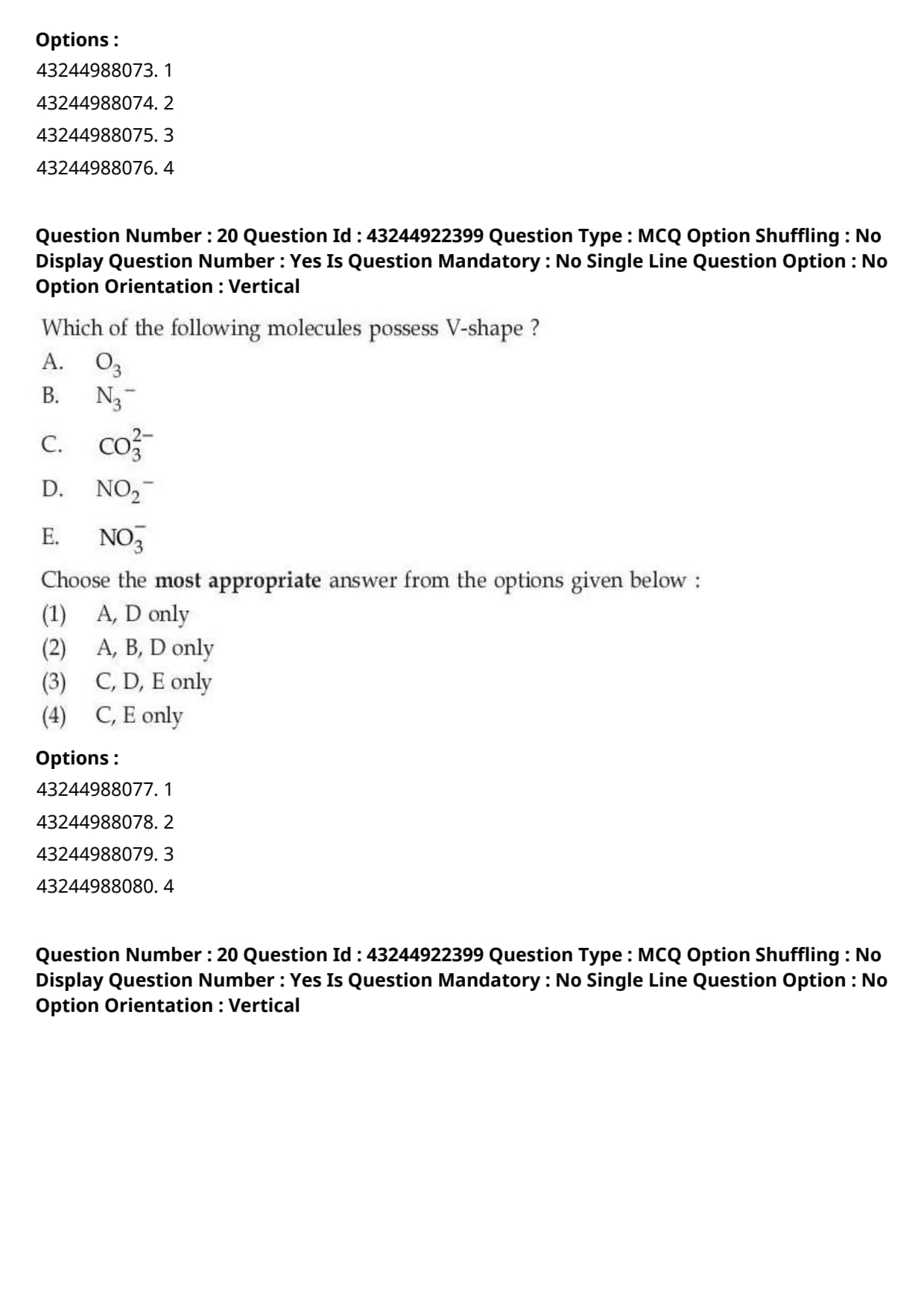
Which of the following molecules possess V-shape ?
A. \(O_3\)
B. \(N_3^-\)
C. \(CO_3^{2-}\)
D. \(NO_2^-\)
E. \(NO_3^-\)
Choose the most appropriate answer from the options given below :
View Solution
Step 1: Concept:
The question asks us to identify which of the provided molecules or ions have a "V-shape" (often referred to as a "bent" or "angular" geometry). This requires using VSEPR (Valence Shell Electron Pair Repulsion) theory to determine molecular geometry.
Step 2: Key Formula or Approach:
For a central atom A, calculate the Steric Number (SN) = (Number of bonded atoms) + (Number of lone pairs).
- SN = 2 (0 lone pairs) \(\rightarrow\) Linear
- SN = 3 (0 lone pairs) \(\rightarrow\) Trigonal planar
- SN = 3 (1 lone pair) \(\rightarrow\) Bent / V-shape (angle \(< 120^\circ\))
- SN = 4 (2 lone pairs) \(\rightarrow\) Bent / V-shape (angle \(\approx 104.5^\circ\))
Step 3: Step-by-step Explanation:
Let's evaluate each species:
A. \(O_3\) (Ozone): The central oxygen atom is bonded to two other oxygen atoms and has one lone pair. SN = \(2+1 = 3\). The electron geometry is trigonal planar, but the molecular geometry (ignoring the lone pair) is Bent (V-shape).
B. \(N_3^-\) (Azide ion): The central nitrogen is double-bonded to the two terminal nitrogens and has no lone pairs on the central atom. SN = \(2+0 = 2\). The molecular geometry is Linear.
C. \(CO_3^{2-}\) (Carbonate ion): The central carbon is bonded to three oxygen atoms (one double bond, two single bonds theoretically, but resonance stabilized) and has no lone pairs. SN = \(3+0 = 3\). The molecular geometry is Trigonal Planar.
D. \(NO_2^-\) (Nitrite ion): The central nitrogen is bonded to two oxygen atoms and carries one lone pair. SN = \(2+1 = 3\). Similar to ozone, the molecular geometry is Bent (V-shape).
E. \(NO_3^-\) (Nitrate ion): The central nitrogen is bonded to three oxygen atoms and has no lone pairs (using its lone pair to form a coordinate bond/double bond structure). SN = \(3+0 = 3\). The molecular geometry is Trigonal Planar.
Thus, only \(O_3\) (A) and \(NO_2^-\) (D) possess a V-shape.
Step 4: Final Answer:
Molecules A and D only, which corresponds to option (A).
Quick Tip: % Quick Tip "V-shape" or "bent" geometries usually arise from central atoms with \(sp^2\) hybridization and one lone pair (bond angle \(\sim 119^\circ\), e.g., \(SO_2\), \(O_3\), \(NO_2^-\)) or \(sp^3\) hybridization with two lone pairs (bond angle \(\sim 104.5^\circ\), e.g., \(H_2O\), \(H_2S\)).
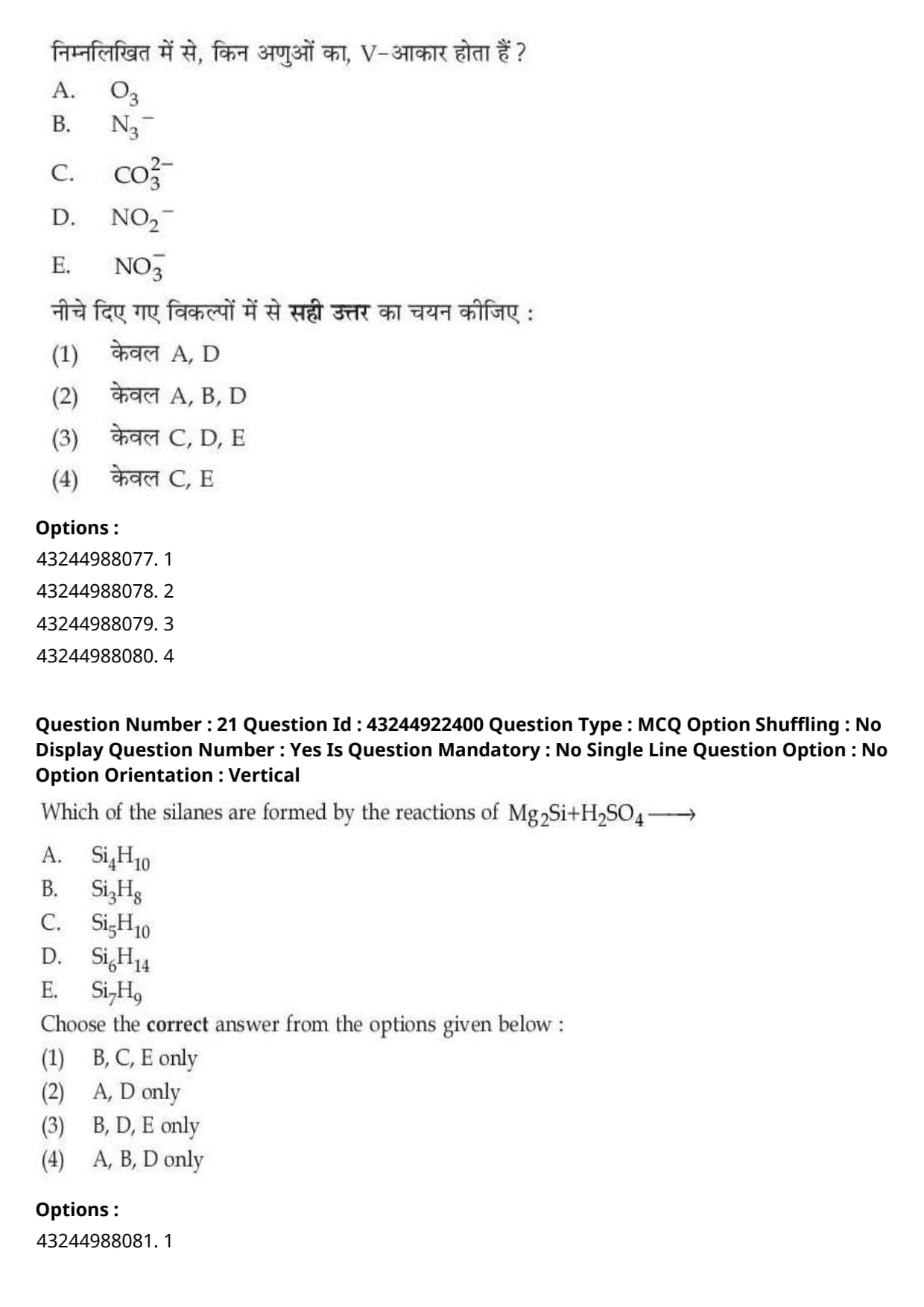
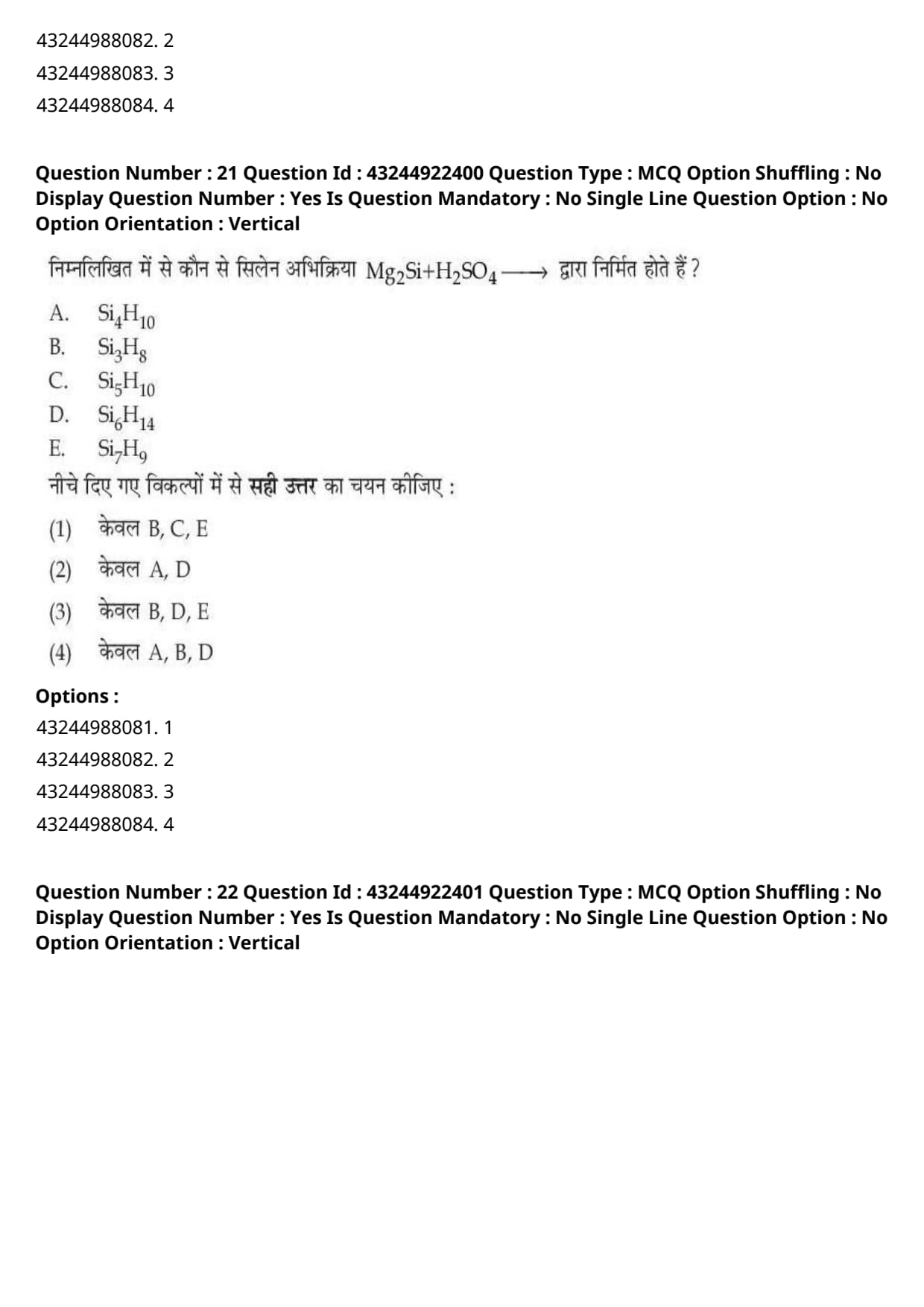
Which of the silanes are formed by the reactions of \(Mg_2Si + H_2SO_4 \longrightarrow\)
A. \(Si_4H_{10}\)
B. \(Si_3H_8\)
C. \(Si_5H_{10}\)
D. \(Si_6H_{14}\)
E. \(Si_7H_9\)
Choose the correct answer from the options given below :
View Solution
Step 1: Concept:
The question asks to identify the specific silane compounds produced when magnesium silicide (\(Mg_2Si\)) reacts with a dilute acid like sulfuric acid (\(H_2SO_4\)).
Step 2: Key Formula or Approach:
The reaction of magnesium silicide with dilute aqueous acids is a classic synthesis route for silanes (silicon hydrides). This reaction does not yield a single product, but rather a complex mixture of gaseous and liquid silanes.
These synthesized silanes are analogous to alkanes and follow the general formula \(Si_nH_{2n+2}\) for saturated, non-cyclic chains.
Step 3: Step-by-step Explanation:
The reaction primarily yields monosilane (\(SiH_4\)) and disilane (\(Si_2H_6\)). However, higher order silanes up to hexasilane (\(Si_6H_{14}\)) are also formed in the resulting mixture and can be separated by fractional distillation.
We must evaluate the provided chemical formulas against the general rule for linear/branched silanes: \(Si_nH_{2n+2}\).
A. \(Si_4H_{10}\): Here \(n=4\). The formula requires \(2(4) + 2 = 10\) hydrogens. This is Tetrasilane, a valid saturated straight-chain or branched silane formed in this reaction.
B. \(Si_3H_8\): Here \(n=3\). The formula requires \(2(3) + 2 = 8\) hydrogens. This is Trisilane, a valid product.
C. \(Si_5H_{10}\): Here \(n=5\). For a straight chain, it should be \(H_{12}\). \(Si_5H_{10}\) corresponds to a cyclopentasilane (a cyclic structure). While cyclic silanes exist, they are not the primary, standard products expected from the acid hydrolysis of \(Mg_2Si\) taught in standard inorganic courses.
D. \(Si_6H_{14}\): Here \(n=6\). The formula requires \(2(6) + 2 = 14\) hydrogens. This is Hexasilane, the highest commonly noted stable liquid silane formed in this mixture.
E. \(Si_7H_9\): Here \(n=7\). This formula is completely invalid for any standard stable silane network. It lacks enough hydrogen atoms to satisfy silicon's tetravalency without an implausible number of double bonds or rings (which silicon resists forming).
Therefore, only the saturated, straight-chain formulas A, B, and D represent the correct products.
Step 4: Final Answer:
The correctly identified products are A, B, and D, which corresponds to option (D).
Quick Tip: % Quick Tip Silanes follow the general formula \(Si_nH_{2n+2}\), exactly like alkanes. Any formula that deviates from this (like \(Si_5H_{10}\) or \(Si_7H_9\)) in introductory inorganic chemistry is usually incorrect or represents a much rarer cyclic variant not formed via simple \(Mg_2Si\) hydrolysis.
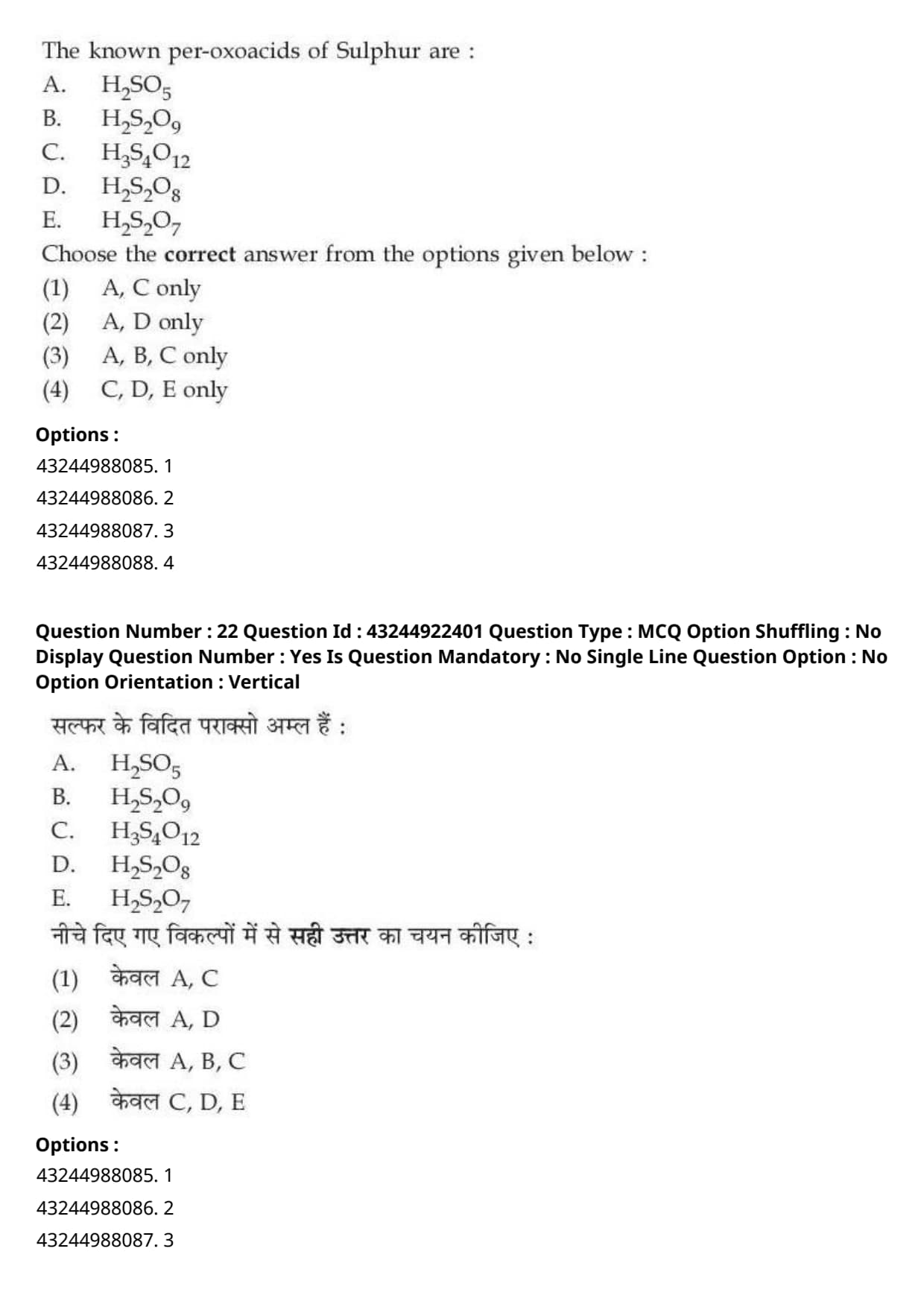
The known per-oxoacids of Sulphur are :
A. \(H_2SO_5\)
B. \(H_2S_2O_9\)
C. \(H_3S_4O_{12}\)
D. \(H_2S_2O_8\)
E. \(H_2S_2O_7\)
Choose the correct answer from the options given below :
View Solution
Step 1: Concept:
The question asks to identify the specific per-oxoacids (also called peroxy acids) among a list of sulfur-containing oxoacids. A per-oxoacid must contain a peroxide linkage (\(-O-O-\) bond).
Step 2: Key Formula or Approach:
One quick way to identify the potential for a peroxide linkage is to calculate the formal oxidation state of the central atom (Sulfur) assuming all oxygens are \(-2\). Sulfur's maximum oxidation state is \(+6\) (Group 16). If the calculated oxidation state exceeds \(+6\), the molecule must contain a peroxide bond (where the oxygen atoms are in a \(-1\) oxidation state) to maintain chemical realism.
Step 3: Step-by-step Explanation:
A. \(H_2SO_5\): Calculating S oxidation state: \(2(+1) + S + 5(-2) = 0 \implies S = +8\). Since \(+8 > +6\), there must be a peroxide linkage. This is structurally known as peroxomonosulfuric acid, or Caro's acid. It has one \(-O-O-H\) group. (Yes)
B. \(H_2S_2O_9\): Calculating S oxidation state: \(2(+1) + 2S + 9(-2) = 0 \implies 2S = +16 \implies S = +8\). While mathematically it suggests peroxide, \(H_2S_2O_9\) is not a standard, well-known stable oxoacid taught in main group chemistry compared to the others.
C. \(H_3S_4O_{12}\): This is not a recognized, stable standard oxoacid formula for sulfur.
D. \(H_2S_2O_8\): Calculating S oxidation state: \(2(+1) + 2S + 8(-2) = 0 \implies 2S = 14 \implies S = +7\). Since \(+7 > +6\), there is a peroxide linkage. This is peroxodisulfuric acid, or Marshall's acid. It features a central \(-O-O-\) bridge connecting two \(SO_3H\) groups. (Yes)
E. \(H_2S_2O_7\): Calculating S oxidation state: \(2(+1) + 2S + 7(-2) = 0 \implies 2S = 12 \implies S = +6\). The oxidation state is exactly \(+6\), the maximum normal state. There is no peroxide linkage. This is pyrosulfuric acid (oleum), which has a standard \(-O-\) bridge linking the two sulfur atoms. (No)
The well-known, textbook per-oxoacids of sulfur are indeed Caro's acid (\(H_2SO_5\)) and Marshall's acid (\(H_2S_2O_8\)).
Step 4: Final Answer:
The recognized per-oxoacids are A and D. This corresponds to option (B).
Quick Tip: % Quick Tip The oxidation state trick is powerful: Assign H as +1 and O as -2. If the central atom's calculated oxidation state exceeds its group valency maximum (like \(> +6\) for S, or \(> +5\) for P), the molecule almost certainly contains a peroxide (\(-O-O-\)) linkage!
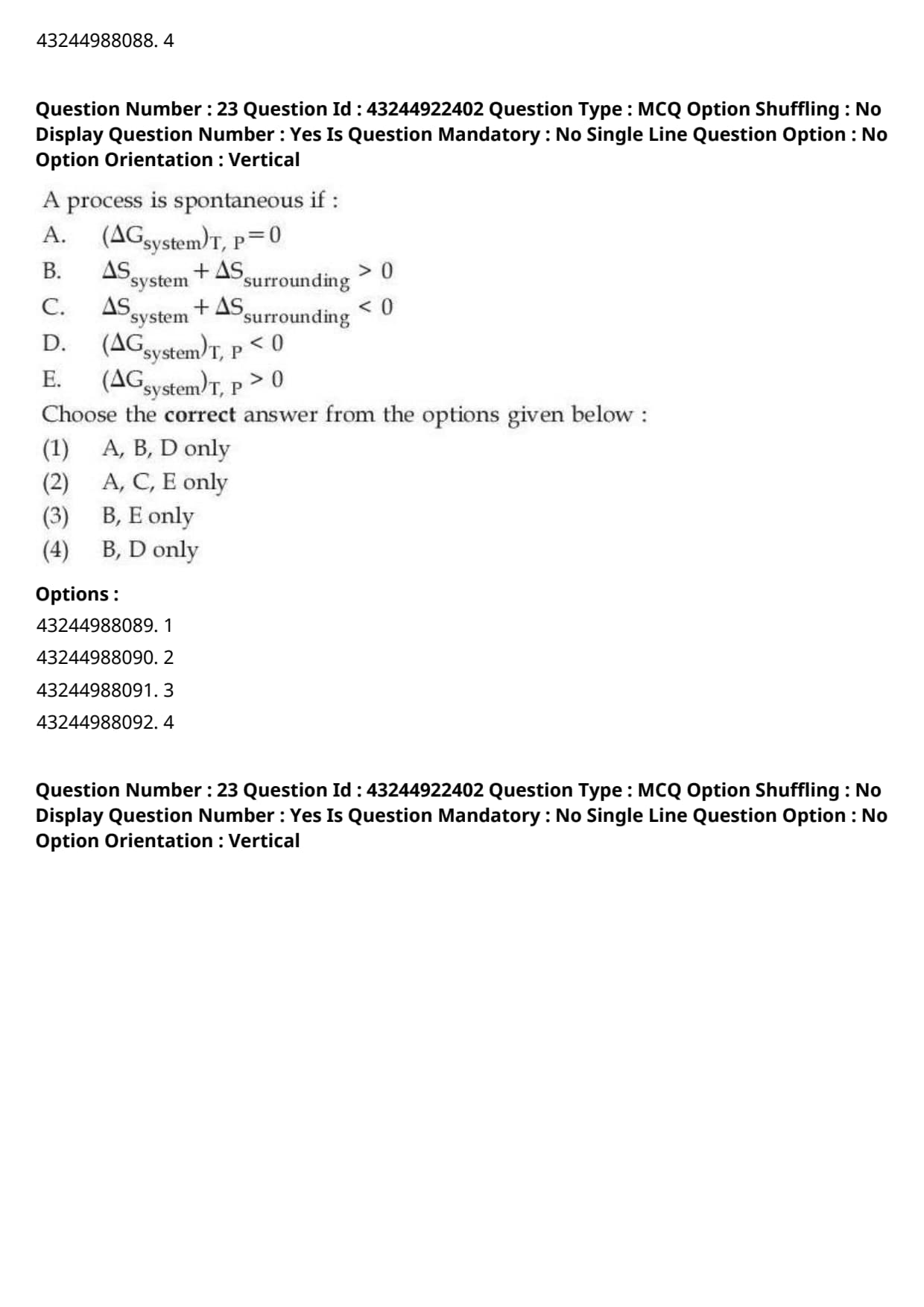
A process is spontaneous if :
A. \((\Delta G_{system})_{T, P} = 0\)
B. \(\Delta S_{system} + \Delta S_{surrounding} > 0\)
C. \(\Delta S_{system} + \Delta S_{surrounding} < 0\)
D. \((\Delta G_{system})_{T, P} < 0\)
E. \((\Delta G_{system})_{T, P} > 0\)
Choose the correct answer from the options given below :
View Solution
Step 1: Concept:
The question asks to identify the correct thermodynamic conditions that definitively indicate a process is spontaneous.
Step 2: Key Formula or Approach:
1. The Second Law of Thermodynamics: A process is spontaneous in a given direction if it results in an overall increase in the entropy of the universe.
\[ \Delta S_{universe} = \Delta S_{system} + \Delta S_{surrounding} > 0 \]
2. Gibbs Free Energy: For processes occurring at constant Temperature (T) and Pressure (P), the entropy of the universe criterion is mathematically translated into the Gibbs free energy change of the system. A process is spontaneous if the free energy of the system decreases.
\[ (\Delta G_{system})_{T, P} < 0 \]
Step 3: Step-by-step Explanation:
Let's review each statement:
A. \((\Delta G_{system})_{T, P} = 0\): This condition indicates that the system is at chemical equilibrium, not that a spontaneous change is occurring in a specific direction.
B. \(\Delta S_{system} + \Delta S_{surrounding} > 0\): This means \(\Delta S_{universe} > 0\). According to the Second Law of Thermodynamics, this is the fundamental definition of a spontaneous process. (True)
C. \(\Delta S_{system} + \Delta S_{surrounding} < 0\): This indicates a decrease in universal entropy, meaning the process is thermodynamically forbidden (non-spontaneous) in the forward direction.
D. \((\Delta G_{system})_{T, P} < 0\): A negative change in Gibbs free energy at constant T and P means the system can do useful work and the process is spontaneous. (True)
E. \((\Delta G_{system})_{T, P} > 0\): A positive Gibbs free energy change indicates a non-spontaneous process (it would be spontaneous in the reverse direction).
The only correct criteria for spontaneity are B and D.
Step 4: Final Answer:
The correct statements are B and D, which corresponds to option (D).
Quick Tip: % Quick Tip Remember the signs: Spontaneous means the universe gets messier (\(\Delta S_{univ} > 0\)) and the system loses free energy (\(\Delta G < 0\)). Equilibrium is when everything is perfectly balanced (\(\Delta S_{univ} = 0\), \(\Delta G = 0\)).
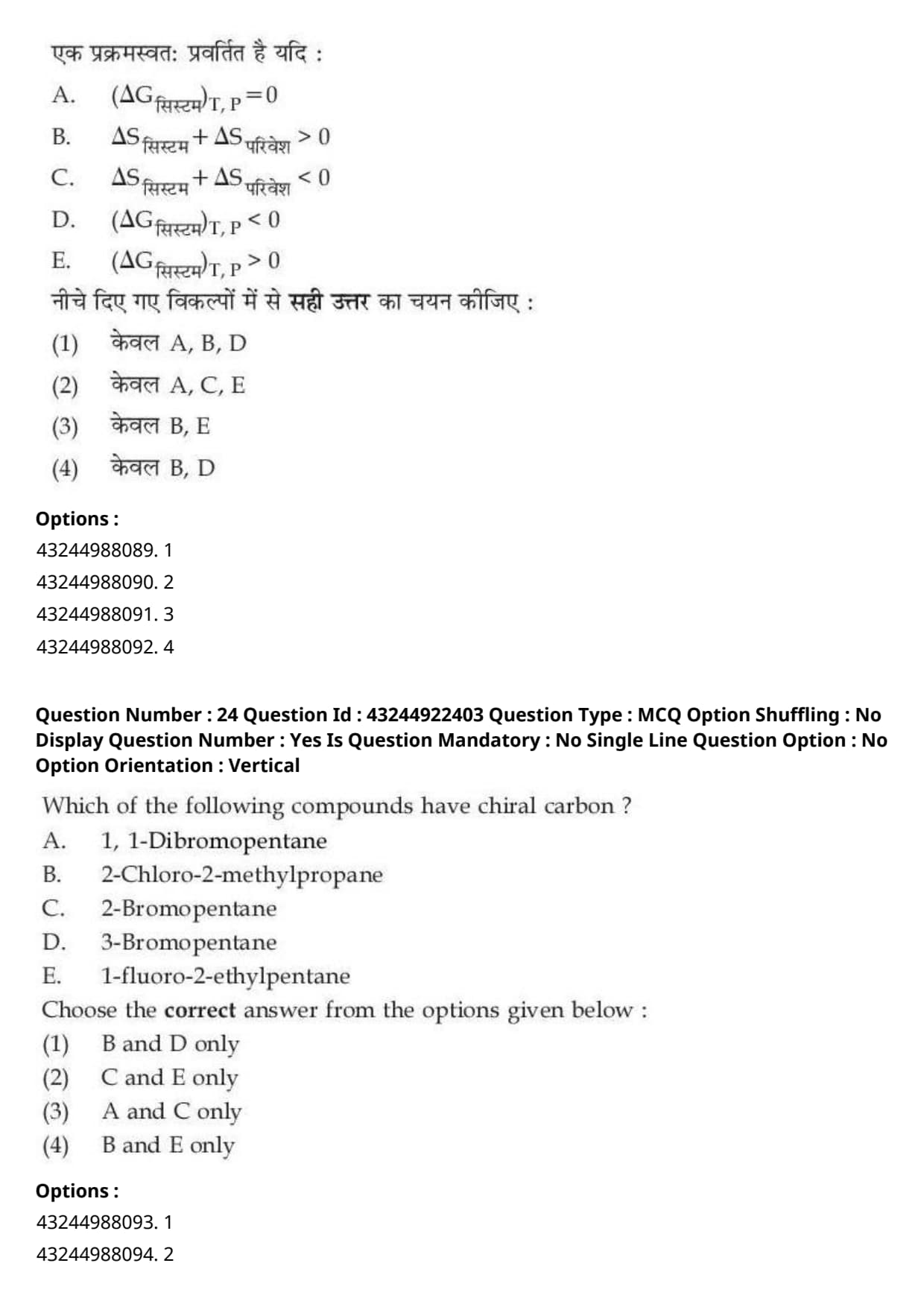
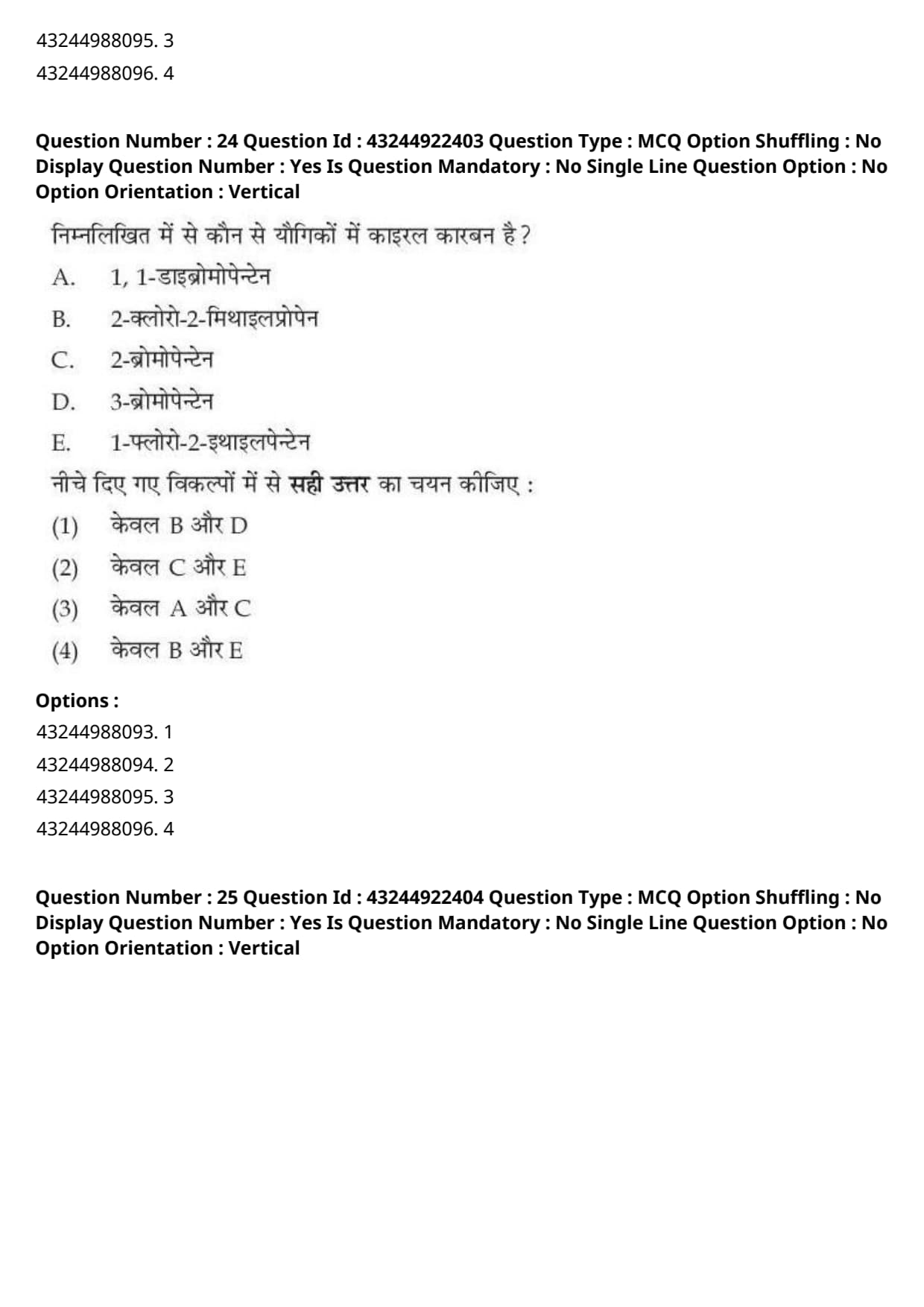
Which of the following compounds have chiral carbon ?
A. 1, 1-Dibromopentane
B. 2-Chloro-2-methylpropane
C. 2-Bromopentane
D. 3-Bromopentane
E. 1-fluoro-2-ethylpentane
Choose the correct answer from the options given below :
View Solution
Step 1: Concept:
The objective is to analyze the chemical names provided, deduce their chemical structures, and identify which of them possess at least one chiral carbon atom (a stereocenter).
Step 2: Key Formula or Approach:
A carbon atom is considered chiral (or an asymmetric stereocenter) if it is \(sp^3\) hybridized and bonded to four distinctly different atoms or chemical groups. We must draw the structures and examine the attachments to every carbon.
Step 3: Step-by-step Explanation:
A. 1,1-Dibromopentane: Structure is \(CH(Br)_2-CH_2-CH_2-CH_2-CH_3\). Carbon-1 is attached to a hydrogen, a butyl chain, and two identical bromine atoms. Because it has two identical groups, it is not chiral. None of the other carbons are chiral either.
B. 2-Chloro-2-methylpropane: Also known as tert-butyl chloride. Structure is \(C(Cl)(CH_3)_3\). The central carbon is attached to a chlorine and three identical methyl groups. Not chiral.
C. 2-Bromopentane: Structure is \(CH_3-CH(Br)-CH_2-CH_2-CH_3\). Let's look at Carbon-2. It is attached to: 1) a Hydrogen atom (\(-H\)), 2) a Bromine atom (\(-Br\)), 3) a Methyl group (\(-CH_3\)), and 4) a Propyl group (\(-CH_2CH_2CH_3\)). All four groups are distinctly different! Therefore, C-2 is a chiral carbon.
D. 3-Bromopentane: Structure is \(CH_3-CH_2-CH(Br)-CH_2-CH_3\). Let's look at Carbon-3. It is attached to: 1) \(-H\), 2) \(-Br\), 3) an Ethyl group (\(-CH_2CH_3\)), and 4) another identical Ethyl group (\(-CH_2CH_3\)). Because two groups are the same, it is achiral.
E. 1-fluoro-2-ethylpentane: Structure is \(CH_2(F)-CH(CH_2CH_3)-CH_2-CH_2-CH_3\). (Note: IUPAC name might be 3-(fluoromethyl)hexane, but the given name clearly denotes the structure). Let's examine Carbon-2. It is attached to: 1) a Hydrogen atom (\(-H\)), 2) a Fluoromethyl group (\(-CH_2F\)), 3) an Ethyl group (\(-CH_2CH_3\)), and 4) a Propyl group (\(-CH_2CH_2CH_3\)). All four groups are unique. Therefore, C-2 is a chiral carbon.
The molecules with chiral carbons are C and E.
Step 4: Final Answer:
Compounds C and E only contain chiral carbons, which points to option (B).
Quick Tip: % Quick Tip Always draw out the full structure, especially the alkyl chains. A very common trap is placing a substituent exactly in the middle of a symmetric chain (like 3-bromopentane or 4-heptanol), which results in two identical alkyl groups, rendering the molecule achiral.
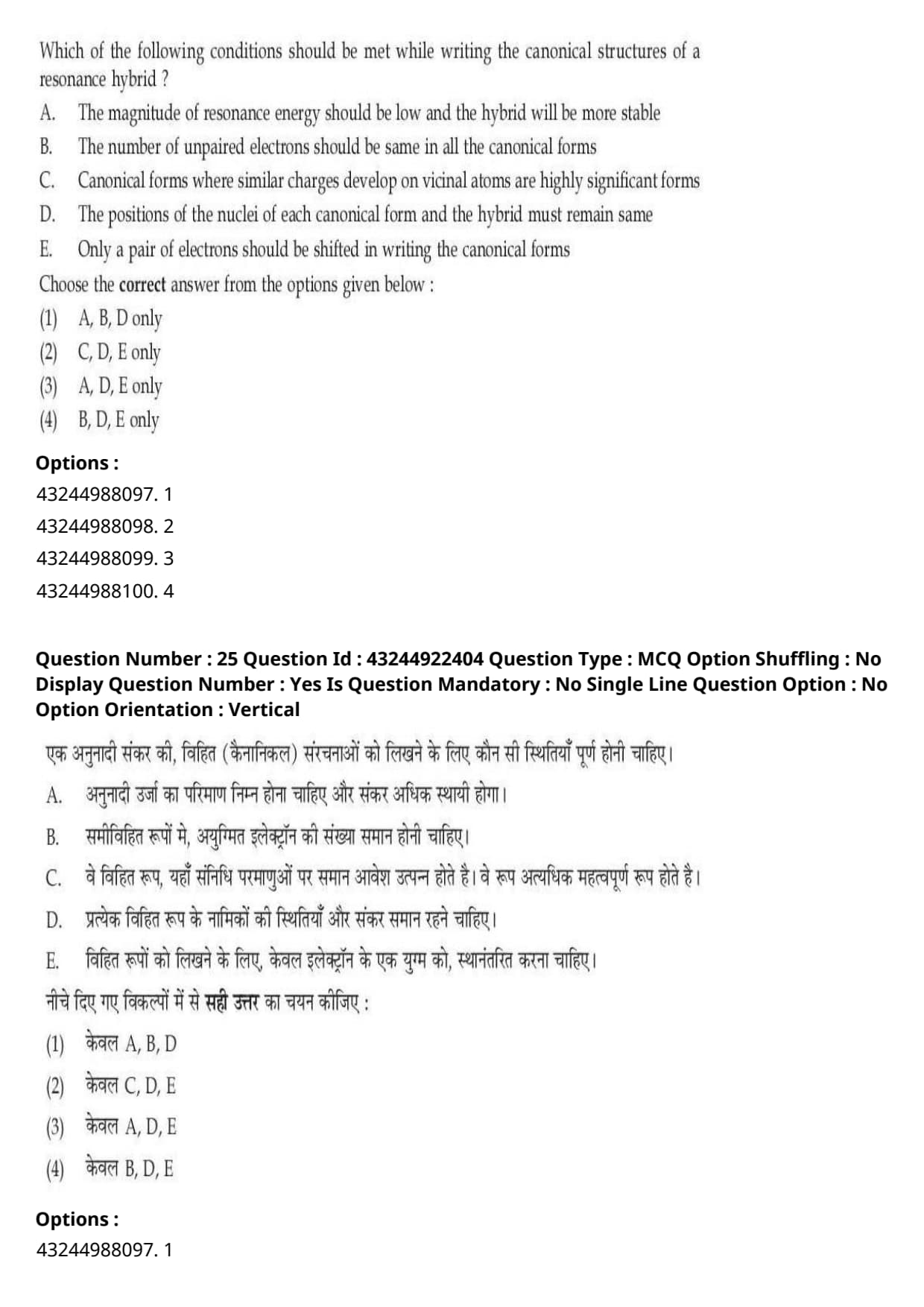
Which of the following conditions should be met while writing the canonical structures of a resonance hybrid ?
A. The magnitude of resonance energy should be low and the hybrid will be more stable
B. The number of unpaired electrons should be same in all the canonical forms
C. Canonical forms where similar charges develop on vicinal atoms are highly significant forms
D. The positions of the nuclei of each canonical form and the hybrid must remain same
E. Only a pair of electrons should be shifted in writing the canonical forms
Choose the correct answer from the options given below :
View Solution
Step 1: Concept:
The question asks to identify the fundamental rules governing the drawing and evaluation of resonance structures (canonical forms) in organic chemistry.
Step 2: Key Formula or Approach:
Review the rules of resonance:
- Resonance involves only the delocalization of electrons (specifically \(\pi\) electrons and lone pairs). Nuclei (atoms) must never move.
- The overall spin state of the molecule cannot change; the number of unpaired electrons must be conserved across all structures.
- More stable resonance structures contribute more to the hybrid. Stability is lowered by separation of opposite charges, and severely lowered by placing like charges on adjacent (vicinal) atoms.
- A higher resonance energy (the energy difference between the hybrid and the most stable theoretical canonical form) implies greater stability, not lower.
Step 3: Step-by-step Explanation:
A. Resonance energy should be low: False. Resonance energy is a measure of the extra stability gained by electron delocalization. A \textit{high magnitude of resonance energy means the hybrid is much more stable than any single canonical form (e.g., benzene has high resonance energy).
B. Number of unpaired electrons should be same: True. Spin multiplicity must be conserved. You cannot draw a resonance form that converts a singlet state into a triplet state by breaking electron pairs arbitrarily.
C. Similar charges on vicinal atoms are highly significant: False. Placing like charges (e.g., two positive charges) on adjacent atoms causes massive electrostatic repulsion. Such structures are extremely high in energy and represent highly \textit{insignificant contributors to the resonance hybrid.
D. Positions of nuclei must remain same: True. This is the absolute golden rule of resonance. If atoms move, it is an isomerization reaction (like tautomerism), not resonance.
E. Only a pair of electrons should be shifted: Generally true in the context of standard polar organic chemistry taught at this level. We use curved arrows to show the movement of pairs of electrons (lone pairs converting to \(\pi\) bonds, or \(\pi\) bonds breaking onto atoms as lone pairs). While radical resonance shifts single electrons, standard rules typically focus on electron pairs. Given the available options (since A and C are definitively false), E must be accepted as True in this context.
Therefore, the correct statements are B, D, and E.
Step 4: Final Answer:
The conditions that apply are B, D, and E, corresponding to option (D).
Quick Tip: % Quick Tip The absolute rules of resonance: 1. NEVER move atoms (nuclei). 2. NEVER exceed the octet rule for 2nd-row elements (C, N, O, F). 3. Conserve the total net charge and the number of unpaired electrons.
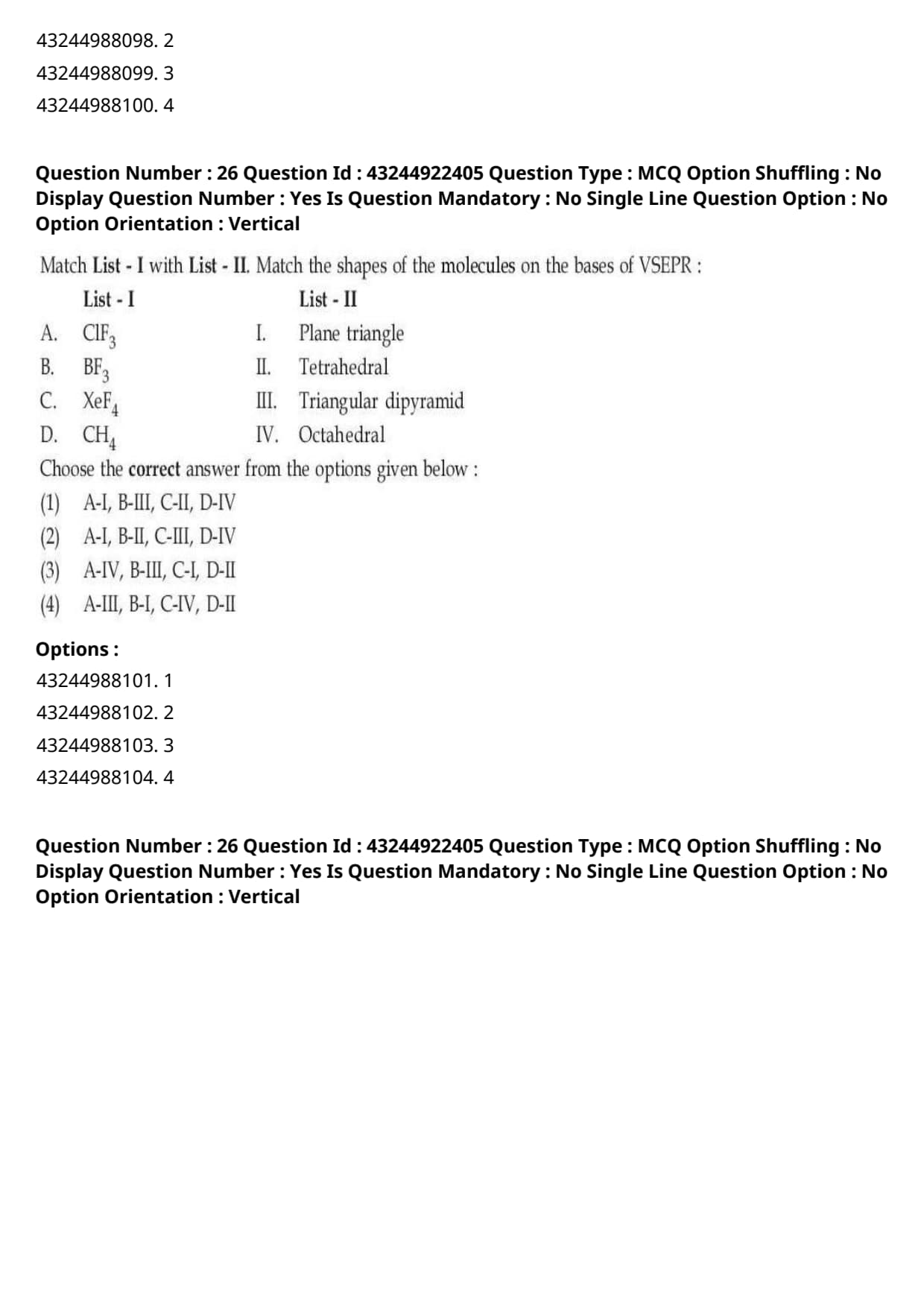
Match List - I with List - II. Match the shapes of the molecules on the bases of VSEPR :

Choose the correct answer from the options given below :
View Solution
Step 1: Concept:
The question asks us to match molecules with their corresponding electron-domain geometries based on the Valence Shell Electron Pair Repulsion (VSEPR) theory. Note that the List II contains the base "electron geometries" (determined by hybridization) rather than the final molecular shapes.
Step 2: Key Formula or Approach:
To find the electron geometry, calculate the Steric Number (SN):
\[ SN = (Number of bonding pairs) + (Number of lone pairs on the central atom) \]
- SN = 3 \(\rightarrow\) Trigonal Planar (Plane triangle)
- SN = 4 \(\rightarrow\) Tetrahedral
- SN = 5 \(\rightarrow\) Trigonal Bipyramidal (Triangular dipyramid)
- SN = 6 \(\rightarrow\) Octahedral
Step 3: Step-by-step Explanation:
A. \(ClF_3\): Chlorine (Group 17) has 7 valence electrons. It forms 3 single bonds with Fluorine, leaving 4 non-bonding electrons (2 lone pairs).
SN = \(3 (bonds) + 2 (lone pairs) = 5\).
Electron geometry: Triangular dipyramid (III).
B. \(BF_3\): Boron (Group 13) has 3 valence electrons. It forms 3 single bonds with Fluorine and has 0 lone pairs.
SN = \(3 (bonds) + 0 (lone pairs) = 3\).
Electron geometry: Plane triangle (I).
C. \(XeF_4\): Xenon (Group 18) has 8 valence electrons. It forms 4 single bonds with Fluorine, leaving 4 non-bonding electrons (2 lone pairs).
SN = \(4 (bonds) + 2 (lone pairs) = 6\).
Electron geometry: Octahedral (IV).
D. \(CH_4\): Carbon (Group 14) has 4 valence electrons. It forms 4 single bonds with Hydrogen and has 0 lone pairs.
SN = \(4 (bonds) + 0 (lone pairs) = 4\).
Electron geometry: Tetrahedral (II).
Matching them up gives A-III, B-I, C-IV, D-II.
Step 4: Final Answer:
The correct match is found in option (D).
Quick Tip: Be careful to distinguish between "Molecular Geometry" (shape of the atoms only) and "Electron Geometry" (arrangement of all electron domains). In this question, \(XeF_4\) has a square planar molecular shape, but an octahedral electron geometry.
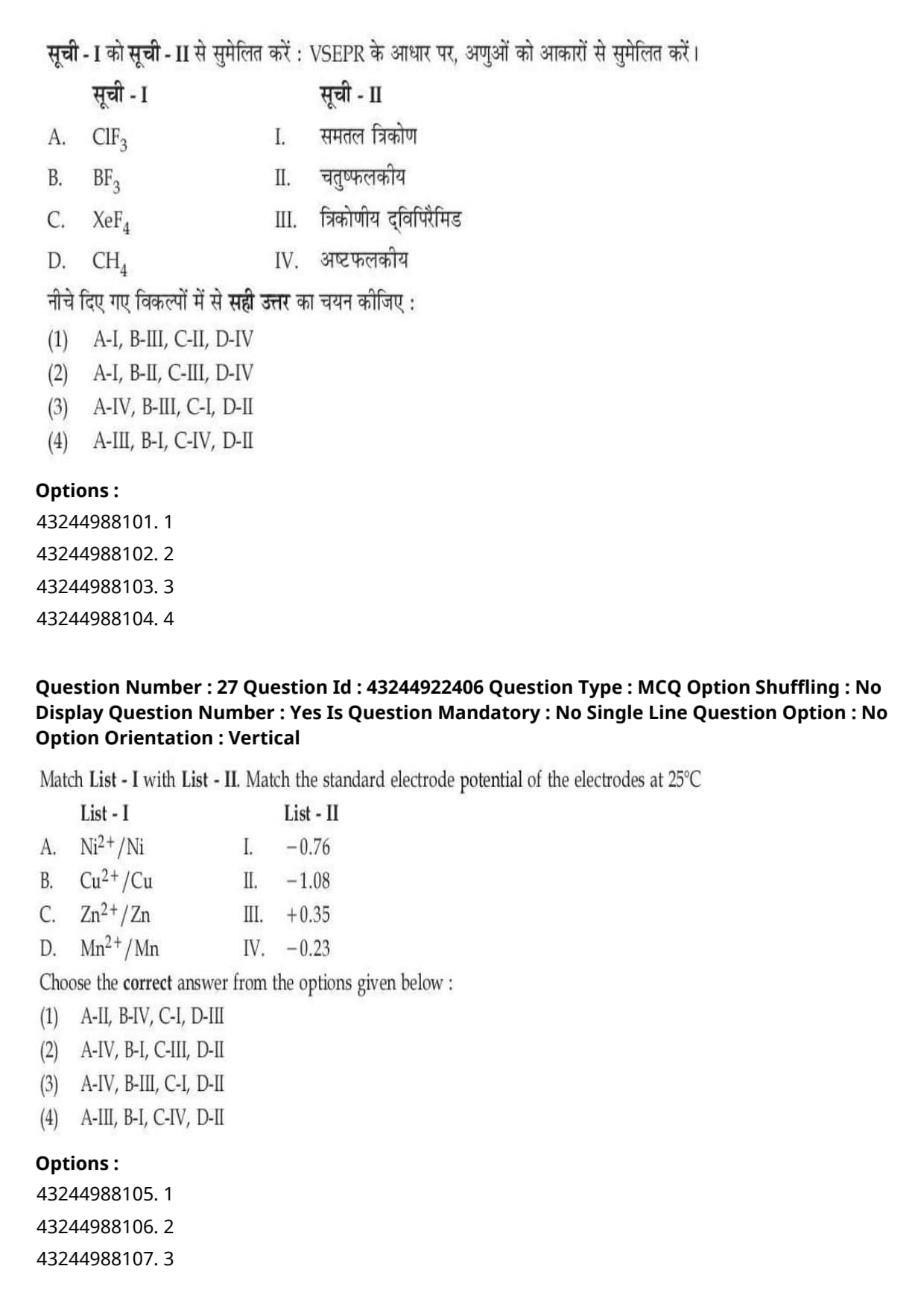
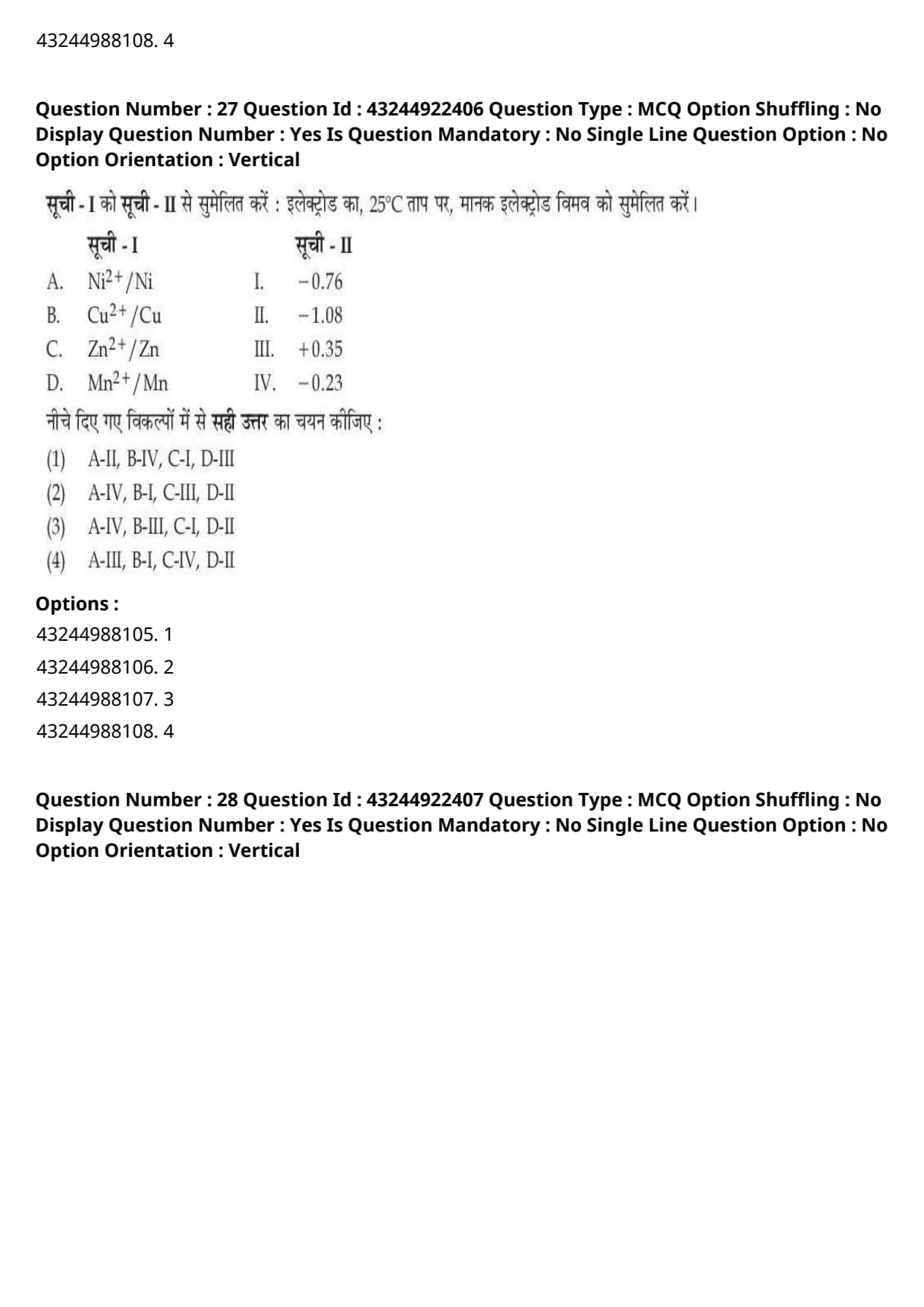
Match List - I with List - II. Match the standard electrode potential of the electrodes at \(25^\circC\)

Choose the correct answer from the options given below :
View Solution
Step 1: Concept:
The question requires matching common transition metal half-cells with their standard reduction potentials (\(E^\circ\)) at 298 K (\(25^\circC\)).
Step 2: Key Formula or Approach:
Knowledge of the standard electrochemical series is needed. The exact textbook values are:
- \(E^\circ(Zn^{2+}/Zn) \approx -0.76 V\)
- \(E^\circ(Cu^{2+}/Cu) \approx +0.34 V\)
- \(E^\circ(Ni^{2+}/Ni) \approx -0.25 V\)
- \(E^\circ(Mn^{2+}/Mn) \approx -1.18 V\)
We must match these standard values to the closest approximations given in List II.
Step 3: Step-by-step Explanation:
C. \(Zn^{2+}/Zn\): The standard reduction potential is widely known as exactly -0.76 V. This perfectly matches (I). So, C-I.
B. \(Cu^{2+}/Cu\): Copper is one of the few common metals with a positive reduction potential, typically \(+0.34 V\). The closest value in the list is +0.35 V (III). So, B-III.
A. \(Ni^{2+}/Ni\): The standard value is \(-0.25 V\). The closest value provided in List II is -0.23 V (IV). So, A-IV.
D. \(Mn^{2+}/Mn\): Manganese is highly electropositive. Its standard reduction potential is \(-1.18 V\). The closest remaining value in the list is -1.08 V (II). So, D-II.
Bringing it all together: A-IV, B-III, C-I, D-II.
Step 4: Final Answer:
This specific sequence matches option (C).
Quick Tip: You do not need to memorize the entire table. Remembering key anchors like \(Zn \ (-0.76V)\) and \(Cu \ (+0.34V)\) is often enough to quickly eliminate incorrect options in matching questions.
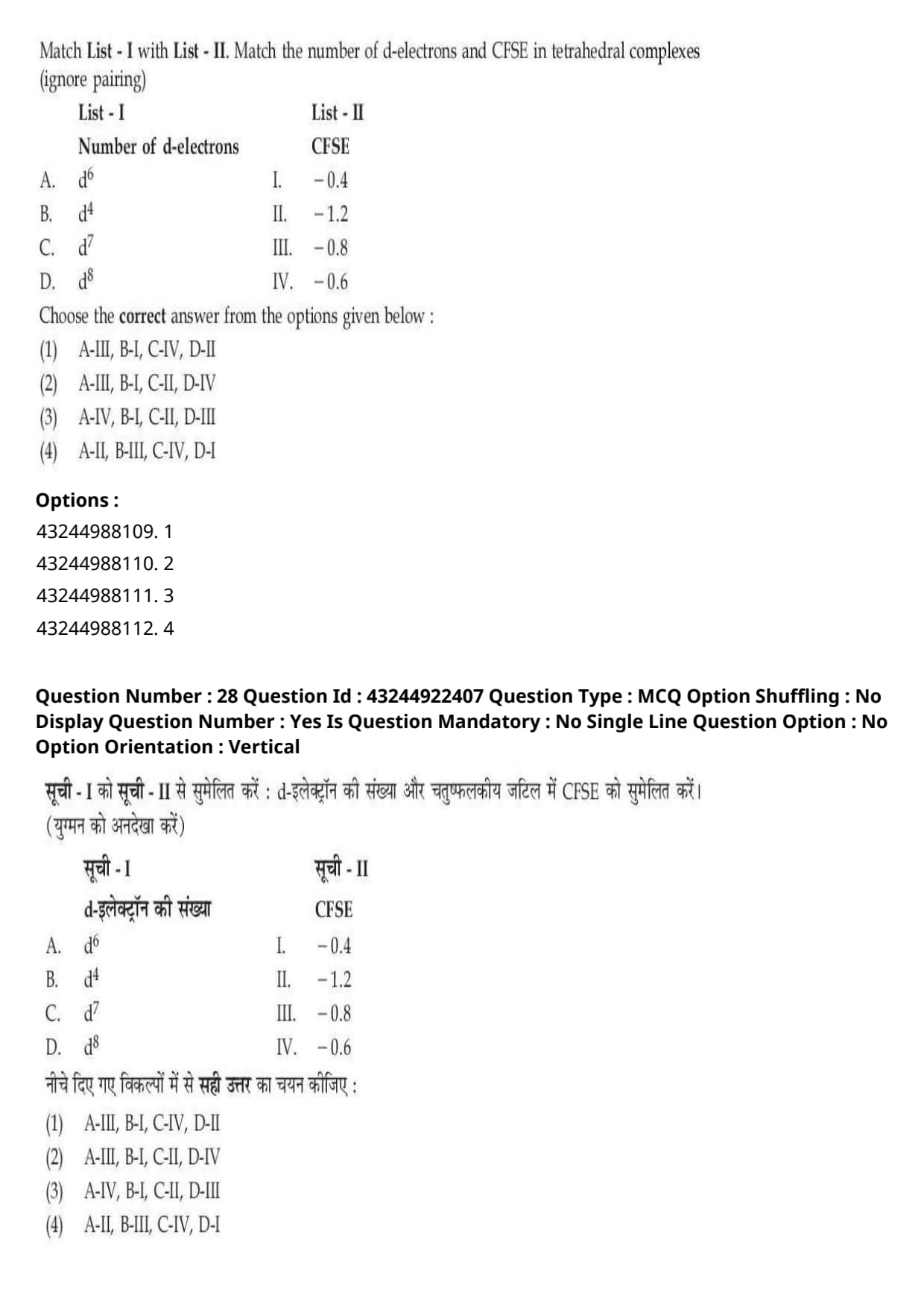
Match List - I with List - II. Match the number of d-electrons and CFSE in tetrahedral complexes (ignore pairing)

Choose the correct answer from the options given below :
View Solution
Step 1: Concept:
The question asks for the Crystal Field Stabilization Energy (CFSE) of tetrahedral complexes for various \(d^n\) configurations. Tetrahedral complexes almost exclusively form high-spin complexes because the tetrahedral splitting parameter (\(\Delta_t\)) is very small (\(\Delta_t \approx \frac{4}{9}\Delta_o\)).
Step 2: Key Formula or Approach:
In a tetrahedral crystal field, the \(d\)-orbitals split into two sets:
- A lower energy doubly degenerate \(e\) set.
- A higher energy triply degenerate \(t_2\) set.
The energy of the \(e\) orbitals is lowered by \(-0.6 \Delta_t\), and the energy of the \(t_2\) orbitals is raised by \(+0.4 \Delta_t\) relative to the barycenter.
\[ CFSE = [(-0.6 \times n_e) + (0.4 \times n_{t_2})] \Delta_t \]
where \(n_e\) and \(n_{t_2}\) are the number of electrons in the \(e\) and \(t_2\) levels, respectively. The problem asks us to ignore pairing energy.
Step 3: Step-by-step Explanation:
Since they are high-spin, we fill the 5 orbitals singly before any pairing occurs:
A. \(d^6\): Configuration is \(e^3 t_2^3\) (first 5 electrons singly occupy all orbitals, the 6th pairs in the lower \(e\) set).
\(CFSE = [3(-0.6) + 3(0.4)]\Delta_t = [-1.8 + 1.2]\Delta_t = \textbf{-0.6} \Delta_t\). (Matches IV).
B. \(d^4\): Configuration is \(e^2 t_2^2\) (all 4 electrons unpaired).
\(CFSE = [2(-0.6) + 2(0.4)]\Delta_t = [-1.2 + 0.8]\Delta_t = \textbf{-0.4} \Delta_t\). (Matches I).
C. \(d^7\): Configuration is \(e^4 t_2^3\).
\(CFSE = [4(-0.6) + 3(0.4)]\Delta_t = [-2.4 + 1.2]\Delta_t = \textbf{-1.2} \Delta_t\). (Matches II).
D. \(d^8\): Configuration is \(e^4 t_2^4\).
\(CFSE = [4(-0.6) + 4(0.4)]\Delta_t = [-2.4 + 1.6]\Delta_t = \textbf{-0.8} \Delta_t\). (Matches III).
The complete matching sequence is A-IV, B-I, C-II, D-III.
Step 4: Final Answer:
The correctly matched sequence corresponds to option (C).
Quick Tip: Remember the inversion between octahedral and tetrahedral field splitting: Octahedral is \(t_{2g}\) (lower, -0.4) and \(e_g\) (upper, +0.6). Tetrahedral is \(e\) (lower, -0.6) and \(t_2\) (upper, +0.4). Tetrahedral complexes are essentially always high-spin!
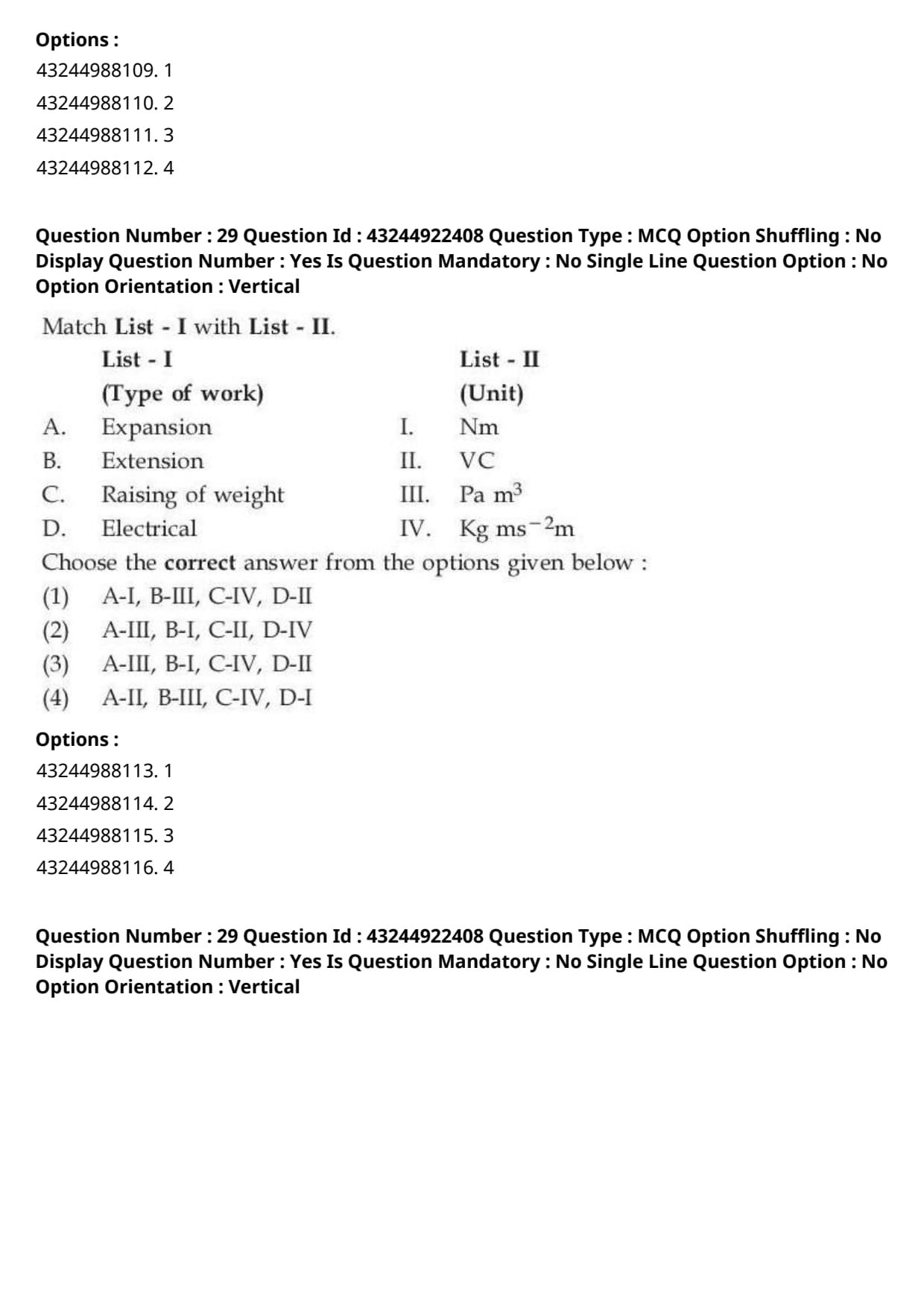
Match List - I with List - II.

Choose the correct answer from the options given below :
View Solution
Step 1: Concept:
The question asks us to match different physical manifestations of work with their corresponding mathematical units based on their fundamental physics formulas.
Step 2: Key Formula or Approach:
Work has the fundamental SI unit of Joules (J). Different forms of work use different variables that multiply together to yield Joules:
- Mechanical Expansion: \(W = \int P \, dV\)
- Extension (Spring/Wire): \(W = \int F \, dx\)
- Gravitational (Raising weight): \(W = mgh\)
- Electrical: \(W = VQ\)
Step 3: Step-by-step Explanation:
A. Expansion Work: The formula is Pressure \(\times\) Change in Volume (\(P\Delta V\)).
Units: Pressure is measured in Pascals (Pa) and volume in cubic meters (m\(^3\)).
Unit combination: Pa m\(^3\) (Matches III).
B. Extension Work: Work done in stretching a wire or spring is Force \(\times\) Extension distance (\(F \cdot dx\)).
Units: Force is Newtons (N) and distance is meters (m).
Unit combination: Nm (Matches I).
C. Raising of weight: Gravitational potential energy work is mass \(\times\) gravity \(\times\) height (\(mgh\)).
Units: mass in Kg, gravity in m/s\(^2\) (or ms\(^{-2}\)), and height in meters (m).
Unit combination: Kg ms\(^{-2}\)m (Matches IV).
D. Electrical Work: The work done moving a charge across a potential difference is Voltage \(\times\) Charge (\(V \cdot Q\)).
Units: Voltage in Volts (V) and Charge in Coulombs (C).
Unit combination: VC (Matches II).
The final matching sequence is A-III, B-I, C-IV, D-II.
Step 4: Final Answer:
The sequence that perfectly matches our derivation is option (C).
Quick Tip: Dimensional analysis is a foolproof way to solve these matches. All the units in List II are ultimately equivalent to 1 Joule of energy (\(1 J = 1 Nm = 1 Pa\cdotm^3 = 1 VC = 1 kg\cdotm^2/s^2\)). Mapping the specific formula variables quickly gives the answer.
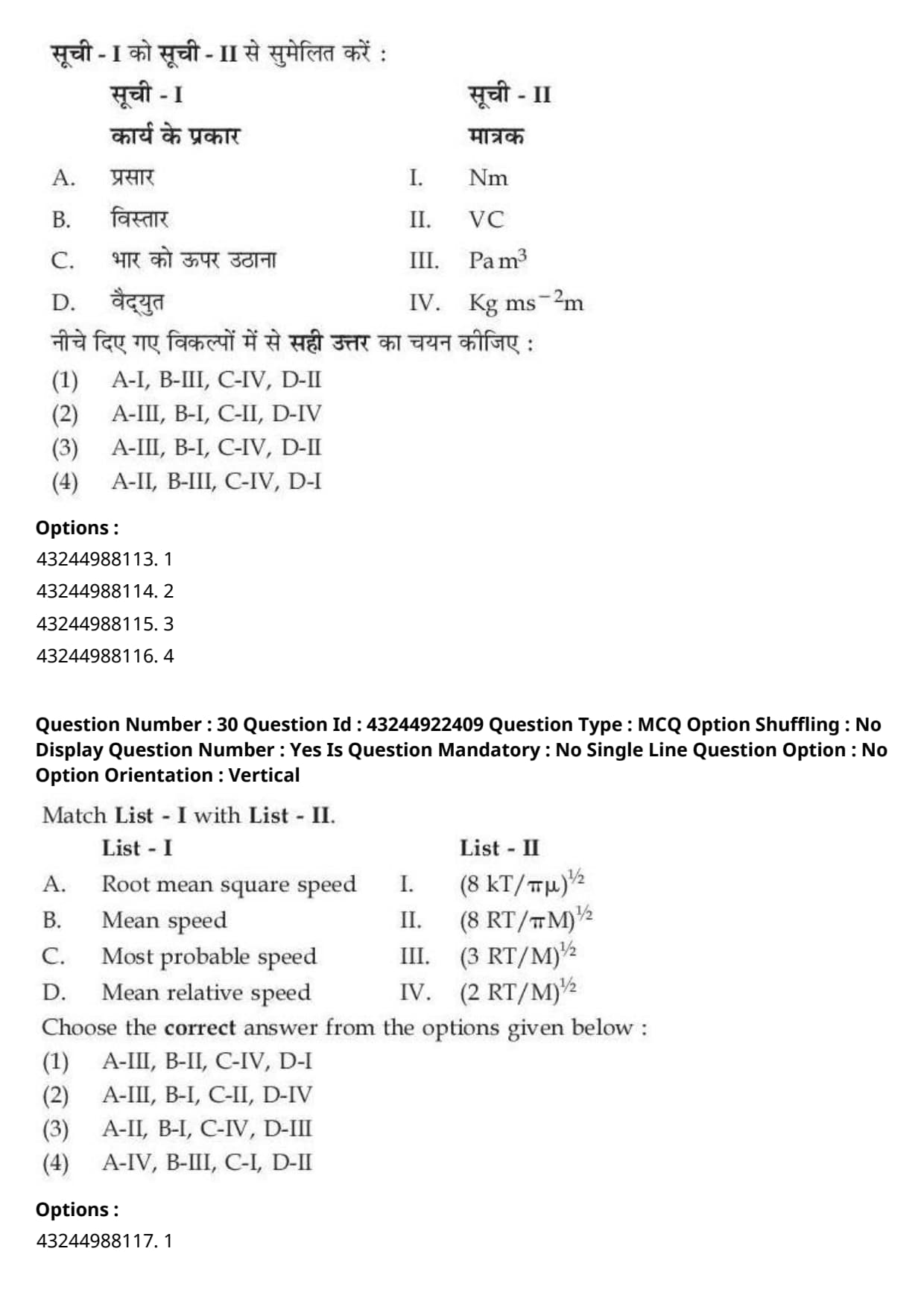
Match List - I with List - II.

Choose the correct answer from the options given below :
View Solution
Step 1: Concept:
This problem requires matching different statistical gas speeds derived from the Maxwell-Boltzmann distribution to their correct mathematical formulas.
Step 2: Key Formula or Approach:
For an ideal gas with molar mass \(M\) at temperature \(T\):
- Root mean square speed (\(v_{rms}\)) = \(\sqrt{\frac{3RT}{M}}\)
- Mean (average) speed (\(v_{avg}\)) = \(\sqrt{\frac{8RT}{\pi M}}\)
- Most probable speed (\(v_{mp}\)) = \(\sqrt{\frac{2RT}{M}}\)
- Mean relative speed (\(v_{rel}\)) of two colliding molecules = \(\sqrt{2} \times v_{avg} = \sqrt{\frac{16RT}{\pi M}}\). Expressed using reduced mass (\(\mu = m/2\)) and the Boltzmann constant (\(k\)), this transforms to \(\sqrt{\frac{8kT}{\pi\mu}}\).
Step 3: Step-by-step Explanation:
A. Root mean square speed: By definition, \(v_{rms} = (\frac{3RT}{M})^{1/2}\).
This matches III.
B. Mean speed: The average speed of gas molecules is \(v_{avg} = (\frac{8RT}{\pi M})^{1/2}\).
This matches II.
C. Most probable speed: The speed at the peak of the Maxwell-Boltzmann curve is \(v_{mp} = (\frac{2RT}{M})^{1/2}\).
This matches IV.
D. Mean relative speed: The average relative speed between two colliding molecules is critical in collision theory. Using atomic mass \(m\) and reduced mass \(\mu = \frac{m_1 m_2}{m_1 + m_2} = \frac{m}{2}\) (for identical molecules), the formula is \((\frac{8kT}{\pi\mu})^{1/2}\).
This matches I.
The final matching sequence is A-III, B-II, C-IV, D-I.
Step 4: Final Answer:
The matching pairs correspond perfectly to option (A).
Quick Tip: A quick mnemonic for ordering the magnitudes of these gas speeds is \textbf{R > A > M} (Rams): \textbf{R}oot mean square (\(\sqrt{3} \approx 1.732\)) \(>\) \textbf{A}verage (\(\sqrt{8/\pi} \approx 1.595\)) \(>\) \textbf{M}ost probable (\(\sqrt{2} \approx 1.414\)).
Hooke's Law is valid only in :
View Solution
Step 1: Concept:
Hooke's Law is a principle of physics stating that the force required to stretch or compress a spring (or a solid material) by some distance is strictly proportional to that distance. We must identify which region of a standard stress-strain curve supports this linear behavior.
Step 2: Key Formula or Approach:
Mathematically, Hooke's Law is expressed as:
\[ \sigma = E \cdot \epsilon \]
where \(\sigma\) is stress, \(E\) is Young's Modulus, and \(\epsilon\) is strain. This indicates a direct, linear relationship between stress and strain.
Step 3: Step-by-step Explanation:
Elastic Region (B): In the initial portion of a material's stress-strain curve, the material deforms reversibly. More specifically, within the very early part of this region (up to the proportional limit), stress is directly proportional to strain, creating a straight line on the graph. Hooke's Law is fully valid here.
Plastic Region (A): Once the yield strength is surpassed, the material undergoes permanent, irreversible deformation. The stress-strain relationship is no longer linear, so Hooke's Law completely fails.
Necking Region (C): This occurs deep within the plastic region just before failure, where the material's cross-sectional area begins to rapidly decrease locally. Hooke's Law is invalid here.
Fracture Point (D): This is the terminal point where the material breaks. Hooke's Law does not apply.
Step 4: Final Answer:
Hooke's Law is only valid in the linear portion of the elastic region, matching option (B).
Quick Tip: Remember the sequence on a stress-strain curve: Proportional Limit (end of Hooke's Law) \(\rightarrow\) Elastic Limit (end of reversible deformation) \(\rightarrow\) Yield Point (start of plastic deformation) \(\rightarrow\) Ultimate Tensile Strength (start of necking) \(\rightarrow\) Fracture.
In quantum well, electrons are confined in :
View Solution
Step 1: Concept:
The question asks to identify the number of dimensions in which charge carriers (electrons or holes) are physically confined within a "quantum well" nanostructure.
Step 2: Key Formula or Approach:
Nanomaterials are classified by how many dimensions restrict the free movement of electrons (quantum confinement):
- Bulk (3D): 0 dimensions of confinement. Electrons move freely in \(x, y, z\).
- Quantum Well (2D film): Confined in 1 dimension (thickness). Electrons move freely in a 2D plane.
- Quantum Wire (1D wire): Confined in 2 dimensions. Electrons move freely along a 1D line.
- Quantum Dot (0D dot): Confined in all 3 dimensions. Electrons are fully trapped, like in an atom.
Step 3: Step-by-step Explanation:
A quantum well is typically formed by sandwiching a thin layer of a narrow-bandgap semiconductor between two layers of a wider-bandgap material.
Because the middle layer is extremely thin (on the order of the de Broglie wavelength of the electrons), the electrons are energetically and physically trapped (confined) in that \(z\)-direction.
However, they are completely free to propagate in the \(x\) and \(y\) plane of the thin film.
Therefore, confinement happens in exactly 1 dimension, allowing 2 degrees of freedom.
Step 4: Final Answer:
Electrons in a quantum well are confined in 1 dimension. This corresponds to option (C).
Quick Tip: A great trick to remember nanostructure naming: The term (2D, 1D, 0D) refers to the number of dimensions the electrons are \textbf{FREE} to move in. A Quantum Well is a 2D material \(\rightarrow\) free in 2 dimensions \(\rightarrow\) confined in \(3 - 2 = 1\) dimension.
Temperature dependence of electron-hole mobility due to lattice scattering varies approximately as :
View Solution
Step 1: Concept:
The mobility of charge carriers (electrons and holes) in a semiconductor is limited by various scattering mechanisms. The question asks for the specific temperature dependence of mobility when limited exclusively by lattice scattering (also known as phonon scattering).
Step 2: Key Formula or Approach:
Carrier mobility (\(\mu\)) is fundamentally defined by the scattering relaxation time (\(\tau\)): \(\mu = \frac{e\tau{m^*}\).
There are two primary scattering mechanisms in a moderately doped semiconductor:
1. Lattice (Phonon) Scattering (\(\mu_L\)): As temperature increases, thermal vibrations of the crystal lattice (phonons) become much more violent, increasing the probability of collision. Thus, mobility decreases as temperature increases.
\[ \mu_L \propto T^{-3/2} \]
2. Ionized Impurity Scattering (\(\mu_I\)): At higher temperatures, charge carriers move much faster (higher thermal velocity) and spend less time in the vicinity of fixed ionized dopants, making them less easily deflected. Thus, mobility increases as temperature increases.
\[ \mu_I \propto T^{3/2} \]
Step 3: Step-by-step Explanation:
The question specifically singles out lattice scattering.
According to semiconductor physics derivations, the scattering rate due to acoustic phonons is proportional to \(T^{3/2}\).
Because mobility is inversely proportional to the scattering rate (\(\mu \propto \tau \propto 1/rate\)), the mobility dictated by lattice scattering is proportional to \(T^{-3/2}\).
Step 4: Final Answer:
The temperature dependence for lattice scattering varies as \(T^{-3/2}\), which matches option (A).
Quick Tip: To remember which is which: High temperatures mean violent lattice shaking, which hinders movement (Phonon mobility drops, \(T^{-3/2}\)). High temperatures mean fast electrons that zip past charges too quickly to be pulled off course (Impurity mobility rises, \(T^{3/2}\)).
During ion-implantation, the impurity atoms entering the crystal, gives up their energy to the lattice via collisions. These impurity atoms come to rest at certain average penetration depth known as :
View Solution
Step 1: Concept:
The question asks for the technical term used in semiconductor manufacturing to describe the average depth at which high-energy ions settle into a target substrate during the ion implantation process.
Step 2: Key Terminology:
- Ion Implantation: A process where ions are accelerated in an electrical field and smashed into a solid.
- Projected Range (\(R_p\)): The average distance an implanted ion travels into the target material perpendicular to the surface before losing all its kinetic energy and coming to a halt.
- Straggle (\(\Delta R_p\)): The statistical variation or standard deviation of the depth distribution around the projected range.
Step 3: Step-by-step Explanation:
When highly energetic ions bombard a crystal lattice, they undergo a series of nuclear and electronic collisions, losing energy at each step.
Because these collisions are random, not every ion stops at the exact same depth. They form a Gaussian distribution profile beneath the surface.
The mean (average) penetration depth, which marks the peak concentration of the implanted ions, is officially termed the Projected Range.
"Straggle" refers to the spread of the profile, not the average depth itself. "Diffusion range" and "Epitaxial range" are entirely different concepts relating to thermal diffusion and crystal growth, respectively.
Step 4: Final Answer:
The average penetration depth is known as the Projected Range. This corresponds to option (D).
Quick Tip: In any Gaussian profile \(N(x) = N_{max} \exp[-(x - R_p)^2 / (2\Delta R_p^2)]\), the center peak \(R_p\) is the Projected Range, and the width factor \(\Delta R_p\) is the Straggle.
Which of the following Band alignment graph represents Broken-gap heterojunction?

View Solution
Step 1: Concept:
The question asks us to identify a specific type of semiconductor heterojunction band alignment from four provided energy band diagrams. Heterojunctions are classified into three types based on how the conduction (\(E_c\)) and valence (\(E_v\)) bands of the two materials align at the interface.
Step 2: Key Classifications of Heterojunctions:
- Type I (Straddling Gap): The bandgap of one material is completely contained within the bandgap of the other. The \(E_c\) of material 2 is lower than material 1, and the \(E_v\) of material 2 is higher than material 1.
- Type II (Staggered Gap): The bandgaps partially overlap. The \(E_c\) and \(E_v\) of material 2 are either both higher or both lower than those of material 1.
- Type III (Broken Gap): The bandgaps do not overlap at all. The conduction band edge (\(E_c\)) of one material drops energetically below the valence band edge (\(E_v\)) of the adjoining material.
Step 3: Step-by-step Explanation:
Let's analyze the provided graphical diagrams based on these definitions:
Graph (1): The right material has a narrower bandgap that sits entirely within the wider bandgap of the left material. This represents a Type I (Straddling) alignment.
Graph (2): The right material's bands are shifted upward relative to the left, but their bandgaps still share a region of overlapping energy. This represents a Type II (Staggered) alignment.
Graph (3): The conduction band (\(E_c\)) of the right material is positioned at a lower energy level than the valence band (\(E_v\)) of the left material. There is zero energy overlap between the two bandgaps. This drastic misalignment represents a Type III (Broken-gap) heterojunction.
Graph (4): Shows the \(E_c\) aligned identically while the \(E_v\) differs, which is a specific boundary case of Type I or II, but definitely not a broken gap.
Step 4: Final Answer:
Graph (3) accurately depicts the broken-gap alignment, making option (C) correct.
Quick Tip: To instantly spot a Broken-gap (Type III) junction, draw a horizontal line originating from the highest valence band. If it goes cleanly over the top of the adjacent material's conduction band, the gap is "broken". InSb/InAs is a classic real-world example of this unique alignment.
A Carnot engine operates between the temperatures 850 K and 300 K. The engine performs 1200 J of work each cycle, which takes 0.25 s. The efficiency of this engine is :
View Solution
Step 1: Concept:
The problem asks for the thermodynamic efficiency of an ideal Carnot heat engine operating between two given temperature reservoirs. Extra information (work done and cycle time) is provided as distractors.
Step 2: Key Formula or Approach:
The theoretical maximum efficiency (\(\eta\)) of any heat engine operating between a hot reservoir at absolute temperature \(T_H\) and a cold reservoir at absolute temperature \(T_C\) is given by Carnot's theorem:
\[ \eta = 1 - \frac{T_C}{T_H} \]
This value can be multiplied by 100 to express it as a percentage.
Step 3: Step-by-step Explanation:
Identify the given variables:
Hot reservoir temperature, \(T_H = 850 K\)
Cold reservoir temperature, \(T_C = 300 K\)
(The work \(W = 1200 J\) and time \(t = 0.25 s\) are not needed to calculate Carnot efficiency, as Carnot efficiency depends entirely and exclusively on the reservoir temperatures).
Substitute the temperature values into the efficiency formula:
\[ \eta = 1 - \frac{300}{850} \]
Simplify the fraction:
\[ \frac{300}{850} = \frac{30}{85} = \frac{6}{17} \]
Calculate the final decimal value:
\[ \eta = 1 - \frac{6}{17} = \frac{11}{17} \]
\[ \eta \approx 1 - 0.3529 \approx 0.6471 \]
Convert to a percentage:
\[ \eta \approx 64.71% \]
Looking at the options, \(64.71%\) is closest to \(\simeq 65%\).
Step 4: Final Answer:
The efficiency is approximately \(65%\), which matches option (B).
Quick Tip: Examiners frequently include "distractor" data in physics problems. If a question explicitly asks for the efficiency of a \textbf{Carnot} engine, completely ignore power, work, time, or heat flow variables if you are already given the two operating temperatures.
Which of the following correctly represents the density of states D(E) for quantum well :
(Here, \(K_o, K_1, K_2, K_3\) are constants; \(d_i\) are degeneracies; \(E_{iw}\) energy of level "\(i\)" in potential well)
View Solution
Step 1: Concept:
The question is testing knowledge of the fundamental Density of States (DOS) mathematical formulas for differently dimensioned systems (Bulk, Quantum Well, Quantum Wire, and Quantum Dot).
Step 2: Key Formula or Approach:
The energy dependency of the DOS function \(D(E)\) changes dramatically depending on quantum confinement:
- 3D (Bulk): \(D(E) \propto E^{1/2}\) (continuous parabolic curve).
- 2D (Quantum Well): \(D(E) \propto \sum \Theta(E - E_n)\), where \(\Theta\) is the Heaviside step function. The DOS is constant within a subband, rising in discrete stair-steps.
- 1D (Quantum Wire): \(D(E) \propto \sum (E - E_n)^{-1/2}\) (sharp peaks that decay).
- 0D (Quantum Dot): \(D(E) \propto \sum \delta(E - E_n)\) (discrete delta-function spikes).
Step 3: Step-by-step Explanation:
Let's evaluate the given mathematical options against our standard models:
(4) \(D(E) = \frac{3}{2} K_3 E^{1/2}\): The \(E^{1/2}\) dependence is the classic signature of a standard unconfined 3D bulk material.
(2) \(D(E) = \frac{1}{2} K_1 \sum d_i (E-E_{iw})^{-1/2}\): The \((E-E_{iw})^{-1/2}\) dependence contains singularities and represents the DOS of a 1D structure, a Quantum Wire.
(3) \(D(E) = K_o \sum d_i \delta(E-E_{iw})^2\): The presence of the delta function \(\delta\) indicates fully discrete atomic-like energy levels, characteristic of a 0D structure, a Quantum Dot.
(1) \(D(E) = K_2 \sum d_i\): In an ideal 2D system, once an energy level \(E_{iw}\) is surpassed, that subband contributes a constant value to the DOS. The total DOS is simply the sum of these constant contributions (step functions). The expression shows a summation of constant terms without energy dependency \(E\) attached to the active terms, perfectly capturing the flat, step-like nature of a Quantum Well.
Step 4: Final Answer:
The correct representation for a quantum well is option (A).
Quick Tip: Memorize the DOS energy dependencies: 3D is \(\sqrt{E}\), 2D is a constant step \(E^0\), 1D is \(1/\sqrt{E}\), and 0D is a delta point \(\delta(E)\).
Choose the correct reciprocal susceptibility \((1/\chi)\) vs. temperature (T) plot for paramagnetic substances above the critical temperature :

View Solution
Step 1: Concept:
The problem requires identifying the correct graphical relationship between inverse magnetic susceptibility (\(1/\chi\)) and absolute Temperature (\(T\)) for a material that possesses a critical temperature (a Curie temperature, \(T_c\)) and behaves paramagnetically above it.
Step 2: Key Formula or Approach:
The language "paramagnetic substances above the critical temperature" specifically describes a Ferromagnetic material in its disordered state at high temperatures (\(T > T_c\)).
In this regime, the susceptibility obeys the Curie-Weiss Law:
\[ \chi = \frac{C}{T - T_c} \]
where \(C\) is the Curie constant and \(T_c\) is the Curie critical temperature.
Taking the reciprocal of this equation yields:
\[ \frac{1}{\chi} = \frac{T - T_c}{C} = \frac{1}{C}T - \frac{T_c}{C} \]
Step 3: Step-by-step Explanation:
The equation \(\frac{1}{\chi} = \frac{1}{C}T - \frac{T_c}{C}\) is in the form of a linear equation \(y = mx + c\).
The y-axis is \(1/\chi\) and the x-axis is \(T\).
The slope (\(m = 1/C\)) is positive, indicating a straight line rising to the right.
To find the x-intercept, set \(1/\chi = 0\). This gives \(0 = \frac{T - T_c}{C}\), which means \(T = T_c\).
Because the material is ferromagnetic, its critical temperature \(T_c\) is a positive value (\(T_c > 0\)). Therefore, the straight line must intersect the positive Temperature axis.
Looking at the given plots:
- Plot (1) shows a curve.
- Plot (2) shows a constant value.
- Plot (3) shows a straight line passing through the origin. This represents the Curie Law (\(\chi = C/T\)) for an ideal paramagnet with no critical temperature interactions (\(T_c = 0\)).
- Plot (4) shows a straight line intersecting the positive T-axis at \(T_c\). This perfectly matches our Curie-Weiss derivation.
Step 4: Final Answer:
Graph 4 correctly represents this relationship, matching option (D).
Quick Tip: For \(1/\chi\) vs \(T\) plots: Ideal Paramagnet = passes exactly through the origin (\(T=0\)). Ferromagnet above \(T_c\) = positive intercept on T-axis (\(T = T_c\)). Antiferromagnet above Neel temp = intersects the negative T-axis (extrapolates to \(T = -\theta\)).
When a semiconductor is doped with pentavalent impurities, the Fermi level (at moderate temperatures) lies :
View Solution
Step 1: Concept:
The question asks for the approximate position of the Fermi level (\(E_F\)) in the energy band diagram of an extrinsic semiconductor after doping.
Step 2: Key Formula or Approach:
- A semiconductor doped with pentavalent impurities (Group 15 elements like P, As, Sb) creates an n-type semiconductor.
- These pentavalent atoms have one extra electron that doesn't fit into the primary covalent bonding network. This creates a highly localized, easily ionized energy level called the donor level (\(E_d\)), positioned just slightly below the bottom edge of the conduction band (\(E_c\)).
- In an n-type semiconductor at moderate temperatures, the Fermi level shifts upward from the intrinsic mid-gap position toward the conduction band to reflect the massive increase in electron concentration.
Step 3: Step-by-step Explanation:
Option (A): "Exactly between conduction and valence band." This describes an undoped, intrinsic semiconductor.
Option (C): "Between acceptor level and top of valence band." This describes a p-type semiconductor (doped with trivalent impurities like Boron).
Option (D): "Between donor level and top of valence band." The donor level is near the top of the gap, and the valence band is at the bottom. This statement encompasses almost the entire bandgap and is too vague/incorrect for a moderately doped n-type material.
Option (B): "Between donor level and bottom of conduction band." At absolute zero (0 K), the Fermi level sits exactly halfway between \(E_d\) and \(E_c\). At moderate (room) temperatures, as donor electrons are excited into the conduction band, the Fermi level drops slightly but generally remains situated in the narrow energy window between the donor level (\(E_d\)) and the conduction band edge (\(E_c\)).
Step 4: Final Answer:
The Fermi level lies between the donor level and the bottom of the conduction band, matching option (B).
Quick Tip: Pentavalent = n-type = extra electrons = Fermi level pushed UP towards the Conduction Band (near the donor level). Trivalent = p-type = extra holes = Fermi level pulled DOWN towards the Valence Band (near the acceptor level).
Under what condition, the diffraction from the lattice will not occur :
View Solution
Step 1: Concept:
This problem assesses the fundamental mathematical limits of X-ray diffraction in crystal lattices, governed by Bragg's Law.
Step 2: Key Formula or Approach:
Bragg's Law establishes the condition for constructive interference (diffraction) from crystalline lattice planes:
\[ n\lambda = 2d \sin \theta \]
Where:
- \(n\) is the order of diffraction (integer)
- \(\lambda\) is the wavelength of the incident wave
- \(d\) is the interplanar spacing of the lattice
- \(\theta\) is the scattering angle
Step 3: Step-by-step Explanation:
To determine when diffraction is physically impossible, we rearrange Bragg's Law to solve for the trigonometric component:
\[ \sin \theta = \frac{n\lambda}{2d} \]
From basic trigonometry, the value of the sine function for any real angle \(\theta\) is strictly bounded between -1 and +1. Therefore, for a physical solution (a valid diffraction angle) to exist, the absolute value must satisfy:
\[ |\sin \theta| \le 1 \]
\[ \frac{n\lambda}{2d} \le 1 \]
If the term \(\frac{n\lambda}{2d}\) exceeds 1, there is no real angle \(\theta\) that can satisfy the Bragg condition.
Consequently, constructive interference cannot happen, and no diffraction peak will be observed.
This physically implies that if the wavelength \(\lambda\) is more than twice the lattice spacing (\(2d\)) for first-order diffraction, the wave is simply too large to resolve the crystal planes.
Step 4: Final Answer:
Diffraction will not occur when \(\frac{n\lambda}{2d} > 1\), which aligns with option (A).
Quick Tip: Because \(\sin\theta \le 1\), Bragg diffraction is impossible if \(\lambda > 2d\). This is exactly why visible light (\(\lambda \sim 500 nm\)) cannot diffract through crystal lattices (\(d \sim 0.1 nm\)); you must use X-rays or electrons with much smaller wavelengths!
Based on Free electron theory, the Hall coefficient for Sodium having BCC structure is :
(Given, side of cube, a = 4.28\AA)
View Solution
Step 1: Concept:
The question asks for the theoretical Hall coefficient (\(R_H\)) of Sodium metal using Drude's free electron model. The Hall coefficient relies entirely on the carrier concentration (number of conduction electrons per unit volume).
Step 2: Key Formula or Approach:
The formula for the Hall coefficient is:
\[ R_H = -\frac{1}{ne} \]
Where:
- \(n\) is the electron number density (electrons/m\(^3\)).
- \(e\) is the elementary charge (\(1.6 \times 10^{-19} C\)).
- The negative sign indicates that the majority carriers are electrons.
First, we must calculate \(n\). Sodium is in Group 1, so it provides 1 valence electron per atom.
Since it has a BCC (Body-Centered Cubic) lattice, there are 2 atoms per unit cell.
Thus, \(n = \frac{Z}{a^3}\), where \(Z=2\) and \(a\) is the lattice parameter.
Step 3: Step-by-step Explanation:
Calculate the volume of the unit cell:
\(a = 4.28 \AA = 4.28 \times 10^{-10} m\)
\(V = a^3 = (4.28 \times 10^{-10})^3 m^3\)
\(V \approx 78.39 \times 10^{-30} m^3\)
Calculate the number density (\(n\)):
\(n = \frac{2 electrons}{78.39 \times 10^{-30} m^3}\)
\(n \approx 0.02551 \times 10^{30} m^{-3} = 2.551 \times 10^{28} m^{-3}\)
Calculate the Hall coefficient (\(R_H\)):
\(R_H = -\frac{1}{(2.551 \times 10^{28})(1.6 \times 10^{-19})}\)
\(R_H = -\frac{1}{4.0816 \times 10^9}\)
\(R_H \approx -0.245 \times 10^{-9} m^3C^{-1}\)
\(R_H \approx -2.45 \times 10^{-10} m^3C^{-1}\)
Step 4: Final Answer:
The calculated Hall coefficient is \(-2.45 \times 10^{-10} m^3C^{-1}\), which matches option (B).
Quick Tip: For alkali metals (Group 1 like Na, K), the Hall coefficient is always negative (because electrons dominate) and usually on the order of \(10^{-10} m^3/C\). This instantly eliminates positive options and vastly differing magnitudes. Remember BCC = 2 atoms/cell, FCC = 4 atoms/cell.
The average energy of an electron is related to Fermi energy (at absolute zero) as :
View Solution
Step 1: Concept:
This relates to the free electron gas model of metals at absolute zero (0 K). Even at 0 K, electrons fill available states up to the Fermi energy (\(E_F\)) due to the Pauli Exclusion Principle. We need the formula for the average kinetic energy of all these electrons.
Step 2: Key Formula or Approach:
The average energy \(\bar{E}\) is found by integrating the energy over all occupied states and dividing by the total number of electrons \(N\):
\[ \bar{E} = \frac{1}{N} \int_0^{E_F} E \cdot D(E) \, dE \]
For a 3D free electron gas, the density of states \(D(E) \propto E^{1/2}\).
Step 3: Step-by-step Explanation:
Let \(D(E) = C E^{1/2}\) where \(C\) is a constant.
The total number of electrons \(N\) is the integral of the DOS up to the Fermi level:
\[ N = \int_0^{E_F} C E^{1/2} \, dE = C \left[ \frac{E^{3/2}}{3/2} \right]_0^{E_F} = \frac{2}{3} C E_F^{3/2} \]
The total energy \(E_{total}\) of the system is:
\[ E_{total} = \int_0^{E_F} E \cdot (C E^{1/2}) \, dE = C \int_0^{E_F} E^{3/2} \, dE = C \left[ \frac{E^{5/2}}{5/2} \right]_0^{E_F} = \frac{2}{5} C E_F^{5/2} \]
Now, find the average energy per electron by dividing the total energy by \(N\):
\[ \bar{E} = \frac{E_{total}}{N} = \frac{\frac{2}{5} C E_F^{5/2}}{\frac{2}{3} C E_F^{3/2}} \]
\[ \bar{E} = \left( \frac{2}{5} \times \frac{3}{2} \right) \frac{E_F^{5/2}}{E_F^{3/2}} = \frac{3}{5} E_F \]
Step 4: Final Answer:
The average energy of an electron at 0 K is exactly three-fifths of the Fermi energy. This matches option (C).
Quick Tip: This is a standard derived constant in solid-state physics for 3D systems. For a 1D system, \(\bar{E} = \frac{1}{3} E_F\). For a 2D system, \(\bar{E} = \frac{1}{2} E_F\). For standard 3D bulk materials, always remember \(\bar{E} = \frac{3}{5} E_F\).
In Quantum dots, the energy levels resembles to those of :
View Solution
Step 1: Concept:
The question asks for the fundamental quantum mechanical model that best characterizes the electronic structure of a Quantum Dot.
Step 2: Key Formula or Approach:
A Quantum Dot is a 0D nanomaterial, meaning that charge carriers are tightly confined in all three spatial dimensions (\(x, y,\) and \(z\)). We must map this physical reality to standard quantum mechanical textbook models.
Step 3: Step-by-step Explanation:
Free electron (A): A free electron has no confinement and a continuous energy spectrum. This contradicts a highly confined nanostructure.
Hydrogen atom (B): While quantum dots are often colloquially referred to as "artificial atoms" because they exhibit discrete energy levels, the core mathematical potential well of a typical semiconductor quantum dot is a sharp spatial boundary (a hard wall), not a spherically symmetric Coulomb potential (\(V \propto -1/r\)) like a real hydrogen atom.
Particle in 3-D box (C): The simplest and most direct physical model for a particle trapped in all three dimensions with rigid boundaries is the "Particle in a 3D box" (an infinite or finite potential well in 3 dimensions). This model successfully predicts the discrete, size-dependent energy levels (\(E_{n_x, n_y, n_z} \propto 1/L^2\)) that are the hallmark of quantum dots.
Damped oscillator (D): This is a classical or macroscopic model involving friction, which doesn't natively describe the discrete stationary energy states of a quantum dot.
Step 4: Final Answer:
The discrete energy levels tightly confined in 3 space dimensions most closely resemble the classic "Particle in a 3-D box" model. This corresponds to option (C).
Quick Tip: Quantum Wells = Particle in a 1D box. Quantum Wires = Particle in a 2D box. Quantum Dots = Particle in a 3D box. The number of "box" dimensions matches the number of confined physical dimensions.
Given below are two statements : one is labelled as Assertion (A) and the other is labelled as Reason (R).
Assertion (A) : FCC lattice has higher packing fraction than simple cubic lattice.
Reason (R) : FCC contains less atoms per unit cell than simple cubic.
In the light of the above statements, choose the most appropriate answer from the options given below :
View Solution
Step 1: Concept:
This problem compares two fundamental crystallographic properties—Atomic Packing Factor (APF) and the number of atoms per unit cell (\(Z\))—for Simple Cubic (SC) and Face-Centered Cubic (FCC) lattice systems.
Step 2: Key Formula or Approach:
- Packing Fraction (APF) is the volume of atoms divided by the volume of the unit cell.
- SC Packing Fraction \(\approx 0.52\) (52%)
- FCC Packing Fraction \(\approx 0.74\) (74%)
- Atoms per unit cell (\(Z\)):
- SC: 8 corners \(\times (1/8) = 1\) atom.
- FCC: 8 corners \(\times (1/8) + 6\) faces \(\times (1/2) = 1 + 3 = 4\) atoms.
Step 3: Step-by-step Explanation:
Evaluating Assertion (A): The packing fraction of an FCC lattice (0.74) is mathematically higher than that of a Simple Cubic lattice (0.52). FCC is a closest-packed structure. Therefore, the assertion is undeniably correct.
Evaluating Reason (R): The reason claims that FCC contains \textit{less atoms per unit cell than simple cubic. As calculated above, FCC contains \(Z=4\) atoms per cell, while SC contains only \(Z=1\). Thus, FCC contains \textit{more atoms per unit cell, making the Reason statement explicitly incorrect.
Step 4: Final Answer:
Assertion (A) is correct, but Reason (R) is factually false. This matches option (C).
Quick Tip: Memorize the "Big Three" unit cell properties:
Simple Cubic: \(Z=1\), APF = 0.52.
Body-Centered Cubic (BCC): \(Z=2\), APF = 0.68.
Face-Centered Cubic (FCC): \(Z=4\), APF = 0.74.
Given below are two statements : one is labelled as Assertion (A) and the other is labelled as Reason (R).
Assertion (A) : Gallium Arsenide (GaAs) is a direct-band gap semiconductor and GaP is an indirect - band gap semiconductor.
Reason (R) : In GaAs, top of valence band and bottom of conduction band are both at the same center point in Brillioun Zone, while in GaP top of the valence band is at a different position from the bottom of conduction band in Brillioun Zone.
In the light of the above statements, choose the most appropriate answer from the options given below :
View Solution
Step 1: Concept:
This question deals with the physical classification of semiconductors based on their E-k (Energy vs. Momentum) band structures. It evaluates the definitions of direct and indirect bandgaps.
Step 2: Key Definitions:
- Direct Bandgap: The lowest energy state in the conduction band (conduction band minimum, CBM) and the highest energy state in the valence band (valence band maximum, VBM) occur at the exact same wavevector (crystal momentum, \(k\)) in the Brillouin zone—typically at the center point (\(\Gamma\) point, \(k=0\)). An electron can transition by just emitting a photon without changing momentum.
- Indirect Bandgap: The CBM and VBM occur at completely different wavevectors (\(k\)) in the Brillouin zone. A transition requires both a photon (for energy) and a phonon (for momentum change).
Step 3: Step-by-step Explanation:
Evaluating Assertion (A): It is a well-established materials science fact that Gallium Arsenide (GaAs) is an excellent direct-bandgap semiconductor (making it great for LEDs and lasers), whereas Gallium Phosphide (GaP) is an indirect-bandgap material (making it less efficient for optoelectronics unless heavily doped with specific traps). Assertion (A) is correct.
Evaluating Reason (R): Reason (R) states that for GaAs, the CBM and VBM are at the same center point (the definition of a direct gap), while for GaP, they are at different momentum positions (the definition of an indirect gap). This statement perfectly defines the physics distinguishing the two types of semiconductors. Reason (R) is correct.
Relationship: Reason (R) provides the exact microscopic quantum-mechanical explanation for the macroscopic classification stated in Assertion (A). Therefore, (R) is the correct explanation of (A).
Step 4: Final Answer:
Both statements are true, and (R) correctly explains (A). This corresponds to option (A).
Quick Tip: Remember that optical emission (light generation) is highly efficient in \textbf{Direct} bandgap materials (GaAs, InP, GaN) because momentum is automatically conserved. \textbf{Indirect} materials (Si, Ge, GaP) are terrible light emitters because they require a "lucky" 3-body collision (electron, hole, and phonon).
Arrange the following systems in decreasing order of number of lattices in it.
A. Triclinic
B. Orthorhombic
C. Tetragonal
D. Cubic
Choose the correct answer from the options given below :
View Solution
Step 1: Concept:
The question asks us to rank four of the seven basic crystal systems based on the number of valid 3D Bravais lattices associated with each system, sorted from highest to lowest.
Step 2: Key Formula or Approach:
There are 14 unique Bravais lattices distributed among 7 crystal systems. We need to recall the distribution:
1. Cubic: 3 lattices (Simple, Body-Centered, Face-Centered)
2. Tetragonal: 2 lattices (Simple, Body-Centered)
3. Orthorhombic: 4 lattices (Simple, Base-Centered, Body-Centered, Face-Centered)
4. Hexagonal: 1 lattice (Simple)
5. Rhombohedral (Trigonal): 1 lattice (Simple)
6. Monoclinic: 2 lattices (Simple, Base-Centered)
7. Triclinic: 1 lattice (Simple)
Step 3: Step-by-step Explanation:
Let's assign the number of lattices to each given option:
A. Triclinic = 1 lattice
B. Orthorhombic = 4 lattices
C. Tetragonal = 2 lattices
D. Cubic = 3 lattices
The question asks for the decreasing order (highest to lowest).
Ranking the numbers: \(4 > 3 > 2 > 1\).
Mapping this back to the letters: B (Orthorhombic) > D (Cubic) > C (Tetragonal) > A (Triclinic).
Step 4: Final Answer:
The correct decreasing order is B, D, C, A, which corresponds to option (D).
Quick Tip: A quick mnemonic for the number of Bravais Lattices in the 7 crystal systems (C-T-O-H-R-M-T): \textbf{3-2-4-1-1-2-1}. Orthorhombic is the "most versatile" because it allows for all 4 possible centering variations without violating its symmetry!
Arrange the following type of electromagnetic waves according to increasing order of their wavelengths :
A. Gamma rays
B. Infrared rays
C. Visible rays
D. Ultraviolet rays
E. Radio waves
Choose the correct answer from the options given below :
View Solution
Step 1: Concept:
The problem requires ordering distinct regions of the electromagnetic (EM) spectrum based on their wavelength (\(\lambda\)).
Step 2: Key Formula or Approach:
The electromagnetic spectrum follows an inverse relationship between energy/frequency and wavelength: higher energy means shorter wavelength (\(E = hc/\lambda\)).
The general order of the EM spectrum from highest energy / shortest wavelength to lowest energy / longest wavelength is:
Gamma Rays \(\rightarrow\) X-Rays \(\rightarrow\) Ultraviolet (UV) \(\rightarrow\) Visible Light \(\rightarrow\) Infrared (IR) \(\rightarrow\) Microwaves \(\rightarrow\) Radio Waves.
Step 3: Step-by-step Explanation:
We need to arrange them in increasing order of wavelength (shortest to longest).
A. Gamma rays: Highest energy, shortest wavelength (\(< 0.01 nm\)). (Position 1)
D. Ultraviolet rays: Lower energy than Gamma, shorter than visible (\(10 - 400 nm\)). (Position 2)
C. Visible rays: Intermediate energy and wavelength (\(400 - 700 nm\)). (Position 3)
B. Infrared rays: Lower energy than visible, longer wavelength (\(700 nm - 1 mm\)). (Position 4)
E. Radio waves: Lowest energy, longest wavelength (\(> 1 m\)). (Position 5)
The sequence from shortest to longest wavelength is: Gamma (A) \(<\) UV (D) \(<\) Visible (C) \(<\) IR (B) \(<\) Radio (E).
Step 4: Final Answer:
The correct increasing order is A, D, C, B, E, which matches option (C).
Quick Tip: A classic mnemonic to remember the spectrum from longest to shortest wavelength (Reverse of this question): \textbf{R}oman \textbf{M}en \textbf{I}nvented \textbf{V}ery \textbf{U}nusual \textbf{X}-ray \textbf{G}uns (Radio, Microwave, IR, Visible, UV, X-Ray, Gamma).
Choose the correct order of steps involved in Chemical Vapour Deposition (CVD) technique :
A. Heterogenous surface reaction catalysed by the surface
B. Nucleation and growth of film
C. Transport of reacting gases and their adsorption to the surface
D. Surface diffusion of the species to growth sites
E. Desorption and transportation of gaseous reaction products away from the surface
Choose the correct answer from the options given below :
View Solution
Step 1: Concept:
Chemical Vapor Deposition (CVD) is a technique to produce high-purity, high-performance solid materials, typically under vacuum. The process relies on a specific sequence of mass transport, surface kinetics, and thermodynamics.
Step 2: Key Formula or Approach:
The widely accepted fundamental steps of thin film growth via CVD are logically sequenced as follows:
1. Transport \& Adsorption: Reactant gases are pumped into the chamber and adsorb onto the heated substrate.
2. Reaction: Chemical reactions occur at the surface, creating the desired solid product (adatoms) and gaseous by-products.
3. Surface Diffusion: The generated adatoms wander (diffuse) across the surface to find lower-energy stable sites (like step edges).
4. Nucleation \& Growth: The adatoms aggregate to form stable nuclei, which then grow into a continuous thin film.
5. Desorption: Waste gaseous by-products desorb from the surface and are pumped away.
Step 3: Step-by-step Explanation:
Any logical sequence must begin with the precursors arriving at the substrate. This is statement C (Transport and adsorption). This immediately eliminates options (B) and (D).
Any logical sequence must end with waste products leaving. This is statement E (Desorption).
We are left to order A, B, and D. According to textbook mechanisms, gas adsorbs (C), reacts to form adatoms (A), the adatoms diffuse to step edges (D), where they incorporate to grow the film (B), and finally by-products leave (E). This gives the theoretical sequence: C, A, D, B, E.
\textit{Note: If we carefully review the provided options, the exact perfect sequence (C, A, D, B, E) is not listed. The closest logical provided sequence that starts with transport and groups reaction/growth before final desorption is Option (3): C, A, B, D, E. While placing diffusion (D) after growth (B) is slightly non-standard (as diffusion feeds growth), it remains the most viable intended answer in the exam's context because it correctly identifies the initial boundary (C) and internal progression better than the completely randomized alternatives.
Step 4: Final Answer:
Selecting the most appropriate sequential flow provided by the options, we choose option (C).
Quick Tip: In complex sequencing questions where textbook perfection isn't an option, prioritize the absolute first step (Gases must arrive/adsorb) and the absolute last step (Waste must leave). This "bookend" strategy rapidly eliminates 50-75% of incorrect choices.
Arrange the following in decreasing order of packing fraction :
A. Face centered cubic structure
B. Body centered cubic structure
C. Simple cubic
D. Diamond cubic structure
Choose the correct answer from the options given below :
View Solution
Step 1: Concept:
The question asks to arrange four common crystal lattice structures in decreasing order (highest to lowest) of their Atomic Packing Fraction (APF), which represents the percentage of volume in a unit cell actually occupied by hard-sphere atoms.
Step 2: Key Formula or Approach:
The APF values for standard crystallographic structures must be memorized:
- Face-Centered Cubic (FCC): This is a closest-packed structure. APF = \(\frac{\pi\sqrt{2}}{6} \approx 0.74\) (74%).
- Body-Centered Cubic (BCC): Not perfectly close-packed, but dense. APF = \(\frac{\pi\sqrt{3}}{8} \approx 0.68\) (68%).
- Simple Cubic (SC): Highly inefficient packing, rare in nature (Polonium). APF = \(\frac{\pi}{6} \approx 0.52\) (52%).
- Diamond Cubic: Consists of two interpenetrating FCC lattices (like Carbon). Because atoms are covalently bonded in a rigid tetrahedral geometry, it is very open and porous. APF = \(\frac{\pi\sqrt{3}}{16} \approx 0.34\) (34%).
Step 3: Step-by-step Explanation:
Assign the APF values to the given letters:
A. FCC = 0.74
B. BCC = 0.68
C. Simple Cubic = 0.52
D. Diamond Cubic = 0.34
Sort the values in decreasing order (highest first):
\(0.74 > 0.68 > 0.52 > 0.34\)
Map the sorted values back to the letters:
A \(>\) B \(>\) C \(>\) D.
Step 4: Final Answer:
The correctly arranged sequence is A, B, C, D, which matches option (C).
Quick Tip: Even though diamond is the hardest natural material, its atomic structure is actually the least densely packed among common lattices (only 34% full space). Hardness comes from the immense strength of its covalent \(sp^3\) bonds, not packing density!
In which of the following situations, heavier particle has smaller De-Broglie wavelength. If two particles :
A. move with same speed
B. move with same linear momentum
C. move with same kinetic energy
D. have fallen through the same height
Choose the most appropriate answer from the options given below :
View Solution
Step 1: Concept:
The question explores the relationship between mass (\(m\)) and the de Broglie wavelength (\(\lambda\)) under various constrained physical conditions. We must identify which conditions mathematically force a heavier mass to yield a smaller wavelength.
Step 2: Key Formula or Approach:
The foundational de Broglie wavelength equation is:
\[ \lambda = \frac{h}{p} = \frac{h}{mv} \]
where \(h\) is Planck's constant, \(p\) is momentum, and \(v\) is velocity.
We can also express it in terms of Kinetic Energy (\(K = \frac{p^2}{2m} \implies p = \sqrt{2mK}\)):
\[ \lambda = \frac{h}{\sqrt{2mK}} \]
Step 3: Step-by-step Explanation:
Let's evaluate each condition:
A. Move with same speed (\(v\) is constant):
Using \(\lambda = \frac{h}{mv}\), if \(v\) is locked as a constant, then \(\lambda \propto \frac{1}{m}\). Thus, a larger mass \(m\) directly results in a smaller \(\lambda\). (True)
B. Move with same linear momentum (\(p\) is constant):
Using \(\lambda = \frac{h}{p}\), if \(p\) is identical for both particles, then \(\lambda\) is identical, regardless of their masses. The heavier particle does not have a smaller wavelength; they are exactly equal. (False)
C. Move with same kinetic energy (\(K\) is constant):
Using \(\lambda = \frac{h{\sqrt{2mK}}\), if \(K\) is locked as a constant, then \(\lambda \propto \frac{1}{\sqrt{m}}\). Because \(m\) is in the denominator, a larger mass still results in a smaller \(\lambda\). (True)
D. Have fallen through the same height (\(h_{drop}\) is constant):
When falling freely from rest, potential energy converts to kinetic energy (\(m g h_{drop} = \frac{1}{2} m v^2\)). Notice that mass cancels out: \(v = \sqrt{2 g h_{drop}}\). Because gravity accelerates all masses equally, both particles achieve the exact same final speed \(v\). As proven in scenario A, if they have the same speed, the heavier particle will have a smaller \(\lambda\). (True)
Step 4: Final Answer:
The conditions where the heavier particle has a smaller wavelength are A, C, and D. This corresponds to option (C).
Quick Tip: Whenever evaluating proportionality questions, write down the formula that contains \textbf{only} the variable in question and the constant given. If the mass \(m\) ends up anywhere in the denominator, the relationship is inverse, meaning "heavier = smaller".
Which of the following statements are true about effective mass?
A. Effective mass arises due to interaction of electrons with periodic potential of lattice
B. The curvature of the band determines the electron effective mass
C. Effective mass cannot be negative
D. The calculation of effective mass takes into account the shape of energy bands in 3-D k-space
E. Effective mass of an electron is given by \(m^* = \frac{\hbar}{\left(\frac{d^2E}{dk^2}\right)}\)
Choose the correct answer from the options given below :
View Solution
Step 1: Concept:
The effective mass (\(m^*\)) is a quantity that is used to simplify band structures by modelling the behavior of a free particle with a modified mass. It captures the effect of the internal periodic potential of the crystal lattice on the electron's movement.
Step 2: Key Formula or Approach:
The standard quantum mechanical formula for the effective mass of an electron in a crystal lattice is defined as:
\[ m^* = \frac{\hbar^2}{\frac{d^2E}{dk^2}} \]
Where \(\hbar\) is the reduced Planck's constant, \(E\) is the energy, and \(k\) is the wavevector.
Step 3: Step-by-step Explanation:
A is True: The effective mass conceptually absorbs the complex internal forces (the periodic potential of the lattice) so that the electron can be treated classically using external forces (\(F = m^*a\)).
B is True: As seen in the formula, \(m^*\) is inversely proportional to the second derivative of the energy-momentum dispersion relation (\(d^2E/dk^2\)), which represents the curvature of the energy band.
C is False: Effective mass can be negative. Near the top of a valence band, the curvature \(d^2E/dk^2\) is negative, resulting in a negative effective mass for electrons (which we conventionally treat as positive "holes" moving in the opposite direction).
D is True: In a real crystal, the energy band shape is three-dimensional, meaning effective mass is actually a tensor that depends on the direction in 3D k-space.
E is False: The formula provided in the statement is missing the square on \(\hbar\). It shows \(\hbar\) instead of the dimensionally correct \(\hbar^2\).
Therefore, only statements A, B, and D are correct.
Step 4: Final Answer:
The correct combination is A, B, D only, matching option (B).
Quick Tip: Always double-check formulas for correct exponents! A missing square on \(\hbar\) makes the equation dimensionally invalid. Also, remember that a negative effective mass for an electron is exactly what gives rise to the concept of a "hole" in semiconductors.
Match List - I with List - II.

Choose the correct answer from the options given below :
View Solution
Step 1: Concept:
This question tests fundamental definitions and phenomena related to magnetism and magnetic materials in solid-state physics.
Step 2: Step-by-step Explanation:
A. Bloch wall: A Bloch wall is a transition region (boundary) between two adjacent magnetic domains in a ferromagnetic material where the magnetization gradually rotates from one direction to another.
Matches III (Separates domains magnetised in different directions).
B. Anisotropy energy: Magnetic anisotropy is the directional dependence of a material's magnetic properties. The anisotropy energy is the energy required to deflect the magnetic moment from its preferred "easy axis" to a "hard axis". Thus, it directs magnetization along the easy axes.
Matches I (Directs the magnetisation along directions of easy magnetisation).
C. Magnon: Just as a phonon is a quantized lattice vibration, a magnon is a quantized collective excitation of the electrons' spin structure in a crystal lattice (a spin wave).
Matches IV (Quantised spin wave).
D. Curie Temperature (\(T_c\)): The critical temperature at which a ferromagnetic material loses its permanent magnetic properties and becomes paramagnetic. Above this temperature, its magnetic susceptibility follows the Curie-Weiss law.
Matches II (Above which the susceptibility of a ferromagnetic material obeys Curie-Weiss Law).
The complete matching sequence is A-III, B-I, C-IV, D-II.
Step 3: Final Answer:
The correctly matched sequence corresponds to option (D).
Quick Tip: Associating elementary excitations with their names helps significantly: Phonon = Lattice vibration, Photon = Light/Electromagnetic wave, Magnon = Spin wave, Plasmon = Plasma oscillation.
Match List - I with List - II.

Choose the correct answer from the options given below :
View Solution
Step 1: Concept:
The Density of States (DOS) function \(N(E)\) dictates how many electron states are available at a given energy level. The shape of the DOS curve changes drastically depending on the number of dimensions in which the electrons are confined (quantum confinement).
Step 2: Key Formula or Approach:
The energy dependencies of the Density of States for different dimensionalities are:
- 3D (Bulk): \(N(E) \propto E^{1/2}\)
- 2D (Quantum Well): \(N(E) \propto Step Function (E^0)\)
- 1D (Quantum Wire): \(N(E) \propto E^{-1/2}\)
- 0D (Quantum Dot): \(N(E) \propto \delta(E)\) (Discrete Delta functions)
Step 3: Step-by-step Explanation:
Let's analyze the graphs (with \(E\) on the y-axis and \(N(E)\) on the x-axis):
Graph III: The curve shows \(N(E)\) increasing proportionally to the square root of \(E\) (a parabola opening to the right). This represents a 3D Bulk semiconductor. (A \(\rightarrow\) III)
Graph II: The graph looks like a staircase. As energy increases, \(N(E)\) jumps by discrete constant amounts. This step-function behavior represents a 2D Quantum well. (B \(\rightarrow\) II)
Graph IV: The graph features sharp peaks that tend toward infinity and then decay before the next peak. This \(1/\sqrt{E}\) inverse relationship represents a 1D Quantum wire. (C \(\rightarrow\) IV)
Graph I: The graph shows only discrete horizontal lines. This means \(N(E)\) only exists at specific, quantized energy levels, representing delta functions. This complete confinement represents a 0D Quantum dot. (D \(\rightarrow\) I)
The matched sequence is A-III, B-II, C-IV, D-I.
Step 4: Final Answer:
The correct option is (D).
Quick Tip: Pay close attention to the axes! In these specific textbook diagrams, Energy is plotted on the vertical y-axis, which can make the curves look rotated \(90^\circ\) compared to standard mathematical plots where the independent variable is on the x-axis.
Match List - I with List - II.

Choose the correct answer from the options given below :
View Solution
Step 1: Concept:
This question requires classifying various materials and alloys into their correct magnetic and electronic property categories.
Step 2: Step-by-step Explanation:
A. Diamagnetic Materials: These materials create an induced magnetic field in a direction opposite to an externally applied magnetic field, and are repelled by the applied magnetic field. Common examples include water, noble gases, and metals like Bismuth, Copper, and Lead. (A \(\rightarrow\) III)
B. Paramagnetic Materials: These materials are weakly attracted by an externally applied magnetic field due to the presence of unpaired electrons. Common examples include alkali and alkaline earth metals like Aluminium, Sodium, and Calcium. (B \(\rightarrow\) I)
C. Ferromagnetic Materials: These materials can form permanent magnets and are strongly attracted to magnetic fields. Iron, Cobalt, Nickel, and their alloys are ferromagnetic. Alnico is a famous family of iron alloys (with Al, Ni, and Co) used to make powerful permanent magnets. (C \(\rightarrow\) IV)
D. High temperature superconductors: These are typically complex ceramic oxide materials (cuprates or titanates/bismuthates) that exhibit superconductivity at temperatures significantly above absolute zero compared to traditional metallic superconductors. The complex oxides listed (\(SrTiO_{3-x}, LiTi_2O_4, Ba(Pb, Bi)O_3\)) are all well-known superconducting oxides. (D \(\rightarrow\) II)
The complete matching sequence is A-III, B-I, C-IV, D-II.
Step 3: Final Answer:
This sequence exactly matches option (C).
Quick Tip: Bismuth is strongly diamagnetic and is a classic textbook example. Alnico literally stands for ALuminium, NIckel, and CObalt; it is one of the most famous ferromagnetic alloys used in guitar pickups and strong magnets.
Match List - I with List - II.

Choose the correct answer from the options given below :
View Solution
Step 1: Concept:
The question asks to match fundamental mechanical material properties (elastic moduli) with their mathematical definitions, which are all variations of the formula: \(Modulus = \frac{Stress}{Strain}\).
Step 2: Key Formula or Approach:
- Stress is Force per unit area (\(F/A\)).
- Strain is the fractional deformation (e.g., \(\Delta L / L\)).
Step 3: Step-by-step Explanation:
A. Young's Modulus (\(Y\) or \(E\)): Defined as longitudinal stress over longitudinal strain.
\(Y = \frac{F/A}{\Delta L/L} = \frac{FL}{A\Delta L}\).
Matches III.
B. Bulk Modulus (\(K\) or \(B\)): Defined as volumetric stress (Pressure, \(dP\)) over volumetric strain (\(dV/V\)). The negative sign ensures the modulus is positive since volume decreases when pressure increases.
\(K = -\frac{dP}{dV/V} = -V\frac{dP}{dV}\).
Matches I.
C. Modulus of Rigidity (Shear Modulus, \(G\)): Defined as shear stress over shear strain. Shear strain is the lateral displacement (\(x\)) divided by the height (\(h\)).
\(G = \frac{F/A}{x/h}\).
Matches IV.
D. Poisson's Ratio (\(\nu\)): Not a modulus, but a ratio of strains. It is the negative ratio of transverse (lateral) strain to axial (longitudinal) strain.
\(\nu = -\frac{Lateral Strain}{Longitudinal Strain} = -\frac{\Delta d / d}{\Delta L / L}\).
Matches II.
The complete matching sequence is A-III, B-I, C-IV, D-II.
Step 4: Final Answer:
This sequence aligns with option (D).
Quick Tip: Poisson's Ratio is unique because it is dimensionless (a ratio of two strains), unlike the Moduli which all have units of Pressure (Pascals or \(N/m^2\)).
How many base pairs are in a haploid set of human chromosomes :
View Solution
Step 1: Concept:
This is a factual question regarding the size of the human genome. The human genome is the complete set of nucleic acid sequences for humans, encoded as DNA within the 23 chromosome pairs in cell nuclei.
Step 2: Step-by-step Explanation:
A single, haploid set of human chromosomes consists of 23 chromosomes (22 autosomes and 1 sex chromosome).
The total length of the human reference genome (representing a haploid set) was mapped during the Human Genome Project.
The total number of DNA base pairs in this haploid set is approximately 3.2 billion base pairs (\(3.2 \times 10^9\) bp).
A full diploid somatic cell contains roughly twice that amount (about 6.4 billion base pairs).
Among the given choices, 3 billion is the correct order of magnitude for a haploid set.
Step 3: Final Answer:
The haploid human genome contains approximately 3 billion base pairs. This matches option (B).
Quick Tip: Just remember: Human = 3 Billion base pairs (per haploid genome) = 23 chromosomes. E. coli (a typical bacterium) has about 4.6 Million base pairs.
CD in Immunology is :
View Solution
Step 1: Concept:
The question asks for the expansion of the abbreviation "CD" as it is specifically used in the field of Immunology.
Step 2: Step-by-step Explanation:
In immunology, CD stands for Cluster of Differentiation (or sometimes Cluster of Designation).
It is a protocol and nomenclature system used for the identification and investigation of cell surface molecules providing targets for immunophenotyping of cells.
CD molecules act as receptors or ligands important for cell signaling, or play a role in cell adhesion.
Familiar examples include CD4 (found on Helper T cells) and CD8 (found on Cytotoxic T cells).
Step 3: Final Answer:
CD stands for Cluster of differentiation, matching option (C).
Quick Tip: CD markers are essentially the "nametags" of immune cells. A classic virology fact: the HIV virus explicitly targets immune cells that express the CD4 receptor (Helper T cells).
First licensed vaccine generated by reverse vaccinology is :
View Solution
Step 1: Concept:
The question pertains to the history of vaccine development, specifically identifying the first vaccine produced using a modern bioinformatics technique known as "reverse vaccinology."
Step 2: Step-by-step Explanation:
Reverse Vaccinology is a methodology that starts with the genomic sequence of a pathogen to computationally predict and identify novel antigens that are likely to invoke an immune response, rather than starting with the cultivation of the pathogen itself.
Traditional methods failed to produce an effective vaccine against \textit{Neisseria meningitidis serogroup B (which causes meningitis) because its capsular polysaccharide is virtually identical to a human neural molecule, making it poorly immunogenic and risking autoimmunity.
In 2000, Rino Rappuoli and his team used the genome sequence of MenB to identify novel surface proteins to use as vaccine targets.
This groundbreaking work led to the development and licensure of the MenB vaccine (trade name Bexsero), officially making it the first licensed vaccine derived via reverse vaccinology.
Step 3: Final Answer:
The MenB vaccine is the correct answer, which corresponds to option (B).
Quick Tip: "Reverse vaccinology" gets its name because it works backward from the DNA sequence rather than forward from the cultivated microbe. It was pioneered by Dr. Rino Rappuoli specifically to defeat Meningococcus B.
Etiological agent of Malaria is a :
View Solution
Step 1: Concept:
This question tests basic knowledge of human pathology and the biological classification of the pathogen (etiological agent) responsible for malaria.
Step 2: Step-by-step Explanation:
Malaria is a life-threatening disease transmitted to humans through the bites of infected female Anopheles mosquitoes.
The actual organism that causes the disease is the \textit{Plasmodium parasite (e.g., \textit{Plasmodium falciparum, Plasmodium vivax).
Biologically, \textit{Plasmodium species are single-celled, eukaryotic organisms.
They do not possess a cell wall (unlike bacteria or fungi) and are vastly more complex than viruses. They belong to the kingdom Protista and are specifically classified as Protozoa.
Step 3: Final Answer:
The causative agent of malaria is a protozoan. This corresponds to option (C).
Quick Tip: Do not confuse the \textit{vector (the mosquito that carries the disease) with the etiological agent (the actual microscopic protozoan parasite that infects your red blood cells).
The opening and closing of stomota is controlled by a hormone called :
View Solution
Step 1: Concept:
This question requires identifying the specific plant hormone (phytohormone) responsible for regulating stomatal aperture, particularly during environmental stress.
Step 2: Step-by-step Explanation:
Stomata are pores on the leaf surface that facilitate gas exchange but also allow water loss via transpiration.
Abscisic Acid (ABA) is commonly known as the "stress hormone" in plants.
During conditions of water scarcity or drought stress, ABA is synthesized in the roots and transported to the leaves.
ABA binds to receptors in the guard cells surrounding the stomata, causing an efflux of potassium ions (\(K^+\)) and water out of the guard cells. The guard cells become flaccid, causing the stomata to strictly close, thereby conserving water.
While other hormones (like auxins and cytokinins) play minor roles in stomatal opening, ABA is the primary master controller for rapid stomatal closure.
Step 3: Final Answer:
Abscisic Acid controls stomatal closing. This matches option (D).
Quick Tip: Function keywords for plant hormones: Auxin = Apical dominance/elongation. Gibberellins = Stem elongation/seed germination. Ethylene = Fruit ripening. Abscisic Acid (ABA) = Stress tolerance/stomatal closure.
Quinolones act on/interfere the :
View Solution
Step 1: Concept:
The question asks for the mechanism of action of a major class of antibiotics known as quinolones (and fluoroquinolones, like ciprofloxacin).
Step 2: Step-by-step Explanation:
Quinolones are bactericidal antibiotics.
They function by entering the bacterial cell and directly binding to and inhibiting two essential bacterial enzymes: DNA gyrase (topoisomerase II) and topoisomerase IV.
DNA gyrase is responsible for unwinding the supercoiled DNA to allow the replication fork to proceed. By inhibiting this enzyme, quinolones physically halt DNA replication.
Therefore, their primary mode of action is interfering with bacterial nucleic acid (DNA) synthesis.
Contrast this with Penicillins (which inhibit cell wall synthesis) or Tetracyclines (which inhibit protein synthesis).
Step 3: Final Answer:
Quinolones interfere with bacterial nucleic acid synthesis, matching option (B).
Quick Tip: Antibiotic mechanisms: Cell Wall (Penicillins, Cephalosporins), Protein Synthesis - 30S or 50S ribosomes (Tetracyclines, Macrolides), Nucleic Acid Synthesis (Quinolones, Rifampin).
The amino acid having aromatic R group is :
View Solution
Step 1: Concept:
This question tests the structural classification of the 20 standard proteinogenic amino acids, specifically identifying which one contains a stable aromatic ring in its side chain (R group).
Step 2: Step-by-step Explanation:
Leucine (A): Contains an isobutyl group. It is an aliphatic, non-polar amino acid.
Arginine (B): Contains a long chain ending in a highly basic guanidino group. It is a positively charged, basic amino acid.
Threonine (D): Contains a hydroxyl group attached to an aliphatic chain. It is a polar, uncharged amino acid.
Tyrosine (C): The R group of tyrosine is a phenol group (a benzene ring with a hydroxyl group attached). The benzene ring makes it highly aromatic.
Note: The three standard aromatic amino acids are Phenylalanine, Tyrosine, and Tryptophan.
Step 3: Final Answer:
Tyrosine is the aromatic amino acid, matching option (C).
Quick Tip: Remember the three aromatic amino acids: Phenylalanine (Phe), Tyrosine (Tyr), and Tryptophan (Trp). They strongly absorb UV light at 280 nm, which is a common lab technique used to quantify protein concentrations.
In Down's Syndrome, there is :
View Solution
Step 1: Concept:
The question requires matching a well-known genetic disorder (Down Syndrome) to its specific chromosomal abnormality (aneuploidy).
Step 2: Step-by-step Explanation:
Down's Syndrome is a genetic disorder caused by abnormal cell division during meiosis (non-disjunction), which results in an extra full or partial copy of a specific autosome.
Medically, Down Syndrome is formally termed Trisomy 21, meaning the affected individual has three copies of Chromosome 21 instead of the usual two.
For context regarding the other options:
- Trisomy 18 causes Edwards syndrome.
- Trisomy 13 causes Patau syndrome.
- Extra X chromosomes cause conditions like Klinefelter syndrome (XXY) or Triple X syndrome (XXX).
Step 3: Final Answer:
Down's Syndrome involves an extra Chromosome 21. This matches option (C).
Quick Tip: A quick mnemonic for the most common viable autosomal trisomies:
\textbf{P}atau = Puberty (Age \textbf{13}) = Trisomy 13.
\textbf{E}dwards = Election (Age \textbf{18}) = Trisomy 18.
\textbf{D}own = Drinking (Age \textbf{21}) = Trisomy 21.
Digestive compartment of eukaryotic cells is :
View Solution
Step 1: Concept:
This question tests basic cell biology, specifically the function of various membrane-bound organelles within a eukaryotic cell.
Step 2: Step-by-step Explanation:
Peroxisome (A): Contains oxidative enzymes for lipid metabolism and chemical detoxification (breaking down hydrogen peroxide). It is not the primary digestive compartment for macromolecules.
Mitochondria (B): The powerhouse of the cell, responsible for generating ATP through cellular respiration.
Golgi Apparatus (C): Responsible for modifying, sorting, and packaging proteins for secretion or delivery to other organelles.
Lysosome (D): Often referred to as the "stomach" or "garbage disposal" of the cell. It contains highly active acid hydrolase enzymes that break down and digest cellular waste, debris, and engulfed macromolecules (like proteins, nucleic acids, and carbohydrates) into their basic building blocks. It acts as the primary digestive compartment.
Step 3: Final Answer:
The lysosome is the digestive compartment, which matches option (D).
Quick Tip: Lysosomes contain acid hydrolases that only function at an acidic pH (around 5.0). If a lysosome accidentally breaks, the enzymes are largely deactivated by the neutral pH of the cytosol, protecting the cell from digesting itself!
Given below are two statements : one is labelled as Assertion (A) and the other is labelled as Reason (R).
Assertion (A) : HIV has a higher mutation rate.
Reason (R) : RNA genomes have much higher mutation rate.
In the light of the above statements, choose the most appropriate answer from the options given below :
View Solution
Step 1: Concept:
This Assertion-Reason question relies on understanding viral genetics, specifically why certain viruses evolve rapidly, focusing on the Human Immunodeficiency Virus (HIV).
Step 2: Step-by-step Explanation:
Evaluating Assertion (A): HIV is notorious in the medical field for its exceptionally high mutation rate. This rapid evolution allows it to quickly develop resistance to antiviral drugs and evade the host's immune system, which is why treating it requires a cocktail of multiple drugs (HAART) and why developing a vaccine has been so difficult. The assertion is absolutely correct.
Evaluating Reason (R): HIV belongs to the retrovirus family, meaning its genetic material is encoded in RNA. When an RNA virus replicates, it uses enzymes (like RNA-dependent RNA polymerase or Reverse Transcriptase) that generally lack the rigorous exonuclease "proofreading" capabilities found in DNA polymerases. Consequently, transcription errors are not corrected, leading to a much higher basal mutation rate in RNA genomes compared to DNA genomes. Reason (R) is a correct scientific principle.
Relationship: The fact that HIV possesses an RNA genome (and uses error-prone reverse transcriptase) is the direct biological cause of its extremely high mutation rate. Therefore, Reason (R) perfectly explains Assertion (A).
Step 3: Final Answer:
Both statements are correct, and the reason correctly explains the assertion. This corresponds to option (A).
Quick Tip: DNA replication is highly accurate because DNA polymerases have a "backspace key" (3' to 5' exonuclease proofreading). RNA polymerases and Reverse Transcriptase generally lack this function, making RNA viruses (like HIV, Influenza, and SARS-CoV-2) mutate much faster than DNA viruses.
Given below are two statements : one is labelled as Assertion (A) and the other is labelled as Reason (R).
Assertion (A) : Lobe finned fishes can grip food items and slice them.
Reason (R) : Gnathostomes are 'jaw-mouth' animals.
In the light of the above statements, choose the most appropriate answer from the options given below :
View Solution
Step 1: Concept:
This question tests zoological taxonomy and evolutionary biology, specifically the functional advantages acquired by early vertebrates with the evolution of jaws.
Step 2: Step-by-step Explanation:
Evaluating Reason (R): The superclass "Gnathostomata" literally translates from Greek as "jaw-mouth" (gnathos = jaw, stoma = mouth). It encompasses all jawed vertebrates. This is a fundamental, correct definition.
Evaluating Assertion (A): Lobe-finned fishes (Sarcopterygii) are an advanced group of bony fishes. As members of the Gnathostomata superclass, they possess hinged jaws and teeth. Before the evolution of jaws, jawless vertebrates (Agnathans) were largely restricted to suction feeding or scavenging. The evolutionary acquisition of jaws gave Gnathostomes the mechanical ability to actively bite, firmly grip struggling prey, and slice food items into manageable pieces. Therefore, stating that a subset of jawed fishes (lobe-finned fishes) can grip and slice food is factually correct.
Relationship: Why can lobe-finned fishes grip and slice food? Because they are jawed vertebrates (Gnathostomes). The presence of the jaw (as defined in R) provides the exact structural mechanism required for the action described in (A). Thus, R is the correct biological explanation for A.
Step 3: Final Answer:
Both statements are true and correctly linked by cause and effect. This points to option (A).
Quick Tip: In evolutionary biology questions, look for the defining morphological trait. Jaws (Gnathostomata) revolutionized feeding by allowing predation and biting. The Assertion uses a specific animal group (Lobe-finned fish) to test if you know they belong to that broader, jaw-possessing classification.
Arrangement of the following hierarchical level as per Lineal system will be :
A. Domains
B. Family
C. Phyla
D. Orders
E. Classes
Choose the correct answer from the options given below :
View Solution
Step 1: Concept:
The question requires ordering the standard biological taxonomic ranks (based on the Linnaean hierarchical system plus the modern Domain).
Step 2: Step-by-step Explanation:
The standard taxonomic hierarchy from most specific (lowest rank, smallest group) to most broad (highest rank, largest group) is:
Species \(\rightarrow\) Genus \(\rightarrow\) Family \(\rightarrow\) Order \(\rightarrow\) Class \(\rightarrow\) Phylum \(\rightarrow\) Kingdom \(\rightarrow\) Domain.
The options use the "less than" (\(<\)) symbol. In the context of a hierarchy, this usually represents moving from the smallest, most exclusive structural subset up to the largest, most inclusive overarching category.
Using the list provided, let's arrange them from smallest category to largest:
1. Family (B)
2. Orders (D)
3. Classes (E)
4. Phyla (C)
5. Domains (A)
Therefore, the correct mathematical sequence using the \(<\) operator is:
Family \(<\) Orders \(<\) Classes \(<\) Phyla \(<\) Domains.
Substituting the letters: B \(<\) D \(<\) E \(<\) C \(<\) A.
Step 3: Final Answer:
The correct sequential arrangement is B \(<\) D \(<\) E \(<\) C \(<\) A, which matches option (C).
Quick Tip: A classic mnemonic to remember the biological hierarchy from largest to smallest is: \textbf{D}ear \textbf{K}ing \textbf{P}hilip \textbf{C}ame \textbf{O}ver \textbf{F}or \textbf{G}ood \textbf{S}oup (Domain, Kingdom, Phylum, Class, Order, Family, Genus, Species).
Sequence of the developmental events in the life cycle of a frog is :
A. Zygote formation
B. Larva formation
C. Gamete formation
D. Blastula formation
E. Gastrula formation
Choose the correct answer from the options given below :
View Solution
Step 1: Concept:
This question tests knowledge of the chronological stages of embryological development and the subsequent life cycle of an amphibian (a frog).
Step 2: Step-by-step Explanation:
1. Gamete formation (C): The life cycle begins in the adult frogs with the production of haploid sex cells (sperm in males, eggs in females) through meiosis.
2. Zygote formation (A): During fertilization, a sperm and an egg fuse to form a single diploid cell known as a zygote.
3. Blastula formation (D): The single-celled zygote undergoes rapid mitotic cell divisions (cleavage) to form a hollow sphere of cells called a blastula.
4. Gastrula formation (E): The blastula undergoes major cellular reorganization, folding inward to form distinct germ layers (ectoderm, mesoderm, endoderm) in a stage called the gastrula.
5. Larva formation (B): The embryo eventually develops organs and hatches from the egg as a free-living, aquatic larva (the tadpole), which will later undergo metamorphosis into an adult frog.
The correct chronological sequence is: C \(\rightarrow\) A \(\rightarrow\) D \(\rightarrow\) E \(\rightarrow\) B.
Step 3: Final Answer:
The sequential order is C, A, D, E, B, which corresponds to option (D).
Quick Tip: Embryonic development sequence is universal across most animals: \textbf{Z}ygote \(\rightarrow\) \textbf{M}orula \(\rightarrow\) \textbf{B}lastula \(\rightarrow\) \textbf{G}astrula. (Alphabetical order B before G!).
Flow of the events occurring in the lifecycle of retroviruses is :
A. Transcription
B. RNA-DNA hybrid formation
C. Reverse transcription
D. Integration
E. Translation
Choose the correct answer from the options given below :
View Solution
Step 1: Concept:
The question asks to trace the specific biochemical steps that occur after a retrovirus (like HIV) infects a host cell.
Step 2: Step-by-step Explanation:
Retroviruses contain an RNA genome. When they enter a cell, they must convert this RNA into DNA to hijack the host's cellular machinery.
1. Reverse transcription (C): The viral enzyme reverse transcriptase binds to the viral RNA genome to begin synthesizing DNA.
2. RNA-DNA hybrid formation (B): The immediate intermediate product of reverse transcription is a temporary double helix consisting of one viral RNA strand and one newly synthesized DNA strand. (The enzyme then degrades the RNA strand and synthesizes a second DNA strand to create double-stranded viral DNA).
3. Integration (D): The newly formed double-stranded viral DNA is transported into the host cell nucleus and permanently inserted (integrated) into the host's genomic DNA using the enzyme integrase. This forms a "provirus".
4. Transcription (A): The host cell's own RNA polymerase treats the viral DNA as native genes, transcribing it into viral messenger RNA (mRNA).
5. Translation (E): The host cell's ribosomes translate the viral mRNA into viral proteins, which assemble to form new viral particles.
Therefore, the correct biological progression is: C \(\rightarrow\) B \(\rightarrow\) D \(\rightarrow\) A \(\rightarrow\) E.
Step 3: Final Answer:
The correct sequential flow of events is C, B, D, A, E, matching option (B).
Quick Tip: Central Dogma is DNA \(\rightarrow\) RNA \(\rightarrow\) Protein. Retroviruses work backward initially: RNA \(\rightarrow\) DNA (Reverse Transcription), then integrate, then follow the normal path: DNA \(\rightarrow\) RNA (Transcription) \(\rightarrow\) Protein (Translation).
Means (system) of communication between locations in animals are :
A. Muscular
B. Endocrine
C. Respiratory
D. Nervous
E. Skeletal
Choose the correct answer from the options given below :
View Solution
Step 1: Concept:
This question identifies the physiological organ systems responsible for transmitting information and coordinating actions between different parts of a multicellular animal body.
Step 2: Step-by-step Explanation:
Animals possess two primary systems dedicated to internal communication, regulation, and control:
The Nervous System (D): Provides rapid, highly targeted communication through electrical impulses travelling along neurons and chemical neurotransmitters crossing synapses. It acts instantly to coordinate immediate responses.
The Endocrine System (B): Provides slower, broader, and more sustained communication by releasing chemical messengers (hormones) into the bloodstream, which travel to distant target organs.
The Muscular (A) and Skeletal (E) systems are responsible for movement and structural support. The Respiratory system (C) handles gas exchange. None of these serve primarily as information transmission networks between distant body locations.
Therefore, only the Endocrine and Nervous systems act as communication networks.
Step 3: Final Answer:
The systems of communication are B and D only, which corresponds to option (C).
Quick Tip: The nervous system is like the body's "wired" internet connection (fast, point-to-point), while the endocrine system is like a "radio broadcast" (slower, reaches anywhere blood flows, but only cells with the right receptor "antenna" respond).
Type-1 hypersensitivity involves :
A. Immune complex
B. Cell mediated
C. IgE mediation
D. Antibody dependent cytotoxicity
E. Mast cell Degranulation
Choose the correct answer from the options given below :
View Solution
Step 1: Concept:
This question tests the clinical classification of immunological hypersensitivity reactions (the Gell and Coombs classification), specifically identifying the mechanisms behind Type I (immediate) hypersensitivity, which constitutes common allergies.
Step 2: Step-by-step Explanation:
Type I Hypersensitivity is an immediate allergic reaction (like asthma, anaphylaxis, or hay fever). It is fundamentally mediated by IgE antibodies (Statement C).
When an allergen binds to IgE antibodies that are already attached to the surface of mast cells and basophils, it cross-links them. This triggers the explosive release of histamine and other inflammatory mediators from the cell in a process called Mast cell degranulation (Statement E).
For context regarding the incorrect statements:
- Antibody-dependent cytotoxicity (D) defines Type II hypersensitivity (IgG/IgM mediated).
- Immune complex deposition (A) defines Type III hypersensitivity.
- Cell-mediated (B) (T-cell driven) defines Type IV (delayed) hypersensitivity.
Therefore, the only correct components of a Type I reaction are C and E.
Step 3: Final Answer:
The correct combination is C and E only, matching option (C).
Quick Tip: Mnemonic for the four types of hypersensitivity reactions: \textbf{ACID}
Type \textbf{I}: \textbf{A}llergic/Anaphylactic (IgE and mast cells)
Type \textbf{II}: \textbf{C}ytotoxic (IgG/IgM targeting cells)
Type \textbf{III}: \textbf{I}mmune complex deposition
Type \textbf{IV}: \textbf{D}elayed (T-cell mediated, no antibodies)
A typical animal cell has :
A. Cell membrane
B. Cell wall
C. Permanent vacoule
D. Lysosome
E. Rough Endoplasmic Reticulum (RER) with Ribosomes attached
Choose the correct answer from the options given below :
View Solution
Step 1: Concept:
This question differentiates between the cellular anatomy of typical animal cells and plant/fungal cells.
Step 2: Step-by-step Explanation:
All eukaryotic cells, including animal cells, are bounded by a flexible lipid bilayer called a Cell membrane (A).
Animal cells contain membrane-bound organelles for protein synthesis, notably the Rough Endoplasmic Reticulum (E).
Animal cells possess Lysosomes (D) to act as their primary intracellular digestive system.
However, animal cells explicitly lack a rigid Cell wall (B), which is a defining feature of plant cells (cellulose) and fungal cells (chitin).
Furthermore, animal cells do not have a large, Permanent central vacuole (C) used for maintaining turgor pressure; this is another hallmark of mature plant cells. (Animal cells may have small, temporary transport vacuoles).
Therefore, the features present in a typical animal cell are A, D, and E.
Step 3: Final Answer:
The correct combination is D, A, and E only, corresponding to option (D).
Quick Tip: The three main features that easily distinguish a Plant cell from an Animal cell under a microscope are the presence of a rigid \textbf{Cell Wall}, green \textbf{Chloroplasts}, and a massive \textbf{Central Vacuole}.
Match List - I with List - II.

Choose the correct answer from the options given below :
View Solution
Step 1: Concept:
Certain bacterial species are fastidious, meaning they require specific essential nutrients or growth factors (like vitamins) in their culture media because they lack the metabolic pathways to synthesize them.
Step 2: Step-by-step Explanation:
B. Vitamin K: Bacteroides melaninogenicus (now often reclassified as \textit{Prevotella melaninogenica) is a famous strict anaerobe that requires hemin and Vitamin K (menadione) as essential growth factors to synthesize elements of its electron transport chain. (B \(\rightarrow\) III). This strongly points to options 2 or 3.
C. Thiamine (\(B_1\)): \textit{Bacillus anthracis requires the addition of specific vitamins, principally thiamine, to support robust growth in defined minimal media. (C \(\rightarrow\) I). This isolates option 3 as the only possibility.
A. Riboflavin: \textit{Clostridium tetani has a known requirement for specific B vitamins including riboflavin to thrive. (A \(\rightarrow\) IV).
D. Folic Acid: \textit{Leuconostoc species (lactic acid bacteria) are known to be highly fastidious and require complex mixtures of vitamins, with Folic acid being a classical required growth factor for \textit{L. dextranicum. (D \(\rightarrow\) II).
The full matched sequence is A-IV, B-III, C-I, D-II.
Step 3: Final Answer:
The matching pairs correspond to option (C).
Quick Tip: Microbiology matching questions often hinge on one highly specific clinical fact. If you know that \textit{Bacteroides requires Vitamin K and Hemin (a standard lab cultivation rule), you can immediately narrow a 4-option question down to a 50/50 guess.
Match List - I with List - II. Match the cell type and their functon :

Choose the correct answer from the options given below :
View Solution
Step 1: Concept:
This question maps major cells of the innate and adaptive immune systems to their primary physiological mechanisms of action.
Step 2: Step-by-step Explanation:
A. Macrophages: These are large innate immune cells whose primary function is to engulf and digest cellular debris, foreign substances, and microbes. This process is called Phagocytosis. (A \(\rightarrow\) III)
B. B lymphocytes (B cells): These are the center of the humoral adaptive immune system. Upon activation, they differentiate into plasma cells, which produce and secrete antibodies. (B \(\rightarrow\) I)
C. T lymphocytes (T cells): This is a broad category, but specifically points toward Cytotoxic T cells (\(CD8^+\)), which directly interact with infected host cells (or cancerous cells) and induce apoptosis to destroy the intracellular pathogen factory. (C \(\rightarrow\) IV)
D. Helper T Cells (\(CD4^+\)): These cells do not kill pathogens directly. Instead, they act as the "generals" of the immune system by secreting stimulatory cytokines that activate B cells, cytotoxic T cells, and macrophages. (D \(\rightarrow\) II)
The complete matching sequence is A-III, B-I, C-IV, D-II.
Step 3: Final Answer:
This logical pairing matches option (C).
Quick Tip: B cells = Bone marrow = humoral immunity = Antibodies. T cells = Thymus = cell-mediated immunity = Cytotoxic killing \& Helper Cytokine signalling.
Match List - I with List - II.

Choose the correct answer from the options given below :
View Solution
Step 1: Concept:
The question asks to match specific amino acids (List I) with base triplets (List II). Notice that List II contains the base Thymine (T), indicating these are DNA sequences, not mRNA codons. Specifically, these are the triplet sequences on the template (non-coding) strand of DNA reading \(3' \rightarrow 5'\).
Step 2: Step-by-step Explanation:
To solve this, we must first transcribe the template DNA triplets into mRNA codons (\(5' \rightarrow 3'\)) using standard base-pairing rules (G\(\leftrightarrow\)C, T\(\rightarrow\)A, A\(\rightarrow\)U). Then we map the mRNA codon to its corresponding amino acid using the genetic code dictionary.
I. GTA:
Template DNA: 3'-GTA-5'
mRNA Codon: 5'-CAU-3'
Amino Acid: Histidine. (C \(\rightarrow\) I)
II. ACC:
Template DNA: 3'-ACC-5'
mRNA Codon: 5'-UGG-3'
Amino Acid: Tryptophan. (D \(\rightarrow\) II)
III. TGC:
Template DNA: 3'-TGC-5'
mRNA Codon: 5'-ACG-3'
Amino Acid: Threonine. (A \(\rightarrow\) III)
IV. GAT:
Template DNA: 3'-GAT-5'
mRNA Codon: 5'-CUA-3'
Amino Acid: Leucine. (B \(\rightarrow\) IV)
The complete matching sequence is A-III, B-IV, C-I, D-II.
Step 3: Final Answer:
The correct matching sequence aligns exactly with option (C).
Quick Tip: If you are given a 3-letter genetic code containing 'T', it is DNA. If the question doesn't specify which strand it is, assume it's the Template strand, swap T for A, A for U, C for G, and check if it makes a recognized mRNA codon. Tryptophan is a great anchor point because it only has one single codon: UGG.



Comments