




The National Testing Agency (NTA) conducted the CUET PG 2026 Material Science (SCQP18) examination on March 27, 2026, during Shift 1 from 09:00 AM to 10:30 AM.
Students who appeared for the exam reported that the overall difficulty level of the paper was moderate. CUET PG 2026 Material Science Question Paper with Solutions PDF is available here for download. The marking scheme is +4 for correct answers and -1 for wrong answers, totaling 300 marks.
CUET PG 2026 Material Science Question Paper with Solutions PDF
| CUET PG 2026 Material Science Question Paper | Download PDF | Check Solutions |



Find the lattice parameter \(a\) for a simple cubic crystal refracting an X-Ray \((\lambda = 1.54\ Å)\) at an angle \(45^\circ\) from a plane having Miller indices \((1,1,0)\) at order \((n=1)\).
View Solution
Concept:
For X-ray diffraction, Bragg's law is used: \[ n\lambda = 2d\sin\theta \]
For a cubic crystal, interplanar spacing is: \[ d=\frac{a}{\sqrt{h^2+k^2+l^2}} \]
Step 1: Use Bragg's law. \[ n=1,\quad \lambda=1.54\ Å,\quad \theta=45^\circ \]
\[ 1\times 1.54 = 2d\sin45^\circ \]
\[ 1.54 = 2d\left(\frac{1}{\sqrt{2}}\right) \]
\[ 1.54 = \sqrt{2}d \]
\[ d=\frac{1.54}{\sqrt{2}} \]
Step 2: Use cubic crystal spacing formula.
For plane \((1,1,0)\), \[ h=1,\quad k=1,\quad l=0 \]
\[ d=\frac{a}{\sqrt{1^2+1^2+0^2}} \]
\[ d=\frac{a}{\sqrt{2}} \]
Step 3: Compare both values of \(d\). \[ \frac{a}{\sqrt{2}}=\frac{1.54}{\sqrt{2}} \]
\[ a=1.54\ Å \]
\[ \therefore Correct Answer is (A) \] Quick Tip: For cubic crystals, first find \(d\) using Bragg's law, then use \(d=\frac{a}{\sqrt{h^2+k^2+l^2}}\).
The expression \(C_v=3R\) represents:
View Solution
Concept:
The molar heat capacity of a crystalline solid at high temperature is given by Dulong and Petit's law.
Step 1: Write the given expression. \[ C_v=3R \]
Step 2: Identify the law.
According to Dulong and Petit's law, the molar specific heat at constant volume for many solids is approximately: \[ C_v=3R \]
where \(R\) is the universal gas constant.
Step 3: Final conclusion.
Therefore, the expression \(C_v=3R\) represents Dulong and Petit's law.
\[ \therefore Correct Answer is (A) \] Quick Tip: Dulong and Petit's law gives \(C_v=3R\) for crystalline solids at high temperature.
A steel wire of length \(2.5\ m\) and area of cross-section \(2.5\times10^{-6}\ m^2\) is suspended from torsion head. A \(5\ kg\) weight is suspended at its free end. Find the change in length of wire \((\Delta L)\). Given \(Y=2\times10^{11}\ N/m^2\).
View Solution
Concept:
Young's modulus is given by: \[ Y=\frac{FL}{A\Delta L} \]
Therefore, \[ \Delta L=\frac{FL}{AY} \]
Step 1: Write the given values. \[ L=2.5\ m \] \[ A=2.5\times10^{-6}\ m^2 \] \[ Y=2\times10^{11}\ N/m^2 \] \[ m=5\ kg \]
Force due to weight: \[ F=mg \]
Taking \(g=9.8\ m/s^2\), \[ F=5\times9.8=49\ N \]
Step 2: Substitute values in the formula. \[ \Delta L=\frac{FL}{AY} \]
\[ \Delta L=\frac{49\times2.5}{(2.5\times10^{-6})(2\times10^{11})} \]
\[ \Delta L=\frac{122.5}{5\times10^5} \]
\[ \Delta L=2.45\times10^{-4}\ m \]
\[ \therefore Correct Answer is (B) \] Quick Tip: For elongation of a wire, use \(\Delta L=\frac{FL}{AY}\), where \(F=mg\).
Which of the following relation gives the potential energy of a diatomic molecule?
View Solution
Concept:
The potential energy of a diatomic molecule contains two parts:
\[ Attractive potential energy \]
and \[ Repulsive potential energy \]
Step 1: Attractive part.
At larger interatomic distance, atoms attract each other. The attractive part is negative:
\[ -\frac{a}{r^m} \]
Step 2: Repulsive part.
At very small interatomic distance, electron cloud repulsion becomes strong. The repulsive part is positive:
\[ +\frac{b}{r^n} \]
Step 3: Combine both parts. \[ U(r)=-\frac{a}{r^m}+\frac{b}{r^n} \]
\[ \therefore Correct Answer is (A) \] Quick Tip: Diatomic molecular potential has a negative attractive term and a positive repulsive term.
The packing fraction of face centered cubic (fcc) lattice is:
View Solution
Concept:
Packing fraction is the fraction of the total unit cell volume occupied by atoms.
Step 1: Number of atoms in FCC unit cell.
In FCC lattice: \[ N=4 \]
Step 2: Relation between lattice parameter and atomic radius.
For FCC: \[ a=2\sqrt{2}r \]
Step 3: Packing fraction formula. \[ Packing fraction=\frac{Volume occupied by atoms}{Volume of unit cell} \]
\[ =\frac{4\left(\frac{4}{3}\pi r^3\right)}{a^3} \]
Substituting \(a=2\sqrt{2}r\), \[ Packing fraction=\frac{4\left(\frac{4}{3}\pi r^3\right)}{(2\sqrt{2}r)^3} \]
\[ =\frac{\pi}{3\sqrt{2}} \]
\[ =0.74 \]
\[ \therefore Correct Answer is (B) \] Quick Tip: Packing fraction of FCC is \(0.74\), which is higher than BCC and simple cubic.
The electrical conductivity of a metal \(\sigma\) is given by:
View Solution
Concept:
According to Drude free electron theory, electrical conductivity of a metal is: \[ \sigma=ne\mu \]
where \(\mu\) is electron mobility.
Step 1: Write electron mobility. \[ \mu=\frac{e\tau}{m} \]
where, \[ e=charge of electron \] \[ \tau=relaxation time \] \[ m=mass of electron \]
Step 2: Substitute mobility in conductivity expression. \[ \sigma=ne\left(\frac{e\tau}{m}\right) \]
\[ \sigma=\frac{ne^2\tau}{m} \]
\[ \therefore Correct Answer is (B) \] Quick Tip: In Drude theory, conductivity increases with electron concentration \(n\) and relaxation time \(\tau\).
The direct lattices are given by \(a_1=(\hat{i}+\hat{j}+\hat{k})\), \(a_2=(3\hat{i}-2\hat{k})\), and \(a_3=(4\hat{i}+3\hat{j})\). Find out the reciprocal lattices \(b_1\), \(b_2\), and \(b_3\).
View Solution
Concept:
For direct lattice vectors \(a_1,a_2,a_3\), reciprocal lattice vectors are: \[ b_1=2\pi\frac{a_2\times a_3}{a_1\cdot(a_2\times a_3)} \] \[ b_2=2\pi\frac{a_3\times a_1}{a_1\cdot(a_2\times a_3)} \] \[ b_3=2\pi\frac{a_1\times a_2}{a_1\cdot(a_2\times a_3)} \]
Step 1: Write the given vectors. \[ a_1=(1,1,1),\quad a_2=(3,0,-2),\quad a_3=(4,3,0) \]
Step 2: Find cross products. \[ a_2\times a_3=(6,-8,9) \]
\[ a_3\times a_1=(3,-4,1) \]
\[ a_1\times a_2=(-2,5,-3) \]
Step 3: Write reciprocal lattice vectors. \[ b_1=2\pi(6\hat{i}-8\hat{j}+9\hat{k}) \]
\[ b_2=2\pi(3\hat{i}-4\hat{j}+\hat{k}) \]
\[ b_3=2\pi(-2\hat{i}+5\hat{j}-3\hat{k}) \]
\[ \therefore Correct Answer is (B) \] Quick Tip: Reciprocal lattice vectors are obtained using cross products of the direct lattice vectors.
The shortest wavelength present in the X-rays at an accelerating potential of \(50\ kV\) is:
View Solution
Concept:
The minimum wavelength of X-rays is given by Duane-Hunt law: \[ \lambda_{\min}=\frac{12.4}{V} \]
where \(V\) is in kV and \(\lambda_{\min}\) is in \(Å\).
Step 1: Write the given accelerating voltage. \[ V=50\ kV \]
Step 2: Apply the formula. \[ \lambda_{\min}=\frac{12.4}{50} \]
\[ \lambda_{\min}=0.248\ Å \]
\[ \lambda_{\min}\approx 0.25\ Å \]
\[ \therefore Correct Answer is (C) \] Quick Tip: For X-rays, \(\lambda_{\min}(Å)=\frac{12.4}{V(kV)}\).
Among the following, which one term does not represent Gibbs free energy?
View Solution
Concept:
Gibbs free energy is defined as: \[ G=H-TS \]
Since, \[ H=U+PV \]
therefore: \[ G=U+PV-TS \]
Also, Helmholtz free energy is: \[ F=U-TS \]
So, \[ G=F+PV \]
Step 1: Check correct forms of \(G\). \[ G=H-TS \]
is correct.
\[ G=U-TS+PV \]
is correct.
\[ G=F+PV \]
is also correct.
Step 2: Identify incorrect expression. \[ G=U+TS \]
is not a correct expression for Gibbs free energy.
\[ \therefore Correct Answer is (A) \] Quick Tip: Always remember \(G=H-TS=U+PV-TS=F+PV\).
For an ideal hcp structure, where the atomic spheres touch each other, the ratio of \(\dfrac{c}{a}\) is:
View Solution
Concept:
For an ideal hexagonal close packed structure, the ideal axial ratio is: \[ \frac{c}{a}=\sqrt{\frac{8}{3}} \]
Step 1: Calculate the value. \[ \frac{c}{a}=\sqrt{\frac{8}{3}} \]
\[ \frac{c}{a}=\sqrt{2.666} \]
\[ \frac{c}{a}=1.633 \]
Step 2: Final answer.
Thus, for ideal hcp structure: \[ \frac{c}{a}=1.633 \]
\[ \therefore Correct Answer is (B) \] Quick Tip: The ideal axial ratio for hcp crystal is \(\frac{c}{a}=1.633\).
Among the following, which is not a technique used to study the morphology of materials?
View Solution
Concept:
Morphology refers to the shape, size, surface structure and texture of materials.
Step 1: Check SEM.
Scanning Electron Microscopy is used to study surface morphology.
\[ (A) is used for morphology \]
Step 2: Check AFM.
Atomic Force Microscopy gives surface topography and morphology at nanoscale.
\[ (B) is used for morphology \]
Step 3: Check TEM.
Transmission Electron Microscopy is used for microstructure and morphology analysis.
\[ (D) is used for morphology \]
Step 4: Check UV-Visible spectroscopy.
UV-Visible spectroscopy is used mainly to study optical absorption and electronic transitions, not morphology.
\[ (C) is not used for morphology \]
\[ \therefore Correct Answer is (C) \] Quick Tip: SEM, AFM and TEM are morphology techniques, while UV-Visible spectroscopy is mainly an optical characterization technique.
For a reversible process, which one is correct?
View Solution
Concept:
For a reversible cyclic process, Clausius theorem states: \[ \oint \frac{\delta Q_{rev}}{T}=0 \]
Step 1: Understand entropy change.
For a reversible process: \[ dS=\frac{\delta Q_{rev}}{T} \]
Step 2: For a complete cycle.
Entropy is a state function. For a complete cycle, the system returns to the initial state.
Therefore, \[ \oint dS=0 \]
Step 3: Substitute entropy expression. \[ \oint \frac{\delta Q_{rev}}{T}=0 \]
\[ \therefore Correct Answer is (C) \] Quick Tip: For a reversible cyclic process, \(\oint \frac{\delta Q}{T}=0\).
Determine the Miller indices for the plane intersecting the coordinate axes \(x=2\), \(y=2\), and \(z=3\).
View Solution
Concept:
Miller indices are obtained by taking reciprocals of intercepts and then clearing fractions.
Step 1: Write the intercepts. \[ x=2,\quad y=2,\quad z=3 \]
So, intercepts are: \[ (2,2,3) \]
Step 2: Take reciprocals. \[ \left(\frac{1}{2},\frac{1}{2},\frac{1}{3}\right) \]
Step 3: Clear fractions.
LCM of \(2,2,3\) is \(6\).
\[ \left(\frac{1}{2}\times6,\frac{1}{2}\times6,\frac{1}{3}\times6\right) \]
\[ (3,3,2) \]
\[ \therefore Correct Answer is (A) \] Quick Tip: For Miller indices, take reciprocals of intercepts and multiply by LCM to get integers.
Calculate the number of particles in \(128\ gm\) sulphur.
View Solution
Concept:
Number of particles is calculated using Avogadro's number: \[ N=nN_A \]
where, \[ n=number of moles \]
and \[ N_A=6.02\times10^{23} \]
Step 1: Atomic mass of sulphur. \[ Atomic mass of sulphur=32\ g/mol \]
Step 2: Calculate number of moles. \[ n=\frac{128}{32} \]
\[ n=4 \]
Step 3: Calculate number of particles. \[ N=4\times6.02\times10^{23} \]
\[ N=24.08\times10^{23} \]
\[ \therefore Correct Answer is (B) \] Quick Tip: Number of particles \(=\) number of moles \(\times\) Avogadro's number.
If the number of electrons per unit volume for the sodium crystal is \(2.55\times10^{28}/m^3\), then the value of Hall coefficient is:
View Solution
Concept:
For electrons, Hall coefficient is: \[ R_H=-\frac{1}{ne} \]
where, \[ n=number of electrons per unit volume \]
and \[ e=1.6\times10^{-19}\ C \]
Step 1: Write the given value. \[ n=2.55\times10^{28}\ m^{-3} \]
Step 2: Apply the formula. \[ R_H=-\frac{1}{ne} \]
\[ R_H=-\frac{1}{(2.55\times10^{28})(1.6\times10^{-19})} \]
\[ R_H=-\frac{1}{4.08\times10^9} \]
\[ R_H=-2.45\times10^{-10}\ m^3/C \]
\[ \therefore Correct Answer is (C) \] Quick Tip: For electron conduction, Hall coefficient is negative: \(R_H=-\frac{1}{ne}\).
The angle between \((111)\) and \((001)\) directions in a cubic crystal is:
View Solution
Concept:
For cubic crystals, angle between two directions \([u_1v_1w_1]\) and \([u_2v_2w_2]\) is: \[ \cos\theta=\frac{u_1u_2+v_1v_2+w_1w_2}{\sqrt{u_1^2+v_1^2+w_1^2}\sqrt{u_2^2+v_2^2+w_2^2}} \]
Step 1: Write the directions. \[ [111]\quad and\quad [001] \]
\[ u_1=1,\ v_1=1,\ w_1=1 \]
\[ u_2=0,\ v_2=0,\ w_2=1 \]
Step 2: Substitute values. \[ \cos\theta=\frac{1(0)+1(0)+1(1)}{\sqrt{1^2+1^2+1^2}\sqrt{0^2+0^2+1^2}} \]
\[ \cos\theta=\frac{1}{\sqrt{3}\times1} \]
\[ \cos\theta=\frac{1}{\sqrt{3}} \]
\[ \theta=\cos^{-1}\left(\frac{1}{\sqrt{3}}\right) \]
\[ \therefore Correct Answer is (D) \] Quick Tip: Use the direction cosine formula to find angle between crystallographic directions.
The potential energy of a diatomic molecule in terms of the interatomic separation \(R\) is given by \[ U(R)=-\frac{A}{R^2}+\frac{B}{R^{10}} \]
where \(A\) and \(B\) are constants. For stable equilibrium at \(R=R_e\), the value of \(R_e\) is:
View Solution
Concept:
For stable equilibrium, potential energy is minimum. Therefore: \[ \frac{dU}{dR}=0 \]
Step 1: Write the given potential energy. \[ U(R)=-\frac{A}{R^2}+\frac{B}{R^{10}} \]
\[ U(R)=-AR^{-2}+BR^{-10} \]
Step 2: Differentiate with respect to \(R\). \[ \frac{dU}{dR}=2AR^{-3}-10BR^{-11} \]
Step 3: Apply equilibrium condition. \[ 2AR^{-3}-10BR^{-11}=0 \]
\[ 2AR^{-3}=10BR^{-11} \]
\[ 2AR^8=10B \]
\[ R^8=\frac{5B}{A} \]
\[ R=\left(\frac{5B}{A}\right)^{1/8} \]
\[ \therefore Correct Answer is (B) \] Quick Tip: At stable equilibrium, differentiate potential energy and put \(\frac{dU}{dR}=0\).
Which is not a state function?
View Solution
Concept:
A state function depends only on the initial and final states of a system, not on the path followed.
Step 1: Check internal energy.
Internal energy is a state function.
\[ \Delta U depends only on initial and final states \]
Step 2: Check entropy.
Entropy is also a state function.
\[ \Delta S depends only on initial and final states \]
Step 3: Check enthalpy.
Enthalpy is a state function.
\[ H=U+PV \]
Step 4: Check work.
Work depends on the path followed during the process. Therefore, work is not a state function.
\[ \therefore Correct Answer is (A) \] Quick Tip: Work and heat are path functions, while internal energy, entropy and enthalpy are state functions.
The Piezoelectric effect is generally found in:
View Solution
Concept:
Piezoelectric effect is the generation of electric polarization or voltage in a material when mechanical stress is applied.
Step 1: Understand piezoelectric materials.
Piezoelectric materials are usually non-centrosymmetric dielectric materials.
Step 2: Identify the general category.
Dielectric materials are generally insulators.
\[ Piezoelectric effect \rightarrow Insulating crystals \]
Step 3: Final conclusion.
Therefore, the piezoelectric effect is generally found in insulators.
\[ \therefore Correct Answer is (B) \] Quick Tip: Piezoelectric materials are usually non-centrosymmetric insulating crystals.
Which is not an example of 2D material?
View Solution
Concept:
Two-dimensional materials have thickness of only one or few atomic layers and show special electronic, optical and mechanical properties.
Step 1: Check hBN.
Hexagonal boron nitride is a well-known 2D material.
\[ (A) is a 2D material \]
Step 2: Check \(MoS_2\).
Molybdenum disulfide belongs to transition metal dichalcogenides and is a common 2D material.
\[ (B) is a 2D material \]
Step 3: Check GO.
Graphene oxide is derived from graphene and is considered a 2D material.
\[ (C) is a 2D material \]
Step 4: Check ZnO.
Zinc oxide is generally treated as a bulk oxide semiconductor material in this context and is not the standard example of a 2D material among the given options.
\[ (D) is not the correct example \]
\[ \therefore Correct Answer is (D) \] Quick Tip: Common 2D materials include graphene, graphene oxide, hBN and \(MoS_2\).
The speed of sound in air undergoing adiabatic changes is given by, where \(\rho\) is the density of medium and \(E_s\) is adiabatic elasticity:
View Solution
Concept:
The speed of sound in an elastic medium depends on the elastic property of the medium and its density.
\[ v=\sqrt{\frac{Elastic modulus}{Density}} \]
Step 1: Identify the elastic modulus.
For sound waves in air undergoing adiabatic changes, the elastic modulus is adiabatic elasticity.
\[ Elastic modulus=E_s \]
Step 2: Identify density.
Density of the medium is given as:
\[ \rho \]
Step 3: Apply the formula. \[ v=\sqrt{\frac{E_s}{\rho}} \]
\[ \therefore Correct Answer is (C) \] Quick Tip: Speed of sound is directly proportional to the square root of elasticity and inversely proportional to the square root of density.
The drift velocity of the electrons is given by, where \(n\) is number of electrons per unit volume, \(I\) is the current, \(e\) is charge on electron and \(A\) is area:
View Solution
Concept:
Electric current in a conductor due to drifting electrons is given by:
\[ I=nAe v_d \]
where, \[ n=number of electrons per unit volume \] \[ A=area of cross-section \] \[ e=charge of electron \] \[ v_d=drift velocity \]
Step 1: Start with current formula. \[ I=nAe v_d \]
Step 2: Rearrange for drift velocity. \[ v_d=\frac{I}{nAe} \]
Step 3: Final answer. \[ \therefore Correct Answer is (A) \] Quick Tip: For drift velocity, remember \(I=nAe v_d\), so \(v_d=\frac{I}{nAe}\).
The energy needed to break the crystal into individual atom is called:
View Solution
Concept:
Cohesive energy is the energy required to separate a solid crystal into isolated neutral atoms.
Step 1: Understand crystal binding.
Atoms in a crystal are held together by bonding forces.
\[ Crystal \rightarrow atoms bonded together \]
Step 2: Energy required to separate atoms.
To break the crystal into individual atoms, energy must be supplied to overcome the bonding forces.
\[ Energy required=Cohesive energy \]
Step 3: Eliminate other options.
Ionization potential is energy required to remove an electron from an atom.
Electron affinity is related to energy change when an electron is added.
Work function is energy required to remove an electron from a metal surface.
\[ \therefore Correct Answer is (B) \] Quick Tip: Cohesive energy measures how strongly atoms are bound in a crystal.
In a crystal, the value of Madelung constant does not depend upon which of the following:
View Solution
Concept:
Madelung constant is a dimensionless constant used in ionic crystals. It depends on the geometrical arrangement of ions in the crystal lattice.
Step 1: Understand Madelung constant.
Madelung constant is related to the electrostatic interaction of ions in an ionic crystal.
\[ Madelung constant=geometrical factor \]
Step 2: Dependence of Madelung constant.
It depends on the crystal structure and the arrangement of positive and negative ions.
Step 3: Check distance between nearest neighbors.
The actual distance between nearest neighbors affects the magnitude of potential energy, but the Madelung constant itself is dimensionless and does not depend on the actual distance value.
\[ \therefore Correct Answer is (C) \] Quick Tip: Madelung constant depends on crystal geometry, not on the actual nearest-neighbor distance.
The ratio of thermal and electrical conductivities is a function of only:
View Solution
Concept:
According to Wiedemann-Franz law, the ratio of thermal conductivity to electrical conductivity is proportional to absolute temperature.
\[ \frac{K}{\sigma}=LT \]
where, \[ K=thermal conductivity \] \[ \sigma=electrical conductivity \] \[ L=Lorenz number \] \[ T=absolute temperature \]
Step 1: Write the law. \[ \frac{K}{\sigma}=LT \]
Step 2: Identify the variable.
Since \(L\) is constant for a metal approximately, the ratio depends only on:
\[ T \]
Step 3: Final answer. \[ \therefore Correct Answer is (C) \] Quick Tip: Wiedemann-Franz law says \(\frac{K}{\sigma}\) is proportional to temperature.
The Bragg condition is given by:
View Solution
Concept:
In reciprocal lattice notation, Bragg diffraction occurs when the change in wave vector is equal to a reciprocal lattice vector.
Step 1: Write diffraction condition.
For elastic scattering:
\[ |\vec{K}+\vec{G}|^2=|\vec{K}|^2 \]
Step 2: Expand the left side. \[ (\vec{K}+\vec{G})\cdot(\vec{K}+\vec{G})=\vec{K}\cdot\vec{K} \]
\[ K^2+2\vec{K}\cdot\vec{G}+G^2=K^2 \]
Step 3: Simplify. \[ 2\vec{K}\cdot\vec{G}+G^2=0 \]
\[ \therefore Correct Answer is (D) \] Quick Tip: In reciprocal space, Bragg condition can be written as \(2\vec{K}\cdot\vec{G}+G^2=0\).
Which statistics is used to explain free electron gas?
View Solution
Concept:
Electrons are fermions. Fermions obey Pauli exclusion principle and follow Fermi-Dirac statistics.
Step 1: Identify the particles.
Free electron gas consists of electrons.
\[ Electrons=fermions \]
Step 2: Statistics followed by fermions.
Fermions follow:
\[ Fermi-Dirac statistics \]
Step 3: Eliminate other options.
Maxwell-Boltzmann statistics applies to classical particles.
Bose-Einstein statistics applies to bosons.
\[ \therefore Correct Answer is (C) \] Quick Tip: Electrons are fermions, so free electron gas is explained using Fermi-Dirac statistics.
In Kronig-Penney model, the energy of lower band at \(k=0\) for \(P<<1\) is given by:
View Solution
Concept:
In the Kronig-Penney model, allowed energy bands are obtained from the periodic potential condition.
Step 1: Understand the condition.
The question asks for the lower band energy at:
\[ k=0 \]
and for weak barrier:
\[ P<<1 \]
Step 2: Use the weak barrier result.
For weak potential barrier, the lower band energy at \(k=0\) is proportional to:
\[ \frac{h^2P}{ma^2} \]
Step 3: Select correct option. \[ E=\frac{h^2P}{ma^2} \]
\[ \therefore Correct Answer is (D) \] Quick Tip: In Kronig-Penney model, weak barrier means \(P<<1\), and the lower band energy at \(k=0\) is proportional to \(\frac{h^2P}{ma^2}\).
Consider free electron gas, the order of excitation energy for an electron to jump from level \(1\) to level \(2\) is:
View Solution
Concept:
In a free electron gas, thermal excitation energy is of the order of thermal energy.
Step 1: Thermal energy scale.
The characteristic thermal energy scale is:
\[ k_B T \]
where, \[ k_B=Boltzmann constant \] \[ T=absolute temperature \]
Step 2: Excitation energy.
For an electron to jump from a lower energy level to a higher energy level due to thermal excitation, the energy involved is generally of the order of:
\[ k_B T \]
Step 3: Final answer. \[ \therefore Correct Answer is (C) \] Quick Tip: Thermal excitation energy is generally of the order of \(k_B T\).
The magnetic susceptibility is always negative in:
View Solution
Concept:
Magnetic susceptibility \(\chi\) measures how a material responds to an applied magnetic field.
Step 1: Diamagnetic materials.
Diamagnetic materials are weakly repelled by magnetic fields.
\[ \chi<0 \]
Step 2: Paramagnetic materials.
Paramagnetic materials have small positive susceptibility.
\[ \chi>0 \]
Step 3: Ferromagnetic materials.
Ferromagnetic materials have large positive susceptibility.
Step 4: Final answer.
Since diamagnetic materials have negative susceptibility:
\[ \therefore Correct Answer is (B) \] Quick Tip: Diamagnetic susceptibility is negative, while paramagnetic and ferromagnetic susceptibilities are positive.
Given below are two statements:
Assertion (A): When air is compressed slowly at STP, there is no change in its temperature.
Reason (R): The process is adiabatic, in adiabatic process there is no change in temperature.
View Solution
Concept:
Slow compression generally allows heat exchange with surroundings and may behave nearly isothermally. Adiabatic process means no heat exchange, not no temperature change.
Step 1: Check Assertion.
When air is compressed slowly, heat can escape to surroundings. Therefore, temperature may remain nearly constant.
\[ A is correct \]
Step 2: Check Reason.
The reason says that in an adiabatic process there is no change in temperature.
This is wrong. In adiabatic compression, temperature generally increases.
\[ R is not correct \]
Step 3: Final conclusion.
Assertion is correct but Reason is incorrect.
\[ \therefore Correct Answer is (C) \] Quick Tip: Adiabatic means no heat exchange. It does not mean constant temperature.
Given below are two statements:
Assertion (A): Ball milling is a top down approach of material synthesis.
Reason (R): Ball milling process converts bulk material into tiny material.
View Solution
Concept:
Material synthesis approaches are mainly of two types: top-down and bottom-up.
Step 1: Understand top-down approach.
In top-down approach, large or bulk material is broken down into smaller particles or nanomaterials.
\[ Bulk material\rightarrow small particles \]
Step 2: Check Assertion.
Ball milling breaks large particles into fine particles by mechanical impact and friction.
\[ A is correct \]
Step 3: Check Reason.
The reason says that ball milling converts bulk material into tiny material. This is correct.
\[ R is correct \]
Step 4: Check explanation.
Since converting bulk material into smaller material is exactly the meaning of top-down synthesis, Reason correctly explains Assertion.
\[ \therefore Correct Answer is (A) \] Quick Tip: Ball milling is a top-down method because it reduces bulk material into smaller particles.
Given below are two statements:
Assertion (A): In Kronig Penney model, if the barrier is weak there will be narrow energy gaps.
Reason (R): For weak barrier, transmission is almost equal to one.
View Solution
Concept:
Kronig-Penney model explains the formation of allowed energy bands and forbidden energy gaps in a periodic potential.
Step 1: Check Assertion.
If the barrier is weak, electrons can pass through the periodic potential more easily. Therefore, the forbidden energy gaps become narrow.
\[ A is correct \]
Step 2: Check Reason.
For weak barrier, transmission is almost equal to one. This means electrons can pass through the barrier easily.
\[ R is correct \]
Step 3: Check explanation.
High transmission through weak barriers leads to narrow energy gaps. Therefore, Reason correctly explains Assertion.
\[ \therefore Correct Answer is (A) \] Quick Tip: In the Kronig-Penney model, weak barriers give narrow band gaps, while strong barriers give wider band gaps.
Given below are two statements:
Assertion (A): The Einstein specific heat \((C_V)\), at low temperature is, \[ C_V=3NK\left(\frac{h\nu}{KT}\right)^3\exp\left(-\frac{h\nu}{KT}\right) \]
Reason (R): The Einstein specific heat, at high temperature, is \(C_V=3NK\).
View Solution
Concept:
Einstein theory of specific heat explains the variation of specific heat of solids with temperature.
Step 1: Check Assertion.
At low temperature, Einstein specific heat decreases exponentially. The standard low temperature dependence contains an exponential term and a power factor, but the expression given in Assertion is not the correct standard expression.
\[ A is not correct \]
Step 2: Check Reason.
At high temperature, Einstein's specific heat approaches the classical Dulong-Petit value:
\[ C_V=3NK \]
So,
\[ R is correct \]
Step 3: Final conclusion.
Assertion is incorrect but Reason is correct.
\[ \therefore Correct Answer is (D) \] Quick Tip: At high temperature, Einstein specific heat approaches \(3NK\), which agrees with Dulong-Petit law.
Given below are two statements:
Assertion (A): The quantum of energy of an elastic wave is called phonon.
Reason (R): The energy of each phonon is \(\epsilon=h\nu\).
View Solution
Concept:
A phonon is the quantum of lattice vibration or elastic wave in a crystal.
Step 1: Check Assertion.
Elastic waves in solids are quantized. The quantum of such vibrational energy is called a phonon.
\[ A is correct \]
Step 2: Check Reason.
The energy of a phonon is:
\[ \epsilon=h\nu \]
where \(\nu\) is the frequency of vibration.
\[ R is correct \]
Step 3: Check explanation.
Since a phonon represents a quantum of vibrational energy and its energy is \(h\nu\), Reason explains Assertion.
\[ \therefore Correct Answer is (A) \] Quick Tip: Phonon is the quantum of lattice vibration, just as photon is the quantum of electromagnetic radiation.
Given below are two statements:
Assertion (A): In electromagnetic spectrum, X-rays lie between ultraviolet and \(\gamma\)-rays.
Reason (R): X-rays having wavelengths of the order of more than \(6\ Å\).
View Solution
Concept:
In the electromagnetic spectrum, radiation is arranged according to wavelength or frequency.
Step 1: Check Assertion.
X-rays lie between ultraviolet rays and gamma rays in the electromagnetic spectrum.
\[ A is correct \]
Step 2: Check Reason.
X-rays have a broad wavelength range and are generally not represented only by wavelengths greater than \(6\ Å\). Therefore, the reason is not correct as a general statement.
\[ R is not correct \]
Step 3: Final conclusion.
Assertion is correct but Reason is not correct.
\[ \therefore Correct Answer is (C) \] Quick Tip: X-rays are placed between ultraviolet rays and gamma rays in the electromagnetic spectrum.
Given below are two statements:
Assertion (A): The reciprocal lattice of a fcc is a direct lattice of bcc.
Reason (R): The reciprocal lattice of a bcc is a direct lattice of fcc.
View Solution
Concept:
Reciprocal lattices are important in crystallography and diffraction.
Step 1: Check Assertion.
The reciprocal lattice of face centered cubic lattice is body centered cubic lattice.
\[ fcc \rightarrow bcc \]
So,
\[ A is correct \]
Step 2: Check Reason.
The reciprocal lattice of body centered cubic lattice is face centered cubic lattice.
\[ bcc \rightarrow fcc \]
So,
\[ R is also correct \]
Step 3: Check explanation.
Reason gives the reverse reciprocal relation. It is correct, but it does not directly explain why the reciprocal lattice of fcc is bcc.
\[ R is not the correct explanation of A \]
\[ \therefore Correct Answer is (B) \] Quick Tip: Reciprocal lattice of fcc is bcc and reciprocal lattice of bcc is fcc.
Given below are two statements:
Assertion (A): The cohesive energy of ionic crystals is mainly due to magnetostatic interaction.
Reason (R): It can be calculated on the basis of point charge model.
View Solution
Concept:
Ionic crystals are formed due to electrostatic attraction between positive and negative ions.
Step 1: Check Assertion.
The assertion says cohesive energy is mainly due to magnetostatic interaction.
This is incorrect. Ionic crystal cohesive energy is mainly due to electrostatic or Coulomb interaction.
\[ A is not correct \]
Step 2: Check Reason.
Ionic crystal energy can be calculated using the point charge model, where ions are treated as point charges.
\[ R is correct \]
Step 3: Final conclusion.
Assertion is incorrect, but Reason is correct.
\[ \therefore Correct Answer is (D) \] Quick Tip: Cohesive energy of ionic crystals is mainly due to electrostatic attraction, not magnetostatic interaction.
Given below are two statements:
Assertion (A): The conductivity of metals decreases with increase in temperature.
Reason (R): More phonons excitation take place at higher temperature.
View Solution
Concept:
In metals, electrical conductivity depends on the scattering of free electrons.
Step 1: Check Assertion.
As temperature increases, conductivity of metals decreases.
\[ A is correct \]
Step 2: Check Reason.
At higher temperature, lattice vibrations increase. These vibrations are represented by phonons.
\[ R is correct \]
Step 3: Check explanation.
More phonon excitation causes more electron-phonon scattering. This reduces relaxation time and decreases conductivity.
\[ R correctly explains A \]
\[ \therefore Correct Answer is (A) \] Quick Tip: In metals, higher temperature increases electron-phonon scattering, so conductivity decreases.
Arrange the following in increasing order of their magnetic susceptibility:
A. Diamagnetic material
B. Paramagnetic material
C. Ferromagnetic material.
View Solution
Concept:
Magnetic susceptibility tells how strongly a material responds to an applied magnetic field.
Step 1: Diamagnetic material.
Diamagnetic materials have small negative susceptibility.
\[ \chi<0 \]
So, they come first in increasing order.
\[ First=A \]
Step 2: Paramagnetic material.
Paramagnetic materials have small positive susceptibility.
\[ \chi>0 \]
So, they come after diamagnetic materials.
\[ Second=B \]
Step 3: Ferromagnetic material.
Ferromagnetic materials have very large positive susceptibility.
\[ Highest=C \]
Step 4: Final order. \[ A,B,C \]
\[ \therefore Correct Answer is (A) \] Quick Tip: Increasing magnetic susceptibility order is diamagnetic \(<\) paramagnetic \(<\) ferromagnetic.
Consider the following statements and arrange their values in decreasing order:
A. The interplanar spacing in fcc for \((111)\) is \(d_{111}\)
B. The interplanar spacing in fcc for \((110)\) is \(d_{110}\)
C. The interplanar spacing in fcc for \((100)\) is \(d_{100}\).
View Solution
Concept:
For a cubic crystal, the interplanar spacing is given by: \[ d_{hkl}=\frac{a}{\sqrt{h^2+k^2+l^2}} \]
where \(a\) is the lattice parameter and \((hkl)\) are the Miller indices.
Step 1: Find \(d_{100}\). \[ d_{100}=\frac{a}{\sqrt{1^2+0^2+0^2}} \] \[ d_{100}=a \]
Step 2: Find \(d_{110}\). \[ d_{110}=\frac{a}{\sqrt{1^2+1^2+0^2}} \] \[ d_{110}=\frac{a}{\sqrt{2}} \]
Step 3: Find \(d_{111}\). \[ d_{111}=\frac{a}{\sqrt{1^2+1^2+1^2}} \] \[ d_{111}=\frac{a}{\sqrt{3}} \]
Step 4: Compare the values. \[ a>\frac{a}{\sqrt{2}}>\frac{a}{\sqrt{3}} \]
Therefore, \[ d_{100}>d_{110}>d_{111} \]
Using the given symbols: \[ C>B>A \]
\[ \therefore Correct Answer is (D) \] Quick Tip: For cubic crystals, larger value of \(\sqrt{h^2+k^2+l^2}\) gives smaller interplanar spacing.
Arrange the following according to increasing order of their dimensionality:
A. Quantum well
B. Quantum wire
C. Bulk material
D. Quantum dot.
View Solution
Concept:
Nanostructures are classified according to how many dimensions are free for carrier motion.
Step 1: Quantum dot.
A quantum dot confines carriers in all three directions.
So, it is: \[ 0D \]
Thus, \[ D=0D \]
Step 2: Quantum wire.
A quantum wire allows motion only in one direction.
So, it is: \[ 1D \]
Thus, \[ B=1D \]
Step 3: Quantum well.
A quantum well allows motion in two directions and confines motion in one direction.
So, it is: \[ 2D \]
Thus, \[ A=2D \]
Step 4: Bulk material.
Bulk material allows motion in all three directions.
So, it is: \[ 3D \]
Thus, \[ C=3D \]
Step 5: Arrange in increasing order. \[ 0D<1D<2D<3D \]
\[ D
Arrange the following options in decreasing order:
A. The activation energy for lattice diffusion is \(Q_l\)
B. The activation energy for dislocation core is \(Q_d\)
C. The activation energy for grain boundaries is \(Q_g\)
D. The activation energy for surface is \(Q_s\).
View Solution
Concept:
Diffusion becomes easier when the atomic path is less restricted. Therefore, activation energy is highest for lattice diffusion and lowest for surface diffusion.
Step 1: Lattice diffusion.
Lattice diffusion occurs through the regular crystal lattice. It requires the highest activation energy.
\[ Q_l is highest \]
So, \[ A comes first \]
Step 2: Grain boundary diffusion.
Grain boundaries are more open than the perfect lattice, so activation energy is lower than lattice diffusion.
\[ Q_g
So, \[ C comes after A \]
Step 3: Dislocation core diffusion.
Dislocation core diffusion is easier than grain boundary diffusion in this order.
\[ Q_d
So, \[ B comes after C \]
Step 4: Surface diffusion.
Surface diffusion is the easiest, so it has the lowest activation energy.
\[ Q_s is lowest \]
So, \[ D comes last \]
Therefore, the decreasing order is: \[ A>C>B>D \]
\[ \therefore Correct Answer is (B) \] Quick Tip: Activation energy for diffusion is generally highest in the lattice and lowest on the surface.
If the temperature of an ideal gas is raised from \(T_1\) to \(T_2\) through the following processes, arrange the heat supplied in increasing order:
A. Adiabatic
B. Isochoric
C. Isobaric.
View Solution
Concept:
For an ideal gas, heat supplied depends on the process.
Step 1: Adiabatic process.
In an adiabatic process: \[ Q=0 \]
So, heat supplied is minimum.
\[ A comes first \]
Step 2: Isochoric process.
In an isochoric process: \[ Q=nC_V\Delta T \]
Step 3: Isobaric process.
In an isobaric process: \[ Q=nC_P\Delta T \]
Since: \[ C_P>C_V \]
therefore: \[ nC_P\Delta T>nC_V\Delta T \]
Step 4: Arrange in increasing order. \[ 0
Thus, \[ A
Arrange the following elements with different atomic weight and same density according to decreasing number of atoms per unit volume:
A. Atomic weight \(=10\)
B. Atomic weight \(=20\)
C. Atomic weight \(=30\)
D. Atomic weight \(=40\).
View Solution
Concept:
Number of atoms per unit volume is inversely proportional to atomic weight when density is the same.
\[ n=\frac{\rho N_A}{M} \]
where, \[ \rho=density \] \[ N_A=Avogadro's number \] \[ M=atomic weight \]
Step 1: Since density is same.
\[ n\propto \frac{1}{M} \]
Step 2: Compare atomic weights. \[ A=10,\quad B=20,\quad C=30,\quad D=40 \]
Smaller atomic weight gives larger number of atoms per unit volume.
Step 3: Arrange in decreasing order. \[ 10<20<30<40 \]
So number of atoms per unit volume is: \[ A>B>C>D \]
\[ \therefore Correct Answer is (B) \] Quick Tip: For equal density, number of atoms per unit volume varies inversely with atomic weight.
Arrange the following in decreasing order:
A. Net magnetization in ferromagnets
B. Net magnetization in ferrimagnets
C. Net magnetization in anti-ferromagnets
D. Net magnetization in paramagnets.
View Solution
Concept:
Magnetization depends on the alignment of magnetic moments in a material.
Step 1: Ferromagnets.
In ferromagnetic materials, magnetic moments align parallel to each other.
Thus, net magnetization is very high.
\[ A is highest \]
Step 2: Ferrimagnets.
In ferrimagnetic materials, opposite magnetic moments are unequal, so some net magnetization remains.
\[ B comes after A \]
Step 3: Anti-ferromagnets.
In anti-ferromagnetic materials, opposite magnetic moments nearly cancel each other.
\[ C is very small \]
Step 4: Paramagnets.
Paramagnetic materials have weak magnetization only in an external field.
\[ D is lowest in the given order \]
Therefore: \[ A>B>C>D \]
\[ \therefore Correct Answer is (C) \] Quick Tip: Ferromagnets show very high net magnetization, while paramagnets show weak magnetization.
Arrange the following types of materials in decreasing order of Fermi energy level from valence band:
A. \(p\)-type semiconductor
B. \(n\)-type semiconductor
C. Intrinsic semiconductor
D. \(n\)-type degenerate semiconductor.
View Solution
Concept:
The Fermi level position in semiconductors depends on doping.
Step 1: \(p\)-type semiconductor.
In a \(p\)-type semiconductor, the Fermi level lies closer to the valence band.
So, its distance from the valence band is smallest.
\[ A is lowest \]
Step 2: Intrinsic semiconductor.
In an intrinsic semiconductor, the Fermi level lies near the middle of the band gap.
\[ C is above A \]
Step 3: \(n\)-type semiconductor.
In an \(n\)-type semiconductor, the Fermi level lies closer to the conduction band.
\[ B is above C \]
Step 4: \(n\)-type degenerate semiconductor.
In a degenerate \(n\)-type semiconductor, the Fermi level may enter the conduction band.
So, it has the highest Fermi level from the valence band.
\[ D is highest \]
Therefore, decreasing order is: \[ D>B>C>A \]
\[ \therefore Correct Answer is (C) \] Quick Tip: Fermi level moves upward for \(n\)-type doping and downward for \(p\)-type doping.
Arrange the following dispersion graphs in decreasing order of their corresponding effective electron mass.

View Solution
Concept:
Effective mass of an electron in a band is related to the curvature of the \(E-k\) dispersion curve.
\[ m^*=\frac{\hbar^2}{\frac{d^2E}{dk^2}} \]
Step 1: Understand the relation.
Effective mass is inversely proportional to curvature.
\[ m^*\propto \frac{1}{curvature} \]
Step 2: Compare graphs.
A flatter dispersion curve has smaller curvature and hence larger effective mass.
A more sharply curved graph has larger curvature and hence smaller effective mass.
Step 3: Arrange according to decreasing effective mass.
From the given graphs, the order of decreasing effective mass is:
\[ A>D>C>B \]
\[ \therefore Correct Answer is (A) \] Quick Tip: Flatter \(E-k\) curve means larger effective mass; sharper curvature means smaller effective mass.
Arrange the following steps of sol-gel method in correct order:
A. Gelation
B. Hydrolysis
C. Sintering
D. Drying.
View Solution
Concept:
Sol-gel method is a bottom-up technique used to synthesize materials from molecular precursors.
Step 1: Hydrolysis.
The process begins with hydrolysis of precursor molecules.
\[ First step=B \]
Step 2: Gelation.
After hydrolysis and condensation reactions, a gel network is formed.
\[ Second step=A \]
Step 3: Drying.
The gel is dried to remove solvent and obtain xerogel or dried gel.
\[ Third step=D \]
Step 4: Sintering.
Finally, sintering or heat treatment is done to improve density and crystallinity.
\[ Fourth step=C \]
Therefore, the correct sequence is: \[ B,A,D,C \]
\[ \therefore Correct Answer is (A) \] Quick Tip: Sol-gel sequence is hydrolysis, gelation, drying and sintering.
Arrange the following thin film deposition techniques in increasing order of their deposition rate:
A. Pulse laser deposition
B. rf Sputtering
C. Thin film deposition by thermal evaporation
D. Spin coating.
View Solution
Concept:
Different thin film deposition methods have different deposition rates depending on the mechanism of material transfer.
Step 1: rf Sputtering.
rf sputtering generally has a comparatively slow deposition rate.
\[ First=B \]
Step 2: Pulsed laser deposition.
Pulsed laser deposition has a higher deposition rate than sputtering in this order.
\[ Second=A \]
Step 3: Thermal evaporation.
Thermal evaporation can deposit films faster than sputtering and PLD.
\[ Third=C \]
Step 4: Spin coating.
Spin coating is a solution-based method and can produce a film quickly over a substrate.
\[ Fourth=D \]
Thus, increasing order is: \[ B,A,C,D \]
\[ \therefore Correct Answer is (D) \] Quick Tip: Among common thin film methods, sputtering is usually slower, while spin coating is comparatively fast.
Arrange the following dispersion graphs in decreasing order of their corresponding density of states.

View Solution
Concept:
Density of states depends on the nature of the dispersion curve and the number of available states in an energy interval.
Step 1: Understand density of states.
Density of states represents the number of allowed energy states available per unit energy interval.
\[ DOS=number of states per energy interval \]
Step 2: Compare graphs.
A graph with larger available number of states for a given energy interval has higher density of states.
Step 3: Decreasing order.
From the given dispersion graphs, the decreasing order of density of states is:
\[ D>C>B>A \]
\[ \therefore Correct Answer is (B) \] Quick Tip: Density of states tells how many energy states are available in a small energy range.
Polymer core covered with magnetic materials are used as/in :
A. Catalysts
B. Polarizer
C. Coatings for anticorrosion protection
D. Fluorescent
E. Drug delivery
Choose the correct answer from the options given below :
View Solution
Step 1: Concept:
The question asks for the primary applications of magnetic polymer nanocomposites, which consist of a polymer core covered with magnetic materials.
Step 2: Explanation:
Magnetic polymer core-shell nanoparticles combine the structural and functional properties of polymers with the responsive characteristics of magnetic materials.
1. Catalysts (A): Magnetic nanoparticles are extensively used as supports for catalytic materials.
Their magnetic nature allows the catalyst to be easily and rapidly recovered from a reaction mixture using an external magnetic field.
2. Coatings for anticorrosion protection (C): Polymer composites integrated with magnetic nanoparticles offer enhanced barrier properties against moisture and aggressive ions.
This makes them highly effective as smart anticorrosion coatings for metals.
3. Drug delivery (E): In nanomedicine, magnetic polymer nanoparticles are vital for targeted drug delivery systems.
An external magnetic field can be applied to guide the drug-loaded nanoparticles directly to specific infected tissues or tumor cells, minimizing side effects.
4. Polarizer (B) and Fluorescent (D) are typically not the primary inherent applications of standard magnetic core-shell structures unless specialized optically active dopants are added.
Step 3: Final Answer:
Based on their specific functional properties, statements A, C, and E represent the correct applications.
Quick Tip: Targeted drug delivery is one of the most prominent biomedical applications of magnetic nanoparticles because it allows precise localization of treatments using an external magnetic field.
Which of the following statement/s regarding polarization in materials is/are correct?
A. Piezoelectricity and pyroelectricity are inherent property of crystals.
B. The electric moment is inversely proportional to the electric field.
C. Above the curie temperature, the dielectric constant is inversely proportional to \((T - T_c)\) in ferro-electric materials.
Choose the correct answer from the options given below:
View Solution
Step 1: Concept:
The question tests the fundamental concepts of electrical polarization, piezoelectricity, and the thermal behavior of ferroelectric materials.
Step 2: Explanation:
1. Statement A: Piezoelectricity and pyroelectricity are indeed inherent properties of specific crystal structures.
These phenomena occur naturally in non-centrosymmetric crystals, where mechanical stress or temperature changes induce a net dipole moment.
Therefore, statement A is correct.
2. Statement B: The induced electric dipole moment \(P\) (polarization) is directly proportional to the applied electric field \(E\), mathematically expressed as \(P = \alpha E\), where \(\alpha\) is the polarizability.
Since it is directly proportional, statement B is incorrect.
3. Statement C: In ferroelectric materials, the dielectric constant \(\epsilon_r\) drops above the Curie temperature \(T_c\).
This behavior is accurately described by the Curie-Weiss law, which states that \(\epsilon_r \propto \frac{1}{T - T_c}\).
Thus, the dielectric constant is inversely proportional to \((T - T_c)\), making statement C correct.
Step 3: Final Answer:
Since statements A and C are factually correct while B is incorrect, the right option is A and C Only.
Quick Tip: Remember the Curie-Weiss law for ferroelectrics above the Curie temperature: \(\chi = \frac{C}{T - T_c}\). This explains the inverse proportionality to temperature difference.
If \(n(E)\) is density of states and \(E\) is energy then, which relations are correct?
A. \(n(E) \propto E^{1/2}\) in 1D
B. \(n(E) \propto E^{-1/2}\) in 1D
C. \(n(E) \propto E\) in 2D
D. \(n(E) \propto E^{-1}\) in 2D
E. \(n(E) \propto E^{1/2}\) in 3D
Choose the correct answer from the options given below:
View Solution
Step 1: Concept:
The density of states (DOS), denoted as \(n(E)\), represents the number of accessible energy states per unit energy interval at a specific energy level \(E\).
The mathematical relationship heavily depends on the spatial dimensionality of the material.
Step 2: Key Formula or Approach:
For a free electron gas, the density of states \(n(E)\) as a function of energy \(E\) depends on the geometric dimension \(d\):
\[ n(E) \propto E^{\frac{d}{2} - 1} \]
Step 3: Explanation:
1. In 1D (Quantum Wire): Substituting \(d = 1\) into the formula gives \(n(E) \propto E^{\frac{1}{2} - 1} = E^{-1/2}\).
Therefore, Statement A is incorrect, and Statement B is correct.
2. In 2D (Quantum Well): Substituting \(d = 2\) gives \(n(E) \propto E^{\frac{2}{2} - 1} = E^0\).
This means \(n(E)\) is a constant (step-function) and is independent of \(E\).
Statement C in the paper says \(n(E) \propto E\), which represents a known typographical error in the question paper (likely meant to represent \(E^0\) or the cumulative density of states \(N(E) \propto E\)).
3. In 3D (Bulk Material): Substituting \(d = 3\) yields \(n(E) \propto E^{\frac{3}{2} - 1} = E^{1/2}\).
Therefore, Statement E is correct.
Since Statements A and B are mutually exclusive, any option containing both (Options A, C, and D) must be logically eliminated.
This leaves Option (B) as the only viable choice, accommodating the correct statements B and E.
Step 4: Final Answer:
By the process of elimination and standard DOS derivations, statements B, C, and E form the correct option.
Quick Tip: Memorize the energy dependencies of the density of states for an electron gas: 3D is \(\sqrt{E}\), 2D is a constant (step function), and 1D is \(1/\sqrt{E}\).
In medical field, the biological nano sensors are used in :
A. non-distructive evolution
B. diagnosis
C. antibody probes
D. aiding controlled Drug delivery to infected cells
E. catalysts
Choose the correct answer from the options given below :
View Solution
Step 1: Concept:
The question seeks to identify the prominent applications of biological nanosensors within the medical sector.
Step 2: Explanation:
Biological nanosensors are nanoscale devices engineered to detect biological analytes or interact with biological systems at the cellular level.
1. Diagnosis (B): Nanosensors are highly sensitive and can detect early biomarkers of diseases such as cancer and viral infections, making them revolutionary for rapid medical diagnosis.
2. Controlled Drug Delivery (D): Nanosensors are integrated into smart drug delivery systems to sense the microenvironment of infected or cancerous cells (such as pH or temperature changes) and release the drug in a highly controlled manner.
While antibody probes (C) are a tool utilizing nanotechnology, statements B and D encompass the broadest and most fundamental medical applications described in clinical nanotechnology.
Options A (non-destructive evolution) and E (catalysts) are not primarily associated with medical biological nanosensors.
Step 3: Final Answer:
The most accurate and comprehensive applications provided in the options are diagnosis and controlled drug delivery, leading to B and D Only.
Quick Tip: When dealing with biomedical applications of nanotechnology, diagnosis and targeted drug delivery are universally recognized as the two primary pillars of current research.
When a gas is allowed to expand isothermally, which statements are correct in this case?
A. The change in internal energy is zero
B. The work done is zero
C. The heat is released by gas
D. The heat is absorbed by gas
Choose the correct answer from the options given below :
View Solution
Step 1: Concept:
The question asks to identify the thermodynamic properties characterizing an isothermal expansion of an ideal gas.
Step 2: Key Formula or Approach:
For an ideal gas undergoing an isothermal process, the temperature remains constant (\(\Delta T = 0\)).
The first law of thermodynamics is given by:
\[ Q = \Delta U + W \]
Step 3: Explanation:
1. Internal Energy (A): Since the internal energy \(U\) of an ideal gas is solely a function of its temperature, a constant temperature implies that the change in internal energy is zero (\(\Delta U = 0\)). Therefore, Statement A is correct.
2. Work Done (B): Because the gas is expanding, its volume increases (\(\Delta V > 0\)), meaning that work is done by the gas on the surroundings (\(W > 0\)). Statement B is incorrect.
3. Heat Transfer (C \& D): Applying the first law of thermodynamics with \(\Delta U = 0\), we get \(Q = W\).
Since work is done by the gas (\(W > 0\)), \(Q\) must also be positive.
A positive \(Q\) means that heat is absorbed by the gas from the surroundings to maintain a constant temperature during expansion.
Therefore, Statement D is correct, and Statement C is incorrect.
Step 4: Final Answer:
Statements A and D are correct, matching Option (D).
Quick Tip: In any isothermal process for an ideal gas, all the heat added to the system is entirely converted into work done by the system because the internal energy cannot change.
In Free electron model, at T=0K, which statement(s) is/are correct?
A. Fermi function is a step function
B. Chemical potential is equal to fermi energy
C. Chemical potential is equal to half of fermi energy
Choose the correct answer from the options given below :
View Solution
Step 1: Concept:
The question relates to the behavior of the free electron gas model at absolute zero temperature (\(T=0K\)).
Step 2: Key Formula or Approach:
The probability that an energy state \(E\) is occupied by an electron is given by the Fermi-Dirac distribution function:
\[ f(E) = \frac{1}{e^{(E - \mu)/k_B T} + 1} \]
where \(\mu\) is the chemical potential and \(k_B\) is the Boltzmann constant.
Step 3: Explanation:
1. Fermi Function at 0K (A): As the temperature \(T\) approaches \(0K\), the exponent \((E - \mu)/k_B T\) approaches \(-\infty\) for \(E < \mu\) and \(+\infty\) for \(E > \mu\).
Consequently, \(f(E)\) becomes exactly \(1\) for \(E < \mu\) and exactly \(0\) for \(E > \mu\).
This abrupt transition forms a perfect mathematical step function. Therefore, Statement A is correct.
2. Chemical Potential at 0K (B \& C): By definition, the Fermi energy \(E_F\) is the energy of the highest occupied quantum state at absolute zero temperature.
At \(T = 0K\), the chemical potential \(\mu\) precisely coincides with the Fermi energy \(E_F\).
Therefore, Statement B is correct, making Statement C incorrect.
Step 4: Final Answer:
Both statements A and B accurately describe the free electron model at \(0K\).
Quick Tip: At absolute zero, all quantum states up to the Fermi energy are completely filled, and all states above it are completely empty, graphically represented as a step function.
Which of the following can be determined by Hall effect?
A. The electron specific heat at constant volume per electron
B. The sign of the current carrying charges
C. The temperature of a rectangular metal slab
D. The charge density
E. The mobility of the charge carriers
Choose the correct answer from the options given below :
View Solution
Step 1: Concept:
The Hall effect occurs when a magnetic field is applied perpendicular to the direction of current flow in a conductor, resulting in a transverse voltage. We must identify which physical quantities can be measured using this phenomenon.
Step 2: Key Formula or Approach:
The Hall coefficient \(R_H\) is defined as:
\[ R_H = \frac{1}{n q} \]
where \(n\) is the charge carrier density and \(q\) is the charge of the carriers.
The mobility \(\mu\) is related to electrical conductivity \(\sigma\) by \(\mu = \sigma |R_H|\).
Step 3: Explanation:
1. Sign of Charge Carriers (B): The polarity of the measured Hall voltage directly indicates whether the dominant charge carriers are positive (holes) or negative (electrons). Statement B is correct.
2. Charge Density (D): By measuring the Hall coefficient \(R_H\), one can easily compute the charge carrier density \(n\). Statement D is correct.
3. Mobility (E): By combining the Hall effect measurements with a separate measurement of the material's electrical conductivity, the drift mobility of the charge carriers can be calculated. Statement E is correct.
4. Irrelevant Parameters (A \& C): The Hall effect provides no direct information regarding the thermodynamic properties such as electron specific heat or the bulk temperature of the metal slab.
Step 4: Final Answer:
The measurable properties are given in statements B, D, and E.
Quick Tip: The Hall effect is the standard laboratory technique to distinguish between P-type (positive Hall coefficient) and N-type (negative Hall coefficient) semiconductors.
For Isobaric and Isochoric Curve, which statements are correct?
A. The slope of an isochoric curve on TS diagram is \(T / C_V\)
B. The slope of an isochoric curve on TS diagram is \(C_V / T\)
C. The slope of an isobaric curve on TS diagram is \(C_P / T\)
D. The slope of an isobaric curve on TS diagram is \(T / C_P\)
E. An isochoric curve have a greater slope than an isobaric curve on TS diagram
Choose the correct answer from the options given below:
View Solution
Step 1: Concept:
The question asks to evaluate the mathematical slopes of constant volume (isochoric) and constant pressure (isobaric) processes when plotted on a Temperature-Entropy (T-S) diagram.
Step 2: Key Formula or Approach:
By the second law of thermodynamics, reversible heat transfer is given by \(dQ = T dS\).
The slope on a T-S diagram represents the derivative \(\frac{dT}{dS}\).
Step 3: Explanation:
1. Isochoric Process (Constant Volume):
Heat exchanged is given by \(dQ = C_V dT\).
Substituting this into the entropy relation gives \(T dS = C_V dT\).
Rearranging for the slope yields: \(\left( \frac{dT}{dS} \right)_V = \frac{T}{C_V}\).
Therefore, Statement A is correct, and B is incorrect.
2. Isobaric Process (Constant Pressure):
Heat exchanged is given by \(dQ = C_P dT\).
Substituting gives \(T dS = C_P dT\).
Rearranging for the slope yields: \(\left( \frac{dT}{dS} \right)_P = \frac{T}{C_P}\).
Therefore, Statement D is correct, and C is incorrect.
3. Comparing Slopes (E):
Since the specific heat at constant pressure is always greater than the specific heat at constant volume (\(C_P > C_V\)) due to the work of expansion, it follows that \(\frac{1}{C_V} > \frac{1}{C_P}\).
Thus, at any given temperature \(T\), the slope \(\frac{T}{C_V}\) is strictly greater than \(\frac{T}{C_P}\).
This means the isochoric curve is steeper than the isobaric curve. Statement E is correct.
Step 4: Final Answer:
Statements A, D, and E are correct, corresponding to Option (D).
Quick Tip: Because \(C_P = C_V + R\) for an ideal gas, \(C_P\) is always larger, which means dividing by a larger number gives a smaller slope. Thus, constant volume lines are always steeper than constant pressure lines on a T-S diagram.
Regarding the defects in solids, which statements are correct?
A. Defects in solids can affect the electrical property
B. Defects in solids can affect the optical property
C. Defects can not be created by any technique
D. Defects can be removed permanently with any technique
Choose the correct answer from the options given below :
View Solution
Step 1: Concept:
The question tests general theoretical knowledge about crystallographic defects and their influence on the macroscopic properties of solid materials.
Step 2: Explanation:
1. Electrical Properties (A): Point defects, such as vacancies or interstitial impurities (doping), introduce new energy levels within the band gap.
This significantly alters the electrical conductivity of a material, which is the foundational principle behind semiconductor physics. Statement A is correct.
2. Optical Properties (B): Defects can act as color centers (e.g., F-centers in alkali halides), where trapped electrons absorb specific wavelengths of visible light, imparting color to an otherwise transparent crystal. Statement B is correct.
3. Creation of Defects (C): Defects can easily be induced artificially through processes like ion implantation, thermal quenching, mechanical deformation, or high-energy irradiation. Therefore, Statement C is false.
4. Removal of Defects (D): According to thermodynamic principles, a crystalline solid must contain a certain equilibrium concentration of point defects (entropy-driven) at any temperature above absolute zero.
Hence, it is impossible to permanently remove all defects from a material at finite temperatures. Statement D is false.
Step 3: Final Answer:
Statements A and B correctly describe the nature of solid-state defects.
Quick Tip: The presence of point defects is a thermodynamic necessity at \(T > 0\) K because their formation increases the configurational entropy of the crystal, minimizing the overall free energy.
If \(\Delta N\) particles are added to the system without adding any thermal energy, then which statements are correct?
A. The internal energy does change
B. The chemical potential does not change
C. The change in internal energy is directly proportional to \(\Delta N\)
D. The internal energy does not change
E. The change in internal energy is inversely proportional to \(\Delta N\)
Choose the correct answer from the options given below:
View Solution
Step 1: Concept:
We need to analyze the change in internal energy of a thermodynamic system when particles are added under specific physical constraints (no thermal energy transfer).
Step 2: Key Formula or Approach:
The fundamental thermodynamic identity for the differential change in internal energy \(dU\) is:
\[ dU = T dS - P dV + \mu dN \]
where \(T\) is temperature, \(S\) is entropy, \(P\) is pressure, \(V\) is volume, \(\mu\) is chemical potential, and \(N\) is the number of particles.
Step 3: Explanation:
1. The problem specifies that no thermal energy is added to the system. Since reversible heat addition is \(dQ = T dS\), no thermal energy implies \(dS = 0\).
2. Assuming the system's volume remains constant (\(dV = 0\)) as particles are added, the fundamental equation simplifies to:
\[ dU = \mu dN \]
For a discrete addition of particles, this becomes \(\Delta U = \mu \Delta N\).
3. Evaluating Statements:
- Because \(\mu\) is generally non-zero, adding particles (\(\Delta N \neq 0\)) guarantees that the internal energy changes. Thus, Statement A is true, and Statement D is false.
- From the derived relation \(\Delta U = \mu \Delta N\), the change in internal energy is mathematically directly proportional to the number of added particles \(\Delta N\). Thus, Statement C is true, and Statement E is false.
- The chemical potential \(\mu\) depends on particle density, so adding particles generally alters \(\mu\), meaning Statement B is false.
Step 4: Final Answer:
Statements A and C perfectly describe the thermodynamic outcome of the process.
Quick Tip: The chemical potential \(\mu\) acts as the energetic "cost" required to add a single particle to a system at constant entropy and volume.
Which are the correct statements?
A. In LED electrical energy is converted to light energy.
B. In Photodiode light energy is converted to electrical energy.
C. In Solar cell electrical energy is converted to light energy.
D. In Tunnel diode depletion layer is narrower than conventional p-n junction.
Choose the correct answer from the options given below :
View Solution
Step 1: Concept:
This question tests the operational principles of various fundamental semiconductor electronic devices.
Step 2: Explanation:
1. Light Emitting Diode (LED) (A): An LED operates under forward bias, where recombination of electrons and holes releases energy in the form of photons.
Therefore, it converts electrical energy into light energy. Statement A is correct.
2. Photodiode (B): A photodiode operates under reverse bias, absorbing incoming photons to generate electron-hole pairs, which induce a measurable current.
Thus, it converts light energy into electrical energy. Statement B is correct.
3. Solar Cell (C): A solar cell operates on the photovoltaic effect, directly converting incoming solar light energy into electrical energy (similar to a large-area photodiode).
Statement C claims the exact opposite process and is therefore incorrect.
4. Tunnel Diode (D): A tunnel diode features extremely heavy doping (degenerate semiconductor) on both the P and N sides.
This extreme doping significantly reduces the width of the depletion layer to just a few nanometers, allowing quantum tunneling of electrons across the junction. Statement D is correct.
Step 3: Final Answer:
Based on semiconductor device physics, statements A, B, and D are factually correct.
Quick Tip: The width of a depletion region is inversely proportional to the square root of the doping concentration. Heavy doping in tunnel diodes causes incredibly thin depletion regions, enabling tunneling.
For lattice vibration, which statements are correct?
A. In phonon spectrum of dia atomic chain there are two excitation modes per wave vector.
B. The lower excitation mode is optical.
C. The upper excitation mode is acoustic.
D. The Brillouin zone of the fcc lattice is of the same shape as Wigner Seitz cell of the bcc lattice.
Choose the correct answer from the options given below :
View Solution
Step 1: Concept:
The question tests knowledge regarding the phonon dispersion in a 1D diatomic lattice chain and the geometrical relationship between direct and reciprocal crystal lattices.
Step 2: Explanation:
1. Phonon Modes (A, B, C):
In a 1D crystal lattice with a basis of two atoms (diatomic chain), the solution to the equations of motion yields a dispersion relation featuring two distinct branches for each allowed wave vector \(k\).
Hence, Statement A is correct.
The branch that approaches zero frequency as the wave vector \(k \rightarrow 0\) is called the acoustic mode, which corresponds to atoms in a unit cell moving entirely in phase.
The branch that maintains a high, non-zero frequency as \(k \rightarrow 0\) is the optical mode, where atoms in a unit cell vibrate out of phase against each other.
Because the acoustic branch represents lower energies and the optical branch represents higher energies, both statements B and C mix up the definitions and are therefore false.
2. Brillouin Zone Geometry (D):
The first Brillouin zone is defined mathematically as the Wigner-Seitz primitive cell of the reciprocal lattice.
The reciprocal lattice of a Face-Centered Cubic (FCC) lattice is geometrically a Body-Centered Cubic (BCC) lattice.
Therefore, the shape of the Brillouin zone of the FCC lattice is exactly the Wigner-Seitz cell of a BCC lattice (which is a truncated octahedron). Statement D is correct.
Step 3: Final Answer:
Since A and D are correct, Option (B) is the right choice.
Quick Tip: For a 3D lattice with \(p\) atoms in the basis, there are 3 acoustic phonon branches and \(3p - 3\) optical phonon branches. A diatomic chain (p=2) will always have optical modes.
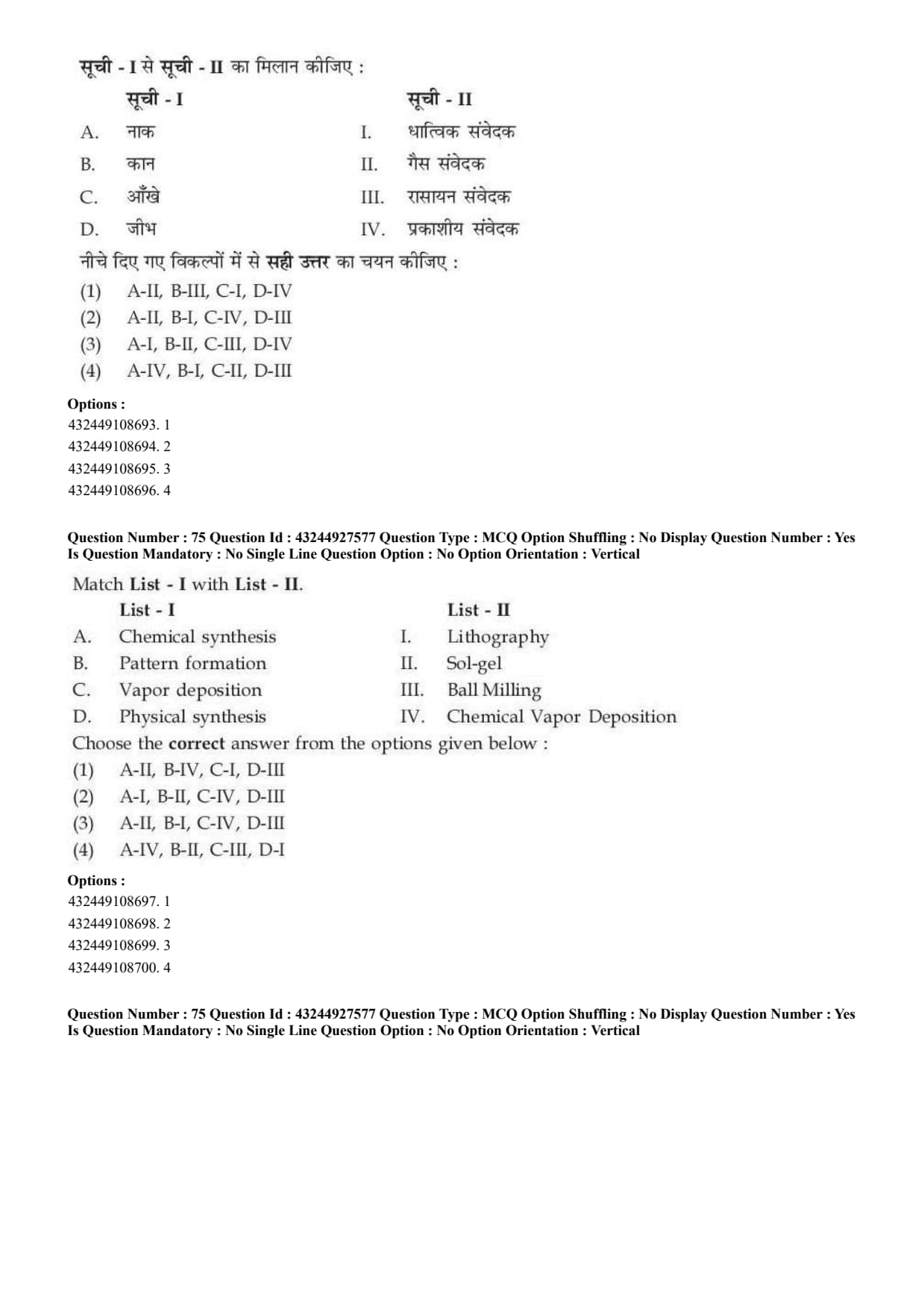
Match List - I with List - II.

Choose the correct answer from the options given below :
View Solution
Step 1: Concept:
This question requires matching various distinct physical thermodynamic systems to their specific formulations of the first law of thermodynamics.
Step 2: Key Formula or Approach:
The universal first law of thermodynamics states that the change in internal energy (\(du\)) equals the heat added to the system (\(dQ\), represented here as \(d\theta\)) plus the mechanical or non-mechanical work done on the system (\(dW\)).
Mathematically: \(du = d\theta + dW\).
Step 3: Explanation:
1. Hydrostatic System (B): For a compressible fluid, the work done on the system is \(-P dv\).
Thus, \(du = d\theta - P dv\). This maps B to I.
2. Stretched Wire (A): When a wire is pulled with a tension force \(F\), work is done on the wire if it elongates by \(dL\).
Thus, the work done is \(+F dL\). The equation is \(du = d\theta + F dL\). This maps A to II.
3. Paramagnetic Rod (C): For magnetic systems, the magnetic work done on the material to change its magnetization \(m\) by an external magnetic field \(H\) is \(\mu_0 H dm\).
Thus, \(du = d\theta + \mu_0 H dm\). This maps C to IV.
4. Electrochemical Cell (D): When an electric charge \(dz\) passes through an electrochemical cell with an electromotive force (EMF) \(\epsilon\), the electrical work done is \(\epsilon dz\).
Thus, \(du = d\theta + \epsilon dz\). This maps D to III.
Step 4: Final Answer:
The precise matching sequence is A-II, B-I, C-IV, D-III.
Quick Tip: Work is universally defined as an intensive property multiplied by the differential of an extensive property. For instance, Force (intensive) \(\times\) length (extensive), or Pressure \(\times\) volume.
Match List - I with List - II.

Choose the correct answer from the options given below :
View Solution
Step 1: Concept:
This matching problem requires classifying standard crystallographic defects into their fundamental structural categories (point, line, or planar defects).
Step 2: Explanation:
1. Vacancies (A): A Schottky defect is a classic thermodynamic point defect in ionic crystals consisting of a pair of empty lattice sites (one cation vacancy and one anion vacancy) to maintain charge neutrality.
Therefore, Vacancies map to Schottky defect (A \(\rightarrow\) III).
2. Interstitial (B): A Frenkel defect occurs when an atom (usually a smaller cation) leaves its standard lattice site, creating a vacancy, and lodges into a nearby interstitial site.
Therefore, Interstitial maps to Frenkel defect (B \(\rightarrow\) I).
3. Grain Boundaries (C): A grain boundary is an interface where two crystalline grains of different orientations meet.
It spans two dimensions and is technically classified as a planar or surface defect.
Therefore, Grain boundaries map to Surface defect (C \(\rightarrow\) II).
4. Edge Dislocation (D): An edge dislocation represents an extra half-plane of atoms inserted partway into the crystal structure.
The defect runs along the edge of this half-plane, making it a 1D linear topological defect.
Therefore, Edge dislocation maps to Line defect (D \(\rightarrow\) IV).
Step 3: Final Answer:
The correct categorization gives the sequence A-III, B-I, C-II, D-IV.
Quick Tip: Defects are generally classified by their dimension: 0D (point defects like Schottky/Frenkel), 1D (line defects like dislocations), 2D (planar defects like grain boundaries), and 3D (volume defects like voids).
Match List - I with List - II.

Choose the correct answer from the options given below :
View Solution
Step 1: Concept:
The question tests the mathematical classification of physical material properties in terms of their tensor rank (order).
Step 2: Explanation:
1. Stress (A): Mechanical stress relates a force vector (rank 1) acting across a surface normal vector (rank 1).
It requires two indices (\(\sigma_{ij}\)) to fully describe it, making it a second-rank tensor. (A \(\rightarrow\) IV).
2. Piezoelectricity (B): The piezoelectric effect linearly relates electric polarization (a rank 1 vector, \(P_i\)) to mechanical stress (a rank 2 tensor, \(\sigma_{jk}\)).
The relating proportionality constant \(d_{ijk}\) requires three indices. Therefore, it is a third-rank tensor. (B \(\rightarrow\) III).
3. Elasticity (C): Hooke's Law for generic anisotropic materials relates the stress tensor (rank 2, \(\sigma_{ij}\)) to the strain tensor (rank 2, \(\varepsilon_{kl}\)).
The elastic stiffness tensor \(C_{ijkl}\) requires four indices to map a 2nd rank tensor to another 2nd rank tensor. Therefore, it is a fourth-rank tensor. (C \(\rightarrow\) II).
4. Density (D): Mass density is a simple scalar magnitude that does not depend on directional coordinates.
Scalars are technically zero-rank tensors. (D \(\rightarrow\) I).
Step 3: Final Answer:
The established tensor ranks match the sequence A-IV, B-III, C-II, D-I.
Quick Tip: A useful rule of thumb: If a physical property connects a tensor of rank \(m\) to a tensor of rank \(n\), the relating property tensor generally has a rank of \(m+n\).
Match List - I with List - II.

Choose the correct answer from the options given below :
View Solution
Step 1: Concept:
The question explores the hierarchical classification of crystallographic symmetries in three-dimensional space, including both point groups and space groups.
Step 2: Explanation:
1. Point group of Bravais lattice (A): A Bravais lattice itself possesses the highest possible symmetry for its lattice system (called holohedry).
There are exactly 7 distinct crystal systems (cubic, tetragonal, orthorhombic, etc.), corresponding to the 7 holohedral point groups of the Bravais lattices. (A \(\rightarrow\) II).
2. Point group of crystal structure (B): When an arbitrary atomic basis is added to a lattice, the point symmetry can be reduced.
Across all crystal systems, there are exactly 32 allowable crystallographic point groups that satisfy translational symmetry. (B \(\rightarrow\) I).
3. Space group of Bravais lattice (C): A pure Bravais lattice represents the basic translational periodicities in 3D space.
There are exactly 14 distinct Bravais lattices distributed among the 7 crystal systems. (C \(\rightarrow\) III).
4. Space group of crystal structure (D): The full symmetry description of a crystal structure involves combining the 32 point groups with translation operations (glide planes and screw axes).
This combination yields a total of exactly 230 distinct 3D space groups. (D \(\rightarrow\) IV).
Step 3: Final Answer:
The numerical classifications follow the sequence A-II, B-I, C-III, D-IV.
Quick Tip: A great memory trick for 3D crystallography numbers: 7 systems, 14 lattices, 32 point groups, and 230 space groups. They strictly dictate all potential crystal symmetries.
Match List - I with List - II.

Choose the correct answer from the options given below :
View Solution
Step 1: Concept:
This question asks to match fundamental variables of the Kinetic Theory of Gases with their corresponding mathematical expressions.
Step 2: Explanation:
1. Root Mean Square Speed (\(v_{rms}\)) (A):
By kinetic theory, \(v_{rms}\) is mathematically defined as \(\sqrt{\frac{3k_B T}{m}}\), where \(k_B\) is the Boltzmann constant and \(m\) is the mass of a single molecule.
This perfectly matches expression II. (A \(\rightarrow\) II).
2. Average Kinetic Energy (\(E\)) (B):
The equipartition theorem states that a monatomic ideal gas has an average translational kinetic energy of \(\frac{3}{2} k_B T\) per molecule.
This matches expression III. (B \(\rightarrow\) III).
3. Pressure (\(P\)) (C):
From the kinetic gas derivation, pressure is caused by collisions with the walls, yielding \(P = \frac{1}{3} \frac{N}{V} m \overline{v^2}\).
Defining number density \(n = N/V\), the pressure is \(P = \frac{1}{3} m n \overline{v^2}\).
This matches expression IV. (C \(\rightarrow\) IV).
4. Mean Square Velocity (\(\overline{v^2}\)) (D):
Squaring the root mean square velocity gives \(\overline{v^2} = v_{rms}^2 = \frac{3k_B T}{m}\).
Alternatively, expressed in terms of the universal gas constant \(R\) and molar mass \(M\), it is \(\frac{3RT}{M}\). The parameter \(m\) in option I loosely represents molar mass in this context.
This matches expression I. (D \(\rightarrow\) I).
Step 3: Final Answer:
The correct matched sequence is A-II, B-III, C-IV, D-I.
Quick Tip: To avoid confusion between molar and molecular formulas, remember: \(R = k_B N_A\), and Molar Mass \(M = m N_A\). Therefore, \(\frac{k_B}{m}\) is entirely equivalent to \(\frac{R}{M}\).
Match List - I with List - II.

Choose the correct answer from the options given below :
View Solution
Step 1: Concept:
This question requires identifying the dimensionality classification of various nanoscale structures based on how many macroscopic dimensions they possess.
Step 2: Explanation:
Nanomaterials are classified by the number of dimensions that are not confined to the nanoscale (i.e., dimensions larger than 100 nm).
1. 0D (Zero-dimensional) (A): All three spatial dimensions are restricted to the nanoscale.
Nanoparticles are essentially tiny dots confined in \(x\), \(y\), and \(z\) directions. (A \(\rightarrow\) IV).
2. 1D (One-dimensional) (B): Two dimensions are restricted to the nanoscale, leaving one dimension extended (macroscopic).
Nano-rods, nanowires, and nanotubes fit this description as they are long in one direction. (B \(\rightarrow\) III).
3. 2D (Two-dimensional) (C): Only one dimension is restricted to the nanoscale, meaning the material is a thin film extended in two dimensions.
A nano-sheet (like graphene) perfectly represents a 2D structure. (C \(\rightarrow\) I).
4. 3D (Three-dimensional) (D): No dimensions are restricted to the nanoscale; the material is bulk but contains nanostructural features internally.
A porous nanostructured network or bulk nanomaterial represents a 3D structure. (D \(\rightarrow\) II).
Step 3: Final Answer:
The matching dimensionalities result in the sequence A-IV, B-III, C-I, D-II.
Quick Tip: The dimension number (0D, 1D, 2D, 3D) refers to the number of dimensions that are "large" or unconfined. Thus, a nanoparticle is 0D (no large dimensions), and a wire is 1D (one large length).
Match List - I with List - II.

Choose the correct answer from the options given below :
View Solution
Step 1: Concept:
This question links fundamental physical observables of quantum mechanical particles (specifically electrons in a lattice) to their mathematical formulas in reciprocal \(k\)-space.
Step 2: Explanation:
1. Energy (A): For a free or effective particle, the kinetic energy \(E\) is given by \(\frac{p^2}{2m^*}\).
Substituting the quantum momentum relation \(p = \hbar k\), the energy becomes \(E = \frac{\hbar^2 k^2}{2m^*}\). (A \(\rightarrow\) III).
2. Momentum (B): The de Broglie relation connects crystal momentum \(p\) directly to the wave vector \(k\) via the reduced Planck constant.
The equation is \(p = \hbar k\) (written as \(\hbar K\) in the options). (B \(\rightarrow\) IV).
3. Effective Mass (C): In a solid, an electron behaves as if it has an effective mass \(m^*\) influenced by the periodic potential.
It is defined by the curvature of the energy band: \(m^* = \hbar^2 \left( \frac{d^2E}{dk^2} \right)^{-1}\). (C \(\rightarrow\) II).
4. Group Velocity (D): The group velocity \(v_g\) represents the velocity at which the overall envelope of the wave packet propagates, which is the particle's macroscopic velocity.
It is mathematically defined as the gradient of the dispersion relation: \(v_g = \frac{1}{\hbar} \frac{dE}{dk}\). (D \(\rightarrow\) I).
Step 3: Final Answer:
The matching derived from solid state physics principles is A-III, B-IV, C-II, D-I.
Quick Tip: A sharp band curvature (large \(d^2E/dk^2\)) implies a small effective mass, meaning the electron is highly mobile. Conversely, a flat band implies a very heavy, sluggish electron.
Match List - I with List - II.

Choose the correct answer from the options given below :
View Solution
Step 1: Concept:
This question asks to match the seven basic crystal systems with their corresponding defining geometric lattice parameters (edge lengths \(a, b, c\) and interaxial angles \(\alpha, \beta, \gamma\)).
Step 2: Explanation:
1. Cubic Lattice (A): The most symmetric crystal system, characterized by all three edge lengths being equal, and all three angles being perfectly orthogonal.
Thus, \(a = b = c\) and \(\alpha = \beta = \gamma = 90^\circ\). (A \(\rightarrow\) IV).
2. Tetragonal Lattice (B): Think of a cubic unit cell stretched along one axis. The base remains square, but the height differs.
Thus, \(a = b \neq c\) and all angles remain orthogonal (\(\alpha = \beta = \gamma = 90^\circ\)). (B \(\rightarrow\) I).
3. Hexagonal Lattice (C): The base is a regular hexagon (composed of equilateral triangles), and it is extruded vertically.
Thus, the basal edges are equal (\(a = b \neq c\)), two vertical faces meet the base orthogonally (\(\alpha = \beta = 90^\circ\)), and the basal angle is \(120^\circ\) (\(\gamma = 120^\circ\)). (C \(\rightarrow\) II).
4. Triclinic Lattice (D): The least symmetric crystal system, where nothing is constrained to be equal or orthogonal.
Thus, \(a \neq b \neq c\) and \(\alpha \neq \beta \neq \gamma \neq 90^\circ\). (D \(\rightarrow\) III).
Step 3: Final Answer:
The structural mapping matches the sequence A-IV, B-I, C-II, D-III.
Quick Tip: To remember symmetry constraints, remember that "Cubic" is the most restrictive (everything equal/orthogonal) while "Triclinic" is the most relaxed (nothing equal/orthogonal).
Match List - I with List - II.

Choose the correct answer from the options given below :
View Solution
Step 1: Concept:
This question links various fundamental physical quantum models to their hallmark wave function solutions.
Step 2: Explanation:
1. Sommerfeld Model (A): The Sommerfeld model describes conduction electrons as a quantum free electron gas confined in a macroscopic volume \(V\).
The wave function is a simple normalized plane wave: \(\psi(r) = \frac{1}{\sqrt{V}} e^{ik\cdot r}\). (A \(\rightarrow\) IV).
2. Bloch Theorem (B): Bloch's theorem describes wave functions of particles in a periodic potential (like a crystal lattice).
It states that the wave function is a plane wave modulated by a periodic function \(u(r)\): \(\psi(r) = e^{ik\cdot r} u_{nk}(r)\). (B \(\rightarrow\) II).
3. Hydrogen Atom (C): The ground state wave function of the simplest atom (Hydrogen) decays exponentially with radial distance from the nucleus.
The normalized solution involves the Bohr radius \(a\): \(\psi(r) = \frac{1}{\sqrt{\pi a^3}} e^{-r/a}\). (C \(\rightarrow\) I).
4. One Dimensional Potential Box (D): A particle confined to a 1D box of length \(L\) possesses standing wave solutions due to boundary conditions.
The normalized wave function is \(\psi_n(x) = \sqrt{\frac{2}{L}} \sin\left(\frac{n\pi x}{L}\right)\). (D \(\rightarrow\) III).
Step 3: Final Answer:
The correct quantum mechanical mapping matches A-IV, B-II, C-I, D-III.
Quick Tip: Recognizing the distinctive parts of wave functions (e.g., the periodic \(u_{nk}(r)\) for Bloch, or the exponential decay \(e^{-r/a}\) for Hydrogen) makes matching very quick.
Match List - I with List - II.

Choose the correct answer from the options given below :
View Solution
Step 1: Concept:
The question asks to pair the fundamental primary and secondary chemical bonding mechanisms with their defining physical descriptions.
Step 2: Explanation:
1. Ionic Bonds (A): Formed by the complete transfer of electrons from one atom to another, resulting in oppositely charged ions.
The bond is held together by strong Coulombic electrostatic forces (electric attraction). (A \(\rightarrow\) IV).
2. Covalent Bonds (B): Formed when two nonmetal atoms with similar electronegativity mutually share valence electrons to achieve stable electron configurations.
This mechanism strictly involves shared electrons. (B \(\rightarrow\) II).
3. Molecular Bonds (C): Atoms or stable molecules bond to each other through weak secondary interactions (dipole-dipole, dispersion forces).
These weak interactions are collectively known as Van der Waals forces. (C \(\rightarrow\) I).
4. Metallic Bonds (D): In a metal, valence electrons detach from individual host atoms and flow freely throughout the entire solid structure.
This creates a lattice of positive ions swimming in a non-localized "electron gas" or "sea of electrons". (D \(\rightarrow\) III).
Step 3: Final Answer:
The exact physical mechanisms match the sequence A-IV, B-II, C-I, D-III.
Quick Tip: Remember the simplified keywords: Ionic = transfer/attraction, Covalent = sharing, Metallic = electron sea/gas, Molecular = Van der Waals.
Match List - I with List - II.

Choose the correct answer from the options given below :
View Solution
Step 1: Concept:
This question draws an analogy between natural human sensory organs and technical engineering sensors based on the type of physical signal they process.
Step 2: Explanation:
1. Nose (A): The human olfactory system functions by detecting airborne volatile molecular compounds.
In engineering terms, this is fundamentally a gas sensor (often termed an electronic nose or e-nose). (A \(\rightarrow\) II).
2. Ears (B): The auditory system detects variations in air pressure, which constitute sound waves.
Therefore, it serves identically to a microphone or acoustic sensor. (B \(\rightarrow\) I).
3. Eyes (C): The visual system utilizes photoreceptor cells to capture photons and interpret light waves.
This directly corresponds to a camera or optical sensor. (C \(\rightarrow\) IV).
4. Tongue (D): The gustatory system evaluates dissolved substances in liquids to determine taste.
Since it detects liquid-phase ions and molecular composition, it functions as a chemical sensor. (D \(\rightarrow\) III).
Step 3: Final Answer:
The bio-mimetic mapping is A-II, B-I, C-IV, D-III.
Quick Tip: Electronic noses (gas sensors) and electronic tongues (liquid chemical sensors) are expanding fields in biomimetic materials science.
Match List - I with List - II.

Choose the correct answer from the options given below :
View Solution
Step 1: Concept:
This matching question tests knowledge of standard thin film, nanomaterial, and microfabrication processing techniques.
Step 2: Explanation:
1. Chemical synthesis (A): Sol-gel is a classic wet-chemical synthesis method used extensively to create solid materials from small molecules.
The process involves conversion of monomers into a colloidal solution (sol) that acts as the precursor for an integrated network (or gel). (A \(\rightarrow\) II).
2. Pattern formation (B): Lithography (e.g., photolithography, electron-beam lithography) is the premier semiconductor industry method for transferring complex geometric shapes or patterns onto the surface of a substrate.
Hence, it is a pattern formation technique. (B \(\rightarrow\) I).
3. Vapor deposition (C): Chemical Vapor Deposition (CVD) is an advanced vacuum deposition method used to produce high-quality, high-performance solid materials.
It explicitly involves chemical reactions in the vapor phase to deposit solid films. (C \(\rightarrow\) IV).
4. Physical synthesis (D): Ball milling is a top-down mechanical (physical) approach used to grind bulk materials into extremely fine powders or nanoparticles without altering their inherent chemistry.
Therefore, it is classified as physical synthesis. (D \(\rightarrow\) III).
Step 3: Final Answer:
The correct methodological mapping is A-II, B-I, C-IV, D-III.
Quick Tip: Synthesis methods are broadly divided into "top-down" (like physical ball milling or lithography) and "bottom-up" (like chemical sol-gel and CVD).



Comments