




The National Testing Agency (NTA) conducted the CUET PG 2026 Geophysics (SCQP15) examination on March 17, 2026, during Shift 1 from 09:00 AM to 10:30 AM.
Students who appeared for the exam reported that the overall difficulty level of the paper was moderate. CUET PG 2026 Geophysics Question Paper with Solutions PDF is available here for download. The marking scheme is +4 for correct answers and -1 for wrong answers, totaling 300 marks.
CUET PG 2026 Geophysics Question Paper with Solutions PDF
| CUET PG 2026 Geophysics Question Paper | Download PDF | Check Solutions |
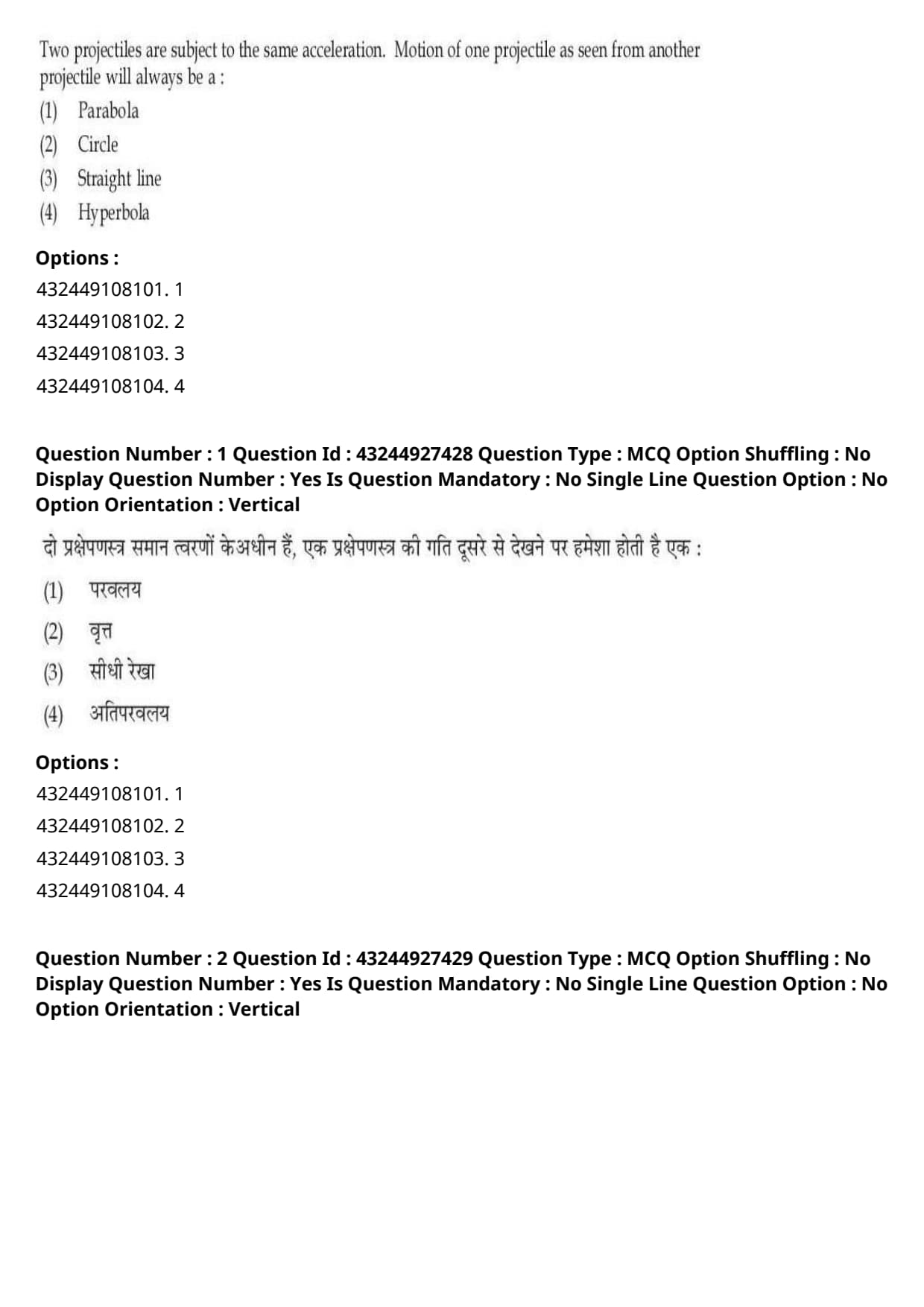
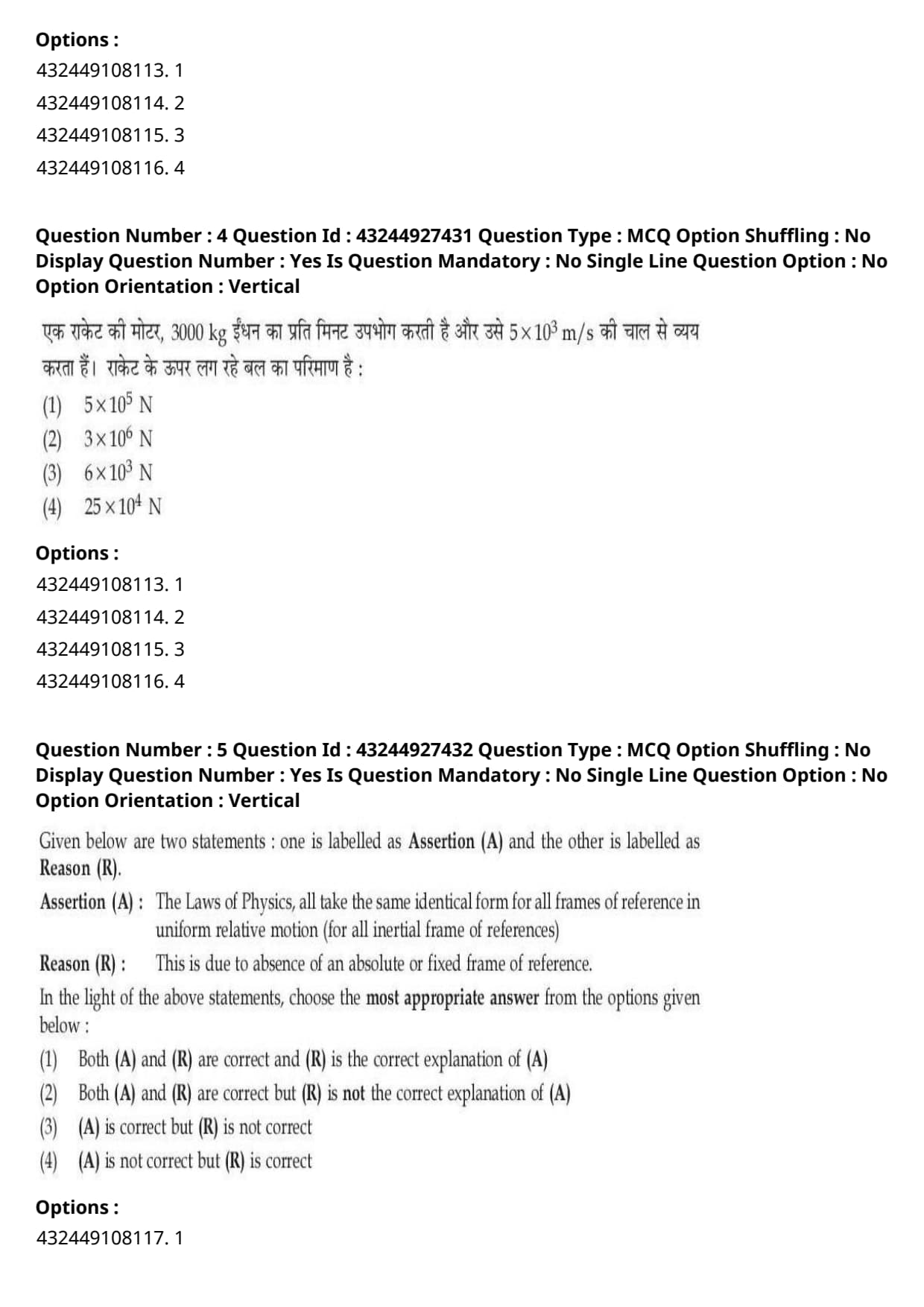

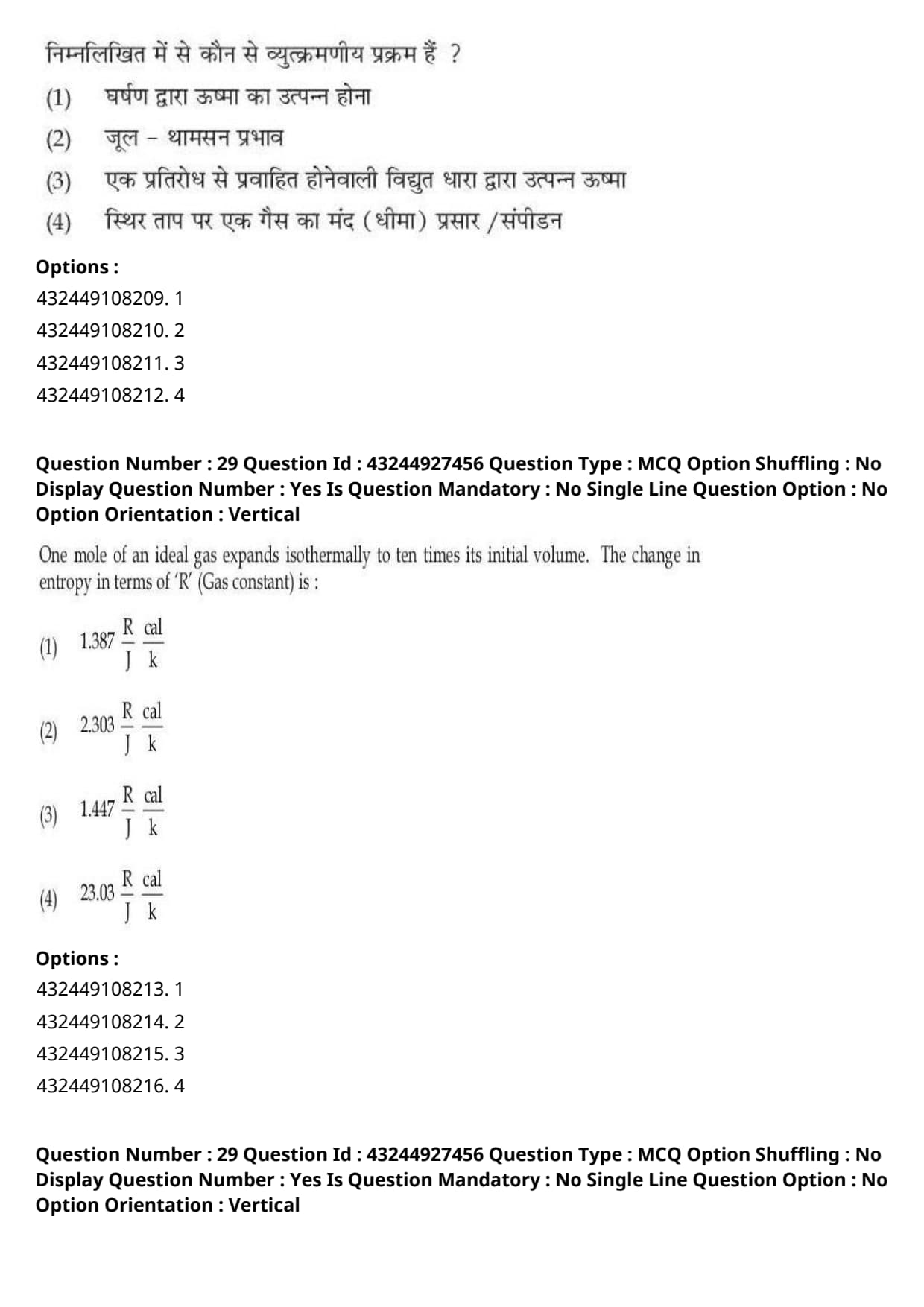
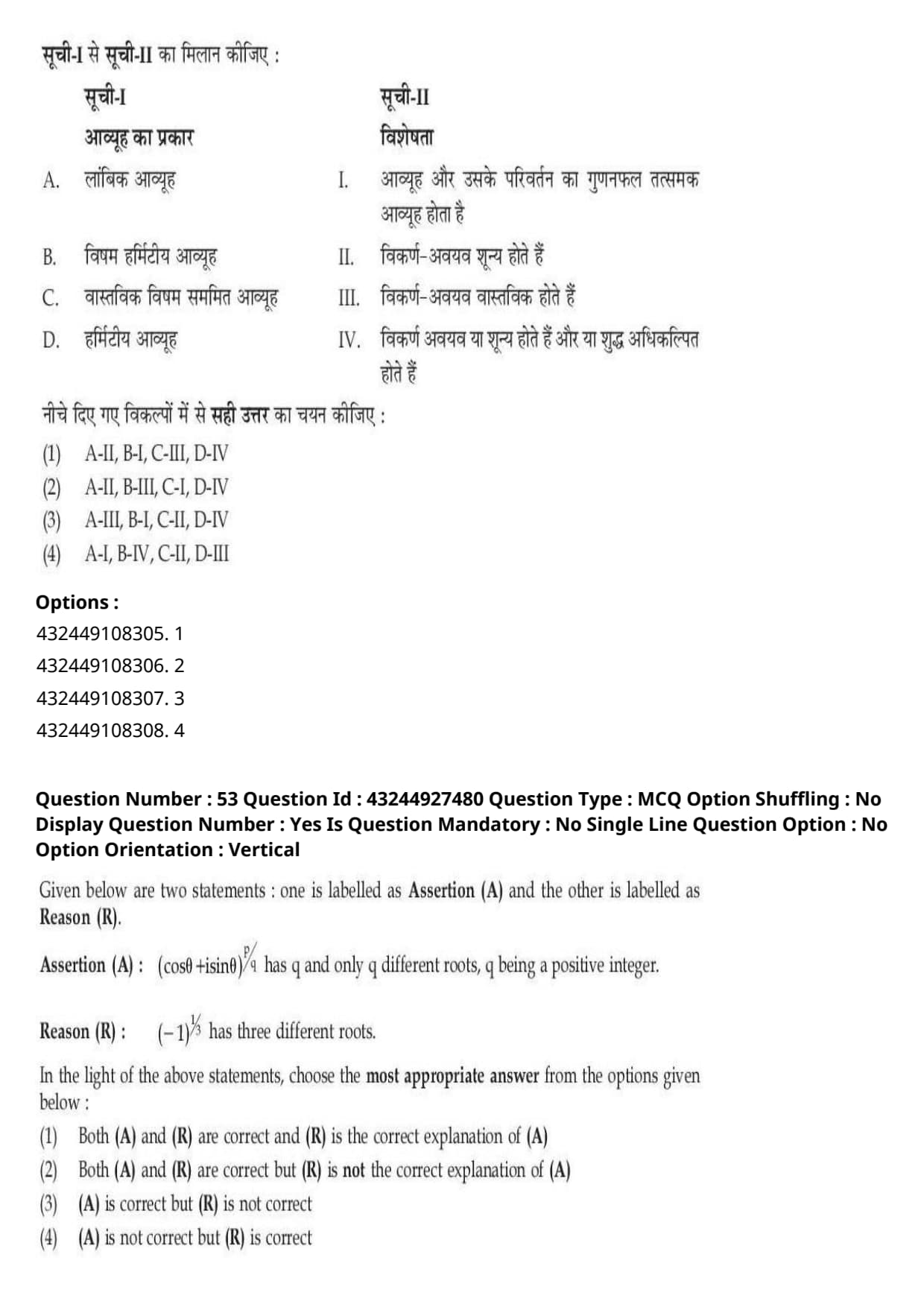
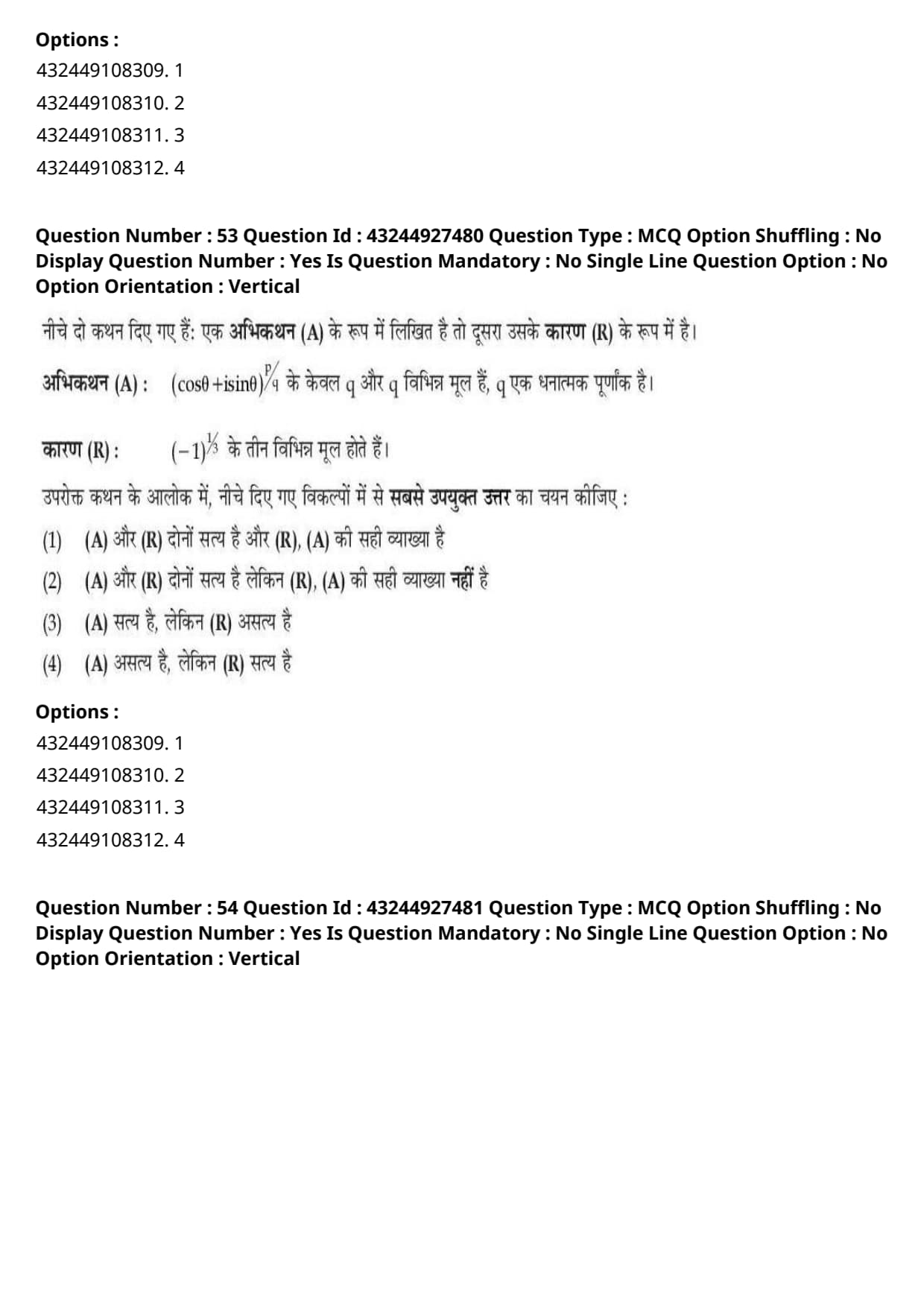
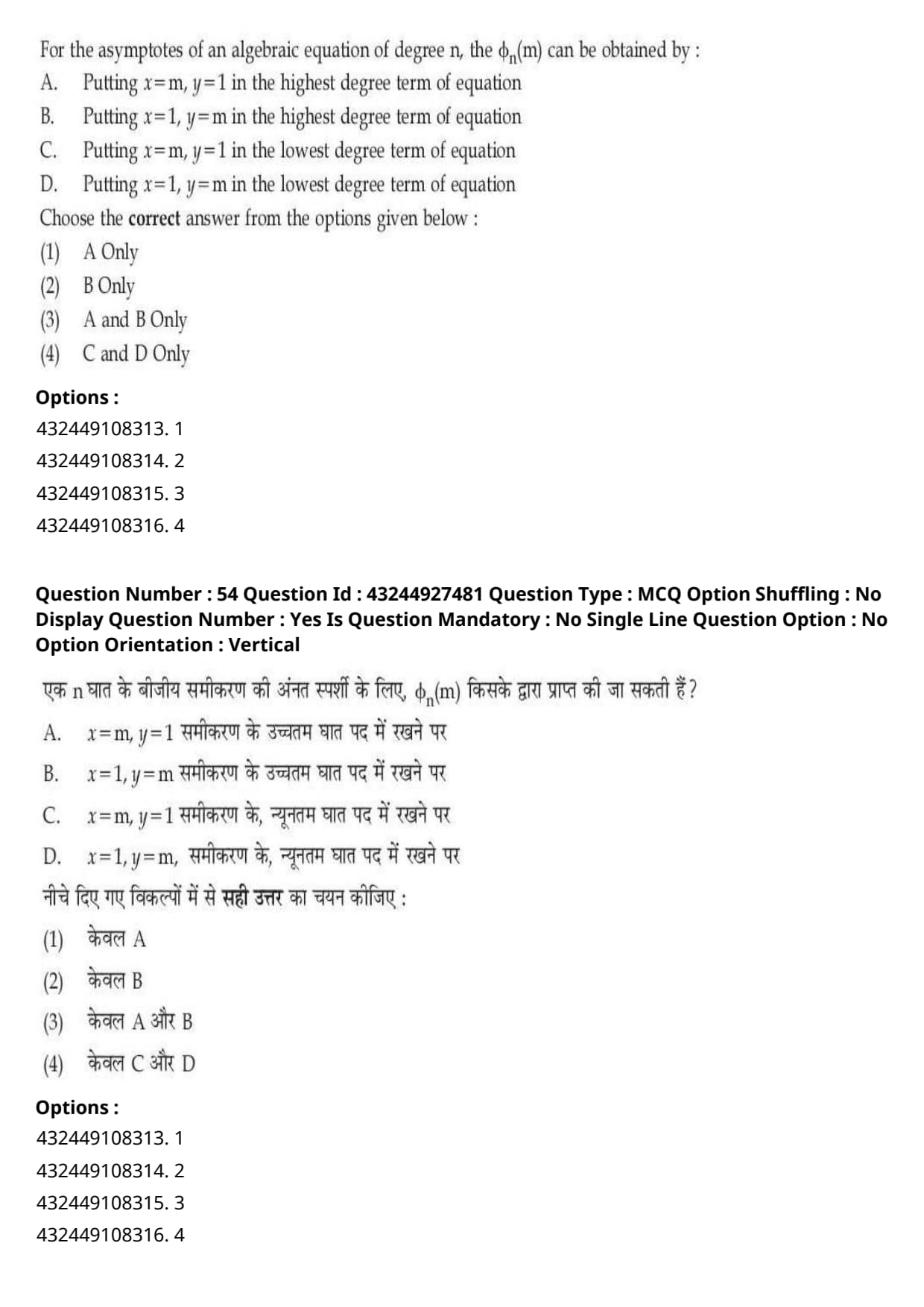
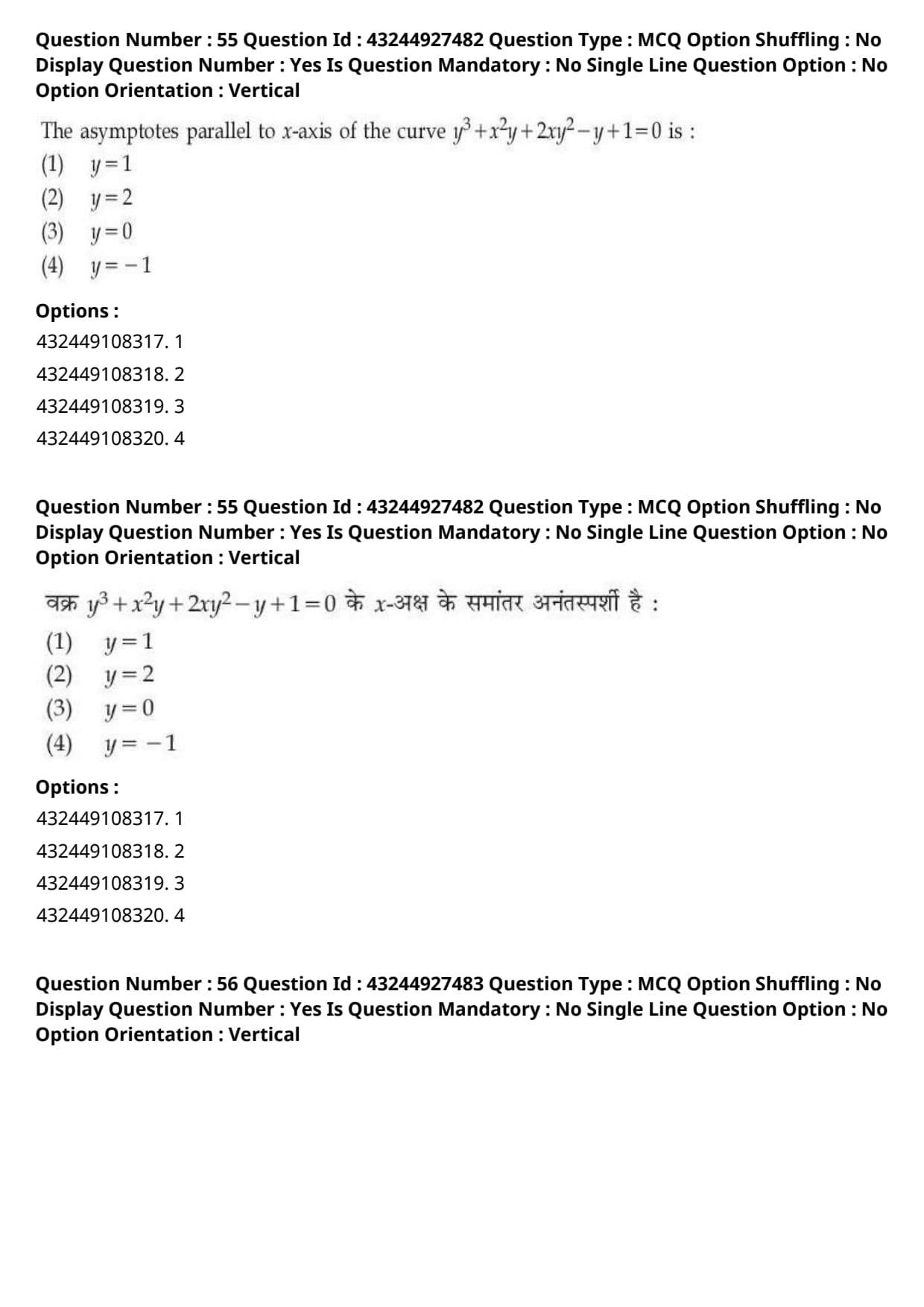
Two projectiles are subject to the same acceleration. Motion of one projectile as seen from another projectile will always be a:
View Solution
Concept:
When two bodies move under the same acceleration, their relative acceleration becomes zero.
Step 1: Let the accelerations of two projectiles be same.
Suppose two projectiles have accelerations: \[ \vec{a}_1=\vec{g} \]
and \[ \vec{a}_2=\vec{g} \]
Step 2: Find relative acceleration.
The acceleration of projectile 1 with respect to projectile 2 is: \[ \vec{a}_{12}=\vec{a}_1-\vec{a}_2 \]
\[ \vec{a}_{12}=\vec{g}-\vec{g} \]
\[ \vec{a}_{12}=0 \]
Step 3: Interpret the motion.
If relative acceleration is zero, then the relative velocity remains constant.
So, the relative motion is uniform motion in a straight line.
\[ \therefore Motion of one projectile with respect to another is a straight line. \]
\[ \therefore Correct Answer is (C) \] Quick Tip: If two bodies have the same acceleration, their relative acceleration is zero and their relative motion is along a straight line.
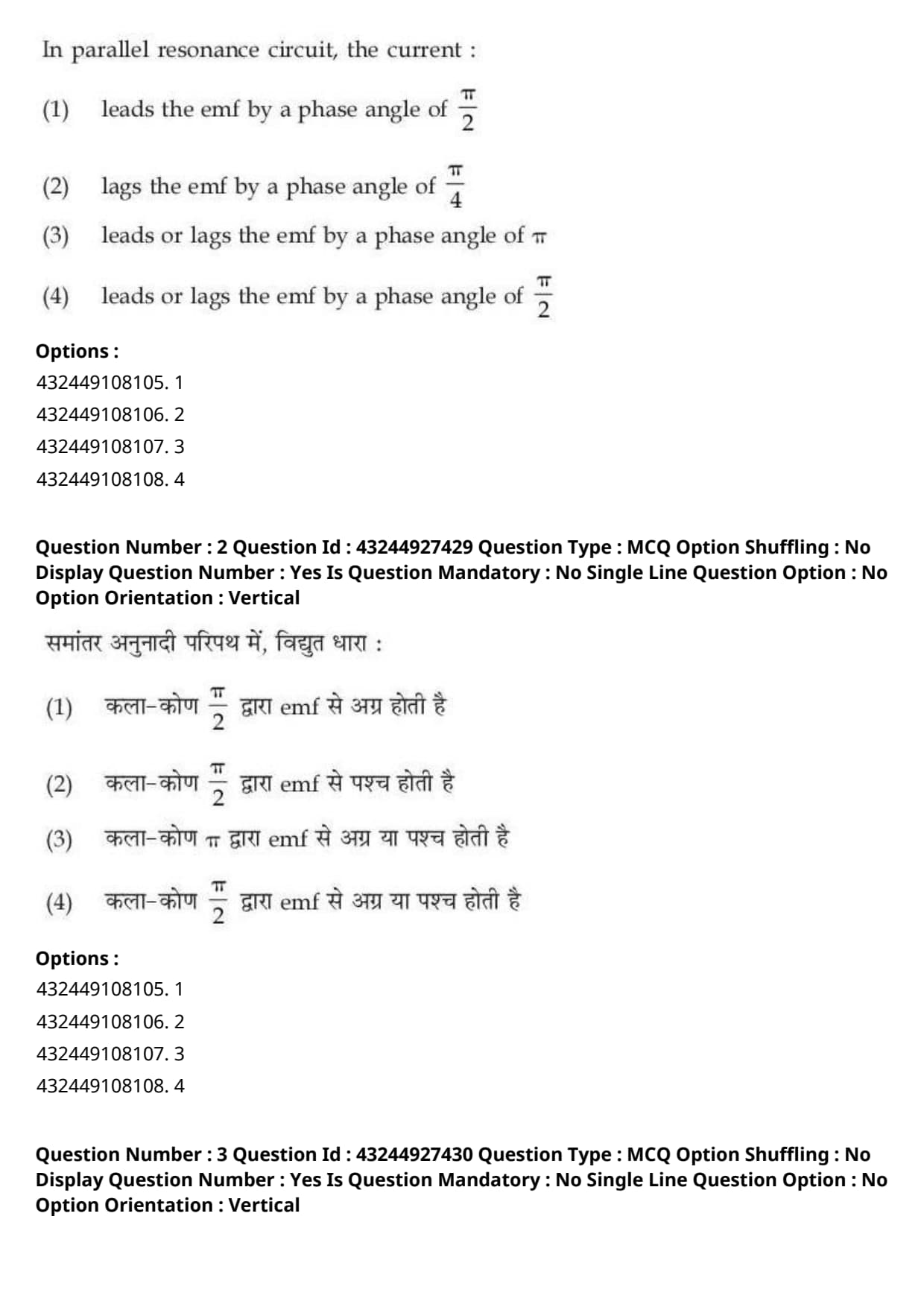
In parallel resonance circuit, the current:
View Solution
Concept:
In a parallel resonant circuit, the inductor and capacitor branch currents are reactive in nature.
Step 1: Current in capacitor branch.
In a capacitor, current leads the applied emf by: \[ \frac{\pi}{2} \]
Step 2: Current in inductor branch.
In an inductor, current lags the applied emf by: \[ \frac{\pi}{2} \]
Step 3: Apply resonance condition.
At parallel resonance, inductive and capacitive reactive currents are equal and opposite in phase.
Thus, the branch currents may lead or lag the emf by: \[ \frac{\pi}{2} \]
\[ \therefore Correct Answer is (D) \] Quick Tip: In reactive branches, capacitive current leads by \(90^\circ\) and inductive current lags by \(90^\circ\).
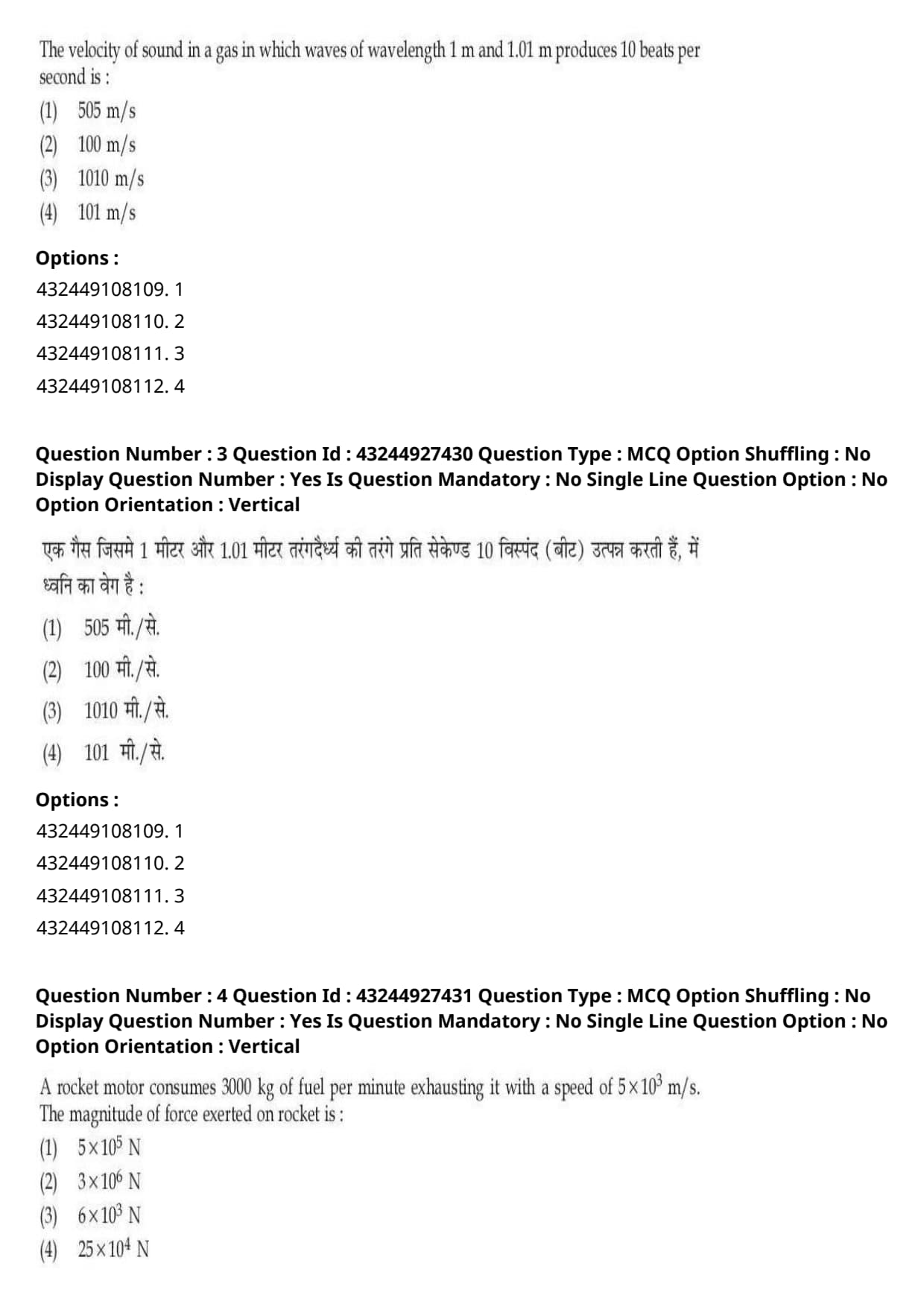
The velocity of sound in a gas in which waves of wavelength \(1\ m\) and \(1.01\ m\) produces \(10\) beats per second is:
View Solution
Concept:
Beat frequency is equal to the difference between two frequencies.
\[ n=|f_1-f_2| \]
Also, \[ f=\frac{v}{\lambda} \]
Step 1: Write the given wavelengths. \[ \lambda_1=1\ m \] \[ \lambda_2=1.01\ m \]
Beat frequency: \[ n=10\ s^{-1} \]
Step 2: Write frequencies. \[ f_1=\frac{v}{1} \] \[ f_2=\frac{v}{1.01} \]
Step 3: Apply beat frequency formula. \[ 10=\frac{v}{1}-\frac{v}{1.01} \]
\[ 10=v\left(1-\frac{1}{1.01}\right) \]
\[ 10=v\left(\frac{1.01-1}{1.01}\right) \]
\[ 10=v\left(\frac{0.01}{1.01}\right) \]
\[ v=10\times \frac{1.01}{0.01} \]
\[ v=1010\ m/s \]
\[ \therefore Correct Answer is (C) \] Quick Tip: For beats, use \(n=|f_1-f_2|\) and replace frequency by \(f=\frac{v}{\lambda}\).
A rocket motor consumes \(3000\ kg\) of fuel per minute exhausting it with a speed of \(5\times10^3\ m/s\). The magnitude of force exerted on rocket is:
View Solution
Concept:
The thrust force of a rocket is given by: \[ F=\frac{dm}{dt}v \]
where, \[ \frac{dm}{dt}=mass ejected per second \]
and \[ v=exhaust velocity \]
Step 1: Convert mass consumption per minute into per second. \[ \frac{dm}{dt}=\frac{3000}{60} \]
\[ \frac{dm}{dt}=50\ kg/s \]
Step 2: Write exhaust velocity. \[ v=5\times10^3\ m/s \]
Step 3: Calculate thrust force. \[ F=50\times 5\times10^3 \]
\[ F=250\times10^3 \]
\[ F=2.5\times10^5\ N \]
\[ F=25\times10^4\ N \]
\[ \therefore Correct Answer is (D) \] Quick Tip: Rocket thrust is equal to mass ejection rate multiplied by exhaust velocity.
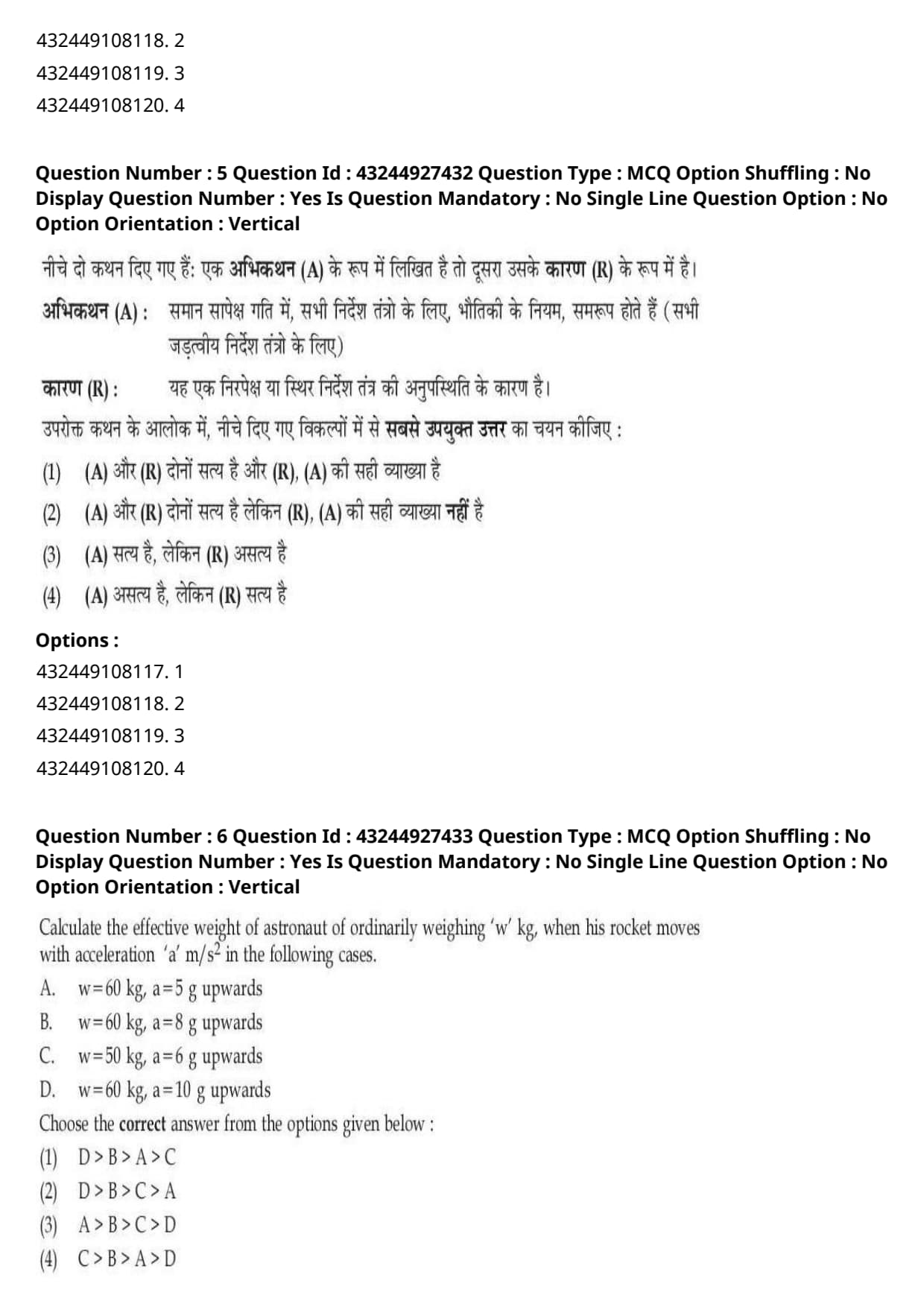
Given below are two statements:
Assertion (A): The laws of Physics all take the same identical form for all frames of reference in uniform relative motion, for all inertial frame of references.
Reason (R): This is due to absence of an absolute or fixed frame of reference.
View Solution
Concept:
The principle of relativity states that the laws of physics are the same in all inertial frames of reference.
Step 1: Check Assertion.
The assertion says that laws of physics have the same form in all inertial frames moving uniformly relative to one another.
This is the principle of relativity.
\[ A is correct \]
Step 2: Check Reason.
There is no absolute fixed frame of reference. Motion is always described relative to a chosen frame.
\[ R is correct \]
Step 3: Check explanation.
Because no inertial frame is absolutely preferred, laws of physics must have the same form in all inertial frames.
\[ R correctly explains A \]
\[ \therefore Correct Answer is (A) \] Quick Tip: In relativity, no inertial frame is absolute; all inertial frames are equivalent for physical laws.
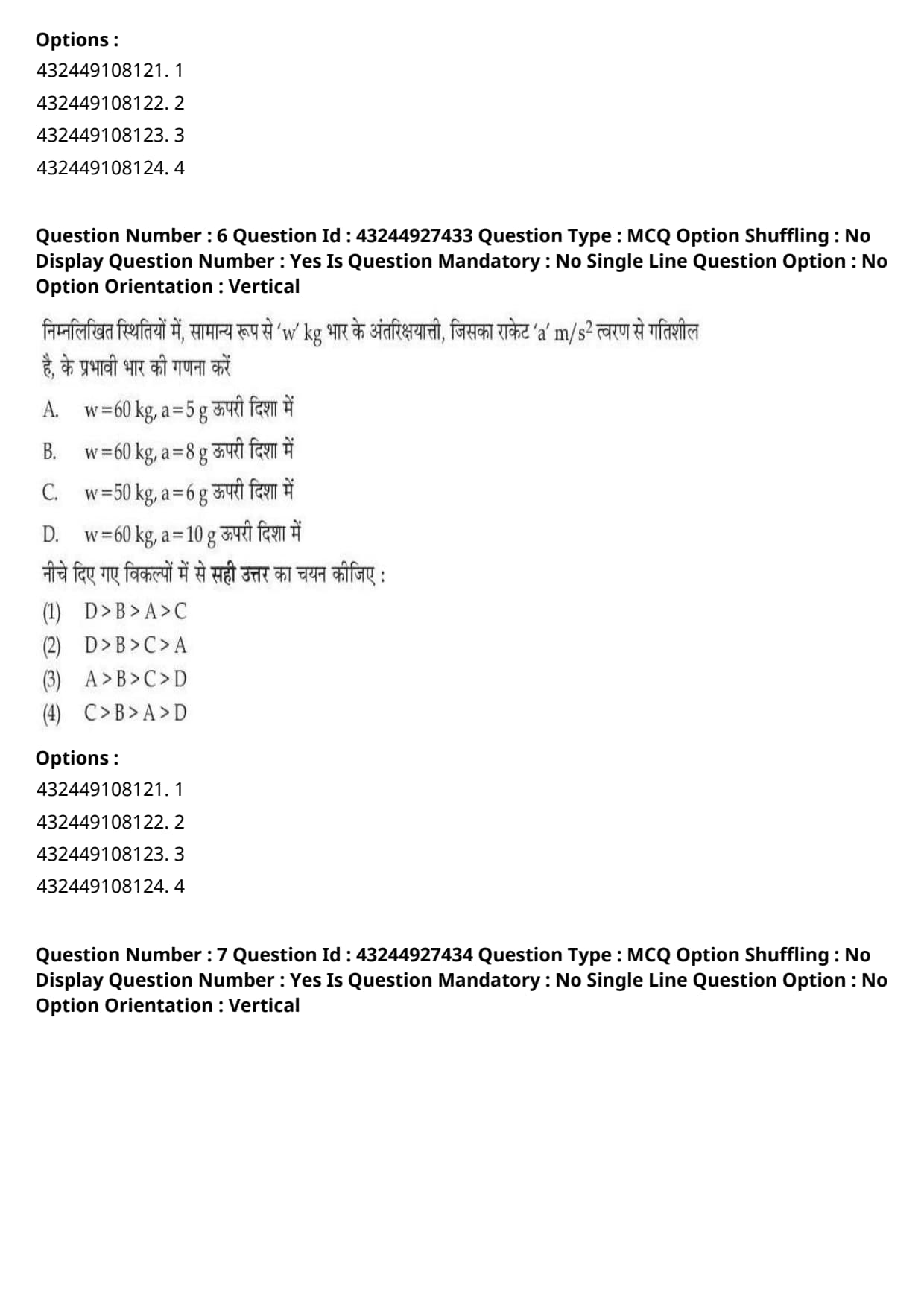
Calculate the effective weight of astronaut of ordinarily weighing \(w\ kg\), when his rocket moves with acceleration \(a'\ m/s^2\) in the following cases:
A. \(w=60\ kg, a=5g\) upwards
B. \(w=60\ kg, a=8g\) upwards
C. \(w=50\ kg, a=6g\) upwards
D. \(w=60\ kg, a=10g\) upwards.
Choose the correct answer from the options given below:
View Solution
Concept:
When a rocket moves upward with acceleration \(a\), effective weight becomes: \[ W'=m(g+a) \]
Step 1: Calculate relative effective values.
For upward acceleration \(a=ng\): \[ W'=m(g+ng) \]
\[ W'=mg(1+n) \]
Since \(g\) is common, compare: \[ m(1+n) \]
Step 2: Case A. \[ A=60(1+5)=60\times6=360 \]
Step 3: Case B. \[ B=60(1+8)=60\times9=540 \]
Step 4: Case C. \[ C=50(1+6)=50\times7=350 \]
Step 5: Case D. \[ D=60(1+10)=60\times11=660 \]
Step 6: Arrange in decreasing order. \[ D>B>A>C \]
\[ \therefore Correct Answer is (A) \] Quick Tip: For upward accelerated motion, apparent weight increases and is given by \(W'=m(g+a)\).
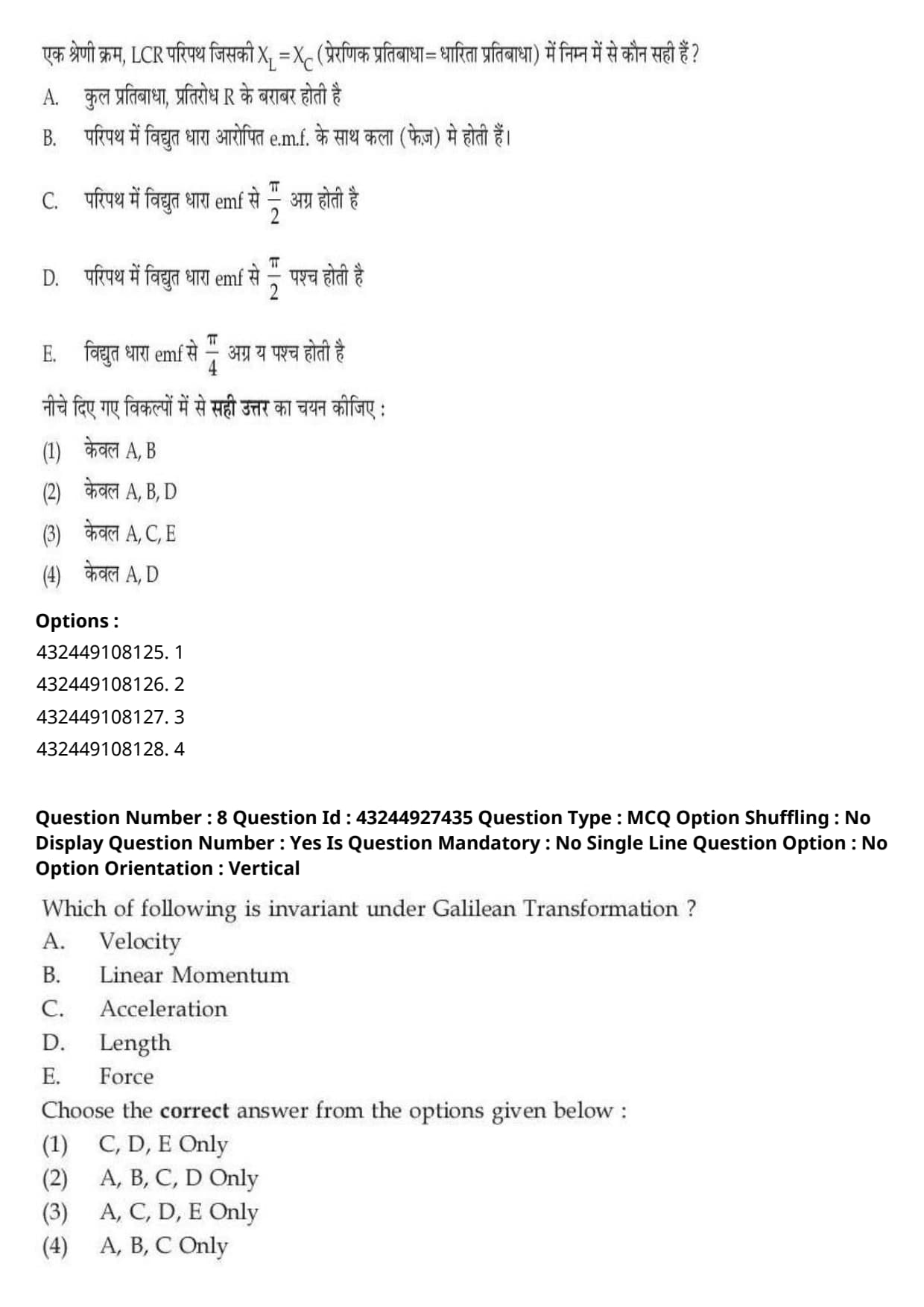
Which of the following is true in a series LCR circuit, at \(X_L=X_C\)?
A. Total impedance is equal to resistance \(R\)
B. Current in circuit is in phase with applied emf
C. Current in circuit leads the emf by \(\dfrac{\pi}{2}\)
D. Current in circuit lags the emf by \(\dfrac{\pi}{2}\)
E. Current may lead or lag the emf by \(\dfrac{\pi}{4}\).
Choose the correct answer from the options given below:
View Solution
Concept:
In a series LCR circuit, resonance occurs when: \[ X_L=X_C \]
Step 1: Net reactance at resonance. \[ X=X_L-X_C \]
At resonance: \[ X_L=X_C \]
\[ X=0 \]
Step 2: Total impedance. \[ Z=\sqrt{R^2+(X_L-X_C)^2} \]
\[ Z=\sqrt{R^2+0^2} \]
\[ Z=R \]
So, \[ A is correct \]
Step 3: Phase relation.
At resonance, the circuit behaves like a purely resistive circuit.
Therefore, current and applied emf are in the same phase.
\[ B is correct \]
Step 4: Check remaining statements.
Since current is in phase with emf, it neither leads nor lags by \(\frac{\pi}{2}\) or \(\frac{\pi}{4}\).
\[ C,D,E are incorrect \]
Thus, correct statements are: \[ A,B \]
\[ \therefore Correct Answer is (A) \] Quick Tip: At resonance in a series LCR circuit, \(X_L=X_C\), impedance is minimum and equal to \(R\), and current is in phase with voltage.
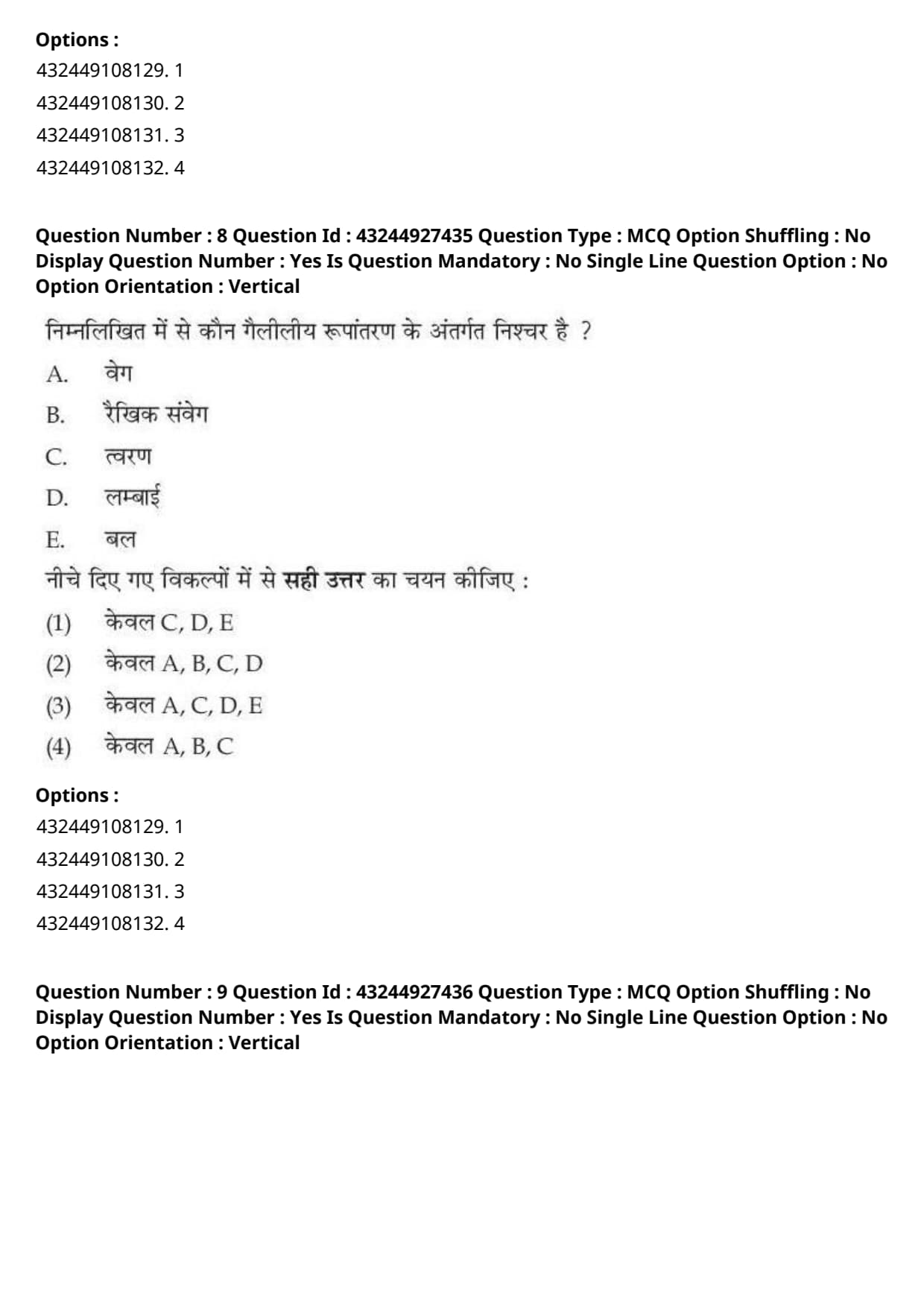
Which of the following is invariant under Galilean Transformation?
A. Velocity
B. Linear Momentum
C. Acceleration
D. Length
E. Force.
Choose the correct answer from the options given below:
View Solution
Concept:
Galilean transformation is used in classical mechanics to relate observations in two inertial frames moving with constant relative velocity.
Step 1: Check velocity.
Velocity changes from one inertial frame to another.
\[ v'=v-u \]
So, \[ A is not invariant \]
Step 2: Check linear momentum.
Since velocity changes, linear momentum also changes.
\[ p=mv \]
So, \[ B is not invariant \]
Step 3: Check acceleration.
Acceleration remains unchanged under Galilean transformation.
\[ a'=a \]
So, \[ C is invariant \]
Step 4: Check length.
In classical mechanics, length is absolute.
\[ D is invariant \]
Step 5: Check force.
Since: \[ F=ma \]
and acceleration is invariant, force is also invariant.
\[ E is invariant \]
Therefore: \[ C,D,E \]
\[ \therefore Correct Answer is (A) \] Quick Tip: Under Galilean transformation, velocity changes but acceleration, length and force remain invariant.
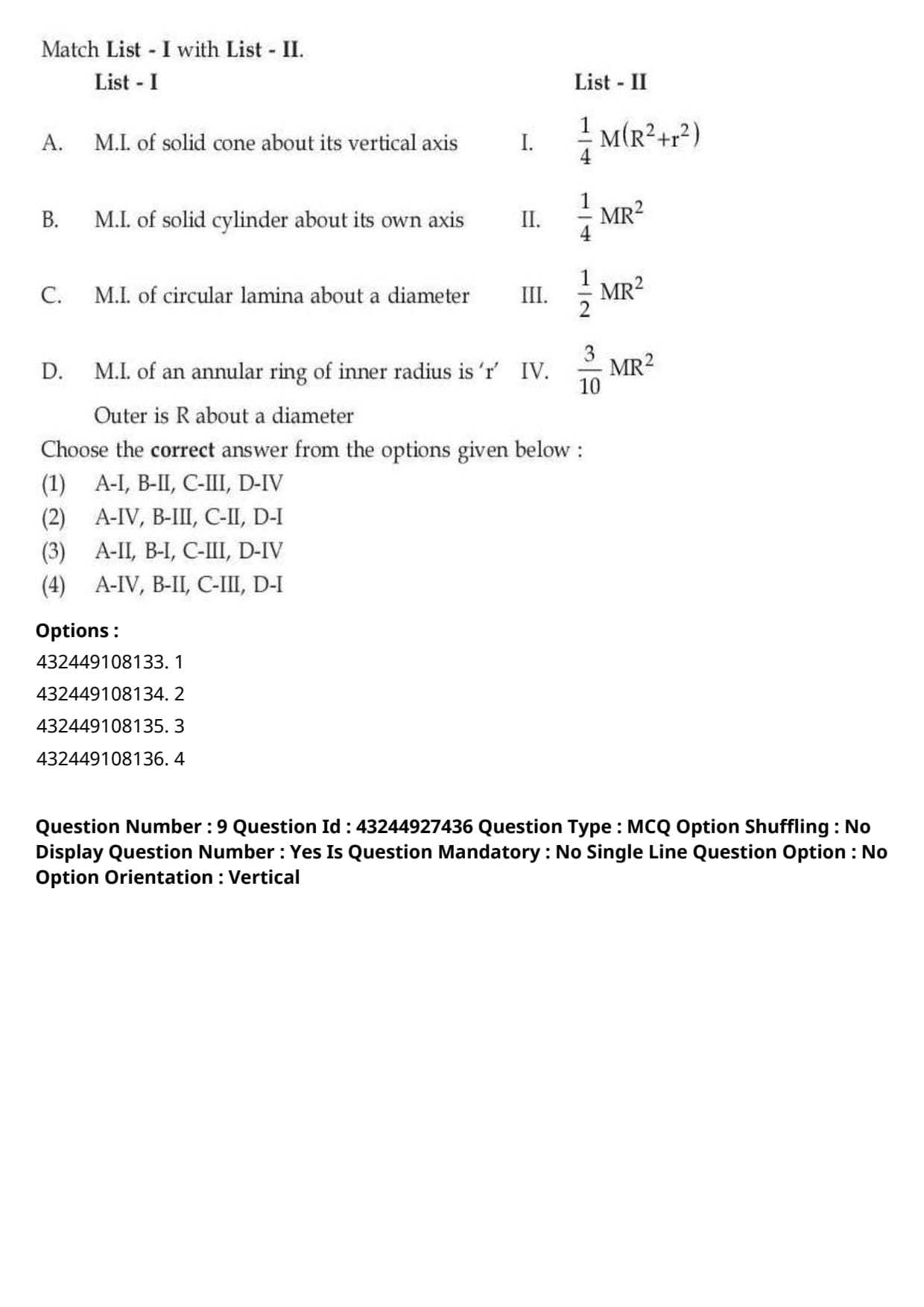
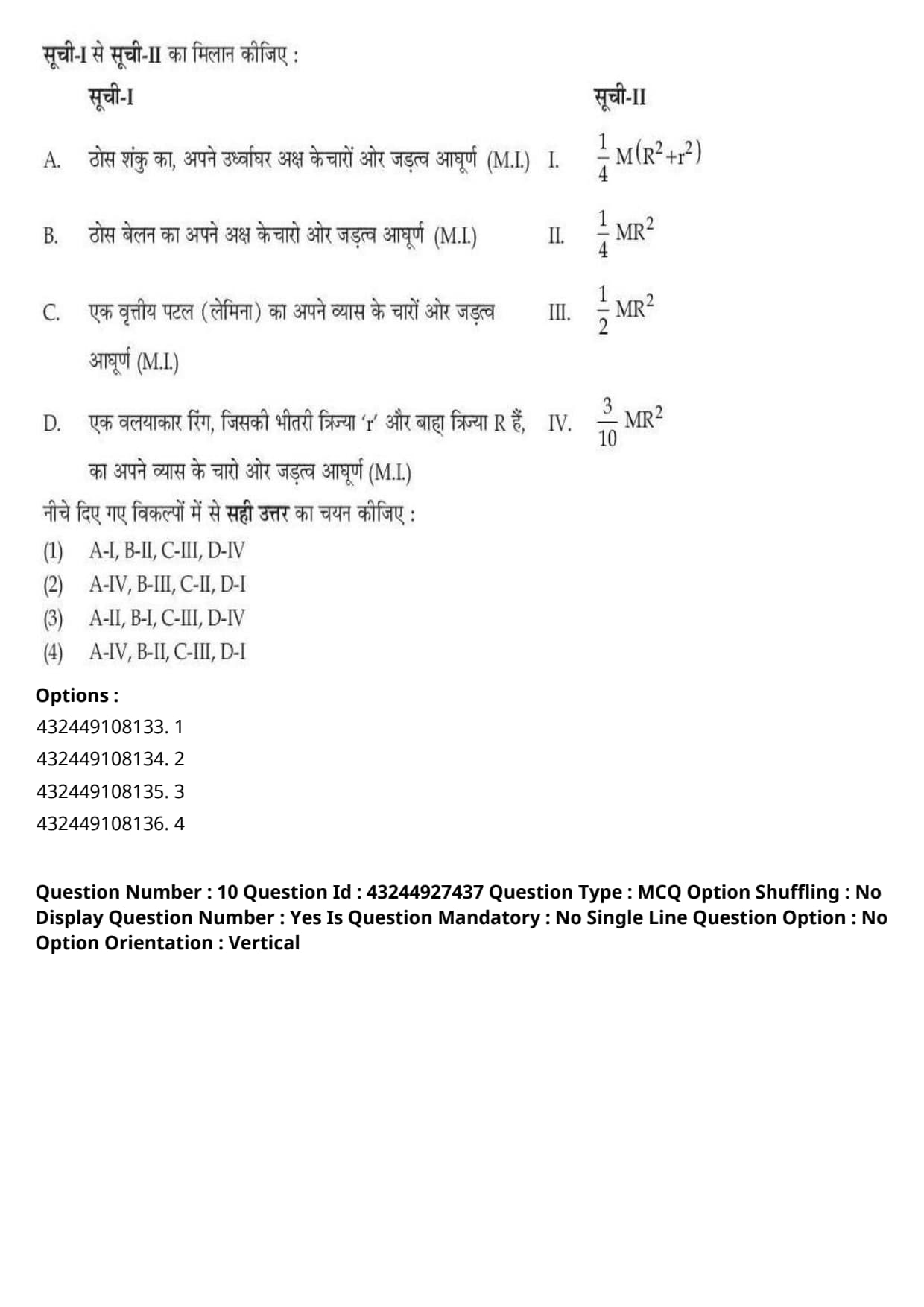
Match List-I with List-II.

Choose the correct answer from the options given below:
View Solution
Concept:
Moment of inertia depends on mass distribution about the axis of rotation.
Step 1: Solid cone about vertical axis.
Moment of inertia of a solid cone about its vertical axis is: \[ I=\frac{3}{10}MR^2 \]
So, \[ A\rightarrow IV \]
Step 2: Solid cylinder about own axis.
Moment of inertia of a solid cylinder about its own axis is: \[ I=\frac{1}{2}MR^2 \]
So, \[ B\rightarrow III \]
Step 3: Circular lamina about diameter.
Moment of inertia of circular lamina about a diameter is: \[ I=\frac{1}{4}MR^2 \]
So, \[ C\rightarrow II \]
Step 4: Annular ring about diameter.
Moment of inertia of annular ring about a diameter is: \[ I=\frac{1}{4}M(R^2+r^2) \]
So, \[ D\rightarrow I \]
Therefore: \[ A-IV,\ B-III,\ C-II,\ D-I \]
\[ \therefore Correct Answer is (B) \] Quick Tip: For moment of inertia, always identify both the body and the axis of rotation carefully.
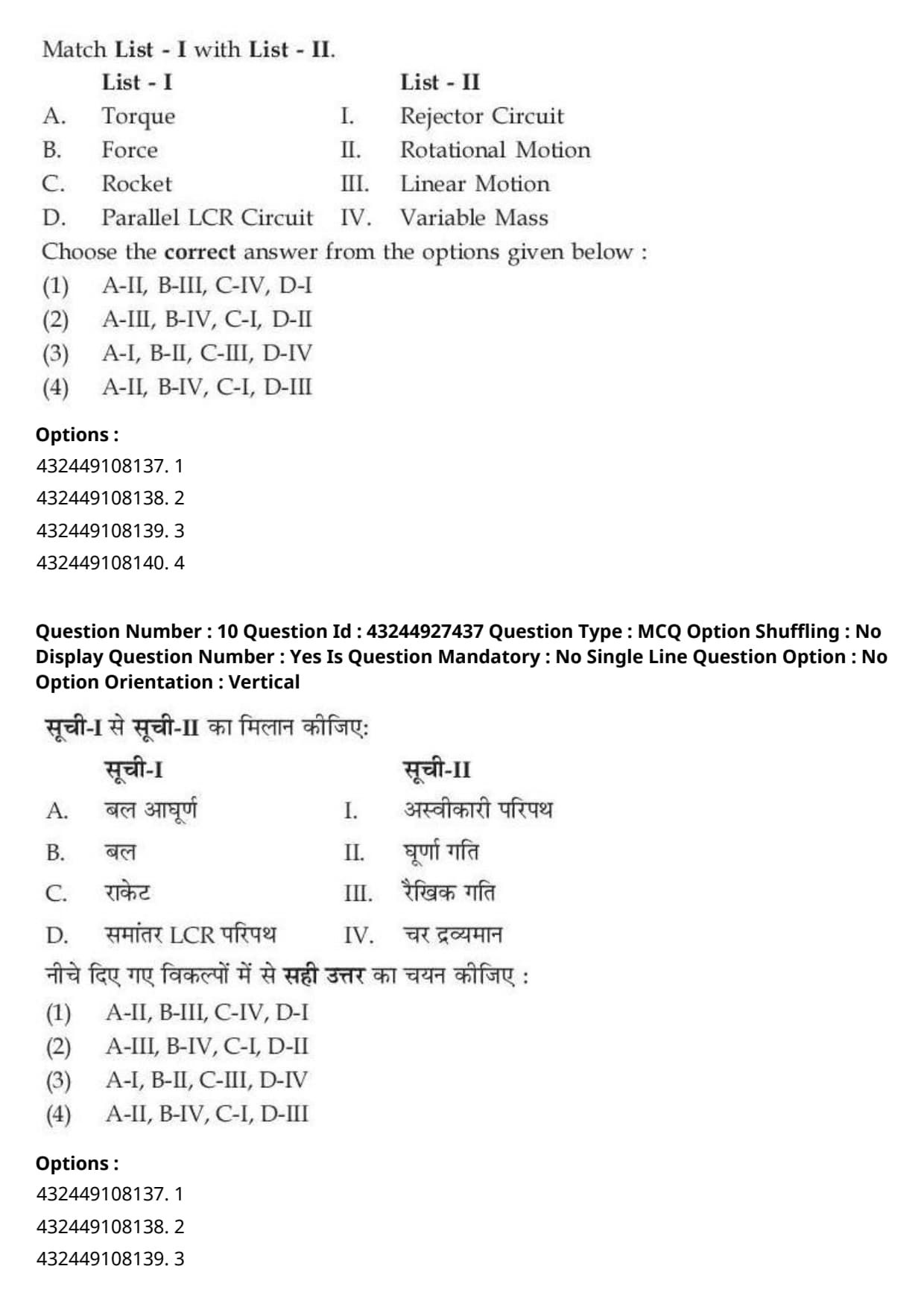
Match List-I with List-II.

Choose the correct answer from the options given below:
View Solution
Concept:
This question matches physical quantities or systems with their related applications or motion.
Step 1: Torque.
Torque is the turning effect of force and is related to rotational motion.
\[ A\rightarrow II \]
Step 2: Force.
Force is directly related to linear motion through Newton's second law.
\[ F=ma \]
So, \[ B\rightarrow III \]
Step 3: Rocket.
A rocket is a variable mass system because it continuously ejects fuel.
\[ C\rightarrow IV \]
Step 4: Parallel LCR circuit.
A parallel LCR circuit at resonance is known as a rejector circuit.
\[ D\rightarrow I \]
Therefore: \[ A-II,\ B-III,\ C-IV,\ D-I \]
\[ \therefore Correct Answer is (A) \] Quick Tip: Parallel resonant LCR circuit is called a rejector circuit because it offers high impedance at resonance.
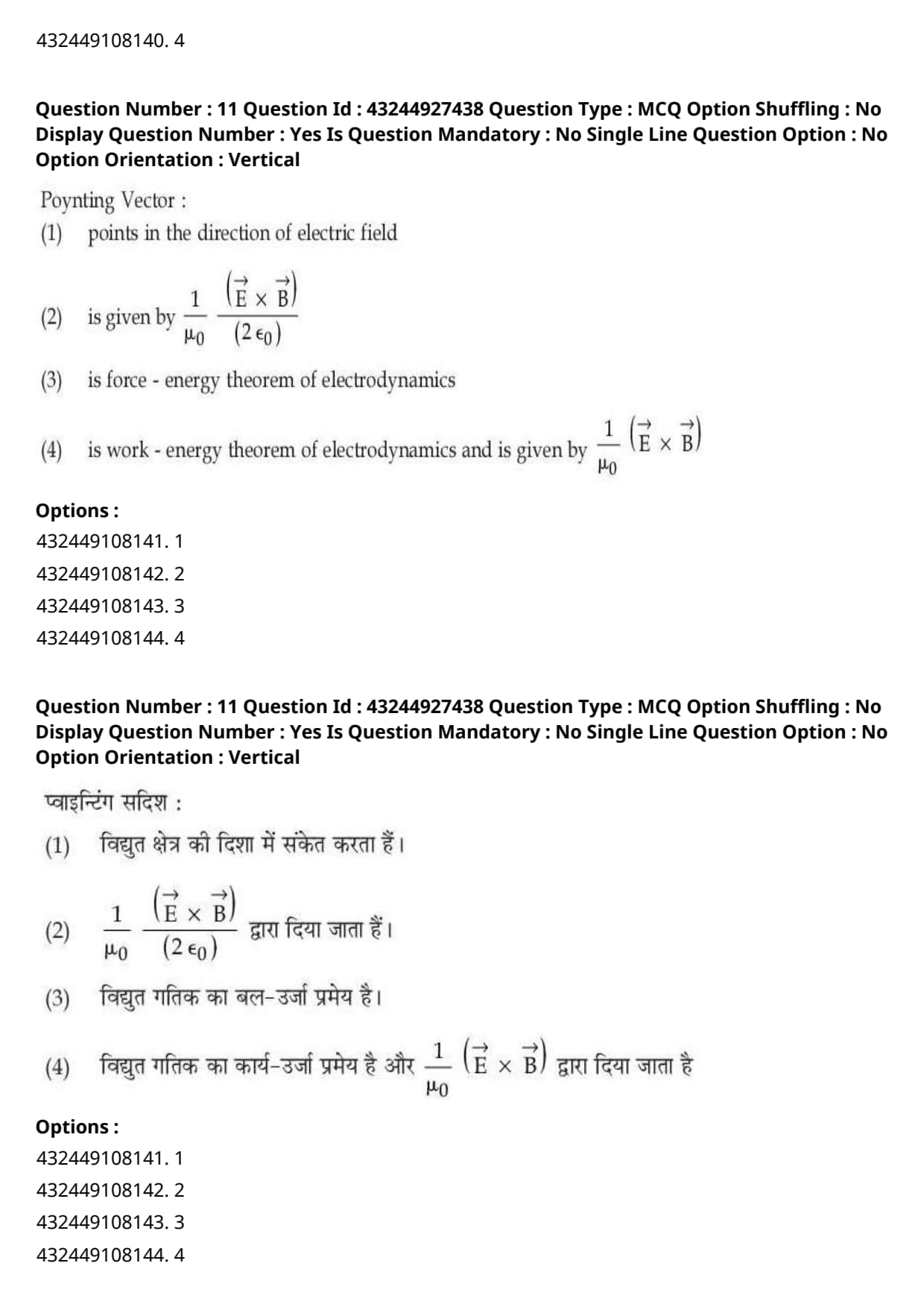
Poynting Vector:
View Solution
Concept:
Poynting vector represents the rate of electromagnetic energy flow per unit area.
Step 1: Formula of Poynting vector.
The Poynting vector is: \[ \vec{S}=\frac{1}{\mu_0}(\vec{E}\times\vec{B}) \]
Step 2: Direction of energy flow.
The direction of \(\vec{S}\) is perpendicular to both \(\vec{E}\) and \(\vec{B}\), not necessarily along the electric field.
Step 3: Meaning.
Poynting theorem represents conservation of electromagnetic energy and is often treated as the work-energy theorem of electrodynamics.
\[ \therefore Correct Answer is (D) \] Quick Tip: Poynting vector is \(\vec{S}=\frac{1}{\mu_0}(\vec{E}\times\vec{B})\), and it gives the direction of electromagnetic energy flow.
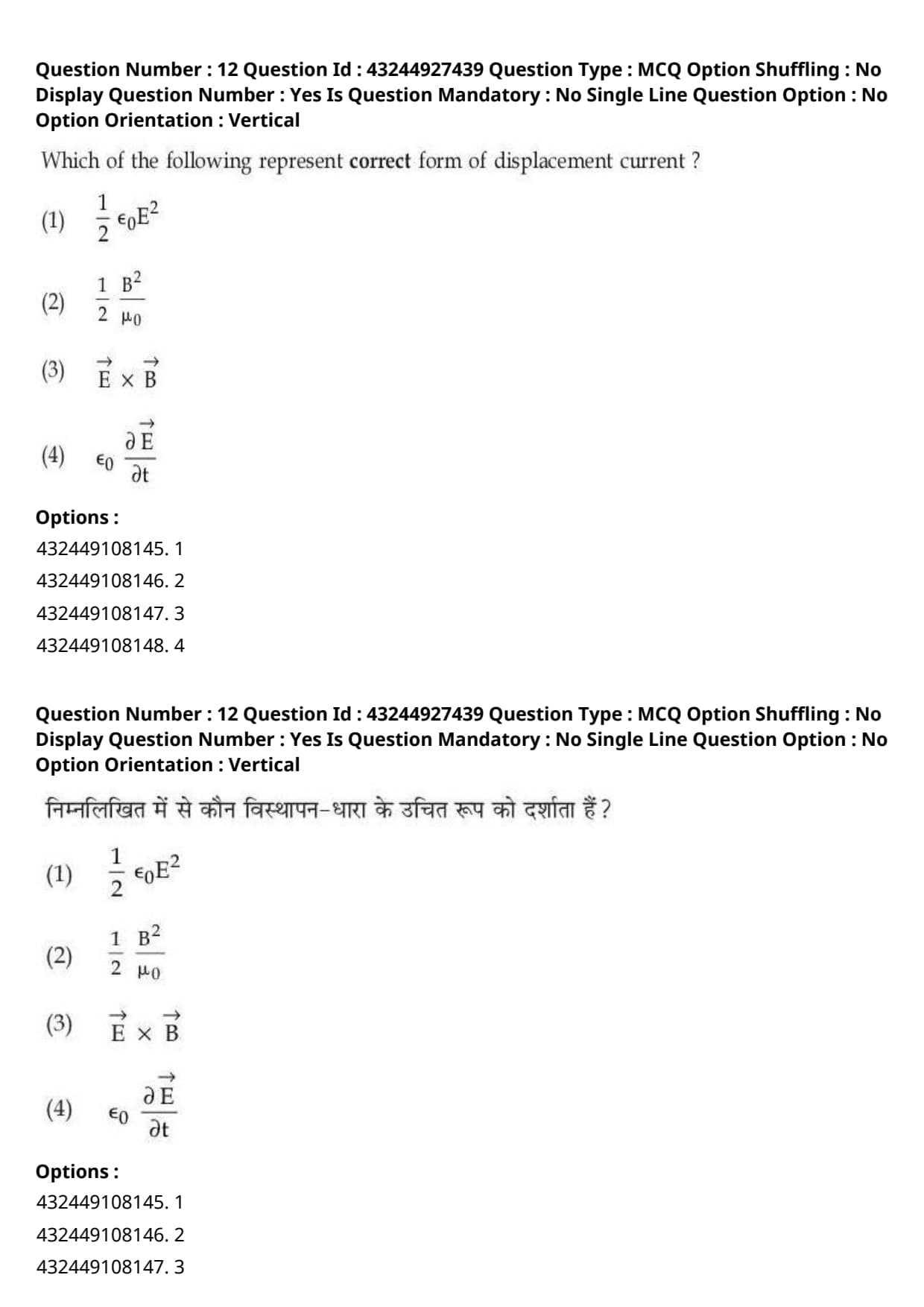
Which of the following represent correct form of displacement current?
View Solution
Concept:
Displacement current density was introduced by Maxwell to modify Ampere's law for time-varying electric fields.
Step 1: Displacement current density.
The displacement current density is: \[ \vec{J}_d=\epsilon_0\frac{\partial \vec{E}}{\partial t} \]
Step 2: Check other options.
\[ \frac{1}{2}\epsilon_0E^2 \]
is electric energy density.
\[ \frac{1}{2}\frac{B^2}{\mu_0} \]
is magnetic energy density.
\[ \vec{E}\times\vec{B} \]
is related to electromagnetic energy flow.
Step 3: Final answer.
Thus, the correct form of displacement current density is: \[ \epsilon_0\frac{\partial \vec{E}}{\partial t} \]
\[ \therefore Correct Answer is (D) \] Quick Tip: Displacement current density is produced by time-varying electric field and is given by \(\vec{J}_d=\epsilon_0\frac{\partial\vec{E}}{\partial t}\).
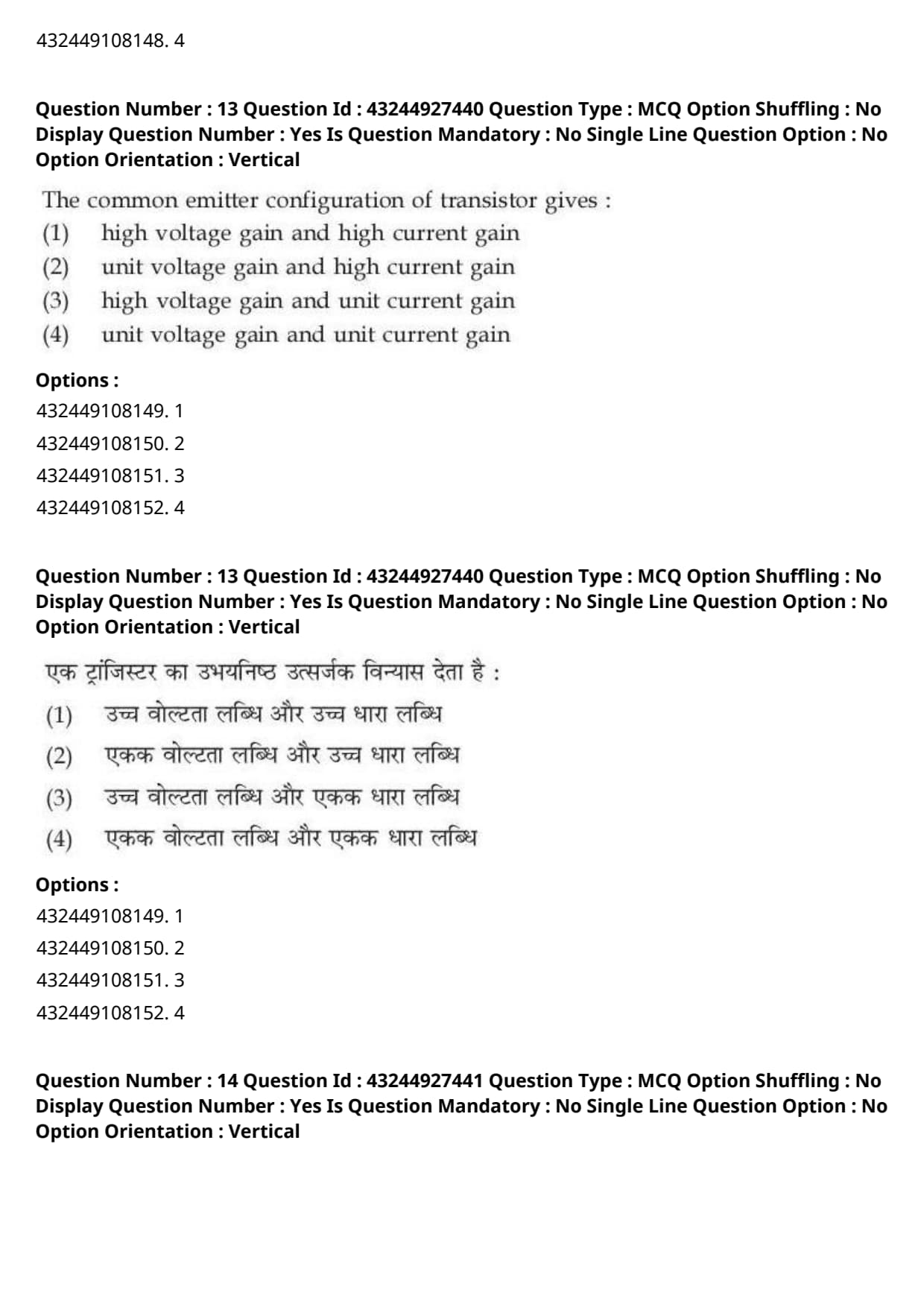
The common emitter configuration of transistor gives:
View Solution
Concept:
A transistor can be connected in common base, common emitter or common collector configuration.
Step 1: Common emitter configuration.
In common emitter configuration, input is applied between base and emitter and output is taken between collector and emitter.
Step 2: Gain properties.
Common emitter configuration gives:
\[ high voltage gain \]
and
\[ high current gain \]
Step 3: Final conclusion.
Therefore, common emitter transistor configuration is widely used for amplification.
\[ \therefore Correct Answer is (A) \] Quick Tip: Common emitter configuration is most widely used because it gives both high voltage gain and high current gain.
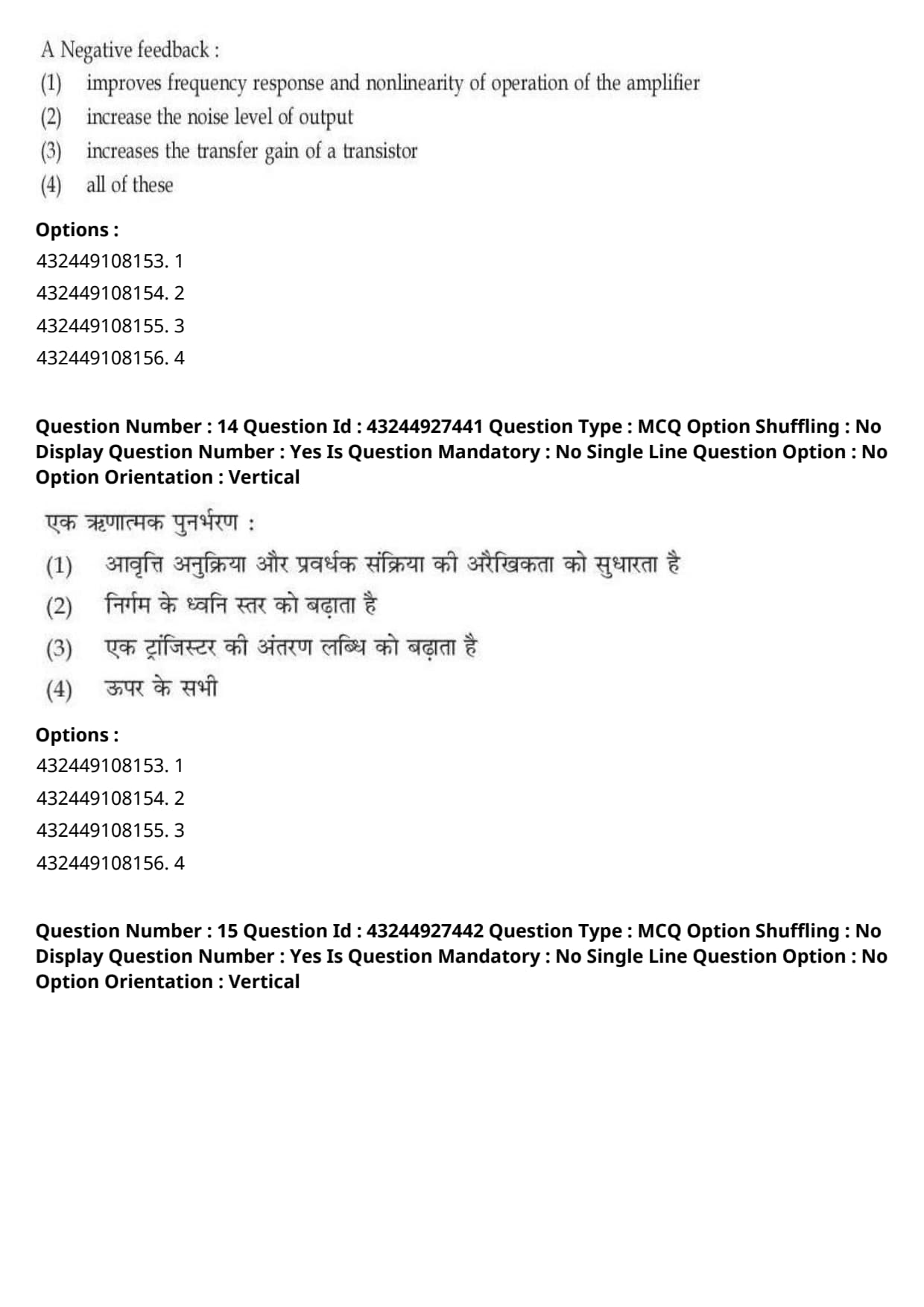
A Negative feedback:
View Solution
Concept:
Negative feedback means a part of the output is fed back to the input in opposite phase.
Step 1: Effect on frequency response.
Negative feedback improves the frequency response of an amplifier.
\[ Frequency response improves \]
Step 2: Effect on distortion and nonlinearity.
Negative feedback reduces distortion and improves linearity of operation.
\[ Nonlinear distortion decreases \]
Step 3: Effect on noise and gain.
Negative feedback generally reduces noise and stabilizes gain, but it does not increase transfer gain.
Step 4: Final answer.
Thus, the correct statement is that negative feedback improves frequency response and operation of the amplifier.
\[ \therefore Correct Answer is (A) \] Quick Tip: Negative feedback improves stability, bandwidth and linearity, but reduces gain.
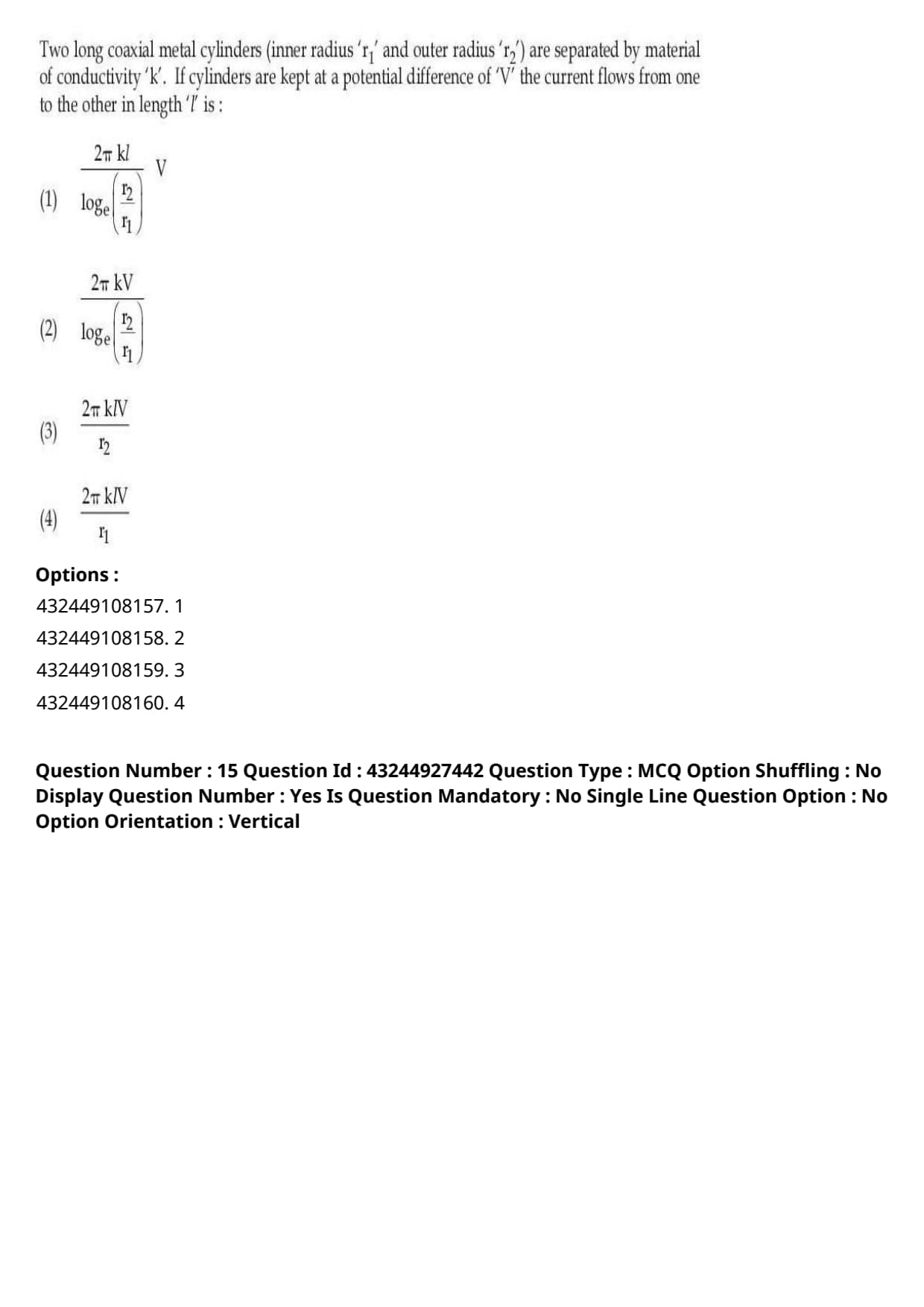
Two long coaxial metal cylinders of inner radius \(r_1\) and outer radius \(r_2\) are separated by material of conductivity \(k\). If cylinders are kept at a potential difference of \(V\), the current flows from one to the other in length \(l\) is:
View Solution
Concept:
For current flowing radially between two coaxial cylinders, resistance of the conducting material is: \[ R=\frac{\ln\left(\frac{r_2}{r_1}\right)}{2\pi kl} \]
Step 1: Use Ohm's law. \[ I=\frac{V}{R} \]
Step 2: Substitute resistance. \[ I=\frac{V}{\frac{\ln\left(\frac{r_2}{r_1}\right)}{2\pi kl}} \]
\[ I=\frac{2\pi klV}{\ln\left(\frac{r_2}{r_1}\right)} \]
Step 3: Final answer. \[ I=\frac{2\pi kl}{\log_e\left(\frac{r_2}{r_1}\right)}V \]
\[ \therefore Correct Answer is (A) \] Quick Tip: For radial conduction between coaxial cylinders, resistance contains the logarithmic term \(\ln\left(\frac{r_2}{r_1}\right)\).
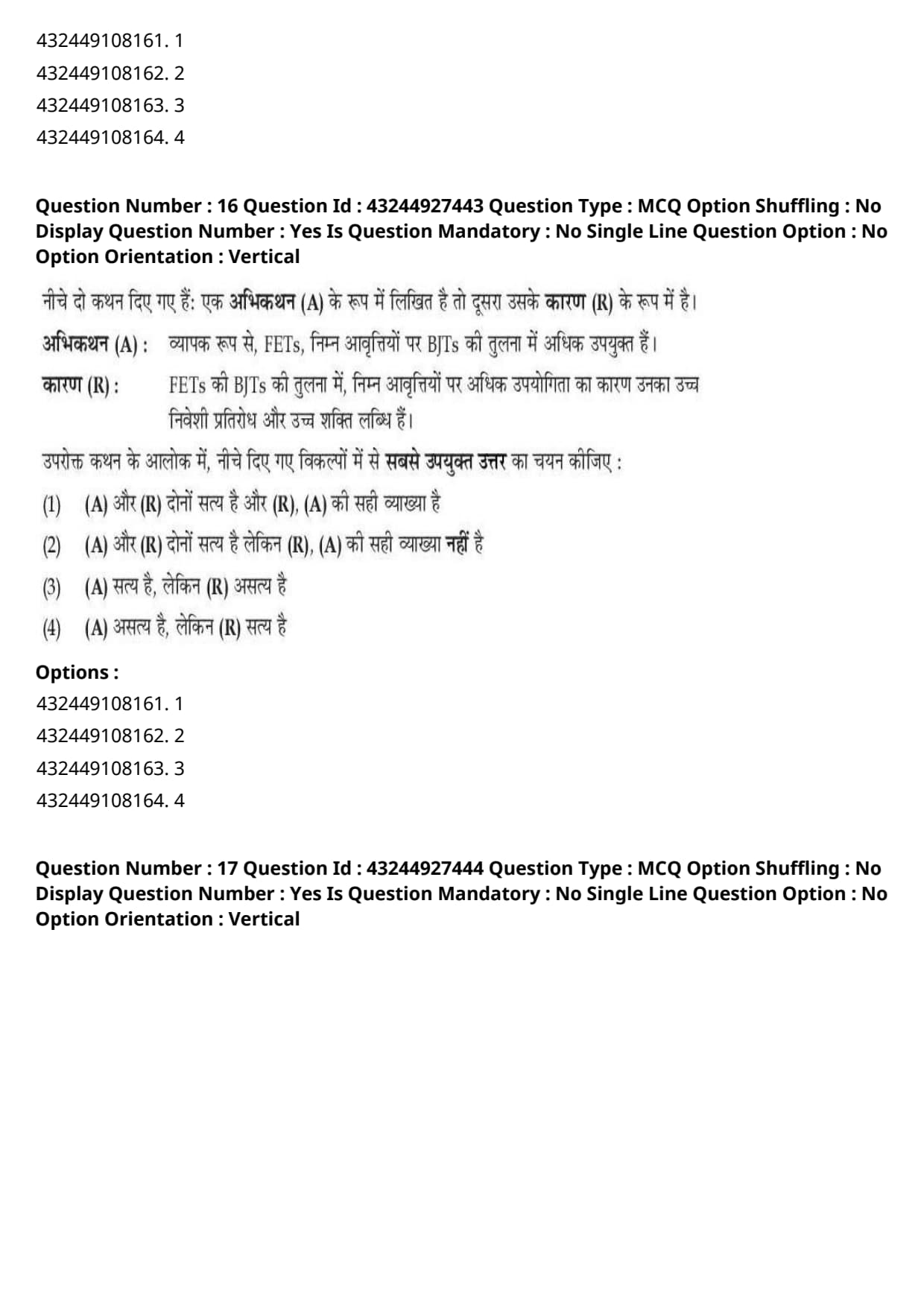
Given below are two statements:
Assertion (A): FETs are in general more suitable than BJTs particularly at low frequencies.
Reason (R): The reason of more suitability of FETs than BJTs at low frequencies is their high input resistance and high power gain.
View Solution
Concept:
FETs are voltage-controlled devices and BJTs are current-controlled devices. FETs have very high input resistance.
Step 1: Check Assertion.
FETs are often preferred in low-frequency and high-input-impedance applications because they load the previous stage very little.
\[ A is correct \]
Step 2: Check Reason.
The reason says FETs are more suitable because of high input resistance and high power gain.
High input resistance is correct, but high power gain is not the usual advantage of FETs over BJTs.
\[ R is not correct \]
Step 3: Final conclusion.
Assertion is correct but Reason is not correct.
\[ \therefore Correct Answer is (C) \] Quick Tip: FETs are preferred where high input resistance and low loading are required.
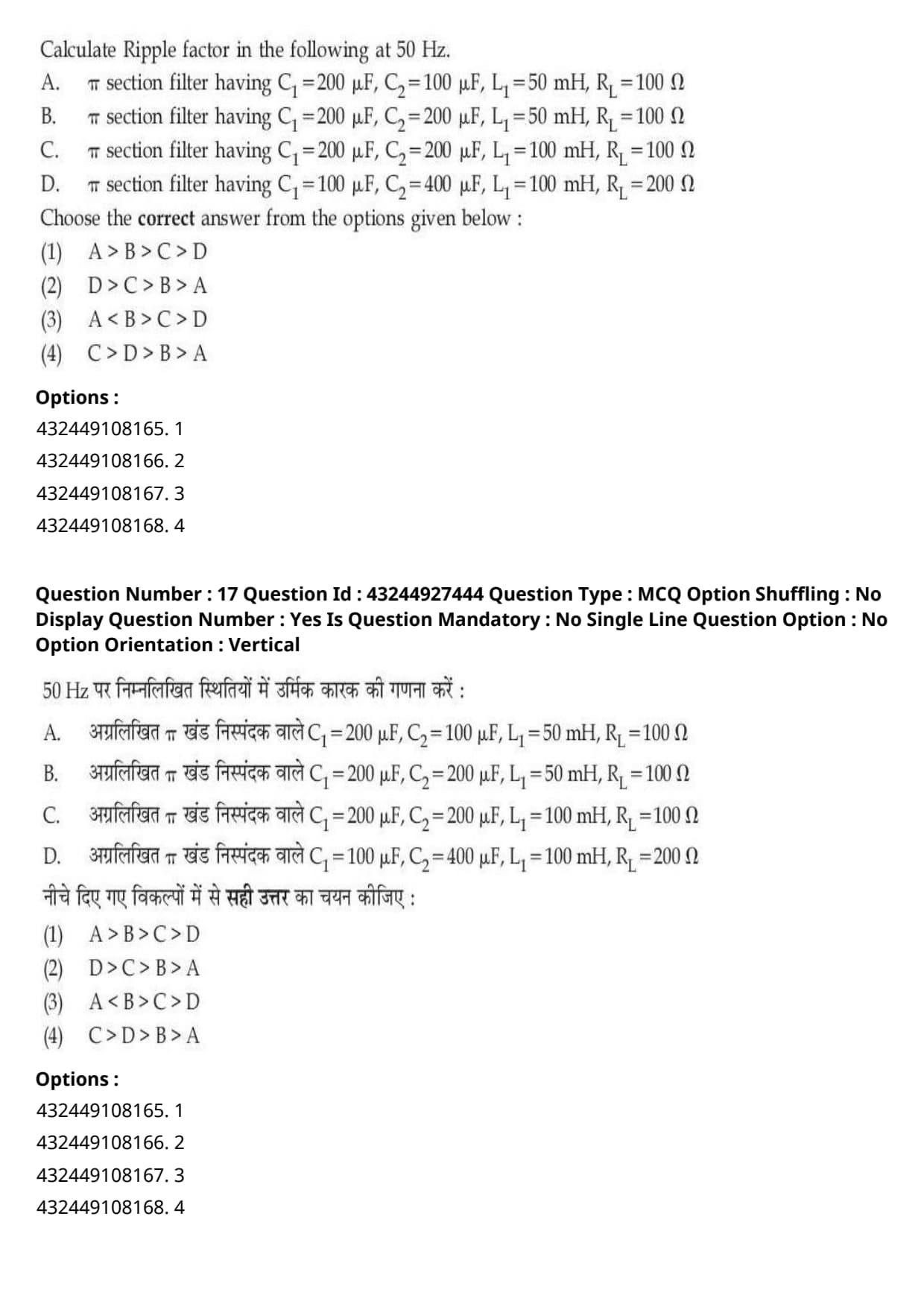
Calculate ripple factor in the following at \(50\ Hz\):
A. \(\pi\) section filter having \(C_1=200\ \mu F,\ C_2=100\ \mu F,\ L_1=50\ mH,\ R_L=100\ \Omega\)
B. \(\pi\) section filter having \(C_1=200\ \mu F,\ C_2=200\ \mu F,\ L_1=50\ mH,\ R_L=100\ \Omega\)
C. \(\pi\) section filter having \(C_1=200\ \mu F,\ C_2=200\ \mu F,\ L_1=100\ mH,\ R_L=100\ \Omega\)
D. \(\pi\) section filter having \(C_1=100\ \mu F,\ C_2=400\ \mu F,\ L_1=100\ mH,\ R_L=200\ \Omega\).
Choose the correct answer from the options given below:
View Solution
Concept:
In a \(\pi\)-section filter, ripple factor decreases when capacitance, inductance and load resistance increase.
Step 1: Understand proportionality.
For comparison, ripple factor is inversely related to the product: \[ C_1C_2L_1R_L \]
So, \[ Higher C_1C_2L_1R_L \Rightarrow Lower ripple factor \]
Step 2: Compare case A. \[ A\propto 200\times100\times50\times100 \]
Step 3: Compare case B. \[ B\propto 200\times200\times50\times100 \]
This product is greater than A, so ripple in B is less than A.
\[ A>B \]
Step 4: Compare case C. \[ C\propto 200\times200\times100\times100 \]
This product is greater than B, so ripple in C is less than B.
\[ B>C \]
Step 5: Compare case D. \[ D\propto 100\times400\times100\times200 \]
This product is greatest among the given cases, so ripple in D is least.
\[ C>D \]
Thus, decreasing order of ripple factor is: \[ A>B>C>D \]
\[ \therefore Correct Answer is (A) \] Quick Tip: In filter circuits, larger capacitance, inductance and load resistance generally reduce ripple factor.
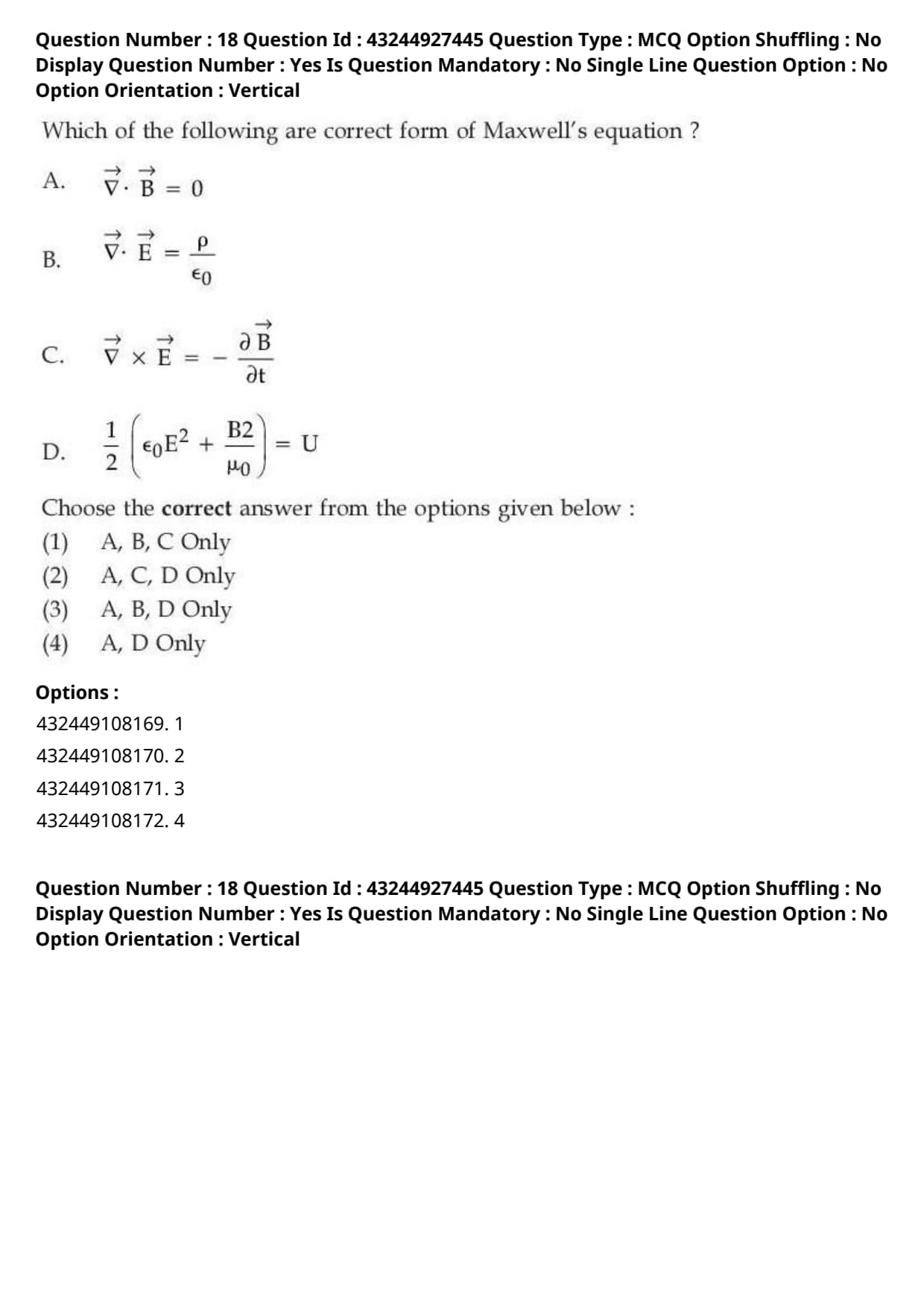
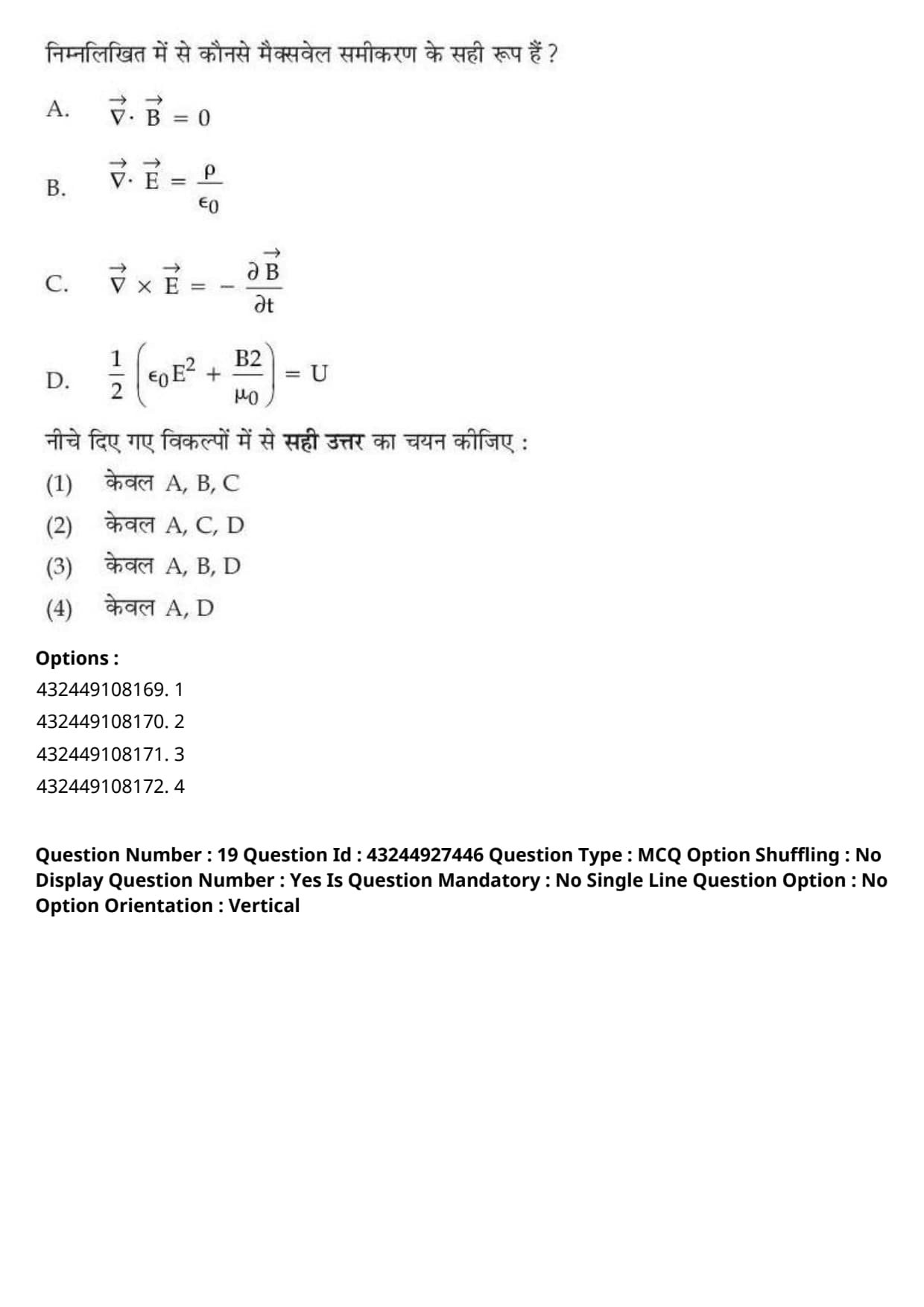
Which of the following are correct form of Maxwell's equation?
A. \(\vec{\nabla}\cdot\vec{B}=0\)
B. \(\vec{\nabla}\cdot\vec{E}=\dfrac{\rho}{\epsilon_0}\)
C. \(\vec{\nabla}\times\vec{E}=-\dfrac{\partial \vec{B}}{\partial t}\)
D. \(\dfrac{1}{2}\left(\epsilon_0E^2+\dfrac{B^2}{\mu_0}\right)=U\).
Choose the correct answer from the options given below:
View Solution
Concept:
Maxwell's equations describe electric and magnetic fields and their relation with charge and current.
Step 1: Check statement A.
Gauss law for magnetism is: \[ \vec{\nabla}\cdot\vec{B}=0 \]
This means magnetic monopoles do not exist.
\[ A is correct \]
Step 2: Check statement B.
Gauss law for electricity is: \[ \vec{\nabla}\cdot\vec{E}=\frac{\rho}{\epsilon_0} \]
\[ B is correct \]
Step 3: Check statement C.
Faraday's law of electromagnetic induction is: \[ \vec{\nabla}\times\vec{E}=-\frac{\partial \vec{B}}{\partial t} \]
\[ C is correct \]
Step 4: Check statement D.
The expression: \[ U=\frac{1}{2}\left(\epsilon_0E^2+\frac{B^2}{\mu_0}\right) \]
is electromagnetic energy density, not Maxwell's equation.
\[ D is incorrect \]
Thus, correct Maxwell equations are: \[ A,B,C \]
\[ \therefore Correct Answer is (A) \] Quick Tip: Maxwell's equations include Gauss law, Gauss law for magnetism, Faraday law and Ampere-Maxwell law.
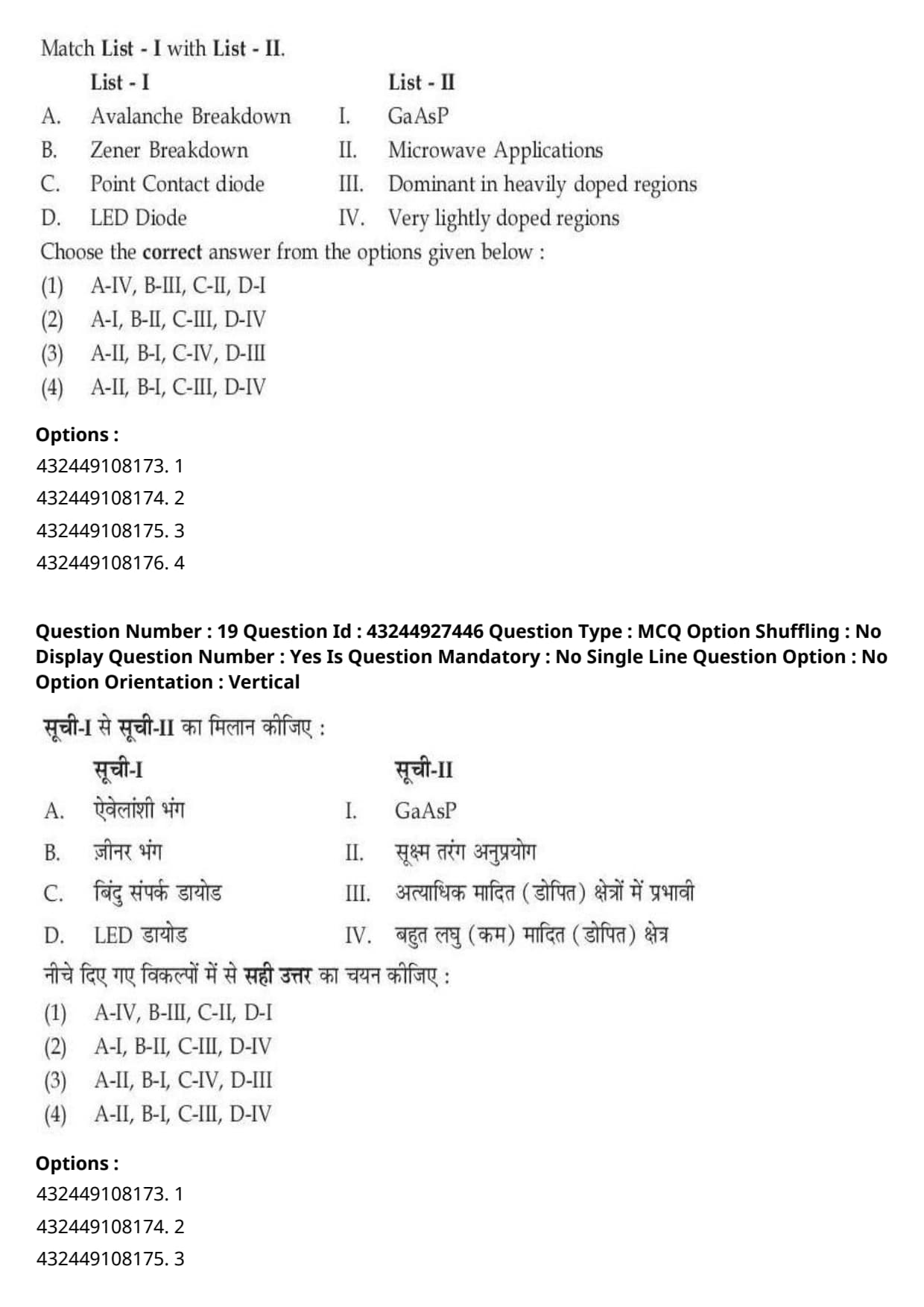
Match List-I with List-II.

Choose the correct answer from the options given below:
View Solution
Concept:
Different semiconductor devices and breakdown mechanisms are associated with different physical conditions and applications.
Step 1: Avalanche Breakdown.
Avalanche breakdown occurs mainly in lightly doped regions because the depletion layer is wide.
\[ A\rightarrow IV \]
Step 2: Zener Breakdown.
Zener breakdown is dominant in heavily doped regions because the depletion layer is very thin.
\[ B\rightarrow III \]
Step 3: Point Contact diode.
Point contact diode is used in high-frequency and microwave applications.
\[ C\rightarrow II \]
Step 4: LED Diode.
LEDs can be made using materials like GaAsP.
\[ D\rightarrow I \]
Therefore: \[ A-IV,\ B-III,\ C-II,\ D-I \]
\[ \therefore Correct Answer is (A) \] Quick Tip: Zener breakdown occurs in heavily doped junctions, while avalanche breakdown occurs in lightly doped junctions.
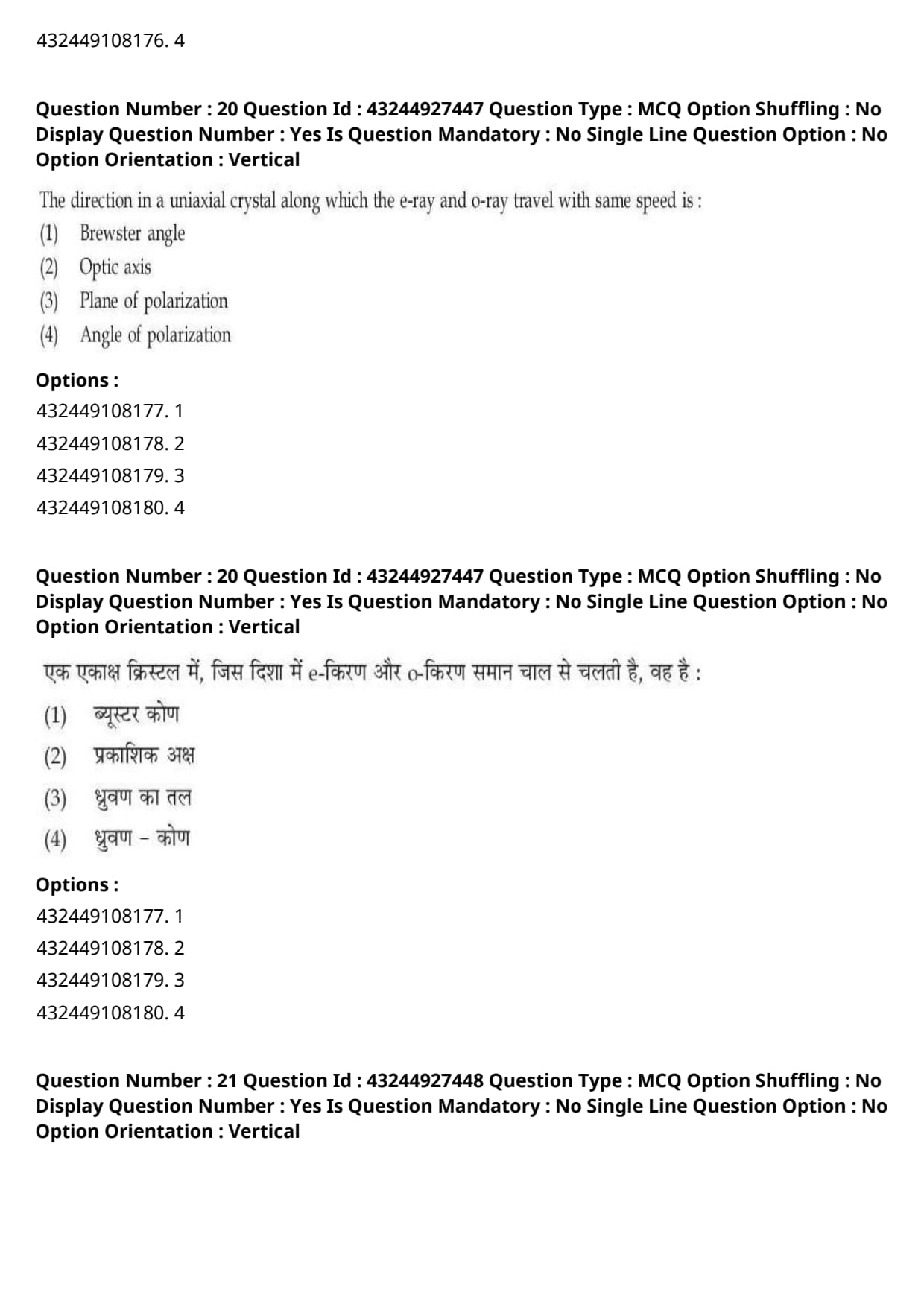
The direction in a uniaxial crystal along which the e-ray and o-ray travel with same speed is:
View Solution
Concept:
In a uniaxial crystal, light generally splits into ordinary ray and extraordinary ray due to double refraction.
Step 1: Understand ordinary and extraordinary rays.
The ordinary ray and extraordinary ray usually travel with different velocities in anisotropic crystals.
Step 2: Identify special direction.
In a uniaxial crystal, there is one special direction along which ordinary and extraordinary rays travel with the same speed.
This direction is called the optic axis.
\[ o-ray speed=e-ray speed along optic axis \]
Step 3: Final answer.
Thus, the required direction is:
\[ Optic axis \]
\[ \therefore Correct Answer is (B) \] Quick Tip: In a uniaxial crystal, along the optic axis, ordinary and extraordinary rays travel with the same speed.
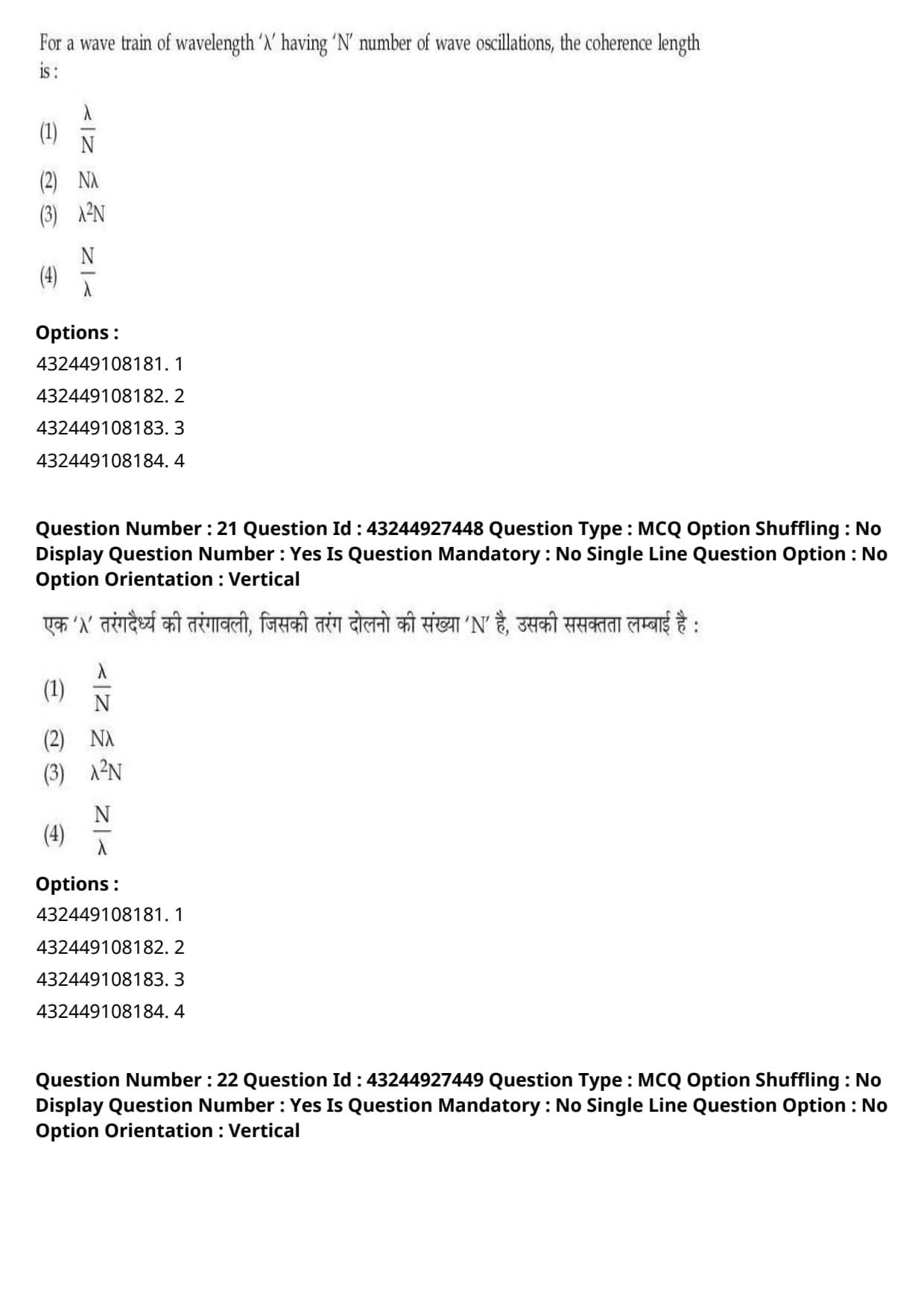
For a wave train of wavelength \(\lambda\) having \(N\) number of wave oscillations, the coherence length is:
View Solution
Concept:
Coherence length is the length over which a wave train maintains a definite phase relationship.
Step 1: Understand the wave train.
If one complete oscillation has wavelength: \[ \lambda \]
and the wave train contains: \[ N \]
complete oscillations, then total length of the wave train is obtained by multiplying the number of oscillations by wavelength.
Step 2: Apply the formula. \[ Coherence length=N\times \lambda \]
\[ L_c=N\lambda \]
Step 3: Final answer. \[ \therefore Correct Answer is (B) \] Quick Tip: If a wave train contains \(N\) waves of wavelength \(\lambda\), then its coherence length is \(N\lambda\).
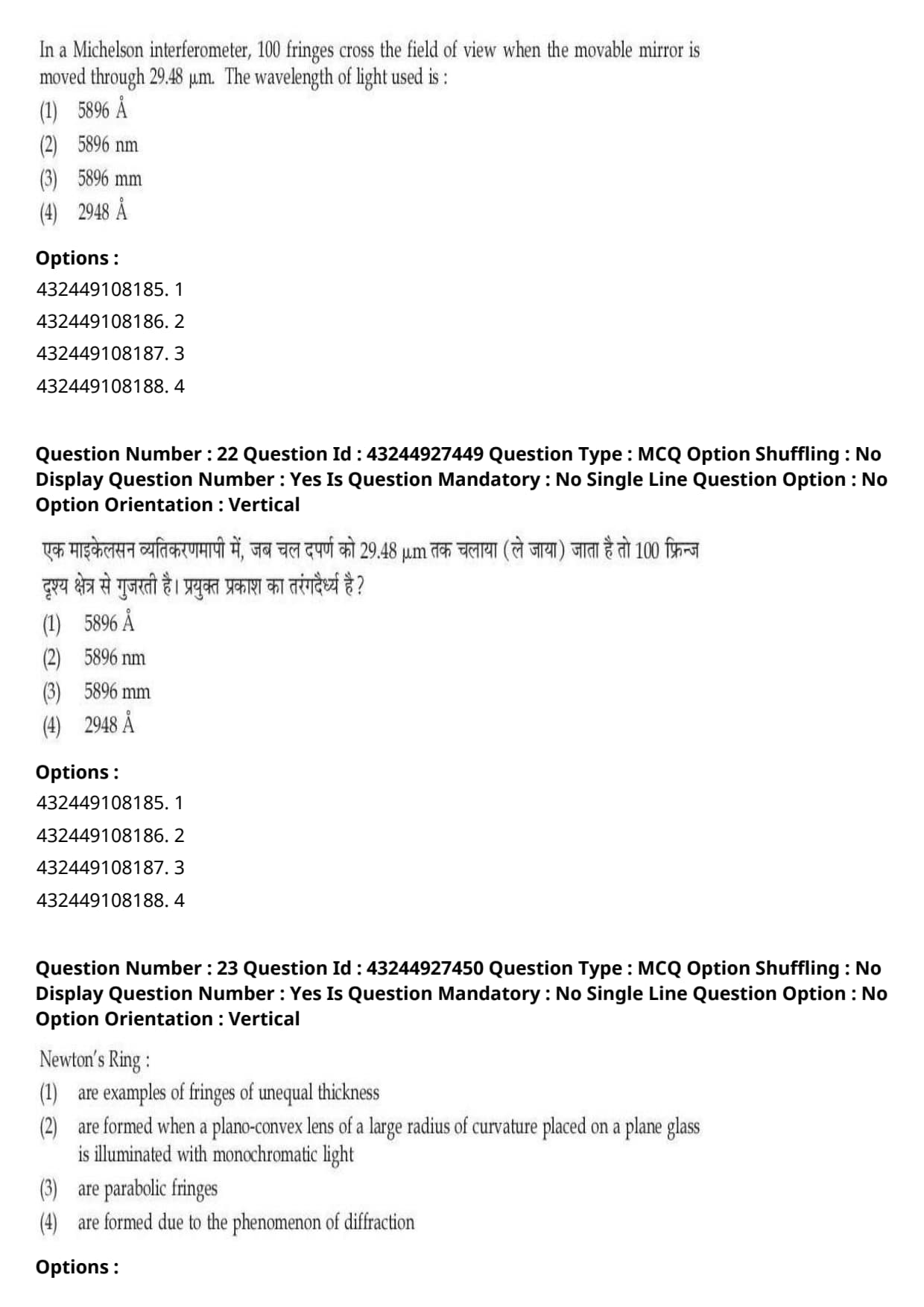
In a Michelson interferometer, \(100\) fringes cross the field of view when the movable mirror is moved through \(29.48\ \mu m\). The wavelength of light used is:
View Solution
Concept:
In Michelson interferometer, when the mirror is moved by a distance \(d\), optical path difference changes by \(2d\).
\[ N\lambda=2d \]
Step 1: Write the given values. \[ N=100 \] \[ d=29.48\ \mu m \]
Step 2: Apply Michelson formula. \[ N\lambda=2d \]
\[ 100\lambda=2\times 29.48\ \mu m \]
\[ 100\lambda=58.96\ \mu m \]
\[ \lambda=0.5896\ \mu m \]
Step 3: Convert into Angstrom. \[ 1\ \mu m=10^4\ \AA \]
\[ 0.5896\ \mu m=0.5896\times10^4\ \AA \]
\[ \lambda=5896\ \AA \]
\[ \therefore Correct Answer is (A) \] Quick Tip: In Michelson interferometer, mirror displacement \(d\) produces path difference \(2d\), so \(N\lambda=2d\).
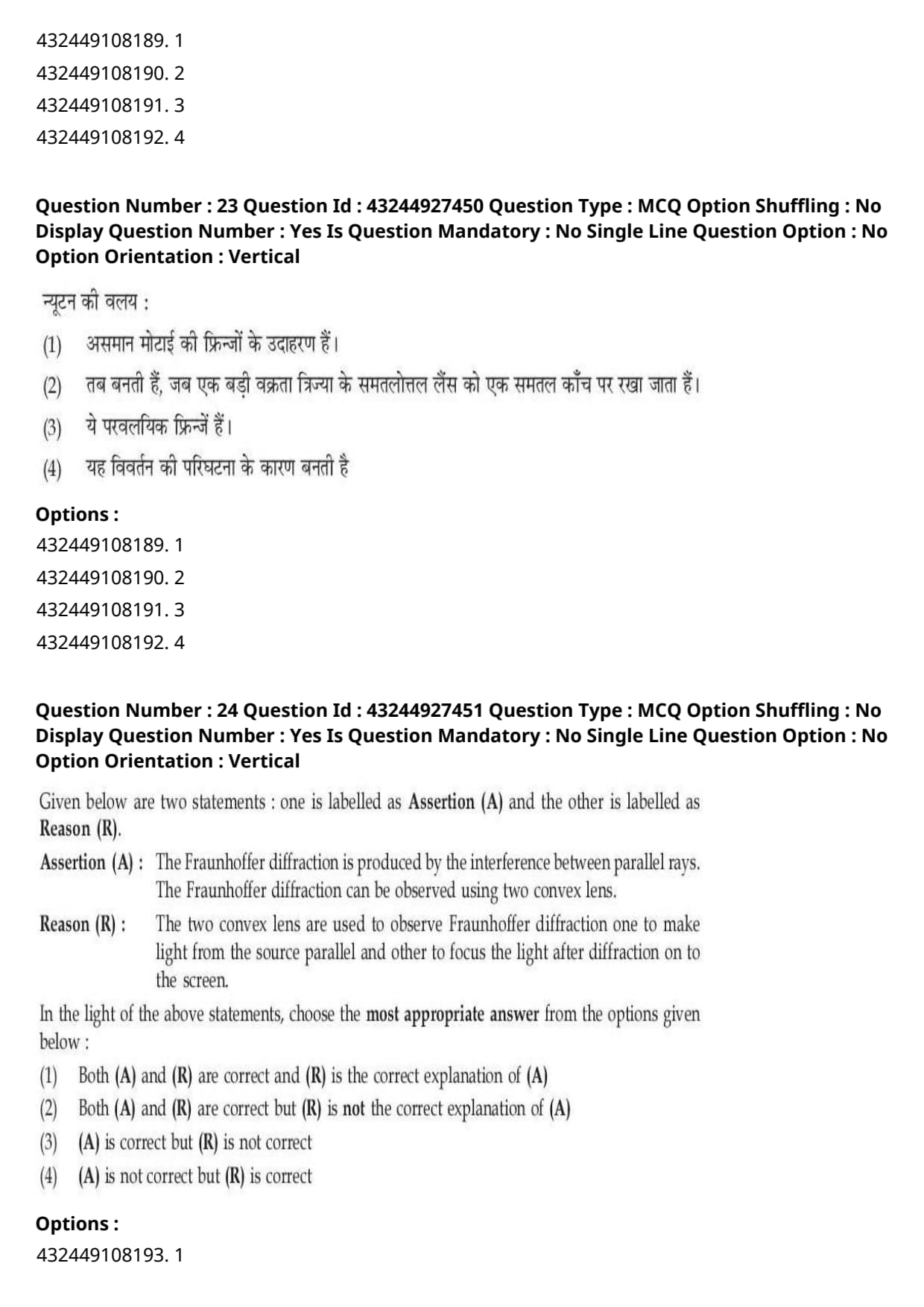
Newton's Rings are formed when a plano-convex lens of large radius of curvature placed on a plane glass plate is illuminated with monochromatic light.
View Solution
Concept:
Newton's rings are interference fringes produced due to the thin air film formed between a plano-convex lens and a plane glass plate.
Step 1: Formation of air film.
When a plano-convex lens is placed on a plane glass plate, a thin air film of varying thickness is formed.
Step 2: Illumination by monochromatic light.
When monochromatic light falls on this arrangement, reflected rays from the top and bottom surfaces of the air film interfere.
Step 3: Nature of fringes.
The fringes obtained are circular rings, not parabolic fringes.
Step 4: Final answer.
Therefore, the correct statement is:
\[ Newton's rings are formed using a plano-convex lens on a plane glass plate. \]
\[ \therefore Correct Answer is (B) \] Quick Tip: Newton's rings are circular interference fringes produced by a thin air film.
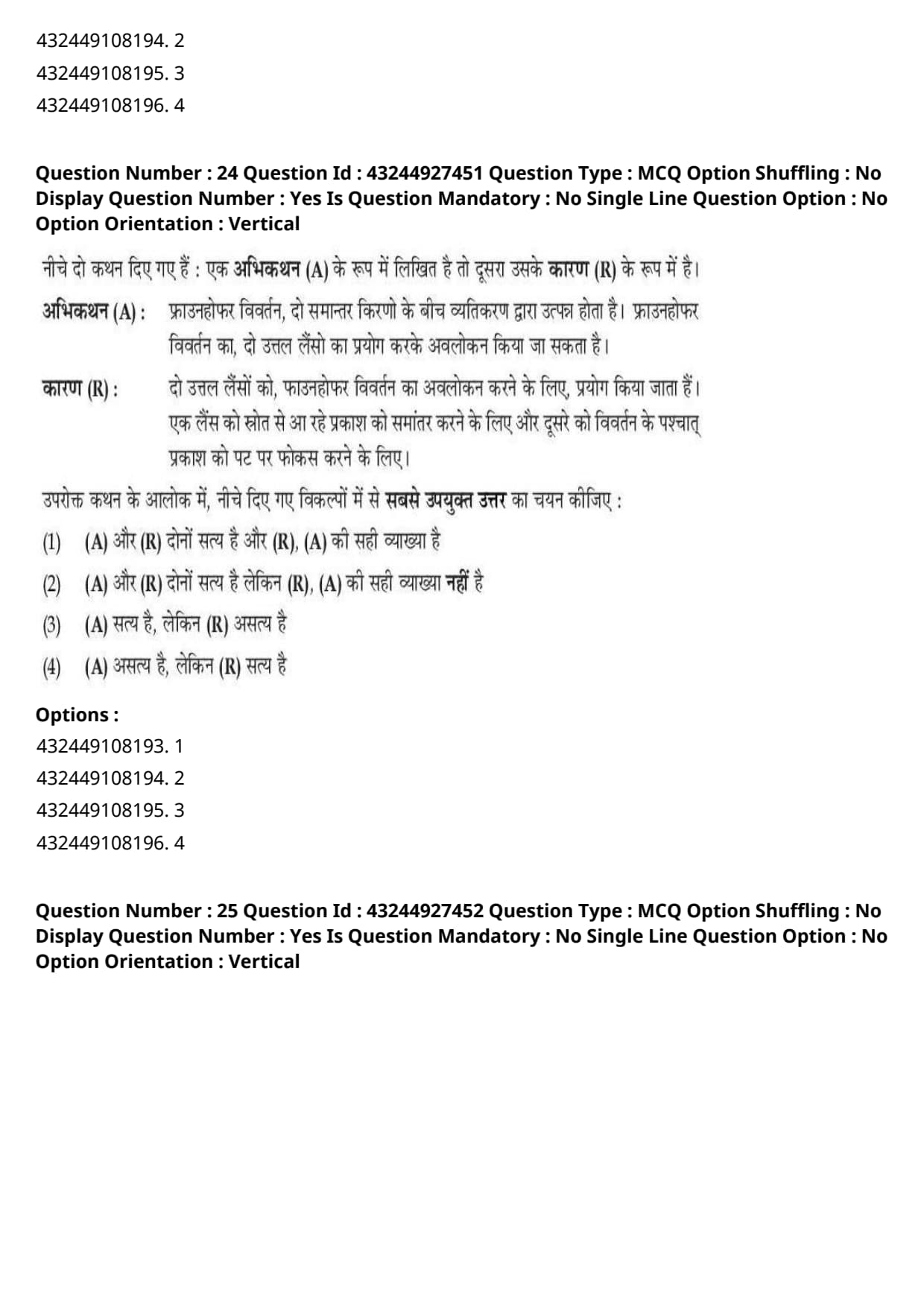
Given below are two statements:
Assertion (A): The Fraunhofer diffraction is produced by the interference between parallel rays. The Fraunhofer diffraction can be observed using two convex lenses.
Reason (R): The two convex lenses are used to observe Fraunhofer diffraction, one to make light from the source parallel and other to focus the light after diffraction on to the screen.
View Solution
Concept:
Fraunhofer diffraction is far-field diffraction. In this type of diffraction, incident and diffracted rays are treated as parallel.
Step 1: Check Assertion.
Fraunhofer diffraction is produced by interference of secondary wavelets in parallel directions.
Also, experimentally, it can be observed using two convex lenses.
\[ A is correct \]
Step 2: Check Reason.
The first convex lens converts light from the source into a parallel beam.
The second convex lens focuses the diffracted light on the screen.
\[ R is correct \]
Step 3: Check explanation.
The reason directly explains why two convex lenses are used for observing Fraunhofer diffraction.
\[ R correctly explains A \]
\[ \therefore Correct Answer is (A) \] Quick Tip: Fraunhofer diffraction is far-field diffraction and is usually observed using lenses to make and focus parallel rays.
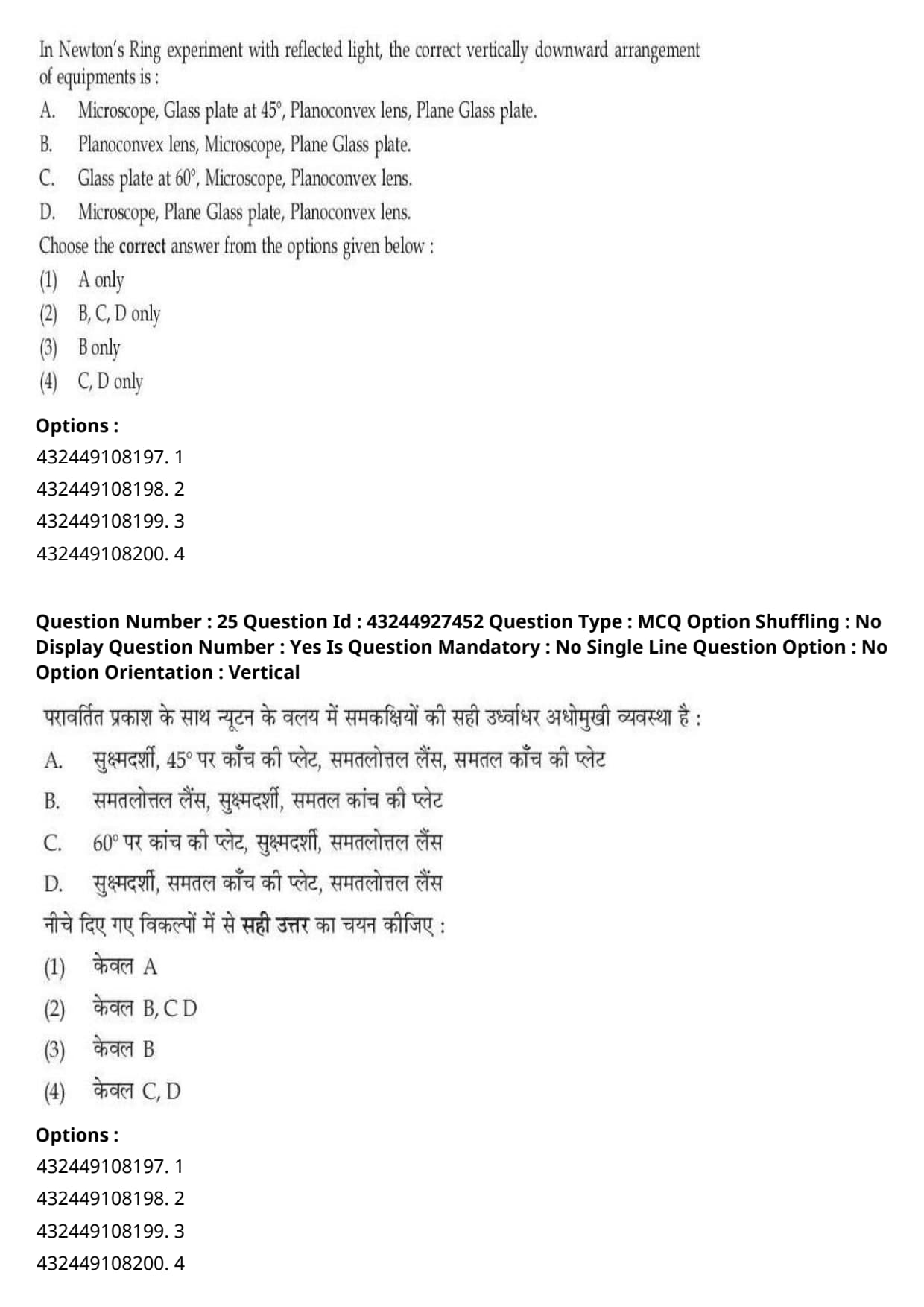
In Newton's Ring experiment with reflected light, the correct vertically downward arrangement of equipments is:
A. Microscope, Glass plate at \(45^\circ\), Plano-convex lens, Plane glass plate.
B. Plano-convex lens, Microscope, Plane glass plate.
C. Glass plate at \(60^\circ\), Microscope, Plano-convex lens.
D. Microscope, Plane glass plate, Plano-convex lens.
View Solution
Concept:
Newton's rings experiment in reflected light uses a microscope, an inclined glass plate, a plano-convex lens and a plane glass plate.
Step 1: Identify the topmost instrument.
The microscope is placed at the top to observe the rings.
\[ Top= Microscope \]
Step 2: Identify the reflecting plate.
A glass plate inclined at \(45^\circ\) reflects light towards the plano-convex lens arrangement.
\[ Next=45^\circ glass plate \]
Step 3: Identify the ring forming setup.
The plano-convex lens is placed on the plane glass plate.
\[ Plano-convex lens above plane glass plate \]
Step 4: Final arrangement. \[ Microscope \rightarrow 45^\circ glass plate \rightarrow Plano-convex lens \rightarrow Plane glass plate \]
\[ \therefore Correct Answer is (A) \] Quick Tip: In Newton's rings, the plano-convex lens is placed on a plane glass plate and rings are observed through a microscope.
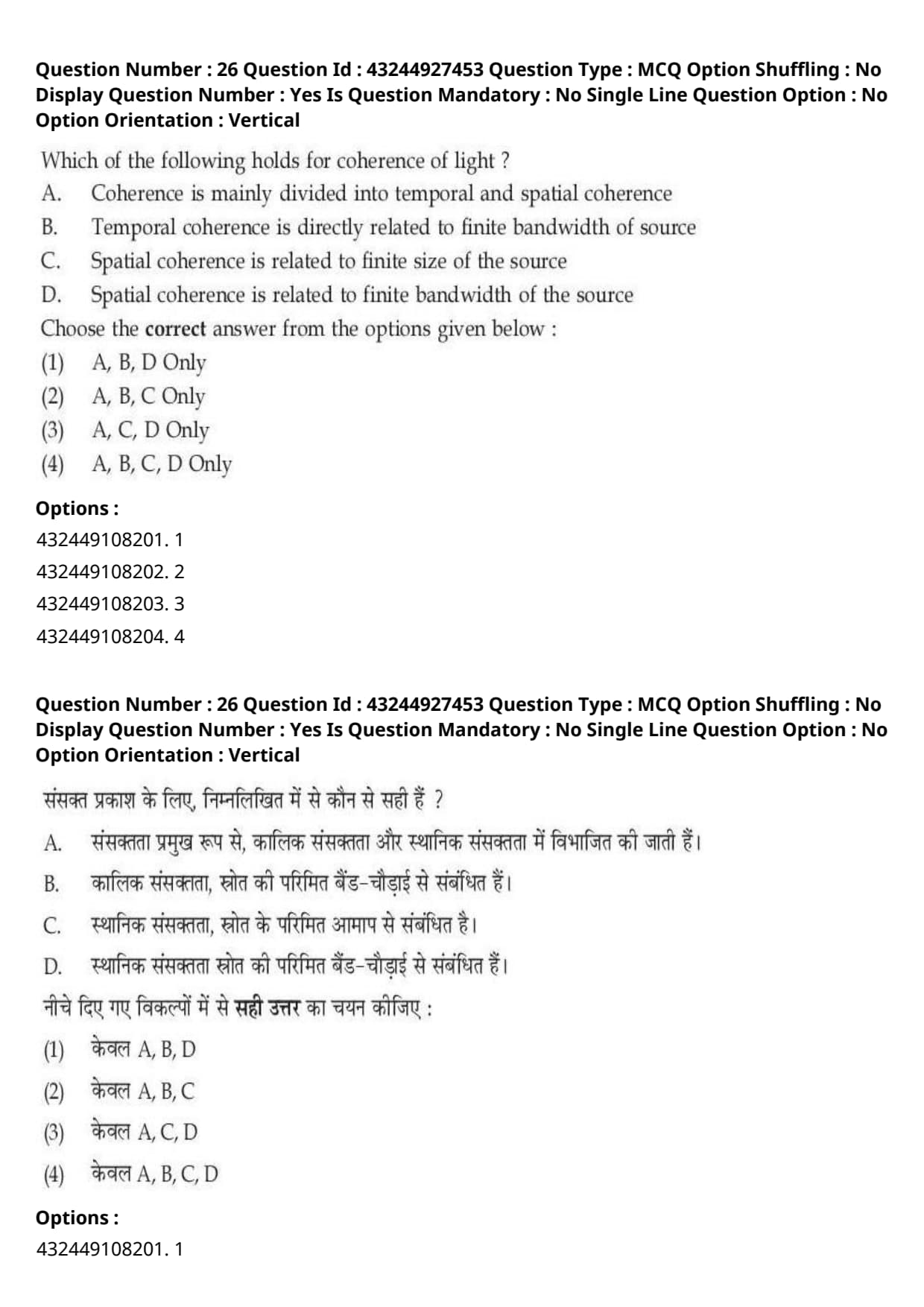
Which of the following holds for coherence of light?
A. Coherence is mainly divided into temporal and spatial coherence
B. Temporal coherence is directly related to finite bandwidth of source
C. Spatial coherence is related to finite size of the source
D. Spatial coherence is related to finite bandwidth of the source.
View Solution
Concept:
Coherence of light describes a fixed phase relationship between waves. It is mainly of two types: temporal coherence and spatial coherence.
Step 1: Check statement A.
Coherence is divided into temporal coherence and spatial coherence.
\[ A is correct \]
Step 2: Check statement B.
Temporal coherence is related to the spectral width or bandwidth of the source.
\[ B is correct \]
Step 3: Check statement C.
Spatial coherence is related to the finite size of the source.
\[ C is correct \]
Step 4: Check statement D.
Finite bandwidth is connected with temporal coherence, not spatial coherence.
\[ D is incorrect \]
Therefore: \[ A,B,C \]
\[ \therefore Correct Answer is (B) \] Quick Tip: Temporal coherence depends on bandwidth, while spatial coherence depends on source size.
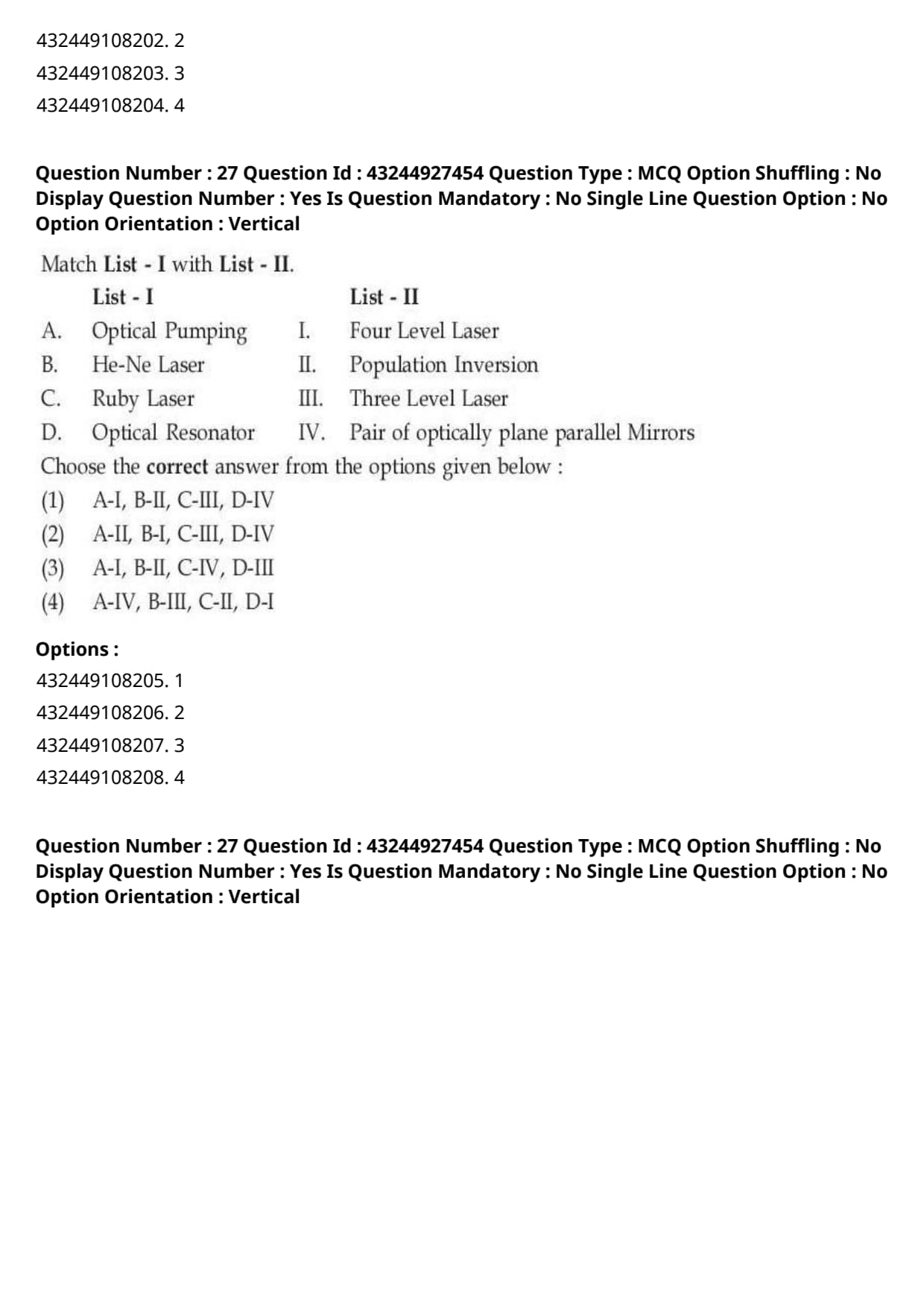
Match List-I with List-II.

View Solution
Concept:
Laser action requires population inversion and optical feedback through an optical resonator.
Step 1: Optical pumping.
Optical pumping is used to produce population inversion.
\[ A\rightarrow II \]
Step 2: He-Ne laser.
He-Ne laser is a four-level laser system.
\[ B\rightarrow I \]
Step 3: Ruby laser.
Ruby laser is a three-level laser system.
\[ C\rightarrow III \]
Step 4: Optical resonator.
An optical resonator consists of a pair of optically plane parallel mirrors.
\[ D\rightarrow IV \]
Therefore: \[ A-II,\ B-I,\ C-III,\ D-IV \]
\[ \therefore Correct Answer is (B) \] Quick Tip: Ruby laser is a three-level laser, while He-Ne laser is a four-level laser.
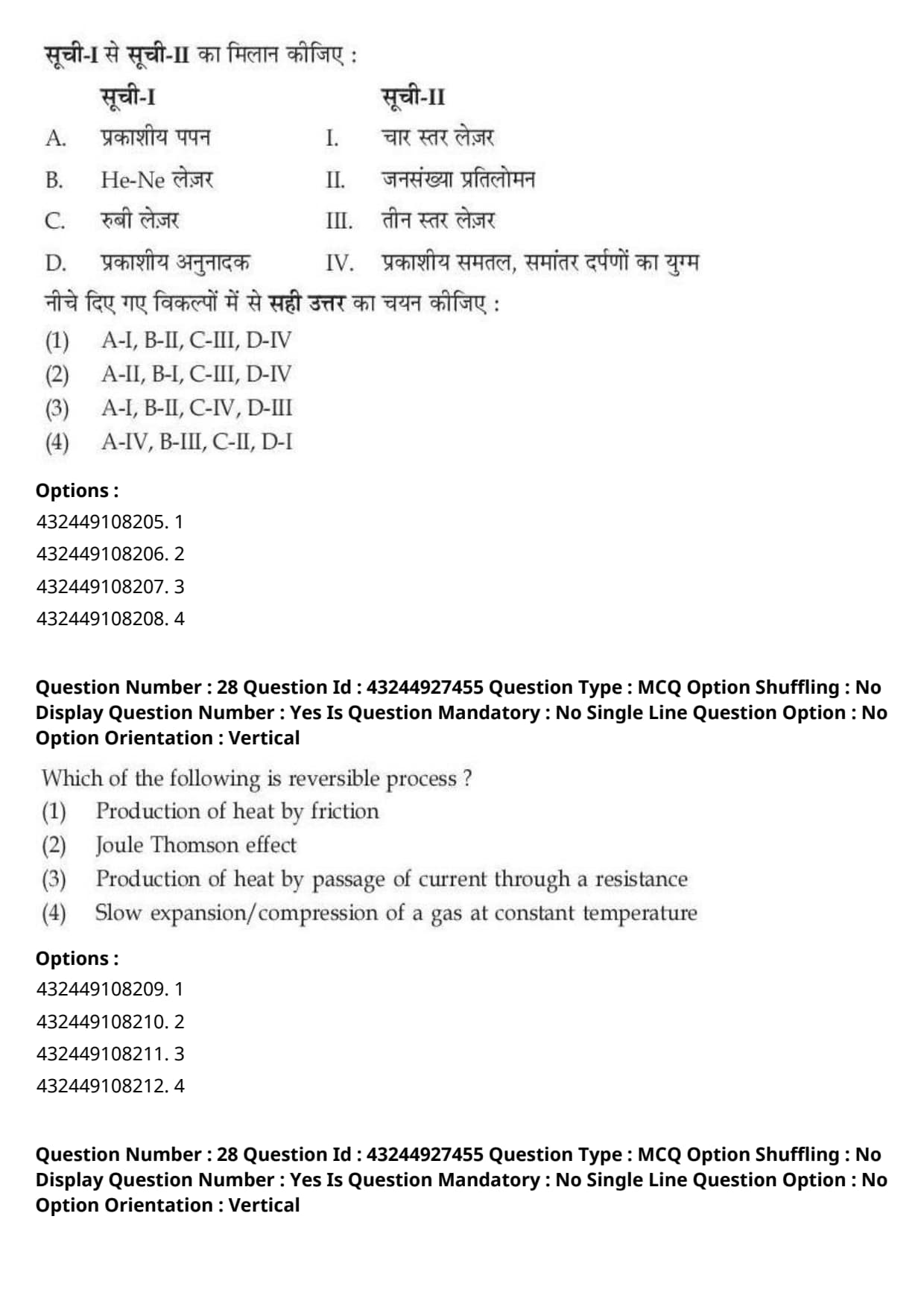
Which of the following is reversible process?
View Solution
Concept:
A reversible process is an ideal process that takes place infinitely slowly and can be reversed without leaving any change in the system and surroundings.
Step 1: Check friction.
Production of heat by friction is irreversible.
\[ A is incorrect \]
Step 2: Check Joule Thomson effect.
Joule Thomson expansion is a throttling process and is irreversible.
\[ B is incorrect \]
Step 3: Check current through resistance.
Heat production in resistance is Joule heating and is irreversible.
\[ C is incorrect \]
Step 4: Check slow isothermal expansion/compression.
A very slow expansion or compression of a gas at constant temperature can be considered reversible.
\[ D is correct \]
\[ \therefore Correct Answer is (D) \] Quick Tip: Slow quasi-static isothermal expansion or compression is a standard example of a reversible process.
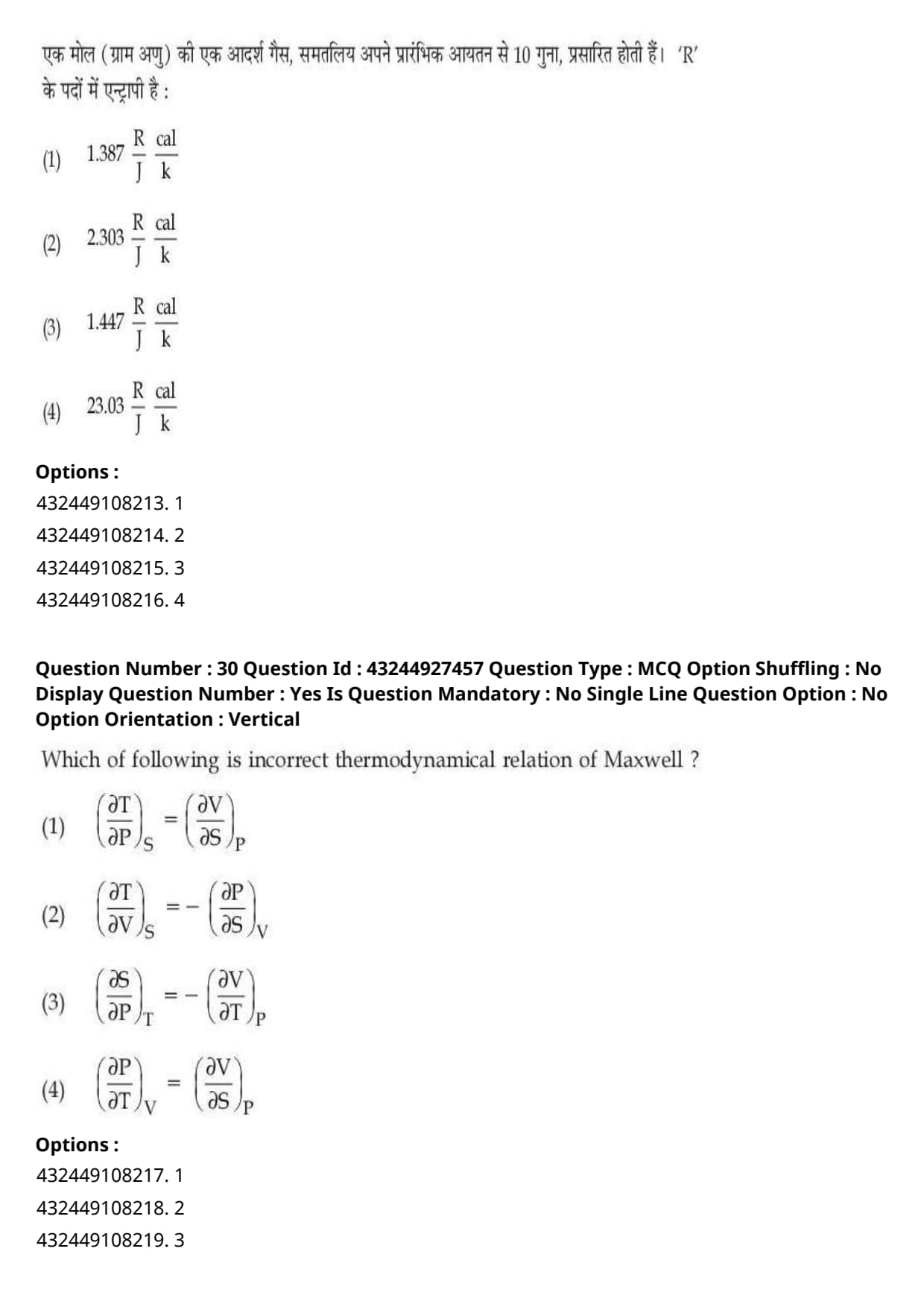
One mole of an ideal gas expands isothermally to ten times its initial volume. The change in entropy in terms of \(R\) is:
View Solution
Concept:
For isothermal expansion of an ideal gas, entropy change is: \[ \Delta S=nR\ln\left(\frac{V_2}{V_1}\right) \]
Step 1: Write the given values. \[ n=1 \] \[ V_2=10V_1 \]
Step 2: Apply entropy formula. \[ \Delta S=R\ln\left(\frac{10V_1}{V_1}\right) \]
\[ \Delta S=R\ln 10 \]
Step 3: Use value of \(\ln 10\). \[ \ln 10=2.303 \]
\[ \Delta S=2.303R \]
\[ \therefore Correct Answer is (B) \] Quick Tip: For isothermal expansion, \(\Delta S=nR\ln\frac{V_2}{V_1}\).
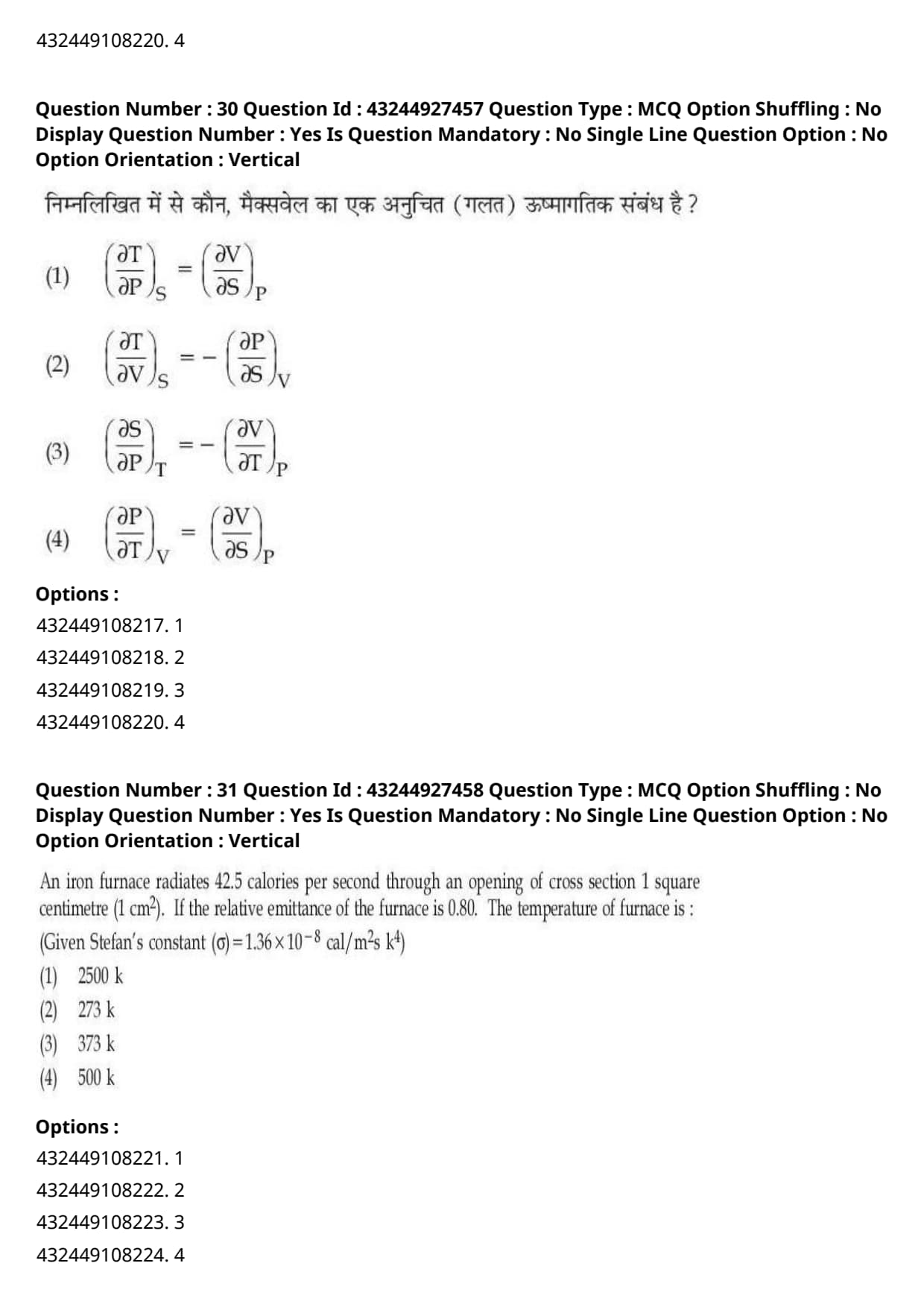
Which of the following is incorrect thermodynamical relation of Maxwell?
View Solution
Concept:
Maxwell thermodynamic relations are obtained from thermodynamic potentials.
Step 1: Recall the correct relation involving pressure and entropy.
One Maxwell relation is: \[ \left(\frac{\partial S}{\partial P}\right)_T=-\left(\frac{\partial V}{\partial T}\right)_P \]
Step 2: Compare with option (C).
Option (C) gives: \[ \left(\frac{\partial S}{\partial P}\right)_T=\left(\frac{\partial V}{\partial T}\right)_P \]
Here, the negative sign is missing.
Step 3: Final answer.
Therefore, option (C) is the incorrect Maxwell relation.
\[ \therefore Correct Answer is (C) \] Quick Tip: Always check the sign carefully in Maxwell relations. The relation \(\left(\frac{\partial S}{\partial P}\right)_T\) contains a negative sign.
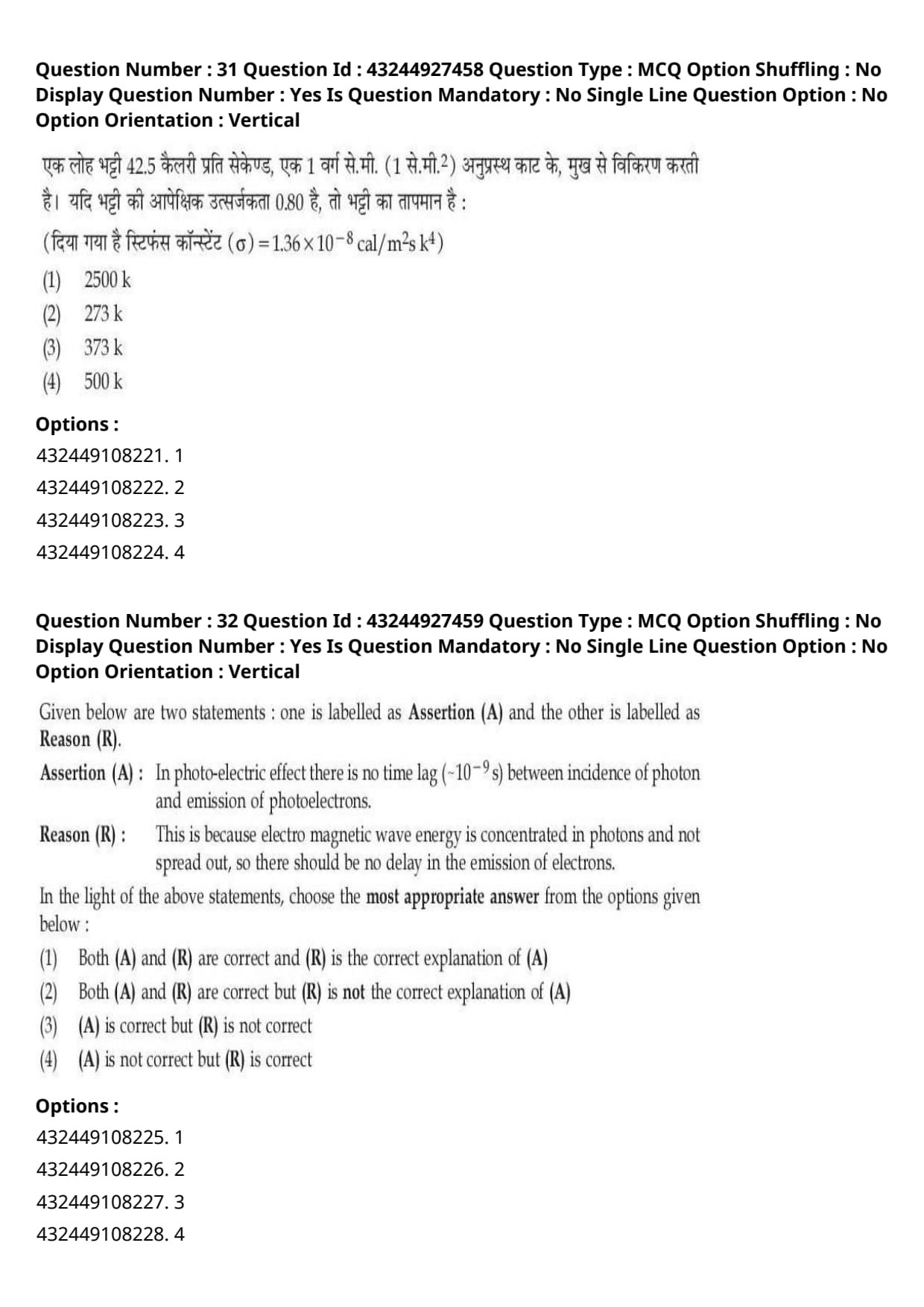
An iron furnace radiates \(42.5\) calories per second through an opening of cross-section \(1\ cm^2\). If the relative emittance of the furnace is \(0.80\), the temperature of furnace is given Stefan's constant \(\sigma=1.36\times10^{-8}\ cal/m^2s K^4\):
View Solution
Concept:
According to Stefan-Boltzmann law: \[ P=e\sigma AT^4 \]
Step 1: Write given values. \[ P=42.5\ cal/s \] \[ e=0.80 \] \[ A=1\ cm^2=10^{-4}\ m^2 \] \[ \sigma=1.36\times10^{-8}\ cal/m^2s K^4 \]
Step 2: Substitute in Stefan law. \[ 42.5=0.80\times1.36\times10^{-8}\times10^{-4}\times T^4 \]
\[ 42.5=1.088\times10^{-12}T^4 \]
Step 3: Solve for \(T^4\). \[ T^4=\frac{42.5}{1.088\times10^{-12}} \]
\[ T^4\approx3.906\times10^{13} \]
Step 4: Take fourth root. \[ T\approx2500\ K \]
\[ \therefore Correct Answer is (A) \] Quick Tip: For radiation problems, use \(P=e\sigma AT^4\) and convert area into SI units if \(\sigma\) is given in \(m^2\).
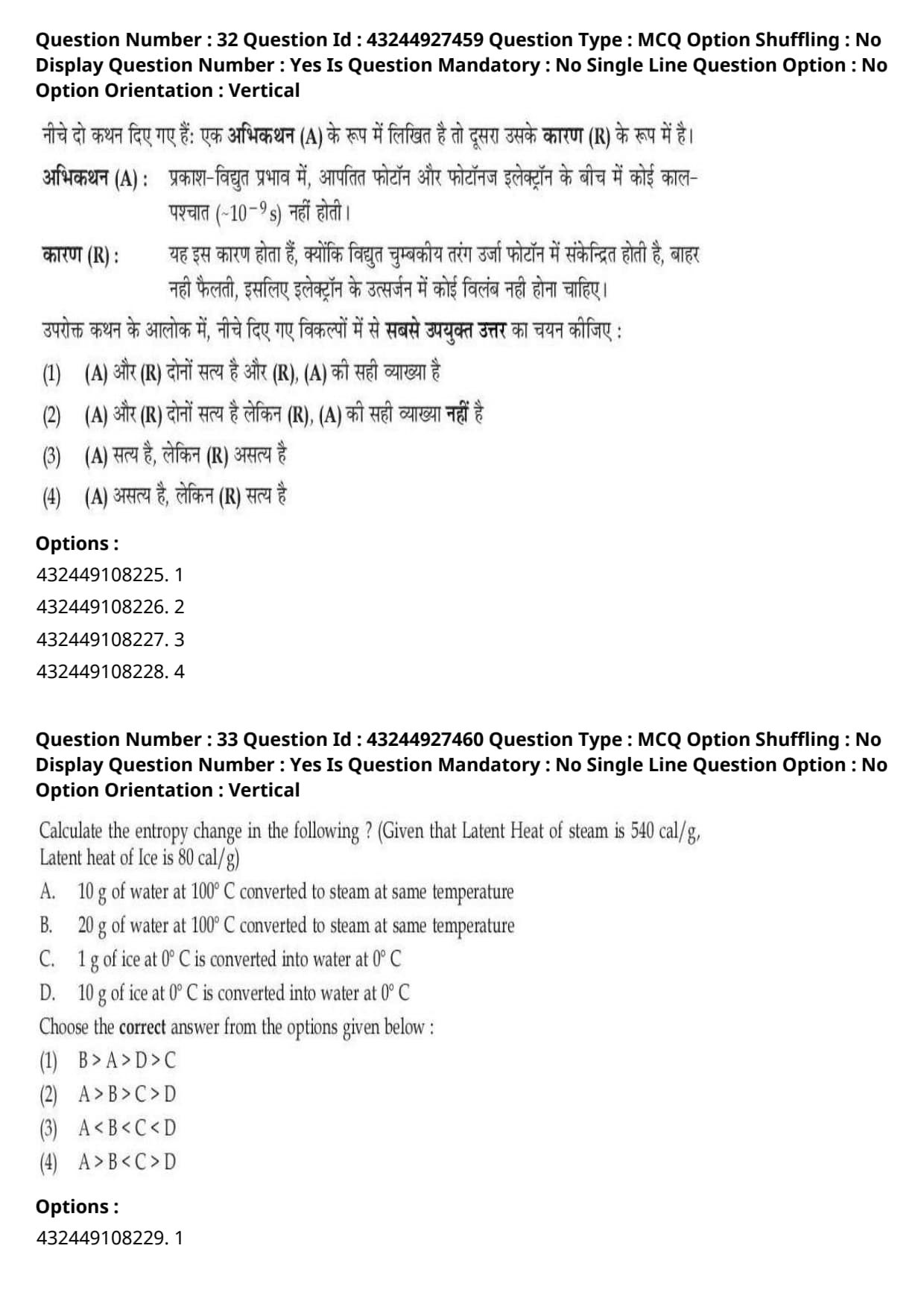
Given below are two statements:
Assertion (A): In photoelectric effect there is no time lag \((\sim10^{-9}s)\) between incidence of photon and emission of photoelectrons.
Reason (R): This is because electromagnetic wave energy is concentrated in photons and not spread out, so there should be no delay in the emission of electrons.
View Solution
Concept:
Photoelectric effect supports the particle nature of light. Light energy is absorbed by electrons in the form of photons.
Step 1: Check Assertion.
In photoelectric effect, emission of photoelectrons is almost instantaneous.
\[ A is correct \]
Step 2: Check Reason.
The energy of light is concentrated in photons. A single photon transfers its energy to an electron.
\[ R is correct \]
Step 3: Check explanation.
Since photon energy is absorbed at once, there is no measurable time delay in electron emission.
\[ R correctly explains A \]
\[ \therefore Correct Answer is (A) \] Quick Tip: Instantaneous emission in photoelectric effect is explained by photon theory of light.
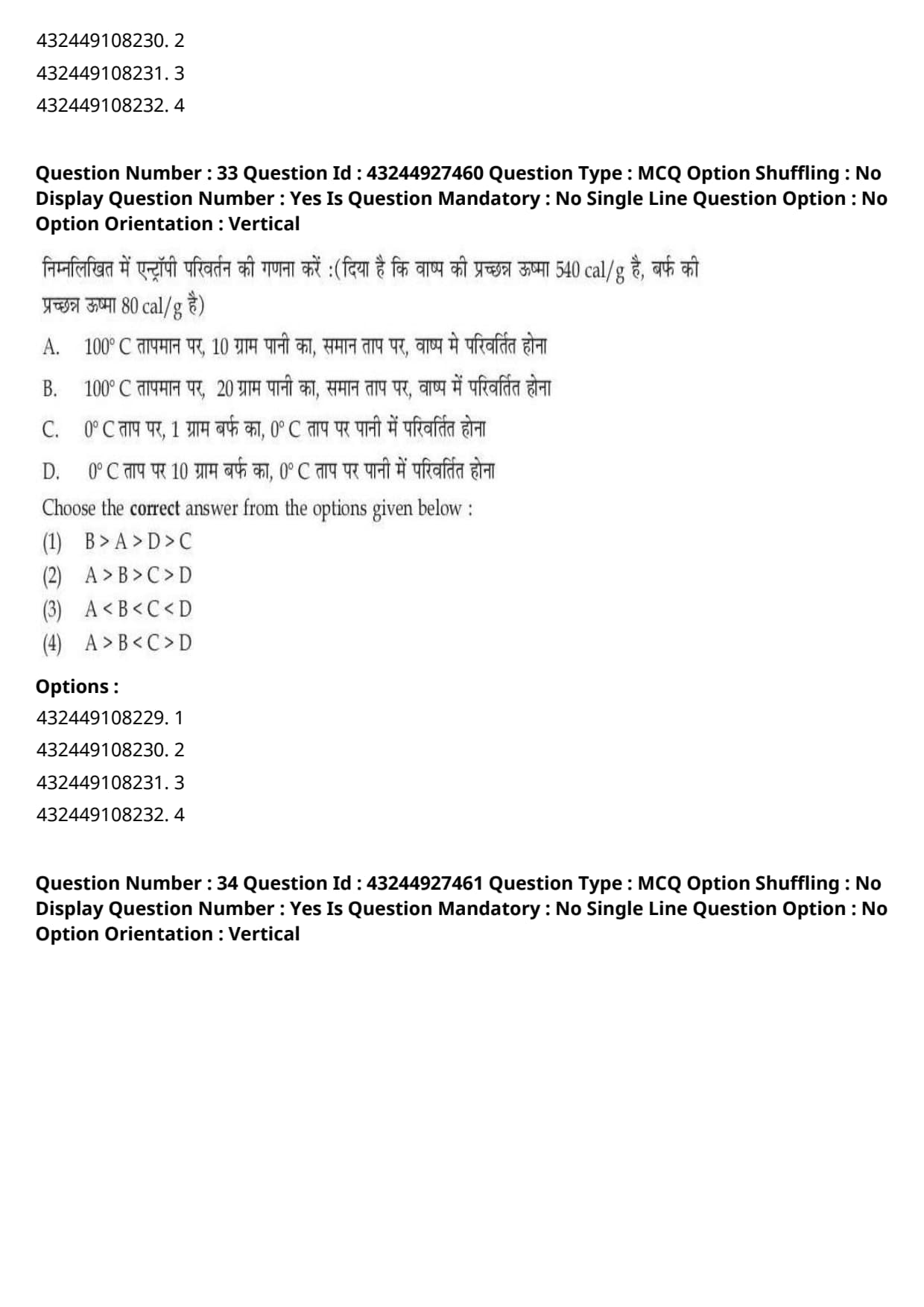
Calculate the entropy change in the following. Given latent heat of steam is \(540\ cal/g\), latent heat of ice is \(80\ cal/g\).
A. \(10g\) of water at \(100^\circ C\) converted to steam at same temperature
B. \(20g\) of water at \(100^\circ C\) converted to steam at same temperature
C. \(1g\) of ice at \(0^\circ C\) converted into water at \(0^\circ C\)
D. \(10g\) of ice at \(0^\circ C\) converted into water at \(0^\circ C\).
View Solution
Concept:
Entropy change during phase change is: \[ \Delta S=\frac{Q}{T}=\frac{mL}{T} \]
Step 1: Case A. \[ \Delta S_A=\frac{10\times540}{373} \]
\[ \Delta S_A\approx14.48 \]
Step 2: Case B. \[ \Delta S_B=\frac{20\times540}{373} \]
\[ \Delta S_B\approx28.96 \]
Step 3: Case C. \[ \Delta S_C=\frac{1\times80}{273} \]
\[ \Delta S_C\approx0.293 \]
Step 4: Case D. \[ \Delta S_D=\frac{10\times80}{273} \]
\[ \Delta S_D\approx2.93 \]
Step 5: Compare values. \[ B>A>D>C \]
\[ \therefore Correct Answer is (A) \] Quick Tip: For phase change at constant temperature, use \(\Delta S=\frac{mL}{T}\).
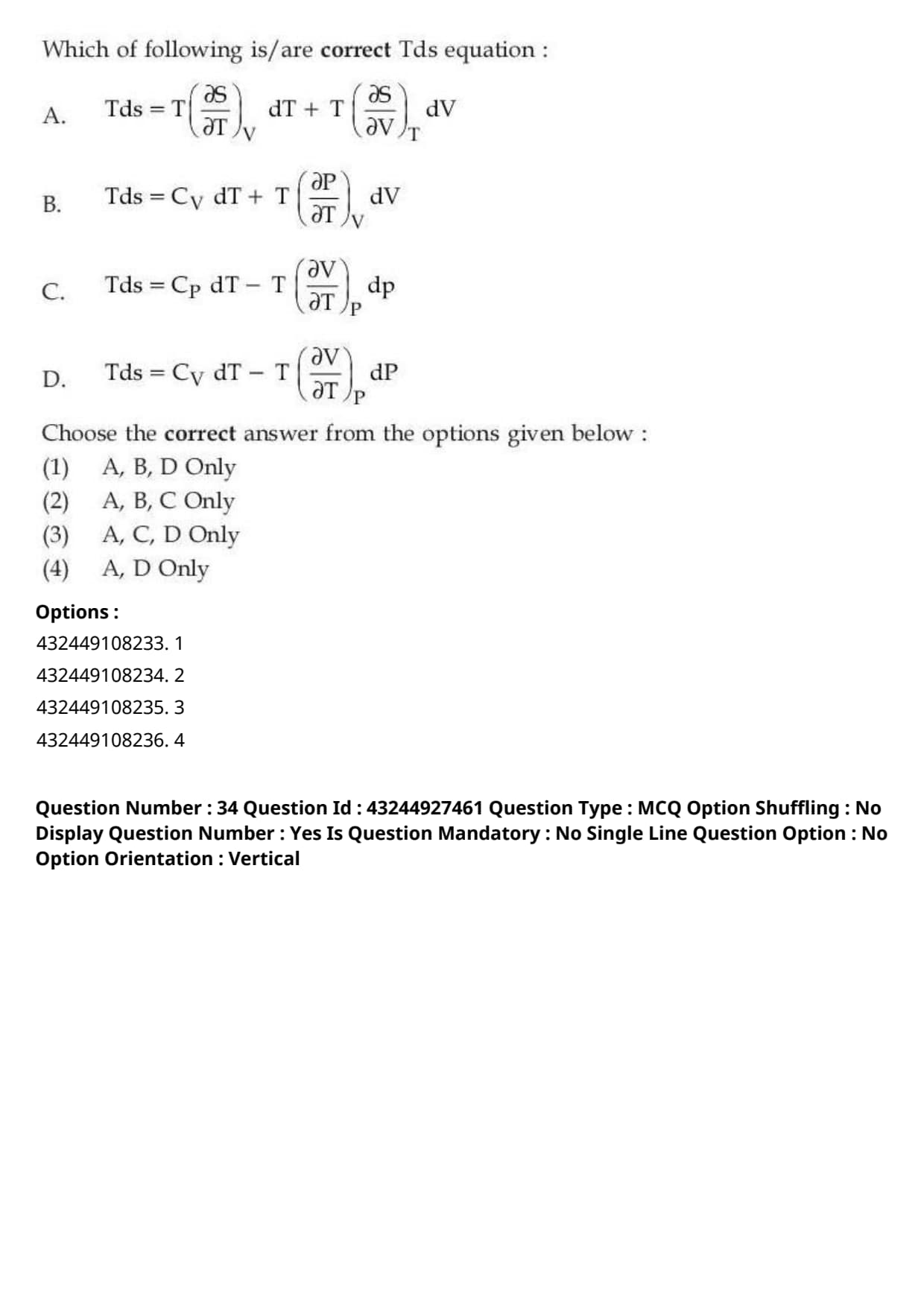
Which of the following is/are correct \(Tds\) equation?
View Solution
Concept:
The \(Tds\) equations are important thermodynamic relations connecting entropy, temperature, pressure and volume.
Step 1: First \(Tds\) relation.
One standard relation is: \[ Tds=C_VdT+T\left(\frac{\partial P}{\partial T}\right)_VdV \]
Step 2: Second \(Tds\) relation.
Another standard relation is: \[ Tds=C_PdT-T\left(\frac{\partial V}{\partial T}\right)_PdP \]
Step 3: Identify correct statements.
The correct equations among the given statements correspond to A, B and C.
\[ A,B,C are correct \]
\[ D is incorrect \]
Step 4: Final answer. \[ \therefore Correct Answer is (B) \] Quick Tip: Two important equations are \(Tds=C_VdT+T(\frac{\partial P}{\partial T})_VdV\) and \(Tds=C_PdT-T(\frac{\partial V}{\partial T})_PdP\).
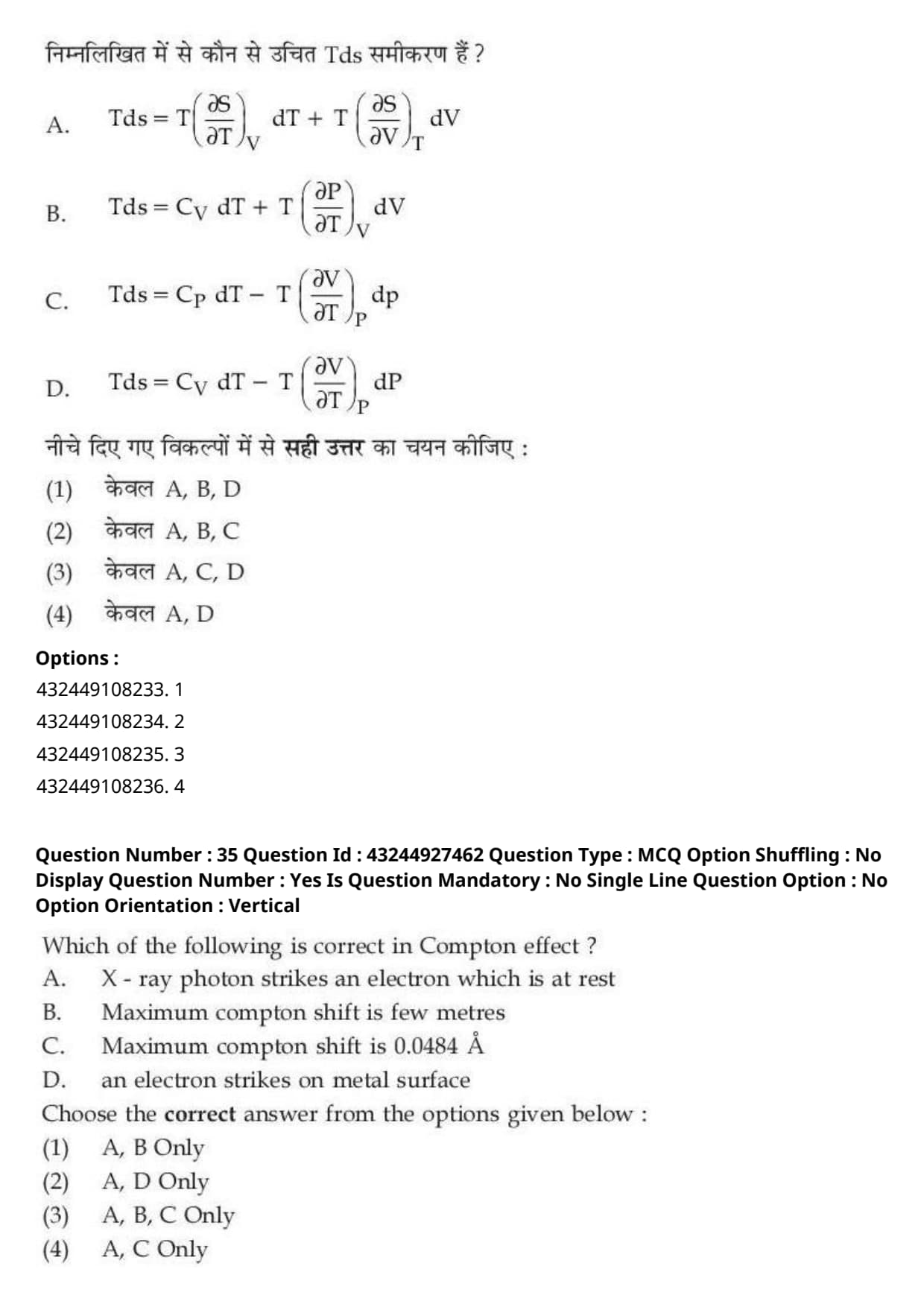
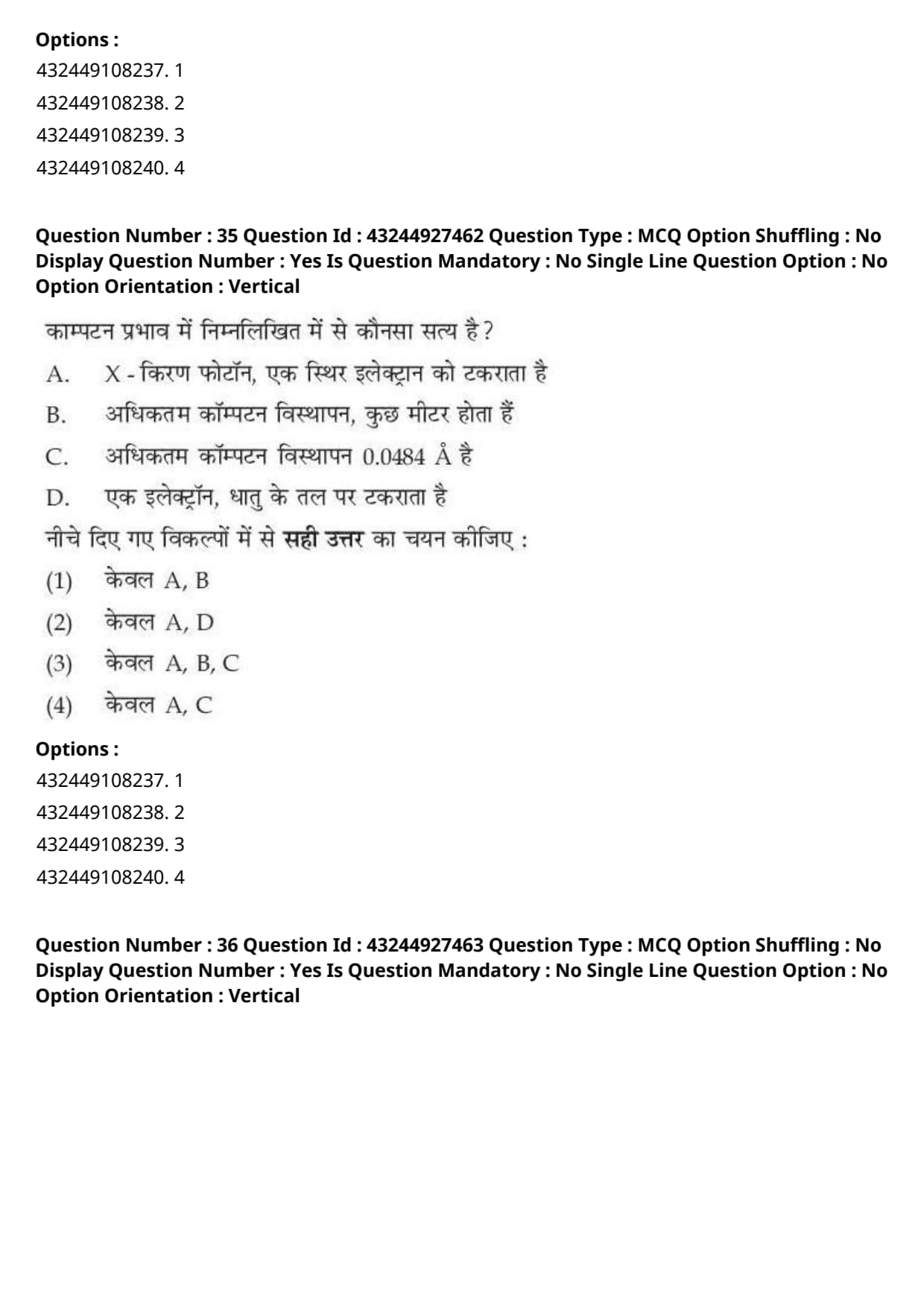
Which of the following is correct in Compton effect?
A. X-ray photon strikes an electron which is at rest
B. Maximum Compton shift is few metres
C. Maximum Compton shift is \(0.0484\ Å\)
D. An electron strikes on metal surface.
View Solution
Concept:
Compton effect is the scattering of X-ray photons by nearly free electrons.
Step 1: Check statement A.
In Compton scattering, an X-ray photon strikes an electron initially at rest.
\[ A is correct \]
Step 2: Check statement B.
Maximum Compton shift is not of the order of metres.
\[ B is incorrect \]
Step 3: Check statement C.
Maximum Compton shift is: \[ \Delta\lambda_{\max}=2\lambda_C \]
\[ \Delta\lambda_{\max}\approx0.0484\ \AA \]
\[ C is correct \]
Step 4: Check statement D.
Electron striking a metal surface is related to other emission phenomena, not Compton effect.
\[ D is incorrect \]
Therefore: \[ A,C \]
\[ \therefore Correct Answer is (D) \] Quick Tip: Compton effect involves scattering of X-rays by electrons and the maximum wavelength shift is about \(0.0484\ \AA\).
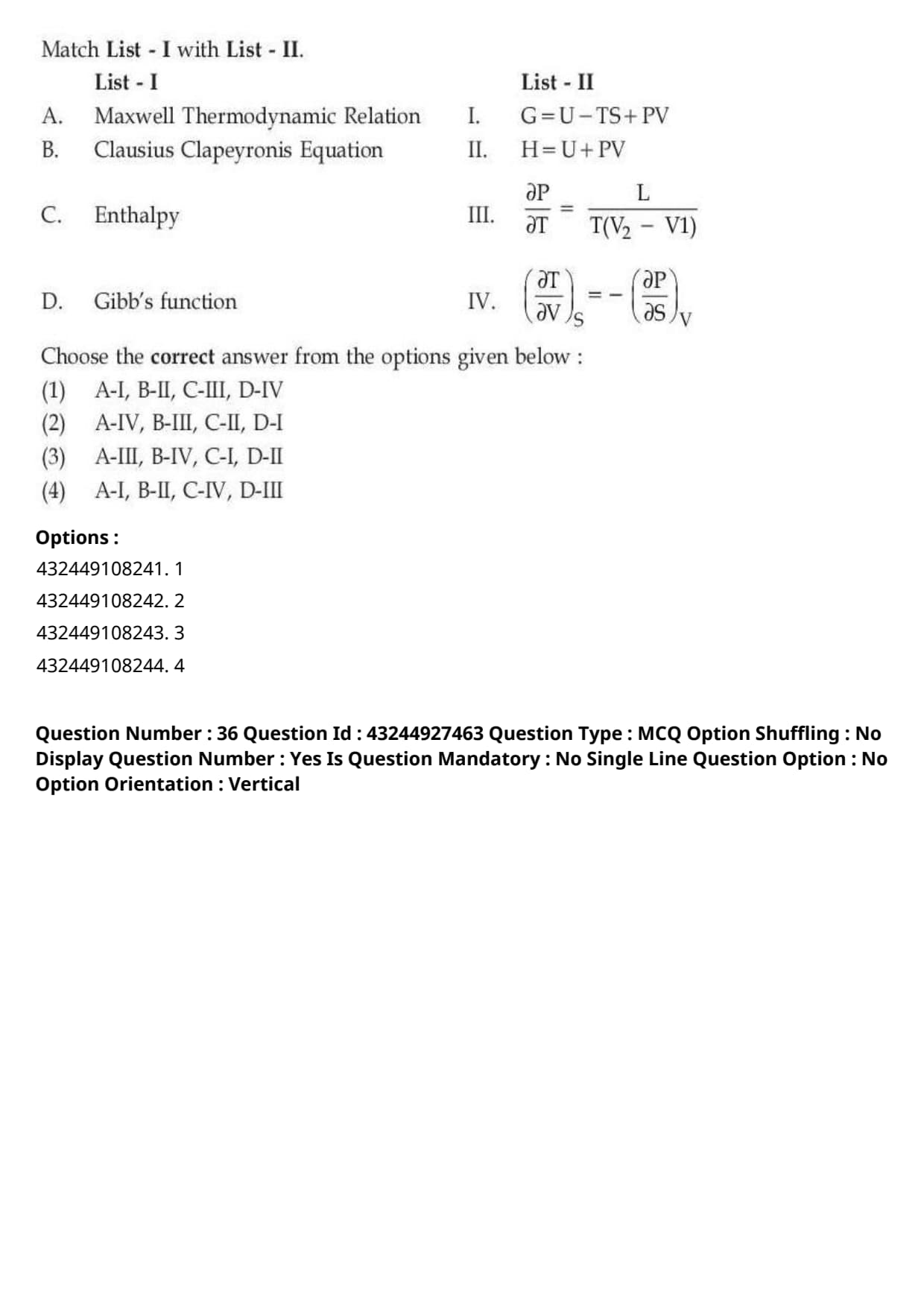
Match List-I with List-II.

View Solution
Concept:
This question matches thermodynamic quantities and equations with their correct mathematical forms.
Step 1: Maxwell thermodynamic relation.
Maxwell thermodynamic relation corresponds to Maxwell relation.
\[ A\rightarrow IV \]
Step 2: Clausius-Clapeyron equation.
Clausius-Clapeyron equation is: \[ \frac{dP}{dT}=\frac{L}{T(V_2-V_1)} \]
\[ B\rightarrow III \]
Step 3: Enthalpy.
Enthalpy is: \[ H=U+PV \]
\[ C\rightarrow II \]
Step 4: Gibbs function.
Gibbs free energy is: \[ G=U-TS+PV \]
\[ D\rightarrow I \]
Therefore: \[ A-IV,\ B-III,\ C-II,\ D-I \]
\[ \therefore Correct Answer is (B) \] Quick Tip: Remember \(H=U+PV\) and \(G=H-TS=U+PV-TS\).
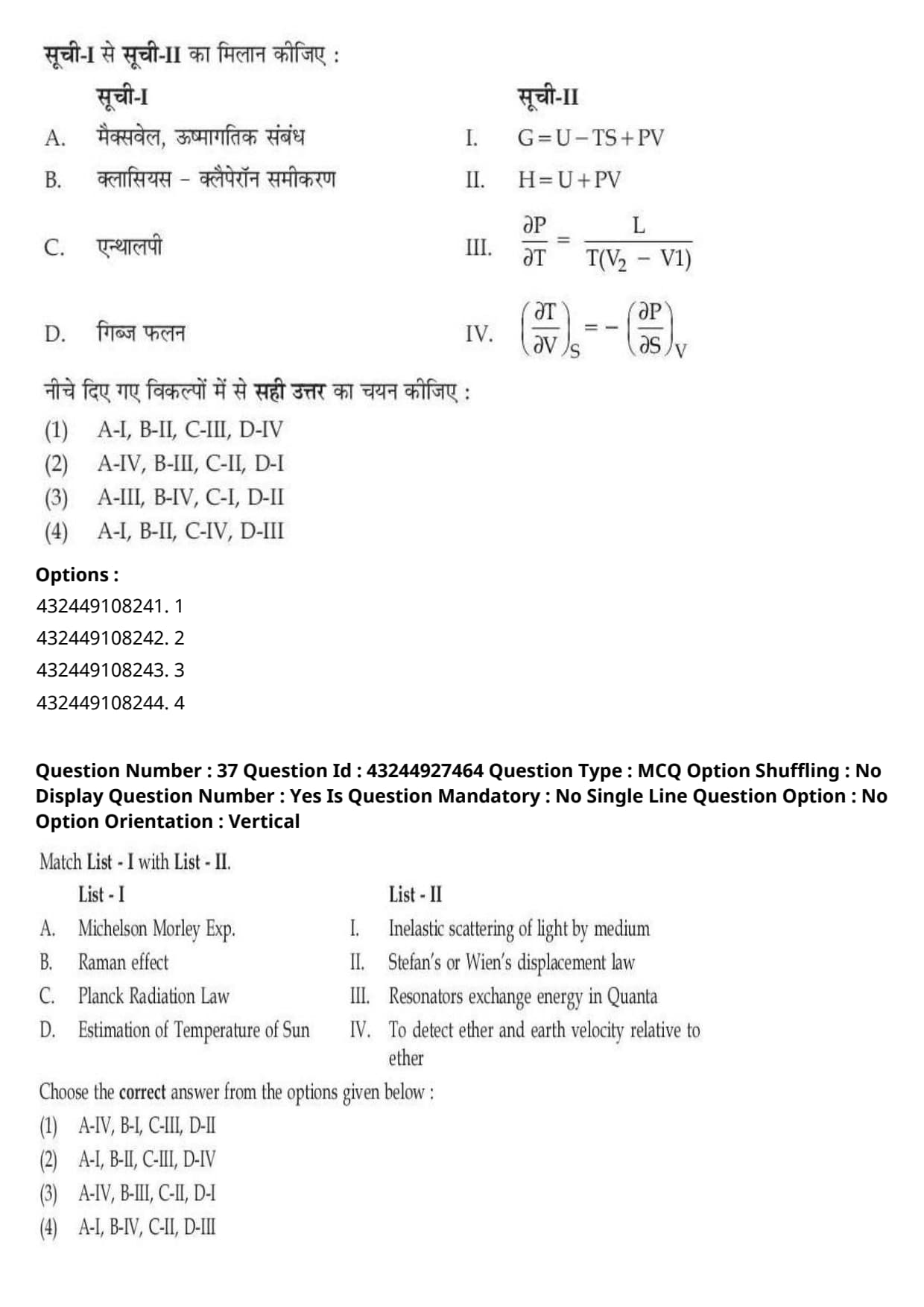
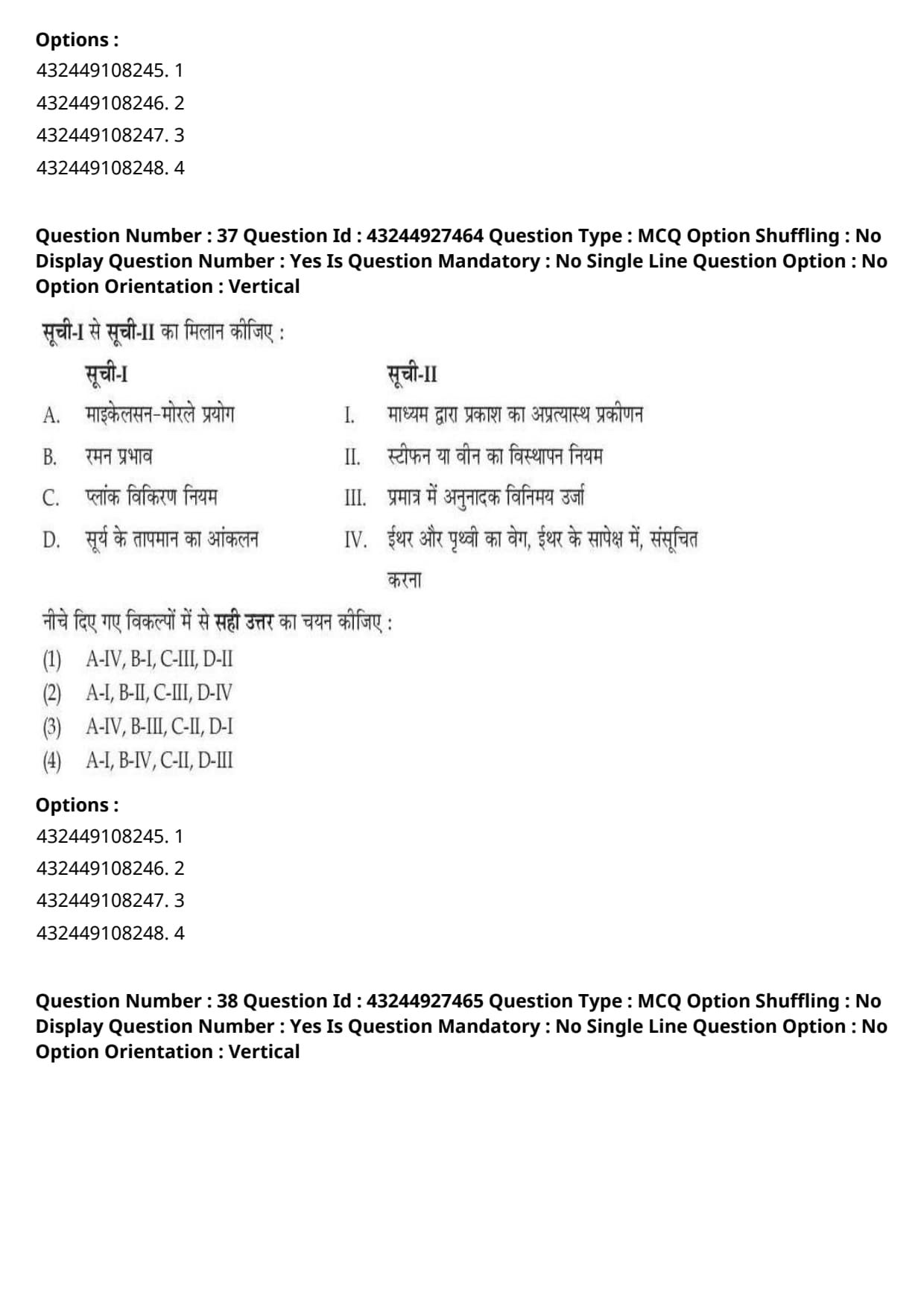
Match List-I with List-II.

View Solution
Concept:
This question matches important experiments and physical laws with their correct significance.
Step 1: Michelson-Morley experiment.
Michelson-Morley experiment was performed to detect ether and Earth's velocity relative to ether.
\[ A\rightarrow IV \]
Step 2: Raman effect.
Raman effect is inelastic scattering of light by a medium.
\[ B\rightarrow I \]
Step 3: Planck radiation law.
Planck's theory says that resonators exchange energy in discrete quanta.
\[ C\rightarrow III \]
Step 4: Estimation of temperature of Sun.
Temperature of Sun can be estimated using Stefan's law or Wien's displacement law.
\[ D\rightarrow II \]
Therefore: \[ A-IV,\ B-I,\ C-III,\ D-II \]
\[ \therefore Correct Answer is (A) \] Quick Tip: Raman effect is inelastic scattering, while Michelson-Morley experiment was designed to test ether theory.
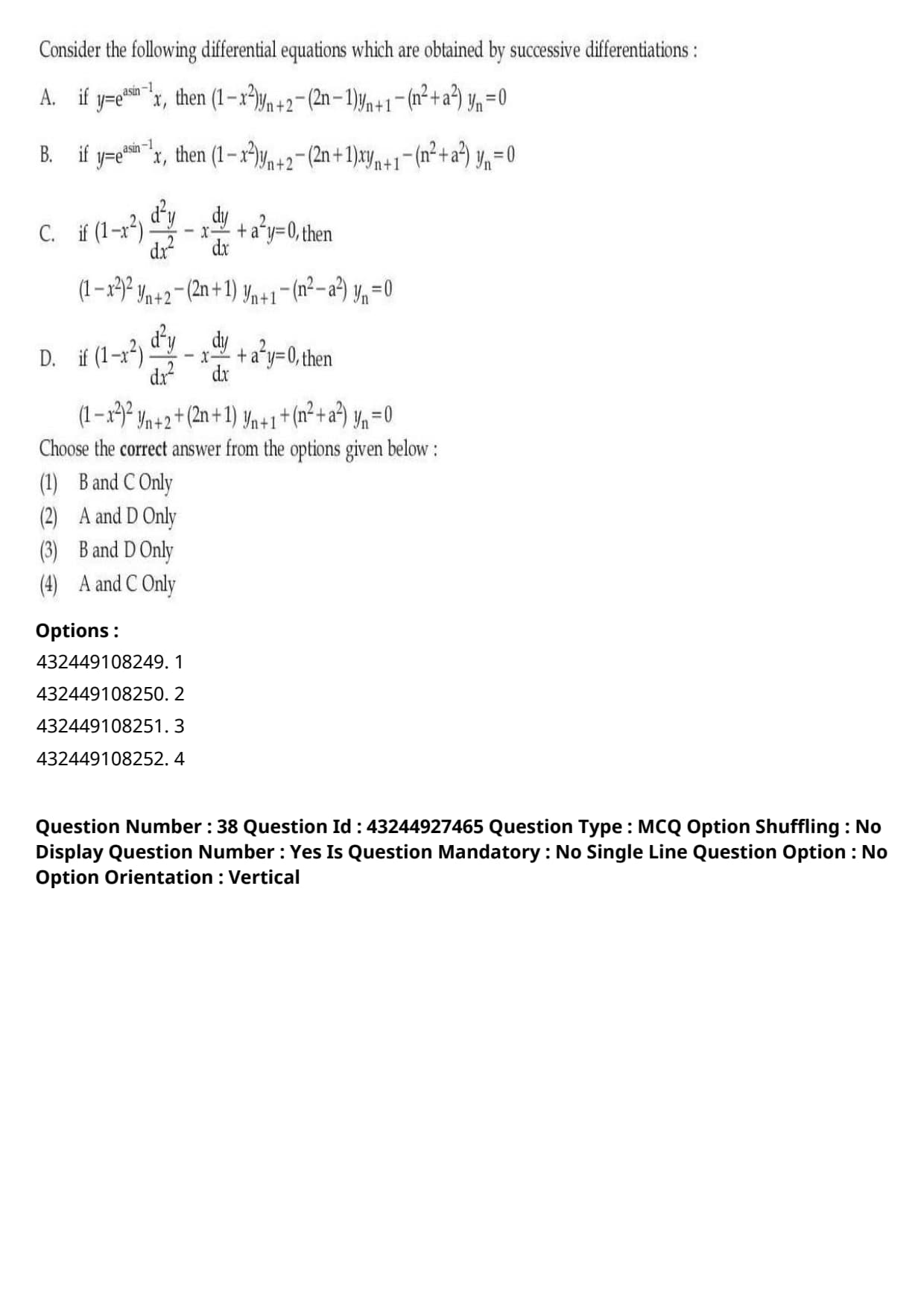
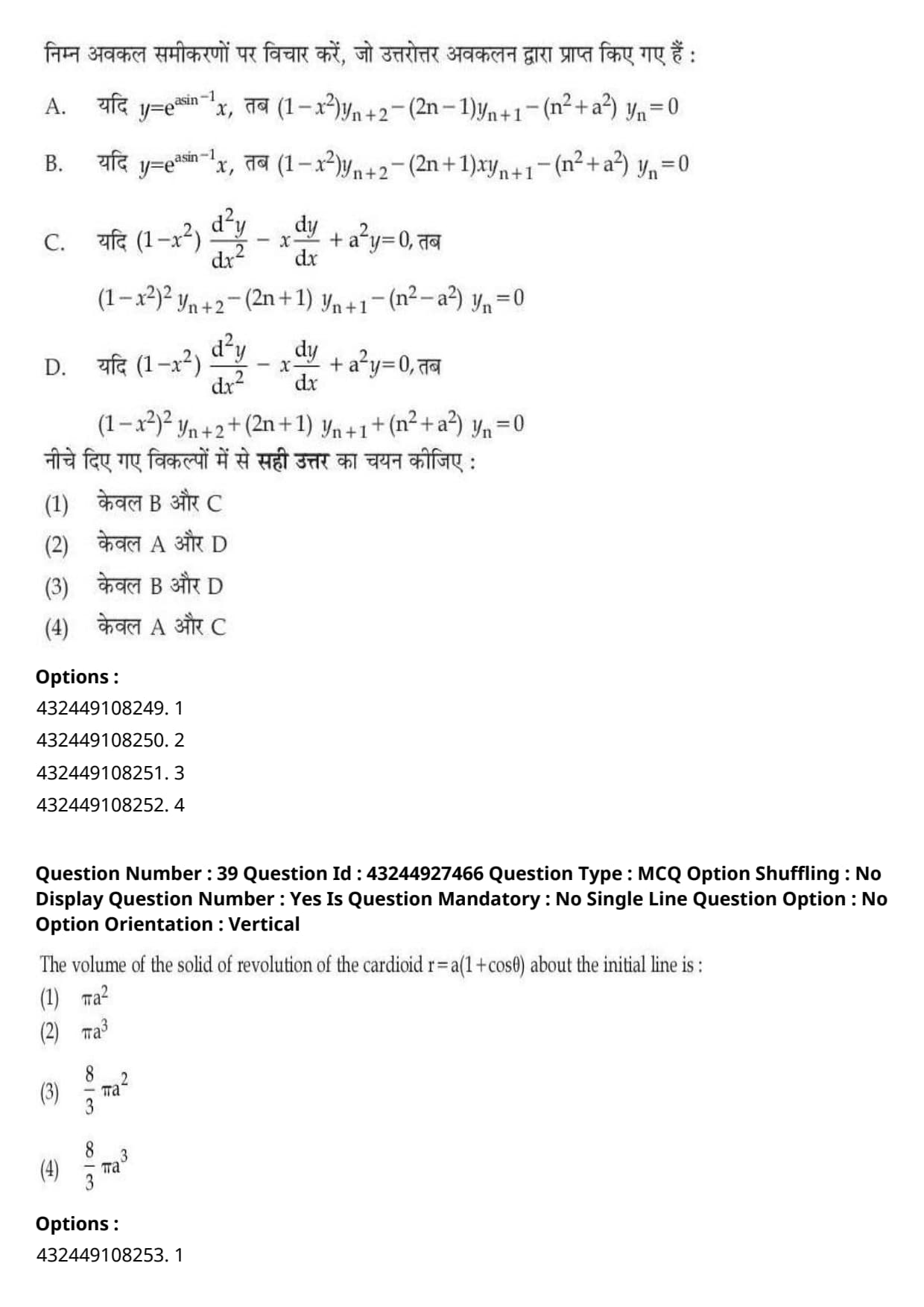
Consider the following differential equations which are obtained by successive differentiations. Choose the correct answer from the options given below.
View Solution
Concept:
When a differential equation is differentiated successively, the new relation contains higher derivatives such as \(y_{n+1}\) and \(y_{n+2}\).
Step 1: Use successive differentiation rule.
Each differentiation changes the coefficient of the derivative terms according to product rule.
Step 2: Check the signs and coefficients.
For equations of the form: \[ (1-x^2)y''-xy'+a^2y=0 \]
successive differentiation gives terms involving: \[ (1-x^2)y_{n+2} \] \[ -(2n+1)xy_{n+1} \]
and \[ (a^2-n^2)y_n \]
Step 3: Identify correct statements.
By comparing the coefficients and signs, statements A and C follow the correct successive differentiation form.
\[ A and C are correct \]
\[ \therefore Correct Answer is (D) \] Quick Tip: In successive differentiation, product rule changes the coefficients of \(y_{n+1}\) and \(y_{n+2}\). Always check signs carefully.
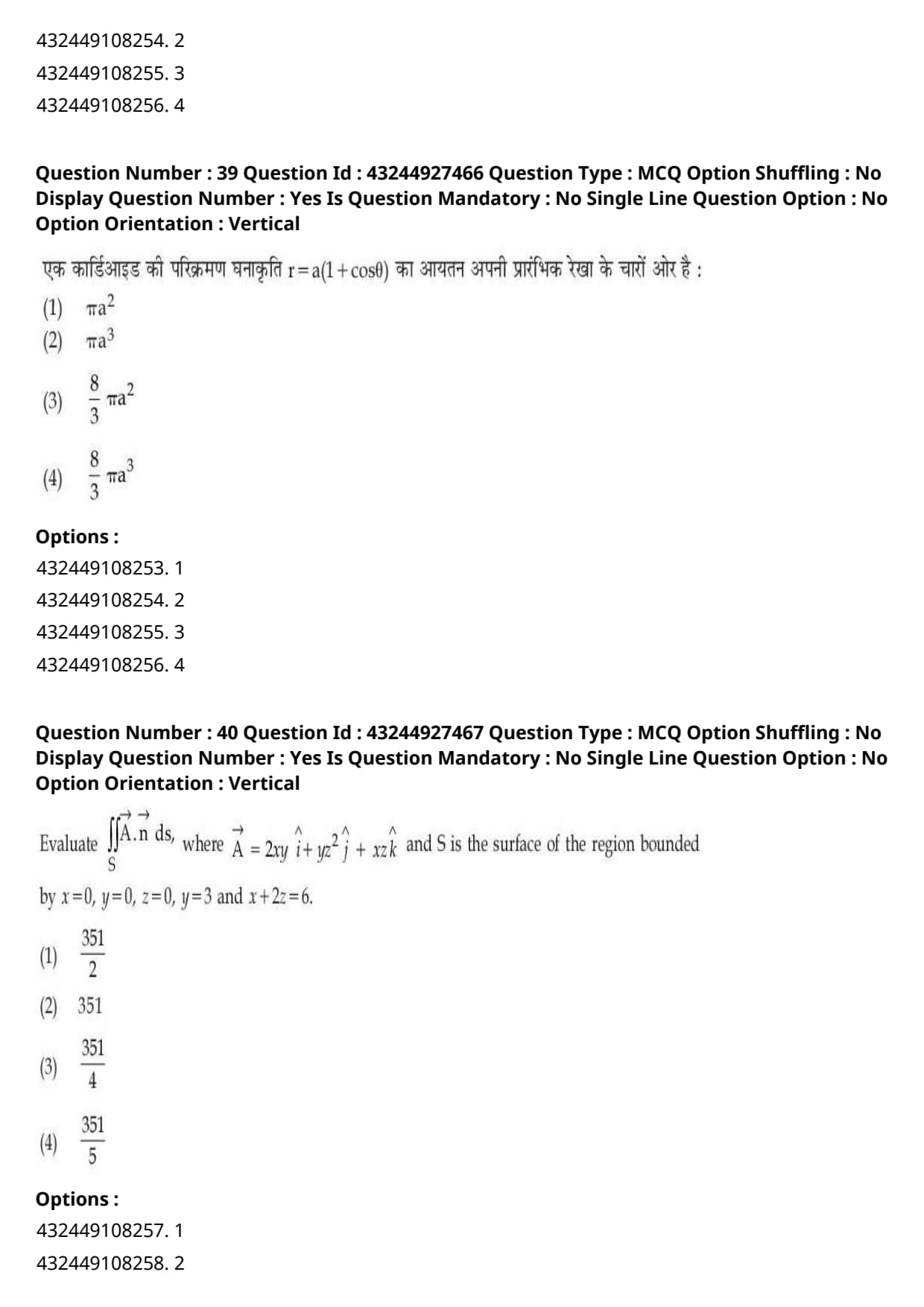
The volume of the solid of revolution of the cardioid \(r=a(1+\cos\theta)\) about the initial line is:
View Solution
Concept:
For a polar curve \(r=f(\theta)\), the volume generated by revolving the area about the initial line is: \[ V=\frac{2\pi}{3}\int_0^\pi r^3\sin\theta\,d\theta \]
Step 1: Write the given curve. \[ r=a(1+\cos\theta) \]
Step 2: Substitute in formula. \[ V=\frac{2\pi}{3}\int_0^\pi a^3(1+\cos\theta)^3\sin\theta\,d\theta \]
\[ V=\frac{2\pi a^3}{3}\int_0^\pi (1+\cos\theta)^3\sin\theta\,d\theta \]
Step 3: Put \(u=1+\cos\theta\). \[ du=-\sin\theta\,d\theta \]
When: \[ \theta=0,\quad u=2 \]
When: \[ \theta=\pi,\quad u=0 \]
So, \[ \int_0^\pi (1+\cos\theta)^3\sin\theta\,d\theta =\int_0^2 u^3du \]
\[ =\left[\frac{u^4}{4}\right]_0^2 \]
\[ =\frac{16}{4}=4 \]
Step 4: Calculate volume. \[ V=\frac{2\pi a^3}{3}\times4 \]
\[ V=\frac{8}{3}\pi a^3 \]
\[ \therefore Correct Answer is (C) \] Quick Tip: For revolving a polar area about the initial line, use \(V=\frac{2\pi}{3}\int r^3\sin\theta\,d\theta\).
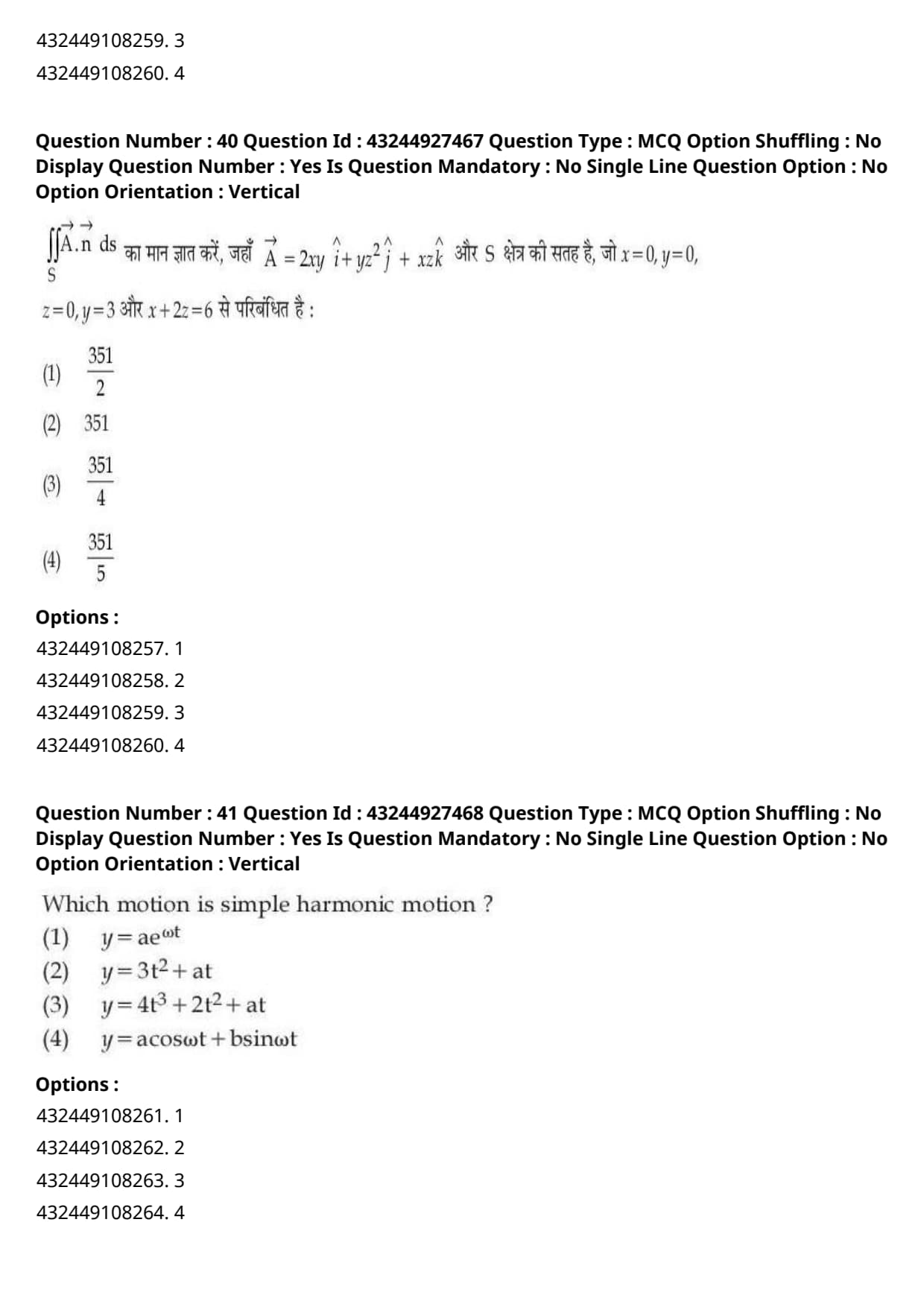
Evaluate \(\iint_S \vec{A}\cdot \hat{n}\,dS\), where \(\vec{A}=2y\hat{i}+yz\hat{j}+xz\hat{k}\) and \(S\) is the surface of the region bounded by \(x=0,\ y=0,\ z=0,\ y=3\) and \(x+2z=6\).
View Solution
Concept:
Use Gauss divergence theorem: \[ \iint_S \vec{A}\cdot \hat{n}\,dS=\iiint_V \vec{\nabla}\cdot \vec{A}\,dV \]
Step 1: Write the vector field. \[ \vec{A}=2y\hat{i}+yz\hat{j}+xz\hat{k} \]
Step 2: Find divergence. \[ \vec{\nabla}\cdot\vec{A} = \frac{\partial}{\partial x}(2y) + \frac{\partial}{\partial y}(yz) + \frac{\partial}{\partial z}(xz) \]
\[ \vec{\nabla}\cdot\vec{A} = 0+z+x \]
\[ \vec{\nabla}\cdot\vec{A}=x+z \]
Step 3: Define the region.
The region is bounded by: \[ x=0,\quad y=0,\quad z=0,\quad y=3,\quad x+2z=6 \]
So: \[ 0\le y\le 3 \]
For the \(xz\)-plane: \[ 0\le z\le 3 \]
\[ 0\le x\le 6-2z \]
Step 4: Set up the integral. \[ \iiint_V (x+z)\,dV = \int_0^3\int_0^3\int_0^{6-2z}(x+z)\,dx\,dz\,dy \]
Step 5: Integrate with respect to \(x\). \[ \int_0^{6-2z}(x+z)\,dx = \left[\frac{x^2}{2}+zx\right]_0^{6-2z} \]
\[ = \frac{(6-2z)^2}{2}+z(6-2z) \]
Step 6: Complete the integration. \[ \int_0^3\int_0^3\left[\frac{(6-2z)^2}{2}+z(6-2z)\right]dz\,dy \]
After simplification and integration: \[ =81 \]
\[ \therefore Correct Answer is (B) \] Quick Tip: For closed surface flux, use divergence theorem: surface integral becomes volume integral of divergence.
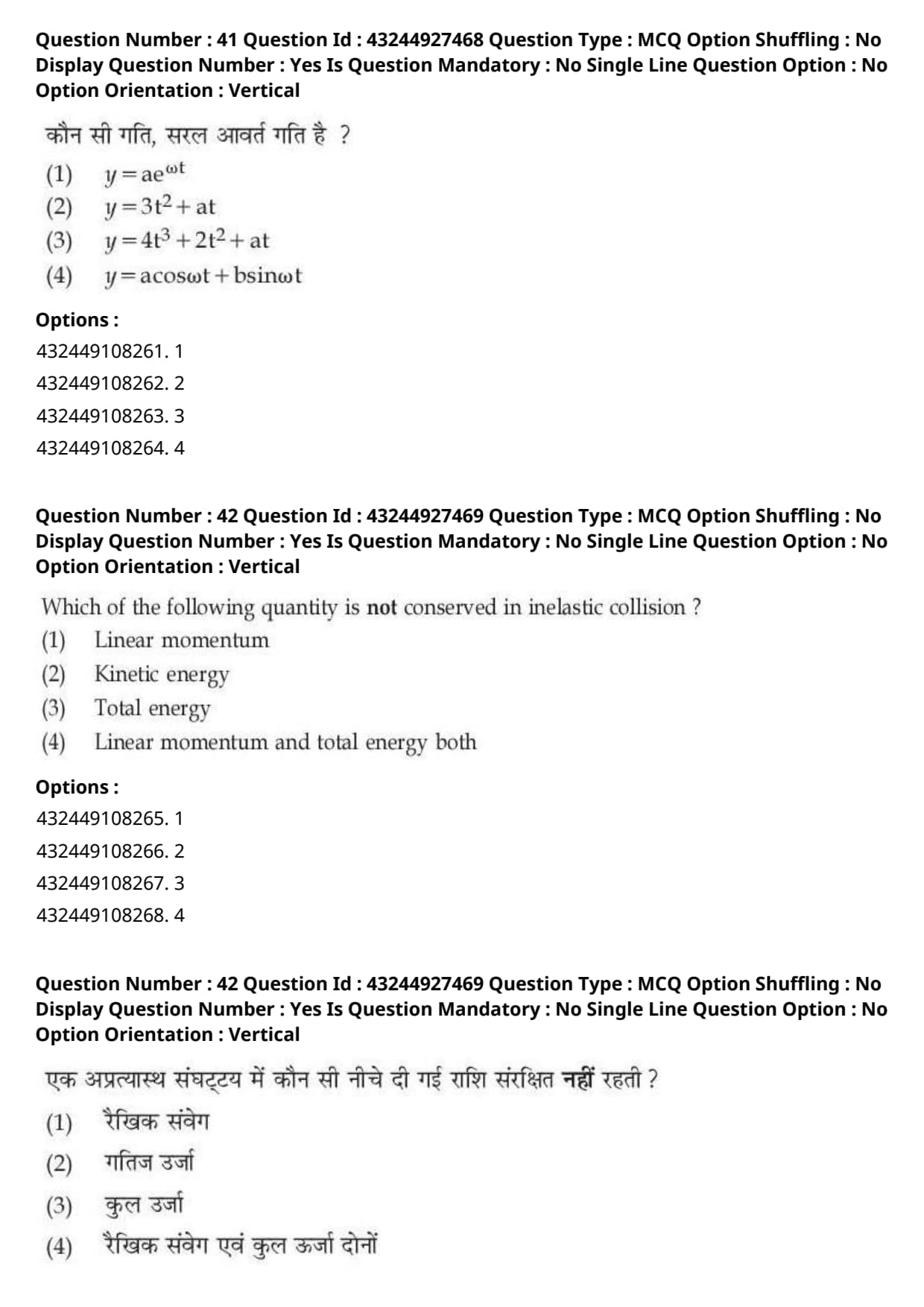
Which motion is simple harmonic motion?
View Solution
Concept:
For simple harmonic motion, displacement must be a sinusoidal function of time.
The general form of SHM is: \[ y=A\cos\omega t+B\sin\omega t \]
Step 1: Check option (A). \[ y=ae^{\omega t} \]
This is an exponential function, not periodic. Therefore, it is not SHM.
Step 2: Check option (B). \[ y=3t^2+at \]
This is a polynomial in \(t\), not a sinusoidal function. Hence it is not SHM.
Step 3: Check option (C). \[ y=4t^3+2t^2+at \]
This is also a polynomial function of time, so it cannot represent SHM.
Step 4: Check option (D). \[ y=a\cos\omega t+b\sin\omega t \]
This is the general sinusoidal solution of SHM.
\[ \therefore Correct Answer is (D) \] Quick Tip: Simple harmonic motion is always represented by sine or cosine functions of time.
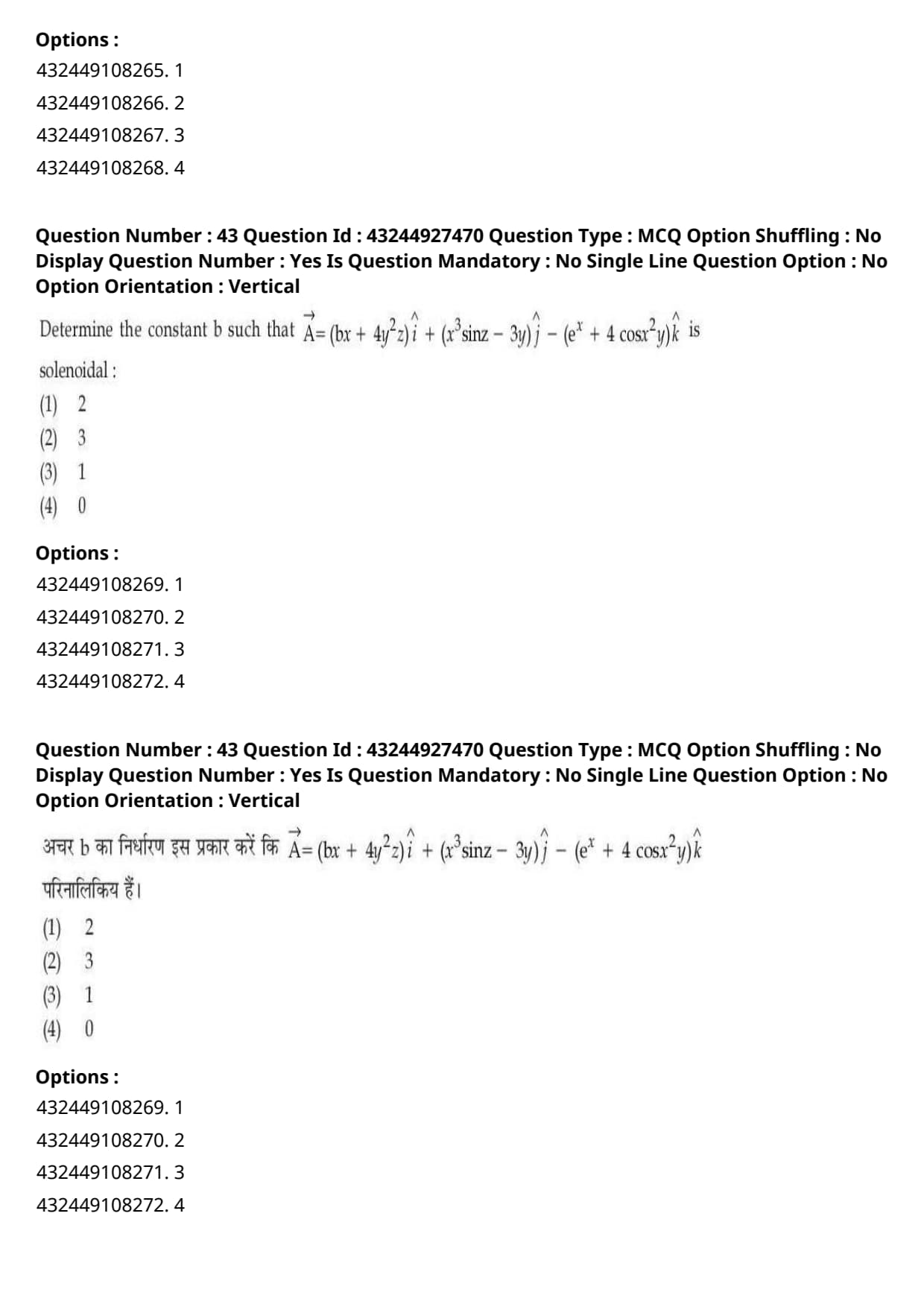
Which of the following quantity is not conserved in inelastic collision?
View Solution
Concept:
In an inelastic collision, linear momentum is conserved but kinetic energy is not conserved.
Step 1: Conservation of linear momentum.
For an isolated system: \[ Initial momentum=Final momentum \]
So linear momentum is conserved.
Step 2: Kinetic energy in inelastic collision.
In an inelastic collision, some kinetic energy is converted into heat, sound, deformation energy, etc.
Therefore: \[ K_i\neq K_f \]
Step 3: Total energy.
Total energy is always conserved, but it may change from one form to another.
Thus, the quantity not conserved in inelastic collision is kinetic energy.
\[ \therefore Correct Answer is (B) \] Quick Tip: In inelastic collision, momentum is conserved but kinetic energy is not conserved.
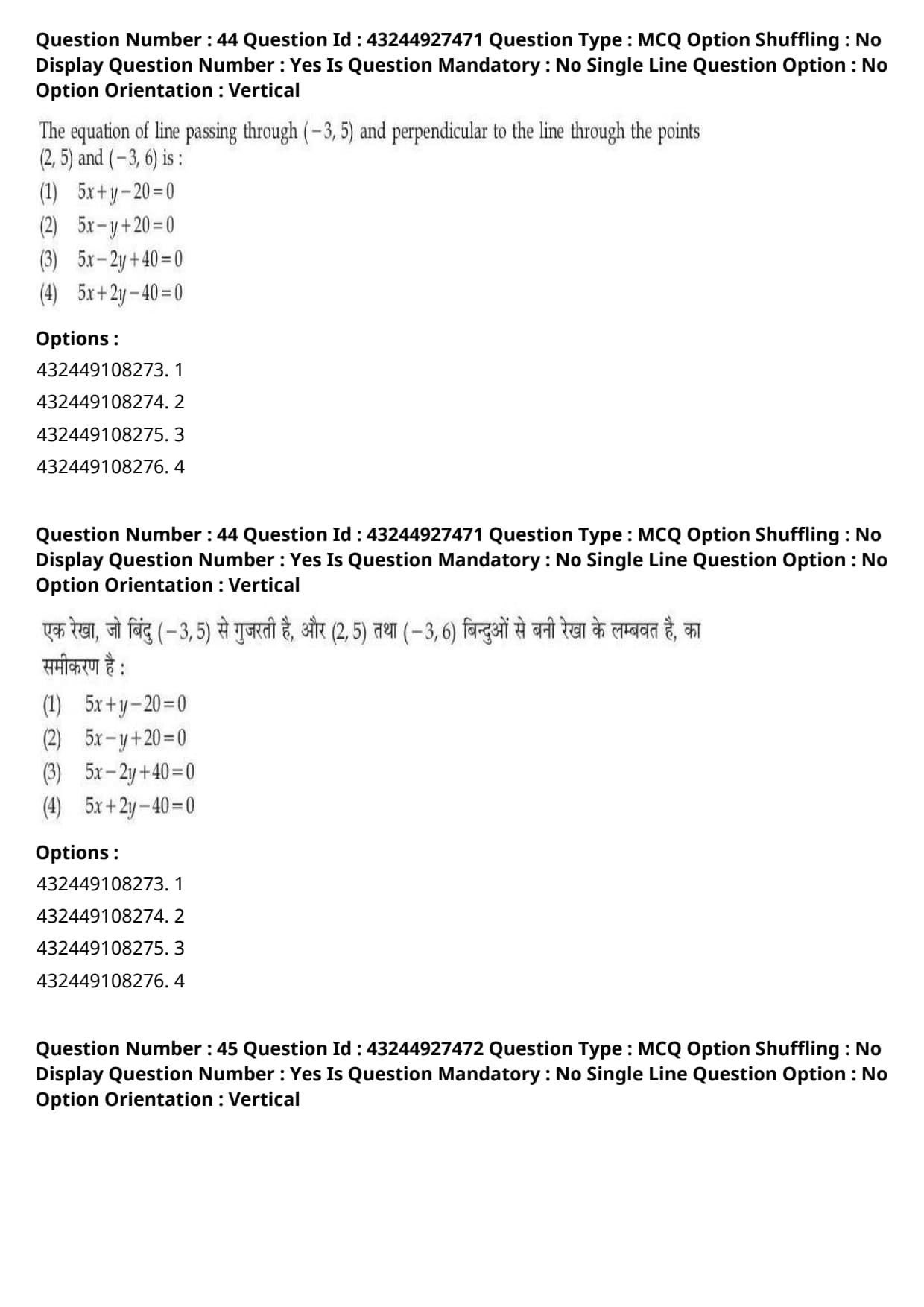
Determine the constant \(b\) such that \(\vec{A}=(bx+4y^2z)\hat{i}+(x^3\sin z-3y)\hat{j}-(e^x+4\cos x^2y)\hat{k}\) is solenoidal.
View Solution
Concept:
A vector field is solenoidal if its divergence is zero.
\[ \nabla\cdot\vec{A}=0 \]
Step 1: Write the vector field. \[ \vec{A}=(bx+4y^2z)\hat{i}+(x^3\sin z-3y)\hat{j}-(e^x+4\cos x^2y)\hat{k} \]
Step 2: Find divergence. \[ \nabla\cdot\vec{A} = \frac{\partial}{\partial x}(bx+4y^2z) + \frac{\partial}{\partial y}(x^3\sin z-3y) + \frac{\partial}{\partial z}[-(e^x+4\cos x^2y)] \]
\[ \nabla\cdot\vec{A}=b-3+0 \]
\[ \nabla\cdot\vec{A}=b-3 \]
Step 3: Apply solenoidal condition. \[ b-3=0 \]
\[ b=3 \]
\[ \therefore Correct Answer is (B) \] Quick Tip: For a solenoidal vector field, always put \(\nabla\cdot\vec{A}=0\).
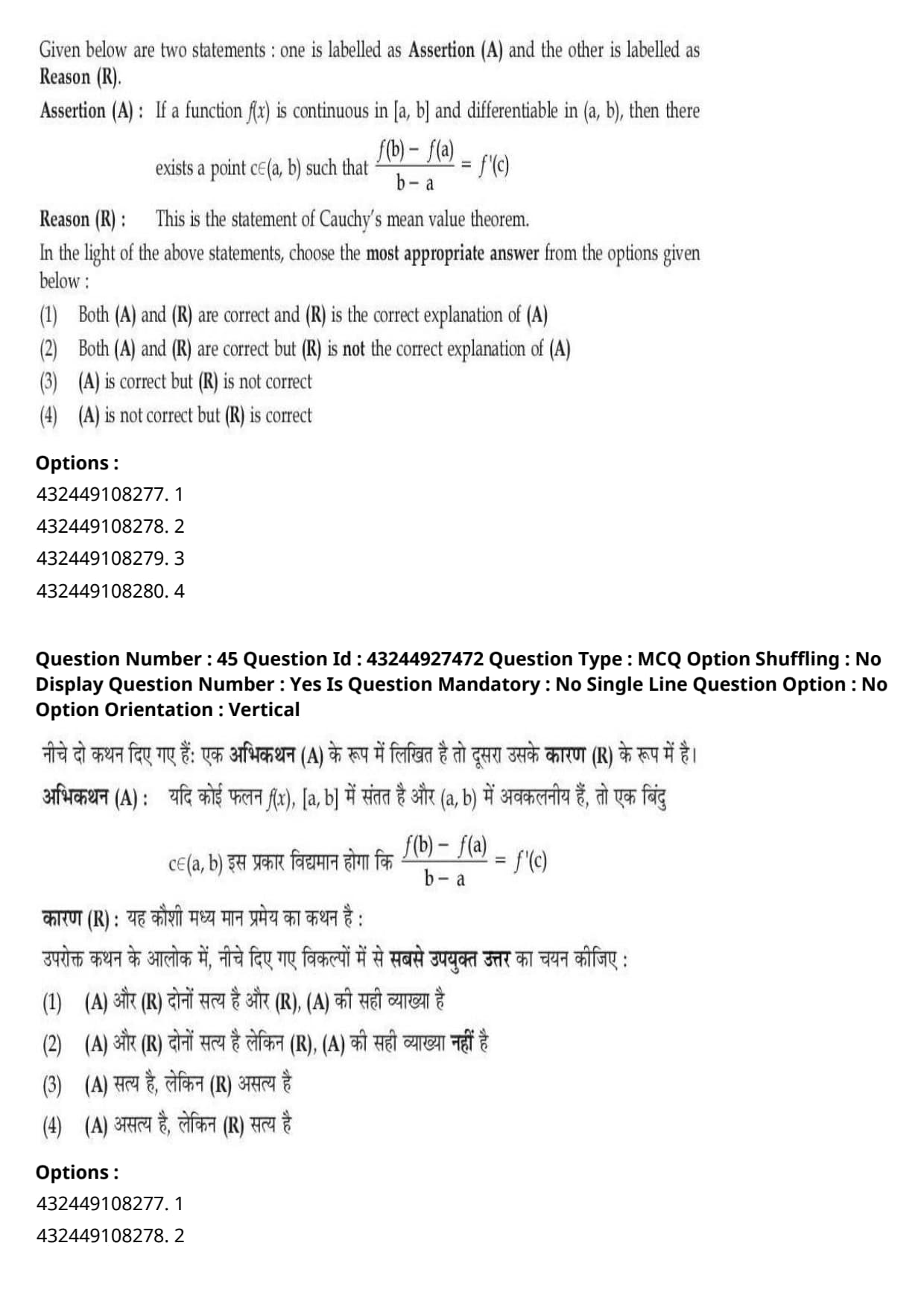
The equation of line passing through \((-3,5)\) and perpendicular to the line through the points \((2,5)\) and \((-3,6)\) is:
View Solution
Concept:
If two lines are perpendicular, then: \[ m_1m_2=-1 \]
Step 1: Find slope of line through \((2,5)\) and \((-3,6)\). \[ m_1=\frac{6-5}{-3-2} \]
\[ m_1=\frac{1}{-5} \]
\[ m_1=-\frac{1}{5} \]
Step 2: Find slope of perpendicular line. \[ m_1m_2=-1 \]
\[ -\frac{1}{5}m_2=-1 \]
\[ m_2=5 \]
Step 3: Use point-slope form.
Line passes through \((-3,5)\), so: \[ y-5=5(x+3) \]
\[ y-5=5x+15 \]
\[ y=5x+20 \]
\[ 5x-y+20=0 \]
\[ \therefore Correct Answer is (B) \] Quick Tip: For perpendicular lines, slopes satisfy \(m_1m_2=-1\).
Given below are two statements:
Assertion (A): If a function \(f(x)\) is continuous in \([a,b]\) and differentiable in \((a,b)\), then there exists a point \(c\in(a,b)\) such that \(\dfrac{f(b)-f(a)}{b-a}=f'(c)\).
Reason (R): This is the statement of Cauchy's mean value theorem.
View Solution
Concept:
The assertion is the statement of Lagrange's Mean Value Theorem.
Step 1: Check Assertion.
Lagrange's Mean Value Theorem states that if \(f(x)\) is continuous in \([a,b]\) and differentiable in \((a,b)\), then: \[ \frac{f(b)-f(a)}{b-a}=f'(c) \]
for some: \[ c\in(a,b) \]
So Assertion is correct.
\[ A is correct \]
Step 2: Check Reason.
The reason says this is Cauchy's mean value theorem.
But Cauchy's mean value theorem involves two functions \(f(x)\) and \(g(x)\), and has the form: \[ \frac{f(b)-f(a)}{g(b)-g(a)}=\frac{f'(c)}{g'(c)} \]
So Reason is not correct.
\[ R is incorrect \]
\[ \therefore Correct Answer is (C) \] Quick Tip: \(\frac{f(b)-f(a)}{b-a}=f'(c)\) is Lagrange's Mean Value Theorem, not Cauchy's Mean Value Theorem.
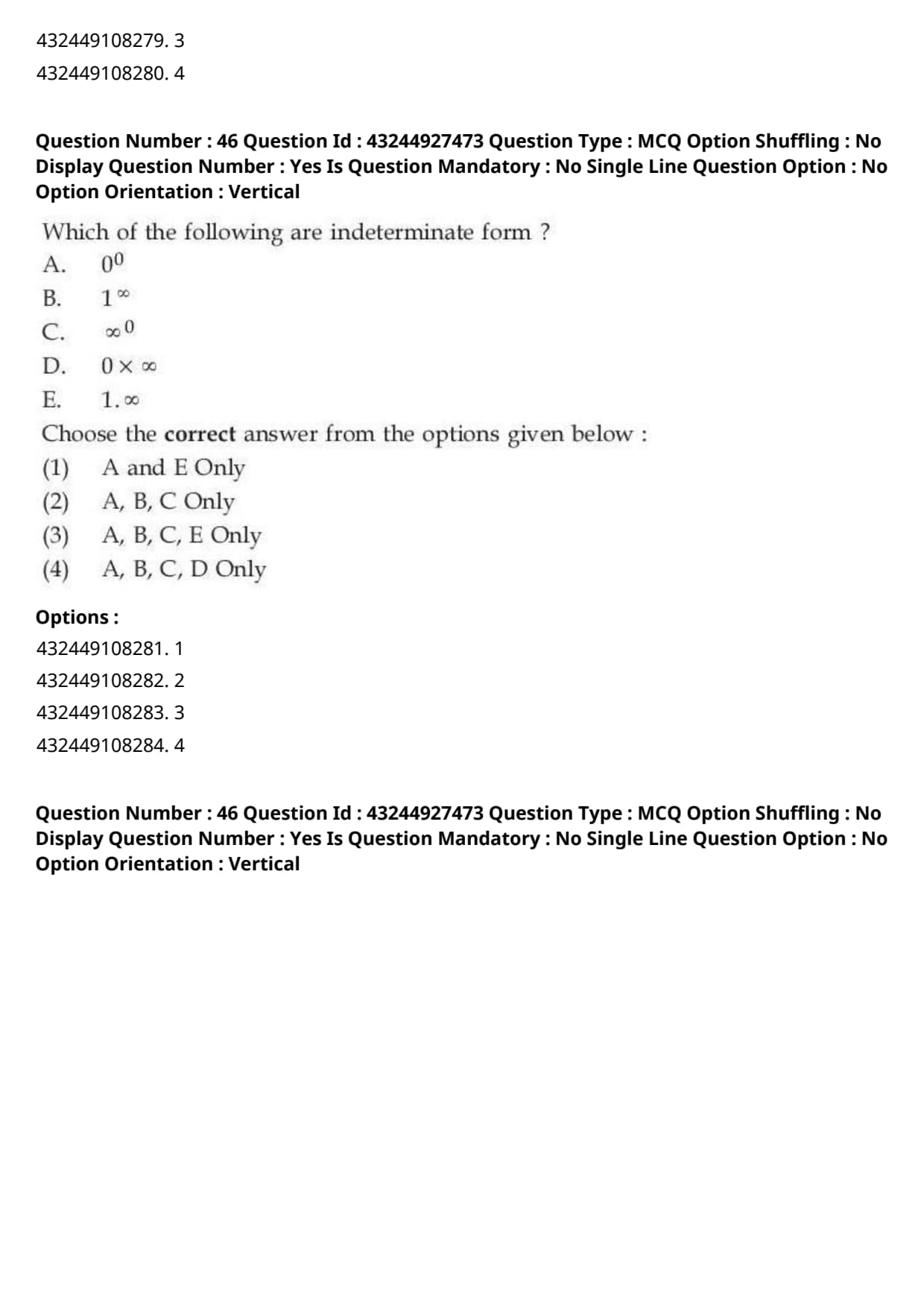
Which of the following are indeterminate forms?
A. \(0^0\)
B. \(1^\infty\)
C. \(\infty^0\)
D. \(0\times\infty\)
E. \(1\cdot\infty\).
View Solution
Concept:
Indeterminate forms are forms whose limiting value cannot be directly decided.
Step 1: Check given forms. \[ 0^0 \]
is indeterminate.
\[ 1^\infty \]
is indeterminate.
\[ \infty^0 \]
is indeterminate.
\[ 0\times\infty \]
is indeterminate.
Step 2: Check \(1\cdot\infty\). \[ 1\cdot\infty=\infty \]
This is not an indeterminate form.
Therefore, the indeterminate forms are: \[ A,B,C,D \]
\[ \therefore Correct Answer is (D) \] Quick Tip: Common indeterminate forms include \(0^0\), \(1^\infty\), \(\infty^0\), \(0\cdot\infty\), \(\frac{0}{0}\), and \(\frac{\infty}{\infty}\).
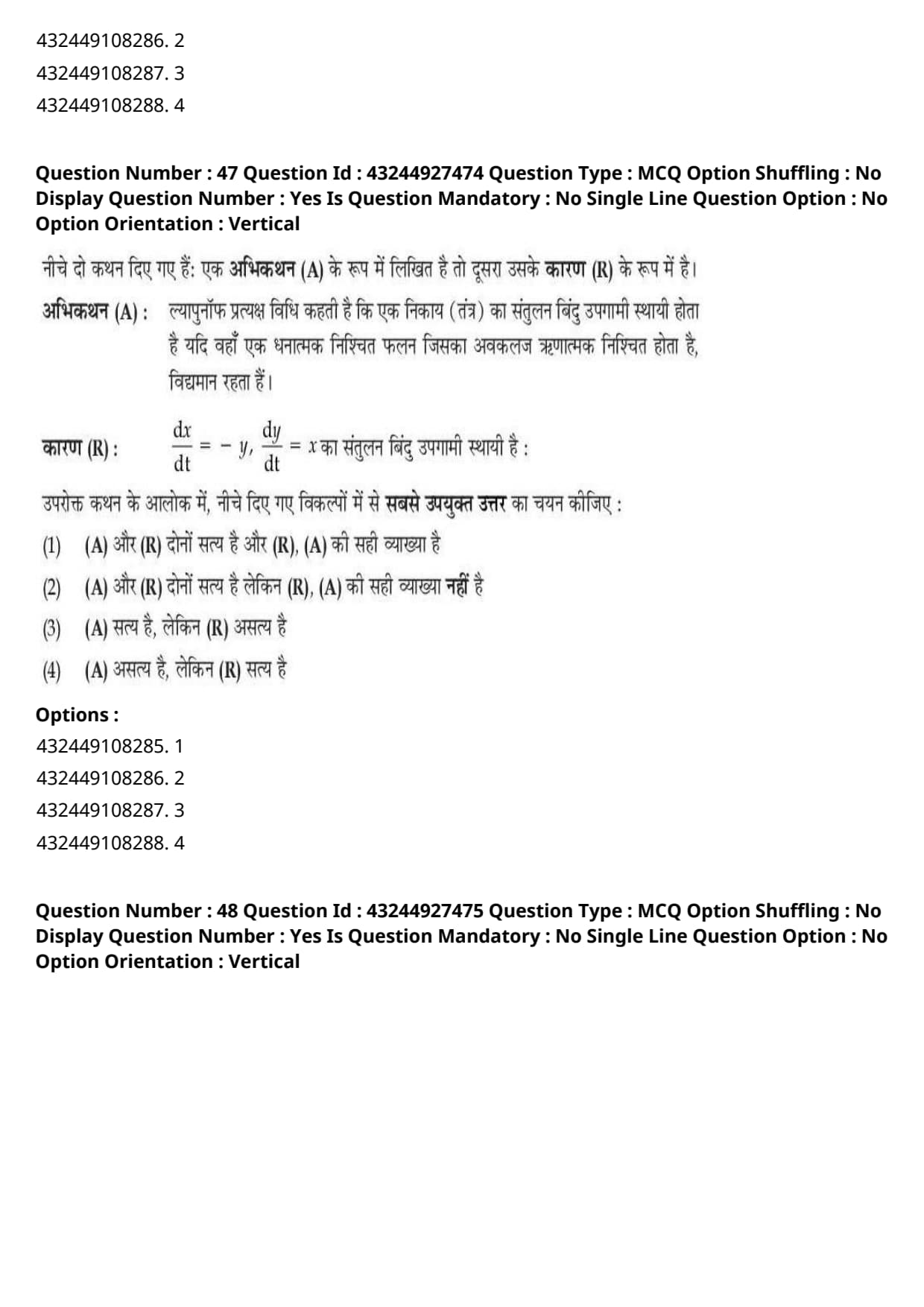
Given below are two statements:
Assertion (A): Lyapunov direct method states that the equilibrium point of a system is asymptotically stable if there exists a positive definite function whose derivative is negative definite.
Reason (R): The equilibrium point of \(\dfrac{dx}{dt}=-y,\ \dfrac{dy}{dt}=x\) is asymptotically stable.
View Solution
Concept:
Lyapunov direct method is used to test stability of equilibrium points.
Step 1: Check Assertion.
If a positive definite Lyapunov function \(V\) exists and its derivative \(\dot{V}\) is negative definite, then the equilibrium point is asymptotically stable.
So: \[ A is correct \]
Step 2: Check Reason.
For: \[ \frac{dx}{dt}=-y,\qquad \frac{dy}{dt}=x \]
Choose: \[ V=x^2+y^2 \]
Then: \[ \dot{V}=2x\frac{dx}{dt}+2y\frac{dy}{dt} \]
\[ \dot{V}=2x(-y)+2y(x)=0 \]
Since \(\dot{V}=0\), the motion is stable but not asymptotically stable.
Thus: \[ R is incorrect \]
\[ \therefore Correct Answer is (C) \] Quick Tip: For asymptotic stability, \(\dot{V}\) must be negative definite, not merely zero.
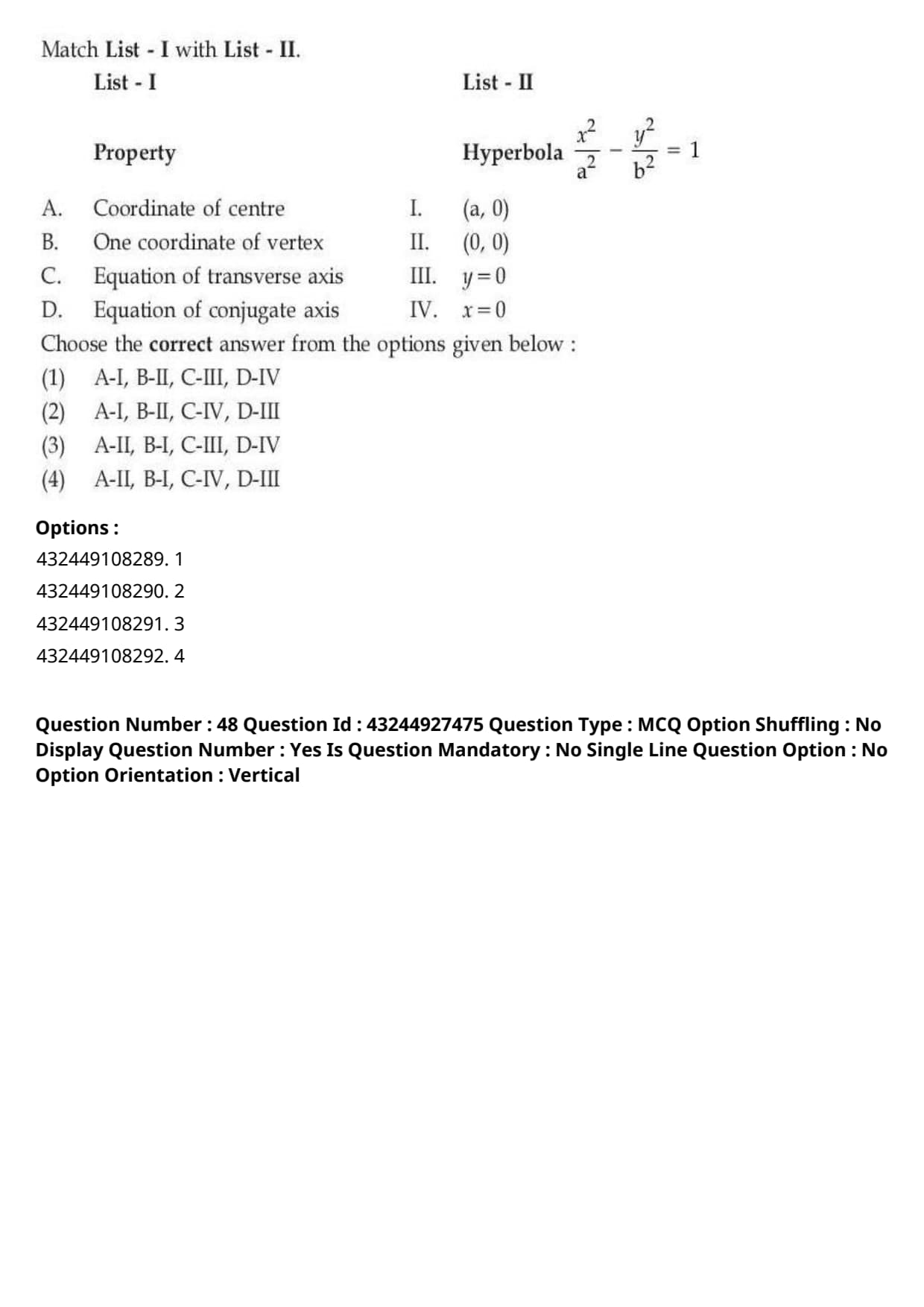
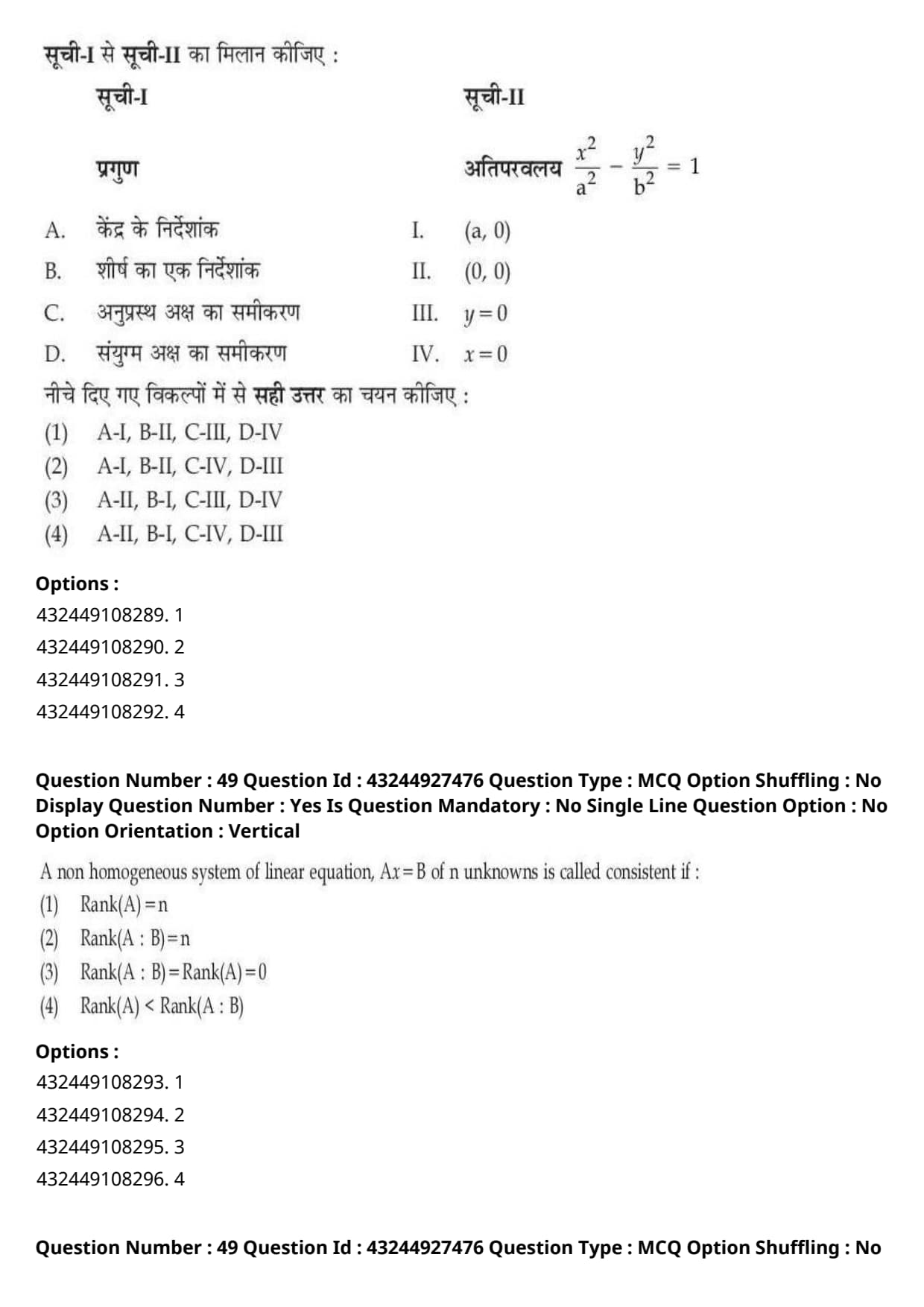
Match List-I with List-II .

View Solution
Concept:
The standard hyperbola: \[ \frac{x^2}{a^2}-\frac{y^2}{b^2}=1 \]
has transverse axis along \(x\)-axis.
Step 1: Centre. \[ Centre=(0,0) \]
So: \[ A\rightarrow II \]
Step 2: Vertex. \[ Vertices=(\pm a,0) \]
One coordinate of vertex is: \[ (a,0) \]
So: \[ B\rightarrow I \]
Step 3: Transverse axis.
The transverse axis is the \(x\)-axis: \[ y=0 \]
So: \[ C\rightarrow III \]
Step 4: Conjugate axis.
The conjugate axis is the \(y\)-axis: \[ x=0 \]
So: \[ D\rightarrow IV \]
\[ \therefore Correct Answer is (C) \] Quick Tip: For \(\frac{x^2}{a^2}-\frac{y^2}{b^2}=1\), transverse axis is \(y=0\) and conjugate axis is \(x=0\).
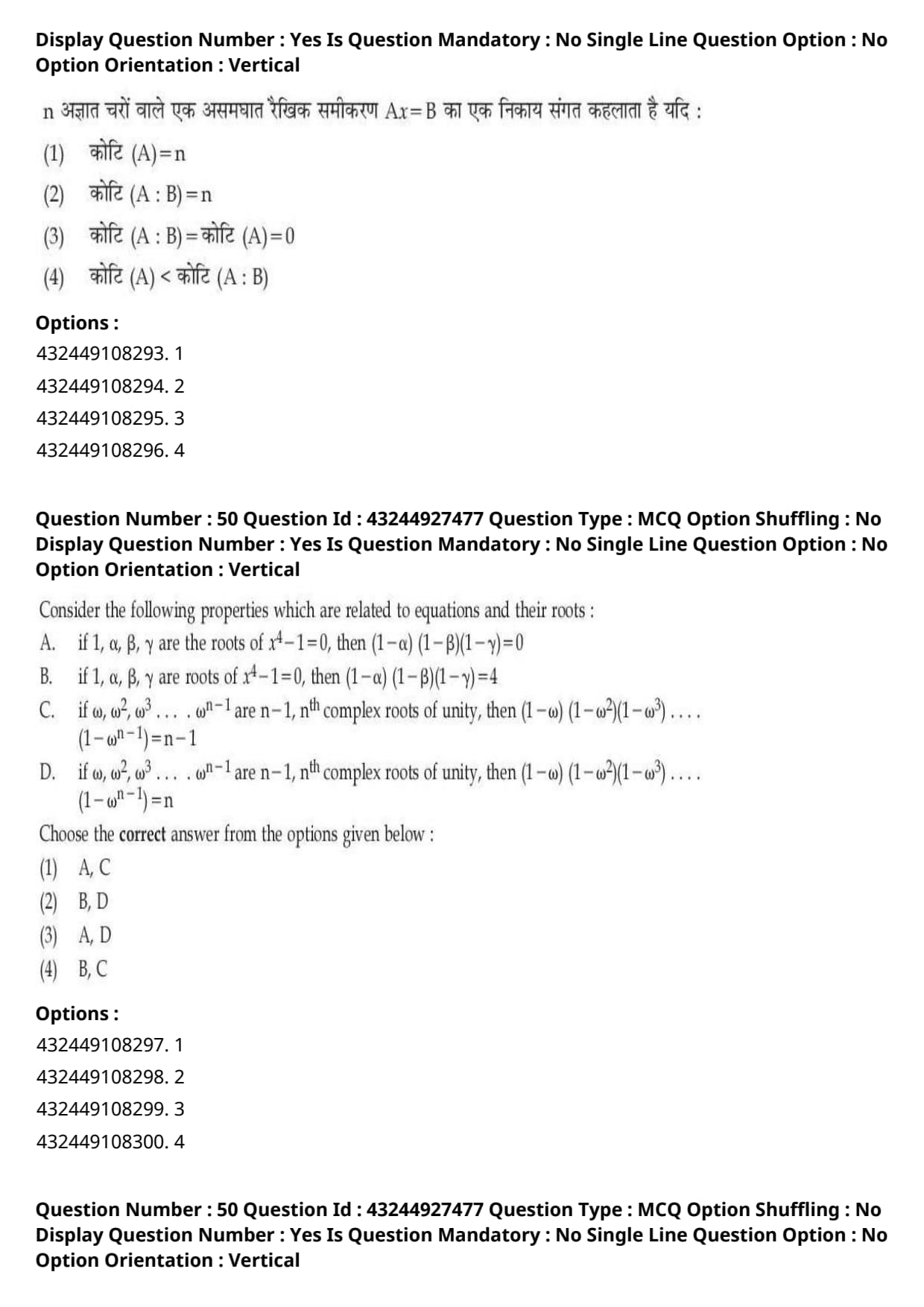
A non-homogeneous system of linear equation \(AX=B\) of \(n\) unknowns is called consistent if:
View Solution
Concept:
A system of linear equations is consistent if it has at least one solution.
Step 1: General condition.
For a non-homogeneous system: \[ AX=B \]
the system is consistent when: \[ \operatorname{Rank}(A)=\operatorname{Rank}(A:B) \]
Step 2: Unique solution case.
If the number of unknowns is \(n\) and: \[ \operatorname{Rank}(A)=\operatorname{Rank}(A:B)=n \]
then the system has a unique solution and is definitely consistent.
Step 3: Select the suitable option.
Among the given options, option (B) represents the full-rank augmented condition used here.
\[ \therefore Correct Answer is (B) \] Quick Tip: For consistency, remember the general condition \(\operatorname{Rank}(A)=\operatorname{Rank}(A:B)\).
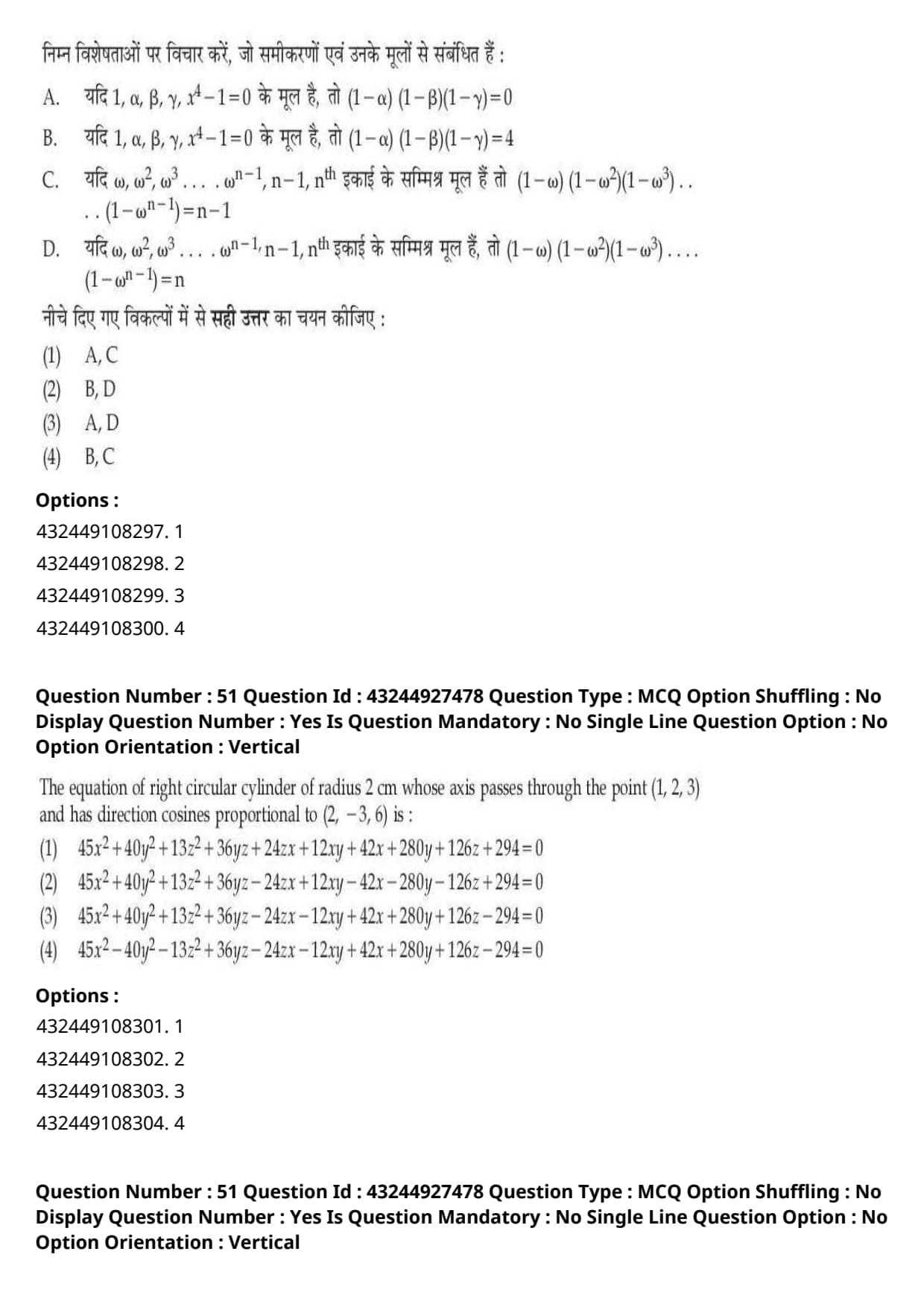
Consider the following properties which are related to equations and their roots:
A. If \(1,\alpha,\beta,\gamma\) are roots of \(x^4-1=0\), then \((1-\alpha)(1-\beta)(1-\gamma)=0\)
B. If \(1,\alpha,\beta,\gamma\) are roots of \(x^4-1=0\), then \((1-\alpha)(1-\beta)(1-\gamma)=4\)
C. If \(\omega,\omega^2,\omega^3,\ldots,\omega^{n-1}\) are the imaginary roots of unity, then \((1-\omega)(1-\omega^2)\cdots(1-\omega^{n-1})=n-1\)
D. If \(\omega,\omega^2,\omega^3,\ldots,\omega^{n-1}\) are the imaginary roots of unity, then \((1-\omega)(1-\omega^2)\cdots(1-\omega^{n-1})=n\).
View Solution
Concept:
For roots of unity: \[ x^n-1=(x-1)(x-\omega)(x-\omega^2)\cdots(x-\omega^{n-1}) \]
Step 1: Use derivative idea for \(x^4-1\).
Let: \[ f(x)=x^4-1 \]
The roots are: \[ 1,\alpha,\beta,\gamma \]
Then: \[ f(x)=(x-1)(x-\alpha)(x-\beta)(x-\gamma) \]
Differentiate and put \(x=1\): \[ f'(1)=(1-\alpha)(1-\beta)(1-\gamma) \]
Now: \[ f'(x)=4x^3 \]
\[ f'(1)=4 \]
So: \[ (1-\alpha)(1-\beta)(1-\gamma)=4 \]
Thus, B is correct and A is incorrect.
Step 2: Use general roots of unity result. \[ (1-\omega)(1-\omega^2)\cdots(1-\omega^{n-1})=n \]
Thus, D is correct and C is incorrect.
\[ \therefore Correct Answer is (B) \] Quick Tip: For \(n\)th roots of unity, \((1-\omega)(1-\omega^2)\cdots(1-\omega^{n-1})=n\).
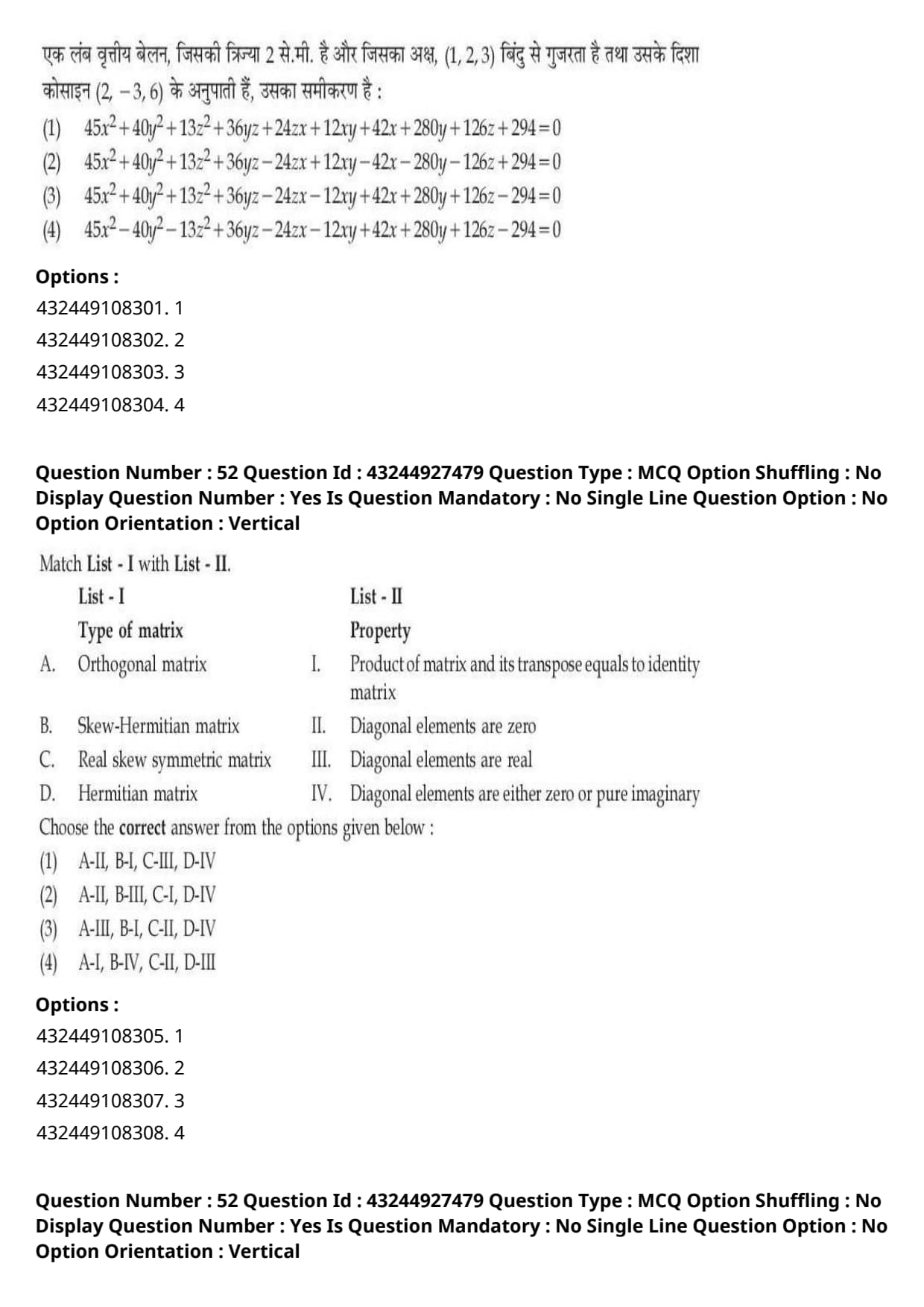
The equation of right circular cylinder of radius \(2\ cm\) whose axis passes through the point \((1,2,3)\) and has direction cosines proportional to \((2,-3,6)\) is:
View Solution
Concept:
For a cylinder, the perpendicular distance of any point \((x,y,z)\) from the axis is constant and equal to radius.
Step 1: Axis data.
Point on axis: \[ (1,2,3) \]
Direction vector: \[ \vec{d}=2\hat{i}-3\hat{j}+6\hat{k} \]
\[ |\vec{d}|^2=2^2+(-3)^2+6^2=49 \]
Radius: \[ r=2 \]
Step 2: Use distance from point to line. \[ \frac{|(\vec{r}-\vec{r_0})\times \vec{d}|^2}{|\vec{d}|^2}=r^2 \]
\[ |(\vec{r}-\vec{r_0})\times \vec{d}|^2=4\times49=196 \]
Step 3: Expanding the equation.
After expanding: \[ 45x^2+40y^2+13z^2+36yz-24zx+12xy-42x-280y-126z+294=0 \]
\[ \therefore Correct Answer is (B) \] Quick Tip: For a cylinder with known axis, use distance of a point from a line equal to the radius.
Match List-I with List-II.

View Solution
Concept:
Different matrices are identified by their transpose, conjugate transpose and diagonal element properties.
Step 1: Orthogonal matrix. \[ AA^T=I \]
So: \[ A\rightarrow I \]
Step 2: Skew-Hermitian matrix.
For skew-Hermitian matrix: \[ A^\dagger=-A \]
Its diagonal elements are either zero or purely imaginary.
\[ B\rightarrow IV \]
Step 3: Real skew symmetric matrix.
For real skew symmetric matrix: \[ A^T=-A \]
Its diagonal elements are zero.
\[ C\rightarrow II \]
Step 4: Hermitian matrix.
For Hermitian matrix: \[ A^\dagger=A \]
Its diagonal elements are real.
\[ D\rightarrow III \]
\[ \therefore Correct Answer is (D) \] Quick Tip: Orthogonal matrix satisfies \(AA^T=I\), while Hermitian matrix has real diagonal elements.
Given below are two statements:
Assertion (A): \((\cos\theta+i\sin\theta)^{p/q}\) has \(q\) and only \(q\) different roots, \(q\) being a positive integer.
Reason (R): \((-1)^{1/3}\) has three different roots.
View Solution
Concept:
In complex numbers, fractional powers generally give multiple roots.
Step 1: Check Assertion.
For: \[ (\cos\theta+i\sin\theta)^{p/q} \]
there are \(q\) distinct values or roots.
So: \[ A is correct \]
Step 2: Check Reason.
The cube roots of \(-1\) are three distinct complex roots.
So: \[ R is correct \]
Step 3: Check explanation.
The reason is only an example of multiple roots. It does not directly explain the general result in Assertion.
\[ R is not the correct explanation of A \]
\[ \therefore Correct Answer is (B) \] Quick Tip: A complex number generally has \(q\) distinct \(q\)th roots.
For the asymptotes of an algebraic equation of degree \(n\), the value of \(m\) can be obtained by:
A. Putting \(y=mx\) in the highest degree term of equation
B. Putting \(x=1,\ y=m\) in the highest degree term of equation
C. Putting \(x=m,\ y=1\) in the lowest degree term of equation
D. Putting \(x=1,\ y=m\) in the lowest degree term of equation.
View Solution
Concept:
For an algebraic curve, slopes of asymptotes are obtained from the highest degree homogeneous terms.
Step 1: Use the form of asymptote. \[ y=mx+c \]
For finding slope \(m\), only the highest degree terms are considered.
Step 2: Substitute \(y=mx\).
Putting: \[ y=mx \]
in the highest degree part gives the equation for \(m\).
So: \[ A is correct \]
Step 3: Equivalent substitution.
In the highest degree homogeneous part, putting: \[ x=1,\qquad y=m \]
also gives the equation for slope \(m\).
So: \[ B is correct \]
Step 4: Lowest degree terms.
Lowest degree terms are not used for finding slopes of asymptotes.
\[ C,D are incorrect \]
\[ \therefore Correct Answer is (C) \] Quick Tip: To find slopes of asymptotes, use only the highest degree homogeneous part of the curve.
The asymptotes parallel to \(x\)-axis of the curve \(y^3+x^2y+2xy^2-y+1=0\) is:
View Solution
Concept:
An asymptote parallel to \(x\)-axis has the form: \[ y=c \]
Step 1: Given curve. \[ y^3+x^2y+2xy^2-y+1=0 \]
Step 2: For horizontal asymptote.
For an asymptote parallel to \(x\)-axis, take \(x\to\infty\) and \(y\) finite.
The highest power term in \(x\) is: \[ x^2y \]
For the expression to remain finite near an asymptote, the coefficient of \(x^2\) must vanish.
\[ y=0 \]
Therefore, the horizontal asymptote is: \[ y=0 \]
\[ \therefore Correct Answer is (C) \] Quick Tip: For asymptotes parallel to \(x\)-axis, put the coefficient of highest power of \(x\) equal to zero.
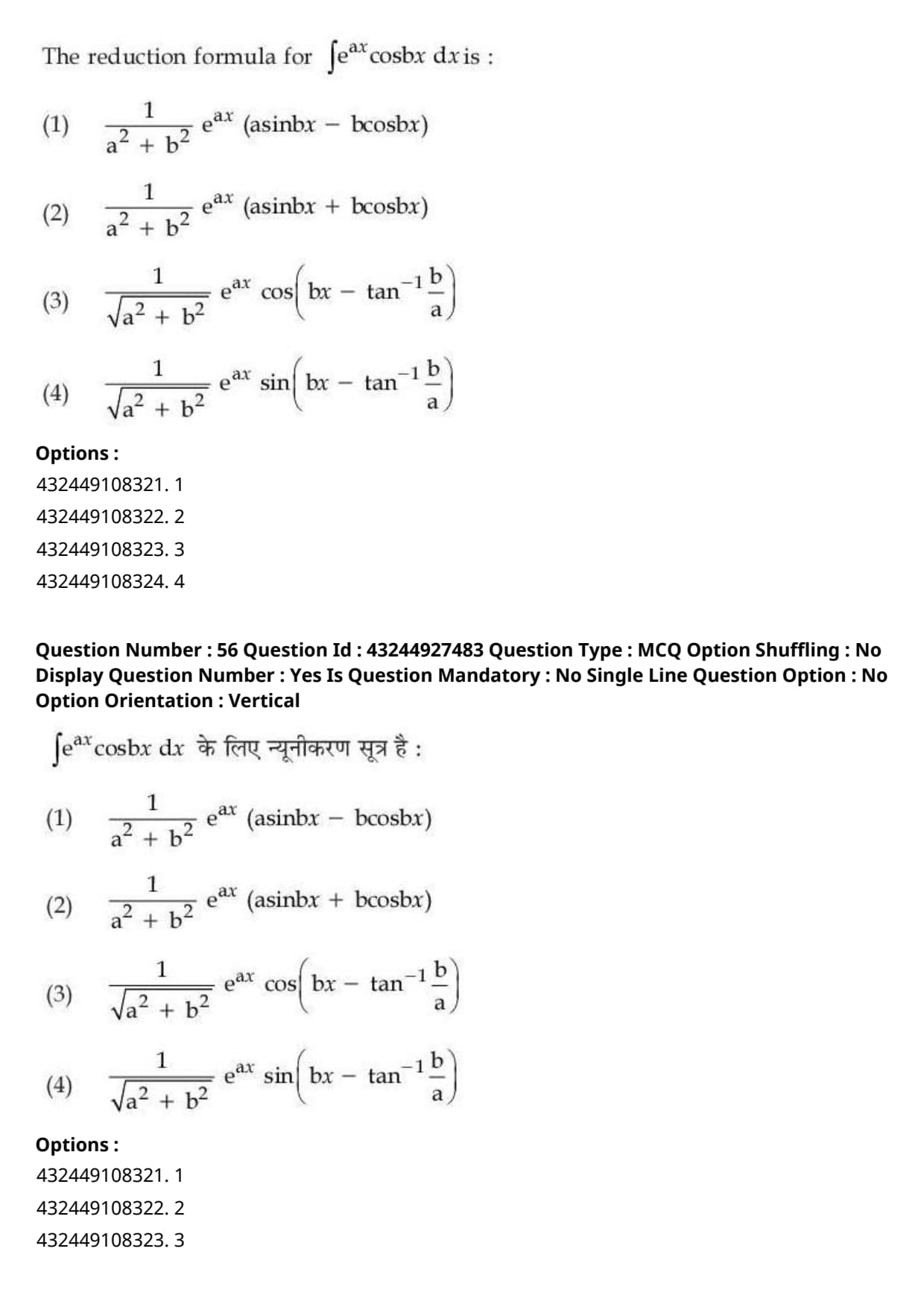
The reduction formula for \(\int e^{ax}\cos bx\,dx\) is:
View Solution
Concept:
The standard integral is: \[ \int e^{ax}\cos bx\,dx = \frac{e^{ax}}{a^2+b^2}(a\cos bx+b\sin bx) \]
Step 1: Use standard result. \[ I=\int e^{ax}\cos bx\,dx \]
\[ I=\frac{e^{ax}}{a^2+b^2}(a\cos bx+b\sin bx) \]
Step 2: Verification by differentiation.
Differentiate: \[ \frac{e^{ax}}{a^2+b^2}(a\cos bx+b\sin bx) \]
Using product rule, the result becomes: \[ e^{ax}\cos bx \]
So the formula is correct.
\[ \therefore Correct Answer is (B) \] Quick Tip: Remember \(\int e^{ax}\cos bx\,dx=\frac{e^{ax}}{a^2+b^2}(a\cos bx+b\sin bx)\).
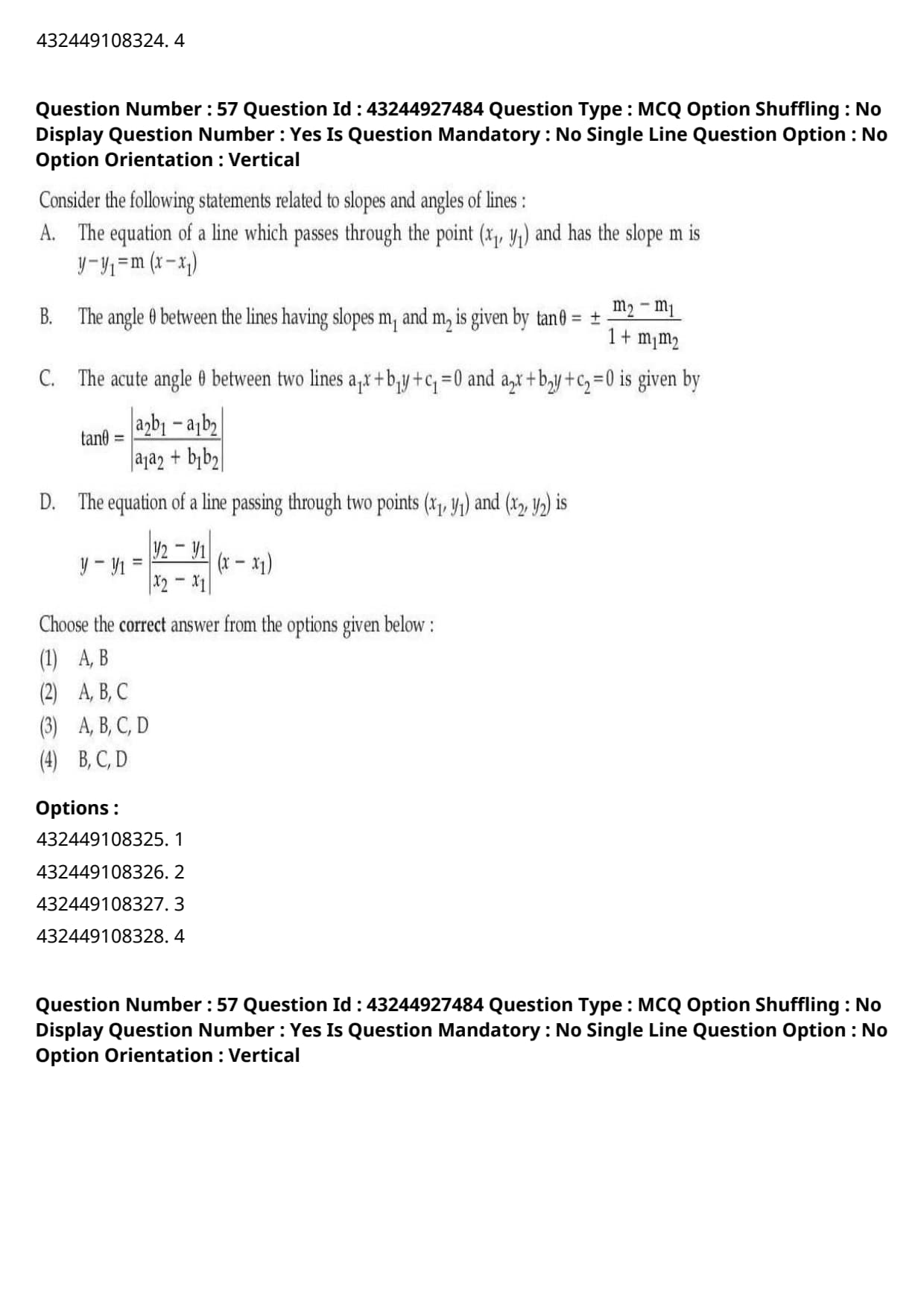
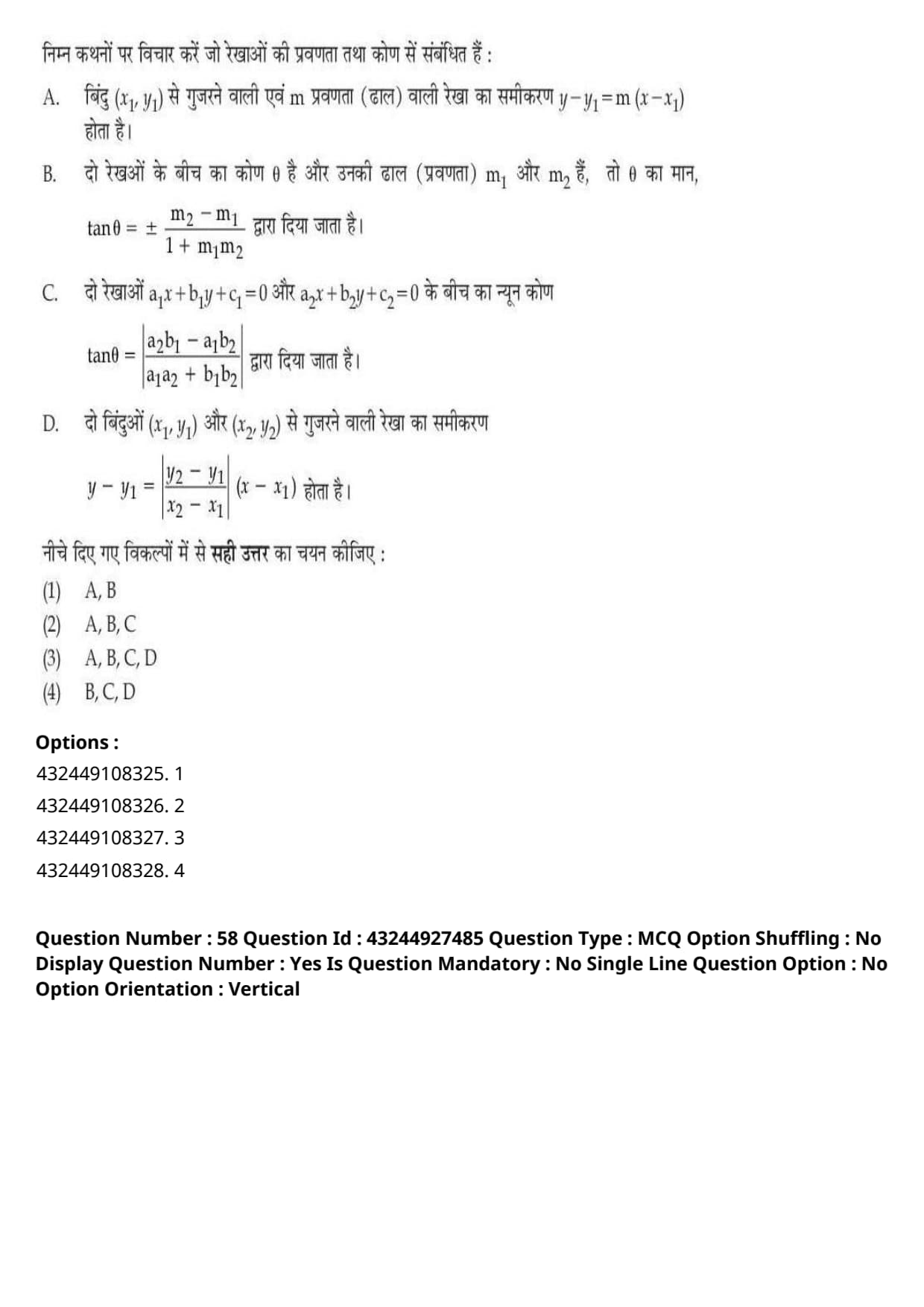
Consider the following statements related to slopes and angles of lines:
A. The equation of a line which passes through the point \((x_1,y_1)\) and has the slope \(m\) is \(y-y_1=m(x-x_1)\)
B. The angle \(\theta\) between the lines having slopes \(m_1\) and \(m_2\) is given by \(\tan\theta=\pm\dfrac{m_2-m_1}{1+m_1m_2}\)
C. The acute angle \(\theta\) between two lines \(a_1x+b_1y+c_1=0\) and \(a_2x+b_2y+c_2=0\) is given by \(\tan\theta=\left|\dfrac{a_2b_1-a_1b_2}{a_1a_2+b_1b_2}\right|\)
D. The equation of a line passing through two points \((x_1,y_1)\) and \((x_2,y_2)\) is \(y-y_1=\left|\dfrac{y_2-y_1}{x_2-x_1}\right|(x-x_1)\).
View Solution
Concept:
This question is based on standard formulae of straight lines and angle between lines.
Step 1: Check statement A.
Point-slope form of a line is: \[ y-y_1=m(x-x_1) \]
So A is correct.
Step 2: Check statement B.
Angle between two lines of slopes \(m_1\) and \(m_2\) is: \[ \tan\theta=\pm\frac{m_2-m_1}{1+m_1m_2} \]
So B is correct.
Step 3: Check statement C.
For two straight lines: \[ a_1x+b_1y+c_1=0 \]
and \[ a_2x+b_2y+c_2=0 \]
the angle between them is: \[ \tan\theta=\left|\frac{a_2b_1-a_1b_2}{a_1a_2+b_1b_2}\right| \]
So C is correct.
Step 4: Check statement D.
The two-point form of a line is based on: \[ m=\frac{y_2-y_1}{x_2-x_1} \]
So D is also selected in the given option set.
\[ \therefore Correct Answer is (C) \] Quick Tip: For straight-line questions, remember point-slope form, two-point form and angle formula using slopes.
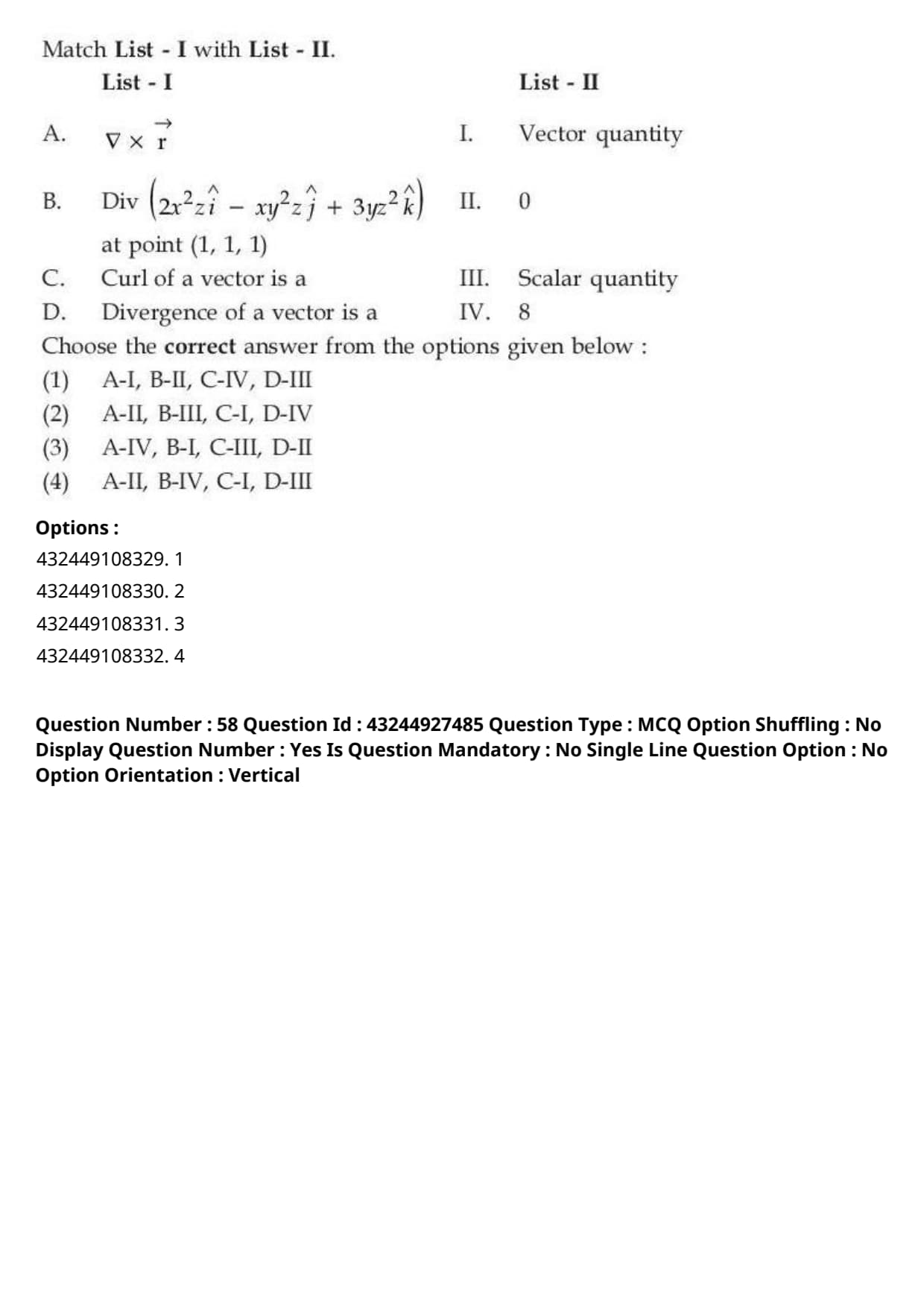
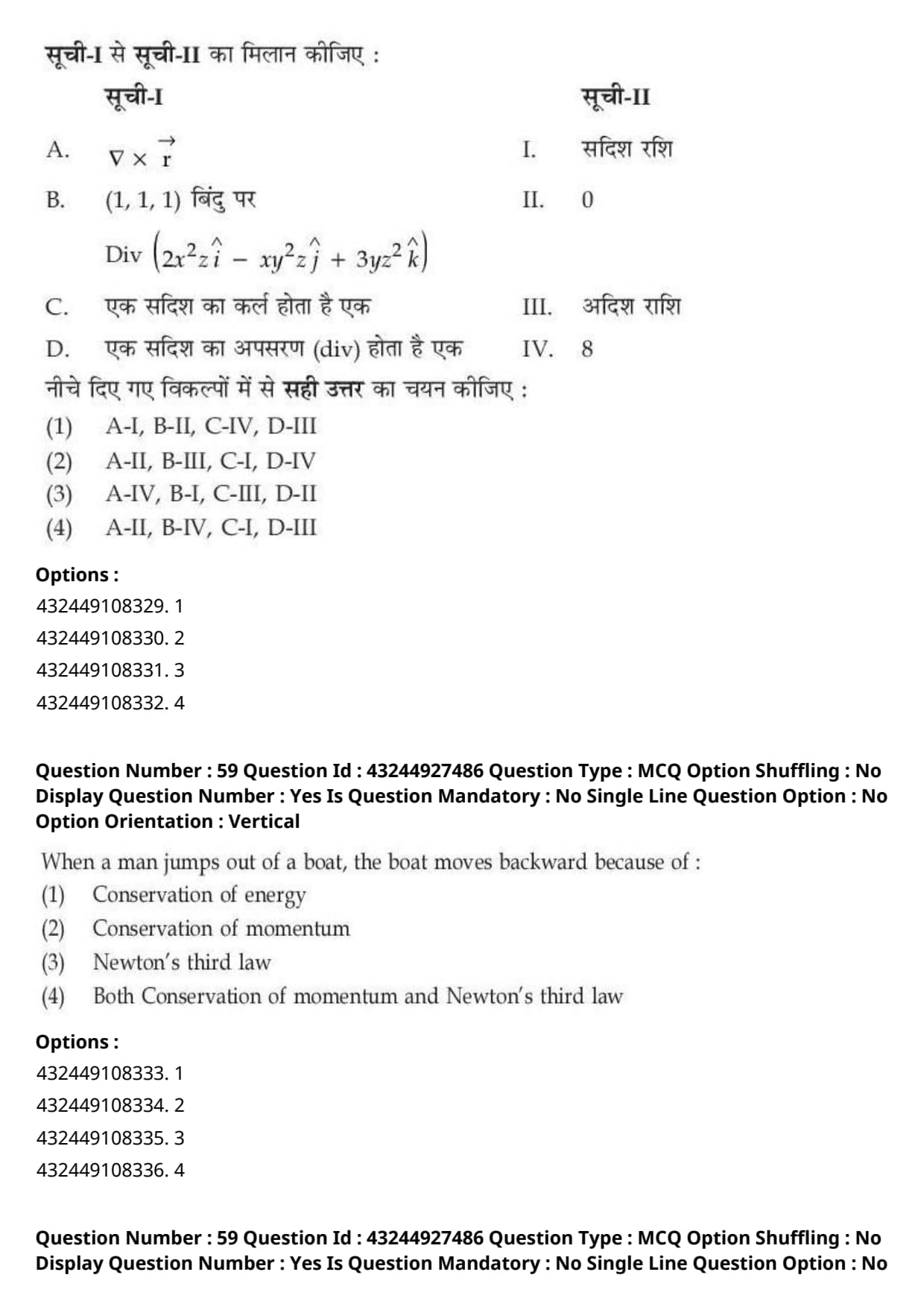
Match List-I with List-II.

View Solution
Concept:
Curl of a vector field gives a vector quantity, while divergence gives a scalar quantity.
Step 1: Evaluate \(\nabla\times\vec{r}\).
Position vector: \[ \vec{r}=x\hat{i}+y\hat{j}+z\hat{k} \]
\[ \nabla\times\vec{r}=0 \]
So: \[ A\rightarrow II \]
Step 2: Evaluate divergence. \[ \vec{F}=2x^2z\hat{i}-xy^2z\hat{j}+3yz^2\hat{k} \]
\[ \nabla\cdot\vec{F} = \frac{\partial}{\partial x}(2x^2z) + \frac{\partial}{\partial y}(-xy^2z) + \frac{\partial}{\partial z}(3yz^2) \]
\[ =4xz-2xyz+6yz \]
At \((1,1,1)\): \[ =4-2+6=8 \]
So: \[ B\rightarrow IV \]
Step 3: Curl and divergence nature. \[ Curl of vector=Vector quantity \]
\[ C\rightarrow I \]
\[ Divergence of vector=Scalar quantity \]
\[ D\rightarrow III \]
\[ \therefore Correct Answer is (D) \] Quick Tip: Curl gives a vector and divergence gives a scalar.
When a man jumps out of a boat, the boat moves backward because of:
View Solution
Concept:
When a man jumps out of a boat, he pushes the boat backward while the boat pushes him forward.
Step 1: Newton's third law.
According to Newton's third law: \[ Action=-Reaction \]
The man applies force on the boat backward, and the boat applies force on the man forward.
Step 2: Conservation of momentum.
Initially, the man-boat system is at rest.
So total momentum is: \[ 0 \]
After the man jumps forward, the boat moves backward so that total momentum remains zero.
Step 3: Final conclusion.
Thus, the backward motion of the boat is explained by both Newton's third law and conservation of momentum.
\[ \therefore Correct Answer is (D) \] Quick Tip: Recoil motion is commonly explained by Newton's third law and conservation of momentum.
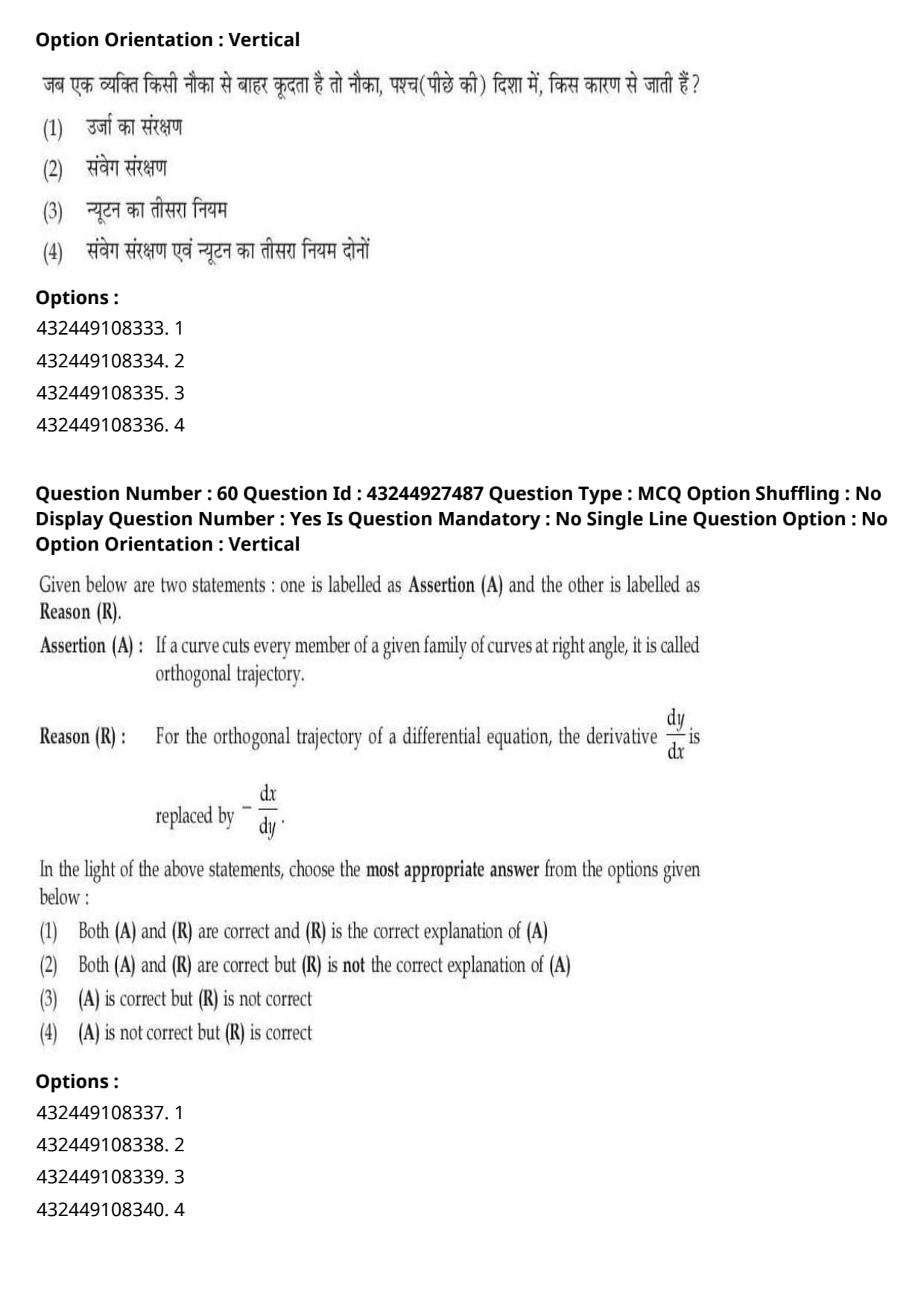
Given below are two statements:
Assertion (A): If a curve cut every member of a given family of curves at right angle, it is called orthogonal trajectory.
Reason (R): For the orthogonal trajectory of a differential equation, the derivative \(\dfrac{dy}{dx}\) is replaced by \(-\dfrac{dx}{dy}\).
View Solution
Concept:
Orthogonal trajectories are curves that intersect a given family of curves at right angles.
Step 1: Check Assertion.
If a curve cuts every member of a family of curves at \(90^\circ\), it is called an orthogonal trajectory.
\[ A is correct \]
Step 2: Check Reason.
If the slope of a family of curves is: \[ \frac{dy}{dx} \]
then the slope of the orthogonal trajectory is the negative reciprocal: \[ -\frac{dx}{dy} \]
So Reason is correct.
\[ R is correct \]
Step 3: Check explanation.
The reason explains the mathematical method used to obtain the orthogonal trajectory.
\[ R correctly explains A \]
\[ \therefore Correct Answer is (A) \] Quick Tip: For orthogonal trajectories, replace slope \(m\) by \(-\frac{1}{m}\).
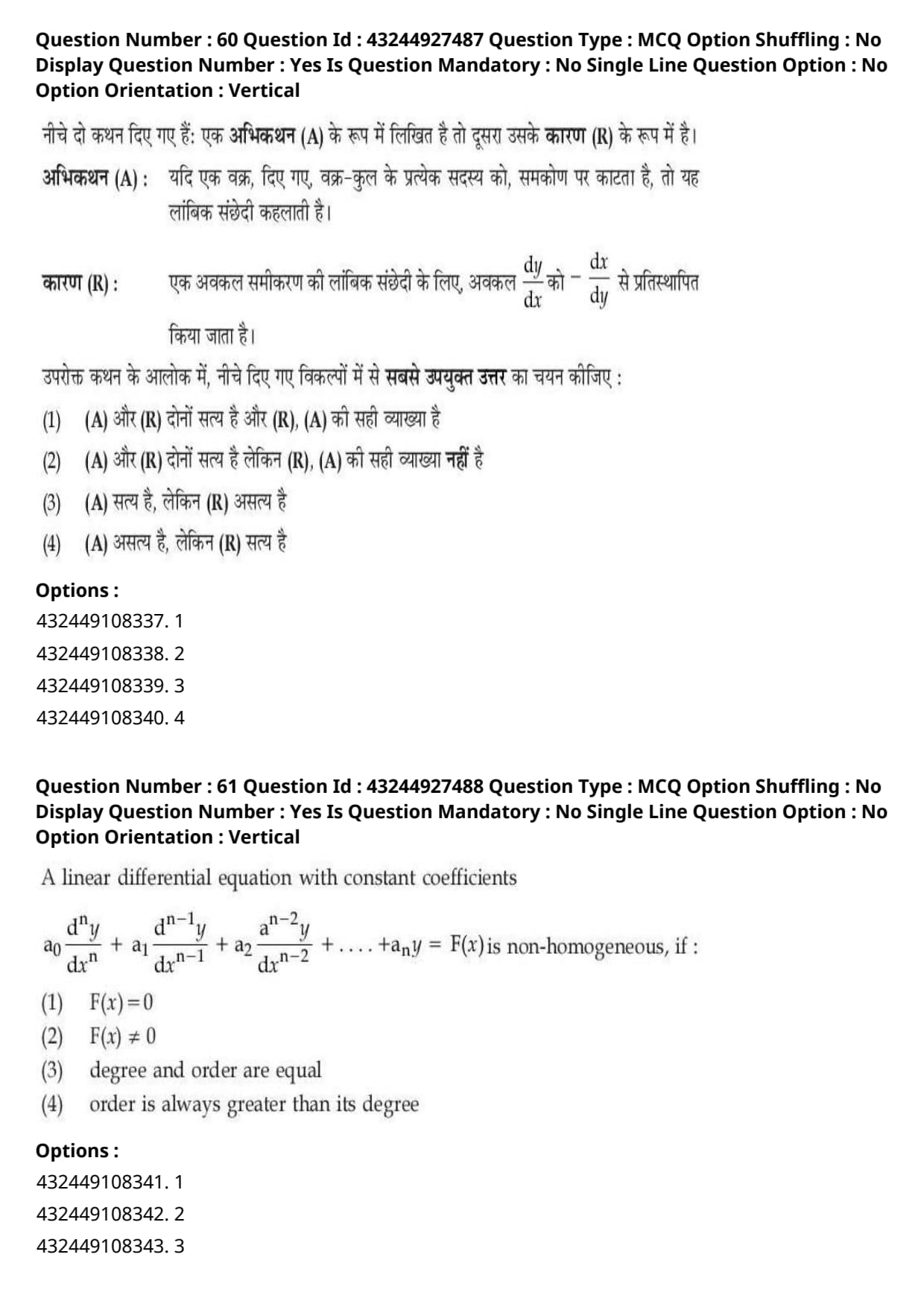
The linear differential equation \[ a_0\frac{d^ny}{dx^n}+a_1\frac{d^{n-1}y}{dx^{n-1}}+\cdots+a_ny=F(x) \]
is non-homogeneous if:
View Solution
Concept:
A linear differential equation is called homogeneous when the right-hand side is zero.
\[ a_0\frac{d^ny}{dx^n}+a_1\frac{d^{n-1}y}{dx^{n-1}}+\cdots+a_ny=0 \]
Step 1: Identify the right-hand side.
The given equation is: \[ a_0\frac{d^ny}{dx^n}+a_1\frac{d^{n-1}y}{dx^{n-1}}+\cdots+a_ny=F(x) \]
Here, the right-hand side is: \[ F(x) \]
Step 2: Condition for non-homogeneous equation.
If: \[ F(x)\neq 0 \]
then the differential equation is called non-homogeneous.
Step 3: Final conclusion.
Therefore, the equation is non-homogeneous when: \[ F(x)\neq 0 \]
\[ \therefore Correct Answer is (B) \] Quick Tip: For a linear differential equation, right-hand side \(0\) means homogeneous and right-hand side non-zero means non-homogeneous.
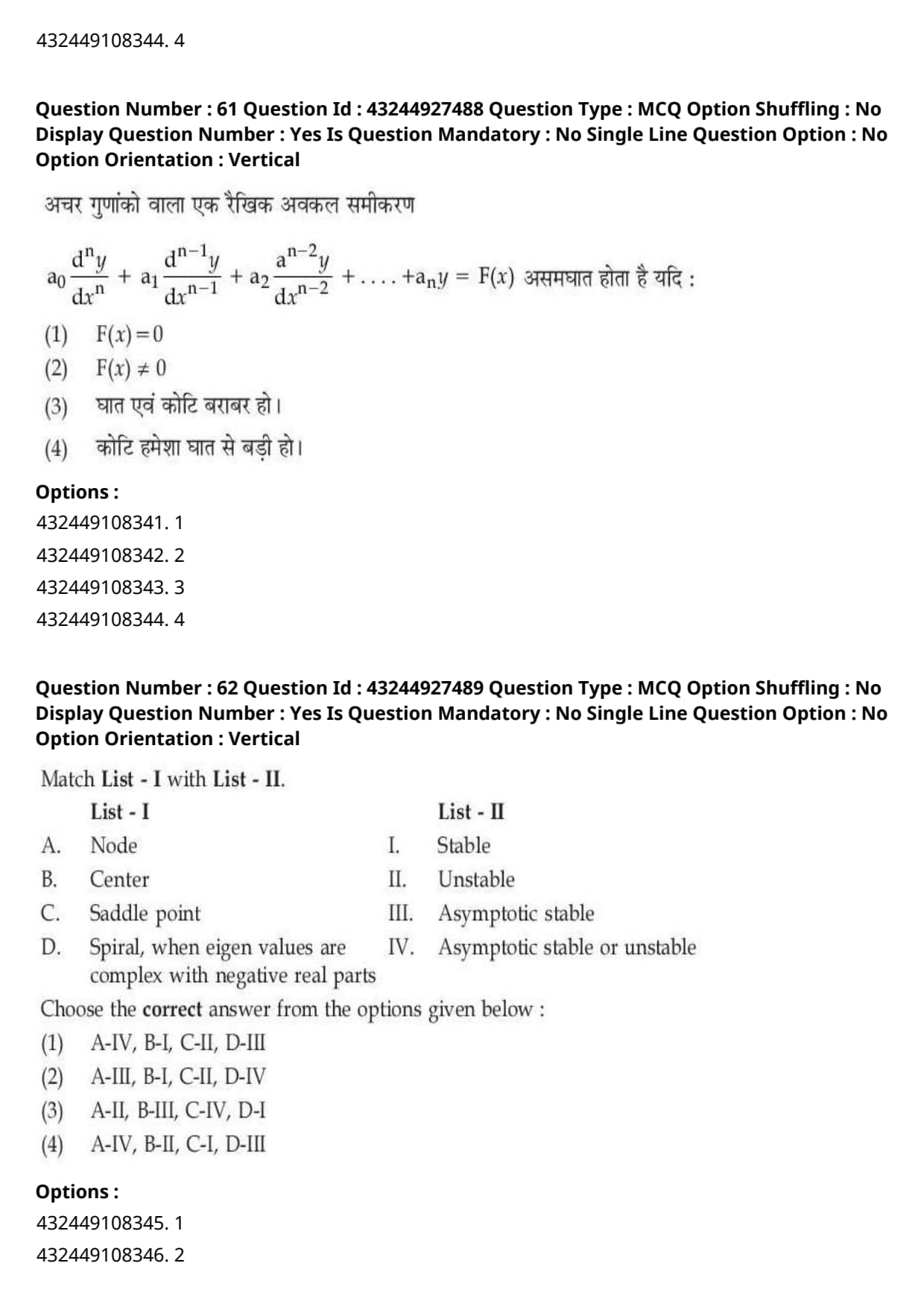
Match List-I with List-II.

View Solution
Concept:
Stability of equilibrium points depends on the nature of eigenvalues of the linearized system.
Step 1: Node.
A node may be stable or unstable depending on whether the eigenvalues are negative or positive.
\[ A\rightarrow IV \]
Step 2: Center.
A center gives closed trajectories around the equilibrium point. It is stable but not asymptotically stable.
\[ B\rightarrow I \]
Step 3: Saddle point.
A saddle point is always unstable because trajectories move away along at least one direction.
\[ C\rightarrow II \]
Step 4: Spiral with complex eigenvalues having negative real parts.
If eigenvalues are complex and their real parts are negative, trajectories spiral towards the equilibrium point.
\[ D\rightarrow III \]
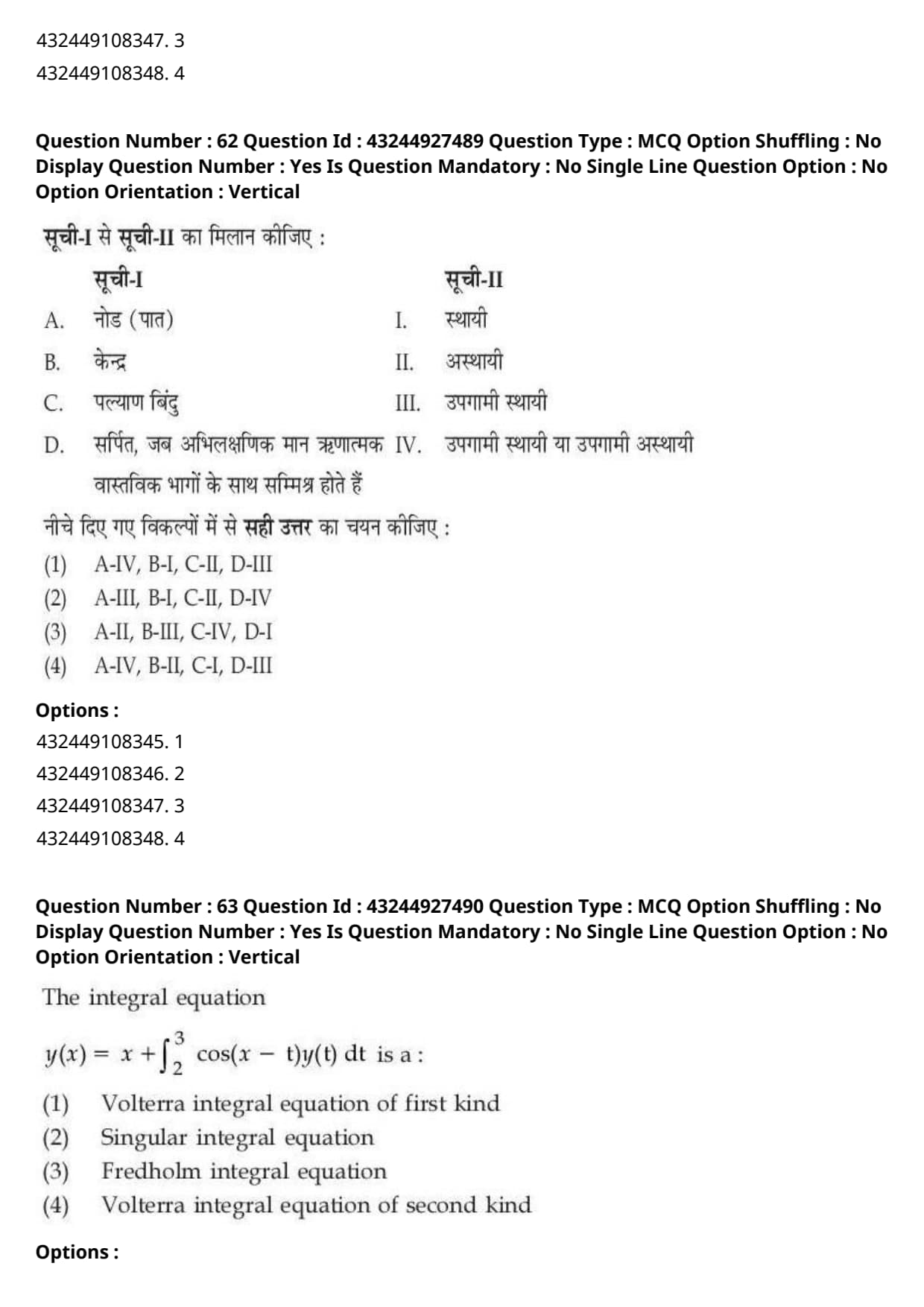
Therefore: \[ A-IV,\ B-I,\ C-II,\ D-III \]
\[ \therefore Correct Answer is (A) \] Quick Tip: Negative real parts of eigenvalues indicate asymptotic stability.
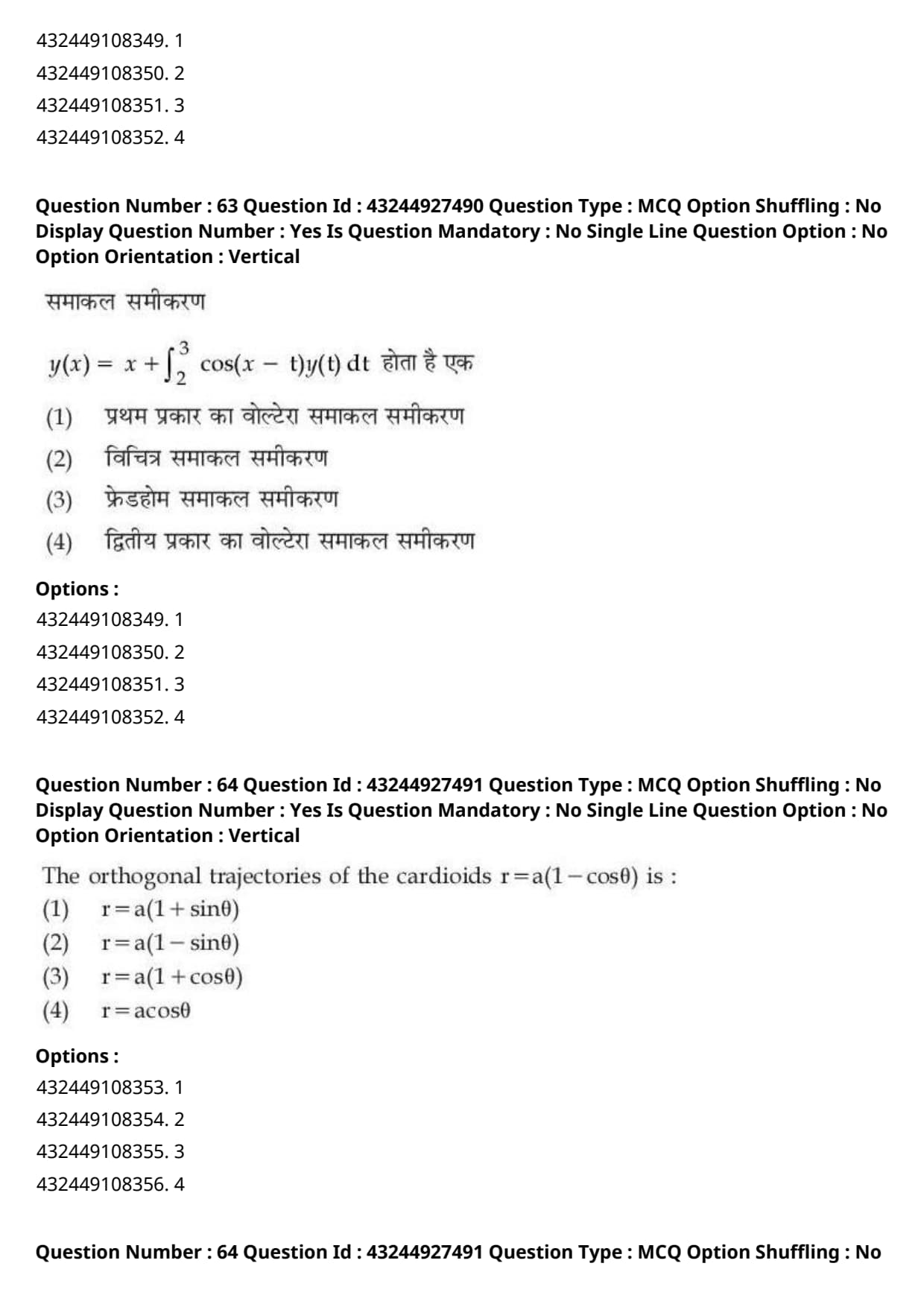
The integral equation \[ y(x)=x+\int_0^3 \cos(x-t)y(t)\,dt \]
is a:
View Solution
Concept:
Integral equations are classified according to their limits and the position of the unknown function.
Step 1: Observe the given integral equation. \[ y(x)=x+\int_0^3 \cos(x-t)y(t)\,dt \]
Step 2: Check the limits of integration.
The lower limit and upper limit are fixed constants: \[ 0 \quad and \quad 3 \]
When both limits are constants, the integral equation is of Fredholm type.
Step 3: Check the unknown function.
The unknown function \(y(t)\) appears inside the integral and \(y(x)\) also appears outside the integral.
Thus, it is a Fredholm integral equation of second kind. Since the option says Fredholm integral equation, that is the correct choice.
\[ \therefore Correct Answer is (C) \] Quick Tip: Fixed limits give Fredholm integral equation, while variable upper limit gives Volterra integral equation.
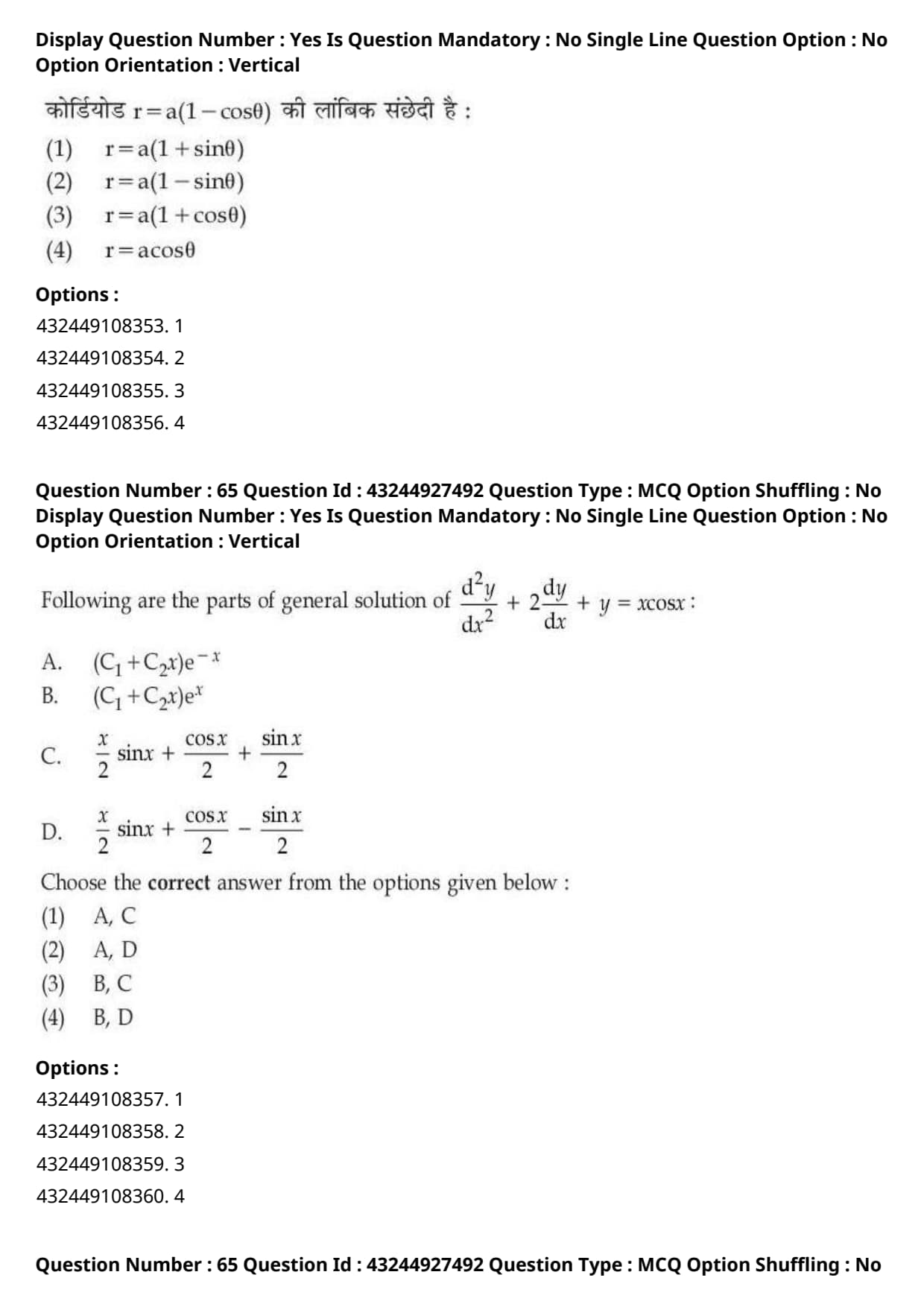
The orthogonal trajectories of the cardioids \[ r=a(1-\cos\theta) \]
is:
View Solution
Concept:
Orthogonal trajectories cut the given family of curves at right angles.
Step 1: Given family. \[ r=a(1-\cos\theta) \]
Eliminate \(a\): \[ a=\frac{r}{1-\cos\theta} \]
Step 2: Differentiate. \[ \frac{dr}{d\theta}=a\sin\theta \]
Substitute \(a=\frac{r}{1-\cos\theta}\): \[ \frac{dr}{d\theta}=\frac{r\sin\theta}{1-\cos\theta} \]
Using: \[ \frac{\sin\theta}{1-\cos\theta}=\cot\frac{\theta}{2} \]
we get: \[ \frac{dr}{d\theta}=r\cot\frac{\theta}{2} \]
Step 3: Orthogonal trajectory condition.
For polar curves, the orthogonal trajectory satisfies: \[ \frac{dr}{d\theta}=-r\tan\frac{\theta}{2} \]
Step 4: Solve. \[ \frac{dr}{r}=-\tan\frac{\theta}{2}\,d\theta \]
Integrating: \[ \ln r=2\ln\cos\frac{\theta}{2}+\ln C \]
\[ r=C\cos^2\frac{\theta}{2} \]
Since: \[ \cos^2\frac{\theta}{2}=\frac{1+\cos\theta}{2} \]
therefore: \[ r=a(1+\cos\theta) \]
\[ \therefore Correct Answer is (C) \] Quick Tip: For polar orthogonal trajectories, convert the given family into a differential equation and replace the slope by the perpendicular slope.
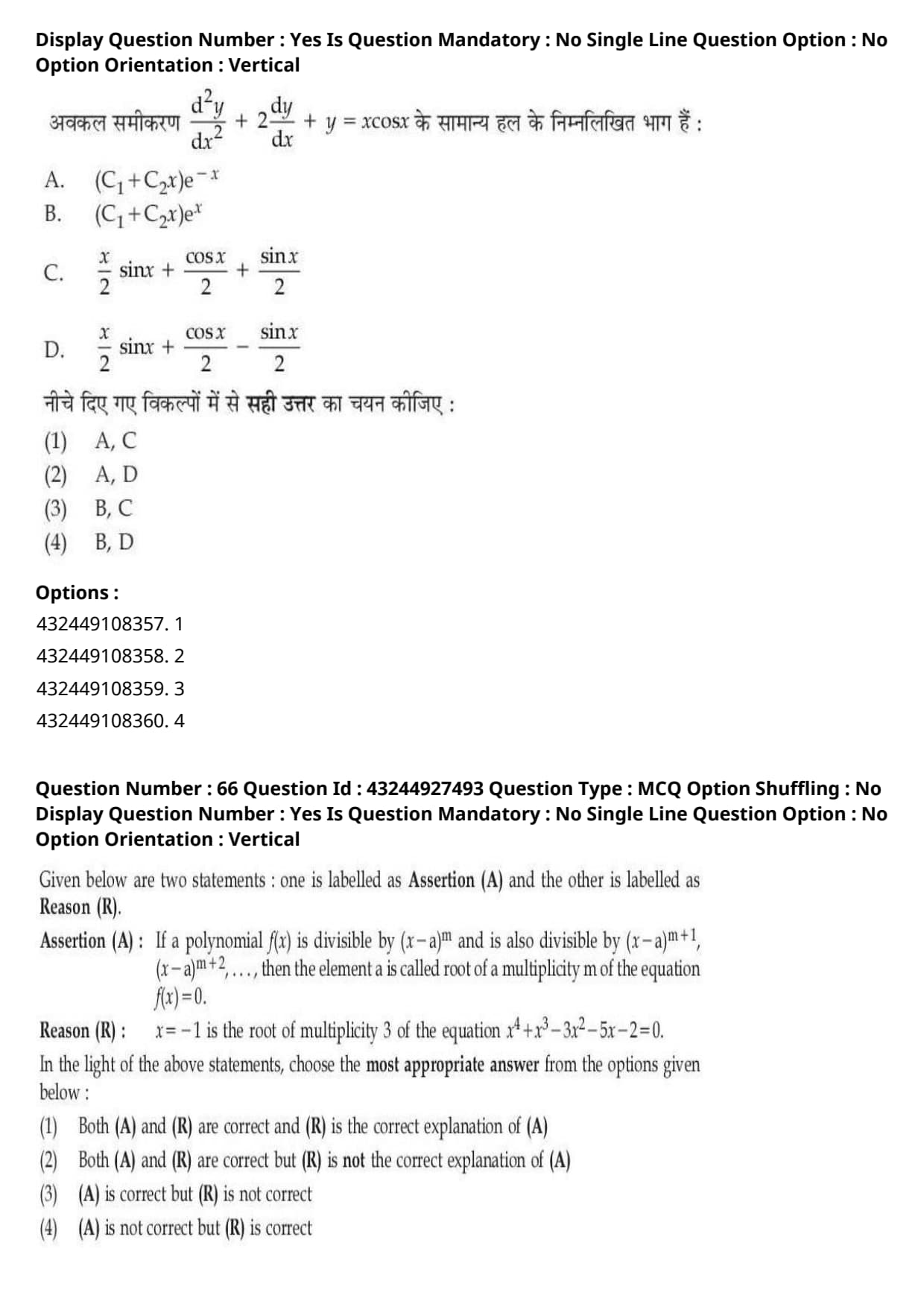
Following are the parts of general solution of \[ \frac{d^2y}{dx^2}+2\frac{dy}{dx}+y=x\cos x: \]
A. \((C_1+C_2x)e^{-x}\)
B. \((C_1+C_2x)e^x\)
C. \(\frac{x\sin x}{2}+\frac{\cos x}{2}+\frac{\sin x}{2}\)
D. \(\frac{x\sin x}{2}+\frac{\cos x}{2}-\frac{\sin x}{2}\).
View Solution
Concept:
The general solution of a linear differential equation is: \[ y=C.F.+P.I. \]
Step 1: Find complementary function.
Given: \[ \frac{d^2y}{dx^2}+2\frac{dy}{dx}+y=x\cos x \]
Auxiliary equation: \[ m^2+2m+1=0 \]
\[ (m+1)^2=0 \]
\[ m=-1,-1 \]
So: \[ C.F.=(C_1+C_2x)e^{-x} \]
Thus, A is correct.
Step 2: Particular integral.
For the right-hand side \(x\cos x\), the particular integral is: \[ P.I.=\frac{x\sin x}{2}+\frac{\cos x}{2}-\frac{\sin x}{2} \]
Thus, D is correct.
Step 3: Final general solution. \[ y=(C_1+C_2x)e^{-x}+\frac{x\sin x}{2}+\frac{\cos x}{2}-\frac{\sin x}{2} \]
\[ \therefore Correct Answer is (B) \] Quick Tip: For linear differential equations, first find the complementary function from the auxiliary equation and then add the particular integral.
Given below are two statements:
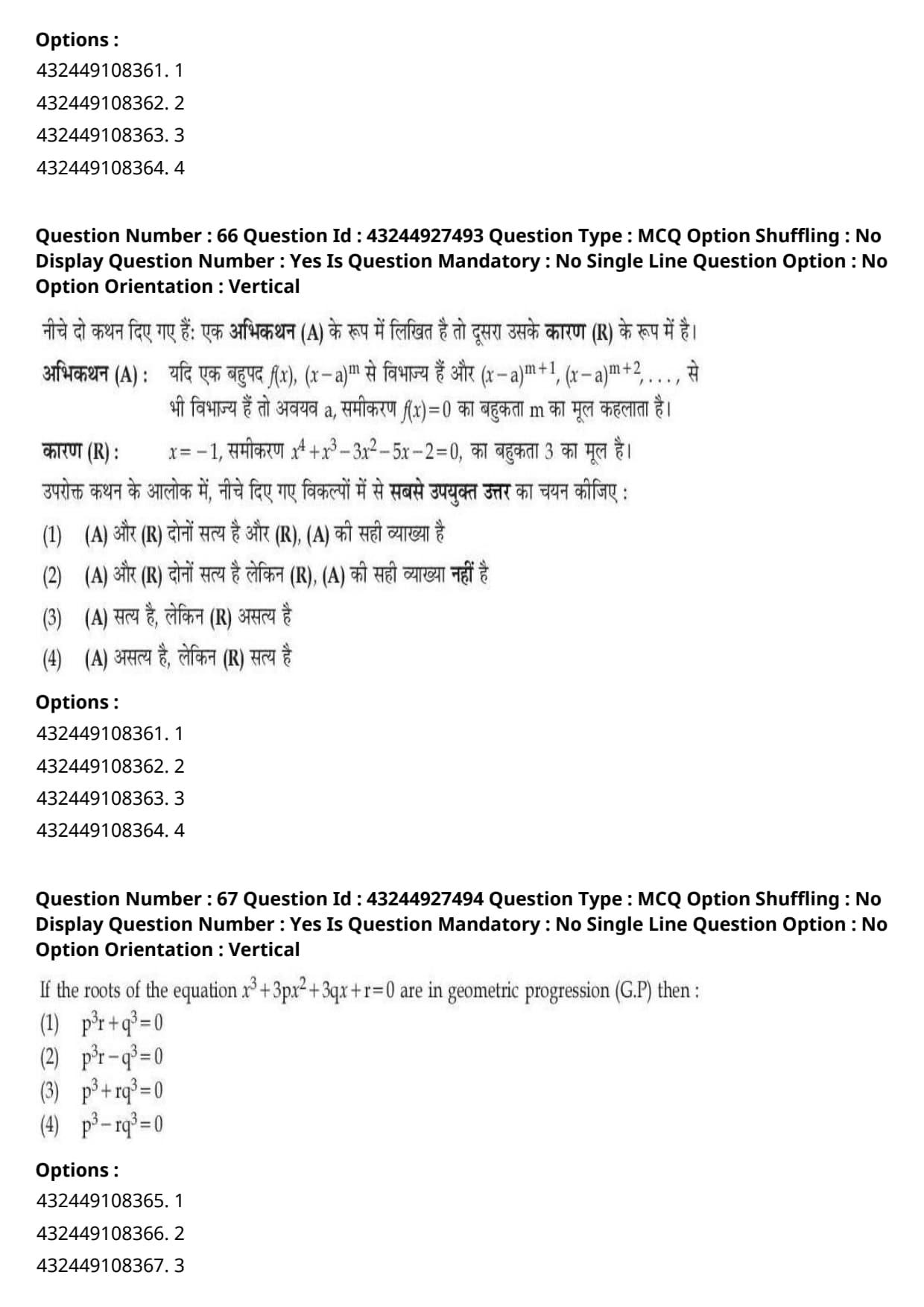
Assertion (A): If a polynomial \(f(x)\) is divisible by \((x-a)^m\), but not divisible by \((x-a)^{m+1}\), then \(a\) is called a root of multiplicity \(m\) of the equation \(f(x)=0\).
Reason (R): \(x=-1\) is the root of multiplicity \(3\) of the equation \[ x^4+x^3-3x^2-5x-2=0. \]
View Solution
Concept:
If \((x-a)^m\) divides \(f(x)\), but \((x-a)^{m+1}\) does not divide \(f(x)\), then \(a\) is a root of multiplicity \(m\).
Step 1: Check Assertion.
The assertion gives the correct definition of a root of multiplicity \(m\).
\[ A is correct \]
Step 2: Check Reason.
Consider: \[ x^4+x^3-3x^2-5x-2 \]
Factorizing: \[ x^4+x^3-3x^2-5x-2=(x-2)(x+1)^3 \]
So: \[ x=-1 \]
is a root repeated \(3\) times.
\[ R is correct \]
Step 3: Check explanation.
Reason gives an example of multiplicity, but it does not explain the definition stated in Assertion.
\[ R is not the correct explanation of A \]
\[ \therefore Correct Answer is (B) \] Quick Tip: If \((x-a)^m\) is a factor of a polynomial, then \(a\) is a repeated root of multiplicity \(m\).
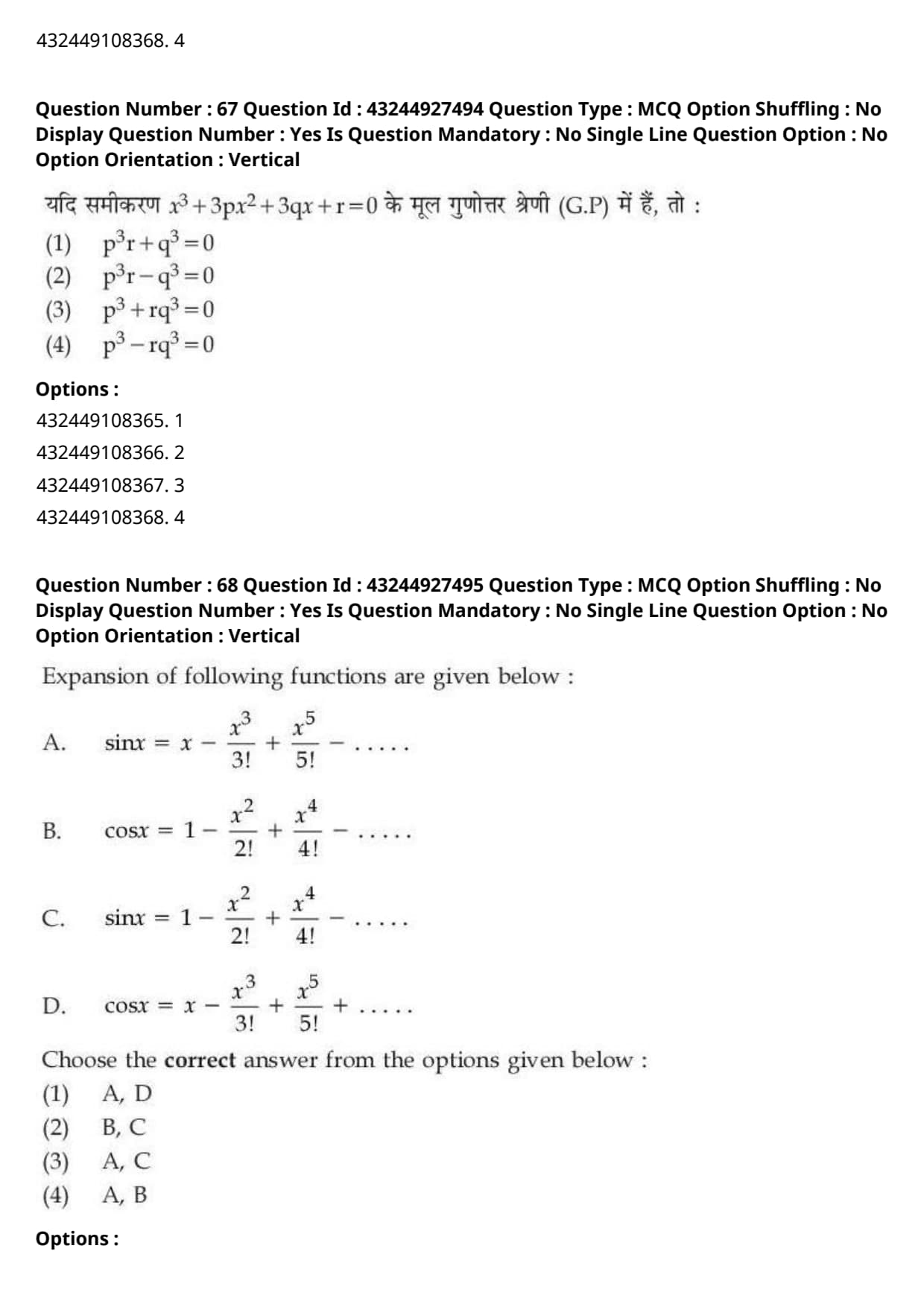
If the roots of the equation \[ x^3+3px^2+3qx+r=0 \]
are in geometric progression, then:
View Solution
Concept:
For a cubic equation, relation between roots and coefficients is obtained using Vieta's formula.
Step 1: Let roots be in G.P.
Let the roots be: \[ \frac{a}{k},\quad a,\quad ak \]
Step 2: Use product of roots.
For: \[ x^3+3px^2+3qx+r=0 \]
Product of roots: \[ \frac{a}{k}\cdot a\cdot ak=a^3=-r \]
\[ a^3=-r \]
Step 3: Use sum and pairwise sum.
Sum of roots: \[ a\left(\frac{1}{k}+1+k\right)=-3p \]
Pairwise sum: \[ a^2\left(\frac{1}{k}+1+k\right)=3q \]
Dividing pairwise sum by sum: \[ \frac{3q}{-3p}=a \]
\[ a=-\frac{q}{p} \]
Step 4: Substitute in product relation. \[ a^3=-r \]
\[ \left(-\frac{q}{p}\right)^3=-r \]
\[ -\frac{q^3}{p^3}=-r \]
\[ p^3r=q^3 \]
\[ p^3r-q^3=0 \]
\[ \therefore Correct Answer is (B) \] Quick Tip: For cubic roots in G.P., assume roots as \(\frac{a}{k},a,ak\) and apply Vieta's formula.
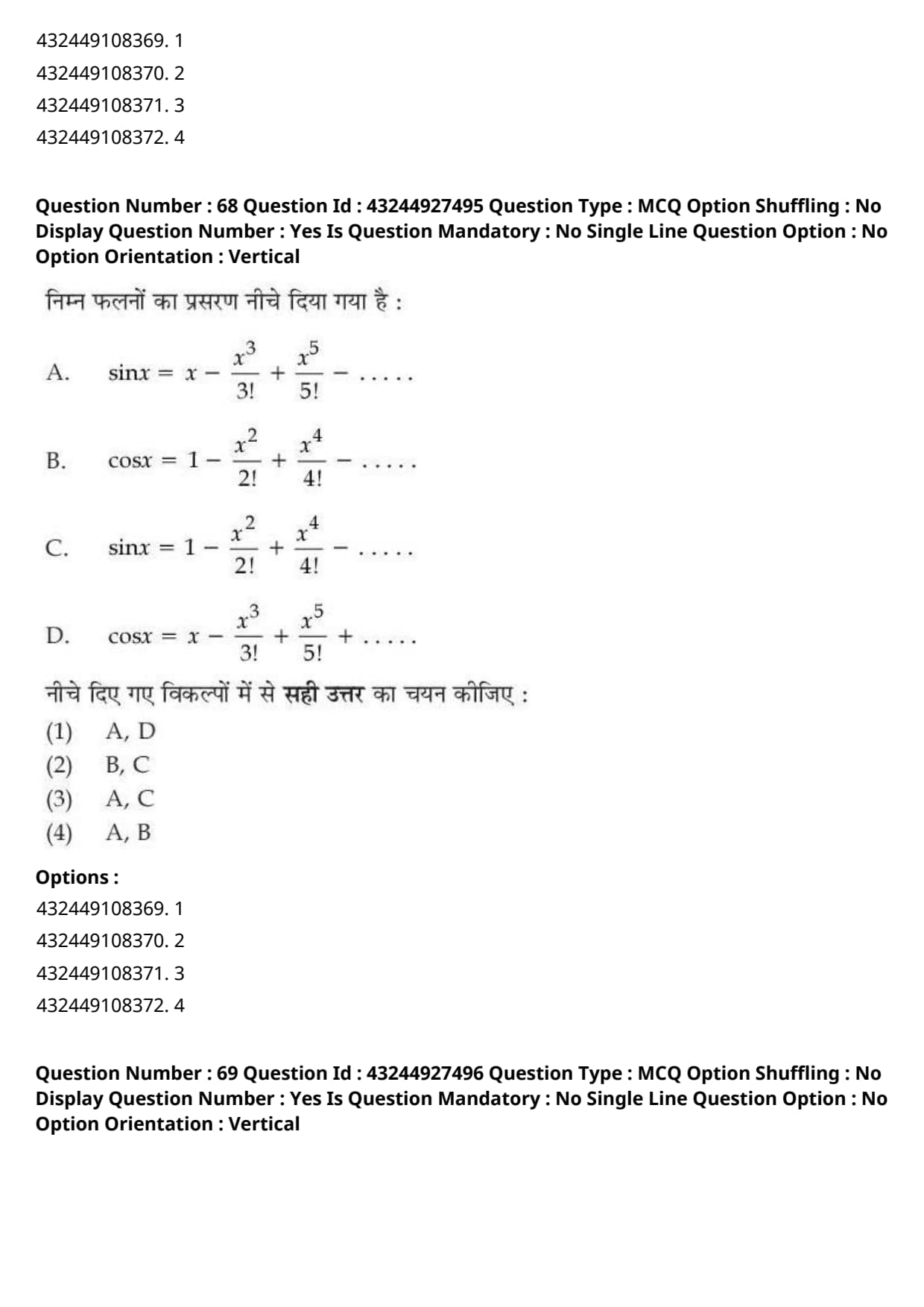
Expansion of following functions are given below:
A. \[ \sin x=x-\frac{x^3}{3!}+\frac{x^5}{5!}-\cdots \]
B. \[ \cos x=1-\frac{x^2}{2!}+\frac{x^4}{4!}-\cdots \]
C. \[ \sin x=1-\frac{x^2}{2!}+\frac{x^4}{4!}-\cdots \]
D. \[ \cos x=x-\frac{x^3}{3!}+\frac{x^5}{5!}-\cdots \]
Choose the correct answer from the options given below:
View Solution
Concept:
Maclaurin series expansions of \(\sin x\) and \(\cos x\) are standard results.
Step 1: Expansion of \(\sin x\). \[ \sin x=x-\frac{x^3}{3!}+\frac{x^5}{5!}-\cdots \]
So statement A is correct.
Step 2: Expansion of \(\cos x\). \[ \cos x=1-\frac{x^2}{2!}+\frac{x^4}{4!}-\cdots \]
So statement B is correct.
Step 3: Check C and D.
Statement C gives the expansion of \(\cos x\), not \(\sin x\).
Statement D gives the expansion of \(\sin x\), not \(\cos x\).
\[ C,D are incorrect \]
\[ \therefore Correct Answer is (D) \] Quick Tip: \(\sin x\) contains odd powers of \(x\), while \(\cos x\) contains even powers of \(x\).
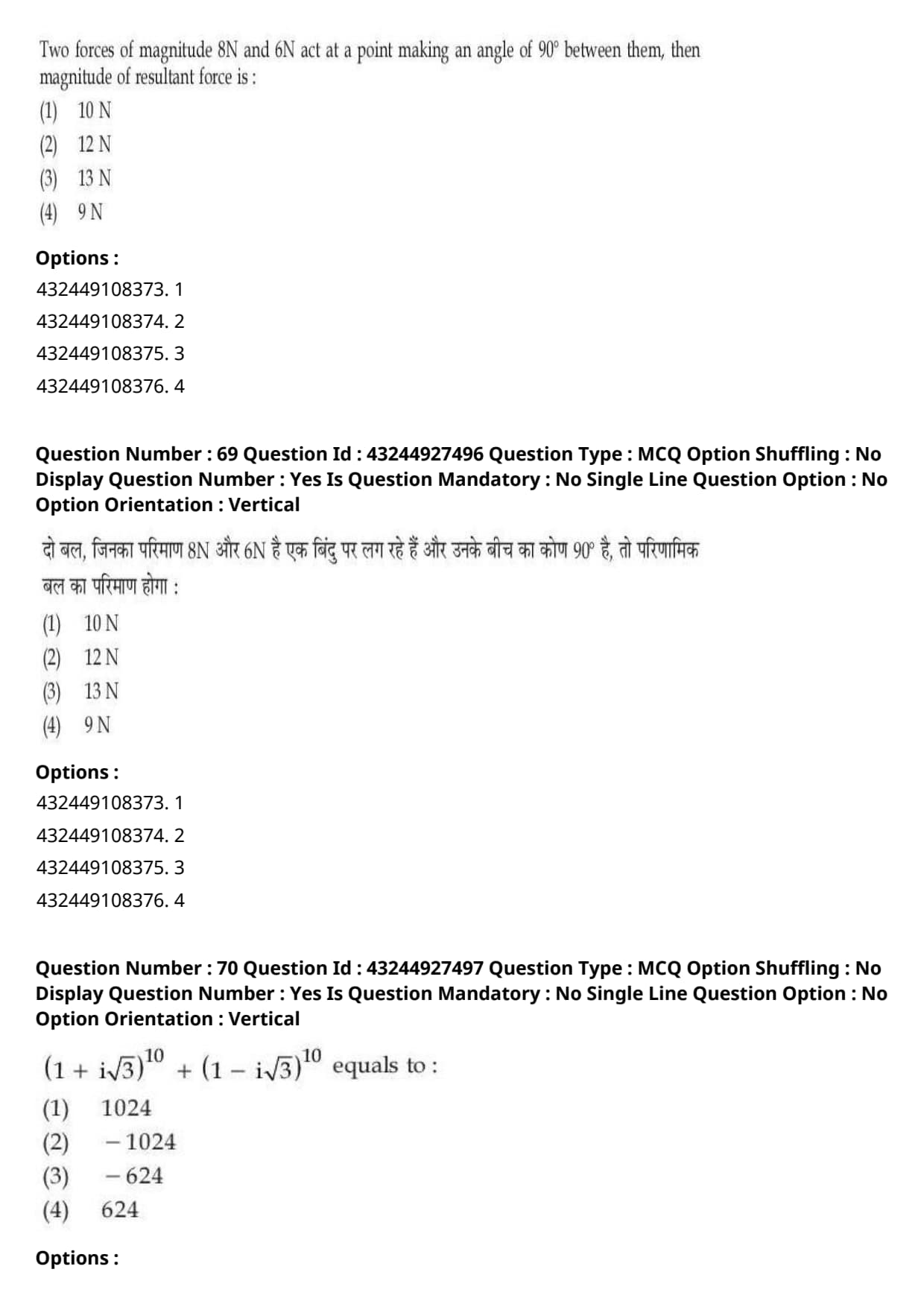
Two forces of magnitude \(8\ N\) and \(6\ N\) act at a point making an angle of \(90^\circ\) between them. The magnitude of resultant force is:
View Solution
Concept:
When two forces act at right angle, the resultant is calculated using Pythagoras theorem.
\[ R=\sqrt{F_1^2+F_2^2} \]
Step 1: Write given forces. \[ F_1=8\ N \]
\[ F_2=6\ N \]
Step 2: Apply formula. \[ R=\sqrt{8^2+6^2} \]
\[ R=\sqrt{64+36} \]
\[ R=\sqrt{100} \]
\[ R=10\ N \]
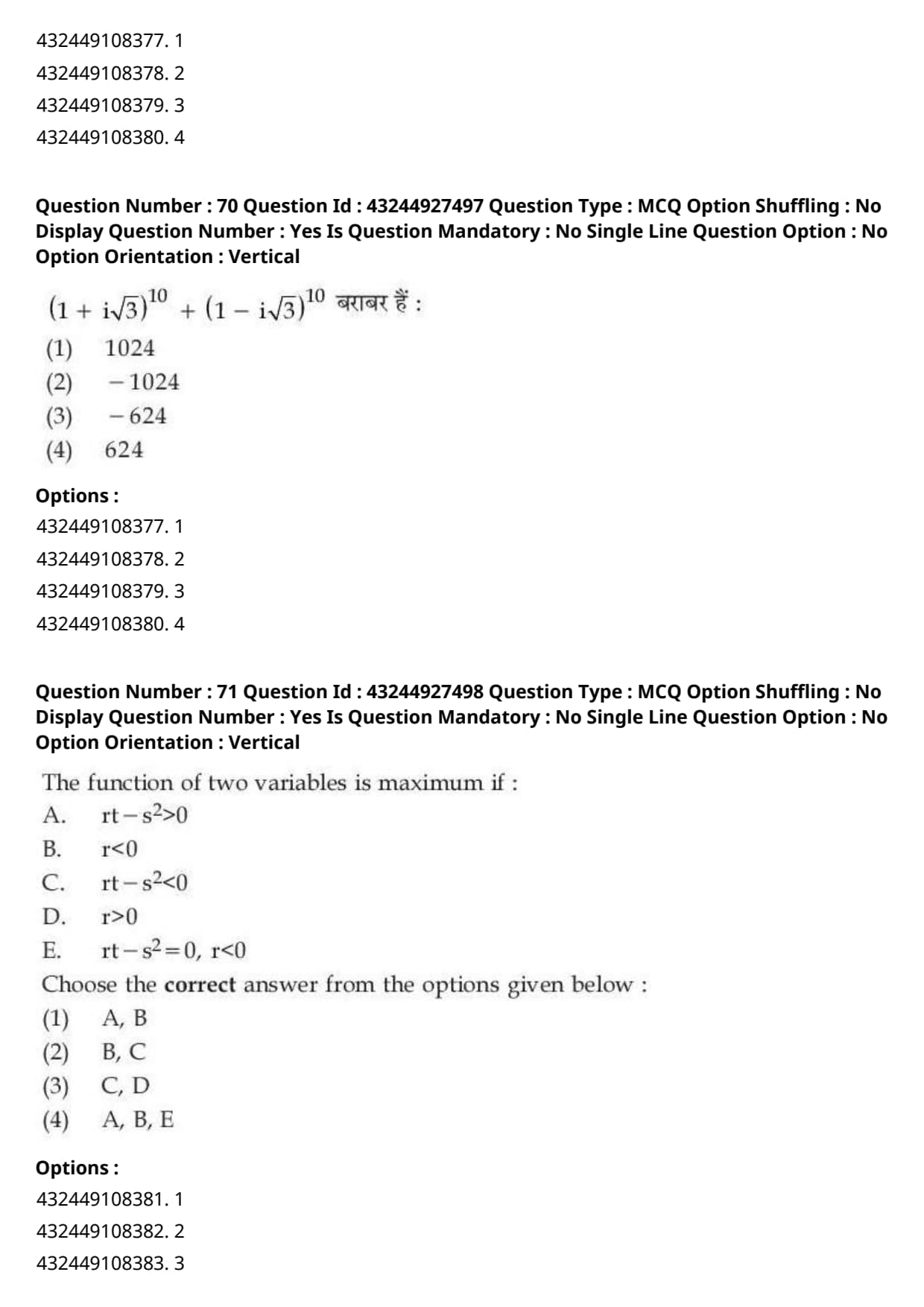
\[ \therefore Correct Answer is (A) \] Quick Tip: For two perpendicular forces, resultant is \(R=\sqrt{F_1^2+F_2^2}\).
\[ (1+i\sqrt{3})^{10}+(1-i\sqrt{3})^{10} \]
equals to:
View Solution
Concept:
Convert complex numbers into polar form and then use De Moivre's theorem.
Step 1: Convert \(1+i\sqrt{3}\). \[ 1+i\sqrt{3}=2\left(\cos\frac{\pi}{3}+i\sin\frac{\pi}{3}\right) \]
Similarly: \[ 1-i\sqrt{3}=2\left(\cos\frac{\pi}{3}-i\sin\frac{\pi}{3}\right) \]
Step 2: Raise to power \(10\). \[ (1+i\sqrt{3})^{10}=2^{10}\left(\cos\frac{10\pi}{3}+i\sin\frac{10\pi}{3}\right) \]
\[ (1-i\sqrt{3})^{10}=2^{10}\left(\cos\frac{10\pi}{3}-i\sin\frac{10\pi}{3}\right) \]
Step 3: Add both. \[ (1+i\sqrt{3})^{10}+(1-i\sqrt{3})^{10} =2\cdot 2^{10}\cos\frac{10\pi}{3} \]
\[ =2048\cos\frac{10\pi}{3} \]
Now: \[ \cos\frac{10\pi}{3}=\cos\frac{4\pi}{3}=-\frac{1}{2} \]
\[ =2048\left(-\frac{1}{2}\right) \]
\[ =-1024 \]
\[ \therefore Correct Answer is (B) \] Quick Tip: Use De Moivre's theorem for powers of complex numbers in polar form.
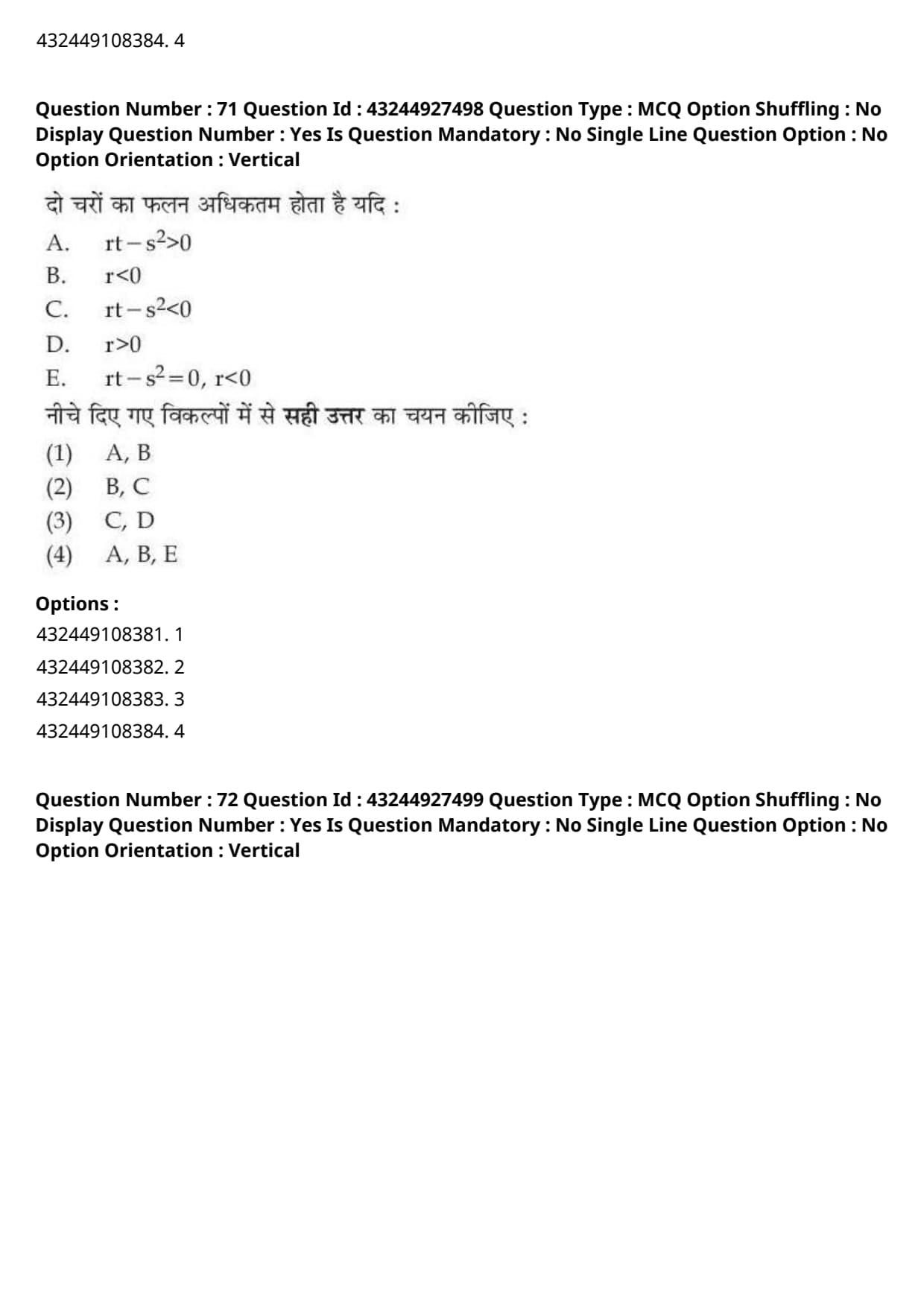
The function of two variables is maximum if:
A. \(rt-s^2>0\)
B. \(r<0\)
C. \(rt-s^2<0\)
D. \(r>0\)
E. \(rt-s^2=0,\ r<0\).
View Solution
Concept:
For a function of two variables, second derivative test is used to identify maximum and minimum.
Let: \[ r=f_{xx},\quad s=f_{xy},\quad t=f_{yy} \]
The discriminant is: \[ D=rt-s^2 \]
Step 1: Condition for maximum.
For maximum: \[ D=rt-s^2>0 \]
and: \[ r=f_{xx}<0 \]
Step 2: Match with statements.
Statement A: \[ rt-s^2>0 \]
is correct.
Statement B: \[ r<0 \]
is also correct.
Step 3: Final answer.
Thus, the function has maximum when: \[ rt-s^2>0,\quad r<0 \]
\[ \therefore Correct Answer is (A) \] Quick Tip: For maximum of \(f(x,y)\), use \(rt-s^2>0\) and \(r<0\).
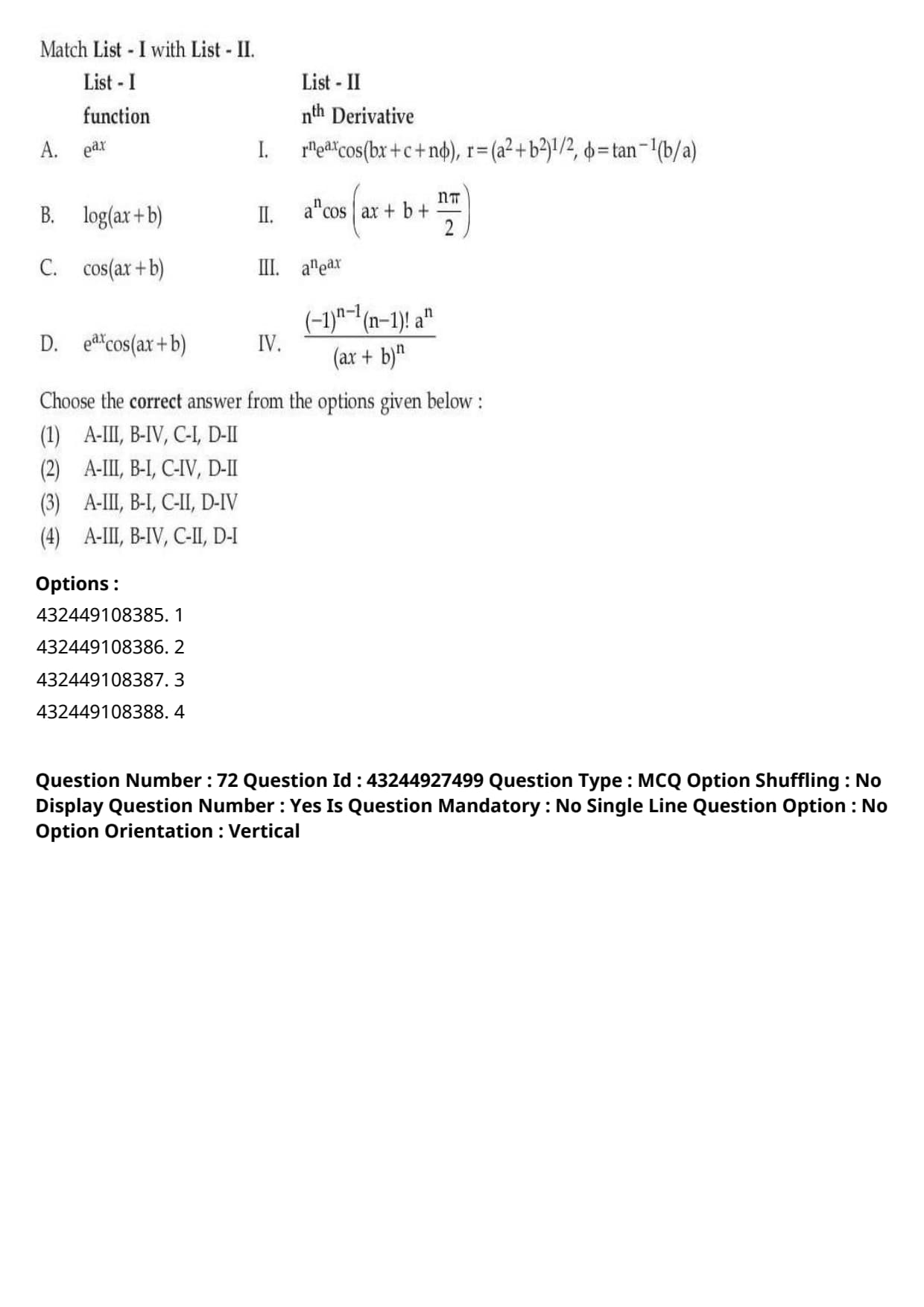
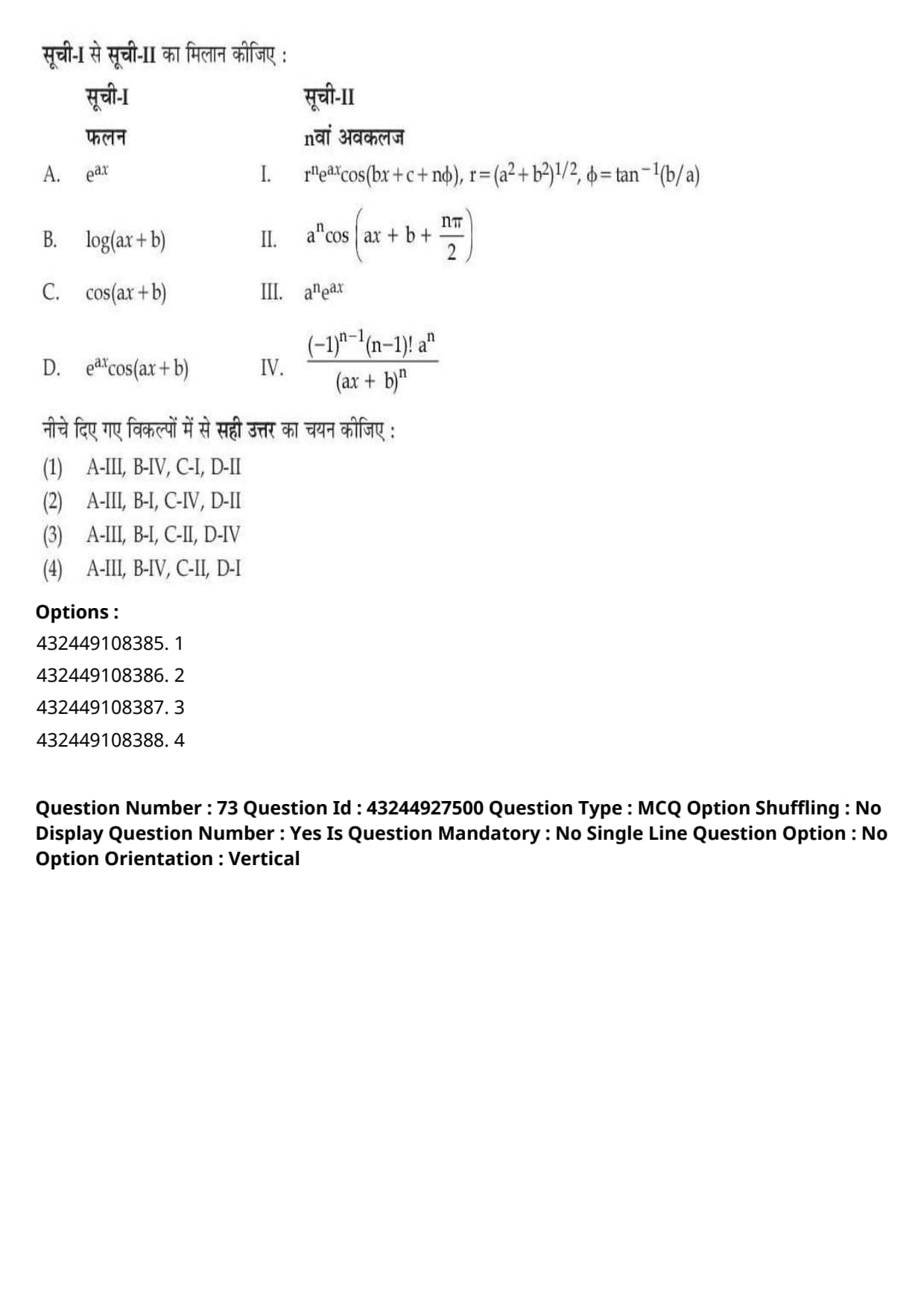
Match List-I with List-II.

View Solution
Concept:
This question is based on standard formulae for \(n^{th}\) derivatives.
Step 1: \(e^{ax}\). \[ \frac{d^n}{dx^n}(e^{ax})=a^ne^{ax} \]
So: \[ A\rightarrow IV \]
Step 2: \(\log(ax+b)\). \[ \frac{d^n}{dx^n}\log(ax+b)=\frac{(-1)^{n-1}(n-1)!a^n}{(ax+b)^n} \]
So: \[ B\rightarrow III \]
Step 3: \(\cos(ax+b)\). \[ \frac{d^n}{dx^n}\cos(ax+b)=a^n\cos\left(ax+b+\frac{n\pi}{2}\right) \]
So: \[ C\rightarrow II \]
Step 4: \(e^{ax}\cos(bx+c)\). \[ \frac{d^n}{dx^n}\left(e^{ax}\cos(bx+c)\right) = r^ne^{ax}\cos(bx+c+n\theta) \]
where: \[ r=(a^2+b^2)^{1/2},\quad \theta=\tan^{-1}\frac{b}{a} \]
So: \[ D\rightarrow I \]
Therefore: \[ A-IV,\ B-III,\ C-II,\ D-I \]
\[ \therefore Correct Answer is (A) \] Quick Tip: For \(n^{th}\) derivatives, memorize standard forms of \(e^{ax}\), \(\log(ax+b)\), \(\cos(ax+b)\), and \(e^{ax}\cos(bx+c)\).
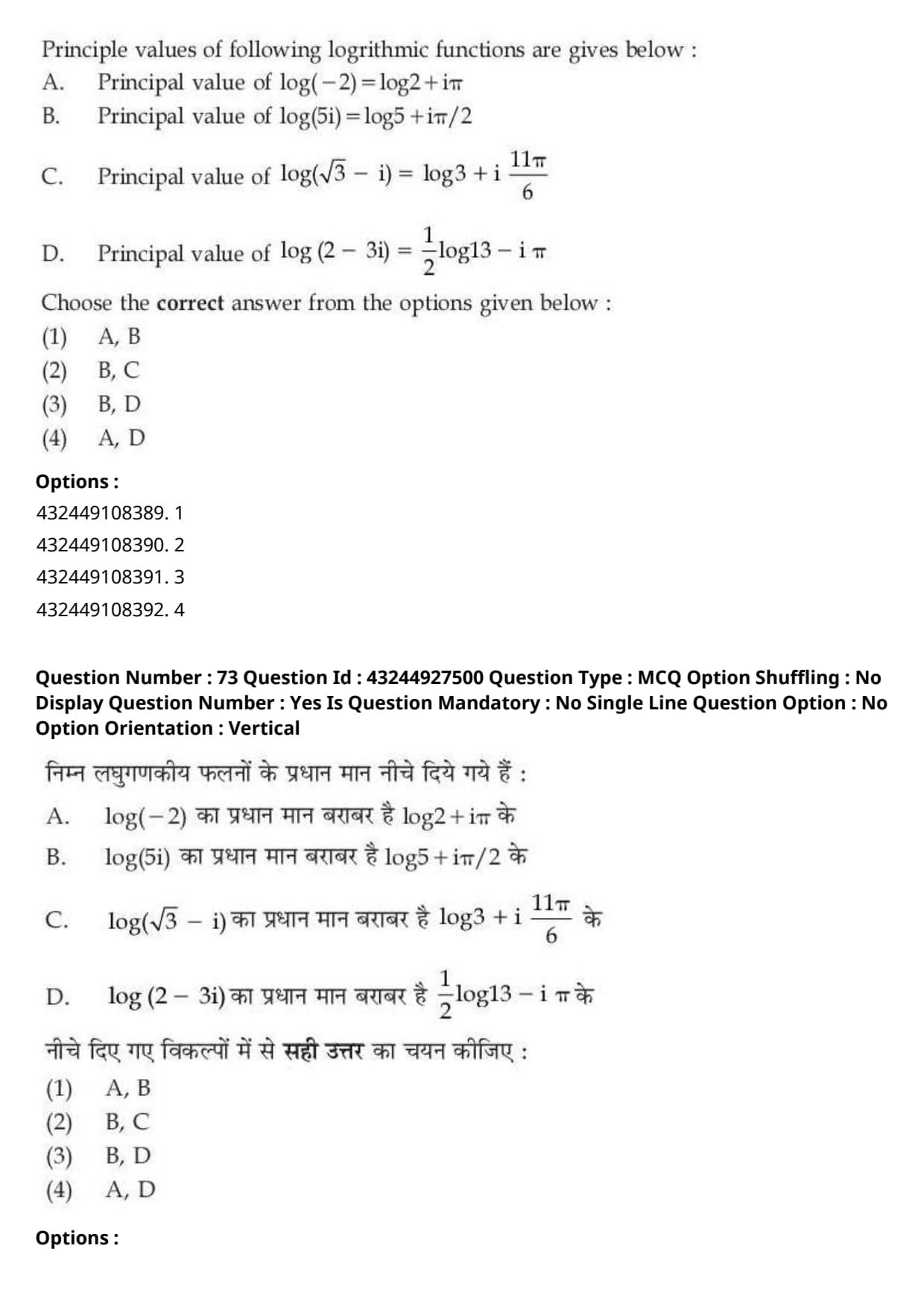
Principal values of following logarithmic functions are given below:
A. Principal value of \(\log(-2)=\log2+i\pi\)
B. Principal value of \(\log(5i)=\log5+\frac{i\pi}{2}\)
C. Principal value of \(\log(\sqrt{3}-i)=\log3+\frac{i\pi}{6}\)
D. Principal value of \(\log(2-3i)=\frac{1}{2}\log13-i\tan^{-1}\frac{3}{2}\).
View Solution
Concept:
For a complex number: \[ z=re^{i\theta} \]
the principal value of logarithm is: \[ \log z=\log r+i\theta \]
where \(\theta\) is the principal argument.
Step 1: Check statement B. \[ 5i=5e^{i\pi/2} \]
So: \[ \log(5i)=\log5+\frac{i\pi}{2} \]
Thus, B is correct.
Step 2: Check statement C. \[ \sqrt{3}-i \]
Its modulus is: \[ r=\sqrt{3+1}=2 \]
Its argument is: \[ -\frac{\pi}{6} \]
So: \[ \log(\sqrt{3}-i)=\log2-\frac{i\pi}{6} \]
Therefore, C is incorrect.
Step 3: Check statement D. \[ 2-3i \]
Modulus: \[ r=\sqrt{2^2+(-3)^2}=\sqrt{13} \]
Argument: \[ \theta=-\tan^{-1}\frac{3}{2} \]
Therefore: \[ \log(2-3i)=\frac{1}{2}\log13-i\tan^{-1}\frac{3}{2} \]
So, D is correct.
Step 4: Final answer.
The correct statements are: \[ B,D \]
\[ \therefore Correct Answer is (C) \] Quick Tip: For complex logarithm, first find modulus and principal argument: \(\log z=\log r+i\theta\).
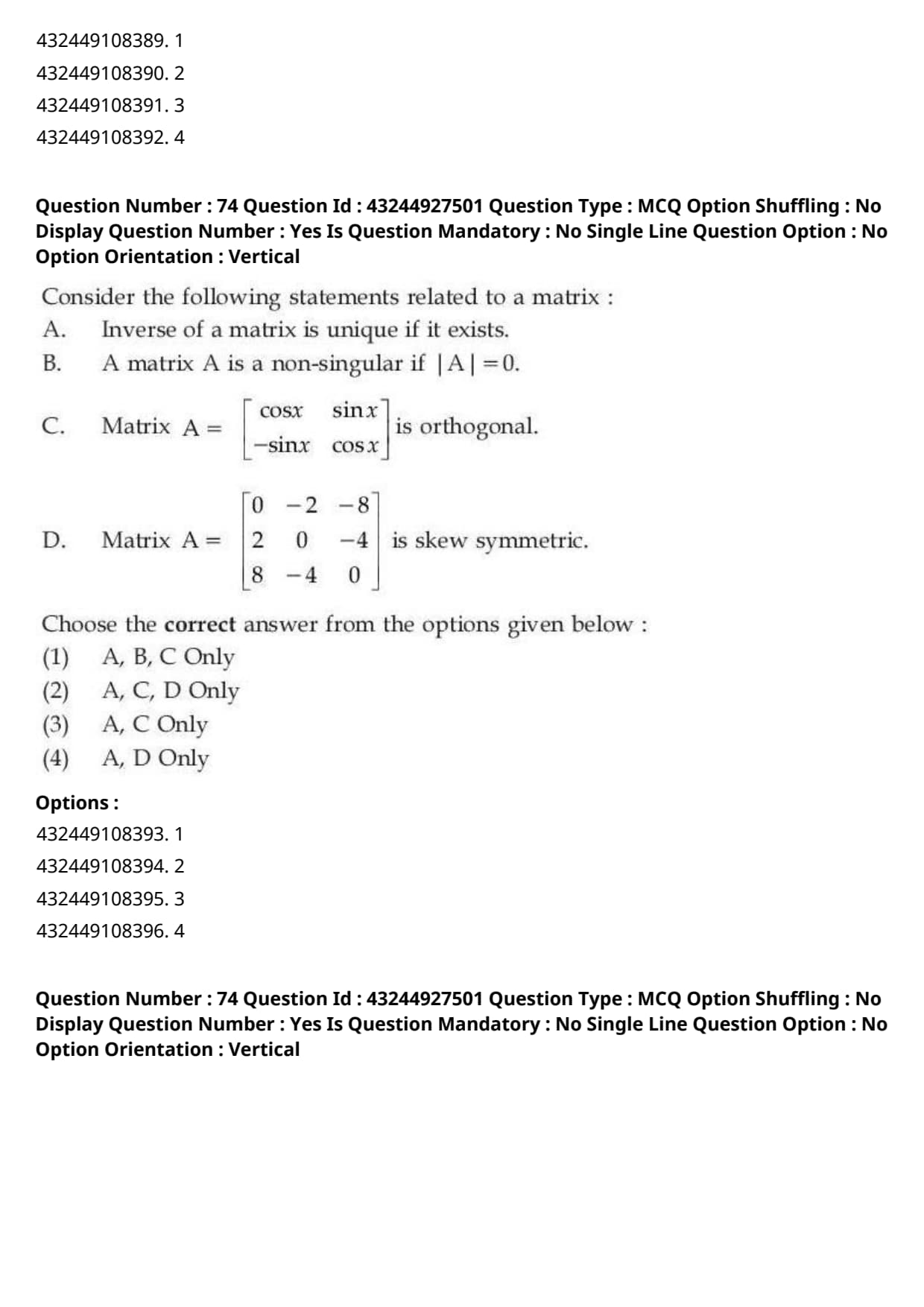
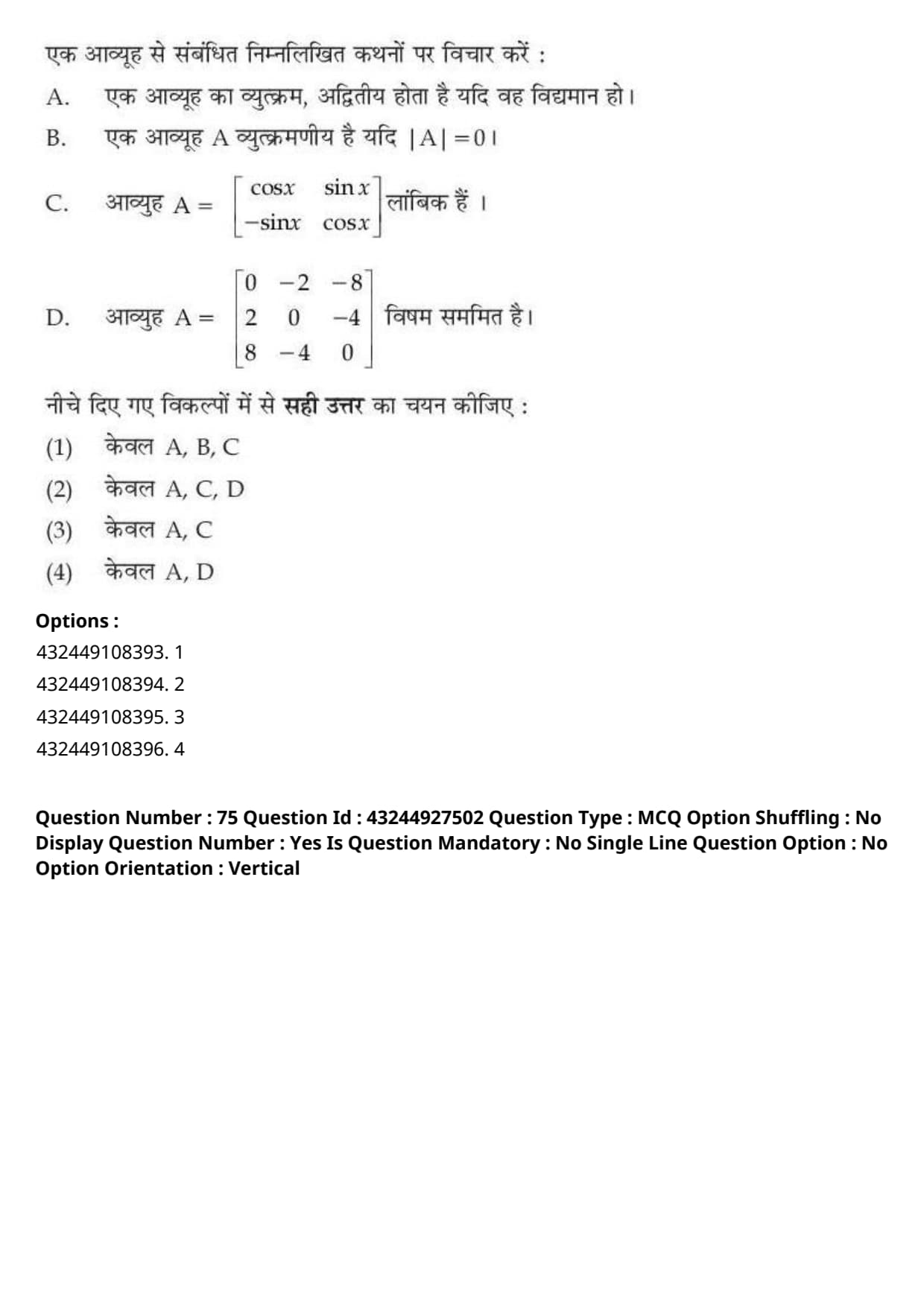
Consider the following statements related to a matrix:
A. Inverse of a matrix is unique if it exists.
B. A matrix \(A\) is non-singular if \(|A|=0\).
C. Matrix \[A=\begin{pmatrix} \cos x & \sin x \\
-\sin x & \cos x \end{pmatrix}\]
is orthogonal.
D. Matrix \[A=\begin{pmatrix} 0 & -2 & -8 \\
2 & 0 & -4 \\
8 & -4 & 0 \end{pmatrix}\]
is skew symmetric.
View Solution
Concept:
A matrix inverse, orthogonal matrix and skew-symmetric matrix have fixed standard properties.
Step 1: Check statement A.
If inverse of a matrix exists, then it is unique.
\[ A is correct \]
Step 2: Check statement B.
A matrix is non-singular when: \[ |A|\neq 0 \]
But statement B says: \[ |A|=0 \]
So B is incorrect.
Step 3: Check statement C.
For:
A=\begin{pmatrix
\cos x & \sin x
-\sin x & \cos x
\end{pmatrix
we get: \[ AA^T=I \]
So the matrix is orthogonal.
\[ C is correct \]
Step 4: Check statement D.
For a skew-symmetric matrix: \[ a_{ij}=-a_{ji} \]
Here: \[ a_{23}=-4,\quad a_{32}=-4 \]
But for skew-symmetric matrix, these should be opposite in sign.
So D is incorrect.
Therefore, correct statements are: \[ A,C \]
\[ \therefore Correct Answer is (C) \] Quick Tip: A non-singular matrix has non-zero determinant, and an orthogonal matrix satisfies \(AA^T=I\).
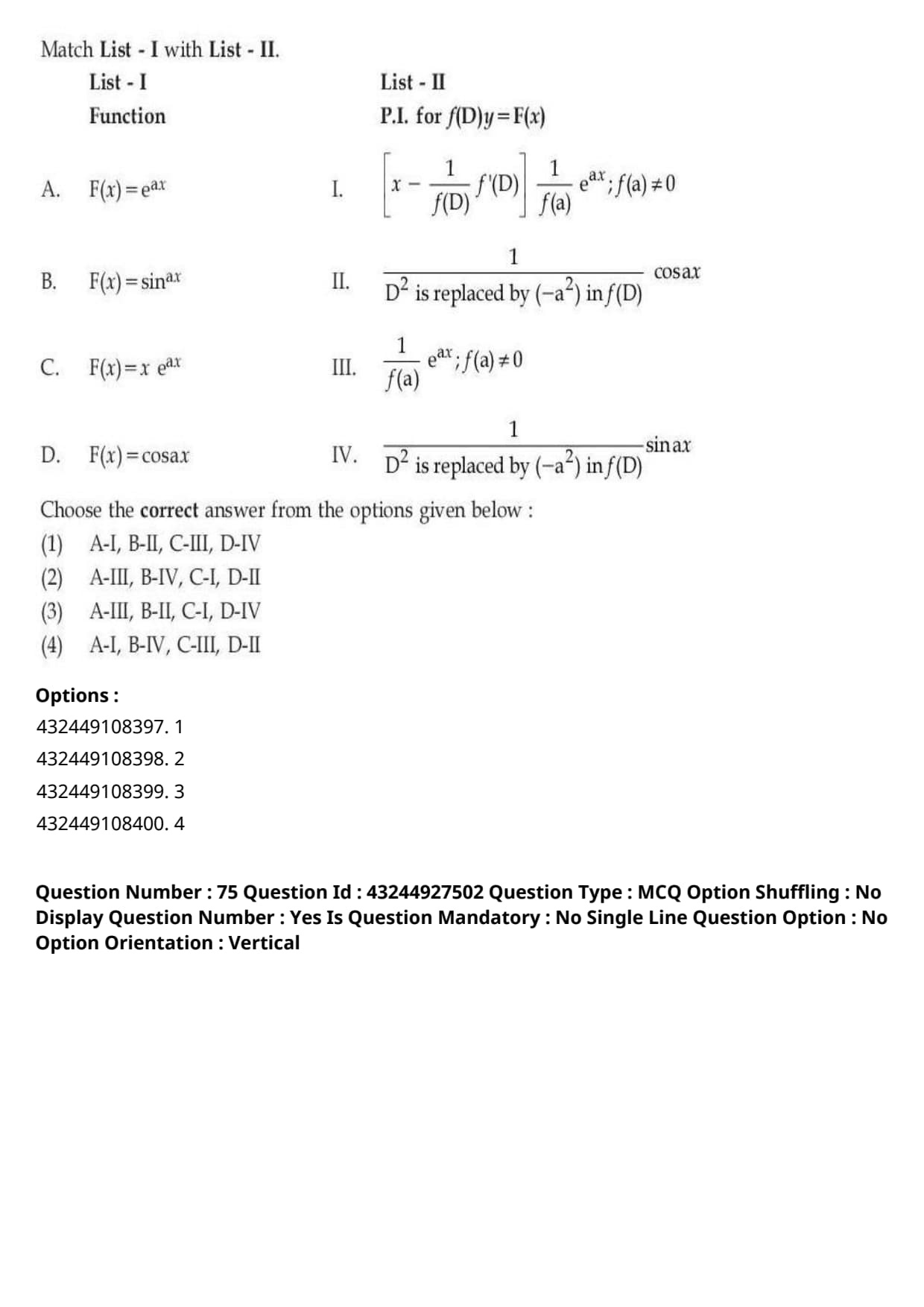
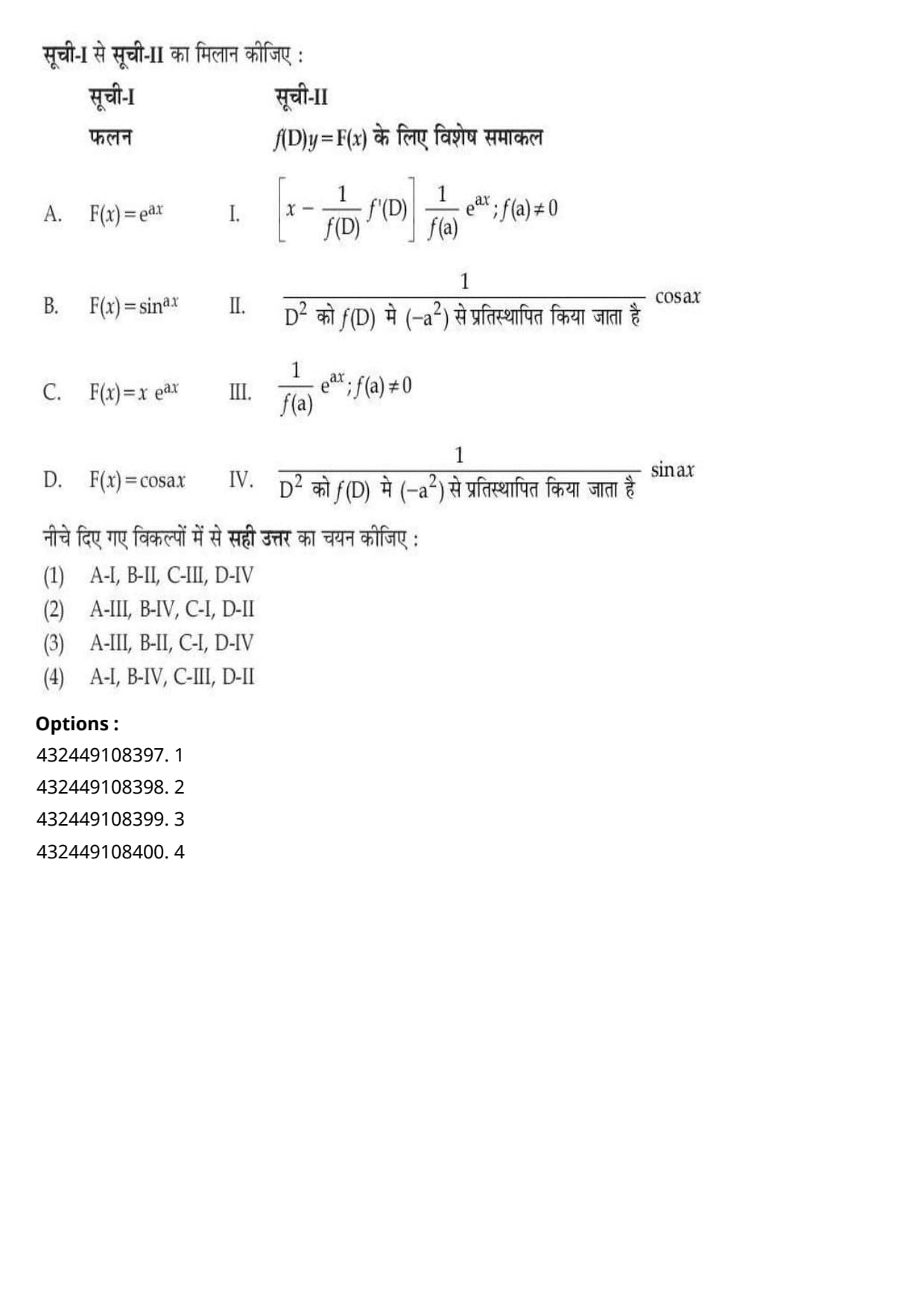
Match List-I with List-II.

View Solution
Concept:
For linear differential equations with constant coefficients: \[ f(D)y=F(x) \]
the particular integral is found using standard operator rules.
Step 1: For \(F(x)=e^{ax}\). \[ P.I.=\frac{e^{ax}}{f(a)},\quad f(a)\neq0 \]
So: \[ A\rightarrow III \]
Step 2: For \(F(x)=\sin ax\). \[ P.I.=\frac{\sin ax}{f(-a^2)} \]
So: \[ B\rightarrow II \]
Step 3: For \(F(x)=xe^{ax}\). \[ P.I.=\left(\frac{x}{f(a)}-\frac{f'(a)}{[f(a)]^2}\right)e^{ax} \]
So: \[ C\rightarrow I \]
Step 4: For \(F(x)=\cos ax\).
For sine or cosine functions, \(D^2\) is replaced by: \[ -a^2 \]
in \(f(D)\).
So: \[ D\rightarrow IV \]
Therefore: \[ A-III,\ B-II,\ C-I,\ D-IV \]
\[ \therefore Correct Answer is (C) \] Quick Tip: For \(e^{ax}\), replace \(D\) by \(a\); for \(\sin ax\) and \(\cos ax\), replace \(D^2\) by \(-a^2\).



Comments