




The National Testing Agency (NTA) conducted the CUET PG 2026 Geology (SCQP14) examination on March 19, 2026, during Shift 1 from 09:00 AM to 10:30 AM.
Students who appeared for the exam reported that the overall difficulty level of the paper was moderate. CUET PG 2026 Geology Question Paper with Solutions PDF is available here for download. The marking scheme is +4 for correct answers and -1 for wrong answers, totaling 300 marks.
CUET PG 2026 Geology Question Paper with Solutions PDF
| CUET PG 2026 Geology Question Paper with Answer Key | Download PDF | Check Solutions |




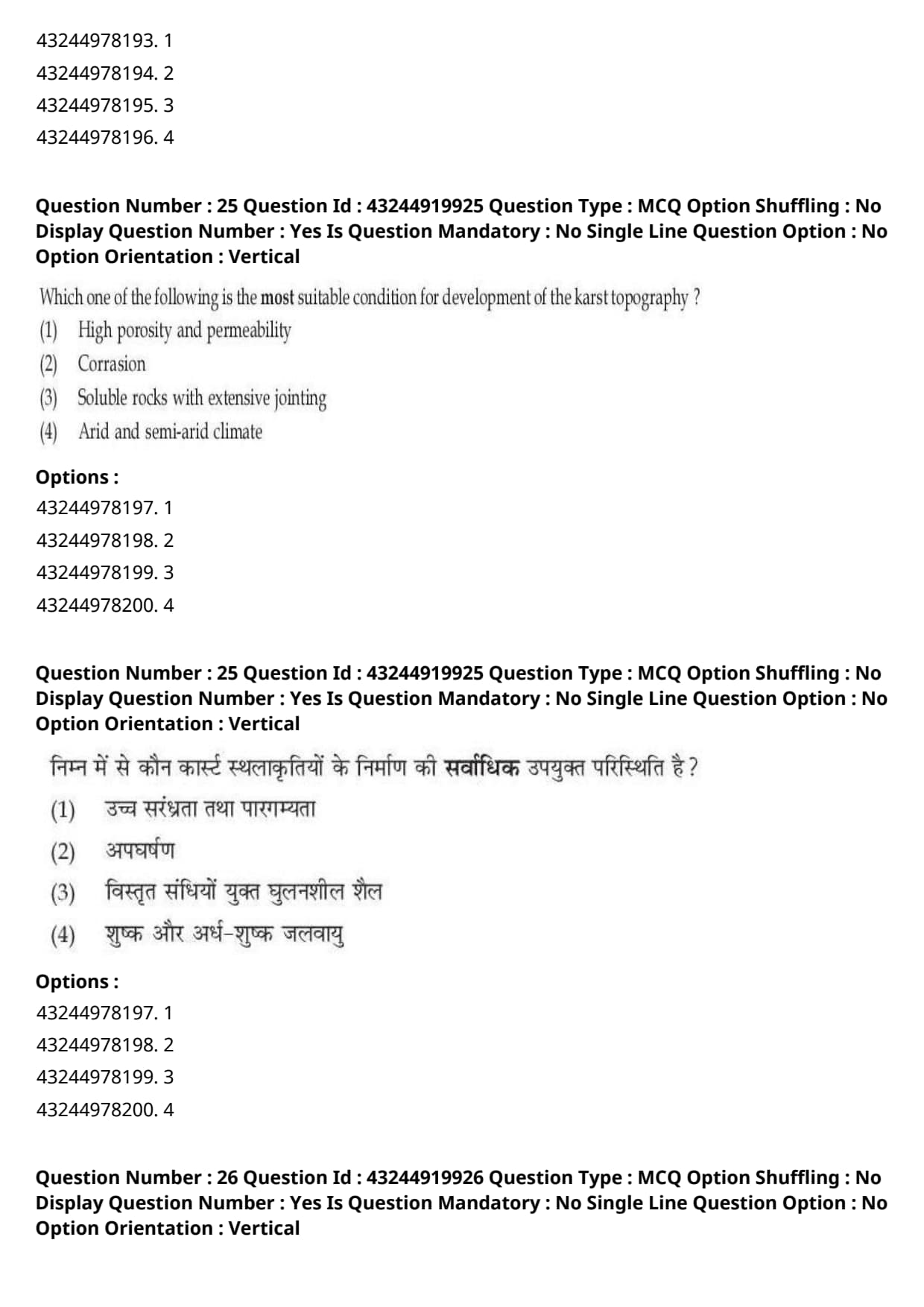
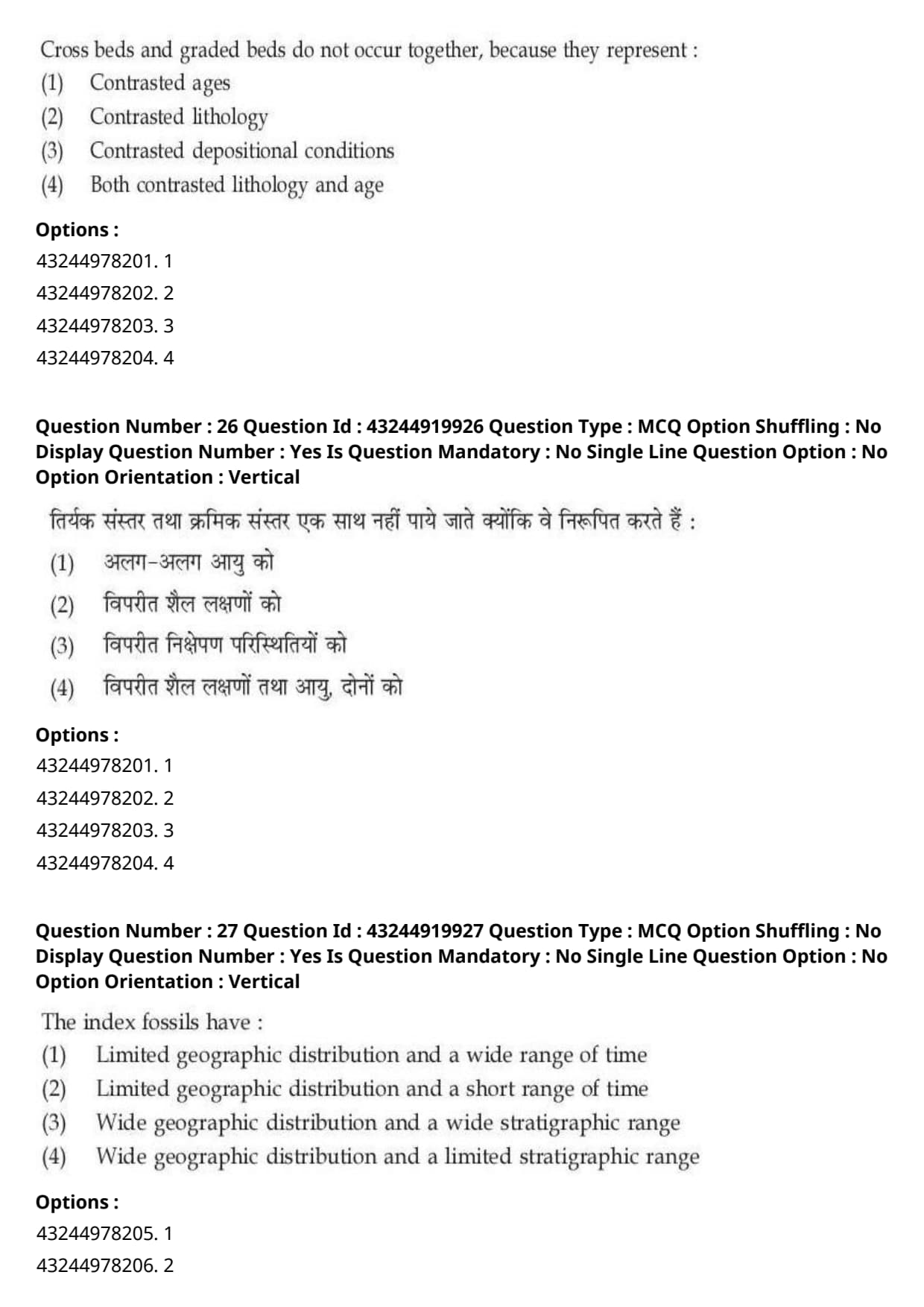
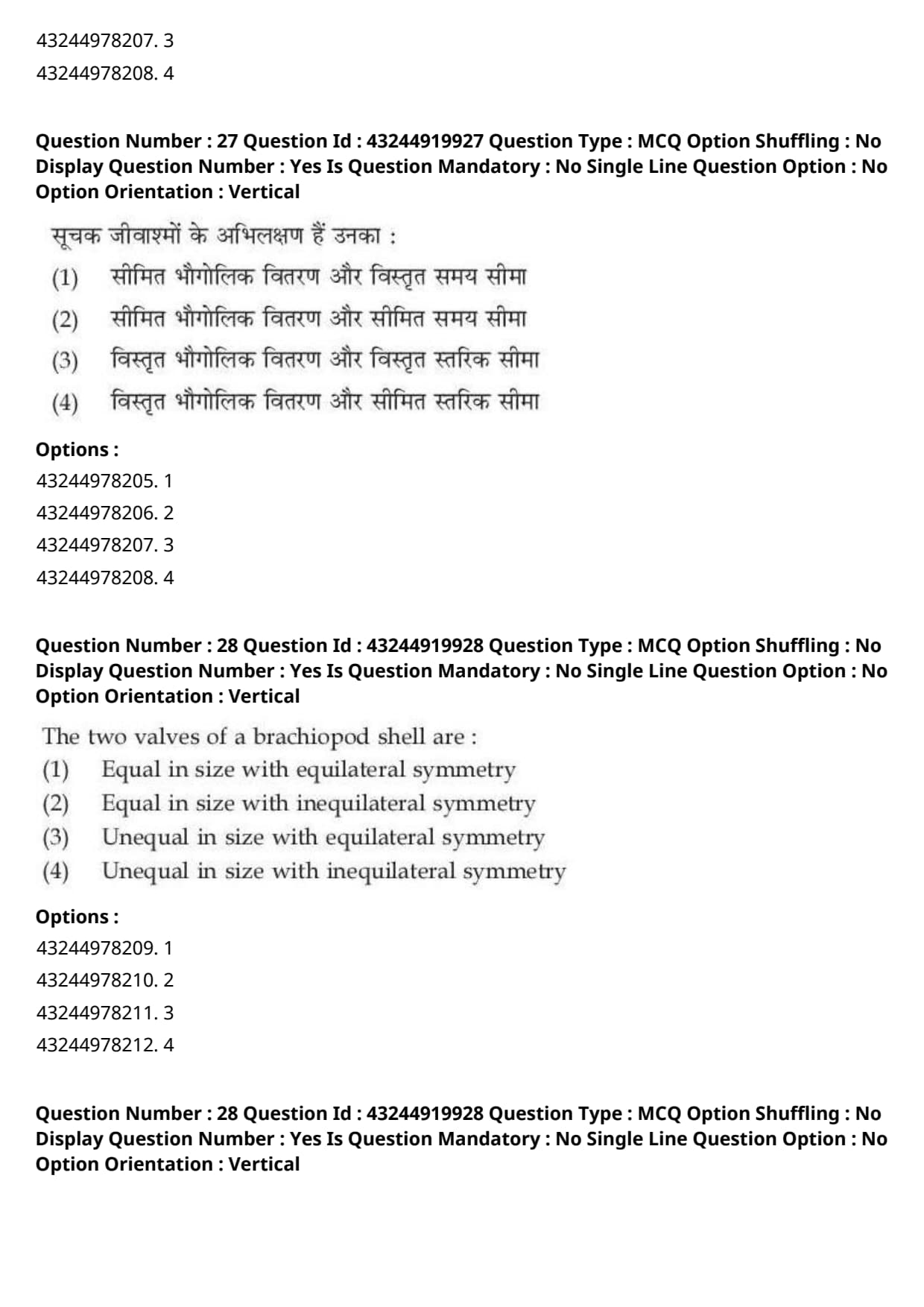
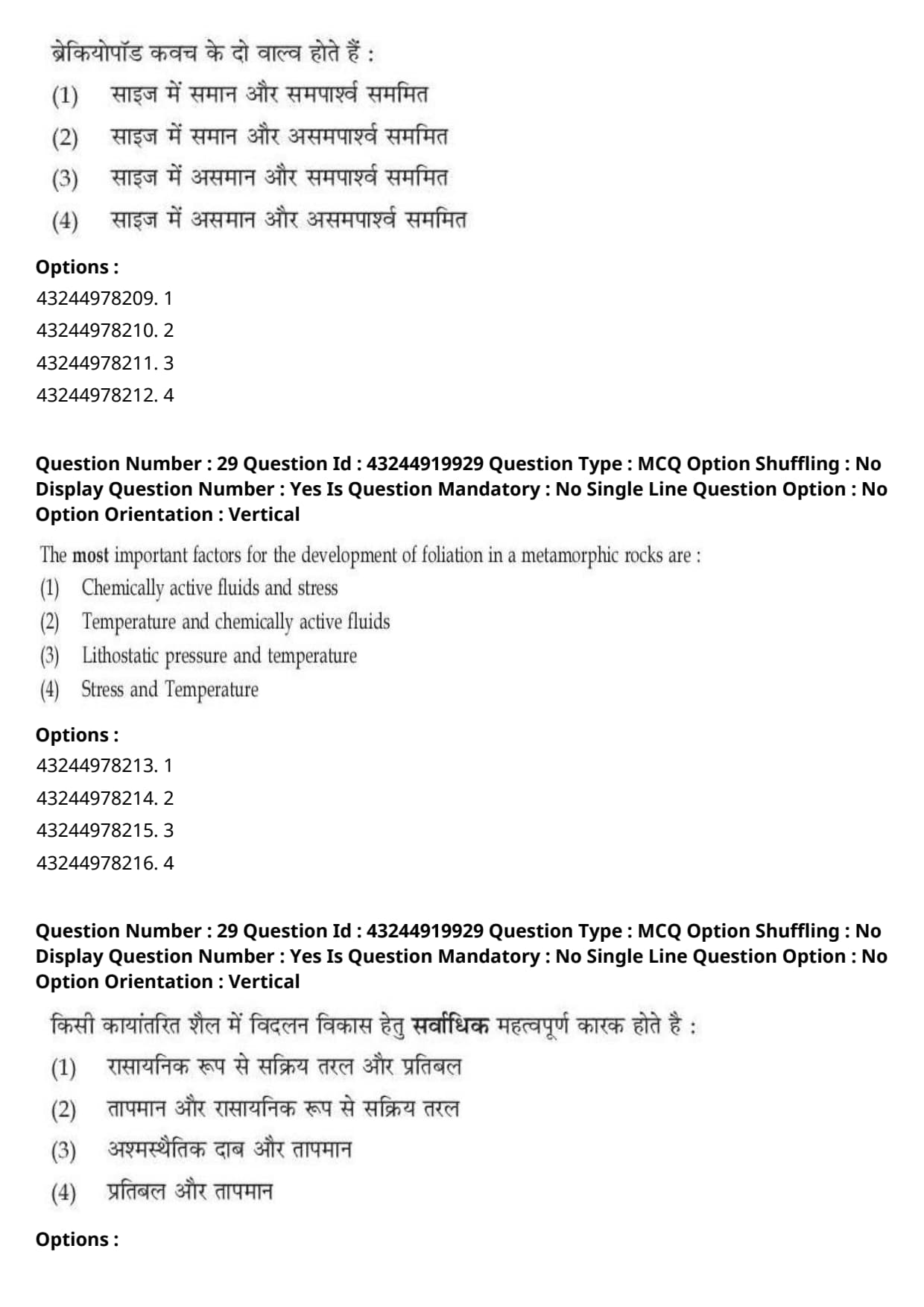














A solid crystal in which a face on one side is opposite to a point on the other, is called:
View Solution
Concept:
In crystallography, symmetry of a crystal is identified by the arrangement of faces, edges, points and symmetry elements.
Step 1: Understand the given condition.
The question says that a face on one side of the crystal is opposite to a point on the other side.
This means the two ends of the crystal are not similar.
Step 2: Identify the crystal character.
When the opposite ends of a crystal are dissimilar, the crystal is called hemimorphic.
\[ Face on one side and point on opposite side \Rightarrow Hemimorphic \]
Step 3: Eliminate other options.
Centrosymmetric crystals have a centre of symmetry.
Enantiomorphous crystals are mirror-related forms.
Non-centrosymmetric is a broad term, but the specific term for this condition is hemimorphic.
\[ \therefore Correct Answer is (D) \] Quick Tip: Hemimorphic crystals have dissimilar opposite ends.
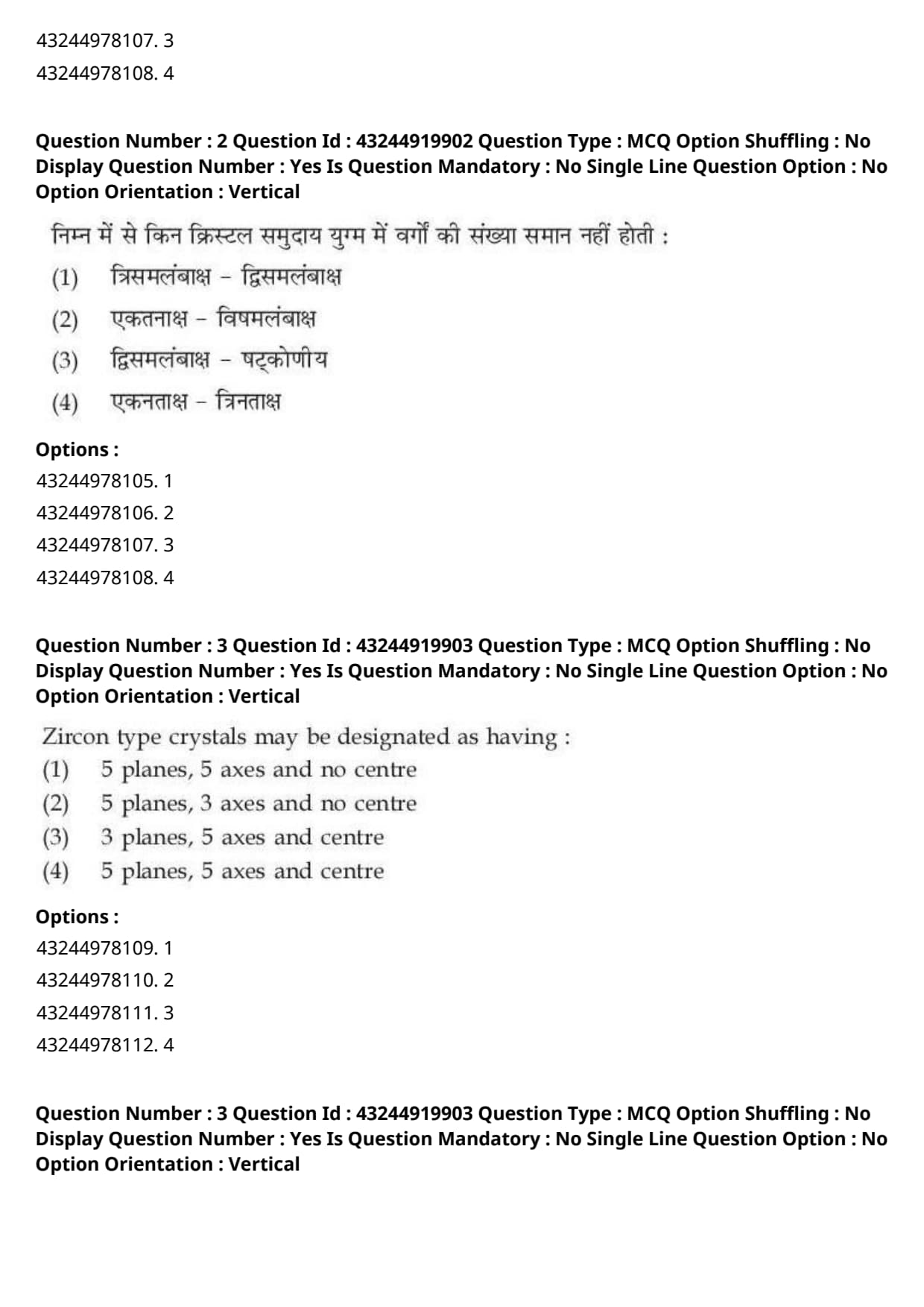
Which of the following pairs do not have the same number of classes in their crystal system?
View Solution
Concept:
Crystal systems contain different numbers of crystal classes. The number of classes depends on symmetry elements present in the system.
Step 1: Recall number of classes.
The cubic crystal system has:
\[ 5 classes \]
The tetragonal crystal system has:
\[ 7 classes \]
Step 2: Compare the pair.
Since cubic has \(5\) classes and tetragonal has \(7\) classes, they do not have the same number of crystal classes.
\[ 5\neq 7 \]
Step 3: Final conclusion.
Therefore, the pair that does not have the same number of classes is:
\[ Cubic -- Tetragonal \]
\[ \therefore Correct Answer is (A) \] Quick Tip: Cubic system has 5 crystal classes, while tetragonal system has 7 crystal classes.
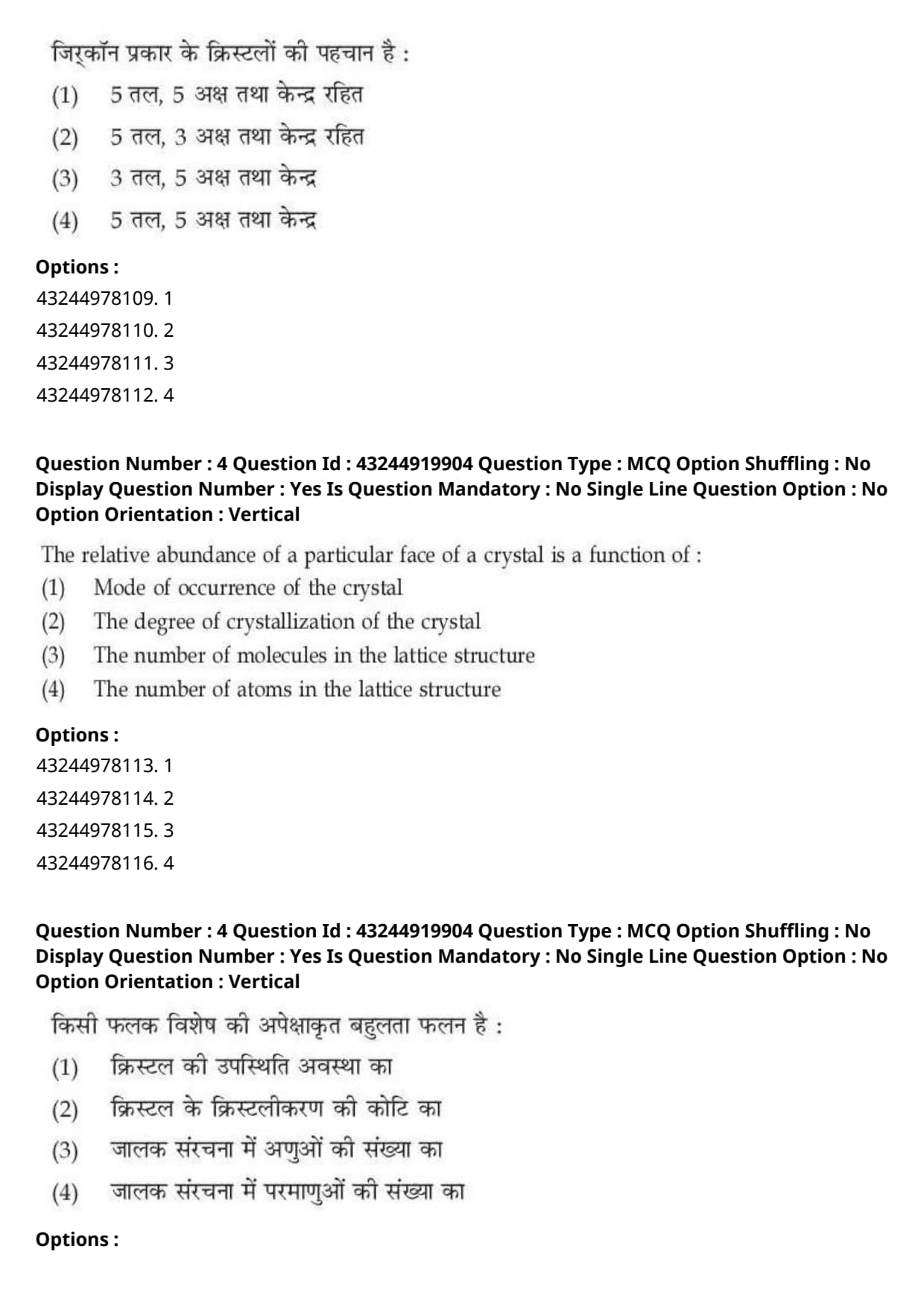
Zircon type crystals may be designated as having:
View Solution
Concept:
Zircon is an important mineral of the tetragonal crystal system. The symmetry of crystals is described by symmetry planes, axes and centre.
Step 1: Identify the crystal type.
Zircon belongs to the tetragonal system and is commonly used as an example of high symmetry tetragonal crystals.
Step 2: Symmetry elements.
Zircon type crystals are described as having:
\[ 5 planes \] \[ 5 axes \] \[ 1 centre of symmetry \]
Step 3: Select the matching option.
The option matching this description is:
\[ 5 planes, 5 axes and centre \]
\[ \therefore Correct Answer is (D) \] Quick Tip: Zircon is a common example used for tetragonal crystal symmetry.
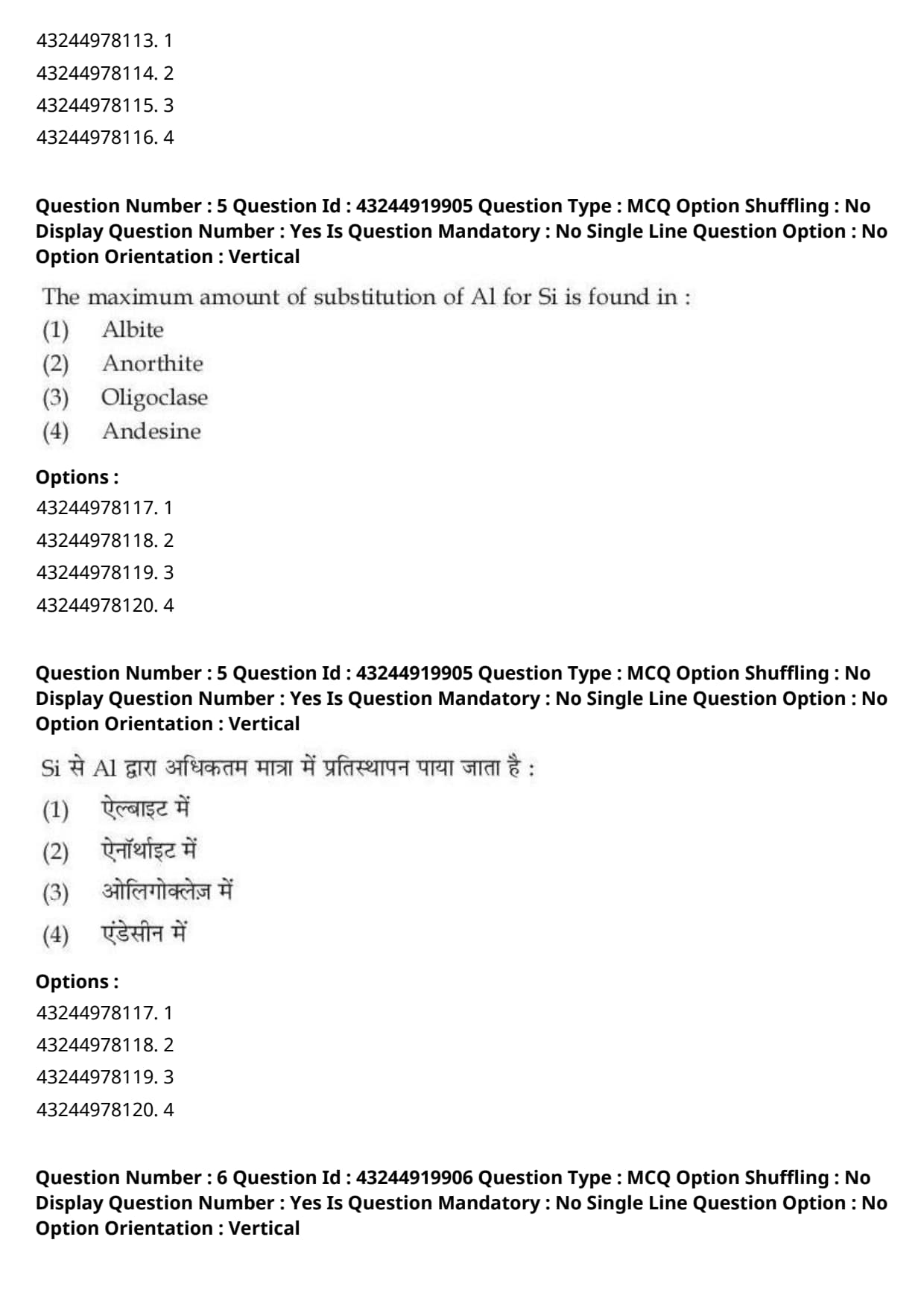
The relative abundance of a particular face of a crystal is a function of:
View Solution
Concept:
Crystal faces develop during crystal growth. Their relative sizes are controlled by the growth conditions and degree of crystallization.
Step 1: Understand crystal faces.
A crystal face is a plane surface developed during crystal growth.
Step 2: Effect of crystallization.
If crystallization conditions are favourable, crystal faces develop properly. If conditions are not uniform, some faces may grow larger and others may remain smaller.
Step 3: Final conclusion.
Thus, the relative size and shape of a crystal face depends mainly on the degree of crystallization.
\[ \therefore Correct Answer is (B) \] Quick Tip: The development of crystal faces depends strongly on crystallization conditions.
The maximum amount of substitution of Al for Si is found in:
View Solution
Concept:
Feldspars are aluminosilicate minerals. In their crystal structure, aluminium can substitute for silicon in tetrahedral sites.
Step 1: Compare feldspar compositions.
Albite has the composition:
\[ NaAlSi_3O_8 \]
Anorthite has the composition:
\[ CaAl_2Si_2O_8 \]
Step 2: Compare Al content.
In albite, there is one aluminium atom for three silicon atoms.
In anorthite, there are two aluminium atoms for two silicon atoms.
\[ Anorthite has more Al substitution for Si \]
Step 3: Final answer.
Therefore, maximum substitution of Al for Si is found in anorthite.
\[ \therefore Correct Answer is (B) \] Quick Tip: Anorthite \((CaAl_2Si_2O_8)\) has greater Al content than albite \((NaAlSi_3O_8)\).
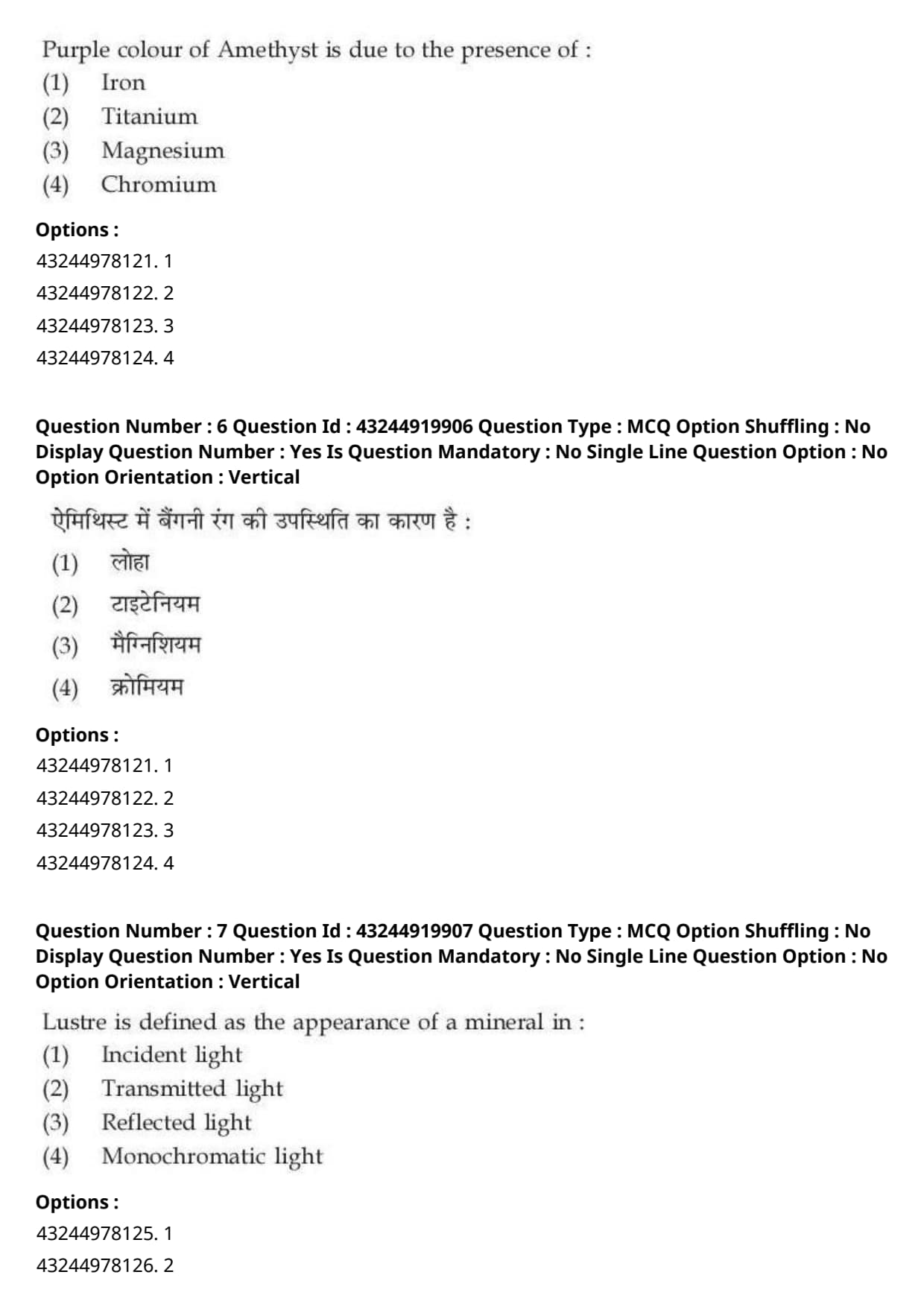
Purple colour of Amethyst is due to the presence of:
View Solution
Concept:
The colour of minerals is often due to trace impurities or defects present in the crystal structure.
Step 1: Identify Amethyst.
Amethyst is a purple variety of quartz.
\[ Amethyst=purple quartz \]
Step 2: Cause of purple colour.
The purple colour of amethyst is mainly due to iron impurity along with irradiation effects.
\[ Purple colour \Rightarrow Iron \]
Step 3: Final answer.
Therefore, the colour of amethyst is due to the presence of iron.
\[ \therefore Correct Answer is (A) \] Quick Tip: Amethyst is purple quartz, and its colour is mainly due to iron impurity.
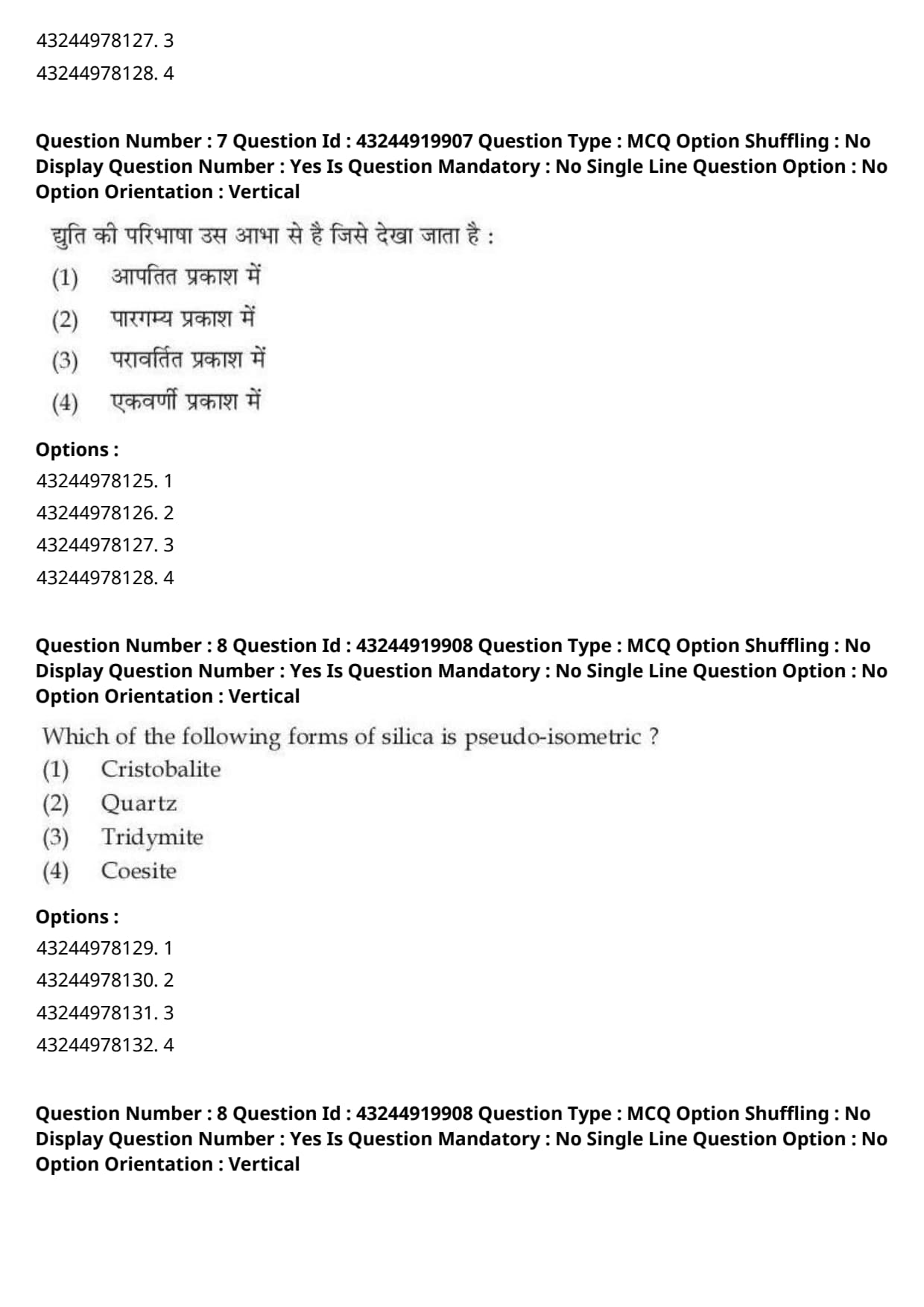
Lustre is defined as the appearance of a mineral in:
View Solution
Concept:
Lustre is an important physical property of minerals. It describes how light is reflected from the surface of a mineral.
Step 1: Understand lustre.
Lustre is the appearance or shine of a mineral surface.
Step 2: Relation with light.
Lustre depends on reflected light from the mineral surface.
\[ Lustre=appearance in reflected light \]
Step 3: Final answer.
Thus, lustre is defined as the appearance of a mineral in reflected light.
\[ \therefore Correct Answer is (C) \] Quick Tip: Lustre describes how a mineral surface looks in reflected light.
Which of the following forms of silica is pseudo-isometric?
View Solution
Concept:
Silica \((SiO_2)\) occurs in different polymorphic forms such as quartz, tridymite, cristobalite and coesite.
Step 1: Understand pseudo-isometric form.
Pseudo-isometric means the crystal appears to have isometric or cubic symmetry, although its actual symmetry may be different.
Step 2: Identify the silica form.
Cristobalite is a high-temperature polymorph of silica and is commonly described as pseudo-isometric.
\[ Pseudo-isometric silica=Cristobalite \]
Step 3: Final answer.
Therefore, the correct form is cristobalite.
\[ \therefore Correct Answer is (A) \] Quick Tip: Cristobalite is a high-temperature silica polymorph and is commonly described as pseudo-isometric.
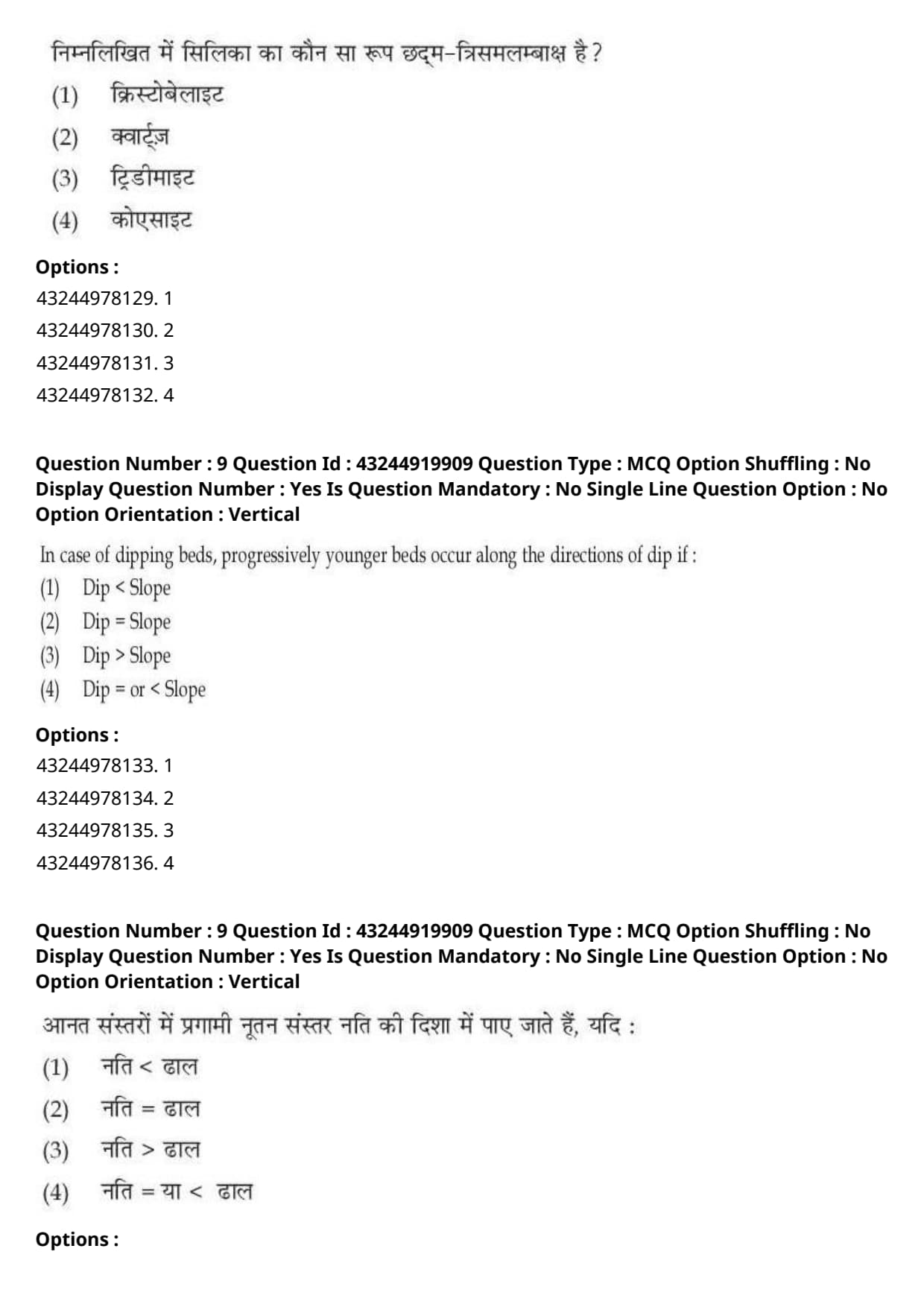
In case of dipping beds, progressively younger beds occur along the directions of dip if:
View Solution
Concept:
In geological mapping, the relation between dip of beds and land slope helps in understanding the outcrop pattern and age sequence of beds.
Step 1: Understand inclined beds.
Dipping beds are sedimentary layers that are tilted from their original horizontal position.
Step 2: Relation between dip and slope.
When the dip of beds is greater than the slope of the land surface, the progressively younger beds appear in the direction of dip.
\[ Dip>Slope \]
Step 3: Final answer.
Therefore, progressively younger beds occur along the direction of dip when:
\[ Dip>Slope \]
\[ \therefore Correct Answer is (C) \] Quick Tip: For inclined beds, age sequence in outcrop depends on the relation between dip of beds and topographic slope.
Which of the following is a fold with parallel limbs?
View Solution
Concept:
Folds are bends or curves in rock layers caused by compressional forces. They are classified based on the geometry of their limbs and axial plane.
Step 1: Understand fold limbs.
The two sides of a fold are called limbs.
Step 2: Identify fold with parallel limbs.
In an isoclinal fold, the two limbs are nearly parallel to each other.
\[ Parallel limbs \Rightarrow Isoclinal fold \]
Step 3: Final answer.
Thus, a fold with parallel limbs is an isoclinal fold.
\[ \therefore Correct Answer is (B) \] Quick Tip: Isoclinal folds have limbs that are nearly parallel to each other.
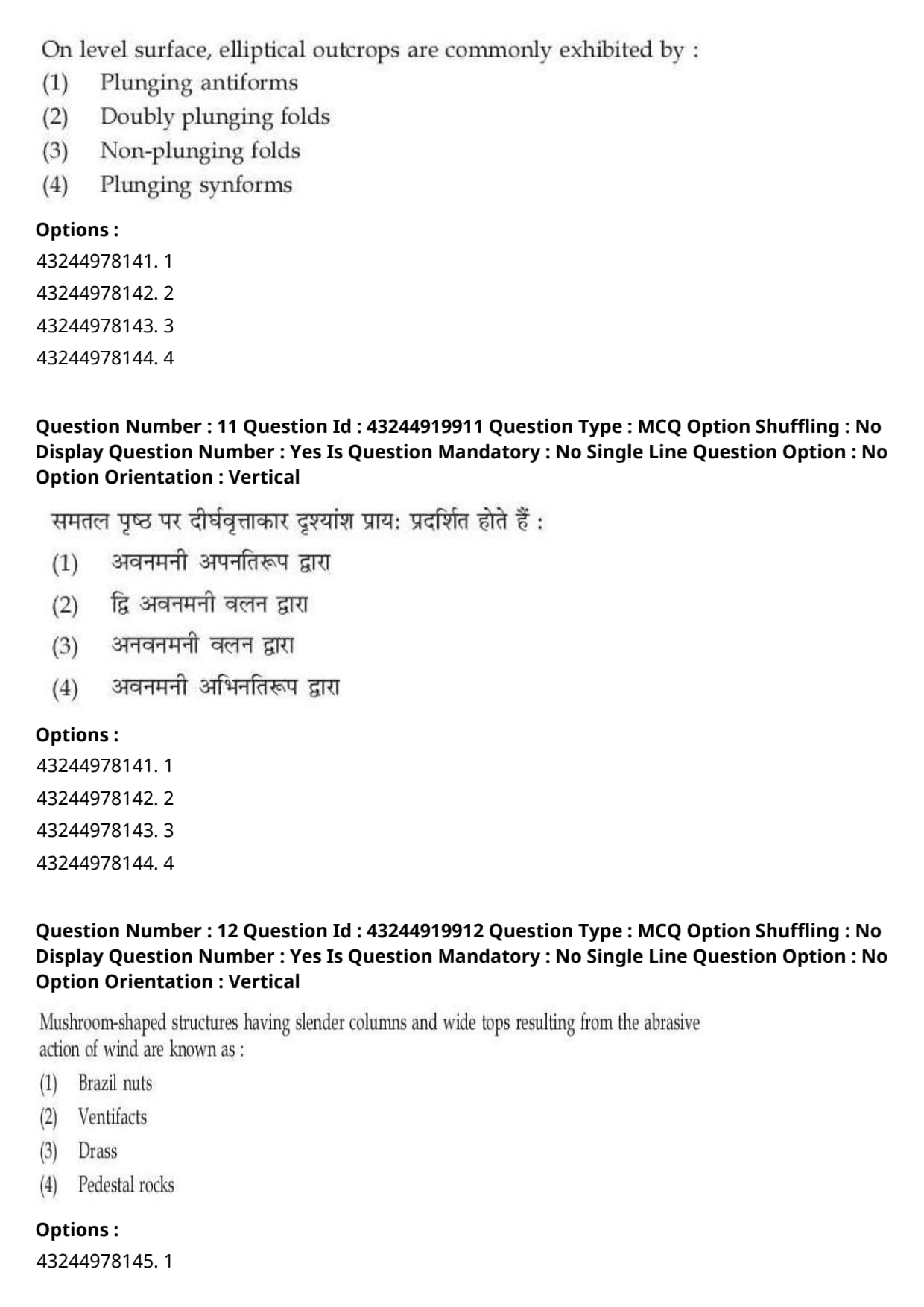
On level surface, elliptical outcrops are commonly exhibited by:
View Solution
Concept:
Outcrop patterns of folds depend on whether the fold is plunging, non-plunging or doubly plunging.
Step 1: Understand elliptical outcrop pattern.
An elliptical outcrop pattern is produced when the fold closes at both ends.
Step 2: Identify the fold type.
A doubly plunging fold plunges in two opposite directions. Because of this, the outcrop pattern becomes elliptical or closed on a level surface.
\[ Elliptical outcrop \Rightarrow Doubly plunging fold \]
Step 3: Final answer.
Therefore, elliptical outcrops are commonly exhibited by doubly plunging folds.
\[ \therefore Correct Answer is (B) \] Quick Tip: Doubly plunging folds commonly produce elliptical or closed outcrop patterns.
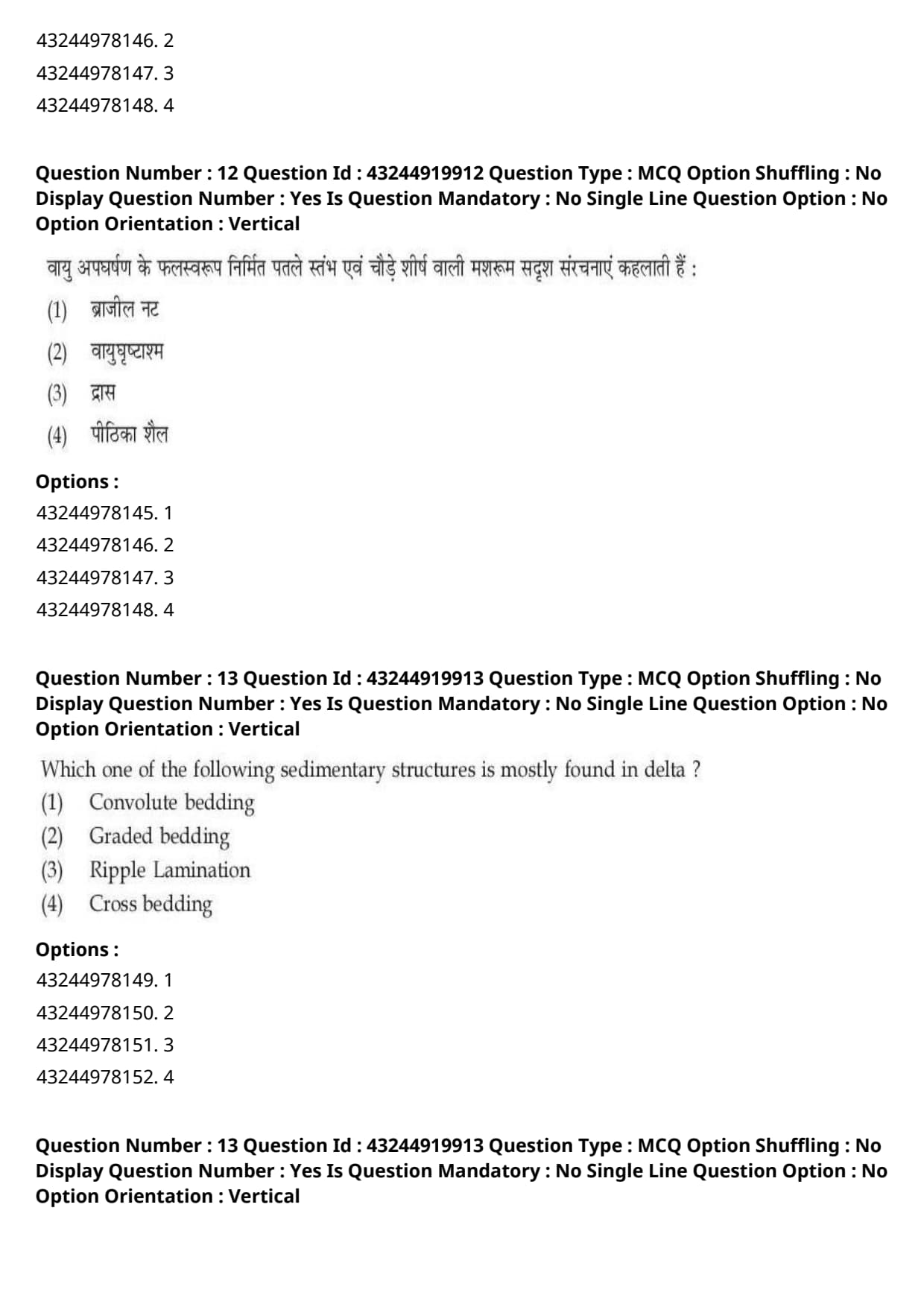
Mushroom-shaped structures having slender columns and wide tops resulting from the abrasive action of wind are known as:
View Solution
Concept:
Wind erosion produces several landforms in arid and semi-arid regions. Abrasion is the sand-blasting action of wind.
Step 1: Understand the described shape.
The question describes a mushroom-shaped structure with a narrow base and wider top.
Step 2: Cause of formation.
Wind abrasion is stronger near the ground because sand particles move close to the surface. Therefore, lower parts of rocks are eroded more than upper parts.
Step 3: Identify the landform.
Such mushroom-shaped rocks are known as pedestal rocks.
\[ Mushroom-shaped wind-eroded rock=Pedestal rock \]
\[ \therefore Correct Answer is (D) \] Quick Tip: Pedestal rocks are formed by differential wind abrasion near the ground surface.
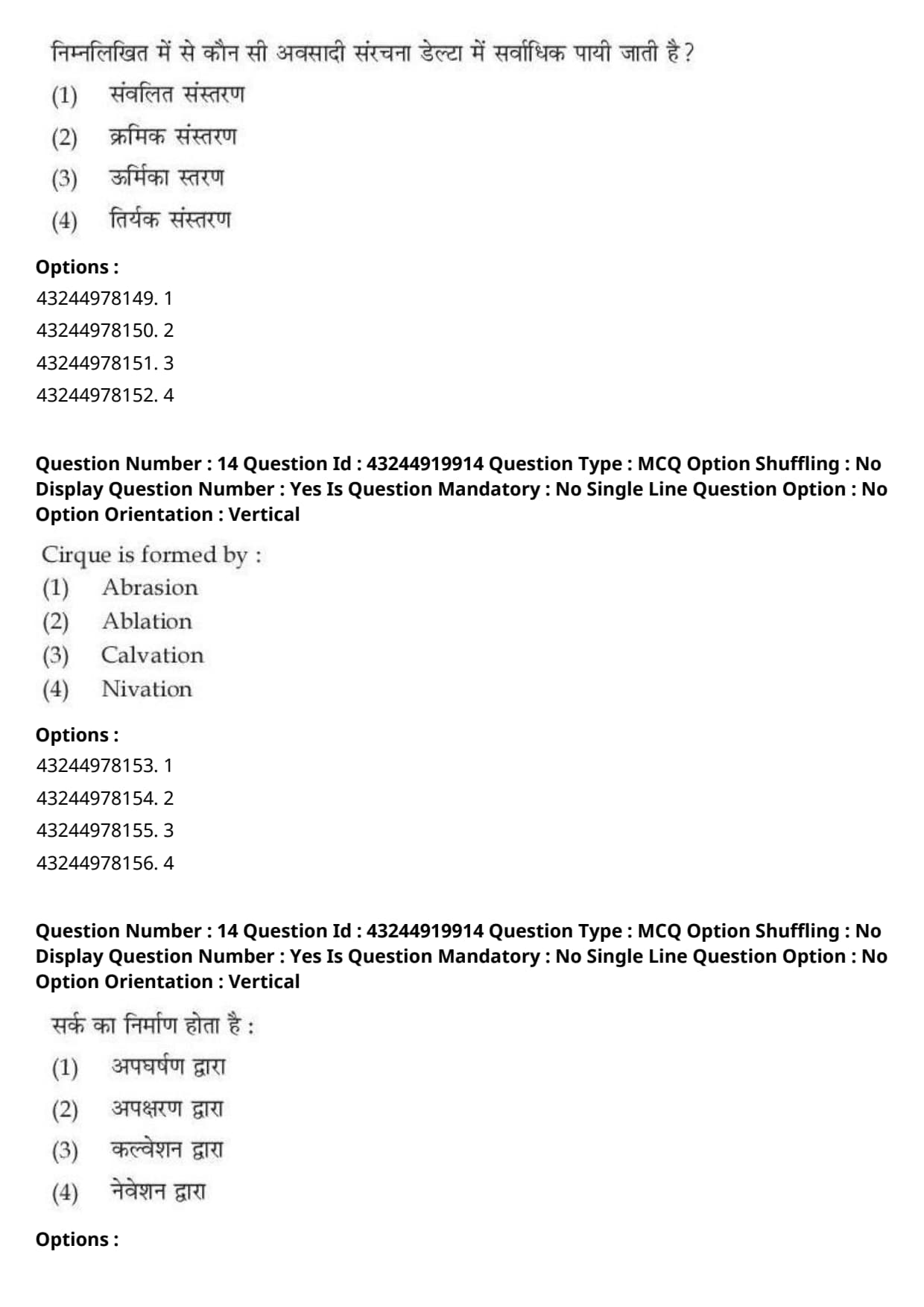
Which one of the following sedimentary structures is mostly found in delta?
View Solution
Concept:
Deltas are depositional environments formed where rivers enter standing bodies of water such as lakes or seas.
Step 1: Understand delta deposition.
In deltaic environments, sediments are deposited by flowing water, distributary channels and current action.
Step 2: Identify common sedimentary structure.
Cross bedding is commonly formed by migration of ripples, dunes or bars under current action.
\[ Deltaic current deposition \Rightarrow Cross bedding \]
Step 3: Final answer.
Thus, the sedimentary structure mostly found in delta among the given options is cross bedding.
\[ \therefore Correct Answer is (D) \] Quick Tip: Cross bedding commonly forms in current-dominated depositional environments such as rivers and deltas.
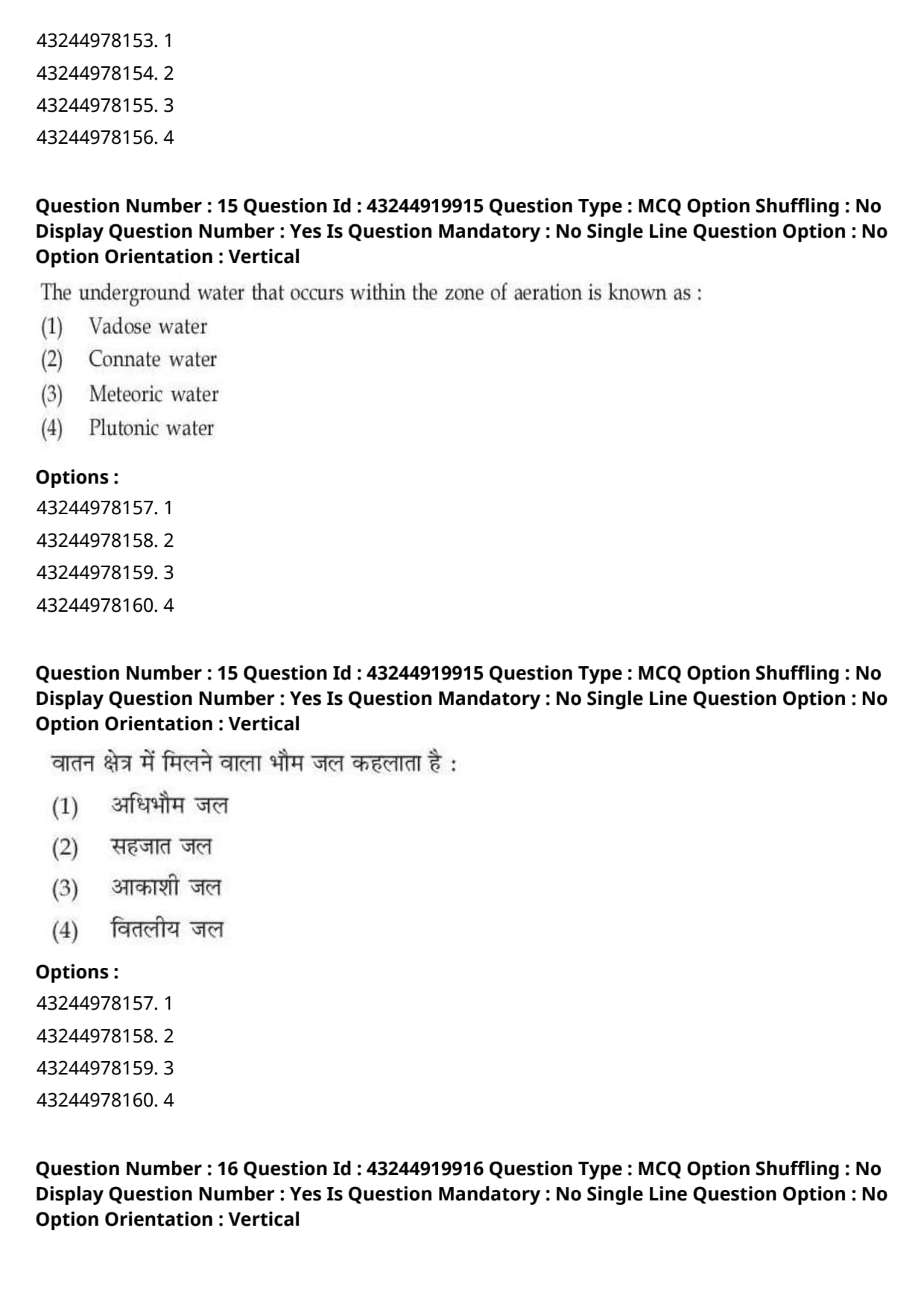
Cirque is formed by:
View Solution
Concept:
Cirques are bowl-shaped depressions found at the head of glacial valleys. They are associated with glacial and snow-related erosional processes.
Step 1: Understand cirque formation.
Cirques form in areas where snow accumulates and gradually modifies the underlying rock surface.
Step 2: Identify the process.
Nivation is the process of erosion and weathering associated with snow patches. It plays an important role in the origin of cirques.
\[ Cirque origin \Rightarrow Nivation \]
Step 3: Eliminate other options.
Abrasion is scraping action by ice or sediments.
Ablation means melting or loss of ice.
Calvation is not the correct process here.
\[ \therefore Correct Answer is (D) \] Quick Tip: Cirques are commonly associated with nivation and glacial erosion at the heads of valleys.
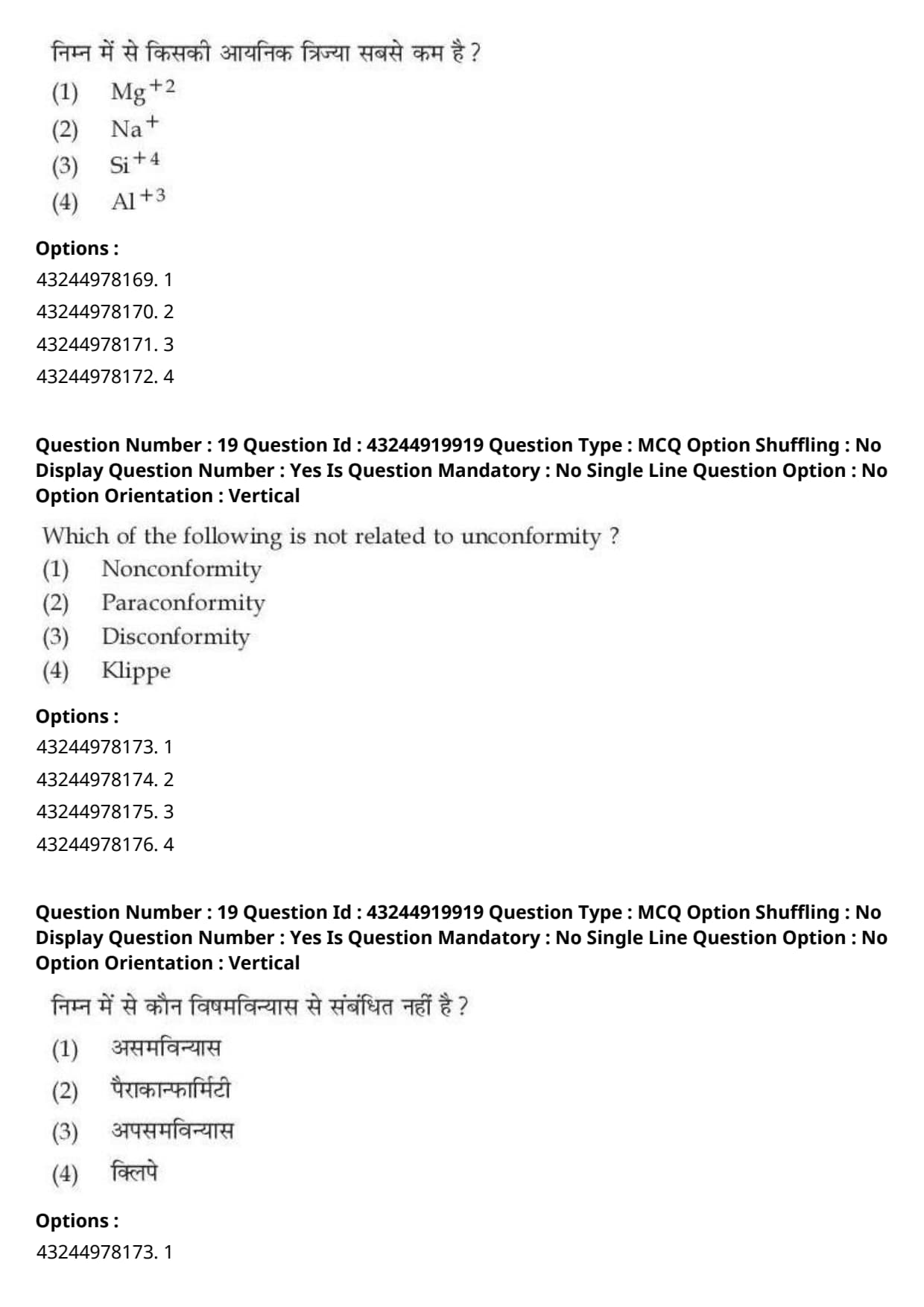
The underground water that occurs within the zone of aeration is known as:
View Solution
Concept:
Groundwater is classified according to its position below the ground surface and its origin.
Step 1: Understand zone of aeration.
The zone of aeration lies above the water table. In this zone, pores contain both air and water.
Step 2: Identify water in zone of aeration.
Water present in the zone of aeration is called vadose water.
\[ Zone of aeration water=Vadose water \]
Step 3: Eliminate other options.
Connate water is trapped in sediments during deposition.
Meteoric water is derived from precipitation.
Plutonic water is associated with deep-seated magmatic sources.
\[ \therefore Correct Answer is (A) \] Quick Tip: Vadose water occurs above the water table in the zone of aeration.
Which of the following is not a diagnostic mineral property?
View Solution
Concept:
Diagnostic mineral properties help in the identification of minerals. Some properties are more reliable than others.
Step 1: Reliable diagnostic properties.
Hardness, lustre and streak are commonly used for mineral identification.
\[ Hardness, Lustre, Streak \Rightarrow useful diagnostic properties \]
Step 2: Why colour is less reliable.
Colour may vary due to impurities, weathering or defects in the mineral.
For example, quartz may occur in many colours.
Step 3: Final answer.
Because colour is not always reliable for diagnosis, it is not considered a strong diagnostic property in this context.
\[ \therefore Correct Answer is (D) \] Quick Tip: Streak is usually more reliable than colour for mineral identification.
Which of the following group of minerals shows highest number of polymorphs?
View Solution
Concept:
Polymorphism means the same chemical composition occurring in more than one crystal structure. In sheet silicates, different stacking arrangements may produce many structural variants.
Step 1: Understand mica group.
Mica minerals are sheet silicates. Their layered structure allows different stacking arrangements.
Step 2: Polymorphs/polytypes in mica.
Because mica layers can stack in several ways, mica commonly shows many polymorphic or polytypic forms.
\[ Mica \Rightarrow large number of polymorphs/polytypes \]
Step 3: Final answer.
Among the given mineral groups, mica shows the highest number of polymorphs.
\[ \therefore Correct Answer is (D) \] Quick Tip: Mica minerals commonly show many structural variants because of different layer stacking arrangements.
Which of the following has the least ionic radius?
View Solution
Concept:
Ionic radius depends on ionic charge and electronic configuration. Generally, higher positive charge pulls electrons more strongly and produces a smaller ionic radius.
Step 1: Compare charges.
The ions given are:
\[ Na^+,\ Mg^{2+},\ Al^{3+},\ Si^{4+} \]
Step 2: Effect of increasing charge.
As positive charge increases, the nucleus attracts the electron cloud more strongly.
\[ Na^+>Mg^{2+}>Al^{3+}>Si^{4+} \]
in terms of ionic radius.
Step 3: Identify least radius.
Thus, \(Si^{4+}\) has the least ionic radius among the given ions.
\[ \therefore Correct Answer is (C) \] Quick Tip: For related cations, higher positive charge generally means smaller ionic radius.
Which of the following is not related to unconformity?
View Solution
Concept:
Unconformity represents a break in the geological record due to erosion or non-deposition.
Step 1: Types of unconformity.
Important types of unconformity include:
\[ Nonconformity \] \[ Paraconformity \] \[ Disconformity \]
Step 2: Understand klippe.
A klippe is an isolated remnant of a thrust sheet separated from the main mass by erosion.
It is a structural geology term and is not a type of unconformity.
Step 3: Final answer.
Therefore, the term not related to unconformity is:
\[ Klippe \]
\[ \therefore Correct Answer is (D) \] Quick Tip: Nonconformity, paraconformity and disconformity are unconformity types; klippe is related to thrust tectonics.
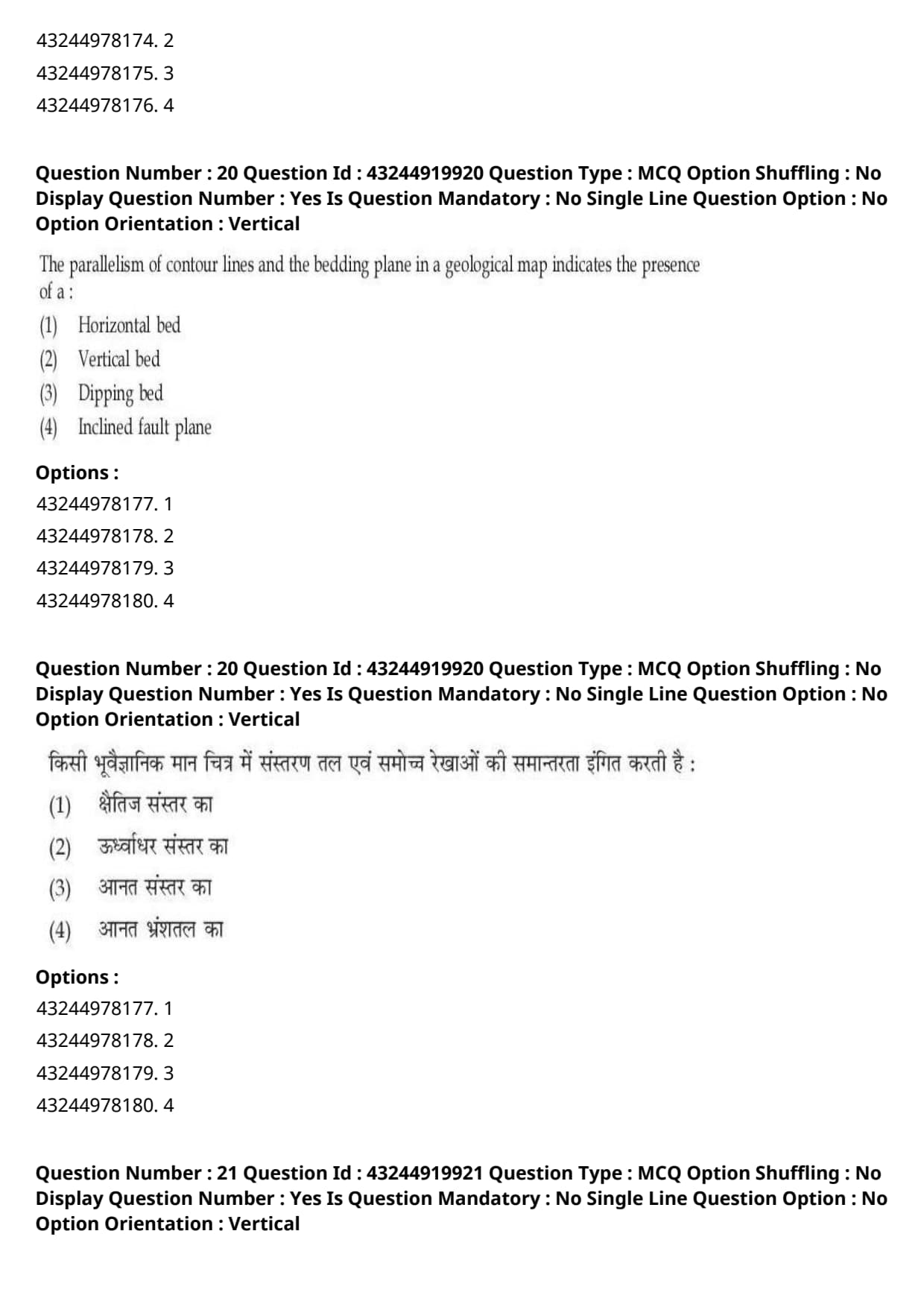
The parallelism of contour lines and the bedding plane in a geological map indicates the presence of a:
View Solution
Concept:
In geological maps, the relation between outcrop patterns and contour lines helps determine the attitude of beds.
Step 1: Understand contour lines.
Contour lines join points of equal elevation.
Step 2: Interpret parallelism.
If the outcrop of a bedding plane runs parallel to contour lines, it means the bed is at the same elevation along its trace.
This condition indicates that the bed is horizontal.
\[ Bedding trace parallel to contours \Rightarrow Horizontal bed \]
Step 3: Final answer.
Therefore, parallelism of contour lines and bedding plane indicates:
\[ Horizontal bed \]
\[ \therefore Correct Answer is (A) \] Quick Tip: In a geological map, a horizontal bed generally follows contour lines.
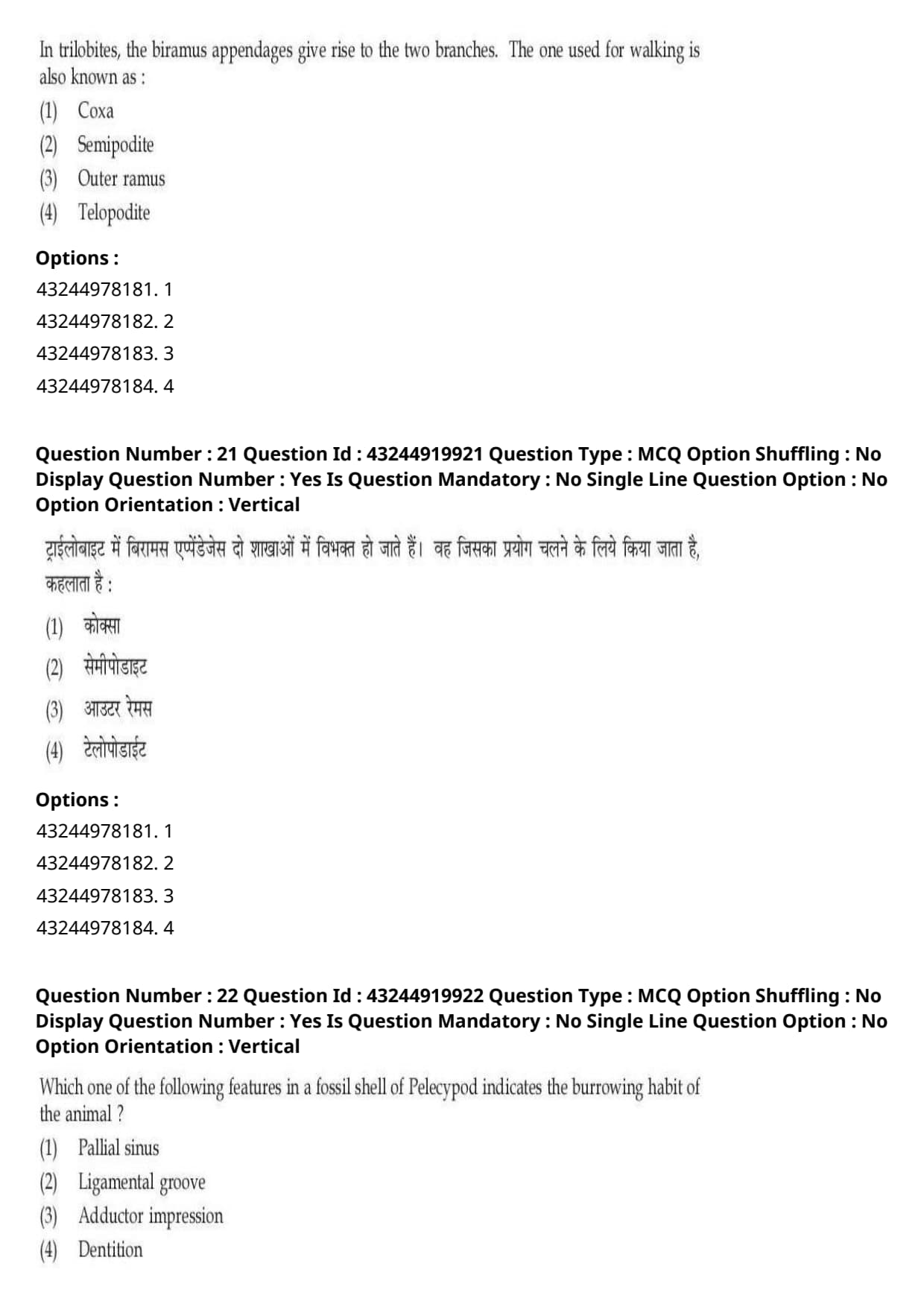
In trilobites, the biramous appendages give rise to the two branches. The one used for walking is also known as:
View Solution
Concept:
Trilobites had biramous appendages, meaning each appendage was divided into two branches.
Step 1: Understand biramous appendage.
A biramous appendage has two main branches: \[ Outer branch \]
and \[ Inner branch \]
Step 2: Function of the walking branch.
The walking branch of the trilobite appendage is called the telopodite.
\[ Walking branch=Telopodite \]
Step 3: Eliminate other options.
Coxa is a basal part.
Outer ramus is generally related to the outer branch.
Semipodite is not the correct term for the walking branch in this question.
\[ \therefore Correct Answer is (D) \] Quick Tip: In trilobite biramous appendages, the walking branch is known as telopodite.
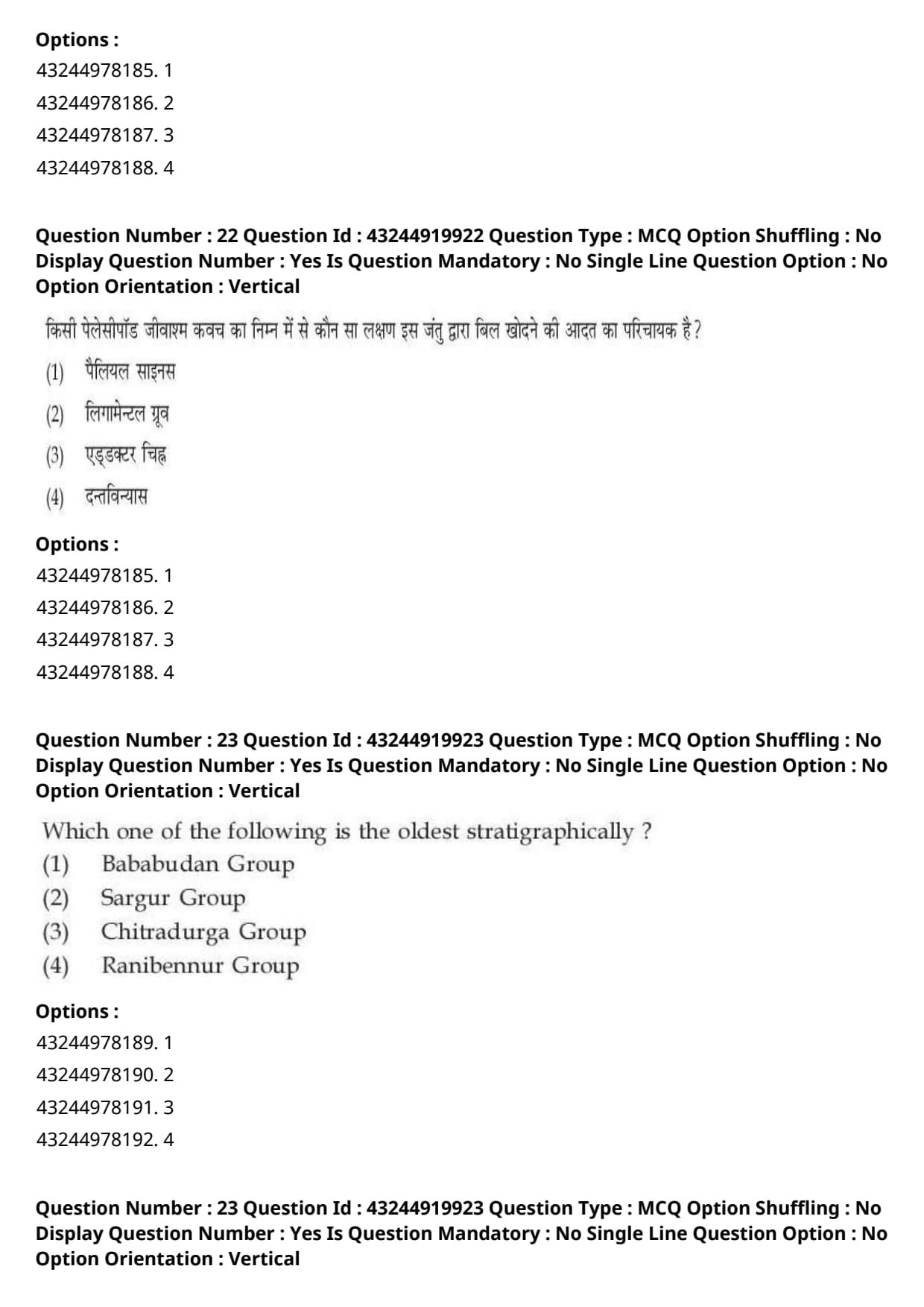
Which one of the following features in a fossil shell of Pelecypod indicates the burrowing habit of the animal?
View Solution
Concept:
Pelecypods, also called bivalves, may live as burrowing organisms. Their shell features help identify their mode of life.
Step 1: Understand pallial sinus.
Pallial sinus is an inward bend in the pallial line of a bivalve shell.
Step 2: Relation with burrowing habit.
Burrowing bivalves have long siphons. These siphons need space for retraction inside the shell.
\[ Long siphons \Rightarrow Pallial sinus \]
Step 3: Final conclusion.
Therefore, pallial sinus indicates burrowing habit in pelecypods.
\[ \therefore Correct Answer is (A) \] Quick Tip: Pallial sinus in bivalves usually indicates siphon-bearing and burrowing habit.
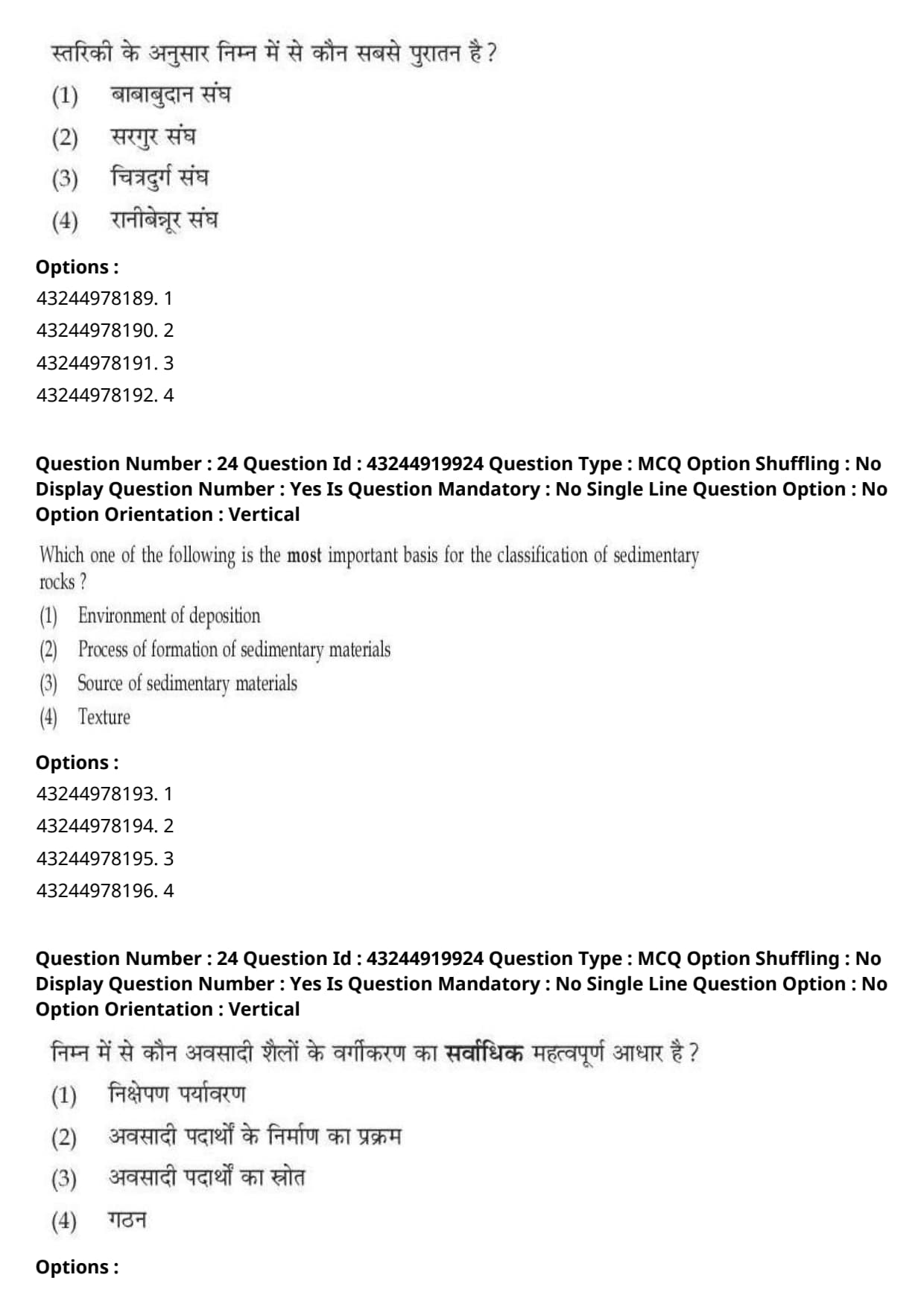
Which one of the following is the oldest stratigraphically?
View Solution
Concept:
In stratigraphy, older rock groups occur lower in the geological time sequence, while younger groups are deposited later.
Step 1: Identify the groups.
The given groups belong to Precambrian stratigraphy of the Indian shield region.
Step 2: Compare relative ages.
Sargur Group is among the oldest supracrustal rock sequences.
\[ Sargur Group \Rightarrow older than Bababudan and Chitradurga groups \]
Step 3: Final answer.
Thus, the oldest stratigraphically among the given options is Sargur Group.
\[ \therefore Correct Answer is (B) \] Quick Tip: In Indian Precambrian stratigraphy, the Sargur Group is considered older than the Dharwar Supergroup units.
Which one of the following is the most important basis for the classification of sedimentary rocks?
View Solution
Concept:
Sedimentary rocks are classified using several features such as texture, composition, origin and depositional environment.
Step 1: Understand texture.
Texture includes grain size, sorting, roundness and arrangement of particles.
Step 2: Importance of texture.
Texture is very important because it directly tells about the nature of sediment, transport history and depositional conditions.
\[ Texture \Rightarrow grain size, sorting and arrangement \]
Step 3: Final answer.
Among the given options, texture is the most important basis for classification.
\[ \therefore Correct Answer is (D) \] Quick Tip: Texture is a key basis of sedimentary rock classification because it reflects grain size and depositional character.
Which one of the following is the most suitable condition for development of the karst topography?
View Solution
Concept:
Karst topography develops mainly in soluble rocks such as limestone and dolomite.
Step 1: Required rock type.
Karst landforms require soluble rocks because groundwater dissolves the rock.
\[ Limestone+carbonic acid water\Rightarrow solution activity \]
Step 2: Role of joints.
Extensive joints allow water to enter deeply into the rock.
\[ Joints \Rightarrow easy movement of water \]
Step 3: Final answer.
Therefore, soluble rocks with extensive jointing provide the most suitable condition for karst topography.
\[ \therefore Correct Answer is (C) \] Quick Tip: Karst topography develops best in soluble, jointed limestone regions.
Cross beds and graded beds do not occur together, because they represent:
View Solution
Concept:
Sedimentary structures form under specific depositional conditions. Cross bedding and graded bedding represent different energy and flow conditions.
Step 1: Cross bedding.
Cross bedding forms due to migration of ripples, dunes or bars under current action.
\[ Cross bedding \Rightarrow traction current conditions \]
Step 2: Graded bedding.
Graded bedding forms when particles settle from suspension, usually from a waning current.
\[ Graded bedding \Rightarrow settling from suspension \]
Step 3: Compare both.
Since both structures represent different depositional environments and processes, they normally do not occur together.
\[ \therefore Correct Answer is (C) \] Quick Tip: Cross bedding indicates current action, while graded bedding indicates settling from suspension.
The index fossils have:
View Solution
Concept:
Index fossils are used for correlation and relative dating of sedimentary rocks.
Step 1: Geographic distribution.
A good index fossil should be widely distributed geographically so that it can be found in many regions.
\[ Index fossil \Rightarrow wide geographic distribution \]
Step 2: Time range.
A good index fossil should exist for a short geological time interval.
\[ Index fossil \Rightarrow limited stratigraphic range \]
Step 3: Final answer.
Therefore, index fossils have wide geographic distribution and limited stratigraphic range.
\[ \therefore Correct Answer is (D) \] Quick Tip: A good index fossil is widespread geographically but short-lived stratigraphically.
The two valves of a brachiopod shell are:
View Solution
Concept:
Brachiopods are marine invertebrates having two shells or valves, but their shell symmetry differs from pelecypods.
Step 1: Valve size.
In brachiopods, the two valves are generally unequal in size.
\[ Pedicle valve\neq brachial valve \]
Step 2: Symmetry.
Each valve is bilaterally symmetrical about a median plane, giving equilateral symmetry.
Step 3: Final answer.
Thus, brachiopod valves are unequal in size with equilateral symmetry.
\[ \therefore Correct Answer is (C) \] Quick Tip: Brachiopods have unequal valves, but each valve is bilaterally symmetrical.
The most important factors for the development of foliation in metamorphic rocks are:
View Solution
Concept:
Foliation is the planar arrangement of minerals in metamorphic rocks.
Step 1: Role of stress.
Directed stress causes platy and elongated minerals to align perpendicular to maximum compression.
\[ Directed stress \Rightarrow preferred mineral orientation \]
Step 2: Role of temperature.
Temperature helps minerals recrystallize during metamorphism.
\[ Temperature \Rightarrow recrystallization \]
Step 3: Final answer.
Thus, stress and temperature are the most important factors for foliation development.
\[ \therefore Correct Answer is (D) \] Quick Tip: Foliation develops mainly due to directed stress and recrystallization during metamorphism.
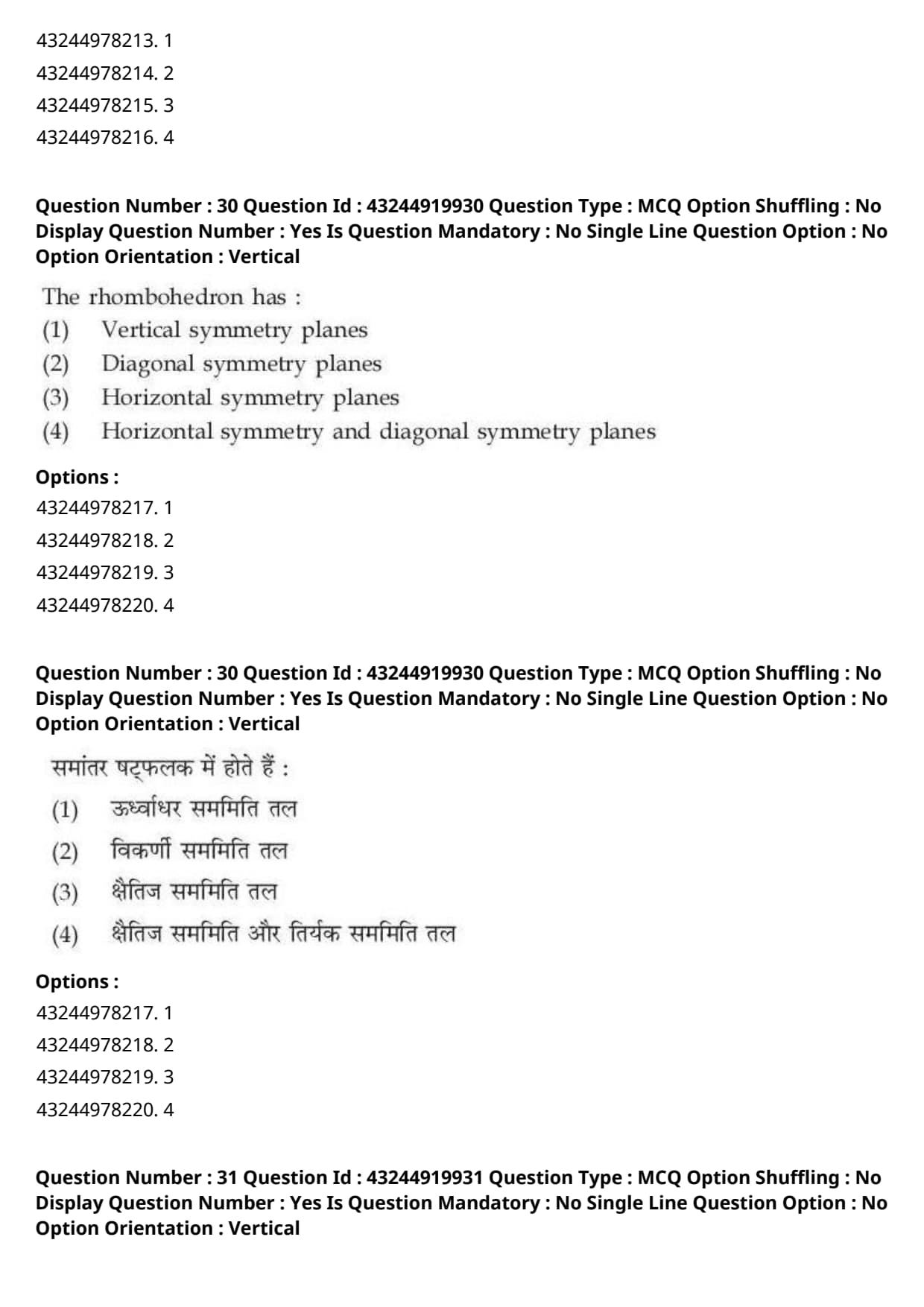
The rhombohedron has:
View Solution
Concept:
Rhombohedron is a form related to the trigonal division of the hexagonal crystal system.
Step 1: Identify the symmetry.
A rhombohedron has symmetry planes that are diagonal in nature.
Step 2: Eliminate other options.
It is not mainly characterized by horizontal symmetry planes. The important symmetry planes associated here are diagonal symmetry planes.
\[ Rhombohedron \Rightarrow Diagonal symmetry planes \]
\[ \therefore Correct Answer is (B) \] Quick Tip: Rhombohedron is commonly associated with diagonal symmetry planes.
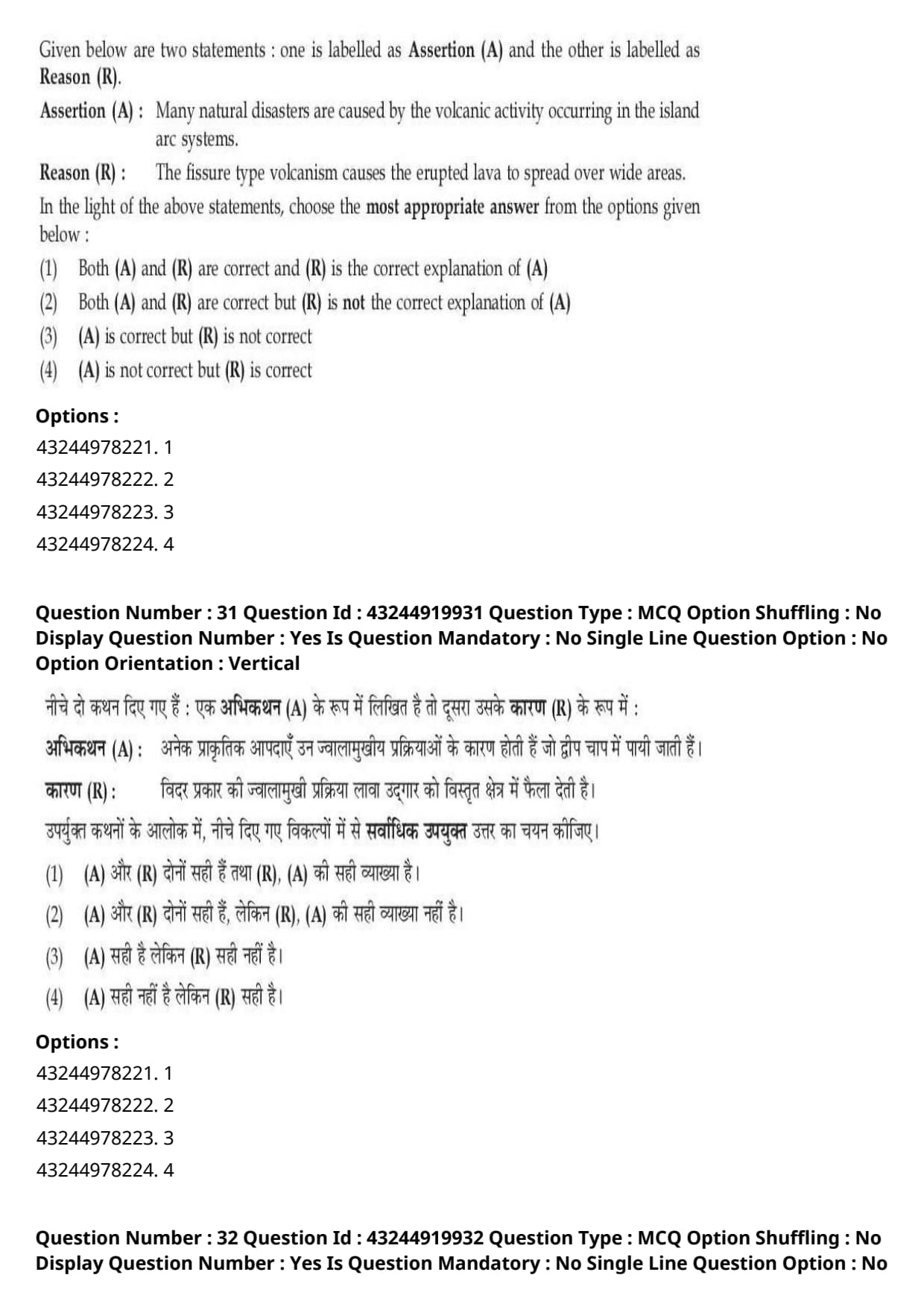
Given below are two statements:
Assertion (A): Many natural disasters are caused by the volcanic activity occurring in the island arc systems.
Reason (R): The fissure type volcanism causes the erupted lava to spread over wide areas.
Choose the most appropriate answer from the options given below:
View Solution
Concept:
Island arcs are associated with subduction zones and active volcanism. Fissure volcanism is a different style of volcanic eruption.
Step 1: Check Assertion.
Island arc systems are volcanically active and may produce earthquakes, eruptions, tsunamis and other disasters.
\[ A is correct \]
Step 2: Check Reason.
Fissure eruptions allow lava to spread over wide areas.
\[ R is correct \]
Step 3: Check explanation.
Reason talks about fissure volcanism, but Assertion talks about volcanic disasters in island arcs. It does not directly explain the Assertion.
\[ \therefore Correct Answer is (B) \] Quick Tip: Both statements may be true, but in assertion-reason questions, the reason must directly explain the assertion.
Given below are two statements:
Assertion (A): Gypsum has lower density than anhydrite.
Reason (R): Hydrated minerals tend to expand many times the original volume of the anhydrous minerals.
Choose the most appropriate answer from the options given below:
View Solution
Concept:
Gypsum is hydrated calcium sulphate, while anhydrite is anhydrous calcium sulphate.
Step 1: Compare minerals.
Gypsum: \[ CaSO_4\cdot 2H_2O \]
Anhydrite: \[ CaSO_4 \]
Step 2: Effect of hydration.
Hydration increases volume because water molecules enter the crystal structure.
\[ Volume increases \Rightarrow density decreases \]
Step 3: Final conclusion.
Gypsum has lower density than anhydrite, and the reason correctly explains it.
\[ \therefore Correct Answer is (A) \] Quick Tip: Gypsum is hydrated calcium sulphate, while anhydrite is anhydrous calcium sulphate.
Given below are two statements:
Assertion (A): Drumlins show features opposite to those of Roches Moutonnees.
Reason (R): The stoss side is steep and the lee side is roughened.
Choose the most appropriate answer from the options given below:
View Solution
Concept:
Drumlins and roches moutonnees are glacial landforms, but their shapes and mode of formation differ.
Step 1: Check Assertion.
Drumlins are streamlined depositional landforms, while roches moutonnees are erosional landforms. Their profiles are opposite in important respects.
\[ A is correct \]
Step 2: Check Reason.
The given reason says the stoss side is steep and lee side is roughened. This is not the correct description for drumlins in this context.
\[ R is not correct \]
Step 3: Final conclusion.
Assertion is correct, but Reason is incorrect.
\[ \therefore Correct Answer is (C) \] Quick Tip: Roches moutonnees are erosional glacial landforms, while drumlins are streamlined depositional landforms.
Given below are two statements:
Assertion (A): In a hand specimen quartz can be easily distinguished from orthoclase.
Reason (R): Orthoclase has lower refractive index than quartz.
Choose the most appropriate answer from the options given below:
View Solution
Concept:
Quartz and orthoclase can be distinguished in hand specimen using physical properties.
Step 1: Check Assertion.
Quartz commonly shows conchoidal fracture and lacks cleavage, while orthoclase has two good cleavages.
\[ A is correct \]
Step 2: Check Reason.
Orthoclase has slightly lower refractive index than quartz.
\[ R is correct \]
Step 3: Check explanation.
Refractive index is not the main hand-specimen basis for distinguishing quartz from orthoclase. Cleavage and fracture are more useful in hand specimen.
\[ R is not the correct explanation of A \]
\[ \therefore Correct Answer is (B) \] Quick Tip: Quartz lacks cleavage and shows conchoidal fracture, while orthoclase shows cleavage.
Given below are two statements:
Assertion (A): L waves are responsible for majority of the destructive earthquakes.
Reason (R): They are the surface waves and develop in the immediate vicinity of the epicenter.
Choose the most appropriate answer from the options given below:
View Solution
Concept:
Earthquake waves are mainly body waves and surface waves. Surface waves generally cause the greatest destruction.
Step 1: Check Assertion.
L waves are surface waves and are responsible for much of the earthquake destruction.
\[ A is correct \]
Step 2: Check Reason.
L waves develop near the surface and travel along the Earth's surface.
\[ R is correct \]
Step 3: Check explanation.
Because L waves are surface waves, their amplitude near the surface is large and they cause strong damage.
\[ R correctly explains A \]
\[ \therefore Correct Answer is (A) \] Quick Tip: Surface waves or L waves are generally the most destructive earthquake waves.
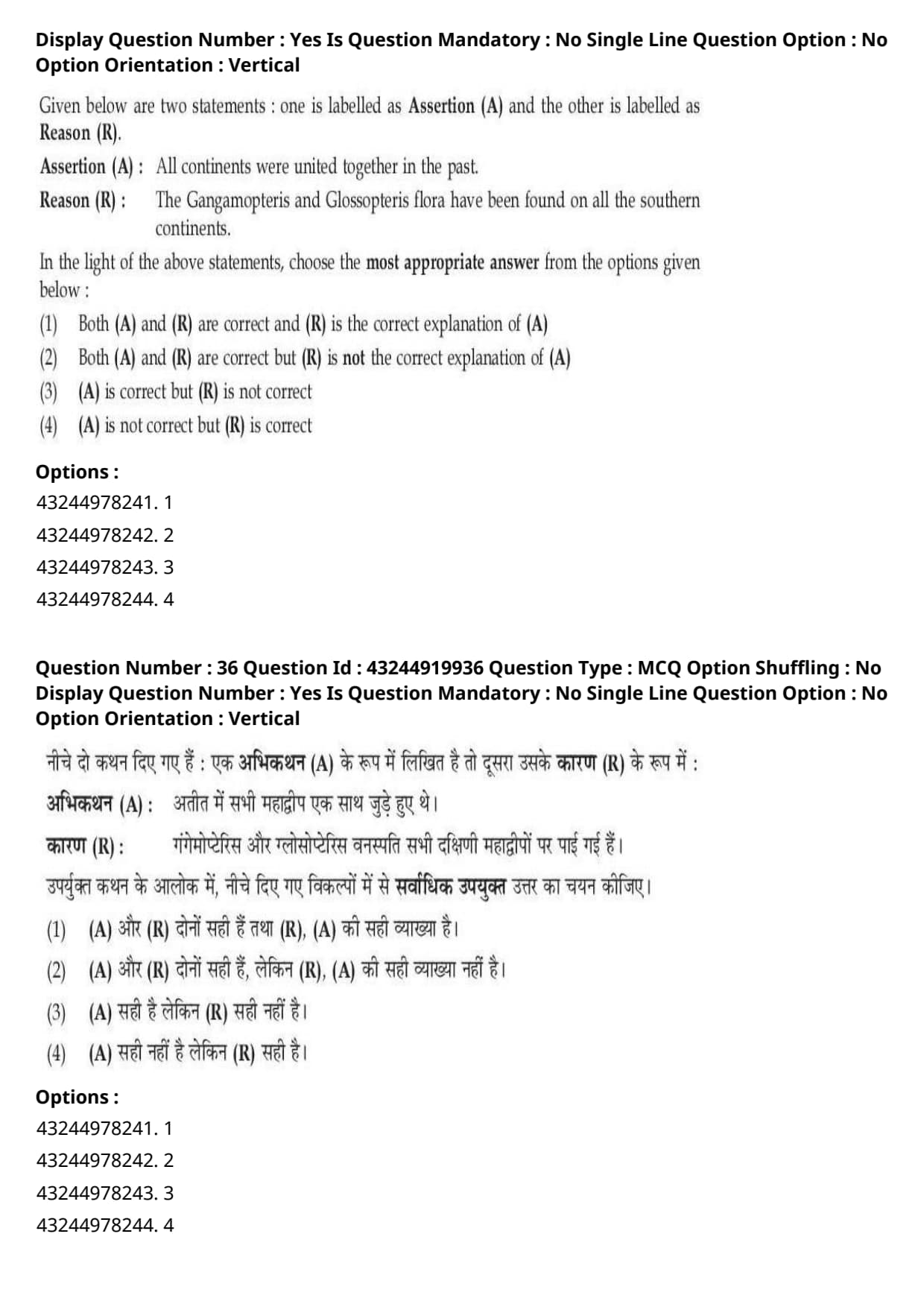
Given below are two statements:
Assertion (A): All continents were united together in the past.
Reason (R): The Gangamopteris and Glossopteris flora have been found on all the southern continents.
Choose the most appropriate answer from the options given below:
View Solution
Concept:
Continental drift theory states that continents were once joined together and later drifted apart.
Step 1: Check Assertion.
The concept of supercontinents suggests that continents were joined together in the geological past.
\[ A is correct \]
Step 2: Check Reason.
Glossopteris and Gangamopteris flora are found on southern continents such as India, Africa, Australia, Antarctica and South America.
\[ R is correct \]
Step 3: Check explanation.
The occurrence of similar fossil flora on separated continents supports the idea that they were once connected.
\[ R correctly explains A \]
\[ \therefore Correct Answer is (A) \] Quick Tip: Glossopteris fossil flora is important evidence for continental drift and Gondwana connection.
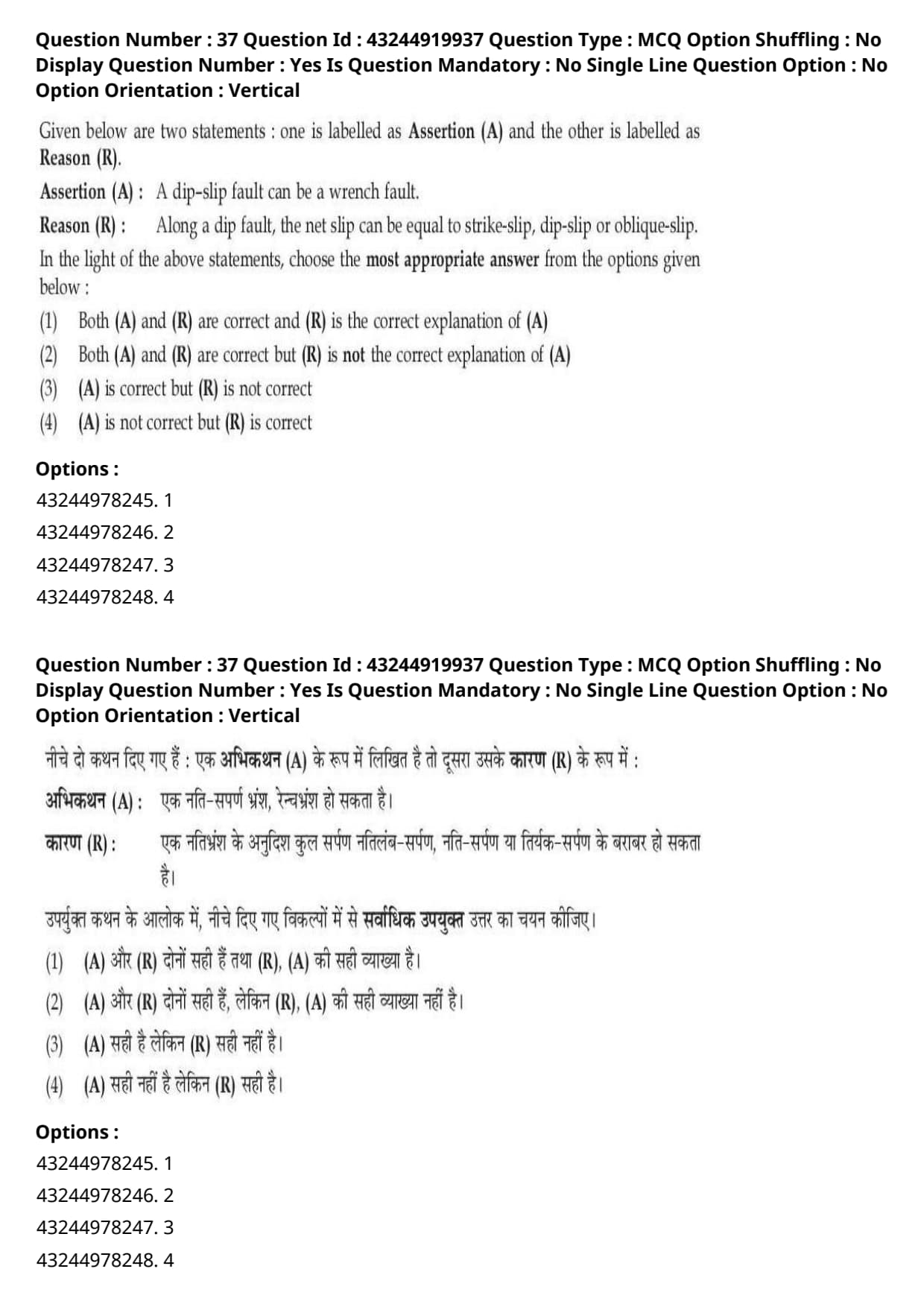
Given below are two statements:
Assertion (A): A dip-slip fault can be a wrench fault.
Reason (R): Along a dip fault, the net slip can be equal to strike-slip, dip-slip or oblique-slip.
Choose the most appropriate answer from the options given below:
View Solution
Concept:
Faults are classified according to the direction of slip relative to the fault plane.
Step 1: Check Assertion.
A dip-slip fault involves movement mainly along the dip direction. A wrench fault is mainly a strike-slip fault.
\[ A is not correct \]
Step 2: Check Reason.
Net slip on a fault may be strike-slip, dip-slip or oblique-slip depending on the movement direction.
\[ R is correct \]
Step 3: Final conclusion.
Assertion is incorrect, but Reason is correct.
\[ \therefore Correct Answer is (D) \] Quick Tip: Dip-slip faults move along dip direction, while wrench faults are strike-slip faults.
Given below are two statements:
Assertion (A): Chronostratigraphy is concerned with the mutual time relationship of strata.
Reason (R): Formation, member and bed are units of chronostratigraphy.
Choose the most appropriate answer from the options given below:
View Solution
Concept:
Chronostratigraphy deals with the age and time relationship of rock strata.
Step 1: Check Assertion.
Chronostratigraphy is concerned with the mutual time relationship of strata.
\[ A is correct \]
Step 2: Check Reason.
Formation, member and bed are lithostratigraphic units, not chronostratigraphic units.
\[ R is not correct \]
Step 3: Final conclusion.
Assertion is correct, but Reason is incorrect.
\[ \therefore Correct Answer is (C) \] Quick Tip: Formation, member and bed are lithostratigraphic units; chronostratigraphy deals with time-rock units.
Given below are two statements:
Assertion (A): The angle between any two faces of a crystal is termed as interfacial angle.
Reason (R): The interfacial angles of corresponding faces of different crystals are constant if they have same chemical composition and measurements are taken at same temperature.
Choose the most appropriate answer from the options given below:
View Solution
Concept:
Interfacial angle is an important crystallographic property used in crystal identification.
Step 1: Check Assertion.
The angle between two crystal faces is called the interfacial angle.
\[ A is correct \]
Step 2: Check Reason.
According to the law of constancy of interfacial angles, corresponding faces of crystals of the same substance show constant angles under the same conditions.
\[ R is correct \]
Step 3: Check explanation.
Reason states an important law about interfacial angles, but it does not define why the angle between two faces is called interfacial angle.
\[ R is not the correct explanation of A \]
\[ \therefore Correct Answer is (B) \] Quick Tip: Interfacial angles remain constant for corresponding faces of crystals of the same substance.
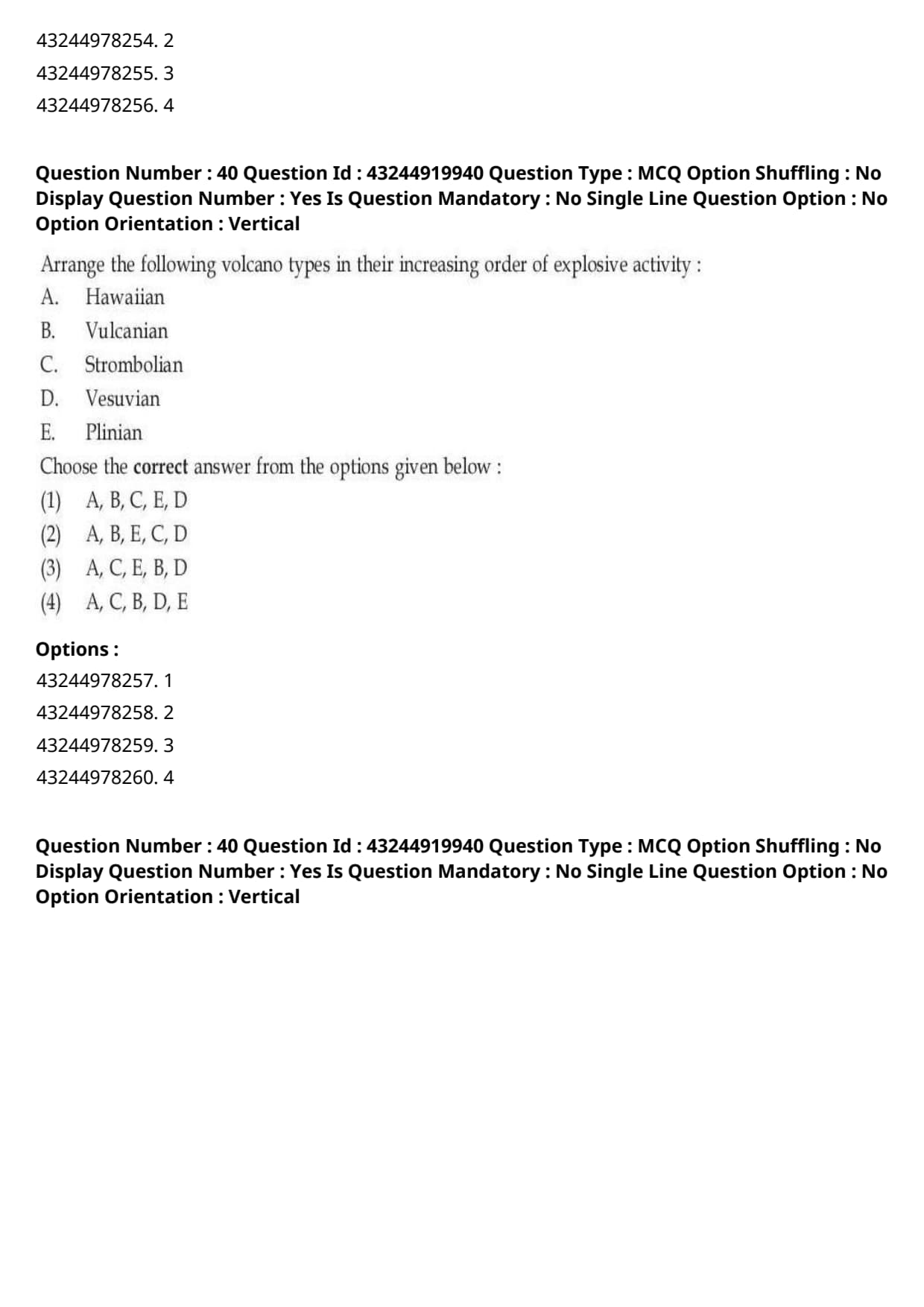
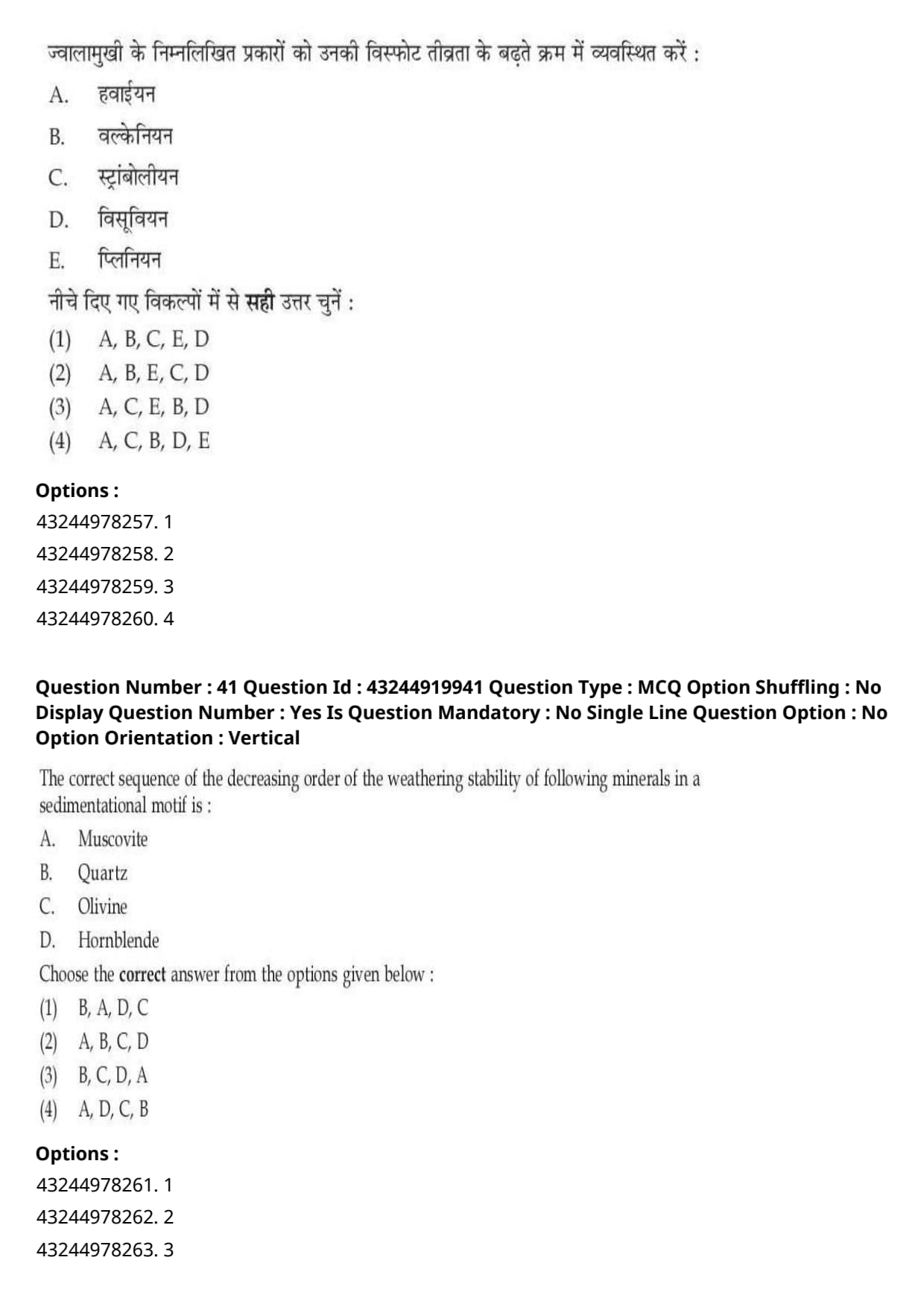
Arrange the following volcano types in their increasing order of explosive activity:
A. Hawaiian
B. Vulcanian
C. Strombolian
D. Vesuvian
E. Plinian
Choose the correct answer from the options given below:
View Solution
Concept:
Volcanic eruptions are classified according to explosiveness, magma viscosity and gas content.
Step 1: Least explosive type.
Hawaiian eruptions are usually quiet and effusive.
\[ Least explosive=A \]
Step 2: Next stages.
Strombolian eruptions are more explosive than Hawaiian eruptions.
\[ A
Vulcanian eruptions are more explosive than Strombolian eruptions.
\[ C
Step 3: Highly explosive types.
Vesuvian eruptions are highly explosive, and Plinian eruptions are among the most explosive.
\[ B
Step 4: Final sequence. \[ A,C,B,D,E \]
\[ \therefore Correct Answer is (D) \] Quick Tip: Increasing explosiveness: Hawaiian \(\rightarrow\) Strombolian \(\rightarrow\) Vulcanian \(\rightarrow\) Vesuvian \(\rightarrow\) Plinian.
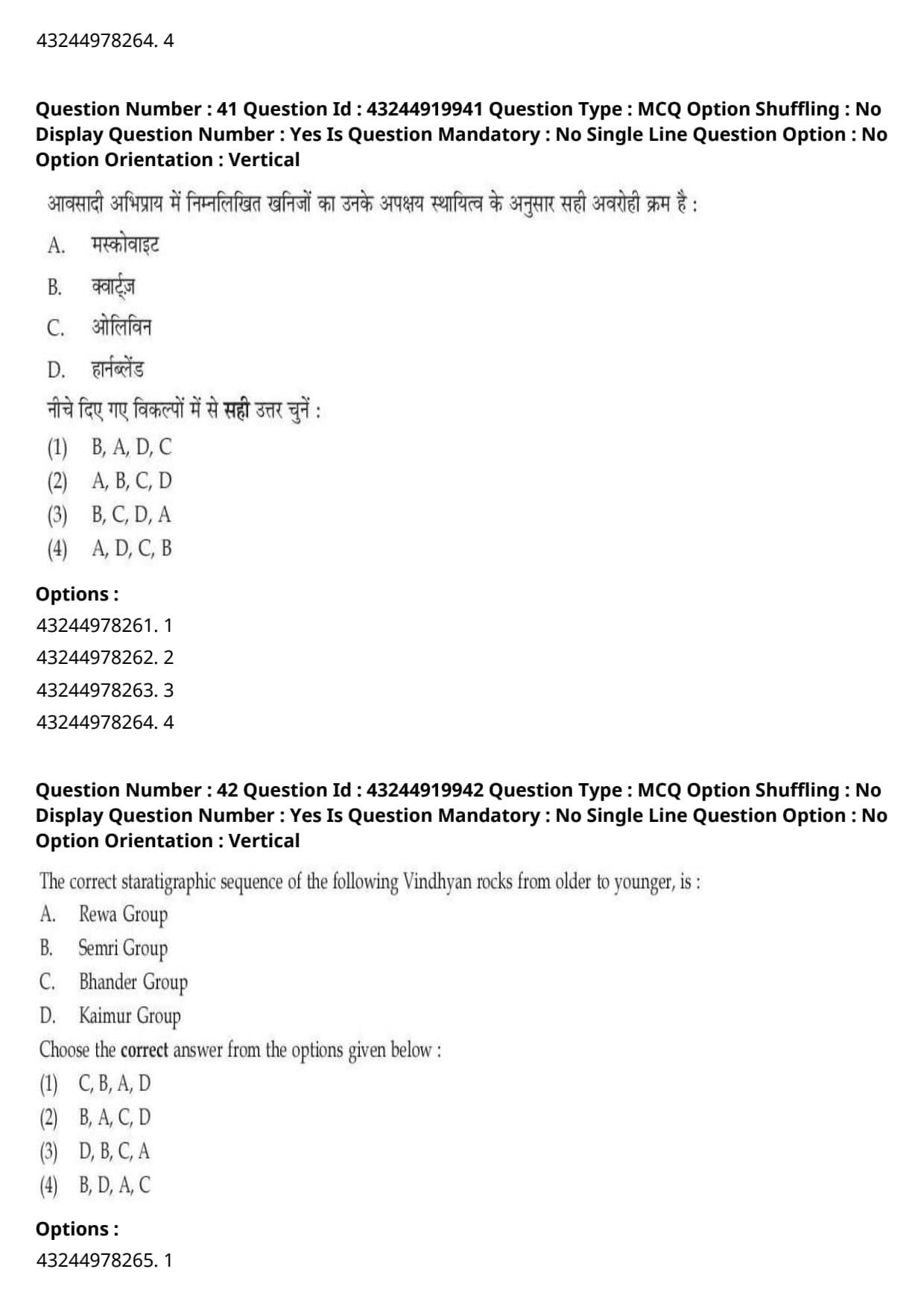
The correct sequence of the decreasing order of the weathering stability of following minerals in a sedimentational motif is:
A. Muscovite
B. Quartz
C. Olivine
D. Hornblende
Choose the correct answer from the options given below:
View Solution
Concept:
Weathering stability of minerals depends on their resistance to chemical and physical weathering. Minerals formed at lower temperature are generally more stable at the Earth's surface, while high-temperature minerals weather faster.
Step 1: Identify the most stable mineral.
Quartz is highly resistant to weathering because it has a strong silicon-oxygen framework structure.
\[ Quartz=most stable \]
So,
\[ B comes first \]
Step 2: Compare muscovite and hornblende.
Muscovite is a mica mineral and is more stable than hornblende during weathering.
\[ Muscovite>Hornblende \]
So,
\[ A comes before D \]
Step 3: Identify the least stable mineral.
Olivine is a high-temperature ferromagnesian mineral and weathers very easily at the Earth's surface.
\[ Olivine=least stable \]
So,
\[ C comes last \]
Step 4: Final sequence.
The decreasing order of weathering stability is:
\[ Quartz>Muscovite>Hornblende>Olivine \]
Using the given letters:
\[ B>A>D>C \]
\[ \therefore Correct Answer is (A) \] Quick Tip: Quartz is highly stable during weathering, while olivine is one of the least stable common silicate minerals.
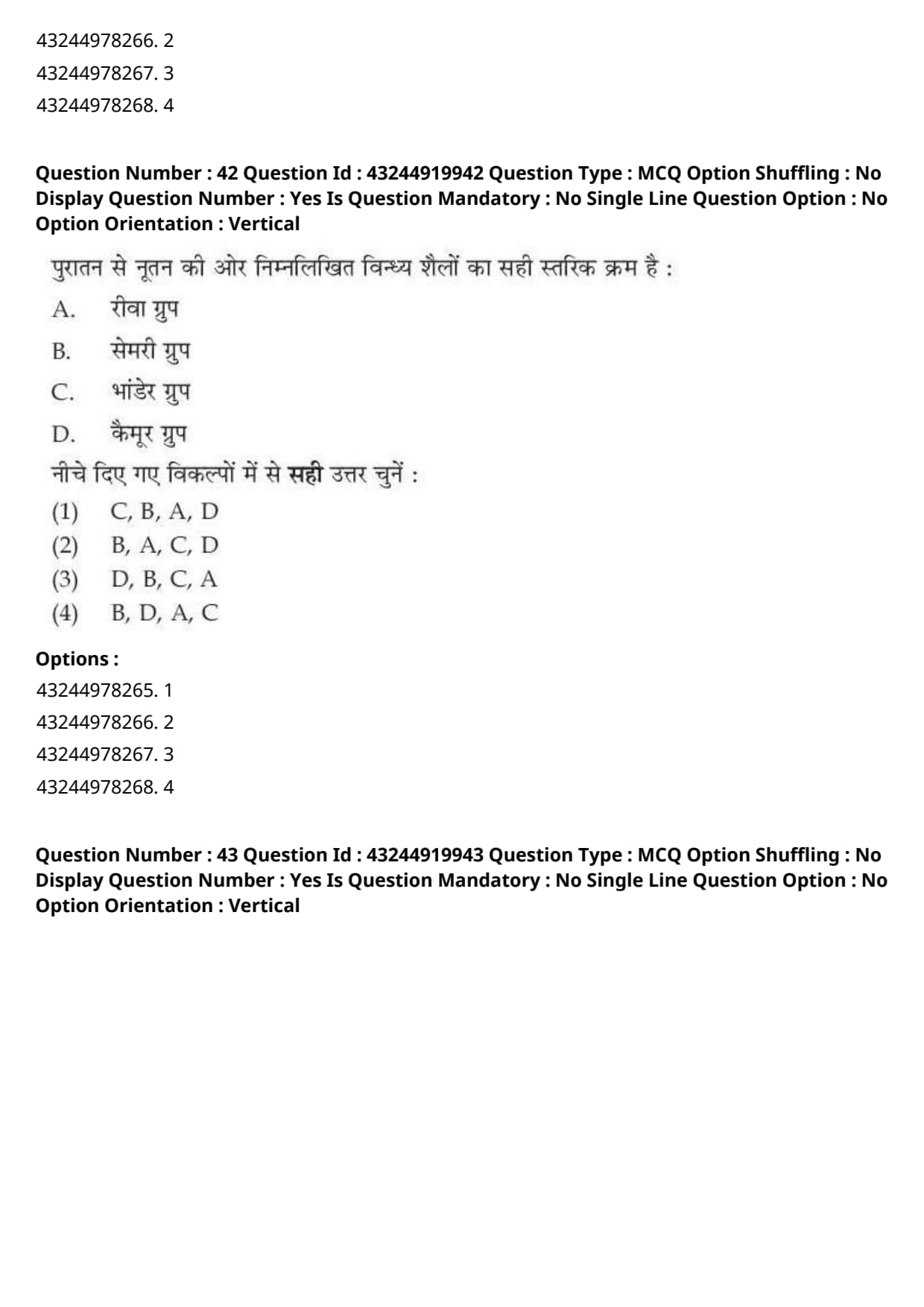
The correct stratigraphic sequence of the following Vindhyan rocks from older to younger is:
A. Rewa Group
B. Semri Group
C. Bhander Group
D. Kaimur Group.
Choose the correct answer from the options given below:
View Solution
Concept:
The Vindhyan Supergroup is divided into several groups arranged from older to younger. Correct stratigraphic order is important for understanding geological history.
Step 1: Identify the oldest group.
The Semri Group is the oldest among the given Vindhyan groups.
\[ Oldest=B \]
Step 2: Identify the next group.
After Semri Group comes the Kaimur Group.
\[ Second=D \]
Step 3: Identify the next younger group.
After Kaimur Group comes the Rewa Group.
\[ Third=A \]
Step 4: Identify the youngest group.
The Bhander Group is the youngest among these.
\[ Youngest=C \]
Therefore, the sequence from older to younger is:
\[ Semri \rightarrow Kaimur \rightarrow Rewa \rightarrow Bhander \]
Using the given letters:
\[ B>D>A>C \]
\[ \therefore Correct Answer is (D) \] Quick Tip: Vindhyan sequence from older to younger is Semri \(\rightarrow\) Kaimur \(\rightarrow\) Rewa \(\rightarrow\) Bhander.
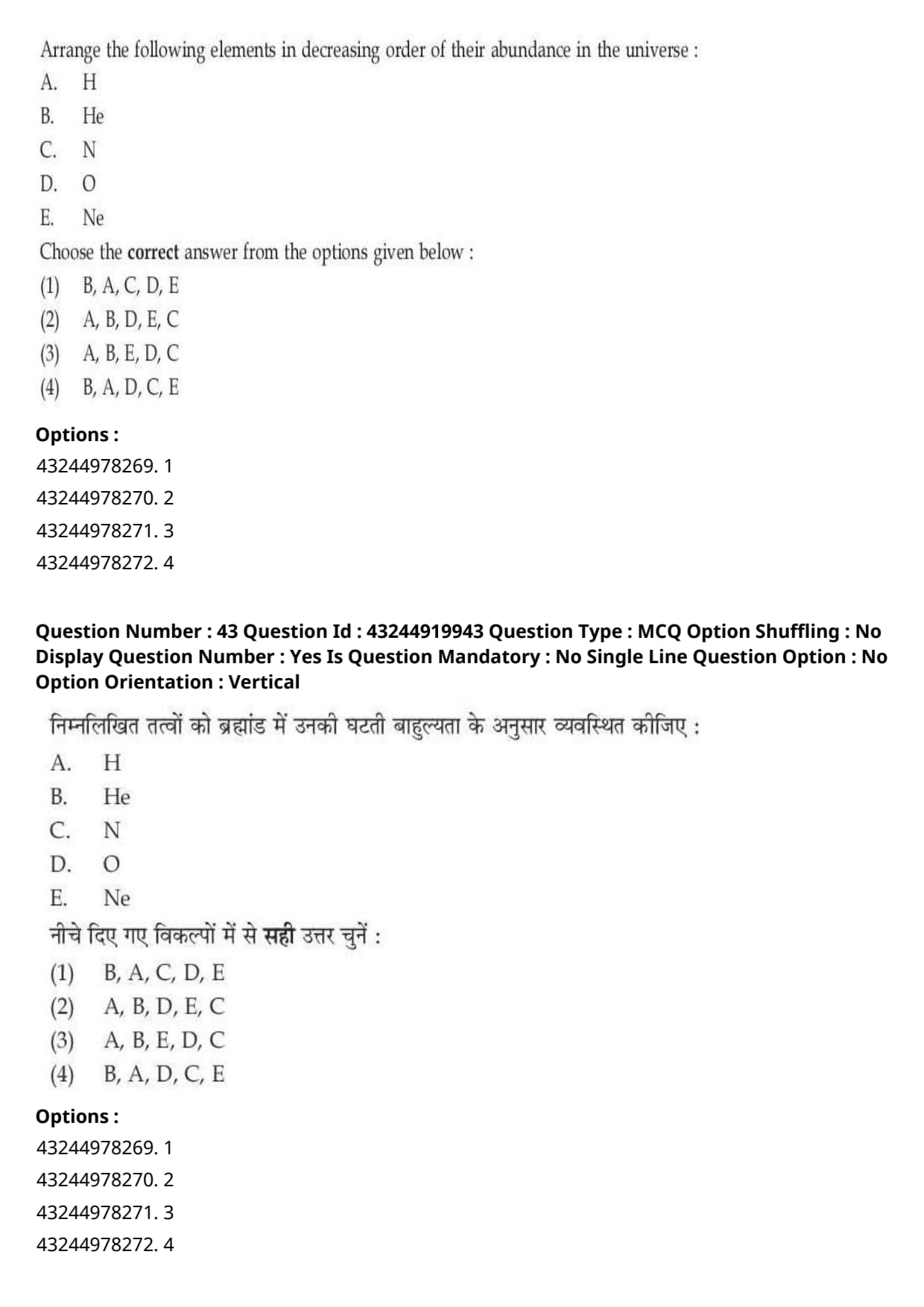
Arrange the following elements in decreasing order of their abundance in the universe:
A. H
B. He
C. N
D. O
E. Ne
Choose the correct answer from the options given below:
View Solution
Concept:
The abundance of elements in the universe is dominated by light elements. Hydrogen is the most abundant element, followed by helium.
Step 1: Identify the most abundant element.
Hydrogen is the most abundant element in the universe.
\[ Hydrogen=A \]
So,
\[ A comes first \]
Step 2: Identify the second most abundant element.
Helium is the second most abundant element.
\[ Helium=B \]
So,
\[ B comes after A \]
Step 3: Compare oxygen, neon and nitrogen.
Among oxygen, neon and nitrogen, oxygen is more abundant than neon and nitrogen. Neon is generally more abundant than nitrogen in cosmic abundance.
\[ O>Ne>N \]
Using the given letters:
\[ D>E>C \]
Step 4: Final decreasing order.
Therefore, the decreasing order is:
\[ H>He>O>Ne>N \]
\[ A>B>D>E>C \]
\[ \therefore Correct Answer is (B) \] Quick Tip: Universal abundance generally starts with Hydrogen, then Helium, followed by heavier elements such as Oxygen and Neon.
The correct sequence from larger to smaller chronostratigraphic units is:
A. Stage
B. Series
C. Zone
D. System
Choose the correct answer from the options given below:
View Solution
Concept:
Chronostratigraphic units are rock units arranged according to geological time. They have a hierarchical order from larger to smaller.
Step 1: Identify the largest unit among the given options.
System is larger than series, stage and zone.
\[ Largest=D \]
Step 2: Identify the next unit.
A system is divided into series.
\[ Second=B \]
Step 3: Identify the next smaller unit.
A series is divided into stages.
\[ Third=A \]
Step 4: Identify the smallest unit.
Zone is smaller than stage in this sequence.
\[ Smallest=C \]
Therefore, the correct order from larger to smaller is:
\[ System>Series>Stage>Zone \]
Using letters:
\[ D>B>A>C \]
\[ \therefore Correct Answer is (B) \] Quick Tip: Chronostratigraphic order is System \(\rightarrow\) Series \(\rightarrow\) Stage \(\rightarrow\) Zone.
Arrange the following volcanics in the decreasing order of their age: A. Panjal
B. Dras
C. Pitepani
D. Malani
Choose the correct answer from the options given below:
View Solution
Concept:
In geology, decreasing order of age means arranging from oldest to youngest.
Step 1: Identify the oldest volcanic unit.
Among the given volcanic units, Pitepani volcanics are older than the others.
\[ Oldest=C \]
Step 2: Identify the next older unit.
Malani volcanics are Proterozoic and are older than Panjal and Dras volcanics.
\[ Second=D \]
Step 3: Compare Panjal and Dras.
Panjal volcanics are older than Dras volcanics.
\[ A>B \]
Step 4: Final decreasing order.
Therefore, from older to younger:
\[ Pitepani>Malani>Panjal>Dras \]
Using letters:
\[ C>D>A>B \]
\[ \therefore Correct Answer is (B) \] Quick Tip: For age-order questions, decreasing order means oldest to youngest.
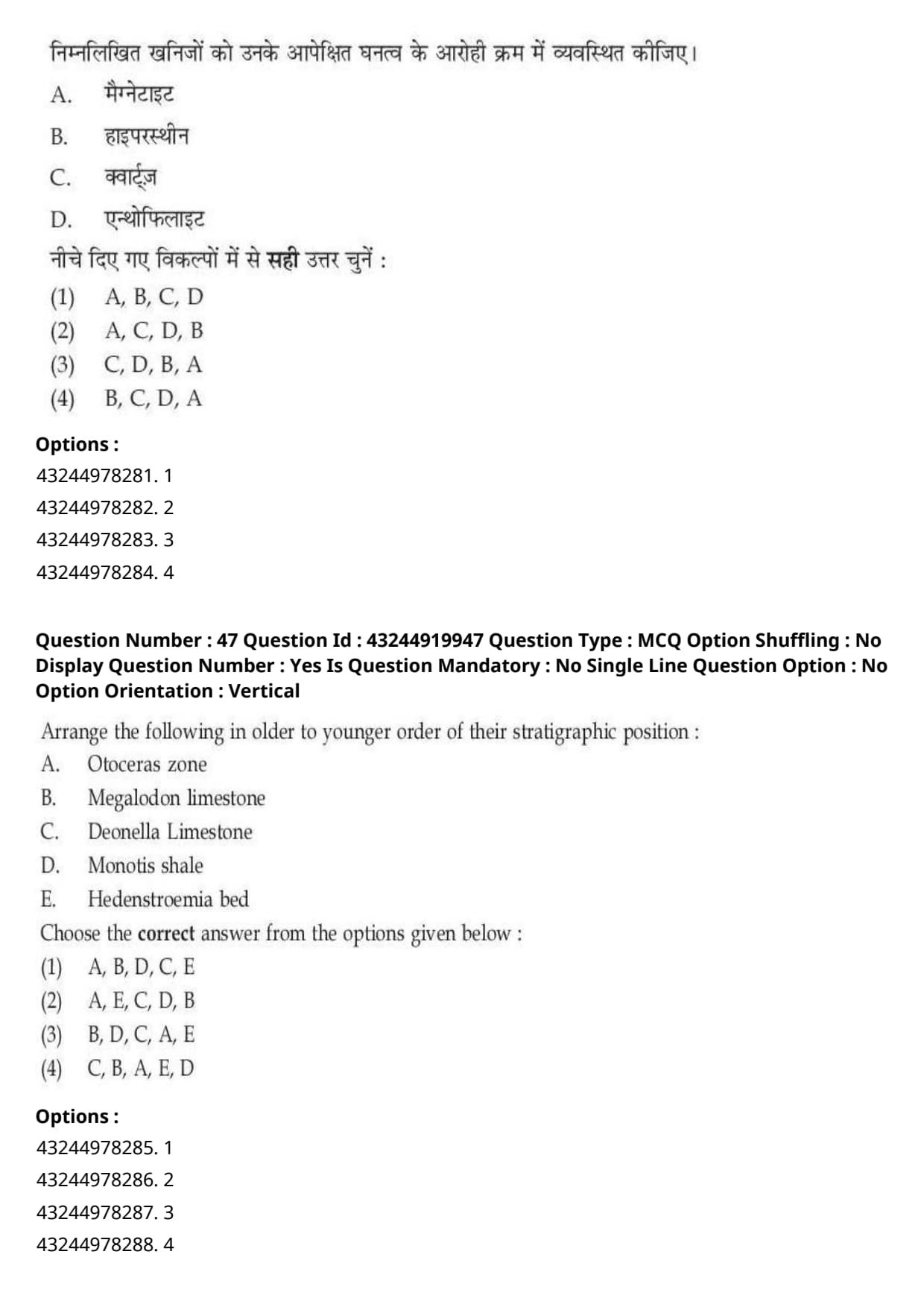
Arrange the following in the increasing order of their specific gravity:
A. Magnetite
B. Hypersthene
C. Quartz
D. Anthophyllite
Choose the correct answer from the options given below:
View Solution
Concept:
Specific gravity is the density of a mineral relative to water. Heavy minerals have higher specific gravity.
Step 1: Identify the lowest specific gravity.
Quartz has relatively low specific gravity, about \(2.65\).
\[ Quartz=C \]
So,
\[ C comes first \]
Step 2: Compare anthophyllite and hypersthene.
Anthophyllite has higher specific gravity than quartz but generally lower than hypersthene.
\[ D
Step 3: Identify the highest specific gravity.
Magnetite is an iron oxide mineral and has high specific gravity.
\[ Magnetite=A \]
So,
\[ A comes last in increasing order \]
Step 4: Final increasing order.
The increasing order is:
\[ Quartz
Using letters:
\[ C
Arrange the following in older to younger order of their stratigraphic position:
A. Otoceras zone
B. Megalodon limestone
C. Daonella Limestone
D. Monotis shale
E. Hedenstroemia bed
Choose the correct answer from the options given below:
View Solution
Concept:
Stratigraphic position is arranged from older beds at the bottom to younger beds above.
Step 1: Identify the oldest zone.
Otoceras zone is the oldest among the given stratigraphic units.
\[ Oldest=A \]
Step 2: Identify the next bed.
Hedenstroemia bed comes after Otoceras zone.
\[ Second=E \]
Step 3: Identify middle units.
Daonella Limestone is followed by Monotis shale.
\[ C>D \]
Step 4: Identify the youngest unit.
Megalodon limestone is the youngest among the given units.
\[ Youngest=B \]
Therefore, the older to younger sequence is:
\[ A>E>C>D>B \]
\[ \therefore Correct Answer is (B) \] Quick Tip: In stratigraphy, older to younger order means moving upward in the geological sequence.
Arrange the following oxides in the decreasing order of their relative abundance in the Earth's crust:
A. \(Al_2O_3\)
B. \(Fe_2O_3+FeO\)
C. \(CaO\)
D. \(SiO_2\)
Choose the correct answer from the options given below:
View Solution
Concept:
The Earth's crust is dominated by silicate minerals, so silica is the most abundant oxide.
Step 1: Identify the most abundant oxide.
Silica \((SiO_2)\) is the most abundant oxide in the Earth's crust.
\[ D comes first \]
Step 2: Identify the second most abundant oxide.
Alumina \((Al_2O_3)\) is next after silica.
\[ A comes second \]
Step 3: Compare iron oxides and calcium oxide.
Total iron oxides are generally more abundant than calcium oxide.
\[ B>C \]
Step 4: Final decreasing order.
Therefore, the decreasing order is:
\[ SiO_2>Al_2O_3>(Fe_2O_3+FeO)>CaO \]
Using letters:
\[ D>A>B>C \]
\[ \therefore Correct Answer is (A) \] Quick Tip: Silica \((SiO_2)\) is the most abundant oxide in the Earth's crust.
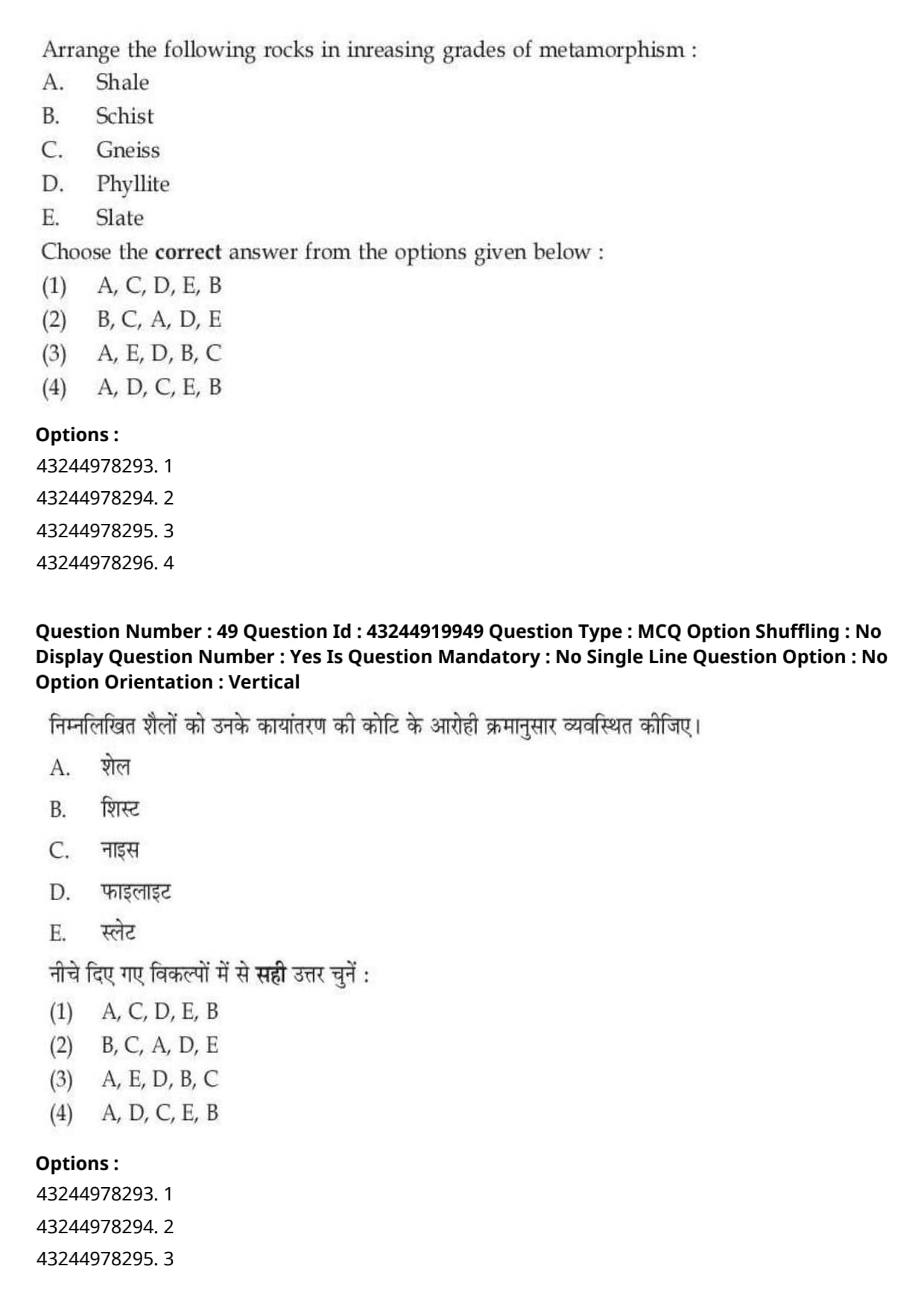
Arrange the following rocks in increasing grades of metamorphism:
A. Shale
B. Schist
C. Gneiss
D. Phyllite
E. Slate
Choose the correct answer from the options given below:
View Solution
Concept:
Metamorphic grade increases with increasing temperature and pressure. Shale transforms into progressively higher grade metamorphic rocks.
Step 1: Start with parent rock.
Shale is the original sedimentary rock.
\[ Lowest=A \]
Step 2: Low-grade metamorphism.
Shale first changes into slate.
\[ Slate=E \]
Step 3: Next grade.
Slate changes into phyllite.
\[ Phyllite=D \]
Step 4: Higher grade.
Phyllite changes into schist.
\[ Schist=B \]
Step 5: Highest grade among these.
Schist changes into gneiss at still higher metamorphic grade.
\[ Highest=C \]
Therefore, increasing grade of metamorphism is:
\[ Shale
Using letters:
\[ A
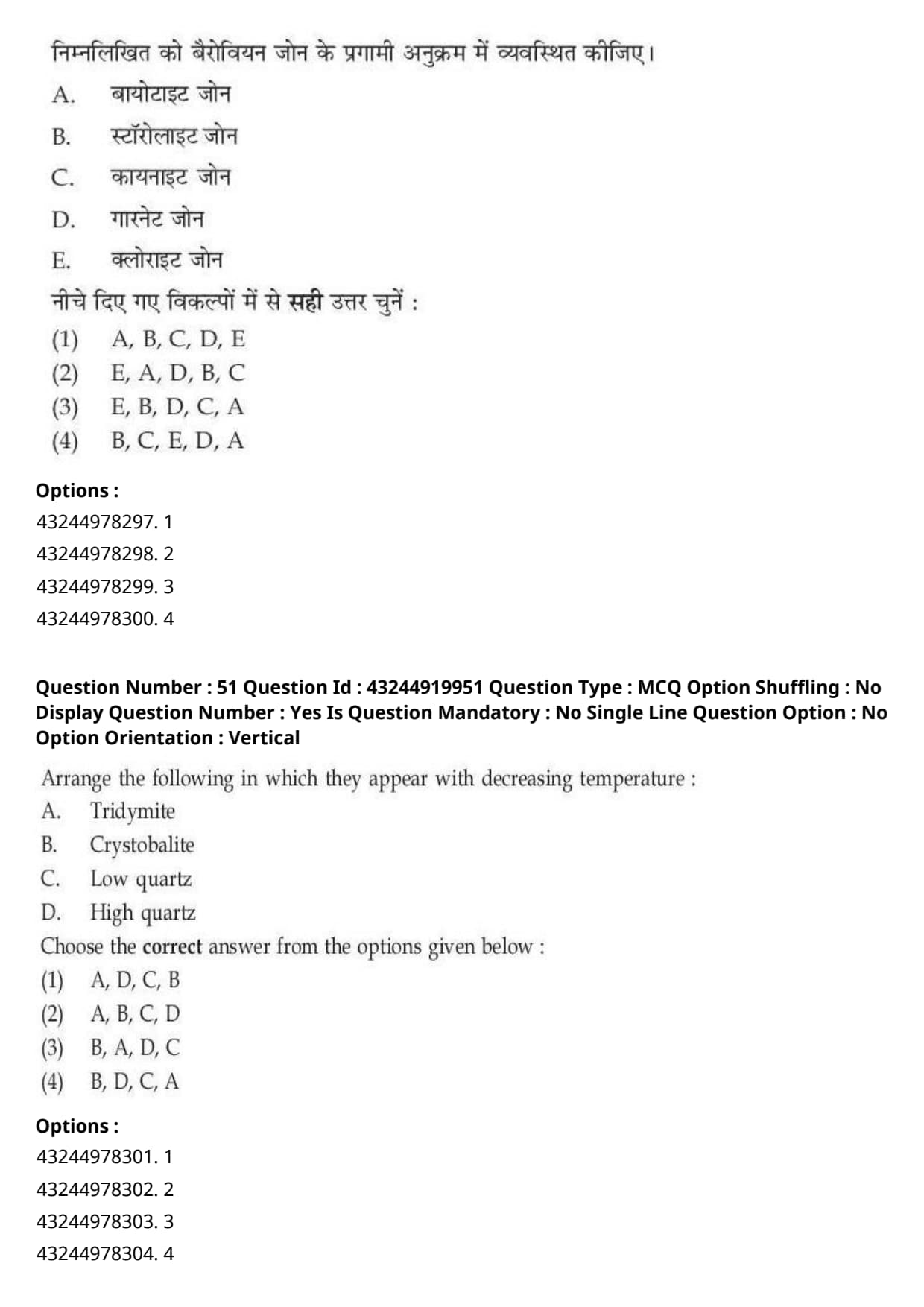
Arrange the following in progressive sequence of the Barrovian zones:
A. Biotite zone
B. Staurolite zone
C. Kyanite zone
D. Garnet zone
E. Chlorite zone
Choose the correct answer from the options given below:
View Solution
Concept:
Barrovian metamorphic zones show progressive regional metamorphism. They are arranged from low grade to high grade according to index minerals.
Step 1: Lowest grade zone.
Chlorite zone represents the lowest grade Barrovian metamorphic zone.
\[ Lowest=E \]
Step 2: Next zone.
After chlorite zone comes biotite zone.
\[ Second=A \]
Step 3: Intermediate zones.
After biotite zone comes garnet zone, then staurolite zone.
\[ D>B \]
Step 4: Higher grade zone.
Kyanite zone represents higher grade metamorphism among the given zones.
\[ Highest=C \]
Therefore, the progressive sequence is:
\[ Chlorite\rightarrow Biotite\rightarrow Garnet\rightarrow Staurolite\rightarrow Kyanite \]
Using letters:
\[ E>A>D>B>C \]
\[ \therefore Correct Answer is (B) \] Quick Tip: Barrovian zones progress as Chlorite \(\rightarrow\) Biotite \(\rightarrow\) Garnet \(\rightarrow\) Staurolite \(\rightarrow\) Kyanite.
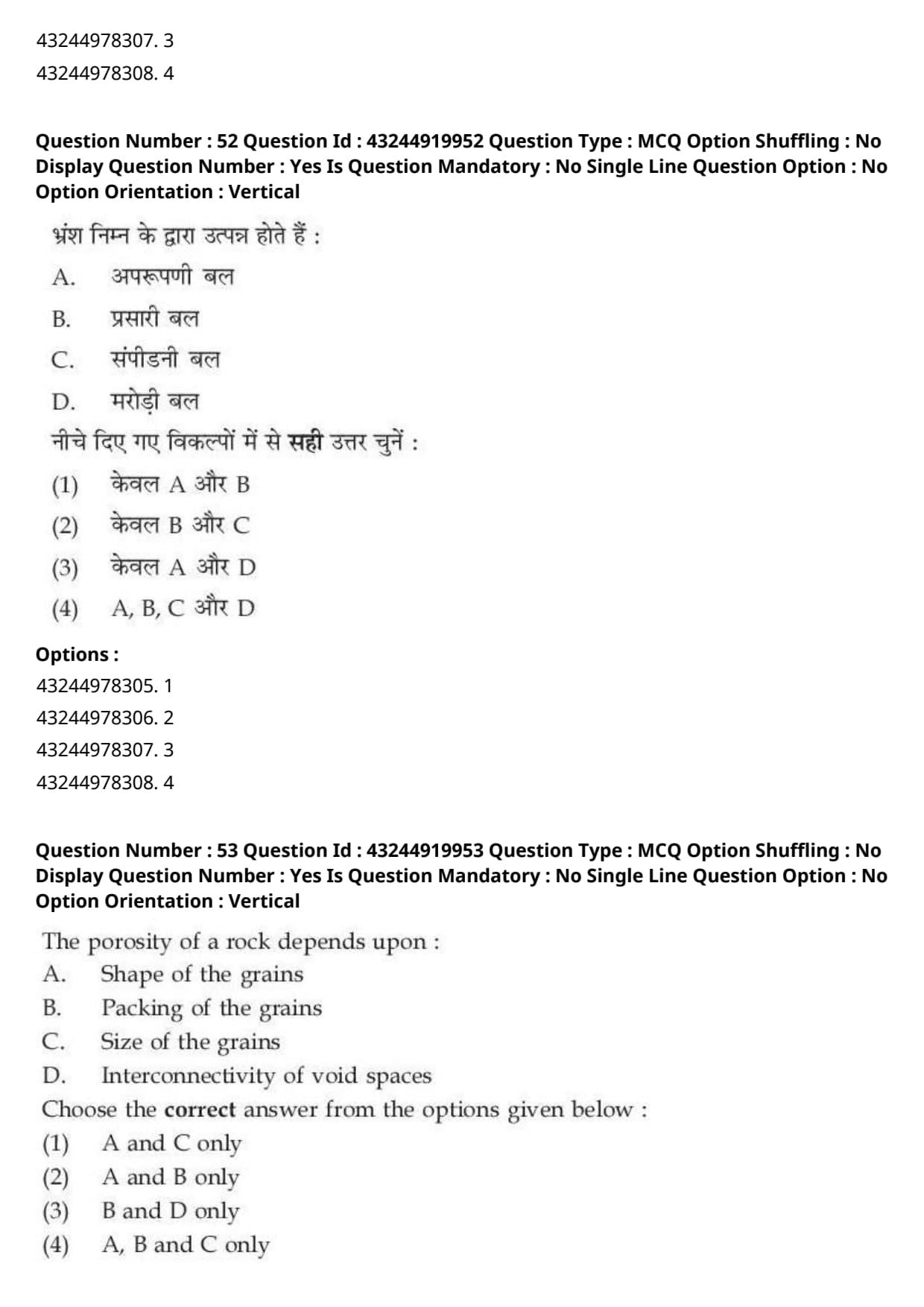
Arrange the following in which they appear with decreasing temperature:
A. Tridymite
B. Cristobalite
C. Low quartz
D. High quartz
Choose the correct answer from the options given below:
View Solution
Concept:
Silica \((SiO_2)\) has different polymorphs stable at different temperatures.
Step 1: Highest temperature form.
Cristobalite is stable at very high temperature among the given silica forms.
\[ Highest=B \]
Step 2: Next temperature form.
Tridymite is stable below cristobalite but above quartz forms.
\[ Second=A \]
Step 3: Quartz forms.
High quartz exists at higher temperature than low quartz.
\[ D>C \]
Step 4: Final decreasing temperature order.
Thus, the sequence is:
\[ Cristobalite>Tridymite>High quartz>Low quartz \]
Using letters:
\[ B>A>D>C \]
\[ \therefore Correct Answer is (C) \] Quick Tip: Silica polymorphs in decreasing temperature are Cristobalite \(\rightarrow\) Tridymite \(\rightarrow\) High quartz \(\rightarrow\) Low quartz.
Faults are generated by:
A. Shear forces
B. Extensional forces
C. Compressional forces
D. Torsional forces
Choose the correct answer from the options given below:
View Solution
Concept:
Faults are fractures in rocks along which displacement has taken place. They are produced by different types of tectonic forces.
Step 1: Shear forces.
Shear forces produce strike-slip or wrench faults.
\[ A is correct \]
Step 2: Extensional forces.
Extensional forces pull rocks apart and commonly produce normal faults.
\[ B is correct \]
Step 3: Compressional forces.
Compressional forces push rocks together and commonly produce reverse or thrust faults.
\[ C is correct \]
Step 4: Torsional forces.
Torsional forces can also contribute to fracturing and displacement of rocks.
\[ D is correct \]
Thus, all given forces can generate faults.
\[ \therefore Correct Answer is (D) \] Quick Tip: Normal faults are related to extension, reverse faults to compression, and strike-slip faults to shear.
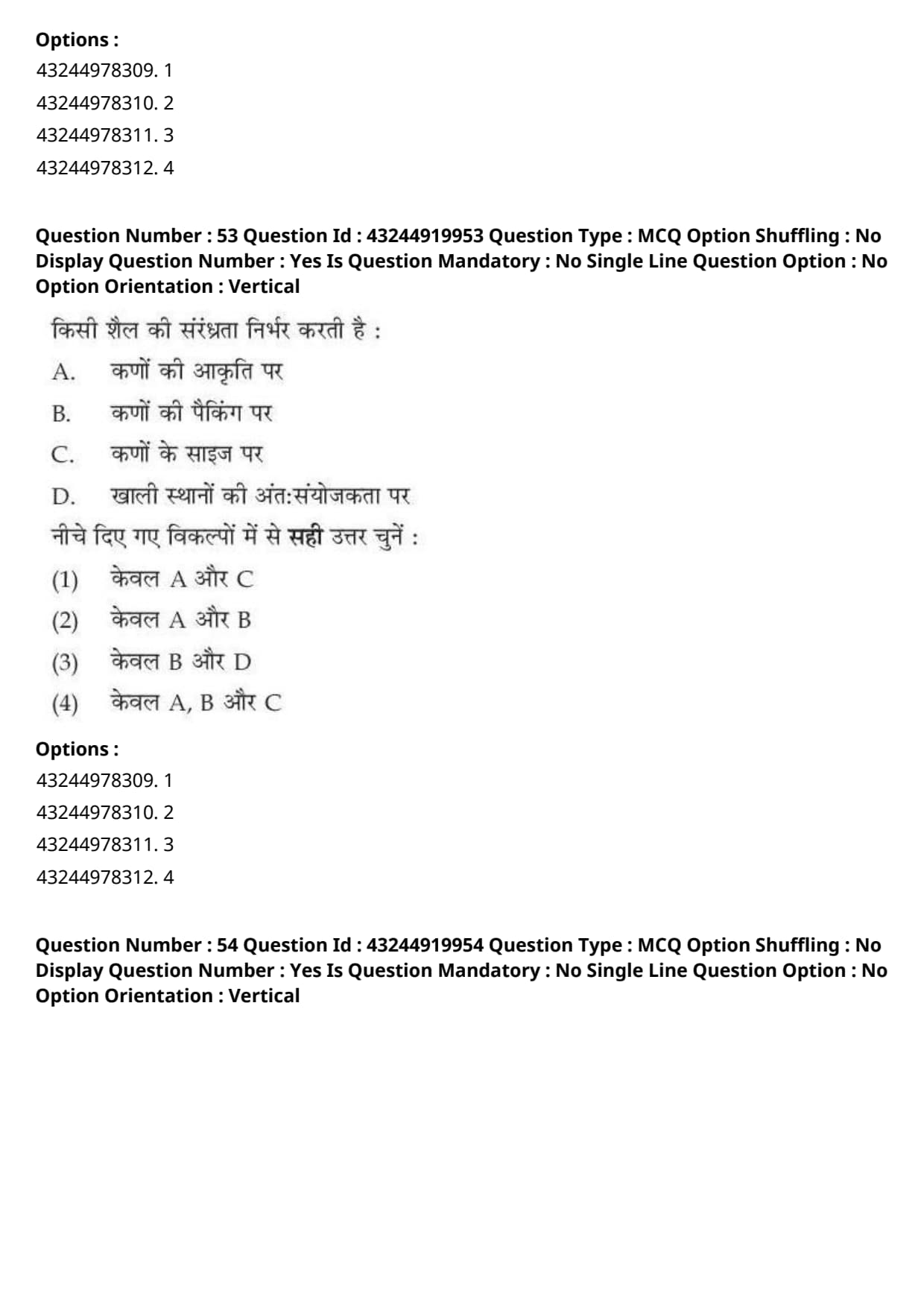
The porosity of a rock depends upon:
A. Shape of the grains
B. Packing of the grains
C. Size of the grains
D. Interconnectivity of void spaces
Choose the correct answer from the options given below:
View Solution
Concept:
Porosity is the percentage of void space present in a rock.
\[ Porosity=\frac{Volume of voids}{Total volume}\times100 \]
Step 1: Shape of grains.
The shape of grains affects how much pore space remains between grains.
\[ A is correct \]
Step 2: Packing of grains.
Loose packing gives higher porosity, while tight packing gives lower porosity.
\[ B is correct \]
Step 3: Size of grains.
Grain size may influence the arrangement of grains and pore spaces.
\[ C is correct \]
Step 4: Interconnectivity of void spaces.
Interconnectivity of void spaces is more directly related to permeability, not porosity.
\[ D is not selected \]
Thus, porosity depends mainly on:
\[ A,B,C \]
\[ \therefore Correct Answer is (D) \] Quick Tip: Porosity is about the amount of pore space, while permeability is about interconnection of pore spaces.
Which of the following statements is/are true for the Bowen's Reaction Series?
A. It is related to comparative destruction of rocks against applied stresses
B. It is related to change in animal behaviour in response to change in climate
C. It is related to crystallisation of minerals from the cooling magma
D. It contains a continuous and a discontinuous series.
Choose the correct answer from the options given below:
View Solution
Concept:
Bowen's Reaction Series explains the order in which minerals crystallize from cooling magma.
Step 1: Check statement A.
Bowen's Reaction Series is not related to destruction of rocks under stress.
\[ A is incorrect \]
Step 2: Check statement B.
It is not related to animal behaviour or climate response.
\[ B is incorrect \]
Step 3: Check statement C.
Bowen's Reaction Series explains crystallisation of minerals from cooling magma.
\[ C is correct \]
Step 4: Check statement D.
Bowen's Reaction Series has two branches:
\[ Continuous series \]
and
\[ Discontinuous series \]
So,
\[ D is correct \]
Thus, the correct statements are:
\[ C,D \]
\[ \therefore Correct Answer is (D) \] Quick Tip: Bowen's Reaction Series explains mineral crystallisation from cooling magma and includes continuous and discontinuous branches.
Which of the following is/are the evidences of the magmatic origin of granites?
A. Chilled margins of the granite
B. Perfect gradation between the country rocks and the granites
C. Presence of xenoliths of country rocks in the granites
D. Graphic texture.
Choose the correct answer from the options given below:
View Solution
Concept:
Magmatic origin of granite means granite formed from crystallisation of magma. Certain field and textural features support this origin.
Step 1: Chilled margins.
Chilled margins form when magma cools rapidly against cooler country rocks.
\[ A is evidence of magmatic origin \]
Step 2: Perfect gradation with country rocks.
Perfect gradation between country rocks and granite is more commonly used as an argument for replacement or metasomatic origin, not direct magmatic origin.
\[ B is not selected \]
Step 3: Xenoliths.
Xenoliths are fragments of country rocks enclosed in magma. Their presence in granite supports intrusion of magma.
\[ C is correct \]
Step 4: Graphic texture.
Graphic texture may develop during crystallisation of granitic magma and supports magmatic origin.
\[ D is correct \]
Thus, the correct evidence set is:
\[ A,C,D \]
\[ \therefore Correct Answer is (D) \] Quick Tip: Chilled margins, xenoliths and magmatic textures support igneous or magmatic origin of granite.
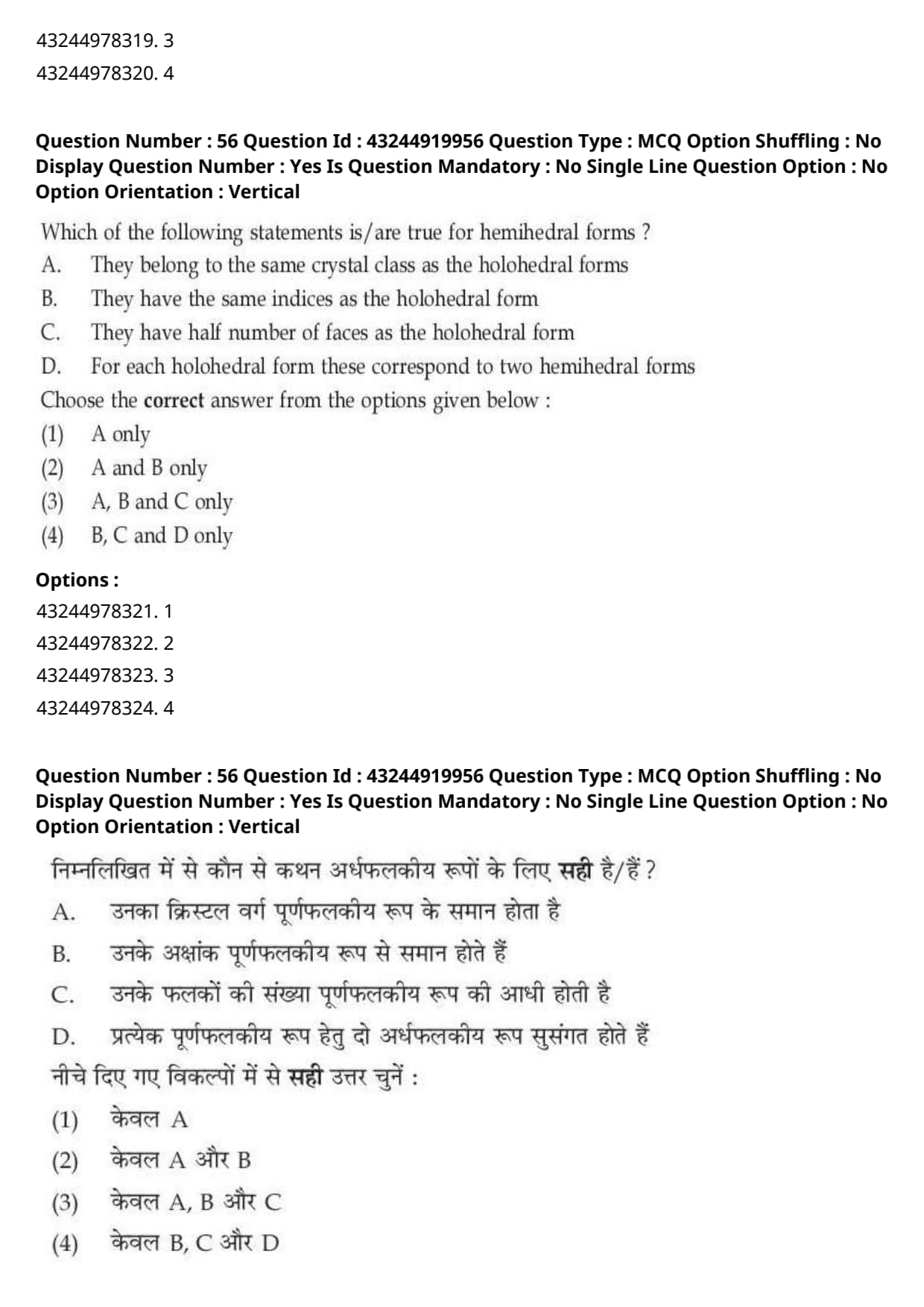
Which of the following statements is/are true for hemihedral forms?
A. They belong to the same crystal class as the holohedral forms
B. They have the same indices as the holohedral form
C. They have half number of faces as the holohedral form
D. For each holohedral form these correspond to two hemihedral forms.
Choose the correct answer from the options given below:
View Solution
Concept:
Hemihedral forms are crystal forms having half the number of faces compared to the corresponding holohedral form.
Step 1: Check statement A.
Hemihedral forms do not represent the same full symmetry condition as holohedral forms.
\[ A is not selected \]
Step 2: Check statement B.
Hemihedral forms can have the same indices as the corresponding holohedral form.
\[ B is correct \]
Step 3: Check statement C.
By definition, hemihedral forms have half the number of faces of the holohedral form.
\[ C is correct \]
Step 4: Check statement D.
For a holohedral form, two corresponding hemihedral forms may occur.
\[ D is correct \]
Therefore, the correct statements are:
\[ B,C,D \]
\[ \therefore Correct Answer is (D) \] Quick Tip: Hemihedral forms have half the number of faces of the corresponding holohedral form.
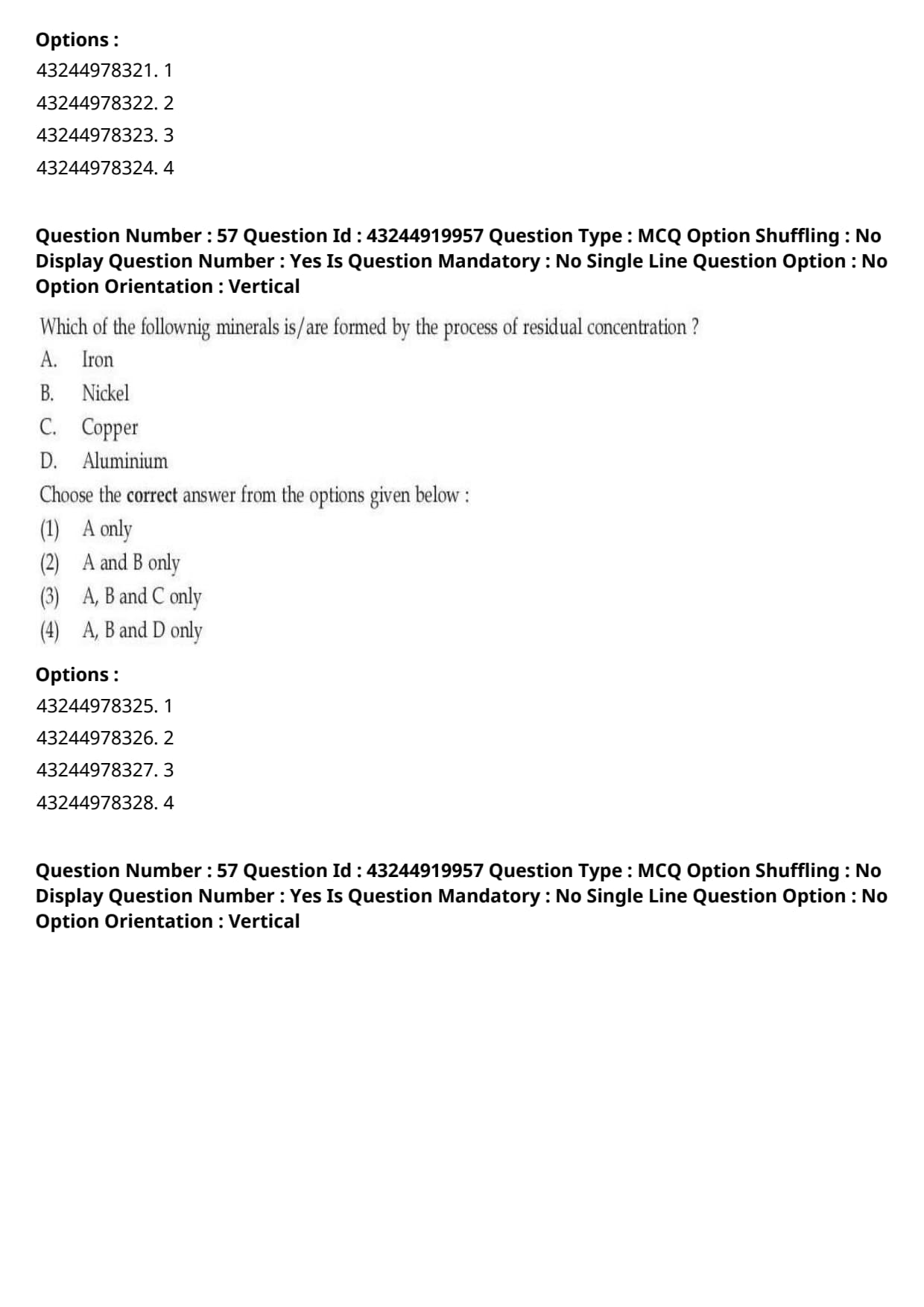
Which of the following minerals is/are formed by the process of residual concentration?
A. Iron
B. Nickel
C. Copper
D. Aluminium.
Choose the correct answer from the options given below:
View Solution
Concept:
Residual concentration forms ore deposits by intense weathering and leaching. Soluble materials are removed, while less soluble valuable materials remain concentrated.
Step 1: Iron.
Iron ores may form by residual concentration through lateritic weathering.
\[ A is correct \]
Step 2: Nickel.
Nickel laterite deposits are formed by residual concentration of nickel during weathering of ultramafic rocks.
\[ B is correct \]
Step 3: Copper.
Copper is not the typical residual concentration mineral in the given set.
\[ C is not selected \]
Step 4: Aluminium.
Bauxite, the chief ore of aluminium, is formed by residual concentration.
\[ D is correct \]
Thus, the correct set is:
\[ A,B,D \]
\[ \therefore Correct Answer is (D) \] Quick Tip: Bauxite and nickel laterite are important examples of residual concentration deposits.
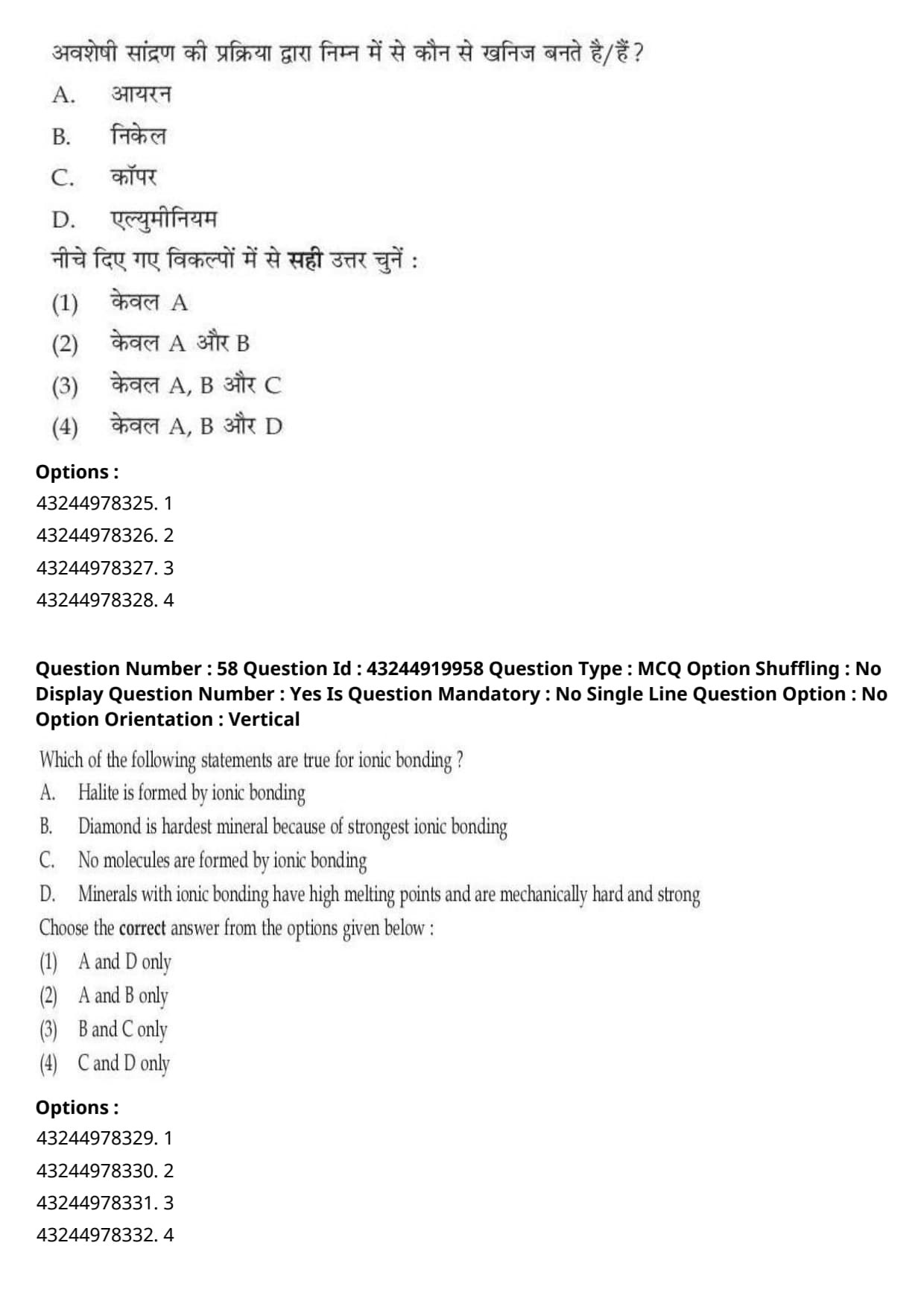
Which of the following statements are true for ionic bonding?
A. Halite is formed by ionic bonding
B. Diamond is hardest mineral because of strongest ionic bonding
C. No molecules are formed by ionic bonding
D. Minerals with ionic bonding have high melting points and are mechanically hard and strong.
Choose the correct answer from the options given below:
View Solution
Concept:
Ionic bonding forms due to electrostatic attraction between oppositely charged ions.
Step 1: Check statement A.
Halite \((NaCl)\) is a classic example of ionic bonding.
\[ Na^+ + Cl^- \rightarrow NaCl \]
So,
\[ A is correct \]
Step 2: Check statement B.
Diamond is very hard because of strong covalent bonding, not ionic bonding.
\[ B is incorrect \]
Step 3: Check statement C.
Ionic solids form crystal lattices rather than discrete molecules, but in the given option set the suitable complete correct pair is not based on C alone.
Step 4: Check statement D.
Ionic minerals usually have high melting points and are mechanically hard and strong due to strong electrostatic forces.
\[ D is correct \]
Thus, the correct option is:
\[ A,D \]
\[ \therefore Correct Answer is (A) \] Quick Tip: Halite is ionic, while diamond is covalent.
Which of the following statements are true for the optically isotropic minerals?
A. They are opaque
B. Light is transmitted with the same velocity in all directions through them
C. Refractive index varies with direction of transmission of light
D. Garnet is an optically isotropic mineral.
Choose the correct answer from the options given below:
View Solution
Concept:
Optically isotropic minerals have the same optical properties in all directions.
Step 1: Check statement A.
Optically isotropic minerals are not necessarily opaque. Many isotropic minerals transmit light.
\[ A is incorrect \]
Step 2: Check statement B.
In isotropic minerals, light travels with the same velocity in all directions.
\[ B is correct \]
Step 3: Check statement C.
If refractive index varies with direction, the mineral is anisotropic, not isotropic.
\[ C is incorrect \]
Step 4: Check statement D.
Garnet belongs to the cubic system and is optically isotropic.
\[ D is correct \]
Thus, the correct statements are:
\[ B,D \]
\[ \therefore Correct Answer is (D) \] Quick Tip: Isotropic minerals have the same refractive index in all directions; garnet is an example.
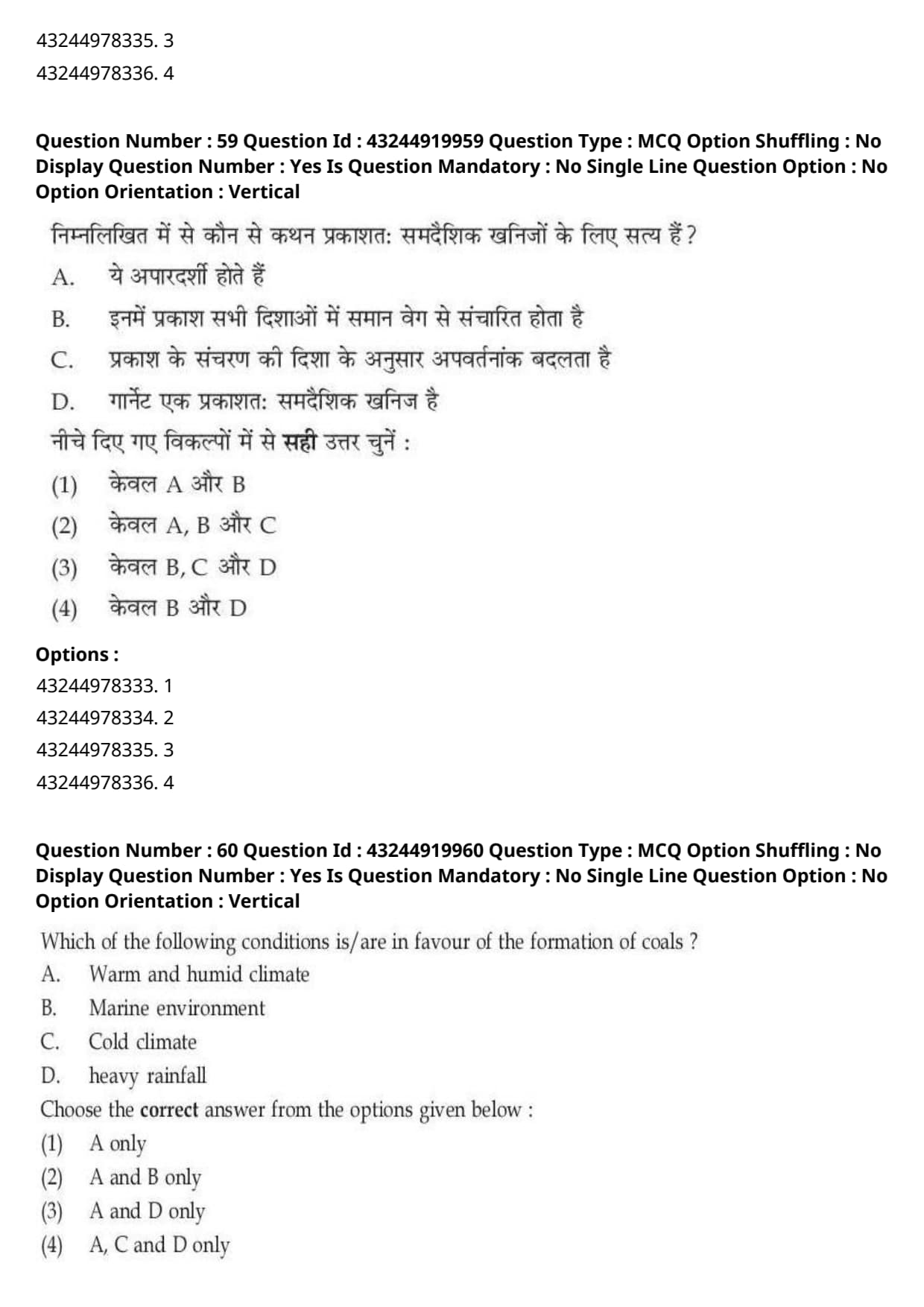
Which of the following conditions is/are in favour of the formation of coals?
A. Warm and humid climate
B. Marine environment
C. Cold climate
D. Heavy rainfall.
Choose the correct answer from the options given below:
View Solution
Concept:
Coal forms from accumulation and preservation of plant material in swampy environments. Climate and water conditions play an important role.
Step 1: Warm and humid climate.
Warm and humid climate supports dense vegetation growth, which provides large amounts of plant material.
\[ A is correct \]
Step 2: Marine environment.
Coal generally forms in swampy, marshy, deltaic or continental wetland environments rather than typical open marine environments.
\[ B is not selected \]
Step 3: Cold climate.
Cold climate is not the most favourable condition for abundant vegetation and coal formation.
\[ C is incorrect \]
Step 4: Heavy rainfall.
Heavy rainfall supports swampy conditions and abundant plant growth, both favourable for coal formation.
\[ D is correct \]
Thus, favourable conditions are:
\[ A,D \]
\[ \therefore Correct Answer is (C) \] Quick Tip: Coal formation is favoured by warm, humid, swampy conditions with abundant vegetation.
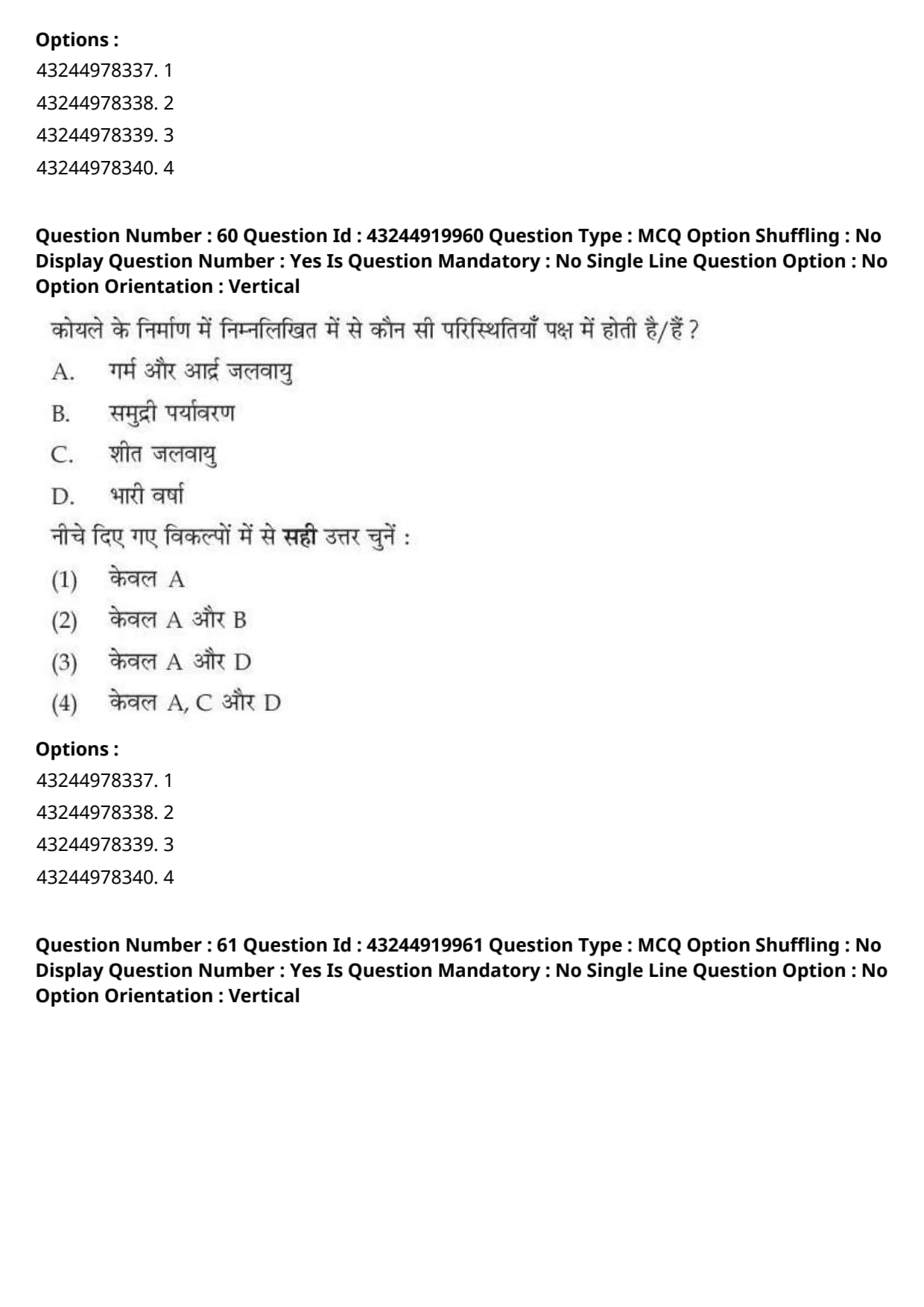
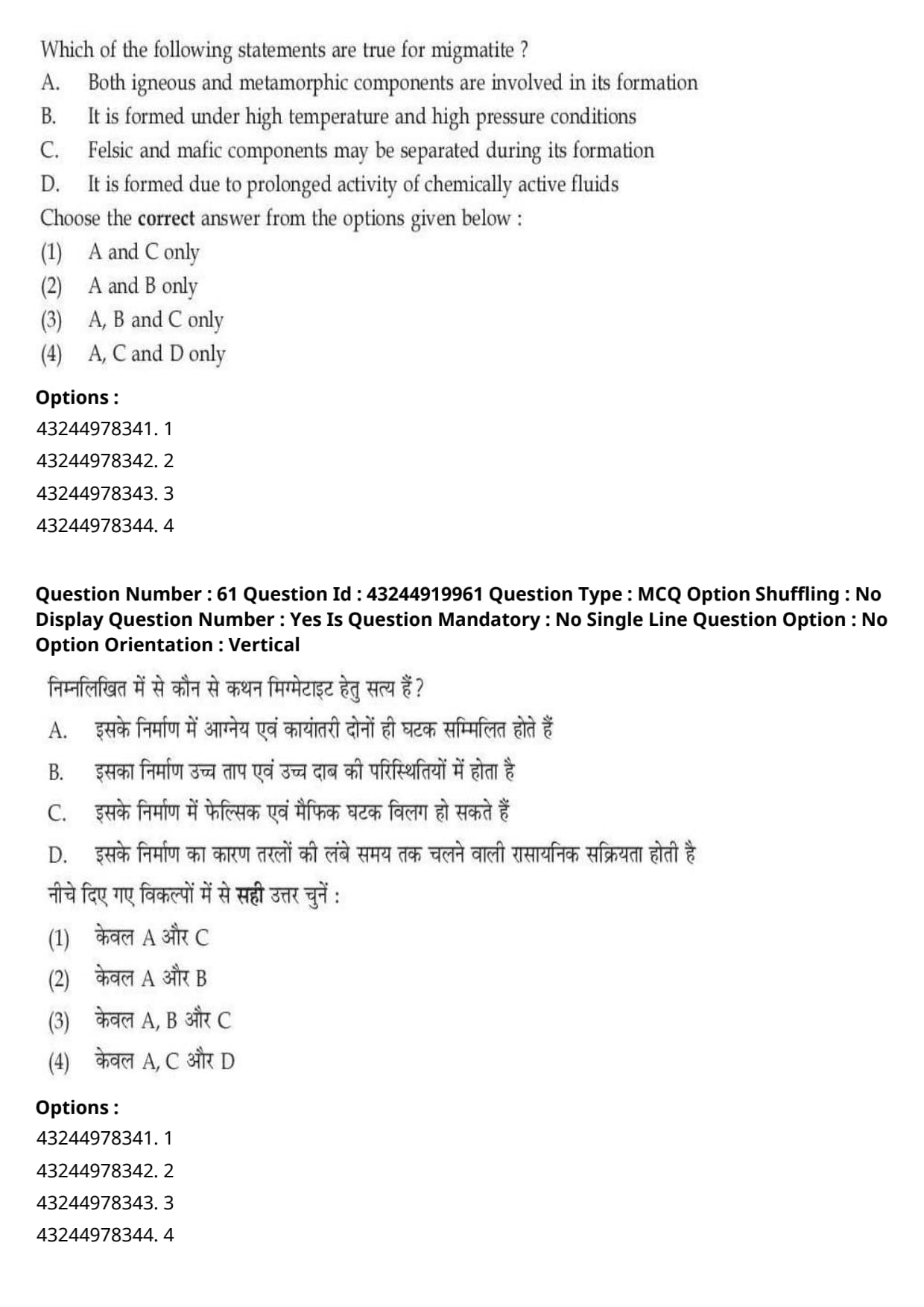
Which of the following statements are true for migmatite?
A. Both igneous and metamorphic components are involved in its formation
B. It is formed under high temperature and high pressure conditions
C. Felsic and mafic components may be separated during its formation
D. It is formed due to prolonged activity of chemically active fluids.
Choose the correct answer from the options given below:
View Solution
Concept:
Migmatite is a mixed rock showing both metamorphic and igneous characters. It is commonly formed under very high-grade metamorphic conditions where partial melting takes place.
Step 1: Check statement A.
Migmatite contains both metamorphic portions and igneous-looking melted portions.
\[ A is correct \]
Step 2: Check statement B.
Migmatites generally form under high temperature and high pressure conditions during high-grade metamorphism.
\[ B is correct \]
Step 3: Check statement C.
During partial melting, felsic material may separate from darker mafic material.
\[ C is correct \]
Step 4: Check statement D.
Prolonged activity of chemically active fluids is more closely related to metasomatism, not the main formation process of migmatite.
\[ D is incorrect \]
Thus, the correct statements are:
\[ A,B,C \]
\[ \therefore Correct Answer is (C) \] Quick Tip: Migmatite is formed by partial melting during high-grade metamorphism and shows both igneous and metamorphic features.
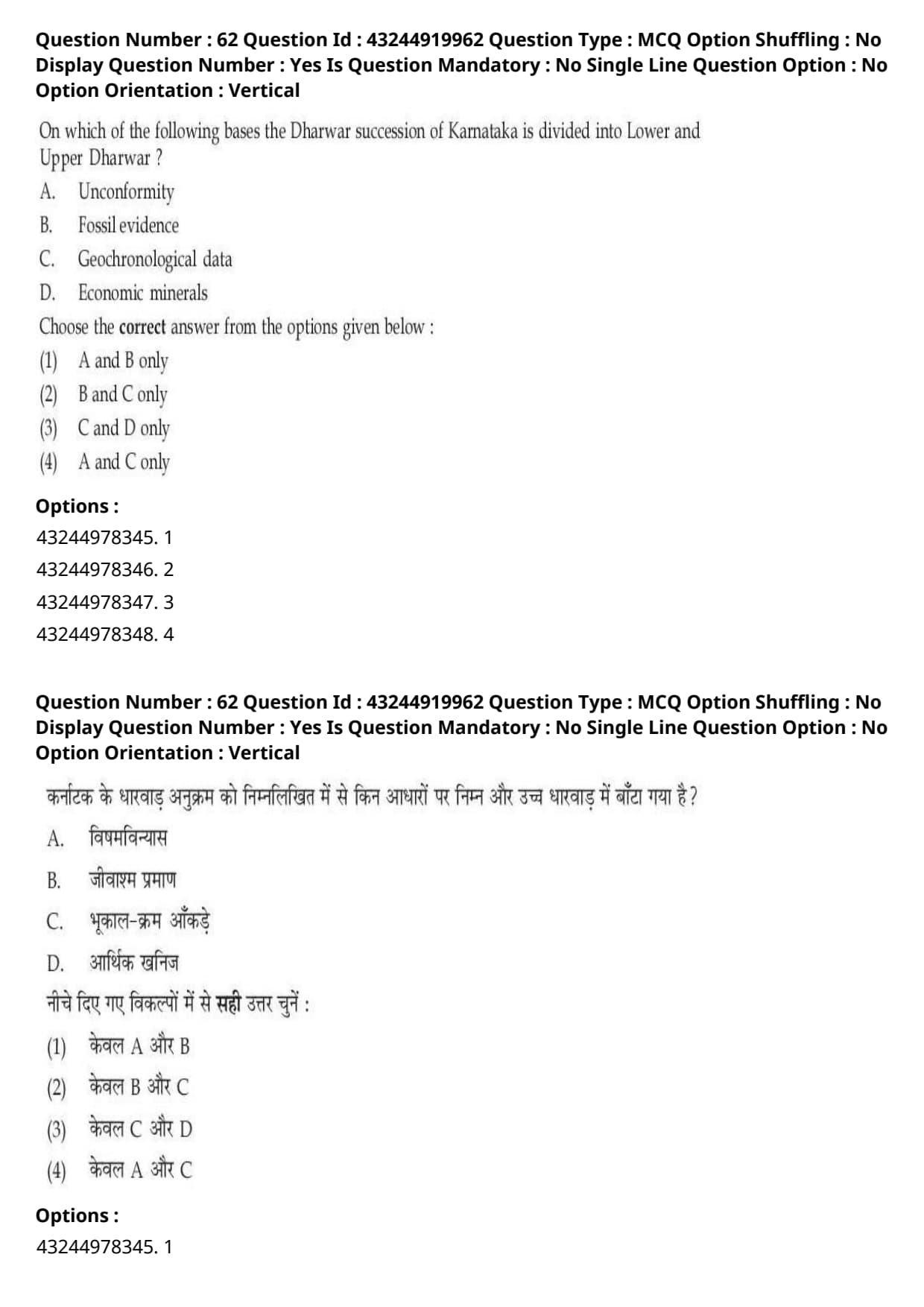
On which of the following bases is the Dharwar succession of Karnataka divided into Lower and Upper Dharwar?
A. Unconformity
B. Fossil evidence
C. Geochronological data
D. Economic minerals.
Choose the correct answer from the options given below:
View Solution
Concept:
The Dharwar succession of Karnataka belongs to the Precambrian rocks. Its division is mainly based on geological relationships and age data.
Step 1: Check unconformity.
Unconformity is an important geological break between rock successions and helps divide older and younger units.
\[ A is correct \]
Step 2: Check fossil evidence.
Dharwar rocks are Precambrian, so fossil evidence is not the main basis for division.
\[ B is incorrect \]
Step 3: Check geochronological data.
Geochronological data gives numerical age information and helps distinguish Lower and Upper Dharwar successions.
\[ C is correct \]
Step 4: Check economic minerals.
Economic minerals may occur in these rocks, but they are not the main formal basis for dividing the succession.
\[ D is incorrect \]
Therefore, the correct statements are:
\[ A,C \]
\[ \therefore Correct Answer is (D) \] Quick Tip: Lower and Upper Dharwar divisions are mainly based on unconformity and geochronological data.
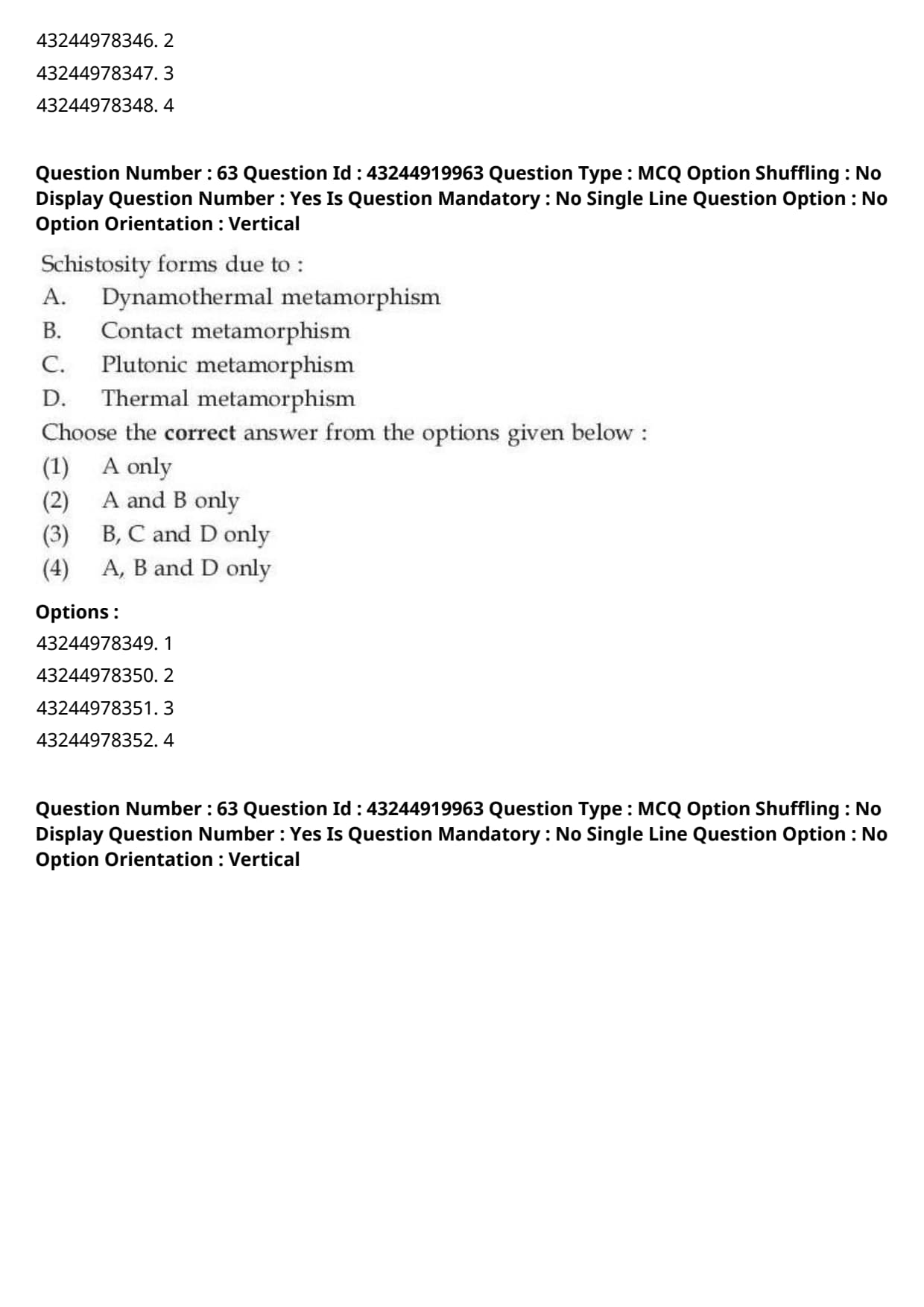
Schistosity forms due to:
A. Dynamothermal metamorphism
B. Contact metamorphism
C. Plutonic metamorphism
D. Thermal metamorphism.
Choose the correct answer from the options given below:
View Solution
Concept:
Schistosity is a planar fabric in metamorphic rocks formed by parallel alignment of platy or flaky minerals.
Step 1: Understand schistosity.
Schistosity develops when minerals such as mica align under directed pressure and recrystallization.
\[ Directed pressure+recrystallization\Rightarrow schistosity \]
Step 2: Check dynamothermal metamorphism.
Dynamothermal metamorphism involves both heat and directed pressure. This is the most suitable condition for schistosity formation.
\[ A is correct \]
Step 3: Check contact and thermal metamorphism.
Contact and thermal metamorphism are mainly caused by heat. They generally produce non-foliated textures rather than strong schistosity.
\[ B and D are incorrect \]
Step 4: Check plutonic metamorphism.
Plutonic metamorphism is mainly associated with deep-seated pressure-temperature conditions, but schistosity is specifically related to directed stress in dynamothermal metamorphism.
\[ C is not selected \]
Thus, the correct answer is:
\[ A only \]
\[ \therefore Correct Answer is (A) \] Quick Tip: Schistosity forms mainly due to directed pressure during dynamothermal metamorphism.
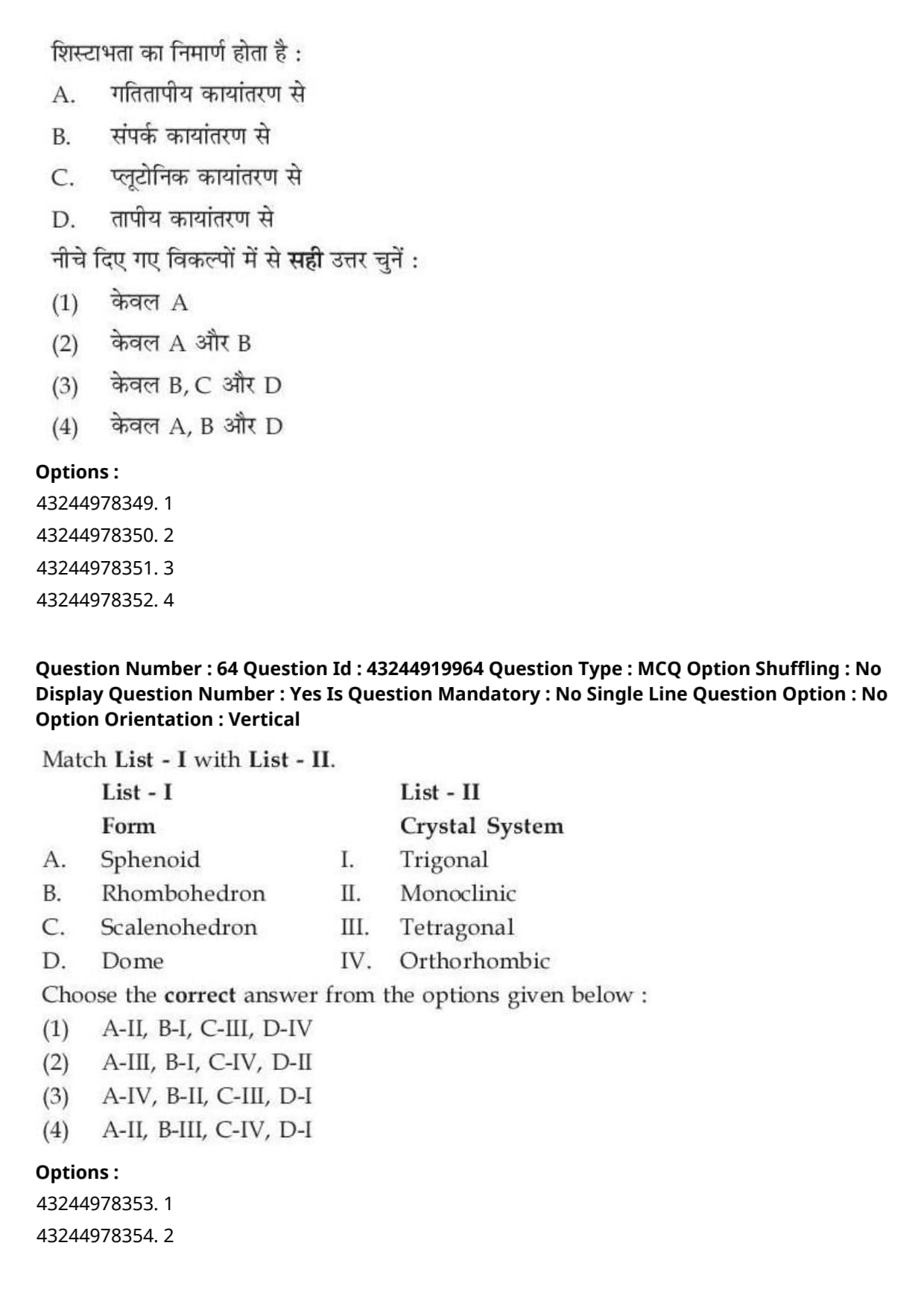
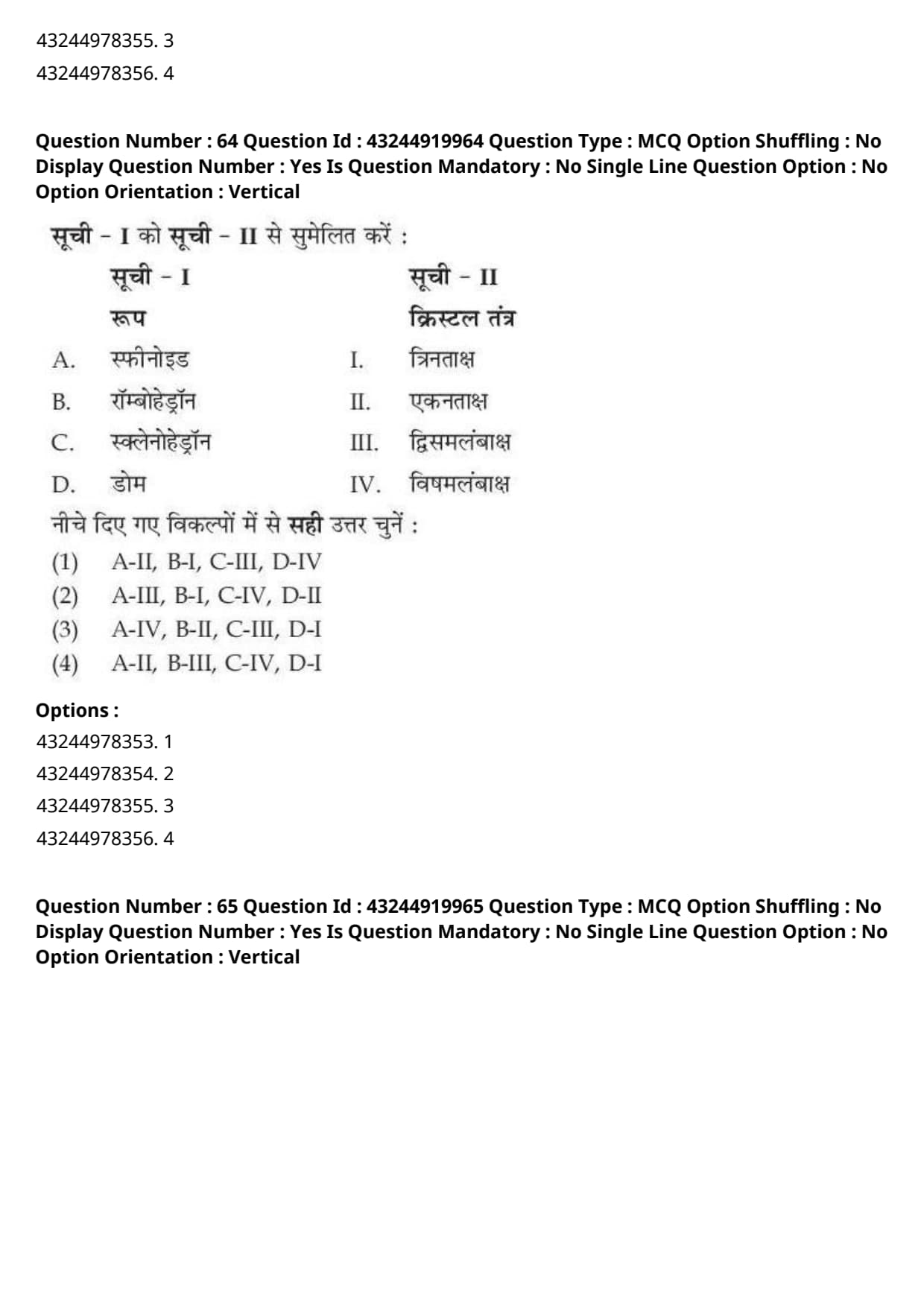
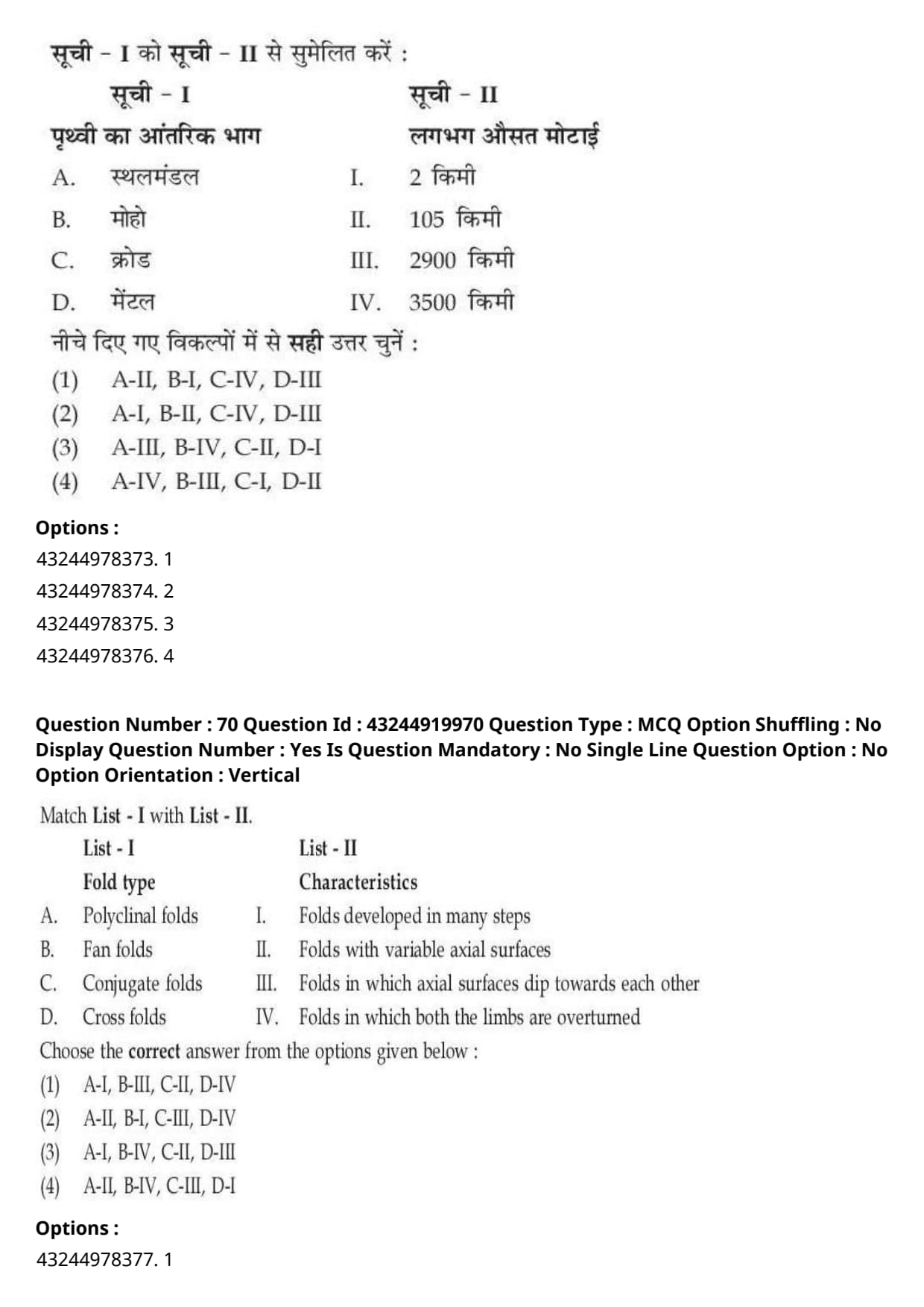
Match List-I with List-II.

Choose the correct answer from the options given below:
View Solution
Concept:
Crystal forms are associated with particular crystal systems based on their symmetry.
Step 1: Match Sphenoid.
Sphenoid is associated with the tetragonal system in the given classification.
\[ A\rightarrow III \]
Step 2: Match Rhombohedron.
Rhombohedron is a characteristic form of the trigonal system.
\[ B\rightarrow I \]
Step 3: Match Scalenohedron.
In the given matching set, scalenohedron corresponds to the orthorhombic system.
\[ C\rightarrow IV \]
Step 4: Match Dome.
Dome is commonly associated with the monoclinic system.
\[ D\rightarrow II \]
Therefore, the correct matching is:
\[ A-III,\ B-I,\ C-IV,\ D-II \]
\[ \therefore Correct Answer is (B) \] Quick Tip: Rhombohedron is an important trigonal crystal form, while dome is commonly linked with monoclinic forms.
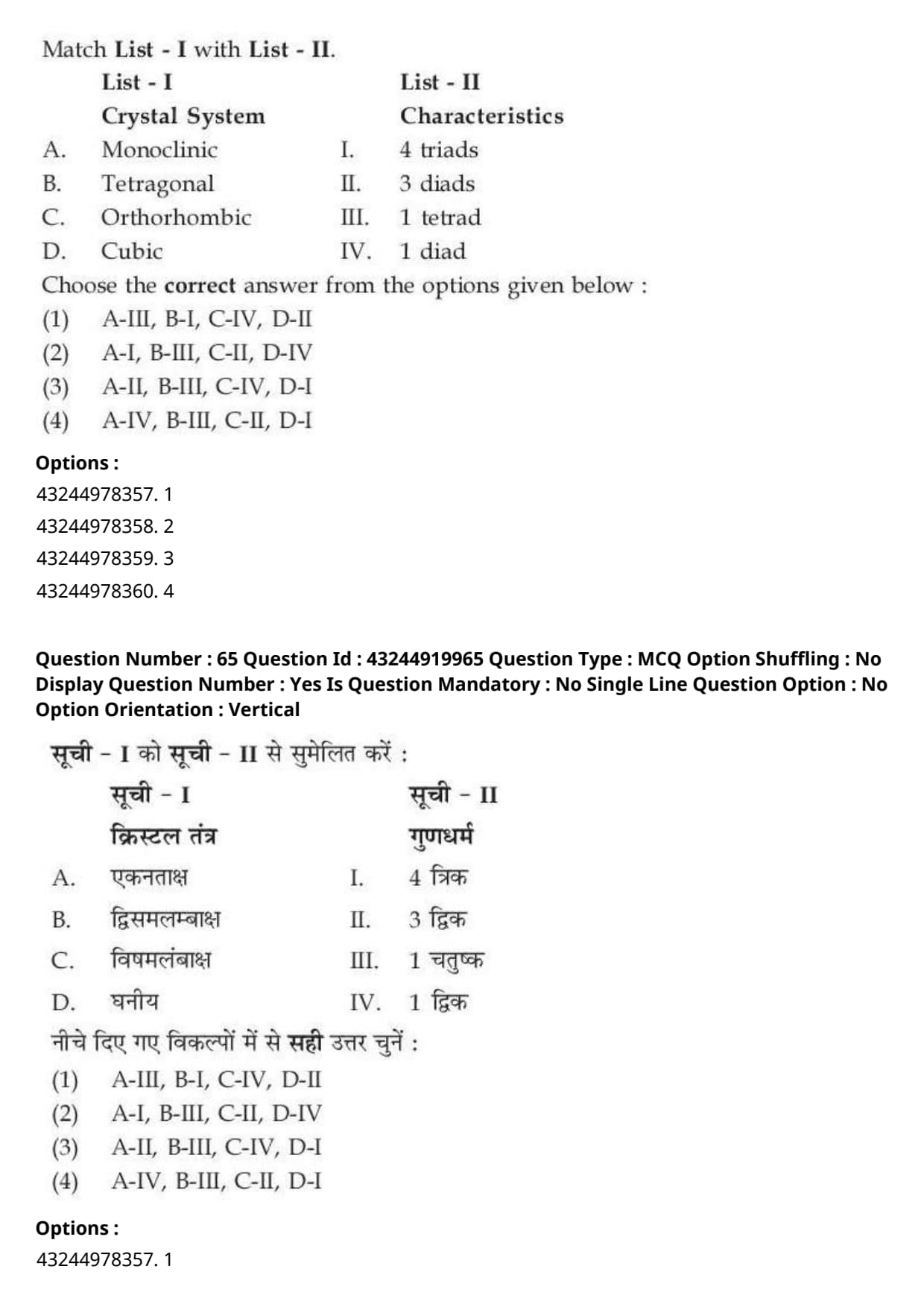
Match List-I with List-II.

Choose the correct answer from the options given below:
View Solution
Concept:
Crystal systems are identified by their symmetry axes. Diad means two-fold axis, tetrad means four-fold axis, and triad means three-fold axis.
Step 1: Match Monoclinic.
Monoclinic crystal system has one diad axis.
\[ A\rightarrow IV \]
Step 2: Match Tetragonal.
Tetragonal crystal system has one tetrad axis.
\[ B\rightarrow III \]
Step 3: Match Orthorhombic.
Orthorhombic crystal system has three diad axes.
\[ C\rightarrow II \]
Step 4: Match Cubic.
Cubic crystal system has four triad axes.
\[ D\rightarrow I \]
Therefore, the correct matching is:
\[ A-IV,\ B-III,\ C-II,\ D-I \]
\[ \therefore Correct Answer is (D) \] Quick Tip: Monoclinic has 1 diad, orthorhombic has 3 diads, tetragonal has 1 tetrad, and cubic has 4 triads.
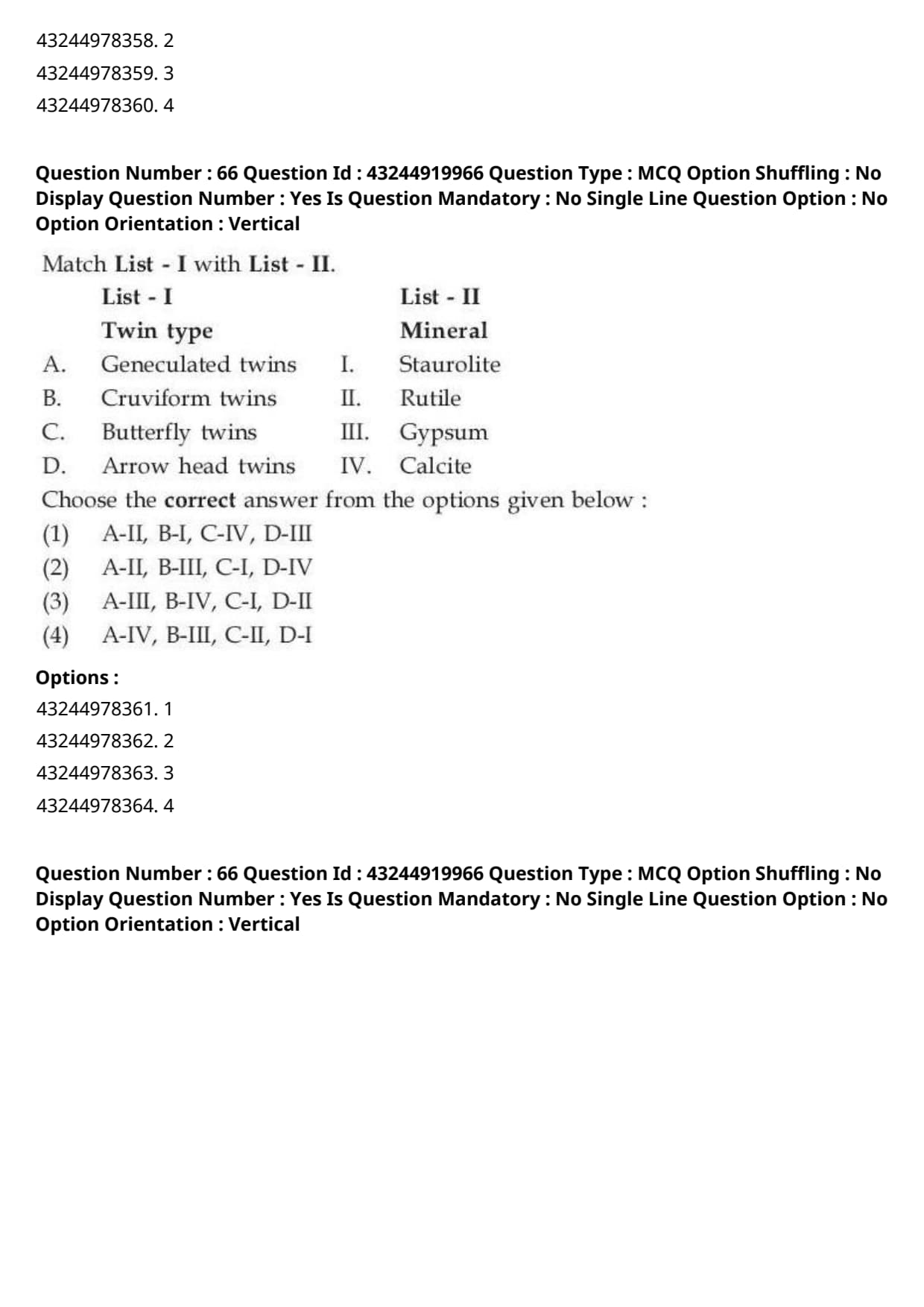
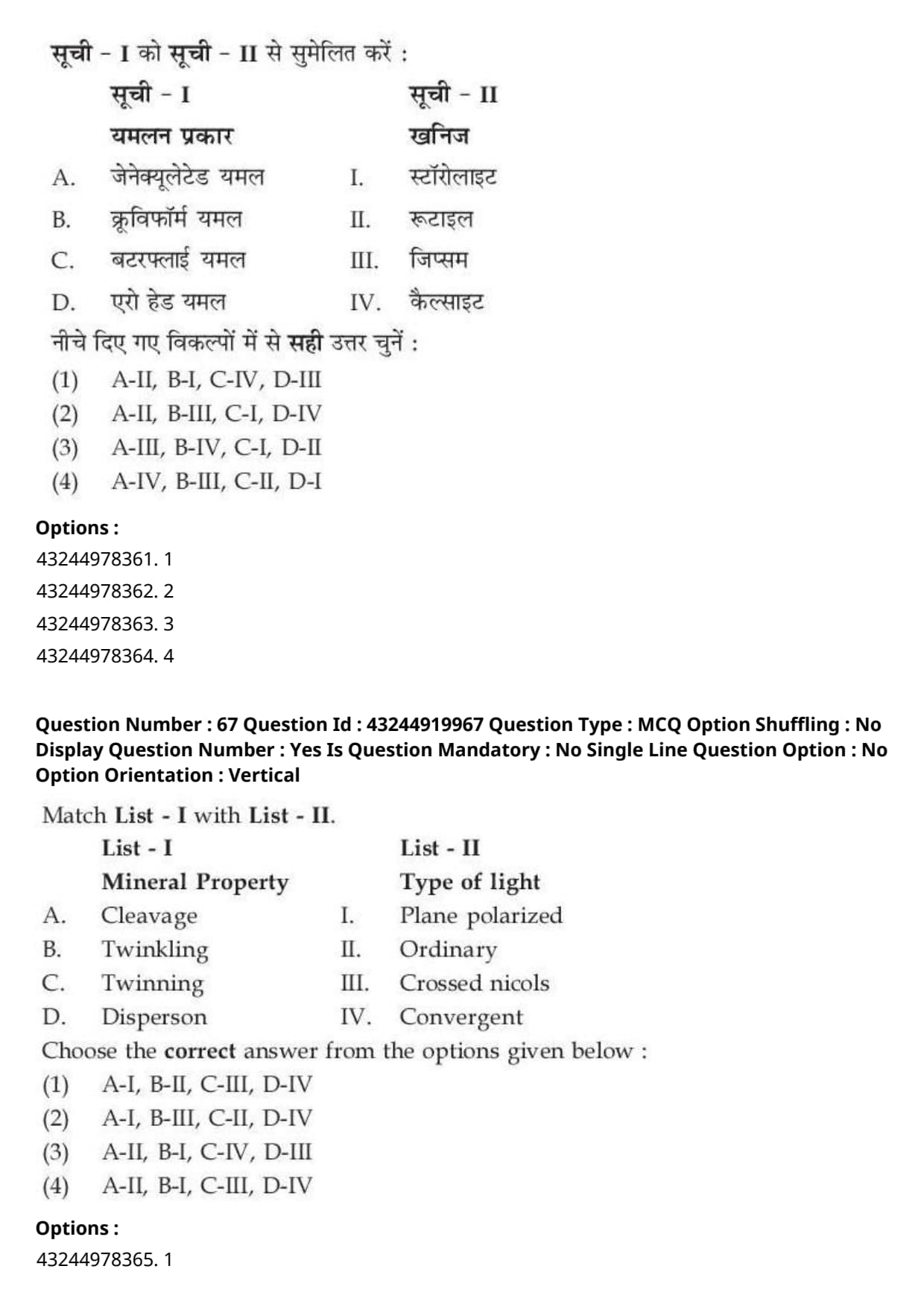
Match List-I with List-II.

Choose the correct answer from the options given below:
View Solution
Concept:
Twinning is the regular intergrowth of two or more crystals of the same mineral according to a definite crystallographic law.
Step 1: Match Geniculated twins.
Geniculated twins are commonly seen in rutile.
\[ A\rightarrow II \]
Step 2: Match Cruciform twins.
Cruciform twins are characteristic of staurolite.
\[ B\rightarrow I \]
Step 3: Match Butterfly twins.
Butterfly twins are associated with calcite.
\[ C\rightarrow IV \]
Step 4: Match Arrow head twins.
Arrow head twins are commonly shown by gypsum.
\[ D\rightarrow III \]
Therefore, the correct matching is:
\[ A-II,\ B-I,\ C-IV,\ D-III \]
\[ \therefore Correct Answer is (A) \] Quick Tip: Cruciform twinning is typical of staurolite, while arrow-head twinning is common in gypsum.
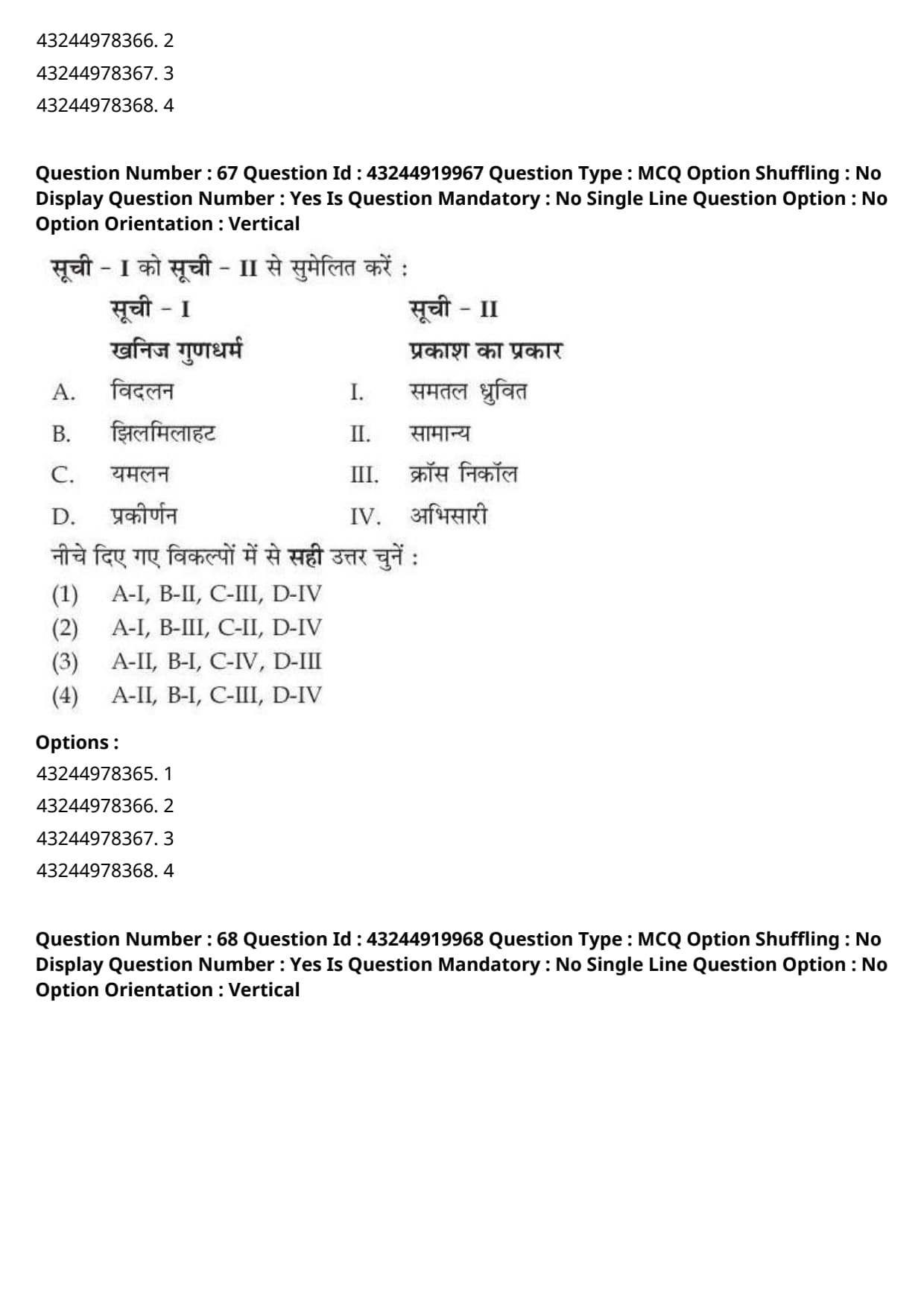
Match List-I with List-II.

Choose the correct answer from the options given below:
View Solution
Concept:
Different optical mineral properties are observed under different light conditions in a polarizing microscope.
Step 1: Match Cleavage.
Cleavage is commonly observed in plane polarized light.
\[ A\rightarrow I \]
Step 2: Match Twinkling.
Twinkling is observed in ordinary light conditions in optical mineralogy.
\[ B\rightarrow II \]
Step 3: Match Twinning.
Twinning is clearly observed under crossed nicols because different twin lamellae show different extinction positions.
\[ C\rightarrow III \]
Step 4: Match Dispersion.
Dispersion is studied with convergent light in interference figures.
\[ D\rightarrow IV \]
Therefore, the correct matching is:
\[ A-I,\ B-II,\ C-III,\ D-IV \]
\[ \therefore Correct Answer is (A) \] Quick Tip: Cleavage is commonly seen in plane polarized light, while twinning is best observed under crossed nicols.
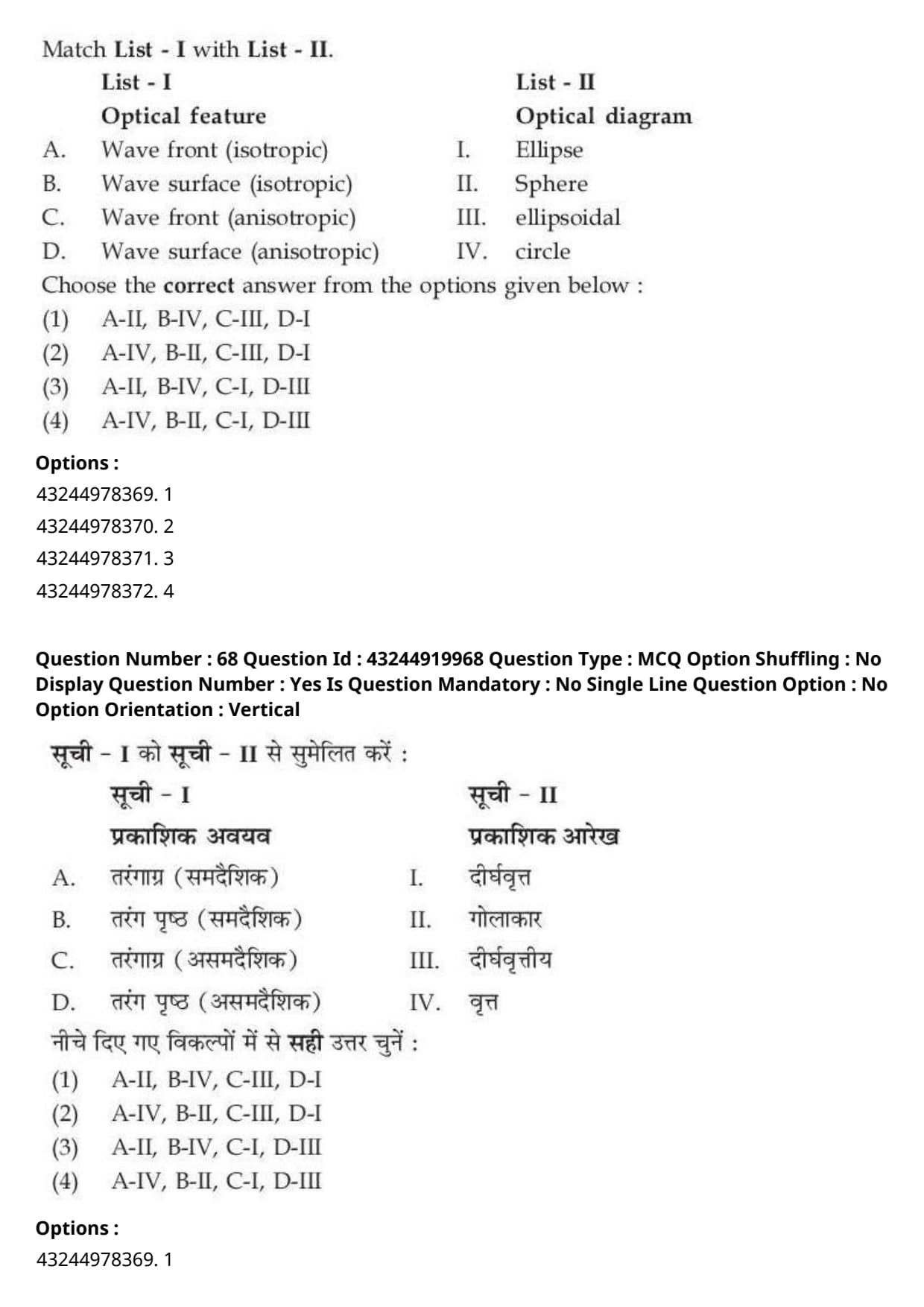
Match List-I with List-II.

Choose the correct answer from the options given below:
View Solution
Concept:
Optical behaviour of isotropic and anisotropic minerals is represented by wave fronts and wave surfaces.
Step 1: Isotropic wave front.
In isotropic media, light travels with equal velocity in all directions. The wave front is circular.
\[ A\rightarrow IV \]
Step 2: Isotropic wave surface.
In three-dimensional representation, the isotropic wave surface is a sphere.
\[ B\rightarrow II \]
Step 3: Anisotropic wave front.
In anisotropic media, light velocity differs with direction. The wave front becomes elliptical.
\[ C\rightarrow I \]
Step 4: Anisotropic wave surface.
The three-dimensional wave surface in anisotropic minerals is ellipsoidal.
\[ D\rightarrow III \]
Therefore, the correct matching is:
\[ A-IV,\ B-II,\ C-I,\ D-III \]
\[ \therefore Correct Answer is (D) \] Quick Tip: Isotropic wave surface is spherical, while anisotropic wave surface is ellipsoidal.
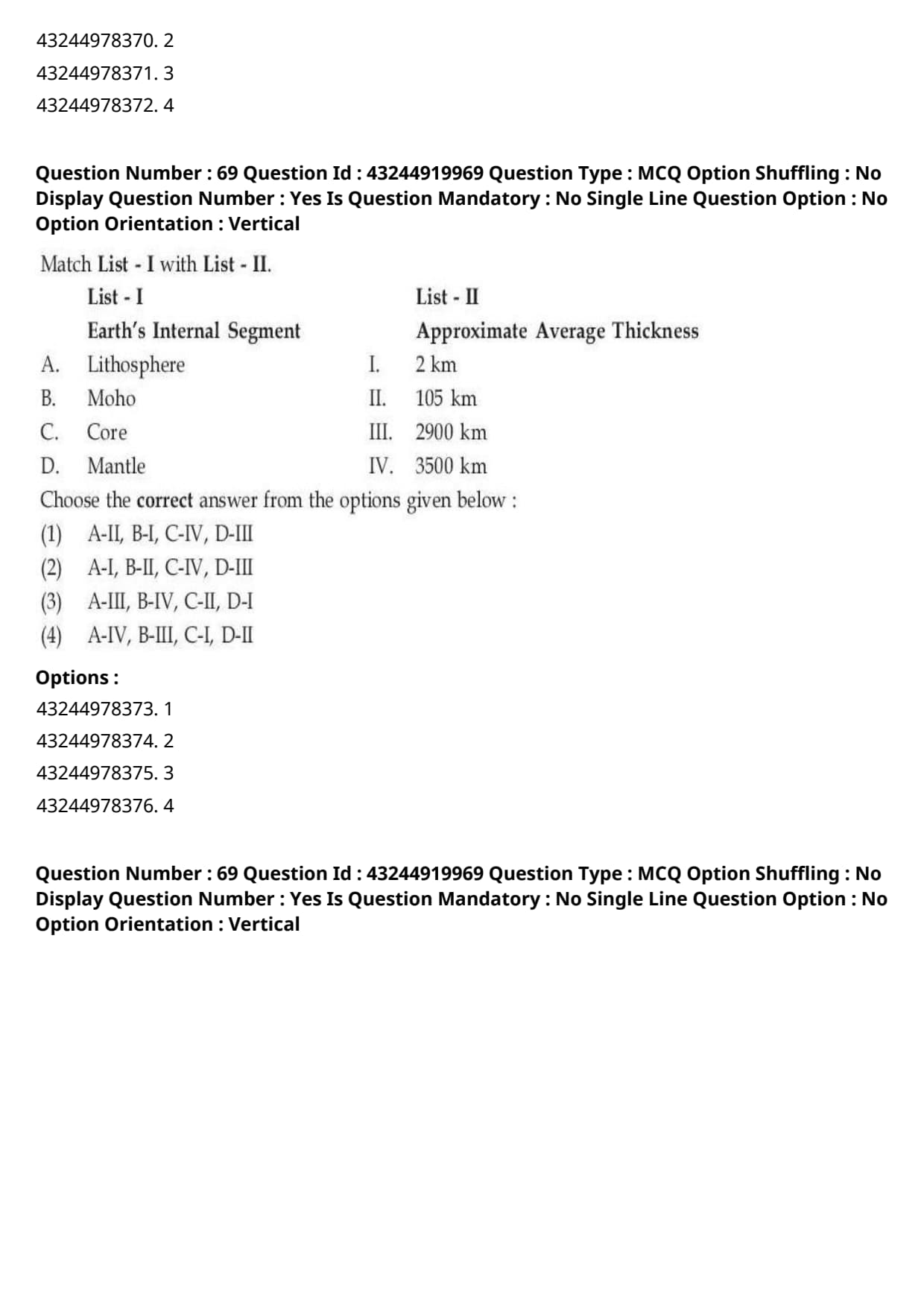
Match List-I with List-II.

Choose the correct answer from the options given below:
View Solution
Concept:
The Earth's internal structure is divided into layers such as lithosphere, mantle and core. Each has an approximate average thickness.
Step 1: Match Lithosphere.
The lithosphere has an approximate average thickness of about:
\[ 105\ km \]
\[ A\rightarrow II \]
Step 2: Match Moho.
Moho represents the Mohorovicic discontinuity zone and is matched with:
\[ 2\ km \]
\[ B\rightarrow I \]
Step 3: Match Core.
The core has an approximate thickness of about:
\[ 3500\ km \]
\[ C\rightarrow IV \]
Step 4: Match Mantle.
The mantle extends to about:
\[ 2900\ km \]
\[ D\rightarrow III \]
Therefore, the correct matching is:
\[ A-II,\ B-I,\ C-IV,\ D-III \]
\[ \therefore Correct Answer is (A) \] Quick Tip: Mantle thickness is approximately \(2900\ km\), while the core is about \(3500\ km\) thick.
Match List-I with List-II.

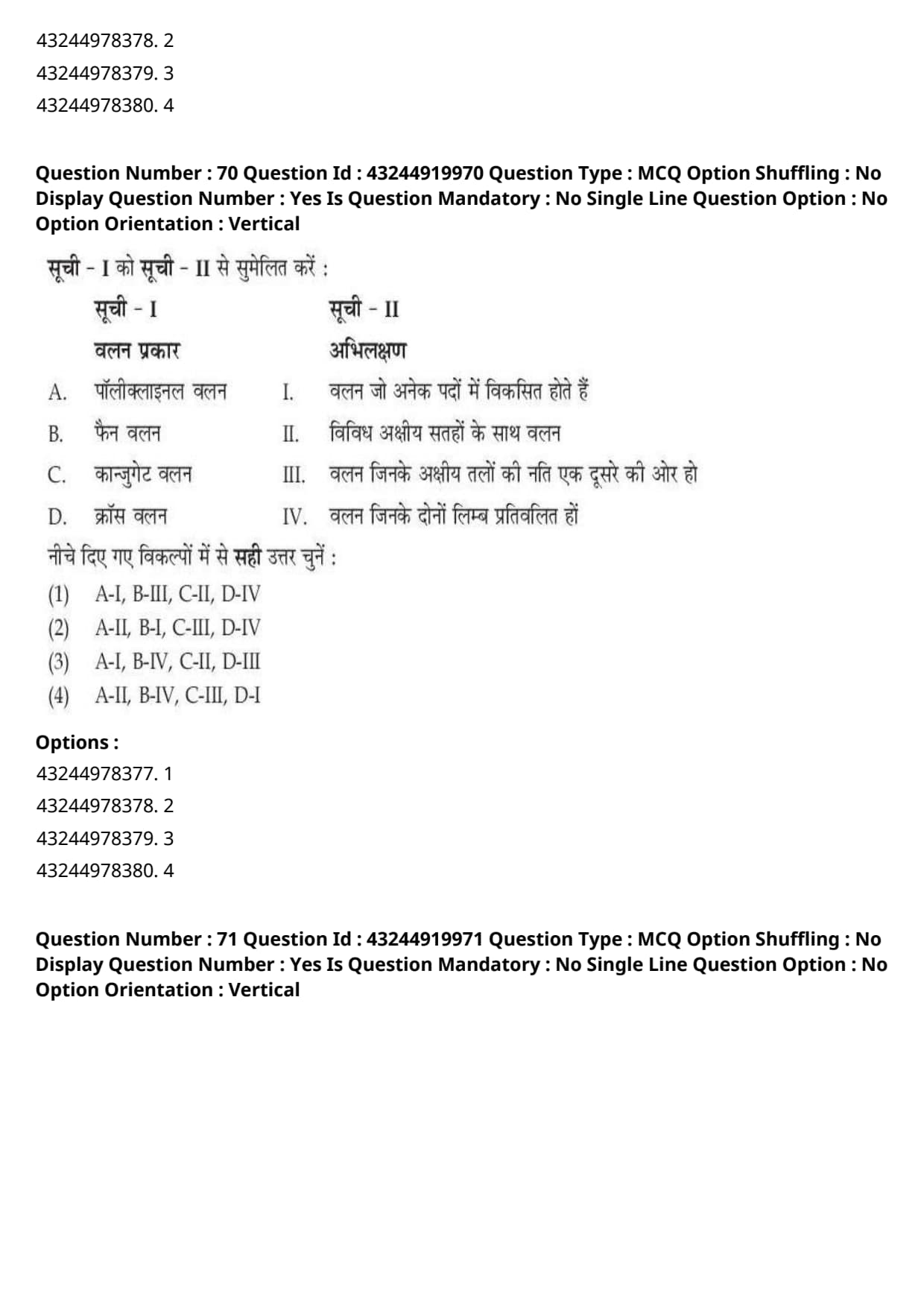
Choose the correct answer from the options given below:
View Solution
Concept:
Folds are classified according to geometry, axial surface, limb attitude and development history.
Step 1: Match Polyclinal folds.
Polyclinal folds are folds with variable axial surfaces.
\[ A\rightarrow II \]
Step 2: Match Fan folds.
Fan folds are folds in which both limbs may be overturned, giving a fan-like geometry.
\[ B\rightarrow IV \]
Step 3: Match Conjugate folds.
Conjugate folds are folds in which axial surfaces dip towards each other.
\[ C\rightarrow III \]
Step 4: Match Cross folds.
Cross folds are produced by more than one phase or step of folding.
\[ D\rightarrow I \]
Therefore, the correct matching is:
\[ A-II,\ B-IV,\ C-III,\ D-I \]
\[ \therefore Correct Answer is (D) \] Quick Tip: Fan folds commonly have overturned limbs, while cross folds develop through more than one folding phase.
Match List-I with List-II.

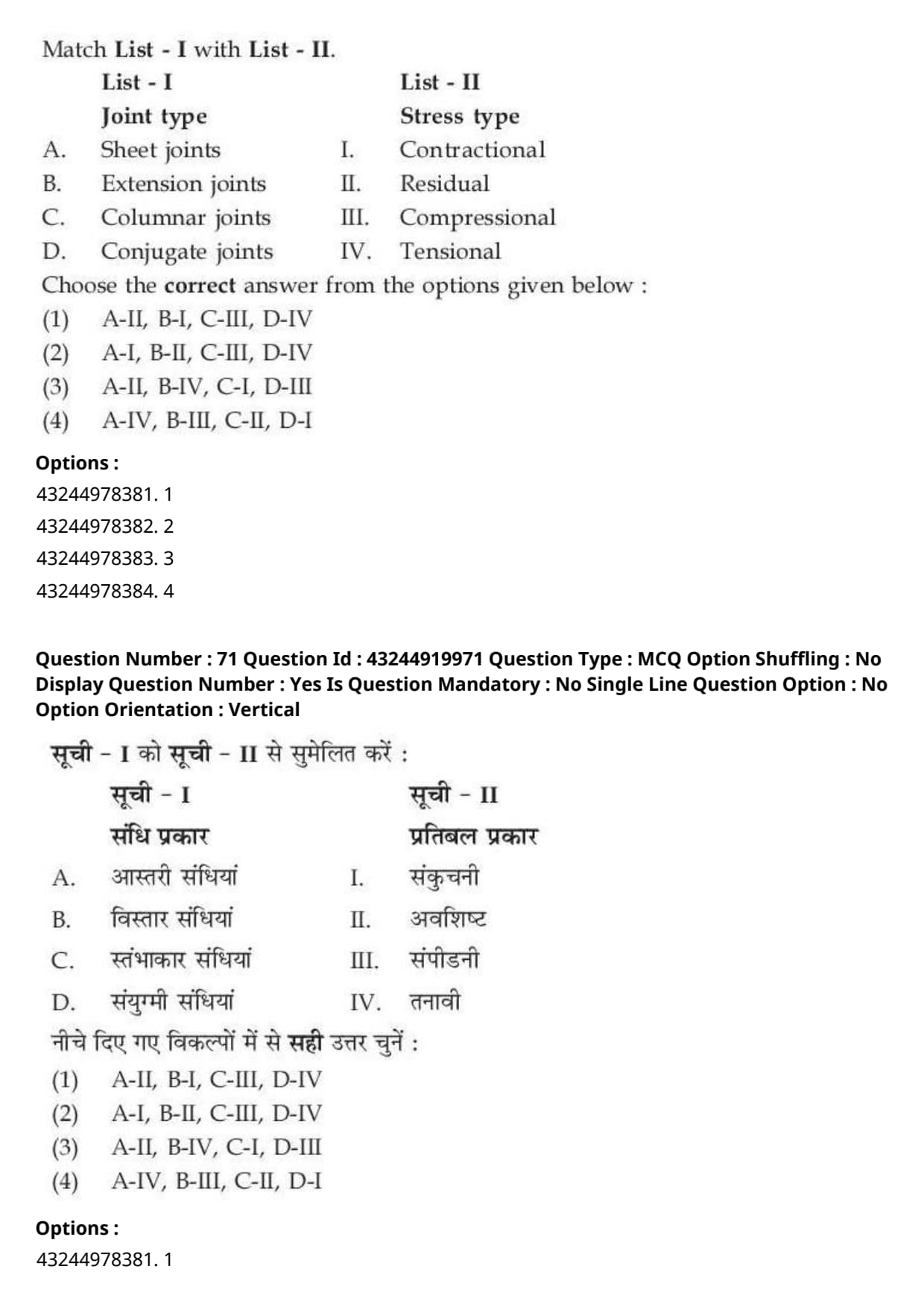
Choose the correct answer from the options given below:
View Solution
Concept:
Joints are fractures in rocks along which there is no significant displacement. They may form due to residual stress, tension, contraction or compression.
Step 1: Match Sheet joints.
Sheet joints commonly develop due to unloading or release of residual stress.
\[ A\rightarrow II \]
Step 2: Match Extension joints.
Extension joints form due to tensional stress.
\[ B\rightarrow IV \]
Step 3: Match Columnar joints.
Columnar joints commonly develop due to contraction during cooling of lava or igneous bodies.
\[ C\rightarrow I \]
Step 4: Match Conjugate joints.
Conjugate joints are commonly related to compressional stress conditions.
\[ D\rightarrow III \]
Therefore, the correct matching is:
\[ A-II,\ B-IV,\ C-I,\ D-III \]
\[ \therefore Correct Answer is (C) \] Quick Tip: Sheet joints are related to unloading or residual stress, while columnar joints are related to contraction during cooling.
Match List-I with List-II.

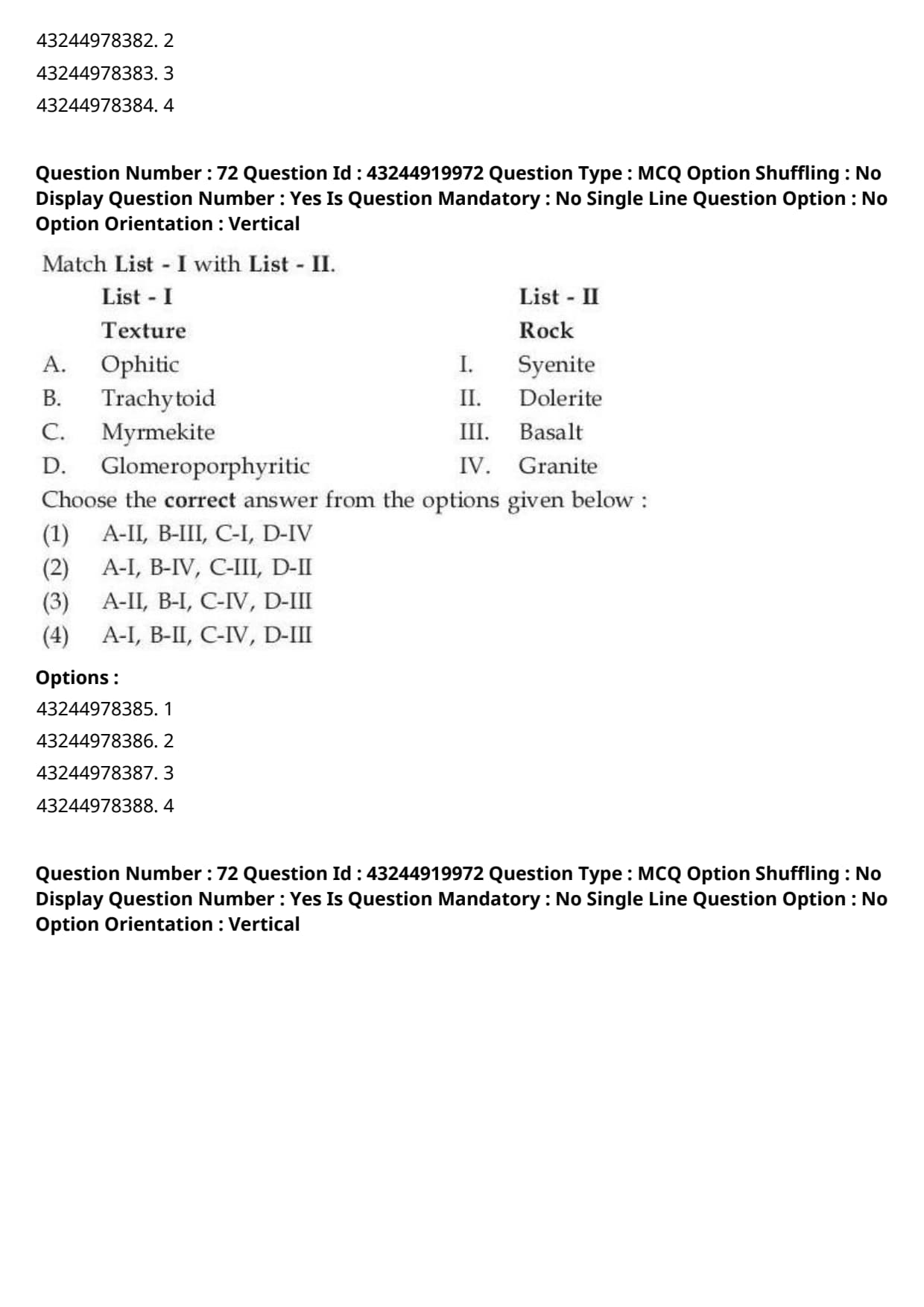
Choose the correct answer from the options given below:
View Solution
Concept:
Igneous rocks show different textures depending on their cooling history, mineral composition and crystallization pattern.
Step 1: Match Ophitic texture.
Ophitic texture is commonly found in dolerite, where pyroxene encloses plagioclase laths.
\[ A\rightarrow II \]
Step 2: Match Trachytoid texture.
Trachytoid texture is commonly associated with syenite due to flow arrangement of tabular feldspar crystals.
\[ B\rightarrow I \]
Step 3: Match Myrmekite texture.
Myrmekite is an intergrowth texture commonly seen in granitic rocks.
\[ C\rightarrow IV \]
Step 4: Match Glomeroporphyritic texture.
Glomeroporphyritic texture is commonly associated with basalt, where phenocrysts occur in clusters.
\[ D\rightarrow III \]
Therefore, the correct matching is:
\[ A-II,\ B-I,\ C-IV,\ D-III \]
\[ \therefore Correct Answer is (C) \] Quick Tip: Ophitic texture is typical of dolerite, and myrmekite texture is commonly associated with granite.
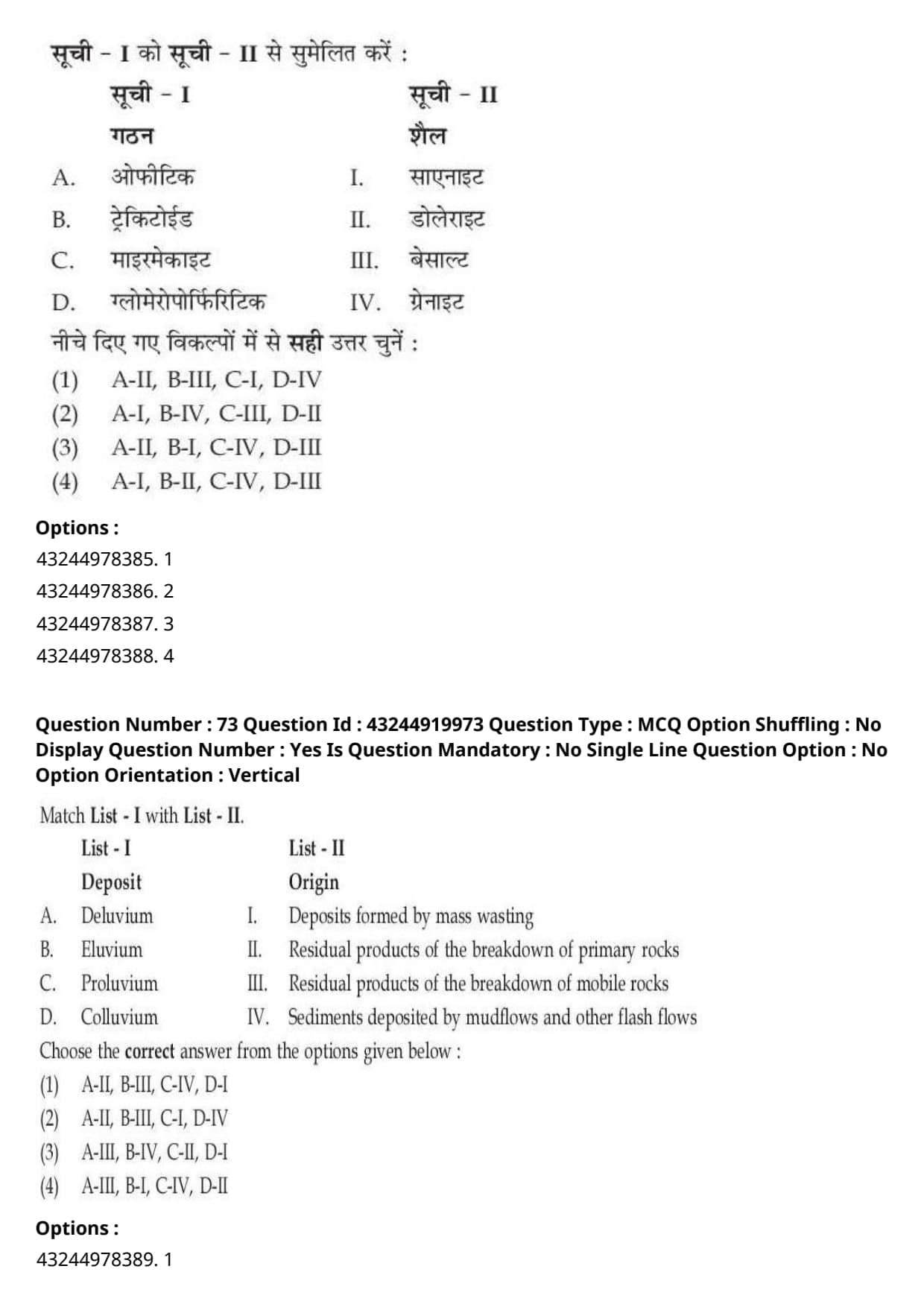
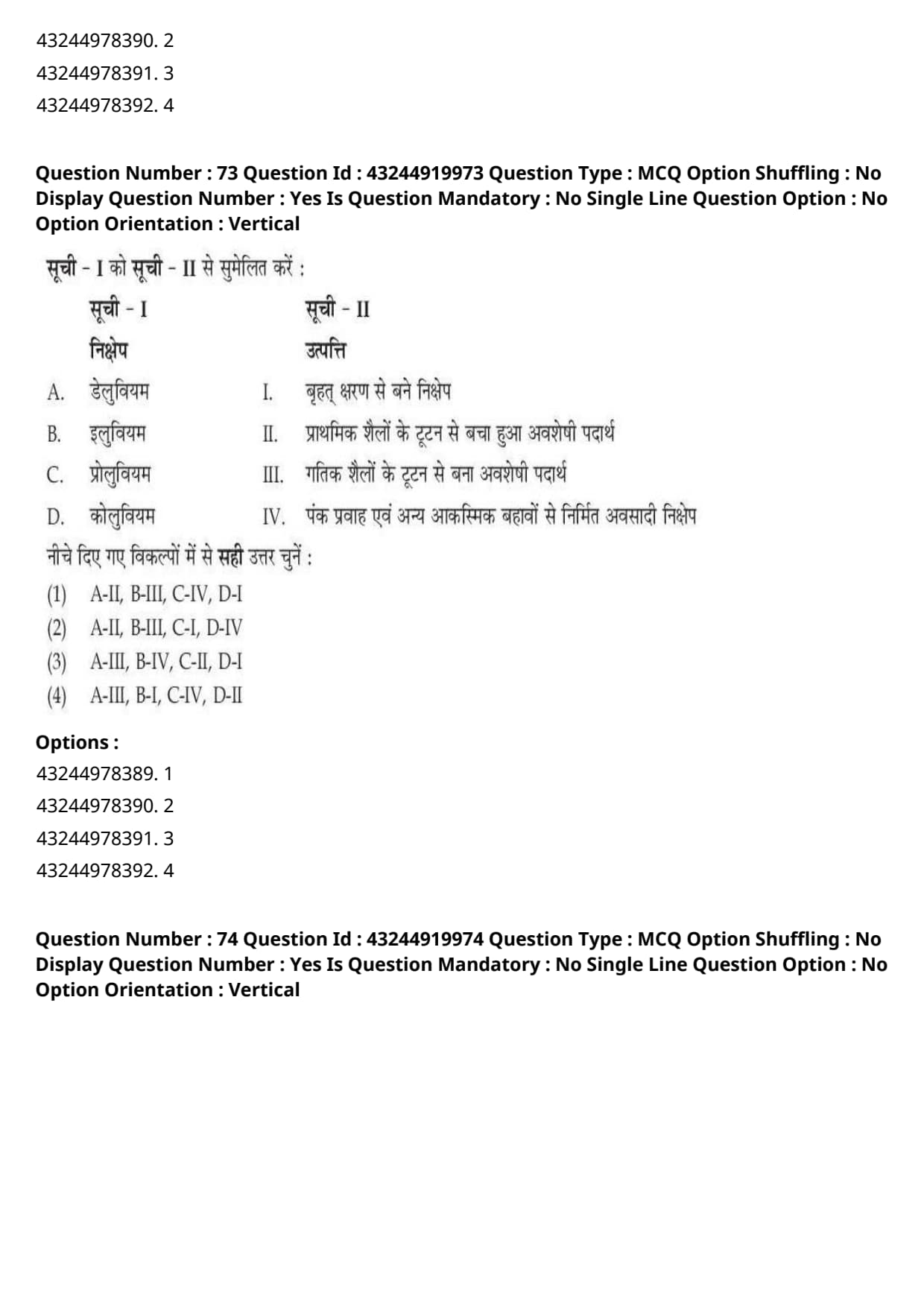
Match List-I with List-II.

Choose the correct answer from the options given below:
View Solution
Concept:
Superficial deposits are classified according to their origin and mode of transport. Some are residual, while others are transported by mass wasting, mudflow or flash flow.
Step 1: Match Deluvium.
Deluvium is matched with residual products formed by breakdown of primary rocks in the given classification.
\[ A\rightarrow II \]
Step 2: Match Eluvium.
Eluvium is matched with residual products formed by breakdown of mobile rocks in the given list.
\[ B\rightarrow III \]
Step 3: Match Proluvium.
Proluvium is commonly associated with sediments deposited by mudflows and flash flows.
\[ C\rightarrow IV \]
Step 4: Match Colluvium.
Colluvium is commonly formed by mass wasting on slopes.
\[ D\rightarrow I \]
Therefore, the correct matching is:
\[ A-II,\ B-III,\ C-IV,\ D-I \]
\[ \therefore Correct Answer is (A) \] Quick Tip: Colluvium is related to mass wasting, while proluvium is related to mudflow and flash-flow deposits.
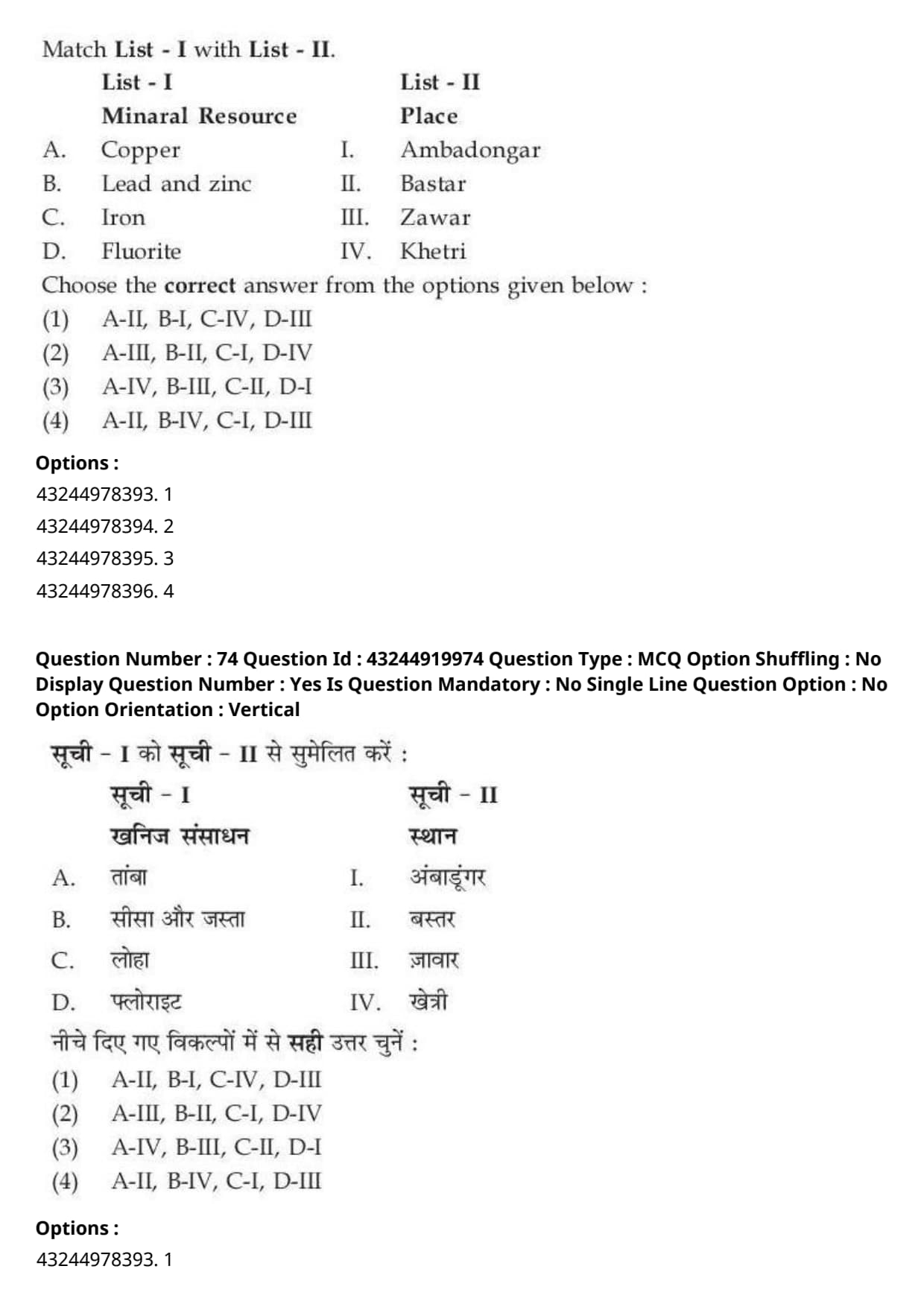
Match List-I with List-II.

Choose the correct answer from the options given below:
View Solution
Concept:
Important mineral resources are associated with specific mining regions in India.
Step 1: Match Copper.
Khetri in Rajasthan is famous for copper deposits.
\[ A\rightarrow IV \]
Step 2: Match Lead and zinc.
Zawar in Rajasthan is known for lead and zinc deposits.
\[ B\rightarrow III \]
Step 3: Match Iron.
Bastar region is associated with iron ore deposits.
\[ C\rightarrow II \]
Step 4: Match Fluorite.
Ambadongar is known for fluorite deposits.
\[ D\rightarrow I \]
Therefore, the correct matching is:
\[ A-IV,\ B-III,\ C-II,\ D-I \]
\[ \therefore Correct Answer is (C) \] Quick Tip: Remember: Khetri--Copper, Zawar--Lead and Zinc, Bastar--Iron, and Ambadongar--Fluorite.
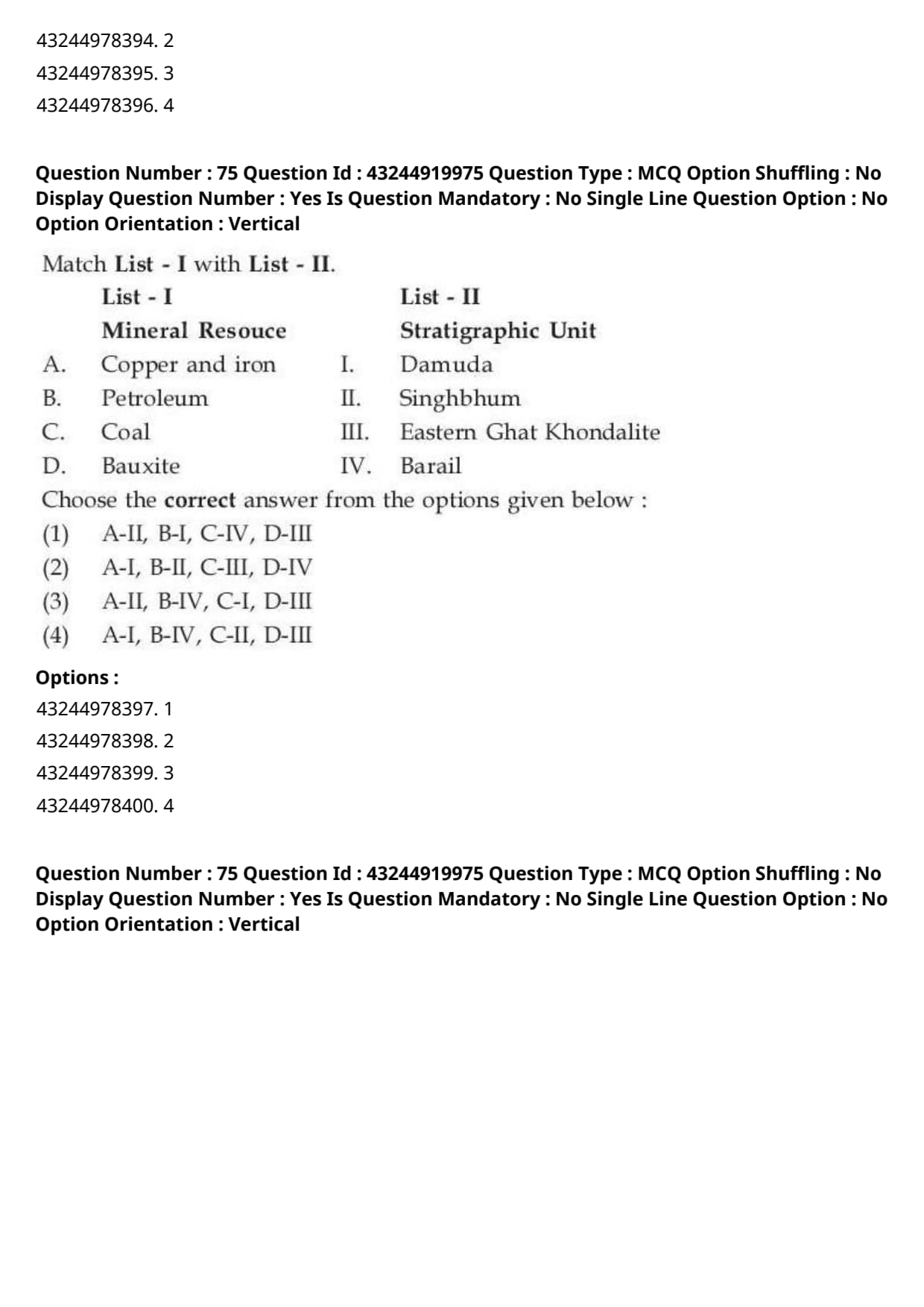
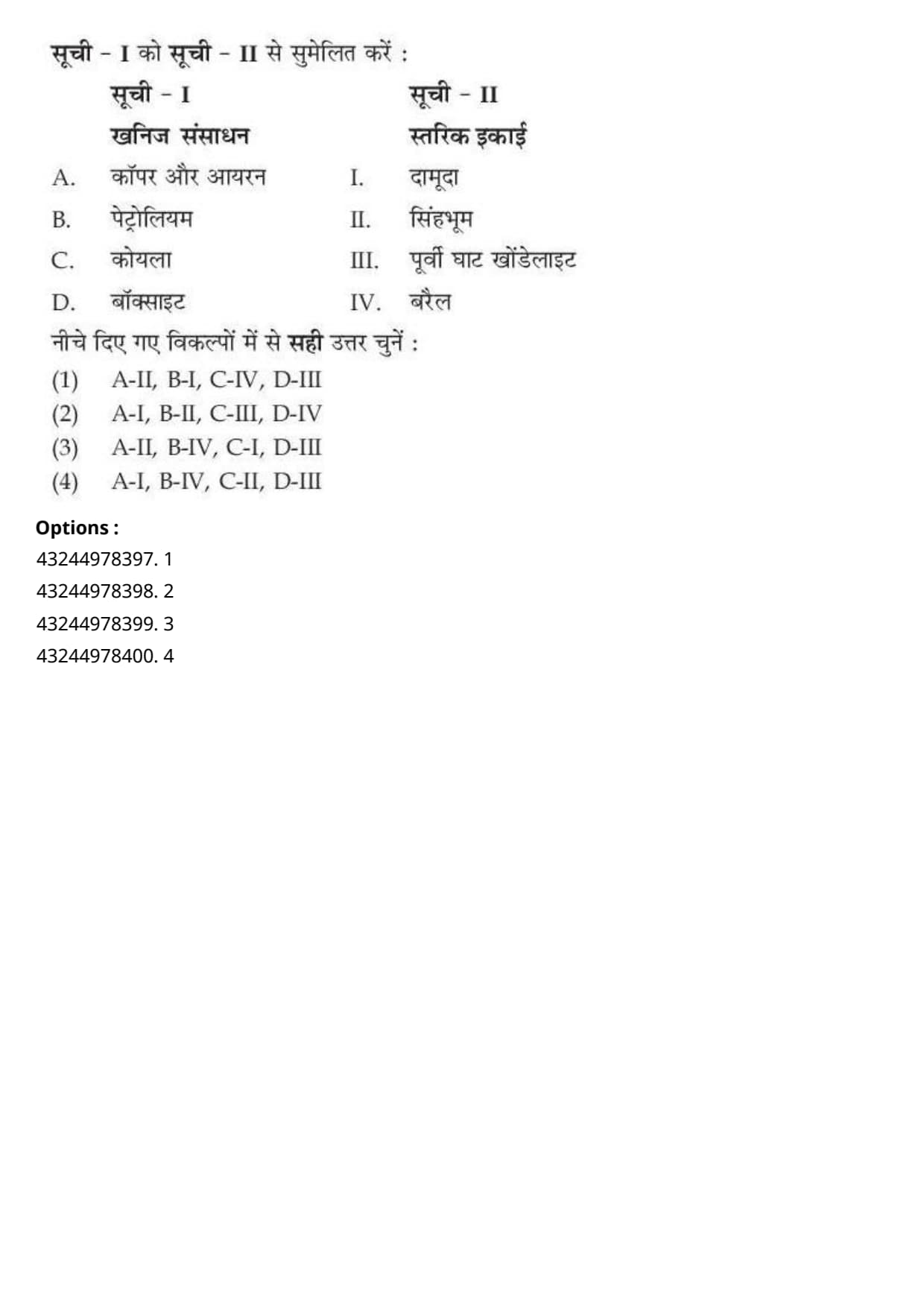
Match List-I with List-II.

Choose the correct answer from the options given below:
View Solution
Concept:
Mineral and energy resources are often associated with particular stratigraphic units and geological provinces.
Step 1: Match Copper and iron.
Singhbhum is well known for copper and iron mineralization.
\[ A\rightarrow II \]
Step 2: Match Petroleum.
Barail Group is associated with petroleum-bearing sequences in northeastern India.
\[ B\rightarrow IV \]
Step 3: Match Coal.
Damuda sequence is famous for coal-bearing formations.
\[ C\rightarrow I \]
Step 4: Match Bauxite.
Bauxite is associated with Eastern Ghat Khondalite terrain.
\[ D\rightarrow III \]
Therefore, the correct matching is:
\[ A-II,\ B-IV,\ C-I,\ D-III \]
\[ \therefore Correct Answer is (C) \] Quick Tip: Damuda is associated with coal, Singhbhum with copper and iron, Barail with petroleum, and Eastern Ghat Khondalite with bauxite.



Comments