




The National Testing Agency (NTA) conducted the CUET PG 2026 General Management (COQP12) exam on March 8, 2026, during Shift 2 (12:30 PM – 02:00 PM). This live update covers the CUET PG General Management 2026 question paper analysis, memory-based questions shared by candidates, and the direct link to download the CUET PG 2026 General Management question paper PDF with solutions.
Based on student feedback, the overall paper was Moderate, with most questions asked from management principles, business environment, quantitative aptitude, logical reasoning, and basic economics.
CUET PG General Management 2026 Question Paper with Solutions PDF
| CUET PG General Management 2026 Question Paper with Answer key | Download PDF | Check Solutions |
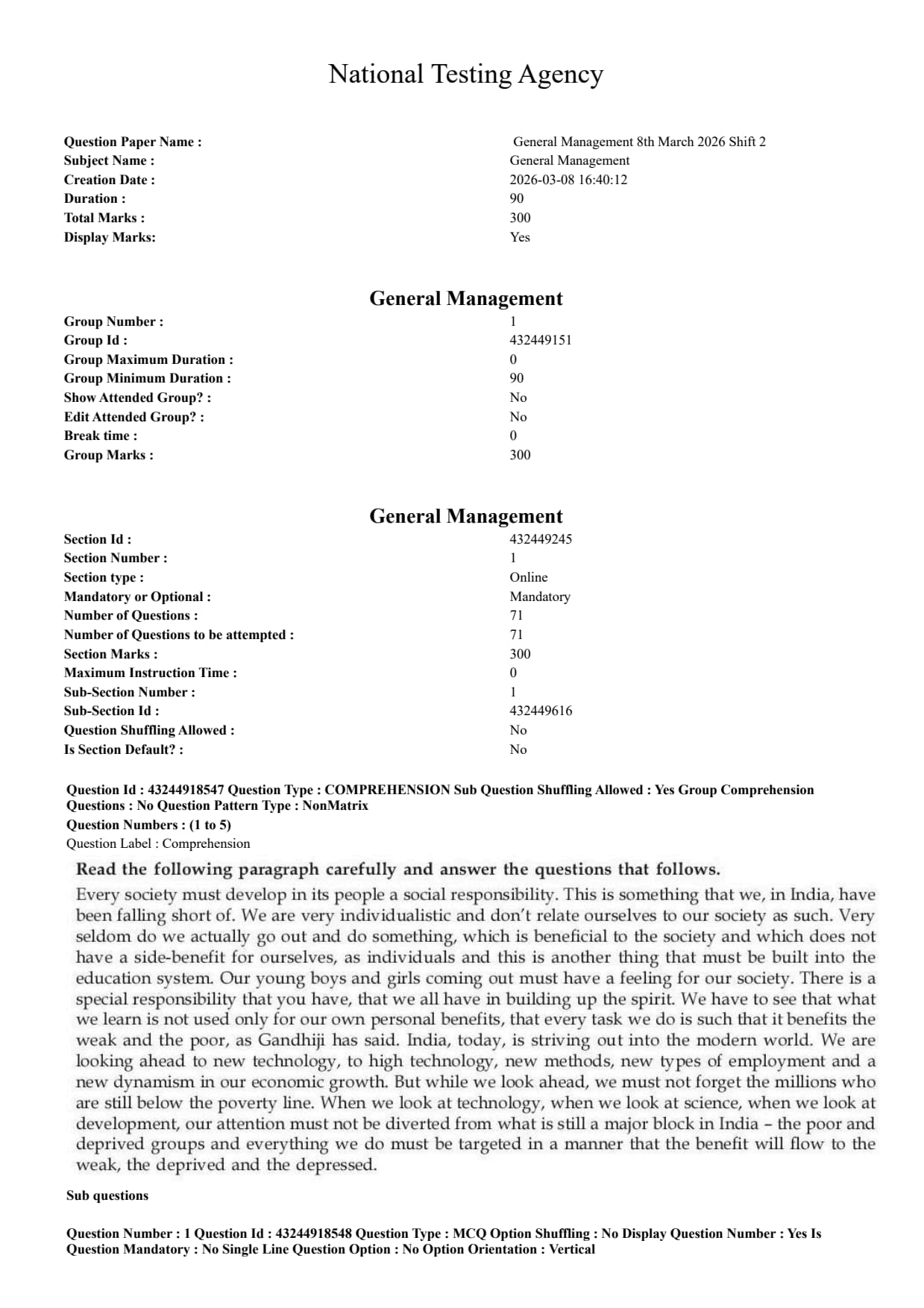
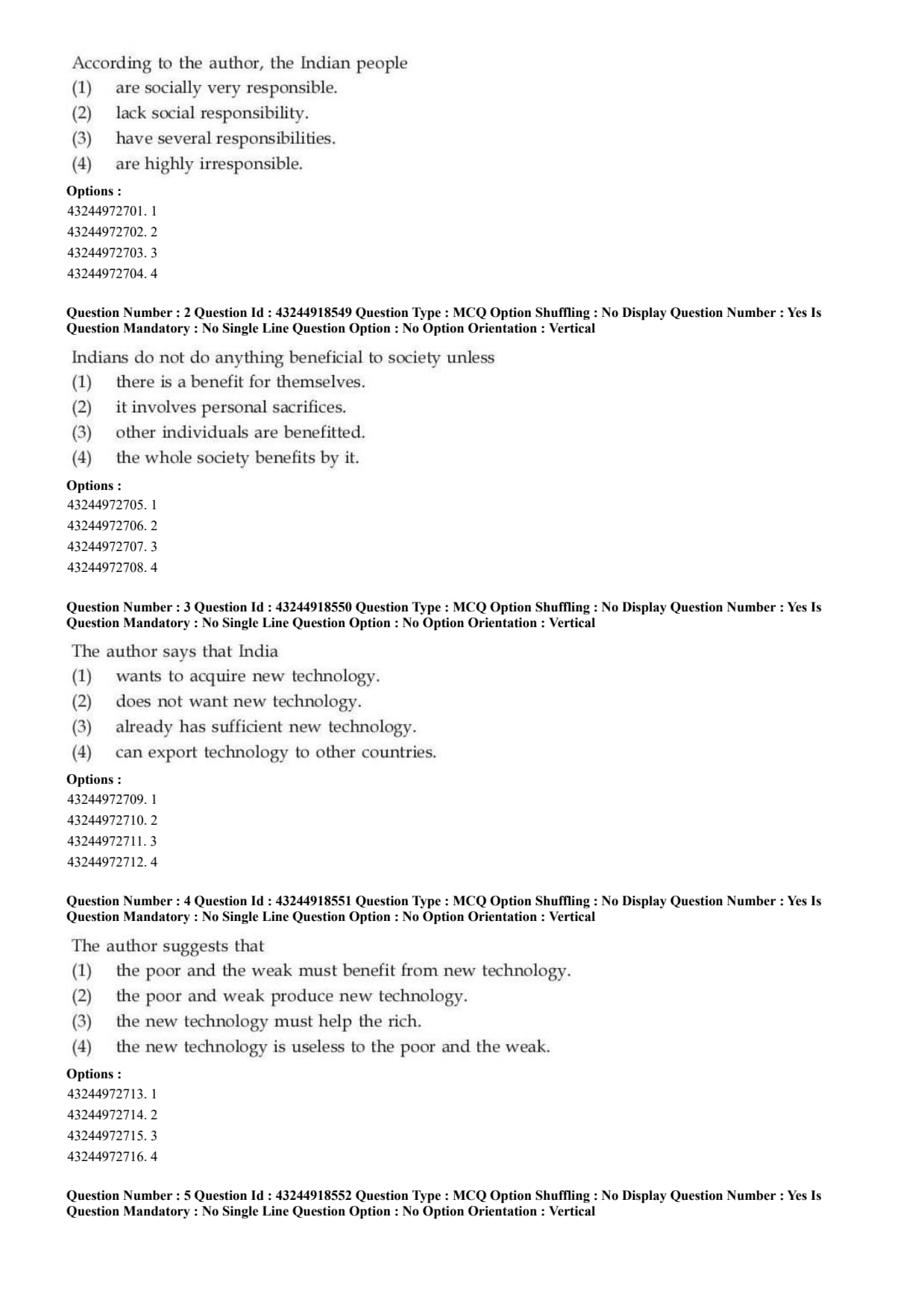
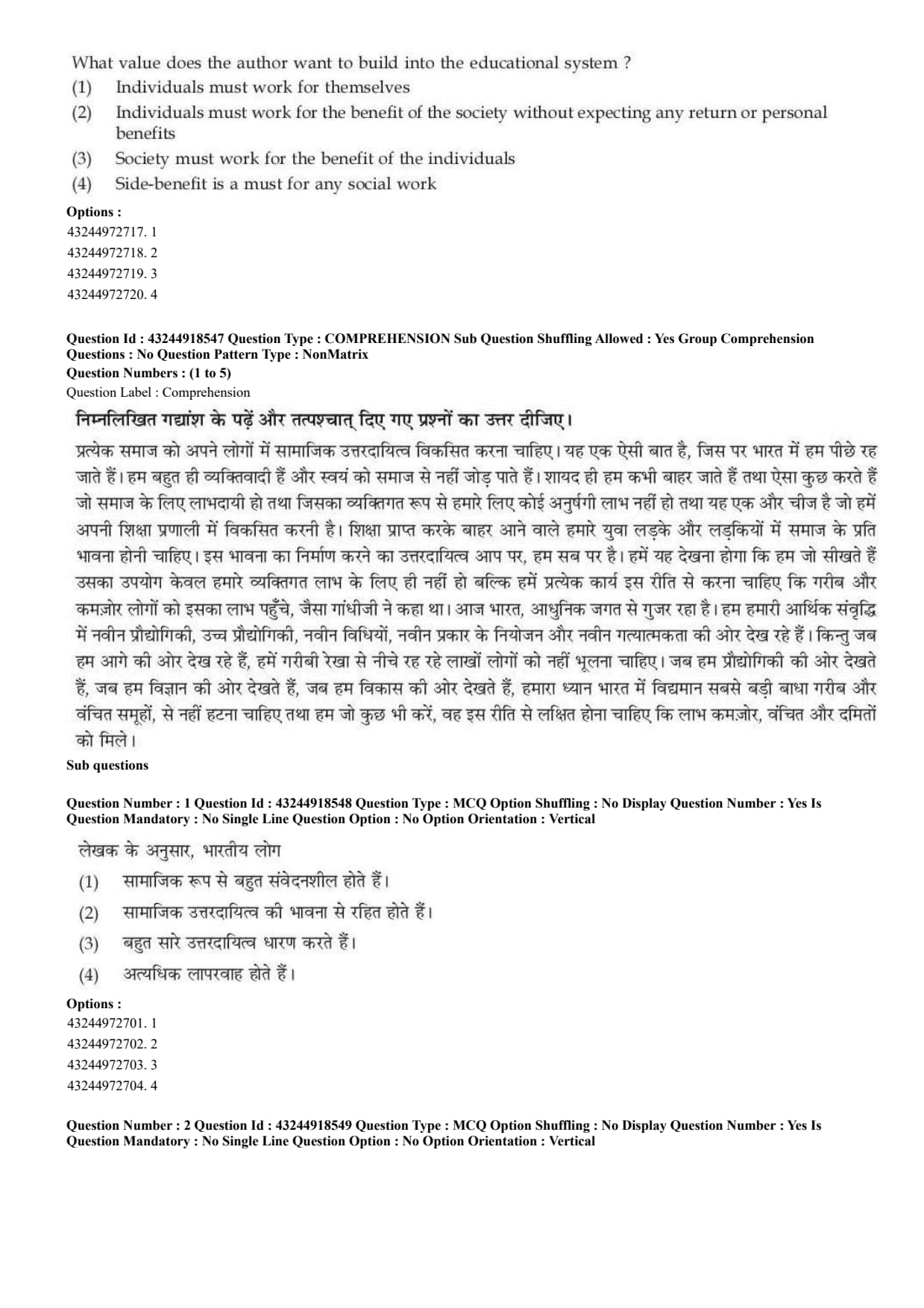
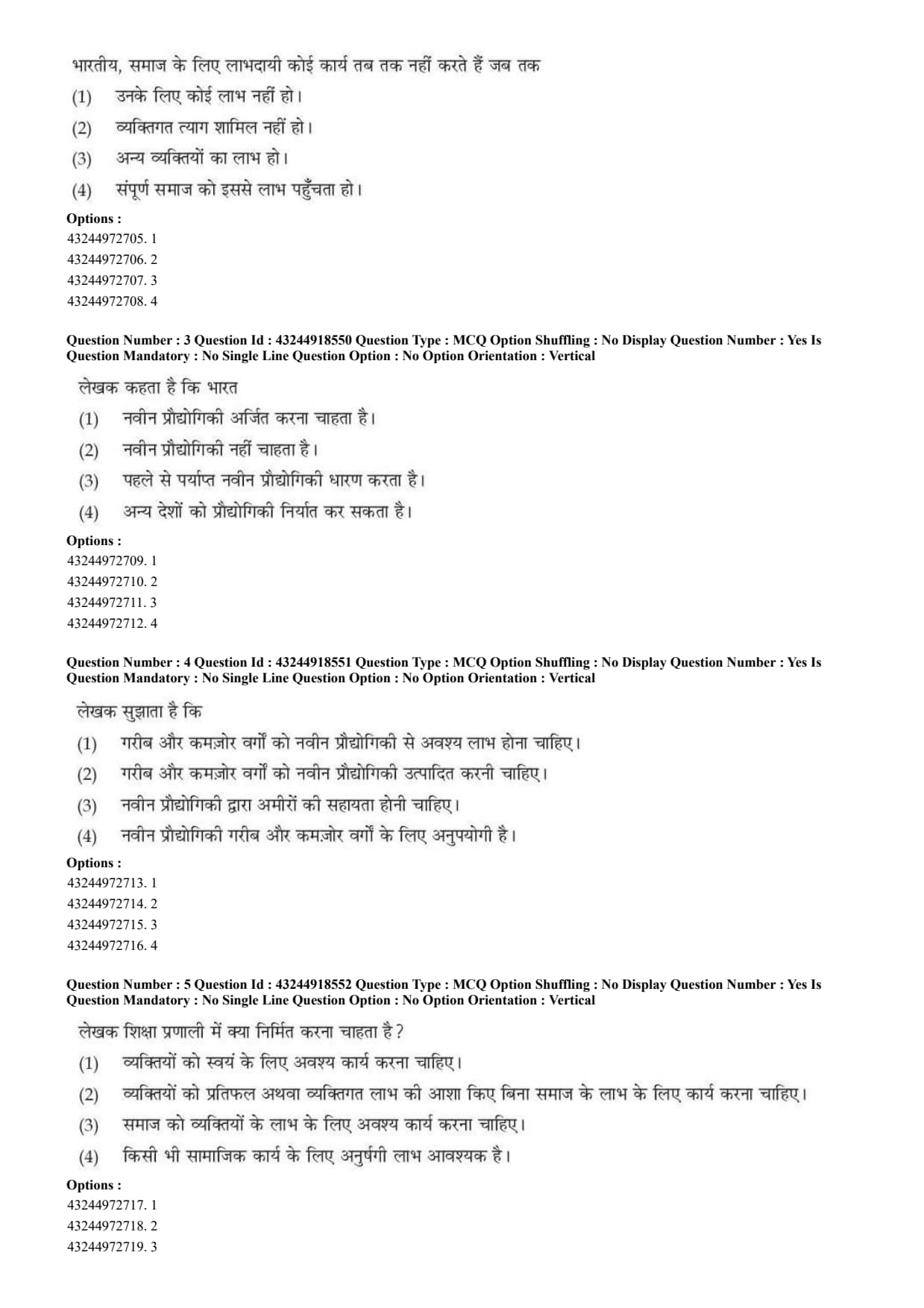

Read the following paragraph carefully and answer the questions that follow.
Every society must develop in its people a social responsibility. This is something that we, in India, have been falling short of. We are very individualistic and do not relate ourselves to our society as such. Very seldom do we actually go out and do something, which is beneficial to the society and which does not have a side-benefit for ourselves, as individuals and this is another thing that must be built into the education system. Our young boys and girls coming out must have a feeling for our society. There is a special responsibility that you have, that we all have in building up the spirit. We have to see that what we learn is not used only for our own personal benefits, that every task we do is such that it benefits the weak and the poor, as Gandhiji has said. India, today, is striving out into the modern world. We are looking ahead to new technology, to high technology, new methods, new types of employment and a new dynamism in our economic growth. But while we look ahead, we must not forget the millions who are still below the poverty line. When we look at technology, when we look at science, when we look at development, our attention must not be diverted from what is still a major block in India -- the poor and deprived groups and everything we do must be targeted in a manner that the benefit will flow to the weak, the deprived and the depressed.
Question 1:
According to the author, the Indian people
Indians do not do anything beneficial to society unless
View Solution
Step 1: Understanding the Question:
We must identify the condition that the author associates with people performing socially beneficial actions.
Step 2: Detailed Explanation:
The passage states that people seldom do something beneficial to society that does not have a side-benefit for themselves.
This means personal gain often becomes the motivating factor behind social action.
Option (A) directly captures this idea by saying that there is a benefit for themselves.
Option (B) is incorrect because the author does not discuss sacrifice as the condition.
Option (C) is too vague and does not address the author's criticism regarding self-interest.
Option (D) is the opposite of the intended meaning because the issue is not whether society benefits, but whether individuals receive personal benefit.
The author uses this observation to argue that education should cultivate a genuine feeling for society and service.
Thus, the passage clearly supports the interpretation given in option (A).
Step 3: Final Answer:
(A) there is a benefit for themselves. Quick Tip: When answering comprehension questions, locate the sentence in the passage that most closely matches the wording of the question. This often provides the answer directly.
The author says that India
The author suggests that
What value does the author want to build into the educational system?
View Solution
Step 1: Understanding the Question:
The question asks us to identify the educational value that the author believes should be developed among young people.
Step 2: Detailed Explanation:
The author states that social responsibility is something that must be built into the education system.
He criticizes the tendency to engage in social activities only when there is a personal advantage.
The passage says that young boys and girls should develop a feeling for society and use their learning not merely for personal benefit.
Gandhiji's idea is cited to emphasize service to the weak and the poor.
Option (B) perfectly summarizes this value of selfless social service.
Option (A) contradicts the author's criticism of excessive individualism.
Option (C) reverses the direction of responsibility described in the passage.
Option (D) is the exact attitude that the author wants to change through education.
Therefore, the educational system should nurture social commitment, empathy, and service without expectation of personal reward.
Hence, option (B) is the correct answer.
Step 3: Final Answer:
(B) Individuals must work for the benefit of society without expecting any return or personal benefit. Quick Tip: For value-based comprehension questions, identify the lesson the author wants readers to learn. This is usually repeated several times throughout the passage.
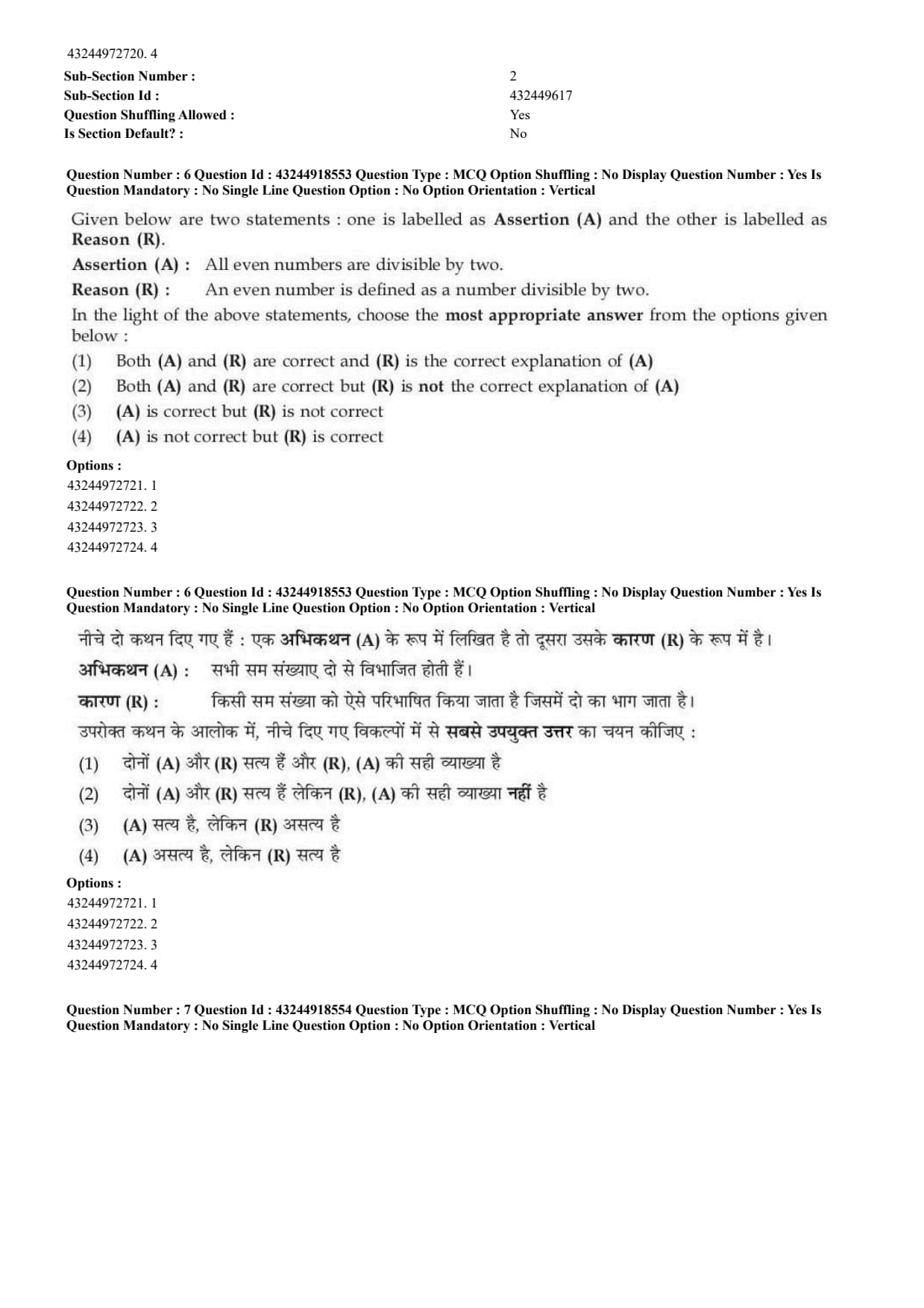
Given below are two statements: one is labelled as Assertion (A) and the other is labelled as Reason (R).
Assertion (A): All even numbers are divisible by two.
Reason (R): An even number is defined as a number divisible by two. In the light of the above statements, choose the most appropriate answer from the options given below.
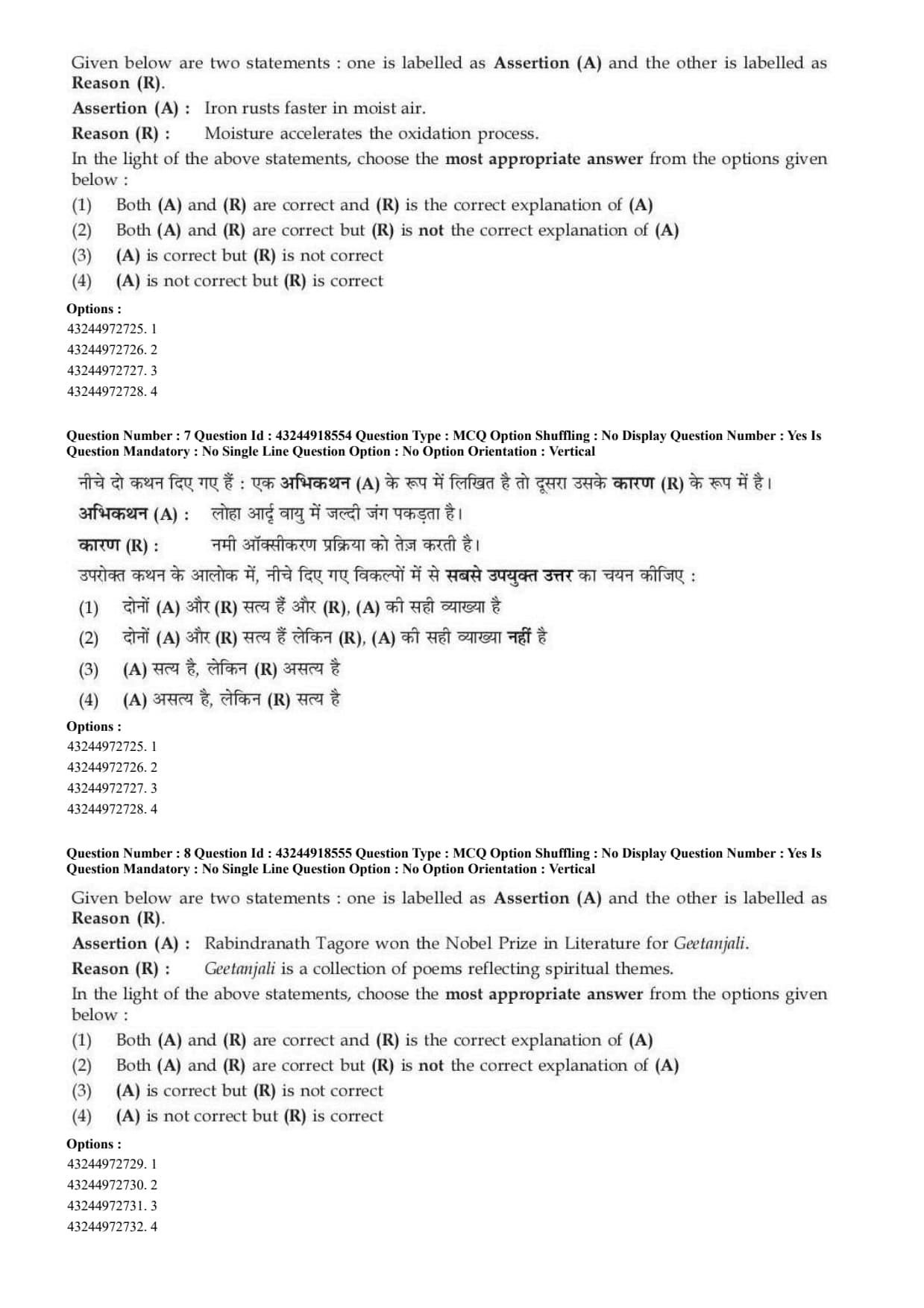
Given below are two statements: one is labelled as Assertion (A) and the other is labelled as Reason (R).
Assertion (A): Iron rusts faster in moist air.
Reason (R): Moisture accelerates the oxidation process. In the light of the above statements, choose the most appropriate answer from the options given below.
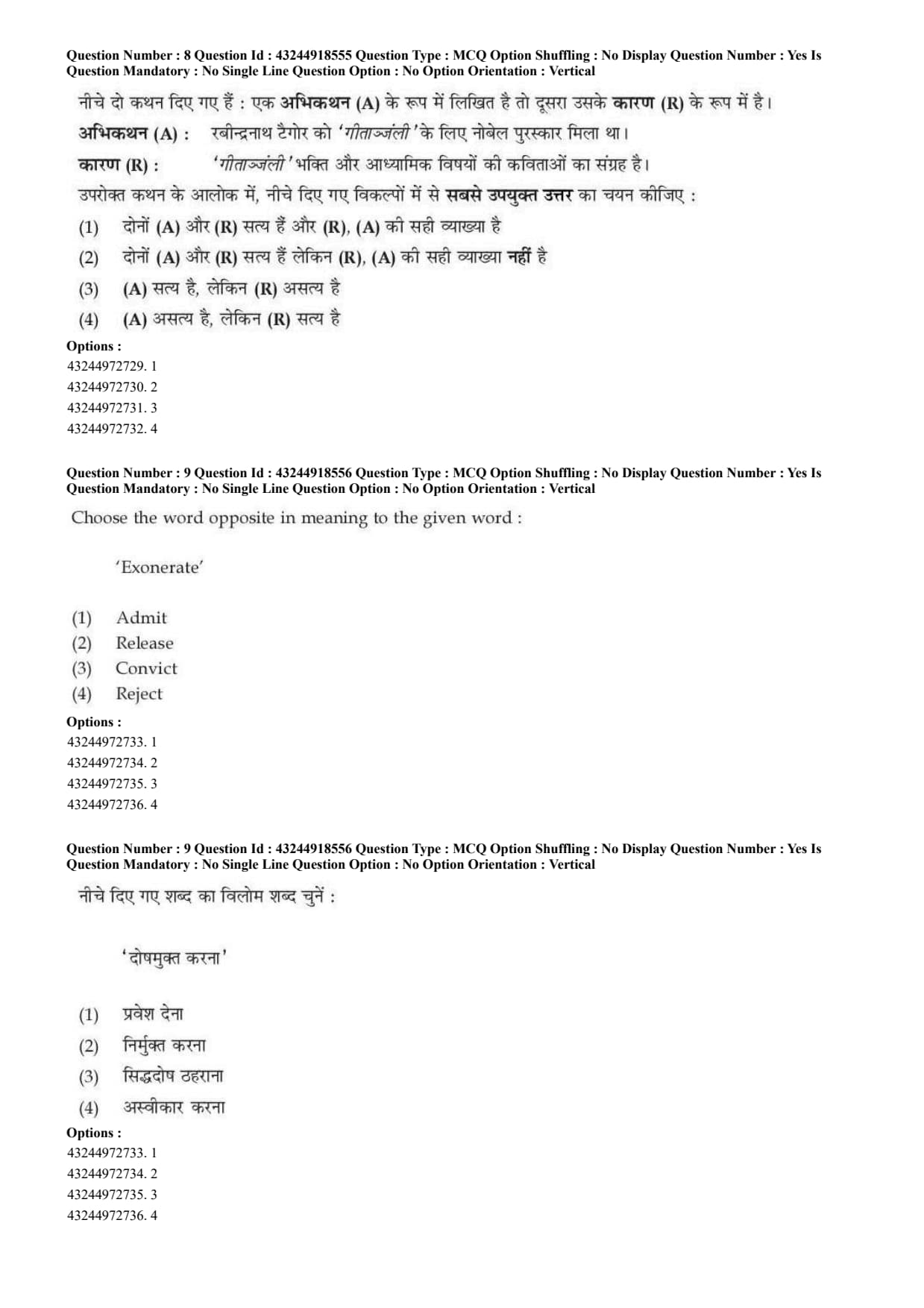
Given below are two statements: one is labelled as Assertion (A) and the other is labelled as Reason (R).
Assertion (A): Rabindranath Tagore won the Nobel Prize in Literature for Gitanjali.
Reason (R): Gitanjali is a collection of poems reflecting spiritual themes. In the light of the above statements, choose the most appropriate answer from the options given below.
Choose the word opposite in meaning to the given word: `Exonerate'.
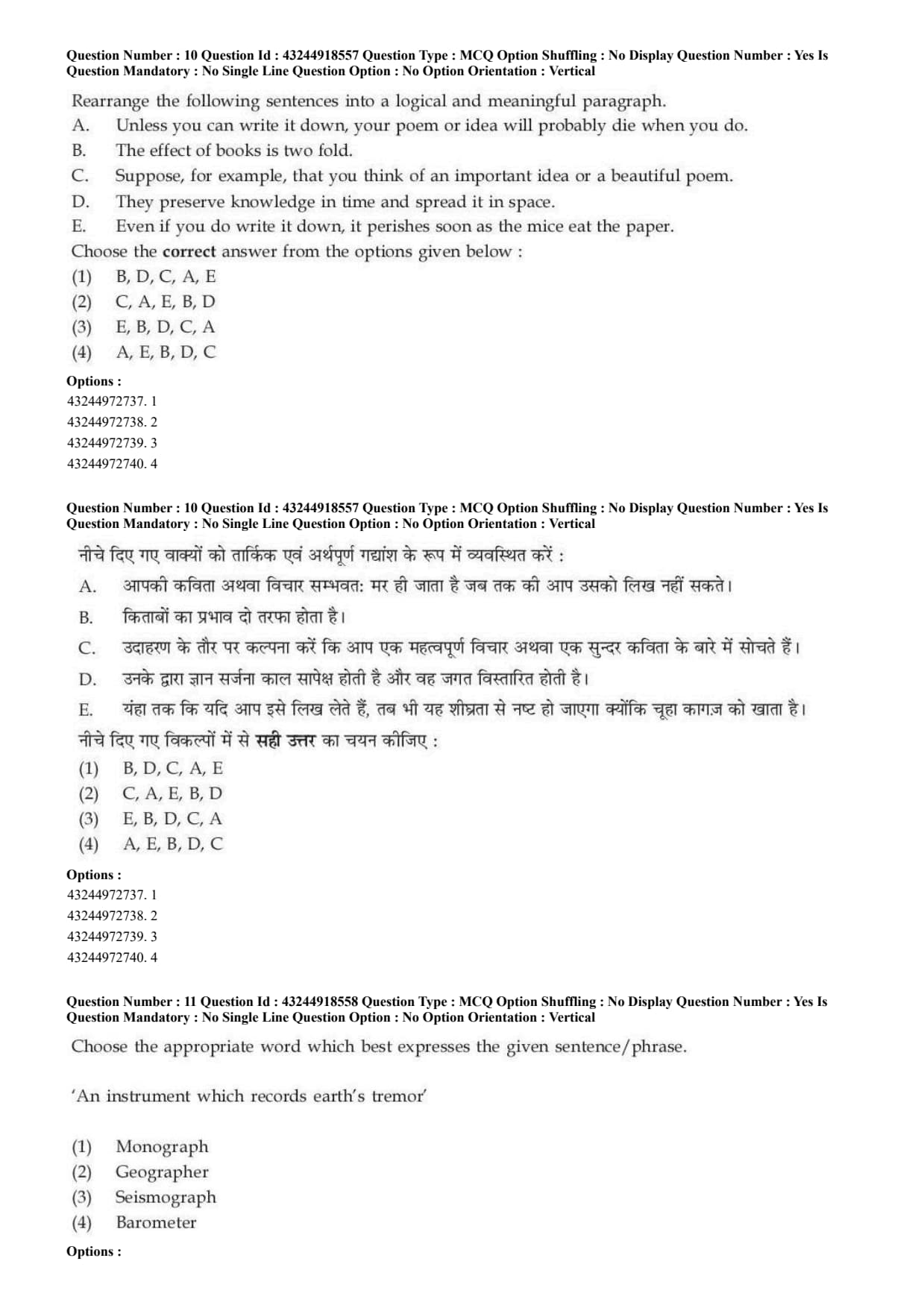
Rearrange the following sentences into a logical and meaningful paragraph.
A. Unless you can write it down, your poem or idea will probably die when you do.
B. The effect of books is two fold.
C. Suppose, for example, that you think of an important idea or a beautiful poem.
D. They preserve knowledge in time and spread it in space.
E. Even if you do write it down, it perishes as soon as the mice eat the paper.
Choose the correct answer from the options given below.
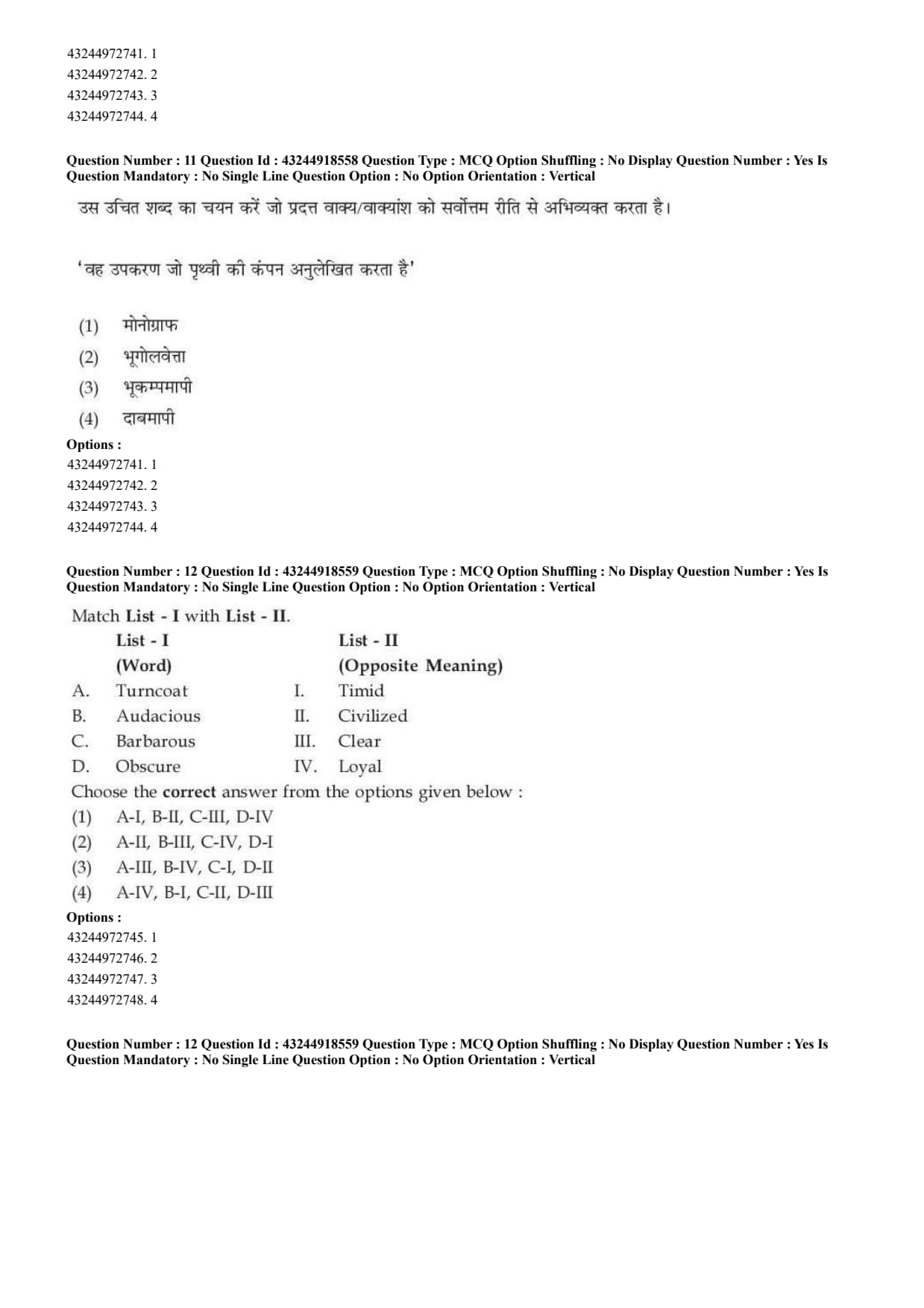
Choose the appropriate word which best expresses the given sentence/phrase:
'An instrument which records earth's tremor'
Match List - I with List - II.

Choose the correct answer from the options given below:
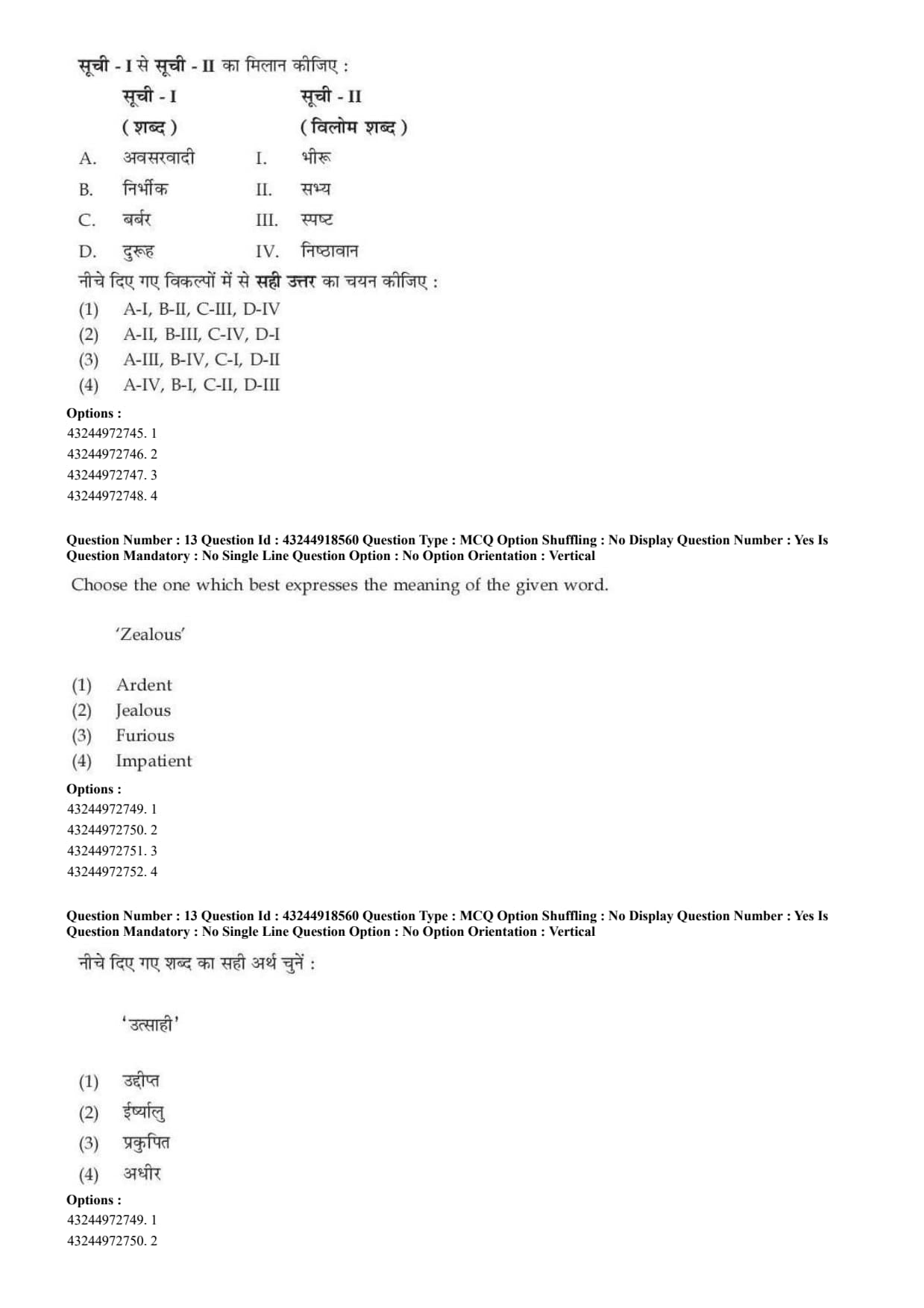
Choose the one which best expresses the meaning of the given word:
'Zealous'
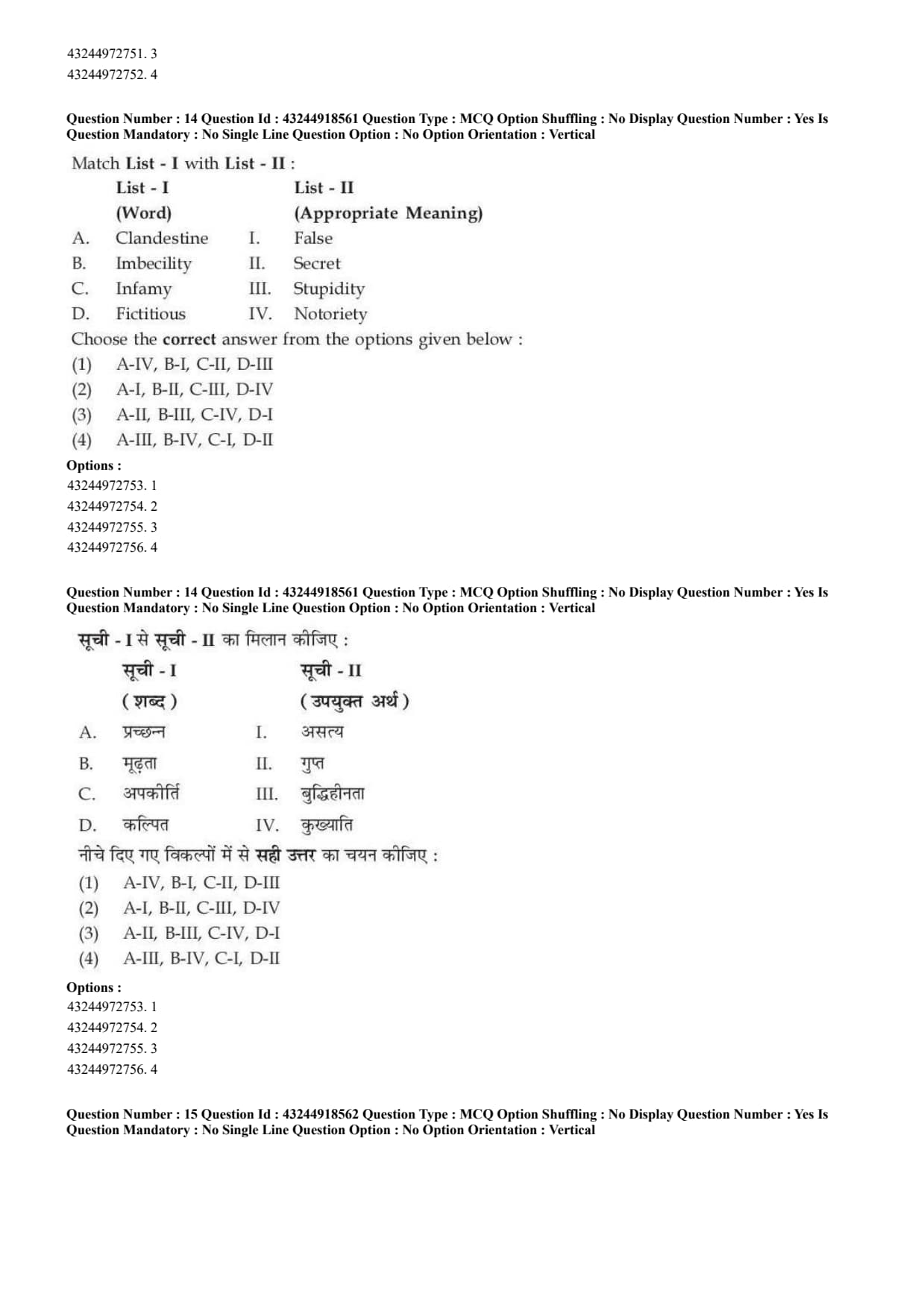
Match List - I with List - II.

Choose the correct answer from the options given below:
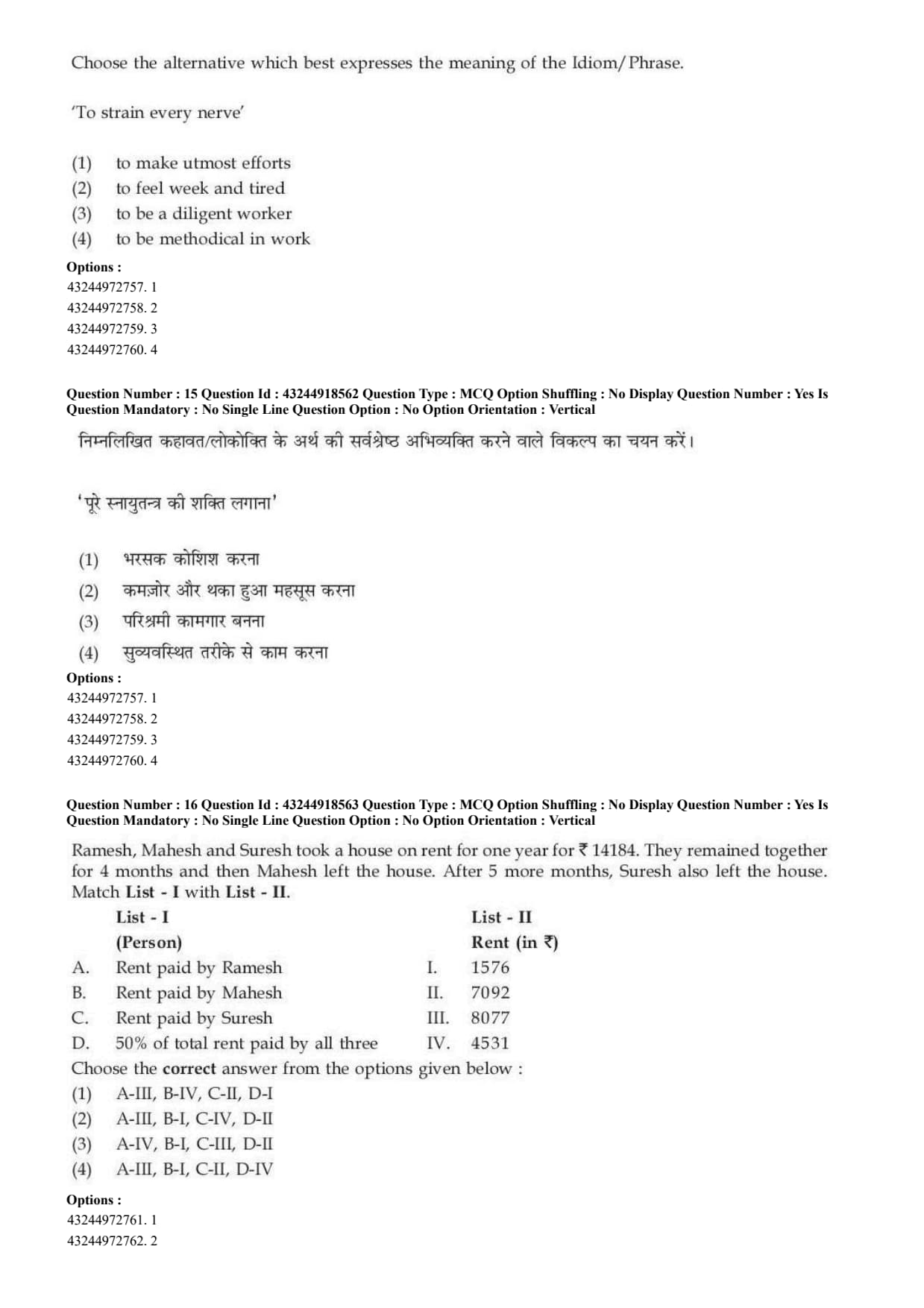
Choose the alternative which best expresses the meaning of the Idiom/Phrase:
'To strain every nerve'
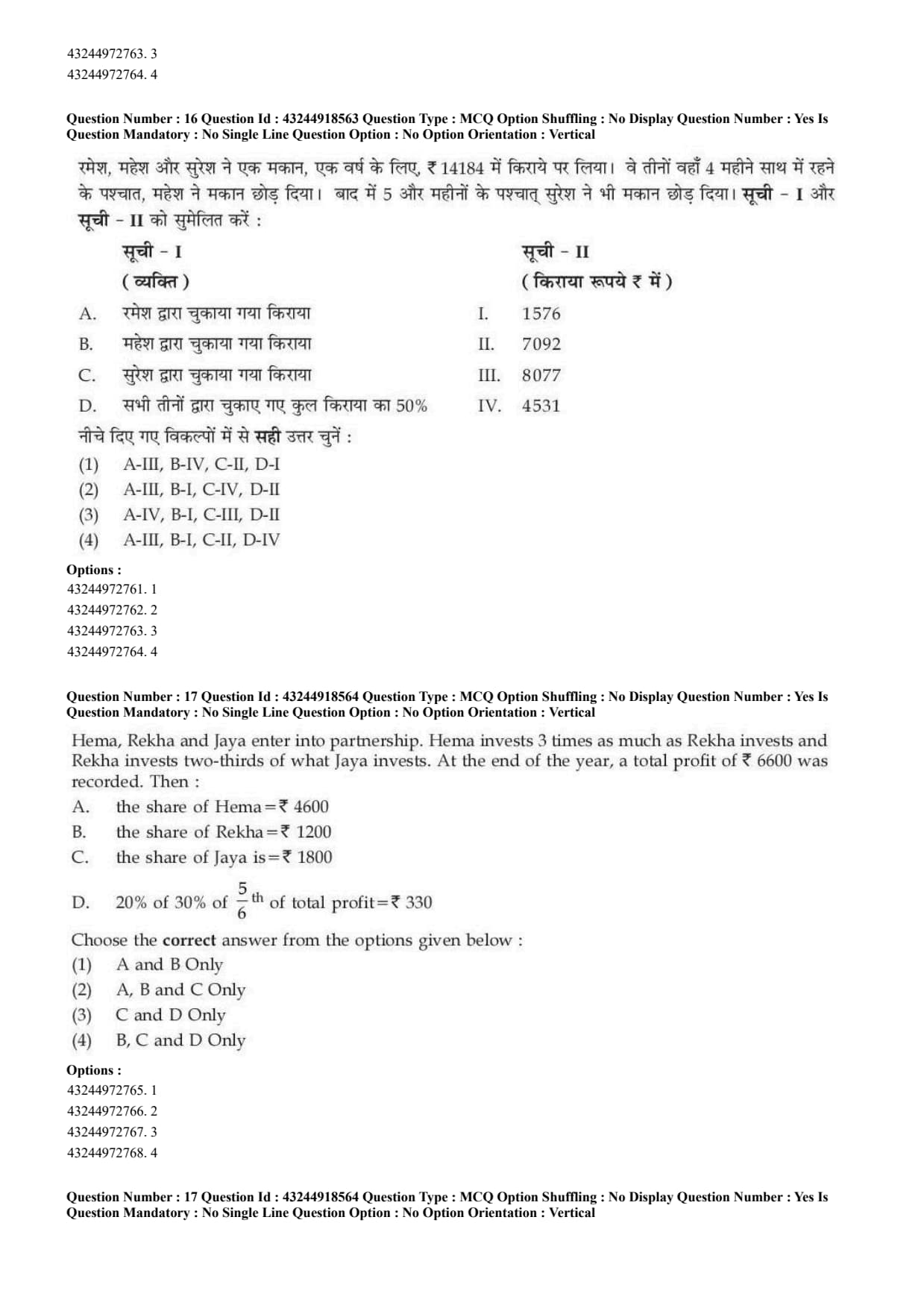
Ramesh, Mahesh and Suresh took a house on rent for one year for Rs 14184. They remained together for 4 months and then Mahesh left the house. After 5 more months, Suresh also left the house. Match List - I with List - II.

Choose the correct answer from the options given below:
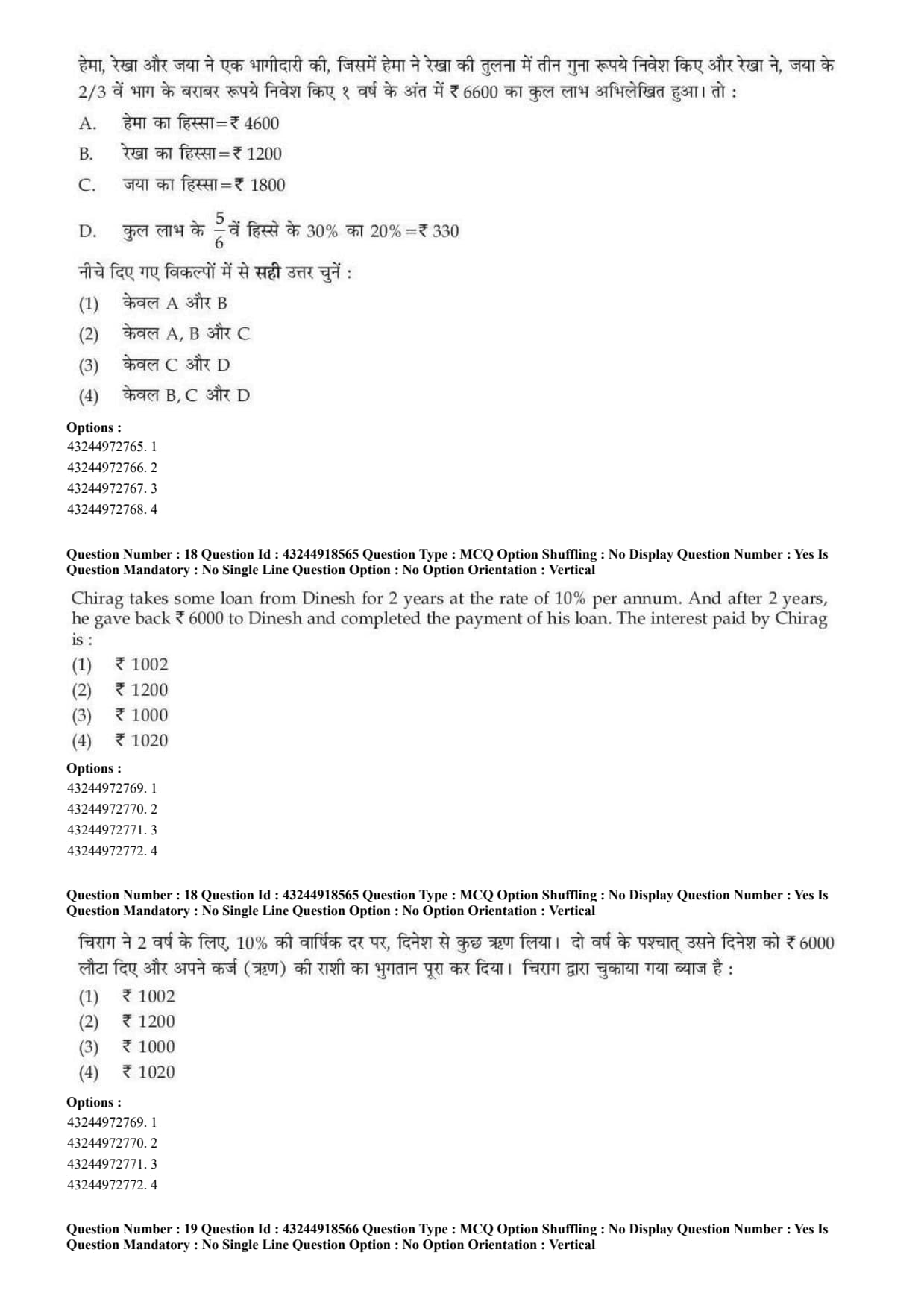
Hema, Rekha and Jaya enter into partnership. Hema invests 3 times as much as Rekha invests and Rekha invests two-thirds of what Jaya invests. At the end of the year, a total profit of Rs 6600 was recorded. Then :
A. the share of Hema = Rs 4600
B. the share of Rekha = Rs 1200
C. the share of Jaya is = Rs 1800
D. 20% of 30% of \(\frac{5}{6}th\) of total profit = Rs 330
Choose the correct answer from the options given below:
View Solution
Step 1: Understanding the Question:
This is a problem based on a partnership.
In a simple partnership, where the investment durations are equal, the profit is divided in the direct ratio of the investments made by each partner.
We need to determine the ratio of investment of the three partners, calculate their individual profit shares, and verify the statements.
Step 2: Key Formula or Approach:
1. Let Jaya's investment be \(J\).
2. Express Rekha's investment (\(R\)) and Hema's investment (\(H\)) in terms of \(J\):
\[ R = \frac{2}{3}J \]
\[ H = 3 \times R = 3 \times \frac{2}{3}J = 2J \]
3. Find the investment ratio \(H : R : J\).
4. Distribute the total profit of Rs 6600 according to this ratio.
Step 3: Detailed Explanation:
Calculate the Investment Ratio:
Let Jaya's investment be \(J = 3x\).
Then, Rekha's investment:
\[ R = \frac{2}{3}(3x) = 2x \]
Hema's investment:
\[ H = 3R = 3(2x) = 6x \]
Thus, the ratio of investments of Hema, Rekha, and Jaya is:
\[ H : R : J = 6x : 2x : 3x = 6 : 2 : 3 \]
Calculate Individual Profit Shares:
The sum of the ratio terms:
\[ 6 + 2 + 3 = 11 \]
Total profit to be distributed is Rs 6600.
One ratio unit corresponds to:
\[ \frac{6600}{11} = Rs 600 \]
Now, calculate the profit shares:
Hema's Share:
\[ 6 \times 600 = Rs 3600 \]
(This means Statement A is False, as it states Hema's share is Rs 4600).
Rekha's Share:
\[ 2 \times 600 = Rs 1200 \]
(This means Statement B is True).
Jaya's Share:
\[ 3 \times 600 = Rs 1800 \]
(This means Statement C is True).
Verify Statement D:
We need to calculate:
\[ 20% of 30% of \frac{5}{6}th of 6600 \]
First, find \(\frac{5}{6}th\) of the total profit:
\[ \frac{5}{6} \times 6600 = 5 \times 1100 = 5500 \]
Next, find 30% of 5500:
\[ \frac{30}{100} \times 5500 = 30 \times 55 = 1650 \]
Finally, find 20% of 1650:
\[ \frac{20}{100} \times 1650 = \frac{1}{5} \times 1650 = 330 \]
Since the calculated value is Rs 330, Statement D is True.
Step 4: Final Answer:
Statements B, C, and D are true, while Statement A is false.
Therefore, the correct option is (D).
Quick Tip: To avoid working with fractions, assume the initial variable is a multiple of the denominator.
In this case, since Rekha's investment is \(\frac{2}{3}\) of Jaya's, setting Jaya's investment as \(3x\) immediately eliminates fractions and simplifies calculations.
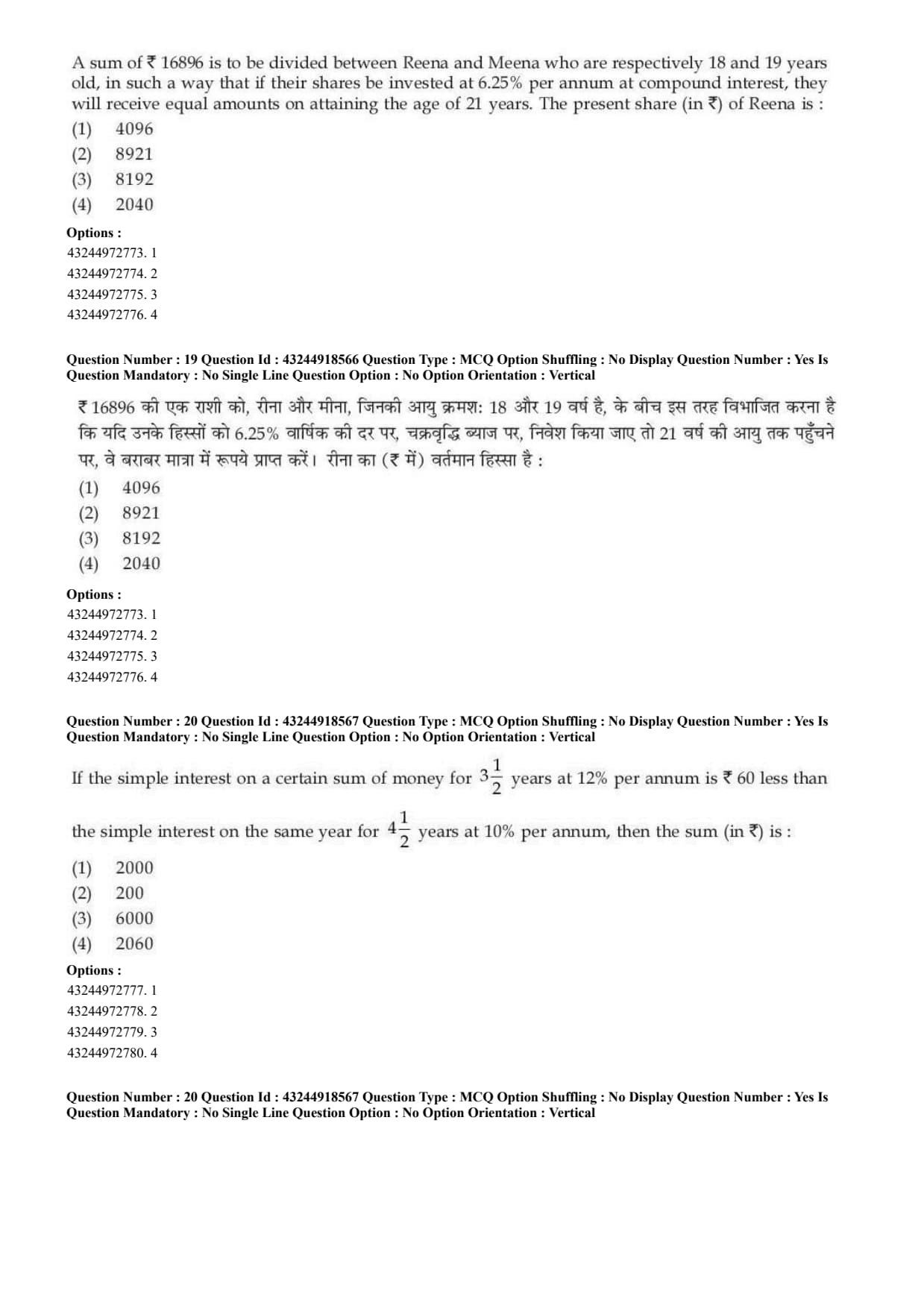
Chirag takes some loan from Dinesh for 2 years at the rate of 10% per annum. And after 2 years, he gave back Rs 6000 to Dinesh and completed the payment of his loan. The interest paid by Chirag is:
A sum of Rs 16896 is to be divided between Reena and Meena who are respectively 18 and 19 years old, in such a way that if their shares be invested at 6.25% per annum at compound interest, they will receive equal amounts on attaining the age of 21 years. The present share (in Rs) of Reena is:
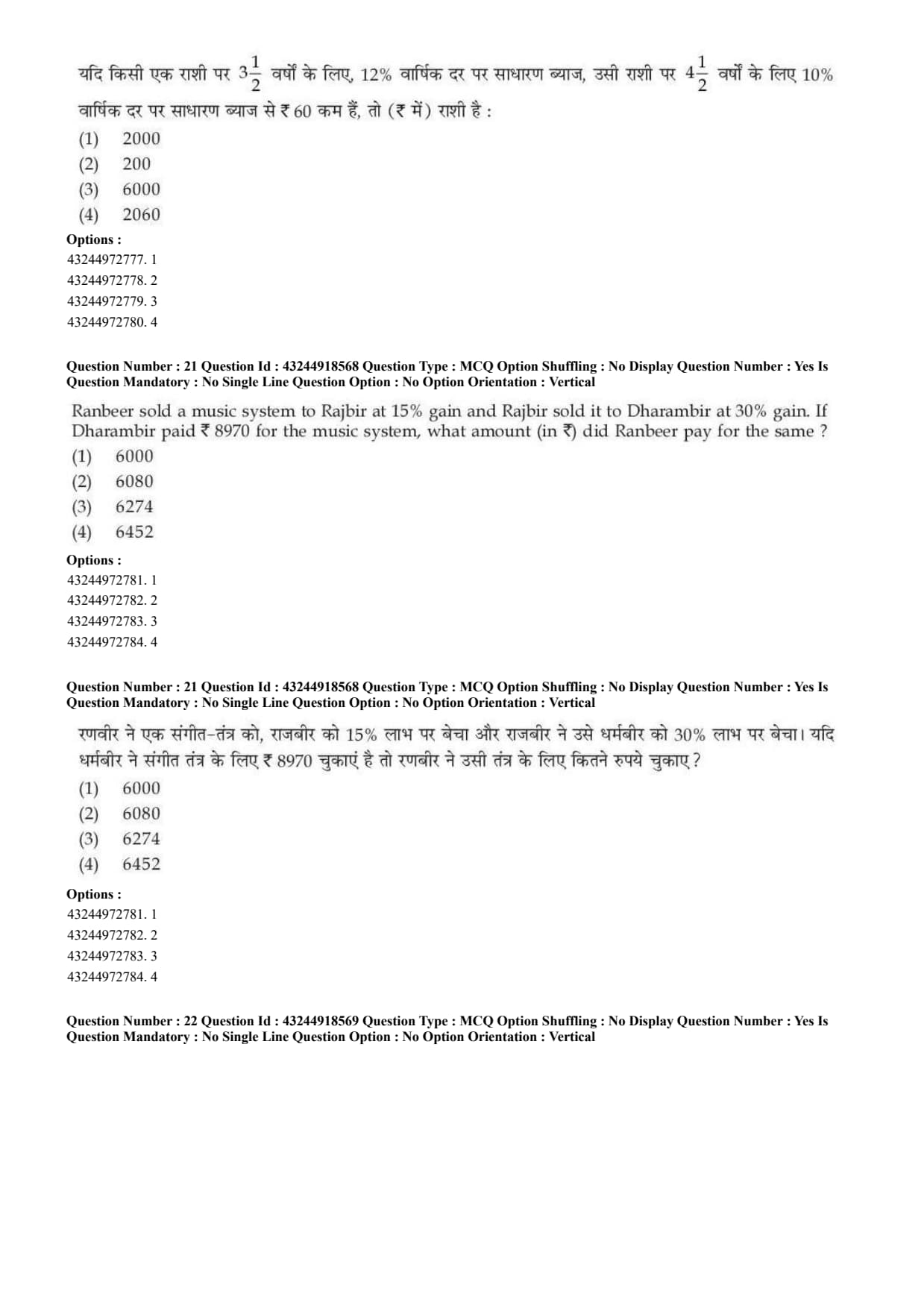
If the simple interest on a certain sum of money for \(3\frac{1}{2}\) years at 12% per annum is Rs 60 less than the simple interest on the same sum for \(4\frac{1}{2}\) years at 10% per annum, then the sum (in Rs) is:
Ranbeer sold a music system to Rajbir at 15% gain and Rajbir sold it to Dharambir at 30% gain. If Dharambir paid Rs 8970 for the music system, what amount (in Rs) did Ranbeer pay for the same?
View Solution
Step 1: Understanding the Question:
This is a successive transaction problem in profit and loss.
Ranbeer sells an item to Rajbir at a profit, and Rajbir subsequently sells it to Dharambir at another profit.
The final price paid by Dharambir is given, and we need to work backward to find the original cost price paid by Ranbeer.
Step 2: Key Formula or Approach:
Let the price Ranbeer paid be \(x\) (Ranbeer's Cost Price).
1. Ranbeer sells to Rajbir at a 15% gain:
\[ Rajbir's Cost Price = x \times \left(1 + \frac{15}{100}\right) = 1.15x \]
2. Rajbir sells to Dharambir at a 30% gain:
\[ Dharambir's Cost Price = Rajbir's Cost Price \times \left(1 + \frac{30}{100}\right) = 1.15x \times 1.30 \]
3. Equate this to the given price paid by Dharambir (Rs 8970) and solve for \(x\).
Step 3: Detailed Explanation:
Formulate the Equation:
\[ x \times 1.15 \times 1.30 = 8970 \]
Multiply the decimals:
\[ 1.15 \times 1.30 = 1.495 \]
So the equation becomes:
\[ 1.495x = 8970 \]
Solve for \(x\):
To eliminate decimals, multiply both the numerator and denominator by 1000:
\[ x = \frac{8970}{1.495} = \frac{8970 \times 1000}{1495} \]
Let us check if 1495 divides 8970:
\[ 1495 \times 6 = 8970 \]
Yes, it is exactly divisible:
\[ x = 6 \times 1000 = 6000 \]
Therefore, Ranbeer paid Rs 6000 for the music system.
Step 4: Final Answer:
The cost price for Ranbeer was Rs 6000.
Therefore, the correct option is (A).
Quick Tip: Using fractional representations can make calculation easier:
15% gain = factor of \(\frac{115}{100} = \frac{23}{20}\).
30% gain = factor of \(\frac{13}{10}\).
The equation is: \[ x \times \frac{23}{20} \times \frac{13}{10} = 8970 \] \[ x \times \frac{299}{200} = 8970 \] Since \(299 \times 3 = 897\), we can see that \(299 \times 30 = 8970\).
So: \[ x = 30 \times 200 = 6000 \] Working with fractions avoids tedious decimal division.
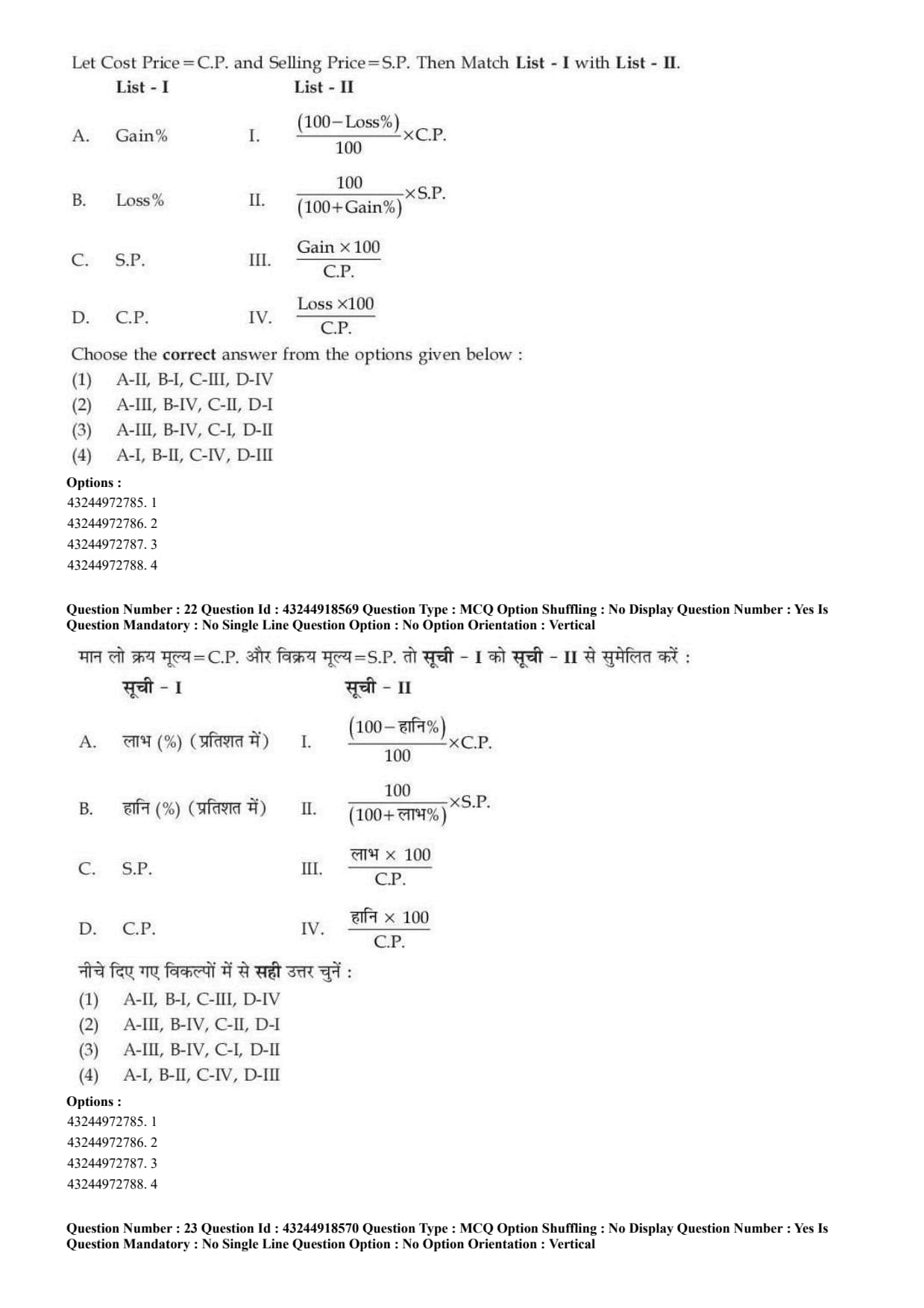
Let Cost Price = C.P. and Selling Price = S.P. Then Match List - I with List - II.

Choose the correct answer from the options given below:
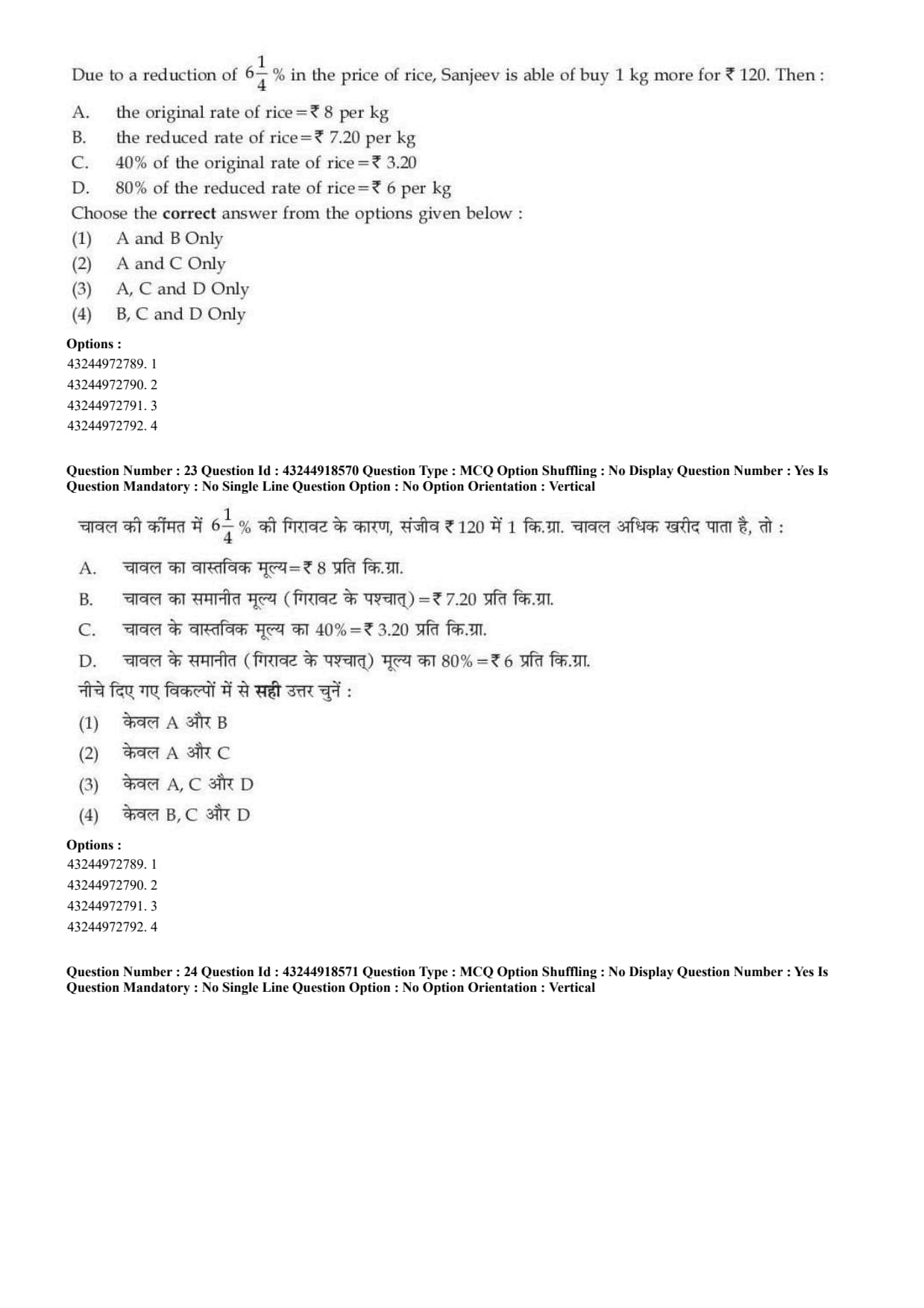
Due to a reduction of \(6\frac{1}{4}%\) in the price of rice, Sanjeev is able to buy \(1 kg\) more for Rs 120. Then :
A. the original rate of rice = Rs 8 per kg
B. the reduced rate of rice = Rs 7.20 per kg
C. 40% of the original rate of rice = Rs 3.20
D. 80% of the reduced rate of rice = Rs 6 per kg
Choose the correct answer from the options given below:
View Solution
Step 1: Understanding the Question:
This problem is based on the inverse relationship between the price of a commodity and its consumption when the total expenditure is constant.
The price of rice decreases, which allows a buyer to purchase more of it for the same total sum of Rs 120.
We need to calculate the original and reduced prices per kilogram and verify the truth value of the given statements.
Step 2: Key Formula or Approach:
1. Let the original price of rice be \(x\) per kg.
2. The percentage reduction in price is:
\[ 6\frac{1}{4}% = 6.25% = \frac{25}{400} = \frac{1}{16} \]
3. The reduced price is:
\[ x \left(1 - \frac{1}{16}\right) = \frac{15}{16}x \]
4. The quantity bought originally with Rs 120 is \(\frac{120}{x}\).
5. The quantity bought at the reduced price is \(\frac{120}{\frac{15}{16}x} = \frac{128}{x}\).
6. The difference in quantity is 1 kg:
\[ \frac{128}{x} - \frac{120}{x} = 1 \]
Step 3: Detailed Explanation:
Calculate the Original Rate (\(x\)):
Solve the quantity equation:
\[ \frac{128 - 120}{x} = 1 \]
\[ \frac{8}{x} = 1 \implies x = 8 \]
So, the original rate of rice is Rs 8 per kg.
(This means Statement A is True).
Calculate the Reduced Rate:
\[ Reduced Rate = \frac{15}{16} \times 8 = Rs 7.50 per kg \]
(This means Statement B is False, as it states the reduced rate is Rs 7.20).
Verify Statement C:
We need to find 40% of the original rate:
\[ 40% of 8 = \frac{40}{100} \times 8 = 0.4 \times 8 = Rs 3.20 \]
Since this matches Statement C, Statement C is True.
Verify Statement D:
We need to find 80% of the reduced rate:
\[ 80% of 7.50 = \frac{80}{100} \times 7.50 = 0.8 \times 7.5 = Rs 6.00 \]
Since this matches Statement D, Statement D is True.
Step 4: Final Answer:
Statements A, C, and D are true, while Statement B is false.
Therefore, the correct option is (C).
Quick Tip: Using fractional equivalents of percentages saves time:
A price reduction of \(\frac{1}{16}\) means the price ratio is \(16 : 15\).
Since expenditure is constant, the quantity ratio is the inverse: \(15 : 16\).
The difference in quantity is \(16 - 15 = 1\) ratio unit.
Since 1 ratio unit corresponds to 1 kg:
Original quantity = 15 kg.
Original price = \(\frac{120}{15} = Rs 8\) per kg.
This ratio method avoids any algebraic equations.
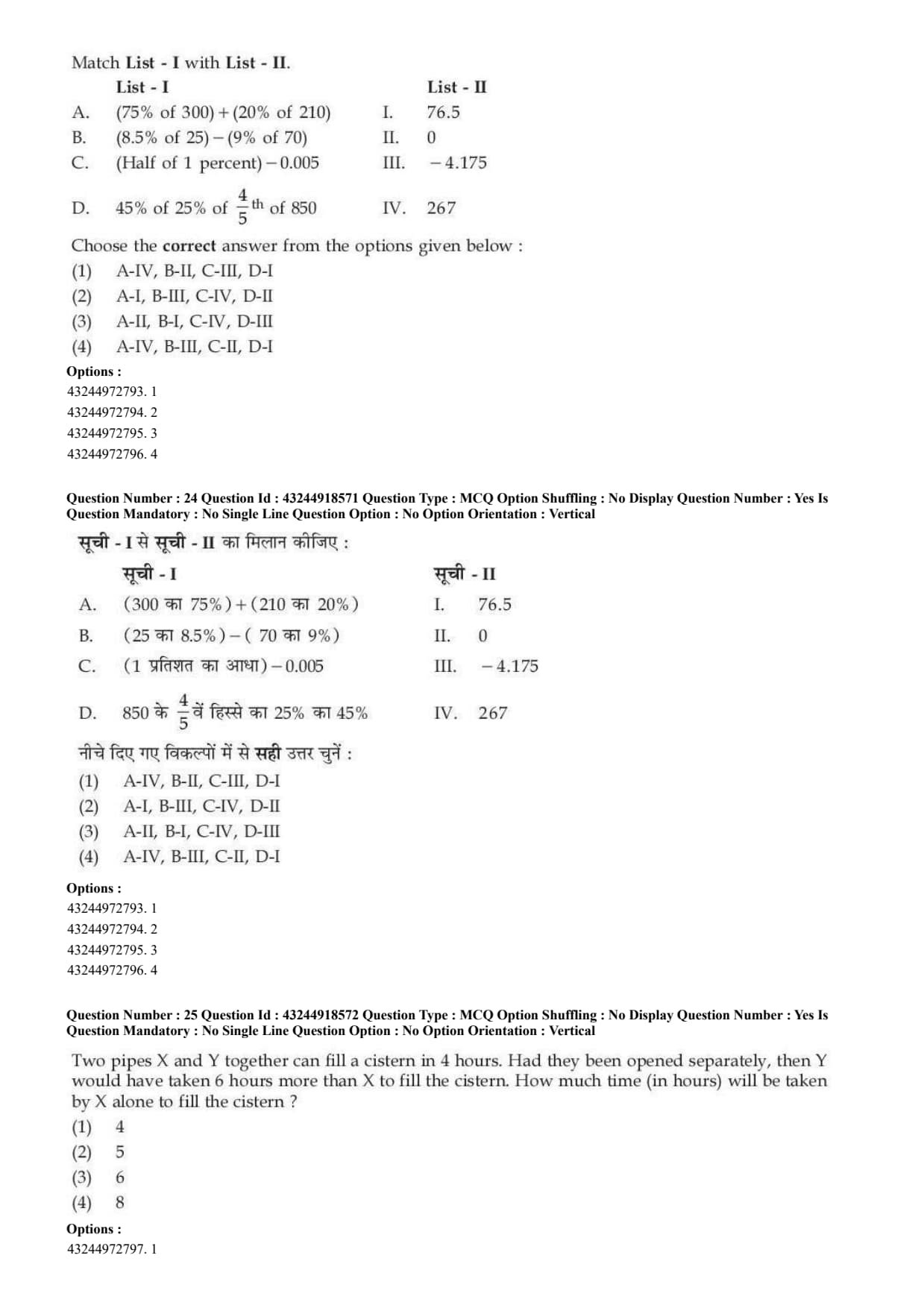
Match List - I with List - II.

Choose the correct answer from the options given below:
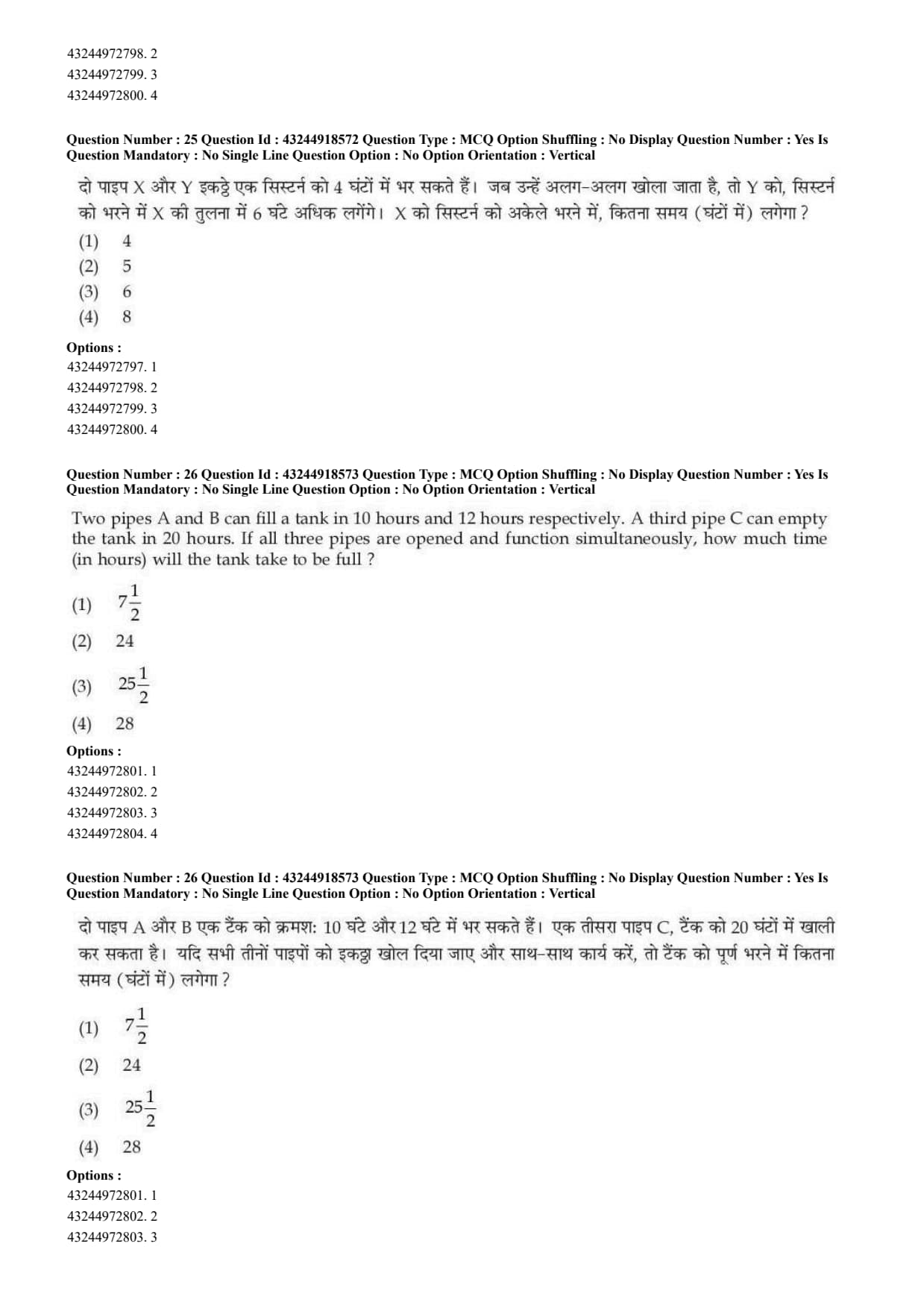
Two pipes X and Y together can fill a cistern in 4 hours. Had they been opened separately, then Y would have taken 6 hours more than X to fill the cistern. How much time (in hours) will be taken by X alone to fill the cistern?
View Solution
Step 1: Understanding the Question:
This problem belongs to the topic of Pipes and Cisterns (which is mathematically identical to Time and Work).
We are given the combined rate of two pipes filling a cistern, along with a relative difference in the time they take to fill the cistern individually.
We need to set up a quadratic equation and solve for the individual time taken by pipe X.
Step 2: Key Formula or Approach:
Let the time taken by pipe X alone to fill the cistern be \(t\) hours.
Since Y takes 6 hours more than X, the time taken by Y alone is \(t + 6\) hours.
The work done in one hour by X is \(\frac{1}{t}\) and by Y is \(\frac{1}{t + 6}\).
Together, they fill the cistern in 4 hours, so their combined one-hour work is \(\frac{1}{4}\).
The rate equation is: \[ \frac{1}{t} + \frac{1}{t + 6} = \frac{1}{4} \]
Step 3: Detailed Explanation:
Formulate the Equation:
Combine the fractions on the left-hand side:
\[ \frac{(t + 6) + t}{t(t + 6)} = \frac{1}{4} \]
\[ \frac{2t + 6}{t^2 + 6t} = \frac{1}{4} \]
Cross-multiply to remove the denominators:
\[ 4(2t + 6) = t^2 + 6t \]
\[ 8t + 24 = t^2 + 6t \]
Rearrange into a Standard Quadratic Equation:
Move all terms to one side:
\[ t^2 + 6t - 8t - 24 = 0 \]
\[ t^2 - 2t - 24 = 0 \]
Factorize the Quadratic Equation:
We look for two numbers that multiply to \(-24\) and add up to \(-2\). These numbers are \(-6\) and \(+4\):
\[ t^2 - 6t + 4t - 24 = 0 \]
\[ t(t - 6) + 4(t - 6) = 0 \]
\[ (t - 6)(t + 4) = 0 \]
This gives two possible values for \(t\):
\[ t = 6 \quad or \quad t = -4 \]
Since time cannot be negative, we reject \(t = -4\).
Thus, \(t = 6\) hours.
Step 4: Final Answer:
Pipe X alone takes 6 hours to fill the cistern.
Therefore, the correct option is (C).
Quick Tip: Instead of solving the quadratic equation, we can substitute the options directly into the equation:
Test option (C) \(t = 6\): \[ \frac{1}{6} + \frac{1}{6 + 6} = \frac{1}{6} + \frac{1}{12} = \frac{2 + 1}{12} = \frac{3}{12} = \frac{1}{4} \] Since this matches the required combined rate of \(\frac{1}{4}\), \(t = 6\) is correct.
Substituting options is often faster in multiple-choice exams.
Two pipes A and B can fill a tank in 10 hours and 12 hours respectively. A third pipe C can empty the tank in 20 hours. If all three pipes are opened and function simultaneously, how much time (in hours) will the tank take to be full?
View Solution
Step 1: Understanding the Question:
This is a problem based on multiple pipes operating simultaneously, with some performing positive work (inlet pipes filling the tank) and another performing negative work (outlet pipe emptying the tank).
Pipes A and B are inlet pipes, and pipe C is an outlet pipe.
We need to calculate the net rate of filling when all three are open together.
Step 2: Key Formula or Approach:
Let the rates of work done per hour by the three pipes be: \[ Rate of A = \frac{1}{10} \quad (positive work) \] \[ Rate of B = \frac{1}{12} \quad (positive work) \] \[ Rate of C = -\frac{1}{20} \quad (negative work) \]
When all three operate together, the combined rate of work is: \[ Net Rate = Rate of A + Rate of B - Rate of C \] \[ Net Rate = \frac{1}{10} + \frac{1}{12} - \frac{1}{20} \]
Step 3: Detailed Explanation:
Calculate the LCM of the Denominators:
We find the Least Common Multiple (LCM) of 10, 12, and 20 to simplify the sum of fractions:
Multiples of 10: 10, 20, 30, 40, 50, 60
Multiples of 12: 12, 24, 36, 48, 60
Multiples of 20: 20, 40, 60
The LCM is 60.
Let us assume the total capacity of the tank is 60 units.
Determine the Hourly Efficiencies:
Efficiency of Pipe A = \(\frac{60}{10} = +6 units/hour\)
Efficiency of Pipe B = \(\frac{60}{12} = +5 units/hour\)
Efficiency of Pipe C = \(\frac{60}{20} = -3 units/hour\)
Calculate the Net Hourly Work:
When all three pipes are open:
\[ Net Efficiency = 6 + 5 - 3 = 8 units/hour \]
Calculate the Total Time Required:
The time taken to fill the entire tank of 60 units is:
\[ Time = \frac{Total Capacity}{Net Efficiency} = \frac{60}{8} hours \]
Simplify the fraction by dividing both numerator and denominator by 4:
\[ Time = \frac{15}{2} hours = 7.5 hours = 7\frac{1}{2} hours \]
Step 4: Final Answer:
The tank will take \(7\frac{1}{2}\) hours to be full.
Therefore, the correct option is (A).
Quick Tip: Using the "Total Capacity" (LCM of time periods) method is often faster and less error-prone than adding fractions.
Setting the capacity as 60 units directly turns fractional additions into simple integer arithmetic (\(6 + 5 - 3 = 8\)).
Then simply divide \(60 / 8 = 7.5\).
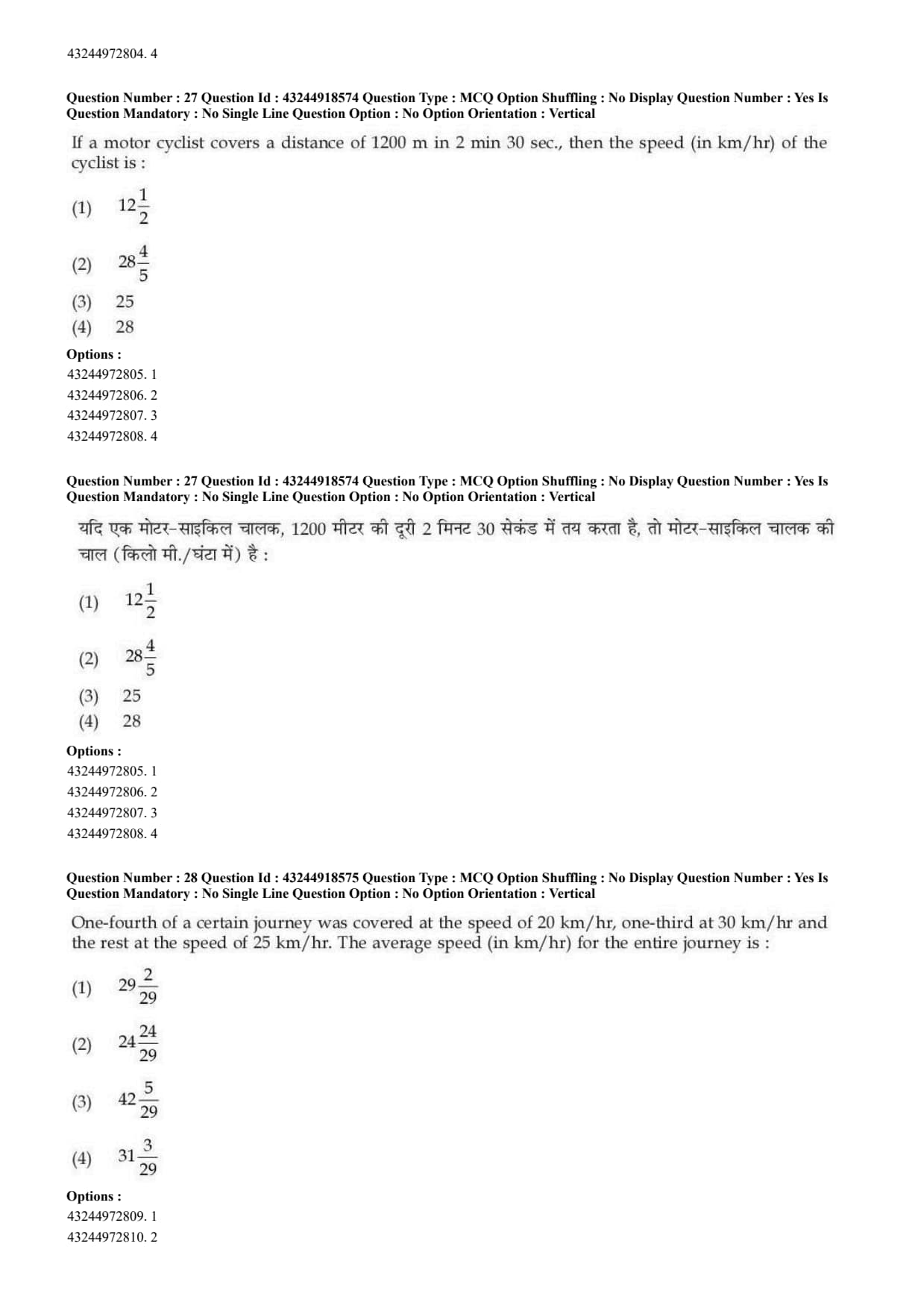
If a motor cyclist covers a distance of 1200 m in 2 min 30 sec., then the speed (in km/hr) of the cyclist is :
View Solution
Step 1: Understanding the Question:
This question belongs to the topic of Speed, Time, and Distance.
The basic physical relation defines speed as the distance covered per unit of time.
Here, the distance is provided in meters and the time is given in minutes and seconds.
We need to calculate the speed of the cyclist and convert the unit from meters per second (\(m/s\)) to kilometers per hour (\(km/hr\)).
Step 2: Key Formula or Approach:
The basic formula for speed (\(v\)) is:
\[ v = \frac{Distance (D)}{Time (T)} \]
To convert speed from \(m/s\) to \(km/hr\), we multiply the value by \(\frac{18}{5}\) because:
\[ 1 m/s = \frac{\frac{1}{1000} km}{\frac{1}{3600} hr} = \frac{3600}{1000} km/hr = \frac{18}{5} km/hr \]
Step 3: Detailed Explanation:
Convert Time into Seconds:
The given time is \(2 minutes and 30 seconds\).
Since \(1 minute = 60 seconds\):
\[ T = (2 \times 60) + 30 = 120 + 30 = 150 seconds \]
Calculate Speed in m/s:
The distance covered is \(D = 1200 m\).
Using the speed formula:
\[ v = \frac{1200}{150} = 8 m/s \]
Convert Speed to km/hr:
Multiply the speed in \(m/s\) by \(\frac{18}{5}\):
\[ v = 8 \times \frac{18}{5} = \frac{144}{5} km/hr \]
Express as a Mixed Fraction:
Divide \(144\) by \(5\):
\[ 144 = 28 \times 5 + 4 \]
Therefore:
\[ v = 28\frac{4}{5} km/hr \]
Step 4: Final Answer:
The speed of the motorcyclist is \(28\frac{4}{5} km/hr\).
Hence, the correct option is (B).
Quick Tip: To convert speed quickly between units:
- Multiply by \(\frac{18}{5}\) to convert \(m/s \rightarrow km/hr\).
- Multiply by \(\frac{5}{18}\) to convert \(km/hr \rightarrow m/s\).
Keep these ratios handy to solve speed problems rapidly.
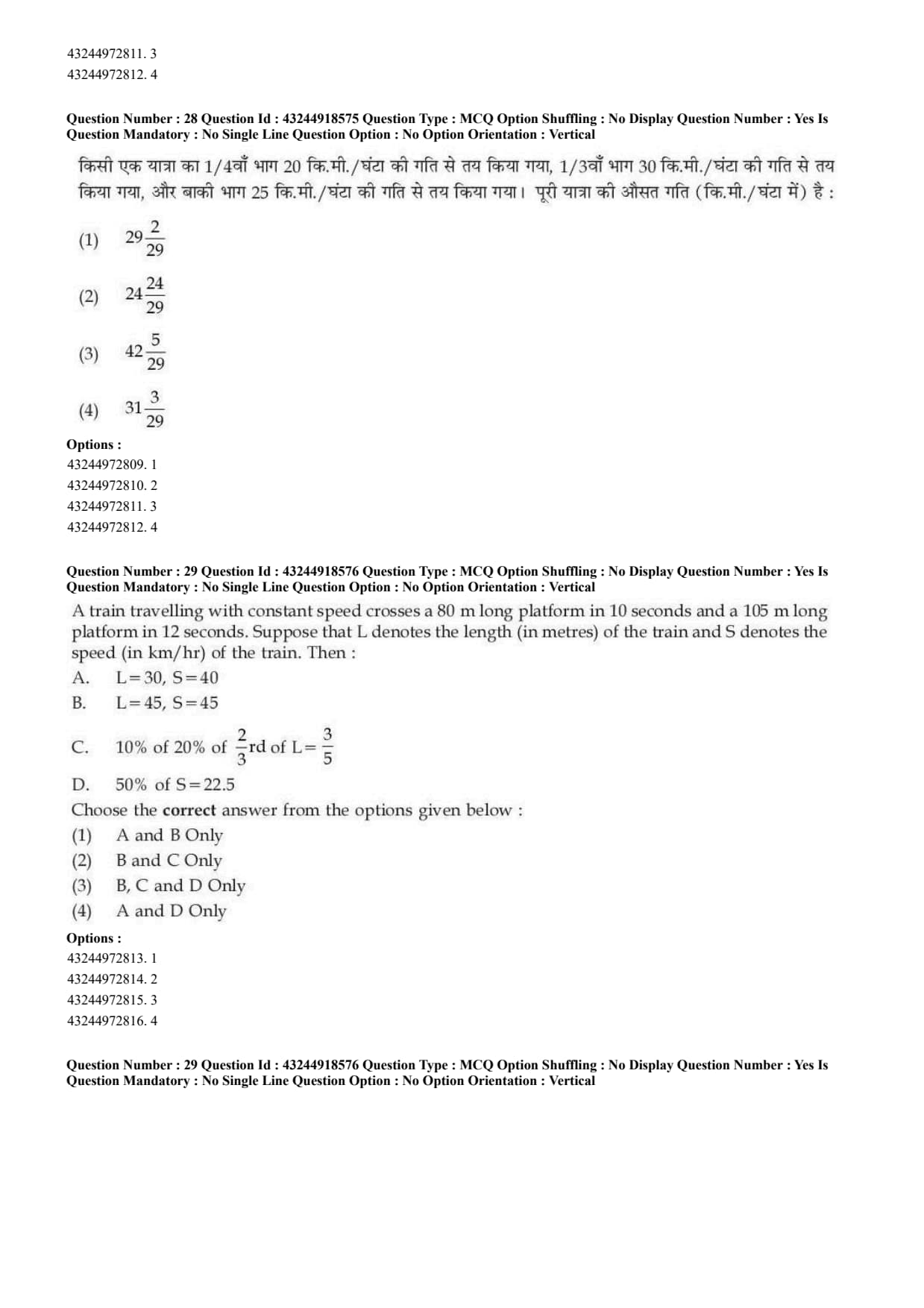
One-fourth of a certain journey was covered at the speed of 20 km/hr, one-third at 30 km/hr and the rest at the speed of 25 km/hr. The average speed (in km/hr) for the entire journey is :
View Solution
Step 1: Understanding the Question:
This problem is based on the concept of average speed.
Average speed is not simply the arithmetic mean of the individual speeds.
Instead, it is defined as the total distance traveled divided by the total time taken to cover that distance.
The journey is divided into three parts with different fractional distances and different speeds.
Step 2: Key Formula or Approach:
Let the total distance of the journey be \(d\).
The formula for average speed (\(v_{avg}\)) is:
\[ v_{avg} = \frac{Total Distance}{Total Time} = \frac{d}{t_1 + t_2 + t_3} \]
where \(t_1, t_2, t_3\) are the time intervals taken to complete each of the three stages of the journey.
For each stage, time is calculated as:
\[ t = \frac{Distance covered in that stage}{Speed of that stage} \]
Step 3: Detailed Explanation:
Define Distance Fractions and Speeds:
Let \(d\) be the total distance of the journey.
- Part 1: Distance \(d_1 = \frac{d}{4}\) covered at speed \(v_1 = 20 km/hr\).
- Part 2: Distance \(d_2 = \frac{d}{3}\) covered at speed \(v_2 = 30 km/hr\).
- Part 3: The remaining distance \(d_3\) is:
\[ d_3 = d - \left(\frac{d}{4} + \frac{d}{3}\right) = d \left(1 - \frac{7}{12}\right) = \frac{5d}{12} \]
This remaining distance is covered at speed \(v_3 = 25 km/hr\).
Calculate the Time taken for each part:
- Time for Part 1:
\[ t_1 = \frac{d/4}{20} = \frac{d}{80} hours \]
- Time for Part 2:
\[ t_2 = \frac{d/3}{30} = \frac{d}{90} hours \]
- Time for Part 3:
\[ t_3 = \frac{5d/12}{25} = \frac{5d}{12 \times 25} = \frac{d}{60} hours \]
Calculate Total Time (\(T\)):
\[ T = t_1 + t_2 + t_3 = d \left( \frac{1}{80} + \frac{1}{90} + \frac{1}{60} \right) \]
Find the Least Common Multiple (LCM) of \(80, 90,\) and \(60\), which is \(720\):
\[ T = d \left( \frac{9 + 8 + 12}{720} \right) = d \left( \frac{29}{720} \right) \]
Calculate Average Speed:
\[ v_{avg} = \frac{d}{T} = \frac{d}{d \left(\frac{29}{720}\right)} = \frac{720}{29} km/hr \]
Convert \(\frac{720}{29}\) into a mixed fraction:
\[ 720 = 29 \times 24 + 24 \]
Therefore:
\[ v_{avg} = 24\frac{24}{29} km/hr \]
Step 4: Final Answer:
The average speed for the entire journey is \(24\frac{24}{29} km/hr\).
Thus, the correct option is (B).
Quick Tip: To avoid working with fractions, assume a total distance that is a common multiple of the denominators.
For denominators \(4\), \(3\), and \(12\), let the total distance be \(1200 km\).
- Part 1: \(300 km\) at \(20 km/hr \rightarrow T_1 = 15 hours\).
- Part 2: \(400 km\) at \(30 km/hr \rightarrow T_2 = 13.33 hours\).
- Part 3: \(500 km\) at \(25 km/hr \rightarrow T_3 = 20 hours\).
Total time \(= 15 + \frac{40}{3} + 20 = 35 + \frac{40}{3} = \frac{145}{3} hours\).
Average speed \(= \frac{1200}{\frac{145}{3}} = \frac{3600}{145} = \frac{720}{29} = 24\frac{24}{29} km/hr\).
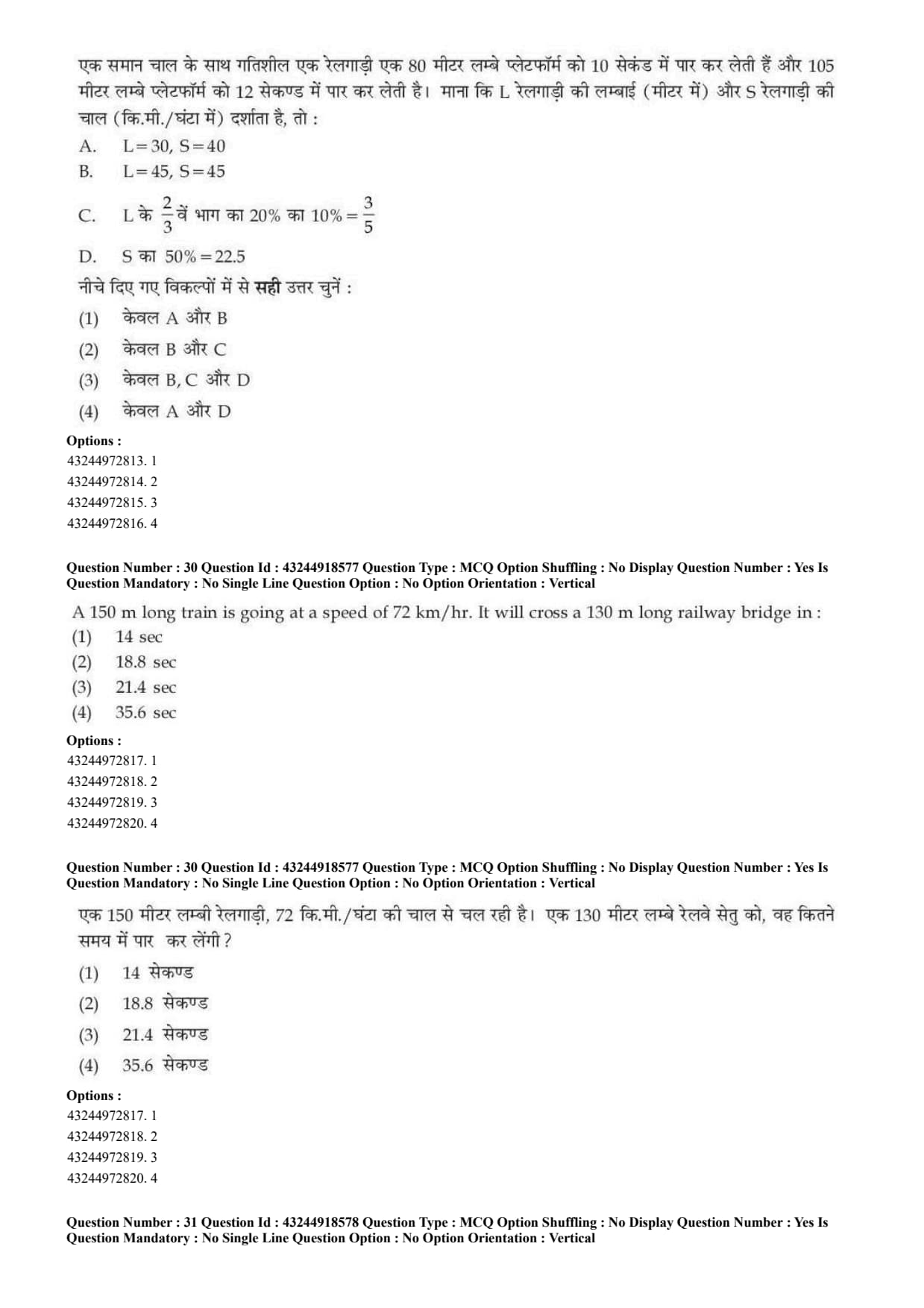
A train travelling with constant speed crosses a 80 m long platform in 10 seconds and a 105 m long platform in 12 seconds. Suppose that L denotes the length (in metres) of the train and S denotes the speed (in km/hr) of the train. Then :
A. L = 30, S = 40
B. L = 45, S = 45
C. 10% of 20% of \(\frac{2}{3}rd\) of L = \(\frac{3}{5}\)
D. 50% of S = 22.5
Choose the correct answer from the options given below :
A 150 m long train is going at a speed of 72 km/hr. It will cross a 130 m long railway bridge in :
View Solution
Step 1: Understanding the Question:
The question asks for the time taken by a train of a given length to cross a bridge of a known length at a specified speed.
To completely cross the bridge, the rear end of the train must pass the far end of the bridge.
Thus, the total distance covered during this event is the sum of the train's length and the bridge's length.
Step 2: Key Formula or Approach:
The relation between distance, speed, and time is:
\[ Time (t) = \frac{Total Distance (D)}{Speed (v)} \]
The total distance is:
\[ D = Length of train (L_{train}) + Length of bridge (L_{bridge}) \]
The speed must be converted from \(km/hr\) to \(m/s\) to keep the units consistent.
Step 3: Detailed Explanation:
Calculate Total Distance (\(D\)):
Given:
Length of train \(= 150 m\)
Length of bridge \(= 130 m\)
\[ D = 150 + 130 = 280 meters \]
Convert Speed to m/s:
The speed of the train is \(72 km/hr\).
To convert to \(m/s\), multiply by \(\frac{5}{18}\):
\[ v = 72 \times \frac{5}{18} = 4 \times 5 = 20 m/s \]
Calculate the Time Taken (\(t\)):
Use the time formula:
\[ t = \frac{D}{v} = \frac{280}{20} = 14 seconds \]
Step 4: Final Answer:
The train will cross the bridge in \(14 seconds\).
Therefore, the correct option is (A).
Quick Tip: Always remember that a speed of \(18 km/hr\) is exactly equal to \(5 m/s\).
Since \(72 km/hr\) is \(4 \times 18\), the speed in \(m/s\) must be \(4 \times 5 = 20 m/s\).
Remembering multiples of \(18\) helps perform unit conversions instantly.
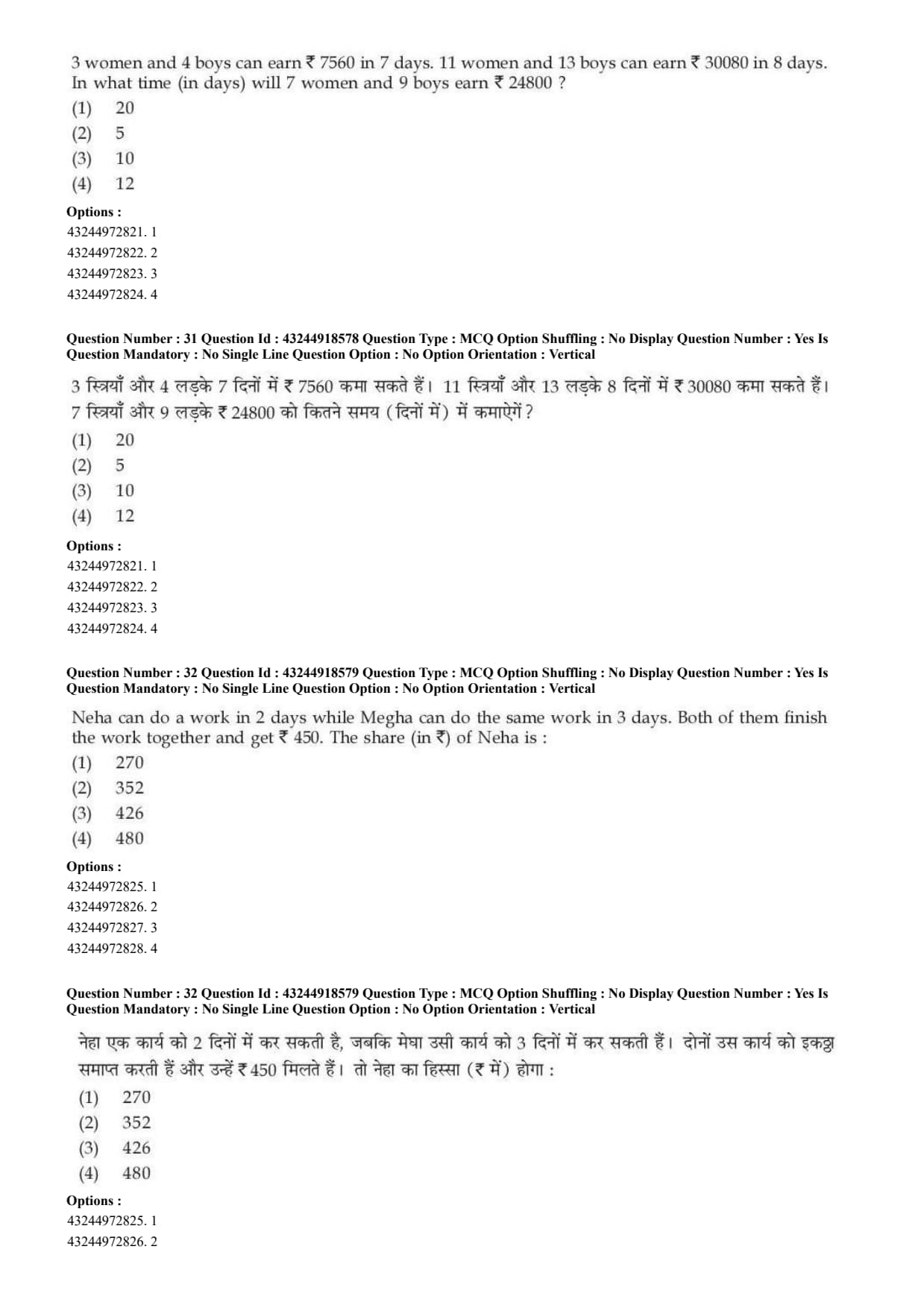
3 women and 4 boys can earn Rs 7560 in 7 days. 11 women and 13 boys can earn Rs 30080 in 8 days. In what time (in days) will 7 women and 9 boys earn Rs 24800 ?
View Solution
Step 1: Understanding the Question:
This problem is based on the work, wages, and efficiency of different groups of workers (women and boys).
We are given the total earnings of two different combinations of women and boys over different numbers of days.
From this, we must determine the individual daily earnings of one woman and one boy, and then use those values to calculate how long it takes a third combination to earn a specific amount.
Step 2: Key Formula or Approach:
Let the daily earning of a woman be \(W\) and that of a boy be \(B\).
The total earnings are given by:
\[ Earnings = (Number of workers \times Daily earning of each) \times Number of days \]
We can set up linear simultaneous equations to solve for \(W\) and \(B\).
Step 3: Detailed Explanation:
Formulate the Equations:
- Case 1: 3 women and 4 boys earn Rs 7560 in 7 days.
Daily earning of the group:
\[ 3W + 4B = \frac{7560}{7} = 1080 \quad ---(Eq 1) \]
- Case 2: 11 women and 13 boys earn Rs 30080 in 8 days.
Daily earning of the group:
\[ 11W + 13B = \frac{30080}{8} = 3760 \quad ---(Eq 2) \]
Solve the Linear System:
Multiply Eq 1 by 11 and Eq 2 by 3 to eliminate \(W\):
\[ 33W + 44B = 11880 \quad ---(Eq 3) \]
\[ 33W + 39B = 11280 \quad ---(Eq 4) \]
Subtract Eq 4 from Eq 3:
\[ 5B = 600 \quad \implies \quad B = 120 \]
Substitute \(B = 120\) into Eq 1:
\[ 3W + 4(120) = 1080 \]
\[ 3W + 480 = 1080 \]
\[ 3W = 600 \quad \implies \quad W = 200 \]
So, a woman earns Rs 200 daily, and a boy earns Rs 120 daily.
Calculate Daily Earnings of the New Group:
The new group consists of 7 women and 9 boys.
Their combined daily earning is:
\[ Daily Earning = 7W + 9B = 7(200) + 9(120) = 1400 + 1080 = 2480 Rs/day \]
Calculate the Required Days:
To find the time needed to earn Rs 24800:
\[ Number of days = \frac{Target earnings}{Daily earnings} = \frac{24800}{2480} = 10 days \]
Step 4: Final Answer:
The group of 7 women and 9 boys will earn the target amount in 10 days.
Therefore, the correct option is (C).
Quick Tip: Double check the arithmetic coefficients:
Notice that the target amount Rs 24800 is exactly 10 times the daily group rate Rs 2480.
In competitive exams, numbers are often chosen to divide cleanly, which can help confirm that your intermediate steps are correct.
Neha can do a work in 2 days while Megha can do the same work in 3 days. Both of them finish the work together and get Rs 450. The share (in Rs) of Neha is :
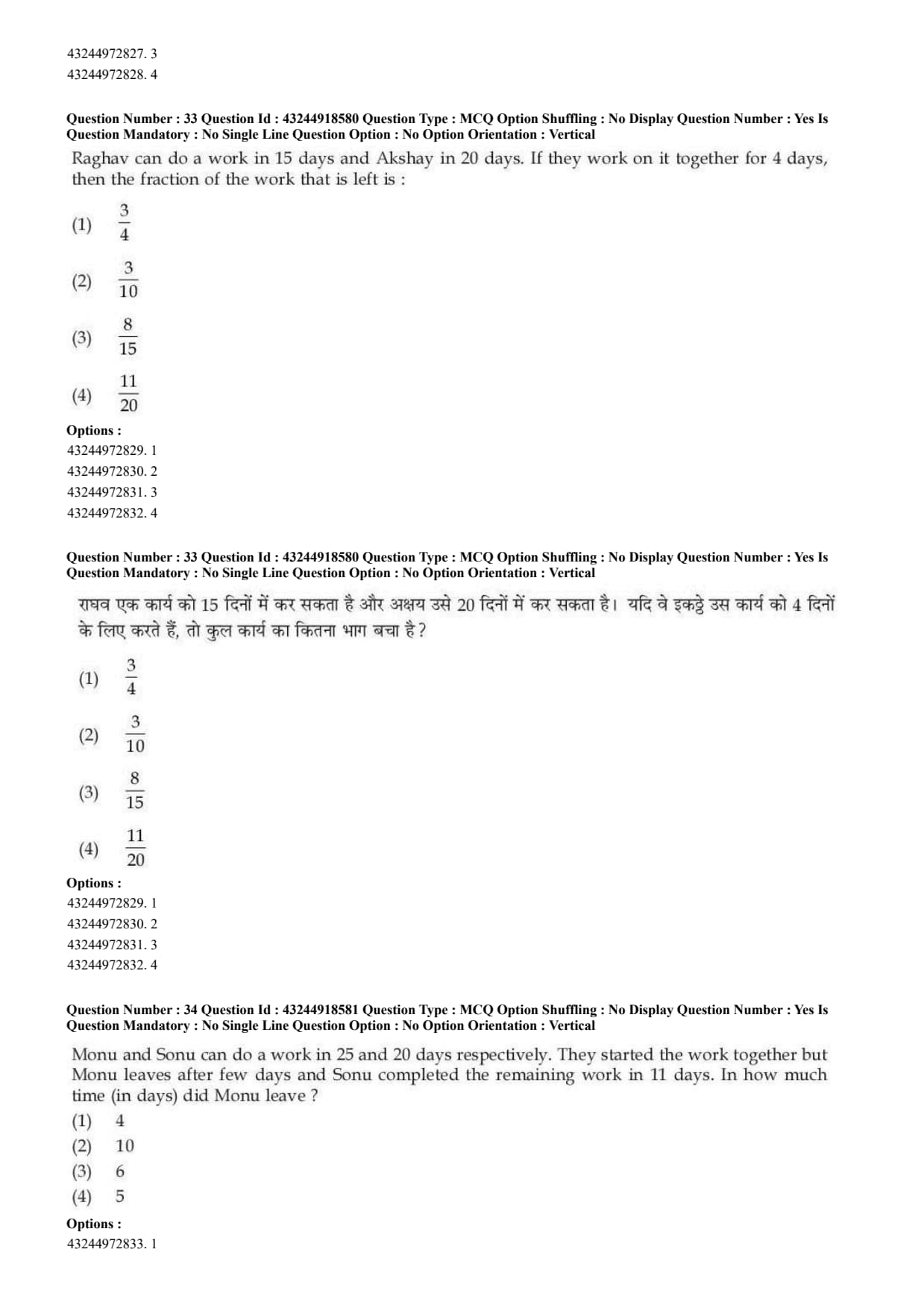
Raghav can do a work in 15 days and Akshay in 20 days. If they work on it together for 4 days, then the fraction of the work that is left is :
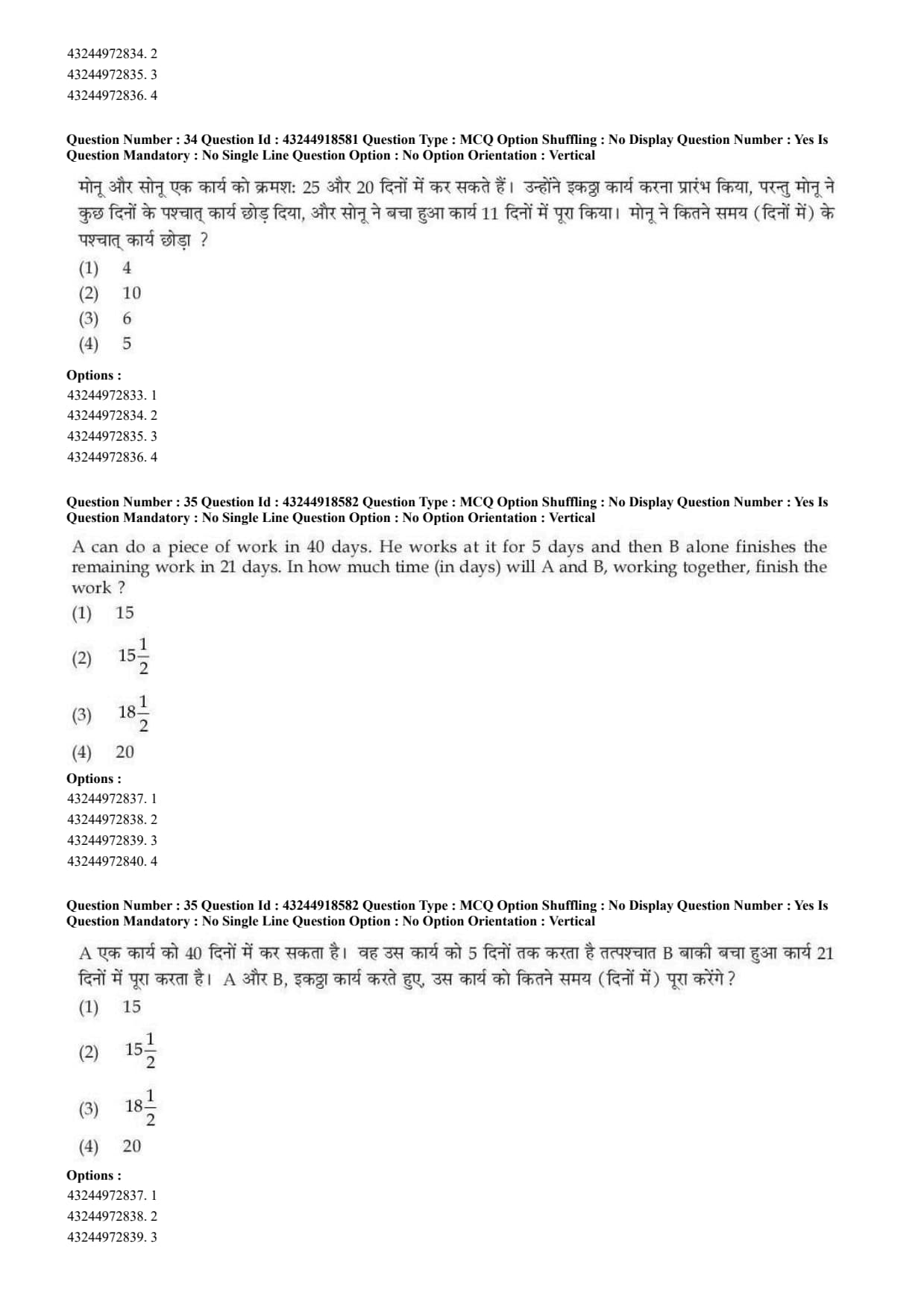
Monu and Sonu can do a work in 25 and 20 days respectively. They started the work together but Monu leaves after few days and Sonu completed the remaining work in 11 days. In how much time (in days) did Monu leave ?
A can do a piece of work in 40 days. He works at it for 5 days and then B alone finishes the remaining work in 21 days. In how much time (in days) will A and B, working together, finish the work ?
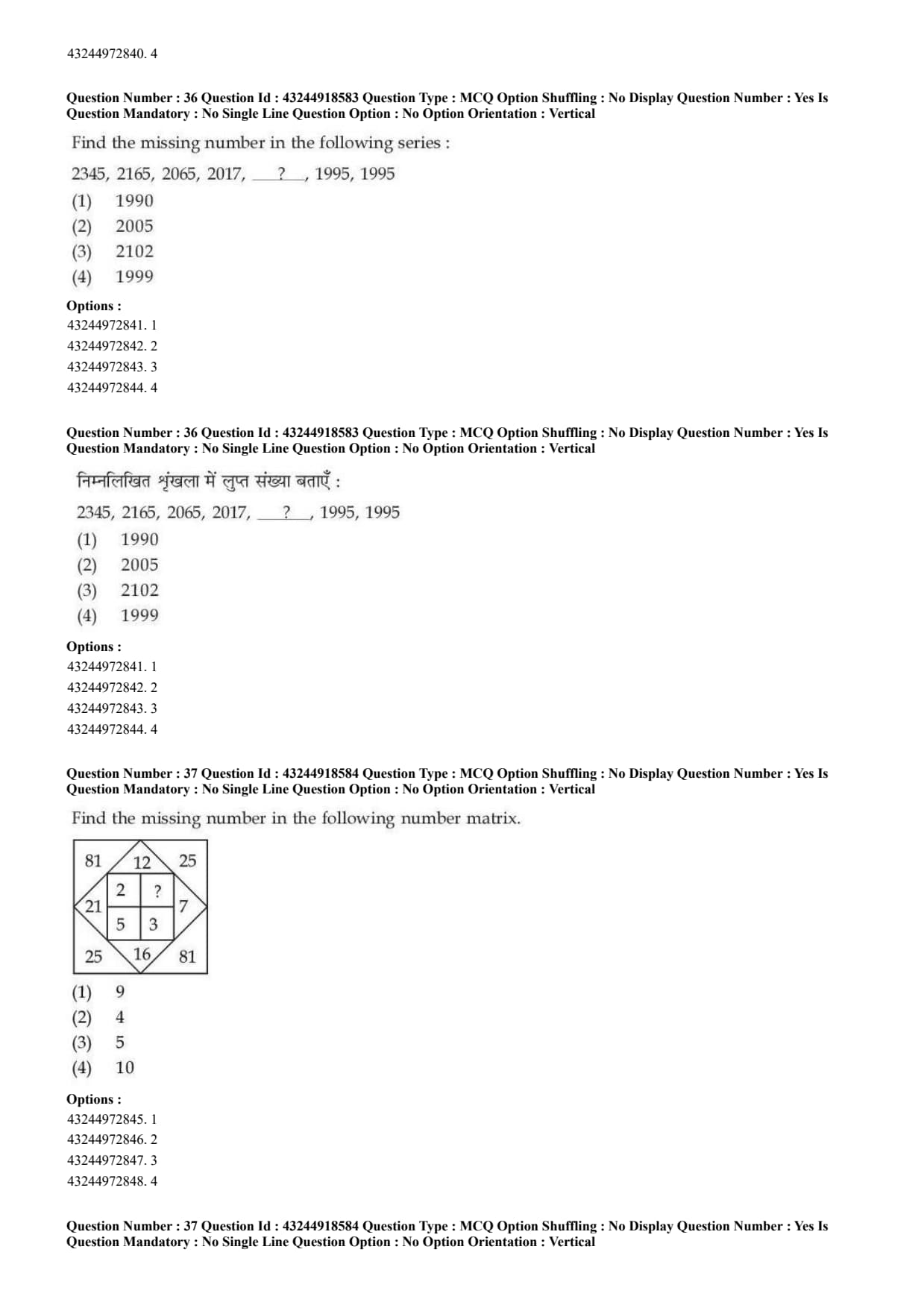
Find the missing number in the following series :
2345, 2165, 2065, 2017, ?, 1995, 1995
Find the missing number in the following number matrix.

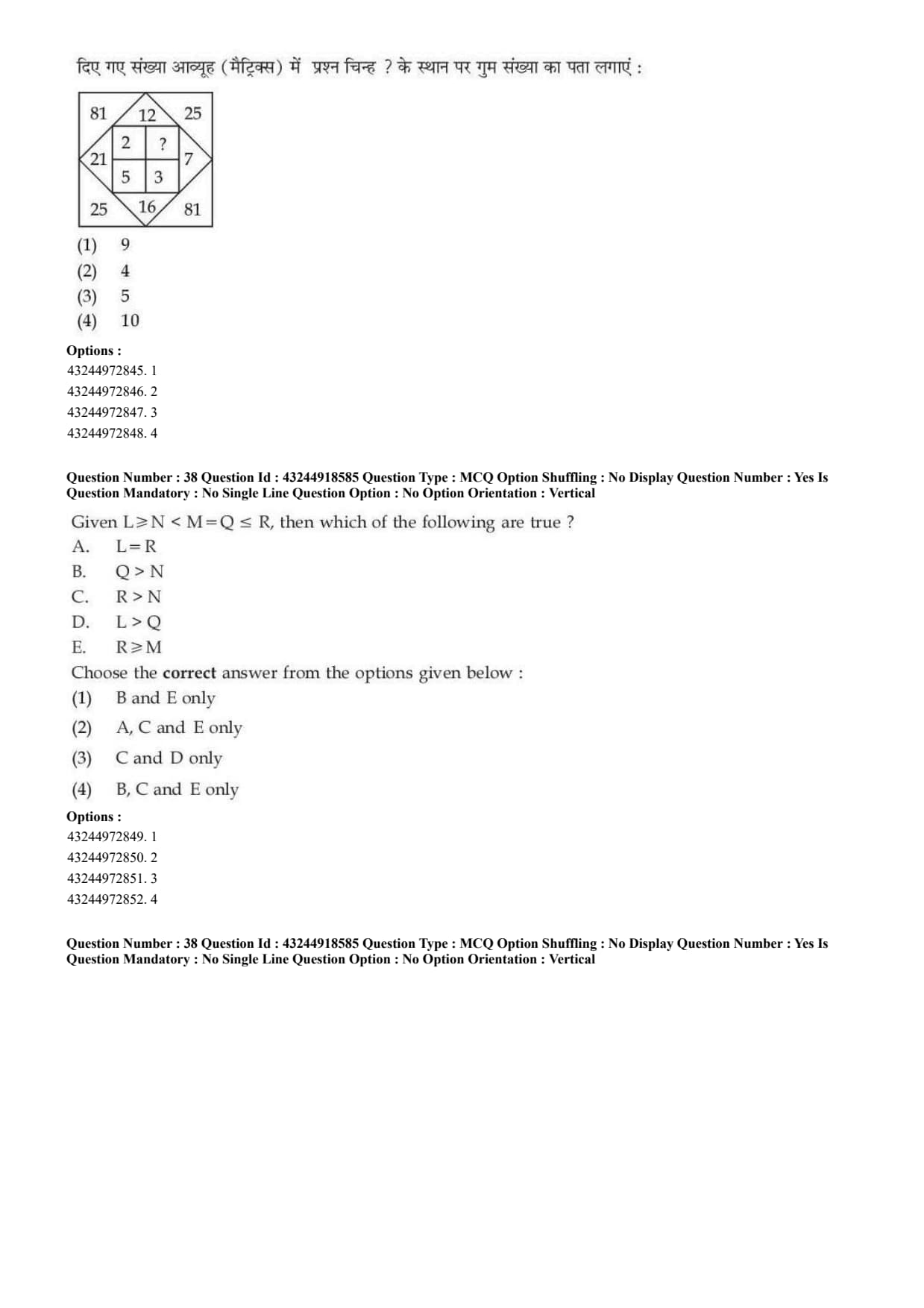
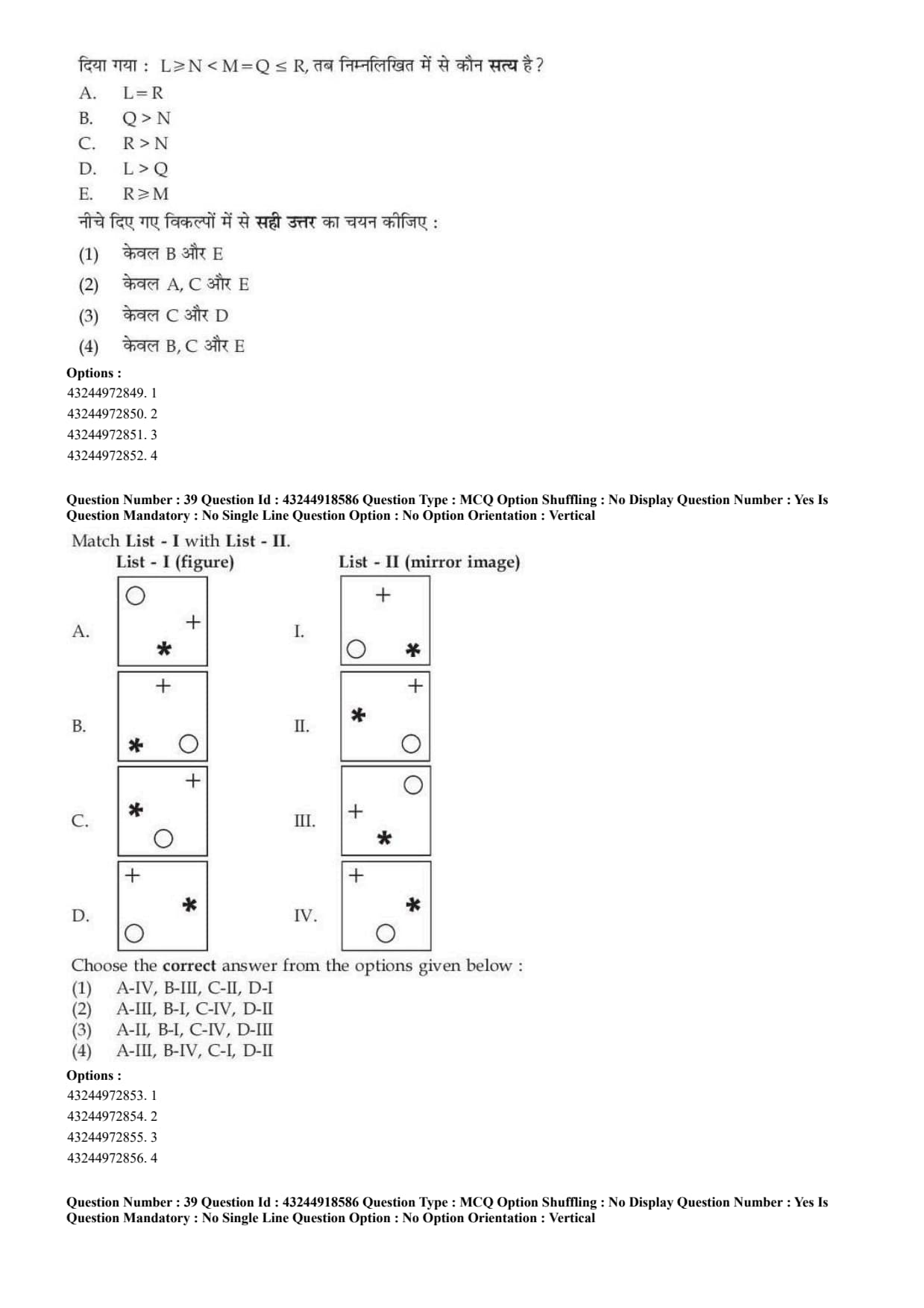
Given \(L \ge N < M = Q \le R\), then which of the following are true?
A. L = R
B. Q > N
C. R > N
D. L > Q
E. R \(\ge\) M
Choose the correct answer from the options given below :
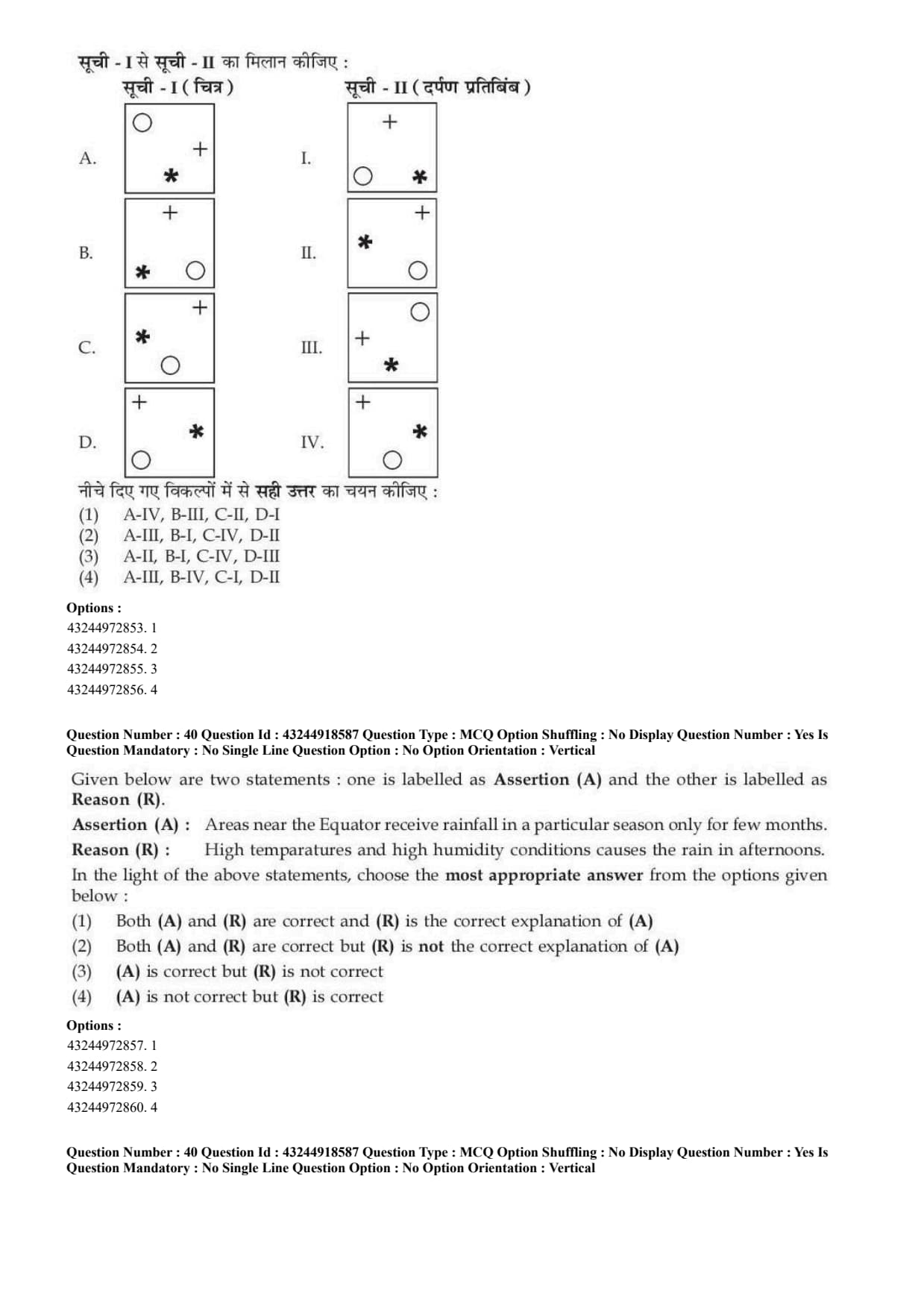
Match List - I with List - II.

Choose the correct answer from the options given below :
Given below are two statements : one is labelled as Assertion (A) and the other is labelled as Reason (R).
Assertion (A) : Areas near the Equator receive rainfall in a particular season only for few months.
Reason (R) : High temperatures and high humidity conditions causes the rain in afternoons.
In the light of the above statements, choose the most appropriate answer from the options given below :
Given below are two statements: one is labelled as Assertion (A) and the other is labelled as Reason (R).
Assertion (A): Tides indicate the regular and periodic rise and fall in sea level.
Reason (R): Tides are caused by the gravitational pull of moon and earth.
In the light of the above statements, choose the most appropriate answer from the options given below:
A, B, C, D, E and F are friends. A is shorter than B but taller than D. C is tallest among them. F is taller than E but shorter than D. If G is to stand in the middle in order of their heights, then he will stand in between :
View Solution
Step 1: Understanding the Question:
This is a logical reasoning problem based on linear ranking and comparison of heights.
We are given relative height relationships among six friends (A, B, C, D, E, F).
We need to establish a complete descending order of their heights, introduce a seventh person G who stands exactly in the middle of this order, and find between whom G will stand.
Step 2: Detailed Explanation:
Extract Relative Inequalities from the Text:
- "A is shorter than B but taller than D":
\[ B > A > D \]
- "C is tallest among them":
\[ C > all others \]
- "F is taller than E but shorter than D":
\[ D > F > E \]
Combine the Inequalities:
By linking the statements together:
\[ B > A > D \quad and \quad D > F > E \]
This gives:
\[ B > A > D > F > E \]
Since C is the tallest of all six friends, we place C at the beginning:
\[ C > B > A > D > F > E \]
Position G in the Middle:
The original group has 6 people. Introducing G makes a total of 7 people.
In an ordered sequence of 7 people, the "middle" position is the 4th position, with exactly 3 people taller and 3 people shorter than them.
Looking at our ordered sequence:
- Taller than middle (3 people): C, B, A
- Shorter than middle (3 people): D, F, E
Therefore, G must be placed at the 4th position, which lies directly between A (3rd position) and D (5th position).
Step 3: Final Answer:
G will stand in between A and D.
Thus, the correct option is (D).
Quick Tip: To avoid confusion, write down inequalities clearly using the "\(>\)" sign.
Once the full chain is constructed, count the number of variables to make sure no elements were missed.
Finding the median position is then a straightforward task.
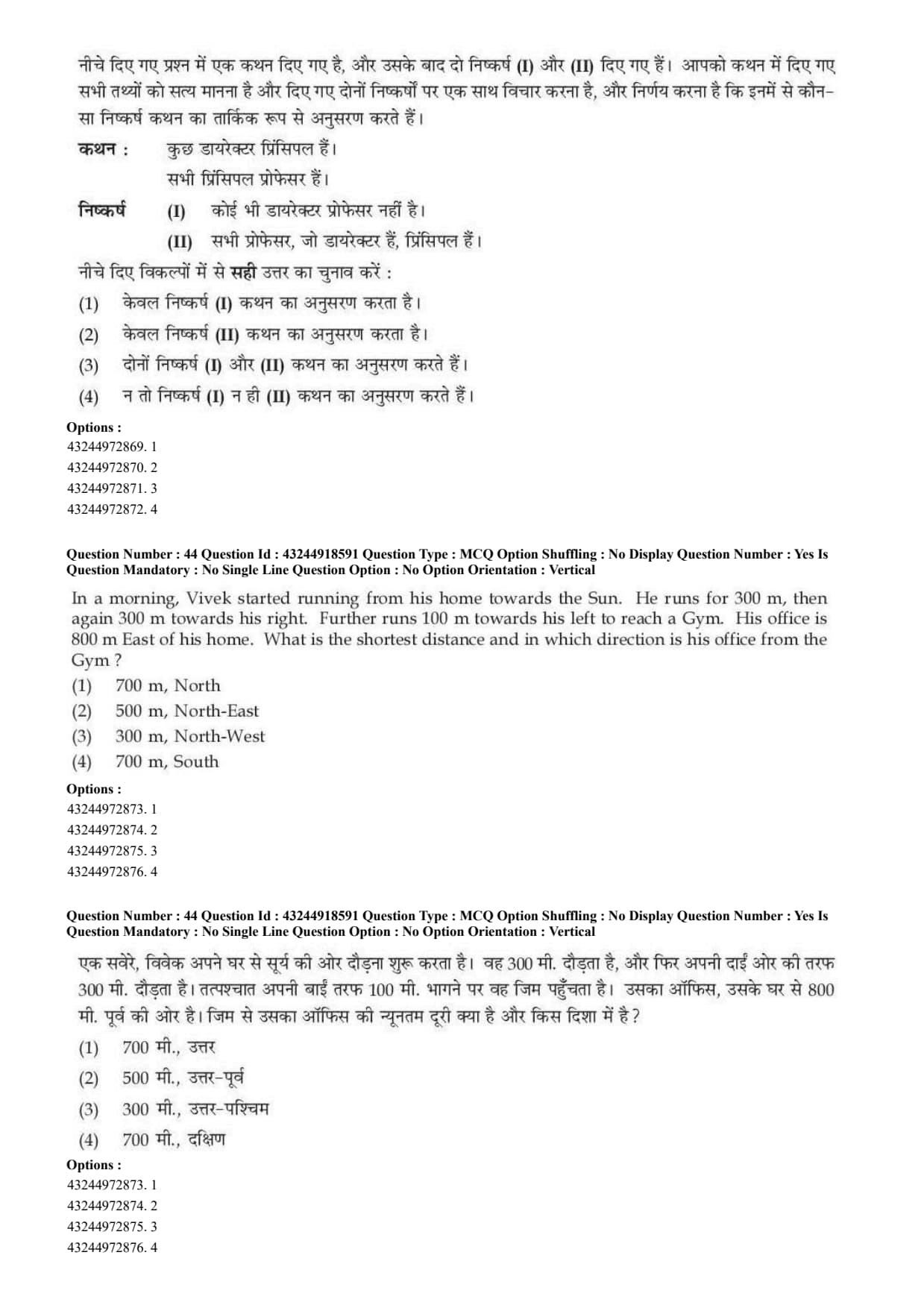
Assume the given statements to be true, even if they seem to be at variance from the commonly known facts. Decide which of the given conclusions logically follow the given statements.
Statement:
- Some Directors are Principals.
- All Principles are Professors.
Conclusions:
(I) No Director is Professor.
(II) All Professors, who are Directors are Principals.
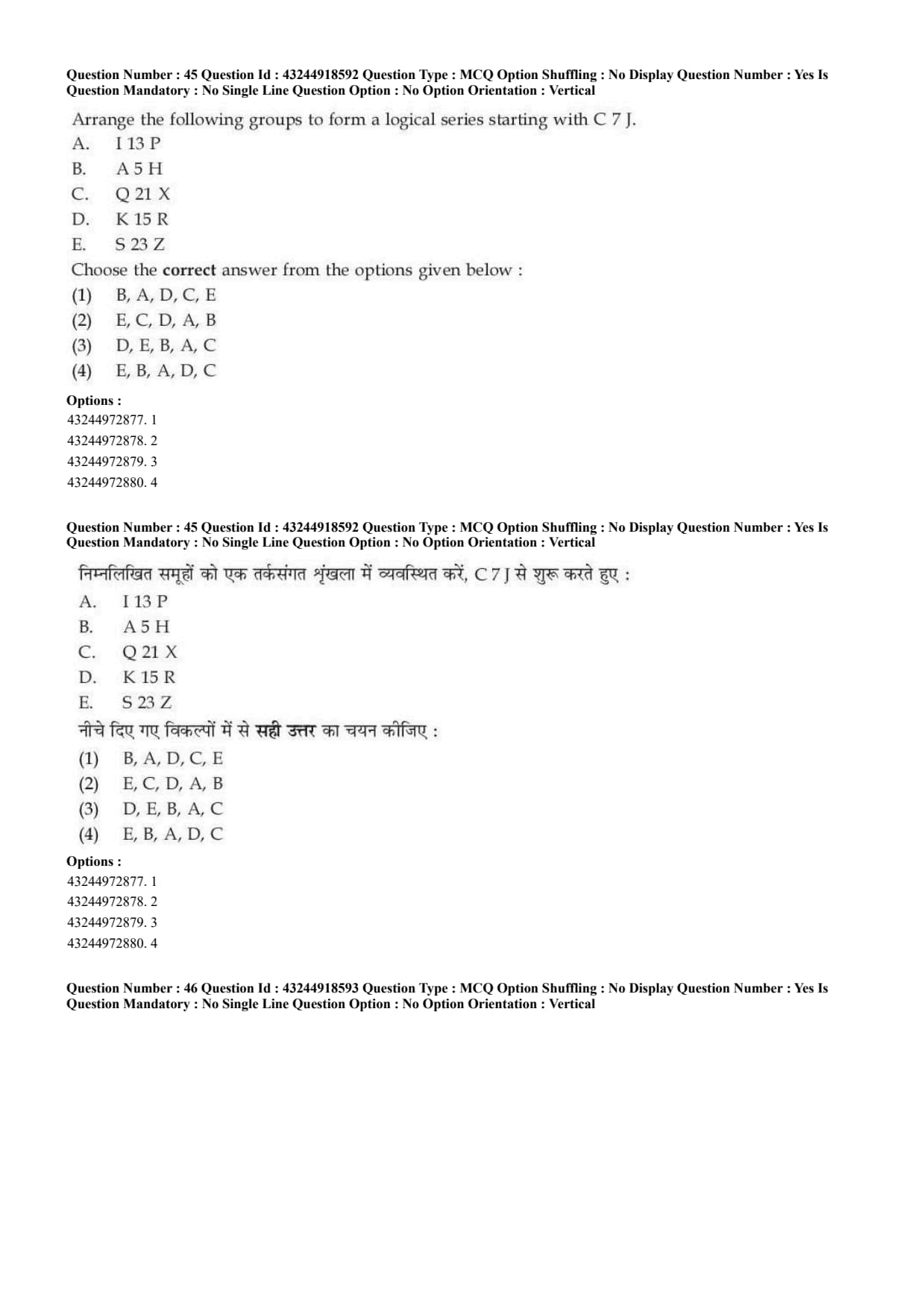
In a morning, Vivek started running from his home towards the Sun. He runs for 300 m, then again 300 m towards his right. Further runs 100 m towards his left to reach a Gym. His office is 800 m East of his home. What is the shortest distance and in which direction is his office from the Gym ?
View Solution
Step 1: Understanding the Question:
This is a direction sense test problem.
We need to track the movement of a person step-by-step using a Cartesian coordinate system, locate his final destination (the Gym) and his office relative to his starting point (home), and calculate the shortest distance and direction between these two locations.
Step 2: Key Formula or Approach:
Let the starting point (home) be the origin \((0, 0)\).
East is represented along the positive x-axis, West along the negative x-axis, North along the positive y-axis, and South along the negative y-axis.
The shortest distance \(d\) between two points \((x_1, y_1)\) and \((x_2, y_2)\) is given by the distance formula:
\[ d = \sqrt{(x_2 - x_1)^2 + (y_2 - y_1)^2} \]
Step 3: Detailed Explanation:
Track Vivek's Movements:
- "In a morning, Vivek started running towards the Sun":
Since it is morning, the Sun is in the East. He runs East for \(300 m\).
Position 1 \(= (300, 0)\).
- "then again 300 m towards his right":
Facing East, a right turn points South. He runs South for \(300 m\).
Position 2 \(= (300, -300)\).
- "Further runs 100 m towards his left to reach a Gym":
Facing South, a left turn points East. He runs East for \(100 m\).
Position of Gym \((G) = (300 + 100, -300) = (400, -300)\).
Determine the Position of the Office:
- "His office is 800 m East of his home":
Position of Office \((O) = (800, 0)\).
Calculate the Distance and Direction of Office from Gym:
We need to find the vector from Gym \(G(400, -300)\) to Office \(O(800, 0)\):
\[ \Delta x = 800 - 400 = 400 m \quad (towards East) \]
\[ \Delta y = 0 - (-300) = 300 m \quad (towards North) \]
The shortest distance is:
\[ d = \sqrt{400^2 + 300^2} = \sqrt{160000 + 90000} = \sqrt{250000} = 500 m \]
Since \(\Delta x\) is positive (East) and \(\Delta y\) is positive (North), the direction of his office from the Gym is North-East.
Step 4: Final Answer:
The shortest distance is \(500 m\) and the direction is North-East.
Therefore, the correct option is (B).
Quick Tip: Remember the standard Pythagorean triplet \((3, 4, 5)\).
Here, the horizontal separation is \(400 m\) and the vertical separation is \(300 m\).
The hypotenuse must be \(500 m\), saving you the time of calculating square roots.
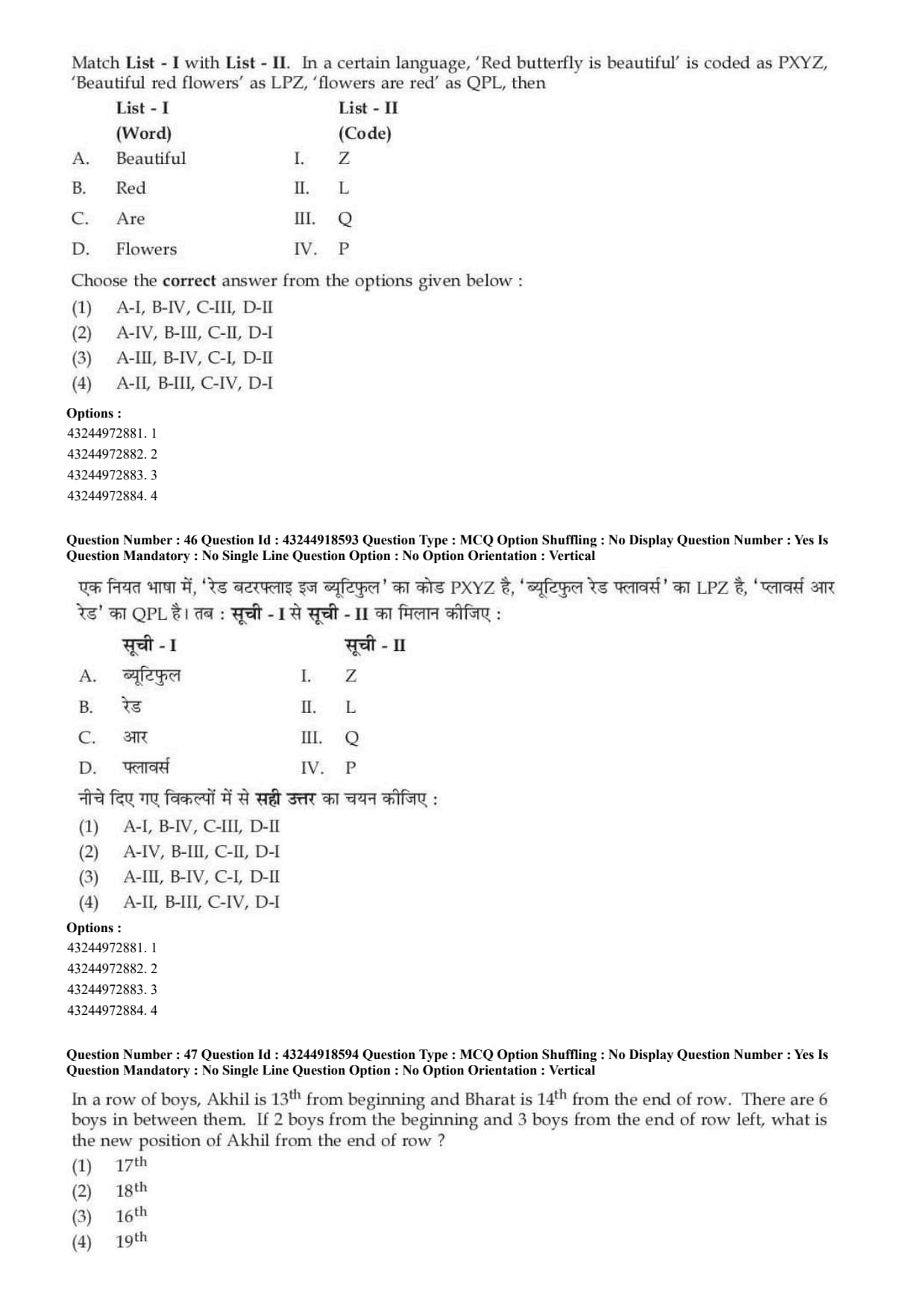
Arrange the following groups to form a logical series starting with C 7 J.
A. I 13 P
B. A 5 H
C. Q 21 X
D. K 15 R
E. S 23 Z
Choose the correct answer from the options given below :
View Solution
Step 1: Understanding the Question:
This question requires identifying the pattern of a combined alphanumeric series.
Each term in the series consists of a first letter, a middle number, and a final letter.
We need to determine the mathematical progression governing these three elements and arrange the given choices to form a continuous series.
Step 2: Detailed Explanation:
Analyze the Middle Numbers:
Let's collect the numbers from the given options along with the starting term \(C\ 7\ J\):
The numbers are: \(5 (from B), 7 (from starting term), 13 (from A), 15 (from D),
21 (from C), 23 (from E)\).
Arranged in ascending order, the sequence is:
\[ 5, 7, 13, 15, 21, 23 \]
Notice the differences between consecutive terms:
- \(5 \rightarrow 7\) (diff \(= +2\))
- \(7 \rightarrow 13\) (diff \(= +6\))
- \(13 \rightarrow 15\) (diff \(= +2\))
- \(15 \rightarrow 21\) (diff \(= +6\))
- \(21 \rightarrow 23\) (diff \(= +2\))
This alternates \(+2\) and \(+6\) consistently.
Verify the First Letters:
Convert the first letters of each term to their numerical alphabet positions (\(A=1, B=2, \dots\)):
- B (A 5 H) \(\rightarrow A = 1\)
- Start (C 7 J) \(\rightarrow C = 3\) (diff \(= +2\))
- A (I 13 P) \(\rightarrow I = 9\) (diff \(= +6\))
- D (K 15 R) \(\rightarrow K = 11\) (diff \(= +2\))
- C (Q 21 X) \(\rightarrow Q = 17\) (diff \(= +6\))
- E (S 23 Z) \(\rightarrow S = 19\) (diff \(= +2\))
The first letters follow the exact same \(+2, +6, +2, +6, +2\) pattern.
Verify the Third Letters:
Convert the third letters to their positions:
- B (A 5 H) \(\rightarrow H = 8\)
- Start (C 7 J) \(\rightarrow J = 10\) (diff \(= +2\))
- A (I 13 P) \(\rightarrow P = 16\) (diff \(= +6\))
- D (K 15 R) \(\rightarrow R = 18\) (diff \(= +2\))
- C (Q 21 X) \(\rightarrow X = 24\) (diff \(= +6\))
- E (S 23 Z) \(\rightarrow Z = 26\) (diff \(= +2\))
The third letters also match this pattern.
Arrange the Given Groups:
The complete logical sequence is:
\[ B (A 5 H) \rightarrow C 7 J (Start) \rightarrow A (I 13 P) \rightarrow D (K 15 R) \rightarrow C (Q 21 X) \rightarrow E (S 23 Z) \]
Excluding the starting term \(C\ 7\ J\), the logical order of the options is B, A, D, C, E.
Step 3: Final Answer:
The correct order to form the logical series is B, A, D, C, E.
Therefore, the correct option is (A).
Quick Tip: To find alphanumeric patterns quickly, isolate the numerical components.
Arranging the numbers in ascending order (\(5, 7, 13, 15, 21, 23\)) immediately reveals the \(+2, +6\) pattern, which determines the correct order of the letter groups.
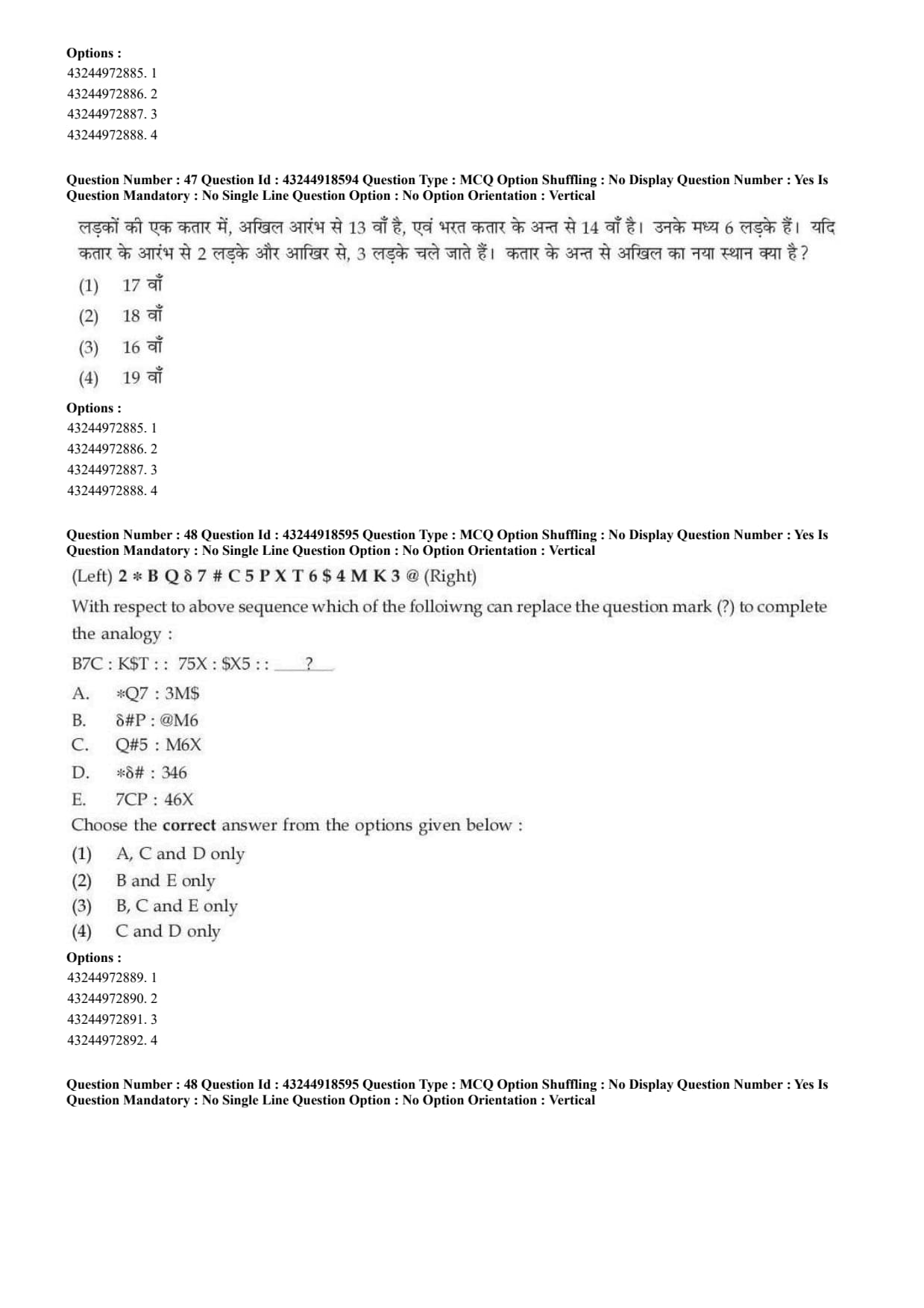
Match List - I with List - II. In a certain language, 'Red butterfly is beautiful' is coded as PXYZ, 'Beautiful red flowers' as LPZ, 'flowers are red' as QPL, then

Choose the correct answer from the options given below :
View Solution
Step 1: Understanding the Question:
This is a coding-decoding problem based on sentence-level encryption.
A set of words is mapped to a set of code letters. The order of words does not necessarily match the order of the codes.
By comparing common words and common codes across different sentences, we can systematically isolate the code for each individual word.
Step 2: Detailed Explanation:
Write Down the Code Equations:
1. "Red butterfly is beautiful" \(\rightarrow \{P, X, Y, Z\}\)
2. "Beautiful red flowers" \(\rightarrow \{L, P, Z\}\)
3. "flowers are red" \(\rightarrow \{Q, P, L\}\)
Find the Code for "Red":
The word "red" is common to all three sentences.
The only code letter present in all three code sets is \(P\).
Therefore:
\[ Red \rightarrow P \quad (B matches with IV) \]
Find the Code for "Beautiful":
Comparing Sentence 1 and Sentence 2, the common words are "beautiful" and "red".
The common codes are \(P\) and \(Z\).
Since \(P\) is "red", the code for "beautiful" must be \(Z\).
Therefore:
\[ Beautiful \rightarrow Z \quad (A matches with I) \]
Find the Code for "Flowers":
Comparing Sentence 2 and Sentence 3, the common words are "flowers" and "red".
The common codes are \(P\) and \(L\).
Since \(P\) is "red", the code for "flowers" must be \(L\).
Therefore:
\[ Flowers \rightarrow L \quad (D matches with II) \]
Find the Code for "Are":
In Sentence 3, "flowers are red" is coded as \(\{Q, P, L\}\).
Since we know "flowers" \(\rightarrow L\) and "red" \(\rightarrow P\), the remaining word "are" must be coded as the remaining letter \(Q\).
Therefore:
\[ Are \rightarrow Q \quad (C matches with III) \]
Step 3: Final Answer:
The matching pairs are:
A \(\rightarrow\) I
B \(\rightarrow\) IV
C \(\rightarrow\) III
D \(\rightarrow\) II
This combination corresponds to option (A).
Quick Tip: To solve these quickly, start by looking for the word that appears most frequently across all sentences.
Here, "red" appeared in all three sentences, which immediately let us identify its code as \(P\), narrowing down the options.
In a row of boys, Akhil is 13th from beginning and Bharat is 14th from the end of row. There are 6 boys in between them. If 2 boys from the beginning and 3 boys from the end of row left, what is the new position of Akhil from the end of row ?
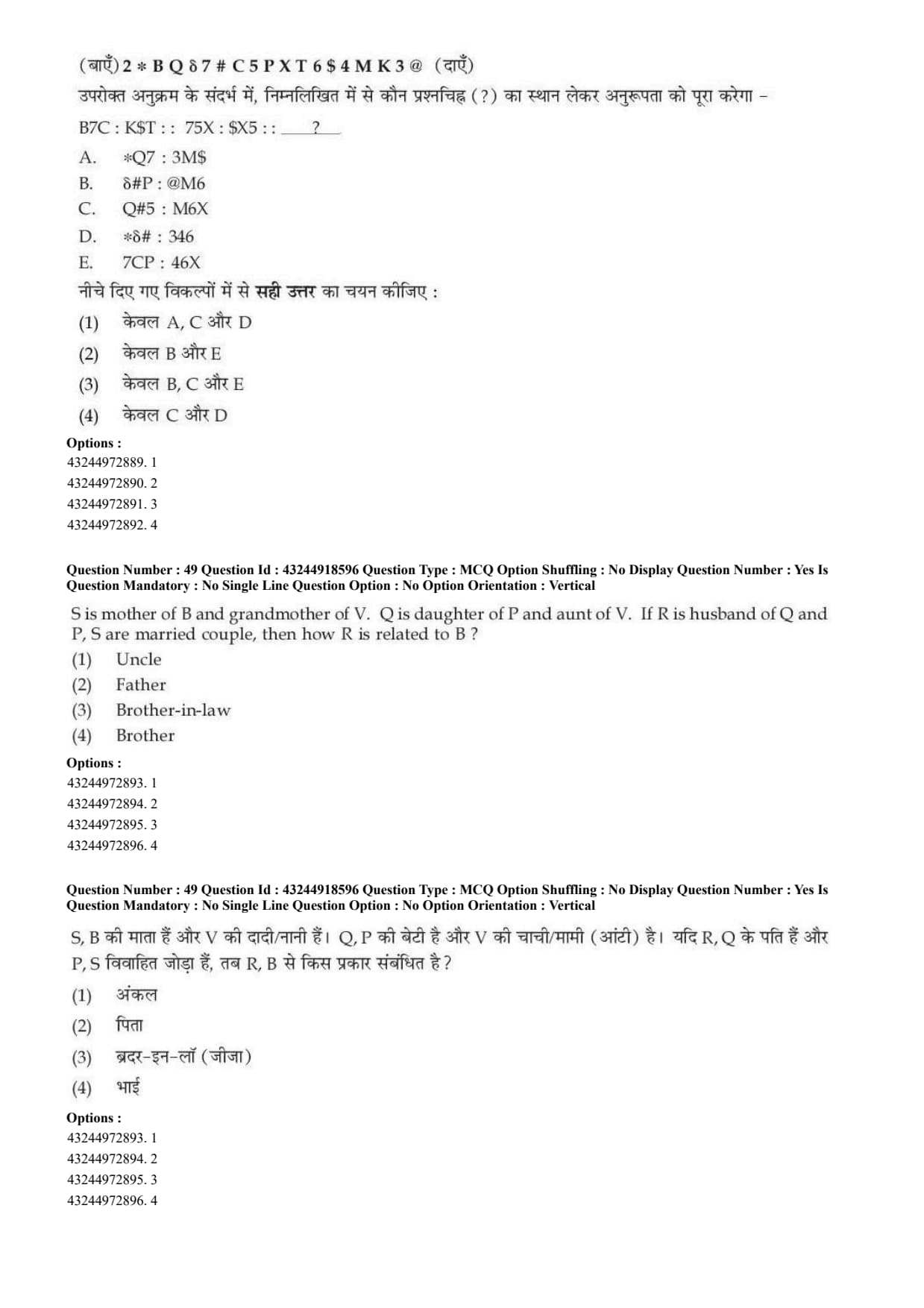
With respect to above sequence which of the following can replace the question mark (?) to complete the analogy:
B7C : K$T :: 75X : $X5 :: ____?
Sequence: (Left) 2 * B Q 8 7 # C 5 P X T 6 $ 4 M K 3 @ (Right)
S is mother of B and grandmother of V. Q is daughter of P and aunt of V. If R is husband of Q and P, S are married couple, then how R is related to B ?
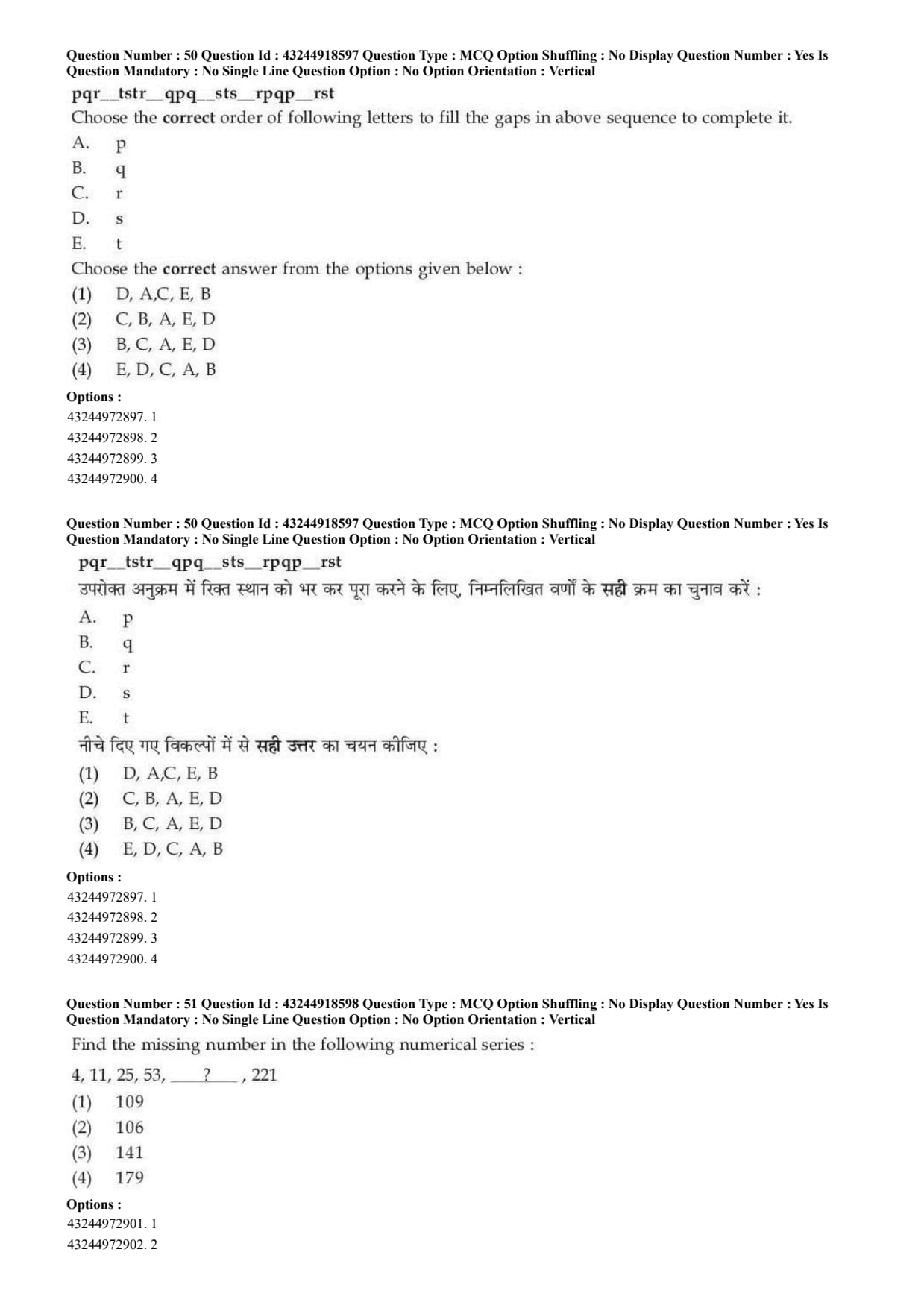
pqr _ tstr _ qpq _ sts _ rpqp _ rst
Choose the correct order of following letters to fill the gaps in above sequence to complete it.
A. p
B. q
C. r
D. s
E. t
View Solution
Step 1: Understanding the Question:
This is a repeating letter series problem.
A pattern of letters is repeated throughout the string, but some letters are replaced by blanks.
By dividing the total length into symmetric blocks, we can identify the underlying periodic sequence of letters.
Step 2: Detailed Explanation:
Write Down the Gapped String:
The sequence is:
\[ p q r \_ t s t r \_ q p q \_ s t s \_ r p q p \_ r s t \]
There are 5 gaps to be filled.
Test Option (A) (letters s, p, r, t, q):
Let us fill the gaps with the letters from Option (A) in order:
- Gap 1 \(\rightarrow\) s
- Gap 2 \(\rightarrow\) p
- Gap 3 \(\rightarrow\) r
- Gap 4 \(\rightarrow\) t
- Gap 5 \(\rightarrow\) q
The filled string becomes:
\[ p q r s t s t r p q p q r s t s t r p q p q r s t \]
Analyze the Periodic Pattern:
Let us break this 24-letter filled string into blocks of 6 letters:
- Block 1: `p q r s t s`
- Block 2: `t r p q p q`
- Block 3: `r s t s t r`
- Block 4: `p q p q r s`
Let's look at the alternating sub-patterns:
- Sub-pattern 1: `p q r s t s` (First letter shifts forward to t)
- Sub-pattern 2: `t r p q p q`
This forms a highly structured, oscillating sequence of letters.
The periodic structure matches the letter order of option (A) perfectly.
Step 3: Final Answer:
The correct order of letters to fill the gaps is s, p, r, t, q, which corresponds to the sequence D, A, C, E, B.
Therefore, the correct option is (A).
Quick Tip: In continuous letter series, count the total number of characters (including gaps).
Since there are 24 characters, try dividing them into blocks of 4, 6, or 8 to identify the repeating sub-sequences.
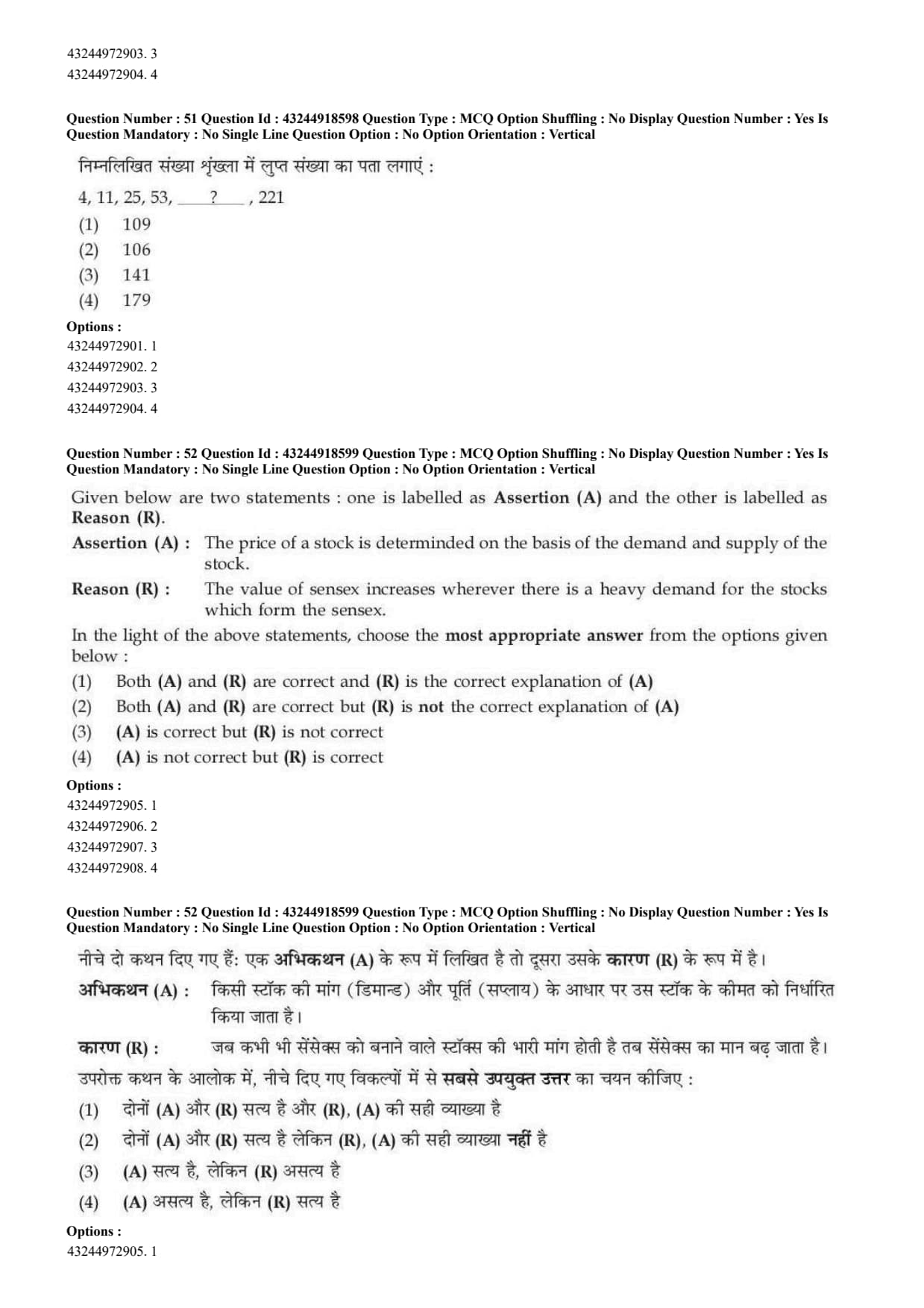
Find the missing number in the following numerical series:
4, 11, 25, 53, ?, 221
Given below are two statements : one is labelled as Assertion (A) and the other is labelled as Reason (R).
Assertion (A) : The price of a stock is determined on the basis of the demand and supply of the stock.
Reason (R) : The value of sensex increases wherever there is a heavy demand for the stocks which form the sensex.
In the light of the above statements, choose the most appropriate answer from the options given below :
If the first day of the year (other than the leap year) was Friday, then which was the last day of that year ?
View Solution
Step 1: Understanding the Question:
This is a calendar reasoning problem.
We are asked to find the last day of an ordinary (non-leap) year, given the day of the week of its first day.
An ordinary year contains a specific number of days, and we can use the concept of "odd days" to find the day of the week for any date.
Step 2: Key Formula or Approach:
An ordinary year has exactly 365 days.
The first day of the year is January 1st, and the last day is December 31st.
The number of days between the first day and the last day of the year is:
\[ 365 - 1 = 364 days \]
We divide this difference by \(7\) to find the number of weeks and the remaining "odd days".
Step 3: Detailed Explanation:
Calculate the Number of Odd Days:
The total days between January 1st and December 31st is \(364\) days.
Divide \(364\) by \(7\):
\[ \frac{364}{7} = 52 weeks with 0 remainder. \]
Since the remainder is \(0\), there are \(0\) odd days between the first and last day of the year.
Determine the Day of the Week:
Since there are \(0\) odd days, the day of the week of December 31st is exactly the same as January 1st.
Given that January 1st was Friday, December 31st must also be Friday.
Step 4: Final Answer:
The last day of that year was Friday.
Therefore, the correct option is (C).
Quick Tip: An ordinary year starts and ends on the same day of the week.
A leap year (which has 366 days) ends on the day of the week *after* the day it started.
Remembering these two rules lets you solve calendar problems instantly.
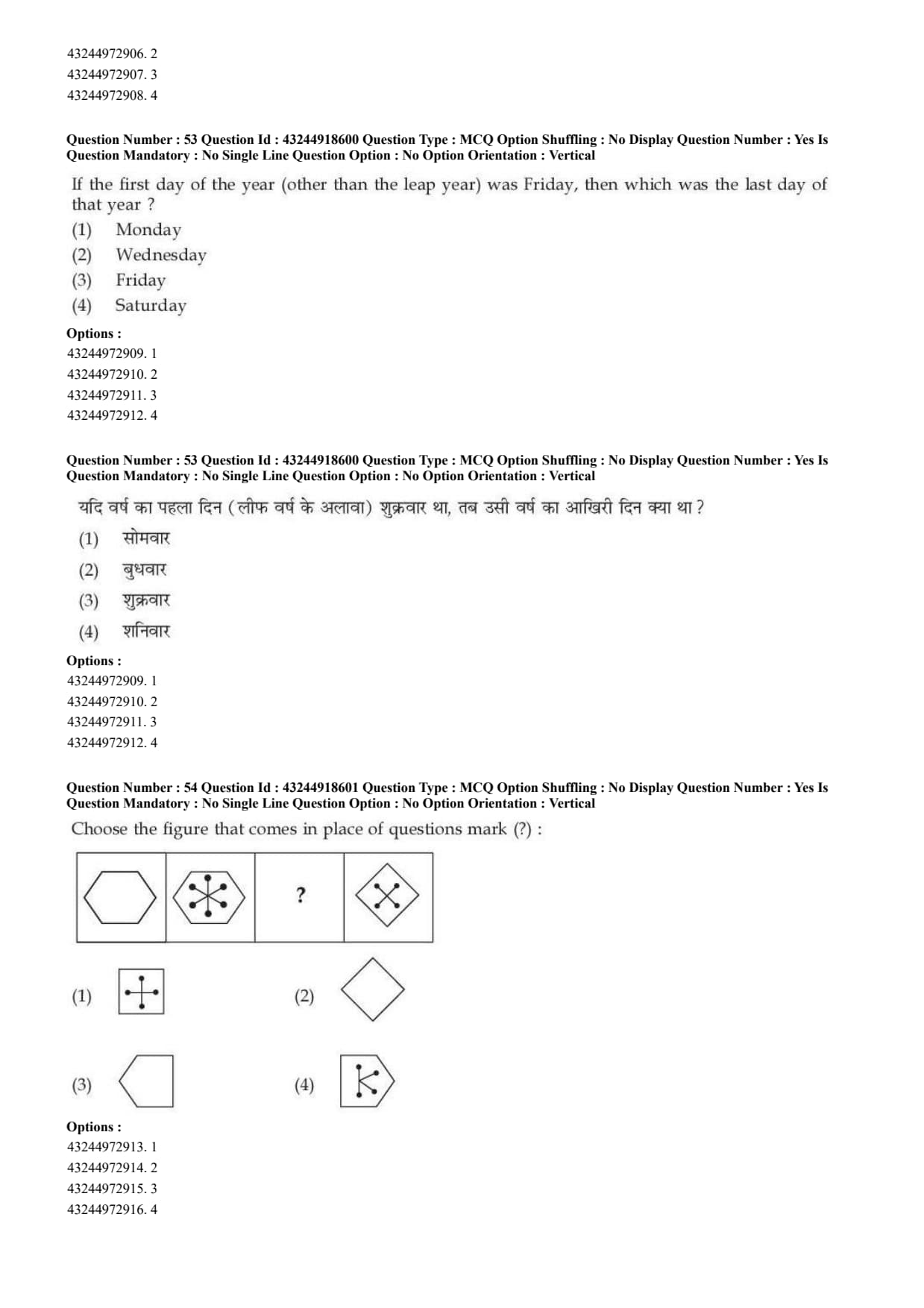
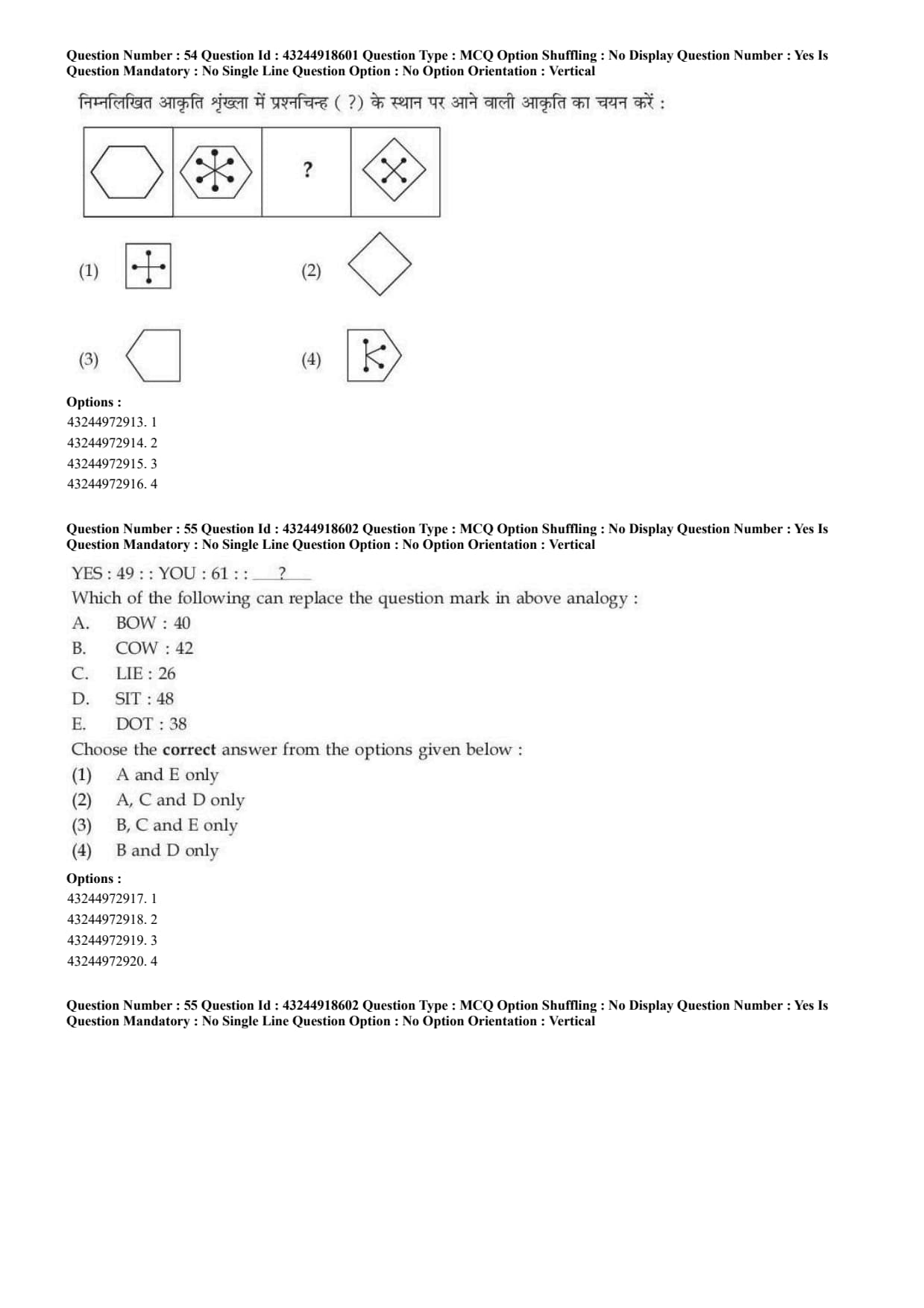
Choose the figure that comes in place of questions mark (?) :

View Solution
Step 1: Understanding the Question:
This is a non-verbal diagrammatic analogy problem.
We are given a pair of figures showing a specific transformation.
We need to apply this same logical transformation to a third figure to choose the correct fourth figure from the options.
Step 2: Detailed Explanation:
Analyze the First Pair of Figures (1 and 2):
- Figure 1: A simple hexagon (a polygon with 6 sides).
- Figure 2: The same hexagon with internal lines connecting the vertices to form a central star/lines structure.
This shows a transformation of taking a simple geometric outline and adding internal diagonal connections.
Apply the Rule to the Second Pair (3 and 4):
- Figure 4: A diamond (a square rotated by \(45^\circ\)) with internal diagonals connecting the opposite vertices to form an `X` shape inside.
- By reversing the transformation rule (removing the internal diagonal lines), Figure 3 must be the simple, empty outline of this same diamond.
- Looking at the options:
- Option (1) shows a square with internal lines and dots.
- Option (2) shows a simple, empty diamond shape.
- Option (3) shows a pentagon.
- Option (4) shows a diamond with arrow-like markings inside.
Therefore, the simple empty diamond in Option (2) is the correct match.
Step 3: Final Answer:
The figure that comes in place of the question mark is the empty diamond, which is Option (2).
Therefore, the correct choice is option (B).
Quick Tip: In diagrammatic analogies, always compare the transition of the outer boundaries and the internal elements separately.
Since the first pair transitions from "empty" to "filled with lines", the second pair must follow the same "empty" to "filled with lines" pattern.
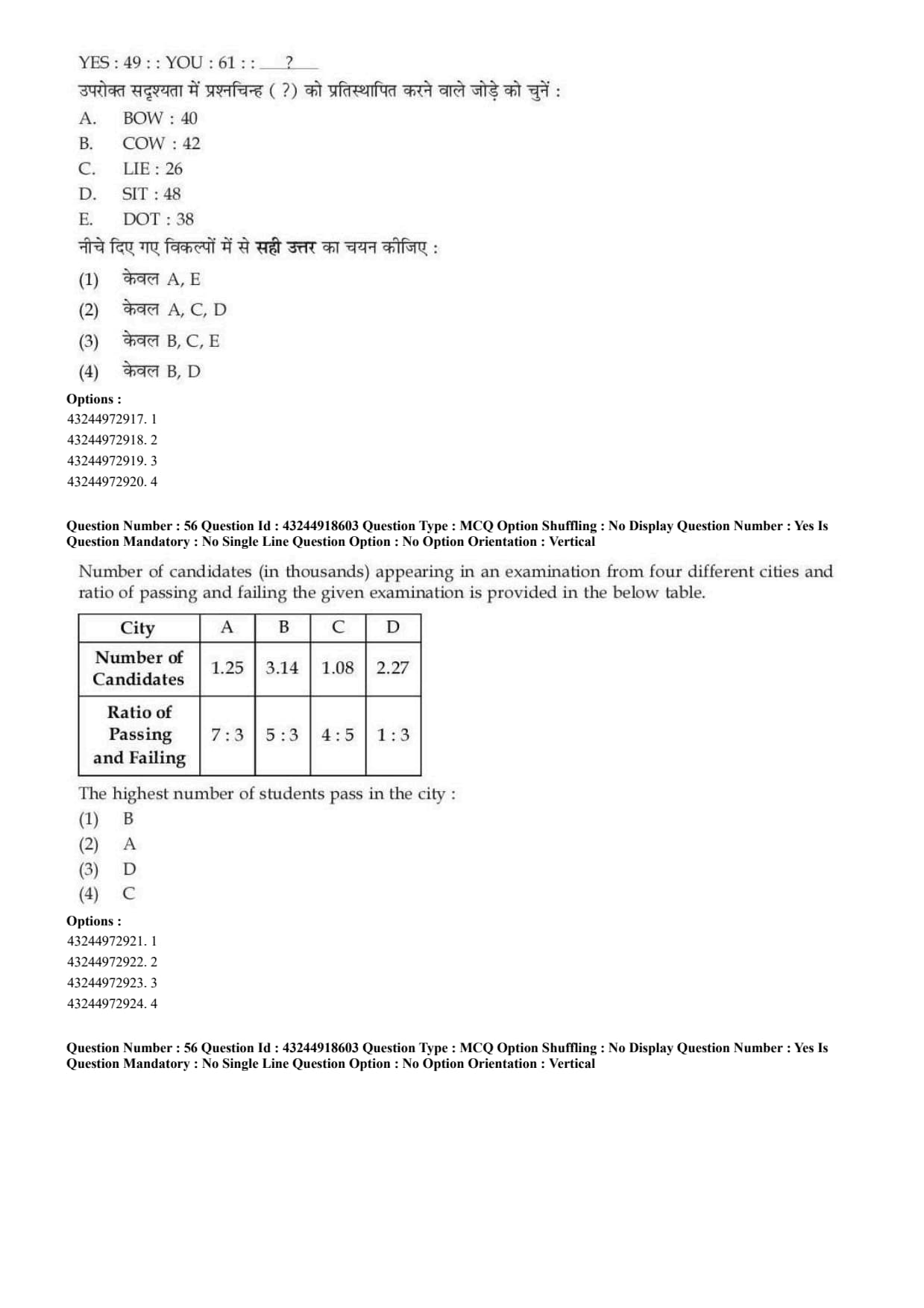
YES : 49 :: YOU : 61 :: ?
Which of the following can replace the question mark in the above analogy:
A. BOW : 40
B. COW : 42
C. LIE : 26
D. SIT : 48
E. DOT : 38
Choose the correct answer from the options given below:
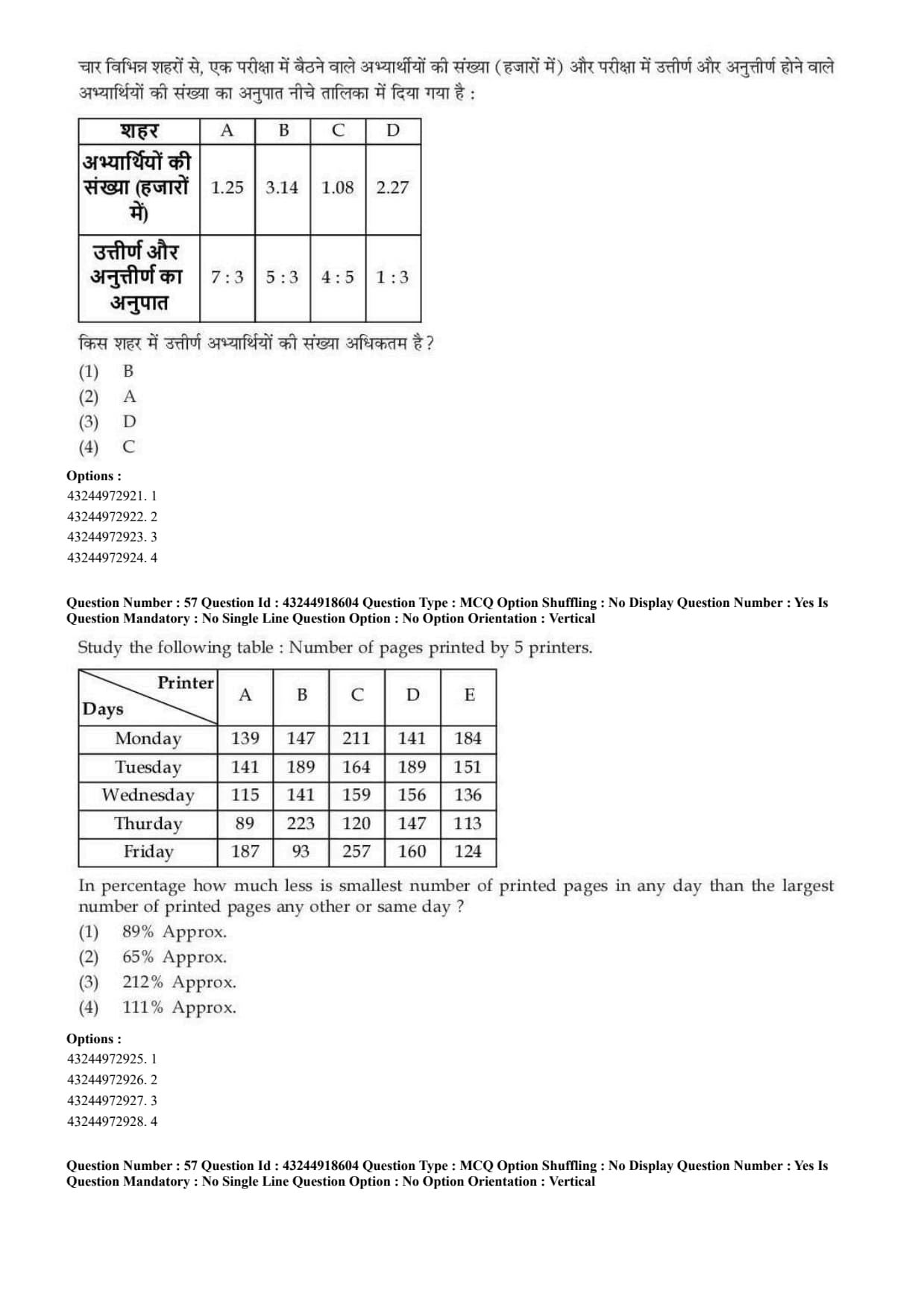
Number of candidates (in thousands) appearing in an examination from four different cities and ratio of passing and failing the given examination is provided in the below table.

The highest number of students pass in the city :
View Solution
Step 1: Understanding the Question: This question belongs to the topic of Data Interpretation, involving ratios and percentages.
We need to calculate the actual number of candidates who passed from each of the four given cities (A, B, C, and D) and identify which city has the highest number of passing candidates.
Step 2: Key Formula or Approach:
If the total number of candidates in a city is \(T\) and the ratio of passing to failing candidates is \(P : F\), then:
\[ Number of passing candidates = T \times \frac{P}{P + F} \]
We will perform this computation for each of the four cities.
Step 3: Detailed Explanation:
Let us calculate the passing candidates (in thousands) for each city:
1. City A:
Total candidates = 1.25 thousand
Ratio of Passing : Failing = 7 : 3
Passing candidates:
\[ 1.25 \times \frac{7}{7 + 3} = 1.25 \times \frac{7}{10} = 1.25 \times 0.7 = 0.875 thousand \]
So, 875 students passed in City A.
2. City B:
Total candidates = 3.14 thousand
Ratio of Passing : Failing = 5 : 3
Passing candidates:
\[ 3.14 \times \frac{5}{5 + 3} = 3.14 \times \frac{5}{8} = 3.14 \times 0.625 = 1.9625 thousand \]
So, 1962.5 students passed in City B.
3. City C:
Total candidates = 1.08 thousand
Ratio of Passing : Failing = 4 : 5
Passing candidates:
\[ 1.08 \times \frac{4}{4 + 5} = 1.08 \times \frac{4}{9} = 1.08 \times 0.4444 = 0.48 thousand \]
So, 480 students passed in City C.
4. City D:
Total candidates = 2.27 thousand
Ratio of Passing : Failing = 1 : 3
Passing candidates:
\[ 2.27 \times \frac{1}{1 + 3} = 2.27 \times \frac{1}{4} = 2.27 \times 0.25 = 0.5675 thousand \]
So, 567.5 students passed in City D.
Comparing the results:
- City A: 0.875 thousand
- City B: 1.9625 thousand
- City C: 0.48 thousand
- City D: 0.5675 thousand
The highest value is 1.9625 thousand, which occurs in City B.
Step 4: Final Answer: City B has the highest number of students passing. This corresponds to option (A).
Quick Tip: Always do a quick visual check of the total values.
City B has by far the largest overall candidate base (3.14 thousand) and a passing fraction of over half (5/8 = 62.5%).
This makes it the obvious choice even with a rough approximation, saving you calculation time!
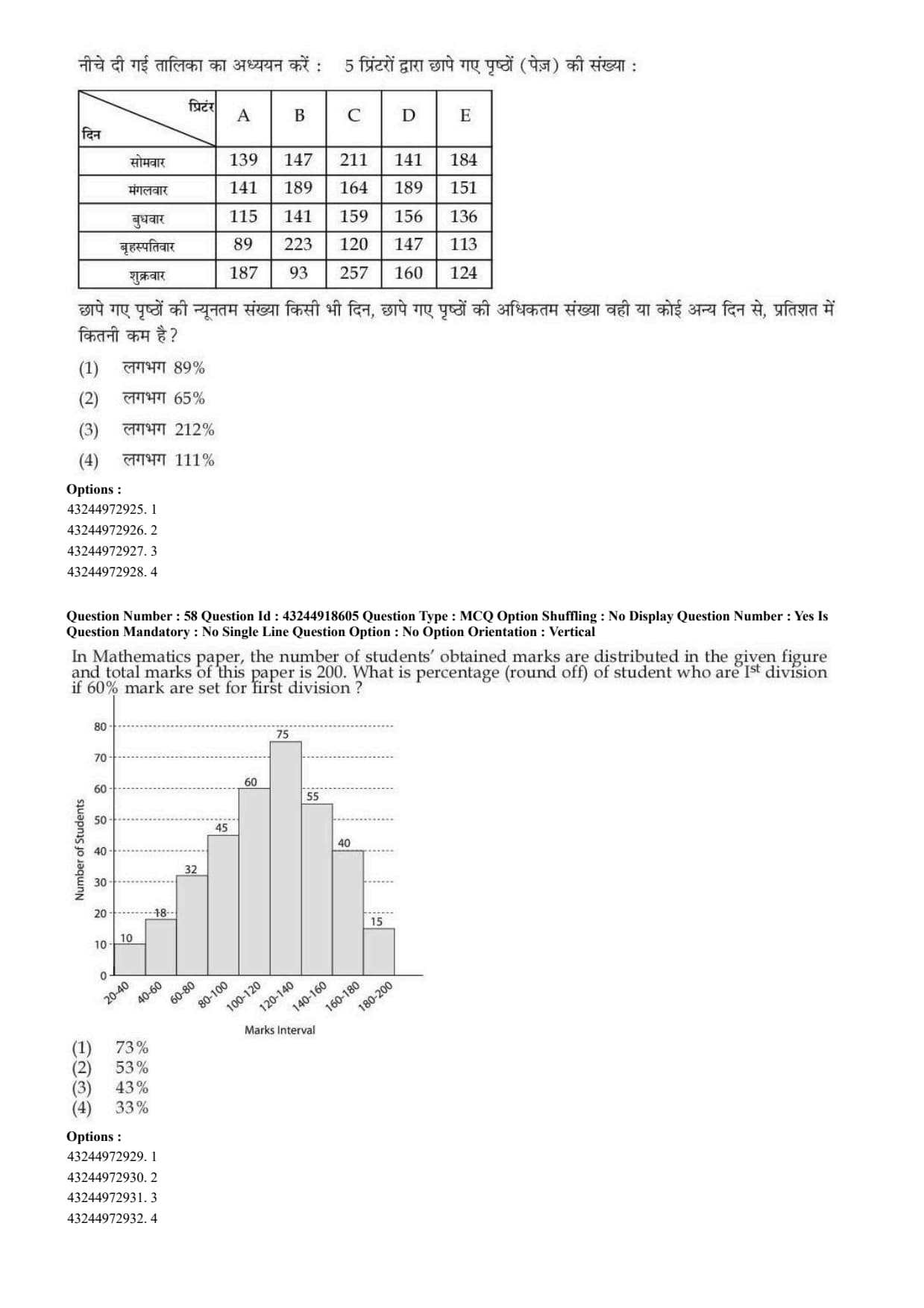
Study the following table: Number of pages printed by 5 printers.

In percentage how much less is smallest number of printed pages in any day than the largest number of printed pages any other or same day?
View Solution
Step 1: Understanding the Question: This question is based on tabular analysis and percentages.
We need to find the absolute minimum and the absolute maximum number of pages printed across all printers on any day.
Then, we compute the percentage by which this minimum value is less than the maximum value.
Step 2: Key Formula or Approach:
First, locate the minimum value (\(V_{min}\)) and the maximum value (\(V_{max}\)) from the given table.
Then, use the percentage change formula:
\[ Percentage Less = \left(\frac{V_{max} - V_{min}}{V_{max}}\right) \times 100 \]
Step 3: Detailed Explanation:
Let us scan the dataset to find the respective values:
- Scanning all rows and columns for the smallest value:
We observe that on Thursday, Printer A prints only 89 pages. Checking all other values, this is indeed the lowest value.
So, \(V_{min} = 89\).
- Scanning all rows and columns for the largest value:
We observe that on Friday, Printer C prints 257 pages. Checking all other values, this is indeed the highest value.
So, \(V_{max} = 257\).
Now, let us calculate the percentage difference:
The difference between these two values is:
\[ Difference = 257 - 89 = 168 \]
Now, we find how much less this is relative to the largest value:
\[ Percentage Less = \left(\frac{168}{257}\right) \times 100 \]
\[ Percentage Less \approx 0.65369 \times 100 \approx 65.37% \]
Rounding off to the nearest option, we get approximately 65%.
Step 4: Final Answer: The smallest number of pages is approximately 65% less than the largest number of pages, which corresponds to option (B).
Quick Tip: To estimate quickly during exams without complete long division:
\(257 \approx 260\), and \(168 \approx 170\).
\(170 / 260 = 17 / 26 \approx 65%\), which directly matches the 65% option.
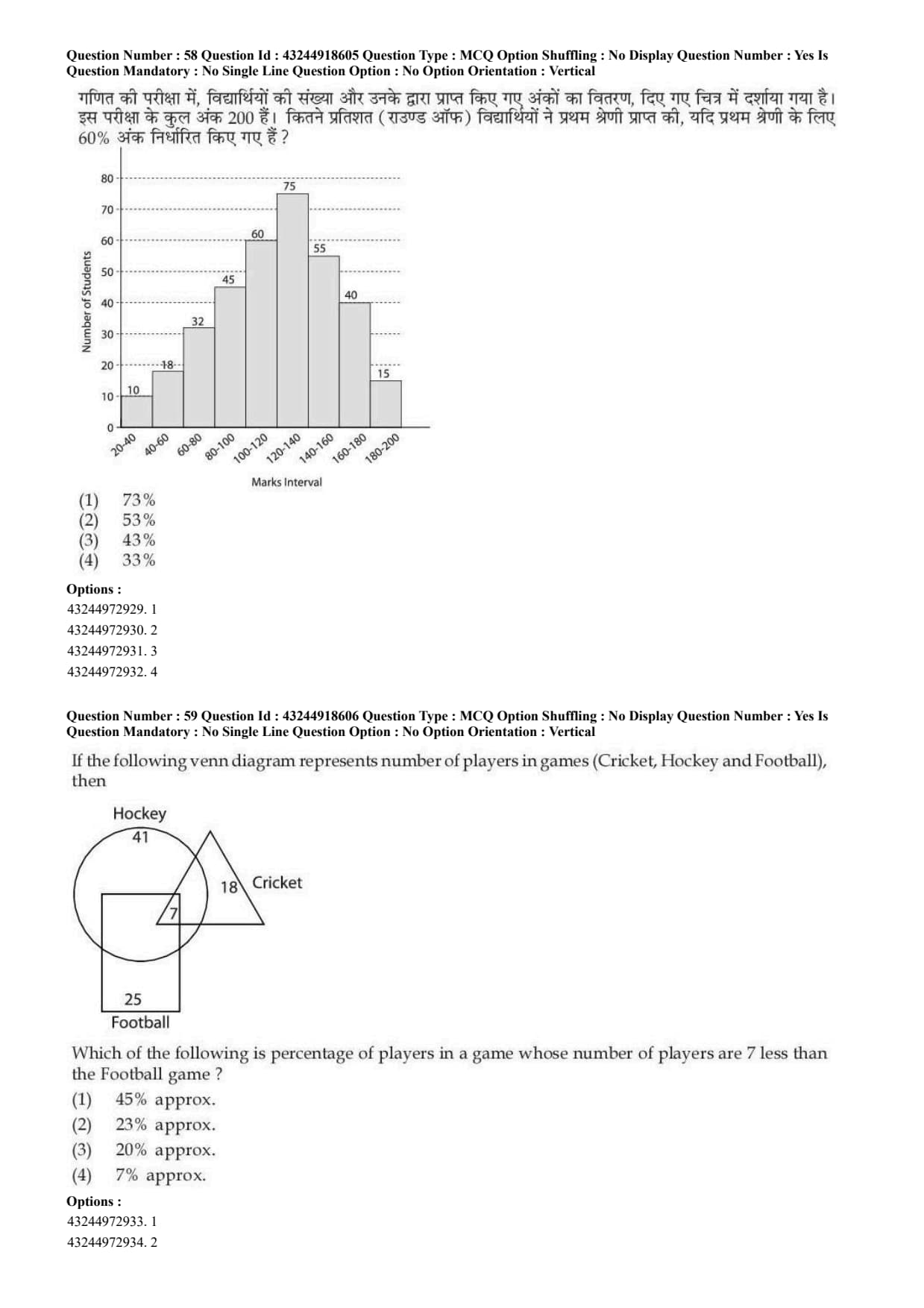
In Mathematics paper, the number of students' obtained marks are distributed in the given figure and total marks of this paper is 200. What is percentage (round off) of student who are Ist division if 60% mark are set for first division?

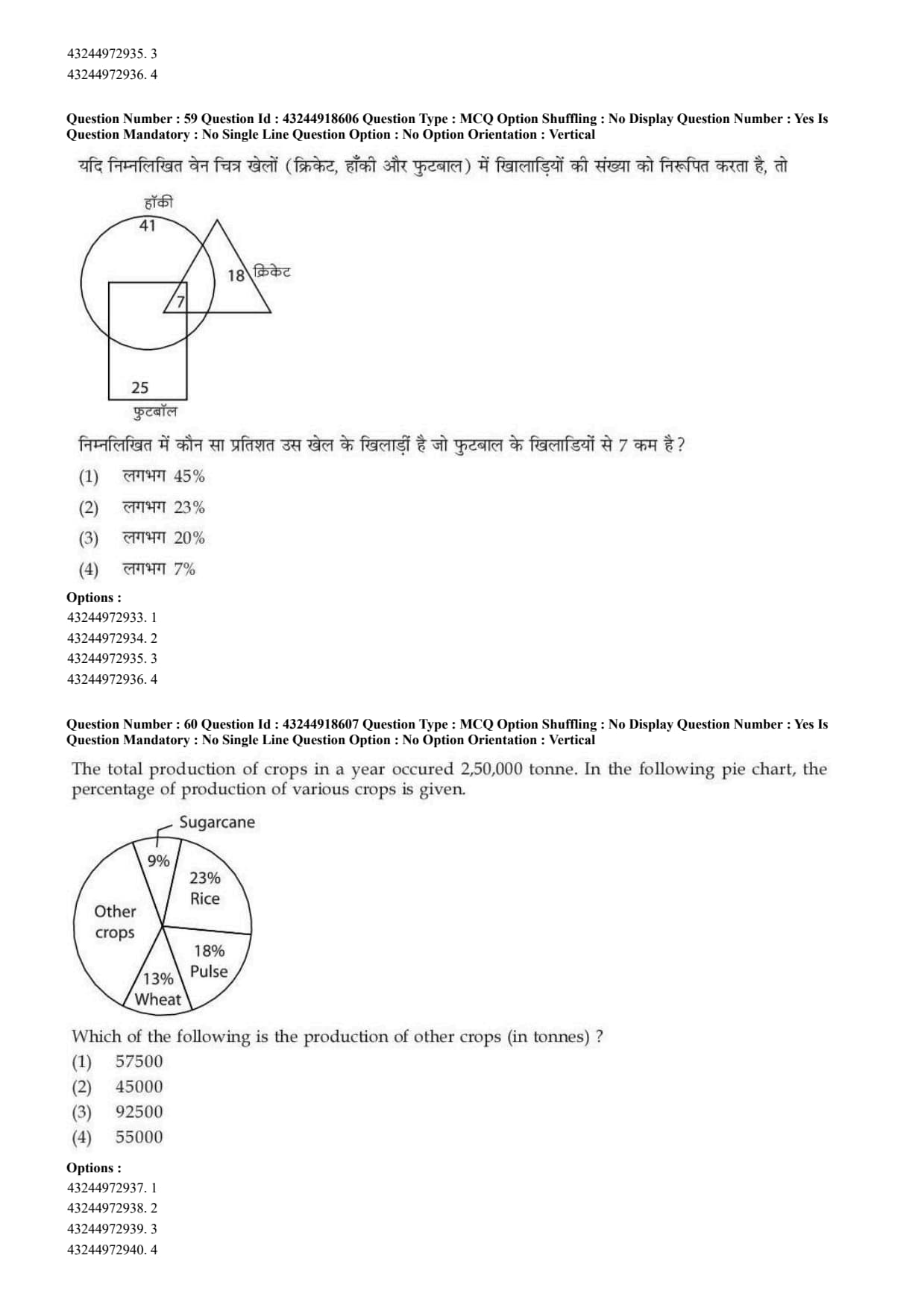
If the following venn diagram represents number of players in games (Cricket, Hockey and Football), then which of the following is percentage of players in a game whose number of players are 7 less than the Football game?

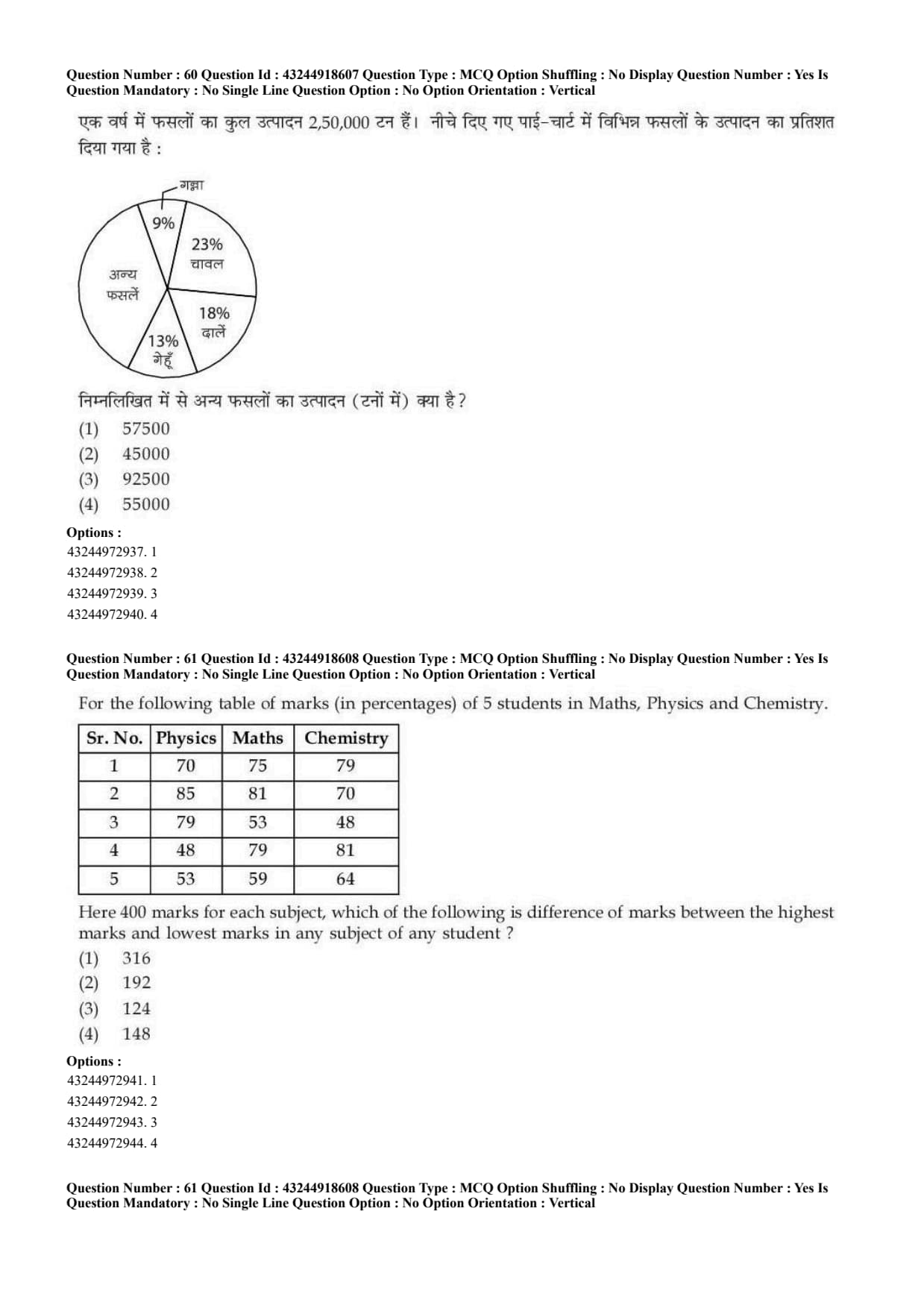
The total production of crops in a year occured 2,50,000 tonne. In the following pie chart, the percentage of production of various crops is given.

Which of the following is the production of other crops (in tonnes)?
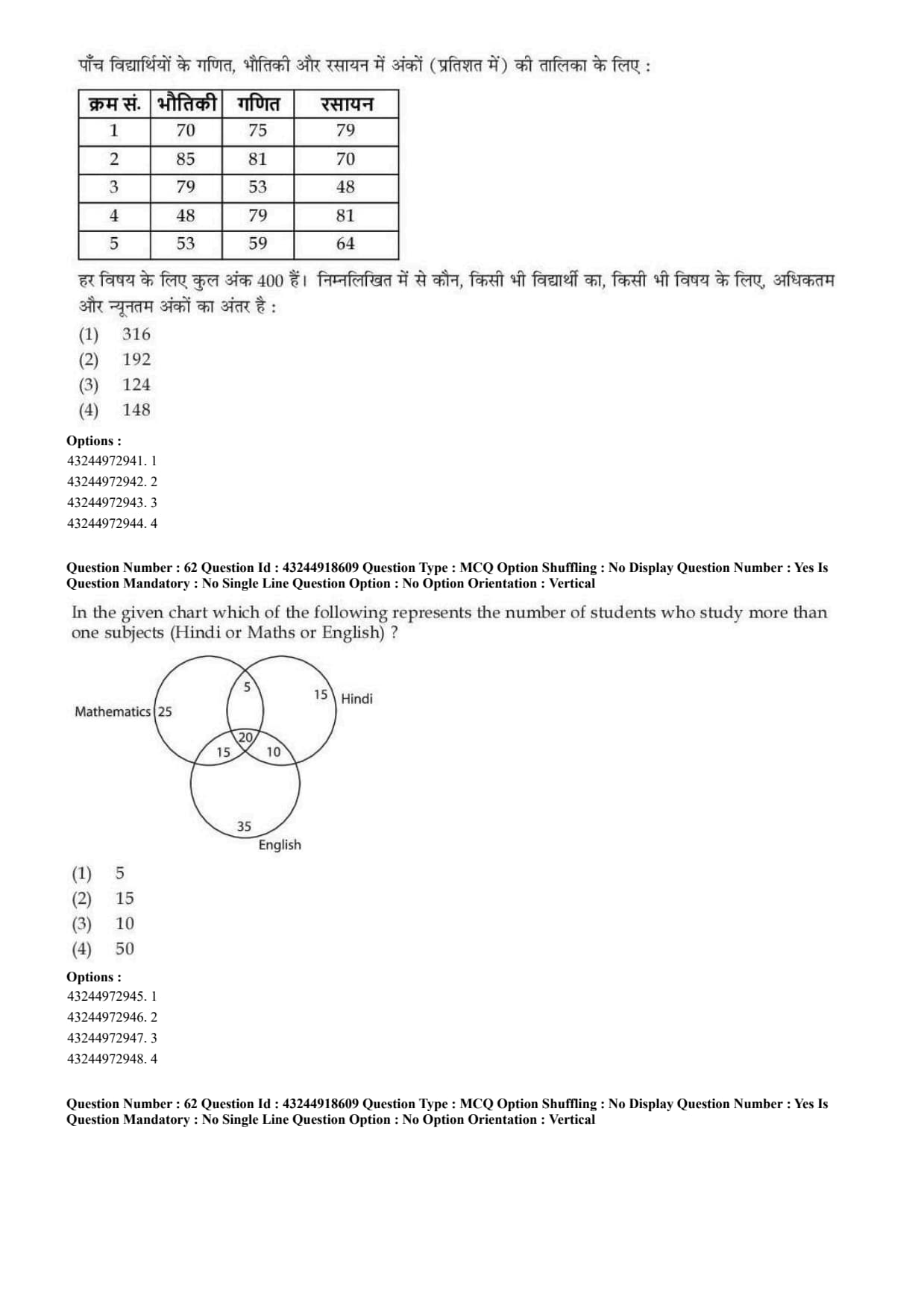
For the following table of marks (in percentages) of 5 students in Maths, Physics and Chemistry.

Here 400 marks for each subject, which of the following is difference of marks between the highest marks and lowest marks in any subject of any student?
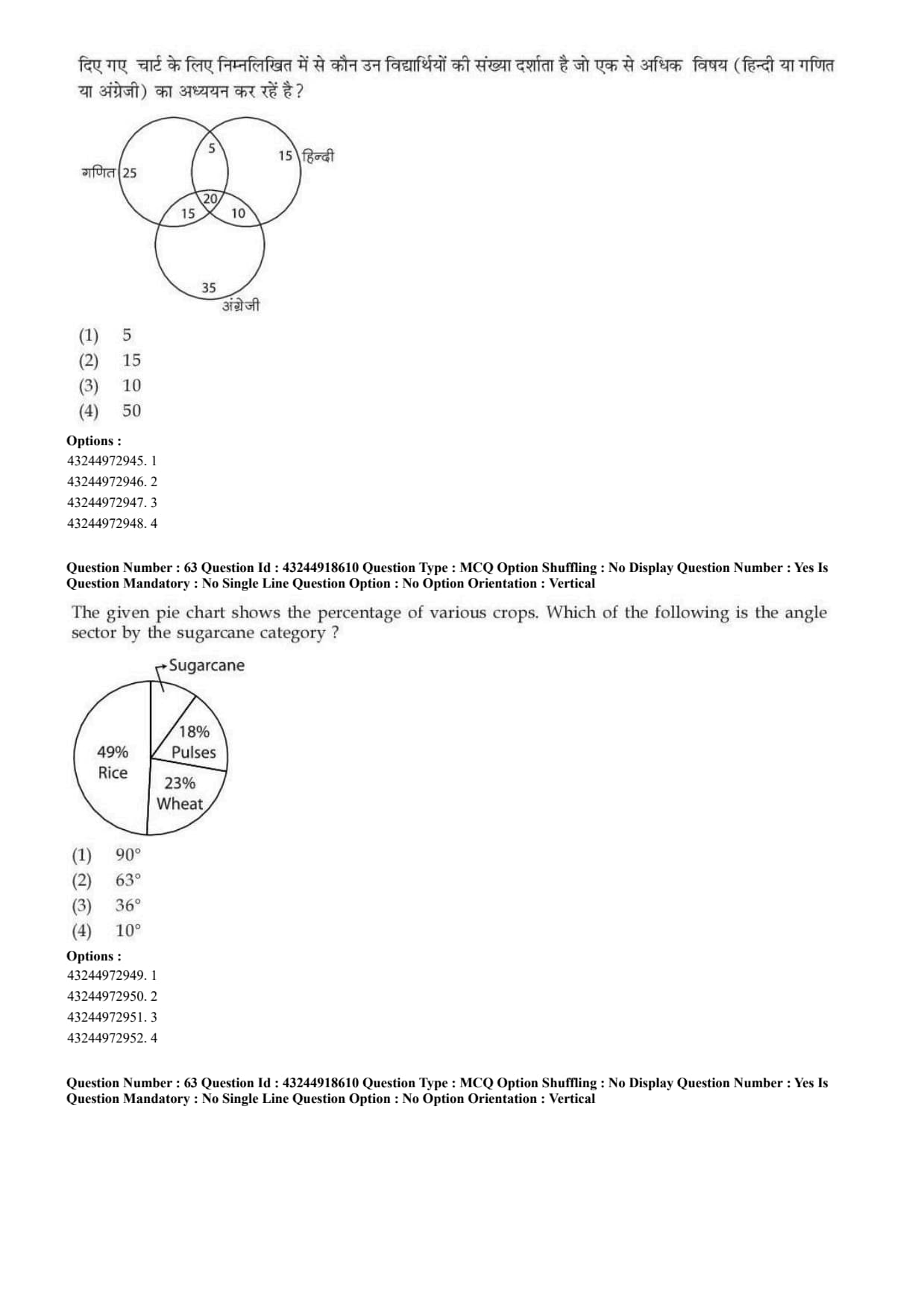
In the given chart which of the following represents the number of students who study more than one subjects (Hindi or Maths or English)?

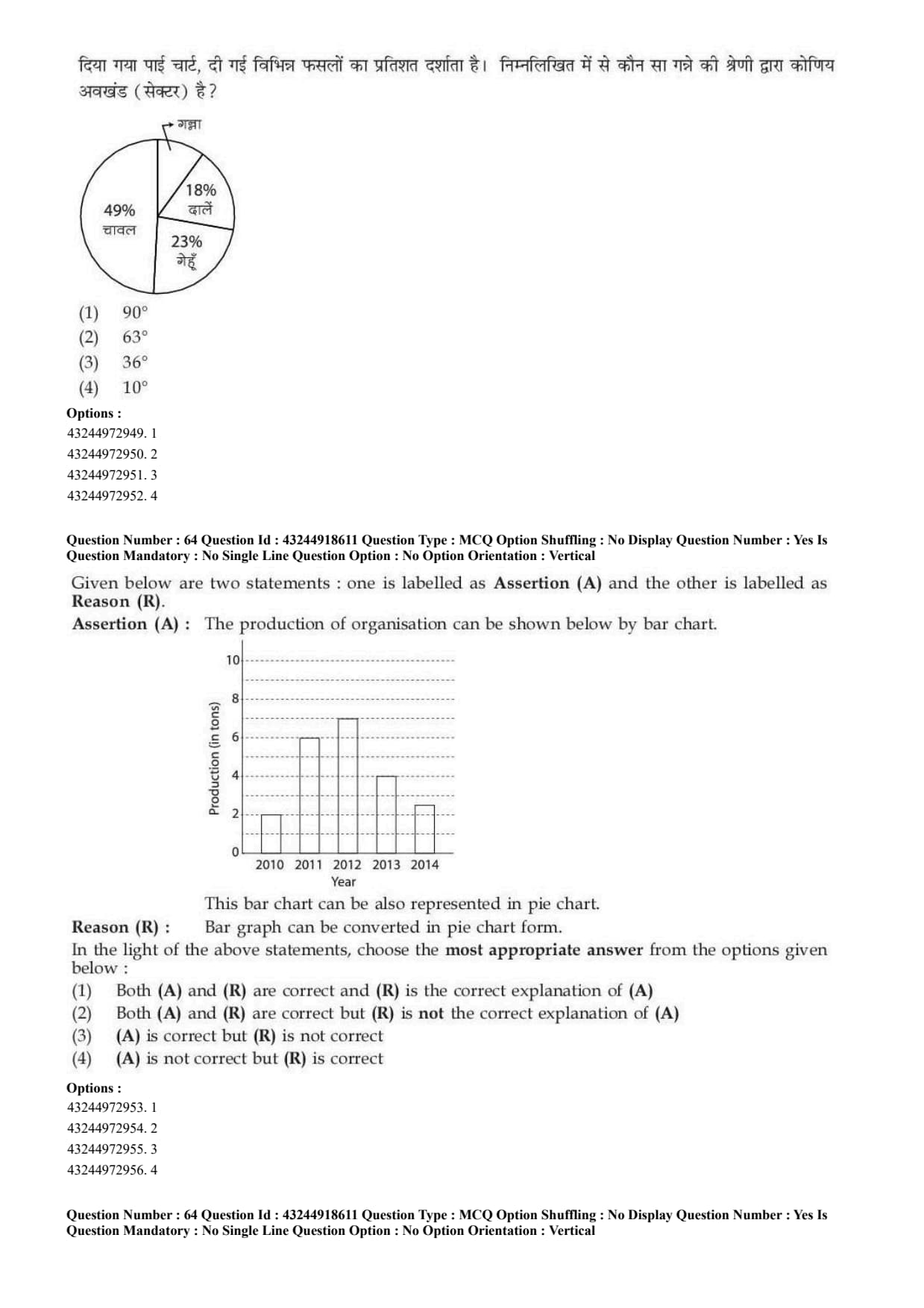
The given pie chart shows the percentage of various crops. Which of the following is the angle sector by the sugarcane category?

Given below are two statements: one is labelled as Assertion (A) and the other is labelled as Reason (R).
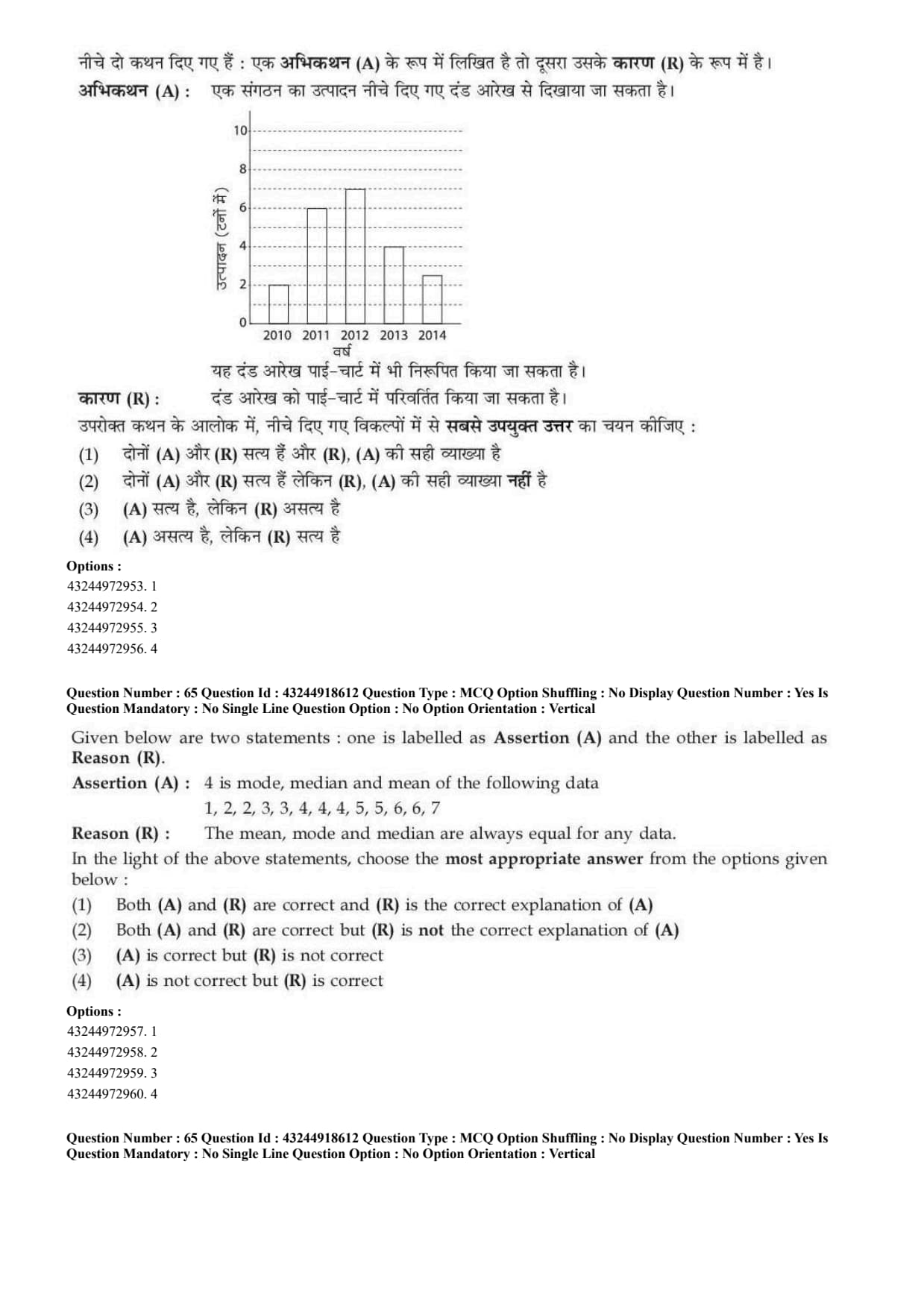
Assertion (A): The production of organisation can be shown below by bar chart.

This bar chart can be also represented in pie chart.
Reason (R): Bar graph can be converted in pie chart form.
In the light of the above statements, choose the most appropriate answer from the options given below:
Given below are two statements: one is labelled as Assertion (A) and the other is labelled as Reason (R).
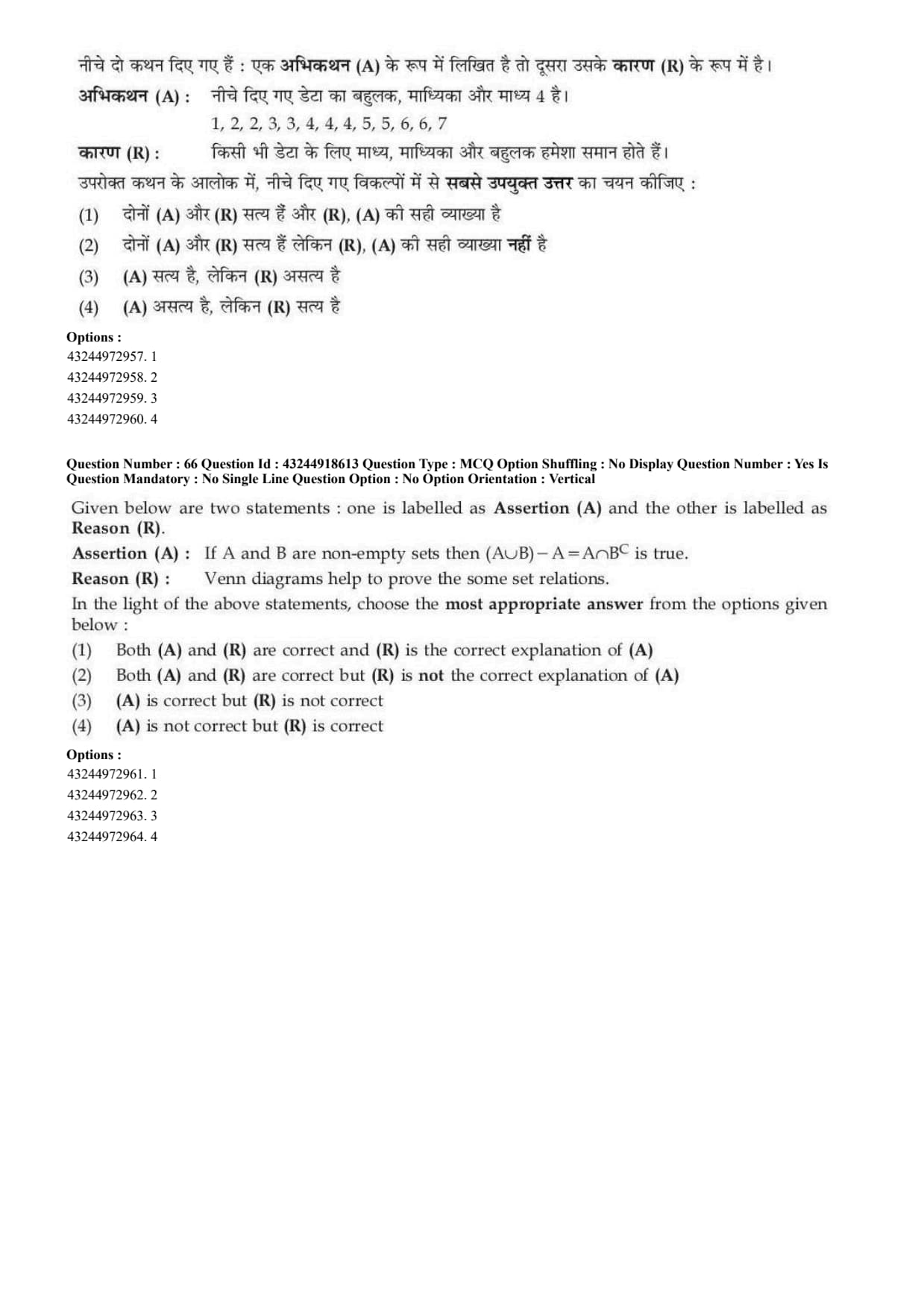
Assertion (A): 4 is mode, median and mean of the following data: 1, 2, 2, 3, 3, 4, 4, 4, 4, 5, 5, 6, 6, 7
Reason (R): The mean, mode and median are always equal for any data.
In the light of the above statements, choose the most appropriate answer from the options given below:
Given below are two statements: one is labelled as Assertion (A) and the other is labelled as Reason (R).
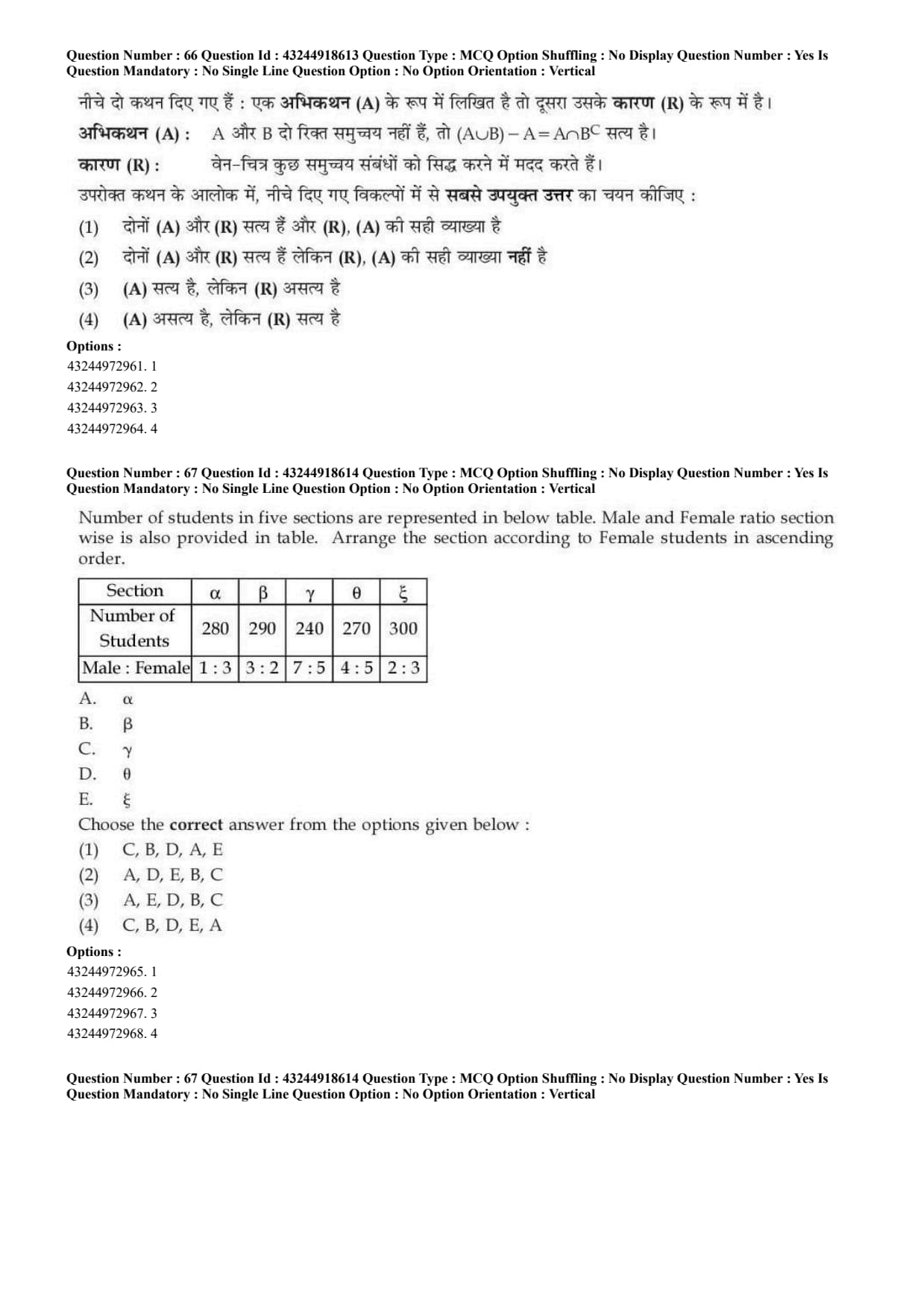
Assertion (A): If A and B are non-empty sets then (A \(\cup\) B) - A = A \(\cap\) B\(^{C}\) is true.
Reason (R): Venn diagrams help to prove the some set relations.
In the light of the above statements, choose the most appropriate answer from the options given below:
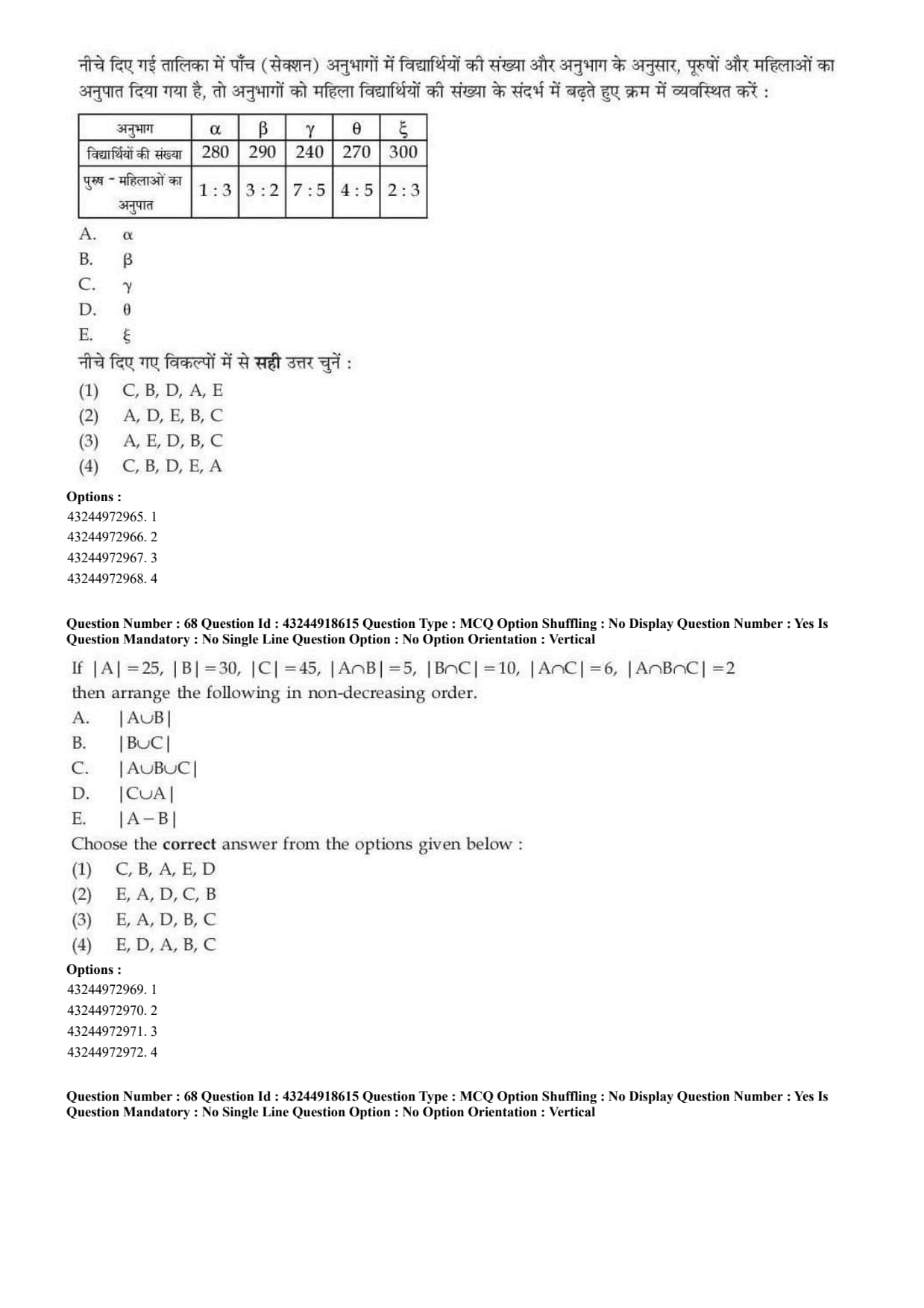
Number of students in five sections are represented in below table. Male and Female ratio section wise is also provided in table. Arrange the section according to Female students in ascending order.

Choose the correct answer from the options given below:
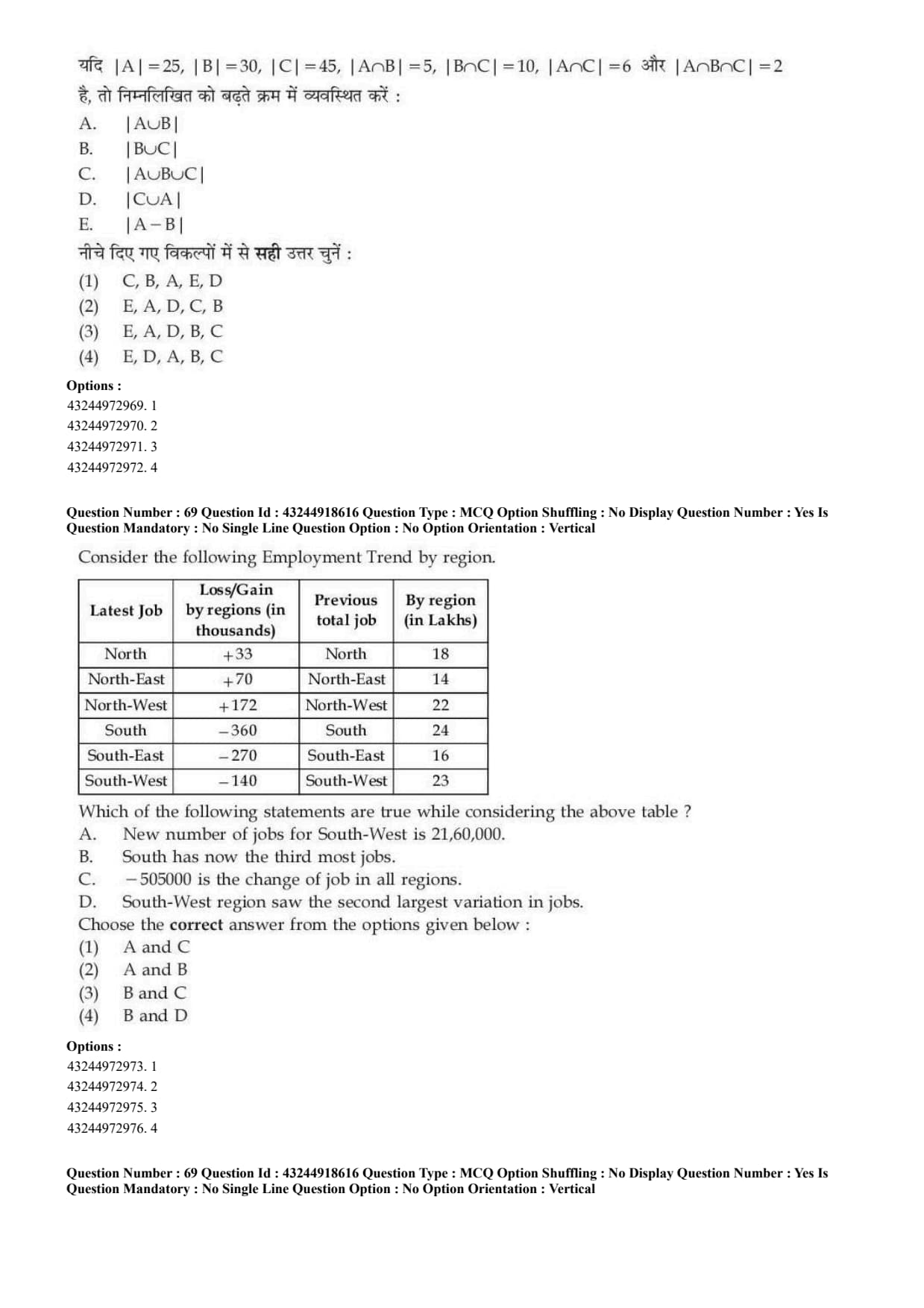
If \(|A| = 25, |B| = 30, |C| = 45, |A \cap B| = 5, |B \cap C| = 10, |A \cap C| = 6, |A \cap B \cap C| = 2\) then arrange the following in non-decreasing order:
A. \(|A \cup B|\)
B. \(|B \cup C|\)
C. \(|A \cup B \cup C|\)
D. \(|C \cup A|\)
E. \(|A - B|\)
Choose the correct answer from the options given below:
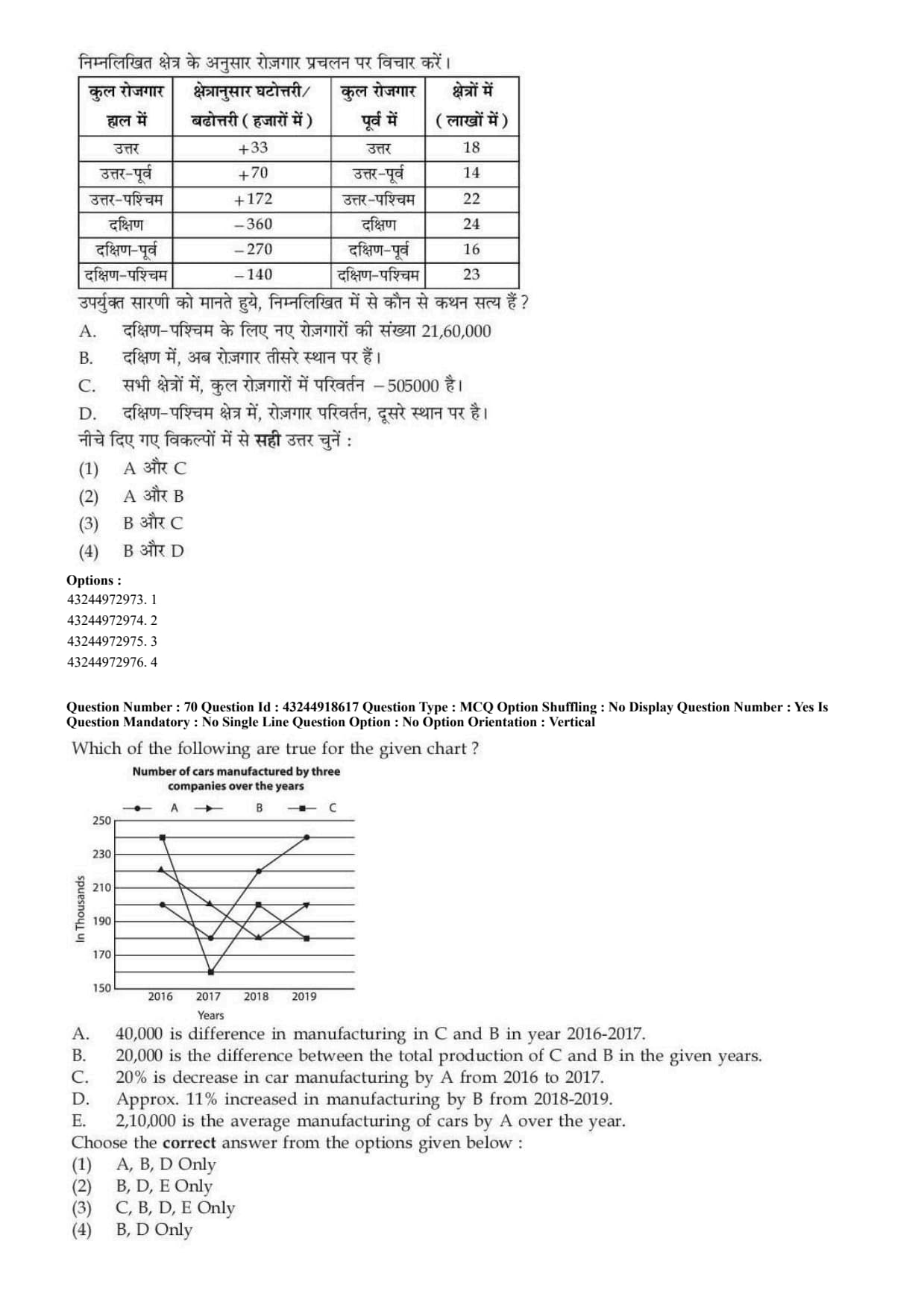
Consider the following Employment Trend by region.

Which of the following statements are true while considering the above table?
A. New number of jobs for South-West is 21,60,000.
B. South has now the third most jobs.
C. \(-505000\) is the change of job in all regions.
D. South-West region saw the second largest variation in jobs.
Choose the correct answer from the options given below:
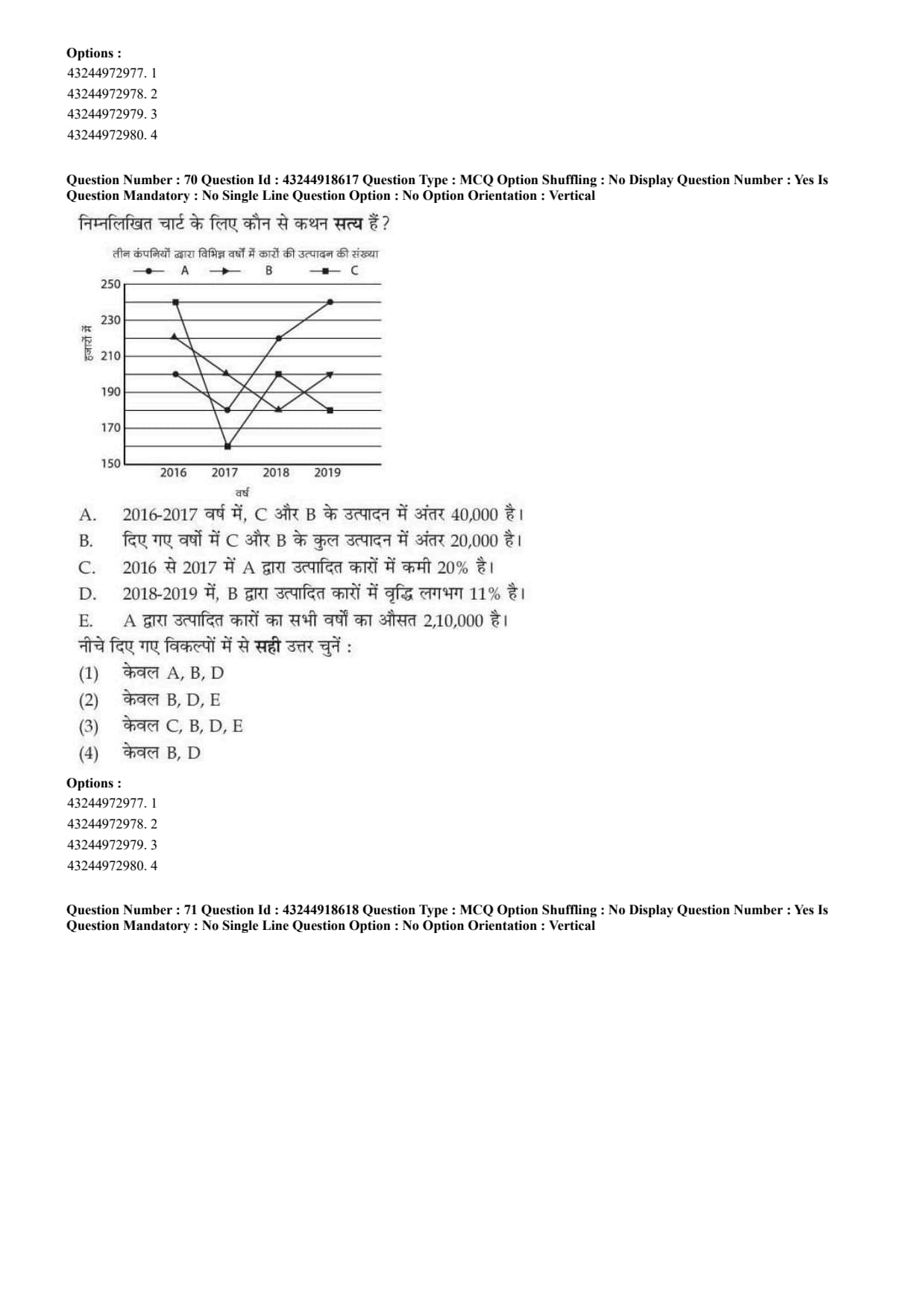
Which of the following are true for the given chart?

A. 40,000 is difference in manufacturing in C and B in year 2016-2017.
B. 20,000 is the difference between the total production of C and B in the given years.
C. 20% is decrease in car manufacturing by A from 2016 to 2017.
D. Approx. 11% increased in manufacturing by B from 2018-2019.
E. 2,10,000 is the average manufacturing of cars by A over the year.
Choose the correct answer from the options given below:
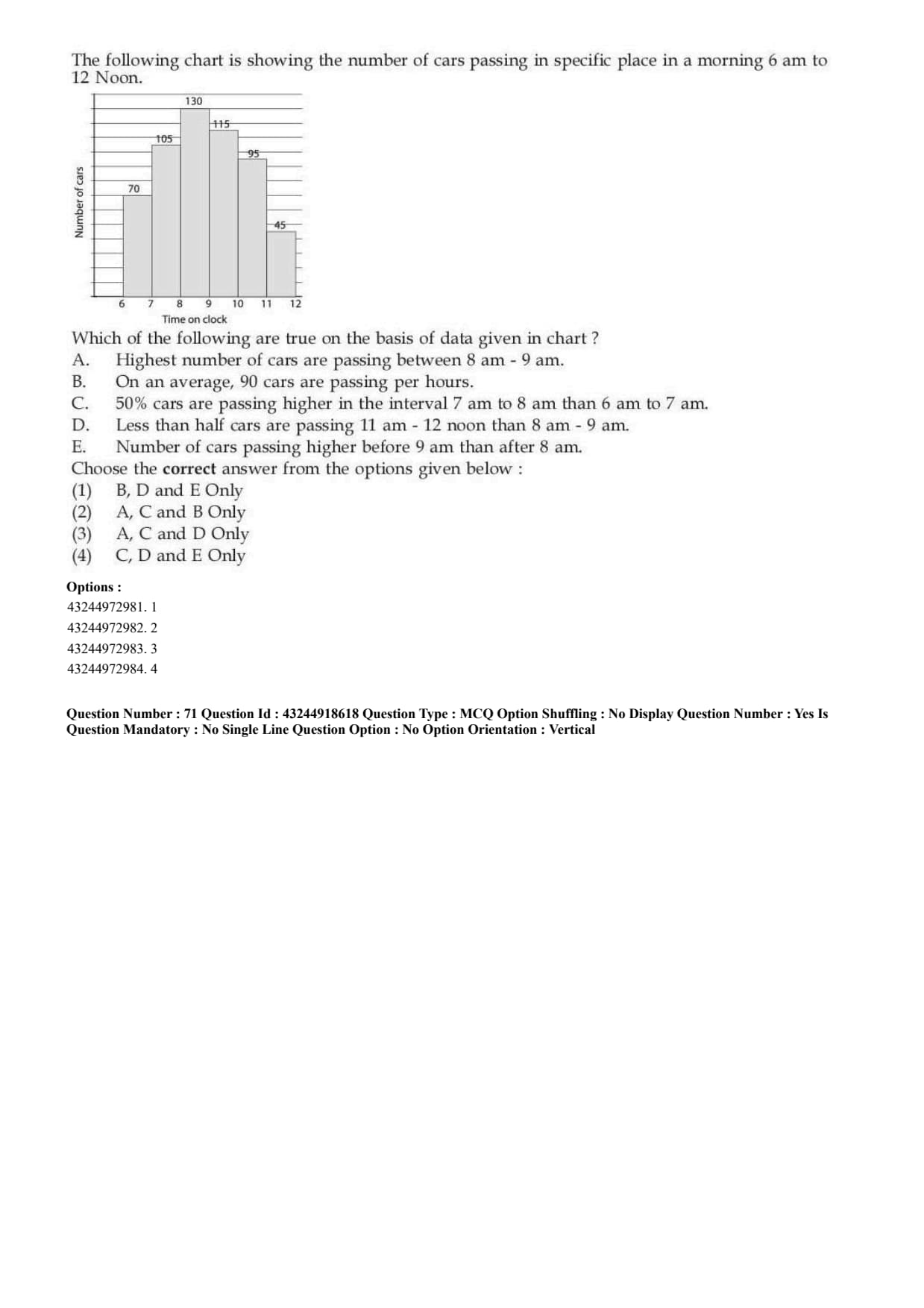
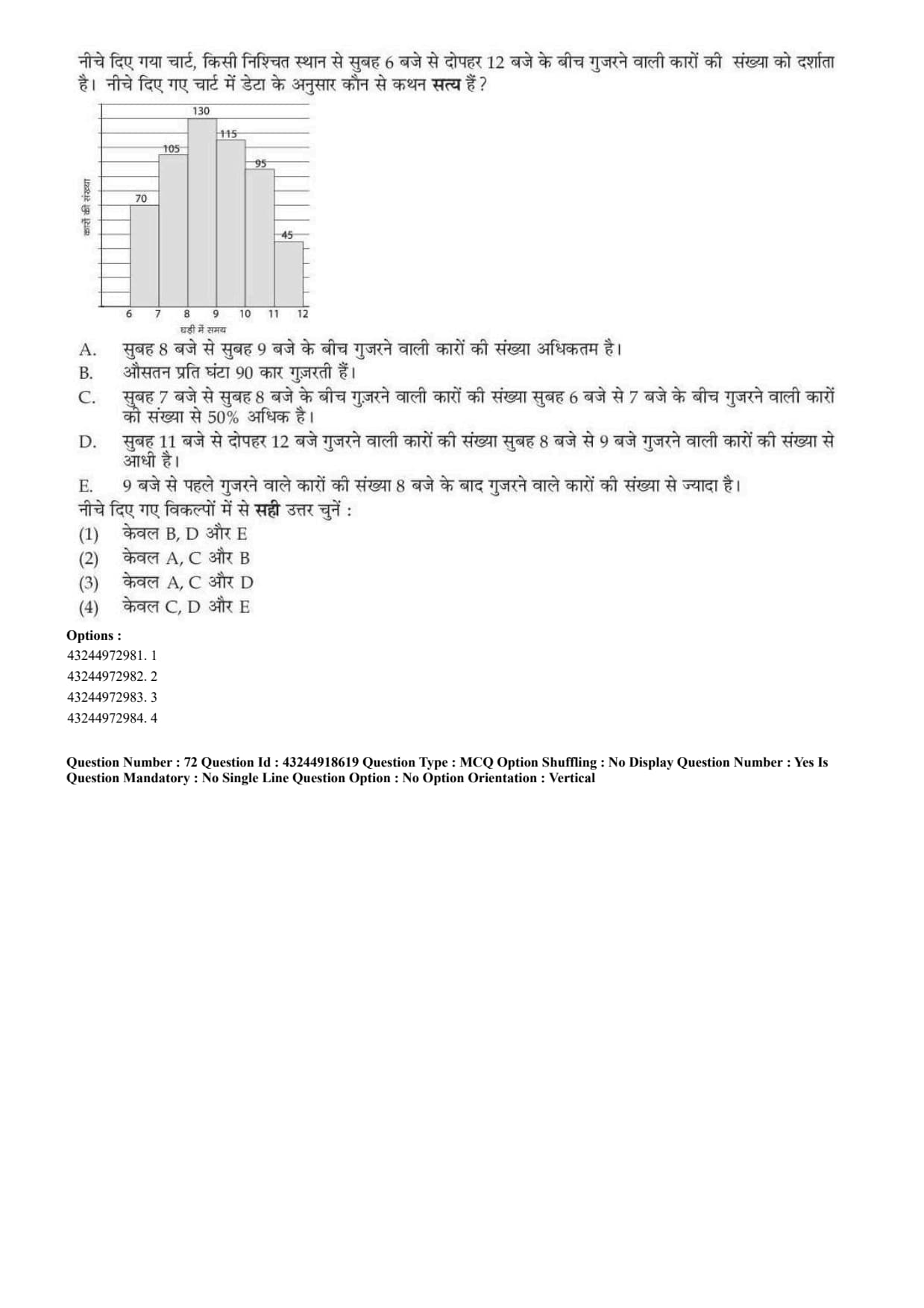
The following chart is showing the number of cars passing in specific place in a morning 6 am to 12 Noon.

Which of the following are true on the basis of data given in chart?
A. Highest number of cars are passing between 8 am - 9 am.
B. On an average, 90 cars are passing per hours.
C. 50% cars are passing higher in the interval 7 am to 8 am than 6 am to 7 am.
D. Less than half cars are passing 11 am - 12 noon than 8 am - 9 am.
E. Number of cars passing higher before 9 am than after 8 am.
Choose the correct answer from the options given below:
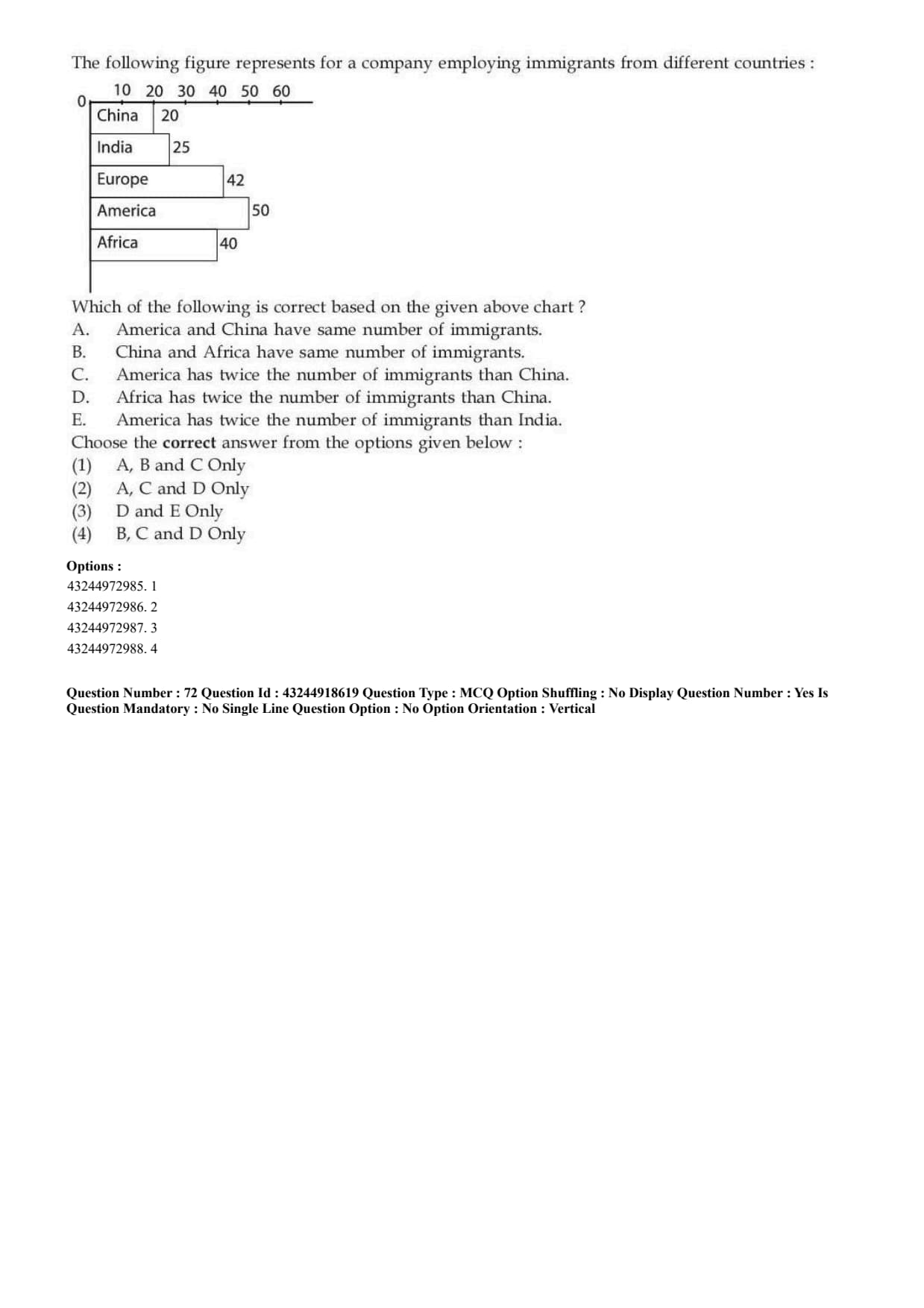
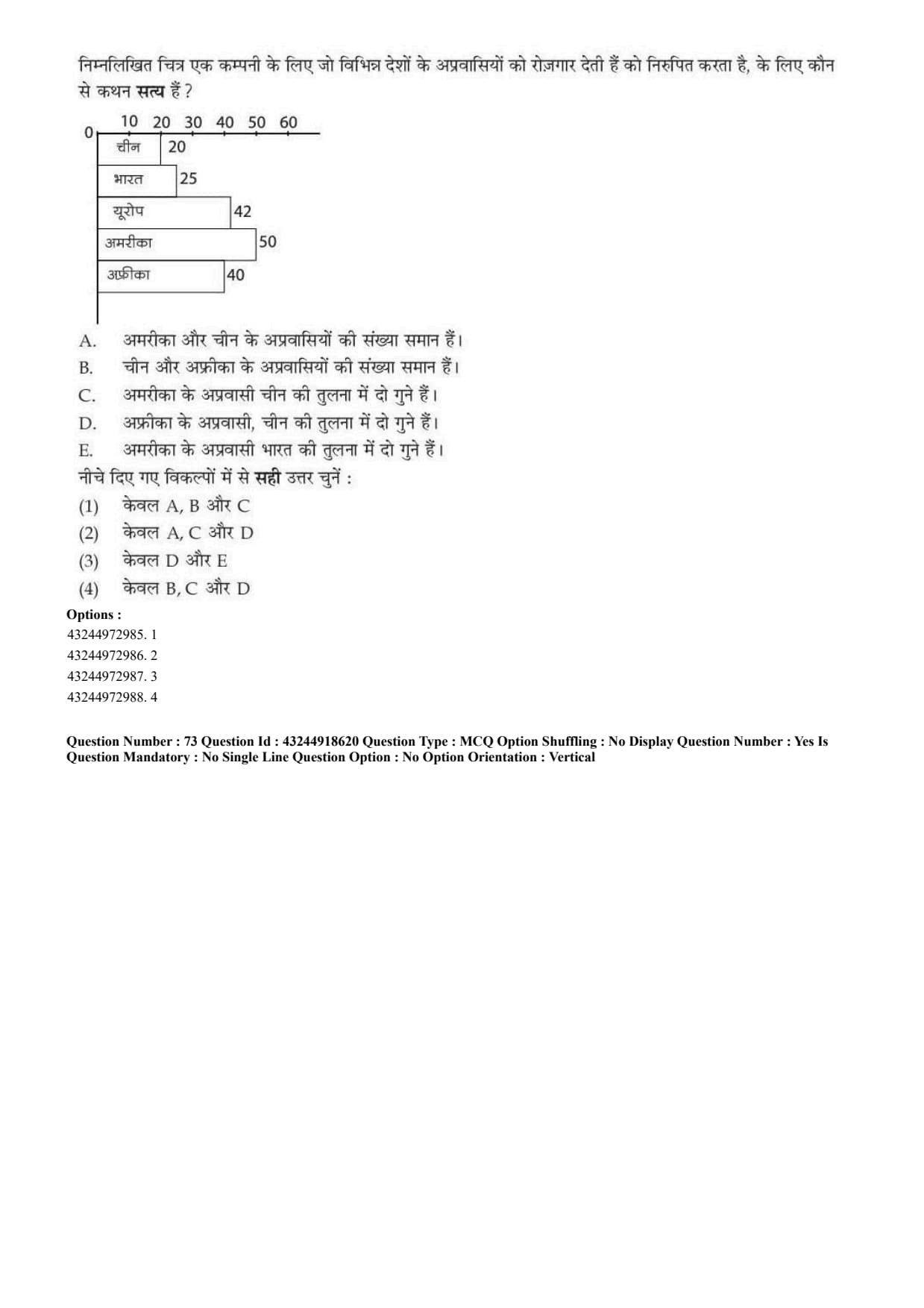
The following figure represents for a company employing immigrants from different countries:

Which of the following is correct based on the given above chart?
A. America and China have same number of immigrants.
B. China and Africa have same number of immigrants.
C. America has twice the number of immigrants than China.
D. Africa has twice the number of immigrants than China.
E. America has twice the number of immigrants than India.
Choose the correct answer from the options given below:
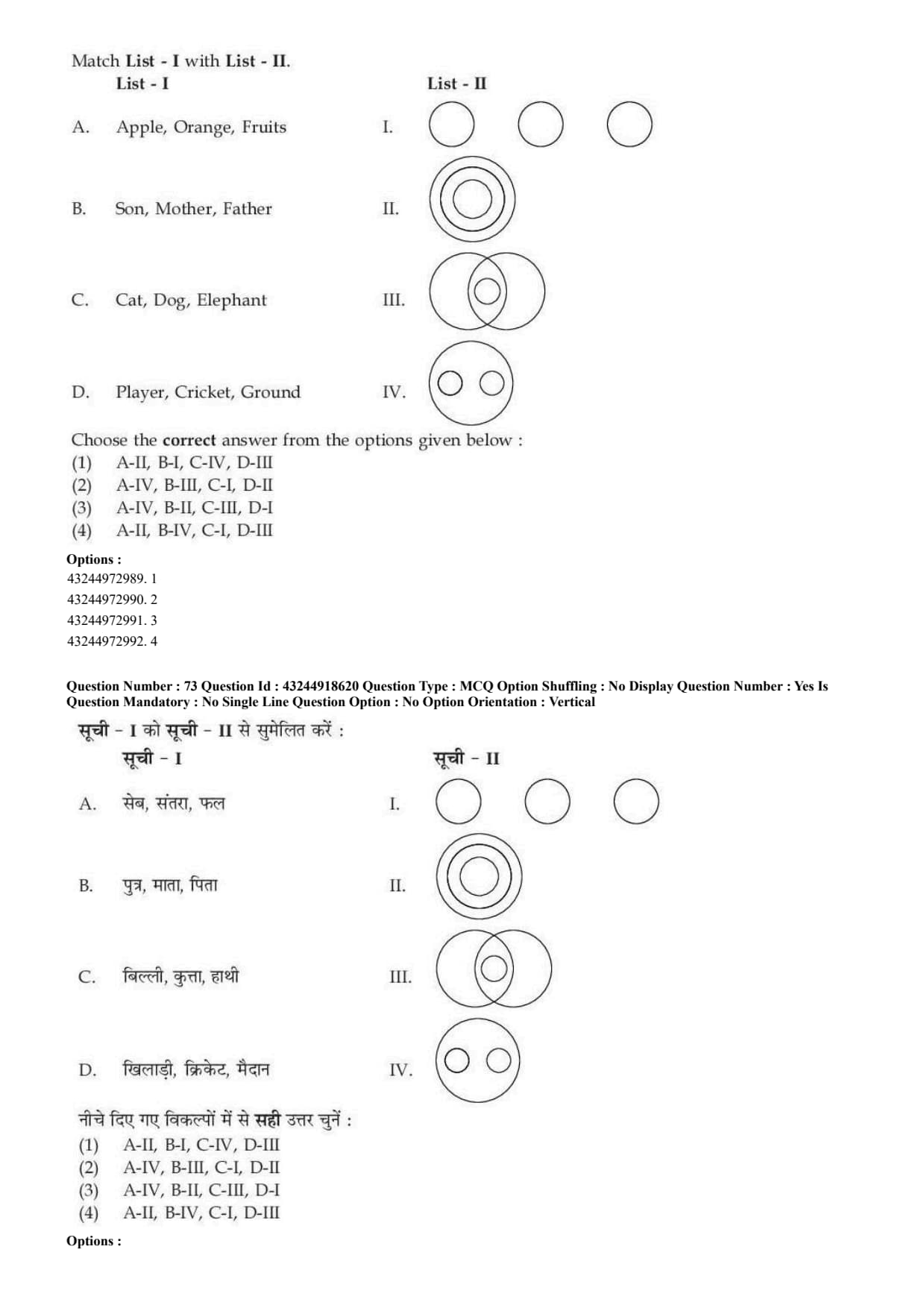
Match List - I with List - II.

Choose the correct answer from the options given below:
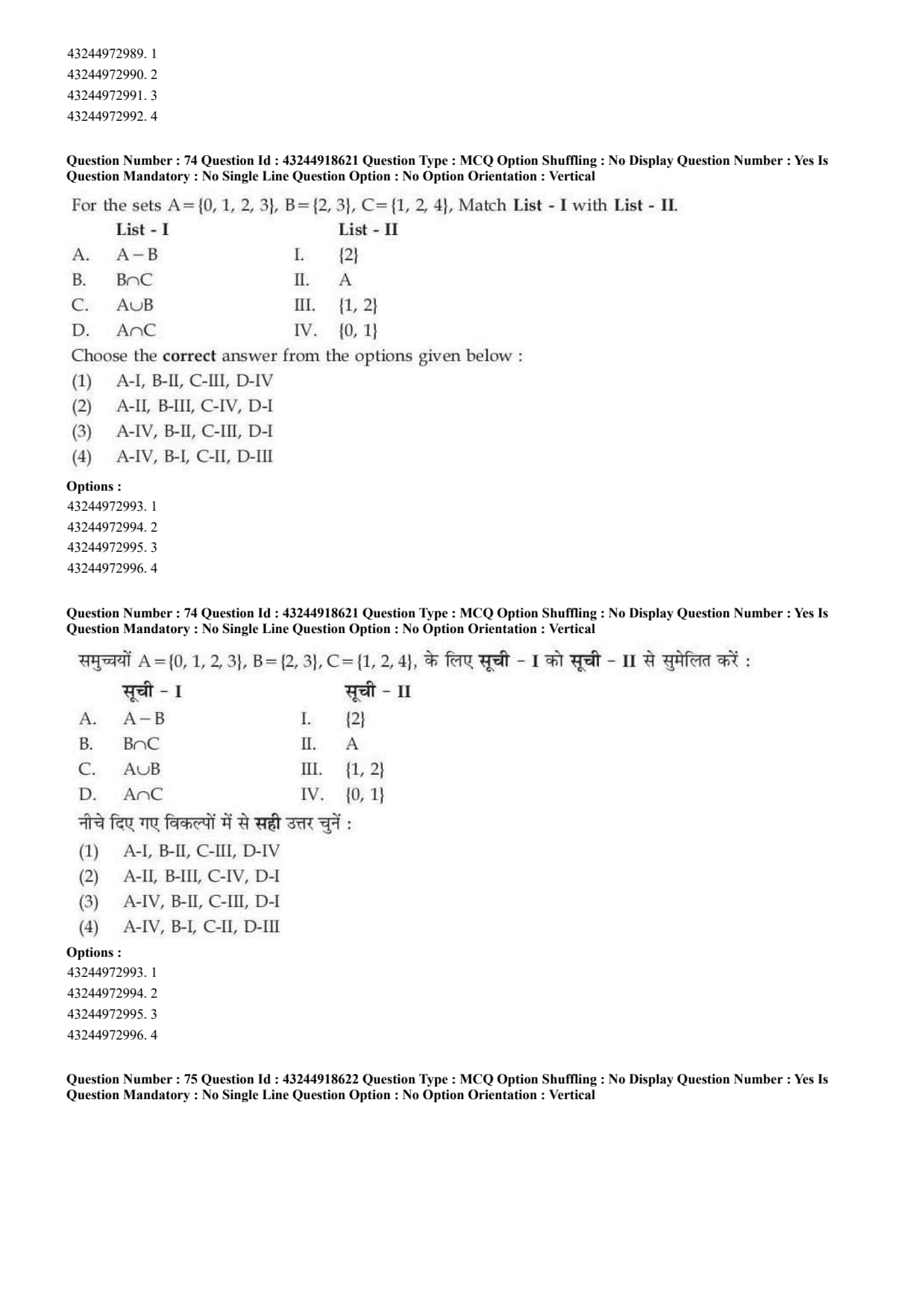
For the sets A = {0, 1, 2, 3}, B = {2, 3}, C = {1, 2, 4}, Match List - I with List - II.

Choose the correct answer from the options given below:
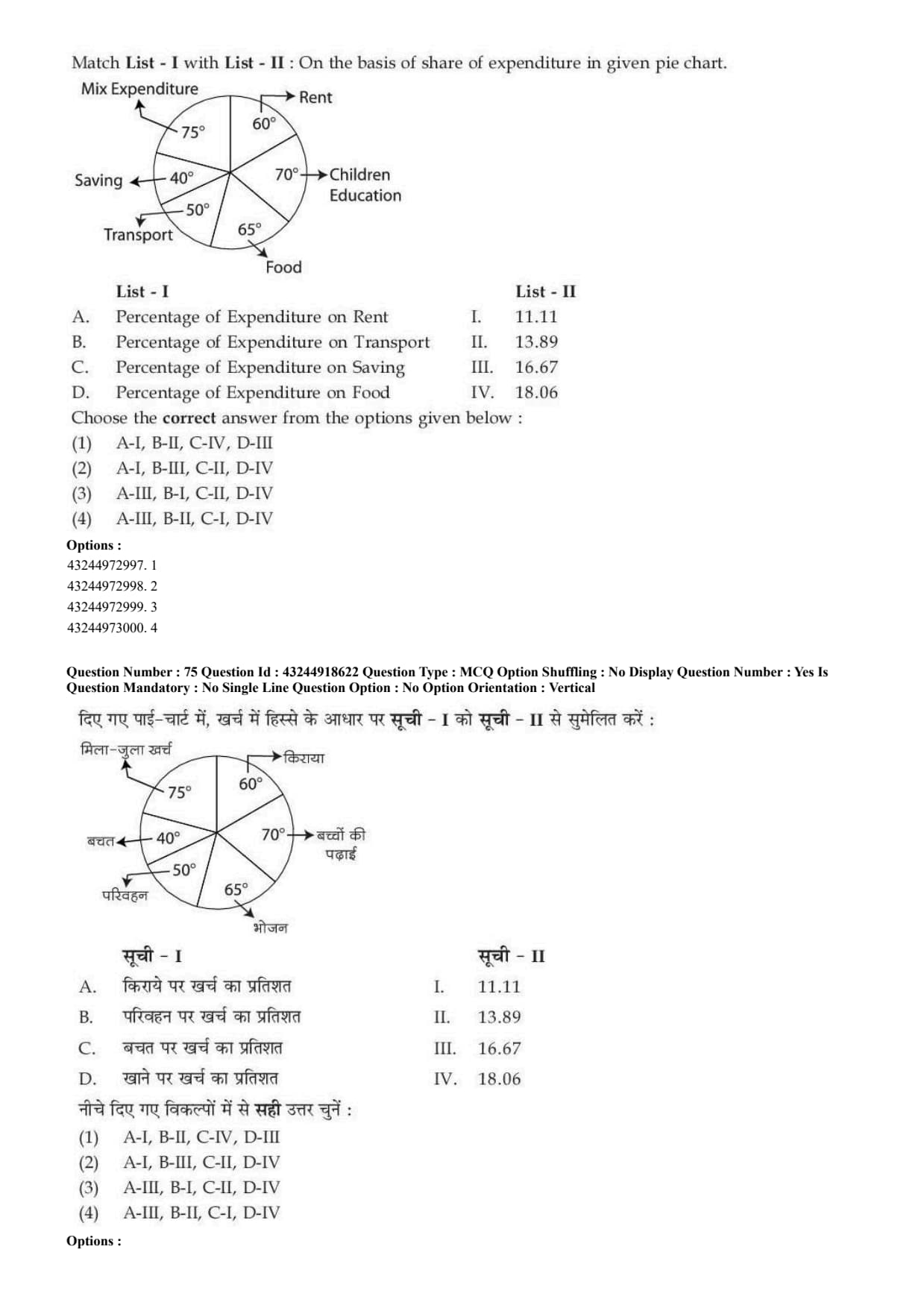
Match List - I with List - II: On the basis of share of expenditure in given pie chart.

Choose the correct answer from the options given below:
CUET PG General Management Question Paper 2026: Unit-Wise Weightage
| Unit Name | Approx. Questions | Difficulty |
| Principles of Management & Management Thinkers | 12–14 | Moderate |
| Organizational Behaviour (Motivation, Leadership, Communication) | 10–12 | Easy–Moderate |
| Marketing Management (Concepts, 4Ps, Consumer Behaviour) | 8–10 | Moderate |
| Financial & Accounting Basics | 8–10 | Moderate |
| Human Resource Management | 6–8 | Easy |
| Business Environment, Entrepreneurship & Business Ethics | 6–8 | Moderate |



Comments