




The National Testing Agency (NTA) conducted the CUET PG 2026 Botany (SCQP07) examination on March 18, 2026, during Shift 3 from 04:00 PM to 05:30 PM.
Students who appeared for the exam reported that the overall difficulty level of the paper was moderate. CUET PG 2026 Botany Question Paper with Solutions PDF is available here for download. The marking scheme is +4 for correct answers and -1 for wrong answers, totaling 300 marks.
CUET PG 2026 Botany Question Paper with Solutions PDF
| CUET PG 2026 Botany Question Paper | Download PDF | Check Solutions |
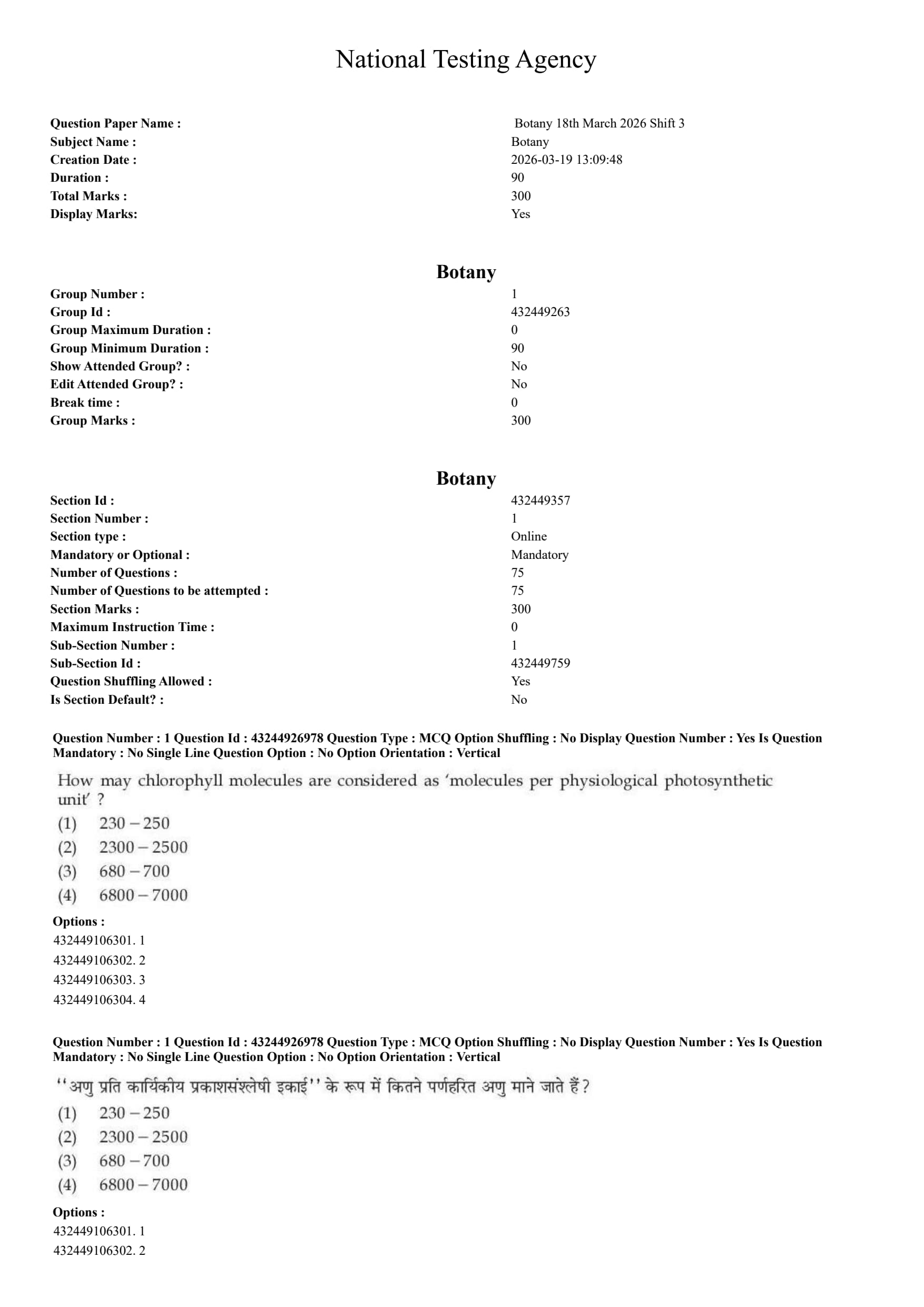
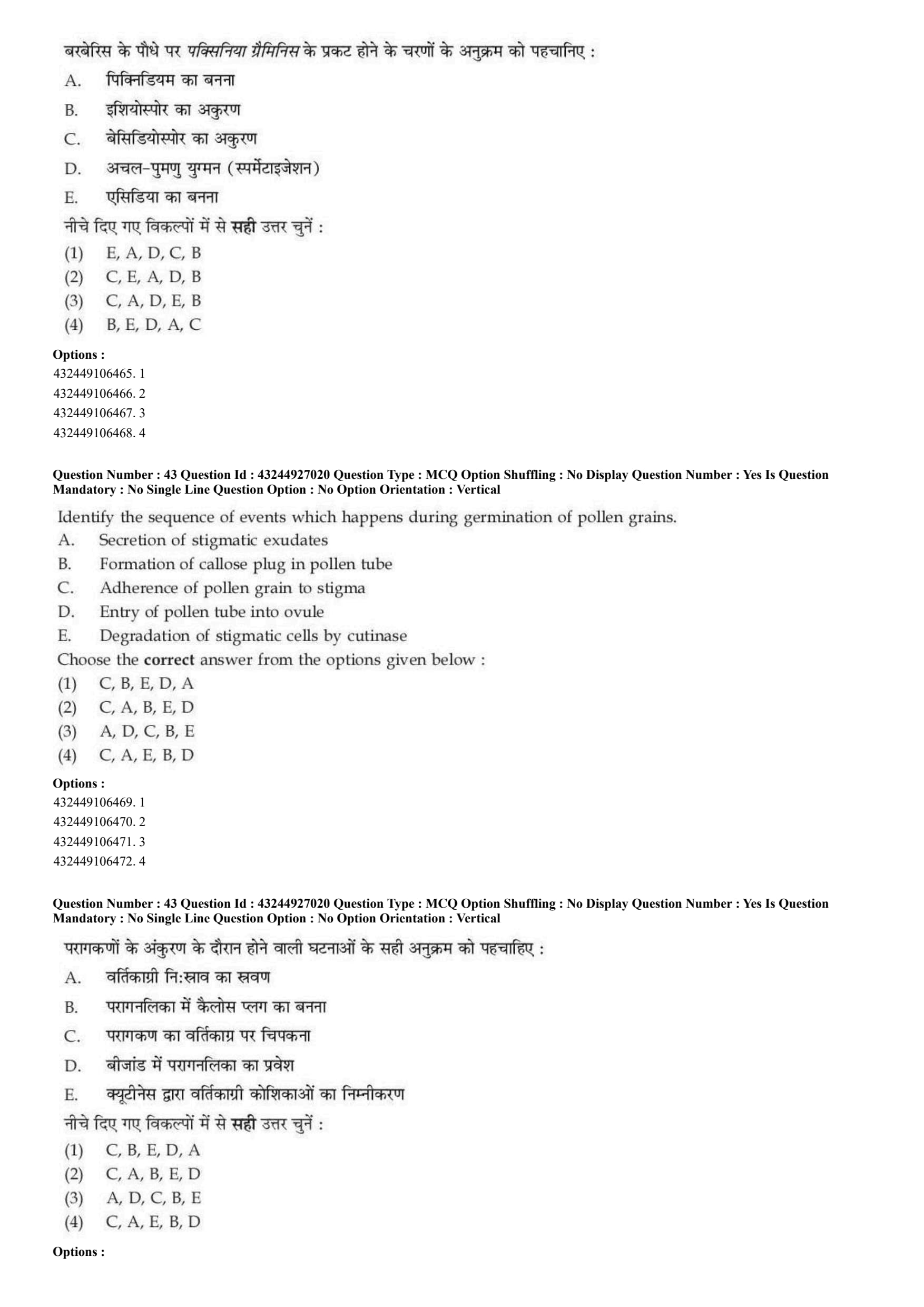
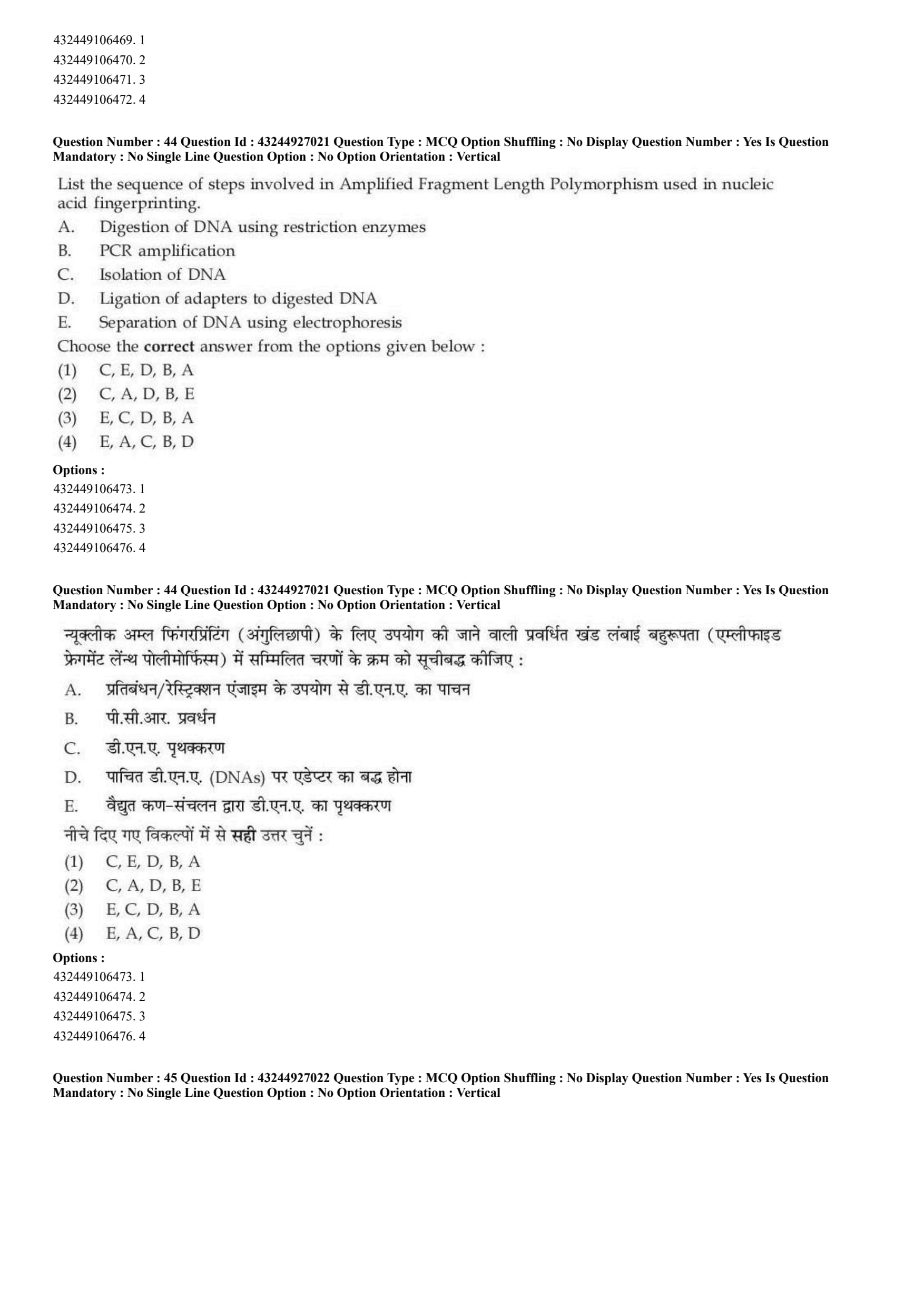
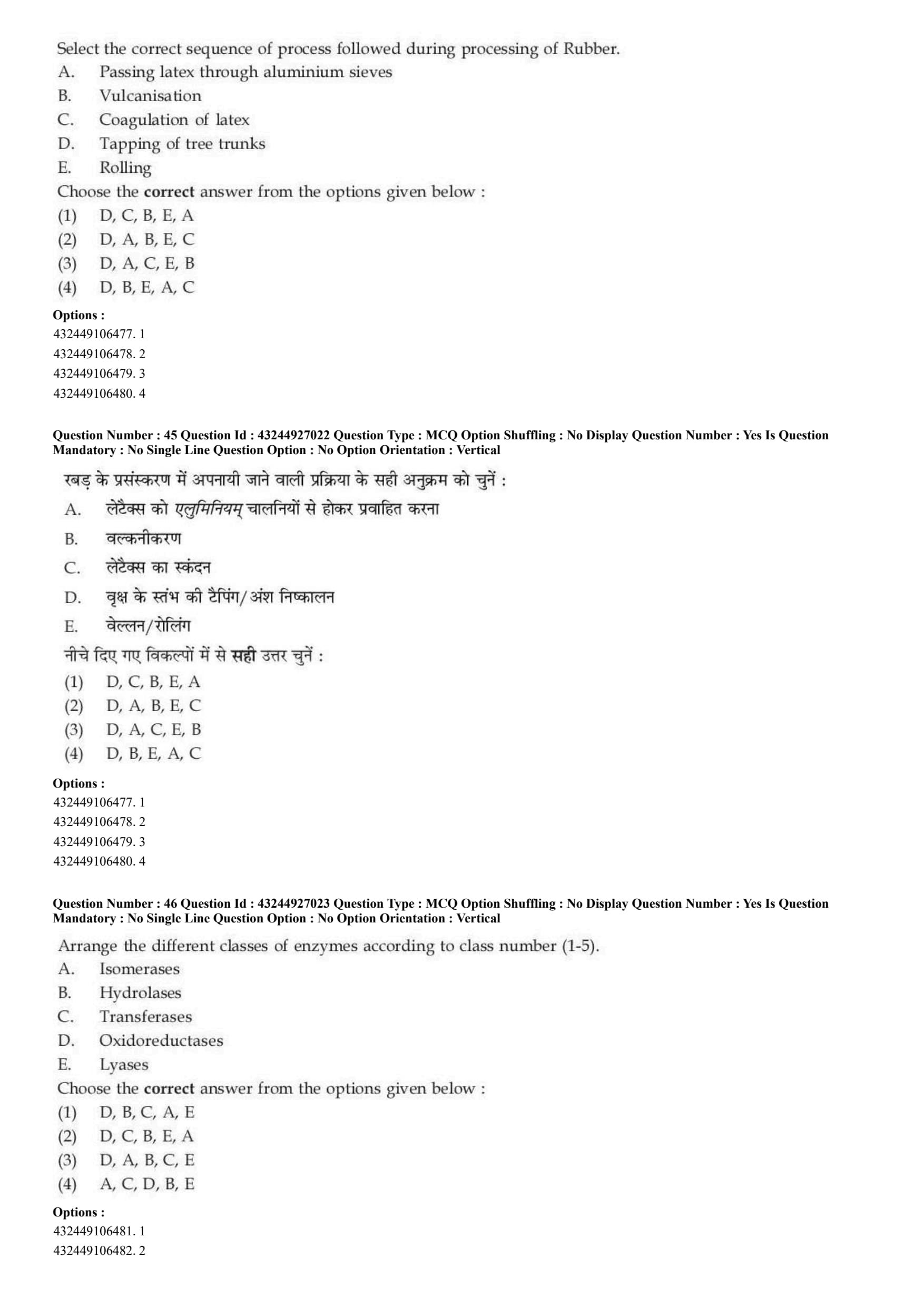
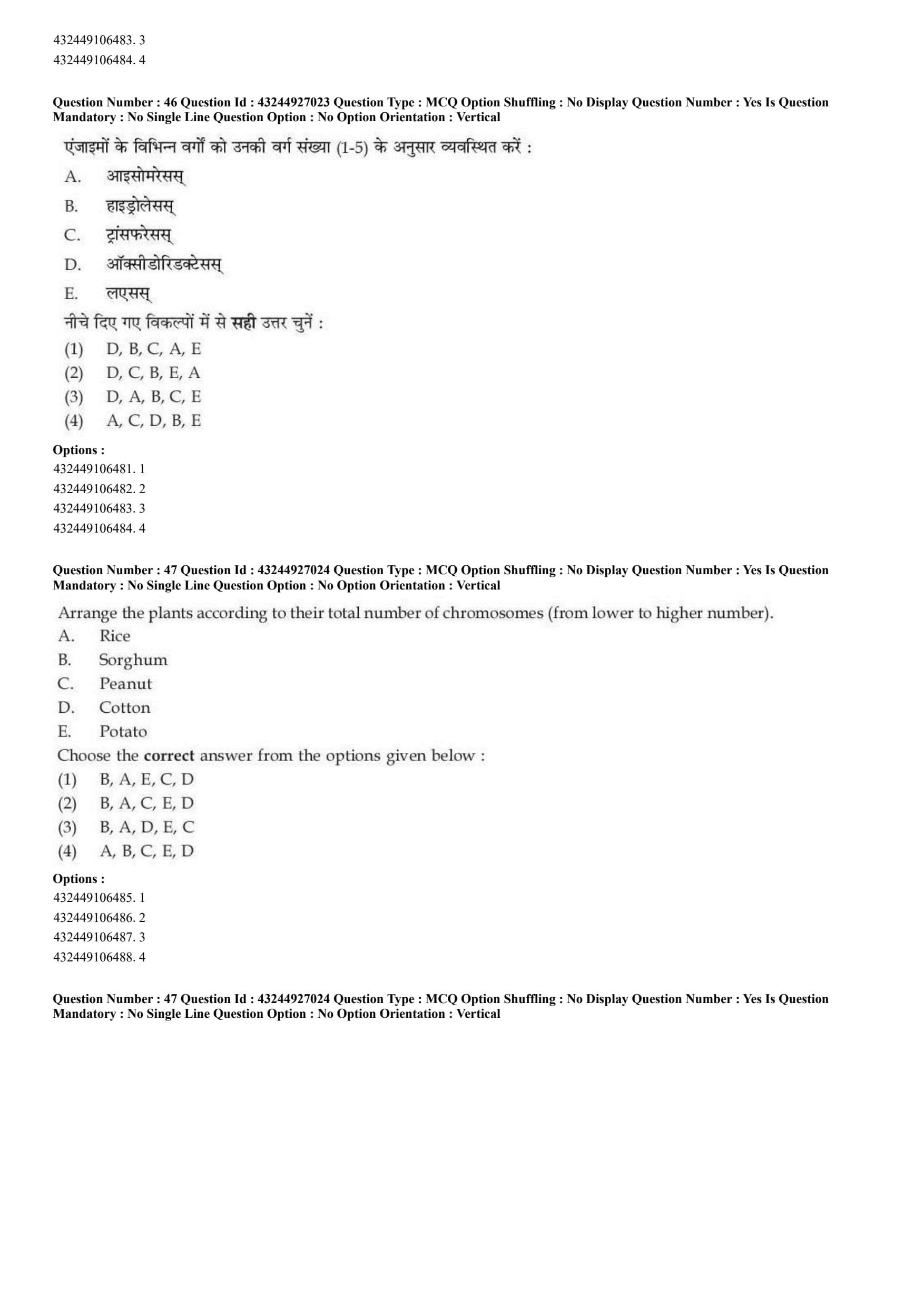
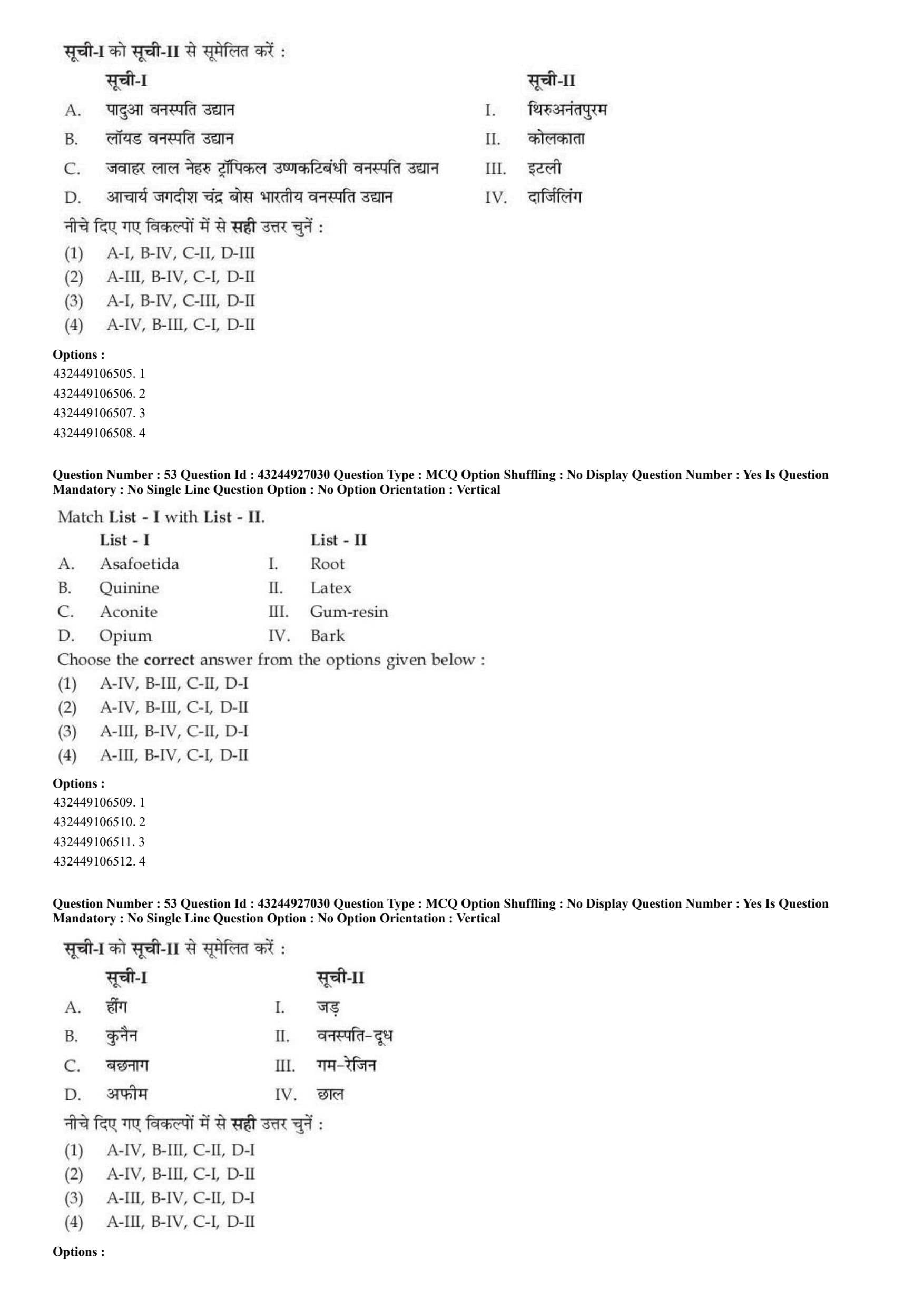
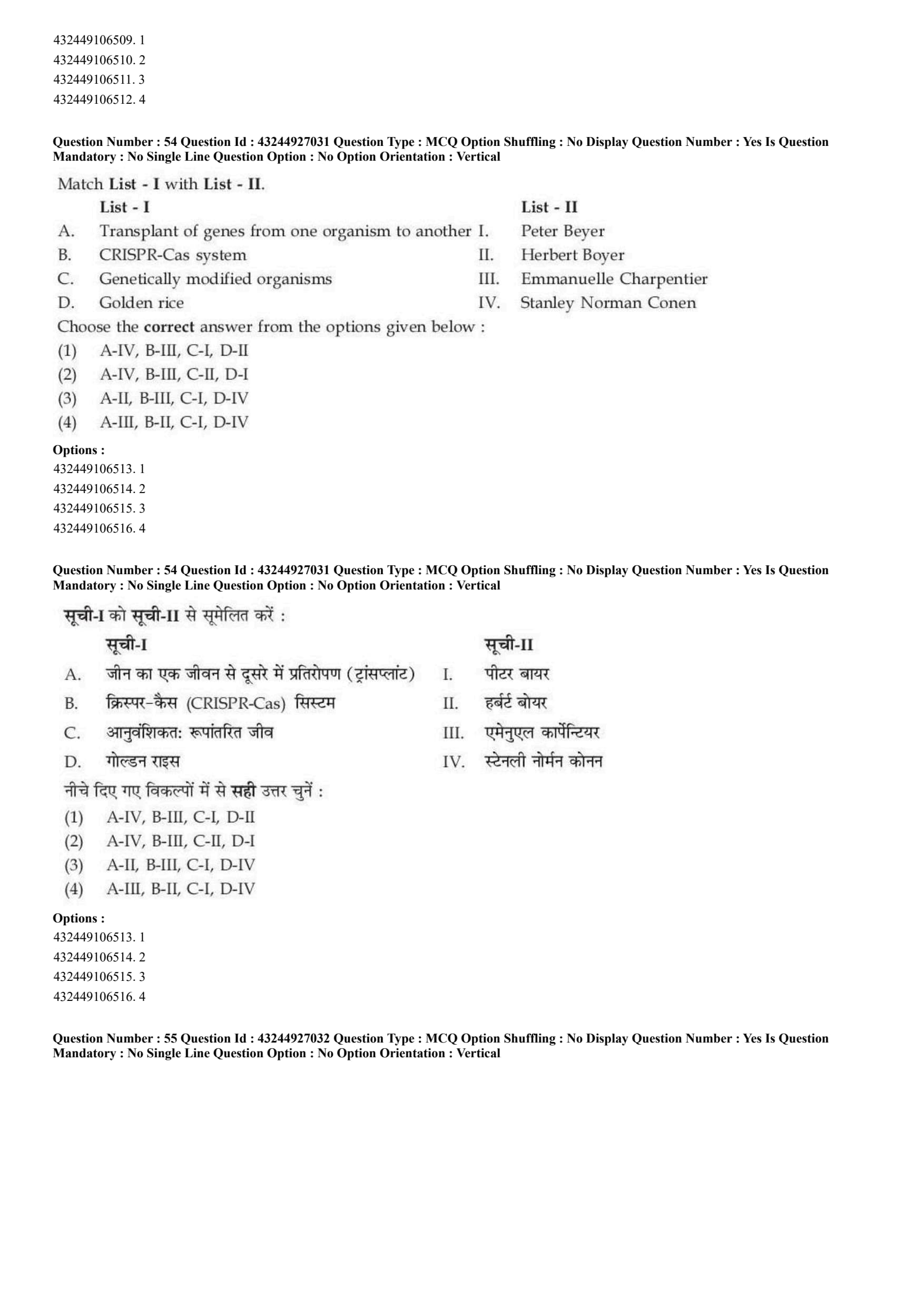
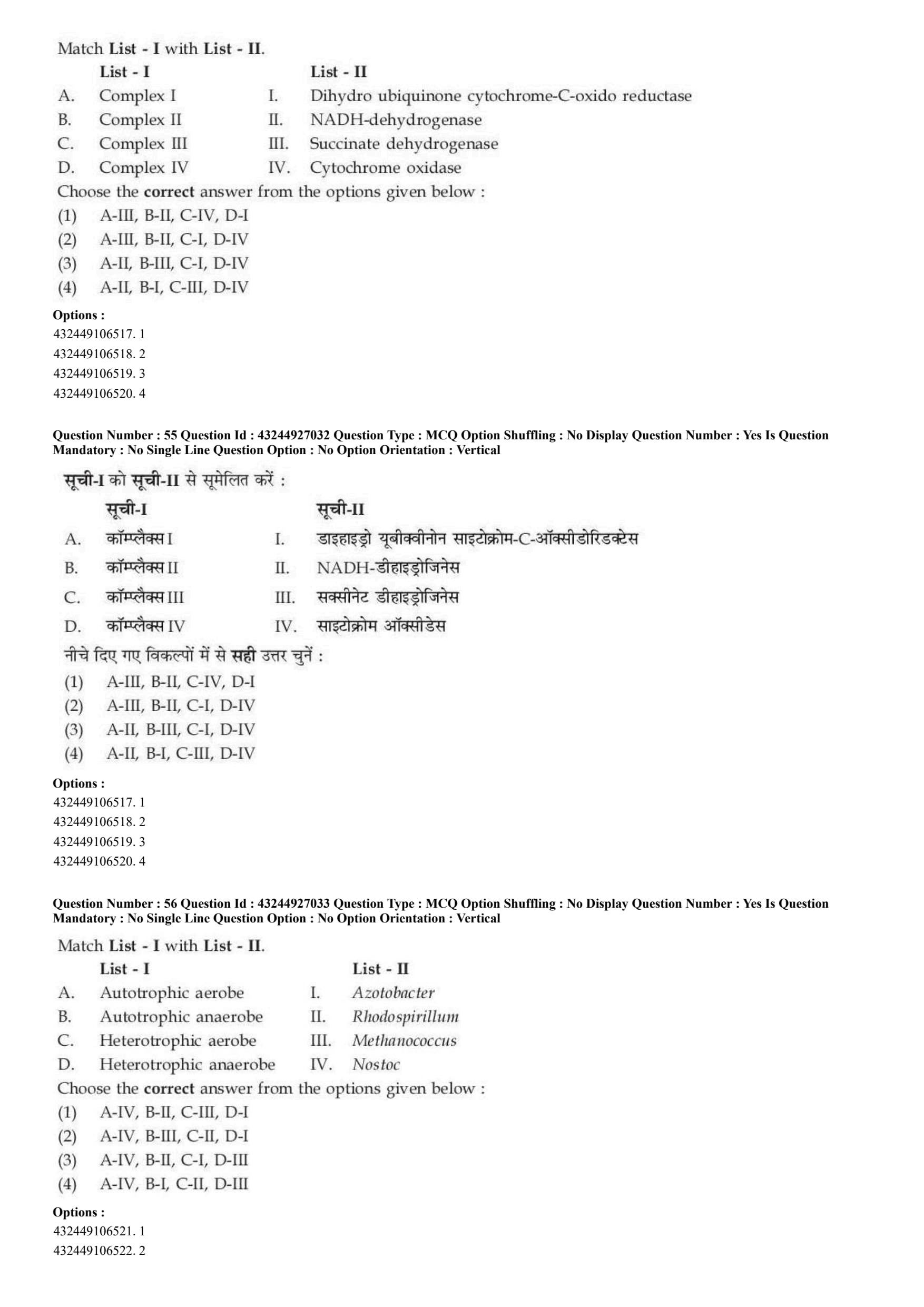
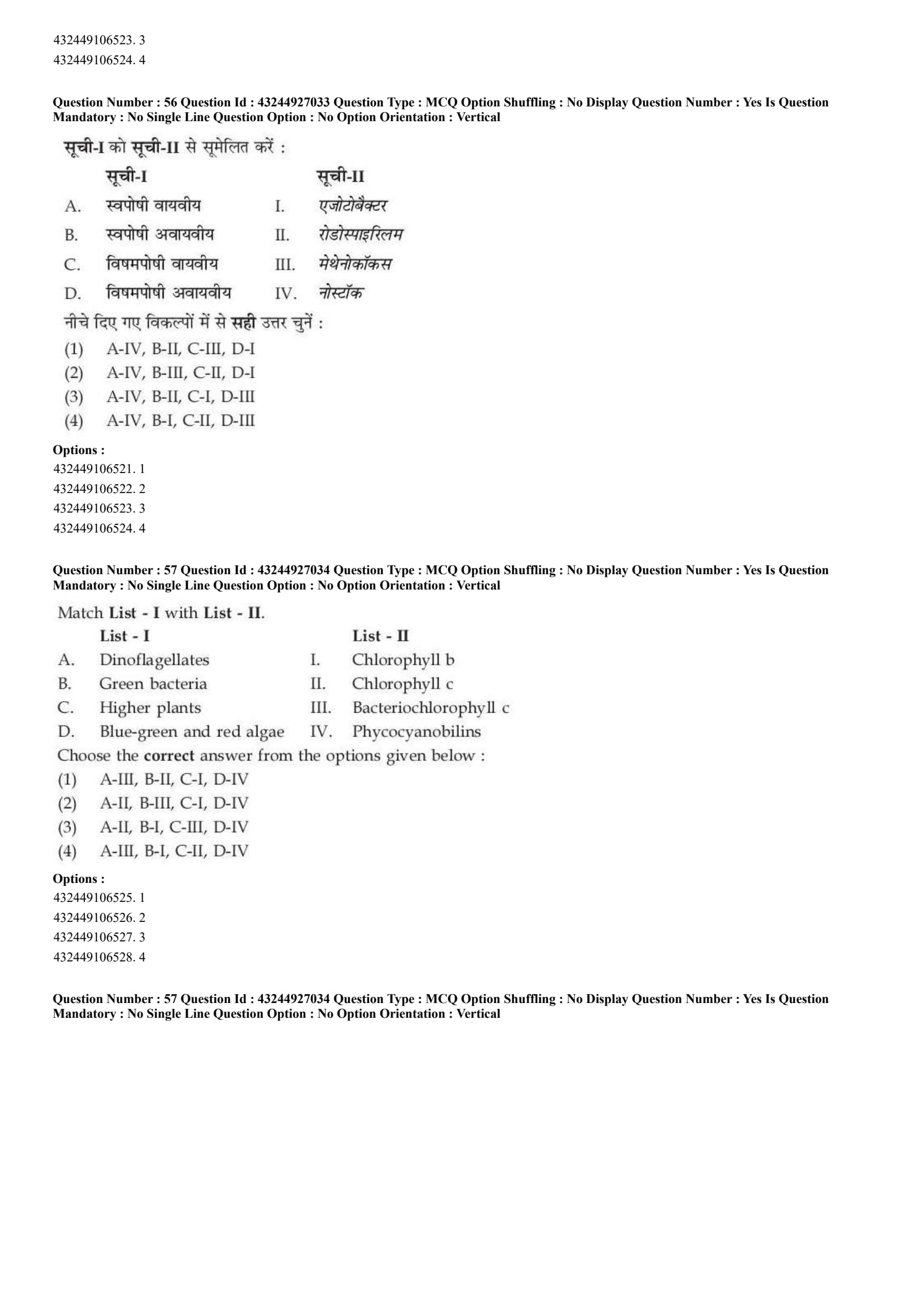
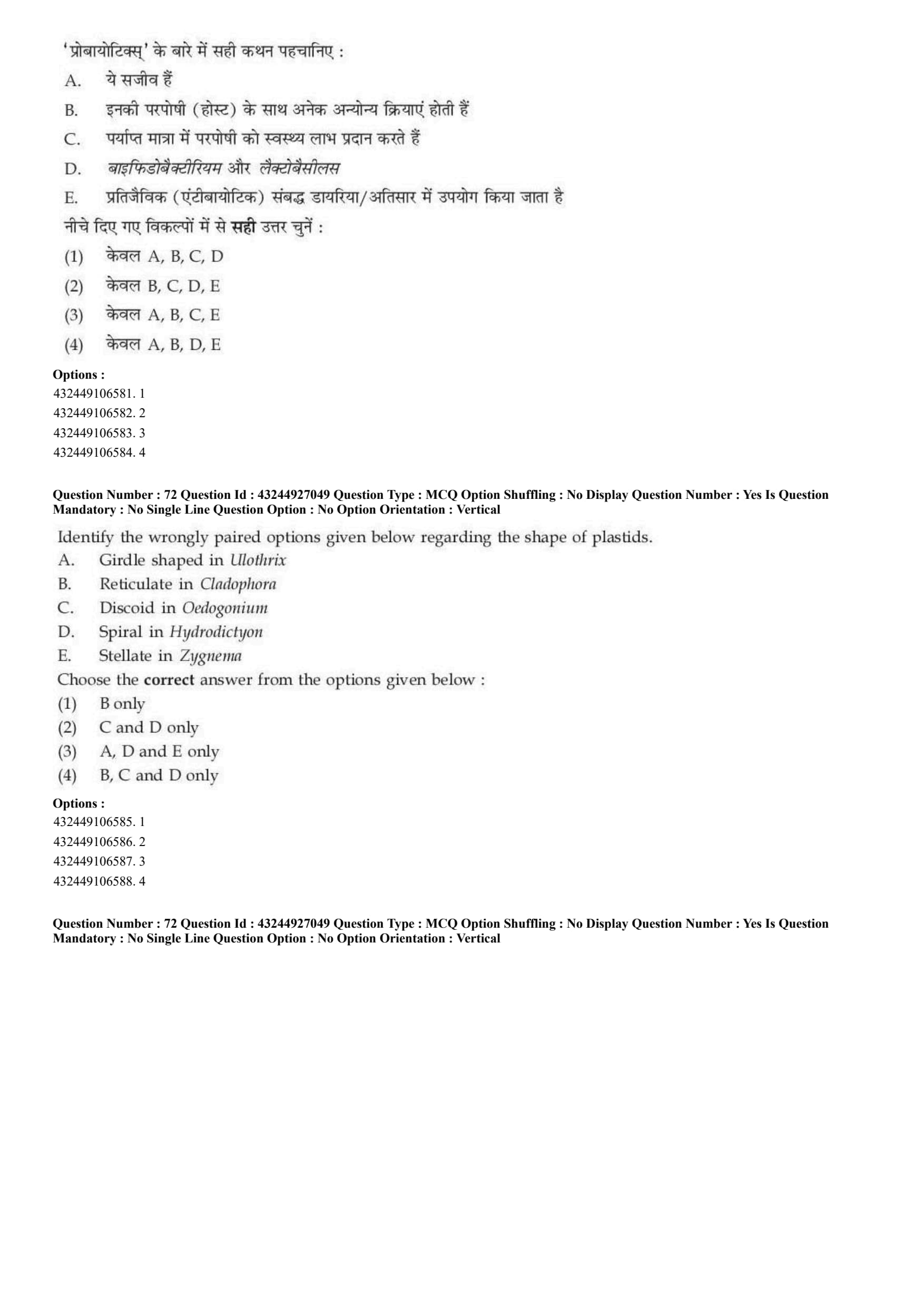
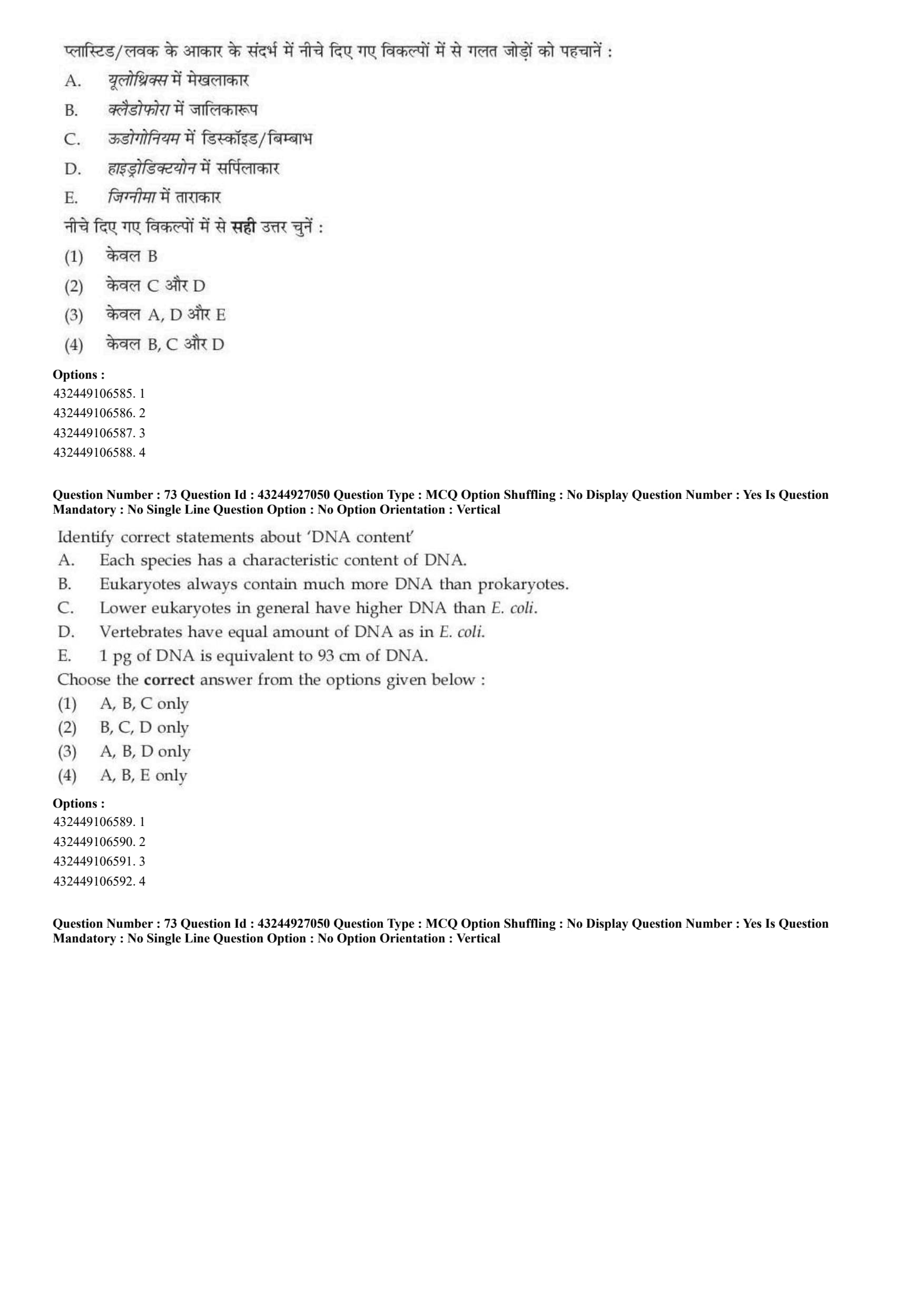
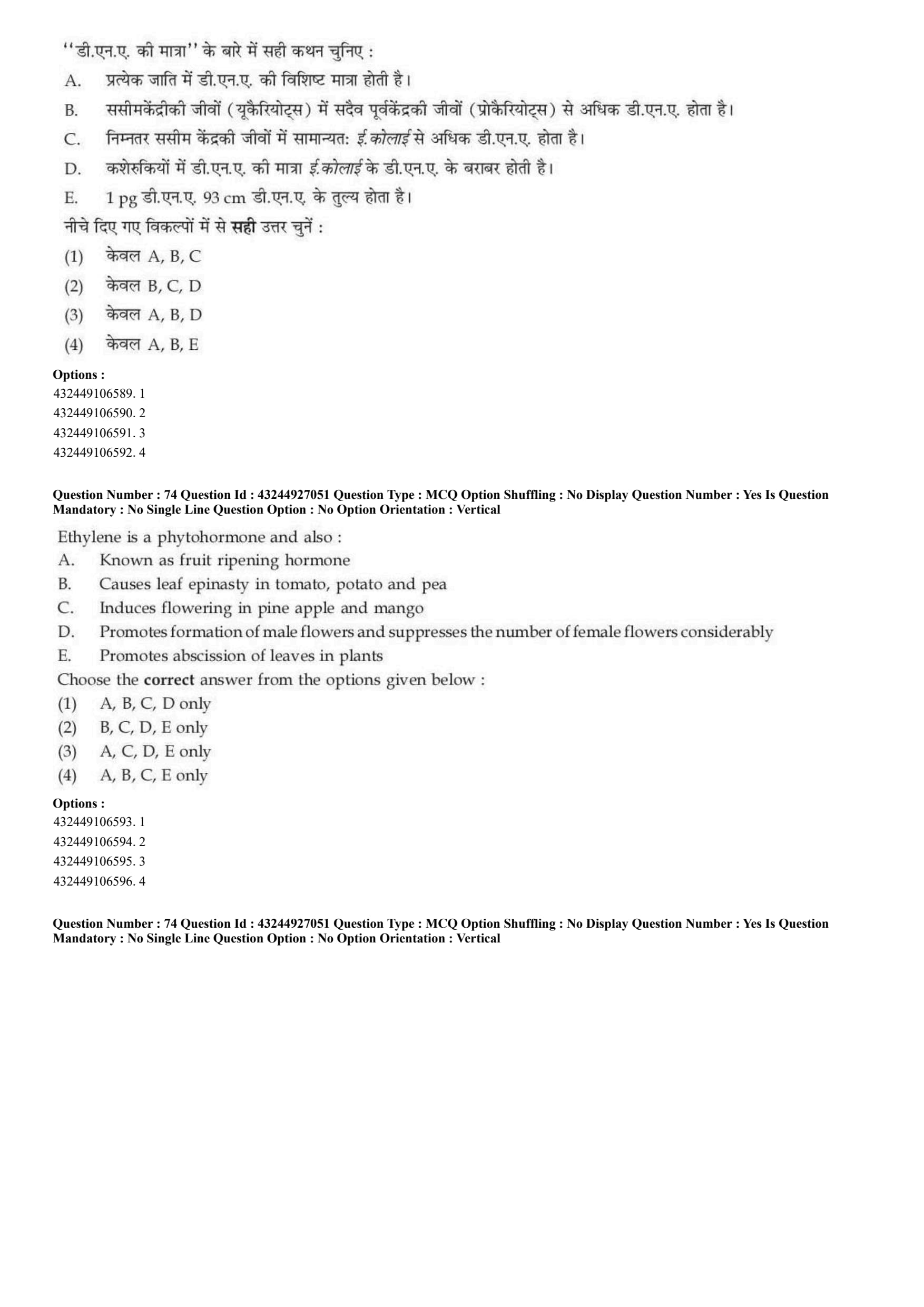
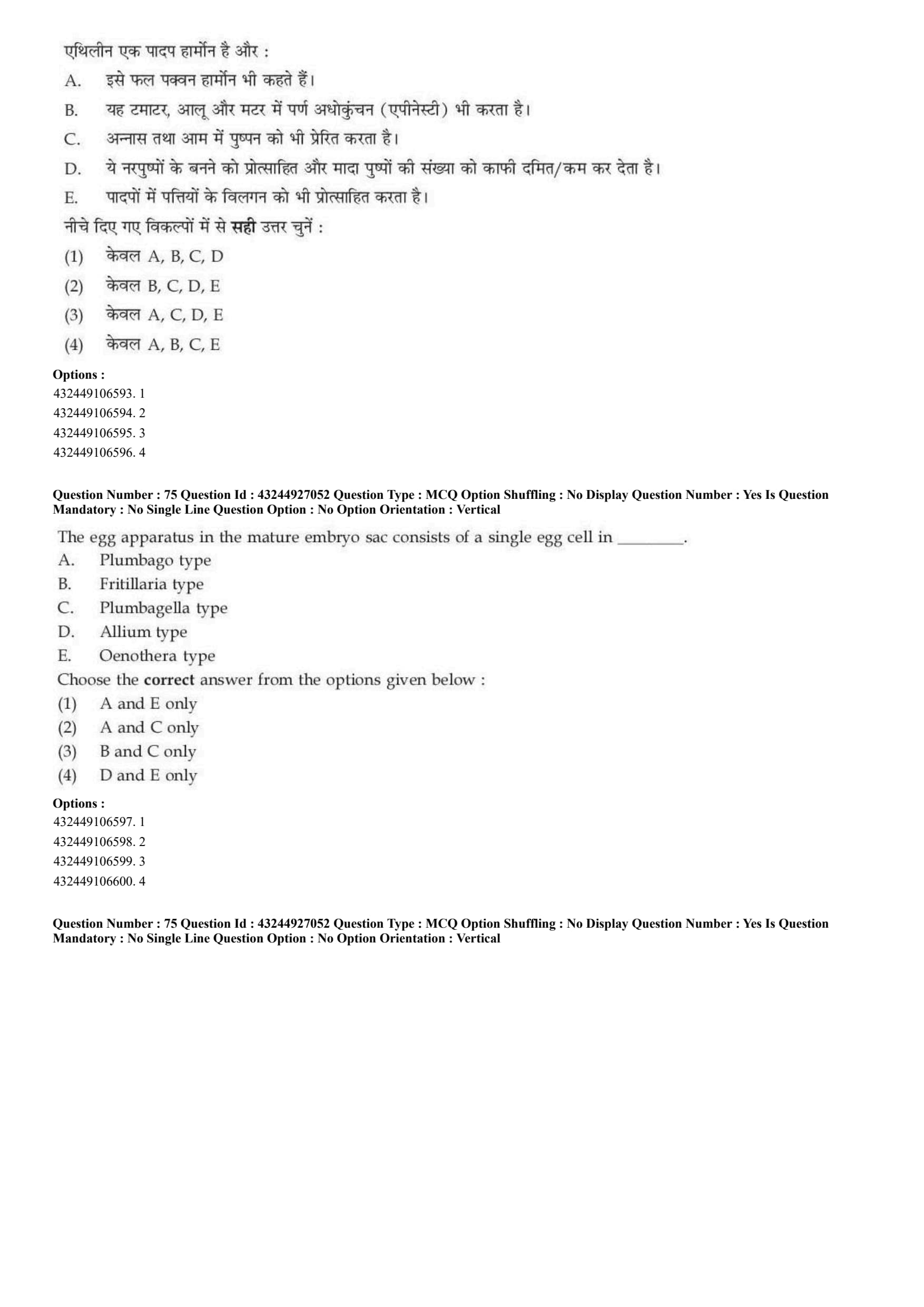
How many chlorophyll molecules are considered as 'molecules per physiological photosynthetic unit'?
View Solution
Step 1: Understanding the Question:
The question asks for the number of chlorophyll molecules that cooperate as a single physiological unit to drive photochemical reactions during photosynthesis.
Step 2: Key Concepts and Approach:
The concept of a photosynthetic unit (PSU) was introduced by Robert Emerson and William Arnold in 1932.
Through flashing-light experiments on the green alga Chlorella, they determined the relationship between the number of chlorophyll molecules and the yield of oxygen evolved.
Step 3: Detailed Explanation:
Emerson and Arnold observed that about 2400 chlorophyll molecules cooperate to release one molecule of oxygen (\(O_2\)).
Since the evolution of one molecule of oxygen requires the absorption of about 8 to 10 light quanta (photons), the minimum functional size of a photosynthetic unit is calculated by dividing the total number of chlorophyll molecules by the quantum requirement.
Dividing 2400 chlorophyll molecules by 10 photons yields approximately 240 chlorophyll molecules per photon absorbed.
This functional unit of about 230 to 250 chlorophyll molecules is known as the physiological photosynthetic unit.
It consists of a light-harvesting complex (antenna complex) that absorbs light energy and transfers it via resonance to a single reaction center (containing chlorophyll a) where photochemical reactions occur.
Step 4: Final Answer:
The physiological photosynthetic unit consists of approximately 230 to 250 chlorophyll molecules.
Quick Tip: Remember that the total number of chlorophyll molecules per \(O_2\) evolved is 2400, while the physiological unit per photon absorbed is 10 times smaller (230 - 250).
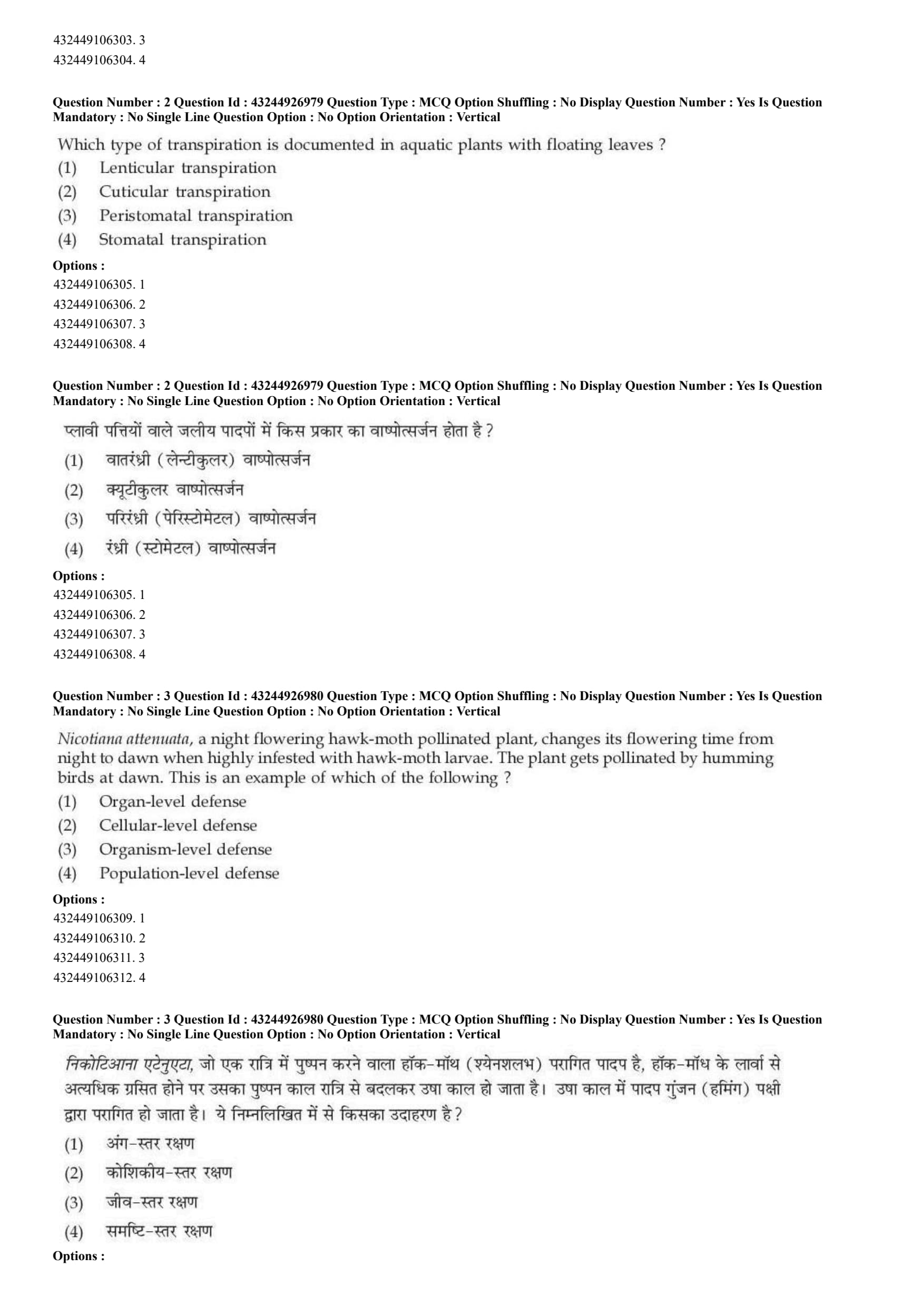
Which type of transpiration is documented in aquatic plants with floating leaves?
View Solution
Step 1: Understanding the Question:
This question requires identifying the primary pathway of water vapor loss (transpiration) from the leaves of aquatic plants that float on the water surface.
Step 2: Key Concepts and Approach:
Transpiration in plants is classified based on the structures involved: stomatal (through stomata), cuticular (through the cuticle), and lenticular (through lenticels).
Floating leaves of aquatic plants (such as Nymphaea) have a unique leaf anatomy to adapt to their aquatic environment.
Step 3: Detailed Explanation:
Aquatic plants with floating leaves are epistomatic, meaning their stomata are located exclusively on the upper epidermis of the leaf.
The lower epidermis remains in direct contact with water, making stomata on that side non-functional or absent to prevent flooding of the air spaces.
The upper surface is exposed to air, light, and wind, which facilitates gas exchange and transpiration through these upper stomata.
As a result, water vapor is lost primarily through the stomata on the upper surface, which constitutes stomatal transpiration.
Cuticular transpiration is minimal because the upper surface is covered with a thick, waxy cuticle to prevent wetting.
Lenticular transpiration is absent since leaves do not possess lenticels (which are structures of woody stems).
Step 4: Final Answer:
Stomatal transpiration is the documented and dominant type of transpiration in aquatic plants with floating leaves.
Quick Tip: Floating leaves are epistomatic (stomata on top) and submerged leaves are astomatic (no stomata), meaning floating leaves rely entirely on stomatal transpiration from their upper surface for gas exchange.
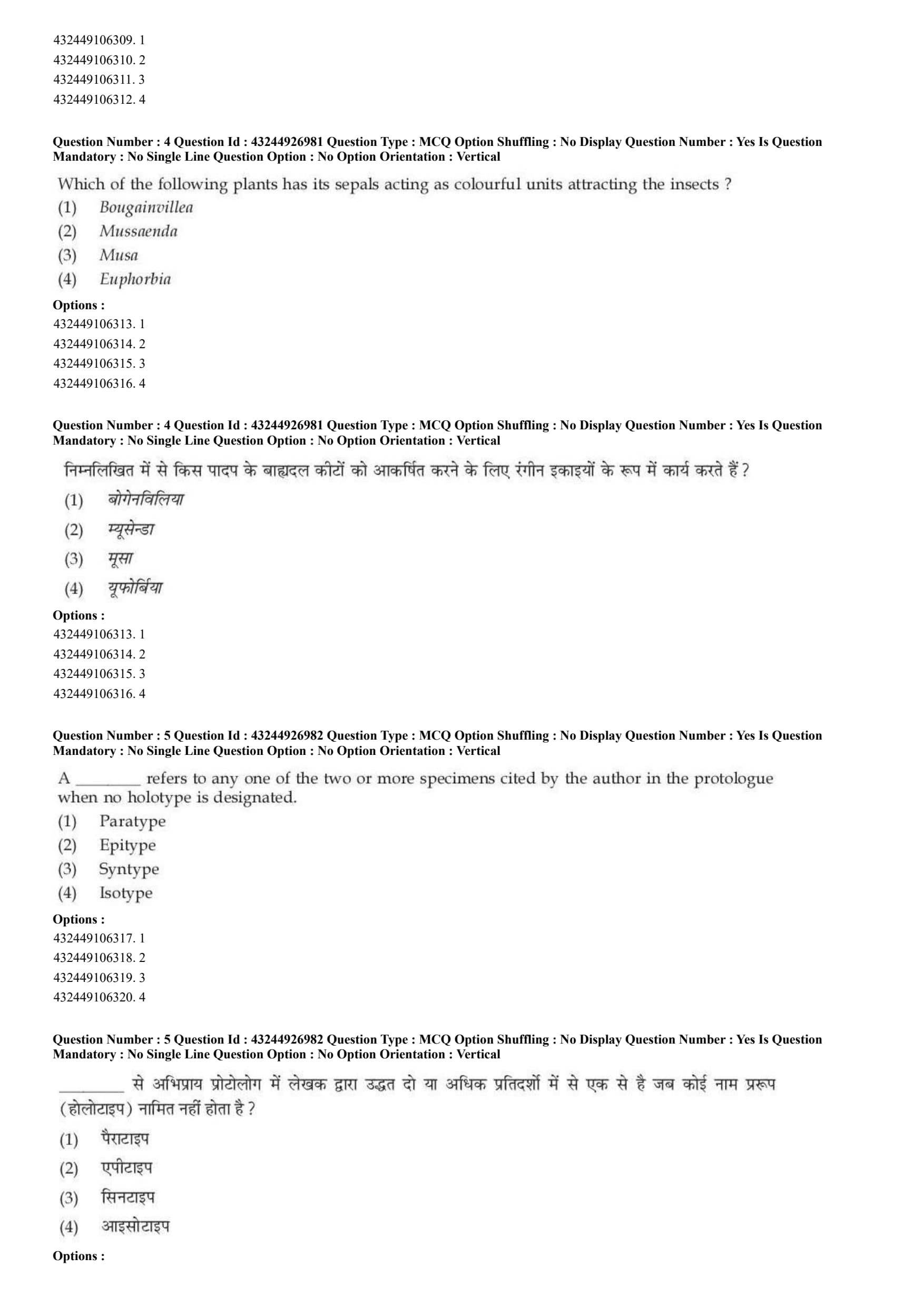
Nicotiana attenuata, a night flowering hawk-moth pollinated plant, changes its flowering time from night to dawn when highly infested with hawk-moth larvae. The plant gets pollinated by humming birds at dawn. This is an example of which of the following?
View Solution
Step 1: Understanding the Question:
The question asks to categorize the ecological defense mechanism of the plant \textit{Nicotiana attenuata, which shifts its flowering time and pollinator association under herbivore attack.
Step 2: Key Concepts and Approach:
Plants have evolved complex defense systems to survive herbivory. These defenses can operate at different biological hierarchies, from molecular and cellular levels to whole-organism and population levels.
An individual organism modifying its entire behavioral, physiological, and phenological output to avoid herbivore damage while maintaining reproduction represents a coordinated whole-organism response.
Step 3: Detailed Explanation:
\textit{Nicotiana attenuata is naturally pollinated by the nocturnal hawkmoth (\textit{Manduca sexta).
Although the adult hawkmoth is a pollinator, its larvae are highly destructive herbivores that feed on the plant.
Upon sensing severe infestation by hawkmoth larvae (induced by oral secretions of the larvae), the plant undergoes a phenological and behavioral shift.
It reduces its nocturnal volatile emissions and shifts its flower opening time to dawn, thereby attracting diurnal hummingbirds for pollination instead of nocturnal hawkmoths.
This strategy represents organism-level defense because it involves the integration of multiple organs (leaves sensing herbivory, flowers changing opening times and fragrance production) to alter the survival and reproductive strategy of the entire individual plant.
It is not a localized cellular response, nor is it restricted to a single isolated organ, nor is it a genetic shift of a population over generations.
Step 4: Final Answer:
This integrated behavioral and physiological shift in the individual plant is a classic example of organism-level defense.
Quick Tip: When an entire individual plant changes its behavioral cycle (like circadian rhythm of flowering) to balance pollination and herbivore avoidance, it is always classified as organism-level defense.
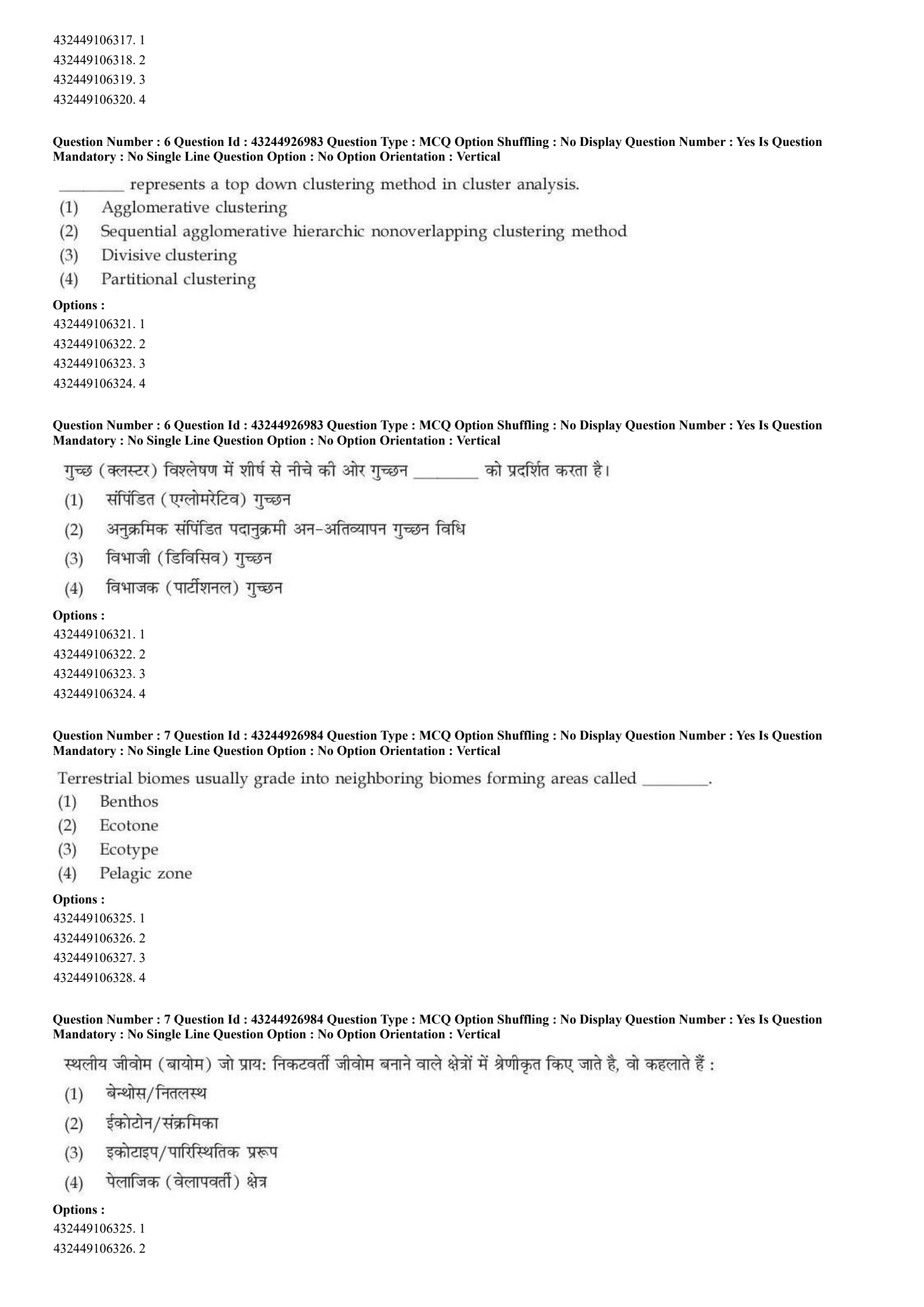
Which of the following plants has its sepals acting as colourful units attracting the insects?
View Solution
Step 1: Understanding the Question:
This question asks to identify which plant modifies its sepals (calyx) into large, brightly colored structures to attract pollinators.
Step 2: Key Concepts and Approach:
Typically, petals (corolla) are the primary attractive organs in animal-pollinated flowers. However, when petals are inconspicuous, plants can modify other floral parts such as bracts or sepals.
We need to distinguish between the modified structures of the listed genera: Bougainvillea, \textit{Mussaenda, \textit{Musa, and \textit{Euphorbia.
Step 3: Detailed Explanation:
In the genus \textit{Mussaenda (family Rubiaceae), the flowers are relatively small and tubular.
To attract insect pollinators, one of the five sepals in the outer flowers of the inflorescence becomes highly enlarged, leaf-like, and brightly colored (white, yellow, or pink). This is known as an "advertising flag."
In \textit{Bougainvillea, the bright, colorful structures surrounding the small, white flowers are modified leaves called bracts.
In \textit{Musa (banana), the large, colorful, protective structures covering the flowers are also bracts.
In \textit{Euphorbia (e.g., \textit{Euphorbia pulcherrima), the highly colored, attractive structures are modified foliage leaves or cyathium bracts.
Consequently, only \textit{Mussaenda specifically uses its modified sepals to act as colorful, insect-attracting units.
Step 4: Final Answer:
The plant that has modified sepals acting as colorful units to attract insects is \textit{Mussaenda.
Quick Tip: Remember: \textit{Bougainvillea = Colorful Bracts; Mussaenda = Colorful Sepals; Euphorbia = Colorful Cyathial Bracts. This distinction is a frequent examiner favorite.
A ________ refers to any one of the two or more specimens cited by the author in the protologue when no holotype is designated.
View Solution
Step 1: Understanding the Question:
This question relates to botanical nomenclature and requires identifying the correct term for nomenclatural type specimens under the rules of the International Code of Nomenclature (ICN).
Step 2: Key Concepts and Approach:
Typification is the process of designating a specimen to serve as the reference point for a scientific name.
The different types of nomenclatural specimens defined by the ICN include: Holotype, Isotype, Syntype, Paratype, Lectotype, Neotype, and Epitype.
Step 3: Detailed Explanation:
A holotype is the single specimen designated by the original author as the nomenclatural type of a taxon at the time of publication.
An isotype is a duplicate specimen of the holotype, collected at the same time and place by the same collector.
A syntype is defined as any specimen cited in the original description (protologue) when the author did not designate a holotype, or when two or more specimens were simultaneously designated as types.
A paratype is a specimen cited in the protologue that is neither the holotype, nor an isotype, nor one of the syntypes when two or more specimens were designated as types.
An epitype is a specimen selected to serve as an interpretative type when the holotype, lectotype, or neotype cannot be critically identified for precise identification.
Therefore, any specimen of two or more cited by the author in the protologue when no holotype is designated is a syntype.
Step 4: Final Answer:
The term that fills the blank is syntype.
Quick Tip: Syntypes occur when there is "No Holotype designated" and "multiple specimens are cited" in the original description (protologue).
________ represents a top down clustering method in cluster analysis.
View Solution
Step 1: Understanding the Question:
The question asks to identify the hierarchical clustering method that uses a "top-down" approach to group data.
Step 2: Key Concepts and Approach:
Hierarchical clustering is a method of cluster analysis which seeks to build a hierarchy of clusters. It is broadly divided into two strategies:
1. Agglomerative (Bottom-Up): Each observation starts in its own cluster, and pairs of clusters are merged as one moves up the hierarchy.
2. Divisive (Top-Down): All observations start in one single cluster, and splits are performed recursively as one moves down the hierarchy.
Step 3: Detailed Explanation:
Divisive clustering starts with a single large cluster containing all data points.
The algorithm then progressively splits the cluster into smaller clusters based on dissimilarity or distance metrics until each data point forms its own individual cluster.
Because it starts with the entire set and divides it downward, it is known as a top-down approach.
Agglomerative clustering is a bottom-up approach that starts with individual elements and merges them.
Partitional clustering (such as K-means) does not construct a hierarchical structure; instead, it directly partitions the dataset into a pre-specified number of non-overlapping clusters.
Thus, divisive clustering is the correct top-down hierarchical method.
Step 4: Final Answer:
Divisive clustering represents a top-down clustering method in cluster analysis.
Quick Tip: Remember: Divisive = Divide (Top-down, starting from one big group); Agglomerative = Aggregate (Bottom-up, merging single points).
Terrestrial biomes usually grade into neighboring biomes forming areas called ________.
View Solution
Step 1: Understanding the Question:
The question asks for the ecological term used to describe the transitional zone where two adjacent terrestrial biomes or ecosystems meet and integrate.
Step 2: Key Concepts and Approach:
In nature, ecosystems and biomes do not have sharp, absolute boundaries. Instead, they gradually transition from one type to another over a geographical gradient.
We need to define the ecological terms: Ecotone, Ecotype, Benthos, and Pelagic zone.
Step 3: Detailed Explanation:
An ecotone is a transition area between two biomes or diverse ecological communities (e.g., the boundary zone between a forest and a grassland).
Ecotones contain species from both adjacent communities and often support unique species adapted to the transition zone, exhibiting high species richness (known as the "edge effect").
An ecotype is a genetically distinct geographic variety, population, or race within a single species, adapted to specific local environmental conditions.
The term benthos refers to organisms that live on, in, or near the bottom of water bodies (lakes, oceans).
The pelagic zone refers to the open, deep water column of an ocean or lake, away from the shore or bottom.
Therefore, the transitional zone where terrestrial biomes grade into one another is called an econe.
Step 4: Final Answer:
The transitional area formed where biomes grade into each other is called an ecotone.
Quick Tip: Ecotone is always a "zone of transition" (e.g., estuaries, marshlands, forest edges), and it is characterized by the "edge effect" where species diversity is often higher than in the neighboring communities.
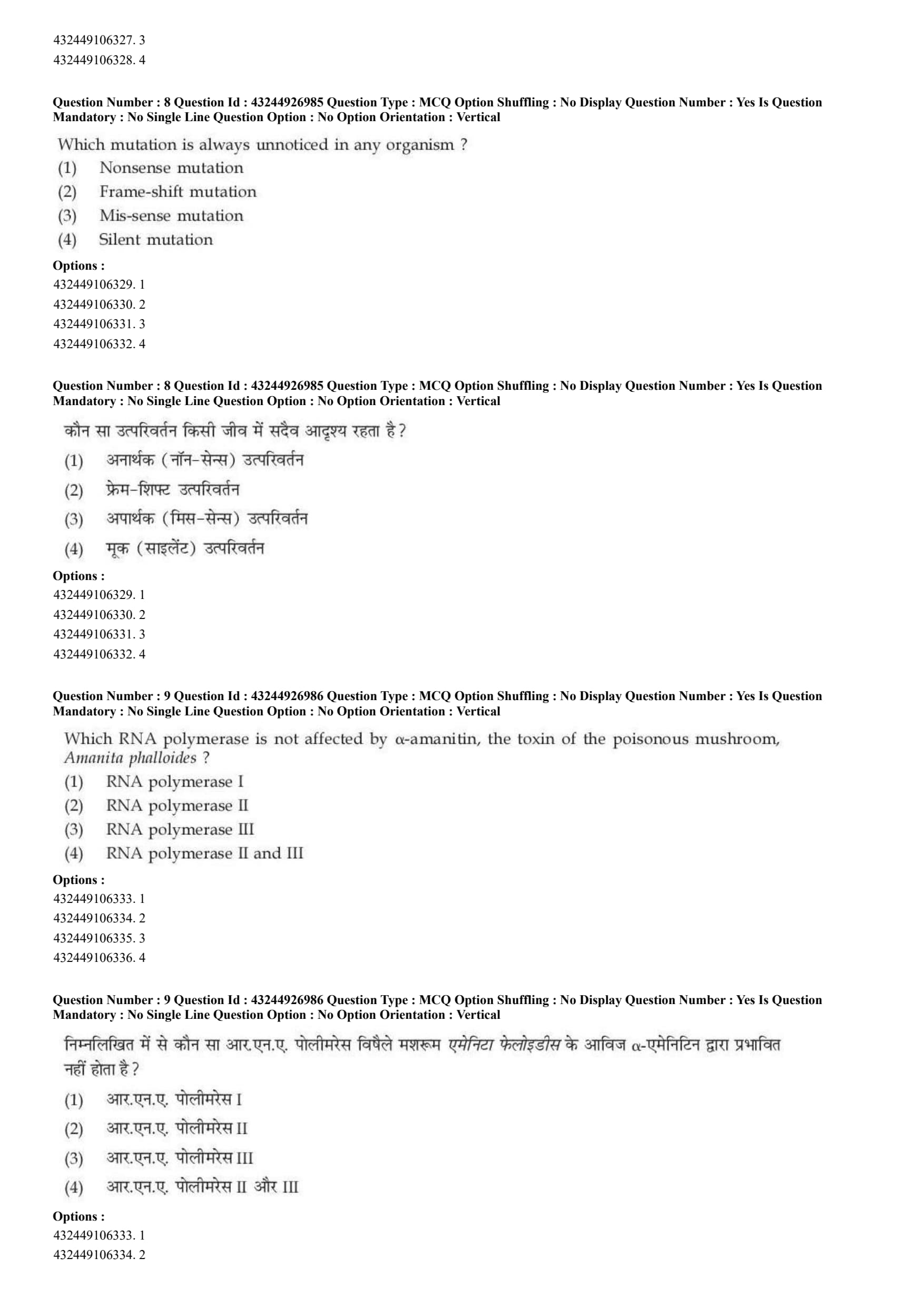
Which mutation is always unnoticed in any organism?
View Solution
Step 1: Understanding the Question:
This question asks to identify the type of genetic mutation that has no phenotypic effect and therefore remains unnoticed in an organism without genetic sequencing.
Step 2: Key Concepts and Approach:
The genetic code is degenerate (redundant), meaning that multiple codons can specify the same amino acid.
A single nucleotide substitution in a gene can have different consequences depending on whether and how it changes the resulting polypeptide sequence.
Step 3: Detailed Explanation:
A silent mutation occurs when a single nucleotide change in a codon results in another codon that codes for the exact same amino acid.
Because the primary amino acid sequence of the protein remains completely unchanged, the structure and function of the protein are unaffected.
Consequently, there is no change in the phenotype of the organism, and the mutation remains unnoticed under normal physiological and physical observations.
A missense mutation changes a codon to specify a different amino acid, which often alters the protein's function and may lead to a detectable mutant phenotype.
A nonsense mutation changes an amino-acid-specifying codon into a stop codon, causing premature termination of translation and resulting in a truncated, usually non-functional protein.
A frameshift mutation involves insertion or deletion of nucleotides (not in multiples of three), altering the entire reading frame downstream and producing a completely different polypeptide.
Step 4: Final Answer:
A silent mutation is always unnoticed because it does not alter the protein product or phenotype.
Quick Tip: Silent mutations alter the genotype (DNA level) but never the phenotype (protein level), making them phenotypically neutral and unnoticed.
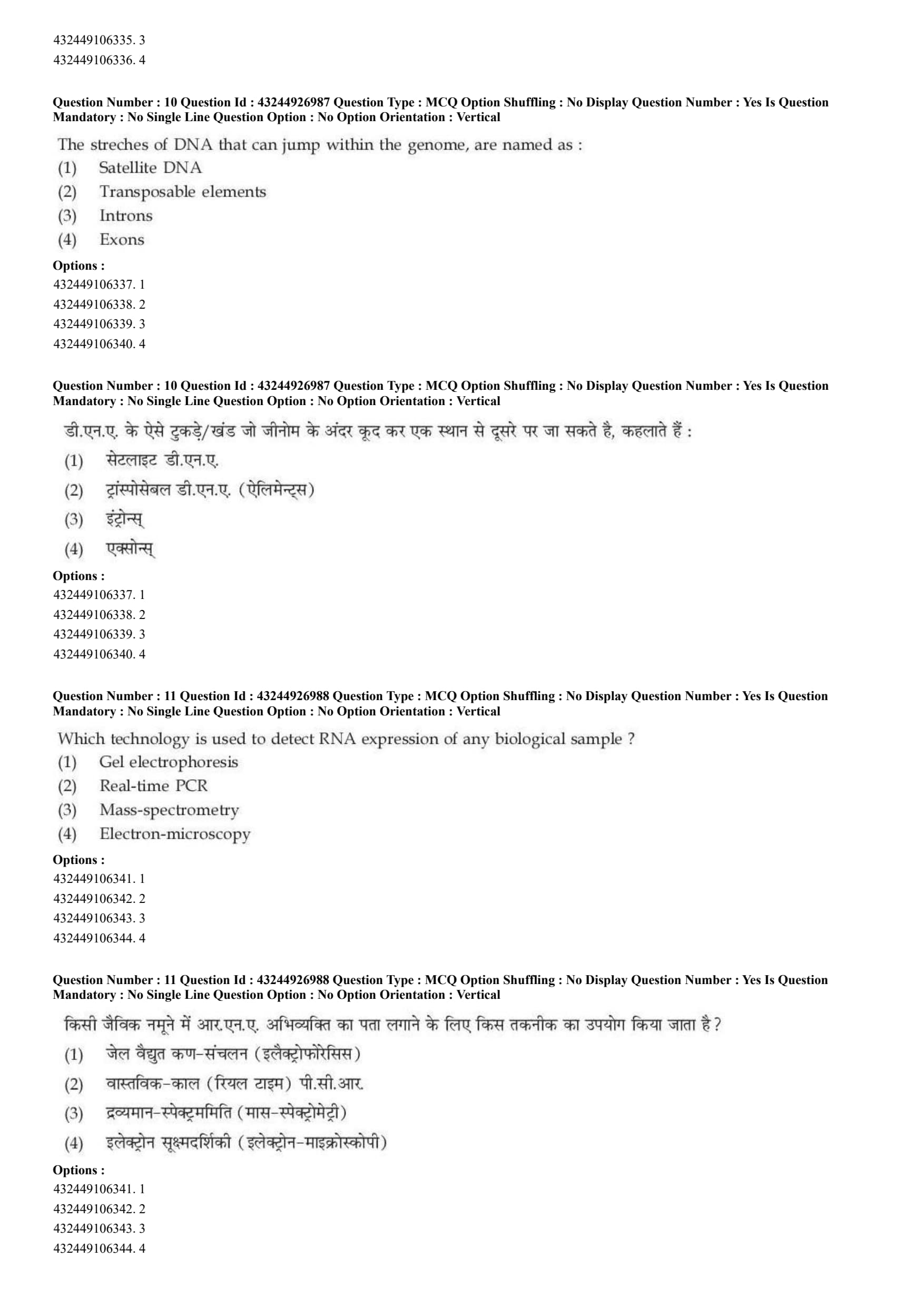
Which RNA polymerase is not affected by \(\alpha\)-amanitin, the toxin of the poisonous mushroom, Amanita phalloides?
View Solution
Step 1: Understanding the Question:
The question asks which eukaryotic RNA polymerase enzyme is insensitive to (not affected by) the fungal toxin \(\alpha\)-amanitin.
Step 2: Key Concepts and Approach:
Eukaryotes possess three distinct nuclear RNA polymerases (I, II, and III) that transcribe different types of genes.
These enzymes can be experimentally distinguished based on their differential sensitivity to \(\alpha\)-amanitin, a cyclic peptide toxin from the death cap mushroom (\textit{Amanita phalloides).
Step 3: Detailed Explanation:
RNA Polymerase I is localized in the nucleolus and is responsible for transcribing the precursor of major ribosomal RNAs (18S, 5.8S, and 28S rRNAs). It is highly resistant and is not affected by low or high concentrations of \(\alpha\)-amanitin.
RNA Polymerase II transcribes all protein-coding genes (mRNAs) and most snRNAs. It is extremely sensitive to \(\alpha\)-amanitin, being inhibited at very low concentrations (nanomolar range).
RNA Polymerase III transcribes tRNAs, 5S rRNA, and other small nuclear and cytoplasmic RNAs. It is moderately sensitive to \(\alpha\)-amanitin (inhibited at high micromolar concentrations in vertebrates, but insensitive in some plants and yeast).
Thus, among the given options, RNA polymerase I is universally recognized as being completely unaffected by the toxin.
Step 4: Final Answer:
RNA polymerase I is not affected by the toxin \(\alpha\)-amanitin.
Quick Tip: Remember the sensitivity order to \(\alpha\)-amanitin:
Pol II (highly sensitive) \(>\) Pol III (moderately sensitive) \(>\) Pol I (completely resistant/unaffected).
The streches of DNA that can jump within the genome, are named as :
View Solution
Step 1: Understanding the Question:
The question asks for the scientific name of mobile genetic sequences of DNA that can change their position within the genome.
Step 2: Key Concepts and Approach:
Genomes are not static; they contain dynamic sequences that are capable of moving from one location to another.
These mobile genetic units were first discovered by Barbara McClintock in maize and are known as transposable elements or "jumping genes."
Step 3: Detailed Explanation:
Transposable elements (TEs) or transposons are DNA sequences that can move to new sites within the genome of a single cell.
Transposition can occur through a "cut-and-paste" mechanism (DNA transposons) or a "copy-and-paste" mechanism (retrotransposons, which utilize an RNA intermediate).
Satellite DNA consists of highly repetitive, non-coding DNA sequences concentrated in heterochromatin regions like centromeres, but these sequences cannot jump.
Introns are non-coding regions within a gene that are transcribed but spliced out during RNA processing and do not possess independent mobility.
Exons are the coding segments of a gene that remain in the mature mRNA after splicing and do not move within the genome.
Step 4: Final Answer:
The mobile segments of DNA that can jump within the genome are called transposable elements.
Quick Tip: Barbara McClintock received the Nobel Prize in 1983 for discovering transposable elements ("jumping genes") in maize, showing that the genome is highly dynamic.
Which technology is used to detect RNA expression of any biological sample?
View Solution
Step 1: Understanding the Question:
This question asks to identify the scientific method used to analyze and quantify the expression levels of RNA in a biological sample.
Step 2: Key Concepts and Approach:
Gene expression is measured by determining the quantity of specific messenger RNA (mRNA) transcripts.
Among the available biological techniques, we must select the one most commonly and precisely used for detecting and quantifying target RNA levels.
Step 3: Detailed Explanation:
Real-time PCR (specifically quantitative reverse transcription PCR, or RT-qPCR) is the gold standard for measuring RNA expression.
In this technique, the RNA of interest is first reverse transcribed into complementary DNA (cDNA) by reverse transcriptase.
The cDNA is then amplified by PCR, and the accumulation of the product is monitored in real-time using fluorescent dyes or sequence-specific probes. This allows precise quantification of the starting RNA amount.
Gel electrophoresis is a separation technique used to resolve DNA, RNA, or proteins based on size, but it does not quantify dynamic gene expression on its own unless paired with blotting.
Mass spectrometry is primarily used to analyze proteins (proteomics) and metabolites (metabolomics), not nucleic acid expression.
Electron microscopy is an imaging tool used to visualize cellular and macromolecular ultrastructures, not molecular expression levels.
Step 4: Final Answer:
Real-time PCR is the technology used to detect and quantify RNA expression in biological samples.
Quick Tip: To detect RNA expression, RT-qPCR (Real-time PCR after reverse transcription) is the most standard, sensitive, and quantitative technique available.
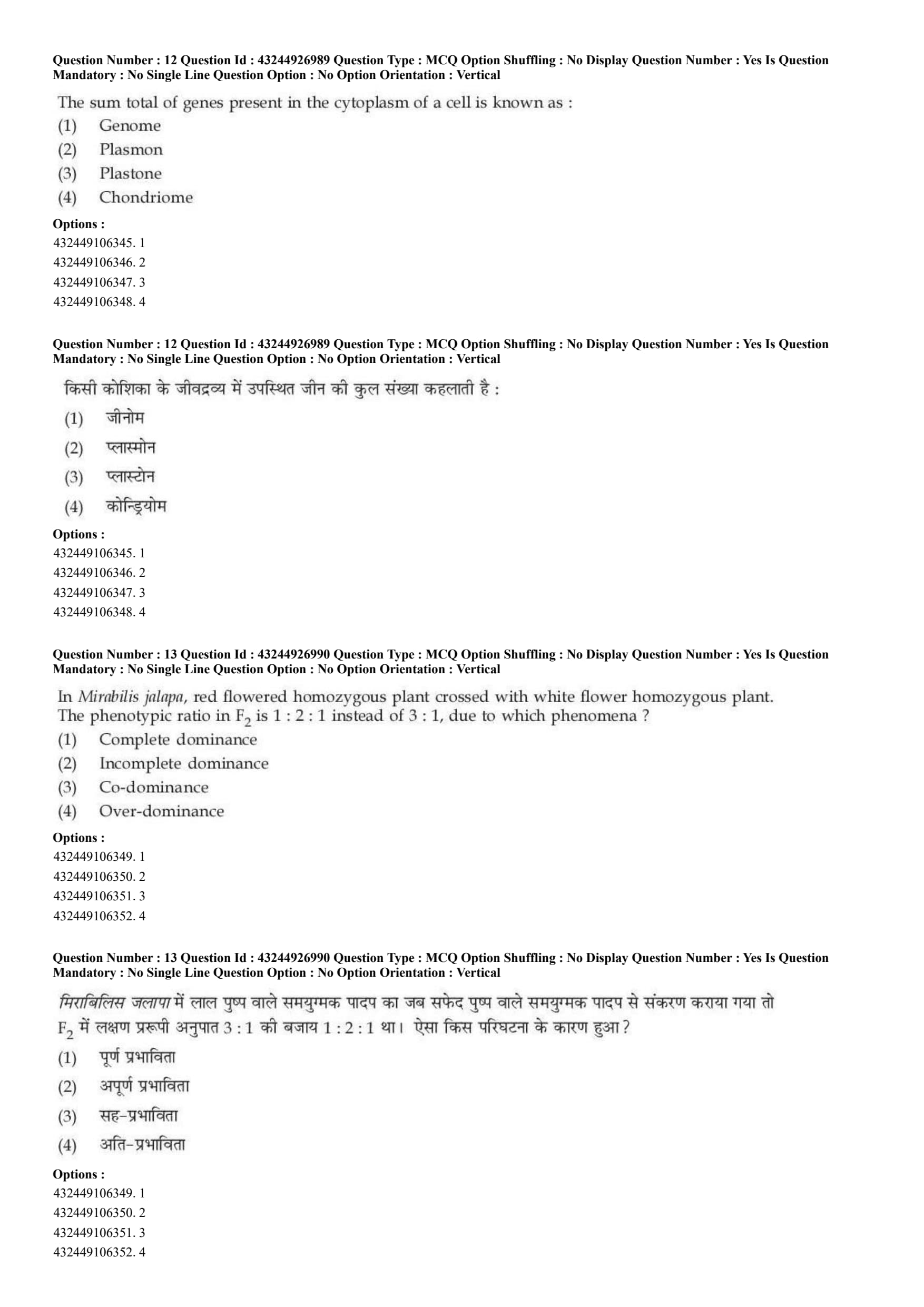
The sum total of genes present in the cytoplasm of a cell is known as :
View Solution
Step 1: Understanding the Question:
The question asks for the biological term that describes the entire complement of genetic material located outside the cell nucleus (in the cytoplasm).
Step 2: Key Concepts and Approach:
Eukaryotic cells contain DNA in the nucleus (nuclear genome) and also in cytoplasmic organelles (mitochondria and plastids).
The genetic material outside the nucleus is responsible for cytoplasmic or extranuclear inheritance, and specific terms describe these individual and collective genetic systems.
Step 3: Detailed Explanation:
The plasmon represents the sum total of all cytoplasmic genetic determinants (extranuclear genes) in a cell.
The genome generally refers to the complete set of genetic material (primarily nuclear) of an organism.
The plastone (or plastome) specifically refers to the genetic material contained within the plastids (e.g., chloroplasts).
The chondriome specifically refers to the genetic material contained within all the mitochondria of a cell.
Since cytoplasmic genes are distributed between mitochondria and plastids, the plasmon is the overarching term that encompasses both the plastone and the chondriome.
Step 4: Final Answer:
The sum total of genes in the cytoplasm is known as the plasmon.
Quick Tip: Remember:
Plasmon = Total Cytoplasmic Genotype
Plastone = Chloroplast Genotype
Chondriome = Mitochondrial Genotype
In Mirabilis jalapa, red flowered homozygous plant crossed with white flower homozygous plant. The phenotypic ratio in \(F_2\) is \(1 : 2 : 1\) instead of \(3 : 1\), due to which phenomena?
View Solution
Step 1: Understanding the Question:
The question asks for the genetic mechanism that explains the modification of the classic Mendelian \(3:1\) phenotypic ratio to a \(1:2:1\) ratio in the \(F_2\) generation of a cross in \textit{Mirabilis jalapa.
Step 2: Key Concepts and Approach:
Mendel's law of dominance states that the dominant allele completely masks the recessive allele in the heterozygote.
However, in post-Mendelian genetics, several exceptions were found where alleles show incomplete or intermediate expressions, leading to altered phenotypic ratios.
Step 3: Detailed Explanation:
When a homozygous red-flowered \textit{Mirabilis jalapa (\(RR\)) is crossed with a homozygous white-flowered plant (\(rr\)), the \(F_1\) generation produces pink-flowered heterozygous plants (\(Rr\)).
The pink color is an intermediate phenotype arising because the red allele (\(R\)) is not completely dominant over the white allele (\(r\)). This is the definition of incomplete dominance.
When the \(F_1\) pink-flowered plants (\(Rr\)) are self-pollinated to produce the \(F_2\) generation, the genotypic segregation is \(1 RR : 2 Rr : 1 rr\).
Since the heterozygotes (\(Rr\)) express a unique pink phenotype, the phenotypic ratio matches the genotypic ratio, which is \(1 Red : 2 Pink : 1 White\) (\(1:2:1\)).
In co-dominance, both alleles are expressed fully and independently in the heterozygote (e.g., AB blood group), rather than forming an intermediate blend.
Step 4: Final Answer:
The \(1:2:1\) phenotypic ratio in the \(F_2\) generation of \textit{Mirabilis jalapa is due to incomplete dominance.
Quick Tip: In incomplete dominance, the phenotypic ratio in the \(F_2\) generation is identical to the genotypic ratio (\(1:2:1\)), because the heterozygote exhibits an intermediate phenotype.
Which type of enzymes, are frequently used to assess genetic variation within a population or plant species?
View Solution
Step 1: Understanding the Question:
The question asks to identify the type of enzyme variants used as molecular or biochemical markers to measure genetic diversity and variation within populations or plant species.
Step 2: Key Concepts and Approach:
Genetic variation can be analyzed at the biochemical level by examining proteins and enzymes.
Allozymes are allelic variants of enzymes encoded by different alleles at the same locus. They differ in their primary structure (amino acid sequence) and can be separated based on electric charge using gel electrophoresis.
Step 3: Detailed Explanation:
Allozymes are functional enzyme variants that arise from genetic mutations at a single locus.
These variations can be easily analyzed using starch gel electrophoresis. Because allozymes migrate at different rates depending on their charge and molecular mass, they serve as highly reliable codominant genetic markers.
They have been extensively used in population genetics, phylogenetics, and conservation biology to study gene flow, heterozygosity, and genetic drift.
Abzymes are catalytic antibodies engineered in the lab and do not reflect natural genetic variation.
Synzymes and enzyme mimics are synthetic, artificial molecules designed to mimic enzyme function and are not biological markers of natural diversity.
Step 4: Final Answer:
Allozymes are the enzymes frequently used to assess genetic variation within a population.
Quick Tip: Allozymes are codominant markers, meaning they can distinguish between homozygotes and heterozygotes, making them ideal for population genetics studies.
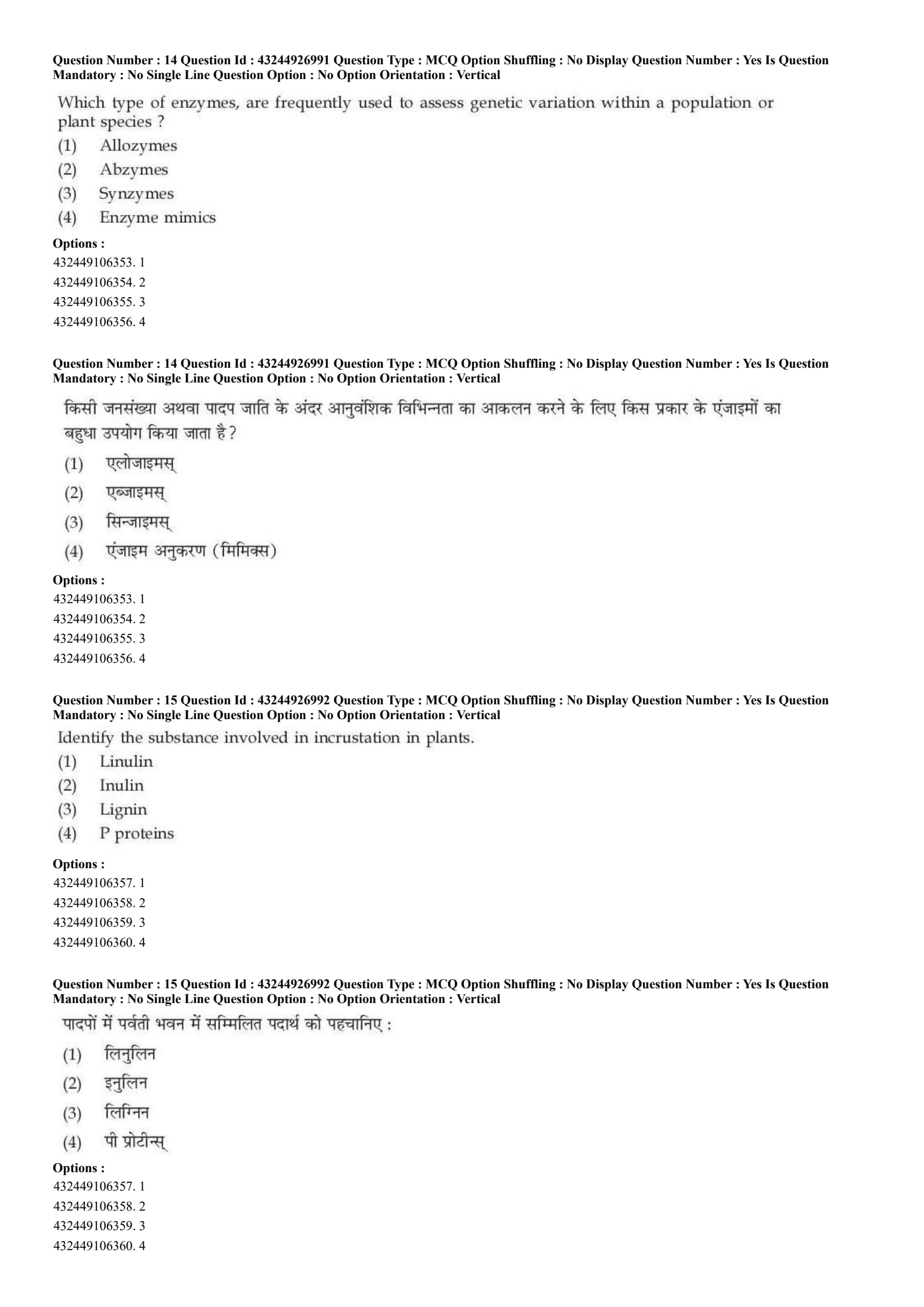
Identify the substance involved in incrustation in plants.
View Solution
Step 1: Understanding the Question:
The question asks to identify which plant substance is involved in the process of incrustation within plant tissues or cell walls.
Step 2: Key Concepts and Approach:
Cell wall modifications occur via two major processes:
1. Adcrustation: Deposition of substances in layers on the outer surface of the cell wall (e.g., cutin, suberin, wax).
2. Incrustation: Infiltration and deposition of substances within the existing microfibrillar matrix of the cell wall.
Step 3: Detailed Explanation:
Lignin is a highly complex, hydrophobic phenolic polymer that is deposited within the cellulose and hemicellulose network of the secondary cell wall during cell maturation.
This process of lignin deposition is called lignification or incrustation. It provides mechanical support, rigidity, compressive strength, and resistance to decay.
Inulin is a storage carbohydrate (fructan) found in the vacuoles of roots and tubers of certain plants (such as Asteraceae members like Dahlia) and is not a structural wall-modifying agent.
P-proteins (Phloem proteins) are involved in sealing damaged sieve tube elements to prevent loss of phloem sap, not in wall incrustation.
Linulin is not a recognized plant cell wall component.
Step 4: Final Answer:
Lignin is the key substance involved in cell wall incrustation in plants.
Quick Tip: Remember: Lignin is the classic "incrusting" substance that provides compressive strength to wood, whereas cutin and suberin are typical "adcrusting" waterproof substances.
Which among the following represents the right combination of characters in Pteris?
View Solution
Step 1: Understanding the Question:
The question requires identifying the correct combination of anatomical (stele type) and developmental (sporangium type) characteristics of the fern genus Pteris.
Step 2: Key Concepts and Approach:
Pteridophytes exhibit evolutionary transitions in their vascular organization (steles) and sporangium development.
We need to evaluate the vascular system of the rhizome of \textit{Pteris and how its sporangia originate.
Step 3: Detailed Explanation:
Stele Type: The rhizome of mature \textit{Pteris species exhibits a dissected siphonostele called a dictyostele. In a dictyostele, the vascular cylinder is broken into multiple overlapping leaf gaps, leaving isolated vascular strands called meristeles.
Sporangium Development: In terms of sporangial development, pteridophytes are either:
1. Eusporangiate: Sporangium develops from a group of initial cells (found in primitive ferns like Lycopods, \textit{Ophioglossum).
2. Leptosporangiate: Sporangium develops from a single superficial initial cell (found in advanced ferns like \textit{Pteris, \textit{Dryopteris, \textit{Adiantum).
Since \textit{Pteris is an advanced leptosporangiate fern, it possesses a dictyostele and shows leptosporangiate sporangium development.
Step 4: Final Answer:
The right combination of characters in \textit{Pteris is Dictyostele and Leptosporangiate.
Quick Tip: True ferns like \textit{Pteris, Dryopteris, and Adiantum are characterized by the advanced "Dictyostele" (broken vascular ring) and "Leptosporangiate" (single-cell origin of sporangium) features.
The sporophyte of which among the following genera has only foot and capsule?
View Solution
Step 1: Understanding the Question:
This question asks to identify which bryophyte genus has a sporophyte differentiated into only a foot and a capsule, lacking a seta.
Step 2: Key Concepts and Approach:
The sporophyte of a typical bryophyte consists of three parts: foot, seta, and capsule.
However, evolutionary modifications or reductions occur across different bryophyte groups (liverworts, hornworts, and mosses). We need to analyze the sporophytic structures of the given options.
Step 3: Detailed Explanation:
In Anthoceros (a hornwort), the sporophyte is an elongated, needle-like structure consisting of a bulbous, deeply embedded foot and an upright, cylindrical capsule. There is no seta; instead, a region of actively dividing meristematic tissue lies between the foot and the capsule, allowing continuous growth of the capsule.
In Riccia, the sporophyte is highly reduced and consists only of a capsule (both foot and seta are completely absent).
In Marchantia and Pellia, the sporophyte is fully developed and clearly differentiated into a distinct foot, a well-defined seta, and a capsule.
Therefore, the hornwort Anthoceros represents the genus having a sporophyte consisting of only a foot and a capsule.
Step 4: Final Answer:
The sporophyte of \textit{Anthoceros contains only a foot and a capsule.
Quick Tip: Remember:
\textit{Riccia = Capsule only
Anthoceros = Foot and Capsule (no Seta, replaced by meristematic zone)
Marchantia / Pellia = Foot, Seta, and Capsule.
Branched rhizoids are found in ________.
View Solution
Step 1: Understanding the Question:
The question asks which bryophyte genus possesses branched rhizoids.
Step 2: Key Concepts and Approach:
Rhizoids in bryophytes are root-like filamentous structures used for anchorage and water absorption.
The structure of rhizoids varies across different groups of bryophytes:
- Liverworts (Hepaticopsida) and Hornworts (Anthocerotopsida) possess unicellular, unbranched rhizoids.
- True mosses (Bryopsida) possess multicellular, branched rhizoids with oblique septa.
Step 3: Detailed Explanation:
Sphagnum is a genus of mosses (class Sphagnopsida). During the early developmental stage (the protonemal stage), the gametophytic system produces multicellular, branched rhizoids. Although adult leafy gametophores of Sphagnum eventually become rootless, the presence of branched rhizoids is characteristic of the moss lineage.
Riccia (a thalloid liverwort) has unicellular, unbranched rhizoids of two types: smooth-walled and tuberculated.
Anthoceros (a hornwort) has only simple, unicellular, unbranched, smooth-walled rhizoids.
Porella (a leafy liverwort) has unicellular, unbranched, smooth-walled rhizoids.
Since \textit{Sphagnum is the only moss among the choices, it is the only genus characterized by having branched rhizoids.
Step 4: Final Answer:
Branched rhizoids are found in \textit{Sphagnum.
Quick Tip: Whenever a question asks about "multicellular or branched rhizoids", look for mosses (like \textit{Funaria, Polytrichum, or Sphagnum). Liverworts and hornworts always have unicellular, unbranched rhizoids.
Among the following, which is not a source for passive dispersal of plant pathogen.
View Solution
Step 1: Understanding the Question:
The question requires identifying which of the listed agencies does not represent a source of passive dispersal for plant pathogens.
Step 2: Key Concepts and Approach:
Pathogen dispersal in plants is categorized into:
1. Passive Dispersal: The pathogen is transported entirely by abiotic physical forces (such as wind, water currents, or soil movement).
2. Active or Vector-Mediated Dispersal: The pathogen is transported and often inoculated directly into the host by living organisms (vectors) like insects, nematodes, or birds.
Step 3: Detailed Explanation:
Air (wind) is a major passive dispersal force that carries lightweight spores (conidia, rust spores) over long distances.
Water is a passive physical medium that disseminates fungal spores, bacterial cells, and zoospores via rain splashes, dew, or irrigation run-offs.
Soil acts as a passive physical reservoir; pathogens residing in soil are transported passively when soil is moved by water, wind, or farm machinery.
Insects are active, biotic vectors. They actively fly, feed on plants, and systematically transmit viruses, bacteria, or fungal spores directly into healthy tissues.
Thus, insect-mediated dispersal is categorized as active biological vector transmission, distinguishing it from passive abiotic transport.
Step 4: Final Answer:
Insects are not a source for passive dispersal of plant pathogens.
Quick Tip: Abiotic agents (Air, Water, Soil) provide "passive" dispersal, whereas biotic agents like "Insects" serve as active vectors for pathogen transmission.
Plasma membrane \(H^+ - ATPases\) are characteristically inhibited by :
View Solution
Step 1: Understanding the Question:
The question asks to identify the characteristic chemical inhibitor of the plant plasma membrane \(H^+\)-ATPase pump.
Step 2: Key Concepts and Approach:
Plant membranes contain different classes of proton pumps (H+-ATPases) that generate proton motive force:
- P-type ATPases: Located on the plasma membrane. They form a covalent phosphorylated intermediate during their catalytic cycle.
- V-type ATPases: Located on the vacuolar membrane (tonoplast).
These pumps can be distinguished by using specific, diagnostic inhibitors.
Step 3: Detailed Explanation:
The plasma membrane \(H^+\)-ATPase belongs to the P-type ATPase family.
P-type ATPases are characteristically and highly selectively inhibited by orthovanadate (\(VO_3^-\)). Vanadate acts as a transition-state analog of phosphate, binding to the active site and blocking dephosphorylation.
Nitrate (\(NO_3^-\)) is a diagnostic inhibitor of the vacuolar V-type ATPase, not the plasma membrane P-type ATPase.
Divalent cations like \(Zn^{2+}\) and \(Ca^{2+}\) play physiological or regulatory roles but are not used as classic diagnostic biochemical inhibitors of these proton pumps.
Step 4: Final Answer:
Plasma membrane \(H^+\)-ATPases are characteristically inhibited by orthovanadate (\(VO_3^-\)).
Quick Tip: Remember this key diagnostic pair for exams:
Plasma Membrane (P-type) ATPase is inhibited by Vanadate (\(VO_3^-\)).
Vacuolar (V-type) ATPase is inhibited by Nitrate (\(NO_3^-\)).
Phenol oxidase is a metalloenzyme, which contains :
View Solution
Step 1: Understanding the Question:
The question asks to identify the key metal cofactor present in the active site of the metalloenzyme phenol oxidase.
Step 2: Key Concepts and Approach:
Metalloenzymes contain tightly bound transition metal ions in their active sites that participate directly in catalysis.
Phenol oxidases (such as catechol oxidase and tyrosinase) are oxidoreductases that catalyze the oxidation of phenolic compounds to quinones, which subsequently polymerize to form brown pigments (melanins).
Step 3: Detailed Explanation:
Phenol oxidases possess a binuclear copper center in their active site, containing two copper atoms (CuA and CuB) coordinated by histidine residues.
These copper ions undergo reversible oxidation-reduction cycles (\(Cu^+ \leftrightarrow Cu^{2+}\)) to facilitate the transfer of electrons from the phenolic substrate to molecular oxygen.
Zinc is found in other metalloenzymes such as carbonic anhydrase and carboxypeptidase.
Manganese is a critical component of the oxygen-evolving complex in Photosystem II.
Iron is found in heme proteins like cytochromes, catalase, and peroxidase.
Since phenol oxidase specifically utilizes copper for its catalytic activity, option (B) is correct.
Step 4: Final Answer:
Phenol oxidase is a copper-containing metalloenzyme.
Quick Tip: Remember that phenol oxidase, tyrosinase, and plastocyanin are all copper-containing proteins, whereas cytochromes and peroxidases are iron-containing proteins.
The major coloured flavonoid pigment that occurs in blue, purple, and red flowers, is ________.
View Solution
Step 1: Understanding the Question:
The question asks for the primary class of water-soluble flavonoid pigments responsible for the blue, purple, and red coloration observed in flowers.
Step 2: Key Concepts and Approach:
Plant pigments belong to several chemical classes, including chlorophylls, carotenoids, and flavonoids.
Flavonoids are polyphenolic secondary metabolites, of which a specific subclass is highly water-soluble and accumulates in the vacuoles of floral epidermal cells to provide vibrant coloration for pollinator attraction.
Step 3: Detailed Explanation:
Anthocyanins are the major group of flavonoid pigments that produce red, purple, and blue colors in flowers, fruits, and leaves.
Their color changes dynamically with vacuolar pH: they generally appear red in acidic conditions, purple in neutral conditions, and blue in alkaline conditions.
Carotenoids are lipid-soluble plastid pigments that produce yellow, orange, and red colors, but they are not flavonoids.
Atropine is a toxic tropane alkaloid found in Solanaceae plants, having no pigment properties.
Cyanogenic glycosides are defensive nitrogenous compounds that release toxic hydrogen cyanide upon tissue damage and are colorless.
Thus, anthocyanins are the correct flavonoid pigments responsible for these floral colors.
Step 4: Final Answer:
The major colored flavonoid pigment is anthocyanin.
Quick Tip: Anthocyanins are water-soluble and reside in vacuoles, whereas carotenoids are lipid-soluble and reside in plastids (chromoplasts).
Who is the Father of plant tissue culture ?
View Solution
Step 1: Understanding the Question:
This question asks to identify the scientist who is historically recognized as the "Father of plant tissue culture."
Step 2: Key Concepts and Approach:
Plant tissue culture is based on the concept of cellular totipotency—the ability of an individual plant cell to divide and differentiate into a whole new plant.
We need to associate this foundational development with the correct historical figure among the choices.
Step 3: Detailed Explanation:
Gottlieb Haberlandt, a German botanist, was the first to attempt to culture isolated single plant cells in vitro in nutrient solutions in 1902.
Though his initial attempts failed to achieve cell division due to the lack of appropriate growth regulators, he formulated the concept of totipotency and laid the theoretical foundation for all future work in tissue culture, earning him the title of the Father of plant tissue culture.
Herbert Boyer and Paul Berg are pioneering figures in recombinant DNA technology and genetic engineering (Boyer co-developed the first transgenic organism, and Berg created the first recombinant DNA molecule).
Kary Mullis invented the Polymerase Chain Reaction (PCR) technique.
Step 4: Final Answer:
Gottlieb Haberlandt is recognized as the Father of plant tissue culture.
Quick Tip: Haberlandt's landmark 1902 paper proposed that any living somatic cell of a plant has the capacity to regenerate a whole plant (totipotency).
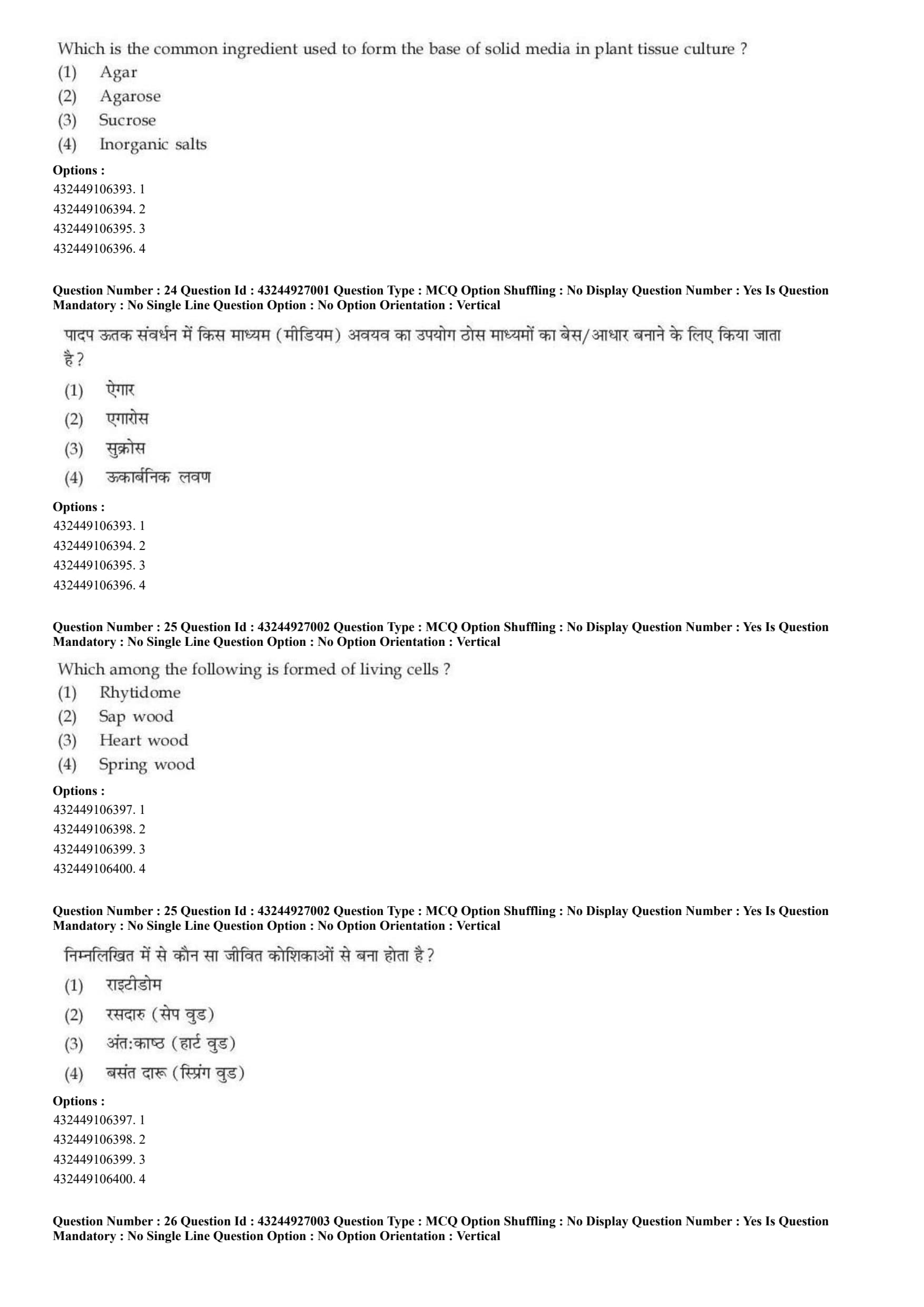
Which is the common ingredient used to form the base of solid media in plant tissue culture ?
View Solution
Step 1: Understanding the Question:
The question asks to identify the most common solidifying or gelling agent used as a base in plant tissue culture media.
Step 2: Key Concepts and Approach:
Nutrient media in plant tissue culture can be liquid or solid.
To prepare solid or semi-solid media, a gelling agent must be added. The ideal gelling agent must be biologically inert, remain stable at incubation temperatures, not be digested by plant enzymes, and allow diffusion of nutrients.
Step 3: Detailed Explanation:
Agar is a sulfated polysaccharide extracted from red algae (such as \textit{Gelidium and \textit{Gracilaria). It is the most widely used gelling agent because it melts at high autoclave temperatures (\(\approx 85^\circC\)) and solidifies into a stable gel upon cooling (\(\approx 40^\circC\)).
Agarose is a purified fraction of agar used primarily for gel electrophoresis of nucleic acids; it is too expensive for routine tissue culture media.
Sucrose is added as a carbon and energy source for heterotrophic tissues, not as a solidifying agent.
Inorganic salts (such as nitrogen, potassium, and phosphorus) provide essential macronutrients and micronutrients but remain dissolved in solution.
Therefore, agar is the standard base ingredient for solid media preparation.
Step 4: Final Answer:
Agar is the common ingredient used to form the base of solid media in plant tissue culture.
Quick Tip: Agar is favored because it is not degraded by plant enzymes during culture and does not react with the chemical components of the media.
Which among the following is formed of living cells ?
View Solution
Step 1: Understanding the Question:
The question requires identifying which of the listed woody plant tissues contains living cellular components.
Step 2: Key Concepts and Approach:
Secondary growth in woody plants produces several anatomical regions in the stem, including outer bark (rhytidome) and secondary xylem (subdivided into sapwood, heartwood, spring wood, etc.).
While much of the mature secondary xylem consists of dead conducting elements (vessels and tracheids), certain tissues retain living parenchymatous cells.
Step 3: Detailed Explanation:
Sapwood (alburnum) is the outer, lighter-colored zone of secondary xylem that actively conducts water and dissolved minerals. It contains living parenchyma cells (ray parenchyma and axial parenchyma) which are metabolically active and function in storage and lateral transport.
Heartwood (duramen) is the central, non-conducting region where all cells, including parenchyma, have died and have been impregnated with tannins, resins, and gums.
Rhytidome consists of dead outer bark tissues (layers of periderm and secondary phloem) that protect the stem.
Spring wood (early wood) refers to the portion of the annual ring formed during spring, consisting of wide vessel elements which are dead at physiological maturity.
Therefore, among the choices, sapwood is the only tissue that contains a significant proportion of active living cells.
Step 4: Final Answer:
Sapwood contains living cells.
Quick Tip: Remember: Sapwood contains active, living parenchyma cells that help in metabolism, while heartwood is completely dead and provides purely mechanical support.
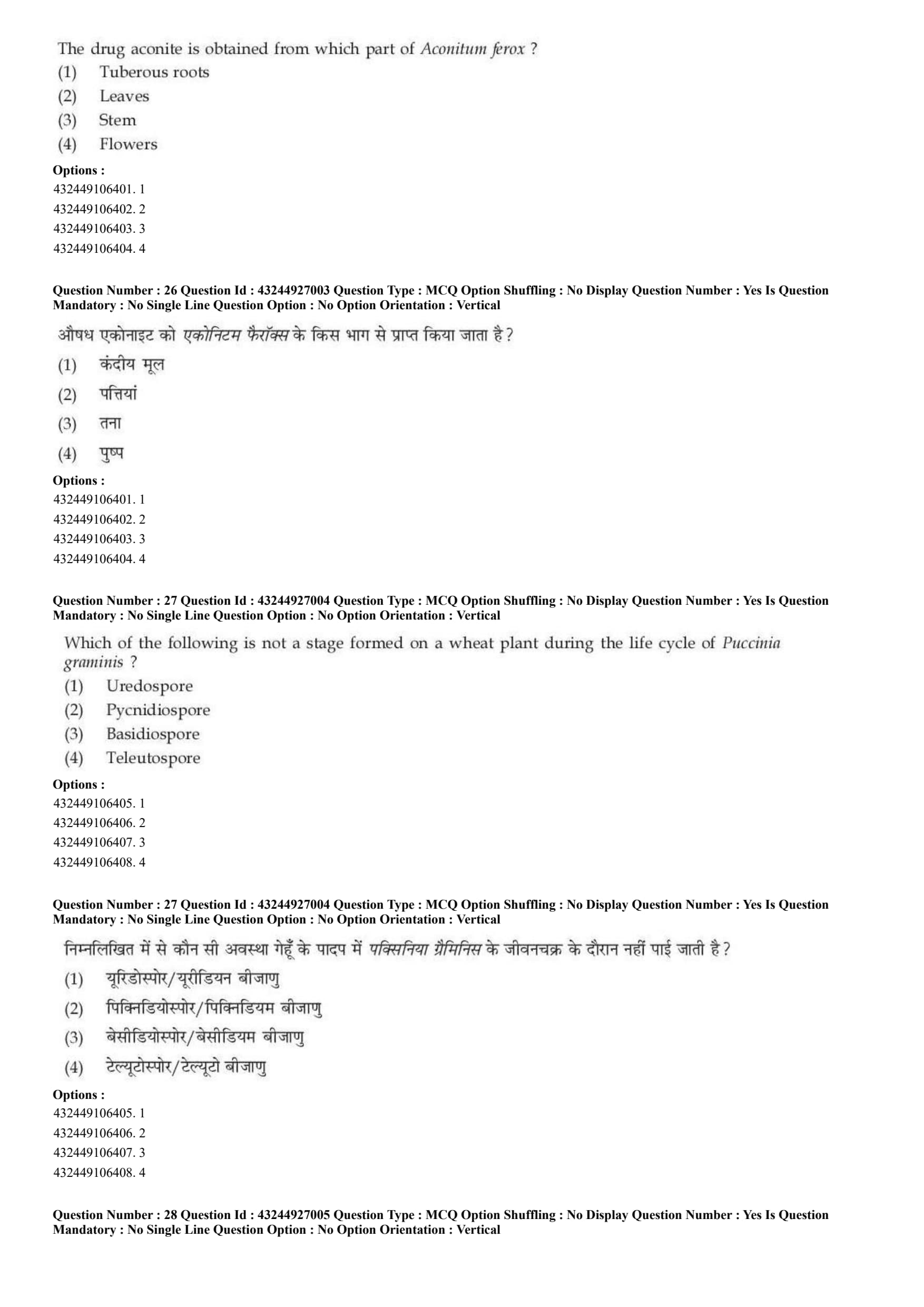
The drug aconite is obtained from which part of Aconitum ferox ?
View Solution
Step 1: Understanding the Question:
The question asks to identify the specific anatomical part of the plant \textit{Aconitum ferox from which the medicinal/toxic drug aconite is extracted.
Step 2: Key Concepts and Approach:
\textit{Aconitum ferox (commonly known as Indian Aconite or Vatsanabha) is a highly poisonous herbaceous plant belonging to the family Ranunculaceae.
The plant synthesizes toxic diterpene alkaloids, primarily aconitine, which have pharmacological uses in minute doses but are lethal in larger quantities. These compounds accumulate preferentially in specialized storage organs.
Step 3: Detailed Explanation:
The drug aconite is commercially and traditionally extracted from the dried tuberous roots of \textit{Aconitum ferox and related species.
These roots are fusiform, dark brown, and contain the highest concentration of toxic alkaloids.
In traditional medicine (such as Ayurveda), the roots undergo a rigorous purification process (Shodhana) to mitigate toxicity before therapeutic application.
Leaves, stems, and flowers contain significantly lower concentrations of the active alkaloid compared to the roots.
Thus, the tuberous root is the correct source of the drug.
Step 4: Final Answer:
Aconite is obtained from the tuberous roots of \textit{Aconitum ferox.
Quick Tip: Many alkaloids and toxic secondary metabolites in herbaceous perennials accumulate in the underground parts (roots or tubers) to protect the plant from soil herbivores.
Which of the following is not a stage formed on a wheat plant during the life cycle of Puccinia graminis ?
View Solution
Step 1: Understanding the Question:
The question asks which spore stage of the rust fungus \textit{Puccinia graminis is not produced on its primary host, the wheat plant.
Step 2: Key Concepts and Approach:
\textit{Puccinia graminis (black stem rust) is a heteroecious, macrocyclic rust fungus, meaning it requires two different hosts to complete its life cycle and produces five distinct spore stages:
1. Stage 0: Pycnia and pycnidiospores (spermatia) on Barberry (\textit{Berberis vulgaris).
2. Stage I: Aecia and aeciospores on Barberry.
3. Stage II: Uredinia and uredospores on Wheat (\textit{Triticum aestivum).
4. Stage III: Telia and teleutospores on Wheat.
5. Stage IV: Basidia and basidiospores in soil or air.
Step 3: Detailed Explanation:
Uredospores (Stage II) are dikaryotic, repeating spores formed in rust pustules on the wheat leaves and stems during summer.
Teleutospores (Stage III) are dark, two-celled, thick-walled resting spores formed on wheat at the end of the growing season.
Pycnidiospores (Stage 0) are unicellular haploid spermatia produced in flask-shaped pycnidia on the upper surface of the leaves of the alternate host, the Barberry plant. They are never formed on wheat.
Basidiospores (Stage IV) are haploid spores formed by the meiosis and germination of teleutospores in soil or on straw, and they infect the barberry plant. While basidiospores are also not formed on the living wheat plant as a disease stage, the question classically targets the distinct alternate host stages. Pycnidiospores are biologically restricted to development on \textit{Berberis, making them the standard correct answer for alternate host-specific stages.
Step 4: Final Answer:
Pycnidiospores are not formed on the wheat plant.
Quick Tip: Remember:
On Wheat = Uredospores and Teleutospores.
On Barberry = Pycnidiospores and Aeciospores.
In Soil/Air = Basidiospores.
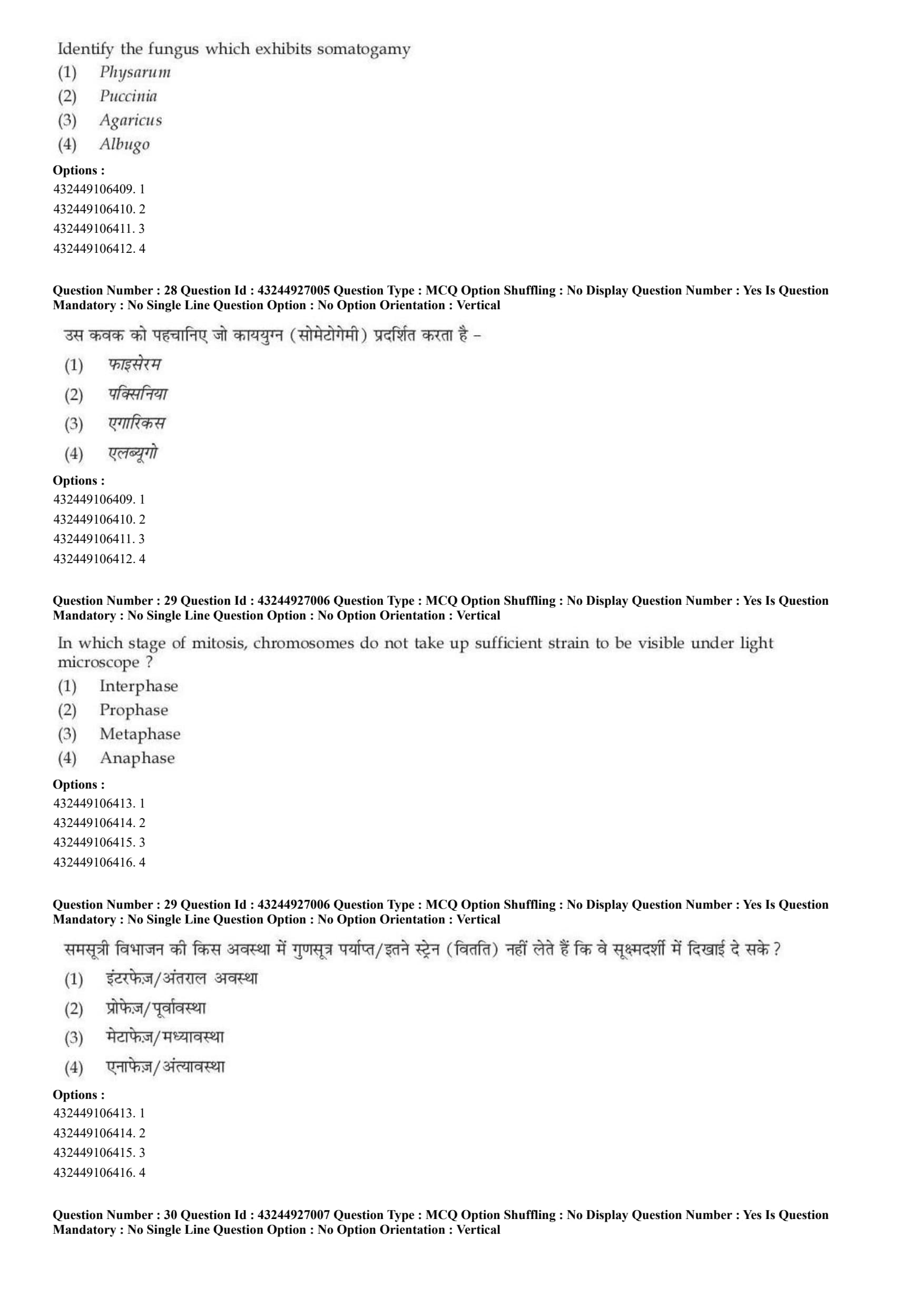
Identify the fungus which exhibits somatogamy
View Solution
Step 1: Understanding the Question:
The question asks to identify which of the listed fungi undergoes sexual reproduction via somatogamy.
Step 2: Key Concepts and Approach:
Somatogamy is a primitive type of sexual reproduction in fungi where specialized sex organs (gametangia) are completely absent.
Instead, fusion occurs directly between two vegetative or somatic hyphae of compatible mating types. This process is highly characteristic of the class Basidiomycetes.
Step 3: Detailed Explanation:
Agaricus (the common mushroom) belongs to the class Basidiomycetes. It does not produce any sex organs.
Its sexual cycle begins with the fusion of two monokaryotic primary mycelia (vegetative cells) of different mating types (\(+\) and \(-\)), which constitutes somatogamy. This fusion results in a dikaryotic secondary mycelium that subsequently forms the basidiocarp (fruiting body).
Physarum is a slime mold (Myxomycete) that undergoes gametic fusion of myxamoebae or swarm cells.
Puccinia undergoes spermatization, where specialized spermatia fuse with receptive hyphae.
Albugo belongs to Oomycetes and performs gametangial contact between distinct male (antheridium) and female (oogonium) sex organs.
Thus, Agaricus is the correct representative that exhibits somatogamy.
Step 4: Final Answer:
\textit{Agaricus is the fungus that exhibits somatogamy.
Quick Tip: Somatogamy is the rule in advanced fungi like Basidiomycetes (e.g., mushrooms like \textit{Agaricus), where sex organs are completely absent.
In which stage of mitosis, chromosomes do not take up sufficient strain to be visible under light microscope ?
View Solution
Step 1: Understanding the Question:
The question asks in which phase of the cell cycle chromosomes are too diffuse and uncondensed to absorb stain and be resolved as distinct units under a light microscope.
Step 2: Key Concepts and Approach:
During the cell cycle, chromatin undergoes dramatic structural transitions.
During division (mitosis), chromatin must condense tightly to facilitate the segregation of sister chromatids. This condensation makes chromosomes highly staining and visible.
During the non-dividing phase (interphase), the DNA must be accessible for transcription and replication, existing in an uncoiled, diffuse state.
Step 3: Detailed Explanation:
During Interphase, the genetic material exists as highly extended, thin, and intertwined chromatin threads. Due to this loose, uncoiled organization, it does not take up enough stain (such as acetocarmine or Feulgen stain) to be resolved as separate chromosomes under a light microscope.
In Prophase, chromatin condensation begins, making the chromosomes appear as distinct, thin threads.
In Metaphase, chromosomes achieve maximum condensation and are highly stained, aligned at the equatorial plate. This is the best stage to study chromosome morphology.
In Anaphase, sister chromatids separate and migrate, remaining highly condensed and visible.
Thus, interphase is the stage where chromosomes are not individually visible.
Step 4: Final Answer:
Chromosomes are not visible under a light microscope during Interphase.
Quick Tip: While chromosomes are "unseen" during Interphase, it is metabolic and biosynthetic activity that is highest during this stage, preparing the cell for division.
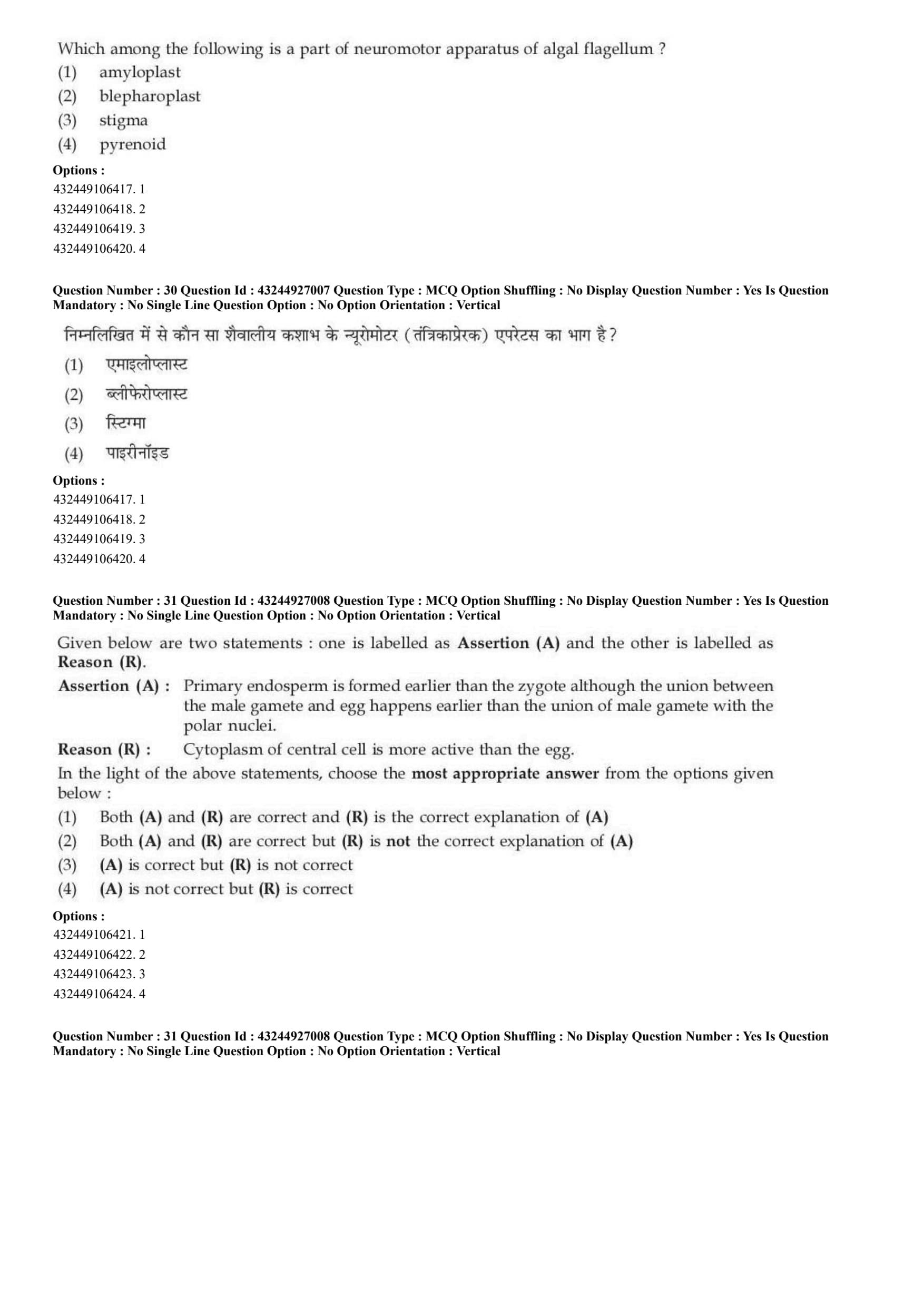
Which among the following is a part of neuromotor apparatus of algal flagellum ?
View Solution
Step 1: Understanding the Question:
The question asks to identify the organelle component that is part of the neuromotor apparatus associated with the movement and anchoring of the flagellum in algae.
Step 2: Key Concepts and Approach:
Flagellated algae possess a specialized system called the neuromotor apparatus (or flagellar apparatus) to coordinate and control flagellar movement.
This apparatus consists of the flagella, basal bodies, and associated microtubular or fibrillar roots. We need to identify the correct botanical/zoological term for the basal body in algae.
Step 3: Detailed Explanation:
The blepharoplast (also known as the basal body, kinetosome, or basal granule) is the cytoplasmic structure located at the base of each flagellum. It acts as the microtubule-organizing center from which the axoneme of the flagellum arises, playing a central role in flagellar motor function.
An amyloplast is a non-pigmented plastid (leucoplast) involved in the synthesis and storage of starch grains, completely unrelated to locomotion.
The stigma (or eyespot) is a photoreceptive organelle found in motile algae that detects light direction to coordinate phototaxis, but it is not the structural basal motor of the flagellum.
A pyrenoid is a proteinaceous sub-compartment within the chloroplast of many algae, acting as a site for carbon dioxide fixation and starch synthesis.
Thus, the blepharoplast is the structural part of the neuromotor apparatus.
Step 4: Final Answer:
The blepharoplast is a part of the neuromotor apparatus of the algal flagellum.
Quick Tip: The blepharoplast is morphologically homologous to the centriole of animal cells, sharing the characteristic \(9+0\) triplet microtubule arrangement at its base.
Given below are two statements : one is labelled as Assertion (A) and the other is labelled as Reason (R).
Assertion (A) : Primary endosperm is formed earlier than the zygote although the union between the male gamete and egg happens earlier than the union of male gamete with the polar nuclei.
Reason (R) : Cytoplasm of central cell is more active than the egg.
In the light of the above statements, choose the most appropriate answer from the options given below :
View Solution
Step 1: Understanding the Question:
The question asks to evaluate the accuracy and relationship of the Assertion and Reason concerning the timing of endosperm development versus embryo development in angiosperms.
Step 2: Key Concepts and Approach:
Double fertilization is a characteristic feature of angiosperms. It involves syngamy (fusion of one male gamete with the egg to form the zygote) and triple fusion (fusion of another male gamete with the diploid secondary nucleus/polar nuclei to form the primary endosperm nucleus, or PEN, within the central cell).
We must analyze the physiological activity and division rate of the resulting zygote and central cell.
Step 3: Detailed Explanation:
Syngamy typically occurs slightly before triple fusion. However, despite being formed slightly later, the primary endosperm nucleus (PEN) begins dividing immediately and rapidly to form endosperm tissue.
Conversely, the zygote undergoes a period of dormancy or rest and does not divide until a substantial amount of endosperm has already formed to provide nutrition. Therefore, endosperm tissue is formed earlier than the embryo.
The rapid division of the PEN is possible because the central cell has a highly active cytoplasm rich in ribosomes, mitochondria, dictyosomes, and metabolic reserves compared to the relatively quiescent and nutrient-depleted cytoplasm of the egg cell.
Thus, the greater metabolic activity of the central cell cytoplasm directly explains why endosperm tissue develops faster and earlier than the zygote starts developing into an embryo. Both statements are correct, and R is the correct explanation.
Step 4: Final Answer:
Both (A) and (R) are correct, and (R) is the correct explanation of (A).
Quick Tip: Endosperm development always precedes embryo development to ensure a ready food supply for the developing embryo as soon as the zygote begins division.
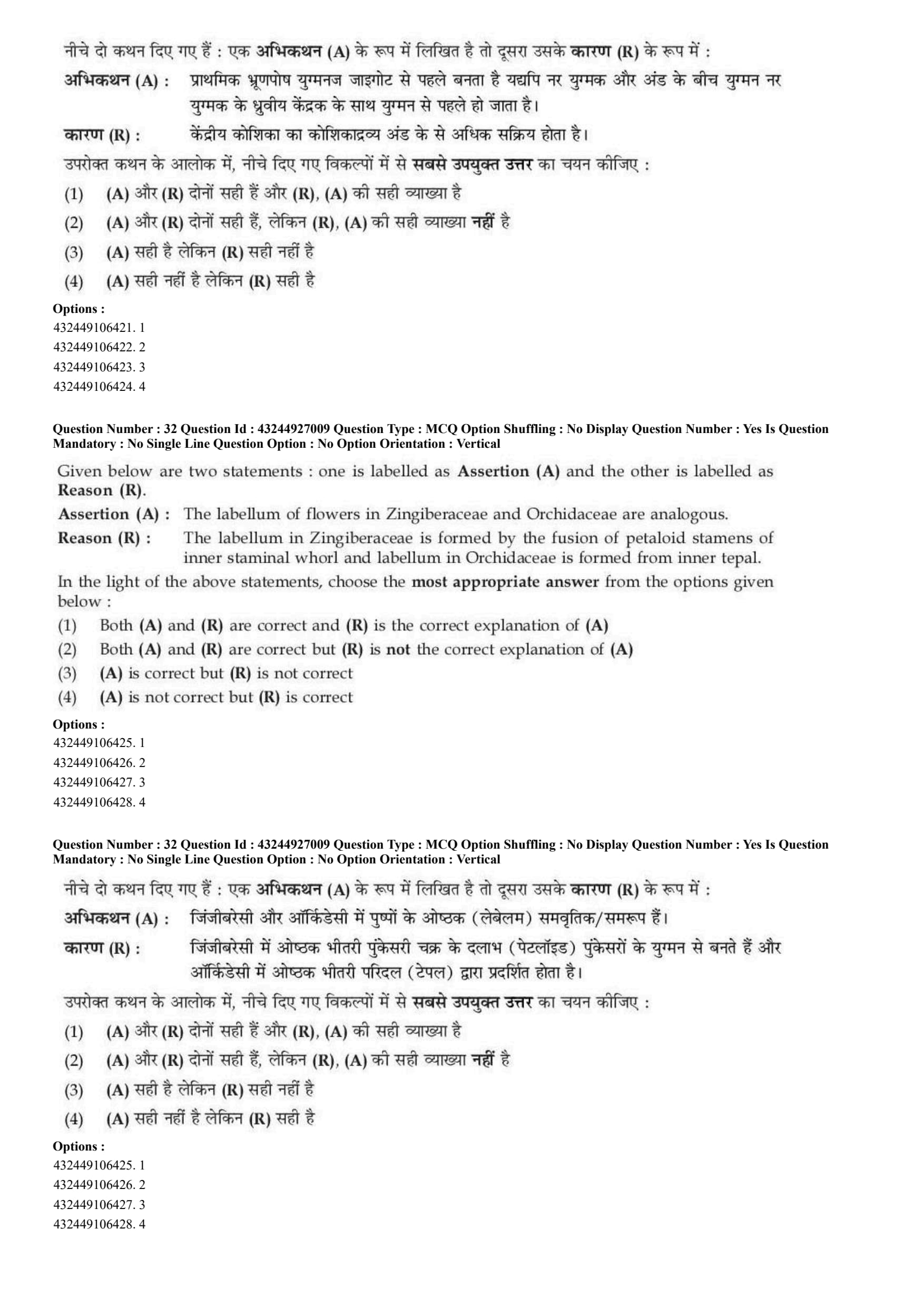
Given below are two statements : one is labelled as Assertion (A) and the other is labelled as Reason (R).
Assertion (A) : The labellum of flowers in Zingiberaceae and Orchidaceae are analogous.
Reason (R) : The labellum in Zingiberaceae is formed by the fusion of petaloid stamens of inner staminal whorl and labellum in Orchidaceae is formed from inner tepal.
In the light of the above statements, choose the most appropriate answer from the options given below :
View Solution
Step 1: Understanding the Question:
The question asks to assess whether the labellum of Zingiberaceae and Orchidaceae flowers are analogous organs, and whether their anatomical origins explain this analogy.
Step 2: Key Concepts and Approach:
- Analogous Organs: Organs that perform the same function but have different evolutionary or embryological origins.
- Homologous Organs: Organs that share a common origin and basic structural plan, regardless of their final function.
We must examine the structural composition and function of the labellum (lip) in the ginger family (Zingiberaceae) and the orchid family (Orchidaceae).
Step 3: Detailed Explanation:
In both Zingiberaceae and Orchidaceae, the flowers have a large, highly conspicuous, often colored landing platform called the labellum used to attract and guide insect pollinators. Thus, they have the same function.
In Zingiberaceae, the labellum is not a true petal; instead, it is a modified structure formed by the fusion of two sterile stamens (staminodes) belonging to the inner staminal whorl.
In Orchidaceae, the labellum is the posterior (or anterior due to resupination) median petal of the inner perianth whorl (inner tepal), representing a modified petal.
Because the two structures serve the same ecological function (pollinator landing pad) but have completely different morphological origins (staminodal origin versus petaloid origin), they are analogous structures.
Reason (R) correctly details these distinct developmental pathways, thus directly explaining why the two structures are analogous.
Step 4: Final Answer:
Both (A) and (R) are correct, and (R) is the correct explanation of (A).
Quick Tip: Analogy = Different Origin, Same Function. Because Zingiberaceae labellum is staminodal and Orchidaceae labellum is a modified petal/tepal, they fit the definition perfectly.
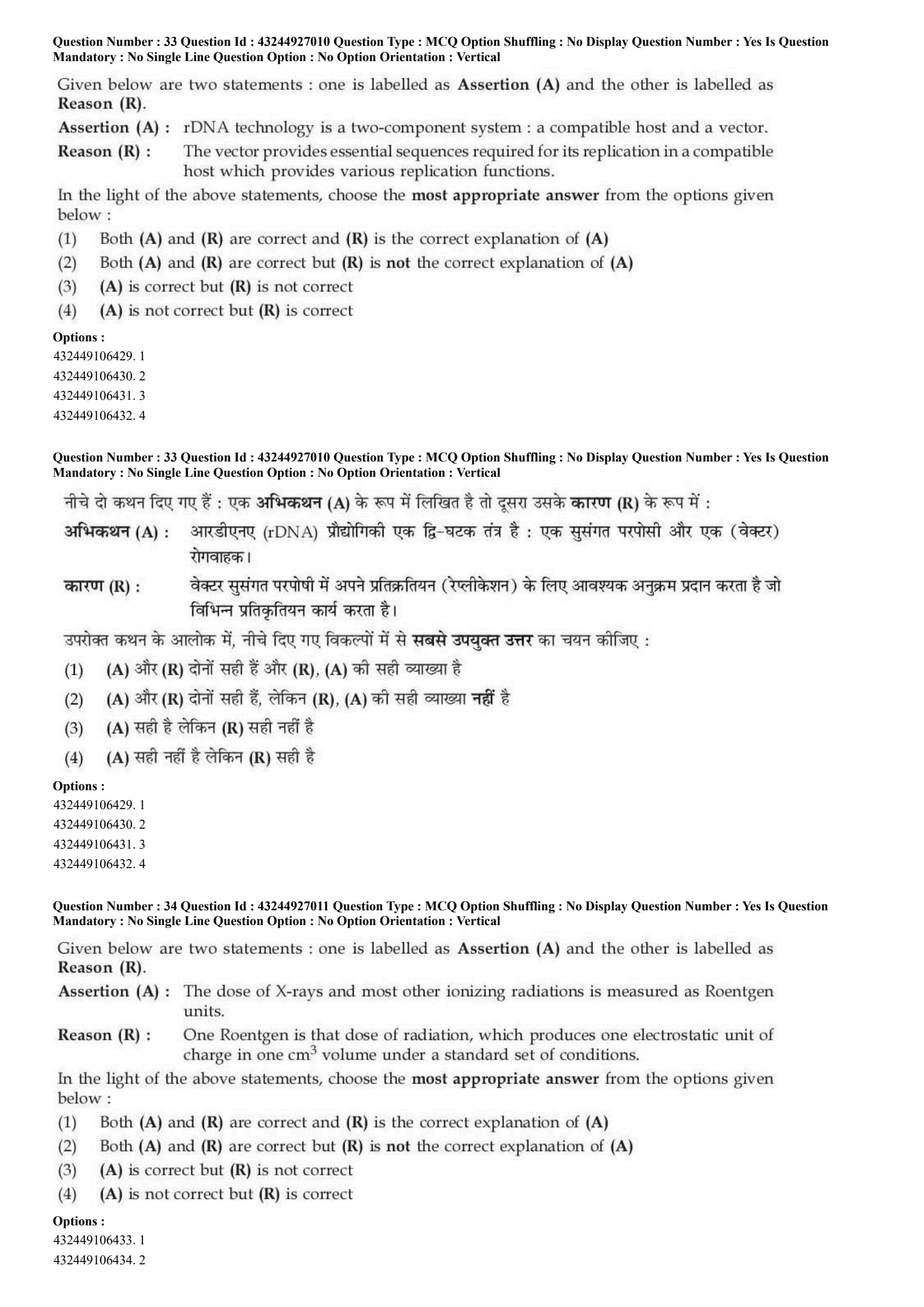
Given below are two statements : one is labelled as Assertion (A) and the other is labelled as Reason (R).
Assertion (A) : rDNA technology is a two-component system : a compatible host and a vector.
Reason (R) : The vector provides essential sequences required for its replication in a compatible host which provides various replication functions.
In the light of the above statements, choose the most appropriate answer from the options given below :
View Solution
Step 1: Understanding the Question:
The question asks to evaluate the components of recombinant DNA (rDNA) technology (host and vector) and their symbiotic functional relationship.
Step 2: Key Concepts and Approach:
Recombinant DNA technology involves inserting a gene of interest into a vector to form a recombinant DNA molecule, which is then introduced into a host cell where it replicates and expresses.
We need to evaluate if the vector and host act as a coordinated two-component system and how they replicate.
Step 3: Detailed Explanation:
Assertion (A) is correct: rDNA cloning is fundamentally a two-component biological system consisting of the cloning vector (vehicle) and a compatible host organism (expression system, e.g., \textit{E. coli or yeast).
Reason (R) is correct: The cloning vector must possess an Origin of Replication (\textit{ori)—a specific nucleotide sequence that is recognized by the host cell's machinery to initiate replication.
However, the vector does not carry its own polymerase, ligase, or nucleotide synthesis enzymes. The host cell provides all these essential enzymatic and metabolic replication functions.
Because the replication of the recombinant molecule is dependent on this functional interaction between the vector's regulatory sequences and the host cell's biological machinery, the technology is defined as a two-component system. Thus, R is the correct explanation of A.
Step 4: Final Answer:
Both (A) and (R) are correct, and (R) is the correct explanation of (A).
Quick Tip: A vector is useless without a compatible host cell, because it lacks the transcription and translation machinery required to replicate and express the cloned gene.
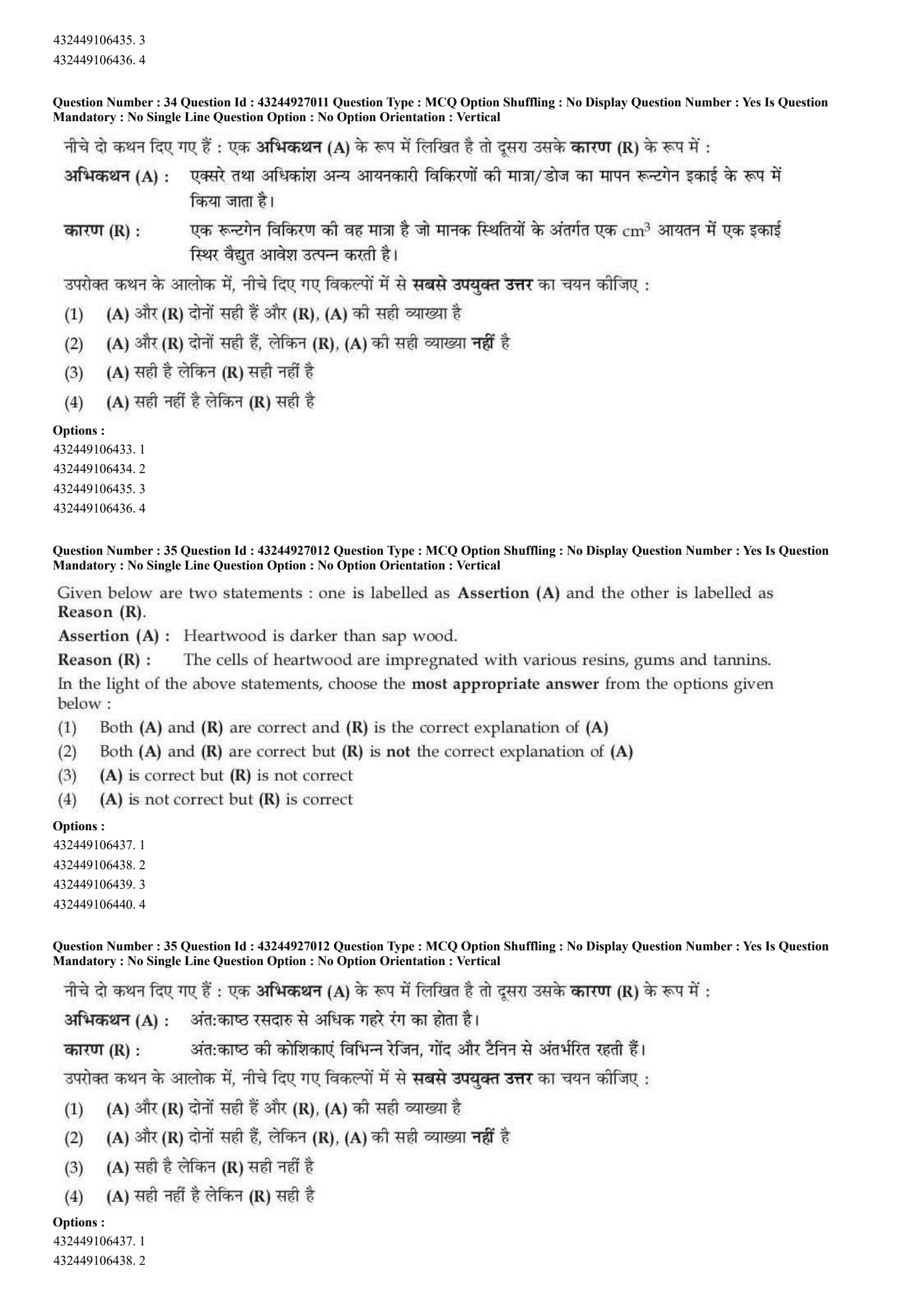
Given below are two statements : one is labelled as Assertion (A) and the other is labelled as Reason (R).
Assertion (A) : The dose of X-rays and most other ionizing radiations is measured as Roentgen units.
Reason (R) : One Roentgen is that dose of radiation, which produces one electrostatic unit of charge in one \(cm^3\) volume under a standard set of conditions.
In the light of the above statements, choose the most appropriate answer from the options given below :
View Solution
Step 1: Understanding the Question:
The question asks to evaluate the unit of measurement for ionizing radiation, specifically the Roentgen, and its exact physical definition.
Step 2: Key Concepts and Approach:
Ionizing radiation (like X-rays and gamma rays) can displace electrons from atoms, creating ion pairs.
The historical and standard unit of exposure is the Roentgen (R), which is defined based on the level of ionization produced in a specific volume of air.
Step 3: Detailed Explanation:
Assertion (A) is correct: X-rays, gamma rays, and other ionizing radiations are commonly measured using the Roentgen unit (R) to quantify radiation exposure in air.
Reason (R) is correct: One Roentgen is defined as the amount of ionizing radiation that generates one electrostatic unit (esu) of electricity (either positive or negative charge) in one cubic centimeter (\(cm^3\)) of dry air at standard temperature and pressure (STP).
Because the Roentgen unit is defined precisely by this ionization charge generated per unit volume of air, it serves as the quantitative measure of radiation dose. Therefore, Reason (R) is the exact physical explanation of Assertion (A).
Step 4: Final Answer:
Both (A) and (R) are correct, and (R) is the correct explanation of (A).
Quick Tip: One Roentgen corresponds to the generation of approximately \(2.08 \times 10^9\) ion pairs per cubic centimeter of dry air under standard conditions.
Given below are two statements : one is labelled as Assertion (A) and the other is labelled as Reason (R).
Assertion (A) : Heartwood is darker than sapwood.
Reason (R) : The cells of heartwood are impregnated with various resins, gums and tannins.
In the light of the above statements, choose the most appropriate answer from the options given below :
View Solution
Step 1: Understanding the Question:
The question asks to evaluate why the central heartwood of a tree trunk appears darker in color than the outer sapwood.
Step 2: Key Concepts and Approach:
During secondary growth, the secondary xylem tissue increases in thickness. Over time, the inner layers lose their water-conducting capacity and undergo physiological changes to form heartwood, while the outer layers remain functional as sapwood.
Step 3: Detailed Explanation:
Assertion (A) is correct: Heartwood (duramen) is the innermost, non-conducting region of the wood and is noticeably darker than the surrounding active sapwood (alburnum).
Reason (R) is correct: As xylem cells age and cease water conduction, they become filled and impregnated with organic compounds called extractives, including resins, gums, tannins, essential oils, and pigments.
These complex chemical substances are highly pigmented and darken the wood fibers.
Because the deposition of these pigmented secondary metabolites (resins, gums, tannins) is the direct cause of the dark coloration, the Reason is the correct explanation of the Assertion.
Step 4: Final Answer:
Both (A) and (R) are correct, and (R) is the correct explanation of (A).
Quick Tip: The impregnation of heartwood with resins and tannins not only darkens the wood but also makes it highly resistant to microbial decay and insect attacks.
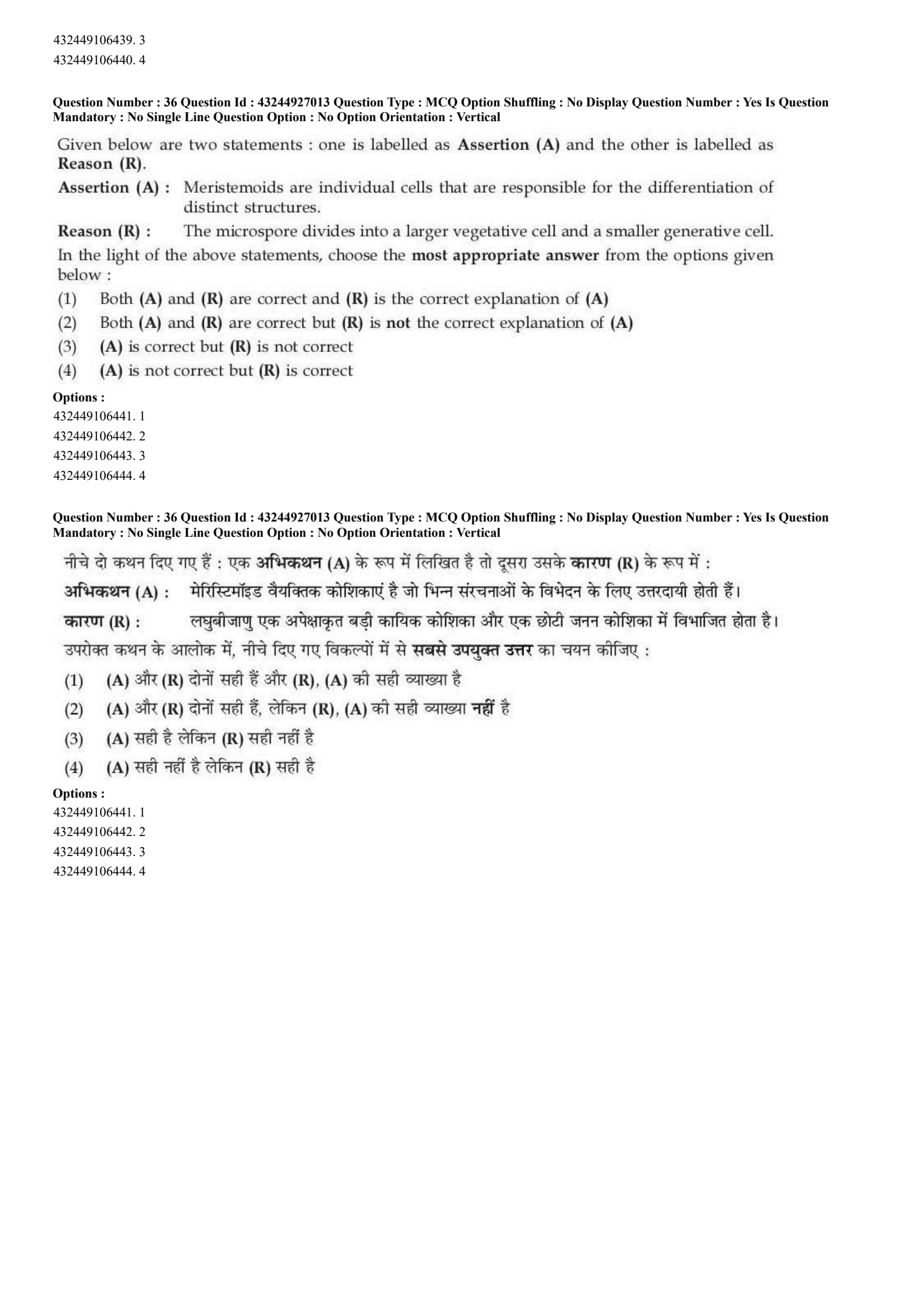
Given below are two statements : one is labelled as Assertion (A) and the other is labelled as Reason (R).
Assertion (A) : Meristemoids are individual cells that are responsible for the differentiation of distinct structures.
Reason (R) : The microspore divides into a larger vegetative cell and a smaller generative cell.
In the light of the above statements, choose the most appropriate answer from the options given below :
View Solution
Step 1: Understanding the Question:
The question asks to evaluate two statements about cell differentiation: the function of meristemoids in tissues and the division of microspores during pollen development.
Step 2: Key Concepts and Approach:
We must analyze each statement independently to verify its biological accuracy and then determine if there is a causal connection between them.
Step 3: Detailed Explanation:
Assertion (A) is correct: A meristemoid is a small, highly active, single cell (or small group of cells) in a plant tissue layer (such as the epidermis) that divides asymmetrically to give rise to specialized epidermal structures, such as guard cells (stomata) or trichomes. It functions as a localized stem cell.
Reason (R) is correct: In pollen development, a haploid microspore undergoes an asymmetric mitotic division to produce a larger, nutrient-rich vegetative cell and a smaller generative cell.
Although both statements are correct biological facts involving asymmetric cell division and differentiation, they describe two completely independent developmental processes.
The division of a microspore does not explain why or how meristemoids function to differentiate distinct structures in vegetative plant tissues. Therefore, R is not the correct explanation of A.
Step 4: Final Answer:
Both (A) and (R) are correct, but (R) is not the correct explanation of (A).
Quick Tip: Both statements illustrate asymmetric cell division, but since they concern different tissues (epidermal development vs. microsporogenesis), they lack a direct cause-and-effect relationship.
Given below are two statements : one is labelled as Assertion (A) and the other is labelled as Reason (R).
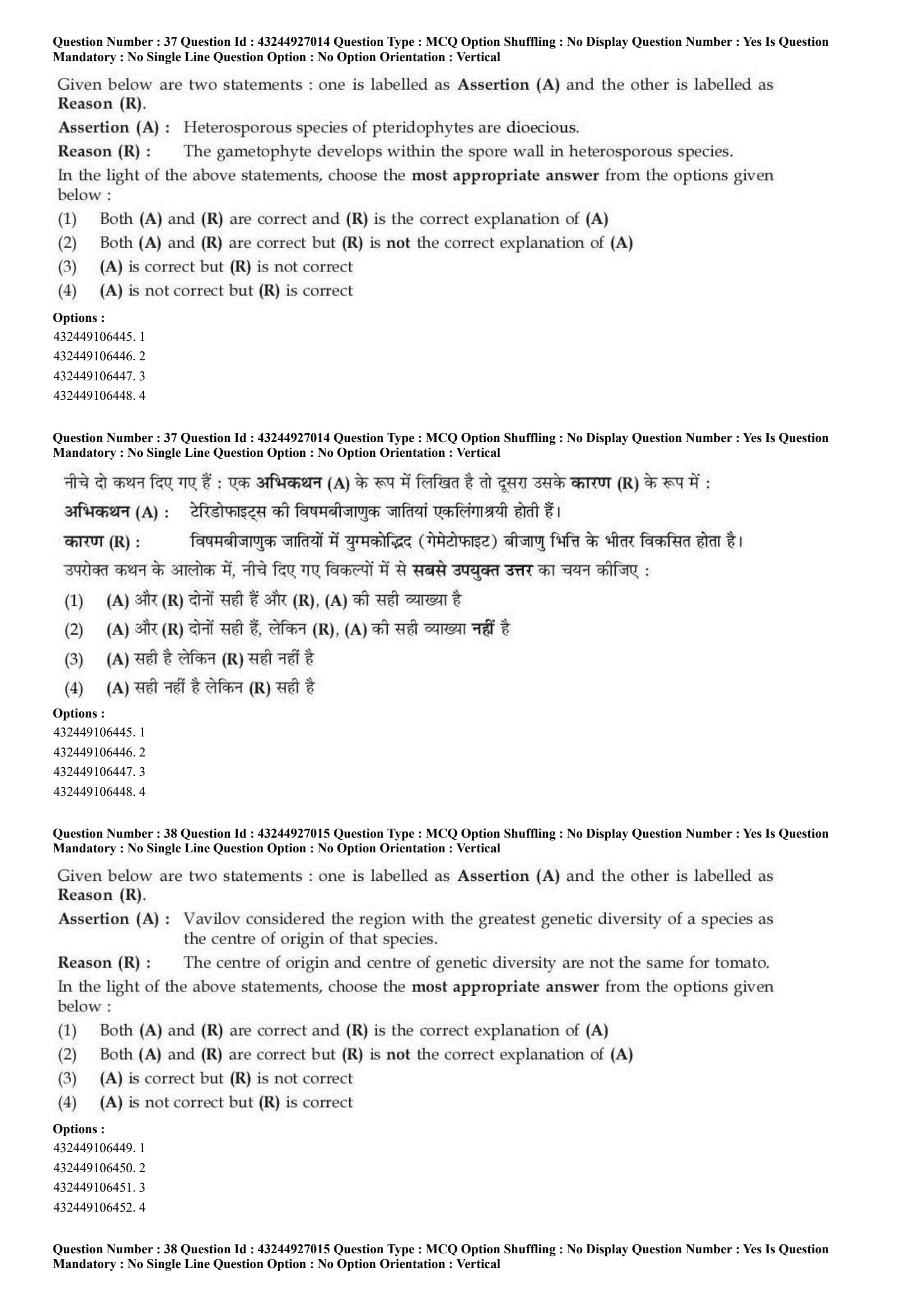
Assertion (A) : Heterosporous species of pteridophytes are dioecious.
Reason (R) : The gametophyte develops within the spore wall in heterosporous species.
In the light of the above statements, choose the most appropriate answer from the options given below :
View Solution
Step 1: Understanding the Question:
The question asks to evaluate the link between heterospory leading to separate sexes (dioecy) in pteridophyte gametophytes and endosporic gametophytic development.
Step 2: Key Concepts and Approach:
- Heterospory: The production of two distinct types of spores: microspores (small, male-determining) and megaspores (large, female-determining).
- Endosporic Development: The gametophyte grows entirely or mostly within the protective confines of the parent spore wall rather than as a free-living green thallus (exosporic).
Step 3: Detailed Explanation:
Assertion (A) is correct: All heterosporous pteridophytes (like \textit{Selaginella, \textit{Marsilea, \textit{Salvinia) are strictly dioecious. Microspores germinate to form male gametophytes, and megaspores germinate to form female gametophytes.
Reason (R) is correct: In heterosporous species, the development of the gametophyte is endosporic, meaning it develops internally within the spore wall utilizing the stored reserves of the spore.
However, the endosporic development itself does not explain why the gametophytes are unisexual (dioecious). The unisexual nature is a direct consequence of heterospory (producing separate male-determining microspores and female-determining megaspores).
Thus, while both statements are biologically correct, Reason (R) is not the correct explanation of Assertion (A).
Step 4: Final Answer:
Both (A) and (R) are correct, but (R) is not the correct explanation of (A).
Quick Tip: Heterospory (separate micro- and megaspores) is the direct evolutionary cause of dioecism in vascular plants, which eventually led to the seed habit.
Given below are two statements : one is labelled as Assertion (A) and the other is labelled as Reason (R).
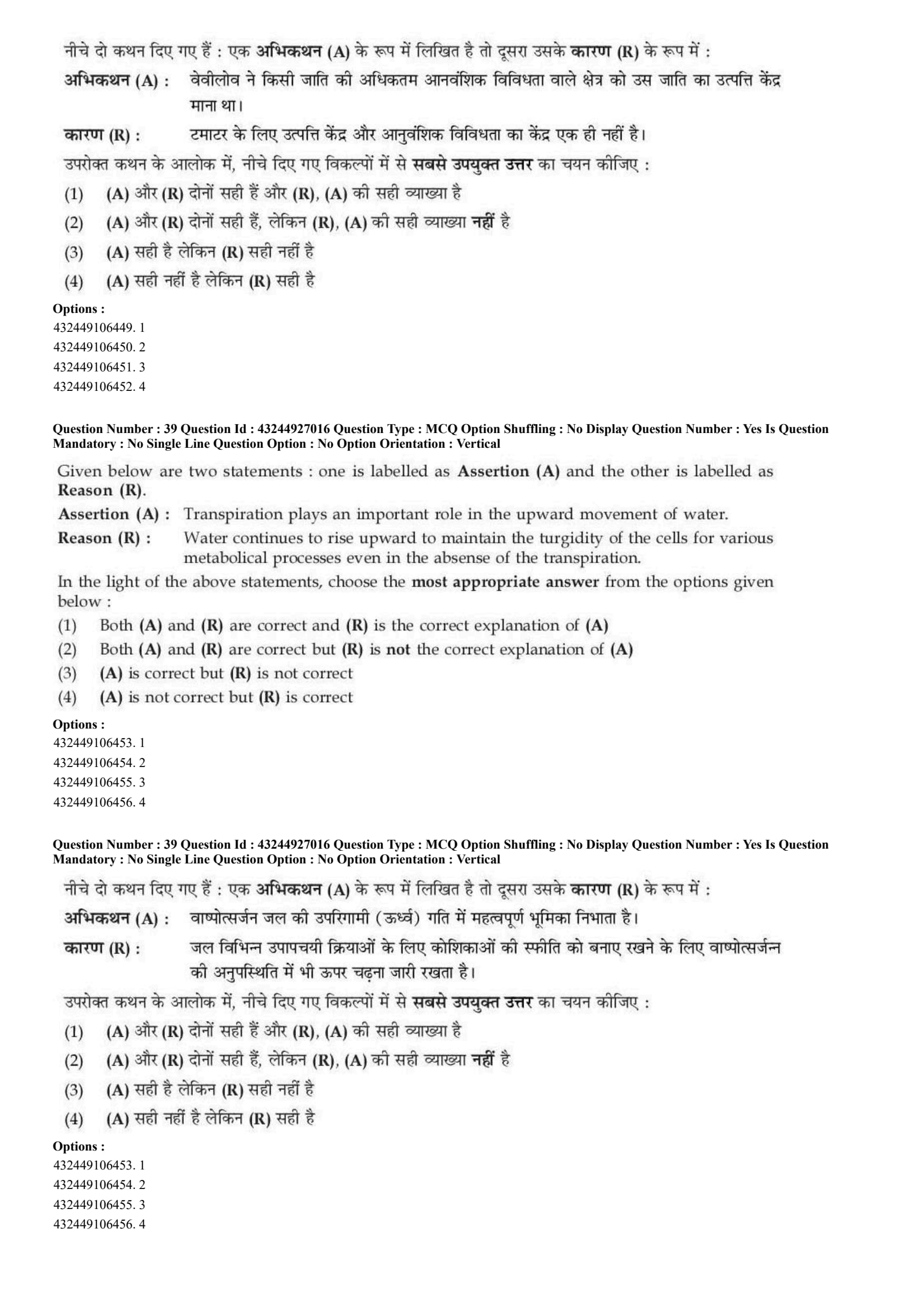
Assertion (A) : Vavilov considered the region with the greatest genetic diversity of a species as the centre of origin of that species.
Reason (R) : The centre of origin and centre of genetic diversity are not the same for tomato.
In the light of the above statements, choose the most appropriate answer from the options given below :
View Solution
Step 1: Understanding the Question:
The question asks to evaluate N.I. Vavilov's biogeographical theory on the centers of origin of cultivated plants, and the specific geographic history of the tomato crop.
Step 2: Key Concepts and Approach:
Vavilov proposed that a crop's center of origin is characterized by a high concentration of wild relatives and maximum genetic diversity.
We need to verify if this rule holds true universally or if there are exceptions, particularly for the tomato crop.
Step 3: Detailed Explanation:
Assertion (A) is correct: N. I. Vavilov established that the region exhibiting the highest genetic diversity and the greatest concentration of varietal forms of a crop species corresponds to its primary center of origin.
Reason (R) is correct: The tomato (\textit{Solanum lycopersicum) is a classic exception. Its wild ancestors originated in the Andean region of South America (Peru/Ecuador), which is its center of origin. However, its primary center of domestication and maximum genetic diversity developed in Mesoamerica (Mexico), which is its secondary center of diversity. Thus, the center of origin and center of diversity are different for tomato.
While both statements are correct, Reason (R) represents an exception/case study that actually deviates from Vavilov's general principle rather than explaining it. Therefore, R is not the correct explanation of A.
Step 4: Final Answer:
Both (A) and (R) are correct, but (R) is not the correct explanation of (A).
Quick Tip: Vavilov identified eight primary global centers of origin of cultivated plants, though secondary centers of diversity can arise due to subsequent human migration and cultivation.
Given below are two statements : one is labelled as Assertion (A) and the other is labelled as Reason (R).
Assertion (A) : Transpiration plays an important role in the upward movement of water.
Reason (R) : Water continues to rise upward to maintain the turgidity of the cells for various metabolic processes even in the absence of the transpiration.
In the light of the above statements, choose the most appropriate answer from the options given below :
View Solution
Step 1: Understanding the Question:
The question asks to evaluate the role of transpiration in the ascent of sap (upward water movement) and how plants manage water transport when transpiration is absent.
Step 2: Key Concepts and Approach:
The upward movement of water in plants is driven by two main forces:
1. Transpiration Pull (active during the day when stomata are open).
2. Root Pressure (active when transpiration is low or absent, such as at night or in high humidity).
Step 3: Detailed Explanation:
Assertion (A) is correct: Transpiration pull is the primary force responsible for the rapid upward transport of water (ascent of sap) through xylem vessels in tall trees during the daytime.
Reason (R) is correct: Under conditions where transpiration is absent or extremely low (e.g., at night or in very high atmospheric humidity), water can still rise slowly in the xylem due to root pressure (active transport of ions into the xylem creating an osmotic gradient). This maintains cellular turgidity for metabolism and occasionally causes guttation.
Both statements are scientifically correct. However, Reason (R) describes an alternative mechanism of water transport (root pressure) rather than explaining the mechanism of transpiration pull asserted in (A). Therefore, R is not the correct explanation of A.
Step 4: Final Answer:
Both (A) and (R) are correct, but (R) is not the correct explanation of (A).
Quick Tip: Transpiration pull is a passive, physical force (suction), while root pressure is an active, physiological process dependent on root cell metabolism.
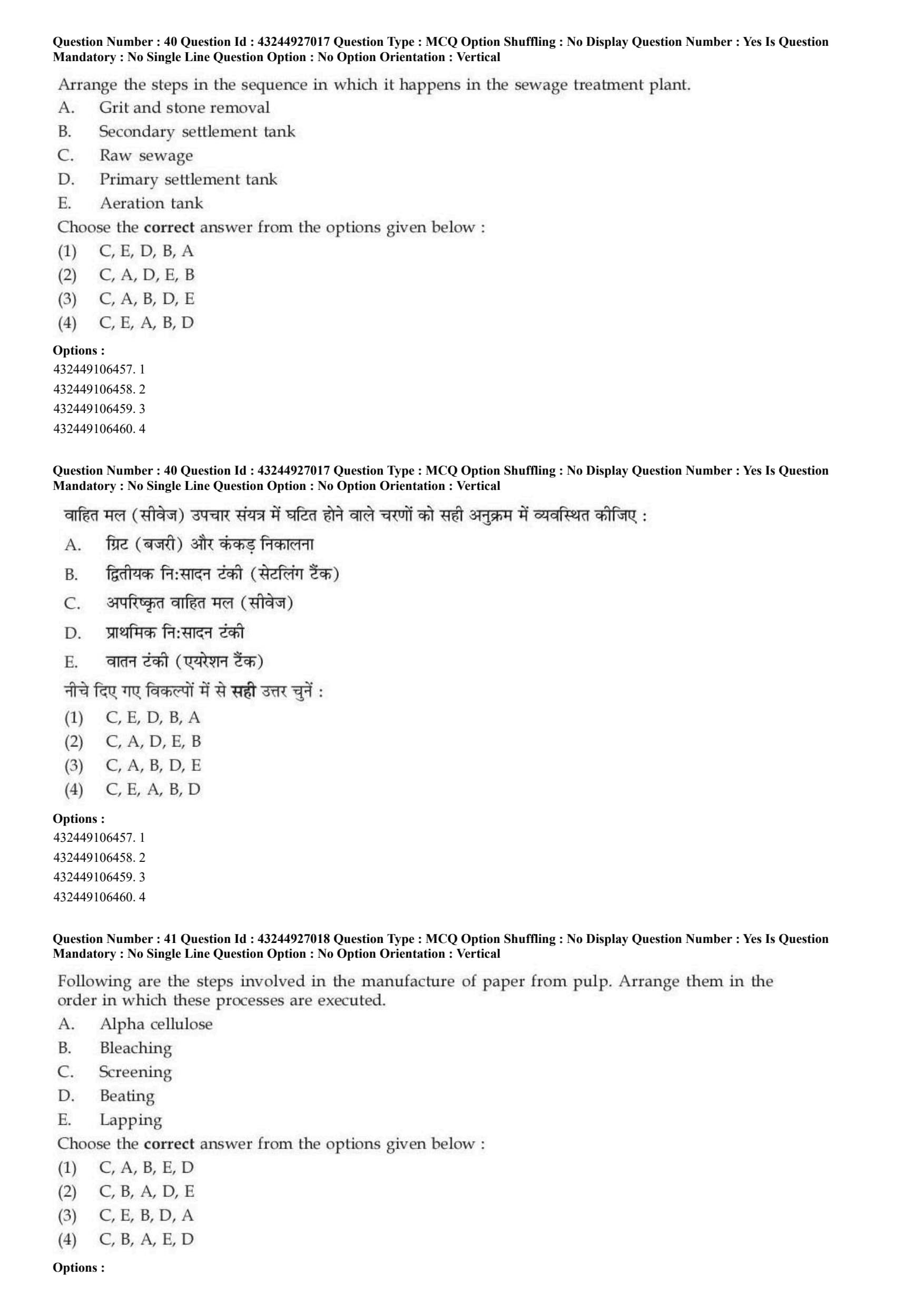
Arrange the steps in the sequence in which it happens in the sewage treatment plant.
A. Grit and stone removal
B. Secondary settlement tank
C. Raw sewage
D. Primary settlement tank
E. Aeration tank
Choose the correct answer from the options given below :
View Solution
Step 1: Understanding the Question:
The question requires arranging the various stages of sewage treatment in a sewage treatment plant (STP) in their correct chronological sequence.
Step 2: Key Concepts and Approach:
Sewage treatment involves three main phases:
1. Primary Treatment (physical removal of floating debris and grit).
2. Secondary Treatment (biological decomposition of organic matter using microbes).
3. Tertiary Treatment (chemical disinfection).
Step 3: Detailed Explanation:
The process begins with incoming Raw sewage (C).
The first step in primary treatment involves physical filtration and sedimentation to remove floating objects and heavy solids, which is Grit and stone removal (A).
The sewage then flows into the Primary settlement tank (D), where organic and inorganic solids settle out to form primary sludge.
The liquid effluent from primary settling goes to secondary (biological) treatment in the Aeration tank (E), where aerobic microbes decompose dissolved organic matter.
Finally, the mixture moves to the Secondary settlement tank (B), where the microbial biomass settles out as activated sludge.
This gives the sequence: C \(\rightarrow\) A \(\rightarrow\) D \(\rightarrow\) E \(\rightarrow\) B.
Step 4: Final Answer:
The correct chronological sequence is C, A, D, E, B.
Quick Tip: Always remember that physical treatment (Grit removal, Primary settlement) must occur before biological treatment (Aeration, Secondary settlement) to protect the microbial flora and mechanical pumps from physical damage.
Following are the steps involved in the manufacture of paper from pulp. Arrange them in the order in which these processes are executed.
A. Alpha cellulose
B. Bleaching
C. Screening
D. Beating
E. Lapping
Choose the correct answer from the options given below :
View Solution
Step 1: Understanding the Question:
The question requires ordering the sequence of technological processes involved in producing paper from raw plant pulp.
Step 2: Key Concepts and Approach:
Papermaking begins with the mechanical or chemical digestion of plant material to release cellulose fibers, followed by cleaning, bleaching, mechanical refining, and sheet formation.
Step 3: Detailed Explanation:
The process begins after digesting the wood with Screening (C) to remove uncooked wood knots, dirt, and large debris from the raw pulp slurry.
The screened pulp is then subjected to Bleaching (B) using chlorine dioxide, oxygen, or ozone to remove residual lignin and whiten the fibers.
This purification process isolates high-grade Alpha cellulose (A), which is the pure structural polymer needed for strong, durable paper.
Next, the purified fibers undergo Beating (D) (mechanical refining), which fibrillates and hydrates the fibers, dramatically increasing their surface area and capacity for hydrogen bonding.
Finally, the refined pulp slurry is pressed, dried, and formed into sheets through Lapping (E) (or sheet formation).
This sequential pathway corresponds to: C \(\rightarrow\) B \(\rightarrow\) A \(\rightarrow\) D \(\rightarrow\) E.
Step 4: Final Answer:
The correct order is C, B, A, D, E.
Quick Tip: Beating (mechanical refining) is a crucial step in papermaking because unbeaten fibers produce weak, absorbent paper, whereas well-beaten fibers yield strong, dense paper due to optimal fiber interlocking.
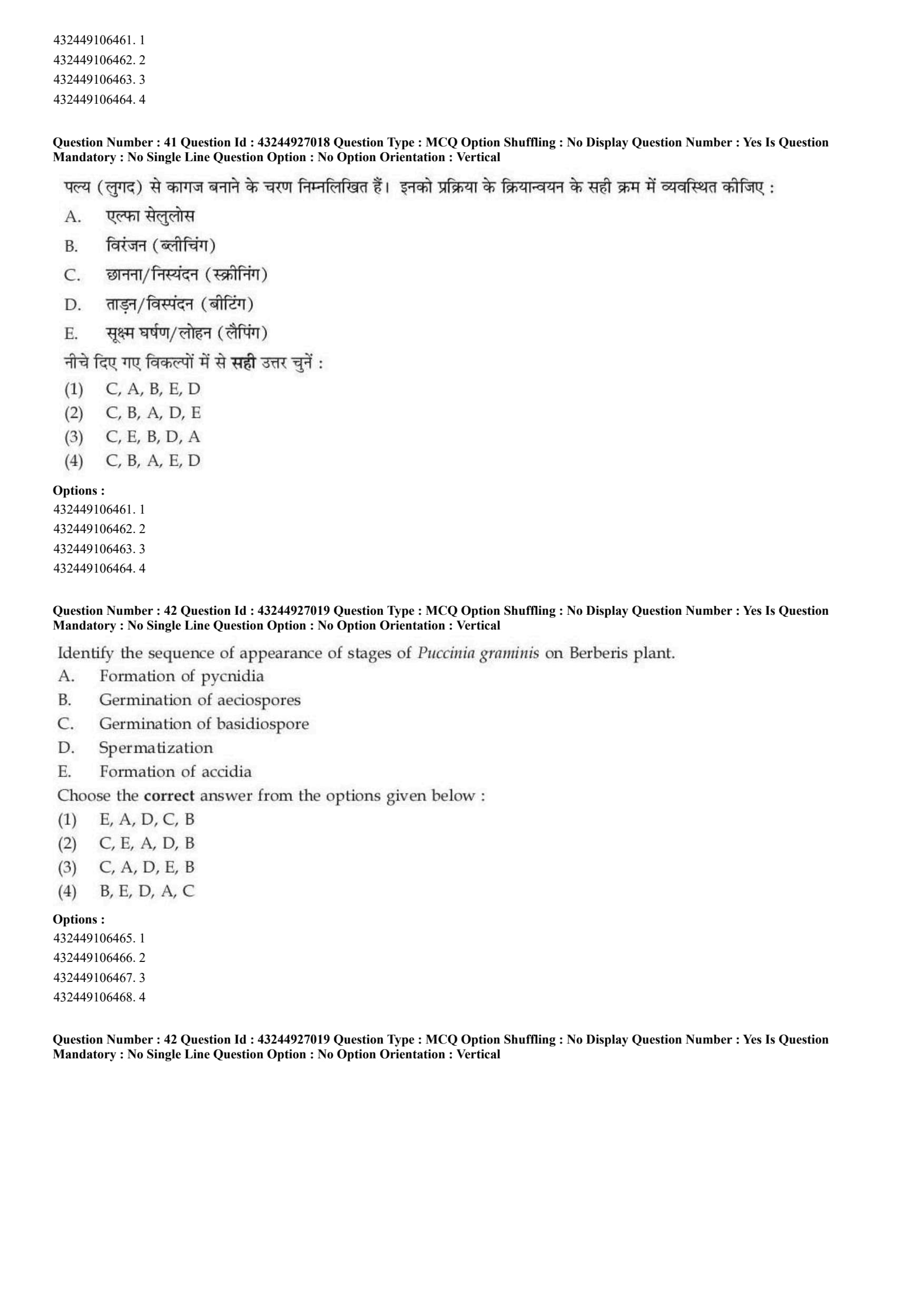
Identify the sequence of appearance of stages of Puccinia graminis on Berberis plant.
A. Formation of pycnidia
B. Germination of aeciospores
C. Germination of basidiospores
D. Spermatization
E. Formation of aecidia
Choose the correct answer from the options given below :
View Solution
Step 1: Understanding the Question:
The question asks to sequence the developmental stages of the rust fungus \textit{Puccinia graminis as they occur specifically on its alternate host, the Barberry plant (\textit{Berberis vulgaris).
Step 2: Key Concepts and Approach:
The life cycle of the heteroecious rust fungus \textit{Puccinia graminis alternates between wheat (uredial and telial stages) and barberry (pycnial and aecial stages).
We must trace the sequence from the initial infection of barberry by windblown basidiospores to the release of aeciospores.
Step 3: Detailed Explanation:
The infection of the Barberry leaf begins with the Germination of basidiospores (C) on the upper epidermis.
The germ tube penetrates the cuticle and forms a haploid mycelium, which develops into flask-shaped spermagonia leading to the Formation of pycnidia (A) on the upper leaf surface.
Spermatia (pycnidiospores) and receptive hyphae of compatible mating types (\(+\) and \(-\)) interact during Spermatization (D) mediated by insects or rain.
This plasmogamy leads to dikaryotization of the mycelium, which migrates to the lower leaf surface, resulting in the Formation of aecidia (E) (aecial cups).
Within these cups, dikaryotic aeciospores are produced and released, leading to the Germination of aeciospores (B) once they land on the primary host, wheat.
This developmental progression is: C \(\rightarrow\) A \(\rightarrow\) D \(\rightarrow\) E \(\rightarrow\) B.
Step 4: Final Answer:
The correct developmental sequence on the Barberry plant is C, A, D, E, B.
Quick Tip: Remember: Basidiospores initiate the cycle on Barberry (C), and Aeciospores exit the Barberry plant to infect Wheat (B). Therefore, the sequence must start with C and end with B.
Identify the sequence of events which happens during germination of pollen grains.
A. Secretion of stigmatic exudates
B. Formation of callose plug in pollen tube
C. Adherence of pollen grain to stigma
D. Entry of pollen tube into ovule
E. Degradation of stigmatic cells by cutinase
Choose the correct answer from the options given below :
View Solution
Step 1: Understanding the Question:
The question requires arranging the biological and physical events that occur from the moment a pollen grain lands on a compatible stigma up to the entry of the pollen tube into the ovule.
Step 2: Key Concepts and Approach:
Pollen germination and tube growth is a highly regulated, directional physiological process. It involves landing, hydration, stigmatic penetration, tip-growth along the style, and fertilization.
Step 3: Detailed Explanation:
The process begins with pollination, which is the physical Adherence of pollen grain to stigma (C).
Landing triggers chemical signaling, leading to hydration of the pollen grain facilitated by the Secretion of stigmatic exudates (A) (lipids, proteins, and sugars).
To penetrate the stigmatic surface and enter the style, the pollen tube secretes hydrolytic enzymes, resulting in the Degradation of stigmatic cells by cutinase (E) and pectinases.
As the pollen tube grows unidirectionally down the style, the vegetative cytoplasm moves toward the growing tip. To prevent backward flow and maintain turgor pressure, the Formation of callose plugs in pollen tube (B) occurs at regular intervals behind the growing tip.
Guided by synergid chemotropic signals, the process culminates in the Entry of pollen tube into ovule (D) through the micropyle.
The correct chronological sequence is: C \(\rightarrow\) A \(\rightarrow\) E \(\rightarrow\) B \(\rightarrow\) D.
Step 4: Final Answer:
The correct sequence of events is C, A, E, B, D.
Quick Tip: Pollen tube growth is strictly tip-focused. Callose plugs (B) are essential structural seals that isolate older, inactive parts of the growing pollen tube to conserve active cytoplasm at the growing tip.
List the sequence of steps involved in Amplified Fragment Length Polymorphism used in nucleic acid fingerprinting.
A. Digestion of DNA using restriction enzymes
B. PCR amplification
C. Isolation of DNA
D. Ligation of adapters to digested DNA
E. Separation of DNA using electrophoresis
View Solution
Step 1: Understanding the Question:
The question requires the identification of the correct sequential steps involved in the Amplified Fragment Length Polymorphism (AFLP) technique used for DNA fingerprinting, genetic mapping, and molecular profiling of nucleic acids.
Step 2: Detailed Explanation:
Isolation of DNA (C): The initial stage requires the extraction and purification of intact genomic DNA from the target organism to ensure high-quality template material.
Digestion of DNA using restriction enzymes (A): The isolated DNA is digested with a combination of two different restriction endonucleases, typically a frequent cutter (such as MseI) and a rare cutter (such as EcoRI), generating a large pool of specific DNA fragments.
Ligation of adapters to digested DNA (D): Double-stranded, synthetic oligonucleotide adapters are covalently ligated to the sticky cohesive ends of the restriction fragments, providing a known sequence for primer attachment.
PCR amplification (B): Polymerase Chain Reaction (PCR) is performed using selective primers that are complementary to the adapter sequences, selectively amplifying a subset of the restriction fragments.
Separation of DNA using electrophoresis (E): The selectively amplified DNA fragments are separated based on their molecular size using high-resolution gel or capillary electrophoresis to visualize the genetic profile.
Following this logical progression, the correct sequence is C \(\rightarrow\) A \(\rightarrow\) D \(\rightarrow\) B \(\rightarrow\) E.
Step 3: Final Answer:
Hence, the correct sequence of steps corresponds to option (B).
Quick Tip: In any DNA-based molecular marker workflow, isolation of DNA must always serve as the starting step, whereas gel electrophoresis for visualization must always be the final step.
This simple rule helps eliminate incorrect options instantly.
Select the correct sequence of process followed during processing of Rubber.
A. Passing latex through aluminium sieves
B. Vulcanisation
C. Coagulation of latex
D. Tapping of tree trunks
E. Rolling
View Solution
Step 1: Understanding the Question:
The question asks for the correct chronological order of activities and industrial processes followed during the extraction, processing, and refining of natural rubber.
Step 2: Detailed Explanation:
The commercial processing of natural rubber from the rubber tree (Hevea brasiliensis) involves the following operations:
Tapping of tree trunks (D): Incisions are carefully made in the bark of the rubber tree to harvest raw, milky latex fluid into collection vessels.
Passing latex through aluminium sieves (A): The collected raw latex is passed through sieves to filter out physical impurities, leaf litter, and bark fragments.
Coagulation of latex (C): Dilute acids, such as formic acid or acetic acid, are added to the strained latex, causing the rubber particles to aggregate and separate from the liquid serum.
Rolling (E): The aggregated rubber mass is passed through heavy rollers to squeeze out excess moisture and compress the material into uniform sheets.
Vulcanisation (B): The rolled sheets are heated with sulfur to create cross-links between polymer chains, which significantly improves the elasticity, structural strength, and temperature resistance of the rubber.
This establishes the sequence: D \(\rightarrow\) A \(\rightarrow\) C \(\rightarrow\) E \(\rightarrow\) B.
Step 3: Final Answer:
Thus, the correct processing sequence is represented by option (C).
Quick Tip: Vulcanization is the final chemical modification step that converts soft, sticky raw rubber into a highly durable commercial product.
Recognizing vulcanization as the terminal process (B) helps narrow down the choices easily.
Arrange the different classes of enzymes according to class number (1-5).
A. Isomerases
B. Hydrolases
C. Transferases
D. Oxidoreductases
E. Lyases
View Solution
Step 1: Understanding the Question:
The question requires us to arrange the primary functional classes of enzymes in accordance with their designated Enzyme Commission (EC) numbers from class 1 to class 5.
Step 2: Detailed Explanation:
According to the International Union of Biochemistry and Molecular Biology (IUBMB) classification scheme, enzymes are grouped into six main classes:
Class 1: Oxidoreductases (D): These enzymes catalyze oxidation-reduction reactions, transferring hydrogen atoms or electrons between substrates.
Class 2: Transferases (C): These enzymes catalyze the transfer of functional groups (such as methyl, acyl, or phosphate groups) from a donor to an acceptor molecule.
Class 3: Hydrolases (B): These enzymes catalyze the hydrolytic cleavage of chemical bonds (C-O, C-N, C-C) by adding water.
Class 4: Lyases (E): These enzymes catalyze the addition of groups to double bonds, or the non-hydrolytic removal of groups to form double bonds.
Class 5: Isomerases (A): These enzymes catalyze structural or geometric rearrangements within a single molecule to convert it into its isomer.
Following this classification, the sequence of classes from 1 to 5 is: D \(\rightarrow\) C \(\rightarrow\) B \(\rightarrow\) E \(\rightarrow\) A.
Step 3: Final Answer:
Therefore, the correct sequence is represented by option (B).
Quick Tip: Use the standard biochemical mnemonic \textbf{"OTHLIL"} to remember the sequence of enzyme classes:
\textbf{O}xidoreductases (1), \textbf{T}ransferases (2), \textbf{H}ydrolases (3), \textbf{L}yases (4), \textbf{I}somerases (5), and \textbf{L}igases (6).
Arrange the plants according to their total number of chromosomes (from lower to higher number).
A. Rice
B. Sorghum
C. Peanut
D. Cotton
E. Potato
Choose the correct answer from the options given below :
View Solution
Step 1: Understanding the Question:
Plant species possess characteristic diploid chromosome numbers (\(2n\)). The question requires ordering the given crop species in ascending order of their somatic chromosome count.
Step 2: Key Chromosome Counts (\(2n\)):
Sorghum (Sorghum bicolor): Diploid \(2n = 20\) (B)
Rice (Oryza sativa): Diploid \(2n = 24\) (A)
Peanut (Arachis hypogaea): Tetraploid \(2n = 40\) (C)
Potato (Solanum tuberosum): Tetraploid \(2n = 48\) (E)
Cotton (Gossypium hirsutum - American tetraploid cotton): Tetraploid \(2n = 52\) (D)
Step 3: Detailed Explanation:
Sorghum has 20 chromosomes (B).
Rice has 24 chromosomes (A).
Peanut has 40 chromosomes (C).
Potato has 48 chromosomes (E).
Cotton has 52 chromosomes (D).
Arranging these values in strictly increasing numerical order (\(20 < 24 < 40 < 48 < 52\)) gives the sequence: B \(\rightarrow\) A \(\rightarrow\) C \(\rightarrow\) E \(\rightarrow\) D.
Step 4: Final Answer:
The correct order is provided in Option (B).
Quick Tip: Remember key crop ploidy numbers: Sorghum (\(2n=20\)), Rice (\(2n=24\)), Maize (\(2n=20\)), Peanut (\(2n=40\)), Potato (\(2n=48\)), Cotton (\(2n=52\)), Wheat (\(2n=42\)).
Arrange the layers of tissues from the centre to periphery as observed in a woody dicot stem.
A. Vascular cambium
B. Periderm
C. Primary xylem
D. Secondary phloem
E. Secondary xylem
Choose the correct answer from the options given below :
View Solution
Step 1: Understanding the Question:
Secondary growth in dicot stems leads to anatomical organization of tissues along the radial axis from the central pith out to the external surface (periphery).
Step 2: Anatomical Radial Distribution:
From the innermost anatomical region (center) moving outward to the periphery:
Primary Xylem (C): Positioned closest to the pith/center (endarch development).
Vascular Cambium (A) \& Secondary Xylem (E): Vascular cambium cuts off secondary xylem internally towards the center and secondary phloem externally.
Secondary Phloem (D): Produced externally towards the outside by the vascular cambium.
Periderm (B): Outermost protective secondary tissue layer comprising phelloderm, phellogen, and phellem.
Step 3: Detailed Explanation:
Primary xylem is formed during primary growth and remains at the innermost boundary around the pith (C).
The vascular cambium (A) actively divides to produce secondary elements.
Secondary xylem accumulates in the inner region (E).
Secondary phloem is pushed outward by cambial activity (D).
Periderm replaces the rupturing epidermis as the protective outermost cover (B).
Following the option order listed in the official question paper, the given sequence is C \(\rightarrow\) A \(\rightarrow\) E \(\rightarrow\) D \(\rightarrow\) B.
Step 4: Final Answer:
This sequence corresponds to Option (B).
Quick Tip: Remember cambium cuts off secondary xylem towards the inside (center) and secondary phloem towards the outside (periphery). Primary xylem always sits at the very center.
Arrange the different phases of photosynthesis in the correct sequence.
A. Capturing the solar energy
B. Formation of higher-energy organic intermediates
C. Splitting of water and release of oxygen
D. Fixation of \(CO_2\) into 3-phosphoglycerate
E. Reduction of phosphoglycerate into glyceraldehyde-3-phosphate
Choose the correct answer from the options given below :
View Solution
Step 1: Understanding the Question:
Photosynthesis consists of photochemical reactions (light-dependent reactions) followed by biochemical reactions (light-independent or dark reactions/Calvin cycle). The question asks for the biological chronology of these phases.
Step 2: Sequential Physiological Stages:
1. Light absorption (A): Light harvesting complex pigments capture photons.
2. Photolysis of water (C): Water splitting enzyme associated with PS-II hydrolyzes \(H_2O\) releasing \(O_2\), protons, and electrons.
3. Synthesis of energy intermediates (B): Non-cyclic photophosphorylation generates high-energy intermediates \(ATP\) and \(NADPH\).
4. Carbon fixation (D): RuBisCO catalyzes carboxylation of RuBP with \(CO_2\) to form 3-phosphoglycerate (3-PGA).
5. Reduction phase (E): \(ATP\) and \(NADPH\) reduce 3-phosphoglycerate into glyceraldehyde-3-phosphate (\(G3P\)).
Step 3: Detailed Explanation:
Photosynthesis initiates with light energy harvesting by photosystems (A).
Photolysis of water releases oxygen and provides electrons to the electron transport chain (C).
Electron transport yields high-energy chemical molecules \(ATP\) and \(NADPH\) (B).
In the stroma, \(CO_2\) fixates into 3-PGA during carboxylation (D).
Reduced intermediates consume \(ATP/NADPH\) to form \(G3P\) triose sugars (E).
The correct chronological order is A \(\rightarrow\) C \(\rightarrow\) B \(\rightarrow\) D \(\rightarrow\) E.
Step 4: Final Answer:
The matching order is presented in Option (B).
Quick Tip: Light reactions (Photolysis \(\rightarrow\) ATP/NADPH formation) must always occur before dark reactions (Fixation \(\rightarrow\) Reduction) because carbon assimilation depends directly on light reaction energy products.
The sequential stages of translation process :
A. Termination
B. Elongation
C. The initiation of translation
D. Watson-Crick base pairing
E. Charging of t-RNA
Choose the correct answer from the options given below :
View Solution
Step 1: Understanding the Question:
Protein synthesis (translation) follows a defined biochemical sequence in molecular biology starting from substrate preparation to polypeptide chain termination.
Step 2: Sequential Molecular Events:
Charging of tRNA (E): Aminoacyl-tRNA synthetase binds specific amino acids to their cognate tRNAs using ATP (aminoacylation).
Initiation (C): Assembly of small ribosomal subunit, mRNA, initiator tRNA, and large ribosomal subunit at the start codon (\(AUG\)).
Watson-Crick base pairing (D): Codon-anticodon complementary base pairing occurs between mRNA codons and incoming charged tRNAs at the A-site.
Elongation (B): Transpeptidation and translocation move the ribosome along mRNA forming sequential peptide bonds.
Termination (A): Release factors recognize stop codons (\(UAA, UAG, UGA\)), cleaving the finished polypeptide.
Step 3: Detailed Explanation:
Before translation complexes form, tRNAs must be charged with amino acids (E).
The initiation complex forms at the ribosome binding site (C).
Specificity during chain elongation relies on Watson-Crick base pairing between mRNA codons and tRNA anticodons (D).
Peptide bonds are formed repetitively during peptide elongation (B).
Termination completes the translation process when a stop codon is encountered (A).
The correct logical sequence is E \(\rightarrow\) C \(\rightarrow\) D \(\rightarrow\) B \(\rightarrow\) A.
Step 4: Final Answer:
The matching sequence is Option (A).
Quick Tip: Charging (activation) of tRNA always precedes ribosomal initiation. Termination is always the final step of translation.
Prophase-I stage of meiosis is the longest phase of meiotic cycle. Arrange the stages involved in correct order.
A. Pachytene
B. Leptotene
C. Zygotene
D. Diplotene
E. Diakinesis
Choose the correct answer from the options given below :
View Solution
Step 1: Understanding the Question:
Prophase-I of Meiosis-I is divided into five distinct sub-stages based on chromosomal behavior and morphological alterations.
Step 2: Sub-stages of Prophase-I:
Leptotene (B): Chromatin condenses into visible thin threads (bouquet stage).
Zygotene (C): Synapsis (pairing) of homologous chromosomes occurs aided by the synaptonemal complex.
Pachytene (A): Crossing over and genetic recombination take place between non-sister chromatids of homologous pairs (tetrad formation).
Diplotene (D): Dissolution of the synaptonemal complex; chiasmata become visible as homologous chromosomes separate slightly.
Diakinesis (E): Terminalisation of chiasmata, nucleolus disappears, and nuclear envelope breaks down.
Step 3: Detailed Explanation:
Chromosomes first condense during Leptotene (B).
Homologous pairing occurs in Zygotene (C).
Crossing over occurs in Pachytene (A).
Chiasmata are revealed in Diplotene (D).
Chiasmata terminalise fully in Diakinesis (E).
The correct chronological sequence is B \(\rightarrow\) C \(\rightarrow\) A \(\rightarrow\) D \(\rightarrow\) E.
Step 4: Final Answer:
The option giving this sequence is Option (A).
Quick Tip: Use the classical mnemonic: \textbf{L}ittle \textbf{Z}ebra \textbf{P}lays \textbf{D}uring \textbf{D}awn \(\rightarrow\) Leptotene, Zygotene, Pachytene, Diplotene, Diakinesis.
Match List - I with List - II.

Choose the correct answer from the options given below :
View Solution
Step 1: Understanding the Question:
The question tests knowledge regarding major botanical gardens globally and nationally along with their respective locations.
Step 2: Detailed Matches:
Padua Botanical Garden (Orto Botanico di Padova): Established in 1545 in Padua, Italy. It is the world's oldest academic botanical garden existing in its original location \(\rightarrow\) Matches with III.
Lloyd Botanical Garden: Situated in Darjeeling, West Bengal, established in 1878 \(\rightarrow\) Matches with IV.
Jawaharlal Nehru Tropical Botanical Garden and Research Institute (JNTBGRI): Located at Palode near Thiruvananthapuram, Kerala \(\rightarrow\) Matches with I.
Acharya Jagdish Chandra Bose Indian Botanical Garden: Located at Shibpur, Howrah near Kolkata, famous for the Great Banyan Tree \(\rightarrow\) Matches with II.
Step 3: Detailed Explanation:
A \(\rightarrow\) III (Padua Botanical Garden is in Italy).
B \(\rightarrow\) IV (Lloyd Botanical Garden is in Darjeeling).
C \(\rightarrow\) I (JNTBGRI is in Thiruvananthapuram).
D \(\rightarrow\) II (AJCB Indian Botanical Garden is in Kolkata).
Step 4: Final Answer:
The correct combination is A-III, B-IV, C-I, D-II, which corresponds to Option (B).
Quick Tip: Padua is famous as the oldest academic botanical garden (Italy). AJCB Indian Botanical Garden in Kolkata hosts the world-famous Great Banyan Tree.
Match List - I with List - II.

Choose the correct answer from the options given below :
View Solution
Step 1: Understanding the Question:
The question asks to pair economically and medically important plant drugs with the plant part from which they are harvested.
Step 2: Detailed Matches:
Asafoetida (Hing): Extracted from taproots of Ferula foetida as an oleo-gum-resin exuded after incisions \(\rightarrow\) Matches with III (Gum-resin).
Quinine: Antimalarial alkaloid extracted from the dried trunk and root bark of Cinchona species \(\rightarrow\) Matches with IV (Bark).
Aconite: Powerful medicinal alkaloid derived from dried tuberous roots of Aconitum napellus \(\rightarrow\) Matches with I (Root).
Opium: Obtained by drying milky latex exuded from incised unripe capsules of Papaver somniferum \(\rightarrow\) Matches with II (Latex).
Step 3: Detailed Explanation:
A \(\rightarrow\) III (Asafoetida is an oleo-gum-resin).
B \(\rightarrow\) IV (Quinine comes from Cinchona bark).
C \(\rightarrow\) I (Aconite comes from roots).
D \(\rightarrow\) II (Opium is dried milky latex).
Step 4: Final Answer:
The correct matching sequence is A-III, B-IV, C-I, D-II, which is Option (D).
Quick Tip: Remember: Quinine = Bark (Cinchona), Opium = Unripe capsule latex (Papaver), Asafoetida = Oleo-gum-resin (Ferula).
Match List - I with List - II.

Choose the correct answer from the options given below :
View Solution
Step 1: Understanding the Question:
The question matches major technological breakthroughs in genetics and biotechnology with their associated scientists.
Step 2: Pioneer Scientists and Contributions:
Transplant of genes (Recombinant DNA): Stanley Norman Cohen along with Herbert Boyer pioneered plasmid-mediated gene transfer between organisms in 1973 \(\rightarrow\) Matches with IV.
CRISPR-Cas system: Discovered as a gene-editing tool by Emmanuelle Charpentier and Jennifer Doudna (Nobel Prize 2020) \(\rightarrow\) Matches with III.
Genetically modified organisms (GMOs): Herbert Boyer co-founded Genentech and constructed early transgenic bacterial GMOs \(\rightarrow\) Matches with II.
Golden rice: Developed by Peter Beyer along with Ingo Potrykus to produce provitamin A (\(\beta\)-carotene) in rice endosperm \(\rightarrow\) Matches with I.
Step 3: Detailed Explanation:
A \(\rightarrow\) IV (Stanley Norman Cohen for early gene transfer).
B \(\rightarrow\) III (Emmanuelle Charpentier for CRISPR-Cas9).
C \(\rightarrow\) II (Herbert Boyer for early recombinant GMO production).
D \(\rightarrow\) I (Peter Beyer for Golden Rice development).
Step 4: Final Answer:
The correct match is A-IV, B-III, C-II, D-I, corresponding to Option (B).
Quick Tip: Golden Rice inventors = Ingo Potrykus \& Peter Beyer.
CRISPR-Cas9 pioneers = Emmanuelle Charpentier \& Jennifer Doudna.
Recombinant DNA pioneers = Cohen \& Boyer.
Match List - I with List - II.

Choose the correct answer from the options given below :
View Solution
Step 1: Understanding the Question:
The inner mitochondrial membrane contains electron transport chain (ETC) multiprotein complexes numbered I through IV. The question requires matching each complex with its enzymatic identity.
Step 2: ETC Complexes Classification:
Complex I: \(NADH dehydrogenase\) (or \(NADH:ubiquinone oxidoreductase\)) transfers electrons from \(NADH\) to ubiquinone \(\rightarrow\) Matches with II.
Complex II: \(Succinate dehydrogenase\) transfers electrons from succinate/\(FADH_2\) to ubiquinone \(\rightarrow\) Matches with III.
Complex III: \(Cytochrome bc_1 complex\) (or \(Dihydroubiquinone cytochrome-c oxidoreductase\)) transfers electrons from ubiquinol to cytochrome c \(\rightarrow\) Matches with I.
Complex IV: \(Cytochrome c oxidase\) transfers electrons from cytochrome c to molecular oxygen, forming \(H_2O\) \(\rightarrow\) Matches with IV.
Step 3: Detailed Explanation:
A \(\rightarrow\) II (Complex I is NADH-dehydrogenase).
B \(\rightarrow\) III (Complex II is Succinate dehydrogenase).
C \(\rightarrow\) I (Complex III is Dihydro ubiquinone cytochrome-c oxidoreductase).
D \(\rightarrow\) IV (Complex IV is Cytochrome oxidase).
Step 4: Final Answer:
The matching set is A-II, B-III, C-I, D-IV, represented by Option (C).
Quick Tip: Complex I = NADH Dehydrogenase
Complex II = Succinate Dehydrogenase
Complex III = Cytochrome \(bc_1\)
Complex IV = Cytochrome \(c\) Oxidase
Complex V = ATP Synthase
Match List - I with List - II.

Choose the correct answer from the options given below :
View Solution
Step 1: Understanding the Question:
Microorganisms exhibit diverse nutritional modes and oxygen requirements. The question requires matching metabolic modes with specific bacterial/archaeal genera.
Step 2: Physiological Classification of Microbes:
Nostoc: Cyanobacterium performing oxygenic photosynthesis (\(CO_2\) fixation) in aerobic environments \(\rightarrow\) Autotrophic aerobe (A - IV).
Rhodospirillum: Purple non-sulfur bacterium capable of photoautotrophic growth under anoxic/anaerobic conditions \(\rightarrow\) Autotrophic anaerobe (B - II).
Azotobacter: Free-living, strictly aerobic, heterotrophic nitrogen-fixing bacterium \(\rightarrow\) Heterotrophic aerobe (C - I).
Methanococcus: Obligate anaerobic methanogenic archaebacterium living in anoxic organic environments \(\rightarrow\) Heterotrophic anaerobe (D - III).
Step 3: Detailed Explanation:
A \(\rightarrow\) IV (Nostoc fixes \(CO_2\) aerobiologically).
B \(\rightarrow\) II (Rhodospirillum photosynthesizes anaerobically).
C \(\rightarrow\) I (Azotobacter relies on organic carbon in oxygenated soils).
D \(\rightarrow\) III (Methanococcus thrives anaerobically).
Step 4: Final Answer:
The correct combination is A-IV, B-II, C-I, D-III, matching Option (C).
Quick Tip: Cyanobacteria (Nostoc, Anabaena) are always aerobic autotrophs. Azotobacter is a classic aerobic heterotrophic nitrogen fixer.
Match List - I with List - II.

Choose the correct answer from the options given below :
View Solution
Step 1: Understanding the Question:
Photosynthetic organisms contain specialized photosynthetic pigments that serve as diagnostic taxonomic markers.
Step 2: Pigment Distribution:
Dinoflagellates (Pyrrophyta): Contain Chlorophyll a and Chlorophyll c (along with peridinin) \(\rightarrow\) Matches with II.
Green bacteria (Chlorobiaceae/Chloroflexaceae): Utilize Bacteriochlorophyll c (or d/e) for anoxygenic photosynthesis \(\rightarrow\) Matches with III.
Higher plants (Viridiplantae): Contain Chlorophyll a and Chlorophyll b as major light-harvesting pigments \(\rightarrow\) Matches with I.
Blue-green algae (Cyanobacteria) and Red algae (Rhodophyta): Contain phycobiliproteins including accessory pigment Phycocyanobilins \(\rightarrow\) Matches with IV.
Step 3: Detailed Explanation:
A \(\rightarrow\) II (Dinoflagellates possess Chlorophyll c).
B \(\rightarrow\) III (Green photosynthetic bacteria possess Bacteriochlorophyll c).
C \(\rightarrow\) I (Higher plants possess Chlorophyll b).
D \(\rightarrow\) IV (Cyanobacteria and Rhodophyta contain Phycocyanobilins).
Step 4: Final Answer:
The matching set is A-II, B-III, C-I, D-IV, represented by Option (B).
Quick Tip: Higher plants = Chlorophyll a + b
Brown algae / Dinoflagellates = Chlorophyll a + c
Red algae / Cyanobacteria = Chlorophyll a + Phycobilins
Green sulfur bacteria = Bacteriochlorophyll c/d
Match List - I with List - II.

Choose the correct answer from the options given below :
View Solution
Step 1: Understanding the Question:
Inflorescence types represent specific arrangements of flowers on a floral axis (peduncle), characteristic of particular plant genera.
Step 2: Inflorescence Matches:
Catkin (Amentum): Pendulous, scaly spike bearing unisexual flowers without petals, found in Mulberry (Morus) \(\rightarrow\) Matches with III.
Hypanthodium: Pear-shaped fleshy receptacle forming a hollow cavity with an apical pore (ostiole), characteristic of Fig (Ficus) \(\rightarrow\) Matches with IV.
Dichasial cyme (Biparous cyme): Main axis terminates in a flower, giving rise to two lateral branches; found in Pink family (Dianthus) \(\rightarrow\) Matches with I.
Corymb: Racemose inflorescence where lower pedicels are longer than upper ones, bringing all flowers to the same horizontal level, as in Candytuft (Iberis) \(\rightarrow\) Matches with II.
Step 3: Detailed Explanation:
A \(\rightarrow\) III (Morus produces catkin inflorescence).
B \(\rightarrow\) IV (Ficus produces hypanthodium inflorescence).
C \(\rightarrow\) I (Dianthus produces dichasial cyme).
D \(\rightarrow\) II (Iberis produces corymb inflorescence).
Step 4: Final Answer:
The matching combination is A-III, B-IV, C-I, D-II, represented by Option (D).
Quick Tip: Ficus is always uniquely associated with Hypanthodium. Iberis (Brassicaceae) is the classic example of a Corymb.
Match List - I with List - II.

Choose the correct answer from the options given below :
View Solution
Step 1: Understanding the Question:
Anomalous secondary growth in dicot stems involves abnormal cambial activity or position, producing unique anatomical features characteristic of specific plant species.
Step 2: Diagnostic Anatomical Anomalies:
Abnormal behavior of normal cambium: Normal cambial ring cuts off secondary xylem and secondary phloem normally in some regions, but produces broad parenchymatous rays in other regions, seen in Aristolochia \(\rightarrow\) Matches with IV.
Included phloem (Interxylary phloem): Phloem strands embedded within the secondary xylem, observed in Leptadenia or Salvadora \(\rightarrow\) Matches with III.
Accessory cambial rings: Formation of successive accessory rings of cambium outside the primary vascular cylinder, characteristic of Boerhaavia diffusa \(\rightarrow\) Matches with I.
Cortical vascular bundles: Vascular bundles present in the cortical region outside the main vascular cylinder, found in Casuarina or Nyctanthes \(\rightarrow\) Matches with II.
Step 3: Detailed Explanation:
A \(\rightarrow\) IV (Aristolochia displays abnormal cambial behavior).
B \(\rightarrow\) III (Leptadenia possesses interxylary/included phloem).
C \(\rightarrow\) I (Boerhaavia forms successive rings of accessory cambium).
D \(\rightarrow\) II (Casuarina exhibits cortical vascular bundles).
Step 4: Final Answer:
The matching set is A-IV, B-III, C-I, D-II, corresponding to Option (C).
Quick Tip: Classic anomalous stem examples:
Boerhaavia = Successive cambial rings
Leptadenia = Interxylary (included) phloem
Aristolochia = Fissured xylem / Cambial ray production
Casuarina / Nyctanthes = Cortical bundles
Match List - I with List - II with the best options available.

Choose the correct answer from the options given below :
View Solution
Step 1: Understanding the Question:
The question tests knowledge of key morphological and anatomical diagnostic structures in Bryophytes and Pteridophytes.
Step 2: Anatomical Structure Matches:
Anthoceros (Hornwort): Sporophyte capsule contains multicellular sterile structures called pseudoelaters assisting spore dispersal \(\rightarrow\) Matches with II.
Azolla (Aquatic fern): Sori are enclosed inside specialized protective coverings termed indusium (sporocarps) \(\rightarrow\) Matches with III.
Marchantia (Liverwort): Gametophyte thallus bears unicellular rhizoids of two types: smooth-walled and tuberculate rhizoids \(\rightarrow\) Matches with IV.
Equisetum (Horsetail): Stem internal anatomy features longitudinal air canals beneath the grooves called vallecular canals \(\rightarrow\) Matches with I.
Step 3: Detailed Explanation:
A \(\rightarrow\) II (Anthoceros contains pseudoelaters).
B \(\rightarrow\) III (Azolla sori are covered by an indusium).
C \(\rightarrow\) IV (Marchantia exhibits tuberculate rhizoids).
D \(\rightarrow\) I (Equisetum stem exhibits vallecular canals).
Step 4: Final Answer:
The matching combination is A-II, B-III, C-IV, D-I, corresponding to Option (C).
Quick Tip: Pseudoelaters = Anthoceros (Hornworts)
True Elaters = Marchantia (Liverworts)
Vallecular and Carinal canals = Equisetum
Tuberculate rhizoids = Marchantiales
Match List - I with List - II.

Choose the correct answer from the options given below :
View Solution
Step 1: Understanding the Question:
Plant pathology classifies diseases by specific symptom terminology manifested on infected plant organs.
Step 2: Disease Symptom Matches:
Dwarfing (Stunting): Failure of stem internodes to elongate, leading to growth inhibition \(\rightarrow\) Matches with III.
Streaks: Elongated, narrow necrotic lesions or stripes along leaf veins composed of dead cells \(\rightarrow\) Matches with II.
Wilt: Loss of cell turgor pressure causing foliage to become flaccid and droop, typically caused by vascular pathogens \(\rightarrow\) Matches with I.
Blotch: Large, irregular necrotic areas or superficial necrotic growths on leaves, stems, or fruits \(\rightarrow\) Matches with IV.
Step 3: Detailed Explanation:
A \(\rightarrow\) III (Dwarfing means internodal growth inhibition).
B \(\rightarrow\) II (Streaks are narrow elongated necrotic lesions).
C \(\rightarrow\) I (Wilt involves loss of turgidity and flaccid drooping).
D \(\rightarrow\) IV (Blotch involves superficial growth/blotchy spots).
Step 4: Final Answer:
The matching sequence is A-III, B-II, C-I, D-IV, which corresponds to Option (B).
Quick Tip: Wilt = Loss of turgidity \(\rightarrow\) Flaccidity.
Dwarfing = Internode length reduction.
Streak = Narrow elongated necrotic lesion.
Match List - I with List - II.

Choose the correct answer from the options given below :
View Solution
Step 1: Understanding the Question:
Smut diseases are caused by basidiomycete fungi belonging to the genus Ustilago. Specific fungal species infect particular host plants causing loose or covered smuts.
Step 2: Pathogen-Host Matches:
Ustilago avenae: Causes loose smut of oats (Avena sativa) \(\rightarrow\) Matches with II.
Ustilago cynodontis: Causes loose smut of doob grass (Cynodon dactylon) \(\rightarrow\) Matches with III.
Ustilago hordei: Causes covered smut of barley (Hordeum vulgare) \(\rightarrow\) Matches with IV.
Ustilago nuda (Ustilago tritici): Causes loose smut of wheat (Triticum aestivum) \(\rightarrow\) Matches with I.
Step 3: Detailed Explanation:
A \(\rightarrow\) II (U. avenae causes loose smut on oats).
B \(\rightarrow\) III (U. cynodontis causes loose smut on doob grass).
C \(\rightarrow\) IV (U. hordei causes covered smut on barley).
D \(\rightarrow\) I (U. nuda causes loose smut on wheat).
Step 4: Final Answer:
The matching set is A-II, B-III, C-IV, D-I, represented by Option (A).
Quick Tip: Ustilago nuda = Loose smut of wheat
Ustilago hordei = Covered smut of barley
Ustilago avenae = Loose smut of oats
Match List - I with List - II.

Choose the correct answer from the options given below :
View Solution
Step 1: Understanding the Question:
The question asks to pair cellular components, organelles, and biological processes with their fundamental biological functions.
Step 2: Functional Matches:
DNA: Encodes genetic information, acting as the primary repository of genetic material \(\rightarrow\) Matches with III.
Mitochondria: Known as the powerhouse of the cell, serving as centers for ATP production via respiratory oxidative phosphorylation \(\rightarrow\) Matches with II.
Golgi bodies: Process, package, modify, and direct newly synthesized proteins received from the endoplasmic reticulum \(\rightarrow\) Matches with I.
Apoptosis: Genetically controlled physiological mechanism of programmed cell death \(\rightarrow\) Matches with IV.
Step 3: Detailed Explanation:
A \(\rightarrow\) III (DNA stores genetic inheritance).
B \(\rightarrow\) II (Mitochondria govern cellular respiration and energy conversion).
C \(\rightarrow\) I (Golgi complex processes and targets newly synthesized proteins).
D \(\rightarrow\) IV (Apoptosis is programmed cell death).
Step 4: Final Answer:
The correct matching sequence is A-III, B-II, C-I, D-IV, corresponding to Option (C).
Quick Tip: DNA = Genetic repository
Mitochondria = Powerhouse / Energy metabolism
Golgi = Protein processing and sorting
Apoptosis = Programmed cell death
Which among the following do not represent the correctly matched group?
A. Dermatogen - Periblem - Plerome
B. Calcium oxalate - Raphides - Cystoliths
C. Sieve tube element - P Proteins - Companion cell
D. Sieve cell - Sieve tube element - Perforation plates
E. Sieve plate - Sieve area - Callose
Choose the correct answer from the options given below :
View Solution
Step 1: Understanding the Question:
The question requires identifying which grouped plant anatomical and physiological terms contain incorrect classifications or mismatched concepts.
Step 2: Analysis of Groups:
Group A (Dermatogen - Periblem - Plerome): Correct. These are the three histogen layers according to Hanstein's Histogen Theory of root/shoot apical meristems.
Group B (Calcium oxalate - Raphides - Cystoliths): Incorrect match. Raphides are needle-like crystals of calcium oxalate, whereas Cystoliths are grape-like deposits composed of calcium carbonate (\(CaCO_3\)) in lithocysts. Thus, grouping cystoliths under calcium oxalate is chemically incorrect.
Group C (Sieve tube element - P Proteins - Companion cell): Correct. These are all intimately associated functional components of angiosperm phloem tissue.
Group D (Sieve cell - Sieve tube element - Perforation plates): Incorrect match. Perforation plates are specialized structural features of xylem vessel elements, NOT phloem sieve elements (sieve elements possess sieve plates, not perforation plates).
Group E (Sieve plate - Sieve area - Callose): Correct. Callose deposition regulates sieve pores on sieve plates and sieve areas of phloem.
Step 3: Detailed Explanation:
Group B misclassifies Cystoliths (\(CaCO_3\)) under Calcium Oxalate.
Group D incorrectly pairs Perforation plates (xylem feature) with phloem components.
Therefore, Groups B and D represent INCORRECTLY matched groups.
Step 4: Final Answer:
The correct option highlighting the mismatched groups is Option (C).
Quick Tip: Cystoliths = Calcium Carbonate (\(CaCO_3\)).
Raphides \& Druse = Calcium Oxalate (\(CaC_2O_4\)).
Perforation plates = Xylem vessels. Sieve plates = Phloem sieve tubes.
Identify the correctly paired terms from the following :
A. Laticifers - Papaveraceae
B. Pollinia - Asclepiadaceae
C. Cypsela - Asteraceae
D. Carpopodium - Apiaceae
E. Schizocarp - Poaceae
Choose the correct answer from the options given below :
View Solution
Step 1: Understanding the Question:
The question asks to identify diagnostic taxonomic features and terms correctly associated with their corresponding plant families.
Step 2: Evaluation of Statements:
A. Laticifers - Papaveraceae: Correct. Members of Papaveraceae (e.g., Papaver somniferum) contain specialized laticifers producing latex.
B. Pollinia - Asclepiadaceae: Correct. Pollen grains in Asclepiadaceae are fused into coherent mass structures termed pollinia forming translator apparatus.
C. Cypsela - Asteraceae: Correct. The characteristic single-seeded dry indehiscent fruit of Asteraceae derived from an inferior bicarpellary ovary with pappus is a cypsela.
D. Carpopodium - Apiaceae: Correct. The carpophore / carpopodium supports the two split mericarps in the schizocarpic fruit of Apiaceae.
E. Schizocarp - Poaceae: Incorrect. The characteristic fruit of Poaceae (grasses) is a caryopsis (grain), where pericarp is fused with seed coat, NOT a schizocarp.
Step 3: Detailed Explanation:
Pair A is accurate (Laticifers in Poppy family).
Pair B is accurate (Pollinia in Milkweed family).
Pair C is accurate (Cypsela in Sunflower family).
Pair D is accurate (Carpopodium/Carpophore in Carrot family).
Pair E is inaccurate (Poaceae fruit is Caryopsis).
Thus, statements A, B, C, and D are correctly paired.
Step 4: Final Answer:
The correct choice is Option (D).
Quick Tip: Poaceae fruit = Caryopsis
Asteraceae fruit = Cypsela
Apiaceae fruit = Cremocarp (a type of Schizocarp with Carpophore)
Asclepiadaceae = Pollinia
The Quiescent centre in root apex is defined correctly by which of the following ?
A. group of relatively inactive cells
B. group of inactive cells that never divide
C. group of infrequently dividing cells
D. lies between protoderm and procambium
E. derived from hypophysis of embryo
Choose the correct answer from the options given below :
View Solution
Step 1: Understanding the Question:
The Quiescent Centre (QC) is a specialized hemispherical zone discovered by F.A.L. Clowes (1956) located in the center of the root apical meristem.
Step 2: Biological Attributes of Quiescent Centre:
Relative inactivity (A): QC cells exhibit low rates of protein synthesis, RNA synthesis, and low metabolic activity.
Infrequent division (C): QC cells divide very slowly (infrequently) under normal physiological conditions, serving as a reservoir of undamaged initials to regenerate damaged meristem cells upon injury.
Divisibility (B is False): Statement B claims they "never divide", which is incorrect because QC cells resume active division when the surrounding active apical initials are damaged.
Developmental Origin (E): In dicot embryogenesis, the root apex and QC are derived from the hypophysis cell of the suspensor.
Positioning (D is False): The QC lies at the center of the root apical meristem behind the root cap, not restricted between protoderm and procambium.
Step 3: Detailed Explanation:
Statement A correctly describes QC as a group of relatively inactive cells.
Statement C correctly describes them as infrequently dividing cells.
Statement E correctly identifies their embryonic derivation from the hypophysis.
Hence, A, C, and E are the correct combination.
Step 4: Final Answer:
The correct option is Option (B).
Quick Tip: Quiescent center cells are low in mitotic activity but retain full totipotency to divide whenever surrounding root meristematic tissue gets injured.
Which among the following are correct statements ?
A. Protophloem is a part of secondary phloem
B. Included phloem constitutes phloem strands in secondary xylem
C. Secondary phloem originates from procambium
D. Internal phloem constitutes phloem strands in pith
E. Included phloem constitutes phloem strands in pith
Choose the correct answer from the options given below :
View Solution
Step 1: Understanding the Question:
The question tests concepts related to vascular tissue classification, primary vs. secondary phloem, and specialized phloem distributions (included and internal phloem).
Step 2: Structural Analysis of Phloem Types:
A is False: Protophloem is the earliest-formed primary phloem developed during primary growth, NOT secondary phloem.
B is True: Included phloem (interxylary phloem) refers to discrete phloem strands that become embedded within the secondary xylem during anomalous secondary growth.
C is False: Secondary phloem originates from the lateral meristem called vascular cambium (procambium gives rise to primary vascular tissues).
D is True: Internal phloem (intraxylary phloem) refers to primary phloem strands located inner to the xylem, positioned at the periphery of the pith (e.g., in Solanaceae, Convolvulaceae).
E is False: Included phloem lies in the secondary xylem, not in the pith.
Step 3: Detailed Explanation:
Included phloem = Phloem embedded in secondary xylem (Statement B is correct).
Internal phloem = Phloem situated towards the pith inside the xylem (Statement D is correct).
Statements A, C, and E are anatomically incorrect.
Therefore, statements B and D are the only correct statements.
Step 4: Final Answer:
The correct choice is Option (B).
Quick Tip: \textbf{Interxylary (Included) Phloem:} Embedded inside secondary xylem (e.g., Leptadenia).
\textbf{Intraxylary (Internal) Phloem:} Located near the central pith inside the xylem cylinder (e.g., Solanum).
Identify the correct statements from the following.
A. Species of Cycas are strictly monoecious.
B. The ovule of Cycas is orthotropous.
C. Female cones of Cycas are larger than male cones.
D. The intine of microspores in Pinus expand on lateral sides to form the wings.
E. The roasted seeds of Pinus gerardiana are edible.
Choose the correct answer from the options given below :
View Solution
Step 1: Understanding the Question:
The question asks to evaluate botanical characteristics of Gymnosperms, specifically focusing on Cycas and Pinus.
Step 2: Evaluation of Statements:
A is False: Cycas species are strictly dioecious (male and female reproductive structures occur on separate plants), not monoecious.
B is True: The ovule (megasporangium) of Cycas is straight or orthotropous, unitegmic, and represents the largest ovule in the plant kingdom.
C is False: Cycas does not form true female cones. Megasporophylls are loosely arranged in a rosette around the stem tip. Male cones are distinct compact structures.
D is False: The lateral wings (sacci) of Pinus microspores (pollen grains) are formed by the expansion of the outer pollen wall layer, the exine (epiexine), NOT the inner intine layer.
E is True: Seeds of Pinus gerardiana (commonly known as Chilgoza pine) are rich in fats/proteins and eaten roasted.
Step 3: Detailed Explanation:
Statement B is scientifically correct regarding orthotropous ovules in Cycas.
Statement E is scientifically correct regarding edible Chilgoza pine seeds.
Statements A, C, and D contain factual botanical errors.
Hence, B and E are the only correct statements.
Step 4: Final Answer:
The correct combination is given in Option (B).
Quick Tip: Cycas lacks true female cones; megasporophylls are arranged loosely.
Pinus pollen wings are formed by exine ballooning.
Pinus gerardiana seeds = Edible Chilgoza.
Identify the correct statements regarding factors influencing development of a plant disease.
A. Host nutrition often influences development of a disease in plant
B. Many leaf diseases are favored by high level of nitrogen in soil
C. Deficiency of potash in plants renders the tissue tolerance to water soaking
D. High calcium decreases resistance to wilt and soft rot diseases
E. Root diseases favoured by high temperature are often controlled by irrigation
Choose the correct answer from the options given below :
View Solution
Step 1: Understanding the Question:
Plant pathology examines how environmental conditions, soil factors, and mineral nutrition alter host susceptibility and disease development.
Step 2: Pathological Analysis of Nutritional/Environmental Factors:
A (Host nutrition): Host nutrition significantly modulates physiological defense mechanisms and structural barriers.
B (High Nitrogen): Excessive nitrogen application promotes lush, succulent vegetative growth with thin cell walls, which directly favors infection by foliar biotrophic/necrotrophic pathogens (e.g., rusts, blights, mildews). (True statement)
C (Potash deficiency): Potassium (potash) plays a vital role in cell wall strength and stomatal regulation. Potash deficiency impairs tissue integrity and alters osmotic responses during water-soaking conditions. (True statement)
D (Calcium role): Calcium forms calcium pectate in the middle lamella, strengthening host cell walls against cell-wall-degrading enzymes (pectinases) secreted by soft rot bacteria (Pectobacterium) and wilt fungi (Fusarium). Therefore, high calcium increases (enhances) resistance to wilt and soft rot. Statement D incorrectly asserts that high calcium "decreases resistance". (False statement)
E (Temperature \& Irrigation): High soil temperatures accelerate certain root diseases (e.g., Rhizoctonia, Pythium). Cooling the soil profile via scheduled irrigation effectively mitigates disease severity. (True statement)
Step 3: Detailed Explanation:
Statement D is clearly incorrect because calcium fortifies middle lamella structural stability, increasing soft rot resistance.
Statements B, C, and E accurately detail plant disease interactions.
Thus, B, C, and E form the valid combination.
Step 4: Final Answer:
The matching combination corresponds to Option (D).
Quick Tip: Calcium strengthens middle lamella (Calcium pectate) \(\rightarrow\) INCREASES resistance to soft rot/wilt.
Excess Nitrogen \(\rightarrow\) Succulent foliage \(\rightarrow\) INCREASES disease susceptibility.
Identify correct statements about 'Enzyme'.
A. Enzymes are the protein biocatalysts which are synthesized by the living cells.
B. An enzyme is specific in its action, possessing active site.
C. Enzyme activities are inhibited by only reversible manner.
D. Many enzymes require certain non-protein substrate called cofactor for their action.
E. Estimation of serum enzymes is of great help in the diagnosis of several diseases.
Choose the correct answer from the options given below :
View Solution
Step 1: Understanding the Question:
Enzymes are biological catalysts essential for cellular metabolism. The question tests general biochemical properties and clinical applications of enzymes.
Step 2: Property Evaluation:
Statement A: Enzymes are protein biocatalysts synthesized inside living cells (ribosomes) to accelerate reaction rates. (Correct)
Statement B: Enzymes demonstrate high substrate specificity owing to 3D active site clefts that bind specific substrates. (Correct)
Statement C: Enzyme inhibition can occur in both reversible (competitive, non-competitive, uncompetitive) and irreversible (covalent modification, suicide inhibitors, heavy metals) manners. Claiming inhibition is "only reversible" is false. (Incorrect)
Statement D: Conjugated enzymes (holoenzymes) require non-protein components (cofactors, prosthetic groups, or coenzymes) for catalytic function. (Correct)
Statement E: Clinical enzymology uses diagnostic serum enzyme levels (e.g., SGOT/AST, SGPT/ALT, LDH) as biomarkers for diseases (liver damage, cardiac infarction). (Correct)
Step 3: Detailed Explanation:
Statements A, B, D, and E reflect established biochemical principles.
Statement C is false because irreversible inhibition is widespread in enzymology.
Therefore, the correct group of statements is A, B, D, and E.
Step 4: Final Answer:
The matching combination is Option (C).
Quick Tip: Enzyme inhibition occurs via reversible AND irreversible mechanisms.
Holoenzyme = Apoenzyme (protein part) + Cofactor (non-protein part).
Identify the correct statements about 'Probiotics'.
A. are living organisms
B. have multiple interaction with the host
C. in adequate amount, confers health benefits to the host
D. Bifidobacterium and Lactobacillus
E. used in antibiotic associated diarrhea
Choose the correct answer from the options given below :
View Solution
Step 1: Understanding the Question:
Probiotics are live microorganisms that confer therapeutic health benefits to the host when consumed in adequate quantities. The question tests key definition points and physiological characteristics of probiotics.
Step 2: Probiotic Characteristics Analysis:
A (Living organisms): Probiotics are live beneficial microbial strains (bacteria/yeasts). (Correct)
B (Host interaction): They interact intimately with host intestinal epithelial cells, mucosal immune pathways, and native gut microbiota. (Correct)
C (Health benefits): The official FAO/WHO definition states: "Live microorganisms which when administered in adequate amounts confer a health benefit on the host." (Correct)
D (Representative species): Species of Lactobacillus and Bifidobacterium are the most widely recognized probiotic bacterial strains. (Correct)
E (Clinical use): Probiotics are clinically administered to treat antibiotic-associated diarrhea.
Step 3: Detailed Explanation:
Statements A, B, C, and D encompass core biological definition and species identification of probiotics.
Following the options provided in the standardized paper, Option (A) groups statements A, B, C, and D.
Step 4: Final Answer:
The matching combination is Option (A).
Quick Tip: Probiotics definition (FAO/WHO): Live beneficial microbes (Lactobacillus, Bifidobacterium) administered in adequate amounts to confer host health benefits.
Identify the WRONGLY paired options given below regarding the shape of plastids.
A. Girdle shaped in Ulothrix
B. Reticulate in Cladophora
C. Discoid in Oedogonium
D. Spiral in Hydrodictyon
E. Stellate in Zygnema
Choose the correct answer from the options given below :
View Solution
Step 1: Understanding the Question:
Chloroplast (plastid) morphology is a key taxonomic character in algal classification. The question asks to identify incorrect (wrongly paired) algal plastid shape matches.
Step 2: Chloroplast Shapes in Algae:
A. Ulothrix: Contains a horseshoe- or girdle-shaped chloroplast. (Correctly paired)
B. Cladophora: Features a net-like or reticulate chloroplast. (Correctly paired)
C. Oedogonium: Possesses a reticulate (net-like) chloroplast surrounding the central vacuole, NOT a discoid chloroplast. (Wrongly paired)
D. Hydrodictyon (Water net): Exhibits a reticulate chloroplast in mature cells, NOT a spiral chloroplast (spiral chloroplasts are characteristic of Spirogyra). (Wrongly paired)
E. Zygnema: Contains two star-shaped or stellate chloroplasts per cell. (Correctly paired)
Step 3: Detailed Explanation:
Oedogonium has a reticulate chloroplast, making C incorrect.
Hydrodictyon has a reticulate chloroplast, making D incorrect.
Thus, C and D represent the wrongly paired options.
Step 4: Final Answer:
The option listing C and D as wrongly paired is Option (B).
Quick Tip: Ulothrix = Girdle-shaped
Spirogyra = Ribbon/Spiral-shaped
Zygnema = Stellate (star-shaped)
Oedogonium \& Cladophora = Reticulate
Chlamydomonas = Cup-shaped
Identify correct statements about 'DNA content'
A. Each species has a characteristic content of DNA.
B. Eukaryotes always contain much more DNA than prokaryotes.
C. Lower eukaryotes in general have higher DNA than E. coli.
D. Vertebrates have equal amount of DNA as in E. coli.
E. \(1 pg of DNA\) is equivalent to \(93 cm\) of DNA.
Choose the correct answer from the options given below :
View Solution
Step 1: Understanding the Question:
Genomics evaluates species genome size (C-value) across evolutionary ranks. The question tests comparative genomic DNA contents across different taxonomic kingdoms.
Step 2: Analysis of Genomic Statements:
Statement A: Each biological species possesses a characteristic haploid genomic DNA content known as its C-value. (Correct)
Statement B: Eukaryotes generally contain significantly greater amounts of genomic DNA than prokaryotes due to intron presence, gene duplications, and non-coding repetitive sequences. (Correct)
Statement C: Lower unicellular/multicellular eukaryotes (such as Saccharomyces cerevisiae, genome size \(\sim 12 Mb\)) possess substantially higher total DNA content than prokaryotes like E. coli (\(\sim 4.6 Mb\)). (Correct)
Statement D: Vertebrate genomes (e.g., mammals \(\sim 3 Gb\)) contain roughly 600 to 1,000 times more DNA than E. coli. Stating they have equal DNA is false. (Incorrect)
Statement E: \(1 pg\) of double-stranded DNA corresponds to \(\sim 0.978 \times 10^9 base pairs = 978 Mb\). Multiplying by the internucleotide distance (\(0.34 nm\) per bp) yields a linear physical length of \(\sim 31 cm\) (or \(0.31 m\)), NOT \(93 cm\). (Incorrect)
Step 3: Detailed Explanation:
Statements A, B, and C reflect valid comparative molecular biology facts.
Statements D and E are quantitatively incorrect.
Hence, A, B, and C are the correct combination.
Step 4: Final Answer:
The matching option is Option (A).
Quick Tip: \(1 pg\) double-stranded DNA \(\approx 978 Mb \approx 31 cm\) of extended linear DNA.
Eukaryotic genomes are always larger than prokaryotic genomes (E. coli \(\approx 4.6 Mb\)).
Ethylene is a phytohormone and also :
A. Known as fruit ripening hormone
B. Causes leaf epinasty in tomato, potato and pea
C. Induces flowering in pine apple and mango
D. Promotes formation of male flowers and suppresses the number of female flowers considerably
E. Promotes abscission of leaves in plants
Choose the correct answer from the options given below :
View Solution
Step 1: Understanding the Question:
Ethylene (\(C_2H_4\)) is a gaseous plant growth regulator (phytohormone) involved in diverse physiological, developmental, and stress response pathways.
Step 2: Physiological Functions of Ethylene:
A (Fruit Ripening): Ethylene triggers the climacteric respiratory burst, promoting fruit softening, color transformation, and aroma production. (True)
B (Epinasty): Ethylene causes downward bending of leaves (epinasty) due to accelerated cell division on the upper surface of petioles under waterlogged or flooded conditions in crops like tomato, potato, and pea. (True)
C (Flowering induction): Commercially applied to synchronize flowering and fruit set in pineapple and mango crops. (True)
D (Sex expression): Ethylene promotes the formation of female flowers (feminization) and increases female-to-male sex ratios in monoecious plants like cucumbers and melons. It does NOT promote male flowers (Gibberellins promote male flowers). (False)
E (Abscission): Ethylene stimulates cellulase and pectinase enzymes in abscission zones, promoting leaf, flower, and fruit drop. (True)
Step 3: Detailed Explanation:
Statements A, B, C, and E represent well-established physiological actions of ethylene.
Statement D is false because ethylene promotes female flower expression, not male.
Therefore, A, B, C, and E form the correct combination.
Step 4: Final Answer:
The matching combination is Option (D).
Quick Tip: Ethylene promotes FEMALE flowers (feminization in cucumbers).
Gibberellin promotes MALE flowers (masculinization).
Ethylene = Fruit ripening, leaf epinasty, abscission, triple response.
The egg apparatus in the mature embryo sac consists of a single egg cell in _________.
A. Plumbago type
B. Fritillaria type
C. Plumbagella type
D. Allium type
E. Oenothera type
Choose the correct answer from the options given below :
View Solution
Step 1: Understanding the Question:
The female gametophyte (embryo sac) in angiosperms exhibits structural variations depending on megasporogenesis and nuclear organization. The question asks which embryo sac types feature an egg apparatus composed solely of a single egg cell without synergids.
Step 2: Embryo Sac Structural Features:
Plumbago type (A): Tetrasporic, 8-nucleate embryo sac. Synergids are completely absent at the micropylar end; the egg apparatus consists solely of a single egg cell.
Plumbagella type (C): Tetrasporic, 4-nucleate embryo sac. Synergids are absent at the micropylar pole, so the micropylar apparatus contains only a single egg cell.
Fritillaria type (B): Tetrasporic, 8-nucleate embryo sac possessing a standard egg apparatus composed of 1 egg cell and 2 synergids.
Allium type (D): Bisporic, 8-nucleate embryo sac containing 1 egg cell and 2 synergids.
Oenothera type (E): Monosporic, 4-nucleate embryo sac containing an egg apparatus with 1 egg cell and 2 synergids.
Step 3: Detailed Explanation:
Both Plumbago and Plumbagella embryo sac development types are characteristically devoid of synergids.
Consequently, in both types, the egg apparatus consists exclusively of a single egg cell.
Therefore, statements A and C are correct.
Step 4: Final Answer:
The correct option is Option (B).
Quick Tip: Plumbago and Plumbagella embryo sac types are famous exceptions where synergids are completely absent, making the egg apparatus consist of a single egg cell.



Comments