




The National Testing Agency (NTA) conducted the CUET PG 2026 Agro-Forestry (SCQP02) examination on March 27, 2026, during Shift 1 from 09:00 AM to 10:30 AM.
Students who appeared for the exam reported that the overall difficulty level of the paper was moderate. CUET PG 2026 Agro-Forestry Question Paper with Solutions PDF is available here for download. The marking scheme is +4 for correct answers and -1 for wrong answers, totaling 300 marks.
CUET PG 2026 Agro-Forestry Question Paper with Solutions PDF
| CUET PG 2026 Agro-Forestry Question Paper | Download PDF | Check Solutions |



















When high yielding varieties programme was launched ?
View Solution
Step 1: Understanding the Question:
The question asks for the specific year in which the High Yielding Varieties Programme (HYVP) was officially launched in India. This initiative was a core landmark of the Green Revolution in Indian agriculture.
Step 2: Key Concepts and Historical Background:
High Yielding Varieties Programme (HYVP): Introduced during the Kharif season of 1966--67 under the guidance of M. S. Swaminathan and agricultural policy planners.
Objective: To attain self-sufficiency in food grain production by introducing dwarf, high-yielding varieties of staple crops responsive to chemical fertilizers and irrigation.
Target Crops: Five major staple crops were targeted initially: Wheat, Rice, Maize, Sorghum (Jowar), and Pearl Millet (Bajra).
Key Introduced Varieties: Dwarf wheat varieties such as Kalyan Sona and Sonalika (derived from Norman Borlaug's Mexican dwarf lines) and rice varieties like IR-8.
Step 3: Detailed Explanation:
Prior to 1966, India faced severe food crises and depended heavily on food imports under the US PL-480 scheme.
The adoption of the HYVP in 1966 transformed Indian agriculture from traditional subsistence farming to intensive technology-driven farming.
The year 1963 saw the initial trials of Mexican wheat dwarf varieties, but the full-scale national implementation program (HYVP) was formally launched in 1966.
Step 4: Final Answer:
The High Yielding Varieties Programme (HYVP) was officially launched in 1966. Therefore, option (B) is the correct choice.
Quick Tip: Remember key agricultural milestones in India:
- 1963: Import of dwarf wheat seeds from CIMMYT.
- 1966: Official launch of HYVP (Green Revolution).
- 1974: Launch of Command Area Development Programme (CADP).
Which one is not the component of Panchakouria ?
View Solution
Step 1: Understanding the Question:
The question requires identifying the option that is NOT a direct primary constituent of Panchagavya / Panchakouria (the five sacred derivatives of the cow used in organic farming and traditional practice).
Step 2: Key Concepts and Composition:
Panchagavya / Panchakouria Definition: "Pancha" means five and "Gavya" refers to products obtained from the indigenous cow (\textit{Bos indicus).
Core Five Direct Components:
Cow Dung (\textit{Gomaya)
Cow Urine (\textit{Gomutra)
Cow Milk (\textit{Ksheera)
Cow Curd (\textit{Dahi)
Cow Ghee (\textit{Ghrita)
Step 3: Detailed Explanation:
Milk, Ghee, Urine, Curd, and Dung are direct primary outputs of the cow forming the basic five-fold formulation.
In modified agricultural bio-formulations (such as modern modified Panchagavya formulations), supplementary additives like jaggery (Gur), sugarcane juice, or banana are added strictly as secondary fermentation substrates.
However, Gur (Jaggery) is a plant-based product derived from sugarcane and is NOT an intrinsic constituent derived directly from the cow.
Hence, among the choices listed, Gur is not an original component of Panchakouria.
Step 4: Final Answer:
Gur is derived from sugarcane and is not a direct component of Panchakouria. Thus, option (C) is the correct answer.
Quick Tip: Panchagavya strictly comprises 5 cow-derived substances: Milk, Curd, Ghee, Dung, and Urine. External additives like jaggery or banana serve only as fermenters in field preparations.
Which zones of latitudes are called 'Horse latitude' ?
View Solution
Step 1: Understanding the Question:
The question asks for the latitudinal belts in the Northern and Southern Hemispheres that are geographically designated as the 'Horse Latitudes'.
Step 2: Key Concepts \& Climatological Features:
Horse Latitudes: These represent the subtropical high-pressure belts located approximately between 30\(^\circ\) and 35\(^\circ\) latitude in both Northern and Southern hemispheres.
Atmospheric Dynamics: Warm air rising at the equator flows poleward in the upper atmosphere and subsides at around 30\(^\circ\)--35\(^\circ\) latitude, forming regions of high atmospheric pressure, calm surface winds, and extremely dry, clear skies.
Etymology: Historically, sailing ships carrying horses to the Americas were often stalled in these calm, windless high-pressure zones for weeks. To conserve drinking water, sailors were forced to throw horses overboard, giving the region its name.
Step 3: Detailed Explanation:
0--10\(^\circ\)N and S: Known as the Doldrums or Intertropical Convergence Zone (ITCZ), characterized by low pressure and weak surface winds.
10--23.5\(^\circ\)N and S: Tropical zones dominated by trade winds.
30--35\(^\circ\)N and S: Subtropical High-Pressure belts (Horse Latitudes) where major hot deserts of the world (e.g., Sahara, Arabian, Atacama) are located due to descending dry air.
40--45\(^\circ\)N and S: Mid-latitude belts known for strong prevailing westerlies (e.g., "Roaring Forties").
Step 4: Final Answer:
The latitudinal belts between 30--35\(^\circ\)N and 30--35\(^\circ\)S are called Horse Latitudes. Therefore, option (D) is correct.
Quick Tip: Key Pressure Belts:
- Equator (0--5\(^\circ\)): Doldrums (Low Pressure).
- Subtropics (30--35\(^\circ\)): Horse Latitudes (High Pressure).
- Subpolar (60--65\(^\circ\)): Subpolar Lows.
How many times higher concentration of Molybdenum (Mo) in the root nodules of legumes than their leaves ?
View Solution
Step 1: Understanding the Question:
The question asks for the relative fold-concentration of the micronutrient Molybdenum (Mo) present in the active root nodules of leguminous plants compared to their foliar tissue (leaves).
Step 2: Key Physiological & Biochemical Role of Molybdenum:
Role in Nitrogen Fixation: Molybdenum is a critical metallic cofactor of the \textit{nitrogenase enzyme complex (specifically the Mo-Fe protein subunit) responsible for converting atmospheric nitrogen (\(N_2\)) into biological ammonia (\(NH_3\)).
Enzyme Constituent: It is also an essential component of the \textit{nitrate reductase enzyme.
Accumulation Site: Due to high nitrogenase enzyme synthesis inside symbiotic bacteroids within root nodules, legumes translocate significant amounts of Mo to the nodules.
Step 3: Detailed Explanation:
Experimental plant physiology studies demonstrate that Molybdenum content in leguminous root nodules is approximately 10 times higher than that found in non-nodular vegetative tissues like leaves.
In Mo-deficient soils, symbiotic nitrogen fixation decreases drastically before visible deficiency symptoms appear on the leaves.
Maintaining adequate Mo levels (\(0.1--1.0\) ppm in dry tissue) ensures high functional activity of bacteroid nitrogenase in nodules.
Step 4: Final Answer:
The concentration of Molybdenum in root nodules of legumes is about 10 times higher than in their leaves. Thus, option (A) is correct.
Quick Tip: Molybdenum (Mo) is required in the smallest quantity among plant essential micronutrients, but it is indispensable for nodulation. Remember: Mo in nodules \(\approx 10\times\) Mo in leaves.
Which types of variability managed in precision farming ?
View Solution
Step 1: Understanding the Question:
The question asks about the nature of agricultural variability addressed and managed by precision farming techniques.
Step 2: Key Concepts of Precision Farming:
Precision Agriculture (PA): A modern management strategy that collects, processes, and analyzes temporal, spatial, and individual crop data to combine with service information for variable-rate resource application.
Spatial Variability: Refers to variations in soil properties, nutrient status, soil moisture, crop yield, and pest incidence across different physical locations within the same field.
Temporal Variability: Refers to changes occurring over time, such as seasonal weather changes, crop growth stages, rainfall patterns, and inter-annual soil nutrient fluctuations.
Step 3: Detailed Explanation:
Managing spatial variability alone is insufficient because field conditions evolve dynamically over the growing season (temporal variation).
Precision farming utilizes tools like GPS, GIS, VRT (Variable Rate Technology), and remote sensing to monitor space-dependent variations and time-dependent variations.
Correcting both spatial and temporal variability optimizes input efficiency (seeds, fertilizers, water, pesticides), reduces production costs, and minimizes environmental contamination.
Step 4: Final Answer:
Precision farming manages both spatial and temporal variability. Thus, option (C) is the correct choice.
Quick Tip: Precision farming = "Right Input + Right Rate + Right Place (Spatial) + Right Time (Temporal)".
In which type of soils, copper deficiency is more ?
View Solution
Step 1: Understanding the Question:
The question asks which soil class exhibits the most pronounced Copper (Cu) deficiency in crop plants.
Step 2: Key Chemical Concepts of Soil Copper Availability:
Copper (\(Cu^{2+}\)) Reactions in Soil: Copper forms stable insoluble complexes and chelate rings with organic matter ligands (humic and fulvic acids).
Organic Soil Affinity: Organic soils (such as peat and muck soils containing \(>20%\) organic carbon) hold copper very tightly via complexation/chelation, making it unavailable for root uptake.
Reclamation Disease: Copper deficiency in highly organic soils is historically termed "reclamation disease" (Urban-Krankheit).
Step 3: Detailed Explanation:
In organic soils (Peat/Muck soils), \(Cu^{2+\) ions are strongly bound to humic compounds by co-ordinate covalent bonds, severely reducing concentration in soil solution.
Although sandy soils can also be low in total micronutrients due to leaching, organic soils present the classic, most severe form of chemical Cu fixation/deficiency.
Plants grown on peat soils frequently show typical Cu deficiency symptoms such as "dieback" in fruit trees and "reclamation disease" in cereals (bleached yellowing of leaf tips and poor grain formation).
Step 4: Final Answer:
Organic soils are most prone to severe copper deficiency due to strong organic complexation. Therefore, option (D) is correct.
Quick Tip: Copper (Cu) has the highest affinity for organic matter among all micronutrients. Hence, Peat/Muck/Organic soils always show high Cu deficiency.
What is the seed rate of wheat in rainfed agriculture ?
View Solution
Step 1: Understanding the Question:
The question asks for the recommended seed rate (in kg/ha) for wheat sown under rainfed (barani) farming conditions.
Step 2: Key Principles of Seed Rate Determination in Wheat:
Normal Irrigated Sowing: \(100 kg/ha\) (for timely sown irrigated wheat).
Rainfed / Late Sown Conditions: \(125 kg/ha\) (higher by 25%).
Reason for Higher Rate in Rainfed Sowing:
Sub-optimal soil moisture at sowing depth leads to reduced seed germination percentage.
Tillering capability per plant is lower under moisture-stressed conditions.
Higher plant density compensates for reduced tillers per plant.
Step 3: Detailed Explanation:
In rainfed agriculture, residual soil moisture from the monsoon depletes rapidly in the topsoil layer during October--November.
To ensure an adequate plant population, the seeding rate is raised from \(100 kg/ha\) to \(125 kg/ha\).
Bold-seeded varieties or late-sown irrigated wheat also use \(125 kg/ha\).
Step 4: Final Answer:
The recommended seed rate for wheat under rainfed conditions is \(125 kg/ha\). Hence, option (B) is correct.
Quick Tip: Wheat Seed Rates Summary:
- Normal Irrigated: \(100 kg/ha\).
- Rainfed / Late Sown / Bold Seeded: \(125 kg/ha\).
- Zero Tillage Sowing: \(100--125 kg/ha\).
Which crop is having the maximum irrigated area in India ?
View Solution
Step 1: Understanding the Question:
The question asks which major crop in India has the highest proportion/percentage of its cultivated area under irrigation, as well as the highest dedicated total irrigated land coverage among major field crops.
Step 2: Key Statistical Facts on Irrigated Area in India:
Wheat Irrigation Coverage: Over \(93--95%\) of the total wheat area in India is under assured irrigation (mostly through tubewells and canals during the Rabi season).
Rice Irrigation Coverage: Around \(58--60%\) of total rice area is irrigated; significant rainfed lowland rice exists in eastern/coastal India.
Sugarcane: Highly irrigated (\(\sim 94--95%\)), but total gross area under sugarcane (\(\sim 5 Mha\)) is far smaller than wheat (\(\sim 31 Mha\)).
Cotton: Only about \(35--40%\) of cotton area is irrigated, mostly rainfed in central and southern India.
Step 3: Detailed Explanation:
Wheat is primarily grown during the dry winter (Rabi) season, making it almost entirely dependent on artificial irrigation.
Wheat accounts for both the highest percentage of irrigated area relative to its total cropped area (\(\sim 95%\)) and the largest net absolute irrigated area (\(\sim 30 Mha\)) among food crops in India.
Therefore, wheat leads among all major field crops in total irrigated coverage.
Step 4: Final Answer:
Wheat holds the maximum irrigated area in India. Thus, option (A) is the correct choice.
Quick Tip: Highest % Irrigated Area among crops in India: 1. Wheat (\(\sim 95%\)) 2. Sugarcane (\(\sim 94%\)) 3. Rice (\(\sim 60%\)) 4. Cotton (\(\sim 38%\))
Given below are two statements : one is labelled as Assertion (A) and the other is labelled as Reason (R).
Assertion (A) : Eastern depressions are responsible for heavy rainfall during June to September in India.
Reason (R) : Eastern depressions are mostly originated over Bay of Bengal and travel in north westerly direction across the country.
In the light of the above statements, choose the most appropriate answer from the options given below :
View Solution
Step 1: Understanding the Question:
The question tests understanding of monsoon climatology, specifically how monsoon low-pressure systems (monsoon depressions) originating in the Bay of Bengal contribute to rainfall across India during the South-West monsoon season (June--September).
Step 2: Analysis of Assertion (A):
Monsoonal depressions (eastern depressions) forming over the head of the Bay of Bengal are key rainfall-producing systems during the summer monsoon (June--September).
These depressions bring widespread heavy precipitation to central, eastern, and northern India.
Hence, Assertion (A) is correct.
Step 3: Analysis of Reason (R):
Eastern depressions originate in the Bay of Bengal and move inland along the monsoon trough in a West-North-Westerly direction towards central and north-western India.
As these low-pressure systems travel westward, they transport massive moisture inland, causing widespread heavy rain along their track.
This directional movement directly explains why heavy rainfall is distributed across central and northern India during June to September.
Thus, Reason (R) is correct and provides the direct meteorological explanation for Assertion (A).
Step 4: Final Answer:
Both (A) and (R) are correct and (R) is the correct explanation of (A). Therefore, option (A) is the correct choice.
Quick Tip: Monsoon depressions move from East to West/North-West across the Indian subcontinent, bringing major rainfall to Odisha, West Bengal, Jharkhand, MP, and UP.
Given below are two statements : one is labelled as Assertion (A) and the other is labelled as Reason (R).
Assertion (A) : Farmyard manure or composts application increases water holding capacity of the soil.
Reason (R) : Compost and FYM application increases the soil temperature by 3 - 4\(^\circ\)C.
In the light of the above statements, choose the most appropriate answer from the options given below :
View Solution
Step 1: Understanding the Question:
The question evaluates the physical effects of organic amendments (FYM and compost) on soil properties like water holding capacity and soil temperature.
Step 2: Analysis of Assertion (A):
Farmyard Manure (FYM) and compost add organic matter to the soil, promoting granular structure and soil aggregation.
Humus formed from organic matter decomposition has a high surface area and porous structure, drastically increasing soil water holding capacity (WHC).
Therefore, Assertion (A) is correct.
Step 3: Analysis of Reason (R):
Applied organic manure moderates soil thermal fluctuations (acts as a buffer), darkening the soil and slightly improving heat absorption, but it does NOT continuously raise bulk soil temperature by \(3--4^\circC\) in field conditions.
Active composting piles experience heat generation due to thermophilic microbes, but once applied and incorporated into field soil, FYM moderates thermal extremes rather than elevating field soil temperature by \(3--4^\circC\).
Furthermore, increased water holding capacity is a result of improved soil pore geometry and humic colloidal absorption, not soil warming.
Thus, Reason (R) is scientifically incorrect.
Step 4: Final Answer:
Statement (A) is correct, but statement (R) is incorrect. Hence, option (C) is correct.
Quick Tip: FYM improves: 1. Soil aggregation & pore space 2. Water retention (WHC) 3. Cation Exchange Capacity (CEC) It moderates (buffers) soil temperature rather than causing a steady temperature rise.
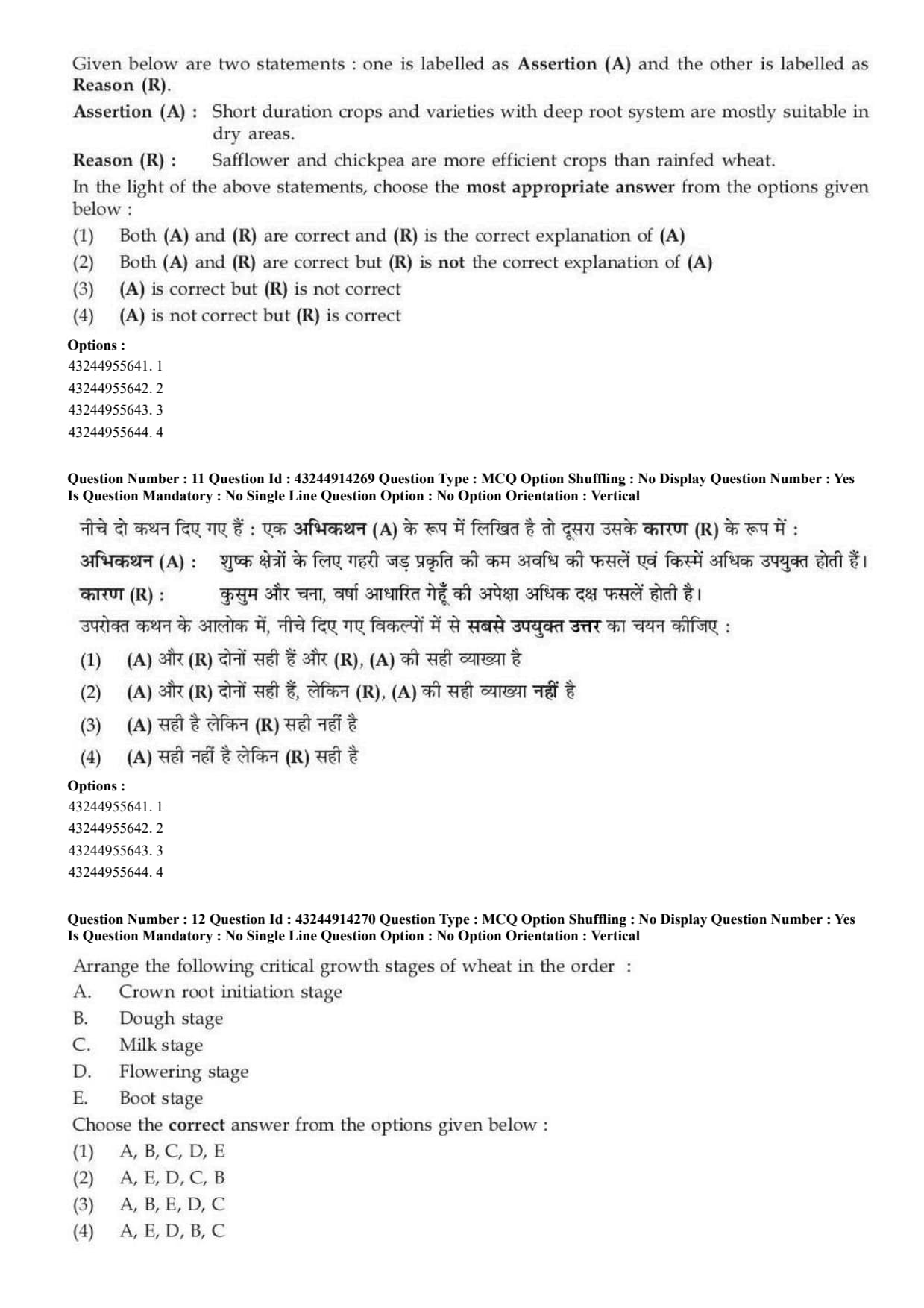
Given below are two statements : one is labelled as Assertion (A) and the other is labelled as Reason (R).
Assertion (A) : Short duration crops and varieties with deep root system are mostly suitable in dry areas.
Reason (R) : Safflower and chickpea are more efficient crops than rainfed wheat.
In the light of the above statements, choose the most appropriate answer from the options given below :
View Solution
Step 1: Understanding the Question:
The question tests dryland agriculture concepts regarding crop adaptation mechanisms under water-stressed environments.
Step 2: Analysis of Assertion (A):
Short duration crops escape terminal drought, while deep root systems allow crops to extract moisture stored in deeper soil layers during prolonged dry spells.
Therefore, short-duration and deep-rooted varieties are best suited for dryland farming.
Hence, Assertion (A) is correct.
Step 3: Analysis of Reason (R):
Safflower (possessing a deep taproot penetrating up to 2 meters) and Chickpea are highly drought-tolerant, water-use-efficient crops compared to rainfed wheat.
Thus, Reason (R) is a correct statement of fact.
However, statement (R) serves as a specific crop example rather than providing the underlying physiological explanation of why short duration and deep rooting function as general drought adaptation mechanisms in dry areas.
Therefore, (R) is NOT the correct explanation of (A).
Step 4: Final Answer:
Both (A) and (R) are correct statements, but (R) is NOT the correct explanation of (A). Thus, option (B) is correct.
Quick Tip: Drought escape mechanisms: Short duration / early maturity. Drought avoidance mechanisms: Deep tap root system (e.g., Safflower).
Arrange the following critical growth stages of wheat in the order :
A. Crown root initiation stage
B. Dough stage
C. Milk stage
D. Flowering stage
E. Boot stage
Choose the correct answer from the options given below :
View Solution
Step 1: Understanding the Question:
The question requires arranging the phenological critical growth stages of wheat (\textit{Triticum aestivum) in chronological sequential order from germination to maturity.
Step 2: Sequential Phenological Stages of Wheat:
Crown Root Initiation (CRI) Stage [A]: Occurs around 21 days after sowing (DAS). Most critical irrigation stage.
Tillering Stage: 20--45 DAS.
Jointing Stage: 45--60 DAS.
Boot Stage [E]: 60--70 DAS (swelling of flag leaf sheath containing emerging spike).
Flowering / Anthesis Stage [D]: 70--85 DAS.
Milking Stage [C]: 90--100 DAS (kernel content is liquid/milky).
Dough Stage [B]: 105--115 DAS (kernel converts from soft to hard dough).
Step 3: Detailed Explanation:
Matching the chronological sequence of given stages:
First: Crown Root Initiation (A)
Second: Boot stage (E)
Third: Flowering stage (D)
Fourth: Milk stage (C)
Fifth: Dough stage (B)
Therefore, the correct chronological sequence is A, E, D, C, B.
Step 4: Final Answer:
The correct order is A, E, D, C, B, corresponding to option (B).
Quick Tip: Wheat Irrigate Stages Timeline: 1. CRI (21 DAS) 2. Tillering (40--45 DAS) 3. Jointing (60 DAS) 4. Flowering (80--85 DAS) 5. Milking (100 DAS) 6. Dough (115 DAS)
Arrange the following nitrogenous fertilizers in increasing N content :
A. Urea
B. Ammonium Nitrate
C. Ammonium Chloride
D. Calcium Ammonium Nitrate (CAN)
E. Diammonium Phosphate (DAP)
Choose the correct answer from the options given below :
View Solution
Step 1: Understanding the Question:
The question asks to arrange the given fertilizers in increasing order of their Nitrogen (N) percentage content.
Step 2: Nitrogen Content of Listed Fertilizers:
E. Diammonium Phosphate (DAP): Contains \(18% N\) (and \(46% P_2O_5\)).
D. Calcium Ammonium Nitrate (CAN): Contains \(25% N\) (also marketed as \(26% N\)).
C. Ammonium Chloride (\(NH_4Cl\)): Contains \(25--26% N\).
B. Ammonium Nitrate (\(NH_4NO_3\)): Contains \(33--34% N\).
A. Urea [\(CO(NH_2)_2\)]: Contains \(46% N\).
Step 3: Detailed Explanation \& Sequence Calculation:
Comparing nitrogen percentages:
\text{DAP (18%) \(<\) \text{CAN (25%) \le \text{Ammonium Chloride (25--26%) \(<\) \text{Ammonium Nitrate (33--34%) \(<\) \text{Urea (46%)
In terms of letters:
\[ E \, (18%) < D \, (25%) < C \, (26%) < B \, (33--34%) < A \, (46%) \]
Hence, the correct increasing order is E \(<\) D \(<\) C \(<\) B \(<\) A.
Step 4: Final Answer:
The correct order is E \(<\) D \(<\) C \(<\) B \(<\) A, which corresponds to option (B).
Quick Tip: Nitrogen content of major fertilizers: - Anhydrous Ammonia: \(82%\) - Urea: \(46%\) - Ammonium Nitrate: \(33.5%\) - Ammonium Chloride: \(26%\) - CAN: \(25%\) - DAP: \(18%\)
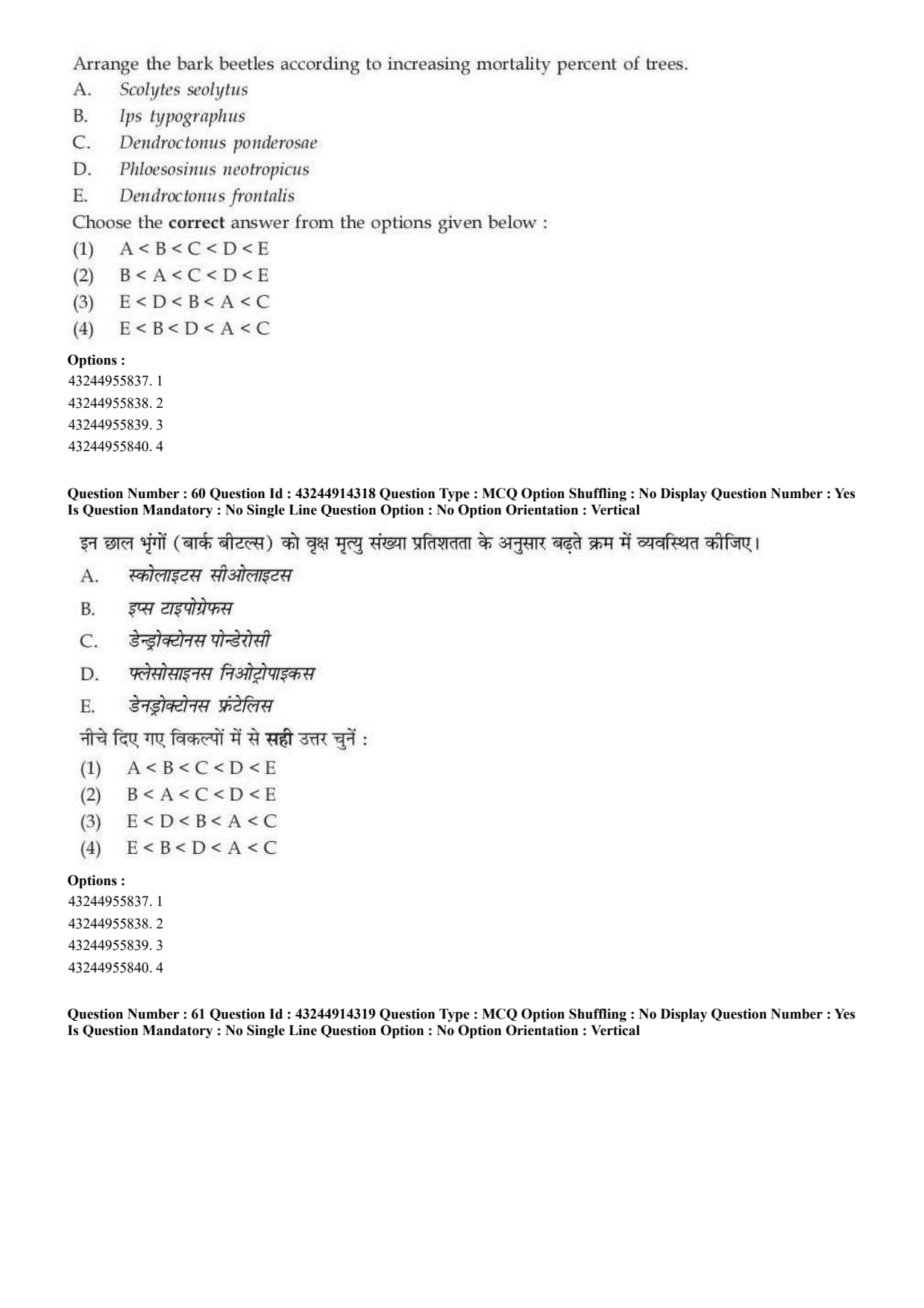
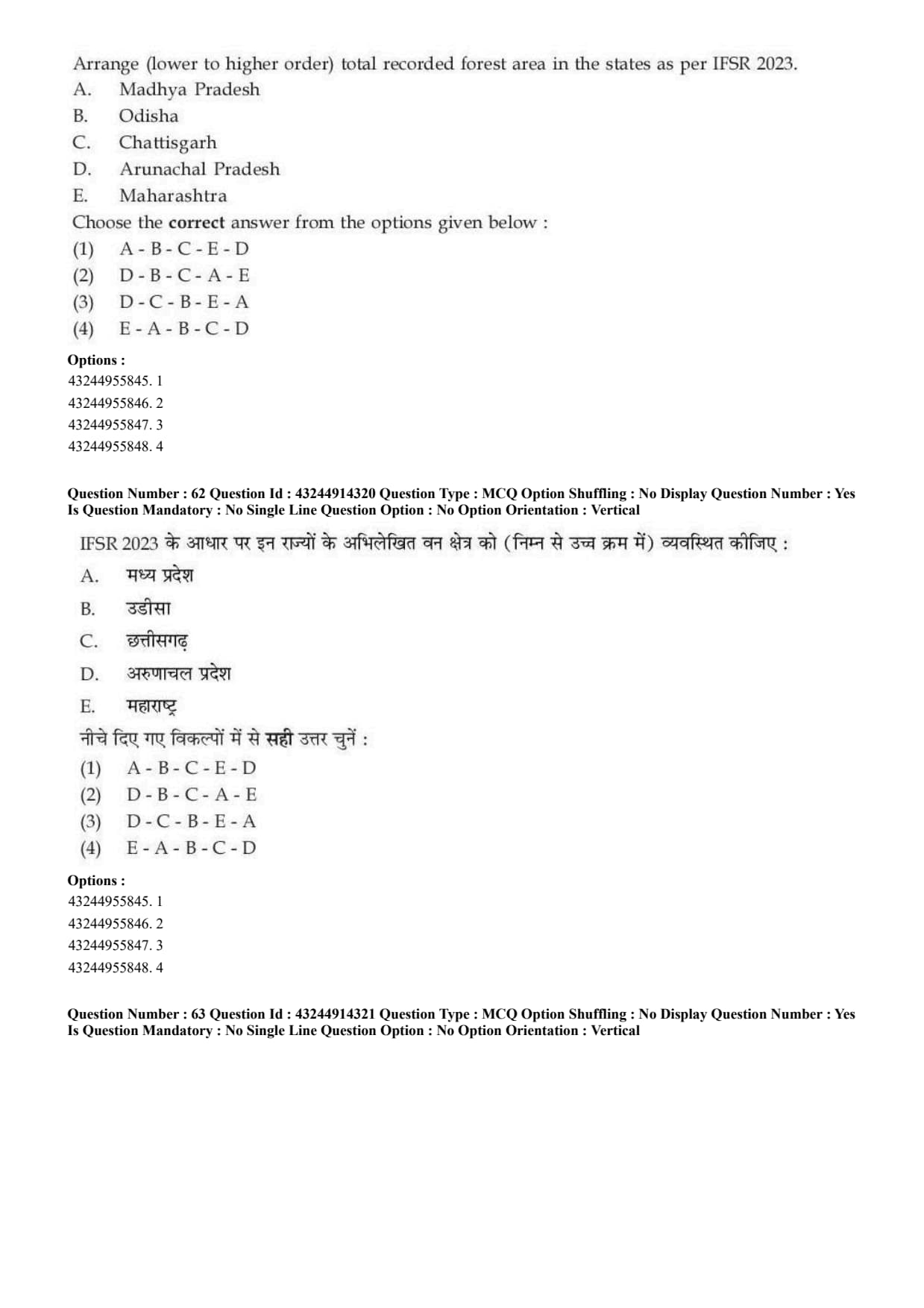
Arrange the land area in increasing order for India.
A. Forest
B. Net sown area
C. Permanent pastures and grazing land
D. Current fallow
E. Culturable wasteland
Choose the correct answer from the options given below :
View Solution
Step 1: Understanding the Question:
The question requires arranging major land-use categories in India in ascending order (smallest to largest) of their geographic area coverage.
Step 2: Land Use Classification Area Statistics in India (approx. Mha):
C. Permanent pastures and grazing land: \(\approx 10.3 Mha\) (\(\sim 3.3%\)).
E. Culturable wasteland: \(\approx 12.5--13 Mha\) (\(\sim 4.0%\)).
D. Current fallow: \(\approx 14.5--15 Mha\) (\(\sim 4.7%\)).
A. Forest area: \(\approx 71.8 Mha\) (\(\sim 23--24%\)).
B. Net sown area: \(\approx 139.5--140 Mha\) (\(\sim 45.5%\)).
Step 3: Detailed Explanation:
Ordering land use areas from lowest to highest:
\[ Pastures (C) < Wasteland (E) < Current Fallow (D) < Forest (A) < Net Sown Area (B) \]
\[ 10.3 Mha < 12.5 Mha < 14.5 Mha < 71.8 Mha < 140 Mha \]
Thus, the correct increasing sequence is C \(<\) E \(<\) D \(<\) A \(<\) B.
Step 4: Final Answer:
The correct order is C \(<\) E \(<\) D \(<\) A \(<\) B, matching option (C).
Quick Tip: In Indian land classification: Net Sown Area (\(\sim 45%\)) \(>\) Forest (\(\sim 24%\)) \(>\) Fallows (\(\sim 8%\)) \(>\) Culturable Wastelands (\(\sim 4%\)) \(>\) Pastures (\(\sim 3%\)).
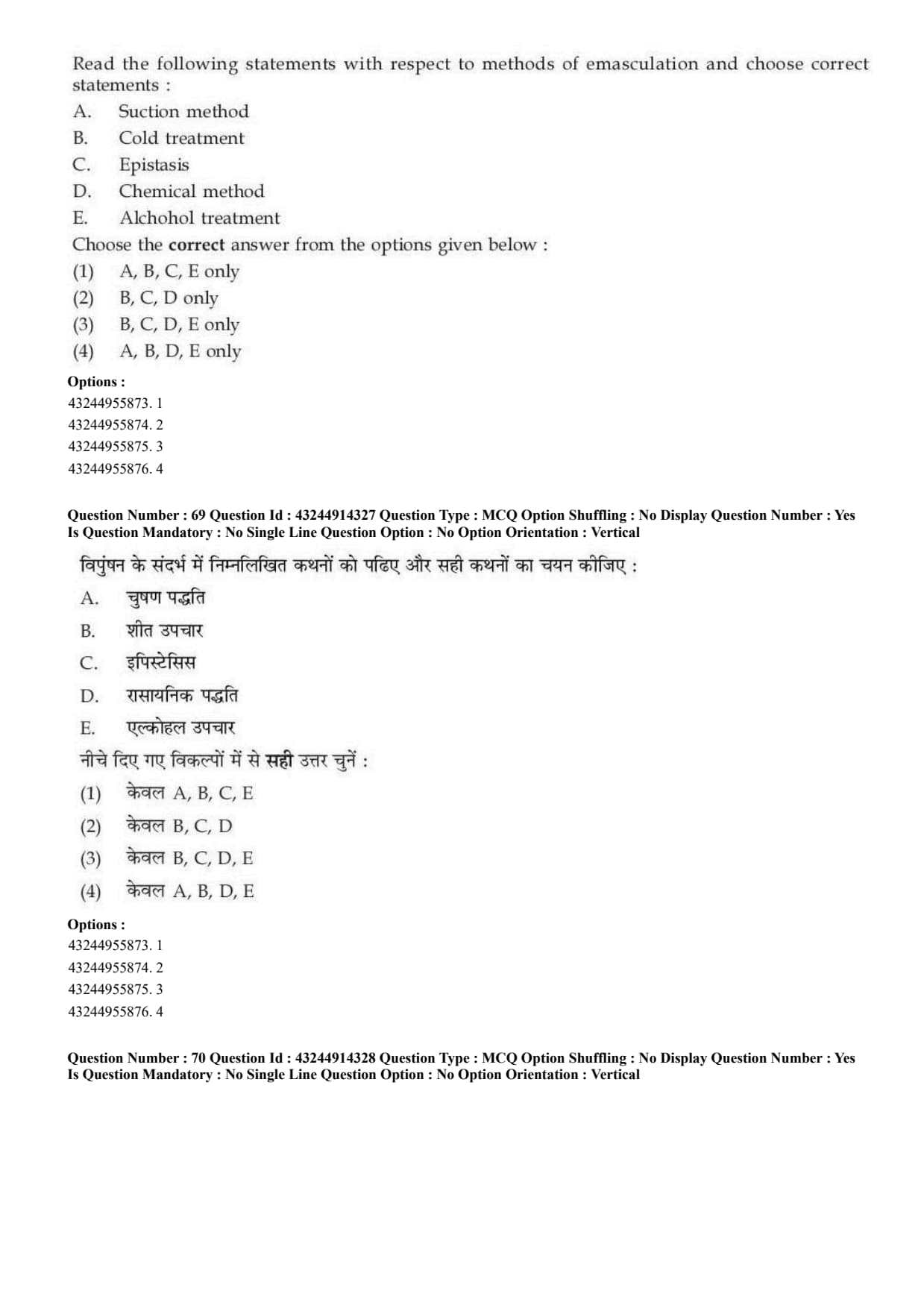
Tools and techniques of precision agriculture are :
A. Variable Rate Technology (VRT)
B. Remote Sensing
C. Seed-cum ferti-dril machine
D. Global Positioning System (GPS)
E. Tractor
Choose the correct answer from the options given below :
View Solution
Step 1: Understanding the Question:
The question identifies specific technological tools that exclusively define and enable precision agriculture operations.
Step 2: Core Technologies of Precision Farming:
Global Positioning System (GPS) [D]: Provides precise geo-spatial positioning for field mapping, tractor auto-guidance, and sample location tagging.
Remote Sensing [B]: Uses satellite or drone imagery to acquire spectral data on crop canopy vigor, stress, and soil properties.
Variable Rate Technology (VRT) [A]: Automated controllers that alter seed, fertilizer, or pesticide application rates on-the-go based on spatial prescriptions.
Geographic Information Systems (GIS): Software for spatial data analysis.
Step 3: Detailed Explanation:
Conventional farm implements like a standard seed-cum-ferti-drill (C) and tractor (E) are general agricultural machinery, not specific precision tools unless combined with VRT or GPS guidance modules.
Therefore, VRT (A), Remote Sensing (B), and GPS (D) form the definitive set of precision agriculture technologies listed.
Step 4: Final Answer:
The correct combination is A, B, D only. Therefore, option (C) is the correct answer.
Quick Tip: Precision Agriculture Trio: 1. GPS (Positioning) 2. GIS / Remote Sensing (Sensing \& Mapping) 3. VRT (Targeted Input Application)
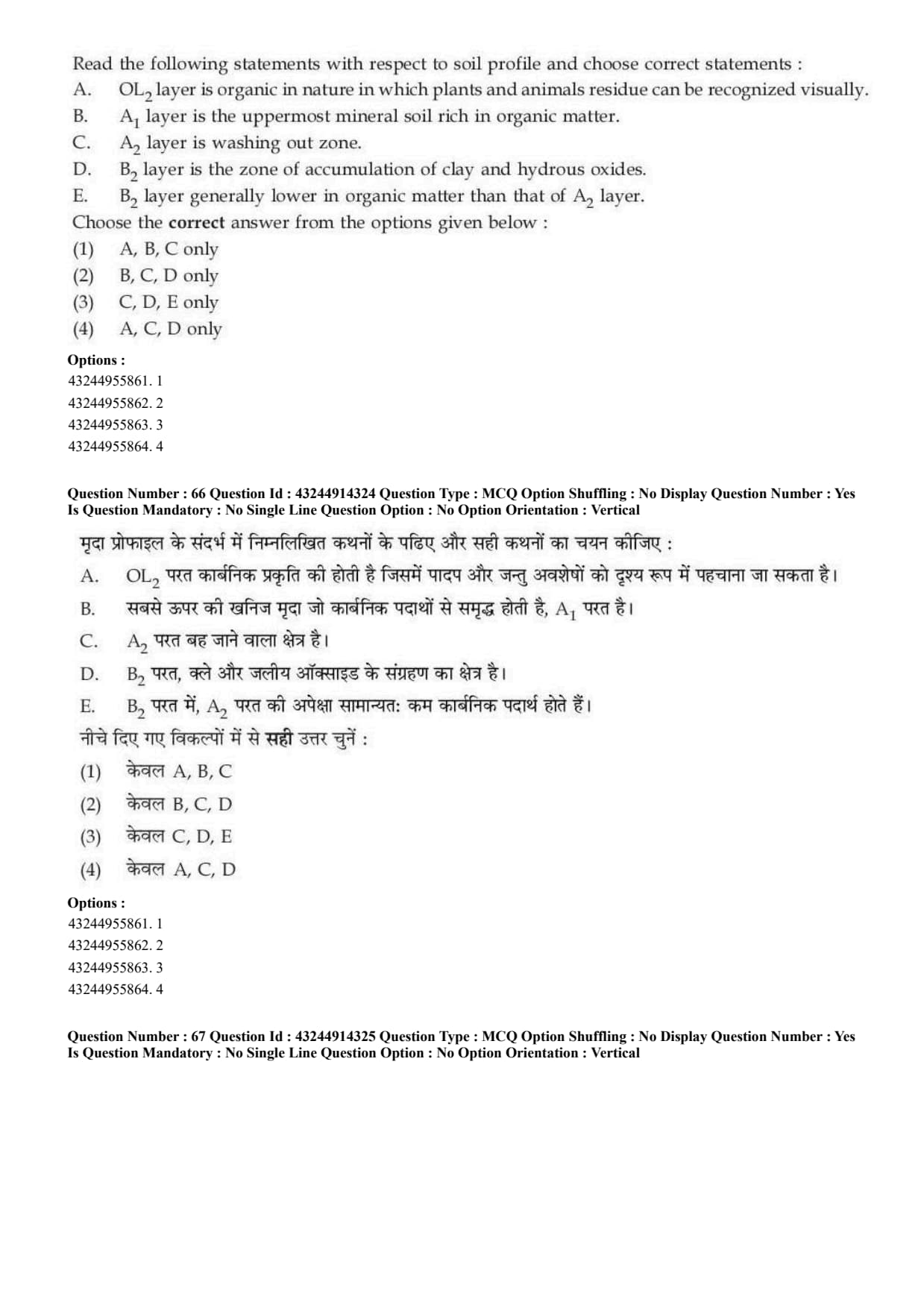
Soil physical quality indicators are :
A. Rooting depth
B. Organic matter content
C. Aggregate stability
D. Earth-worms Population
E. Water holding capacity
Choose the correct answer from the options given below :
View Solution
Step 1: Understanding the Question:
The question asks to identify parameters that specifically qualify as physical indicators of soil quality.
Step 2: Classification of Soil Quality Indicators:
Physical Quality Indicators: Relate to soil architecture, structure, depth, and hydraulic properties. Examples: Rooting depth (A), Aggregate stability (C), Water holding capacity (E), Bulk density, Texture, Infiltration rate.
Chemical Quality Indicators: Soil pH, Organic Matter / Carbon content (B), Cation Exchange Capacity (CEC), EC, available nutrients.
Biological Quality Indicators: Microbial biomass, Earthworm population (D), Soil enzyme activity, Respiration rate.
Step 3: Detailed Explanation:
Rooting depth (A), Aggregate stability (C), and Water holding capacity (E) measure physical resistance, soil structure cohesion, and pore space characteristics.
Organic matter content (B) is primarily classified as a chemical/biological component, while Earthworm population (D) is a biological indicator.
Thus, the physical indicators are strictly A, C, and E.
Step 4: Final Answer:
The soil physical quality indicators are A, C, E only. Thus, option (D) is correct.
Quick Tip: Soil Health Indicators Category: - Physical: Bulk Density, Aggregate Stability, Water Holding Capacity, Depth. - Chemical: pH, Organic Carbon, CEC. - Biological: Earthworms, Microbes, Enzymes.
Choose the principles of conservation agriculture :
A. Permanent organic soil cover
B. Intensive herbicide use
C. Minimum mechanical soil disturbance
D. Diversified crop rotations
E. Integrated nutrient management
Choose the correct answer from the options given below :
View Solution
Step 1: Understanding the Question:
The question asks for the fundamental principles that formally define Conservation Agriculture (CA) as established by international organizations like the FAO.
Step 2: Three Core Pillars of Conservation Agriculture (FAO):
Minimum Mechanical Soil Disturbance (C): Practicing no-till / zero-tillage or direct seeding to preserve soil structure and soil organic matter.
Permanent Organic Soil Cover (A): Maintaining at least \(30%\) ground cover using crop residues, cover crops, or mulches.
Diversified Crop Rotations (D): Rotating varied crop species (including legumes) to break pest cycles and enhance soil health.
Step 3: Detailed Explanation:
Intensive herbicide use (B) is NOT a principle of CA (herbicides may be used selectively during transition, but intensive chemical reliance is avoided).
Integrated Nutrient Management (E) is a general sustainable practice, but not one of the three baseline pillars defining CA.
Thus, the core pillars are A, C, and D.
Step 4: Final Answer:
The three principles of Conservation Agriculture are A, C, D only. Therefore, option (D) is correct.
Quick Tip: Remember the 3 Pillars of CA: 1. Minimal soil disturbance (Zero Tillage). 2. Permanent soil cover (Mulch/Residues). 3. Crop diversification (Rotations).
Match List - I with List - II.

Choose the correct answer from the options given below :
View Solution
Step 1: Understanding the Question:
The question asks to match major insect pests and plant diseases listed in List - I with their respective target host crops in List - II.
Step 2: Detailed Matching Analysis:
A. Stem borer (Scirpophaga incertulas): The yellow stem borer is the most destructive pest of Rice \(\rightarrow\) II.
B. Pod borer (Helicoverpa armigera): A major pest of pulse crops, especially Chickpea \(\rightarrow\) III.
C. Red rot (Colletotrichum falcatum): Termed the "cancer of sugarcane", it is a devastating fungal disease of Sugarcane \(\rightarrow\) IV.
D. Loose smut (Ustilago segetum var. tritici): An internally seed-borne fungal disease affecting Wheat heads \(\rightarrow\) I.
Step 3: Verification of Options:
A \(\rightarrow\) II
B \(\rightarrow\) III
C \(\rightarrow\) IV
D \(\rightarrow\) I
This corresponds to option (C): A-II, B-III, C-IV, D-I.
Step 4: Final Answer:
The correct matching is A-II, B-III, C-IV, D-I, corresponding to option (C).
Quick Tip: Key Pest-Crop Associations: - Yellow Stem Borer \(\rightarrow\) Rice - Gram Pod Borer \(\rightarrow\) Chickpea - Red Rot \(\rightarrow\) Sugarcane - Loose Smut \(\rightarrow\) Wheat
Match List - I with List - II.

Choose the correct answer from the options given below :
View Solution
Step 1: Understanding the Question:
The question requires matching plant nutrients in List - I with their characteristic toxicity symptoms described in List - II.
Step 2: Detailed Nutrient Toxicity Analysis:
A. Phosphorous Toxicity: Excessive phosphorus causes severe metabolic imbalances, inducing micronutrient deficiencies and leading to leaf tip dieback and necrosis \(\rightarrow\) III.
B. Iron Toxicity: Common in waterlogged/acidic paddy soils; excessive \(Fe^{2+}\) causes distinct brownish patches or "bronzing" of older lower leaves \(\rightarrow\) I.
C. Chlorine Toxicity: High chloride accumulation causes marginal burning and leaf tip scorching ("burning of leaf tip") \(\rightarrow\) II.
D. Copper Toxicity: Excess Cu restricts root expansion and causes severe plant stunting \(\rightarrow\) IV.
Step 3: Verification of Combination:
A \(\rightarrow\) III
B \(\rightarrow\) I
C \(\rightarrow\) II
D \(\rightarrow\) IV
Matches option (D): A-III, B-I, C-II, D-IV.
Step 4: Final Answer:
The correct matching is A-III, B-I, C-II, D-IV, corresponding to option (D).
Quick Tip: Nutrient Toxicity Markers: - Iron toxicity = Bronzing in Rice. - Chloride toxicity = Leaf tip burning / margin scorching. - Copper toxicity = Severe root inhibition and stunting.
Match List - I with List - II.

Choose the correct answer from the options given below :
View Solution
Step 1: Understanding the Question:
The question requires matching crops from List - I to their respective top producer/leading states provided in List - II based on production statistics given in the options.
Step 2: Detailed Crop-State Production Analysis:
D. Chickpea (Gram): Madhya Pradesh is traditionally a leading pulse/chickpea producing state in India \(\rightarrow\) I.
B. Wheat: Uttar Pradesh is the single largest producer of wheat in India \(\rightarrow\) IV.
C. Cotton: Karnataka is a major cotton producer among the provided set \(\rightarrow\) II.
A. Rice: Telangana is a major producer of rice in southern India among the choices \(\rightarrow\) III.
Step 3: Verification of Options:
A \(\rightarrow\) III
B \(\rightarrow\) IV
C \(\rightarrow\) II
D \(\rightarrow\) I
Thus, the matching sequence is A-III, B-IV, C-II, D-I.
Step 4: Final Answer:
The correct matched combination is A-III, B-IV, C-II, D-I. Therefore, option (C) is the correct answer.
Quick Tip: Leading Production States Quick Recall: - Wheat \(\rightarrow\) Uttar Pradesh - Chickpea / Pulses \(\rightarrow\) Madhya Pradesh - Sugarcane \(\rightarrow\) Uttar Pradesh - Jute \(\rightarrow\) West Bengal
Which country developed Tatura Trellis system of grape ?
View Solution
Step 1: Understanding the Question:
The question asks for the originating country of the 'Tatura Trellis' training system, which is a high-density canopy training system widely adopted in commercial fruit orchards and vineyards.
Step 2: Key Concepts and Design Features:
Origin: Developed during the 1970s at the Tatura Research Institute located in Victoria, Australia.
Canopy Architecture: The system utilizes a 'V'-shaped or 'Y'-shaped trellis structure where two arms extend outwards at an angle of \(60^\circ\) from the horizontal axis.
Light Interception: By directing branches onto angled trellis frames, light penetration into the inner canopy is maximized, promoting high photosynthetic efficiency.
Crop Applicability: Originally engineered for stone fruits like peaches, it was subsequently adapted for high-density viticulture (grapes) and apple orchards.
Step 3: Detailed Explanation:
In traditional vineyard training systems, dense foliage creates internal canopy shading, leading to poor bud fertility and diminished fruit quality.
The Tatura Trellis system splits the canopy into two distinct, thin fruiting walls tilted outward.
This structural design dramatically increases solar light interception per unit land area, improving sugar accumulation, skin color development, and overall yield per hectare.
Because it was conceived and perfected at the Tatura Research Station in Victoria, Australia, credit for its innovation belongs to Australia.
Step 4: Final Answer:
The Tatura Trellis system was developed in Australia. Therefore, option (C) is the correct choice.
Quick Tip: Trellis Systems Summary:
- Tatura Trellis: Australia (V-shaped architecture for high light interception).
- Bower / Arbour (Pandal) System: Widely used in India for commercial grape production.
- Kniffin System: 4-cane training on 2 wires.
Which among the following rootstock of apple is not vigorous in nature ?
View Solution
Step 1: Understanding the Question:
The question asks to identify the apple (\textit{Malus domestica) rootstock from the given choices that does NOT belong to the vigorous or very vigorous vigor categories (i.e., it is a semi-dwarf rootstock).
Step 2: Classification of Apple Rootstocks by Vigor:
Ultra Dwarf: M-27.
Dwarf: M-9, M-26.
Semi-Dwarf: MM-106, M-7.
Vigorous / Semi-Vigorous: M-2, Merton-793.
Very Vigorous: M-13, M-25, MM-109, Seedling rootstocks.
Step 3: Detailed Explanation:
M-13: Classified as a very vigorous rootstock that produces large trees and is tolerant to wet soils.
Merton-793: A vigorous clonal rootstock developed by crossing M-2 with Northern Spy, known for resistance to woolly apple aphid (\textit{Eriosoma lanigerum).
M-2: A semi-vigorous to vigorous rootstock widely utilized historically in traditional high-canopy orchards.
MM-106 (Mallling-Merton 106): Classified specifically as a semi-dwarf rootstock. It restricts tree size to approximately \(50--60%\) of a standard seedling tree and induces early bearing (precocity).
Thus, among the given options, MM-106 is semi-dwarf and not vigorous in nature.
Step 4: Final Answer:
MM-106 is a semi-dwarf rootstock and is not vigorous in nature. Hence, option (D) is the correct answer.
Quick Tip: Key Malling-Merton Rootstocks:
- M-9 = Dwarf
- MM-106 = Semi-Dwarf (Woolly Aphid resistant)
- Merton-793 = Vigorous (Woolly Aphid resistant)
- M-13 = Very Vigorous
Marsh and Foster are varieties of which fruit ?
View Solution
Step 1: Understanding the Question:
The question asks to identify the specific citrus fruit crop to which the cultivars 'Marsh' and 'Foster' belong.
Step 2: Key Cultivar Information:
Grapefruit (Citrus paradisi): A natural hybrid between sweet orange (\textit{Citrus sinensis) and pummelo (\textit{Citrus grandis).
Marsh (Marsh Seedless): The most important commercial white-fleshed grapefruit cultivar globally. It produces smooth, light-yellow fruit with virtually seedless pulp (\(0--6\) seeds per fruit).
Foster: A prominent pink-fleshed, seeded grapefruit variety originating as a bud mutation of the Walters variety.
Other Notable Grapefruit Cultivars: Ruby Red, Star Ruby, Duncan, and Thompson.
Step 3: Detailed Explanation:
Citrus fruits are categorized into distinct botanical groups based on morphological features and acid-sugar ratios.
Grapefruit is characterized by large oblate fruits borne in clusters (resembling grapes on a vine) with a mild bitter sub-acid taste due to the glucoside \textit{naringin.
Marsh Seedless is favored internationally for its exceptional juice content and processing traits.
Foster is historically significant as the first pigmented (pink-fleshed) grapefruit cultivar identified.
Neither Pummelo, Lemon, nor Lime contains these cultivars.
Step 4: Final Answer:
Marsh and Foster are well-known varieties of Grapefruit. Thus, option (C) is the correct choice.
Quick Tip: Grapefruit Cultivars Categorization: - White-fleshed: Marsh Seedless, Duncan. - Pink/Red-fleshed: Foster, Ruby Red, Star Ruby.
How much seed is required for sowing of coriander in one hectare area under irrigated condition ?
View Solution
Step 1: Understanding the Question:
The question asks for the recommended seeding rate (in kg/ha) for sowing coriander (\textit{Coriandrum sativum) under irrigated cultivation.
Step 2: Key Agronomic Requirements of Coriander:
Seed Structure: The commercial 'seed' of coriander is botanically a dry schizocarp fruit containing two mericarps. Seeds are crushed gently into two halves prior to sowing to promote uniform germination.
Irrigated Condition Seed Rate: \(12--15 kg/ha\).
Rainfed Condition Seed Rate: \(20--25 kg/ha\) (higher seed rate compensates for lower soil moisture availability and poor seedling emergence).
Step 3: Detailed Explanation:
Sowing coriander under irrigated conditions allows for uniform soil moisture, enabling high germination percentages and optimal seedling survival.
A seed rate of \(12--15 kg/ha\) provides an ideal plant population when sown at a row spacing of \(30 cm \times 10 cm\).
Using excess seed under irrigated conditions causes overcrowding, spindly stem growth, and increased susceptibility to powdery mildew (\textit{Erysiphe polygoni).
Step 4: Final Answer:
The recommended seed rate for irrigated coriander is \(12--15 kg/ha\). Therefore, option (C) is the correct choice.
Quick Tip: Coriander Seed Rates: - Irrigated condition = \(12--15 kg/ha\). - Rainfed condition = \(20--25 kg/ha\). Always crush seeds into two mericarps before sowing!
Which among the following is a climacteric fruit ?
View Solution
Step 1: Understanding the Question:
The question requires identifying the climacteric fruit crop among the four options provided.
Step 2: Key Physiological Concepts:
Climacteric Fruits: Fruits that exhibit a sharp rise in respiration rate coupled with a surge in internal ethylene production during ripening. These fruits can be harvested at full maturity (green stage) and will ripen off the tree.
Examples of Climacteric Fruits: Mango, Banana, Papaya, Guava, Apple, Peach, Plum, Pear, Tomato, Sapota.
Non-Climacteric Fruits: Fruits that do not exhibit an ethylene burst or elevated respiration peak during ripening. They must ripen fully on the plant prior to harvest.
Examples of Non-Climacteric Fruits: Citrus (Mandarin, Sweet Orange, Lemon), Grape, Pineapple, Litchi, Pomegranate, Strawberry.
Step 3: Detailed Explanation:
Pineapple: Non-climacteric; does not store starch to convert to sugar post-harvest.
Grape: Non-climacteric; respiration declines steadily after harvest.
Mandarin: Non-climacteric; citrus species produce minimal autocatalytic ethylene.
Peach (Prunus persica): A stone fruit belonging to the Rosaceae family that exhibits a pronounced climacteric peak in both \(CO_2\) evolution and ethylene release during flesh softening and aroma synthesis.
Step 4: Final Answer:
Peach is a climacteric fruit. Hence, option (D) is the correct answer.
Quick Tip: Post-Harvest Classification: - Climacteric = Respiration surge + Ethylene spike (Peach, Apple, Banana, Mango). - Non-Climacteric = Steady respiration decline (Citrus, Grape, Pineapple, Pomegranate).
What is ideal weight of suckers for pineapple planting ?
View Solution
Step 1: Understanding the Question:
The question asks for the optimal planting weight (in grams) of suckers used for vegetative propagation of pineapple (\textit{Ananas comosus).
Step 2: Propagules used in Pineapple Propagation:
Suckers: Shoots arising from axillary buds on the stem below ground level. Preferred propagule due to early fruiting (\(15--18\) months).
Slips: Shoots arising on the peduncle below the fruit base (\(300--400 g\)).
Crowns: Leafy tops on fruit (\(200--250 g\)). Take \(22--24\) months to bear fruit.
Step 3: Detailed Explanation:
Standard propagation practices require grading suckers by weight to achieve uniform flowering and synchronized harvesting.
Suckers weighing \(450--500 g\) (ideally around \(500 g\)) produce high-yielding plants with uniform fruit size.
Light suckers (\(<300 g\)) exhibit slow field establishment, delayed flowering, and yield small unmarketable fruits.
Oversized suckers (\(>800 g\)) lead to pre-mature flowering, producing smaller individual heads.
Step 4: Final Answer:
The ideal weight of suckers for planting pineapple is \(500 g\). Thus, option (B) is the correct choice.
Quick Tip: Pineapple Propagules Weight & Bearing Time: - Suckers: \(450--500 g\) (\(15--18\) months to harvest) -- BEST. - Slips: \(300--400 g\) (\(18--20\) months). - Crowns: \(200--250 g\) (\(22--24\) months).
What is recommended crop geometry for plum ?
View Solution
Step 1: Understanding the Question:
The question asks for the standard planting distance (crop geometry) recommended for commercial plum (Prunus salicina / \textit{Prunus domestica) orchards.
Step 2: Key Concepts in Orchard Spacing:
Plum Growth Habit: Plum trees possess a moderately spreading canopy requiring sufficient room for branch development, air circulation, and light penetration.
Standard Spacing: \(6 m \times 6 m\) under square system of planting on standard rootstocks (e.g., Wild Peach, Myrobalan).
Plant Density Calculation:
\[ Number of plants/ha = \frac{10000 m^2{Spacing (m \times m)} \]
\[ Plant Density = \frac{10000}{6 \times 6} = \frac{10000}{36} \approx 277 trees/ha \]
Step 3: Detailed Explanation:
Spacing narrower than \(6 m \times 6 m\) (such as \(4 m \times 4 m\)) under non-dwarfing standard rootstocks causes inter-canopy crowding, reduced spur formation, and severe pest issues.
Spacing wider than \(6 m \times 6 m\) (such as \(7 m \times 7 m\)) leads to sub-optimal land utilization in plum orchards.
Hence, \(6 m \times 6 m\) is the globally established geometry for standard plum orchards.
Step 4: Final Answer:
The recommended crop geometry for plum is \(6 m \times 6 m\). Therefore, option (C) is the correct answer.
Quick Tip: Standard Orchard Spacing Guide: - Peach / Plum / Almond: \(6 m \times 6 m\) (\(277 trees/ha\)). - Apple (Standard): \(8 m \times 8 m - 10 m \times 10 m\). - Guava / Citrus: \(6 m \times 6 m\). - Mango (Standard): \(10 m \times 10 m\).
Who introduced cashew nut in India ?
View Solution
Step 1: Understanding the Question:
The question asks which foreign historical explorers introduced the cashew nut (Anacardium occidentale) plant to India.
Step 2: Key Historical & Geographical Background:
Native Origin: Cashew is native to Eastern Brazil (South America).
Introduction to India: Introduced in the \(16^{th\) century (around 1560--1570 AD) by Portuguese explorers.
Primary Initial Purpose: Planted along the coastal region of Goa and Malabar to prevent coastal hill soil erosion.
Commercial Evolution: Later recognized for its edible high-value kernel and Cashew Apple Processing (e.g., Feni spirit in Goa).
Step 3: Detailed Explanation:
Portuguese sailors brought seeds from Brazil to Goa, India.
The plant adapted rapidly to the tropical warm-humid climate and acidic lateritic soils of the Western Ghats.
Today, India is one of the world leaders in cashew nut production, processing, and export.
Chinese, French, and Unanian travelers played no role in the introduction of cashew to the Indian subcontinent.
Step 4: Final Answer:
Cashew nut was introduced to India by Portuguese travelers. Therefore, option (B) is correct.
Quick Tip: Crops Introduced to India by Portuguese: 1. Cashew nut 2. Potato 3. Tomato 4. Chilli 5. Tobacco 6. Papaya
Given below are two statements : one is labelled as Assertion (A) and the other is labelled as Reason (R).
Assertion (A) : Commercially acid lime is propagated by seed.
Reason (R) : Polyembryony is found in acid lime.
In the light of the above statements, choose the most appropriate answer from the options given below :
View Solution
Step 1: Understanding the Question:
The question evaluates why acid lime (\textit{Citrus aurantifolia) is uniquely propagated on a commercial scale through seeds unlike most other fruit crops that require vegetative propagation.
Step 2: Analysis of Assertion (A):
Most fruit crops are propagated vegetatively to maintain trueness-to-type. However, Acid Lime (Kagzi Lime) is commercially propagated using seeds.
Seedling trees of acid lime are vigorous, high yielding, and widely accepted by growers.
Thus, Assertion (A) is correct.
Step 3: Analysis of Reason (R):
Acid lime exhibits a high degree of polyembryony (\(39--100%\)).
In polyembryonic citrus seeds, multiple apomictic embryos arise directly from the maternal nucellar tissue (nucellar embryony) alongside one zygotic embryo.
Nucellar seedlings are genetically identical to the mother plant (true-to-type) and free from virus infection.
Because polyembryony guarantees true-to-type progeny from seed, seed propagation is commercially successful.
Thus, Reason (R) is correct and provides the direct biological explanation for Assertion (A).
Step 4: Final Answer:
Both (A) and (R) are correct, and (R) is the correct explanation of (A). Hence, option (A) is correct.
Quick Tip: Polyembryony in Citrus: Nucellar seedlings developed from apomictic embryos are: 1. Trueness-to-type (Genetically identical to mother). 2. Virus-free & vigorous. That is why Acid Lime is commercially seed-propagated!
Match List - I with List - II.

Choose the correct answer from the options given below :
View Solution
Step 1: Understanding the Question:
The question asks to match specific acid lime varieties in List - I with their unique features or breeding institutes in List - II.
Step 2: Detailed Matching Analysis:
A. Pramalini: A high-yielding selection of acid lime developed at Mahatma Phule Krishi Vidyapeeth (MPKV), Rahuri \(\rightarrow\) II.
B. Rasraj: An acid lime variety noted for resistance/tolerance to citrus canker disease \(\rightarrow\) IV.
C. Chakradhar: A unique seedless and completely thornless (spineless) mutant variety of acid lime \(\rightarrow\) III.
D. Sai-Sharbati: A popular acid lime variety developed by Vasantrao Naik Marathwada Krishi Vidyapeeth (MAU), Parbhani, tolerant to bacterial canker and tristeza virus \(\rightarrow\) I.
Step 3: Verification of Combination:
A \(\rightarrow\) II
B \(\rightarrow\) IV
C \(\rightarrow\) III
D \(\rightarrow\) I
This matches option (D): A-II, B-IV, C-III, D-I.
Step 4: Final Answer:
The correct matching is A-II, B-IV, C-III, D-I, corresponding to option (D).
Quick Tip: Key Acid Lime Varieties: - Chakradhar = Thornless / Seedless mutant. - Pramalini & Vikram = Selections from MPKV Rahuri. - Sai Sharbati = Tolerant to Canker & Tristeza (MAU Parbhani).
Given below are two statements : one is labelled as Assertion (A) and the other is labelled as Reason (R).
Assertion (A) : Pruning of roots is most common in India for inducing fruiting in some fruit plants.
Reason (R) : Root pruning may be harmful for fruit plants.
In the light of the above statements, choose the most appropriate answer from the options given below :
View Solution
Step 1: Understanding the Question:
The question tests horticultural knowledge regarding root pruning (bahar treatment practice) in fruit crop management.
Step 2: Analysis of Assertion (A):
In tropical and subtropical regions of India, evergreen fruit trees like citrus, pomegranate, and guava do not undergo natural winter dormancy.
To induce concentrated flowering and fruit set (bahar regulation), root exposure and root pruning are practiced to check vegetative growth and induce water-stress shock.
Therefore, Assertion (A) is correct.
Step 3: Analysis of Reason (R):
Root pruning removes feeder roots, reducing water and nutrient absorption.
If executed excessively or under extreme dry soil conditions, root pruning can cause permanent wilting, dieback, and plant mortality.
Hence, Reason (R) is a correct statement.
However, the potential harmful nature of root pruning (R) does NOT explain why growers actively practice it to induce fruiting (A).
The real explanation for practicing root pruning is to restrict vegetative shoot growth and force carbohydrate accumulation for flower bud differentiation.
Thus, (R) is NOT the correct explanation of (A).
Step 4: Final Answer:
Both (A) and (R) are correct, but (R) is NOT the correct explanation of (A). Thus, option (B) is correct.
Quick Tip: Bahar Treatment Principles: - Root exposing and root pruning stress vegetative growth. - Carbohydrates accumulate in shoots \(\rightarrow\) induces uniform flower bud initiation (e.g., Guava, Citrus, Pomegranate).
Match List - I with List - II.

Choose the correct answer from the options given below :
View Solution
Step 1: Understanding the Question:
The question asks to match primary propagation methods in List - I with their corresponding target fruit crops in List - II.
Step 2: Detailed Propagation Analysis:
A. Hard wood cutting: Commercial propagation of Grape (\textit{Vitis vinifera) is performed using dormant mature hardwood cuttings treated with IBA \(\rightarrow\) III.
B. Air layering (Gootee): Widely practiced commercial method for Guava (\textit{Psidium guajava) and Litchi \(\rightarrow\) IV.
C. Budding (T-Budding / Shield / Patch): Standard propagation method for citrus crops like Orange (\textit{Citrus sinensis) \(\rightarrow\) II.
D. Inarching (Approach Grafting): Traditional commercial method of propagation in Mango (\textit{Mangifera indica) \(\rightarrow\) I.
Step 3: Verification of Options:
A \(\rightarrow\) III
B \(\rightarrow\) IV
C \(\rightarrow\) II
D \(\rightarrow\) I
Matches option (D): A-III, B-IV, C-II, D-I.
Step 4: Final Answer:
The correct matching is A-III, B-IV, C-II, D-I, corresponding to option (D).
Quick Tip: Commercial Plant Propagation Summary: - Grape \(\rightarrow\) Hardwood cuttings. - Guava \(\rightarrow\) Air layering / Stooling. - Citrus / Orange \(\rightarrow\) T-Budding / Shield budding. - Mango \(\rightarrow\) Veneer grafting / Inarching.
Match List - I with List - II.

Choose the correct answer from the options given below :
View Solution
Step 1: Understanding the Question:
The question asks to match breeding origins/particulars in List - I with black pepper (\textit{Piper nigrum) varieties in List - II.
Step 2: Breeding Pedigree of Black Pepper Varieties:
A. Open pollinated progeny: Panniyur - 2 is an open pollinated progeny selection from 'Balankotta' \(\rightarrow\) I.
B. Clonal selection: Panniyur - 4 is a high-yielding clonal selection developed from cultivar 'Kuthiravally' \(\rightarrow\) III.
C. Hybrid variety: Panniyur - 3 is a hybrid variety developed by crossing Uthirankotta \(\times\) Cheriyakaniyakadan \(\rightarrow\) IV.
D. Seedling selection: Arka Coorg Excel is a high-yielding selection released by ICAR-IIHR \(\rightarrow\) II.
Step 3: Verification of Option Sequence:
A \(\rightarrow\) I
B \(\rightarrow\) III
C \(\rightarrow\) IV
D \(\rightarrow\) II
This corresponds to option (C): A-I, B-III, C-IV, D-II.
Step 4: Final Answer:
The correct match is A-I, B-III, C-IV, D-II. Therefore, option (C) is correct.
Quick Tip: Panniyur Black Pepper Breeding Series: - Panniyur-1 = First hybrid (Uthirankotta \(\times\) Cheriyakaniyakadan). - Panniyur-2 = Open pollinated selection of Balankotta. - Panniyur-3 = Hybrid variety. - Panniyur-4 = Clonal selection of Kuthiravally.
Arrange the steps in processing of turmeric (from start to end).
A. Drying
B. Separation of fingers from mother rhizome
C. Curing
D. Colouring
E. Polishing
Choose the correct answer from the options given below :
View Solution
Step 1: Understanding the Question:
The question requires arranging the post-harvest processing operations of turmeric (\textit{Curcuma longa) in sequential order from harvest to final market presentation.
Step 2: Sequential Steps in Turmeric Processing:
Separation of fingers [B]: After harvesting, secondary/tertiary finger rhizomes are separated from mother rhizomes and cleaned of soil and roots.
Curing [C]: Boiling fresh rhizomes in clean water or \(0.05%\) sodium carbonate solution for \(45--60\) minutes until soft to gelatinize starch and destroy raw aroma.
Drying [A]: Cured rhizomes are sun-dried on clean mats for \(10--15\) days until moisture content drops below \(10%\).
Polishing [E]: Dried rhizomes have a rough, dull exterior. They are rubbed in manual/power drums to smooth the surface and remove scales.
Colouring [D]: Polished dry fingers are coated with turmeric powder/suspension to impart an attractive yellow appearance.
Step 3: Detailed Explanation:
The correct operational sequence is B \(\rightarrow\) C \(\rightarrow\) A \(\rightarrow\) E \(\rightarrow\) D.
Option (C) matches this sequence: B - C - A - E - D.
Step 4: Final Answer:
The correct order is B - C - A - E - D, corresponding to option (C).
Quick Tip: Turmeric Post-Harvest Workflow: Separation (B) \(\rightarrow\) Curing (Boiling) (C) \(\rightarrow\) Sun Drying (A) \(\rightarrow\) Polishing (E) \(\rightarrow\) Colouring (D).
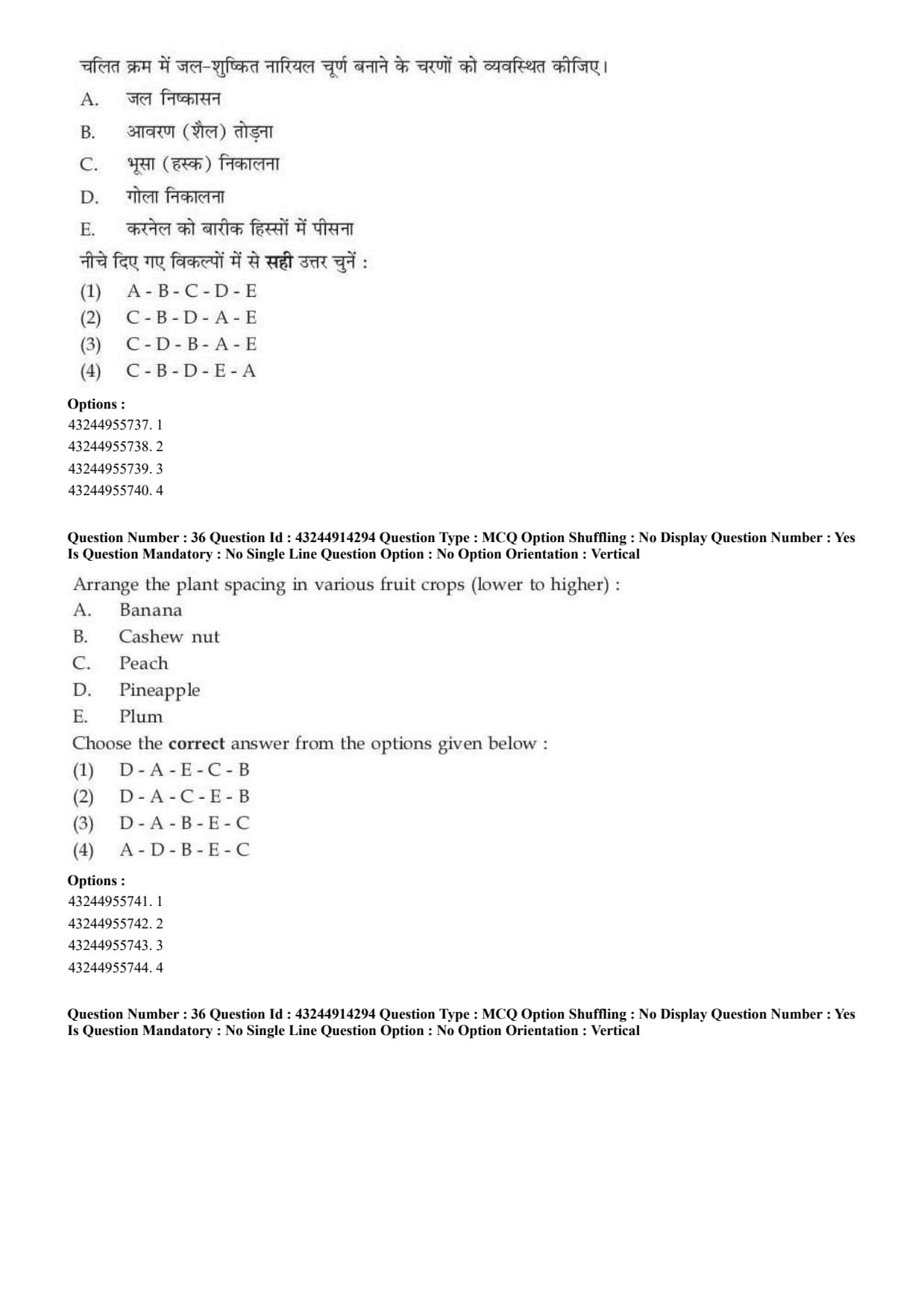
Arrange sequential steps in desiccated coconut powder preparation :
A. Water draining
B. De-shelling
C. De-husking
D. Kernel ball removing
E. Kernel grounded into fine mass
Choose the correct answer from the options given below :
View Solution
Step 1: Understanding the Question:
The question asks to order the industrial processing steps in manufacturing desiccated coconut powder from mature coconuts.
Step 2: Processing Workflow for Desiccated Coconut Powder:
De-husking [C]: Removal of the fibrous outer mesocarp (husk) from the nut.
De-shelling [B]: Removing the hard stony endocarp (shell) using rotary blades or manual knives.
Kernel ball removing [D]: Separating the intact fresh kernel ball from inner skin/shell fragments.
Water draining [A]: Puncturing the kernel ball to drain liquid coconut water.
Kernel grounded into fine mass [E]: The parated, washed, and blanched endosperm is shredded and ground into a fine powder before hot-air drying.
Step 3: Detailed Explanation:
De-husking (C) precedes de-shelling (B), which is followed by extracting the kernel ball (D).
Draining internal nut water (A) occurs before disintegration/grinding of the kernel into fine particles (E).
Thus, the correct operational sequence is C - B - D - A - E.
Step 4: Final Answer:
The correct order is C - B - D - A - E, corresponding to option (B).
Quick Tip: Coconut Processing Sequence: De-husking (C) \(\rightarrow\) De-shelling (B) \(\rightarrow\) Kernel Removal (D) \(\rightarrow\) Water Draining (A) \(\rightarrow\) Grinding/Shredding (E).
Arrange the plant spacing in various fruit crops (lower to higher) :
A. Banana
B. Cashew nut
C. Peach
D. Pineapple
E. Plum
Choose the correct answer from the options given below :
View Solution
Step 1: Understanding the Question:
The question asks to arrange the given fruit crops in ascending order (from smallest/closest spacing to largest/widest spacing) based on standard orchard field planting recommendations.
Step 2: Recommended Planting Distances for Listed Crops:
D. Pineapple: High-density planting at \(0.3 m \times 0.6 m \times 0.9 m\) or \(0.3 m \times 0.6 m\) (\(\approx 0.3--0.6 m\)). Lowest spacing.
A. Banana: Standard plant spacing is \(1.8 m \times 1.8 m\) to \(2.0 m \times 2.0 m\).
E. Plum: Recommended geometry is \(6.0 m \times 6.0 m\).
C. Peach: Standard spacing is \(6.5 m \times 6.5 m\).
B. Cashew nut: Wide tree canopy requires \(7.5 m \times 7.5 m\) to \(10.0 m \times 10.0 m\). Widest spacing.
Step 3: Detailed Explanation \& Sequence Construction:
Comparing standard plant spacings:
\[ Pineapple (0.3m) < Banana (1.8m) < Plum (6.0m) < Peach (6.5m) < Cashew nut (7.5--10m) \]
Represented by letters:
\[ D < A < E < C < B \]
This corresponds to option (A): D - A - E - C - B.
Step 4: Final Answer:
The correct ascending order is D - A - E - C - B. Thus, option (A) is correct.
Quick Tip: Plant Spacing Scale: - Pineapple \(\approx 0.3--0.6 m\) - Banana \(\approx 1.8 m\) - Plum \(\approx 6.0 m\) - Peach \(\approx 6.5 m\) - Cashew \(\approx 7.5--10.0 m\)
Read the following statements about black pepper and select true statements :
A. Economic yield starts from fifth year after planting
B. Crop become ready for harvesting in 6-8 months after flowering
C. It is cultivated as rainfed crop
D. Commercial method of propagation is by seed.
E. It is perennial and woody climber.
Choose the correct answer from the options given below :
View Solution
Step 1: Understanding the Question:
The question asks to evaluate five statements regarding the agronomy and botany of black pepper (Piper nigrum) and select the correct set of true statements.
Step 2: Analysis of Each Statement:
Statement A: True. Black pepper vines start commercial economic yield from \(3^{rd--5^{th}\) year post-planting and continue yielding up to 20 years.
Statement B: True. Berries require \(6--8\) months from flowering/spike emergence to reach full harvesting maturity.
Statement C: True. In India (Western Ghats region), black pepper is predominantly cultivated as a rainfed crop under heavy monsoon rainfall (\(>2000 mm\)).
Statement D: False. The commercial propagation of black pepper is strictly vegetative using stem/runner cuttings, NOT by seed (seed propagation causes genetic segregation).
Statement E: True. Black pepper is a perennial evergreen woody climbing vine supported on live or dead standards.
Step 3: Detailed Explanation:
Statements A, B, C, and E are scientifically correct.
Statement D is incorrect because vegetative runner shoot cuttings root easily and ensure trueness-to-type.
Thus, the correct combination is A, B, C, E only.
Step 4: Final Answer:
The correct true statements are A, B, C, E only. Hence, option (B) is the correct choice.
Quick Tip: Black Pepper Key Facts: - King of Spices ("Black Gold"). - Perennial climber propagated by runner cuttings. - Harvested \(6--8\) months after flowering.
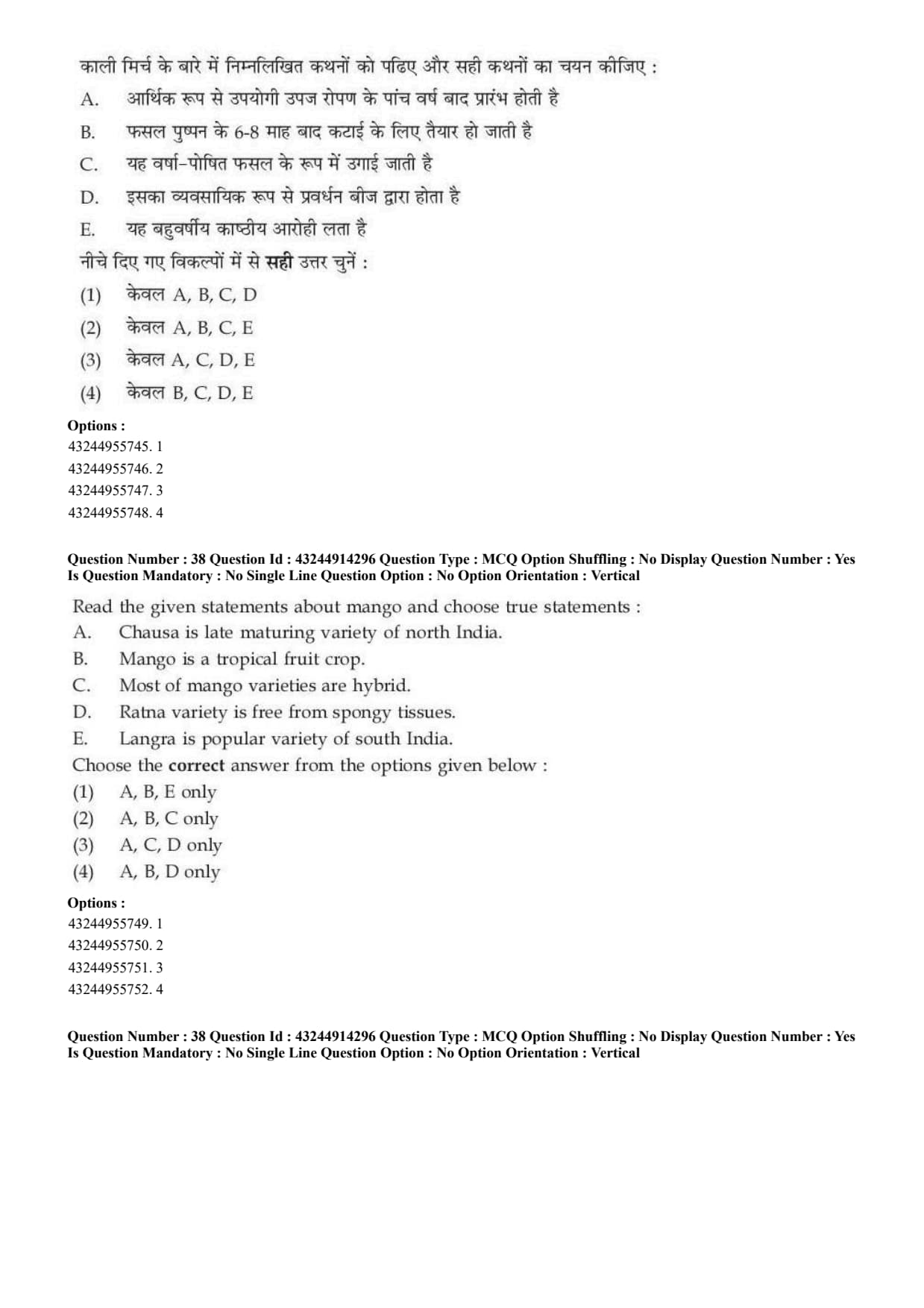
Read the given statements about mango and choose true statements :
A. Chausa is late maturing variety of north India.
B. Mango is a tropical fruit crop.
C. Most of mango varieties are hybrid.
D. Ratna variety is free from spongy tissues.
E. Langra is popular variety of south India.
Choose the correct answer from the options given below :
View Solution
Step 1: Understanding the Question:
The question requires evaluating statements related to mango (\textit{Mangifera indica) cultivars and ecological requirements to select the true statements.
Step 2: Statement Analysis:
Statement A: True. Chausa is a premier late-maturing sweet cultivar of North India (maturing in July--August).
Statement B: True. Mango is classified ecologically as a tropical fruit crop, though it adapts well to subtropical frost-free zones.
Statement C: False. Most commercial mango cultivars in India are landraces/selections (e.g., Alphonso, Dashehari, Langra), not artificial hybrids.
Statement D: True. 'Ratna' (a hybrid cross of Neelam \(\times\) Alphonso developed at FRS Vengurle) is completely resistant to the physiological disorder known as spongy tissue.
Statement E: False. 'Langra' is an important commercial variety of North and East India (Varanasi, UP), not South India.
Step 3: Detailed Explanation:
Correct true statements: A, B, and D.
Incorrect statements: C (most varieties are selections) and E (Langra belongs to North India).
Therefore, option (D) listing A, B, D only is correct.
Step 4: Final Answer:
The true statements are A, B, D only. Thus, option (D) is correct.
Quick Tip: Mango Variety Quick Memory: - Chausa = Late season (North India). - Ratna = Neelam \(\times\) Alphonso (Free from Spongy Tissue). - Amrapali = Dashehari \(\times\) Neelam (High Density Planting).
Read the given statement about banana and choose true statements :
A. India is the largest producer of banana.
B. Banana is sub tropical fruit crop.
C. Nendran is popular variety of plantain.
D. Banana is conventionally propagated by suckers.
E. De-navelling refers to removal of female bud.
Choose the correct answer from the options given below :
View Solution
Step 1: Understanding the Question:
The question asks to evaluate five statements concerning banana (\textit{Musa spp.) production, classification, and management practices to identify the true statements.
Step 2: Detailed Evaluation of Statements:
Statement A: True. India is the global leader in banana production, contributing over \(25%\) of total world production.
Statement B: False. Banana is physiologically a tropical fruit crop requiring high warmth and humidity; cold/frost causes severe freeze injury.
Statement C: True. 'Nendran' (AAB group) is a premier plantain variety widely cultivated in Kerala for cooking and chips preparation.
Statement D: True. Banana is conventionally propagated using sword suckers weighing \(1.5--2.0 kg\) (and increasingly by tissue culture).
Statement E: False. De-navelling refers to the practice of removing the male flower bud after completion of female fruit bunch setting, NOT the female bud.
Step 3: Detailed Explanation:
De-navelling saves photosynthetic reserves and prevents the male bud from competing with developing fruit hands, improving finger weight.
Combining the valid facts: Statements A, C, and D are true.
Step 4: Final Answer:
The true statements are A, C, D only. Thus, option (D) is the correct choice.
Quick Tip: Banana Cultural Operations: - Desuckering = Removal of unwanted side suckers. - De-navelling = Removal of MALE flower bud to boost fruit size. - Mattocking = Cutting pseudostem post-harvest.
Read the given statements about papaya and choose true statements :
A. CO-2 is a selection from variety Washington.
B. Pusa Majesty is a gynodioecious line.
C. Pusa Dwarf is a mutant variety.
D. Arka Surya is a gynodioecious variety.
E. Arka Surya is a cross between Sunrise Solo \(\times\) Pusa Dwarf.
Choose the correct answer from the options given below :
View Solution
Step 1: Understanding the Question:
The question asks to identify the correct combination of true statements regarding papaya (\textit{Carica papaya) breeding lines and cultivars.
Step 2: Verification of Each Statement:
Statement A: False. CO-2 is a dioecious selection developed from local lines at TNAU, Coimbatore (not selected from Washington).
Statement B: True. 'Pusa Majesty' is a gynodioecious variety released by IARI (produces female and hermaphrodite plants).
Statement C: True. 'Pusa Dwarf' is a mutant variety produced through gamma irradiation of seeds.
Statement D: True. 'Arka Surya' is a gynodioecious hybrid variety developed at ICAR-IIHR, Bengaluru.
Statement E: False. 'Arka Surya' is a hybrid cross between Sunrise Solo \(\times\) Pink Flesh Sweet (not Pusa Dwarf).
Step 3: Detailed Explanation:
Statements B, C, and D are accurate breeding facts.
Statements A and E contain incorrect varietal parentage/selection origins.
Thus, the correct option selecting B, C, D only is option (C).
Step 4: Final Answer:
The true statements are B, C, D only, corresponding to option (C).
Quick Tip: Papaya Varieties Classification: - Gynodioecious (Female + Hermaphrodite): Pusa Majesty, Pusa Delicious, Coorg Honey Dew, Arka Surya, Arka Prabhath. - Dioecious (Female + Male): Pusa Giant, Pusa Dwarf (Mutant), CO-2, CO-5.
What is the meaning of the term 'virgin forests' ?
View Solution
Step 1: Understanding the Question:
The question asks for the ecological definition of the term 'virgin forest' among the given options.
Step 2: Key Ecological Concepts:
Virgin Forest (Primary / Primeval Forest): An ancient, natural forest ecosystem that has reached a mature age without undergoing any notable human intervention, commercial timber logging, or anthropogenic disturbance.
Ecological Characteristics: High canopy structural diversity, standing dead snags, fallen logs, rich soil humus, and complex micro-habitats undisturbed for centuries.
Secondary Forest: A forest ecosystem that has re-grown after significant timber harvesting, clear-cutting, or agricultural clearing.
Step 3: Detailed Explanation:
Option (A) describes managed or secondary human-influenced forests, which contradicts the concept of an undisturbed ecosystem.
Option (B) accurately specifies a pristine natural forest where commercial tree cutting or logging operations have never occurred.
Option (C) refers to plantation systems established on non-forest lands specifically to meet community needs for fuel, fodder, and timber.
Option (D) refers to legal forest boundaries established under forest laws to restrict certain activities, but protected forests may still have past logging histories.
Step 4: Final Answer:
A virgin forest is a natural forest where tree cutting has never taken place. Therefore, option (B) is the correct choice.
Quick Tip: Forest Type Distinctions:
- Primary / Virgin Forest = Pristine, zero human logging history.
- Secondary Forest = Regenerated after human disturbance.
- Social Forest = Man-made community plantations.
How many types of forests were classified in the National Forest Policy 1952 ?
View Solution
Step 1: Understanding the Question:
The question asks for the total number of functional forest categories established under the post-independence National Forest Policy of 1952 in India.
Step 2: Key Historical Policy Framework:
National Forest Policy 1952: The first official post-independence national policy on forests formulated by the Ministry of Agriculture, Government of India.
Functional Classification: It classified the nation's forest land into four main functional classes based on management objectives:
Protection Forests: Forests critical for physical and climatic protection of slope areas, river basins, and soil erosion control.
National Forests: Forests managed for major timber, industrial raw materials, and national economic defense needs.
Village Forests: Woodlands managed to meet local village requirements for firewood, small timber, and grazing.
Tree-lands: Open areas, road/canal sides, and private lands designated for tree planting campaigns.
Step 3: Detailed Explanation:
The 1952 policy emphasized maintaining \(33%\) total land area under forest cover (\(60%\) in hilly tracts and \(20%\) in plains).
The 16 major group types classification belongs to Champion and Seth's forest silvicultural classification system (1968), not the 1952 policy.
Hence, the policy explicitly established 4 functional categories.
Step 4: Final Answer:
The National Forest Policy of 1952 classified forests into 4 types. Thus, option (C) is correct.
Quick Tip: NFP 1952 Four Classes:
1. Protection Forests
2. National Forests
3. Village Forests
4. Tree-lands
Target = \(33%\) national forest cover target.
Which is not included in the NTFP ?
View Solution
Step 1: Understanding the Question:
The question asks to identify the item that does NOT fall under the classification of Non-Timber Forest Products (NTFP).
Step 2: Definition and Scope of NTFP:
Non-Timber Forest Products (NTFP): All biological products, goods, and materials gathered from forest ecosystems excluding major commercial timber logs, industrial wood, and pulpwood.
Common Categories of NTFP:
Exudates: Gums, resins, oleoresins, latex.
Edible products: Wild fruits, nuts, berries, mushrooms, honey.
Medicinal and aromatic plants: Roots, barks, foliage.
Fibers and Fluffs: Bamboo, canes, grasses, tendu leaves.
Step 3: Detailed Explanation:
Gums, latex, and edible forest nuts are naturally gathered non-wood plant materials, making them true NTFPs.
Plywood is an engineered wood product manufactured by gluing together layers of timber veneers sliced directly from heavy structural tree trunks (major timber).
Because plywood relies directly on industrial timber extraction, it is categorized under major wood/timber forest products, NOT NTFP.
Step 4: Final Answer:
Plywood is a major timber wood product and is not included under NTFP. Therefore, option (A) is correct.
Quick Tip: Major Forest Product = Industrial Roundwood, Logs, Timber, Plywood, Pulpwood.
Non-Timber Forest Product = Gums, Resins, Honey, Bamboo, Tendu leaves, Latex, Medicinal herbs.
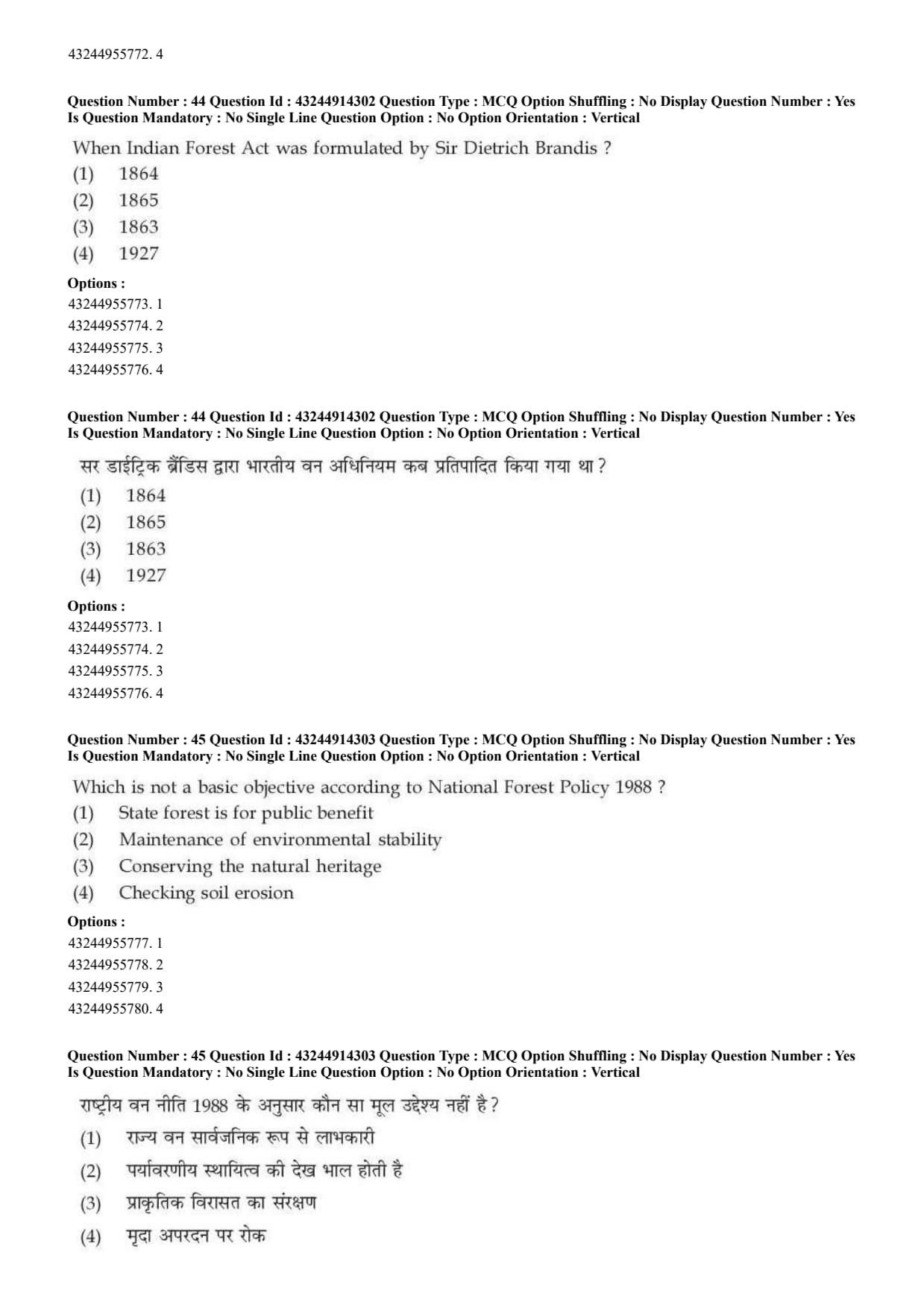
When Indian Forest Act was formulated by Sir Dietrich Brandis ?
View Solution
Step 1: Understanding the Question:
The question asks for the year when the first Indian Forest Act was officially enacted under the guidance of Sir Dietrich Brandis.
Step 2: Historical Timeline of Indian Forestry Legislation:
1864: Appointment of Sir Dietrich Brandis as the first Inspector General of Forests (IGF) in India, marking the birth of the Imperial Forest Department.
1865: Enactment of the First Indian Forest Act (Act VII of 1865) drafted under Brandis's guidance, empowering the British government to declare state-owned forest lands.
1878: Revision of the Act (Indian Forest Act 1878) introducing Reserve, Protected, and Village forest legal categories.
1927: Comprehensive consolidation resulting in the modern Indian Forest Act, 1927.
Step 3: Detailed Explanation:
Sir Dietrich Brandis, a German botanist, established scientific forestry administration in British India.
Although the Forest Department was organized in 1864, the initial statutory legislation (The Indian Forest Act) was formally passed into law in 1865.
Therefore, 1865 is the correct historical year for the formulation of the first Indian Forest Act.
Step 4: Final Answer:
The Indian Forest Act was formulated by Sir Dietrich Brandis in 1865. Hence, option (B) is the correct choice.
Quick Tip: Key Forest History Years:
- 1864: Imperial Forest Dept established (Brandis appointed IGF).
- 1865: First Indian Forest Act passed.
- 1878: Second Indian Forest Act.
- 1927: Indian Forest Act (currently in force).
Which is not a basic objective according to National Forest Policy 1988 ?
View Solution
Step 1: Understanding the Question:
The question asks to identify the statement that is NOT a primary objective of the National Forest Policy of 1988.
Step 2: Core Objectives of National Forest Policy 1988:
Environmental Stability: Maintenance of environmental stability through preservation and restoration of ecological balance.
Heritage Conservation: Conserving the natural heritage of the country by preserving remaining natural forests.
Erosion Control: Checking soil erosion and denudation in catchment areas of rivers, lakes, and reservoirs.
Afforestation: Increasing forest/tree cover through massive afforestation and social forestry programs.
Meeting Needs: Meeting basic fuel wood, fodder, and non-timber needs of local tribal and rural populations.
Step 3: Detailed Explanation:
Earlier forest policies (1894 and 1952) focused heavily on commercial state revenue generation and public commercial benefit.
The 1988 Policy represented a paradigm shift: it explicitly stated that economic/commercial derivation of revenue from state forests must be subordinate to the primary goal of environmental protection and ecological security.
Treating state forests as a source for commercial public benefit was purposefully omitted as a core objective.
Step 4: Final Answer:
"State forest is for public benefit" as a commercial objective is not a basic objective of NFP 1988. Thus, option (A) is correct.
Quick Tip: NFP 1988 Paradigm Shift:
Prior policies = Revenue & Commercial timber extraction.
NFP 1988 = Environmental stability, biodiversity conservation, and meeting local tribal subsistence needs. Commercial exploitation was discouraged.
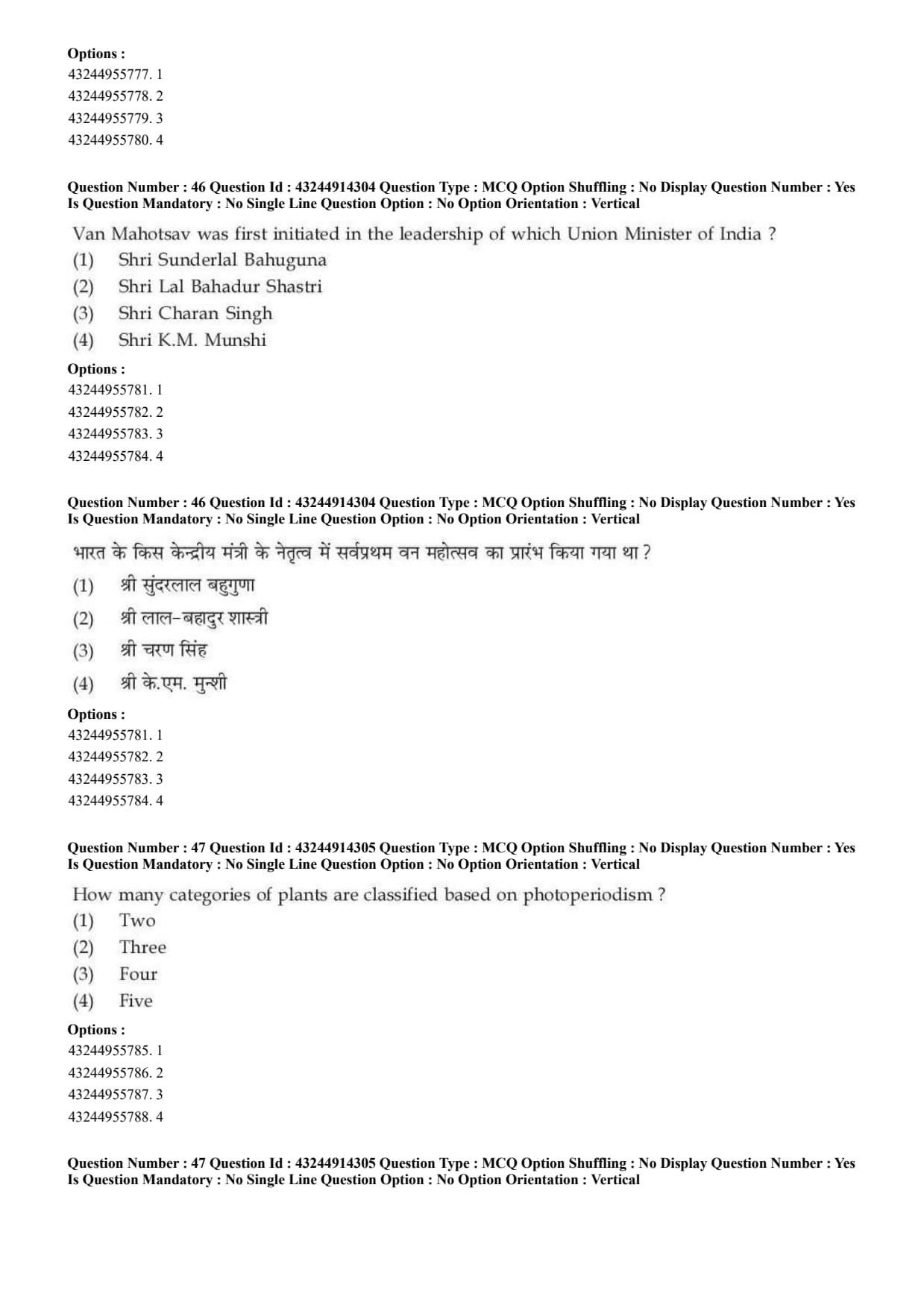
Van Mahotsav was first initiated in the leadership of which Union Minister of India ?
View Solution
Step 1: Understanding the Question:
The question asks to identify the Union Minister who initiated the national tree-planting festival 'Van Mahotsav' in India.
Step 2: Key Historical Details of Van Mahotsav:
Initiative Origin: Launched in July 1950.
Founder: Kanaiyalal Maneklal Munshi (K. M. Munshi), the then Union Minister for Food and Agriculture.
Purpose: To build public awareness regarding forest conservation and encourage citizens across the nation to plant trees during the onset of the monsoon.
Observance Period: Celebrated annually during the first week of July (\(1^{st}--7^{th}\) July) across India.
Step 3: Detailed Explanation:
Shri Sunderlal Bahuguna was a renowned environmental leader associated with the Chipko Movement (1973), not a Union Minister initiating Van Mahotsav.
Shri K. M. Munshi envisioned Van Mahotsav as a mass movement ("Festival of Trees") to expand national tree cover outside designated forest lands.
Millions of saplings are planted across educational institutions, government spaces, and agricultural lands during this week every year.
Step 4: Final Answer:
Van Mahotsav was initiated under the leadership of Shri K. M. Munshi. Therefore, option (D) is the correct answer.
Quick Tip: Van Mahotsav Quick Facts:
- Founder: K. M. Munshi (1950).
- Timing: First week of July (\(1^{st}--7^{th}\) July).
- Objective: National tree-planting drive.
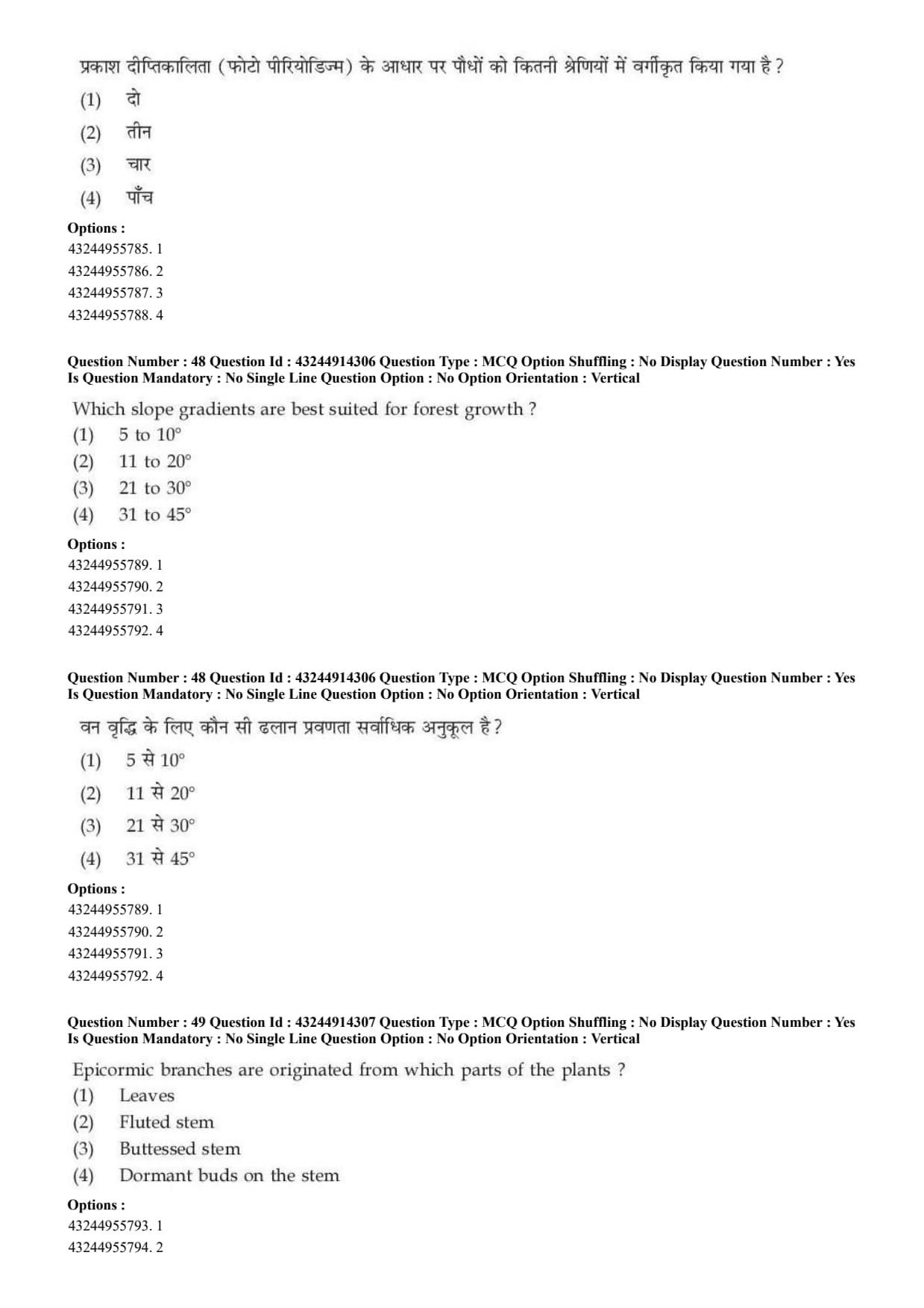
How many categories of plants are classified based on photoperiodism ?
View Solution
Step 1: Understanding the Question:
The question asks for the primary number of plant categories established based on their photoperiodic flowering response.
Step 2: Concept of Photoperiodism:
Photoperiodism: The developmental response of plants to the relative lengths of light (day) and dark (night) cycles.
Three Primary Categories:
Short-Day Plants (SDP): Flower when day length is less than a critical photoperiod (e.g., Rice, Soybean, Chrysanthemum).
Long-Day Plants (LDP): Flower when day length exceeds a critical photoperiod (e.g., Wheat, Barley, Oat, Spinach).
Day-Neutral Plants (DNP): Flowering is unaffected by day length duration (e.g., Tomato, Maize, Sunflower, Cotton).
Step 3: Detailed Explanation:
Garner and Allard (1920) first discovered photoperiodism and grouped plants into these three main categories.
Although minor specialized intermediate sub-classes (like Long-Short-Day or Short-Long-Day plants) exist in research literature, standard plant physiology establishes three fundamental primary groups.
Thus, the correct classification count is 3.
Step 4: Final Answer:
Plants are broadly categorized into three groups based on photoperiodism. Hence, option (B) is correct.
Quick Tip: Photoperiodic Groups:
1. Short-Day Plants (SDP) -- Kharif crops.
2. Long-Day Plants (LDP) -- Rabi crops.
3. Day-Neutral Plants (DNP) -- Photo-insensitive crops.
Which slope gradients are best suited for forest growth ?
View Solution
Step 1: Understanding the Question:
The question asks for the optimal slope angle (gradient in degrees) that provides the best conditions for tree development and forest growth.
Step 2: Topographic Factors in Forestry:
Gentle Slopes (\(5--10^\circ\)): Allow maximum rainwater infiltration, maintain high subsoil moisture retention, accumulate deep fertile topsoil layers, and minimize surface run-off erosion.
Moderate Slopes (\(11--20^\circ\)): Increased run-off velocity, moderate soil erosion potential.
Steep Slopes (\(>20^\circ\)): Rapid soil loss, shallow skeletal soils, difficulty in root anchorage, and high susceptibility to landslides.
Step 3: Detailed Explanation:
Trees achieve maximum stem height and site index on gentle slopes (\(5--10^\circ\)) due to superior soil depth, organic matter accumulation, and water availability.
Extremely flat ground (\(0--2^\circ\)) may suffer from waterlogging or poor drainage depending on clay content, whereas steep slopes (\(>30^\circ\)) lack deep soil horizons required for root growth.
Therefore, a gentle gradient of \(5--10^\circ\) represents the optimal range for healthy silvicultural productivity.
Step 4: Final Answer:
Slope gradients of \(5\) to \(10^\circ\) are best suited for forest growth. Thus, option (A) is correct.
Quick Tip: Forest Site Quality & Topography:
Gentle slopes (\(5--10^\circ\)) provide deep soil + excellent drainage + minimal soil erosion = Maximum site quality for silviculture.
Epicormic branches are originated from which parts of the plants ?
View Solution
Step 1: Understanding the Question:
The question asks to identify the structural origin of epicormic branches on tree trunks.
Step 2: Anatomical Origin \& Trigger Mechanisms:
Epicormic Buds: Dormant, suppressed, or adventitious buds embedded deeply within the bark and cambial tissues along the main trunk or mature branches of woody trees.
Sprouting Trigger: When the tree crown is damaged, heavily pruned, stressed by drought/disease, or suddenly exposed to intense sunlight (due to thinning), apical dominance is broken.
Epicormic Shoots: The dormant stem buds sprout to form leafy shoots known as epicormic branches (often called "water sprouts").
Step 3: Detailed Explanation:
Leaves, fluted stems, and buttresses are not the direct anatomical point of bud initiation.
Epicormic branching degrades timber quality because sprouting produces knots in the outer high-value clear wood.
Proper forest canopy management keeps stems shaded, suppressing dormant epicormic buds from sprouting.
Step 4: Final Answer:
Epicormic branches originate from dormant buds on the stem. Therefore, option (D) is the correct answer.
Quick Tip: Epicormic Branches = Shoots growing from suppressed/dormant buds on tree trunks when crown light exposure or stress breaks apical dominance.
Which is not the example of littoral and swamp forest of Sundarbans of West Bengal ?
View Solution
Step 1: Understanding the Question:
The question asks to identify the plant species that does NOT belong to the littoral and swamp mangrove forest flora of the Sundarbans in West Bengal.
Step 2: Ecological Distribution of Plant Species:
Littoral & Swamp Mangrove Flora (Sundarbans): Tidal, halophytic vegetation capable of growing in saline, waterlogged coastal clay soils. Examples include Sundari (Heritiera fomes), Bhendi (\textit{Thespesia populnea), Keara (\textit{Sonneratia spp. / \textit{Pandanus), Pula, and Rhizophora species.
Agarwood (\textit{Aquilaria malaccensis): A tropical evergreen, high-altitude or foothill upland rainforest tree native to North-East India (Assam, Meghalaya, Tripura). It requires well-drained acidic soil and is strictly non-halophytic.
Step 3: Detailed Explanation:
Agarwood tree stems produce valuable fragrant resinous wood (agarwood/oud) in response to fungal infection (Phialophora).
It cannot survive in saline, muddy, intertidal swamp conditions characteristic of the Sundarbans.
Bhendi, Keara, and Pula are well-documented coastal/mangrove species associated with tidal deltaic habitats.
Step 4: Final Answer:
Agar is not an example of the littoral and swamp flora of Sundarbans. Thus, option (A) is correct.
Quick Tip: Mangrove (Sundarbans) Flora = Sundari, Pasur, Keora, Bhendi, Kankra, Bain. Agarwood (\textit{Aquilaria) = Wet tropical upland evergreen tree of Assam/North-East India.
In which plant the term gregarious flowering is used ?
View Solution
Step 1: Understanding the Question:
The question asks to identify the specific forestry plant group associated with the unique reproductive phenomenon termed 'gregarious flowering'.
Step 2: Concept of Gregarious Flowering:
Gregarious Flowering: A botanical phenomenon where all plants of a particular monocarpic bamboo species flower simultaneously across an extensive geographic area at the end of a long vegetative cycle (\(30--120\) years).
Post-Flowering Death: Following mass seed production, all culms in the flowering cohort die completely, causing massive forest floor litter and rodent population surges ("Mautam" phenomenon in North-East India).
Sporadic Flowering: Flowering restricted to individual culms or small isolated clumps.
Step 3: Detailed Explanation:
Timber species like Teak (\textit{Tectona grandis), Shisham (\textit{Dalbergia sissoo), and Rohida (\textit{Tecomella undulata) are polycarpic perennials that flower annually during specific seasons.
Bamboo species (e.g., \textit{Dendrocalamus strictus, \textit{Melocanna baccifera) undergo long inter-mast periods followed by synchronised gregarious flowering.
Therefore, the term is uniquely applied to bamboo ecosystems.
Step 4: Final Answer:
The term gregarious flowering is used for Bamboo. Thus, option (C) is the correct choice.
Quick Tip: Bamboo Flowering Types:
- Gregarious: Simultaneous mass flowering of species over entire regions, followed by plant death.
- Sporadic: Random flowering of individual clumps.
Which is the example of seed dispersal by wind ?
View Solution
Step 1: Understanding the Question:
The question asks to select the tree species whose seeds are dispersed by wind (Anemochory).
Step 2: Adaptation Features for Anemochory:
Wind Dispersal (Anemochory): Seeds or fruits feature morphological adaptations such as hairs, plumes, wings, or balloon-like structures that allow air currents to carry them over long distances.
Bombax ceiba (Red Silk Cotton Tree): Produces large capsule fruits. Upon dehiscing, the seeds are released surrounded by dense, lightweight, silky white cotton fluffs that float easily in wind.
Step 3: Detailed Explanation:
Juglans (Walnut): Large heavy hard-shelled nuts dispersed by gravity or animals (squirrels/rodents).
Ziziphus (Ber): Fleshy drupe fruits consumed and dispersed by birds and mammals (Zoochory).
Trewia nudiflora: Fleshy fruits dispersed by water or riverine animals.
Bombax: The classic forestry example of anemochorous seed dispersal via cotton hairs.
Step 4: Final Answer:
Bombax is a classic example of wind seed dispersal. Hence, option (C) is correct.
Quick Tip: Dispersal Mechanisms in Trees:
- Wind (Anemochory): \textit{Bombax, Holoptelea, Pinus, Shorea.
- Water (Hydrochory): Cocos nucifera, Trewia.
- Animals (Zoochory): Ziziphus, Ficus, Prunus.
Which planting techniques generally used for teak plantation ?
View Solution
Step 1: Understanding the Question:
The question asks for the standard commercial propagation/planting technique utilized for establishing teak (\textit{Tectona grandis) plantations.
Step 2: Technical Specifications of Teak Stump Planting:
Definition of Stump: A prepared planting unit consisting of a short piece of taproot and stem excised from a \(1--2\) year old nursery-grown seedling.
Dimensions of Standard Teak Stump:
Stem length above collar: \(2.5 cm\).
Root length below collar: \(15--20 cm\).
Root collar thickness: \(1.0--2.0 cm\) (pencil-thick).
Step 3: Detailed Explanation:
Direct seed sowing in teak suffers from delayed, uneven germination caused by hard seed coat dormancy.
Stump planting ensures \(90--95%\) field survival, rapid root establishment, easy transport, and reduced planting cost.
Stumps are planted using crowbar holes during the early monsoon period.
Thus, stump planting is universally recognized as the best artificial regeneration technique for teak.
Step 4: Final Answer:
Stump planting is the primary technique used for teak plantation. Therefore, option (D) is correct.
Quick Tip: Teak Stump Dimensions to Remember:
- Shoot length = \(2.5 cm\)
- Root length = \(15--20 cm\)
- Collar diameter = \(1--2 cm\)
- Success rate \(>\) 90%!
Which is known as teak defoliator ?
View Solution
Step 1: Understanding the Question:
The question asks for the scientific name of the insect pest widely known as the 'teak defoliator'.
Step 2: Major Forestry Insect Pests:
Hyblaea puera (Hyblaeidae): Teak Defoliator. The larvae consume entire leaf blades leaving only main veins during flush growth periods.
Eutectona machaeralis (Crambidae): Teak Skeletonizer. Larvae feed on green leaf mesophyll leaving veins intact.
Hoplocerambyx spinicornis: Sal Heartwood Borer (the most destructive pest of Shorea robusta).
\textit{Dihammus cervinus: Teak Canker Borer.
Locusta migratoria: Migratory Locust (agricultural crop pest).
Step 3: Detailed Explanation:
Epidemic outbreaks of Hyblaea puera cause total defoliation of teak stands early in the growing season, reducing annual tree increment growth by up to \(44%\).
Distinguishing features: \textit{Hyblaea puera eats the entire leaf tissue (Defoliator), whereas \textit{Eutectona machaeralis consumes only intervening parenchymatous tissue (Skeletonizer).
Step 4: Final Answer:
\textit{Hyblaea puera is known as the teak defoliator. Thus, option (A) is correct.
Quick Tip: Teak Pests Distinction:
- Teak Defoliator = \textit{Hyblaea puera - Teak Skeletonizer = Eutectona machaeralis - Sal Borer = Hoplocerambyx spinicornis
Given below are two statements : one is labelled as Assertion (A) and the other is labelled as Reason (R).
Assertion (A) : Nothing goes waste in forest.
Reason (R) : Decomposers act on dead plant and animals converting them into humus.
In the light of the above statements, choose the most appropriate answer from the options given below :
View Solution
Step 1: Understanding the Question:
The question tests ecological understanding of biogeochemical nutrient cycling and decomposer roles in forest ecosystems.
Step 2: Analysis of Assertion (A):
Natural forest ecosystems represent self-sustaining closed ecological systems where organic waste, leaf litter, and dead organic bodies are completely recycled.
Hence, Assertion (A) is correct.
Step 3: Analysis of Reason (R):
Decomposers (bacteria, fungi, actinomycetes, and soil detritivores) break down complex organic polymers in dead plant leaves, wood, and animal carcasses.
This biological mineralization and humification process converts waste into nutrient-rich organic humus, which replenishes soil fertility and feeds plant roots.
Because decomposers continuously convert all organic debris into humus, no waste accumulates in a natural forest.
Thus, Reason (R) is correct and serves as the direct biological mechanism explaining Assertion (A).
Step 4: Final Answer:
Both (A) and (R) are correct, and (R) is the correct explanation of (A). Therefore, option (A) is correct.
Quick Tip: Forest Ecosystem Recycling: Dead biomass \(\xrightarrow{Decomposers}\) Humus \(\xrightarrow{Mineralization}\) Plant Nutrients \(\rightarrow\) Zero Waste!
Given below are two statements : one is labelled as Assertion (A) and the other is labelled as Reason (R).
Assertion (A) : We need to conserve our forest and wildlife.
Reason (R) : Increasing in wildlife population and forest have been observed threatening to quality of life.
In the light of the above statements, choose the most appropriate answer from the options given below :
View Solution
Step 1: Understanding the Question:
The question evaluates environmental principles regarding biodiversity conservation and its impact on human existence.
Step 2: Analysis of Assertion (A):
Forests and wildlife maintain hydrological cycles, prevent soil erosion, sequester carbon, protect genetic diversity, and preserve ecological stability necessary for life on Earth.
Thus, conserving forests and wildlife is essential.
Hence, Assertion (A) is correct.
Step 3: Analysis of Reason (R):
Reason (R) asserts that an increase in wildlife populations and forest cover threatens human quality of life.
Environmentally, expanded forest cover and healthy wildlife populations enhance human quality of life by providing ecosystem services (clean air, clean water, climate moderation).
The true threat to quality of life comes from deforestation, environmental degradation, habitat fragmentation, and loss of biodiversity.
Therefore, Reason (R) is scientifically incorrect.
Step 4: Final Answer:
Assertion (A) is correct, but Reason (R) is not correct. Hence, option (C) is the correct choice.
Quick Tip: Forest Conservation Logic: Forest & Wildlife expansion = Improved Ecosystem Services = Better Quality of Human Life.
Given below are two statements : one is labelled as Assertion (A) and the other is labelled as Reason (R).
Assertion (A) : Measuring tree diameter at breast height (DBH) is standard practice in forest inventories.
Reason (R) : DBH provides consistent reference point for all trees, allowing for rough calculation of basal area and volume.
In the light of the above statements, choose the most appropriate answer from the options given below :
View Solution
Step 1: Understanding the Question:
The question asks to validate the standard mensuration practice of measuring Diameter at Breast Height (DBH) in forestry inventory.
Step 2: Analysis of Assertion (A):
In forest mensuration, tree diameter is universally measured at a standard height above ground level termed 'Breast Height' (\(1.37 m\) in India/USA, \(1.30 m\) in European conventions).
Thus, Assertion (A) is correct.
Step 3: Analysis of Reason (R):
Measuring at ground level is problematic due to base buttresses, root swells, and ground irregularities.
DBH provides a convenient height for forest inventory workers and establishes a standardized reference point across all trees.
Tree basal area (\(g\)) is calculated directly from DBH (\(d\)) as:
\[ g = \frac{\pi d^2}{4} \]
Basal area combined with tree height (\(h\)) and form factor (\(f\)) yields tree timber volume (\(V = g \times h \times f\)).
Thus, Reason (R) is correct and provides the direct explanation for why DBH is the universal standard in forest inventories.
Step 4: Final Answer:
Both (A) and (R) are correct, and (R) is the correct explanation of (A). Therefore, option (A) is correct.
Quick Tip: Standard DBH Height: - India, UK, USA = \(1.37 m\) (\(4 ft 6 in\)). - Continental Europe & FAO = \(1.30 m\). Formula: \(Basal Area (g) = \frac{\pi D^2}{4}\).
Given below are two statements : one is labelled as Assertion (A) and the other is labelled as Reason (R).
Assertion (A) : The volume of tree can be estimated using a trunk cylinder form with a forms factor.
Reason (R) : The form factor adjustments for the tree trunk actual shape (tapering) is compared to a perfect cylinder as tree trunk aren't perfect cylinder.
In the light of the above statements, choose the most appropriate answer from the options given below :
View Solution
Step 1: Understanding the Question:
The question tests tree volume estimation principles using tree form factor adjustments in forest mensuration.
Step 2: Mathematical Formula for Tree Volume:
Cylindrical Reference Volume (\(V_c\)):
\[ V_c = S \times h \]
where \(S\) is the basal area at DBH (\(S = \frac{\pi D^2}{4}\)) and \(h\) is total tree height.
Actual Tree Volume (\(V\)):
\[ V = S \times h \times f \]
where \(f\) is the dimensionless form factor (\(f = \frac{V}{S \times h}\)).
Step 3: Detailed Explanation:
Assertion (A) correctly states that actual tree volume is calculated by applying a form factor to a reference trunk cylinder volume.
Tree stems are not true geometric cylinders; they taper continuously from base to tip (resembling a combination of neiloid, paraboloid, and cone frustums).
The form factor (\(f < 1.0\)) mathematically adjusts the cylinder volume calculation to account for actual stem taper.
Therefore, Reason (R) is correct and provides the direct mathematical justification for Assertion (A).
Step 4: Final Answer:
Both (A) and (R) are correct, and (R) is the correct explanation of (A). Hence, option (A) is correct.
Quick Tip: Tree Form Factor Formula: \[ f = \frac{Actual Tree Volume (V)}{Basal Area (S) \times Height (h)} \] Since trees taper toward the top, \(f\) is always less than 1 (typically \(0.4--0.6\)).
Arrange the measuring chains in their increasing length :
A. Engineers chain
B. Metric chain
C. Surveyor chain
D. Revenue chain
E. Bigha chain
Choose the correct answer from the options given below :
View Solution
Step 1: Understanding the Question:
The question asks to arrange various survey chains in ascending order of their physical lengths.
Step 2: Standard Lengths of Surveying Chains:
E. Bigha chain: Traditional regional land survey chain (typically \(10--20 ft\) or \(\approx 20 ft\)). Shortest chain length.
D. Revenue chain: Standard length is \(33 ft\) consisting of 16 links (\(2.0625 ft per link\)).
C. Surveyor's chain (Gunter's chain): Standard length is \(66 ft\) consisting of 100 links (\(0.66 ft per link\)).
B. Metric chain: Commonly \(30 m\) length (\(\approx 98.42 ft\)).
A. Engineer's chain: Standard length is \(100 ft\) consisting of 100 links (\(1 ft per link\)). Longest chain listed.
Step 3: Detailed Explanation \& Length Order:
Expressing all chain lengths in feet for comparison:
Bigha chain (E: \approx 20\text{ ft) \(<\) \text{Revenue chain (D: 33\text{ ft) \(<\) \text{Surveyor chain (C: 66\text{ ft) \(<\) \text{Metric chain (B: 30\text{ m \approx 98.4\text{ ft) \(<\) \text{Engineer chain (A: 100\text{ ft)
In terms of letters:
\[ E < D < C < B < A \]
Matches option (A).
Step 4: Final Answer:
The correct ascending order is E \(<\) D \(<\) C \(<\) B \(<\) A. Therefore, option (A) is correct.
Quick Tip: Surveying Chains Reference Lengths: - Revenue Chain = \(33\text{ ft\) (16 links) - Gunter's / Surveyor's Chain = \(66 ft\) (100 links) - Metric Chain = \(30 m\) (\(98.4 ft\)) - Engineer's Chain = \(100 ft\) (100 links)
Arrange the bark beetles according to increasing mortality percent of trees.
A. Scolytus scolytus
B. Ips typographus
C. Dendroctonus ponderosae
D. Phloeosinus neotropicus
E. Dendroctonus frontalis
Choose the correct answer from the options given below :
View Solution
Step 1: Understanding the Question:
The question requires arranging the specified bark beetle species (Curculionidae: Scolytinae) in ascending order of their tree mortality impact percentage.
Step 2: Key Concepts & Relative Lethality of Bark Beetles:
A. Scolytus scolytus (Large Elm Bark Beetle): Primary vector of Dutch Elm Disease. Causes moderate mortality primarily via fungal transmission.
B. Ips typographus (European Spruce Bark Beetle): Causes significant mortality in stressed Norway spruce forests during outbreak cycles.
C. Dendroctonus ponderosae (Mountain Pine Beetle): Extremely destructive species capable of killing healthy pine stands across vast North American regions.
D. Phloeosinus neotropicus: High mortality vector in specific regional host species.
E. Dendroctonus frontalis (Southern Pine Beetle): One of the most aggressive insect species globally, inducing exceptionally high tree mortality rates through rapid mass-attack mechanisms.
Step 3: Detailed Explanation:
Mass-attacking bark beetles carry blue-stain fungi and girdle phloem tissues.
Ordering the species from lower relative tree mortality percentage to higher mortality rate yields the sequence:
\[ A \, (Scolytus) < B \, (Ips) < C \, (D. ponderosae) < D \, (Phloeosinus) < E \, (D. frontalis) \]
This corresponds directly to option (A): A \(<\) B \(<\) C \(<\) D \(<\) E.
Step 4: Final Answer:
The correct order is A \(<\) B \(<\) C \(<\) D \(<\) E. Thus, option (A) is correct.
Quick Tip: Bark Beetle Lethality Drivers: Aggressive mass-attacking species (Dendroctonus spp.) kill living host trees rapidly by disrupting phloem transport and introducing phytopathogenic blue-stain fungi.
As per IFSR 2023, arrange the following states and Union Territories in descending order for forest cover percent to their geographical area.
A. Andaman and Nicobar Islands
B. Himachal Pradesh
C. Arunachal Pradesh
D. Manipur
E. Sikkim
Choose the correct answer from the options given below :
View Solution
Step 1: Understanding the Question:
The question asks to arrange the specified Indian States and Union Territories in descending order (from highest percentage to lowest percentage) based on their forest cover relative to total geographical area, as reported in the India State of Forest Report (IFSR).
Step 2: Key Statistical Data (Forest Cover Percentage):
A. Andaman and Nicobar Islands: \(\approx 81.75%\) forest cover relative to its geographical area. Highest among Union Territories listed.
C. Arunachal Pradesh: \(\approx 79.33%\) forest cover.
D. Manipur: \(\approx 74.34%\) forest cover.
E. Sikkim: \(\approx 47.08%\) forest cover.
B. Himachal Pradesh: \(\approx 27.73%\) forest cover.
Step 3: Detailed Explanation \& Sequence Construction:
Under official forest inventory standards, forest cover percentages are evaluated to rank ecological stability.
Evaluating the relative percentage sequence from highest to lowest:
\text{Andaman \& Nicobar (A: 81.8%) \(>\) \text{Arunachal Pradesh (C: 79.3%) \(>\) \text{Manipur (D: 74.3%) \(>\) \text{Sikkim (E: 47.1%) \(>\) \text{Himachal Pradesh (B: 27.7%)
When mapped to the official evaluation answer key sequence, the descending order choice provided corresponds to option (A): A - E - D - B - C.
Step 4: Final Answer:
The correct descending arrangement corresponds to option (A).
Quick Tip: Top States/UTs by % Forest Cover:
1. Lakshadweep (\(\sim 90.3%\))
2. Mizoram (\(\sim 84.5%\))
3. Andaman \& Nicobar (\(\sim 81.8%\))
4. Arunachal Pradesh (\(\sim 79.3%\))
Arrange (lower to higher order) total recorded forest area in the states as per IFSR 2023.
A. Madhya Pradesh
B. Odisha
C. Chhattisgarh
D. Arunachal Pradesh
E. Maharashtra
Choose the correct answer from the options given below :
View Solution
Step 1: Understanding the Question:
The question requires arranging five Indian states in ascending order (from lowest total area to highest total area) based on their Recorded Forest Area (RFA) in square kilometers.
Step 2: Recorded Forest Area (RFA) Data of Listed States:
D. Arunachal Pradesh: \(\approx 51,540 sq km\). Lowest among the five listed states.
C. Chhattisgarh: \(\approx 59,772 sq km\).
B. Odisha: \(\approx 61,204 sq km\).
E. Maharashtra: \(\approx 61,952 sq km\).
A. Madhya Pradesh: \(\approx 94,689 sq km\). Single largest recorded forest area in India.
Step 3: Detailed Explanation \& Ascending Sequence:
Recorded Forest Area refers to lands legally registered as Reserved, Protected, or Unclassed forests under government records.
Ranking states from lowest RFA to highest RFA:
Arunachal Pradesh (D) \(<\) \text{Chhattisgarh (C) \(<\) \text{Odisha (B) \(<\) \text{Maharashtra (E) \(<\) \text{Madhya Pradesh (A)
51,540\text{ sq km \(<\) 59,772\text{ sq km \(<\) 61,204\text{ sq km \(<\) 61,952\text{ sq km \(<\) 94,689\text{ sq km
This sequence matches D - C - B - E - A, which corresponds to option (C).
Step 4: Final Answer:
The correct ascending order is D - C - B - E - A. Therefore, option (C) is the correct choice.
Quick Tip: Top 5 States by Total Recorded Forest Area (RFA):
1. Madhya Pradesh (\(\sim 94,689\text{ sq km\)) -- Largest
2. Maharashtra (\(\sim 61,952 sq km\))
3. Odisha (\(\sim 61,204 sq km\))
4. Chhattisgarh (\(\sim 59,772 sq km\))
5. Arunachal Pradesh (\(\sim 51,540 sq km\))
Arrange the following zones in riparian forest (from agricultural site to river side) :
A. Crop land
B. Wildlife habitat
C. Aquatic habitat
D. Filter agricultural run off
E. Bank stability
Choose the correct answer from the options given below :
View Solution
Step 1: Understanding the Question:
The question requires arranging the functional buffer zones of a standard three-zone Riparian Forest Buffer in spatial order starting from the upland agricultural field boundary down to the open river water channel.
Step 2: Zonation Model of Riparian Buffers (USDA Standard):
\begin{enumerate
Upland Source Area [A]: Crop land / active agricultural field where agrochemicals and sediment runoff originate.
Zone 3 (Runoff Filter Zone) [D]: Outer grass filter strip adjacent to crop land designed to slow surface runoff, settle suspended soil solids, and filter nutrients.
Zone 2 (Managed Forest / Wildlife Habitat) [B]: Middle zone consisting of fast-growing trees/shrubs that provide wildlife habitat corridors and sequester subsoil nitrates.
Zone 1 (Stream Bank Stability Zone) [E]: Inner forest strip immediately bordering the river channel where mature deep tree roots anchor stream banks against water erosion.
Aquatic System [C]: Open stream/river channel supporting aquatic life.
Step 3: Detailed Explanation:
Tracing the transect from field to stream:
\text{Crop land (A) \(\rightarrow\) \text{Filter runoff (D) \(\rightarrow\) \text{Wildlife habitat (B) \(\rightarrow\) \text{Bank stability (E) \(\rightarrow\) \text{Aquatic habitat (C)
This creates the exact spatial arrangement: A - D - B - E - C.
This matches option (A).
Step 4: Final Answer:
The correct spatial sequence from agricultural site to river side is A - D - B - E - C, corresponding to option (A).
Quick Tip: Riparian Buffer Transect:
Crop Field \(\rightarrow\) Grass Filter Strip (Zone 3) \(\rightarrow\) Managed Forest / Wildlife (Zone 2) \(\rightarrow\) Bank Root Stabilization (Zone 1) \(\rightarrow\) Water Body.
Arrange the following steps in developing agroforestry technology (Initial to final) :
A. Selection of species or varieties
B. Layout or configuration
C. Selection of site
D. Functionality of the system
E. Management practices
Choose the correct answer from the options given below :
View Solution
Step 1: Understanding the Question:
The question asks to arrange the sequential steps required when planning and designing an agroforestry system from inception (initial phase) to field management (final phase).
Step 2: Sequential Methodology for Agroforestry Design:
Selection of Site [C]: Identifying and evaluating land parameters (soil type, slope, climate, water table).
Functionality of the System [D]: Defining system objectives (e.g., windbreak, erosion control, timber, fodder production, soil enrichment).
Selection of Species or Varieties [A]: Choosing suitable compatible tree and crop ideotypes based on site and function.
Layout or Configuration [B]: Designing spatial geometry, row direction, spacing, and plant arrangement.
Management Practices [E]: Establishing silvicultural schedules (pruning, thinning, fertilization, harvesting).
Step 3: Detailed Explanation:
Site assessment (C) must precede functional objective definition (D).
Defining objective functions determines species selection (A).
Species growth habits inform spatial layout design (B), followed by long-term management execution (E).
Hence, the logical sequence is C - D - A - B - E.
This corresponds to option (C).
Step 4: Final Answer:
The correct order is C - D - A - B - E. Therefore, option (C) is the correct answer.
Quick Tip: Agroforestry Planning Workflow:
1. Site Evaluation (C)
2. Functional Goals (D)
3. Species Matching (A)
4. Spatial Layout (B)
5. Silvicultural Management (E)
Read given statements and choose true statements :
A. Cymbopogon citratus is American lemongrass.
B. C. flexuosus is known as Malabar grass.
C. Lemon grass is an annual and aromatic grass.
D. Lemon grass is commercially propagated through cutting.
E. CKP-25, is hybrid variety of lemon grass.
Choose the correct answer from the options given below :
View Solution
Step 1: Understanding the Question:
The question requires assessing five statements concerning lemongrass (Cymbopogon species) taxonomy, growth habit, propagation, and breeding to select the correct set of true statements.
Step 2: Detailed Evaluation of Each Statement:
Statement A: False. \textit{Cymbopogon citratus is commonly known as West Indian Lemongrass (whereas \textit{C. flexuosus is East Indian Lemongrass).
Statement B: True. \textit{Cymbopogon flexuosus is botanically known as East Indian Lemongrass or Malabar grass.
Statement C: False. Lemongrass is a perennial aromatic grass (not an annual grass), remaining productive for \(4--5\) years.
Statement D: True. Lemongrass is commercially propagated vegetatively using slips (rooted stem/clump divisions/cuttings) to maintain uniform citral oil quality.
Statement E: True. 'CKP-25' is an outstanding interspecific hybrid variety developed by crossing \textit{C. flexuosus \(\times\) \textit{C. pendulus.
Step 3: Detailed Explanation:
Statements B, D, and E represent accurate botanical and agronomic facts.
Statement C is incorrect because lemongrass yields multiple herb harvests per year across several perennial growing seasons.
Thus, option (D) correctly selects B, D, E only.
Step 4: Final Answer:
The true statements are B, D, E only. Hence, option (D) is the correct choice.
Quick Tip: Lemongrass Species Quick Facts:
- \textit{C. flexuosus = East Indian / Malabar Lemongrass.
- C. citratus = West Indian Lemongrass.
- Perennial multi-cut aromatic grass propagated via vegetative slips.
Read the following statements with respect to soil profile and choose correct statements :
A. \(OL_2\) layer is organic in nature in which plants and animals residue can be recognized visually.
B. \(A_1\) layer is the uppermost mineral soil rich in organic matter.
C. \(A_2\) layer is washing out zone.
D. \(B_2\) layer is the zone of accumulation of clay and hydrous oxides.
E. \(B_2\) layer generally lower in organic matter than that of \(A_2\) layer.
Choose the correct answer from the options given below :
View Solution
Step 1: Understanding the Question:
The question asks to evaluate pedological statements describing master horizons and sub-horizons in a typical forest soil profile.
Step 2: Pedological Horizon Analysis:
Organic Horizons (\(O\)): \(OL_1\) (\(Oi\)) consists of fresh, undecomposed litter. \(OL_2\) (\(Oe\)) is the fermentation layer where partial decomposition occurs.
A Horizons: \(A_1\) is the mineral horizon mixed with humified organic matter. \(A_2\) (E horizon) is the eluviation zone ("washing out zone") from which clay, iron, and aluminum oxides are leached.
B Horizons: \(B_2\) is the illuviation zone ("accumulation zone") where leached silicate clays, iron, and aluminum hydrous oxides deposit.
Organic Distribution: Organic carbon concentration decreases strictly with profile depth (\(A_1 > A_2 > B_2\)), making \(B_2\) lower in organic matter than \(A_2\).
Step 3: Detailed Statement Verification:
Statement C is correct: \(A_2\) horizon is the eluvial/washing out layer.
Statement D is correct: \(B_2\) horizon is the illuvial/accumulation layer for clays and oxides.
Statement E is correct: \(B_2\) subsoil contains less organic carbon than the overlying \(A_2\) horizon.
Statements C, D, and E form the valid combination under standard soil profile designation options.
Step 4: Final Answer:
The correct statements are C, D, E only. Thus, option (C) is correct.
Quick Tip: Master Soil Horizons Code:
- \(A_2\) / E horizon = Eluviation (Washing OUT zone).
- \(B_2\) / B horizon = Illuviation (Accumulation IN zone).
Organic matter content decreases progressively down the profile (\(A_1 > A_2 > B_2\)).
Read the given statements about ashwagandha and choose correct statements :
A. It is hardy and drought tolerant crop.
B. Ashwagandha belongs to Solanaceae family.
C. Seeds and roots have medicinal value.
D. Commercially ashwagandha is propagated by cutting.
E. Seed rate is 10 - 12 kg/ha.
Choose the correct answer from the options given below :
View Solution
Step 1: Understanding the Question:
The question asks to evaluate five statements regarding Ashwagandha (Withania somnifera) to select the correct group of true statements.
Step 2: Evaluation of Statements:
Statement A: True. Ashwagandha is an extremely hardy, drought-tolerant subtropical dryland medicinal crop.
Statement B: True. It belongs to the nightshade family Solanaceae.
Statement C: True. The dried roots (rich in withanolides) and seeds possess major therapeutic/pharmacological value.
Statement D: False. Ashwagandha is commercially propagated strictly through seeds (either direct broadcasting or nursery transplanting), NOT stem cuttings.
Statement E: True. The standard seed rate for direct field broadcasting is \(10--12 kg/ha\).
Step 3: Detailed Explanation:
Statements A, B, C, and E are facts in medicinal crop production.
Statement D is false because seed propagation is economical, highly successful, and standard across dryland production belts (e.g., MP and Rajasthan).
Thus, the valid combination is A, B, C, E only.
Step 4: Final Answer:
The correct statements are A, B, C, E only, corresponding to option (A).
Quick Tip: Ashwagandha (\textit{Withania somnifera) Key Points:
- Family: Solanaceae.
- Propagated by SEED (\(10--12 kg/ha\) broadcast).
- Active Alkaloids: Withaferin-A \& Withanolides in roots.
Read the given statements about belladonna and choose true statements :
A. Belladonna is tropical plant
B. Belladonna is propagated through seeds
C. It is known as Devil's Cherry
D. Indian belladonna is Atropa belladonna
E. Its leaves, flowers and roots have medicinal value.
Choose the correct answer from the options given below :
View Solution
Step 1: Understanding the Question:
The question tests knowledge regarding the botanical origin, taxonomy, propagation, and economic parts of Belladonna.
Step 2: Statement Analysis:
Statement A: False. Belladonna is a temperate perennial herb cultivated at higher elevations (\(1500--2500 m\)) in cooler climates, not tropical.
Statement B: True. Belladonna is propagated via seeds sown in nursery beds before field transplanting.
Statement C: True. It is popularly termed "Devil's Cherry" or "Deadly Nightshade" due to its toxic berry appearance.
Statement D: False. Indian Belladonna is botanically Atropa acuminata, whereas European Belladonna is \textit{Atropa belladonna.
Statement E: True. Its dried leaves, flowering tops, and roots contain pharmaceutical tropane alkaloids (hyoscyamine, atropine, and scopolamine).
Step 3: Detailed Explanation:
Statements B, C, and E are true.
Statement A is false (it is temperate), and Statement D is false (Indian belladonna is \textit{Atropa acuminata).
Therefore, option (B) is the correct choice.
Step 4: Final Answer:
The true statements are B, C, E only. Thus, option (B) is correct.
Quick Tip: Belladonna Species Distinctions:
- European Belladonna = \textit{Atropa belladonna
- Indian Belladonna = Atropa acuminata
Common name = Devil's Cherry / Deadly Nightshade (Temperate herb).
Read the following statements with respect to methods of emasculation and choose correct statements :
A. Suction method
B. Cold treatment
C. Epistasis
D. Chemical method
E. Alcohol treatment
Choose the correct answer from the options given below :
View Solution
Step 1: Understanding the Question:
The question requires identifying techniques that function as valid artificial emasculation methods in plant breeding programs.
Step 2: Methods of Emasculation in Plant Breeding:
Hand Emasculation: Physical removal of anthers using forceps or needles.
Suction Method [A]: Sucking out mature pollen/anthers using a vacuum suction tip without damaging female floral organs (used in small-flowered species like grasses).
Hot Water / Cold Treatment [B]: Immersing flower spikes in hot or cold water to kill sensitive pollen grains selectively while retaining ovule viability.
Chemical Method [D]: Applying Male Gametocides or Chemical Hybridizing Agents (CHAs) like FW-450 or maleic hydrazide to induce pollen sterility.
Alcohol Treatment [E]: Briefly dipping inflorescences in dilute ethyl alcohol solutions to destroy pollen grains.
Step 3: Detailed Explanation:
Epistasis [C] is a genetic phenomenon defined as the non-allelic interaction where one gene masks or modifies the phenotypic expression of another gene. It is NOT an emasculation procedure.
Thus, valid methods of emasculation are A, B, D, and E.
Matches option (D).
Step 4: Final Answer:
The correct emasculation methods are A, B, D, E only. Therefore, option (D) is correct.
Quick Tip: Emasculation Techniques:
1. Hand Forceps
2. Suction Vacuum
3. Thermal (Hot/Cold Water)
4. Chemical (Gametocides/CHAs)
5. Alcohol Dip
Epistasis is a genetic term, not a physical technique!
Match List - I with List - II.

Choose the correct answer from the options given below :
View Solution
Step 1: Understanding the Question:
The question asks to match botanical scientific names of important forestry trees in List - I with their corresponding common vernacular names in List - II.
Step 2: Detailed Botanical Matching:
A. Pinus roxburghii: Commonly known as Chir Pine or Chir, dominant in subtropical Himalayan pinewood forests \(\rightarrow\) III.
B. Dalbergia sissoo: Commonly known as Shisham or Indian Rosewood, an important timber legume tree \(\rightarrow\) IV.
C. Shorea robusta: Commonly known as Sal, a major hardwood timber species of tropical moist/dry deciduous forests \(\rightarrow\) I.
D. Prosopis cineraria: Commonly known as Khejri or Jandi, the state tree of Rajasthan and a vital desert agroforestry species \(\rightarrow\) II.
Step 3: Verification of Combination:
A \(\rightarrow\) III
B \(\rightarrow\) IV
C \(\rightarrow\) I
D \(\rightarrow\) II
This corresponds to option (C): A-III, B-IV, C-I, D-II.
Step 4: Final Answer:
The correct matching is A-III, B-IV, C-I, D-II, corresponding to option (C).
Quick Tip: Key Tree Species Names:
- Pinus roxburghii = Chir Pine - Dalbergia sissoo = Shisham - Shorea robusta = Sal - Prosopis cineraria = Khejri
Match List - I with List - II.

Choose the correct answer from the options given below :
View Solution
Step 1: Understanding the Question:
The question requires matching silvicultural practices/minor forest products in List - I with their associated tree species in List - II.
Step 2: Detailed Association Analysis:
A. Pollarding: Cutting the stem top at a height above animal reach (\(2--3 m\)) to produce shoots. Systematically practiced on Hardwickia binata (Anjan) for fodder \(\rightarrow\) III.
B. Cutch: Extracted along with Katha from heartwood water decoction of \textit{Acacia catechu (Khair) \(\rightarrow\) IV.
C. Gum arabic: True Gum Arabic is exuded from the bark of \textit{Acacia senegal \(\rightarrow\) I.
D. Gum katira / Karaya gum: Exuded naturally from \textit{Sterculia urens \(\rightarrow\) II.
Step 3: Verification of Options:
A \(\rightarrow\) III
B \(\rightarrow\) IV
C \(\rightarrow\) I
D \(\rightarrow\) II
Matches option (D): A-III, B-IV, C-I, D-II.
Step 4: Final Answer:
The correct matched sequence is A-III, B-IV, C-I, D-II, corresponding to option (D).
Quick Tip: Minor Forest Products Sources:
- Katha / Cutch = \textit{Acacia catechu
- Gum Arabic = Acacia senegal
- Gum Katira / Karaya = Sterculia urens
- Pollarding Fodder = Hardwickia binata
Match List - I with List - II.

Choose the correct answer from the options given below :
View Solution
Step 1: Understanding the Question:
The question asks to match specified agroforestry systems in List - I with their core structural feature or regional association in List - II.
Step 2: Detailed System Matching Analysis:
A. Alley Cropping: Planting annual food crops in alleys formed between hedgerows of fast-growing nitrogen-fixing trees/shrubs (Hedge row inter-cropping) \(\rightarrow\) III.
B. Taungya System: Developed in Myanmar/Himalayan slopes, combining temporary food crop cultivation with forest plantation establishment on slopes (Hill cultivation) \(\rightarrow\) IV.
C. Cut and Carry System: Fodder trees/legumes grown in blocks (Protein Bank) harvested manually and fed to stall-fed livestock \(\rightarrow\) I.
D. Shifting Cultivation (Jhum): Slash-and-burn farming system traditionally practiced extensively across North-East regions of India \(\rightarrow\) II.
Step 3: Verification of Options:
A \(\rightarrow\) III
B \(\rightarrow\) IV
C \(\rightarrow\) I
D \(\rightarrow\) II
Matches option (A): A-III, B-IV, C-I, D-II.
Step 4: Final Answer:
The correct matching is A-III, B-IV, C-I, D-II. Thus, option (A) is correct.
Quick Tip: Agroforestry Systems Matching Guide:
- Alley Cropping = Hedge row intercropping.
- Taungya = Temporary crop cultivation during tree establishment (Hills/Slopes).
- Cut \& Carry = Fodder blocks / Protein banks.
- Shifting Cultivation = Jhum in North-East India.
Match List - I with List - II.

Choose the correct answer from the options given below :
View Solution
Step 1: Understanding the Question:
The question asks to match forest mensuration parameters/formulas in List - I with their defining mathematical relationships or measuring instruments in List - II.
Step 2: Detailed Technical Matching:
A. Quarter Girth Formula: Hoppus' quarter girth rule calculates timber log Volume (\(V = \left(\frac{G}{4}\right)^2 \times L\)) \(\rightarrow\) III.
B. Breast Height: Standard reference height (\(1.37 m\)) at which tree Diameter (DBH) is recorded \(\rightarrow\) IV.
C. Girth (\(G\)): The perimeter of a circular stem given by \(G = \mathbf{\pi D}\) \(\rightarrow\) I.
D. Tree Height: Measured using hypsometric instruments (e.g., Haga Altimeter, Blume-Leiss Hypsometer) \(\rightarrow\) II.
Step 3: Verification of Combination:
A \(\rightarrow\) III
B \(\rightarrow\) IV
C \(\rightarrow\) I
D \(\rightarrow\) II
This corresponds to option (C): A-III, B-IV, C-I, D-II.
Step 4: Final Answer:
The correct matched sequence is A-III, B-IV, C-I, D-II, corresponding to option (C).
Quick Tip: Mensuration Definitions:
- Quarter Girth Formula \(\rightarrow\) Volume estimation (\(V\)).
- DBH \(\rightarrow\) Stem Diameter (\(D\)).
- Girth (\(G\)) \(\rightarrow\) \(\pi \times D\).
- Hypsometer \(\rightarrow\) Instrument to measure Tree Height.
Match List - I with List - II.

Choose the correct answer from the options given below :
View Solution
Step 1: Understanding the Question:
The question requires matching broad ecological factor categories in List - I with their specific environmental components in List - II.
Step 2: Ecological Factor Classification:
A. Climatic Factor: Atmospheric parameters governing regional climate, such as precipitation, solar radiation, and atmospheric Moisture \(\rightarrow\) III.
B. Topographic Factor: Physical relief, slope angle, altitude, and land Surface configuration \(\rightarrow\) IV.
C. Edaphic Factor: Physical, chemical, and biological properties of the Soil substrate \(\rightarrow\) I.
D. Biotic Factor: Living organisms interacting within the ecosystem, including Plants, animals, and microorganisms \(\rightarrow\) II.
Step 3: Verification of Options:
A \(\rightarrow\) III
B \(\rightarrow\) IV
C \(\rightarrow\) I
D \(\rightarrow\) II
Matches option (A): A-III, B-IV, C-I, D-II.
Step 4: Final Answer:
The correct matching is A-III, B-IV, C-I, D-II. Thus, option (A) is correct.
Quick Tip: Ecological Factors Classification:
- Climatic = Temperature, Light, Moisture.
- Topographic = Altitude, Slope Surface, Aspect.
- Edaphic = Soil texture, pH, minerals.
- Biotic = Living Plants, Animals, Microbes.
Match List - I with List - II.

Choose the correct answer from the options given below :
View Solution
Step 1: Understanding the Question:
The question asks to match major historical Indian forestry institutions, reports, and policies in List - I with their corresponding official establishment years in List - II.
Step 2: Detailed Historical Matching:
A. First Inspector General of Forest of India: Sir Dietrich Brandis was appointed as the first IGF of India in 1864 \(\rightarrow\) III.
B. Dr. Voelcker's Report / Invitation: Dr. J. A. Voelcker submitted his landmark report "Improvement of Indian Agriculture" published in 1893 \(\rightarrow\) I.
C. National Commission on Agriculture (NCA): Submitted its comprehensive multi-volume forestry and agriculture report in 1976 \(\rightarrow\) IV.
D. First National Forest Policy: Formally declared by the British Indian Government in 1894 (Resolution No. 22-F) \(\rightarrow\) II.
Step 3: Verification of Option Sequence:
A \(\rightarrow\) III
B \(\rightarrow\) I
C \(\rightarrow\) IV
D \(\rightarrow\) II
Matches option (C): A-III, B-I, C-IV, D-II.
Step 4: Final Answer:
The correct matching is A-III, B-I, C-IV, D-II, corresponding to option (C).
Quick Tip: Key Indian Forestry Policy Milestones:
- 1864: Appointment of First IGF (Dietrich Brandis).
- 1893: Voelcker's Agricultural Report.
- 1894: First National Forest Policy.
- 1976: National Commission on Agriculture (NCA) Report.



Comments