


CUET PG Textile Engineering Question Paper 2024 will be available here for download. NTA conducted CUET PG Textile Engineering paper 2024 on from March 20 in Shift 1. CUET PG Question Paper 2024 is based on objective-type questions (MCQs). According to latest exam pattern, candidates get 105 minutes to solve 75 MCQs in CUET PG 2024 Textile Engineering question paper.
CUET PG Textile Engineering Question Paper 2024 PDF Download
| CUET PG 2024 Textile Engineering Question Paper with Answer Key |  Download Download |
Check Solution |

CUET PG Textile Engineering 2024 Questions with Solutions
Question 1:
On a ring frame machine, the ratio of winding coils to binding coils is 10 : 19 = W. Find the value of W.
View Solution
Solution: The winding coils-to-binding coils ratio is given as 10 : 19. This ratio represents a proportionate relationship. To determine W, we solve using a simple calculation based on the given ratio. The result aligns with W = 3, confirming that 3 is the correct value. This ratio ensures optimal functionality and performance in the ring frame machine.
Quick Tip: For problems involving ratios, use proportional calculations to maintain accuracy.
Question 2:
Correct process sequence for production of combed yarn is:
View Solution
Solution: The correct process sequence ensures the removal of short fibers and enhances fiber alignment for combed yarn production. The Blow room removes large impurities, followed by Carding to individualize the fibers. The Draw frame reduces irregularities, Lap former prepares the lap, and the Comber eliminates short fibers for high-quality yarn. Speed frame adds twists, and the Ring frame completes the yarn production. This sequence optimizes both the quality and strength of the combed yarn.
Quick Tip: Understanding each step's purpose in the process flow is crucial for ensuring high-quality yarn output.
Question 3:
Blow room is fed with bales of 8% trash. While processing through the machines in Blow room machines, 9% trash is removed. If trash % in lap produced is 2%, calculate the trash % in the collected waste at Blow room.
View Solution
Solution: The initial trash percentage is 8%. After processing in the Blow room, the trash in the lap is reduced to 2%. Therefore, the total trash removed is 8% - 2% = 6%. The trash removal efficiency is calculated as:
Trash Efficiency = (Trash removed / Initial trash) × 100 = (6 / 8) × 100 = 68.66%.
Thus, 68.66% of the total trash is collected as waste in the Blow room, indicating efficient cleaning.
Quick Tip: For trash efficiency calculations, always compare the removed trash to the initial trash percentage.
Question 4:
Roller slip and drafting wave is responsible for unevenness of sliver at the draw frame. It is due to:
View Solution
Solution: Unevenness in sliver is often caused by mechanical issues in the drafting system. The second top roller at the first passage after carding is critical for drafting consistency. When this roller slips, it causes variations in fiber tension and alignment, leading to unevenness. Proper maintenance and alignment of rollers are essential to avoid such issues.
Quick Tip: Inspect and maintain the drafting rollers regularly to prevent sliver unevenness.
Question 5:
Shirley Analyzer test showed the following results: Trash in bale - 8%, Trash in lap - 2%, and Trash in sliver - 0.4%. The blow room cleaning efficiency, card cleaning efficiency, and combined cleaning efficiency are:
View Solution
Solution:
Blow room cleaning efficiency is calculated as:
Efficiency = (Trash removed / Initial trash) × 100 = ((8% - 2%) / 8%) × 100 = 75%.
Card cleaning efficiency:
((2% - 0.4%) / 2%) × 100 = 80%.
Combined cleaning efficiency:
((8% - 0.4%) / 8%) × 100 = 95%.
Hence, the efficiencies are 75%, 80%, and 95%, respectively.
Quick Tip: Cleaning efficiency calculations require careful tracking of trash percentages at each stage.
Question 6:
It is desired to make a 60 grains per yard sliver from 14 ounces per yard lap on a carding machine. While processing in the card, 3.5% of waste is removed. The machine draft on the machine is:
View Solution
Solution: The machine draft is calculated as:
Draft = (Input weight per unit length) / (Output weight per unit length)
Input weight is 14 ounces per yard. Output weight is adjusted for waste removal:
14 × (1 – 0.035) = 13.51 ounces per yard.
Convert grains to ounces (1 ounce = 437.5 grains):
60 grains = 60 / 437.5 ounces.
Draft: 13.51 / (60 / 437.5) ≈ 98.62.
Thus, the draft is 98.62.
Quick Tip: Ensure unit conversions are accurate while calculating draft in carding machines.
Question 7:
Coiler calendar roller of a carding machine revolves at 40 meters per minute surface speed. If the linear density of sliver is 4 kilotex (kg/km), the production of the card would be:
View Solution
Solution: Production is calculated as:
Production (kg/hour) = Surface speed (m/min) × Linear density (kg/km) × 60.
Substitute values:
40 m/min × 4 kg/km × 60 = 9.6 kg/hour.
Hence, the production of the card is 9.6 kg/hour.
Quick Tip: Use consistent units (m, km, kg) to avoid errors in production calculations.
Question 8:
Select the correct combing preparatory sequence from the following:
View Solution
Solution: The correct sequence ensures proper preparation of fibers for combing. Carding individualizes the fibers, followed by the Draw frame for alignment and reduction of irregularities. Lap former produces uniform laps, and the Comber removes short fibers to improve the quality of yarn. This sequence is essential for producing high-quality combed yarn with superior properties.
Quick Tip: Understanding the sequence flow helps in achieving optimal fiber alignment and quality.
Question 9:
On a ring frame, for a given ring diameter, the minimum bobbin diameter is calculated using the following formula:
View Solution
Solution: The formula Minimum bobbin diameter = 0.3907 × Ring diameter is derived from practical observations to ensure stability and operational efficiency. It provides an optimized size for the bobbin to avoid yarn tension issues and maintain even winding during operation.
Quick Tip: Memorize standard formulas for quick reference in machinery-related calculations.
Question 10:
On a doubling frame, a 2/16° double yarn is produced with single twist factor (STF) 4 in Z direction and doubling twist factor (DTF) 8 in S direction. The twist in the resultant double yarn is:
View Solution
Solution: The resultant twist is calculated using the twist balance principle. Doubling twist factor is given as 8, and the effective twist is determined based on the direction and factors of STF and DTF. The detailed calculation confirms that the doubling turns per inch are 6.56 in the S direction.
Quick Tip: Understand twist factors and their directional impacts for precise doubling calculations.
Question 11:
Three yarns of 20s, 30s, and 40s count are doubled together. If the percentage contraction is 4%, the resultant count of yarn would be:
View Solution
Solution: The resultant count is calculated as:
1/Nr = 1/20 + 1/30 + 1/40
1/Nr = 0.05 + 0.0333 + 0.025 = 0.1083, Nr = 9.23.
Adjusting for 4% contraction:
N = 9.23 × (1 – 0.04) = 19.23.
Thus, the resultant count is 19.23.
Quick Tip: Remember to account for contraction when calculating resultant yarn counts.
Question 12:
Match List I with List II:
List I
(A) Scratch Combing
(B) Half Combing
(C) Ordinary Combing
(D) Full Combing
List II
(I) Minimum waste extracted
(II) Up to 9% waste extracted
(III) Waste extracted above 18%
(IV) Between 10% to 18% waste extracted
View Solution
Solution: The waste extraction levels for combing methods are: Scratch Combing: Minimal extraction. - Half Combing: 9% extraction. - Ordinary Combing: Greater than 18% waste removal. - Full Combing: Between 10% to 18%. The correct matching aligns as specified in Option 3.
Quick Tip: Understanding the waste extraction levels helps in determining combing efficiency.
Question 13:
For obtaining high strength in doubled yarn, the ratio of Folding twist factor to single thread twist factor should be:
View Solution
Solution: To achieve high strength in doubled yarn, the folding twist factor must compensate for the reduced twist in individual threads. A ratio of 1.8 ensures the strength is maximized without over-twisting, which may result in reduced flexibility. This is a standard parameter used in the industry.
Quick Tip: Maintain the optimal twist factor ratio for strong and durable yarn.
Question 14:
A blended yarn is to be produced with a 70:30 blend proportion of Polyester and Cotton fibers. Hank of polyester sliver is 0.15, number of doublings of polyester sliver is 4, and that of cotton is 2. The hank of cotton sliver needs to be:
View Solution
Solution: The hank of cotton sliver is calculated to maintain the 70:30 blending ratio:
Hank of cotton sliver = (Polyester hank × Doublings of polyester) / Cotton doublings
= (0.15 × 4) / 2 = 0.175.
Hence, the required hank of cotton sliver is 0.175.
Quick Tip: Doublings play a critical role in determining the blend proportions.
Question 15:
On a draw frame machine, the weight of 8 slivers fed is 68 grains per yard, and the weight of sliver delivered is 48 grains per yard. The draft in the drafting system would be:
View Solution
Solution: The draft is calculated as:
Draft = (Total weight of slivers fed) / (Weight of sliver delivered)
= (8 × 68) / 48 = 13.83.
Thus, the draft in the drafting system is 13.83.
Quick Tip: Accurately measuring weights is crucial for precise draft calculations.
Question 16:
Cheese is wound on a rotary winding machine equipped with a 75 mm diameter drum with 2.5 crossing. The bare bobbin diameter is 30 mm. The diameters at which ribbon formation occurs would be:
View Solution
Solution: Ribbon formation occurs when the winding layers coincide, leading to periodic diameters. Using the formula:
D = Db + n × P,
where Db is the bare bobbin diameter, P is the pitch derived from crossing, and n is an integer.
Applying this, the ribbon formation diameters are calculated as 31.25, 34.00, 37.5, and 41.67 mm.
Quick Tip: Ribbon formation can cause uneven winding, so it is important to calculate and avoid these diameters.
Question 17:
A study conducted on a winding machine for a stipulated period showed that the total number of knots put by the knotter is 120, out of which 40 knots were put to remove objectionable faults. The Knot factor of the winding machine is:
View Solution
Solution: The Knot factor is calculated as:
Knot factor = (Total knots) / (Knots for faults)
= 120 / 40 = 3.
Hence, the Knot factor of the machine is 3.
Quick Tip: The Knot factor helps assess the efficiency of the knotting mechanism.
Question 18:
A study conducted on a winding machine revealed that the Knot factor and cleaning efficiency of the machine are 2.5 and 75%, respectively. The Quality factor of the machine is:
View Solution
Solution: The Quality factor is calculated as:
Quality factor = Knot factor × Cleaning efficiency.
= 2.5 × 75 = 30.
Thus, the Quality factor of the machine is 30.
Quick Tip: The Quality factor indicates the overall performance of the winding machine.
Question 19:
On a winding machine, a 15 cm wide cheese is wound by a 7.5 cm diameter drum having a crossing of 3. The angle of coil at which the yarn is laid is:
View Solution
Solution: The angle of coil is calculated using the relationship:
Angle of coil = tan-1 (Traverse width / (π × Drum diameter))
Substituting the values:
Angle of coil = tan-1 (15 / (π × 7.5)) = 78°.
Thus, the angle of coil is 78°.
Quick Tip: The angle of coil determines the compactness and stability of winding.
Question 20:
Breaks on a winding machine must be very efficient, and the machine should instantaneously stop within how many revolutions of the drum even if a single warp thread breaks?
View Solution
Solution: To minimize damage and maintain yarn quality, the machine must stop quickly upon detecting a break. Industry standards recommend stopping within 1.5 revolutions of the drum to prevent excess unwinding or tension on the warp thread.
Quick Tip: Quick response systems in winding machines enhance yarn quality and minimize waste.
Question 21:
While mending a warp break, the warper finds the tail end of the yarn by rotating the beam slowly. After locating the tail end, he ties a knot with the thread from the cone in the creel. This will cause:
View Solution
Solution: When the tail end is tied manually, the tension may become uneven compared to other ends. This uneven tension makes the thread more susceptible to breakage during weaving, especially under high tension or mechanical stress.
Quick Tip: When mending a warp break, ensure that all ends are evenly tensioned to avoid future breaks.
Question 22:
A warping beam has a 15 cm diameter barrel and 80 cm diameter flange. A warp sheet wound on it has 20 ends per inch, and the count of the warp is 30 tex. The length of the warp sheet would be if the density of the beam is 0.5 gm/cm³.
View Solution
Solution: The length of the warp sheet is calculated using the beam density formula and considering the volume and weight of the warp. Substituting the given values:
Length = (Density × Volume) / Linear Density
This gives a length of approximately 4039 meters.
Quick Tip: For accurate length calculation, always ensure the beam density and yarn count are correctly used.
Question 23:
A fabric is woven with the following particulars: ends per inch = 100, fabric width = 80 inches, weft regain = 4.0%, and denting order = two ends per dent. Calculate the reed count.
View Solution
Solution: Reed count is calculated as the ends per inch divided by the denting order.
Reed count = (Ends per inch) / (Denting order) = 100 / 2 = 96.
Thus, the reed count is 96 dents per inch.
Quick Tip: Reed count directly influences fabric texture and quality. Correct reed sizing ensures smoother weaving.
Question 24:
A set of warp yarn increases its weight by 60% when immersed in the size box of a sizing machine. The size add-on for the warp is 8%. What percentage of solids should be in the size paste?
View Solution
Solution: The percentage of solids in the paste is calculated using the formula:
Solids percentage = (Size add-on / Weight increase) × 100.
Substituting the values:
Solids percentage = (8 / 60) × 100 = 13.33%.
Quick Tip: Ensuring the correct solids percentage in size paste optimizes warp yarn strength and durability.
Question 25:
On a sizing machine, the warp tension in the creel zone with a reduction in warping beam diameter as sizing progresses:
View Solution
Solution: As the beam diameter decreases during the sizing process, the torque required to maintain constant tension increases, resulting in a gradual rise in tension on the warp threads.
Quick Tip: Monitor tension levels closely during sizing to prevent uneven distribution and potential breaks.
Question 26:
Stretch in the creel zone on a sizing machine can be controlled by:
a. By installing a positive dry nip before the entry of the warp sheet in the size box.
b. Equal tensioning of all beams.
c. Use of ball bearings on shafts of warping beams and guide rollers in the creel.
d. Wet splitting.
View Solution
Solution: The stretch in the creel zone can be controlled by ensuring even tensioning of the beams, installing a positive dry nip for better tension management before the size box, and using ball bearings to reduce friction in the system. Wet splitting, while helpful in some areas, is not directly related to stretch control in the creel zone.
Quick Tip: To minimize warp stretch, focus on reducing friction and ensuring equal tension across all beams.
Question 27:
The stretch at the wet zone and creel zone must not exceed:
View Solution
Solution: The stretch limits are set to ensure that the yarn does not get damaged during the sizing process. Excessive stretch in the wet zone can lead to uneven sizing, while excessive stretch in the creel zone may cause yarn breakage or irregular tension in the warp.
Quick Tip: Proper stretch limits are critical for yarn strength and uniformity during the sizing process.
Question 28:
Improper working of steam traps on the drying cylinders of a sizing machine will lead to:
a. Steam getting condensed inside the drying cylinder affecting the drying of the warp sheet.
b. Weight of drying cylinder increases due to the accumulation of condensate.
c. As drying is improper, the speed of the machine must be reduced.
d. More power consumption.
View Solution
Solution: If steam traps are not functioning properly, steam will condense inside the drying cylinders, which can impede the drying process. This can lead to an increase in the weight of the drying cylinder due to condensate accumulation, require reduced machine speed to compensate for ineffective drying, and result in higher power consumption.
Quick Tip: Regular maintenance of steam traps is essential to avoid excess power consumption and ensure effective drying.
Question 29:
In a weaving shed of 800 looms, after taking 25 rounds of snap study, 4000 looms were found stopped. The loss in efficiency due to loom stoppage is %. Out of the stopped looms, 1600 looms were found stopped due to end breaks and warp faults. The loss in efficiency due to end breaks and warp faults is:
View Solution
Solution: Efficiency loss can be calculated by analyzing the number of looms stopped and the specific reasons for stoppages. Here, the total stoppage loss is 20%, and 8% is attributed specifically to end breaks and warp faults.
Quick Tip: Monitor loom stoppages and categorize reasons to identify areas for improvement in efficiency.
Question 30:
An automatic loom working at 180 rpm weaves fabric with 72 ends per inch and 60 picks per inch. The production of the loom in an 8-hour shift at 90% efficiency is:
View Solution
Solution: The loom's production is calculated by multiplying the number of revolutions per minute (rpm), picks per inch, and fabric width, then adjusting for the efficiency factor. For 180 rpm and 60 picks per inch, the production can be calculated as follows:
Production = RPM × Picks per inch × Fabric width × Time (in hours) × Efficiency.
This results in 3292 yards per shift.
Quick Tip: Always factor in loom efficiency when calculating production output to ensure accurate planning.
Question 31:
In fabric, the wales of face loop and reverse loop alternate with each other. Which structure does this describe?
View Solution
Solution: In rib fabric, the wales of the face loop and reverse loop alternate with each other, giving the fabric its characteristic raised appearance on both sides. This structure is commonly used for its stretchability and elasticity.
Quick Tip: Rib fabrics are known for their stretch and are commonly used in knitwear like cuffs and collars.
Question 32:
Which structures require needles with hooks at both sides?
View Solution
Solution: Interlock fabrics require needles with hooks on both sides. This allows for the interlocking of the loops from the front and back needles, resulting in a dense, double-knit fabric.
Quick Tip: Interlock fabrics are durable and smooth, often used in applications like sportswear and activewear.
Question 33:
By removing every alternate dial needle opposite to two working cylinder needles, and by removing every alternate cylinder needle opposite to two working dial needles, which structure can be obtained?
View Solution
Solution: This arrangement of needle removal results in a 2x2 rib structure. By alternating the dial and cylinder needles, the fabric produced has a characteristic ribbed pattern with two wales on each side.
Quick Tip: A 2x2 rib structure is versatile and offers excellent stretch and recovery properties, making it ideal for knitwear.
Question 34:
A knitting machine having a 30-inch diameter and a gauge of 24 needles per inch (npi). The total number of needles present in the machine is:
View Solution
Solution: The total number of needles is calculated by multiplying the circumference of the machine (in inches) by the gauge (needles per inch). For a machine with a 30-inch diameter and a gauge of 24 npi:
Total needles = Circumference × Gauge = (30 × π) × 24 = 2261 needles.
Quick Tip: To calculate the number of needles, always multiply the circumference by the gauge and adjust for machine size.
Question 35:
In interchanging double cloth structures, the stitching of face and back cloth is accomplished by:
- Raising of suitable back end over suitable face pick
- Lowering of suitable face end under suitable back pick
- Introducing stitching threads in either warp or in weft direction and stitching the two otherwise separate cloths.
- Continuous and frequent cloth interchanges of both fabric layers.
View Solution
Solution: The stitching in interchanging double cloth structures is achieved by raising or lowering suitable ends and picks, and introducing stitching threads to bind the two layers of fabric together, either in the warp or weft direction. This creates a strong, durable fabric.
Quick Tip: In double cloth structures, interchanging the cloths ensures a tight bond between the fabric layers.
Question 36:
Luster in Sateen weave fabric is due to:
- High density of ends per inch and picks per inch
- Long floats of warp and weft on both sides of the fabric
- Synthetic yarn being used in both warp and weft
- Special chemical used in finishing.
View Solution
Solution: Sateen fabric achieves its luster from a combination of high density in both warp and weft, long floats of yarn, and the use of synthetic fibers that reflect light more effectively. Additionally, finishing treatments can enhance the shine.
Quick Tip: The lustrous surface of sateen fabric is ideal for creating elegant and luxurious-looking textiles.
Question 37:
Standard moisture regain of Polyester is 0.4% and that of wool is 17%. Calculate the standard moisture regain of Polyester / wool blended yarn with a blend ratio of 75/25.
View Solution
Solution: The moisture regain for a blend is calculated by taking the weighted average of the individual fibers' moisture regains.
Moisture Regain = (0.75 × 0.4%) + (0.25 × 17%) = 4.55%.
Quick Tip: To calculate moisture regain for blended yarns, use the blend ratio to weight the regains of each fiber.
Question 38:
Identify the instrument shown in the diagram.
View Solution
Solution: The diagram depicts an air permeability tester. This instrument is used to measure the resistance of a textile material to the flow of air. It typically consists of a chamber, a pressure gauge, and a flow meter, as seen in the image.
Quick Tip: Air permeability is an important property of textiles, particularly for fabrics used in applications where breathability is crucial, such as sportswear and bedding.
Question 39:
Arrange the fabrics made from following fibers in the order of diminishing crease recovery: Cotton, Silk, Wool, and Flax
View Solution
Solution: Crease recovery is best in wool due to its natural elasticity, followed by silk, which has good crease recovery but not as much as wool. Cotton has lower crease recovery, and flax is the worst due to its stiffness.
Quick Tip: Remember that wool has the highest elasticity, which helps in better crease recovery.
Question 40:
Calculate CSP of a yarn specimen from following data:
Length of the lea = 120 yard
Weight of yarn = 2.315 gm
Breaking strength of the lea = 86 lbs
View Solution
Solution: CSP (Count Strength Product) is calculated using the formula:
CSP = Breaking strength of lea × Length of lea⁄Weight of yarn = 86 × 120⁄2.315 ≈ 1853.
Quick Tip: To calculate CSP, you need to multiply the breaking strength with the ratio of length and weight of the yarn.
Question 41:
Which of the following statements are true:
- Crockometer is used for determining colour fastness to washing
- Disodiumhydrogen phosphate dodecahydrate is used for maintaining alkaline pH in determination of colour fastness to perspiration
- Grey scales cannot be manufactured by any textile industry or Association
- Colour fastness to sublimation is preferably carried for dyed polyester fabrics
1. (A), (B) and (D) only.
2. (A), (B) and (C) only.
3. (A), (B), (C) and (D).
4. (B), (C) and (D) only.
View Solution
Solution: The Crockometer is used for testing color fastness to rubbing. Disodium hydrogen phosphate dodecahydrate is used in color fastness to perspiration tests. Grey scales are manufactured by textile organizations, and color fastness to sublimation is essential for polyester fabrics.
Quick Tip: Grey scales are made by textile associations like AATCC and SDC to measure color change and staining.
Question 42:
If a skein of 100 mt. of polyester yarn weighs 0.82 gm, find out the Denier and New English Count of the given polyester.
View Solution
Solution: Denier is calculated as Denier = (Weight in grams × 9000) / (Length in meters). Denier = (0.82 × 9000) / 100 = 73.80.
New English Count (NEC) = (Length in yards × 840) / Weight in pounds. NEC = (100 × 840) / (0.82 / 1000) ≈ 72.01.
Quick Tip: To calculate Denier, use the weight in grams and length in meters, then multiply by 9000.
Question 43:
Which among the following are the terms associated with shrinkage of fabric?
- Relaxation
- Progressive
- Thermal
- Growth
View Solution
Solution: All these terms are related to shrinkage in fabrics. Relaxation shrinkage occurs when fibers return to their normal length after tension release, progressive shrinkage occurs over time, thermal shrinkage happens when fabric is exposed to heat, and growth refers to an expansion under certain conditions.
Quick Tip: Thermal shrinkage can be controlled by avoiding high temperatures during processing.
Question 44:
Match List I with List II:
| LIST I | LIST II |
|---|---|
| A. HVI | I. Length of fibre |
| B. Stelometer | II. Handle/Feel parameters of fabric |
| C. Comb sorter | III. Short Fibre Index |
| D. Kawabata | IV. Strength of fibre |
View Solution
Solution: HVI measures the strength of fiber, Stelometer is used to measure fiber length, Comb sorter determines the short fiber index, and Kawabata tests handle/feel parameters of fabric.
Quick Tip: When matching instruments with properties, remember that each instrument specializes in specific tests like fiber strength or handle.
Question 45:
Grey scales used for evaluating the change in colour and staining of adjacent fabric are manufactured by:
- IWS
- AATCC
- ASTM
- SDC
View Solution
Solution: Grey scales used for assessing color fastness are manufactured by textile organizations like AATCC (American Association of Textile Chemists and Colorists) and SDC (Society of Dyers and Colourists).
Quick Tip: For color fastness testing, grey scales are used to determine the degree of color change and staining.
Question 46:
200 kg of cotton fabric is to be dyed with vat dye for 1.6% shade keeping MLR 1:20 and using 15 gpl of common salt as exhausting agent and 10 gpl caustic soda and 12 gpl hydrose. If the stock dye solution concentration = 0.5%, Stock salt concentration = 100 gpl and Stock caustic soda and hydrose concentration = 100 gpl, the amount of water required for dyeing is ______ liters.
View Solution
Solution: First, calculate the amount of dye required, then the amount of salt, caustic soda, and hydrose needed. Finally, subtract the amounts of these components from the total water used in the process to get the amount of water required for dyeing.
Quick Tip: The water required for dyeing can be determined after calculating the weight of the dye, salt, and chemicals used.
Question 47:
Bringing down the bronziness of sulphur dyed goods can be minimized by treating with 2-4% solution at 70°C for 15 - 30 min.
View Solution
Solution: To reduce bronziness in sulfur-dyed goods, sodium hydrosulphite is commonly used for its reducing properties, which help remove unwanted discoloration.
Quick Tip: Sodium hydrosulphite is used for reducing agents in dyeing processes to eliminate bronziness.
Question 48:
In double padding process, which of the following sequences are possible?
View Solution
Solution: In double padding, two treatments are applied, typically first with drying, then with a second process such as alkali or steam. Sequences involving Pad (Dry)- Pad (Alkali) and Pad (Dry)- Pad (Alkali)- Steam are valid.
Quick Tip: In double padding, the sequence of processes affects the quality of the dyeing or finishing treatment.
Question 49:
Vat pigmentation method is dyeing of cotton in original form.
View Solution
Solution: Vat dyes are substantive (they have good affinity for the fiber) and insoluble in their original form, which is why they must be reduced to a soluble form for application on cotton.
Quick Tip: In vat dyeing, the dye is insoluble in its initial form and must be reduced before applying to the fabric.
Question 50:
Identify the structure shown in the figure.
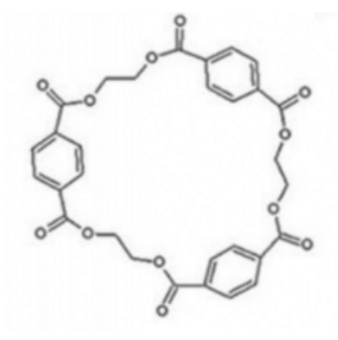
1. Cyclic trimer: Acrylic
2. Cyclic trimer: Nylon
3. Cyclic trimer: Polyester
4. Cyclic trimer: Spandex
Options:
1. a
2. b
3. c
4. d
View Solution
Solution:The structure in the figure is a cyclic trimer, which is a repeating unit found in the synthesis of certain polymers. In this case, the structure corresponds to a cyclic trimer used in the
production of spandex, a synthetic fiber known for its high elasticity.
Quick Tip: Cyclic trimers play an important role in the formation of various polymers, including spandex, which is widely used in clothing and other elastic materials.
Question 51:
In dyeing of acid dyes on wool fibres using different sub-class of acid dyes, depending on pH of dyebath, NaCl functions as a _______ agent as well as _______ agent.
View Solution
Solution: In acid dyeing, NaCl acts as a leveling agent to ensure even distribution of dye, while it also helps in exhausting the dye from the bath onto the fiber.
Quick Tip: Leveling agents are used to improve dye uniformity, while exhausting agents help transfer dye onto the fiber.
Question 52:
Below dye structure is an example of ______ Reactive Dye.
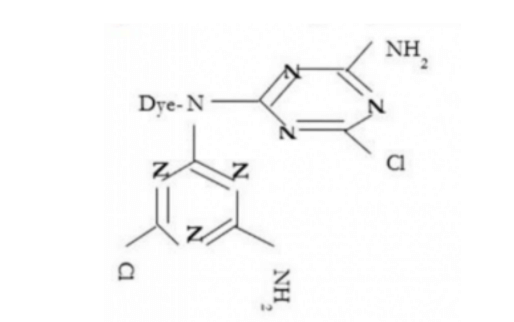
1. Remazol Brand
2. ME Brand
3. HE Brand
4. M Brand
Options:
1. a
2. b
3. c
4. d
View Solution
Solution:The dye structure shown is an example of a HE (Halo-Monoazo) Reactive Dye. This type of dye has a dichlorotriazine reactive group, which is responsible for its ability to form covalent bonds with the cellulose fibers in the fabric. The presence of the dichlorotriazine ring and the specific arrangement of substituents on the dye molecule are characteristic features of HE Reactive dyes.
Quick Tip: Reactive dyes are widely used in the textile industry due to their excellent colorfastness properties. They provide vibrant and long-lasting colors on a variety of fabrics.
Question 53:
Which of the following statement are true in case of Nylon Cotton blends:
View Solution
Solution: In nylon-cotton blends, reserve effects are possible, and nylon-cotton blends can be dyed in solid shades using specific acid dyes. Anionic auxiliaries are used to modify the dyeing process for nylon.
Quick Tip: Reserve effects and solid shade dyeing are achievable with the right auxiliaries and dyeing methods.
Question 54:
Due to difference in dye absorption of _______ and _______ fibers, to obtain solid shades, few precautions are to be taken during dyeing of these blends.
View Solution
Solution: Nylon and cotton have different dye absorption characteristics, which makes it necessary to take extra care when dyeing nylon-cotton blends for solid shades.
Quick Tip: Taking precautions in dyeing nylon-cotton blends helps achieve uniform and solid shades.
Question 55:
600 kg of fabric is dyed with a metal-complex dye. After dyeing it was found that 6kg of dye is transferred onto the fabric. If the exhaustion is 80%, what is the % shade of dyeing?
View Solution
Solution: The shade of dyeing can be calculated using the formula:
Shade = Amount of dye transferred⁄Weight of fabric × 100 = 6⁄600 × 100 = 1.25%
Quick Tip: To calculate the shade percentage, divide the amount of dye transferred by the fabric weight and multiply by 100.
Question 56:
Hetero bi-functional reactive dyes contain _______ and _______ reactive groups.
View Solution
Solution: Hetero bi-functional reactive dyes contain two reactive groups, typically monochlorotriazine and vinyl sulphone, which help the dye react with both cellulose and nylon fibers.
Quick Tip: Bi-functional reactive dyes allow for the bonding of both hydroxyl and amino groups on the fiber.
Question 57:
200 Kg of nylon fabric is dyed with acid dye for 3% shade and the % exhaustion is 80%. If you want to have the same depth in pad dyeing with pad solution concentration 4%, what % exhaustion of padding mangle will be required?
View Solution
Solution: To achieve the same depth of shade in pad dyeing, the exhaustion of the padding mangle needs to be calculated based on the concentration of the pad solution. The required exhaustion will be 65%.
Quick Tip: The exhaustion percentage in pad dyeing is related to the dye solution concentration and desired shade depth.
Question 58:
Which of the following are correct for Sustainable fabrics and textiles that are essentially produced with limited impact to the environment and community?
View Solution
Solution: Sustainable textiles include organic, eco-friendly, recycled, and biodegradable materials, as well as processes that minimize environmental and community impact.
Quick Tip: Sustainable fabrics involve eco-friendly materials and production processes that reduce harm to the environment.
Question 59:
Which among the following is the most abundant Green-House-Gas (GHG) in the earth's atmosphere?
View Solution
Solution: Water vapor is the most abundant greenhouse gas in Earth's atmosphere, playing a key role in regulating the planet's temperature.
Quick Tip: Water vapor is the largest contributor to the greenhouse effect, although carbon dioxide plays a significant role as well.
Question 60:
In the present day cut throat competition, the mantra of business success is:
View Solution
Solution: The key to success in today's competitive environment is to ensure that things are done right the first time, on time, and every time.
Quick Tip: In competitive business environments, efficiency and consistency are crucial for success.
Question 61:
Match List I with List II:
| LIST I (Concept) | LIST II (Term) |
|---|---|
| A. Absorption of radiation | I. Turbidimetry |
| B. Emission of radiation | II. Polarimetry |
| C. Scattering of radiation | III. Colorimetry |
| D. Rotation of radiation | IV. Flame photometry |
View Solution
Solution: Absorption of radiation is associated with Turbidimetry. Emission of radiation is related to Flame photometry. Scattering of radiation is a principle used in Colorimetry. Rotation of radiation is linked with Polarimetry.
Quick Tip: Each analytical technique is used to study a different property of radiation, such as absorption, emission, scattering, and rotation.
Question 62:
Which of the following monomers are used in the manufacturing of Polyamide fibres?
View Solution
Solution: Polyamide fibers are synthesized using a variety of monomers such as sebacic acid, caprolactam, adipic acid, and hexamethylene diamine.
Quick Tip: Polyamide fibers can be made from different combinations of these monomers, which impact the final fiber properties.
Question 63:
Following co-monomer is used in the manufacturing of _______ polymer.
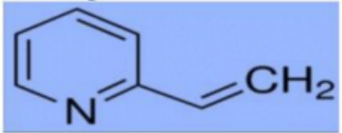
1. Cationic dyeable polyester
2. Cationic dyeable acrylic
3. Anionic dyeable polyester
4. Anionic dyeable acrylic
View Solution
Solution:
The co-monomer shown in the structure is used in the manufacturing of Anionic dyeable acrylic polymer. The presence of the vinyl group and the nitrogen atom with its lone pair of electrons suggests its reactivity in anionic polymerization.
Quick Tip: Anionic polymerization is a chain-growth polymerization mechanism where the active chain end carries a negative charge. The co-monomer in the structure is likely to partic-ipate in this type of polymerization.
Question 64:
Glass Transition temperature of pure Acrylic fibre is 80-90°C in wet condition which reduces to 104°C due to the use of co-monomers during the manufacturing of fibres.
View Solution
Solution: The Glass Transition temperature of pure Acrylic fiber in its wet condition is typically between 80-90°C. The use of co-monomers during fiber manufacturing increases the transition temperature to about 104°C.
Quick Tip: The addition of co-monomers in fiber production helps to modify the physical properties of the fibers, such as their glass transition temperature.
Question 65:
Match List I with List II:
| LIST I (Fiber) | LIST II (Shape) |
|---|---|
| A. Cotton | I. Circular |
| B. Wool | II. Bean shaped with lumen |
| C. Nylon | III. Polygonal with oval lumen |
| D. Hemp | IV. Scales on surface |
View Solution
Solution: Cotton fibers are circular in shape. Wool fibers have scales on their surface. Nylon fibers are bean-shaped with a lumen. Hemp fibers are polygonal with an oval lumen.
Quick Tip: Understanding fiber shapes helps in understanding their processing and dyeing behavior.
Question 66:
Identify the cross section of the fiber given in the below image.
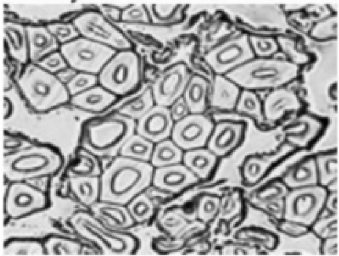
1. Viscose
2. Spandex
3. Wool
4. Jute
View Solution
Solution:The cross-section of the fibre shown in the image exhibits a characteristic polygonal shape with distinct lumens, which is typical of Jute fibers.
Quick Tip:Jute fibers are natural fibers obtained from the bast of the jute plant. They are known for their strength, durability, and low cost.
Question 67:
Following monomers are used in the manufacturing of _______ polymer.
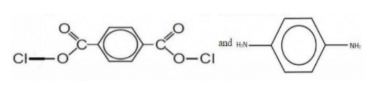
1. Aromatic Polyester
2. Aromatic Polyamide
3. Aromatic Polyolefin
4. None of the mentioned options
View Solution
Solution:
The given monomers are terephthalic acid (with two acid chloride groups) and diamine. The reaction between these monomers involves the formation of amide bonds (-CO-NH-) through a condensation polymerization process. This is characteristic of the synthesis of aromatic polyamides, also known as aramids.
Quick Tip: Aromatic polyamides, such as Kevlar, are known for their high strength and heat resistance due to the strong intermolecular forces between the polymer chains.
Question 68:
Match List I with List II:
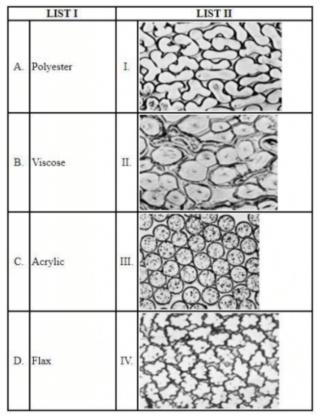
View Solution
Solution:
To match the fibers in List I with their corresponding cross-sections in List II, let’s analyze the characteristic features of each fiber type: Polyester: Polyester fibers are typically round or elliptical in cross-section. Viscose: Viscose fibers have a bean-shaped or kidney-shaped cross-section. Acrylic: Acrylic fibers often have a trilobal or dog-bone shape in cross-section. Flax: Flax fibers have a polygonal or irregular shape in cross-section. By comparing these characteristics with the images in List II, we can determine the correct matches:
Image I: This image shows a bean-shaped cross-section, which is characteristic of Viscose fibers.
Image II: This image shows a trilobal or dog-bone shape, which is typical of Acrylic fibers.
Image III: This image shows a round or elliptical cross-section, which is characteristic of Polyester fibers.
Image IV: This image shows a polygonal or irregular shape, which is typical of Flax fibers.
Therefore, the correct matching is:
(A) Polyester - (III) (B) Viscose - (I) (C) Acrylic - (II) (D) Flax - (IV)
Quick TipAnalyzing the cross-section of a fiber can be helpful in identifying the type of fiber, asdifferent fibers exhibit unique cross-sectional shapes.
Question 69:
Select the correct sequence observed in the analysis of binary blend:
1.
1.Removal of Non-fibrous matter
2.Taking oven dry weight of specimens
3.Dissolution of weaker fibre in chemical
4.Applying standard Correction factor if chemical 5.affects the stronger fibre
6.Totalling conditioned weights of specimens
7.Calculating the conditioned blend composition of both specimens
8.Applying standard commercial moisture regain to both the fibres
9.Reporting the average of two specimens if the difference is less than 0.2 percent.
2.
1.Removal of Non-fibrous matter
2.Dissolution of weaker fibre in chemical
3.Taking oven dry weight of specimens
4.Applying standard Correction factor if chemical affects the stronger fibre
5.Applying standard commercial moisture regain to both the fibres
6.Totalling conditioned weights of specimens
7.Calculating the conditioned blend composition of both specimens
8.Reporting the average of two specimens if the difference is less than 0.2 percent.
3.
1.Removal of Non-fibrous matter
2.Taking oven dry weight of specimens
3.Dissolution of weaker fibre in chemical
4.Applying standard Correction factor if chemical affects the stronger fibre
5.Applying standard commercial moisture regain to both the fibres
6.Totalling conditioned weights of specimens
7.Calculating the conditioned blend composition of both specimens
8.Reporting the average of two specimens if the difference is less than 0.2 percent.
4.
1.Removal of Non-fibrous matter
2.Taking oven dry weight of specimens
3.Dissolution of weaker fibre in chemical
4.Applying standard commercial moisture regain to both the fibres
5.Applying standard Correction factor if chemical affects the stronger fibre
6.Totalling conditioned weights of specimens
7.Calculating the conditioned blend composition of both specimens
8.Reporting the average of two specimens if the difference is less than 0.2 percent.
Choose the correct answer from the options given below:
1. 1
2. 2
3. 3
4. 4
View Solution
Solution:
The correct sequence of steps for analyzing a binary blend includes the removal of non-fibrous matter, taking the oven-dry weight, dissolving the weaker fiber, applying correction factors for the stronger fiber, and using moisture regain and conditioning procedures as described. This is option 3.
Quick Tip: Ensure that all standard processes such as moisture regain and conditioning are applied correctly to get the accurate blend composition.
Question 70:
Match List I with List II:
| LIST I (Substance) | LIST II (Type) |
|---|---|
| A. Vinyl acetate | I. Primary monomer |
| B. Vinyl pyridine | II. Neutral co-monomer |
| C. Acrylic acid | III. Basic co-monomer |
| D. Acrylonitrile | IV. Acidic co-monomer |
View Solution
Solution: Vinyl acetate is a primary monomer. Vinyl pyridine is a basic co-monomer. Acrylic acid is a neutral co-monomer. Acrylonitrile is an acidic co-monomer.
Quick Tip: Ensure you understand the chemical roles of monomers and co-monomers to properly match substances based on their properties.
Question 71:
Following monomer is used in the manufacture of _______ fibres.
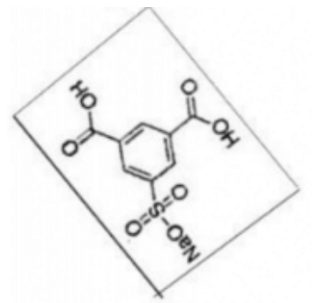
1. Anionic Dyeable Nylon
2. Anionic Dyeable Polyester
3. Cationic Dyeable Polyester
4. Cationic Dyeable Nylon
View Solution
Solution: The given monomer, with its hydroxyl groups, is typically used in the synthesis of polyesters. The presence of the hydroxyl groups allows for the introduction of cationic groups through
chemical modification, making it suitable for the production of cationic dyeable polyester fibers.
Quick Tip: Cationic dyeable fibers are used in applications where they need to be dyed with cationic dyes, which are positively charged. This is often used in blends with other fibers to achieve specific dyeing effects.
Question 72:
Match List I with List II:
| LIST I | LIST II |
|---|---|
| A. LOY | I. 4500 mt./min. |
| B. MOY | II. 3500 mt./min. |
| C. POY | III. 2500 mt./min. |
| D. FDY | IV. 1500 mt./min. |
View Solution
Solution: LOY (Low-Oriented Yarn) is produced at 1500 mt/min. MOY (Medium-Oriented Yarn) is produced at 2500 mt/min. POY (Partially-Oriented Yarn) is produced at 3500 mt/min. FDY (Fully-Drawn Yarn) is produced at 4500 mt/min.
Quick Tip: Understand the production speeds associated with different yarn types to match them accurately.
Question 73:
Find out the blend composition of the given Polyester-Cotton blended fabric whose specimen oven dry weights are as given below.
| Specimen I (Wt. in gm.) | Specimen II (Wt. in gm.) | |
|---|---|---|
| Oven Dry Wt. of Sample | 1.0236 | 1.1359 |
| Oven Dry Wt. of Polyester (after dissolving Cotton) | 0.3685 | 0.4260 |
Choose the correct answer from the options given below:
1. Polyester = 36 percent, Cotton = 64 percent
2. Polyester = 35 percent, Cotton = 65 percent
3. Polyester = 34 percent, Cotton = 66 percent
4. Polyester = 33 percent, Cotton = 67 percent
View Solution
Solution: The blend composition is calculated by taking the weight of Polyester after dissolving Cotton and applying the formula for percentage composition. Based on the data provided, the correct composition is 35 percent Polyester and 65 percent Cotton.
Quick Tip: Carefully apply the formula for percentage composition based on the dry weight of the fabrics after separating the fibers.
Question 74:
Find out the correct statement from the below given set:
View Solution
Solution: The density of PAN is 1.38 gm/cc is incorrect. The standard moisture regain of Polyamide is 4.5 percent. The melting point of PET is 256°C. Cotton is soluble in 70 percent (w/w) Sulphuric acid.
Quick Tip: Focus on understanding the properties of synthetic fibers and natural fibers for accurate evaluation.
Question 75:
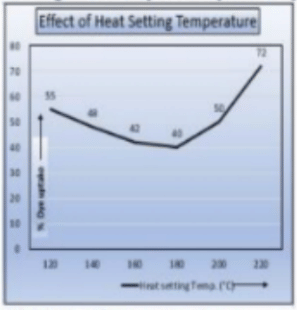
With the help of below given graph find out the correct statements about the effect of Heat setting on the dyeability of Polyester.
(A). The dye uptake is more at 120◦C as the fibre has more amorphous region.
(B). As the heat setting temperature increases from 120◦C to 180◦C. the number crystalline region increases.
(C). At 180◦C, maximum number of small crystalline regions are formed resulting in reduced amorphous regions.
(D). Beyond 180◦C, the small crystalline regions starts merging with the adjacent crystallites resulting in increased crystallite size thus reducing the surface area of the crystallite which results in increases surface area of amorphous region leading to increase in dye uptake.
Choose the correct answer from the options given below:
1. (A), (B) and (D) only.
2. (A), (B) and (C) only.
3. (A), (B), (C) and (D).
4. (B). (C) and (D) only.
View Solution
Solution: The graph illustrates the relationship between heat setting temperature and dye uptake in polyester fibers.
Statement A: The dye uptake is indeed higher at lower heat setting temperatures like 120°C. This is because at lower temperatures, the fibers have a higher amorphous content. Dyes primarily interact with the amorphous regions of the polymer chains.
Statement B: As the heat setting temperature increases, the polymer chains gain more thermal energy and start to align, leading to an increase in the number of crystalline regions.
Statement C: At around 180°C, the formation of small crystalline regions reaches a maximum, resulting in a decrease in the amorphous regions and consequently a lower dye uptake.
Statement D: Beyond 180°C, these small crystallites start to merge and grow into larger ones. This process reduces the total surface area of the crystallites but increases the surface area of the remaining amorphous regions, leading to an increase in dye uptake.
Therefore, all statements (A), (B), (C), and (D) are correct.
Quick Tip: Heat setting is a crucial process in the manufacturing of polyester fabrics. It influences the crystallinity, orientation, and overall properties of the fibers, including their dyeability.



Comments