


CUET PG 2024 Social Work 28th March 2024 Shift 2 Question Paper with Solution PDF is available for download here. Students found the Social Work Theories and Methods section easy, Community Organization and Development moderate, and Social Policy and Welfare Administration topics difficult. The Social Policy and Welfare Administration section carried the highest weightage, and the overall difficulty level was moderate to difficult.
CUET PG 2024 Social Work Question Paper with Answer Key PDF
| CUET PG 2024 Social Work Question Paper with Answer Key |  Download Download |
Check Solution |

CUET PG 2024 Social Work Questions with Solutions
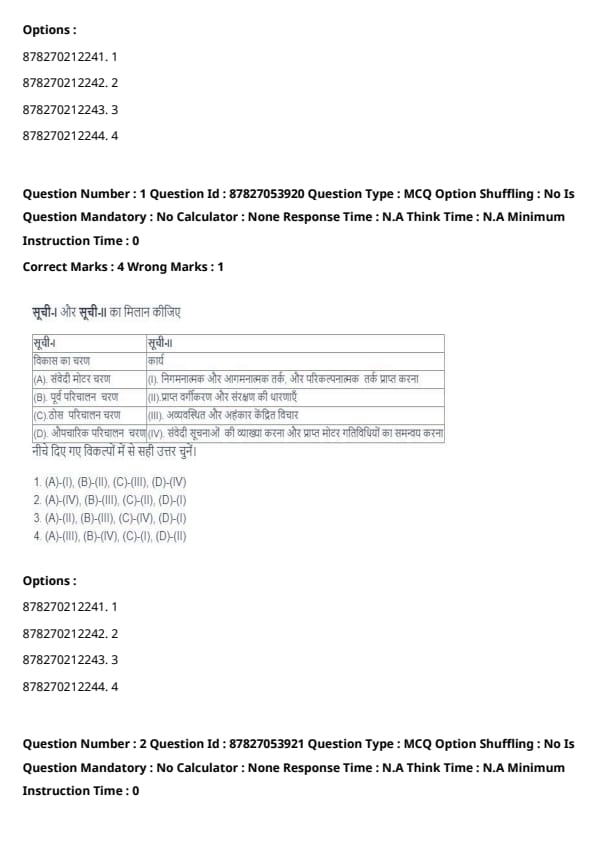
Question 1:
Match List-I with List-II:
| List-I | List-II |
|---|---|
| (A) Sensory Motor Stage | (I) Achieving deductive and inductive reasoning, and hypothetical reasoning |
| (B) Pre-operational Stage | (II) Notions of classification and conservation achieved |
| (C) Concrete Operational Stage | (III) Unsystematic and egocentric thoughts |
| (D) Formal Operational Stage | (IV) Interpreting sensory information and coordinating motor activities achieved |
View Solution
Jean Piaget's theory outlines the stages of cognitive development:
- Sensory Motor Stage: Infants explore the world through sensory and motor actions, achieving object permanence.
- Pre-operational Stage: Symbolic thinking develops, but thoughts are unsystematic and egocentric.
- Concrete Operational Stage: Logical thinking emerges, with concepts like classification and conservation being understood.
- Formal Operational Stage: Abstract reasoning and hypothetical thinking are developed.
Question 2:
The Ministry of Women and Child Development has launched ______ scheme to cover child protection and welfare services that aims to foster a supportive and synchronized ecosystem for the optimum development of children:
View Solution
Mission Vatsalaya aims to improve child welfare by integrating services like education, healthcare, and nutrition, ensuring vulnerable children receive comprehensive care in institutional and non-institutional settings.
Question 3:
Which of the following is a non-statutory and non-institutional service for children?
A. Supplementary Nutrition
B. Orphanages run by NGOs
C. Child care institutions under JJ Act
D. Probation
Choose the correct answer from the options given below:
View Solution
Non-statutory and non-institutional services operate outside formal legal frameworks:
- Orphanages run by NGOs: Provide care without statutory obligations.
- Probation: A community-based service allowing children to remain with families under supervision.
Statutory services like Child Care Institutions are regulated by the Juvenile Justice Act.
Question 4:
The Ramsar Convention is related to:
View Solution
The Ramsar Convention, adopted in 1971, promotes the conservation and sustainable use of wetlands, highlighting their ecological and economic importance, including biodiversity support and water purification.
Question 5:
Which of the following are the advantages of Tropical Amazonian Rain forests?
A. They regulate temperature and climate.
B. They regulate the water cycle.
C. They hinder attainment of food security.
D. They help in mitigation of floods.
Choose the correct answer from the options given below:
View Solution
The Amazon rainforest plays a crucial role in:
- Temperature and Climate Regulation: Acting as a carbon sink, it stabilizes global climate.
- Water Cycle Regulation: Maintains water cycles through evapotranspiration.
- Flood Mitigation: Stabilizes soil and reduces runoff.
Contrary to the statement, rainforests indirectly contribute to food security rather than hindering it.
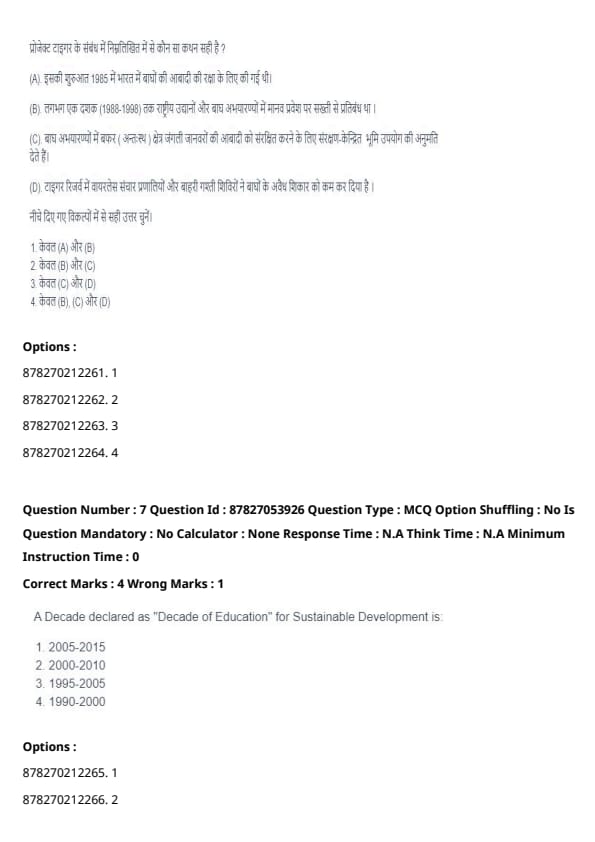
Question 6:
Which of the following statements are correct with regard to Project Tiger?
A. It was started in 1985 to protect the population of Tigers in India.
B. Human entry was strictly prohibited in the national parks and Tiger reserves for about a decade (1988-1998).
C. Buffer areas in Tiger reserves allow conservation-oriented land use to preserve wild animal populations.
D. Wireless communication systems and outstation patrol camps in the Tiger reserves have reduced poaching of Tigers.
Choose the correct answer from the options given below:
View Solution
Project Tiger, launched in 1973, is a significant conservation initiative. Key elements include:
- Buffer Zones: Surround core tiger reserves to allow conservation-compatible land use.
- Advanced Monitoring: Wireless communication and patrol camps reduce poaching by enhancing surveillance.
Note: The project began in 1973, not 1985, and human entry was regulated, not completely prohibited.
Question 7:
A Decade declared as “Decade of Education for Sustainable Development” is:
View Solution
The United Nations designated 2005-2015 as the “Decade of Education for Sustainable Development” to integrate sustainability principles into global education systems, fostering environmental awareness and resource conservation.
Question 8:
Arrange in the order of occurrence from earliest to latest:
A. Forest Survey of India
B. Earth Summit
C. Biological Diversity Act
D. National Biodiversity Action Plan
Choose the correct answer from the options given below:
View Solution
The chronological order is:
- Forest Survey of India (1981): Established for forest resource assessments.
- Earth Summit (1992): Focused on global sustainable development.
- Biological Diversity Act (2002): Enacted to conserve biodiversity.
- National Biodiversity Action Plan (2008): Outlined conservation strategies for India.
Question 9:
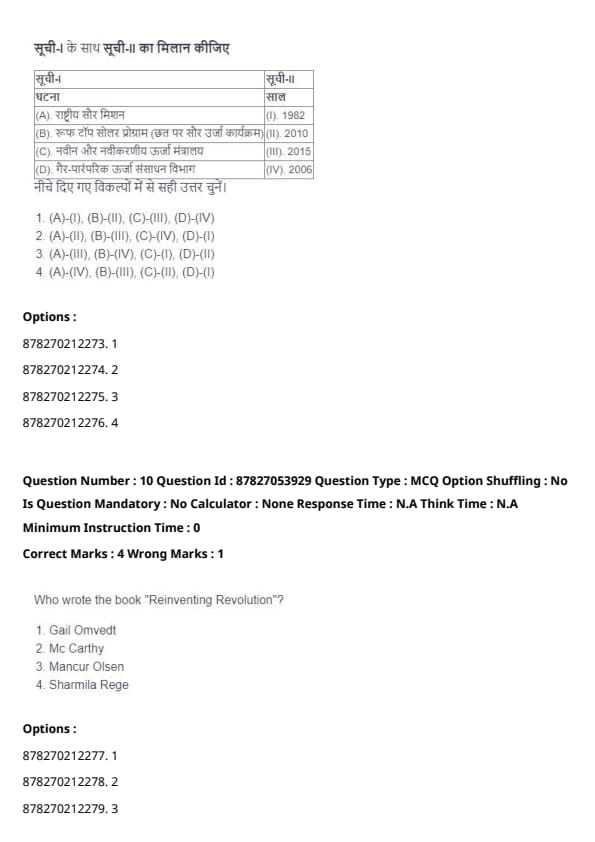
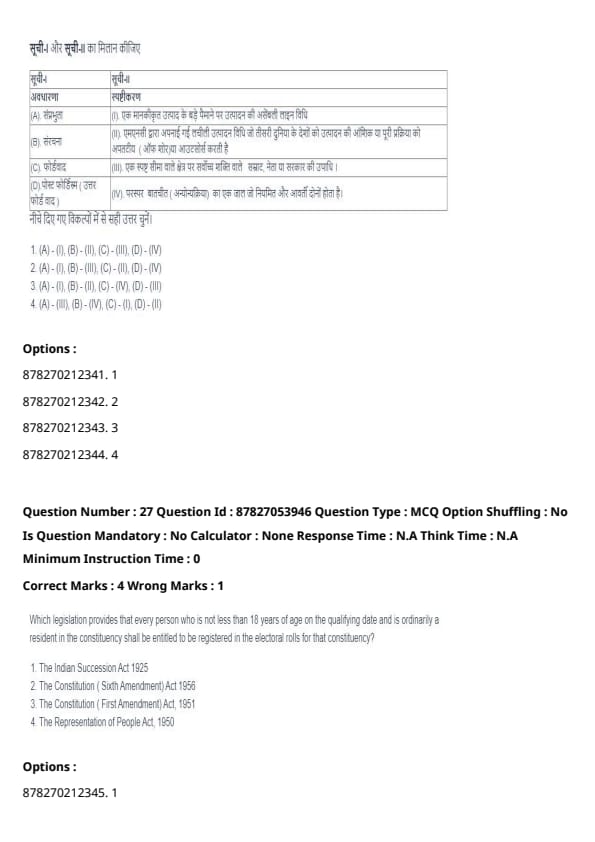
Match List-I with List-II:
| List-I | List-II |
|---|---|
| (A) National Solar Mission | (II) 2010 |
| (B) Roof Top Solar Programme | (III) 2015 |
| (C) Ministry of New and Renewable Energy | (IV) 2006 |
| (D) Department of Non-Conventional Energy Resources | (I) 1982 |
Choose the correct answer from the options given below:
View Solution
The timeline of solar and renewable energy initiatives in India:
- National Solar Mission (2010): Part of the National Action Plan on Climate Change.
- Roof Top Solar Programme (2015): Focused on decentralized solar power.
- Ministry of New and Renewable Energy (2006): Oversaw renewable energy development.
- Department of Non-Conventional Energy Resources (1982): Early step in renewable energy policy.
Question 10:
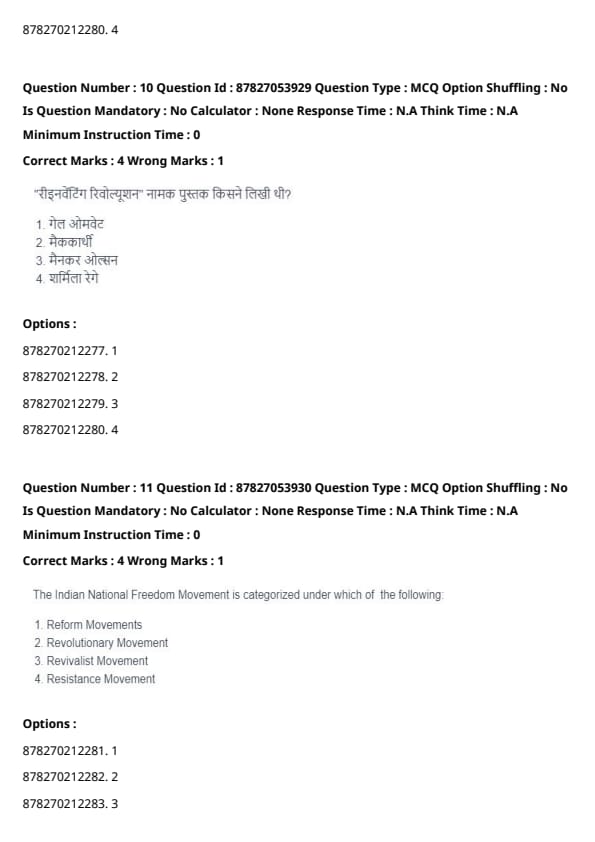
Who wrote the book “Reinventing Revolution”?
View Solution
Gail Omvedt authored “Reinventing Revolution: New Social Movements and the Socialist Tradition in India,” focusing on grassroots movements like those of Dalits, feminists, and peasants, blending traditional socialism with contemporary social issues.
Question 11:
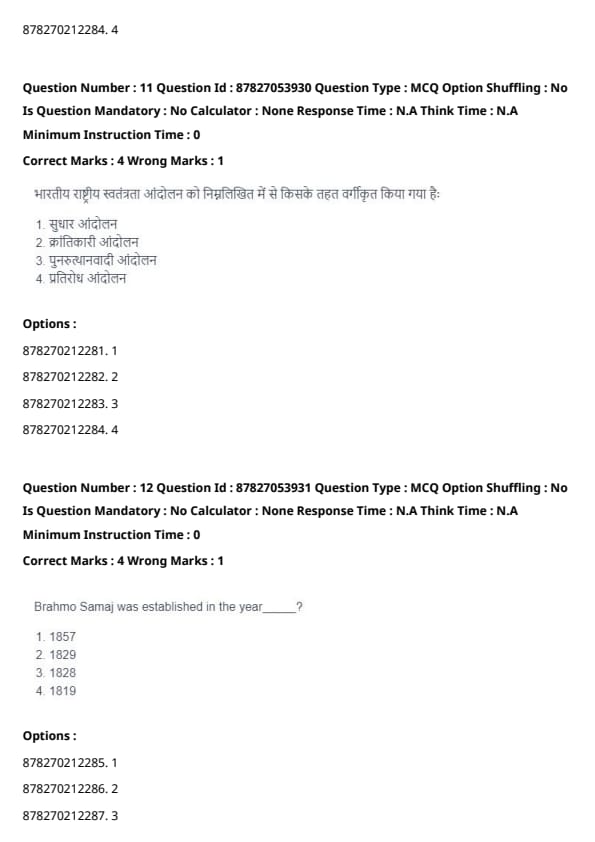
The Indian National Freedom Movement is categorized under which of the following:
View Solution
The Indian National Freedom Movement is best categorized as a resistance movement. It opposed British colonial rule through:
- Non-violent civil disobedience: Led by Mahatma Gandhi.
- Revolutionary activities: Conducted by groups such as the Hindustan Socialist Republican Association.
- Legal and political reforms: Advocated by the Indian National Congress.
The movement symbolized collective opposition, inspiring anti-colonial efforts worldwide.
Question 12:
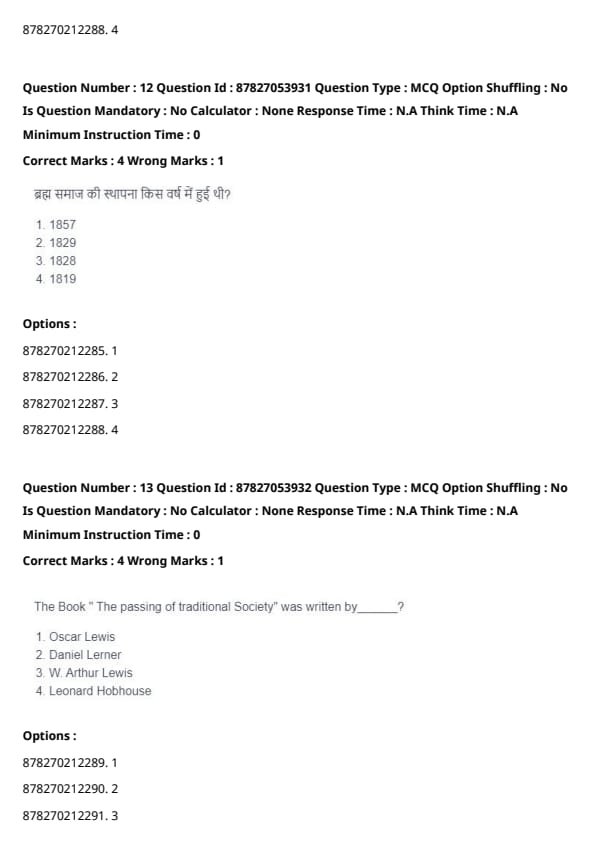
Brahmo Samaj was established in the year:
View Solution
Raja Ram Mohan Roy established the Brahmo Samaj in 1828. This movement sought to modernize Hindu society by:
- Promoting monotheism.
- Opposing practices like Sati, child marriage, and caste discrimination.
- Encouraging rational thought and education.
The Brahmo Samaj was instrumental in shaping the Indian Renaissance.
Question 13:
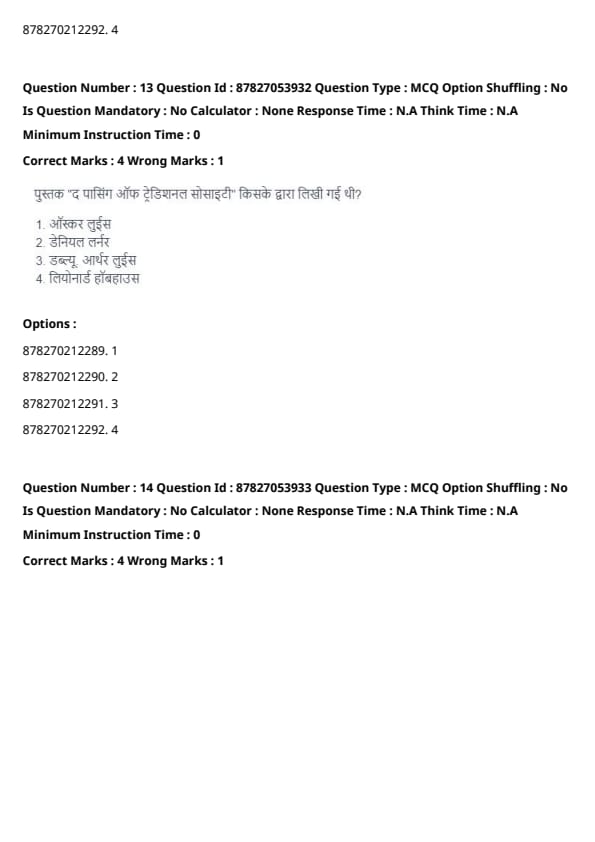
The Book “The Passing of Traditional Society” was written by:
View Solution
Daniel Lerner wrote “The Passing of Traditional Society,” which examines how media, literacy, and communication drive social and cultural transformation in traditional societies. The book emphasizes modernization and its role in transitioning agrarian societies to industrial ones.
Question 14:
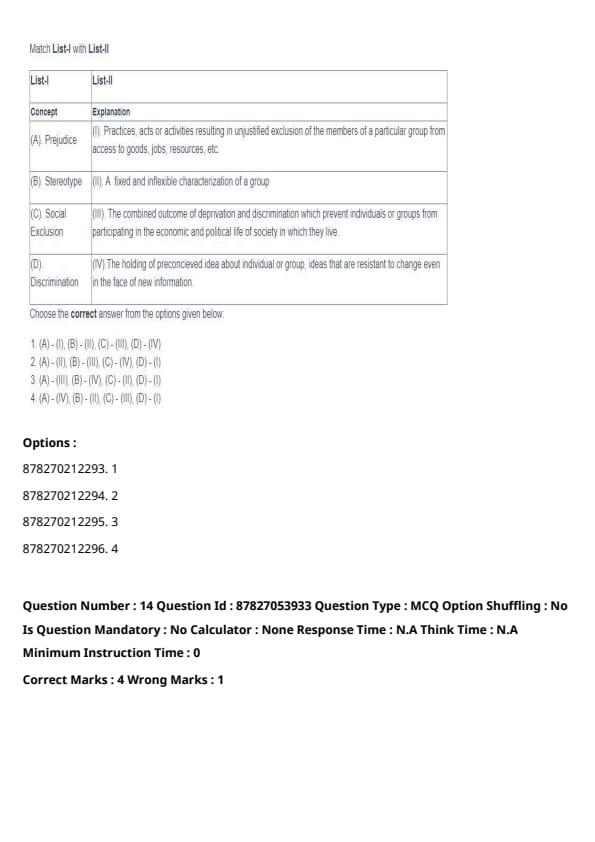
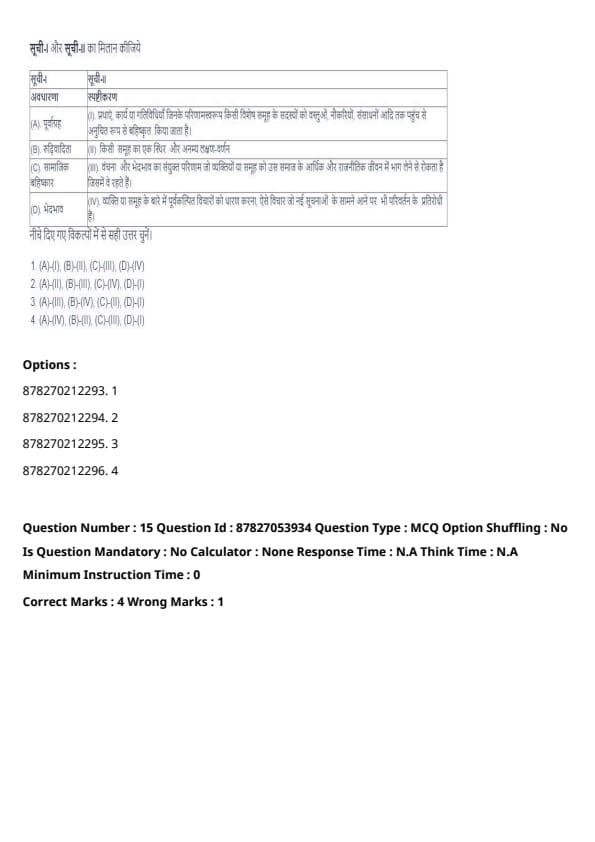
Match List-I with List-II:
| List-I (Concept) | List-II (Explanation) |
|---|---|
| (A) Prejudice | (IV) The holding of preconceived ideas about individuals or groups, resistant to change even with new information. |
| (B) Stereotype | (II) A fixed and inflexible characterization of a group. |
| (C) Social Exclusion | (III) Deprivation and discrimination that prevent participation in economic and political life. |
| (D) Discrimination | (I) Practices or activities excluding certain groups unjustifiably. |
Choose the correct answer from the options given below:
View Solution
Definitions of key sociological concepts:
- Prejudice: Preconceived, often negative, ideas resistant to new evidence.
- Stereotype: Rigid, oversimplified beliefs about a group.
- Social Exclusion: Marginalization preventing societal participation.
- Discrimination: Actions excluding groups based on identity.
Question 15:
Who among the following are propagators of the Bhakti Movement?
(A) Kabir
(B) Rana Sambha
(C) Guru Nanak
(D) Basaveshwara
Choose the correct answer from the options given below:
View Solution
The Bhakti Movement emphasized devotion to a single deity and social equality. Key propagators include:
- Kabir: A poet-saint who denounced rituals and superstitions.
- Guru Nanak: Founder of Sikhism, promoting universal brotherhood.
- Basaveshwara: A reformer and founder of the Lingayat sect in Karnataka.
Rana Sambha was not associated with this movement.
Question 16:
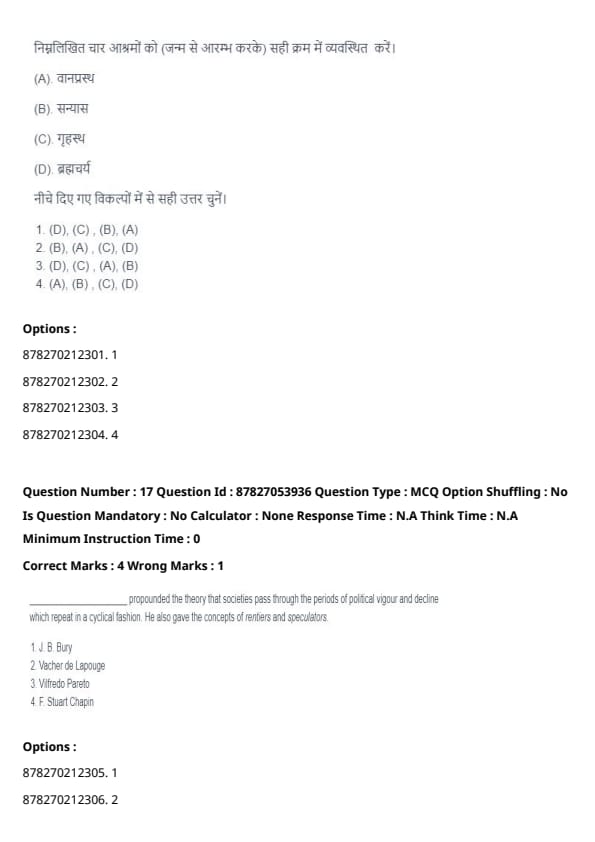
Sequentially arrange the four ashramas in order (starting from birth) as mentioned in the Jabala Upanishad:
(A) Vanprastha
(B) Sanyasa
(C) Grahastha
(D) Brahmacharya
Choose the correct answer from the options given below:
View Solution
The four ashramas, as described in the Jabala Upanishad, are:
- Brahmacharya (Student Life): Focuses on learning and discipline.
- Grahastha (Householder Life): Centers on fulfilling family and societal duties.
- Vanprastha (Hermit Life): Involves detachment from worldly responsibilities.
- Sanyasa (Renunciation): Dedicated to spiritual goals and renunciation of material desires.
Question 17:
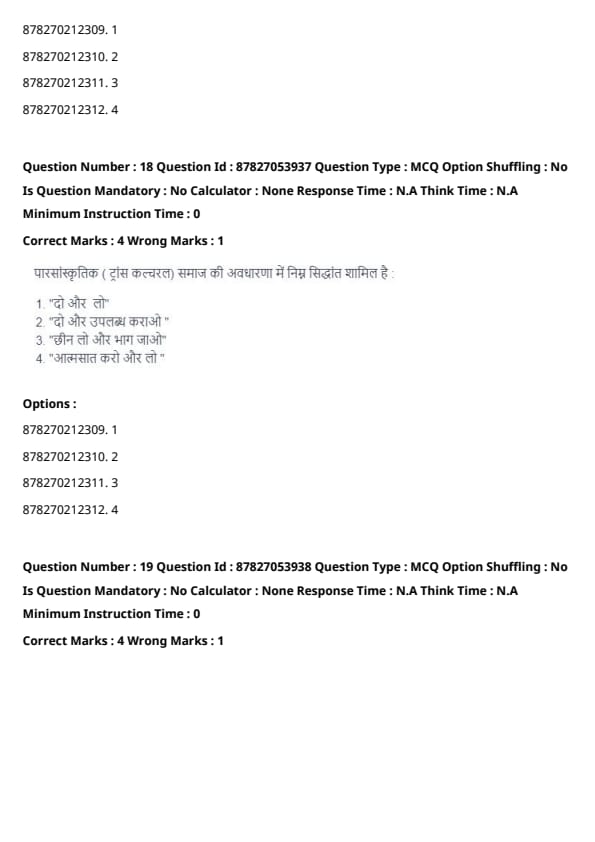
_______ propounded the theory that societies pass through periods of political vigour and decline which repeat in a cyclical fashion. He also gave the concepts of rentiers and speculators:
View Solution
Vilfredo Pareto introduced the cyclical theory of societal change, proposing that societies alternate between periods of political vigor and decline due to the rise and fall of elites. Key concepts include:
- Rentiers: Individuals favoring stability and long-term investments.
- Speculators: Risk-takers who drive innovation and change.
Question 18:
The concept of transcultural society involves the principle of _______:
View Solution
A transcultural society emphasizes cultural integration and mutual exchange. The principle of “give and take” promotes coexistence and enrichment by sharing values, traditions, and practices.
Question 19:
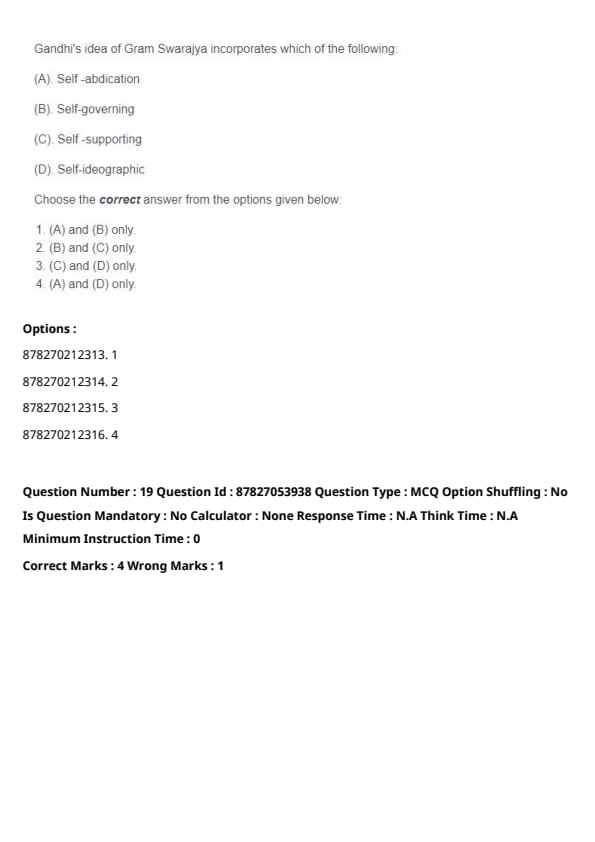
Gandhi's idea of Gram Swarajya incorporates which of the following:
(A) Self-abdication
(B) Self-governing
(C) Self-supporting
(D) Self-ideographic
Choose the correct answer from the options given below:
View Solution
Gandhi's Gram Swarajya (village self-rule) emphasized:
- Self-governing: Local decision-making and governance.
- Self-supporting: Economic independence through sustainable practices.
This vision promoted decentralized governance and self-sufficiency.
Question 20:
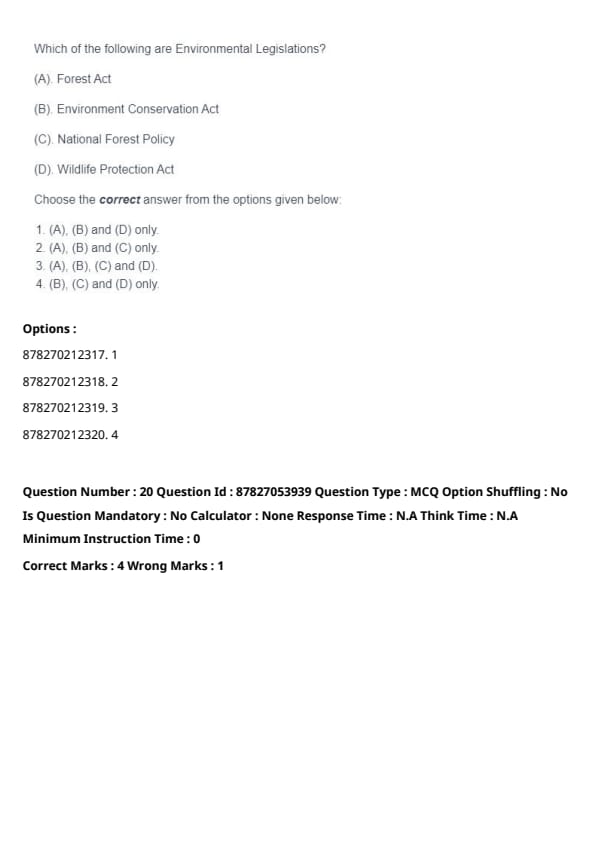
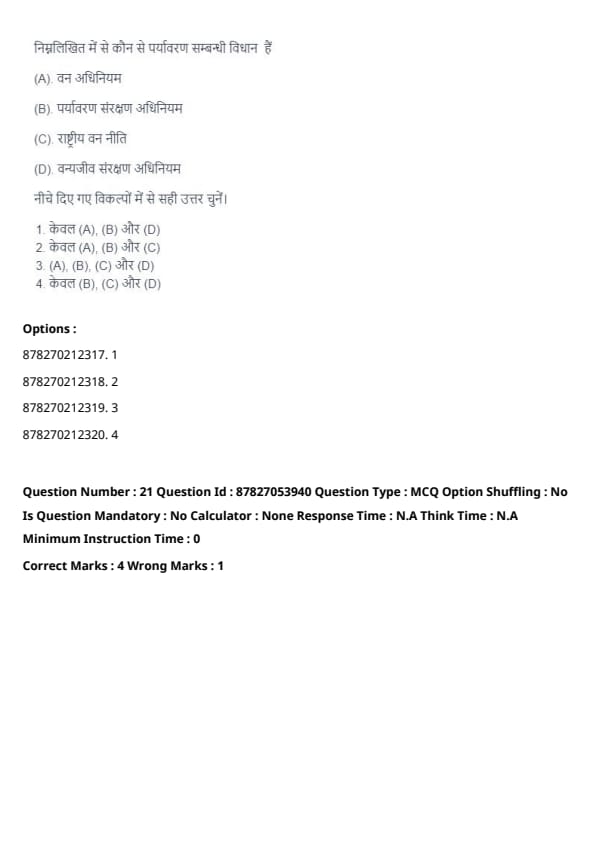
Which of the following are Environmental Legislations?
(A) Forest Act
(B) Environment Conservation Act
(C) National Forest Policy
(D) Wildlife Protection Act
Choose the correct answer from the options given below:
View Solution
All listed acts and policies are crucial to India's environmental framework:
- Forest Act: Regulates the use and conservation of forests.
- Environment Conservation Act: Focuses on protecting ecosystems from industrial impacts.
- National Forest Policy: Provides guidelines for forest conservation and sustainable use.
- Wildlife Protection Act: Conserves biodiversity by regulating hunting and poaching.
Question 21:
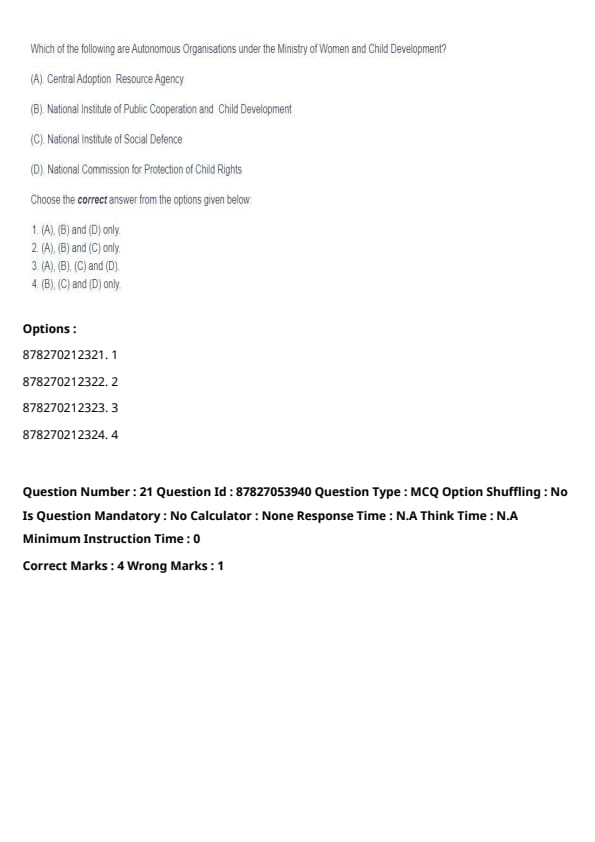
Which of the following are Autonomous Organisations under the Ministry of Women and Child Development?
(A) Central Adoption Resource Agency
(B) National Institute of Public Cooperation and Child Development
(C) National Institute of Social Defence
(D) National Commission for Protection of Child Rights
Choose the correct answer from the options given below:
View Solution
The Ministry of Women and Child Development oversees several autonomous organizations:
- Central Adoption Resource Agency (CARA): Promotes and regulates adoptions in India.
- National Institute of Public Cooperation and Child Development (NIPCCD): Provides training and research in child development.
- National Institute of Social Defence (NISD): Focuses on welfare issues like addiction and elderly care.
- National Commission for Protection of Child Rights (NCPCR): Ensures the protection of children’s rights.
Question 22:
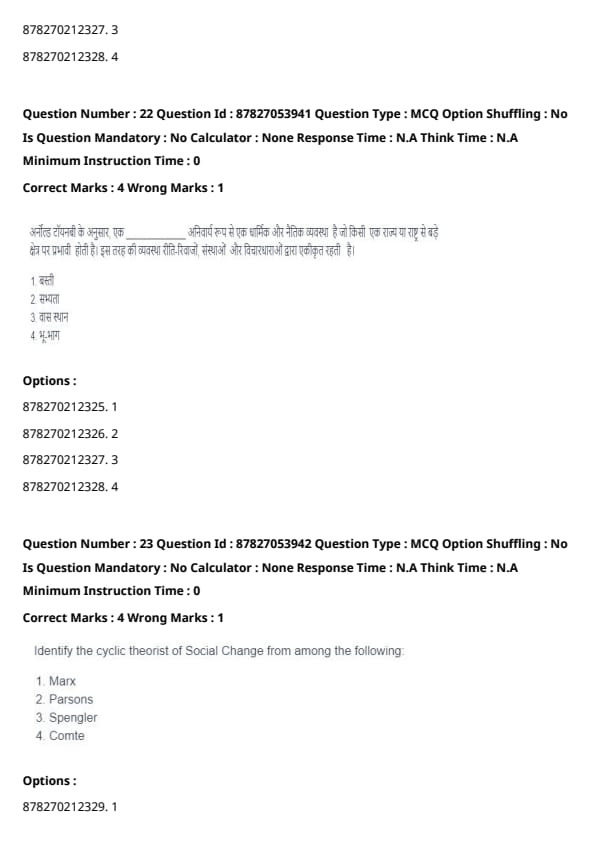
According to Arnold Toynbee, a _______ is essentially a religious and ethical system holding sway over an area often larger than a state or nation. Such a system is unified by customs, institutions, and ideologies.
View Solution
Arnold Toynbee defines a civilization as a cultural system transcending state and national boundaries. Key features include:
- A shared ethical and religious framework.
- Unified customs, institutions, and ideologies.
- Influence over vast regions, often shaping global history.
Examples include the Greco-Roman, Indic, and Sinic civilizations.
Question 23:
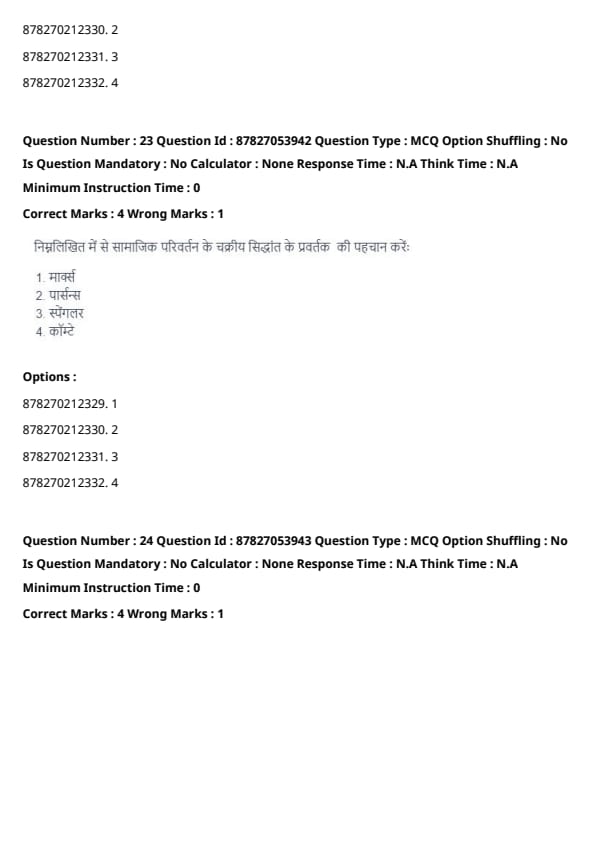
Identify the cyclic theorist of Social Change from among the following:
View Solution
Oswald Spengler proposed the cyclical theory of social change in his work “The Decline of the West.” Key ideas include:
- Civilizations follow a life cycle: birth, growth, maturity, decline, and death.
- Cultural expressions and societal dynamics are linked to this cycle.
Spengler’s theory contrasts with linear theories like Marx’s historical materialism.
Question 24:
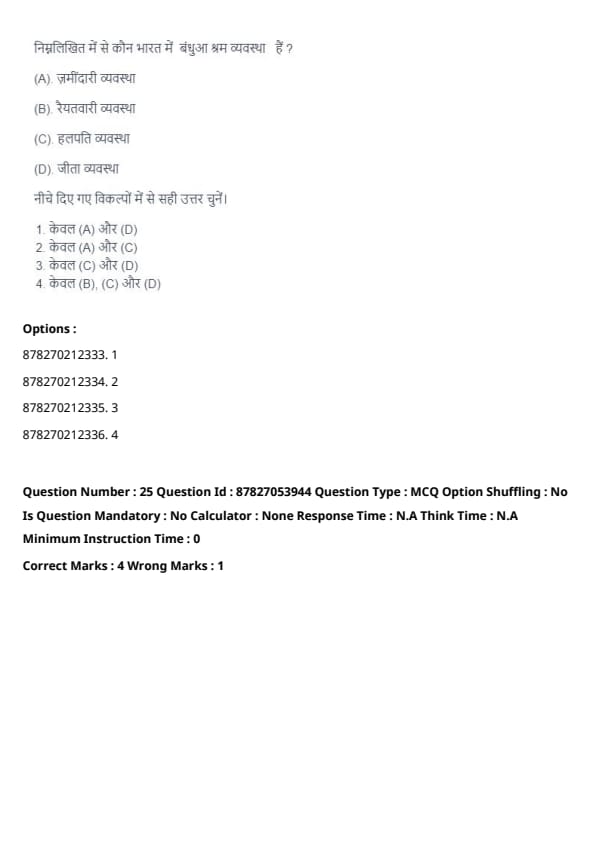
Which of the following are bonded labour systems in India?
(A) Zamidari system
(B) Raiyatwari system
(C) Halpati system
(D) Jeeta system
Choose the correct answer from the options given below:
View Solution
The Halpati and Jeeta systems are forms of bonded labor found in specific regions of India. Key characteristics:
- Laborers are exploited under debt obligations.
- Freedom to change employers is restricted.
These practices are illegal under the Bonded Labour System (Abolition) Act, 1976.
Question 25:
Arrange the Peasant Movements in their order of occurrence from earliest to latest:
(A) Telangana Movement
(B) Bardoli Satyagrah
(C) Champaran Satyagraha
(D) Bengal Revolt
Choose the correct answer from the options given below:
View Solution
The chronological order of these peasant movements is:
- Bengal Revolt (1859–1860): Protest against the indigo planters.
- Champaran Satyagraha (1917): Led by Mahatma Gandhi to address the grievances of indigo farmers.
- Bardoli Satyagraha (1928): Led by Sardar Vallabhbhai Patel against increased taxation.
- Telangana Movement (1946–1951): Revolt by peasants against feudal oppression.
Question 26:
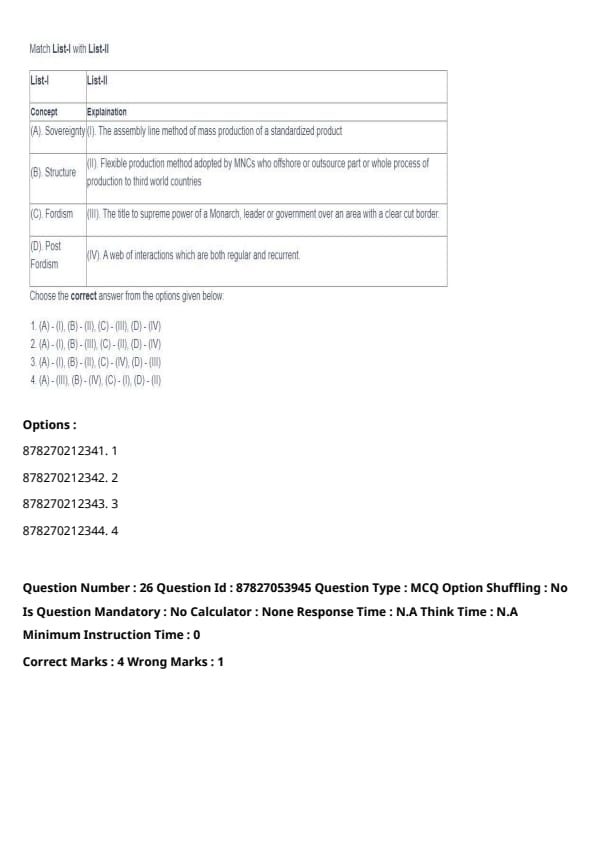
Match List-I with List-II:
| List-I (Concept) | List-II (Explanation) |
|---|---|
| (A) Sovereignty | (III) The title to supreme power of a Monarch, leader or government over an area with a clear-cut border. |
| (B) Structure | (IV) A web of interactions which are both regular and recurrent. |
| (C) Fordism | (I) The assembly line method of mass production of a standardized product. |
| (D) Post Fordism | (II) Flexible production method adopted by MNCs who offshore or outsource part or whole process of production to third-world countries. |
Choose the correct answer from the options given below:
View Solution
The correct matching of concepts is:
- Sovereignty: Supreme authority over a defined territory.
- Structure: Patterns of regular and recurrent interactions within a system.
- Fordism: Mass production of standardized products using assembly lines.
- Post-Fordism: Flexible production systems, often involving outsourcing and multinational collaboration.
Question 27:
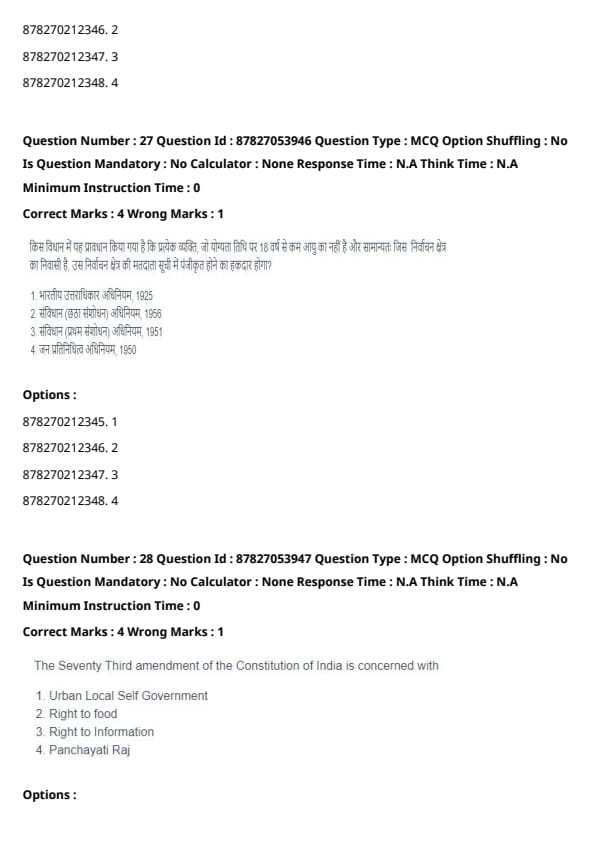
Which legislation provides that every person who is not less than 18 years of age on the qualifying date and is ordinarily a resident in the constituency shall be entitled to be registered in the electoral rolls for that constituency?
View Solution
The Representation of People Act, 1950, defines:
- Preparation of electoral rolls.
- Eligibility criteria for voter registration.
- Implementation of universal adult suffrage in India.
Question 28:
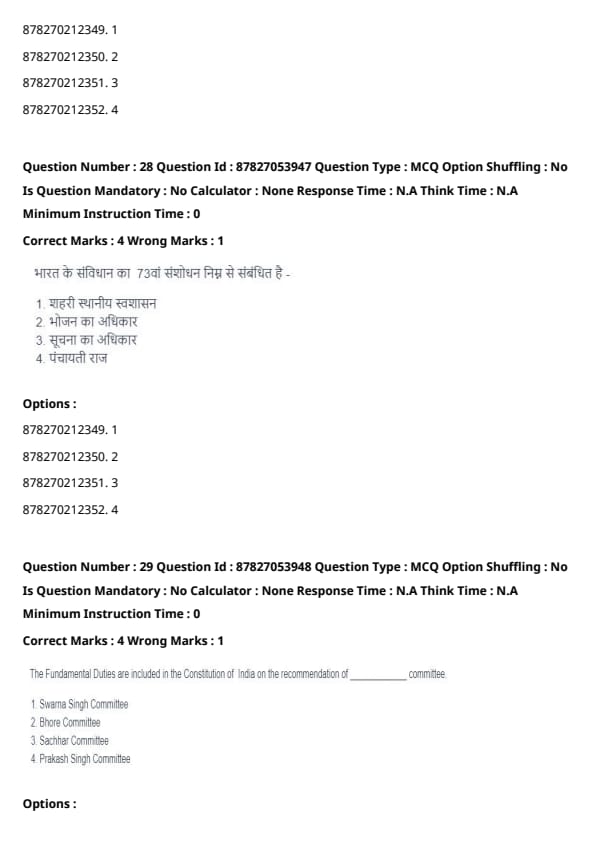
The Seventy-Third amendment of the Constitution of India is concerned with:
View Solution
The 73rd Amendment Act, 1992, introduced:
- Decentralized governance through Panchayati Raj institutions.
- Direct elections to Panchayats and Gram Sabhas.
- Reservation for Scheduled Castes, Scheduled Tribes, and women in Panchayati Raj institutions.
Question 29:
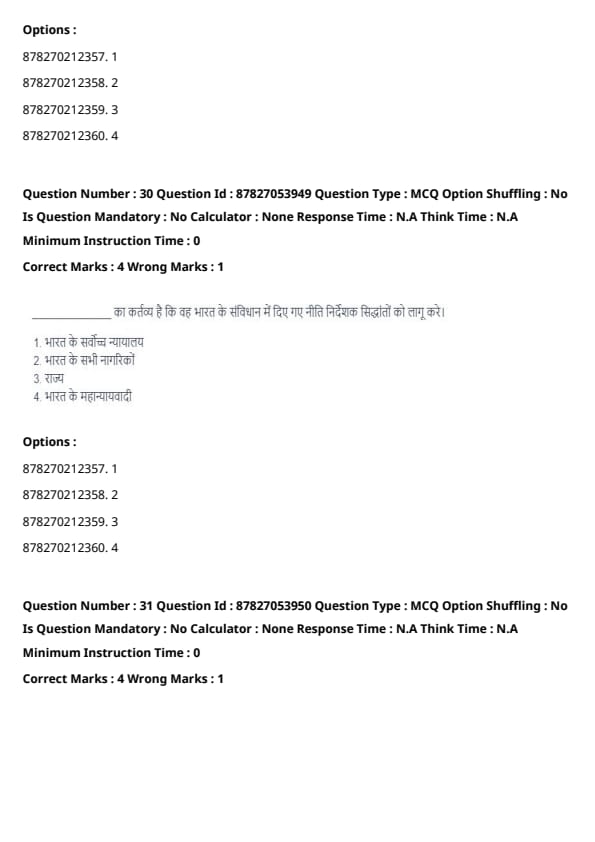
The Fundamental Duties are included in the Constitution of India on the recommendation of _______ committee:
View Solution
The Fundamental Duties were added to the Indian Constitution by the 42nd Amendment Act, 1976, based on recommendations by the Swarna Singh Committee. These duties:
- Emphasize moral obligations of citizens.
- Encourage respect for the Constitution and national symbols.
- Include responsibilities like protecting the environment and promoting scientific temper.
Question 30:
_______ has/have the duty of implementation of Directive Principles provided in the Constitution of India:
View Solution
The State is responsible for implementing the Directive Principles of State Policy, which:
- Guide policymaking for social and economic welfare.
- Aim to reduce inequality and poverty.
- Include goals like free education, public health, and equal pay for equal work.
While non-justiciable, these principles are fundamental to governance.
Question 31:
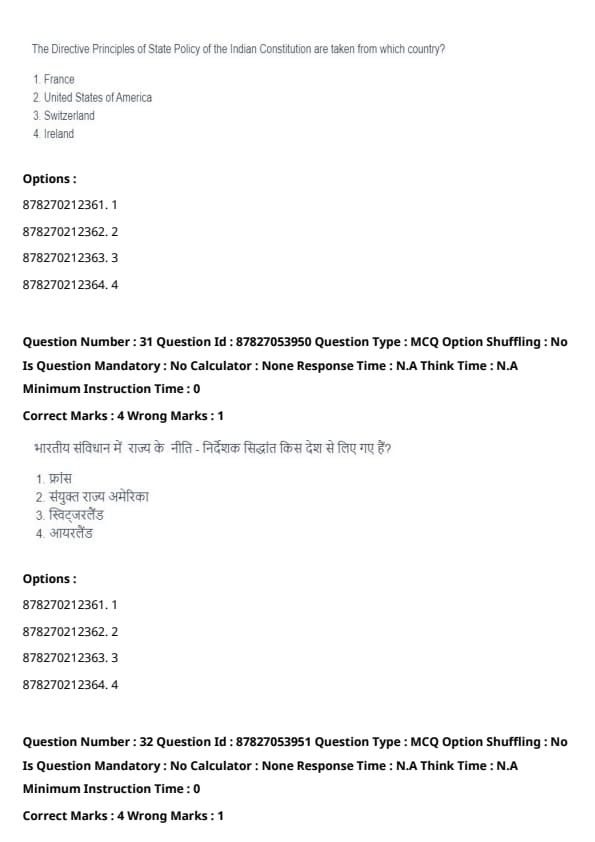
The Directive Principles of State Policy of the Indian Constitution are taken from which country?
View Solution
The Directive Principles of State Policy were borrowed from Ireland's Constitution, which was inspired by the principles of social justice in the Spanish Constitution. These principles aim to ensure socio-economic justice and provide guidelines for creating a welfare state in India.
Question 32:
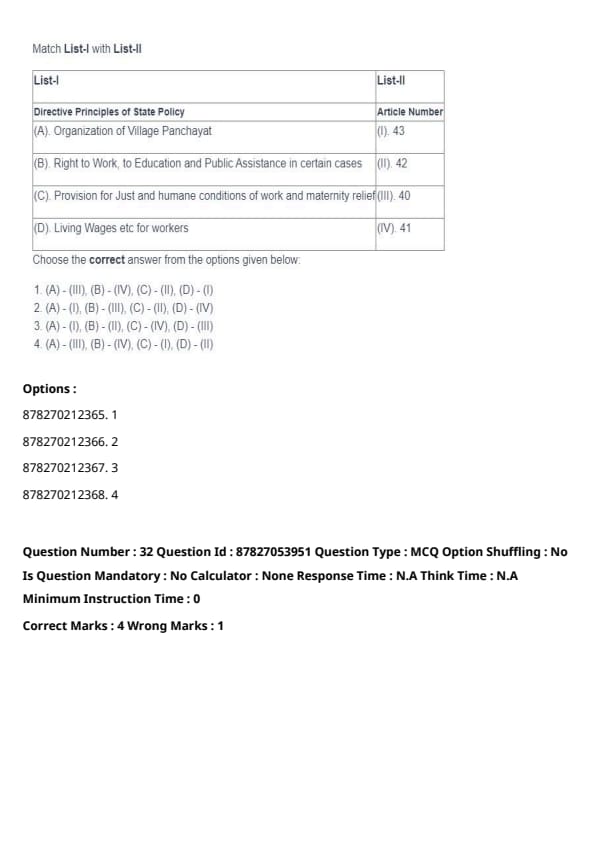
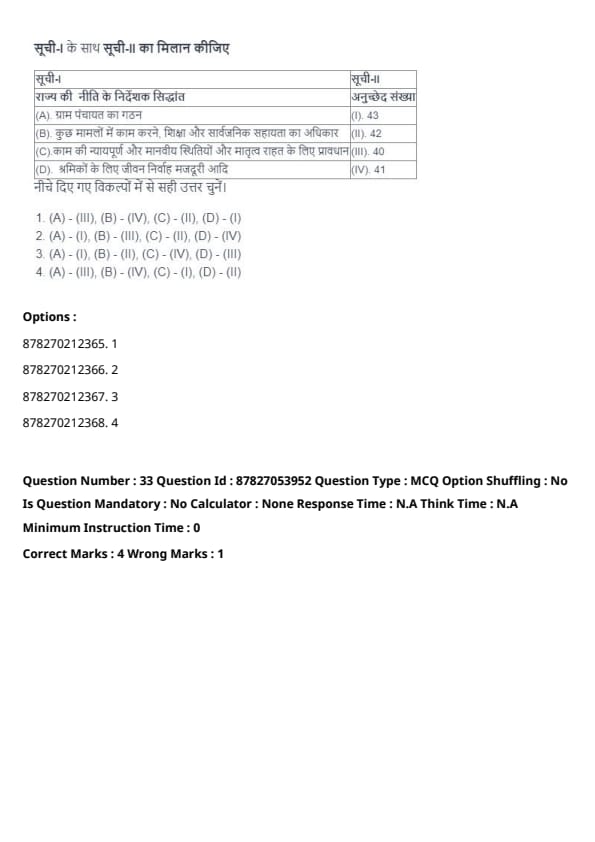
Match List-I with List-II:
| List-I (Directive Principles) | List-II (Article Number) |
|---|---|
| (A) Organization of Village Panchayat | (III) 40 |
| (B) Right to Work, to Education and Public Assistance in certain cases | (IV) 41 |
| (C) Provision for Just and humane conditions of work and maternity relief | (II) 42 |
| (D) Living Wages etc for workers | (I) 43 |
Choose the correct answer from the options given below:
View Solution
The correct matches are:
- Article 40: Organization of Village Panchayats.
- Article 41: Right to work, education, and public assistance in certain cases.
- Article 42: Provision for just and humane conditions of work and maternity relief.
- Article 43: Living wages and decent work conditions for workers.
Question 33:
According to Article 51-A of the Constitution of India, Fundamental Duties include:
(A) To abide by the Constitution and respect its ideals and institutions, the national flag and national anthem.
(B) To cherish and follow the noble ideals which inspired our national struggle for freedom.
(C) To uphold and protect the sovereignty, unity and integrity of India.
(D) To propagate the supremacy of his/her own culture over others.
Choose the correct answer from the options given below:
View Solution
Fundamental Duties include:
- To respect the Constitution, the national flag, and the national anthem.
- To cherish and follow the ideals of the freedom struggle.
- To uphold and protect India’s sovereignty, unity, and integrity.
These duties aim to promote patriotism and responsible citizenship.
Question 34:
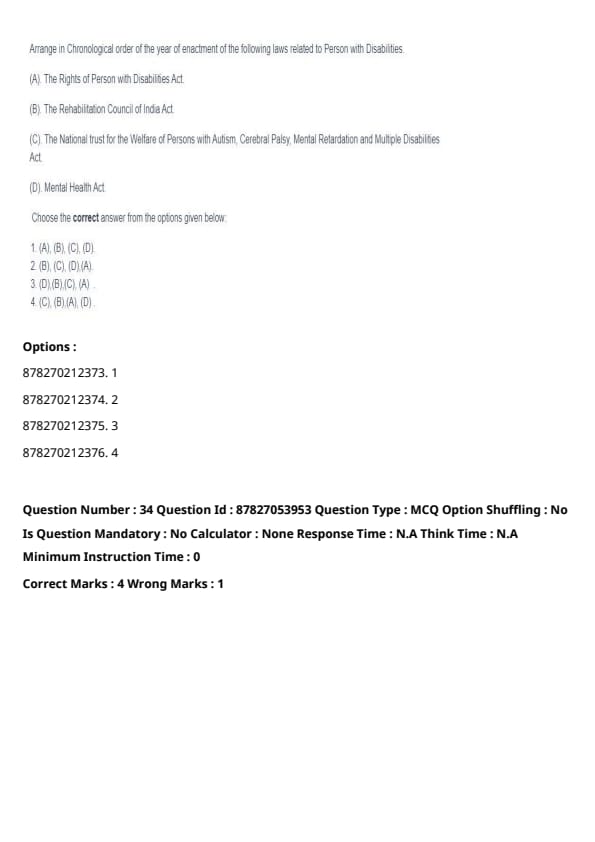
Arrange in Chronological order of the year of enactment of the following laws related to Persons with Disabilities:
(A) The Rights of Person with Disabilities Act.
(B) The Rehabilitation Council of India Act.
(C) The National Trust for the Welfare of Persons with Autism, Cerebral Palsy, Mental Retardation and Multiple Disabilities Act.
(D) Mental Health Act.
Choose the correct answer from the options given below:
View Solution
The chronological order is:
- Mental Health Act: 1987.
- Rehabilitation Council of India Act: 1992.
- National Trust Act: 1999.
- Rights of Persons with Disabilities Act: 2016.
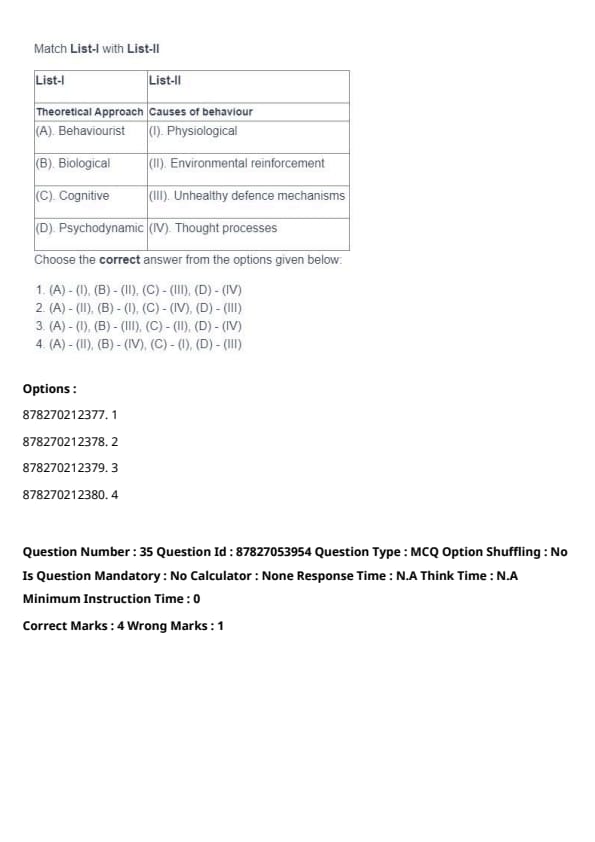
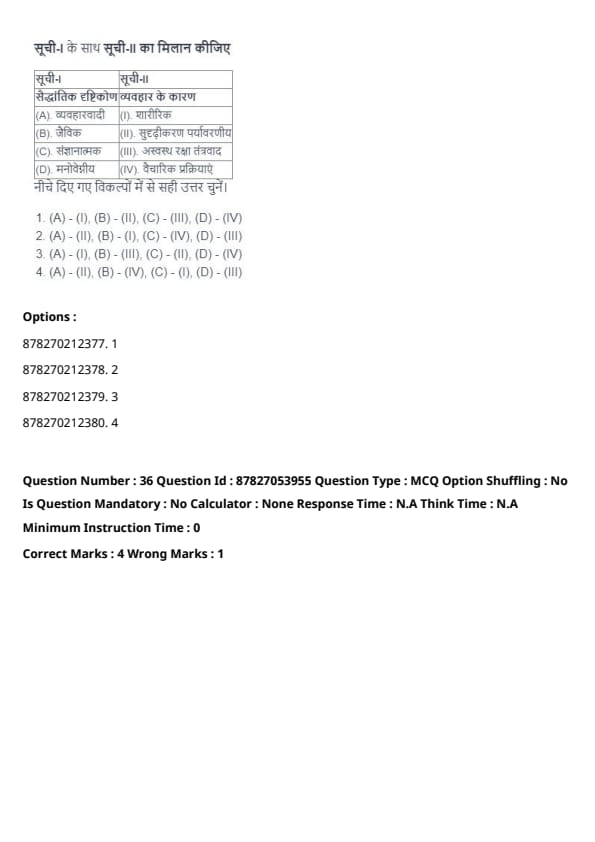
Question 35:
Match List-I with List-II:
| List-I (Theoretical Approach) | List-II (Causes of Behaviour) |
|---|---|
| (A) Behaviourist | (II) Environmental reinforcement |
| (B) Biological | (I) Physiological |
| (C) Cognitive | (IV) Thought processes |
| (D) Psychodynamic | (III) Unhealthy defence mechanisms |
Choose the correct answer from the options given below:
View Solution
The correct matching of theoretical approaches and causes of behavior is:
- Behaviourist: Focus on environmental reinforcement.
- Biological: Emphasis on physiological and genetic factors.
- Cognitive: Concentration on thought processes and mental activities.
- Psychodynamic: Stress on unconscious motives and unhealthy defense mechanisms.
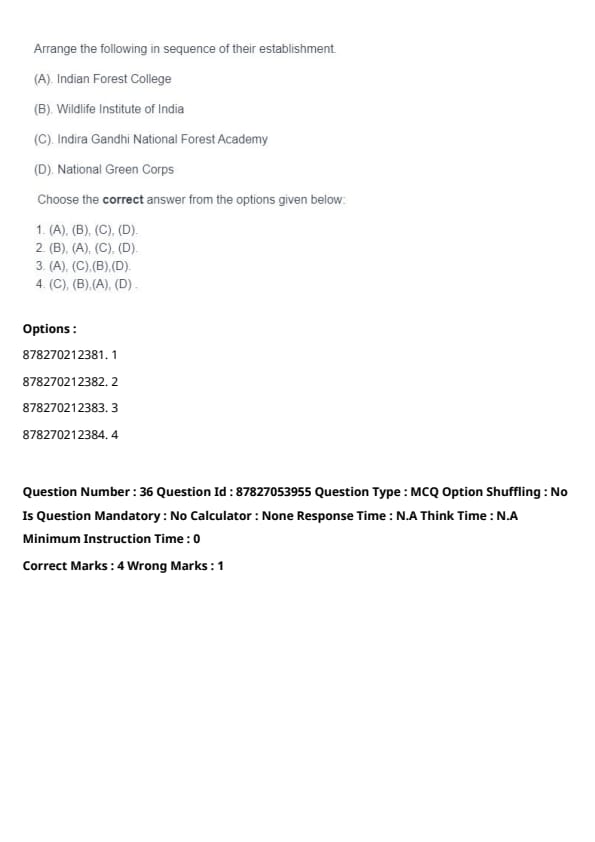
Question 36:
Arrange the following in sequence of their establishment:
(A) Indian Forest College
(B) Wildlife Institute of India
(C) Indira Gandhi National Forest Academy
(D) National Green Corps
Choose the correct answer from the options given below:
View Solution
The chronological order of establishment is as follows:
- Indian Forest College (1938): Established for training forest officers.
- Wildlife Institute of India (1982): Specializes in wildlife research and training.
- Indira Gandhi National Forest Academy (1987): Provides advanced training for Indian Forest Service officers.
- National Green Corps (2001): Promotes environmental awareness among school students.
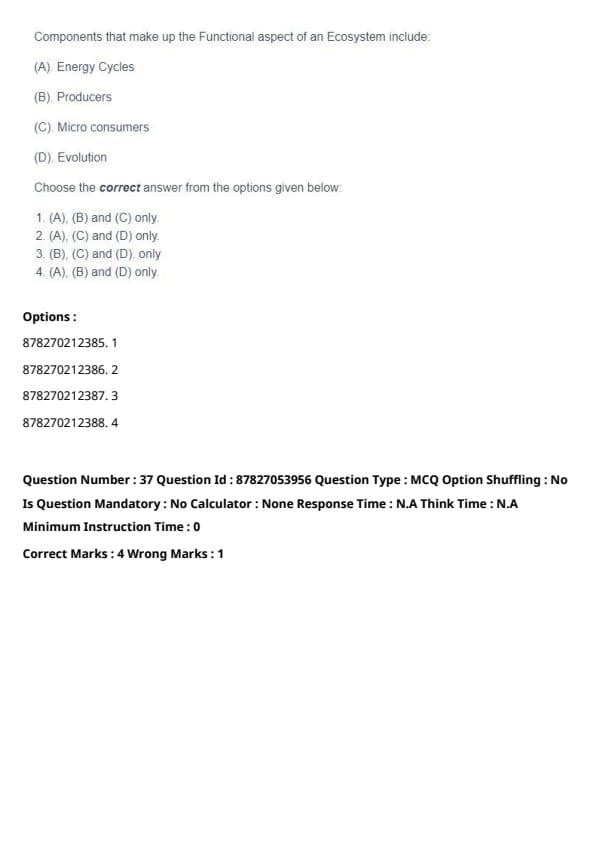
Question 37:
Components that make up the functional aspect of an ecosystem include:
(A) Energy Cycles
(B) Producers
(C) Micro consumers
(D) Evolution
Choose the correct answer from the options given below:
View Solution
The functional aspects of an ecosystem include:
- Energy Cycles: Movement of energy through food chains and webs.
- Producers: Organisms that synthesize energy via photosynthesis.
- Micro consumers: Decomposers that recycle nutrients in the ecosystem.
These components maintain ecological balance and sustainability.
Question 38:
Pollutants that are produced in the atmosphere when certain chemical reactions take place among primary pollutants are called _______:
View Solution
Secondary pollutants are formed when primary pollutants react with other chemicals in the atmosphere. Examples include:
- Ozone: Formed from reactions between volatile organic compounds (VOCs) and nitrogen oxides (NOx) under sunlight.
- Smog: A mixture of various secondary pollutants formed through complex reactions.
These pollutants significantly affect air quality and human health.
Question 39:
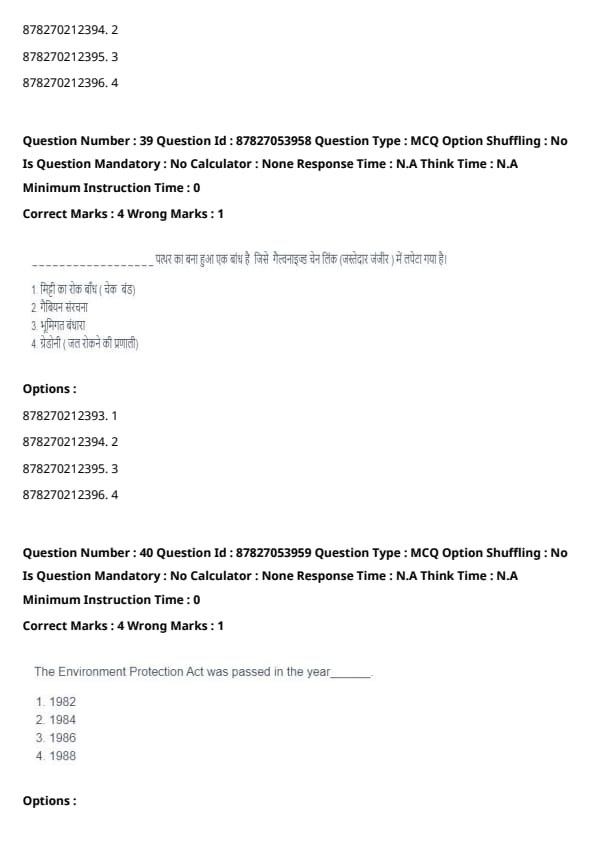
A/An _______ is a bund constructed of stone and wrapped in galvanized chain link:
View Solution
Gabion structures are wire mesh containers filled with stones and are used for:
- Erosion control: Stabilizing slopes and riverbanks.
- Water flow management: Reducing flood risks.
- Reinforcement: Supporting retaining walls and constructions.
These structures are cost-effective and environmentally friendly solutions for water and soil management.
Question 40:
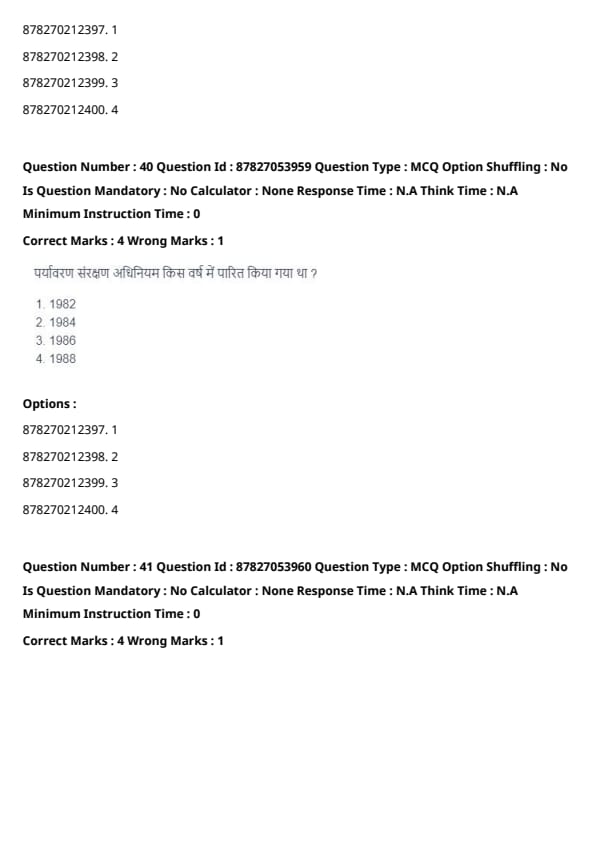
The Environment Protection Act was passed in the year _______:
View Solution
The Environment Protection Act of 1986 provides the legal framework for:
- Preventing environmental pollution.
- Setting environmental quality standards.
- Addressing environmental hazards.
This Act was enacted following the Bhopal gas tragedy to strengthen environmental governance and ensure a safer environment.
Question 41:
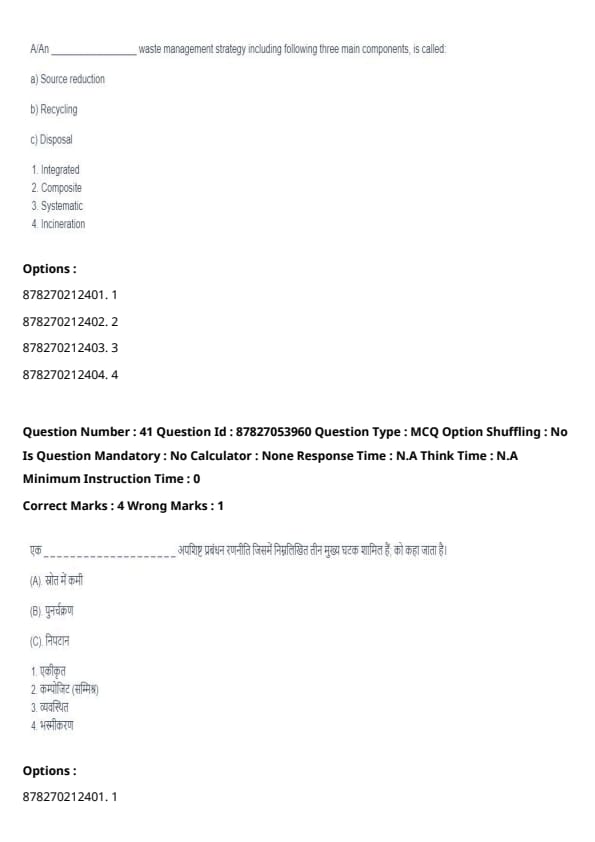
A/An _______ waste management strategy including the following three main components is called:
- (a) Source reduction
- (b) Recycling
- (c) Disposal
View Solution
Integrated waste management incorporates source reduction, recycling, and environmentally safe disposal. This strategy minimizes environmental impact and promotes sustainability.
Question 42:
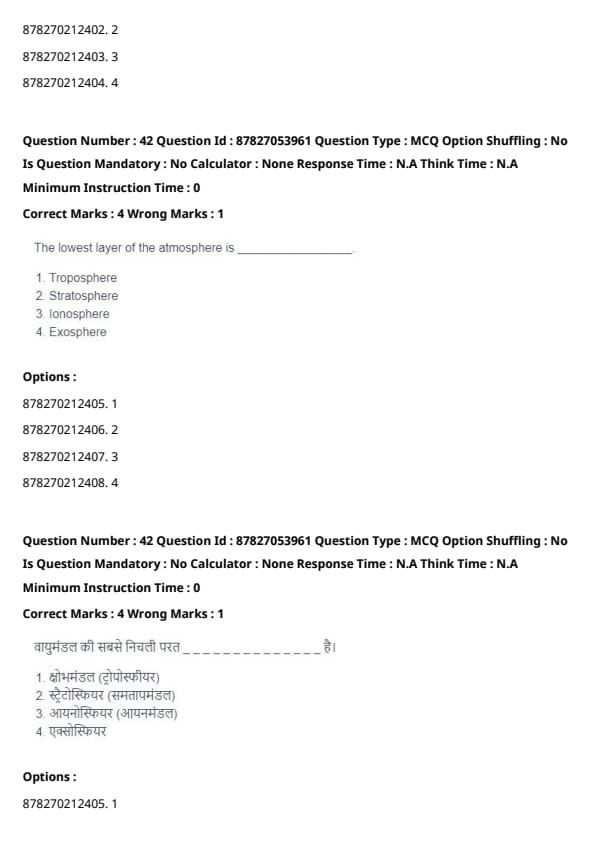
The lowest layer of the atmosphere is _______:
View Solution
The troposphere, extending up to 8–15 km above the surface, contains most of the atmosphere's mass and is where weather phenomena occur. It holds the air we breathe and regulates the climate.
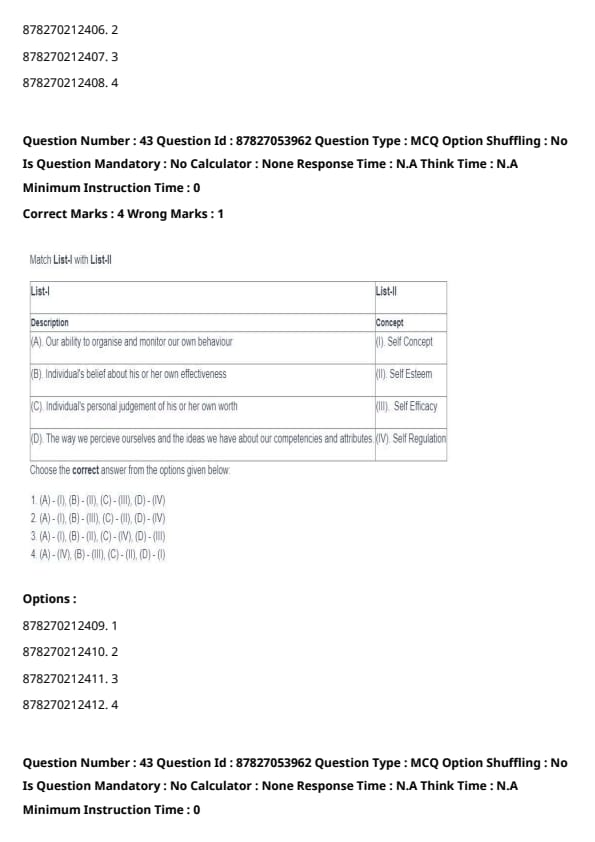
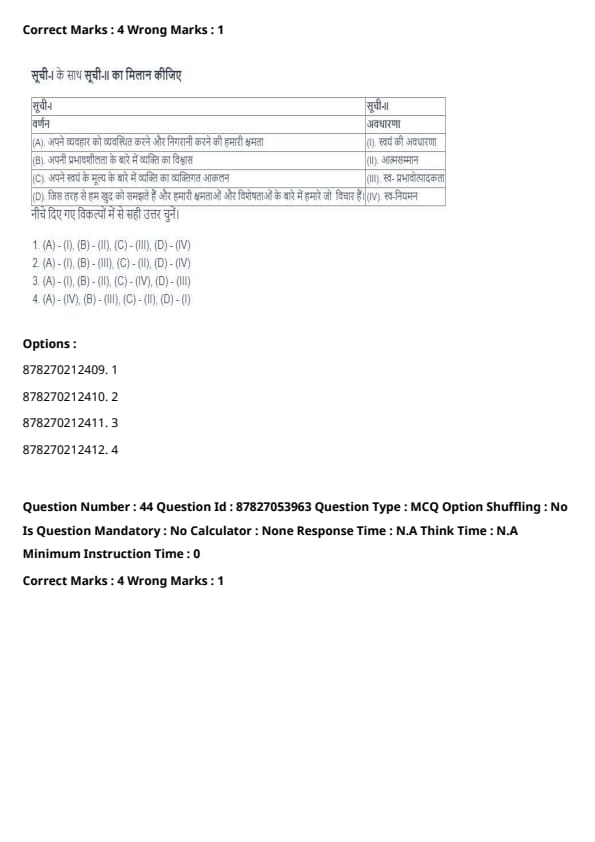
Question 43:
Match List-I with List-II:
| List-I (Description) | List-II (Concept) |
|---|---|
| (A) Our ability to organize and monitor our own behavior | (IV) Self Regulation |
| (B) Individual's belief about his or her own effectiveness | (III) Self Efficacy |
| (C) Individual's personal judgment of his or her own worth | (II) Self Esteem |
| (D) The way we perceive ourselves and the ideas we have about our competencies and attributes | (I) Self Concept |
Choose the correct answer from the options given below:
View Solution
The correct matching aligns psychological concepts with their descriptions:
- Self-Regulation: Monitoring and organizing behavior to achieve goals.
- Self-Efficacy: Belief in one's effectiveness in achieving outcomes.
- Self-Esteem: Personal judgment of worth and value.
- Self-Concept: Perception and understanding of one's attributes and competencies.
Question 44:
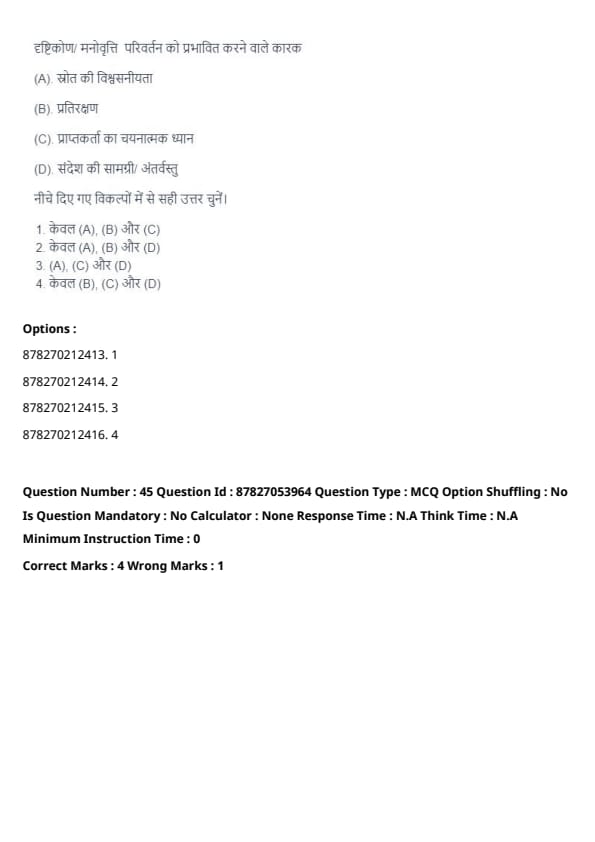
Factors influencing Attitude Change are:
(A) Credibility of Source
(B) Immunization
(C) Selective attention of receiver
(D) Content of message
Choose the correct answer from the options given below:
View Solution
Factors influencing attitude change include:
- Credibility of the Source: Trustworthy and knowledgeable sources are more persuasive.
- Selective Attention of Receiver: Audiences focus on specific aspects that align with their interests.
- Content of the Message: Clear and compelling messages are more likely to induce change.
Immunization does not impact attitude change.
Question 45:
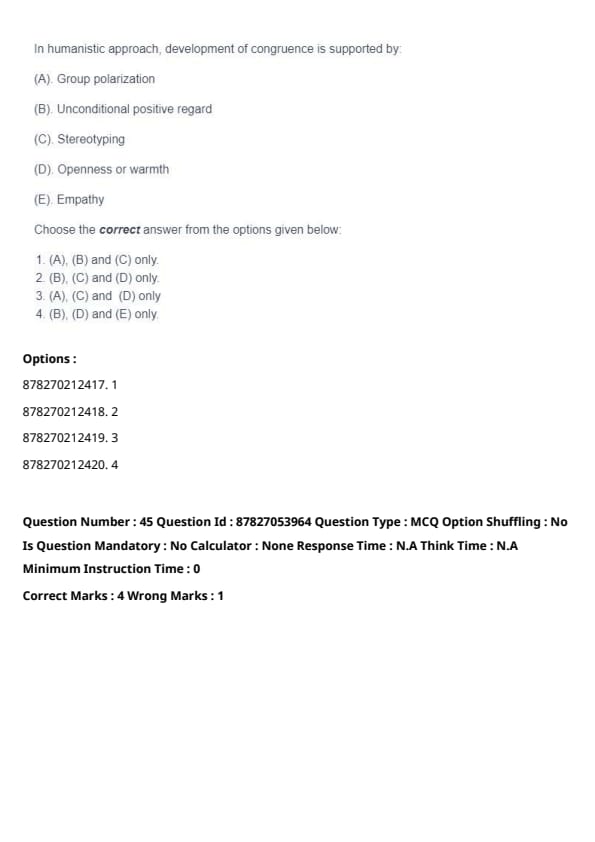
In humanistic approach, development of congruence is supported by:
(A) Group polarization
(B) Unconditional positive regard
(C) Stereotyping
(D) Openness or warmth
(E) Empathy
Choose the correct answer from the options given below:
View Solution
According to Carl Rogers' humanistic theory, congruence is supported by:
- Unconditional Positive Regard: Accepting individuals without judgment.
- Openness or Warmth: Creating a safe and accepting environment.
- Empathy: Understanding and sharing the feelings of others.
These factors foster alignment between one's ideal self and actual self.
Question 46:
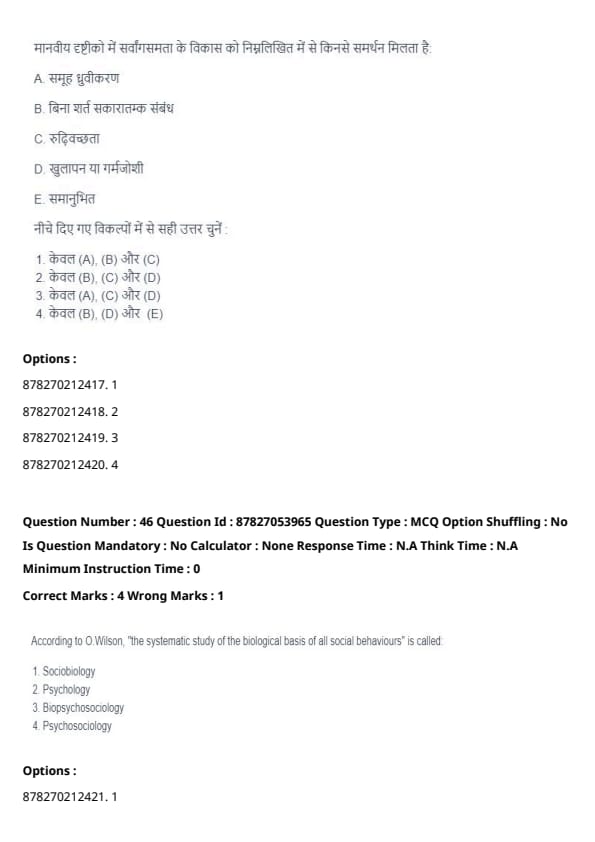
According to O. Wilson, “the systematic study of the biological basis of all social behaviours" is called:
View Solution
Edward O. Wilson defined sociobiology as the systematic study of the biological basis of all social behavior. It explores how evolutionary principles shape social behaviors in humans and other species.
Question 47:
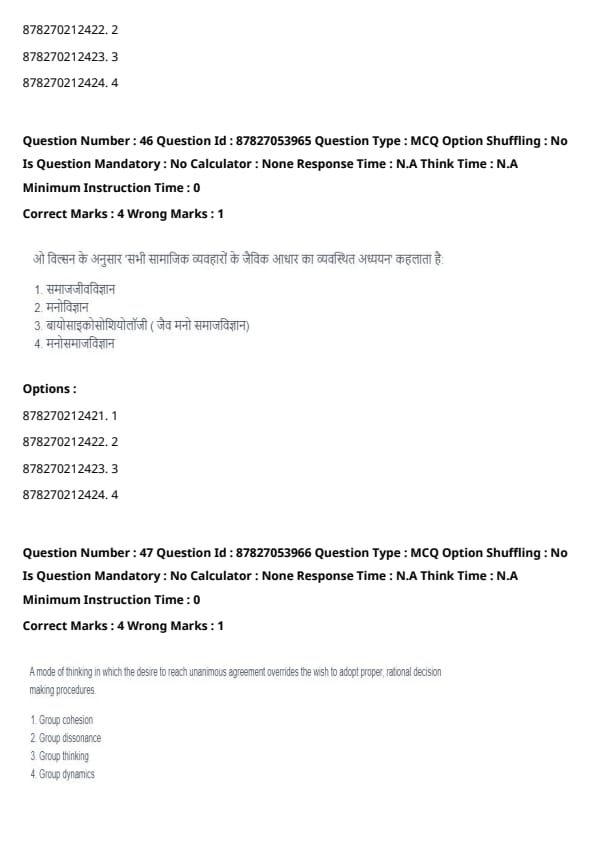
A mode of thinking in which the desire to reach unanimous agreement overrides the wish to adopt proper, rational decision-making procedures is called:
View Solution
Groupthink occurs when a group prioritizes consensus over critical evaluation, leading to poor decision-making. Symptoms include suppression of dissent and the illusion of unanimity. Encouraging open dialogue can mitigate groupthink.
Question 48:
A therapeutic approach developed by Carl Rogers in which the therapist helps clients to clarify their true feelings and come to value who they are is called:
View Solution
Client-Centered Therapy, developed by Carl Rogers, emphasizes:
- Unconditional Positive Regard: Acceptance without judgment.
- Empathy: Understanding clients' perspectives.
- Congruence: Authentic communication by the therapist.
This approach helps individuals explore their potential and achieve personal growth.
Question 49:
A form of behaviour modification using the principles of counterconditioning and reciprocal inhibition is called:
View Solution
Systematic Desensitization, developed by Joseph Wolpe, is used to reduce phobias and anxiety by:
- Gradual exposure to anxiety-inducing stimuli.
- Teaching relaxation techniques to counteract fear responses.
This method is grounded in classical conditioning and reciprocal inhibition principles.
Question 50:
A term that refers to “venting an emotion” or “getting it out of one's system,” which may sometimes be useful in lessening aggression, fear, or anxiety, is:
View Solution
Catharsis is the process of releasing suppressed emotions to achieve emotional relief. Introduced in psychoanalytic theory by Sigmund Freud, it helps individuals confront and process emotions in therapeutic settings.
Question 51:
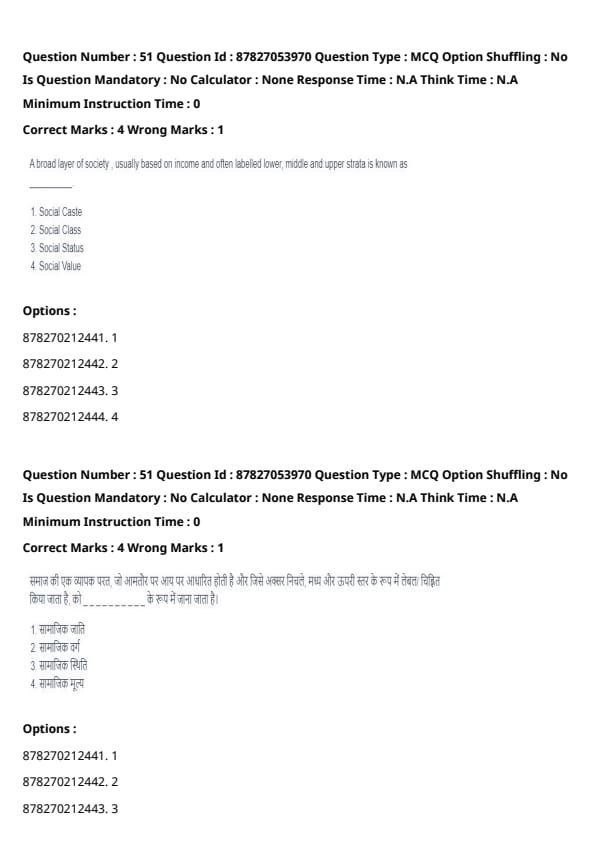
A broad layer of society, usually based on income and often labelled lower, middle and upper strata, is known as:
View Solution
Social class refers to a division within society based on economic factors like income, wealth, and occupation. It categorizes individuals or groups into lower, middle, and upper classes, influencing access to resources and opportunities.
Question 52:
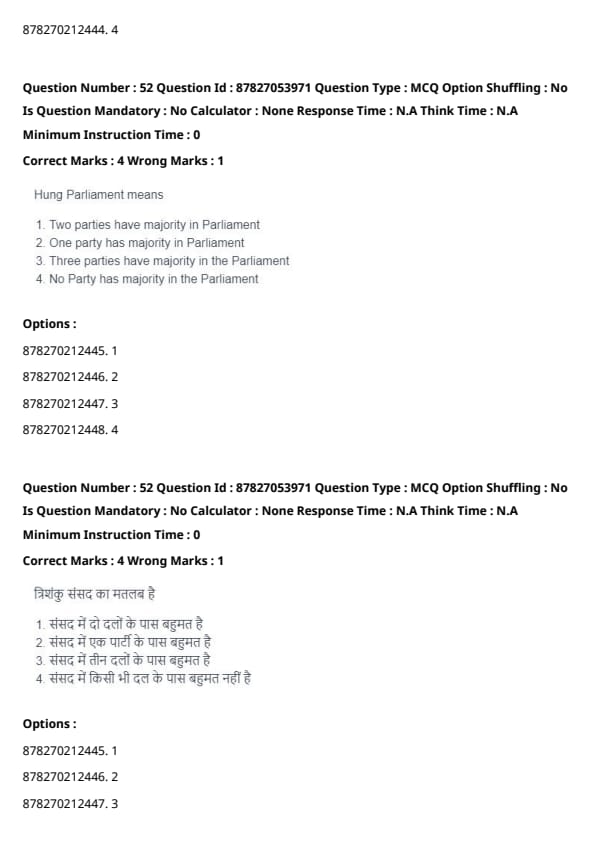
Hung Parliament means:
View Solution
A hung parliament occurs when no political party wins a clear majority in the legislature. This often results in coalition governments or minority administrations, requiring collaboration among parties to form a government.
Question 53:
Who is associated with the Narmada Bachao Andolan?
View Solution
Medha Patkar is the prominent leader of the Narmada Bachao Andolan, a movement opposing the construction of large dams on the Narmada River due to their environmental and social impacts, particularly the displacement of local communities.
Question 54:
The political theory that individuals join and stay in civil society as if they had signed a contract is known as:
View Solution
Social contract theory, developed by Hobbes, Locke, and Rousseau, posits that individuals consent to form a society and government for mutual protection and benefit. This theory underpins modern democratic systems.
Question 55:
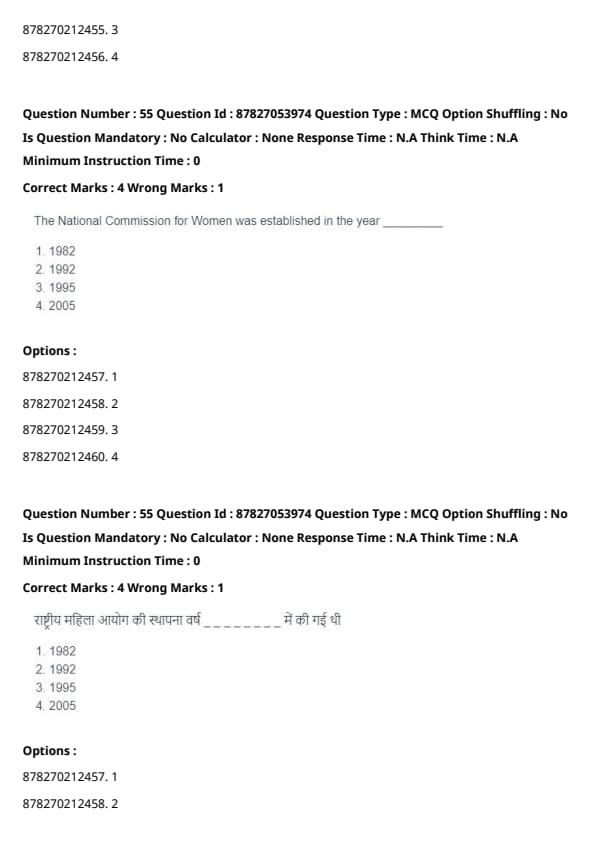
The National Commission for Women was established in the year _______:
View Solution
The National Commission for Women (NCW) was established in 1992 as a statutory body to promote and safeguard the rights and welfare of women in India. It investigates issues of gender discrimination and advises the government on policy reforms.
Question 56:
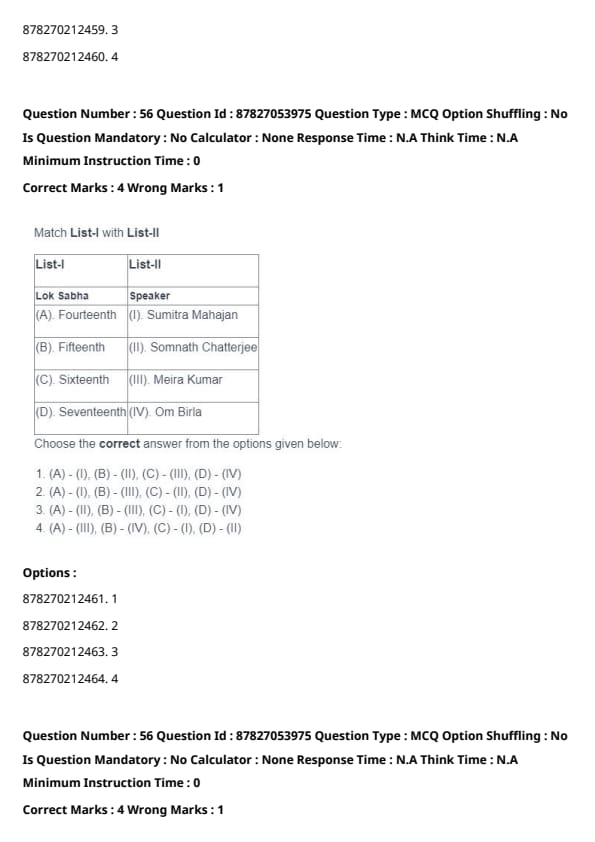
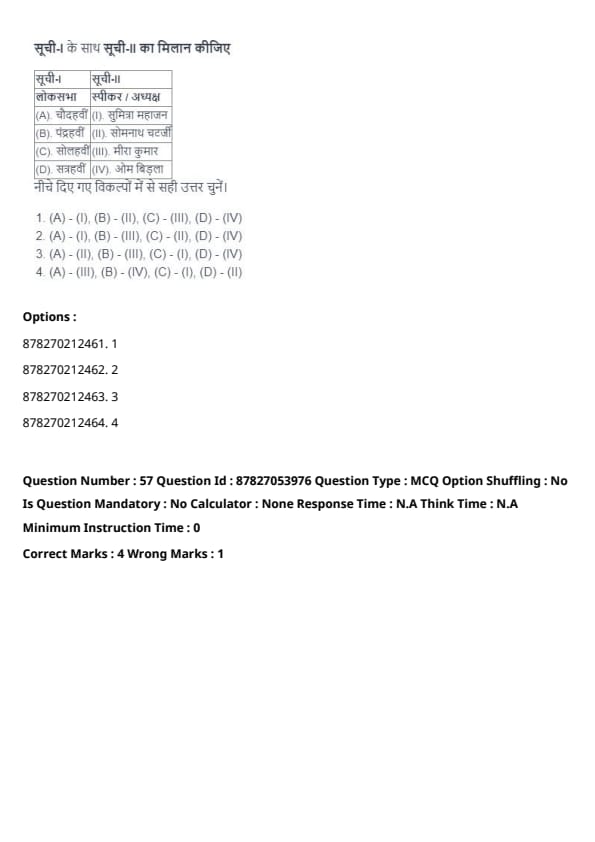
Match List-I with List-II:
| List-I (Lok Sabha) | List-II (Speaker) |
|---|---|
| (A) Fourteenth | (II) Somnath Chatterjee |
| (B) Fifteenth | (III) Meira Kumar |
| (C) Sixteenth | (I) Sumitra Mahajan |
| (D) Seventeenth | (IV) Om Birla |
Choose the correct answer from the options given below:
View Solution
The correct matches align the Lok Sabha sessions with their respective Speakers:
- Fourteenth Lok Sabha: Somnath Chatterjee
- Fifteenth Lok Sabha: Meira Kumar
- Sixteenth Lok Sabha: Sumitra Mahajan
- Seventeenth Lok Sabha: Om Birla
Question 57:
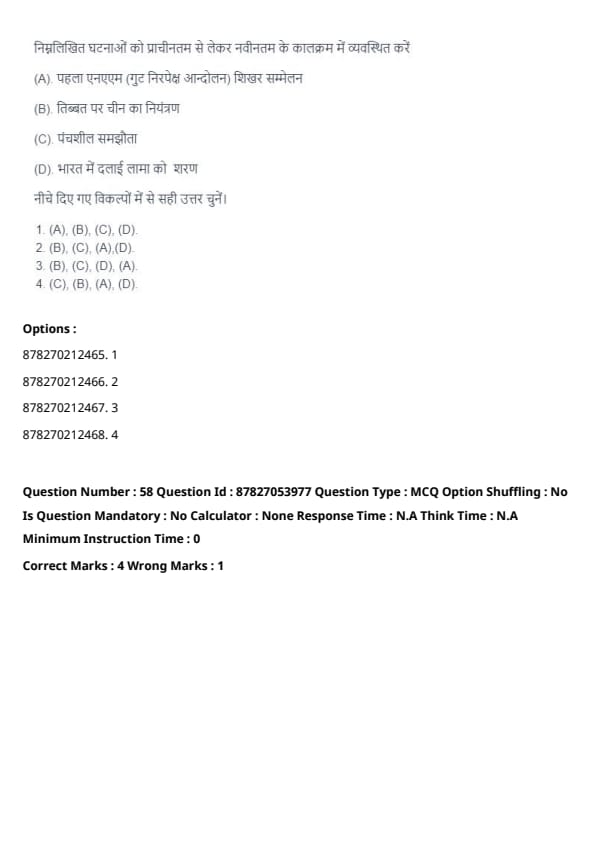
Arrange the following in order of occurrence from earliest to latest:
(A) First NAM Summit
(B) China's Control over Tibet
(C) Panchsheel Agreement
(D) Asylum of Dalai Lama in India
Choose the correct answer from the options given below:
View Solution
The chronological sequence is as follows:
- China's Control over Tibet (1950).
- Panchsheel Agreement (1954).
- First NAM Summit (1961).
- Asylum of Dalai Lama in India (1959).
Question 58:
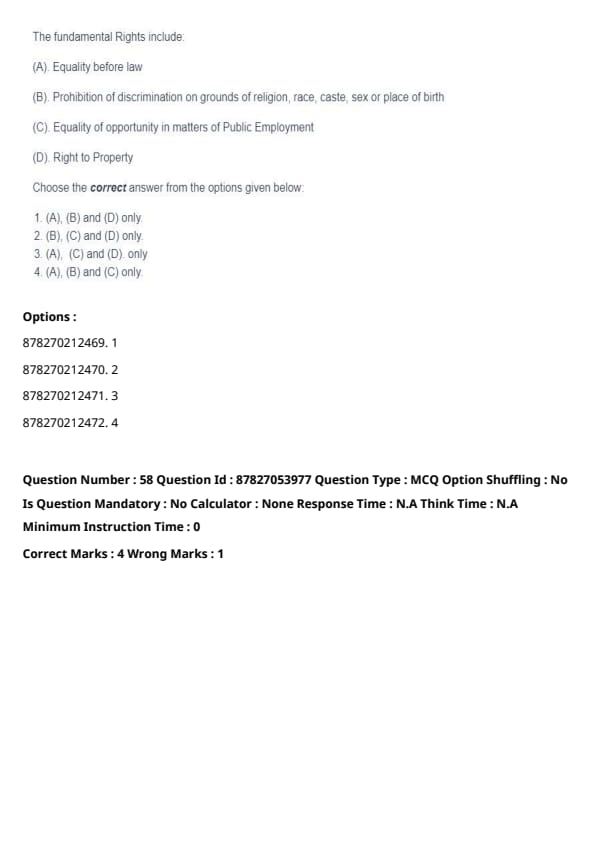
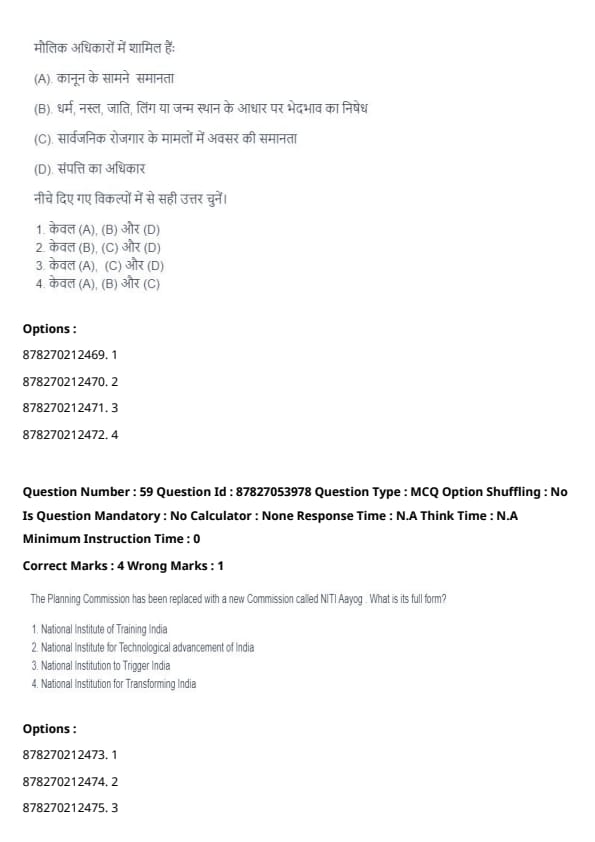
The fundamental rights include:
(A) Equality before law
(B) Prohibition of discrimination on grounds of religion, race, caste, sex or place of birth
(C) Equality of opportunity in matters of public employment
(D) Right to Property
Choose the correct answer from the options given below:
View Solution
The fundamental rights enshrined in the Indian Constitution include:
- Equality before law (Article 14): Ensures equal treatment under the law.
- Prohibition of discrimination (Article 15): Prevents discrimination based on religion, race, caste, sex, or place of birth.
- Equality of opportunity (Article 16): Guarantees equal opportunity in public employment.
The Right to Property was removed from the fundamental rights list by the 44th Amendment Act, 1978.
Question 59:
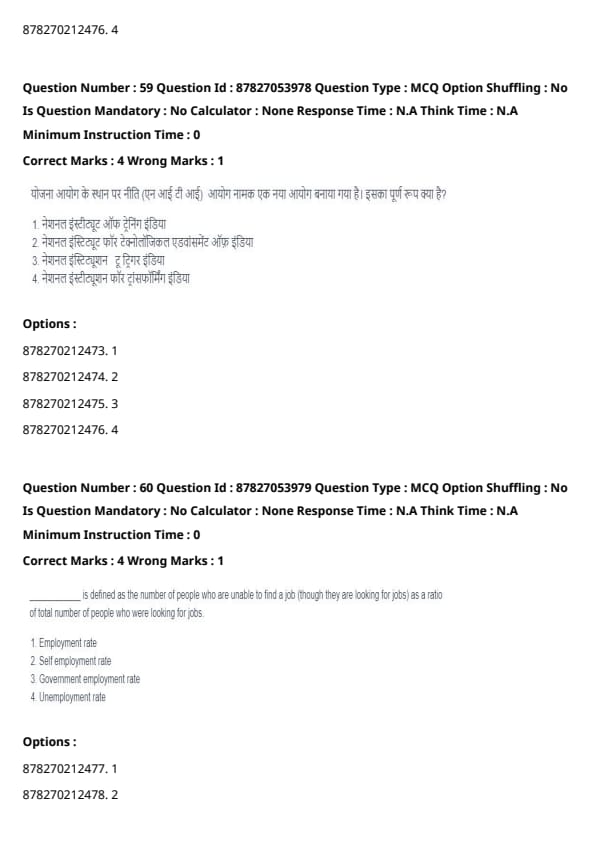
The Planning Commission has been replaced with a new Commission called NITI Aayog. What is its full form?
View Solution
NITI Aayog, established in 2015, replaced the Planning Commission to foster cooperative federalism. It emphasizes strategic policy-making, decentralized planning, and aligning with sustainable development goals.
Question 60:
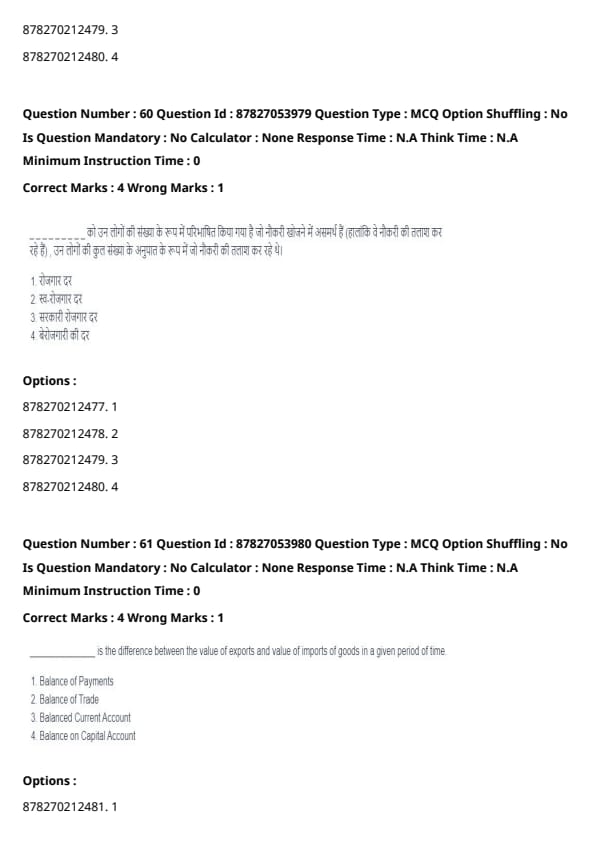
_______ is defined as the number of people who are unable to find a job (though they are looking for jobs) as a ratio of the total number of people who were looking for jobs:
View Solution
The unemployment rate is an economic indicator representing the percentage of people in the labor force who are actively looking for jobs but unable to find one. It reflects the health of the economy and workforce utilization.
Question 61:
_______ is the difference between the value of exports and the value of imports of goods in a given period of time:
View Solution
The balance of trade is a key economic indicator reflecting the difference between a country's exports and imports of goods. A trade surplus occurs when exports exceed imports, while a trade deficit occurs when imports exceed exports.
Question 62:
_______ was launched in May 2015 to address the longevity risks among workers in the unorganized sector who are not covered under any statutory social security scheme:
View Solution
The Atal Pension Yojana is a government-backed pension scheme aimed at providing a fixed monthly pension after retirement to workers in the unorganized sector. It encourages savings for old age and offers benefits based on contributions made during working years.
Question 63:
_______ is the single comprehensive indirect tax, operational from 1 July 2017, on the supply of goods and services right from the manufacturer/service provider to the consumer:
View Solution
The Goods and Services Tax (GST) is a landmark reform in India's tax structure, subsuming multiple indirect taxes such as VAT, excise duty, and service tax. GST simplifies tax compliance and promotes a uniform tax regime, fostering ease of doing business.
Question 64:
Economic exchanges without the mediation of money are referred to as _______:
View Solution
Barter exchanges involve the direct trade of goods and services without using money. It is one of the oldest forms of trade, requiring a double coincidence of wants, meaning both parties must have what the other desires.
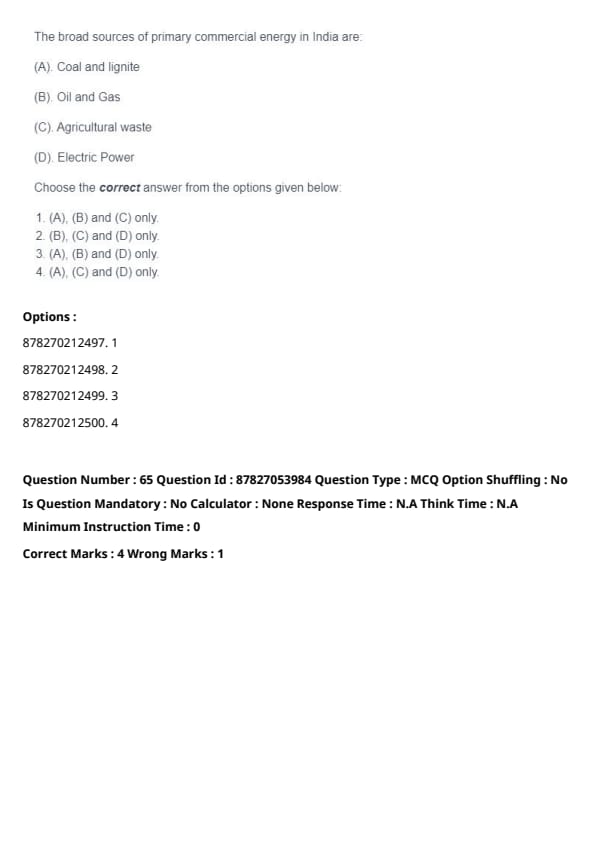
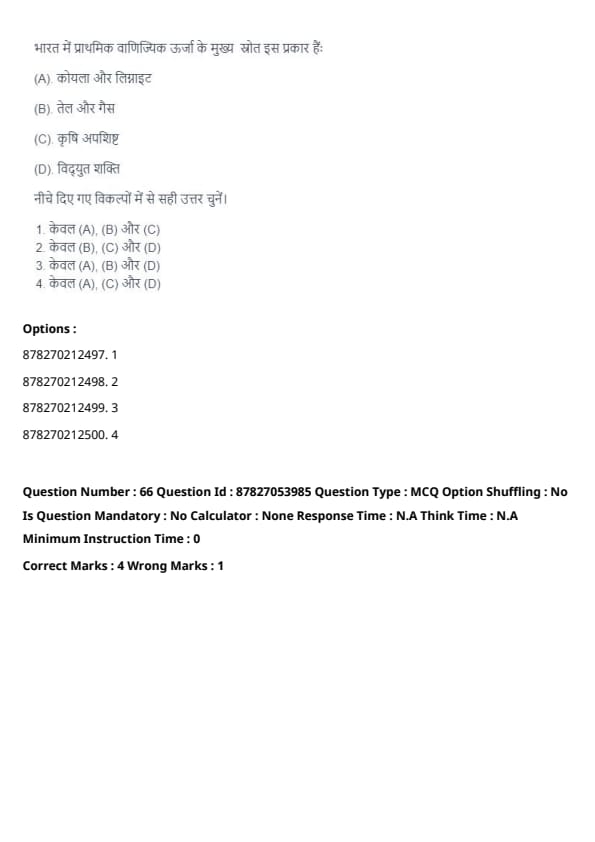
Question 65:
The broad sources of primary commercial energy in India are:
(A) Coal and lignite
(B) Oil and Gas
(C) Agricultural waste
(D) Electric Power
Choose the correct answer from the options given below:
View Solution
India's primary commercial energy sources include:
- Coal and lignite: The dominant source of energy, used extensively in power generation.
- Oil and gas: Essential for transportation and industrial sectors.
- Electric power: Generated through conventional (thermal, hydropower) and non-conventional (solar, wind) means.
Agricultural waste is not considered primary commercial energy.
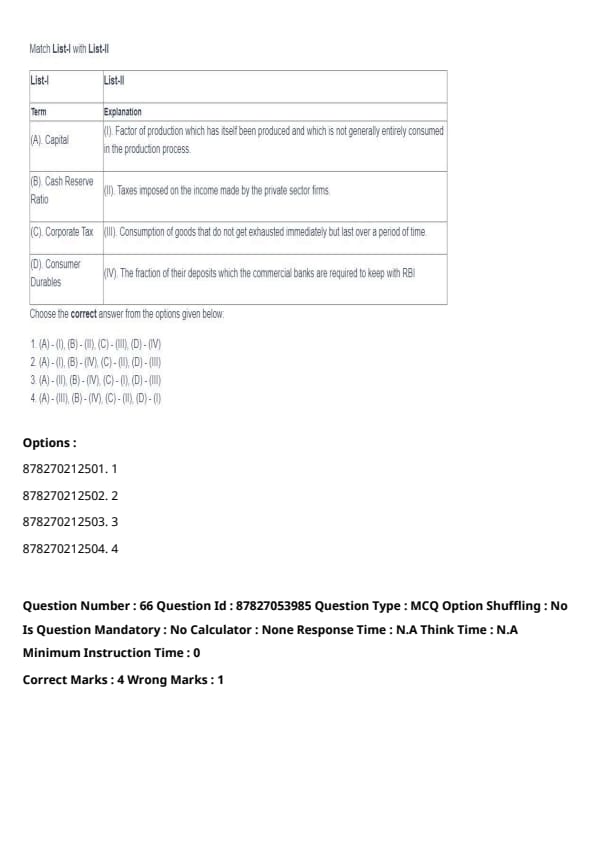
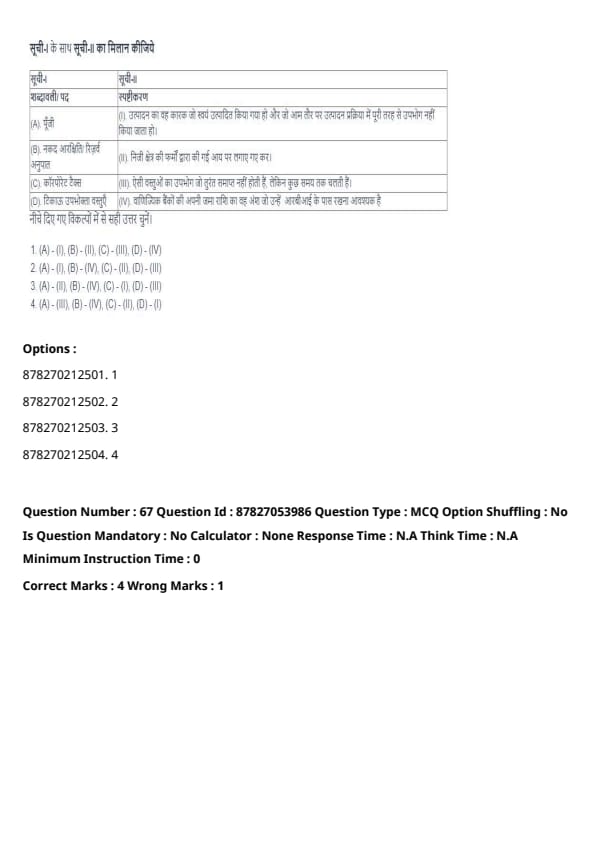
Question 66:
Match List-I with List-II:
| List-I (Term) | List-II (Explanation) |
|---|---|
| (A) Capital | (I) Factor of production which has itself been produced and which is not generally entirely consumed in the production process. |
| (B) Cash Reserve Ratio | (II) The fraction of their deposits which the commercial banks are required to keep with RBI. |
| (C) Corporate Tax | (III) Taxes imposed on the income made by the private sector firms. |
| (D) Consumer Durables | (IV) Consumption of goods that do not get exhausted immediately but last over a period of time. |
Choose the correct answer from the options given below:
View Solution
This matching defines key economic terms:
- Capital: A produced factor of production.
- Cash Reserve Ratio (CRR): The portion of deposits that banks must maintain with the Reserve Bank of India.
- Corporate Tax: Taxes on private sector firms' income.
- Consumer Durables: Long-lasting goods consumed over time.
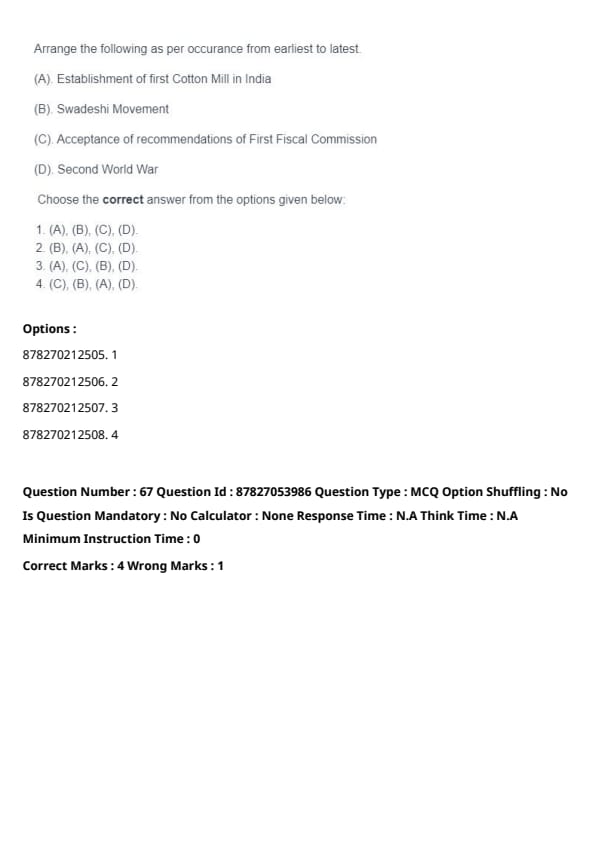
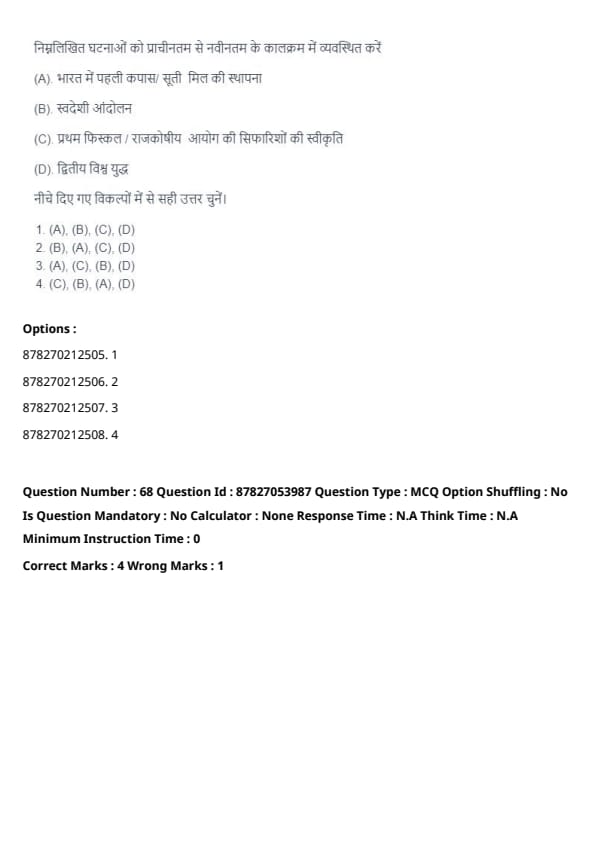
Question 67:
Arrange the following as per occurrence from earliest to latest:
- (A) Establishment of first Cotton Mill in India
- (B) Swadeshi Movement
- (C) Acceptance of recommendations of First Fiscal Commission
- (D) Second World War
Choose the correct answer from the options given below:
View Solution
The chronological order of events is:
- The first Cotton Mill in India: Established in 1854.
- Swadeshi Movement: Began in 1905 as part of the freedom struggle.
- First Fiscal Commission Recommendations: Accepted in 1921.
- Second World War: Took place from 1939 to 1945.
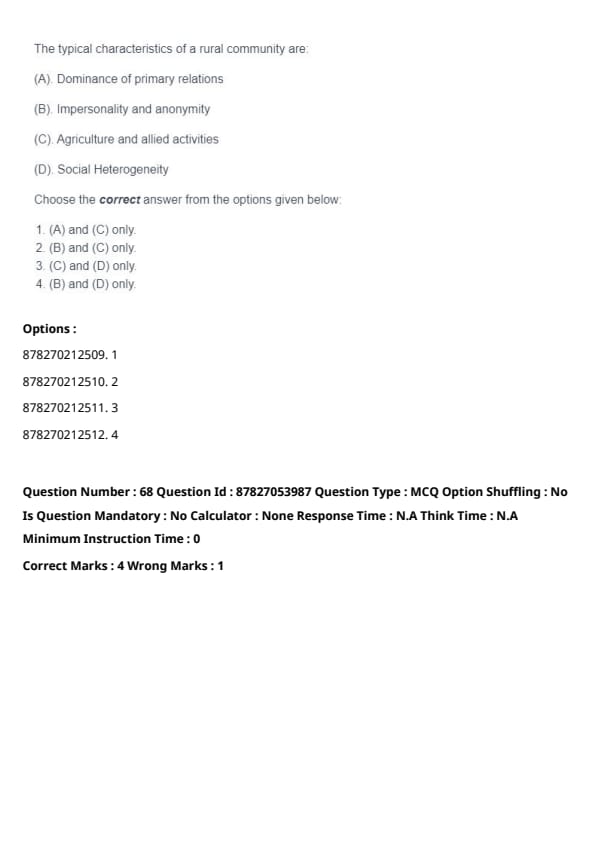
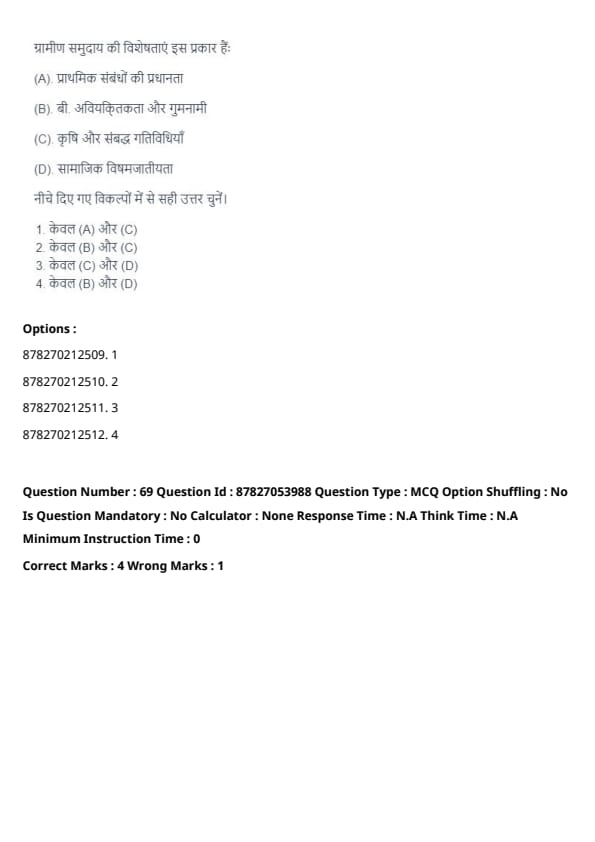
Question 68:
The typical characteristics of a rural community are:
- (A) Dominance of primary relations
- (B) Impersonality and anonymity
- (C) Agriculture and allied activities
- (D) Social Heterogeneity
Choose the correct answer from the options given below:
View Solution
Rural communities are characterized by:
- Dominance of primary relations: Close personal relationships within the community.
- Agriculture and allied activities: The main livelihood for most rural populations.
Question 69:
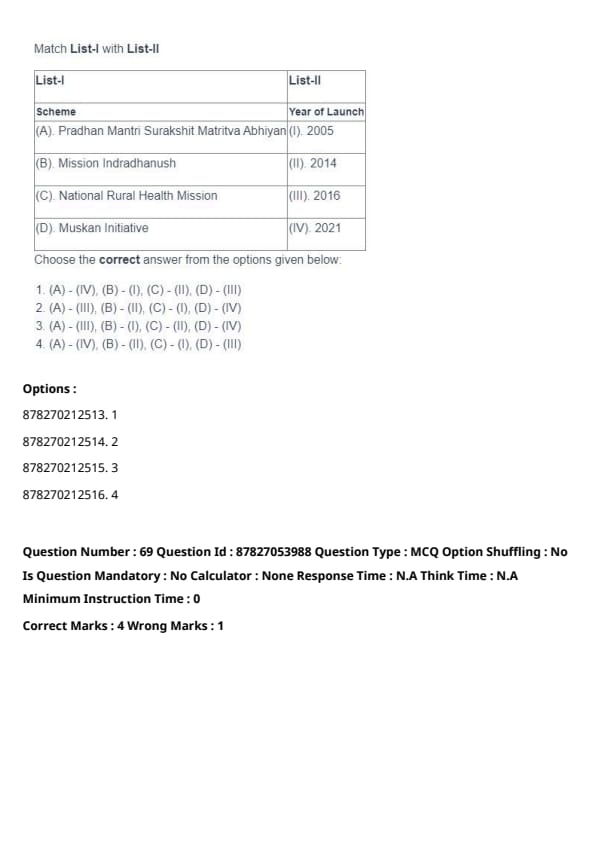
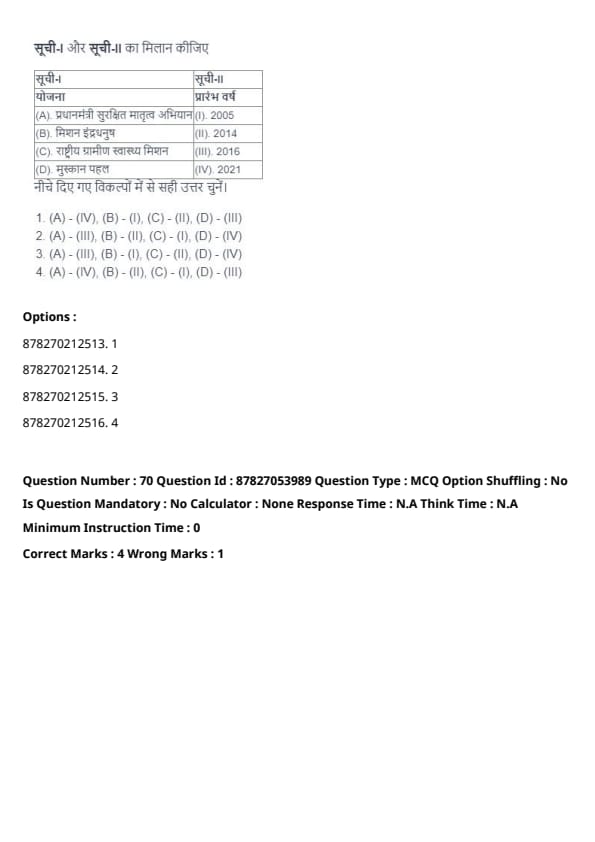
Match List-I with List-II:
| List-I (Scheme) | List-II (Year of Launch) |
|---|---|
| (A) Pradhan Mantri Surakshit Matritva Abhiyan | (I) 2005 |
| (B) Mission Indradhanush | (II) 2014 |
| (C) National Rural Health Mission | (III) 2016 |
| (D) Muskan Initiative | (IV) 2021 |
Choose the correct answer from the options given below:
View Solution
Key healthcare initiatives and their respective launch years:
- Pradhan Mantri Surakshit Matritva Abhiyan: 2016
- Mission Indradhanush: 2014
- National Rural Health Mission: 2005
- Muskan Initiative: 2021
Question 70:
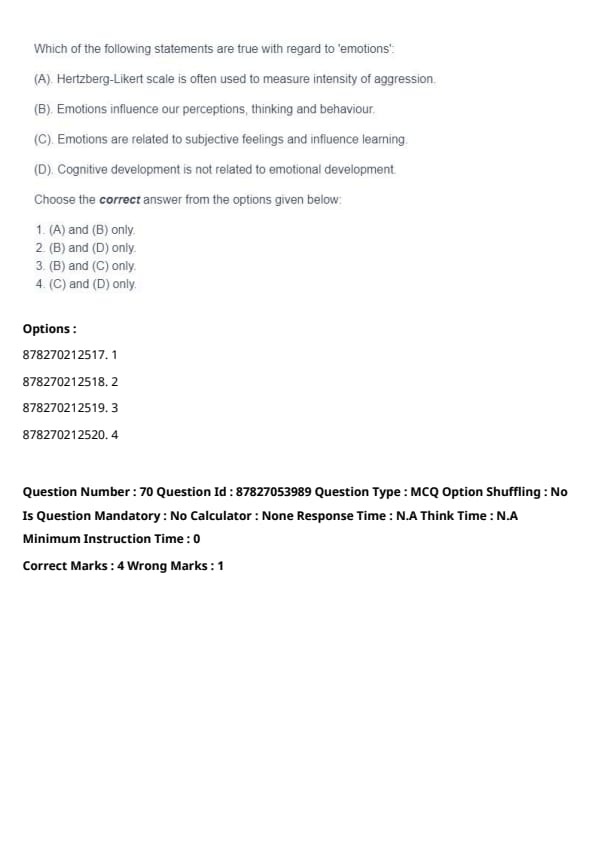
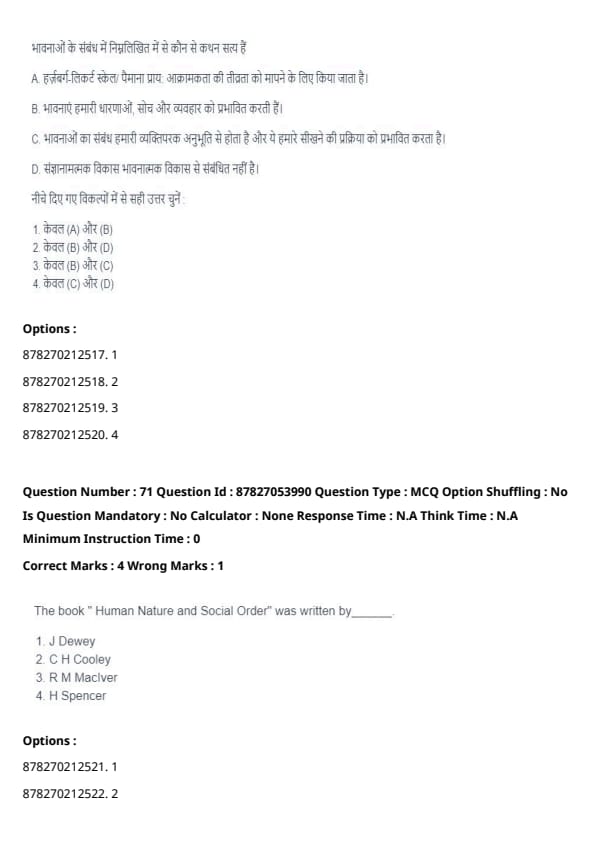
Which of the following statements are true with regard to “emotions":
- (A) Hertzberg-Likert scale is often used to measure intensity of aggression.
- (B) Emotions influence our perceptions, thinking and behaviour.
- (C) Emotions are related to subjective feelings and influence learning.
- (D) Cognitive development is not related to emotional development.
Choose the correct answer from the options given below:
View Solution
Emotions significantly impact:
- Perception, thinking, and behavior: Emotions influence decision-making and actions.
- Learning processes: Emotions motivate and enhance focus.
Emotional and cognitive development are interrelated, and Hertzberg-Likert scale is not used for measuring aggression intensity.
Question 71:
The book “Human Nature and Social Order" was written by:
View Solution
Charles Horton Cooley, an American sociologist, authored the book "Human Nature and Social Order." He emphasized the role of society in shaping individual identity through social interaction. Cooley’s concept of the “looking-glass self” is foundational in understanding how individuals form their self-image based on others' perceptions.
Question 72:
An arrangement of practices and behaviour on which members of the society base their daily lives is called:
View Solution
Social order refers to the system of norms, values, and practices that organize and regulate human behavior to maintain stability and predictability within a society. This includes laws, customs, and social institutions that foster cooperation and prevent chaos.
Question 73:
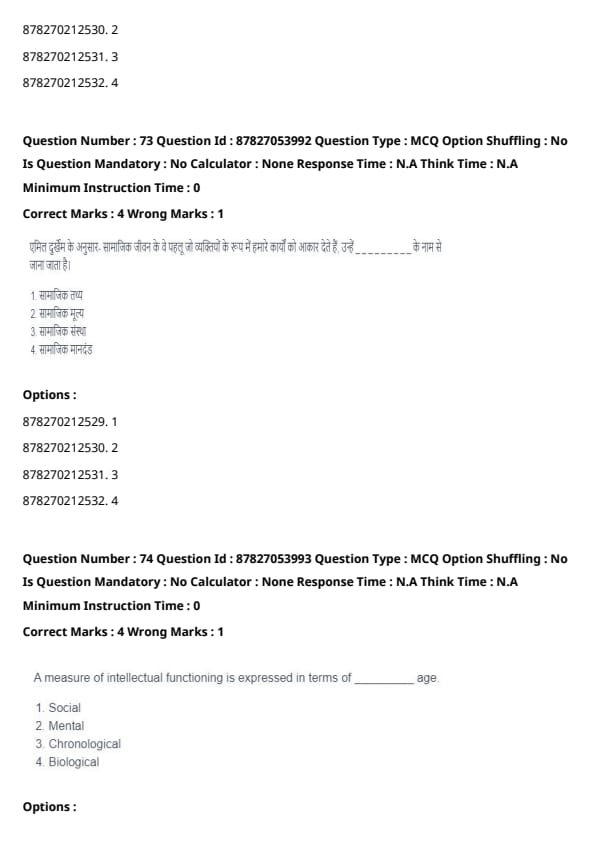
According to Emile Durkheim - Those aspects of social life that shape our actions as individuals are known as:
View Solution
Emile Durkheim, a prominent sociologist, defined social facts as external constraints imposed on individuals by society, such as laws, norms, and cultural expectations. These forces are independent of individual wills but shape collective behavior and maintain social cohesion.
Question 74:
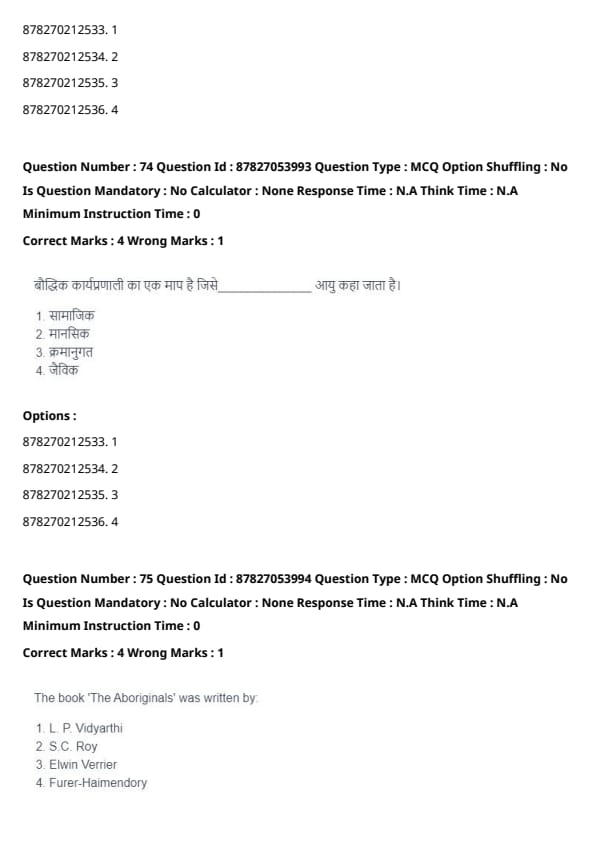
A measure of intellectual functioning is expressed in terms of \_\_\_\_\_\_ age:
View Solution
Mental age is an individual's cognitive ability compared to the average cognitive level of their chronological age group. It is a concept used to evaluate intellectual functioning and is a key component in calculating the Intelligence Quotient (IQ), where:
IQ = (Mental Age / Chronological Age) × 100.
Question 75:
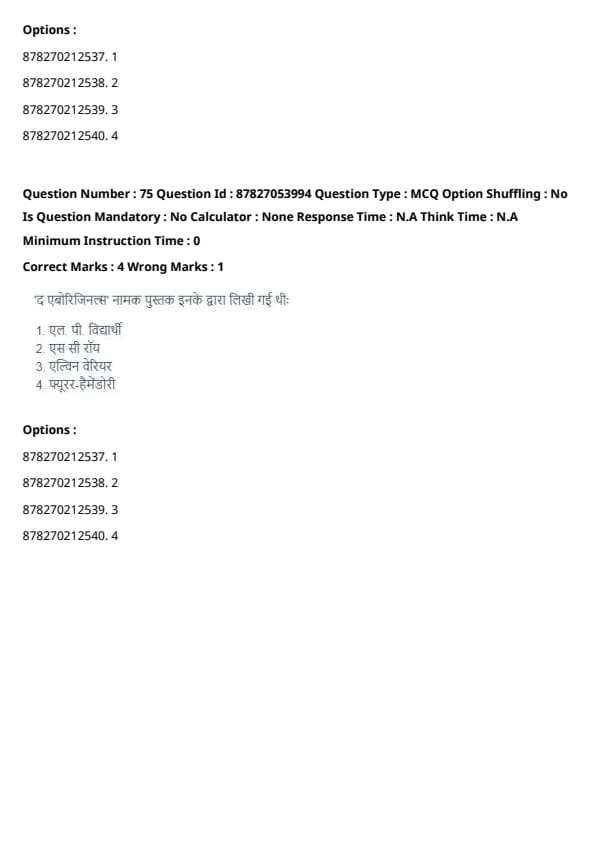
The book “The Aboriginals" was written by:
View Solution
Elwin Verrier, a distinguished anthropologist, authored “The Aboriginals,” focusing on the lifestyles, cultures, and challenges of indigenous tribes in India. His work provides deep insights into tribal societies and their interactions with broader socio-economic systems.













































Comments