


.png?h=35&w=35&mode=stretch)
CUET PG 2024 Painting 27th March 2024 Shift 2 Question Paper with Solution PDF is available for download here. Students found the Art Techniques and Materials section easy, History of Indian Art and Aesthetics moderate, and Modern Art Movements topics difficult. The Modern Art Movements section carried the highest weightage, and the overall difficulty level was moderate to difficult.
CUET PG 2024 Painting Question Paper with Answer Key PDF
| CUET PG 2024 Painting Question Paper with Answer Key |  Download Download |
Check Solution |
Painting 2024 Questions with Solutions
Question 1:
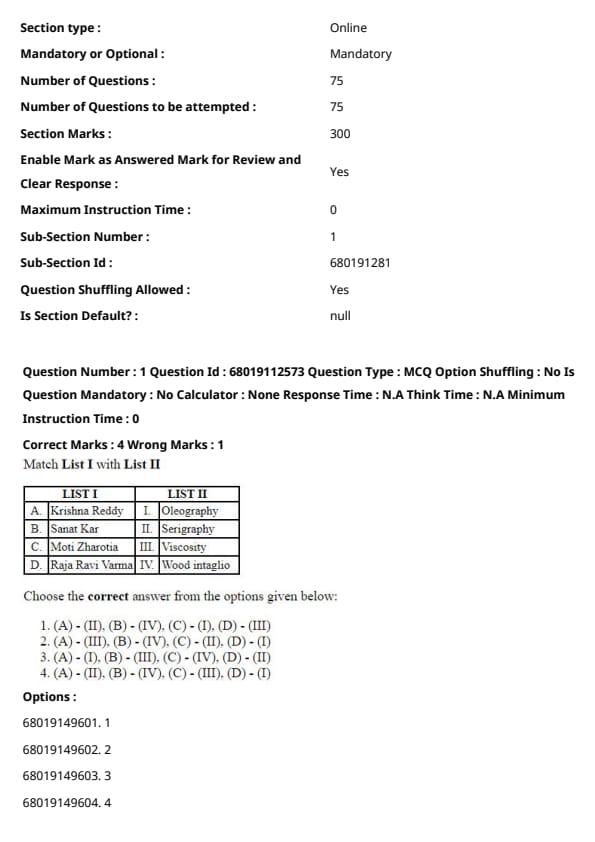
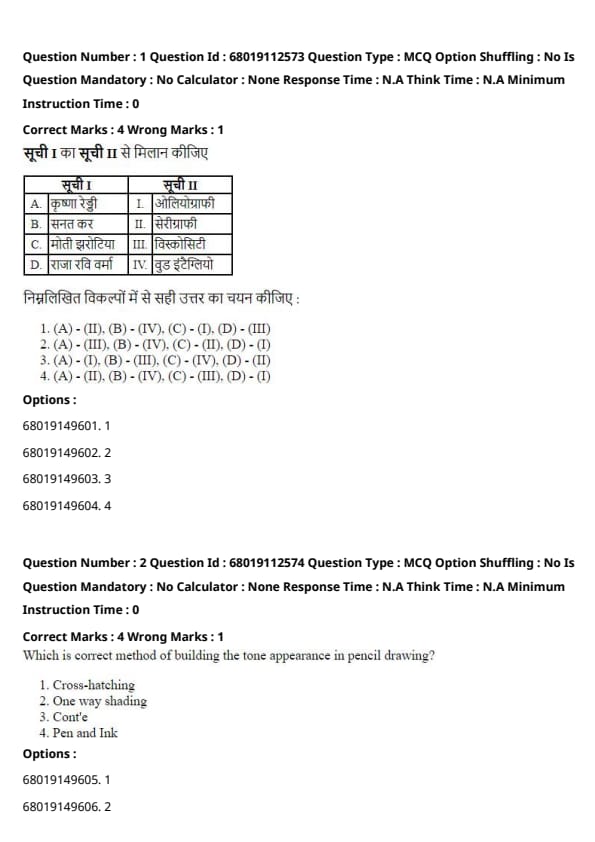
Match List I with List II:
| List I | List II |
|---|---|
| A. Krishna Reddy | I. Oleography |
| B. Sanat Kar | II. Serigraphy |
| C. Moti Zharotia | III. Viscosity |
| D. Raja Ravi Varma | IV. Wood intaglio |
Choose the correct answer from the options given below:
View Solution
The correct match is as follows:
- A. Krishna Reddy — III. Viscosity
- B. Sanat Kar — IV. Wood intaglio
- C. Moti Zharotia — II. Serigraphy
- D. Raja Ravi Varma — I. Oleography
These associations highlight the contributions of notable artists to specific artistic techniques and media.
Question 2:
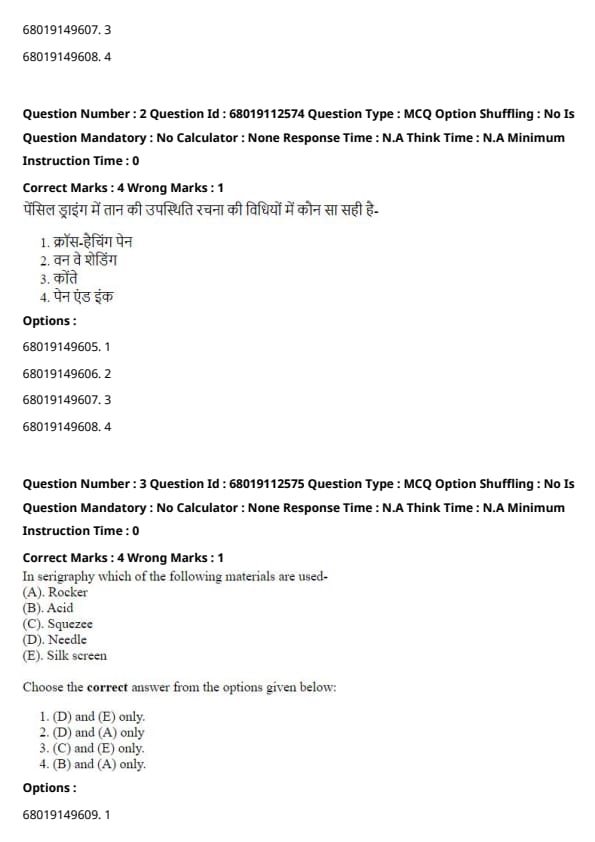
Which is the correct method of building the tone appearance in pencil drawing?
View Solution
One way shading involves creating consistent strokes in a single direction to build tone and gradient in pencil drawing. This method ensures smooth transitions and is ideal for depicting light and shadow.
Question 3:
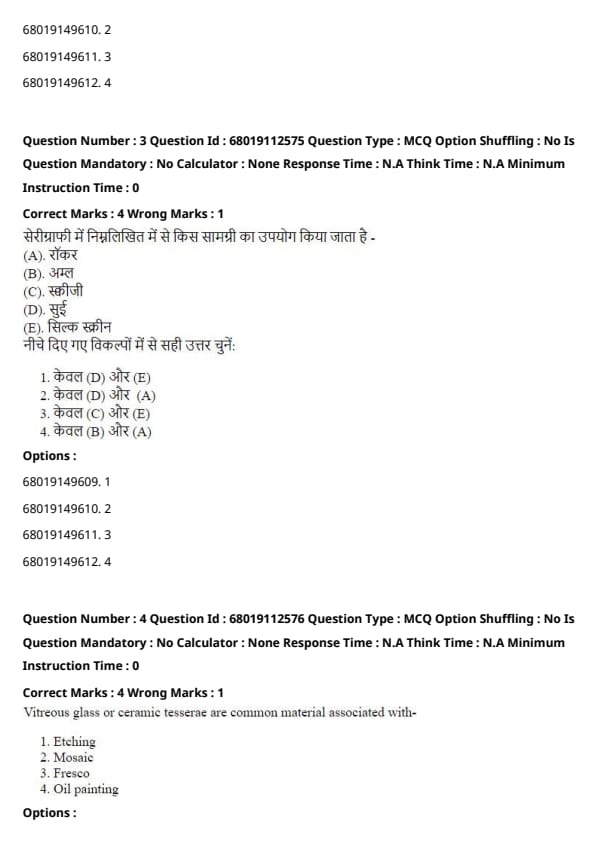
In serigraphy which of the following materials are used?
(A) Rocker, (B) Acid, (C) Squeegee, (D) Needle, (E) Silk screen
Choose the correct answer from the options given below:
View Solution
In serigraphy, a squeegee is used to press ink through a silk screen onto the substrate. The silk screen acts as the stencil for the design. Other options, such as acids and needles, are not relevant to this technique.
Question 4:
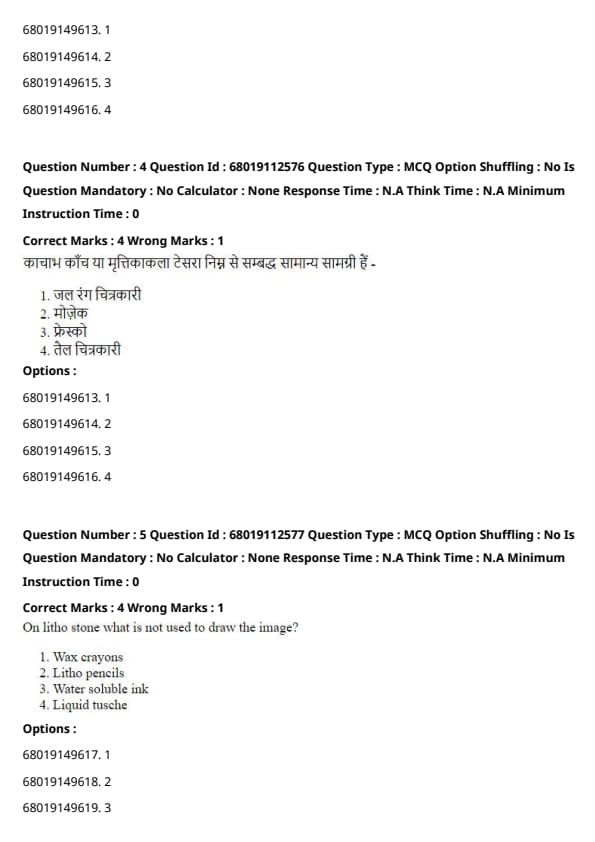
Vitreous glass or ceramic tesserae are common materials associated with:
View Solution
Mosaics are created by assembling small pieces of vitreous glass or ceramic tesserae into patterns or pictures. This technique has been used for centuries in architecture to decorate walls, floors, and ceilings.
Question 5:
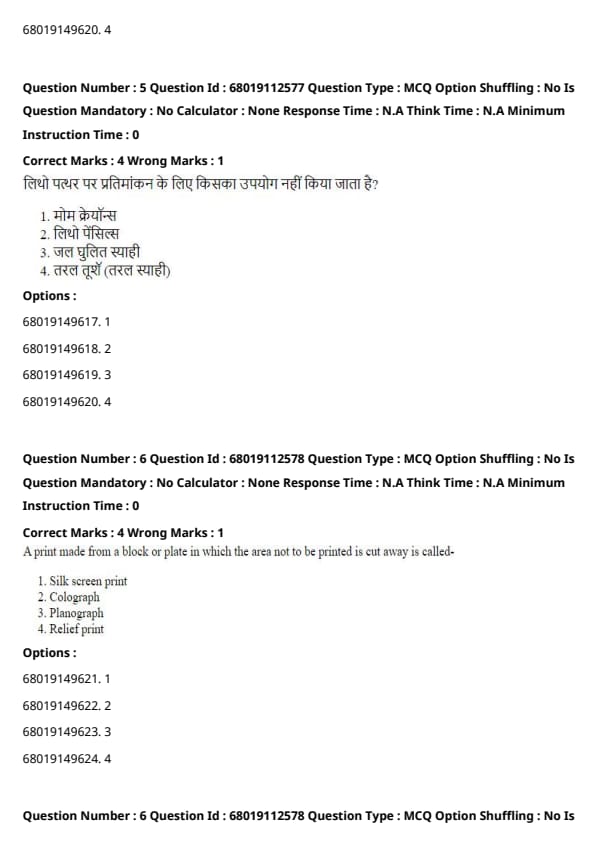
On litho stone, what is not used to draw the image?
View Solution
Water soluble ink is not used on a litho stone. Lithography relies on the principle that oil and water repel each other. Materials like wax crayons, litho pencils, and liquid tusche are used for drawing on the stone.
Question 6:
A print made from a block or plate in which the area not to be printed is cut away is called:
View Solution
Relief printing involves carving away the non-printing areas of a block or plate, leaving the raised areas to receive ink. This technique is one of the oldest printing methods and is widely used in woodcuts and linocuts.
Question 7:
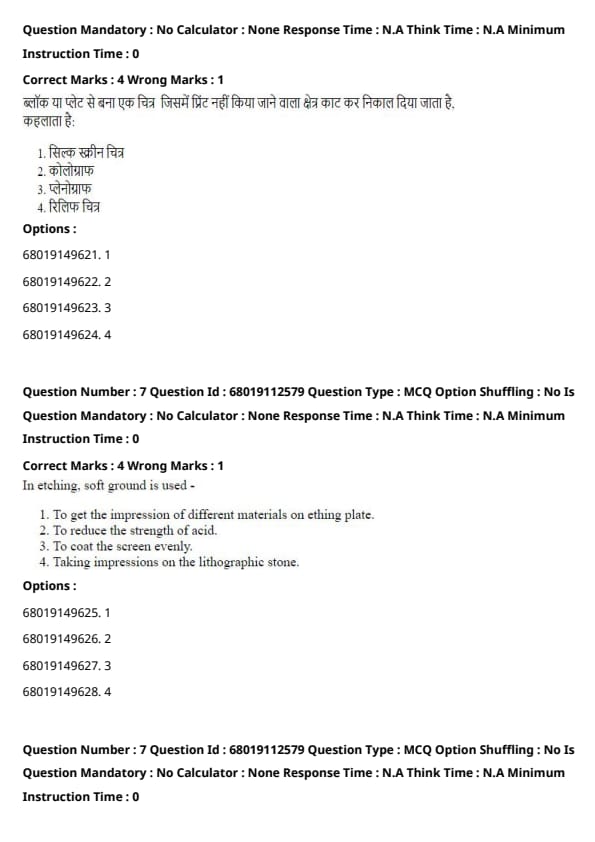
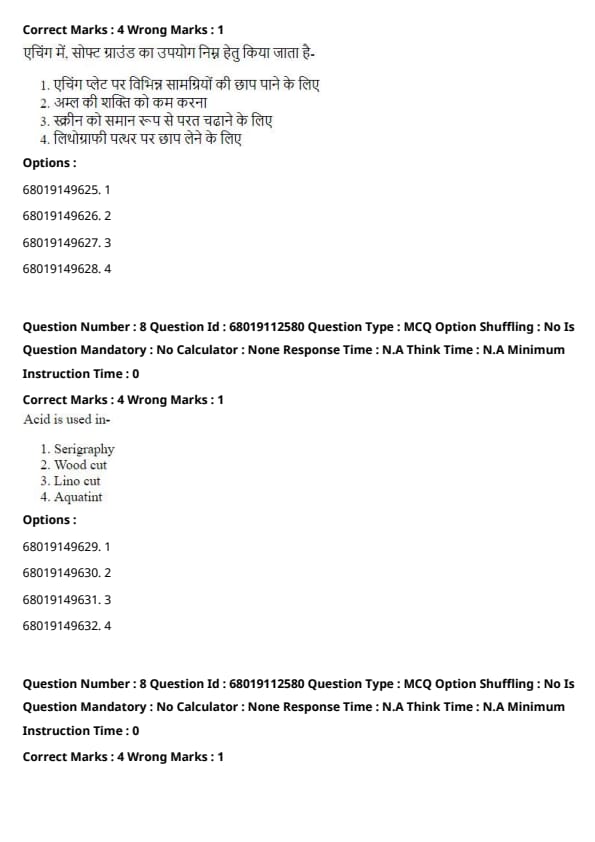
In etching, soft ground is used:
View Solution
Soft ground is a waxy resist applied to an etching plate. It remains slightly tacky, allowing textures and patterns from various materials (like fabric or leaves) to be pressed into it. These impressions are then etched onto the plate using acid.
Question 8:
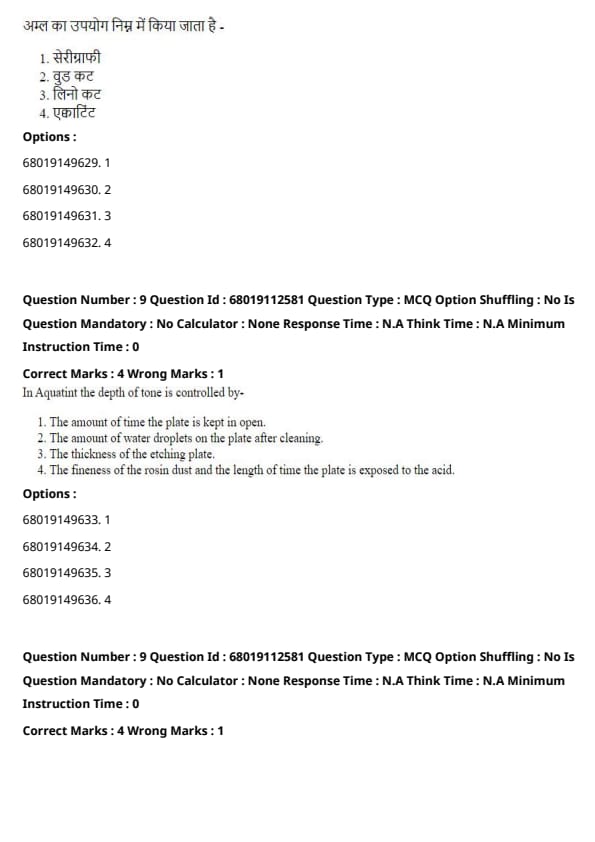
Acid is used in:
View Solution
Acid is an integral part of the aquatint process, where it etches the metal plate to create tonal effects. The plate is first dusted with rosin particles, which protect certain areas from being etched, allowing for gradations of tone.
Question 9:
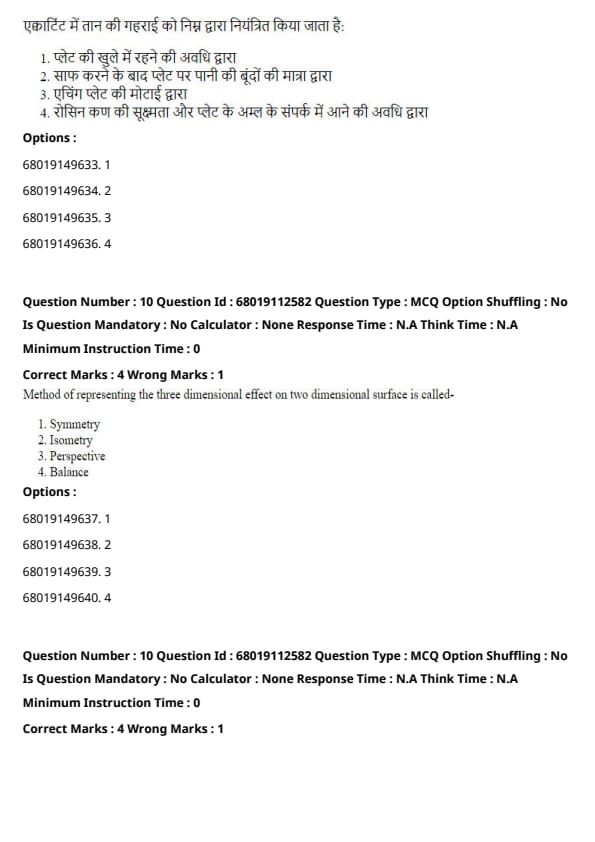
In aquatint, the depth of tone is controlled by:
View Solution
The depth of tone in aquatint is controlled by the size of the rosin particles and the duration of acid exposure. Finer rosin dust results in smoother, lighter tones, while longer acid exposure deepens the tonal values.
Question 10:
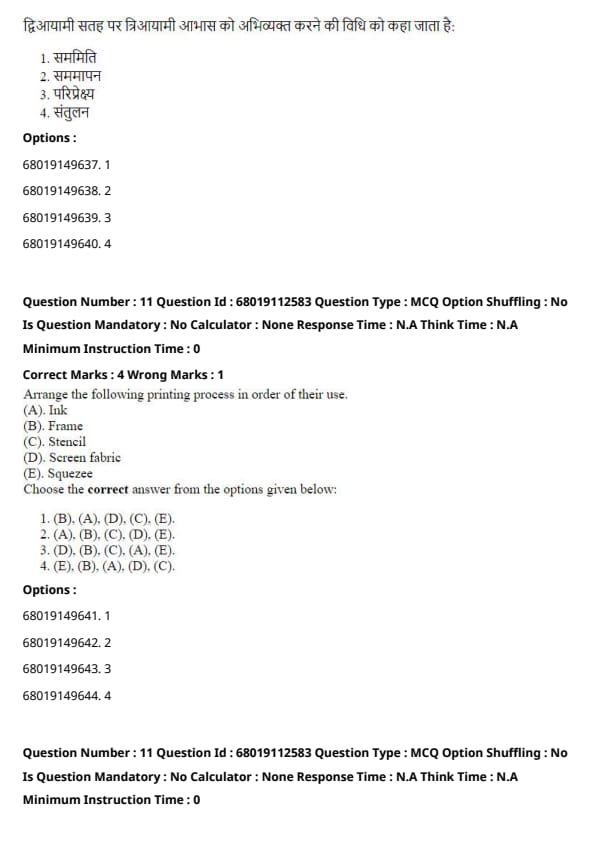
The method of representing the three-dimensional effect on a two-dimensional surface is called:
View Solution
Perspective is a drawing technique that uses vanishing points and converging lines to create the illusion of depth. It allows artists to represent three-dimensional objects realistically on a two-dimensional surface.
Question 11:
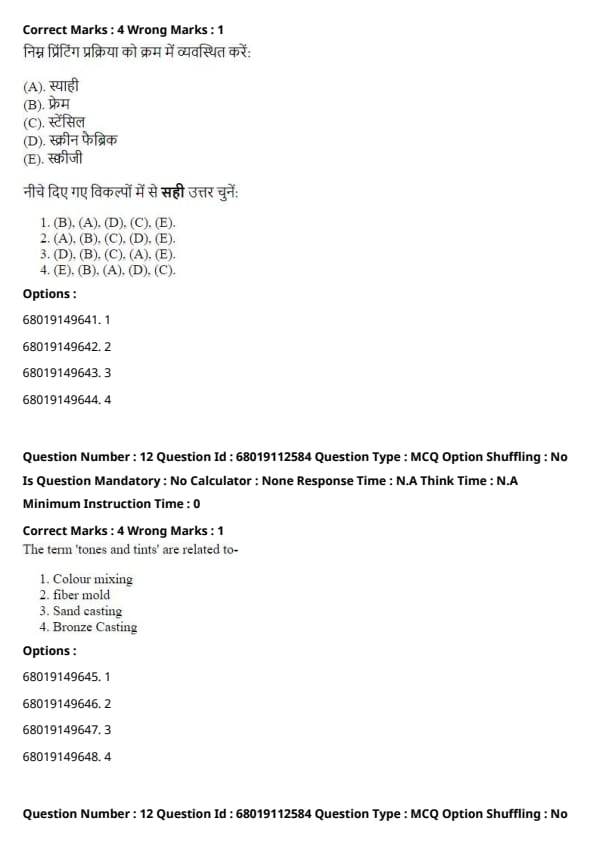
Arrange the following printing processes in order of their use:
(A) Ink (B) Frame (C) Stencil (D) Screen fabric (E) Squeegee
Choose the correct answer from the options given below:
View Solution
The correct sequence for the printing process is as follows:
- Screen fabric (D) is stretched to create the base for printing.
- A frame (B) is added to hold the screen fabric taut.
- A stencil (C) is prepared and placed over the screen.
- Ink (A) is applied over the stencil.
- A squeegee (E) is used to press the ink through the stencil and screen onto the substrate.
This sequence ensures precision and proper ink application during screen printing.
Question 12:
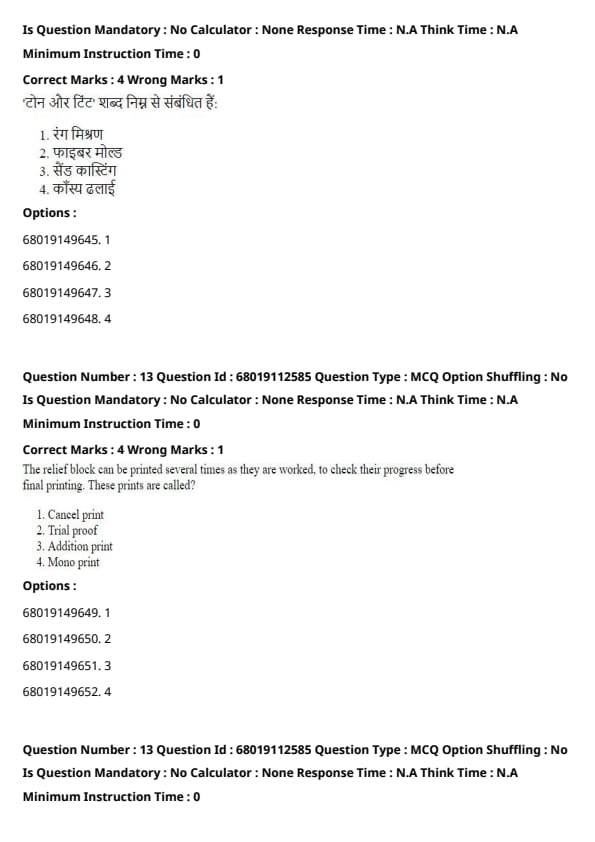
The term 'tones and tints' are related to:
View Solution
Tones and tints are key concepts in colour theory. A tint is created by adding white to a colour, making it lighter, while a tone is created by adding grey to a colour, reducing its saturation. These methods help artists manipulate colour to create depth, highlights, and shadows in their work.
Question 13:
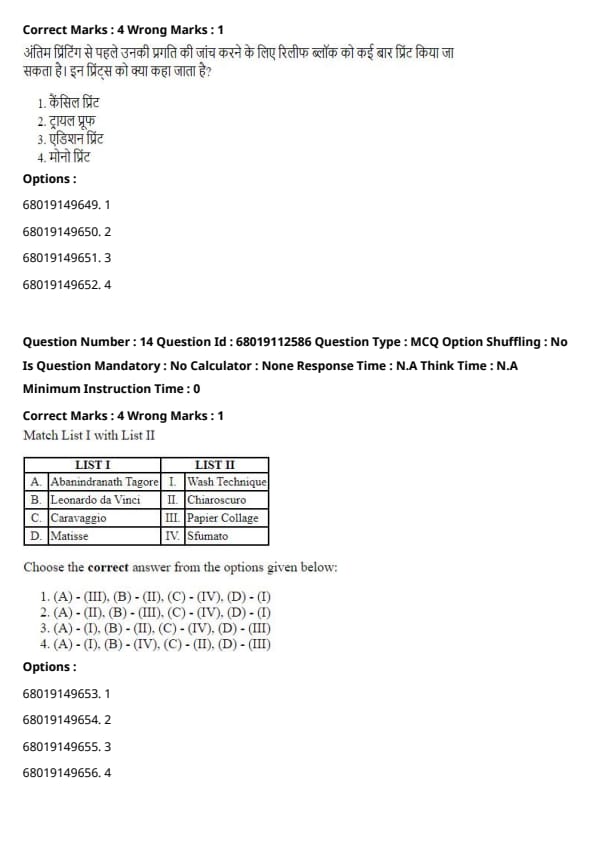
The relief block can be printed several times as they are worked to check their progress before final printing. These prints are called:
View Solution
Trial proofs are preliminary prints made during the relief printing process. They allow artists to evaluate the progress and make adjustments to the block before final printing. This step ensures that the final print meets the artist's expectations.
Question 14:
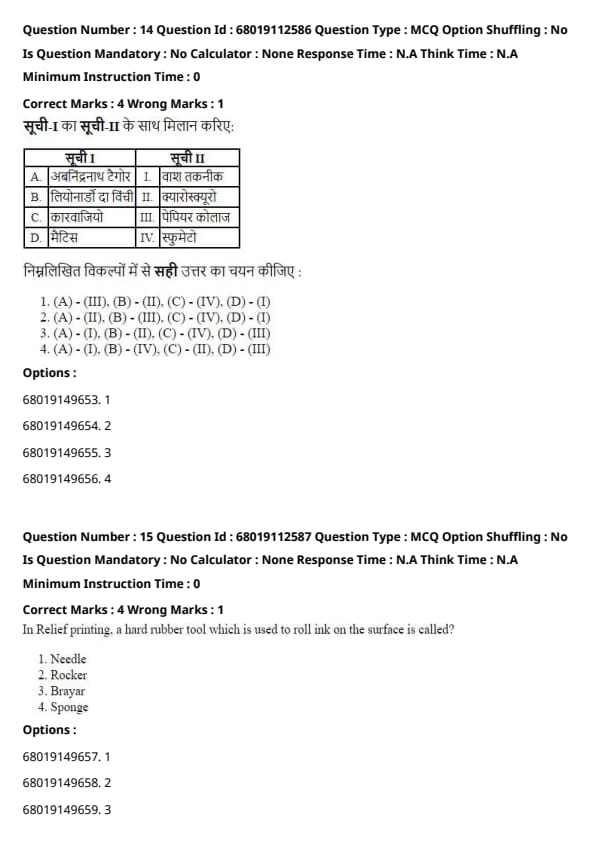
Match List I with List II:
| List I | List II |
|---|---|
| A. Abanindranath Tagore | I. Wash Technique |
| B. Leonardo da Vinci | II. Chiaroscuro |
| C. Caravaggio | III. Sfumato |
| D. Matisse | IV. Papier Collage |
Choose the correct answer from the options given below:
View Solution
- Abanindranath Tagore pioneered the Wash Technique (A - I), emphasizing subtle tonal variations.
- Leonardo da Vinci utilized Chiaroscuro (B - II) to create dramatic light and shadow contrasts.
- Caravaggio is credited with developing Sfumato (C - IV), a technique for soft transitions between colours.
- Matisse was known for his use of Papier Collage (D - III), cutting and pasting coloured paper into compositions.
Understanding these techniques provides insight into the unique styles and innovations of these legendary artists.
Question 15:
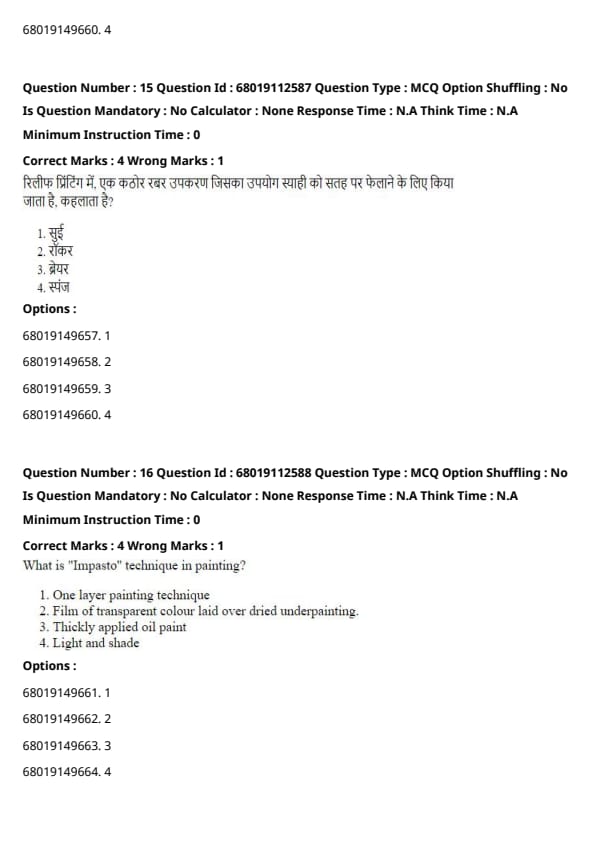
In relief printing, a hard rubber tool used to roll ink on the surface is called:
View Solution
A brayer is a tool with a hard rubber roller used in relief printing to apply ink evenly across the printing surface or plate. It ensures that ink is distributed smoothly and consistently over the raised areas of the block.
Question 16:
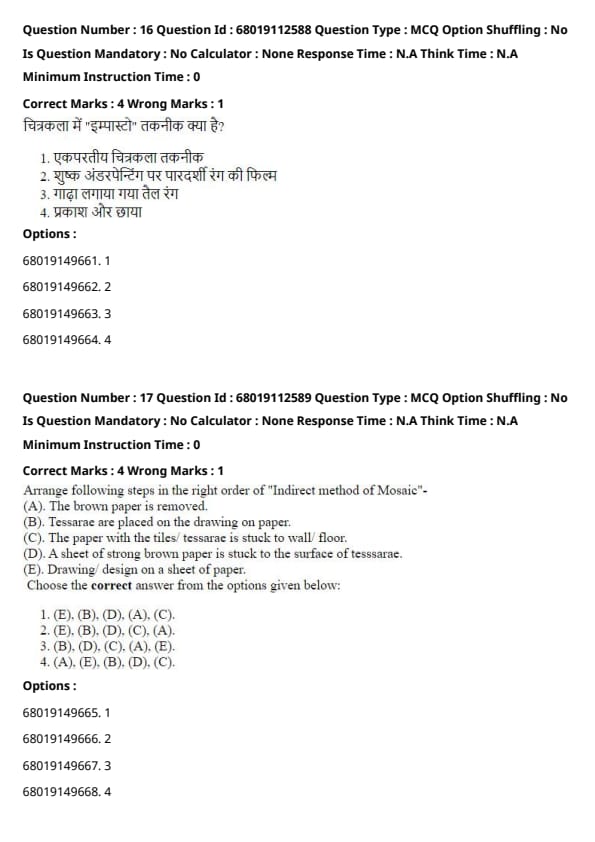
What is "Impasto" technique in painting?
View Solution
The Impasto technique involves applying oil paint thickly, allowing the texture of the brushstrokes or palette knife marks to remain visible. This method creates a three-dimensional, sculptural effect on the canvas, adding depth and drama to the artwork. It is often used to emphasize light and shadow or to highlight specific areas of a painting.
Question 17:
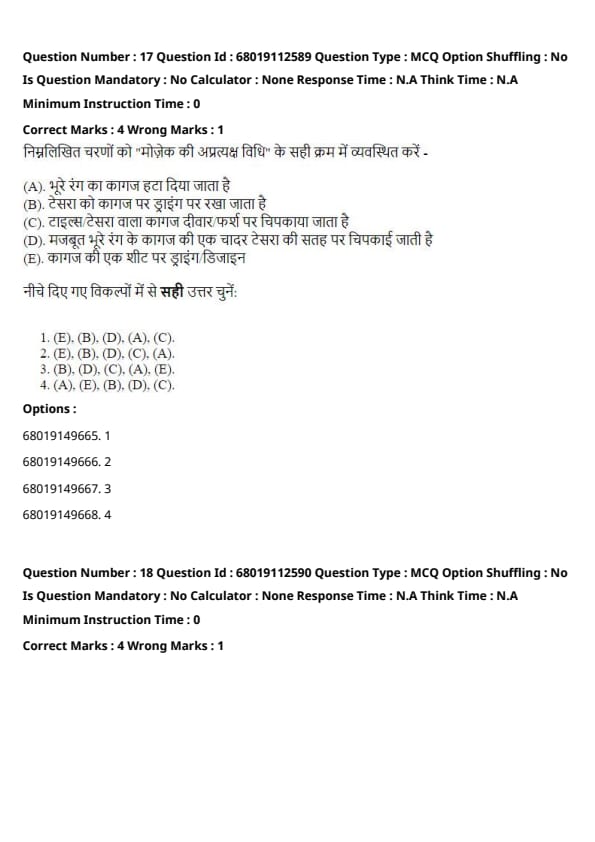
Arrange the following steps in the right order of "Indirect method of Mosaic":
(A) The brown paper is removed. (B) Tesserae are placed on the drawing on paper. (C) The paper with the tiles/tesserae is stuck to the wall/floor. (D) A sheet of strong brown paper is stuck to the surface of tesserae. (E) Drawing/design on a sheet of paper.
Choose the correct answer from the options given below:
View Solution
The Indirect method of mosaic involves the following steps:
- Drawing the design on a sheet of paper (E).
- Placing the tesserae on the drawn design (B).
- Sticking a sheet of strong brown paper to the surface of the tesserae (D).
- Affixing the paper with tiles/tesserae to the wall or floor (C).
- Removing the brown paper after the adhesive sets (A).
This method is preferred for creating intricate and precisely aligned mosaics.
Question 18:
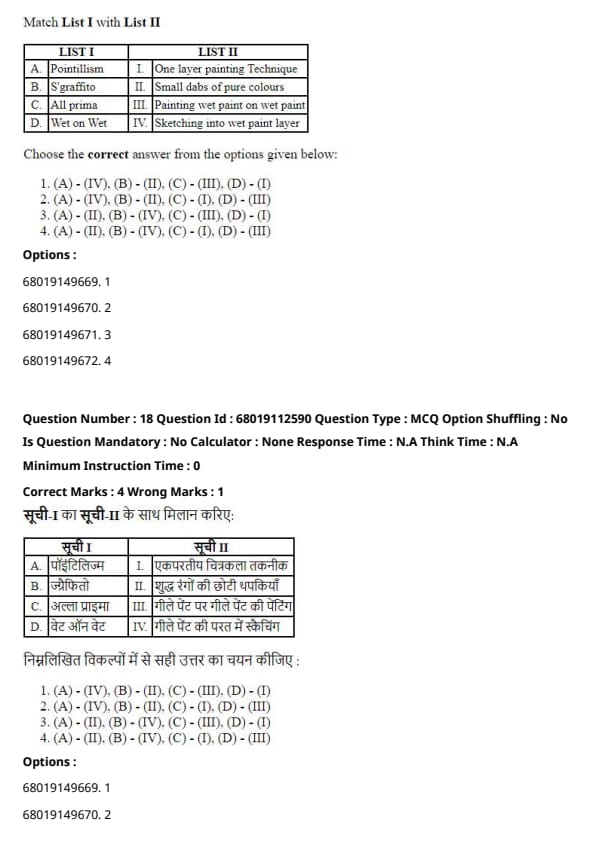
Match List I with List II:
| List I | List II |
|---|---|
| A. Pointillism | II. Small dabs of pure colours |
| B. S’graffito | IV. Sketching into wet paint layer |
| C. Alla Prima | I. One layer painting technique |
| D. Wet on Wet | III. Painting wet paint on wet paint |
Choose the correct answer from the options given below:
View Solution
- Pointillism involves applying small dabs of pure colours to create a cohesive image (A - II).
- S’graffito is a technique where designs are etched into a wet paint layer (B - IV).
- Alla Prima refers to completing a painting in one sitting using a single-layer technique (C - I).
- Wet on Wet involves applying wet paint onto a wet surface to blend colours seamlessly (D - III).
These techniques highlight the diversity of painting methods and their unique effects.
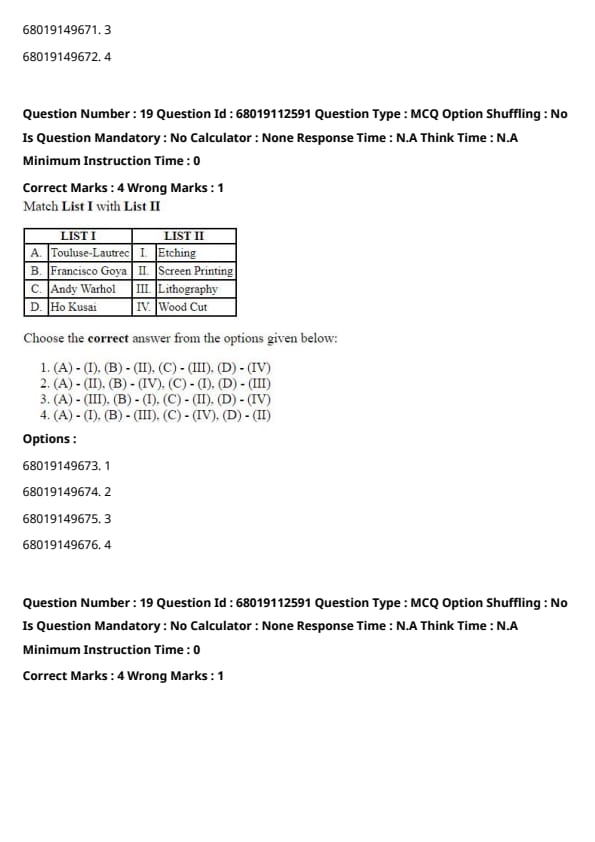
Question 19:
Match List I with List II:
| List I | List II |
|---|---|
| A. Touluse-Lautrec | III. Lithography |
| B. Francisco Goya | I. Etching |
| C. Andy Warhol | II. Screen Printing |
| D. Ho Kusai | IV. Wood Cut |
Choose the correct answer from the options given below:
View Solution
- Touluse-Lautrec is renowned for his lithographic posters (A - III).
- Francisco Goya is a master of etching (B - I).
- Andy Warhol revolutionized art with screen printing (C - II).
- Ho Kusai is famous for his detailed woodcut prints (D - IV).
These techniques define the artistic legacies of these iconic artists.
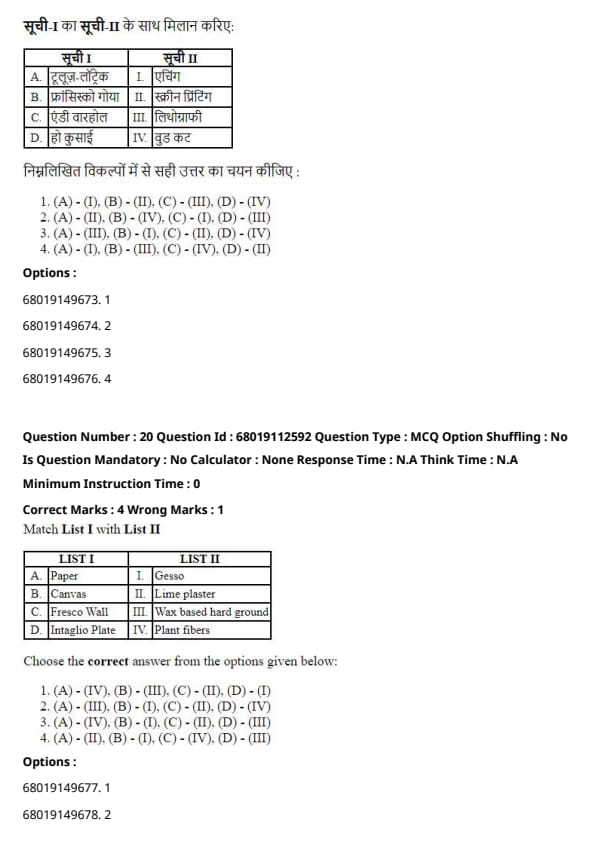
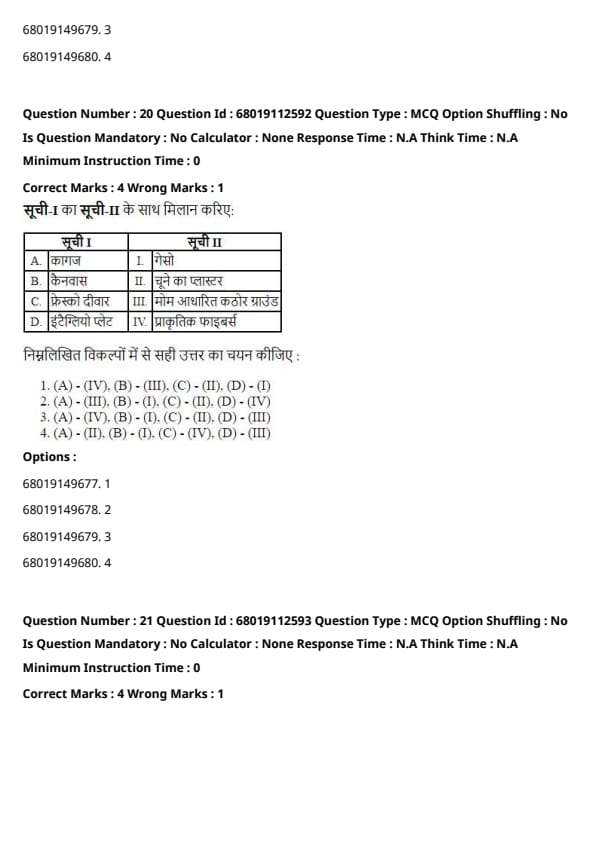
Question 20:
Match List I with List II:
| List I | List II |
|---|---|
| A. Paper | IV. Plant fibers |
| B. Canvas | I. Gesso |
| C. Fresco Wall | II. Lime plaster |
| D. Intaglio Plate | III. Wax-based hard ground |
Choose the correct answer from the options given below:
View Solution
- Paper is created from plant fibers (A - IV).
- Canvas is primed with gesso to prepare it for painting (B - I).
- Fresco walls are made using lime plaster (C - II).
- Intaglio plates utilize a wax-based hard ground for etching (D - III).
These materials are integral to their respective artistic processes and ensure their effectiveness.
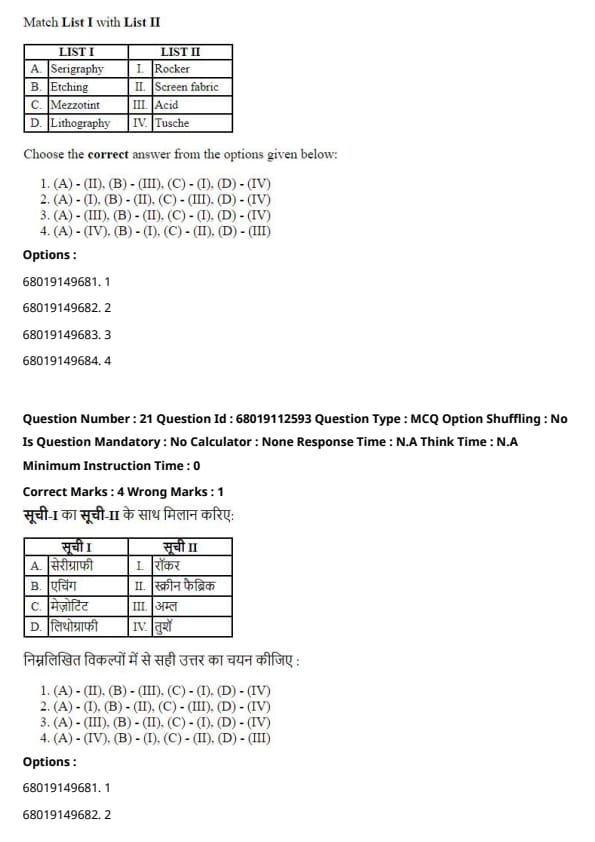
Question 21:
Match List I with List II:
| List I | List II |
|---|---|
| A. Serigraphy | II. Screen fabric |
| B. Etching | III. Acid |
| C. Mezzotint | I. Rocker |
| D. Lithography | IV. Tusche |
Choose the correct answer from the options given below:
View Solution
- Serigraphy uses a screen fabric to transfer ink onto the surface through a stencil (A - II).
- Etching involves the use of acid to create designs on a metal plate (B - III).
- Mezzotint employs a rocker tool to create gradients and textures (C - I).
- Lithography utilizes tusche, a greasy ink, for drawing on the litho stone (D - IV).
Each of these techniques has distinct tools and materials, making them unique in their application and final output.
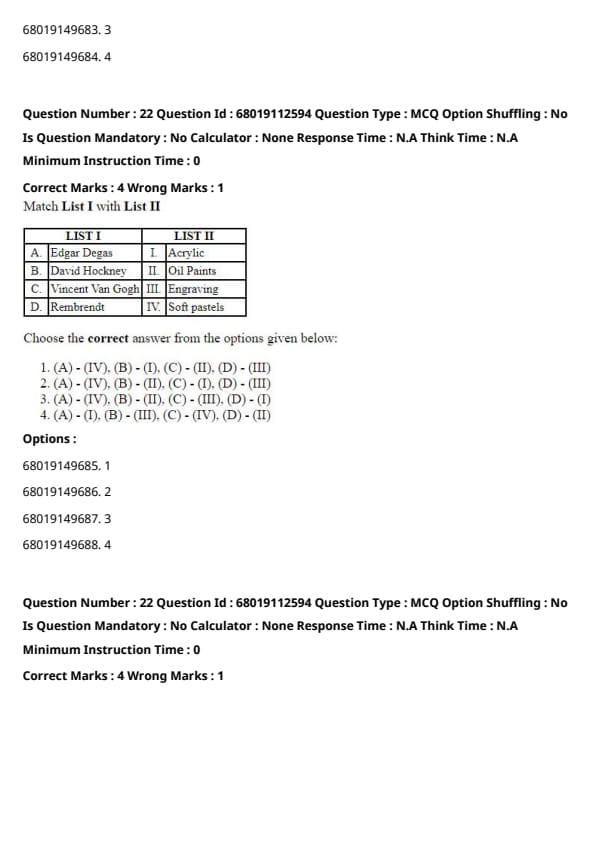
Question 22:
Match List I with List II:
| List I | List II |
|---|---|
| A. Edgar Degas | IV. Soft pastels |
| B. David Hockney | I. Acrylic |
| C. Vincent Van Gogh | II. Oil Paints |
| D. Rembrandt | III. Engraving |
Choose the correct answer from the options given below:
View Solution
- Edgar Degas is primarily associated with soft pastels (A - IV).
- David Hockney is known for his use of acrylic paints (B - I).
- Vincent Van Gogh is renowned for his expressive use of oil paints (C - II).
- Rembrandt mastered the technique of engraving (D - III).
Understanding the mediums and techniques of these iconic artists provides insight into their creative processes and contributions to art history.
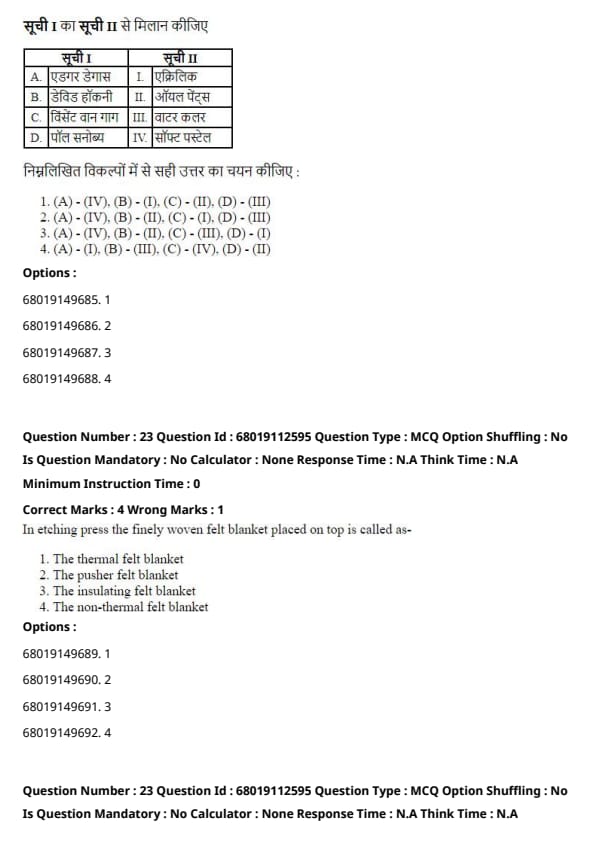
Question 23:
In etching press, the finely woven felt blanket placed on top is called:
View Solution
The pusher felt blanket is a crucial component in an etching press. It ensures even distribution of pressure over the etching plate and paper during the printing process, protecting both from damage. This blanket also helps achieve consistent impressions by absorbing excess pressure.
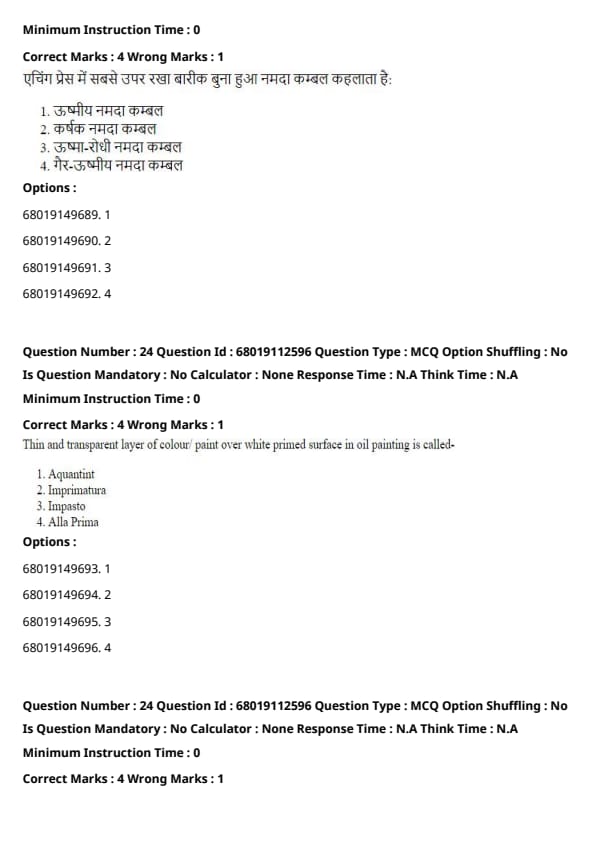
Question 24:
Thin and transparent layer of colour/paint over white primed surface in oil painting is called:
View Solution
Imprimatura is a technique where a thin, transparent layer of paint, usually in earth tones, is applied over a white primed surface. This initial layer serves as an underpainting to establish the tone and mood of the artwork.
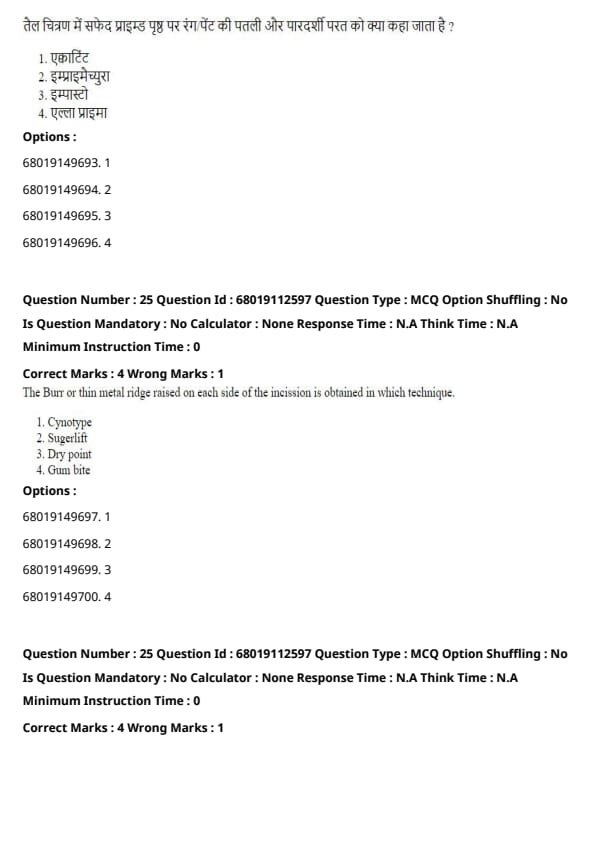
Question 25:
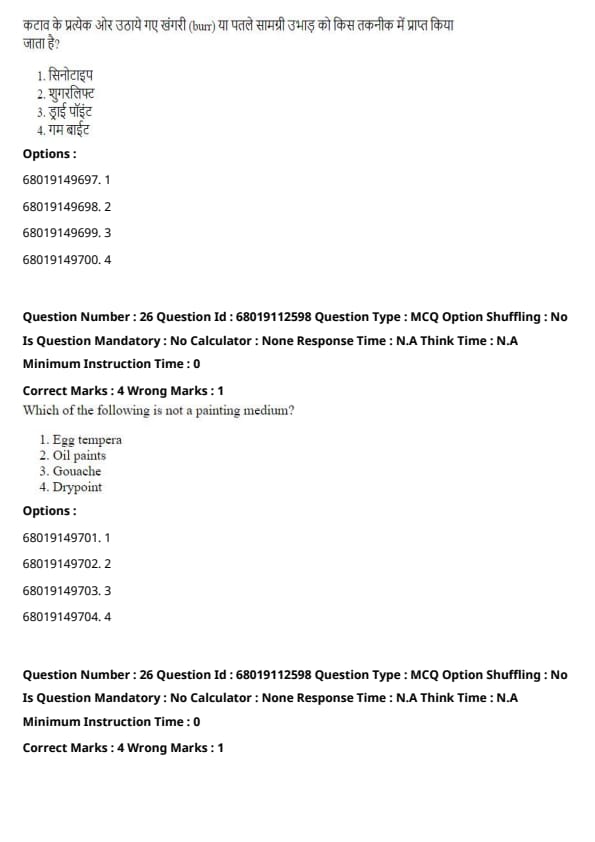
The Burr or thin metal ridge raised on each side of the incision is obtained in which technique?
View Solution
In the dry point technique, a sharp needle is used to scratch the surface of a metal plate, creating an incision. The burr, a thin metal ridge raised on either side of the line, traps ink, resulting in rich, velvety textures in the final print.
Question 26:
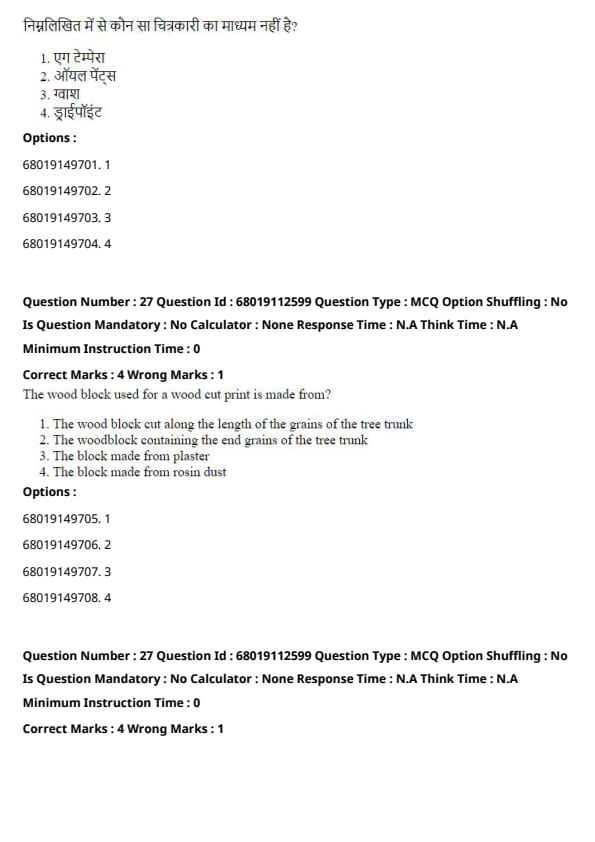
Which of the following is not a painting medium?
View Solution
Drypoint is not a painting medium; it is a printmaking technique where a needle is used to incise lines into a metal plate. In contrast, egg tempera, oil paints, and gouache are all painting mediums used to apply pigment onto a surface. Each painting medium offers different textures, finishes, and durability for artistic expression.
Question 27:
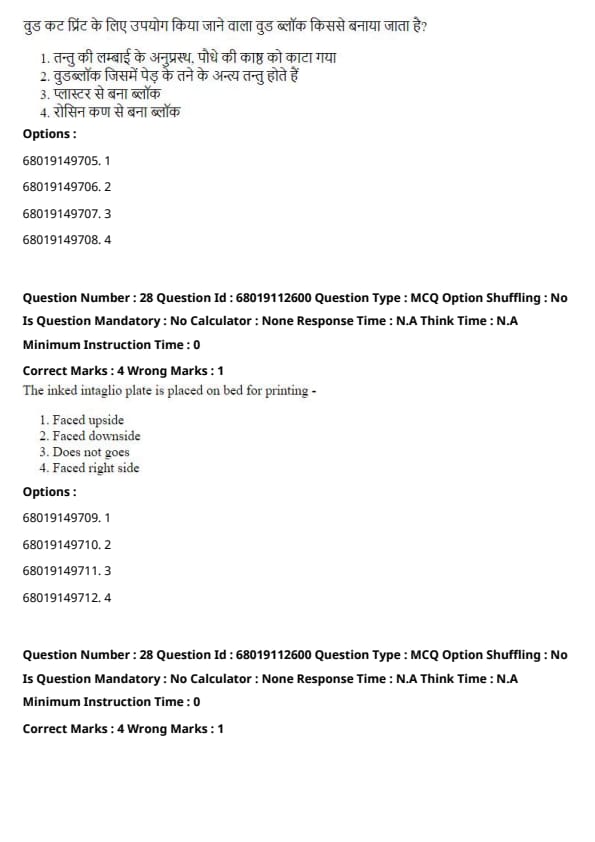
The wood block used for a woodcut print is made from?
View Solution
The traditional wood block for woodcut prints is made by cutting along the length of the grains of the tree trunk. This technique provides a durable surface that is easy to carve and ideal for holding ink, allowing for clear and detailed prints. Softwoods such as pine or cherry are commonly used due to their fine grain and ease of carving.
Question 28:
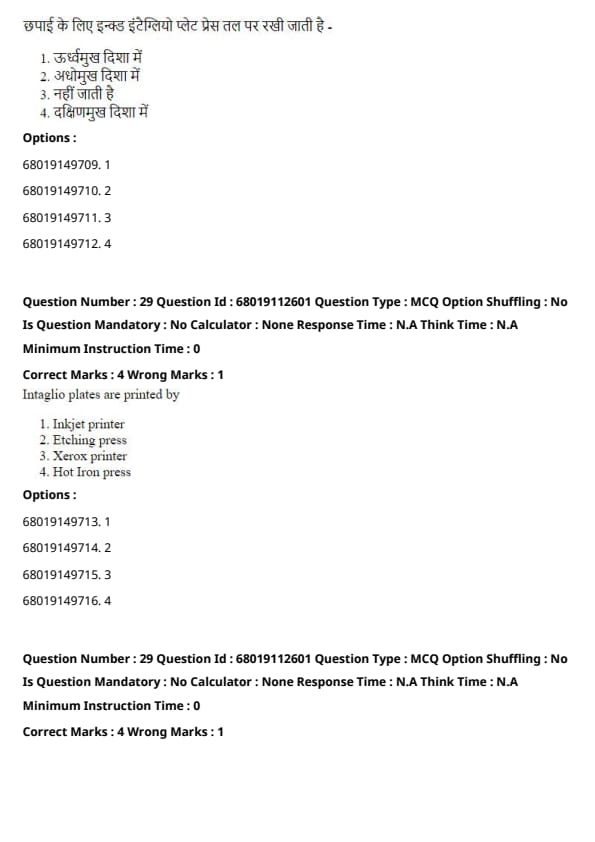
The inked intaglio plate is placed on the bed for printing:
View Solution
In intaglio printing, the inked plate is placed on the press bed with the inked side facing upward. The paper is then carefully placed over the plate. Heavy pressure is applied using the etching press, which ensures that the ink transfers from the recessed areas of the plate to the paper, creating the print.
Question 29:
Intaglio plates are printed by:
View Solution
Intaglio plates require an etching press to transfer the ink from the recessed areas of the plate to the paper. The press applies even and heavy pressure, which ensures that the ink is properly embedded into the dampened paper. This process is essential for achieving the intricate details typical of intaglio prints.
Question 30:
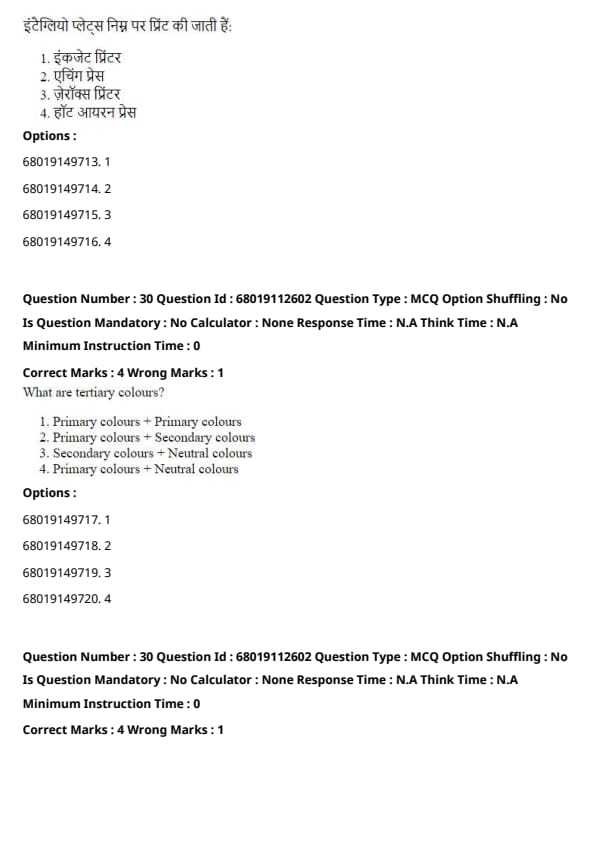
What are tertiary colours?
View Solution
Tertiary colours are created by mixing a primary colour (red, blue, or yellow) with a secondary colour (green, orange, or purple). For example, mixing yellow with green creates yellow-green, and mixing red with orange creates red-orange. These colours add depth and variety to the artist’s palette, enabling the creation of more nuanced and complex colour schemes.
Question 31:
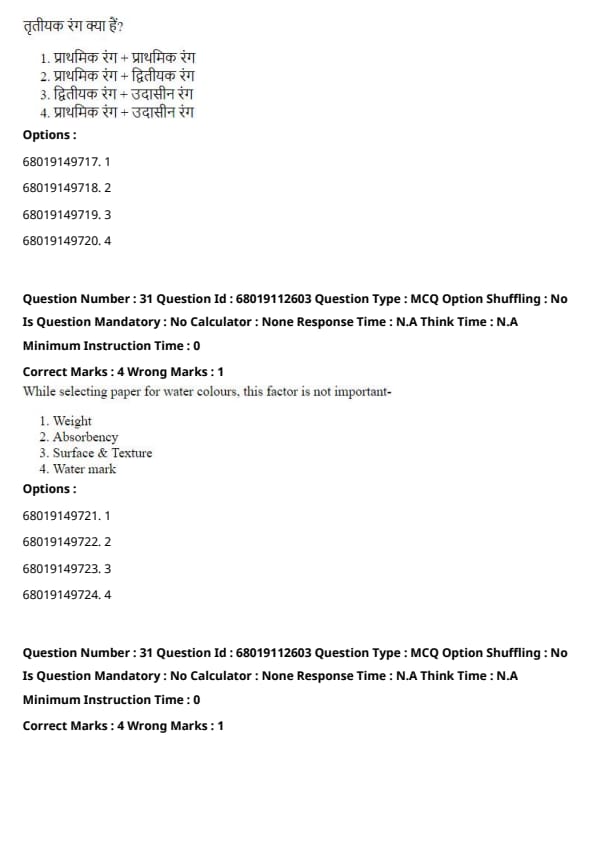
While selecting paper for watercolours, this factor is not important:
View Solution
For watercolor painting, factors like weight, absorbency, and surface texture are crucial. The weight (typically 300 gsm or higher) ensures the paper does not warp under wet washes. Absorbency helps the paint adhere and blend seamlessly, while surface texture (e.g., cold press, hot press, or rough) affects the final appearance of the artwork. A watermark, while indicative of the paper's brand or quality, is not a functional aspect affecting performance.
Question 32:
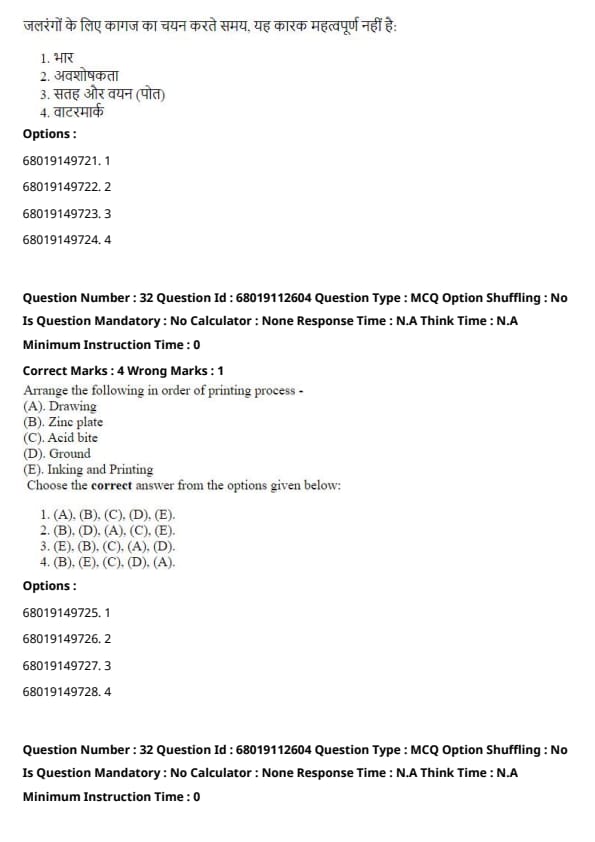
Arrange the following in order of the printing process:
(A) Drawing, (B) Zinc plate, (C) Acid bite, (D) Ground, (E) Inking and Printing
Choose the correct answer from the options given below:
View Solution
The correct sequence for the printing process involves:
- Preparing the zinc plate (B), which serves as the base for etching.
- Applying ground (D), which is a resist material used to protect the plate from acid.
- Drawing the design (A) on the ground-covered plate.
- Acid bite (C), where the exposed parts of the plate are etched by acid to create the design.
- Inking and printing (E), transferring the design onto paper or another surface.
This sequence is typical for intaglio techniques like etching and aquatint.
Question 33:
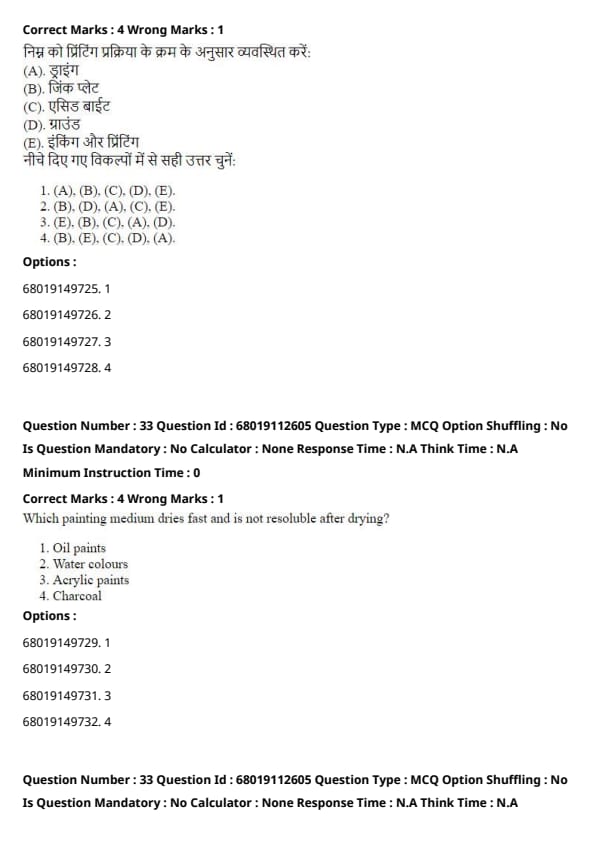
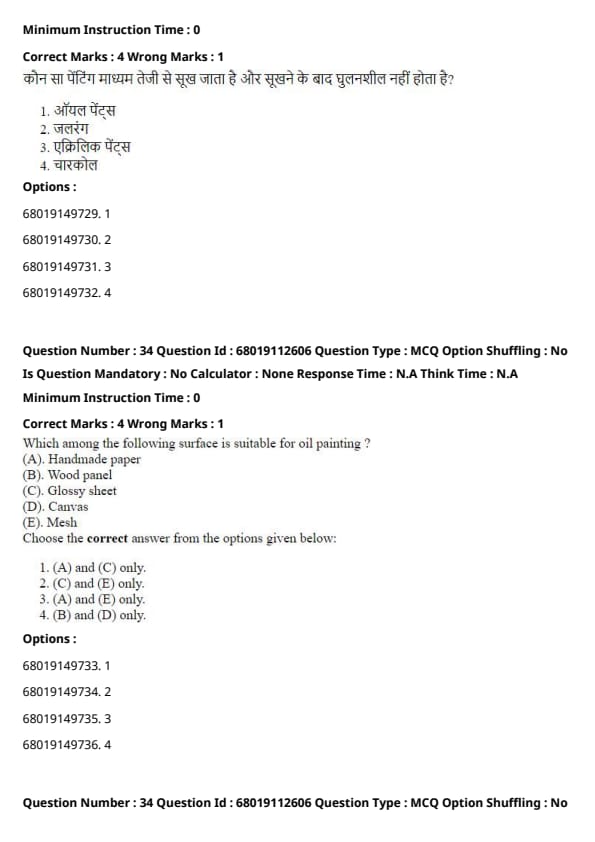
Which painting medium dries fast and is not resoluble after drying?
View Solution
Acrylic paints are water-based but dry quickly to form a permanent, water-resistant layer. Once dried, they cannot be reactivated or blended further with water or other mediums, unlike watercolours or oil paints. This quick-drying property makes acrylics highly versatile and suitable for layering and mixed-media applications.
Question 34:
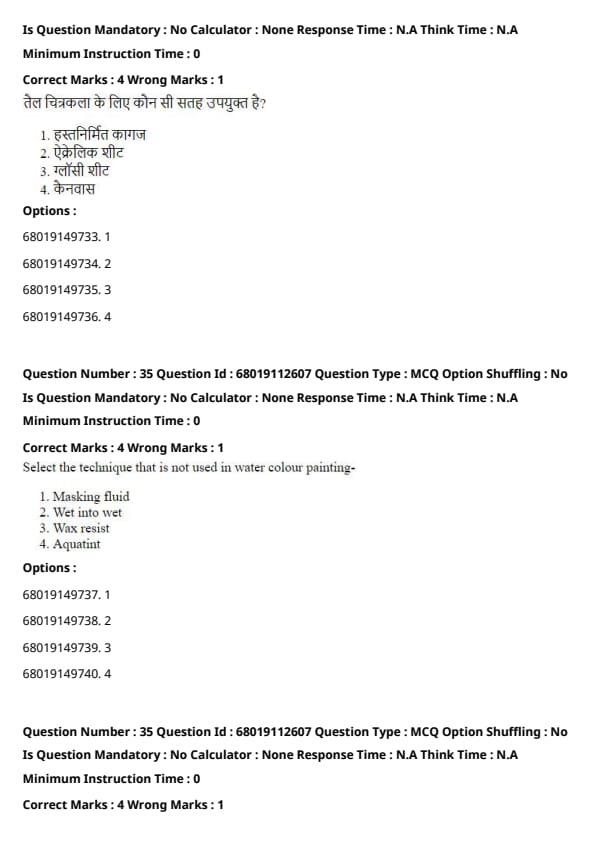
Which among the following surfaces is suitable for oil painting?
(A) Handmade paper, (B) Wood panel, (C) Glossy sheet, (D) Canvas, (E) Mesh
Choose the correct answer from the options given below:
View Solution
Wood panels and canvas are traditional and durable surfaces suitable for oil painting. These surfaces can hold oil paint well without warping or deteriorating over time. Wood panels provide a rigid base, while canvas offers flexibility and texture. Other surfaces, like handmade paper or glossy sheets, are unsuitable due to their inability to support the weight and properties of oil paint.
Question 35:
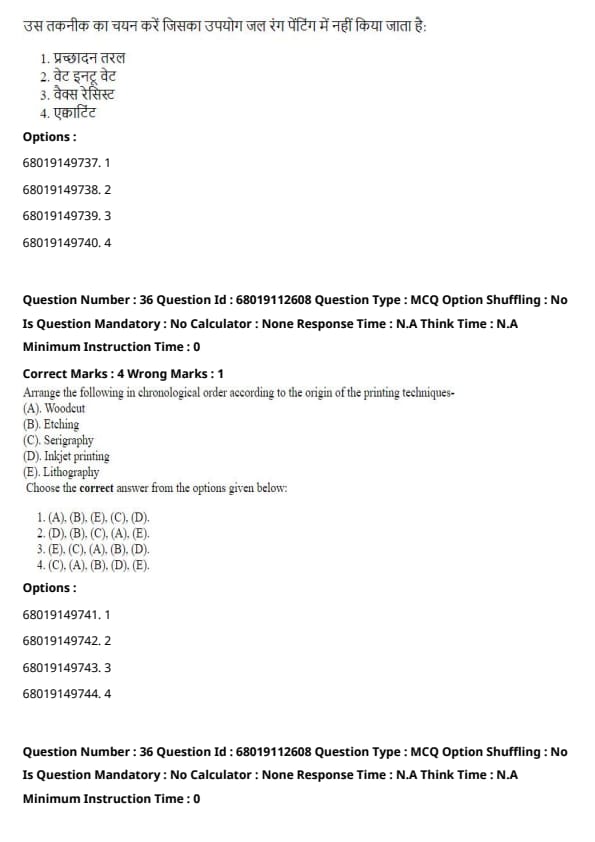
Select the technique that is not used in watercolour painting:
View Solution
Aquatint is a printmaking technique used in intaglio processes to create tonal effects, not a watercolour painting technique. Techniques like masking fluid, wet into wet, and wax resist are integral to watercolour painting, helping to create textures, gradients, and highlights effectively.
Question 36:
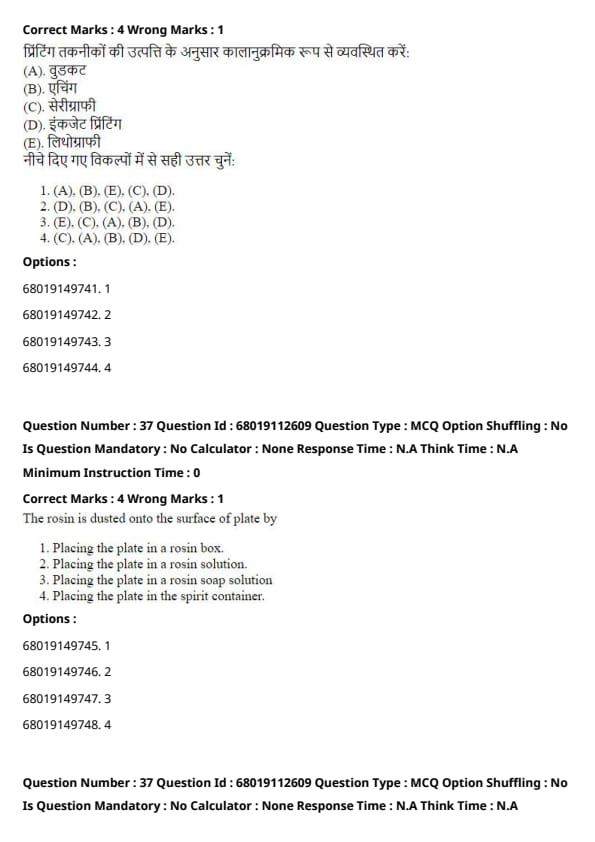
Arrange the following in chronological order according to the origin of the printing techniques:
(A) Woodcut, (B) Etching, (C) Serigraphy, (D) Inkjet printing, (E) Lithography
Choose the correct answer from the options given below:
View Solution
The chronological order of the printing techniques is as follows:
- Woodcut: The earliest known form of printing, originating in the 8th century.
- Etching: Developed in the 16th century, using acid to create designs on metal plates.
- Lithography: Invented in 1796, it uses the principle of oil and water repelling each other.
- Serigraphy: Also known as screen printing, it gained prominence in the 20th century.
- Inkjet printing: A modern printing method, widely used since the 1980s.
This progression highlights the advancements in printing technologies over centuries.
Question 37:
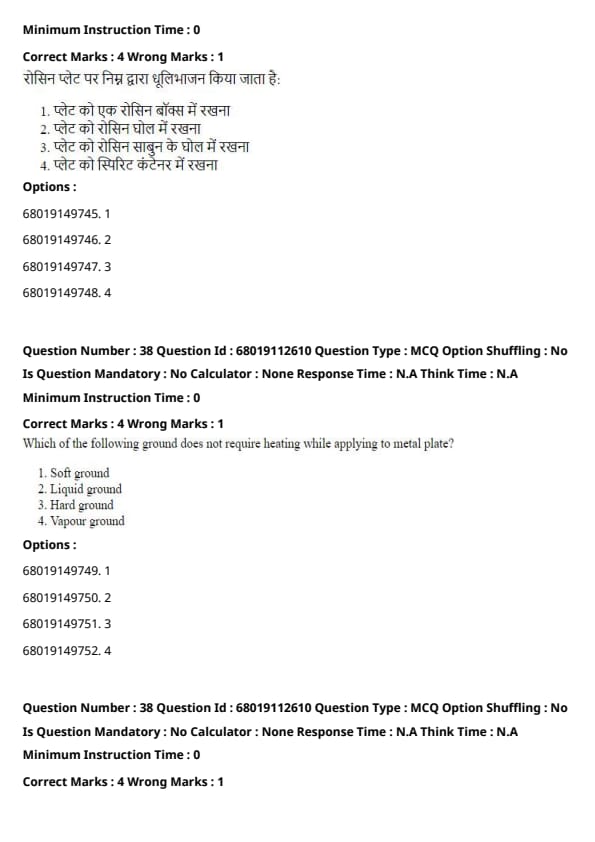
The rosin is dusted onto the surface of the plate by:
View Solution
In the aquatint process, the plate is placed in a rosin box where rosin particles are evenly distributed over its surface. Heat is then applied to melt the particles, which adhere to the plate and act as a resist during acid etching. This technique helps create tonal effects by controlling the acid's exposure to the plate.
Question 38:
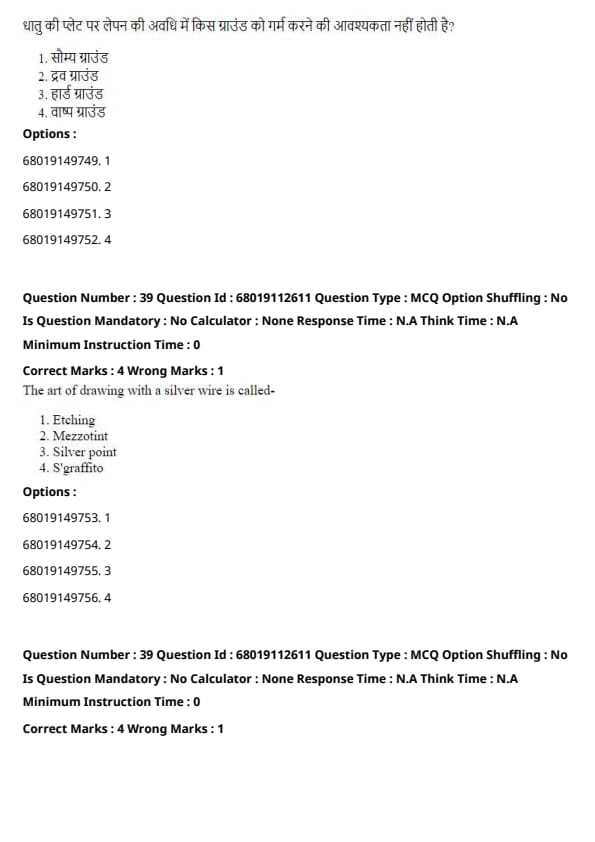
Which of the following ground does not require heating while applying to a metal plate?
View Solution
Liquid ground is directly applied to the plate using a brush and does not require heating. Once applied, it dries naturally, making it convenient for certain etching techniques. Liquid ground provides a smooth and even surface, allowing artists to create fine and intricate details. Other grounds, such as soft and hard grounds, typically require heating to adhere to the plate.
Question 39:
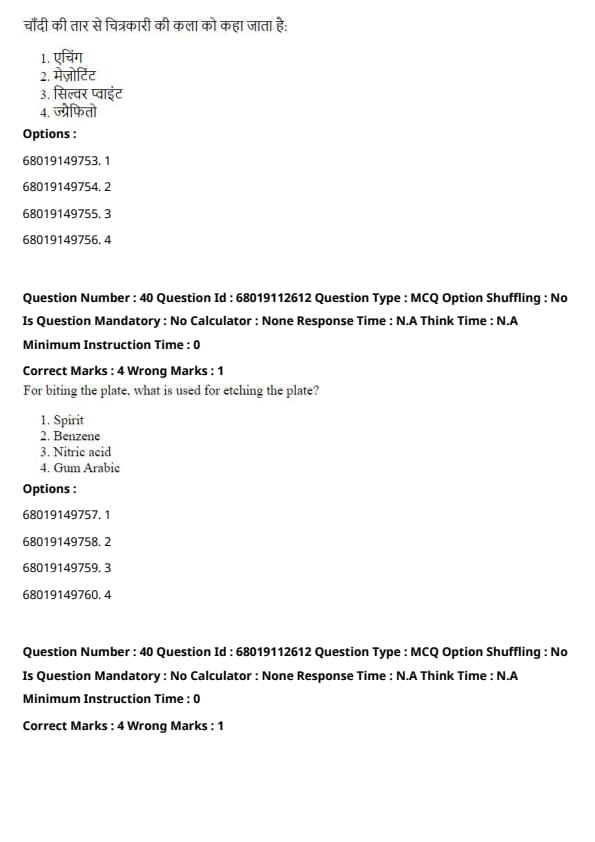
The art of drawing with a silver wire is called:
View Solution
Silver point is a drawing technique that uses a silver wire on a specially prepared surface coated with gesso or bone ash. As the silver wire scratches the surface, it leaves behind fine metallic lines that darken and oxidize over time, giving the artwork a unique and aged appearance. This technique was widely used during the Renaissance for its precision and delicacy.
Question 40:
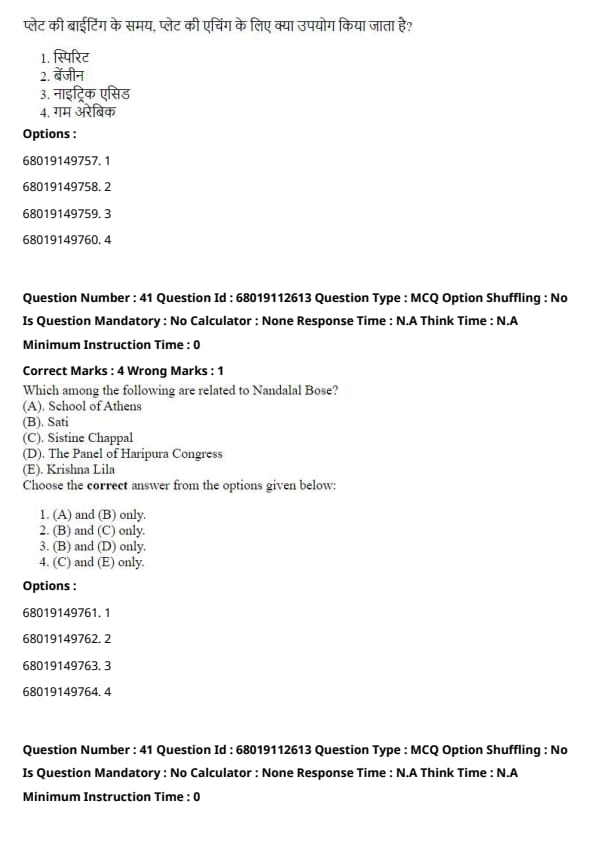
For biting the plate, what is used for etching the plate?
View Solution
Nitric acid is used in intaglio printmaking to etch metal plates. It reacts with the exposed areas of the plate, corroding the surface to create grooves and lines that hold ink. The strength of the acid and the duration of exposure determine the depth of the etching, allowing for varying levels of detail and tonal effects. Proper safety precautions, such as wearing gloves and working in a ventilated area, are essential when handling nitric acid.
Question 41:
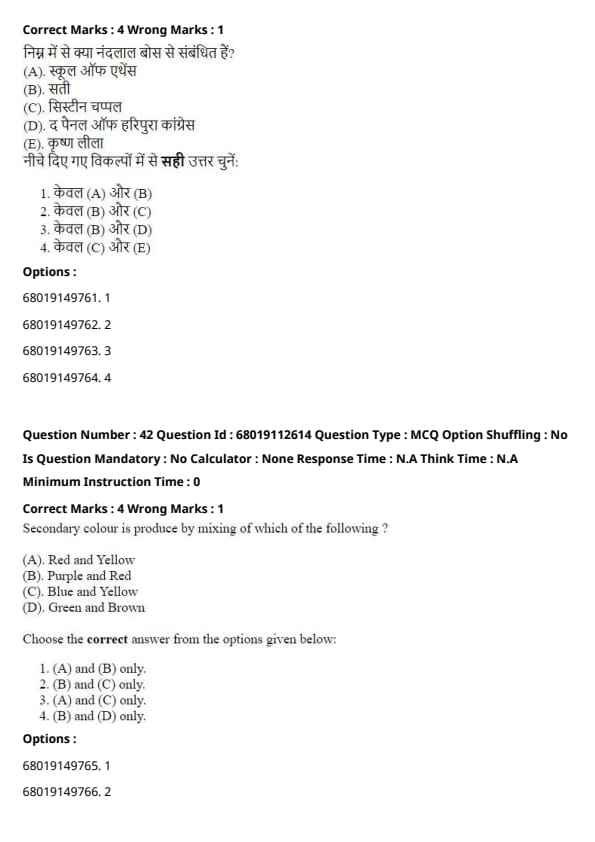
Which among the following are related to Nandalal Bose?
(A) School of Athens, (B) Sati, (C) Sistine Chappal, (D) The Panel of Haripura Congress, (E) Krishna Lila
Choose the correct answer from the options given below:
View Solution
Nandalal Bose is associated with the painting “Sati” and the “Panel of Haripura Congress”, reflecting his contributions to Indian art and the Indian freedom movement. “Sati” is a poignant representation of Indian cultural themes, while the Haripura panels celebrated rural life and India's struggle for independence. These works underscore Bose's role in the Bengal School of Art and his influence on modern Indian art.
Question 42:
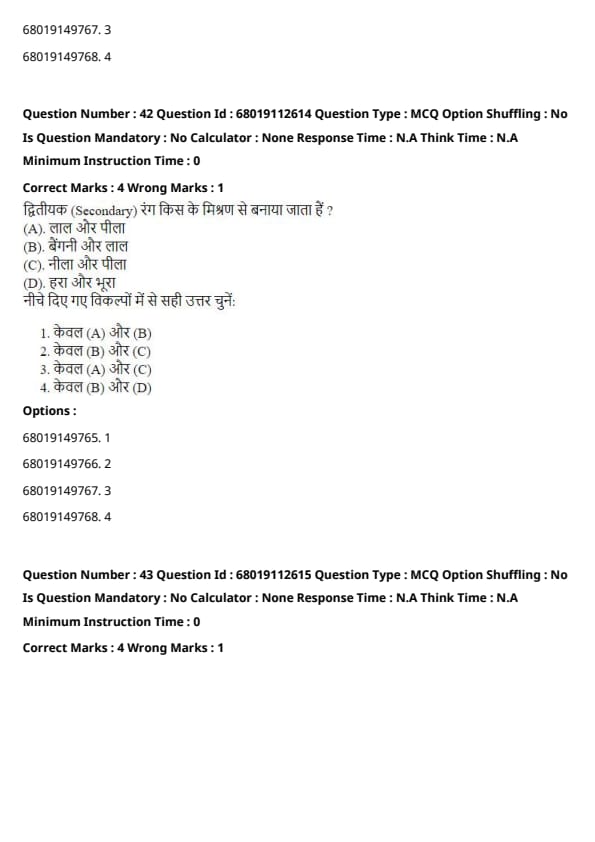
Secondary colour is produced by mixing which of the following?
(A) Red and Yellow, (B) Purple and Red, (C) Blue and Yellow, (D) Green and Brown
Choose the correct answer from the options given below:
View Solution
Secondary colours are formed by mixing two primary colours:
- Mixing Red and Yellow creates Orange (A).
- Mixing Blue and Yellow creates Green (C).
Other combinations like Purple and Red or Green and Brown do not produce secondary colours because they involve non-primary colours.
Question 43:
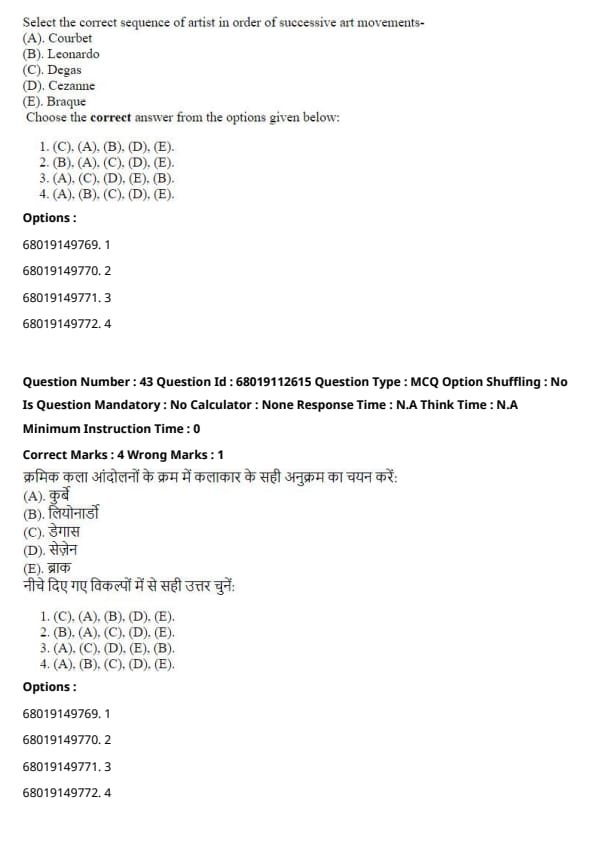
Select the correct sequence of artists in order of successive art movements:
(A) Courbet, (B) Leonardo, (C) Degas, (D) Cezanne, (E) Braque
Choose the correct answer from the options given below:
View Solution
The sequence reflects the progression of art movements:
- Leonardo da Vinci (Renaissance): Focused on realism, proportion, and humanism.
- Gustave Courbet (Realism): Emphasized ordinary subjects and rejection of romanticism.
- Edgar Degas (Impressionism): Captured fleeting moments with vibrant light and colour.
- Paul Cezanne (Post-Impressionism): Introduced structured compositions and bold brushstrokes.
- Georges Braque (Cubism): Revolutionized art with abstract, geometric forms.
Question 44:
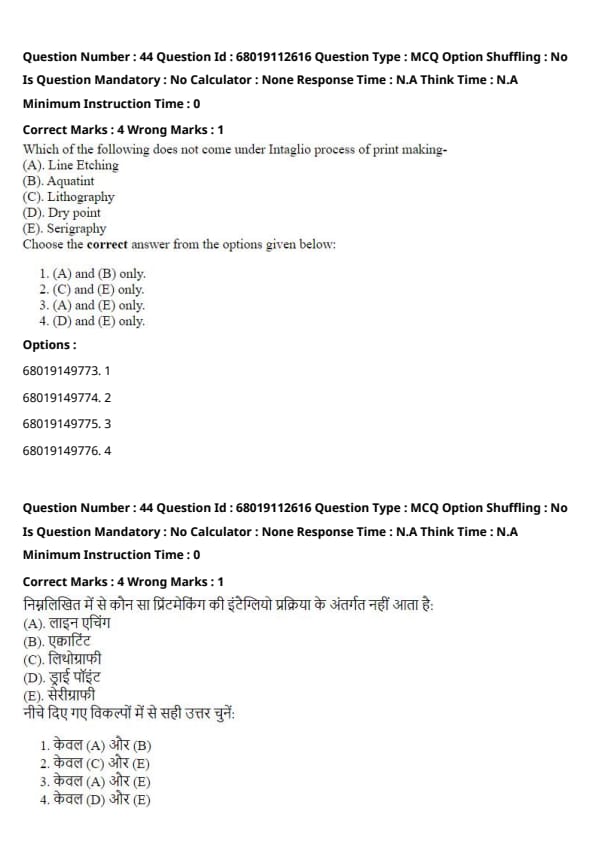
Which of the following does not come under Intaglio process of printmaking:
(A) Line Etching, (B) Aquatint, (C) Lithography, (D) Dry Point, (E) Serigraphy
Choose the correct answer from the options given below:
View Solution
Lithography (C) and Serigraphy (E) are not intaglio techniques. Intaglio involves incising designs into a plate, allowing ink to collect in the grooves. Examples include:
- Line Etching (A): Uses acid to etch lines.
- Aquatint (B): Creates tonal effects.
- Dry Point (D): Employs a needle to scratch the plate.
Lithography and serigraphy rely on surface-based techniques.
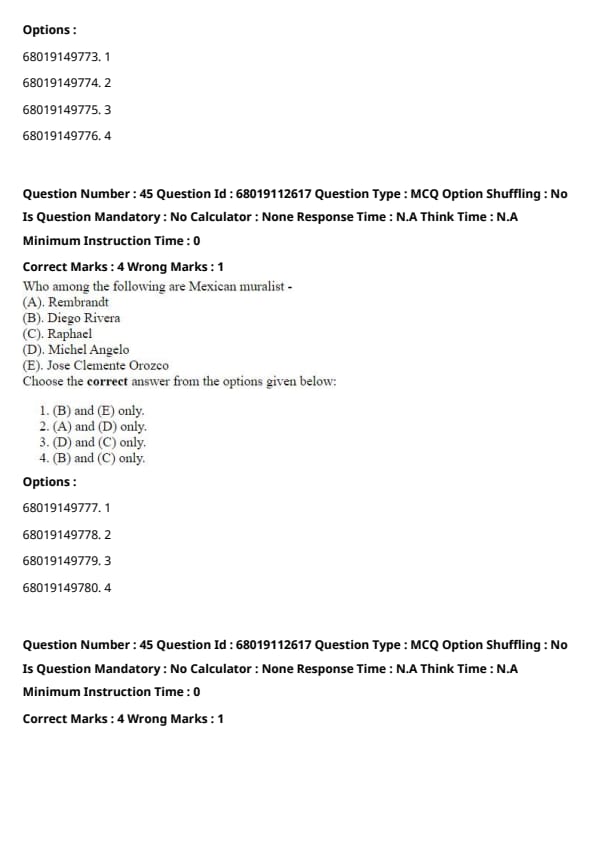
Question 45:
Who among the following are Mexican muralists?
(A) Rembrandt, (B) Diego Rivera, (C) Raphael, (D) Michel Angelo, (E) Jose Clemente Orozco
Choose the correct answer from the options given below:
View Solution
Diego Rivera (B) and Jose Clemente Orozco (E) were prominent Mexican muralists. They created large-scale frescoes depicting themes of social and political significance, reflecting Mexico's cultural identity and revolutionary history. Their works are celebrated for their vivid imagery and deep messages.
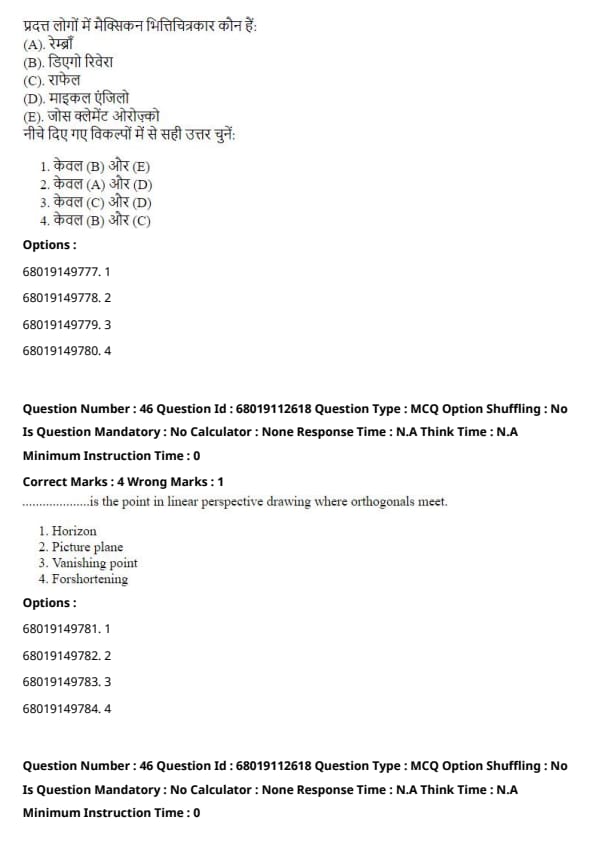
Question 46:
...is the point in linear perspective drawing where orthogonals meet.
View Solution
In linear perspective, the vanishing point is the point where parallel lines (orthogonals) appear to converge on the horizon. This creates the illusion of depth in a two-dimensional drawing, making it essential for realistic representation. For example, in a drawing of a road, the sides of the road appear to meet at the vanishing point.
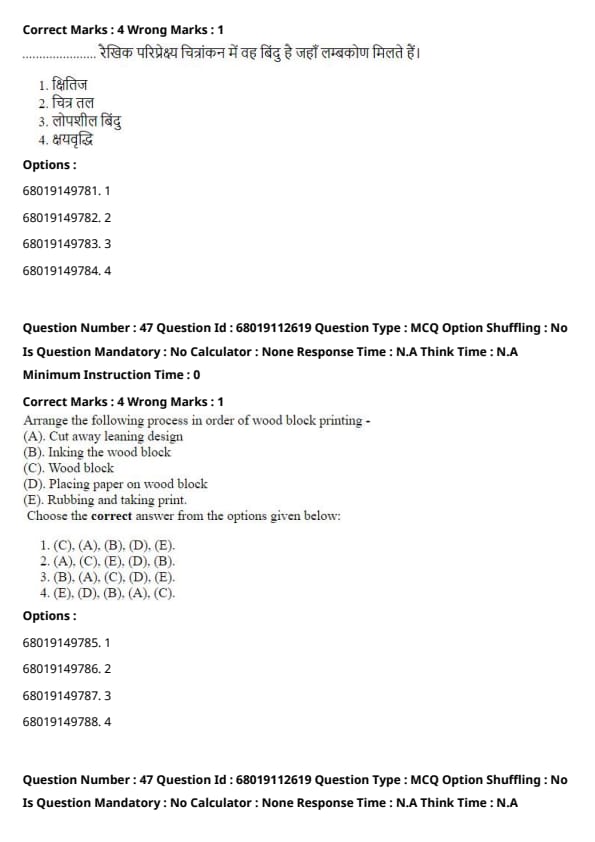
Question 47:
Arrange the following process in order of wood block printing:
(A) Cut away leaving design, (B) Inking the wood block, (C) Wood block, (D) Placing paper on wood block, (E) Rubbing and taking print
Choose the correct answer from the options given below:
View Solution
The correct sequence for wood block printing is as follows:
- Start with the wood block (C), which serves as the base for the design.
- Cut away the non-design areas, leaving the desired design raised (A).
- Ink the raised design using a roller or brayer (B).
- Place paper on the inked block carefully to transfer the design (D).
- Rub the back of the paper using a baren or a similar tool to ensure even transfer of ink (E).
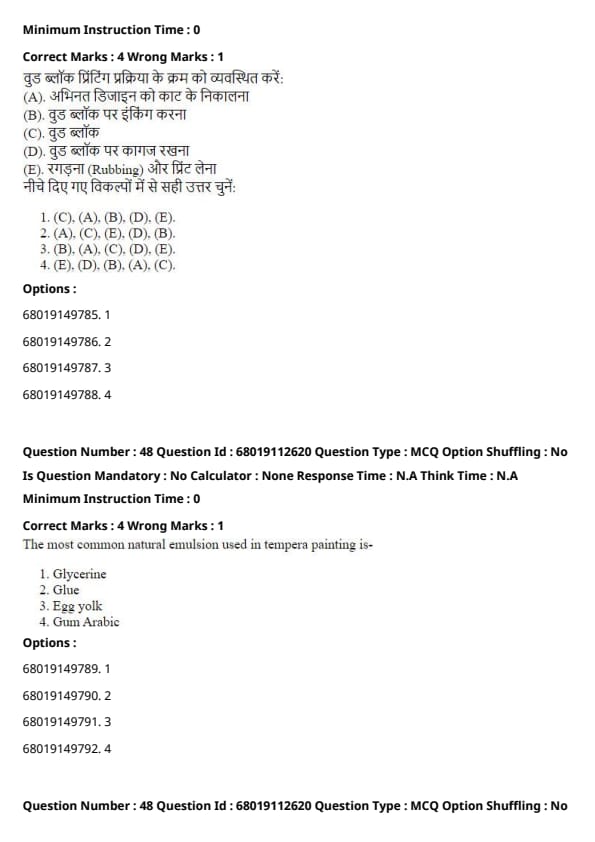
Question 48:
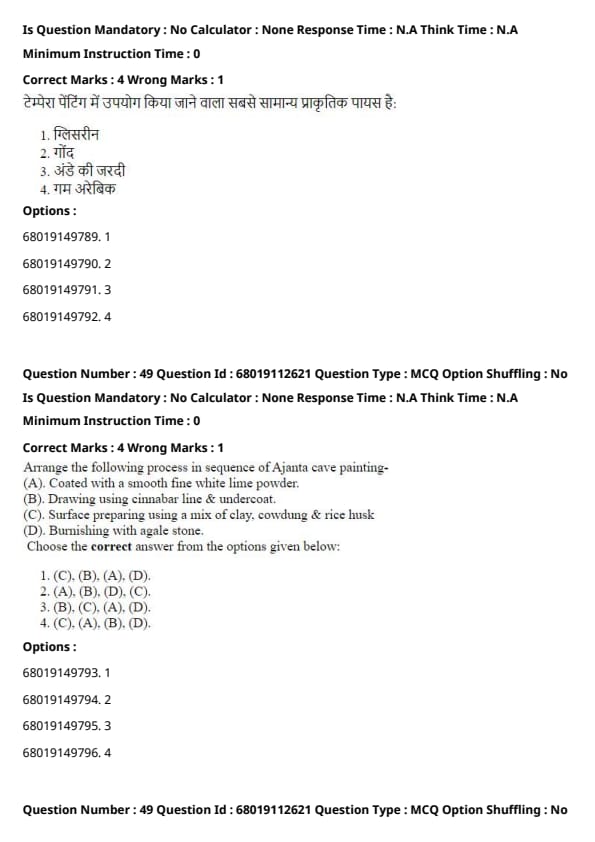
The most common natural emulsion used in tempera painting is:
View Solution
Egg yolk is a natural emulsion used in tempera painting. It acts as a binder, mixing with pigments to create a quick-drying and durable medium. The paint achieves a matte finish and is known for its longevity. This technique was widely used during the medieval and Renaissance periods before the advent of oil paints.
Question 49:
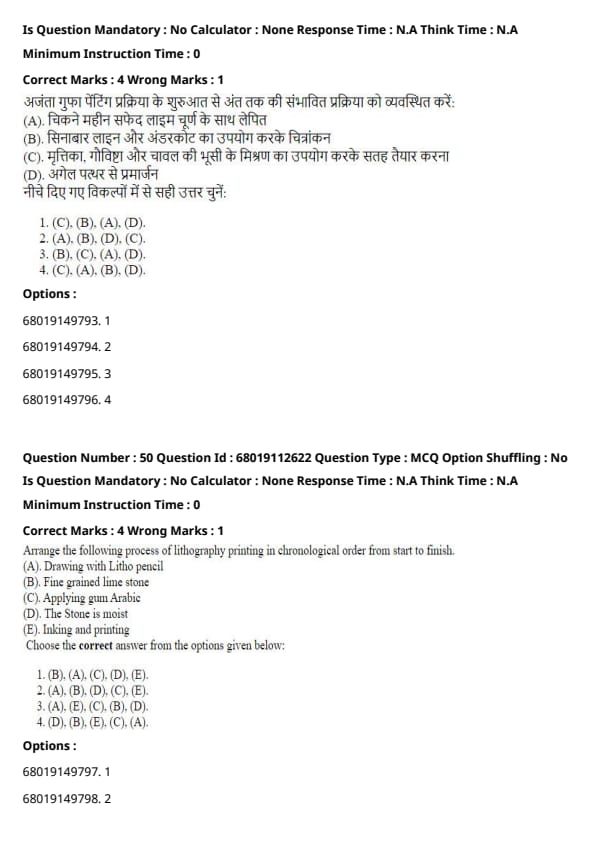
Arrange the following process in sequence of Ajanta cave painting:
(A) Coated with a smooth fine white lime powder, (B) Drawing using cinnabar line and undercoat, (C) Surface preparing using a mix of clay, cowdung and rice husk, (D) Burnishing with agale stone
Choose the correct answer from the options given below:
View Solution
The correct sequence for Ajanta cave painting is:
- Prepare the surface using a mixture of clay, cowdung, and rice husk (C).
- Coat the surface with a fine layer of white lime powder to create a smooth painting base (A).
- Draw using cinnabar lines and apply the undercoat to define the design (B).
- Burnish the surface using an agale stone to enhance the smoothness and finish (D).
Question 50:
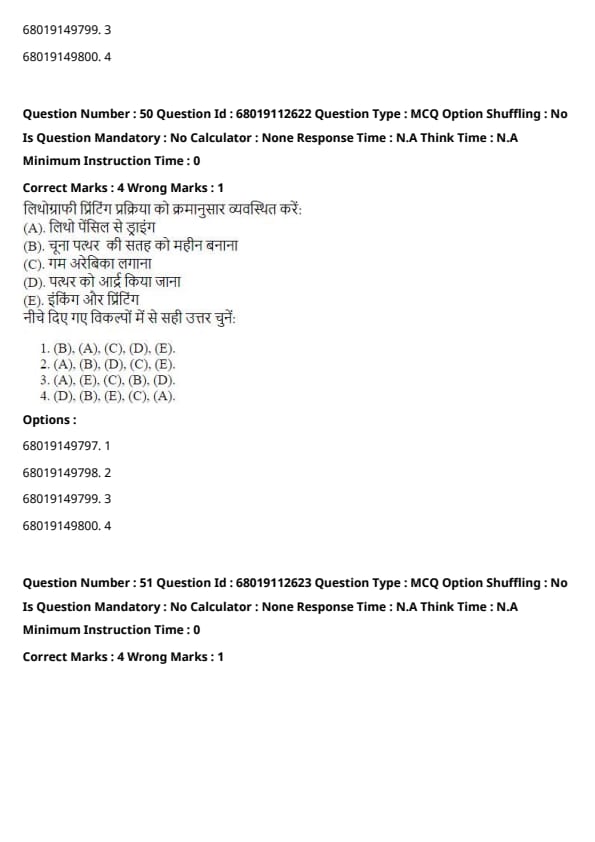
Arrange the following process of lithography printing in chronological order from start to finish:
(A) Drawing with Litho pencil, (B) Fine grained limestone, (C) Applying gum Arabic, (D) The Stone is moist, (E) Inking and printing
Choose the correct answer from the options given below:
View Solution
The correct sequence for lithography printing is:
- Start with a fine-grained limestone (B), which is the printing surface.
- Draw the image using a litho pencil or crayon (A).
- Apply gum Arabic to protect the non-image areas and set the drawing (C).
- Keep the stone moist so that the non-image areas repel ink (D).
- Ink the stone and transfer the image onto paper by printing (E).
Question 51:
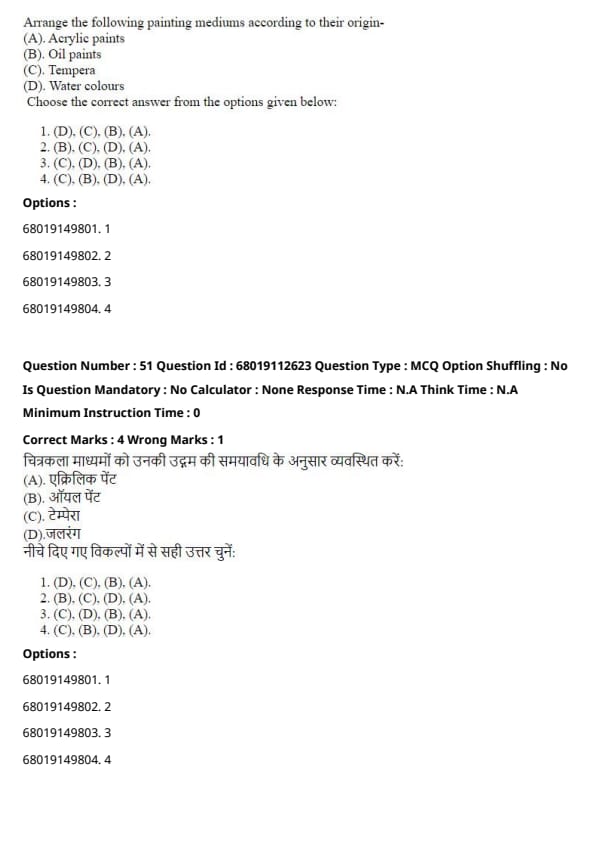
Arrange the following painting mediums according to their origin:
(A) Acrylic paints, (B) Oil paints, (C) Tempera, (D) Watercolours
Choose the correct answer from the options given below:
View Solution
The chronological order of painting mediums is:
- Tempera (C): An ancient medium used for centuries in medieval and Renaissance art.
- Oil paints (B): Developed during the Middle Ages, offering slow drying times and rich textures.
- Watercolours (D): Evolved as a medium after oil paints for creating translucent and delicate effects.
- Acrylic paints (A): Introduced in the 20th century, known for their quick-drying properties and versatility.
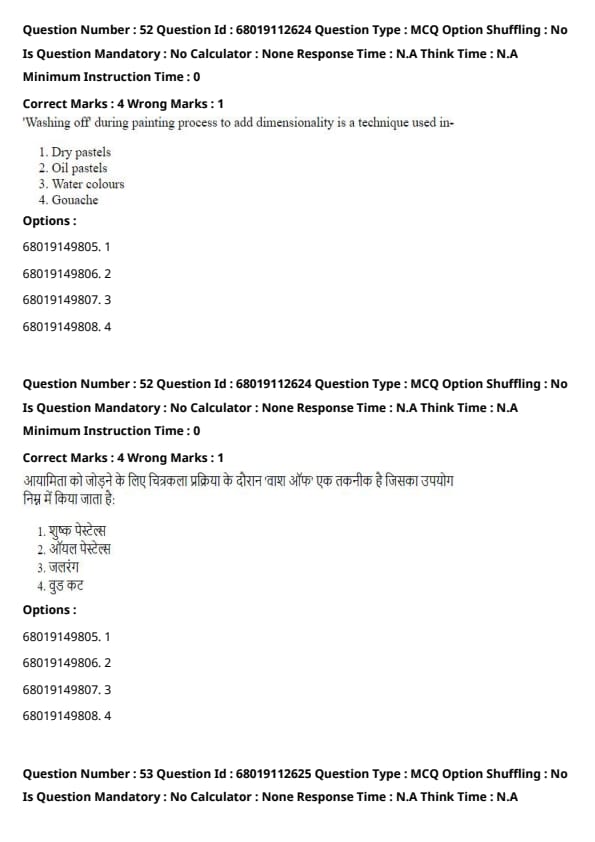
Question 52:
Washing off during painting process to add dimensionality is a technique used in:
View Solution
Washing off is a technique used in watercolour painting to achieve gradients, soften edges, and add depth. By gently removing or diluting paint with water, artists can create smooth transitions between colours and enhance the dimensionality of their artwork. This method is ideal for portraying light and atmospheric effects.
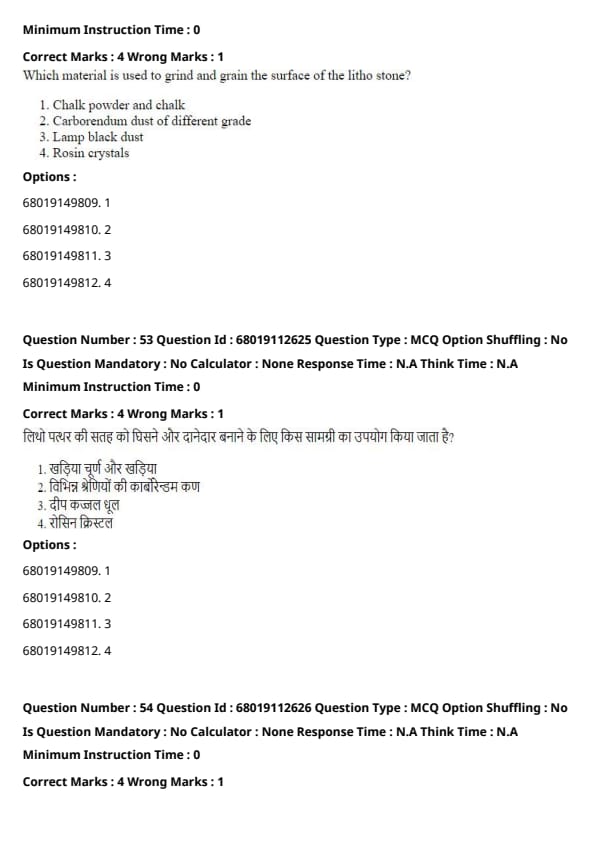
Question 53:
Which material is used to grind and grain the surface of the litho stone?
View Solution
Carborundum dust, available in different grades, is used to grind and prepare the litho stone. This process smooths the stone and removes any irregularities, ensuring an even surface for drawing and printing. Proper preparation of the litho stone is essential to achieving consistent and high-quality prints.
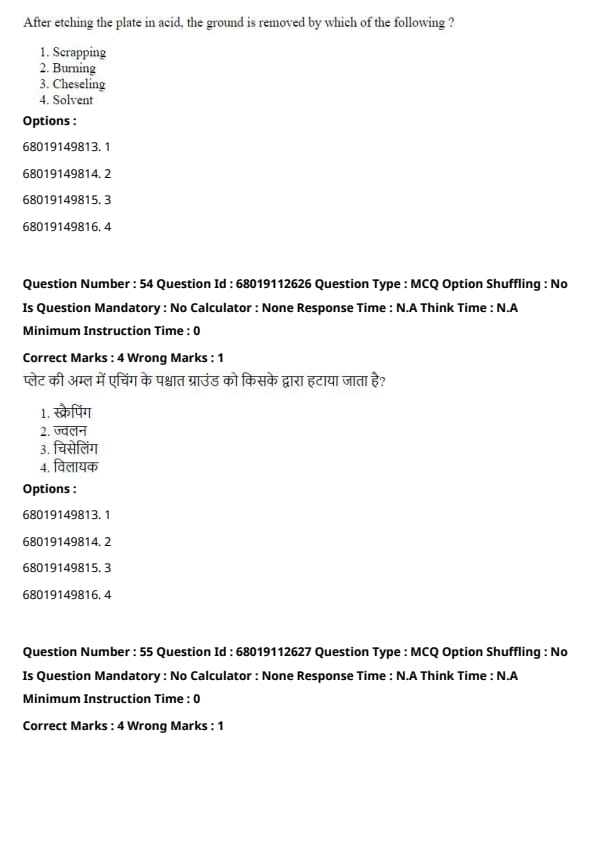
Question 54:
After etching the plate in acid, the ground is removed by which of the following?
View Solution
The ground, a protective coating applied to the plate during the etching process, is removed using a solvent like turpentine or mineral spirits. This ensures that the plate is clean and ready for inking and printing. Removing the ground is a crucial step to reveal the etched design without damaging the plate.
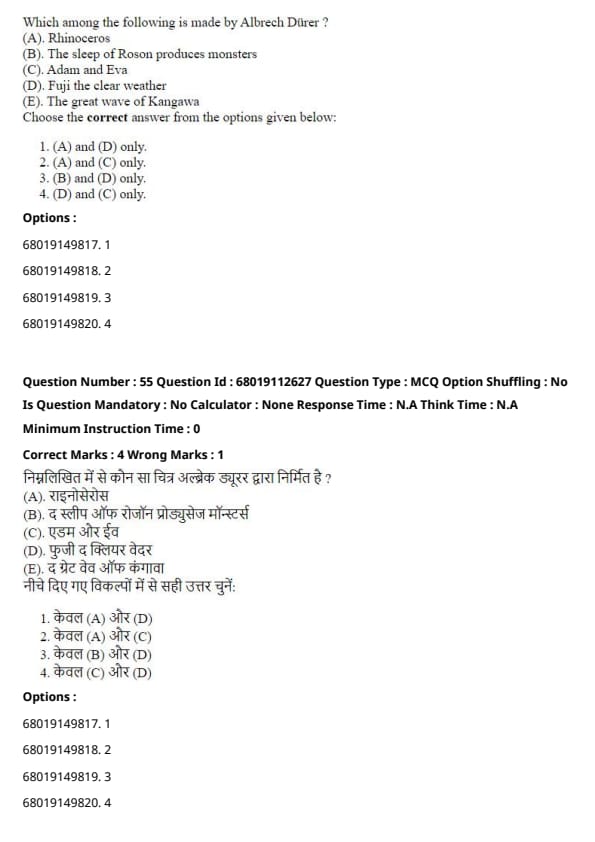
Question 55:
Which among the following is made by Albrecht Dürer?
(A) Rhinoceros, (B) The Sleep of Reason Produces Monsters, (C) Adam and Eva, (D) Fuji the Clear Weather, (E) The Great Wave of Kanagawa
Choose the correct answer from the options given below:
View Solution
Albrecht Dürer was a prominent figure of the Northern Renaissance known for his masterful printmaking. He created:
- “Rhinoceros” (A): A famous woodcut combining scientific observation and artistic imagination.
- “Adam and Eva” (C): An engraving celebrated for its intricate detail and symbolism.
The other works listed, such as “Fuji the Clear Weather” and “The Great Wave of Kanagawa”, are associated with Japanese artists like Hokusai.
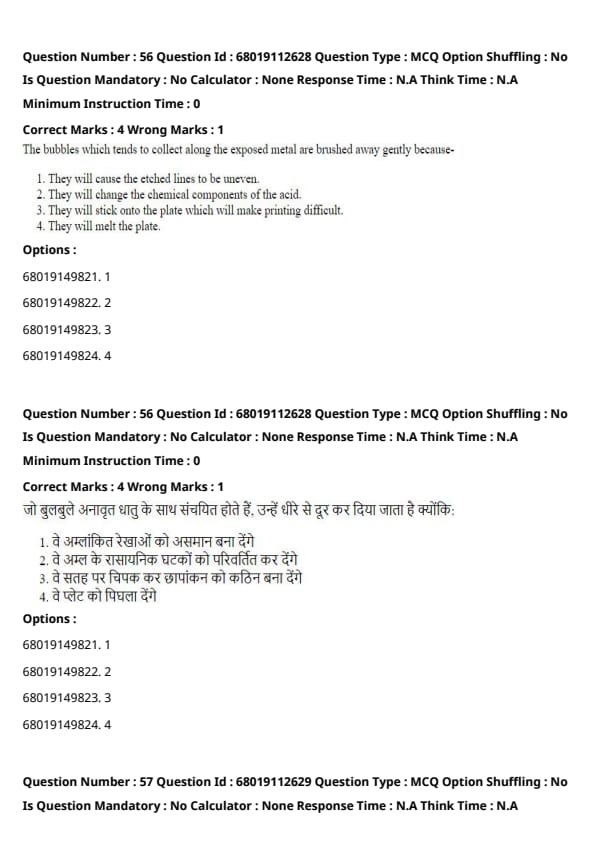
Question 56:
The bubbles which tend to collect along the exposed metal are brushed away gently because -
View Solution
During the etching process, bubbles form along the exposed metal areas as a byproduct of the chemical reaction between the acid and the plate. These bubbles can block the acid from evenly biting into the metal, leading to inconsistent or incomplete lines in the final design. Brushing them away gently ensures uniform etching and sharp details.
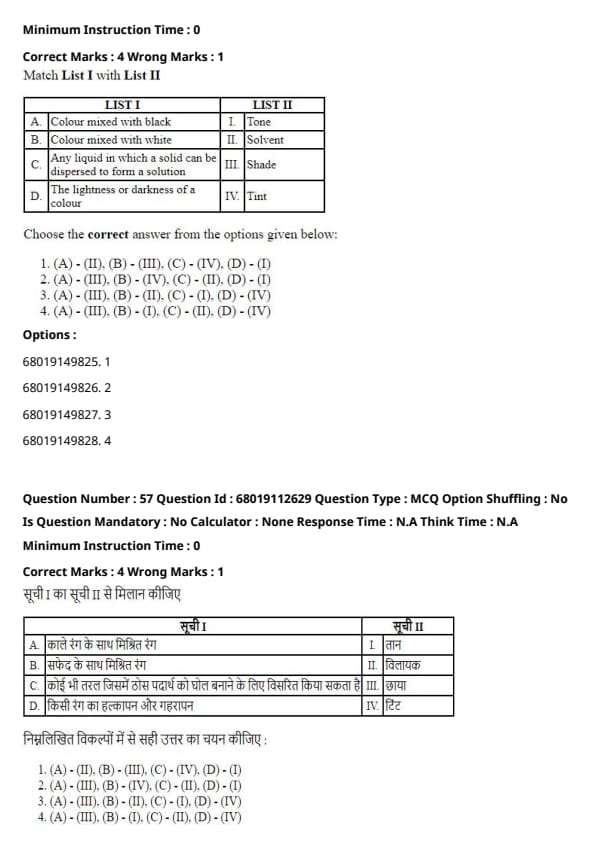
Question 57:
Match List I with List II:
| List I | List II |
|---|---|
| A. Colour mixed with black | III. Shade |
| B. Colour mixed with white | IV. Tint |
| C. Any liquid in which a solid can be dispersed to form a solution | II. Solvent |
| D. The lightness or darkness of a colour | I. Tone |
Choose the correct answer from the options given below:
View Solution
- Colour mixed with black creates a Shade (A - III), darkening the colour.
- Colour mixed with white creates a Tint (B - IV), lightening the colour.
- A Solvent (C - II) is a liquid used to dissolve or disperse solids for application in mediums like paint.
- The Tone (D - I) refers to the lightness or darkness of a colour, determined by the interplay of shades, tints, and base colour.
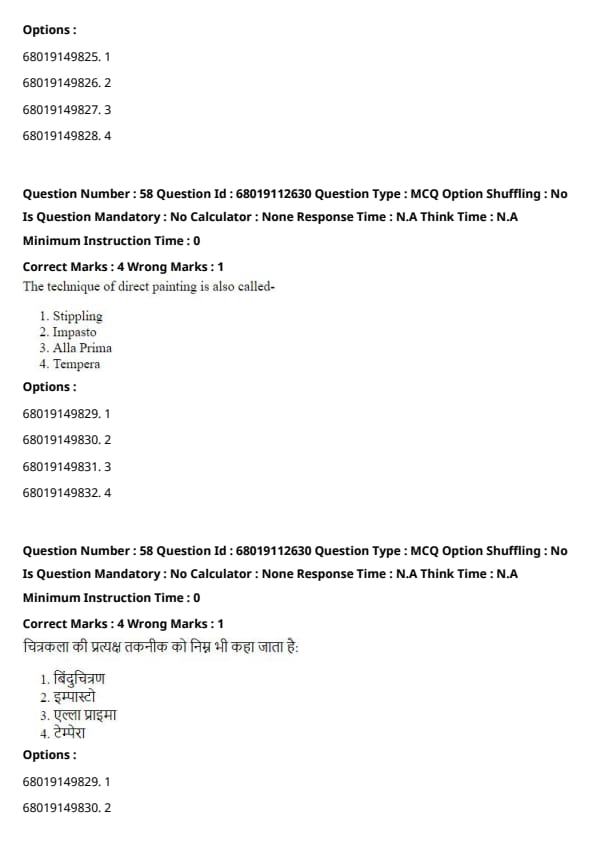
Question 58:
The technique of direct painting is also called -
View Solution
Alla Prima, meaning "at first attempt" in Italian, is a painting technique where the artist applies wet paint directly onto the canvas without letting previous layers dry. This approach is also known as "wet-on-wet" painting. It allows for expressive and spontaneous artworks with visible brushstrokes, capturing the immediacy and energy of the process.
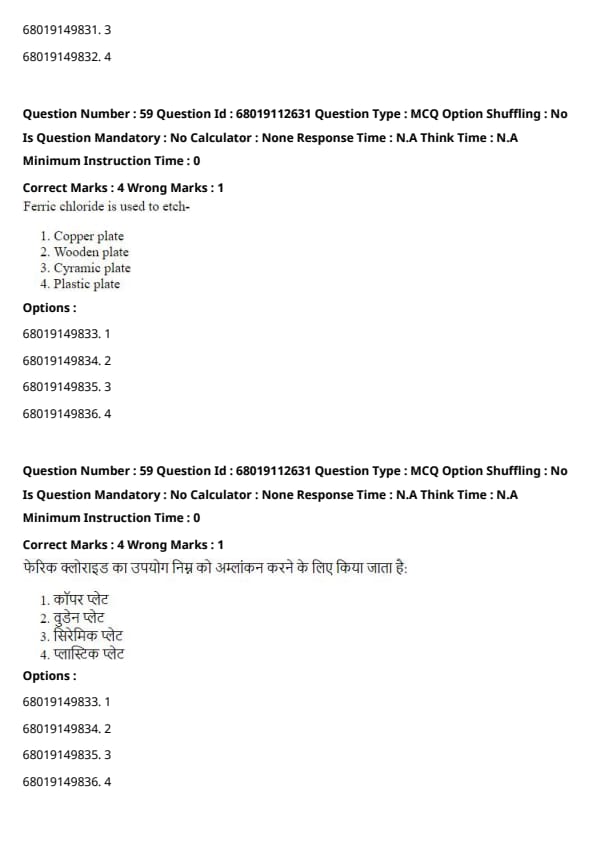
Question 59:
Ferric chloride is used to etch -
View Solution
Ferric chloride is a chemical commonly used in intaglio printmaking to etch copper plates. When applied, it reacts with the exposed areas of the copper plate, corroding them to create grooves. These grooves hold ink, which is transferred to paper during the printing process. Ferric chloride is preferred over nitric acid due to its safer handling and precise etching properties.
Question 60:
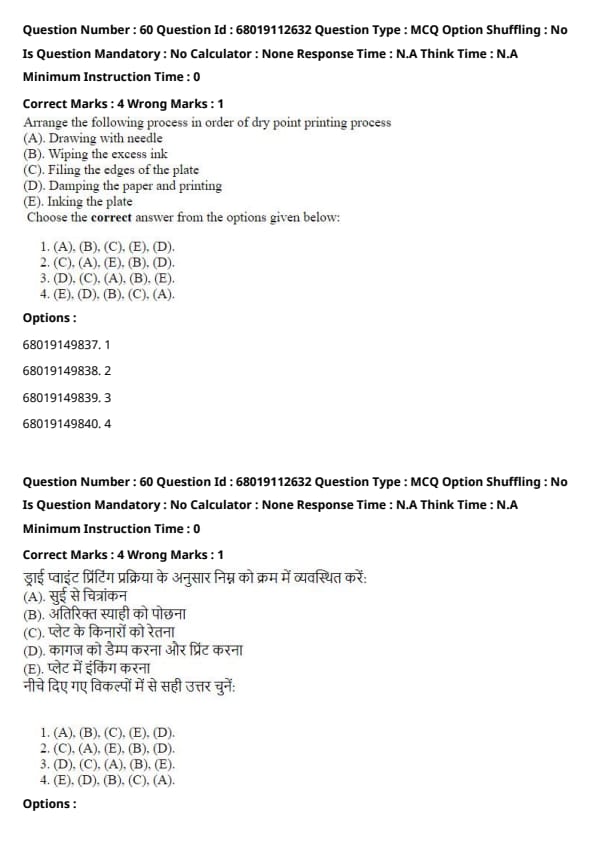
Arrange the following process in order of dry point printing process:
(A) Drawing with needle, (B) Wiping the excess ink, (C) Filing the edges of the plate, (D) Damping the paper and printing, (E) Inking the plate
Choose the correct answer from the options given below:
View Solution
The correct sequence for dry point printing is:
- File the edges of the plate to remove sharp edges and prepare it for engraving (C).
- Draw the design on the plate using a needle, creating grooves and burrs (A).
- Ink the plate to fill the grooves with ink (E).
- Wipe the excess ink, leaving it only in the grooves for printing (B).
- Dampen the paper and print by applying pressure using an etching press (D).
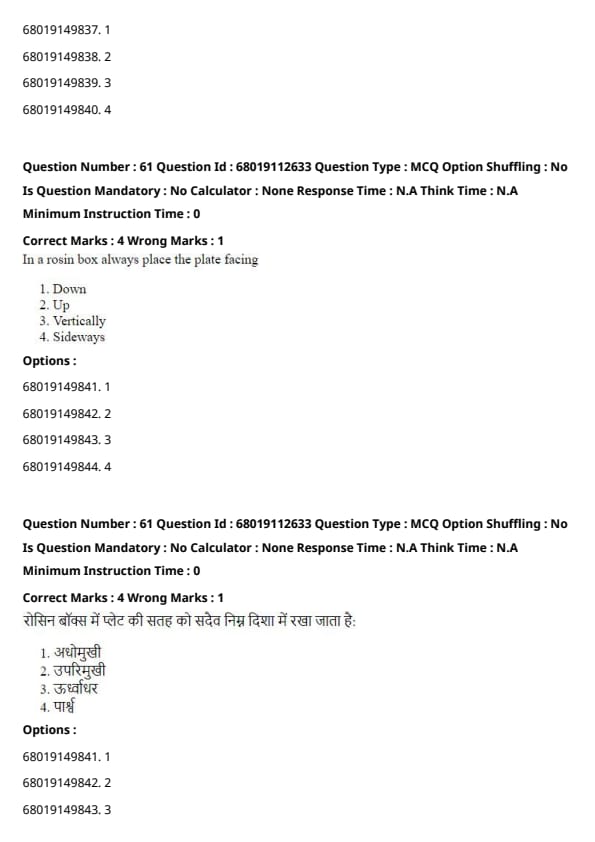
Question 61:
In a rosin box always place the plate facing -
View Solution
In an aquatint process, the plate is placed facing up in a rosin box. This allows the rosin particles to evenly settle on the plate's surface. After heating, the rosin adheres to the plate, creating a textured ground that resists acid and produces tonal effects during etching. Uniform application of rosin is essential for achieving consistent results.
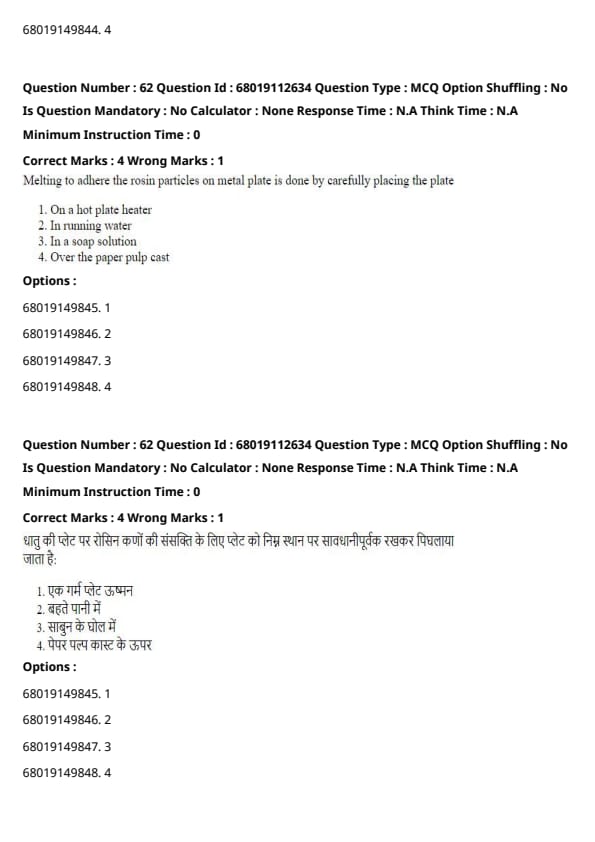
Question 62:
Melting to adhere the rosin particles on the metal plate is done by carefully placing the plate -
View Solution
In the aquatint process, the rosin particles are adhered to the surface of the metal plate by carefully heating it on a hot plate heater. This causes the rosin to melt slightly and stick to the plate, creating a resist pattern that protects certain areas during acid etching. Proper and even heating is crucial to avoid over-melting, which can disrupt the uniformity of the tonal effects.
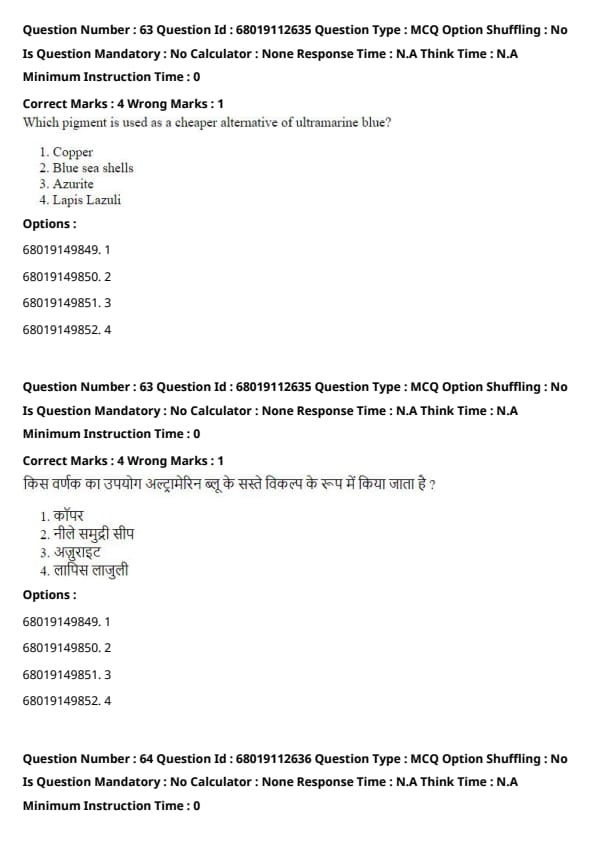
Question 63:
Which pigment is used as a cheaper alternative to ultramarine blue?
View Solution
Azurite, a naturally occurring mineral, serves as a cost-effective alternative to ultramarine blue, which is derived from the more expensive lapis lazuli. Azurite produces a vibrant blue but is less intense and durable compared to ultramarine. Its accessibility made it a popular choice among artists seeking economical options for blue pigments in historical artworks.
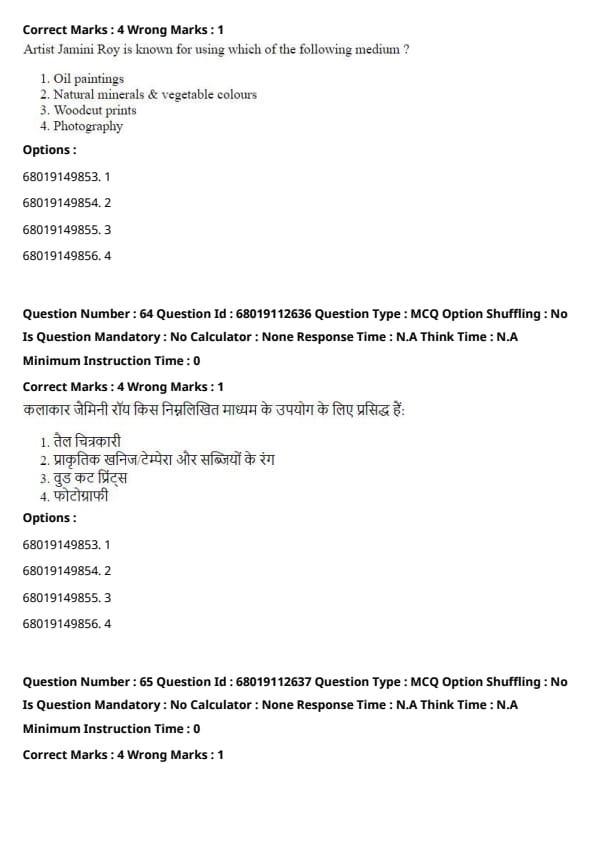
Question 64:
Artist Jamini Roy is known for using which of the following medium?
View Solution
Jamini Roy, a pioneer of modern Indian art, is celebrated for his use of natural minerals and vegetable colours in his artworks. He was inspired by traditional Indian folk art and rural Bengal culture. By utilizing natural pigments, Jamini Roy created vibrant and enduring works that reflect India's artistic heritage.
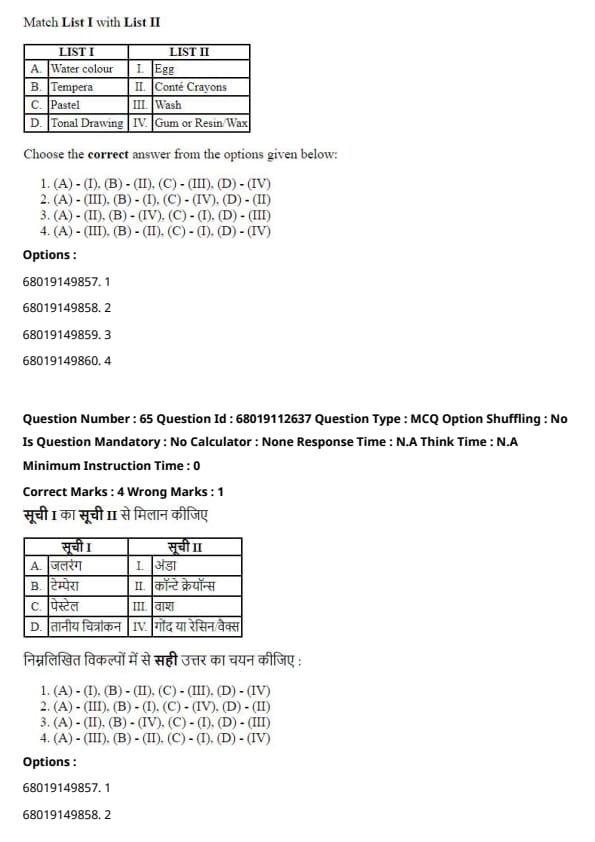
Question 65:
Match List I with List II:
| List I | List II |
|---|---|
| A. Water colour | III. Wash |
| B. Tempera | I. Egg |
| C. Pastel | IV. Gum or Resin/Wax |
| D. Tonal Drawing | II. Conte Crayons |
Choose the correct answer from the options given below:
View Solution
- Watercolour is applied using the wash technique, creating translucent layers (A - III).
- Tempera employs egg as a binding medium, giving a quick-drying matte finish (B - I).
- Pastel sticks are held together with gum or resin/wax, allowing for vibrant colours (C - IV).
- Tonal drawing often uses Conte crayons, which are ideal for creating smooth gradients and textures (D - II).
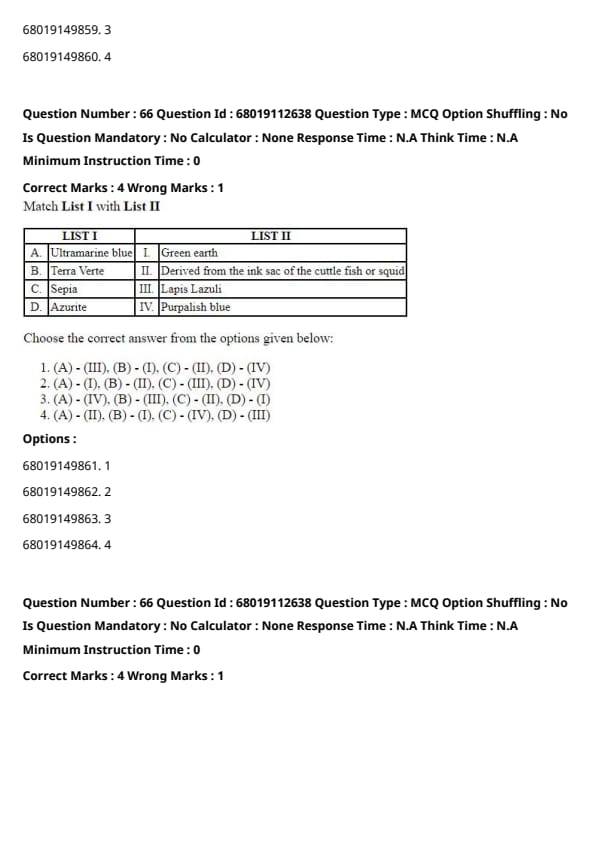
Question 66:
Match List I with List II:
| List I | List II |
|---|---|
| A. Ultramarine blue | III. Lapis Lazuli |
| B. Terra Verte | I. Green earth |
| C. Sepia | II. Derived from the ink sac of the cuttlefish or squid |
| D. Azurite | IV. Purplish blue |
Choose the correct answer from the options given below:
View Solution
- Ultramarine blue is derived from Lapis Lazuli, a rare and expensive mineral (A - III).
- Terra Verte, also known as Green earth, is a natural pigment used for earthy tones (B - I).
- Sepia comes from the ink sac of the cuttlefish or squid, providing rich brown hues (C - II).
- Azurite produces a distinct purplish blue colour, historically used in frescoes (D - IV).
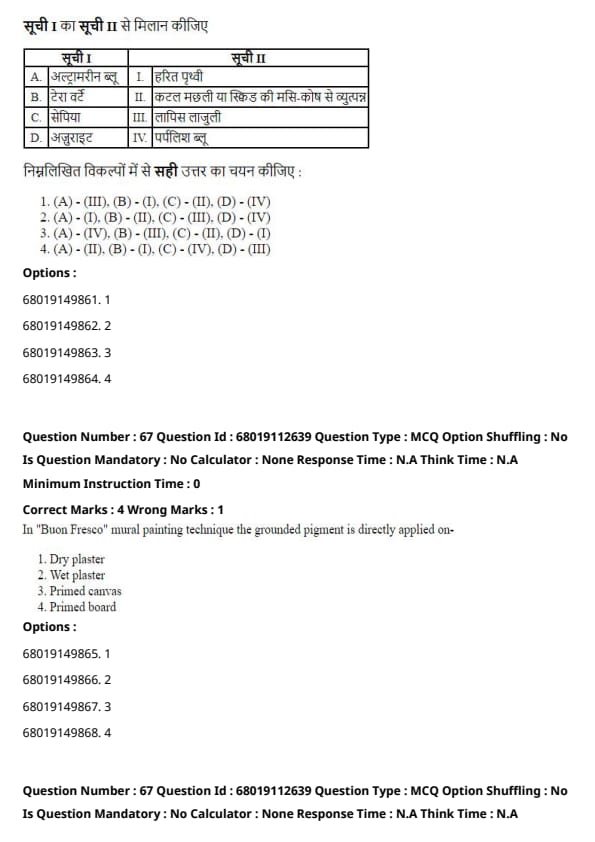
Question 67:
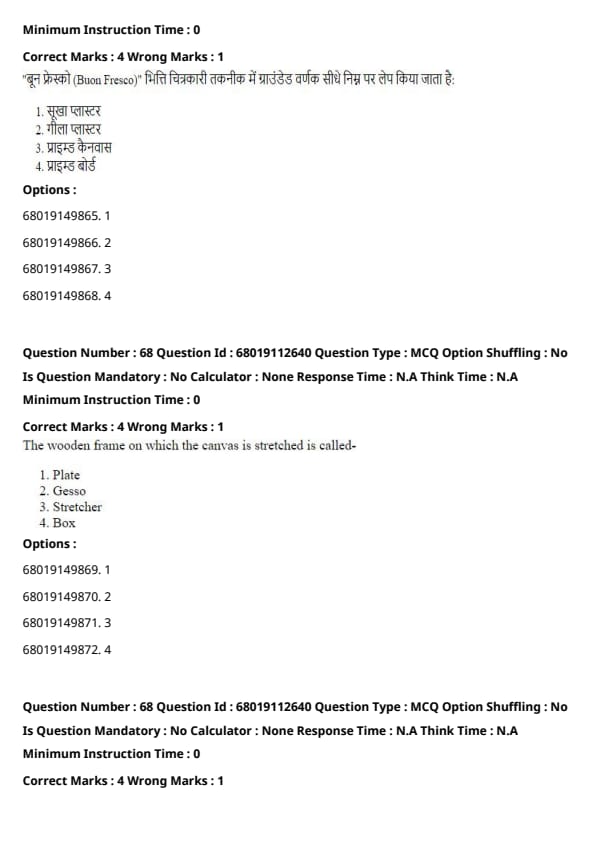
In "Buon Fresco" mural painting technique, the grounded pigment is directly applied on -
View Solution
In the Buon Fresco technique, pigments mixed with water are applied to freshly prepared wet lime plaster. As the plaster sets, a chemical reaction occurs, bonding the pigment to the plaster and creating a durable and vibrant finish. This method was widely used in Renaissance murals, such as Michelangelo's Sistine Chapel ceiling, ensuring the artwork's longevity.
Question 68:
The wooden frame on which the canvas is stretched is called -
View Solution
A stretcher is a wooden frame used to stretch and support the canvas. It ensures the canvas remains taut and stable for painting, preventing sagging or wrinkling during the artwork's creation. Stretchers are adjustable, allowing artists to tighten the canvas as needed. Proper stretching is critical for durability and ease of application.
Question 69:
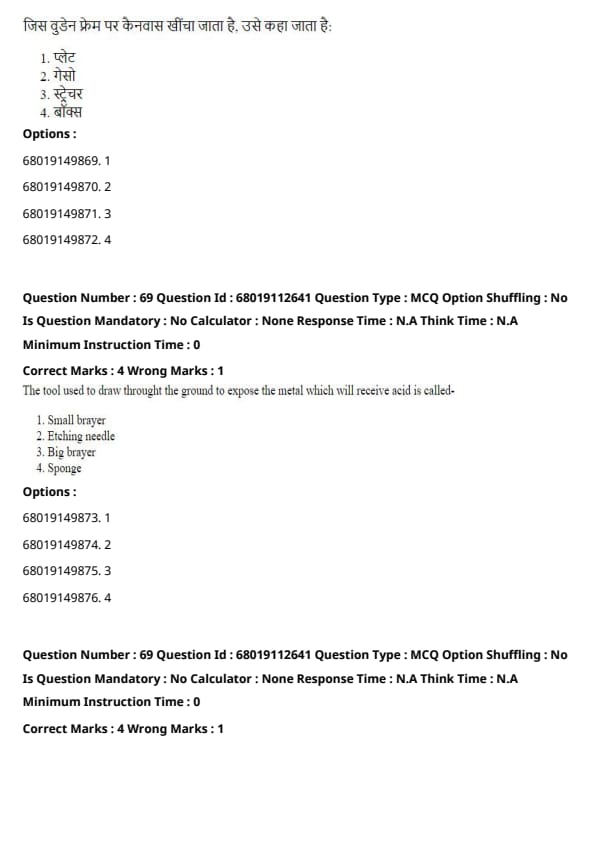
The tool used to draw through the ground to expose the metal which will receive acid is called -
View Solution
An etching needle is a sharp tool used in intaglio printmaking to create designs on a metal plate coated with acid-resistant ground. By scratching through the ground, the needle exposes the metal beneath, which is later bitten by acid to form grooves. These grooves hold the ink during printing, transferring the design onto paper.
Question 70:
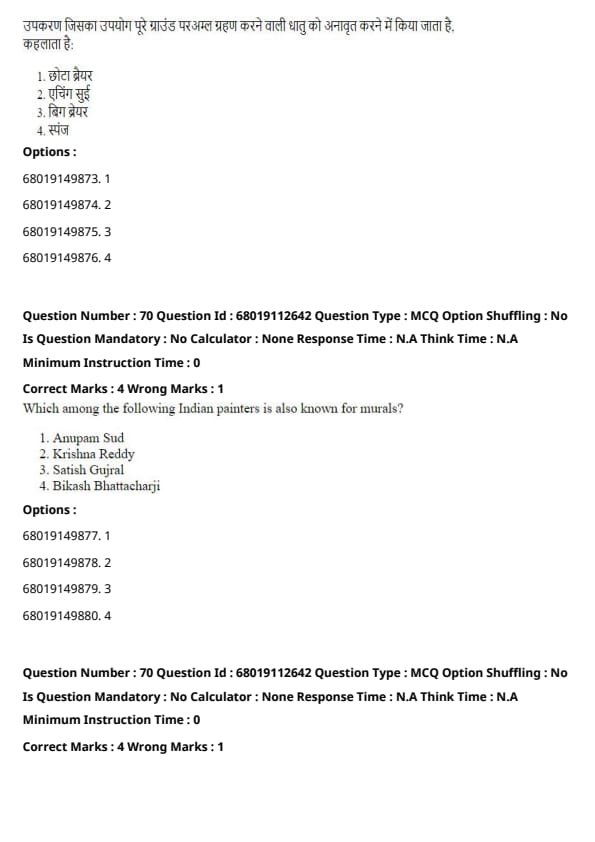
Which among the following Indian painters is also known for murals?
View Solution
Satish Gujral was a renowned Indian artist celebrated for his contributions to mural art, along with his work in painting, sculpture, and architecture. His murals often depict cultural and historical themes, showcasing his versatility and ability to integrate traditional and modern styles. Gujral's work reflects India's rich heritage and artistic diversity.
Question 71:
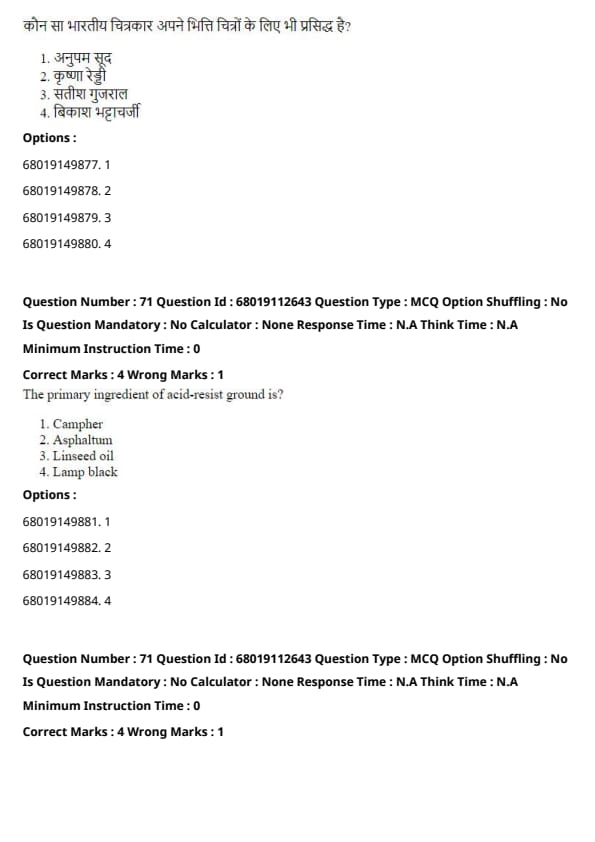
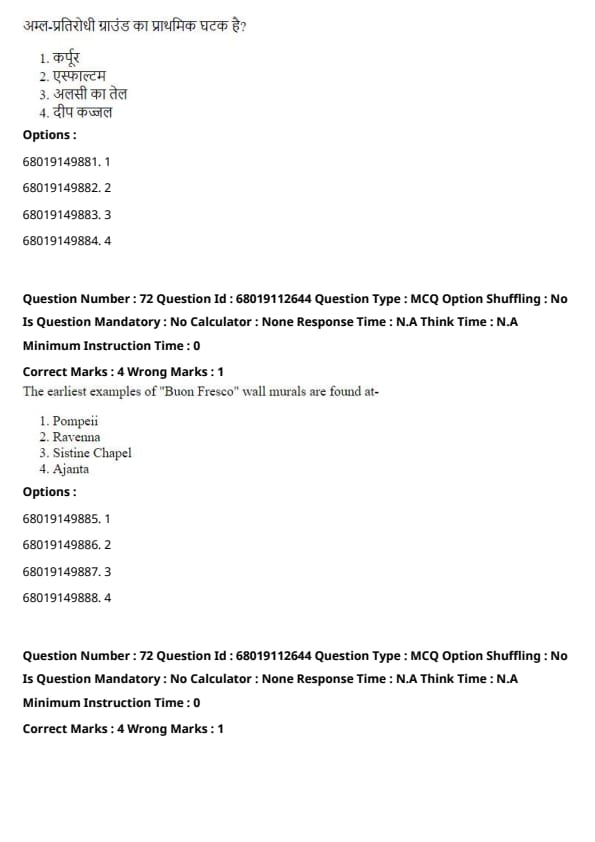
The primary ingredient of acid-resist ground is -
View Solution
Asphaltum is the main ingredient in acid-resistant ground used in etching. It creates a durable coating that protects the metal plate from acid exposure. The ground is applied evenly, and the design is scratched into it using an etching needle. Asphaltum ensures that only the exposed areas of the metal are etched, preserving the integrity of the surrounding surface.
Question 72:
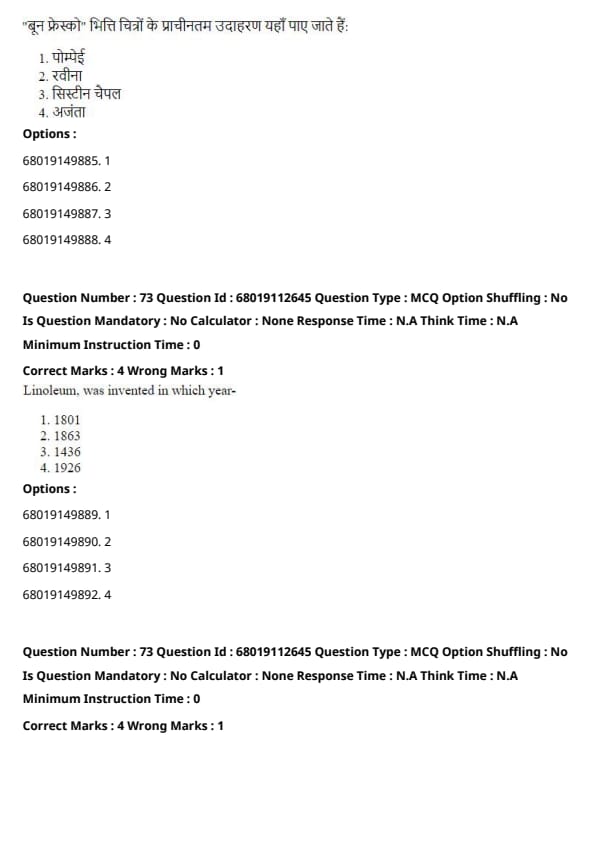
The earliest examples of "Buon Fresco" wall murals are found at -
View Solution
The earliest examples of "Buon Fresco" murals are located in the ancient city of Pompeii, preserved under volcanic ash from the eruption of Mount Vesuvius in 79 CE. These murals demonstrate the use of pigments applied directly onto wet plaster, a technique that chemically bonds the paint to the wall. The frescoes at Pompeii offer a vivid glimpse into Roman life, showcasing scenes of mythology, daily activities, and ornamental designs.
Question 73:
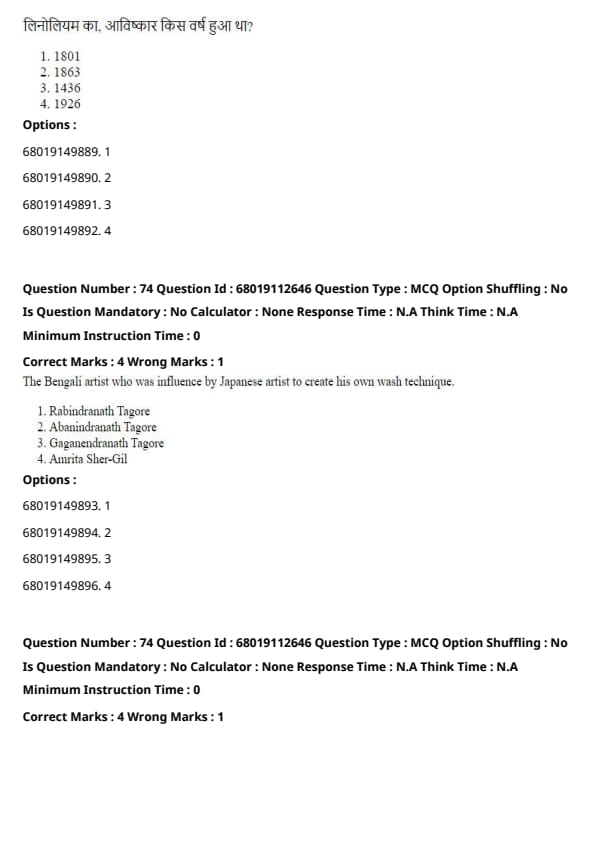
Linoleum was invented in which year?
View Solution
Linoleum was invented in 1863 by Frederick Walton as a durable flooring material. It is composed of linseed oil, ground cork, resin, and other natural materials. Over time, linoleum was adapted for use in printmaking due to its smooth surface and ease of carving, making it ideal for creating intricate designs in relief printing.
Question 74:
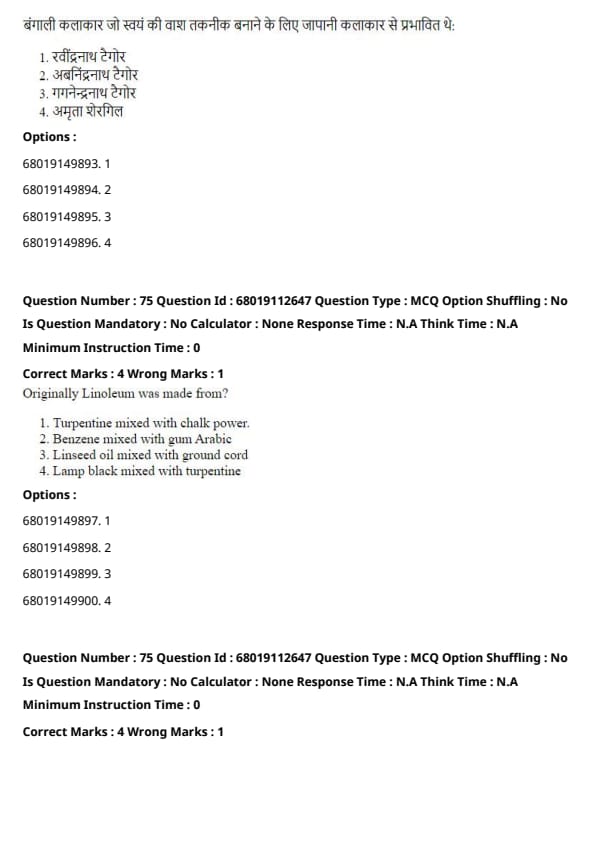
The Bengali artist who was influenced by Japanese artists to create his own wash technique -
View Solution
Abanindranath Tagore, a leading figure of the Bengal School of Art, was inspired by the Japanese wash technique. Under the influence of Japanese artists like Okakura Kakuzo, he developed his own wash style, combining Indian themes with delicate, translucent layers of colour. This innovation revitalized Indian art traditions, moving away from colonial styles and establishing a unique national identity.
Question 75:
Originally, Linoleum was made from -
View Solution
Linoleum was originally manufactured using linseed oil combined with ground cork, resin, and wood flour. These natural components resulted in a durable, flexible material initially intended for flooring. Its smooth surface and ease of carving later made it a preferred medium for printmaking. Linoleum's eco-friendly composition and versatility contributed to its widespread use in both functional and artistic applications.




Comments