


.png?h=35&w=35&mode=stretch)
CUET PG History of Art Question Paper 2024 is available here for download. NTA conducted CUET PG Botany paper 2024 on from March 11 in Shift 1. As per students’ feedback, the overall paper was easy to moderate. CUET PG Question Paper 2024 is based on objective-type questions (MCQs). According to the latest exam pattern, candidates get 105 minutes to solve 75 MCQs in CUET PG 2024 History of Art question paper.
CUET PG History of Art Question Paper 2024 PDF Download
| CUET PG History of Art Question Paper 2024 with Answer Key |  Download Download |
Check Solution |

CUET PG History of Art Questions with Solutions
Question 1:
Lascaux caves are located in:
View Solution
The Lascaux caves, renowned for their Paleolithic cave paintings, are located in southwestern France. The paintings, estimated to be around 17,000 years old, primarily depict large animals native to the region during the Upper Paleolithic era. The caves were discovered in 1940 and are a UNESCO World Heritage Site. Quick Tip: Remember that Paleolithic art is often found in caves and often features animals. Knowing the general locations of key prehistoric sites helps with these types of questions.
Original sculpture of the Priest King is in which Museum?
View Solution
The original sculpture of the Priest King, an iconic artifact of the Indus Valley Civilization, is housed in the National Museum, Karachi, Pakistan. This sculpture, made of steatite, showcases the sophisticated craftsmanship of the Harappan people. The figure's serene expression and intricate attire offer valuable insights into the civilization's culture and beliefs. Quick Tip: The Priest King is a key artifact of the Indus Valley Civilization. Remember its location in Pakistan.
What is a key feature to identify a Mauryan period sculpture?
View Solution
A distinctive feature of Mauryan sculptures is the high polish on the surface of the stone, often sandstone or granite. This characteristic sheen is a result of the advanced stone-working techniques employed during the Mauryan period. Quick Tip: Mauryan sculpture is characterized by its polish, typically on sandstone or granite.
In which Museum the Didarganj Yakshi is housed?
View Solution
The Didarganj Yakshi, a stunning example of Mauryan-era sculpture, is located in the Patna Museum, Bihar, India. This life-sized yakshi figure, carved from polished sandstone, exemplifies the artistic skill and aesthetic sensibilities of the period. Quick Tip: The Didarganj Yakshi is a key example of Mauryan art and is housed in the Patna Museum.
Blue colour in Ajanta mural painting is derived from which material?
View Solution
The vibrant blue pigment used in the Ajanta murals was derived from lapis lazuli, a semi-precious stone. This pigment, known for its rich hue and durability, was highly valued and often imported from distant regions like Afghanistan. The use of such precious materials highlights the importance given to these murals. Quick Tip: The rich blue of the Ajanta murals comes from lapis lazuli.
Razmnama is depiction of stories from:
View Solution
The Razmnama is a Persian translation of the Indian epic Mahabharata. Commissioned by the Mughal Emperor Akbar, it played a significant role in bridging cultural understanding between Persian and Indian traditions. The text features detailed illustrations that depict key events and characters from the epic. Quick Tip: The Razmnama is the Persian translation of the Mahabharata, commissioned by Akbar.
Titian is a painter from which school of Renaissance period?
View Solution
Titian (Tiziano Vecellio) was a leading figure of the Venetian School of Renaissance painting during the 16th century. The Venetian School was known for its emphasis on rich colors, light, and a painterly style, in contrast to the linear precision of the Florentine School. Quick Tip: Titian is a prominent artist of the Venetian School, known for rich colours and textures.
Venus of Willendorf is carved out of which stone?
View Solution
The Venus of Willendorf, a famous Paleolithic figurine, is carved from oolitic limestone. This small sculpture, dating back to approximately 25,000-30,000 BCE, is thought to be a fertility symbol. The choice of limestone allowed for detailed carving of the figure's distinctive features. Quick Tip: The Venus of Willendorf is a Paleolithic figurine carved from limestone.
Ziggurat is an Architectural form of which ancient Civilization?
View Solution
Ziggurats are massive, stepped structures that were built in ancient Mesopotamia (modern-day Iraq and surrounding regions). These structures served as temples dedicated to the various deities of the Mesopotamian pantheon. They were constructed primarily from mud bricks and represent a significant architectural achievement of the Sumerian, Babylonian, and Assyrian civilizations. Quick Tip: Ziggurats are Mesopotamian stepped temple structures.
Ishtar Gate is from which period of Mesopotamian Art?
View Solution
The Ishtar Gate was constructed in Babylon during the Neo-Babylonian Empire, under the rule of Nebuchadnezzar II (around 604-562 BCE). It was dedicated to the goddess Ishtar and was adorned with glazed bricks depicting lions, bulls, and dragons. It formed part of a grand processional way leading into the city. Quick Tip: The Ishtar Gate is a key example of Neo-Babylonian architecture.
The Palette of Narmer is designed to project.
View Solution
The Palette of Narmer, an ancient Egyptian ceremonial palette, is interpreted as depicting the unification of Upper and Lower Egypt under King Narmer. The scenes on the palette show Narmer wearing the crowns of both regions, symbolizing his authority and power over the unified land. The artwork is a powerful statement of royal authority and divine legitimacy. Quick Tip: The Palette of Narmer symbolizes the unification of Egypt and the power of the ruler.
Archaic sculptures of standing women referred as korai in Greek Sculptures generally represents:
View Solution
Korai (singular: Kore) are archaic Greek statues of standing young women, typically clothed. These statues were often used as votive offerings in sanctuaries, particularly to goddesses like Athena. They are thought to represent young women, possibly priestesses, in service to the deity. While they may have had multiple functions, their primary purpose was religious and dedicatory. Quick Tip: Korai are archaic Greek statues of young women, often used as votive offerings.
Doric Order is an architectural feature of which ancient civilization:
View Solution
The Doric order is one of the three classical orders of ancient Greek architecture (the other two being Ionic and Corinthian). It is characterized by simple, unadorned columns with a plain capital (top) and no base. The Doric order is known for its strength and simplicity and is found in many famous Greek temples, including the Parthenon. Quick Tip: The Doric order is a fundamental element of classical Greek architecture, distinguished by plain columns.
Romantic period landscape painting captures:
View Solution
Romantic landscape painting often focused on the concept of the "sublime," which refers to a sense of awe, wonder, and even terror inspired by the vastness and power of nature. Artists like Caspar David Friedrich and J.M.W. Turner sought to evoke these feelings in their depictions of dramatic landscapes, storms, and natural phenomena. The sublime evokes a sense of awe, wonder, and even a hint of terror in the face of nature's immense power. Quick Tip: Romantic landscape painting frequently evokes the concept of the sublime, emphasizing nature's power.
Relationship of colour and violent emotions is a unique feature of which western art movement?
View Solution
Expressionism, an early 20th-century art movement, emphasized the artist's inner feelings and emotions, often using bold, distorted forms and intense, non-naturalistic colors to convey subjective experiences. Artists like Ernst Ludwig Kirchner and Emil Nolde used color to express anxiety, alienation, and other powerful emotions. Quick Tip: Expressionism uses bold colors and distorted forms to express intense emotions.
Name the artist who explores relation between music and painting in visual art .
View Solution
Wassily Kandinsky, a Russian painter and art theorist, was a pioneer of abstract art. He believed that colors and forms could evoke emotions and spiritual experiences in the same way that music does. He often gave his paintings musical titles like "Composition" and "Improvisation," reflecting his interest in the connection between visual art and music. He explored the concept of synesthesia (the blending of senses). Quick Tip: Kandinsky is known for his exploration of the relationship between music, color, and abstract art.
The use of dramatic light and the melodramatic gestures in an artwork are reminiscent of which style?
View Solution
The Baroque style, which flourished in Europe from the early 17th to mid-18th century, is characterized by dramatic use of light and shadow (tenebrism), exaggerated motion, and intense emotion. Artists like Caravaggio and Bernini were masters of this style, creating works that were intended to evoke a strong emotional response from the viewer. Quick Tip: Baroque art is known for its drama, intense light and shadow (tenebrism), and emotional impact.
Neoclassicism under the patronage of Napoleon visualised arts to project the image of France as a new imperial Rome, thus he patronised the creation of ..........
View Solution
Napoleon Bonaparte, aiming to emulate the grandeur of the Roman Empire, heavily patronized Neoclassical art and architecture. Triumphal arches, reminiscent of those built by Roman emperors to commemorate victories, were a key element of this imperial imagery. The Arc de Triomphe in Paris is the most famous example. Quick Tip: Napoleon used Neoclassical art, particularly triumphal arches, to connect his rule to the Roman Empire.
The earliest Jain manuscript paintings include............. colours
View Solution
Early Jain manuscript paintings, particularly those from the Western Indian tradition (like the Kalpasutra manuscripts), often used a limited palette. While red and yellow were common, a key feature was the prominent use of blue (often derived from lapis lazuli) and gold leaf. These colors were symbolic and added to the preciousness of the manuscripts. Quick Tip: Early Jain manuscripts often feature blue and gold, using precious materials like lapis lazuli and gold leaf.
What is unique feature of Gothic architecture?
View Solution
Gothic architecture, which flourished in Europe during the High and Late Middle Ages, is characterized by several distinctive features, most notably the pointed arch. The pointed arch allowed for taller, more slender structures and larger windows, contributing to the soaring verticality and light-filled interiors of Gothic cathedrals. Ribbed vaults and flying buttresses are other key elements. Quick Tip: Pointed arches, ribbed vaults, and flying buttresses are defining features of Gothic architecture.
An exhibition of works of the Bauhaus artists in Calcutta in1922 stimulated Indian taste for:
View Solution
The Bauhaus school, a German art school operational from 1919 to 1933, emphasized functional design and the integration of art, craft, and technology. Their work often featured abstract and non-representational forms. The 1922 exhibition in Calcutta exposed Indian artists to these new ideas, influencing a move towards abstraction and modernism in Indian art. Quick Tip: The Bauhaus school promoted functional design and non-representational (abstract) art.
Name the artist who identified primitivism of folk, popular and tribal art as an 'authentic' expression of the Indian soul in his artworks.
View Solution
Jamini Roy (1887-1972) was a prominent Indian painter who consciously rejected Western academic styles and turned to the folk art traditions of Bengal, particularly the Kalighat Pat style, for inspiration. He believed that these indigenous forms represented the true spirit of Indian art and culture. He simplified forms, used bold, flat colors, and drew inspiration from folk motifs and themes. Quick Tip: Jamini Roy is known for incorporating folk art elements, particularly from the Kalighat Pat style, into his paintings.
The academic sculpture tradition, founded at the Bombay Art School by Lockwood Kipling in the nineteenth century, is reflected in the works of which sculptor?
View Solution
G.K. Mhatre (Ganpatrao Kashinath Mhatre) was a prominent sculptor who received his training at the Sir J.J. School of Art in Bombay (Mumbai), which was founded under the influence of British academic traditions. His early works, in particular, reflect the academic style taught at the school, emphasizing realism and naturalistic representation. Quick Tip: G.K. Mhatre's early works reflect the academic style taught at the Bombay Art School.
Iconography of Lakulisha relates to which of the following tradition
View Solution
Lakulisha is considered the founder (or a major reformer) of the Pashupata sect, one of the oldest Shaiva traditions. His iconography, which often depicts him holding a club (lakula), is directly associated with this sect. The Pashupatas emphasized ascetic practices and devotion to Shiva. Quick Tip: Lakulisha is associated with the Pashupata sect of Shaivism.
Kitab-i-Nauras is a work by the ruler:
View Solution
The Kitab-i-Nauras (Book of Nine Rasas) is a collection of songs and poems written by Ibrahim Adil Shah II, the ruler of the Bijapur Sultanate in the late 16th and early 17th centuries. The work is significant for its exploration of the nine rasas (aesthetic emotions) of Indian art and its blend of Hindu and Muslim cultural traditions. He was a great patron of art, music, and literature. Quick Tip: Ibrahim Adil Shah II, the ruler of Bijapur, authored the Kitab-i-Nauras.
Ragamala illustrated at Chawand in 1605 belongs to the Rajput style of painting from:
View Solution
The Ragamala paintings illustrated at Chawand in 1605 are a significant example of the Mewar school of Rajput painting. Chawand served as the capital of Mewar for a period after Udaipur. This early Ragamala series is characterized by its vibrant colors, simplified compositions, and bold lines. It's one of the foundational sets for understanding the development of the Mewar style. The artist responsible for most of this series is Nasiruddin (or Nisardi). Ragamala paintings are pictorial representations of musical modes (ragas), and they form a significant genre within Indian miniature painting. Quick Tip: Remember that Chawand is associated with the Mewar school of Rajput painting, and the 1605 Ragamala set is a key example of its early style.
Painter Manaku belonged to which school of Pahari Painting?
View Solution
Manaku was a prominent painter of the Guler school of Pahari painting. He is particularly famous for his series of paintings illustrating the Gita Govinda (circa 1730), which are considered masterpieces of the Guler style. The Guler school is known for its refined lines, delicate coloring, and lyrical compositions, which are all evident in Manaku's work. His father, Pandit Seu, and brother, Nainsukh are also well known artists of this style. He painted many themes, including the Bhagavata Purana, Ramayana and Ragamala. Quick Tip: Associate Manaku with the Guler school and his masterpiece, the Gita Govinda series. He's a key figure in Pahari painting.
The Vishnu sculpture of Sena period is housed in which Museum?
View Solution
The Sena dynasty ruled in Bengal and Bihar in the 11th and 12th centuries, and they were great patrons of art, particularly Vaishnava sculpture. While specific locations within a museum can change, sculptures from this period (and region generally) are very likely to be found in major museums with collections of Indian art. Given the options, the Indian Museum, Kolkata, is the most plausible repository of this work, owing to its location in the heart of the former Sena kingdom and its large collection of eastern Indian sculptures. The National Museum in Delhi also has a wide range of sculpture. Jhansi is unlikely. It needs to be properly verified. Quick Tip: When considering the location of sculptures, consider the geographical area the dynasty ruled and major museums in that region or with significant collections from that period.
Western art elements are frequently seen in the works of the Mughal artist:
View Solution
Basawan was a prominent Mughal painter during the reign of Akbar, known for his exceptional skill in incorporating Western art elements into his works. He was particularly adept at using techniques like chiaroscuro (the use of strong contrasts between light and dark) and perspective, which were characteristic of European Renaissance art. This influence came via European prints and paintings that arrived at the Mughal court. Basawan's works, including illustrations for the Akbarnama and other manuscripts, demonstrate this skillful blending of artistic styles. He was particularly good at portraiture, and in depicting backgrounds. Quick Tip: Remember Basawan as a key Mughal artist who integrated Western techniques like chiaroscuro and perspective into his paintings.
Ratha temples of Mahabalipuram has in sculpture potrait of rulers of which dynasty:
View Solution
The Ratha temples (also known as the Pancha Rathas) at Mahabalipuram (Mamallapuram) are rock-cut monolithic structures, each carved in the shape of a chariot (ratha). They were built during the reign of the Pallava dynasty in the 7th and 8th centuries CE. These temples, along with other monuments at Mahabalipuram, are a UNESCO World Heritage Site. Though not strictly portraits in the modern sense, there are sculptures and inscriptions within and on the Rathas that reference the Pallava kings, particularly Narasimhavarman I (also known as Mamalla, hence the name Mamallapuram), who is credited with commissioning much of the work. Quick Tip: The Ratha temples at Mahabalipuram are definitively associated with the Pallava dynasty.
Prajnaparamita is the female personification of one of the following:
View Solution
Prajnaparamita, in Mahayana Buddhism, is the personification of perfect wisdom (prajna). The term literally means "the Perfection of Wisdom." She is often depicted as a female bodhisattva or goddess. The Prajnaparamita Sutras are a core set of Mahayana Buddhist texts that emphasize the concept of shunyata (emptiness) and the path to enlightenment through the realization of this wisdom. She is often depicted holding a book, symbolizing knowledge. Quick Tip: Prajnaparamita = Perfection of Wisdom. Remember her as a female embodiment of wisdom in Mahayana Buddhism.
Chaunsat yogini temple is at which site?
View Solution
While there are several Chaunsat Yogini temples in India, the one referred in the question most probably implies the one at Khajuraho. It is located in the western group of temples. There is also a well known temple at Bhedaghat, near Jabalpur and in Odisha. Chaunsat Yogini temples are dedicated to 64 (chaunsat) yoginis, who are female deities or attendants of the goddess. The Khajuraho temple is one of the oldest and most prominent, dating back to the 9th century CE. The temple at Khajuraho is rectangular in shape, unlike the other temples which are circular. Quick Tip: There are multiple Chaunsat Yogini temples, but Khajuraho is one of the most famous and is located among a larger, well-known temple complex.
Where are the earliest group of monolith temples found?
View Solution
The earliest groups of significant monolith temples in a large complex and with developed iconography are often associated with the rock-cut cave temples of western India, specifically in Maharashtra. Sites like the Ajanta and Ellora caves (which are in Maharashtra) contain some of the earliest and most elaborate examples of rock-cut architecture, including both Buddhist and Hindu monolithic temples, such as the Kailasa temple at Ellora. While there are other early rock-cut structures in other parts of India (like the Barabar Caves in Bihar), the scale, artistry, and religious diversity are particularly notable in Maharashtra. The Pallava-era monolithic temples at Mahabalipuram (in Tamil Nadu) are also significant, but they are generally considered slightly later than the earliest examples in Maharashtra. This question requires a careful understanding of dating and the term "earliest group". Quick Tip: Early rock-cut architecture is strongly associated with Maharashtra (Ajanta, Ellora), though other regions like Bihar (Barabar Caves) and Tamil Nadu (Mahabalipuram) also have important sites. Consider both date and architectural complexity.
Which hindu deity is the principal character of the Andhakasuravadha story as given in Puranic literature and represented in the sculpture of Kailashnath Temple, Ellora?
View Solution
The Andhakasuravadha story is a Puranic narrative in which Lord Shiva defeats the demon Andhaka. "Vadha" means "slaying." The sculpture at the Kailashnath Temple (Cave 16) at Ellora depicts this scene, showcasing Shiva's fierce form as he vanquishes the asura. The sculpture is a powerful representation of Shiva's cosmic dance and his role as the destroyer of evil. This is a common theme in Shaivite iconography. Quick Tip: Andhakasuravadha = Shiva slaying the demon Andhaka. This is a key story associated with Shiva.
Which Post impressionist artist reassert formal and structural values in painting
View Solution
Paul Cézanne is considered a key figure in Post-Impressionism and is particularly known for his emphasis on formal and structural values in painting. Unlike the Impressionists who focused on capturing fleeting moments and the effects of light, Cézanne sought to create a sense of solidity and permanence in his works. He used geometric forms, simplified shapes, and multiple perspectives to explore the underlying structure of his subjects. His approach paved the way for later movements like Cubism. Quick Tip: Cézanne is the Post-Impressionist most associated with a return to form and structure, bridging Impressionism and Cubism.
Berthe Morisot belonged to which art movement?
View Solution
Berthe Morisot was a prominent member of the Impressionist movement in 19th-century France. She was one of the few female artists associated with the core group of Impressionists, and her work is characterized by its delicate brushwork, focus on domestic scenes, and exploration of light and color. She was a close friend and colleague of artists like Édouard Manet (she married his brother), Edgar Degas, and Pierre-Auguste Renoir. Quick Tip: Berthe Morisot is a key female Impressionist painter, known for her intimate depictions of women and domestic life.
A Bar at the Folies-Bergère is a work by which artist?
View Solution
A Bar at the Folies-Bergère (Un bar aux Folies Bergère) is one of Édouard Manet's most famous and final major works. It depicts a scene in a Parisian nightclub, with a barmaid standing before a mirror that reflects the lively crowd. The painting is notable for its complex composition, ambiguous perspective, and commentary on modern life and social interactions. It's a key example of Manet's Realist/Impressionist style. Quick Tip: A Bar at the Folies-Bergère is a masterpiece by Édouard Manet, known for its modern subject matter and ambiguous reflections.
Underground cemeteries of the Roman period are called:
View Solution
Catacombs are underground passageways used as burial places, particularly associated with early Christians in Rome. These extensive networks of tunnels and chambers contain niches for individual burials and larger rooms for family tombs. They also often feature early Christian art, including frescoes and symbols. They are important archaeological sites for understanding early Christian beliefs and practices. Quick Tip: Catacombs = underground cemeteries, especially Roman and early Christian.
Chartres Cathedral is of which western architectural style?
View Solution
Chartres Cathedral, located in France, is a prime example of High Gothic architecture. Key features of the Gothic style evident in Chartres include: pointed arches, ribbed vaults, flying buttresses (which allow for larger windows and thinner walls), extensive stained glass windows (including its famous rose windows), and a soaring verticality. It is considered to be one of the best examples of French High Gothic style. Quick Tip: Chartres Cathedral = High Gothic. Remember the key features: pointed arches, ribbed vaults, flying buttresses, stained glass.
What is the medium of the famous Renaissance painting Arnolfini Portrait by Jan van Eyck
View Solution
Jan van Eyck's Arnolfini Portrait is a renowned example of early Netherlandish oil painting. The use of oil paints allowed for greater detail, richer colors, and a wider range of tonal gradations than previous techniques like tempera. Van Eyck was a pioneer in the development and refinement of oil painting techniques, and this portrait showcases the luminous quality and subtle details achievable with this medium. Quick Tip: Arnolfini Portrait = Jan van Eyck = Early Netherlandish oil painting. Oil paint allowed for incredible detail and luminosity.
The monumental painting School of Athens is a work of which Renaissance Artist?
View Solution
The School of Athens is a fresco painting by the Italian Renaissance artist Raphael. It is one of a series of frescoes painted by Raphael in the Stanze della Segnatura in the Vatican Palace. The fresco depicts a gathering of great philosophers and scientists from classical antiquity, including Plato, Aristotle, Socrates, and Pythagoras. It's a celebration of human reason and knowledge and a prime example of High Renaissance art, known for its balanced composition, perspective, and idealized figures. Quick Tip: School of Athens = Raphael = Vatican Palace = High Renaissance. Remember this association.
Heightened emotion seen in the sculpture the Ecstasy of Saint Teresa is a characterstic of which art historical period.
View Solution
Gian Lorenzo Bernini's Ecstasy of Saint Teresa is a quintessential example of Baroque sculpture. The Baroque style, which flourished in the 17th century, is characterized by drama, intense emotion, movement, and theatricality. The sculpture depicts Saint Teresa of Ávila in a moment of religious ecstasy, with an angel piercing her heart with a golden arrow. The swirling drapery, dynamic composition, and intense facial expressions all contribute to the overall sense of drama and heightened emotion that define the Baroque. Quick Tip: Ecstasy of Saint Teresa = Bernini = Baroque. Think: drama, emotion, movement.
Sculpture of Deviprosad Roy Chowdhury show influences of which western sculptor?
View Solution
Devi Prasad Roy Chowdhury, a prominent Indian sculptor and painter, was significantly influenced by the work of the French sculptor Auguste Rodin. This influence is evident in Roy Chowdhury's dynamic compositions, expressive forms, and focus on the human figure. His famous sculptures, such as the Triumph of Labour, often exhibit a similar sense of movement and emotional intensity found in Rodin's work. He was also influenced by other Western artists, but Rodin's influence is the most prominent. Quick Tip: Devi Prasad Roy Chowdhury was heavily influenced by Auguste Rodin. Look for dynamic, expressive forms in his sculptures.
Lion capital of India's National Emblem is housed in which of the following Museum:
View Solution
The Lion Capital of Ashoka, which serves as India's National Emblem, is originally from Sarnath. The original sculpture is housed in the Sarnath Archaeological Museum, located near the site where it was originally erected by Emperor Ashoka in the 3rd century BCE. The capital features four Asiatic lions standing back-to-back, symbolizing power, courage, confidence, and pride. It's a masterpiece of Mauryan art and a significant symbol of India's ancient heritage. Quick Tip: Lion Capital of Ashoka = Sarnath Museum. Remember its location and its significance as India's National Emblem.
The Heliodorus Garuda pillar is situated at which site:
View Solution
The Heliodorus pillar, also known as the Khamba Baba, is a stone column erected around 113 BCE in Vidisha (Besnagar), Madhya Pradesh, India. It was commissioned by Heliodorus, an Indo-Greek ambassador to the court of the Shunga king Bhagabhadra. The pillar is dedicated to Vasudeva (Krishna) and has an inscription in Brahmi script that provides valuable insights into the interaction between Greek and Indian cultures during that period. This pillar is an example of cultural interaction between India and the Greeks. Quick Tip: Heliodorus Pillar = Vidisha. Remember it as an example of Indo-Greek interaction.
Following structures are from Pallava period
View Solution
The Pallava dynasty, which ruled parts of South India from the 3rd to the 9th centuries CE, was known for its significant contributions to rock-cut and structural temple architecture.
(A) Shore Temple: The Shore Temple at Mahabalipuram (Mamallapuram) is a structural temple complex built during the reign of the Pallava king Narasimhavarman II (Rajasimha) in the early 8th century CE. It's a UNESCO World Heritage site and a prime example of Pallava architecture.
(B) Kailashnath Kanchipuram: The Kailasanathar Temple at Kanchipuram is another significant structural temple built by the Pallava king Narasimhavarman II (Rajasimha). It's known for its intricate carvings and its influence on later South Indian temple architecture.
(C) Varaha Cave: The Varaha Cave Temple at Mahabalipuram is a rock-cut cave temple, part of a larger complex of cave temples at the site. It was excavated during the reign of the Pallava king Narasimhavarman I (Mamalla) in the 7th century CE. It features a prominent sculpture of Vishnu in his Varaha (boar) avatar.
(D) Udayagiri Cave: The Udayagiri Caves are a group of rock-cut caves located near Vidisha, Madhya Pradesh. These caves are primarily associated with the Gupta period, not the Pallava period. They contain important inscriptions and sculptures related to Vaishnavism, Shaivism, and Shaktism.
Therefore, only (A), (B), and (C) are from the Pallava period. Quick Tip: Remember the key Pallava sites: Mahabalipuram (Shore Temple, Ratha Temples, Cave Temples) and Kanchipuram (Kailasanathar Temple). Udayagiri is Gupta.
Following are the parts of Stupa Architecture
View Solution
Let's examine the components of Stupa architecture:
(A) Toran: Toranas are the elaborate gateways that surround a stupa. They are often richly carved with sculptures depicting scenes from the life of the Buddha, Jataka tales, and other Buddhist symbols. They are a crucial part of the Stupa's architectural and symbolic design.
(B) Shikhar: Shikhara refers to the towering superstructure above the sanctum (garbhagriha) of a Hindu temple. It is not a component of a Buddhist stupa. Stupas have a dome-like structure (Anda), not a Shikhara.
(C) Vedika: The Vedika is a railing or fence that encloses the stupa, marking the sacred precinct. It often features carvings and inscriptions. It acts as a circumambulatory path.
(D) Anda: The Anda is the hemispherical dome of the stupa, which is its main body. It represents the cosmic mountain or the universe and often contains relics of the Buddha or other important Buddhist figures.
Therefore, (A), (C) and (D) are correct, and (B) Shikar is incorrect. Quick Tip: Key Stupa parts: Anda (dome), Vedika (railing), Torana (gateway), Harmika (square platform on top of Anda), Chhatra (umbrella on top). Shikhara is for Hindu temples.
Which of the following Stories are depicted in Ajanta murals
View Solution
The Ajanta Caves, a UNESCO World Heritage site in Maharashtra, India, are renowned for their exquisite mural paintings, primarily depicting scenes from the Jataka tales (stories of the Buddha's previous lives) and the life of the Buddha.
(A) Mahajanaka Jataka: The Mahajanaka Jataka, a story of a prince who renounces worldly life, is prominently depicted in the Ajanta murals.
(B) Vidhurapandita Jataka: The Vidhurapandita Jataka, a story about a wise minister, is also found in the Ajanta murals.
(C) Sibi Jataka: The Sibi Jataka, a tale of self-sacrifice where King Sibi offers his own flesh to save a dove, is another Jataka story depicted at Ajanta.
(D) Kaliya Mardan: Kaliya Mardan, the story of Krishna subduing the serpent Kaliya, is a Hindu narrative, primarily associated with Krishna. While there may be some Hindu imagery in the later caves at Ajanta (which are a mix of Buddhist and a few Hindu themes), the dominant theme is Buddhist, and the Kaliya Mardan story is not a major or characteristic subject of the Ajanta murals. It is more typically found in later Hindu art.
Therefore, options (A), (B) and (C) are found at Ajanta. Quick Tip: Ajanta murals primarily depict Jataka tales (stories of the Buddha's previous lives). Remember key Jatakas like Mahajanaka, Vidhurapandita, and Sibi. Kaliya Mardan is a Krishna story, not a typical Ajanta subject.
Which of the following are the Nagar style of temples
View Solution
Nagara, Dravida, and Vesara are the three main styles of Hindu temple architecture in India. Nagara is prevalent in North India, Dravida in South India, and Vesara is a hybrid style found primarily in the Deccan region.
(A) Shekhari: Shekhari is a type of shikhara (tower) found in Nagara temples. It's characterized by a multi-tiered, curving tower with smaller subsidiary towers (urushringas) clustered around the main central spire.
(B) Bhumija: Bhumija is another type of Nagara shikhara, particularly common in the Malwa region of central India. It features a central spire with miniature shikhara-like elements arranged in horizontal and vertical rows.
(C) Vesara: Vesara is a distinct style of temple architecture, a hybrid of Nagara and Dravida features. It is not a sub-type of Nagara.
(D) Latina: Latina is the most basic and earliest form of Nagara shikhara. It's a single, slightly curving tower that tapers to a point.
Therefore, only Shekhari, Bhumija, and Latina are types of Nagara temple shikharas. Quick Tip: Nagara: Latina, Shekhari, Bhumija (types of shikharas). Dravida: Vimana. Vesara: Hybrid style.
The Early Renaissance painters are
View Solution
The Early Renaissance in Italy marked a transition from the medieval style to a new emphasis on naturalism, perspective, and classical ideals.
(A) Mantegna: Andrea Mantegna is an important figure, but he is generally classified as part of the High Renaissance, or at least a transitional figure between Early and High. His work is characterized by a strong interest in classical antiquity, perspective, and dramatic foreshortening, but his mature style is more developed and less experimental than the earliest Renaissance artists.
(B) Giotto: Giotto di Bondone is considered a crucial precursor to the Renaissance, or a Proto-Renaissance artist. His work in the late 13th and early 14th centuries broke away from the stylized Byzantine tradition and introduced a greater sense of realism, three-dimensionality, and emotional expression. He is absolutely vital to the development of the Renaissance.
(C) Cimabue: Cimabue (Cenni di Pepo) was a Florentine painter and mosaicist, considered one of the last great Italian artists working in the Byzantine style, and Giotto's teacher. He also moved towards greater naturalism, but his work still retains strong Byzantine elements. He's a transitional figure.
(D) Duccio: Duccio di Buoninsegna was a Sienese painter who, like Giotto and Cimabue, played a significant role in the transition from the medieval style to the early Renaissance. He is known for his Maestà altarpiece and his emphasis on graceful lines and expressive figures, blending Byzantine tradition with emerging naturalism.
Giotto, Cimabue, and Duccio are the foundational figures who began the move away from the medieval style, making them Early Renaissance/Proto-Renaissance. Mantegna represents a later development. Quick Tip: Early Renaissance/Proto-Renaissance: Giotto, Cimabue, Duccio (breaking from Byzantine style). High Renaissance: Mantegna (more developed perspective and classicism).
Which of the following artists are associated with Fauvism
View Solution
Fauvism ("wild beasts") was a short-lived but influential early 20th-century art movement characterized by its use of intense, non-naturalistic colors, bold brushstrokes, and simplified forms.
(A) André Derain: André Derain was a key figure in the Fauvist movement, known for his vibrant landscapes and cityscapes.
(B) Maurice de Vlaminck: Maurice de Vlaminck was another central member of the Fauvist group, known for his expressive use of color and thick impasto paint application.
(C) Henri Matisse: Henri Matisse is considered the leader of the Fauvist movement. His works are characterized by their bold use of color, flattened perspective, and decorative patterns.
(D) Georges Rouault: While Georges Rouault is often associated with Expressionism because of his later works, his early works was aligned with the Fauvist style. So he is also counted as a Fauvist.
So, all the given artists can be categorized as Fauvists. Quick Tip: Fauvism = Wild Beasts = Intense, non-naturalistic color. Key artists: Matisse, Derain, Vlaminck, Rouault.
Following sites are associated with Buddhist Cave Architecture:
View Solution
(A) Elephanta: Elephanta Caves, located on Elephanta Island near Mumbai, are primarily known for their Hindu rock-cut cave temples, particularly those dedicated to Shiva. While there are some Buddhist caves on the island, they are much smaller and less significant than the Hindu caves. Thus Elephanta is primarily a Shaivite site.
(B) Bagh: The Bagh Caves, located in Madhya Pradesh, are a group of rock-cut Buddhist caves known for their mural paintings, similar in style to those at Ajanta.
(C) Ajanta: The Ajanta Caves, in Maharashtra, are a UNESCO World Heritage site and are exclusively Buddhist. They are famous for their exquisite mural paintings depicting Jataka tales and scenes from the life of the Buddha.
(D) Ellora: The Ellora Caves, also in Maharashtra, are a UNESCO World Heritage site featuring rock-cut cave temples representing three religions: Buddhism, Hinduism, and Jainism. The Buddhist caves at Ellora (Caves 1-12) are among the earliest at the site and contain significant sculptures and architectural features.
Therefore (B), (C), and (D) are primarily associated with Buddhist cave architecture, and (A) is not. Quick Tip: Ajanta: Exclusively Buddhist. Ellora: Buddhist, Hindu, and Jain. Bagh: Buddhist. Elephanta: Primarily Hindu (Shaivite).
Gupta Sculptures are found at the following sites:
View Solution
The Gupta period (roughly 4th to 6th centuries CE) is considered a golden age of Indian art, particularly known for its distinctive style of sculpture.
(A) Eran: Eran, in Madhya Pradesh, is an important archaeological site with significant Gupta-period remains, including sculptures and inscriptions. The large Varaha sculpture at Eran is a particularly notable example.
(B) Ahichchhatra: Ahichchhatra (also spelled Ahichhatra), in Uttar Pradesh, was an important city during the Gupta period and has yielded significant archaeological finds, including Gupta-era sculptures and terracotta figures.
(C) Vijayanagar: Vijayanagar (Hampi) was the capital of the Vijayanagara Empire, which flourished much later (14th-17th centuries) than the Gupta period. The art and architecture of Vijayanagar are distinct from the Gupta style.
(D) Bhitargaon: Bhitargaon, in Uttar Pradesh, is the site of a famous Gupta-period brick temple, one of the earliest surviving brick temples in India. It also features terracotta sculptures.
Therefore, Eran, Ahichchhatra and Bhitargaon are major Gupta sites. Quick Tip: Gupta sites: Eran, Ahichchhatra, Bhitargaon, Sarnath, Mathura, Udayagiri (near Vidisha). Vijayanagar is much later.
The themes that are from the Kalpasutra in the Western School of Painting are
View Solution
The Kalpasutra is a Jain text containing the biographies of the Jain Tirthankaras, particularly Parshvanatha and Mahavira. It's a crucial text for Svetambara Jains and is often richly illuminated.
(A) The Interpreters of the Fourteen Dreams: This is a common theme in Kalpasutra illustrations. Queen Trishala, Mahavira's mother, has fourteen auspicious dreams before his birth, which are interpreted by astrologers to signify the birth of a great soul. These dreams are a standard iconographic element.
(B) Queen Trisala on her conch: Depictions of Queen Trishala are frequent in Kalpasutra manuscripts. While she might not always be on a conch specifically, her representation is tied to the narrative of Mahavira's birth.
(C) God Indra Instructs Harinaigamesin...: This is a very specific and central event in the Kalpasutra narrative. Indra, recognizing the significance of Mahavira's birth, orchestrates the transfer of the embryo from a Brahmin woman (Devananda) to Queen Trishala, a Kshatriya, as it was believed that a Tirthankara should be born into a Kshatriya family. Harinaigamesin is the divine agent who carries out this transfer.
(D) Pragyaparamita: Prajnaparamita is a central concept in Mahayana Buddhism, personified as a goddess. It represents "perfect wisdom." This is not a theme found in the Jain Kalpasutra. It belongs to a different religious tradition altogether.
Therefore, options (A), (B), and (C) are directly related to the Kalpasutra, while (D) is not.
Quick Tip: The Kalpasutra is a key Jain text. Remember its association with the life of Mahavira and the fourteen dreams of his mother. Distinguish between Jain and Buddhist iconography.
Mesopotamia (in modern Iraq), the center of ancient Near Eastern civilization, had following period associated with it
View Solution
Mesopotamia, often called the "cradle of civilization," is located in modern-day Iraq. Its history is marked by a succession of powerful city-states and empires. All the options listed were significant periods/cultures within Mesopotamian history:
(A) Uruk: The Uruk period (c. 4000-3100 BCE) is one of the earliest periods of Mesopotamian civilization. Uruk was a major city-state and is known for the development of writing (cuneiform), monumental architecture (ziggurats), and complex social organization. It's considered the period of the first true cities.
(B) Sumer: Sumer (c. 4500-1900 BCE) is considered the earliest known civilization in Mesopotamia (and arguably, the world). The Sumerians developed city-states, irrigation systems, cuneiform writing, and complex religious beliefs. They were not a unified empire, but a collection of independent city-states (like Ur, Uruk, Lagash, etc.).
(C) Babylon: Babylon was a major Mesopotamian city-state that rose to prominence multiple times. The Old Babylonian period (c. 1894-1595 BCE) is famous for Hammurabi and his law code. The Neo-Babylonian Empire (626-539 BCE) under Nebuchadnezzar II was another period of great power and architectural achievements (like the Ishtar Gate).
(D) Akkad: The Akkadian Empire (c. 2334-2154 BCE), under Sargon of Akkad, was the first true empire in Mesopotamia, unifying the Sumerian and Akkadian-speaking peoples. It represents a significant shift from independent city-states to a larger, centralized political entity.
Since all four options represent significant periods or cultures within Mesopotamian history, the correct answer is (3).
Quick Tip: Remember the chronological order of major Mesopotamian civilizations: Sumer, Akkad, Babylon (and Assyria, though not listed here). Each had unique contributions. Uruk is a city and a period within the broader Sumerian civilization.
Provide the correct chronological order for the following Temples
View Solution
Arranging these temples chronologically requires knowledge of the periods in which they were constructed:
(C) Sanchi, Temple No. 17: This is one of the earliest surviving free-standing temples in India, dating to the Gupta period, specifically the early 5th century CE. Its simple structure (a flat-roofed square sanctum with a portico) is a key example of early Gupta temple architecture.
(B) Dasavatar Temple, Deogarh: This temple, also dedicated to Vishnu, is another important Gupta-era temple, dating to the late 5th or early 6th century CE. It's significant for being one of the earliest known shikhara (tower) temples in North India, though the shikhara is now largely ruined. It shows the development of temple architecture beyond the simple flat-roofed style.
(D) Kailasanatha temple, Kanchipuram: This temple, dedicated to Shiva, was built in the early 8th century CE by the Pallava king Narasimhavarman II (Rajasimha). It's a prime example of Dravidian architecture, with its pyramidal vimana (tower) and elaborate carvings.
(A) Lakshaman Temple, Khajuraho: The Lakshmana Temple is part of the Khajuraho group of monuments, built by the Chandela dynasty. It dates to the 10th century CE (around 930-950 CE). It's a classic example of Nagara-style temple architecture, known for its intricate sculptures and complex plan.
Therefore, the correct chronological order is (C), (B), (D), (A).
Quick Tip: When dealing with chronological order of temples, remember the major dynasties and their associated architectural styles: Gupta (early temples, simple structures), Pallava (Dravidian style), Chandela (Nagara style, Khajuraho).
Arrange the following Orissa Temple in correct chronological order of there construction
View Solution
The temples of Odisha (Orissa) represent a distinct regional style of Nagara architecture. Here's their chronological order:
(A) Parasuramesvara Temple: This is one of the oldest surviving temples in Bhubaneswar, dating to the 7th century CE. It's an early example of the Kalingan style of architecture.
(C) Mukteshvara Temple: This temple, also in Bhubaneswar, is dated to the 10th century CE (around 950-975 CE). It's considered a "gem of Orissan architecture" and marks a transition in the development of the Kalingan style. Its torana (gateway) is particularly noteworthy.
(B) Lingaraja Temple: This is the largest temple in Bhubaneswar, dedicated to Shiva. It was built in the 11th century CE, representing the mature phase of Kalingan architecture.
(D) Sun Temple, Konark: This magnificent temple, dedicated to the Sun God Surya, was built in the 13th century CE by the Eastern Ganga king Narasimhadeva I. It's famous for its colossal chariot-shaped design and intricate carvings.
Therefore, the correct chronological sequence is (A), (C), (B), (D).
Quick Tip: Orissan temples follow a general chronological development: early (Parasuramesvara), transitional (Mukteshvara), mature (Lingaraja), and culminating (Konark). The location is as important.
Arrange the Mughal manuscript painting in chronological order
View Solution
Arranging these Mughal manuscripts chronologically requires understanding the reigns of the emperors under whom they were produced:
(C) Hamza-nama: This is the earliest of the listed manuscripts. It was commissioned by the young Mughal emperor Akbar, very early in his reign (starting around 1562). It's a massive project, taking about 15 years to complete, and illustrates the adventures of Amir Hamza, an uncle of the Prophet Muhammad. The large size and Persian influenced early style makes it unique among the Mughal works.
(B) Razm-nama: The Razmnama is a Persian translation of the Hindu epic Mahabharata. It was commissioned by Akbar in the 1580s, after the Hamzanama project was well underway. This indicates Akbar’s interest in different religious traditions.
(D) Akbar-nama: The Akbarnama is the official chronicle of Akbar's reign, written by Abu'l Fazl. It was completed in the late 16th century (around 1590-1596). It gives us crucial insights into Akabar's reign and policies. The third volume of the Akbarnama is called the Ain-i-Akbari.
(A) Tujuk-i-Jahangiri: This is the autobiography of Emperor Jahangir, Akbar's son and successor. It covers his reign, which began in 1605 and ended in 1627. So, it came much after the others.
Therefore, the correct order is (C), (B), (D), (A).
Quick Tip: Remember the major Mughal emperors in order: Babur, Humayun, Akbar, Jahangir, Shah Jahan, Aurangzeb. Associate major artistic projects with the emperor who commissioned them. Hamzanama and Akbarnama are particularly important under Akbar.
Arrange the following in Chronological order:
View Solution
This question tests knowledge of the chronology of ancient civilizations and their key monuments/achievements.
(D) Law code of Hammurabi: This is the oldest item on the list. Hammurabi was a Babylonian king who ruled from approximately 1792 to 1750 BCE. His law code is one of the oldest deciphered writings of significant length in the world.
(A) The Parthenon: The Parthenon is a temple dedicated to the goddess Athena on the Athenian Acropolis in Greece. It was built in the 5th century BCE (447-432 BCE), during the Classical Greek period.
(C) Arch of Constantine: This triumphal arch in Rome was built to commemorate Constantine the Great's victory at the Battle of Milvian Bridge in 312 CE. It's a late Roman monument.
(B) Hagia Sophia: Hagia Sophia, a massive cathedral (later a mosque, and now a museum) in Istanbul (formerly Constantinople), was built in its current form by the Byzantine emperor Justinian I in the 6th century CE (532-537 CE). It's a prime example of Byzantine architecture.
Therefore, the correct chronological order is (D), (A), (C), (B).
Quick Tip: For world history, create a timeline with major civilizations (Mesopotamia, Egypt, Greece, Rome, Byzantine) and their key achievements. Hammurabi's Code is a very early example of written law; the Parthenon is Classical Greek; the Arch of Constantine is Roman; and Hagia Sophia is Byzantine.
Find out the correct chronological order of the "David" sculptures
View Solution
This question tests knowledge of Renaissance and Baroque sculptors and their famous depictions of David.
(C) Donatello: Donatello created two famous David sculptures. The earlier, in marble (c. 1408-1409), is still somewhat Gothic in style. The more famous bronze David (c. 1440s) is considered the first free-standing nude male sculpture since antiquity and a quintessential Early Renaissance work.
(B) Verrocchio: Andrea del Verrocchio's bronze David (c. 1473-1475) is a High Renaissance work, showing a more mature and confident David than Donatello's.
(D) Michelangelo: Michelangelo's David (1501-1504), a colossal marble statue, is one of the most iconic works of the High Renaissance. It depicts a heroic, idealized David before his battle with Goliath.
(A) Bernini: Gian Lorenzo Bernini's David (1623-1624) is a Baroque sculpture. It shows David in action, twisting and about to hurl the stone, contrasting with the more static Renaissance depictions. This is a key difference.
Thus, the correct order is (C) Donatello, (B) Verrocchio, (D) Michelangelo, (A) Bernini.
Quick Tip: Remember the progression of styles: Early Renaissance (Donatello - first free-standing nude), High Renaissance (Verrocchio, Michelangelo - idealized forms), Baroque (Bernini - dynamic action).
Arrange the correct order of construction of Stupa from Bottom to Top:
View Solution
Here the question tests your knowledge of parts of the Stupa and their placement, so arranging the different parts of a stupa in order from bottom to top is:
(A) Vedika: The vedika is the railing that surrounds the stupa, demarcating the sacred space. It's at ground level, so it forms the base.
(D) Anda: The anda is the hemispherical dome of the stupa, which represents the cosmic mountain. It sits above the base and the processional path.
(C) Harmika: The harmika is a square railing on top of the anda. It symbolizes the abode of the gods.
(B) Chhatra: The chhatra is the umbrella-like structure on top of the harmika, symbolizing royalty and protection. It's the topmost element.
Therefore, the correct order is (A) Vedika, (D) Anda, (C) Harmika, (B) Chhatra. Quick Tip: Visualize a stupa: the railing (vedika) is at the base, then the dome (anda), then the square railing on top of the dome (harmika), and finally the umbrella (chhatra).
Arrange the artworks of Picasso from earliest to the latest:
View Solution
(A) La Vie (Life): This painting was created in 1903, during Picasso's Blue Period.
(C) Les Demoiselles d'Avignon: This groundbreaking work, painted in 1907, is considered a precursor to Cubism.
(D) Guernica: This powerful anti-war painting was created in 1937 in response to the bombing of Guernica during the Spanish Civil War.
(B) Bull's Head: This sculpture, made from a bicycle seat and handlebars, was created in 1942.
Therefore the correct order is (A), (C), (D), (B).
Quick Tip: Know the key periods of Picasso's career: Blue Period, Rose Period, Cubism, and later works. "Les Demoiselles d'Avignon" is a crucial transitional work leading to Cubism. "Guernica" is a major anti-war statement.
Arrange the Romantic artists and their works from earlier to the later period
View Solution
This question requires knowledge of key Romantic artists and the approximate dates of their major works. Romanticism was a broad movement, so precise dating is crucial.
(D) Francisco de Goya, The Executions of the Third of May: This painting, completed in 1814, depicts the execution of Spanish civilians by Napoleon's troops during the Peninsular War. It's a powerful indictment of war and a key work of early Romanticism, although Goya's style is often considered unique and not easily categorized.
(B) Théodore Géricault, Raft of the Medusa: This large-scale painting (1818-1819) depicts a contemporary event – the aftermath of a shipwreck – with dramatic intensity and realism. It's a landmark of French Romanticism.
(C) Eugène Delacroix, Liberty Leading the People: This iconic painting (1830) commemorates the July Revolution of 1830 in France. Delacroix is considered the leading painter of the French Romantic school.
(A) Joseph Mallord William Turner, Burning of the Houses of Lords and Commons: Turner, a British Romantic landscape painter, created several versions of this scene, depicting the fire that destroyed the Houses of Parliament in 1834. His work is known for its dramatic use of light and color.
Therefore, the correct chronological order is (D), (B), (C), (A).
Quick Tip: Romanticism emphasized emotion, individualism, and the sublime power of nature. Key artists include Goya (early, often unique style), Géricault and Delacroix (French), and Turner (British, landscape focus). Remember a few key works for each.
Arrange the artists in western artistic tradition according to their era of working
View Solution
This question tests knowledge of different periods and their respective artists, spread across very long periods.
(B) Praxiteles: He was an ancient Greek sculptor of the 4th century BCE, known for his graceful and naturalistic depictions of the human form.
(C) Ghiberti: He was a Florentine Italian artist of the Early Renaissance (15th Century) most famous for creating the bronze doors of the Florence Baptistery, called the Gates of Paradise.
(D) Canova : He was an Italian Neoclassical sculptor, famous for his marble sculptures. He perfectly captured the Neoclassical style by recreating the softness and form in his marble sculptures in late 18th Century.
(A) Rodin: He was a 19th-century French sculptor, generally considered the founder of modern sculpture.
Therefore, the correct order is (B), (C), (D), (A)
Quick Tip: Knowing the different periods in art, for example, ancient greek, renaissance, neoclassical and modern, will help you place artists in their respective timelines.
Arrange the sequence as per medium and date of paintings:
View Solution
This question deals with chronological order of the artworks, with medium of painting being the key here:
(A) Ajanta mural painting: The Ajanta cave paintings are murals created between the 2nd century BCE and 5th-6th century CE. Murals are large paintings done directly on a wall surface.
(C) Buddhist palm leaf manuscript painting: The earliest surviving Indian paintings, other than murals, are found in Buddhist palm-leaf manuscripts, dating from around the 10th-12th centuries CE.
(D) Kalpasutra manuscript painting: Kalpasutra manuscripts are Jain texts. Illuminated (illustrated) Kalpasutra manuscripts became increasingly elaborate from around 14th Century.
(B) Thangkha painting: Thangka paintings are Tibetan Buddhist paintings on cotton, or silk appliqué, usually depicting a Buddhist deity, scene, or mandala. While the tradition is ancient, the examples we have typically date from 11th century and onwards.
Therefore, the correct order is (A), (C), (D), (B)
Quick Tip: Always focus on the keywords, for example, 'mural', 'palm-leaf' etc to know which art form it is talking about. This will help in creating a chronological order of art forms.
Match List-I with List-II
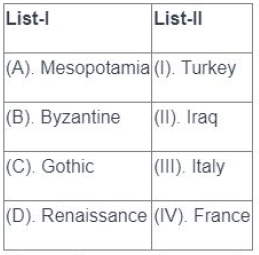
View Solution
(A) Mesopotamia - (II) Iraq: Mesopotamia, the "land between the rivers" (Tigris and Euphrates), is located in modern-day Iraq. It was the cradle of several ancient civilizations, including the Sumerian, Akkadian, Babylonian, and Assyrian empires.
(B) Byzantine - (I) Turkey: The Byzantine Empire, also known as the Eastern Roman Empire, had its capital in Constantinople, which is now Istanbul, Turkey. Byzantine art and architecture, characterized by mosaics, icons, and domed churches, flourished in this region.
(C) Gothic - (IV) France: Gothic architecture, known for its pointed arches, ribbed vaults, and stained glass windows, originated in France in the 12th century. The Chartres Cathedral is a prime example of Gothic architecture.
(D) Renaissance - (III) Italy: The Renaissance, a period of great artistic and intellectual flourishing, began in Italy in the 14th century. Key figures like Leonardo da Vinci, Michelangelo, and Raphael were associated with the Italian Renaissance. Quick Tip: Associate key civilizations and art movements with their geographical regions of origin. This will help in solving matching questions related to art history.
Match List-I with List-II
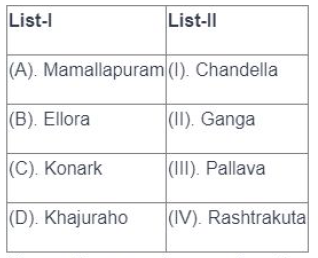
View Solution
(A) Mamallapuram - (III) Pallava: The rock-cut temples and monolithic rathas of Mamallapuram (also known as Mahabalipuram) were created by the Pallava dynasty in the 7th and 8th centuries.
(B) Ellora - (IV) Rashtrakuta: The Kailasanatha Temple at Ellora, a magnificent rock-cut monolithic temple dedicated to Lord Shiva, was commissioned by the Rashtrakuta king Krishna I in the 8th century.
(C) Konark - (II) Ganga: The Sun Temple at Konark, designed in the form of a giant chariot, was built by the Eastern Ganga dynasty king Narasimhadeva I in the 13th century.
(D) Khajuraho - (I) Chandella: The temples of Khajuraho, famous for their intricate sculptures and nagara-style architecture, were built by the Chandella dynasty between the 10th and 12th centuries. Quick Tip: Indian temple architecture styles and periods can often be identified by their characteristic features and associated dynasties. Remember major dynasties with their architectural styles.
Match List-I with List-II
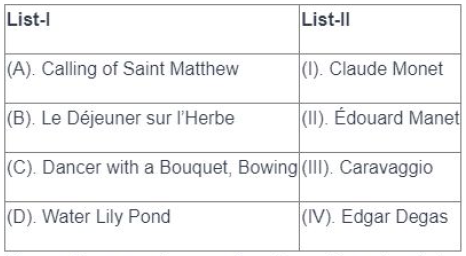
View Solution
(A) Calling of Saint Matthew - (III) Caravaggio: "The Calling of St. Matthew" is a famous Baroque painting by the Italian artist Caravaggio, known for its dramatic use of light and shadow (tenebrism).
(B) Le Déjeuner sur l'Herbe - (II) Édouard Manet: "Le Déjeuner sur l'Herbe" (The Luncheon on the Grass) is a controversial painting by Édouard Manet, a key figure in the transition from Realism to Impressionism. Its depiction of a nude woman with clothed men in a contemporary setting shocked audiences.
(C) Dancer with a Bouquet, Bowing - (IV) Edgar Degas: Edgar Degas, known for his depictions of ballet dancers, created "Dancer with a Bouquet, Bowing," capturing the grace and movement of a ballerina.
(D) Water Lily Pond - (I) Claude Monet: Claude Monet, a founder of French Impressionist painting, is famous for his series of "Water Lilies" paintings, depicting his flower garden at Giverny. Quick Tip: Familiarize yourself with iconic works of Western art and their respective artists. Pay attention to the artistic movements and periods to which they belong (e.g., Baroque, Impressionism).
Match List-I with List-II
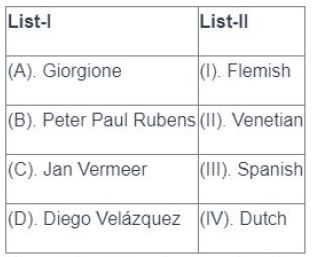
View Solution
(A) Giorgione - (II) Venetian: Giorgione was an Italian painter of the Venetian school during the High Renaissance, known for his poetic landscapes and enigmatic figures.
(B) Peter Paul Rubens - (I) Flemish: Peter Paul Rubens was a prominent Flemish Baroque painter, known for his dynamic compositions, vibrant colors, and depictions of historical and mythological subjects.
(C) Jan Vermeer - (IV) Dutch: Jan Vermeer was a Dutch Baroque Period painter who specialized in domestic interior scenes of middle-class life. He is renowned for his masterful use of light and perspective.
(D) Diego Velázquez - (III) Spanish: Diego Velázquez was a Spanish painter, considered one of the most important artists of the Spanish Golden Age and a master of both portraiture and historical scenes. Quick Tip: Pay attention to the nationalities and artistic schools of major European artists. This knowledge helps in connecting artists with their respective movements and styles.
Match List-I with List-II
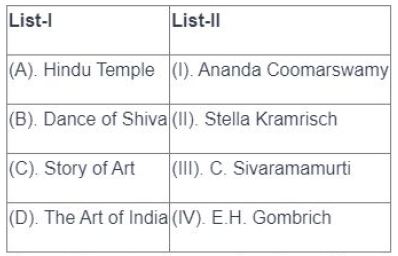
View Solution
(A) Hindu Temple - (I) Ananda Coomaraswamy: Ananda Coomaraswamy was a Ceylonese (Sri Lankan) philosopher and metaphysician, and a pioneering historian of Indian and Asian art, known for his work on Hindu temple architecture.
(B) Dance of Shiva - (II) Stella Kramrisch: Stella Kramrisch was a Czech-born American historian of Indian art, particularly known for her book "The Hindu Temple" and essays like "The Dance of Shiva".
(C) Story of Art - (IV) E.H. Gombrich: E.H. Gombrich was an Austrian-born British art historian, famous for his widely read book "The Story of Art," a comprehensive survey of Western art.
(D) The Art of India - (III) C. Sivaramamurti: C. Sivaramamurti was an Indian art historian, archaeologist and museum curator, best known for his work on Indian art and his book "The Art of India." Quick Tip: Knowing the authors of influential art history books is crucial for these matching questions. Remember that art historical scholarship encompasses various specializations (Indian art, Western art, specific religious traditions, etc.).
Match List-I with List-II
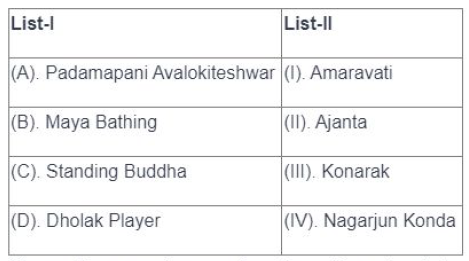
View Solution
(A) Padamapani Avalokiteshwar - (II) Ajanta: The iconic image of Padamapani Avalokiteshwar, the bodhisattva of compassion, is found in Cave 1 of the Ajanta caves.
(B) Maya Bathing - (I) Amaravati: The scene of Maya's bath or Maya Devi giving birth to Buddha under a sal tree is depicted in the sculptural reliefs at Amaravati. These reliefs are now mostly in the British Museum.
(C) Standing Buddha - (IV) Nagarjun Konda: Standing Buddha images can be found at Nagarjun Konda, a significant Buddhist site in Andhra Pradesh.
(D) Dholak Player - (III) Konarak: Sculptures of musicians playing various instruments, including the dholak, adorn the Sun Temple at Konark. The sculptures here are of different musicians and dancers. Quick Tip: Link important artworks and iconographic themes with their respective archaeological sites. Understanding the cultural and religious context of these sites will further enhance your knowledge.
Match List-I with List-II
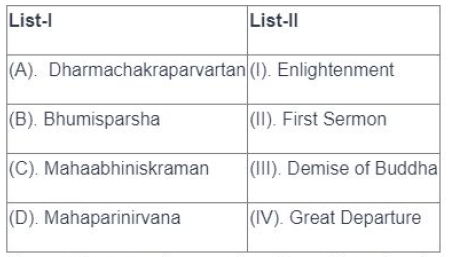
View Solution
(A) Dharmachakraparvartan - (II) First Sermon: Dharmachakraparvartan translates to "Turning of the Wheel of Dharma" and refers to Buddha's first sermon at Sarnath after attaining enlightenment. This event marks the beginning of his public teaching career.
(B) Bhumisparsha - (I) Enlightenment: Bhumisparsha mudra, the "earth-touching gesture," symbolizes the moment of Buddha's enlightenment under the Bodhi tree, when he called upon the earth to witness his triumph over Mara (temptation).
(C) Mahaabhiniskraman - (IV) Great Departure: Mahaabhiniskraman refers to the "Great Departure" when Siddhartha Gautama left his palace, wife, and child to seek spiritual enlightenment. This event is a key turning point in his life story.
(D) Mahaparinirvana - (III) Demise of Buddha: Mahaparinirvana signifies the "Great Extinction" or the death of Buddha, marking his release from the cycle of rebirth. This event is commemorated by stupas and other Buddhist monuments. Quick Tip: Understanding the key events in Buddha's life, their symbolic significance, and their related terminology is essential for answering such questions. Remember their visual depictions, which are often found in Buddhist art.
Match List-I with List-II
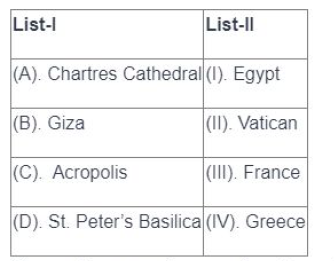
View Solution
(A) Chartres Cathedral - (III) France: Chartres Cathedral is a prime example of French Gothic architecture, renowned for its stained-glass windows and intricate sculptures.
(B) Giza - (I) Egypt: The Giza pyramid complex, with the Great Pyramid of Giza, is located on the Giza plateau near Cairo, Egypt, and is a defining monument of ancient Egyptian civilization.
(C) Acropolis - (IV) Greece: The Acropolis of Athens is an ancient citadel located on a rocky outcrop above the city of Athens, Greece, and contains the remains of several ancient buildings of great architectural and historical significance, the most famous being the Parthenon.
(D) St. Peter's Basilica - (II) Vatican: St. Peter's Basilica is a Renaissance-style church located in Vatican City. It's a major pilgrimage site for Catholics and is considered one of the holiest places in Christendom. Quick Tip: Associate famous architectural monuments with their geographical locations and historical periods. This can aid in understanding the spread of artistic styles and influences.
Match List-I with List-II
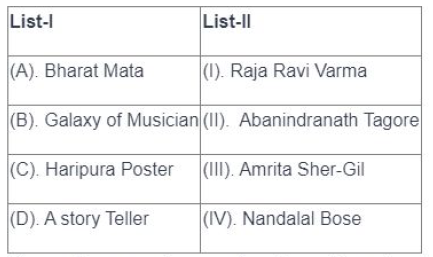
View Solution
(A) Bharat Mata - (II) Abanindranath Tagore: Abanindranath Tagore, a key figure of the Bengal School of Art, painted "Bharat Mata" as a four-armed Hindu goddess holding objects symbolizing India's national aspirations.
(B) Galaxy of Musician - (I) Raja Ravi Varma: Raja Ravi Varma, a celebrated Indian painter, is known for his depictions of scenes from the epics and Puranas, as well as portraits. His realistic style and use of oil paints revolutionized Indian art. “Galaxy of Musicians” is one of his well-known works.
(C) Haripura Poster - (IV) Nandalal Bose: Nandalal Bose, a student of Abanindranath Tagore and a prominent figure of the Bengal School, designed the posters for the Haripura session of the Indian National Congress in 1938.
(D) A Story Teller - (III) Amrita Sher-Gil: Amrita Sher-Gil, a pioneering Hungarian-Indian painter, painted several artworks showing the common life of people in India. "A Story Teller" reflects her use of rich color and post-impressionistic influences. Quick Tip: Understanding the context of modern Indian art—the Bengal School, its artists, and their responses to nationalism—is crucial for such questions. Pay attention to how artistic styles evolved during this period.
Match List-I with List-II
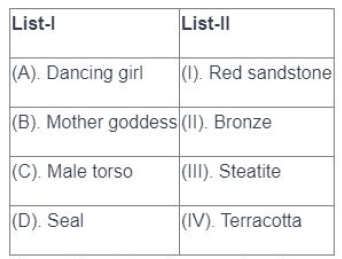
View Solution
(A) Dancing girl - (II) Bronze: The "Dancing Girl" from Mohenjo-daro is a small bronze sculpture, showcasing the metalworking skills of the Indus Valley Civilization.
(B) Mother goddess - (IV) Terracotta: Mother goddess figurines were commonly made of terracotta in the Indus Valley Civilization, reflecting their beliefs and rituals.
(C) Male torso - (I) Red sandstone: The "Priest-King" or male torso sculpture from Mohenjo-daro, though fragmented, reveals details of attire and ornaments. It's made of steatite, not red sandstone.
(D) Seal - (III) Steatite: The seals of the Indus Valley Civilization, used for trade and administration, were primarily made of steatite, a soft stone easily carved with intricate designs. Quick Tip: Connect Indus Valley artifacts with their respective materials (bronze, terracotta, steatite). This helps in understanding the technological capabilities and artistic expressions of this civilization.





Comments