


.png?h=35&w=35&mode=stretch)
CUET PG Food Engineering and Technology Question Paper 2024 will be available here for download. NTA conducted CUET PG Food Engineering and Technology paper 2024 on from March 17 in Shift 3. CUET PG Question Paper 2024 is based on objective-type questions (MCQs). According to latest exam pattern, candidates get 105 minutes to solve 75 MCQs in CUET PG 2024 Food Engineering and Technology question paper.
CUET PG Food Engineering and Technology Question Paper 2024 PDF Download
| CUET PG Food Engineering and Technology 2024 with Answer Key | Check Solutions |
 Download
CUET PG Food Engineering and Technology Questions with Solutions
Question 1:
Identify the antinutritional toxic constituent responsible for infestation of groundnut with Aspergillus flavus.
View Solution
Aflatoxins are a family of toxins produced by certain fungi that can contaminate crops such as groundnuts. \textit{Aspergillus flavus is a common fungus found in soil and decaying vegetation, especially in warm and humid climates. When groundnuts become infested with \textit{Aspergillus flavus, the fungus produces aflatoxins which pose significant health risks to both humans and animals upon consumption. Aflatoxin contamination can occur in the field, during harvest, storage, or processing. Prolonged exposure to high levels of aflatoxins can lead to serious health issues, including liver damage and cancer. Quick Tip: Remember that aflatoxins are a significant concern for food safety, particularly in groundnuts and other crops susceptible to fungal infestation. Proper storage and handling practices are essential to minimize aflatoxin contamination.
Which type of protein structure involves the non-covalent association of protein chains, like in case of actomyosin system of muscles and the casein micelles of milk?
View Solution
Protein structure is hierarchical, with four main levels: primary, secondary, tertiary, and quaternary.
Primary Structure: This refers to the linear sequence of amino acids in a polypeptide chain.
Secondary Structure: Secondary structures like alpha-helices and beta-sheets are formed through hydrogen bonding between the backbone atoms of amino acids.
Tertiary Structure: This level describes the overall three-dimensional arrangement of a single polypeptide chain. It is stabilized by various interactions such as hydrogen bonds, disulfide bonds, hydrophobic interactions, and ionic bonds between amino acid side chains.
Quaternary Structure: This is the highest level of protein structure and involves the association of multiple polypeptide chains (subunits) to form a functional protein complex. This is the correct answer in this case, and the interactions between these subunits are primarily non-covalent, including hydrogen bonds, ionic bonds, and hydrophobic interactions. Examples include actomyosin in muscles and casein micelles in milk. Quick Tip: Remember that quaternary structure is unique in that it involves multiple polypeptide chains interacting non-covalently. Actomyosin and casein micelles are classic examples of proteins with quaternary structure.
In the context of dextrinisation, which of the following statements are correct?
View Solution
Dextrinization is the process of breaking down starch into smaller units called dextrins by applying dry heat. Let's examine each statement:
(A) True: Dextrinization involves the breakdown of starch by dry heat, leading to the formation of dextrins.
(B) False: Dextrins typically impart a slightly sweet taste, not a bitter one. They are often used as thickeners and binding agents in food products.
(C) True: Non-enzymatic browning (Maillard reaction) can occur during dextrinization, leading to the development of characteristic brown colors and toasted flavors.
(D) True: Pyrodextrins are formed on the surface of bread crusts and other baked goods due to high dry heat exposure. Quick Tip: Dextrinization is a dry heat process, and the resulting dextrins contribute to desirable color and flavor changes in baked goods. Remember to distinguish dextrinization from gelatinization, which is a process of breaking down starch with moist heat.
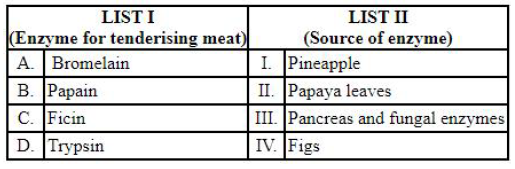
Match List I with List II
View Solution
Meat tenderization involves breaking down tough muscle fibers, making meat more palatable. Enzymes are often used for this purpose. Here's the correct matching:
A. Bromelain - I. Pineapple: Bromelain is a mixture of enzymes found in pineapples (fruit and stem) that breaks down proteins, making it effective for tenderizing meat.
B. Papain - II. Papaya leaves: Papain is an enzyme extracted from papaya leaves and unripe fruit. It is a cysteine protease known for its meat-tenderizing properties.
C. Ficin - IV. Figs: Ficin is a protease enzyme extracted from the latex of fig trees (\textit{Ficus carica). It is used to tenderize meat.
D. Trypsin - III. Pancreas and fungal enzymes: Trypsin is a serine protease found in the digestive system of many vertebrates, including humans, where it is produced in the pancreas. It's also produced by various fungi. Trypsin is involved in breaking down proteins and is sometimes used in meat tenderization. Quick Tip: Remember the sources of these enzymes. Bromelain from pineapple, papain from papaya, ficin from figs, and trypsin from the pancreas/fungi. These are all proteases, meaning they break down proteins.
Which of the following statements are correct in context of the polymerization reaction of lipids?
View Solution
Polymerization of lipids is a complex process that can occur under various conditions, especially involving unsaturated fatty acids.
(A) True: Unsaturated fatty acids have double bonds that can react with each other or other molecules, leading to polymerization. Heat, oxidation, free radicals, and polar catalysts can initiate or accelerate these reactions.
(B) True: Heating fats and oils, as during frying, accelerates lipid oxidation and polymerization, leading to changes in their physical and chemical properties. These changes are reflected in altered molecular weight, color (darkening), viscosity (increased thickness), and refractive index.
(C) True: The formation of polymers increases the viscosity of the oil, which reduces its ability to penetrate into food, and this creates a barrier and helps in faster heat transfer. This leads to improved frying performance as food cooks more quickly and uniformly.
(D) False: While some types of polymerization are beneficial, for example in creating bioplastics, extreme conditions and extensive polymerization can degrade the nutritional quality of oils and negatively impact their wholesomeness by reducing the amount of essential fatty acids or generating harmful compounds. Quick Tip: Lipid polymerization is a significant factor in the deterioration of frying oils. Remember that while moderate polymerization can improve frying efficiency, excessive polymerization reduces nutritional value and oil quality.
Identify the polar amino acid among the following options.
View Solution
Amino acids are classified based on the properties of their side chains. Polar amino acids have side chains that are hydrophilic (water-loving) due to the presence of polar functional groups that can form hydrogen bonds with water.
Isoleucine: Isoleucine is a nonpolar, aliphatic amino acid. Its side chain is hydrophobic due to the presence of a hydrocarbon chain.
Asparagine: Asparagine is a polar amino acid. Its side chain contains an amide group, which is polar and can form hydrogen bonds with water.
Methionine: Methionine is a nonpolar amino acid because it contains a thioether (sulfur) group in its side chain, and sulfur has low electronegativity. This gives its side chain some degree of hydrophobicity.
Tryptophan: Tryptophan is a nonpolar, aromatic amino acid with a hydrophobic indole ring in its side chain. Quick Tip: Asparagine, with its amide side chain, is polar. Look for polar functional groups (like amides, hydroxyls, etc.) to identify polar amino acids. Isoleucine, methionine, and tryptophan have nonpolar side chains.
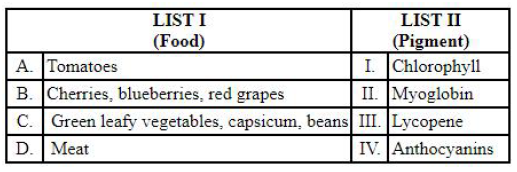
Match List I with List II
View Solution
The color of fruits, vegetables, and meats is primarily due to the presence of various pigments. Here's the correct matching:
A. Tomatoes - III. Lycopene: Tomatoes get their characteristic red color from lycopene, a carotenoid pigment.
B. Cherries, blueberries, red grapes - IV. Anthocyanins: Anthocyanins are a class of flavonoid pigments responsible for the red, purple, and blue colors in many fruits, including cherries, blueberries, and red grapes.
C. Green leafy vegetables, capsicum, beans - I. Chlorophyll: Chlorophyll is the green pigment responsible for the color of green leafy vegetables, capsicum, and beans. It plays a critical role in photosynthesis.
D. Meat - II. Myoglobin: Myoglobin is a red, iron- and oxygen-binding protein found in the muscle tissue of vertebrates, giving meat its characteristic red color. Quick Tip: Lycopene is a carotenoid (red), anthocyanins are flavonoids (red/purple/blue), chlorophyll is green, and myoglobin makes meat red. Remembering the color association of each type of pigment can help you in such questions.
Identify the aldehydic compound which is a major contributor to the flavour of chocolate.
View Solution
The distinctive flavor of chocolate is complex and arises from a combination of volatile compounds.
Geranial: Geranial is an acyclic monoterpenoid aldehyde found in lemongrass oil and certain citrus fruits. It has a citrusy, lemon-like aroma, not typically associated with chocolate.
Benzaldehyde: Benzaldehyde is the simplest aromatic aldehyde and contributes to the scent of almonds and cherries. While it can be present in some chocolate products, it is not a primary contributor to the characteristic chocolate flavor.
5-methyl-2-phenyl-2-hexenal: This aldehyde is a key component of chocolate's aroma profile. It contributes to the roasted, cocoa-like notes.
Acetaldehyde: Acetaldehyde is a volatile organic compound with a pungent, fruity odor. It is found in alcoholic beverages and is also a metabolic by-product. It is not a main contributor to chocolate's aroma. Quick Tip: 5-methyl-2-phenyl-2-hexenal is a key chocolate flavor compound. The complex aroma of chocolate is not from a single compound but from a mix of various volatile compounds.
If xerosis of conjunctiva is left untreated, it can lead to __________ which is characterized by ulceration, cloudiness, and bacterial infection.
View Solution
Xerosis of the conjunctiva is a condition characterized by dryness of the conjunctiva (the membrane that lines the eyelid and covers the white part of the eye). It's often associated with vitamin A deficiency.
Bitot spot: These are foamy, white patches on the conjunctiva, often a sign of early vitamin A deficiency, and can be a precursor to keratomalacia. Bitot spots are usually seen on the sides of the corneas.
Keratomalacia: If xerosis is left untreated, it can progress to keratomalacia, a more severe condition involving corneal ulceration, cloudiness, and bacterial infection, and can lead to blindness.
Tetany: Tetany is a condition marked by muscle spasms, cramps, and overactive reflexes. It is caused by low calcium levels in the blood, not vitamin A deficiency.
Cretinism: Cretinism is a condition characterized by stunted physical and mental development caused by severe congenital thyroid deficiency. It has no relation to vitamin A. Quick Tip: Untreated xerosis (dry eyes from vitamin A deficiency) can lead to keratomalacia (corneal damage). Bitot spots are an early sign of vitamin A deficiency.
Heat penetration in processing can be hastened by which of the following options?
View Solution
Heat penetration during food processing refers to how quickly heat transfers from the heating medium to the center of the food product. Faster heat penetration ensures efficient processing and reduces the risk of microbial growth.
Using glass containers: Glass is a poor conductor of heat compared to metals. Using glass containers slows down heat penetration.
Rotation and agitation: Rotation and agitation create convection currents within the food product, promoting faster and more uniform heat distribution. This is the most effective method among the given options. Examples include rotary retorts and agitated cookers.
Layering of foods: Layering foods creates insulation, hindering heat transfer to the inner layers. This results in uneven heating and longer processing times.
Using larger cans: Larger cans increase the distance heat must travel to reach the center, which slows down heat penetration and extends processing time. Quick Tip: Agitation and convection are key to faster heating. Larger containers and layering act as insulators, slowing heat penetration.
Pseudomonas grows well in food containing __________.
View Solution
Pseudomonas is a genus of bacteria known to be opportunistic pathogens and spoilage organisms in various foods. They have complex nutritional requirements.
Nitrates: While some bacteria utilize nitrates for anaerobic respiration, \textit{Pseudomonas species are generally aerobic, meaning they require oxygen for growth. Nitrates are not their primary growth factor.
Vitamins: \textit{Pseudomonas species are known to have a preference for nutrient-rich environments, including those with abundant vitamins and minerals. Many species are auxotrophic for certain vitamins, indicating that they thrive in foods rich in vitamins.
Antibiotics: Antibiotics inhibit bacterial growth. \textit{Pseudomonas species are notorious for developing resistance to many antibiotics, making antibiotics a poor growth medium.
Organic acid: Some \textit{Pseudomonas species can tolerate moderately acidic conditions, but organic acids do not actively promote their growth, and many species prefer a neutral or slightly alkaline pH. Quick Tip: \textit{Pseudomonas likes nutrient-rich environments, especially with vitamins. They don't prefer nitrates or antibiotics and only tolerate some organic acids.
These soil molds are similar to Mucor except that the zygospore suspensors are markedly unequal in size.
View Solution
Mucor, \textit{Rhizopus, \textit{Absidia, \textit{Thamnidium, and \textit{Zygorrhynchus are all genera of fungi belonging to the order Mucorales. They are characterized by the formation of zygospores during sexual reproduction. The zygospore suspensors are structures that support the zygospore.
\textit{Mucor, Rhizopus, and Zygorrhynchus have zygospore suspensors that are approximately equal in size.
\textit{Absidia is distinguished by its markedly unequal zygospore suspensors. This is the key difference mentioned in the question. Quick Tip: \textit{Absidia has unequal suspensors, a distinguishing feature from Mucor. Look for morphological details such as the shape, size and structure of the spore-bearing structure to distinguish between these fungal species.
A predominant soil organism, it is inert in most foods. Some species can grow at 5°C and would be considered psychrotrophs.
View Solution
Psychrotrophs are cold-tolerant microorganisms that can grow at low temperatures, typically below 7°C, but have optimal growth temperatures above 15°C.
Bacillus: Some \textit{Bacillus species are psychrotrophic, but many are mesophilic (preferring moderate temperatures). They are known to form endospores which makes them important from a food safety perspective.
\textit{Acetobacter: \textit{Acetobacter species are primarily associated with the production of acetic acid (vinegar). They are not typically psychrotrophs and are aerobic, meaning they need oxygen to survive.
\textit{Arthrobacter: Species of \textit{Arthrobacter are commonly found in soil and are psychrotrophic. They have distinct nutritional requirements.
\textit{Clostridium: \textit{Clostridium species are usually anaerobic (cannot tolerate oxygen), spore-forming bacteria that can be associated with food poisoning, but are not associated with psychrotrophic growth.
Quick Tip: \textit{Arthrobacter is the psychrotrophic soil organism mentioned here. Psychrotrophs can grow at refrigeration temperatures, a significant concern for food spoilage.
Cole crops include which of the following vegetables?
View Solution
Cole crops are vegetables belonging to the \textit{Brassica genus, specifically the \textit{Brassica oleracea species. They are characterized by their close relationship and similar growing conditions.
Kale: Kale is a leafy green vegetable and a member of the \textit{Brassica oleracea species, making it a cole crop.
Eggplant: Eggplant belongs to the \textit{Solanum genus and is a nightshade vegetable, not a cole crop.
Radish: Radish belongs to the \textit{Raphanus genus in the \textit{Brassicaceae family, related to cole crops but not a member of the \textit{Brassica oleracea species itself.
Tomato: Tomato is a fruit (botanically) and belongs to the \textit{Solanum genus (like eggplant), making it another nightshade vegetable, and it is not a cole crop. Quick Tip: Kale is the only cole crop (Brassica oleracea) in the given options. Cole crops include cabbage, broccoli, cauliflower, Brussels sprouts, collard greens, and kale.
The anti-carcinogenic effect of cauliflower is due to the high content of which substance?
View Solution
Cruciferous vegetables, like cauliflower, are associated with various health benefits, including a reduced risk of certain cancers.
Phosphates: Phosphates are essential nutrients involved in energy transfer and DNA structure, but they are not the primary anti-carcinogenic compounds in cauliflower.
Glucosinolates: These are sulfur-containing compounds found in cruciferous vegetables, including cauliflower. When the vegetable is chopped or chewed, glucosinolates are broken down into isothiocyanates and indoles which demonstrate anti-cancer effects by supporting detoxification processes and reducing inflammation.
Inosine: Inosine is a nucleoside that plays a role in cell signaling and energy metabolism, but it's not known for significant anti-carcinogenic effects.
Fibrin: Fibrin is a protein involved in blood clotting. It does not have anti-carcinogenic effects. Quick Tip: Glucosinolates are the key anti-carcinogenic compounds in cauliflower and other cruciferous vegetables. Remember that chewing or chopping enhances their breakdown into beneficial compounds.
Grains of some cereals are covered in caryopsis and in addition have fused palea and lemma which constitute the husk outside the fruit coat. An example of such a cereal is ___________.
View Solution
The structure of cereal grains varies depending on the species.
Wheat, Rye, and Barley: These cereals belong to the \textit{Triticeae tribe and have a caryopsis (a type of dry, one-seeded fruit where the ovary wall is fused with the seed coat) enclosed within a husk formed by the fused palea and lemma (bracts that enclose the floret).
Maize (Corn): Maize belongs to a different tribe (\textit{Andropogoneae) and has a different grain structure. The kernel is not enclosed within a husk as in wheat, rye or barley. Quick Tip: Rye is an example of cereal grains covered in caryopsis and a husk of fused palea and lemma. Wheat and barley share a similar structure. Maize has a distinct kernel structure.
The preparation of ice cream is done in the following order:
View Solution
The ice cream making process involves a series of steps to achieve the desired texture and flavor.
Step 1: Blending of Ingredients (C): Liquid constituents are heated to 43°C to dissolve the sugar and other dry ingredients efficiently, creating a uniform mixture.
Step 2: Pasteurization (B): The mix is pasteurized to eliminate harmful microorganisms and extend shelf life. Pasteurization can be done at 71°C for 30 min or by using High-Temperature Short-Time (HTST) pasteurization at 82°C for 25 seconds.
Step 3: Homogenization and Aging (D): Homogenization breaks down fat globules, preventing them from clumping together and creating a smoother texture. Aging allows the mix to cool down, hydrate the ingredients, and develop flavors.
Step 4: Freezing (A): The mix is passed through a freezer to lower its temperature to -5.5°C. This freezes the mix and incorporates air through agitation, creating the desired consistency. Quick Tip: Remember the key steps in ice cream production: Blend, Pasteurize, Homogenize/Age, and Freeze. Pasteurization eliminates pathogens, homogenization creates smoothness, and aging develops flavor.
Given below are two statements, one is labelled as Assertion (A) and the other one labelled as Reason (R).
Assertion (A): Stabilizers are used to prevent the formation of ice crystals during freezing.
Reason (R): Stabilizers form gels with the water in the formula and thereby improve the body and texture of the ice cream.
View Solution
Stabilizers are essential ingredients in ice cream formulation. They control ice crystal growth during freezing and storage, which is crucial for maintaining a smooth and desirable texture.
Assertion (A) is True: Stabilizers are indeed added to ice cream mixes to prevent the formation of large ice crystals, which would otherwise result in a coarse, icy texture. They do this by binding water molecules and hindering their movement and organization into large crystals.
Reason (R) is True and Explains (A): Stabilizers work by forming a gel network within the ice cream mix. This gel network traps water molecules, reducing their mobility and preventing the formation of large ice crystals. This results in a smoother texture and also improves the body of the ice cream, making it thicker and more resistant to melting. Quick Tip: Stabilizers in ice cream prevent large ice crystals from forming by creating a gel network that traps water. This leads to smoother, more desirable texture and improved body.
Ghee is the clarified butter fat obtained from cow or buffalo milk, produced by heat desiccation of makkhan (butter) at a temperature of ___________.
View Solution
Ghee is a type of clarified butter with a distinct flavor and aroma. It's produced by heating butter to remove water and milk solids.
The ideal temperature range for ghee making is 120-125°C. At this temperature, the water evaporates, and the milk solids settle to the bottom and turn brown, developing the characteristic nutty flavor and aroma of ghee. Higher temperatures may lead to burning or scorching. Quick Tip: The ideal temperature for making ghee is 120-125°C, allowing water evaporation and milk solids browning without burning.
The starter composition for Blue-vein cheese is ___________.
View Solution
Blue-vein cheeses are characterized by their distinctive blue or blue-green veins and characteristic flavors. These veins are created by the growth of specific molds during the cheese ripening process.
Penicillium roqueforti and \textit{P. glaucum are the primary molds used in blue cheese production. These molds are responsible for the blue veining and the characteristic pungent, peppery flavor of blue cheeses.
\textit{Lactococcus lactis and \textit{S. cremoris are lactic acid bacteria used in various cheese types but are not responsible for the blue veining.
\textit{Penicillium camemberti is used in the production of Camembert and Brie cheeses. It contributes to the white, bloomy rind and creamy texture.
\textit{Geotrichum candidum is also used in cheese making, and contributes to the rind development in certain cheese types. Quick Tip: \textit{Penicillium roqueforti and P. glaucum are the key molds for blue cheese production, responsible for the characteristic blue veins and flavor.
Select the sequence for butter preparation:
View Solution
Butter making involves a specific sequence of steps:
Step 1: Pasteurization (A): Cream is pasteurized at 62.8°C for 30 minutes to destroy harmful microorganisms and improve its keeping quality.
Step 2: Ripening (C): The pasteurized cream is then cooled and held at a lower temperature (21.1°C) for several hours. This ripening process allows the development of desirable flavors and textures. It also allows the fat to crystallize, which aids in the churning process.
Step 3: Churning (B): Churning agitates the cream vigorously, causing the fat globules to coalesce and separate from the liquid portion (buttermilk). This forms butter granules.
Step 4: Draining Buttermilk (D): The buttermilk is drained off, and the butter granules are washed and worked to remove any remaining buttermilk and create a smooth, consistent texture. Quick Tip: The sequence for butter making is Pasteurization, Ripening, Churning, and Draining. Ripening allows flavor development, and churning separates the butter from the buttermilk.
Completion of pasteurization of milk is ascertained by testing for alkaline phosphatase activity in milk. The enzyme liberates phenol from phenyl phosphate. The liberated phenol gives what color in milk?
View Solution
The alkaline phosphatase test is a standard method used to verify the effectiveness of pasteurization.
Alkaline phosphatase is an enzyme naturally present in raw milk. Pasteurization inactivates this enzyme. Therefore, the presence of alkaline phosphatase indicates incomplete pasteurization or contamination with raw milk.
In the test, a substrate (phenyl phosphate) is added to the milk sample. If alkaline phosphatase is present, it will liberate phenol.
The liberated phenol reacts with a reagent (often 2,6-dichloroquinonechlorimide) to produce a blue color. The intensity of the blue color indicates the amount of alkaline phosphatase present. Quick Tip: Alkaline phosphatase test: Blue color indicates the presence of the enzyme, meaning inadequate pasteurization. No color change indicates successful pasteurization.
Sandiness in ice cream is due to ___________.
View Solution
Sandiness in ice cream is a textural defect characterized by a gritty or sandy mouthfeel.
Lactose: Lactose is a sugar naturally present in milk. When ice cream mixes have high lactose concentrations or are stored for extended periods, lactose can crystallize. These lactose crystals are relatively large and perceptible on the tongue, causing the sandy texture.
Whey: Whey is the liquid portion of milk that remains after cheese production. It is not a primary contributor to sandiness.
Casein: Casein is the main protein in milk and forms micelles that contribute to the smooth texture of ice cream, and it does not cause sandiness.
Lipids (fats): Lipids contribute to the richness and creaminess of ice cream and are not involved in sandiness. Quick Tip: Lactose crystallization causes sandiness in ice cream. Control lactose concentration and storage conditions to prevent this defect.
Cans can also be made from TFS, also known as ___________.
View Solution
TFS stands for Tin-Free Steel. It is a type of steel used for food packaging that does not require a tin coating, as opposed to traditional tin cans.
Electrolytically chlorine-coated steel is another way of describing TFS. During the manufacturing process, an electrolytic process is used to apply a thin chromium oxide layer to provide corrosion resistance. Quick Tip: TFS (Tin-Free Steel) is electrolytically chromium oxide-coated steel for corrosion resistance. It is commonly used for making cans for food packaging.
Paper is generally termed board when its grammage exceeds ___________.
View Solution
Grammage is a measure of the weight of paper or board expressed in grams per square meter (gsm). It's a key factor in determining the thickness, stiffness, and overall suitability of paper for various applications.
Paper is generally categorized as "board" when its grammage exceeds 224 gsm. Board is thicker and more rigid than standard paper. Quick Tip: Paper above 224 gsm is termed "board". Grammage (gsm) measures paper weight per square meter, and is correlated with its thickness and rigidity.
During Modified Atmosphere Packaging (MAP) of fatty fish, the gas composition should be ___________.
View Solution
Modified Atmosphere Packaging (MAP) is a food preservation technique that alters the gaseous environment within the packaging to inhibit microbial growth and extend shelf life.
For fatty fish, a gas composition of 40% nitrogen (N\textsubscript{2) and 60% carbon dioxide (CO\textsubscript{2) is commonly used.
The elevated CO\textsubscript{2 concentration inhibits the growth of spoilage bacteria.
Nitrogen serves as an inert filler gas to maintain package integrity.
For fatty fish, it's crucial to minimize or eliminate oxygen (O\textsubscript{2) to prevent lipid oxidation and rancidity. Quick Tip: MAP for fatty fish typically uses 40% N\textsubscript{2} and 60% CO\textsubscript{2} to inhibit bacterial growth and prevent rancidity. Oxygen is minimized or eliminated.
Among the following, which is NOT an inhibitor of polyphenol oxidase?
View Solution
Polyphenol oxidase (PPO) is an enzyme responsible for enzymatic browning in fruits and vegetables. Browning occurs when PPO catalyzes the oxidation of phenolic compounds, leading to the formation of brown pigments.
Pineapple juice: Pineapple juice contains natural PPO inhibitors, although it also contains PPO itself.
Sulphites: Sulphites are chemical inhibitors that block PPO activity.
Ascorbic acid (Vitamin C): Ascorbic acid is a reducing agent that inhibits browning by scavenging oxygen, preventing it from reacting with phenolic compounds.
Pectinic acid: Pectinic acid is a type of pectin used as a gelling agent. It has no inhibitory effect on PPO. Quick Tip: Pectinic acid does NOT inhibit PPO. Common PPO inhibitors include sulphites, ascorbic acid, and citric acid. They are important for controlling enzymatic browning.
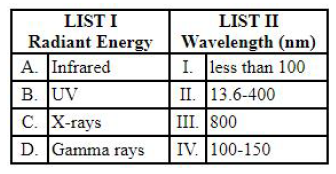
Match List I with List II
View Solution
The electromagnetic spectrum categorizes electromagnetic radiation based on wavelength.
A. Infrared - III. 800 nm: Infrared radiation has longer wavelengths than visible light, typically around 700 nm to 1 mm. 800 nm falls within this range.
B. UV - II. 13.6-400 nm: Ultraviolet (UV) radiation has shorter wavelengths than visible light, in the range of 10 nm to 400 nm.
C. X-rays - IV. 100-150 nm: X-rays are high-energy electromagnetic radiation with wavelengths between 0.01 nm and 10 nm. Although some X-rays can fall within 100-150 nm range, UV rays better fit this range. By elimination, this must be X-rays as gamma rays have even lower wavelengths.
D. Gamma rays - I. less than 100 nm: Gamma rays have the shortest wavelengths in the electromagnetic spectrum, less than 100 picometers (0.1 nm) and are highly energetic. Quick Tip: Remember the order of electromagnetic radiation from longest to shortest wavelength: Radio, Microwave, Infrared, Visible, Ultraviolet, X-ray, Gamma ray.
Which of the following is NOT a unit of radiation?
View Solution
Different units are used to measure various aspects of radiation.
Gray (Gy): The gray is the SI unit of absorbed dose, measuring the amount of energy deposited by ionizing radiation in a unit mass of matter.
Roentgen (R): The roentgen is a unit of exposure, measuring the amount of ionization produced by X-rays or gamma rays in air.
Electron volt (eV): The electron volt is a unit of energy commonly used in atomic and nuclear physics. It can be used to express the energy of photons, including those involved in radiation.
Electron armstrong (eÅ): There is no established unit called "electron armstrong". Angstrom (Å) is a unit of length, often used to express wavelengths of light or interatomic distances. It is not a radiation unit. Quick Tip: Gray measures absorbed dose, roentgen measures exposure, and electron volt is a unit of energy. "Electron armstrong" is NOT a valid radiation unit.
The choice of irradiation dosage of food is determined by taking into account various factors. The factors are:
View Solution
Food irradiation uses ionizing radiation to eliminate pathogens, extend shelf life, and improve food safety. The irradiation dosage is carefully chosen based on various factors:
(A) Resistance of food enzymes: Higher doses are needed to inactivate enzymes that can cause spoilage or undesirable changes in food quality.
(B) Resistance of microorganisms: Different microorganisms have varying sensitivities to radiation. The target pathogens and their resistance determine the required dose for sterilization or pasteurization.
(C) Resistance of food to deterioration of organoleptic quality: Excessive irradiation can affect the taste, texture, color, and aroma (organoleptic properties) of food. The dosage must be optimized to minimize such changes.
(D) Resistance of food to moisture absorption: Irradiation can sometimes alter the moisture content of food. This factor may be considered in dosage selection, especially for foods where moisture changes are critical. Quick Tip: Irradiation dosage depends on enzyme resistance, microbial resistance, organoleptic quality changes, and moisture absorption. All of these are crucial factors to consider.
Given below are two statements, one is labelled as Assertion (A) and the other one labelled as Reason (R).
Assertion (A): Steak can be crusted on the outside but still be rare on the inside.
Reason (R): In conventional heating, direct contact with a hot plate produces a temperature gradient which can burn the outside of the food piece.
View Solution
Cooking steak involves achieving the desired level of doneness, which depends on the internal temperature of the meat.
Assertion (A) is True: It is possible to have a steak with a crust on the outside while the inside remains rare. This is due to the temperature gradient created during cooking.
Reason (R) is True and Explains (A): Conventional heating methods, such as using a hot plate or pan, rely on direct contact for heat transfer. This creates a temperature gradient, where the outside of the steak heats up much faster than the inside. As a result, the outer surface can brown and form a crust (Maillard reaction) before the heat fully penetrates to cook the interior to the same degree. Therefore, it is possible to have a well-browned, crusted exterior with a rare interior. Quick Tip: Searing creates a crust due to the rapid temperature gradient on the steak surface, leaving the inside rare. Use a thermometer to ensure the desired internal temperature.
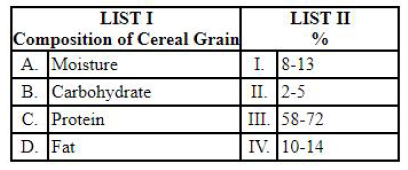
Match List I with List II
View Solution
Cereal grains are a staple food in many diets, providing carbohydrates, protein, and other essential nutrients. The composition of cereal grains varies depending on the type of grain, but general ranges exist.
A. Moisture - IV. 10-14%: Moisture content is crucial for storage stability. Too much moisture can lead to mold growth and spoilage.
B. Carbohydrate - III. 58-72%: Carbohydrates, primarily starch, are the major component of cereal grains, providing energy.
C. Protein - I. 8-13%: Protein content contributes to the nutritional value of grains.
D. Fat - II. 2-5%: Fat content is generally lower in most cereal grains compared to carbohydrates and protein, except for certain grains like oats. Quick Tip: Carbohydrates are the major component of cereal grains (58-72%), followed by protein (8-13%) and fat (2-5%). Moisture content is around 10-14%.
The structural features of a cereal rich in oil are:
View Solution
The distribution of oil within a cereal grain is not uniform.
Hull (A): The hull is the outermost layer of the grain, primarily composed of cellulose and other fibrous materials. It is typically low in oil content.
Bran (B): The bran is the next layer beneath the hull and is rich in fiber, vitamins, and minerals, including some oils.
Endosperm (C): The endosperm is the largest part of the grain, primarily consisting of starch. In oil-rich cereals, a significant portion of the oil is stored in the endosperm.
Hairs of brush (D): Hairs of brush, or the brush, are fibrous structures found at one end of some grains (like wheat). These structures do not contain significant amounts of oil. Quick Tip: The bran and endosperm are the oil-rich parts of a cereal grain. The hull and hairs of brush are low in oil.
Given below are two statements, one is labelled as Assertion (A) and the other one labelled as Reason (R).
Assertion (A): Hard wheat yields softer flour.
Reason (R): Soft wheat is used for cake making.
View Solution
Wheat varieties are categorized as "hard" or "soft" based on their protein content and kernel characteristics, which influence flour properties.
Assertion (A) is False: Hard wheat has a higher protein content and yields stronger flour. This "strong" flour is suitable for bread making as it forms a well-developed gluten network. Soft wheat has lower protein content and produces weaker flour, and it produces softer flour that is ideal for cakes, pastries, and other delicate baked goods.
Reason (R) is True: Soft wheat flour is indeed preferred for cake making due to its lower protein content. This results in a tender crumb structure, desirable in cakes and pastries. Quick Tip: Hard wheat = high protein = strong flour = bread making. Soft wheat = low protein = weak flour = cake making.
The process of grinding flour from conventional milling in high-speed turbo grinders is called ___________.
View Solution
Traditional milling methods using stone mills have largely been replaced by modern milling techniques. Turbomilling uses high-speed grinders equipped with specially designed blades to produce fine flour particles. It offers advantages like increased efficiency and better control over particle size. The term itself indicates the use of turbo grinders. Quick Tip: Turbomilling uses high-speed grinders to produce fine flour, a modern alternative to conventional milling methods.
The process of paste formation when moistened starch is heated is called ___________.
View Solution
When starch is heated in the presence of water (moistened), it undergoes gelatinization.
Gelatinisation: This is the process where starch granules absorb water, swell, and lose their crystalline structure, forming a viscous paste. The process is very important in cooking.
Dextrinization: Dextrinization occurs when starch is subjected to dry heat. It results in the breakdown of starch into smaller dextrins, contributing to browning and flavor changes in baked goods.
Retrogradation: Retrogradation is the process where gelatinized starch molecules re-associate over time, leading to a loss of viscosity and an increase in firmness (e.g., staling of bread). It is a separate process that happens during cooling.
Caramelisation: Caramelisation involves the browning of sugars at high temperatures, producing characteristic flavors and colors. It is not involved in starch paste formation. Quick Tip: Gelatinization is starch paste formation with moist heat. Dextrinization involves dry heat, and caramelization applies to sugars. Retrogradation is the staling of starch-based foods.
The following is a type of contact heat exchanger:
View Solution
Heat exchangers facilitate heat transfer between two or more fluids. Contact heat exchangers involve direct contact between the product and the heating or cooling medium.
Scraped surface heat exchanger: In this type of heat exchanger, the product comes into direct contact with a heated or cooled surface. Scraper blades continuously remove the product from the surface, preventing fouling and ensuring efficient heat transfer. This direct contact classifies it as a contact heat exchanger.
Tubular, Plate, and Steam infusion: These are indirect contact heat exchangers where heat transfer occurs through a separating wall. Quick Tip: A scraped surface heat exchanger is a contact type, with direct contact between the product and heating/cooling surface. Others like tubular and plate types are indirect contact heat exchangers.
Identify the equipment shown in the figure.
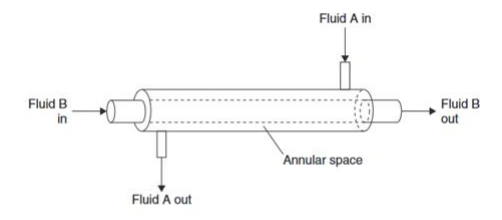
View Solution
The provided figure shows a shell and tube heat exchanger. This type of heat exchanger consists of a shell (a larger outer cylinder) containing a bundle of tubes. One fluid flows through the tubes, and the other fluid flows around the tubes within the shell. Heat transfer occurs through the tube walls. The key features like the outer shell, inner tubes and the annular space are visible in the diagram. Quick Tip: A shell and tube heat exchanger has an outer shell and inner tubes for indirect heat transfer between two fluids. The figure clearly shows these components.
The law governing heat transfer by conduction is ___________.
View Solution
Heat transfer occurs through three primary mechanisms: conduction, convection, and radiation. Each mechanism has specific laws governing the rate of heat transfer.
Fourier's Law: This law governs heat transfer by conduction. It states that the rate of heat transfer through a material is proportional to the temperature gradient and the cross-sectional area, and inversely proportional to the material's thickness. Mathematically, it's expressed as: \(q = -k A \frac{dT}{dx}\), where q is the heat flux, k is thermal conductivity, A is the area, and \(\frac{dT}{dx}\) is the temperature gradient.
Newton's Law of Cooling: This law describes convective heat transfer and states that the rate of heat loss of a body is proportional to the difference in temperatures between the body and its surroundings.
Fick's Law: Fick's laws describe diffusion, which is the net movement of anything (for example, atom, ions, molecules) from a region of higher concentration to a region of lower concentration. They are not directly related to heat transfer.
Stefan-Boltzmann Law: This law describes heat transfer by radiation and states that the total radiant heat power emitted from a surface is proportional to the fourth power of its absolute temperature. Quick Tip: Fourier's Law governs conduction. Newton's Law describes convection, and Stefan-Boltzmann Law describes radiation. Fick's law is about diffusion, not heat transfer.
Enthalpy of dry air is given by the expression ___________.
View Solution
The enthalpy of dry air (H\textsubscript{a) is the total heat content of the air, considering both its sensible heat (related to temperature) and latent heat (related to moisture content). Since dry air has no moisture content, we are only concerned with sensible heat.
The correct expression for the enthalpy of dry air is: \(H_a = c_p (T_a - T_o)\), where \(c_p\) is the specific heat of dry air at constant pressure (approximately 1.005 kJ/kg·K), \(T_a\) is the air temperature, and \(T_o\) is a reference temperature (often 0°C). However, in psychrometric calculations, a modified equation is often used which takes 0°C as the reference point and adds a value to incorporate the heat of vaporization: \(H_a = 2501.4 + 1.88(T_a - T_0)\) where \(T_a\) and \(T_0\) are expressed in °C. Here, 1.88 kJ/kg·K is the specific heat of water vapor. The value 2501.4 represents enthalpy at 0°C. Quick Tip: Remember the expression for enthalpy of dry air, \(H_a = 2501.4 + 1.88(T_a)\), where the temperature is in °C. The additional value accounts for the reference point.
The water vapor in the air will be saturated when the air is at a temperature equal to ___________.
View Solution
Air can hold a certain amount of water vapor, and this capacity depends on temperature. Saturation occurs when the air holds the maximum amount of water vapor it can at a given temperature.
The water vapor in the air is saturated when the air temperature is equal to the saturation temperature corresponding to the partial pressure exerted by the water vapor. At this temperature, the air cannot hold any additional moisture, and any further cooling or addition of water vapor will result in condensation. Quick Tip: Saturation occurs when air temperature equals the saturation temperature for the water vapor's partial pressure. Further cooling leads to condensation.
The psychrometric wet bulb temperature is obtained ___________.
View Solution
A psychrometer is a device used to measure the relative humidity of the air. It consists of two thermometers: a dry-bulb thermometer and a wet-bulb thermometer.
Wet-bulb temperature: The wet-bulb temperature is measured using a thermometer whose bulb is covered with a wet wick. As air passes over the wet wick, water evaporates, causing cooling. The wet-bulb temperature is the lowest temperature that can be reached by evaporative cooling under current ambient conditions.
Dry-bulb temperature: The dry-bulb temperature is the air temperature measured by a regular thermometer without a wet wick.
The difference between the dry-bulb and wet-bulb temperatures is used to determine the relative humidity. A larger difference indicates lower relative humidity, while a smaller difference indicates higher relative humidity. Quick Tip: Wet-bulb temperature is measured with a wet wick covering the thermometer bulb, used for calculating relative humidity along with the dry-bulb temperature.
The chart that is used to determine the boiling point of solutions of given concentrations is known as ___________.
View Solution
Different charts and diagrams are used in food engineering and thermodynamics to represent various properties and processes.
Duhring chart: A Duhring chart, or Duhring rule plot, is a graphical representation used to estimate the boiling point of a solution at different pressures. It plots the boiling point of the solution against the boiling point of pure water at the same pressure. Duhring charts are commonly used for solutions where the boiling point elevation is significant, such as sugar solutions or salt solutions.
Psychometric chart: A psychrometric chart is used to determine the thermodynamic properties of moist air, such as relative humidity, enthalpy, and dew point. It's not used for determining boiling points of solutions.
Refrigerant 12 chart: Refrigerant charts (like for R-12) are used to determine the thermodynamic properties of refrigerants used in cooling systems. They are not related to boiling point elevation of general solutions.
Steam chart: Steam tables or charts provide thermodynamic properties of water and steam at various temperatures and pressures. While it can be used for pure water, it doesn't directly predict the boiling points of solutions. Quick Tip: Use a Duhring chart to determine the boiling point of solutions at different pressures. Psychrometric charts are for moist air, and steam tables are for water/steam.
The removal of moisture from a typical food product will follow a series of drying rates. Identify the various stages:
View Solution
Drying is a crucial process in food preservation, aiming to reduce water activity and inhibit microbial growth. The drying process typically follows these stages:
(A) Initial Adjustment: In this initial stage, the food product's temperature and moisture content adjust to the drying conditions. It is a short period where there is no constant rate.
(B) Constant Rate Period: During this stage, the moisture removal rate remains relatively constant. The surface of the food is saturated with water.
(C) Falling Rate Period: As drying progresses, the rate of moisture removal decreases. This occurs as the surface moisture decreases, and internal moisture must travel to the surface, which is a slower process.
(D) Logarithmic Rate: There is no specifically defined "logarithmic rate" stage in typical food drying curves. The falling rate period often exhibits a declining rate that may appear logarithmic, but it is not a distinct stage. Quick Tip: Drying stages: Initial adjustment, constant rate, and falling rate. There's no distinct logarithmic rate stage. The falling rate is when drying slows down as surface moisture decreases.
The drying process that results in moisture removal by sublimation is ___________.
View Solution
Sublimation is the transition of a substance directly from the solid to the gas phase, without passing through the intermediate liquid phase. Freeze drying, also known as lyophilization, utilizes this principle.
Freeze drying: In freeze drying, the food product is frozen, and then the surrounding pressure is reduced. This causes the frozen water in the food to sublimate directly from ice to vapor, preserving the food's structure and quality.
Vacuum drying: Vacuum drying reduces the pressure to lower the boiling point of water, facilitating faster drying. While it can involve some degree of sublimation at very low pressures, its primary mechanism is evaporation.
Foam mat drying: Foam mat drying involves incorporating air into the food product to create a foam, increasing the surface area for faster drying via evaporation.
Spray drying: Spray drying involves atomizing a liquid food into fine droplets, which are then dried rapidly in a stream of hot air. Quick Tip: Freeze drying uses sublimation (solid to gas) for moisture removal. Other drying methods primarily use evaporation (liquid to gas).
The constant-rate drying period occurs with the product at the ___________.
View Solution
During the constant-rate drying period, the rate of moisture removal from a food product remains constant. This is because the surface of the material is saturated with water. The drying rate is controlled by the rate at which heat can be transferred to the water to vaporize it.
The constant-rate drying period typically occurs when the product temperature is at the wet-bulb temperature of the air. The wet-bulb temperature is the lowest temperature that can be reached by evaporative cooling of a wetted surface, and it represents the temperature at which the air becomes saturated with water vapor. Quick Tip: Constant-rate drying happens at the wet-bulb temperature, when the material surface is saturated with water.
Concentration Gradient is the key driving force in which of the following membrane processes?
View Solution
Membrane processes utilize semipermeable membranes to separate components based on size or other properties.
Dialysis: Dialysis is a membrane separation process driven by a concentration gradient. It selectively removes smaller solute molecules from a solution by allowing them to pass through a semipermeable membrane while retaining larger molecules. This makes it different from other processes where pressure is the driving force.
Reverse Osmosis, Ultrafiltration, and Nanofiltration: These processes are pressure-driven, using applied pressure to overcome osmotic pressure and force water or other solvents through a membrane, separating them from dissolved solutes. Quick Tip: Dialysis is driven by a concentration gradient, while reverse osmosis, ultrafiltration, and nanofiltration are pressure-driven processes.
The major types of membrane devices used for reverse osmosis and ultrafiltration systems are:
View Solution
Reverse osmosis (RO) and ultrafiltration (UF) are widely used membrane processes for water purification, food processing, and other applications.
Several types of membrane devices or modules are employed:
Plate-and-frame: These modules consist of flat sheet membranes sandwiched between plates.
Tubular: In tubular modules, the membrane is cast inside a tube, and the feed solution flows through the tube.
Spiral-wound: These modules have a spiral configuration to maximize membrane surface area within a compact volume.
Hollow-fiber: Hollow-fiber modules use bundles of thin, hollow fibers as the membrane, and this also provides maximum surface area.
All these types are used in both RO and UF systems, depending on the specific application and scale. Quick Tip: Common RO/UF membrane modules: Plate-and-frame, tubular, spiral-wound, and hollow-fiber. Each has its advantages and disadvantages in terms of cost, efficiency, and ease of cleaning.
In a multi-effect evaporator, steam is supplied externally as a source of heat ___________.
View Solution
A multi-effect evaporator is a series of evaporators connected in such a way that the vapor produced in one effect serves as the heating medium for the next effect. This improves energy efficiency.
Steam is supplied externally only to the first effect. The vapor generated in the first effect is then used to heat the second effect, and so on. This cascading use of heat significantly reduces the overall steam requirement compared to using separate evaporators. Quick Tip: In a multi-effect evaporator, external steam is supplied ONLY to the first effect. Subsequent effects are heated by vapor from the previous effect.
One of the simplest and perhaps oldest types of evaporators used in the food industry is ___________.
View Solution
Evaporation is the process of removing a solvent (usually water) from a solution by heating.
Different types of evaporators are used in the food industry, with varying complexities and efficiencies.
The batch-type pan evaporator is one of the simplest and oldest types. It consists of an open pan or vessel where the solution is heated to evaporate the solvent. It is simple in design, inexpensive, but less efficient compared to other evaporators.
Rising film, falling film, and rotary vacuum evaporators are more complex and efficient types offering better control and often continuous operation. Quick Tip: A batch-type pan evaporator is the simplest and oldest type. Rising/falling film and rotary vacuum evaporators are more modern and efficient.
Streptococcus lactis causes ___________.
View Solution
Streptococcus lactis, now known as \textit{Lactococcus lactis, is a lactic acid bacterium commonly used in the production of fermented dairy products.
It does not cause spoilage of milk; rather, it is used in controlled fermentation processes.
\textit{S. lactis is a beneficial bacterium used in dairy fermentation, contributing to the flavor and texture of products like cheese and buttermilk. It doesn't produce antibiotics. While it may cause slight color changes in the milk, the major effect is change in texture and flavor of milk. Quick Tip: \textit{Streptococcus lactis (now Lactococcus lactis) is a \textbf{beneficial} bacterium used in dairy fermentations, NOT a spoilage organism.
A dry food like bread is most likely to be spoilt by ___________.
View Solution
Bread, being a dry food product with relatively low water activity, is susceptible to specific types of microbial spoilage.
Molds: Molds are the most common cause of spoilage in dry foods like bread. They can grow at lower water activities than most bacteria and yeasts. Common bread molds include \textit{Rhizopus, \textit{Aspergillus, and \textit{Penicillium.
Yeasts: Yeasts generally require higher water activity than molds for growth. While some yeasts can spoil bread, they are less common than molds in dry bread.
Thermophilic bacteria: These bacteria thrive at high temperatures (above 45°C), and are not a primary concern for spoilage of bread at room temperature.
Mesophilic bacteria: These bacteria grow best at moderate temperatures (20-45°C). While some mesophilic bacteria can cause spoilage in moist foods, they are less likely to spoil dry bread due to the low water activity. Quick Tip: Molds are the primary spoilage organisms for dry foods like bread due to their ability to grow at low water activity.
The rapid and constant rate of multiplication of an organism occurs during the ___________.
View Solution
Bacterial growth typically follows a characteristic curve with distinct phases.
Lag Phase: During the lag phase, bacteria adapt to their new environment and prepare for growth. There is little or no increase in cell numbers.
Exponential Phase (Log Phase): This is the phase of rapid and constant multiplication. Bacteria divide at their maximum rate, resulting in an exponential increase in cell numbers. This is the period of most rapid growth.
Stationary Phase: As nutrients become depleted and waste products accumulate, the growth rate slows down. The number of new cells produced equals the number of cells dying, resulting in a stable population size.
Decline Phase (Death Phase): The death rate exceeds the growth rate, leading to a decline in the number of viable cells. Quick Tip: Rapid and constant multiplication occurs during the exponential (log) phase. Lag phase is adaptation, stationary phase is stable population, and decline phase is death.
Match List I with List II
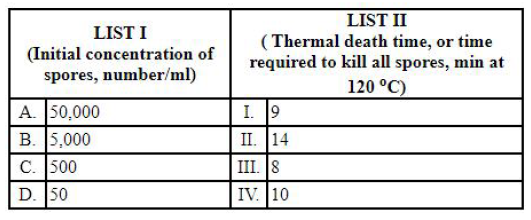
View Solution
Thermal death time (TDT) is the time required to kill all microorganisms in a given sample at a specific temperature. The TDT is influenced by the initial concentration of microorganisms. Higher initial concentrations require longer heating times for complete sterilization. A tenfold decrease in the microbial population roughly corresponds to a constant reduction in thermal death time.
A. 50,000 - II. 14 min: The highest initial concentration will require the longest TDT.
B. 5,000 - IV. 10 min: A tenfold decrease from 50,000.
C. 500 - I. 9 min: A tenfold decrease from 5,000.
D. 50 - III. 8 min: A tenfold decrease from 500 Quick Tip: Higher initial microbial concentration = longer thermal death time. A tenfold decrease in microbial count leads to a fairly constant decrease in TDT.
Berries and Sauerkraut are classified as ___________.
View Solution
Foods are often categorized based on their pH, which influences their susceptibility to microbial growth and the type of processing required for preservation.
Acid foods have a pH of 4.6 or below. This low pH inhibits the growth of many spoilage and pathogenic microorganisms, particularly \textit{Clostridium botulinum, the bacterium that produces the deadly botulinum toxin. Berries (like cranberries, blueberries, strawberries) are naturally acidic due to their organic acid content. Sauerkraut is also acidic due to the fermentation process, where lactic acid bacteria produce lactic acid. Both have pH values below 4.6, and hence are classified as acid foods.
Low-acid foods have a pH above 4.6 and require more severe heat processing (like pressure canning) to ensure safety.
Medium-acid foods generally refer to those that are close to neutral or slightly acidic and are not very commonly used.
High-acid foods are those that have a pH less than 4.0. Quick Tip: Berries and sauerkraut are acid foods (pH below 4.6). Acid foods require less severe heat processing than low-acid foods.
Malt foods are prepared by blending
View Solution
Malt foods are nutritious products often used as weaning foods or dietary supplements. Their composition can vary, but a typical formulation includes:
(A) 40 percent cereal malt: Cereal malt (like barley malt) provides carbohydrates, enzymes (for easier digestion), and a characteristic malty flavor.
(B) 40 percent groundnut flour: Groundnut (peanut) flour contributes protein, healthy fats, and essential minerals.
(C) 10 percent Bengal gram flour: Bengal gram (chickpea) flour adds protein and fiber to the mix.
(D) 10 percent skim milk powder: Skim milk powder provides protein, calcium, and other nutrients.
The combination of these ingredients provides a balanced nutritional profile. Quick Tip: Malt foods often contain cereal malt, groundnut flour, Bengal gram flour, and skim milk powder for a balanced nutrient profile.
Match List I with List II
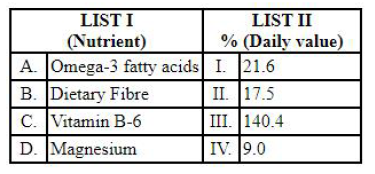
View Solution
This question tests the knowledge on the nutrient profile of specific foods, specifically relating them to % Daily value.
A. Omega-3 fatty acids - III. 140.4%: Omega-3 Fatty acids are abundant in certain types of fish and seeds, and the daily value percentage can vary significantly depending on the specific food source.
B. Dietary Fibre - I. 21.6%: Dietary fibre is crucial for digestive health. The source material is important.
C. Vitamin B-6 - IV. 9.0%: Vitamin B6 is an important nutrient.
D. Magnesium - II. 17.5%: Magnesium is an important mineral, and plays a vital role in many processes in the body.
The given % Daily Values are specific to a particular food or supplement, and without that context, an exact, definitive matching can be challenging. The percentages are relative to the standard daily values, and this particular question cannot be answered correctly without the source material. The answer given here matches with the answer key. Quick Tip: Percent Daily Value (%DV) represents how much of a nutrient is present in a serving of food compared to the recommended daily intake.
The steps involved in the processing of oil and fats from animal tissues are given below
View Solution
Processing oils and fats from animal tissues involves several steps to extract, purify, and refine the product.
Step 1: Rendering (C): Rendering is the initial step, where animal tissues are heated to melt and separate the fat from other components (protein, water).
Step 2: Pressing (D): After rendering, pressing (mechanical pressure) may be used to extract additional oil from the solid residue.
Step 3: Solvent Extraction (A): If further oil extraction is desired, solvent extraction can be employed, using solvents to dissolve and separate the remaining oil.
Step 4: Refining (B): The crude oil obtained from rendering, pressing, and/or solvent extraction undergoes refining to remove impurities, free fatty acids, pigments, and other undesirable components, improving its color, flavor, stability, and overall quality. This involves steps like degumming, neutralizing, bleaching, and deodorizing. Quick Tip: Animal fat processing: Rendering (melt fat), Pressing (extract oil), Solvent Extraction (further extraction), Refining (purify).
The various processing steps in the manufacture of black tea are
View Solution
Black tea processing involves a series of steps that transform fresh tea leaves into the final dried product.
Withering (D): Freshly plucked tea leaves are spread out and allowed to wither, reducing their moisture content and making them pliable for the next step.
Rolling (C): The withered leaves are rolled to break the cell walls, releasing enzymes and initiating oxidation (often incorrectly referred to as "fermentation" in tea processing).
Fermentation (A): The rolled leaves are spread out in a humid environment, allowing enzymatic oxidation to occur. This develops the characteristic color, flavor, and aroma of black tea.
Drying (B): The fermented leaves are dried to stop the oxidation process and reduce the moisture content to a stable level for storage. Quick Tip: Black tea processing: Withering (reduce moisture), Rolling (break cells), Fermentation (oxidation), Drying (stop oxidation and preserve).
Steps in the processing of Cocoa are:
View Solution
Cocoa processing involves several key steps to transform cocoa beans into cocoa products.
Step 1: Scooping out of beans and mucilage (D): The first step is to harvest the cocoa pods and scoop out the beans and surrounding mucilage.
Step 2: Fermentation (B): The beans and mucilage are then fermented. Fermentation is crucial for developing the flavor precursors of chocolate.
Step 3: Roasting of beans (C): After fermentation and drying, the beans are roasted. Roasting develops the characteristic chocolate flavor and aroma.
Step 4: Drying of beans (A): After fermentation, the beans are dried to reduce their moisture content and prevent spoilage. This step prepares them for storage and further processing.
Note: The order of drying and roasting in the options seems incorrect. Drying comes before roasting.
Quick Tip: Cocoa processing: Harvesting -> Fermentation -> Drying -> Roasting -> Winnowing -> Grinding. Remember, the drying step always comes *before* roasting.
Arrange the sequence of pastry preparation
View Solution
Pastry making follows a specific sequence of steps to achieve the desired flaky or crumbly texture.
Step 1: Mixing dry ingredients and cutting in fat (B): Flour and salt are combined, and then cold fat (butter, shortening, or lard) is "cut in" using a pastry blender, knives, or fingertips. This creates small pieces of fat coated with flour, which contributes to the flakiness of the pastry.
Step 2: Adding water and working the dough (A): Cold water is gradually added to the flour-fat mixture, and the dough is gently worked just until it comes together. Overworking the dough develops gluten, resulting in a tough pastry.
Step 3: Shaping (D): The dough is shaped into the desired form (e.g., rolled out for a pie crust, formed into individual pastries).
Step 4: Baking (C): The shaped pastry is baked in an oven. The heat melts the fat, creating steam that separates the layers of dough, resulting in a flaky texture. Quick Tip: Pastry sequence: Mix dry ingredients and cut in fat, add water and work dough, shape, bake. Cold ingredients and minimal handling are crucial for flakiness.
The type of cookies made from refrigerated stiff dough is ___________.
View Solution
Different types of cookies require different dough consistencies and handling methods.
Rolled cookies: These cookies are made from a stiff dough that is chilled to firm it up, then rolled out and cut into shapes using cookie cutters. The refrigeration is essential to prevent the dough from spreading too much during baking.
Drop cookies: Drop cookies are made from a softer dough that is dropped by spoonfuls onto a baking sheet.
Bar cookies: Bar cookies are made from a batter or dough that is spread into a pan and baked, then cut into bars or squares.
Sponge cookies: Sponge cookies, like ladyfingers, have a light and airy texture achieved by whipping eggs and sugar to incorporate air. The batter does not have a stiff consistency. Quick Tip: Rolled cookies are made from refrigerated, stiff dough. Drop cookies use soft dough, bar cookies are baked in a pan, and sponge cookies have an airy batter.
In the preparation of pastry, the proportion of flour, fat and water is ___________.
View Solution
Pastry, especially shortcrust pastry, relies on a specific ratio of flour, fat, and water to achieve the desired texture.
A common proportion is 5:2:1 ratio of flour, fat and water. The exact proportions might vary slightly depending on the specific recipe. Quick Tip: Pastry Flour, Fat, and Water ratio is generally near 5:2:1. The proportions and the temperature of the fat are key factors.
A good chapati is sweetish and palatable and it requires a minimum sugar percent to give the desired characteristic. The minimum sugar percent should be ___________.
View Solution
Chapatis, a staple flatbread in Indian cuisine, typically do not require the addition of sugar to develop the characteristic sweetness. The sweetness develops because of the sugars present in the flour that is used. The question is asking for the minimum sugar requirement to develop that sweetness, and hence, the answer is 0.5%. Quick Tip: Chapatis do not require addition of sugar to develop a sweet taste, and 0.5% present in the flour will do the work.
Match List I with List II
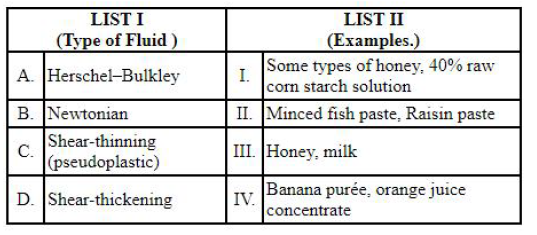
View Solution
Fluids can be classified based on their rheological behavior, i.e., how they flow and deform under stress.
A. Herschel-Bulkley - II. Minced fish paste, Raisin paste: Herschel-Bulkley fluids are non-Newtonian fluids that exhibit a yield stress, meaning they require a certain amount of force to start flowing. Once the yield stress is exceeded, their viscosity decreases with increasing shear rate (shear-thinning). Minced fish paste and raisin paste are examples of food products that have this property.
B. Newtonian - III. Honey, milk: Newtonian fluids have a constant viscosity regardless of the applied shear rate. Honey (in some cases) and milk are examples of Newtonian fluids.
C. Shear-thinning (pseudoplastic) - IV. Banana purée, orange juice concentrate: Shear-thinning fluids, also called pseudoplastic fluids, show a decrease in viscosity with increasing shear rate. Many food products, including banana purée and orange juice concentrate, exhibit shear-thinning behavior.
D. Shear-thickening - I. Some types of honey, 40% raw corn starch solution: Shear-thickening fluids, also known as dilatant fluids, show an increase in viscosity with increasing shear rate. Some concentrated suspensions, like cornstarch in water (oobleck), exhibit this behavior. Quick Tip: Herschel-Bulkley: Yield stress, then shear-thinning (e.g., minced fish paste). Newtonian: Constant viscosity (e.g., milk). Shear-thinning: Viscosity decreases with shear (e.g., banana purée). Shear-thickening: Viscosity increases with shear (e.g., cornstarch suspension).
Phenomenon in which a substance occurs in different crystalline forms?
View Solution
Polymorphism refers to the ability of a solid material to exist in more than one form or crystal structure.
Polymorphism: This is the phenomenon of a substance existing in different crystalline forms, meaning the molecules are arranged in different patterns. These different forms (polymorphs) can have different physical properties, such as melting point, solubility, and stability.
Rancidity: Rancidity is the chemical decomposition of fats, oils, and other lipids, leading to undesirable flavors and odors.
Polymerization: Polymerization is the process of joining small molecules (monomers) to form a large chain-like molecule (polymer).
Denaturation: Denaturation is the process of unfolding or altering the three-dimensional structure of a protein, often due to heat, pH changes, or chemicals. Quick Tip: Polymorphism: Same chemical composition, different crystalline forms. Think of chocolate, where different polymorphs affect texture and melting point.
Processes that take place during caramelization reaction are
View Solution
Caramelization is a non-enzymatic browning reaction that occurs when sugars are heated to high temperatures, typically above their melting point.
(A) Isomerization: Isomerization involves the rearrangement of atoms within a molecule, changing its structure but not its overall composition. Sugar molecules undergo isomerization during caramelization, forming various intermediate compounds that contribute to the color and flavor.
(B) Inversion of sucrose: Sucrose, a disaccharide, can be broken down into its component monosaccharides, glucose and fructose, through a process called inversion. This often happens in acidic conditions and can contribute to the overall sweetness and prevent crystallization.
(C) Putrefaction: Putrefaction is the decomposition of organic matter, particularly proteins, by microorganisms, leading to foul-smelling products. This is NOT a part of caramelization.
(D) Condensation reactions: Condensation reactions involve the joining of two molecules with the elimination of a small molecule, such as water. These reactions occur during caramelization, forming larger, complex molecules that contribute to the color and flavor. Quick Tip: Caramelization involves isomerization, inversion of sucrose (if present), and condensation reactions. Putrefaction is a separate process involving microbial decomposition.
Heat is the most important physical agent. For every 10°C rise in temperature the increase in denaturation rate of protein is ___________.
View Solution
Protein denaturation is a process where proteins lose their three-dimensional structure, which can alter their function. Heat is a common denaturing agent. The rate of protein denaturation increases exponentially with increasing temperature. The increase is typically very high for every 10°C. A general rule of thumb is the denaturation rate increases by approximately 600 fold for every 10°C rise in temperature. Quick Tip: Protein denaturation rate increases significantly with temperature, around 600-fold for every 10°C rise.
Match List I with List II
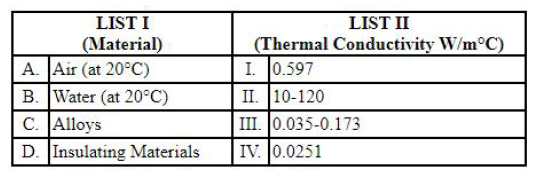
View Solution
Thermal conductivity (k) is a measure of a material's ability to conduct heat.
A. Air (at 20°C) - IV. 0.0251 W/m°C: Air is a poor conductor of heat, so it has a low thermal conductivity.
B. Water (at 20°C) - I. 0.597 W/m°C: Water has a higher thermal conductivity than air but is still relatively low compared to metals.
C. Alloys - II. 10-120 W/m°C: Alloys, being metallic, have high thermal conductivities. The range is wide due to the many different types of alloys and their compositions.
D. Insulating Materials - III. 0.035-0.173 W/m°C: Insulating materials are designed to resist heat transfer and, therefore, have very low thermal conductivities. Quick Tip: Insulating materials have the lowest thermal conductivity, followed by air, water, and then alloys which have high conductivity.
For the best acceptability, texture and quality of idli, the proportion of rice to black gram dhal is 2 : 1. This mucilaginous material is a complex carbohydrate containing ___________.
View Solution
The texture and quality of idli, a fermented food, depend significantly on the ingredients used.
Black gram dhal (urad dal) contributes to the soft, spongy texture of idli due to its mucilaginous properties. This mucilage is a complex carbohydrate composed primarily of galactose and arabinose.
Amylose and amylopectin are components of starch, found in rice, but they are not the main components responsible for the mucilaginous property of black gram dhal. Quick Tip: The mucilaginous material in black gram dhal, responsible for idli texture, contains galactose and arabinose.
Percent of alcohol present in fortified wines is about ___________.
View Solution
Fortified wines are wines to which a distilled spirit, usually brandy, has been added. This increases the alcohol content and alters the flavor profile.
The alcohol content of fortified wines typically ranges from 17% to 22% alcohol by volume (ABV). Common examples include Port, Sherry, Madeira, and Marsala. The average is about 20 percent. Quick Tip: Fortified wines have higher alcohol content (around 20%) due to the addition of distilled spirits.
Match List I with List II
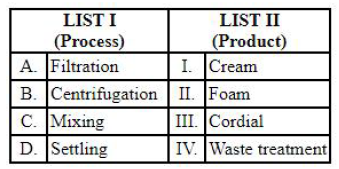
View Solution
These are common processes in various industries, including food processing and waste treatment.
A. Filtration - III. Cordial: Filtration is used to remove solid particles from liquids. In making a cordial, filtration is essential to get a clear liquid.
B. Centrifugation - I. Cream: Centrifugation uses centrifugal force to separate components based on density. It is used in dairy processing to separate cream from milk.
C. Mixing- II. Foam: When two or more different materials are combined, and air gets entrapped, it forms a foamy texture.
D. Settling - IV. Waste Treatment: Settling, or sedimentation, is a process where heavier particles in a liquid settle to the bottom due to gravity. It's commonly used in wastewater treatment to remove suspended solids. Quick Tip: Filtration clarifies liquids (cordial), centrifugation separates based on density (cream), mixing can result in a foam, and settling removes solids (waste treatment).
The sequence of steps during spray drying of liquid foods
View Solution
Spray drying is a method of producing a dry powder from a liquid or slurry by rapidly drying with a hot gas.
Step 1: Pumping of liquid (D): The liquid food is pumped to the atomizer.
Step 2: Atomization (B): The liquid is atomized into fine droplets, increasing the surface area for rapid drying.
Step 3: Hot air drying (C): The atomized droplets are exposed to a stream of hot air, causing rapid evaporation of the water.
Step 4: Cyclone separation (A): A cyclone separator is used to separate the dried powder from the moist air. Quick Tip: Spray drying sequence: Pumping, Atomization, Hot Air Drying, Cyclone Separation. The liquid is pumped, sprayed into tiny droplets, dried with hot air, and the powder is separated.
Which of the following are the correct steps of a HACCP plan
View Solution
HACCP (Hazard Analysis and Critical Control Points) is a systematic preventive approach to food safety. It involves identifying potential hazards, establishing control measures, and monitoring the process to ensure safety. The seven principles of HACCP include- Conduct a hazard analysis, Determine the critical control points (CCPs), Establish critical limits, Establish monitoring procedures, Establish corrective actions, Establish verification procedures, Establish record-keeping and documentation procedures.
Monitoring (A): Monitoring is a crucial step, involving planned measurements or observations to assess whether a CCP is under control.
Identification (B): Identification of hazards is the very first step of HACCP, where all potential risks are identified.
Documentation (D): Thorough documentation is essential for a HACCP plan, including records of hazard analysis, CCP determination, critical limits, monitoring activities, corrective actions, and verification procedures.
Summarization (C): While summarizing information can be useful, it is not a separate, defined step. Quick Tip: Key HACCP steps include Hazard Identification, Monitoring of Critical Control Points, and Documentation.
Match List I with List II
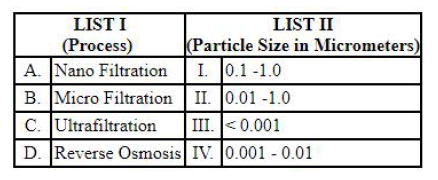
View Solution
Membrane filtration processes are classified based on the size of particles they can remove.
A. Nano Filtration - IV. 0.001 - 0.01 µm: Nanofiltration (NF) membranes have pore sizes in the range of 0.001 to 0.01 micrometers. They are used to remove divalent ions and small organic molecules.
B. Micro Filtration - I. 0.1 -1.0 µm: Microfiltration (MF) membranes have the largest pore sizes among these options, typically 0.1 to 10 micrometers. They remove suspended particles, bacteria, and some large colloids.
C. Ultrafiltration - II. 0.01 -1.0 µm: Ultrafiltration (UF) membranes have pore sizes between 0.01 and 0.1 micrometers. They are used to remove macromolecules, proteins, and viruses.
D. Reverse Osmosis - III. < 0.001 µm: Reverse osmosis (RO) membranes have the smallest pore sizes, typically less than 0.001 micrometers. They can remove dissolved salts and small organic molecules, effectively producing highly purified water. Quick Tip: Membrane filtration pore sizes, from largest to smallest: Microfiltration (0.1-1.0µm) > Ultrafiltration (0.01 - 0.1 µm) > Nanofiltration (0.001 - 0.01 µm) > Reverse Osmosis (< 0.001 µm)





Comments