


CUET PG Environmental Sciences Question Paper 2024 will be available here for download. NTA conducted CUET PG Environmental Sciences paper 2024 on from March 19 in Shift 1. CUET PG Question Paper 2024 is based on objective-type questions (MCQs). According to latest exam pattern, candidates get 105 minutes to solve 75 MCQs in CUET PG 2024 Environmental Sciences question paper.
CUET PG Environmental Sciences Question Paper 2024 PDF Download
| CUET PG 2024 Environmental Sciences Question Paper with Answer Key |  Download Download |
Check Solution |

Environmental Sciences 2024 Questions with Solutions
Question 1:
What will be the energy of 1 mole of photons having a wavelength of 200 nm?
Planck's constant, h = 6.6 × 10⁻³⁴ Js and Speed of light, c = 3.0 × 10⁸ ms-1
View Solution
Solution:
1. Calculate the energy of one photon: E = hc⁄λ
Substituting the values: E = (6.6 × 10-34 × 3.0 × 108)⁄(200 × 10-9)
E = 9.9 × 10⁻¹⁹ J
2. Calculate the energy of 1 mole of photons:
Emole = E × NA
Emole = 9.9 × 10-19 × 6.022 × 1023
Emole = 5.96 × 10⁵ J mol−1
3. Convert to kilojoules: Emole = 599 KJ mol-1
Quick Tip: Always ensure that the wavelength is converted to meters (λ = 200 nm = 200 × 10-9 m) before performing calculations.
Question 2:
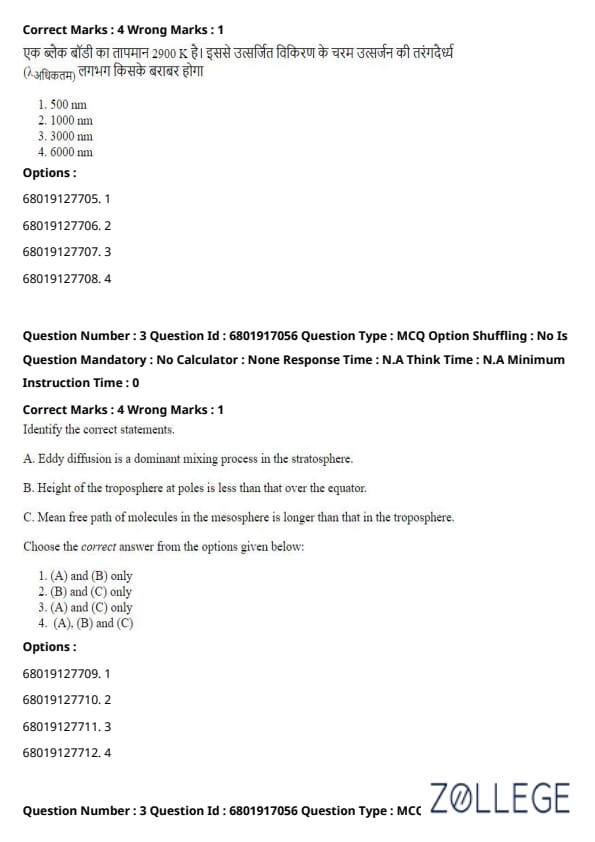
A black body has a temperature of 2900 K. The wavelength of peak emission (λmax) of the radiation emitted from it is approximately equal to:
View Solution
Solution:
1. Use Wien's Displacement Law to calculate the wavelength of peak emission: λmax = b⁄T
Where:
• b = 2.898 × 10⁻³ m·K (Wien's constant)
• T = 2900 K (Temperature of the black body)
2. Substituting the values:
λmax = 2.898 × 10⁻³⁄2900
λmax = 1.000 × 10⁻⁶ m
3. Convert to nanometers: λmax = 1000 nm
Quick Tip: Wien's Displacement Law is useful for determining the peak wavelength of radiation emitted by a black body at a given temperature.
Question 3:
Identify the correct statements:
Statements:
A. Eddy diffusion is a dominant mixing process in the stratosphere.
B. Height of the troposphere at poles is less than that over the equator.
C. Mean free path of molecules in the mesosphere is longer than that in the troposphere.
Choose the correct answer from the options given below:
View Solution
Solution:
1. Statement A is incorrect. Eddy diffusion is not the dominant mixing process in the stratosphere. Molecular diffusion, rather than eddy diffusion, dominates at higher altitudes like the stratosphere.
2. Statement B is correct. The height of the troposphere is indeed less at the poles (approximately 8-10 km) than over the equator (approximately 16-18 km), due to differences in temperature and atmospheric dynamics.
3. Statement C is correct. The mean free path of molecules increases with altitude as the air density decreases. Hence, the mean free path in the mesosphere is longer than in the troposphere.
Thus, the correct statements are (B) and (C).
Quick Tip: Remember that atmospheric mixing mechanisms vary by altitude: the troposphere relies on turbulence and convection, while molecular diffusion becomes significant in the upper layers like the mesosphere.
Question 4:
Earthquakes occur in:
View Solution
Solution: Earthquakes typically occur in the Earth's lithosphere, which includes the crust and the rigid upper portion of the mantle. This is where tectonic plates interact, leading to seismic activity.
Quick Tip: The depth range of earthquakes is typically between 0 and 700 km, corresponding to the crust and upper mantle.
Question 5:
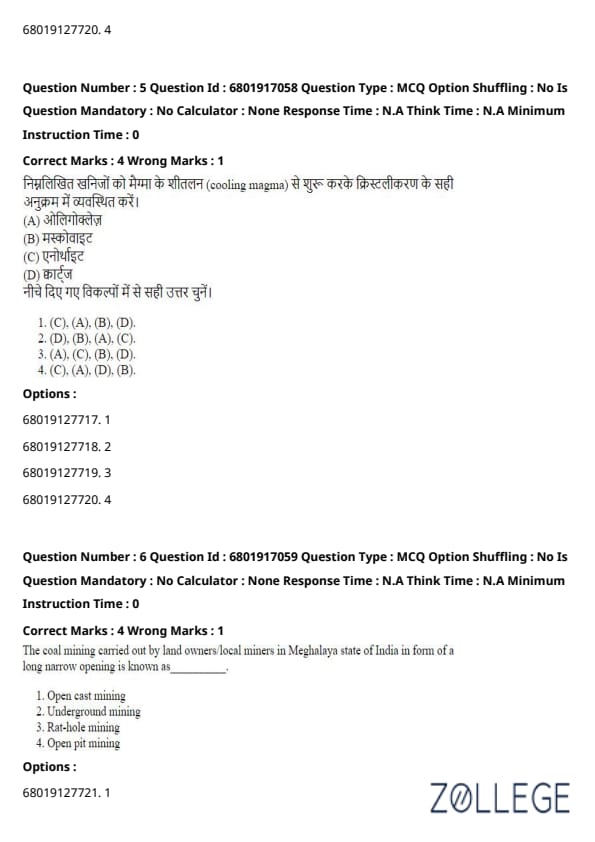
Arrange the following minerals in the correct sequence of crystallization starting from a cooling magma:
Minerals:
A. Oligoclase
B. Muscovite
C. Anorthite
D. Quartz
Choose the correct answer from the options given below:
View Solution
Solution: Minerals crystallize from magma in a specific order according to Bowen's Reaction Series:
1. Anorthite (C): Crystallizes at higher temperatures.
2. Oligoclase (A): Forms as magma cools further.
3. Muscovite (B): Crystallizes at lower temperatures.
4. Quartz (D): Forms last at the lowest temperatures.
Quick Tip: Bowen's Reaction Series is key to understanding the order of mineral crystallization from cooling magma.
Question 6:
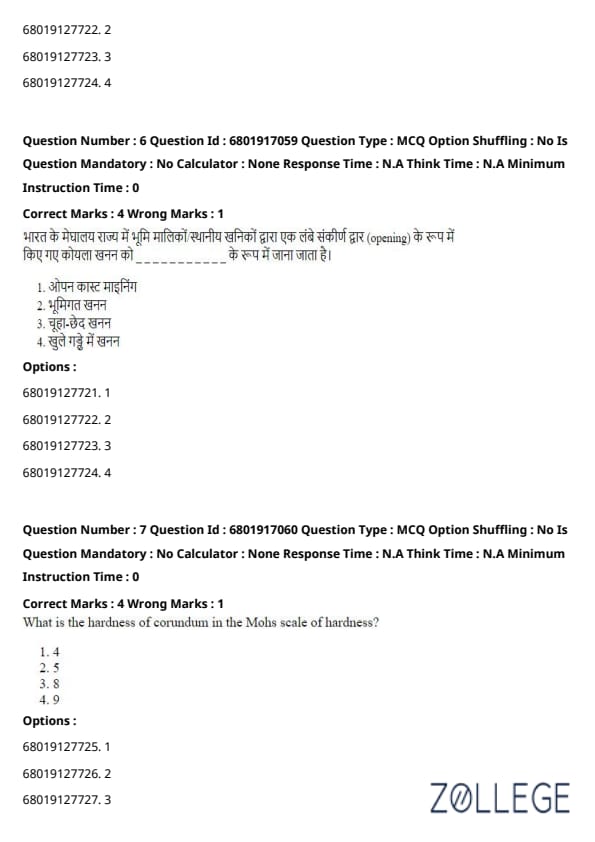
The coal mining carried out by landowners/local miners in Meghalaya state of India in the form of a long narrow opening is known as:
View Solution
Solution: Rat-hole mining is a method practiced in Meghalaya, India, where coal is extracted through narrow tunnels dug into the ground. It is named for the small size of the openings, resembling rat holes.
Quick Tip: Rat-hole mining is controversial due to safety concerns and environmental impact, and it has been banned in India.
Question 7:
What is the hardness of corundum in the Mohs scale of hardness?
View Solution
Solution: Corundum has a hardness of 9 on the Mohs scale, making it one of the hardest natural minerals, second only to diamond.
Quick Tip: The Mohs scale of hardness ranks minerals based on their ability to scratch softer materials.
Question 8:
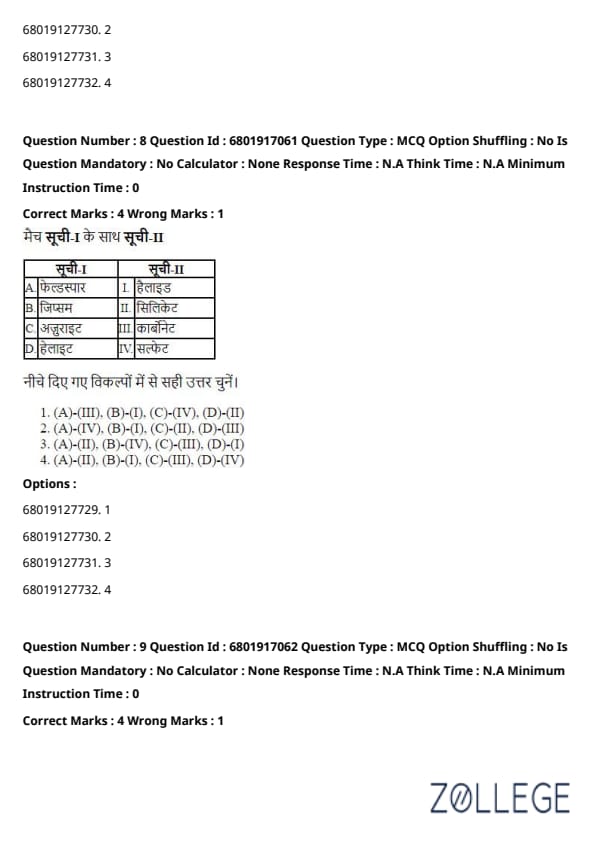
Match List I with List II:
| LIST I | LIST II |
|---|---|
| A. Feldspar | I. Halide |
| B. Gypsum | II. Silicate |
| C. Azurite | III. Carbonate |
| D. Halite | IV. Sulfate |
Choose the correct answer from the options given below:
View Solution
Solution:
• Feldspar is a silicate mineral (A - II).
• Gypsum belongs to the sulfate group (B - IV).
• Azurite is a carbonate mineral (C - III).
• Halite is classified as a halide (D - I).
Quick Tip: Understanding mineral classifications is essential for identifying and analyzing geological materials.
Question 9:
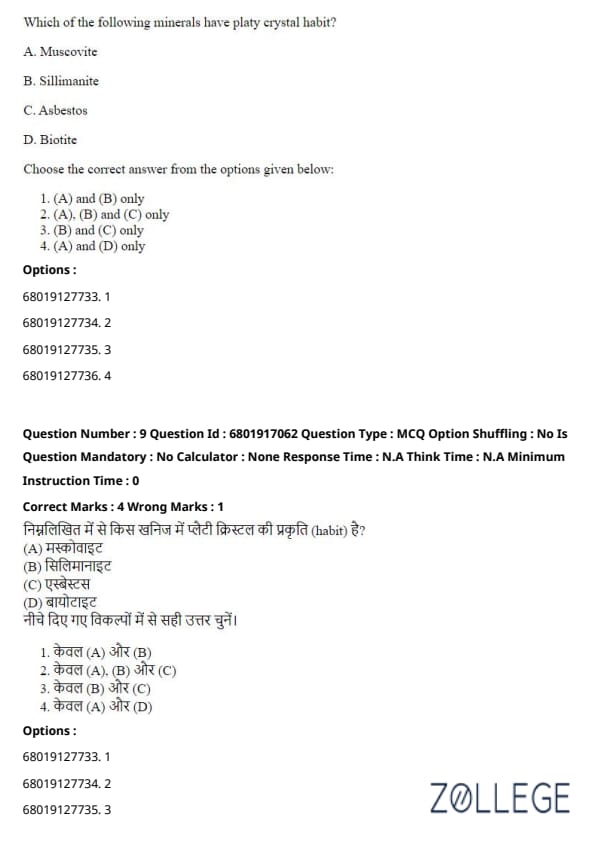
Which of the following minerals have platy crystal habit?
Minerals:
A. Muscovite
B. Sillimanite
C. Asbestos
D. Biotite
Choose the correct answer from the options given below:
View Solution
Solution: Muscovite and Biotite are mica minerals with a platy crystal habit, characterized by their ability to split into thin, flexible sheets.
Quick Tip: The platy habit is a distinguishing feature of minerals in the mica group.
Question 10:
What is the plutonic equivalent of rhyolite?
View Solution
Solution: Rhyolite is an extrusive igneous rock, while granite is its plutonic equivalent, meaning it crystallizes below the Earth's surface with similar mineral composition.
Quick Tip: Plutonic rocks crystallize slowly beneath the Earth's surface, resulting in coarse-grained textures.
Question 11:
In the asthenosphere, the velocity of S-waves in partly molten rocks:
A. Increases
B. Decreases
C. Remain Constant
D. First increases then decreases
Choose the correct answer from the options given below:
View Solution
Solution: The velocity of S-waves decreases in the asthenosphere due to the presence of partially molten rocks, which reduce the rigidity of the medium. This property indicates that the asthenosphere is a mechanically weak layer within the Earth's upper mantle.
Quick Tip: S-waves cannot propagate through fully molten regions, and their reduced velocity in the asthenosphere is a key indicator of partial melting.
Question 12:
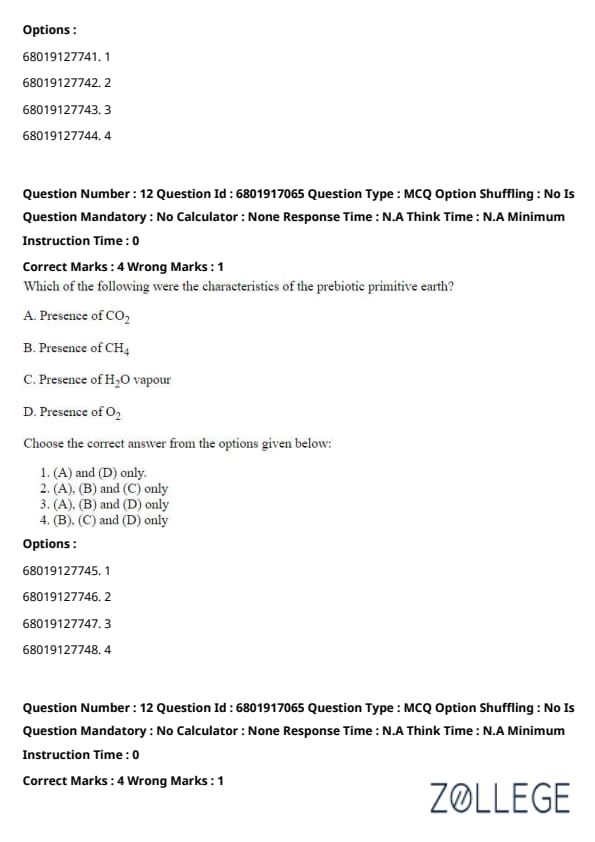
Which of the following were the characteristics of the prebiotic primitive Earth?
Characteristics:
A. Presence of CO2
B. Presence of CH4
C. Presence of H2O vapour
D. Presence of O2
Choose the correct answer from the options given below:
View Solution
Solution: The prebiotic primitive Earth was characterized by:
• The presence of CO2 (carbon dioxide), CH4 (methane), and H2O (water vapour).
• The absence of O2 (oxygen), as the atmosphere was reducing and not oxidizing during this period.
Quick Tip: The reducing atmosphere of primitive Earth played a crucial role in chemical evolution and the origin of life.
Question 13:
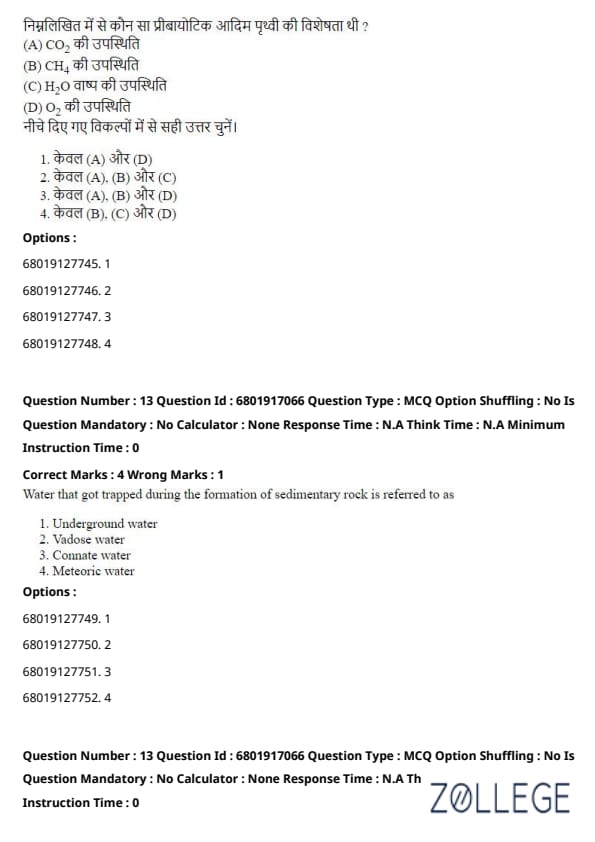
Water that got trapped during the formation of sedimentary rock is referred to as:
View Solution
Solution: Connate water is the water that gets trapped within the pores of sedimentary rocks during their formation. It is ancient water, distinct from meteoric or underground water, and may contain high salinity due to its long isolation.
Quick Tip: Connate water is often studied in petroleum geology as it can affect the porosity and permeability of reservoir rocks.
Question 14:
Cooking pans made from which of the following metals would need less heat to achieve a certain cooking temperature?
View Solution
Solution: The specific heat of a material determines how much heat is required to raise its temperature. Silver has the lowest specific heat among the given options, requiring less heat to reach a given temperature compared to copper, iron, or aluminium.
Quick Tip: Materials with lower specific heat values heat up faster, making them more efficient for cooking.
Question 15:
Match List I with List II:
| LIST I (Experiment) | LIST II (Conclusion) |
|---|---|
| A. Photoelectric effect | I. Ether medium does not exist |
| B. Michelson-Morley | II. Light is made up of photons |
| C. Stern-Gerlach | III. Quantization of electronic orbit |
| D. Franck-Hertz | IV. Electron spin moment |
Choose the correct answer from the options given below:
View Solution
Solution:
• Photoelectric effect (A): Demonstrated that light consists of photons (A - II).
• Michelson-Morley experiment (B): Proved the non-existence of the ether medium (B - I).
• Stern-Gerlach experiment (C): Provided evidence of electron spin moment (C - IV).
• Franck-Hertz experiment (D): Confirmed the quantization of electronic orbits (D - III).
Quick Tip: Each experiment played a pivotal role in shaping modern physics and understanding quantum mechanics.
Question 16:
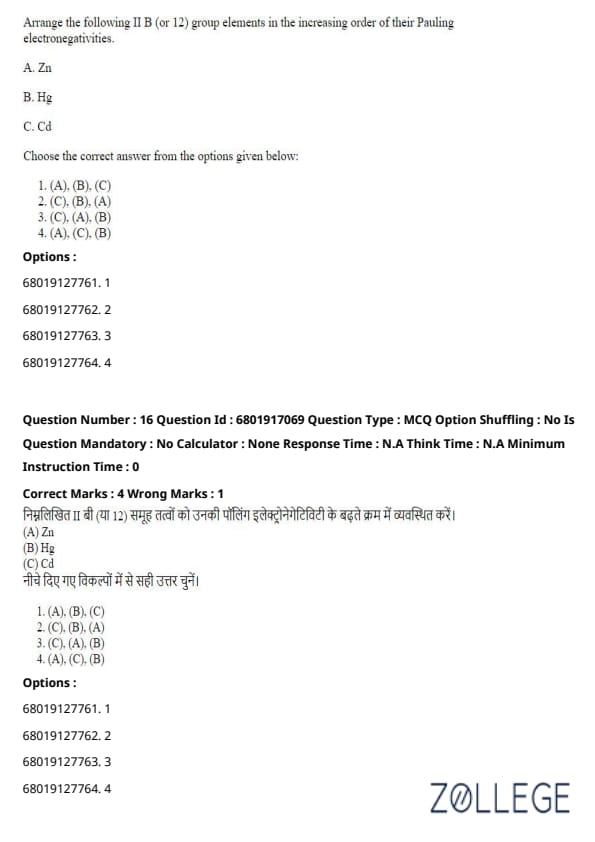
Arrange the following II B (or 12) group elements in the increasing order of their Pauling electronegativities:
Elements:
A. Zn
B. Hg
C. Cd
Choose the correct answer from the options given below:
View Solution
Solution: The electronegativities of group 12 elements are as follows:
• Zinc (Zn): 1.65
• Cadmium (Cd): 1.69
• Mercury (Hg): 2.00
Thus, the increasing order of their electronegativities is Zn < Cd < Hg.
Quick Tip: Electronegativity increases as you move to the right in the periodic table or from heavier to lighter elements within a group.
Question 17:
What will be the molar concentration of ammonium ion in a 100 ppb ammoniacal solution?
View Solution
Solution: 100 ppb means 100 µg/L of ammonia (NH3). To calculate the molar concentration of ammonium ions (NH+4):
• Molar mass of NH3: 17g/mol
• Moles of NH3 per litre:
100 × 10-6⁄17 = 5.88 × 10⁻⁶ mol/L
Thus, the molar concentration of ammonium ion is approximately 5.56 × 10⁻⁶ mol/L.
Quick Tip: The molar concentration from a ppb value can be determined using the formula: Moles/L = ppb value (in µg/L)⁄Molar mass (in g/mol)
Question 18:
In which of the following pairs of chemical species does sulfur (S) not have the same oxidation number?
View Solution
Solution: The oxidation numbers of sulfur in the given species are:
1. S2 (0) and H2S (-2) - Different oxidation numbers.
2. H2SO3 (+4) and SO2 (+4) – Same oxidation numbers.
3. HS- (-1) and S2- (-2) - Different oxidation numbers.
4. H2S (-2) and S2− (-1) - Different oxidation numbers.
Thus, sulfur does not have the same oxidation number in the pairs H2SO3 and SO2, and HS¯ and S2-.
Quick Tip: To determine the oxidation number, balance the total charge of the molecule or ion with the known oxidation states of other atoms.
Question 19:
Which of the following chemical species will dominantly exist in water having a pH of less than 5?
View Solution
Solution: At a pH of less than 5, the water is acidic. Under these conditions, carbonic acid (H2CO3) is the dominant species because the equilibrium shifts towards the protonated form of carbon dioxide in water:
CO2 + H2O → H2CO3
Bicarbonate (HCO-3) and carbonate (CO2-3) are predominant only at higher pH levels.
Quick Tip: The pH level determines the dominant form of carbon species in water: H2CO3 at low pH, HCO-3 at neutral pH, and CO2-3 at high pH.
Question 20:
Which of the following microbial species are helpful in the denitrification process?
Microbial species:
A. Rhizobium sp
B. Achromobacter
C. Pseudomonas
D. Nitrosomonas
E. Azotobacter
Choose the correct answer from the options given below:
View Solution
Solution: Denitrification is a process where nitrate (NO-3) is reduced to nitrogen gas (N2) or other gaseous forms. The key microbes involved include:
• Achromobacter (B): A known denitrifying bacterium.
• Pseudomonas (C): Another significant bacterium involved in denitrification.
Nitrosomonas (D): It is involved in nitrification, not denitrification. _Rhizobium_ (A) and _Azotobacter_ (E): These are nitrogen-fixing bacteria, not involved in denitrification.
Quick Tip: Denitrification microbes convert nitrates into gaseous nitrogen, playing a critical role in the nitrogen cycle.
Question 21:
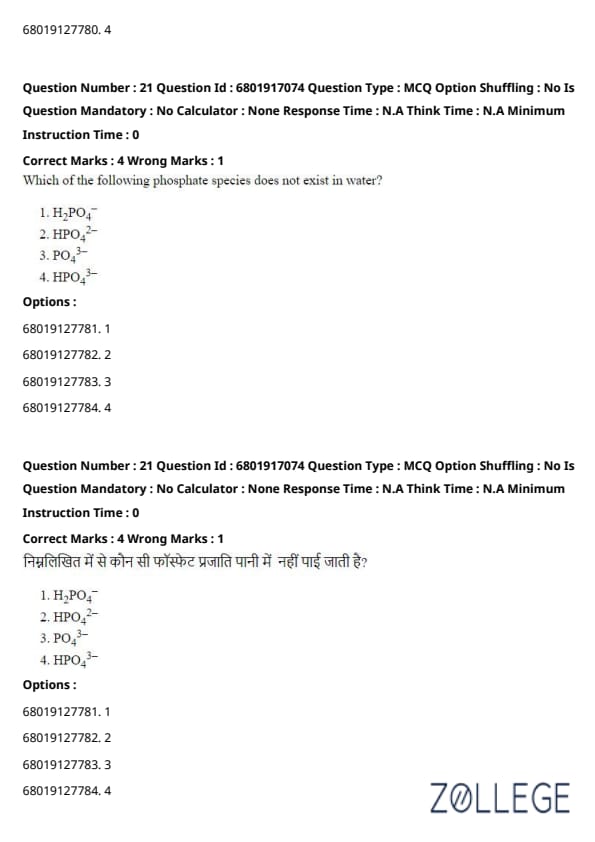
Which of the following phosphate species does not exist in water?
View Solution
Solution: The following phosphate species exist in water depending on the pH:
• H2PO-4: Exists in acidic conditions.
• HPO2-4: Exists in neutral to slightly alkaline conditions.
• PO3-4: Exists in highly alkaline conditions.
The species HPO3-4 does not exist because it would require an impossible intermediate oxidation state of phosphorus.
Quick Tip: Phosphate species in water are determined by pH and include H2PO-4, HPO2-4, and PO3-4. HPO3-4 is not chemically viable.
Question 22:
When ice starts melting from 0°C to 8.5°C, its density will:
View Solution
Solution:
1. At 0°C, ice starts to melt, and the density of water increases as it transitions to the liquid phase.
2. Between 0°C and 4°C, the density of water continues to increase due to molecular arrangement becoming more compact.
3. Beyond 4°C, the density begins to decrease as the water expands with temperature.
4. Thus, between 0°C and 8.5°C, the density of water first increases and then decreases.
Quick Tip: Water exhibits maximum density at 4°C, a property crucial for the survival of aquatic life in colder regions.
Question 23:
Which of the following metal is bioaccumulative in nature but does not undergo biomagnification to cause adverse health effects?
View Solution
Solution:
1. Selenium (Se) is bioaccumulative, meaning it accumulates in organisms over time.
2. However, it does not biomagnify significantly across trophic levels, reducing its adverse health effects compared to mercury (Hg).
Quick Tip: Remember, biomagnification refers to the increase in concentration of a substance through trophic levels, whereas bioaccumulation happens within a single organism over time.
Question 24:
What will be the unit of equilibrium constant for the following reaction?
CH3COCH3 + HCN = CH3C(OH)(CN)CH3
View Solution
Solution:
1. Equilibrium constant (Kc) is defined as: Kc = [products]⁄[reactants]
2. Substituting units: Kc = mol dm-3⁄(mol dm³)(mol dm-3)
3. Final unit: Kc = mol-1 dm³
Quick Tip: Always check the stoichiometry of the reaction while calculating the equilibrium constant. Units depend on the number of moles of reactants and products.
Question 25:
Partial pressure of nitrogen gas (N2) in the atmosphere will be:
View Solution
Solution:
1. The total atmospheric pressure is approximately 1 atm = 101325 Pa.
2. The percentage of nitrogen gas (N2) in the atmosphere is approximately 78%.
3. Partial pressure: PN₂ = 0.78 × 101325 ≈ 7.9 × 10⁴ Pa.
Quick Tip: The total atmospheric pressure is distributed proportionally among all gases. Multiply the atmospheric pressure by the percentage composition of the gas.
Question 26:
Which of the following codons are called nonsense codons?
View Solution
Solution:
1. Nonsense codons (UAA, UAG, UGA) signal the termination of translation. These codons do not code for any amino acids.
2. UAA, UAC, UAG includes two nonsense codons (UAA, UAG) and one typo (UAC).
Quick Tip: Nonsense codons are also called stop codons and play a critical role in ending the process of protein synthesis.
Question 27:
Organogenesis in humans takes place during:
View Solution
Solution:
1. Organogenesis begins in the fourth week of embryonic development.
2. By the end of this week, the basic structures of the heart, neural tube, and major organs start forming.
Quick Tip: Remember, organogenesis starts in the embryonic period and progresses through cellular differentiation and morphogenesis.
Question 28:
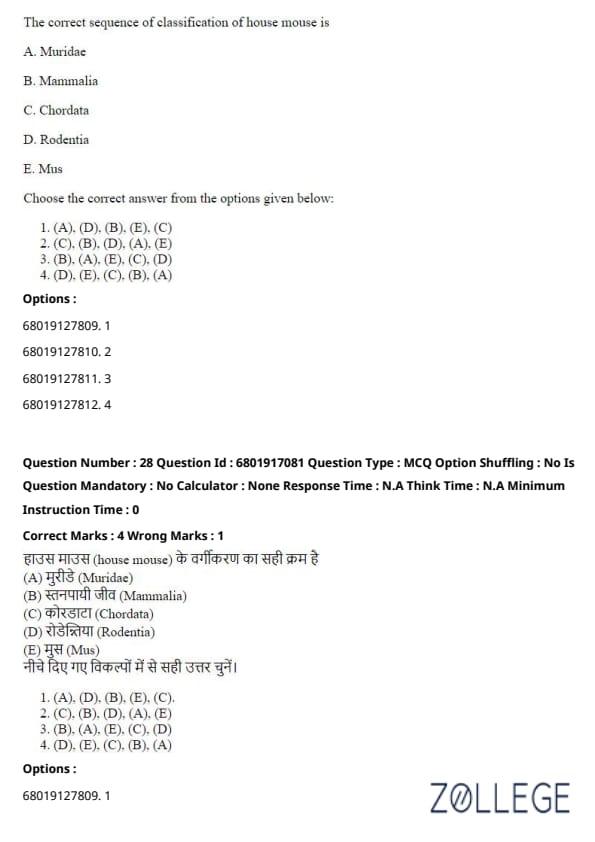
The correct sequence of classification of house mouse is:
View Solution
Solution:
1. The house mouse (_Mus musculus_) belongs to:
• Phylum: Chordata
• Class: Mammalia
• Order: Rodentia
• Family: Muridae
• Genus: Mus
2. The correct hierarchical sequence follows from phylum to genus.
Quick Tip: When classifying organisms, always start from the broadest category (phylum) and move towards the most specific (genus or species).
Question 29:
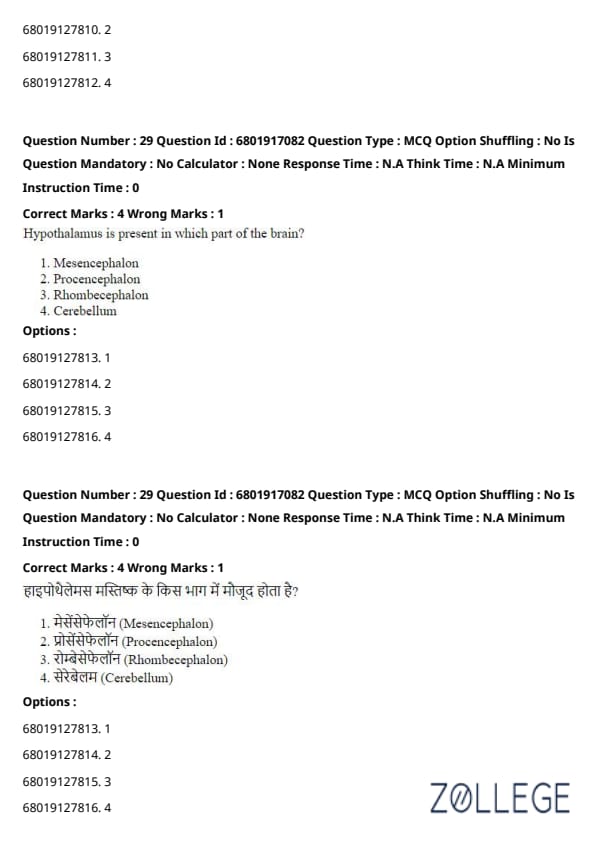
Hypothalamus is present in which part of the brain?
View Solution
Solution:
1. The hypothalamus is part of the forebrain (procencephalon) and plays a key role in hormone regulation and maintaining homeostasis.
2. It connects the nervous and endocrine systems through the pituitary gland.
Quick Tip: Remember, the procencephalon includes the cerebrum, thalamus, and hypothalamus.
Question 30:
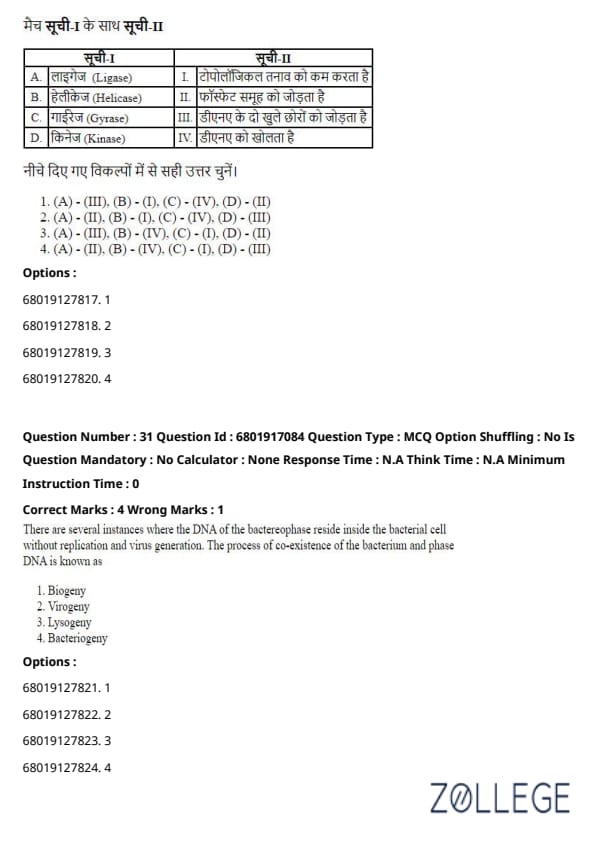
Match List I with List II:
| LIST I | LIST II |
|---|---|
| A. Ligase | I. Reduce topological strain |
| B. Helicase | II. Adds phosphate group |
| C. Gyrase | III. Joins two open ends of DNA |
| D. Kinase | IV. Unwinds the DNA |
Choose the correct answer from the options given below:
View Solution
Solution:
• Ligase (A): Ligase is an enzyme that joins two open ends of DNA, typically during replication or repair, by forming phosphodiester bonds. Hence, (III).
• Helicase (B): Helicase unwinds the DNA double helix, separating the strands to facilitate replication or transcription. Hence, (IV).
• Gyrase (C): Gyrase is a type of topoisomerase that reduces topological strain in DNA caused by unwinding during replication. Hence, (I).
• Kinase (D): Kinase is an enzyme that adds phosphate groups to molecules, often modifying proteins or other substrates. Hence, (II).
Quick Tip: Each enzyme in DNA replication has a specific function: helicase unwinds DNA, gyrase reduces strain, ligase joins ends, and kinase adds phosphate groups.
Question 31:
There are several instances where the DNA of the bacteriophage resides inside the bacterial cell without replication and virus generation. The process of co-existence of the bacterium and phage DNA is known as:
View Solution
Solution: Lysogeny refers to the state in which a bacteriophage integrates its DNA into the host bacterial genome and resides in a dormant state without causing immediate replication or destruction of the host cell. This integrated viral DNA is called a prophage, and it can remain in the lysogenic cycle until triggered to enter the lytic cycle, where viral replication occurs.
Quick Tip: Lysogeny refers to the dormant phase where bacteriophage DNA integrates into the bacterial genome without replication or lysis.
Question 32:
Which of the following organelles contains DNA?
View Solution
Solution: Mitochondria contain their own circular DNA, which allows them to encode some of their own proteins and enzymes necessary for energy production through oxidative phosphorylation. This unique feature makes mitochondria semi-autonomous organelles. Ribosomes, peroxisomes, and Golgi bodies do not contain DNA.
Quick Tip: Mitochondria and chloroplasts are unique organelles that have their own DNA, supporting the endosymbiotic theory.
Question 33:
The "Biofilm” is a thin layer that constitutes:
View Solution
Solution: A biofilm is a structured community of bacterial cells enclosed in a self-produced polymeric matrix, primarily composed of glycocalyx. This matrix helps bacteria adhere to surfaces and provides protection against environmental stress and antimicrobial agents.
Quick Tip: Biofilms are protective bacterial communities embedded in extracellular polymeric substances (EPS), including glycocalyx.
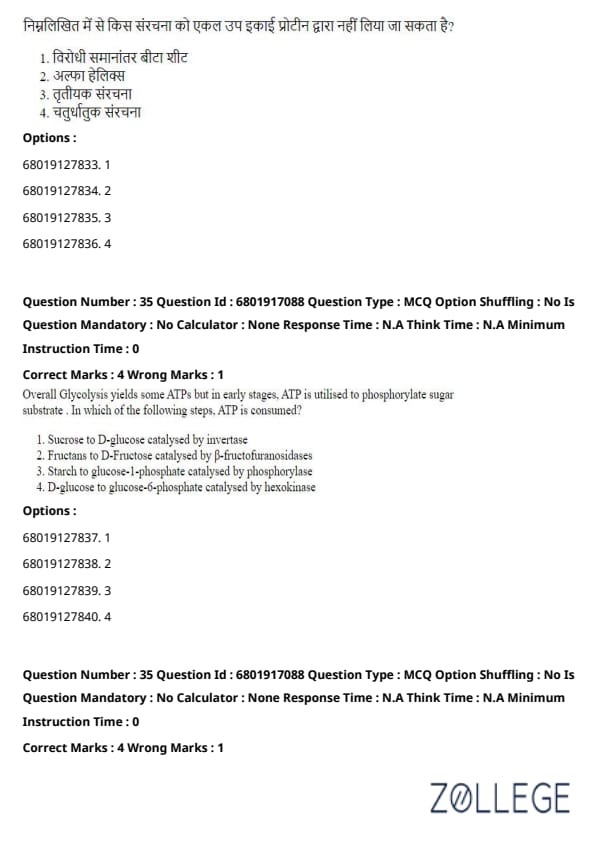
Question 34:
Which of the following structure cannot be taken by the single subunit protein?
View Solution
Solution:
1. A single subunit protein can form secondary structures like alpha helices and beta sheets, and it can also fold into a tertiary structure.
2. Quaternary structure involves interactions between multiple polypeptide chains, which a single subunit protein cannot achieve.
Quick Tip: Quaternary structures are unique to multimeric proteins like hemoglobin, which consist of more than one polypeptide chain.
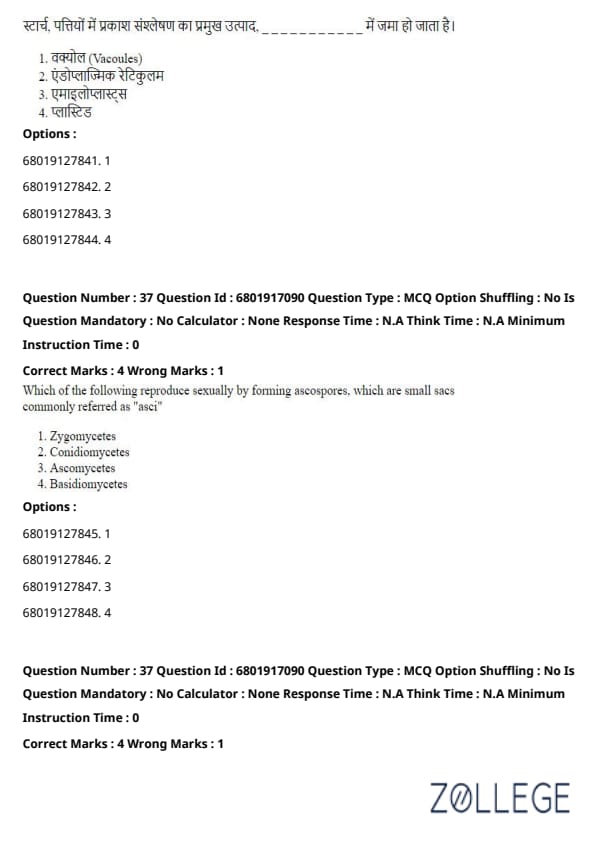
Question 35:
Overall Glycolysis yields some ATPs, but in early stages, ATP is utilized to phosphorylate sugar substrates. In which of the following steps is ATP consumed?
View Solution
Solution:
1. In the first step of glycolysis, hexokinase catalyses the phosphorylation of D-glucose to glucose-6-phosphate using one molecule of ATP.
2. This phosphorylation step is critical for trapping glucose inside the cell and initiating glycolysis.
3. The other options involve either enzymatic cleavage or phosphorylation without ATP usage.
Quick Tip: Remember that glycolysis involves two ATP-consuming steps: phosphorylation of glucose (hexokinase) and phosphorylation of fructose-6-phosphate (phosphofructokinase-1).
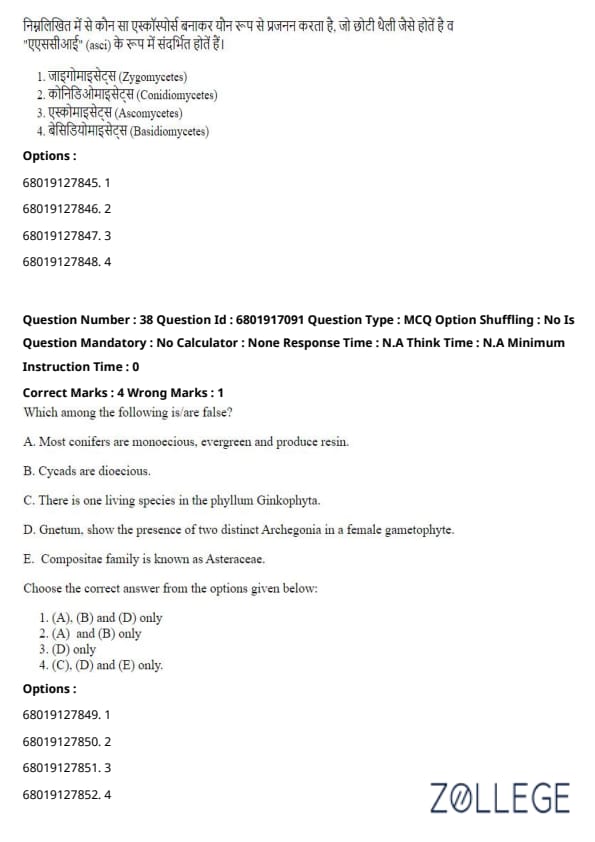
Question 36:
Starch, the major product of photosynthesis in leaves, gets accumulated in:
View Solution
Solution:
1. Amyloplasts are specialized plastids that store starch in plants.
2. They are non-photosynthetic organelles, predominantly found in storage tissues like tubers and seeds.
3. Other options like vacuoles, ER, or general plastids are not specific for starch storage.
Quick Tip: Amyloplasts are a type of leucoplast that stores starch, distinct from chloroplasts involved in photosynthesis.
Question 37:
Which of the following reproduce sexually by forming ascospores, which are small sacs commonly referred to as "asci"?
View Solution
Solution:
1. Ascomycetes are fungi that produce sexual spores called ascospores within a sac-like structure called ascus.
2. Other fungal classes like Zygomycetes and Basidiomycetes have different reproductive structures.
Quick Tip: Ascomycetes are also known as sac fungi and include organisms like _Penicillium_ and _Saccharomyces_.
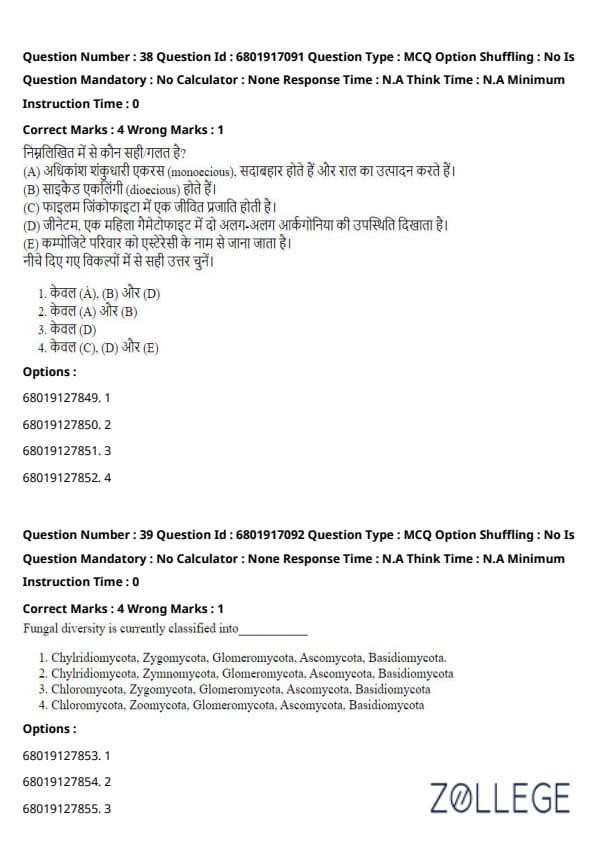
Question 38:
Which among the following is/are false?
Statements:
A. Most conifers are monoecious, evergreen, and produce resin.
B. Cycads are dioecious.
C. There is one living species in the phylum Ginkophyta.
D. Gnetum shows the presence of two distinct archegonia in a female gametophyte.
E. Compositae family is known as Asteraceae.
Choose the correct answer from the options given below:
View Solution
Solution:
1. Most conifers are monoecious, cycads are dioecious, and the phylum Ginkophyta contains only one species, _Ginkgo biloba_.
2. _Gnetum_ does not show two distinct archegonia; it is an error in the statement.
3. The Compositae family is indeed referred to as Asteraceae, its alternative name.
Quick Tip: To identify false statements, carefully compare the given information with known characteristics of plant groups and families.
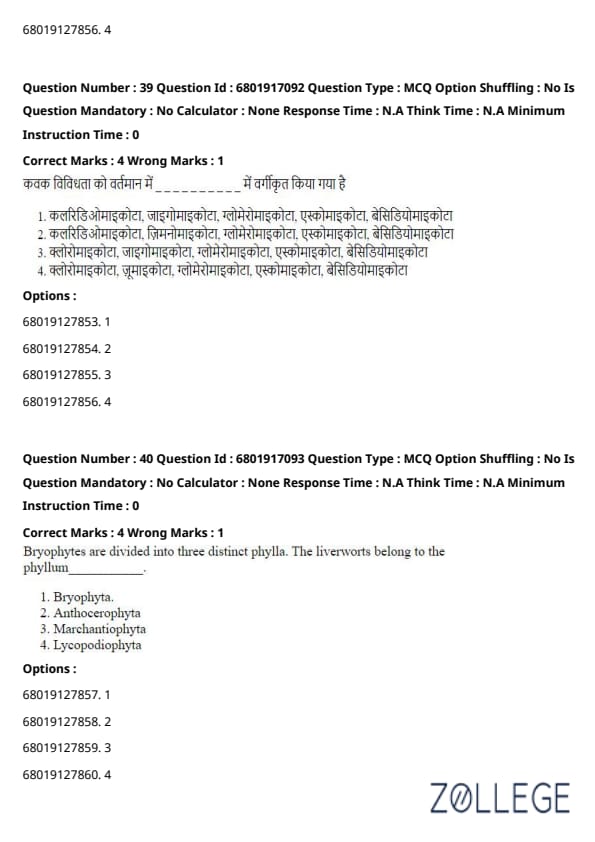
Question 39:
Fungal diversity is currently classified into:
View Solution
Solution:
1. Modern fungal taxonomy includes five major phyla based on their reproductive structures and molecular data.
2. These phyla are:
• Chytridiomycota: Primitive fungi with flagellated spores.
• Zygomycota: Fungi forming zygospores during reproduction.
• Glomeromycota: Fungi involved in mycorrhizal associations with plants.
• Ascomycota: Sac fungi producing spores in asci.
• Basidiomycota: Club fungi producing spores on basidia.
Quick Tip: To remember fungal phyla, focus on their reproductive structures and ecological roles. For example, Basidiomycota (club fungi) include mushrooms, while Ascomycota (sac fungi) include yeasts.
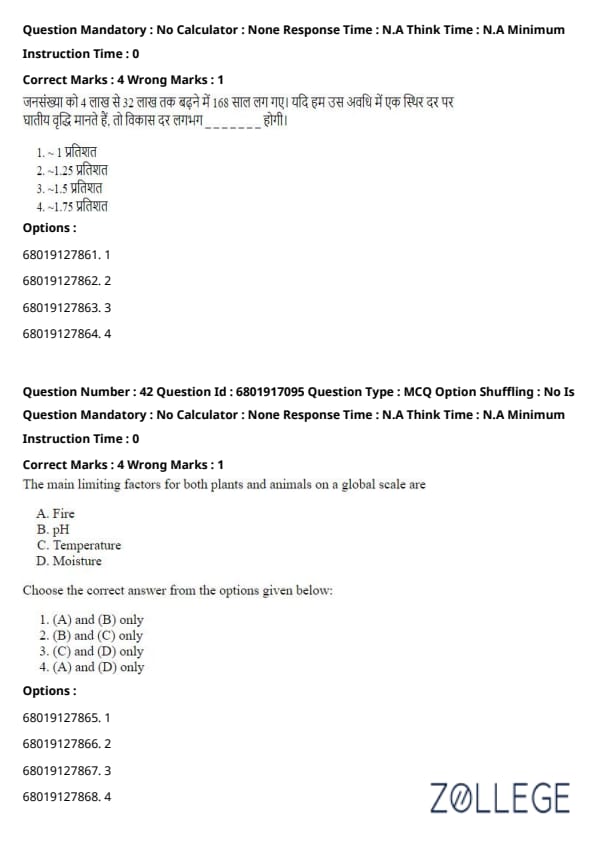
Question 40:
Bryophytes are divided into three distinct phyla. The liverworts belong to the phylum:
View Solution
Solution:
1. Bryophytes are non-vascular plants and are divided into three phyla:
• Marchantiophyta: Liverworts, named after the genus Marchantia.
• Anthocerophyta: Hornworts, characterized by their horn-like sporophytes.
• Bryophyta: Mosses, known for their leafy structures and dominance in the gametophyte stage.
2. Liverworts belong to the phylum Marchantiophyta, distinguished by their flattened, thalloid structure and oil bodies in their cells.
Quick Tip: To classify bryophytes, remember: liverworts (Marchantiophyta), hornworts (Anthocerophyta), and mosses (Bryophyta).
Question 41:
It took 168 years for a population to increase from 0.4 million to 3.2 million. If we assume exponential growth at a constant rate over that period of time, the growth rate would be approximately:
View Solution
Solution:
1. The exponential growth rate (r) can be calculated using the formula: Nt = N0ert
2. Substituting values: 3.2 = 0.4e168r.
3. Solving for r: r ≈ 0.0125 or 1.25
Quick Tip: Exponential growth assumes continuous, compounded growth over time. Use logarithms to solve for growth rate r.
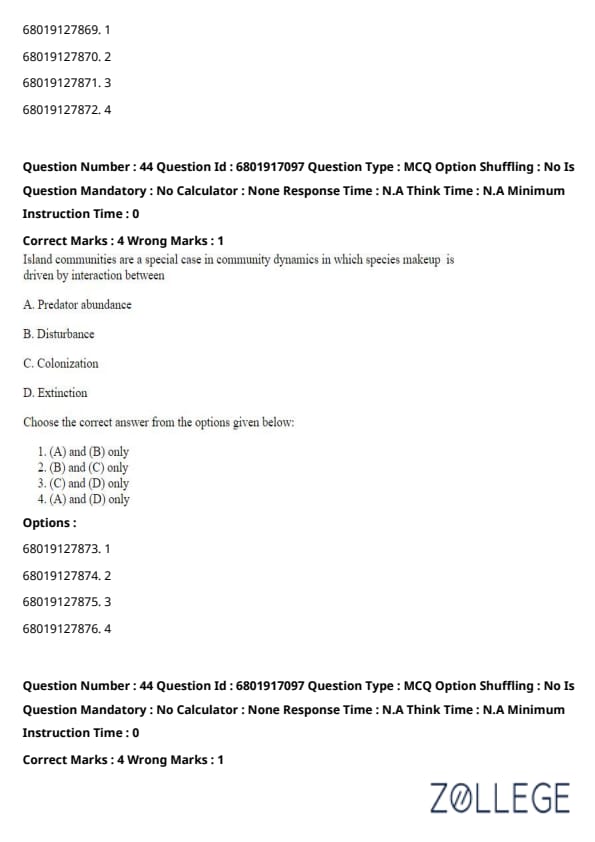
Question 42:
The main limiting factors for both plants and animals on a global scale are:
A. Fire
B. pH
C. Temperature
D. Moisture
Choose the correct answer from the options given below:
View Solution
Solution:
1. Temperature and moisture are primary limiting factors that affect metabolic processes, reproduction, and survival.
2. Fire and pH are secondary factors that may influence specific ecosystems.
Quick Tip: Temperature regulates enzymatic activities, while moisture is critical for water balance and photosynthesis.
Question 43:
Match List I with List II:
| LIST I - Ecological Parameters | LIST II - Unit of Measurement |
|---|---|
| A. Net primary productivity | I. g/m² |
| B. Absorbed photosynthetically active radiation | II. g/L |
| C. Phosphorus | III. Joules/area/year |
| D. Plant biomass | IV. gC/area/year |
Choose the correct answer from the options given below:
View Solution
Solution:
• Net primary productivity (A): Measured in gC/area/year, as it represents the carbon fixed by plants in a given area over time.
• Absorbed photosynthetically active radiation (B): Measured in Joules/area/year, reflecting the energy absorbed by plants for photosynthesis.
• Phosphorus (C): Measured in g/L, representing its concentration in a solution.
• Plant biomass (D): Measured in g/m², representing the total mass of living plant matter per unit area.
Quick Tip: Units of ecological parameters vary widely; ensure you associate each parameter with its specific measurement scale.
Question 44:
Island communities are a special case in community dynamics in which species makeup is driven by interaction between:
A. Predator abundance
B. Disturbance
C. Colonization
D. Extinction
Choose the correct answer from the options given below:
View Solution
Solution:
1. Colonization and extinction are key processes influencing species composition on islands, as described in the theory of island biogeography.
2. Predators and disturbances are less significant compared to colonization and extinction dynamics.
Quick Tip: The balance between colonization and extinction determines species richness on islands, influenced by island size and distance from the mainland.
Question 45:
Arrange the stages by which a species becomes invasive in an area:
A. Introduced
B. Established
C. Pest
D. Imported
Choose the correct answer from the options given below:
View Solution
Solution:
1. A species is first imported (D), then introduced (A) into the new environment.
2. It becomes established (B) if it adapts and thrives, and finally, it is classified as a pest (C) when it causes ecological or economic harm.
Quick Tip: Invasive species progression often follows the "Tens Rule," where 10% of imported species become introduced, 10% of introduced species become established, and 10% of established species become pests.
Question 46:
Polar species tend to have longer geographical ranges than tropical species in many taxonomic groups. This is generally known as:
View Solution
Solution:
1. Rapoport's rule states that species in polar regions tend to have larger geographical ranges compared to those in tropical regions.
2. This is attributed to their ability to adapt to broader environmental variations.
Quick Tip: Remember, Rapoport's rule highlights the inverse relationship between latitude and species' range size.
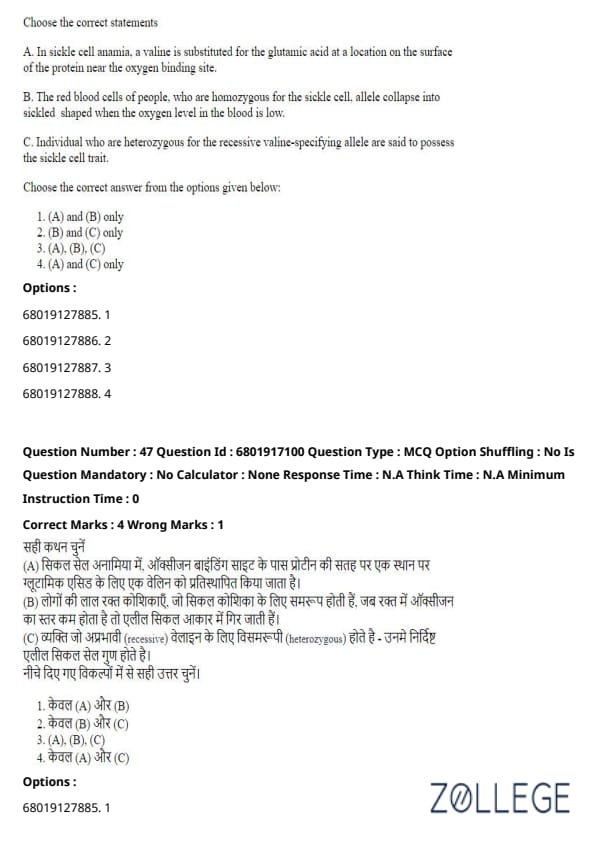
Question 47:
Choose the correct statements:
Statements:
A. In sickle cell anemia, a valine is substituted for the glutamic acid at a location on the surface of the protein near the oxygen-binding site.
B. The red blood cells of people who are homozygous for the sickle cell allele collapse into sickled shape when the oxygen level in the blood is low.
C. Individuals who are heterozygous for the recessive valine-specifying allele are said to possess the sickle cell trait.
Choose the correct answer from the options given below:
View Solution
Solution: All the given statements correctly describe the characteristics and genetic basis of Sickle cell anemia, Red blood cells of people, and Sickle cell trait.
• (A): In sickle cell anemia, the substitution of valine for glutamic acid occurs in the beta chain of hemoglobin at position 6, leading to abnormal hemoglobin (HbS) formation.
• (B): Individuals homozygous for the sickle cell allele (HbS/HbS) have red blood cells that collapse into a sickled shape under low oxygen conditions, causing blockages in blood vessels and reduced oxygen delivery.
• (C): Heterozygous individuals (HbA/HbS) are said to have the sickle cell trait. They generally do not exhibit severe symptoms but can experience mild symptoms under extreme conditions.
Quick Tip: Sickle cell anemia results from a single nucleotide mutation, leading to a missense mutation in the HBB gene.
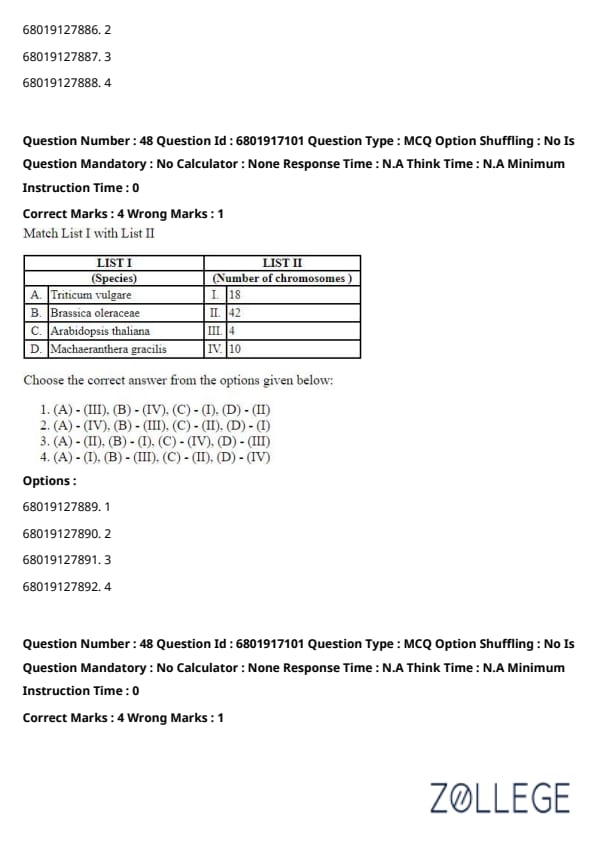
Question 48:
Match List I with List II:
| LIST I (Species) | LIST II (Number of chromosomes) |
|---|---|
| A. _Triticum vulgare_ | I. 18 |
| B. _Brassica oleraceae_ | II. 42 |
| C. _Arabidopsis thaliana_ | III. 4 |
| D. _Machaeranthera gracilis_ | IV. 10 |
Choose the correct answer from the options given below:
View Solution
Solution: The number of chromosomes for each species is as follows:
• _Triticum vulgare_ (A): This is common wheat and has 42 chromosomes, which is why it matches with II.
• _Brassica oleraceae_ (B): This species, which includes cabbage and broccoli, has 18 chromosomes, matching with I.
• _Arabidopsis thaliana_ (C): A model plant in genetics with 10 chromosomes, matching with IV.
• _Machaeranthera gracilis_ (D): A flowering plant with only 4 chromosomes, matching with III.
Quick Tip: Chromosome counts are often consistent within species and can serve as a useful identification tool.
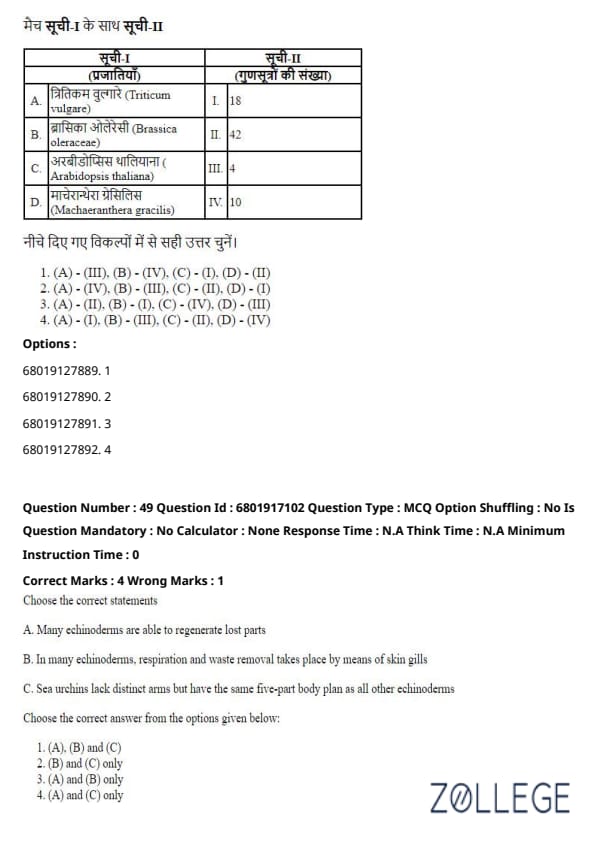
Question 49:
Choose the correct statements:
Statements:
A. Many echinoderms are able to regenerate lost parts.
B. In many echinoderms, respiration and waste removal takes place by means of skin gills.
C. Sea urchins lack distinct arms but have the same five-part body plan as all other echinoderms.
Choose the correct answer from the options given below:
View Solution
Solution: All the given statements are correct descriptions of echinoderm characteristics, including regeneration, skin gills for respiration, and the five-part body plan.
• (A): Many echinoderms, such as sea stars, have the remarkable ability to regenerate lost arms or body parts. This is a key feature of their biology.
• (B): Respiration and waste removal in echinoderms occur through skin gills (dermal branchiae), which are extensions of their coelom.
• (C): Sea urchins are echinoderms with a five-part radial symmetry, like other members of this phylum, but they lack distinct arms, unlike sea stars.
Quick Tip: Echinoderms, such as sea stars and sea urchins, exhibit radial symmetry and a unique water vascular system for locomotion and feeding.
Question 50:
Bone present in the thigh region of humans is known as:
View Solution
Solution:
1. The femur, or thigh bone, is the longest and strongest bone in the human body.
2. It connects the hip to the knee and plays a critical role in supporting body weight and enabling leg movement.
Quick Tip: The femur is part of the appendicular skeleton, while bones like the sternum and humerus belong to different regions.
Question 51:
The monumental book 'Silviculture of Indian Trees' is written by:
View Solution
Solution:
1. R.S. Troup is recognized for his seminal work on silviculture, focusing on the management and growth of Indian trees.
2. This book remains a cornerstone for forestry studies and practices in India.
Quick Tip: Silviculture refers to the art and science of managing forest growth and composition for ecological and economic benefits.
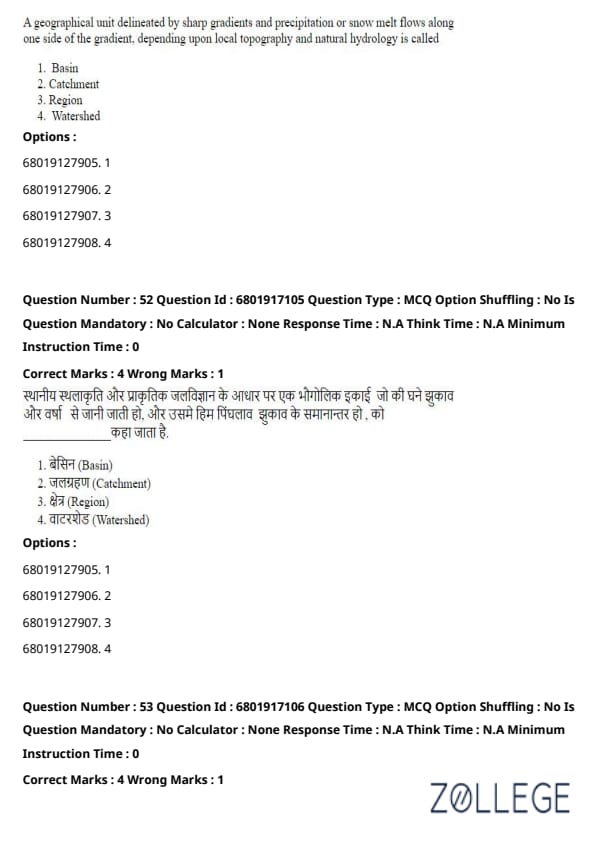
Question 52:
A geographical unit delineated by sharp gradients where precipitation or snowmelt flows along one side of the gradient, depending upon local topography and natural hydrology, is called:
View Solution
Solution:
1. A watershed is an area of land that channels precipitation and snowmelt to a common outlet, such as a river or lake.
2. It is delineated by topographical divides that separate drainage basins.
Quick Tip: Watersheds are essential for water resource management and ecological studies, as they represent hydrological boundaries.
Question 53:
The publication 'The Future We Want' is the outcome of:
View Solution
Solution:
1. 'The Future We Want' was an outcome document highlighting the vision and commitments made during the 2012 United Nations Conference.
2. It focused on global efforts to integrate environmental considerations into sustainable development.
Quick Tip: This publication underscores the significance of global cooperation in addressing environmental challenges for sustainable development.
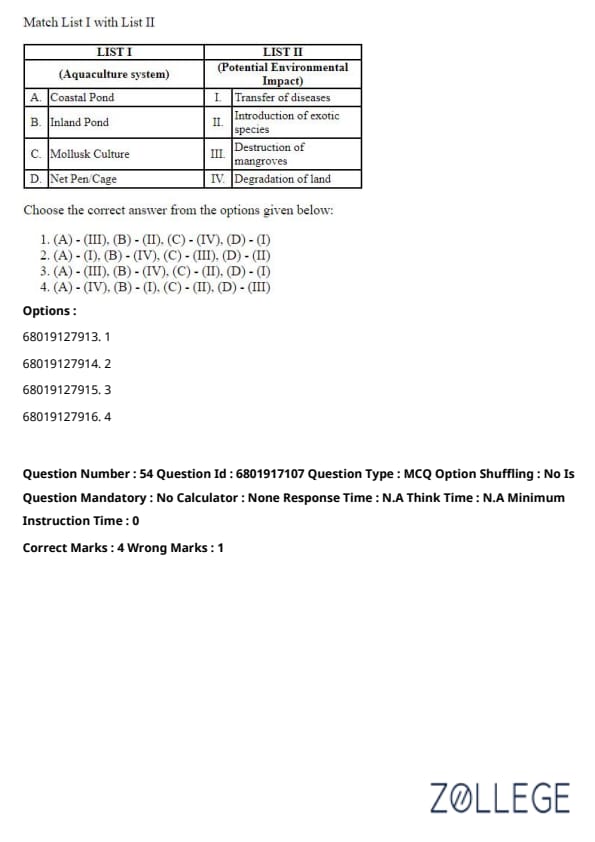
Question 54:
Match List I with List II:
| LIST I (Aquaculture system) | LIST II (Potential Environmental Impact) |
|---|---|
| A. Coastal Pond | I. Transfer of diseases |
| B. Inland Pond | II. Introduction of exotic species |
| C. Mollusk Culture | III. Destruction of mangroves |
| D. Net Pen/Cage | IV. Degradation of land |
Choose the correct answer from the options given below:
View Solution
Solution:
• Coastal Pond (A): Associated with destruction of mangroves (III), as ponds are often created by clearing mangrove forests.
• Inland Pond (B): Leads to degradation of land (IV), as constructing ponds can result in soil erosion and salinization.
• Mollusk Culture (C): Can cause the introduction of exotic species (II), due to the importation of non-native mollusks for aquaculture.
• Net Pen/Cage (D): Results in transfer of diseases (I), as dense fish populations in cages facilitate the spread of pathogens.
Quick Tip: Aquaculture impacts vary: coastal ponds often destroy mangroves, inland ponds degrade land, mollusk cultures may introduce exotic species, and net pens/cages can transfer diseases.
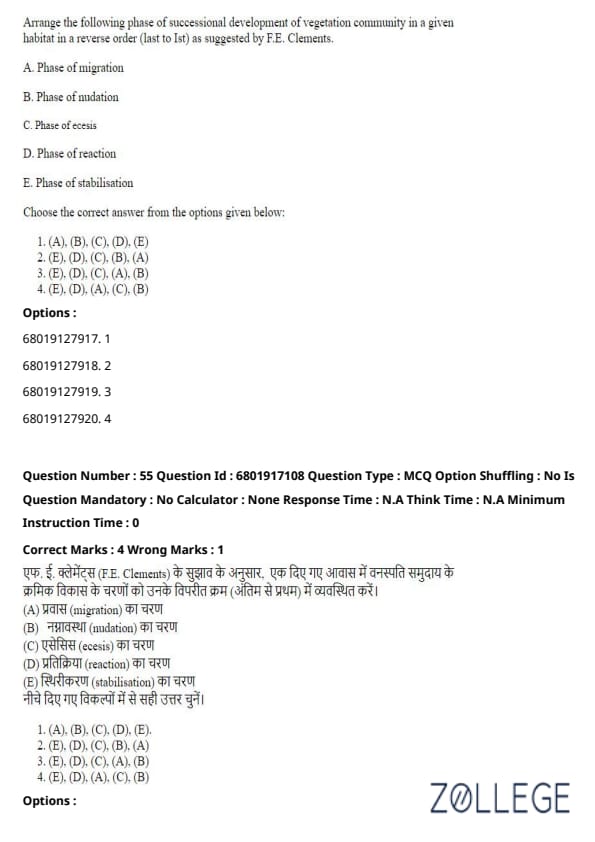
Question 55:
Arrange the following phases of successional development of a vegetation community in reverse order (last to first) as suggested by F.E. Clements:
Phases:
A. Phase of migration
B. Phase of nudation
C. Phase of ecesis
D. Phase of reaction
E. Phase of stabilization
Choose the correct answer from the options given below:
View Solution
Solution:
1. The phases of vegetation succession are:
• Stabilization (E): Final stage with a stable climax community.
• Reaction (D): Modifications to the habitat due to biotic interactions.
• Ecesis (C): Establishment of species.
• Migration (A): Arrival of new species.
• Nudation (B): Formation of bare area due to disturbance.
Quick Tip: Vegetation succession progresses in a predictable sequence, moving from disturbance (nudation) to stability (climax community).
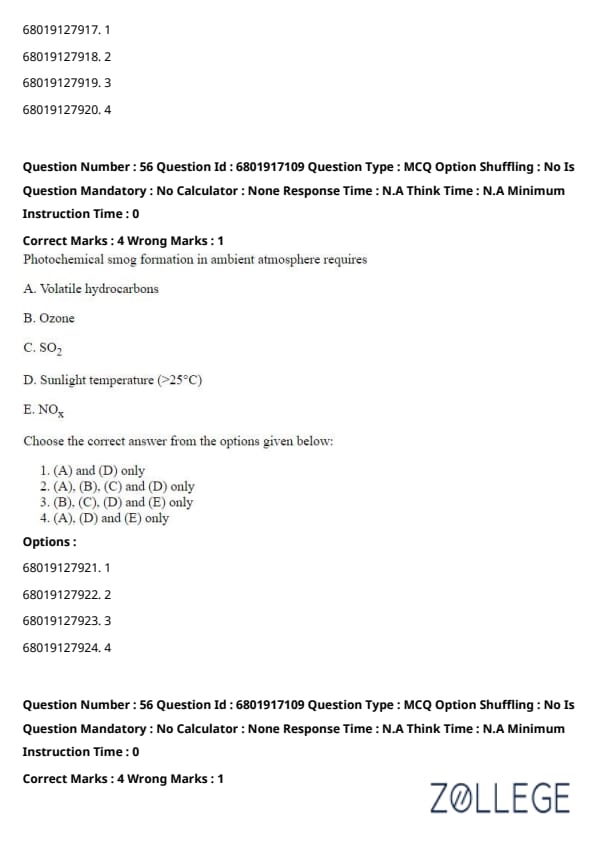
Question 56:
Photochemical smog formation in ambient atmosphere requires:
A. Volatile hydrocarbon
B. Ozone
C. SO2
D. Sunlight Temperature
E. NOx
Choose the correct answer from the options given below:
View Solution
Solution:
1. Photochemical smog requires volatile hydrocarbons (A), sunlight/temperature (>25°C) (D), and nitrogen oxides (NOx) (E).
2. Ozone (B) and sulfur dioxide (C) may contribute but are not essential for initial formation.
Quick Tip: Smog formation peaks in urban areas with high vehicle emissions, as NOx and hydrocarbons react under sunlight.
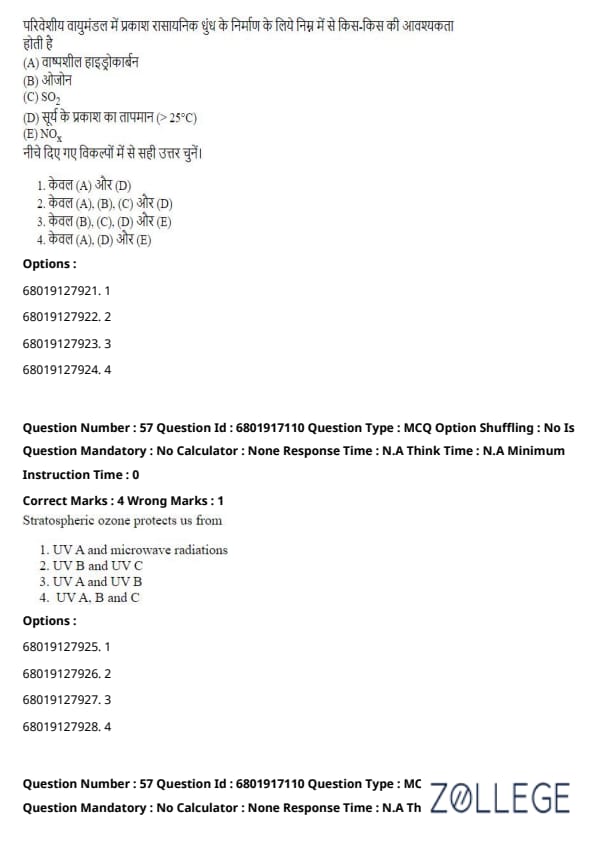
Question 57:
Stratospheric ozone protects us from:
View Solution
Solution:
1. Stratospheric ozone absorbs harmful UV B and UV C radiation from the sun, which can cause skin cancer, cataracts, and DNA damage.
2. UV A is less harmful and largely reaches the Earth's surface.
Quick Tip: Ozone in the stratosphere forms the "ozone layer," a critical barrier against UV radiation.
Question 58:
Which of the following greenhouse gases is not emitted from landfill sites?
View Solution
Solution:
1. Landfill sites emit methane, nitrous oxide, and water vapour due to decomposition of organic waste.
2. Ozone is not emitted directly; it forms in the atmosphere through photochemical reactions.
Quick Tip: Methane from landfills is a potent greenhouse gas, contributing significantly to global warming.
Question 59:
A sound pressure level of 40 decibels is equivalent to a sound pressure of:
View Solution
Solution:
1. The sound pressure level in decibels is given by: Lp = 20log10(P⁄P0)
2. Substituting Lp = 40 dB, P0 = 2 × 10⁻⁵ Pa, we get P = 0.002 Pa.
Quick Tip: Decibels measure sound intensity on a logarithmic scale, relative to a reference pressure (P0 = 2 × 10⁻⁵ Pa).
Question 60:
Which of the following is a criteria pollutant as per National Ambient Air Quality Standards?
View Solution
Solution:
1. Carbon monoxide (CO) is a criteria pollutant as it is toxic and can cause severe health effects by interfering with oxygen transport in blood.
2. Other options like CO2 and CFCs are not listed under criteria pollutants in NAAQS.
Quick Tip: Criteria pollutants include CO, NOx, SO2, particulate matter, and others regulated for public health.
Question 61:
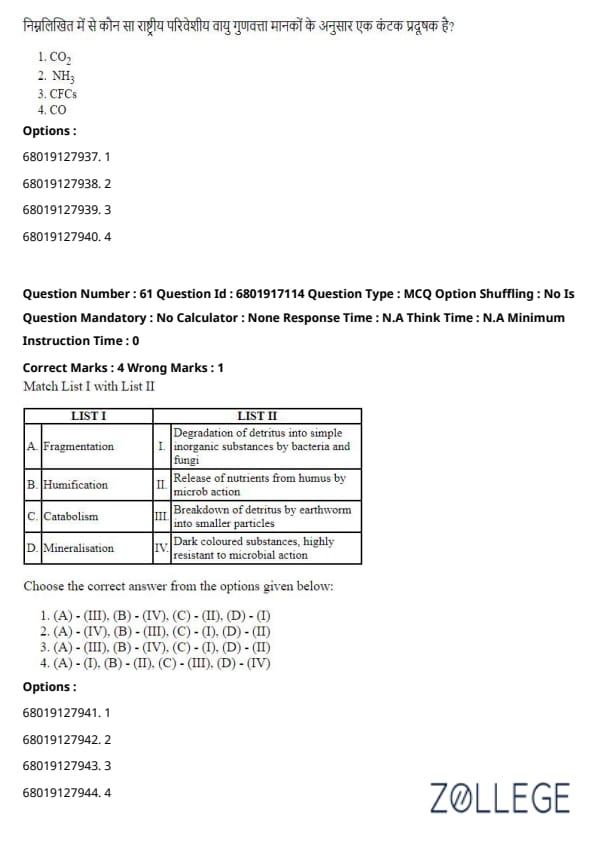
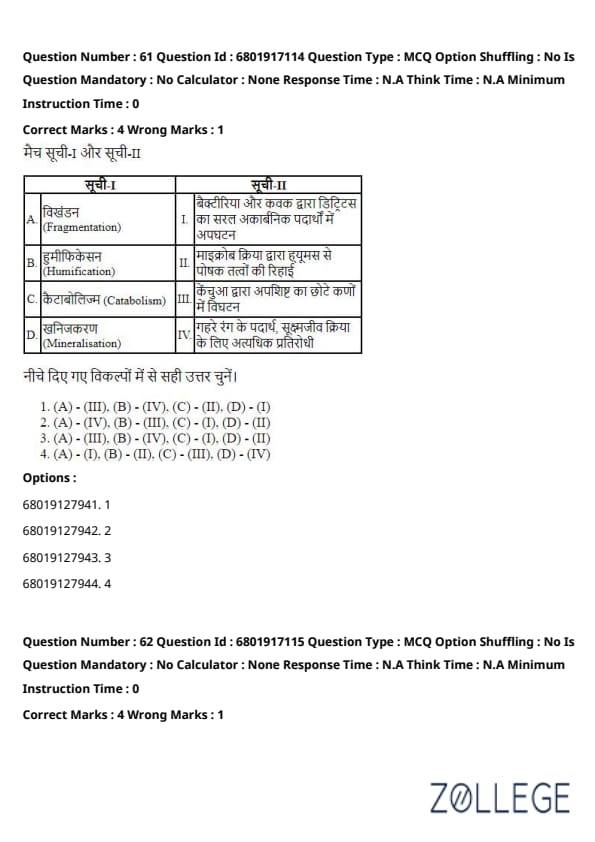
Match List I with List II:
| LIST I | LIST II |
|---|---|
| A. Fragmentation | I. Degradation of detritus into simple inorganic substances by bacteria and fungi |
| B. Humification | II. Release of nutrients from humus by microb action |
| C. Catabolism | III. Breakdown of detritus by earthworm into smaller particles |
| D. Mineralisation | IV. Dark coloured substances, highly resistant to microbial action |
Choose the correct answer from the options given below:
View Solution
Solution:
• Fragmentation (A): This refers to the breakdown of detritus into smaller particles by organisms like earthworms. Hence, it corresponds to III.
• Humification (B): The process of humification results in dark-colored substances called humus, which are highly resistant to microbial action, corresponding to IV.
• Catabolism (C): Catabolism involves the breakdown of complex organic matter into simpler inorganic substances by bacteria and fungi, corresponding to I.
• Mineralisation (D): The release of nutrients from humus is achieved by microbial action, which corresponds to II.
Quick Tip: Decomposition involves fragmentation, humification, catabolism, and mineralization, each contributing to nutrient cycling.
Question 62:
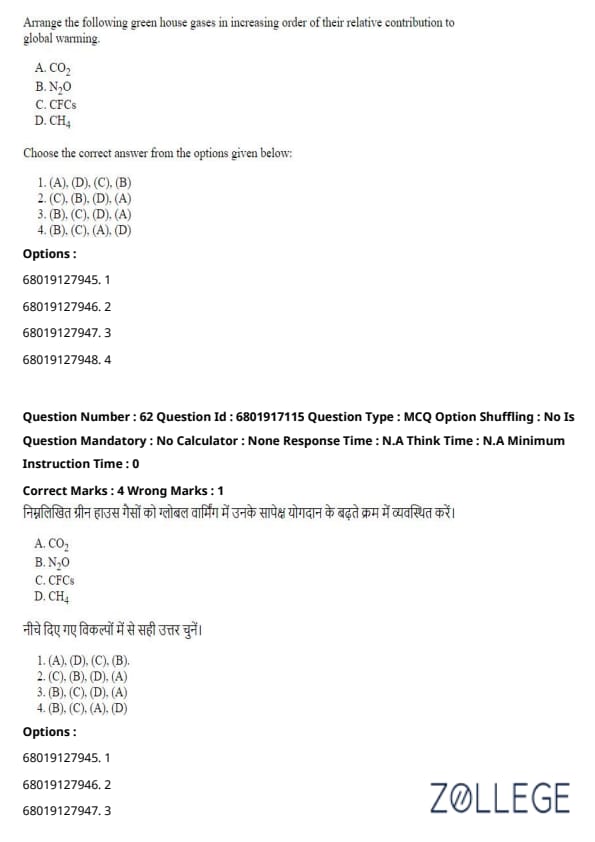
Arrange the following greenhouse gases in increasing order of their relative contribution to global warming:
Greenhouse gases:
A. CO2
B. N2O
C. CFCS
D. CH4
Choose the correct answer from the options given below:
View Solution
Solution:
1. The relative contribution of greenhouse gases to global warming is as follows:
• N2O (lowest),
• CFCs,
• CH4,
• CO2 (highest).
2. CO2 has the greatest overall contribution due to its abundance, while N2O has a lower impact due to its smaller concentration.
Quick Tip: Greenhouse gases vary in their global warming potential and atmospheric abundance; CO2 contributes the most due to its sheer volume.
Question 63:
In sewage water, which of the following is expected to be present in the highest quantity (mg/L)?
View Solution
Solution:
1. Chemical oxygen demand (COD) represents the total amount of oxygen required to oxidize organic and inorganic matter, and it is the highest in sewage water.
2. Dissolved oxygen (DO) is usually low in sewage due to microbial activity.
Quick Tip: COD is a key parameter in water quality analysis, often exceeding other oxygen demand indicators.
Question 64:
The process that results in a chemical becoming increasingly concentrated at successive higher trophic levels in a food web is referred to as:
View Solution
Solution:
1. Biomagnification refers to the increase in concentration of pollutants like mercury or pesticides at higher trophic levels.
2. Bioaccumulation, by contrast, occurs within a single organism over time.
Quick Tip: Top predators in a food web, such as eagles or sharks, often suffer the most from biomagnification due to pollutant accumulation.
Question 65:
Acidic soils are mostly found in:
A. Cold climate
B. Hot climate
C. Dry climate
D. Humid climate
Choose the correct answer from the options given below:
View Solution
Solution: Acidic soils are typically found in cold and humid climates. These regions receive ample rainfall, which leads to leaching of minerals and nutrients from the soil, resulting in higher acidity. Cold climates, with their slower weathering processes, also contribute to the formation of acidic soils.
Quick Tip: Cold and humid climates favor the formation of acidic soils, often rich in organic matter but poor in nutrients.
Question 66:
Arrange the following soil horizons as they occur from top to bottom:
Horizons:
A. O horizon
B. A horizon
C. B horizon
D. E horizon
E. C horizon
Choose the correct answer from the options given below:
View Solution
Solution: The correct order of soil horizons is:
• O horizon: Organic matter.
• A horizon: Topsoil with minerals and organic material.
• E horizon: Zone of leaching.
• B horizon: Subsoil where leached minerals accumulate.
• C horizon: Weathered parent material.
Quick Tip: Soil horizons reflect layers of soil development, with O being organic-rich and C containing the least weathered material.
Question 67:
A sample has an absorbance of 2. Its transmittance would be:
View Solution
Solution:
1. Transmittance (T) and absorbance (A) are related by the formula: A = -log10(T)
2. Given A = 2: T = 10-A = 10-2 = 0.01
3. Therefore, the transmittance of the sample is 0.01 or 1%
Quick Tip: The higher the absorbance of a sample, the lower its transmittance, as more light is absorbed by the sample.
Question 68:
Which of the following is a polar solvent?
View Solution
Solution:
1. Acetic acid: Polar due to its ability to form hydrogen bonds and its carboxylic group.
2. Ethyl acetate: Polar solvent because of its ester group, which has partial positive and negative charges.
3. Acetone: Highly polar because of the carbonyl group (C = O), which can interact with polar and ionic compounds.
4. Chloroform: Non-polar solvent because of its symmetrical molecular structure and inability to form significant dipoles.
Quick Tip: Polar solvents typically dissolve polar compounds or ionic substances due to their ability to form dipole interactions or hydrogen bonds.
Question 69:
An analyst reported 40.9 ppm Na in all 10 analyses of the standard solution having a true value of 40.11 ± 0.3 ppm. This data is:
View Solution
Solution:
1. Precision: The analyst consistently reported 40.9 ppm for all 10 analyses, showing low variation and high precision.
2. Accuracy: The reported value (40.9 ppm) falls within the range of the true value (40.11 ± 0.3 ppm), indicating accuracy.
3. Therefore, the data is both accurate (close to the true value) and precise (reproducible).
Quick Tip: Precision refers to the consistency of results, while accuracy indicates how close results are to the true value.
Question 70:
Find the limit of resolution of a microscope where the numerical aperture of the objective is 1.4 and the beam of light has a wavelength of 400 nm:
View Solution
Solution:
1. The limit of resolution (d) is given by: d = λ⁄2 × NA
Where λ = 400 nm and NA = 1.4.
2. Substituting the values: d = 400⁄2 × 1.4 = 175 nm.
Quick Tip: Higher numerical aperture and shorter wavelengths reduce the limit of resolution, enhancing a microscope's resolving power.
Question 71:
While separating the protein using polyacrylamide gel electrophoresis, the major ions playing an important role in stacking the protein are:
i. Glycine of the running gel buffer
ii. Chloride ion
iii. The protein itself
Which of the following is correct?
View Solution
Solution:
1. Chloride ions (ii) move fastest because of their small size and high mobility.
2. Proteins (iii) move next, followed by glycine (i), which is slower due to its zwitterionic form at the stacking pH.
Quick Tip: In SDS-PAGE, stacking occurs due to differences in ion mobility between the leading ion (chloride) and trailing ion (glycine).
Question 72:
Match List I with List II:
| LIST I (Interaction) | LIST II (Species A, Species B) |
|---|---|
| A. Amensalism | I. +, - |
| B. Predation | II. -, - |
| C. Commensalism | III. +, 0 |
| D. Competition | IV. -, 0 |
Choose the correct answer from the options given below:
View Solution
Solution: The correct matches for the ecological interactions are:
• Amensalism (A): A negative effect on one species and no effect on the other, which is represented by IV. -, 0.
• Predation (B): Involves one species benefiting (predator) and the other being harmed (prey), represented by I. +, -.
• Commensalism (C): One species benefits while the other is neither helped nor harmed, represented by III. +, 0.
• Competition (D): Both species are negatively affected due to limited resources, represented by II. -, -.
Quick Tip: Interaction types are defined by how species benefit (+), are harmed (-), or are unaffected (0).
Question 73:
The rate of decrease of dissolved oxygen (Lt) with time t in a wastewater sample is directly proportional to the amount of oxygen present in the sample at time t. The unit of rate constant k will be:
View Solution
Solution:
1. The equation dLt⁄dt = -kLt is a first-order reaction.
2. For a first-order reaction, the unit of k is s-1.
Quick Tip: In a first-order reaction, the rate constant k has units of reciprocal time (e.g., s¯¹).
Question 74:
Which of the following is an example of a condition caused by chromosomal abnormality?
View Solution
Solution:
1. Turner's syndrome is a chromosomal abnormality caused by the absence of one X chromosome in females (45, XO).
2. Other conditions listed, such as emphysema and Lyme disease, are not related to chromosomal abnormalities.
Quick Tip: Chromosomal abnormalities often result in syndromes such as Turner's syndrome, Down syndrome, and Klinefelter syndrome.
Question 75:
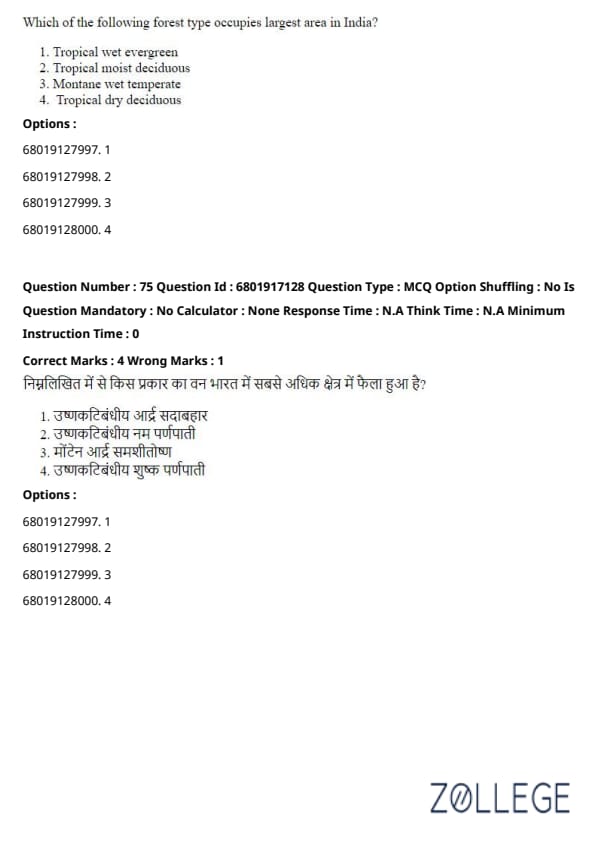
Which of the following forest types occupies the largest area in India?
View Solution
Solution:
1. Tropical moist deciduous forests occupy the largest area in India, followed by tropical dry deciduous forests.
2. These forests are commonly found in regions with moderate rainfall, such as the foothills of the Himalayas, parts of central India, and the Eastern Ghats.
Quick Tip: Tropical moist deciduous forests are rich in biodiversity and include species like sal, teak, and bamboo.























































Comments