


.png?h=35&w=35&mode=stretch)
CUET PG Dance Question Paper 2024 is available here for download. NTA conducted CUET PG Dance paper 2024 on from March 22 in Shift 1. CUET PG Question Paper 2024 is based on objective-type questions (MCQs). According to latest exam pattern, candidates get 105 minutes to solve 75 MCQs in CUET PG 2024 Dance question paper.
CUET PG Dance Question Paper 2024 PDF Download
| CUET PG Dance Question Paper 2024 with Answer Key | Check Solutions |
 Download
CUET PG Dance Questions with Solutions
Question 1:
In which temple we can find the illustration of 108 Karanas as described in the Natyashastra?
View Solution
The Brihadeshvara Temple at Thanjavur, Tamil Nadu, built by the Chola king Rajaraja I, is renowned for its intricate carvings and sculptures. Among these are depictions of 108 karanas, which are a unit of dance described in the Natyashastra. These visual representations provide valuable insights into the dance forms prevalent during the Chola period and the importance given to the arts. While other temples may have sculptures related to dance, the Brihadeshvara Temple stands out for its comprehensive depiction of the 108 karanas.
Quick Tip: Associate the Brihadeshvara Temple with the 108 karanas. Remembering specific examples of where theoretical concepts are visualized in art or architecture is highly beneficial.
By which name were the Devadasis of Jagannath temple of Puri known?
View Solution
The Devadasis of the Jagannath temple in Puri were known as Mahari. These women were dedicated to the service of the deity and played a crucial role in the temple rituals and traditions. They were highly skilled in dance and music, specifically the Odissi dance form, and their performances were an integral part of the temple's cultural landscape. The term "Mahari" itself signifies their elevated status and association with the temple. Gotipua, while a dance form from Odisha, refers to young boys dressed as girls who perform, and is not directly related to the Devadasis. Nartaki is a generic term for a female dancer, and Nati is a term used for actresses or female performers in other parts of India.
Quick Tip: Remember the specific term Mahari for the Devadasis of the Jagannath Temple. Connecting specific terms to particular locations or deities helps in recalling such information accurately.
Who is the author of Sangeeta Ratnakara?
View Solution
The Sangeeta Ratnakara is a major Sanskrit work on music theory written by Sarangadeva during the 13th century in the court of Yadava king Singhana II. This treatise provides a detailed and comprehensive understanding of various aspects of music, including its forms, structures, and different theoretical frameworks. It is one of the most important musicological texts of medieval India. Dhananjaya, also from the 13th century, is known for his work \textit{Dasharupaka, focusing on theatre and drama. Bharata Muni, credited with the \textit{Natyashastra, laid the foundation of Indian dramatic theory, while Subhankara is not directly associated with the specified works.
Quick Tip: Associate \textit{Sangeeta Ratnakara with Sarangadeva and the 13th century. Linking major works with their authors and their historical contexts helps in retaining essential information.
Who has written Manasollasa?
View Solution
The Manasollasa, also known as \textit{Abhilashitartha Chintamani, is an encyclopedic Sanskrit text written by the Western Chalukya king Somesvara III, who ruled in the 12th century. This extensive work covers a wide range of topics, including polity, governance, music, dance, and various other arts and sciences, reflecting the intellectual pursuits of the royal court. Nandikeshwar, known for his treatise on dance, the \textit{Abhinaya Darpana, predates Somesvara. Shankaradeva, a 15th-16th century Assamese polymath, is renowned for his contributions to Vaishnavism and the development of Sattriya dance. Bhanjadeva, while a historical figure, is not associated with the authorship of \textit{Manasollasa.
Quick Tip: Remember \textit{Manasollasa as a multi-faceted work authored by King Somesvara III. Recognizing royal patronage of arts and literature can help place texts like this within their historical context.
Which Purana vividly describes the dance of Krishna with the gopis?
View Solution
The Shrimad Bhagavata Purana, also known as the \textit{Bhagavatam, vividly describes the Raas Leela, the divine dance of Krishna with the gopis. This Purana focuses on the life and teachings of Krishna and is a central text within Vaishnavism. The Raas Leela is presented as a metaphor for the loving devotion (bhakti) between the individual soul and the divine. The \textit{Shiva Purana, \textit{Brahma Purana, and \textit{Garuda Purana primarily focus on their respective deities and do not provide such elaborate descriptions of Krishna's Raas Leela.
Quick Tip: Associate Krishna's Raas Leela with the \textit{Shrimad Bhagavata Purana. Connecting specific themes or stories with their respective texts aids in recalling relevant information during exams.
Which Raas is performed in the precincts of Govindji Temple on Kartik Purnima?
View Solution
The Maha Raas is performed in the precincts of the Govindji Temple on Kartik Purnima. This is a significant event within the Vaishnava tradition, celebrating the divine love between Krishna and the gopis. The Maha Raas is a grand spectacle, often involving a large number of performers and devotees, and is considered a highly auspicious occasion. While other forms of Raas like Kunj Raas (performed in groves), Nritya Raas (focused on dance), and Vasant Raas (celebrated during spring) exist, they are not specifically associated with the Govindji Temple's Kartik Purnima celebrations.
Quick Tip: Connect Maha Raas with the Govindji Temple and Kartik Purnima. Remembering the specific festivals and locations associated with particular dance forms is crucial for such questions.
Which among the following is a traditional theatre form of Odisha?
View Solution
Prahlad Nataka is a traditional theatre form of Odisha. It is a unique form of musical drama based on the story of Prahlada, a devotee of Vishnu, from the \textit{Bhagavata Purana. This theatrical performance incorporates elements of dance, music, and dialogue, making it a rich and complex art form. Yakshagana is a traditional theatre form from Karnataka, Dashavatara is associated with Maharashtra and Goa, and Ankiya Nat is a traditional theatre form of Assam, developed by the saint Shankaradeva.
Quick Tip: Remember Prahlad Nataka as a traditional theatre form specific to Odisha. Being aware of the regional variations and origins of different art forms is crucial in Indian classical dance and theatre.
Which folk dance form has a connection with Shakti Puja?
View Solution
Garba, a folk dance from Gujarat, has a strong connection with Shakti Puja, particularly during the Navratri festival. It is traditionally performed in circles around a centrally placed image of the Goddess Durga, or a lamp representing her. The dance movements, often accompanied by rhythmic clapping and singing, are an expression of devotion and celebration of the feminine divine. Bihu is a harvest festival from Assam, Lavani is a dance form from Maharashtra, often performed in a theatrical setting, and Giddha is a folk dance from Punjab, primarily performed by women.
Quick Tip: Associate Garba with Navratri and Shakti Puja in Gujarat. Connecting dance forms with their regional and religious contexts aids in accurate recall.
According to whom, Nritta depends on rhythm and tempo only and is devoid of Rasa and Bhava?
View Solution
Bharata Muni, in his seminal work \textit{Natyashastra, defines Nritta as pure dance, emphasizing its reliance on rhythm and tempo. He differentiates it from Nritya and Natya, which incorporate rasa (aesthetic flavor) and bhava (emotions). Nritta, according to Bharata Muni, is devoid of any narrative or emotional content, focusing solely on the technical aspects of movement and rhythm. While other scholars like Nandikeshwar, Sarangadeva, and Dhananjaya have contributed to the understanding of dance and aesthetics, the specific definition of Nritta as purely rhythmic movement comes from Bharata Muni.
Quick Tip: Remember Bharata Muni's definition of Nritta as pure dance focusing on rhythm and tempo. Understanding the fundamental distinctions between Nritta, Nritya, and Natya is crucial.
Who is the presiding deity of ‘Ranga' - the stage?
View Solution
Brahma is considered the presiding deity of ‘Ranga', the stage. In the \textit{Natyashastra, Brahma is credited with creating Natyaveda, the sacred art of drama, by combining elements from the four Vedas. As the creator of this art form, he is invoked and honored as the presiding deity of the stage, seeking his blessings for successful performances. While other deities like Vishnu, Maheswara (Shiva), and Skanda are significant within Hinduism, they do not hold the same specific association with the stage as Brahma.
Quick Tip: Associate Brahma with the creation of Natyaveda and his role as the presiding deity of ‘Ranga'. Remembering the mythological origins of dance and drama can aid in understanding its sacred significance.
What was the earlier name for present-day Bharatanatyam?
View Solution
Bharatanatyam, as we know it today, was earlier known as Dasiattam. The term "Dasiattam" refers to the dance performed by devadasis, women dedicated to temple service. This historical association reflects the dance form's deep roots in temple rituals and traditions. In the early 20th century, as part of a broader social and cultural reform movement, the name was changed to Bharatanatyam, distancing it from the devadasi system while retaining its artistic essence. Koodiyattam is a traditional Sanskrit theatre form from Kerala, Mohiniattam is another classical dance form from Kerala, and Krishnattam is a traditional dance-drama from Kerala, based on the life of Krishna.
Quick Tip: Connect Dasiattam with the devadasi tradition and its evolution into Bharatanatyam. Understanding the historical context of name changes can shed light on social and cultural shifts.
Which of the following is a Sthayi Bhava?
View Solution
Shringara (romantic love) is one of the eight sthayi bhavas, which are the dominant emotional states in Indian aesthetics and performance arts, especially dance and drama. Sthayi bhavas are considered permanent or enduring emotions, forming the basis for the development of rasa (aesthetic flavor). Jugupsa (disgust), Glani (weakness or debility), and Stambha (stupor or paralysis) are considered vyabhichari bhavas (transient emotions) that complement and enhance the sthayi bhavas but are not themselves the dominant emotional states.
Quick Tip: Memorize the eight sthayi bhavas and understand their significance as the foundation of rasa. Differentiating between sthayi and vyabhichari bhavas is essential for a comprehensive understanding of Indian aesthetics.
What is the basic position in Odissi called?
View Solution
The basic position in Odissi is called Chauka. It is a fundamental stance characterized by a square-like posture, with the feet placed apart and the knees bent. This posture provides stability and balance, serving as the foundation for various movements and transitions within the Odissi repertoire. Ardhamandali is a half-circular movement, Bhangi Pareng is not associated with the primary stance, and Kalasham is not directly related to the fundamental positions in Odissi.
Quick Tip: Visualize the Chauka position and its square-like form, associating it as the foundational stance in Odissi. Connecting terminology with visual representations helps reinforce understanding and accurate recall.
Which type of Abhinaya deals with verbal representation?
View Solution
Vachika Abhinaya deals with verbal representation in Indian classical dance and drama. It encompasses the use of words, songs, and speech to convey meaning and emotions. Angika Abhinaya involves physical expressions and gestures, Aharya Abhinaya utilizes costumes, makeup, and stage properties, and Sattvika Abhinaya involves the expression of subtle, involuntary emotions.
Quick Tip: Remember the four types of Abhinaya and their specific modes of expression. Vachika relates to speech, Angika to body, Aharya to costumes and makeup, and Sattvika to involuntary expressions.
What is the Nayika called when she drives her Nayaka away after a jealous quarrel and feels remorse due to his not returning?
View Solution
A Kalahantarita Nayika is one who drives her Nayaka (lover) away after a jealous quarrel and then feels remorse when he doesn't return. This specific type of Nayika highlights the complexities of love, anger, and regret within the framework of Nayaka-Nayika bhava (the representation of lovers). Khandita is a Nayika who has been offended or rejected by her lover, Vipralabdha is one who is separated from her lover and yearns for his return, and Virahotkanthita is a Nayika who is distressed by separation from her lover, especially when he fails to arrive as promised.
Quick Tip: Understand the nuances of Kalahantarita compared to other Nayika types. Remembering the specific emotional states associated with each Nayika is essential for such questions.
What is the Nayaka called who is devoted and faithful to his beloved?
View Solution
A Dakshina Nayaka is characterized by his devotion and faithfulness to his beloved. He is considerate of her feelings and prioritizes her happiness. Anukula is a Nayaka who is easily swayed or controlled by his beloved, Dhrista is a bold and arrogant lover, and Satha is deceitful and unfaithful. Understanding these distinctions is crucial for appreciating the nuances of Nayaka-Nayika bhava in Indian classical dance and literature.
Quick Tip: Associate Dakshina Nayaka with devotion and faithfulness. Contrasting different Nayaka types based on their character traits aids in memorization and application.
Which of the following comes under the category of Nritta?
View Solution
Batu is categorized as Nritta. It is a pure dance piece in Odissi, characterized by fast tempo and complex rhythmic patterns, focused on showcasing technical virtuosity. Padam, Ashtapadi, and Vandana fall under the category of Nritya, which incorporates expression and bhava (emotions) along with rhythmic movement. Padam is more expressive and emotive, Ashtapadi often involves storytelling from the \textit{Gita Govinda, and Vandana is a devotional piece offering salutations to a deity.
Quick Tip: Remember Batu as a Nritta piece within Odissi, highlighting speed and rhythmic complexity. Classifying dance compositions based on Nritta, Nritya, and Natya can enhance your understanding of their purpose and structure.
What is the first composition of the Odissi Dance repertoire?
View Solution
The first composition in a traditional Odissi dance repertoire is the Mangalacharana, often performed as part of the Alarippu. It is an invocatory piece, seeking blessings from the deity and setting a sacred tone for the performance. The Alarippu itself is a slow and graceful piece, focusing on body movements and rhythmic syllables, preparing the dancer for the more complex compositions that follow. Bhangi Pareng comes after the Alarippu, showcasing varied stances and postures. Pallavi, which explores melodic variations and improvisations, comes later in the performance.
Quick Tip: Remember the sequence: Mangalacharana (within Alarippu) begins the Odissi repertoire, followed by Bhangi Pareng and Pallavi. Understanding the order and purpose of each piece is beneficial for performance and theoretical analysis.
What do you understand by Sankirtana?
View Solution
Sankirtana refers to a community prayer, often involving devotional singing and chanting, performed by a Pala or a group. It is a significant part of the Vaishnava tradition, particularly in regions like West Bengal and Odisha. While Sankirtana can involve expressive elements and rhythmic movements, its core essence lies in its devotional and communal nature, rather than being strictly classified as a dance drama, expressional dance, or pure dance.
Quick Tip: Associate Sankirtana with communal devotional singing within Vaishnavism. Focus on the devotional and participatory aspect rather than its performance elements.
The ornament ‘Bengapatia' is associated with which dance form?
View Solution
The ‘Bengapatia' ornament, a type of forehead decoration, is specifically associated with Odissi. It is a distinctive element of the Odissi dancer's attire, complementing the overall aesthetic and traditional iconography. While other dance forms like Bharatanatyam, Kathak, and Manipuri have their own unique jewelry and costume traditions, the Bengapatia is unique to Odissi.
Quick Tip: Visualize the Bengapatia ornament on an Odissi dancer's forehead. Associating specific ornaments or costume elements with particular dance forms is helpful for visual identification and recall.
What is it called when the hand is not clapped to indicate a beat but is silent according to the Hindustani Tala system?
View Solution
In the Hindustani Tala system, when a beat is not indicated by clapping but is kept silent, it is called Khali. This signifies an absence of a physical stroke or sound on that particular beat, creating a rhythmic contrast within the tala cycle. Tali refers to a clap or a struck beat, Matra represents the basic unit of time in a tala, and Laya refers to the tempo or speed of the rhythmic cycle.
Quick Tip: Contrast Khali (silent beat) with Tali (struck beat) within the Hindustani Tala system. Understanding these basic elements is crucial for rhythmic analysis and performance.
Who is the founder of Kalakshetra?
View Solution
Rukmini Devi Arundale is the founder of Kalakshetra, a renowned institution for Indian classical dance and music located in Chennai. She played a pivotal role in the revival and promotion of Bharatanatyam, giving it a renewed status and respectability. Birju Maharaj is a prominent Kathak dancer, Vallathol Menon is associated with the revival of Kathakali, and Shanta Rao was a renowned Bharatnatyam and Kuchipudi dancer.
Quick Tip: Associate Rukmini Devi Arundale with Kalakshetra and the revival of Bharatanatyam. Remembering key figures and their contributions to specific dance forms or institutions is essential.
By which name are the actors of Kuchipudi dance drama known?
View Solution
The actors of Kuchipudi dance drama are known as Bhagavatulu. This term reflects the tradition of male Brahmin actors playing both male and female roles in the dance-drama. Purusavesam is not associated with the actors of Kuchipudi, Nattuvanar is a term used for dance teachers or conductors of music in Bharatanatyam, and Duhar is not related to Kuchipudi.
Quick Tip: Remember Bhagavatulu as the term for actors in Kuchipudi, highlighting the tradition of male Brahmins playing all roles. Connecting specific terms to dance forms or regions aids in accurate recall.
Madhavi Mudgal belongs to which dance form?
View Solution
Madhavi Mudgal is a renowned exponent of Odissi. She has made significant contributions to the preservation, promotion, and evolution of the dance form. Manipuri is a classical dance form from Manipur, Kuchipudi is from Andhra Pradesh, and Kathakali is from Kerala.
Quick Tip: Associate Madhavi Mudgal with Odissi. Remembering prominent dancers and their associated dance forms is essential for such questions.
Which among the following is a traditional dance drama form of Karnataka?
View Solution
Yakshagana is a traditional dance drama form of Karnataka, known for its vibrant costumes, elaborate makeup, energetic music, and stylized dialogues. Jatra is a folk theatre form from West Bengal, Bhuta Kola is a ritualistic dance from Karnataka involving spirit worship, and Bhagavata Mela Nataka is a traditional dance-drama form from Tamil Nadu.
Quick Tip: Associate Yakshagana with Karnataka and its distinct visual elements. Knowing the regional origins of different dance drama forms helps in quick and accurate identification.
Pick the odd one out in the context of Vyabhichari Bhavas.
View Solution
Pralaya (dissolution or destruction) is the odd one out in the context of Vyabhichari Bhavas. Vyabhichari Bhavas are transient emotions that complement and enhance the Sthayi Bhavas (dominant emotional states) in Indian aesthetics. Nirveda (disgust or apathy), Alasya (laziness or languor), and Jadata (stupidity or dullness) are all recognized as Vyabhichari Bhavas, representing fleeting emotional states. Pralaya, on the other hand, is a more permanent and fundamental concept related to cosmic destruction and is not usually categorized as a transient emotion within the framework of Rasa theory.
Quick Tip: Remember that Vyabhichari Bhavas are transient emotions. Pralaya, representing cosmic dissolution, doesn't fit within this category.
What is the aesthetic pleasure called?
View Solution
Aesthetic pleasure is called Rasanishpatti. This term refers to the culmination of the rasa experience, the point at which the aesthetic flavor is fully realized and savored by the audience or spectator. Sthayi Bhava is a dominant emotional state, Anubhava refers to the outward manifestations of emotions, and Vibhava is the determinant or the cause that evokes a particular emotion.
Quick Tip: Rasanishpatti is the ultimate goal of artistic expression in Indian aesthetics - the realization of aesthetic pleasure.
According to Abhinaya Darpana, which style of dance has been created by Goddess Parvati?
View Solution
According to the \textit{Abhinaya Darpana, Lasya is believed to have been created by Goddess Parvati. Lasya is a graceful and delicate style of dance, often characterized by fluid movements and expressions of feminine beauty and emotions. Natya encompasses both Tandava and Lasya, while Nritta is pure dance focusing on rhythmic movements, and Tandava is associated with Lord Shiva, known for its vigorous and powerful movements.
Quick Tip: Associate Lasya with Parvati and its graceful, feminine qualities. Remembering the mythological associations of dance forms helps contextualize their stylistic characteristics.
Uday Shankar Dance Festival is held every year in which city?
View Solution
The Uday Shankar Dance Festival is held annually in Kolkata. It is a tribute to the legendary dancer Uday Shankar, who was born in Udaipur, Rajasthan. But his major base was in Kolkata where he established his institute called "Almora". The festival showcases various dance forms and performances, promoting the legacy of Uday Shankar and his contributions to modern Indian dance.
Quick Tip: Remember Kolkata as the host city for the Uday Shankar Dance Festival. Associating festivals and events with specific locations aids in accurate recall.
What is Uddhata Nritta?
View Solution
Uddhata Nritta refers to vigorous and energetic dance movements. It is characterized by strong, dynamic footwork, jumps, and swift turns, conveying a sense of power and vitality. It contrasts with "sukumara" or soft dance, which emphasizes graceful, flowing movements. While pure dance (Nritta) can be either uddhata or sukumara, the term specifically highlights the vigorous aspect.
Quick Tip: Associate Uddhata Nritta with energetic and powerful movements. Contrasting it with sukumara (soft dance) helps clarify the distinction.
The musical instrument ‘Pung' belongs to which dance form?
View Solution
The ‘Pung', a type of barrel drum, is an integral musical instrument in Manipuri dance. It is played by male dancers who also sing and perform rhythmic movements, often accompanying the female dancers. While other dance forms like Mohiniattam, Kathak, and Odissi have their distinct musical accompaniments, the Pung is specifically associated with Manipuri, contributing to its unique sound and rhythmic structure.
Quick Tip: Visualize the Pung drum and associate it with Manipuri dance. Connecting specific instruments to particular dance forms is helpful for auditory and visual identification.
What are the stanzas following the first stanza of a song called?
View Solution
The stanzas following the first stanza (often called Mukhda or sometimes Sthayi) of a song are called Antaras. These stanzas develop the melodic and lyrical content of the song, often exploring variations on the main theme established in the first stanza. Arasa is not associated with musical structure, Sthayi refers to the main or dominant mood or emotion of a composition, and Mukhda is the opening section of the composition and is often repeated.
Quick Tip: Remember the structure: Mukhda (first stanza) followed by Antaras (subsequent stanzas). Understanding the basic components of song structure in Indian classical music is helpful for compositional analysis and performance.
What is psycho-physical representation called?
View Solution
Psycho-physical representation, the expression of subtle, involuntary emotions through physical manifestations, is called Sattvika Abhinaya. It involves portraying inner feelings like love, fear, or disgust through subtle changes in facial expression, body language, and vocal tone. Angika Abhinaya refers to physical gestures and movements, Vachika Abhinaya involves verbal expression, and Aharya Abhinaya refers to costume and makeup.
Quick Tip: Sattvika Abhinaya is the most challenging form of Abhinaya, requiring deep emotional connection and control to express subtle, involuntary feelings effectively.
Which among the following comes under ‘Nritya'?
View Solution
Ashtapadi comes under ‘Nritya'. It refers to the eight-stanza verses from Jayadeva's Gita Govinda, commonly used in Indian classical dance forms like Odissi and Bharatanatyam. These verses, rich in lyrical beauty and emotional depth, provide ample scope for expressive dance. Tillana is more of a technical piece showcasing rhythmic virtuosity, and Batu is also a Nritta piece. Tarana is similar to Tillana found in Hindustani music.
Quick Tip: Associate Ashtapadi with Nritya and its expressive nature, often used to depict stories and emotions from the \textit{Gita Govinda.
In Mohiniattam, what is the nose ring called?
View Solution
In Mohiniattam, the nose ring is called Mukutti. It is a distinctive ornament worn by the dancer, adding to the traditional aesthetic of the dance form. Chandra, Kankana, and Rauka are not specifically associated with nose rings in Mohiniattam.
Quick Tip: Remember Mukutti as the nose ring in Mohiniattam. Paying attention to the specific names of ornaments in different dance forms is beneficial.
Sattriya dance is primarily based on which Purana?
View Solution
Sattriya dance, a classical dance form from Assam, is primarily based on the Bhagavata Purana, specifically focusing on the stories and teachings of Krishna. It was developed and popularized by the 15th-16th century saint and scholar, Shankaradeva, as a part of his Vaishnava devotional practices. While other Puranas may contain references to dance and drama, Sattriya's core narratives and themes are primarily drawn from the \textit{Bhagavata Purana.
Quick Tip: Connect Sattriya with the \textit{Bhagavata Purana and Krishna stories within the Vaishnava tradition of Assam.
What is the cause for the arousal of an emotion called?
View Solution
The cause for the arousal of an emotion is called Vibhava. It refers to the external stimuli or circumstances that trigger a particular emotional response. For example, seeing a loved one (Vibhava) can evoke the feeling of love (Sthayi Bhava). Anubhava represents the outward manifestation of the emotion, while Vyabhichari Bhava is a transient emotion that complements the dominant emotion.
Quick Tip: Vibhava is the trigger, Sthayi Bhava is the dominant emotion, Anubhava is the expression, and Vyabhichari Bhava is a fleeting complementary emotion.
What is the rhythmic pattern of syllables played on Tabla or any other percussion instrument called?
View Solution
The rhythmic pattern of syllables played on the Tabla or any other percussion instrument is called Bol. Bols are mnemonic syllables that represent specific strokes and sounds produced on the instrument. They are used to communicate and teach rhythmic patterns, forming the basis of Tabla and other percussion techniques. Antara refers to a melodic section in Indian classical music, Lahara refers to a wave-like melodic improvisation, and Tala refers to the rhythmic cycle itself.
Quick Tip: Bols are the building blocks of rhythmic patterns in Tabla and other percussion instruments. They are used to represent and communicate specific strokes.
What is the ornament worn on the top of the head at the center in Kuchipudi called?
View Solution
The ornament worn on the top of the head at the center in Kuchipudi is called Nagamu. It is a significant element of the traditional Kuchipudi dancer's headgear, complementing the overall aesthetic and costume. Koluchu is worn for the hair bun at the back, Ragidi refers to small bells tied around the dancer's ankles, and Nattu is not specifically associated with head ornaments in Kuchipudi.
Quick Tip: Visualize the Nagamu on a Kuchipudi dancer's head, noting its central position. Associating specific ornaments with their placement on the dancer's attire aids in accurate identification.
What is the full form of S.N.A.?
View Solution
S.N.A. stands for Sangeet Natak Akademi. It is India's national academy for music, dance, and drama, promoting and preserving these performing arts. It was founded in 1952 and plays a key role in recognizing and supporting artists in these fields.
Quick Tip: Remember Sangeet Natak Akademi as India's national academy for performing arts (music, dance, and drama).
‘Shiva’s dance of bliss’ is known as?
View Solution
Shiva's dance of bliss is known as Ananda Tandava. This dance form embodies the cosmic energy and joy of creation, often associated with Shiva's role as the cosmic dancer, Nataraja. Kalika Tandava is associated with the fierce form of Goddess Kali, Rudra Tandava represents Shiva's wrath and destructive power, and Samhara Tandava is the dance of destruction at the end of time.
Quick Tip: Ananda Tandava represents creation and bliss, contrasting with the destructive aspects of Rudra and Samhara Tandava.
Khajuraho festival is being organized by which state?
View Solution
The Khajuraho festival is organized by Madhya Pradesh. It is an annual dance festival held against the backdrop of the magnificent Khajuraho temples, showcasing various Indian classical dance forms.
Quick Tip: Associate the Khajuraho festival with the temples and the state of Madhya Pradesh. Remembering the location of major festivals is often helpful.
In Indian context, what does the word Aesthetics mean?
View Solution
In the Indian context, Aesthetics is best represented by the term "Soundaryashastra." This term specifically deals with the principles of beauty, art, and aesthetics, encompassing various art forms, including dance, music, literature, and visual arts. Dharmashastra deals with law and ethics, Arthashastra focuses on economics and political science, and Kamashastra deals with the art of love and sensuality.
Quick Tip: Soundaryashastra is the Indian equivalent of Aesthetics, dealing with the principles of beauty and art.
What is the Rasa theory of Bhatta Nayaka?
View Solution
The Rasa theory of Bhatta Nayaka is known as Chitraturaga Nyaya. He proposed that rasa (aesthetic flavor) arises from the combination of vibhava (determinants), anubhava (consequents), and vyabhichari bhavas (transient emotions), creating a unique aesthetic experience. Sadharanikarana is the process of generalization or universalization of emotions, Anukarana is imitation or mimesis, and Upachitivada is the theory of suggestion or indirect expression.
Quick Tip: Associate Bhatta Nayaka with Chitraturaga Nyaya and his emphasis on the combination of elements that generate Rasa.
What is the total number of Angaharas enumerated in Natyashastra?
View Solution
The Natyashastra enumerates a total of 36 Angaharas. Angaharas are major limb movements, combinations of various movements and postures in dance and drama, contributing to the overall choreography and expression.
Quick Tip: Remember the number 36 for Angaharas as described in the \textit{Natyashastra.
Give the correct order of the repertoire of Odissi.
View Solution
The correct order of a traditional Odissi repertoire is: Mangalacharana (B), Batu (C), Pallavi (A), and Abhinaya (D). The performance typically begins with the Mangalacharana, an invocatory piece. It is followed by Batu, which emphasizes pure dance and rhythmic complexity. Pallavi explores melodic variations and improvisations, and Abhinaya focuses on expressive storytelling and emotional portrayal.
Quick Tip: Remember the progression: invocation (Mangalacharana), pure dance (Batu), melodic exploration (Pallavi), and expression (Abhinaya).
Arrange the following Utplavanas in the correct sequence.
(A) Alagotplavana
(B) Motitotplavana
(C) Utplavanakartari
(D) Ashwotplavana
View Solution
The correct sequence of Utplavanas, which are a type of jump in Odissi, is: Alagotplavana (A), Utplavanakartari (C), Ashwotplavana (D), and Motitotplavana (B). These jumps are characterized by specific movements and postures, progressing from simpler to more complex forms.
Quick Tip: Visualize the different Utplavanas and their sequence, paying attention to the specific body positions and movements involved.
Arrange the following texts in their correct chronological order.
(A) Abhinavabharati
(B) Natyadarpana
(C) Natyashastra
(D) Abhinayadarpana
View Solution
The correct chronological order of the texts is: Natyashastra (C), \textit{Abhinavabharati (A), \textit{Natyadarpana (B), and \textit{Abhinayadarpana (D). The \textit{Natyashastra, attributed to Bharata Muni, is the earliest and most authoritative text on Indian dramaturgy. The \textit{Abhinavabharati, a commentary on the \textit{Natyashastra by Abhinavagupta, comes next. The \textit{Natyadarpana and the \textit{Abhinayadarpana are later works.
Quick Tip: The \textit{Natyashastra is considered the foundational text of Indian dramaturgy, followed by commentaries and later treatises.
Arrange the following artists according to their chronological order:
(A) Saswati Sen
(B) Yamini Krishnamurthy
(C) Uday Shankar
(D) Sharmila Biswas
View Solution
The chronological order of the artists is: Uday Shankar (C), Yamini Krishnamurthy (B), Saswati Sen (A), and Sharmila Biswas (D). Uday Shankar (1900-1977) was a pioneering figure in modern Indian dance. Yamini Krishnamurthy (born 1940) is a renowned Bharatanatyam and Kuchipudi dancer. Saswati Sen (born 1947) is a prominent Odissi dancer. Sharmila Biswas (born 1964) is a leading exponent of Odissi.
Quick Tip: Remembering the approximate birth years or active periods of prominent artists helps establish their chronological order.
Arrange the following Samyuta Hastas in the correct order.
(A) Samputa
(B) Samkha
(C) Pasha
(D) Chakra
View Solution
The correct order of the Samyuta Hastas (combined hand gestures) is: Pasha (C), Samkha (B), Chakra (D), and Samputa (A). Samyuta Hastas are formed by combining two Asamyuta Hastas (single-hand gestures) to create specific expressions and meanings in Indian classical dance. The order provided here reflects the traditional sequence or progression found in many dance styles.
Quick Tip: Practice forming the Samyuta Hastas and visualize their sequence to aid in memorization.
Arrange the following Shiro Bhedas in the correct order.
(A) Udvahitam
(B) Adhomukham
(C) Samam
(D) Alolitam
View Solution
The correct order of Shiro Bhedas (head movements) is: Samam (C), Udvahitam (A), Adhomukham (B), and Alolitam (D). Shiro Bhedas are specific head positions and movements used to convey expressions and emotions in Indian classical dance. Samam is the straight or neutral position, Udvahitam is the head raised upwards, Adhomukham is the head tilted downwards, and Alolitam involves a gentle swaying or oscillating movement of the head.
Quick Tip: Practice the Shiro Bhedas, paying attention to the specific angles and movements involved in each position.
Arrange the following jatis in the ascending order of the matras.
(A) Mishra
(B) Tishra
(C) Khanda
(D) Chaturasra
View Solution
The ascending order of jatis based on the number of matras (beats) is: Khanda (C) - 4 matras, Tishra (B) - 3 matras, Chaturasra (D) - 7 matras, and Mishra (A) - Mishra Jati is a combination, not a fixed number. Note that Mishrajati is a combination of beats and not a fixed number of matras.
Quick Tip: Remember the number of matras in each jati: Tishra (3), Chaturasra (4), Khanda (5), Mishra (7), Sankeerna (9).
Arrange the following Talas in descending order of the matras.
(A) Kaharwa
(B) Ektaal
(C) Jhaptaal
(D) Teentaal
View Solution
The descending order of Talas based on the number of matras is: Teentaal (D) - 16 matras, Ektaal (B) - 12 matras, Jhaptaal (C) - 10 matras, and Kaharwa (A) - 8 matras.
Quick Tip: Memorize the number of matras in common talas like Teentaal (16), Ektaal (12), Jhaptaal (10), and Kaharwa (8).
Arrange the following Universities in the correct sequence from east to west.
(A) Gwalior University
(B) Visva Bharati University
(C) The M.S. University of Baroda
(D) Banaras Hindu University
View Solution
The correct sequence of Universities from east to west is: Visva Bharati University (B) in West Bengal, Banaras Hindu University (D) in Uttar Pradesh, Gwalior University (A) in Madhya Pradesh, and The M.S. University of Baroda (C) in Gujarat.
Quick Tip: Use a mental map of India to visualize the locations of these universities and their relative positions from east to west.
Give the correct sequence from ancient to later.
(A) Ramayana
(B) Puranas
(C) Vedas
(D) Mahabharata
View Solution
The correct sequence from ancient to later is: Vedas (C), Puranas (B), Ramayana (A), and Mahabharata (D). The Vedas are considered the oldest scriptures in Hinduism, followed by the Puranas, which are a vast collection of ancient Hindu texts. The \textit{Ramayana and the \textit{Mahabharata are epic poems, with the \textit{Ramayana generally considered to have been written before the \textit{Mahabharata. Quick Tip: Remember the general sequence: Vedas, Puranas, Ramayana, Mahabharata.
Identify the Nayakas on the basis of their nature, according to Natyashastra.
(A) Dhirodatta
(B) Dhrista
(C) Dhiralalita
(D) Dhiraddhata
View Solution
According to the \textit{Natyashastra, the Nayakas (male lovers) are classified based on their nature as follows: Dhirodatta (A) - heroic and noble, Dhrista (B) - bold and arrogant, Dhiralalita (C) - playful and flirtatious, and Dhiraddhata (D) - calm and composed.
Quick Tip: Remember the four types of Nayakas: Dhirodatta (heroic), Dhrista (arrogant), Dhiralalita (playful), and Dhiraddhata (calm).
Identify the Nayikas on the basis of their situation in love.
(A) Abhisarika
(B) Mugdha
(C) Khandita
(D) Vasakasajjika
View Solution
The Nayikas (female lovers) are categorized based on their situation in love as follows: Abhisarika (A) - one who goes to meet her lover, Mugdha (B) - an innocent and naive young girl in love, Khandita (C) - one who is upset or angry with her lover, and Vasakasajjika (D) - one who is adorned and waiting for her lover.
Quick Tip: Understand the different situations and emotional states associated with each type of Nayika.
Identify the episodes related to Mahabharata.
(A) Ramasetu
(B) Agyatavasa
(C) Cheeraharan
(D) Bakasura Vadha
View Solution
The episodes related to the Mahabharata are: Agyatavasa (B) - the Pandavas' period of living incognito, Cheeraharan (C) - the attempted disrobing of Draupadi, and Bakasura Vadha (D) - Bhima's slaying of the demon Bakasura. Ramasetu (A), the bridge built by Rama, is from the \textit{Ramayana.
Quick Tip: Be familiar with the key stories and episodes from the \textit{Mahabharata and Ramayana.
Identify the Sattvika Bhavas from the following:
(A) Svarabhanga
(B) Vibodha
(C) Ashru
(D) Vepathu
View Solution
The Sattvika Bhavas, which are involuntary expressions of emotion, include: Svarabhanga (A) - change in voice or speech, Ashru (C) - tears, and Vepathu (D) - trembling. Vibodha (B) - awakening or realization, is not categorized as a Sattvika Bhava.
Quick Tip: Sattvika Bhavas are involuntary expressions, reflecting genuine emotions.
Identify the dance forms of Kerala.
(A) Bharatanatyam
(B) Mohiniattam
(C) Kathakali
(D) Nangiar Koothu
View Solution
The dance forms of Kerala are: Mohiniattam (B), Kathakali (C), and Nangiar Koothu (D). Bharatanatyam (A), while popular in Kerala, originated in Tamil Nadu.
Quick Tip: Remember Mohiniattam, Kathakali, and Nangiar Koothu as classical dance/drama forms from Kerala.
Identify the jewelries used in Bharatanatyam.
(A) Mangai Malai
(B) Kireetam
(C) Kanganam
(D) Ottiyanam
View Solution
The jewelry used in Bharatanatyam includes: Mangai Malai (A) - a long necklace, Kireetam (B) - a crown or head ornament, Kanganam (C) - bangles, and Ottiyanam (D) - a waist belt. These are traditional ornaments that complement the costume and enhance the overall aesthetic of the dance form.
Quick Tip: Visualize a Bharatanatyam dancer adorned with these ornaments: Mangai Malai, Kireetam, Kanganam, and Ottiyanam.
Identify the dance compositions that classify under Nritya art form.
(A) Varnam
(B) Tukada
(C) Padam
(D) Abhinaya
View Solution
The dance compositions that classify under Nritya, which combines pure dance with expressive elements, include: Varnam (A) - a complex and elaborate piece showcasing both nritta and abhinaya, Tukada (B) - a short, fast-paced piece often used as a technical demonstration, Padam (C) - an expressive piece focusing on emotions and storytelling, and Abhinaya (D) itself.
Quick Tip: Nritya blends nritta and abhinaya, requiring both technical skill and expressive ability.
Identify the eminent classical dancers of Kathak.
(A) Rohini Bhate
(B) Prerna Srimali
(C) Jagannath Mohanta
(D) Uma Sharma
View Solution
Eminent classical dancers of Kathak include Rohini Bhate (A), Prerna Srimali (B), and Uma Sharma (D). Jagannath Mohanta (C) is primarily known for Odissi.
Quick Tip: Associate Rohini Bhate, Prerna Srimali, and Uma Sharma with Kathak. Knowing prominent artists associated with each dance form is beneficial.
Identify the dance festivals held in Maharashtra.
(A) Nishagandhi Festival
(B) Kala Ghoda Festival
(C) Raindrops Festival
(D) Elephanta Festival
View Solution
Dance festivals held in Maharashtra include Kala Ghoda Festival (B), Raindrops Festival (C), and sometimes Elephanta Festival (D). Nishagandhi Festival (A) is held in Kerala.
Quick Tip: Associate Kala Ghoda, Raindrops, and Elephanta with Maharashtra. Be aware that festival locations can sometimes change.
Identify the viniyogas of Pataka hasta from the following:
(A) Naddyam
(B) Amaramandale
(C) Turage
(D) Vrukshabhaveshu
View Solution
Viniyogas (usages) of Pataka hasta (flag hand gesture) include: Naddyam (A) - representing a river, Amaramandale (B) - depicting a celestial being, and Turage (C) - indicating a horse or riding. Vrukshabhaveshu (D) - depicting trees, is not typically associated with Pataka hasta.
Quick Tip: Pataka hasta is a versatile hand gesture used to depict various objects and concepts, including rivers, celestial beings, and riding.
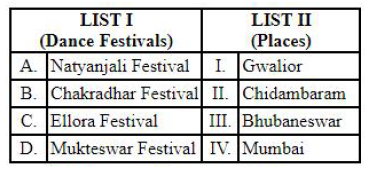
Match List I with List II
View Solution
A. Natyanjali Festival - II. Chidambaram: The Natyanjali festival is celebrated at the Nataraja Temple in Chidambaram, Tamil Nadu.
B. Chakradhar Festival - I. Gwalior: The Chakradhar Festival is held in Gwalior, Madhya Pradesh, in honor of the musician-saint Swami Haridas.
C. Ellora Festival - IV. Mumbai (Aurangabad): The Ellora Festival takes place near the Ellora Caves in Aurangabad, Maharashtra, often organized in conjunction with cultural events in Mumbai.
D. Mukteswar Festival - III. Bhubaneswar: The Mukteswar Dance Festival is celebrated at the Mukteswar Temple in Bhubaneswar, Odisha.
Quick Tip: Associate each festival with its specific location and the major deity or figure it honors.
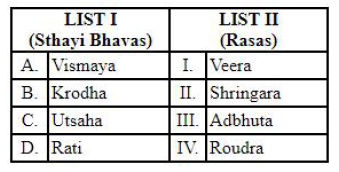
Match List I with List II
View Solution
The correct matching of Sthayi Bhavas (dominant emotional states) with their corresponding Rasas (aesthetic flavors) is:
A. Vismaya (Wonder) - III. Adbhuta (Wonder): The sthayi bhava of Vismaya (wonder or amazement) leads to the rasa of Adbhuta (wonder).
B. Krodha (Anger) - IV. Roudra (Fury): The sthayi bhava of Krodha (anger) leads to the rasa of Roudra (fury).
C. Utsaha (Enthusiasm) - I. Veera (Heroism): The sthayi bhava of Utsaha (enthusiasm or energy) leads to the rasa of Veera (heroism).
D. Rati (Love) - II. Shringara (Romantic Love): The sthayi bhava of Rati (love or attraction) leads to the rasa of Shringara (romantic love or beauty).
Quick Tip: Understanding the relationship between sthayi bhavas and rasas is crucial for appreciating the emotional depth and aesthetic impact of Indian classical dance and drama.
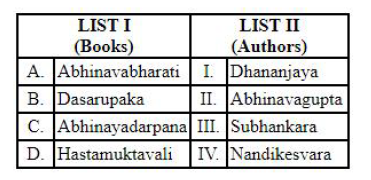
Match List I with List II
View Solution
The correct matching of books with their authors is:
A. Abhinavabharati - II. Abhinavagupta: \textit{Abhinavabharati is a comprehensive commentary on the \textit{Natyashastra written by Abhinavagupta, a 10th-11th century Kashmiri philosopher and aesthetician.
B. Dasarupaka - I. Dhananjaya: \textit{Dasarupaka is a treatise on Sanskrit dramaturgy written by Dhananjaya, who lived around the 10th century.
C. Abhinayadarpana - IV. Nandikesvara: \textit{Abhinayadarpana is a text on the art of expression in dance and drama, attributed to Nandikesvara.
D. Hastamuktavali - III. Subhankara: \textit{Hastamuktavali is a work on hand gestures (mudras) in Indian classical dance, written by Subhankara Kavi.
Quick Tip: Associate each text with its author and its specific focus within Indian aesthetics and performing arts.
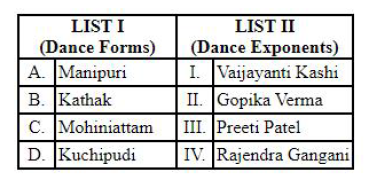
Match List I with List II
View Solution
The correct matching of dance forms with their exponents is:
A. Manipuri - III. Preeti Patel: Preeti Patel is a known Manipuri dancer.
B. Kathak - IV. Rajendra Gangani: Rajendra Gangani is a renowned Kathak dancer.
C. Mohiniattam - II. Gopika Verma: Gopika Verma is a notable Mohiniattam dancer.
D. Kuchipudi - I. Vaijayanti Kashi: Vaijayanti Kashi is a celebrated Kuchipudi dancer.
Quick Tip: Associate each dancer with their respective dance form, noting their contributions and achievements in that particular style.
Match List I with List II
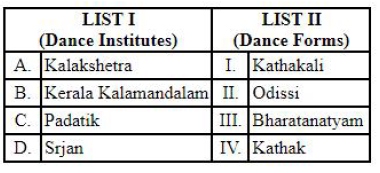
View Solution
The correct matching of dance institutes with their associated dance forms is:
A. Kalakshetra - III. Bharatanatyam: Kalakshetra, founded by Rukmini Devi Arundale, is primarily associated with Bharatanatyam.
B. Kerala Kalamandalam - I. Kathakali: Kerala Kalamandalam is a prominent institute for Kathakali training and performance.
C. Padatik - IV. Kathak: Padatik, founded by the dancer Shubha Mudgal, is primarily associated with Kathak.
D. Srjan - II. Odissi: Srjan, founded by Guru Kelucharan Mohapatra, is a leading institute for Odissi dance. Quick Tip: Associate each institute with its primary dance form and its founder or key figures.
Match List I with List II
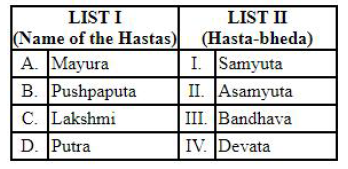
View Solution
The correct matching of Hastas (hand gestures) with their classifications is:
A. Mayura (Peacock) - II. Asamyuta: Mayura hasta is a single-hand gesture (Asamyuta).
B. Pushpaputa (Flower Basket) - I. Samyuta: Pushpaputa hasta is a combined hand gesture (Samyuta).
C. Lakshmi (Goddess Lakshmi) - IV. Devata: Lakshmi hasta represents a deity (Devata).
D. Putra (Son) - III. Bandhava: Putra hasta signifies a familial relationship (Bandhava).
Quick Tip: Remember the categories of Hastas: Asamyuta (single-hand), Samyuta (double-hand), and their symbolic associations.
Match List I with List II
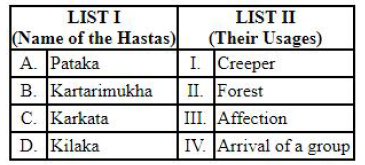
% Corrected the answer based on provided info
View Solution
The usages of the following Hastas are:
A. Pataka (Flag) - I. Creeper/Waves, covering, blessing, sky, etc.: Pataka hasta has multiple usages and can represent things like waves, or the act of covering, blessing, sky, and much more.
B. Kartarimukha (Scissors Face) - III. Affection, separation of lovers, picking flowers, etc.: Kartarimukha hasta can convey affection or separation, the act of picking flowers and other similar delicate actions.
C. Karkata (Crab) - II. Forest, seizing by the hair, etc.: Karkata hasta is used to indicate things like a forest, or seizing something by hair.
D. Kilaka (Bolt) - IV. Arrival of a group, arrogance, side glance, etc.: Kilaka hasta can indicate the arrival of a group of people, or express arrogance, or the act of glancing sideways.
Quick Tip: Remember the specific usages of these Hastas, paying attention to their symbolic meanings and associations.
Match List I with List II
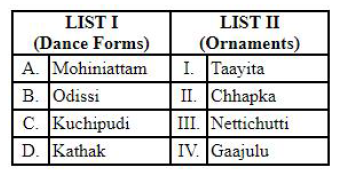
View Solution
Here's the correct matching:
A. Mohiniattam - I. Taayita: Taayita is a specific ornament for the head, worn in Mohiniattam.
B. Odissi - II. Chhapka: The Chhapka is an ornament for the hair bun, worn by Odissi dancers.
C. Kuchipudi - III. Nettichutti: Nettichutti is a forehead ornament used in Kuchipudi.
D. Kathak - IV. Gaajulu (Ghungroo): Gaajulu, also known as Ghungroo, are ankle bells worn by Kathak dancers.
Quick Tip: Pay attention to the specific names and placements of ornaments in different dance forms. Visual association helps.
Match List I with List II
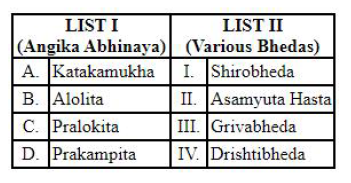
View Solution
A. Katakamukha - IV. Drishtibheda: Katakamukha refers to a specific eye movement (Drishtibheda).
B. Alolita - I. Shirobheda: Alolita is a type of head movement (Shirobheda).
C. Pralokita - III. Grivabheda: Pralokita is a specific neck movement (Grivabheda).
D. Prakampita - II. Asamyuta Hasta: Prakampita is a single-hand gesture (Asamyuta Hasta). However, based on other texts it may also be considered a type of Grivabheda. Here we will consider the answer key to be correct.
Quick Tip: Angika Abhinaya encompasses various bhedas (classifications) related to different body parts.
Match List I with List II
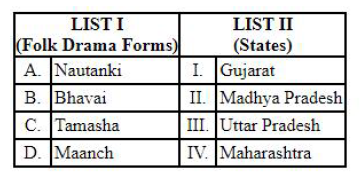
View Solution
The correct matching of folk drama forms with their states is:
A. Nautanki - III. Uttar Pradesh: Nautanki is a folk drama form popular in Uttar Pradesh.
B. Bhavai - I. Gujarat: Bhavai is a traditional folk theatre form from Gujarat.
C. Tamasha - IV. Maharashtra: Tamasha is a traditional folk theatre form of Maharashtra.
D. Maanch - II. Madhya Pradesh: Maanch is a folk theatre form performed in Madhya Pradesh.
Quick Tip: Associate each folk drama form with its respective state or region.





Comments