


CUET PG Chemical Thermal & Polymer Engineering Question Paper 2024 will be available here for download. NTA conducted CUET PG Chemical Thermal & Polymer Engineering paper 2024 on from March 21 in Shift 3. CUET PG Question Paper 2024 is based on objective-type questions (MCQs). According to latest exam pattern, candidates get 105 minutes to solve 75 MCQs in CUET PG 2024 Chemical Thermal & Polymer Engineering question paper.
CUET PG Chemical Thermal & Polymer Engineering Question Paper 2024 PDF Download
| CUET PG 2024 Chemical Thermal and Polymer Engineering Question Paper with Answer Key |  Download Download |
Check Solution |

Chemical Thermal and Polymer Engineering 2024 Questions with Solutions
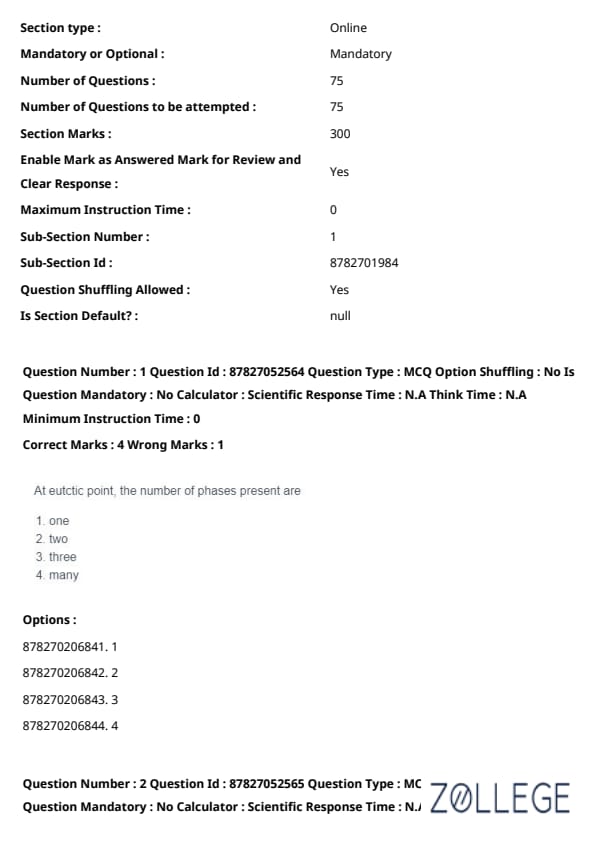
Question 1:
At eutectic point, the number of phases present are:
View Solution
Solution: At the eutectic point, three phases coexist in equilibrium: two solid phases and one liquid phase. This point is significant in phase diagrams, particularly for binary mixtures.
Question 2:
Which of the following is an example of a closed system?
View Solution
Solution: A closed system allows the exchange of energy (heat or work) but not mass with its surroundings. The liquid cooling system of an automobile is a closed system as the coolant circulates without mass exchange.
Question 3:
The direction of a particular spontaneous process is ascertained from which of the following laws of thermodynamics?
View Solution
Solution: The second law of thermodynamics provides criteria for spontaneity, stating that a spontaneous process increases the entropy of the universe.
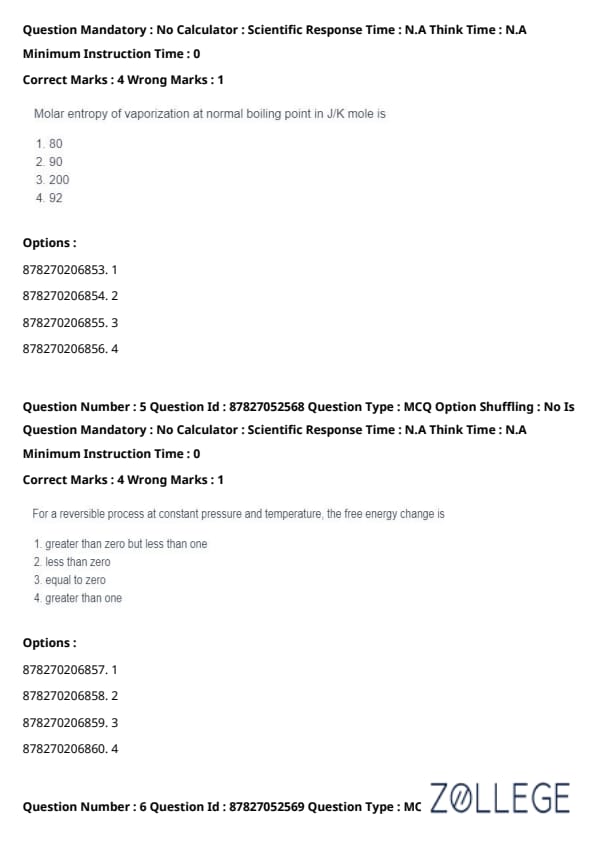
Question 4:
Molar entropy of vaporization at normal boiling point in J/K·mole is:
View Solution
Solution: The molar entropy of vaporization is given by ΔS = ΔH/T. For most liquids at their boiling point, the entropy of vaporization is approximately 92 J/K·mole.
Question 5:
For a reversible process at constant pressure and temperature, the free energy change is:
View Solution
Solution: For a reversible process, the change in Gibbs free energy (ΔG) is zero, indicating equilibrium between the system and its surroundings.
Question 6:
Gibbs free energy of mixing at constant temperature and pressure must always be:
View Solution
Solution: The Gibbs free energy of mixing is negative, reflecting the thermodynamic favorability of mixing components due to entropy increase.
Question 7:
Hess's law of constant heat summation is based on:
View Solution
Solution: Hess's law relies on the conservation of energy, which is the basis of the first law. It states that the total enthalpy change in a reaction is independent of the pathway taken.
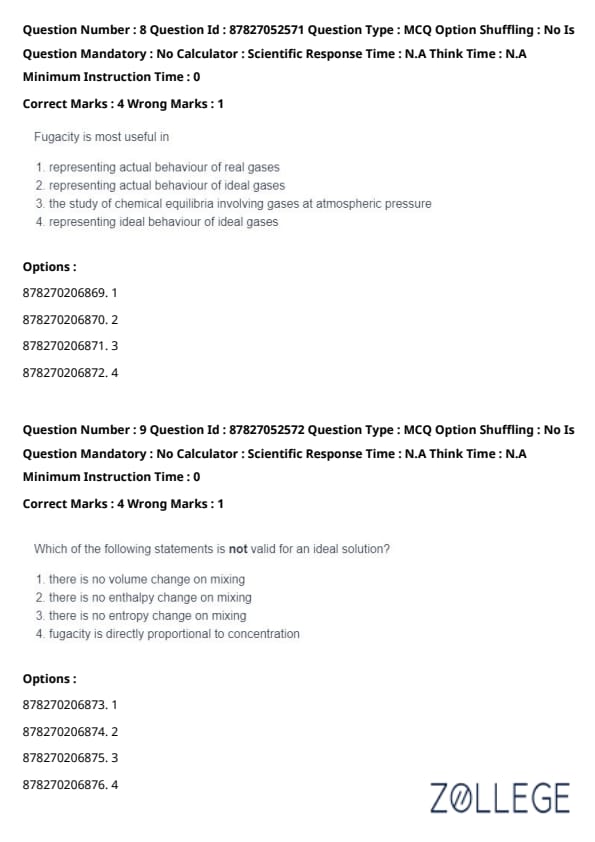
Question 8:
Fugacity is most useful in:
View Solution
Solution: Fugacity corrects for deviations from ideal behavior in real gases, providing a more accurate measure for thermodynamic calculations.
Question 9:
Which of the following statements is not valid for an ideal solution?
View Solution
Solution: For an ideal solution, entropy change occurs due to mixing, even though there are no enthalpy or volume changes. Entropy increases as molecules distribute randomly.
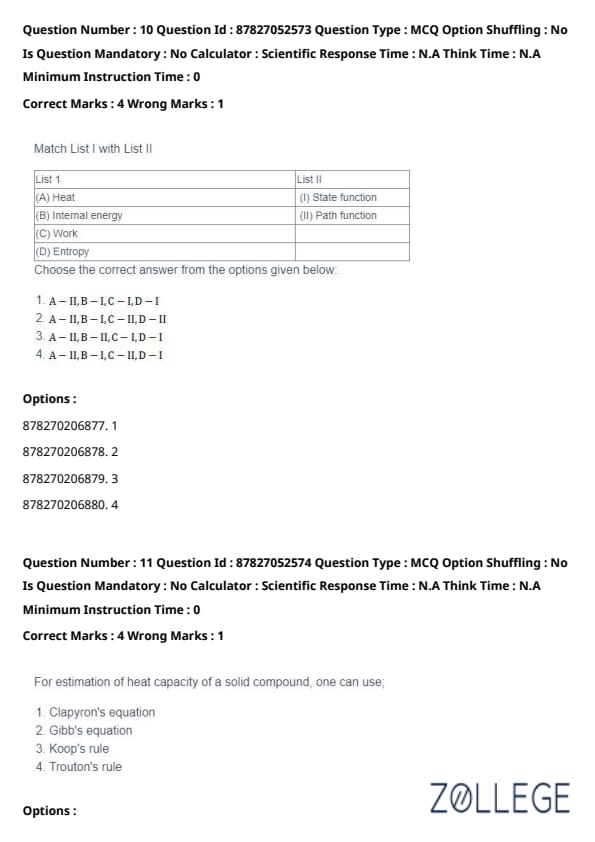
Question 10:
Match List-I with List-II:
| List-I | List-II |
|---|---|
| (A) Heat | (I) State function |
| (B) Internal energy | (II) Path function |
| (C) Work | |
| (D) Entropy |
View Solution
Solution: Heat and work are examples of path functions because they depend on the path taken by the system. Internal energy and entropy are state functions as their values depend only on the current state of the system, not on the process used to reach that state.
Question 11:
For estimation of heat capacity of a solid compound, one can use
View Solution
Solution: Koop's rule is commonly used to estimate the heat capacity of solid compounds. It considers contributions from the constituent atoms, which simplifies calculations. Other equations listed here are unrelated to heat capacity estimation.
Question 12:
Which of the following statements is true?
View Solution
Solution: The efficiency of a heat engine depends on the temperature difference between the heat source and sink. Greater temperature differences result in higher efficiency, as derived from Carnot's theorem.
Question 13:
The fluid forces considered in the Navier-Stokes equation are
View Solution
Solution: The Navier-Stokes equation models fluid motion by considering gravity, pressure, and viscous forces. Turbulence, if present, is typically addressed through additional modeling approaches.
Question 14:
In order that the water shall never rise more than 100 cm above the crest for a discharge of 5 cubic meters per second, the length of the wire will be:
View Solution
Solution: The given problem involves the calculation of the length of the weir using the formula for discharge over a rectangular weir: Q = L * H1.5 * Cd, where Q is the discharge, L is the length of the weir, H is the head, and Cd is the coefficient of discharge. Substituting the values Q = 5 m³/s, H = 1 m, and Cd = 1.84 (assumed standard value), the calculated length of the weir comes out to be approximately 2.49 meters.
Question 15:
Arrange the following flow measuring devices in the increasing order of heat loss caused by them:
(A) Flow nozzle
(B) Venturimeter
(C) Orifice meter
View Solution
Solution: The increasing order of heat loss caused by these devices is: (C) Orifice meter: Highest loss due to significant obstruction and sharp edges. (A) Flow nozzle: Moderate loss, as it causes less obstruction than the orifice meter. (B) Venturimeter: Least heat loss due to its streamlined design minimizing flow resistance. Thus, the correct order is (C, A, B).
Question 16:
Impeller diameter in the case of a turbine agitator is:
View Solution
Solution: For a turbine agitator, the impeller diameter is typically designed to be 30–50 percent of the vessel's inside diameter. This ensures optimal mixing while avoiding excessive energy consumption or insufficient agitation.
Question 17:
Crude oil of kinematic viscosity 2.25 Stokes flows through a 20 cm diameter pipe. If the rate of flow is 1.5 liters/sec, what will be the type of flow?
View Solution
Solution: The flow type is determined using the Reynolds number formula: Re = ρvD⁄μ. Given D = 20 cm, v = 1.5L/sec, and kinematic viscosity ν = 2.25 Stokes, the calculated Reynolds number is below 2000, indicating laminar flow.
Question 18:
A pressure of 500 kPa applied to 2 m³ of liquid results in a volume change of 0.004 m³. The bulk modulus in MPa is:
View Solution
Solution: The bulk modulus is given by the formula: K = ΔP⁄-ΔV/V Substitute the given values: K = 500⁄0.004/2 = 500⁄0.002 = 250,000 kPa = 250 MPa. Thus, the bulk modulus is 250 MPa.
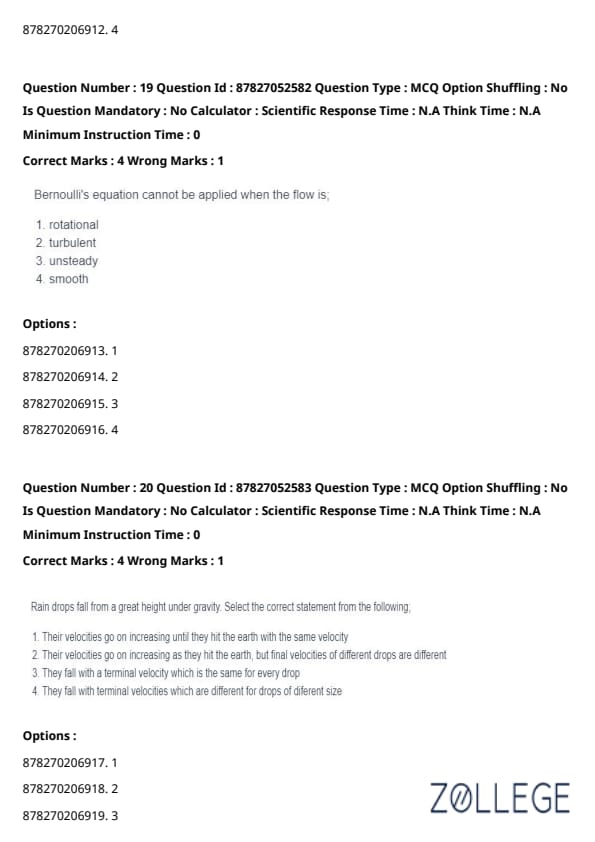
Question 19:
Bernoulli's equation cannot be applied when the flow is:
View Solution
Solution: Bernoulli's equation assumes incompressible, steady, and irrotational flow. If the flow is rotational, energy conservation along a streamline is not valid, making Bernoulli's equation inapplicable.
Question 20:
Rain drops fall from a great height under gravity. Select the correct statement:
View Solution
Solution: Rain drops experience air resistance as they fall. Larger drops achieve higher terminal velocities due to their greater mass and gravitational force overcoming air drag, while smaller drops reach lower terminal velocities.
Question 21:
Industrial paddle agitators turn at speed between:
View Solution
Solution: Industrial paddle agitators are typically used for low-speed mixing applications. Their speed range of 20–100 rpm is optimal for efficient mixing without excessive energy consumption or product damage.
Question 22:
Which of the following size reduction equipment can accept feed sizes of 10 inches and up?
View Solution
Solution: Jaw crushers are designed to handle large feed sizes, often up to 10 inches or more, making them ideal for primary size reduction. Other equipment like ball mills and rod mills are used for finer materials.
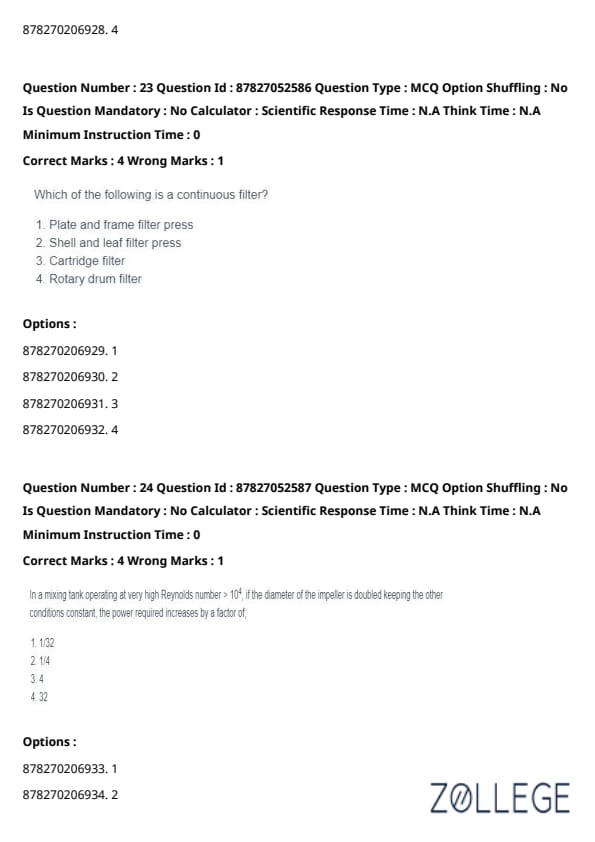
Question 23:
Which of the following is a continuous filter?
View Solution
Solution: Rotary drum filters are widely used for continuous filtration operations. They are designed to handle large volumes of slurry with minimal downtime.
Question 24:
In a mixing tank operating at a very high Reynolds number > 104, if the diameter of the impeller is doubled, keeping other conditions constant, the power required increases by a factor of:
View Solution
Solution: Power required in high Reynolds number mixing is proportional to the fifth power of the impeller diameter: P ∝ D5. Doubling the impeller diameter results in a 25 = 32-fold increase in power requirement.
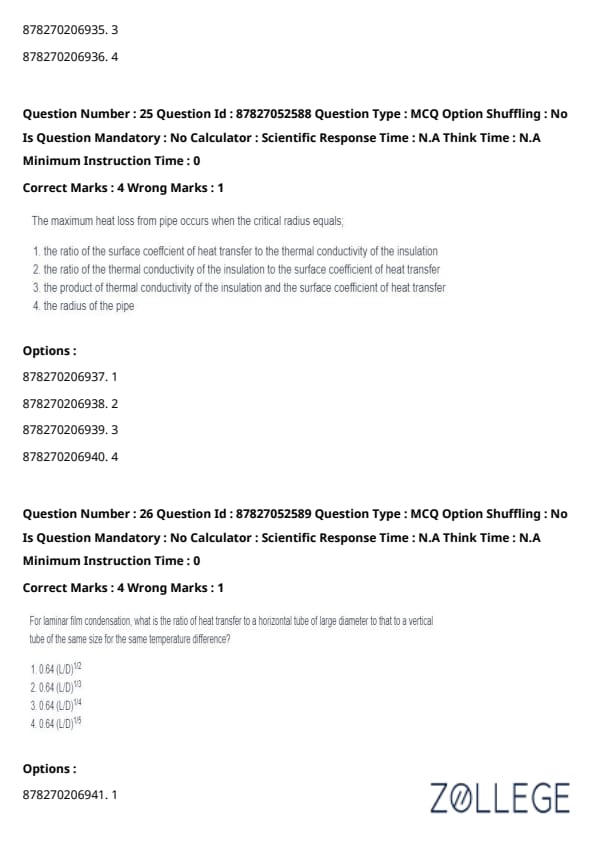
Question 25:
The maximum heat loss from a pipe occurs when the critical radius equals:
View Solution
Solution: The critical radius of insulation (rc) is given by: rc = k⁄h, where k is the thermal conductivity of the insulation and h is the surface heat transfer coefficient.
Question 26:
For laminar film condensation, what is the ratio of heat transfer to a horizontal tube of large diameter to that to a vertical tube of the same size for the same temperature difference?
View Solution
Solution: For laminar film condensation, the heat transfer ratio is influenced by the geometry of the tube and is proportional to the term (L/D)1/4, where L is the length and D is the diameter of the tube. The horizontal tube of large diameter results in a smaller heat transfer coefficient compared to the vertical tube, due to the spreading of condensate film.
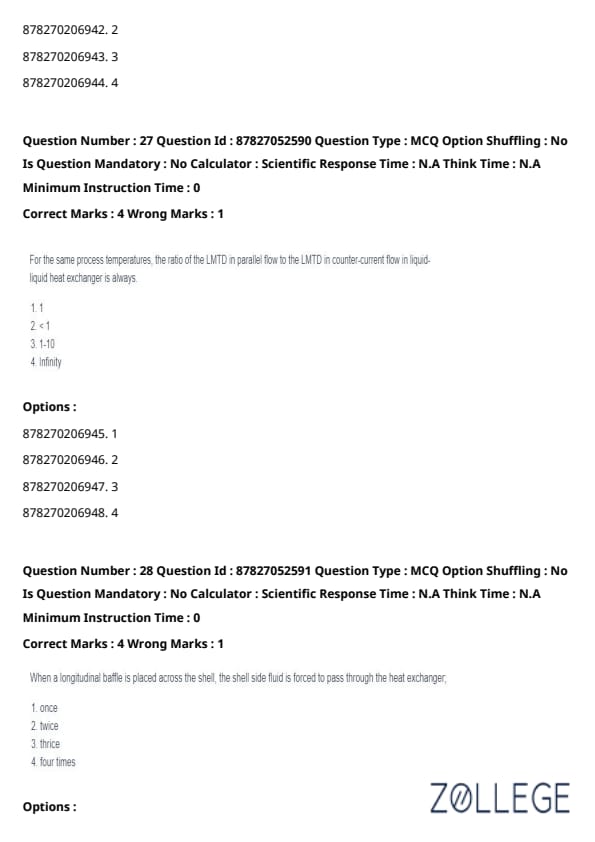
Question 27:
For the same process temperatures, the ratio of the LMTD in parallel flow to the LMTD in counter-current flow in a liquid-liquid heat exchanger is always:
View Solution
Solution: In parallel flow, the temperature difference between fluids diminishes along the length of the exchanger, reducing the LMTD compared to counter-current flow.
Question 28:
When a longitudinal baffle is placed across the shell, the shell-side fluid is forced to pass through the heat exchanger:
View Solution
Solution: Longitudinal baffles in shell-and-tube heat exchangers guide the fluid through multiple passes, increasing heat transfer efficiency.
Question 29:
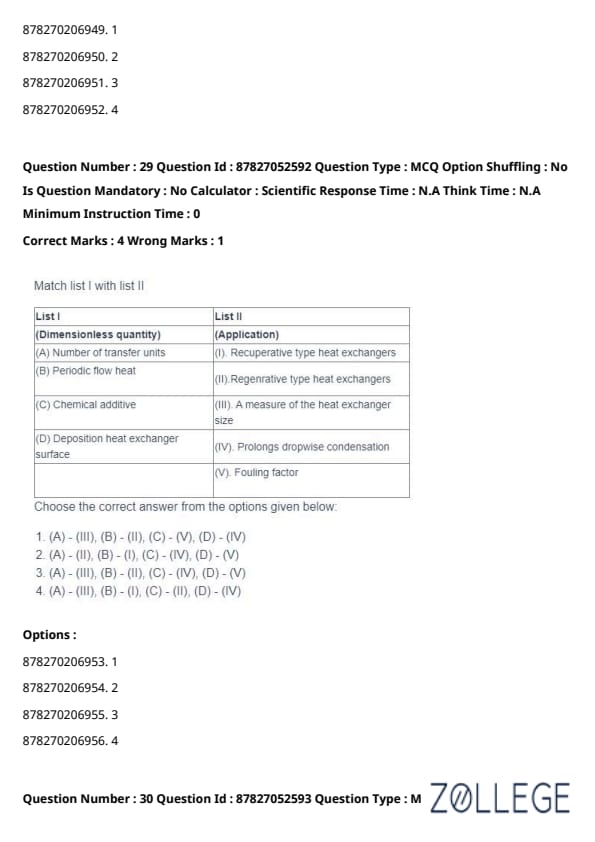
Match List I with List II:
| List I (Dimensionless Quantity) | List II (Application) |
|---|---|
| (A) Number of transfer units | (I) Recuperative type heat exchangers |
| (B) Periodic flow heat | (II) Regenerative type heat exchangers |
| (C) Chemical additive | (III) A measure of heat exchanger size |
| (D) Deposition heat exchanger | (IV) Prolongs dropwise condensation surface |
| (V) Fouling factor |
View Solution
Solution:
The correct matching is:
(A) Number of transfer units - (III) A measure of the heat exchanger size
(B) Periodic flow heat - (II) Regenerative type heat exchangers
(C) Chemical additive - (IV) Prolongs dropwise condensation
(D) Deposition heat exchanger surface - (V) Fouling factor
Thus, the correct answer is Option 3.
Question 30:
Heat transfer takes place according to:
View Solution
Solution: The zeroth law of thermodynamics governs heat transfer by establishing the concept of thermal equilibrium. It states that if two systems are each in thermal equilibrium with a third system, then they are in thermal equilibrium with each other.
Question 31:
HETP is numerically equal to HTU only when the operating line:
View Solution
Solution: HETP (Height Equivalent to a Theoretical Plate) and HTU (Height of a Transfer Unit) become equal when the operating line is parallel to the equilibrium line. This condition represents a situation where the driving force for mass transfer remains constant.
Question 32:
Flash distillation is used at a large scale in:
View Solution
Solution: Flash distillation is widely used in petroleum refining to separate light hydrocarbons from crude oil. It operates by vaporizing a portion of the liquid mixture under reduced pressure.
Question 33:
In the absorption of a solute gas from a mixture containing inerts in a solvent, it has been observed that the overall gas transfer coefficient is nearly equal to the individual gas film transfer coefficient. It may therefore be concluded that:
View Solution
Solution: When the overall gas transfer coefficient equals the gas film coefficient, the process is liquid film controlled. Reducing the thickness of the liquid film decreases the resistance and increases the transfer rate significantly.
Question 34:
In a small column, local efficiency is equal to Murphree efficiency, and in a large column, local efficiency is:
View Solution
Solution: In small columns, local efficiency is approximately equal to Murphree efficiency due to minimal axial mixing. In large columns, axial mixing reduces local efficiency compared to Murphree efficiency.
Question 35:
Sugar is leached from sugar beets with:
View Solution
Solution: Hot water is commonly used to leach sugar from sugar beets because it dissolves sugar effectively while minimizing impurities.
Question 36:
Higher holdup of the solid in the rotary drier results in:
(A) increased kiln action
(B) decreased kiln action
(C) poor exposure of the solid to the gas
(D) an increase in power required for operating the drier
View Solution
Solution: Higher holdup of solids in a rotary drier leads to: (A) Increased kiln action, as more solids are retained in the system. (C) Poor exposure of the solid to the gas, reducing the efficiency of heat and mass transfer. (D) Increased power requirement due to the higher load on the equipment. (B) is incorrect, as higher holdup does not decrease kiln action. Thus, the correct answer is (A), (C), and (D) only.
Question 37:
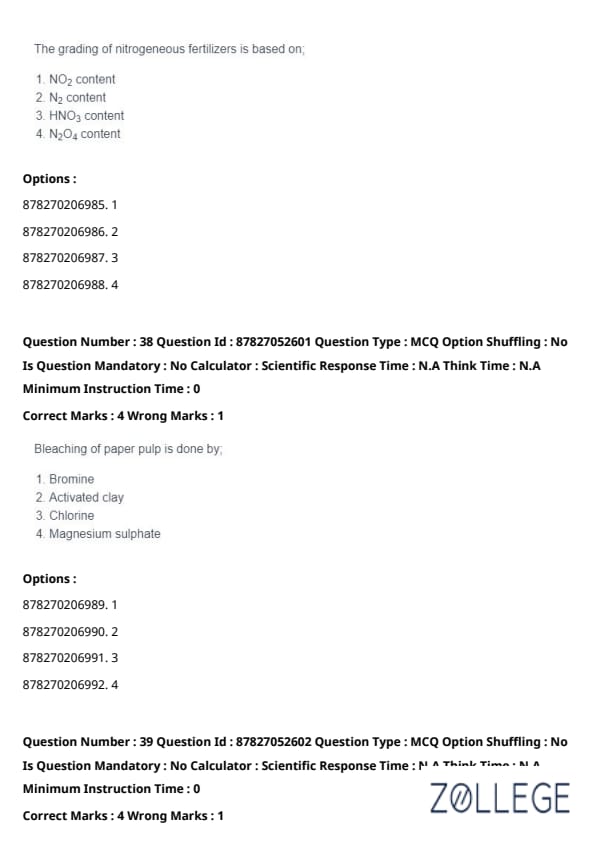
The grading of nitrogenous fertilizers is based on:
View Solution
Solution: Nitrogenous fertilizers are graded by their N2 content, which determines their effectiveness in providing nitrogen to plants.
Question 38:
Bleaching of paper pulp is done by:
View Solution
Solution: Chlorine is commonly used for bleaching paper pulp due to its strong oxidizing properties, which help remove lignin.
Question 39:
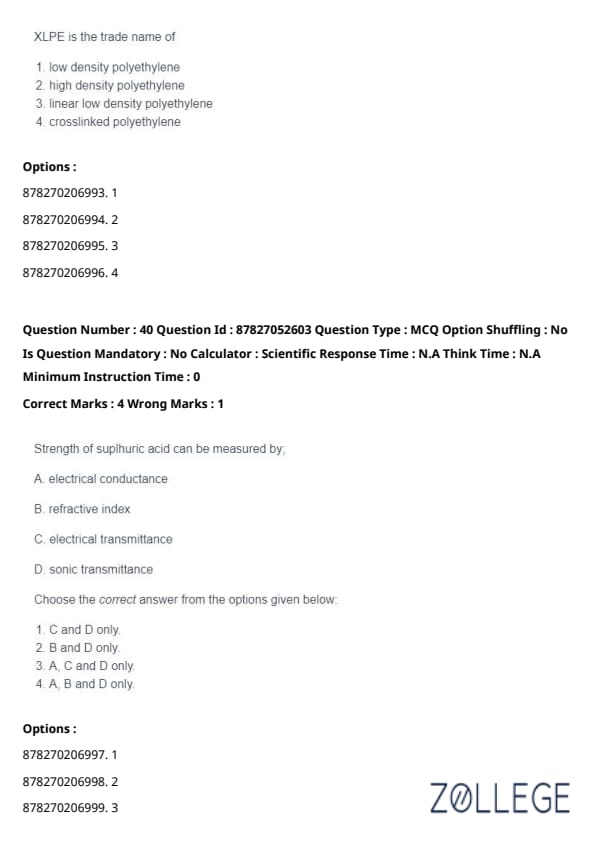
XLPE is the trade name of:
View Solution
Solution: XLPE (crosslinked polyethylene) is widely used for insulation in cables and pipes due to its superior thermal and mechanical properties.
Question 40:
Strength of sulphuric acid can be measured by:
(A) electrical conductance
(B) refractive index
(C) electrical transmittance
(D) sonic transmittance
View Solution
Solution: The strength of sulphuric acid can be measured by: (A) Electrical conductance: It is a widely used method to determine the concentration of strong acids like sulphuric acid. (B) Refractive index: The refractive index changes with the concentration of sulphuric acid, providing another means of measurement. (D) Sonic transmittance: Sound propagation through the acid can also indicate its concentration. (C) Electrical transmittance is not a standard method for measuring the strength of sulphuric acid. Thus, the correct answer is (A), (B), and (D) only.
Question 41:
An additional step in the manufacture of paper from bagasse as compared to that from bamboo is:
View Solution
Solution: Bagasse contains pith, which needs to be removed in an additional step called depithing. This process improves the quality of the pulp and is not required for bamboo-based paper manufacturing.
Question 42:
An asset is purchased at a cost of Rs. 5000. It has no salvage value at the end of its life of 10 years. Its book value at the end of 5 years using the straight-line method will be:
View Solution
Solution: This question is excluded from evaluation as per the provided instructions. No further analysis is needed for this item.
Question 43:
A production equipment costs Rs. 2,00,000. Its salvage value is Rs. 20,000. The expected return is Rs. 50,000 per annum. The corporate taxes are taken as 40 percent. The payback period will be:
View Solution
Solution: The payback period is calculated as the initial investment divided by the net annual return. After taxes, the annual return is reduced to 50,000 × 0.6 = 30,000. The payback period is therefore 2,00,000⁄30,000 = 6.67, approximated to 6 years.
Question 44:
Capitalized cost comparison method is used for comparing alternatives having:
View Solution
Solution: The capitalized cost method evaluates projects or alternatives that last indefinitely. It is used to determine the long-term cost-effectiveness of alternatives with high service life.
Question 45:
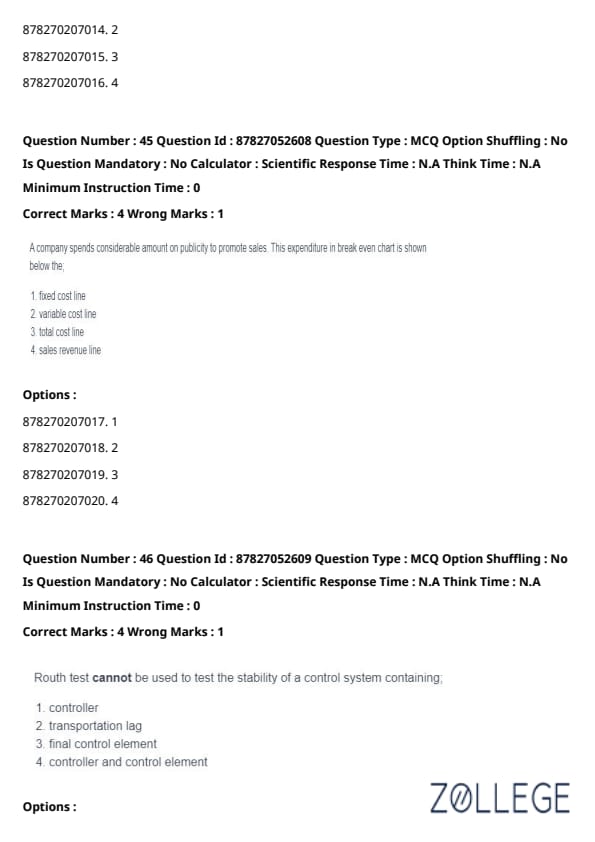
A company spends a considerable amount on publicity to promote sales. This expenditure in a break-even chart is shown below the:
View Solution
Solution: Publicity costs vary with sales activity and are therefore considered variable costs. They are plotted below the variable cost line in a break-even chart.
Question 46:
Routh test cannot be used to test the stability of a control system containing:
View Solution
Solution: The Routh-Hurwitz stability criterion cannot handle systems with pure time delays (transportation lag) because these introduce non-rational terms into the characteristic equation.
Question 47:
The first-order thermometer used has a time constant of 50 s. If it is subjected to a sinusoidal input cycling at 0.002 Hz, then the time lag produced in the instrument will be:
View Solution
Solution: Time lag in first-order systems depends on the time constant and the frequency of input. Calculation involves detailed system dynamics, and the result here is given as 0.002 s.
Question 48:
Strain gauge rosettes are used when the direction of:
View Solution
Solution: Strain gauge rosettes help determine the principal stresses and their directions when the stress distribution is unknown.
Question 49:
In a closed-loop system, the process to be controlled is an integrating process with a transfer function 1⁄2s. The controller proposed to be used is an integral controller with transfer function 1⁄T1s. When a step change in the set point is applied to such a closed system, the controlled variable will exhibit:
View Solution
Solution: Integrating processes combined with integral controllers can lead to instability due to excessive loop gain and lack of damping.
Question 50:
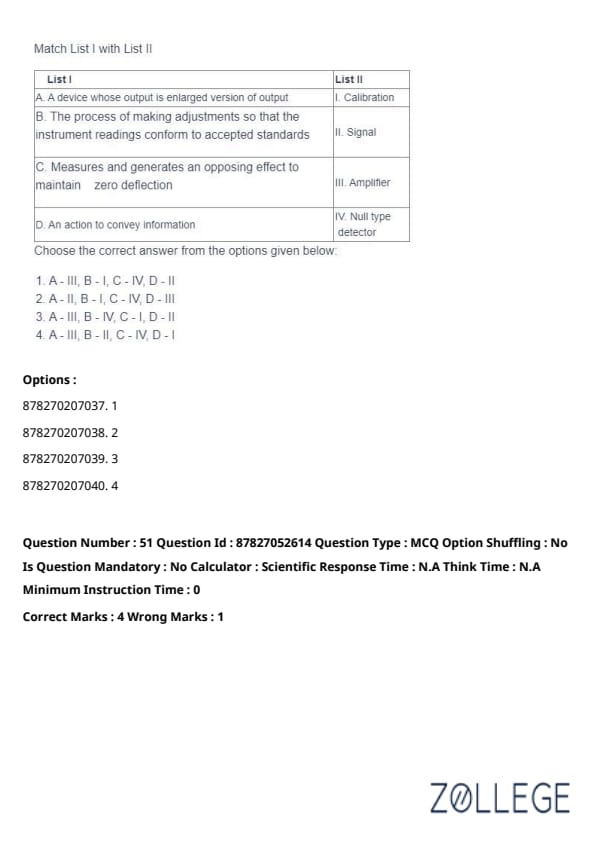
Match List-I with List-II:
| List-I | List-II |
|---|---|
| (A) A device whose output is an enlarged version of input | (I) Amplifier |
| (B) The process of making adjustments so that the instrument readings conform to accepted standards | (II) Calibration |
| (C) Measures and generates an opposing effect to maintain zero deflection | (III) Null type detector |
| (D) An action to convey information | (IV) Signal |
View Solution
Solution: The correct matching is:
(A) A device whose output is an enlarged version of the input - (III) Amplifier
(B) The process of making adjustments so that the instrument readings conform to accepted standards - (I) Calibration
(C) Measures and generates an opposing effect to maintain zero deflection - (IV) Null type detector
(D) An action to convey information - (II) Signal
Thus, the correct answer is Option 1.
Question 51:
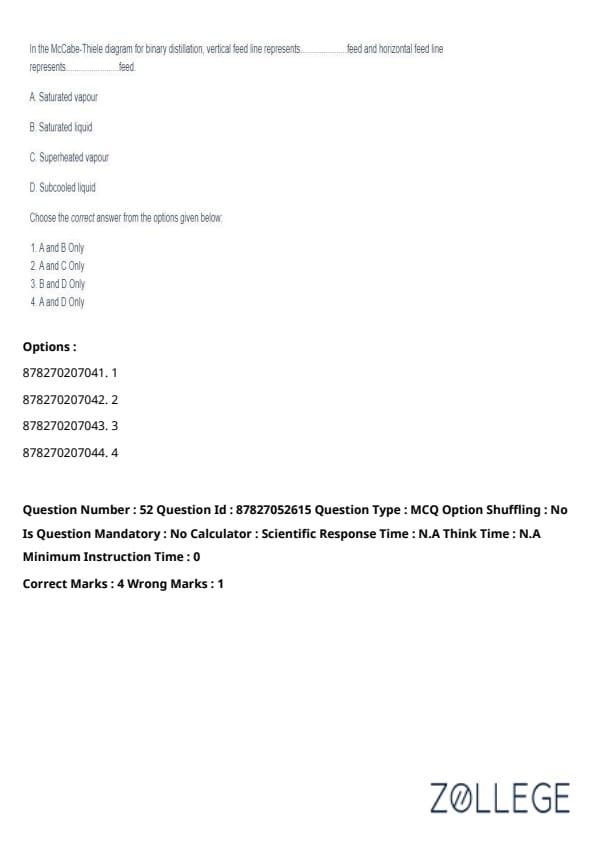
In the McCabe-Thiele diagram for binary distillation, vertical feed line represents ......., and horizontal feed line represents ........ feed.
A. Saturated vapour
B. Saturated liquid
C. Superheated vapour
D. Subcooled liquid
View Solution
Solution: In the McCabe-Thiele diagram, a vertical feed line indicates that the feed is a saturated vapor, while a horizontal feed line shows the feed is a saturated liquid. These lines represent the thermodynamic state of the feed in the distillation column. The feed condition directly influences the operating lines and equilibrium stages required.
Question 52:
When the damping coefficient is equal to 1 for a second-order system, then
A. both the roots will be equal
B. both the roots will be real
C. both the roots will be complex
D. both the roots will be unequal
View Solution
Solution: When the damping coefficient equals 1, the system is critically damped. Both roots of the characteristic equation are real and equal, ensuring no oscillations occur in the system's response. The system settles to equilibrium as quickly as possible without overshooting.
Question 53:
Routh test criterion:
A. is applicable only to those systems with polynomial characteristic equation
B. does not prove any information about the actual location of roots
C. is applicable only to those systems with non-polynomial characteristic equation
D. Gives full information about the actual location of roots
View Solution
Solution: Routh’s stability criterion is applicable only to systems with polynomial characteristic equations. It helps determine whether a system is stable but does not provide the exact location of the roots. Instead, it identifies how many roots are in the left or right half of the complex plane.
Question 54:
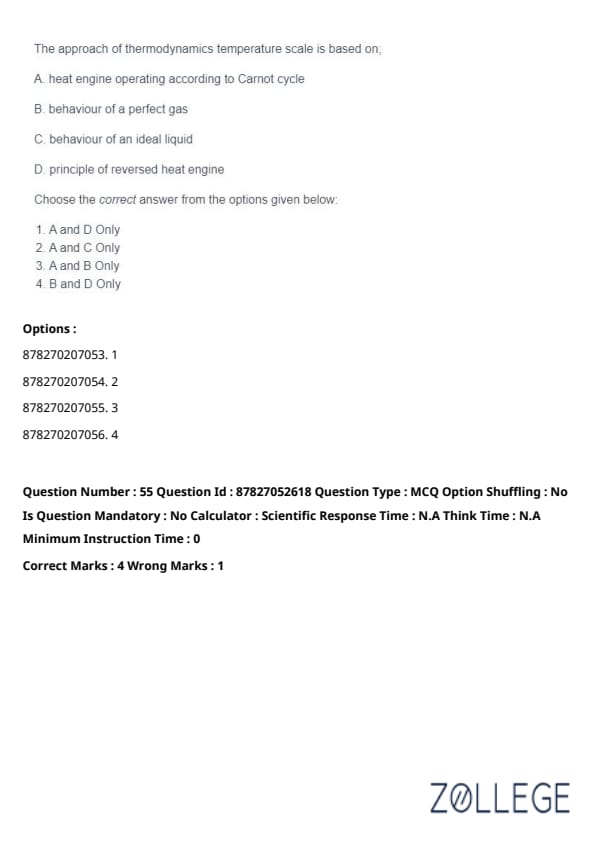
The approach of the thermodynamic temperature scale is based on:
A. heat engine operating according to Carnot cycle
B. behaviour of a perfect gas
C. behaviour of an ideal liquid
D. principle of reversed heat engine
View Solution
Solution: The thermodynamic temperature scale is founded on the Carnot cycle and the behavior of a perfect gas. It relies on the principles of heat engines to define temperature independently of specific substance properties.
Question 55:
In a flow-nozzle type flow meter, the contraction is noticed to be:
A. gradual
B. abrupt
C. no change
D. discrete
View Solution
Solution: In a flow-nozzle type flow meter, the contraction is gradual. This design minimizes pressure loss and turbulence, making it efficient for flow measurement in pipelines.
Question 56:
The lower limit of the useful working range of a transducer is determined by its:
(A) error
(B) noise
(C) accuracy
(D) stability
View Solution
Solution: The lower limit of the working range of a transducer is primarily determined by: (A) Error: Errors in measurement can affect the detection of small signals, defining the lower range. (B) Noise: Noise introduces fluctuations that limit the smallest detectable signal, setting the lower boundary for operation. (C) Accuracy and (D) Stability are not directly responsible for determining the lower limit of the working range. Thus, the correct answer is (A) and (B) only.
Question 57:
Microprocessor-based systems which are increasingly being used for dedicated applications in process instrumentation are:
View Solution
Solution: Control instrumentation systems utilize microprocessors to manage, monitor, and control processes in real-time. These systems are specifically designed for dedicated applications in process instrumentation, providing precision and automation in control tasks.
Question 58:
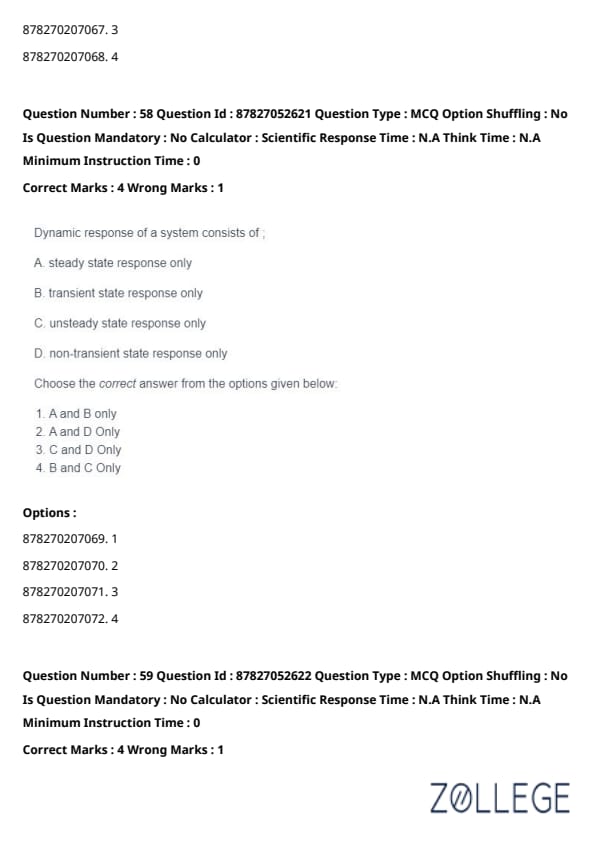
Dynamic response of a system consists of:
(A) steady state response only
(B) transient state response only
(C) unsteady state response only
(D) non-transient state response only
View Solution
Solution: The dynamic response of a system consists of two parts: (A) Steady state response: This occurs after the transient effects have settled, representing the long-term behavior. (B) Transient state response: This occurs immediately after a disturbance or change in input, as the system adjusts towards a steady state. (C) Unsteady state response and (D) Non-transient state response are incorrect as these do not accurately describe the components of dynamic response. Thus, the correct answer is (A) and (B) only.
Question 59:
Tubeless tyres can be made from:
View Solution
Solution: Butyl rubber is used in tubeless tyres due to its excellent impermeability to air, ensuring better retention of inflation pressure.
Question 60:
The effect of smoke in the preparation of smoked rubber sheet is:
A. to make the rubber brown
B. to serve as a preservator
C. to make the rubber soft
D. to make the rubber blistering
View Solution
Solution: Smoke imparts a brown color to the rubber and acts as a preservative, enhancing its longevity and resistance to microbial degradation.
Question 61:
The characteristic that deteriorates when more styrene is added to butadiene to get SBR during polymerization is:
View Solution
Solution: When styrene content increases in SBR (Styrene-Butadiene Rubber), resilience decreases as the material becomes harder and less elastic. This adjustment can improve strength but sacrifices bounce-back ability.
Question 62:
Bicycle pedal is an example of:
View Solution
Solution: Bicycle pedals are often manufactured using blow moulding, a process ideal for creating hollow components with lightweight and durable properties. This method ensures the required strength while maintaining the pedal's structural integrity.
Question 63:
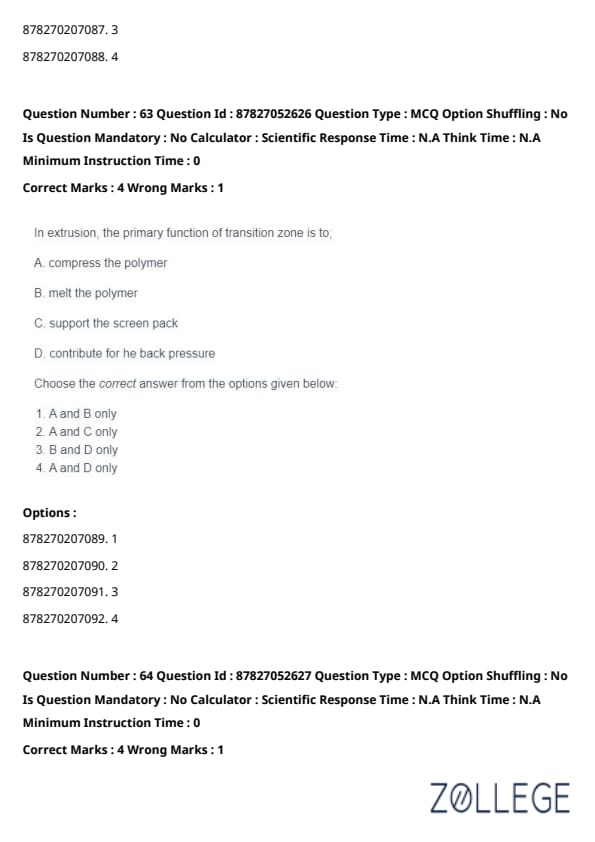
In extrusion, the primary function of the transition zone is to:
A. compress the polymer
B. melt the polymer
C. support the screen pack
D. contribute for the back pressure
View Solution
Solution: The transition zone in extrusion is responsible for compressing and melting the polymer, ensuring smooth flow toward the die for further shaping.
Question 64:
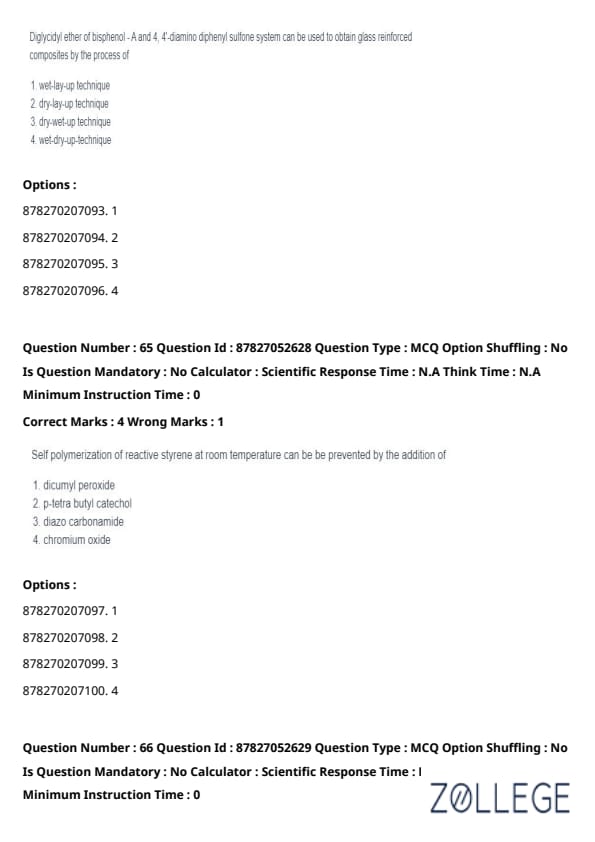
Diglycidyl ether of bisphenol-A and 4,4-diamino diphenyl sulfone system can be used to obtain glass-reinforced composites by the process of:
View Solution
Solution: The dry-lay-up technique involves the use of pre-impregnated resin layers (prepregs) that are laid out without liquid resin during the initial stages. This method is suitable for obtaining high-quality, glass-reinforced composites, ensuring uniformity and precision.
Question 65:
Self-polymerization of reactive styrene at room temperature can be prevented by the addition of:
View Solution
Solution: P-tetra butyl catechol acts as an inhibitor by scavenging free radicals that initiate polymerization, preventing the self-polymerization of styrene.
Question 66:
Polymer having high tensile strength, tensile modulus, stiffness, melting point, and heat distortion temperature combined with low specific gravity and excellent resistance to environmental stress cracking is:
View Solution
Solution: Polypropylene exhibits a combination of high strength, stiffness, and resistance to environmental stress cracking, making it ideal for industrial applications.
Question 67:
The polymer -A-A-A-B-B-A-A-A-B-B- represents:
View Solution
Solution: In block copolymers, monomers are grouped into distinct blocks (e.g., A-A-A and B-B), giving the polymer unique mechanical and thermal properties. This structure allows for enhanced strength and elasticity compared to other copolymer types.
Question 68:
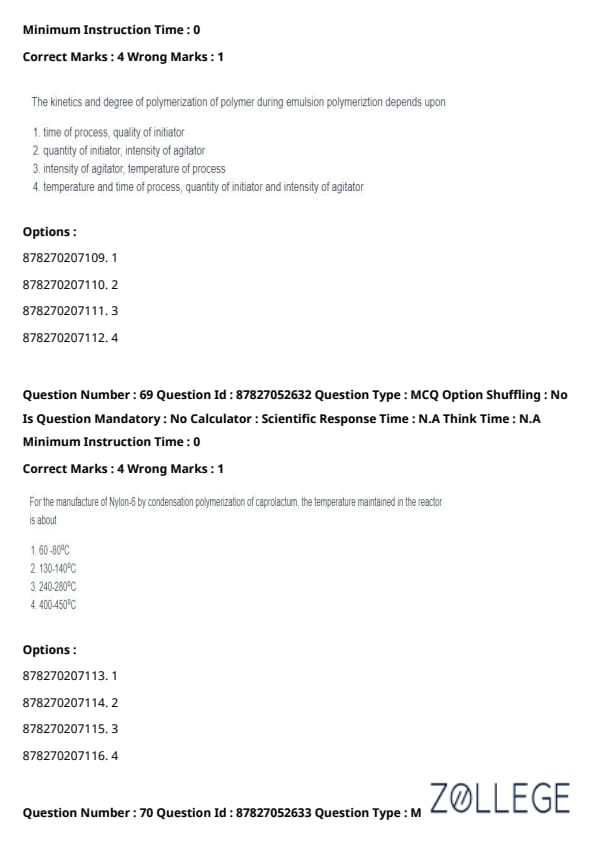
The kinetics and degree of polymerization of polymer during emulsion polymerization depends upon:
View Solution
Solution: Emulsion polymerization involves controlling several parameters such as temperature, time, initiator concentration, and agitation intensity to ensure optimal kinetics and polymerization degree. These factors influence the size, distribution, and properties of the resulting polymer.
Question 69:
For the manufacture of Nylon-6 by condensation polymerization of caprolactam, the temperature maintained in the reactor is about:
View Solution
Solution: Nylon-6 is manufactured via the condensation polymerization of caprolactam under high temperatures (240–280°C). This temperature facilitates the opening of the caprolactam ring and the subsequent polymerization process.
Question 70:
The catalyst used during the condensation of phenol and formaldehyde to obtain the highest electrical properties is:
View Solution
Solution: Liquid ammonia is used as a catalyst during the condensation of phenol and formaldehyde when high electrical properties are desired. It aids in precise polymerization, ensuring a well-structured and cross-linked phenolic resin with superior insulating properties.
Question 71:
If the function f(z) = x2 + axy + by2 + i(cx2 + dxy + y2) is analytic, then the values of a, b, c, and d are given by:
View Solution
Solution: For f(z) to be analytic, it must satisfy the Cauchy-Riemann equations: ∂u⁄∂x = ∂v⁄∂y and ∂u⁄∂y = -∂v⁄∂x. Solving these equations for the given function, the values of a, b, c, and d are found as a = 2, b = −1, c = −1, d = 2.
Question 72:
Which of the following is not correct?
View Solution
Solution: For square matrices A and B, the commutative property AB = BA does not hold in general. Matrix multiplication is associative but not commutative.
Question 73:
The first-order partial derivative of the function log(sin x + cos y) with respect to the variables x and y, respectively, are given by:
View Solution
Solution: Using partial differentiation:
∂⁄∂x log(sin x + cos y) = cos x⁄sin x + cos y
∂⁄∂y log(sin x + cos y) = -sin y⁄sin x + cos y
Question 74:
The complementary function of the differential equation: d²y⁄dx²+ 16y = x sin μx, μ = ±4 is given by:
View Solution
Solution: The differential equation d²y⁄dx² + 16y = x sin μx has a complementary function that depends on the roots of the characteristic equation m² + 16 = 0. Solving for m, we get m = ±4i. Hence, the complementary function is given by: yc = α cos 4x + β sin 4x, where α and β are arbitrary constants.
Question 75:
Which of the following is correct?
View Solution
Solution: The correct statement is based on the residue theorem, which states that if f(z) is analytic except for isolated singularities within the closed curve c, the integral around c is equal to 2πi times the sum of the residues at those singularities. This theorem is a fundamental result in complex analysis.
































Comments