




The AP EAPCET 2026 Registration process has started on 4th Feb 2026 on its official website. The AP EAPCET exams are scheduled to be held from 12th May to 20th May 2026 for admission to undergraduate engineering, agriculture, and pharmacy courses in Andhra Pradesh.
- The Engineering stream, the paper consists of Mathematics (80 questions), Physics (40), and Chemistry (40).
- The streams of Agriculture and Pharmacy comprise Physics, Chemistry, Botany, and Zoology (40 questions each).
- Candidates receive 1 mark for each correct response, and there is no negative marking.
Like every year, more than 2 lakh aspirants appeared for the engineering stream and approximately 80,000 for agriculture and pharmacy, depicting the competitive nature and level of the exam.
Candidates are advised to fill out the application forms as soon as possible to avoid last-minute hassles.
Related Links:
- AP EAPCET Application Form 2026, Registration (start), Required Documents, Application Fees & Correction Window
- AP EAPCET Syllabus 2026 (Expected): Subject-Wise Weightage, Important Topics & Model Paper PDF
What is the AP EAPCET Exam?
The Andhra Pradesh Engineering, Agriculture and Pharmacy Common Entrance Test (also known as AP EAPCET) exam is a state-level entrance exam conducted by the Jawaharlal Nehru Technical University (JNTU) Kakinada, on behalf of APSCHE (AP State Council of Higher Education). This exam is held to facilitate admissions into the following streams: -
- Engineering [Engineering, Bio-Technology, B.Tech. (Dairy Technology), B.Tech. (Agr.
Engg.), B.Tech. (Food Science and Technology)]
- Agriculture [B.Sc. (Ag)/ B.Sc. (Hort)/ B.V.Sc. & A.H/B.F.Sc]
- Pharmacy (B Pharm, D Pharm)
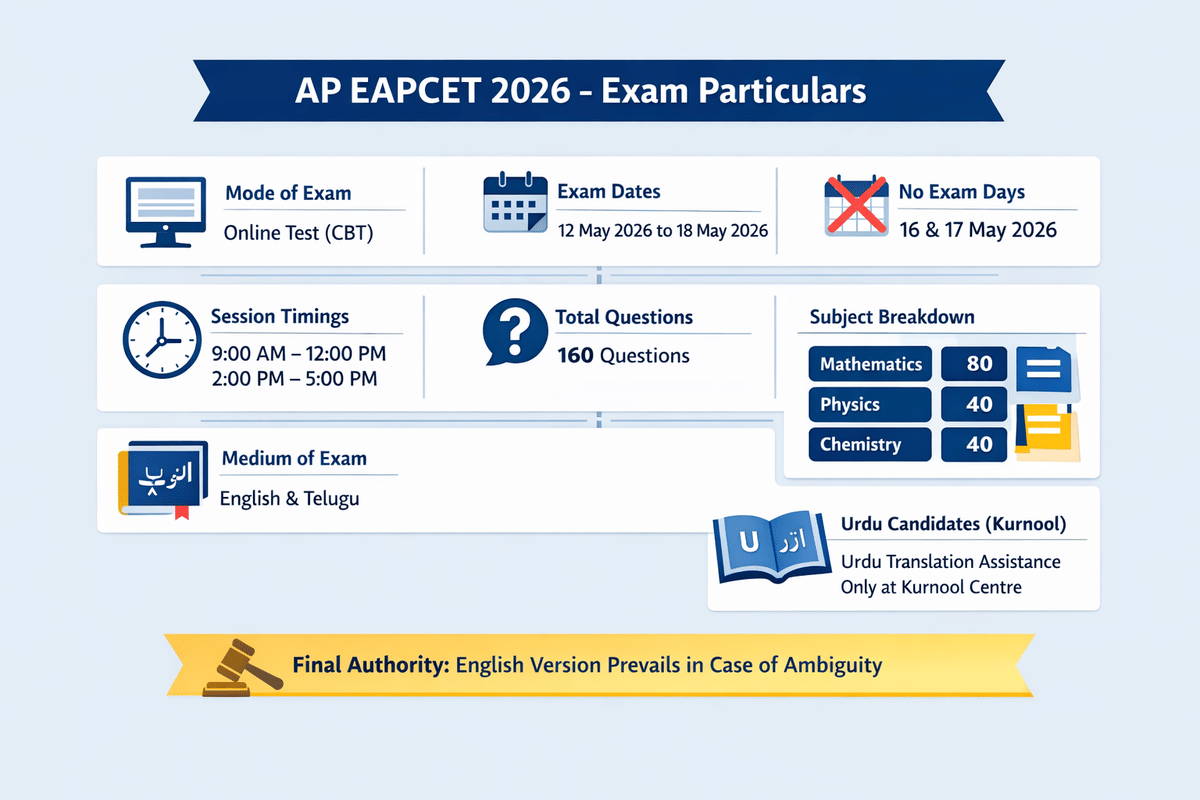
Refer to the table below for the crucial information regarding AP EAPCET 2026 exam: -
| Particular | Details |
|---|---|
| Name of Exam | AP EAPCET 2026 |
| Mode of Examination | Online (Computer-Based Test) |
| Total Number of Questions | 160 |
| Mathematics | 80 Questions |
| Physics | 40 Questions |
| Chemistry | 40 Questions |
| Medium of Question Paper | English & Telugu |
| Urdu Medium Candidates | Translation assistance is available only at the Kurnool Test Centre |
| Final Authority in Case of Ambiguity | English version of the question paper |
| Official Website | https://cets.apsche.ap.gov.in |
Also Check:
AP EAPCET 2026 Important Dates
The official notification regarding the AP EAPCET 2026 exam dates has been released on the official website. Candidates can fill out the application form as the registration has already begun.
| Date and Day | Activity |
|---|---|
| 04-02-2026 (Wednesday) | Commencement of submission of Online Applications |
| 07-03-2026 (Saturday) | Last date for submission of Online Applications without Late Fee |
| 12-03-2026 (Thursday) | Last date for submission of Online Applications with Late Fee (Rs.1000/-) |
| 17-03-2026 (Tuesday) | Last date for submission of Online Applications with Late Fee (Rs.2000/-) |
| 21-03-2026 (Saturday) | Last date for submission of Online Applications with Late Fee (Rs.4000/-) |
| 26-03-2026 (Thursday) | Last date for submission of Online Applications with Late Fee (Rs.10000/-) |
| 26-03-2026 (Thursday)to 28-03-2026 (Saturday) | Correction of online application data already submitted by the candidate |
| 28-04-2026 (Tuesday) | Downloading Hall-Tickets from the website/ through WhatsApp) |
| 12-05-2026 (Tuesday)to 15-05-2026 (Friday) and18-05-2026 (Monday) | Dates of Examination (Engineering) |
| Two sessions | Sessions per Day |
| 9:00 A.M. – 12:00 P.M. | Session 1 Timing |
| 2:00 P.M. – 5:00 P.M. | Session 2 Timing |
| 25-05-2026 (Monday) | Last date for receiving Objections on Preliminary Key (Engineering, Agriculture & Pharmacy)* |
| 01-06-2026 (Monday) | Release of results tentatively |
Also Check:
AP EAPCET 2026 Eligibility
In order to apply for an AP EAPCET course, students must meet a defined eligibility criteria. These include age, domicile status, and educational qualifications, all of which will be taken into account in determining whether a student qualifies and can therefore pursue a course of study in Andhra Pradesh.
- With respect to nationality, domicile, and educational qualifications, candidates will be required to achieve a minimum qualifying score on the AP EAPCET before applying.
- Candidates must also meet the minimum educational qualifications to apply for an AP EAPCET course.
- Students who have not yet received their qualifying exam results may apply on a probationary basis.
- However, to be accepted to an AP EAPCET course, candidates must have successfully passed their qualifying exam.
- There are different age limitations on various degrees of study (Engineering, pharmacy, agriculture) in accordance with the professional guidelines of the relevant profession.
| Eligibility Aspect | Details |
|---|---|
| Nationality | Indian Nationals / PIO / OCI Card Holders |
| State Requirement | Must belong to Andhra Pradesh and satisfy Local / Non-Local status as per AP Government Orders (2026–27) |
| Minimum Marks | 45% aggregate in specified subjects (40% for reserved category candidates) |
| Eligible Courses | Engineering, B.Pharmacy (M.P.C), Pharm.D, B.Tech (Dairy Technology), B.Tech (Agr. Engineering), B.Tech (FS & T), B.Sc (Agriculture Engg) |
| Qualification – Option I | Passed Intermediate (10+2) with Mathematics, Physics & Chemistry or relevant vocational courses (AP Board or equivalent); appearing candidates may apply provisionally |
| Qualification – Option II | Passed Diploma in Engineering (AP SBTET or equivalent); appearing candidates may apply provisionally |
| Age – Engineering & Pharmacy | Minimum 16 years as on 31 Dec 2026; no upper age limit |
| Age – Agriculture/Dairy/FS&T Courses | Minimum 17 years; upper age limit 22 years (25 years for SC/ST) as on 31 Dec 2026 |
| Pharm.D Qualification | Passed Intermediate (10+2) with Physics, Chemistry & Mathematics or equivalent; appearing candidates eligible provisionally |
| Pharm.D Age Limit | Minimum 17 years as on 31 Dec 2026 |
Source: Official AP EAPCET notification
Also Check: AP EAPCET (AP EAMCET) Eligibility Criteria 2026, Age Limit, and Qualification
AP EAPCET 2026 Registration
The registration process for AP EAPCET 2026 has already begun on 4th Feb, and students are advised to submit the application form as soon as possible to avoid last-minute hassles. Candidates can fill out their form till 26 March 2026 with a penalty fee.
- A correction window will also be made available after the last date to all the students who will need to correct some crucial information in their application forms.
- Payment of the registration fee for submission of the Online Application Form is the first step, and the Registration Fee is Rs. 800/- for students belonging to the open category (for SC/ST Candidates Rs.700/- and for BC Candidates Rs.750/-).
- Registration Fee has to be paid through any kind of Online Payment Modes (Credit Card/ Debit Card/Net Banking/ AP Online) from any Recognized Bank.
| Facilities | Last Dates |
|---|---|
| Last date for submission of Online Applications without Late Fee | 07-03-2026 (Saturday) |
| Last date for submission of Online Applications with Late Fee (Rs.1000/-) | 12-03-2026 (Thursday) |
| Last date for submission of Online Applications with Late Fee (Rs.2000/-) | 17-03-2026 (Tuesday) |
| Last date for submission of Online Applications with Late Fee (Rs.4000/-) | 21-03-2026 (Saturday) |
| Last date for submission of Online Applications with Late Fee (Rs.10000/-) | 26-03-2026 (Thursday) |
| Correction of online application data already submitted by the candidate | 26-03-2026 (Thursday)to 28-03-2026 (Saturday) |
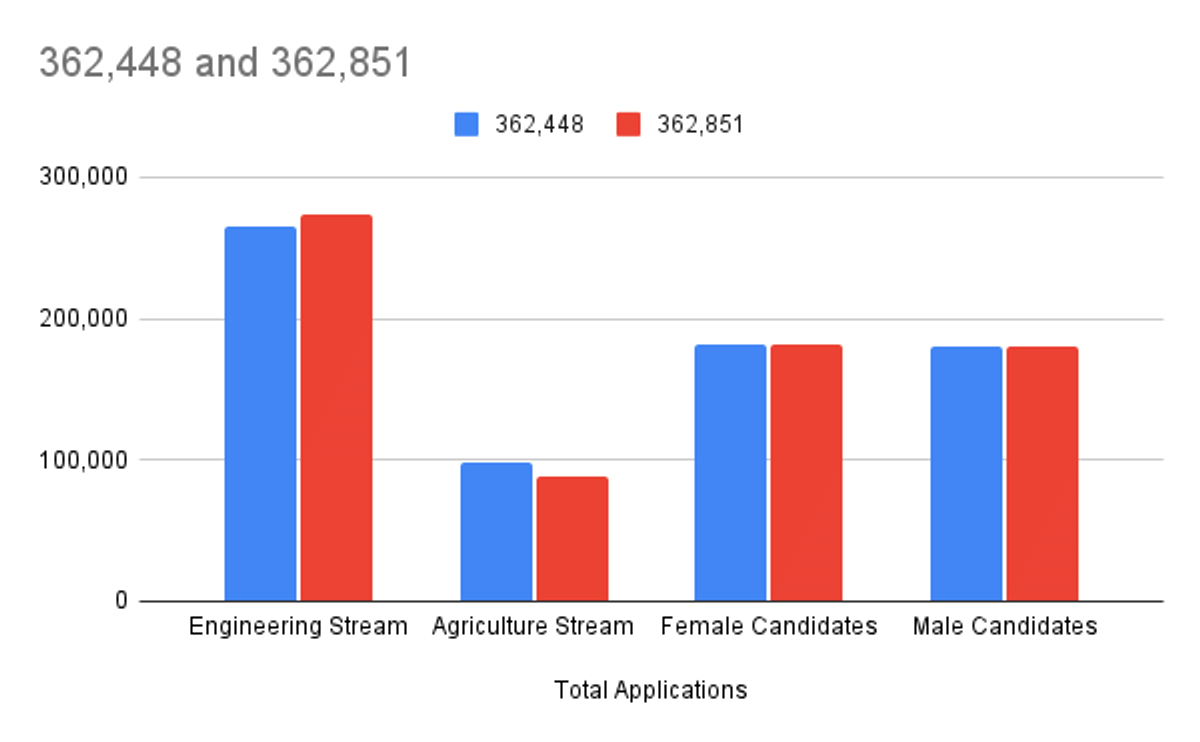
AP EAMCET Previous Year Registration trend (2023-25)
| Year | Total Applications | Engineering Stream | Agriculture Stream | Female Candidates | Male Candidates |
|---|---|---|---|---|---|
| 2025 | 362,448 | 264,840 | 97,608 | 182,283 | 180,165 |
| 2024 | 362,851 | 274,213 | 88,638 | 182,283 | 180,566 |
| 2023 | 337,500 | 230,000 (approx.) | 107,500 (approx.) | Not specified | Not specified |
Check:
AP EAPCET 2026 Exam Pattern
The EAPCET exam is divided into the Engineering stream and the Agriculture & Pharmacy stream.
- AP EAPCET 2026 engineering stream exam has 80 questions from maths, with 40 questions each from chemistry and physics, totalling 160 questions carrying each + 1 mark for correct answers. There is no negative marking in the paper.
- AP EAPCET 2026 agriculture & Pharmacy stream follows a biology-heavy (80 questions) exam pattern with physics and chemistry each having 40 questions.
| Aspect | Engineering Stream (MPC) | Agriculture & Pharmacy Stream (BiPC) |
|---|---|---|
| Primary Target Courses | B.Tech (Engineering, Biotechnology, Dairy Technology, Agricultural Engineering, Food Science & Technology), B.Pharmacy (MPC route in some cases) | B.Sc. (Agriculture), B.Sc. (Horticulture), B.V.Sc. & A.H., B.F.Sc., B.Pharmacy, Pharm.D |
| Subjects Tested | Mathematics, Physics, Chemistry | Biology (Botany + Zoology), Physics, Chemistry |
| Number of Questions | Mathematics: 80 Physics: 40 Chemistry: 40 Total: 160 | Biology: 80 (40 Botany + 40 Zoology) Physics: 40 Chemistry: 40 Total: 160 |
| Marks Distribution | Mathematics: 80 marks (50%) Physics: 40 marks (25%) Chemistry: 40 marks (25%) | Biology: 80 marks (50%) Physics: 40 marks (25%) Chemistry: 40 marks (25%) |
| Main Subject Weightage | Mathematics (highest emphasis – problem-solving & analytical skills) | Biology (highest emphasis – conceptual & factual knowledge in life sciences) |
| Exam Mode | Online CBT (Computer-Based Test) | Online CBT (Computer-Based Test) |
| Duration | 3 hours (180 minutes) | 3 hours (180 minutes) |
| Question Type | MCQs (4 options each) | MCQs (4 options each) |
| Marking Scheme | +1 per correct answer. No negative marking | +1 per correct answer. No negative marking |
| Medium | English & Telugu (Urdu help at Kurnool only) | English & Telugu (Urdu help at Kurnool only) |
| Exam Dates (2026) | 12 May to 18 May 2026 (no exam on 16 & 17 May) | Typically 19–20 May 2026 or overlapping with late MPC slots (as per recent patterns) |
| Session Timings | FN: 9:00 AM – 12:00 PM AN: 2:00 PM – 5:00 PM | Same as Engineering |
| Normalization | Yes (across multiple sessions) | Yes (across multiple sessions) |
| Qualifying Marks | General: 25% (40/160) SC/ST: No minimum (limited to reserved seats) | General: 25% (40/160) SC/ST: No minimum (limited to reserved seats) |
| Rank Calculation | 75% normalized EAPCET marks + 25% Intermediate (Maths + Physics + Chemistry) | 75% normalized EAPCET marks + 25% Intermediate (Biology + Physics + Chemistry) |
| Tie-Breaking Criteria | 1. EAPCET total marks 2. Mathematics marks 3. Physics marks 4. Age (older preferred) | 1. EAPCET total marks 2. Biology marks 3. Chemistry marks 4. Age (older preferred) |
| Key Preparation Focus | Strong Maths (algebra, calculus, coordinate geometry) + balanced Phy/Chem | Strong Biology (botany, zoology, human physiology, genetics) + balanced Phy/Chem |
Quick Links:
AP EAPCET Previous Year Question Paper
| AP EAPCET Question Paper 2025 | Download PDF |
|---|---|
| AP EAPCET Question Paper 2024 | Download PDF |
| AP EAPCET Question Paper 2023 | Download PDF |
| AP EAPCET Question Paper 2022 | Download PDF |
| AP EAPCET Question Paper 2021 | Download PDF |
| AP EAPCET Question Paper 2020 | Download PDF |
| AP EAPCET Question Paper 2019 | Download PDF |
| AP EAPCET Question Paper 2018 | Download PDF |
| AP EAPCET Question Paper 2017 | Download PDF |
AP EAPCET 2026 Syllabus
The syllabus for AP EAPCET 2026 has been released on the official website, and candidates are advised to read their respective exam syllabus for a comprehensive understanding of the requirements and aptitude acumen.
The syllabus is different for engineering (MPC) and pharmacy & agriculture streams.
| Feature | Engineering (MPC) | Agriculture & Pharmacy (BiPC) |
|---|---|---|
| Subjects | Physics, Chemistry, Mathematics | Physics, Chemistry, Botany, Zoology |
| Focus Areas | Technical and Mathematical Concepts | Biological and Agricultural Sciences |
| Career Pathways | Engineering, Technology | Agriculture, Pharmacy, Medical Sciences |
To know the syllabus of each subject in detail, please refer to the following: -
| AP EAMCET Syllabus Subject-wise | Check Here |
|---|---|
| AP EAPCET Mathematics Syllabus | Check Here |
| AP EAPCET Biology Syllabus | Check Here |
| AP EAPCET Chemistry Syllabus | Check Here |
| AP EAPCET 2024 Physics Syllabus | Check Here |
AP EAPCET 2026 Subject-wise weightage
The engineering stream has three subjects: Physics, Chemistry, and Maths. Please refer to the following tables for their subject-wise weightages: -
For Physics Syllabus (For Engineering and Pharmacy & Agriculture streams): -
| Topic | Weightage (No. of Questions) | Weightage (%) | |
|---|---|---|---|
| Heat and Thermodynamics | 9–10 | 22.5% | |
| Systems of Particles and Rotational Motion | 6–7 | 17.5% | |
| Work, Energy, and Power | 5–6 | 15% | |
| Motion in a Plane | 4–5 | 12.5% | |
| Laws of Motion | 5–6 | 15% | |
| Gravitation | 3–4 | 10% | |
| Moving Charges and Magnetism | 4–5 | 12.5% | |
| Oscillations | 4–5 | 12.5% | |
| Current Electricity | 3–4 | 10% | |
| Waves | 3–4 | 10% | |
For Chemistry Syllabus (For Engineering and Pharmacy & Agriculture streams): -
| Topic | Weightage (No. of Questions) | Weightage (%) |
|---|---|---|
| Atomic Structure | 2–3 | 7.5% |
| Chemical Bonding and Molecular Structure | 3–4 | 12.5% |
| States of Matter | 2–3 | 7.5% |
| Thermodynamics | 3–4 | 12.5% |
| Equilibrium | 3–4 | 12.5% |
| Redox Reactions | 2–3 | 7.5% |
| s-Block Elements | 2–3 | 7.5% |
| Some p-Block Elements | 2–3 | 7.5% |
| Organic Chemistry – Some Basic Principles and Techniques | 3–4 | 12.5% |
| Hydrocarbons and Environmental Chemistry | 3–4 | 12.5% |
For Maths Syllabus (For Engineering Stream only): -
| Topic | Weightage (No. of Questions) | Weightage (%) |
|---|---|---|
| Algebra | 10–12 | 12.5% |
| Trigonometry | 10–12 | 12.5% |
| Probability and Statistics | 11–15 | 15% |
| Vector Algebra | 11–15 | 15% |
| Coordinate Geometry | 10–12 | 12.5% |
| Calculus | 11–15 | 15% |
For the Botany and Zoology (Agriculture and Pharmacy stream only): -
| Topic | Weightage (No. of Questions) | Weightage (%) |
|---|---|---|
| Diversity in the Living World | 15–18 | 18.75% |
| Structural Organisation in Animals | 12–15 | 15% |
| Cell Structure and Function | 12–15 | 15% |
| Plant Physiology | 12–15 | 15% |
| Human Physiology | 12–15 | 15% |
| Reproduction | 12–15 | 15% |
| Genetics and Evolution | 12–15 | 15% |
AP EAPCET 2026 Preparation Tips
To prepare for AP EAMCET 2026, you need to plan a month-wise strategy. Below is a well-structured 9-month plan broken down into several phases, maintaining a proper balance between concept clarity, practice, and examination strategy.
- Phase 1 (Months 1–3): Develop a foundation of basic concepts by reading NCERT textbooks, taking notes, and solving basic problems for around 4–5 hours a day.
- Phase 2 (Months 4–6): In phase 2, you must raise your performance by reading for 5–6 hours a day to perform topic-wise practice, solve last year's papers, and moderate to difficult questions.
- Phase 3 (Months 7–8): In the third phase, begin taking full-length mock tests to maximise your speed and practice error analysis with 6–7 hours of daily study to learn the art of time management and accuracy before the exam.
- Phase 4 (Month 9): This is the final phase, spend time on rapid revision of high-weightage subjects, practising the last 5 years' papers, and stress management for 4–5 hours a day.
| Phase | Months | Focus | Activities | Suggested Daily Preparation Hours |
|---|---|---|---|---|
| Phase 1 | 1–3 | Foundation & Concept Building | Study NCERT textbooks thoroughly, make concept notes, and practice basic problems practice | 4–5 hours |
| Phase 2 | 4–6 | Intensive Practice & Application | Topic-wise practice, previous year papers, moderate to difficult questions, and revise formulas | 5–6 hours |
| Phase 3 | 7–8 | Mock Tests & Speed Optimization | Full-length mock tests, time management, identify and correct mistakes | 6–7 hours |
| Phase 4 | 9 | Final Revision & Exam Strategy | Quick revision of high-weightage topics, last 5-year solved papers, and stress management | 4–5 hours |
AP EAMCET Phase-wise Time Allocation
| Phase | Months | Focus | Activities |
|---|---|---|---|
| Phase 1 | 1–3 | Foundation & Concept Building | NCERT study, basic problem practice |
| Phase 2 | 4–6 | Intensive Practice & Application | Topic-wise practice, previous year papers |
| Phase 3 | 7–8 | Mock Tests & Speed Optimisation | Full-length mocks, time management |
| Phase 4 | 9 | Final Revision & Exam Strategy | Revision, quick mocks, stress management |
Check Also:
AP EAMCET Mock Tests: - Direct link to take an online free mock test for MPC and BPC
AP AEPCET 2026 Cutoff (expected)
The trends of the AP EAMCET cutoff show that even small differences in a test taker's score result in significant variations in rank. Variables such as the difficulty of the exam, how many candidates take the test, and the number of available seats can also impact how high or low the final cutoff will be.
- In the Engineering stream, students' overall scores of 150 -160 yield rankings of 1-100; whereas overall scores of 140 -149 yield rankings of 101-500; finally, scores between 130-139 produce rankings of 501-1000.
- In the Agriculture and Pharmacy stream, a score of 140 -160 yields rankings up to the top 500; whereas scores of 120 through 129 yield rankings from 1001 through 2000.
Generally speaking, any score above a 120 would be enough to qualify for almost all good colleges, while scores of 100-109 would potentially qualify for some colleges at a mid-range level.
Engineering Stream (MPC)
| Marks | Estimated Rank Range |
|---|---|
| 150–160 | 1–100 |
| 140–149 | 101–500 |
| 130–139 | 501–1,000 |
| 120–129 | 1,001–2,000 |
| 110–119 | 2,001–3,000 |
| 100–109 | 3,001–5,000 |
Agriculture & Pharmacy Stream
| Marks | Estimated Rank Range |
|---|---|
| 140–160 | 1–500 |
| 130–139 | 501–1,000 |
| 120–129 | 1,001–2,000 |
| 110–119 | 2,001–3,000 |
| 100–109 | 3,001–5,000 |
Also Check:
AP EAMCET Colleges List - 2026
The Andhra Pradesh State Council of Higher Education (APSCHE) has accredited many public and private institutions in the state that provide undergraduate degrees through the AP EAPCET examination. Some of the most well-known institutions include:
- Jawaharlal Nehru Technological University - Kakinada (JNTUK - Kakinada)
- Andhra University College of Engineering - Visakhapatnam
- Sri Venkateswara University College of Engineering - Tirupati
- VIT-AP University - Amaravati
- GMR Institute of Technology - Rajam
- Gayatri Vidya Parishad College of Engineering - Visakhapatnam
- RVR & JC College of Engineering - Guntur
- Velagapudi Ramakrishna Siddhartha Engineering College - Vijayawada.
AP EAMCET Courses (Branch Codes)
The AP EAPCET 2026 exam has a variety of undergraduate courses to offer to aspirants. The table presents all the available branches to candidates fo AP EAP CET 2026 exam:
| Branch Code | Branch Name |
|---|---|
| AGR | Agricultural Engineering |
| AI | Artificial Intelligence |
| AID | Artificial Intelligence and Data Science |
| AIM | Artificial Intelligence and Machine Learning |
| ASE | Aerospace Engineering |
| AUT | Automobile Engineering |
| BDT | Dairy Technology |
| BIO | Biotechnology |
| CAD | Computer Science Engineering (AI & Data Science) |
| CAI | Computer Science and Engineering (AI) |
| CBA | Computer Science Engineering (Big Data Analytics) |
| CBC | Computer Science Engineering (Blockchain) |
Also Check:
- List of Engineering Colleges in India Accepting AP EAPCET Based on 2025 Ranking
- AP EAMCET (EAPCET) Mock Test 2026: Take an online free mock test for MPC and BPC
FAQs:
Ques: What is the purpose of the AP EAPCET exam?
Ans: AP EAPCET is a state-level entrance test that aims to grant entry into an array of undergraduate programs, i.e., engineering, pharmacy and agriculture, being offered at institutions located within the state of Andhra Pradesh. It creates a single point of reference for students seeking admission into B. tech, B.Pharm, B.sc. (Agriculture) and other similar courses.
Ques: Which student achieved 1st rank in AP EAPCET 2025?
Ans: Avanaganti Anirudh Reddy from Vanasthalipuram, Hyderabad has achieved a score of 96.3969 (out of 100) and achieved 1st ranking amongst the engineers that took the exam.
In terms of the agriculture and pharmacy streams, Ramayanam Venkata Naga Sai Harshavardhan from Penamaluru, Krishna district, was awarded 1st ranking.
Ques: Will the AP EAPCET Examination be offered in multiple languages/mediums?
Ans: Yes; The AP EAPCET will be offered in both English and Telugu.
Ques. Is Mathematics compulsory for all candidates?
Ans. No, Mathematics is not compulsory for all the candidates; it is mandatory for the candidates who are applying for the Engineering stream (B.Tech).
Those candidates who are applying for the Agriculture/Pharmacy stream, mathematics is not compulsory for them.
Ques. Can candidates from other states apply for AP EAMCET 2026?
Ans. Yes, candidates from other states can apply for the AP EAMCET 2026 exam provided that they meet the eligibility criteria, as they will be considered under the Unreserved (OU) category and will not be eligible for the local quota.
Ques. Are there any reservations for SC/ST candidates?
Ans. Yes, there are reservations for SC/ST candidates as per the government norms. The SC/ST candidates are eligible for a qualifying percentage of 40% in the qualifying examination.
Ques. Can I change my exam centre after submission?
Ans. No, you cannot change your AP EAMCET exam centre after submitting your application. The AP EAMCET Correction window does not allow you change your exam centre preferences. The Correction window only allows you to change certain details like name, DOB, and community.






Comments
Found 42 Comments
You can check here for the AP EAMCET Previous Year Question Paper- Download Solution PDF with Answer Keys [2024-2013]. The question paper has a total of 160 MCQ type questions. Total time allotted for completing the examination is 3 hours. The question paper consists of topics from Physics, Chemistry, and Mathematics and in MPC covers questions from Physics, Chemistry, and Biology (Botany and Zoology) subjects.
You can download the AP EAMCET (AP EAPCET) 2026 result from the official APSCHE examination website once the result link becomes active. The official result download page is available through the EAPCET section of the cets.apsche.ap.gov.in portal, where students can check their marks and rank by logging in with their hall ticket and registration details. After submitting the required information, the result will appear on the screen, and you can save or print the rank card for counselling and admission purposes in engineering or pharmacy programs.
To download the AP EAMCET question papers from the official website, visit https://sche.ap.gov.in/EAMCET. Navigate to the “Previous Question Papers” or “Downloads” section, select the desired year and stream (Engineering/Medical), and click “Download.” Save the PDF to your device for reference and practice
The EAMCET (Engineering, Agriculture and Medical Common Entrance Test) is an annual entrance examination conducted by the Andhra Pradesh State Council of Higher Education (APSCHE). It is used for admission into undergraduate professional courses in Engineering, Agriculture, and Medical streams across colleges in Andhra Pradesh and Telangana. The exam tests knowledge in Physics, Chemistry, and Mathematics/Biology, and ranks candidates based on merit for counseling and seat allotment in state universities and affiliated colleges
For AP EAMCET 2025 B.Sc Agriculture, the expected cut-off ranks vary by category and college: for top government agriculture colleges like ANGRAU, general category students may need ranks below about 3,500–5,000, while other categories (BC/SC/ST) have higher cutoff ranges; private colleges may admit up to 25,000–35,000+, depending on seats and reservation.
You can register for AP EAMCET (now called AP EAPCET) to join the B.Pharmacy course if you meet the eligibility criteria. You must have passed or appeared in 10+2 with Physics, Chemistry, and Biology/Maths, and satisfy age and local status requirements. Registration is done online through the official AP EAPCET application portal; after applying, you must take the exam, get a rank, and then complete counselling for seat allotment in B.Pharmacy programs.
For AP EAMCET BiPC stream counselling 2025, the final phase registration and counselling last date was November 4, 2025, with web options and document verification also closing around the same time, and the final seat allotment announced on November 7, 2025.
You can take the following actions to register for the Amrita Vishwa Vidyapeetham Chennai Campus:
The applicants' exam results are fully weighted in the preparation of the AP EAMCET rank list. Generally, when preparing the rank list, 75% of the points from the AP EAMCET and 25% from the school results are taken into account.
Between 1 and 5000 is considered as a good rank range. A candidate must receive between 150 and 160 marks on the AP EAMCET in order to receive a rank below 1000.
Here are some tips to score well in AP EAMCET
Please check the link for 2024 EAPCET questions and answers https://collegedunia.com/exams/ap-eapcet/question-paper
The date of commencement of AP EAPCET BiPC counseling has not been released yet. The examination conducting authority will shortly release the counseling notification on its official website.
The official dates for the AP EAPCET BiPC counseling 2023 is yet to be released. However, it is expected that students can start exercising the Web option from mid November 2023.
AP EAPCET BiPC counseling has been delayed. The official notification for the said counseling session is yet to released. The official dates will be soon released by APSCHE.
The counseling process for AP EAPCET 2023 BiPC Counseling is expected to begin shortly. The official dates of counseling will be released soon by the conducting authority.
AP EAMCET BiPC Counseling 2023 is to begin soon. However, APSCHE has not released the official dates for the counseling process yet. The official notification will be released shortly.
APSCHE has already conducted Round 1 Counseling for AP EAPCET MPC. But APSCHE has not yet released the official dates for MPC Round 2 counseling and BiPC Round 1 counseling.
Dhanekula Institute of Engineering and Technology releases the AP EAPCET cut-off for the B.Tech CSE program for each category of students and for each round of counseling. You can check the detailed cut-off for this college from DIET Vijayawada Cut-offs.
AP EAPCET 2023 Round 1 Counseling registration begun on July 24, 2023. The counseling process has been conducted and the seat allotment results have been declared on August 23, 2023. The dates for Round 2 counseling are yet to be released.