




The AP EAMCET is now officially known as the AP EAPCET exam. The AP EAPCET exam pattern is the same as that of previous years. Every year, JNTU Kakinda releases the AP EAPCET exam pattern on its official website, cets.apsche.ap.gov.in. Candidates seeking admission to colleges in Andhra Pradesh must know the exam pattern for the MPC and BiPC streams.
- AP EAPCET MPC exam pattern is for engineering, and AP EAPCET 2027 BiPC exam is for agriculture and pharmacy streams.
- The AP EAPCET exam duration is of 3 hours in CBT mode, comprising 160 questions in total.
- The AP EAPCET exam pattern for MPC consists of 80 questions in Mathematics and 40 questions each from Physics and Chemistry.
- EAMCET exam pattern BiPC: candidates need to answer 80 questions in Biology (Botany-40, Zoology-40) and 40 each from Physics and Chemistry.
- According to AP EAPCET marking scheme, there is no negative marking for either stream of examination. Each correct answer is worth +1 mark.
AP EAMCET Exam Pattern Evolution from AP EAMCET to AP EAPCET: The AP EAMCET is the most common term used among aspirants for years. Candidates often get confused with the terminology used to denote the same examination. Here is what you should know before learning the AP EAMCET paper pattern:
AP EAMCET stands for Andhra Pradesh Engineering, Agricultural and Medical Common Entrance Test.
- But in 2021, the government changed AP EAMCET to AP EAPCET.
- The M in “AP EAMCET” meant Medicine, but UG medical admission is conducted only through NEET. So the “M” was replaced with “P”, which stands for professional course- “Pharmacy”.
Therefore, the AP EAMCET was converted to AP EAPCET. Hence, AP EAPCET stands for Andhra Pradesh Engineering, Agriculture and Pharmacy Common Entrance Test.
Other than the transition in the exam name, the core exam pattern/ structure is the same as before for MPC and BiPC streams.
Related Articles:
- AP EAPCET Agriculture Exam Pattern: Marking Scheme, BSc Agriculture Rank, IPE Marks & Syllabus
- AP EAMCET Syllabus: Subject-Wise Weightage, Important Topics, Best Books, and PYQs
Key Summary
- The AP EAPCET exam pattern questions will be in English and Telugu medium only. Urdu assistance will be provided at the Kurnool centre.
- A general category candidate should have 25% aggregate marks in the qualifying examination to get a rank. For SC and ST there is no qualifying marks are required.
- As per AP EAMCET paper pattern, out of the four options, there will be only one correct answer.
- All questions in both the streams will have equal weightage and the AP EAMCET total marks is 160.
AP EAMCET Exam Pattern Overview 2027
On behalf of APSCHE, JNTU Kakinda conducts the AP EAPCET examination. The key highlights of the AP EAPCET exam pattern are tabulated below:
| Particular | Key Details |
|---|---|
| Exam Mode | Online (CBT) |
| Duration | 3 Hours |
| Medium of Exam | English and Telugu (Candidates willing to give the exam in Urdu have to appear at Kurnool only) |
| Question Type | MCQs (4 options, 1 correct) |
| Total Questions | 160 |
| Total Marks | 160 |
| Marking Scheme | +1 for correct, no negative marking |
Related Article: AP EAMCET Previous Year Question Paper- Download Solution PDF with Answer Keys
Ques. Is AP EAPCET exam pattern and AP EAMCET paper pattern the same?
Ans. Yes, AP EAMCET is known as AP EAPCET after the government changed the name in 2021. Now, the current official exam name is AP EAPCET, which comprises 160 questions in total, with a similar subject-wise question distribution.
AP EAMCET Exam Pattern for Engineering 2027
The AP EAPCET exam pattern for the engineering stream includes Mathematics, Physics and Chemistry.
- Mathematics carries 50% weightage, while Physics and Chemistry together contribute the other 50%.
- The AP EAPCET subject-wise question distribution for the engineering domain is tabulated below:
| Subject | Questions | Marks |
|---|---|---|
| Mathematics | 80 | 80 |
| Physics | 40 | 40 |
| Chemistry | 40 | 40 |
| Total | 160 | 160 |
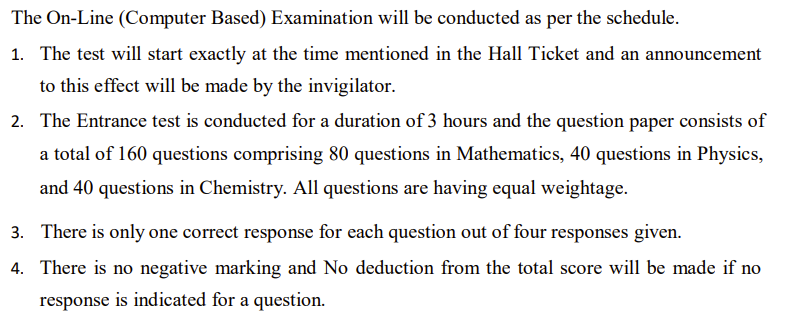
Source: cets.apsche.ap.gov.in
Related Links:
- AP EAPCET Mathematics Syllabus: Download PDF, Check Weightage, Important Topics, Best Books
- AP EAPCET Physics Syllabus, Check Weightage of Important Topics, Best Books
- AP EAPCET Chemistry Syllabus: Important Topics, Weightage & Preparation Tips
Ques. How many questions are asked in AP EAPCET Engineering?
Ans. The total number of questions asked in AP EAPCET Engineering is 160. Maths comprises 80 questions, which is half of the paper and Physics and Chemistry each have 40 questions.
AP EAMCET Exam Pattern BiPC 2027
The EAMCET exam pattern BiPC comprises Biology (Botany + Zoology), Physics and Chemistry.
The Biology subject comprises 80 questions, split into:
- 40 questions from Botany
- 40 questions from Zoology.
Candidates appearing in AP EAPCET BiPC must focus more on Biology, which carries half of the total marks.
The AP EAPCET subject-wise question distribution for Agriculture and Pharmacy (BiPC) stream is as follows:
| Subject | Questions | Marks |
|---|---|---|
| Biology | 80 | 80 |
| Physics | 40 | 40 |
| Chemistry | 40 | 40 |
| Total | 160 | 160 |
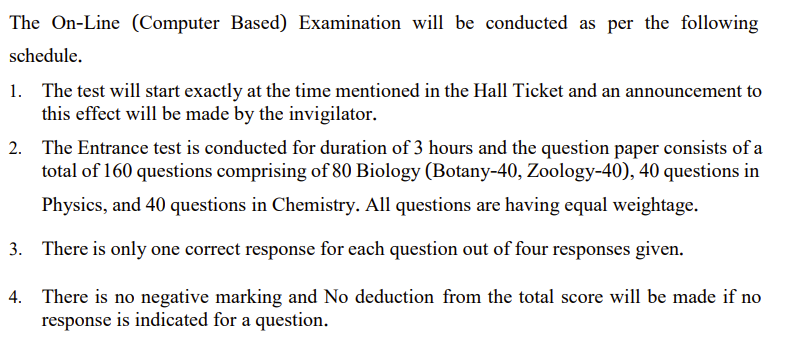
Source: cets.apsche.ap.gov.in
Has the AP EAPCET Subject-Wise Question Distribution Trend Changed Over the Years?
No, the number of questions in the AP EAPCET exam pattern has been consistent over the years. The AP EAMCET exam pattern comprises;
- 80 questions from Maths
- 40 questions from Physics
- 40 questions from Chemistry
- 80 questions from Biology (only for BiPC)
This means the weightage of the exam pattern is 50% for Maths, 25% each for Physics and Chemistry for the MPC stream.
Also Read:
- AP EAMCET Syllabus: Subject-Wise Weightage, Important Topics, Best Books, and PYQs
- AP EAMCET Biology Syllabus: Detailed Syllabus, Important Topics, Weightage, and Preparation Tips
Ques. What is the duration of AP EAPCET?
Ans. The total duration of the AP EAPCET examination is 3 hours. You need to answer 160 MCQs in CBT mode.
AP EAPCET Exam Pattern Important Topics 2027
The AP EAPCET subject-wise important topics for MPC candidates are tabulated below based on priority:
| Subjects | Must Do Chapters | Secondary Chapters |
|---|---|---|
| Mathematics | Differentiation, Integration, Limits and Continuity, Circles, System of Circles, Matrices and Determinants, Complex Numbers/ Quadratic and Cubic Equations, P&C and Probability | Conic Sections, Functions, 2D and 3D Geometry, Binomial Theorem, Trigonometry and Vectors 3& D |
| Physics | Motion in a Straight Line and Plane, Systems of Particles and Rotatory Motions, Work/Power and Energy, Laws of Motion, Moving Charges and Magnetism, Thermodynamics, Modern Physics and Current Electricity | Waves, Electrostatics, Gravitation, Ray Optics, Oscillations and EMI |
| Chemistry | Atomic Structure and Chemical Bonding, Solutions, States of Matter, Chemical Kinetics, Thermodynamics, P/D block elements, Periodic Classification, Haloarens/ Carboxylic Acid/ Aldehydes and Ketones | General Organic Chemistry: Alcohls/ Phenols/ Ethers, Aromatic Compounds, F/S Block Elements |
You can watch the YouTube video: “ Spark Andhra Pradesh- IPE and EAPCET” to know the complete details regarding AP EAPCET 2027. In this video, you will find information about the exam pattern, important topics and top colleges accepting AP EAPCET scores.
AP EAPCET 2027 Subject-wise Chapter Weightage: Past Years Analysis
The subject-wise weightages for AP EAPCET based on past years' trend analysis are tabulated below. Prepare for AP EAPCET 2027 based on the weightages for each chapter to cover the maximum part of the syllabus.
AP EAPCET 2027 Maths Chapter-wise Weightage
| Topic Covered | Combined Number of Questions Asked | Combined Weightages (%) |
|---|---|---|
| Differentiation, Integration, Limits and Continuity, Circles and System of Circles, Matrices and Determinants, Complex Numbers, Probability | 35- 50 | 35- 50 |
| Conic Sections, Functions, 2 and 3 D Geometry, Binomial Theorem, Trigonometry and Vector 3D | 20- 25 | 20- 30% |
AP EAPCET 2027 Physics Chapter-wise Weightage
| Topic Covered | Combined Number of Questions Asked | Combined Weightages (%) |
|---|---|---|
| Motion in a Straight Line, Systems of Particles and Rotataory Motions, Work, Power and Energy, Laws of Motion, Moving Charges and Magnetism, Thermodynamics, Modern Physics, Current Electricity, Moving Charges and Magnetism | 20- 25 | 20- 25 |
| Waves, Electrostatics, Electrostatic Potential, Gravitation, Ray Optics, Oscillations, Electromagnetic Induction | 5- 10 | 5- 10% |
| Unit and Dimension, Mechanical Properties of Solid, Magnetism and Matter, Kinetic Theory of Gases, Wave Optics, Communication System | 5- 10 | 5- 10 |
AP EAPCET 2027 Chemistry Chapter-wise Weightage
| Topic Covered | Combined Number of Questions Asked | Combined Weightages (%) |
|---|---|---|
| Atomic Structure and Chemical Bonding, Solutions, States of Matter, Chemical Kinetics, Thermodynamics, P-Block and D-Block elements, Periodic Classification, Organic Chemistry | 25 | 25 |
| General Organic Chemistry, Alcohols, Phenols, Ethers, Aromatic Compounds, F and S Block Elements | 10- 12 | 10- 12 |
| Mole Concept, Measurements in Chemistry, Surface Chemistry, Coordination Compounds | 3- 5 | 3-5 |
Related Articles:
- AP EAMCET (EAPCET) Mock Test: Take Online Free Mock Test for MPC and BPC
- AP EAMCET (EAPCET) Physics Mock Test: Attempt Free Online Chapter-wise and Topic wise Mock Tests
- AP EAMCET (EAPCET) Chemistry Mock Test: Attempt Free Online Chapter-wise and Topic wise Mock Tests
- AP EAMCET (EAPCET) Mathematics Mock Test: Attempt Free Online Chapter-wise and Topic wise Mock Tests
Ques. What are the important Biology topics for AP EAPCET 2027?
Ans. Important topics for AP EAPCET 2027 Biology include Cell Biology, Genetics, Plant Physiology, Human Physiology, and Ecology.
AP EAPCET Marking Scheme 2027
According to the AP EAPCET exam pattern, the total marks for each stream are 160.
- The AP EAPCET marking scheme makes it a more student-friendly examination.
- Thus, candidates should not leave any questions unanswered.
| Question Type | Marks Awarded | Negative Marking |
|---|---|---|
| Correct Answer | +1 mark | None |
| Incorrect Answer | 0 marks | None |
| Unanswered Questions | 0 marks | None |
Does EAMCET have Negative Marking?
No, EAMCET has no negative marking. Candidates are advised to solve questions without leaving any to score maximum marks in the AP EAMCET exam.
Related Articles:
AP EAMCET Total Marks for MPC and BiPC
The EAMCET total marks for each stream is 160. The EAMCET total marks score calculation formula with an example is discussed below.
EAMCET Total Marks MPC Score Calculation
Suppose an MPC candidate attempted 140 questions, left 10 unattempted and had 10 wrong answers. A common question among students is: What are the total marks in EAMCET?
Here is the total marks in EAMCET calculation method-
| EAMCET Total Marks MPC Score Calculation Formula: Number of Correct Questions (140) x 1 |
Hence, the candidate's EAMCET Total Marks MPC is 140 out of 160, as there is no impact of negative marking or unattempted questions.
EAMCET Total Marks for BiPC
Suppose a BiPC candidate attempted 150 questions, with 5 unattempted and 5 wrong answers. Students often ask What will be the total marks in EAMCET?
Here is the total marks in EAMCET calculation method-
| EAMCET Total Marks BiPC Score Calculation Formula: Number of Correct Questions (150) x 1 |
Hence, the candidate's EAMCET Total Marks for BiPC is 150 out of 160, with no negative marking for incorrect or unattempted questions.
Related Link: AP EAPCET Paper Analysis: Check Shift Wise Analysis, Difficulty Level, Question Papers
Ques. How many marks for EAMCET for BiPC?
Ans. The EAMCET (EAPCET) exam for the BiPC stream (Agriculture and Pharmacy) is conducted for a total of 160 marks. The question paper contains 160 multiple-choice questions, with 1 mark given for each correct answer and no negative marking for wrong answers.
AP EAPCET Exam Timings 2027
The AP EAPCET exam duration for MPC and BiPC streams is 3 hours. Usually, the AP EAPCET exam commences in two slots: morning and Afternoon.
Candidates need to complete their entire stream-specific paper within the time limit.
| AP EAMCET Exam Slots | AP EAMCET Exam Duration |
|---|---|
| Morning Shift | 9:00 AM – 12:00 PM |
| Afternoon Shift | 2:00 PM – 5:00 PM |
On discussion forums such as Reddit, users have shared some AP EAPCET exam tips along with how to complete the exam within the time limit.
As per the guide provided, EAPCET is a speed-game test; you need to look at the question and solve it. Figure out if Physics or Chemistry is your strength. Most EAMCET questions are easier than JEE Main. If a question looks familiar but clearly takes 6- 8 minutes to solve, leave it for last, as time matters.
Recommended Time Splits for subjects in AP EAPCET should be:
- Physics: 30- 40 Minutes
- Chemistry: 40- 50 Minutes
- Maths: 90- 110 Minutes
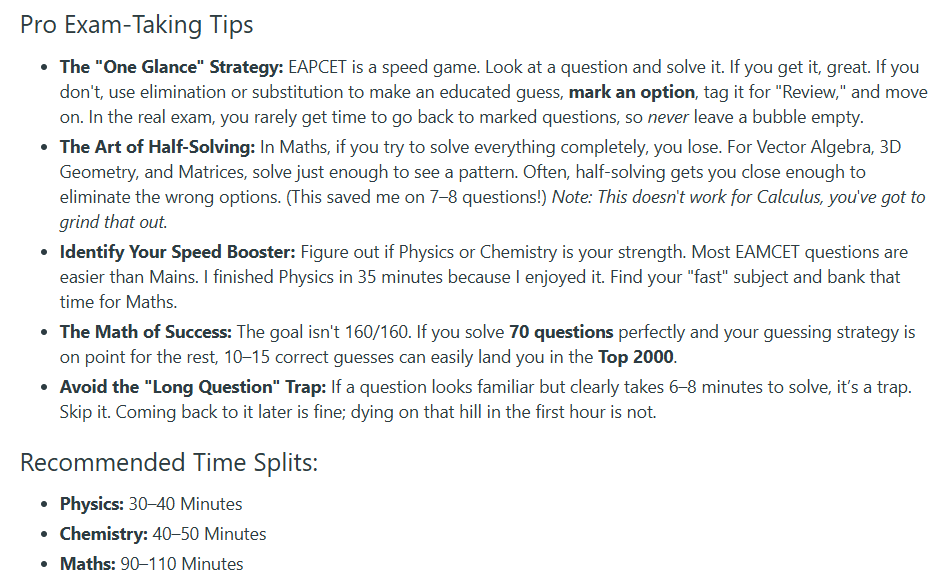
Source: Reddit
Also Check:
- AP EAMCET Exam Centres: Check List of District-wise & Regional Centres & Important Instructions
- AP EAMCET Hall Ticket: Check Release Date, How to Download, Exam Day Guidelines
Ques. How many questions are asked in AP EAMCET BiPC?
Ans. The AP EAMCET BiPC (Agriculture and Pharmacy) paper have 80 Biology questions (40 from Botany and 40 from Zoology), 40 Physics questions, and 40 Chemistry questions.
AP EAMCET Exam Pattern 2027: Mode of Language
The AP EAPCET exam pattern will be in CBT mode. The AP EAMCET paper pattern comprises MCQs only. The number of options available for one question is 4. Out of 4, only one answer will be correct.
| Mode of Language for AP EAPCET Exam 2027 | |
|---|---|
| English and Telugu | Candidates willing to give the exam in Urdu have to appear only at the Kurnool Centre |
Related Link: AP EAMCET Chapter Wise Weightage
Ques. What is the marking scheme for AP EAPCET 2027?
Ans. According to the AP EAPCET marking scheme 2027, each correct answer carries +1 mark, while incorrect or unanswered questions carry 0 marks.
AP EAPCET Exam Pattern 2027 FAQs
Ques. How many marks for EAMCET?
Ans. The EAMCET (now officially called EAPCET in Andhra Pradesh) has a maximum total of 160 marks for the engineering and BiPC streams. The exam consists of 160 multiple-choice questions, with 1 mark awarded for each correct answer and no negative marking for wrong answers.
Ques. What are the TS EAMCET total marks for BiPC?
Ans. The total marks for the TS EAMCET (TG EAPCET) BiPC (Agriculture and Pharmacy) stream are 160 marks. The exam consists of 160 multiple-choice questions, with each correct answer carrying 1 mark and no negative marking for wrong answers.
Ques. What subjects are included in the AP EAPCET Exam Pattern 2027?
Ans. AP EAPCET Exam Pattern for MPC includes Mathematics, Physics, and Chemistry. AP EAPCET BiPC Exam Pattern consists of Biology, Physics, and Chemistry.
Ques. Is 40 marks good in AP EAMCET?
Ans. No, 40 marks out of 160 is generally not considered a good score in the AP EAMCET exam. 40 marks is the exact minimum qualifying mark for the general category to pass the test and be eligible for the counselling process.
Ques. What is 39 marks in EAMCET?
Ans. Scoring 39 marks in AP EAMCET makes the general category fall short of the minimum qualification threshold. For SC/ST candidates, there is no minimum mark requirement to secure a rank.
Ques. Is 70 a good score in AP EAMCET?
Ans. A score of 70 out of 160 in AP EAMCET is a decent score. With these marks, you will secure admission into mid-tier private engineering colleges in core specializations.
Ques. Is EAMCET paper easy or hard?
Ans. The AP EAMCET paper is generally considered moderate in overall difficulty. It is comparatively less difficult than JEE Main. But you should master speed because it is long and has strict time limits.
Ques. What is the rank for 37 marks in EAMCET?
Ans. With 37 marks in AP EAPCET, your estimated rank will be around 90000 and 100000+ for a reserved category. If you are from the General/OC category, you will not be assigned any rank, as 37 is below the qualifying marks.
Ques. Is 75000 a good rank in EAMCET?
Ans. A rank of 75000 in AP EAMCET is generally considered a below-average rank. You can still secure admission into decent regional private engineering colleges or core branches in mid-tier colleges.



Comments