




The AP EAPCET, formerly known as AP EAMCET, is an entrance exam for admission in various Engineering, Agriculture, and Pharmacy courses in several colleges in Andhra Pradesh. The exam features sections such as Physics, Mathematics/Zoology & Botany(for Pharmacy & Agriculture courses) and Chemistry.
A candidate planning to attempt AP EAMCET 2026 must know the detailed chapter-wise weightage from each section, which helps in better strategising for the exam.
- Mathematics is the most important and rewarding section in AP EAPCET, comprising 80 questions out of 160 questions.
- Other sections such as Physics, Chemistry, Zoology and Botany comprises 40 questions each.
- Some important topics in AP EAPCET Mathematics are Functions, Probability, Circle, Complex Numbers, etc, which usually see 3-5 questions from each topic.
- Physics: According to expert analysis, some high-weightage topics in AP EAPCET Physics are Mechanical Properties of Fluids , Waves, Work , Energy, Current Electricity etc. These sections are expected to see 2-3 questions in 2026.
- Chemistry: Topics such as Organic Compounds, Atomic Structure, States of Matter, Thermodynamics etc are considered high-weightage topics, covering roughly 10 questions or 25% of the AP EAMCET’s Chemistry section.
Also Read:
- AP EAMCET 2026 Syllabus: Subject-Wise Weightage, Important Topics, Best Books, and PYQs
- AP EAPCET Exam Pattern 2026: Subject-Wise Weightage, Marking Scheme & Type of Questions
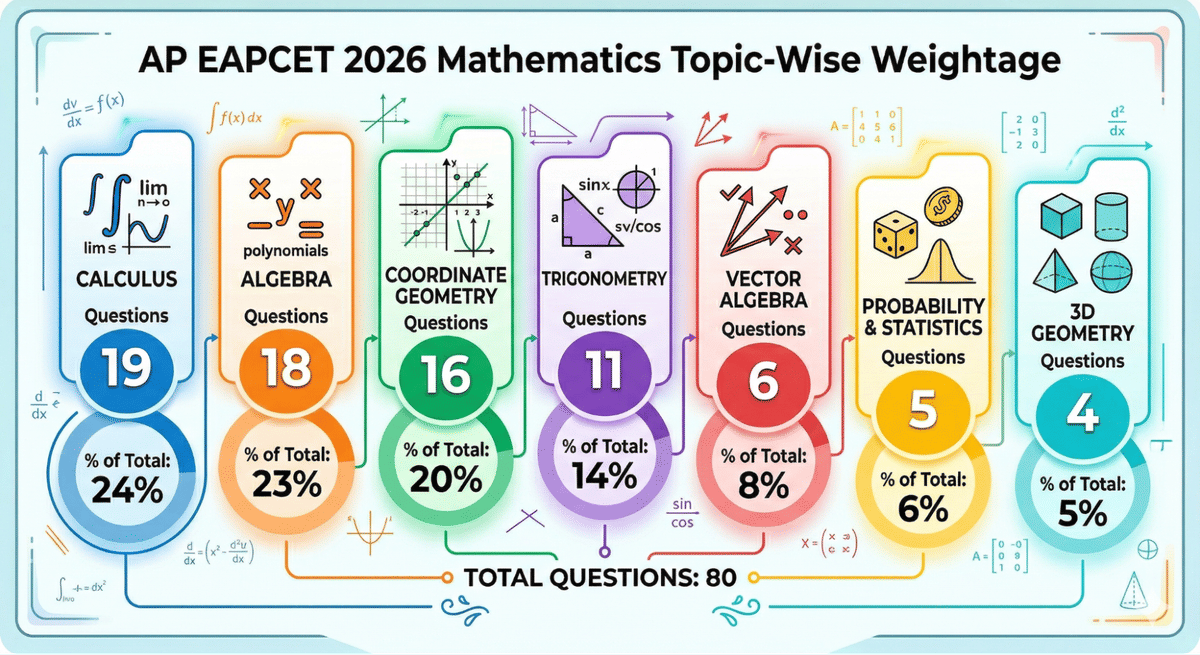
AP EAMCET 2026 Mathematics Chapter-Wise Weightage
Some major topics in the Mathematics sections of AP EAMCET 2026 are as follows:
- Algebra
- Calculus
- Coordinate Geometry
- Trigonometry
Together, these major sections comprise 80%(roughly 64 questions) of the Mathematics section in the AP EAPCET exam as shown in the infographic below:
Detailed chapter-wise weightage distribution of the Mathematics section for 2026 and previous years are given in the table below:
| S.No | Chapter Name | Weightage - Expected Number of Questions | |
|---|---|---|---|
| 2026 | 2025 | ||
| 1 | Functions | 4 | 4 |
| 2 | Probability | 3 | 3 |
| 3 | Circle | 3 | 3 |
| 4 | Complex Numbers | 3 | 3 |
| 5 | Integration | 3 | 5 |
| 6 | Properties of Triangle | 3 | 3 |
| 7 | Matrices | 2 | 2 |
| 8 | Limits | 2 | 2 |
| 9 | Differentiation | 2 | 1 |
| 10 | Maxima & Minima | 2 | 2 |
| 11 | Definite Integrals | 2 | 3 |
| 12 | Differential Equations | 2 | 2 |
| 13 | Straight Lines | 2 | 2 |
| 14 | Parabola | 2 | 2 |
| 15 | Additions of Vectors | 2 | 2 |
| 16 | Products of Vectors | 4 | 4 |
| 17 | Permutations & Combinations | 2 | 3 |
| 18 | Binomial Theorem | 2 | 2 |
| 19 | Measures of Dispersion | 2 | 2 |
| 20 | Quadratic Expressions | 2 | 2 |
| 21 | Prerequisites (Coordinate Geometry) | 2 | 2 |
| 22 | Mathematical Induction | 1 | 1 |
| 23 | Trigonometric Ratios | 1 | 2 |
| 24 | Periodicity & Extreme Values | 1 | 1 |
| 25 | Compound Angles | 1 | 1 |
| 26 | Multiple & Sub-Multiple Angles | 1 | 1 |
| 27 | Transformations | 1 | 1 |
| 28 | Trigonometric Equations | 1 | 1 |
| 29 | Inverse Trigonometric Functions | 1 | 1 |
| 30 | Hyperbolic Functions | 1 | 1 |
| 31 | Locus | 1 | 1 |
| 32 | Change of Axis | 1 | 1 |
| 33 | Pair of Straight Lines | 1 | 1 |
| 34 | 3D Geometry (Basic) | 1 | 1 |
| 35 | Direction Cosines & Ratios | 1 | 1 |
| 36 | 3D Lines | 1 | 1 |
| 37 | 3D Planes | 1 | 1 |
| 38 | Continuity | 1 | 1 |
| 39 | Errors & Approximations | 1 | 1 |
| 40 | Tangents & Normals | 1 | 1 |
| 41 | Rate of Change | 1 | 1 |
| 42 | Mean Value Theorem | 1 | 1 |
| 43 | De Moivre's Theorem | 1 | 1 |
| 44 | Theory of Equations | 1 | 1 |
| 45 | Partial Functions | 1 | 1 |
| 46 | System of Circles | 1 | 1 |
| 47 | Ellipse | 1 | 1 |
| 48 | Hyperbola | 1 | 1 |
| 49 | Areas | 1 | 1 |
Source: YouTube
As evident in the above table, there is no major change for 2026 Maths weightage and it remains more or less the same when compared to 2025’s weightage.
A user in a Reddit post talks about how to tackle weak chapters in AP EAPCET, recommending resources “Personally Vora classes for Maths, Abhilash Sharma/Saleem Sir/ABJ sir for physics , Vora classes/Dexterchem for Chemistry are what I recommend”. Read the whole discussion here.
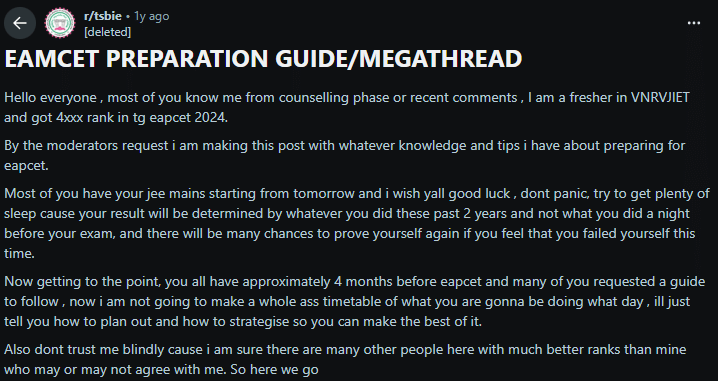
Source: Reddit
AP EAMCET 2026 Physics Chapter-Wise Weightage
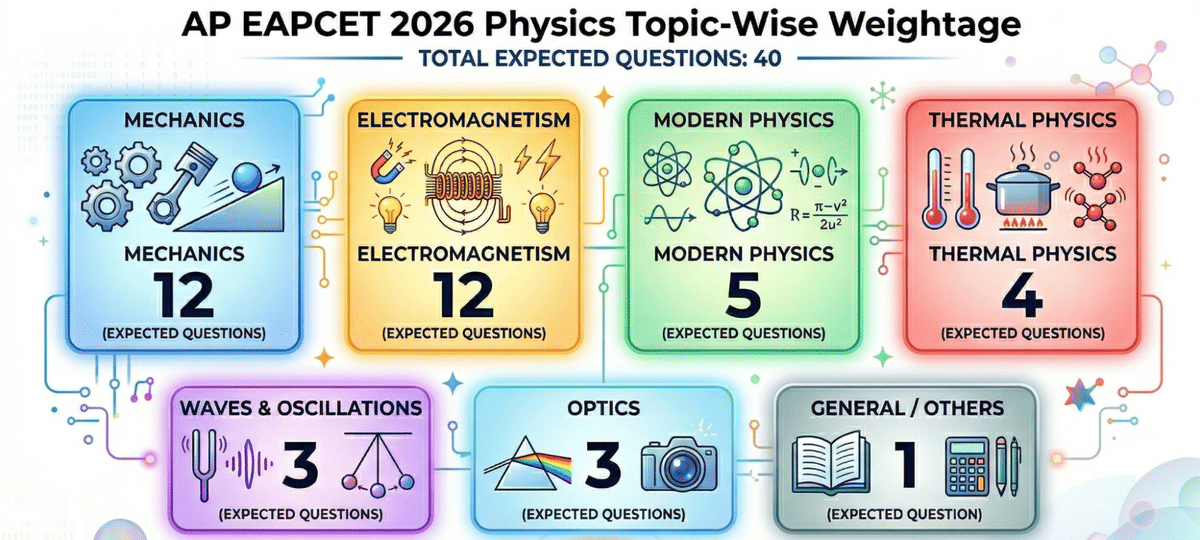
In AP EAMCET Physics, topics such as Mechanics and Electromagnetics often dominate the question distribution.
- Mechanics and Electromagnetics together will contribute around 60% of the questions for the AP EAPCET 2026, making them vital chapters for preparation.
- Topics such as Modern Physics, Waves & Oscillations, Optics and Thermal Physics are expected to contribute between 3 to 5 questions each.
The below given infographics shows Physics topic-wise distribution of questions:
The chapter-wise weightage for Physics section of AP EAMCET has seen a consistent trend over the past year.
- While topics such as Mechanical Properties of Fluids are expected to have slightly more questions in 2026, a reduction can be seen in topics like Ray Optics & Optical Instruments, Motion in a Plane, Oscillations, etc.
- These topics are expected to see roughly 50% less questions in 2026.
AP EAPCET Physics chapter-wise weightage distribution for 2026 and previous years are given in the table below:
| S.No | Chapter Name | Weightage - Expected No of Questions | ||
|---|---|---|---|---|
| 2026 | 2025 | 2024 | ||
| 1 | Mechanical Properties of Fluids | 2 | 1 | 1 |
| 2 | Waves | 2 | 2 | 1 |
| 3 | Work, Energy & Power | 2 | 1 | 1-3 |
| 4 | System of Particles & Rotational Motion | 2 | 3 | 1-3 |
| 5 | Current Electricity | 2 | 2 | 2 |
| 6 | Moving Charges & Magnetism | 2 | 1 | 2 |
| 7 | Semiconductor Electronics | 2 | 1 | - |
| 8 | Nuclei | 2 | 1 | 2 |
| 9 | Thermal Properties of Matter | 2 | 2 | 2 |
| 10 | Ray Optics & Optical Instruments | 2 | 2 | 2-5 |
| 11 | Oscillations | 1 | - | 1-2 |
| 12 | Laws of Motion | 1 | 2 | - |
| 13 | Motion in a Plane | 1 | 1 | 2-3 |
| 14 | Gravitation | 1 | 1 | 1 |
| 15 | Mechanical Properties of Solids | 1 | 1 | 1 |
| 16 | Motion in a Straight Line | 1 | 1 | 1-2 |
| 17 | Units & Measurements | 1 | 1 | 1 |
| 18 | Physical World | 1 | 1 | 1 |
| 19 | Electric Charges & Fields | 1 | 1 | 1 |
| 20 | Electrostatic Potential & Capacitance | 1 | 2 | 1 |
| 21 | Magnetism & Matter | 1 | 1 | 1 |
| 22 | Electromagnetic Induction | 1 | 1 | 1 |
| 23 | Alternating Current | 1 | 1 | 1 |
| 24 | Electromagnetic Waves | 1 | 1 | - |
| 25 | Atoms | 1 | 1 | 1 |
| 26 | Dual Nature of Matter & Radiation | 1 | 1 | 1 |
| 27 | Communication Systems | 1 | 2 | 1 |
| 28 | Kinetic Theory | 1 | 1 | 1 |
| 29 | Thermodynamics | 1 | 2 | 1-2 |
| 30 | Wave Optics | 1 | 1 | - |
Source: YouTube
AP EAMCET 2026 Chemistry Chapter-Wise Weightage
In AP EAMCET 2026, Physical and Organic Chemistry are expected to have the highest weightage, together comprising around 29 out of 40 questions.
Some major chapters in AP EAPCET 2026 Chemistry will be:
- Organic Compounds
- Atomic Structure
- States of Matter
- Thermodynamics
Chemistry topic-wise number of questions distribution is shown in the infographics below:
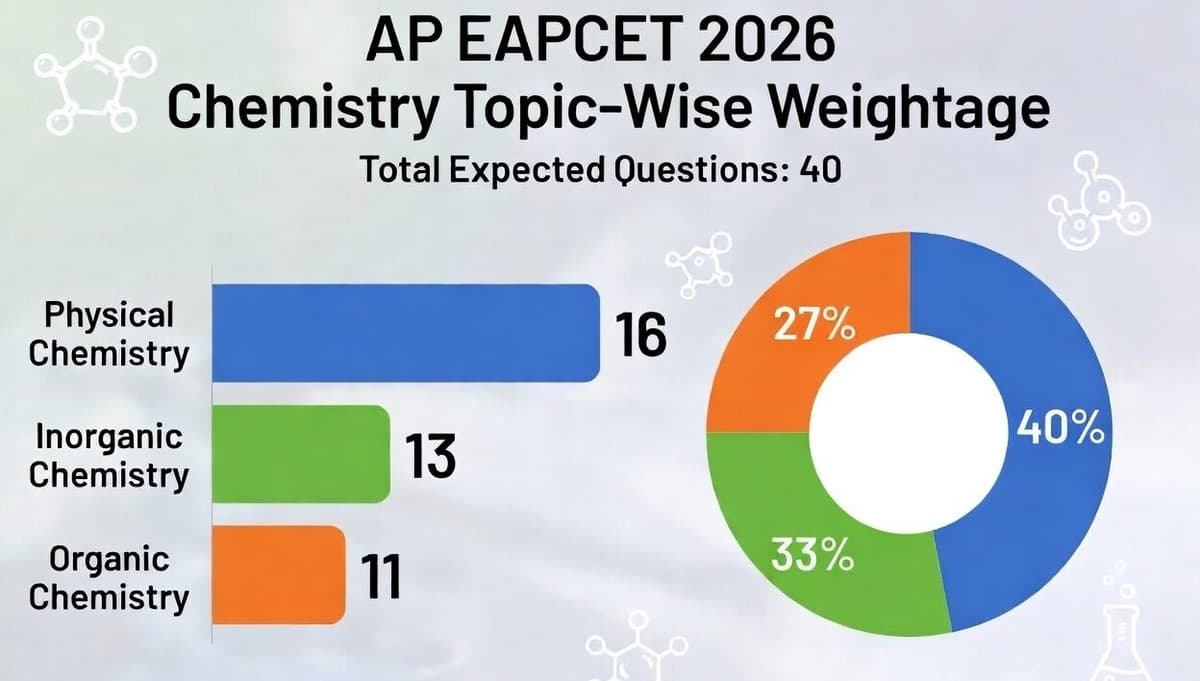
AP EAPCET year-wise Chemistry chapter-wise weightage is given in the table below:
| S.No | Chapter Name | Weightage - Expected No of Questions | |
|---|---|---|---|
| 2026 | 2025 | ||
| 1 | Organic Compounds containing C, H & O | 3 | - |
| 2 | Atomic Structure | 2 | 1-2 |
| 3 | States of Matter (Gases & Liquids) | 2 | 1 |
| 4 | Thermodynamics (Physical) | 2 | 1 |
| 5 | Chemical Equilibrium, Acids & Bases | 2 | 2 |
| 6 | Solutions | 2 | 1 |
| 7 | Surface Chemistry | 2 | 1 |
| 8 | Chemical Bonding & Molecular Structure | 2 | 1-2 |
| 9 | P-Block Elements (Grp 13 & 14) | 2 | 2 |
| 10 | D & F Block & Coordination Compounds | 2 | 1 |
| 11 | Organic Chemistry: Basic Principles & Hydrocarbons | 2 | 6 |
| 12 | Biomolecules | 2 | 1 |
| 13 | Haloalkanes & Haloarenes | 2 | 1 |
| 14 | Stoichiometry | 1 | 1 |
| 15 | Electrochemistry | 1 | 1 |
| 16 | Chemical Kinetics | 1 | 1 |
| 17 | Solid State | 1 | 1 |
| 18 | Classification of Elements & Periodicity | 1 | 1 |
| 19 | S-Block Elements | 1 | 2 |
| 20 | Hydrogen & its Compounds | 1 | 1 |
| 21 | Environmental Chemistry | 1 | 1 |
| 22 | General Principles of Metallurgy | 1 | 1 |
| 23 | P-Block Elements (Grp 15–18) | 1 | - |
| 24 | Chemistry in Everyday Life | 1 | 1 |
| 25 | Polymers | 1 | 1 |
| 26 | Organic Compounds containing Nitrogen | 1 | 1 |
AP EAMCET 2026 Biology Chapter-wise Weightage
In AP EAPCET 2026, the Biology section features 80 questions, which are equally divided among Botany and Zoology.
- Some high-weightage topics in Zoology are Human Physiology, Animal Diversity, Human Reproduction and Biology in Human Welfare.
- These 4 chapters alone are expected to contribute roughly 28-29 questions in AP EAPCET 2026, covering a vast chunk of nearly 75% of the Zoology questions.
- If we talk about Botany, some high weightage topics for 2026 will be Plant Physiology, Cell Structure & Function, Structural Organization in Plants, Molecular Biology, etc.
- Like Zoology, these four chapters are expected to comprise around 20 questions, which is 50% of the total questions for Botany, and ¼ th of the Biology section of EAPCET, giving students an opportunity to score more with fewer chapters.
Botany Chapter Wise Weightage
Based on expert analysis, the chapter-wise weightage for Botany has remained the same in 2026 compared to 2025. Check the topic-wise weightage for the Botany in the table below:
| Topics | Expected Number of Questions | |
|---|---|---|
| 2026 | 2025 | |
| Plant Physiology | 5-6 | 5-6 |
| Cell Structure & Function | 4-5 | 4-5 |
| Molecular Biology | 3-4 | 3-4 |
| Diversity in Living World | 3-4 | 3-4 |
| Plant Ecology | 3-4 | 3-4 |
| Reproduction in Plants | 2-3 | 2-3 |
| Plant Systematics | 2-3 | 2-3 |
| Internal Organization of Plants | 2-3 | 2-3 |
| Genetics | 2-3 | 2-3 |
| Biotechnology | 2-3 | 2-3 |
Zoology Chapter Wise Weightage
Topic-wise weightage distribution for Zoology in AP EAMCET 2026 will be similar to that of 2025 as given in the table below:
| Topics | Expected Number of Questions | |
|---|---|---|
| 2026 | 2025 | |
| Human Anatomy & Physiology | 15-16 | 15-16 |
| Animal Diversity | 4-5 | 4-5 |
| Human Reproduction | 3-4 | 3-4 |
| Structural Organization in Animals | 2-3 | 1-2 |
| Diversity in Living World | 2-3 | 2-3 |
| Biology in Human Welfare | 3-4 | 3-4 |
| Evolution | 1-2 | 1-2 |
| Applied Biology | 1-2 | 1-2 |
| Locomotions & Reproduction in Protozoa | 1-2 | - |
| Genetics | 1-2 | 1-2 |
| Periplaneta Americana Type Study | 1-2 | - |
Source:YouTube
Also Read:
AP EAMCET Previous-Year Question Papers
AP EAPCET question papers from the last 5 years are given in the table below:
A Reddit user shares an image of detailed chapter-wise weightage for AP EAPCET 2026, speculating whether it's official or helpful asking “Are we sure?”
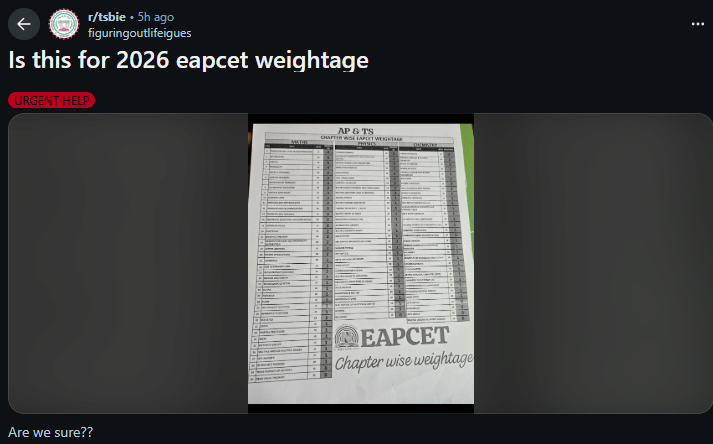
Source: Reddit
How to score 120+ in AP EAMCET 2026
Now that candidates have detailed chapter-wise weightage for each subject, they can utilize it to score 120+ in AP EAPCET 2026.
A detailed subject-wise strategy to score 120+ marks in last six weeks before AP EAPCET 2026 is given in the table below:
| Subject | High-Weightage Chapters | Priority Action (Next 5–6 Weeks) | Target Score |
|---|---|---|---|
| Mathematics (80Q) |
|
| 55–65 marks |
| Physics (40Q) |
|
| 30–35 marks |
| Chemistry (40Q) |
|
| 30–35 marks |
Additional Tips:
- Aim for 85-90% accuracy in high-weightage chapters in each subject, they can help get 100+ marks.
- Since there is no negative marking in AP EAPCET, you can attempt as many questions as possible to increase your marks.
- However, do not waste unnecessary time if a question takes too long to solve.
AP EAMCET Chapter Wise Weightage 2026 FAQs
Ques: What are the high weightage chapters in AP EAMCET 2026?
Ans: Subject-wise high-weightage chapters in AP EAMCET 2026 are given in the table below:
| Subject | High Weightage Chapters |
|---|---|
| Mathematics | Functions, Circles, Probability, Complex Numbers |
| Physics | Mechanical Properties of Fluids, Waves, Current Electricity |
| Chemistry | Organic Compounds, Atomic Structure, States of Matter, Thermodynamics |
| Biology | Plant Physiology, Cell Structure & Function, Human Anatomy & Physiology, Animal Diversity |
Ques: What are the best books for AP EAPCET 2026?
Ans: Here are the list of best books for each subject in AP EAPCET 2026:
| Subject | Book Title | Author / Publisher |
|---|---|---|
| All Subjects | NCERT Textbooks (Class 11 & 12) | NCERT |
| Physics | Concepts of Physics (Vol 1 & 2) | H.C. Verma |
| Physics | IIT JEE Physics | D.C. Pandey |
| Chemistry | Physical Chemistry | O.P. Tandon |
| Chemistry | Concise Inorganic Chemistry | J.D. Lee |
| Chemistry | Organic Chemistry | Morrison & Boyd (or O.P. Tandon) |
| Mathematics | Class 11 & 12 Mathematics | R.D. Sharma |
Ques: What is the IPE weightage in AP EAPCET 2026?
Ans: AP EAPCET IPE weightage is the weightage given to a candidate’s class 10+2 marks for preparing the merit list. For AP EAPCET 2026, the IPE weightage is 25% while the rest 75% weightage will be given to a candidate’s normalised score in AP EAPCET exam.



Comments