



.png?h=35&w=35&mode=stretch)
The AP EAMCET 2026 Biology Syllabus has been released by the JNTU, Hyderabad, on its official website, together with the notification. Candidates can now download the syllabus from the AP EAMCET website, cets.apsche.ap.gov.in.
The Biology syllabus is divided into two sections– Zoology and Biology. The Biology section will have 80 questions and carries 50% of the total marks of the exam.
- Of the 50%, around 30% of the questions will be on topics like Evolution and Genetics.
- The remaining 20% will be covered in topics on Plant and Animal Physiology.
The AP EAMCET 2026 Biology Syllabus carries an important component in determining the overall performance in the exam.
- High-weightage topics are– Plant Physiology (22%) and Ecology (15%) from Botany, & Human Physiology (20%) and Genetics & Evolution (18%) from Zoology.
- And Molecular Biology and Biotechnology are brief chapters, but these topics are high-scoring in the exam, and you must not skip them.
Related Links:
- AP EAPCET Exam Pattern 2026: Subject-Wise Weightage, Marking Scheme & Type of Questions
- AP EAPCET 2026 Chemistry Syllabus: Important Topics, Weightage & Preparation Tips
- AP EAPCET 2026 Physics Syllabus, Check Weightage of Important Topics, Best Books
AP EAMCET 2026 Biology Syllabus
The AP EAMCET 2026 Biology syllabus defines the complete set of topics from Botany and Zoology that all the candidates must cover to perform well in the examination.
Genetics, Plant Physiology, Human Physiology, and Ecology are some of the most important topics in this syllabus that you must not miss.
You won’t notice any major changes in the syllabus since 2025. The test checks both basic knowledge and practical understanding. Studying NCERT and practicing diagrams will help you achieve better results.
AP EAMCET 2026 Biology Syllabus: Highlights
| Parameter | Details |
|---|---|
| Total Questions | 80 questions (Botany: 40 + Zoology: 40) |
| Marks per Question | 1 mark per question |
| Total Marks | 80 marks |
| Duration | 180 minutes (total duration of the exam) |
| Sectional time limit | No sectional time limit |
| Types of Questions | Multiple Choice Questions (MCQs) |
| Topics Covered | Botany, Zoology, Genetics, Plant Physiology, Human Physiology, Ecology and Environment, Biotechnology, etc. |
| Marking Scheme | +1 mark for each correct answerNo negative marking |
| Weightage | 50% of the total exam (80 out of 160 marks) |
AP EAMCET 2026 Biology Syllabus: Subject-wise Syllabus
The AP EAPCET 2025 Biology syllabus is divided into Botany and Zoology, covering essential concepts for candidates in Agriculture, Pharmacy, and Life Sciences.
The syllabus comprises Intermediate 1st- and 2nd-year topics, with an emphasis on Plant Physiology, Human Physiology, Genetics, and Ecology, which form a major part of the exam.
The syllabus has been elaborated in detailed, structured tables given below.
AP EAMCET 2026: Detailed Botany Syllabus
| Unit | Subtopics | Explanation |
|---|---|---|
| Diversity of Plant Life | Algae, Bryophytes, Pteridophytes, Gymnosperms, Angiosperms | Classifications of plants, characteristics, and evolutionary significance of different plant groups. |
| Structural Organisation | Morphology of Root, Stem, Leaf & Flower, Anatomy of Plants | Study of the external and internal structure of plants, including tissues and adaptations. |
| Cell Structure and Function | Cell Organelles, Biomolecules, Cell Cycle, Mitosis, & Meiosis | Structure and function of plant cells, macromolecules, and cell division processes |
| Plant Physiology | Photosynthesis, Respiration, Enzymes, Hormones, Transpiration | Mechanisms of energy production, growth regulation, and water transport in plants. |
| Reproduction in Plants | Pollination, Fertilization, Seed Formation, Apomixis, Polyembryony | Sexual and asexual reproduction in plants, seed development, and dispersal mechanisms. |
| Genetics and Evolution | Mendelian Genetics, Chromosomal Theory, DNA, RNA, Gene Expression | Principles of heredity, gene interactions, and the molecular basis of inheritance |
| Ecology & Environment | Ecosystem, Biodiversity, Conservation, Environmental issues | Study of ecological interactions, conservation strategies, and the impact of human activities |
AP EAMCET 2026: Detailed Zoology Syllabus
| Unit | Subtopics | Explanation |
|---|---|---|
| Diversity of Animal Life | Animal Kingdom, Classification, Phylum Characteristics | Classification of animals based on structural and functional features. |
| Structural Organisation | Animal Tissues, Morphology & Anatomy of Earthworm, Frog & Cockroach | Study of different tissues and comparative anatomy of invertebrates and vertebrates. |
| Cell Structure and Function | Cell Organelles, DNA, RNA, Protein Synthesis | Structure and function of animal cells, including gene expression mechanisms. |
| Human Physiology | Digestive, Respiratory, Circulatory, Nervous, Excretory,, Endocrine Systems | Detailed study of human body functions and regulatory mechanisms. |
| Reproduction & Development | Gametogenesis, Fertilization, Embryonic Development, Hormonal Regulation | Study of the human reproductive system and developmental biology. |
| Genetics and Biotechnology | DNA Replication, Genetic Engineering, Recombinant DNA Technology | Application of genetics in medicine, agriculture, and biotechnology. |
| Ecology & Environment | Population Ecology, Adaptations, Conservation Strategies | Interaction of organisms with the environment and sustainable development. |
AP EAMCET 2026 Biology Syllabus: Topic-wise Weightage
By targeting high-weightage topics, students can get the maximum score and enhance the possibility of achieving a top rank.
AP EAMCET 2026: Zoology Topic-wise Weightage
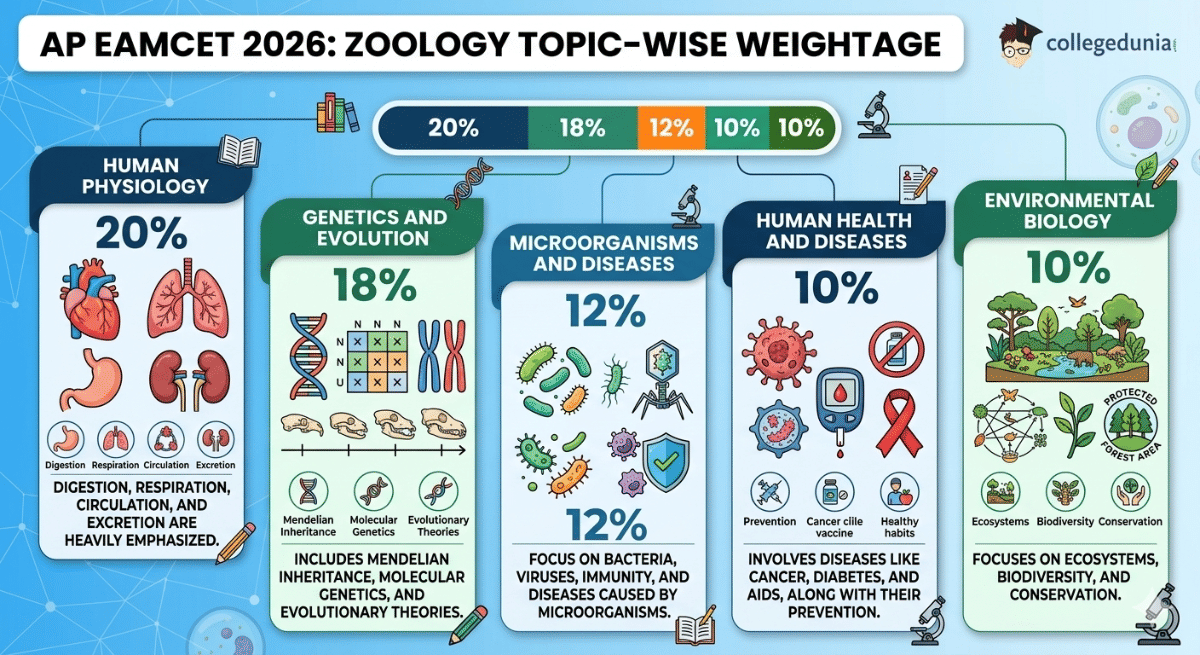
Human Physiology carries the highest weightage in Zoology at 20%, followed by Genetics and Evolution at 18%, making these two sections the most important for Zoology preparation.
| Topic | Weightage | Key Areas |
|---|---|---|
| Human Physiology | 20% | Digestion, Respiration, Circulation, Excretion |
| Genetics and Evolution | 18% | Mendelian Inheritance, Molecular Genetics, Evolutionary Theories |
| Microorganisms and Diseases | 12% | Bacteria, Viruses, Immunity, and Diseases Caused by Microorganisms |
| Human Health and Diseases | 10% | Cancer, Diabetes, AIDS, Prevention |
| Environmental Biology | 10% | Ecosystems, Biodiversity, Conservation |
AP EAMCET 2026: Botany Topic-wise Weightage
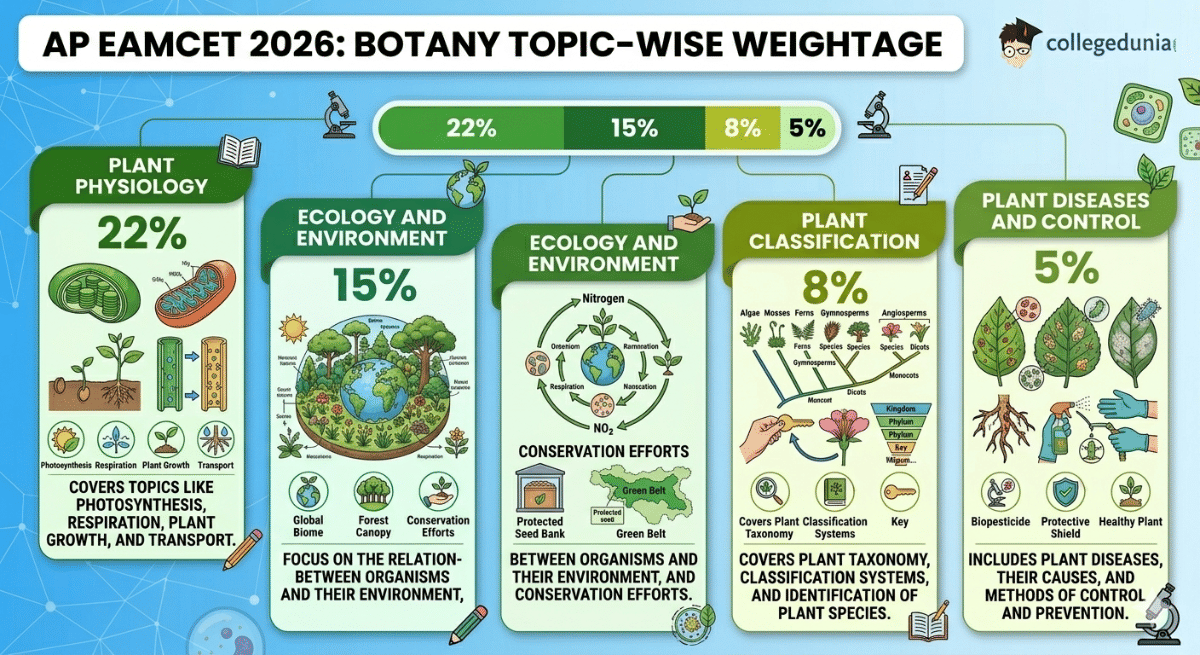
Plant Physiology dominates the Botany section at 22% weightage, followed by Ecology and Environment at 15% — making these two the most critical topics to prioritise.
| Topic | Weightage | Key Areas |
|---|---|---|
| Plant Physiology | 22% | Photosynthesis, Respiration, Plant Growth, Transport |
| Ecology and Environment | 15% | Global Biome, Forest Canopy, Conservation Efforts, Relation between Organisms and their Environment |
| Ecology and Environment (Conservation) | 8% | Protected Seed Bank, Green Belt, Organisms and their Environment, Conservation Efforts |
| Plant Classification | 8% | Plant Taxonomy, Classification Systems, Identification of Plant Species |
| Plant Diseases and Control | 5% | Plant Diseases, their Causes, Biopesticides, Protective Shield, Healthy Plant, Methods of Control and Prevention. |
AP EAMCET 2026: Biotechnology and Genetics Weightage
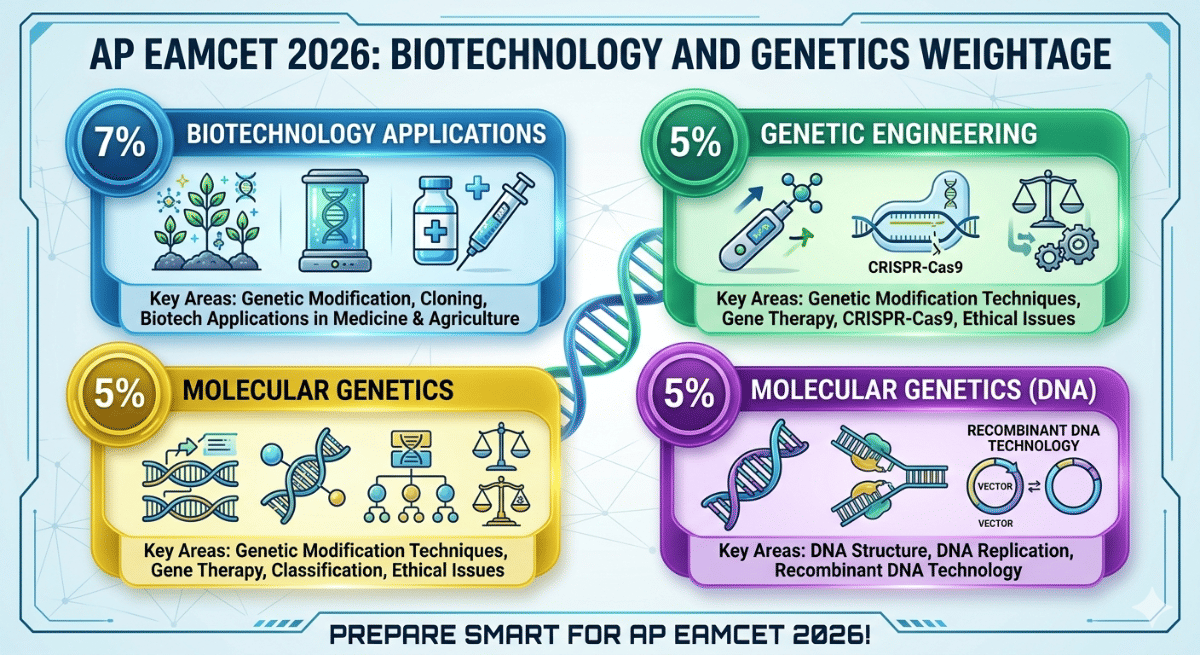
Candidates should prioritise Biotechnology Applications and Genetic Engineering as these topics are consistently represented across previous year papers and require conceptual clarity over rote learning.
| Topic | Weightage | Key Areas |
|---|---|---|
| Biotechnology Applications | 7% | Genetic Modification, Cloning, Biotech Applications in Medicine and Agriculture |
| Genetic Engineering | 5% | Genetic Modification Techniques, Gene Therapy, CRISPR-Cas9, Ethical Issues |
| Molecular Genetics | 5% | Genetic Modification Techniques, Gene Therapy, Classification, Ethical Issues |
| Molecular Genetics (DNA) | 5% | DNA Structure, DNA Replication, Recombinant DNA Technology |
Also Check: AP EAMCET Chapter Wise Weightage 2026
AP EAMCET 2026 Biology Syllabus: Preparation Strategy
The AP EAPCET 2026 exam for the Agriculture & Pharmacy (BiPC) stream is just around the corner on 19th & 20th May 2026. Students should follow a systematic and focused study plan. Biology carries 50% weightage (80 out of 160 marks), making it the most scoring and important subject for BiPC candidates.
Since time is short, the focus is on smart revision, high-weightage topics, speed, accuracy, and mock tests. No new topics!
AP EAMCET 2026 Biology Syllabus: Last Month Strategy
Week 1: Core Revision
Focus on the high-weightage chapters (Physiology, Genetics, Ecology).
- Revise short notes, diagrams, and flowcharts for key topics.
- Solve 50–60 topic-wise MCQs every day.
- Start a "Mistake Notebook" for difficult points and errors.
Week 2: Past Papers
Solve the PYQs and focus on sectional testing.
- Complete AP EAPCET shift papers from 2022–2025.
- Take three 80-question biology tests this week.
- Review every wrong answer and revise weak spots immediately.
Week 3: Mock Tests
Focus on your speed and exam-day timing.
- Take one full biology mock test daily (80 questions).
- Aim to finish within 60 minutes with high accuracy.
- Re-check high-yield facts and differences between concepts.
Week 4: Last 2–3 Days
Focus on light revision and mental rest.
- Read your "Mistake Notebook" and look over cycles/diagrams.
- Do not start any new topics or heavy mock tests.
- Focus on sleep and staying calm before the exam.
AP EAMCET 2026 Biology Syllabus: Must-Have Books
Choosing the right resources is critical as AP EAMCET questions are strictly curated from the official board curriculum to test conceptual depth. Here’s a list of must-have books curated by us that you must study to ace your exam.
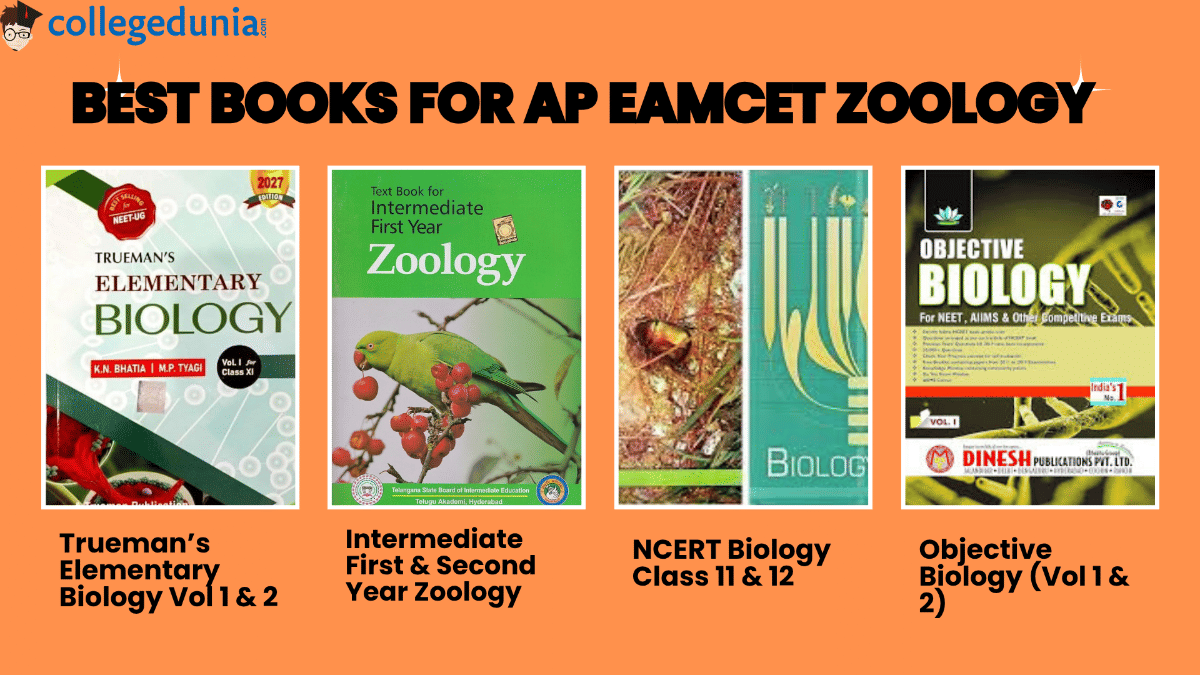
AP EAMCET 2026 Biology Syllabus: Zoology Books
| Recommended Title | Author/Publisher | Key Features |
|---|---|---|
| Intermediate First & Second Year Zoology | Telugu Academy | Essential for Human Physiology and Animal Diversity questions. |
| NCERT Biology Class 11 & 12 | NCERT | Excellent for diagrams and cellular processes. |
| Trueman’s Elementary Biology | KN Bhatia & MP Tyagi | Detailed explanations for anatomy and evolution topics. |
| Objective Biology (Vol 1 & 2) | Dinesh Publications | Offers a vast bank of practice questions specific to Zoology. |
AP EAMCET 2026 Biology Syllabus: Botany Books
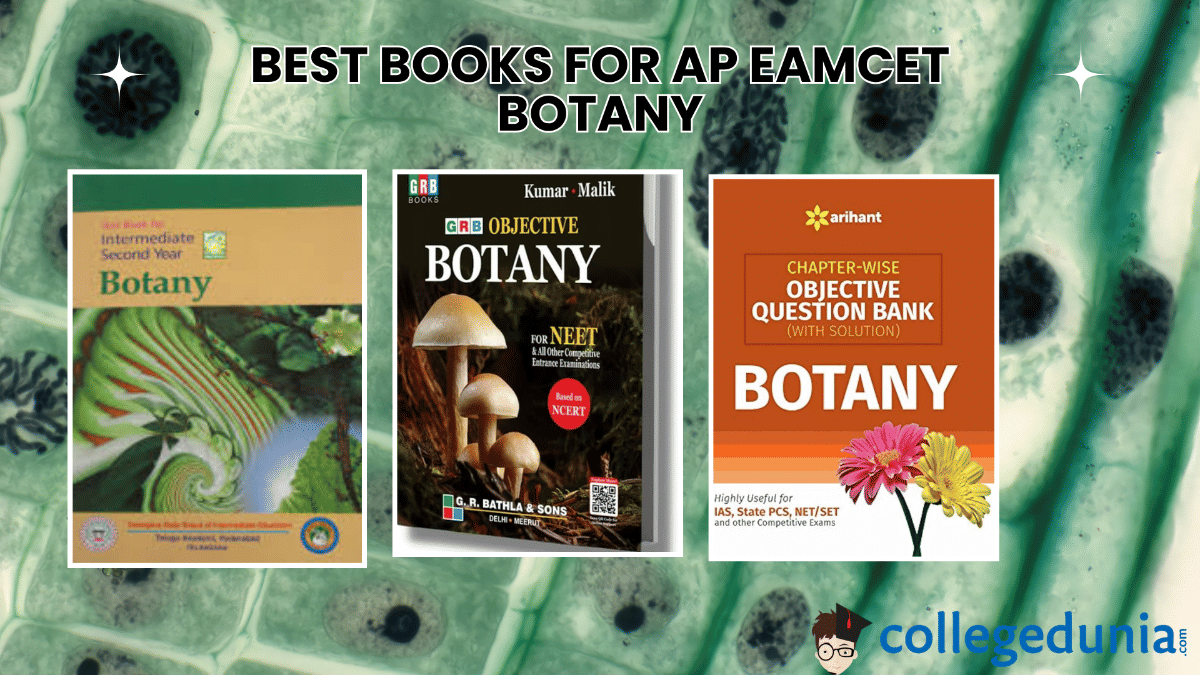
| Recommended Title | Author/Publisher | Key Features |
|---|---|---|
| Intermediate First & Second Year Botany | Telugu Academy | The official textbook directly follows the state board syllabus. |
| Objective Botany for EAMCET | Arihant Experts | Contains chapter-wise MCQs and previous years' papers. |
| Objective Botany (Set of 3 Vols) | GRB Bathla | Provides deeper insights for those aiming for a top 1000 rank. |
FAQs
Ques. A candidate on a Reddit forum was asking, “Any known or working tricks of AP EAMCET (BiPC)?”
Ans. for any working tricks for Biology, Physics, and Chemistry subjects that will make attempting the paper easier.
The biggest trick for AP EAPCET BIPC is that there is no negative marking, so attempt all 160 questions without fear. Study Biology fully by focusing on high-weightage chapters like Plant Physiology, Human Physiology, Genetics, and Ecology, as it becomes your main scoring area. For Physics and Chemistry, use elimination techniques and guess smartly after preparing only the important topics and formulas. Solve previous papers and take mocks regularly while revising diagrams and processes from Intermediate textbooks for quick gains.
Ques. How to prepare for EAMCET within 10 days with zero knowledge?
Ans. Preparing for AP EAPCET (EAMCET) BIPC in just 10 days with zero prior knowledge is extremely challenging, and realistic expectations should be modest. With no negative marking, the smartest approach is to maximize your Biology score while attempting every question. Prioritize the highest-weightage chapters that can easily fetch 40–60+ marks. Don’t aim for deep understanding. Instead, learn basic formulas, definitions, and common question types from high-yield areas.
Ques. Are the NCERT NEET books enough for the EAMCET?
Ans. No, NCERT NEET books alone are not enough for AP EAPCET (EAMCET) BIPC Biology, though they form a very strong foundation.
For Biology, the NCERT Class 11 and 12 books cover 70-80% of the concepts, diagrams, processes, and facts that appear in EAPCET. Many questions are similar to NEET-style ones, so mastering the NCERT lines, examples, tables, and diagrams will help you score well (easily 50+ marks if revised properly). However, students and recent aspirants repeatedly say that Telugu Akademi (AP Intermediate IPE) textbooks have extra details, specific explanations, and slight differences in depth that match the exact EAPCET pattern better.
Ques. Can I score high enough in Biology to get a rank below 1000 in AP EAPCET (EAMCET) BIPC 2026?
Ans. To secure a rank under 1000 in AP EAPCET, students generally need a total score of around 140–160 marks out of 160 (based on recent trends and expected marks vs rank analysis). Since Biology carries 80 marks and is the strongest section for BiPC students, scoring 65–75+ marks in Biology becomes crucial. This leaves you needing roughly 75–85 marks combined from Physics and Chemistry (40 marks each).



Comments