




WBJEE 2027 is a state-level entrance exam conducted by the West Bengal Joint Entrance Examinations Board (WBJEEB). It is for admission to BE, BTech, and BPharm programmes in government-aided and private engineering and pharmacy colleges across West Bengal.
The WBJEE 2027 exam is expected to be held in May 2027. In 2026, the exam was conducted on May 24, 2026.
- WBJEE 2027 official notification is expected in December/ January 2027.
- The WBJEE 2027 registration will commence from March to April 2027. Last year, online WBJEE registration ran from May 10 to April 8, 2026.
- WBJEE Registration fee is INR 500 for General Male, INR 400 for General Female and for the male reserved category. The female reserved category needs to pay INR 300.
- WBJEE 2027 exam is offline OMR-based with 155 MCQs carrying 200 marks. The exam is of 4 hours long and divided into two papers.
- WBJEE Maths carries 75 MCQs; Physics and Chemistry each have 40 MCQs.
- As per WBJEE marking scheme, there is negative marking of 0.25 and 0.5 marks each in categories 1 and 2. No negative marking for category 3.
- The WBJEE syllabus closely aligns with the Class 11 and 12 curricula of the Council of Higher Secondary Education.
- Candidates can expect their WBJEE 2027 admit card in the middle of May 2027. In 2026, the admit card was available from May 15, 2026.
- WBJEE 2027 result is expected in June 2027. Last year, the result was declared on June 18, 2026.
Related Links:
- WBJEE Exam Dates: Registration, Admit Card, Answer Key and Result Dates
- WBJEE Application Form: Registration Closed, How to Apply and Form Correction
- WBJEE Syllabus: Subject-Wise Topics, Chapter-Wise Weightage and PDF Download
WBJEE 2027: Overview
WBJEE 2027 is a state-level entrance exam conducted by WBJEEB for admission to engineering and pharmacy across West Bengal.
| Parameter | Details for WBJEE |
|---|---|
| Conducting Body | West Bengal Joint Entrance Examinations Board (WBJEEB) |
| Exam Name | West Bengal Joint Entrance Examination (WBJEE) |
| Subjects Covered | Mathematics, Physics, and Chemistry |
| Exam Level | State-Level Entrance Exam (West Bengal) |
| Exam Mode | Offline (Pen-and-paper OMR based) |
| Total Questions | 155 Questions (Mathematics: 75, Physics: 40, Chemistry: 40) |
| Total Marks | 200 Marks (Mathematics: 100, Physics: 50, Chemistry: 50) |
| Marking Scheme | Divided into 3 categories:
|
| Passing Criteria |
|
| Basic Eligibility |
|
| Age Limit |
|
| Application Mode | Online |
| Official Website | wbjeeb.nic.in |
Related Link: WBJEE Exam Centres List- District-Wise Zones, Codes & Cities in West Bengal, Assam & Tripura
WBJEE 2027 Exam Date
WBJEE 2027 official notification is expected in December/ January 2027. The important events related to WBJEE exam date 2027 are tabulated below.
| Events | Expected Dates | 2026 Schedule |
|---|---|---|
| Online Registration Start | March 2027 | March 10, 2026 |
| Online Registration Last Date | April 2027 | April 8, 2026 |
| Application Form Correction Window | April 2027 | April 7 - 9, 2026 |
| Admit Card Release | May 2027 | May 15, 2026 |
| WBJEE 2027 Exam Date | May 2027 | May 24, 2026 (Sunday) |
| Provisional Answer Key Release | May 2027 | May 27, 2026 |
| Final Answer Key | June 2027 | June 17, 2026 |
| Result Declaration | June 2027 | June 18, 2026 |
| Centralised Counselling Registration | June 2027 | From June 30, 2026 |
Related Link: WBJEE Reservation 2027: Category Wise Seats, Fee Concession and Cutoff Relaxation
Ques. How many times can a candidate attempt the WBJEE exam?
Ans. There is no attempt limit for the WBJEE exam, provided you meet the minimum age criteria (at least 17 years old by December 31 of the admission year).
WBJEE 2027 Registration
WBJEE 2027 registration is expected to begin in March 2027 and will conclude around April 2027.
Last year, online WBJEE registration ran from May 10 to April 8, 2026.
How to Register for WBJEE 2027?
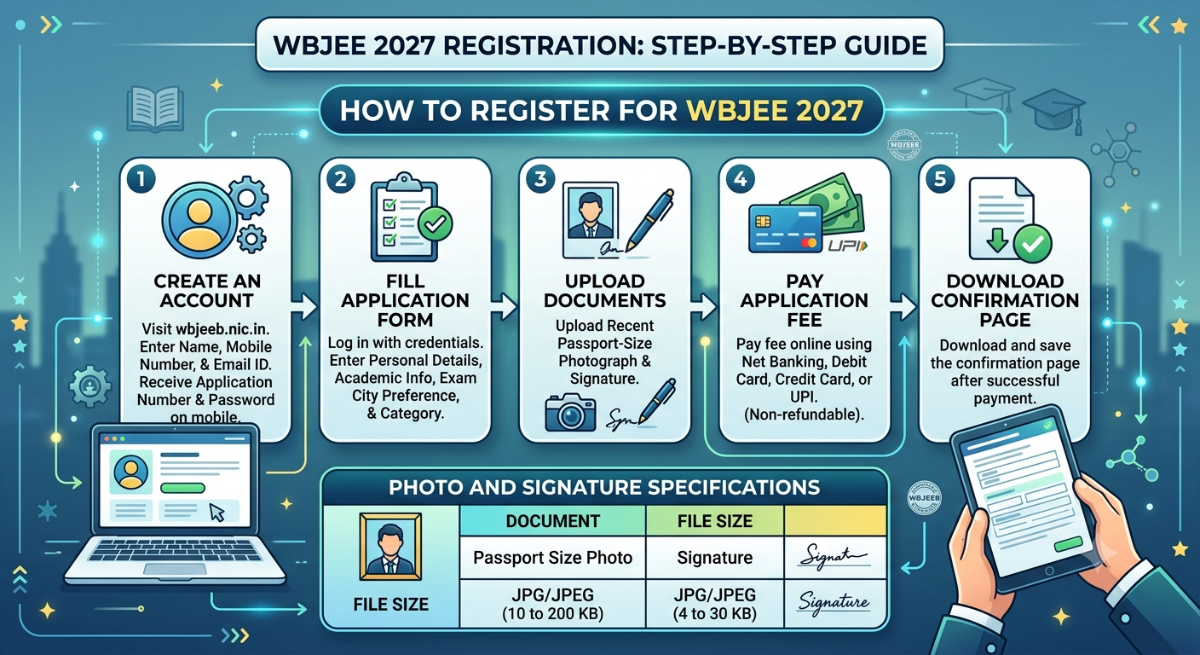
The step-by-step guide to register for WBJEE 2027 is discussed below. Follow these steps to successfully fill out the WBJEE 2027 Application form.
- Step 1: Create a new account on wbjeeb.nic.in using your name, mobile number, and email ID. An application number and password will be sent to your mobile.
- Step 2: Log in with your credentials and fill in personal details, academic information, exam city preference, and category details.
- Step 3: Upload a recent passport-size photograph and your signature.
- Step 4: Pay the fee online through Net Banking, Debit Card, Credit Card, or UPI. The fee is non-refundable.
- Step 5: Download and save your confirmation page after successful fee payment.
Check out the Photo and Signature Specifications:
| Document | File Size |
|---|---|
| Passport Size Photo | JPG/JPEG (10 to 200 KB) |
| Signature | JPG/JPEG (4 to 30 KB) |
Documents Required for WBJEE 2027 Registration
- Recent Colour Passport-size Photograph
- Signature: signed in black or blue ink on plain white paper
- Class 10 Admit Card / Certificate
- Class 12 Marksheet / Certificate
- Valid Photo ID (Aadhaar / PAN / Passport)
- Category Certificate (SC/ST/OBC-A/OBC-B/EWS/PwD/TFW) (if applicable)
- WB Domicile Certificate (if applicable)
WBJEE 2027 Registration Fee
The category-wise WBJEE 2027 Registration fee is tabulated below. You must pay online via Net Banking, Debit Card, Credit Card, or UPI. The registration fee for WBJEE 2027 is non-refundable under any circumstances.
- For general category candidates: Male: INR 500 | Female: INR 400
- For reserved category candidates: Male: INR 400 | Female: INR 300
| Category | Gender | RegistrationFee |
|---|---|---|
| General | Male | INR 500 |
| Female | INR 400 | |
| SC/ST/ OBC-A /OBC-B/EWS/ PwD/ TFW | Male | INR 400 |
| Female | INR 300 |
Related Link: WBJEE Form Correction 2027: Expected March 2027, Editable Fields and How to Edit
Ques. Can students from outside West Bengal apply for WBJEE 2027?
Ans. Yes. Non-domicile students can apply, but they are only eligible for engineering seats in private colleges and universities. Government college seats are strictly reserved for West Bengal residents.
WBJEE Registration Date: Previous Years' Trend
WBJEE Registration has followed the trend as mentioned below:
- WBJEE registration usually begins in late December, but the 2026 cycle shifted to March 10, marking a significant departure from the previous winter schedule.
- Registration deadlines have varied from January to February in earlier years, while the 2026 deadline extended to April 8, giving candidates a later application window.
| Exam Year | Registration Start Date | Registration Deadline | Key Trend Note |
| 2026 | March 10, 2026 | April 8, 2026 | Delayed by over two months to avoid clashing with the WBCHSE board exams and state assembly elections. |
| 2025 | December 28, 2024 | February 5, 2025 | Returned to the standard winter timeline to match the late April exam slot. |
| 2024 | December 28, 2023 | February 5, 2024 | Followed the standard 38-day application window. |
| 2023 | December 23, 2022 | January 20, 2023 | One of the earliest cycles, giving students a concise window to apply ahead of the April exam. |
| 2022 | December 24, 2021 | January 16, 2022 | Post-pandemic correction cycle that established the baseline winter timeline. |
WBJEE 2027 Eligibility Criteria
Candidates are eligible for WBJEE 2027, provided they fulfil the age and qualification requirements. Along with the WBJEE 2027 eligibility criteria, you must also meet the admission requirements for universities, institutes, or Colleges in West Bengal.
| Eligibility Parameters | Details |
|---|---|
| Citizenship |
|
| Academic Qualification |
|
| Age Restriction |
|
Along with the above, note that:
- Candidates should have passed 10+2 examination with Physics/ Mathematics/ Chemistry/ Computer Science/ Electronics/ Information Technology/ Biology/ Informatics Practices/ Biotechnology/ Technical Vocational subject/ Agriculture/ Engineering Graphics/ Business Studies/ Entrepreneurship.
- Minimum marks: 45% in Physics, Mathematics, and the third compulsory subject combined.
- Relaxation: SC / ST / OBC-A / OBC-B / PwD candidates of West Bengal need only 40% aggregate in those three subjects.
- Must have passed in English in the 10+2 or equivalent examination with at least 30% marks.
- Required to pass theoretical and practical/project exams in all permitted subject combinations.
Related Link: WBJEE Eligibility Criteria: Age Limit, Attempt Limit, Qualifying Marks, Domicile Criteria
Ques. Can candidates get admission through JEE Main scores instead of WBJEE?
Ans. Yes. Private engineering colleges in West Bengal reserve a fixed percentage of seats (typically 10%) for candidates applying via JEE Main scores through the official WBJEE counselling portal.
WBJEE 2027 Exam Pattern
WBJEE 2027 had two papers held on the same day. Each paper is 2 hours long. It consists of a total of 155 MCQs in OMR format.
- Paper 1 covered 75 MCQs in Mathematics.
- Paper 2 covered 80 MCQs. 40 each from Physics and Chemistry.
| Subject | Category 1: Each Q carries 1 mark (-ve marks of ¼ each) | Category 2: Each Q carries 2 marks (-ve marks of ½ each) | Category 3: Each Q carries 2 marks (No negative marks) | Total number of Questions | Total Marks |
|---|---|---|---|---|---|
| Maths | 50 | 15 | 10 | 75 | 100 |
| Physics | 30 | 5 | 5 | 40 | 50 |
| Chemistry | 30 | 5 | 5 | 40 | 50 |
Source: wbjeeb.nic.in
WBJEE 2027 Marking Scheme
The WBJEE Marking Scheme is different for categories 1, 2 and 3 questions. As it implies negative marking in categories 1 and 2, blind guessing is not recommended.
-
In Category 1, only one option is correct. For any combination of more than one option, even if it contains the correct option, the said answer will be treated as incorrect and will yield -1/4 (25% negative) marks.
-
In Category 2, only one option is correct. For any combination of more than one option, even if it contains the correct option, the said answer will be treated as incorrect and will yield -1/2 (25% negative) marks.
-
In Category 3, one or more options are correct.
-
Incorrect options selected: Zero marks, even if some selected options are correct.
-
Partially correct answers: Marks = 2 × (correct options marked / total correct options), provided no incorrect options are selected.
-
| Marking Scheme | Category 1 | Category 2 | Category 3 |
|---|---|---|---|
| Correct Answer | 1 mark for each | 2 marks for each | 2 marks for each |
| Incorrect Answer | -1/4 of each incorrect response | -1/2 of each incorrect answer | No negative Marking |
| Unanswered | 0 | 0 | 0 |
Source: wbjeeb.nic.in
WBJEE 2027 Paper Schedule
The WBJEE 2027 Paper timing schedule is based on previous years' exam format.
| Paper | Timing |
|---|---|
| Paper I (Mathematics) | 11:00 a.m. to 1.00 p.m |
| Paper II (Physics & Chemistry) | 2:00 p.m. to 4:00 p.m. |
Related Link: WBJEE Exam Pattern: 155 Questions, 200 Marks, Marking Scheme and Paper Structure
WBJEE 2027 Syllabus: Subject-wise Topics
WBJEE syllabus closely aligns with the Class 11 and 12 curricula of recognised Indian Boards/ Council of Higher Secondary Education.
The important topics for each subject from the WBJEE syllabus, along with weightages based on previous years' trends, are mentioned below.
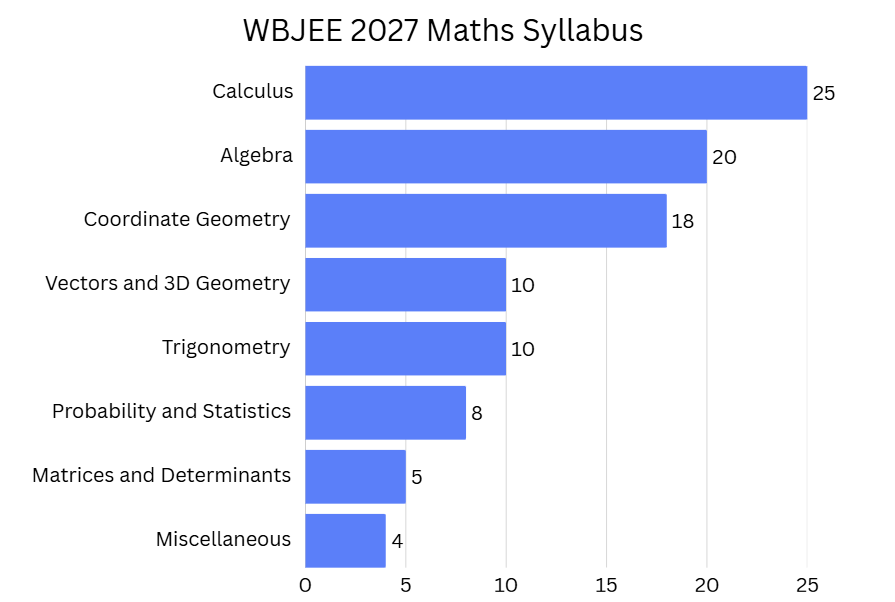
WBJEE Maths Syllabus 2027
| Important Topics | Weightages (%) |
|---|---|
| Calculus (Limits, Derivatives, Integration, Differential Equations) | 25 |
| Algebra (Sets, Quadratic Equations, Series, Permutations, Binomials) | 20 |
| Coordinate Geometry | 18 |
| Vectors and 3D Geometry | 10 |
| Trigonometry | 10 |
| Probability and Statistics | 8 |
| Matrices and Determinants | 5 |
| Miscellaneous (complex numbers, relations and functions) | 4 |
Related Link: WBJEE Maths Syllabus 2027: Subject-Wise Topics, Chapter-Wise Weightage and PDF Download
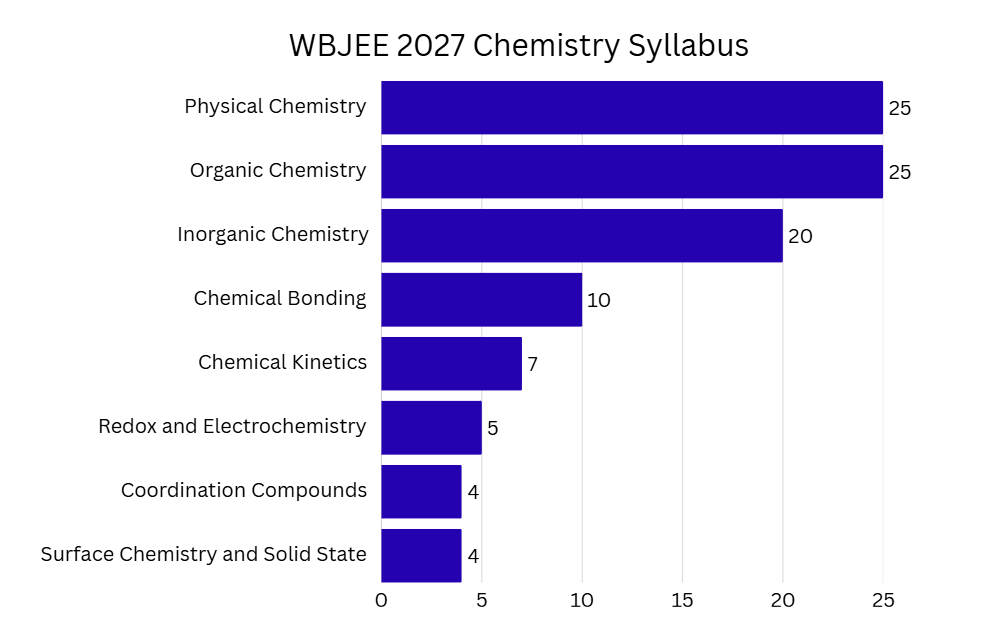
WBJEE 2027 Syllabus Chemistry
| Important Topics | Weightages (%) |
|---|---|
| Physical Chemistry (Mole Concept, Thermodynamics, Equilibrium) | 25 |
| Organic Chemistry (Hydrocarbons, Alcohols, Aldehydes, GOC) | 25 |
| Inorganic Chemistry (Periodic Table, s-p-d block elements) | 20 |
| Chemical Bonding | 10 |
| Chemical Kinetics | 7 |
| Redox and Electrochemistry | 5 |
| Coordination Compounds | 4 |
| Surface Chemistry and Solid State | 4 |
Related Link: WBJEE Chemistry Syllabus 2027: Subject-Wise Topics, Chapter-Wise Weightage and PDF Download
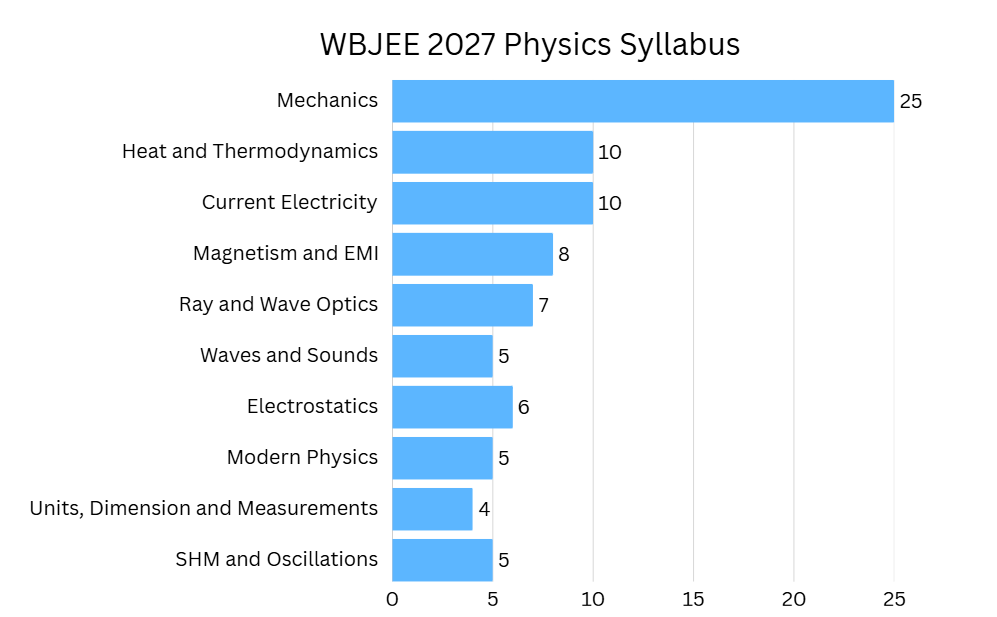
WBJEE 2027 Syllabus Physics
| Important Topics | Weightages (%) |
|---|---|
| Mechanics (Laws of Motion, Work, Power, Energy and Rotation) | 25 |
| Heat and Thermodynamics | 10 |
| Current Electricity | 10 |
| Magnetism and EMI | 8 |
| Ray and Wave Optics | 7 |
| Waves and Sounds | 5 |
| Electrostatics | 6 |
| Modern Physics (Atoms, Molecules, Nuclei, Photoelectric current) | 5 |
| Units, Dimension and Measurements | 4 |
| SHM and Oscillations | 5 |
Related Link: WBJEE Physics Syllabus 2027: Subject-Wise Topics, Chapter-Wise Weightage and PDF Download
WBJEE 2027 Preparation Tips
If you are planning to appear for WBJEE 2027, now is a good time to start.
- Mathematics:
- This is the highest-weightage subject. Focus on Calculus, Coordinate Geometry, Algebra, and Trigonometry.
- Aim to practise solving 75 questions in under 110 minutes to leave time for checking. Prioritise category 3 questions and try to attempt all because it has no negative marking.
- Physics:
- Modern Physics, Electromagnetism, and Thermodynamics are high-weightage areas.
- The Physics paper tests conceptual questions. Understand the theory behind every formula rather than memorising results.
- Chemistry:
- This is the most manageable section. NCERT is your best resource.
- Focus on Organic reaction mechanisms, Electrochemistry, and Thermodynamics in Physical Chemistry. Inorganic questions are often direct and scoring.
| Preparation Area | Tips and Strategies |
|---|---|
| Mathematics |
|
| Physics |
|
| Chemistry |
|
| Previous Year Papers |
|
| OMR-Based Mock Tests |
|
| Class 11 Topics |
|
| WBCHSE Syllabus |
|
| Category 3 Questions |
|
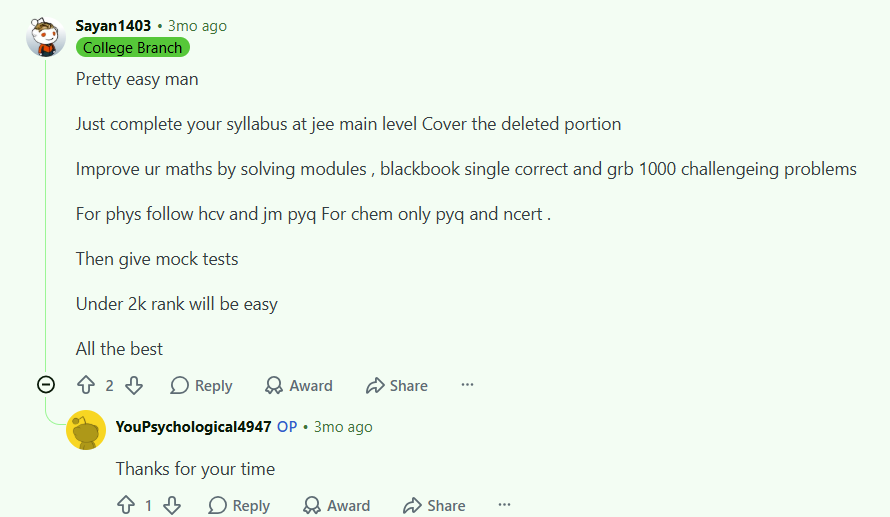
On Reddit, a user asked about the guidance for WBJEE 2027 and how tough it is to get a rank below 2000.
Based on this, another user shared some tips, which are as follows:
- Complete your syllabus at the JEE Main level. Cover the deleted portion as well.
- Improve Maths by solving modules, Black Book (single correct) and GRB 1000 challenging problems.
- For Physics, follow HCV and JEE Main PYQs
- For Chemistry, only PYQs and NCERT
- Then give mock tests to score under rank 2000 in WBJEE 2027.
Source: Reddit
Related Links:
WBJEE 2027 Admit Card
Candidates can expect their WBJEE 2027 admit card in the middle of May 2027. In 2026, the admit card was available from May 15, 2026.
How to Download the WBJEE Admit Card in 2027
A step-by-step guide to downloading the WBJEE Admit Card is given below:
- Step 1: Visit the Official WBJEE Site at wbjeeb.nic.in.
- Step 2: Click on the "Download WBJEE 2027 Admit Card" link.
- Step 3: Enter your Application Number and Password or Date of Birth.
- Step 4: Click on the admit card download button and print the document.
Details Mentioned on WBJEE 2027 Admit Card
- Candidate’s name, roll number, and application number
- Photograph and signature
- Exam centre name and full address
- Paper timing for Paper 1 and Paper 2
- Category and gender of the candidate
- Important exam-day instructions and guidelines
Documents to Bring on WBJEE 2027 Exam Day:
- A printed copy of the WBJEE admit card
- A valid photo identity proof (Aadhaar, PAN card, Voter ID, or Passport) on exam day.
- A copy of the colour photograph that was uploaded during the online application
Related Link: WBJEE Admit Card: Check Release Date, Download Link, Exam Day Guidelines
Ques. Can candidates change their exam centre after submitting the WBJEE application form?
Ans. No. Once the application form is submitted, the choice of exam zones cannot be altered, even during the online correction window.
WBJEE 2027 Answer Key
WBJEE 2027 Provisional answer key will be released around May 2027. Last year, it was released on May 27, 2026.
- Candidates will be given 2- 3 days to object to the answers in the provisional answer key by paying INR 500.
- Candidates will be given a window to raise objections against the provisional answer key by submitting their challenges online.
- The board then reviews all objections and releases the final answer key after verifying the contested answers in June 2027.
| Particulars | 2027 Dates | 2026 |
|---|---|---|
| WBJEE Provisional Answer Key | May 2027 | May 27, 2026 |
| WBJEE Provisional Answer Key Objection Window | May 2027 | May 27- 29 2026 |
| WBJEE Final Answer Key | June 2027 | June 17, 2026 |
Related Link: WBJEE Answer Key: Final Key, Download PDF and Score Calculation
WBJEE 2027 Result
WBJEE 2027 result is expected in June 2027. Last year, the result was declared on June 18, 2026.
How to Download WBJEE 2027 Rank Card
- Step 1: Go to the official website: wbjeeb.nic.in
- Step 2: Click on the “WBJEE 2027 Rank Card” link on the homepage
- Step 3: Enter your Application Number and Password
- Step 4: Click Submit and download your rank card as a PDF
- Step 5: Save a printed copy for use during counselling
Details on WBJEE 2027 Rank Card
- Candidate’s name, roll number, and application number
- General Merit Rank (GMR)
- Category Rank (for SC, ST, OBC-A, OBC-B, PwD as applicable)
- Subject-wise marks scored in Paper 1 and Paper 2
- Total marks obtained out of 200
Related Link: WBJEE Result at wbjeeb.nic.in, Counselling, Cutoff and Marks Vs Rank
WBJEE 2027 Marks vs Rank
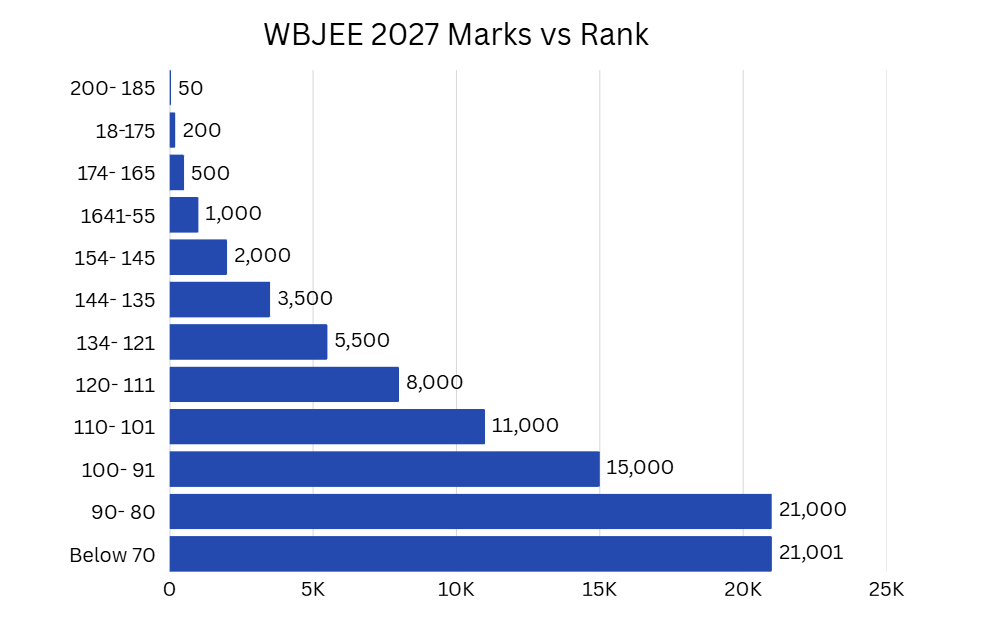
The WBJEE Marks vs. rank 2027 is expected and based on previous years' exam difficulty trends.
| Marks | Expected Rank | Probable options |
|---|---|---|
| 200- 185 | 1-50 | JU CSE and IT |
| 18-175 | 51-200 | All JU branches |
| 174- 165 | 201-500 | JU ECE, EE; top government college CSE |
| 1641-55 | 501-1,000 | JU Mechanical, Civil; GCECT and KGEC CSE |
| 154- 145 | 1,001-2,000 | State government colleges, RCCIIT CSE and ECE |
| 144- 135 | 2,001-3,500 | Solid government college options across branches |
| 134- 121 | 3,501-5,500 | Mid-tier government colleges; HIT and RCCIIT CSE |
| 120- 111 | 5,501-8,000 | MAKAUT-affiliated government colleges; most branches open |
| 110- 101 | 8,001-11,000 | Tier-1 private CSE (Heritage, Techno India) |
| 100- 91 | 11,001-15,000 | Mid-tier private engineering colleges |
| 90- 80 | 15,001-21,000 | Private colleges; government options narrow sharply |
| Below 70 | 21,001 | Primarily private engineering colleges across WB |
Related Link: WBJEE Marks vs Rank: Rank Card Out, Category Wise GMR Analysis and Branch Wise Cutoff
Ques. What is the difference between WBJEE General Merit Rank (GMR) and Pharmacy Merit Rank (PMR)?
Ans.
- GMR: Calculated using Physics, Chemistry, and Mathematics scores. It is used for admission into all Engineering, Technology, and Architecture courses.
- PMR: Calculated using Physics and Chemistry scores only (with Biology/Maths as a component). It is used strictly for Pharmacy degree admissions.
WBJEE 2027 Counselling
The WBJEE 2027 Counselling will begin in June 2027 based on the 2026 schedule.
- Register for Counselling: Visit the official WBJEEB counselling portal and complete the counselling registration.
- Enter Details: Provide WBJEE/JEE Main rank, academic and personal details.
- Pay Counselling Fee: Pay the prescribed counselling registration fee online.
- Check Seat Matrix: Review available colleges, courses, categories and seats.
- Fill Choices: Select preferred colleges and courses and arrange them in priority order.
- Lock Choices: Review and confirm the choices before the deadline.
- Seat Allotment: WBJEEB will allot seats based on rank, preferences, eligibility and seat availability.
- Accept Seat: Download the allotment result and pay the required seat acceptance/admission fee.
- Choose Upgradation: Opt for upgradation if you want to be considered for a higher-preference seat in the next round.
- Document Verification & Admission: Complete document verification and report to the allotted institute for final admission.
WBJEE 2027 FQQs
Ques. Can candidates participate in WBJEE counselling if they have not qualified for a government college cutoff?
Ans. Yes. Ranking in the WBJEE qualifies you to participate in counseling. If you miss the government cutoffs, you can still secure seats in self-financing private institutions or semi-government colleges.
Ques. How can candidates estimate their WBJEE rank before the official result is declared?
Ans. You can calculate your tentative score using the official WBJEE Answer Key and then cross-reference your total score with trusted Marks vs. Rank comparative charts from previous years.
Ques. What happens if a candidate forgets to lock their choices during WBJEE counselling?
Ans. The system will automatically lock your last saved choices on the final registration day. However, if you fail to save any choices at all, you will not be considered for seat allotment.
Ques. Can candidates get admission to Jadavpur University through WBJEE, and what rank is generally required?
Ans. Yes. Jadavpur University takes admissions exclusively via WBJEE. To secure highly competitive branches like Computer Science (CSE) or IT, home-state students generally need a GMR under 100 to 300, while other core engineering branches usually close under a GMR of 1,000 to 1,500.
Ques. Which documents are required during WBJEE counselling and admission?
Ans.
- WBJEE Provisional Allotment Letter and Rank Card
- Class 10 Admit Card/Birth Certificate (for age proof)
- Class 10 and 12 Marksheets
- Domicile Certificate (mandatory for government seats)
- Category Certificate (SC/ST/OBC, if applicable)



Comments
Found 79 Comments
With a General Merit Rank around 57k in WBJEE, securing a seat in top-tier government colleges or premium private CS branches is unlikely. However, you can secure seats in mid-tier private colleges like Academy of Technology (AOT), Asansol Engineering, or Abacus Institute for core or allied branches. Alternatively, if you hold an SC/ST category status, elite options like Haldia Institute of Technology or certain specialized branches at Calcutta University become highly accessible.
You can check here for the WBJEE Mock Test 2025: Attempt Free Online Mock Test. The Official Notification for WBJEE 2026 Exam is expected to be released in December 2025, the registration process will open in January 2026, and the WBJEE Exam will be conducted in April 2026.? The WBJEE Exam will be held in an offline mode, including 2 papers: Paper 1 of mathematics and Paper 2 of Physics and Chemistry. The Total marks are 200, 100 for paper 1 and 100 for paper 2.
Admission to Jadavpur University, Kolkata, for undergraduate engineering and technology courses is based on WBJEE (West Bengal Joint Entrance Examination) ranks. Candidates must qualify in WBJEE, meet eligibility criteria, and participate in counselling conducted by the West Bengal Joint Entrance Examinations Board. Seat allotment is merit-based and follows WBJEE ranks.
The tentative WBJEE Exam Date for 2025 is in the month of April.
The West Bengal Joint Entrance Examinations Board (WBJEEB) does not entertain any requests for changes in the exam centre once it has been allocated. The exam centres for WBJEE are allocated based on the choices given during the application form fill-up. Therefore, it’s crucial to carefully select your preferred exam centres while filling out the application form.
Preparing for the WBJEE 2024 in a short span of 20 days can be challenging, but with a focused approach and strategic planning, it is possible. Here are some tips to help you prepare effectively:
Remember, the goal is to understand concepts and not just memorize facts.
Last date to apply for BITSAT2024 is 11-APR-2024.
If the correction window is closed, you can contact the JEE helpline at 1800-1023-781 to request a correction. They will guide you on the process and the documents you need to submit.
WBJEE 2024 Application Form Last Date is already over on Feb 5
Collegedunia.com is one of the most trusted websites regarding courses or colleges/institutions and assists students by providing information on the admission process details of the courses, colleges/institutions of their interest.
To participate in the entrance examination, the candidates had to fill out and submit the application form before the extended date i.e., February 5, 2024. If the candidates were unable to register before the final date, then they will not be allowed to attempt the examination
Collegedunia is an educational portal and search engine, not a college, that provides information on higher education in India and abroad. Please confirm what course are you looking at and for which location and we will be able to give you more details on the same.
I want to fill wb jee form
We are sorry. The last date to fill WBJEE form was 5th Feb 2024.
After registration, you will be given application number to login and fill the form. Follow the steps provided and submit the application form. Save the soft copies of the application form and fee receipt and also get a printout of the same for future use. Refer to this link to confirm https://collegedunia.com/exams/wbjee
We are sorry! The last date to fill WBJEE form was 5th Feb 2024.
The details of WBJEE test centre is available here https://collegedunia.com/exams/wbjee/exam-centers
How to pass WBJEE and what is syallabus
Check the link to get all details regarding WBJEE including syllabus https://collegedunia.com/exams/wbjee
The details of WBJEE test centre is available here https://collegedunia.com/exams/wbjee/exam-centers