




The WBJEE Chemistry syllabus 2027 carries 50 marks across 40 questions in Paper 2. The West Bengal JEE Syllabus covers the full Class 11 and Class 12 Chemistry curriculum of WBCHSE and CBSE, with no chapters removed.
- Class 12 Chemistry accounts for approximately 55–60% of the Chemistry questions, while Class 11 contributes the remaining 40–45%.
- Organic Chemistry has an estimated 32–35% weightage, making it one of the largest sections. GOC, Hydrocarbons, Carbonyl Compounds, and Oxygen-Containing Compounds form its core.
- Physical Chemistry contributes approximately 35–38% of the paper. It includes numerical-based questions from Thermodynamics, Equilibrium, Solutions, Electrochemistry, and Chemical Kinetics.
- Inorganic Chemistry accounts for around 30–32% of the Chemistry section, with Coordination Compounds, p-Block, and d- and f-Block Elements forming important portions.
- Core Organic Chemistry carries the highest individual cluster weightage of 14–16%, equivalent to approximately 7–8 marks out of 50. It includes GOC, Hydrocarbons, and Purification and Elemental Analysis.
- WBJEE retains chapters removed from the reduced JEE Main syllabus, including Solid State, Surface Chemistry, Metallurgy, s-Block Elements, Polymers, and Environmental Chemistry.
Related Links:
- WBJEE Question Paper (Available), Download Previous Years' Question Paper and Answer Key PDFs
- WBJEE Exam Pattern 2027: Total Questions, Marking Scheme, Syllabus, Weightage and Sample Papers
Key Summary
- The WBJEE Chemistry syllabus spans Physical, Organic, and Inorganic Chemistry, tested across three question categories.
- Coordination Compounds and GOC are the two highest-yield chapters, each forming the base for several other topics.
- WBJEE keeps 8–9 chapters that JEE Main removed, so the syllabus for WBJEE is longer than JEE Main's.
- O.P. Tandon, Morrison & Boyd, and J.D. Lee remain the standard reference books for Physical, Organic, and Inorganic Chemistry.
WBJEE Chemistry Syllabus 2027: Highlights
| Particular | Details |
|---|---|
| Exam Name | West Bengal Joint Entrance Examination (WBJEE) 2027 |
| Exam Paper | Paper 2 (Chemistry section) |
| Total Questions | 40 Questions |
| Total Marks | 50 Marks |
| Duration (Physics & Chemistry) | 2 Hours (120 minutes total for both subjects combined) |
| Question Type | Objective Multiple Choice Questions (MCQs) |
| Category 1 (Single Option Correct) | 30 Questions (+1 mark for correct; -0.25 mark for incorrect) |
| Category 2 (Single Option Correct) | 5 Questions (+2 marks for correct; -0.5 mark for incorrect) |
| Category 3 (Multiple Options Correct) | 5 Questions (+2 marks for correct; no negative marking) |
| Syllabus Level | Aligned with Class 11 & 12 Chemistry curriculum standards of WBCHSE and CBSE |
Ques. How many marks does Chemistry carry in the WBJEE syllabus?
Ans. 50 marks across 40 questions in Paper 2.
Ques. Is the WBJEE Chemistry syllabus the same as JEE Main?
Ans. No. The syllabus of WBJEE keeps several chapters JEE Main has removed.
Check Out:
WBJEE Class 11 Chemistry Syllabus
Below are the WBJEE topics that come from Class 11 syllabus:
- Focus on Chemical Bonding, Structure of Atom, Equilibrium, and Chemical Thermodynamics. These chapters build the foundation for solving application-based and numerical questions.
- Revise periodic trends, s-Block and p-Block elements, Hydrogen, and important compounds.
- Master IUPAC nomenclature, electronic effects, reaction intermediates, isomerism, and important addition and substitution reactions. Solve reaction-based questions regularly to improve accuracy.
| Chapters | Important Topics |
|---|---|
| Physical Chemistry | |
| Some Basic Concepts of Chemistry | Laws of chemical combination, Mole concept, Atomic and molecular masses, Empirical and molecular formulas, Stoichiometry, Limiting reagent, Molarity, Molality, Normality, Mole fraction |
| Structure of Atom | Bohr's model, de Broglie relationship, Heisenberg's uncertainty principle, Quantum numbers, Shapes of orbitals, Aufbau principle, Pauli's exclusion principle, Hund's rule, Electronic configuration |
| States of Matter | Gas laws, Ideal gas equation, Kinetic molecular theory, Real gases, van der Waals equation, Liquefaction of gases, Vapour pressure, Viscosity, Surface tension |
| Chemical Thermodynamics | System and surroundings, Work, Heat, Internal energy, Enthalpy, First and Second Laws of Thermodynamics, Hess's Law, Entropy, Gibbs free energy, Spontaneity |
| Equilibrium | Law of mass action, Equilibrium constants (Kp and Kc), Le Chatelier's principle, Acid-base theories, pH, Ionisation, Common ion effect, Salt hydrolysis, Buffer solutions, Solubility product (Ksp) |
| Redox Reactions | Oxidation and reduction, Oxidation numbers, Balancing redox reactions using ion-electron and oxidation-number methods |
| Inorganic Chemistry | |
| Classification of Elements and Periodicity in Properties | Modern Periodic Law, Periodic table, Atomic and ionic radii, Ionisation enthalpy, Electron gain enthalpy, Electronegativity |
| Chemical Bonding and Molecular Structure | Ionic and covalent bonds, Bond parameters, Born-Haber cycle, VSEPR theory, Valence Bond Theory, Hybridisation, Molecular Orbital Theory, Bond order, Magnetic properties, Dipole moment, Hydrogen bonding |
| Hydrogen | Position of hydrogen, Isotopes, Hydrides, Properties of water and heavy water, Hydrogen peroxide (H₂O₂) |
| s-Block Elements | Alkali and alkaline earth metals, Electronic configurations, Anomalous properties, Diagonal relationships, Reactivity trends, Solubility and thermal stability, Important compounds of sodium and calcium |
| p-Block Elements | Group 13 and Group 14 elements, Electronic configurations, Oxidation states, Borax, Boric acid, Diborane, Allotropes of carbon, Silicates, Silicones, Silanes |
| Organic & Environmental Chemistry | |
| Organic Chemistry – Some Basic Principles and Techniques (GOC) | Classification, IUPAC nomenclature, Inductive effect, Electromeric effect, Resonance, Hyperconjugation, Bond fission, Reaction intermediates, Organic reaction types, Purification and elemental analysis |
| Hydrocarbons | Alkanes, Alkenes, Alkynes, Aromatic hydrocarbons, Isomerism, Conformations, Markovnikov's and Anti-Markovnikov's addition, Ozonolysis, Benzene, Aromaticity, Electrophilic substitution reactions |
| Environmental Chemistry | Air, water and soil pollution, Smog, Acid rain, Ozone depletion, Greenhouse effect, Global warming, Green chemistry |
Ques. Is Environmental Chemistry part of the WBJEE Chemistry syllabus?
Ans. Yes, under Class 11, covering pollution, acid rain, and green chemistry.
Also Check:
WBJEE Class 12 Chemistry Syllabus
Class 12 Chemistry forms the highest-scoring core of the exam. It typically accounts for 55% to 60% of the total questions in the Chemistry section.
- Focus on Solid State, Solutions, Electrochemistry, and Chemical Kinetics. Practise formula-based questions involving colligative properties, the Nernst equation, conductivity, packing efficiency, and reaction half-life.
- Thoroughly revise p-Block, d- and f-Block Elements, Metallurgy, and Coordination Compounds.
- Focus on Haloalkanes, Alcohols, Phenols, Ethers, Carbonyl Compounds, and Amines. Prepare reaction charts covering named reactions, reagents, mechanisms, and important conversions.
| Chapters | Important Topics |
|---|---|
| Physical Chemistry | |
| Solid State | Classification of solids, Amorphous and crystalline solids, Unit cells, Density calculations, Packing efficiency, Packing voids, Schottky and Frenkel defects, Band theory, Conductors, Semiconductors, Insulators, n-type and p-type semiconductors |
| Solutions | Types of solutions, Concentration terms, Henry's law, Solid solutions, Raoult's law, Ideal and non-ideal solutions, Colligative properties, Relative lowering of vapour pressure, Elevation of boiling point, Depression of freezing point, Osmotic pressure, Abnormal molecular mass, van 't Hoff factor |
| Electrochemistry | Redox reactions, Specific and molar conductivity, Kohlrausch's law, Electrolysis, Faraday's laws, Dry cells, Galvanic and electrolytic cells, EMF, Standard electrode potential, Nernst equation, Gibbs energy and EMF relationship, Fuel cells, Corrosion |
| Chemical Kinetics | Reaction rates, Factors affecting reaction rates, Order and molecularity, Rate law, Rate constant, Integrated rate equations, Half-life of zero and first-order reactions, Collision theory, Activation energy, Arrhenius equation |
| Surface Chemistry | Adsorption, Physisorption and chemisorption, Freundlich adsorption isotherm, Homogeneous and heterogeneous catalysis, Enzyme catalysis, Colloids, Lyophilic and lyophobic colloids, Micelles, Tyndall effect, Brownian movement, Electrophoresis, Coagulation, Emulsions |
| Inorganic Chemistry | |
| Isolation of Elements (General Principles and Processes of Metallurgy) | Extraction principles, Concentration of ores, Oxidation and reduction, Electrolytic extraction, Refining, Extraction of aluminium, copper, zinc and iron |
| p-Block Elements (Groups 15, 16, 17 and 18) | Electronic configurations, Occurrence, Oxidation states, Periodic trends, Nitrogen and its compounds, Ammonia, Nitric acid, Phosphorus and its compounds, Oxygen, Ozone, Sulphur and sulphuric acid, Halogens, Chlorine, Hydrochloric acid, Interhalogen compounds, Noble gases |
| d- and f-Block Elements | Electronic configurations, Transition metal properties, Oxidation states, Ionic radii, Colour, Catalytic and magnetic properties, Interstitial compounds, Alloy formation, Potassium dichromate (K₂Cr₂O₇), Potassium permanganate (KMnO₄), Lanthanides, Actinides, Lanthanide contraction |
| Coordination Compounds | Ligands, Coordination number, Colour, Magnetic properties, Molecular shapes, IUPAC nomenclature, Structural and stereoisomerism, Werner's theory, Valence Bond Theory, Crystal Field Theory, Octahedral and tetrahedral splitting |
| Organic Chemistry | |
| Haloalkanes and Haloarenes | Nomenclature, C–X bond, Physical and chemical properties, Nucleophilic substitution, SN1 and SN2 mechanisms, Stereochemistry, Directive influence of halogens, Uses and environmental effects of halogen compounds |
| Alcohols, Phenols and Ethers | Nomenclature, Methods of preparation, Physical and chemical properties, Primary, secondary and tertiary alcohols, Dehydration, Acidic nature of phenols, Electrophilic substitution, Williamson synthesis, Ether cleavage, Uses of methanol and ethanol |
| Aldehydes, Ketones and Carboxylic Acids | Nomenclature, Carbonyl group, Methods of preparation, Nucleophilic addition, Alpha-hydrogen reactivity, Aldol condensation, Cannizzaro reaction, Clemmensen reduction, Wolff-Kishner reduction, Acidic nature of carboxylic acids, HVZ reaction |
| Organic Compounds Containing Nitrogen (Amines and Diazonium Salts) | Classification and nomenclature of amines, Structure, Preparation, Basic strength, Hinsberg test, Cyanides, Isocyanides, Diazonium salts, Sandmeyer reaction, Coupling reactions |
| Biomolecules | Carbohydrates, Glucose, Fructose, D-L configuration, Sucrose, Lactose, Maltose, Starch, Cellulose, Glycogen, Amino acids, Peptide bonds, Protein structures, Denaturation, Enzymes, Vitamins, Deficiency diseases, DNA and RNA |
| Polymers | Natural and synthetic polymers, Addition and condensation polymerisation, Copolymerisation, Natural and synthetic rubber, Polythene, Nylon, Polyesters, Bakelite |
| Chemistry in Everyday Life | Chemicals in medicines, Analgesics, Tranquilizers, Antiseptics, Disinfectants, Antibiotics, Antacids, Antihistamines, Food preservatives, Artificial sweeteners, Antioxidants, Soaps and detergents, Cleansing action |
Ques. Which class holds higher weightage in the WBJEE Chemistry syllabus?
Ans. Class 12, at 55–60% of the total questions.
WBJEE Sample Paper 2027: Download PDF
| WBJEE Subject-wise Sample Paper | Sample Paper |
|---|---|
| WBJEE Mathematics Sample Paper | Download PDF |
| WBJEE Physics Sample Paper | Download PDF |
| WBJEE Chemistry Sample Paper | Download PDF |
WBJEE Chemistry Syllabus: High-Weightage Chapters 2027
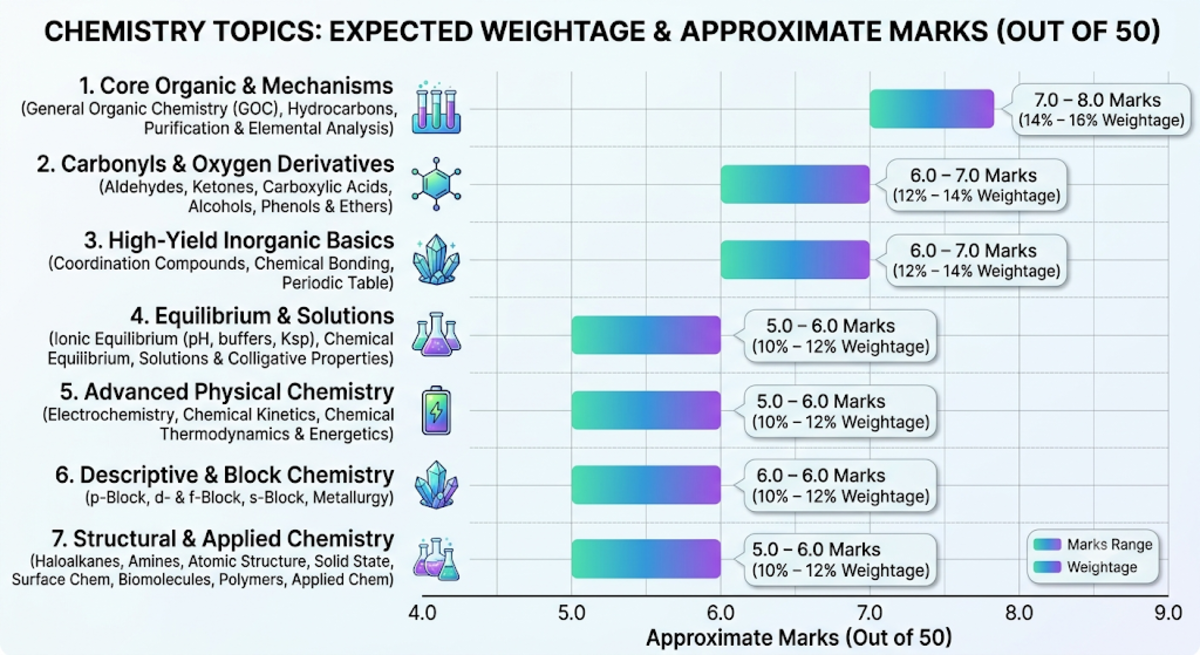
WBJEE Chemistry important chapters cluster into seven groups based on historical question patterns from WBJEEB.
- Core Organic & Mechanisms carries the highest weightage, at 14–16%.
- Carbonyls, Oxygen Derivatives, and High-Yield Inorganic Basics each carry 12–14%.
- The remaining four clusters fall in the 10–12% range, spreading the rest of the paper fairly evenly.
| Topics | Included Chapters | Expected Weightage (%) | Approx. Marks (Out of 50) |
|---|---|---|---|
| 1. Core Organic & Mechanisms | General Organic Chemistry (GOC), Hydrocarbons (Alkanes, Alkenes, Alkynes, Benzene), Purification & Elemental Analysis | 14% – 16% | 7.0 – 8.0 |
| 2. Carbonyls & Oxygen Derivatives | Aldehydes & Ketones, Carboxylic Acids & Derivatives, Alcohols, Phenols & Ethers | 12% – 14% | 6.0 – 7.0 |
| 3. High-Yield Inorganic Basics | Coordination Compounds, Chemical Bonding & Molecular Structure, Periodic Table & Classification | 12% – 14% | 6.0 – 7.0 |
| 4. Equilibrium & Solutions | Ionic Equilibrium (pH, buffers, Ksp), Chemical Equilibrium, Solutions & Colligative Properties | 10% – 12% | 5.0 – 6.0 |
| 5. Advanced Physical Chemistry | Electrochemistry, Chemical Kinetics, Chemical Thermodynamics & Energetics | 10% – 12% | 5.0 – 6.0 |
| 6. Descriptive & Block Chemistry | p-Block Elements (Groups 13 to 18), d- & f-Block Elements, s-Block Elements & Hydrogen, Metallurgy (Principles of Isolation) | 10% – 12% | 5.0 – 6.0 |
| 7. Structural & Applied Chemistry | Haloalkanes & Haloarenes, Amines & Diazonium Salts, Atomic Structure & Redox Reactions, Solid State & Surface Chemistry, Biomolecules, Polymers, & Applied Chem | 10% – 12% | 5.0 – 6.0 |
Ques. Which chapters in Chemistry are high-weightage for the WBJEE?
Ans. Core Organic & Mechanisms carry the highest cluster weightage, at 14–16%, followed by Carbonyls/Oxygen Derivatives and High-Yield Inorganic Basics at 12–14% each.
WBJEE Question Paper with Solution PDF
| Paper | Question Paper PDF | Solution PDF |
|---|---|---|
| WBJEE 2026 Physics & Chemistry Question Paper | Download PDF | Check Here |
| WBJEE 2025 Physics & Chemistry | Download PDF | Check Here |
| WBJEE 2025 Physics | Download | Check Solutions |
WBJEE Chemistry Exam Pattern 2027
Chemistry is included in Paper 2, alongside Physics, carrying 50 marks across 40 multiple-choice questions.
- The exam is conducted in an offline, OMR-based format.
- The Chemistry section has three categories, each with its own marking rules.
- In Categories 1 and 2, selecting more than one option counts as an incorrect answer and triggers negative marking.
- Category 3 has no negative marking. Marking all correct options with no incorrect ones gives the full 2 marks. Marking only some correct options gives partial marks, using the number of correct options marked divided by the total correct options, multiplied by 2.
- Marking any incorrect option in Category 3 gives a score of 0 for that question.
| Category | Number of Questions | Marks per Correct Answer | Negative Marking | Multiple Correct Options? |
|---|---|---|---|---|
| Category 1 | 30 | +1 Mark | -0.25 Mark | No (Only one option is correct) |
| Category 2 | 5 | +2 Marks | -0.5 Mark | No (Only one option is correct) |
| Category 3 | 5 | +2 Marks | None | Yes (One or more options can be correct) |
| Total | 40 Questions | 50 Marks | — | — |
Ques. What is the WBJEE exam pattern for Chemistry?
Ans. 40 questions worth 50 marks, split into three categories with different marking rules.
Ques. Is there negative marking in Category 3 of WBJEE Chemistry?
Ans. No. Category 3 has no negative marking, but an incorrect option drops the score for that question to 0.
Check Out:
WBJEE Chemistry Syllabus: Class 11 vs Class 12 Topics
Class 12 topics hold higher weightage overall. Heavy blocks like Coordination Compounds, p/d/f-block elements, and advanced Organic functional groups push Class 12 to 55–60%, against Class 11's 40–45%.
Physical Chemistry
- Physical Chemistry is formula-driven. Solid conceptual foundations give a high accuracy rate.
- Physical Chemistry takes about 35% – 38% of the total exam weightage.
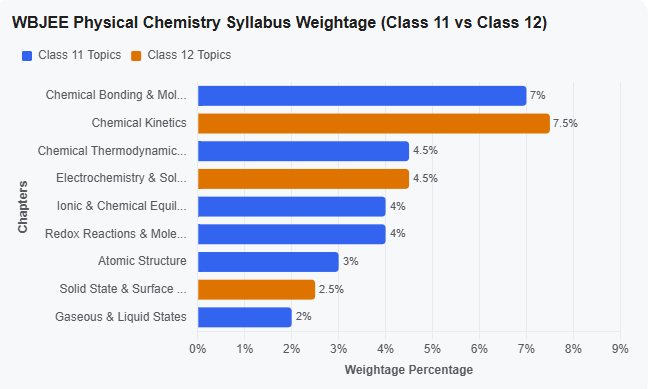
- Chemical Kinetics (Class 12) and Chemical Bonding (Class 11) regularly fetch the highest number of direct questions in this section.
| Class 11 Chapters | Weightage | Class 12 Chapters | Weightage |
|---|---|---|---|
| Chemical Bonding & Molecular Structure | 6% – 8% | Chemical Kinetics | 7% – 8% |
| Chemical Thermodynamics / Energetics | 4% – 5% | Electrochemistry & Solutions | 4% – 5% |
| Ionic & Chemical Equilibrium | 4% | Solid State & Surface Chemistry | 2% – 3% |
| Atomic Structure | 3% | — | |
| Redox Reactions & Mole Concept | 3% – 5% | ||
| Gaseous & Liquid States | 2% | ||
Organic Chemistry
- Organic Chemistry requires mastery over mechanisms, name reactions, and multi-step conversions.
- Organic Chemistry takes about 32% – 35% of the total exam weightage.
- GOC is foundational. Skipping it hurts your ability to solve Class 12 conversion questions.
- Reactions involving Aldehydes, Ketones, and Carboxylic Acids feature heavily in Category 2 and 3 questions.
| Class 11 Chapters | Weightage | Class 12 Chapters | Weightage |
|---|---|---|---|
| General Organic Chemistry (GOC) | 6% – 7% | Oxygen-Containing Compounds (Alcohols, Phenols, Ethers, Aldehydes, Ketones, Carboxylic Acids) | 7% – 8% |
| Hydrocarbons (Alkanes, Alkenes, Alkynes) | 3% | Haloalkanes & Haloarenes | 3% |
| Environmental Chemistry | 1% | Nitrogen-Containing Compounds (Amines) | 3% |
| — | Polymers & Biomolecules | 3% | |
Inorganic Chemistry
- Inorganic Chemistry is highly theoretical. A major portion comes directly from Class 12 blocks.
- Inorganic Chemistry takes about 30% – 32% of the total exam weightage.
- Coordination Compounds and the complete p-Block spectrum are the heavyweights here.
| Class 11 Chapters | Weightage | Class 12 Chapters | Weightage |
|---|---|---|---|
| s-Block Elements | 4% – 6% | p-Block Elements (Groups 15 to 18) | 6% – 8% |
| p-Block Elements (Groups 13 & 14) | 2% | d & f-Block (Transition Elements) | 6% |
| Periodic Table & Properties | 2% | Coordination Compounds | 4% |
| Hydrogen | 1% | Metallurgy / Extraction of Metals | 2% |
Ques. Which carries more weightage, Class 11 or Class 12 Physical Chemistry?
Ans. Class 12, led by Chemical Kinetics at 7–8%.
JEE Chemistry vs WBJEE Chemistry Syllabus
JEE Main removed several chapters after NCERT syllabus rationalisation. WBJEE retains the complete, unreduced syllabus. This means WBJEE Chemistry covers more chapters than JEE Main.
JEE Main Chemistry Focus:
- Equal distribution across Physical, Organic, and Inorganic Chemistry.
- Physical Chemistry sits almost exclusively in Section B (Numerical Value Questions), with internal choices.
- Inorganic questions focus on Coordination Compounds and Chemical Bonding at a high level.
WBJEE Chemistry Focus:
- Organic Chemistry dominates Category 2 and 3 questions, specifically Class 12 Oxygen and Nitrogen compounds.
- p-block, s-block, and Metallurgy reactions cannot be skipped. They give direct, quick-scoring points in Category 1.
- Physical Chemistry appears across all three categories, so numerical calculations must be solved without answer options to eliminate from.
| Feature / Chapter | JEE Main Chemistry | WBJEE Chemistry |
|---|---|---|
| Syllabus Reduction | Reduced. Around 8-9 chapters were removed recently | No Major Reduction. It continues to test the traditional full syllabus. |
| Solid State & Surface Chemistry | Removed | Included (High conceptual weightage) |
| s-Block & Metallurgy | Removed | Included (Direct, fact-based questions) |
| Polymers & Chemistry in Everyday Life | Removed | Included (Scoring, formula/structure-based) |
| Environmental Chemistry | Removed | Included |
Ques. Does WBJEE Chemistry include chapters JEE Main removed?
Ans. Yes. WBJEE includes Solid State, Surface Chemistry, Metallurgy, s-Block, Polymers, and Environmental Chemistry, all of which JEE Main dropped.
Best Books for WBJEE Chemistry Syllabus 2027
Book selection must cover two areas for WBJEE Chemistry preparation: solidifying foundational concepts and mastering the exam's three-category question pattern, especially the tricky Category 3 questions.
- Complete NCERT and WBCHSE textbooks first.
- Use reference books selectively for difficult topics.
- Prioritise WBJEE chapter-wise questions and previous-year papers (WBJEE PYQ) to get familiar with Category 1, 2, and 3 questions.
| Book / Resource | Author / Publisher | How It Helps in WBJEE Chemistry Preparation |
|---|---|---|
| NCERT Chemistry Class 11 & 12 | NCERT | Covers fundamental concepts, inorganic reactions, periodic trends, chemical bonding, and organic chemistry mechanisms |
| WBCHSE Chemistry Class 11 & 12 | Chhaya Prakashani / Santra Publication | Covers state-board-specific topics, laboratory preparations, reactions, metallurgy, and polymers that may receive additional emphasis in WBJEE |
| Physical Chemistry | O.P. Tandon / P. Bahadur | Provides solved numerical examples and practice problems for topics such as equilibrium, electrochemistry, thermodynamics, and chemical kinetics |
| Organic Chemistry | Morrison & Boyd | Builds conceptual understanding of reaction mechanisms, named reactions, and multi-step organic conversions |
| Advanced Problems in Organic Chemistry | M.S. Chouhan | Offers higher-level practice for organic reaction mechanisms, conversions, and multi-concept questions |
| Concise Inorganic Chemistry | J.D. Lee | Helps strengthen periodic properties, chemical bonding, coordination compounds, and inorganic reaction concepts |
| WBJEE Chapterwise Explorer – Chemistry | MTG Editorial Board | Provides chapterwise practice questions aligned with the WBJEE syllabus and its different question categories |
| A Textbook of Chemistry for WBJEE | Arihant Publications | Offers syllabus-based explanations, solved examples, and targeted exercises for WBJEE preparation |
| WBJEE 20+ Years Solved Papers | Arihant / MTG | Helps identify recurring question patterns, understand exam difficulty, and practise previous-year questions across all three categories |
Ques. Which books are best for WBJEE Chemistry preparation?
Ans. NCERT Chemistry Class 11 & 12 and WBCHSE textbooks first, then O.P. Tandon for Physical Chemistry, Morrison & Boyd for Organic Chemistry, and J.D. Lee for Inorganic Chemistry.
WBJEE Chemistry Sample Paper 2027
| WBJEE Chemistry Sample Paper | Direct Link |
|---|---|
| WBJEE Chemistry Sample Paper 20 (Latest) | Download PDF |
| WBJEE Chemistry Sample Paper 19 (Latest) | Download PDF |
| WBJEE Chemistry Sample Paper 18 (Latest) | Download PDF |
| WBJEE Chemistry Sample Paper 17 (Latest) | Download PDF |
| WBJEE Chemistry Sample Paper 16 (Latest) | Download PDF |
| WBJEE Chemistry Sample Paper 15 (Latest) | Download PDF |
| WBJEE Chemistry Sample Paper 14 (Latest) | Download PDF |
| WBJEE Chemistry Sample Paper 13 (Latest) | Download PDF |
| WBJEE Chemistry Sample Paper 12 (Latest) | Download PDF |
| WBJEE Chemistry Sample Paper 11 (Latest) | Download PDF |
| WBJEE Chemistry Sample Paper 10 | Download PDF |
| WBJEE Chemistry Sample Paper 9 | Download PDF |
| WBJEE Chemistry Sample Paper 8 | Download PDF |
| WBJEE Chemistry Sample Paper 7 | Download PDF |
| WBJEE Chemistry Sample Paper 6 | Download PDF |
| WBJEE Chemistry Sample Paper 5 | Download PDF |
| WBJEE Chemistry Sample Paper 4 | Download PDF |
| WBJEE Chemistry Sample Paper 3 | Download PDF |
| WBJEE Chemistry Sample Paper 2 | Download PDF |
| WBJEE Chemistry Sample Paper 1 | Download PDF |
WBJEE Chemistry Syllabus 2027: Preparation Strategy
Follow the tips below to prepare effectively for the WBJEE Chemistry exam:
- Clear the basics first. Master Chemical Bonding and GOC early. They act as structural prerequisites for almost 40% of the entire paper.
- Prioritise Class 12 application blocks. Revise Chemical Kinetics, Coordination Compounds, and Oxygen Organic Compounds through past WBJEE papers, since their question patterns repeat.
- Build a formula and exception log. For Physical Chemistry, log every formula with its units, especially in Electrochemistry and Solutions. For Inorganic Chemistry, log exceptions in trends, such as atomic radii and ionisation enthalpy anomalies in the p-block.
- Solve at least the past 15 years of WBJEE Chemistry papers (wbjee pyq). Physical chemistry numerical profiles, like packing efficiency in Solid State or first-order kinetics half-life, repeat with different values almost every alternate year.
| Preparation Strategy | How to Implement |
|---|---|
| Clear Fundamental Concepts |
|
| Prioritize High-Weightage Class 12 Topics |
|
| Maintain a Formula and Exception Log |
|
| Cover WBJEE-Specific Chapters |
|
| Practise Category 3 Questions |
|
| Prepare Organic Conversion Charts |
|
| Solve Previous-Year Question Papers |
|
| Revise Numerical-Based Topics |
|
WBJEE Chemistry Syllabus FAQs
Ques. Which chapters in Chemistry are high-weightage for the WBJEE?
Ans. Core Organic & Mechanisms, Carbonyls & Oxygen Derivatives, and High-Yield Inorganic Basics carry the highest weightage, together worth around 38–44% of the paper.
Ques. What is the WBJEE exam pattern for Chemistry?
Ans. 40 questions worth 50 marks, split into three categories, each with its own marking scheme.
Ques. Is WBJEE Chemistry syllabus tougher than JEE Main?
Ans. It is longer, not necessarily tougher. WBJEE retains chapters JEE Main removed, so the total syllabus coverage is wider.
Ques. Which chapters did JEE Main remove that WBJEE still includes?
Ans. Solid State, Surface Chemistry, Metallurgy, s-Block Elements, Polymers, Chemistry in Everyday Life, and Environmental Chemistry.
Ques. How is Category 3 marked in WBJEE Chemistry?
Ans. No negative marking applies, but selecting even one incorrect option drops the score for that question to zero. Partial marks are given using correct options marked divided by total correct options, multiplied by 2.
Ques. Which books should I use for WBJEE Chemistry preparation?
Ans. NCERT and WBCHSE textbooks first, then O.P. Tandon, Morrison & Boyd, and J.D. Lee for Physical, Organic, and Inorganic Chemistry respectively.



Comments